

Submitted:
07 August 2025
Posted:
11 August 2025
You are already at the latest version
Abstract
Chemical sensors have undergone transformative advances in recent years due to the convergence of nanomaterials, advanced fabrication techniques, and state-of-the-art characterization methods. This review analyzes developments from 2019 to 2025 in the design and application of next-generation chemical sensors, with a focus on the United States as a key driver of global innovation. Nanomaterials such as graphene derivatives, MXenes, carbon nanotubes, metal–organic frameworks, and hybrid composites have enabled unprecedented sensitivity and selectivity, achieving detection limits down to parts-per-billion and even parts-per-trillion levels for gases, ions, and biomolecules. Concurrently, additive manufacturing, miniaturization, and flexible electronics have facilitated the creation of wearable, stretchable, and implantable sensors, expanding their utility in healthcare diagnostics, environmental monitoring, food safety, and industrial process control. Advanced characterization techniques including in-situ spectroscopy and high-resolution microscopy have elucidated interfacial mechanisms, guiding rational material design. Despite these advances, challenges remain in terms of scalability, reproducibility, long-term stability, and regulatory compliance, while data privacy emerges as a key concern for IoT-integrated sensing networks. Future perspectives highlight the integration of artificial intelligence and machine learning for real-time data interpretation, development of green and biodegradable materials, and the convergence of multidisciplinary approaches to address societal needs. Overall, nanomaterial-enabled chemical sensors are poised to become essential tools for advancing public health, environmental sustainability, and industrial innovation.
Keywords:
chemical sensors
; nanomaterials
; MXenes
; metal–organic frameworks (MOFs)
; graphene-based materials
; wearable sensors
; additive manufacturing
; advanced characterization
; Internet of Things (IoT)
; artificial intelligence (AI)
1. Introduction
Chemical sensors play a central role in modern analytical science, offering real-time, selective, and sensitive detection of chemical species across gas, liquid, and solid phases. These devices typically consist of three key components: a recognition element (such as a nanostructured material), a transduction system (electrical, optical, thermal, or piezoelectric), and a signal-processing module. The fundamental operation involves capturing a molecular interaction or binding event and converting it into a measurable output. Over the past two decades, a significant transformation has occurred in the field, driven largely by the development of novel nanomaterials and their integration into compact, portable, and often wearable sensing platforms [1,2].
Historically, chemical sensors were dominated by metal oxide semiconductors such as SnO₂, ZnO, and TiO₂, especially for gas detection [3]. These materials are still widely used today but have been surpassed in performance by nanostructured materials with higher specific surface areas, tunable surface chemistries, and advanced electronic or photonic properties. Carbon nanotubes (CNTs), for instance, have been implemented in chemiresistive and field-effect transistor (FET) sensor architectures, demonstrating parts-per-billion (ppb) detection limits for NO₂, NH₃, and volatile organic compounds (VOCs) [4]. Graphene-based materials—including graphene oxide and reduced graphene oxide—have shown exceptional promise for both chemical and biosensing, particularly when modified with functional groups or metallic nanoparticles [5,6]. More recently, metal–organic frameworks (MOFs) have emerged as a class of crystalline, porous materials with high surface area and chemical tunability. Their potential in gas sensing is increasingly recognized, especially when integrated with transducers like QCM, SPR, or electrochemical cells [7,8,9]. MOFs such as ZIF-8, HKUST-1, and MIL-101 have been used to detect CO₂, SO₂, H₂S, and various VOCs under ambient conditions, often outperforming conventional sensors in selectivity and stability [10,11,12]. Meanwhile, two-dimensional (2D) materials like MoS₂, WS₂, and MXenes have shown promise in flexible sensing applications due to their high electronic mobility and mechanical robustness [5,13,14]. In the United States, sensor technologies are considered strategic across environmental, healthcare, industrial, defense, and infrastructure sectors. The Environmental Protection Agency (EPA), for example, supports the deployment of low-cost air quality sensors to monitor ozone, particulate matter, and NO₂ in urban and rural environments, as part of its “Air Sensor Toolbox” initiative [15,16]. The National Institutes of Health (NIH) and National Science Foundation (NSF) have funded numerous projects focusing on wearable sensors for health diagnostics, such as glucose, lactate, cortisol, and hydration levels from sweat and interstitial fluid [17,18]. These sensors are also finding applications in early disease detection, remote patient monitoring, and pandemic preparedness.
The integration of chemical sensors into smart infrastructure is advancing rapidly. Cities such as New York, Los Angeles, and San Francisco are incorporating networks of air quality and environmental sensors to manage urban mobility, public health, and emergency response systems [19]. Furthermore, smart homes and industrial facilities now include embedded chemical sensors for detecting gas leaks, VOC emissions, or equipment degradation in real-time, feeding data into machine learning platforms for predictive maintenance [20]. The global chemical sensors market reflects this expansion. Recent market analyses estimate the 2024 market value at USD 24.9 billion, with projections exceeding USD 55 billion by 2034 [21]. North America holds a substantial share (~35%), and within the United States, the sector is growing at a compound annual rate of 8.6%, driven by environmental regulations, healthcare diagnostics, and industrial automation [22]. Notably, startups and academic spinoffs in Boston, San Diego, and the Bay Area are at the forefront of commercializing chemical sensor technologies for portable and personalized use. Another major trend is the shift toward flexible, stretchable, and biodegradable sensor platforms. Advances in additive manufacturing—such as aerosol jet printing, inkjet printing, and extrusion-based 3D printing—have enabled the fabrication of low-cost, scalable sensor arrays on substrates like polyimide, PDMS, and paper [23]. These developments facilitate mass production of wearable devices that conform to the human body, essential for next-generation medical diagnostics, athletic performance tracking, and military applications [23]. Simultaneously, artificial intelligence (AI) and machine learning are increasingly integrated into sensor systems, improving signal classification, drift correction, and real-time decision-making. AI-enhanced “electronic nose” systems, for example, are used for complex odor and VOC pattern recognition in environmental and food quality monitoring [24,25]. In healthcare, AI algorithms are being applied to predict dehydration, blood glucose fluctuations, or infectious disease onset from multivariate sensor datasets. A crucial element supporting these developments is the use of advanced characterization techniques. Methods such as Raman spectroscopy, X-ray photoelectron spectroscopy (XPS), Fourier-transform infrared spectroscopy (FTIR), scanning electron microscopy (SEM), transmission electron microscopy (TEM), atomic force microscopy (AFM), and electrochemical impedance spectroscopy (EIS) are routinely employed to understand material–analyte interactions, sensor surface chemistry, and degradation mechanisms. These insights are vital for rational sensor design and reliability under diverse operating conditions.
Despite these advances, challenges remain. Sensor drift over time, reproducibility across batches, power consumption, cross-sensitivity to interferents, and calibration under variable conditions all require further study. Moreover, regulatory frameworks for wearable chemical sensors, particularly in healthcare applications, are still evolving and can delay commercialization. Sustainability is also emerging as a key concern, with increasing interest in green synthesis methods, biodegradable substrates, and recycling of spent devices [26]. This review aims to provide a comprehensive analysis of recent progress (2019–2025) in U.S.-led chemical sensor technologies, focusing on four main dimensions: (1) novel sensing materials, (2) advanced fabrication methods, (3) characterization and performance evaluation, and (4) real-world applications in healthcare, environment, food safety, and industrial systems. We highlight synergies between nanomaterial science, engineering design, data science, and translational research. Furthermore, we outline future perspectives and technological bottlenecks that must be addressed to enable wide-scale deployment of smart, robust, and sustainable sensor platforms. This convergence of application-driven demand and materials innovation sets the stage for a detailed examination of the nanomaterials that underpin state-of-the-art chemical sensors.
2. Material for Advanced Chemical Sensors
The performance of chemical sensors is intimately linked to the properties of the materials used in their construction. Over the past decade, the discovery and engineering of nanostructured materials have led to major breakthroughs in sensitivity, selectivity, response time, and device stability. This section reviews the main classes of sensing materials that have shaped the evolution of next-generation chemical sensors, highlighting their structural features, functional advantages, and integration potential.
2.1. Carbon-Based Nanomaterials
Carbon-based nanomaterials have emerged as one of the most prominent platforms for advanced chemical sensor development due to their exceptional physicochemical properties, tunable electronic structure, high specific surface area, and versatile functionalization capabilities [27]. Among these, graphene, reduced graphene oxide (rGO), and carbon nanotubes (CNTs) are the most extensively explored materials in the field of chemical sensing.
Graphene, a single-atom-thick two-dimensional (2D) sheet of sp²-hybridized carbon atoms arranged in a hexagonal lattice, exhibits outstanding electrical conductivity, mechanical strength, and thermal stability [28]. Its high electron mobility at room temperature (~200,000 cm²/Vs) makes it particularly attractive for electronic sensing applications where rapid and sensitive transduction of molecular interactions is required [29]. The large specific surface area of graphene (~2630 m²/g) provides abundant sites for analyte adsorption, thus enhancing sensor response [30]. Furthermore, the zero bandgap of pristine graphene can be tuned via chemical doping, defect engineering, or hybridization with other materials to improve its sensitivity and selectivity towards target analytes [31].
Reduced graphene oxide (rGO), derived from the chemical or thermal reduction of graphene oxide (GO), combines some of the electrical conductivity of pristine graphene with residual oxygen-containing functional groups that facilitate chemical modification and functionalization [32]. These functional groups (e.g., hydroxyl, epoxy, carboxyl) not only impart hydrophilicity, enabling stable aqueous dispersions, but also serve as active sites for covalent or non-covalent immobilization of recognition elements such as enzymes, antibodies, or aptamers [33]. Consequently, rGO-based sensors have demonstrated superior performance in detecting gases [34], heavy metal ions [35], and biomolecules [36] compared to unmodified graphene-based platforms, due to the synergy between conductive domains and functional anchoring sites.
Carbon nanotubes (CNTs), both single-walled (SWCNTs) and multi-walled (MWCNTs), represent another widely explored class of carbon nanostructures for chemical sensing applications. CNTs are quasi one-dimensional materials with extraordinary mechanical strength, chemical stability, and electrical conductivity, enabling efficient electron transfer between analytes and electrodes [37]. SWCNTs, in particular, possess tunable electronic properties (metallic or semiconducting) depending on their chirality and diameter, which can be exploited to design sensors with tailored performance characteristics [38]. The hollow tubular morphology of CNTs provides internal and external adsorption sites for analytes, thereby enhancing their sensitivity [39].
A critical aspect in the design of high-performance chemical sensors based on carbon nanomaterials is surface functionalization to improve both sensitivity and selectivity. For instance, functionalization of graphene or rGO with metal nanoparticles (e.g., Au, Pt, Pd) enhances catalytic activity towards specific analytes and facilitates charge transfer between the nanomaterial and the target molecules, resulting in improved sensing performance [40,41]. Non-covalent functionalization using π-π stacking interactions with aromatic compounds or surfactants preserves the conjugated electronic structure of graphene while introducing specific recognition capabilities [42]. Covalent functionalization, although potentially disrupting the sp² network, enables strong attachment of molecular recognition elements, which is essential in biosensor designs [43,44]. In the case of CNTs, functionalization strategies include acid treatment to introduce carboxyl and hydroxyl groups on the surface, enabling further conjugation with biomolecules or polymers [45]. Additionally, decorating CNTs with conducting polymers such as polyaniline (PANI) or polypyrrole (PPy) has been shown to enhance selectivity towards gases like ammonia and nitrogen dioxide by synergistically combining the redox responsiveness of polymers with the conductive properties of CNTs [46,47]. Recent advancements also involve the development of hybrid nanocomposites, where carbon-based nanomaterials are combined with metal oxides (e.g., ZnO, TiO₂, SnO₂) to achieve enhanced sensitivity, stability, and selectivity towards a broad range of analytes [48,49]. Such hybrid systems leverage the high surface area and conductive network of carbon nanomaterials with the inherent catalytic or adsorption capabilities of metal oxides, resulting in superior sensing performance in terms of response time, limit of detection (LOD), and operational stability [50]. For example, a graphene/ZnO nanocomposite-modified electrode has been reported to exhibit remarkable sensitivity towards hydrogen peroxide with a low detection limit and rapid response time due to the synergistic catalytic activity of ZnO nanoparticles and the high conductivity of graphene sheets [51]. Similarly, rGO-TiO₂ composites have been employed in photoelectrochemical sensors, where rGO enhances charge separation and transport under illumination, thereby improving the photocurrent response upon analyte binding [52].
In summary, carbon-based nanomaterials, particularly graphene, rGO, and CNTs, offer a versatile platform for chemical sensor development due to their intrinsic electronic properties, high surface area, and amenability to surface functionalization. Ongoing research focuses on optimizing functionalization strategies to tailor their surface chemistry towards specific analytes while maintaining or enhancing their electrical properties. Moreover, the integration of these nanomaterials into flexible, wearable, and miniaturized sensor devices is opening new avenues for their application in environmental monitoring, healthcare diagnostics, and industrial process control [53,54].
2.2. Metal and Metal Oxide Nanostructures
Metal and metal oxide nanostructures form a cornerstone of modern chemical sensing technologies due to their intrinsic physicochemical properties, versatile morphologies, and well-established synthesis methods that facilitate integration into practical devices. Their widespread use arises from their high surface-to-volume ratios, tunable electronic structures, catalytic activity, and chemical stability, which collectively enable highly sensitive and selective detection of a broad spectrum of chemical analytes, including gases, ions, and biomolecules. Among these materials, zinc oxide (ZnO) has emerged as one of the most widely studied metal oxides for chemical sensors. ZnO is an n-type semiconductor with a wide bandgap of 3.37 eV and a large exciton binding energy (~60 meV), properties that confer high electron mobility and strong optical absorption in the UV region [55]. The ability to synthesize ZnO in various nanostructured morphologies, such as nanorods, nanowires, nanosheets, nanobelts, hollow spheres, and hierarchical flower-like assemblies, has been pivotal in tuning its sensing performance [56]. For example, ZnO nanorods and nanowires provide one-dimensional electron transport pathways, enhancing charge carrier mobility, while hierarchical flower-like structures formed by radially oriented nanorods dramatically increase the surface area available for analyte adsorption. This combination of structural features enables ZnO-based sensors to achieve high sensitivity, rapid response, and low detection limits for target gases such as NO₂, ethanol, and volatile organic compounds (VOCs) [57,58]. Similarly, tin dioxide (SnO₂) is a prominent n-type semiconducting metal oxide extensively employed in gas sensing applications. Its wide bandgap (~3.6 eV) and high conductivity modulation in the presence of adsorbed gases make it ideal for detecting reducing gases like CO, H₂, CH₄, and various alcohol vapors [59]. The fundamental sensing mechanism in SnO₂ involves chemisorption of oxygen species on the surface, which creates electron depletion layers; upon exposure to reducing gases, these oxygen species are removed via surface reactions, leading to an increase in electrical conductivity [60]. The fabrication of SnO₂ into nanostructures such as nanorods, nanowires, hollow spheres, and mesoporous architectures enhances the density of active sites, promotes efficient gas diffusion, and improves the kinetics of adsorption–desorption processes [61]. Moreover, doping SnO₂ with noble metals such as Pt, Pd, or Au (see Figure 1), can significantly lower the operating temperature of sensors while enhancing selectivity and catalytic activity towards specific analytes, an aspect critical for energy-efficient and targeted sensing applications [62].
Another noteworthy example is copper oxide (CuO), a p-type semiconductor with a narrow bandgap (~1.2 eV). CuO’s sensing capabilities stem from its strong surface adsorption and redox reactivity, enabling effective detection of gases such as H₂S, NH₃, and NO₂ [63]. The synthesis of CuO nanostructures, including nanoflakes, nanorods, nanoplatelets, and porous microspheres, further amplifies its sensing performance by increasing the availability of reactive sites and facilitating rapid analyte diffusion within the sensor matrix. Additionally, combining CuO with other metal oxides to form heterojunctions, such as CuO–ZnO or CuO–TiO₂, improves sensor performance through the formation of p–n junctions that facilitate charge separation and modulate conductivity upon analyte exposure [64,65].
Titanium dioxide (TiO₂) is another metal oxide widely used in chemical sensing, particularly in photo-assisted applications due to its strong photocatalytic activity and chemical inertness. TiO₂ exists in three crystalline phases (anatase, rutile, brookite), with anatase being preferred for sensing applications because of its higher electron mobility and photocatalytic efficiency [66,67]. Nanostructured TiO₂, fabricated as nanotubes, nanorods, nanobelts, mesoporous films, or hierarchical assemblies, offers enhanced analyte adsorption and fast charge transport [68]. Under UV illumination, TiO₂ generates electron-hole pairs that can participate in surface redox reactions, enabling photoelectrochemical sensing with improved sensitivity and minimal interference from ambient conditions [9]. This characteristic is particularly advantageous for the detection of organic vapors, toxic gases, and biomolecules in aqueous environments [69]. Beyond metal oxides, noble metal nanoparticles such as gold (Au) and silver (Ag) play a crucial role in chemical sensor development due to their unique localized surface plasmon resonance (LSPR) properties [70]. LSPR results in strong absorption and scattering of light at characteristic wavelengths, which are highly sensitive to changes in the surrounding dielectric environment. This forms the basis of various optical sensing strategies, including colorimetric and refractive index-based detection [71,72]. Gold nanoparticles are particularly attractive for biosensing applications due to their excellent chemical stability, ease of functionalization with thiol-linked biomolecular recognition elements, and biocompatibility. They have been widely used in sensors for detecting proteins, nucleic acids, and small biomolecules with high sensitivity and selectivity [73]. Silver nanoparticles, on the other hand, exhibit stronger plasmonic enhancement effects, making them ideal substrates for surface-enhanced Raman scattering (SERS) sensors capable of detecting analytes down to single-molecule levels [1]. A defining feature that underpins the superior performance of metal and metal oxide nanostructures in sensing applications is their structural design, which directly influences material–analyte interactions, charge transfer processes, and sensor stability. For example, hierarchical morphologies, such as flower-like assemblies of nanorods or hollow sphere structures, provide exceptionally high surface areas and facilitate rapid mass transport of analytes, resulting in enhanced sensitivity and faster response-recovery cycles [74]. In ZnO nanoflower-based sensors, the radial arrangement of nanorods not only increases active site availability but also creates open diffusion pathways that promote efficient gas molecule adsorption and desorption [75]. Core–shell architectures represent another powerful design strategy to combine complementary material properties in a single nanostructure. In such systems, the core material often imparts desirable electronic or optical properties, while the shell material governs surface reactivity and analyte selectivity. For instance, Au@TiO₂ core–shell nanoparticles leverage the high conductivity and LSPR effects of gold with the photocatalytic activity of TiO₂, leading to enhanced charge separation and improved photoelectrochemical sensing performance [76]. Similarly, SnO₂@SiO₂ core–shell structures have been shown to improve selectivity by modulating surface chemistry and preventing interference from non-target species, a feature critical for accurate detection in complex matrices [77]. Moreover, facet engineering and shape control of nanostructures can significantly influence their sensing properties. Different crystal facets exhibit distinct atomic arrangements and electronic densities, affecting the adsorption energy and catalytic activity towards analytes. For example, SnO₂ nanocubes exposing <100> facets have demonstrated higher CO sensing performance than nanorods exposing <101> facets due to increased surface oxygen vacancy densities and lower activation energies for gas adsorption reactions [78].
Finally, the design of porous and hollow nanostructures enhances analyte accommodation within internal voids while preserving structural integrity. This leads to improved sensitivity, faster analyte diffusion, and reduced sensor fouling, all essential for prolonged sensor operation with minimal degradation in performance [1]. In summary, metal and metal oxide nanostructures offer a rich design landscape for chemical sensing applications. Their inherent electronic and catalytic properties, coupled with sophisticated structural engineering strategies such as hierarchical morphology construction, core–shell formation, facet control, and porosity tuning, enable the development of sensors with superior sensitivity, selectivity, and operational stability. These materials serve as an essential foundation for integrating advanced functionalities into miniaturized, flexible, and wearable sensor devices, facilitating real-time and accurate detection in environmental monitoring, healthcare diagnostics, food safety assurance, and industrial process control – domains that will be explored in subsequent sections of this review.
2.3. Silicon Nanowires and Semiconductor Materials
Silicon-based nanostructures, particularly silicon nanowires (SiNWs), represent a cornerstone in the development of next-generation chemical sensors due to their superior electronic properties, high surface-to-volume ratios, and compatibility with established semiconductor fabrication technologies. These attributes make SiNWs ideal candidates for highly sensitive, label-free, and real-time detection platforms applicable to environmental monitoring, biomedical diagnostics, and industrial process control. Silicon nanowires are one-dimensional semiconductor structures with diameters ranging from a few to hundreds of nanometers and lengths extending to several micrometers. Their high aspect ratio dramatically increases the density of surface atoms relative to bulk silicon, enabling substantial modulation of their electronic properties upon adsorption of target analytes [79]. The ability to tailor their electrical characteristics through controlled doping further enhances their versatility for sensor design. A particularly impactful integration strategy involves incorporating SiNWs into field-effect transistor (FET) platforms. In such configurations, the nanowire acts as the semiconducting channel bridging source and drain electrodes, while the gate potential is modulated by the adsorption of charged analytes or biomolecules on the nanowire surface. This surface-induced field effect alters the carrier density within the channel, leading to measurable changes in current that directly correlate with analyte concentration [80]. This principle enables label-free detection, eliminating the need for fluorophores or enzymatic amplification, thus simplifying device architecture and facilitating real-time analysis. Seminal work by Cui et al. in 2001 demonstrated the first SiNW-FET biosensor capable of detecting streptavidin through biotin functionalization with high sensitivity [79]. Since then, extensive advances have been made in device architectures, including back-gated, top-gated, and electrolyte-gated FETs. Electrolyte-gated configurations have proven especially suitable for biosensing applications due to their high gate capacitance and direct exposure of the nanowire surface to the analyte-containing solution [81,82]. The fabrication of SiNW-based sensors benefits from both top-down and bottom-up approaches. Top-down fabrication involves defining nanowire structures from silicon-on-insulator (SOI) wafers using lithographic patterning and etching techniques such as electron-beam lithography and reactive ion etching. This method offers precise control over nanowire dimensions, alignment, and doping profiles, and is fully compatible with CMOS processing, enabling large-scale production and integration into microelectronic circuits [81]. However, it requires advanced facilities and is cost-intensive. Bottom-up synthesis, primarily achieved via vapor–liquid–solid (VLS) growth mechanisms using metal nanoparticle catalysts (typically Au), enables the production of single-crystalline SiNWs with excellent electronic properties and tunable dimensions [83]. These nanowires can be assembled onto pre-patterned electrodes using techniques such as dielectrophoresis or contact printing, although challenges remain in achieving precise large-scale alignment for device integration. Advances in microfabrication have also facilitated the incorporation of SiNWs into microelectromechanical systems (MEMS) and nanoelectromechanical systems (NEMS). These hybrid devices combine electrical and mechanical sensing modalities, enabling enhanced performance and multifunctionality. For example, MEMS cantilever arrays coated with SiNWs allow for mass-based sensing through deflection or resonance frequency shifts upon analyte binding, providing high sensitivity and multiplexed detection capabilities [84]. NEMS devices employing ultra-thin SiNWs can achieve attogram-level mass resolution, enabling the detection of individual virus particles or nanoparticles by monitoring resonance frequency shifts as target analytes adsorb onto the nanowire surface [85]. Additionally, integration of SiNW sensors with on-chip microfluidic systems and wireless readout electronics has led to the development of portable diagnostic devices capable of rapid, real-time analysis of biomarkers, pathogens, and environmental pollutants [86]. The combination of SiNWs with plasmonic nanoparticles or quantum dots has also been explored to create hybrid optoelectronic sensors with enhanced sensitivity and tailored spectral responses for specific analytes [87].
Despite these advances, challenges remain in the large-scale and reproducible manufacturing of SiNW-based sensors, long-term operational stability, and biocompatibility for in vivo applications. Strategies such as optimized surface passivation, antifouling coatings, and system-level packaging are under active investigation to address these limitations. Overall, silicon nanowires and related semiconductor nanomaterials provide a versatile and scalable platform for chemical sensing, enabling the development of highly sensitive, miniaturized, and integrable devices essential for future applications in environmental monitoring, healthcare diagnostics, food safety, and industrial process surveillance.
2.4. Metal–Organic Frameworks (MOFs) and Hybrid Composites
Metal–organic frameworks (MOFs) have emerged as a powerful class of materials in chemical sensing due to their exceptionally high surface areas, tailorable pore structures, and versatile chemical functionalities. MOFs are crystalline porous materials formed by the self-assembly of metal ions or clusters (nodes) with organic linkers (ligands), resulting in frameworks with well-defined pore sizes and tunable chemical environments [88]. This structural modularity enables precise control over adsorption selectivity, molecular recognition, and catalytic activity, which are critical for the design of high-performance chemical sensors. A key advantage of MOFs is their tailorable pore structures, which can be engineered to achieve size- and shape-selective sensing of target analytes. For instance, modification of organic linkers or choice of metal centers allows tuning of pore dimensions to match specific gas or vapor molecules, enhancing both selectivity and adsorption capacity [89]. Furthermore, the incorporation of functional groups within the framework, such as amine, thiol, or carboxyl moieties, introduces specific chemical affinities, facilitating selective detection via strong host–guest interactions or coordination chemistry [90]. This tunability enables MOFs to act as molecular sieves and pre-concentration layers in sensor architectures, improving sensitivity and lowering detection limits.
Despite these advantages, the intrinsic insulating nature of many pristine MOFs initially limited their direct use as transducer materials. Recent strategies to overcome this limitation include the synthesis of electrically conductive MOFs, incorporation of redox-active metal centers or ligands, and formation of hybrid composites with conductive materials such as graphene, carbon nanotubes, or metal nanoparticles [91]. For example, conductive 2D MOFs based on metal bis(dithiolene) or bis(dithiolene diimine) motifs have demonstrated electrical conductivities up to 100 S/cm, enabling their direct integration into chemiresistive sensor devices [92].
A recent U.S.-based study by Campbell et al. demonstrated the development of a Cu₃(HHTP)₂ (HHTP = 2,3,6,7,10,11-hexahydroxytriphenylene) conductive MOF thin film sensor for ammonia detection [93]. The device exhibited a linear and reversible response to NH₃ at parts-per-million levels with rapid response times (< 30 s), attributed to the strong interaction between NH₃ molecules and open copper sites within the MOF structure combined with its intrinsic electrical conductivity (see Figure 2). This represents a significant advance towards practical MOF-based gas sensors operable at room temperature with low power consumption. Hybrid composites combining MOFs with other functional nanomaterials have further enhanced sensor performance by leveraging synergistic effects. For instance, the integration of MOFs with graphene oxide (GO) or reduced graphene oxide (rGO) improves electrical conductivity and mechanical stability while maintaining the high porosity and selective adsorption properties of MOFs [94]. An example is the ZIF-8/rGO composite sensor developed for VOC detection, where ZIF-8 provides selective adsorption of target vapors while rGO enables efficient charge transport, resulting in enhanced sensitivity and rapid response [95,96,97]. Moreover, MOF–metal nanoparticle composites have been utilized for catalytically assisted sensing. The encapsulation or deposition of noble metal nanoparticles (e.g., Au, Pt, Pd) within MOF structures facilitates catalytic decomposition or redox reactions of analytes, producing measurable electrical or optical signals [90]. For example, a recent study reported Au@MIL-101 composites for hydrogen peroxide sensing, where the Au nanoparticles catalyze the decomposition of H₂O₂ while MIL-101 ensures high dispersion and accessibility of active sites [98]. The integration of MOFs with microfabrication and printing techniques has also advanced rapidly in the United States. Researchers have successfully fabricated MOF thin films via layer-by-layer deposition, spray-coating, and inkjet printing, enabling scalable production of flexible and miniaturized sensors compatible with wearable and portable devices [99,100]. For example, microfabricated MOF-coated quartz crystal microbalance (QCM) sensors have demonstrated highly selective and sensitive detection of aromatic VOCs such as benzene, toluene, and xylene (BTX) through size-selective adsorption within the MOF pores [101].
Additionally, the development of MOF-derived materials, where MOFs serve as sacrificial templates for synthesizing porous metal oxides, carbons, or metal–carbon composites, has expanded the range of functional sensing materials. These MOF-derived structures often retain the high porosity and tunable morphology of the parent MOF while exhibiting enhanced conductivity and stability, making them suitable for electrochemical and gas sensing applications [102]. MOFs and hybrid composites offer unique opportunities for chemical sensor development due to their structural tunability, high porosity, and versatile functionalization strategies. Recent U.S.-based research continues to drive innovations in conductive MOF design, integration with electronic transducers, and scalable fabrication approaches, paving the way for next-generation sensors with high sensitivity, selectivity, and operational stability suitable for environmental monitoring, industrial safety, and biomedical diagnostics.
2.5. Emerging Materials
In recent years, the exploration of emerging materials for chemical sensing applications has expanded beyond traditional semiconductors and noble metals, with a focus on advanced two-dimensional (2D) materials, conductive polymers, and bioinspired platforms. Among 2D materials, graphene was the initial focus due to its exceptional surface area, mechanical strength, and electronic properties. However, research has rapidly diversified towards other 2D materials such as transition metal dichalcogenides (TMDs), MXenes, and black phosphorus, which offer tunable band gaps, rich surface chemistries, and synergistic functionalities that are highly attractive for chemical sensor development [103].
Molybdenum disulfide (MoS₂), a prototypical TMD, exhibits a direct band gap in its monolayer form (~1.8 eV), high on/off current ratios in field-effect transistors (FETs), and significant chemical sensitivity due to abundant edge sites and defect-mediated interactions with analytes. Recent studies have demonstrated MoS₂-based FET sensors with femtomolar detection limits for biomolecules such as dopamine, enabled by surface functionalization with aptamers or metal nanoparticles to enhance specificity and electronic transduction efficiency [104,105].
MXenes, a class of early transition metal carbides and nitrides with general formula Mₙ₊₁XₙTₓ, have emerged as highly promising candidates for chemical sensing due to their metallic conductivity, hydrophilic nature, and surface termination versatility (–OH, –F, –O groups). For example, Ti₃C₂Tₓ MXene-based sensors have exhibited rapid response times (<1 s) and low detection limits (ppb range) towards volatile organic compounds (VOCs) such as ethanol and acetone, attributed to strong analyte adsorption and high carrier mobility [106,107]. Recent advances have demonstrated the potential of MXene-based hybrids in agricultural sensing. For instance, Kumar et al. [108] developed a chemoresistive sensor combining SnO₂ nanoparticles with Ti₃C₂Tₓ MXene sheets to detect methyl jasmonate (MeJA), a volatile ester released by plants under insect attack. The SnO₂/MXene nanocomposite formed a p–n heterojunction, enhancing charge separation and catalytic oxidation of MeJA, achieving a detection limit as low as 120 ppb with high selectivity and rapid response even at 125°C (Figure 3). Remarkably, real-time testing on tomato plants infested with Tuta absoluta revealed sensor responses 10 times higher than uninfested controls, underscoring its applicability in precision agriculture and early pest detection systems [108].
Additionally, recent approaches integrate MXenes with conductive polymers or metal-organic frameworks (MOFs) to achieve synergistic enhancements in sensitivity, selectivity, and environmental stability [109]. Conductive polymers such as polyaniline (PANI), polypyrrole (PPy), and poly(3,4-ethylenedioxythiophene) (PEDOT) remain versatile platforms due to their tunable conductivity, facile synthesis, and ability to incorporate functional dopants or biomolecular recognition elements [110,111]. Recent innovations include the fabrication of PANI nanofiber networks for ammonia sensing with detection limits down to sub-ppm levels [112], and PPy-based nanocomposites integrated with carbon nanomaterials for electrochemical detection of heavy metal ions with enhanced preconcentration and electron transfer capabilities [113,114]. Beyond synthetic materials, bioinspired and biomimetic sensing platforms are gaining momentum, leveraging natural recognition mechanisms and hierarchical architectures. For instance, silk fibroin and peptide-functionalized nanostructures have been employed to detect volatile analytes and biomolecules with high selectivity under ambient conditions [115,116]. Additionally, the incorporation of natural enzymes or synthetic enzyme-mimicking nanozymes into sensor architectures provides catalytic amplification and specificity, enabling ultrasensitive detection of glucose, organophosphates, and other clinically or environmentally relevant targets [117]. The integration of these emerging materials with microfabrication technologies, flexible substrates, and wireless readout systems is paving the way for next-generation wearable, implantable, and environmental monitoring devices with unprecedented sensitivity, selectivity, and real-time data acquisition capabilities. Continued progress in controlled synthesis, interfacial engineering, and scalable processing remains essential to translate the intrinsic advantages of these novel materials into robust, commercially viable chemical sensor platforms [103,118].
The rich variety of nanomaterials explored for chemical sensing—ranging from carbon-based structures and metal oxides to MOFs and emerging 2D systems—has opened unprecedented opportunities for performance enhancement. However, the successful deployment of these materials in real-world sensing platforms critically depends on the development of suitable fabrication technologies and device architectures that preserve material functionality while enabling integration, scalability, and mechanical adaptability.
3. Fabrication Technologies and Sensor Architectures
The translation of novel sensing materials into practical devices requires equally innovative fabrication strategies. Advances in micro- and nanofabrication techniques, combined with the emergence of flexible and biodegradable substrates, have enabled the development of miniaturized, stretchable, and wearable sensor architectures with enhanced functionality and user adaptability. This section discusses the main fabrication approaches and design strategies that underpin the next generation of chemical sensors, with emphasis on scalable production, structural integration, and compatibility with real-world applications.
3.1. Miniaturization Techniques
The progressive miniaturization of chemical sensors has been a fundamental driver in advancing analytical performance, integration capabilities, and application versatility. Key fabrication strategies enabling miniaturization include soft lithography, nanoimprint lithography, and self-assembly, each offering distinctive advantages in resolution, scalability, and cost-effectiveness.
Soft lithography encompasses a suite of techniques that utilize elastomeric stamps, molds, or conformable photomasks, typically fabricated from polydimethylsiloxane (PDMS), to pattern features at micro- and nanoscale dimensions [119]. It includes microcontact printing (µCP), replica molding, and microtransfer molding, among others. Soft lithography allows for high-throughput patterning of organic, inorganic, and biological materials onto diverse substrates under relatively mild conditions, enabling the fabrication of flexible, stretchable, and biointegrated sensors. For instance, microcontact-printed gold or SAM-based patterns have been used to define electrode architectures in electrochemical sensors with submicron resolution [120].
Nanoimprint lithography (NIL) is a high-resolution, high-throughput patterning technology that relies on mechanical deformation of a resist material using a rigid mold to replicate nanoscale features down to sub-10 nm [121]. Thermal NIL involves heating the resist above its glass transition temperature before imprinting, while UV-NIL uses photocurable resists under ambient conditions. NIL offers advantages over conventional photolithography, such as bypassing diffraction limits and achieving cost-effective patterning without expensive optics or masks. Its applications in sensor fabrication include the creation of periodic nanostructures for surface-enhanced Raman scattering (SERS) substrates, photonic crystals for optical sensors, and nanofluidic channels for molecular detection [122].
Self-assembly leverages the spontaneous organization of molecules, nanoparticles, or block copolymers into ordered structures driven by non-covalent interactions such as van der Waals forces, electrostatic interactions, and hydrogen bonding [123]. This bottom-up approach enables the formation of well-defined architectures without external patterning tools. For example, self-assembled monolayers (SAMs) of alkanethiols on gold provide molecularly precise functionalization layers in electrochemical and optical sensors, imparting selectivity towards specific analytes [124]. Additionally, block copolymer micelles and colloidal nanoparticle arrays have been utilized to fabricate nanostructured sensing films with tunable porosity and surface area, enhancing analyte diffusion and binding capacity [125]. The convergence of these miniaturization techniques with advanced materials and flexible substrates underpins the development of next-generation wearable, implantable, and portable chemical sensors. Future directions include hybrid approaches that integrate top-down lithographic precision with bottom-up self-assembly to achieve hierarchical multiscale architectures with optimized sensing performance and manufacturability.
3.2. Additive Manufacturing and Printing Technologies
Additive manufacturing (AM) and printing technologies have revolutionized the fabrication of chemical sensors by enabling rapid prototyping, design versatility, and direct integration on flexible and unconventional substrates. These techniques are especially attractive for low-cost, scalable production of customized sensor architectures tailored for wearable, implantable, and environmental monitoring applications.
Inkjet printing is a non-contact, digitally controlled technique that deposits picoliter droplets of functional inks onto substrates with high precision [126]. It is compatible with a wide range of materials including metallic nanoparticle inks, carbon nanomaterials, conductive polymers, and biomolecule solutions. Inkjet printing has been employed to fabricate interdigitated electrodes, conductive traces, and sensing films for applications such as glucose sensing, heavy metal ion detection, and gas sensing. For instance, inkjet-printed silver nanoparticle electrodes have enabled flexible amperometric biosensors with low detection limits and stable operation [127].
Aerosol jet printing offers higher resolution (down to ~10 μm) and greater versatility in ink viscosity compared to inkjet printing, by focusing an aerosolized ink stream with a sheath gas before deposition [128]. This allows for conformal printing onto 3D or uneven surfaces, critical for integrating sensors onto complex geometries or flexible substrates. Aerosol jet printing has been utilized to produce highly sensitive gas sensors based on printed networks of carbon nanotubes or graphene, as well as to fabricate microelectrode arrays for electrochemical biosensing [129].
3D printing, including techniques such as fused deposition modeling (FDM), stereolithography (SLA), and direct ink writing (DIW), enables layer-by-layer construction of three-dimensional sensor platforms [130]. DIW, in particular, allows printing of viscoelastic inks containing conductive fillers or biomolecules to create functional microstructures with embedded sensing capabilities. Applications include fully printed electrochemical cells, microfluidic-integrated sensors, and customizable wearable patches for sweat analysis [131,132].
A key advantage of these AM technologies is their compatibility with flexible and unconventional substrates, such as polyethylene terephthalate (PET), polyimide (PI), textiles, paper, and biodegradable polymers. Printing on flexible substrates enables the development of conformal sensors capable of monitoring physiological parameters with minimal discomfort, such as epidermal sensors for electrolytes or metabolites [133]. Furthermore, printing on biodegradable or eco-friendly substrates supports sustainable sensor technologies, critical for disposable environmental monitoring devices [134]. Despite their potential, challenges remain in ensuring ink-substrate compatibility, maintaining functional stability under mechanical deformation, and achieving high-resolution multilayer structures without cross-contamination. Ongoing advances in ink formulation, printer design, and hybrid integration strategies are expected to address these limitations, paving the way for the widespread adoption of additive manufacturing in the scalable production of next-generation chemical sensors.
3.3. Wearable and Stretchable Sensor Designs
The development of wearable and stretchable chemical sensors has revolutionized personalized healthcare, real-time physiological monitoring, and human-machine interfaces. These sensors are designed to conform to the dynamic surfaces of the human body while maintaining reliable performance under mechanical deformation.
Electronic skin (e-skin) refers to sensor systems that mimic the tactile sensing capabilities and mechanical properties of human skin, integrating arrays of pressure, temperature, and chemical sensors onto ultrathin, flexible substrates [135]. For chemical sensing, e-skin platforms incorporating pH sensors, sweat electrolyte analyzers, and gas sensors have been demonstrated. For example, graphene-based e-skin devices have been fabricated to detect ammonia and volatile organic compounds (VOCs) relevant to skin health and environmental exposure [136]. These systems often utilize stretchable interconnects, serpentine-patterned electrodes, or intrinsically stretchable materials to accommodate strains exceeding 20%, enabling robust operation during body movements.
Textile-based sensors integrate conductive fibers, yarns, or printed patterns into fabrics, offering a seamless interface with clothing for unobtrusive monitoring [137]. Techniques such as embroidery with metallic threads, dip-coating with conductive polymers, or direct inkjet printing of nanomaterial-based inks have been used to fabricate textile sensors for analytes such as sweat metabolites (e.g. glucose, lactate) and respiratory gases. Recent studies demonstrated knitted textile sensors incorporating carbon nanotube fibers for continuous ammonia sensing with high mechanical durability under bending and washing cycles [138].
Implantable and on-body sensing platforms extend wearable sensor capabilities to invasive and minimally invasive configurations for continuous monitoring of internal biochemical markers [139]. Implantable electrochemical sensors, often fabricated using biocompatible polymers, flexible electronics, and microfabricated electrodes, have been developed to detect analytes such as glucose, lactate, oxygen, and electrolytes within tissues or bodily fluids. For example, microneedle-based electrochemical sensors enable minimally invasive interstitial fluid analysis, providing real-time glucose monitoring with reduced patient discomfort compared to traditional needle-based methods [140]. Similarly, flexible implantable sensors based on polyimide or PDMS substrates integrated with enzyme-functionalized electrodes have demonstrated stable operation for days to weeks with minimal tissue inflammation [141].
Wearable and stretchable sensor designs demand materials and fabrication strategies that balance mechanical compliance, biocompatibility, electrical performance, and long-term stability. Future directions include integrating multifunctional sensing (e.g. combined chemical, electrophysiological, and mechanical monitoring), wireless data transmission, and energy harvesting modules to achieve fully autonomous, closed-loop healthcare systems. These fabrication strategies, when combined with the latest advances in nanomaterials, are enabling the creation of highly integrated, flexible, and multifunctional sensor platforms. However, to fully exploit their potential and ensure reliable operation across diverse applications, it is essential to employ advanced characterization techniques that can elucidate material properties, interface behavior, and sensing mechanisms.
4. Advanced Characterization and Performance Evaluation
The development of high-performance chemical sensors critically depends on a deep understanding of the structural, chemical, and electronic properties of sensing materials and interfaces. As sensor architectures become increasingly complex—incorporating nanocomposites, flexible substrates, and bioinspired layers—advanced characterization techniques play a pivotal role in guiding rational design, optimizing performance, and ensuring reproducibility. This section provides an overview of the main experimental tools used to probe material properties at multiple scales, elucidate transduction mechanisms, and validate sensor behavior under real-world conditions.
4.1. Spectroscopic and Microscopic Tools
Comprehensive characterization of sensor materials, surfaces, and interfaces is indispensable for elucidating structure–function relationships, optimizing fabrication processes, and ensuring reproducibility in chemical sensing performance. Spectroscopic and microscopic techniques provide complementary insights across length scales ranging from atomic to macroscopic levels.
X-ray photoelectron spectroscopy (XPS) is a powerful surface-sensitive analytical tool that probes the elemental composition, oxidation states, and chemical environments within the top ~5–10 nm of materials [142]. It has been widely applied to verify surface functionalization of sensing layers, confirm successful immobilization of recognition elements such as enzymes, aptamers, or antibodies, and evaluate the oxidation states of metal or metal oxide nanoparticles used as catalytic or transducing elements in sensors. For instance, XPS has confirmed thiol-based self-assembled monolayers (SAMs) on gold electrodes to ensure molecular orientation and packing density critical for biosensor selectivity [143]. Additionally, in gas sensors based on metal oxides (e.g. SnO₂, ZnO), XPS reveals oxygen vacancy concentrations and surface hydroxylation levels, which govern adsorption and sensing behavior [144].
Raman spectroscopy provides vibrational fingerprints of materials, enabling non-destructive assessment of chemical bonding, molecular structure, crystallinity, and defect density [145]. In carbon-based sensing materials, Raman is indispensable to analyze graphene oxide reduction (ID/IG ratios), layer number (2D peak shape), and functional group changes after surface modification. For example, reduced graphene oxide-based electrochemical sensors utilize Raman to confirm partial restoration of sp² carbon networks, correlating with enhanced electrical conductivity and sensor performance [146]. For semiconductor nanostructures (e.g. MoS₂, WS₂), Raman modes (E²g and A₁g) reveal layer thickness, strain, and doping effects, which influence electronic sensing mechanisms [147].
Fourier-transform infrared spectroscopy (FTIR) identifies characteristic vibrational modes of functional groups and molecular interactions, serving as a versatile tool for verifying surface modifications, polymer composition, and analyte binding [148]. In polymer-based sensors, FTIR detects incorporation of dopants, cross-linking degrees, or incorporation of nanoparticles. Moreover, FTIR has been used to study adsorption of VOCs or biomolecules onto metal-organic frameworks (MOFs) and porous sensing films, revealing specific interaction sites that dictate selectivity and response kinetics [149].
Scanning electron microscopy (SEM) provides high-resolution topographical and compositional imaging, essential for visualizing surface morphology, nanostructured architectures, and film uniformity [150]. For printed or coated sensors, SEM ensures homogenous deposition and reveals crack formation or delamination risks. In chemiresistive sensors, SEM characterizes percolation networks of nanomaterials such as carbon nanotubes or metal nanoparticle assemblies, influencing electron transport pathways and sensitivity [151].
Transmission electron microscopy (TEM) enables atomic-resolution imaging and crystallographic analysis through selected area electron diffraction (SAED) or high-resolution TEM (HRTEM) [152]. TEM characterizes nanoparticle size distributions, core-shell structures, and lattice fringes in catalytic nanomaterials, providing insights into active sites for sensing reactions. For instance, in electrochemical sensors employing Pt or Pd nanoparticles, TEM elucidates particle dispersion on carbon supports, which determines electroactive surface area and detection limits [153].
Atomic force microscopy (AFM) offers nanoscale surface topography mapping with sub-nanometer vertical resolution, as well as mechanical property and electrical property measurements using specialized modes [154]. Tapping-mode AFM characterizes roughness and morphology of thin-film sensors, crucial for analyte diffusion and surface interactions. Conductive-AFM maps local conductivity variations, identifying grain boundaries or defects affecting sensor response. Kelvin probe force microscopy (KPFM) measures surface potential, relevant for semiconductor-based FET sensors to understand work function modulations upon analyte adsorption [155].
Integrated application of these tools allows holistic characterization of sensor materials, correlating chemical composition, structure, morphology, and functional properties to sensing performance. For instance, combining XPS and Raman provides chemical state and structural information on graphene derivatives, while SEM and AFM collectively elucidate micro- and nanoscale surface morphology. Such comprehensive analyses are critical to rationally design high-performance, stable, and selective chemical sensors for diverse applications in environmental monitoring, healthcare, and industrial process control.
4.2. Electrochemical and Impedance-Based Techniques
Electrochemical techniques are fundamental to characterizing and understanding the sensing mechanisms, analytical performance, and interfacial processes of chemical sensors. Among these, electrochemical impedance spectroscopy (EIS), voltammetry, and amperometry remain the most widely employed methodologies, each offering unique insights into sensor behavior.
Electrochemical impedance spectroscopy (EIS) is a versatile frequency-domain technique that applies a small alternating voltage perturbation to an electrode while measuring the resulting current over a range of frequencies [156]. This enables the deconvolution of interfacial processes such as charge transfer resistance, double-layer capacitance, and diffusional impedance, which collectively govern the sensor’s response characteristics. EIS is particularly powerful for probing the kinetics of redox reactions at sensor surfaces, as well as for evaluating the properties of thin films, modified electrodes, and nanostructured interfaces. In biosensing applications, for instance, EIS has been widely used in label-free detection platforms, where the binding of analytes such as proteins or DNA strands to recognition elements like aptamers or antibodies induces measurable changes in the charge transfer resistance and capacitance at the electrode–electrolyte interface [157]. This principle underpins many modern impedimetric biosensors that achieve detection limits down to the femtomolar range for biomarkers relevant to cancer diagnosis or infectious disease monitoring [157]. Moreover, EIS is essential for evaluating the stability and reproducibility of sensing interfaces, providing insights into degradation mechanisms under repeated analyte exposure or mechanical stress, particularly in wearable sensors [158].
Voltammetry, encompassing cyclic voltammetry (CV), differential pulse voltammetry (DPV), and square-wave voltammetry (SWV), is extensively employed to characterize the redox behavior of sensing materials and quantify analyte concentrations [159]. CV is particularly useful for obtaining qualitative information regarding redox reversibility, diffusion coefficients, and electron transfer kinetics. For example, it allows the evaluation of the electroactive surface area of modified electrodes, which directly correlates with sensitivity in amperometric detection [160]. DPV and SWV, on the other hand, offer enhanced analytical sensitivity by minimizing capacitive background currents, making them suitable for trace detection of analytes such as heavy metals, pharmaceuticals, and neurotransmitters [161]. In chemical sensors employing carbon-based nanomaterials, voltammetry provides crucial evidence of successful material functionalization, as observed through shifts in peak potentials or enhanced current densities corresponding to increased electron transfer rates [133]. Furthermore, voltammetry is instrumental in evaluating selectivity by enabling the simultaneous detection of multiple analytes based on their distinct oxidation or reduction potentials, a feature particularly valuable in complex biological or environmental matrices [162].
Amperometry remains a cornerstone technique for chemical sensors due to its simplicity, rapid response, and suitability for real-time continuous monitoring [163]. By applying a constant potential and measuring the resulting current, amperometry directly quantifies analyte concentrations based on Faradaic processes at the electrode surface. This approach underpins classic enzymatic biosensors, such as glucose sensors, where the enzymatic reaction produces an electroactive species (e.g. H₂O₂) that is oxidized at the electrode, generating a current proportional to glucose concentration [159]. Recent developments in amperometric sensors have leveraged nanostructured electrodes incorporating materials like gold nanoparticles, carbon nanotubes, and graphene to enhance electron transfer kinetics, increase electroactive surface area, and lower detection limits [158]. The integration of amperometric sensors into flexible and stretchable platforms has enabled their use in wearable devices for non-invasive monitoring of biomarkers in sweat, tears, or interstitial fluid, with demonstrated applications in personalized healthcare and fitness tracking [139].
Key performance metrics evaluated using these electrochemical techniques include limit of detection (LOD), selectivity, and response/recovery time. The LOD defines the lowest analyte concentration that can be reliably distinguished from noise, often determined using DPV or EIS due to their high signal-to-noise ratios [157]. Recent advances in nanomaterial-modified electrodes and surface engineering have enabled electrochemical sensors to achieve LODs in the picomolar to femtomolar ranges, supporting ultra-sensitive detection of biomarkers or environmental pollutants [157]. Selectivity, essential for sensor reliability in complex matrices, is assessed by comparing responses to target analytes against potential interferents. This is achieved through material functionalization strategies that incorporate selective recognition elements, tuning of operating potentials to minimize interference, or leveraging the distinct electrochemical signatures provided by voltammetric methods [162]. Response time, defined as the interval required to reach 90% of the steady-state signal upon analyte exposure, and recovery time, representing the duration for the sensor to return to baseline after analyte removal, are critical for real-time monitoring applications. Rapid response and recovery are particularly valued in wearable and environmental sensors where dynamic changes in analyte concentrations must be captured accurately [139]. Electrochemical characterization not only validates sensor functionality but also guides rational design and optimization by revealing fundamental insights into material properties, interface stability, and transduction mechanisms. The integration of electrochemical methods with microfabrication, flexible electronics, and wireless data acquisition systems is accelerating the development of next-generation wearable, implantable, and portable chemical sensors with high sensitivity, selectivity, and operational stability. Future directions are expected to focus on the combination of electrochemical techniques with optical, spectroscopic, and mass-based transduction in hybrid multimodal platforms, further enhancing analytical performance for diverse applications in health, environmental monitoring, and industrial process control [139].
4.3. In-Field and Real-Time Validation
The ultimate goal of chemical sensor development lies in their successful deployment for in-field and real-time applications, which requires rigorous validation under operational conditions. Laboratory-based characterization provides fundamental insights into sensor behavior; however, translation to real-world environments necessitates additional assessments of robustness, reliability, and practicality. Deployment protocols are crucial to ensure standardized testing and reliable performance data across diverse field conditions. These protocols typically include pre-deployment calibration using known standards, validation against established analytical techniques (e.g. ICP-MS for metal ion sensors, HPLC for organic analytes), and controlled exposure tests under simulated field environments. For environmental monitoring sensors, deployment often involves integration into flow systems, drones, buoys, or wearable patches, depending on target analytes and application contexts [164]. For example, heavy metal ion sensors designed for river monitoring are commonly tested within flow-through cells or directly submerged, with periodic sampling for laboratory validation [165].
Environmental robustness is a critical parameter determining sensor suitability for real-time deployment. Sensors must maintain performance under fluctuating temperature, humidity, light exposure, and mechanical stresses. In the case of wearable chemical sensors, mechanical deformation such as bending or stretching during body movements can affect signal stability. Strategies to enhance robustness include encapsulation with permeable protective coatings, use of intrinsically flexible substrates (e.g. PDMS, Ecoflex), and integration of strain-insensitive electrode architectures [166]. For environmental sensors, robustness also entails resistance to biofouling, sediment accumulation, and chemical interferences from complex matrices, often addressed by incorporating antifouling coatings or selective membranes [167,168].
Calibration methods are indispensable for accurate and reproducible measurements in the field. Traditional calibration approaches involve laboratory-based standard curves, which may not account for matrix effects or environmental variabilities. To address this, in situ calibration methods such as standard addition protocols, internal standards, or automatic on-board calibration using stored standards have been employed [169]. Calibration methods, including on-chip standard addition and drift correction strategies, are critical for ensuring accuracy and stability in field-deployed and wearable sensor platforms [170]. Recent advances in real-time calibration leverage machine learning models trained on large datasets to dynamically adjust calibration curves, compensating for environmental factors such as temperature, humidity, or pH variations, thereby enhancing measurement accuracy under variable conditions [171].
Successful in-field validation also requires assessment of sensor response and recovery times under realistic analyte concentration changes, long-term stability over operational periods ranging from days to months, and evaluation of power consumption and data transmission reliability in wireless or remote sensing platforms [136]. For instance, wearable sweat sensors must demonstrate continuous operation over multiple hours with minimal signal drift, while environmental VOC sensors deployed on drones require rapid stabilization times to enable spatial mapping of analyte distributions during flight [172].
Finally, deployment studies often include user feedback and operational feasibility analysis, particularly for wearable and point-of-care devices, to ensure ergonomic design, user comfort, and minimal interference with daily activities or workflows. The integration of sensors with data processing units, wireless transmission modules, and user interfaces further determines their practical utility in real-world settings [139]. In-field and real-time validation bridges the gap between laboratory innovation and impactful application, requiring interdisciplinary approaches that combine materials science, device engineering, data analytics, and user-centered design to ensure that chemical sensors fulfill their intended societal and environmental roles effectively. These insights not only support the rational design of advanced sensors but also enable their successful deployment in critical real-world scenarios. The following section explores how these technologies are currently being applied across major sectors in the United States.
5. Application Domains in the United States
The practical impact of chemical sensors is ultimately measured by their performance in real-world settings. In recent years, the United States has led numerous efforts to translate advances in materials, fabrication, and characterization into field-deployable sensing systems. These systems address critical national priorities such as environmental protection, public health, food safety, industrial optimization, and smart infrastructure. This section highlights the major application domains where chemical sensors are currently being implemented across the U.S., providing representative examples of how cutting-edge technologies are shaping decision-making, regulatory compliance, and societal outcomes.
5.1. Environmental Monitoring
Environmental monitoring represents a critical and expanding application domain for chemical sensors in the United States, driven by the need to assess and manage risks associated with anthropogenic and natural sources of pollution. Chemical sensors provide real-time, in situ, and often low-cost alternatives or complements to traditional analytical techniques such as gas chromatography-mass spectrometry (GC-MS) or inductively coupled plasma mass spectrometry (ICP-MS), enabling continuous monitoring across wide geographic areas.
Air quality monitoring has seen substantial integration of chemical sensors to detect gaseous pollutants such as nitrogen oxides (NOₓ), sulfur dioxide (SO₂), ozone (O₃), carbon monoxide (CO), and volatile organic compounds (VOCs), as well as particulate matter (PM) fractions including PM₁₀ and PM₂.₅ [173]. The traditional paradigm relies on fixed-site regulatory monitoring stations equipped with highly accurate reference analyzers, which, while providing robust data, suffer from limited spatial resolution due to installation and maintenance costs [174]. To address this, low-cost sensor networks based on electrochemical, metal oxide semiconductor (MOS), or optical sensing principles are being deployed to provide high-resolution pollutant mapping. For instance, MOS-based NO₂ and O₃ sensors have been mounted on public transport vehicles and bicycle fleets to map urban air quality with unprecedented spatial granularity [175]. Similarly, VOC sensors based on photoionization detection and metal oxide arrays have been utilized for monitoring industrial emissions and detecting hazardous leaks.
Particulate matter monitoring has also advanced significantly through optical particle counters (OPCs) employing light scattering techniques. These sensors, while requiring frequent calibration and correction for humidity effects, offer compact and energy-efficient solutions for personal exposure monitoring, enabling epidemiological studies linking PM exposure to cardiovascular and respiratory diseases [176]. Portable PM₂.₅ sensors have been validated for personal exposure assessments and indoor air monitoring, although calibration and drift correction remain critical challenges [177]. Integration of PM sensors into UAVs has further expanded their application, enabling aerial mapping of smoke plumes, assessment of pollutant dispersion models, and optimization of emergency response efforts [172].
Water quality monitoring employs chemical sensors to detect a broad spectrum of contaminants including heavy metals such as lead (Pb), arsenic (As), mercury (Hg), and cadmium (Cd), as well as nitrates, phosphates, and organic micropollutants such as pesticides, pharmaceuticals, and endocrine disruptors [178]. Electrochemical sensors based on anodic stripping voltammetry (ASV) with bismuth or gold nanoparticle-modified electrodes have demonstrated high sensitivity and low detection limits for trace metal analysis, facilitating rapid on-site measurements that are critical in contamination events such as lead leaching in municipal water systems [179]. Citizen sensing initiatives have transformed environmental monitoring by empowering communities with low-cost sensors, though challenges in calibration and data interpretation remain [173].
Structured citizen science frameworks and participatory environmental monitoring programs have greatly enhanced public engagement and expanded data collection for air quality assessments in the United States [180]. These platforms are designed for long-term deployment in surface waters, stormwater systems, and wastewater treatment facilities, supporting regulatory compliance, pollutant source identification, and assessment of remediation efficacy.
Recent advances in low-cost air quality monitoring tools have facilitated their adoption in community-based sensing programs, bridging research and public engagement for environmental health assessments [181]. Socioeconomic disparities in air pollution exposure highlight the importance of integrating environmental justice considerations into sensor deployment and monitoring strategies [182].
Wildfire monitoring represents a rapidly growing area of sensor application due to the health impacts of smoke exposure, which include exacerbation of asthma, cardiovascular events, and increased mortality rates [183]. Chemical sensors deployed during wildfire events measure smoke-associated pollutants such as VOCs, CO, and PM₂.₅, providing real-time exposure data for public health agencies and supporting epidemiological studies on respiratory outcomes [184]. Integration of sensors into autonomous platforms such as drones and stationary sensor networks facilitates rapid mapping of pollutant dispersion, identification of fire hotspots, and evaluation of containment strategies [185]. Additionally, research initiatives are exploring the deployment of chemical sensors for early detection of wildfire ignition through monitoring of combustion gases and thermal signatures, contributing to rapid response systems [186,187].
The deployment of chemical sensors for environmental monitoring in the United States is further supported by interdisciplinary collaborations involving federal agencies, academic institutions, private companies, and community organizations. These collaborations facilitate technology transfer, ensure adherence to quality standards, and accelerate the adoption of sensor data in regulatory frameworks and environmental management practices [188].
Future directions in environmental monitoring include the development of calibration-free or self-calibrating sensors that maintain accuracy under variable environmental conditions, integration of sensor data streams with artificial intelligence and machine learning models for predictive pollution mapping, and expansion of sensor networks into underserved and rural areas to address environmental justice disparities. Advances in material science, nanotechnology, and data analytics will continue to drive innovation in sensor sensitivity, selectivity, and durability, enhancing their impact on public health protection, ecosystem conservation, and climate resilience.
5.2. Healthcare and Biomedical Diagnostics
The application of chemical sensors in healthcare and biomedical diagnostics has advanced significantly over the past decade, driven by the demand for rapid, non-invasive, and personalized monitoring tools that enable early disease detection, therapy optimization, and improved patient outcomes. Among the biological fluids targeted for chemical sensing, breath, sweat, and saliva have emerged as attractive matrices due to their accessibility, minimal invasiveness, and rich biochemical information reflective of systemic health status.
Breath analysis has attracted substantial interest for the detection of volatile organic compounds (VOCs) and gaseous biomarkers associated with metabolic and respiratory diseases [189]. Exhaled nitric oxide (NO) is an established biomarker for airway inflammation in asthma, measured using chemiluminescent and electrochemical sensors to guide corticosteroid therapy adjustments [190]. Furthermore, acetone detection in breath has been explored as a non-invasive diagnostic for diabetes mellitus, as breath acetone levels correlate with blood ketone bodies produced during altered glucose metabolism [191] The clinical potential of exhaled breath analysis for diabetes mellitus. Metal oxide semiconductor (MOS) sensors, quartz crystal microbalance (QCM) devices, and colorimetric sensor arrays have been developed for these applications, with recent advances focusing on enhancing selectivity through nanostructured sensing films, molecularly imprinted polymers, or catalytic filters that minimize cross-interferences from humidity and other VOCs [192].
Sweat analysis offers another promising avenue for continuous health monitoring. Sweat contains electrolytes such as sodium, potassium, and chloride, as well as metabolites including glucose, lactate, and urea, which reflect hydration status, metabolic activity, and renal function [193]. Flexible electrochemical sensors integrated onto wearable platforms, including epidermal patches and textile-based devices, have enabled real-time monitoring of sweat analytes during exercise, occupational tasks, or daily activities [194]. For instance, lactate sensors based on enzyme-functionalized electrodes provide insights into anaerobic threshold and muscle fatigue, relevant for athletic performance optimization [136]. Glucose sensors for sweat have been investigated as potential non-invasive alternatives to blood glucose monitoring in diabetes management, although challenges remain due to the low and variable concentrations of glucose in sweat compared to blood [195]. Strategies such as sweat induction via iontophoresis, signal amplification using nanomaterials, and incorporation of microfluidic sweat collection channels are being developed to improve detection limits and sampling efficiency [196].
Saliva-based sensing has gained attention for its potential in monitoring a wide range of analytes, including hormones (e.g., cortisol), electrolytes, metabolites, and pathogens [197]. In the United States, saliva has been validated as a reliable and non-invasive matrix for SARS-CoV-2 detection, supporting its integration into diagnostic and surveillance protocols [198]. Additionally, saliva offers a medium for rapid viral detection, as demonstrated during the COVID-19 pandemic, where lateral flow assays and electrochemical sensors were adapted for SARS-CoV-2 antigen and antibody detection [199]. The integration of saliva sensors into mouthguards or intraoral devices has further expanded their application prospects for continuous monitoring in sports medicine and chronic disease management [200].
The broader paradigm of non-invasive biosensing aligns with the principles of personalized medicine, enabling tailored healthcare interventions based on an individual's real-time biochemical profile [201]. Wearable and implantable sensors capable of continuously tracking physiological and biochemical parameters can inform early diagnosis, optimize drug dosing, and detect adverse responses before clinical symptoms manifest [202]. For example, wearable platforms integrating sweat glucose sensors with transdermal insulin delivery modules represent a closed-loop system for diabetes management under investigation [203]. Despite these advances, challenges remain in ensuring sensor accuracy, selectivity, and stability in complex biological matrices, as well as addressing inter- and intra-individual variability in analyte concentrations [204]. Calibration strategies, antifouling surface modifications, and advanced data processing algorithms, including machine learning approaches for pattern recognition and analyte prediction, are being employed to overcome these limitations [205].
Future directions in healthcare chemical sensing include the development of multi-analyte platforms capable of simultaneous detection of biomarkers panels, integration with wireless data transmission for telemedicine applications, and incorporation into smart textiles and minimally invasive microneedle arrays for continuous interstitial fluid analysis [206,207]. Such innovations are poised to transform disease prevention, diagnosis, and management towards more proactive, data-driven, and patient-centered healthcare systems.
5.3. Food Safety and Quality Assurance
Ensuring food safety and quality is a critical public health and economic priority in the United States, where chemical sensors have found increasing applications in detecting contaminants, pathogens, and spoilage indicators across the food supply chain. Traditional food safety testing relies on laboratory-based chromatographic, spectrometric, and microbiological assays, which, while sensitive and accurate, are time-consuming, costly, and require specialized personnel and infrastructure [208]. Emerging Point-of-care Technologies for Food Safety Analysis. The integration of chemical sensors into food safety workflows offers rapid, portable, and potentially real-time detection capabilities to complement these conventional techniques.
Detection of chemical contaminants such as pesticides, heavy metals, and veterinary drug residues has been a major focus of sensor development. Electrochemical sensors employing nanostructured electrodes functionalized with recognition elements, such as aptamers or molecularly imprinted polymers (MIPs), have demonstrated high sensitivity and selectivity for pesticide residues including organophosphates and carbamates [209,210]. For example, screen-printed carbon electrodes modified with gold nanoparticles and acetylcholinesterase enzymes enable rapid detection of organophosphate pesticides by monitoring inhibition of enzymatic activity [211]. Similarly, voltametric sensors incorporating bismuth film electrodes have been developed for trace detection of heavy metals such as lead and cadmium in food samples, providing portable alternatives to ICP-MS analysis [179].
Biosensors targeting microbial pathogens, including Escherichia coli, Salmonella spp., and Listeria monocytogenes, are of particular relevance due to the risks posed by foodborne illnesses. Electrochemical impedance spectroscopy (EIS)-based immunosensors have been employed for label-free detection of bacterial antigens, with detection limits down to 10² CFU/mL achieved within one hour [212]. Optical sensors based on surface plasmon resonance (SPR) and fluorescence transduction have also been adapted for pathogen detection in food matrices, with advances in nanoparticle-based signal amplification enhancing sensitivity and enabling multiplexed detection of multiple pathogens simultaneously [213]. Monitoring of spoilage indicators such as biogenic amines, volatile sulfur compounds, and organic acids is critical for assessing food freshness and quality assurance during storage, transport, and retail display. Colorimetric sensors employing pH-responsive or amine-reactive dyes integrated into packaging films have been developed to provide visual freshness indicators for meat, fish, and dairy products [214]. For instance, polydiacetylene-based colorimetric films undergo visible blue-to-red transitions in response to protein degradation, providing intuitive spoilage indication to consumers [215]. Integration of sensors into packaging materials and handheld devices represents a significant advancement towards real-time food monitoring. Smart packaging systems incorporating printed electrochemical or optical sensor arrays enable continuous assessment of product quality without the need to open packaging, preserving sterility and extending shelf-life [216]. Handheld devices equipped with electrochemical or colorimetric sensor cartridges provide portable, user-friendly platforms for on-site screening by food inspectors, distributors, and retailers, reducing reliance on centralized laboratory testing and enabling rapid decision-making [217].
Future directions in food safety sensing focus on the development of multi-analyte platforms capable of simultaneous detection of diverse contaminants and spoilage indicators, improving sensor selectivity in complex food matrices, and ensuring biocompatibility and regulatory compliance of sensor materials used in direct food contact applications. These innovations are anticipated to enhance food safety management systems, reduce food waste by extending shelf-life through freshness monitoring, and increase consumer confidence in food quality.
5.4. Industrial Process Control
The implementation of chemical sensors in industrial process control has become increasingly critical for ensuring operational safety, process optimization, regulatory compliance, and cost efficiency across sectors such as petrochemical refining, chemical manufacturing, energy production, and aerospace engineering. Chemical sensors enable real-time monitoring of key process parameters, detection of hazardous leaks, and early identification of corrosion and material degradation, providing essential data for predictive maintenance and process automation.
Leak detection is a primary application where chemical sensors play a vital role in safeguarding personnel, equipment, and the environment. Gas sensors based on electrochemical, metal oxide semiconductor (MOS), and infrared absorption principles are widely used for the detection of flammable and toxic gases such as methane (CH₄), hydrogen sulfide (H₂S), carbon monoxide (CO), ammonia (NH₃), and volatile organic compounds (VOCs) [218]. For instance, MOS sensors employing SnO₂ or ZnO nanostructures exhibit high sensitivity to methane and propane, making them suitable for deployment in natural gas pipelines and refinery environments [219]. Optical fiber-based distributed sensing systems utilizing Raman or Brillouin scattering have been employed for pipeline leak detection over long distances, providing spatially resolved concentration profiles with minimal maintenance requirements [220]. The integration of wireless sensor networks with leak detection systems further enhances coverage in large industrial facilities, enabling rapid response to accidental releases and minimizing environmental impacts [221].
Corrosion monitoring is another critical application area, as corrosion-induced failures can lead to significant safety hazards and economic losses. Electrochemical sensors based on linear polarization resistance (LPR), electrochemical impedance spectroscopy (EIS), and electrochemical noise analysis (ENA) have been widely adopted for in situ corrosion monitoring in pipelines, storage tanks, and heat exchangers [222]. For example, LPR probes provide quantitative measurements of corrosion rates in real-time by determining polarization resistance, which inversely correlates with corrosion current density [223]. Recent advances include the development of microfabricated corrosion sensors with integrated reference and counter electrodes on flexible substrates, enabling deployment in confined or curved surfaces within process equipment [224]. Additionally, fiber optic corrosion sensors employing fiber Bragg gratings coated with corrosion-sensitive materials provide distributed corrosion mapping capabilities, supporting predictive maintenance strategies [225].
Inline chemical process surveillance relies on sensors that provide continuous monitoring of critical process parameters such as pH, dissolved oxygen, conductivity, and specific analyte concentrations. Electrochemical sensors, optical sensors based on UV-Vis, near-infrared (NIR), and Raman spectroscopy, and mass-based sensors such as quartz crystal microbalance (QCM) devices are commonly employed for this purpose [226]. For instance, inline NIR spectroscopy sensors are used for monitoring reactant and product concentrations in pharmaceutical and polymer synthesis processes, enabling real-time adjustments to maintain optimal reaction conditions and product quality [227]. In fermentation and bioprocessing industries, electrochemical sensors for pH, dissolved oxygen, and carbon dioxide provide essential data for process control, ensuring high yields and product consistency [228]. Recent innovations in industrial sensing include the integration of chemical sensors with Internet of Things (IoT) frameworks, cloud computing, and machine learning algorithms for advanced process analytics and decision support systems [229]. Smart sensor platforms capable of self-calibration and drift correction are under development to reduce maintenance demands and enhance long-term reliability in harsh industrial environments [230]. Moreover, the incorporation of sensors into robotic inspection systems and autonomous drones is expanding their application for remote and hazardous area monitoring, enhancing operational safety and efficiency [231].
The continued advancement of chemical sensor technologies for industrial process control is expected to drive significant improvements in plant safety, environmental protection, operational reliability, and regulatory compliance. Future directions include the development of multi-analyte sensor arrays for comprehensive process monitoring, enhanced sensor materials with improved stability under extreme conditions, and seamless integration with digital twin platforms for real-time process simulation and optimization.
5.5. Smart Cities and IoT-Integrated Sensing Networks
The integration of chemical sensors within smart city frameworks has emerged as a transformative approach for urban infrastructure management, environmental monitoring, mobility optimization, and energy efficiency. Smart cities leverage interconnected sensor networks, data analytics, and automated control systems to enhance quality of life, resource utilization, and sustainability. Chemical sensors, as integral components of these networks, provide critical real-time data on environmental pollutants, public health indicators, and infrastructure integrity.
Recent advances in direct printing of MXene-based wireless electronic systems have accelerated their deployment within IoT-enabled smart city infrastructures. For instance, Shao et al. [232] demonstrated a fully printed flexible wireless sensing platform using aqueous Ti₃C₂Tₓ MXene inks at room temperature. As shown in Figure 4, this system integrates micro-supercapacitors for energy storage, temperature and humidity sensors, and Bluetooth communication modules onto a single flexible PET substrate. The printed device exhibited high electrical conductivity (~6,900 S cm⁻¹), rapid sensing response, and robust mechanical flexibility, enabling real-time environmental monitoring and wireless data transmission to smartphones. Such platforms exemplify the convergence of advanced nanomaterials, energy storage, and wireless communication for scalable deployment in smart city air quality monitoring, wearable health devices, and connected agricultural networks [232].
Sensor grids deployed in urban environments enable continuous monitoring of air quality, including concentrations of nitrogen oxides (NOₓ), ozone (O₃), carbon monoxide (CO), sulfur dioxide (SO₂), particulate matter (PM), and volatile organic compounds (VOCs) [233]. Dense networks of low-cost air quality sensors have been established in cities such as Chicago, Los Angeles, and New York to identify pollution hotspots, inform traffic management strategies, and support epidemiological studies on respiratory and cardiovascular health outcomes [175]. For example, the Array of Things project in Chicago integrates chemical sensors with meteorological and mobility sensors to provide hyperlocal environmental data accessible to city planners and researchers [234].
In the context of mobility, chemical sensors contribute to intelligent transportation systems by monitoring vehicular emissions and detecting hazardous gas leaks in underground subway systems or tunnels [235,236]. Integration of gas sensors into traffic lights or roadside units enables dynamic traffic control based on pollution levels, promoting environmental sustainability and compliance with air quality regulations [237]. Additionally, wearable chemical sensors for personal exposure monitoring are increasingly utilized by cyclists, pedestrians, and vulnerable populations to assess their daily pollutant exposure and optimize commuting routes [173]. Infrastructure monitoring is another critical application, where chemical sensors are embedded into concrete structures, pipelines, and storage tanks to detect corrosion, leaks, or material degradation [164]. For instance, electrochemical corrosion sensors integrated into bridges and parking structures provide early warnings of reinforcement deterioration, enabling proactive maintenance and extending structural lifespan [225]. Combined with structural health monitoring systems, these sensors enhance the resilience and safety of urban infrastructure. Energy systems within smart cities also benefit from sensor integration. Chemical sensors in smart grids monitor gas compositions in energy production and distribution, ensuring safety and efficiency in natural gas networks, fuel cells, and hydrogen storage systems [218]. Sensor data informs demand-response strategies, fault detection, and optimization of energy usage patterns, supporting grid stability and sustainability goals [229].
Key technological challenges in implementing IoT-integrated chemical sensing networks include ensuring reliable connectivity, minimizing power consumption, and achieving efficient data fusion and analysis. Wireless communication protocols such as LoRaWAN, ZigBee, and NB-IoT have been employed to connect large numbers of distributed sensors with minimal energy demands [238]. Ultra-low-power sensor designs utilizing energy harvesting from ambient sources, such as solar or vibrational energy, further extend operational lifetimes and reduce maintenance needs [239]. Data fusion approaches, combining inputs from heterogeneous sensor types, leverage machine learning algorithms to derive actionable insights for urban management and planning [240]. For example, integrating air quality data with traffic flow, meteorological, and health data supports predictive modeling of pollution episodes and targeted mitigation strategies.
Future directions include the development of self-calibrating chemical sensors with long-term operational stability, integration with edge computing for on-site data processing, and deployment of multimodal sensor platforms combining chemical, physical, and biological sensing capabilities. These innovations will enable smart cities to achieve comprehensive environmental monitoring, efficient resource management, and enhanced public health protection, contributing to the realization of sustainable, resilient, and equitable urban ecosystems. Despite these promising applications, key scientific, technological, and regulatory hurdles remain. These limitations—and strategies to overcome them—are discussed next.
6. Challenges, Limitations, and Future Perspectives
Despite remarkable advances in the design, fabrication, and application of chemical sensors, numerous challenges and limitations persist, hindering their full-scale deployment, commercialization, and impact across sectors such as environmental monitoring, healthcare, food safety, industrial process control, and smart cities. Addressing these barriers is critical to translating laboratory innovations into robust, user-friendly, and scalable technologies that serve societal needs. One of the foremost challenges is scalability and reproducibility in manufacturing sensor devices. Laboratory-scale demonstrations often rely on precise material synthesis techniques, such as hydrothermal growth, solvothermal methods, or complex lithographic patterning, which may not be readily adaptable to large-scale production [241]. For instance, the uniform deposition of nanostructured sensing layers (e.g., graphene, MoS₂, MXenes, metal oxide nanowires) with controlled thickness, morphology, and functionalization remains a bottleneck [133]. Variations in synthetic conditions lead to batch-to-batch inconsistencies, affecting sensor calibration and performance reproducibility. To address this, roll-to-roll chemical vapor deposition (CVD), scalable sputtering techniques, and additive manufacturing methods including inkjet and aerosol jet printing are being explored for uniform, cost-effective production of sensor components [242]. Manufacturing costs are closely tied to scalability challenges. Sensors that incorporate noble metal catalysts (e.g., Pt, Pd, Au), complex biorecognition elements (e.g., antibodies, enzymes), or multi-step microfabrication processes tend to be expensive, limiting their adoption in low-resource settings or widespread deployment scenarios such as dense air quality sensor networks [164]. The development of alternative materials such as conductive polymers, carbon nanocomposites, and synthetic receptors like aptamers or molecularly imprinted polymers offers potential routes to cost reduction while maintaining sensitivity and selectivity [243]. Long-term stability and operational durability of chemical sensors represent persistent challenges for field deployment. Sensors exposed to harsh environmental conditions—including temperature fluctuations, humidity changes, UV radiation, and chemical interferents—often exhibit performance degradation, baseline drift, or loss of sensitivity over time [159]. For example, enzyme-based biosensors suffer from denaturation and reduced catalytic activity, while metal oxide semiconductor sensors can undergo surface poisoning or humidity-induced conductivity variations [244]. Strategies to mitigate these issues include encapsulation with protective coatings, use of stabilizing agents or crosslinkers for biorecognition elements, and integration of reference sensing elements for real-time calibration [245]. Fouling and biofouling are specific limitations in biosensors deployed for continuous monitoring in biological fluids or environmental waters. Adsorption of proteins, salts, or organic contaminants onto sensing surfaces can impede analyte diffusion, reduce active surface area, and lead to erroneous readings [163]. The development of antifouling coatings, such as polyethylene glycol (PEG) derivatives, zwitterionic polymers, or hydrophilic self-assembled monolayers, has shown promise in enhancing operational lifetimes [167,246]. Another critical limitation is selectivity, especially in complex sample matrices containing structurally similar interferents. While nanomaterials provide enhanced sensitivity due to high surface area and conductivity, they often lack intrinsic molecular selectivity [164]. Hybrid approaches combining nanomaterials with molecular recognition elements (e.g., aptamers, molecularly imprinted polymers, synthetic receptors) are under investigation to address this, but challenges remain in achieving robust, stable, and scalable immobilization of such receptors [136]. Environmental compatibility and sustainability are increasingly important considerations in sensor design. Many high-performance sensors utilize materials with potential environmental or health hazards, such as heavy metal oxides, persistent fluoropolymers, or toxic organic solvents during fabrication [247]. Moreover, single-use disposable sensors contribute to electronic and plastic waste streams. The adoption of green chemistry principles, biodegradable substrates (e.g., cellulose nanofibers, chitosan, silk fibroin), and eco-friendly fabrication methods are critical to developing sustainable sensing platforms [248].
Regulatory challenges constitute a significant barrier to commercialization, particularly for medical diagnostics and food safety applications. Devices intended for clinical use require rigorous validation and approval from agencies such as the US Food and Drug Administration (FDA), involving extensive studies to demonstrate accuracy, repeatability, biocompatibility, and safety [249]. Similarly, environmental sensors intended for regulatory monitoring must comply with standards set by the US Environmental Protection Agency (EPA), which require performance evaluations against reference-grade instruments [250]. These validation pathways are resource- and time-intensive, often slowing down technology translation.
Data privacy and security concerns are amplified in the context of wearable sensors, citizen science deployments, and IoT-integrated sensing networks. Continuous monitoring of personal health metrics, environmental exposures, and geolocated data raises risks related to data breaches, unauthorized access, and misuse [201]. Ensuring end-to-end data encryption, secure cloud storage, user consent protocols, and compliance with regulations such as HIPAA and the General Data Protection Regulation (GDPR) is essential to foster public trust [251].
Looking forward, artificial intelligence (AI) and machine learning (ML) are poised to revolutionize chemical sensing by enabling advanced signal processing, drift compensation, calibration, and interpretation of complex multivariate datasets. AI/ML algorithms have been employed to deconvolute overlapping signals in VOC sensor arrays for disease diagnostics [252], predict analyte concentrations under varying environmental conditions [253], and automate quality control in manufacturing sensor components [240]. Combining AI with edge computing can enable on-device data processing, reducing latency and dependency on cloud infrastructures, particularly critical for real-time healthcare monitoring or industrial process control.
Future perspectives in chemical sensing include the development of:
- (a)
- Self-calibrating and self-powered sensors leveraging energy harvesting technologies (e.g., triboelectric, piezoelectric, or biofuel cells) to enable autonomous long-term operation [239].
- (b)
- Multimodal sensing platforms integrating chemical, physical, and biological transduction mechanisms for comprehensive environmental and physiological monitoring [254].
- (c)
- Flexible, stretchable, and biodegradable sensors to expand wearable and implantable applications while minimizing environmental impact [255].
- (d)
- Digital twin frameworks, combining sensor data with real-time simulation models for predictive maintenance, disease progression modeling, and smart city management [256].
Achieving these visions will require interdisciplinary collaborations spanning material science, device engineering, data science, regulatory policy, and social sciences to ensure that chemical sensor technologies are technically robust, environmentally sustainable, economically viable, and socially acceptable.
7. Conclusions
Over the past two decades, the field of chemical sensors has undergone a remarkable transformation, driven primarily by the convergence of nanomaterials science, advanced fabrication techniques, and cutting-edge characterization methodologies. This synergistic integration has enabled a paradigm shift in the design and performance of chemical sensors, overcoming limitations that had historically constrained their sensitivity, selectivity, and operational stability. The emergence of nanomaterials such as metal–organic frameworks (MOFs), MXenes, graphene derivatives, carbon nanotubes, and hybrid inorganic-organic composites has expanded the available chemical space for sensor development. These materials exhibit unique physicochemical properties, including high specific surface area, tunable pore structures, abundant active sites, and diverse surface chemistries. Such features have facilitated the creation of sensors with detection limits reaching parts-per-billion (ppb) and even parts-per-trillion (ppt) levels, enabling real-time monitoring of trace analytes in environmental, biomedical, and industrial contexts. Equally transformative has been the progress in fabrication techniques, encompassing microfabrication, lithography, electrospinning, layer-by-layer assembly, and additive manufacturing (3D and 4D printing). These methodologies have allowed precise control over sensor architecture, film thickness, and interfacial properties, leading to miniaturized, flexible, and even stretchable devices compatible with wearable electronics and implantable diagnostics. Furthermore, the rise of self-powered and energy-harvesting sensor systems has addressed critical limitations related to device autonomy, especially for remote or in vivo applications. Advanced characterization tools, particularly in-situ and operando spectroscopy (e.g. XPS, Raman, IR), scanning probe techniques (e.g. AFM, KPFM), and high-resolution electron microscopy (e.g. TEM, STEM-EELS), have elucidated fundamental mechanisms underlying analyte recognition, charge transfer, and interfacial interactions. Such mechanistic insights are crucial for rational design, enabling predictive optimization of material compositions and architectures to achieve targeted sensing functionalities.
The translation of these scientific advances into practical applications has led to the deployment of high-performance sensors for environmental monitoring (e.g. heavy metal ions, VOCs, atmospheric pollutants), healthcare diagnostics (e.g. glucose, lactate, cancer biomarkers), food safety (e.g. pathogens, pesticide residues), and industrial process control. Their impact spans from public health protection and environmental sustainability to economic growth through the creation of advanced sensor-based products and services. Importantly, the United States has maintained a leadership position in global sensor innovation, leveraging its robust ecosystem of research universities, national laboratories, technology companies, and federal agencies. Strategic initiatives such as the National Nanotechnology Initiative (NNI), Advanced Manufacturing programs, and interdisciplinary research centers have fostered collaborations that accelerate the development and commercialization of next-generation sensing platforms. These efforts not only enhance national competitiveness but also address critical societal challenges, from environmental remediation to pandemic preparedness. However, despite these remarkable achievements, significant challenges remain. Reproducibility and scalability of nanomaterial synthesis continue to hinder mass production, while ensuring long-term stability under variable environmental conditions is essential for reliable field deployment. Selectivity, often a bottleneck for complex mixtures or interfering species, requires innovative solutions such as integration with molecular recognition elements (e.g. aptamers, antibodies, molecularly imprinted polymers) and the design of hierarchical hybrid structures.
Looking forward, interdisciplinary convergence will be the cornerstone of future advancements. The integration of materials science, chemistry, electrical and mechanical engineering, data science, and biomedical disciplines will enable the creation of multifunctional, intelligent sensing systems. In particular, artificial intelligence (AI) and machine learning (ML) will play an increasingly vital role in interpreting complex multidimensional sensing data, enabling predictive analytics, anomaly detection, and autonomous decision-making. Additionally, the development of greener, more sustainable synthesis routes is imperative to reduce environmental and health risks associated with nanomaterial fabrication, aligning with global goals of responsible innovation and circular economy. Efforts to minimize energy consumption, eliminate toxic reagents, and design biodegradable sensor components will enhance the environmental footprint of future sensor technologies. Finally, as society moves towards the Internet of Things (IoT), smart cities, and personalized medicine, the demand for distributed, wireless, and real-time sensing networks will grow exponentially. Chemical sensors, empowered by nanomaterials and advanced data analytics, will constitute an essential backbone of these systems, enabling continuous environmental surveillance, early disease detection, and adaptive process control. In summary, nanomaterial-based chemical sensors stand at the forefront of transformative technologies, poised to address some of the most pressing challenges of the 21st century. Realizing their full potential will require continued multidisciplinary collaboration, investment in fundamental and translational research, standardization of fabrication protocols, and integration with intelligent data management systems. The journey from fundamental discoveries to widespread societal impact is underway, promising a future where chemical sensing becomes an invisible yet indispensable enabler of human health, environmental protection, and technological progress.
Author Contributions
Conceptualization, A.M. and F.M.; methodology, A.M. and F.M.; formal analysis, A.M. and F.M.; investigation, A.M. and F.M.; resources, A.M. and F.M.; writing—original draft preparation, F.M.; writing—review and editing, A.M. and F.M.; supervision, F.M.; project administration, F.M.; funding acquisition, A.M. and F.M. All authors have read and agreed to the published version of the manuscript.
Funding
Financial support from NSF Center for the Advancement of Wearable Technologies-CAWT (Grant 1849243) and from the Consortium of Hybrid Resilient Energy Systems CHRES (DE-NA0003982) are gratefully acknowledged.
Institutional Review Board Statement
Not applicable.
Informed Consent Statement
Not applicable.
Data Availability Statement
The data is contained in the article and is available from the corresponding authors on reasonable request.
Acknowledgments
The authors gratefully acknowledge Raúl S. García, Dina Márquez, and Dock García for their valuable assistance in organizing and updating the research databases, as well as for their support in coordinating the bibliography.
Conflicts of Interest
The authors declare no conflict of interest.
Abbreviations
The following abbreviations are used in this manuscript:
| 2D | Two-Dimensional |
| AFM | Atomic Force Microscopy |
| AI | Artificial Intelligence |
| AM | Additive Manufacturing |
| CNT | Carbon Nanotube |
| CO | Carbon Monoxide |
| CO₂ | Carbon Dioxide |
| CVD | Chemical Vapor Deposition |
| DIW | Direct Ink Writing |
| DPV | Differential Pulse Voltammetry |
| EIS | Electrochemical Impedance Spectroscopy |
| EPA | Environmental Protection Agency |
| FDM | Fused Deposition Modeling |
| FET | Field-Effect Transistor |
| FDA | Food and Drug Administration |
| FTIR | Fourier-Transform Infrared Spectroscopy |
| GC-MS | Gas Chromatography–Mass Spectrometry |
| GDPR | General Data Protection Regulation |
| GO | Graphene Oxide |
| HIPAA | Health Insurance Portability and Accountability Act |
| ICP-MS | Inductively Coupled Plasma Mass Spectrometry |
| IoT | Internet of Things |
| KPFM | Kelvin Probe Force Microscopy |
| LD | Linear Dichroism |
| LOD | Limit of Detection |
| LPR | Linear Polarization Resistance |
| MEMS | Microelectromechanical Systems |
| ML | Machine Learning |
| MOF | Metal–Organic Framework |
| MOS | Metal Oxide Semiconductor |
| MWCNT | Multi-Walled Carbon Nanotube |
| MXene | Transition Metal Carbide or Nitride (general formula Mₙ₊₁XₙTₓ) |
| NEMS | Nanoelectromechanical Systems |
| NIH | National Institutes of Health |
| NIL | Nanoimprint Lithography |
| NO | Nitric Oxide |
| NO₂ | Nitrogen Dioxide |
| NOₓ | Nitrogen Oxides |
| NSF | National Science Foundation |
| OPC | Optical Particle Counter |
| PANI | Polyaniline |
| PDMS | Polydimethylsiloxane |
| PEDOT | Poly(3,4-ethylenedioxythiophene) |
| PET | Polyethylene Terephthalate |
| ppb | Parts Per Billion |
| ppm | Parts Per Million |
| ppt | Parts Per Trillion |
| PPy | Polypyrrole |
| QCM | Quartz Crystal Microbalance |
| rGO | Reduced Graphene Oxide |
| SAM | Self-Assembled Monolayer |
| SEM | Scanning Electron Microscopy |
| SiNW | Silicon Nanowire |
| SLA | Stereolithography |
| SPR | Surface Plasmon Resonance |
| STEM-EELS | Scanning Transmission Electron Microscopy–Electron Energy Loss Spectroscopy |
| SWCNT | Single-Walled Carbon Nanotube |
| TMD | Transition Metal Dichalcogenide |
| UV | Ultraviolet |
| VOC | Volatile Organic Compound |
| XPS | X-ray Photoelectron Spectroscopy |
References
- Wang, C.; Yin, L.; Zhang, L.; Xiang, D.; Gao, R. Metal Oxide Gas Sensors: Sensitivity and Influencing Factors. Sensors 2010, 10, 2088–2106. [Google Scholar] [CrossRef] [PubMed]
- Janata, J.; Josowicz, M. Conducting Polymers in Electronic Chemical Sensors. Nature Mater 2003, 2, 19–24. [Google Scholar] [CrossRef] [PubMed]
- Yavari, F.; Koratkar, N. Graphene-Based Chemical Sensors. J. Phys. Chem. Lett. 2012, 3, 1746–1753. [Google Scholar] [CrossRef] [PubMed]
- Tang, R.; Shi, Y.; Hou, Z.; Wei, L. Carbon Nanotube-Based Chemiresistive Sensors. Sensors 2017, 17, 882. [Google Scholar] [CrossRef]
- Gosai, A.; Khondakar, K.; Ma, X.; Ali, Md. Application of Functionalized Graphene Oxide Based Biosensors for Health Monitoring: Simple Graphene Derivatives to 3D Printed Platforms. Biosensors 2021, 11, 384. [Google Scholar] [CrossRef]
- Shahriari, S.; Sastry, M.; Panjikar, S.; Singh Raman, R. Graphene and Graphene Oxide as a Support for Biomolecules in the Development of Biosensors. NSA 2021, Volume 14, 197–220. [Google Scholar] [CrossRef]
- Zhu, C.; Gerald, R.E.; Huang, J. Metal-Organic Framework Materials Coupled to Optical Fibers for Chemical Sensing: A Review. IEEE Sensors J. 2021, 21, 19647–19661. [Google Scholar] [CrossRef]
- Gittins, J.W.; Ge, K.; Balhatchet, C.J.; Taberna, P.-L.; Simon, P.; Forse, A.C. Understanding Electrolyte Ion Size Effects on the Performance of Conducting Metal–Organic Framework Supercapacitors. J. Am. Chem. Soc. 2024, 146, 12473–12484. [Google Scholar] [CrossRef]
- Zhang, R.; Lu, L.; Chang, Y.; Liu, M. Gas Sensing Based on Metal-Organic Frameworks: Concepts, Functions, and Developments. Journal of Hazardous Materials 2022, 429, 128321. [Google Scholar] [CrossRef]
- Chandra, D.K.; Kumar, A.; Mahapatra, C. Smart Nano-Hybrid Metal-Organic Frameworks: Revolutionizing Advancements, Applications, and Challenges in Biomedical Therapeutics and Diagnostics. Hybrid Advances 2025, 9, 100406. [Google Scholar] [CrossRef]
- Carter, E.A.; Hungerford, J.T.; Joshi, J.N.; DeWitt, S.J.A.; Jiang, X.; Marszalek, B.; Lively, R.P.; Walton, K.S. Chemical Stability of MIL-101(Cr) upon Adsorption of SO2 and NO2 under Dry and Humid Conditions. Ind. Eng. Chem. Res. 2023, 62, 8864–8872. [Google Scholar] [CrossRef]
- Kong, X.-J.; Li, J.-R. An Overview of Metal–Organic Frameworks for Green Chemical Engineering. Engineering 2021, 7, 1115–1139. [Google Scholar] [CrossRef]
- Gaba, S.; Sahu, M.; Chauhan, N.; Jain, U. Unlocking the Potential of Low-Dimensional MoS2 as a Smart Nanoplatform for Environmental Technologies, Therapeutic Strategies, and Biomedical Sensing. Talanta Open 2025, 12, 100498. [Google Scholar] [CrossRef]
- Wang, W.; Wu, C.; Li, Z.; Liu, K. Interface Engineering of 2D Materials toward High-Temperature Electronic Devices. Advanced Materials 2025, 37, 2418439. [Google Scholar] [CrossRef]
- Environments and Contaminants - Criteria Air Pollutants.
- Air Quality Sensors: Policy Options to Help Address Implementation Challenges.
- Sheffield, Z.; Paul, P.; Krishnakumar, S.; Pan, D. Current Strategies and Future Directions of Wearable Biosensors for Measuring Stress Biochemical Markers for Neuropsychiatric Applications. Advanced Science 2025, 12, 2411339. [Google Scholar] [CrossRef] [PubMed]
- Xu, J.; Fang, Y.; Chen, J. Wearable Biosensors for Non-Invasive Sweat Diagnostics. Biosensors 2021, 11, 245. [Google Scholar] [CrossRef] [PubMed]
- Zeng, F.; Pang, C.; Tang, H. Sensors on Internet of Things Systems for the Sustainable Development of Smart Cities: A Systematic Literature Review. Sensors 2024, 24, 2074. [Google Scholar] [CrossRef] [PubMed]
- Zong, B.; Wu, S.; Yang, Y.; Li, Q.; Tao, T.; Mao, S. Smart Gas Sensors: Recent Developments and Future Prospective. Nano-Micro Lett. 2025, 17, 54. [Google Scholar] [CrossRef]
- Chemical Sensors Market Report by Product Type (Electrochemical, Optical, Pellistor/Catalytic Bead, Semiconductor, and Others), Analyte (Solid, Liquid, Gas), Application (Industrial, Environmental Monitoring, Medical, Defense and Homeland Security, and Others), and Region 2025-2033. SR112025A 1579.
- Trishita Deb Environmental Health and Safety Software Market to Reach USD 99. 8 Billion by 2034.
- Vo, D.-K.; Trinh, K.T.L. Advances in Wearable Biosensors for Healthcare: Current Trends, Applications, and Future Perspectives. Biosensors 2024, 14, 560. [Google Scholar] [CrossRef] [PubMed]
- Cernat, A.; Groza, A.; Tertis, M.; Feier, B.; Hosu-Stancioiu, O.; Cristea, C. Where Artificial Intelligence Stands in the Development of Electrochemical Sensors for Healthcare Applications-A Review. TrAC Trends in Analytical Chemistry 2024, 181, 117999. [Google Scholar] [CrossRef]
- Wang, C.; He, T.; Zhou, H.; Zhang, Z.; Lee, C. Artificial Intelligence Enhanced Sensors - Enabling Technologies to next-Generation Healthcare and Biomedical Platform. Bioelectron Med 2023, 9, 17. [Google Scholar] [CrossRef] [PubMed]
- Noopur Jain New Study Revolutionizes Healthcare with Green Wearable Sensors.
- Novoselov, K.S.; Geim, A.K.; Morozov, S.V.; Jiang, D.; Zhang, Y.; Dubonos, S.V.; Grigorieva, I.V.; Firsov, A.A. Electric Field Effect in Atomically Thin Carbon Films. Science 2004, 306, 666–669. [Google Scholar] [CrossRef]
- Geim, A.K.; Novoselov, K.S. The Rise of Graphene. Nature Mater 2007, 6, 183–191. [Google Scholar] [CrossRef]
- Bolotin, K.I.; Sikes, K.J.; Jiang, Z.; Klima, M.; Fudenberg, G.; Hone, J.; Kim, P.; Stormer, H.L. Ultrahigh Electron Mobility in Suspended Graphene. Solid State Communications 2008, 146, 351–355. [Google Scholar] [CrossRef]
- Stoller, M.D.; Park, S.; Zhu, Y.; An, J.; Ruoff, R.S. Graphene-Based Ultracapacitors. Nano Lett. 2008, 8, 3498–3502. [Google Scholar] [CrossRef]
- Zhang, Y.; Tan, Y.-W.; Stormer, H.L.; Kim, P. Experimental Observation of the Quantum Hall Effect and Berry’s Phase in Graphene. Nature 2005, 438, 201–204. [Google Scholar] [CrossRef]
- Dreyer, D.R.; Park, S.; Bielawski, C.W.; Ruoff, R.S. The Chemistry of Graphene Oxide. Chem. Soc. Rev. 2010, 39, 228–240. [Google Scholar] [CrossRef]
- Pei, S.; Cheng, H.-M. The Reduction of Graphene Oxide. Carbon 2012, 50, 3210–3228. [Google Scholar] [CrossRef]
- Ragab, H.M.; Diab, N.S.; Aleid, G.M.; Aziz, R.A.; Obeidat, S.T.; Yusof, N.; Farea, M.A. Selective H2S Sensor with CdS@PPy/rGO Nanocomposite for Sustainable Air Quality Monitoring. Diamond and Related Materials 2025, 154, 112155. [Google Scholar] [CrossRef]
- Zhang, L.; Peng, D.; Liang, R.-P.; Qiu, J.-D. Graphene-Based Optical Nanosensors for Detection of Heavy Metal Ions. TrAC Trends in Analytical Chemistry 2018, 102, 280–289. [Google Scholar] [CrossRef]
- Lee, J.; Kim, J.; Kim, S.; Min, D.-H. Biosensors Based on Graphene Oxide and Its Biomedical Application. Advanced Drug Delivery Reviews 2016, 105, 275–287. [Google Scholar] [CrossRef] [PubMed]
- Collins, P.G.; Bradley, K.; Ishigami, M.; Zettl, A. Extreme Oxygen Sensitivity of Electronic Properties of Carbon Nanotubes. Science 2000, 287, 1801–1804. [Google Scholar] [CrossRef] [PubMed]
- Karlsson, T.; Hallander, P.; Liu, F.; Poot, T.; Åkermo, M. Sensing Abilities of Embedded Vertically Aligned Carbon Nanotube Forests in Structural Composites: From Nanoscale Properties to Mesoscale Functionalities. Composites Part B: Engineering 2023, 255, 110587. [Google Scholar] [CrossRef]
- Oliveira, I.E.; Silva, R.M.; Silva, C.G.; Silva, R.F. Modelling VA-CNT Surface Morphology for Pollutant Adsorption from Aqueous Media. Nanoscale Adv. 2025, 7, 1714–1726. [Google Scholar] [CrossRef]
- Saleh, T.A.; Fadillah, G. Recent Trends in the Design of Chemical Sensors Based on Graphene–Metal Oxide Nanocomposites for the Analysis of Toxic Species and Biomolecules. TrAC Trends in Analytical Chemistry 2019, 120, 115660. [Google Scholar] [CrossRef]
- Speranza, G. Carbon Nanomaterials: Synthesis, Functionalization and Sensing Applications. Nanomaterials 2021, 11, 967. [Google Scholar] [CrossRef]
- Georgakilas, V.; Tiwari, J.N.; Kemp, K.C.; Perman, J.A.; Bourlinos, A.B.; Kim, K.S.; Zboril, R. Noncovalent Functionalization of Graphene and Graphene Oxide for Energy Materials, Biosensing, Catalytic, and Biomedical Applications. Chem. Rev. 2016, 116, 5464–5519. [Google Scholar] [CrossRef]
- Sainz-Urruela, C.; Vera-López, S.; Paz San Andrés, M.; Díez-Pascual, A.M. Surface Functionalization of Graphene Oxide with Tannic Acid: Covalent vs Non-Covalent Approaches. Journal of Molecular Liquids 2022, 357, 119104. [Google Scholar] [CrossRef]
- Guo, Z.; Chakraborty, S.; Monikh, F.A.; Varsou, D.; Chetwynd, A.J.; Afantitis, A.; Lynch, I.; Zhang, P. Surface Functionalization of Graphene-Based Materials: Biological Behavior, Toxicology, and Safe-By-Design Aspects. Advanced Biology 2021, 5, 2100637. [Google Scholar] [CrossRef]
- Khan, A.; Alamry, K.A. Surface Modified Carbon Nanotubes: An Introduction. In ACS Symposium Series; Aslam, J., Hussain, C.M., Aslam, R., Eds.; American Chemical Society: Washington, DC, 2022; Volume 1424, pp. 1–25. ISBN 978-0-8412-9749-4. [Google Scholar]
- Dong, R.; Yang, M.; Zuo, Y.; Liang, L.; Xing, H.; Duan, X.; Chen, S. Conducting Polymers-Based Gas Sensors: Principles, Materials, and Applications. Sensors 2025, 25, 2724. [Google Scholar] [CrossRef] [PubMed]
- Khan, M.; Refati, M.F.A.D.; Arup, M.M.R.; Islam, Md.A.; Mobarak, M.H. Conductive Polymer-Based Electronics in Additive Manufacturing: Materials, Processing, and Applications. Advances in Polymer Technology 2025, 2025, 4234491. [Google Scholar] [CrossRef]
- Pargoletti, E.; Cappelletti, G. Breakthroughs in the Design of Novel Carbon-Based Metal Oxides Nanocomposites for VOCs Gas Sensing. Nanomaterials 2020, 10, 1485. [Google Scholar] [CrossRef] [PubMed]
- Channabasavana Hundi Puttaningaiah, K.P. Innovative Carbonaceous Materials and Metal/Metal Oxide Nanoparticles for Electrochemical Biosensor Applications. Nanomaterials 2024, 14, 1890. [Google Scholar] [CrossRef]
- Onyinye Okechukwu, V.; Olayiwola Idris, A.; Umukoro, E.H.; Azizi, S.; Maaza, M. Exploring the Contribution of Intelligent Nanomaterials in Gas Sensing. ChemistrySelect 2024, 9, e202304703. [Google Scholar] [CrossRef]
- Saranya, M.; Ramachandran, R.; Wang, F. Graphene-Zinc Oxide (G-ZnO) Nanocomposite for Electrochemical Supercapacitor Applications. Journal of Science: Advanced Materials and Devices 2016, 1, 454–460. [Google Scholar] [CrossRef]
- Tayebi, M.; Kolaei, M.; Tayyebi, A.; Masoumi, Z.; Belbasi, Z.; Lee, B.-K. Reduced Graphene Oxide (RGO) on TiO2 for an Improved Photoelectrochemical (PEC) and Photocatalytic Activity. Solar Energy 2019, 190, 185–194. [Google Scholar] [CrossRef]
- Zhang, T.; Li, L.; Sun, X.; Shi, Y.; Cheng, W.; Pan, L. Recent Advances in Nanomaterials for Wearable Devices: Classification, Synthesis, and Applications. Nanotechnology 2025, 36, 232003. [Google Scholar] [CrossRef]
- Parvin, N.; Joo, S.W.; Jung, J.H.; Mandal, T.K. Unlocking the Future: Carbon Nanotubes as Pioneers in Sensing Technologies. Chemosensors 2025, 13, 225. [Google Scholar] [CrossRef]
- Raha, S.; Ahmaruzzaman, Md. ZnO Nanostructured Materials and Their Potential Applications: Progress, Challenges and Perspectives. Nanoscale Adv. 2022, 4, 1868–1925. [Google Scholar] [CrossRef]
- Zhu, C.; Wang, X. Nanomaterial ZnO Synthesis and Its Photocatalytic Applications: A Review. Nanomaterials 2025, 15, 682. [Google Scholar] [CrossRef] [PubMed]
- Janotti, A.; Van De Walle, C.G. Fundamentals of Zinc Oxide as a Semiconductor. Rep. Prog. Phys. 2009, 72, 126501. [Google Scholar] [CrossRef]
- Wang, Z.L. Zinc Oxide Nanostructures: Growth, Properties and Applications. J. Phys.: Condens. Matter 2004, 16, R829–R858. [Google Scholar] [CrossRef]
- Jamal Malallah Rzaij; Sameer Obaid Nawaf; Ahmed Khalil Ibrahim A Review on Tin Dioxide Gas Sensor: The Role of the Metal Oxide Doping, Nanoparticles, and Operating Temperatures. World J. Adv. Res. Rev. 2022, 14, 051–062. [CrossRef]
- Bârsan, N.; Hübner, M.; Weimar, U. Conduction Mechanisms in SnO2 Based Polycrystalline Thick Film Gas Sensors Exposed to CO and H2 in Different Oxygen Backgrounds. Sensors and Actuators B: Chemical 2011, 157, 510–517. [Google Scholar] [CrossRef]
- Li, G.; Hou, J.; Hilal, M.; Kim, H.; Chen, Z.; Cui, Y.; Kim, J.-H.; Cai, Z. Development of High-Performance Ethanol Gas Sensors Based on La2O3 Nanoparticles-Embedded Porous SnO2 Nanofibers. Sensors 2024, 24, 6839. [Google Scholar] [CrossRef]
- Sun, Y.-F.; Liu, S.-B.; Meng, F.-L.; Liu, J.-Y.; Jin, Z.; Kong, L.-T.; Liu, J.-H. Metal Oxide Nanostructures and Their Gas Sensing Properties: A Review. Sensors 2012, 12, 2610–2631. [Google Scholar] [CrossRef]
- Hu, J.; Xu, S.; Li, N.; Li, J.; Cheng, M.; Wei, T.; Liu, Q.; Li, W.; Dong, Y.; Zhang, Y.; et al. Designing One-Dimensional Hierarchical Cu@Cu2O/CuO Core-Shell Heterostructure for Highly Sensitive Detection of NO2 at Room Temperature. Sensors and Actuators B: Chemical 2023, 378, 133118. [Google Scholar] [CrossRef]
- Franco, M.A.; Conti, P.P.; Andre, R.S.; Correa, D.S. A Review on Chemiresistive ZnO Gas Sensors. Sensors and Actuators Reports 2022, 4, 100100. [Google Scholar] [CrossRef]
- B, S.; John, A.; Panda, P.K. A Review on Metal-Oxide Based p-n and n-n Heterostructured Nano-Materials for Gas Sensing Applications. Sensors International 2021, 2, 100085. [Google Scholar] [CrossRef]
- Scarpelli, F.; Mastropietro, T.F.; Poerio, T.; Godbert, N. Mesoporous TiO2 Thin Films: State of the Art. In Titanium Dioxide - Material for a Sustainable Environment; Yang, D., Ed.; InTech, 2018 ISBN 978-1-78923-326-1.
- Eddy, D.R.; Permana, M.D.; Sakti, L.K.; Sheha, G.A.N.; Solihudin; Hidayat, S. ; Takei, T.; Kumada, N.; Rahayu, I. Heterophase Polymorph of TiO2 (Anatase, Rutile, Brookite, TiO2 (B)) for Efficient Photocatalyst: Fabrication and Activity. Nanomaterials 2023, 13, 704. [Google Scholar] [CrossRef] [PubMed]
- Tian, X.; Cui, X.; Lai, T.; Ren, J.; Yang, Z.; Xiao, M.; Wang, B.; Xiao, X.; Wang, Y. Gas Sensors Based on TiO2 Nanostructured Materials for the Detection of Hazardous Gases: A Review. Nano Materials Science 2021, 3, 390–403. [Google Scholar] [CrossRef]
- Kumari, S.; Sharma, K.; Korpal, S.; Dalal, J.; Kumar, A.; Supreet; Kumar, S. ; Duhan, S. A Comprehensive Study on Photocatalysis: Materials and Applications. CrystEngComm 2024, 26, 4886–4915. [Google Scholar] [CrossRef]
- Fahimi-Kashani, N.; Orouji, A.; Ghamsari, M.; Sahoo, S.K.; Hormozi-Nezhad, M.R. Plasmonic Noble Metal (Ag and Au) Nanoparticles: From Basics to Colorimetric Sensing Applications. In Gold and Silver Nanoparticles; Elsevier, 2023; pp. 1–58 ISBN 978-0-323-99454-5.
- Dykman, L.; Khlebtsov, N. Gold Nanoparticles in Biomedical Applications: Recent Advances and Perspectives. Chem. Soc. Rev. 2012, 41, 2256–2282. [Google Scholar] [CrossRef]
- Guo, L.; Jackman, J.A.; Yang, H.-H.; Chen, P.; Cho, N.-J.; Kim, D.-H. Strategies for Enhancing the Sensitivity of Plasmonic Nanosensors. Nano Today 2015, 10, 213–239. [Google Scholar] [CrossRef]
- Tiwari, P.M.; Vig, K.; Dennis, V.A.; Singh, S.R. Functionalized Gold Nanoparticles and Their Biomedical Applications. Nanomaterials 2011, 1, 31–63. [Google Scholar] [CrossRef]
- Zeng, H.; Zhang, G.; Nagashima, K.; Takahashi, T.; Hosomi, T.; Yanagida, T. Metal–Oxide Nanowire Molecular Sensors and Their Promises. Chemosensors 2021, 9, 41. [Google Scholar] [CrossRef]
- Raj, V.J.; Ghosh, R.; Girigoswami, A.; Girigoswami, K. Application of Zinc Oxide Nanoflowers in Environmental and Biomedical Science. BBA Advances 2022, 2, 100051. [Google Scholar] [CrossRef]
- El-Toni, A.M.; Habila, M.A.; Labis, J.P.; ALOthman, Z.A.; Alhoshan, M.; Elzatahry, A.A.; Zhang, F. Design, Synthesis and Applications of Core–Shell, Hollow Core, and Nanorattle Multifunctional Nanostructures. Nanoscale 2016, 8, 2510–2531. [Google Scholar] [CrossRef]
- Varghese, S.S.; Lonkar, S.; Singh, K.K.; Swaminathan, S.; Abdala, A. Recent Advances in Graphene Based Gas Sensors. Sensors and Actuators B: Chemical 2015, 218, 160–183. [Google Scholar] [CrossRef]
- Liang, Y.; Li, H.; Zhao, X.; Xue, L.; Tang, L.; Xue, F.; Yu, T.; Yang, Y. Crystal Facets-Controlled NiO/SnO2 p-n Heterostructures with Engineered Surface and Interface towards Triethylamine Sensing. Journal of Alloys and Compounds 2023, 947, 169503. [Google Scholar] [CrossRef]
- Cui, Y.; Wei, Q.; Park, H.; Lieber, C.M. Nanowire Nanosensors for Highly Sensitive and Selective Detection of Biological and Chemical Species. Science 2001, 293, 1289–1292. [Google Scholar] [CrossRef] [PubMed]
- Zafar, S.; D’Emic, C.; Jagtiani, A.; Kratschmer, E.; Miao, X.; Zhu, Y.; Mo, R.; Sosa, N.; Hamann, H.; Shahidi, G.; et al. Silicon Nanowire Field Effect Transistor Sensors with Minimal Sensor-to-Sensor Variations and Enhanced Sensing Characteristics. ACS Nano 2018, 12, 6577–6587. [Google Scholar] [CrossRef] [PubMed]
- Stern, E.; Klemic, J.F.; Routenberg, D.A.; Wyrembak, P.N.; Turner-Evans, D.B.; Hamilton, A.D.; LaVan, D.A.; Fahmy, T.M.; Reed, M.A. Label-Free Immunodetection with CMOS-Compatible Semiconducting Nanowires. Nature 2007, 445, 519–522. [Google Scholar] [CrossRef]
- Janićijević, Ž.; Nguyen-Le, T.-A.; Baraban, L. Extended-Gate Field-Effect Transistor Chemo- and Biosensors: State of the Art and Perspectives. Next Nanotechnology 2023, 3–4, 100025. [Google Scholar] [CrossRef]
- Hochbaum, A.I.; Yang, P. Semiconductor Nanowires for Energy Conversion. Chem. Rev. 2010, 110, 527–546. [Google Scholar] [CrossRef]
- Arlett, J.L.; Myers, E.B.; Roukes, M.L. Comparative Advantages of Mechanical Biosensors. Nature Nanotech 2011, 6, 203–215. [Google Scholar] [CrossRef]
- Chaste, J.; Eichler, A.; Moser, J.; Ceballos, G.; Rurali, R.; Bachtold, A. A Nanomechanical Mass Sensor with Yoctogram Resolution. Nature Nanotech 2012, 7, 301–304. [Google Scholar] [CrossRef]
- Gao, N.; Zhou, W.; Jiang, X.; Hong, G.; Fu, T.-M.; Lieber, C.M. General Strategy for Biodetection in High Ionic Strength Solutions Using Transistor-Based Nanoelectronic Sensors. Nano Lett. 2015, 15, 2143–2148. [Google Scholar] [CrossRef]
- Yan, R.; Park, J.-H.; Choi, Y.; Heo, C.-J.; Yang, S.-M.; Lee, L.P.; Yang, P. Nanowire-Based Single-Cell Endoscopy. Nature Nanotech 2012, 7, 191–196. [Google Scholar] [CrossRef]
- Furukawa, H.; Cordova, K.E.; O’Keeffe, M.; Yaghi, O.M. The Chemistry and Applications of Metal-Organic Frameworks. Science 2013, 341, 1230444. [Google Scholar] [CrossRef]
- Li, J.-R.; Sculley, J.; Zhou, H.-C. Metal–Organic Frameworks for Separations. Chem. Rev. 2012, 112, 869–932. [Google Scholar] [CrossRef]
- Kreno, L.E.; Leong, K.; Farha, O.K.; Allendorf, M.; Van Duyne, R.P.; Hupp, J.T. Metal–Organic Framework Materials as Chemical Sensors. Chem. Rev. 2012, 112, 1105–1125. [Google Scholar] [CrossRef]
- Sun, L.; Campbell, M.G.; Dincă, M. Electrically Conductive Porous Metal–Organic Frameworks. Angew Chem Int Ed 2016, 55, 3566–3579. [Google Scholar] [CrossRef]
- Sheberla, D.; Bachman, J.C.; Elias, J.S.; Sun, C.-J.; Shao-Horn, Y.; Dincă, M. Conductive MOF Electrodes for Stable Supercapacitors with High Areal Capacitance. Nature Mater 2017, 16, 220–224. [Google Scholar] [CrossRef] [PubMed]
- Campbell, M.G.; Sheberla, D.; Liu, S.F.; Swager, T.M.; Dincă, M. Cu3 (Hexaiminotriphenylene)2 : An Electrically Conductive 2D Metal–Organic Framework for Chemiresistive Sensing. Angew Chem Int Ed 2015, 54, 4349–4352. [Google Scholar] [CrossRef] [PubMed]
- Zuliani, A.; Khiar, N.; Carrillo-Carrión, C. Recent Progress of Metal–Organic Frameworks as Sensors in (Bio)Analytical Fields: Towards Real-World Applications. Anal Bioanal Chem 2023, 415, 2005–2023. [Google Scholar] [CrossRef] [PubMed]
- Lu, G.; Hupp, J.T. Metal−Organic Frameworks as Sensors: A ZIF-8 Based Fabry−Pérot Device as a Selective Sensor for Chemical Vapors and Gases. J. Am. Chem. Soc. 2010, 132, 7832–7833. [Google Scholar] [CrossRef]
- Paul, A.; Banga, I.K.; Muthukumar, S.; Prasad, S. Engineering the ZIF-8 Pore for Electrochemical Sensor Applications─A Mini Review. ACS Omega 2022, 7, 26993–27003. [Google Scholar] [CrossRef]
- Zhao, Y.; Wei, Y.; Lyu, L.; Hou, Q.; Caro, J.; Wang, H. Flexible Polypropylene-Supported ZIF-8 Membranes for Highly Efficient Propene/Propane Separation. J. Am. Chem. Soc. 2020, 142, 20915–20919. [Google Scholar] [CrossRef] [PubMed]
- Salman, F.; Kazıcı, H.Ç.; Gülcan, M. Comparative of MIL101(Cr) and Nano -MIL101(Cr) Electrode as an Electrochemical Hydrogen Peroxide Sensor. Electroanalysis 2022, 34, 1598–1609. [Google Scholar] [CrossRef]
- Wang, W.; Chen, D.; Li, F.; Xiao, X.; Xu, Q. Metal-Organic-Framework-Based Materials as Platforms for Energy Applications. Chem 2024, 10, 86–133. [Google Scholar] [CrossRef]
- Crivello, C.; Sevim, S.; Graniel, O.; Franco, C.; Pané, S.; Puigmartí-Luis, J.; Muñoz-Rojas, D. Advanced Technologies for the Fabrication of MOF Thin Films. Mater. Horiz. 2021, 8, 168–178. [Google Scholar] [CrossRef]
- Jajko, G.; Sevillano, J.J.G.; Calero, S.; Makowski, W.; Kozyra, P. The Boost of Toluene Capture in UiO-66 Triggered by Structural Defects or Air Humidity. J. Phys. Chem. Lett. 2023, 14, 5618–5623. [Google Scholar] [CrossRef]
- Shahzadi, S.; Akhtar, M.; Arshad, M.; Ijaz, M.H.; Janjua, M.R.S.A. A Review on Synthesis of MOF-Derived Carbon Composites: Innovations in Electrochemical, Environmental and Electrocatalytic Technologies. RSC Adv. 2024, 14, 27575–27607. [Google Scholar] [CrossRef]
- Kuila, T.; Bose, S.; Khanra, P.; Mishra, A.K.; Kim, N.H.; Lee, J.H. Recent Advances in Graphene-Based Biosensors. Biosensors and Bioelectronics 2011, 26, 4637–4648. [Google Scholar] [CrossRef]
- Late, D.J.; Huang, Y.-K.; Liu, B.; Acharya, J.; Shirodkar, S.N.; Luo, J.; Yan, A.; Charles, D.; Waghmare, U.V.; Dravid, V.P.; et al. Sensing Behavior of Atomically Thin-Layered MoS2 Transistors. ACS Nano 2013, 7, 4879–4891. [Google Scholar] [CrossRef]
- Sarkar, D.; Liu, W.; Xie, X.; Anselmo, A.C.; Mitragotri, S.; Banerjee, K. MoS2 Field-Effect Transistor for Next-Generation Label-Free Biosensors. ACS Nano 2014, 8, 3992–4003. [Google Scholar] [CrossRef]
- Ran, J.; Gao, G.; Li, F.-T.; Ma, T.-Y.; Du, A.; Qiao, S.-Z. Ti3C2 MXene Co-Catalyst on Metal Sulfide Photo-Absorbers for Enhanced Visible-Light Photocatalytic Hydrogen Production. Nat Commun 2017, 8, 13907. [Google Scholar] [CrossRef]
- Yu, S.; Li, P.; Ding, H.; Liang, C.; Wang, X. 2D MXenes-Based Gas Sensors: Progress, Applications, and Challenges. Small Methods 2025, 2402179. [Google Scholar] [CrossRef] [PubMed]
- Kumar, P.; Kataria, S.; Subaharan, K.; Chandel, M.; Sahu, B.K.; Sharma, P.; Shanmugam, V. Sensing Nature’s Alarm: SnO2/MXene Gas Sensor Unveils Methyl Jasmonate Signatures of Plant Insect Stress. Nanoscale 2024, 16, 10675–10681. [Google Scholar] [CrossRef] [PubMed]
- Lim, K.R.G.; Handoko, A.D.; Nemani, S.K.; Wyatt, B.; Jiang, H.-Y.; Tang, J.; Anasori, B.; Seh, Z.W. Rational Design of Two-Dimensional Transition Metal Carbide/Nitride (MXene) Hybrids and Nanocomposites for Catalytic Energy Storage and Conversion. ACS Nano 2020, 14, 10834–10864. [Google Scholar] [CrossRef]
- Tiwari, J.N.; Vij, V.; Kemp, K.C.; Kim, K.S. Engineered Carbon-Nanomaterial-Based Electrochemical Sensors for Biomolecules. ACS Nano 2016, 10, 46–80. [Google Scholar] [CrossRef]
- Wong, Y.C.; Ang, B.C.; Haseeb, A.S.M.A.; Baharuddin, A.A.; Wong, Y.H. Review—Conducting Polymers as Chemiresistive Gas Sensing Materials: A Review. J. Electrochem. Soc. 2020, 167, 037503. [Google Scholar] [CrossRef]
- Ding, B.; Wang, M.; Yu, J.; Sun, G. Gas Sensors Based on Electrospun Nanofibers. Sensors 2009, 9, 1609–1624. [Google Scholar] [CrossRef]
- Thali, B.G.; Agrahari, D.S.; Kamble, R.M. Current Advancement in Electrochemical Potential of Polypyrrole-Based Composite Materials for Supercapacitor Application: A Mini Review. ChemistrySelect 2025, 10, e202502298. [Google Scholar] [CrossRef]
- Jain, R.; Jadon, N.; Pawaiya, A. Polypyrrole Based next Generation Electrochemical Sensors and Biosensors: A Review. TrAC Trends in Analytical Chemistry 2017, 97, 363–373. [Google Scholar] [CrossRef]
- Sim, D.; Huang, T.; Kim, S.S. Peptide-Functionalized Carbon Nanotube Chemiresistors: The Effect of Nanotube Density on Gas Sensing. Sensors 2023, 23, 8469. [Google Scholar] [CrossRef]
- Tao, H.; Kaplan, D.L.; Omenetto, F.G. Silk Materials – A Road to Sustainable High Technology. Advanced Materials 2012, 24, 2824–2837. [Google Scholar] [CrossRef]
- Wu, J.; Wang, X.; Wang, Q.; Lou, Z.; Li, S.; Zhu, Y.; Qin, L.; Wei, H. Nanomaterials with Enzyme-like Characteristics (Nanozymes): Next-Generation Artificial Enzymes (II). Chem. Soc. Rev. 2019, 48, 1004–1076. [Google Scholar] [CrossRef]
- Hu, J.; Dong, M. Recent Advances in Two-Dimensional Nanomaterials for Sustainable Wearable Electronic Devices. J Nanobiotechnol 2024, 22, 63. [Google Scholar] [CrossRef] [PubMed]
- Qin, D.; Xia, Y.; Whitesides, G.M. Soft Lithography for Micro- and Nanoscale Patterning. Nat Protoc 2010, 5, 491–502. [Google Scholar] [CrossRef] [PubMed]
- Wilbur, J.L.; Kumar, A.; Biebuyck, H.A.; Kim, E.; Whitesides, G.M. Microcontact Printing of Self-Assembled Monolayers: Applications in Microfabrication. Nanotechnology 1996, 7, 452–457. [Google Scholar] [CrossRef]
- Chou, S.Y.; Krauss, P.R.; Renstrom, P.J. Nanoimprint Lithography. Journal of Vacuum Science & Technology B: Microelectronics and Nanometer Structures Processing, Measurement, and Phenomena 1996, 14, 4129–4133. [Google Scholar] [CrossRef]
- Guo, L.J. Nanoimprint Lithography: Methods and Material Requirements. Advanced Materials 2007, 19, 495–513. [Google Scholar] [CrossRef]
- Grzelczak, M.; Vermant, J.; Furst, E.M.; Liz-Marzán, L.M. Directed Self-Assembly of Nanoparticles. ACS Nano 2010, 4, 3591–3605. [Google Scholar] [CrossRef]
- Love, J.C.; Estroff, L.A.; Kriebel, J.K.; Nuzzo, R.G.; Whitesides, G.M. Self-Assembled Monolayers of Thiolates on Metals as a Form of Nanotechnology. Chem. Rev. 2005, 105, 1103–1170. [Google Scholar] [CrossRef]
- Kajbafvala, A.; Bahmanpour, H.; Maneshian, M.H.; Li, M. Self-Assembly Techniques for Nanofabrication. Journal of Nanomaterials 2013, 2013, 158517. [Google Scholar] [CrossRef]
- Derby, B. Inkjet Printing of Functional and Structural Materials: Fluid Property Requirements, Feature Stability, and Resolution. Annu. Rev. Mater. Res. 2010, 40, 395–414. [Google Scholar] [CrossRef]
- Rosati, G.; Ravarotto, M.; Scaramuzza, M.; De Toni, A.; Paccagnella, A. Silver Nanoparticles Inkjet-Printed Flexible Biosensor for Rapid Label-Free Antibiotic Detection in Milk. Sensors and Actuators B: Chemical 2019, 280, 280–289. [Google Scholar] [CrossRef]
- Yan, C.; Wang, J.; Kang, W.; Cui, M.; Wang, X.; Foo, C.Y.; Chee, K.J.; Lee, P.S. Highly Stretchable Piezoresistive Graphene–Nanocellulose Nanopaper for Strain Sensors. Advanced Materials 2014, 26, 2022–2027. [Google Scholar] [CrossRef] [PubMed]
- Secor, E.B.; Prabhumirashi, P.L.; Puntambekar, K.; Geier, M.L.; Hersam, M.C. Inkjet Printing of High Conductivity, Flexible Graphene Patterns. J. Phys. Chem. Lett. 2013, 4, 1347–1351. [Google Scholar] [CrossRef] [PubMed]
- Truby, R.L.; Lewis, J.A. Printing Soft Matter in Three Dimensions. Nature 2016, 540, 371–378. [Google Scholar] [CrossRef]
- Yuk, H.; Lu, B.; Lin, S.; Qu, K.; Xu, J.; Luo, J.; Zhao, X. 3D Printing of Conducting Polymers. Nat Commun 2020, 11, 1604. [Google Scholar] [CrossRef]
- Yang, H.; Leow, W.R.; Chen, X. 3D Printing of Flexible Electronic Devices. Small Methods 2018, 2, 1700259. [Google Scholar] [CrossRef]
- Bandodkar, A.J.; Wang, J. Non-Invasive Wearable Electrochemical Sensors: A Review. Trends in Biotechnology 2014, 32, 363–371. [Google Scholar] [CrossRef]
- Torrente-Rodríguez, R.M.; Tu, J.; Yang, Y.; Min, J.; Wang, M.; Song, Y.; Yu, Y.; Xu, C.; Ye, C.; IsHak, W.W.; et al. Investigation of Cortisol Dynamics in Human Sweat Using a Graphene-Based Wireless mHealth System. Matter 2020, 2, 921–937. [Google Scholar] [CrossRef]
- Someya, T.; Bao, Z.; Malliaras, G.G. The Rise of Plastic Bioelectronics. Nature 2016, 540, 379–385. [Google Scholar] [CrossRef]
- Kim, J.; Campbell, A.S.; De Ávila, B.E.-F.; Wang, J. Wearable Biosensors for Healthcare Monitoring. Nat Biotechnol 2019, 37, 389–406. [Google Scholar] [CrossRef]
- Stoppa, M.; Chiolerio, A. Wearable Electronics and Smart Textiles: A Critical Review. Sensors 2014, 14, 11957–11992. [Google Scholar] [CrossRef]
- Wu, G.; Du, H.; Cha, Y.L.; Lee, D.; Kim, W.; Feyzbar-Khalkhali-Nejad, F.; Oh, T.-S.; Zhang, X.; Kim, D.-J. A Wearable Mask Sensor Based on Polyaniline/CNT Nanocomposites for Monitoring Ammonia Gas and Human Breathing. Sensors and Actuators B: Chemical 2023, 375, 132858. [Google Scholar] [CrossRef]
- Ray, T.R.; Choi, J.; Bandodkar, A.J.; Krishnan, S.; Gutruf, P.; Tian, L.; Ghaffari, R.; Rogers, J.A. Bio-Integrated Wearable Systems: A Comprehensive Review. Chem. Rev. 2019, 119, 5461–5533. [Google Scholar] [CrossRef] [PubMed]
- Miller, P.R.; Narayan, R.J.; Polsky, R. Microneedle-Based Sensors for Medical Diagnosis. J. Mater. Chem. B 2016, 4, 1379–1383. [Google Scholar] [CrossRef] [PubMed]
- Yuk, H.; Lu, B.; Zhao, X. Hydrogel Bioelectronics. Chem. Soc. Rev. 2019, 48, 1642–1667. [Google Scholar] [CrossRef]
- Baer, D.R.; Engelhard, M.H.; Johnson, G.E.; Laskin, J.; Lai, J.; Mueller, K.; Munusamy, P.; Thevuthasan, S.; Wang, H.; Washton, N.; et al. Surface Characterization of Nanomaterials and Nanoparticles: Important Needs and Challenging Opportunities. Journal of Vacuum Science & Technology A: Vacuum, Surfaces, and Films 2013, 31, 050820. [Google Scholar] [CrossRef]
- Desimoni, E.; Brunetti, B. X-Ray Photoelectron Spectroscopic Characterization of Chemically Modified Electrodes Used as Chemical Sensors and Biosensors: A Review. Chemosensors 2015, 3, 70–117. [Google Scholar] [CrossRef]
- Kumar, R.; Al-Dossary, O.; Kumar, G.; Umar, A. Zinc Oxide Nanostructures for NO2 Gas–Sensor Applications: A Review. Nano-Micro Lett. 2015, 7, 97–120. [Google Scholar] [CrossRef]
- Ferrari, A.C.; Robertson, J. Interpretation of Raman Spectra of Disordered and Amorphous Carbon. Phys. Rev. B 2000, 61, 14095–14107. [Google Scholar] [CrossRef]
- Wang, Y.; Li, Y.; Tang, L.; Lu, J.; Li, J. Application of Graphene-Modified Electrode for Selective Detection of Dopamine. Electrochemistry Communications 2009, 11, 889–892. [Google Scholar] [CrossRef]
- Dresselhaus, M.S.; Jorio, A.; Hofmann, M.; Dresselhaus, G.; Saito, R. Perspectives on Carbon Nanotubes and Graphene Raman Spectroscopy. Nano Lett. 2010, 10, 751–758. [Google Scholar] [CrossRef] [PubMed]
- Stuart, B.H. Infrared Spectroscopy: Fundamentals and Applications; Analytical Techniques in the Sciences; 1st ed.; Wiley, 2004; ISBN 978-0-470-85427-3.
- Foo, M.L.; Matsuda, R.; Kitagawa, S. Functional Hybrid Porous Coordination Polymers. Chem. Mater. 2014, 26, 310–322. [Google Scholar] [CrossRef]
- Egerton, R.F. Physical Principles of Electron Microscopy; Springer International Publishing: Cham, 2016; ISBN 978-3-319-39876-1. [Google Scholar]
- He, S.; Song, B.; Li, D.; Zhu, C.; Qi, W.; Wen, Y.; Wang, L.; Song, S.; Fang, H.; Fan, C. A Graphene Nanoprobe for Rapid, Sensitive, and Multicolor Fluorescent DNA Analysis. Adv Funct Materials 2010, 20, 453–459. [Google Scholar] [CrossRef]
- Williams, D.B.; Carter, C.B. Transmission Electron Microscopy; Springer US: Boston, MA, 1996; ISBN 978-0-306-45324-3. [Google Scholar]
- Chen, C.; Kang, Y.; Huo, Z.; Zhu, Z.; Huang, W.; Xin, H.L.; Snyder, J.D.; Li, D.; Herron, J.A.; Mavrikakis, M.; et al. Highly Crystalline Multimetallic Nanoframes with Three-Dimensional Electrocatalytic Surfaces. Science 2014, 343, 1339–1343. [Google Scholar] [CrossRef] [PubMed]
- García, R. Dynamic Atomic Force Microscopy Methods. Surface Science Reports 2002, 47, 197–301. [Google Scholar] [CrossRef]
- Zhu, C.; Yang, G.; Li, H.; Du, D.; Lin, Y. Electrochemical Sensors and Biosensors Based on Nanomaterials and Nanostructures. Anal. Chem. 2015, 87, 230–249. [Google Scholar] [CrossRef]
- Bard, A.J.; Faulkner, L.R.; White, H.S. Electrochemical Methods: Fundamentals and Applications; Third edition.; Wiley: Hoboken, NJ, USA Chichester, West Sussex, UK, 2022; ISBN 978-1-119-33406-4. [Google Scholar]
- Radi, A.-E. Electrochemical Aptamer-Based Biosensors: Recent Advances and Perspectives. International Journal of Electrochemistry 2011, 2011, 1–17. [Google Scholar] [CrossRef]
- Magar, H.S.; Hassan, R.Y.A.; Mulchandani, A. Electrochemical Impedance Spectroscopy (EIS): Principles, Construction, and Biosensing Applications. Sensors 2021, 21, 6578. [Google Scholar] [CrossRef]
- Wang, J. Electrochemical Glucose Biosensors. Chem. Rev. 2008, 108, 814–825. [Google Scholar] [CrossRef]
- Hussain, A.; Abbas, N.; Ali, A. Inkjet Printing: A Viable Technology for Biosensor Fabrication. Chemosensors 2022, 10, 103. [Google Scholar] [CrossRef]
- Yang, Y.; Song, Y.; Bo, X.; Min, J.; Pak, O.S.; Zhu, L.; Wang, M.; Tu, J.; Kogan, A.; Zhang, H.; et al. A Laser-Engraved Wearable Sensor for Sensitive Detection of Uric Acid and Tyrosine in Sweat. Nat Biotechnol 2020, 38, 217–224. [Google Scholar] [CrossRef]
- Yoo, E.-H.; Lee, S.-Y. Glucose Biosensors: An Overview of Use in Clinical Practice. Sensors 2010, 10, 4558–4576. [Google Scholar] [CrossRef] [PubMed]
- Huang, C.-W.; Lin, C.; Nguyen, M.K.; Hussain, A.; Bui, X.-T.; Ngo, H.H. A Review of Biosensor for Environmental Monitoring: Principle, Application, and Corresponding Achievement of Sustainable Development Goals. Bioengineered 2023, 14, 58–80. [Google Scholar] [CrossRef] [PubMed]
- Turner, A.P.F. Biosensors--Sense and Sensitivity. Science 2000, 290, 1315–1317. [Google Scholar] [CrossRef]
- Odobašić, A.; Šestan, I.; Begić, S. Biosensors for Determination of Heavy Metals in Waters. In Biosensors for Environmental Monitoring; Rinken, T., Kivirand, K., Eds.; IntechOpen, 2019 ISBN 978-1-78923-823-5.
- Bandodkar, A.J.; Jeang, W.J.; Ghaffari, R.; Rogers, J.A. Wearable Sensors for Biochemical Sweat Analysis. Annual Rev. Anal. Chem. 2019, 12, 1–22. [Google Scholar] [CrossRef]
- Delgado, A.; Briciu-Burghina, C.; Regan, F. Antifouling Strategies for Sensors Used in Water Monitoring: Review and Future Perspectives. Sensors 2021, 21, 389. [Google Scholar] [CrossRef]
- Wang, C.; Li, Z.; Pan, Z.; Li, D. Development and Characterization of a Highly Sensitive Fluorometric Transducer for Ultra Low Aqueous Ammonia Nitrogen Measurements in Aquaculture. Computers and Electronics in Agriculture 2018, 150, 364–373. [Google Scholar] [CrossRef]
- Li, M.; Li, Y.-T.; Li, D.-W.; Long, Y.-T. Recent Developments and Applications of Screen-Printed Electrodes in Environmental Assays—A Review. Analytica Chimica Acta 2012, 734, 31–44. [Google Scholar] [CrossRef]
- Dincer, C.; Bruch, R.; Kling, A.; Dittrich, P.S.; Urban, G.A. Multiplexed Point-of-Care Testing – xPOCT. Trends in Biotechnology 2017, 35, 728–742. [Google Scholar] [CrossRef]
- Zhu, J.; Cho, M.; Li, Y.; He, T.; Ahn, J.; Park, J.; Ren, T.-L.; Lee, C.; Park, I. Machine Learning-Enabled Textile-Based Graphene Gas Sensing with Energy Harvesting-Assisted IoT Application. Nano Energy 2021, 86, 106035. [Google Scholar] [CrossRef]
- Villa, T.; Gonzalez, F.; Miljievic, B.; Ristovski, Z.; Morawska, L. An Overview of Small Unmanned Aerial Vehicles for Air Quality Measurements: Present Applications and Future Prospectives. Sensors 2016, 16, 1072. [Google Scholar] [CrossRef] [PubMed]
- Snyder, E.G.; Watkins, T.H.; Solomon, P.A.; Thoma, E.D.; Williams, R.W.; Hagler, G.S.W.; Shelow, D.; Hindin, D.A.; Kilaru, V.J.; Preuss, P.W. The Changing Paradigm of Air Pollution Monitoring. Environ. Sci. Technol. 2013, 47, 11369–11377. [Google Scholar] [CrossRef] [PubMed]
- Lewis, A.C.; Lee, J.D.; Edwards, P.M.; Shaw, M.D.; Evans, M.J.; Moller, S.J.; Smith, K.R.; Buckley, J.W.; Ellis, M.; Gillot, S.R.; et al. Evaluating the Performance of Low Cost Chemical Sensors for Air Pollution Research. Faraday Discuss. 2016, 189, 85–103. [Google Scholar] [CrossRef] [PubMed]
- Castell, N.; Dauge, F.R.; Schneider, P.; Vogt, M.; Lerner, U.; Fishbain, B.; Broday, D.; Bartonova, A. Can Commercial Low-Cost Sensor Platforms Contribute to Air Quality Monitoring and Exposure Estimates? Environment International 2017, 99, 293–302. [Google Scholar] [CrossRef]
- Sousan, S.; Koehler, K.; Hallett, L.; Peters, T.M. Evaluation of the Alphasense Optical Particle Counter (OPC-N2) and the Grimm Portable Aerosol Spectrometer (PAS-1.108). Aerosol Science and Technology 2016, 50, 1352–1365. [Google Scholar] [CrossRef]
- Kumar, P.; Skouloudis, A.N.; Bell, M.; Viana, M.; Carotta, M.C.; Biskos, G.; Morawska, L. Real-Time Sensors for Indoor Air Monitoring and Challenges Ahead in Deploying Them to Urban Buildings. Science of The Total Environment 2016, 560–561, 150–159. [Google Scholar] [CrossRef]
- Nolan, E.M.; Lippard, S.J. Tools and Tactics for the Optical Detection of Mercuric Ion. Chem. Rev. 2008, 108, 3443–3480. [Google Scholar] [CrossRef]
- Honeychurch, K.C.; Hart, J.P.; Cowell, D.C. Voltammetric Behavior and Trace Determination of Lead at a Mercury-Free Screen-Printed Carbon Electrode. Electroanalysis 2000, 12, 171–177. [Google Scholar] [CrossRef]
- English, P.B.; Richardson, M.J.; Garzón-Galvis, C. From Crowdsourcing to Extreme Citizen Science: Participatory Research for Environmental Health. Annual Review of Public Health 2018, 39, 335–350. [Google Scholar] [CrossRef]
- Clements, A.L.; Griswold, W.G.; Rs, A.; Johnston, J.E.; Herting, M.M.; Thorson, J.; Collier-Oxandale, A.; Hannigan, M. Low-Cost Air Quality Monitoring Tools: From Research to Practice (A Workshop Summary). Sensors 2017, 17, 2478. [Google Scholar] [CrossRef]
- Hajat, A.; Hsia, C.; O’Neill, M.S. Socioeconomic Disparities and Air Pollution Exposure: A Global Review. Curr Envir Health Rpt 2015, 2, 440–450. [Google Scholar] [CrossRef] [PubMed]
- Reid, C.E.; Brauer, M.; Johnston, F.H.; Jerrett, M.; Balmes, J.R.; Elliott, C.T. Critical Review of Health Impacts of Wildfire Smoke Exposure. Environ Health Perspect 2016, 124, 1334–1343. [Google Scholar] [CrossRef] [PubMed]
- U.S. Environmental Protection Agency Wildfire Smoke Air Monitoring Response Technology (WSMART).
- Seesaard, T.; Kamjornkittikoon, K.; Wongchoosuk, C. A Comprehensive Review on Advancements in Sensors for Air Pollution Applications. Science of The Total Environment 2024, 951, 175696. [Google Scholar] [CrossRef]
- Mohapatra, A.; Trinh, T. Early Wildfire Detection Technologies in Practice—A Review. Sustainability 2022, 14, 12270. [Google Scholar] [CrossRef]
- Jaffe, D.A.; O’Neill, S.M.; Larkin, N.K.; Holder, A.L.; Peterson, D.L.; Halofsky, J.E.; Rappold, A.G. Wildfire and Prescribed Burning Impacts on Air Quality in the United States. Journal of the Air & Waste Management Association 2020, 70, 583–615. [Google Scholar] [CrossRef]
- U.S. Environmental Protection Agency Evaluation of Emerging Air Sensor Performance.
- Volatile Biomarkers: Non-Invasive Diagnosis in Physiology and Medicine; Amann, A. , Smith, D., Eds.; 1st ed.; Elsevier: Amsterdam, 2013; ISBN 978-0-444-62620-2. [Google Scholar]
- Kharitonov, S.A.; Barnes, P.J. Exhaled Markers of Pulmonary Disease. Am J Respir Crit Care Med 2001, 163, 1693–1722. [Google Scholar] [CrossRef]
- Minh, T.D.C.; Blake, D.R.; Galassetti, P.R. The Clinical Potential of Exhaled Breath Analysis for Diabetes Mellitus. Diabetes Research and Clinical Practice 2012, 97, 195–205. [Google Scholar] [CrossRef]
- Righettoni, M.; Tricoli, A.; Pratsinis, S.E. Si:WO3 Sensors for Highly Selective Detection of Acetone for Easy Diagnosis of Diabetes by Breath Analysis. Anal. Chem. 2010, 82, 3581–3587. [Google Scholar] [CrossRef]
- Sonner, Z.; Wilder, E.; Heikenfeld, J.; Kasting, G.; Beyette, F.; Swaile, D.; Sherman, F.; Joyce, J.; Hagen, J.; Kelley-Loughnane, N.; et al. The Microfluidics of the Eccrine Sweat Gland, Including Biomarker Partitioning, Transport, and Biosensing Implications. Biomicrofluidics 2015, 9, 031301. [Google Scholar] [CrossRef]
- Gao, W.; Emaminejad, S.; Nyein, H.Y.Y.; Challa, S.; Chen, K.; Peck, A.; Fahad, H.M.; Ota, H.; Shiraki, H.; Kiriya, D.; et al. Fully Integrated Wearable Sensor Arrays for Multiplexed in Situ Perspiration Analysis. Nature 2016, 529, 509–514. [Google Scholar] [CrossRef]
- Jia, W.; Valdés-Ramírez, G.; Bandodkar, A.J.; Windmiller, J.R.; Wang, J. Epidermal Biofuel Cells: Energy Harvesting from Human Perspiration. Angew Chem Int Ed 2013, 52, 7233–7236. [Google Scholar] [CrossRef] [PubMed]
- Emaminejad, S.; Gao, W.; Wu, E.; Davies, Z.A.; Yin Yin Nyein, H.; Challa, S.; Ryan, S.P.; Fahad, H.M.; Chen, K.; Shahpar, Z.; et al. Autonomous Sweat Extraction and Analysis Applied to Cystic Fibrosis and Glucose Monitoring Using a Fully Integrated Wearable Platform. Proc. Natl. Acad. Sci. U.S.A. 2017, 114, 4625–4630. [Google Scholar] [CrossRef] [PubMed]
- Lee, H.; Song, C.; Hong, Y.S.; Kim, M.; Cho, H.R.; Kang, T.; Shin, K.; Choi, S.H.; Hyeon, T.; Kim, D.-H. Wearable/Disposable Sweat-Based Glucose Monitoring Device with Multistage Transdermal Drug Delivery Module. Sci. Adv. 2017, 3, e1601314. [Google Scholar] [CrossRef] [PubMed]
- Wyllie, A.L.; Fournier, J.; Casanovas-Massana, A.; Campbell, M.; Tokuyama, M.; Vijayakumar, P.; Warren, J.L.; Geng, B.; Muenker, M.C.; Moore, A.J.; et al. Saliva or Nasopharyngeal Swab Specimens for Detection of SARS-CoV-2. N Engl J Med 2020, 383, 1283–1286. [Google Scholar] [CrossRef]
- Yakoh, A.; Pimpitak, U.; Rengpipat, S.; Hirankarn, N.; Chailapakul, O.; Chaiyo, S. Paper-Based Electrochemical Biosensor for Diagnosing COVID-19: Detection of SARS-CoV-2 Antibodies and Antigen. Biosensors and Bioelectronics 2021, 176, 112912. [Google Scholar] [CrossRef]
- Arakawa, T.; Kuroki, Y.; Nitta, H.; Chouhan, P.; Toma, K.; Sawada, S.; Takeuchi, S.; Sekita, T.; Akiyoshi, K.; Minakuchi, S.; et al. Mouthguard Biosensor with Telemetry System for Monitoring of Saliva Glucose: A Novel Cavitas Sensor. Biosensors and Bioelectronics 2016, 84, 106–111. [Google Scholar] [CrossRef]
- Heikenfeld, J.; Jajack, A.; Rogers, J.; Gutruf, P.; Tian, L.; Pan, T.; Li, R.; Khine, M.; Kim, J.; Wang, J.; et al. Wearable Sensors: Modalities, Challenges, and Prospects. Lab Chip 2018, 18, 217–248. [Google Scholar] [CrossRef]
- Nyein, H.Y.Y.; Gao, W.; Shahpar, Z.; Emaminejad, S.; Challa, S.; Chen, K.; Fahad, H.M.; Tai, L.-C.; Ota, H.; Davis, R.W.; et al. A Wearable Electrochemical Platform for Noninvasive Simultaneous Monitoring of Ca2+ and pH. ACS Nano 2016, 10, 7216–7224. [Google Scholar] [CrossRef]
- Lee, H.; Hong, Y.J.; Baik, S.; Hyeon, T.; Kim, D. Enzyme-Based Glucose Sensor: From Invasive to Wearable Device. Adv Healthcare Materials 2018, 7, 1701150. [Google Scholar] [CrossRef]
- Kim, J.; Campbell, A.S.; Wang, J. Wearable Non-Invasive Epidermal Glucose Sensors: A Review. Talanta 2018, 177, 163–170. [Google Scholar] [CrossRef]
- Gao, W.; Ota, H.; Kiriya, D.; Takei, K.; Javey, A. Flexible Electronics toward Wearable Sensing. Acc. Chem. Res. 2019, 52, 523–533. [Google Scholar] [CrossRef]
- Ben Halima, H.; Lakard, B.; Jaffrezic-Renault, N. Microneedle-Based Sensors for Wearable Diagnostics. Chemosensors 2025, 13, 68. [Google Scholar] [CrossRef]
- Erdem, A.; Eksin, E.; Senturk, H.; Yildiz, E.; Maral, M. Recent Developments in Wearable Biosensors for Healthcare and Biomedical Applications. TrAC Trends in Analytical Chemistry 2024, 171, 117510. [Google Scholar] [CrossRef]
- Choi, J.R.; Yong, K.W.; Choi, J.Y.; Cowie, A.C. Emerging Point-of-Care Technologies for Food Safety Analysis. Sensors 2019, 19, 817. [Google Scholar] [CrossRef] [PubMed]
- Du, A.; Hua, L.; Guo, Z.; Jia, F.; Xu, X.; Wang, S.; Lu, Z. Nano-Engineered Fiber-Based Sensing Frontiers: Revolutionizing on-Site Pesticide Detection for Global Food-Environment Nexus Challenges. Coordination Chemistry Reviews 2025, 538, 216710. [Google Scholar] [CrossRef]
- Hara, T.O.; Singh, B. Electrochemical Biosensors for Detection of Pesticides and Heavy Metal Toxicants in Water: Recent Trends and Progress. ACS EST Water 2021, 1, 462–478. [Google Scholar] [CrossRef]
- Arduini, F.; Cinti, S.; Scognamiglio, V.; Moscone, D. Nanomaterials in Electrochemical Biosensors for Pesticide Detection: Advances and Challenges in Food Analysis. Microchim Acta 2016, 183, 2063–2083. [Google Scholar] [CrossRef]
- Li, Y.; Schluesener, H.J.; Xu, S. Gold Nanoparticle-Based Biosensors. Gold Bull 2010, 43, 29–41. [Google Scholar] [CrossRef]
- Mauriz, E.; Calle, A.; Montoya, A.; Lechuga, L. Https://Doi.Org/10.1007/S11694-011-9120-x. Talanta 2006, 69, 359–364. Talanta. [CrossRef]
- Kuswandi, B.; Wicaksono, Y.; Jayus; Abdullah, A. ; Heng, L.Y.; Ahmad, M. Smart Packaging: Sensors for Monitoring of Food Quality and Safety. Sens. & Instrumen. Food Qual. 2011, 5, 137–146. [Google Scholar] [CrossRef]
- Valdez, M.; Gupta, S.K.; Lozano, K.; Mao, Y. ForceSpun Polydiacetylene Nanofibers as Colorimetric Sensor for Food Spoilage Detection. Sensors and Actuators B: Chemical 2019, 297, 126734. [Google Scholar] [CrossRef]
- Bao, F.; Liang, Z.; Deng, J.; Lin, Q.; Li, W.; Peng, Q.; Fang, Y. Toward Intelligent Food Packaging of Biosensor and Film Substrate for Monitoring Foodborne Microorganisms: A Review of Recent Advancements. Critical Reviews in Food Science and Nutrition 2024, 64, 3920–3931. [Google Scholar] [CrossRef]
- Verma, N.; Bhardwaj, A. Biosensor Technology for Pesticides—A Review. Appl Biochem Biotechnol 2015, 175, 3093–3119. [Google Scholar] [CrossRef] [PubMed]
- Hodgkinson, J.; Tatam, R.P. Optical Gas Sensing: A Review. Meas. Sci. Technol. 2013, 24, 012004. [Google Scholar] [CrossRef]
- Korotcenkov, G. Metal Oxides for Solid-State Gas Sensors: What Determines Our Choice? Materials Science and Engineering: B 2007, 139, 1–23. [Google Scholar] [CrossRef]
- Bao, X.; Chen, L. Recent Progress in Distributed Fiber Optic Sensors. Sensors 2012, 12, 8601–8639. [Google Scholar] [CrossRef]
- Akyildiz, I.F.; Su, W.; Sankarasubramaniam, Y.; Cayirci, E. Wireless Sensor Networks: A Survey. Computer Networks 2002, 38, 393–422. [Google Scholar] [CrossRef]
- Electrochemical Techniques in Corrosion Science and Engineering; Corrosion technology; Marcel Dekker: New York, 2003; ISBN 978-0-8247-9917-5.
- Corrosion of Steel in Concrete: Prevention, Diagnosis, Repair; Bertolini, L. , Ed.; Wiley-VCH: Weinheim, 2004; ISBN 978-3-527-30800-2. [Google Scholar]
- Shevtsov, D.; Cao, N.L.; Nguyen, V.C.; Nong, Q.Q.; Le, H.Q.; Nguyen, D.A.; Zartsyn, I.; Kozaderov, O. Progress in Sensors for Monitoring Reinforcement Corrosion in Reinforced Concrete Structures—A Review. Sensors 2022, 22, 3421. [Google Scholar] [CrossRef]
- Fan, L.; Bao, Y. Review of Fiber Optic Sensors for Corrosion Monitoring in Reinforced Concrete. Cement and Concrete Composites 2021, 120, 104029. [Google Scholar] [CrossRef]
- Claßen, J.; Aupert, F.; Reardon, K.F.; Solle, D.; Scheper, T. Spectroscopic Sensors for In-Line Bioprocess Monitoring in Research and Pharmaceutical Industrial Application. Anal Bioanal Chem 2017, 409, 651–666. [Google Scholar] [CrossRef]
- Jamrógiewicz, M. Application of the Near-Infrared Spectroscopy in the Pharmaceutical Technology. Journal of Pharmaceutical and Biomedical Analysis 2012, 66, 1–10. [Google Scholar] [CrossRef]
- Villadsen, J.; Nielsen, J.H.; Lidén, G.; Nielsen, J.H. Bioreaction Engineering Principles; 3rd ed.; Springer: New York, 2011; ISBN 978-1-4419-9687-9.
- Lee, I.; Lee, K. The Internet of Things (IoT): Applications, Investments, and Challenges for Enterprises. Business Horizons 2015, 58, 431–440. [Google Scholar] [CrossRef]
- Smart Sensor Technologies for IoT; MDPI, 2021; ISBN 978-3-0365-2463-4.
- Howard, A.; Matarić, M.J.; Sukhatme, G.S. Mobile Sensor Network Deployment Using Potential Fields: A Distributed, Scalable Solution to the Area Coverage Problem. In Distributed Autonomous Robotic Systems 5; Asama, H., Arai, T., Fukuda, T., Hasegawa, T., Eds.; Springer Japan: Tokyo, 2002; pp. 299–308. ISBN 978-4-431-65943-3. [Google Scholar]
- Shao, Y.; Wei, L.; Wu, X.; Jiang, C.; Yao, Y.; Peng, B.; Chen, H.; Huangfu, J.; Ying, Y.; Zhang, C.J.; et al. Room-Temperature High-Precision Printing of Flexible Wireless Electronics Based on MXene Inks. Nat Commun 2022, 13. [Google Scholar] [CrossRef] [PubMed]
- Kumar, P.; Morawska, L.; Martani, C.; Biskos, G.; Neophytou, M.; Di Sabatino, S.; Bell, M.; Norford, L.; Britter, R. The Rise of Low-Cost Sensing for Managing Air Pollution in Cities. Environment International 2015, 75, 199–205. [Google Scholar] [CrossRef] [PubMed]
- Catlett, C.E.; Beckman, P.H.; Sankaran, R.; Galvin, K.K. Array of Things: A Scientific Research Instrument in the Public Way: Platform Design and Early Lessons Learned. In Proceedings of the Proceedings of the 2nd International Workshop on Science of Smart City Operations and Platforms Engineering; ACM: Pittsburgh Pennsylvania, April 18, 2017; pp. 26–33. [Google Scholar]
- Cepa, J.J.; Pavón, R.M.; Caramés, P.; Alberti, M.G. A Review of Gas Measurement Practices and Sensors for Tunnels. Sensors 2023, 23, 1090. [Google Scholar] [CrossRef] [PubMed]
- Kim, G.-S.; Son, Y.-S.; Lee, J.-H.; Kim, I.-W.; Kim, J.-C.; Oh, J.-T.; Kim, H. Air Pollution Monitoring and Control System for Subway Stations Using Environmental Sensors. Journal of Sensors 2016, 2016, 1–10. [Google Scholar] [CrossRef]
- Mead, M.I.; Popoola, O.A.M.; Stewart, G.B.; Landshoff, P.; Calleja, M.; Hayes, M.; Baldovi, J.J.; McLeod, M.W.; Hodgson, T.F.; Dicks, J.; et al. The Use of Electrochemical Sensors for Monitoring Urban Air Quality in Low-Cost, High-Density Networks. Atmospheric Environment 2013, 70, 186–203. [Google Scholar] [CrossRef]
- Raza, U.; Kulkarni, P.; Sooriyabandara, M. Low Power Wide Area Networks: An Overview. IEEE Commun. Surv. Tutorials 2017, 19, 855–873. [Google Scholar] [CrossRef]
- Dagdeviren, C.; Yang, B.D.; Su, Y.; Tran, P.L.; Joe, P.; Anderson, E.; Xia, J.; Doraiswamy, V.; Dehdashti, B.; Feng, X.; et al. Conformal Piezoelectric Energy Harvesting and Storage from Motions of the Heart, Lung, and Diaphragm. Proc. Natl. Acad. Sci. U.S.A. 2014, 111, 1927–1932. [Google Scholar] [CrossRef]
- Lau, B.P.L.; Marakkalage, S.H.; Zhou, Y.; Hassan, N.U.; Yuen, C.; Zhang, M.; Tan, U.-X. A Survey of Data Fusion in Smart City Applications. Information Fusion 2019, 52, 357–374. [Google Scholar] [CrossRef]
- Novoselov, K.S.; Fal′ko, V.I.; Colombo, L.; Gellert, P.R.; Schwab, M.G.; Kim, K. A Roadmap for Graphene. Nature 2012, 490, 192–200. [Google Scholar] [CrossRef]
- Ervin, M.H.; Le, L.T.; Lee, W.Y. Inkjet-Printed Flexible Graphene-Based Supercapacitor. Electrochimica Acta 2014, 147, 610–616. [Google Scholar] [CrossRef]
- Yetisen, A.K.; Akram, M.S.; Lowe, C.R. Paper-Based Microfluidic Point-of-Care Diagnostic Devices. Lab Chip 2013, 13, 2210. [Google Scholar] [CrossRef]
- Damborský, P.; Švitel, J.; Katrlík, J. Optical Biosensors. Essays in Biochemistry 2016, 60, 91–100. [Google Scholar] [CrossRef] [PubMed]
- Haupt, K.; Mosbach, K. Molecularly Imprinted Polymers and Their Use in Biomimetic Sensors. Chem. Rev. 2000, 100, 2495–2504. [Google Scholar] [CrossRef] [PubMed]
- Russo, M.J.; Han, M.; Desroches, P.E.; Manasa, C.S.; Dennaoui, J.; Quigley, A.F.; Kapsa, R.M.I.; Moulton, S.E.; Guijt, R.M.; Greene, G.W.; et al. Antifouling Strategies for Electrochemical Biosensing: Mechanisms and Performance toward Point of Care Based Diagnostic Applications. ACS Sens. 2021, 6, 1482–1507. [Google Scholar] [CrossRef] [PubMed]
- Benn, T.M.; Westerhoff, P. Nanoparticle Silver Released into Water from Commercially Available Sock Fabrics. Environ. Sci. Technol. 2008, 42, 4133–4139. [Google Scholar] [CrossRef]
- Tao, H.; Brenckle, M.A.; Yang, M.; Zhang, J.; Liu, M.; Siebert, S.M.; Averitt, R.D.; Mannoor, M.S.; McAlpine, M.C.; Rogers, J.A.; et al. Silk-Based Conformal, Adhesive, Edible Food Sensors. Advanced Materials 2012, 24, 1067–1072. [Google Scholar] [CrossRef]
- U.S. Food & Drug Administration Https://Www.Fda.Gov/Medical-Devices.
- EPA U.S. Environmental Protection Agency Air Sensor Toolbox.
- Price, W.N.; Cohen, I.G. Privacy in the Age of Medical Big Data. Nat Med 2019, 25, 37–43. [Google Scholar] [CrossRef]
- Broza, Y.Y.; Haick, H. Nanomaterial-Based Sensors for Detection of Disease by Volatile Organic Compounds. Nanomedicine 2013, 8, 785–806. [Google Scholar] [CrossRef]
- Qazi, S.; Raza, K. Smart Biosensors for an Efficient Point of Care (PoC) Health Management. In Smart Biosensors in Medical Care; Elsevier, 2020; pp. 65–85 ISBN 978-0-12-820781-9.
- Yang, Y.; Gao, W. Wearable and Flexible Electronics for Continuous Molecular Monitoring. Chem. Soc. Rev. 2019, 48, 1465–1491. [Google Scholar] [CrossRef]
- Ali, S.M.; Noghanian, S.; Khan, Z.U.; Alzahrani, S.; Alharbi, S.; Alhartomi, M.; Alsulami, R. Wearable and Flexible Sensor Devices: Recent Advances in Designs, Fabrication Methods, and Applications. Sensors 2025, 25, 1377. [Google Scholar] [CrossRef]
- Abdullahi, I.; Longo, S.; Samie, M. Towards a Distributed Digital Twin Framework for Predictive Maintenance in Industrial Internet of Things (IIoT). Sensors 2024, 24, 2663. [Google Scholar] [CrossRef]
Figure 1.
SEM images at low magnification for (a) PVP nanofibers, (c) SnO₂ without La doping, (e) SnO₂ doped with 16% La, (g) SnO₂ doped with 32% La, and (i) SnO₂ doped with 48% La. Panels (b), (d), (f), (h), and (j) display the respective high-magnification SEM micrographs of each sample. (Adapted with permission from ref. [62], MDPI 2024).
Figure 1.
SEM images at low magnification for (a) PVP nanofibers, (c) SnO₂ without La doping, (e) SnO₂ doped with 16% La, (g) SnO₂ doped with 32% La, and (i) SnO₂ doped with 48% La. Panels (b), (d), (f), (h), and (j) display the respective high-magnification SEM micrographs of each sample. (Adapted with permission from ref. [62], MDPI 2024).
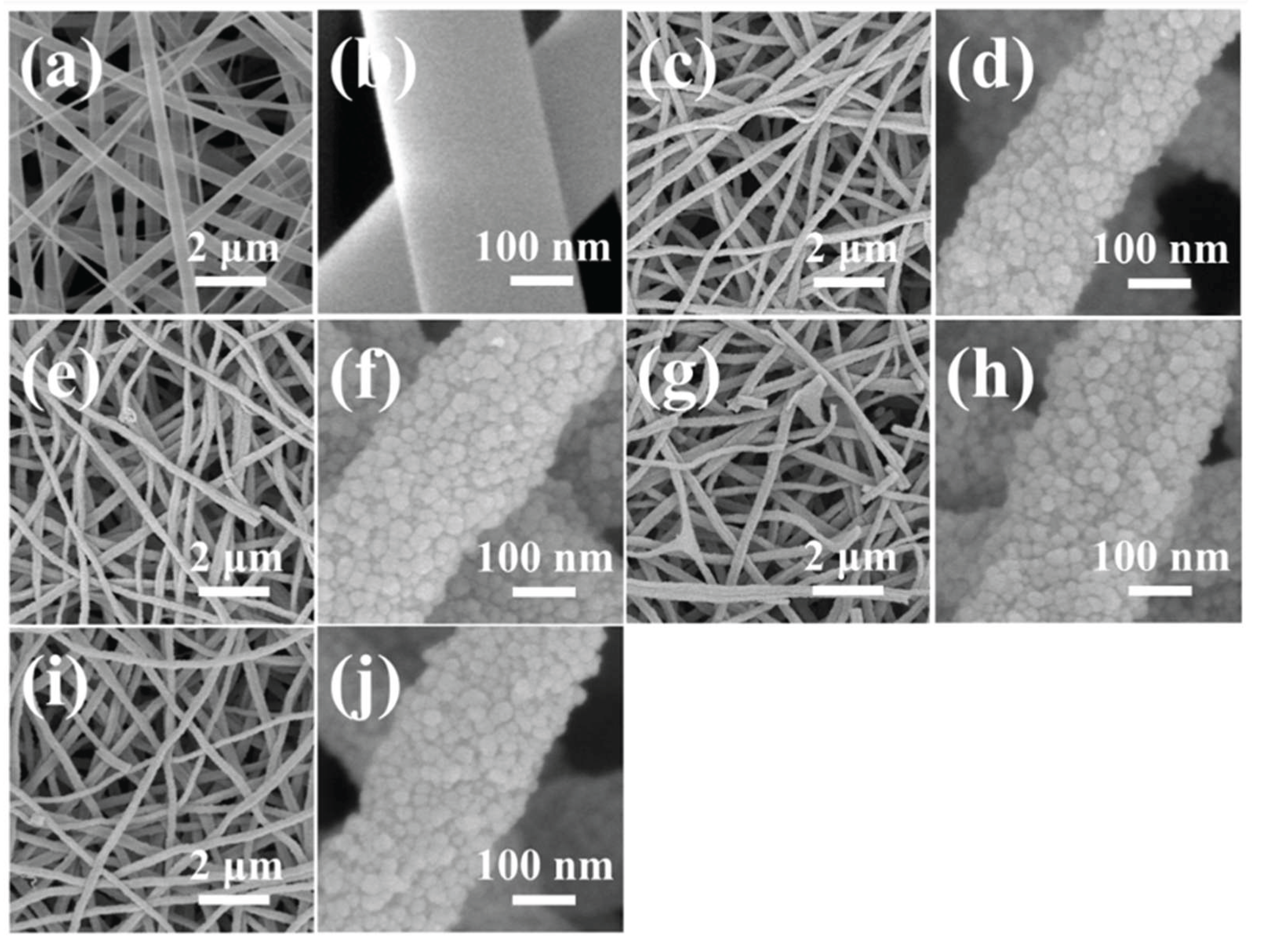
Figure 2.
Chemical structure of the conductive 2D metal–organic framework Cu₃(HITP)₂ (a), indicating its pore size (~2 nm) and electrical conductivity in pressed pellet form; Atomistic model illustrating the hexagonal porous arrangement of Cu₃(HITP)₂ (b); and chemiresistive response profile of a Cu₃(HITP)₂-based sensor upon exposure to decreasing concentrations of ammonia (NH₃) from 10 ppm to 0.5 ppm, demonstrating high sensitivity and reversible detection behavior (c). (Adapted with permission from ref. [93], Wiley-VCH Verlag GmbH & Co, 2015).
Figure 2.
Chemical structure of the conductive 2D metal–organic framework Cu₃(HITP)₂ (a), indicating its pore size (~2 nm) and electrical conductivity in pressed pellet form; Atomistic model illustrating the hexagonal porous arrangement of Cu₃(HITP)₂ (b); and chemiresistive response profile of a Cu₃(HITP)₂-based sensor upon exposure to decreasing concentrations of ammonia (NH₃) from 10 ppm to 0.5 ppm, demonstrating high sensitivity and reversible detection behavior (c). (Adapted with permission from ref. [93], Wiley-VCH Verlag GmbH & Co, 2015).
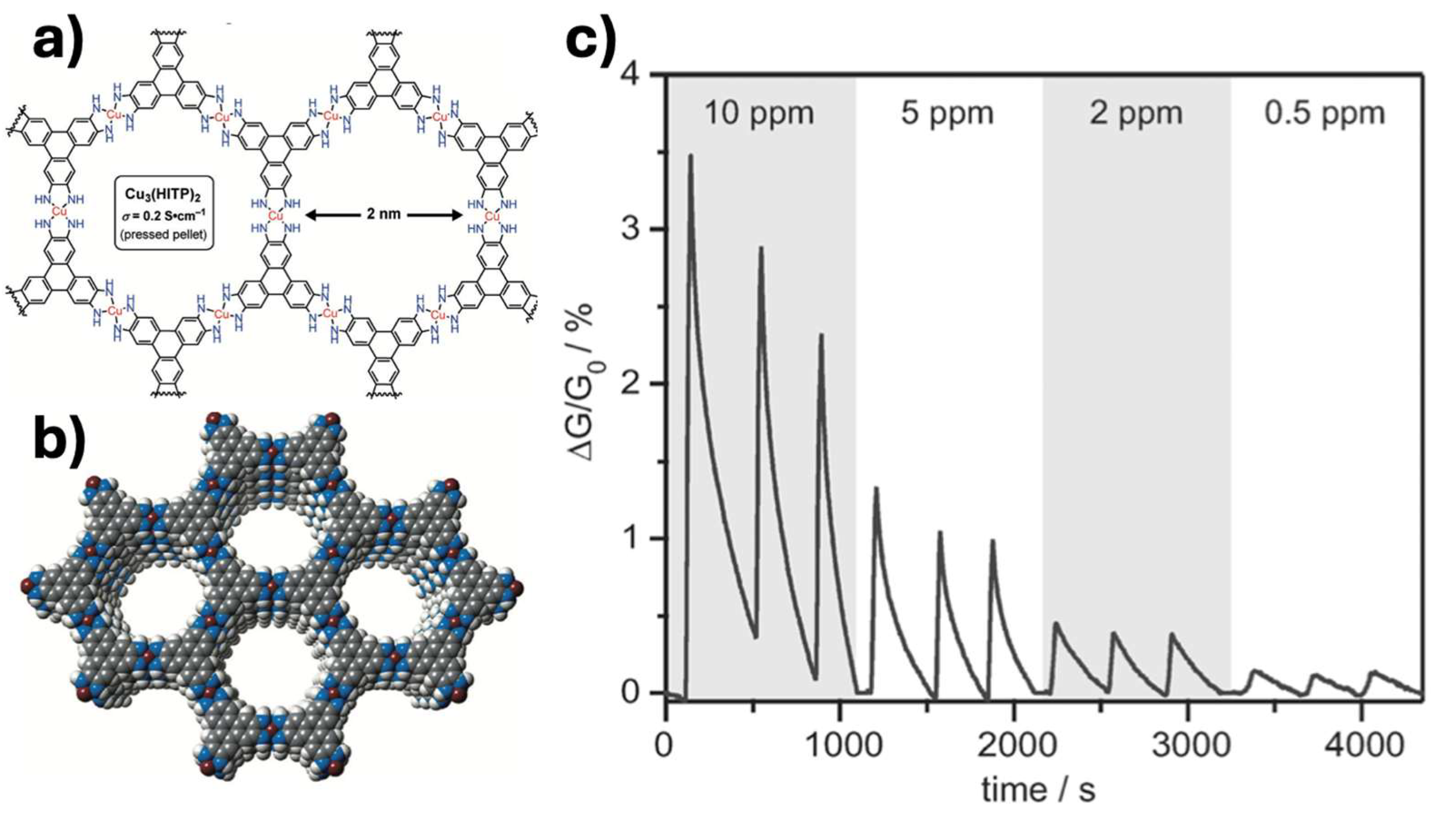
Figure 3.
GC-MS chromatogram of volatiles emitted by Tuta absoluta-infested tomato plants showing MeJA peaks (a). Photographs of control and infested plants (b). Sensor response profiles over time for control and infested plants, demonstrating >10-fold increase upon infestation (c-d). Energy diagram illustrating the SnO₂/MXene p–n heterojunction mechanism for MeJA detection (e). FTIR spectra confirming oxidation of MeJA after exposure to the sensor (f). (Reprinted with permission from ref. [108], Royal Society of Chemistry, 2024).
Figure 3.
GC-MS chromatogram of volatiles emitted by Tuta absoluta-infested tomato plants showing MeJA peaks (a). Photographs of control and infested plants (b). Sensor response profiles over time for control and infested plants, demonstrating >10-fold increase upon infestation (c-d). Energy diagram illustrating the SnO₂/MXene p–n heterojunction mechanism for MeJA detection (e). FTIR spectra confirming oxidation of MeJA after exposure to the sensor (f). (Reprinted with permission from ref. [108], Royal Society of Chemistry, 2024).
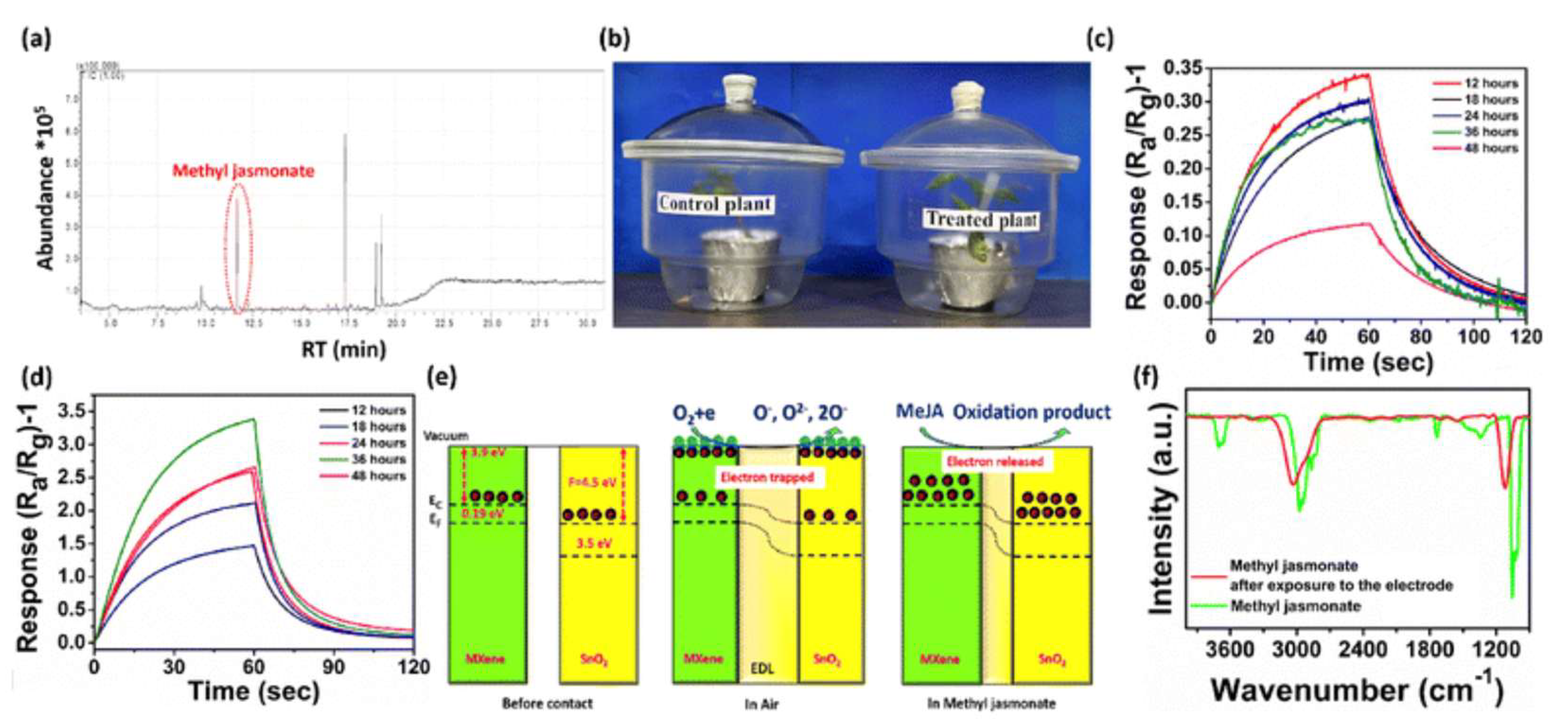
Figure 4.
Diagram illustrating the wireless sensing platform incorporating three fully MXene-printed functional components (a). Block diagram depicting the configuration and working mechanism of the integrated system (b). Cyclic voltammetry (CV) curves at varying scan rates (c), galvanostatic charge–discharge (GCD) profiles at different current densities (d), and calculated areal capacitance values derived from CV (top) and GCD (bottom) analyses (e) for the micro-supercapacitor (MSC) unit. Ragone plots comparing the areal energy and power densities achieved in this work with previously reported MSC devices (f). Real-time electrical response of the MXene-based temperature sensor measured between 20–55 °C (g). Normalized resistance variation when in contact with and removed from the palm, with inset showing response changes for different contact durations (h). Resistance changes of the MXene humidity sensor under multiple humidity levels (i). Repetitive dynamic response and recovery curves recorded between 20% RH and 80% RH, with inset highlighting response time (j). (Reprinted with permission from ref. [232], Springer Nature, 2022).
Figure 4.
Diagram illustrating the wireless sensing platform incorporating three fully MXene-printed functional components (a). Block diagram depicting the configuration and working mechanism of the integrated system (b). Cyclic voltammetry (CV) curves at varying scan rates (c), galvanostatic charge–discharge (GCD) profiles at different current densities (d), and calculated areal capacitance values derived from CV (top) and GCD (bottom) analyses (e) for the micro-supercapacitor (MSC) unit. Ragone plots comparing the areal energy and power densities achieved in this work with previously reported MSC devices (f). Real-time electrical response of the MXene-based temperature sensor measured between 20–55 °C (g). Normalized resistance variation when in contact with and removed from the palm, with inset showing response changes for different contact durations (h). Resistance changes of the MXene humidity sensor under multiple humidity levels (i). Repetitive dynamic response and recovery curves recorded between 20% RH and 80% RH, with inset highlighting response time (j). (Reprinted with permission from ref. [232], Springer Nature, 2022).
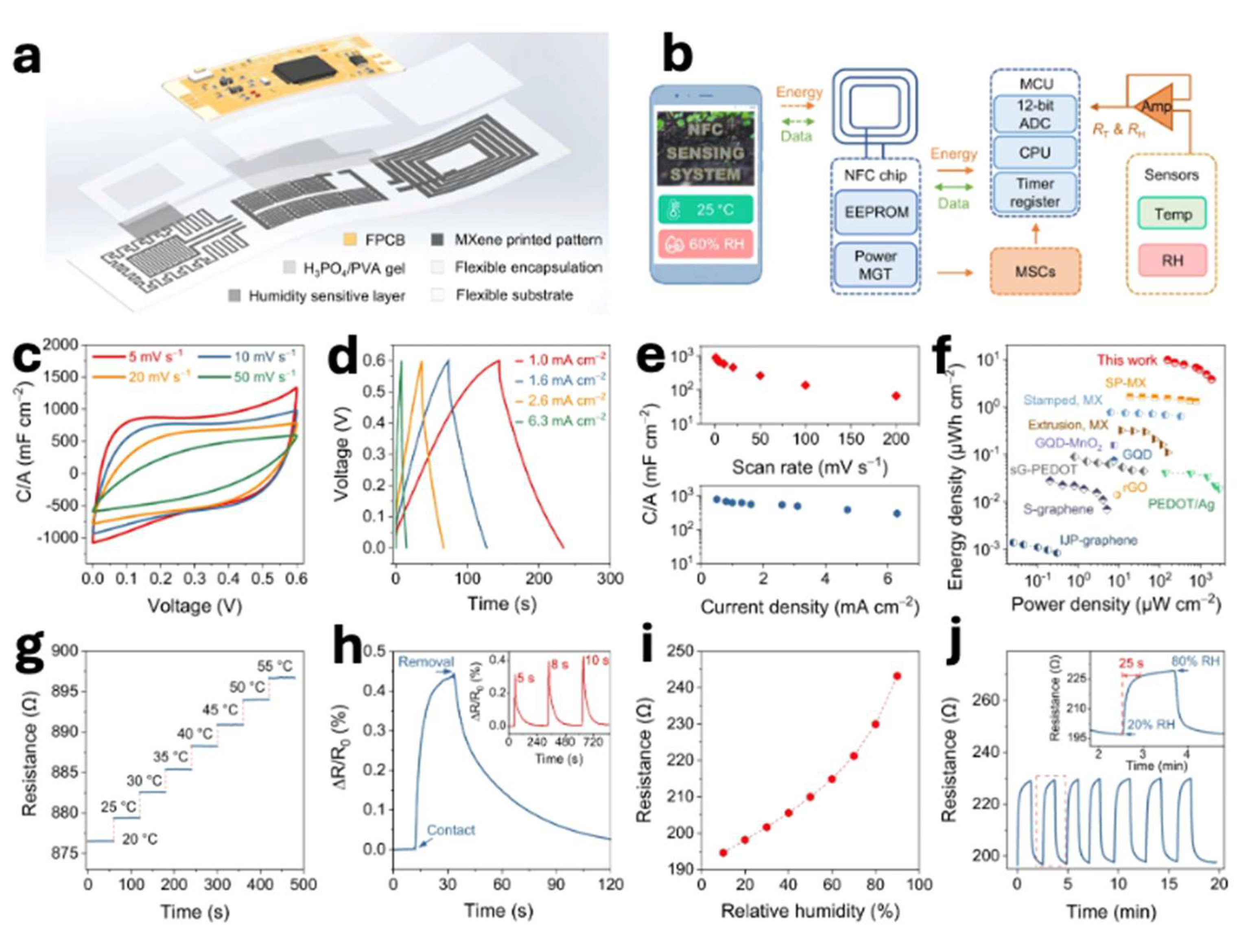
Disclaimer/Publisher’s Note: The statements, opinions and data contained in all publications are solely those of the individual author(s) and contributor(s) and not of MDPI and/or the editor(s). MDPI and/or the editor(s) disclaim responsibility for any injury to people or property resulting from any ideas, methods, instructions or products referred to in the content. |
© 2025 by the authors. Licensee MDPI, Basel, Switzerland. This article is an open access article distributed under the terms and conditions of the Creative Commons Attribution (CC BY) license (http://creativecommons.org/licenses/by/4.0/).
Copyright: This open access article is published under a Creative Commons CC BY 4.0 license, which permit the free download, distribution, and reuse, provided that the author and preprint are cited in any reuse.