

Submitted:
07 August 2025
Posted:
07 August 2025
You are already at the latest version
Abstract
Nitrile imines and nitrile oxides are capable of reacting (3+2)-cycloadditions with various dipolarophiles with double and triple carbon-carbon, carbon-heteroatom or heteroatom-heteroatom. As a result of these reactions, five-membered heterocyclic compounds are formed. When cyclic dipolarophiles with an to exocyclic carbon-nitrogen bond double bonds (exo-C=N) are introduced into the reaction with these dipoles, 1,2,4-triazoline or 1,2,4-oxadiazoline cycles are formed, spiro-coupled with the initial dipolarophile cycle. Using such rectations, it is possible to effectively synthesize spiro compounds with enhanced biological activity. This review comprehensively summarizes the literature data on the 1,3-dipolar cycloaddition of nitrile imines and nitrile oxides to exo-C=N bonds for the spiro compounds synthesis. The research area covers reactions of both saturated and unsaturated dipolarophiles, monocyclic and polycyclic structures, as well as compounds containing one to three heteroatoms, with special attention to systems containing biologically significant heterocyclic pharmacophores. Based on the collected literature sources, the high regio- and chemoselectivity characteristic of this type of reaction, as well as high tolerance to labile substrates, are shown. Recent advances in reaction conditions, including microwave and ultrasonic activation, as well as one-pot and diffusion protocols were highlighted.
Keywords:
1
; 3-dipolar cycloaddition
; nitrile imines
; nitrile oxides
; spiro-compounds
; triazolines
; oxadiazolines
1. Introduction
The primary characteristic of nitrile imines and nitrile oxides is their ability to undergo 1,3-dipolar cycloaddition (or (3+2)-cycloaddition, 32CA) reactions and form five-membered heterocycles by interacting with dipolarophiles that contain carbon-carbon, carbon-heteroatom, and heteroatom-heteroatom multiple bonds. The possibility to attach to the last two types of dipolarophilic particles significantly broadens the range of potential synthetic applications of nitrile imines and nitrile oxides compared to some other types of dipoles, which are mainly available for attaching to C-C multiple bonds [1]. When a dipolarophile's structure contains other multiple bonds, the chemoselectivity of the dipolar cycloaddition reaction becomes a significant concern because the activity of 2π-components in relation to nitrile imines and nitrile oxides is known to be comparable for olefins and compounds with a C=N bond [2,3].
A majority of 1,3-dipolar cycloaddition reactions for nitrile imines and nitrile oxides are effective under non-catalytic conditions and do not necessitate heating or other activation methods, rendering them suitable for use with labile substrates. Dipolarophiles with C=C and C=N bonds are frequently the focus of research due to their high activity and the superior stability of the resulting heterocycle in comparison to, for example, those formed by the addition of carbon-chalcogen bonds [1].
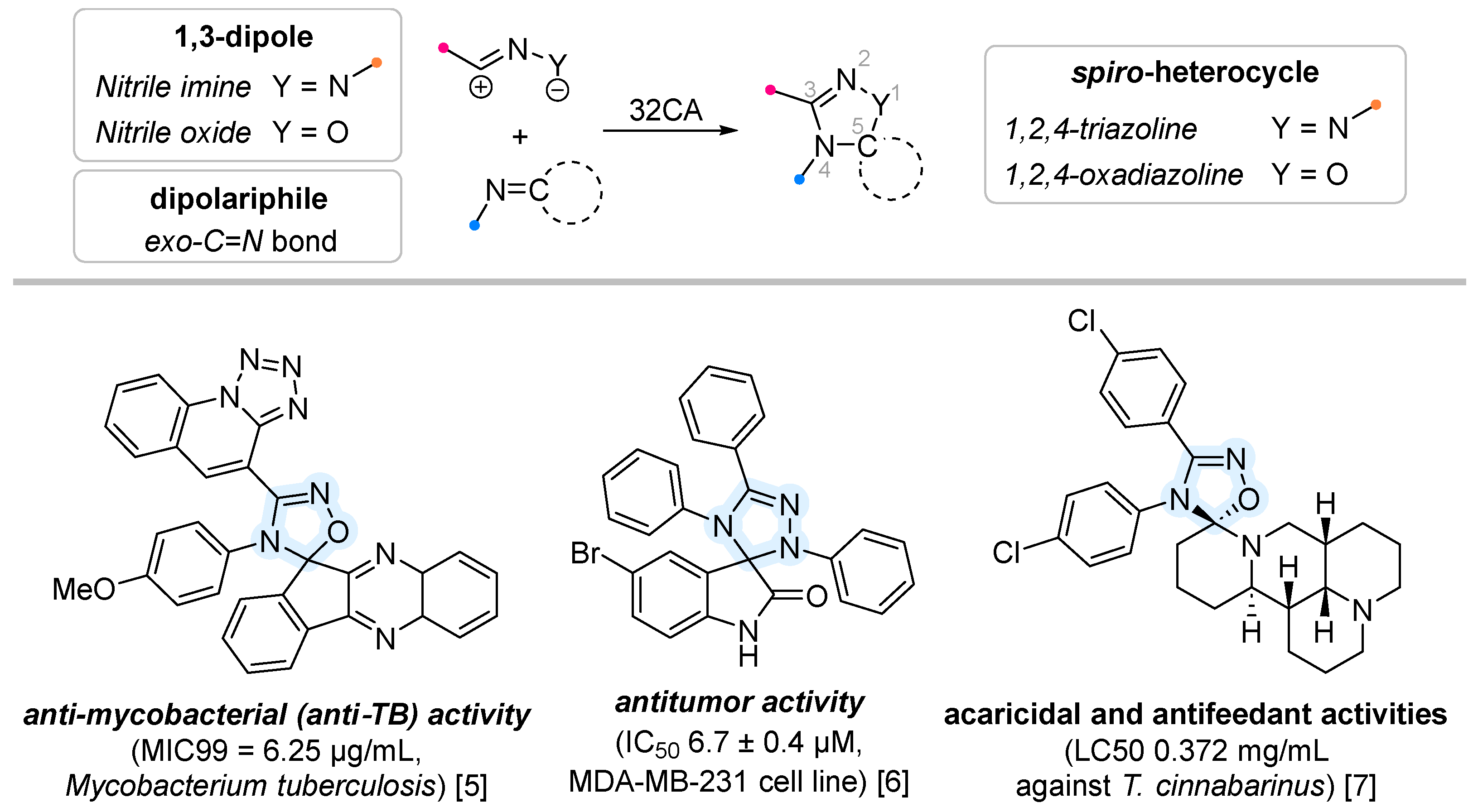
When 1,1-disubstituted dipolarophile is exposed to dipole, it creates new heterocycle with quaternary carbon atom. If this atom is part of a cyclic system, and the double bond is exocyclic, then (3+2)-cycloaddition results in the formation of a spiro-conjugated molecule. In contrast to olefins, the reactions of the dipolarophilic imino group are significantly more predictable in terms of regiochemistry: nitrile imines and nitrile oxides form five-membered cycles with heteroatoms in positions 1,2, and 4 [2,4] (Scheme 1).
The presence of a quaternary carbon atom in a spiro compound provides conformational rigidity to the molecule. When pharmacophoric fragments are incorporated into such a structure, the geometry of the spirocyclic framework dictates their mutual arrangement. This approach facilitates the attainment of optimal steric characteristics of molecules for interaction with biological targets. As a result, compounds such as spirooxadiazolines and spirotriazolines are frequently developed as biologically active substances [5,6,7] (Scheme 1).
These factors have resulted in a significant increase in the number of studies on nitrile imines and nitrile oxides, from the time they were first described by Rolf Huisgen as 1,3-dipolar cycloaddition [1,8] to the present day, when these reactions have become as integral to organic synthesis as other classical transformations. Later, the properties of nitrile imines and nitrile oxides were discussed in a number of reviews and monographs. Some of them are dedicated to the generation methods, main properties, and applications of nitrile imines [2,9] and nitrile oxides [4,10,11]. There are also more specialized papers that present generalized information exclusively about the generation of dipoles [12] or the use of nitrile imines [13] or nitrile oxides [14,15,16] in heterocyclic compounds synthesis. Review articles covering research from a specific period such as [17,18] are less common. The parts related to (3+2)-cycloaddition reactions can also be found in review articles focused on synthesis of heterocyclic compounds, such as 1,2,4-triazolines [19] and spiro-2-oxindoles [18]. Additionally, it is worth mentioning reviews based on the type of dipolarophile. For example, reactions involving nitrile oxides and carbon-heteroatom bonds [3], the interaction between nitrile imines and multifunctional dipolarophiles [20], and even more specifically, reactions of nitrile imines and nitrile oxides with hydrazines, hydrazones, and oximes [21].
Despite the fact that 1,3-dipolar cycloaddition reactions are very effective to the synthesis of spiro compounds, there are currently no works summarizing data on the methods of obtaining and properties of molecules formed by the interaction of nitrile imines or nitrile oxides with dipolarophiles containing exocyclic carbon-nitrogen (exo-C=N) double bonds (Scheme 1). The above reviews and monographs provide fragmented information that, when dealing with this topic, undoubtedly poses some difficulties for researchers.
Crossing the equator of the seventh decade of research on (3+2)-cycloaddition, we have gathered literature data on methods for synthesizing spiro compounds via cycloaddition of nitrile imines and nitrile oxides to exocyclic C=N bonds. The review is divided into four main parts according to the type of dipolarophile introduced into the reaction and primarily includes transformations of molecules based on saturated cycles (Section 2.1), which include, in addition to carbocycles, monocyclic and condensed piperidine derivatives. The second section (2.2) discusses the reactions of nitrile imines and nitrile oxides with exo-C=N bonds of unsaturated dipolarophiles. This section is the largest in terms of the number of cited sources. Therefore, for convenience, it has been divided into three subsections: monocyclic compounds (2.2.1), condensed carbocycles (2.2.2), and condensed heterocycles (2.2.3). While subsection 2.2.2 contains only a few isolated examples, part 2.2.3 is the most extensive compared to the others. The reason for this is due to the prevalence of cycloaddition reactions in producing biologically active molecules, whose structure often includes condensed heterocyclic pharmacophore fragments, such as isatin and its derivatives. Reactions of nitrile imines and nitrile oxides with exo-C=N-bonds of monocyclic dipolarophiles are also presented in sections 2.3 (cycles with two heteroatoms) and 2.4 (cycles with three heteroatoms).
2. Cycloaddition to Exocyclic Bonds C=N
2.1. Saturated Carbocycles and Piperidine Derivatives with Exo-C=N-Bonds in Reactions with Nitrile Imines and Nitrile Oxides
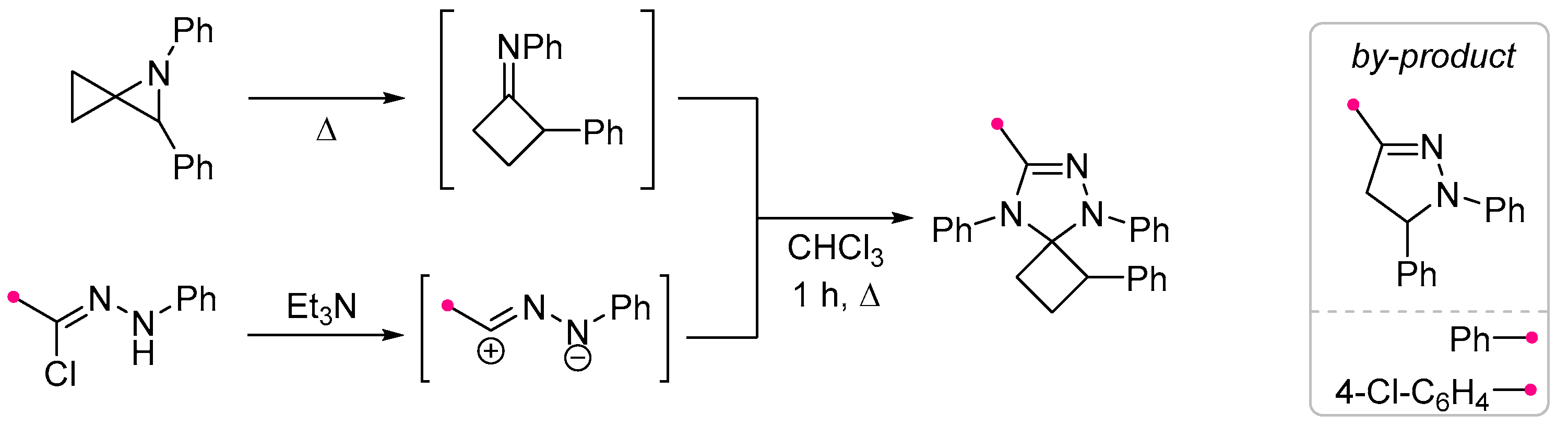
The only documented case of the formation of spirocyclobutane as a result of (3+2)-cycloaddition is the reaction of azaspiro[2,2]pentane with diphenyl nitrile imine (DPNI), generated in situ from hydrazonoyl chloride under the action of triethylamine [22]. The formation of this product involves the primary thermally initiated isomerization of azaspiro[2,2]pentane into (phenylimino)cyclobutane, which then interacts with dipole to create a spiro-fused compound. With an increase in the reaction time and the amount of the dipole precursor, the reaction was accompanied by the formation of other products. Under the conditions shown (Scheme 2), only the trisubstituted pyrazoline was formed as a by-product.
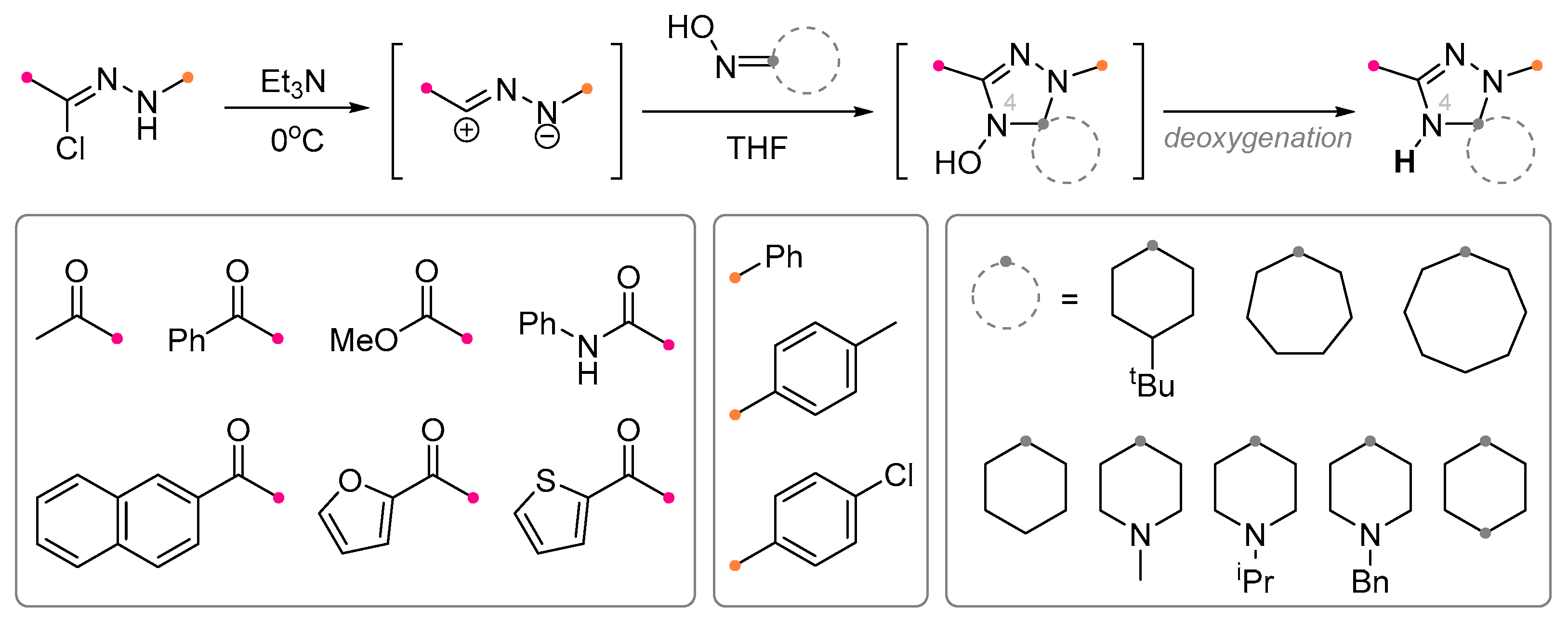
The properties of oximes and hydrazones with respect to nitrile imines and nitrile oxides were considered in detail in the review [21], therefore, only the key features of the interaction of these dipolarophiles, important for the synthesis of spiroconjugated products, will be given here. Despite the commonly occurring similarities in the chemical properties of nitrile imines and nitrile oxides, their interactions with cyclic oximes and hydrazones differ. Under the action of nitrile imines generated from hydrazone chlorides, cyclic oximes were converted into N4-unsubstituted spirotriazoles [21,23,24]. It was assumed that the spiro compound with hydroxy-group on the N4 nitrogen atom was formed as an intermediate. However, due to the presence of excessive amounts of triethylamine, the compound inevitably lost an oxygen atom (Scheme 3). Using this approach, it was also possible to obtain a dispiro-product using dioxime as starting dipolarophile [25].
It is also known that 4-hydroxy-oxadiazolines, which are obtained by reacting nitrile oxides with ketoximes, do not undergo deoxygenation and can be isolated [16]. However, there are no known examples of such reactions involving cyclic dipolarophiles, so these reactions will not be discussed in detail in this review.
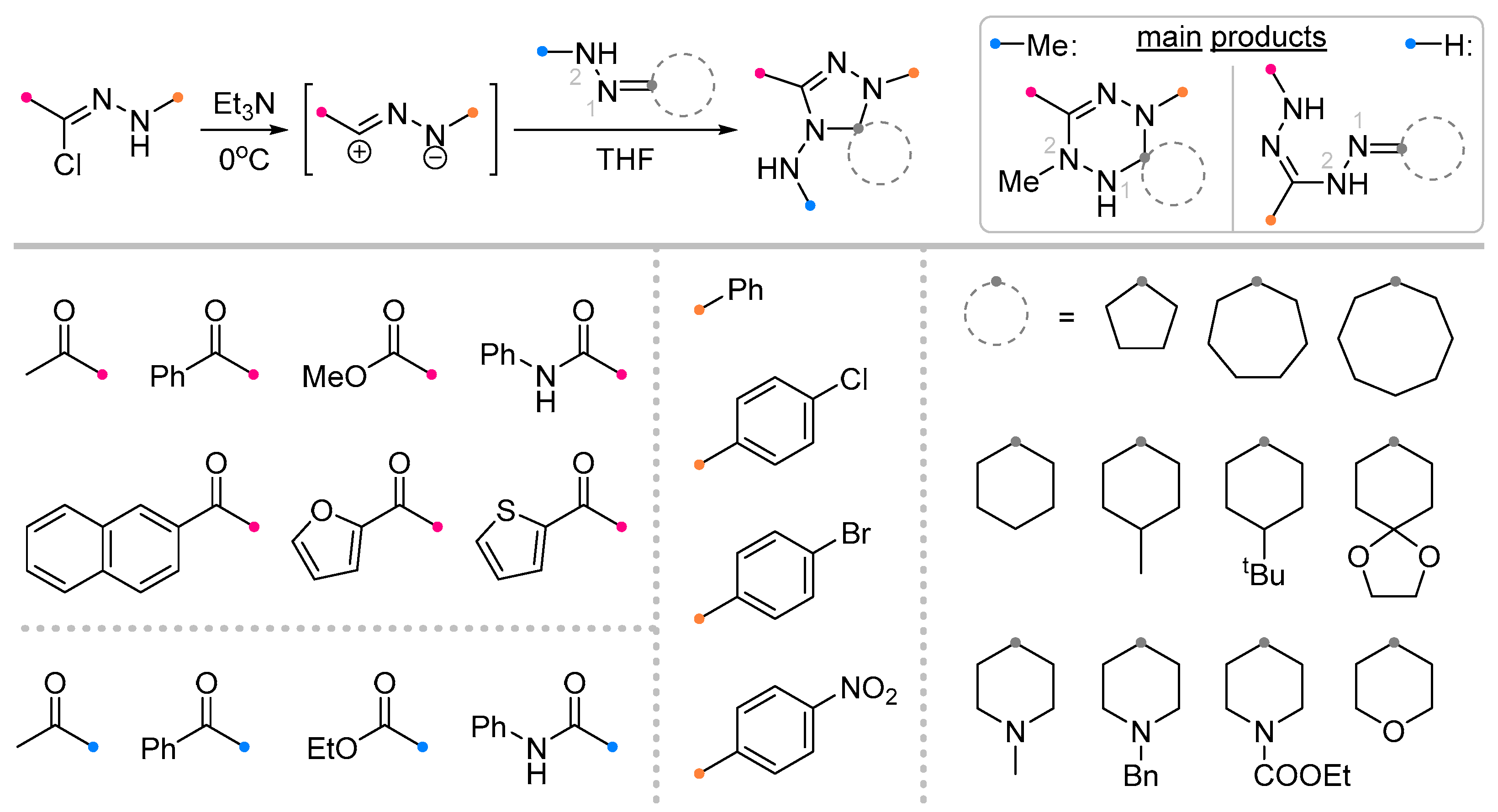
The possibility of producing spiro-linked triazolines by the reaction of nitrile imines and cyclic hydrazones is limited by the use of dipolarophiles with electron acceptor groups at the terminal nitrogen atom [26] (Scheme 4). N2-Alkyl cyclohydrazones react with nitrile imines to form spiro tetrahydrotetrazines [21], while N2-unsubstituted cycloalkanone hydrazones attach to nitrile imines via nucleophilic addition similar to other amines [2].
The reaction of nitrile oxides, which are formed in situ from hydroxyimidoyl halides through the HCl elimination by triethylamine, with cyclic ketohydrazones leads to the formation of spiro-fused 4-aminooxadiazoles [27] (Scheme 5). Surprisingly, unlike nitrile imines, the addition of such dipolarophiles occurs nucleophilically only for hydrazones obtained from acetophenone derivatives, in other cases the product corresponds to a normal (3+2)-cycloaddition [21]. Analyzing the literature data, we found that the number of cyclic hydrazones studied in reactions with nitrile oxides is significantly lower compared to those tested in reactions with nitrile imines. There is currently no information available on the reactivity of piperidine hydrazones or any reactions of N2-substituted cyclohydrazones. The reason for this may be the low reactivity of the substrates listed, but the authors of the papers on this topic have not specified this.
One of the rare examples of the nitrile oxides cycloaddition to amidines is the reaction with matrine-type alkaloids [7] (Scheme 6). As in the example above, the dipole was formed in situ, and the spiro product was formed not only regio-, but also stereoselectively, due to the pre-determined configuration of the stereocenters in the initial dipolarophile, which was confirmed by the results of X-ray diffraction analysis.
2.2. Unsaturated Cycles with an Exocyclic C=N Bond as Dipolarophiles in Reactions with Nitrile Imines and Nitrile Oxides
The presence of several multiple bonds, accessible for dipole addition, in the dipolarophile structure often imposes some limitations on the synthetic applicability of (3+2)-cycloaddition reactions for the preparation of heterocyclic products. Therefore, most of the examples reviewed in this section will be presented by simple cycles containing conjugated double bonds or fused carbo- and heterocycles. It is worth noting that the majority of works are devoted to nitrile oxides reactions, while for nitrile oxides there are only isolated examples. In our opinion, this unevenness in the studies may be partly due to the fact that in some cases nitrile oxides are capable of exhibiting greater selectivity in the competition of C=C and C=N bonds [20,28,29].
2.2.1. Reactions of Nitrile Imines and Nitrile Oxides with Exo-C=N-Bonds of Monocyclic Compounds
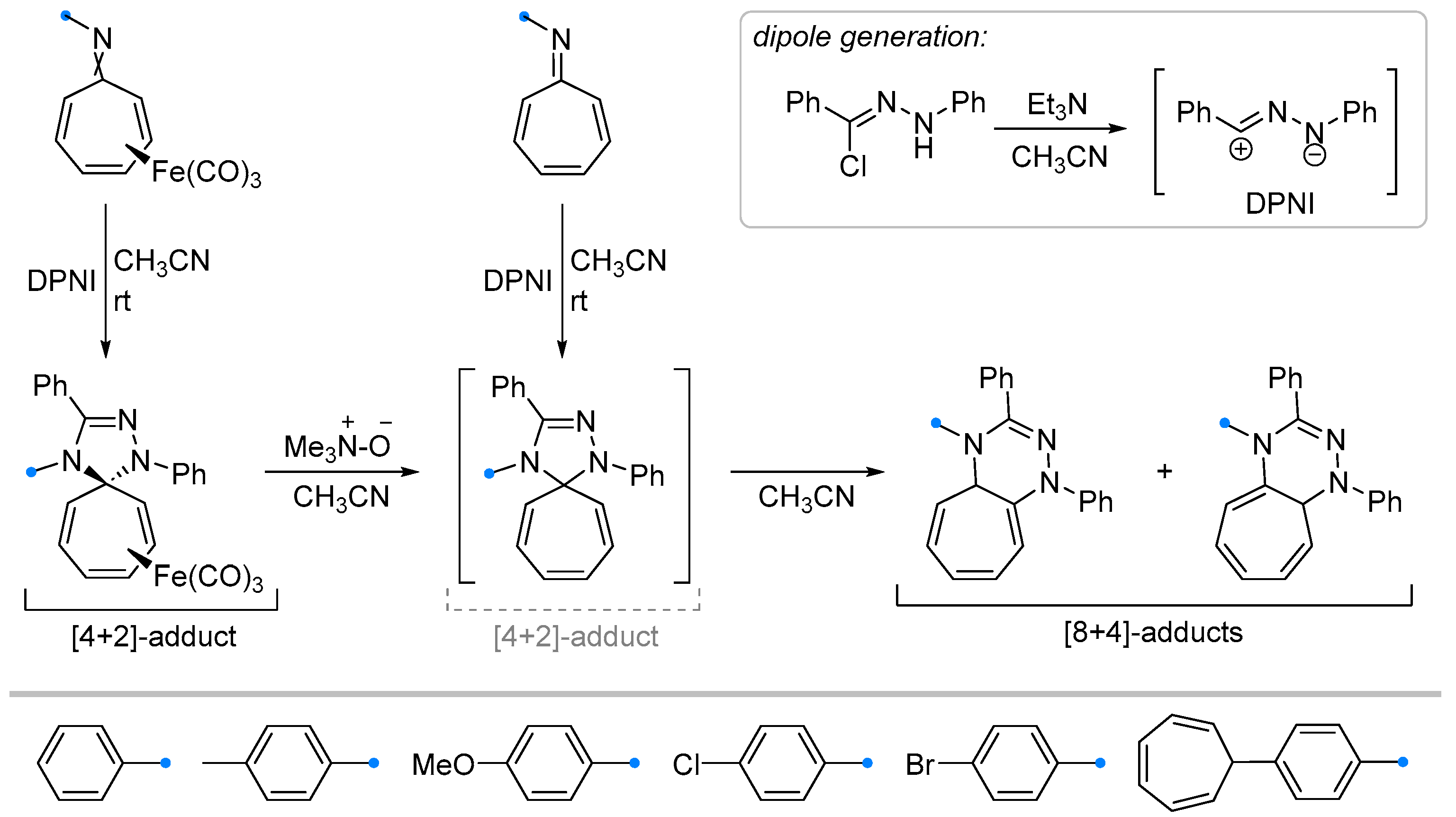
Investigations of monocyclic unsaturated compounds as dipolarophiles have focused mainly on reactions of 8-azaheptafulvenes (also known as troponimines) and their tricarbonyl iron complexes. It has been shown that spiro-fused cycloheptatrienyl-triazolines can be obtained only for tricarbonyl iron complexes [30]. Reaction of 8-azaheptafulvene itself with DPNI resulted in the formation of the spiro compound only as an intermediate on the way to condensed [8+4]-adducts (Scheme 7), which were also formed upon removal of the Fe(CO)3-group by the action of trimethylamine oxide on the spiro-fused complex. It is noteworthy that DPNI added to 8-azaheptafulvene complexes exclusively from the side opposite to the Fe(CO)3-group, yielding an anti-addition product.
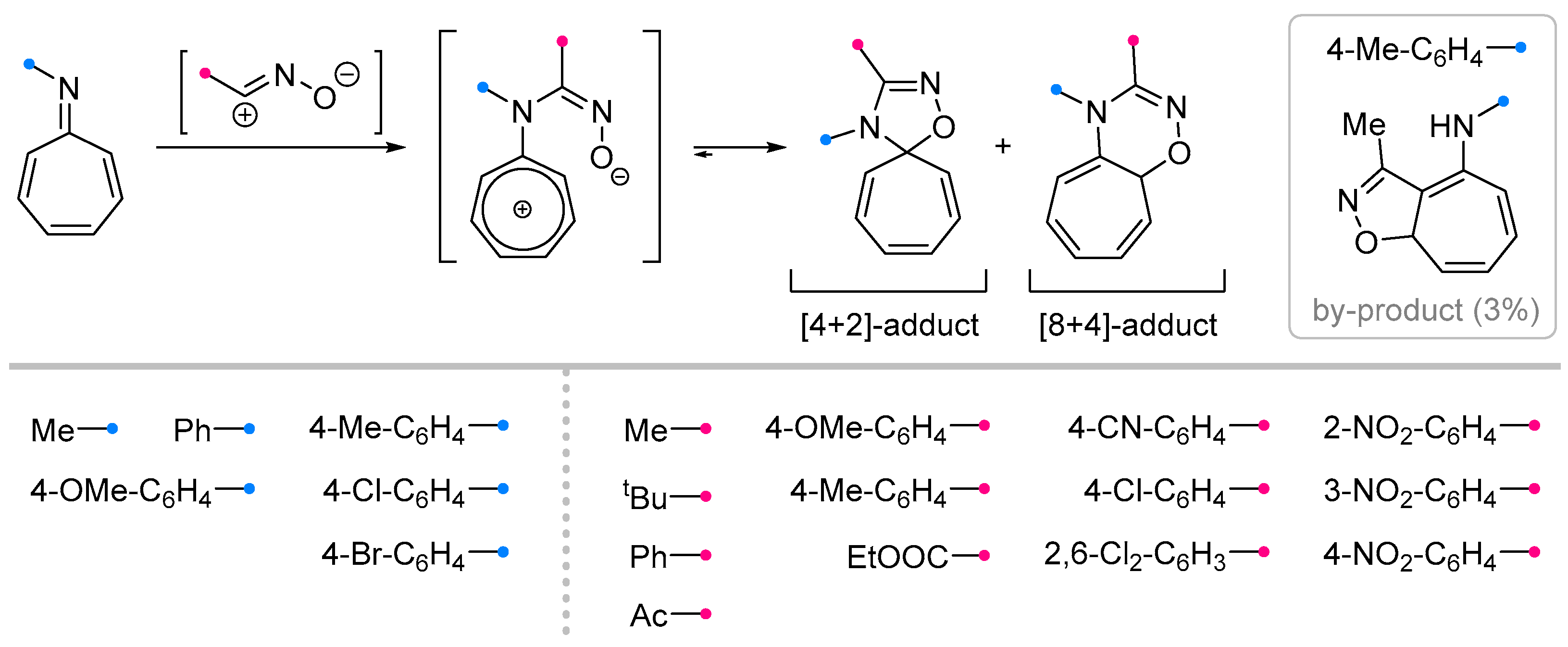
The reactions of nitrile oxides have been studied in a number of works not only on the example of tricarbonyl iron complexes, but also for free 8-azaheptafulvenes. It was shown that, in contrast to the products of nitrile imines addition, spiro-fused cycloheptatrienyl oxadiazolines not only can be isolated, but also for some dipoles (e.g., tert-butyl nitrile oxide) are the only product [31,32,33]. Nevertheless, the formation of an indivisible mixture of the [4+2]-spiro adduct and the condensed [8+4]-heterocycle is also common [30,31] (Scheme 8). The assumption that the reaction occurs with a high degree of asynchrony, and the intermediate zwitterion and the reaction products exist in an equilibrium strongly shifted towards the latter, but sufficient for isomerization, was later confirmed by quantum chemical calculations [34]. A by-product detected in one case indicates that conjugated (3+2)-cycloaddition can occur between nitrile oxide and 8-azaheptafulvene at one of the carbon-carbon bonds, accompanied by isomerization of the exo-imine to the amine [31].
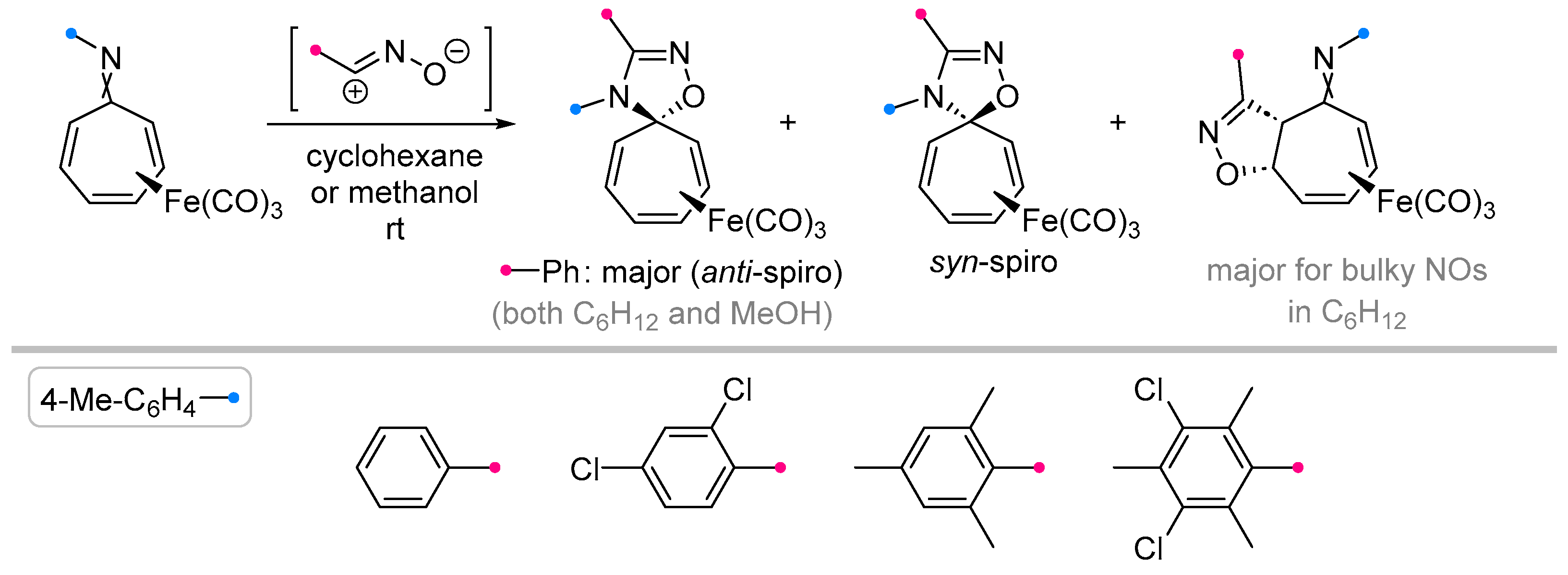
The reactions of Fe(CO)3-complexes of 8-azaheptafulvenes with nitrile oxides were accompanied exclusively by the formation of [4+2]-addition products. In addition to anti- and syn-spiro-complexes, stereoselective formation of a condensed product (3+2)-cycloaddition to one of the C=C bonds was observed [30] (Scheme 9). It was noted that for tricarbonyl iron complexes, isomerization of the main anti-spiro product into syn- is also possible in hexafluoroisopropanol and other highly polar solvents that stabilize the intermediate zwitterion [35]. Unfortunately, an assessment of the applicability of this method for the synthesis of spiro compounds is not possible, since no information on the possibility of isolating individual spiro compounds and other synthetic components was provided in [30,35].
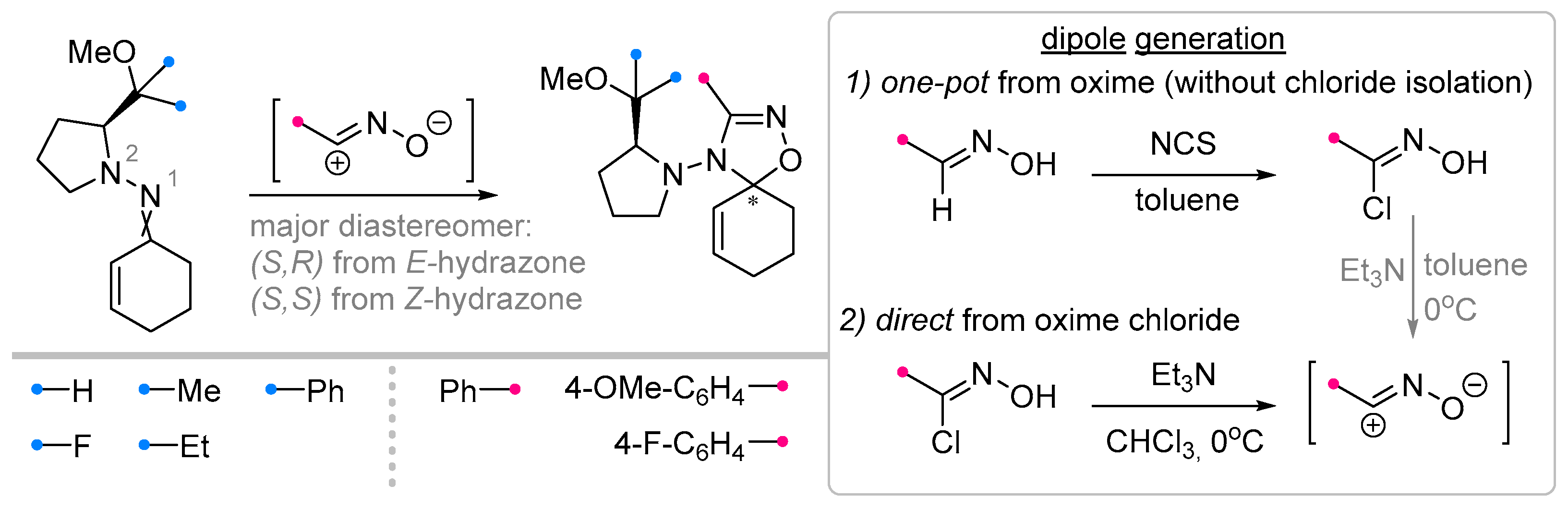
Cyclohexenone hydrazones containing chiral substituents at the N2 atom were reacted with nitrile oxides under different conditions [36] (Scheme 10), the main difference being the dipole precursor used. It was shown that the use of a procedure that does not involve the isolation of chlorooxime is less efficient than direct generation of nitrile oxide from the corresponding hydrochloride. The diastereoselectivity of the reaction was assessed independently for E- and Z-hydrazones, the latter of which allowed the preparation of spirooxadiazolines with higher diastereomeric excess values.
It was shown in the work [37] that stable nitrile oxides are capable of adding to the imino form of aminopyridines to form a spiro compound corresponding to (3+2)-cycloaddition to the exocyclic C=NH bond. Unfortunately, the resulting product cannot be isolated, so the presented reaction is not of preparative interest for obtaining spiro compounds.
2.2.2. Addition of Nitrile Oxides and Nitrile Imines at the Exocyclic C=N Bond of Fused Carbocycles
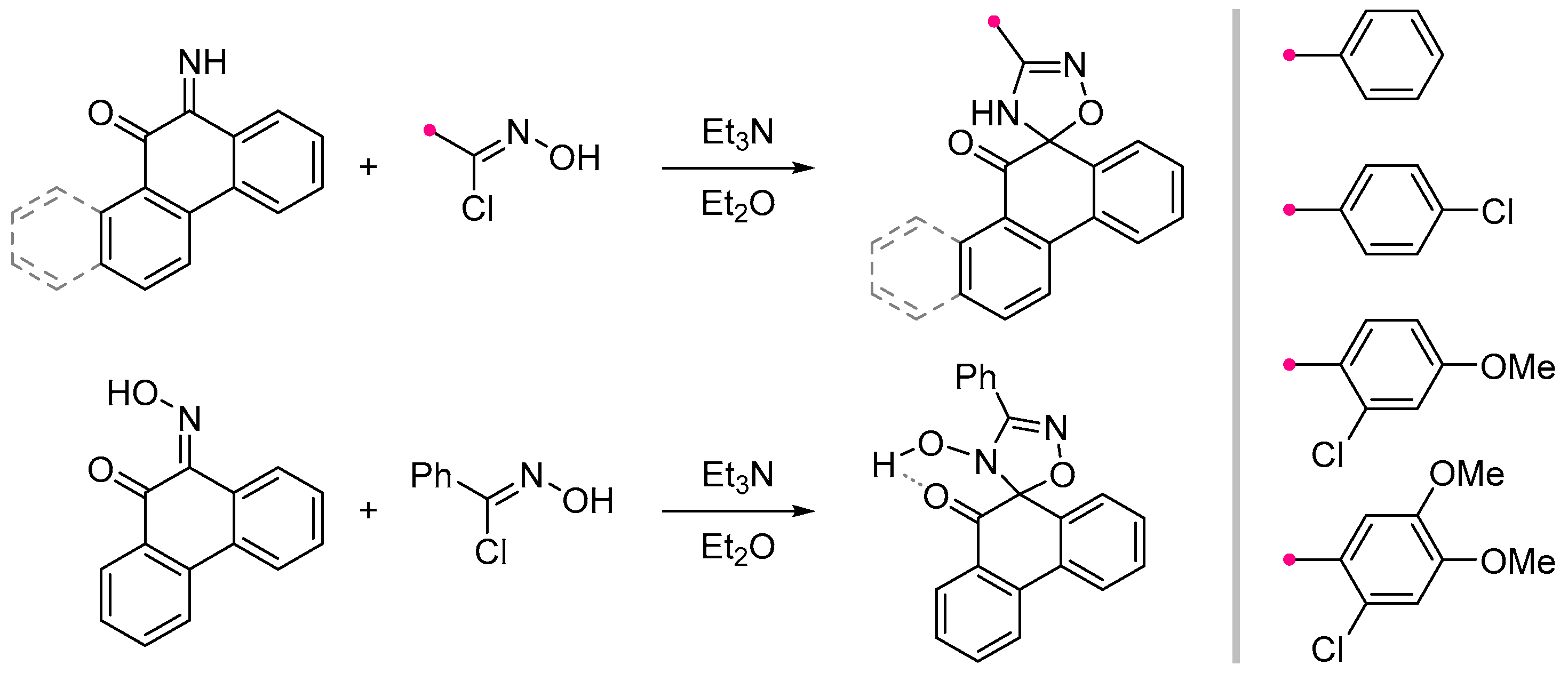
Cycloaddition reactions at exocyclic C=N bonds of unsaturated condensed carbocyclic compounds are poorly represented in the literature. Only a few examples of nitrile oxide reactions involving imines of phenanthraquinone and chrysenquinone, as well as phenanthraquinone oxime, are known [38,39] (Scheme 11). As in the reaction of nitrile oxides with ketoximes [16], the spiro-fused derivative of phenanthraquinone retains the N4-hydroxy group. Between it and the carbonyl group located near the spiro fusion, the formation of a hydrogen bond was observed (detected by IR spectroscopy) [38].
2.2.3. Reactions of Nitrile Oxides and Nitrile Imines at Exocyclic C=N Bonds of Fused Heterocycles
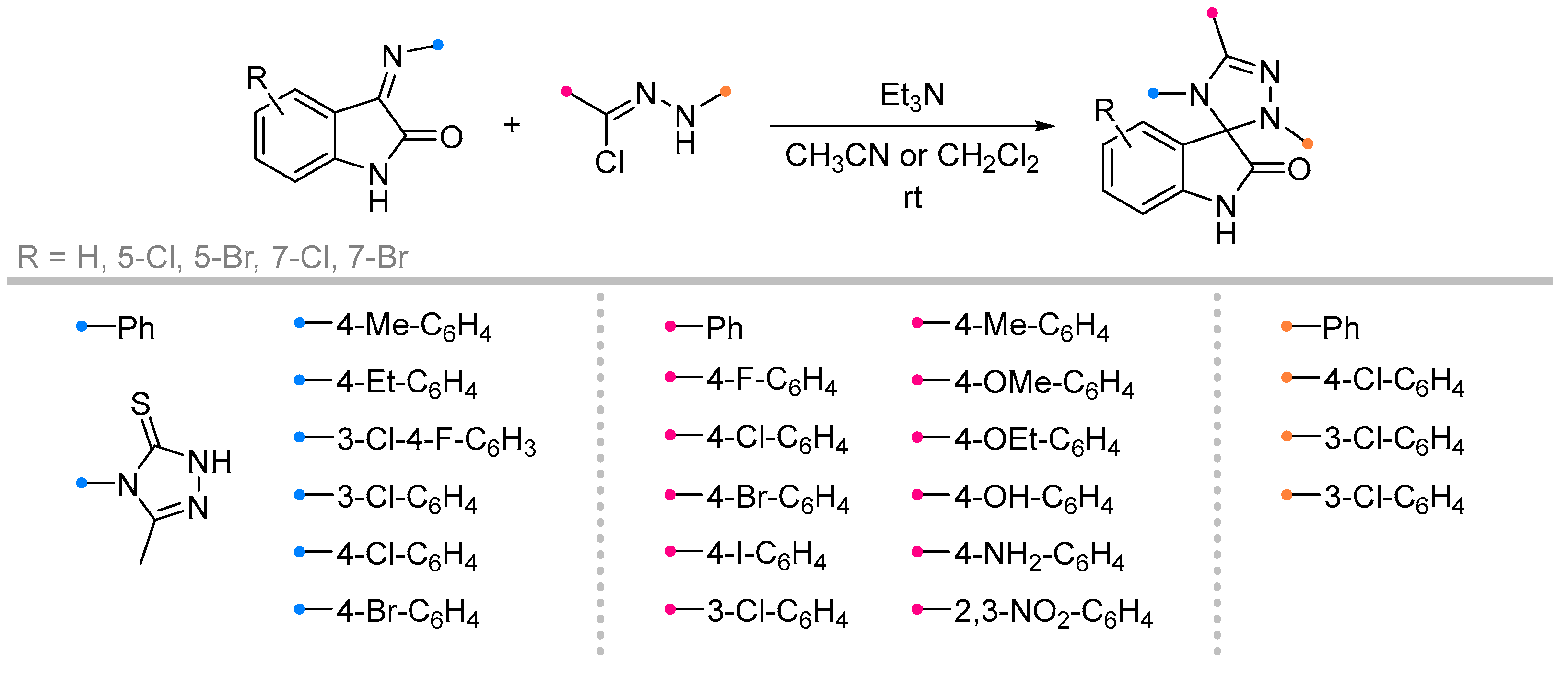
A wide range of biologically active spiroindolinones have been synthesized by the action of nitrile imines generated in situ from hydrazonoyl halides and imines previously obtained from isatin [5,40]. The reactions proceeded in the usual manner, allowing the preparation of spiro-fused triazolines in good yield (Scheme 12). Several equally effective methods are known, which involve microwave action to accelerate the reaction [41,42]. The methods used showed high tolerance to various substituents among the aromatic groups of the nitrile imine and dipolarophile.
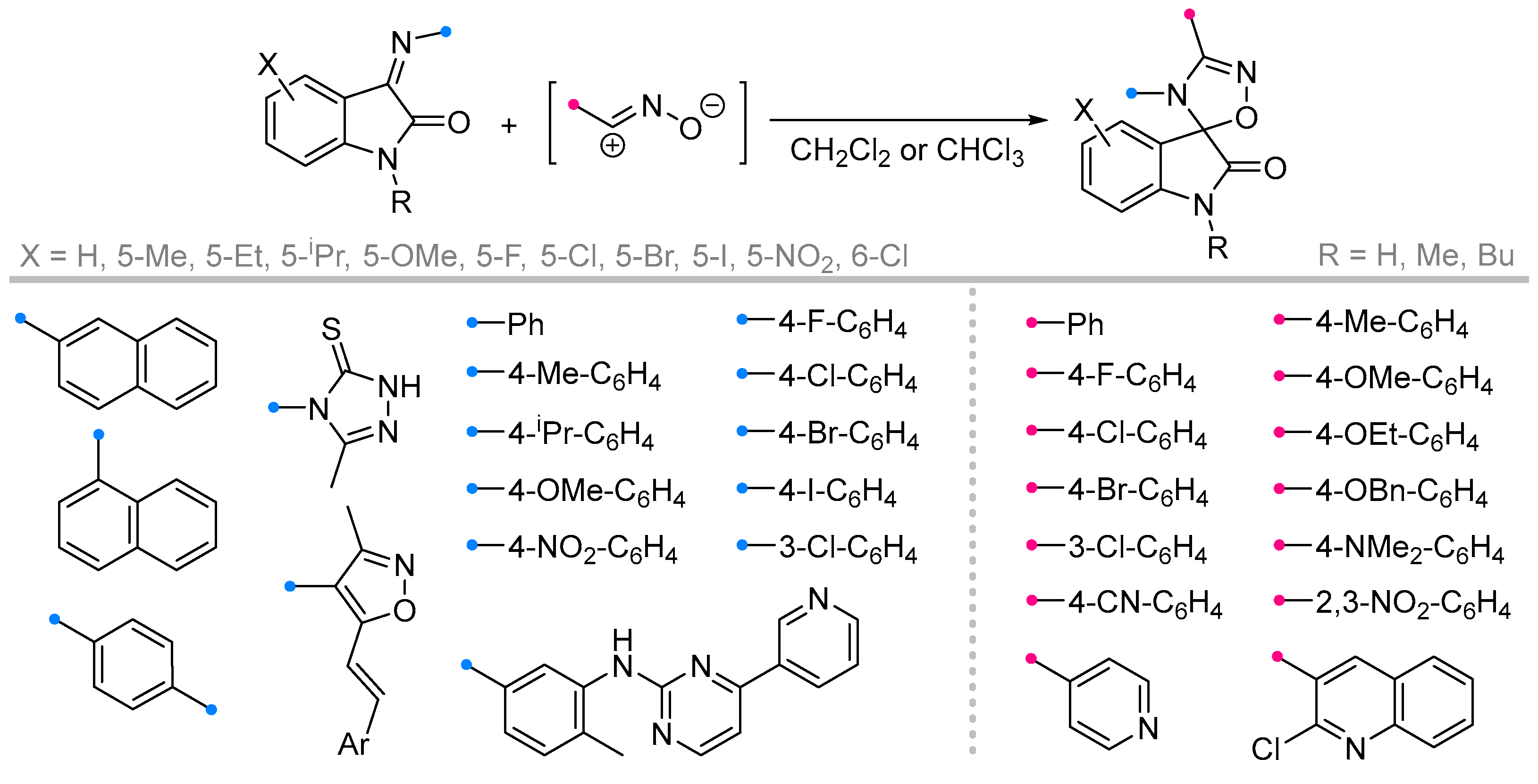
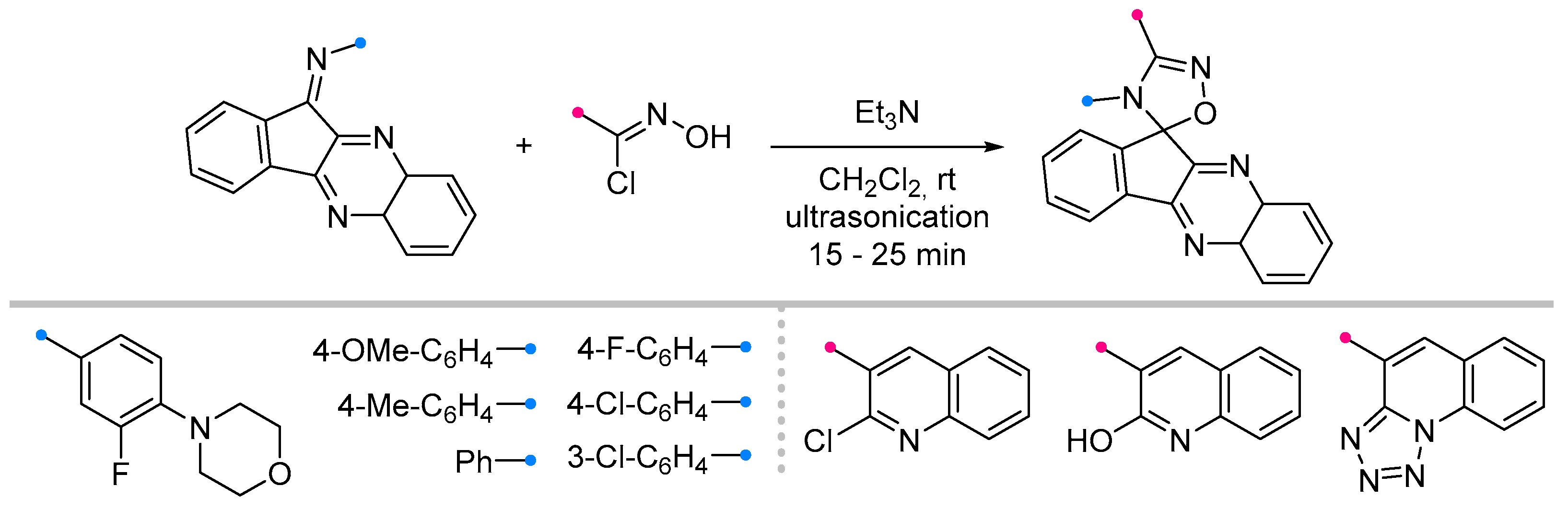
No less extensive are the studies of iminoindolinones in reactions with nitrile oxides (Scheme 13). The diversity of substrates in this case is supported by the diversity of the methodologies used. Along with traditional approaches [43,44,45,46], methods are used with one-pot dipole generation from benzaldoxime (similar to that shown in Scheme 10) [47,48] or one-pot synthesis of the spiro compounds from isatin and amine [49], ultrasonic activation [50] or in a catalytic version [49]. The existence of many methods complicates the definition of uniform conditions for this type of reaction, however, the most common for these transformations should be considered chlorinated solvents (CH2Cl2 and CHCl3), as well as their mixtures with other solvents designed to increase the solubility of the reagents. It was shown that the reactions proceed efficiently for substituents in the aromatic ring of the dipole with different electronic effects, as well as for sterically hindered imines and diimines.
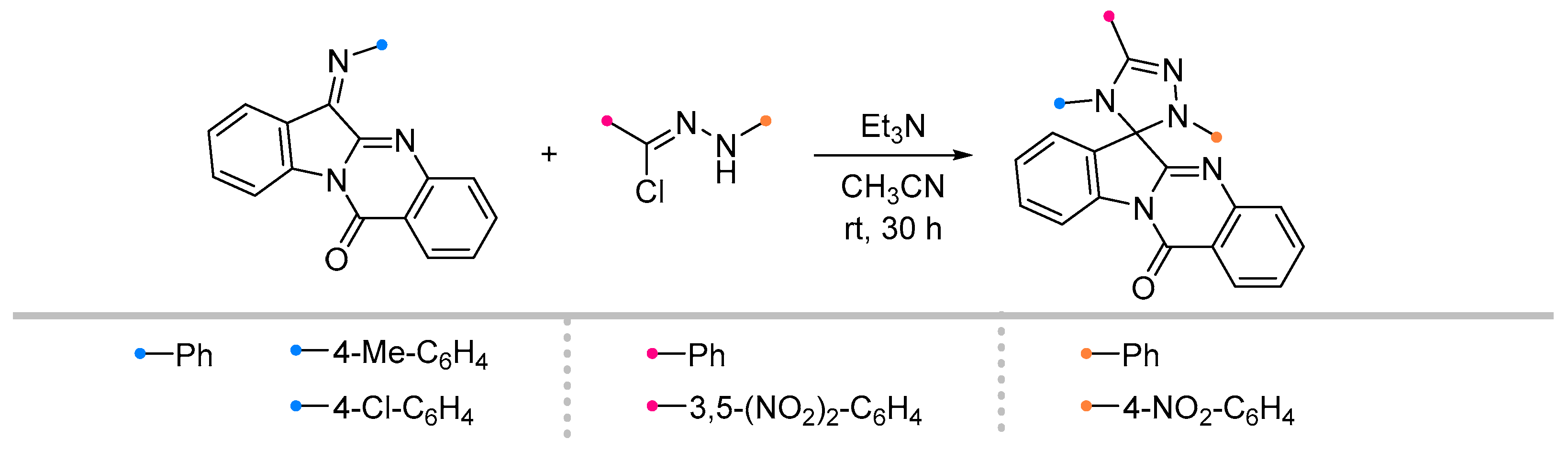
Arylimines, which are derivatives of tryptanthrin (or indoloquinazoline), are capable of adding nitrile imines similarly to other indoles and their derivatives [51] (Scheme 14). The preparation of spirotriazolines in this manner does not require special conditions, and the target products are formed after 30 hours in good and excellent yields.
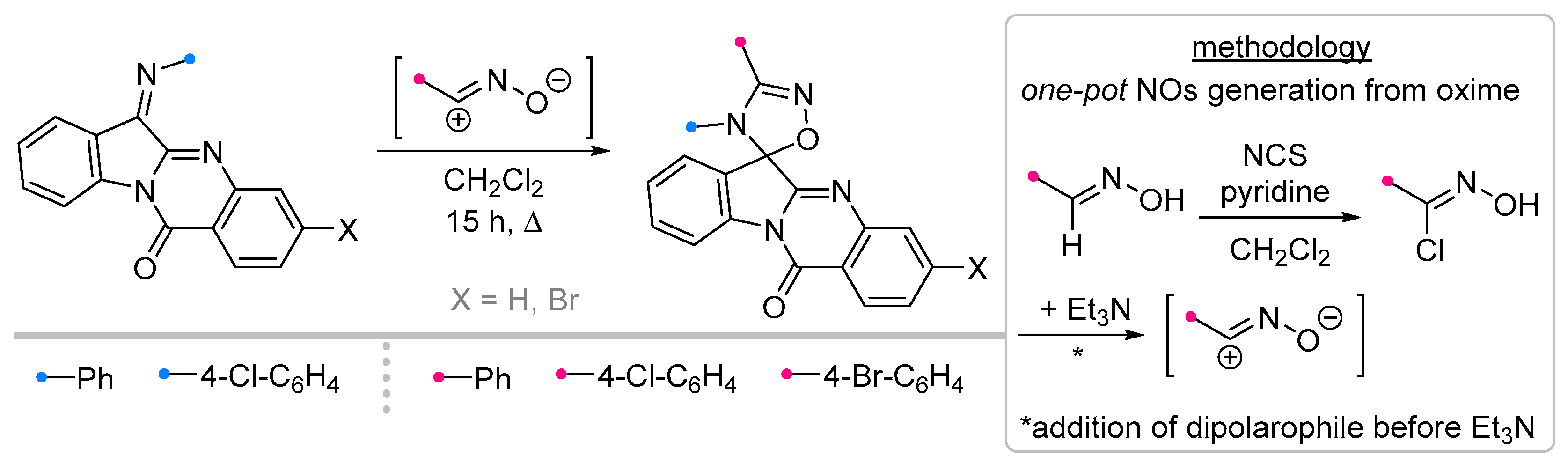
One of the most successful examples of the use of the one-pot strategy in the synthesis of spiro compounds is the transformation of tryptanthrin imines under the nitrile oxide action. Unlike many approaches used in (3+2)-cecloaddition reactions, the reaction described in [52] occurs at elevated temperature, resulting in the formation of the target product in high yield (Scheme 15).
2.3. Addition Reactions of NO and NI at the Exocyclic Bond of C=N Cycles with Two Heteroatoms
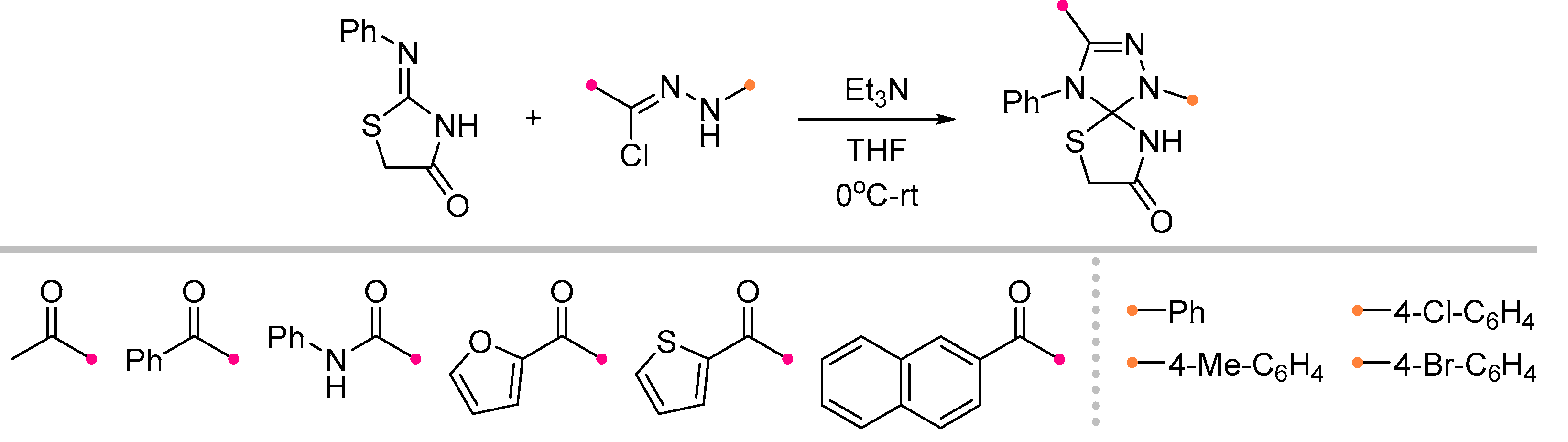
The reaction of 2-imino-thiazolidin-4-one and nitrile imine proceeds according to the classical scheme with the formation of a spiro-fused product [53]. As in the case of the above (3+2)-cycloaddition reactions, the dipole chemoselectively adds to the C=N bond without affecting the exocyclic C=O group (Scheme 17).
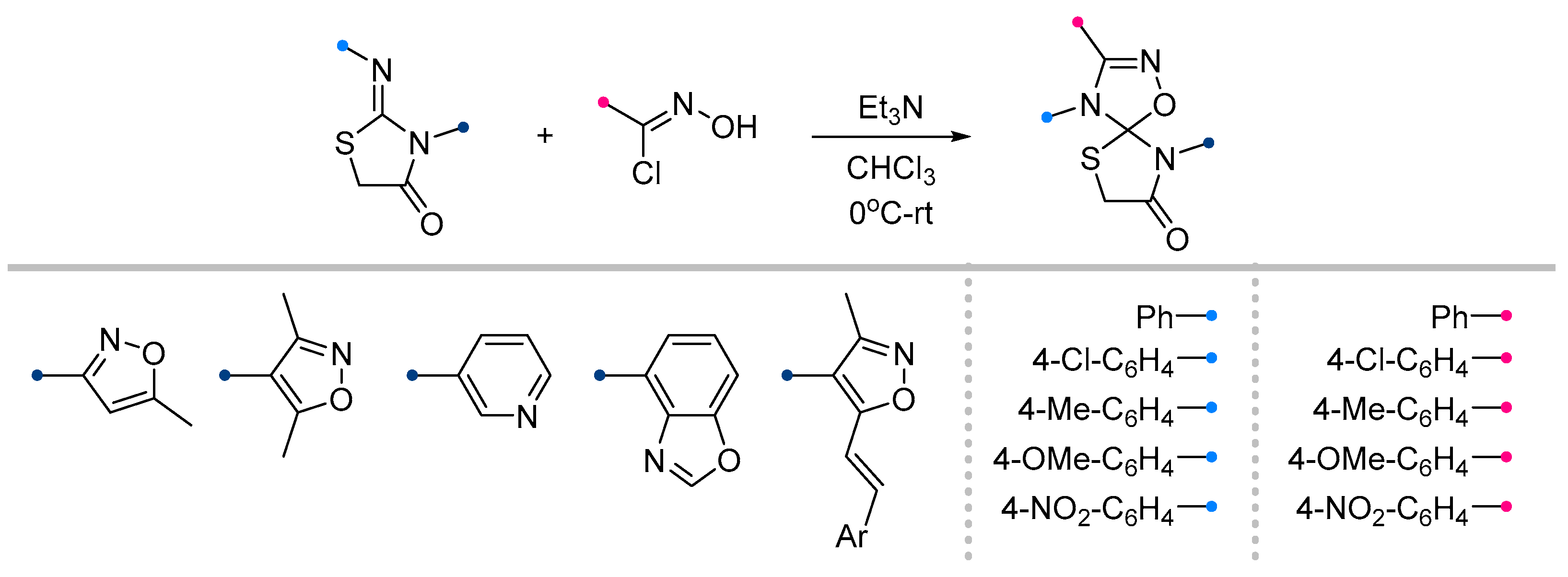
The amide C=O bond remains inert when these dipolarophiles are reacted with nitrile oxides (Scheme 18). It is surprising that, in contrast to the nitrile imine reactions, which have only been studied for thiazolidin-4-ones unsubstituted at the N3 nitrogen atom, the addition of nitrile oxide has only been described for dipolarophiles containing heteroaromatic substituents at this position, such as oxazoles [54,55,56], benzoxazole [57] и pyridine [58]. The reactions are carried out in a traditional manner, which demonstrates high efficiency for all of the listed substituents.
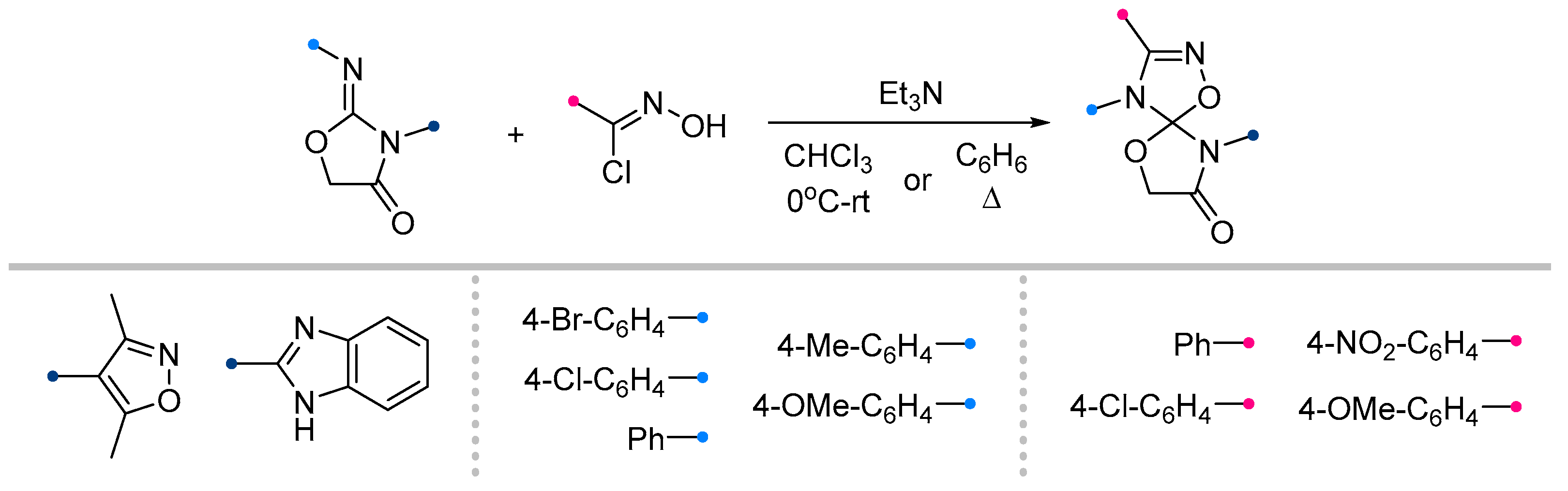
Despite the structural similarity, only two examples of the use of 2-imino-oxazolidin-4-ones in reactions of (3+2)-cycloaddition are known (Scheme 19). Unexpectedly, the replacement of the substituent at the N3 atom critically affects the conditions for carrying out such reactions: dipolarophiles containing dimethyloxazole are introduced into the reaction under conditions similar to thiazolidines (under cooling in CHCl3) [56], while benzimidazole-substituted dipolarophiles are boiled in benzene [59]. Both methods allow obtaining spiro-fused oxadiazolines with a yield of over 70%.
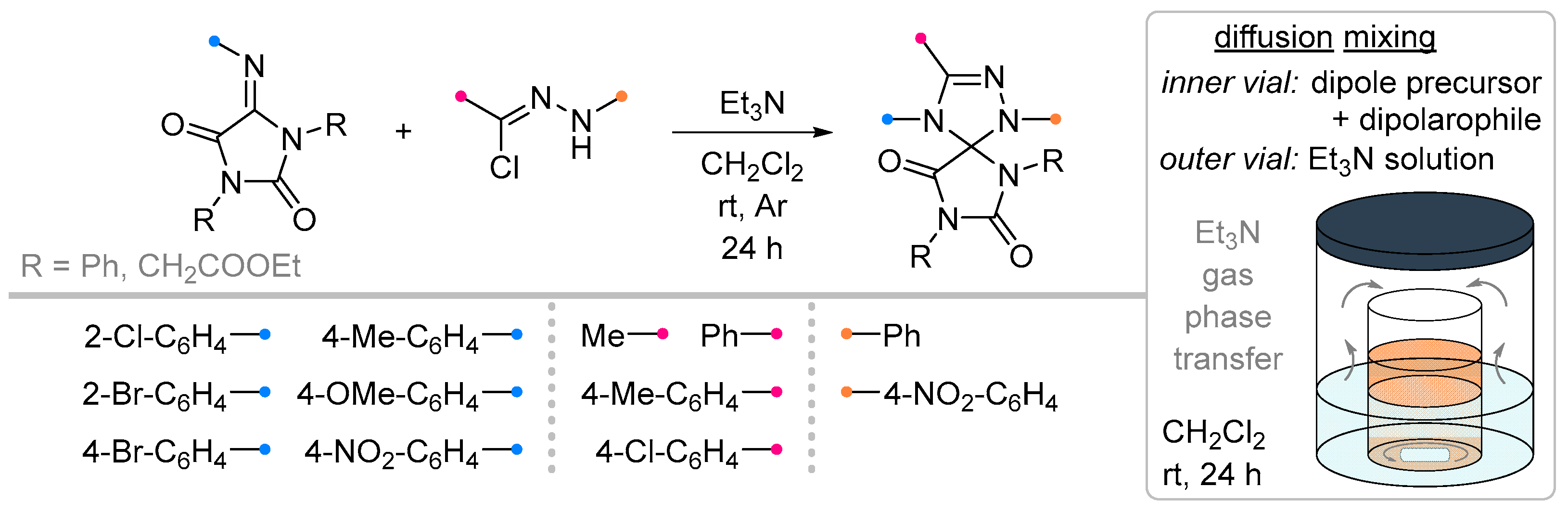
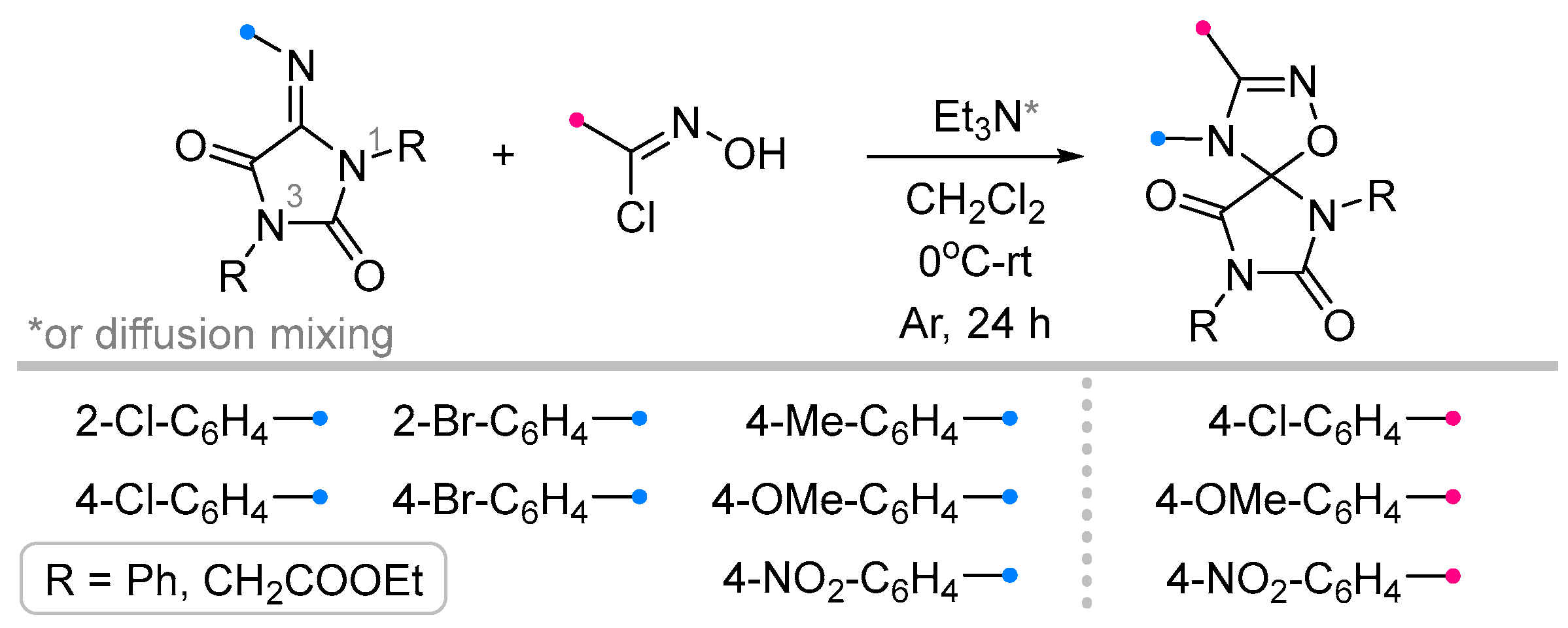
To obtain spiro-fused hydantoins (imidazolidine-2,4-diones) with the triazoline ring, the corresponding arylimines were introduced into the reaction with nitrile imines (Scheme 20) [60]. The dipole was generated in the classical way from hydrazonoyl halide and triethylamine. The latter was introduced into the reaction mixture by two methods: by dropping a base solution (the most common method) and by diffusion through the gas phase. Both methods were shown to be very effective, but the yield of the product depended to a greater extent on the electronic characteristics of the substituents in the aromatic fragments and, more unexpectedly, on the nature of the substituents at the N1 and N3 atoms of the imidazolidine (R in Scheme 20).
Both under conventional conditions and using the diffusion approach, iminohydantoins were reacted with nitrile oxides (Scheme 21) [61]. In contrast to the above nitrile imine reactions, diffusion mixing of the reactants was in some cases significantly inferior to classical conditions, in which the target spiro compounds were formed in good or excellent yields. At the same time, it was found that the presented method has a number of limitations: in addition to the low reactivity of N1-alkyl iminohydantoins (similar to that presented for nitrile imines), the (3+2)-cycloaddition reaction did not occur for carbethoxyformonitrile oxide (EtOOC-CNO) even for N1,N3-bis-aryl substituted dipolarophile.
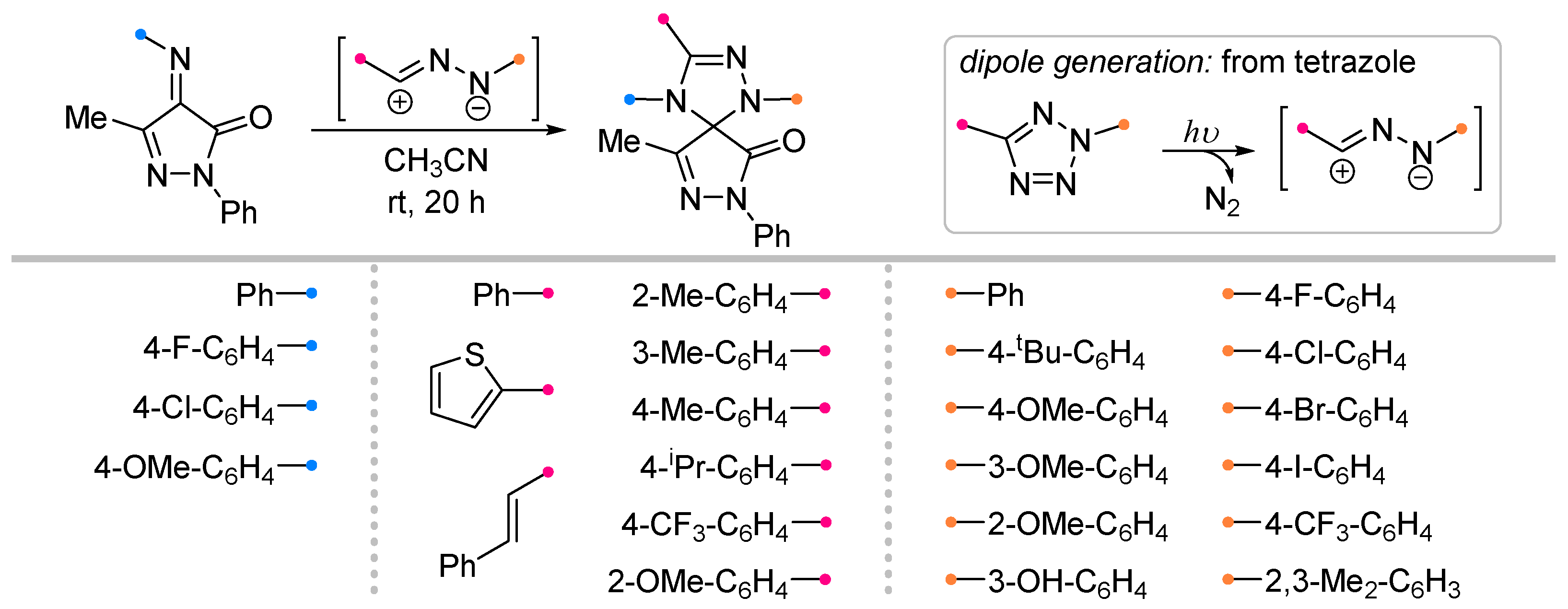
The work [62], describing the synthesis of spiro-fused triazolines by the reaction of nitrile imines and 4-imino-pyrazolin-3-ones, is the only example of (3+2)-cycloaddition of these dipoles with an exo-C=N bond initiated by the action of light (Scheme 22). The authors of the article selected tetrazoles as dipole precursors, which were photochemically converted into nitrile imines with the release of molecular nitrogen. It was shown on a large number of substrates that the selected conditions allow the synthesis of spiro compounds with excellent yields.
2.4. Nitrile Oxide and Nitrile Imine Reactions at Exocyclic C=N Bonds of Heterocycles with Three Heteroatoms
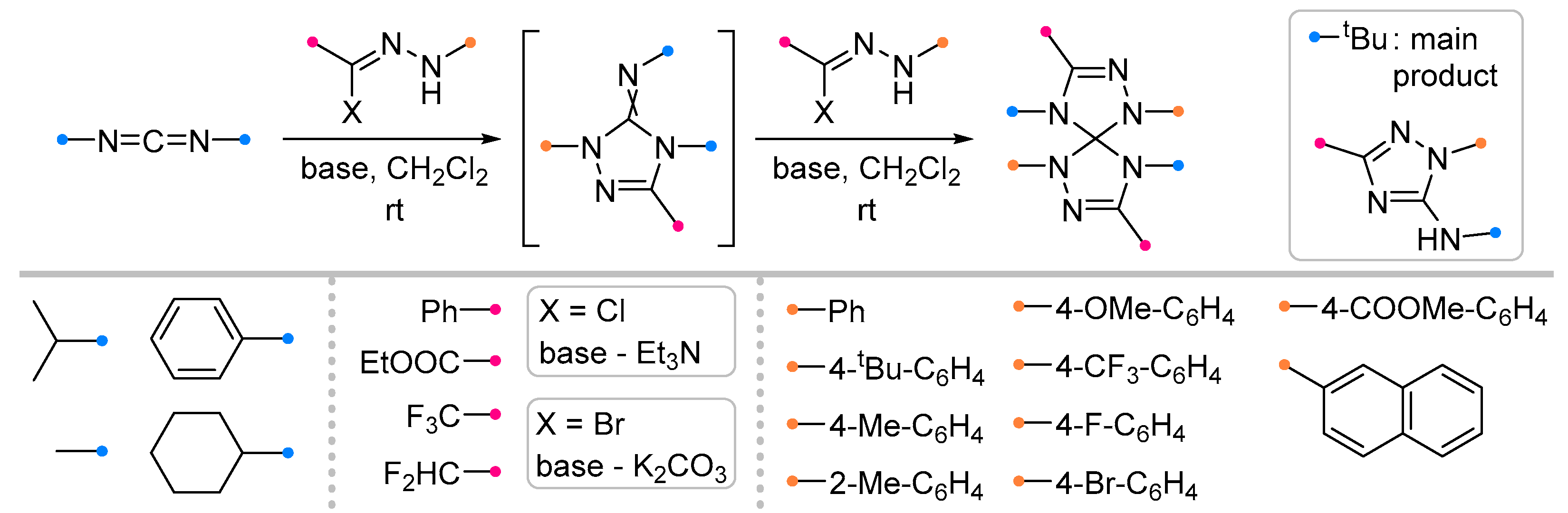
The applicability of the method first described in 1965 [63] for the synthesis of bis-1,2,4-triazolinespiranes at the reactions of nitrile imines with carbodiimides has recently been extended to various fluorine-containing dipoles [64] (Scheme 23). It was shown that the preparation of similar spiro products by the addition of two different dipoles is also possible, but this requires the synthesis of the intermediate imino-triazoline by a different method [63]. Being a more active dipolarophile than carbodiimide, it adds a second dipole molecule more quickly and therefore cannot be isolated. It was also noted that the addition of nitrile imine to an imino-triazoline with an exo-C=NH group does not allow the synthesis of the spiro-fused product, which apparently turns out to be unstable [65]. The method also had other limitations, for example, di-p-tolyl-carbodiimide did not react with the CHF2-substituted dipole, and when using di-tert-butyl-carbodiimide, the main product was aminotriazole [64], which was also formed from other carbodiimides when boiling them with nitrile imine in toluene [66].
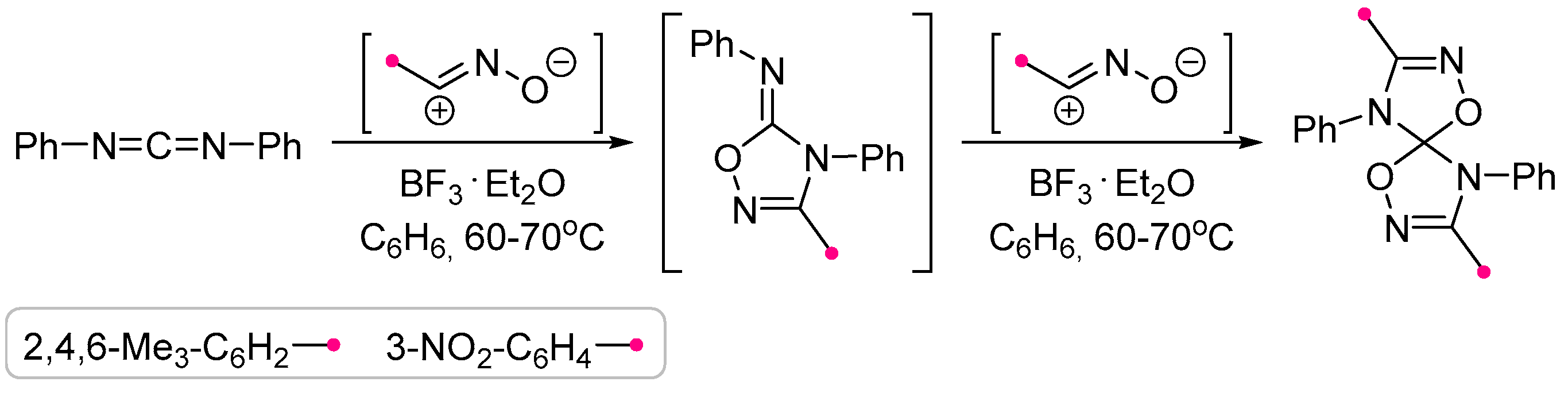
The reactions of nitrile oxides with carbodiimides were similar to the example presented above, but in the presence of boron trifluoride etherate, which was necessary for the activation of the C=N bond in the 1,3-dipolar cycloadition reaction (Scheme 24) [67]. It is worth noting that under non-catalytic conditions, nitrile oxide did not add to diphenylcarbodiimide even after many hours of heating in benzene. The addition of boron trifluoride made it possible to obtain the spiro-fused product in less than an hour. As for nitrile imines, obtaining a structure formally corresponding to the addition of two different dipole molecules was possible only if the intermediate imino-oxazolidine was synthesized by an independent method.
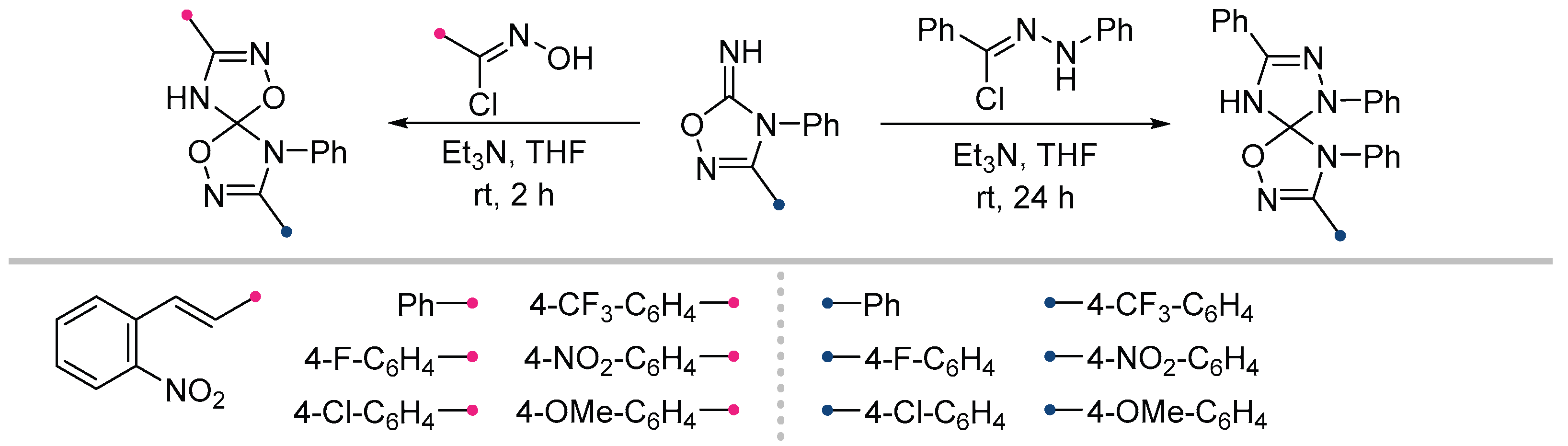
A more convenient dipolarophile for the synthesis of spiro compounds of the oxadiazoline-oxadiazoline type and the only precursor of triazoline-oxadiazolines was oxadiazole imine, the reactions of which with nitrile imines and nitrile oxides were described in [68] (Scheme 25). The introduction of exo-C=N-unsubstituted oxadiazoline imine into the (3+2)-cycloaddition reactions made it possible not only to carry out reactions with nitrile oxides in the absence of a catalyst, but also to significantly reduce the reaction time compared to that required for nitrile imines. In contrast to unstable triazoline-triazolines, both types of spiro compounds synthesized from this dipolarophile were stable enough for isolation, characterization, and study of their biological properties.
3. Conclusions
Synthesis of compounds with a spiro-fused framework via the (3+2)-cycloaddition reaction at exocyclic carbon-nitrogen bonds appears to be not only feasible but also a convenient synthetic approach to these derivatives. The versatility of this approach has been demonstrated by numerous studies of compounds with an exo-C=N bond as dipolarophiles, such as cyclic imines, oximes, hydrazones, amidines, etc. Spiro compounds formed by dipolarophiles of a polycondensed structure or complex compounds reflect the high reactivity of nitrile imines and nitrile oxides even toward sterically hindered substrates. Recent work on this topic has focused largely on spiroconjugation of heterocyclic pharmacophoric fragments, as well as on the use of alternative approaches to dipolar cycloaddition reactions (microwave and ultrasonic activation, one-pot and diffusion techniques), opening up new possibilities for organic synthesis.
Funding
This research was funded by the Russian Science Foundation, grant number 24-13-00004, and was supported by the RUDN University Scientific Projects Grant System, project №021408-2-000.
Conflicts of Interest
The authors declare no conflicts of interest.
Abbreviations
The following abbreviations are used in this manuscript:
| 32CA | (3+2)-Cycloaddition |
| DPNI | Diphenyl nitrile imines |
References
- Huisgen, R. 1,3-Dipolar Cycloadditions. Past and Future. Angew. Chem. Int. Ed. Engl. 1963, 2, 565–598. [Google Scholar] [CrossRef]
- Jamieson, C.; Livingstone, K. The Nitrile Imine 1,3-Dipole; Springer International Publishing: Cham, Switzerland, 2020; ISBN 978-3-030-43480-9. [Google Scholar]
- Esipenko, A.A.; Samarai, L.I. Cycloaddition of Nitrile Oxides to Multiple Bonds Containing a Heteroatom. Russ. Chem. Rev. 1993, 62, 1097–1105. [Google Scholar] [CrossRef]
- Belen’kii, L.I. Nitrile Oxides. In Nitrile Oxides. In Nitrile Oxides, Nitrones, and Nitronates in Organic Synthesis; John Wiley & Sons, Inc.: New Jersey, USA, 2007; pp. 1–127. [Google Scholar]
- Kanchrana, M.; Gamidi, R.K.; Kumari, J.; Sriram, D.; Basavoju, S. Design, Synthesis, Anti-Mycobacterial Activity, Molecular Docking and ADME Analysis of Spiroquinoxaline-1,2,4-Oxadiazoles via [3 + 2] Cycloaddition Reaction under Ultrasound Irradiation. Mol. Divers. 2024, 28, 3979–3991. [Google Scholar] [CrossRef]
- Ribeiro, C.J.A.; Nunes, R.C.; Amaral, J.D.; Gonçalves, L.M.; Rodrigues, C.M.P.; Moreira, R.; Santos, M.M.M. Spirotriazoline Oxindoles: A Novel Chemical Scaffold with in Vitro Anticancer Properties. Eur J Med Chem 2017, 140, 494–509. [Google Scholar] [CrossRef]
- Lv, M.; Ma, Q.; Zhang, S.; Xu, H. Construction of Spiro-1,2,4-Oxadiazoline-Fused Matrine-Type Alkaloids as Pesticidal Agents. Bioorg. Med. Chem. Lett. 2021, 51, 128356. [Google Scholar] [CrossRef]
- Proceedings of the Chemical Society. October 1961. Proceedings of the Chemical Society 1961, 357. [Google Scholar] [CrossRef]
- Sharp, J.T. Nitrile Ylides and Nitrile Imines. In Synthetic Applications of 1,3-Dipolar Cycloaddition Chemistry Toward Heterocycles and Natural Products; Padwa, A., Pearson, W., Eds.; John Wiley & Sons, Inc.: New Jersey, USA, 2002; Volume 59, pp. 473–537. [Google Scholar] [CrossRef]
- Jäger, V.; Colinas, P.A. Nitrile Oxides. In Synthetic Applications of 1,3-Dipolar Cycloaddition Chemistry Toward Heterocycles and Natural Products; Padwa, A., Pearson, W., Eds.; John Wiley & Sons, Inc.: New Jersey, USA, 2002; Volume 59, pp. 361–472. [Google Scholar] [CrossRef]
- Grundmann, Ch. The Chemistry of Nitrile Oxides. In Organische Chemie; Springer: Berlin, Heidelberg, 2006; pp. 62–127. [Google Scholar]
- Paton, M.R. 3.20 - N-Substituted Nitriles and Other Heteroanalogues of Nitriles of the Type RCZ. In Comprehensive Organic Functional Group Transformations; Katritzky, A.R., Meth-Cohn, O., Rees, C.W., Eds.; Elsevier Science: Amsterdam, Netherlands, 1995; pp. 677–692. [Google Scholar] [CrossRef]
- Kumar, A.K.; Kumar, K.A.; Govindaraju, M.; Kumar, V.G. Nitrile Imines: Versatile Intermediates in the Synthesis of Five Membered Heterocycles. Int. J. Res. Pharm. Chem. 2013, 3, 140–152. [Google Scholar]
- Quilico, A. Advances in Nitrile Oxides Chemistry. Experientia 1970, 26, 1169–1183. [Google Scholar] [CrossRef]
- Grundmann, C. Synthesis of Heterocyclic Compounds with the Aid of Nitrile Oxides. Synthesis (Stuttg) 1970, 1970, 344–359. [Google Scholar] [CrossRef]
- Grundmann, C.; Grünanger, P. Addition Reactions Leading to Cyclic Structures: 1,3-Dipolar Cycloadditions. In The Nitrile Oxides. Organische Chemie in Einzeldarstellungen, Springer: Berlin, Heidelberg, 1971, Volume 59; pp. 85–139. [CrossRef]
- Deepthi, A.; Acharjee, N.; Sruthi, S.L.; Meenakshy, C.B. An Overview of Nitrile Imine Based [3+2] Cycloadditions over Half a Decade. Tetrahedron 2022, 116, 132812. [Google Scholar] [CrossRef]
- Molteni, G.; Silvani, A. Spiro-2-oxindoles via 1,3-dipolar Cycloadditions. A Decade Update. Eur. J. Org. Chem. 2021, 2021, 1653–1675. [Google Scholar] [CrossRef]
- Kadaba, P.K. 1,2,4-Triazolines. Adv. Heterocycl. Chem. 1989, 46, 169–281. [Google Scholar] [CrossRef]
- S. Shawali, A. Chemoselectivity in 1,3-Dipolar Cycloaddition Reactions of Nitrilimines with Multifunctionalized Dipolarophiles. Curr Org Chem 2014, 18, 598–614. [Google Scholar] [CrossRef]
- Ferwanah, A.-R.S.; Awadallah, A.M. Reaction of Nitrilimines and Nitrile Oxides with Hydrazines, Hydrazones and Oximes. Molecules 2005, 10, 492–507. [Google Scholar] [CrossRef] [PubMed]
- Tsuge, O.; Watanabe, H.; Kiryu, Y. The Reactions of 1,2-Diphenyl-1-Azaspiro[2,2]Pentane and 2-Phenyl-1-Azaspiro[2.2]Pent-1-Ene with C, N -Diarylnitrilimines. Bull. Chem. Soc. Jpn. 1979, 52, 3654–3658. [Google Scholar] [CrossRef]
- Dalloul, H.M. Heterocyclic synthesis using Nitrile imines. 4. synthesis of 3-substituted 1-aryl-1,2,4-triazaspiroalk-2-enes. Chem. Heterocycl. Compd. 2004, 40, 1402–1407. [Google Scholar] [CrossRef]
- Dalloul, H.M.; Boyle, P.H. HETEROCYCLIC SYNTHESIS USING NITRILIMINES: PART 7. SYNTHESIS OF SOME NEW SUBSTITUTED 1,2,4,8-TETRAAZASPIRO[4.5]DEC-2-ENES. Heterocycl. Comm. 2007, 13, 155–160. [Google Scholar] [CrossRef]
- Dalloul, H.M.; Samaha, A.S.A. Synthesis of Nitrogen-Containing Dispiroheterocycles Using Nitrilimines (II). J. Serb. Chem. Soc. 2010, 75, 1473–1479. [Google Scholar] [CrossRef]
- Dalloul Peter H Boyle, H.M.; Dalloul, H.M.; Boyle, P.H. Heterocyclic Synthesis Using Nitrilimines: Part 5. Synthesis of Some Novel Spiro Heterocycles. Turk. J. Chem. 2006, 30, 119–124. [Google Scholar]
- Awadallah, A.M. Synthesis of Schiff Bases, Oximes and Hydrazones of 1,2,4-Oxadiazole and 1,2,4-Triazoles, Asian J. Chem. 2006, 18, 2151–2158. [Google Scholar]
- Liu, B.; Li, X.F.; Liu, H.C.; Yu, X.Y. Unexpected Nitrilimine Cycloaddition of Thiazolo[3,2-a]Pyrimidine Derivatives. Tetrahedron Lett. 2013, 54, 6952–6954. [Google Scholar] [CrossRef]
- Li, X.; Zheng, A.; Liu, B.; Yu, X.; Yi, P. Synthesis of [1,2,4]Oxadiazolo[4,5- a ]Thiazolo[2,3- b ]Pyrimidin-9(10 H )-ones via 1,3-Dipolar Cycloaddition of Nitrile Oxide to Thiazolo[3,2- a ]Pyrimidin-3-one Derivatives. Chin. J. Chem. 2010, 28, 977–980. [Google Scholar] [CrossRef]
- Freccero, M.; Gandolfi, R. Reactions of O,O'-Disubstituted Benzonitrile Oxides with 8-Azaheptafulvenes. Heterocycles 1998, 47, 453–466. [Google Scholar] [CrossRef]
- Gandolfi, R.; Gamba, A.; Grünanger. P. 1,3-DIPOLAR CYCLOADDITION OF NITRILE OXIDES TO 8-AZAHEPTAFULVENES. Heterocycles 1995, 40, 619–638. [Google Scholar] [CrossRef]
- Saito, K.; Ito, K.; Takahashi, K. 1,3-Dipolar Cycloaddition Reactions of N-Aryl-2,4,6-Cycloheptarien-1-Imines with p-Substituted Benzonitrile Oxides: Formations of 1,2,4-Oxadiazaspiro[4.6]Undeca-6,8,10-Trienes. Heterocycles 1993, 36, 21–24. [Google Scholar] [CrossRef]
- Ito, K.; Saito, K. 1,3-Dipolar Cycloaddition Reactions of 2,4,6-Cycloheptatrien-1-Imines with Benzonitrile Oxides Leading to 1,2,4-Oxadiazaspiro[4.6]Undeca-2,6,8,10-Tetraenes. Bull. Chem. Soc. Jpn. 1995, 68, 3539–3547. [Google Scholar] [CrossRef]
- Freccero, M.; Gandolfi, R.; Sarzi-Amade’, M.; Bovio, B. Reactions between Triazolinediones and Equilibrating Forms of Cycloheptatriene Derivatives Featuring 7,7-Spiro and 1,7-Fused Heterocyclic Rings. Eur. J. Org. Chem. 2002, 569–579. [Google Scholar] [CrossRef]
- Burdisso, M.; Gandolfi, R.; Toma, L.; Oberti, R. Hexafluoroisopropanol as a Suitable Solvent for Rearrangements via Zwitterionic Intermediates. Tetrahedron 1991, 41, 6725–6736. [Google Scholar] [CrossRef]
- Enders, D.; Meyer, I.; Runsink, J.; Raabe, G. Diastereo- and Enantioselective Synthesis of ∆2-1,2,4-Oxadiazolines by 1,3-Dipolar Cycloaddition of Nitrile Oxides with Chiral Hydrazones. Heterocycles 1999, 50, 995–1024. [Google Scholar] [CrossRef] [PubMed]
- Beltrame, P.; Cadoni, E.; Floris, C.; Gelli, G.; Lai, A. Reactions of a Stable Benzonitrile Oxide with Aminopyridines. Heterocycles 2000, 53, 1915–1938. [Google Scholar] [CrossRef]
- Awad, W.I.; Sobhy, M. 1,3-Dipolar Cycloaddition of Nitrile Oxides. II. Reactions with o -Quinoid Structures. Can. J. Chem. 1969, 47, 1473–1477. [Google Scholar] [CrossRef]
- Awad, W.I.; Mohayed, S.; Rahman Omran, A. Studies of Quinoid Structures. VII.1 Reaction of Benzonitrile Oxide with o-Quinones. J. Org. Chem. 1966, 31, 331–333. [Google Scholar] [CrossRef]
- Bazian, A.; Taheri, M.; Alavi, H. Synthesis of 4′-[3-Methyl-5-Thioxo-1H-1,2,4-Triazol-4(5H)-Yl]- 2′,5′-Diphenyl-2′,4′-Dihydro Spiro[Indolin-3,3′[1, 2,4]Triazol]-2-One Derivatives. Russ. J. Gen. Chem. 2014, 84, 586–592. [Google Scholar] [CrossRef]
- Souzangarzadeh, S.; Bazian, A.; Anaraki-Ardakani, H. A Facile Synthesis of Novel Spiro Indoline-Based Heterocycles through 1,3-Dipolar Cycloaddition Reactions. J. Chem. Res. 2012, 36, 94–95. [Google Scholar] [CrossRef]
- Azizian, J.; Soozangarzadeh, S.; Jadidi, K. Microwave-Induced One-Pot Synthesis of Some New Spiro[3H-Indole-3,5′(4′H)-[1,2,4]Triazoline]-2-Ones. Synth. Commun. 2001, 31, 1069–1073. [Google Scholar] [CrossRef]
- Franke, A. Spirocyclische 2-Indolinone Durch 1,3-dipolare Cycloaddition. Liebigs Ann. Chem. 1978, 1978, 717–725. [Google Scholar] [CrossRef]
- Rajanarendar, E.; Mohan, G.; Ramesh, P.; Rao, E. SYNTHESIS OF SOME NOVEL ISOXAZOLYL-SPIRO-[3H-INDOLE-3,2'-THIAZOLIDINE]-2,4'-(1H)-DIONES, [3H-INDOLE-3,4'-AZETIDINE]-2,2'-(1H)- DIONES AND [3H-INDOLE-3,5'-3'-PHENYL-1',2',4'-OXADIAZOLINE]-2(1H)-ONES. Heterocycl. Commun. 2006, 12, 431–436. [Google Scholar] [CrossRef]
- Ribeiro, C.J.A.; Amaral, J.D.; Rodrigues, C.M.P.; Moreira, R.; Santos, M.M.M. Spirooxadiazoline Oxindoles with Promising in Vitro Antitumor Activities. MedChemComm 2016, 7, 420–425. [Google Scholar] [CrossRef]
- de Azevedo, L.D.; Leite, D.I.; de Oliveira, A.P.; Junior, F.P.S.; Dantas, R.F.; Bastos, M.M.; Boechat, N.; Pimentel, L.C.F. Spirooxadiazoline-oxindoles Derived from Imatinib Show Antimyeloproliferative Potential in K562 Cells. Arch. Pharm. (Weinheim) 2024, 357, 2400029. [Google Scholar] [CrossRef]
- Azizian, J.; Sarrafi, Y.; Mehrdad, M. Synthesis of Some New I-Methyl-3’, 3’- Dichlorospiro[Indol-3, 4’-Azetidine]-2(3H), 2’- Diones and Bis[1-Methyl-3’, 3’- Dichlorospiro(Indole-3, 4’ -Azetidine)-2(3H), 2’-Diones]. Ind. J. Chem. 2000, 39B, 304–307. [Google Scholar]
- Souzangarzadeh, S. 1,3-Dipolar Cycloaddition Reaction of Nitrile Oxides to Isatin Imines. Iran. J. Chem. Chem. Eng. 2016, 35, 31–35. [Google Scholar]
- Shi, G.; He, X.; Shang, Y.; Xiang, L.; Yang, C.; Han, G.; Du, B. Synthesis of 3′,4′-Diaryl-4′H-Spiro[Indoline-3,5′-[1′,2′,4′]Oxadiazol]-2-Ones via DMAP-Catalyzed Domino Reactions and Their Antibacterial Activity. Chin. J. Chem. 2016, 34, 901–909. [Google Scholar] [CrossRef]
- Kanchrana, M.; Allaka, B.S.; Krishna, G.R.; Basavoju, S. An Ultrasound Assisted Synthesis of Spirooxindolo-1,2,4-Oxadiazoles via [3+2] Cycloaddition Reaction and Their Anti-Cancer Activity. Arkivoc 2023, 2023, 202211940. [Google Scholar] [CrossRef]
- Azizian, J.; Mohammadizadeh, M.R.; Javadi, M.; Mohammadi, A.A.; Karimi, A.R. One-Pot Synthesis of Some New Spiro 6H-Indolo[b-1,2]Quinazoline-12-One-[1,2,4]Triazolines. J. Chem. Res. 2004, 2004, 125–126. [Google Scholar] [CrossRef]
- Azizian, J.; Madani, M.; Souzangarzadeh, S. One-Pot Synthesis of Novel Derivatives of Spiro-[6H-Indolo [2,1-b]Quinazoline-6,3′-[1,2,4]Oxadiazoline]. Synth. Commun. 2005, 35, 765–768. [Google Scholar] [CrossRef]
- Dalloul, H.M. Synthesis of Spiro-Heterocycles with the Thiazolidinone Moiety from Nitrilimines. J. Chin. Chem. Soc. 2009, 56, 196–201. [Google Scholar] [CrossRef]
- Rajanarendar, E.; Raju, S.; Reddy, A.S.R. Synthesis of Novel Isoxazolyl 1,6-Dithia-4,9-Diazaspiro[4,4]Nonane-3,8- Diones and 1-Oxa-6-Thia-2,4,9-Triazaspiro[4,4]Non-2-Ene-8-Ones. Phosphorus Sulfur Silicon Relat. Elem. 2009, 184, 3139–3148. [Google Scholar] [CrossRef]
- Rajanarendar, E.; Rao, E.K.; Shaik, F.P.; Reddy, M.N.; Srinivas, M. Design, Synthesis, Antibacterial and Antifungal Activity of Novel Spiro-Isoxazolyl Bis-[5,5’]Thiazolidin-4-Ones and Spiro-Isoxazolyl Thiazolidin-4-One-[5,5’]-1,2-4 Oxdiazolines. J. Sulfur Chem. 2010, 31, 263–274. [Google Scholar] [CrossRef]
- Rajanarendar, E.; Reddy, A.S.R.; Reddy, K.G.; Raju, S. Synthesis and Antimicrobial Activity of Novel Spiro-isoxazolyl Oxazolidin-4-one-[5,5’]-1,2,4-oxadiazolines and Thiazolidin-4-one-[5,5’]-1,2,4-oxadiazolines. Indian J. Chem., Sect. B: Org. Chem. Incl. Med. Chem. 2011, 12, 1800–1806. [Google Scholar]
- Vodela, S.; Reddy Mekala, R.; Gadegoni, H. Synthesis, Characterization and Biological Evaluation of Some Novel 9-Benzooxazol-4-Yl-3,4-Diphenyl-1-Oxa-6-Thia-2,4,9-Triaza-Spiro [4.4]Non-2-En-8-Ones. Int. J. Biomed. Res. 2013, 5, 5–12. [Google Scholar] [CrossRef]
- Vodela, S.; Reddy Mekala, R.; Reddy Modugu, N.; Vannada, J. SYNTHESIS AND ANTIMICROBIAL EVALUATION OF SOME NOVEL SPIROTHIAZOLIDIN-BASED DERIVATIVES. World J. Pharm. Pharm. Sci. 2014, 3, 800–810. [Google Scholar]
- Kishore, B; Brahmeshwari, G. SYNTHESIS AND ANTIMICROBIAL SCREENING OF NOVEL 4-(1H-BENZO[d] IMIDAZOL-2-YL)-8,9-DIARYL-1,6-DIOXA-4,7,9-TRIAZASPIRO[4,5]DEC-7-EN-3-ONES. Heterocycl. Lett. 2018, 8, 631–639. [Google Scholar]
- Kuznetsova, J. V.; Tkachenko, V.T.; Petrovskaya, L.M.; Filkina, M.E.; Shybanov, D.E.; Grishin, Y.K.; Roznyatovsky, V.A.; Tafeenko, V.A.; Pestretsova, A.S.; Yakovleva, V.A.; et al. [3+2]-Cycloaddition of Nitrile Imines to Parabanic Acid Derivatives—An Approach to Novel Spiroimidazolidinediones. Int. J. Mol. Sci. 2023, 25, 18. [Google Scholar] [CrossRef]
- Petrova, J. V; Tkachenko, V.T.; Tafeenko, V.A.; Pestretsova, A.S.; Pokrovsky, V.S.; Kukushkin, M.E.; Beloglazkina, E.K. Facile Synthesis of Hydantoin/1,2,4-Oxadiazoline Spiro-Compounds via 1,3-Dipolar Cycloaddition of Nitrile Oxides to 5-Iminohydantoins. Beilstein J. Org. Chem. 2025, 21, 1552–1560. [Google Scholar] [CrossRef]
- Jia, P.; Lin, Z.; Luo, C.; Liang, J.; Lai, R.; Guo, L.; Yao, Y.; Wu, Y. Synthesis of Spirotriazolines and Spirooxadiazolines via Light-Induced 1,3-Dipolar [3+2] Cycloadditions. New J. Chem. 2023, 47, 20248–20252. [Google Scholar] [CrossRef]
- Huisgen, R.; Grashey, R.; Kunz, R.; Wallbillich, G.; Aufderhaar, E. 1.3-Dipolare Cycloadditionen, XVII: Bisaddukte Aus Nitriliminen Und Carbodiimiden. Chem. Ber. 1965, 98, 2174–2184. [Google Scholar] [CrossRef]
- Zhou, Y.; Li, X.; Liu, X.; Huang, D.; Wang, K.-H.; Wang, J.; Hu, Y. Synthesis of Di/Trifluoromethyl Bis(1,2,4-Triazoline)Spiranes and 1,2,4-Triazoles via 1,3-Dipolar Cycloaddition of Nitrilimines and Carbodiimides. Org. Biomol. Chem. 2025, 23, 2662–2671. [Google Scholar] [CrossRef]
- Huisgen, R.; Aufderhaar, E. 1.3-Dipolare Cycloadditionen, XVIII: Die Umsetzung Des Phenyl-cyanamids Mit C-Äthoxycarbonyl-N-phenyl-nitrilimin. Chem. Ber. 1965, 98, 2185–2192. [Google Scholar] [CrossRef]
- Yen, W.; Kung, F.; Wong, F.F. 1,3-Dipolar Cycloaddition of Carbodiimides and Nitrilimines: Synthesis and Mechanistic Study of 5-Amino-1,2,4-triazoles. Eur. J. Org. Chem. 2016, 2016, 2328–2335. [Google Scholar] [CrossRef]
- Grundmann, C.; Richter, R. Die Bortrifluorid Katalysierte Addition von Nitriloxiden an Cn-Doppelbindungssysteme. Tetrahedron Lett. 1968, 9, 963–966. [Google Scholar] [CrossRef]
- Sharma, P.; Ranga Prabhath, M.R.; Wong, D.; Ampem-Lassen, M.A.; Bhat, S. V.; Williams, L.; Carvalho, T.G. Synthesis of Biologically Active Heterospirocycles through Iterative 1,3-Dipolar Cycloaddition Pathways. J. Org. Chem. 2021, 86, 1223–1230. [Google Scholar] [CrossRef] [PubMed]
Scheme 1.
Synthesis of biologically active 1,2,4-triazolines and 1,2,4-oxadiazolines.
Scheme 2.
Synthesis of spirocyclobutane using nitrile imine cycloaddition.
Scheme 3.
Preparation of N4-unsubstituted spirotriazoles from cyclic oximes and nitrile imines.
Scheme 4.
Reactions of cyclic hydrazones and nitrile imines.
Scheme 5.
Preparation of spiro-fused 4-aminooxadiazoles from cyclohydrazones and nitrile oxides.
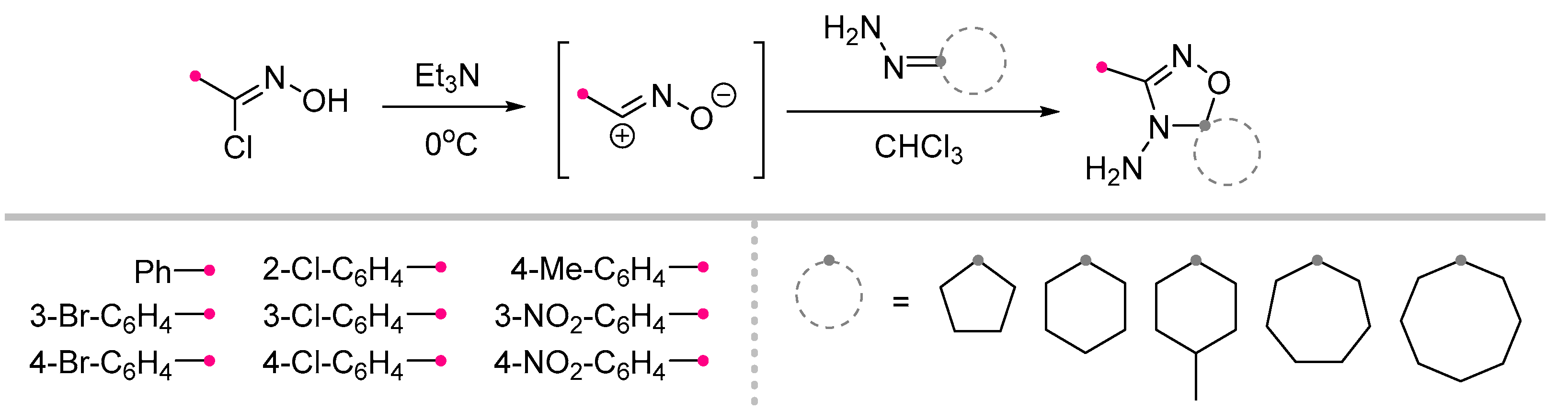
Scheme 6.
Dipolar cycloaddition of nitrile oxides and imino-substituted matrine-type alkaloids.
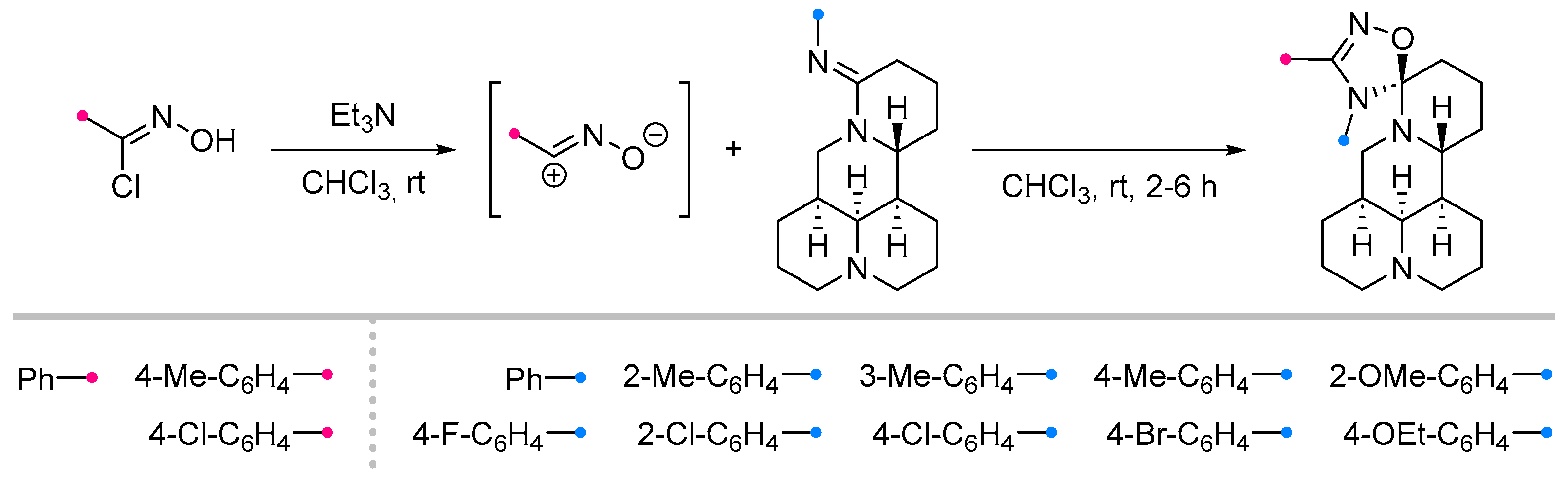
Scheme 7.
Formation of [4+2]- and [8+4]-adducts of 8-azaheptafulvenes and DPNI.
Scheme 8.
Cycloaddition reactions of nitrile oxides with 8-azaheptafulvenes.
Scheme 9.
Cycloaddition reactions of nitrile oxides with Fe(CO)3-complexes of 8-azaheptafulvenes.
Scheme 10.
Diastereoselective synthesis of spirooxadiazolines from cyclohexenone hydrazones.
Scheme 11.
Reactions of nitrile oxides and imines of phenanthraquinone and chrysenequinone.
Scheme 12.
Synthesis of spiroindolinones from isatin derivatives and nitrile imines.
Scheme 13.
Synthesis of spiroindolinones from isatin derivatives and nitrile oxides.
Scheme 14.
Triazoline-tryptanthrin spirocompounds formation.
Scheme 15.
Oxadiazoline-tryptanthrin spirocompounds formation.
Scheme 16.
Ultrasonic-activated reactions of nitrile oxides and with fused imines.
Scheme 17.
Synthesis of spirocompounds from 2-imino-thiazolidin-4-ones and nitrile imines.
Scheme 18.
Synthesis of spirocompounds from 2-imino-thiazolidin-4-ones and nitrile oxides.
Scheme 19.
Formation of oxazolidine-oxadiazoline spirocompounds from nitrile oxides.
Scheme 20.
Dipolar cycloaddition of nitrile imines and iminohydantoins.
Scheme 21.
Dipolar cycloaddition of nitrile oxides and iminohydantoins.
Scheme 22.
Synthesis of spiro-fused triazolines from nitrile imines generated from tetrazoles.
Scheme 23.
Carbodiimide synthesis of bis-1,2,4-triazolinespiranes.
Scheme 24.
Carbodiimide synthesis of bis-1,2,4-oxadiazolinespiranes.
Scheme 25.
Oxadiazoline imine – precursor for triazoline-oxadiazoline and bis-oxadiazoline spirocompounds.
Scheme 25.
Oxadiazoline imine – precursor for triazoline-oxadiazoline and bis-oxadiazoline spirocompounds.
Disclaimer/Publisher’s Note: The statements, opinions and data contained in all publications are solely those of the individual author(s) and contributor(s) and not of MDPI and/or the editor(s). MDPI and/or the editor(s) disclaim responsibility for any injury to people or property resulting from any ideas, methods, instructions or products referred to in the content. |
© 2025 by the authors. Licensee MDPI, Basel, Switzerland. This article is an open access article distributed under the terms and conditions of the Creative Commons Attribution (CC BY) license (https://creativecommons.org/licenses/by/4.0/).
Copyright: This open access article is published under a Creative Commons CC BY 4.0 license, which permit the free download, distribution, and reuse, provided that the author and preprint are cited in any reuse.


