

Submitted:
06 August 2025
Posted:
07 August 2025
You are already at the latest version
Abstract
Using physical and digital credit cards substantially enhances user convenience and incorporates technological advancements that can influence financial behaviors, including usage and payment practices. This study analyzes the financial literacy of 355 employees from a private enterprise in relation to their knowledge, ownership, and use of credit cards. The research adopts a descriptive, correlational, non-experimental, and cross-sectional approach. It investigates the relationship between credit card ownership and sociodemographic variables, employing the binomial Logit model to identify pertinent factors. The principal results indicate that 58.4% of participants do not utilize credit cards. Among those who do, 26.0% make payments to avoid accruing interest, while 15.5% settle their balances in full. The correlational analysis demonstrates that individuals over 40 are less likely to possess a credit card. In contrast, those with incomes exceeding two or three minimum wages are likelier to hold a credit card than other respondents. These findings may inform the development of financial education programs focusing on the effective use and benefits of credit.
Keywords:
credit cards
; sociodemographic variables
; binomial logit model
; credit
1. Introduction
Given the financial market's rapid and continuous growth and innovation, various increasingly sophisticated financial products and services have emerged, such as payment methods and digital credit cards. The credit card, as a payment and settlement instrument, has dramatically changed the way we consume, and at the same time, the effects of the COVID-19 crisis have affected how consumers decide to use their credit cards. Individual financial knowledge positively affects consumers' credit card ownership and the financial behaviors in their use by cardholders (Chen et al., 2023).
Mobile wallets or digital credit cards allow the user more convenience and technological innovation (Kumar et al., 2019). The digital payments industry has seen the emergence of a new mobile service called Mwallet, a digital wallet that is friendlier than a physical wallet. According to (Palan K. et al., 2011) and (Veludo-de-Oliveira et al., 2014), various factors strongly influence individuals' compulsive buying, such as budget restriction, impulsive purchases, and materialism
Some authors have identified that individuals' behavior regarding online card purchases is also related to electronic payment systems (Xu et al., 2022; Rahman & Hossain, 2023). These authors found that individuals who make a more significant number of online purchases with credit cards develop patterns of compulsive purchasing. In addition, women showed a greater propensity to compulsive buying. Financial knowledge is a necessary factor for consumers to make desirable financial decisions; therefore, having information about economic and financial concepts and knowing the rights and obligations established by law on the use of credit instruments will allow consumers to make appropriate decisions (Lusardi, 2019). The findings of (Lusardi and Tufano, 2015) show that consumers with low levels of knowledge about debt and financial experience are more likely to face problems related to financial loans and high-cost debts. Sociodemographic characteristics such as sex, age, income, educational level, and other variables can influence credit card ownership and consumer payment behavior (Chen et al., 2023). (Hernández-Mejía et al., 2021) show that behavior toward debt contracted with credit cards is negatively related to the level of financial education after considering the effect of sociodemographic variables. Therefore, individuals with a lower level of financial literacy are more likely to pay interest on debt. This research aims to determine the financial knowledge regarding credit and the sociodemographic variables related to the possession of credit cards by a group of workers in the private security sector in Mexico.
2. Literature Review
Various studies emphasize the importance of financial knowledge and its influence on financial decision-making, particularly on the possession and use of credit cards (Chen et al., 2023; Hernández-Mejía., et al, 2021; Lusardi and Tufano, 2015; Mottola, 2013). Data from the Global Findex survey and the Financial Access Survey show how the acquisition of loans, possession of debit and credit cards, and financial inclusion influenced economic growth in Egypt (Hassouba, 2023). Access to credit plays an indispensable role in driving adaptation in various ways by particular population groups. In their results, (Jiao et al., 2020) show that access to financial credit constitutes one of the key factors that promote the adoption of adaptation measures in rural environments. Their findings show that households with more sources of accumulating financial capital are better able to purchase inputs and invest in costly strategies if necessary and are, therefore, more likely to adapt to an expanded range of strategies. (Chandio et al., 2020) found that experience in agriculture, land size, and socioeconomic characteristics positively and significantly influenced small farmers' demand for formal credit. Men have more demand for credit than women. In Sweden, gender plays an essential role in risk-taking credit decisions, with female officials focusing more on collateral in their evaluations of first-time credit applications than male officials (Rad et al., 2013). Likewise, sociodemographic variables such as age, tenure, insight, education, and location did not significantly affect decision-making about credit risks. Other research with a gender perspective has identified those female officials who grant loans are more conservative than male officials (Bacha & Mohamed, 2019; Bellucci et al., 2010). Another variable of great importance in the acquisition and use of credit cards is people's risk management. Various studies have identified that poor management of banking risks is a probable cause of financial crisis in the general population (Acharya, 2009; Dell’Ariccia et al., 2012).
A large part of the population tries to avoid financial crises concerning long-term loans because, if a loan is poorly planned, it may accumulate over time. (Clark and Strauss, 2008) and (Wang, 2009) highlight that trust gives the population the ability to evaluate credit risk. Their findings highlight the relationship between trust on the part of those in charge of loans, their attitudes towards credit risk, and credit decision-making. An important distinction is thus made between self-confidence in general and confidence as it relates specifically to the trustworthiness of loan officers and their ability as professionals to make correct judgments about risk estimation when making financial credit decisions. (Fishbein and Ajzen,1975) identified that organizational credit risk norms are directly and indirectly related to credit attitudes and risks, which directly impact individuals' decisions regarding credit. On the other hand, (Jansson et al., 2023) identified an important influence on the banking context within loans, influencing officials' behavior when requesting a loan. A study by (Xu, et al.,2022) found a difference in credit card use between genders. The findings showed that in the group of women, there is a relatively high frequency of compulsive purchasing through a credit card compared to men, with a result of 10.0% in women and 3.3% in men. (Nofario et al., 2020) identified that prestige, distrust of money, and monetary anxiety are factors related to impulsive credit card purchases. (Likewise, Khandelwal et al., 2021) confirm that the frequent and unrestrained use of credit cards is associated with the lack of self-control due to compulsive purchases in a large part of the population. This, in turn, is highly related to individuals' deficient financial literacy. (Felipe et al., 2023) identified factors preceding compulsive credit card use, such as anxiety and materialism. A large part of the population relates that COVID-19 altered the general economy that moved through cash monetary transactions, which is why they adopted contactless transactions such as mobile wallets (Okonkwo et al., 2023). (Krichene, 2017) considers the levels of credit risk associated with long-term loans granted by financial institutions to all private companies and individuals, which allows consumers to be discriminated against. In response to COVID-19, the banking sector accelerated the transformation from paper to digital banking. Consumers have quickly adapted, causing notable changes in behavior when accessing and using digital payment services (Haapio et al., 2021; McKinsey et al., 2020; Goodell, 2020). Over the last four decades, the use of ATMs and payment cards has been replaced by mobile payment applications; in fact, mobile money has played an essential role in transforming the socioeconomic conditions of many segments of the disadvantaged and unbanked population in various countries (Glavee et al., 2020). The findings of (Fogel and Schneider,2011) showed that high-income college students and part-time jobs were associated with disposable income. Likewise, attitudes toward irresponsible credit card use, compulsive purchasing, money anxiety, and part-time jobs were related to sensitivity to the price of money. At the same time, other sociodemographic variables such as age, income, education, and marital status influenced compulsive buying. However, in the (Khare,2013) study, consumers' attitudes toward credit cards did not alter compulsive buying in the Indian population.
Table 1 summarizes the variables related to credit card ownership
3. Problem Formulation
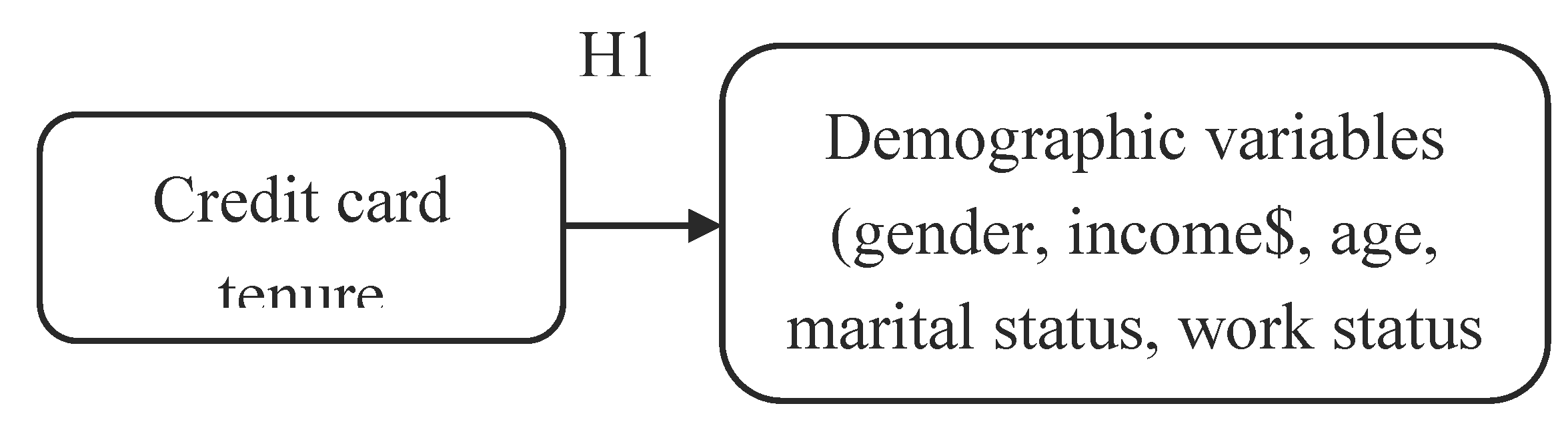
Main questions: What financial knowledge do respondents have concerning financial credit? Is there a relationship between credit tenure and the sociodemographic characteristics of the respondent?
Objective O1.- To determine the respondents' knowledge of financial credit.
Objective O2.- To determine the relationship between credit possession and sociodemographic characteristics.
Conceptual model for the study (preliminary construct)
Figure 1.
Empirical study route.
4. Methodology
The research is of a non-experimental design since it was carried out without manipulating or altering any independent variable (X), with the idea of modifying the effect on the dependent variable or variables (Y). Therefore, the study is approached from the positivist paradigm (hypothetical-deductive). The population under study are workers of a Mexican company, whose activity is the branch of private security, with fiscal domicile in Veracruz, Mexico. As an inclusion criterion, workers hired under the salaries and wages regime who are also registered with the Mexican Institute of Social Security are considered. For the research, 355 workers between 18 and 53 years old were selected.
The type of sampling used is non-probabilistic, by self-determination. The (Contreras-Rodríguez et al., 2017) instrument was used to collect data. The questionnaire was distributed in person to workers within reach. Respondents who were not within reach were contacted through an electronic questionnaire. This was possible with the support of the Human Resources department staff in each area. The instrument was applied from April 1, 2022 to September 30, 2022.
The instrument comprises two sections: items on the socioeconomic profile (sex, age, income, marital status) and financial knowledge regarding the possession, use, and payment behavior of credit cards. Frequency distributions were obtained on the answers to the questions about use, frequency, risk, and information respondents consider when choosing a credit. The binomial Logit model was used to determine the relationship between the decision to own credit cards and the sociodemographic variables (Greene, 2002). The model is denoted as:
in the case m=2, and
To estimate the m-1 parameter vectors , the likelihood function is maximized
Taking logarithms
By maximizing this function, the estimators are obtained
In the binomial logit case (m=2), it is true that
and
Taking logarithm
The That is, the β in the logit is the impact of X on the logarithm of the relative risk ratio. From the estimation, the significant variables related to the decision to own credit cards are identified, for which the z-contrast statistic and the p-value are used. In our model, the independent variables are age, marital status, employment status, income range, and gender.
5. Operationalization of Variables
Table 2 below shows the operationalization of this research's primary variable, the decision to own a credit card.
Table 3 operationalizes the sociodemographic profile variable of the respondents: gender, income range, age (age range), marital status, and employment status, which are the independent variables.
6. Data Analysis
Table 4 presents the results of respondents¿ financial knowledge concerning credit. Regarding the question: What is credit for you? 23.2% of those surveyed mentioned that credit is a money loan that generates interest, 21.1% responded that it is a loan, 18.6% of the population agreed that it is a loan paid in installments, and 20.1% answered that it is a debt. Regarding the frequency with which they usually read or find out about credits, 50.0% say that they never find out about credits, 27.1% always find out, and 22.8% occasionally. Gi Concerning the risks they identify when requesting a loan, 48.8% responded that the main risk is paying high interest or increased interest, 37.5% responded that the risk is getting into debt, and 13.5% responded that the risk of requesting a loan credit is not paying and losing one's assets. Regarding the use of credit cards, 58.4% do not use them. Of those who use them, 31.3% indicated that they use 1-2 cards, 7.6% use 3-4 cards, and 4.8% use more than four cards. Regarding the payment behavior of those with a credit card, 26.0% make the necessary payment to avoid generating interest, while 15.5% pay the total amount. Regardless of whether the respondent has a credit card, they indicate the main advantages of using the credit card. 34.7% indicate that it is possible to buy when there is no money, 31.6% could use the card in case of unforeseen events, 13.0% % could use it as a financing instrument, 7.6% indicate that the credit card gives them the possibility of handling less cash and 4.0% have the opportunity to buy in markets and department stores. Regarding the money management question, 45.2% of respondents prefer to handle cash, 30.8% use debit cards, and 18.6% prefer both credit and debit cards equally. To carry out financial operations, respondents most frequently use the official banking application on their cell phone (37.6%), 34.5% use ATMs, 19.8% go directly to branches, and less frequently use the internet (8.2%). Of those surveyed in the process of choosing a credit card, 49.4% do not know what the Total Annual Cost (CAT) is, 33.6% always take the CAT as a reference, and 16.9% indicated that they do not always do so because they doubt that it is useful.
If they have a credit card that they do not use, 18.0% keep the cards active, and the rest of the respondents who do not use the cards cancel them. Regarding credit card payment dates, 63.3% know what the payment deadline is and record it in their calendar and cell phone alarm so as not to forget it, while 26.8% do not know. Therefore, they pay when they have the money. Of the total number of respondents, 54.7% of those surveyed indicated that a credit card is very useful to cover unforeseen expenses, while 15.6% consider that it is useful to finance themselves for up to 50 days without interest, 10 % to be financed to cover personal expenses, 8.9% to complete family expenses. 52.3% of those surveyed indicated that acquiring a new credit card is convenient because it meets their needs and has an adequate CAT; 43.8% choose it because it is offered to them.
7. Binomial Logit Model of the Decision of Credit Card Use and Its Relationship with Sociodemographic Variables
Table 5 presents the result of the Logit Binomial model of the decision to have a credit card and its relationship with the sociodemographic variables. The results indicate that the gender variable is not statistically significant (p-value =0.75), which indicates that there are no significant differences in the decision to own a credit card between men and women. The result does not favor the hypothesis of the relationship between credit card ownership and gender.
In the model results, the age variable is significant in the over-40 category (p-value = 0.001). The category coefficient has a negative sign (-1.166), which indicates that workers who are over 40 years old are less likely to have a credit card. The marital status variable is not significant (p-value=0.80). This indicates that credit card ownership is not related to the person's marital status. The employment status of the person surveyed is not significant (p-value = 0.358). The income variable is significant in the categories of two minimum monthly salaries and three minimum monthly salaries (p-value = 0.000), whose coefficients have positive signs. These results indicate that workers who receive two minimum monthly salaries as income or those who receive three minimum monthly salaries as income are more likely to have a credit card.
8. Discussion and Conclusions
The results of this research allow us to determine the financial knowledge of respondents regarding credit, as well as the sociodemographic variables related to the possession of credit cards. The descriptive results show that only 23% of those surveyed know that credit is a loan of money that generates financial interest, which could be a consequence of the population's lack of knowledge of the concept of financial interest (Hernández-Mejía., et al., 2021). Likewise, our results identify the risks that respondents face when requesting a loan. Those that stand out are 48.8% responded that the main risk is paying high or increased interest, 37.5% % responded that the risk is getting into debt, and 13.5% responded that the risk of requesting a loan is not paying and losing one's assets. Unlike our results, in the study of (Bacha and Mohamed, 2 019); (Bellucci et al., 2010), and (Khare, 2013), no results were found that significantly affected decision-making about risks when purchasing a credit card.
From the binomial Logit model, two variables are identified that affect the possession of credit cards. The age variable and the income variable are significant. Income is one of the most important variables in credit card ownership as evidenced in (Chen et al., 2023). According to (Fogel, Schneider, M., 2011), when individuals had a high level of disposable income, they showed attitudes toward irresponsible credit card use, such as compulsive shopping and money anxiety.
In our results, respondents over 40 years old are less likely to purchase a credit card. In this regard, diverse results are found in the empirical evidence. In the findings of (Chen et al., 2023), in the age range of 45-54 years, the direction of the relationship is the same, and in the age range of 55 or more, the relationship is positive.
9. Final Thoughts
The results of this research show the importance of knowing the population's knowledge about financial credit and sociodemographic variables related to credit card ownership. The results support the stated hypotheses regarding the relationship between credit card ownership and respondents’ income and age. Our results have identified that workers over 40 are less likely to have credit. Based on the above, it would be relevant to carry out an analysis and identify the reason why this particular population prefers not to acquire a credit card and motivate them to use credit cards appropriately. On the other hand, continuing with credit card decisions, the population with an income range of two and three monthly minimum wages is more likely to have greater use of credit cards compared to those who earn less than one minimum monthly salary. Based on the above, it would be feasible to carry out a program that can measure the payment capacity of individuals who earn a low salary to encourage them to acquire a credit card without going into debt, which would undoubtedly benefit their finances in a positive way.
Funding
Knowledge of financial credit and credit card ownership: empirical evidence in workers in the private security sector in Mexico.
References
- Acharya, V.; Richardson, M. Causes of the financial crisis. A critical review. Journal of Politics and Society 2009, 21, 195–210. [Google Scholar]
- Bacha, S.; Mohamed, A. How gender and emotions bias the credit decision-making in banking firms. Journal of Behavioral and Experimental Finance 2019, 22, 183–191. [Google Scholar]
- Bellucci, A.; Borisov, A.; Zazzaro, A. Does gender matter in bank-firm relationship? Evidence from small business lending”. Journal of Banking and Finance 2010, 34(12), 2968–2984. [Google Scholar]
- Chandio, A.A.; Jiang, Y.; Rehman, A.; Twumasi, M.A.; Pathan, A.G.; Mohsin, M. Determinants of Demand for Credit by Smallholder Farmers’: A Farm Level Analysis Based on Survey in Sindh, Pakistan. Journal of Asian Business and Economic Studies 2020, 28, 225–240. [Google Scholar] [CrossRef]
- Chen, F; Yu, D; Sun, Z. Investigating the associations of consumer financial knowledge and financial behaviors of credit card use. Helion 2023, 9(1), e12713. [Google Scholar] [CrossRef] [PubMed]
- Clark, G.; Strauss, K. Individual pension-related risk propensities: the effects of socio-demographic characteristics and a spousal pension entitlement on risk attitudes. Ageing and Society 2008, 28(6), 847–874. [Google Scholar]
- Contreras-Rodriguez, B. A.; Garcia-Santillan, A.; amp; Moreno-Garcia, E. Level of knowledge that high school students have in financial topics on spending and credit, savings and investment and money management [Knowledge in high school students in financial topics on spending and credit, savings and investment and money management]. International Journal of Developmental and Educational Psychology 2017, 2(1), 487–512. [Google Scholar]
- Dell'Ariccia, G.; Igan, D.; Laeven, L. Credit booms and lending standards: evidence from the subprime mortgage market. Journal of Money, Credit and Banking 2012, 44 Nos 2-3, 367–384. [Google Scholar]
- Felipe, I.J.d.S.; Silva, M.M.; Ceribeli, H.B. Precedents of the compulsive use of a credit card: an analysis of university students' buying behavior. Management Magazine 2023, 30(1), 47–61. [Google Scholar] [CrossRef]
- Fishbein, M.; Ajzen, I. Belief, Attitude, Intention, and Behavior: an Introduction to Theory and Research, Addison-Wesley, Reading. 1975. [Google Scholar]
- Fogel, J.; Schneider, M. Credit card use: disposable income and employment status. Young Consumers 2011, 12(1), 5–14. [Google Scholar] [CrossRef]
- Glavee-Geo, R.; Shaikh, A.A.; Karjaluoto, H.; Hinson, R.E. Drivers and outcomes of consumer engagement: insights from mobile money usage in Ghana. International Journal of Bank Marketing 2020, 38, 1–20. [Google Scholar] [CrossRef]
- Goodell, J.W. COVID-19 and finance: agendas for future research. Finance Research Letters 2020, 35, 1–5. [Google Scholar] [CrossRef]
- Greene, William H. Econometric analysis. Prentice Hall 2002. [Google Scholar]
- Haapio, H.; Mero, J.; Karjaluoto, H.; Shaikh, A.A. Implications of the COVID-19 pandemic on market orientation in retail banking. Journal of Financial Services Marketing 2021, 26(4), 205–214. [Google Scholar] [CrossRef]
- Hassouba, T.A. Financial inclusion in Egypt: the road ahead. Review of Economics and Political Science 2023, ahead-of-print, No. ahead-of-print. [Google Scholar] [CrossRef]
- Hernández-Mejía, S.; García-Santillán, A.; Moreno-García, E. Financial literacy and the use of credit cards in Mexico. Journal of International Studies 2021, 14(4), 97–112. [Google Scholar] [CrossRef]
- Jansson, M.; Roos, M.; Gärling, T. Banks' risk taking in credit decisions: influences of loan officers' personality traits and financial risk preference versus bank-contextual factors. Managerial Finance 2023, 49(8), 1297–1313. [Google Scholar] [CrossRef]
- Jiao, X.; Zheng, Y.; Liu, Z. Three-stage quantitative approach of understanding household adaptation decisions in rural Cambodia. International Journal of Climate Change Strategies and Management 2020, 12(1), 39–58. [Google Scholar] [CrossRef]
- Khandelwal, R.; Kolte, A.; Veer, N.; Sharma, P. Compulsive buying behaviour of credit card users and affecting factors such as financial knowledge, prestige and retention time: a cross-sectional research. Vision: The Journal of Business Perspective 2021, 1–9. [Google Scholar] [CrossRef]
- Khare, A. Credit Card Use and Compulsive Buying Behavior. Journal of Global Marketing 2013, 26(1), 28–40. [Google Scholar] [CrossRef]
- Krichene, A. Using a naive Bayesian classifier methodology for loan risk assessment: Evidence from a Tunisian commercial bank. Journal of Economics, Finance and Administrative Science 2017, 22(42), 3–24. [Google Scholar] [CrossRef]
- Kumar, V.; Nim, N.; Sharma, A. Driving growth of mwallets in emerging markets: A retailer's perspective. Journal of the Academy of Marketing Science 2019, 47(4), 747–769. [Google Scholar] [CrossRef]
- Lusardi, A. Financial literacy and the need for financial education: evidence and implications. Swiss J Economics Statistics 2019, 155, 1. [Google Scholar] [CrossRef]
- Lusardi, A.; y Tufano, P. Debt literacy, financial experiences, and overindebtedness, J. Pension Econ. Finance 2015, 14(4), 332–368. [Google Scholar] [CrossRef]
- Mottola, G. R. In our best interest: women, financial literacy, and credit card behavior. Numeracy 2013, 6(2). [Google Scholar] [CrossRef]
- McKinsey and Company. The 2020 McKinsey global payments report. 2020. Available online: https://www.mckinsey.com/industries/financial-services/our-insights/data-sharing-and-open-banking (accessed on 5 May 2021).
- Nofario, E; Purwanto; Hendratono, T. The moderating role of credit card usage on the relationship between money power prestige, money distrust, and money anxiety with compulsive buying. Technology Reports of Kansai University 2020, 62(10), 6273–6281. [Google Scholar]
- Okonkwo, C.W.; Amusa, L.B.; Kind regards, H.; Common Fosso, S. Mobile wallets in cash-based economies during COVID-19. Industrial Management & Data Systems 2023, 123(2), 653–671. [Google Scholar] [CrossRef]
- Palan, K. M.; Morrow, P. C.; Trapp, A.; Blackburn, V. Compulsive buying behavior in college students: The mediating role of credit card misuse. Journal of Marketing Theory and Practice 2011, 19(1), 81–96. [Google Scholar] [CrossRef]
- Rad, A.; Yazdanfar, D.; Öhman, P. An empirical study of loan officers' assessment of SME loan applications. International Journal of Gender and Entrepreneurship 2013, 6(2), 121–141. [Google Scholar]
- Rahman, M.F.; Hossain, M.S. The impact of website quality on online compulsive buying behavior: evidence from online shopping organizations. South Asian Journal of Marketing 2023, 4(1), 1–16. [Google Scholar] [CrossRef]
- Veludo-de-Oliveira, T. M.; Falciano, M. A.; Perito, R. V. B. Effects of credit card usage on young Brazilians' compulsive buying. Young Consumers 2014, 15(2), 111–124. [Google Scholar] [CrossRef]
- Xu, C.; Unger, A.; With, C.; Papastamatelou, J.; Raab, G. The influence of Internet shopping and use of credit cards on gender differences in compulsive buy. Journal of Internet and Digital Economics 2022, 2(1), pp. 27 a 45. [Google Scholar] [CrossRef]

Table 1.
Theoretical contributions on credit cards.
| Savings reasons | Relationship | Author |
| Age | Positive | Palan, et al., (2011) and Veludo-de-Oliveira et al., (2014), Bacha and Mohamed, 2019; Bellucci et al., (2010). |
| Household income | Positive | Bacha and Mohamed, 2019; Bellucci et al., (2010); Fogel and Schneider (2011), |
| Family size | Positive | Bacha and Mohamed (2019); Bellucci et al., (2010). |
| Employment status of the head of household. | Positive | Bacha and Mohamed, 2019; Bellucci et al., (2010). Fogel, J., Schneider, M. (2011). |
| Gender | Positive |
Rad et al., (2013). Bacha, Mohamed, (2019) ; Bellucci et al., (2010). Xu C. et al, (2022). |
| Marital status | Positive |
Bacha and Mohamed, 2019; Bellucci et al., (2010). Khare, A. (2013). |
Table 2.
Operationalization of the dependent variable in the model.
| Variable | Categories | Coding |
|---|---|---|
| Decision to use a credit card | 1 use a credit card 2. do not use a credit card |
Dichotomous categorical variable: The value 1 is assigned if a credit card is used and 0 if it is not. Reference category: no credit card used (Chen et al., 2023, Hernández-Mejía., et al, 2021) |
Table 3.
Coding of independent variables of the research.
| Variable | Categories | Coding |
|---|---|---|
|
Gender |
Women Man |
Dichotomous variable: the value 1 is assigned to the male category and 0 to the female category. Reference category: Women (Chen et al., 2023, Hernández-Mejía., et al, 2021) |
|
Income range |
1 monthly minimum wage 2 minimum monthly salaries 3 minimum monthly salaries or more |
Categorical variable. Dichotomous variables are designed for each category. The value 1 is assigned if the characteristic is present and 0 otherwise. Reference category: 1 monthly minimum wage. (Chen et al., 2023, Hernández-Mejía., et al, 2021) |
|
Age (Age range) |
18 to 25 years 26 to 30 years 30 to 40 years More than 40 years |
Categorical variable. Dichotomous variables are designed for each category. The value 1 is assigned if the characteristic is present and 0 otherwise. Reference category: 18 to 25 years old. (Chen et al., 2023, Hernández-Mejía., et al, 2021) |
|
Marital status |
Single Married free union Separate Divorced Widower |
A dichotomous variable is designed: the value 1 is assigned if the person is married or lives in a common law union and 0 others (Single, separated, divorced, widowed). Reference category: single. (Chen et al., 2023, Hernández-Mejía., et al, 2021) |
|
Employment status |
It only works Work and study and work and seeks to study |
A dichotomous variable is designed: the value 1 is assigned if the person only works and 0 if the person works and studies or works and seeks to study. Reference category: works and studies or works and seeks to study. (Chen et al., 2023, Hernández-Mejía., et al, 2021) |
Table 4.
Results of the credit financial knowledge survey.
| Ask | Response options | Number of people | Percentage |
|---|---|---|---|
| How often do you read or find out about credits? | It's a loan | 79 | 22.3 |
| It is a loan that is paid in installments. | 66 | 18.6 | |
| It's a debt | 71 | 20.1 | |
| Interest-bearing loan | 82 | 23.2 | |
| Help to solve a problem | 46 | 13.0 | |
| They are problems | 10 | 2.8 | |
| Never | 177 | 50.0 | |
| Occasionally, when I need it | 81 | 22.8 | |
| Always | 96 | 27.1 | |
| What is the main risk of requesting a loan? | Get into debt | 133 | 37.57 |
| Failure to pay and losing assets | 48 | 13.56 | |
| Pay high interest or increase interest | 173 | 48.87 | |
| Do you use a credit card at home? | Yes | 147 | 41.53 |
| No | 207 | 58.47 | |
| If yes: How many credit cards do you have? | 1-2 | 111 | 31.36 |
| 3-4 | 27 | 7.62 | |
| More than 4 | 17 | 4.8 | |
| Not applicable | 199 | 56.22 | |
| If you have a credit card, when you pay: what do you do most frequently? | Pay the full amount | 55 | 15.5 |
| Pay a little more than the minimum | 24 | 6.8 | |
| Make the minimum payment | 17 | 4.8 | |
| Make the necessary payment to avoid generating interest | 92 | 26.0 | |
| Not applicable | 166 | 46.9 | |
| Regardless of whether or not you have a credit card, for you, what would be the main advantage of using a credit card? | Possibility of buying when there is no money | 123 | 34.7 |
| Handle less cash. | 27 | 7.6 | |
| Unforeseen events | 112 | 31.6 | |
| Avoid assaults. | 16 | 4.5 | |
| Buy in markets and department stores | 14 | 4.0 | |
| Financing | 46 | 13.0 | |
| Do not handle cash and get points rewards | 8 | 2.3 | |
| 2% refund on purchases | 8 | 2.3 | |
| In general terms, how do you prefer to manage your money? | Cash | 160 | 45.2 |
| Credit card | 16 | 4.5 | |
| debit card | 109 | 30.8 | |
| Cheque | 3 | 0.8 | |
| Credit and debit cards alike | 66 | 18.6 | |
| Where do you carry out your operations most frequently? | Branch | 70 | 19.8 |
| ATMs | 122 | 34.5 | |
| Internet | 29 | 8.2 | |
| The official application on the cell phone | 133 | 37.6 | |
| Before choosing a credit card, do you compare the CAT? | Always | 119 | 33.6 |
| Not always, because I doubt it will be useful | 60 | 16.9 | |
| I don't know what the CAT is | 175 | 49.4 | |
| Do you have credit cards that you don't use? | No, I cancel those that I do not use | 253 | 77.1 |
| Yes, every card can be useful someday. | 59 | 18.0 | |
| I use all of them, with some cards, I finance the debts of other cards | 16 | 4.9 | |
| Do you know what your credit card payment deadline is? | Yes, I record it in my calendar and on my cell phone alarm so I don't forget it. | 224 | 63.3 |
| Sometimes I forget and have to pay a late payment fee. | 35 | 9.9 | |
| No, I pay when I have the money to do so | 95 | 26.8 | |
| In your opinion, why do you think the credit card is more useful? | Financing me for 50 days without interest (full payment of my debt before the payment deadline) | 56 | 15.6 |
| Cover unforeseen expenses | 201 | 54.7 | |
| To complete family expenses. | 34 | 8.9 | |
| Fund me to cover personal expenses | 36 | 10.0 | |
| Buy things that will give returns in the future | 27 | 7.5 | |
| When purchasing a new credit card, you try to choose because: | It suits my needs and is the one with a suitable CAT. | 185 | 52.3 |
| They offer it to me | 155 | 43.8 | |
| They give me status (university cards, soccer teams, Gold or Premier) | 14 | 4.0 |
Table 5.
Binomial econometric model of credit card ownership.
| Coefficient |
Std. Dev. |
With | p-value | ||
|---|---|---|---|---|---|
| Const | −0.348 | 0.335 | −1.039 | 0.298 | |
| Gender | Female (CF) | ||||
| Male | 0.082 | 0.263 | 0.314 | 0.753 | |
| Age | 18 to 25 years (CF) | ||||
| 26 to 30 years | −0.544 | 0.383 | −1.421 | 0.155 | |
| 30 to 40 years | −0.198 | 0.374 | −0.530 | 0.596 | |
| More than 40 years | −1.166 | 0.367 | −3.17 | 0.001*** | |
| State civil | Single (CF) | ||||
| married or cohabiting | 0.063 | 0.257 | 0.247 | 0.804 | |
| Employment status | Work and study or work and seek to study (CF) | ||||
| Only working | −0.256 | 0.279 | −0.917 | 0.358 | |
| Income range | 1 monthly minimum wage (CF) |
||||
| 2 minimum monthly salary | 1.288 | 0.248 | 5.192 | <0.000*** | |
| 3 minimum monthly salary | 2.099 | 0.525 | 3.994 | <0.000*** | |
Note: CF indicates reference category; *, **, *** indicate significance level of 10%, 5% and 1%, respectively.
Disclaimer/Publisher’s Note: The statements, opinions and data contained in all publications are solely those of the individual author(s) and contributor(s) and not of MDPI and/or the editor(s). MDPI and/or the editor(s) disclaim responsibility for any injury to people or property resulting from any ideas, methods, instructions or products referred to in the content. |
© 2025 by the authors. Licensee MDPI, Basel, Switzerland. This article is an open access article distributed under the terms and conditions of the Creative Commons Attribution (CC BY) license (http://creativecommons.org/licenses/by/4.0/).
Copyright: This open access article is published under a Creative Commons CC BY 4.0 license, which permit the free download, distribution, and reuse, provided that the author and preprint are cited in any reuse.


