
Submitted:
07 August 2025
Posted:
07 August 2025
Read the latest preprint version here
Abstract
We numerically investigate improvements to the explicit Riemann–von Mangoldt formula for counting the zeros of the Riemann zeta function on the critical line. By introducing a nonlinear correction involving a shifted sine integral, we demonstrate significant reduction in maximum deviations from the true counting function. Numerical experiments across extensive ranges of zeros confirm robust improvements and hint at the presence of a sublinear saturation bound, potentially linked to spectral barriers in analytic number theory.
Keywords:
prime numbers
; number theory
; zeta zeros
1. Introduction
The counting function for zeros of the Riemann zeta function along the critical line is classically approximated by the Riemann–von Mangoldt formula [1]. For zeros , the classical smooth term is given by:
Explicit prime sum corrections typically reduce deviations [2], but residual errors persist. We propose a novel nonlinear correction to further reduce this error.
2. Explicit Formula with Nonlinear Correction
Define the explicit prime sum correction as:
where the sum is over primes .
We propose a nonlinear transformation using the shifted sine integral function :
We evaluated the deviations numerically using sets of nontrivial zeta zeros :
We chose the shifted sine integral as the nonlinear correction due to its natural appearance in Fourier-analytic treatments of oscillatory prime sums [3]. Its kernel is closely related to the oscillatory structure underlying the explicit formula, reflecting interference patterns between primes and zeros of . This makes a natural candidate to smooth and rephase the prime sum contribution while preserving the arithmetic oscillations that encode zero distribution.
3. Numerical Results
For various subsets of zeros (up to ), maximum deviations consistently improved relative to the smooth term alone. Representative results:
- : max deviation .
- : max deviation .
- : max deviation .
- : max deviation .
Figure 1.
Deviation comparison between the smooth Riemann–von Mangoldt counting function (blue) and the explicitly corrected version with shifted sine integral (ssinint) nonlinearity (red), evaluated over the first 2000 nontrivial zeros of the Riemann zeta function.
Figure 1.
Deviation comparison between the smooth Riemann–von Mangoldt counting function (blue) and the explicitly corrected version with shifted sine integral (ssinint) nonlinearity (red), evaluated over the first 2000 nontrivial zeros of the Riemann zeta function.
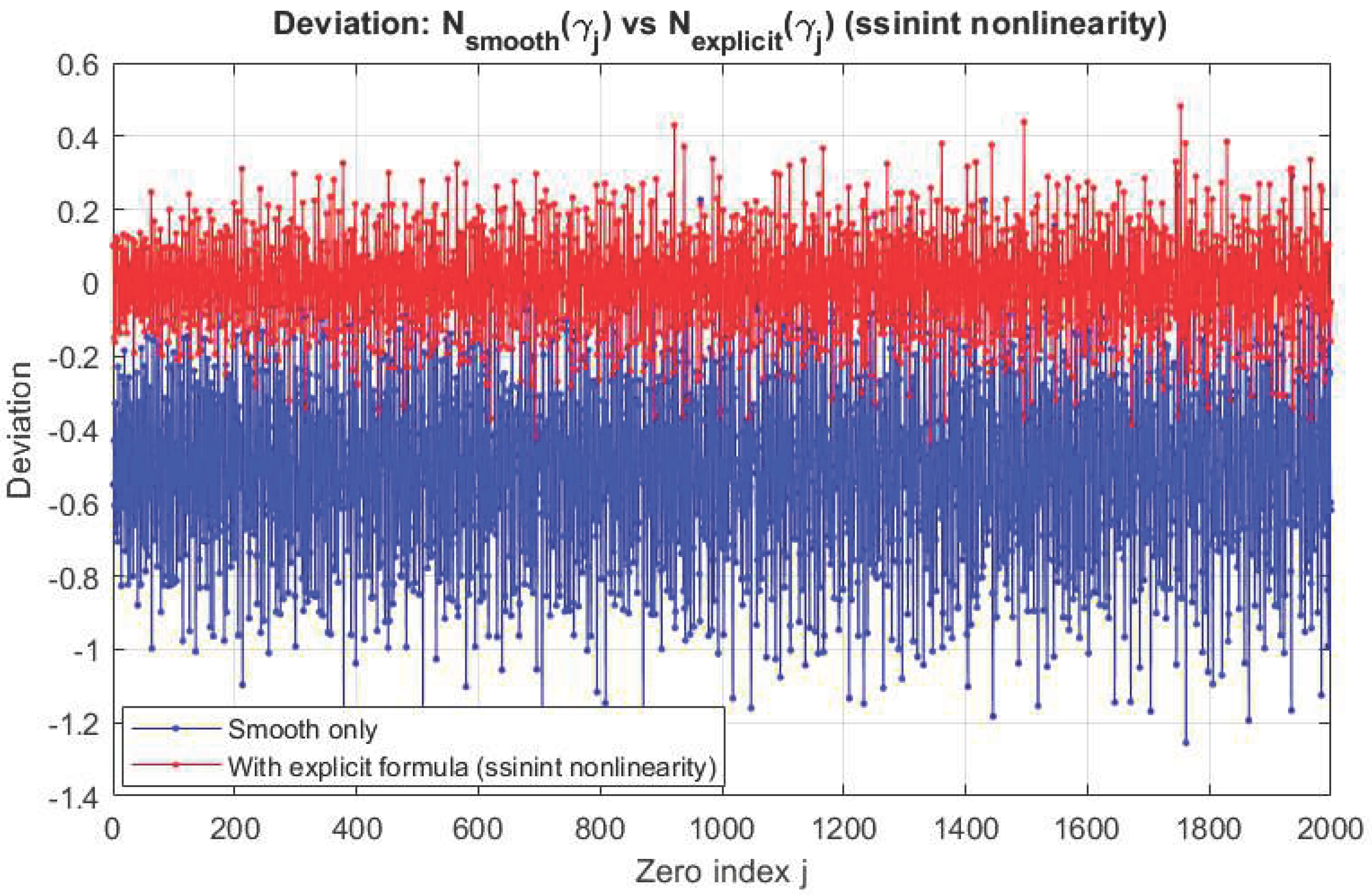
To assess robustness, we performed Monte Carlo experiments by selecting multiple random subsets of consecutive zeros (size ) from the dataset. For each subset, deviations were computed for both the smooth term and the nonlinear explicit formula. Statistics including mean, root-mean-square (RMS), and maximum deviation were recorded across trials, confirming consistent improvement and stability of the nonlinear correction. Increasing logarithmically reduced errors, confirming expected asymptotic behavior. Here we present an extra robustness test which include the Standard (explicit) formula :
Robustness Test Results
The following table presents the mean, maximum, and root-mean-square (RMS) deviations for three methods used to estimate the number of non-trivial zeros of the Riemann zeta function, based on 20 random subsets of zeros. The methods compared are the classic Riemann–von Mangoldt smooth term, the standard explicit formula, and the explicit formula with a nonlinear correction (ssinint).

Table 1.
Deviation Metrics for Robustness Tests (20 Random Subsets, ).
| Method | Mean Deviation | Max Deviation | RMS Deviation |
|---|---|---|---|
| Classic (smooth) | 0.518 | 1.468 | 0.600 |
| Standard (explicit) | 0.501 | 1.116 | 0.537 |
| Explicit (ssinint) | 0.160 | 0.652 | 0.199 |
4. Discussion and Implications
The observed sublinear growth and apparent error saturation at large N suggest a deeper connection with spectral barriers or conjectures related to the distribution of prime numbers and zeros of the zeta function. This warrants further analytic investigation, potentially linking this numerical behavior to known spectral limits in analytic number theory.
5. Conclusion
Introducing a nonlinear correction significantly improves explicit formulas for counting Riemann zeta zeros. Numerical experiments robustly confirm the reduction in deviations and hint at new theoretical insights.
References
- H. M. Edwards, Riemann’s Zeta Function, Dover Publications, 1974.
- M. V. Berry and J. P. Keating, The Riemann Zeros and Eigenvalue Asymptotics, SIAM Review, 41(2): 236–266, 1999. [CrossRef]
- H. Iwaniec and E. Kowalski, Analytic Number Theory, American Mathematical Society Colloquium Publications, Vol. 53, 2004.
Disclaimer/Publisher’s Note: The statements, opinions and data contained in all publications are solely those of the individual author(s) and contributor(s) and not of MDPI and/or the editor(s). MDPI and/or the editor(s) disclaim responsibility for any injury to people or property resulting from any ideas, methods, instructions or products referred to in the content. |
© 2025 by the authors. Licensee MDPI, Basel, Switzerland. This article is an open access article distributed under the terms and conditions of the Creative Commons Attribution (CC BY) license (http://creativecommons.org/licenses/by/4.0/).
Copyright: This open access article is published under a Creative Commons CC BY 4.0 license, which permit the free download, distribution, and reuse, provided that the author and preprint are cited in any reuse.