

Submitted:
06 August 2025
Posted:
07 August 2025
You are already at the latest version
Abstract
Purpose: This article evaluated the decline of registered auditors (RAs) and its impact on the future of the assurance industry in South Africa. Auditors play a critical role in ensuring the transparency, trust, and credibility of financial statements. The decrease in the number of registered auditors has become a pressing issue, raising concerns about the assurance industry’s ability to maintain a sufficient number of registered auditors and continue providing assurance services to public and private entities.
Methodology: A qualitative Delphi methodology was employed, involving interviews with RAs who are registered with the Independent Regulatory Board for Auditors (IRBA). Eight RAs participated in structured interviews. This approach enabled the researcher to gather expert opinions, identify emerging trends, and explore challenges and opportunities within the audit profession related to the decline of RAs.
Main findings: The decline of RAs is straining client demands, increasing workloads, and leading to a shortage of audit firms, which in turn affects audit quality and methodologies. Audit firms struggle to attract and retain talent due to regulatory burdens, economic pressures, and concerns about work-life balance. These pressures have resulted in higher audit fees, increased compliance costs, and more extensive training requirements. Smaller audit firms are especially impacted, with some downscaling their assurance services or exiting the market entirely.
Practical implications: This study underscores the pressing need for regulatory bodies, such as the IRBA, to address the challenges faced by audit firms, particularly in terms of compliance and workforce retention. Proactive strategies are required to preserve the quality and accessibility of assurance services.
Contribution: This study contributes to the ongoing discourse on the future of the audit profession by offering grounded insights into how the industry might sustain itself amid a declining number of RAs and changing professional dynamics.
Keywords:
assurance
; audits
; Independent Regulatory Board for Auditors
; technology advancements
; regulatory challenges
Purpose: This article evaluated the decline of registered auditors (RAs) and its impact on the future of the assurance industry in South Africa. Auditors play a critical role in ensuring the transparency, trust, and credibility of financial statements. The decrease in the number of registered auditors has become a pressing issue, raising concerns about the assurance industry’s ability to maintain a sufficient number of registered auditors and continue providing assurance services to public and private entities. Methodology: A qualitative Delphi methodology was employed, involving interviews with RAs who are registered with the Independent Regulatory Board for Auditors (IRBA). Eight RAs participated in structured interviews. This approach enabled the researcher to gather expert opinions, identify emerging trends, and explore challenges and opportunities within the audit profession related to the decline of RAs. Main findings: The decline of RAs is straining client demands, increasing workloads, and leading to a shortage of audit firms, which in turn affects audit quality and methodologies. Audit firms struggle to attract and retain talent due to regulatory burdens, economic pressures, and concerns about work-life balance. These pressures have resulted in higher audit fees, increased compliance costs, and more extensive training requirements. Smaller audit firms are especially impacted, with some downscaling their assurance services or exiting the market entirely. Practical implications: This study underscores the pressing need for regulatory bodies, such as the IRBA, to address the challenges faced by audit firms, particularly in terms of compliance and workforce retention. Proactive strategies are required to preserve the quality and accessibility of assurance services. Contribution: This study contributes to the ongoing discourse on the future of the audit profession by offering grounded insights into how the industry might sustain itself amid a declining number of RAs and changing professional dynamics.
1. Introduction
The audit profession plays a critical role in ensuring financial transparency and public trust (Abrahams and Phesa, 2025). In recent years, however, a worrying global trend has emerged, the supply of qualified auditors is declining (Abrahams and Phesa, 2025). Multiple countries have reported auditor shortages and a decline in entry into the profession (Ellis, 2022, Khumalo, 2023, Tyson, 2023, Yiu and Zhong, 2023). For example, the United States saw over 300,000 accountants leave their jobs in a two-year span, with an estimated 17% workforce contraction (Ellis, 2022). Similarly, Australia’s pool of registered company auditors has shrunk by more than 30% over the past decade, a decline attributed to demographic shifts, firm consolidations, and an ageing workforce (Hecimovic et al., 2009). Across jurisdictions, younger professionals are increasingly reluctant to pursue careers in auditing due to demanding workloads, stringent regulations, and concerns about work-life balance (Harber, 2018). These global pressures, including regulatory burden, talent shortages, firm closures, and audit market consolidation, have created a challenging environment for the sustainability of the audit profession (Ramalepe, 2023, Ahn et al., 2024, Tyson, 2023, Vien, 2024, Eldaly, 2012, Fülöp and Pintea, 2014).
South Africa mirrors these international trends, with evidence pointing to a notable decline in its registered auditor (RA) population (Irba, 2024a). Recent data from the Independent Regulatory Board for Auditors (IRBA) indicate that the number of RAs in South Africa fell by approximately 11.7% between 2019 and 2023 (Irba, 2023). This contraction stems from multiple factors, such as auditors retiring faster than they can be replaced, and fewer young accountants entering the auditing field (Irba, 2024a). The profession has struggled to attract new talent, in part due to negative public perceptions resulting from high-profile corporate scandals and the intense demands of audit work (Abrahams and Phesa, 2025). Additionally, South African auditors face increased regulatory pressure (Abrahams and Phesa, 2025). Amid audit failures, regulators have tightened oversight and IRBA inspections in recent years (Irba, 2024b). At the same time, such measures aim to restore confidence, but they have increased compliance costs and liability risks for auditors (Celestin, 2020b). Smaller audit practices, in particular, are strained by the cost of complying with stricter standards and oversight (Celestin, 2020a). Many small and mid-tier firms find it difficult to absorb these burdens, which has led some to merge with larger firms or exit the assurance market entirely (Celestin, 2020a). This audit market consolidation further concentrates the industry among the Big Four firms, raising concerns about reduced competition and the capacity to serve the public interest (Celestin, 2020a). In summary, by 2025, the South African auditing landscape will be characterised by a shrinking auditor workforce and mounting challenges related to audit quality, talent retention, and firm viability (Abrahams and Phesa, 2025, Harber, 2018).
The purpose of this study was to evaluate the impact that the decline of RAs will have on the future of the assurance industry in South Africa. The study employed a qualitative research approach by conducting structured interviews with eight RAs currently registered with the Independent Regulatory Board for Auditors (IRBA), the South African audit regulatory body. Notably, IRBA was once ranked number one for seven consecutive years from 2010 to 2016 in the World Economic Forum’s Global Competitiveness Report for the strength of its auditing and reporting standards (Irba, 2016). Even though the IRBA has declined since 2017 due to recent scandals (Steinhoff scandal, VBS Mutual Bank Collapse, Tongaat Hulett and others) (Irba, 2017), which have led to a significant loss of trust (Ramsarghey and Hardman, 2020), IRBA still plays a significant role in the world and is one of the most respected regulatory bodies, evidenced by the recent re-election of Mr. Imre Nagy, CEO of the IRBA as the board member and the chairperson of IFIAR Audit and Finance Committee in the International Forum of Independent Audit Regulators, “with Ireland (IAASA), Poland (PANA), Singapore (ACRA), and South Africa (IRBA) being appointed to the IFIAR Board for a four-year term, joining currently appointed board members from 12 jurisdictions to form a full board of 16 members” (Irba, 2025). This shows how IRBA is still relevant and amongst the world leaders in the auditing space. For this reason, we find this study relevant not only in South Africa, but globally, as it may show the same sentiment in other jurisdictions.
The central research question guiding this inquiry is: How will the decline in Registered Auditors affect the assurance industry in the future within the South African economy? This study aims to:
- Describe professional concerns about the decline in RAs in South Africa.
- Explain the drivers of RA decline between 2019 and 2023.
- Document firm-level strategies adopted to adapt to changes in RA numbers.
- Examine regulatory challenges shaping audit practice and their perceived proportionality.
- Assess near-term risks (5–10 years) for capacity, quality, and market structure.
- Identify opportunities for growth and improvement in the profession.
- Examine strategies to sustain the RAs in a midst of a decline.
This study addresses a growing and pressing concern, that is, the shortage of assurance auditors, which is placing an increasing strain on the capacity, quality, and sustainability of assurance services within the country. By directly engaging with experienced professionals through in-depth interviews, the research captures practitioner-based insights into how this trend is shaping audit practice, firm resilience, and public trust in financial reporting. The findings offer a grounded and forward-looking evaluation of the risks, challenges, and potential responses to the auditor shortage.
Importantly, this study contributes to the academic literature as one of the first qualitative investigations into the future impact of declining RAs in the South African context and, as noted before, may contribute significantly to the debate in other jurisdictions. It adds to the broader discourse on the future of the assurance profession, offering evidence-based perspectives that may inform policy, regulatory reform, and professional development strategies aimed at sustaining the audit industry in an increasingly constrained environment.
The following sections of the article outline the literature review, methodology, analysis and discussion of results, and conclusions. The conclusion includes the study's contribution, limitations, recommendations for practice and policy, and directions for future research.
2. Literature Review
This section offers an overview of previous researchers’ findings and identifies gaps in the existing research. Furthermore, it establishes a foundation for the theoretical studies upon which this thesis is based.
2.1. Theoretical Review: Behavioural and Institutional Theory
The Behavioural Theory, and more specifically the Theory of Planned Behaviour (TPB) developed by Ajzen (1991), underpins this study. According to TPB, human behaviour is driven by three core components: behavioural beliefs, normative beliefs, and control beliefs. Behavioural beliefs relate to anticipated outcomes (positive or negative) of a particular behaviour, which shape an individual’s attitude. Normative beliefs involve perceived social pressures or expectations from others. Control beliefs reflect how easy or difficult the individual perceives the behaviour to be, influenced by past experiences and anticipated obstacles (Ajzen, 1991).
This theory applies to the auditing profession in the South African context. It offers a lens to understand the declining interest in registering as an RA, particularly among young professionals. For example, behavioural beliefs may be shaped by the perceived risk, intensity of regulatory scrutiny, or unattractive working conditions in the profession. Normative pressures could relate to the societal and professional expectations placed on auditors. At the same time, control beliefs may stem from the perceived difficulty of qualifying, sustaining performance, or maintaining independence in the face of growing compliance demands.
As this study seeks to evaluate how the decline in RAs may affect the future of the assurance industry, behavioural theory allows for a deeper analysis of why auditors are leaving or avoiding the profession altogether. It provides a psychological framework for interpreting the motivations, deterrents, and professional decisions that contribute to the diminishing supply of RAs, which in turn has tangible implications for audit firm capacity, assurance quality, and industry sustainability.
Institutional theory offers a lens through which to interpret how audit firms respond to external systemic influences, including regulatory demands, professional expectations, and pressures arising from global market dynamics (Abrahams and Phesa, 2025). Scott (2013) identifies three forms of institutional pressure, coercive, normative, and mimetic, that guide and constrain organisational behaviour. These mechanisms are particularly pertinent when examining the global shortage of auditors, as firms navigate technological integration, regulatory complexity, and workplace restructuring to manage uncertainty and maintain legitimacy (Malsch and Gendron, 2011, Fülöp and Pintea, 2014). The theory thus provides a valuable framework for analysing how evolving institutional contexts shape the long-term viability of the audit profession (Abrahams and Phesa, 2025).
2.2. Empirical Literature
The decline of Registered Auditors (RAs) in South Africa has become a critical concern within the auditing profession, raising questions about the future capacity and credibility of the assurance industry (Abrahams and Phesa, 2025). This section reviews empirical studies between 2019 and 2025 that explore the causes of this decline, its implications for audit quality, firm sustainability, regulatory pressure, and technological transformation. The literature further identifies key gaps in the South African context that this study seeks to address.
An empirical study by Harber (2018) remains one of the earliest South African investigations into the decline in RAs. Harber (2018) identified growing public misunderstandings of the audit profession, increasing regulatory scrutiny, and heightened litigation risk as key deterrents. His findings showed that audit professionals were concerned about the increasing workload, complexity of the job, and regulatory overreach, issues which have persisted and worsened in subsequent years (Harber, 2018). While insightful, Harber’s study predates several major developments, such as the removal of Mandatory Audit Firm Rotation (MAFR) (Mantshantsha, 2023), the surge in post-COVID global mobility, and IRBA’s stricter enforcement of penalties. As a result, there is a clear need to re-examine the topic in the current context.
Ahn et al. (2024) examined how the global shortage of accounting graduates has affected the talent pipeline within audit firms. Their research found that many firms have been forced to broaden recruitment beyond traditional target universities, which has, in turn, been associated with lower audit quality (Ahn et al., 2024). This trend is mirrored in South Africa, where limited interest in pursuing careers in audit has further reduced the attractiveness of the RA designation (Abrahams and Phesa, 2025). This study confirms that declining enrolments and a shifting labour market are now international challenges threatening the profession’s future (Abrahams and Phesa, 2025).
The issue of auditor retention is further explored by Knechel et al. (2021), who studied the consequences of high turnover in public accounting. Their results showed that firms suffering from brain drain, particularly the loss of high-performing auditors, experienced client losses and compromised audit quality, especially in complex audit engagements (Knechel et al., 2021).
Further compounding the problem is the growing pressure of regulatory compliance and workload (Caseware, 2024). According to Persellin et al. (2019), auditors reported that excessive workloads, driven by tight deadlines and staff shortages, led to reduced audit quality, compromised professional judgement, and ultimately lower job satisfaction. The stress and time constraints auditors face, particularly in peak season, continue to drive early exits from the profession (Persellin et al., 2019).
Cpa Ireland (2023) offers additional insight into how the global regulatory environment affects the viability of small audit firms. The report warns that by 2030, many sole practitioners may withdraw from the audit market due to rising compliance costs and the complexity of current auditing standards (Cpa Ireland, 2023). The report calls for proportional audit standards for Less Complex Entities (LCEs), a view echoed by many South African auditors struggling to balance regulatory obligations with operational sustainability (Cpa Ireland, 2023).
Similarly, the Financial Reporting Council (2024) report highlights a consistent decline in the number of registered audit firms in the UK, attributing this trend to consolidation and the exit of smaller practices. Abrahams and Phesa (2025) confirms that many small and mid-tier firms are abandoning audit work due to the increasing difficulty of navigating complex standards not designed for SME audits. These developments parallel the South African situation, where audit market concentration is growing, and smaller firms are struggling to survive in an environment favouring larger players (Abrahams and Phesa, 2025).
The technological transformation of audit work adds another layer of complexity (Caseware, 2024). Han et al. (2023) reviewed how AI, blockchain, and data analytics are reshaping audit procedures. Their study concluded that while automation improves efficiency, it also demands a new skillset from auditors, creating a mismatch between traditional training and emerging audit needs (Han et al., 2023). This is especially challenging for smaller South African firms that lack the capacity or capital to invest in advanced technologies and staff upskilling.
Caseware (2024) reinforces these challenges, stating that nearly 90% of audit teams globally struggle to attract and retain qualified auditors. The report also notes that data analytics is now used in 78% of audits, while skills in data science are at 18%, IT auditing (15%), and cybersecurity (12%) are increasingly in demand. Notably, the report highlights that internal audit teams are being asked to do more with fewer resources, placing additional strain on existing professionals and accelerating burnout, a pattern also observable among South African RAs (Caseware, 2024).
In summary, the empirical literature confirms that the auditing profession is under significant strain due to talent shortages, excessive workloads, regulatory burdens, and the pressures of digital transformation. While the causes and effects of the RA decline are well-documented in global contexts, limited empirical work has explored these dynamics from South African RAs' perspective. This study addresses this gap by directly engaging with eight practising RAs to gather qualitative insights into how these challenges are being experienced locally and how they are likely to impact the future of the assurance industry.
3. Methodology
This study employed a qualitative method approach, structured using the Delphi methodology to ensure coherence across the research philosophy, strategy, design, data collection, and analysis techniques. Data were gathered through interviews and analysed using descriptive and thematic methods to address the study’s objectives.
3.1. Research Philosophy
This study adopts a pragmatic research philosophy, which supports the use of flexible, real-world approaches to investigating complex issues. Pragmatism aligns with the study’s goal of evaluating the practical implications of a declining number of Registered Auditors (RAs) on the future of the assurance industry. Given the exploratory nature of this inquiry, a qualitative approach was deemed most suitable for gathering in-depth insights from experienced auditors. The study uses inductive reasoning, enabling the researcher to draw conclusions based on themes that emerged from participants’ responses.
3.2. Research Design
A Delphi-based qualitative design was used to obtain expert consensus on the implications of the auditor shortage. The Delphi method is ideal for underexplored or emergent issues where expert judgment is essential. It involves multiple rounds of structured input from a panel of subject-matter experts to arrive at shared understandings or highlight areas of divergence. For this study, the Delphi approach was conducted in two rounds to allow for iterative reflection and refinement of participant views.
3.3. Research Sample
he research population and sample for the interviews consisted exclusively of existing Registered Auditors (RAs), selected to provide in-depth professional insights into the future implications of the decline in the auditing profession. Participants were identified through direct outreach to audit firms listed on the Independent Regulatory Board for Auditors (IRBA) website, where contact information was obtained and used to invite eligible RAs to participate. The interviews were conducted from 1 March to 27 May 2025. All interviews were conducted using structured, open-ended questions via a Zoom recorded call, allowing participants to respond. The responses were subsequently prepared for analysis using qualitative coding to identify common patterns, concepts, and themes across participants’ insights.
3.4. Sample Size for the Interviews
The data was collected through open-ended structured interviews with Registered Auditors currently practicing in South Africa. The interview guide included questions focused on the perceived impact of the declining RA population on audit quality, firm operations, regulatory pressures, talent retention, and the sustainability of the profession. Participants responded to the interview questions using Microsoft Forms. The responses were compiled and prepared for thematic analysis. Ethical clearance was obtained, and all participants provided informed consent before taking part in the study.
Although the original sample size target was 14 participants, consistent with guidance from Harber (2018), who found saturation at this level, the final sample comprised eight RAs. These participants were selected using snowball sampling, a non-probability technique appropriate for reaching professionals within a specialised and relatively small population. The sample was diverse in terms of firm size, audit experience, and geographic location within South Africa. Participation continued until thematic saturation was deemed to have been reached.
3.5. Analysis of Findings for the Interviews
Interview responses were analysed using a thematic coding approach. The qualitative data was organised in Microsoft Excel and then imported into QSR NVivo 12 software, a computer-assisted qualitative data analysis software. The software was used to identify recurring keywords, concepts, and themes in the open-ended responses. Codes were developed inductively based on common patterns in the data. Themes were refined through comparison across participants and rounds. The iterative nature of the Delphi method allowed participants to review and comment on preliminary findings, thereby enhancing the validity and depth of the final themes.
4. Ethical Approval and Informed Consent
The study was conducted in accordance with the ethical guidelines of the University of KwaZulu-Natal, dated 26 February 2025, and expires on 26 February 2026, with the reference number HSSREC/00008274/2025. Permission to access potential participants was obtained through formal gatekeeper letters from the Independent Regulatory Board for Auditors (IRBA) and the South African Institute of Chartered Accountants (SAICA). Participation in the interview was voluntary, and all participants provided informed consented at the beginning of the interview that was recorded. No personally identifiable information was collected, and responses were treated with strict confidentiality.
5. Analysis and Discussion of Results
The South African auditing profession faces a decline in RAs, risking the quality and sustainability of assurance services. This chapter analyses data from RAs using semi-structured interviews and thematic analysis with NVivo. Zoom interviews, recorded and transcribed, enabled systematic coding to develop themes aligned with research goals.
Following Spencer and Ritchie (2012) and Saldaña (2021), a mix of pre-existing and inductive codes guided analysis. The approach balanced organic insights with theoretical frameworks, providing a nuanced understanding of the decline, its drivers, consequences, and strategic responses from key industry stakeholders.
Table 5.1 presents the codebook for the thematic analysis. The table shows that eight themes were uncovered from the transcribed data collected from the RAs and discussed under several subthemes.
| Theme | Subthemes |
| Sustaining the Auditing Profession Amidst Decline | Concern about the Decline of RAs in South Africa Perceived Causes of the Decline Future Challenges Facing the Auditing Profession Opportunities for Growth and Improvement |
| Reasons for the Decline in Registered Auditors | Regulatory Burden and Compliance Pressure Economic and Commercial Pressures Migration and Talent Drain Career Risk, Burnout, and Work-life Balance Structural and Generational Shifts in the Profession Perceived Erosion of Audit Purpose |
| Strategies to Adapt to Changes in the Number of Registered Auditors | Technological Integration and Innovation Technology-Enabled Talent Upskilling Talent Management and Capacity Planning Risk Management and Business Model Repositioning |
| Regulatory Challenges in the Audit Profession |
One-size-fits-all regulation and the disproportionate burden on auditors The weight of compliance Disconnect between regulators and practitioners |
| Challenges Facing the Auditing Profession in the Next 5 to 10 Years | A Shrinking, Pressured Profession The Risk-Reward Imbalance and Economic Pressures Technological Disruption and Readiness Systemic Weakness in Oversight and Policy |
| Opportunities for Growth and Improvement in the Auditing Profession |
Leveraging Technology to Enhance Audit Processes Diversification Beyond Traditional Audit Regulatory Reform and Collaboration Structural and Policy Changes Rebuilding Professional Attractiveness Market Positioning and Scarcity Value |
| Strategies for Sustaining the Assurance Industry Amidst a Decline in Registered Auditors | Regulator Reforms Technology and Innovation Collaboration and Networks Talent Development and Retention Legislative and Policy Engagement |
5.1. Theme 1: Sustaining the Auditing Profession Amidst Decline
This theme addresses the research aim number 1, which sought to know the concerns about the decline in RAs in South Africa. The theme is discussed under the subthemes depicted in Figure 5.1.
5.2. Subtheme 1.1: Concern about the Decline of RAs in South Africa
The decline in the number of Registered Auditors (RAs) in South Africa has elicited a mixture of concern, reflection, and pragmatic acceptance from those within the profession. The voices of the interviewees paint a nuanced picture, highlighting not only the perceived risks but also the complexities surrounding the issue.
5.2.1. A Profession Under Strain
Many participants expressed deep concern about what the shrinking pool of auditors’ signals for the profession’s standing and future viability. Interviewee 1 captured this anxiety when they remarked:
"It doesn’t create a good public sort of image or reputation for auditors. Why are auditors leaving? Clearly, something is broken or something isn’t right... My concern is: what are we as auditors, or what is IRBA, not doing correctly?" (Participant 1).
For this auditor, the decline is not just a matter of numbers but a symptom of broader systemic challenges. They criticised the professional bodies, IRBA and SAICA, for being insufficiently hands-on, describing them as distant entities that issue guidance but fail to provide meaningful, practical support:
"They have all these circulars and things on their website, and they make it your responsibility as an auditor... but I don’t think they’re dynamic in terms of taking members by the hand."
Interviewee 3 echoed this concern, linking the decline in RAs to the weakening of the audit training pipeline and the potential erosion of professional quality:
"If auditing continues in its direction and we give up auditing as something we do, how can we train our future chartered accountants? How would a CA of today be compared with a CA in 20 years if we've come through two completely different training mechanisms?" (Participant 3).
For them, the decline threatens not just the audit function but the broader ecosystem of accounting expertise in South Africa.
Similarly, Interviewee 8 worried about the downstream consequences of having fewer auditors safeguarding stakeholder interests. They warned:
"It points to the sustainability of the profession going forward. With a dwindling pool of registered auditors, there's less protection for stakeholders, which increases risk for businesses and the economy at large."(Participant 8).
5.2.2. Business Opportunity or Ethical Tension
A few participants noted that the decline also creates practical shifts in the market. Interviewee 1, reflecting candidly, observed:
"If RAs decline, that means more business for other RAs. So, yes, I am concerned. But it’s more business for someone else. But some RAs will say: we don’t want the business." (Participant 1).
This duality — the prospect of greater demand alongside reputational harm — points to the complex dynamics at play. For some, the shrinking RA pool could be a commercial advantage; yet this comes with ethical and quality concerns, as Interviewee 4 cautioned:
"If RAs are fewer, then it means even the audit fee is going to increase for client organisations... It could be costly both for clients and audit firms themselves." (Participant 4).
5.2.3. Impact on Smaller Firms
Several participants emphasised how smaller firms bear the brunt of the challenges brought on by RA decline. Interviewee 1 described how small and medium-sized practices struggle to absorb clients dropped by larger firms:
"It’s much tougher for the smaller firms. All these changes of legislation... it’s making it really difficult for the smaller firms to keep up." (Participant 1)
Interviewee 5 highlighted the looming risk of a service gap:
"Somewhere there’s going to come a point where we don’t have auditors. The people that will remain won’t be the small or medium practitioners — only the large ones, and they’re not interested in a lot of the smaller clients." (Participant 5).
This sentiment was shared by Interviewee 6, who pointed out the broader economic consequences:
"If you've got a decline of registered auditors, you're likely to have more clients but fewer auditors. That could drive up costs and create competition among clients just to secure audit services." (Participant 6).
5.2.4. Mixed or Ambivalent Views
Not all participants saw the issue in starkly negative terms. Interviewee 2, for example, expressed a more measured concern:
"I’m more concerned about the reasons for the decline than the decline itself." (Participant 2).
For Interviewee 7, the issue was approached with a degree of ambivalence, shaped in part by the lack of visible value in the profession:
"On the one hand, I think I’m concerned about the effect on the profession... On the other hand, I’m double-minded about what is really the value of being an auditor, especially as a black auditor. There’s no value at all." (Participant 7).
Similarly, Interviewee 8 admitted that while the decline might enhance their personal marketability as an RA, they nonetheless saw it as detrimental for the profession’s long-term sustainability:
"If I were to be selfish, I’d say no [I’m not concerned] because it means I’m more in demand. But holistically, I am concerned. It points to the sustainability of the profession going forward." (Participant 8).
Concerns over the decline of RAs in South Africa highlight fears about the profession’s image, trust, and operational issues. Participants worry about weakened public confidence, lack of institutional support, and the growing gap between large and small practices. They recognise that while this decline changes market dynamics and offers opportunities, it also presents risks. The core worry is that without reforms, this decline could increase inequalities, reduce audit quality, and harm the industry’s ability to serve the public interest.
5.3. Subtheme 1.2: Perceived Causes of the Decline
5.3.1. Regulatory Burden and Complexity
Many auditors pointed to an increasingly onerous regulatory environment as a primary driver of RA attrition. Interviewee 1 lamented:
“All these changes of legislation... it’s making it really difficult for smaller firms to keep up. It pushes up training, it pushes up costs.”(Participant 1).
Interviewee 5 elaborated on how the regulatory scope has expanded beyond reasonable limits:
“The pool of things auditors believe they must do is becoming wider and wider. The real focus of audit — saying the financials are free of material misstatement — is a small part of what auditors do at the end of the day.”(Participant 5).
5.3.2. Lack of Support from Professional Bodies
There was widespread frustration with professional bodies like IRBA and SAICA, which were perceived as distant and insufficiently supportive. As Interviewee 1 put it:
“I don’t think IRBA and SAICA are as hands-on... they have all these circulars, but they make it your responsibility.”(Participant 1).
5.3.3. Economic Pressures and Client Expectations
Several participants described the misalignment between client expectations and audit realities. Interviewee 1 reflected:
“Clients don’t care about the quality of the audit file. They just want the financial statements signed off, and they don’t want to pay for the work that goes into that.”(Participant 1).
Similarly, Interviewee 3 highlighted how funding constraints push clients to seek cheaper audit services, further undermining the profession:
“Those non-commercial audits came to us because they couldn’t afford the fees of the bigger firms... now even we can’t service them, and they may be left without audit options.”(Participant 3).
5.3.4. Work-life imbalance and burnout
Several RAs cited unsustainable workloads as a contributing factor to attrition. As Interviewee 1 succinctly put it:
“The hours that you work is crazy. There’s a lack of work-life balance.”(Participant 1)
5.4. Subtheme 1.3: Future Challenges Facing the Auditing Profession
The future of the auditing profession, as envisioned by participants, appears fraught with structural, economic, and ethical challenges.
5.4.1. Talent Pipeline Depletion
Participants were particularly concerned about the erosion of the talent pipeline. Interviewee 3 warned:
“How can we train future CAs if auditing is no longer part of their foundation? What will the CA of tomorrow look like compared to today’s?” (Participant 3).
Interviewee 4 echoed this, stressing the difficulty of mentoring when there are fewer RAs:
“There won’t be enough people to mentor trainees... it impacts the up-and-coming professionals.”(Participant 4)
5.4.2. Market Imbalances and Service Gaps
Interviewee 5 foresaw a growing gap in service provision:
“The people that will remain will be large practitioners... and they’re not interested in smaller clients. There’s going to be a huge gap in service delivery.”(Participant 5).
5.4.3. Escalating Costs and Client Pressures
The imbalance between shrinking RA numbers and persistent client needs is expected to escalate audit fees and client competition for services, as Interviewee 6 pointed out:
“There’ll be more clients but fewer auditors. That could drive up costs and create competition among clients just to get audits done.”(Participant 6).
5.5. Subtheme 1.4: Opportunities for Growth and Improvement
Despite their concerns, some participants identified opportunities for renewal and growth within the profession.
5.5.1. Repositioning Audit Value
Participants suggested that the profession needs to better articulate and demonstrate its value to clients and society. Interviewee 8 reflected:
“With fewer auditors, there’s less protection for stakeholders. We need to remind people of the critical role we play in safeguarding public interest.” (Participant 8)
5.5.2. Advocating Regulatory Reform
Participants highlighted the need to simplify or tailor regulations to firm size and capacity. Interviewee 1 argued:
“Smaller firms can’t be held to the same regulatory standard as the big firms without support... It’s just not sustainable.”(Participant 1).
5.5.3. Strengthening Mentorship and Training Pipelines
The importance of nurturing the next generation of auditors came through strongly. Interviewee 4 suggested:
“We need to ensure there are enough RAs to mentor trainees and guide them properly.”(Participant 4)
Overall, the narratives reveal a profession at a crossroads, with participants worried about the decline of the profession due to regulatory overload, economic pressures, lack of support, and client apathy. The consequences could be talent shortages, weaker assurance, higher costs, and service gaps harming both the profession and public interest. However, there are pathways forward, such as regulatory reform, strengthening the audit pipeline, technological innovation, and positioning auditing as a public good. Without action, RAs decline could reshape assurance, reducing its ability to serve South Africa’s needs.
Theme 1 is supported by several sources that directly document shrinking pipelines and attrition. The foundational Abrahams and Phesa (2025) frames the decline as a global, multifactorial trend, with talent shortages, recruitment difficulties, and burnout repeatedly cited. Caseware (2023) noted a sharp rise in hiring difficulty, firms turning work away, and a contracting graduate pool. Empirical and interview-based studies such as Murray (2024), Boyle et al. (2024), Jahn and Loy (2023) focus on falling enrolments and talent scarcity. Research on exits and retention Abramova et al. (2025), Knechel et al. (2021), Harber (2018)links declining appeal, turnover, and “brain drain” to the decline of auditors. Many studies interrogate competencies, quality, market behaviour, or role transformation without asserting a numerical decline. Reviews of competency supply–demand gaps (Kroon and Do Céu Alves, 2023), academic career choices (Plumlee and Reckers, 2014), and entry-level knowledge, skills, and abilities (Pasewark, 2021) address fit and skills rather than headcount. Quality-focused oversight Irba (2024b), tracks remediation and deficiencies, not workforce size. Technology-oriented work Isotalo (2024) highlights the transformation from AI and automation.
The most convincing argument for Theme 1 is the convergence of pipeline contraction (fewer accounting students and graduates choosing audit), negative work perceptions (stress, burnout, alternative career appeal), and retention challenges (measurable turnover). The neutral or differently focused sources help limit the scope: concerns about competencies, quality inspections, or technological change may influence how audit is practised and what skills are valued, but they do not directly indicate a decline in registered auditor numbers. For South Africa, the alignment of local evidence on declining audit appeal with international pipeline and retention data strengthens the case that maintaining the profession requires targeted interventions in attraction, development, and retention, rather than just curriculum or quality control reforms.
5.6. Theme 2: Reasons for the Decline in Registered Auditors
This theme addresses the research aim number 2. The number of RAs declined by 11.72% from 2019 to 2023, and the decline of assurance RAs was 3.46% within the same period. Comment on possible reasons for these trends. This section presents an in-depth analysis of interviewees’ perspectives regarding the reasons behind the decline in RAs between 2019 and 2023.
Figure 5.
2: Visualising experts reasons for the decline in registered auditors.
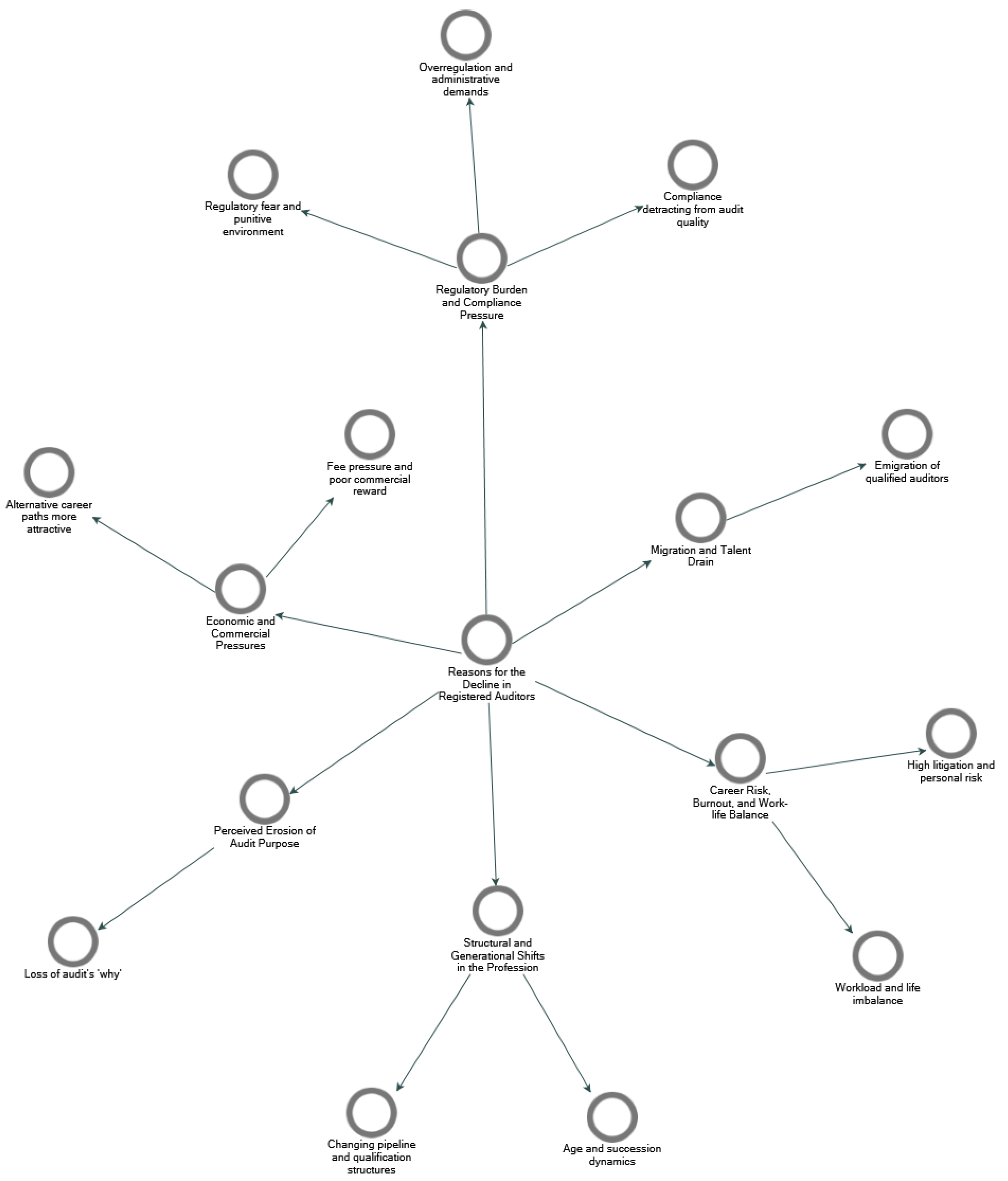
5.7. Subtheme 2.1: Regulatory Burden and Compliance Pressure
5.7.1. Overregulation and Administrative Demands
Participants consistently highlighted that excessive regulation has overwhelmed audit practitioners, particularly smaller firms that lack the resources of larger counterparts.
“Overregulation is definitely a massive part... just the amount of time that we’re spending on stuff that’s not reviewing the files. That’s just out of balance at the moment.” (Interviewee 2)
“The auditing profession does not necessarily compensate you as much as you would be compensated out in commerce… the regulation is layered more and more. It’s just becoming more tedious.” (Interviewee 8)
5.7.2. Regulatory Fear and Punitive Environment
Auditors feel targeted by regulators, creating anxiety and discouraging continued practice in assurance. These are reflected in the quotes attributable to participants 5 and 7.
“The very first thing that comes to my mind... you are reminded daily that you will be penalised up to 25 million rand by IRBA… They even use the words ‘we will catch you’.” (Interviewee 5)
“I think what you’re seeing should have been more [attrition]. I’m expecting that, especially in the light of these penalties that they keep on publishing in the Government Gazette.” (Interviewee 7)
5.7.3. Compliance Detracting from Audit Quality
Several auditors noted that the focus on regulatory compliance shifts attention away from professional judgment and substantive audit work.
“We focus so much on ticking the box that you miss the fact that this company has going concern issues... that is what extreme regulation is doing.” (Interviewee 8)
“We spend so much time trying to understand this control environment and document it just to pretty much put IRBA at ease... but it doesn’t really add that much value to my audit.” (Interviewee 2)
5.8. Subtheme 2.2: Economic and Commercial Pressures
5.8.1. Fee Pressure and Poor Commercial Reward
Interviewees described how rising costs, client fee resistance, and declining profitability make auditing unsustainable.
“The fees that you recover are almost not worth doing the audit work.” (Interviewee 1)
“Our clients are very fee-oriented… they don’t have the loyalty they had in the past.” (Interviewee 2)
“Auditing has always been a grudge buy... it’s an expense on the income statement that stands out like a sore thumb.” (Interviewee 8)
5.8.2. Alternative Career Paths More Attractive
Audit is increasingly seen as unattractive compared to alternative career opportunities in commerce or technology.
“Now you can go and study a computer programming course... you’re going to earn double before you’re thirty, and you don’t have a regulator watching over your shoulder daily.” (Interviewee 5)
“Auditing is not sexy anymore… there are so many new paths in the CA/RA pipeline, and that also blurred the lines.” (Interviewee 5)
5.9. Subtheme 2.3: Migration and Talent Drain
Emigration of Qualified Auditors
Many noted that South African audit qualifications are highly portable, leading to an outflow of talent.
“A lot of auditors prefer to go work in the UK, in Europe or Australia... people migrate and that’s why the SAICA and IRBA qualifications are very handy.” (Interviewee 1)
“Quite a number of people in our industry have migrated to other countries... there won’t be a need to continue registering as an RA with IRBA.” (Interviewee 4)
5.10. Subtheme 2.4: Career Risk, Burnout, and Work-life Balance
5.10.1. High Litigation and Personal Risk
Participants expressed fear over the personal liability associated with assurance work.
“You’re in a profession where people will tell you, listen, we’re going to subpoena you in court.” (Interviewee 1)
“Auditors are soft targets for regulation... those who could run away have, and those that can’t are stuck.” (Interviewee 3)
5.10.2. Workload and Life Imbalance
COVID-19 and evolving work expectations have made the long hours of audit work unappealing.
“COVID definitely changed people’s mindsets... the perception is that auditing takes a lot of your personal time. People aren’t as keen for that these days.” (Interviewee 2)
“There’s better work-life balance in commerce than in the audit space.” (Interviewee 4)
5.11. Subtheme 2.5: Structural and Generational Shifts in the Profession
5.11.1. Age and Succession Dynamics
Older auditors are stepping away from auditing, leaving younger partners to bear the load.
“Those numbers tell me those that can run away will and have... the younger ones can’t give it up because it’s their livelihood.” (Interviewee 3).
5.11.2. Changing Pipeline and Qualification Structures
Interviewees criticised additional qualification hurdles, like the ADP, as discouraging.
“It’s four and a half years’ worth of training to register as an RA... it’s unappealing. People aren’t keen to wait that long.” (Interviewee 8).
“Since IRBA took away the public exams and introduced the ADP program… as a trainee it is like a prison sentence.” (Interviewee 4)
5.12. Subtheme 2.6: Perceived Erosion of Audit Purpose
Loss of Audit’s ‘Why’
Several participants spoke of a declining sense of professional purpose.
“There’s not a big talk around the purpose of the profession any longer... we need to understand the why of what we are doing.” (Interviewee 8)
“It was sexy 20 years ago to become an auditor… now it’s just not anymore.” (Interviewee 5)
The findings show a complex mix of regulatory, economic, generational, and personal factors causing the decline in RAs in South Africa. Once prestigious, the profession is now seen as less attractive. Some challenges are systemic, while others stem from changing priorities among young professionals and weaknesses in training future auditors. Interviewees share concern that if unaddressed, these issues could threaten the profession's long-term sustainability.
Abrahams and Phesa (2025) stated an 11.72% drop in Registered Auditors (2019–2023), by mapping six mutually reinforcing causes. On the talent pipeline and perception, evidence points to both quantity and fit problems: skills–demand gaps are flagged in Kroon and Do Céu Alves (2023); firms report recruitment strain and a shrinking graduate pool in Caseware (2024); South African appeal is declining for young CAs(SA) in Harber (2018); and large-firm perspectives diagnose fewer accounting graduates and readiness concerns in Murray (2024).
Regulation and compliance costs alter the profession’s risk–reward profile, perceptions of over-regulation and the chilling effect of rotation are prominent in Harber (2018); inspection demands and remediation work are documented in Irba (2024b); quantified cost pressures appear in Celestin (2020a); cross-regional failure patterns tied to regulatory stringency are noted in Celestin (2020b); and fee-raising structures such as joint audits are discussed in Coffee (2019). Talent shortages, recruitment challenges, and burnout are evidenced by firm surveys in Caseware (2024), reinforced by outflows from assurance roles in Harber (2018), systematic departure drivers in Knechel et al. (2021), junior exit rates in Abramova et al. (2025), and by the practitioner perceptions captured in Murray (2024).
Technological change compounds skills mismatches and transition costs: firms grapple with virtual work, BI tools, and adoption hurdles in Caseware (2023); AI’s specific impacts on audit roles are analysed in Isotalo (2024); and competency misalignment linked to evolving skill needs appears in Kroon and Do Céu Alves (2023). Financial pressure and profitability shape incentives and strategy, consulting–audit income dynamics and fee economics are treated in Coffee (2019), fee payments and bargaining power in Kharuddin and Basioudis (2022), wage-related attractiveness in Albu et al. (2011), and profitability concerns are explicitly noted in Murray (2024). Finally, audit resignations and risk factors are substantiated through departure hazards in Knechel et al. (2021), South African turnover dynamics in Harber (2018), junior turnover pressures in Abramova et al. (2025), quality-related deficiencies in Irba (2024b), systemic failure risks in Coffee (2019), and direct acknowledgment in Murray (2024). Together, these sources corroborate a decline driven by intertwined pipeline, regulatory, technological, economic, and risk mechanisms that will require coordinated responses across attraction, formation, and retention.
5.13. Theme 3 Strategies to Adapt to Changes in the Number of Registered Auditors
This theme addresses the research aim number 3, which sought to know the strategies the firm implemented to adapt to changes in the number of Registered Auditors.The interviews revealed diverse, multi-faceted strategies employed by audit firms to navigate the evolving environment of Registered Auditors (RAs). These strategies were clustered into three major subthemes: (1) Technological Integration and Innovation, (2) Talent Management and Capacity Planning, and (3) Risk Management and Business Model Repositioning (Figure 4.3).
Figure 5.
3: Visualising Strategies to Adapt to Changes in the Number of Registered Auditors.
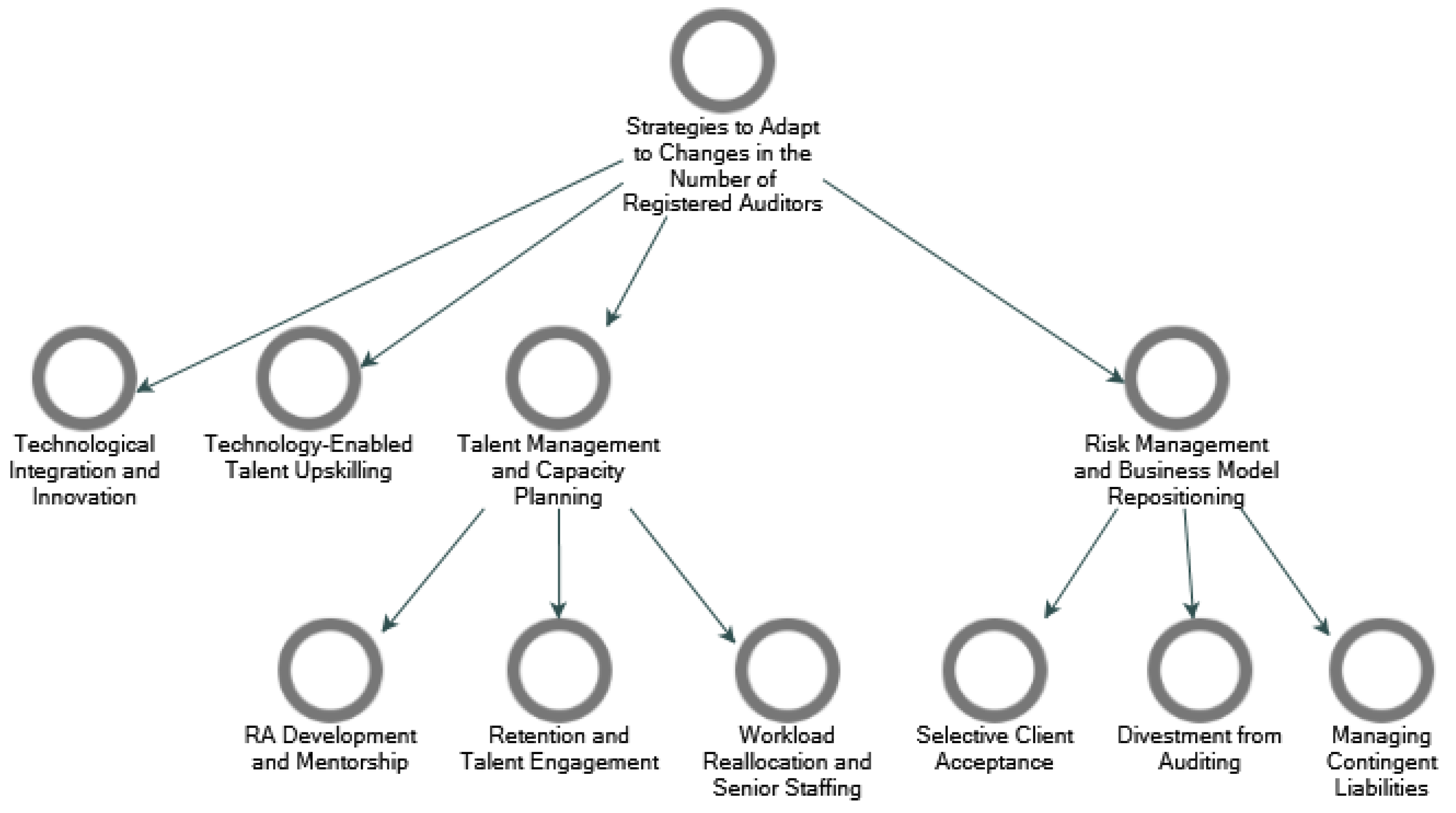
5.14. Subtheme 3.1: Technological Integration and Innovation
In response to the complex challenges facing the auditing profession, particularly the shrinking pool of Registered Auditors (RAs) and the intensifying pressure to maintain profitability and audit quality, firms are increasingly turning to technological integration as a strategic imperative. Participants in the study revealed how Artificial Intelligence (AI) tools and digital platforms are not only supporting audit execution but are fundamentally reshaping traditional audit processes.
“We try to use that stuff, electronic more electronic AI sort of stuff, data analytics and stuff incorporated into the audit. We try to think out of the box in terms of what can be done to satisfy certain assertions… We use AI tools like I use ChatGPT, I use Copilot… I’ve got five open as I’m speaking to you.” (Participant 1).
Similarly, Interviewee 8 articulated the efficiency gains associated with automation of routine processes, recounting,
“The tools are so important… the way we use IT now… historically, the audit team would go out to the client and they would sit there and vouch tedious amounts of information. These days... they run a script and basically test 100% of the population… That process probably takes them about a day or two, where ordinarily it would have taken a trainee probably two weeks.” (Participant 8)
The adoption of platforms like ChatGPT, Copilot, Pocket CA, CA Assistant, and Data Snipper was key in transforming audit file prep, risk assessments, and streamlining assertions. These tools help auditors validate data, automate documentation, and perform logical tests efficiently. Moving from manual to AI-augmented audits shows that technology is essential for the future of audit practices in resource-limited settings. This shift supports industry goals to stay competitive amid regulatory pressure and talent shortages. AI is viewed not as a job threat but as a tool that helps audit teams work better despite staffing challenges.
5.15. Subtheme 3.2: Technology-Enabled Talent Upskilling
In response to the evolving technological landscape and the resultant transformation of audit practices, firms have recognised the critical need to enhance the digital literacy and technical competencies of their workforce. This subtheme captures a proactive response by firms to the dual challenge of Registered Auditor (RA) shortages and rapidly advancing audit technologies by investing in structured, internal upskilling initiatives. One noteworthy approach described by Interviewee 8 involved the establishment of an internal:
“We’ve got this data school now… we basically train them on all of these things… coding aspects, the tools which they use… and we try to then, if they haven’t found a job, deploy them onto the audit and incorporate them as part of the audit team.” (Participant 8)
The above quote underscores a deliberate shift from traditional audit training towards a technology-enabled model, where proficiency in coding, automation tools, and data analysis is positioned as equally vital as financial reporting knowledge.
5.16. Subtheme 3.3: Talent Management and Capacity Planning
Amid the declining number of Registered Auditors (RAs) in South Africa, talent management and strategic capacity planning have emerged as central priorities within audit firms. This theme explores how firms are responding to the resource crisis through proactive strategies in RA development, retention, and adaptive resourcing models, demonstrating a shift towards a more sustainable and diversified workforce model. The responses from interview participants reflect a nuanced understanding that building and maintaining audit capacity now requires a multi-pronged approach, involving both structural and cultural transformation.
5.16.1. RA Development and Mentorship
To counteract the diminishing pipeline of RAs, firms have adopted a dual-pronged strategy of structured mentorship and qualification diversification. As articulated by Interviewee 2,
“We provide them with the opportunity to do the IRBA mentorship, that is the 18-month ADP program... and we’ve recently registered with ACCA… we’ve got two ACCA trainees currently at our firm.”(Participant 2).
This reflects a clear institutional commitment to cultivating home-grown audit talent through the IRBA's Audit Development Programme (ADP), a supervised practical training framework designed to prepare candidates for registration as RAs. Simultaneously, the adoption of alternative professional pathways, such as ACCA accreditation, signals an evolution in how firms conceptualise audit competency. These alternative routes serve to expand the talent pool, making room for internationally trained accountants and providing flexibility in addressing capacity gaps. Ultimately, these efforts represent a broader shift towards talent diversification and long-term workforce sustainability, ensuring the continued relevance and resilience of the audit function.
5.16.2. Retention and Talent Engagement
Beyond talent development, firms are increasingly recognising the need to retain experienced professionals through innovative and empowering talent engagement strategies. According to Interviewee 4,
“You have to come up with retention strategies… giving people partnership into the firm… make them realise that this firm is not, I’m not working for a particular person. This is mine… if you give someone ownership, then they better take care of something.”(Participant 4).
This highlights a fundamental shift from hierarchical employment structures to co-ownership models, where equity participation and a sense of belonging are used to foster loyalty. The emphasis on internal promotion and shared ownership is seen not only as a motivational tool but also as a way to preserve institutional memory and ensure leadership continuity. This approach aligns with modern organisational behaviour theories which suggest that autonomy and recognition significantly enhance employee engagement and performance.
5.16.3. Workload Reallocation and Senior Staffing
Faced with a constrained RA supply, firms are also reconfiguring their internal structures by redistributing audit responsibilities and hiring experienced non-RA professionals. Interviewee 6 noted,
“We may need to employ more senior staff, who are not necessarily RAs, but that will actually make sure that they do the work, then the RA will just have to review and ensure everything is done accordingly.”(Participant 6).
This operational model allows firms to preserve the quality and integrity of audits while optimising the scarce capacity of RAs for review and sign-off duties. The reallocation strategy illustrates a form of hierarchical task restructuring, where workload is divided based on competency and regulatory necessity. This adaptive staffing model not only ensures continuity in service delivery but also mirrors global trends in professional services, where multidisciplinary teams are leveraged to balance regulatory requirements, cost efficiency, and client satisfaction.
The above findings under this theme underscore a critical evolution in how audit firms approach human capital management. By broadening qualification pathways, offering participatory career trajectories, and reconfiguring task assignments, firms are moving towards a more agile and inclusive resourcing strategy. These interventions address not just the symptoms of the RA shortage but also its structural causes, such as rigid qualification routes, talent drain, and limited career progression. Furthermore, these talent strategies reveal a sector grappling with the competing demands of regulatory compliance, economic sustainability, and human-centred leadership. The shift towards empowerment, mentorship, and collaborative staffing models suggests that the auditing profession in South Africa is not simply reacting to crisis, but is reimagining its workforce architecture to thrive in a complex and evolving professional environment
5.17. Subtheme 3.4: Risk Management and Business Model Repositioning
The structural decline in the number of Registered Auditors (RAs) in South Africa has prompted audit firms to critically re-evaluate their business models and risk exposure. As financial, regulatory, and operational pressures intensify, firms are undertaking strategic repositioning—prioritising profitability, selectivity, and liability mitigation. The findings reveal that risk-conscious decision-making has become central to the sustainability of audit practices, as firms grapple with the high compliance burdens, marginal audit returns, and growing liability exposure.
5.17.1. Selective Client Acceptance
One of the most prominent strategies employed by firms is increased selectivity in client engagement, driven by the need to protect margins and manage regulatory exposure. Firms have instituted minimum audit fee thresholds and are rejecting audit engagements deemed financially unviable. As Interviewee 2 explained,
“We’ve pretty much put a minimum audit fee that we are able to service that client… we just realised that for certain… you’re not able to perform an audit at a profitable margin.” (Participant 2).
The above approach reflects a pragmatic shift towards quality over quantity, with firms prioritising resource allocation to engagements that align with their financial and operational capacities.
Similarly, Interviewee 6 highlighted the cost-to-effort misalignment in small audit files. ““How do you expect me really for a 2.5 audit to have to open a file… planning until conclusion for 2.5? Really, it’s not worth it.”(Participant 6).
These sentiments underscore a growing intolerance for underpriced and overburdened audit engagements, which contribute to professional fatigue and financial strain. Selective client onboarding thus serves as both a risk mitigation mechanism and a sustainability strategy.
5.17.2. Divestment from Auditing
Beyond client selectivity, some firms have opted for more radical measures by divesting from assurance services altogether. This trend reflects a fundamental reassessment of auditing’s long-term profitability and risk profile. For instance, Interviewee 3 stated,
“We no longer believe in… audit on its own would never be profitable… we will lose a significant chunk of revenue, but we’re hoping that the cost of reducing the staff… will restore a higher level of overall profitability.” (Participant 3).
The above strategic retreat from auditing illustrates how the burden of compliance, coupled with tight margins, has rendered audit services economically untenable for certain practices. Likewise, Interviewee 5 expressed intent to exit auditing to pursue more profitable service lines:
“I am 80% sure that I’m going to de-register as a registered auditor by the end of next year… I will make up 50% more of that fees by having more time to attend to my non-audit clients.” (Participant 5).
These accounts point to an ongoing structural recalibration, in which firms redirect their efforts towards tax advisory, accounting, and consulting services. This strategic pivot not only optimises profitability but also reduces exposure to professional indemnity risks and regulatory interventions.
5.17.3. Managing Contingent Liabilities
A critical concern influencing strategic decisions is the potential for significant contingent liabilities arising from audit engagements. Interviewees highlighted the disproportionate risk-reward dynamics, where small profits are outweighed by the threat of regulatory fines. Interviewee 3 noted,
“Out of a 6 million Rand audit turnover, we’ve made 190,000 Rand of profit… that profit alone will not cover one fine from IRBA.” (Participant 3).
This reflects a broader apprehension that even a single sanction could erase years of profitability, especially for small to mid-sized firms.
Additionally, the lack of appeals mechanisms and the perception of unchecked regulatory power exacerbate these concerns.
As Interviewee 5 pointed out,
“There’s no appeals process… the perception out there is that if someone complain at the IRBA, then you in trouble.” (Participant 5).
These fears reflect a growing distrust in regulatory processes and protections, and suggest that risk aversion is not only economic but also institutional. The absence of effective insurance coverage for regulatory fines further discourages participation in audit markets, incentivising firms to either reduce audit exposure or exit the space entirely.
Subtheme 3 reflects a paradigm shift in how audit firms in South Africa are navigating a high-risk, low-reward environment. Faced with diminishing RA numbers, tightening regulations, and economic constraints, firms are implementing strategic triage: narrowing client bases, abandoning audit services, and proactively mitigating liability exposure. These repositioning strategies are not reactive but deliberately transformational, indicating a profession in search of new operating models that prioritise resilience, efficiency, and ethical sustainability. Moreover, these changes have far-reaching implications for audit quality and public assurance. As firms become more selective or exit the audit field, audit capacity may become increasingly concentrated, potentially threatening competition, independence, and access, especially for small and medium-sized enterprises. The sector may therefore require regulatory recalibration and systemic support mechanisms to preserve the integrity and inclusiveness of the auditing ecosystem in the long term.
Theme 3 depicts firms adapting to a high-risk, low-reward environment through three complementary levers. On technological integration and innovation, adoption is advancing but uneven, per Caseware (2023) “cloud adoption keeps rising” and “business intelligence catches on,” while also noting operational frictions in “using new technologies” and “communicating with clients virtually.” Caseware (2024), extends this to “virtual-world realities,” talent responses, and new services. The profession-level shift is amplified by emerging tools as per Isotalo (2024) details how AI, automation, and blockchain are reshaping evidence gathering and judgement, and calls for clarity on which audit tasks are being displaced.
For talent management and capacity planning, the evidence base is consistent with Caseware (2023) that flags “talent management a top challenge,” with difficulty “finding the right talent” surging and skills readiness lagging. The upstream pipeline is strained according to Boyle et al. (2024) that highlights declining enrolments, negative perceptions, and faculty hiring challenges; Murray (2024) similarly cites a “lack of accounting professionals” and falling enrolments. Competency misalignments persist according to Kroon and Do Céu Alves (2023), implying curriculum recalibration for future RA capacity, while Jahn and Loy (2023) notes that stringent access requirements (e.g., partial exams) raise workload and stress for entrants. Retention sits alongside acquisition, which can be seen by Abramova et al. (2025) that references “Retention Effectiveness Strategies for CPA Firms,” underscoring the need to stabilise headcount, not just feed the pipeline.
Strategic triage pruning client portfolios, exiting certain audits, and mitigating liability, follow from the pressures documented across sources. Abrahams and Phesa (2025) links firm behaviour to financial pressure and profitability, audit resignations and risk factors, and regulation and compliance costs, situating choices within institutional constraints. Liability exposure is evident in Sanni (2024), that discusses negligent cases affecting big firms (e.g., Deloitte), reinforcing proactive risk management. Regulatory intensity and recurring deficiencies according to Irba (2024b), raise the cost of engagement (e.g., revenue recognition, journal entries, significant judgements/estimates), encouraging portfolio focus. Market structure and specialisation choices according to Kharuddin and Basioudis (2022) provide the economic logic, fee payments, economies of scale, and selective industry focus, behind narrowing to defensible niches. Together, these sources depict firms investing in technology, rebuilding capacity, and tightening risk perimeters as pragmatic responses to the sustained decline in RAs and the broader constraints acting on South African audit practices.
5.18. Theme 4: Regulatory Challenges in the Audit Profession
This theme addresses the research aim number 4, that highlights the challenges posed by current audit regulations in South Africa. The narratives reveal that auditors face significant difficulties arising from regulatory frameworks that many view as disproportionate, punitive, and out of touch with the realities of practice. Three overarching subthemes emerged from the data, as illustrated in the figure below:
Figure 5.
4: Visualising Regulatory Challenges in the Audit Profession.
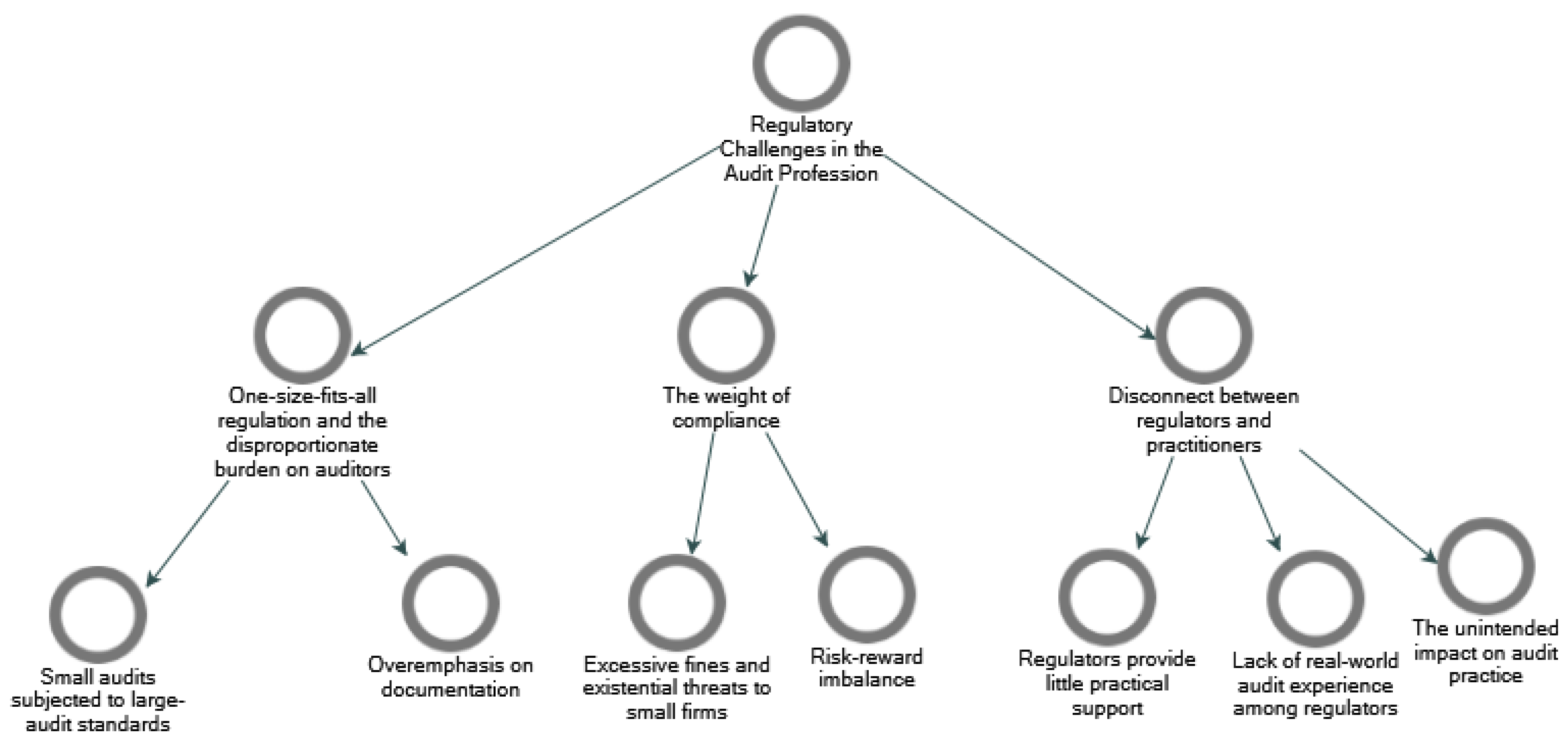
5.19. Subtheme 4.1 One-Size-Fits-All Regulation and the Disproportionate Burden on Auditors
5.19.1. Small Audits Subjected to Large-Audit Standards
Participants voiced deep frustration at how current audit regulations impose a one-size-fits-all approach that fails to account for differences in client size, complexity, and risk profile. This rigid regulatory model was widely seen as inefficient, costly, and damaging to smaller firms.
Interviewee 1 highlighted this issue vividly, describing the disconnect between the standards and the realities of auditing small entities:
"Now you have to audit a sole proprietor or director... and you have to do the audit procedures as if you’re doing it for a company that’s doing 100 million revenue... I know I can’t rely on these internal controls... but unfortunately, I can’t write that in my file. I have to go through system notes, do a walkthrough... two days have passed, and I’ve never even done the actual control testing." (Participant 1).
For this auditor, the problem is not a reluctance to comply, but a sense that the standards are out of step with the realities of small businesses, placing disproportionate burdens on both auditors and clients.
Interviewee 2 echoed this concern, noting the absence of regulatory differentiation:
"There’s still not a clear distinction between a larger firm and a small to medium firm. I was quite optimistic with the proposal for that audit of less complex entities... but they declined."(Participant 2).
Similarly, Interviewee 6 argued that regulations need to better accommodate professional judgement:
"Unfortunately, as per standards, it’s one size fits all. But when it comes to clients, that’s not one size fits all. Auditing could be structured in a way to say you are allowed perhaps to have professional judgment per your client."(Participant 6).
Drawing from the above narratives, participants felt that regulatory frameworks impose unnecessary steps on smaller audits, increasing costs and effort without improving audit quality. They argued for reforms that allow proportionality and professional judgment.
5.19.2. Overemphasis on Documentation
The demands for exhaustive documentation were seen as stifling critical thinking and genuine audit quality Interviewee 8 shared:
"The team is so pressed to get through the fieldwork... they miss the bigger picture because they’re under so much pressure. They're so tick-box driven, tick, tick, tick... they aren't really taking time to think." (Participant 8).
From the above statement, one could assume that the documentation demands and fear of inspection have driven a box-ticking culture, where auditors focus on file completeness rather than meaningful assurance.
5.20. Subtheme 4.2: The Weight of Compliance
Another subtheme uncovered from the transcribed data was anxiety over the harsh penalties imposed by regulators.
5.20.1. Excessive Fines and Existential Threats to Small Firms
Participants described how disproportionate fines and disciplinary processes threatened the very existence of smaller practices. Interviewee 4 voiced concern about the existential threat posed by such penalties:
"Fines and penalties are actually a big concern because they are prohibitive. Once you are fined, then you are out of business because it’s beyond hefty."(Participant 4).
Interviewee 5 provided a striking example of how even administrative errors can lead to ruinous consequences:
"This practitioner said no, I’m not doing audits [on one form], but then on the fees form, there was audit income declared. Improper conduct — 100,000 rand fine for that. Where’s the balance?"(Participant 5).
For Interviewee 6, these risks have led to a reconsideration of their professional future:
"There is no way I’m going to be rich being an RA... IRBA comes back to you, then they charge you... they will sell your assets. When they are done with you, you will be nobody."(Participant 6).
The above narrative reveals that participants believe the regulatory system imposes disproportionate punishments, particularly on smaller practices, fostering fear and discouraging auditors from continuing in the profession.
5.20.2. Risk-Reward Imbalance
The economic model of auditing was viewed as increasingly unsustainable: high personal and professional risk, but without corresponding financial reward. Interviewee 7 reflected on the mismatch between audit risk and its financial returns:
"Auditors take risk by taking on this work... but then you must look at the reward. The rewards are not there. It just doesn’t make sense."(Participant 7).
5.21. Subtheme 4.3: Disconnect Between Regulators and Practitioners
5.21.1. Regulators Provide Little Practical Support
Beyond the standards themselves, participants felt let down by the lack of practical, supportive engagement from the regulator. They described a relationship defined more by fear and compliance than collaboration or guidance.
Interviewee 2 reflected on their recent experience of inspection:
"They don’t want to advise... they were very focused on the theory and the legislation... but not willing to give recommendations for our firm."(Participant 2).
5.21.2. Lack of Real-World Audit Experience Among Regulators
Interviewee 3 offered a scathing critique of the mentality behind inspections:
"The principle of not documented, not done is effectively the same as asking somebody to prove a negative... these fools are being allowed to take that view." (Participant 3)
For them, this dogmatic stance has widened the gap between the regulator and practitioners:
"There’s a disconnect. If they don’t sit in our firm, they don’t understand where we come from. That gap is something that needs significant attention."
Participants feel that regulators operate in isolation from the practical realities of auditing, enforcing rules without offering workable solutions or guidance. Interviewee 3 critiqued the regulatory personnel:
"If you go and make an IRBA inspector have to spend a month in an audit firm... I wouldn’t be surprised if he gets marched to the door and chucked out because he can’t function in a practical commercial world."
Overall, there is a perception that regulators and inspectors lack sufficient on-the-ground audit experience, leading to unrealistic expectations and ineffective oversight.
5.21.3. The Unintended Impact on Audit Practice
Ironically, participants feared that regulatory overreach — intended to improve audit quality — may in fact undermine it. Time and resources are diverted from substantive audit work to compliance with form, checklists, and documentation.
Interviewee 8 summarised this dilemma:
"All this regulation... the practical implementation is not being considered correctly. The team is so pressed to get through the fieldwork... they miss the bigger picture because they’re under so much pressure."(Participant 8).
The auditors interviewed painted a picture of a profession struggling under the weight of disproportionate and rigid regulation. While participants accepted the need for high standards and accountability, they called for a more nuanced, risk-based, and supportive regulatory approach — one that acknowledges the realities of small firms and low-complexity audits. The current system, they argued, threatens not just the viability of smaller firms but the overall quality and integrity of audit practice. Without reforms that balance rigour with proportionality and support, they warned, the regulatory framework risks weakening the very assurance it seeks to protect.
Theme 4, that auditors perceive regulation as disproportionate, punitive, and out of touch, is directly substantiated by several sources. Harber (2018), offers explicit confirmation, describing the profession in South Africa as over-regulated, with burdens translating into more work and higher costs, and warning that measures such as MAFR will further depress the profession’s appeal. The scoping review Abrahams and Phesa (2025) reinforces this with “regulatory fatigue” and rising regulatory demands, framed as coercive and normative pressures within institutional theory. Practice-side sentiment aligns with (Caseware, 2023) that lists “new laws and regulations” among top challenges, indicating day-to-day operational strain. The legal edge of the regime appears in Sanni (2024) (e.g., a negligent case against Deloitte in China; ASIC proceedings), Ghosh and Tang (2015) discusses the litigation risk scores linked to enforcement actions, and Albu et al. (2011) links the rule-based shifts harming comparability. Structural frictions are also evident in Jahn and Loy (2023), which associates higher access requirements with fewer professionals and notes that small practices face oversight and sanctions more often. Market-economics and professional expectations intersect in Coffee (2019) that states auditing as a low-margin “commodity” pushes talent towards consulting and questions whether legislative fixes are adequate, and in Kharuddin and Basioudis (2022), where regulators’ expectations around deep industry understanding raise the bar for engagement complexity. Overall, the weight of evidence supports theme 4’s claim that regulations and related legal exposures are widely experienced as costly, exacting, and misaligned with professional realities, even as some documents merely chart their effects rather than judging their proportionality.
5.22. Theme 5: Challenges Facing the Auditing Profession in the Next 5 to 10 Years
This theme addresses the research aim number 5. The interviews revealed a complex landscape of challenges facing the South African auditing profession. The findings are organised into four overarching subthemes, illustrated in the figure below
Figure 5.
5: Visualising the challenges facing the auditing profession in the next 5 to 10 Years.
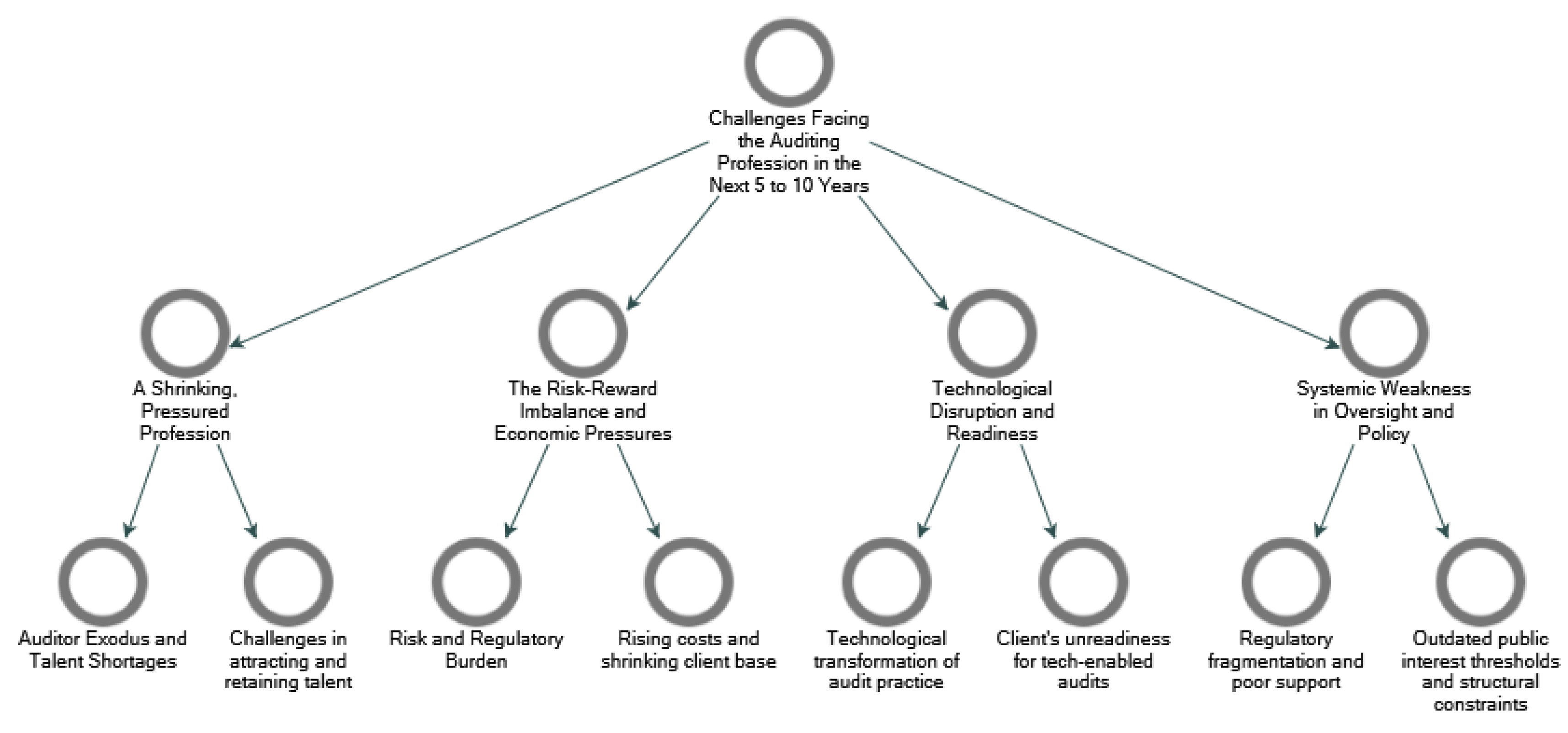
5.23. Subtheme 5.1: A Shrinking, Pressured Profession
5.23.1. Auditor Exodus and Talent Shortages
Participants expressed profound concern over the shrinking pool of Registered Auditors (RAs). Interviewee 6 predicted:
"I see a huge decrease in this part as well... The assurance category within the RAs will carry on decreasing even higher."(Participant 6).
Similarly, Interviewee 3 framed this as a systemic risk:
"You're going to have a significant gap between the demand and the supply... There will not be enough auditors to conduct the audit requirements of the commercial sector."(Participant 3)
5.23.2. Challenges in Attracting and Retaining Talent
Interviewees noted that the profession struggles to remain attractive, particularly in light of alternative employment options abroad or with international firms. As Interviewee 2 explained:
"It’s just going to become really expensive to hire personnel... people are working for overseas companies locally, earning substantially more than what they would earn at a company like ours."(Participant 2)
Interviewee 8 added that this exodus places strain on those who remain:
"The existing resources become fatigued, drained... risk of losing quality staff essentially."(Participant 8).
5.24. Subtheme 5.2: The Risk-Reward Imbalance and Economic Pressures
5.24.1. Risk and Regulatory Burden
Interviewees described the profession as increasingly punitive, with fines and sanctions eroding its appeal. Interviewee 7 highlighted:
"The risk is a big issue... The risk versus the rewards — that is the big issue to say if those dynamics don't change, then I think the profession... is doomed."(Participant 7)
Interviewee 6 echoed this, noting the chilling effect of IRBA’s approach:
"They don’t give you recommendations... they name and shame you. So by one error, you become... so bad."(Participant 6).
5.24.2. Rising Costs and Shrinking Client Base
Several participants described how rising fees — driven by regulatory and operational pressures — risk pricing clients out of the market. Interviewee 2 cautioned:
"We might lose clients, or they might prefer a cheaper service... They might just move over to an independent review, which is substantially cheaper." (Participant 2)
Interviewee 8 similarly observed:
"There’s that growing tension between clients and audit firms because of the rising fee... clients are basically shopping around all the time."(Participant 8).
5.25. Subtheme 5.3: Technological Disruption and Readiness
5.25.1. Technological Transformation of Audit Practice
Technology was seen both as a lifeline and a threat. Interviewee 8 warned:
"If any firm is not staying abreast of what is happening, they run the risk of becoming obsolete." (Participant 8)
Interviewee 5 reflected on the inadequacy of current training and standards for a digital future:
"Is an audit still relevant and will an audit remain relevant in the next 10 years for the big firms? Do we really achieve any outcome by doing audits as it's currently being done?"(Participant 5).
5.25.2. Client's Unreadiness for Tech-Enabled Audits
Interviewee 5 described how small clients complicate technology adoption:
"Your client must also be ready to be tested by AI... AI will never be able to test the system if the accountant [is] doing something different every month." (Participant 5).
5.26. Subtheme 5.4: Systemic Weakness in Oversight and Policy
5.26.1. Regulatory Fragmentation and Poor Support
Participants voiced frustration with IRBA’s perceived conflict between regulation and profession-building. Interviewee 3 critiqued:
"A regulator should regulate. I don't think a regulator should be responsible for stocking the profession... IRBA must split — one division to support auditors, another to regulate them."(Participant 3).
5.26.2. Outdated Public Interest Thresholds and Structural Constraints
Both Interviewee 4 and Interviewee 8 highlighted the outdated Public Interest Score thresholds:
"It was put in place around 2008... The Rand has lost significant value since 2008... there is a push to take it up." (Interviewee 4)
"If they just added adjustments by inflation each year... More and more clients are just being scoped into audits because the public interest score hasn’t been adjusted." (Interviewee 8)
Across the above subthemes, participants painted a portrait of a profession at a crossroads. They foresee a perfect storm of talent shortages, cost pressures, regulatory overreach, and technological disruption, all converging to challenge the audit industry’s future viability. The tension between audit quality, cost containment, and sustainability was a recurring anxiety, as was the call for more meaningful support from regulators and professional bodies. As Interviewee 3 summarised poignantly:
"You're going to get bigger accounting scandals... not because the auditors aren't doing their job, [but] because they simply don't have the time, because there aren't enough of them." (Participant 3).
Theme 5 has direct evidence that comes from Caseware (2023), which identify “talent management” as a top challenge, cite a shrinking graduate pipeline, and note retention difficulties. Empirical work Knechel et al. (2021) documents departure and turnover hazards among auditors, while Harber (2018) reports a South African decline in the appeal of remaining in audit, with movement out of assurance roles. Abramova et al. (2025) highlights staffing pressures and the need for retention strategies. Broad scoping in Abrahams and Phesa (2025) links pipeline weakness, recruitment challenges (including burnout), and resignation risks to the global contraction. Pasewark (2021) adds that business schools struggle to equip entrants with needed competencies, reinforcing the supply problem. Murray (2024) directly lists shortages, falling enrolments, and firm responses (pay, flexibility, outsourcing, upskilling, and investment in AI/tech). Several literature indirectly support a picture of a pressured profession. Kroon and Do Céu Alves (2023) has evidence of persistent competency gaps between universities and market expectations, sustaining shortages in “job-ready” talent. Regulatory demands and failure dynamics in Celestin (2020b), legal exposure in Sanni (2024), and risk metrics in Ghosh and Tang (2015) point to heightened practice risk and cost. Shifting skill requirements and “hybridisation” pressures appear in Albu et al. (2011), enrolment-related constraints in Boyle et al. (2024), and academic pipeline frictions in Plumlee and Reckers (2014). Continual remediation needs in Irba (2024b) underline resource pressure; broader trust, regulatory proposals, and fee-market stresses in Coffee (2019) and competitive or specialisation dynamics in Kharuddin and Basioudis (2022) further describe the environment. Technology-driven transformation and task displacement risks in Isotalo (2024) and market concentration or client-switching pressures in Mattar (2024) also align with a sustained pressure narrative.
5.27. Theme 6: Opportunities for Growth and Improvement in the Auditing Profession
This theme addresses the research aim number 6, which explores the opportunities for growth and improvement in the auditing profession. The transcribed data revealed several intertwined opportunities for growth and improvement in the auditing profession. These opportunities reflect both structural and human elements of the profession and draw from the lived experiences of the interviewees. Figure 4.6 illustrates subthemes and categories uncovered from the transcript.
Figure 5.
6: Visualising experts view on opportunities for growth and improvement in the Auditing Profession.
Figure 5.
6: Visualising experts view on opportunities for growth and improvement in the Auditing Profession.
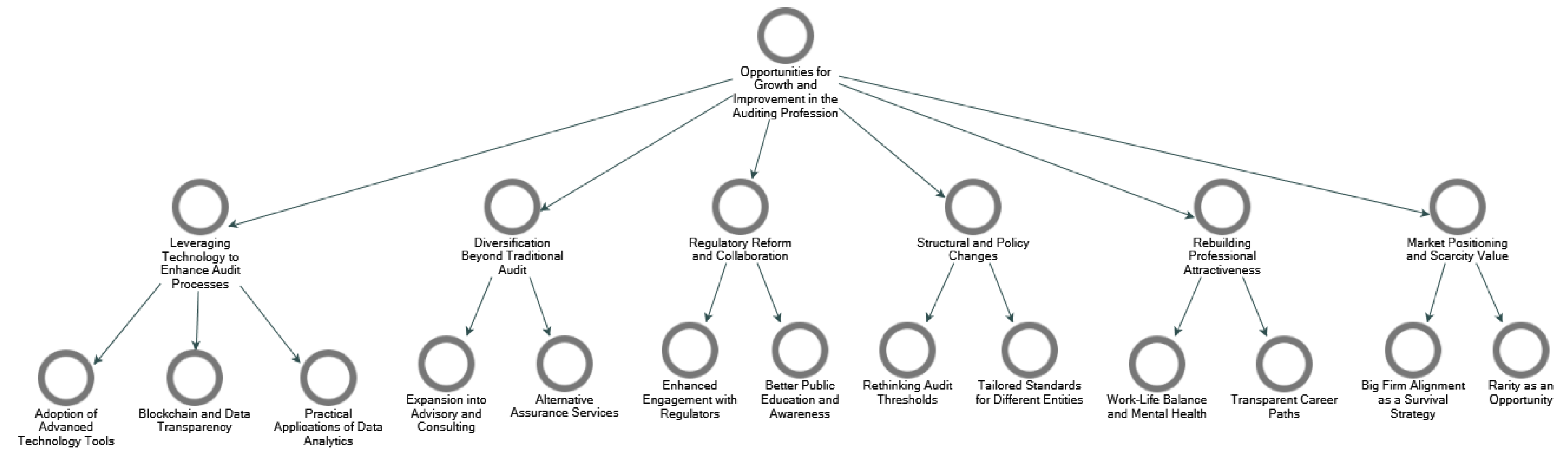
5.28. Subtheme 6.1: Leveraging Technology to Enhance Audit Processes
5.28.1. Adoption of Advanced Technology Tools
Several participants identified technology as a key avenue for growth. The integration of technology—while still emerging in many practices—was seen as vital for improving audit efficiency, accuracy, and value delivery.
Interviewee 1 remarked:
“Opportunities exist for auditors by utilizing advanced technology tools… not necessarily AI and stuff, but like, you know, on seeing your procedures, on seeing the audit experience with using these tools.” (Participant 1).
5.28.2. Blockchain and Data Transparency
The potential of blockchain technology was highlighted as a bold opportunity to strengthen transparency and accountability.
Interviewee 3 proposed:
“Force the listed companies in the next five years to put all of their accounting records on the blockchain. It’s now visible for everyone… the best analytical review procedures you'll find are done by asset managers — imagine if their reports were public.” (Participant 3)
5.28.3. Practical Applications of Data Analytics
From the transcribed data observed, it became apparent that technology’s practical application in exception reporting and data analysis was also seen as a low-hanging fruit that could modernise audit practice.
Interviewee 3 shared that:
“In Xero you can run an exception report… pull out any journal that was passed between 11 p.m. and 3 a.m. Now, those must help.”
The above subtheme suggests that participants recognised that technology, if effectively adopted, could transform the auditing profession. However, they also noted significant barriers related to cost, training, and the overwhelming nature of data preparation for analysis.
5.29. Subtheme 6.2: Diversification Beyond Traditional Audit
5.29.1. Expansion into Advisory and Consulting
Many participants identified that traditional audit services were no longer the sole path for firm growth. Instead, advisory, forensic, and business consulting services represented significant new revenue streams. Interviewee 4, for example, observed that
“If you have seen the bigger firms, they've done this already… income is coming from advisory, forensic audit, business planning… HR functions. Opportunities are around consulting rather than your normal auditing.” (Participant 4).
5.29.2. Alternative Assurance Services
There was a shared view that the profession needed to embrace tailored services for smaller entities, including independent reviews and agreed-upon procedures. In this, interviewee 5 lamented a missed opportunity:
“The auditing standard for less complex entities was an ideal opportunity to split auditing into larger and smaller sections… it was an opportunity missed.”(Participant 5).
Overall, participants felt strongly that the auditing profession must diversify. Expanding into consulting and alternative assurance would allow firms to remain relevant, especially for smaller clients where full audits may not add proportional value.
5.30. Subtheme 6.3: Regulatory Reform and Collaboration
5.30.1. Enhanced Engagement with Regulators
A recurring theme from the observed data transcribed was the need for improved, more meaningful collaboration between audit firms and regulatory bodies like IRBA. Interviewee 2 reflected positively that:
“It was really nice to have IRBA visit us… we could sit around the table, provide input. Whether that was taken to heart, I don’t know, but at least it felt like it.”(Participant 2)
Interviewee 8 echoed this by noting that:
“I think if we add more input when decisions are being made… that will allow for better growth and development in the profession.”(Participant 8).
5.30.2. Better Public Education and Awareness
There was a call for educating clients and the public about what audits are (and are not) meant to achieve, particularly regarding fraud detection. Interviewee 3, for example, suggested:
“Better education to the public about what an auditor entails, especially around a sample type basis… remove the pressure that everything they see is absolute.”(Participant 3).
Overall, it was evident that participants desired more proactive, two-way engagement with regulators, as well as efforts to manage public and client expectations about audit outcomes.
5.31. Subtheme 6.4: Structural and Policy Changes
5.31.1. Rethinking Audit Thresholds
Several interviewees highlighted the need to revisit thresholds and standards, especially to better align with the realities of small and medium-sized enterprises (SMEs).
Interviewee 7 critiqued the status quo by stating that:
“350 PIS is a lot actually… until 350 there’s no requirement to be audited. That is a lot of work lost… this profession in South Africa must just disappear; it’s going extinct because of these things.”(Participant 7).
5.31.2. Tailored Standards for Different Entities
Participants highlighted the unfairness of applying identical standards to vastly different companies. For example, Interviewee 3 asked:
“How is it that ABC Trading down the road needs to comply with the same standards as Sasol? How is it possible those two coexist and have to sing from the same hymn sheet?” (Participant 3).
Drawing from the above narrative, there was strong sentiment that current regulations fail to reflect business realities, particularly for SMEs, and that the auditing profession is suffering as a result.
5.32. Subtheme 6.5: Rebuilding Professional Attractiveness
5.32.1. Work-Life Balance and Mental Health
Participants highlighted that the profession’s demanding nature limits its attractiveness, especially to younger generations seeking balanced lifestyles.
Interviewee 1 admitted:
“You can’t even offer them work-life balance because inherently the audit environment… there is no work-life balance.”(Participant 1).
Interviewee 6 noted:
“It has high pressure, a lot of work pressure, a lot of mental… you can have mental health issues and all those things.”(Participant 6).
5.32.2. Transparent Career Paths
Better communication about progression and rewards was seen as key to attracting and retaining talent.
Interviewee 8 argued:
“If there was a bit more transparency… it would cultivate growth and development. Economic implications are quite real… especially for those from disadvantaged backgrounds.” (Participant 8).
From the transcribed data observed, Participants saw the need to make the profession more humane and transparent, particularly in terms of managing expectations about workload and career advancement.
5.33. Subtheme 6.6: Market Positioning and Scarcity Value
5.33.1. Big Firm Alignment as a Survival Strategy
Some participants saw the dominance of large firms as inevitable and advised alignment for survival.
Interviewee 6 suggested:
“Future RAs… better be ready to align themselves to big firms that already have facilities and even legal services to defend the companies.”(Participant 6).
5.33.2. Rarity as an Opportunity
The declining number of auditors was seen by some as creating opportunities for those who remain.
Interviewee 2 commented:
“A decline in registered auditors is a concern… but for someone that’s already a registered auditor, that also provides opportunity because it distinguishes myself from someone else.”(Participant 2).
The above data present a mixed view by the participants on marketing positioning and security value. While some lamented the consolidation of the profession around large firms, others saw opportunity in the growing scarcity of qualified auditors.
In summary, the qualitative data provides a rich, multifaceted picture of the perceived opportunities for growth and improvement in the auditing profession. Participants highlighted both systemic changes—such as regulatory reform and diversification of services—and internal firm-level opportunities—such as better use of technology, improved work-life balance, and clearer career pathways. Underpinning many of these views was a call for the auditing profession to modernise, humanise, and refocus on delivering value in a changing business and regulatory environment.
Multiple literature underscore the burden side of the ledger, such as Celestin (2020a) reports a 25% rise in audit hours post-change, evidence of heavier processes and resource strain; Harber (2018) characterises South African audit as over-regulated; and the scoping review Abrahams and Phesa (2025) identifies rising regulatory demands, regulatory burden, and coercive pressures. Together, they substantiate the case for structural recalibration (including thresholds) as a route to restore sustainable work volumes. Market Positioning and Scarcity Value points to two linked strategies. First, big-firm alignment: Celestin (2020a) notes larger firms absorb adoption costs more easily; Kharuddin and Basioudis (2022) finds markets perceive higher quality from large or industry-specialist auditors; Isotalo (2024) reflects the Big 4’s gravitational pull in the literature; and Mattar (2024) documents Big Four dominance as complex clients seek control through Big Four auditors. This constellation supports the interview view that future RAs gain resilience by aligning with scale, infrastructure, and legal capability. Second, scarcity as opportunity, persistent shortages and exits elevate the value of remaining RAs. Caseware (2023) reports difficulty finding and keeping qualified talent and a shrinking graduate pipeline; Knechel et al. (2021) examines departure or turnover; Dawkins (2023) flags declining enrolments; Jahn and Loy (2023) links higher access requirements to tougher entry; Harber (2018) shows young CAs(SA) barring audit; Plumlee and Reckers (2014) highlights student perception effects; Abramova et al. (2025) notes retention strategies; Pasewark (2021) details curriculum gaps; Murray (2024) lists firm responses (pay, flexibility, outsourcing, upskilling, AI/tech); Abrahams and Phesa (2025) synthesises shortages, burnout, and attrition; and Ghosh and Tang (2015) adds evidence on auditor resignations. The net effect is that regulatory load and talent scarcity compress supply while raising the relative market power, and potential pricing and selection options, of those who remain.
5.34. Theme 7: Strategies for Sustaining the Assurance Industry Amidst a Decline in Registered Auditors
This theme addresses the research aim number 7. The sustained decline in the number of Registered Auditors (RAs) in South Africa presents a pressing challenge to the integrity and viability of the national assurance industry. Interviews with professionals across the audit sector revealed a deep-seated concern for the future of the profession, along with a range of strategies aimed at mitigating the decline. Their insights, grounded in lived experience, suggest that survival and rejuvenation of the audit sector require a multi-pronged and collaborative approach. Five interrelated subthemes emerged: regulator reforms, technological innovation, professional collaboration, talent development and retention, and legislative and policy engagement (Figure 4.7). Collectively, these strategies point toward a vision of systemic renewal built upon reform, inclusion, and innovation.
Figure 5.
7: Visualising experts' view on strategies for sustaining the assurance industry Amidst a Decline in Registered Auditors.
Figure 5.
7: Visualising experts' view on strategies for sustaining the assurance industry Amidst a Decline in Registered Auditors.
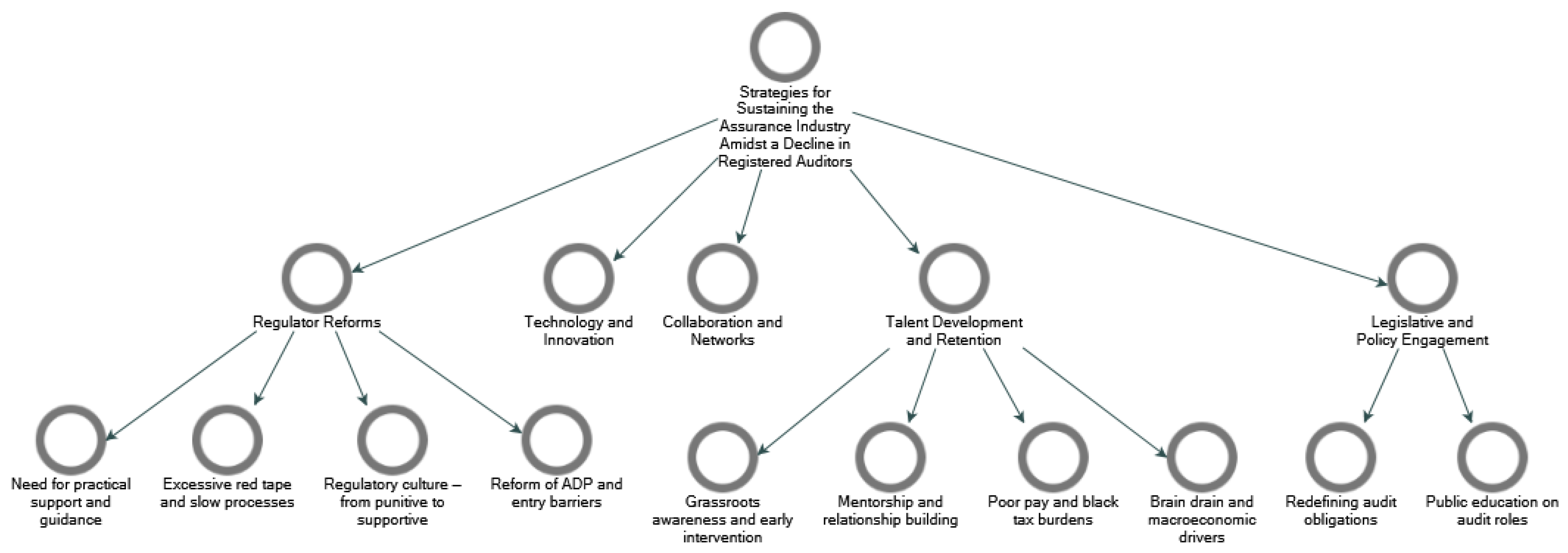
5.35. Subtheme 7.1: Regulator Reforms
A recurring thread in participants’ narratives was the perceived need for reform within the audit regulatory environment, particularly the role of the Independent Regulatory Board for Auditors (IRBA). Many expressed frustrations with the existing regulatory culture and processes, describing them as punitive, opaque, and disconnected from practice realities
Need for practical support and guidance
Participants advocated for practical and scenario-based training from the regulator to better support auditors in applying complex standards. Interviewee 1 suggested that IRBA should offer more interactive training that mirrors real-life dilemmas, stating:
“Give people the example: the FD paid money without authorisation from the board… You work through it… That sort of interactive training.”(Participant 1).
Similarly, the development of IRBA-approved audit tools or software was viewed as a potential game-changer to promote standardisation and reduce ambiguity, further reinforcing the call for practical regulatory support.
5.35.1. Excessive Red Tape and Slow Processes
However, beyond training and tools, participants were critical of the lengthy and burdensome registration and proficiency processes, which act as disincentives to aspiring auditors. Interviewee 8 shared:
“It was such a lengthy process to register as an RA… If I wasn’t passionate… there’d be no reason for me to jump through all those hoops.” (Participant 8).
Delays in proficiency interview outcomes were also reported to stall career progression, particularly at the point of promotion to partner, exacerbating frustration and attrition.
“Even internally... you’re ready to be promoted to partner... but IRBA takes forever... then the promotion gets pushed out... it’s very frustrating.” (Participant 8).
5.35.2. Regulatory Culture — From Punitive to Supportive
Moreover, there was strong sentiment around transforming the regulatory culture from punitive to supportive. Interviewee 3’s rhetorical question:
“Who wants to drive to work every day to sign off on a job that could cost you your house, your family, your marriage?” (Participant 3).
The above rhetoric underscores the fear-driven environment many experience. Participants advocated for a more enabling and empathetic regulatory framework, one that fosters engagement rather than alienation.
“They should not be punitive in nature... they must be supportive.” (Participant 6).
5.35.3. Reform of ADP and Entry Barriers
Lastly, reforms to the Audit Development Programme (ADP) and entry barriers were widely supported. Some of the participants interviewed suggested that automatic RA registration post-articles, as was previously practised, could reduce delays and increase throughput. The additional 18-month ADP requirement, on top of an already arduous seven-year CA pathway, was described as excessive and exclusionary, particularly for individuals from under-resourced backgrounds.
“This 18-month ADP doesn’t work… Becoming a CA is already seven years. Very few people are keen to do extra 18 months.” (Participant 6).
“IRBA might consider going back to the audit system where... as soon as they are done with articles, they are automatically registered auditors.” (Participant 4).
From the above statements, there is consensus that the audit development programme (ADP) adds unnecessary delays and discourages new entrants, especially those from underprivileged backgrounds.
5.36. Subtheme 7.2: Technology and Innovation
Technology emerged as a critical lever for sustaining the audit profession, particularly in light of declining human capital. Participants argued that greater adoption of AI, automation, and smart audit tools could help offset staff shortages, reduce audit fatigue, and improve consistency and efficiency. As Interviewee 1 explained,
“We need to rely more on software and technology and artificial intelligence... helpful in terms of cutting off time... and the quality.” (Participant 1).
The above suggests a growing recognition that technological integration must be embraced not only to enhance audit quality but also as a survival mechanism in the face of talent and regulatory pressures.
5.37. Subtheme 7.3: Collaboration and Networks
Another key strategy identified was inter-firm collaboration and alliance-building, particularly among small and medium-sized firms. Interviewee 1 recommended that firms
“Join up in associations or networks... for training, discussion forums… create audit procedures or standards together.” (Participant 1).
Such collaboration could enable firms to pool resources, share best practices, and co-create cost-effective audit methodologies, enhancing overall sector resilience.
Additionally, participants underscored the need to foster a stronger sense of community and belonging among auditors, especially younger professionals. Events, networking forums, and community-building initiatives were seen as essential to improve morale and professional identity. Interviewee 2’s suggestion to create events that attract and retain younger RAs points to the need for more vibrant professional spaces where early-career auditors feel supported and engaged.
“Making it more attractive for younger people... have events to get the younger registered auditors together.” (Participant 2)
5.38. Subtheme 7.4: Talent Development and Retention
5.38.1. Grassroots Awareness and Early Intervention
Talent pipeline development was widely recognised as both a long-term investment and a short-term imperative. Participants proposed early awareness campaigns, targeting learners at high school and university levels, to demystify the audit profession and inspire entry. Interviewee 8 advocated for “early intervention… high school level... through university... practical VAC programs to make it more exciting.” These grassroots efforts were seen as crucial to diversifying the talent pool and strengthening the profession’s future.
“Better awareness at grassroots level... early intervention... high school level... through university... practical VAC programs to make it more exciting.” (Participant 8)
Interviewee 4 shared similar sentiments that:
“Start even at high school and encourage people to start maths and accounting... bursary condition that you qualify as CA and go through the audit programme.”(Participant 4).
There is strong consensus that early intervention, beginning at high school, and more engaging vacation (VAC) programs are essential to demystify the profession and attract future auditors.
5.38.2. Mentorship and Relationship Building
Mentorship and relationship-building were also described as key mechanisms for talent development. Interviewee 8 noted the importance of engaging with students even before they enter formal training, emphasising the value of consistent mentorship and connection to sustain interest and motivation.
“Be proactive in mentoring them very early on before they even sign up for the firm... build strong relationships with those students.” (Participant 8)
5.38.3. Poor Pay and Black Tax Burdens
However, socio-economic barriers continue to hamper retention. Participants highlighted the impact of low compensation, ‘black tax’, and delayed financial returns, which dissuade capable graduates from committing to the long audit qualification journey. Interviewee 4 lamented that auditors earn significantly less than their counterparts in commerce who bear fewer responsibilities, while Interviewee 8 argued that “they must be alive to these things”, a call to align professional expectations with the lived realities of aspiring auditors.
“They don’t factor that people don’t have time... they want to accumulate wealth for their family... black tax is integrated into so many underprivileged households... They must be alive to these things.” (Participant 8).
“Enhance the perks for auditors... someone doing less than half of what you are doing is earning more than twice what you are earning.”(Participant 4).
Socio-economic pressures, including black tax and wealth-building needs, make the drawn-out RA qualification and low pay deeply unattractive. Participants stress the need to align processes and remuneration with these realities.
5.38.4. Brain Drain and Macroeconomic Drivers
The broader context of macroeconomic instability, including load shedding and governance challenges, was also cited as a driver of the brain drain. As Interviewee 4 observed, the exodus of professionals is not solely due to audit pressures, but also to the general socio-political climate. This highlights the need for government-level interventions to retain critical skills in-country.
“When there was ridiculous load shedding... that’s when most people left for overseas... government must ensure the economy is functioning well.”(Participant 4)
5.39. Subtheme 7.5: Legislative and Policy Engagement
5.39.1. Redefining Audit Obligations
There was a strong call for legislative and policy review to recalibrate the scope and public understanding of audit. Several participants questioned whether all entities currently subject to statutory audits genuinely require them. Interviewee 5 provocatively asked: “Do we really have to audit all these things?” suggesting that the audit profession’s role could be redefined to focus on higher-risk or more impactful engagements.
“Do we really have to audit all these things?... Isn’t there another way the auditing profession can assist to achieve your goals?” (Participant 5).
Participants propose a review of which entities genuinely require audits, to reduce unnecessary regulatory burdens and refocus the profession’s efforts.
5.39.2. Public Education on Audit Roles
Public misunderstanding of auditors’ responsibilities was also a recurring concern. Participants believed that public education campaigns, led by IRBA or professional bodies, could help clarify the scope and limits of audit work.
“IRBA... tell the public what an auditor does and doesn’t do?”(Participant 5).
As Interviewee 8 noted, awareness of the audit profession’s purpose should be elevated to the level of essential service providers, such as doctors or nurses, to restore trust and recognition.
“More awareness of the purpose... this is why we are doing what we’re doing. Similar to a nurse, or a doctor, or a policeman.”(Participant 8)
Public misunderstanding of audit roles feeds unrealistic expectations. Participants recommend public education campaigns to close this gap.
Theme 7 (regulator reforms, technological innovation, professional collaboration, talent development/retention, and legislative/policy engagement) is broadly validated, though several sources flag execution risks. On regulator reforms, Irba (2024b) shows movement in the right direction (fewer referrals; more “some improvement” outcomes), while Celestin (2020a) and Celestin (2020b) illustrate how new regimes and proactive interventions shape practice. Guidance that stresses industry understanding per Kharuddin and Basioudis (2022) and varied EU entry rules per Jahn and Loy (2023) demonstrate policy levers that affect both quality and access. At the same time, Abrahams and Phesa (2025) cautions that regulatory burden and regulatory fatigue can aggravate declines, and Coffee (2019) questions whether rule-changes alone can restore trust, useful caveats for reform design. On technological innovation, uptake and strain are both visible. Firms report accelerating cloud/analytics adoption and operational friction in Caseware (2023), inspections point to recurring IT-control weaknesses and the need for better tech integration in Irba (2024b). The scoping review recognises technology’s disruptive force Abrahams and Phesa (2025), while Isotalo (2024) details AI’s implications for evidence and judgement. Yet practical priorities vary, Murray (2024) finds firms more often relying on outsourcing and temporary staffing than tech investment to plug gaps, implying innovation is necessary but not a universal first-line fix. Professional collaboration and talent development/retention are interdependent. Kroon and Do Céu Alves (2023), emphasise the roles of professional bodies and education regulators in aligning competencies; Boyle et al. (2024) show active dialogue via advisory councils and conferences; Coffee (2019) encourages investor–auditor engagement (e.g., Q&A). On talent, the consensus is unambiguous, Caseware (2023) documents difficulties in finding and retaining staff; Dawkins (2023) reports declining enrolments; firms respond with pay, flexibility, upskilling, and AI/tech investment per Murray (2024). Retention mechanics are clarified in Knechel et al. (2021) and Abramova et al. (2025), while Abrahams and Phesa (2025) connect pipeline strain, burnout, and attrition. Still, Kroon and Do Céu Alves (2023) identify persistent university, market competency gaps, signalling continued work for educators and accrediting bodies.
Finally, legislative and policy engagement cuts across all pillars such as Kroon and Do Céu Alves (2023), national entry requirements, Jahn and Loy (2023), and standard-setting/adoption dynamics Celestin (2020a) show how law and policy steer supply, capability, and practice behaviour. The institutional framing in Abrahams and Phesa (2025), coercive, normative, and mimetic pressures, usefully explain why reforms, collaboration, and technology must be coordinated to avoid shifting burdens without solving root causes. In short, the sources back Theme 7’s strategic directions, while underscoring that success hinges on calibrating regulatory load, executing technology well, closing competency gaps, and sustaining targeted retention efforts.
The eight interviewees' reflections converge on a key insight: ensuring the sustainability of South Africa's assurance sector requires multi-stakeholder collaboration, structural reforms, and cultural change. These strategies, ranging from regulatory updates and technology adoption to talent development and legislative adjustments, go beyond mere survival tactics, embodying a shared vision of renewal. Despite frustrations with bureaucratic delays, strict oversight, and socio-economic disparities, participants also identified avenues for hope and progress. Their stories combine critique with practical suggestions, indicating that although the hurdles for the audit profession are significant, they are not impossible to overcome.
6. Summary of Stakeholder Perceptions on the State of the Auditing Profession in South Africa
The word cloud derived from the interview data offers a visual summary of the dominant lexicon used by participants when discussing the challenges, opportunities, and sustainability of the auditing profession in South Africa (Figure 5.8). The frequency and prominence of specific terms provide important insights into stakeholder concerns, thematic emphases, and the overall discursive landscape shaping the debate around RAs.
At the core of the word cloud, the terms “audit,” “auditors,” “firms,” “assurance,” and “auditing” appear in bold and large fonts, signifying their centrality in the discourse. This reflects a strong orientation towards professional identity, with interviewees continuously referencing the function, role, and institutional challenges of auditors. The prominence of the term “registered” suggests that the regulatory and designation-specific elements of the profession, particularly the status of being a Registered Auditor, are critical in participants’ conceptualisations of professional legitimacy and industry pressures.
The repetition of “client” and “clients” further underscores the client-auditor relationship as a central concern, perhaps reflecting discussions around commercial pressures, audit fees, service value, or the balancing of audit independence with client satisfaction. Similarly, the appearance of words like “quality,” “compliance,” and “standards” (albeit in smaller fonts) suggest that audit performance and expectations of rigour are underlying themes in the conversation.
Overall, the dominance of terms related to audit practice, regulation, and uncertainty underscores a profession at a crossroads, contending with reputational pressures, declining RA numbers, and an evolving technological and regulatory landscape. The data suggest that efforts to reinvigorate the assurance industry must centre not only on procedural reforms and educational outreach but also on a reconceptualisation of what it means to be an auditor in a rapidly transforming society. This analysis, when triangulated with thematic findings from in-depth interviews, affirms that a holistic, multi-stakeholder response, encompassing policy reform, technological innovation, and talent development, is imperative to restore sustainability, relevance, and trust in the auditing profession.
7. Conclusions
The study aimed to evaluate the decline of RAs and its impact on the future of the assurance industry in South Africa. The main research question was: How will the decline in RAs affect the assurance industry in the future within the South African economy? This study aimed to describe professional concerns about the decline in RAs in South Africa, explain the drivers of RA decline between 2019 and 2023, document firm-level strategies adopted to adapt to changes in RA numbers, examine regulatory challenges shaping audit practice and their perceived proportionality, assess near-term risks (5–10 years) for capacity, quality, and market structure, identify opportunities for growth and improvement in the profession and lastly examined strategies to sustain the RAs in a midst of a decline. The findings are based on behavioural theory and institutional theory, which unpack the multifaceted realities surrounding the decline of RAs in South Africa, drawing on rich qualitative data that illuminate both the proximate and structural factors contributing to this trend. Participants articulated a complex interplay of regulatory pressures, unattractive career incentives, talent migration, and profitability challenges that collectively undermine the appeal and feasibility of maintaining RA status. The findings underscore that the issue extends beyond individual decision-making and is deeply embedded in systemic inefficiencies and institutional disincentives.
Notably, audit firms are not passive observers of this decline. Instead, they are actively engaging in talent development through mentorship, alternative qualification pathways, and internal training programmes that enhance technological capacity. At the same time, firms are repositioning their business models, selectively accepting clients, divesting from audit services, and reallocating workloads to navigate risk exposure and ensure financial viability. These strategic shifts reflect a broader transformation of the profession, where sustainability is increasingly contingent on adaptability, innovation, and stakeholder engagement. A key limitation of this study is its exclusive reliance on the perspectives of registered auditors. As such, it does not capture the viewpoints of audit clients or regulatory bodies, such as IRBA and SAICA. Future research should broaden the scope to include input from clients, public stakeholders, and professional bodies to develop a more comprehensive understanding of the systemic issues affecting the profession. To conclude, the chapter reinforces the urgent need for collaborative, cross-sectoral interventions to revitalise the audit profession. Strengthening the RA pipeline will require not only educational and regulatory reform but also deliberate efforts to reposition auditing as a viable and rewarding career path. As such, the insights presented here offer a valuable platform for reimagining a resilient and future-ready audit ecosystem in South Africa.
References
- Abrahams, T. & Phesa, M. 2025. Analysing the Factors Contributing to the Decline of Auditors Globally and Avenue for Future Research: A Scoping Review. Journal of Risk and Financial Management, 18, 363.
- Abramova, I., Hann, R. N., Wang, W. & Zhang, J. 2025. Navigating Auditor Turnover: Early Promotion and Retention in the Audit Profession.
- Ahn, J., Hoitash, R., Hoitash, U. & Krause, E. 2024. Labor supply drought: the case of accountant talent shortage and audit outcomes. Available at SSRN 4792026.
- Ajzen, I. 1991. The theory of planned behavior. Organizational Behavior and Human Decision Processes, 50(2), pp.179-211.
- Albu, C. N., Albu, N., Faff, R. & Hodgson, A. 2011. Accounting competencies and the changing role of accountants in emerging economies: the case of Romania. Accounting in Europe, 8, 155-184.
- Boyle, J. F., Marcy, A. S., Boyle, D. M. & Hermanson, D. R. 2024. Accounting chairs’ perceptions of current challenges. Issues in Accounting Education, 39, 1-18.
- Caseware 2023. CaseWare state of accounting firms trends report.
- Caseware 2024. CaseWare state of accounting firms trends report.
- Celestin, M. 2020a. The effect of regulatory changes on auditing standards: How global compliance rules are reshaping the audit profession. Brainae Journal of Business, Sciences and Technology, 4, 34-43.
- Celestin, M. 2020b. HOW AUDIT FAILURES IN MAJOR CORPORATE SCANDALS HAVE LED TO STRICTER ASSURANCE STANDARDS AND REGULATIONS.
- Coffee, J. 2019. Why do auditors fail? What might work? What won't? Accounting and Business Research, 540-561.
- Cpa Ireland. 2023. Decline in the Number of Auditors to Hit SMEs With Higher Costs [Online]. Available: https://www.cpaireland.ie/Latest-News/News/News-2023/Decline-in-the-Number-of-Auditors-to-Hit-SMEs-With [Accessed 20 December 2023].
- Dawkins, M. C. 2023. Declining Enrollments—A Call to Action! Issues in Accounting Education, 38(1), 9-18.
- Eldaly, M. K. 2012. Effects of the new regulations of the audit profession on the audit firms’ strategies.
- Ellis, L. 2022. Why So Many Accountants Are Quitting. Wall Street Journal.
- Financial Reporting Council 2024. Key Facts and Trends in the Accountancy Profession. The Financial Reporting Council Limited 2024.
- Fülöp, M. T. & Pintea, M.-O. 2014. Effects of the new regulation and corporate governance of the audit profession. SEA-Practical Application of Science, 4, 545-554.
- Ghosh, A. & Tang, C. Y. 2015. Auditor Resignation and Risk Factors. Accounting Horizons.
- Han, H., Shiwakoti, R. K., Jarvis, R., Mordi, C. & Botchie, D. 2023. Accounting and auditing with blockchain technology and artificial Intelligence: A literature review. International Journal of Accounting Information Systems, 48, 100598.
- Harber, M. 2018. Exploring the nature and consequences of a possible decline in the appeal of the South African audit profession. Southern African Journal of Accountability and Auditing Research, 20, 13-28.
- Hecimovic, A., Martinov-Bennie, N. & Roebuck, P. 2009. The force of law: Australian auditing standards and their impact on the auditing profession. Australian accounting review, 19, 1-10.
- Irba. 2016. South Africa retains pole position for auditing and reporting standards for seventh year in a row [Online]. Available: https://www.irba.co.za/news-headlines/press-releases/south-africa-retains-pole-position-for-auditing-and-reporting-standards-for-seventh-year-in-a-row [Accessed 5 August 2025].
- Irba. 2017. Drop in SA WEF ranking is regrettable but expected [Online]. Available: https://www.irba.co.za/news-headlines/press-releases/drop-in-sa-wef-ranking-is-regrettable-but-expected [Accessed 5 August 2025].
- Irba 2023. Annual Report.
- Irba 2024a. IRBA 2024 Annual Report.
- Irba 2024b. Public Inspections Report on Audit Quality. IRBA.
- Irba. 2025. IRBA re-elected to IFIAR Board [Online]. Available: chrome-extension://efaidnbmnnnibpcajpcglclefindmkaj/https://www.irba.co.za/upload/report_files/24.-IFIAR-re-appointment-2025.pdf [Accessed 5 August 2025].
- Isotalo, N. 2024. Emerging technologies transforming the auditing profession.
- Jahn, P. & Loy, T. 2023. Audit in Europe–A comparison of access requirements into the audit profession across the European Union. Accounting in Europe, 20, 244-271.
- Kharuddin, K. a. M. & Basioudis, I. 2022. A review of theories on auditor industry specialisation. International Journal of Academic Research in Business and Social Sciences, 12, 1701-1714.
- Khumalo, K. 2023. SA auditing firms struggling with shortage of skills [Online]. Available: https://www.businesslive.co.za/bd/companies/financial-services/2023-08-21-sa-auditing-firms-struggling-with-shortage-of-skills/ [Accessed 30 September 2023].
- Knechel, W. R., Mao, J., Qi, B. & Zhuang, Z. 2021. Is There a Brain Drain in Auditing? The Determinants and Consequences of Auditors Leaving Public Accounting. Contemporary Accounting Research, 38(4), pp. 2461-2495.
- Kroon, N. & Do Céu Alves, M. 2023. Examining the fit between supply and demand of the accounting professional's competencies: A systematic literature review. The International Journal of Management Education, 21, 100872.
- Malsch, B. & Gendron, Y. 2011. Reining in auditors: On the dynamics of power surrounding an “innovation” in the regulatory space. Accounting, Organizations and Society, 36, 456-476.
- Mantshantsha, S. 2023. Auditor rotation no longer mandatory in South Africa, appeals court rules [Online]. Available: https://www.news24.com/fin24/companies/auditor-rotation-no-longer-mandatory-in-south-africa-appeals-court-rules-20230602 [Accessed 15 March 2024].
- Mattar, D., El Khoury, R. & Chaanine, M. 2024. Factors Affecting Auditor Change Decisions: The Case of United Kingdom. Sage, 1-18.
- Murray, L. 2024. Understanding Large Accounting Firm Perceptions on the Decline of Accounting Graduates and Implications of Supply Shortages. Bachelor of Science Senior Honors Thesis, University of New Hampshire.
- Pasewark, W. R. 2021. Preparing accountants of the future: Five ways business schools struggle to meet the needs of the profession. Issues in Accounting Education, 36, 119-151.
- Persellin, J. S., Schmidt, J. J., Vandervelde, S. D. & Wilkins, M. S. 2019. Auditor perceptions of audit workloads, audit quality, and job satisfaction. Accounting horizons, 33, 95-117.
- Plumlee, R. D. & Reckers, P. M. 2014. Lessons not learned: Why is there still a crisis-level shortage of accounting Ph. Ds? Accounting Horizons, 28, 313-330.
- Ramalepe, P. 2023. News 24 Why South Africa is facing a talent shortage in the auditing industry [Online]. Available: https://www.news24.com/news24/tech-and-trends/news/why-south-africa-is-facing-a-talent-shortage-in-the-auditing-industry-20230629 [Accessed 30 September 2023].
- Ramsarghey, K. & Hardman, S. G. 2020. The auditing profession's role in terms of accountability: a South African perspective. Southern African Journal of Accountability and Auditing Research, 22, 39-49.
- Saldaña, J. 2021. The coding manual for qualitative researchers.
- Sanni, M. R. 2024. THE FUTURE OF AUDITING PROFESSION IN THE FACE OF AUDITORS’LIABILITY: A REVIEW OF LITERATURE. FUTURE, 7.
- Scott, W. R. 2013. Institutions and organizations: Ideas, interests, and identities, Sage publications.
- Spencer, L. & Ritchie, J. 2012. In pursuit of quality. Qualitative research methods in mental health and psychotherapy, 227-242.
- Tyson, J. 2023. Auditors say accountant shortage ramps up work pressure: CAQ [Online]. CFO Dive. Available: https://www.cfodive.com/news/auditors-say-accountant-shortage-increases-work-pressure-caq/701796/ [Accessed 11 February 2025].
- Vien, C. 2024. Is the accounting shortage behind the drop in audit quality? [Online]. CFO Brew. Available: https://www.cfobrew.com/stories/2024/12/09/is-the-accounting-shortage-behind-the-drop-in-audit-quality [Accessed 11 February 2025].
- Yiu, E. & Zhong, J. 2023. Shortage of audit professionals will ‘affect Hong Kong’s position as a fundraising centre’, industry body says, asks government to recruit overseas auditors [Online]. Available: https://www.scmp.com/business/article/3228197/shortage-audit-professionals-will-affect-hong-kongs-position-fundraising-centre-industry-body-says?campaign=3228197&module=perpetual_scroll_0&pgtype=article [Accessed 30 September 2023].
Figure 5.
1: Visualising sustaining the Auditing Profession Amidst Decline.
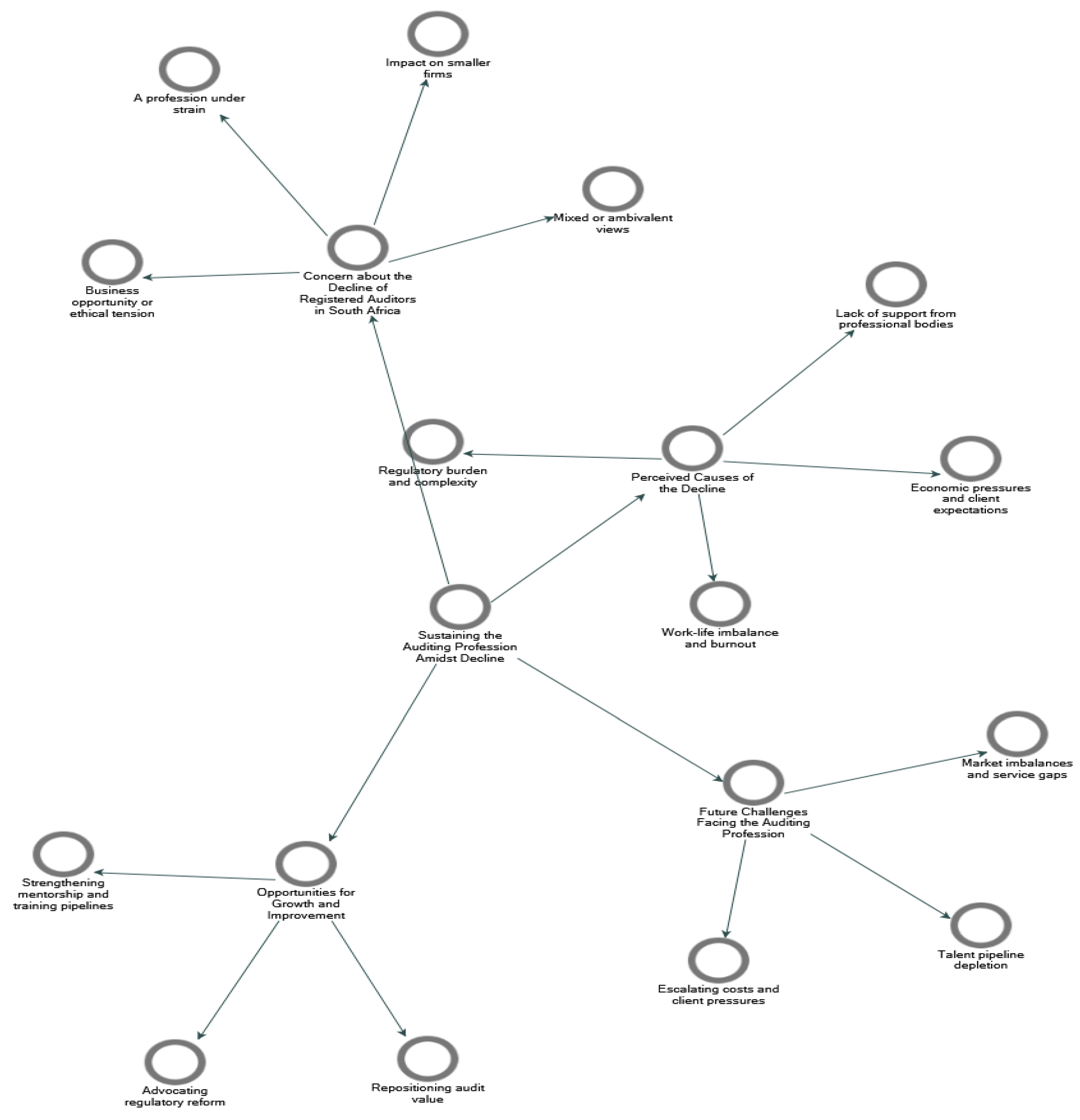
Figure 5.
8: Word cloud subsuming the key concepts from the interview.

Disclaimer/Publisher’s Note: The statements, opinions and data contained in all publications are solely those of the individual author(s) and contributor(s) and not of MDPI and/or the editor(s). MDPI and/or the editor(s) disclaim responsibility for any injury to people or property resulting from any ideas, methods, instructions or products referred to in the content. |
© 2025 by the authors. Licensee MDPI, Basel, Switzerland. This article is an open access article distributed under the terms and conditions of the Creative Commons Attribution (CC BY) license (http://creativecommons.org/licenses/by/4.0/).
Copyright: This open access article is published under a Creative Commons CC BY 4.0 license, which permit the free download, distribution, and reuse, provided that the author and preprint are cited in any reuse.


