

Submitted:
05 August 2025
Posted:
06 August 2025
You are already at the latest version
Abstract
Green subcritical water extraction has been applied with the white oil-bearing rose Rosa alba L. The two factor modeling process revealed that 150 °C and 30 minute treatment resulted maximum yield of phytochemicals: essential oil, phenolic compounds, total sugars, proteins and simple sugars. A quantitative and qualitative analysis of the products was performed. The essential oil contains mainly phenylethyl alcohol, citronellol, geraniol and hydrocarbons (paraffins). The phenolic substances were represented by phenolic acids (gallic acid: 30.92-113.37 µg/mL; ferulic acid: 44.50-99.96 µg/mL; rosmarinic acid: 25.27-80.47 µg/mL and protocatechuic acid: 13.05-25.48 µg/mL), flavonoids (both quercetin and kaempferol: 8.35-8.56 µg/mL and their glycosides: 15.91-58.08 µg/mL). The monosaccharides determined were glucose (3.09-15.29 mg/mL), galacturonic acid (1.02-2.34 mg/mL), galactose (0.18-0.78 mg/mL), rhamnose (0.17-0.48 mg/mL) and xylose (0.07-0.17 mg/mL). The content of total phenols, flavonoids and antioxidant activity were reported by DPPH, ABTS, FRAP and CUPRAC methods. The complex composition and activity of the extracts suggests their application directly as a food supplement or in cosmetic preparations.
Keywords:
Rosa alba L
; subcritical water extraction
; hydrothermal treatment
; essential oil
; antioxidant activity
1. Introduction
Extraction is a basic method for obtaining substances from aromatic and medicinal plants. Depending on the type of solvent, the procedure and the parameters of the method, there are many variations with many kind of products - combination of volatiles and non-volatile metabolites, only non-volatiles or only a target substance/substances. In industry, a well-established (conventional) type of extraction is usually used – the raw material is treated with an organic solvent (n-hexane, petroleum ether, methanol, ethanol, diethyl ether, chloroform or ethyl acetate), which is subsequently removed from the final product. In this case, there are always unwanted residues or environmental consequences. The modern processing methods required minimal treatment of the raw material, a quality product, economic efficiency and environmental compatibility. This is especially difficult with oil-bearing rose – a precious plant with wide application in perfumery, pharmacological importance, medical purposes and lifestyle quality [1].
Subcritical water extraction (SWE), also known as hot compressed water, pressurized hot water extraction or hydrothermal treatment, is a new, eco-friendly and “green” method for extraction of biologically active compounds [2]. As the temperature increases, it’s dielectric constant and polarity of the molecule decreases, and above 200 degrees Celsius it ionizes and becomes a very good solvent for hydrophobic organic molecules [3]. This highly effective technology allows for the use of minimal plant material with maximum yield of beneficial nutrients [4]. As such, pressurized hot water extracts are sustainable, eco-friendly and cost effective.
Our team and other scientists work on applying the hydrothermal treatment technology to essential oil bearing and medicinal plants and provided that these extracts with bioactive compounds could be used in the food industry as food antioxidants, food supplements and functional foods with potential health benefits [5,6,7]. To the best of our knowledge there is scant information in the literature regarding the application of the subcritical water extraction to roses [8,9], and for R. alba such data are completely lacking.
2. Materials and Methods
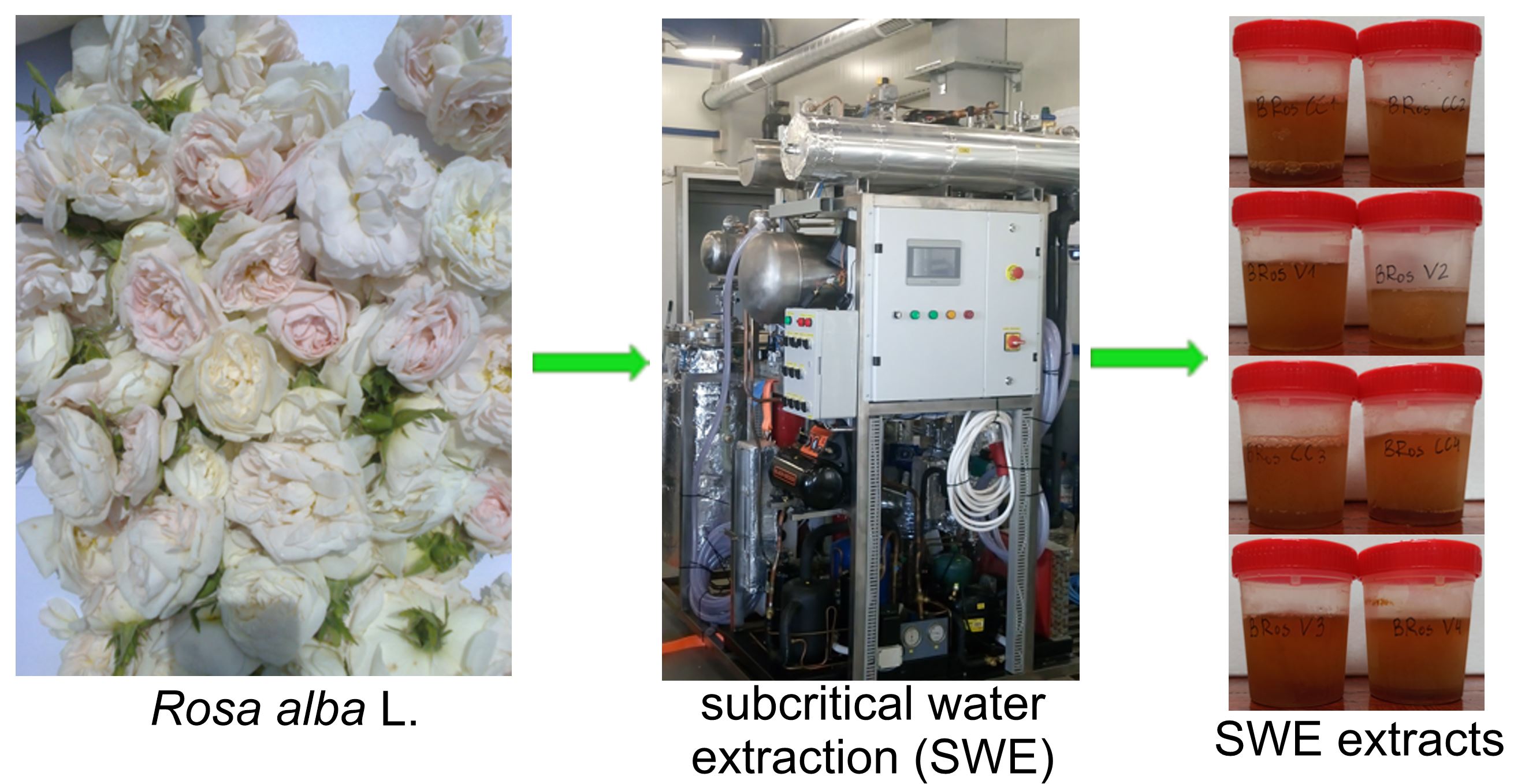
Materials: Fresh rose flowers of Rosa alba L. were used as raw material (2023 harvest). The plants were grown in the experimental field of the Institute for Roses and Medicinal Plants (IRAP), Kazanlak, Bulgaria. The rose blossoms were picked early in the morning (8.00 – 10.00 a.m.). The most appropriate flowering phases was used: semi-opened and full-opened buds. Half of the flowers had the petals separated from the calyx. Finally, whole flowers and petals were used as raw materials. They were processed immediately, in two repetitions.
Processing/Technology: Innosolv Ltd., Plovdiv, Bulgaria has developed an automated system for extraction of plant-based raw materials using pressurized hot water with working volume of the extractor of 2 L. In the working chamber of the extractor, a metal mesh basket is placed. Its working volume is 2 L, and it holds the raw material to be processed (200 g). The mesh basket has mesh size of 100 µm. The basket is loaded in the extractor using a loading unit. For keeping constant extraction temperature throughout the whole process, the extractor is equipped with a tempering unit. The water solvent is heated up to the desired extraction temperature outside the extractor in a heating vessel. Water is heated in vessel by means of a stainless steel electric heater. Two temperature regimens were used – mild (100 °C) and intense (150 °C). During each stage of heating the water, inert nitrogen gas is fed into the vessel from a pressurized cylinder to maintain counter-pressure. The counter-pressure value is aligned to the desired extraction temperature, and it should be higher than the saturation pressure of the water at that temperature. Thus, at the stages of water heating and extraction, the solvent is thermodynamically in a non-boiling liquid state.
After reaching the set extraction temperature, the hot water is fed into the extractor chamber, which marks the beginning of the extraction process. A circulating pump is used to intensify the process and reduce the time for extraction. It allows the solvent to pass around the particles of the raw material in a closed loop during the extraction. The flow rate of the circulated solvent is 50 bed volumes/hour (BV/h) – in our case having a 2 L extractor volume this value is 100 L/h. After completion of the extraction for the specified time (15 and 30 min), the obtained miscella is transferred from the extractor to one of the miscella collectors. To do so, it passes through a recovery unit, where its temperature and pressure decrease. The clean water solvent is fed into the system through recovery unit. Water is heated there and then fed into heating vessel. Generally, the extraction process is carried out in the following sequence: heating of the solvent and tempering of the extractor/loading the raw material/extraction/draining the miscella/waste removal. All stages of the extraction process (except loading the raw material and waste removal) are fully programmable logic controller (PLC) automated. The operator pre-sets the desired extraction temperature, number of solvent changes, and extraction duration for each change.
In parallel with the extraction, steam distillation was performed on a Clevenger-type laboratory apparatus, with classic parameters: sample 200 g, duration 2.5 hours and speed 3–4 mL/min. The aim was to obtain an essential oil that is going to be compared to the obtained by hydrothermal treatment extracts.
Chemical composition: The volatiles were obtained after liquid-liquid extraction of 500 mL SWE extract with equal quantity diethyl ether. The extraction was performed three times. The combined ether extracts were dehydrated with anhydrous sodium sulfate, and evaporated on a vacuum rotary evaporator until complete solvent removal. The sample was tempered and weighed to account for the amount of volatile fraction. The essential oil and volatile fractions were dried over anhydrous sodium sulfate and stored in tightly closed dark vials at 4°C until further analyzed.
GC-FID/MS Technique: The chemical composition of the rose oils was evaluated on an Agilent 7820A GC System coupled with a flame ionization detector and a 5977B MS detector. The protocol was chosen according to ISO 9842 for the gas chromatographic analysis of rose oil. The capillary column EconoCapTM ECTM-5 (30 m × 0.32 mm × 0.25 mm film of 5% phenyl, 95% methylpolysiloxane) was used. Hydrogen (99.999% purity) was used as a carrier gas. The split ratio was 1:10, the inlet temperature was set to 250°C, and the FID temperature was set to 300°C. The component relative percentages were calculated based on GC peak areas without correction factors.
The identification of constituents was established by comparing the retention indices and MS spectra with those reported in the literature, as well as, whenever possible, co-injections with authentic compounds.
Neutral sugars, monosaccharide composition and proteins: The amount of neutral sugars in the extracts was determined by phenol–sulfuric acid method [10]. 200 μL of the extract was mixed with 200 μL 5% phenol (Sigma-Aldrich Chemie Gmbh, Germany) solution in water and 1 mL concentrated H2SO4 (Sigma-Aldrich Chemie Gmbh, Germany) was added. The mixture was vortexed and the absorption at 492 nm with 1 cm cuvette was measured. The standard curve was prepared using D-galactose.
The quantities of galactose, rhamnose, glucose and galacturonic acid were determined on chromatographic system ELITE LaChrome (Hitachi) HPLC with a VWR Hitachi Chromaster 5450 refractive index detector using Aminex HPX-85H column. The samples and standards were eluted with 5 mM H2SO4 (Sigma-Aldrich Chemie Gmbh, Germany) at an elution rate of 0.5 mL/min, column temperature 50°С, and detector temperature 35°С. The amounts of xylose and mannose were determined separately with the same chromatographic system using Sugar SP0810 (Shodex®) column. The samples and standards were eluted with ultrapure water at an elution rate of 1.0 mL/min, column temperature 85°С, and detector temperature 35°С.
The protein content was determined employing the Bradford method [11] with AMRESCO E535-KIT (AMRESCO, Solon, Ohio, USA) with bovine gammaglobulin as standard. One hundred μL of the extract was mixed with 1 mL of the Bradford reagent, vortexed, wait for 2 min, and the absorption at 595 nm with 1 cm cuvette was measured.
Total polyphenolic and flavonoid content: The total polyphenolic content (TPC) of R. alba SWE extracts was assessed according to the method of Ivanov et al. [12] using the Folin–Ciocalteu reagent (Sigma-Aldrich, St. Louis, MO, USA). The results were expressed as mg equivalents of gallic acid (GAE) per mL of extract. The total flavonoid content (TFC) of R. alba SWE extracts was evaluated following the method described by Ivanov et al. [12]. The results were expressed as mg of quercetin equivalents (QE) per mL of extract.
Individual phenolic acids and flavonoids: HPLC analysis of individual phenolic acids and flavoniods in extract was performed by HPLC with UV-VIS detector (Waters, Milford, MA, U.S.) as described previously [13]. 20 µL of extract were injected into C18 column (Supelco Discovery HS; 5 μm, 25 cm × 4.6 mm) (Merck KGaA, Darmstadt, Germany) and eluted by 1% acetic acid (Phase A) and methanol (Phase B) in gradient as described in [13]. The 1.0 mL/min flow rate was used. The gallic, protocatechuic, vanillic, syringic, p-coumaric, and salicylic acids, (+)-catechin, (+)-epicatechin, and hesperidin were detected at λ = 280 nm, whereas the rosmarinic, chlorogenic, caffeic, and ferulic acids, rutin, quercetin, and kaempferol were detected at λ= 360 nm. Quantification was done by retention times and calibration curves of external standards.
Antioxidant activity:
DPPH Radical Scavenging Assay
The DPPH assay was performed by the method of Ivanov et al. [12] using DPPH (2,2-diphenyl-1-picrylhydrazyl) reagent (Sigma-Aldrich, St. Louis, MO, USA). The antioxidant activity was expressed as mM Trolox equivalents (TE)/mL of extract.
ABTS Radical Scavenging Assay
The ABTS assay was performed by the method of Ivanov et al. [12] using ABTS (2,2'-azino-bis(3-ethylbenzothiazoline-6-sulfonic acid)) reagent (Sigma-Aldrich, St. Louis, MO, USA). The antioxidant activity was expressed as mM Trolox equivalents (TE)/mL of extract.
Ferric-Reducing Antioxidant Power (FRAP) Assay
The FRAP assay was performed according to the method of Ivanov et al. [12] using 2,4,6-Tris(2-pyridyl)-s-triazine (TPTZ) (Sigma-Aldrich, St. Louis, MO, USA). The antioxidant activity was expressed as mM Trolox equivalents (TE)/mL of extract.
CUPric Reducing Antioxidant Capacity (CuPRAC) Assay
The CuPRAC assay was performed according to the method of Ivanov et al. [12] using copper (II) – neocuproine (2,9-dimethyl-1,10-phenanthroline) (Sigma-Aldrich, St. Louis, MO, USA) as reagent. The antioxidant activity was expressed as mM Trolox equivalents (TE)/mL of extract.
Statistical analysis: The experimental data (three replications) are presented as mean value ± standard deviation. For analysis one-way ANOVA test (Tukey’s post hoc test; p < 0.05) was used with Microsoft Excel 2013 (additional XL Toolbox NG module installed).
3. Results and Discussions
3.1. Experimental Design
The experiments were organized as two factors at two levels model. The factors were temperature and duration. The levels were 100 °C and 150 °C and 15 min and 30 min treatment. Factors and levels were selected based on data from the previous works and the literature. Table 1 presented the variants.
3.2. Extracts
As the temperature and duration of treatment increases with the sequence of variants, the amount of extract obtained also increases accordingly. The botanical part has practically no impact on the amount of extract. In appearance, the variants at low temperature are clear liquid with a yellow-brown color, and a pleasant rose aroma. The extracts of higher temperature are turbid, of a darker color, and also with characteristic rose odor.
The volatile content in the extracts has been evaluated applying extraction procedure aiming at concentration of the compounds, because the low levels of the odor substances. The methodology was developed and validated specifically for rose water, which also has a very low content of rose oil. Figure 1 presented both the results for volatiles and extractive substance content in the products of subcritical water extraction. Although obtained by long-term distillation (2 – 3 h), rose water is the closest product suitable for comparison with the extracts obtained. By standard, the content of essential oil in it is 0.025 - 0.050% [14]. Apparently, extraction with superheated water extracts the full amount of volatile substances for 30 minutes – the levels of values for the indicator positions are within the limits 0.010 – 0.060 %. The data showed that the essential oil content increases in the samples with increasing temperature and duration of treatment. At 100 °C, the petals contain higher levels of essential oil – a fact that confirms the well-known rule of oil localization in the rose blossoms [15].
The longer treatment resulted in increased amounts of dry matters – in average with 55 %. The regimens applied having higher temperature showed that the whole flower and petals have the same content and the same composition in the variants treated for 30 minutes, but have a drastic increase of the dry content. This contradiction with the observation could be explained with the disruption of the macromolecules at critical conditions and releasing a microstructures which are volatile.
3.3. Chemical Composition of the Extracts
3.3.1. Gas-Chromatography – Mass Spectrometry (GC-MS) Analyses
The chemical composition of the volatiles in the R.alba extracts is presented in Table 2. Compared to classic rose oil obtained from R. alba, the volatile components found in subcritical water extracts have the same qualitative profile, but a different quantitative composition. The essential oil is reach of monoterpene alcohols (geraniol (19.71%), citronellol and nerol (14.92%), and aliphatic hydrocarbons (nonadecane (13.21%) and heneicosane (11,86%), but the extracts stand out with a high content of phenylethyl alcohol (from 6% to 25%, linalool (from 3% to 20%). In the extracts obtained at a higher temperature (150 °C) and a longer extraction period (30 min), aliphatic hydrocarbons are in larger quantities. Basically, the products obtained have more phenyl derivatives – phenylethyl alcohol (from 14% to 25%), eugenol (from 2% to 8%) and methyl eugenol (from 0.2 to 7%). The levels of the eugenol and methyl eugenol were higher than in the essential oil (0.06 and 0.05 %, respectively), but did not exceeded the limits. This pattern has similarities to the composition of rose water [16] and confirmed the results of Özel et al. [9]. Interestingly, Babu et al. [17] distilled R. damascena at elevated pressure and temperature and the composition of the rose oil acquired had almost the same composition as the extracts obtained in the present work.
Antonova et al. [18] investigated and compared the composition of five aroma rose products: three essential oils (from distilleries in Bulgaria from different locations), one supercritical CO2 extract and one extract obtained using subcritical freon (1,1,1,2-tetrafluoroethane – freon R134a) treatment. Their data suggested that the essential oils contain phenethyl alcohol in the range of 0.74–1.26 relative % while the extracts obtained with liquefied gasses has much higher content – 46.68 and 56.6 relative % for CO2 and freon extracts, respectively. The content of phenylethyl alcohol (from 14% to 25%) in the SWE extracts suggests that the aroma products obtained in the present study in relation to the phenylethyl alcohol concentration are somewhere between the rose oils and extracts produced by liquefied gasses. In contrary, the linalool quantities ranging from 3% to 20% in the extracts obtained as a results of the present study in the aroma rose product are in the 0.08–1.31 relative % range [18].
Ethanol is a component that is standardized in the international standard for rose oil [19]. It is associated with the fermentation processes that occur in the flower during improper storage before processing. In our case, its content is so low that it is not recorded in either the essential oil or the extracts. This is due to the immediate processing of the raw material by both methods. The total percentages for rose oil are higher than those for extracts and this could be explained with the amounts of non-volatile components that were obtained during the SWE treatment of the plant material.
3.3.2. Total Neutral Sugars and Protein Content Determination
Extracts obtained with a polar solvent, such as water used in SWE, often also contain polar components such as carbohydrates (polysaccharides and sugars) and water-soluble proteins. The next step in our research was to determine the content of total neutral sugars and proteins (Table 3).
The maximum amount of total neutral sugars was recorded when the petals were extracted both briefly (15 min) and for a long time (30 min), and the temperature was 150°C. In these modes of subcritical water extraction, the amount of extracted neutral sugars increased by about 30% (6.30–6.40 mg/mL) compared to the extraction mode at 100°C (4.40–4.50 mg/mL). This fact confirms that in the rose flower the main amount of sugars (oligo and polysaccharides) is in the petals [20,21], which under subcritical conditions are hydrolyzed to their low molecular weight monomers (simple sugars). At the lower temperature of 100°C such processes were not observed to a significant extent. The protein data show that at 100°C the amounts of proteins are the same in whole flowers and petals for both subcritical extraction solutions. At 150°C the protein values were generally higher and the maximum values were reached at 30 min of treatment, but there is a clear distinction in the protein content of petals and whole flowers. These results again indicate that under subcritical conditions degradation processes in high molecular weight metabolites occur.
3.3.3. Monosaccharide Composition of SWE Extracts
The monosaccharide composition of the aqueous extracts of subcritical water extraction has also been determined. Table 4 shows more detailed data regarding the monosaccharide content in the obtained extracts. HPLC analysis revealed the presence of five monosaccharides in the petals and the flowers, four neutral sugars (glucose, galactose, rhamnose and xylose) and one uronic acid (galacturonic acid). In the obtained extracts, the main monosaccharide is glucose. The amount of glucose in the extracts varies from 4 to 15 mg/mL extract. Higher amounts of glucose are found in the extracts obtained at higher temperatures 150°C and longer subcritical extraction times (30 min) (Table 4). This observation tentatively is related to the increased rate of hydrolysis of hemicelluloses and partially of cellulose. It is well known that besides a method for “green extraction” SWE is used for treatment (often combined with enzymatic pretreatment) of lignocellulosic biomass for obtaining of low-molecular carbohydrates which could be used as substrates for ethanol production or as precursors for synthesis of various building blocks used for obtaining of biodegradable polymers [22,23].
Galacturonic acid and rhamnose are the characteristic monosaccharides of the main chain of pectic polysaccharides. R. alba flowers are characterized by the presence of pectic polysaccharides [24]. In general, it is clearly seen that the highest values in the amounts of monosaccharides were in the variants with a temperature of 150°C and a processing time of 30 minutes. The content of galacturonic acid was maximum and almost the same for both the whole flower and the petals in the different extraction modes. In the case of rhamnose, such trend is absent, the amounts are similar in the extracts obtained in the studied extraction modes. Galactose is clearly expressed in the variants with the petals, as is the case with an extraction time of 30 minutes. Xylose is present only in the experiments with 150 degrees and an extended extraction time (30 min). Galactose and xylose are characteristic monomers in the branched chains of pectin polysaccharides. Their concentration increases in the extracts obtained at increased temperature and extraction time. Under these conditions, pectin hydrolysis also increases, which is the reason for the identification of these monosaccharides in the extracts polysaccharides [24].
3.3.4. Total Polyphenols, Total Flavonoids and Antioxidant Activity of R. alba SWE Extracts
In various extracts obtained from processed (CO2 supercritical extraction and steam distillation) and unprocessed R. alba flowers, in addition to volatile components and monosaccharides, polyphenolic components (phenolic acids and flavonoids) with antioxidant activity are also found [25]. On this basis, the next step in analyzing the obtained extracts was to determine the content of total polyphenols, total flavonoids, and their relationship with antioxidant activity. The latter was determined by four different methods, covering all aspects of this biological effect. The results are presented in Table 5.
As in previous studies on the extracts, there is a clear trend for an increase in the concentration of phenolic components with intensification of extraction conditions – increasing the temperature and extraction time (Table 5). Total polyphenols reach a maximum in samples with petals, both in a short 15 min extraction and in a longer subcritical water extraction (0.60 – 0.63 mg/mL). In the whole-flower variants, the content of polyphenols practically does not change. This indicates that these forms do not undergo destruction and are sufficiently stable.
Flavonoids do not show a clear trend for either the botanical part or the temperature and duration of extraction. For the whole flower, a slight decrease of about 15% in the values was observed with longer extraction, which may be a consequence of the destruction of certain flavonoid structures. Our previous study showed that the flavonoid content in R. alba flowers is about 18 mg/g [26], apparently the subcritical water extraction applied almost completely extracts these substances.
As mentioned above, to date, this is (to the best of our knowledge) the first report on SWE extracts from R. alba, and for this reason they are compared with similar distillation products – hydrosol and wastewater. Georgieva et al [27] declared that R. alba hydrolate contained 72.73 mg GAE/mL total polyphenols, which is consistent with our results. Ilieva et al [28] found that the wastewater from steam distillation of R. damascena had the highest amount of polyphenols (7.6 mg/mL) compared to those of R. damascena and R. centifolia.
The products of hydroalcoholic extraction of R. damascena have higher levels of total polyphenol and total flavonoid content, but are concentrated (or even lyophilized) and cannot be compared with our extracts [29,30,31]. A concentrated aqueous extract of R. damascena has a total polyphenol content of about 110 µg/mL and a total flavonoid content of about 176 µg/mL [32].
In terms of antioxidant activity, a clear relationship emerges between the content of total phenols and biological effect. The phenolic compounds are recognized as free radical scavengers and they count the majority of the antioxidant activity of a plant. The mechanism of action is mostly derived from their metal ion-chelating and hydrogen donating abilities. Antioxidant activity is usually measured by the DPPH method, but in the present study, the inhibitory power was investigated using DPPH, ABTS, FRAP and CUPRAC methods, each using different chromogenic redox reagents with different standard potentials. The DPPH and ABTS analyses reaction with an organic radical and provides simplicity and high sensitivity. The FRAP and CUPRAC use reduction with a metal ions. They are fast and cost-effective, and does not require specialized equipment. The ABTS and CUPRAC tests can measure both hydrophilic and lipophilic antioxidants, the FRAP method only measure hydrophilic antioxidants and DPPH only apply to hydrophobic systems. The data showed their different capacity: the resulting ranges for DPPH, ABTS, FRAP and CUPRAC were 4.06–7.56 mM TE/mL, 3.69–7.24 mM TE/mL, 3.65–7.22 mM TE/mL and 8.66–15.84 mM TE/mL, respectively. The antioxidant levels of the extracts were significantly lower than the ascorbic acid (18.22 µg/mL), as reported by Alizadeh and Fattahi [33], compared with rosmarinus subcritical water extracts – 11.3 μg/mL. But, the antioxidant activity of the obtained subcritical water extracts of flowers and petals of R. alba is practically no different from 70% ethanol extracts of R. alba obtained from waste rose flowers (after steam distillation and CO2 subcritical extraction) by two methods DPPH and FRAP (about 6000 mM TE/L) [25].

Table 6.
Individual phenolic acids and flavonoids in R. alba SWE extracts.
| Compound | Concentration, µg/mL | |||||||
| BRCC1 | BRCC2 | BRV1 | BRV2 | BRCC3 | BRCC4 | BRV3 | BRV4 | |
| Gallic acid | 44.45±1.01e | 39.07±0.86f | 30.92±0.98g | 40.79±1.05f | 68.17±1.05d | 113.37±1.35a | 104.34±1.35c | 108.85±0.99b |
| Protocatehuic acid | NF* | NF | NF* | NF | NF | 13.05±0.94c | 19.22±0.67b | 25.48±0.86a |
| (+)-Catechin | NF | NF | NF | NF | NF | NF | NF | NF |
| Chlorogenic acid | NF | NF | NF | NF | NF | NF | NF | NF |
| Vanillic acid | NF | NF | NF | NF | NF | NF | NF | NF |
| Caffeic acid | NF | NF | NF | NF | NF | NF | NF | NF |
| Syringic acid | NF | NF | NF | NF | NF | NF | NF | NF |
| (-)-Epicatechin | NF | NF | NF | NF | NF | NF | NF | NF |
| p-Coumaric acid | NF | NF | NF | NF | NF | NF | NF | NF |
| Ferulic acid | 99.96±1.80a | 47.21±1.62e,f | 77.49±1.02c | 87.56±1.68b | 51.36±1.85e | 44.50±1.47f | 84.26±1.57b | 67.63±1.77d |
| Salicylic acid | NF | NF | NF | NF | NF | NF | NF | NF |
| Rutin | 47.13±1.21a | 19.25±0.99e | 33.04±0.89c | 37.76±1.02b | 16.58±1.35f | 13.53±0.86g | 31.01±1.14c | 25.00±0.94d |
| Hesperidin | 10.95±0.94a | 2.51±0.87d | 7.42±0.96b | 6.12±0.85b,c | 7.68±0.88b | 5.77±1.02c | 10.95±0.94a | 2.51±0.87d |
| Rosmarinic acid | 65.12±1.74b | 25.27±1.16f | 50.06±1.02c | 46.95±1.11d | 79.41±1.34a | 80.47±1.20a | 65.12±1.74b | 25.27±1.16f |
| Quercetin | NF | NF | NF | NF | 8.35±0.89b | 8.25±0.94b | NF | NF |
| Kaempherol | NF | NF | NF | NF | ULOQ** | 0.311±0.08 | NF | NF |
** - Under the limit of quantification; * - Not found; 1Results are presented as the mean of three measurements; a,b,c,d,e,f Different letters in columns indicate statistically different values (Tuckey’s HSD test, p < 0.05).
In the SWE aqueous extracts, three major phenolic acids were identified: gallic, ferulic and rosmarinic acids. Protocatechuic acid was detected only in the extracts obtained at 150 °C. Gallic acid was more completely extracted at higher extraction temperatures and longer extraction periods, its concentrations being about 2 times higher in the extracts obtained at 150 °C (104-113 µg/mL) compared to those obtained at 100 °C (30-44 µg/mL). The behavior of the other two acids, ferulic and rosmarinic acids, is similar, but at 150 °C and an extraction period of 30 min their amounts decrease due to hydrolysis and oxidative processes.
Two flavonoid glycosides were mainly identified in the extracts – rutin and hesperidin. Rutin is in 3-4 times higher (15-40 µg/mL) concentrations than hesperidin (2-10 µg/mL). Higher yields were observed in extracts obtained with shorter extraction times (15 min) compared to those obtained with longer extraction periods, due to hydrolysis processes occurring in flavonoid glycosides. Quercetin was only found in whole flower extracts obtained at 150°C (about 8 µg/mL). Quercetin is most likely a hydrolysis product of rutin during the extraction process. Our results confirm the study by Ko et al. [34] on the relationship between flavonoid structure and subcritical water extraction, namely that the optimal temperature for the extraction of glycosides is 50 degrees lower than that for aglycones. Slavov et al., 2020 also found similar phenolic acids and flavonoids in 70% ethanol extracts obtained from by-products of R. alba flowers.
5. Conclusions
Subcritical water extraction – a promising “green” method for extraction and treatment of raw plant materials, of Rosa alba L. can be used as an efficient method for obtaining an aromatic product with a complex composition, consisting of volatile components and phytochemicals – proteins, sugars, polyphenols, flavonoids in both their forms: glycosides and aglycones possessing potent antioxidant activity. The content of these organic substances in them is not high, but in their overall potential they make white rose subcritical water extracts a superior product that can be applied directly as a nutritional supplement or cosmetic ingredient. To the best of our knowledge this is the first report in the scientific literature on the obtaining of R. alba SWE products and determination of their chemical composition. The extracts differ in their composition from rose oil and rose extracts obtained by liquefied gasses (supercritical CO2 extract and subcritical freon extract). The extracts are close in chemical parameters to rose hydro distillates, which are valuable raw materials used in cosmetics.
6. Patents
This section is not mandatory but may be added if there are patents resulting from the work reported in this manuscript.
Author Contributions
Conceptualization, A.D., N.N., A.S.; methodology, A.D., A.S., N.N., V.G.; validation, I.I., A.S. and I.H.; formal analysis, A.S., I.I., A.D.; investigation, A.D., A.S., I.I., V.G., I.H.; resources, A.D., N.N.; data curation, A.S., A.D., N.N., I.H.; writing—original draft preparation, A.D., N.N., A.S.; writing—review and editing, A.S., I.I., A.D., V.G.; supervision, A.D. and A.S.; project administration, A.S., A.D., N.N.; funding acquisition, A.S. All authors have read and agreed to the published version of the manuscript.
Funding
This work has been carried out in the framework of the National Science Program "Critical and strategic raw materials for a green transition and sustainable development", approved by the Resolution of the Council of Ministers № 508/18.07.2024 and funded by the Ministry of Education and Science (MES) of Bulgaria.
Conflicts of Interest
The authors declare no conflicts of interest.
Abbreviations
The following abbreviations are used in this manuscript:
| SWE | Subcritical water extraction |
| GC-MS | Gas chromatography – Mass spectrometry |
| HPLC | High performance liquid chromatography |
| DPPH | 2,2-diphenyl-1-picrylhydrazyl radical |
| ABTS | 2,2'-azino-bis(3-ethylbenzothiazoline-6-sulfonic acid |
| FRAP | Ferric-Reducing Antioxidant Power |
| CUPRAC | CUPric Reducing Antioxidant Capacity |
References
- Mileva, M.; Ilieva, Y.; Jovtchev, G.; Gateva, S.; Zaharieva, M.M.; Georgieva, A.; Dimitrova, L.; Dobreva, A.; Angelova, T.; Vilhelmova-Ilieva, N.; Valcheva, V.; Najdenski, Н. Rose flowers – A delicate perfume or a natural healer? Biomolecules, 2021, 11, 127, 1–32. [CrossRef]
- Vardakas, A. A new process for enzyme-assisted subcritical water extraction of rice husk polyphenols. Sci. Works Univ. Food Technol. 2020, 67(1), 76–81.
- Chemat, F.; Abert Vian, M.; Ravi, H.K.; Khadhraoui, B.; Hilali, S.; Perino, S.; Fabiano Tixier, A.-S. Review of alternative solvents for green extraction of food and natural products: Panorama, principles, applications and prospects. Molecules 2019, 24, 3007, 1–27. [CrossRef]
- Nastić, N.; Švarc-Gajić, J.; Delerue-Matos, C.; Barroso, F.; Soares, C.; Moreira, M.; Morais, S.; Mašković, P.; Srček, V.; Slivac, I.; Radošević, K.; Radojković, M. Subcritical water extraction as an environmentally-friendly technique to recover bioactive compounds from traditional Serbian medicinal plants. Ind. Crops Prod. 2018, 111, 579–589. [CrossRef]
- Atanasova, A.; Petrova, A.; Teneva, D.; Ognyanov, M.; Georgiev, Y.; Nenov, N.; Denev, P. Subcritical water extraction of rosmarinic acid from lemon balm (Melissa officinalis L.) and its effect on plant cell wall constituents. Antioxidants 2023, 12, 888, 1–15. [CrossRef]
- Ibanez, E.; Kubatova, A.; Senorans, F.J.; Cavero, S.; Reglero, G.; Hawthorne, S.B. (2003). Subcritical water extraction of antioxidant compounds from rosemary plants. J Agricul. Food Chem. 2003, 51, 375–382.
- Zhang, J.; Wen, C.; Zhang, H.; Duan, Y.; Ma, H. Recent advances in the extraction of bioactive compounds with subcritical water, A review. Trends Food Sci. Technol. 2020, 95, 183–195. [CrossRef]
- Özel, M., Clifford, A. Superheated water extraction of fragrance compounds from Rosa canina. Flavour Fragr. J. 2004, 19(4), 354–359. [CrossRef]
- Özel, M.; Göǧüş, F.; Lewis, A. Comparison of direct thermal desorption with water distillation and superheated water extraction for the analysis of volatile components of Rosa damascena Mill. using GCxGC-TOF/MS. Anal. Chim. Acta, 2006, 566, 172–177. [CrossRef]
- DuBois, M.; Gilles, K.; Hamilton, J.; Rebers, P.; Smith, F. Colorimetric method for determination of sugars and related substances. Anal. Chem. 1956, 28(3), 350–356.
- Bradford, M.M. A rapid and sensitive method for the quantitation of microgram quantities of protein using the principle of protein dye binding. Anal. Biochem. 1976, 72, 248–254. [CrossRef]
- Ivanov, I.; Vrancheva, R.; Marchev, A.; Petkova, N.; Aneva, I.; Denev, P.; Georgiev, V.; Pavlov, A. Antioxidant activities and phenolic compounds in Bulgarian Fumaria species. Int. J. Curr. Microbiol. Appl. Sci. 2014, 3, 296–306.
- Krasteva, G.; Berkov, S.; Pavlov, A.; Georgiev, V. Metabolite profiling of Gardenia Jasminoides Ellis in vitro cultures with different levels of differentiation. Molecules 2022, 27, 8906. [CrossRef]
- Industry standard BS – II – 02. Natural rose water. 2006. Bulgarian Association of Essential Oils, Perfumes and Cosmetics (BNAEOPC). https://www.bnaeopc.com/ (accessed on 25 May 2025).
- Mihailova, J.; Atanasova, R.; Balinova-Tsvetkova, A. Direct gas chromatography of essential oil in the separate parts of the flower of the Kazanlik rose (Rosa damascena Mill. trigintipetala Dieck). In Proceedings of VIIth International Congress of the Essential Oils, Kyoto, Japan, 1977a, October 1977, 219–221.
- Agarwal, S.G.; Gupta, A.; Kapahi, B.K.; Baleshwar, Thappa, R.K.; Suri, O.P. Chemical composition of rose water volatiles. J. Essent. Oil Res. 2005, 17(3), 265–267. [CrossRef]
- Babu, K.G.D.; Singh, B.; Joshi, V.P.; Singh, V. Essential oil composition of Damask rose (Rosa damascena Mill.) distilled under different pressures and temperatures. Flavour Fragr. J. 2002, 17, 136–140. [CrossRef]
- Antonova, D.V.; Medarska, Y.N.; Stoyanova, A.S.; Nenov N.S.; Slavov, A.M.; Antonov, L.M. Chemical profile and sensory evaluation of Bulgarian rose (Rosa damascena Mill.) aroma products, isolated by different techniques. J. Essent. Oil Res. 2021, 33(2), 171–181. [CrossRef]
- ISO 9842:2024. Oil of Rose (Rosa x damascena Miller). International Organization for Standardization: Geneva, Switzerland, 2024. Available online: https://www.iso.org/standard/86897.html (accessed on 30 March 2025).
- Mihailova, J.; Decheva, R.; Koseva, D. Microscopic and biochemical study of starch and localization of essential oil in the corolla leaves of the Kazanlak oil-bearing rose. Plant Sci. 1977b, XIV(2), 34–40 (In Bulgarian).
- Sood, S.; Vyas, D.; Nagar, P.K. Physiological and biochemical studies during flower development in two rose species. Scientia Hort. 2006, 108(4), 390–396. [CrossRef]
- Wyman, C.E.; Dale B.E. Producing biofuels via the sugar platform. Chem. Eng. Prog. 2015, 111(3), 45–51.
- Wojcieszak, R.; Itabaiana I. Engineering the future: Perspectives in the 2,5-furandicarboxylic acid synthesis. Catal. Today 2020, 354(1), 211–2017. [CrossRef]
- Slavov, A.; Chalova, V. Physicochemical characterization of pectic polysaccharides from rose essential oil industry by-products. Foods 2024, 13(2), 270, 1–17. [CrossRef]
- Slavov, A.; Vasileva, I.; Denev, P.; Dinkova, R.; Teneva, D.; Ognyanov, M.; Georgiev Y. Polyphenol-rich extracts from essential oil industry wastes. Bul. Chem. Commun. 2020, 52(Special Issue D), 78–83.
- Dobreva, A.; Gerdzhikova, M. 2013. The flavonoid content in the white oil-bearing rose (Rosa alba L.). Agricul. Sci. Technol. 2013, 5(1), 134–136.
- Georgieva, A.; Dobreva, A.; Tzvetanova, E.; Alexandrova, A.; Mileva, M. Comparative study of phytochemical profiles and antioxidant properties of hydrosols from Bulgarian Rosa alba L. and Rosa Damascena Mill. J. Essent. Oil-Bear. Plants. 2019, 22, 1362–1371.
- Ilieva, Y.; Dimitrova, L.; Georgieva, A.; Vilhelmova-Ilieva, N.; Zaharieva, M.M.; Kokanova-Nedialkova, Z.; Dobreva, A.; Nedialkov, P.; Kussovski, V.; Kroumov, A.D.; Najdenski, H., Mileva, M. In vitro study of the biological potential of wastewater obtained after the distillation of four Bulgarian oil-bearing roses. Plants 2022, 11, 1073, 1–19. [CrossRef]
- Baydar, N.; Baydar, H. Phenolic compounds, antiradical activity and antioxidant capacity of oil-bearing rose (Rosa damascena Mill.) extracts. Ind. Crops Prod. 2013, 41, 375–380. [CrossRef]
- Chroho, M.; Bouymajane, A.; Oulad El Majdoub, Y.; Cacciola, F.; Mondello, L.; Aazza, M.; Zair, T.; Bouissane, L. Phenolic composition, antioxidant and antibacterial activities of extract from flowers of Rosa damascena from Morocco. Separations 2022, 9, 247, 1–11. [CrossRef]
- Gavra, D.I.; Endres, L.; Pet˝o, Á.; Józsa, L.; Fehér, P.; Ujhelyi, Z.; Pallag, A.; Marian, E.; Vicas, L.G.; Ghitea, T.C.; Muresan M., Bácskay I., Jurca T. In vitro and human pilot studies of different topical formulations containing Rosa species for the treatment of psoriasis. Molecules, 2022, 27, 5499, 1–22. [CrossRef]
- Sivaraj, C.; Abhirami, R.; Deepika, M.; Sowmiya, V.; Saraswathi, K.; Arumugam, P. Antioxidant, antibacterial activities and GC-MS analysis of fresh rose petals aqueous extract of Rosa damascena Mill L. J. Drug Deliv. Ther. 2019, 9(4-s), 68–77. [CrossRef]
- Alizadeh, Z.; Fattahi, M. Essential oil, total phenolic, flavonoids, anthocyanins, carotenoids and antioxidant activity of cultivated Damask Rose (Rosa damascena) from Iran: With chemotyping approach concerning morphology and composition. Sci. Hortic. 2021, 288, 110341. [CrossRef]
- Ko, M.J.; Cheigh, C.I.; Chung, M.S. Relationship analysis between flavonoids structure and subcritical water extraction (SWE). Food Chem. 2014, 143, 147–155. [CrossRef]
Figure 1.
The content of the essential oil and extractive substances (dry matter) in the R. alba L. extracts.
Figure 1.
The content of the essential oil and extractive substances (dry matter) in the R. alba L. extracts.
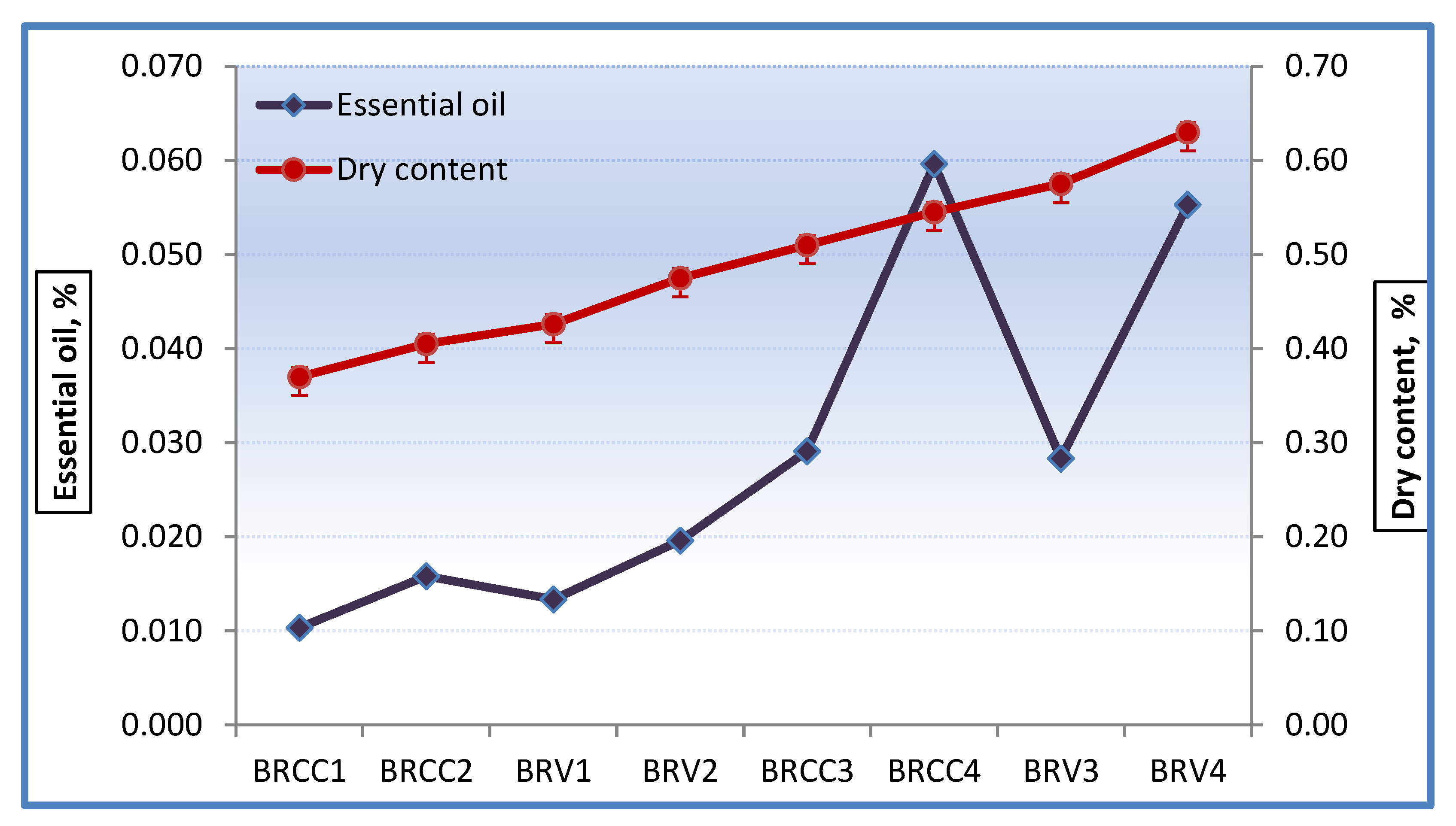
Table 1.
Experimental design of subcritical water treatment of R. alba L. plant material.
| № | Sample description | Abbreviation | Parameters | Extracts obtained, mL | |
| Temperature, °C | Duration, min | ||||
| 1 | Whole flowers | BRCC1 | 100 | 15 | 1937 ± 23 |
| 2 | Whole flowers | BRCC2 | 100 | 30 | 2017 ± 15 |
| 3 | Petals | BRV1 | 100 | 15 | 1978 ± 10 |
| 4 | Petals | BRV2 | 100 | 30 | 2050 ± 15 |
| 5 | Whole flowers | BRCC3 | 150 | 15 | 2112 ± 20 |
| 6 | Whole flowers | BRCC4 | 150 | 30 | 2066 ± 12 |
| 7 | Petals | BRV3 | 150 | 15 | 2053 ± 18 |
| 8 | Petals | BRV4 | 150 | 30 | 2056 ± 21 |
Table 2.
Chemical composition of the volatile fractions of R. alba L. essential oil and SWE extracts determined by GC-MS.
Table 2.
Chemical composition of the volatile fractions of R. alba L. essential oil and SWE extracts determined by GC-MS.
| № | RI | List of the components / classes | Essential oil | BRCC1 | BRCC2 | BRV1 | BRV2. | BRCC3 | BRCC4 | BRV3b | BRV4a |
| Relative % | |||||||||||
| 1 | 668 | Ethanol | - | - | - | - | - | - | - | - | - |
| 2 | 1031 | Limonene | 0.06 | 3.31 | 2.16 | 2.94 | 2.67 | 0.08 | 0.50 | 0.48 | 1.00 |
| 3 | 1098 | Linalool | 1.29 | 13.40 | 18.42 | 13.11 | 7.35 | 20.69 | 2.98 | 8.84 | 2.83 |
| 4 | 1118 | 2-Phenylethanol | 0.16 | 14.48 | 10.55 | 14.08 | 6.69 | 13.36 | 25.05 | ||
| 5 | 1109 | Cis-rose oxide | 0.04 | 0.91 | 0.60 | 0.47 | 0.64 | 0.67 | 0.15 | 0.35 | 1.26 |
| 6 | 1134 | Trans-rose oxide | 0.02 | 0.13 | 0.13 | 1.84 | 0.12 | 0.68 | 0.04 | 0.07 | 0.92 |
| 7 | 1228 | Citronellol + Nerol | 14.92 | 0.97 | 0.20 | 0.86 | 4.87 | 3.28 | 0.87 | 0.38 | 0.88 |
| 8 | 1276 | Geraniol | 19.71 | 7.81 | 6.84 | 9.08 | 5.94 | 0.68 | 0.98 | 3.41 | 10.48 |
| 9 | 1364 | Eugenol | 0.06 | 2.47 | 1.72 | 1.36 | 3.58 | 8.33 | 1.35 | 1.83 | 3.62 |
| 10 | 1401 | Methyl eugenol | 0.05 | 5.80 | 4.12 | 3.49 | 7.80 | 0.22 | 2.99 | 3.77 | 1.93 |
| 11 | 1678 | Heptadecane | 0.45 | 0.05 | 0.58 | 0.30 | 0.09 | 0.69 | 1.36 | 0.62 | 0.06 |
| 12 | 1727 | Farnesol | 3.77 | 0.08 | 0.19 | - | 0.10 | 0.42 | 0.38 | 0.22 | 0.05 |
| 13 | 1874 | Nonadecene | 5.50 | 0.46 | 2.70 | 0.27 | 0.68 | 1.73 | 4.73 | 3.22 | 0.51 |
| 14 | 1900 | Nonadecane | 13.21 | 1.17 | 15.56 | 1.01 | 1.65 | 8.21 | 24.96 | 16.39 | 10.04 |
| 15 | 2000 | Eicosane | 1.39 | 0.10 | 1.50 | 0.57 | 0.15 | 0.75 | 2.04 | 1.43 | 0.04 |
| 16 | 2100 | Heneicosane | 11.86 | 0.58 | 8.28 | 0.18 | 0.86 | 3.54 | 10.91 | 8.40 | 0.03 |
| 17 | 2300 | Tricosane | 2.67 | 0.08 | 1.86 | 1.72 | 0.15 | 0.83 | 2.31 | 1.53 | 0.24 |
| 18 | 2500 | Pentacosane | 1.18 | 0.04 | 0.71 | 1.04 | 0.14 | 1.62 | 0.72 | 0.91 | 0.11 |
| 19 | 2700 | Heptacosane | 1.22 | 0.04 | 0.70 | 3.49 | 0.16 | 1.66 | 0.92 | 0.30 | 0.29 |
| Monoterpenes | 36.04 | 26.53 | 28.35 | 28.3 | 21.59 | 26.08 | 5.52 | 13.53 | 17.37 | ||
| Phenylethanol | 0.16 | 14.48 | 18.42 | 10.55 | 14.08 | 20.69 | 6.69 | 13.36 | 25.05 | ||
| Rose oxides | 0.06 | 1.04 | 0.73 | 2.31 | 0.76 | 1.35 | 0.19 | 0.42 | 2.18 | ||
| Phenylpropenes | 0.11 | 8.27 | 5.84 | 4.85 | 11.38 | 8.55 | 4.34 | 5.6 | 5.55 | ||
| Sesquiterpenes | 3.77 | 0.08 | 0.19 | - | 0.1 | 0.42 | 0.38 | 0.22 | 0.05 | ||
| Alkanes and alkenes | 37.48 | 2.52 | 31.89 | 8.58 | 3.88 | 19.03 | 47.95 | 32.8 | 11.32 | ||
| Total | 77.56 | 61.20 | 66.27 | 52.28 | 51.03 | 54.08 | 65.88 | 65.51 | 60.14 | ||
Table 3.
Total content of neutral sugars and proteins in the R. alba SWE extracts.
| № | Sample | Total neutral sugars, mg/mL | Proteins, µg/mL |
| 1 | BRCC1 | 0.52±0.00b | 156.97±3.99e |
| 2 | BRCC2 | 0.49±0,05b,c | 152.62±2.18e |
| 3 | BRV1 | 0.44±0.01c | 170.56±3.46d |
| 4 | BRV2 | 0.45±0.04c | 155.18±0.73e |
| 5 | BRCC3 | 0.41±0.02c | 206.72±1.81c |
| 6 | BRCC4 | 0.52±0.03b | 234.67±5.08a |
| 7 | BRV3 | 0.64±0.02a | 221.85±1.45b |
| 8 | BRV4 | 0.63±0.02a | 240.31±3.63a |
1Results are presented as the mean of three measurements; a,b,c,d,e Different letters in columns indicate statistically different values (Tuckey’s HSD test, p < 0.05).
Table 4.
Monosaccharide composition of R. alba SWE extracts.
| № | Sample | GalA, mg/mL (galacturonic acid) | Glc, mg/mL (glucose) | Rha, mg/mL (rhamnose) | Gal, mg/mL (galactose) | Xyl, mg/mL (xylose) |
| 1 | BRCC1 | 1.24±0.11c,d | 4.09±0.27f | 0.48±0.08a | - | - |
| 2 | BRCC2 | 1.02±0.16d | 7.72±0.12d | 0.28±0.01b | - | - |
| 3 | BRV1 | 1.36±0.25c | 6.55±0.14e | 0.18±0.02c | 0.24±0.07c | - |
| 4 | BRV2 | 1.58±0.18b,c | 3.09±0.23g | 0.17±0.02c | 0.47±0.04b | - |
| 5 | BRCC3 | 1.84±0.14b | 8.53±0.10c | 0.25±0.07b | - | - |
| 6 | BRCC4 | 2.34±0.12a | 11.59±0.21b | 0.33±0.01b | 0.17±0.01c | 0.07±0.01b |
| 7 | BRV3 | 1.29±0.14c | 4.12±0.26f | 0.22±0.03b,c | 0.18±0.09c | - |
| 8 | BRV4 | 2.24±0.18а | 15.29±0.11a | 0.27±0.05b | 0.78±0.08a | 0.17±0.01a |
1Results are presented as the mean of three measurements; a,b,c,d,e Different letters in columns indicate statistically different values (Tuckey’s HSD test, p < 0.05).
Table 5.
Content of total polyphenols, total flavonoids and antioxidant activity of R. alba SWE extracts.
Table 5.
Content of total polyphenols, total flavonoids and antioxidant activity of R. alba SWE extracts.
| № | Samples | TPC, mg GAE/mL |
TFC, mg QE/mL |
Antioxidant activity, mM TE/mL | |||
| DPPH | ABTS | FRAP | CUPRAC | ||||
| 1 | BRCC1 | 0.57±0.00b | 0.25±0.00a | 5.81±0.02d | 5.75±0.01c | 5.49±0.05c | 14.18±0.02c |
| 2 | BRCC2 | 0.51±0.00c | 0.21±0.00c | 5.17±0.02e | 4.91±0.08d | 4.67±0.08d | 11.44±0.11d |
| 3 | BRV1 | 0.41±0.03e | 0.19±0.00d | 4.06±0.12f | 3.69±0.03f | 3.65±0.01f | 8.66±0.11f |
| 4 | BRV2 | 0.43±0.00e | 0.21±0.00c | 4.44±0.07f | 4.37±0.19e | 4.14±0.01e | 9.39±0.04e |
| 5 | BRCC3 | 0.48±0.00d | 0.18±0.00d | 5.62±0.02d | 5.46±0.08c | 4.87±0.01d | 11.29±0.04d |
| 6 | BRCC4 | 0.57±0.01b | 0.18±0.00d | 6.27±0.02c | 6.52±0.51b | 6.16±0.19b | 14.49±0.02c |
| 7 | BRV3 | 0.60±0.01a,b | 0.23±0.00b | 6.70±0.22b | 6.71±0.42b | 6.71±0.25a | 15.18±0.02b |
| 8 | BRV4 | 0.63±0.01a | 0.19±0.00d | 7.56±0.16a | 7.24±0.01a | 7.22±0.22a | 15.84±0.02a |
1Results are presented as the mean of three measurements; a,b,c,d,e,f Different letters in columns indicate statistically different values (Tuckey’s HSD test, p < 0.05). TPC - total polyphenol content; TFC – total flavonoids content.
Disclaimer/Publisher’s Note: The statements, opinions and data contained in all publications are solely those of the individual author(s) and contributor(s) and not of MDPI and/or the editor(s). MDPI and/or the editor(s) disclaim responsibility for any injury to people or property resulting from any ideas, methods, instructions or products referred to in the content. |
© 2025 by the authors. Licensee MDPI, Basel, Switzerland. This article is an open access article distributed under the terms and conditions of the Creative Commons Attribution (CC BY) license (http://creativecommons.org/licenses/by/4.0/).
Copyright: This open access article is published under a Creative Commons CC BY 4.0 license, which permit the free download, distribution, and reuse, provided that the author and preprint are cited in any reuse.