

Submitted:
06 February 2026
Posted:
09 February 2026
You are already at the latest version
Abstract
We prove that the following decision problems (1) and (2) are algorithmically undecidable when \( n∈N \). (1) \( ∃(y_0,...,y_n)∈N^{n+1} ∀i,j,k∈{0,...,n} (((2^{2^{2^j \cdot 3^k}}+1 divides n) ⇒ (y_j+1=y_k))∧((2^{2^{2^i \cdot 3^j \cdot 5^{k+1}}}+1 divides n)⇒(y_i \cdot y_j=y_k))) \). (2) \( ∃p,q∈N ((n=2^p \cdot 3^q)∧∀(x_0,...,x_p)∈N^{p+1} ∃(y_0,...,y_p)∈{0,...,q}^{p+1} ∀i,j,k∈{0,...,p} (((x_j+1=x_k)⇒(y_j+1=y_k))∧((x_i \cdot x_j=x_k)⇒(y_i \cdot y_j=y_k)))) \). For \( n∈N \), let \( E_n={1=x_k, x_i+x_j=x_k, x_i \cdot x_j=x_k: i,j,k∈{0,...,n}} \). For \( n∈N \), f(n) denotes the smallest b∈N such that if a system of equations \( S⊆E \)_n has a solution in \( N^{n+1} \), then S has a solution in\( {0,...,b}^{n+1} \). The author proved earlier that the function \( f:N→N \) is computable in the limit and eventually dominates every computable function g:N→N. We present a short program in MuPAD which for n∈N prints the sequence \( {f_i(n)}_{i=0}^∞ \) of non-negative integers converging to f(n). We prove that no algorithm takes as input a non-negative integer n and decides whether or not \( ∃p,q∈N ((n=2^p \cdot 3^q)∧∀(x_0,...,x_p)∈N^{p+1} ∃(y_0,...,y_p)∈{0,...,q}^{p+1} ((∀j,k∈{0,...,p} (x_j+1=x_k ⇒ y_j+1=y_k)) ∧ (∀i,j,k∈{0,...,p} (x_i \cdot x_j=x_k ⇒ y_i \cdot y_j=y_k)))) \). For \( n∈N \), \( β(n) \) denotes the smallest b∈N such that if a system of equations \( S⊆E_n \) has a unique solution in \( N^{n+1} \), then this solution belongs to \( {0,...,b}^{n+1} \). The author proved earlier that the function \( β:N→N \) is computable in the limit and eventually dominates every function δ:N→N with a single-fold Diophantine representation. The computability of β is unknown. We present a short program in MuPAD which for n∈N prints the sequence \( {β_i(n)}_{i=0}^∞ \) of non-negative integers converging to \( β(n) \).
Keywords:
arithmetic of N
; computable function
; eventual domination
; limit-computable function
; single-fold Diophantine representation
; undecidable decision problem
MSC: 03D20; 11U05
1. The Collatz Problem Leads to a Short Computer Program That Computes in the Limit a Function of Unknown Computability
Definition 1.(cf. [11]). A computation in the limit of a function is a semi-algorithm which takes as input a non-negative integer n and for every prints a non-negative integer such that .
By Definition 1, a function is computable in the limit when there exists an infinite computation which takes as input a non-negative integer n and prints a non-negative integer on each iteration and prints on each sufficiently high iteration.
It is known that there exists a limit-computable function which is not computable, see Theorem 1. Every known proof of this fact does not lead to the existence of a short computer program that computes f in the limit. So far, short computer programs can only compute in the limit functions from to whose computability is proven or unknown.
Lemma 1.
For every ,
MuPAD is a part of the Symbolic Math Toolbox in MATLAB R2019b. By Lemma 1, the following program in MuPAD computes in the limit a function .
input("Input a non-negative integer n",n):
while TRUE do
print(sign(n)):
n:=sign(n-1)*(2*n+(1-(-1)^n)*(5*n+2))/4:
end_while:
The computability of is unknown, see [1]. The Collatz conjecture implies that for every .
2. A Limit-Computable Function Which Eventually Dominates Every Computable Function
For , let
Theorem 1.([9]). There exists a limit-computable function which eventually dominates every computable function .
We present an alternative proof of Theorem 1. For , denotes the smallest such that if a system of equations has a solution in , then S has a solution in . The function is computable in the limit and eventually dominates every computable function , see [13]. The term "dominated" in the title of [13] means "eventually dominated". Flowchart 1 shows a semi-algorithm which computes in the limit, see [13].
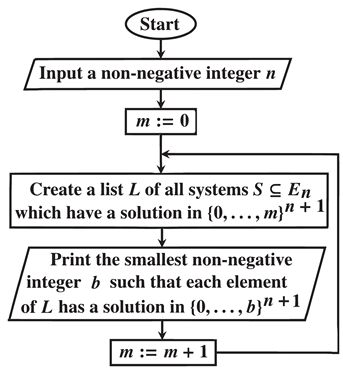
Flowchart 1
A semi-algorithm which computes in the limit
3. A Short Program in MuPAD That Computes f in the Limit
Flowchart 2 shows a simpler semi-algorithm which computes in the limit.
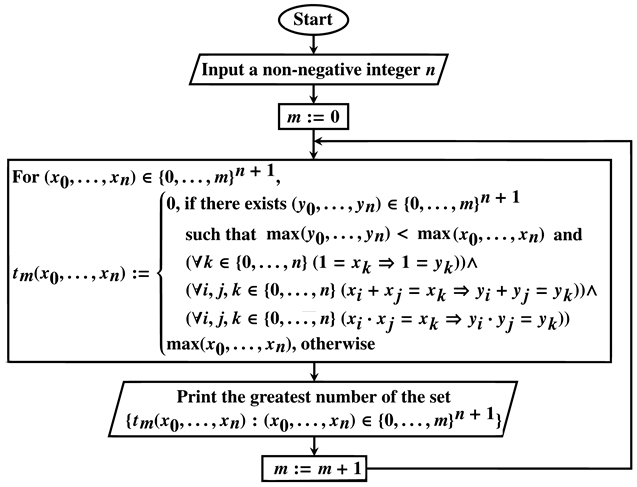
Flowchart 2
A simpler semi-algorithm which computes in the limit
Lemma 2.
For every , the number printed by Flowchart 2 does not exceed the number printed by Flowchart 1.
Proof.
For every ,
□
Lemma 3.
For every , the number printed by Flowchart 1 does not exceed the number printed by Flowchart 2.
Proof.
Let . For every system of equations , if and solves S, then solves the following system of equations:
□
Theorem 2.
For every , Flowcharts 1 and 2 print the same number.
Proof.
It follows from Lemmas 2 and 3. □
Definition 2.
An approximation of a tuple is a tuple such that
Observation 1.
For every , there exists a set such that
and every tuple possesses an approximation in .
Observation 2.
For every , equals the smallest such that every tuple possesses an approximation in .
Observation 3.
For every , Flowcharts 1 and 2 print the smallest such that every tuple possesses an approximation in .
The following program in MuPAD implements the semi-algorithm shown in Flowchart 2.
input("Input a non-negative integer n",n):
m:=0:
while TRUE do
X:=combinat::cartesianProduct([s $s=0..m] $t=0..n):
Y:=[max(op(X[u])) $u=1..(m+1)^(n+1)]:
for p from 1 to (m+1)^(n+1) do
for q from 1 to (m+1)^(n+1) do
v:=1:
for k from 1 to n+1 do
if 1=X[p][k] and 1<>X[q][k] then v:=0 end_if:
for i from 1 to n+1 do
for j from i to n+1 do
if X[p][i]+X[p][j]=X[p][k] and X[q][i]+X[q][j]<>X[q][k] then v:=0 end_if:
if X[p][i]*X[p][j]=X[p][k] and X[q][i]*X[q][j]<>X[q][k] then v:=0 end_if:
end_for:
end_for:
end_for:
if max(op(X[q]))<max(op(X[p])) and v=1 then Y[p]:=0 end_if:
end_for:
end_for:
print(max(op(Y))):
m:=m+1:
end_while:
4. Three Undecidable Decision Problems About a Non-Negative Integer n Which Have a Short Description in Terms of Arithmetic
Theorem 3.
No algorithm takes as input non-negative integers n and m and decides whether or not
Proof.
Since the function f is not computable, it follows from Observation 2. □
Lemma 4.([12]). For non-negative integers, the equation is equivalent to a system which consists of equations of the forms and .
For , denotes the smallest such that if a system of equations has a solution in , then S has a solution in . From Lemma 4 and [13], it follows that the function is computable in the limit and eventually dominates every computable function . A bit shorter program in MuPAD computes h in the limit.
Theorem 4.
No algorithm takes as input non-negative integers n and m and decides whether or not
Proof.
It holds because the function h is not computable. □
Theorem 5.
No algorithm takes as input a non-negative integer n and decides whether or not
Proof.
It follows from Theorem 4. □
Corollary 1.
For some non-negative integer n, the formal statement in Theorem 5 is logically undecidable.
Let denote the integer part function.
Lemma 5.
The function
is surjective.
Proof.
It holds because . □
Theorem 6.
No algorithm takes as input a non-negative integer n and decides whether or not
Proof.
It follows from Theorem 4 and Lemma 5. □
Corollary 2.
For some non-negative integer n, the formal statement in Theorem 6 is logically undecidable.
Lemma 6.([10]). For every , implies that the numbers and are relatively prime.
Lemma 7.([12]). There exists a constructive algorithm that takes as input a Diophantine equation and returns a system S of equations of the forms and which is solvable in non-negative integers if and only if the equation is solvable in non-negative integers.
Theorem 7.
No algorithm takes as input a non-negative integer n and decides whether or not
Proof.
If , then we can compute a unique such that . The decision problem (P) is algorithmically undecidable because we can obtain undecidability when and for every
and
In this case, by Lemma 6, for every system of equations
the problem of solvability of S in non-negative integers is equivalent to the problem (P) for some , where n can be computed. Next, we apply Lemma 7 and a negative solution to Hilbert’s 10th problem. □
Corollary 3.
For some non-negative integer n, the formal statement in Theorem 7 is logically undecidable.
5. A Limit-Computable Function of Unknown Computability Which Eventually Dominates Every Function with a single-fold Diophantine Representation
The Davis-Putnam-Robinson-Matiyasevich theorem states that every listable set has a Diophantine representation, that is
for some polynomial W with integer coefficients, see [6]. The representation (R) is said to be single-fold, if for any the equation has at most one solution .
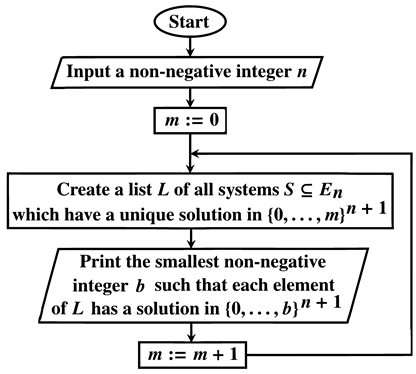
For , denotes the smallest such that if a system of equations has a unique solution in , then this solution belongs to . The computability of is unknown.
Theorem 8.
The function is computable in the limit and eventually dominates every function with a single-fold Diophantine representation.
6. A Short Program in MuPAD That Computes in the Limit
Flowchart 4 shows a simpler semi-algorithm which computes in the limit.
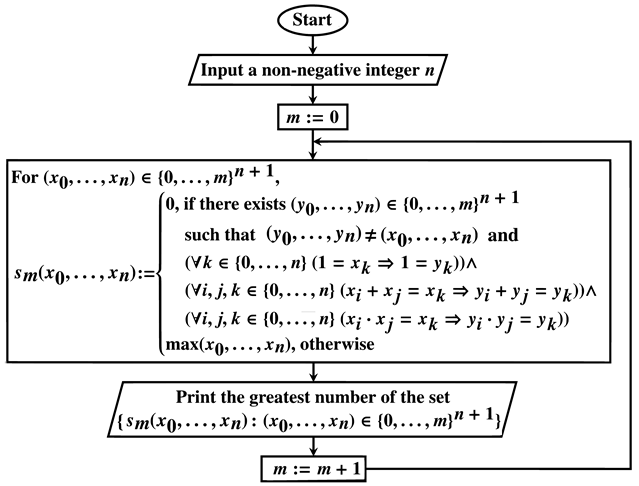
Flowchart 4
A simpler semi-algorithm which computes in the limit
Lemma 8.
For every , the number printed by Flowchart 4 does not exceed the number printed by Flowchart 3.
Proof.
For every ,
□
Lemma 9.
For every , the number printed by Flowchart 3 does not exceed the number printed by Flowchart 4.
Proof.
Let . For every system of equations , if is a unique solution of S in , then solves the system , where
By this and the inclusion , has exactly one solution in , namely . □
Theorem 9.
For every , Flowcharts 3 and 4 print the same number.
Proof.
It follows from Lemmas 8 and 9. □
The following program in MuPAD implements the semi-algorithm shown in Flowchart 4.
input("Input a non-negative integer n",n):
m:=0:
while TRUE do
X:=combinat::cartesianProduct([s $s=0..m] $t=0..n):
Y:=[max(op(X[u])) $u=1..(m+1)^(n+1)]:
for p from 1 to (m+1)^(n+1) do
for q from 1 to (m+1)^(n+1) do
v:=1:
for k from 1 to n+1 do
if 1=X[p][k] and 1<>X[q][k] then v:=0 end_if:
for i from 1 to n+1 do
for j from i to n+1 do
if X[p][i]+X[p][j]=X[p][k] and X[q][i]+X[q][j]<>X[q][k] then v:=0 end_if:
if X[p][i]*X[p][j]=X[p][k] and X[q][i]*X[q][j]<>X[q][k] then v:=0 end_if:
end_for:
end_for:
end_for:
if q<>p and v=1 then Y[p]:=0 end_if:
end_for:
end_for:
print(max(op(Y))):
m:=m+1:
end_while:
References
- Calude, C. S. To halt or not to halt? That is the question; World Scientific: Singapore, 2024. [Google Scholar]
- Cantone, D.; Casagrande, A.; Fabris, F.; Omodeo, E. The quest for Diophantine finite-fold-ness. Matematiche (Catania) 2021, 76(no. 1), 133–160. [Google Scholar] [CrossRef]
- Cantone, D.; Cuzziol, L.; Omodeo, E. G. On Diophantine singlefold specifications. Matematiche (Catania) 2024, 79(no. 2), 585–620. Available online: https://lematematiche.dmi.unict.it/index.php/lematematiche/article/view/2703/1218.
- Cantone, D.; Omodeo, E. G. “One equation to rule them all”, revisited. Rend. Istit. Mat. Univ. Trieste 32 pp. (electronic). 2021, 53 Art.(No. 28). [Google Scholar] [CrossRef]
- Davis, M.; Matiyasevich, Yu.; Robinson, J. Hilbert’s tenth problem, Diophantine equations: positive aspects of a negative solution; in: Mathematical developments arising from Hilbert problems (ed. F. E. Browder), Proc. Sympos. Pure Math. In Part 2; reprinted in: The collected works of Julia Robinson (ed. S. Feferman), Amer. Math. Soc., Providence, RI; Amer. Math. Soc.: Providence, RI, 1976; vol. 28, p. 323–378 269–324. [Google Scholar] [CrossRef]
- Yu. Matiyasevich, Hilbert’s tenth problem; MIT Press: Cambridge, MA, 1993. [Google Scholar]
- Matiyasevich, Yu. Hilbert’s tenth problem: what was done and what is to be done, in: Proceedings of the Workshop on Hilbert’s tenth problem: relations with arithmetic and algebraic geometry (Ghent, 1999). In Contemp. Math. 270; Amer. Math. Soc.: Providence, RI, 2000; pp. 1–47. [Google Scholar] [CrossRef]
- Matiyasevich, Yu. Towards finite-fold Diophantine representations. J. Math. Sci. (N. Y.) 2010, vol. 171(no. 6), 745–752. [Google Scholar] [CrossRef]
- Royer, J. S.; Case, J. Subrecursive Programming Systems: Complexity and Succinctness; Birkhäuser: Boston, 1994. [Google Scholar]
- Sierpiński, W. Elementary theory of numbers, 2nd ed.; Schinzel, A., Ed.; PWN – Polish Scientific Publishers and North-Holland: Warsaw-Amsterdam, 1987. [Google Scholar]
- Soare, R. I. Interactive computing and relativized computability. In Computability: Turing, Gödel, Church and beyond; Copeland, B. J., Posy, C. J., Shagrir, O., Eds.; MIT Press: Cambridge, MA, 2013; pp. 203–260. [Google Scholar]
- Tyszka, A. A hypothetical upper bound on the heights of the solutions of a Diophantine equation with a finite number of solutions. Open Comput. Sci. 2018, 8(no. 1), 109–114. [Google Scholar] [CrossRef]
- Tyszka, A. All functions g:N→N which have a single-fold Diophantine representation are dominated by a limit-computable function f:N∖{0}→N which is implemented in MuPAD and whose computability is an open problem. In Computation, cryptography, and network security; Daras, N. J., Rassias, M. Th., Eds.; Springer: Cham, 2015; pp. 577–590. [Google Scholar] [CrossRef]
Disclaimer/Publisher’s Note: The statements, opinions and data contained in all publications are solely those of the individual author(s) and contributor(s) and not of MDPI and/or the editor(s). MDPI and/or the editor(s) disclaim responsibility for any injury to people or property resulting from any ideas, methods, instructions or products referred to in the content. |
© 2026 by the authors. Licensee MDPI, Basel, Switzerland. This article is an open access article distributed under the terms and conditions of the Creative Commons Attribution (CC BY) license (http://creativecommons.org/licenses/by/4.0/).
Copyright: This open access article is published under a Creative Commons CC BY 4.0 license, which permit the free download, distribution, and reuse, provided that the author and preprint are cited in any reuse.


