

Submitted:
04 August 2025
Posted:
06 August 2025
You are already at the latest version
Abstract
Obesity, along with dyslipidemia and hyperglycemia, is a growing metabolic disorder linked to chronic diseases such as atherosclerosis, hypertension, and type 2 diabetes. This study evaluated the anti-obesity, lipid-lowering, and anti-hyperglycemic effects of CB-02 capsules containing dry extracts of Phyllanthus emblica L., Dendrobium officinale, and Gynostemma pentaphyllum in HFD-induced obese Swiss albino mice. After 12 weeks of HFD induction, mice were treated orally with CB-02 (576 or 1152 mg/kg/day) for 8 weeks. CB-02 significantly reduced BW gain, AC, Lee index, and the relative weights of visceral fat and major organs. It also improved lipid profiles by decreasing TC, TG, LDL-C, and non-HDL-C, while increasing HDL-C. These effects were comparable to orlistat (60 mg/kg/day). Furthermore, CB-02 lowered fasting glucose and improved insulin sensitivity, as indicated by an increased QUICKI and HOMA-β and reduced HOMA-IR. Histopathological evaluation showed that CB-02 reduced hepatic steatosis and inflammatory cell infiltration, as well as attenuated β-cell morphological alterations and pancreatic histopathological damage. These results suggest that CB-02 may be a promising therapeutic candidate for managing obesity and its comorbidities, including dyslipidemia, hyperglycemia, and hepatic steatosis, contributing to the prevention of type 2 diabetes and cardiovascular diseases in obese individuals.
Keywords:
CB-02 capsules
; Phyllanthus emblica
; Dendrobium officinale
; Gynostemma pentaphyllum
; obesity
; dyslipidemia
1. Introduction
Obesity, dyslipidemia, and hyperglycemia are three common metabolic disorders that are rapidly increasing in prevalence worldwide. They have become major risk factors for chronic conditions such as atherosclerosis, hypertension, coronary artery disease, type 2 diabetes, and metabolic syndrome. The primary causes of these disorders include imbalances in lipid and energy metabolism, often resulting from high-fat diets, sedentary lifestyles, and environmental or genetic factors [1−3].
In addition to modern treatment approaches such as lipid-lowering agents and anti-obesity medications, there is a growing interest in the use of natural herbal preparations due to their safety and minimal side effects [4,5]. In Vietnam's rich pharmacopeia, many medicinal plants traditionally used for lipid metabolism regulation and weight management have shown potential through both folk medicine and modern research [6,7].
Phyllanthus emblica (also known as Indian gooseberry) is rich in polyphenols and vitamin C and has been reported to possess strong antioxidant, hypolipidemic, and hepatoprotective properties. Hsu et al. (2025) demonstrated that polysaccharides extracted from P. emblica improved lipid metabolism and reduced obesity in HFD-fed mice by enhancing lipolysis via adipose triglyceride lipase, HSL, AMPKα, and β-oxidation, such as PPARα and CPT-1, and reducing lipogenesis, while also modulating the gut microbiota [8]. In a randomized double-blind clinical trial, Pingali et al. (2019) found that administering P. emblica extract (500 mg, twice daily) to patients with metabolic syndrome significantly reduced TC (11.1%), LDL-C (21.8%), and TG (19.2%), while increasing HDL-C [9].
Gynostemma pentaphyllum, a plant rich in gypenosides with structures similar to ginsenosides, has been shown to regulate lipid metabolism, promote weight loss, and support the treatment of metabolic syndrome. A preclinical study in C57BL/6N mice revealed that G. pentaphyllum extract reduced BW, fat mass, cholesterol, and triglycerides by activating AMPK and increasing SIRT1, CPT-1, and HSL expression, while downregulating adipogenesis-related genes such as CCAAT/Enhancer-binding protein alpha, PPARγ, and SREBP-1c [10]. Another study confirmed the anti-obesity and hypolipidemic effects of gypenosides in obese mice through lipid metabolism modulation and lipidomics analysis [11].
Dendrobium officinale Kimura et Migo, a valuable herb in traditional medicine known for its yin-nourishing and fluid-generating properties, also exhibits effects on energy metabolism and anti-inflammation. Polysaccharides from D. officinale have been shown to improve insulin resistance and lipid metabolism disorders in both experimental mouse models and in vitro studies. D. officinale reduced TG, TC, LDL-C, and FFA levels, while increasing HDL-C, partly through its effects on PPARγ activation [12]. Zhou et al. (2025) demonstrated that D. officinale extract alleviated hepatic steatosis and reduced TG, TC, LDL-C, and oxidative stress in HFD-fed mice and cats by modulating the NF-κB/IκB signaling pathway [13].
Based on traditional medical knowledge and modern pharmaceutical techniques, CB-02 capsules were developed at the Military Medical University using a combination of these three medicinal plants, which were collected from Cao Bang province—an area with favorable soil and climatic conditions for high-quality herbal production. However, the biological efficacy of this preparation in regulating lipid metabolism and controlling BW has not yet been thoroughly evaluated.
Therefore, this study was conducted to evaluate the lipid-modulating and weight-reducing effects of CB-02 capsules in a high-fat diet-induced obesity model using white mice, with the aim of providing scientific evidence for the development of herbal-based therapeutic products derived from Vietnamese medicinal plants.
2. Results
2.1. Obesity Model Induction Results
After 12 weeks of feeding 50 mice an HFD, the BW and BL of all animals were measured. The Lee obesity index was subsequently calculated for each mouse, and 40 mice with a Lee index greater than 310 were selected for inclusion in the main experimental phase. The control group of the main trial consisted of 10 additional healthy, normal male mice weighing 20–25 g. Table 1 below summarizes key baseline parameters of the mice in all study groups at the beginning of Phase 2.
Mice in the G2, G3, G4, and G5 treatment groups all had Lee indices greater than 310. The BW, AC, and Lee index values in these groups were significantly higher than those of the G1 (p < 0.001). However, there was no significant difference in BL among the five groups (p > 0.05). Obese mice in the G2 to G5 groups showed no significant differences in BW, BL, AC, or Lee index among each other (p > 0.05).
2.2. Effects of CB-02 on BW, AC, and Lee Obesity Index
The BW of mice in both the G1 and G2 groups increased over time. Notably, the weight gain in the G2 group was significantly greater than that of the G1 group (p < 0.05 at T2 and T3; p < 0.01 at T4 and T5; and p < 0.001 at T7 and T8). At week 8 (T8), the percentage increase in BW compared to baseline (T0) in the G2 group reached 31.42% (Figure 1). In contrast, mice in the G3 group and both the G4 and G5 groups exhibited minimal weight gain throughout the 8-week experimental period. Compared to the G3 group, the percentage change in BW from T1 to T8 in all treated groups (G3, G4, and G5) was significantly lower, with p < 0.001 at all time points. These results suggest that CB-02, similarly to orlistat, effectively suppressed weight gain in HFD-induced obese mice during the intervention period.
AC in both the model (G2) and control (G1) groups increased over time, with a greater increase observed in the model group. At time points T4, T6, and T8, the percentage increase in AC in the model group (G2) was significantly higher than that in the control group (G1, p < 0.05) (Figure 2). By the end of the 8-week experimental period (T8), the AC had increased by 4.48% in the model group (G2) and by 2.45% in the control group (G1) compared to baseline (T0). In comparison with the model group (G2), the groups treated with CB-02 and/or orlistat (G3, G4, and G5) exhibited significantly lower percentage increases in AC (p < 0.01 and p < 0.001, respectively). At T8, the percentage increases relative to T0 in the CB-02 576 and 1152 mg/kg/day, and the orlistat groups were 1.65%, 1.15%, and 1.45%, respectively (Figure 2).
The Lee obesity index increased over time in both the G1 and G2 groups, with a greater increase observed in the G2 group. Compared to the G1 group, the percentage change in the Lee index in the G2 group was significantly higher, with p < 0.01 at time point T2 and p < 0.001 at T4, T6, and T8. In contrast, the groups treated with orlistat and CB-02 formulations (G3, G4, and G5) exhibited a downward trend in the Lee index. Compared to the G2 group, the percentage changes in the Lee index
from T2 to T8 were significantly lower in all treated groups (p < 0.001). At the end of the 8-week intervention (T8), the Lee index increased by 7.57% in the G2 group and 1.26% in the G1 group (Figure 3). In contrast, the Lee index decreased by 2.39% in the orlistat group (G3), 1.92% in the G4 group (576 mg/kg/day), and 2.18% in the G5 group (1152 mg/kg/day).
The detailed values for BW, AC, and the Lee obesity index at the end of the experiment are presented in Table 2. At the end of the trial, all groups from G2 to G5 showed statistically significant differences in BW, AC, and Lee obesity index compared to G1, with p < 0.001. Similarly, comparisons between the G3, G4, and G5 groups versus the G2 group revealed statistically significant reductions in all three parameters (p < 0.001).
At the end of the 8-week experimental period, BW, AC, and the Lee obesity index in groups 2 to 5 were significantly different from those in the control group (G1), with p < 0.001. Comparisons between the model group (G2) and the groups treated with orlistat or CB-02 (G3, G4, and G5) revealed statistically significant reductions in BW and Lee index (p < 0.001). Additionally, AC in the orlistat and CB-02 groups (G3, G4, and G5) was significantly lower than that in the model group (G2, p < 0.05). No significant differences were observed in BW, AC, or Lee index among the orlistat- and CB-02-treated groups (p > 0.05).
2.3. Effects of CB-02 on Organ and Visceral Fat Weights
Compared to the control group (G1), the weights of the heart, liver, kidneys, spleen, and pancreas were significantly increased in the model group (G2, p < 0.001). Treatment with either orlistat (G3) or CB-02 (G4 and G5) significantly reduced the weights of these organs compared to the model group (p < 0.001); however, the values remained higher than those of the control group (p < 0.001 and p < 0.01, respectively). No statistically significant differences were observed in the weights of the heart, liver, kidneys, spleen, and pancreas between the orlistat group and the two CB-02 groups (p > 0.05) (Table 3).
Compared to the control group (G1), the relative weights of the heart, liver, kidneys, and spleen were significantly increased in the model group (G2, p < 0.01). Treatment with orlistat (G3) and CB-02 (G4 and G5) at doses of 576 mg/kg/day and 1152 mg/kg/day significantly reduced the relative weights of the heart, liver, and kidneys compared to the model group (p < 0.05), whereas the reduction in spleen relative weight was not statistically significant (p > 0.05). The relative weight of the pancreas in the model group (G2) tended to decrease compared to the control group (G1), while treatment with CB-02 (G4 and G5) showed a trend toward increased pancreatic weight relative to the model group (G2); however, these differences were not statistically significant (p > 0.05). No statistically significant differences were observed in the relative weights of the heart, liver, kidneys, spleen, and pancreas between the orlistat group (G3) and the two CB-02 groups (G4 and G5, p > 0.05) (Table 4).
Compared to the control group (G1), both the absolute and relative weights of visceral adipose tissues in the model group (G2) were significantly increased (p < 0.001 and p < 0.01, respectively). Treatment with orlistat (G3) or CB-02 (G4 and G5) significantly reduced the absolute and relative weights of these visceral fat depots compared to the model group (G2, p < 0.001, p < 0.01, and p < 0.05). The relative weights of retroperitoneal fat and epididymal fat pads were reduced to levels comparable to those of the control group (G1); however, the relative weight of mesenteric fat remained significantly higher than that in the control group (G2, p < 0.01). No statistically significant differences were observed in either the absolute or relative weights of visceral adipose tissues between the orlistat group (G3) and the two CB-02 groups (G4 and G5, p > 0.05) (Table 5).
2.4. Effects of CB-02 on Blood Lipid Parameters
Compared to the G1 group, the G2 group showed significantly elevated levels of TC, TG, LDL-C, and non-HDL-C, while HDL-C levels were significantly reduced (p < 0.001). Treatment with G3, G4, and G5 groups significantly improved the lipid profile, as evidenced by reductions in TC, TG, LDL-C, and non-HDL-C levels, and a marked increase in HDL-C levels compared to the model group (p < 0.001). However, the levels of TC, TG, LDL-C, and non-HDL-C in the G3, G4, and G5 groups remained significantly higher than those in the G1 group (p < 0.001), while HDL-C levels were restored to values statistically comparable to those of the G1 group (p > 0.05). No statistically significant differences were observed in any of the lipid indices between the G3 group and either of the G4 and G5 groups (p > 0.05), indicating comparable efficacy (Table 6).
2.5. Effects of CB-02 on Blood Glucose Levels and Insulin Resistance
Compared to the control group (G1), the model group (G2) exhibited significant increases in blood glucose, serum insulin, and HOMA-IR indices, along with significant decreases in QUICKI and HOMA-β indices (p < 0.001). Treatment with orlistat (G3) or CB-02 (G4 and G5) significantly reduced blood glucose and HOMA-IR levels and increased QUICKI and HOMA-β indices compared to the model group (G2, p < 0.001), while serum insulin levels were also significantly decreased (p < 0.01). However, blood glucose, serum insulin, HOMA-IR, and QUICKI indices did not return to levels comparable to those of the control group (G1). The HOMA-β index in the orlistat-treated group (G3) was restored to a level comparable to the control (G1), whereas in the CB-02-treated groups (G4 and G5), the HOMA-β index was significantly higher than that of the control group (G1, p < 0.05 and p < 0.01, respectively). Compared to the orlistat group (G3), both CB-02 groups (G4 and G5) showed significantly lower blood glucose levels and significantly higher HOMA-β indices (p < 0.01). No statistically significant differences were observed between the two CB-02 groups (G4 and G5) in blood glucose, serum insulin, or insulin resistance indices (p > 0.05) (Table 7).
2.6. Histopathological Images of the Pancreas and Liver from Mice in Different Experimental Groups
Pancreatic lobules were separated by thin fibrous septa. The exocrine acini contained abundant eosinophilic secretions. The islets of Langerhans (indicated by green arrows) consisted of cells with lightly stained cytoplasm. In the model group (G2), the islets were markedly enlarged compared to those in the control group (G1), with some regions exhibiting cellular morphological changes and disorganized tissue architecture (black arrows). In the orlistat- and CB-02-treated groups (G3, G4, and G5), the islet size was reduced relative to the model group (G2), and only minimal cellular and structural abnormalities were observed (Figures A−E). The islet diameter in the model group (G2) was significantly greater than that in the control group (G1, p < 0.01). In contrast, treatment with orlistat or CB-02 significantly decreased islet diameter compared to the model group (p < 0.05). No statistically significant differences were observed in islet diameter among the three treatment groups (Orlistat and CB-02) (Figure 4F).
In the model group (G2), prominent accumulation of lipid droplets was observed within the hepatic parenchyma (green arrows), along with notable infiltration of inflammatory cells (black arrows). In contrast, the orlistat- and CB-02-treated groups (G3, G4, and G5) exhibited a marked reduction in hepatic lipid accumulation and minimal to no inflammatory cell infiltration (Figure 5). No significant histopathological differences were detected among the three treatment groups (Orlistat and both CB-02 doses).
3. Discussion
In experimental research evaluating anti-obesity effects, the establishment and utilization of animal models of obesity play a critical role in recapitulating the pathophysiological processes of the disease and providing a reliable basis for objectively assessing the efficacy of therapeutic interventions. Various approaches have been developed to induce obesity in animals, including hypercaloric feeding, administration of high-energy or HFDs, hypothalamic damage (via surgical or chemical means), and the use of genetically modified strains with mutations affecting energy metabolism [14,15,16]. Among these, the HFD-induced obesity model is the most employed due to its high feasibility, reproducible outcomes, and versatility for different research purposes. HFD regimens typically provide 45% to 60% of total energy from fat and are administered to rodents for durations ranging from 8 to 27 weeks, depending on the experimental design and modeling intensity [17,18,19].
In this study, an HFD-induced obesity model was employed, in which the diet provided a total energy content of 4495.8 kcal/kg, with fat accounting for 48.08% of the total caloric intake. Administration of an HFD increases caloric consumption, disrupts metabolic balance, and promotes lipid accumulation in adipose tissue and various organs, thereby inducing obesity and associated metabolic dysfunctions. Within a few weeks of HFD exposure, experimental animals typically develop key features resembling human metabolic syndrome, including rapid weight gain, hyperglycemia, dyslipidemia, hypertension, insulin resistance, and endothelial dysfunction—all of which are major risk factors for cardiovascular diseases and type 2 diabetes [16,19].
Notably, the mouse is one of the most widely used models in obesity research due to its genetic homogeneity, high susceptibility to HFD-induced obesity, and sensitivity to metabolic perturbations. Mice are also advantageous for laboratory use because of their small size, low maintenance cost, ease of handling, and rapid physiological responses—making them an ideal choice for preliminary investigations into pathophysiological mechanisms and therapeutic interventions. Moreover, the HFD-induced obesity model in mice allows comprehensive evaluation of biochemical parameters (e.g., serum lipids, blood glucose), organ and fat pad weights, and the expression of genes and proteins involved in energy metabolism and inflammatory pathways. The degree of obesity and metabolic derangement in mice can be flexibly modulated by adjusting the dietary fat content, feeding duration, and mouse strain used. Therefore, this model not only closely mimics the pathophysiological characteristics of human obesity but also serves as a robust platform for assessing the efficacy of pharmacological agents, herbal medicines, nutraceuticals, or lifestyle interventions.
The study was conducted in two distinct phases. During phase 1, which lasted 12 weeks, mice were fed an HFD to induce obesity. Phase 2 consisted of an 8-week intervention period, during which the obese mice continued receiving the HFD and were randomly assigned to treatment groups administered either the test formulation or the reference drug, orlistat. Anti-obesity efficacy was evaluated based on a set of predefined physiological and metabolic parameters. Orlistat was chosen as the positive control due to its established clinical use as an Food and Drug Administration-approved anti-obesity medication since 1999, and its official adoption in Vietnam since 2008. Orlistat is a hydrogenated derivative of lipstatin—a natural inhibitor of pancreatic lipase originally isolated from Streptomyces toxytricini. It exerts its therapeutic effect by selectively inhibiting gastrointestinal lipases, particularly pancreatic lipase, thereby preventing the hydrolysis of dietary triglycerides into absorbable FFA and monoglycerides. This results in reduced intestinal fat absorption. Notably, orlistat does not interfere with other digestive enzymes such as trypsin, chymotrypsin, amylase, or various esterases, and therefore does not impair the digestion or absorption of carbohydrates or proteins [20].
To preliminarily assess obesity in mice, several basic morphometric indices were employed, including BW, BL (measured from the tip of the nose to the anus), AC, and the Lee index. Among these, the Lee index is a commonly used parameter in preclinical studies to reflect fat distribution and the degree of obesity in rodents. Analogous to the body mass index in humans, the Lee index is calculated based on BW and BL. Additionally, AC serves as a valuable complementary indicator, reflecting visceral fat accumulation, which is closely associated with metabolic disorders, including insulin resistance, dyslipidemia, and metabolic syndrome. The combination of multiple morphometric parameters enhances the accuracy and objectivity of obesity assessment in animal models. Our findings indicated that, following 12 weeks of HFD feeding, all mice in groups 2 through 5 exhibited Lee index values exceeding the threshold of 310, commonly accepted as the cut-off for obesity in rodents. The mean Lee index values in these groups (G2−G5) were all above 326 and were significantly higher than those in the control group (G1, p < 0.001) (Table 1).
Furthermore, the HFD induced a marked increase in both BW and AC in mice compared to the control group (G1, p < 0.001), indicating substantial fat accumulation during the induction period. In contrast, the average BL (measured from the nose to the anus) of mice in the HFD-fed groups showed only a slight, statistically non-significant increase relative to controls (p > 0.05). This can be explained by the fact that the animals used were adults, whose linear growth had stabilized; therefore, changes primarily occurred in body mass and fat distribution. These results collectively confirm that all mice included in the intervention phase had developed a clearly defined obese phenotype, meeting the criteria for inclusion in the subsequent treatment experiment.
In experimental obesity research, an increase in BW is commonly regarded as a clear and quantifiable indicator of excessive fat accumulation. Mariana et al. [19] noted that in most diet-induced obesity models using energy-dense feeding, BW gain is the principal parameter employed to evaluate the onset and progression of obesity. Consequently, controlling and reducing BW is considered a critical criterion for assessing the therapeutic efficacy of anti-obesity interventions. An analysis of the percentage change in BW over the 8-week intervention period revealed that the control group (G1), maintained on a standard chow diet, exhibited normal physiological growth with an average increase of 15.76%. In contrast, the model group (G2), which continued to receive an HFD, showed a marked weight gain averaging 31.42%, indicating a sustained and pronounced trend of adiposity induced by the obesogenic diet.
The HFD formulation used in this study contained a high fat content (48.08%), which has the potential to activate central regulatory systems by increasing the expression of NPY—a neurotransmitter that stimulates feeding behavior. Elevated NPY levels not only promote hunger and increase food intake but also reduce energy expenditure by suppressing thermogenesis, thereby leading to enhanced fat accumulation [21]. This mechanism explains the experimental observation of the rapid weight gain in the group of mice that continued to consume the HFD. Although the mice were continuously fed the HFD, those in the orlistat-treated and CB-02-treated groups (G3, G4, and G5) showed minimal weight gain, and even a slight weight loss was observed in the orlistat group (G3, BW change at week 8: –0.96%). Orlistat acts by inhibiting pancreatic lipase, thus blocking the hydrolysis of dietary fats into monoglycerides and FFA [20,22], which leads to a reduction of fat absorption by approximately 30% [23]. Consequently, reduced fat absorption decreases calorie intake and contributes to weight loss. CB-02 exhibited a weight-reducing effect comparable to that of orlistat (Table 2). Although the exact mechanism of CB-02 has not been fully elucidated, based on the known pharmacological actions of its herbal components, CB-02 is thought to exert its anti-obesity effects through multiple targets. P. emblica has been shown to promote weight loss via AMPK activation, inhibition of adipogenic gene expression, modulation of the gut microbiota, and reduction of hepatic lipid synthesis [8,24,25]. G. pentaphyllum has demonstrated anti-obesity effects through activation of the AMPK–SIRT1 pathway, enhancement of lipoprotein lipase activity, promotion of fatty acid oxidation, and inhibition of lipogenesis [10,11,26]. D. officinale has been reported to reduce BW by inhibiting lipogenesis, enhancing β-oxidation, regulating the microbiota–insulin axis, and reducing inflammation [13,27,28]. The therapeutic targets of CB-02 are likely to involve multiple pathways derived from its constituent herbs, warranting further investigation to clarify its underlying mechanisms.
Similar to BW, changes in AC and Lee obesity index were also selected as key parameters to evaluate the anti-obesity effects of CB-02. These parameters were measured after 2, 4, 6, and 8 weeks of CB-02 administration. As shown in Figure 2 and Figure 3, the model group (G2) exhibited a marked and progressive increase in both AC and Lee index over time, with statistically significant percentage changes compared to the control group (G1). The model group (G2) was maintained on an HFD, which promotes lipogenesis while suppressing lipid oxidation. Excess dietary fat that is not metabolized is stored in adipocytes, particularly in the abdominal region, resulting in an increase in abdominal girth and Lee index. In contrast, mice treated with CB-02 (G4 and G5) or orlistat (G3) showed significantly lower increases in both AC and Lee index compared to the model group (G2, p < 0.01 and p < 0.001, respectively). The reductions in these indices, alongside BW loss, serve as fundamental criteria supporting the anti-obesity efficacy of CB-02. These effects are presumably mediated through mechanisms similar to those involved in the observed weight reduction, as discussed above.
Organ and adipose tissue weight indices are critical biological parameters in obesity research, particularly in animal models. Evaluating these indices provides valuable insights into pathophysiology, metabolism, and therapeutic efficacy. Adipose tissue weight directly reflects excessive energy accumulation, a hallmark of obesity. Notably, visceral fat is strongly associated with insulin resistance, dyslipidemia, and chronic inflammation. A reduction in adipose tissue mass, especially visceral fat, following treatment is considered a key indicator of the biological efficacy of anti-obesity drugs or herbal preparations [29,30].
The relative organ weight, defined as the percentage of organ weight relative to total BW, serves as an objective quantitative index to diagnose the degree of obesity in animals, assess treatment effectiveness, and monitor potential side effects on vital organs such as the liver, kidneys, and heart. An increase in relative liver weight in obesity is primarily attributed to hepatic fat accumulation (hepatic steatosis), along with multiple pathogenic mechanisms involving lipid metabolism disorders, insulin resistance, and chronic inflammation [31]. The elevation of relative heart weight is a commonly observed phenomenon in both experimental and clinical studies of obesity. This increase is driven by several pathophysiological factors, including mechanical overload due to increased body mass, obesity-induced hypertension, and chronic low-grade inflammation. The latter involves elevated levels of inflammatory cytokines such as tumor necrosis factor-alpha, interleukin-6, and leptin, which can directly damage cardiac tissue, leading to myocardial fibrosis and cardiomyocyte hypertrophy—thus increasing heart weight [32]. An increase in relative kidney weight is often linked to glomerular hyperfiltration and albuminuria associated with insulin resistance and metabolic syndrome. Renal hypertrophy in obesity is a well-documented pathophysiological phenomenon, particularly in animal models and obese individuals. This renal enlargement reflects multiple pathological changes, including glomerular hyperfiltration, interstitial hyperplasia, and lipid accumulation within the kidneys [33]. Splenomegaly, or increased relative spleen weight, is also observed in numerous experimental studies, especially in HFD-induced obese animal models. Although the spleen is not a central metabolic organ like the liver or kidneys, its weight gain reflects obesity-related immune dysregulation, chronic inflammation, and enhanced immune activity [34]. Our study showed that the relative weights of visceral adipose tissues and organs in the model group (G2) were significantly elevated compared to the control group (G1), reflecting the characteristic pathological alterations of obesity in the experimental model. Administration of CB-02 at doses of 576 and 1152 mg/kg/day significantly reduced the relative weights of visceral fat depots and the liver, heart, and kidneys compared to the model group (G2), with effects comparable to those of orlistat at 60 mg/kg/day (Table 3 and Table 4), thereby confirming the anti-obesity efficacy of CB-02. The relative spleen weight showed a decreasing trend after CB-02 and orlistat administration (G3, G4, and G5), though not statistically significant, possibly due to the longer time required to reverse obesity-induced splenic alterations.
Regarding the pancreas, the absolute pancreatic weight in the model group (G2) increased significantly compared to the control group (G1, p < 0.001), accompanied by a significant enlargement of the diameter of the pancreatic islets (p < 0.01). In comparison with the model group (G2), both the orlistat- and CB-02-treated groups (G3, G4, and G5) showed a marked reduction in absolute pancreatic weight (p < 0.001), as well as a decrease in islet diameter (p < 0.05). However, no statistically significant differences were observed in relative pancreatic weight (i.e., pancreas weight normalized to BW) between the model and control groups (G2 and G1), or between the treatment groups (G3, G4, and G5) and the model group (G2, p > 0.05). These results suggest that changes in absolute pancreatic weight and islet diameter may correspond to changes in overall BW. In obesity, endocrine pancreatic tissue—particularly the islets of Langerhans—may undergo partial hypertrophy of β-cells; however, such changes are typically insufficient to cause a notable increase in total pancreatic mass, while exocrine pancreatic tissue remains largely unaffected. Prolonged obesity, characterized by persistent elevations in circulating lipids and glucose, may also induce lipotoxic and glucotoxic stress on β-cells, leading to impaired function and gradual loss of β-cell mass, ultimately resulting in mild pancreatic atrophy over time [35].
An HFD induces dyslipidemia through multiple interrelated mechanisms, including enhanced absorption of exogenous lipids, stimulation of hepatic lipid synthesis, insulin resistance, reduced activity of lipolytic enzymes, and chronic inflammation. These pathophysiological changes result in elevated levels of TG, LDL-C, and reduced HDL-C [36]. The present findings demonstrated that both orlistat and CB-02 significantly reduced serum levels of TC, TG, LDL-C, and non-HDL-C, while increasing HDL-C levels compared to the model group (p < 0.001) (Table 6). Orlistat acts as a pancreatic lipase inhibitor, impeding the enzymatic breakdown of dietary fats in the gastrointestinal tract, thereby reducing lipid absorption. CB-02, a polyherbal formulation containing P. emblica, G. pentaphyllum, and D. officinale, may exert its therapeutic effects through a multi-target approach, resulting from the complementary pharmacological actions of its constituent herbs.
P. emblica has been shown to activate AMPK, inhibit lipogenesis by downregulating PPARγ, SREBP-1c, ACC, and FAS, and enhance lipid β-oxidation through the upregulation of CPT-1 and PPARα [8]. Saponins and flavonoids derived from G. pentaphyllum similarly activate AMPK, thereby reducing the expression of SREBP-1c, ACC, and FAS, while upregulating PGC-1α, UCP-1, and CPT-1 to promote mitochondrial fatty acid oxidation. Additionally, this herb regulates cholesterol homeostasis via modulation of SREBP-2, 3-hydroxy-3-methylglutaryl-CoA reductase, and LDL receptor expression, and enhances bile acid synthesis through the farnesoid X receptor/cholesterol 7α-hydroxylase signaling axis [37]. D. officinale activates PPAR-retinoid X receptor and AMPK signaling pathways to increase fatty acid oxidation, regulate hepatic metabolomic profiles, and reduce lipotoxicity [38]. Furthermore, it exhibits pronounced anti-inflammatory effects by inhibiting the NF-κB/IκB pathway, mitigates oxidative stress (as evidenced by decreased malondialdehyde and reactive oxygen species levels), and improves lipid profiles including TG, TC, and the LDL-C/HDL-C ratio [13]. Collectively, the herbal components of CB-02 demonstrate potent bioactivity in regulating lipid metabolism and are likely to act synergistically on the three major pathological pathways of dyslipidemia: (1) inhibition of endogenous lipid synthesis via the downregulation of transcriptional regulators such as SREBP-1c, ACC, FAS, and PPARγ, resulting in reduced hepatic production of triglycerides and cholesterol; (2) promotion of lipid catabolism and β-oxidation through AMPK activation and upregulation of PPARα, CPT-1, UCP-1, and PGC-1α [8,37]; and (3) attenuation of lipid absorption and enhancement of lipid excretion [37,38]. In addition, all three botanical ingredients in CB-02 possess strong antioxidant properties, contributing to anti-inflammatory effects, hepatoprotection, and improved systemic metabolic function [9,10,13]. The synergistic integration of these medicinal herbs enables CB-02 to exert a comprehensive therapeutic effect on dyslipidemia, particularly that induced by high-fat dietary intake.
An HFD induces hyperglycemia primarily by reducing insulin sensitivity in hepatic, adipose, and muscle tissues, leading to decreased glucose uptake and increased hepatic gluconeogenesis. As blood glucose is not efficiently transported into cells, the pancreas compensates by secreting more insulin, resulting in hyperinsulinemia [39]. To assess the degree of insulin resistance and pancreatic β-cell function, the indices QUICKI, HOMA-IR, and HOMA-β were evaluated [40]. The QUICKI reflects overall insulin sensitivity, while the HOMA-IR indicates the extent of insulin resistance. A decrease in QUICKI and an increase in HOMA-IR are indicative of insulin resistance. The HOMA-β index estimates the insulin secretory function of pancreatic β-cells; a higher value suggests stronger β-cell activity.
As shown in Table 7, the model group (G2) exhibited increased HOMA-IR and decreased QUICKI, indicating that HFD led to significant insulin resistance, subsequently resulting in elevated blood glucose and compensatory hyperinsulinemia. The HOMA-β index in the model group was also reduced (Table 7), suggesting a decline in pancreatic compensatory function. Although insulin secretion remained high, it was insufficient to maintain glucose homeostasis, resulting in marked hyperglycemia. Treatment with orlistat and CB-02 significantly lowered blood glucose levels, increased QUICKI, reduced HOMA-IR, and elevated HOMA-β (Table 7). Notably, CB-02 exhibited a stronger effect in reducing blood glucose and increasing HOMA-β compared to orlistat (p < 0.01). Furthermore, both CB-02-treated groups (G4 and G5) displayed significantly higher HOMA-β values than the control group (G1, p < 0.05 and p < 0.01, respectively). This suggests that CB-02 may exert its glucose-lowering effects through multiple mechanisms beyond those of orlistat. In obese mice, orlistat reduces lipid absorption, which improves insulin resistance, lowers inflammation, and restores pancreatic β-cell function. Similarly, CB-02 improved dyslipidemia and thereby reduced insulin resistance. Additionally, CB-02 may exert its antihyperglycemic effects through synergistic mechanisms involving its herbal components: G. pentaphyllum, D. officinale, and P. emblica.
The ethyl acetate extract from P. emblica L. (EPE) has been shown to enhance AMPK phosphorylation in liver and skeletal muscle tissues and to increase glucose transporter type 4 expression on muscle cell membranes. EPE treatment also suppressed hepatic gluconeogenesis by downregulating G6Pase and PEPCK and reduced glycogen synthase kinase 3β phosphorylation, thereby modulating hepatic glycogen synthesis, contributing to antidiabetic and insulin-sensitizing effects [41]. The ethanol extract from P. emblica fruit further reduced intestinal absorption of sucrose and glucose [42].
G. pentaphyllum, rich in gypenosides and polysaccharides, lowers blood glucose through mechanisms such as enhancing glucokinase activity, inhibiting hepatic glucose-producing enzymes like G6Pase, promoting pancreatic β-cell insulin secretion, improving insulin signaling, reducing insulin resistance, and suppressing glucose absorption [43−45]. Clinical studies have confirmed that Vietnamese G. pentaphyllum tea possesses antidiabetic effects through enhancement of insulin sensitivity [46].
Polysaccharides isolated from the stems and leaves of D. officinale Kimura et Migo have demonstrated pronounced hypoglycemic activity in type 2 diabetic mouse models. These polysaccharides promote hepatic glycogen synthesis and inhibit glycogen breakdown by suppressing the glucagon–cAMP–PKA signaling pathway. Simultaneously, they activate the PI3K/Akt pathway, increasing glycogen synthesis and enhancing glucose-metabolizing enzyme activities [47]. Additionally, compounds such as bibenzyls and phenanthrenes isolated from D. officinale have shown potent α-glucosidase inhibitory activity, with N-p-coumaroyltyramine exhibiting an IC₅₀ of approximately 0.4 µM, significantly more potent than acarbose [48].
CB-02, a formulation composed of P. emblica, G. pentaphyllum, and D. officinale, may exert its antihyperglycemic effects via multiple mechanisms. All three herbs enhance glucose uptake by activating AMPK or PI3K/Akt pathways, promote glucose transport into cells, and stimulate glycogen synthesis. They also inhibit intestinal glucose absorption, thereby reducing postprandial blood glucose, and possess antioxidant, anti-inflammatory, and lipid-lowering properties that help protect pancreatic β-cells and improve insulin sensitivity. Furthermore, CB-02 may increase glucose utilization by upregulating glucose-metabolizing enzymes (e.g., hexokinase, glucose-6-phosphate dehydrogenase), suppress gluconeogenesis by inhibiting PEPCK and G6Pase, and reduce glycogenolysis by inhibiting glucagon-mediated cAMP–PKA signaling. These potential mechanisms warrant further investigation in future studies.
In obesity, particularly that induced by an HFD, the most evident pathological changes are observed in the liver and pancreas, accompanied by disturbances in lipid and carbohydrate metabolism. Therefore, histological examinations of these organs were conducted to evaluate the therapeutic effects of the tested formulation. In the model group (G2), liver sections revealed clear signs of steatosis and inflammatory cell infiltration. Pancreatic histology showed hypertrophy of the islets of Langerhans, with certain areas exhibiting morphological alterations and disorganization of tissue architecture. Degeneration of pancreatic β-cells was also observed, with these cells being replaced by inflammatory cells and fibrotic tissue. Treatment with the reference drug orlistat (G3) and the CB-02 formulation (G4 and G5) significantly attenuated these pathological features in both the liver and pancreas of obese mice (Figure 4 and Figure 5). These results suggest that CB-02 provides protective effects on both hepatic and pancreatic tissues under metabolic stress. The underlying mechanisms are likely related to its antioxidant and anti-inflammatory properties, as well as its ability to regulate lipid and glucose metabolism, thereby protecting hepatocytes and pancreatic β-cells from oxidative stress and chronic inflammation, and improving their functional integrity. These findings further support the therapeutic potential of CB-02 in managing type 2 diabetes, dyslipidemia, and non-alcoholic fatty liver disease.
4. Materials and Methods
4.1. CB-02 Capsules
CB-02 hard capsules meeting institutional quality standards were manufactured by Phu Tin Pharmaceutical Joint Stock Company (Thuong Tin, Hanoi, Vietnam). Each capsule contains 400 mg of CB-02 dry extract powder, corresponding to: 224 mg of dry extract of P. emblica, 86 mg of dry extract of D. officinale, and 90 mg of dry extract of G. pentaphyllum. The capsules were stored in sealed brown PET bottles with aluminum sealing membranes and silica gel desiccant, protected from light. Before administration, the capsules were opened, and the powder was suspended in distilled water to form a dense suspension (1 gram of powder per 1.5 mL of distilled water) for oral gavage in experimental animals.
4.2. Animals
Adult, healthy male Swiss albino mice, weighing 16–18 grams, were obtained from the Laboratory Animal Center of the Military Medical University. Mice were housed under standard laboratory conditions, fed a standard diet, and provided with water ad libitum.
4.3. Equipment and Reagents
An analytical balance (CP224S) and a technical balance were used, both manufactured by Sartorius (Germany). Biochemical analyses were performed using a biochemical analyzer from Biochemical Systems International Srl (Italy). Enzyme-linked immunosorbent assays (ELISA) were conducted using a 96-well plate reader (Thermo, Finland). A refrigerated centrifuge (Universal 320) was used for sample processing (Hettich, Germany). Blood glucose levels were measured using test strips and the OneTouch Profile Meter (Johnson & Johnson, USA). Commercial assay kits were employed for the quantification of TC, TG, and HDL-C. Orlistat 10 mg capsules were provided by STADA (Vietnam).
4.4. In Vivo Test
4.4.1. Phase 1 – Induction of Obesity Model
Male Swiss albino mice (14–16 g) were fed an HFD for 12 weeks. The relative caloric contribution of macronutrients in the HFD is shown in Table 8.
After 12 weeks, obesity in mice was assessed using the Lee index [49], calculated using formula 1:
where: W = BW (g) and L = body length (BL) from nose to anus (cm).
Mice with a Lee index ≥ 310.0 were classified as obese. A total of 40 obese mice were selected for Phase 2 of the study.
4.4.2. Phase 2 – Main Experiment
Forty obese Swiss albino mice from Phase 1 and ten additional healthy male Swiss albino mice (weighing 20–25 g) were enrolled in Phase 2. The animals were randomly divided into five groups (n = 10 per group) and maintained on their respective dietary and treatment regimens for 8 weeks as follows:
- + Physiological control group (G1): Healthy mice fed a standard diet and administered distilled water orally at a dose of 10 mL/kg.
- + Obese model group (G2): Obese mice continued the HFD and received distilled water at a dose of 10 mL/kg.
- + Positive control group (G3, reference drug): Obese mice continued the HFD and were treated with orlistat at 60 mg/kg/day.
- + CB-02 treatment group 1 (G4): Obese mice continued the HFD and were administered CB-02 suspension at 576 mg/kg/day.
- + CB-02 treatment group 2 (G5): Obese mice continued the HFD and were administered CB-02 suspension at 1152 mg/kg/day.
The BW of the mice and the corresponding weight change ratios were recorded and monitored weekly from the beginning of Phase 2. BL was measured after intraperitoneal injection of 1% w/v propofol at a dose of 0.1 mL per 10 g of body weight. The length was determined from the tip of the nose to the anus using a measuring tape with 0.1 cm precision. Measurements were performed at five time points: baseline (T0), and at weeks 2 (T2), 4 (T4), 6 (T6), and 8 (T8) of the experimental periods.
Waist circumference and its change ratios were assessed immediately after BL measurement. The mice were placed in a prone position, and the maximum AC was measured using the same measuring tape, at the same time intervals as BL.
The Lee obesity index and its change over time were calculated every two weeks based on BW and BL according to formula 1 [49].
On the final day of the main experiment, mice were fasted overnight, and blood samples were collected from the orbital sinus. Serum lipid parameters, including TC, TG, and HDL-C, were measured using commercial assay kits. Blood glucose levels were determined using glucose test strips and a OneTouch Profile Meter, and serum insulin concentrations were quantified by ELISA. LDL-C and non-HDL-C were calculated using the Friedewald formula 2 and formula 3 [50]:
Several indices of insulin resistance were calculated, including the QUICKI, HOMA-IR, and HOMA-β [40].
Mice were sacrificed, and the liver, spleen, kidneys, heart, and pancreas were dissected, rinsed with 0.9% cold saline, dried with tissue paper, and weighed using an analytical balance. Relative organ weights were calculated using formula 4:
Visceral fat tissues, including mesenteric artery fat, retroperitoneal fat, and epididymal fat pad, were carefully dissected using scissors. The fat tissues were then rinsed with cold 0.9% saline solution, gently blotted dry with paper towels, and weighed using an analytical balance to determine their absolute weight. The relative fat weight was calculated using the following formula 5:
Histopathological slides of the pancreas and liver were stained with hematoxylin and eosin (H&E) and examined at the Department of Pathological Anatomy and Forensic Medicine, Military Hospital 103. Image J software was used to measure the diameter of the islets of Langerhans in the mouse pancreas.
4.5. Statistical Analysis
All data were analyzed using biomedical statistical methods with SPSS software version 22.0. Results are presented as mean ± standard deviation ( ± SD). One-way analysis of variance (ANOVA) was used to compare means across three or more groups. A post-hoc test was performed using Tukey's post-hoc test. A p-value of less than 0.05 was considered statistically significant.
± SD). One-way analysis of variance (ANOVA) was used to compare means across three or more groups. A post-hoc test was performed using Tukey's post-hoc test. A p-value of less than 0.05 was considered statistically significant.5. Conclusions
This study demonstrates that oral administration of CB-02 at 576 and 1152 mg/kg/day significantly improves obesity-related parameters, dyslipidemia, and hyperglycemia in HFD-induced obese Swiss albino mice. CB-02 reduced BW gain, AC, and the Lee index compared to the model group, with effects comparable to orlistat (60 mg/kg/day) and independent of dose. Visceral fat depots (retroperitoneal, epididymal, and mesenteric) and relative weights of the liver, heart, and kidneys also decreased significantly. Regarding lipid metabolism, CB-02 lowered TC, TG, LDL-C, and non–HDL-C while increasing HDL-C. CB-02 also reduced hepatic steatosis and inflammatory cell infiltration in liver histopathological sections, with effects similar to orlistat and no significant dose-dependent differences. CB-02 improved glycemic control by lowering fasting blood glucose, increasing QUICKI, reducing HOMA-IR, and enhancing HOMA-β, indicating improved insulin sensitivity and β-cell function. These effects were more pronounced than with orlistat. Moreover, CB-02 exhibited protective effects on pancreatic β-cells by attenuating morphological alterations and histopathological changes in pancreatic tissue. Overall, CB-02 shows potential as a multifunctional therapeutic candidate for obesity and its metabolic complications, including dyslipidemia, hyperglycemia, hepatic steatosis, and insulin resistance, thereby contributing to the prevention of type 2 diabetes and cardiovascular disease.
Author Contributions
Conceptualization, N.D.N., N.H.N., N.V.D., and L.H.P.; Data curation, H.L.H., N.D.N., and L.H.P.; Formal analysis, H.L.H., P.V.B., and N.H.N.; Investigation, H.L.H., P.V.B., and N.H.N.; Methodology, N.D.N., N.H.N., and L.H.P.; Project administration, L.H.P.; Supervision, N.D.N. and L.H.P.; Validation, H.L.H. and N.H.N.; Writing—original draft, H.L.H., P.V.B., N.D.N., N.H.N., D.C.T., and L.H.P.; Writing—review and editing, N.D.N., N.H.N., D.C.T., and L.H.P. All authors have read and agreed to the published version of the manuscript.
Funding
This research received no external funding.
Institutional Review Board Statement
The animal study protocol was approved by the Scientific Council of the Military Medical University and complies with ethical standards in medical research (ethical permission number IACUC-0203/22, issued on March 02, 2022) for studies involving animals.
Informed Consent Statement
Not applicable
Data Availability Statement
The original contributions presented in this study are included in the article. Further inquiries can be directed to the corresponding authors.
Acknowledgments
The authors are thankful to the management and the principal of the Department of Pharmacology at Vietnam Military Medical University for providing the necessary infrastructure and conducting the experiments.
Conflicts of Interest
The authors declare no conflicts of interest.
Abbreviations
The following abbreviations are used in this manuscript:
AC Abdominal circumference
ACC Acetyl-CoA carboxylase
Akt Protein kinase B
AMPKα AMP-activated protein kinase subunit alpha
BL Body length
BW Body weight
cAMP–PKA Cyclic adenosine monophosphate-protein kinase A
CPT-1 Carnitine palmitoyltransferase 1
FAS Fatty acid synthase
FFA Free fatty acid
G6Pase Glucose-6-phosphatase
H&E Hematoxylin and eosin
HDL-C High-density lipoprotein cholesterol (HDL-C)
HFD High-fat diet
HOMA-IR Homeostatic model assessment for insulin resistance
HOMA-β Homeostatic model assessment for β-cell function
HSL Hormone-sensitive lipase
LDL-C Low-density lipoprotein cholesterol
NF-κB/IκB Nuclear factor kappa-light-chain-enhancer of activated B cells/Inhibitor of kappa light polypeptide gene enhancer in B-cells
Non-HDL-C Non-high-density lipoprotein cholesterol
NPY Neuropeptide Y
PEPCK Phosphoenolpyruvate carboxykinase
PGC-1α Peroxisome proliferator-activated receptor gamma coactivator 1-alpha
PI3K Phosphoinositide 3-kinase
PPARα Peroxisome proliferator activated receptor alpha
QUICKI Quantitative insulin sensitivity check index
SIRT1 Sirtuin 1
SREBP-1c Sterol regulatory element-binding protein 1c
TC Total cholesterol
TG Triglycerides
UCP-1 Uncoupling protein 1
References
- Abad-Jiménez, Z.; Vezza, T. Obesity: A global health challenge demanding urgent action. Biomedicines 2025, 13, 502. [Google Scholar] [CrossRef]
- Dhondge, R.H.; Agrawal, S.; Patil, R.; Kadu, A.; Kothari, M. A comprehensive review of metabolic syndrome and its role in cardiovascular disease and type 2 diabetes mellitus: Mechanisms, risk factors, and management. Cureus 2024, 16, e67428. [Google Scholar] [CrossRef]
- Bays, H.E.; Kirkpatrick, C.F.; Maki, K.C.; Toth, P.P.; Morgan, R.T.; Tondt, J.; Christensen, S.M.; Dixon, D.J.; Jacobson, T.A. . Obesity, dyslipidemia, and cardiovascular disease: A joint expert review from the Obesity Medicine Association and the National Lipid Association 2024. J. Clin. Lipidol. 2024, 18, e320–e350. [Google Scholar] [CrossRef] [PubMed]
- Shaik Mohamed Sayed, U,F. ; Moshawih, S.; Goh, H.P.; Kifli, N.; Gupta, G.; Singh, S.K.; Chellappan, D.K.; Dua, K.; Hermansyah, A.; Der, H.L.; Ming, L.C.; Goh, B.H. Natural products as novel anti-obesity agents: insights into mechanisms of action and potential for therapeutic management. Front. Pharmacol. 2023, 14, 1182937. [Google Scholar]
- Thaipitakwong, T.; Aramwit, P. A review of the efficacy, safety, and clinical implications of naturally derived dietary supplements for dyslipidemia. Am. J. Cardiovasc. Drugs 2017, 17, 27–35. [Google Scholar] [CrossRef] [PubMed]
- Chang, H.Y.; Chen, S.Y.; Lin, J.A.; Chen, Y.Y.; Chen, Y.Y.; Liu, Y.C.; Yen, G.C. Phyllanthus emblica fruit improves obesity by reducing appetite and enhancing mucosal homeostasis via the gut microbiota-brain-liver axis in HFD-induced leptin-resistant rats. J. Agric. Food Chem. 2024, 72, 10406–10419. [Google Scholar] [CrossRef]
- Chung, S.; Park, S.H.; Park, J.H.; Hwang, J.T. Anti-obesity effects of medicinal plants from Asian countries and related molecular mechanisms: a review. Rev. Cardiovasc. Med. 2021, 22, 1279–1293. [Google Scholar] [CrossRef]
- Hsu, Y.H.; Chen, S.Y.; Chenm, J.D.; Yen, G.C. Phyllanthus emblica L. polysaccharides mitigate obesity via modulation of lipid metabolism and gut microbiota in high-fat diet-fed mice. Food Funct. 2025, 16, 5008–5028. [Google Scholar] [CrossRef]
- Usharani, P.; Merugu, P.; Nutalapati, C. Evaluation of the effects of a standardized aqueous extract of Phyllanthus emblica fruits on endothelial dysfunction, oxidative stress, systemic inflammation and lipid profile in subjects with metabolic syndrome: a randomised, double blind, placebo controlled clinical study. BMC Complement. Altern. Med. 2019, 19, 97. [Google Scholar] [CrossRef]
- Lee, H.S.; Lim, S.M.; Jung, J.I.; Kim, S.M.; Lee, J.K.; Kim, Y.H.; Cha, K.M.; Oh, T.K.; Moon, J.M.; Kim, T.Y.; Kim, E.J. Gynostemma pentaphyllum extract ameliorates high-fat diet-induced obesity in C57BL/6N mice by upregulating SIRT1. Nutrients 2019, 11, 2475. [Google Scholar] [CrossRef] [PubMed]
- Xie, P.; Xie, J.B.; Xiao, M.Y.; Guo, M.; Qi, Y.S.; Li, F.F.; Piao, X.L. Liver lipidomics analysis reveals the anti-obesity and lipid-lowering effects of gypnosides from heat-processed Gynostemma pentaphyllum in high-fat diet fed mice. Phytomedicine 2023, 115, 154834. [Google Scholar] [CrossRef]
- Qu, J.; Tan, S.; Xie, X.; Wu, W.; Zhu, H.; Li, H.; Liao, X.; Wang, J.; Zhou, Z.A.; Huang, S.; Lu, Q. Dendrobium officinale polysaccharide attenuates insulin resistance and abnormal lipid metabolism in obese mice. Front. Pharmacol. 2021, 12, 659626. [Google Scholar] [CrossRef]
- Zhou, R.; Wang, Y.; Chen, S.; Cheng, F.; Yi, Y.; Lv, C.; Qin, S. Anti-Inflammatory effect of Dendrobium officinale extract on high-fat diet-induced obesity in rats: Involvement of gut microbiota, liver transcriptomics, and NF-κB/IκB pathway. Antioxidants (Basel) 2025, 14, 432. [Google Scholar] [CrossRef]
- Martins, T.; Ferreira, T.; Nascimento-Gonçalves, E.; Castro-Ribeiro, C.; Lemos, S.; Rosa, E.; Antunes, L,M. ; Oliveira, P.A. Obesity rodent models applied to research with food products and natural compounds. Obesities 2022, 2, 171–204. [Google Scholar] [CrossRef]
- Johnston, S.L.; Souter, D.M.; Tolkamp, B.J.; Gordon, I.J.; Illius, A.W.; Kyriazakis, I.; Speakman, J.R. Intake compensates for resting metabolic rate variation in female C57BL/6J mice fed high-fat diets. Obesity (Silver Spring) 2007, 15, 600–606. [Google Scholar] [CrossRef] [PubMed]
- Lutz, T.A.; Woods, S.C. Overview of animal models of obesity. Curr. Protoc. Pharmacol. 2012; 5.61.1–5.61.18. [Google Scholar]
- Preguiça, I.; Alves, A.; Nunes, S.; Fernades, R.; Gomes, P.; Viana, S.D.; Reis, F. Diet-induced rodent models of obesity-related metabolic disorders - A guide to a translational perspective. Obes. Rev. 2020, 21, e13081. [Google Scholar] [CrossRef] [PubMed]
- Bastías-Pérez, M.; Dolors, S.; Herrero, L. Dietary options for rodents in the study of obesity. Nutrients, 2020; 12, 3234. [Google Scholar]
- de Moura e Dias, M.; dos Reis, S.A.; da Conceição, L.L.; de Oliveira Sediyama, C.M.N.; Pereira, S.S.; de Oliveira, L.L.; do Carmo Gouveia Peluzio, M.; Martinez, J.A.; Milagro, F.I. Diet-induced obesity in animal models: points to consider and influence on metabolic markers, Diabetol. Metab. Syndr. 2021, 13, 32. [Google Scholar] [CrossRef] [PubMed]
- Department of Science, Technology and Training, Ministry of Health. Decision No. 2892/QD-BYT Decision on promulgating the professional document "Guidelines for diagnosis and treatment of obesity". [Online]. 2022 [cited 2025 Mar 14]. Available from: https://emohbackup.moh.gov.vn/publish/home?documentId=8975.
- Kamiji, M.M.; Inui, A. Neuropeptide Y receptor selective ligands in the treatment of obesity. Endocr. Rev. 2007, 28, 664–684. [Google Scholar] [CrossRef]
- Tak, Y.J.; Lee, S.Y. Long-term efficacy and safety of anti-obesity treatment: Where Do We Stand? Curr. Obes. Rep.
- Daneschvar, H.L.; Aronson, M.D.; Smetana, G.W. FDA-approved anti-obesity frugs in the United States. Am. J. Med. 2016, 129, 879.e1–879.e6. [Google Scholar] [CrossRef]
- Gou, X.; Ding, Y.; Wu, Y.; Tao, Y.; Wang, Y.; Wang, Y.; Liu, J.; Ma, M.; Zhou, X.; Nhamdriel, T.; Fan, G. Functional effects and mechanisms of Phyllanthus emblica fruit and gallic acid on metabolic diseases: Experimental evidence and clinical perspectives. Food Biosci. 2024, 59, 104039. [Google Scholar] [CrossRef]
- Lin, H.Y.; Lin, C.H.; Kuo, Y.H.; Shih, C.C. Antidiabetic and antihyperlipidemic activities and molecular mechanisms of Phyllanthus emblica L. extract in mice on a high-fat diet. Curr. Issues Mol. Biol. 2024, 46, 10492–10529. [Google Scholar] [CrossRef]
- Yeo, J.; Kang, Y.J.; Jeon, S.M.; Jung, U.J.; Lee, M.K.; Song, H.; Choi, M.S. Potential hypoglycemic effect of an ethanol extract of Gynostemma pentaphyllum in C57BL/KsJ-db/db mice. J. Med. Food. 2008, 11, 709–716. [Google Scholar] [CrossRef]
- Oskouei, Z.; Ghasemzadeh Rahbardar, M.; Hosseinzadeh, H. The effects of Dendrobium species on the metabolic syndrome: A review. Iran. J. Basic Med. Sci. 2023, 26, 738–752. [Google Scholar]
- Jiang, W.; Tan, J.; Zhang, J.; Deng, X.; He, X.; Zhang, J.; Liu, T.; Sun, R.; Sun, M.; Chen, K.; Xu, T.; Yan, Y.; Moazzami, A.; Wu, E.J.; Zhan, J.; Hu, B. Polysaccharides from Dendrobium officinale improve obesity-induced insulin resistance through the gut microbiota and the SOCS3-mediated insulin receptor substrate-1 signaling pathway. J. Sci. Food Agric. 2024, 104, 3437–3447. [Google Scholar] [CrossRef]
- Lempesis, I.G.; Tsilingiris, D.; Liu, J.; Dalamaga, M. Of mice and men: Considerations on adipose tissue physiology in animal models of obesity and human studies. Metabol. Open 2022, 15, 100208. [Google Scholar] [CrossRef]
- Kong, Y.; Yang, H.; Nie, R.; Zhang, X.; Zuo, F.; Zhang, H.; Nian, X. Obesity: pathophysiology and therapeutic interventions. Mol. Biomed. 2025, 6, 25. [Google Scholar] [CrossRef]
- Basil, B.; Myke-Mbata, B.K.; Eze, O.E.; Akubue, A.U. From adiposity to steatosis: metabolic dysfunction-associated steatotic liver disease, a hepatic expression of metabolic syndrome - current insights and future directions. Clin. Diabetes Endocrinol. 2024, 10, 39. [Google Scholar] [CrossRef] [PubMed]
- Zaromytidou, M.; Savvatis, K. The weight of obesity in hypertrophic cardiomyopathy. Clin. Med. 2023, 23, 357–363. [Google Scholar] [CrossRef] [PubMed]
- León-Román, J.; López-Martínez, M.; Esteves, A.; Ciudin, A.; Núñez-Delgado, S.; Álvarez, T.; Lecube, A.; Rico-Fontalvo, J.; Soler, M.J. Obesity-related kidney disease: A growing threat to renal health. Int. J. Mol. Sci. 2025, 26, 6641. [Google Scholar] [CrossRef] [PubMed]
- Brummer, C.; Singer, K.; Renner, K.; Bruss, C.; Hellerbrand, C.; Dorn, C.; Reichelt-Wurm, S.; Gronwald, W.; Pukrop, T.; Herr, W.; Banas, M.; Kreutz, M. The spleen-liver axis supports obesity-induced systemic and fatty liver inflammation via MDSC and NKT cell enrichment. Mol. Cell Endocrinol. 2025, 601, 112518. [Google Scholar] [CrossRef]
- Dludla, P.V.; Mabhida, S.E.; Ziqubu, K.; Nkambule, B.B.; Mazibuko-Mbeje, S.E.; Hanser, S.; Basson, A.K.; Pheiffer, C.; Kengne, A.P. Pancreatic β-cell dysfunction in type 2 diabetes: Implications of inflammation and oxidative stress. World J. Diabetes 2023, 14, 130–146. [Google Scholar] [CrossRef] [PubMed]
- Hong, Y.; Hu, Y.; Sun, Y.A.; Shi, J.Q.; Xu, J. High-fat diet caused renal damage in ApoE-/- mice via the activation of RAGE-mediated inflammation. Toxicol. Res. 2025, 10, 1171–1176. [Google Scholar] [CrossRef] [PubMed]
- Xie, P.; Luo, H.T.; Pei, W.J.; Xiao, M.Y.; Li, F.F.; Gu, Y.L.; Piao, X.L. Saponins derived from Gynostemma pentaphyllum regulate triglyceride and cholesterol metabolism and the mechanisms: A review. J. Ethnopharmacol. 2024, 319, 117186. [Google Scholar] [CrossRef]
- Zou, J.; Song, Q.; Shaw, P.C.; Zuo, Z. Dendrobium officinale regulate lipid metabolism in diabetic mouse liver via PPAR-RXR signaling pathway: Evidence from an integrated multi-omics analysis. Biomed. Pharmacother. 2024, 173, 116395. [Google Scholar] [CrossRef] [PubMed]
- Della Vedova, M.C.; Muñoz, M.D.; Santillan, L.D.; Plateo-Pignatari, M.G.; Germanó, M.J.; Rinaldi Tosi, M.E.; Garcia, S.; Gomez, N.N.; Fornes, M.W.; Gomez Mejiba, S.E.; Ramirez, D.C. A mouse model of diet-induced obesity resembling most features of human metabolic syndrome. Nutr. Metab. Insights 2016, 9, 93–102. [Google Scholar] [CrossRef]
- Wongwananuruk, T.; Prasongvej, P.; Chantrapanichkul, P.; Indhavivadhana, S.; Tanmahasamut, P.; Rattanachaiyanont, M.; Techatraisak, K.; Angsuwathana, S. Measures of serum markers HbA1c, HOMA-IR, HOMA-β, QUICKI and G/I ratio as predictors of abnormal glucose tolerance among Thai women with polycystic ovary syndrome. J. Clin. Med. 2025, 14, 1452. [Google Scholar] [CrossRef]
- Lin, H.Y.; Lin, C.H.; Kuo, Y.H.; Shih, C. C. Antidiabetic and antihyperlipidemic activities and molecular mechanisms of Phyllanthus emblica L. extract in mice on a high-fat diet. Curr. Issues Mol. Biol. 2024, 46, 10492–10529. [Google Scholar] [CrossRef]
- Sultana, Z.; Jami, S.; Ali, E.; Begum, M.; Haque, M. Investigation of antidiabetic effect of ethanolic extract of Phyllanthus emblica Linn. fruits in experimental animal models. Pharmacol. Phar. 2014, 5, 11–18. [Google Scholar] [CrossRef]
- Yeo, J.; Kang, Y.J.; Jeon, S.M.; Jung, U.J.; Lee, M.K.; Song, H.; Choi, M.S. Potential hypoglycemic effect of an ethanol extract of Gynostemma pentaphyllum in C57BL/KsJ-db/db mice. J. Med. Food 2008, 11, 709–716. [Google Scholar] [CrossRef]
- Gao, D.; Zhao, M.; Qi, X.; Liu, Y.; Li, N.; Liu, Z.; Bian, Y. Hypoglycemic effect of Gynostemma pentaphyllum saponins by enhancing the Nrf2 signaling pathway in STZ-inducing diabetic rats. Arch. Pharm. Res. 2016; 39, 221–230. [Google Scholar]
- Wang, Z.; Zhao, X.; Liu, X.; Lu, W.; Jia, S.; Hong, T.; Li, R.; Zhang, H.; Peng, L.; Zhan, X. Anti-diabetic activity evaluation of a polysaccharide extracted from Gynostemma pentaphyllum. Int. J. Biol. Macromol. 2019, 126, 209–214. [Google Scholar] [CrossRef]
- Huyen, V.T.T.; Phan, D.V.; Thang, P.; Ky, P.T. Hoa, N.K.; Ostenson, C.G. Antidiabetic effect of Gynostemma pentaphyllum tea in randomly assigned type 2 diabetic patients. Evid. Based Complement. Alternat. Med. 2012, 2012, 452313. [Google Scholar] [CrossRef]
- Hei, J.W.; Hung, W.; Yanbo, Z.; Zhang, Z.J. Dendrobium in diabetes: A comprehensive review of its phytochemistry, pharmacology, and safety. J. Transl. Sci. 2021, 7, 1–10. [Google Scholar] [CrossRef]
- Chen, W.; Lu, J.; Zhang, J.; Wu, J.; Yu, L.; Qin, L.; Zhu, B. Traditional uses, phytochemistry, pharmacology, and quality control of Dendrobium officinale Kimura et. Migo. Front. Pharmacol. 2011, 12, 726528. [Google Scholar] [CrossRef] [PubMed]
- Lee, M.O. Determination of the surface area of the white rat with its application to the expression of metabolic results. Am. J. Physiol. 1929, 89, 24–33. [Google Scholar] [CrossRef]
- Friedewald, W.T.; Levy, R.I.; Fredrickson, D.S. Estimation of the concentration of low-density lipoprotein cholesterol in plasma, without use of the preparative ultracentrifuge. Clin. Chem. 1972, 18, 499–502. [Google Scholar] [CrossRef] [PubMed]
Figure 1.
Percentage change in BW of mice in different groups over time. T0: week 0; T1: week 1; T2: week 2; T3: week 3; T4: week 4; T5: week 5; T6: week 6; T7: week 7; and T8: week 8. *p < 0.01; **p < 0.05; ***p < 0.001 compared to G1; p < 0.001 compared to G2.
Figure 1.
Percentage change in BW of mice in different groups over time. T0: week 0; T1: week 1; T2: week 2; T3: week 3; T4: week 4; T5: week 5; T6: week 6; T7: week 7; and T8: week 8. *p < 0.01; **p < 0.05; ***p < 0.001 compared to G1; p < 0.001 compared to G2.
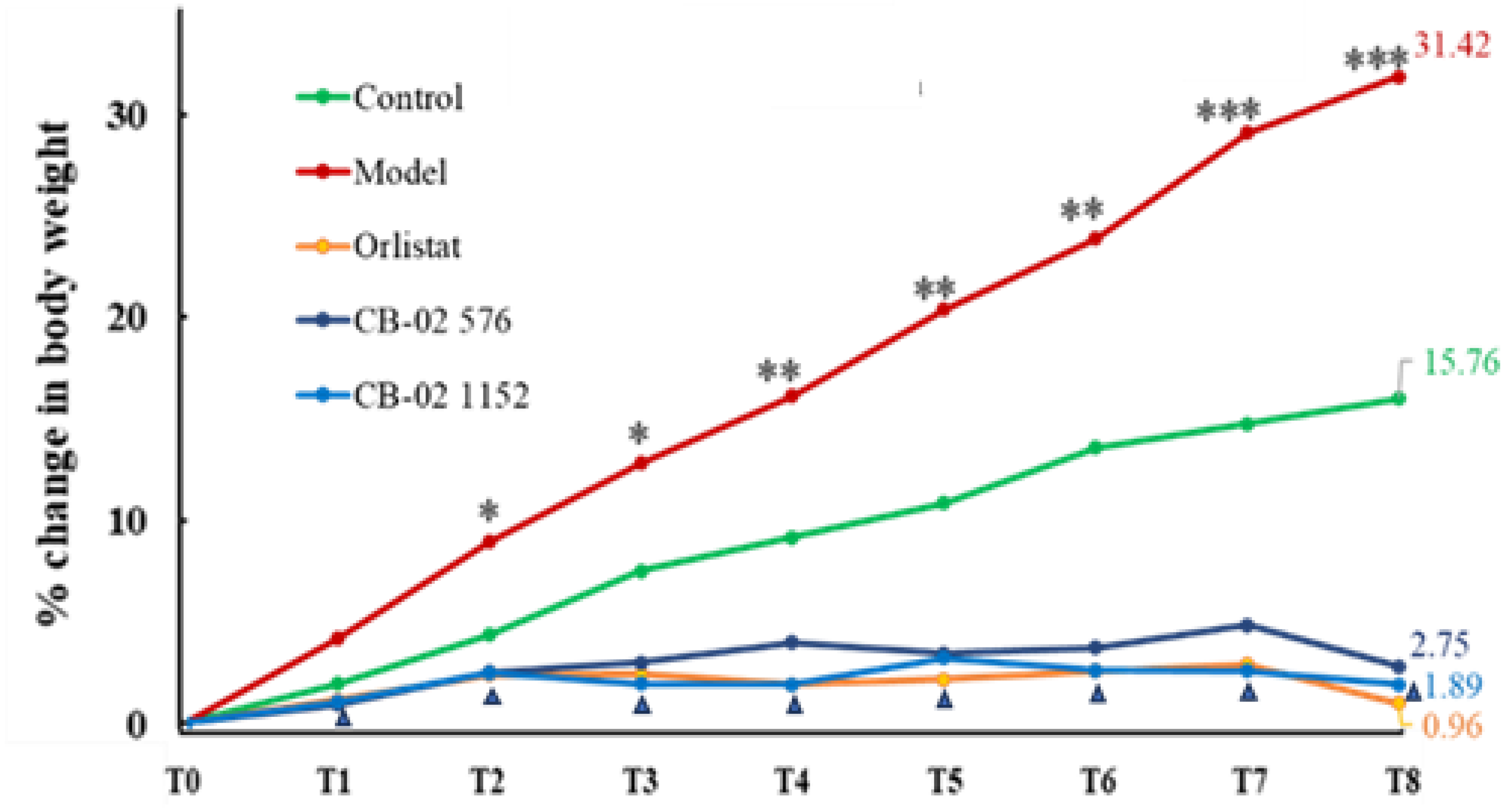
Figure 2.
Figure 2. Percentage change in AC of mice in different groups over time. T0: week 0; T2: week 2; T4: week 4; T6: week 6; and T8: week 8. *p < 0.05 compared to G1; ✧p < 0.01; p < 0.001 compared to G2.
Figure 2.
Figure 2. Percentage change in AC of mice in different groups over time. T0: week 0; T2: week 2; T4: week 4; T6: week 6; and T8: week 8. *p < 0.05 compared to G1; ✧p < 0.01; p < 0.001 compared to G2.
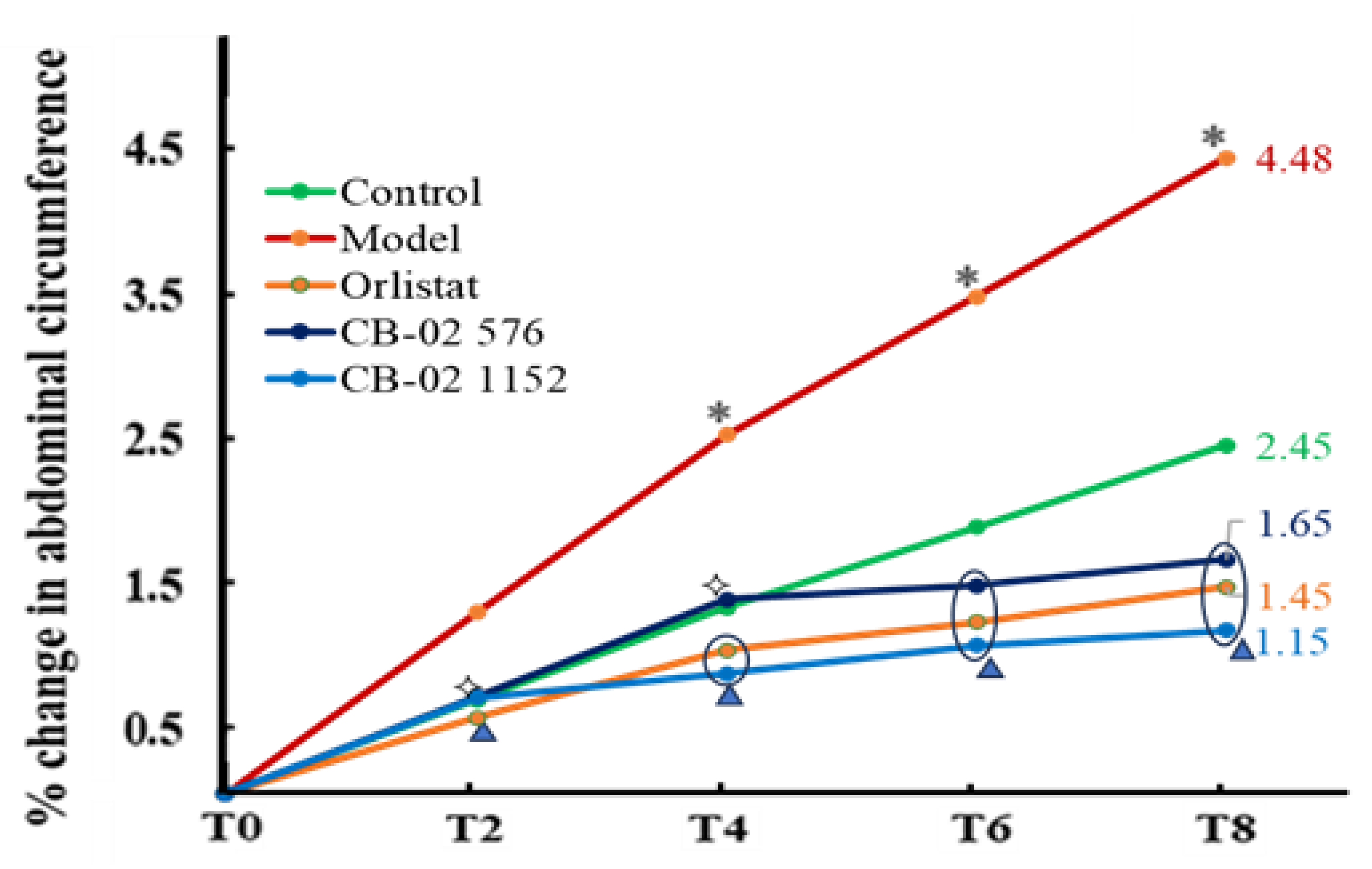
Figure 3.
Changes in the Lee obesity index of mice in different groups over time. T0: week 0; T2: week 2; T4: week 4; T6: week 6; and T8: week 8. **p < 0.01; ***p < 0.001 compared to G1; p < 0.001 compared to G2.
Figure 3.
Changes in the Lee obesity index of mice in different groups over time. T0: week 0; T2: week 2; T4: week 4; T6: week 6; and T8: week 8. **p < 0.01; ***p < 0.001 compared to G1; p < 0.001 compared to G2.
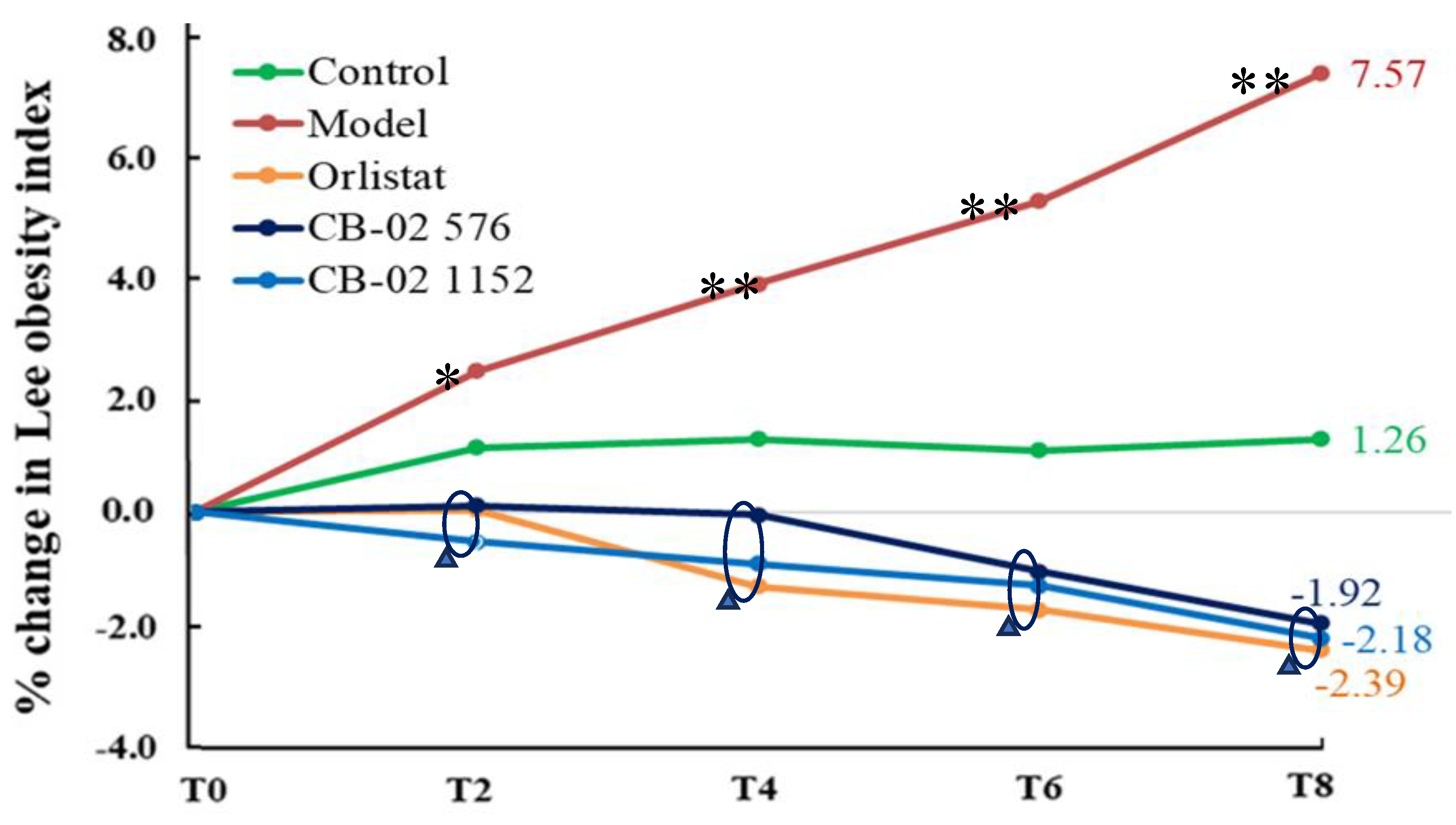
Figure 4.
Histopathological features of H&E-stained pancreatic tissue and the diameter of the islets of Langerhans. A: Control group (G1); B: Model group (G2); C: Orlistat group (G3); D: CB-02 576 (G4); E: CB-02 1152 (G5); and F: The diameter of the islets of Langerhans.
Figure 4.
Histopathological features of H&E-stained pancreatic tissue and the diameter of the islets of Langerhans. A: Control group (G1); B: Model group (G2); C: Orlistat group (G3); D: CB-02 576 (G4); E: CB-02 1152 (G5); and F: The diameter of the islets of Langerhans.
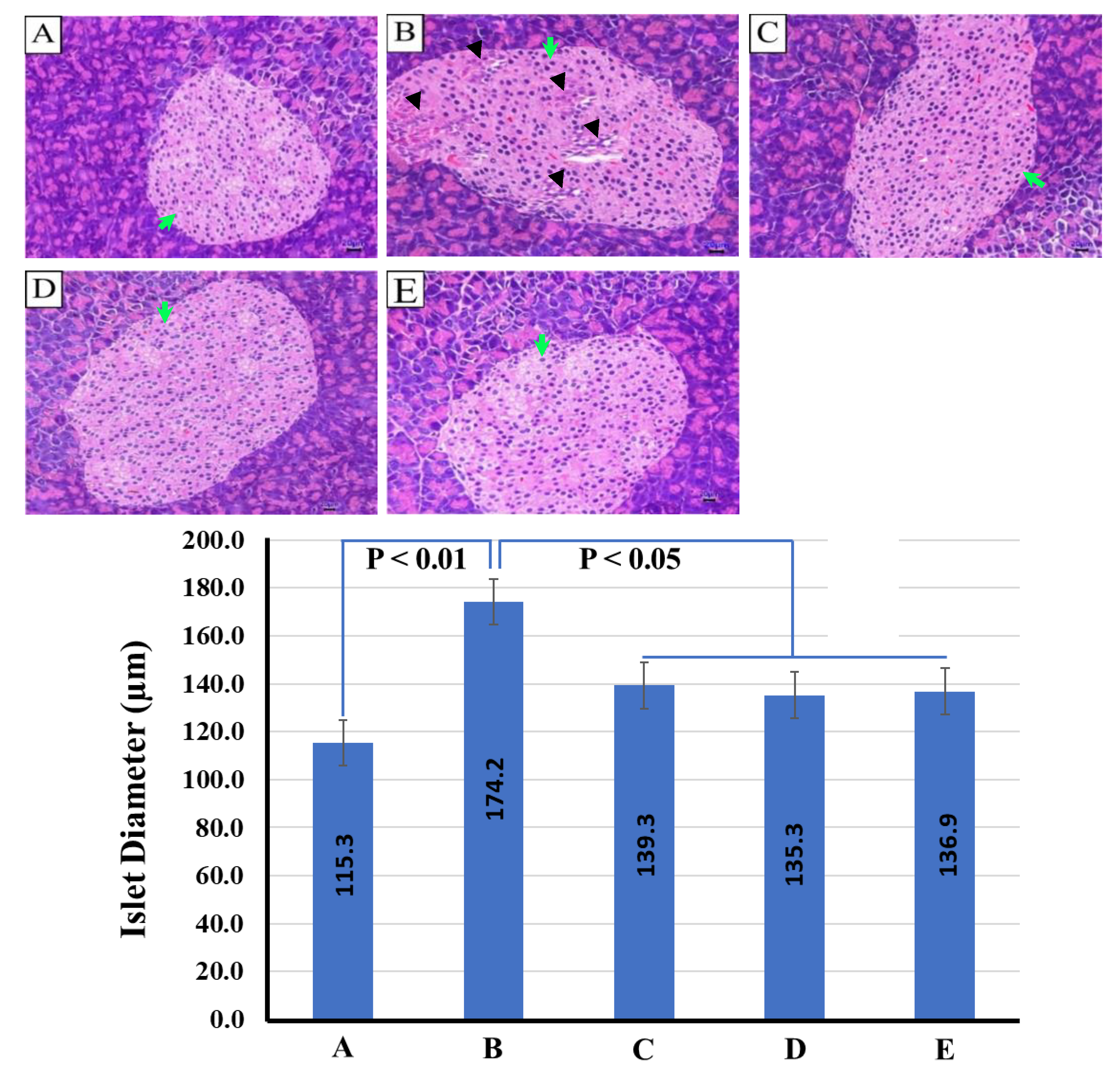
Figure 5.
Histopathological analysis of liver tissue stained with H&E. A: Control group (G1); B: Model group (G2); C: Orlistat-treated group (G3); D: CB-02 576 (G4); and E: CB-02 1152 (G5).
Figure 5.
Histopathological analysis of liver tissue stained with H&E. A: Control group (G1); B: Model group (G2); C: Orlistat-treated group (G3); D: CB-02 576 (G4); and E: CB-02 1152 (G5).
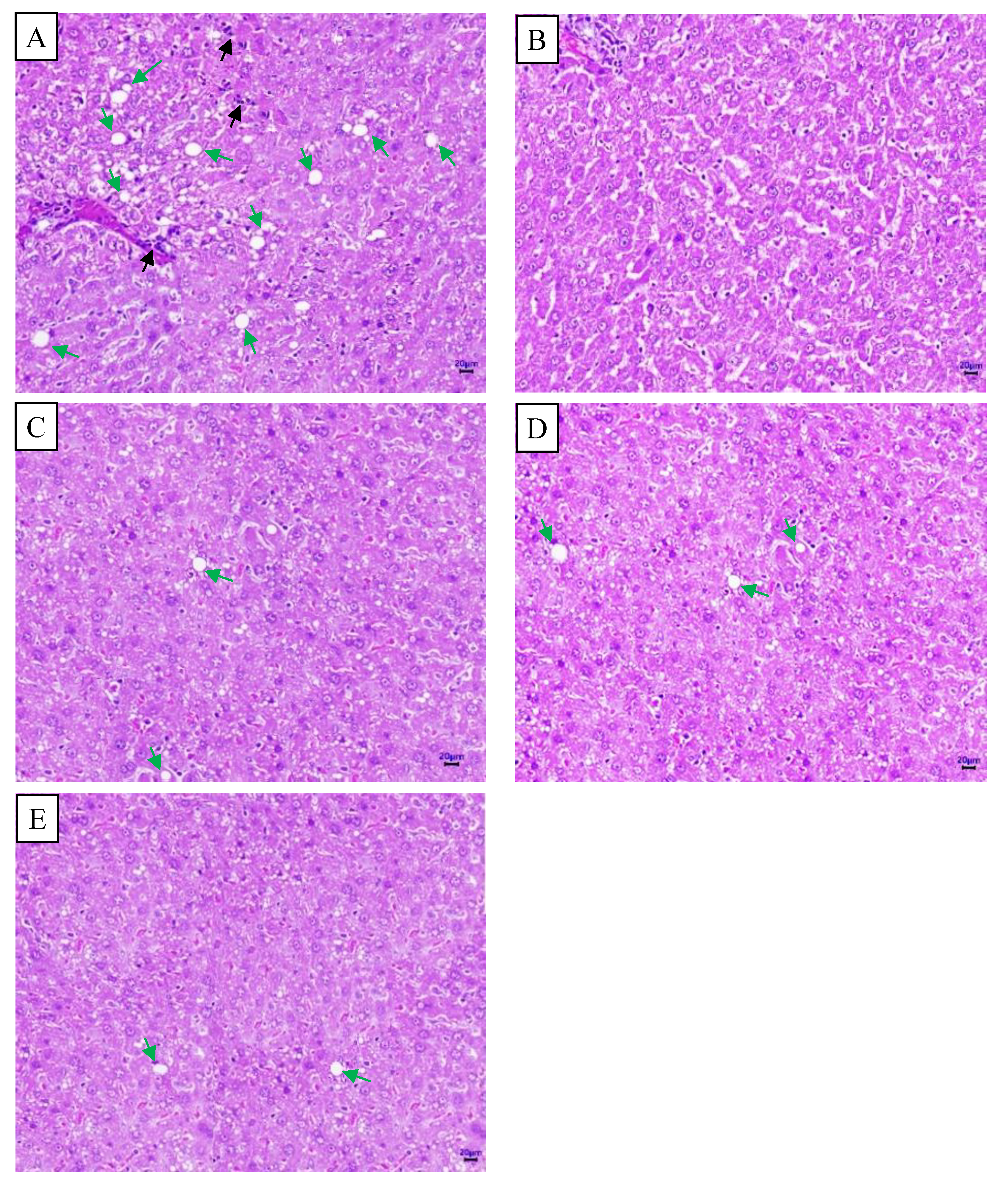

Table 1.
Baseline parameters of mice at the beginning of the main experimental phase.
| Group | n |
Research Indicators at T0 (± SD)
|
|||
| BW (g) | Nose to anus length (cm) | AC (mm) | Lee obesity index | ||
| G1 (1) | 10 | 22.02 ± 2.10 | 9.69 ± 0.32 | 69.50 ± 1.15 | 292.07 ± 5.47 |
| G2 (2) | 10 | 33.93 ± 4.85 | 9.89 ± 0.34 | 81.35 ± 2.64 | 334.11 ± 8.98 |
| G3 (3) | 10 | 34.38 ± 4.49 | 9.85 ± 0.39 | 81.72 ± 2.68 | 337.10 ± 6.86 |
| G4 (4) | 10 | 32.67 ± 3.58 | 9.79 ± 0.33 | 82.02 ± 1.10 | 332.64 ± 3.61 |
| G5 (5) | 10 | 33.06 ± 4.46 | 9.82 ± 0.36 | 82.44 ± 1.19 | 331.97 ± 4.30 |
| p2,3,4,5-1 | < 0.001 | > 0.05 | < 0.001 | < 0.001 | |
The p-values were determined using one-way ANOVA followed by Tukey’s post-hoc test to compare body weight, body length, abdominal circumference, and Lee index among the experimental groups at the baseline of the formal trial.
Table 2.
BW, AC, and Lee obesity index at the end of the main experimental phase.
| Group | n |
Research Indicators at T8(± SD)
|
||
| BW (g) | AC (mm) | Lee obesity index | ||
| G1 (1) | 10 | 25.79 ± 2.22 | 71.19 ± 0.67 | 292.66 ± 4.59 |
| G2 (2) | 10 | 44.49 ± 5.71 | 84.96 ± 1.77 | 351.36 ± 10.13 |
| G3 (3) | 10 | 34.58 ± 3.49 | 82.50 ± 2.55 | 321.70 ± 6.96 |
| G4 (4) | 10 | 33.58 ± 4.26 | 83.27 ± 1.16 | 319.89 ± 5.78 |
| G5 (5) | 10 | 33.67 ± 4.44 | 82.98 ± 1.29 | 319.12 ± 5.40 |
| p2,3,4,5-1 p3,4,5-2 p4,5-3 p5-4 |
< 0.001 | |||
| < 0.001 | < 0.05 | < 0.001 | ||
| > 0.05 | ||||
The p-values were calculated using one-way ANOVA followed by Tukey’s post hoc test to assess differences in BW, AC, and Lee index among the study groups at the end of the experimental period.
Table 3.
Organ weights of mice across the experimental groups.
| Group | n |
Organweights(g)(± SD)
|
||||
| Heart | Liver | Kidneys | Spleen | Pancreas | ||
| G1 (1) | 10 | 0.125 ± 0.020 | 1.119 ± 0.183 | 0.241 ± 0.027 | 0.083 ± 0.013 | 0.228 ± 0.027 |
| G2 (2) | 10 | 0.255 ± 0.024 | 2.495 ± 0.227 | 0.521 ± 0.054 | 0.193 ± 0.032 | 0.349 ± 0.035 |
| G3 (3) | 10 | 0.171 ± 0.018 | 1.647 ± 0.260 | 0.343 ± 0.048 | 0.119 ± 0.031 | 0.276 ± 0.039 |
| G4 (4) | 10 | 0.170 ± 0.021 | 1.626 ± 0.141 | 0.348 ± 0.050 | 0.123 ± 0.023 | 0.281 ± 0.041 |
| G5 (5) | 10 | 0.163 ± 0.022 | 1.584 ± 0.237 | 0.339 ± 0.056 | 0.116 ± 0.025 | 0.286 ± 0.036 |
| p2-1 | < 0.001 | |||||
| p3,4,5-2 | ||||||
| p3,4,5-1 | < 0.001 | < 0.01 | ||||
| p4,5-3 | > 0.05 | |||||
| p5-4 | ||||||
p-values were determined using one-way ANOVA followed by Tukey’s post hoc test to compare absolute organ weights among the experimental groups.
Table 4.
Relative organ weights of mice across the experimental groups.
| Group | n |
Relative organto BWs (%)(± SD)
|
|||||
| Heart | Liver | Kidneys | Spleen | Pancreas | |||
| G1 (1) | 10 | 0.484 ± 0.070 | 4.339 ± 0.624 | 0.943 ± 0.145 | 0.323 ± 0.062 | 0.885 ± 0.104 | |
| G2 (2) | 10 | 0.579 ± 0.073 | 5.712 ± 1.003 | 1.192 ± 0.211 | 0.445 ± 0.115 | 0.792 ± 0.101 | |
| G3 (3) | 10 | 0.498 ± 0.066 | 4.803 ± 0.862 | 1.002 ± 0.171 | 0.346 ± 0.097 | 0.799 ± 0.096 | |
| G4 (4) | 10 | 0.510 ± 0.058 | 4.891 ± 0.619 | 1.037 ± 0.088 | 0.368 ± 0.070 | 0.840 ± 0.097 | |
| G5 (5) | 10 | 0.491 ± 0.091 | 4.755 ± 0.792 | 1.013 ± 0.144 | 0.350 ± 0.090 | 0.855 ± 0.116 | |
| p2-1 | < 0.01 | > 0.05 | |||||
| p3,4,5-2 | < 0.05 | > 0.05 | |||||
| p3,4,5-1 | > 0.05 | ||||||
| p4,5-3 | |||||||
| p5-4 | |||||||
Table 5.
Table 5. Weights of visceral fat in mice across the experimental groups ( ± SD).
± SD).| Group | n | Visceral fat weights (mg) | Relative visceral fatto BWs (%) | ||||
| Mesenteric arteries fat | Retroperitoneal fat | Epididymal fat | Mesenteric arteries fat | Retroperitoneal fat | Epididymal fat | ||
| G1 (1) | 10 | 228.38 ± 46.39 | 192.29 ± 55.10 | 424.69 ± 70.21 | 0.890 ± 0.188 | 0.749 ± 0.208 | 1.650 ± 0.267 |
| G2 (2) | 10 | 766.22 ± 83.26 | 510.06 ± 92.23 | 1050.26 ± 104.47 | 1.743 ± 0.258 | 1.165 ± 0.264 | 2.403 ± 0.425 |
| G3 (3) | 10 | 410.44 ± 69.73 | 297.84 ± 79.29 | 619.53 ± 96.74 | 1.189 ± 0.178 | 0.876 ± 0.284 | 1.818 ± 0.381 |
| G4 (4) | 10 | 426.88 ± 81.83 | 309.01 ± 96.90 | 629.56 ± 83.15 | 1.278 ± 0.239 | 0.914 ± 0.249 | 1.886 ± 0.243 |
| G5 (5) | 10 | 393.38 ± 76.77 | 287.31 ± 81.85 | 616.11 ± 99.40 | 1.175 ± 0.221 | 0.863 ± 0.273 | 1.853 ± 0.335 |
| p2-1 | < 0.001 | < 0.01 | < 0.001 | ||||
| p3,4,5-2 | < 0.05 | < 0.01 | |||||
| p3,4,5-1 | < 0.001 | < 0.01 | < 0.001 | < 0.01 | > 0.05 | ||
| p4,5-3 | > 0.05 | ||||||
| p5-4 | |||||||
p-values were determined using one-way ANOVA followed by Tukey’s post hoc test to compare absolute and relative weights of visceral fat tissues among the experimental groups.
Table 6.
Blood lipid profiles of mice in experimental groups ( ± SD).
± SD).| Group | n | Blood lipid indices (mmol/L) | ||||
| TC | TG | HDL-C | LDL-C | Non-HDL-C | ||
| G1 (1) | 10 | 3.22 ± 0.50 | 0.76 ± 0.12 | 1.58 ± 0.19 | 1.29 ± 0.56 | 1.63 ± 0.61 |
| G2 (2) | 10 | 6.46 ± 0.86 | 1.79 ± 0.32 | 1.01 ± 0.16 | 4.63 ± 0.67 | 5.45 ± 0.81 |
| G3 (3) | 10 | 4.45 ± 0.85 | 1.12 ± 0.20 | 1.46 ± 0.21 | 2.49 ± 0.78 | 2.99 ± 0.86 |
| G4 (4) | 10 | 4.85 ± 0.69 | 1.27 ± 0.18 | 1.39 ± 0.25 | 2.88 ± 0.71 | 3.46 ± 0.79 |
| G5 (5) | 10 | 4.54 ± 0.63 | 1.16 ± 0.17 | 1.49 ± 0.23 | 2.52 ± 0.68 | 3.05 ± 0.75 |
| p2-1 | < 0.001 | < 0.01 | ||||
| p3,4,5-2 | < 0.001 | |||||
| p3,4,5-1 | < 0.001 | < 0.01 | < 0.001 | < 0.01 | > 0.05 | |
| p4,5-3 | > 0.05 | |||||
| p5-4 | ||||||
p-values were calculated using one-way ANOVA followed by Tukey’s post hoc test to compare blood lipid indices among the experimental groups.
Table 7.
Blood glucose, serum insulin, and insulin resistance indices in mice ( ± SD).
± SD).| Group | n |
Blood glucose (mg/dL) |
Serum insulin (µIU/mL) |
Insulin resistance indices | |||
| QUICKI | HOMA-IR | HOMA-β | |||||
| G1 (1) | 10 | 96.40 ± 9.32 | 3.22 ± 0.67 | 0.404 ± 0.020 | 0.77 ± 0.22 | 35.91 ± 7.76 | |
| G2 (2) | 10 | 179.34 ± 24.68 | 7.54 ± 0.95 | 0.320 ± 0.009 | 3.35 ± 0.65 | 24.14 ± 4.89 | |
| G3 (3) | 10 | 127.76 ± 8.51 | 6.19 ± 0.87 | 0.346 ± 0.010 | 1.96 ± 0.37 | 34.64 ± 4.28 | |
| G4 (4) | 10 | 115.18 ± 10.60 | 6.23 ± 0.61 | 0.351 ± 0.008 | 1.77 ± 0.26 | 44.29 ± 8.37 | |
| G5 (5) | 10 | 111.06 ± 15.67 | 6.28 ± 0.89 | 0.353 ± 0.014 | 1.74 ± 0.42 | 50.81 ± 13.92 | |
| p2-1 | < 0.001 | ||||||
| p3,4,5-2 | < 0.001 | < 0.01 | < 0.001 | < 0.001 | < 0.001 | ||
| p3,4,5-1 | p3-1 < 0.001; p4-1 < 0.01; p5-1 < 0.05 | < 0.001 | p3-1 > 0.05; p4-1 < 0.05; p5-1 < 0.01 | ||||
| p4,5-3 | < 0.01 | > 0.05 | > 0.05 | > 0.05 | < 0.01 | ||
| p5-4 | > 0.05 | ||||||
p-values were calculated using one-way ANOVA followed by Tukey’s post hoc test to compare blood glucose, serum insulin, and insulin resistance indices among the experimental groups.
Table 8.
The relative caloric contribution of macronutrients in the HFD.
| Nutrient | Energy (Kcal) | Percentage (%) |
| Protein | 641.0 | 14.26 |
| Carbohydrat | 1693.4 | 37.67 |
| Fat | 2161.4 | 48.08 |
| Total | 4495.8 | 100 |
Disclaimer/Publisher’s Note: The statements, opinions and data contained in all publications are solely those of the individual author(s) and contributor(s) and not of MDPI and/or the editor(s). MDPI and/or the editor(s) disclaim responsibility for any injury to people or property resulting from any ideas, methods, instructions or products referred to in the content. |
© 2025 by the authors. Licensee MDPI, Basel, Switzerland. This article is an open access article distributed under the terms and conditions of the Creative Commons Attribution (CC BY) license (http://creativecommons.org/licenses/by/4.0/).
Copyright: This open access article is published under a Creative Commons CC BY 4.0 license, which permit the free download, distribution, and reuse, provided that the author and preprint are cited in any reuse.


