

Submitted:
29 July 2025
Posted:
30 July 2025
You are already at the latest version
Abstract
Six aromatic plants (Lavandula pedunculata subsp. sampaioana, Lavandula stoechas subsp. luisieri, Mentha × piperita, Origanum vulgare subsp. virens, Thymus mastichina, and Thymus zygis subsp. sylvestris) were analysed to evaluate their essential oil yield, chemical compo-sition, antioxidant activity and antifungal capacity against two mold species, green mold (Penicillium digitatum (Pers.) Sacc.) and blue mold (Penicillium italicum Wehmer). The antioxidant activity was found to be at its lowest in Lavandula pedunculata subsp. sam-paioana (3.84 ± 0.26) and at its highest in Thymus zygis subsp. sylvestris (161.70 ± 0.15). Similarly, the in vitro antifungal capacity assay produced different results depending on the essential oil used: the lowest value was produced by Thymus mastichina essential oil, and the highest by Thymus zygis subsp. sylvestris. All the data collected reveal a positive correlation between antioxidant activity, as meas-ured by DPPH and ABTS assays, and the inhibition halo created by the essential oils used in this study.
Keywords:
antifungal activity
; antioxidant
; essential oil
; Lavandula
; Mentha
; Origanum
; Penicillium
; Thymus
1. Introduction
Fruit and vegetables postharvest diseases caused by fungal infections (Aspergillus, Penicillium, Fusarium, Alternaria, …) due to wounds or insect bites produce elevated loss of food during storage, distribution and sale [1,2,3,4,5,6,7]. Citrus major sources of postharvest diseases are green mold (Penicillium digitatum (Pers.) Sacc.) and blue mold (Penicillium italicum Wehmer), which cause economic losses of 15–30% and affect 50–90% of production, particularly in developing countries [8,9,10,11,12,13]. Traditionally, several methods based on synthetic chemical fungicides have been developed to reduce post-harvest losses; however, intensive use of these methods generates resistance, reducing their effectiveness [9,14,15]. Moreover, consumer trends demand products that are free of chemical residues and more environmentally friendly. Together with legislative restrictions on the use of phytosanitary products, this creates the need for new, more effective and environmentally friendly postharvest management. These alternatives include biocontrol strategies involving the use of antagonist yeast or bacteria, immersion in aqueous extracts of medicinal plants or citrus fruits, vaporization of essential oils from medicinal plants, wax coatings containing essential oils or plant extracts, new biopolymers and heat treatments, among others [6,11,16,17,18,19,20,21].
Studies of the antifungal capacity of medicinal plants extracts or essential oils have reported the ability of fight various fungal infections caused by Aspergillus spp., Candida spp., Cryptococcus spp., Epidermophyton spp., Fusarium spp., Microsporum spp. Penicillium spp., and Trichophyton spp. [22,23,24,25,26,27]. Several studies have shown that essential oils from species such thyme, oregano, clove, cinnamon or citrus have a high inhibitory capacity against the in vitro growth of fungal colonies from Penicillium species such as P. digitatum and P. italicum) [28,29,30,31,32,33,34,35,36]. The antifungal properties of these essential oils have contributed to the development of new research aimed at preventing post-harvest infections caused by P. digitatum and P. italicum [37,38,39,40,41,42,43,44,45].
The use of essential oils from medicinal plants whose chemical composition includes antifungal compounds (e.g., thymol, carvacrol, terpinen-4-ol, etc. [46]) makes it possible to search for local medicinal species commonly used in traditional medicine that are rich in these kinds of compounds, creating a new local employment opportunity that are more environmentally friendly. For that purpose, the main objective of this research is to evaluate the inhibitory and antioxidant activities of different aromatic plants, native to the SW from the Iberian Peninsula, against two mold species (P. digitatum and P. italicum), which cause postharvest disease in citrus fruits (e.g., oranges).
2. Materials and Methods
2.1. Plant Material, Essential Oil Extraction, and Chemical Characterization of Essential Oils
Aerial parts of six aromatic plants (L. pedunculata subsp. sampaioana, L. stoechas subsp. luisieri, Mentha × piperita, O. vulgare subsp. virens., Th. mastichina, and Th. zygis subsp. sylvestris) were collected from the experimental crops at Institute of Agrarian Research “La Orden-Valdesequera” (CICYTEX) (near of Guadajira, Spain). Representative samples were collected during the flowering stage, which took place between May and June 2024.
Fresh stems, leaves, and flowers from each specie were cut in small pieces and submitted to hydro-distillation in Clevenger-type apparatus for 2 h. The essential oils (EOs) were stored in amber vial at 4ºC.
The chemical analysis of the essential oils was carried out using a combination of two gas chromatography techniques (GC-FID + GC-MS), chemical compounds were identified by CG-MS and quantified by CG-FID. The analysis was performed on Agilent 8890 GC paired with the 5977B MSD (Mass Selective Detector). Polar column DB-WAX UI (60 m long, 0.25 mm diameter and 0.5 µm film thicknesses) was employed using Helium carrier gas at constant flow of 2 mL/min. Apolar column HP-5MS UI (60 m long, 0.25 mm diameter and 0.25 µm film thicknesses) was employed using Helium carrier gas at constant flow of 1 mL/min. The column temperature stared at 50ºC and increased to 240ºC (polar column) and 285ºC (apolar column).
2.2. Antioxidant Activity
The antioxidant activity of each essential oil samples was determined by ABTS and DPPH assay method. The absorbance was measured using a spectrophotometer (Beckman Coulter DU® 730).
The standard line from each assay was designed using Trolox (6-hidroxy-2,5,7,8-tetramethylchroman-carboxylic acid) (Sigma-Aldrich 238813) between 1mM and 2mM concentration and measured the absorbance at 734nm (ABTS) and 517nm (DPPH).
All the essential oil samples were analysed in triplicate. The sample volume used was 3 milliliters (2,95 ml from DPPH/ABTS + 50 μl from essential oil sample). The results, from both analyses (ABTS and DPPH) were presented as millimoles (mM) of Trolox equivalents and grams of Trolox equivalents per gram of essential oil, with the main objective of developing a data matrix comparable between each other.
2.2.1. ABTS [2,2’-azino-bis(3-ethylbenzothiazoline-6-sulphonic acid)] Assay
ABTS assay is based on the ability of molecules to scavenge the free radical of ABTS in comparison with Trolox [47]. Absolute ethanol was used to prepare the working solution of ABTS (Sigma-Aldrich A1888) at a concentration of 7 mM, which was then adjusted to obtain a final absorbance of 0.7 ± 0.02 (at 734 nm). To determine antioxidant activity, the essential oil samples remained in the dark at ambient temperature for 30 minutes and, thereafter, the absorbance was measured at 734nm.
2.2.2. DPPH (2,2-diphenyl-1-picrylhydrazyl) Assay
The DPPH protocol to measure antioxidant activity was based on the description in reference [48]. Methanol (100%) was used as the solvent to prepare a working solution 75 µmol/L of DPPH (Sigma-Aldrich D9132), which was then adjusted to a final absorbance of 0.7 ± 0.02 (at 517 nm). For antioxidant activity determination, the samples remained in the dark at ambient temperature for 120 minutes, after which the absorbance was measured at 517 nm.
2.3. In Vitro Antifungal Activity Assay
2.3.1. Fungal Isolation
The fungal species used are P. digitatum and P. italicum, obtained from infected Citrus aurantium L. fruit. The isolation was realized in Petri dishes containing Sabouraud Dextrose agar (6%) and incubated for 7 days at 27ºC ± 1ºC, in complete darkness. The differential isolations were transferred to new Petri dishes containing Sabouraud Dextrose agar and re-sown each week until a pure fungal culture of each species was obtained. Finally, the standardization of the fungal colonies was achieve using a 0.85% saline solution suspension to obtain the 0.5 McFarland standard (1,5 · 108 CFU/ml) [49]. Morphological characterization (macro and microscopic) was performed using dichotomous keys as a reference [50,51,52].
2.3.2. Antifungal Activity
The disk diffusion method was used to evaluate the antifungal activity of each of the essential oils [53,54]. The fungal suspension was sown in Petri dishes (87,8 mm diameter) containing 25 ml of Sabouraud Dextrose Agar. A sterile swab was used to spread the mold suspension evenly across the surface of the dish to ensure a homogeneous development of the mold. Essential oils were inoculate using a 10 mm diameter filter disk soaked with 25μl of each essential oil sample and placed in the center of the Petri dish.
The study included a control group and a study group with 3 repetitions of each for each species of essential oil. Thus, 12 Petri dishes were used for each essential oil species (3 control dishes + 3 study dishes for each one of the analysed molds, P. digitatum and P. italicum). The Petri dishes were incubated for 5 days (96 hours) in an incubator chamber at 27ºC ± 1ºC in complete darkness and in the normal position (not inverted) to avoid affecting the mold growth. Finally, the Petri dishes were checked, photographed and measured every 24 hours. Measurements were taken by evaluating the inhibitory halo of growth around the filter disk using a caliper.
2.4. Statistical Analysis
Descriptive and inferential statistical analysis were performed using R v 4.3.3 software) [55] to determine the relationship between the inhibitory halo of growth results and the antioxidant activity obtained from the samples. The 48-hour data from inhibitory halo of growth were used to developed the statistical analysis (to ensure a correct understanding of the data and avoid mixing up inhibition and natural absence of growth).
3. Results
3.1. Essential Oil Composition
Table 1 shows the essential oils yield obtained for each of the aromatic plant, expressed in grams of essential oil per kilogram of fresh plant and as a percentage (w/w). The highest yields were obtained in Thymus mastichina (L.) L., Lavandula pedunculata subsp. sampaioana (Rozeira) Franco, and Thymus zygis subsp. sylvestris (Hoffmanns. & Link) Cout. with values of 2.43%, 1.28%, and 0.88% respectively. The species with the lowest yields were Mentha × piperita L., Lavandula stoechas subsp. luisieri (Rozeira) Rozeira, and Origanum vulgare subsp. virens (Hoffmans. & Link) Bonnier & Layens (0.62%, 0.42% and 0.41%, respectively).
The essential oils have a rich monoterpene-based chemical composition (Table 2). The majority of the detected compounds are: thymol (68.83% in Th. zygis subsp. sylvestris and 36.72% in O. vulgare subsp. virens), 1.8-cineole (66.06% and 17.71% in Th. mastichina and L. stoechas subsp. luisieri respectively), camphor and fenchone (35.51% and 34.20% respectively in L. pedunculata subsp. sampaioana), gamma-terpinene (30.69% in O. vulgare subsp. virens), menthone and L-menthol (29.12 and 27.56% respectively in M × piperita), and trans-alpha-necrodyl acetate (20.46% in L. stoechas subsp. luisieri).
3.2. Antioxidant Activity
Obtained results (Table 3) show that the essential oils of the L. stoechas subsp. luisieri, O. vulgare subsp. virens and Th. zygis subsp. sylvestris species have higher antioxidant activity. These species have in common a high percentage of the chemical’s thymol, gamma-terpinene and trans-alpha-necrodyl acetate in their essential oils.
3.3. In Vitro Antifungal Activity Assay
3.3.1. Fungal Isolation
The P. italicum species was observed to grow more quickly and be less susceptible to contamination in in vitro conditions than P. digitatum (Figure 1).
3.3.2. Antifungal Activity
The Petry dishes were photographed every 24 hours, and it could be observed that the filter disk infused with the essential oils is able to inhibit the fungal species development (inhibition halo) and delay maturation of both species (Figure 2).
Table 4 displays statistical parameters obtained from the inhibition halo measurements obtained after 48 hours of growing. Measurement results show a higher inhibitory capacity from essential oil over P. digitatum specie than P. italicum (inhibition halo mean: 29.69 mm in P. digitatum and 27.81 mm in P. italicum). Besides, the observed skew shows a positive trend. On the other hand, the kurtosis of the antioxidant activity shows a platykurtic curve, indicating fewer extreme values than a normal distribution. However, the inhibition halo differs in the kurtosis depending on the fungal species (slightly leptokurtic in P. digitatum and platykurtic in P. italicum).
Finally, the data distribution in relation to each essential oil species is presented in a boxplot for each fungal species (Figure 3). It is possible to observe that the Th. zygis subsp. sylvestris essential oil produced the most extensive inhibition halo for both fungal species, with a clear difference compared to the rest of the samples.
3.3.3. Statistical Analysis
The Shapiro-Wilk test applied to the data base obtained in the study indicate the absence of normal distribution (Table 5), for that reason the statistical analysis was based on non-parametric correlation test (Spearman’s correlation).
The results of the Spearman’s correlation test show a p-value of less than 0.05 (significance level), indicating a linear relationship between the pairs of variables studied at the ordinal level and showing that this relationship is not due to chance (Table 6.).
A significant statistical linear correlation was found between the different measurements of antioxidant activity (using the ABTS and DPPH methods) and the inhibition halo using the various essential oil samples on the two species of mesophilic mold (P. digitatum and P. italicum) (Figure 4).
4. Discussion
The obtained data shows the essential oils of Th. zygis subsp. sylvestris, O. vulgare subsp. virens and L. stoechas subsp. luisieri to have high antioxidant activity and elevated antifungal activity for both ABTS and DPPH. Conversely, the essential oils of Th. mastichina, M. × piperita and L. pedunculata subsp. sampaioana exhibited low antioxidant and anti-fungal activity against the two evaluated fungal species, P. italicum and P. digitatum.
High antifungal and antioxidant activity from Th. zygis has been widely recognized in several studies [56,57,58,59,60,61]. Th. zygis essential oil can have different chemotypes (thymol, carvacrol, carvacrol/thymol, linalool, geranyl acetate/geraniol, …) [58,60,61,62,63]. However, only the carvacrol, thymol and carvacrol/thymol chemotypes, have demonstrated elevated antifungal and antioxidant capacity [47,49,50,51,52,53]. The presence of thymol and carvacrol compounds in essential oil from other species of Thymus L. genus is well known [33,64,65,66]. Furthermore, research into the antifungal activity indicates that they have a higher inhibitory capacity for fungal growth than the pure compounds – thymol or carvacrol [57,64]. Regarding P. digitatum and P. italicum molds, Th. zygis subsp. sylvestris essential oil has an elevated inhibitory capacity against “in vitro” growth, as observed in other Penicillium species [33,36,56].
On the other hand, the other thyme species included in this study, Th. mastichina, has an essential oil rich in 1,8-cineole [59,67,68,69], with a poor antioxidant and antifungal capacity against the Penicillium species studied. However, other studies have shown it to have good antifungal properties against other fungal species, such as Sclerotinia spp., Fusarium spp., Alternaria spp. or Candida spp. [59,70,71,72]. This makes it possible to use it to fight fungal infections in crops or on the skin.
O. vulgare subsp. virens essential oil has a thymol/gamma-terpinene chemotype, which is unusual for this species [73,74]. This coincides with what was observed in research involving the carvacrol chemotype of O. vulgare, which exhibits high antioxidant and antifungal activity against P. digitatum and P. italicum [36,74,75,76,77,78].
The two Lavandula L. subspecies studied exhibit different antifungal capacities, with L. stoechas subsp. luisieri demonstrating greater activity than L. pedunculata subsp. sampaioana [79], and notably the inhibitory effect on P. digitatum growth is higher than on P. italicum. The antioxidant activity of L. stoechas subsp. luisieri essential oil is very high, mainly due to the presence of necrodiol derivatives [80]. On the other hand, L. pedunculata subsp. sampaioana has an essential oil rich in fenchone, camphor and 1,8-cineole, which are compounds with low antioxidant capacity [59,68].
M. × piperita essential oil exhibits the lowest of all the essential oils studied in the present research. However, other studies indicate good inhibitory capacity against several species of the Penicillium genus, including P. digitatum [81,82,83,84]. This divergence in results could be due to variation in the essential oil’s chemical composition, including different percentages of menthol, menthone, limonene, alpha-pinene, and betha-pinene, among others.
5. Conclusions
The Th. zygis subsp. sylvestris, O. vulgare subsp. virens and L. stoechas subsp. luisieri essential oils have a high antioxidant capacity and can effectively inhibit the “in vitro” growth of the molds that mainly cause postharvest damages in Citrus genus fruits. Furthermore, all the essential oils studied exhibited a higher inhibition response against green mold (P. digitatum) than blue mold (P. italicum).
Author Contributions
Conceptualization, M.C. and F.M.; methodology, M.C. and F.M.; software, M.C. and D.G.; formal analysis, M.C., D.G., and F.M.; investigation, M.C., F.M., C.D., and D.G..; resources, F.V.; writing—original draft preparation, M.C. and F.M.; writing—review and editing, D.G., C.D., and F.V. All authors have read and agreed to the published version of the manuscript.
Funding
This study forms part of the AGROALNEXT programme and was supported by MCIN with funding from European Union NextGenerationEU (PRTR-C17.I1).
Institutional Review Board Statement
Not applicable.
Informed Consent Statement
Not applicable.
Data Availability Statement
The original contributions presented in this study are included in the article. Further inquiries can be directed to the corresponding author.
Acknowledgments
The authors would like to acknowledge Alonso Martín Jabato and Julian Mor-cillo Solis for their help and maintenance of the assay crops used in this research. Additionally, we are grateful for the help of Pedro Del Viejo Esteban and Alicia Gil de los Santos during the development of the laboratory studies.
Conflicts of Interest
The authors declare no conflicts of interest.
References
- Hodges, R.J.; Buzby, J.C.; Bennett, B. Postharvest losses and waste in developed and less developed countries: opportunities to improve resource use. J. Agric. Sci. 2011, 149(S1), 37–45. [CrossRef]
- Snyder, A.B.; Worobo, R.W. Fungal Spoilage in Food Processing, J. Food Prot. 2018, 81(6), 1035–1040. [CrossRef]
- Rizwana, H.; Bokahri, N.A.; Alsahli, S.A.; Al Showiman, A.S.; Alzahrani, R.M.; Aldehaish, H.A. Postharvest disease management of Alternaria spots on tomato fruit by Annona muricata fruit extracts. Saudi J. Biol. Sci. 2021, 28(4), 2236–2244. [CrossRef]
- Shakeel, Q.; Shaheen, M.R.; Ali, S.; Ahmad, A.; Raheel, M.; Bajwa, R.T. Chapter 1 - Postharvest management of fruits and vegetables. In Applications of Biosurfactant in Agriculture, Inamuddin, C.O.A. Ed., Academic Press, 2022, pp. 1–16. [CrossRef]
- Zakaria, L. Fusarium Species Associated with Diseases of Major Tropical Fruit Crops. Horticulturae 2023, 9(3), 322. [CrossRef]
- Pouris, J.; Kolyva, F.; Bratakou, S.; Vogiatzi, C.A.; Chaniotis, D.; Beloukas, A. The Role of Fungi in Food Production and Processing. Appl. Sci. 2024, 14(12), 5046. [CrossRef]
- Dijksterhuis, J.; Houbraken, J. Fungal Spoilage of Crops and Food. In Agricultural and Industrial Applications. The Mycota, Grüttner, S., Kollath-Leiß, K., Kempken, F. Eds., Springer, Cham, 2025, 16, pp. 31–66. [CrossRef]
- Palou, Ll.; Valencia-Chamorro, S.A.; Pérez-Gago, M.B. Antifungal edible coatings for fresh citrus fruit: A review. Coatings 2015, 5(4), 962–986. [CrossRef]
- Costa, J.H.; Wassano, C.I.; Angolini C.F.F.; Scherlach, K.; Hertweek, C.; Fill, T.P. Antifungal potential of secondary metabolites involved in the interaction between citrus pathogens. Sci. Rep. 2019, 9, 18647. [CrossRef]
- Papoutsis, K.; Mathioudakis, M.M.; Hasperué, J.H.; Ziogas, V. Non-chemical treatments for preventing the postharvest fungal rotting of citrus caused by Penicillium digitatum (green mold) and Penicillium italicum (blue mold). Trends Food Sci. Technol. 2019, 86, 479–491. [CrossRef]
- Cheng, Y.; Lin, Y.; Cao, H.; Li, Z. Citrus Postharvest Green Mold: Recent Advances in Fungal Pathogenicity and Fruit Resistance. Microorganisms 2020, 8(3), 449. [CrossRef]
- Hanif, Z.; Ashari, H. Post-harvest losses of citrus fruits and perceptions of farmers in marketing decisions. E3S Web Conf. 2021, 306, 02059. [CrossRef]
- Kadhim, Z.R.; Ali, S.H.; AL-Rubaye, S.A. The economic impacts of the post-harvest losses of tangerines and Seville oranges crops in Iraq (Baghdad Governorate: As a case study). Bulg. J. Agric. Sci. 2025, 31(2), 237–244.
- Hall, D.J. Comparative activity of selected food preservatives as citrus postharvest fungicides. Proc. Fla. State Hort. Soc. 1988, 101, 184–187.
- Holmes, G.J.; Eckert, J.W. Sensitivity of Penicillium digitatum and P. italicum to postharvest citrus fungicides in California. Phytopathology 1999, 89, 716–721. [CrossRef]
- Talibi, I.; Boubaker, H.; Boudyach, E.H.; Ait Ben Aoumar, A. Alternative methods for the control of postharvest citrus diseases. J Appl Microbiol. 2014, 117(1), 1–17. [CrossRef]
- Ma, J.; Li, Y.; Chen, H.; Zeng, Z.; Li, Z.-L.; Jiang, H. Synthesis of Oxylipin Mimics and Their Antifungal Activity against the Citrus Postharvest Pathogens. Molecules 2016, 21(2), 254. [CrossRef]
- Chen, J.; Shen, Y.; Chen, C.; Wan, C. Inhibition of Key Citrus Postharvest Fungal Strains by Plant Extracts In Vitro and In Vivo: A Review. Plants 2019, 8(2), 26. [CrossRef]
- Kanashiro, A.M.; Akiyama, D.Y.; Kupper, K.C.; Fill, T.P. Penicillium italicum: An Underexplored Postharvest Pathogen. Front. Microbiol. 2020, 11, 606852. [CrossRef]
- Wang, Z.; Sui, Y.; Li, J.; Tian, X.; Wang, Q. Biological control of postharvest fungal decays in citrus: a review. Crit. Rev. Food Sci. Nutr. 2020 62(4), 861–870. [CrossRef]
- Strano, M.C.; Altieri, G.; Allegra, M.; Di Renzo, G.C.; Paterna, G.; Matera, A.; Genovese, F. Postharvest Technologies of Fresh Citrus Fruit: Advances and Recent Developments for the Loss Reduction during Handling and Storage. Horticulturae 2022, 8, 612. [CrossRef]
- Tejeswini, M.G.; Sowmya, H.V.; Swarnalatha, S.P.; Negi, P.S. Antifungal activity of essential oils and their combinations in vitro and in vivo conditions. Arch. Phytopathol. Pflanzenschutz 2013, 47(5), 564–570. [CrossRef]
- Felšöciová, S.; Vukovic, N.; Jeżowski, P.; Kačániová, M. Antifungal activity of selected volatile essential oils against Penicillium sp. Open Life Sci. 2020, 15(1), 511-521. [CrossRef]
- Abd Rashed, A.; Rathi, D.-N.G.; Ahmad Nasir, N.A.H.; Abd Rahman, A.Z. Antifungal Properties of Essential Oils and Their Compounds for Application in Skin Fungal Infections: Conventional and Nonconventional Approaches. Molecules 2021, 26(4), 1093. [CrossRef]
- Ferreira, E.S.; Rosalen, P. L.; Benso, B.; de Cássia Orlandi Sardi, J.; Denny, C.; Alves de Sousa, S.; Queiroga Sarmento Guerra, F.; de Oliveira Lima, E.; Almeida Freires, I.; Dias de Castro, R. The Use of Essential Oils and Their Isolated Compounds for the Treatment of Oral Candidiasis: A Literature Review. Evid. Based Complement. Alternat. Med. 2021, 1059274. [CrossRef]
- Hou, T.; Sana, S.S.; Li, H.; Xing, Y.; Nanda, A.; Netala, V.R.; Zhang, Z. Essential oils and its antibacterial, antifungal and anti-oxidant activity applications: A review. Food Biosci. 2022, 47, 101716. [CrossRef]
- Tran, H.M.; Le, D.H.; Nguyen, V.-A.T.; Vu, T.X.; Thanh, N.T.K.; Giang, D.H.; Dat, N.T.; Pham, H.T.; Muller, M.; Nguyen, H.Q.; Tran, V.-T. Penicillium digitatum as a Model Fungus for Detecting Antifungal Activity of Botanicals: An Evaluation on Vietnamese Medicinal Plant Extracts. J. Fungi 2022, 8, 956. [CrossRef]
- Daferera, D.J.; Ziogas, B.N.; Polissiou, M.G. GC-MS analysis of essential oils from some Greek aromatic plants and their fungitoxicity on Penicillium digitatum. J Agric Food Chem. 2000, 48(6), 2576–2581. [CrossRef]
- Plaza, P.; Torres, R.; Usall, J.; Lamarca, N.; Vinas, I. Evaluation of the potential of commercial postharvest application of essential oils to control citrus decayJ. Hortic. Sci. Biotechnol. 2004, 79(6), 935–940. [CrossRef]
- Yahyazadeh, M.; Omidbaigi, R.; Zare, R, Taheri, H. Effect of some essential oils on mycelial growth of Penicillium digitatum Sacc. World J Microbiol Biotechnol. 2008, 24, 1445–1450. [CrossRef]
- Jing, L.; Lei, Z.; Li, L.; Xie, R.; Xi. W.; Guan, Y. Sumner, L.W.; Zhou, Z. Antifungal Activity of Citrus Essential Oils. J. Agric. Food Chem. 2014, 62(14), 3011–3033. [CrossRef]
- Tao, N.; Jia, L.; Zhou, H. Anti-fungal activity of Citrus reticulata Blanco essential oil against Penicillium italicum and Penicillium digitatum. Food Chem. 2014, 153, 265–271. [CrossRef]
- Boubaker, H.; Karim, H.; El Hamdaoui, A.; Msanda, F.; Leach, D.; Bombarda, I.; Vanloot, P.; Abbad, A.; Boudyach, E.H.; Ait Ben Aoumar, A. Chemical characterization and antifungal activities of four Thymus species essential oils against postharvest fungal pathogens of citrus. Ind. Crop. Prod. 2016, 86, 95–101. [CrossRef]
- Moussa, H.; El Omari, B.; Chefchaou, H.; Tanghort, M.; Mzabi, A.; Chami, N.; Remmal, A. Action of thymol, carvacrol and eugenol on Penicillium and Geotrichum isolates resistant to commercial fungicides and causing postharvest citrus decay. Can. J. Plant Pathol. 2020, 43(1), 26–34. [CrossRef]
- Et-tazy, L.; Lamiri, A.; Satia, L.; Essahli, M.; Krimi Bencheqroun, S. In Vitro Antioxidant and Antifungal Activities of Four Essential Oils and Their Major Compounds against Post-Harvest Fungi Associated with Chickpea in Storage. Plants 2023, 12, 3587. [CrossRef]
- Martins, G.A.; Bicas, J. L. Antifungal activity of essential oils of tea tree, oregano, thyme, and cinnamon, and their components. Braz. J. Food Technol. 2024, 27, e2023071. [CrossRef]
- Arras, G.; Usai, M. Fungitoxic Activity of 12 Essential Oils against Four Postharvest Citrus Pathogens: Chemical Analysis of Thymus capitatus Oil and its Effect in Subatmospheric Pressure Conditions. J. Food Prot. 2001, 64(7), 1025–1029. [CrossRef]
- Rahman, M.M.; Wills, R.B.H.; Bowyer, M.C.; Golding, J.B.; Kirkman, T.; Pristijono, P. Efficacy of Orange Essential Oil and Citral after Exposure to UV-C Irradiation to Inhibit Penicillium digitatum in Navel Oranges. Horticulturae 2020, 6, 102. [CrossRef]
- Alvarez, M.V.; Palou, L.; Taberner, V.; Fernández-Catalán, A.; Argente-Sanchis, M.; Pitta, E.; Pérez-Gago, M.B. Natural Pectin-Based Edible Composite Coatings with Antifungal Properties to Control Green Mold and Reduce Losses of ‘Valencia’ Oranges. Foods 2022, 11, 1083. [CrossRef]
- Wardana, A.A.; Kingwascharapong, P.; Wigati, L.P.; Tanaka, F.; Tanaka, F. The antifungal effect against Penicillium italicum and characterization of fruit coating from chitosan/ZnO nanoparticle/Indonesian sandalwood essential oil composites. Food Packag. Shelf Life 2022, 32, 100849. [CrossRef]
- Olmedo, G.M.; Zhang, J.; Zhao, W.; Mattia, M.; Rosskopf, E.N.; Ritenour, M.; Plotto, A.; Bai, J. Application of Thymol Vapors to Control Postharvest Decay Caused by Penicillium digitatum and Lasiodiplodia theobromae in Grapefruit. Foods 2023, 12, 3637. [CrossRef]
- Gharzouli, M.; Aouf, A.; Mahmoud, E.; Ali, H.; Alsulami, T.; Badr, A.N.; Ban, Z.; Farouk, A. Antifungal effect of Algerian essential oil nanoemulsions to control Penicillium digitatum and Penicillium expansum in Thomson Navel oranges (Citrus sinensis L. Osbeck). Front. Plant Sci. 2024, 15, 1491491. [CrossRef]
- Maunpuii, C.V.L.; Maisnam, R.; Antuhu, Y.L.; Kumari, A.; López-Menchero, J.R.; González-Coloma, A.; Andrés, M.F.; Kaushik, N. Evaluating the efficiency of essential oils as fumigants in controlling Penicillium digitatum in citrus fruits. BIO Web Conf. 2024, 110, 02009. [CrossRef]
- Maswanganye, L.T.C.; Pillai, S.K.; Sivakumar, D. Chitosan Coating Loaded with Spearmint Essential Oil Nanoemulsion for Antifungal Protection in Soft Citrus (Citrus reticulata) Fruits. Coatings 2025, 15, 105. [CrossRef]
- Sánchez-Torres, P. Emerging alternatives to control fungal contamination. Curr. Opin. Food Sci. 2025, 61, 101255. [CrossRef]
- Pérez-Alonso, C.O.; Martínez-Romero, D.; Zapata, P.J.; Serrano, M.; Valero, D.; Castillo, S. The effects of essential oils carvacrol and thymol on growth of Penicillium digitatum and P. italicum involved in lemon decay. Int. J. Food Microbiol. 2012, 158(2), 101–106. [CrossRef]
- Re, R.; Pellegrini, N.; Proteggente, A.; Pannala, A.; Yang, M.; Rice-Evans, C. Antioxidant activity applying an improved ABTS radical cation decolorization assay. Free Radic Biol Med. 1999, 26(9-10), 1231–1237. [CrossRef]
- Brand-Williams, W.; Cuvelier, M.E.; Berset, C. Use of a free radical method to evaluate antioxidant activity. LWT-Food Sci. Technol. 1995, 28(1), 25–30. [CrossRef]
- Morris, S.C.; Nicholls, P.J. An evaluation of optical density to estimate fungal spore concentrations in water suspensions. Phytopathology 1978, 68(8), 1240–1242. [CrossRef]
- Barnett, H.L.; Hunter, B.B. Illustrated genera of imperfect fungi, 4th ed. APS Press. 1998, 218 pp.
- Pitt, J.I. A Laboratory Guide to Common Penicillium Species, 2nd ed. CSIRO Division of Food Processing, North Ryde, New South Wales, Australia. 1988, 187 pp.
- Romero, C.S. Hongos Fitopatógenos. Universidad Autónoma Chapingo. Chapingo, Estado de México, México, 1988, 347 pp.
- Bauer, A.W.; Kirby, W.M.M.; Sherris, J.C.; Turck, M. Antibiotic susceptibility testing by a standardized single disk method. Am. J. Clin. Pathol. 1966, 45, 493–496. [CrossRef]
- Hossain, T.J. Methods for screening and evaluation of antimicrobial activity: A review of protocols, advantages, and limitations. Eur J Microbiol Immunol. 2024, 14(2), 97–115. [CrossRef]
- R Core Team. R: A Language and Environment for Statistical Computing. R Foundation for Statistical Computing, Vienna, Austria. 2024.
- El Hajli, F.; Chakir, S.; Annemer, S.; Assouguem, A.; Elaissaoui, F.; Ullah, R.; Ali, E.A.; Choudhary, R.; Hammani, K.; Lahlali, R.; Echchgadda, G. Tetraclinis articulata (Vahl) Mast.; Mentha pulegium L.; and Thymus zygis L. essential oils: Chemical composition, antioxidant and antifungal properties against postharvest fungal diseases of apple, and in vitro, in vivo, and in silico investigation. Open Chem. 2025, 23(1), 20250131. [CrossRef]
- Radi, F.z.; Bouhrim, M.; Mechchate, H.; Al-zahrani, M.; Qurtam, A.A.; Aleissa, A.M.; Drioiche, A.; Handaq, N.; Zair, T. Phytochemical Analysis, Antimicrobial and Antioxidant Properties of Thymus zygis L. and Thymus willdenowii Boiss. Essential Oils. Plants 2022, 11, 15. [CrossRef]
- Gonçalves, M.J.; Cruz, M.T.; Cavaleiro, C.; Lopes, M.C.; Salgueiro, L. Chemical, antifungal and cytotoxic evaluation of the essential oil of Thymus zygis subsp. sylvestris. Ind. Crops Prod. 2010, 32(1), 70–75. [CrossRef]
- Pina-Vaz, C.; Gonçalves, A.; Pinto, E.; Costa-de-Oliveira, S.; Tavares, C.; Salgueiro, L.; Cavaleiro, C.; Gonçalves, M.J.; Martinez-de-Oliveira, J. Antifungal activity of Thymus oils and their major compounds. JEADV 2004, 18(1), 73–78. [CrossRef]
- Gourich, A.A.; Bencheikh, N.; Bouhrim, M.; Regragui, M.; Rhafouri, R.; Drioiche, A.; Asbabou, A.; Remok, F.; Mouradi, A.; Addi, M.; Hano, C.; Zair, T. Comparative Analysis of the Chemical Composition and Antimicrobial Activity of Four Moroccan North Middle Atlas Medicinal Plants’ Essential Oils: Rosmarinus officinalis L.; Mentha pulegium L.; Salvia officinalis L.; and Thymus zygis subsp. gracilis (Boiss.) R. Morales. Chemistry 2022, 4, 1775–1788. [CrossRef]
- Sáez, F. Essential oil variability of Thymus zygis growing wild in southeastern Spain. Phytochemistry 1995, 40(3), 819–825. [CrossRef]
- Rodrigues, V.; Cabral, C.; Évora, L.; Ferreira, I.; Cavaleiro, C.; Cruz, M.T.; Salgueiro, L. Chemical composition, anti-inflammatory activity and cytotoxicity of Thymus zygis L. subsp. sylvestris (Hoffmanns. & Link) Cout. essential oil and its main compounds. Arab. J. Chem. 2015, 12(8), 3236–3243. [CrossRef]
- Pérez-Sánchez, R.; Ubera, J.L.; Lafont, F.; Gálvez, C. Composition and Variability of the Essential Oil in Thymus zygis from Southern Spain. J. Essent. Oil Res. 2008, 20(3), 192–200. [CrossRef]
- Šegvić, M.; Kosalec, I.; Mastelić, J.; Piecková, E.; Pepeljnak, S. Antifungal activity of thyme (Thymus vulgaris L.) essential oil and thymol against moulds from damp dwellings. Lett. Appl. Microbiol. 2007, 44(1), 36–42. [CrossRef]
- Golparvar, A.R.; Hadipanah, A. A Review of the Chemical Composition of Essential Oils of Thymus Species in Iran. Research on Crop Ecophysiology 2023, 18(1), 25–51. [CrossRef]
- Etri, K.; Pluhár, Z. Exploring Chemical Variability in the Essential Oils of the Thymus Genus. Plants 2024, 13, 1375. [CrossRef]
- Delgado, T.; Marinero, P.; Asensio-S.-Manzanera, M.C.; Asensio, C.; Herrero, B.; Pereira, J.A.; Ramalhosa, E. Antioxidant activity of twenty wild Spanish Thymus mastichina L. populations and its relation with their chemical composition. LWT-Food Sci. Technol. 2014, 57(1), 412–418. [CrossRef]
- Macedo, S.; Piçarra, A.; Guerreiro, M.; Salvador, C.; Candeias, F.; Caldeira, A.T.; Martins, M.R. Toxicological and pharmacological properties of essential oils of Calamintha nepeta, Origanum virens and Thymus mastichina of Alentejo (Portugal). Food Chem. Toxicol. 2019, 133, 110747. [CrossRef]
- Mateus, D.; Costa, F.; de Jesus, V.; Malaquias, L. Biocides Based on Essential Oils for Sustainable Conservation and Restoration of Mural Paintings in Built Cultural Heritage. Sustainability 2024, 16, 11223. [CrossRef]
- Fraternale, D.; Giamperi, L.; Ricci, D. Chemical Composition and Antifungal Activity of Essential Oil Obtained from In Vitro Plants of Thymus mastichina L. J. Essent. Oil Res. 2003, 15(4), 278–281. [CrossRef]
- Rodrigues, M.; Lopes, A.C.; Vaz, F.; Filipe, M.; Alves, G.; Ribeiro, M.P.; Coutinho, P.; Araujo, A.R.T.S. Thymus mastichina: Composition and Biological Properties with a Focus on Antimicrobial Activity. Pharmaceuticals 2020, 13, 479. [CrossRef]
- Diánez, F.; Santos, M.; Parra, C.; Navarro, M.J.; Blanco, R.; Gea, F.J. Screening of antifungal activity of 12 essential oils against eight pathogenic fungi of vegetables and mushroom. Lett. Appl. Microbiol. 2018, 67, 400–410. [CrossRef]
- Machado, A.M.; Lopes, V.; Barata, A.M.; Póvoa, O.; Farinha, N.; Figueiredo, A.C. Essential Oils from Origanum vulgare subsp. virens (Hoffmanns. & Link) Ietsw. Grown in Portugal: Chemical Diversity and Relevance of Chemical Descriptors. Plants 2023, 12, 621. [CrossRef]
- Soltani, S.; Shakeri, A.; Iranshahi, M.; Boozari, M. A Review of the Phytochemistry and Antimicrobial Properties of Origanum vulgare L. and Subspecies. Iran J. Pharm. Res. 2001, 20(2), 268–285. [CrossRef]
- Arras, G.; Usai, M. Fungitoxic Activity of 12 Essential Oils against Four Postharvest Citrus Pathogens: Chemical Analysis of Thymus capitatus Oil and its Effect in Subatmospheric Pressure Conditions. J. Food Prot. 2001, 64(7), 1025–1029. [CrossRef]
- Kocić-Tanackov, S.D.; Dimić, G.R.; Tanackov, I.J.; Pejin, D.J.; Mojović, L.V.; Pejin, J.D. Antifungal activity of Oregano (Origanum vulgare L.) extract on the growth of Fusarium and Penicillium species isolated from food. Hem. Ind. 2012, 66(1), 33–41. [CrossRef]
- Zulu, L.; Gao, H.; Zhu, Y.; Wu, H.; Xie, Y.; Liu, X.; Yao, H.; Rao, Q. Antifungal effects of seven plant essential oils against Penicillium digitatum. Chem. Biol. Technol. Agric. 2023, 10, 82. [CrossRef]
- Vitoratos, A.; Bilalis, D.; Karkanis, A.; Efthimiadou, A. Antifungal Activity of Plant Essential Oils Against Botrytis cinerea, Penicillium italicum and Penicillium digitatum. Not. Bot. Horti. Agrobo. 2013, 41(1), 86–92. [CrossRef]
- Domingues, J.; Goulão, M.; Delgado, F.; Gonçalves, J.C.; Gonçalves, J.; Pintado, C.S. Essential Oils of Two Portuguese Endemic Species of Lavandula as a Source of Antifungal and Antibacterial Agents. Processes 2023, 11, 1165. [CrossRef]
- Pombal, S.; Rodrigues, C.F.; Araújo, J.P.; Rocha, P.M.; Rodilla, J.M.; Diez, D.; Granja, Á.P.; Gomes, A.C.; Silva, L.A. Antibacterial and antioxidant activity of Portuguese Lavandula luisieri (Rozeira) Rivas-Martinez and its relation with their chemical composition. SpringerPlus. 2016, 5(1), 1711. [CrossRef]
- Tyagi, A.K.; Malik, A. Antimicrobial potential and chemical composition of Mentha piperita oil in liquid and vapour phase against food spoiling microorganisms. Food Control 2011, 22(11), 1707–1714. [CrossRef]
- Reddy, D.N.; Al-Rajab, A.J.; Sharma, M.; Moses, M.M.; Reddy, G.R.; Albratty, M. Chemical constituents, in vitro antibacterial and antifungal activity of Mentha × Piperita L. (peppermint) essential oils. J. King Saud Univ. Sci. 2019, 31(4), 528–533. [CrossRef]
- Zamanian, Z.; Bonyadian, M.; Moshtaghi, H.; Ebrahimi, A. Antifungal effects of essential oils of Zataria multiflora, Mentha pulegium, and Mentha piperita. J. Food Qual. Hazards Control. 2021, 8, 41–44. [CrossRef]
- Kgang, I.E.; Mathabe, P.M.K.; Klein, A.; Kalombo, L.; Belay, Z.A.; Caleb, O.J. Effects of lemon (Citrus Limon L.), lemongrass (Cymbopogon citratus) and peppermint (Mentha piperita L.) essential oils against of Botrytis cinerea and Penicillium expansum. JSFA Reports 2022, 2, 405–414. [CrossRef]
Figure 1.
Fungal isolation: (a) P. digitatum; (b) P. italicum.
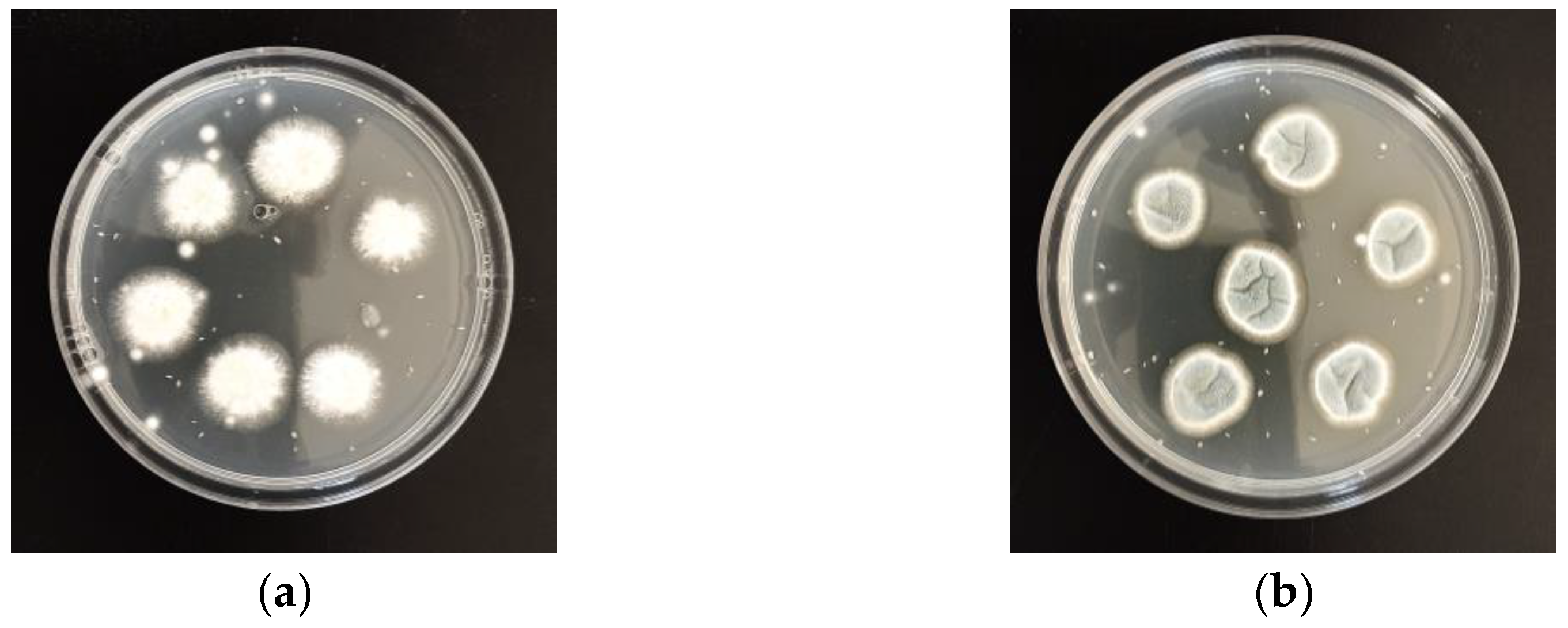
Figure 2.
Photographic progression of P. digitatum and P. italicum (time in hours).
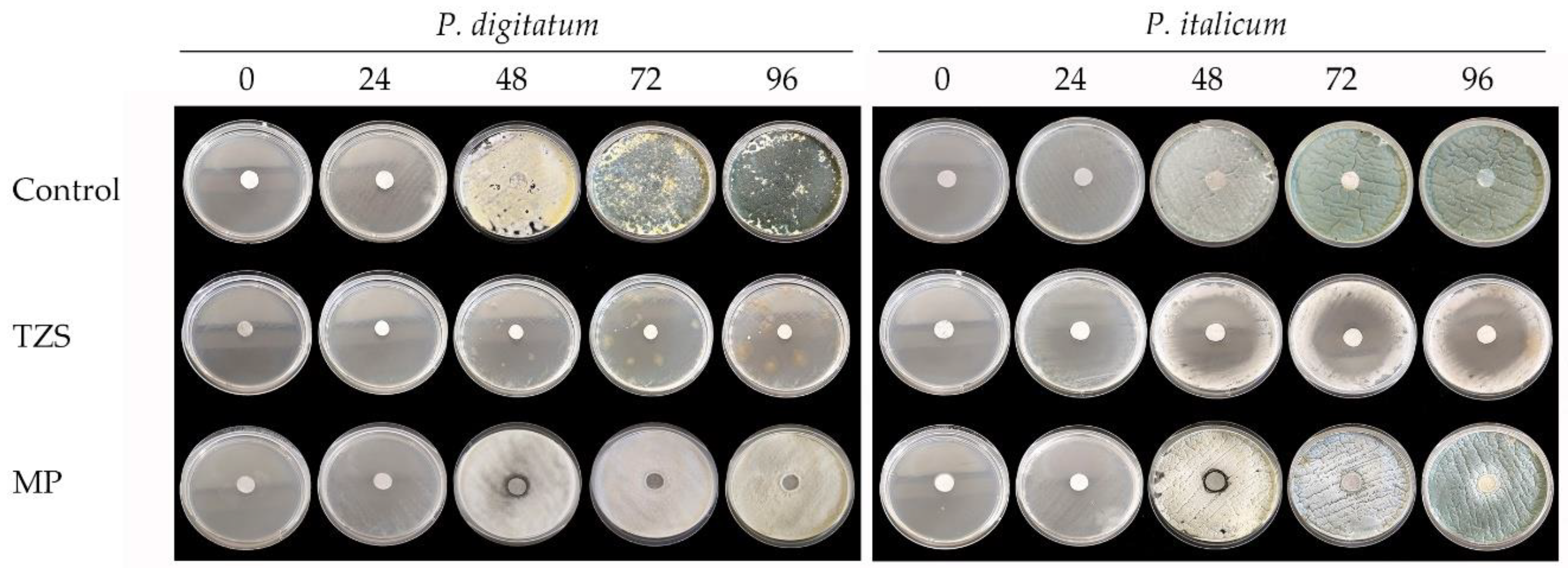
Figure 3.
Inhibition halo boxplot produced by the different essential oil samples.
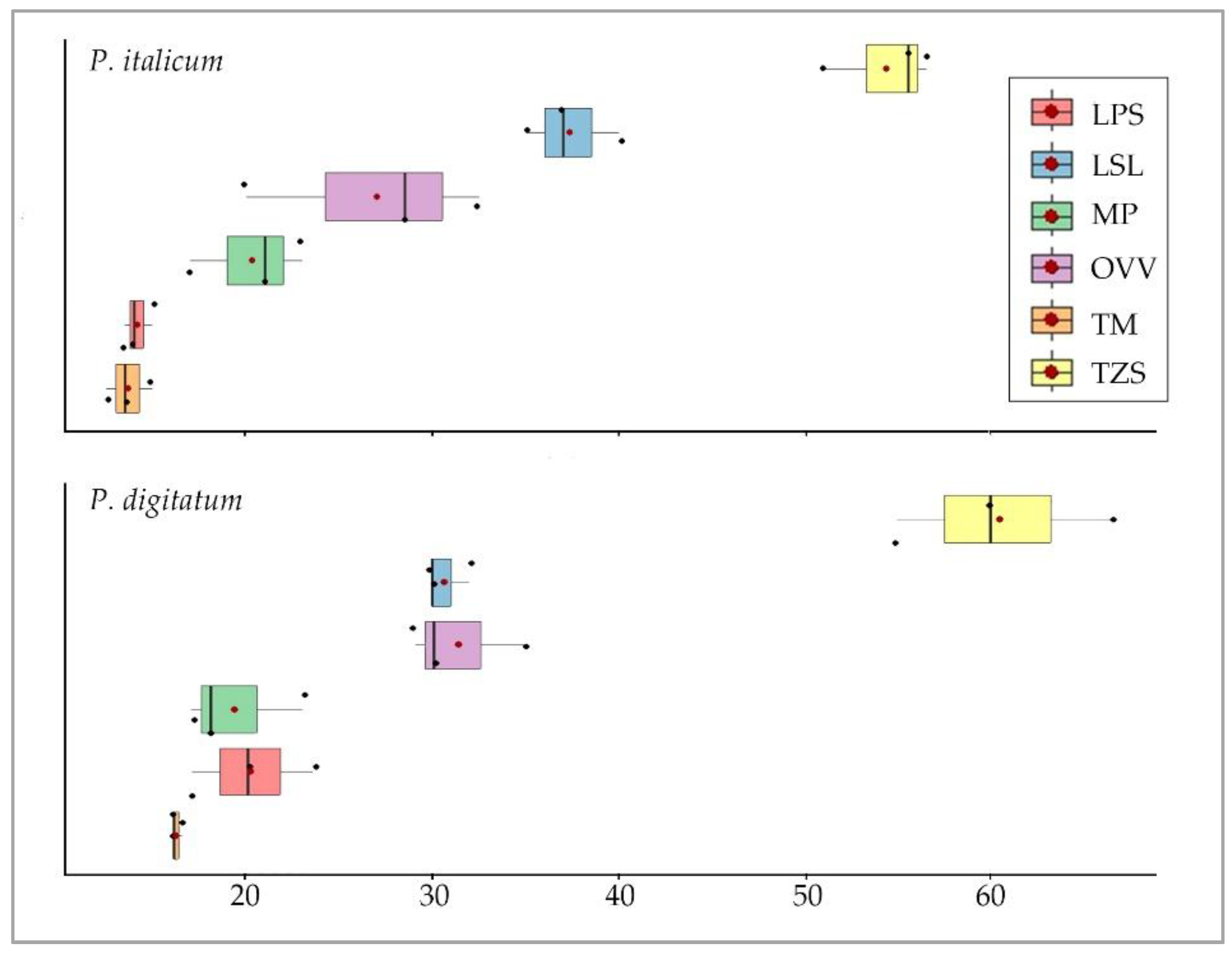
Figure 4.
Scatter plots.
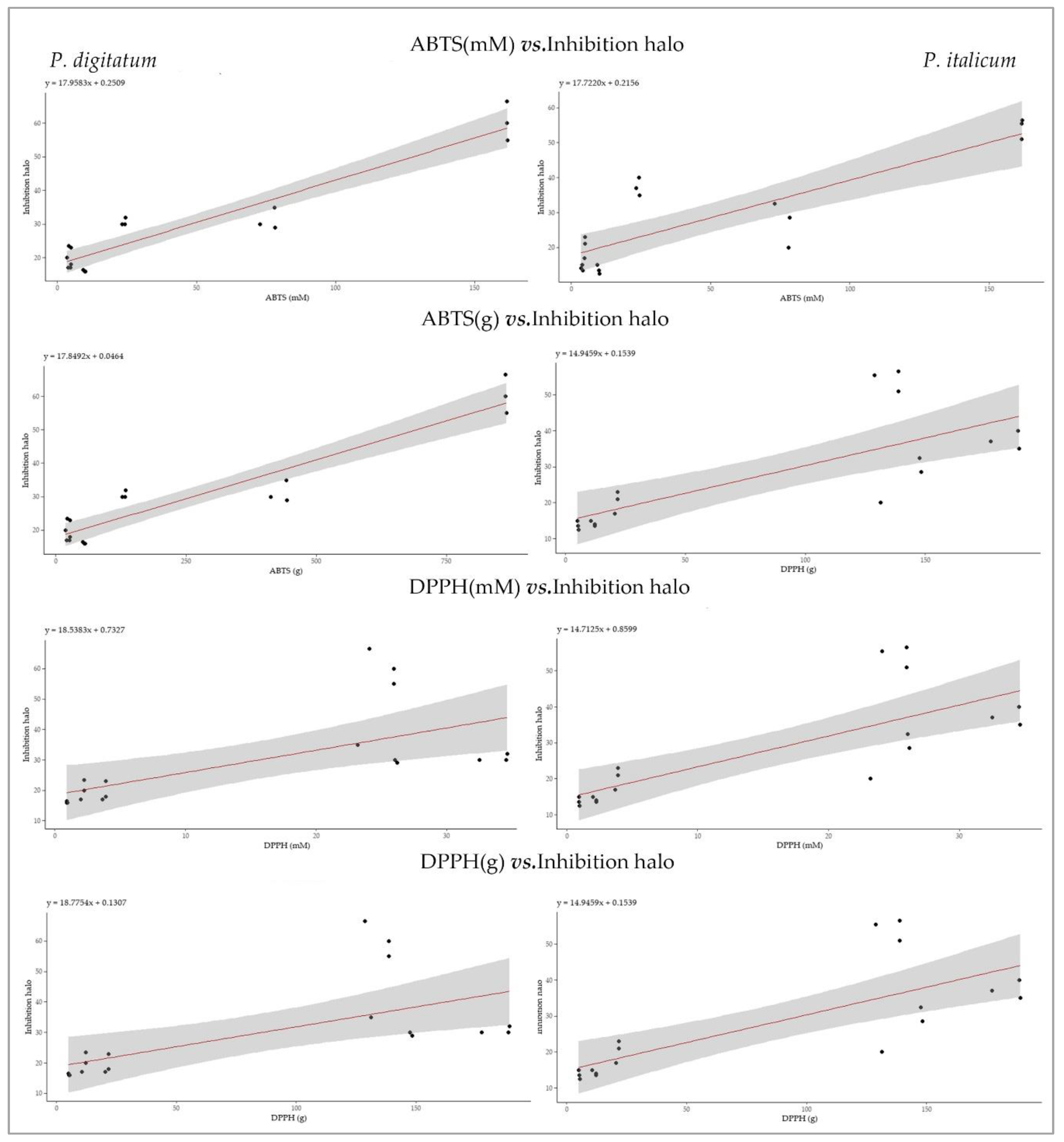

Table 1.
Yield of the essential oil extraction by hydrodistillation.
| Specie | Code | Yield (w/w) | % (w/w) |
|---|---|---|---|
| Origanum vulgare subsp. virens | OVV | 4.09 | 0.41 |
| Lavandula pedunculata subsp. sampaioana | LPS | 12.80 | 1.28 |
| Lavandula stoechas subsp. luisieri | LSL | 4.22 | 0.42 |
| Thymus zygis subsp. sylvestris | TZS | 8.78 | 0.88 |
| Thymus mastichina | TM | 24.29 | 2.43 |
| Mentha × piperita | MP | 6.17 | 0.62 |
Table 2.
Composition of the essential oils.
| RI-WAX | RI-HP5 | Compound | OVV | LPS | LSL | TM | TZS | MP |
|---|---|---|---|---|---|---|---|---|
| 1025 | 933 | Alpha-Pinene | 0.67 | 6.35 | 1.83 | 3.44 | 0.51 | 0.74 |
| 1029 | 918 | Alpha-Thujene | 1.63 | 0.01 | 0.21 | 1.32 | 0.06 | |
| 1069 | 953 | Camphene | 0.29 | 2.29 | 0.10 | 0.10 | 0.14 | 0.02 |
| 1114 | 978 | Beta-Pinene | 0.18 | 0.05 | 0.30 | 5.11 | 0.13 | 1.17 |
| 1126 | 972 | Sabinene | 0.29 | 0.03 | 0.12 | 3.83 | 0.07 | 0.67 |
| 1133 | 940 | Cymene Isomer | 2.67 | |||||
| 1165 | 991 | Beta-Myrcene | 2.28 | 0.17 | 0.07 | 1.87 | 1.91 | 0.33 |
| 1186 | 1018 | Alpha-Terpinene | 3.76 | 0.03 | 1.33 | 0.26 | ||
| 1206 | 1021 | Limonene | 0.35 | 2.03 | 0.20 | 1.17 | 0.32 | 3.42 |
| 1222 | 1039 | 1,8-Cineole | 0.02 | 0.93 | 17.71 | 66.06 | 6.72 | |
| 1238 | 1035 | Cis-Beta-Ocimene | 2.15 | 0.15 | 0.45 | 0.02 | 0.01 | 0.27 |
| 1254 | 1058 | Gamma-Terpinene | 30.69 | 0.05 | 0.12 | 1.79 | 5.72 | 0.41 |
| 1278 | 1025 | Para-Cymene | 5.26 | 0.24 | 0.14 | 1.03 | 9.36 | 0.08 |
| 1418 | 1090 | Fenchone | 34.20 | 0.28 | ||||
| 1465 | 1074 | Trans-Sabinene Hydrate | 0.16 | 0.70 | 0.68 | 0.82 | ||
| 1484 | 1124 | Menthone | 29.12 | |||||
| 1500 | 1164 | Menthofuran | 4.94 | |||||
| 1510 | 1166 | Isomenthone | 4.31 | |||||
| 1541 | 1149 | Camphor | 36.51 | 1.00 | ||||
| 1553 | 1100 | Linalool | 0.16 | 2.00 | 2.29 | 4.14 | 0.86 | 0.26 |
| 1574 | 1294 | Menthyl Acetate | 2.36 | |||||
| 1592 | 1239 | Thymol Methyl Ether | 1.88 | 0.01 | ||||
| 1595 | 1119 | Fenchol<endo-> | 0.86 | |||||
| 1599 | 1288 | Bornyl Acetate | 0.98 | 0.06 | <0,01 | |||
| 1606 | 1280 | Trans-Alpha-Necrodyl Acetate | 20.46 | |||||
| 1607 | 1239 | Carvacrol Methyl Ether | 2.38 | 0.05 | ||||
| 1608 | 1165 | Neo-Menthol | 4.11 | |||||
| 1617 | 1450 | Trans-Beta Caryophyllene | 1.61 | 0.04 | 0.22 | 0.12 | 1.41 | 1.18 |
| 1619 | 1284 | Lavandulyl Acetate | 0.20 | 4.01 | ||||
| 1636 | 1296 | Arbozol | 2.24 | |||||
| 1653 | 1169 | L-Menthol | 27.56 | |||||
| 1662 | 1170 | Delta-Terpineol | 1.50 | 0.22 | ||||
| 1665 | 1244 | Pulegone | 3.98 | |||||
| 1668 | 1187 | 5-Methylene-2,3,4,4-tetrame-2-Cyclopentenone | 2.37 | |||||
| 1860 | Unknown Sesquiterpenol | 2.06 | ||||||
| 1679 | 1172 | Trans-Alpha-Necrodol | 6.56 | |||||
| 1696 | 1195 | Alpha-Terpineol | 0.11 | 0.29 | 0.29 | 4.86 | 0.13 | 0.44 |
| 1713 | 1167 | Borneol | 0.65 | 0.78 | 0.12 | 0.34 | 0.02 | |
| 2168 | 1293 | Thymol | 36.72 | 68.83 | 0.08 | |||
| 2192 | 1316 | Carvacrol | 0.28 | 0.17 | 2.54 |
Table 3.
Antioxidant Activity results (ABTS and DPPH methods).
| Code | ABTS | DPPH | ||
|---|---|---|---|---|
| mM TROLOX eq. | g TROLOX eq. / g EO | mM TROLOX eq. | g TROLOX eq. / g EO | |
| OVV | 76.45 ± 3.02 | 433.01 ± 17.10 | 25.15 ± 1.69 | 142.45 ± 9.57 |
| LPS | 3.84 ± 0.26 | 20.79 ± 1.41 | 2.17 ± 0.16 | 11.73 ± 0.87 |
| LSL | 24.06 ± 0.64 | 131.33 ± 3.47 | 33.91 ± 1.21 | 184.99 ± 6.58 |
| TM | 9.76 ± 0.41 | 54.19 ± 2.30 | 0.96 ± 0.03 | 5.31 ± 0.16 |
| TZS | 161.70 ± 0.15 | 864.20 ± 0.81 | 25.34 ± 1.08 | 135.42 ± 5.78 |
| MP | 4.83 ± 0.09 | 26.94 ± 0.51 | 3.83 ± 0.13 | 21.34 ± 0.74 |
Table 4.
Statistical parameters from inhibition halo measurement.
| EO | x̅ | s | Me | Max | Min | SEM | g₁ | g₂ |
|---|---|---|---|---|---|---|---|---|
| P. digitatum | ||||||||
| OVV | 31.33 | 3.21 | 30.00 | 35.00 | 29.00 | 1.86 | 0.34 | -2.33 |
| LPS | 20.17 | 3.25 | 20.00 | 23.50 | 17.00 | 1.88 | 0.05 | -2.33 |
| LSL | 30.67 | 1.15 | 30.00 | 32.00 | 30.00 | 0.67 | 0.38 | -2.33 |
| TM | 16.17 | 0.29 | 16.00 | 16.50 | 16.00 | 0.17 | 0.38 | -2.33 |
| TZS | 60.50 | 5.77 | 60.00 | 66.50 | 55.00 | 3.33 | 0.09 | -2.33 |
| MP | 19.33 | 3.21 | 18.00 | 23.00 | 17.00 | 1.86 | 0.34 | -2.33 |
| P. italicum | ||||||||
| OVV | 27.00 | 6.38 | 28.50 | 32.50 | 20.00 | 3.69 | -0.22 | -2.33 |
| LPS | 14.17 | 0.76 | 14.00 | 15.00 | 13.50 | 0.44 | 0.21 | -2.33 |
| LSL | 37.33 | 2.52 | 37.00 | 40.00 | 35.00 | 1.45 | 0.13 | -2.33 |
| TM | 13.67 | 1.26 | 13.50 | 15.00 | 12.50 | 0.73 | 0.13 | -2.33 |
| TZS | 54.33 | 2.93 | 55.50 | 56.50 | 51.00 | 1.69 | -0.34 | -2.33 |
| MP | 20.33 | 3.06 | 21.00 | 23.00 | 17.00 | 1.76 | -0.21 | -2.33 |
Table 5.
Shapiro-Wilk test results.
| variables | W | p-value | W | p-value |
|---|---|---|---|---|
| P. digitatum | P. italicum | |||
| inhibition halo (mm) | 0.80130 | 0.00159 | 0.86399 | 0.01418 |
| ABTS (mM) | 0.72045 | 0.00014 | 0.72045 | 0.00014 |
| ABTS (g) | 0.72651 | 0.00017 | 0.72709 | 0.00017 |
| DPPH (mM) | 0.79313 | 0.00122 | 0.79468 | 0.00122 |
| DPPH (g) | 0.79468 | 0.00128 | 0.79468 | 0.00128 |
Table 6.
Spearman’s correlation test results obtained in inhibition halo measurements.
| variables | S | p-value | ρ | S | p-value | ρ |
|---|---|---|---|---|---|---|
| P. digitatum | P. italicum | |||||
| ABTS (mM) | 245.38 | 3.70 · 10-4 | 0.75 | 247.88 | 3.98 · 10-4 | 0.74 |
| ABTS (g) | 235.35 | 2.75 · 10-4 | 0.76 | 247.88 | 3.98 · 10-4 | 0.74 |
| DPPH (Mm) | 232.34 | 2.51 · 10-4 | 0.76 | 176.77 | 3.42 · 10-5 | 0.82 |
| DPPH (g) | 238.36 | 3.01 · 10-4 | 0.75 | 194.80 | 6.98 · 10-5 | 0.80 |
Disclaimer/Publisher’s Note: The statements, opinions and data contained in all publications are solely those of the individual author(s) and contributor(s) and not of MDPI and/or the editor(s). MDPI and/or the editor(s) disclaim responsibility for any injury to people or property resulting from any ideas, methods, instructions or products referred to in the content. |
© 2025 by the authors. Licensee MDPI, Basel, Switzerland. This article is an open access article distributed under the terms and conditions of the Creative Commons Attribution (CC BY) license (http://creativecommons.org/licenses/by/4.0/).
Copyright: This open access article is published under a Creative Commons CC BY 4.0 license, which permit the free download, distribution, and reuse, provided that the author and preprint are cited in any reuse.


