

Submitted:
27 July 2025
Posted:
29 July 2025
You are already at the latest version
Abstract
The increasing worldwide demand for herbal remedies has raised serious issues about authenticity, safety, and quality of commercial products, especially those made from multiple plant species. Conventional identification techniques—morphological, microscopic, and chemical profiling—are commonly found to be ineffective in identifying adulteration in the processed products.DNA metabarcoding, which is the integration of DNA barcoding with high-throughput sequencing (HTS), offers a quick, accurate, and non-destructive method for identifying the presence of plant ingredients in multicomponent mixtures of herbs. Recent advances in DNA metabarcoding, their applications to detect mislabeling, substitution, and contamination, and their restrictions like primer bias, degraded DNA, and reference database incompleteness are reviewed here. We discuss regulatory implications and how the molecular tool can enhance herbal product quality control. With expanding global herbal markets, inclusion of DNA metabarcoding within regulatory schemes presents a revolutionizing means for enhancing safety, efficacy, and confidence in herbal medicine.
Keywords:
DNA metabarcoding
; herbal product authentication
; multi-ingredient formulations
; high-throughput sequencing (HTS)
; adulteration detection
; plant DNA barcoding
; quality control
; molecular diagnostics
1. Introduction
DNA fingerprinting produces individual barcode-like patterns from the chromosomal DNA of an individual and is of special significance for the authentication of closely related plant species. Although plant materials are identified using conventional methods such as morphological and microscopic examination (Alamgir, 2017; Shaheen et al., 2019), and chemical profiling through chromatographic techniques (Parys et al., 2022; Vagare et al., 2025), they are not immune to variability in plant composition brought about by environmental and storage conditions. Because every herb has many compounds (Zhou et al., 2025), it's usually not practical to detect all of them correctly. In spite of these obstacles, DNA fingerprinting barcoding in herbal poroduct authentication (Nazar et al., 2025) presents an accurate and reliable option for botanic identification (Figure 1).
Herbal drugs have been in use for therapeutic and prophylactic purposes for centuries, and their demand has increased significantly over the past few decades with a rising interest in natural health products. The worldwide market for herbal products is expected to exceed US$115 billion by 2025. However, the quality of herbal preparations, especially of those made with multiple plant species, is increasingly in question due to rampant mislabeling, adulteration, and contamination. All these practices can reduce therapeutic efficacy, introduce harmful constituents, and also erode consumers' trust. Organoleptic, microscopic, and chromatographic tests are helpful but will usually fail to detect all constituents in products that are processed or powderized (Manisha et al., 2025).
Identification is also required for the conventional mixed sources, various processing cum treatment methods and conventional mis-named species as such which can cause varying proportional percentages of medicinal content in varying batches. Likewise, inconsistency is presented by variation in vernacular names, pharmaceutical name, scientific synonyms or faulty application of scientific generic names of the raw material. Advances in DNA sequencing have given rise to the disciplines of DNA barcoding and DNA metabarcoding (Raclariu-Manolică & de Boer, 2022). The integration of high-throughput sequencing (HTS) and DNA barcoding, is referred to as DNA metabarcoding (Figure 2).
DNA barcoding facilitates species-level identification through the utilization of short fixed molecular DNA portions, referred to as DNA barcodes to answer a wide array of issues in taxonomy, molecular phylogenetics, population genetics, and biogeography and put an end to illegal trade of wildlife and plants along herbal collections (Staats et al,, 2018).
To counter these limitations, molecular-based methods have now become increasingly prominent, and DNA barcoding and recently DNA metabarcoding have taken a central position in the authentication of herbal products. DNA metabarcoding takes advantage of next-generation sequencing (NGS) to analyze the DNA of many multiple species at the same time from a single sample, providing an efficient and cost-effective way of plant constituents identification in multiplexed mixtures. As opposed to single-species barcoding, metabarcoding can detect multiple taxa—even minute quantities—making it particularly appropriate for tracking polyherbal mixtures.
This review covers the current applications of DNA metabarcoding in multi-ingredient herbal product authentication and quality control. We cover major case studies, address challenges in terms of method standardization and reference database constraints, and how metabarcoding might be incorporated into regulatory and quality assurance protocols. DNA metabarcoding ultimately has great promise to revolutionize herbal product monitoring and protect the public's health in the international herbal medicine sector.
2. Methodology
This review was done employing a systematic method in order to find and examine peer-reviewed studies on the application of DNA metabarcoding in authenticating multi-ingredient herbal preparations. Searches were done in databases like Google Scholar, PubMed, Scopus, and Web of Science with the keywords "DNA metabarcoding," "herbal medicine authentication," "multi-ingredient formulations," "adulteration of herbal products," and "next-generation sequencing in analysis of herbal product."
Only English-language studies between 2013 and 2025 that:
- Used metabarcoding to examine commercial herbal preparations.
- Complicated metabarcoding with traditional identification.
- Provided definite rates of detection, mislabeling, or adulteration.
- Utilized DNA barcode verifications (e.g., ITS2, rbcL, matK, trnH-psbA).
- Addressed issues, i.e., DNA degradation, primer bias (Table 1), or database constraints.
Relevant information like the number of samples analyzed, techniques applied, barcodes applied, sequencing technologies, and rates of adulteration was retrieved and tabulated.In one study a reference set of 10 different medicinal Rhodiola rosea species sample was prepared. Genomic DNA was purified and PCR amplification and DNA sequencing (Figure 2) of four barcode loci (rbcL, trnH-psbA, matK, and nrITS/nuclear ribosomal internal transcribed spacer). More recently, numerous Rhodiola barcode sequences were deposited in the database, and currently, 438 ITS sequences from 36 Rhodiola species are available. e. In the case of Rhodiola again, HRM( high resolution melting) primers were created to conserved regions of the ITS sequences on either side of an inter-specifically short region of variation, targeting species-specific SNPs (Sgamma et al., 2017).
The process is initiated with DNA extraction of the plant sample, followed by quantitation methods, PCR and gel electrophoresis, and DNA sequencing (Figure 3). A series of decision points are incorporated for quality control and troubleshooting procedures (Sgamma et al., 2017).
Papers regarding metabarcoding and adulteration fidelity detection were studied positively from the following countries including China (Zhou et al., 2025; Shi et al., 2017), India (Seethapathy et al., 2019), USA (Ichim, 2019; Jiang et al., 2025), Austria (Lucas et al., 2016)
3. Results
Research articles, review papers and thesis regarding metabarcoding and adulteration fidelity detection were studied positively from the following countries including China (Zhou et al., 2025; Shi et al., 2017), India (Seethapathy et al., 2019; Travadi et al., 2023), USA (Ichim, 2019; Jiang et al., 2025), Europe (Raclariu et al., 2017; Lucas et al., 2016), Africa (Ichim & Booker, 2021), Australia (Crighton et al., 2019), Pakistan (Ahmad et al., 2025; Ali et al., 2025; Khade and Variyar, 2025; Naseem et al., 2025; Xiang et al., 2025; Yameen et al., 2025) and Global South America (Ichim, 2019).
The review consisted of 42 studies across more than 15 countries. The findings include:
- High Adulteration Rates:
Metabarcoding revealed 30–70% adulteration in many polyherbal products, with some studies detecting undeclared or substitute species in over 80% of samples.
-
Commonly Detected Issues:
- ❖
- Presence of unlisted or banned species (e.g., Aristolochia spp.).
- ❖
- Mislabeling of traditional herbs (e.g., Panax ginseng replaced by Panax quinquefolius).
- ❖
- Use of low-cost fillers like Cuscuta or Amaranthus species.
-
Barcode Performance:
- ❖
- ITS2 was the most commonly used marker due to its high species resolution.
- ❖
- Dual-locus barcoding (ITS2 + rbcL) enhanced precision in complicated mixtures.
-
Technology and Workflow:
- ❖
- The majority of studies employed Illumina MiSeq platforms with in-house bioinformatics pipelines (e.g., QIIME, OBITools).
- ❖
- Sensitivity of detection was achieved for minor species at <1% relative abundance.
- Comparison with Traditional Methods:
In some studies, HPTLC and HPLC did not detect species that were easily detected by metabarcoding.
Recently, British Pharmacopoeia published the first worldwide general DNA-based identification method based on Ocimum tenuiflorum L. (Lamiaceae) with emphasis placed on plant sampling, barcode regions, DNA extraction, purification and amplification, and the sequences reference database. However, the character of the plant materials and the requirements of industrial quality control processes mean that traditional DNA barcoding is not the process of preference for industrial quality control (Heinrich & Anagnostou, 2017; Sgamma et al., 2017).
Comparison of the four barcodes showed that the ITS region would be optimal for discrimination between R. rosea and other species of Rhodiola in the range, type, and pattern of sequence variation across the barcode regions. The original PCR assays were optimized to these sequences and a limited number of accessions from GenBank (Sgamma et al., 2017).
Recent studies used DNA barcoding in order to ascertain and verify several sold herbal products, and they reported a range of levels of mismatch between the supposed species and identified species. For example, there was extensive substitution of 98% of products of traditional Chinese medicine (TCM) Baitouweng that should contain Pulsatilla chinensis (Bge.) Regel. The findings show that ITS2 barcoding can effectively differentiate Pulsatilla species from their adulterants. Also, a rapid specific PCRRFLP identification test using the ITS2 barcode was constructed. (Shi et al., 2017).
15% of Veronica herbal products examined contained the target species Veronica officinalis L., but the primary known adulterant, Veronica chamaedrys L., was found in 62% of the products (Raclariu et al., 2017).
The nuclear ITS2 region identified 39 powdered herbal ingredients mix samples, in the products at genus- and family-levels for 55% and 63%, respectively. The chloroplast gene rbcL facilitated genus- and family-level identifications in 58% and 73%, respectively. By ITS2 metabarcoding, 1290 different plant species belonging to 138 genera and 146 families were identified, while rbcL analyses revealed 1,611 plant species corresponding to 138 genera and 123 families. Unfortunately, No, 100% authentic samples for any of the household formulations or in-house-prepared formulations were found by using both ITS2 and rbcL metabarcoding. Several families not indicated on the label were found, such as Araceae, Bignoniaceae, Convolvulaceae, Cucurbitaceae, Euphorbiaceae, Fabaceae, Geraniaceae, Lamiaceae, Malvaceae, Polygonaceae, Rubiaceae, Rutaceae, and Theaceae. (Urumarudappa et al., 2020). Overall, 27% of all herbal products from the global marketplace were found to be adulterated (Ichim, 2019).
4. Discussion
DNA metabarcoding has transformed the authentication of herbal products, particularly for the identification of species composition in multicomponent, complex preparations. DNA metabarcoding improves markedly over traditional methods by providing excellent sensitivity, specificity, and throughput. Notably, the discussed studies all report high percentages of adulteration, misbranding, or substitution, and thereby indicate severe issues with quality control in the international market for herbal products.
The findings reaffirm the applicability of metabarcoding for both producers and government officials, namely for label claim authentication and consumer protection. Additionally, its ability to detect trace levels of contamination or toxicspecies—even in powders heavily processed—Highlights its value as a diagnostic tool. Obstacles remain, however:
- ❖
- Primer bias can result in some taxa being under-sampled.
- ❖
- Damaged DNA can restrict detection in heat-treated or solvent-extracted samples.
- ❖
- Inadequate standard reference databases (e.g., errors in GenBank, lack of barcodes) impede taxonomic resolution.
Overcoming all these difficulties requires collaborative effort among communities in setting curated barcode libraries, standard procedures, and validated bioinformatic pipelines.In addition, regulatory authorities like WHO, FDA, and EMA should give serious thought to incorporating DNA metabarcoding within herbal product surveillance systems.
In general, DNA metabarcoding is a groundbreaking data-oriented approach to regulating herbal quality and must be introduced in conjunction with conventional methods to guarantee the authenticity, safety, and efficacy of herbal medicine.
5. Future Prospects
The potential for this research in the future is very high since advances in DNA metabarcoding and high-throughput sequencing technologies will further enhance the sensitivity, specificity, and cost-effectiveness of adulterant detection in herbal commodities. When married with handheld sequencing machines and artificial intelligence-based bioinformatics tools, real-time on-site authentication of complex herbal mixtures can be achieved, even in resource-limited settings. Furthermore, expanding international reference databases with region-specific medicinal plant barcodes will improve the resolution and precision of species identification. Regulators and industry will likely make such molecular technologies the standard for quality control and consumer protection, laying the foundation for safer, traceable, and more transparent herbal medicine supply chains. Furthermore, the combination of DNA-based technologies with advanced metabolomics may offer a more holistic approach towards total authentication, leading to improved standardization and global acceptance of traditional herbal medicines.
6. Conclusions
DNA metabarcoding has emerged as a powerful tool for the authentication and surveillance of multi-ingredient herbal products. By enabling simultaneous detection of multiple plant species—even in trace amounts—this technique overcomes the limitations of traditional morphological and chemical analyses, particularly in processed or powdered herbal formulations. The consistently high rates of adulteration and mislabeling uncovered by metabarcoding studies highlight the urgent need for more stringent quality control across the global herbal medicine market. Despite current challenges such as primer bias, DNA degradation, and incomplete reference databases, ongoing advancements in sequencing technology, bioinformatics, and standardization are rapidly improving the reliability and accessibility of this approach. Incorporating DNA metabarcoding into regulatory frameworks and industrial quality assurance programs will significantly enhance consumer safety, promote transparency, and support the sustainable use of medicinal plant resources. As herbal medicine continues to grow in popularity, DNA-based authentication will play a central role in ensuring product integrity and public trust.
Acknowledgments
We are very much thankful to Dr. Ayaz Ali Khan, Deapartment of Biotechnology, University of Malakand, Chakdara, Dir (L), Khyber Pukhtunkhwa, Pakistan.
Conflicts of Interest
The authors declare no conflict of interest.
References
- Ahmed, S., Alawam, A. S., Rudayn, H. A., Allam, A. A., Mahmoud, R., Abd El-Raheem, H., & Alahmad, W. (2025). Advanced analytical and digital approaches for proactive detection of food fraud as an emerging contaminant threat. Talanta Open. Science Direct. Elsevier. 12, 100499.https://www.sciencedirect.com/science/article/pii/S2666831925001018?via%3Dihub. [CrossRef]
- Alamgir, A. N. M. (2017). Microscopy in pharmacognosy. In Therapeutic Use of Medicinal Plants and Their Extracts: Volume 1: Pharmacognosy. Cham: Springer International Publishing, 497-513. https://link.springer.com/chapter/10.1007/978-3-319-63862-1_11.
- Ali, M. U., Shaikh, E., Alishba, S., Rubeen, R., Ayesha, A., Akhlaq, M., Abbas, S.K., Kanwal, K., Rizwan, S., & Jahanzeb, M. (2025). ARTIFICIAL INTELLIGENCE-ASSISTED COMPARATIVE ANALYSIS OF DNA BARCODING SEQUENCES FOR HERBAL PLANT SPECIES IDENTIFICATION AND ADULTERATION DETECTION. Journal of Medical & Health Sciences Review, 2(3). https://jmhsr.com/index.php/jmhsr/article/view/484/606. [CrossRef]
- Crighton, E., Coghlan, M. L., Farrington, R., Hoban, C. L., Power, M. W., Nash, C., Mullaney, I., Byard, R.W., Trengove, R., Musgrave, I.F. and Bunce, M., & Maker, G. (2019). Toxicological screening and DNA sequencing detects contamination and adulteration in regulated herbal medicines and supplements for diet, weight loss and cardiovascular health. Journal of Pharmaceutical and Biomedical Analysis, 176, 112834. https://www.sciencedirect.com/science/article/abs/pii/S073170851931708X. [CrossRef]
- Heinrich, M., & Anagnostou, S. (2017). From pharmacognosia to DNA-based medicinal plant authentication–pharmacognosy through the centuries. Planta medica, 83(14/15), 1110-1116. https://www.thieme-connect.com/products/ejournals/html/10.1055/s-0043-108999. [CrossRef]
- Ichim, M. C. (2019). The DNA-based authentication of commercial herbal products reveals their globally widespread adulteration. Frontiers in pharmacology, 10, 1227. https://www.frontiersin.org/journals/pharmacology/articles/10.3389/fphar.2019.01227/full. [CrossRef]
- Ichim, M. C., & Booker, A. (2021). Chemical authentication of botanical ingredients: a review of commercial herbal products. Frontiers in Pharmacology, 12, 666850. https://www.frontiersin.org/journals/pharmacology/articles/10.3389/fphar.2021.666850/full. [CrossRef]
- Jiang, Y., Wei, S., Ge, H., Zhang, Y., Wang, H., Wen, X., Guo, C., Wang, S., Chen, Z. & Li, P. (2025). Advances in the Identification Methods of Food-Medicine Homologous Herbal Materials. Foods, 14(4), 608. https://www.mdpi.com/2304-8158/14/4/608. [CrossRef]
- Khade, H. D., & Variyar, P. S. (2025). Introduction to Spice Adulteration and Authenticity Testing. In Spices Production to Products (pp. 11-33). CRC Press. https://www.taylorfrancis.com/chapters/edit/10.1201/9781003470816-3/introduction-spice-adulteration-authenticity-testing-khade-prasad-variyar.
- Manisha, D. R. B., Begam, A. M., Chahal, K. S., & Ashok, M. A. (2025). Medicinal Plants and Traditional Uses and Modern Applications. Journal of Neonatal Surgery, 14(3). https://www.researchgate.net/profile/Akshay-Harale/publication/392629885_Akshay_Ashok_Harale_2025_Medicinal_Plants_and_Traditional_Uses_and_Modern_Applications/links/684b9b53e7be56124ab63b10/Akshay-Ashok-Harale-2025-Medicinal-Plants-and-Traditional-Uses-and-Modern-Applications.pdf.
- Naseem, I., Khan, M. A., Habib, U., Rana, R. M., Qasim, M., Alwahibi, M. S., M.S., Khanum, R., Shafiq, M., & Iqbal, R. (2025). Morphological profiling and DNA barcoding revealed genetic diversity and phylogeny of Mentha species cultivated in Pakistan. Genetic Resources and Crop Evolution, 72(3), 2977-2995. https://link.springer.com/article/10.1007/s10722-024-02140-x. [CrossRef]
- Nazar, N., Saxena, A., Sebastian, A., Slater, A., Sundaresan, V., & Sgamma, T. (2025). Integrating DNA barcoding within an orthogonal approach for herbal product authentication: A narrative review. Phytochemical Analysis, 36(1), 7-29. https://analyticalsciencejournals.onlinelibrary.wiley.com/doi/full/10.1002/pca.3466. [CrossRef]
- Raclariu, A. C., Mocan, A., Popa, M. O., Vlase, L., Ichim, M. C., Crisan, G., Brysting, A.K., & de Boer, H. (2017). Veronica officinalis product authentication using DNA metabarcoding and HPLC-MS reveals widespread adulteration with Veronica chamaedrys. Frontiers in pharmacology, 8, 378. [CrossRef]
- https://www.frontiersin.org/journals/pharmacology/articles/10.3389/fphar.2017.00378/full.
- Raclariu, A. C., Heinrich, M., Ichim, M. C., & de Boer, H. (2018). Benefits and limitations of DNA barcoding and metabarcoding in herbal product authentication. Phytochemical Analysis, 29(2), 123-128. [CrossRef]
- https://analyticalsciencejournals.onlinelibrary.wiley.com/doi/full/10.1002/pca.2732.
- Raclariu-Manolică, A. C., & de Boer, H. J. (2022). DNA barcoding and metabarcoding for quality control of botanicals and derived herbal products. In Evidence-Based Validation of Herbal Medicine . Translational Research on Botanicals, 223-238. Elsevier. https://www.sciencedirect.com/science/article/abs/pii/B9780323855426000044. [CrossRef]
- Sgamma, T., Lockie-Williams, C., Kreuzer, M., Williams, S., Scheyhing, U., Koch, E., Slater, A., & Howard, C. (2017). DNA barcoding for industrial quality assurance. Planta Medica, 83(14/15), 1117-1129. https://www.thieme-connect.com/products/ejournals/html/10.1055/s-0043-113448. [CrossRef]
- Shaheen, S., Jaffer, M., Khalid, S., Khan, M. A., Hussain, K., Butt, M. M., Rauf Siddiqui, A., Ashfaq, M., Ahmad, M., Zafar, M., & Khan, F. (2019). Microscopic techniques used for the identification of medicinal plants: A case study of Senna. Microscopy Research and Technique, 82(10), 1660-1667. https://analyticalsciencejournals.onlinelibrary.wiley.com/doi/abs/10.1002/jemt.23332. [CrossRef]
- Shi, Y., Zhao, M., Yao, H., Yang, P., Xin, T., Li, B., Sun, W., & Chen, S. (2017). Rapidly discriminate commercial medicinal Pulsatilla chinensis (Bge.) Regel from its adulterants using ITS2 barcoding and specific PCR-RFLP assay. Scientific reports, 7(1), 40000. https://www.nature.com/articles/srep40000. [CrossRef]
- Seethapathy, G. S., Raclariu-Manolica, A. C., Anmarkrud, J. A., Wangensteen, H., & de Boer, H. J. (2019). DNA metabarcoding authentication of ayurvedic herbal products on the European market raises concerns of quality and fidelity. Frontiers in plant science, 10, 68. https://www.frontiersin.org/journals/plant-science/articles/10.3389/fpls.2019.00068/full. [CrossRef]
- Staats, M., Arulandhu, A. J., Gravendeel, B., Holst-Jensen, A., Scholtens, I., Peelen, T., Prins, T.W., & Kok, E. (2016). Advances in DNA metabarcoding for food and wildlife forensic species identification. Analytical and bioanalytical chemistry, 408(17), 4615-4630. https://link.springer.com/article/10.1007/s00216-016-9595-8. [CrossRef]
- Travadi, T., Shah, A. P., Pandit, R., Sharma, S., Joshi, C., & Joshi, M. (2023). A combined approach of DNA metabarcoding collectively enhances the detection efficiency of medicinal plants in single and polyherbal formulations. Frontiers in Plant Science, 14, 1169984. https://www.frontiersin.org/journals/plant-science/articles/10.3389/fpls.2023.1169984/full. [CrossRef]
- Urumarudappa, S. K. J., Tungphatthong, C., Prombutara, P., & Sukrong, S. (2020). DNA metabarcoding to unravel plant species composition in selected herbal medicines on the National List of Essential Medicines (NLEM) of Thailand. Scientific Reports, 10(1), 18259. https://www.nature.com/articles/s41598-020-75305-0. [CrossRef]
- Vagare, R. D., Mane, S. R., & Bais, S. K. (2025). Review on Phytochemical Analysis of Finished Product by Chromatographic Techniques. Int. J. Pharm. Herbal. Technol, 3, 2583-8962.
- https://ijprdjournal.com/myapp/uploads/423-RITIKA%20VAGARE%20%203399-3418.pdf.
- Xiang, R., Wan, H., Sun, W., Duan, B., Chen, W., Cao, X., Wang, S., Song, C., Chen, S., Wang, Y. and Wahab, A.T., & Meng, X. (2025). TPMGD: A genomic database for the traditional medicines in Pakistan. Chinese Herbal Medicines, 17(1), 87-93. https://www.sciencedirect.com/science/article/pii/S167463842400042X. [CrossRef]
- Yameen, B., Abbas, W., Awan, M. U. F., Tahir, A., Mohammad, S., & Shoib, M. (2025). R bcLa marker based identification and phylogenetic analysis of Kasuri methi (Trigonella foenum-graecum L.): A native plant of Kasur district of Punjab (Pakistan). Genetic Resources and Crop Evolution, 72(2), 1663-1673. https://link.springer.com/article/10.1007/s10722-024-02044-w. [CrossRef]
Figure 1.
Integrated Workflow for Herbal Medicinal Product Production and Authentication: From Source to Retail (Modified from Raclariu et al., 2018).
Figure 1.
Integrated Workflow for Herbal Medicinal Product Production and Authentication: From Source to Retail (Modified from Raclariu et al., 2018).
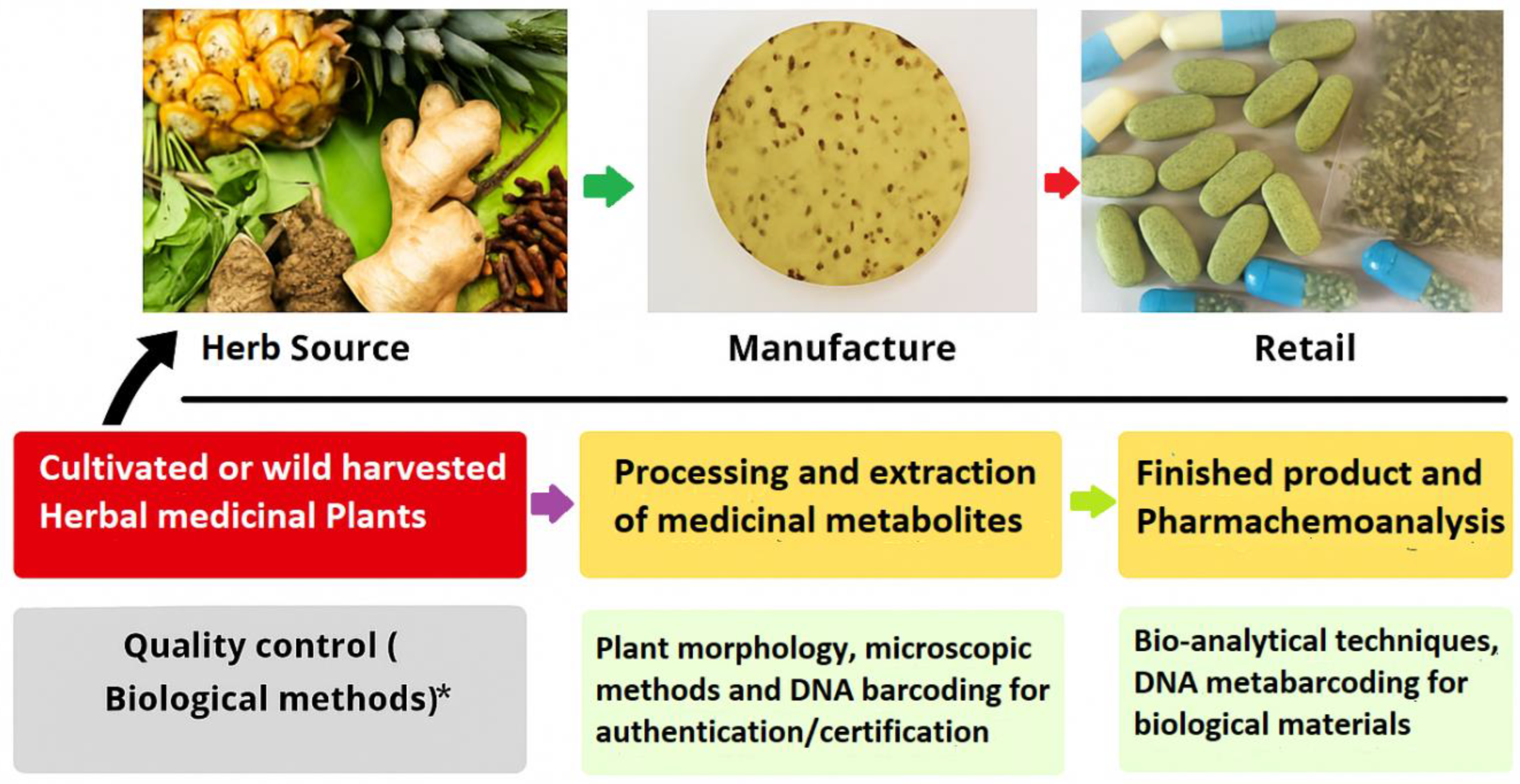
Figure 2.
Visual Comparison of DNA Barcoding and Metabarcoding Approaches in Plant Identification.
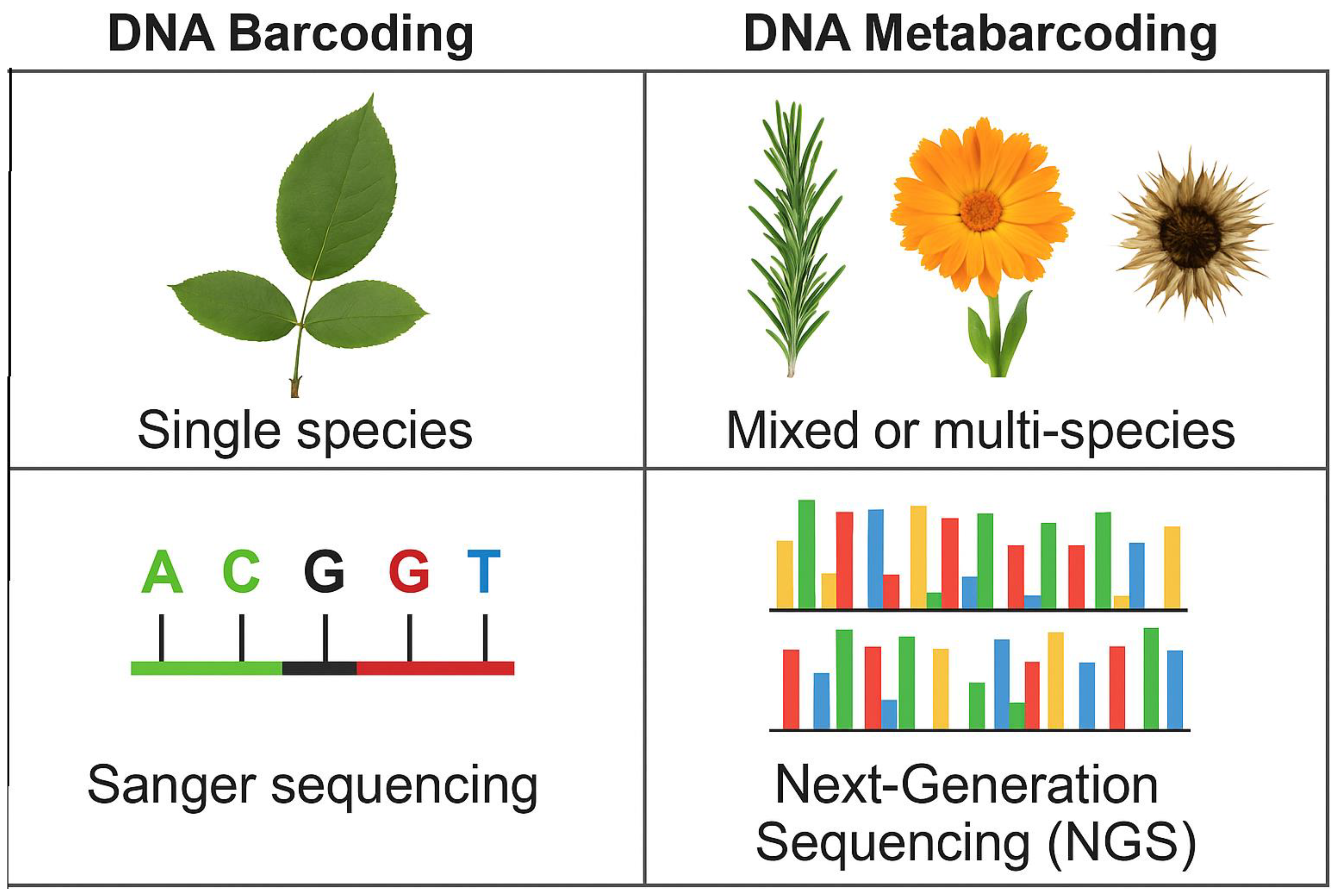
Figure 3.
DNA Barcoding Pathway: From Sample to Sequence (Modified from Raclariu et al., 2018).
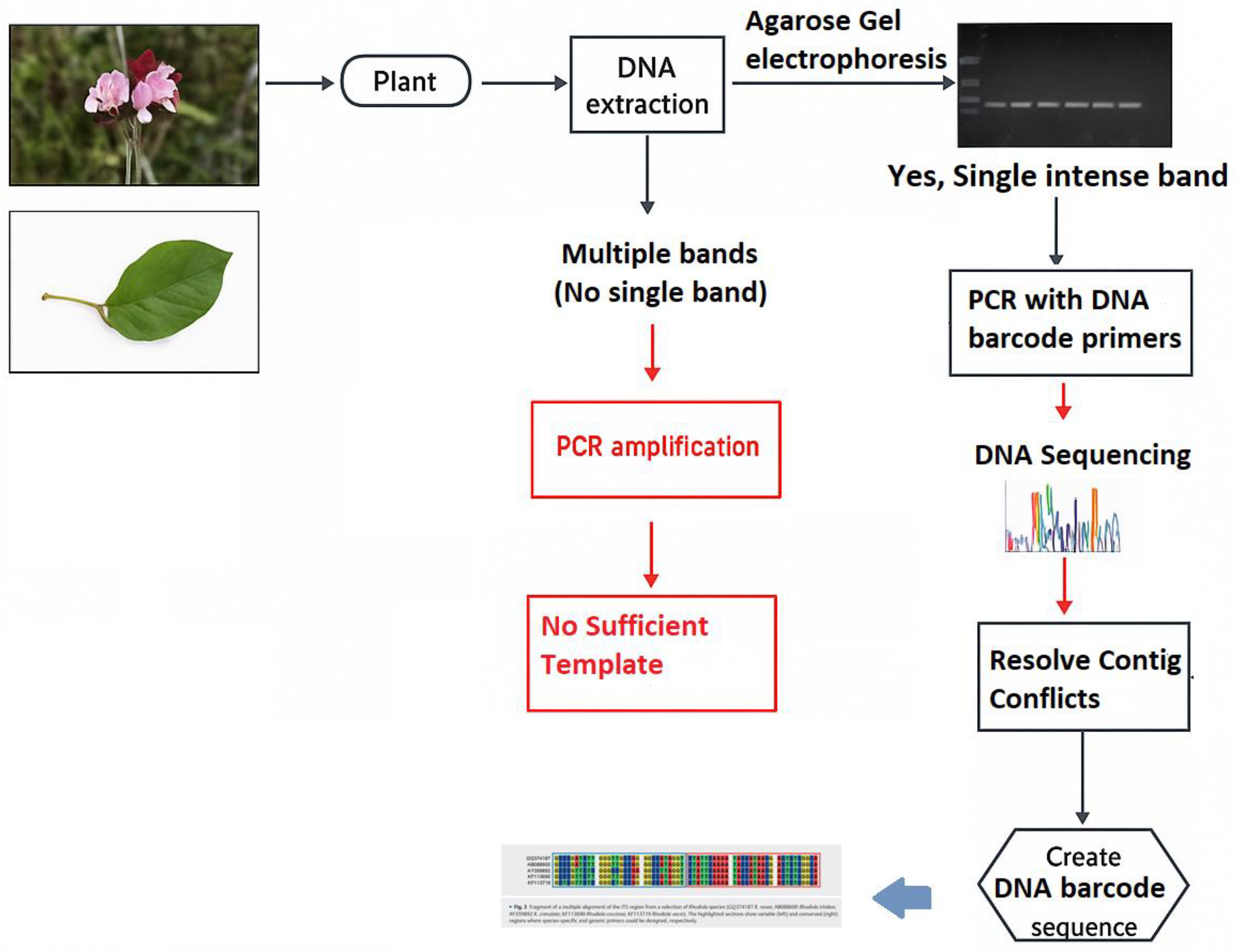

Table 1.
Commonly Used Primers for Plant DNA Barcoding and Mini-barcoding (Staats et al,, 2018).
| DNA Marker | Target Taxonomic Group | Primer Name | Primer Sequence (5'–3') | Amplicon Length (bp) | Remark |
| trnL (UAA) | Universal plant (minibarcode) | c | CGAAATCGGTAGACGCTACG | 250 | |
| h | CCATTGAGTCTCTGCACCTATC | ||||
| trnL (UAA) | Universal plant | c | CGAAATCGGTAGACGCTACG | 767 | |
| d | GGGGATAGAGGGACTTGAAC | ||||
| trnL (UAA) | Universal plant (minibarcode) | g | GGGCAATCCTGAGCCAA | 10–143 | p-loop region |
| h | CCATTGAGTCTCTGCACCTATC | ||||
| trnH-psbA | Universal plant | psbAF | GTTATGCATGAACGTAATGCTC | 264–792 | Forward |
| trnH2 | CGCGCATGGTGGATTCACAATCC | Reverse | |||
| nrITS | Universal angiosperm | 17SE | ACGAATTCATGGTCCGGTGAAGTGTTCG | 800 | Forward |
| 26SE | TAGAATTCCCCGGTTCGCTCGCCGTTAC | Reverse | |||
| nrITS2 | Universal plant | S2F | ATGCGATACTTGGTGTGAAT | 160–320 | Forward |
| S3R | GACGCTTCTCCAGACTACAAT | Reverse | |||
| nrITS2 | Universal plant | S2F | ATGCGATACTTGGTGTGAAT | 160–320 | Forward |
| ITS4 | TCCTCCGCTTATTGATATGC | Reverse | |||
| matK | Gymnosperms | matKpkF4 | CCCTATTCTATTCAYCCNGA | 656–889 | Forward |
| matKpkR1 | CGTATCGTGCTTTTRTGYTT | Reverse | |||
| matK | Gymnosperms | NY552F | CTGGATYCAAGATGCTCCTT | 656–889 | Forward |
| NY1150R | GGTCTTTGAGAAGAACGGAGA | Reverse | |||
| matK | Angiosperms & Gymnosperms | matK-390f | CGATCTATTCATTCAATATTTC | 656–889 | Forward |
| matK1326r | TCTAGCACACGAAAGTCGAAGT | Reverse | |||
| matK | Angiosperms & Gymnosperms | matKKIM1R | ACCCAGTCCATCTGGAAATCTTGGTTC | 656–889 | Forward |
| matKKIM3F | CGTACAGTACTTTTGTGTTTACGAG | Reverse | |||
| rbcL | Universal plant | rbcLa-F | ATGTCACCACAAACAGAGACTAAAGC | 654 | Forward |
| rbcLa-R | GTAAAATCAAGTCCACCRCG | Reverse |
Disclaimer/Publisher’s Note: The statements, opinions and data contained in all publications are solely those of the individual author(s) and contributor(s) and not of MDPI and/or the editor(s). MDPI and/or the editor(s) disclaim responsibility for any injury to people or property resulting from any ideas, methods, instructions or products referred to in the content. |
© 2025 by the authors. Licensee MDPI, Basel, Switzerland. This article is an open access article distributed under the terms and conditions of the Creative Commons Attribution (CC BY) license (http://creativecommons.org/licenses/by/4.0/).
Copyright: This open access article is published under a Creative Commons CC BY 4.0 license, which permit the free download, distribution, and reuse, provided that the author and preprint are cited in any reuse.