

Submitted:
24 July 2025
Posted:
25 July 2025
You are already at the latest version
Abstract
Introduction. This article examines the relationship between variations in linguistic self-esteem and academic performance among international students studying Russian at the preparatory department of the K. A. Timiryazev Russian State Agricultural Academy during the 2023-2024 academic year. The study aims to explore the correlation between students' levels of linguistic self-esteem and their success in learning Russian as a foreign language. It hypothesizes that students with persistently low self-esteem may achieve better language acquisition outcomes compared to those with accurate or inflated self-perceptions. Research methods involved surveying students before and after their exams, followed by comparative analysis of the collected data. The survey included 74 students representing 35 countries. Key findings reveal a notable pattern: higher academic achievement correlates with lower self-esteem. Conversely, students with average or lower scores tend to have a more realistic assessment of their language skills and exhibit lower aspirations. Specific results indicate that students who achieved “excellent” grades predominantly have stable low self-esteem (16 to 2), while those with “good” grades also show predominantly stable self-esteem (12 to 5). Students with average results tend to have a more balanced view of their self-esteem, and underperforming students also demonstrate predominantly stable self-esteem. The novelty of this research lies in its comparative approach, analyzing students’ actual academic results alongside their perceptions of language proficiency over a two-year period. Practically, the findings can inform the development of more effective teaching strategies that account for students' psychological characteristics and their linguistic self-esteem. Future research could further investigate the underlying causes of low self-esteem among successful students and develop methods to optimize the learning process by considering individual self-esteem profiles.
Keywords:
linguistic self-assessment
; Russian as a foreign language
; types of self-assessment
; level of self-assessment
; stability of self-assessment
Introduction
This study constitutes a continuation of the analysis of linguistic self-assessment data of students conducted in the 2022–2023 academic year at the Preparatory Department for International Students at the K.A. Timiryazev Russian State Agrarian University – Moscow Timiryazev Agricultural Academy (RGAU-MSHA).
Attention to self-assessment as an autonomous psychological phenomenon has been devoted since the mid-20th century. As noted by several researchers, the definition of self-assessment remains a challenging issue; nevertheless, the phenomenon continues to be actively investigated.
The aim of this research is to replicate the 2023 experiment in 2024 and refine its findings to validate the initial hypothesis, which posits a relationship between the level of linguistic self-assessment and academic performance among students learning Russian as a foreign language. It is hypothesized that students exhibiting a stable low self-assessment may achieve greater success in mastering the Russian language curriculum than those with stable accurate or inflated self-assessments.
To fulfill this aim, several objectives are set forth:
- to administer a questionnaire to students in 2024 regarding their linguistic self-assessment;
- to compare the obtained responses with those of students from 2023;
- to outline a comprehensive typology of linguistic self-assessment forms and their correlation with the research outcomes.
The scientific novelty of this study lies in the approach whereby students’ actual performance results are compared with their own perceptions of language proficiency. Additionally, by analyzing data collected over two consecutive years, this investigation enables an enhancement of existing findings through the inclusion of new material.
The relevance of this work pertains to examining linguistic self-assessment as a significant factor influencing students’ academic achievement, thereby potentially facilitating the development of more effective pedagogical approaches tailored to the psychological characteristics of learners. Moreover, recognizing linguistic self-assessment as a distinct category is critical. While numerous international studies address students’ self-assessment and its relationship to academic success, the specific focus on linguistic self-assessment in the context of foreign language learning (particularly Russian) acquires special importance. Understanding the structure of linguistic self-assessment aids in improving strategies for adapting international students to the Russian academic environment.
The subject of this research is students’ self-perception of their language skills.The object of the study encompasses the types of linguistic self-assessment formed by students of the preparatory faculty during one academic year of Russian language instruction (either 2023 or 2024).
Ethical Review
This study was approved by the Institutional Review Board of RGAU-MSHA. Participants provided informed consent. Personal identifying information was removed from all electronic records during data encryption. Student responses, both during and after the survey, were anonymized in accordance with the Declaration of Helsinki and the guarantee of each participant’s confidentiality.
Literature Review
The relationship between self-assessment and academic achievement is well-established and thoroughly studied. General psychological frameworks [1,2,3,4,5,6,7] have extensively examined the structure of self-assessment, alongside its role in educational settings [8,9,10,11,12,13,14,15,16,17] and its association with satisfaction derived from academic performance [18,19,20,21], predominantly based on data from secondary school and university students [22,23,24,25,26,27].
One of the earliest conceptualizations of self-perception was proposed by William James, who distinguished several forms of self-representation. It is thus logical to consider language self-assessment within the broader framework of social self-representation because, as James noted, “a person has as many social selves as there are individuals who recognize them.”
Researchers postulating self-representations have also explored the individual’s attitude toward themselves, encompassing both positive and negative evaluations. Despite the existence of the concept of “global self-esteem as a unified and integral construct”, many scholars support the view that self-perception is segmented; it comprises various forms of self-representations such as self-assessment, self-respect, and self-acceptance.
Ellis (1962) posited that generally negative self-esteem leads to emotional disorders. Expanding on this, subsequent scholars linked low self-esteem to reduced frustration tolerance. Massin thoroughly examined the relationship between negative self-esteem and mental health, confirming the connection between self-esteem and self-acceptance, while differentiating the functions of these constructs. He stated that “while self-acceptance and self-esteem are similar, theoretical differences exist between the two. Findings indicate that self-acceptance influences overall psychological well-being, whereas self-esteem is more related to issues in the development and maintenance of depressive thoughts. This supports Ellis’s viewpoint that self-acceptance is tied to overall psychological well-being”.
In the Russian research tradition, a hierarchy of self-assessments is distinguished, with generalized self-esteem at the apex. This generalized self-esteem is further divided into academic and non-academic domains (the latter subdivided into physical, emotional, and social aspects).
It is also important to mention the dichotomy of self-consciousness consisting of the “I and me” and “I and others,” which defines dual systems governing self-regulation of actions based on self-evaluation of external manifestations, internal motivation, and social appraisal of effectiveness and social value. The interplay of these self-representational facets shapes the profile of students’ self-assessment.
Concerning more specialized investigations of self-assessment, it is pertinent to highlight research by Asian scholars examining academic success and failure as key factors influencing self-esteem.
A study by Pakistani psychologists investigating the interrelations among optimism, self-assessment, and academic achievement revealed that the reciprocal influence between self-assessment and academic success is significant, whereas optimism exerts no notable effect on either self-esteem or academic achievement. This finding provides substantial evidence for the link between students’ academic accomplishments and their self-assessment. The authors also underscore the potential role of cultural factors in shaping student self-esteem, although the specific mechanisms remain unspecified. The cultural dimension is especially significant in the context of Russian language learners, who should not be evaluated by parameters standard for native Russian students due to differences in the importance of cultural and social contextual factors such as family authority, community status, gender roles, and stereotypes. In this respect, it is advisable to consult sources investigating self-esteem among Asian (notably Iranian) students, who constitute the principal demographic of the preparatory division for international students at the K.A. Timiryazev Russian State Agrarian University – Moscow Timiryazev Agricultural Academy (RGAU-MSHA).
An Iranian study focusing on medical students’ self-esteem examined its relationship with motivation in detail. The research demonstrated a direct correlation between academic performance and achievement motivation: “Individuals with higher academic achievements generally exhibit higher performance motivation”. Furthermore, the authors reached surprising conclusions that “motivation plays a far more critical role in learning and academic achievement than does intelligence,” an important addition to the structural understanding of self-esteem.
In a parallel investigation conducted at Gilani University (Iran), which studied students’ self-assessment, the researchers found that family opinion is a significant factor influencing student self-esteem. Additionally, the link between education and attainment of higher social status serves as an extra motivational factor, connecting self-esteem with other self-assessment types. Thus, for Iranian students, external societal evaluation is as consequential as internal assessment. The study authors emphasize that differences in self-assessment are more pronounced across students from different countries than among Iranian students studying various disciplines, underscoring culture as a decisive factor. A statistically significant association was also established between interest in the subject and academic achievement.
Developing the idea of familial impact on self-esteem formation, S. Batul discusses the relationship between a positive family upbringing model and school as well as academic success. Batul further highlights that “self-assessment appears to function as an academic self-regulation mechanism capable of reducing procrastination and improving achievement”. Moreover, the self-esteem model proposed contests claims by contemporary researchers suggesting self-esteem has a direct significant effect on academic achievement. The author stresses her findings support the proposition that “low self-esteem does not always predict poor academic performance”.
Indian researchers, concluding differently on the correlation among self-esteem, happiness, and academic success, argue that “self-esteem and happiness are more dependent on positive interpersonal relationships and social engagement, which bring approval and personal satisfaction, rather than purely material metrics such as grades”. This conclusion highlights the superior influence of social bonds within peer groups over academic results on student self-esteem.
Contrasting these findings, another Indian study claims “the higher the self-esteem, the higher the academic performance and achievements. Therefore, a favorable home environment enhances self-esteem, allowing adolescents to confidently solve problems and face life’s challenges”.
A direct correlation between high self-esteem and academic achievement has also been confirmed by Iranian researchers through meta-analyses [14, well as by Chinese scholars studying rural schoolchildren.
Hence, even within a single country, contradictory evidence exists regarding the link between self-esteem and academic accomplishment. Nonetheless, these studies collectively provide a general understanding of prevailing trends. The problem of language self-assessment, as a subset of general self-esteem, is also partially conditioned by social context.
The students surveyed in our study were isolated from their families and native cultures, enabling an examination of their language self-assessment independent of external factors.
Currently, domestic research addresses issues related to the influence of low self-esteem on second language acquisition success, as well as the broader patterns linking low self-esteem and academic achievement. Accordingly, several works have proposed methods to enhance students’ self-esteem.
The study by O.S. Saikina on language self-assessment among learners of Russian and its impact on academic outcomes is noteworthy. Analysis of Chinese students newly arrived in Russia and those residing more than a year revealed that “students immersed in the language environment for over a year exhibit greater self-confidence”. Thus, the author also emphasizes the reciprocal effect of academic success and language proficiency progress on students’ global self-esteem.
In the present study, language self-assessment is conceptualized as a specific instantiation of general self-esteem, defined as “the aggregate of an individual’s socially, culturally, and psychologically conditioned and emotionally colored representations of proficiency in one or more languages”.
However, although the correlation between self-esteem and language learning success cannot be denied, the directionality of causation remains unclear without further in-depth research. It is unknown whether poor academic achievement causes low self-esteem or vice versa. Consequently, this study opts to consider three levels of self-assessment: low, accurate, and overestimated.
O.N. Molchanova notes that individuals with low self-esteem “possess a confused self-concept, characterized by uncertainty, contradiction, and variability. The lack of precise knowledge about their own abilities renders such individuals sensitive to social evaluations, contributing to instability in self-representations”.
Thus, theory reveals a correlation between self-esteem level and its stability, with the strength of this correlation shaped by culturally determined significance of external (family, social status) and internal (gender, age, interest in the subject) factors.
Synthesizing existing theories suggests that self-esteem is linked to academic achievement while maintaining a degree of stability, capable of persisting at a high, accurate, or low level regardless of external conditions.
Based on the cited research, it is hypothesized that language self-assessment, as a subset of general self-esteem, similarly depends on properties of stability and level.
Theoretical Framework of the Study
Cultural differences in this study were mitigated, as all students experienced equally discomforting conditions, being separated from their families and cultures and compelled to establish communication both with Russian and international peers. Russian served as the lingua franca. Unlike the online learning context in our previous studies, in this setting, students had the opportunity to realistically assess their linguistic abilities in an authentic language environment, encountering daily communicative situations where they could either successfully achieve their communicative intentions or experience communicative failure.
Given that the study focused on changes in self-assessment in relation to external factors—namely, the outcomes of the final certification—it was decided to consider the stability of self-assessment among its various aspects. Both stable and fluctuating self-assessments were observed. From a psychological perspective, instability of self-assessment “is accompanied by a distinct set of affective and motivational characteristics: increased anxiety, frustration with a predominance of extrapunitive reaction tendencies and fixation on self-defense, modification of interpersonal interaction styles combining elements of conformity with suspicion, secrecy, and aggressiveness, decreased emotional stability; additionally, increased emotionality and reduced plasticity as temperamental traits” 1.
Regarding the stability/instability parameter, two general types of linguistic self-assessment were proposed: stable and changing. Subsequently, it was planned to correlate these types with students’ actual exam results in Russian and, based on this, identify within stable self-assessment the subtypes of accurate, overestimated, and underestimated self-assessment; and within changing self-assessment, the increasing and decreasing types.
However, this description of the self-assessment structure proved insufficiently precise for interpreting the obtained data, as not all categories in the classification corresponded with the exam results.
Therefore, after comparing the 2023 and 2024 responses, it was decided to refine the self-assessment structure and to analyze the two-year results from this revised perspective.
Specifically, increasing and decreasing self-assessments were further subdivided according to their degree of adaptation to the actual assessment.
Definition and Classification of Self-Assessment Stability
Stable self-assessment is defined as a self-evaluation that remains unchanged before and after the examination and the announcement of results.
Based on the degree of alignment with exam outcomes, stable self-assessment is categorized into three types:
- Low stable, where the self-assessed score is lower than the exam result;
- Accurate (or realistic), where the self-assessment matches the exam result;
- Overestimated, where the self-assessed score exceeds the exam result.
Changing self-assessment may be either decreasing, meaning the self-assessment prior to the exam is higher than after the exam, or increasing, where the self-assessment before the exam is lower than after.
Furthermore, both increasing and decreasing self-assessments can vary in their correspondence to reality. For instance, a decrease in self-assessment may shift from realistic to underestimated, or an increase may reach realistic levels, remain below realistic, or surpass realistic self-assessment.
In terms of concordance with reality, self-assessment is categorized as either accurate (realistic) or inaccurate (non-realistic). This distinction applies to both stable and changing types of self-assessment. Here, the reality of self-assessment is operationally defined by the examination results—a premise that, while assumptive, provides a useful benchmark for comparing self-assessment types in a generalized manner.
Methodology, Materials, and Methods
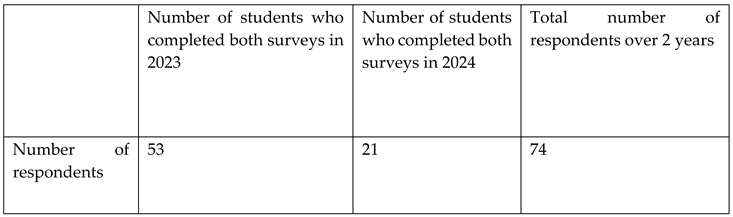
The materials consisted of paired questionnaires distributed to students, as well as summary records containing the results of the final Russian language examinations. Since not all respondents who completed the first survey answered the second questionnaire, the number of valid results presented in Table 1 is relatively small.
Methods
This study employed general scientific methods of questionnaire surveying and comparative data analysis. The selection of these methods was dictated by the need to obtain an overall depiction of the development of linguistic self-assessment, in line with the study’s aims and objectives.
The research was conducted in two stages: surveying and data analysis.
At the first stage, a questionnaire method was applied to students enrolled in the preparatory department. Students responded to several questions unrelated to language, as well as to a question regarding their self-assessed proficiency in the Russian language. Each student completed the questionnaire twice—once before the exam and once after taking the exam and receiving the results. The purpose of this dual questionnaire administration was to compare students’ perceptions of their language proficiency prior to evaluation with any changes in these perceptions influenced by the final results.
At the second stage, data collected during the surveys over two academic years (2022–2023 and 2023–2024) were analyzed.
The survey participants represented a diverse cohort from the following countries: Afghanistan, Benin, Botswana, Burundi, Vietnam, Haiti, Guinea, Greece, Democratic Republic of Congo, Zimbabwe, Israel, Indonesia, Jordan, Iran, Cameroon, China, Comoros, Cuba, Kenya, Laos, Mali, Mozambique, Mongolia, Nigeria, Senegal, Syria, Somalia, Sierra Leone, Thailand, Tanzania, Togo, Tunisia, Turkmenistan, Central African Republic, Chad, and Ecuador.
Data collection was carried out via the Google Forms service. Response tabulation and analysis were performed using Microsoft Excel.
Limitations of the Applied Methods
The methods employed in this study also presented several limitations. For instance, the sample size of respondents in the questionnaire survey is insufficient to draw more precise conclusions regarding linguistic self-assessment. Moreover, the questionnaire methodology itself has inherent systemic constraints and only allows for a broad general depiction of the dynamics involved in establishing linguistic self-evaluation.
In addition, the limitations previously identified for the method in 2023 [Solovyeva, pp. 93–94] remain relevant for the 2024 surveys. These limitations are associated with the five-point grading system and the nature of students’ self-assessment. For example, it is impossible to classify an “exceedingly high” type of self-assessment among students who received an “excellent” grade.
The analysis of data from students in 2023 and 2024 precludes conclusions about changes in self-assessment perceptions over a longer period of language acquisition, due to the preparatory faculty’s limited duration of Russian language instruction.
Nevertheless, despite these limitations, at this stage of the research, the available volume of data and the conclusions drawn therefrom are considered sufficient and appropriate to the study’s objectives.
Research Results
Final Assessment Outcomes and Self-Evaluation
The results over the two-year period demonstrated generally consistent trends. As shown in the table and figure below, there is an overall tendency toward underestimation in self-evaluation. Notably, the exam performance has a minimal impact on students’ self-assessment, as the scores assigned before and after the examination largely coincide. However, it is probable that our data are insufficient to establish definitive patterns, and thus, the observed tendencies should be interpreted only in a broad, general context.

Table 2.
.
 |
Figure 1.
.
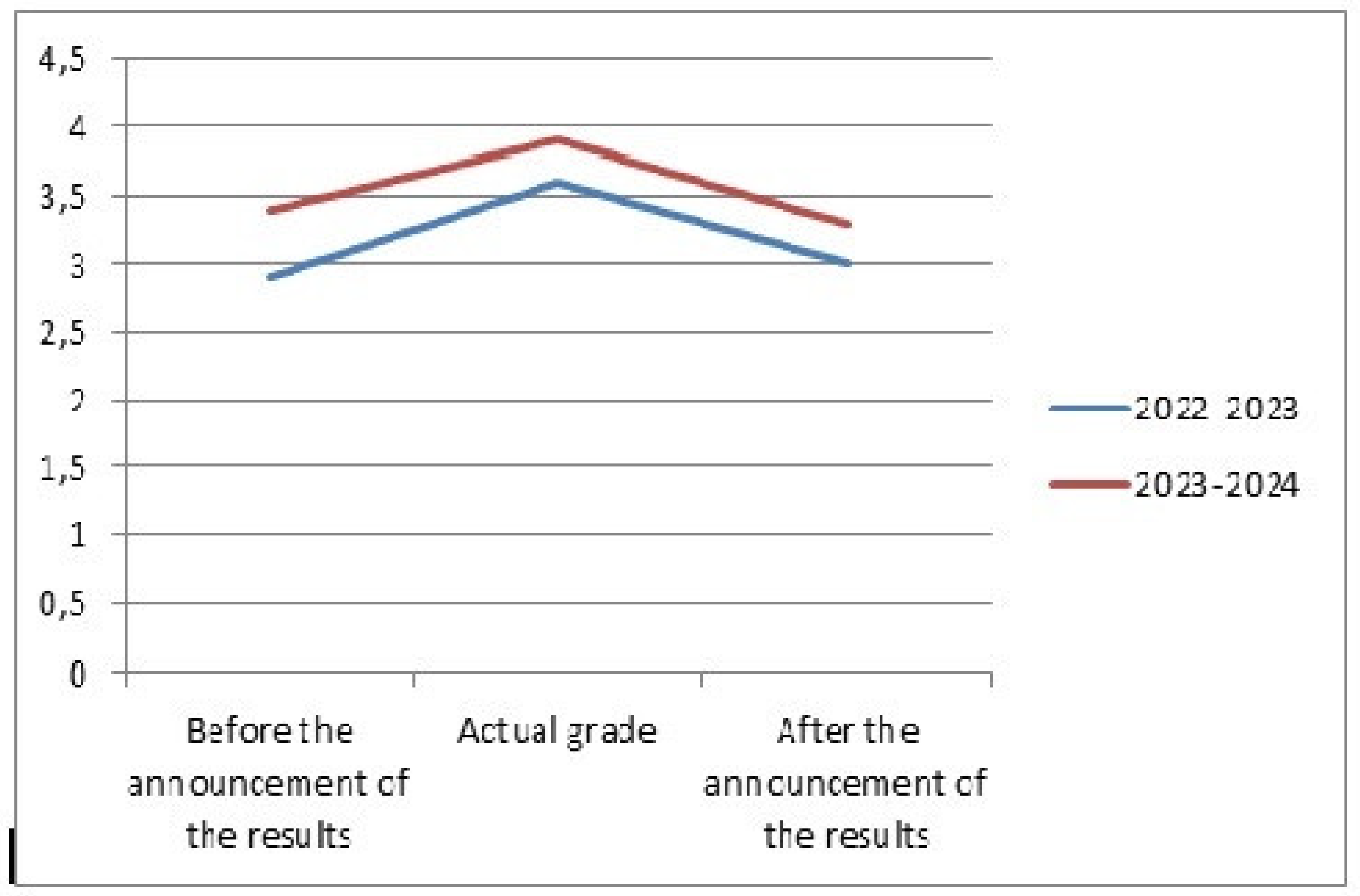
Thus, a cautious conclusion can be drawn that encouragement through high grades plays a less significant role in the formation of self-esteem than individual attitudes and beliefs. Overall, no significant correlation was found between academic grades and students’ linguistic self-esteem.
Profiles of Linguistic Self-Esteem Among Students with Varying Levels of Success in the Russian Language Course
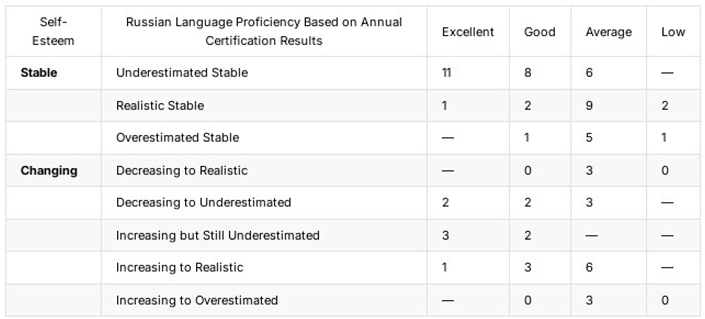
Based on survey data collected in 2023 and 2024 from a total of 74 students, 18 achieved “excellent” results, 18 achieved “good,” 35 were rated “satisfactory,” and 3 received “unsatisfactory” evaluations.
Analysis of the data revealed that students who obtained an “excellent” exam grade tended to exhibit stable rather than fluctuating self-esteem (12 vs. 6). Among those with stable self-esteem, the vast majority (11 students) underestimated their language proficiency relative to their actual exam performance, while only one student assessed their knowledge objectively. Of those whose self-esteem fluctuated, only one student’s self-assessment rose to align with a realistic evaluation. In the remaining five cases, self-esteem either increased (3 students) or decreased (2 students) but remained below the actual performance level. The overall ratio of underestimated to realistic self-esteem—combining both stable and changing cases—was 16 to 2.
Thus, it can be concluded that students demonstrating excellent academic achievement predominantly possess stable yet underestimated self-esteem. However, this correlation does not yet clarify the causal mechanisms underlying this pattern; it merely confirms an association between these parameters.
Similarly, students who received “good” grades were characterized primarily by stable self-esteem (11 stable vs. 7 changing). They also tended to undervalue their actual knowledge relative to their exam results (8 students). Only two students evaluated their skills realistically, and a single student maintained consistently inflated self-esteem.
Within the subset exhibiting fluctuating self-esteem, those whose self-esteem increased to a realistic level were slightly more numerous (3 students), while four showed self-esteem fluctuations that remained underestimated. No instances were observed in which self-esteem rose above realistic levels or declined from inflated to realistic. Overall, the ratio of underestimated to inflated self-esteem relative to realistic self-esteem—considering both stable and changing patterns—was 12 to 5. This ratio is more balanced compared to the “excellent” group, although the number of students with underestimated self-esteem remains higher.
Regarding the largest group—students with “satisfactory” results—the structure of self-esteem differed notably from the two preceding categories. Their self-esteem was also more commonly stable than variable (20 stable vs. 15 changing). However, the distribution of self-esteem levels varied. Among the 20 students with stable self-esteem, 9 realistically assessed their language proficiency, 6 underestimated, and 5 overestimated their abilities. Of the 15 students with fluctuating self-esteem, 6 increased their self-assessment to a realistic level; three students lowered their self-esteem to realistic, three lowered it to underestimated, and three heightened it to overestimated. The overall ratio of underestimated/overestimated to realistic self-esteem—across stable and changing profiles—was approximately 9/8 to 18.
Consequently, compared to the previous two groups, the “satisfactory” students exhibited a higher proportion of realistic self-evaluation and a larger contingent of individuals with overestimated self-esteem, either stable or acquired.
For the small group of students unable to achieve a passing grade (3 individuals), data were insufficient for definitive analysis, though they predominantly exhibited stable self-esteem.
Table 3.
Summary data for 2 years.
 |
Discussion
The obtained results contribute to a deeper understanding of the structure of students’ self-esteem, a topic recognized as highly relevant in contemporary global education research by both domestic and international scholars. An intriguing finding is that students with average and low academic performance exhibit greater stability in self-esteem and tend to evaluate their knowledge more realistically compared to high achievers and excellent students. Among these students, a larger proportion perceive their knowledge as undervalued. This aligns with findings from Pakistani psychologists, who concluded that low self-esteem does not negatively affect academic achievement to the extent previously assumed. Given that the scope of this study allows for identifying correlations but does not ascertain causal direction, several hypotheses may explain these observed patterns.
It is plausible that students with average or poor grades do not regard their lower results as problematic or threatening to their self-esteem. Many may consider their knowledge sufficient and feel satisfied with their outcomes. Furthermore, individual personality traits may lead to inflated self-esteem functioning as a psychological defense mechanism, preventing recognition of academic difficulties. High self-esteem among low-performing students has also been documented among Iranian students in prior studies, consistent with broader trends in this type of research. Overall, the data correspond with prior research demonstrating the stability of self-esteem under external influences. However, linguistic self-esteem paradoxically correlates with better performance despite being consistently low, challenging common assumptions.
Conclusion
The study confirmed a relationship between levels of linguistic self-esteem and academic achievement among students learning Russian as a foreign language. Students exhibiting persistently low self-esteem tended to achieve higher success in their Russian language program than those showing stable realistic or consistently inflated self-esteem. In particular, high achievers predominantly displayed stable but underestimated self-esteem. Students with good academic standing also showed mainly stable self-esteem, with a ratio of underestimated to inflated self-esteem at approximately 12 to 5. Students with satisfactory performance presented a more balanced profile, with a higher prevalence of realistic self-esteem; both underestimated and inflated self-esteem were observed, though stability predominated over fluctuation. Low-performing students mainly demonstrated stable self-esteem.
The study revealed a pattern whereby higher academic achievement correlates with lower self-esteem, while students with average or low results more often demonstrated realistic self-assessment of their abilities.
Moreover, linguistic self-esteem, while sharing general characteristics of self-esteem such as high/realistic/low and stable/fluctuating, appears only partially dependent on academic success and is significantly shaped by external factors.Future research could focus on investigating the causes underlying low self-esteem among high-achieving students and exploring strategies to overcome psychological discomfort while maintaining excellent performance.
Acknowledgements
The author expresses her gratitude to the reviewers for their expert opinion and constructive approach.
| 1 | Zin'ko, E.V. (2007). The relationship between self-esteem and aspiration level according to the parameters of stability and adequacy (Doctoral dissertation abstract, p. 8). [In Russian]. |
References
- Molchanova, O. N. (2006). Samootsenka: stabil’nost’ ili izmenchivost’? [Self-esteem: Stability or variability?]. Psikhologiya: Zhurnal Vysshey Shkoly Ekonomiki [Psychology: Journal of the Higher School of Economics], 3(2). Retrieved July 1, 2025, from https://cyberleninka.ru/article/n/samootsenka-stabilnost-ili-izmenchivost.
- Dryden, W., & Bond, F. W. (1994). Reason and emotion in psychotherapy: Albert Ellis. British Journal of Psychiatry, 165(1), 131–135. [CrossRef]
- James, W. (1998). The principles of psychology. Cambridge, MA: Harvard Publications.
- Macinnes, D. L. (2006). Self-esteem and self-acceptance: An examination into their relationship and their effect on psychological health. Journal of Psychiatric and Mental Health Nursing, 13(5), 483–489. [CrossRef]
- Wells, E., Hunnikin, L. M., & Ash, D. P. (2020). Low self-esteem and impairments in emotion recognition predict behavioural problems in children. Journal of Psychopathology and Behavioral Assessment, 42, 693–701. [CrossRef]
- Gayfulin, A. V. (2009). Razlichnye teor eticheskie podhody v opredelenii ponyatiya samootsenki [Different theoretical approaches to defining the concept of self-esteem]. Vestnik Tomskogo Gosudarstvennogo Pedagogicheskogo Universiteta [Bulletin of Tomsk State Pedagogical University], 1. Retrieved July 1, 2025, from https://cyberleninka.ru/article/n/razlichnye-teoreticheskie-podhody-v-opredelenii-ponyatiya-samootsenki.
- Chesnokova, I. I., & Shorokhova, E. V. (1977). Problema samosoznaniya v psikhologii [The problem of self-consciousness in psychology]. Moscow: Nauka.
- Akram, B., & Suneel, I. (2018). Relationship of optimism with academic achievement and self-esteem among university students in Pakistan. International Journal of Social Sciences & Educational Studies, 5(2), 108–119. [CrossRef]
- Arbabisarjou, A., Zare, S., Shahrakipour, M., & Ghoreishinia, G. (2016). The relationship between self-esteem and academic achievement motivation in university students. International Journal of Pharmacy and Technology, 8(2), 12353–12360. [CrossRef]
- Asgari, F., Mirzaee, M., Tabari, R., & Kazemnejad Leili, E. (2016). Self-esteem in students of Guilan University of Medical Sciences. Research in Medical Education, 8(2), 18–26. [CrossRef]
- Batool, S. S. (2019). Academic achievement: Interplay of positive parenting, self-esteem, and academic procrastination. Australian Psychologist, 72(2), 1–14. [CrossRef]
- Chacko, C. H. M., & Abraham, S. S. (2017). Academic performance, self-esteem and happiness among adolescents in Kerala. Journal of Indian Psychology, 4(4), 47–54. [CrossRef]
- Cheema, G. K., & Bhardwaj, M. (2021). Study of self-esteem and academic achievement in relation to home environment among adolescents. European Journal of Molecular & Clinical Medicine, 8(1), 1978–1987.
- Enayati, B., & Homayouni, N. (2018). Examine the role of self-esteem in learners’ academic progress: Research-based meta-analysis. Journal, 7(9), 249–264.
- Golizadeh, Z. (2024). Meta-analysis of the relationship between self-esteem and academic achievement. Educational Psychology, 19(70), 200–226. [CrossRef]
- Neroni, J., Celeste, M., Kirschner, P. A., Xu, K. M., & de Groot, R. H. M. (2022). Academic self-efficacy, self-esteem, and grit in higher online education: Consistency of interests predicts academic success. Social Psychology of Education, 25, 951–975. [CrossRef]
- Tamannaifar, M. R., & Gandomi, Z. (2011). Correlation between achievement motivation and academic achievement in university students. Educational Strategy in Medical Sciences, 4(1), 15–19.
- Chelvam, T., & Ismail, N. (2020). Relationship between self-esteem, happiness and academic performance among children. Academic Journal of Business and Social Sciences, 4(1), 1–11.
- Daraei, M. (2017). An investigation of the relationship between depression and self-esteem with academic performance. Journal, 19(5), 117–126.
- Ghourbanpour, A., Talebi, G., & Taghipour, M. (2016). Relationship between self-esteem and academic progress in physiotherapy students at Babol University of Medical Sciences. Journal, 4(2), 34–39.
- Moradi, D., Karami, M., Ghanei Gheshlagh, R., Nemat, M., & Dehvan, F. (2018). Evaluation of the relationship between self-esteem and academic success in nursing students of Kurdistan University of Medical Sciences, Sanandaj, Iran in 2018. SJNMP, 4(2), 71–78.
- Hosseini, S. N., Mirzaei-Alavijeh, M., Karami-Matin, B., Hamzeh, B., Ashtarian, H., & Jalilian, F. (2016). Locus of control or self-esteem; which one is the best predictor of academic achievement in Iranian college students? Iranian Journal of Psychiatry and Behavioral Sciences, 10(1). [CrossRef]
- Kamala, S., & Selvaraju, R. (2019). Relationship between self-esteem and academic achievement of higher secondary students. Pramana Research Journal, 9(8).
- Kazemi Jujili, M., & Khanzadeh, M. (2022). Structural model of the relationship between resiliency and academic achievement with the mediating role of self-regulation strategies and self-esteem in high school students with cerebral palsy. Journal of Exceptional Children, 22(2), 5.
- Kim, J. Y. (Joy), Kim, E., & Lee, I. (2021). Influence of self-esteem of middle school students for mental care on academic achievement: Based on the mediation effect of GRIT and academic enthusiasm. International Journal of Environmental Research and Public Health, 18(13), 7025. [CrossRef]
- Sayehmiri, K., Valizadeh, R., & Tavan, H. (2019). The relationship between self-esteem and academic achievement of Iranian nursing and medical sciences students: A meta-analysis letter. Nursing and Midwifery Studies, 89(4), 217–222.
- Yu, W. (2022). The role of self-esteem in the academic performance of rural students in China. International Journal of Environmental Research and Public Health, 19(20), 13317. [CrossRef]
- Sviridova, E. A. (2015). Znachenie refleksii i samootsenki v izuchenii inostrannykh yazykov [The importance of reflection and self-esteem in foreign language learning]. Sibirskiy Torgovo-Ekonomicheskiy Zhurnal [Siberian Trade and Economic Journal], 1(20), 110–113. Retrieved July 1, 2025, from https://cyberleninka.ru/article/n/znachenie-refleksii-i-samootsenki-v-izuchenii-inostrannyh-yazykov.
- Ushakova, T. N. (2011). Rozhdenie slova: Problemy psikhologii rechi i psikolingvistiki [The birth of the word: Problems of speech psychology and psycholinguistics] (A. L. Zhuravlev, Ed.). Moscow: Institute of Psychology, Russian Academy of Sciences. Retrieved May 29, 2025, from https://biblioclub.ru/index.php?page=book&id=86269.
- Orth, U., Robins, R. W., Meier, L. L., & Conger, R. D. (2016). Refining the vulnerability model of low self-esteem and depression: Disentangling the effects of genuine self-esteem and narcissism. Journal of Personality and Social Psychology, 110, 133–149. [CrossRef]
- Eromo, T., & Levy, D. A. (2017). The rise, fall, and resurgence of “self-esteem”: A critique, reconceptualization, and recommendations. North American Journal of Psychology, 19(2), 255–302.
- Saykina, O. S. (2019). Kak obuchenie v rossiyskom vuze vliyaet na samootsenku kitayskikh studentov [How studying at a Russian university influences self-esteem of Chinese students]. Doklady TSHA [Reports of the Timiryazev Agricultural Academy], 291(1). Retrieved July 1, 2025, from https://www.elibrary.ru/download/elibrary_37121303_81409432.pdf.
- Solovyeva, A. A., & Saykina, O. S. (2024). Problema sootvetstviya yazykovoy samootsenki studentov-inostrantsev podgotovitel’nogo otdeleniya rezultatam itogovogo ekzamenа po russkomu yazyku [The issue of matching language self-esteem of foreign preparatory students with results of the Russian final exam]. Filologiya: Nauchnye Issledovaniya [Philology: Scientific Research], 11. Retrieved July 1, 2025, from https://cyberleninka.ru/article/n/problema-sootvetstviya-yazykovoy-samootsenki-studentovinostrantsev-podgotovitelnogo-otdeleniya-rezultatam-itogovogo-ekzamena-po.
- Solovyeva, A. A., Saykina, O. S., & Zubkova, O. N. (2021). Rol’ yazykovoy sredy v protsesse formirovaniya yazykovoy samootsenki kitayskikh studentov [The role of linguistic environment in the development of language self-esteem of Chinese students]. In Tsifrovizatsiya v kontekste ustoychivogo sotsial’no-ekonomicheskogo razvitiya agropromyshlennogo kompleksa: Materialy II Mezhdunarodnoy nauchno-prakticheskoy konferentsii po problemam razvitiya agrarnoy ekonomiki, Moskva, 19–20 oktyabrya 2021 goda (pp. 202–206).
Table 1.
.
 |
Disclaimer/Publisher’s Note: The statements, opinions and data contained in all publications are solely those of the individual author(s) and contributor(s) and not of MDPI and/or the editor(s). MDPI and/or the editor(s) disclaim responsibility for any injury to people or property resulting from any ideas, methods, instructions or products referred to in the content. |
© 2025 by the authors. Licensee MDPI, Basel, Switzerland. This article is an open access article distributed under the terms and conditions of the Creative Commons Attribution (CC BY) license (http://creativecommons.org/licenses/by/4.0/).
Copyright: This open access article is published under a Creative Commons CC BY 4.0 license, which permit the free download, distribution, and reuse, provided that the author and preprint are cited in any reuse.


