

Submitted:
03 August 2025
Posted:
04 August 2025
Read the latest preprint version here
Abstract
The velocity of light is one of the most fundamental questions in physics. For centuries, the velocity of light has been a subject of scientific discussion. In this article, we will discuss this subject based on the experimental data. Marmet measured in 2000 that light needs 14 μs more when traveling from S.F. to N.Y. than when traveling back in the opposite direction, from N.Y. to S.F. These data are the main standpoint of this research. The result of the study is that light has a constant velocity also in a moving medium. The second postulate of the Special Theory of Relativity is valid in all different local ethers that move with different velocities.
Keywords:
velocity of light
; special relativity
; vibrating rays theory
; ether
1. Introduction
Precise measurement confirmed that light needs microseconds extra when traveling from San Francisco to New York: “However, an accurate measurement of the time interval given by the GPS shows that light takes an extra 0.014 microseconds for light to travel eastward (from S.F. to N.Y.)” [1]. Earth rotates in the direction from S.F. to N.Y. Local ether moves and rotates with the Earth. That’s why light, when moving in the direction of Earth’s motion, has a smaller velocity than when moving in the opposite direction. The distance from GPS satellite above New York and GPS satellite above San Francisco is about 4500 km. Light needs 15000 microseconds to travel this distance. If Earth were to move through the stationary non-rotating ether, the situation would be as follows:
Earth rotates local ether and the situation is as follows:
.
Imagine measuring the velocity of light with an apparatus. This apparatus would also move in the ether. That’s why when we would measure light in the direction of S.F.-N.Y., the measured velocity of light would be the velocity of light minus the velocity of the ether in which the apparatus exists. When we would measure in the direction N.Y.-S.F., the measured velocity of light would be the velocity of light plus the velocity of the ether in which the apparatus exists. This measurement confirms that at the latitudes of San Francisco and New York, at the height of GPS satellites, which is 20.200 km above the surface, ether has a velocity of 280 m/s. This causes changes in the velocity of light when moving from S.F. to N.Y. or in the opposite direction.
At 39 degrees north, Earth’s surface rotation velocity is . The Earth is rotating the local ether at a height of 20.200 kilometres above Earth’s surface, with approximately 77.5% of its rotational velocity. We suppose that at the Earth’s surface, the rotational velocity of the ether is close to the rotational velocity of the Earth’s surface. The local ether is moving and rotating with the Earth. That’s why the Michelson-Morley experiment gave a null result. Since it was carried out with false premise that Earth moves through the stationary ether.
2. Result of the Measurement of the Velocity of Light Depend on the Observer Position
Imagine you swim in a lake at a speed of 15 km/h where water is at rest and continue to swim in a river that comes out of the lake, which has a speed of 10 km/h. Your speed on the lake will be 15 km/h. Also, for an observer on the bank of the lake, your speed will be 15 km/h. Your speed in the river will be 5 km/h as for an internal observer and 25 km/h for an observer on the bank of the river.
The same happens for an internal observer when measuring the duration of light motion from San Francisco to New York. The observer and the apparatus are in the local ether in motion and so the apparatus measures velocity of light.
The lake represents the ether at rest, the river represents moving ether, and you, as the swimmer, represent light and its variable velocity. When you start swimming upstream, you will have a speed of 25 km/h concerning the river. When swimming upstream, for the external observer on the bank of the river, you will have a speed of 5 km/h. The same happens for an external observer in the Fizeau and Sagnac experiments [2].
When you would move out of the Earth’s local ether into the area of ether at rest, you would measure that velocity of light when moving from S.F. to N.Y has velocity of .
Figure 1.
Local ether rotates with the Earth.
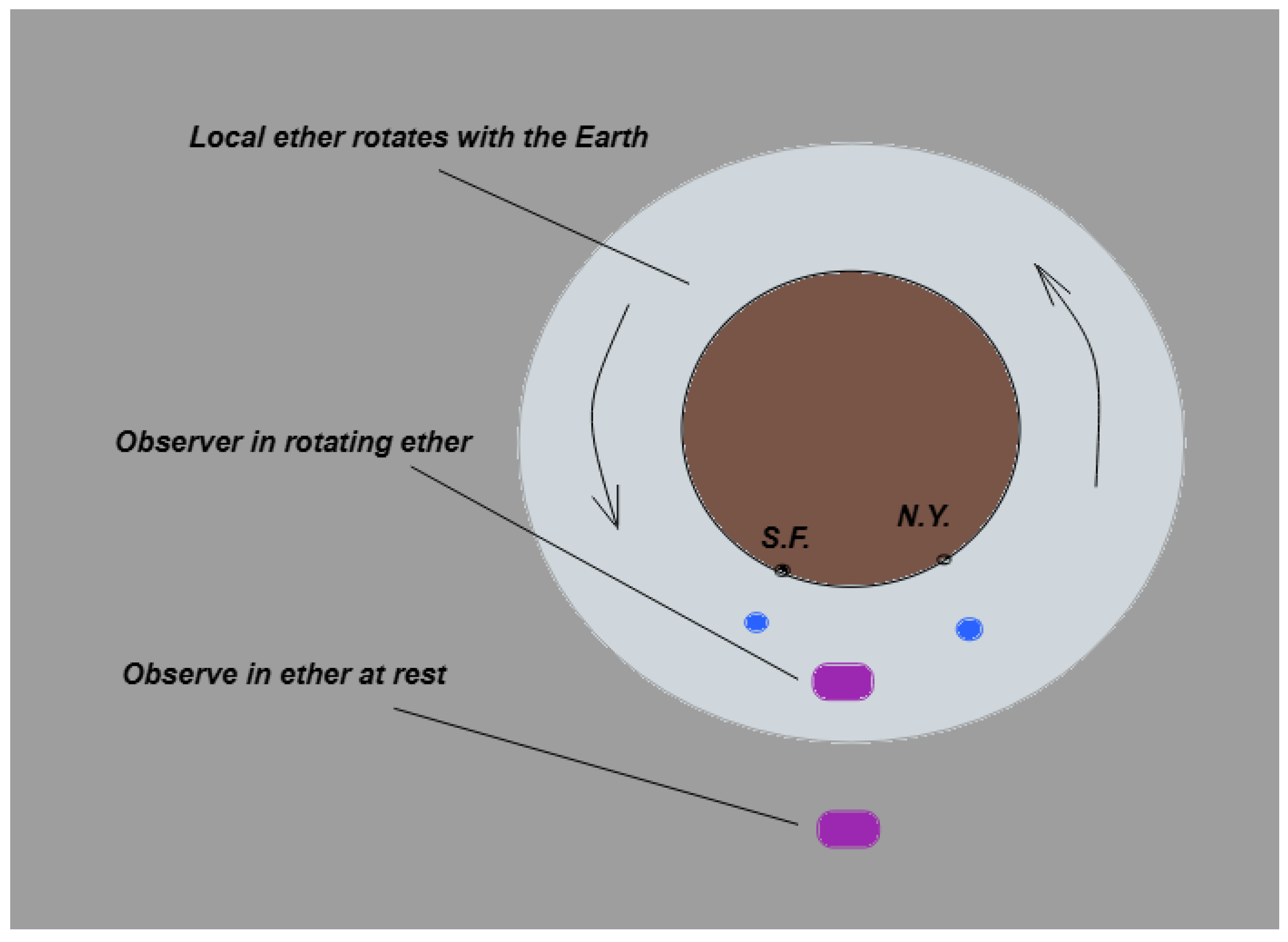
In measuring the speed of light, the observer’s position is crucial. In the case of moving ether, Einstein was correct that the observer’s location determines how they perceive physical reality. In Ether Relativity, the speed of light is the super-positional velocity: “The speed of light, c, is a type of super-positional velocity, which remains constant throughout the universe; we can say. When measured in different local ethers, the measured velocity of super-positional velocity gives different values. Regarding the velocity of light, Ether Relativity introduces the superposition principle; Einstein’s second postulate of SR remains valid [2].
3. Discussion
Vibrating Rays Theory (VRT) proposes that velocity of light is not constant and depends on the velocity of the source and on the velocity of the receiver [3]. In VRT velocity of light coming out of the source that moves with velocity is as follows: . If this is right, then it would be difficult to explain the Doppler effect: in the case that the source moves or the receiver moves so that the distance between them increases, the light wave will be stretched. In the case that the source moves or the receiver moves so that the distance between them decreases, then the light wave will be squished. If light is not stretched or squished, as is the case in VRT, where light increases velocity when the source is in motion, there is no Doppler effect.
VRT has a problem to explain how the Doppler effect is generated. Classical explanation of the Doppler effect is that with the motion of the source or receiver, the light gets stretched or squished, but its velocity of light remains unchanged, see Figure 2:
Experiments conducted on the Earth’s surface involving the Doppler effect were all performed within the local dynamic ether. The source and receiver were always located in the same local ether that moves and rotates with the Earth. Therefore, the results of the measurements are as if they were performed in a stationary ether.
In Special Theory of Relativity (STR), space is empty, and light moves through an empty space deprived of physical properties. This is its weakest point [2]. In Vibrating Rays Theory (VRT), light moves along the rays that are created by the source of light, and these rays extend into the infinity of space. Imagine that the source of light is placed in a moving ether and we have two apparatuses that measure the velocity of the light. One is in the local moving ether, the other is in the stationary ether, see Figure 3:
According to Ether Relativity, velocity of light for the observer 1 and 2 will be:
According to STR, velocity of light for the observer 1 and 2 will be:
According to VRT, velocity of light for the observer 1 and 2 will be:
Equation (1) has experimental verification when light moves from S.F. to N.Y. Equation (2) has experimental verification in Fizeau experiment and in Sagnac experiment. Equations of STR (3,4) and equations VRT (5.6) were never experimentally proved. In the Sagnac and the Fizeau experiments, where the interferometer (Sagnac) and the flow of the water in the tube (Fizeau) create an additional motion of local ether. This decreases the velocity of light for an internal observer and increases it for an external observer.
4. Dynamic Ether Experiment
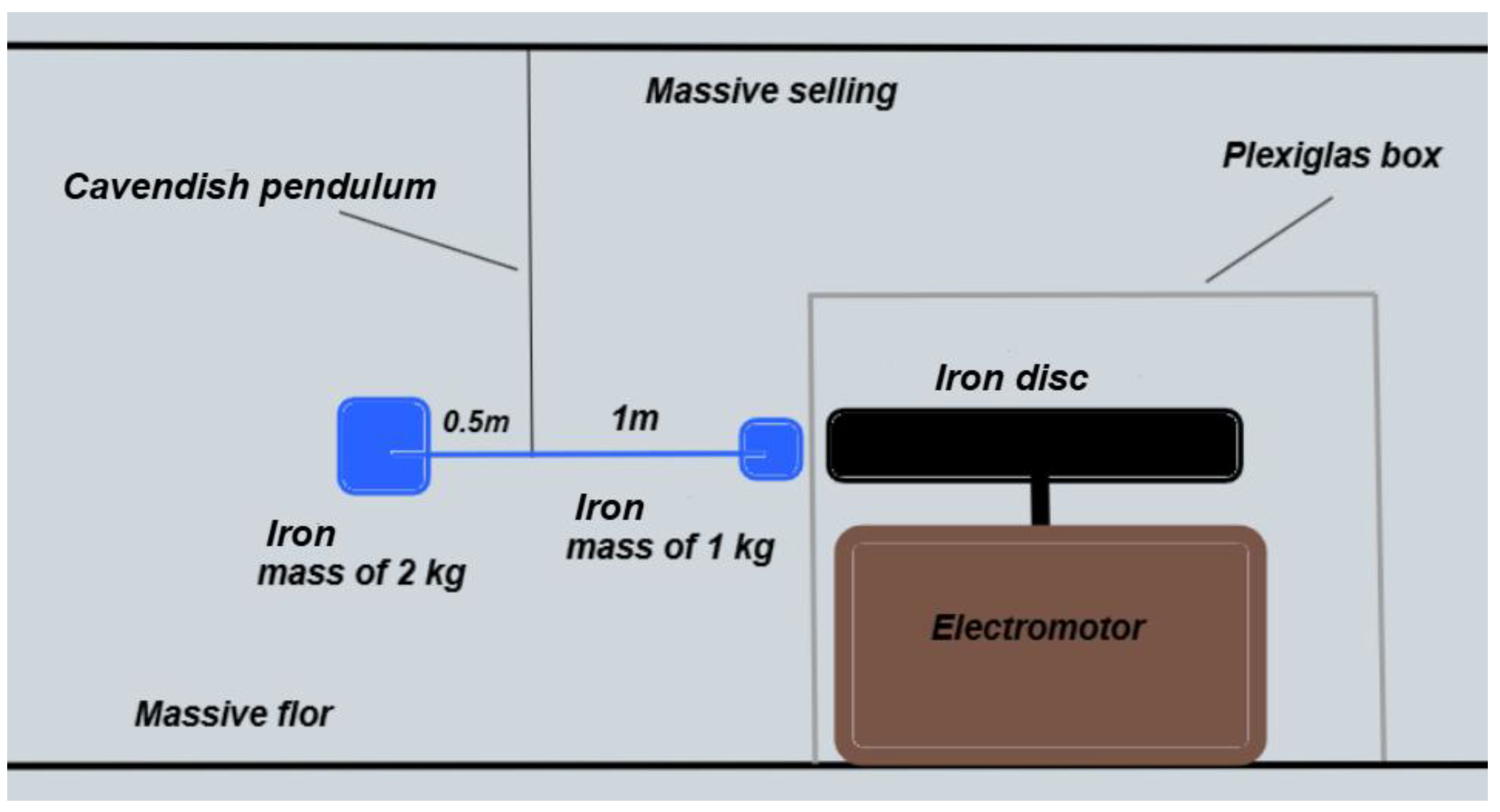
The dynamic ether experiment is a new version of the Cavendish experiment with a rotating disc. We take two iron cubes that have a hole to be fixed on the aluminium rod. One has 1 kilogram, the other has 2 kilograms. We put them on the iron rod with threads so that we can adjust the position of the rod to be horizontal. We hang the rod on the ceiling of a massive building. We have an electromotor which has on the shaft an iron disk with a diameter of 30 cm and, height of 10 cm. We place the electromotor on the massive floor of the building, as you see in the figure below. The electromotor with a disk is in the Plexiglas box, see Figure 4:
We place the rod in a position that is close to the disk. We start the electromotor running. We expect that the disc will also rotate the local ether and that local ether will move the iron mass of 1 kg and consequently rotate the pendulum with both masses.
5. Conclusions
Ether Relativity replaced inertial systems with the local ethers. Velocity of light in all local ethers is constant. The reading of the velocity of light depends on the position of measuring apparatus and the position of observer who use it to measure velocity of light. Einstein is right: this world is relative.
References
- Paul Marmet, The GPS and the constant velocity of light, Acta Scientiarum, 22 (2000), no. 5, 1269-1279. https://periodicos.uem.br/ojs/index.php/ActaSciTechnol/article/view/3062/2214.
- Amrit Sorli, Einstein Legacy: Ether relativity and cosmology, International Journal of Quantum Foundations, August 3, (2025) https://ijqf.org/archives/7583.
- Luis Bilbao, Luis Bernal, Fernando Minotti, Vibrating rays theory (2019) https://arxiv.org/abs/1407.5001.
Figure 2.
Doppler effect of light.
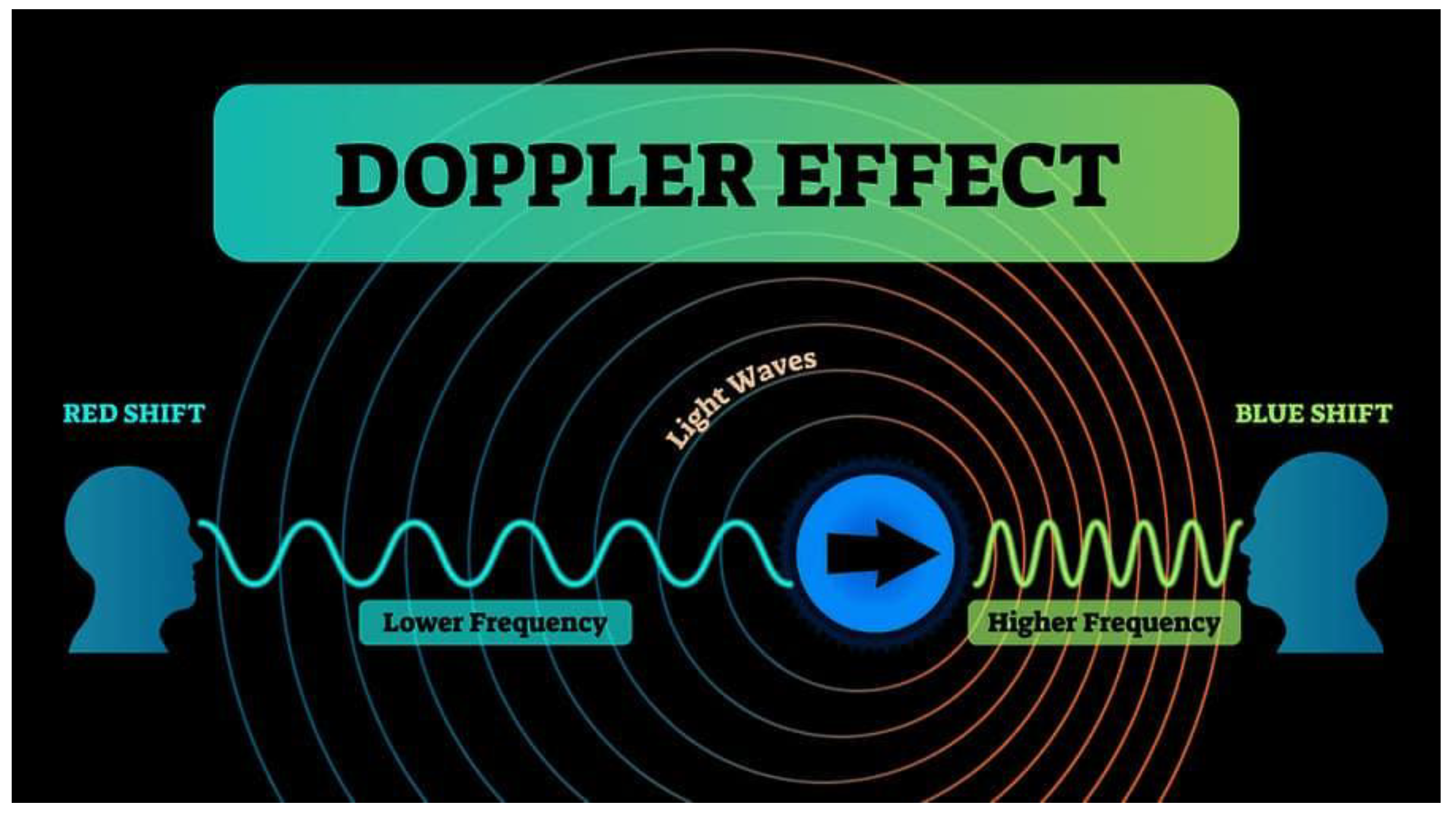
Figure 3.
Velocity of light in moving ether.
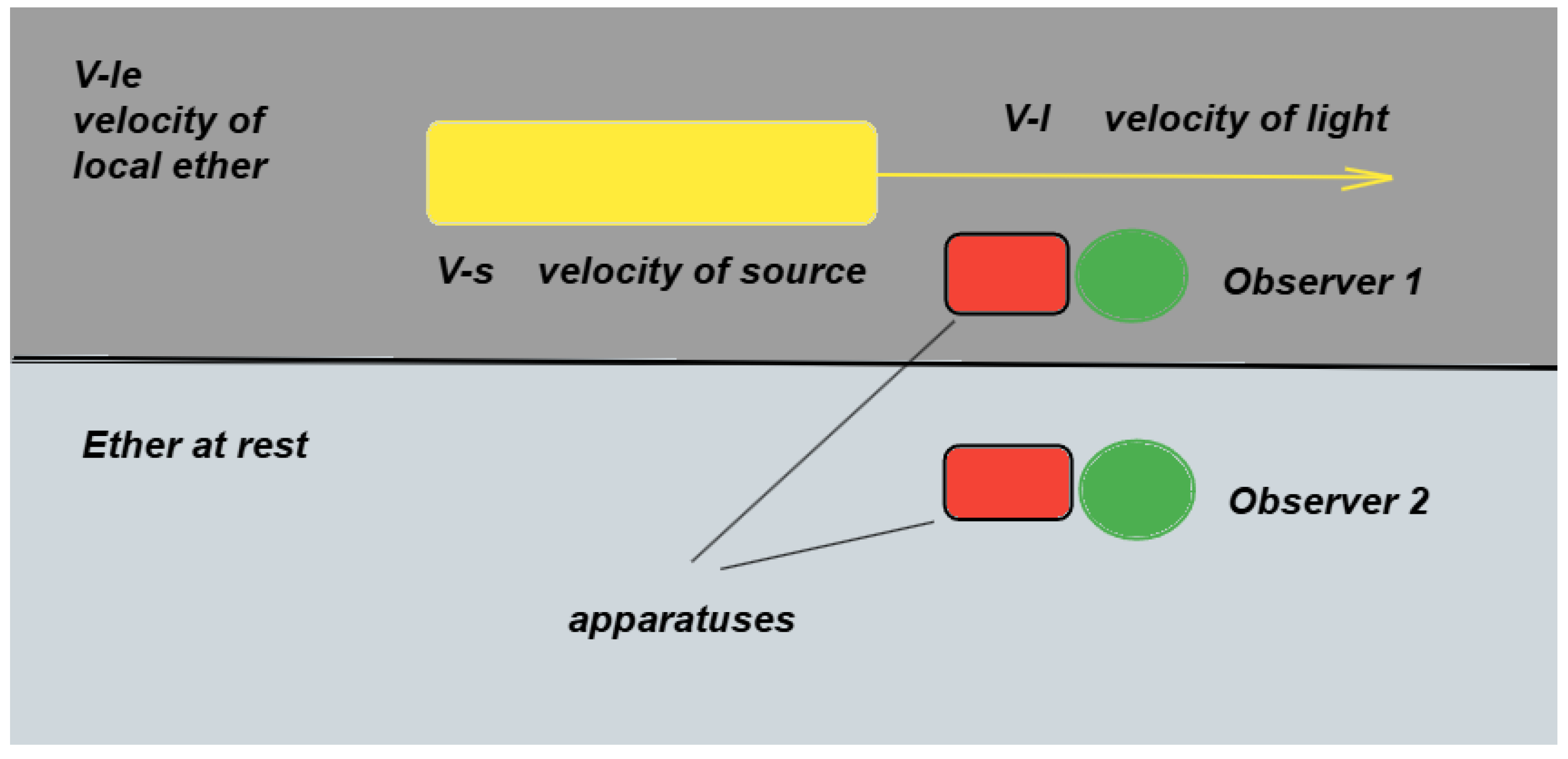
Figure 4.
dynamic ether experiment.
Disclaimer/Publisher’s Note: The statements, opinions and data contained in all publications are solely those of the individual author(s) and contributor(s) and not of MDPI and/or the editor(s). MDPI and/or the editor(s) disclaim responsibility for any injury to people or property resulting from any ideas, methods, instructions or products referred to in the content. |
© 2025 by the authors. Licensee MDPI, Basel, Switzerland. This article is an open access article distributed under the terms and conditions of the Creative Commons Attribution (CC BY) license (http://creativecommons.org/licenses/by/4.0/).
Copyright: This open access article is published under a Creative Commons CC BY 4.0 license, which permit the free download, distribution, and reuse, provided that the author and preprint are cited in any reuse.


