

Submitted:
23 July 2025
Posted:
24 July 2025
You are already at the latest version
Abstract
This paper systematically reviews the key developmental stages of China's new energy vehicle (NEV) charging and battery swapping industry, from its initial exploration to high-quality development, it analyzes technological breakthroughs, market expansion, and policy support at each stage. The study reveals that the industry has progressed through three stages: the initial exploration phase (before 2014), the comprehensive deployment phase (2014–2020), and the high-quality development phase (since 2021). The industry has established a diverse energy replenishment system centered on charging, with battery swapping serving as a supplementary approach. By the end of 2024, China had constructed 12.818 million charging piles and 4,443 battery swapping stations, forming the largest charging and swapping network in the world. Policy implementation has achieved remarkable results, including rapid expansion of infrastructure scale, continuous technological upgrades, diverse business model innovations, and ongoing improvements in user experience. However, challenges persist, such as insufficient standardization, profitability issues in business models, and coordination barriers. Drawing on international experiences such as the EU’s unified charging standards and U.S. federal and state-level coordinated policies, combined with industry innovation trends, this paper forecasts future development directions. These include widespread adoption of high-power charging technology, intelligent charging system upgrades, integration of photovoltaic, energy storage, and charging, diversified operational ecosystems for charging/swapping facilities, deep integration of virtual power plants, and construction of comprehensive energy stations. Policy recommendations include strengthening standardization, optimizing regional coordination and subsidy mechanisms, improving participation mechanisms for virtual power plants, promoting interoperability of charging/swapping infrastructure, and enhancing environmental protection and resource recycling.
Keywords:
new energy vehicles
; charging and swapping industry
; development history
; development trends
1. Introduction
Driven by the global energy transition and carbon neutrality goals, the global new energy vehicle industry is ushering in unprecedented development opportunities. According to the annual report “Global Electric Vehicle Outlook 2025” released by the International Energy Agency (IEA), the global penetration rate of new energy vehicles is expected to reach more than 25% in 2025, and China will exceed 50%, becoming the world’s largest new energy vehicle market [1]. By the end of 2024, there will be 31.4 million new energy vehicles in China, accounting for 8.90% of the total number of vehicles [2]. The rapid development of new energy vehicles in China has brought huge demand to the charging and swapping industry.
As a key link connecting new energy vehicles and energy transition, the development of the charging and swapping industry is not only related to the promotion and popularization of new energy vehicles, but also will have a profound impact on the transformation of energy structure and the realization of carbon neutrality goals. In recent years, the development of our country’s new energy vehicle charging and swapping industry has achieved remarkable results. By the end of 2024, China has built a total of 12.818 million charging piles and 4,443 battery swapping stations, forming the world’s largest charging network, and 80% of the fast charging technology for 15-minute charging has been mass-produced [3]. However, the development of our country’s charging and swapping industry still faces many challenges: on the one hand, the regional distribution of charging and swapping facilities is uneven [4], and the difference in facility density between the developed eastern regions and the central and western regions is significant; On the other hand, the lack of compatibility standards such as battery swap interfaces and battery specifications leads to the inability of different brands of battery swap facilities to communicate with each other [5]. In addition, the utilization rate of battery swapping stations is low [6], and the profit model is not yet mature, which restricts the large-scale development of the industry.
This paper focuses on the core issue of the high-quality development of the charging and swapping industry, systematically reviews the development process of China’s new energy vehicle charging and swapping industry, evaluates the implementation effect of industrial policies, and predicts the future development trend by drawing on the advanced experience of the European Union and the United States, so as to provide certain reference value for policy formulation, industrial development and academic research.
This paper finds that China’s new energy vehicle charging and swapping industry has gone through three complete stages of development from exploration to maturity, and the implementation of relevant industrial policies has achieved remarkable results, including the rapid expansion of charging and swapping infrastructure, continuous upgrading of technology, diversified innovation and exploration of business models, and continuous improvement of user experience, but at the same time, it faces problems such as insufficient standardization, difficulties in making business models profitable, and obstacles to synergy. Combined with the trend of industry technological innovation, this paper predicts that China’s new energy vehicle charging and swapping industry will develop in the direction of popularization of high-power charging technology, intelligent charging system upgrading, integration of optical storage and charging, ecological diversification of charging and swapping facilities, deep integration of virtual power plants, and construction of integrated energy stations. Promote the interconnection of charging and swapping infrastructure, and strengthen environmental protection and resource recycling.
The structure of this paper is as follows: the first part reviews the development process of China’s charging and swapping industry policy, and analyzes the characteristics of the three stages from the exploration period to the comprehensive layout to the high-quality development; The second part evaluates the implementation effect of China’s new energy charging and swapping industry policy, including the achievements and shortcomings; The third part draws on international experience, compares the charging and swapping policies and technical routes of the European Union, the United States and other regions, and analyzes the industrial development experience that can be used for reference. The fourth part looks forward to the future development trend and discusses the popularization of high-power charging technology, the upgrade of intelligent charging system, the integration of optical storage and charging, and going overseas. The concluding section summarizes the conclusions of the study and makes policy recommendations.
2. Literature Review
Scholars at home and abroad have conducted effective research on the development of China’s charging and swapping industry or charging and swapping infrastructure from different perspectives. These include:
2.1. On the Development Status of China’s New Energy Vehicle Charging and Swapping Infrastructure
The development status of China’s new energy vehicle charging and swapping infrastructure has shown a rapid growth trend. With the popularization of new energy vehicles, key indicators such as the distribution, type and utilization rate of charging piles have changed significantly.
In terms of the distribution of charging piles, the study by Hopkins et al. (2023) pointed out that despite the increase in the speed of charging infrastructure laying, there is still uncertainty in the market, and there is an uneven distribution of charging piles, and the market tends to serve early adopters [7]. Hu(2019) shows that the acceleration of urbanization and the limitation of urban space pose new challenges to the layout of charging piles [8].
In terms of the type of charging pile, there are two main types of slow charging and fast charging on the market. Research by Mastoi et al. (2022) shows that the layout of fast charging stations needs to consider economic benefits and grid impacts, while slow charging stations pay more attention to convenience and penetration [9].
In terms of usage, research by Funke et al. (2019) shows that public charging infrastructure as an alternative to home charging is only necessary in some densely populated areas. In addition, framework conditions vary widely from country to country, and as a result, country-specific literature findings can only be transferred to other countries on a limited basis [10].
In terms of policy support, the research of Le and He (2019) shows that the coordination of new energy vehicle industry policies has a significant impact on market penetration. Policymakers should pay attention to the diversity of business models when promoting the application of policies, and adopt a combination of measures in infrastructure construction to promote the development of the new energy vehicle market [11].
Overall, the development status of China’s new energy vehicle charging and swapping infrastructure shows a positive trend, but it also faces challenges such as uneven distribution, type selection, utilization rate optimization, and policy coordination.
2.2. On the Development Trend of China’s New Energy Vehicle Charging and Swapping Infrastructure
The development trend of China’s new energy vehicle charging and swapping infrastructure is affected by many factors, including technological progress, policy guidance and market demand. In terms of technological advancements, with the transition to zero-emission and ultra-low-emission electric vehicles, information technology for charging station infrastructure, distributed energy generation units, and government policy support have become crucial. Studies have shown that the planning and technical development of charging station infrastructure can improve the design and implementation of charging stations [12]. In addition, the optimal location of fast charging stations is determined based on economic benefits and grid impact, suggesting that the construction of charging stations in the future will be more focused on efficiency and economic benefits [13].
In terms of policy guidance, China has issued more than 100 policies for the new energy vehicle industry since 2009. The study finds that policy coordination has a significant impact on the market penetration effect, and it is proposed that the combination of “fiscal and taxation + regulation + guidance” measures should be adopted in infrastructure construction, and the subsidy should be gradually transferred to the charging service of operating enterprises [14]. In addition, to ensure equitable deployment of charging infrastructure, social equity needs to be considered, ensuring that all communities and individuals can enjoy the benefits of investment through local target setting, economic incentives, and policy incentives [15].
In terms of market demand, the mass adoption of EV charging networks needs to consider the increasing penetration of EVs in the long term as well as highly dynamic and location-dependent demand and grid constraints. The study proposes an approach to dynamic charging network design, i.e., how to optimize the location of charging stations at different time stages and the number of chargers within each station to accommodate the increase in EV penetration [16].
To sum up, the development trend of China’s new energy vehicle charging and swapping infrastructure will develop in the direction of more advanced technology, more coordinated policies, and more adaptable markets. The charging infrastructure of the future will be smarter and more efficient, while ensuring fairness and broad market penetration.
3. Review of the Development Process of China’s New Energy Vehicle Charging and Swapping Industry
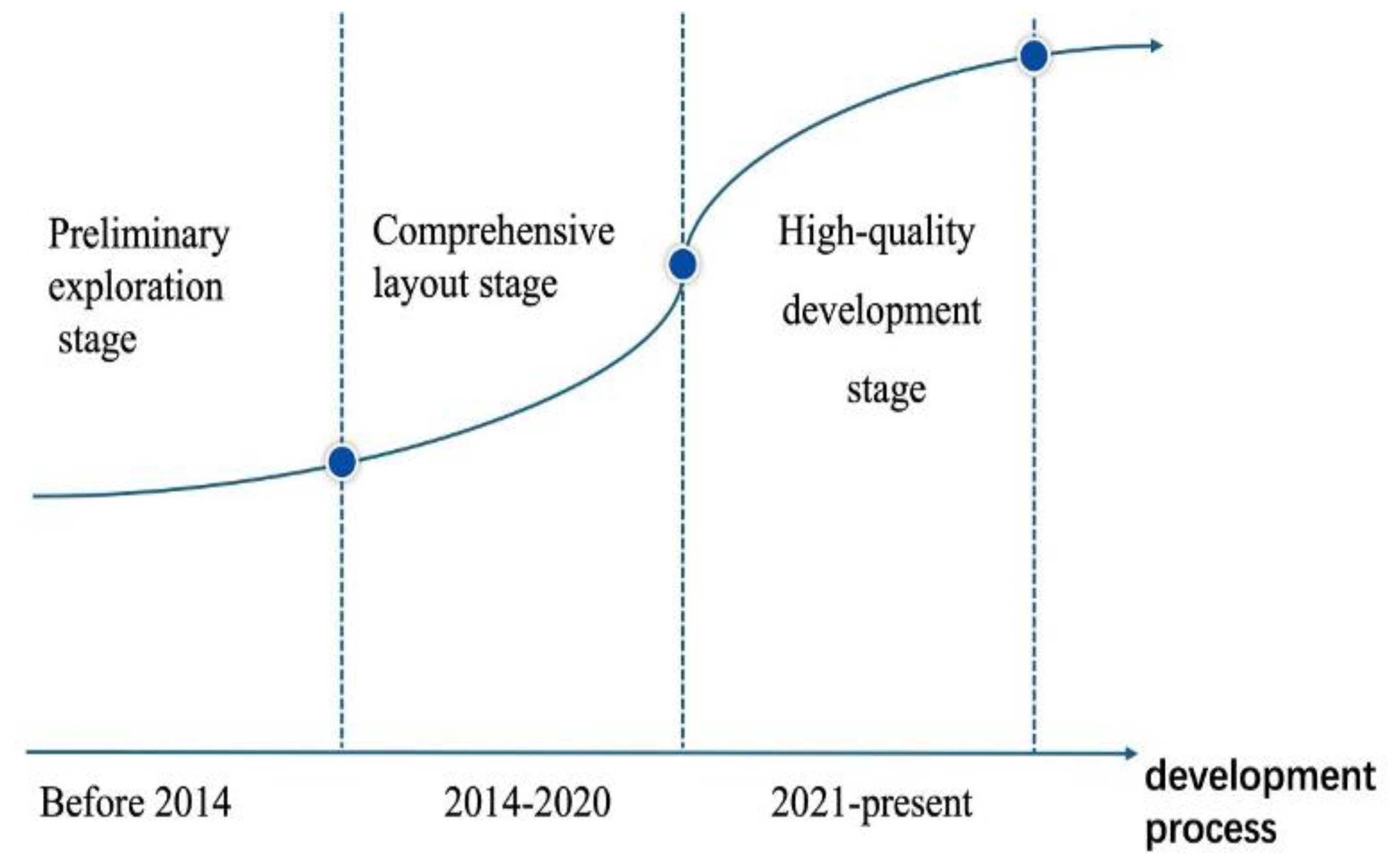
China’s new energy charging and swapping industry has experienced a complete development cycle from germination to outbreak, from exploration to maturity, forming a diversified energy supplement pattern of “charging as the mainstay, supplemented by battery swapping”. The development of this industry not only solves the problem of battery life anxiety of new energy vehicles, but also becomes an important support for promoting China’s energy transition and achieving carbon neutrality goals. According to the different characteristics of industrial development, it can be divided into three stages: the initial exploration stage (before 2014), the comprehensive layout stage (2014-2020) and the high-quality development stage (2021-present). Each stage has its own unique policy orientation, technical route and market pattern, which together constitute a complete development map of China’s charging and swapping industry.
Figure 1.
Schematic diagram of the developmental stages of China’s new energy vehicle Charging and swapping industry.
Figure 1.
Schematic diagram of the developmental stages of China’s new energy vehicle Charging and swapping industry.
3.1. Preliminary Exploration Stage (Before 2014): Policy Guidance, State-Owned Enterprise Leadership and Business Model Exploration
Before 2014, China’s new energy charging and swapping industry was in the initial exploration stage, and the core characteristics of this stage were strong policy guidance, state-owned enterprises-led pilot construction, and preliminary exploration of business models. The start of the charging and swapping industry is closely linked to the development of the new energy vehicle industry, and the early policy will plan the charging and swapping as a supporting facility, laying the foundation for the subsequent development of the industry.
At the policy level, in 2009, the General Office of the State Council issued the “Automobile Industry Adjustment and Revitalization Plan”, which proposed for the first time to “establish a fast charging network for electric vehicles and accelerate the construction of public charging facilities in public places such as parking lots” [17]. Subsequently, in 2012, the Ministry of Science and Technology issued the “Twelfth Five-Year Plan for the Development of Electric Vehicle Science and Technology”, which clearly proposed to formulate and improve the electric vehicle charging interface, charging communication protocol, charger technical standards, charging station design specifications, etc [18].providing a technical standard basis for the charging and swapping industry. The policies at this stage are mostly based on the electric vehicle industry policy, and are mainly based on macro strategies such as industrial adjustment plans and strategic emerging industry development plans, and lack detailed plans and descriptions for charging and swapping infrastructure.
In terms of technical route selection, during the period from 2010 to 2012, the State Grid and China Southern Power Grid led the pilot construction of the battery swap mode. In 2010, the State Grid built 11 standardized electric vehicle charging and swapping stations, and 22 charging and swapping stations entered the construction stage [19]. In 2012, the State Grid proposed to lead the battery swap mode of passenger cars in accordance with the operation mode of “battery swap as the mainstay, plug charging as the supplement, centralized charging, and unified distribution”. China Southern Power Grid cooperated with Israel’s Better Place (a multinational electric vehicle charging and swapping technology service company headquartered in Israel) in Guangzhou to build a battery swap station in Guangzhou to explore the battery swap technology route [20]. However, the development of the battery swap mode at this stage is limited due to problems such as inconsistent standards, high cost, and poor compatibility.
In terms of market structure, the construction of charging and swapping infrastructure is mainly led by state-owned enterprises. According to statistics, by the end of 2014, China had built a total of 780 charging and swapping stations, 31,000 AC and DC charging piles, and its China Grid Company had built 618 charging and swapping stations, with a total of 24,000 charging piles [21], accounting for 79.23% and 77.42% of the country respectively. The participation of private enterprises is low, and the operation mode of charging and swapping facilities is not yet mature. At the same time, the charging and swapping facilities at this stage mainly serve the public sector such as buses and taxis, and the private market has not yet been opened.
In terms of business model exploration, there are many attempts at this stage. BYD once experimented with battery swap mode (for example, Pengcheng Taxi Company used E6 battery swap in 2010 [22], but gave up due to battery standardization and cost issues, and switched to charging mode; Tesla launched the 93-second fast battery swap technology in 2013, but due to the high cost of battery swapping and the inability to share special-shaped batteries across models [23], it strategically abandoned the battery swap technology route and operation mode in 2014. These early attempts have provided valuable experience for the development of the subsequent charging and swapping business model.
3.2. Comprehensive Layout Stage (2014-2020): Charging Mode Dominance, Market Openness and Technological Progress
From 2014 to 2020, China’s new energy charging and swapping industry has entered a comprehensive layout stage, and the core characteristics of this stage are the establishment of the dominant position of charging mode, the introduction of social capital in the open market, and the gradual popularization of fast charging technology. As the State Grid adjusts the strategic direction of charging and battery swapping, the charging mode has become the mainstream, and the development of the battery swapping mode has been slow, forming a development pattern of “charging first, supplemented by battery swapping”.
In terms of policy support, in May 2014, the State Grid issued the “Opinions on Doing a Good Job in the Service of Electric Vehicle Charging and Swapping Facilities”, which clearly supports the participation of social capital in the charging pile market. In November of the same year, the Ministry of Science and Technology, the Ministry of Finance, the Ministry of Industry and Information Technology and the National Development and Reform Commission jointly issued the Notice on Incentives for the Construction of New Energy Vehicle Charging Facilities, encouraging the use of public-private partnership model (i.e., PPP model, abbreviation of Public-Private-Partnership) to guide social capital to participate in the construction of charging infrastructure [24]. In September 2015, the General Office of the State Council issued the “Guiding Opinions on Accelerating the Construction of Electric Vehicle Charging Infrastructure” and the “Guidelines for the Development of Electric Vehicle Charging Infrastructure (2015-2020)”, proposing to build 4.8 million charging piles and 12,000 charging stations by 2020, with a vehicle-to-pile ratio of 1:1 to meet the charging needs of 5 million electric vehicles [25,26]. In 2018, the Ministry of Finance’s policy further shifted, shifting local subsidies from purchase to charging infrastructure construction and operation, and strengthened policy guidance.
In terms of market opening, after 2014, the construction of charging piles has shifted from state-owned enterprises to private capital influx. The rise of private operators such as special calls and star charging has formed a three-legged pattern with the State Grid. According to the data, by the end of 2020, the number of public charging piles in the country was 807,000, of which 207,000 were operated by special calls, 205,000 were operated by Star Charging, and 181,000 were operated by the State Grid, accounting for 73.5% of the total number of public charging piles [27]. However, despite the policy of encouraging the participation of private capital, there are still many obstacles in its implementation. By the end of 2020, there were 1.681 million charging piles in the country, including 807,000 public charging piles and 874,000 private charging piles [28]. It is far from the target of “more than 4.8 million distributed charging piles by 2020” required by the “Guidelines for the Development of Electric Vehicle Charging Infrastructure (2015-2020)”, with a completion rate of only 35%. At the end of 2020, the number of new energy vehicles was 4.92 million [29], and the vehicle-to-pile ratio was about 2.9:1, far from reaching the 1:1 level of the policy target.
In terms of technological progress, breakthroughs have been made in fast charging technology at this stage. Tesla launched 240kW superchargers in 2015, and State Grid mainly uses DC piles (46% of its charging piles in 2020). In December 2015, the National Standards Committee issued the “Connecting Device for Conductive Charging of Electric Vehicles” (GB/T 20234-2015) [30] to standardize the unified standard of charging interfaces for new energy vehicles, but as of the end of 2020, there are still “information barriers”, which need to rely on third-party platforms (such as AutoNavi map access to 96% of charging pile information [31]) to solve.
In terms of business model, this stage has formed a whole industry chain layout of “equipment manufacturing-charging operation-solution solution”. The company has partnered with private sector (such as the National Adjustment Fund) and Huawei to improve its technology, but its expansion has slowed down. Relying on the resources of Wanbang Group, Star Charging has risen rapidly, and its market share has risen rapidly to 25% [32]. However, the investment in the construction of charging piles is large, the return cycle is long, the industry as a whole is still in a state of loss, and the profit model of operators is not yet fully mature.
In the evolution of the charging and swapping pattern, the charging mode gradually dominates at this stage. At the beginning of 2014, the State Grid proposed to optimize the planning and layout of the charging and swapping service network in accordance with the principle of “leading fast charging, taking into account slow charging, guiding battery swapping, and being economical and practical”, marking that the charging mode has become the mainstream. The battery swap mode has only been applied to specific models of a few companies (such as NIO) due to the slow development of car companies fighting their own battles and the difficulty of battery standardization.
3.3. High-Quality Development Stage (2021-Present): Technological Innovation, Revival of Battery Swap Mode and Integration of Vehicle Network
Since 2021, China’s new energy charging and swapping industry has entered a stage of high-quality development, and the core characteristics of this stage are the acceleration of technological innovation, the revival of battery swapping mode, and the integration of vehicles and networks has become a new trend.
In terms of technological innovation, the high-voltage fast charging platform technology of 800V and above has become a breakthrough point. In 2021, GAC Aion released ultra-fast battery technology and A480 supercharging pile, proposing “5 minutes of charging and 200 kilometers of range [33]”. In March 2025, BYD launched the “Super e Platform” technology matrix to achieve the world’s first “global kilovolt high-voltage architecture” for passenger cars, fully upgrading the battery, motor, power supply and thermal management system to a 1000V platform, and increasing the charging speed to “2 kilometers per second”. As of June 2025, China’s major NEV manufacturers have released more than 50 models of 800V and above high-voltage platforms. The popularization of supercharging technology has promoted the upgrading of charging facilities, such as the single-day discharge capacity of Shenzhen Lianhuashan supercharging station reaches 13,000 kWh, and the maximum discharge power is 2,160kW [34]; Huawei has launched a 600kW liquid-cooled supercharger that supports all models in the 200-1000V voltage range. In addition, significant progress has also been made in battery swapping technology, such as the chocolate battery swap block launched by CATL, which claims to be suitable for 80% of the world’s pure electric platform models that have been launched and will be launched in the next three years, and NIO’s fourth-generation battery swap station can serve multiple brand models at the same time.
In terms of the revival of the battery swap mode, this stage presents the characteristics of multi-subject participation and multi-scenario application. Since the first battery swap station was put into operation on May 20, 2018, NIO has deployed 3,343 battery swapping stations across the country, including 989 highway battery swapping stations, forming a high-speed battery swap network of “9 vertical, 9 horizontal and 14 urban agglomerations” [35]. At the same time, NIO has encrypted the layout of charging piles and battery swapping stations through the “Power Up County and County Connection Plan” (including charging county and battery swap county pass), so that “where oil trucks can go, trams can go” [36]. For example, plans to add 4,000 new battery swapping stations by 2025 [37], Geely plans to operate 5,000 smart battery swapping stations around the world by 2025 [38], and Sinopec plans to build 5,000 charging and swapping stations by 2025 [39]. For example, CATL’s Qiji Battery Swap Yangluo Hub Station can provide battery swap services for 200 heavy trucks per day, with a range of 350 to 800 kilometers per battery swap [40].
In terms of vehicle-to-grid convergence, V2G (Vehicle-to-Grid (vehicle-to-grid interaction) technology has moved from the proof-of-concept stage to large-scale application. In March 2025, Shenzhen launched the country’s largest vehicle network interactive measurement, covering more than 760 charging stations, 18,000 charging piles, and 17,000 vehicles participating in the city, with an interactive electricity of 88,000 kWh, and car owners can get a subsidy of 4 yuan per kilowatt-hour of electricity, which is much higher than the charging cost of 0.4 yuan for trough electricity [41].In March 2025, the National Development and Reform Commission and other departments jointly issued the “Notice on the First Batch of Pilot Large-scale Application of Vehicle-Network Interaction” (Fagaiban Energy [2025] No. 241), which included 9 cities including Shanghai in the first batch of pilot cities, and planned to initially build a technical standard system by 2025 and achieve large-scale application by 2030, providing tens of millions of kilowatts of two-way regulation capacity for the power grid [42]. For example, NIO’s first integrated PV storage and charging station in Suzhou is equipped with 1 battery swap station, 14 charging spaces, 22 energy storage batteries, and a 50 kW photovoltaic power generation system, which can generate 51,700 kWh of green electricity per year and reduce carbon emissions by 51.54 tons [43].
In terms of policy support, in 2025, the Ministry of Finance, the Ministry of Industry and Information Technology, and the Ministry of Transport jointly issued the “Notice on Carrying out the Pilot Application for Filling the Shortcomings of County-level Charging and Swapping Facilities in 2025”, which plans to support 75 pilot counties, and the central government will provide financial support for projects such as the construction and operation of public charging and swapping facilities and the transformation of distribution networks [44]. The pilot encourages the application of new technologies, and converts the number of standard piles for V2G projects with obvious demonstration effects according to a specific coefficient. At the same time, the policy emphasizes direct data connection and interconnection, and requires public charging and swapping facilities in pilot counties to upload operation data to the clearing platform in real time by direct connection to strengthen supervision.
In terms of market structure, the charging and swapping industry has formed a diversified competition pattern. In the field of charging, special calls, star charging, and the State Grid still dominate, but emerging companies such as Huawei and China Southern Power Grid are also accelerating their layout. In the field of battery swapping, companies such as NIO and CATL have become the main force, among which NIO is in a leading position in the market. At the same time, the integration of the charging and swapping industry with energy, transportation, Internet and other fields is deepening, such as Huawei’s cooperation with Telai, NIO and other enterprises to provide intelligent charging solutions, and AutoNavi Map access the real-time information of 96% of operators to provide users with convenient charging services.
3.4. Comparison of the Development Characteristics of the Three Stages
On the whole, the difference between the three stages of development of China’s new energy vehicle charging and swapping industry mainly lies in the change in the relationship between policy and market interaction. In the initial exploration stage, the policy is mainly based on directional guidance, the market participation is low, and the construction of charging and swapping facilities is mainly led by state-owned enterprises. In the comprehensive layout stage, the construction of charging facilities has received a large number of subsidies and market participation has increased, but the development of the battery swap mode has been slow due to unclear policies. In the stage of high-quality development, policies are more precise, charging and swapping are developing in parallel, the standard system is gradually improved, and financial subsidies are combined with market-oriented operation, forming a diversified charging and swapping industry ecology.

Table 1.
Comparison of the development stages of China’s new energy charging and swapping industry.
| Development stage | Time span | Policy-oriented | Leading the technical route | Market participants | Main business model | Characteristics of the industry |
|---|---|---|---|---|---|---|
| Initial exploration phase | Before 2014 | Planning-led | Battery replacement is the main thing, and charging is the supplement | State-owned enterprises dominate | Auto companies build their own and operate independently | Pilot first, different standards, high cost |
| Full layout stage | 2014-2020 | Subsidy-supported | Charging is the main thing, supplemented by battery replacement | State-owned enterprises and private enterprises in parallel | Operational services, equipment manufacturing | The market is open, fast charging is popular, and interconnection is insufficient |
| High-quality development stage | 2021-present | Green transformation | Parallel development of charging and battery swapping | Diverse subject participation | Standardization, networking, and platformization | Technological innovation, revival of battery swapping, and vehicle-network integration |
4. Analysis of the Implementation Effect of China’s New Energy Vehicle Charging and Swapping Industry Policy
4.1. Analysis of the Effectiveness of Policy Implementation
The implementation of China’s charging and swapping industry policy has achieved remarkable results, mainly reflected in the following aspects:
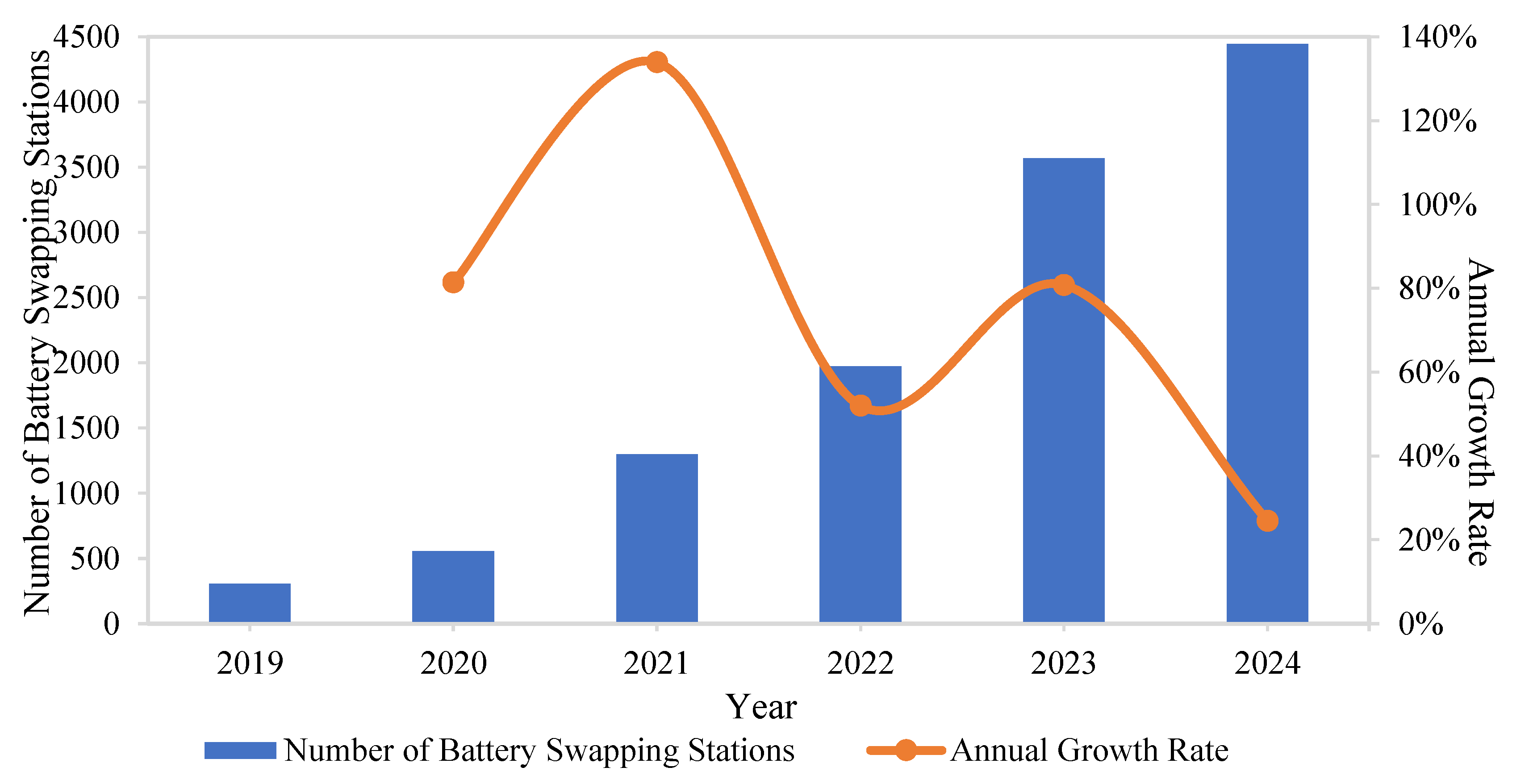
First of all, the scale of charging and swapping infrastructure is growing rapidly. By the end of 2024, China has built a total of 12.818 million charging piles and 4,443 battery swapping stations, forming the world’s largest charging and swapping network [45]. The number of charging piles will increase from 31,000 in 2014 to about 12.8 million in 2024, with an average annual compound growth rate of 82.66%. The number of battery swapping stations has increased from 306 in 2019 to 4,443 in 2024, with an average annual growth rate of more than 30%.
Figure 2.
The number and trend of charging piles in China from 2014 to 2024. data from China Electric Vehicle Charging Infrastructure Promotion Alliance, https://evcipa.org.cn/ (accessed on 20 June 2025).
Figure 2.
The number and trend of charging piles in China from 2014 to 2024. data from China Electric Vehicle Charging Infrastructure Promotion Alliance, https://evcipa.org.cn/ (accessed on 20 June 2025).
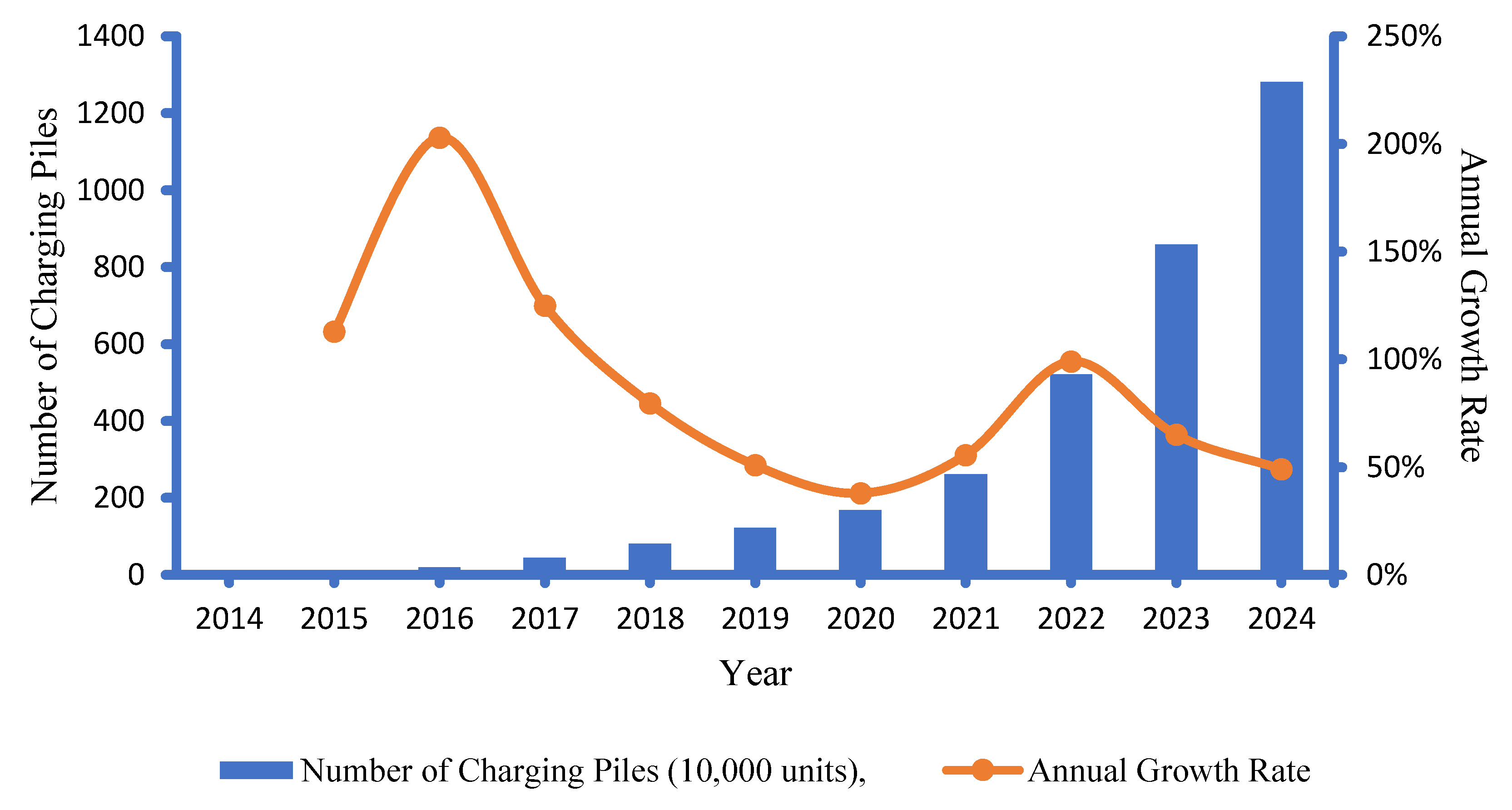
Figure 3.
The number and trend of battery swapping stations in China from 2019 to 2024. Data from China Electric Vehicle Charging Infrastructure Promotion Alliance, https://evcipa.org.cn/ (accessed on 20 June 2025).
Figure 3.
The number and trend of battery swapping stations in China from 2019 to 2024. Data from China Electric Vehicle Charging Infrastructure Promotion Alliance, https://evcipa.org.cn/ (accessed on 20 June 2025).
Secondly, the county connection project of battery swapping is advancing rapidly. According to NIO’s plan, the battery swap county will be divided into three phases: by June 30, 2025, 14 provincial-level administrative regions in Beijing, Shanghai, Guangdong, Jiangsu, Zhejiang, Anhui, Hubei, Shandong, Sichuan, Henan, Fujian, Tianjin, Chongqing, and Macao will be completed, and more than 1,200 county-level administrative districts will be connected; Before December 31, 2025, 13 provincial-level administrative regions in Hunan, Hebei, Shaanxi, Guangxi, Yunnan, Guizhou, Jiangxi, Hainan, Shanxi, Jilin, Liaoning, Gansu and Ningxia will be newly completed. So far, NIO will have completed the full coverage of battery swapping stations in 27 provincial-level administrative regions and more than 2,300 county-level administrative regions. And from 2026, the construction of battery swapping stations in the remaining provincial-level administrative regions will be accelerated. By the end of May 2025, NIO had built 26,377 charging piles, connected more than 1.26 million third-party charging piles, and built 3,343 battery swapping stations across the country, covering nearly 1,000 districts and counties across the country [46]. As of May 2025, NIO has realized the county-to-county connection of battery swapping in six provinces and cities: Beijing, Shanghai, Zhejiang, Jiangsu, Guangdong, and Tianjin, building a global battery charging and swapping service ecosystem from cities to counties and towns [47].
Table 2.
Overview of NIO’s battery swapping stations over the past generations.
| iterate | Go live | Number of battery compartments | Average battery swap time | Applicable brands |
|---|---|---|---|---|
| The first generation of battery swapping stations | 2018.05 | 5 | - | EC/ES/ET Series (excluding ET9) |
| The second generation of battery swapping stations | 2021.04 | 13 | 5 minutes and 40 seconds | EC/ES/ET Series (excluding ET9) |
| The third generation of battery swapping stations | 2023.04 | 21 | 4 minutes and 40 seconds | EC/ES/ET series (partially applicable to ET9), partly applicable to Ledao |
| Fourth-generation battery swap station | 2024.06 | 23 | 3 minutes and 30 seconds | EC/ES/ET series, Ledao, Firefly, Changan, Geely, Chery and other brands |
Data from NIO Annual Report https://ir.nio.com/zh-hant/financials/annual-reports (accessed on 20 June 2025).
Third, the battery swap standard system has been gradually improved. On November 28, 2024, the national standard “Technical Requirements for Battery Swap Service for Operating Pure Electric Vehicles” (GB/T 45098-2024) was released and will be implemented on March 1, 2025 [48]. The standard puts forward specific requirements for the location of the swap station, the compatibility of the swap, the service process, etc., and fills the standard gap in our country in the field of operating pure electric vehicle swap services.
Fourth, progress has been made in the exploration of business model innovation. NIO’s BaaS (Battery as a Service) model has been recognized by the market, and its BaaS penetration rate (the proportion of NIO users using BaaS services to the total number of NIO users) has reached 60% in 2024 [49]. CATL launched the “Chocolate Battery Swap Block”, which adopts a standardized design to achieve cross-model compatibility. In addition, the virtual power plant model has also begun to explore applications in the field of battery swapping, such as NIO’s cooperation with the State Grid and China Southern Power Grid, whose battery swapping stations have realized charging during the trough hours at night and discharging to the grid during peak hours during the day, which can not only realize the effective dispatch of electric energy, but also make profits in the market through electric energy trading.
Fifth, technological innovation has yielded fruitful results. Enhancing scientific and technological innovation capabilities is one of the key measures for China to promote green economic development [50]. Along with the growth of China’s new energy vehicle (NEV) industry, continuous technological innovations in the NEV charging and battery swapping sector have emerged. CATL’s “Shenxing Super Rechargeable Battery” realizes the lithium iron phosphate 4C supercharging technology, which can be charged in 10 minutes and has a range of 400 kilometers [51]. NIO’s battery swap technology has been shortened from 9 minutes in the first generation of battery swapping stations to less than 3 minutes now. At the same time, the integrated technology of photovoltaic storage, charging and swapping is also developing rapidly, such as the integrated energy station jointly built by CATL and Sinopec, which organically combines charging, battery swapping, photovoltaic power generation and energy storage systems.
Overall, the implementation of China’s new energy vehicle charging and swapping industry policy has effectively promoted the rapid expansion of charging and swapping infrastructure, continuous upgrading of technology, business model innovation and exploration, and continuous improvement of user experience, providing strong support for the development of China’s new energy vehicle industry.
4.2. Analysis of Problems Encountered in Policy Implementation
Although the implementation of the policy has achieved remarkable results, it also faces the following key issues:
First of all, the degree of standardization of battery swapping is insufficient. In 2024, China issued the “Technical Requirements for Battery Swap Service for the Operation of Pure Electric Vehicles” (Standard No.: GB/T 45098-2024), but there are still problems in actual implementation, such as inconsistent interfaces and different battery specifications. For example, the battery specifications of different brands (such as NIO, Ledao, and Firefly) within NIO are incompatible, resulting in a battery swap station being equipped with multiple battery specifications, reducing operational efficiency. In addition, the lack of battery cascade utilization standards affects the sustainable development of battery swapping mode.
Second, it is difficult for the business model to make a profit. The battery swap mode has the characteristics of “heavy assets and high investment”. The cost of NIO’s first-generation battery swap station is about 3 million yuan, and the third-generation battery swap station is reduced to 1.5 million yuan (excluding batteries and operating costs) [52].According to estimates, each battery swap station needs an average of 60-70 orders per day to achieve breakeven, but in 2024, there will be a total of 87,000 battery swaps, with an average of about 28 orders per station per day, which is more than half of the breakeven point [53], and the profitability of NIO’s battery swap business is far away. NIO’s net loss in 2024 widened to 22.66 billion yuan, with an asset-liability ratio of 84%, mainly due to heavy asset investment in the battery swap station network [54]. At the same time, charging facilities are also facing profitability problems, and some charging stations are “hard to find” during holidays, but the daily utilization rate is low.
Third, there are obvious barriers to synergy. There is a contradiction in the distribution of benefits in the cooperation between car companies, battery manufacturers, and energy companies, resulting in the fragmentation of the battery swap network. For example, BYD’s blade battery is not compatible with other battery swap standards, which limits the promotion of battery swap mode. In addition, the coordination between the battery swap station and the power grid is insufficient, and it is difficult to give full play to the role of the battery swap station in the peak regulation of the power grid.
Fourth, regional development is unbalanced. The charging and swapping facilities in the first-tier cities and the new first-tier cities are relatively complete, but the coverage rate of charging and swapping facilities in the third- and fourth-tier cities and county areas is low. According to the statistics of the China Charging Alliance, by the end of 2024, the construction of public charging piles in economically developed provinces such as Guangdong, Zhejiang, Jiangsu, Shanghai, Shandong, Henan, Anhui, Hubei, Sichuan, and Beijing accounted for 68.8%, while the coverage rate of charging piles in county areas was less than 5%, in stark contrast [55].
Fifth, the contradiction between technology iteration and battery swap network. With the continuous advancement of battery technology, such as the application of new technologies such as 800V high-voltage platforms and solid-state batteries, the battery swap network needs to be continuously upgraded to adapt to new battery specifications and increase operating costs. For example, industry-leading power battery manufacturers such as CATL, Guoxuan Hi-Tech, and Funeng Technology are increasing the development of solid-state batteries with energy densities of 400-600Wh/kg, which will pose new challenges to existing battery swap networks.
In short, the main challenges faced by the implementation of the policy are the lack of standardization, the difficulty of making business models profitable, the obstacles to collaboration, the imbalance of regional development, and the contradiction between technology iteration and battery swapping networks, which restrict the further development of the charging and swapping industry.
5. Reference from International Experience in the Development of China’s New Energy Vehicle Charging and Swapping Industry
5.1. The EU Experience
The EU has accumulated rich experience in the construction of charging and swapping infrastructure, which is mainly reflected in the following aspects:
First of all, the policy is mandatory to promote infrastructure construction. The European Union passed the Alternative Fuels Infrastructure Directive (AFIR) in July 2023, which requires member states to build fast-charging stations every 60 kilometers on motorways, covering the core network of the Trans-European Transport Network (TEN-T) by 2025 and expanding to the entire network by 2030 [56]. In October 2022, the German government approved a plan to rapidly expand EV charging stations, which intends to invest €6.3 billion over three years to increase the number of EV charging stations nationwide 14-fold to 1 million by 2030 [57,58]. The UK government released its EV Infrastructure Strategy in March 2022, proposing to invest at least £1.6 billion to expand the charging network, with plans to increase the number of EV charging stations tenfold to 300,000 by 2030 [59].
Second, the unification of standards promotes industrial collaboration. The European Automobile Manufacturers’ Association (ACEA) has proposed the CCS (Combined Charging System) charging standard, which integrates AC and DC charging into one unified system [60]. The standard connector is designed as a combined socket with integrated AC and DC interfaces on the physical interface, which can be compatible with three charging modes: single-phase AC charging, three-phase AC charging and DC charging, providing standard and flexible charging options for electric vehicles. As the mainstream charging standard of the European Union, CCS makes it mandatory for car companies to be compatible to avoid interface confusion. This standardized approach significantly reduces the construction and operating costs of charging and swapping facilities, and improves the user experience.
Third, government-enterprise cooperation accelerates the sinking of charging and swapping infrastructure. Sweden has accelerated the layout of battery swapping through government-enterprise cooperation. On November 17, 2022, the first battery swap station jointly built by Sweden and NIO was officially launched at the Varberg battery swap station. In October 2023, the French government added an additional €200 million in public subsidies to the “Charging Infrastructure Program” to support the installation of home and street charging piles and the development of dedicated charging stations for heavy-duty trucks, while the tax credit for households to purchase and install charging piles will be increased from 300 euros to 500 euros [61]. These cooperation models have effectively solved the problem of infrastructure sinking and improved the coverage of charging and swapping facilities in third- and fourth-tier cities and rural areas.
Fourth, user-oriented to improve service experience. The EU Alternative Fuel Infrastructure Regulation (AFIR) requires charging points to accept electronic payments for terminals and devices that provide payment services, and for public charging points with an output power of 50 kW, the charging price charged by the operator should be based on the electricity price per kWh, and for public charging points with an output power of less than 50 kW, the operator should provide clear and convenient price information within the charging stations they operate, including the charging price per kWh, charging price per minute, price per charge, and all price components. These requirements for payment facilitation and price transparency of charging facilities are conducive to improving the user experience. This user-oriented policy design has significantly improved the utilization rate and user satisfaction of charging and swapping facilities.
To sum up, the core of the EU’s experience is the mandatory policy to promote infrastructure construction, the promotion of unified interface standards to promote industrial collaboration, the government-enterprise cooperation to accelerate the sinking of infrastructure, and the user-oriented improvement of service experience, which has good reference significance for the development of China’s charging and swapping industry.
5.2. The U.S. Experience
The United States has also accumulated rich experience in the construction of charging and swapping infrastructure, which is mainly reflected in the following aspects:
First, the federal and state coordinated policies promote industrial development. In 2022, the Biden administration established the National Electric Vehicle Infrastructure Initiative (NEVI) [62] to provide states with a total of $5 billion in funding to build a national network of 500,000 charging stations along highways across the United States, as well as $2.5 billion in competitive grants to support charging facilities in the community. California’s Zero Emission Vehicle (ZEV) Act mandates that all vehicles sold by car companies must be zero-emission vehicles by 2035, driving demand for battery charging. This kind of coordinated policy design between the federal and state effectively solves the problem of regional differences in policy implementation and improves the implementation effect of policies.
Second, technology iteration is combined with market selection. Tesla tried the battery swap mode, but finally abandoned the battery swap mode in 2015 because the battery swap had no price advantage over super fast charging and did not gain consumer support. In 2025, Tesla will restart the Model S battery swap pilot, combined with the supercharging network to reduce the load on the grid, reflecting the need for a flexible technical route to adapt to the needs of the market. This combination of technology iteration and market selection provides a useful reference for the development of China’s charging and swapping industry.
Third, open and shared business model innovation. Tesla has opened up its supercharging network (such as partnering with Ford and GM) to make a profit through service fee and credit transactions. According to an analysis by Goldman Sachs, an American investment bank, Tesla earns an extra $25 billion a year by opening up its charging network [63]. This open and shared business model innovation effectively solves the problem of low utilization rate of charging piles and improves the economic benefits of infrastructure.
Fourth, virtual power plants (VPPs) are combined with charging and swapping. In 2021, Tesla partnered with Northern California power company PG&E in California to officially launch its first official virtual power plant project [64]. The project pays eligible Powerwall users to deliver additional power to the grid in the event of an outage. Multiple powerwalls work at the same time to create a “virtual power plant” that helps the grid maintain power in the event of an emergency or energy shortage. Registered Powerwall virtual power plant users can earn an additional $2 incentive for every kWh of electricity provided to the grid during a specified “event”. At present, the project has been expanded to the Southern California Edison Company (SCE) service area, with a total capacity of more than 100MW. By smoothing out grid fluctuations, virtual power plants can achieve the role of “peak shaving and valley filling”, from which energy storage equipment manufacturers, users and power grids can all benefit, which inspires Chinese charging and swapping station operators to carry out similar explorations.
The core of the U.S. experience is the combination of federal and state coordinated policies to promote industrial development, the combination of technology iteration and market selection, the innovation of open and shared business models, and the combination of virtual power plants and battery charging and swapping, which have important reference value for the development of China’s battery charging and swapping industry.
5.3. Enlightenment of International Experience for China
Through the analysis of the experience of the European Union and the United States, the following enlightenment for the development of China’s charging and battery swapping industry can be extracted:
First, strengthen policy mandatory and standardization. China needs to strengthen the unification of cross-regional and cross-brand charging/battery swapping standards (such as referring to the EU CCS protocol promotion mechanism) to avoid interface confusion and battery specification differentiation. At the same time, car companies will be guided to participate in the formulation of battery swap standards through policies to avoid fragmentation of technical routes.
Second, promote regional coordination and subsidies. We can learn from the Swedish government-enterprise cooperation model and guide the sinking of battery swap facilities through local subsidies (such as third- and fourth-tier cities). At the same time, it is necessary to establish a linkage mechanism between federal and local policies to avoid imbalances in regional development. For example, with reference to the synergy between ZEV and federal subsidies in California, we will promote the layout of battery swap facilities in key areas.
Third, balance technology and market dynamics. Avoid over-reliance on a single technology (such as the failure of early battery swap pilots), and combine the complementary development of overcharging and battery swapping. At the same time, according to different user groups and usage scenarios, differentiated charging and swapping service models are designed to meet diverse needs.
Fourth, improve user convenience. Promote the interconnection of payment systems and platforms (e.g. EU contactless payment requirements) to reduce the operational burden on users. At the same time, optimize the layout of charging and swapping facilities, improve coverage and convenience of use, and eliminate “range anxiety”.
Fifth, explore diversified profit models. Drawing on Tesla’s business model of opening up the supercharging network, it will make a profit through service fee and credit transactions. At the same time, the battery swap station participates in the virtual power plant, using the peak-to-valley electricity price difference and peak shaving services to generate revenue. For example, NIO has connected 68 battery swapping stations in Suzhou to State Grid’s new power load management system to form a virtual power plant with an adjustable capacity of no less than 20,000 kilowatts [65], which not only optimizes the user-side resource aggregation strategy, but also improves the economic benefits of the battery swapping stations.
The enlightenment of international experience for the development of China’s charging and swapping industry is to strengthen policy compulsion and standardization, promote regional coordination and subsidies, balance technology and market dynamics, improve user convenience, and explore diversified profit models. These enlightenments provide important ideas for solving the key problems in the development of China’s charging and swapping industry.
6. Trend Outlook for the Development of China’s New Energy Vehicle Charging and Swapping Industry
6.1. Outlook for Industry Trends
Based on the analysis of the industrial development process and international experience, China’s charging and swapping industry will show the following development trends in the future:
First, high-power charging technology is popularized. With the rapid growth of new energy vehicles, high-power charging technology will become the key to solving the problem of long waiting time for charging. China’s ultra-fast charging standard is expected to become a common choice around the world. The “Notice on Promoting the Scientific Planning and Construction of High-power Charging Facilities” jointly issued by the National Development and Reform Commission and other four departments proposes that by the end of 2027, we will strive to have more than 100,000 high-power charging facilities nationwide, and high-power charging facilities with a single-gun charging power of more than 250kW will be further popularized, and service quality and technology application will be iteratively upgraded [66]. The price of high-power charging equipment is relatively expensive, and it requires a large site for equipment matching and installation, and the capital for power capacity increase, construction, operation and maintenance is high, but its economy will gradually improve with technological progress and scale effect.
The second is the upgrade of the intelligent charging system. The smart charging system will be upgraded from “plug and charge” to “plug and play”, reducing user operation steps and improving the charging experience. Charging and swapping facilities will be deeply integrated with technologies such as the Internet of Things, big data, and artificial intelligence to achieve intelligent scheduling, intelligent operation and maintenance, and intelligent services. Charging and swapping facilities will transform from a single function to a multi-functional integration, integrating with catering, entertainment, shopping, automobile services and other industries to improve service experience and profitability.
The third is the integrated development of optical storage and charging. To achieve the “dual carbon” goals, China is improving its approach to deploying rooftop distributed photovoltaic systems. With support from financial and hybrid policies, the owner-built model generates the highest expected utility [67]. The integration of photovoltaic, energy storage, and charging (PV-storage-charging integration) has emerged as an important development direction for charging and battery swapping infrastructure. Through the construction of photovoltaic power generation and energy storage facilities, the charging cost will be reduced and the proportion of green electricity consumption will be increased. With the station + terminal as the link, the charging network deeply links vehicles, batteries, energy, and people, forming a multi-member interactive management system such as two-way power distribution, distributed green electricity, smart energy storage, electric vehicle charging and discharging, and electric heat conversion. This not only improves the economy of charging and swapping facilities, but also provides a new way for renewable energy consumption.
Fourth, the operation ecology of charging and swapping facilities is diversified. The operation of charging and swapping facilities will change from a single charging model to a diversified service model. Charging and swapping facilities will become an important part of urban infrastructure, and will be deeply integrated with urban planning, transportation planning, and energy planning. Charging facility operators will transform from simple infrastructure providers to diversified roles such as energy service providers, data service providers, and platform service providers, and expand value-added services and business models.
Fifth, the opportunity for charging and swapping facilities to go to sea. With the maturity and cost advantage of China’s charging and swapping technology, charging and swapping facilities going overseas will become a new growth point. CATL has cooperated with European car companies through standardized battery modules (such as chocolate battery swaps), and has implemented heavy truck battery swap projects in Shanghai Port and Xiamen Port [68]. China should seize this opportunity to promote the internationalization of China’s charging and swapping standards and expand overseas markets. Especially in the countries along the “Belt and Road”, charging and swapping facilities have broad prospects for going to sea.
Sixth, the in-depth integration of virtual power plants and charging and swapping. The battery swap station will be transformed from a simple energy supplement facility to a “flexible buffer zone” of the power grid, and participate in the peak regulation of the power grid through “peak shaving and valley filling” to alleviate the contradiction between local power supply and demand. According to statistics, 20 batteries in a battery swap station can form a small energy storage station with 2,000 kWh of electricity, which has energy storage attributes and can be charged during the valley electricity price period to reduce the overall operating cost.
Seventh, the construction and promotion of integrated energy stations. The integrated energy station jointly built by CATL and Sinopec organically combines charging, battery swapping, photovoltaic power generation and energy storage systems to form an energy synergy model of “photovoltaic storage, charging and swapping + virtual power plant”. In the future, this kind of integrated energy station will become the development trend of charging and swapping infrastructure, which can improve the efficiency of land resource utilization on the one hand, and meet diversified energy needs at the same time. According to statistics, a battery swap station occupies an area of about 3 parking spaces, but can serve hundreds of vehicles, saving more than 60% of land costs compared with charging stations of the same scale, and has more promotion value in urban core areas where land resources are scarce.
In the future, China’s charging and swapping industry will develop in the direction of popularization of high-power charging, intelligent charging system upgrading, integration of optical storage and charging, diversification of operation ecology of charging and swapping facilities, overseas charging and swapping facilities, in-depth integration of virtual power plants and charging and swapping, and construction and promotion of integrated energy stations, so as to form a more perfect, efficient and sustainable charging and swapping infrastructure system.
6.2. Policy Development Direction
Based on the industrial development trend and international experience, China’s charging and swapping industry policy will be adjusted in the following directions in the future:
First of all, strengthen standardization. The policy will speed up the formulation of unified standards such as battery size, interface protocols, and communication protocols, and force car companies to be compatible and avoid the differentiation of technical routes. At the same time, for new technologies such as solid-state batteries, special battery swap standards are formulated to ensure the compatibility of technology iteration with the existing battery swap network. Promote the formulation of high-power charging standards.
Second, optimize regional coordination and subsidy mechanisms. The policy will promote regional coordination and avoid duplication of construction and waste of resources. At the same time, according to the characteristics of different regions, different subsidy mechanisms are designed to improve the accuracy and effectiveness of policies. For example, promote the binding of regional battery swap subsidies with battery recycling (for example, a recycling certificate is required for a subsidy of 0.5 yuan for each battery swap), learn from the market-driven path, and rely on the difference in electric energy prices, ancillary service income, and capacity compensation to form a closed loop and reduce policy dependence.
Third, improve the participation mechanism of virtual power plants. Clarify the rules and standards for battery swapping stations to participate in virtual power plants, and improve market transparency and revenue certainty. At the same time, through the design of the electricity price mechanism, the battery swap station is guided to participate in the peak regulation of the power grid and improve the efficiency of energy utilization. For example, Shandong pioneered the “government and e-commerce” tripartite coordination mechanism, and the Shandong Provincial Development and Reform Commission, Shandong Provincial Energy Bureau and Shandong Electric Power jointly carried out special training, and established a special class for the development of virtual power plants to ensure the implementation of policy standards [69].
Fourth, promote the interconnection of charging and swapping infrastructure. The policy will promote the interconnection of charging and swapping facilities, break brand barriers, and improve the convenience of users. At the same time, a unified payment system and service platform will be established to simplify the user operation process. For example, NIO’s charging network has served more than 200 car brand users, with a total of more than 600,000 registered users, and has cooperated with 20 brands to realize the interconnection of the charging network.
Fifth, strengthen environmental protection and resource recycling. The policy will strengthen the management of the whole life cycle of batteries, promote the cascade utilization of retired batteries, and reduce resource waste and environmental pollution. At the same time, mandatory standards for battery recycling and disposal have been formulated to raise environmental protection requirements. For example, Hainan has begun to plan battery recycling plants, and the policy needs to clarify tax incentives or mandatory requirements for battery cascade utilization.
In the future, China’s charging and swapping industry policies will be adjusted in the direction of strengthening standardization, optimizing regional coordination and subsidy mechanisms, improving the participation mechanism of virtual power plants, promoting the interconnection of charging and swapping infrastructure, and strengthening environmental protection and resource recycling, so as to provide more powerful policy support for the development of the charging and swapping industry.
7. Conclusions and Implications
7.1. Conclusion
China’s new energy vehicle charging and swapping industry has gone through a process from initial exploration to comprehensive layout and then to high-quality development, forming a diversified energy supplement system with “charging as the mainstay, battery swapping as the supplement”. By the end of 2024, China has built 12.818 million charging piles and 4,443 battery swapping stations, forming the world’s largest charging network and providing solid support for the development of China’s new energy vehicle industry.
Remarkable results have been achieved in the implementation of the policy, including the rapid growth of infrastructure scale, the rapid advancement of the county-to-county connection project of battery swapping, the gradual improvement of the battery swap standard system, and the exploration of business model innovation. However, problems such as insufficient standardization, difficulty in making business models profitable, obstacles to collaboration, unbalanced regional development, and the contradiction between technology iteration and battery swapping networks still restrict the further development of the charging and swapping industry.
The international experience provides a useful reference for the development of China’s charging and swapping industry. The EU promotes infrastructure construction through mandatory policies, promotes industrial collaboration through unified standards, accelerates infrastructure sinking through government-enterprise cooperation, and improves service experience through user-oriented cooperation. The United States has provided new ideas for the development of China’s battery charging and swapping industry through the coordinated policies of the federal and state governments, the combination of technology iteration and market selection, the innovation of open and shared business models, and the combination of virtual power plants and battery charging and swapping.
In the future, China’s battery charging and swapping industry will develop in the direction of the integration of solid-state batteries and battery swapping modes, the deep integration of virtual power plants and battery charging and swapping, the construction and promotion of integrated energy stations, the first breakthrough in the field of battery swapping modes in the field of commercial vehicles, and the popularization and deepening of vehicle-electricity separation mode. At the same time, the policy will be adjusted in the direction of strengthening standardization and mandatory unification, optimizing regional coordination and subsidy mechanisms, improving the participation mechanism of virtual power plants, promoting the interconnection of charging and swapping infrastructure, and strengthening environmental protection and resource recycling, so as to provide more powerful policy support for the development of the charging and swapping industry.
7.2. Revelation
The development of China’s charging and swapping industry needs to be optimized from the following aspects:
First of all, promoting standardization and mandatory unification is the key to the development of the charging and swapping industry. It is necessary to speed up the formulation of unified standards such as battery size, interface protocols, and communication protocols, and force car companies to be compatible and avoid the differentiation of technical routes. At the same time, for new technologies such as solid-state batteries, special battery swap standards are formulated to ensure the compatibility of technology iteration with the existing battery swap network. You can refer to the EU CCS agreement promotion mechanism to establish a cross-regional and cross-brand standardization system.
Secondly, exploring diversified profit models is the key to solving the profitability difficulties of business models. We can learn from Tesla’s business model of opening up the supercharging network to achieve profitability through service fee and point transactions. At the same time, we should promote the participation of battery swapping stations in virtual power plants, use the peak-to-valley electricity price difference and peak shaving services to create revenue, optimize the resource aggregation strategy on the user side, and improve the economic benefits of battery swapping stations.
Third, strengthening synergy and ecological construction is the guarantee for the sustainable development of the charging and swapping industry. It is necessary to build an ecological alliance of car companies, battery manufacturers, energy companies, and financial institutions to promote the co-construction and sharing of battery swap facilities. For example, CATL and other car companies launched the “chocolate battery swap block”, and SAIC and PetroChina jointly built an integrated energy station, both of which are positive practices of industrial synergy. At the same time, the policy needs to provide initial subsidies or pilot support to reduce barriers to synergy.
Fourth, balancing technology iteration and battery swap network upgrade is the foundation for the long-term development of the battery charging and swapping industry. It is necessary to avoid over-reliance on a single technology, and combine the complementary development of supercharging and battery swapping. At the same time, according to different user groups and usage scenarios, differentiated charging and swapping service models are designed to meet diverse needs. For example, NIO has begun to adapt semi-solid-state batteries (150kWh version) to some battery swapping stations, and will further expand the scope of adaptation in the future to balance technology iteration and battery swap network upgrades.
Fifth, improving user convenience and service experience is the key to the marketization of the charging and swapping industry. It is necessary to promote the interconnection between the payment system and the platform to reduce the operational burden on users. At the same time, optimize the layout of charging and swapping facilities, improve coverage and convenience of use, and eliminate “range anxiety”. NIO’s charging network has more than 6 million registered users, serving more than 200 car brand users, and cooperating with 20 brands to realize the interconnection of the charging network and improve user convenience and service experience.
The development of China’s charging and swapping industry needs to be optimized from multiple dimensions such as standardization, business model, collaboration, technology iteration and user experience, so as to form a more complete, efficient and sustainable charging and swapping infrastructure system to provide strong support for the development of the new energy vehicle industry.
Author Contributions
Conceptualization, F.W.; methodology, F.W. and Q.Z.; software, Q.Z.; validation, F.W. and Q.Z.; formal analysis, F.W. and Q.Z.; investigation, Q.Z.; resources, Q.Z.; data curation, Q.Z.; writing—original draft preparation, Q.Z.; writing—review and editing, F.W.; visualization, Q.Z.; supervision, F.W.; project administration, F.W.; funding acquisition, F.W. All authors have read and agreed to the published version of the manuscript.
Funding
The authors acknowledge financial support from the General Project of National Philosophy and Social Sciences Foundation in 2022: Driving effects, potential impacts and coordinating pathways of the forcing mechanism from China’s “dual carbon” targets on its high-quality economic development [grant number: 22BJY127].
Data Availability Statement
Not applicable.
Conflicts of Interest
The authors declare no conflict of interest.
References
- International Energy Agency. Global EV Outlook 2025. Available online: https://www.iea.org/reports/global-ev-outlook-2025 (accessed on 15 July 2025).
- China News Agency. As of the end of 2024, the number of new energy vehicles in China has reached 31.4 million. Available online: https://www.chinanews.com.cn/gn/2025/01-17/10355104.shtml (accessed on 15 July 2025).
- Xinhua News Net. The Ministry of Industry and Information Technology: It will formulate guiding opinions on promoting the development of the battery - swapping mode. Available online: https://www.news.cn/auto/20250124/9bef8e93ba374d0b9dd0b9eb09d0e59d/c.html (accessed on 15 July 2025).
- China Automotive Technology and Research Center, Nissan (China) Investment Co., Ltd., Dongfeng Motor Co., Ltd. Blue Book on New Energy Vehicles: Report on the Development of China’s New Energy Vehicle Industry, 1st ed.; Social Sciences Academic Press: Beijing, China, 2024; pp. 33–34. [Google Scholar]
- Luan, X. Shen (Shanghai) Focuses on the Two Sessions: How to Address Insufficient and Incompatible Charging and Battery Swapping Infrastructure for New Energy Vehicles? Available online: https://www.thepaper.cn/newsDetail_forward_26559946 (accessed on 15 July 2025).
- Ma, T.; Yu, D. Research and Recommendations on the Development of Battery Swapping Mode for New Energy Vehicles in China. Available online: https://mp.weixin.qq.com/s/9yZBI90XK9okYBprMlitsA (accessed on 15 July 2025).
- Hopkins, E.; Potoglou, D.; Orford, D.; Cipcigan, L. Can the Equitable Roll out of Electric Vehicle Charging Infrastructure Be Achieved? Renewable And Sustainable Energy Reviews 2023, 182, 113398. [Google Scholar] [CrossRef]
- Hu, J. Research on the layout planning of charging piles for pure electric vehicles. Solar Energy 2019, 11, 62–64. [Google Scholar]
- Mastoi, M.S.; Zhuang, S.; Munir, H.M.; Haris, M.; Hassan, M.; Usman, M.; Bukhari, S.H.H.; Ro, J.S. An in-depth analysis of electric vehicle charging station infrastructure, policy implications, and future trends. Energy Reports 2022, 8, 11504–11529. [Google Scholar] [CrossRef]
- Funke, A.A.; Sprei, F.; Gnann, T.; Plötz, P. How much charging infrastructure do electric vehicles need? A review of the evidence and international comparison. Transportation Research 2019, 77, 224–242. [Google Scholar] [CrossRef]
- Le, W.; He, Y. Research on Policy Coordination and Market Penetration of New Energy Vehicle Industry. Journal of Management 2019, 5, 20–29. [Google Scholar]
- Mastoi, M.S.; Zhuang, S.; Munir, M.M.; Haris, M.; Hassan, M.; Usman, M.; Bukhari, S.H.H.; Ro, J.S. An in-depth analysis of electric vehicle charging station infrastructure, policy implications, and future trends. Energy Reports 2022, 8, 11504–11529. [Google Scholar] [CrossRef]
- Rivera, S.; Goetz, S.M.; Kouro, S.; Lehn, P.W.; Pathmanathan, M.; Bauer, P. Charging Infrastructure and Grid Integration for E lectromobility. Proceedings of the IEEE 2023, 111, 371–396. [Google Scholar] [CrossRef]
- Le, W.; He, Y. Research on Policy Coordination and Market Penetration of New Energy Vehicle Industry. Journal of Management 2019, 5, 20–29. [Google Scholar]
- Hopkins, E.; Potoglou, D.; Orford, D.; Cipcigan, L. Can the Equitable Roll out of Electric Vehicle Charging Infrastructure Be Achieved? Renewable And Sustainable Energy Reviews 2023, 182, 113398. [Google Scholar] [CrossRef]
- Zhang, Y.; Chen, J.; Cai, L.; Pan, J. Expanding EV Charging Networks Considering Transportation Pattern and Power Supply Limit. IEEE Transactions on Smart Grid 2019, 10, 6332–6342. [Google Scholar] [CrossRef]
- National Development and Reform Commission. Plan for Adjusting and Reinvigorating the Automobile Industry. Available online: https://www.gov.cn/zhengce/content/2009-03/20/content_8121.htm (accessed on 15 July 2025).
- Ministry of Science and Technology of China. Notice on Issuing the 12th Five - Year Special Plan for the Scientific and Technological Development of Electric Vehicles. Available online: https://www.most.gov.cn/xxgk/xinxifenlei/fdzdgknr/fgzc/gfxwj/gfxwj2012/201204/t20120424_93860.html (accessed on 15 July 2025).
- State Grid Corporation of China. State Grid has Completed the Construction of 11 Charging and Battery-Swapping Stations. Available online: http://www.sasac.gov.cn/n2588025/n2588124/c4233473/content.html (accessed on 15 July 2025).
- Southern Power Grid News. Israel’s Better Place Establishes Strategic Cooperative Relationship with China Southern Power Grid. Available online: https://news.cdc.net.cn/article/34218.html (accessed on 15 July 2025).
- Xinhua News Agency. Solving the Dilemma of New Energy Vehicle Charging: Interpreting the Three Key Highlights of “Guiding Opinions on Accelerating the Construction of Electric Vehicle Charging Infrastructure”. Available online: https://www.gov.cn/zhengce/2015-10/09/content_2944347.htm (accessed on 15 July 2025).
- Unicom/Hong Kong. It can be used for 300 kilometers BYD e6 taxi officially operated. Available online: http://www.uniwire.cn/html/2010/caijing_0517/48025.html (accessed on 15 July 2025).
- Energy Chain Research Institute. The “Past and Present” of Battery Swap Mode. Available online: https://www.d1ev.com/kol/145507 (accessed on 15 July 2025).
- Ministry of Finance, Ministry of Science and Technology, Ministry of Industry and Information Technology, etc. Notice on Incentives for the Construction of New Energy Vehicle Charging Facilities. Available online: https://www.miit.gov.cn/jgsj/zbys/qcgy/art/2020/art_c3c28d8f43f343c59e0ace50b14e10a3.html (accessed on 15 July 2025).
- General Office of the State Council. Guiding Opinions on Accelerating the Construction of Electric Vehicle Charging Infrastructure. Available online: https://www.gov.cn/zhengce/content/2015-10/09/content_10214.htm (accessed on 15 July 2025).
- National Development and Reform Commission, National Energy Administration, Ministry of Industry and Information Technology, etc. Guidelines for the Development of Electric Vehicle Charging Infrastructure (2015-2020). Available online: https://www.gov.cn/zhengce/2015-10/09/content_5076250.htm (accessed on 15 July 2025).
- China Electric Vehicle Charging Infrastructure Promotion Alliance. 2020 Electric Vehicle Charging and Swapping Infrastructure Operation. Available online: https://mp.weixin.qq.com/s/PNs7GvsUNWWwUaGc9fdOCA (accessed on 15 July 2025).
- China Electric Vehicle Charging Infrastructure Promotion Alliance.2020年Electric Vehicle Charging and Swapping Infrastructure Operation. Available online: https://mp.weixin.qq.com/s/PNs7GvsUNWWwUaGc9fdOCA (accessed on 15 July 2025).
- Ministry of Public Security of China. In 2020, there were 33.28 million newly registered motor vehicles and 4.92 million new energy vehicles in China. Available online: https://www.mps.gov.cn/n2254314/n6409334/n9194010/c9217870/content.html (accessed on 15 July 2025).
- National Technical Committee of Automobile Standardization. Connection set of conductive charging for electric vehicles. Available online: https://std.samr.gov.cn/ (accessed on 15 July 2025).
- Sina. AutoNavi online charging map: charging pile information covers 96% and opens up payment links. Available online: https://tech.sina.com.cn/i/2020-03-31/doc-iimxxsth2854619.shtml (accessed on 15 July 2025).
- China Electric Vehicle Charging Infrastructure Promotion Alliance. 2020 Electric Vehicle Charging and Swapping Infrastructure Operation. Available online: https://mp.weixin.qq.com/s/PNs7GvsUNWWwUaGc9fdOCA (accessed on 15 July 2025).
- Xinhua News Net. GAC Aion’s Ultra-Fast Battery Technology And A480 Super Charging Pile Made Its World Premiere. Available online: https://www.news.cn/auto/20210831/ccc45c521dea4f648af959a1623b7b70/c.html (accessed on 15 July 2025).
- Yang, M. Guangdong-Hong Kong-Macao Greater Bay Area High-level Power Construction “Achievements” Eye-catching. China Energy News 2025, 7. Available online: https://paper.people.com.cn/zgnyb/pc/content/202506/09/content_30078781.html (accessed on 15 July 2025).
- NIO official website. NO.3342 NIO Power Station | Jinshan Avenue, Nanchuan, Chongqing. Available online: https://www.nio.cn/power-articles/20250603004 (accessed on 15 July 2025).
- NIO official website. NIO released a plan to power up the county. Available online: https://www.nio.cn/news/20240820001 (accessed on 15 July 2025).
- Explore and practice the substitution of electric energy represented by the replacement of heavy trucks, and the substitution of hydrogen energy with hydrogen fuel cells and systems as the core is fully committed to “green electric transportation”. China Energy News 2021, 11. Available online: https://paper.people.com.cn/zgnyb/html/2021-03/01/content_2036428.htm (accessed on 15 July 2025).
- Sina Net. Geely will join hands with Lifan to deploy 5,000 battery swapping stations by 2025. Available online: https://finance.sina.cn/tech/2021-12-31/detail-ikyakumx7504261.d.html (accessed on 15 July 2025).
- Interface News. Sinopec has entered the battery swap station and will build 5,000 battery swapping stations in the next five years. Available online: https://www.jiemian.com/article/5958105.html (accessed on 15 July 2025).
- Yangtze River Network. Wuhan ushered in a large-scale heavy truck battery swap station: it only takes 5 minutes to change the battery, and the range is up to 800 kilometers. Available online: http://news.cjn.cn/whpd/yw_19947/202507/t5164055.htm (accessed on 15 July 2025).
- News.cn. More than 17,000 trips participated in the ultra-large-scale vehicle network interactive test in Shenzhen. Available online: http://www.news.cn/20250329/a49667a8d52c4e729cca3240b5a79ed0/c.html (accessed on 15 July 2025).
- National Development and Reform Commission. Available online: https://zfxxgk.ndrc.gov.cn/web/iteminfo.jsp?id=20494 (accessed on 15 July 2025).
- Xinhua Press. Suzhou’s photovoltaic storage, charging and swapping station has been put into use, allowing 2,000 electric vehicles to use green electricity every year. Available online: https://www.xhby.net/content/s677680d5e4b09f022e59beca.html (accessed on 15 July 2025).
- The Central People’s Government of the People’s Republic of China.Notice on Carrying out the 2025 Pilot Application for Filling and Replacing Short Boards of County Charging and Swapping Facilities. Available online: https://www.gov.cn/zhengce/zhengceku/202502/content_7005716.htm (accessed on 15 July 2025).
- China Electric Vehicle Charging Infrastructure Promotion Alliance.2024 National Electric Vehicle Charging and Swapping Infrastructure Operation. Available online: https://evcipa.com/dataCenter/dataList (accessed on 15 July 2025).
- NIO official website. NO.3342 NIO Power Station | Jinshan Avenue, Nanchuan, Chongqing. Available online: https://www.nio.cn/power-articles/20250603004 (accessed on 15 July 2025).
- Automobile Network Review. NIO announced the layout of the charging and swapping network in May 2025, adding 50 new battery swapping stations and 208 charging piles. Available online: https://www.qcwp.com/news/945625 (accessed on 15 July 2025).
- National Road Transport Standardization Technical Committee. Technology requirements for battery swap service of commercial pure electric vehicles (GB/T 45098-2024). Available online: https://jtst.mot.gov.cn/gb/search/gbDetailed?id=ac0d33e48a5c5aa0bc671eb365e2bfb9 (accessed on 15 July 2025).
- Tencent.com. NIO’s BaaS penetration rate has reached 60%, but it has buried double liquidity risks. Available online: https://news.qq.com/rain/a/20250415A01PMV00 (accessed on 15 July 2025).
- Wang, F.; Li, H.; Wu, J. Policy evolution, evaluation methods and realization paths of economic green development in China. Journal of Green Mine 2024, 2, 136–149. [Google Scholar]
- Zhou, W.; Zhong, D. CATL released the Shenxing ultra-rechargeable battery, which can be charged for 10 minutes and has a range of 400 kilometers. Guangzhou Daily 2023, 10. Available online: https://gzdaily.dayoo.com/pc/html/2023-08/17/content_875_834014.htm (accessed on 15 July 2025).
- Beijing News. CATL joins hands with NIO, can the pain points of battery swapping be solved? Available online: https://baijiahao.baidu.com/s?id=1827480248090554835&wfr=spider&for=pc (accessed on 15 July 2025).
- IT Times. NIO battery swapping station close to profitability? Visiting the top 3 battery swapping stations in Shanghai, the polarization is serious. Available online: https://user.guancha.cn/main/content?id=1380463 (accessed on 15 July 2025).
- NIO. Annual Report (2024). Available online: https://ir.nio.com/zh-hant/financials/annual-reports (accessed on 15 July 2025).
- China Electric Vehicle Charging Infrastructure Promotion Alliance. 2024 National Electric Vehicle Charging and Swapping Infrastructure Operation. Available online: https://evcipa.com/dataCenter/dataList (accessed on 15 July 2025).
- European Council. Alternative Fuels Infrastructure Directive. Available online: https://data.consilium.europa.eu/doc/document/PE-25-2023-INIT/en/pdf (accessed on 15 July 2025).
- Federal Ministry of Digital and Transport, BMDV. Master Plan for Charging Infrastructure ii. Available online: https://d-nb.info/1268161659/34 (accessed on 15 July 2025).
- China News. Germany to invest 6.3 billion euros in electric vehicle charging stations, target: 14-fold increase in quantity. Available online: https://www.chinanews.com.cn/cj/2022/10-20/9876872.shtml (accessed on 15 July 2025).
- Gov.UK.UK electric vehicle infrastructure strategy. Available online: https://assets.publishing.service.gov.uk/media/6245ba40e90e075f15381cf0/taking-charge-the-electric-vehicle-infrastructure-strategy.pdf (accessed on 15 July 2025).
- European Automobile Manufacturers’ Association. Combined Charging System. Available online: https://gitcode.com/Open-source-documentation-tutorial/d0729/blob/main/Combined_Charging_System_1%200_Specification_V1%202%207.pdf (accessed on 15 July 2025).
- Electrive. France boosts EV infrastructure budget; incoming changes to bonus schemes. Available online: https://www.electrive.com/2023/10/30/france-boosts-ev-infrastructure-budget-incoming-changes-to-bonus-schemes/ (accessed on 15 July 2025).
- U.S. Federal National Electric Vehicle Infrastructure (NEVI) Formula Program. Available online: https://www.energy.ca.gov/programs-and-topics/programs/federal-ev-infrastructure-programs (accessed on 15 July 2025).
- Sina. Goldman Sachs: Tesla’s charging network could generate annual revenue of $25 billion. Available online: https://finance.sina.cn/stock/relnews/us/2021-07-23/detail-ikqciyzk7210009.d.html (accessed on 15 July 2025).
- Eepower. Tesla and PG&E are Building California’s Largest Virtual Power Plant. Available online: https://eepower.com/news/tesla-and-pge-are-building-californias-largest-virtual-power-plant/# (accessed on 15 July 2025).
- Suzhou Municipal Development and Reform Commission. Suzhou has built the largest-scale battery-swapping virtual power plant. Available online: https://fg.suzhou.gov.cn/szfgw/rdxw/202503/fcab195e44dd4bb093a3c2ce494d4517.shtml (accessed on 15 July 2025).
- National Development and Reform Commission, National Energy Administration, Ministry of Industry and Information Technology, etc. Notice on Promoting the Scientific Planning and Construction of High-Power Charging Facilities. Available online: https://www.ndrc.gov.cn/xwdt/tzgg/202507/t20250707_1399031_ext.html (accessed on 15 July 2025).
- Wang, F.; Chen, Z. Comparison of county-level rooftop photovoltaic development models in China’s electricity spot market. Energy Economics 2025, 148, 108623. [Google Scholar] [CrossRef]
- CATL: Paving the Way in the Battery Swapping Market with Technology and Standards. Available online: http://m.ce.cn/cy/202412/27/t20241227_39248963.shtml (accessed on 15 July 2025).
- Mo, F.; Ye, H.; Lu, F. Accelerating the Marketization of “Three Types of Resources and Three Types of Benefits”-Comprehensively Shaping the “Qilu Model” for the Development of Virtual Power Plants. China Electric Power News 2025, 1,8952. Available online: https://www.cpnn.com.cn/epaper/index.html?bc=01&articleId=1915570083208364033&time=20250425 (accessed on 15 July 2025).
Disclaimer/Publisher’s Note: The statements, opinions and data contained in all publications are solely those of the individual author(s) and contributor(s) and not of MDPI and/or the editor(s). MDPI and/or the editor(s) disclaim responsibility for any injury to people or property resulting from any ideas, methods, instructions or products referred to in the content. |
© 2025 by the authors. Licensee MDPI, Basel, Switzerland. This article is an open access article distributed under the terms and conditions of the Creative Commons Attribution (CC BY) license (http://creativecommons.org/licenses/by/4.0/).
Copyright: This open access article is published under a Creative Commons CC BY 4.0 license, which permit the free download, distribution, and reuse, provided that the author and preprint are cited in any reuse.


