

Submitted:
23 July 2025
Posted:
24 July 2025
You are already at the latest version
Abstract
Market gardening plays a central role in food security and improving household income in Ziguinchor, Senegal. Faced with growing environmental and socio-economic challenges, agroecology emerges as a sustainable pathway for strengthening this agro-economic activity. This study evaluates the adoption of agroecological practices by urban and peri-urban market gardeners, identifying influencing factors and constraints. A survey of 300 farmers was conducted in Ziguinchor, and data were analyzed using Excel. Relative Importance Index (RII), Weighted Average Index (WAI), and Problem Confrontation Index (PCI) ranked the most used practices, influencing factors, and adoption barriers. Results show that 79.67% of respondents were women, mostly over 45 with secondary education. Most of market gardeners consider this activity main source of income, and have been doing so for more than 10 years. Common agroecological practices include: removing weeds and diseased plants, organic fertilization, watering, crop rotation, and recommended fertilizer application, with relative importance indices of 0.75, 0.75, 0.72, 0.73, and 0.62, respectively. Key constraints include the lack of labor (PCI=789), lack of information and training (PCI=597), high cost of improved seeds (PCI=549), and limited access to organic fertilizer (PCI=538). Reinforcing extension services, capacity building, and both technical and financial support is essential to promote agroecological practices.
Keywords:
agroecological practices
; adoption
; obstacles
; enabling factors
; market gardeners
1. Introduction
The issue of food security is becoming increasingly complex and worrying in a world where the population is growing rapidly and consumption needs are increasing [1]. In fact, in 2023, approximately 2.33 billion people worldwide were experiencing moderate or severe food insecurity. These food crises are often the result of known factors such as conflicts, economic shocks, food price spikes, climate change, and droughts, which have had a particularly severe impact on African countries [2]. According to the March 2024 Harmonized Framework analysis published by the Permanent Inter-State Committee for Drought Control in the Sahel (CILSS), approximately 55 million people in West and Central Africa have been food insecure during the June-August 2024 lean season [3]. In Senegal, the interior and southern regions are particularly affected, with 20 departments vulnerable to chronic food insecurity. In Sedhiou, 29% of the population is affected, while in Kédougou, Kaffrine, and Tambacounda the rates are over 25% [4]. Faced with sustained population growth from 13,508,715 inhabitants in 2013 to 18,126,390 inhabitants in 2023 [5,6] and environmental challenges, ensuring sufficient and sustainable agricultural production is becoming a priority. Agriculture, which remains a pillar of the Senegalese economy, employs more than 60% of the working population and accounts for 15.74% of gross domestic product (GDP) in 2022 [7]. In 2021-2022, national horticultural production reached 1.6 million tons, of which 106,000 tons were exported, generating more than 75 billion CFA francs [8]. Among the various agricultural activities, market gardening plays a crucial role in the local economy, both in rural and urban areas, particularly in the Ziguinchor region. It not only improves food security but also generates income. However, the predominance of conventional agricultural practices raises many concerns today. It is being questioned because of its intensive nature, which depletes the soil and is therefore unsustainable [9]. On the one hand, the intensive use of chemical inputs (synthetic fertilizers, pesticides, herbicides) has various negative impacts on the soil, the most significant of which are the disruption of biological activity, deep soil compaction, and increased susceptibility to erosion [10,11]. According to [9], conventional agriculture is one of the main causes of deforestation and the depletion of arable land, reducing its long-term fertility. In addition, inappropriate or excessive use of pesticides can have adverse impacts on the environment, the quality of agricultural products, and human health [12,13,14]. At the same time, the effects of climate change, notably irregular rainfall and rising temperatures, are heightening farmers’ vulnerability, making it essential to transition to more resilient farming practices. Market gardening also faces challenges such as poor technical expertise, limited access to water, difficulties in seed supply, post-harvest losses, and poor market organization [15].
Face with these challenges, agroecology is emerging as a viable and sustainable alternative, promoting environmentally-friendly practices such as the use of organic fertilizers, biopesticides, as well as sustainable management of water and land resources. It helps improve the resilience of agricultural systems and reduce vulnerability to the effects of climate change [16]. Agroecology, conceived as a science, a practice and a movement, integrates ecological principles into the management of agricultural systems. . It is based on a set of techniques that are both innovative and traditional, such as agroforestry, crop rotation, and biological control [17].
In Senegal, several studies have been devoted to the use of agroecological practices in market gardening, notably in localities such as: Ndiongolor (Fatick Department) by [18], in the Niayes zone, the groundnut basin, and the Tambacounda Department by [19]. However, these studies did not specifically analyze the factors facilitating or limiting the adoption of agroecological practices by market gardeners. Yet understanding these determinants is essential to promote their wider dissemination. To our knowledge, in the Ziguinchor region, existing studies on market gardening have not yet addressed the issue in any depth [20,21]. This is why we conducted a study in Ziguinchor to help fill this knowledge gap. Our study specifically aims at (1) identifying and classifying the agroecological practices most widely adopted by market gardeners; (2) identifying the factors that influence and hinder market gardeners’ decisions to adopt agroecological practices.
2. Material and Methods
2.1. Study Area
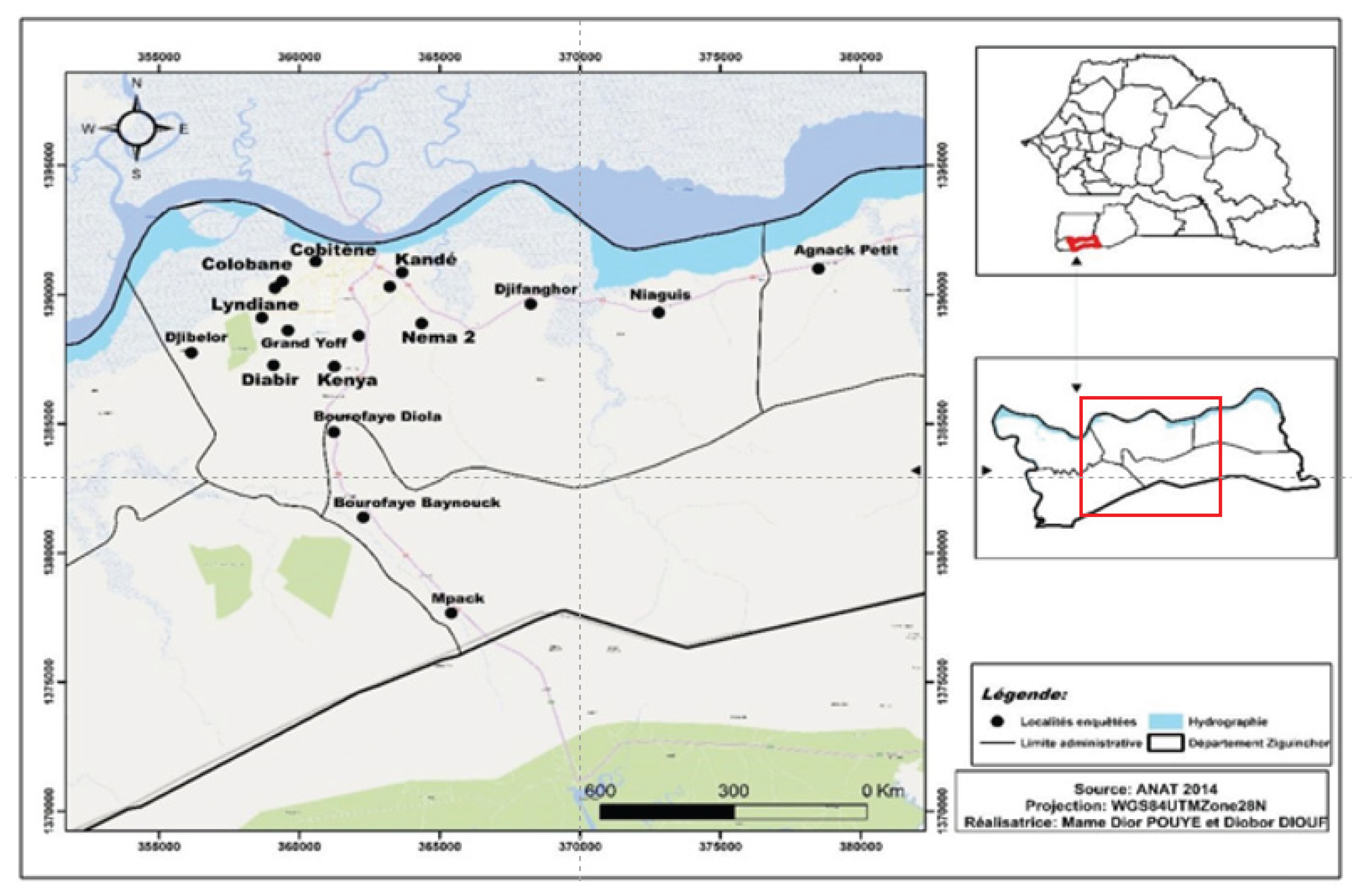
This study was carried out in the commune of Ziguinchor, located in southwestern Senegal, between 12°33′ north latitude and 16°16′ west longitude. It covers an area of 7,339 km2, representing around 3.7% of the national territory [6]. The area is subject to a coastal submarine climate [22] characterized by an average annual temperature of 27°C, with extremes reaching 37°C in April and a minimum of 15.50°C in January [23]. Average annual rainfall is estimated at 1,200 mm [6]. Agriculture is practiced by around 71% of households in rural areas and 29% in urban areas [24], with market gardening, arboriculture, pig breeding and poultry farming predominating [25,26]. It seems that Market gardening, an essential source of income and food security for farming households [27], is generally carried out on small areas ranging from 200 to 1200 m2 [28], and is characterized by a wide diversity of crops [29].
Figure 1.
Location map of the study area.
2.2. Data Collection
2.2.1. Survey
Data collection was based on a questionnaire drawn up on the basis of an in-depth review of the scientific literature. To ensure the relevance of the questions and the methodological appropriateness to the local context, a pilot survey was carried out in the study area. The questionnaire, comprising 74 questions, is structured under six main headings: (1) socio-demographic characteristics of respondents, (2) information on crop plots, (3) use of agroecological practices, (4) opportunities linked to the practice of agroecology, (5) factors influencing the adoption of agroecological practices and (6) obstacles to the adoption of agroecological practices. The KoboToolbox platform (version 2.024.05) was used to develop the questionnaire, which was then deployed on the KoboCollect application (version 2023.2.4) to ensure effective data collection from October 28 to November 19, 2024.
In urban areas, the survey was carried out in Ziguinchor neighborhoods where market gardening is most developed: Lydiane, Diabir, Djibock, Diefaye, Colobane, Co-bitene, Kande, Kantene, Kenia, Nema 2, Grand Yoff, Castor, and Boucotte. In rural areas, it was carried out in villages on the outskirts of Ziguinchor, notably in the commune of Niaguis (Agnack Petit, Djifanghor and Niaguis) and in the commune of Boutoupa Camaracounda (Bourofaye Diola, Bourofaye Bainounck and Mpack).
Data collection was carried out using the snowball method, where selected initial participants helped to identify other potential participants. In the interests of a higher response rate and contextual observation, this method was combined with the door-to-door method, which involves going directly to individuals’ homes to collect data.
2.2.1. Sampling
Since, at the time of the study, there was no database on the size of the city’s market gardening population, the sample size was determined using the formula of [30], described by [31]:
With:
no: sample size required if the population is unknown; z: the standard value of 1.96 at a confidence interval of 95% and a precision of ±5%; p: the estimated share of the population = 0.5; q: 1-p; e: the desired level of precision.
The resulting sample size is as follows:
It should be noted, however, that due to the unavailability of some market gardeners during the data collection phase, the survey covered only 300 market gardeners instead of 384.
2.3. Data Analysis
Basic descriptive statistics, such as mean, frequency, percentage, and count, were used to present the results. To assess the agroecological practices adopted, the associated opportunities, and the factors promoting or hindering their adoption, scoring criteria were defined, scores calculated, and a ranking made.
2.3.1. Relative Importance Index (RII)
The agroecological practices used were identified and ranked using the Relative Importance Index (RII). In addition to assessing the level of use of agroecological practices, the RII also helps prioritize agroecological knowledge and practices in order of frequency of adoption, so that adaptation actions or support can be targeted on the right practice(s). This method has been used in previous research by [32] and [33] to examine the most popular agroecological practices among small-scale farmers in northern and eastern Ghana, respectively. Formula 2 was used to calculate the RII:
Here, W is the weighting of a particular response on a Likert scale with 4 response modalities: never used = 1, rarely used = 2, often used = 3, and used every year = 4. A is the highest response (4), and N is the number of respondents taken into account (300).
2.3.2. Weighted average index (WAI)
WAI is a statistical analysis method that determines the mean of an outcome by multiplying the weight given to a particular event by the associated quantitative result, then adding up all the results. This is very useful for determining a theoretically expected outcome where each event has different probabilities of occurring. WAI is therefore crucial in determining the perceived opportunities for adopting agroecological practices, and the factors that may influence their adoption.
To assess the factors motivating producers to adopt agroecological practices, the WAI was estimated on the basis of a 4-point Likert scale: 1 = “disagree”; 2 = “more or less agree”; 3 = “agree”; 4 = “strongly agree”.
For the assessment of factors influencing farmers’ adoption of agroecological practices, the WAI was estimated based on a Likert scale with the following 4 modalities: 1 = very low level of influence, 2 = low level of influence, 3 = medium level of influence, 4 = very high level of influence.
Several studies have used the WAI to evaluate climate change adaptation measures [34,35,36]. The WAI is mathematically given by formula 3:
where F denotes frequency, W represents weight or importance, and i shows the score of each factor and opportunity related to agroecological practices, or the score of each factor that can influence the adoption of agroecological practices.
2.3.3. Problem Confrontation Index (PCI)
To classify the barriers to the adoption of agroecological practices, the Problem Confrontation Index (PCI) was used. This index has been used in previous studies to identify factors that prevent smallholder farmers from adopting climate-smart farming practices [34,37,38]. For the estimation of PCI, a list of 9 questions was asked with a 4-point Likert scale to classify the obstacles that hinder the adoption of agroecological practices: 0 = “this is not a constraint”; 1 = “low-level constraint”; 2 = “moderate-level constraint”; 3 = “high-level constraint”.
where Pn is the number of small-scale farmers who rated the obstacle as no problem; Pl is the number of small-scale farmers who rated the obstacle as low-level; Pm is the number of small-scale farmers who rated the obstacle as moderate-level; and Ph is the number of small-scale farmers who rated the obstacle as high-level.
3. Results
3.1. Sociodemographic Characteristics of Market Gardeners
Table 1 presents the sociodemographic characteristics of the market gardeners surveyed. Women make up the majority, representing 79.67% of the sample, compared to 20.33% men.
In terms of age distribution, more than half of the market gardeners surveyed (50.66%) are over 45 years old, while young people aged between 20 and 30 remain poorly represented in the sector (11%). Those under 20 account for only a marginal share (1.3%). The majority of respondents (66.33%) are married, compared with 18% widowed, 13% single, and 2.67% divorced. In terms of household size, a large proportion (74%) has between 5 and 15 members. The study also shows that the Diolas (49%) and Socés (26.33%) are the ethnic groups that practice market gardening the most in the study area. Approximately 30% of market gardeners have no schooling, unlike the others who have varying levels of education, dominated by secondary level (22.67%) and primary level (21.33%). In addition, 57.67% of respondents are heads of households. Furthermore, a large proportion of market gardeners (84.33%) have not received training in market gardening techniques and are not members of a production association (84%). Furthermore, the majority (83.66%) do not have access to credit. The study also reveals that agriculture is the main activity of market gardeners (99.6%), followed by trade (92.6%) and livestock farming (35%). Their main sources of income are vegetable production (96%), followed by trade (87.33%), cashew nut production (47.33%) and mango production (33.33%). It was also noted that more than half of the vegetable farmers surveyed (50.33%) have more than 10 years of experience.
3.2. Characteristics of the Market Gardening System in the Study Area
Table 2 provides information on the characteristics of the market gardening system in the study area. It shows that the total area of cultivated plots is most often between 1,000 and 5,000 m2. With regard to land tenure, the majority of market gardeners obtain their plots through loans (62.67%) or inheritance (29.33%), revealing a problem of insecure land tenure. Production is mainly carried out on low-lying land (45%) and plateau areas (35.33%). In terms of soil fertility, most respondents (70.67%) consider their soil to be fertile, compared to 27.33% who consider it to be of average fertility. In addition, most of the crops grown are intended for food and sale (89.67%). In terms of the active workforce in the household, the study reveals that the number of people in the household involved in production work rarely exceeds five (14.6%).
3.3. Agroecological Practices Used by Smallholder Farmers
Table 3 shows the relative importance of agroecological practices used by smallholder farmers.
The analysis reveals that market gardeners employ a range of agroecological practices. Maintaining proper spacing between plants during sowing or transplanting and quickly identifying and removing weeds and diseased plants are among the agroecological practices most commonly adopted by market gardeners with an RII value of 0.75. These agroecological practices include using manure to fertilize plots (RII = 0.73); watering crops in case of water shortages (RII = 0.72); crop rotation (RII = 0.62); applying recommended doses of chemical fertilizers, and not burning dry grass and crop residues (RII = 0.60 for each). The least adopted agroecological practices are the use of weather information (RII=0.31), no-till farming (RII=0.30), and the use of resistant seeds (RII=0.29).
3.4. Opportunities and Motivating Factors for the Adoption of Agroecological Practices
The results in Table 4 show that improved soil fertility, healthy and nutritious food consumption, higher quality production, increased yields and vegetable production, and improved revenues are the factors that most motivate producers to adopt agroecological practices, with respective WAI values of 3.76, 3.75, 3.73, 3.7, and 3.62. Better environmental protection, better adaptation to climate change, biodiversity conservation, and effective disease and pest control are the factors that motivate producers the least to adopt agroecological practices.
3.5. Factors that Influence the Use of Agroecological Practices by Smallholder Farmers
The results in Table 5 show that having technical guidance and training on agroecological practices, access to information on good agroecological practices, and being a member of a network of producers practicing agroecology, are ranked 1st, 2nd, and 3rd, respectively, among the factors influencing producers’ decision to adopt agroecological practices, with respective WAI values of 3.75, 3.74, and 3.70. The factors that have less influence on the adoption of agroecological practices are access to improved seed varieties, access to organic fertilizer and biopesticides, the availability of crop plots with property title, and the receipt of information on rainfall and temperature.
3.6. Barriers Affecting the Adoption of Agroecological Practices
The results in Table 6 show that lack of manpower (PCI = 789), low level of access to information and training on good agricultural practices (PCI = 597), high cost of improved seeds (PCI = 549), difficulties in accessing organic manure (PCI = 538), difficulties in accessing financing for agriculture (PCI = 477) are ranked in this order as the most important obstacles that can block the adoption of agroecological practices by market gardeners. Factors such as difficulty of access to land (PCI = 422), crop pests and diseases (PCI=397), poor government support for access to seeds, organic fertilizers and pesticides (PCI=325), and difficulty of access to climatic information (rainfall, temperature) (PCI=153) also appear as limitations blocking the adoption of agroecological practices, but to a lesser extent, compared with the first obstacles cited.
4. Discussion
4.1. Sociodemographic Characteristics of Market Gardeners
The results of this study show that women are more involved in market gardening than men. This female predominance could be explained by the fact that men are more involved in food and cash crops, such as rice, cowpeas or cashew nuts. These observations concur with those of [27], [39], and [40], who report that women represent 86%, 90.8%, and 95% of the sector, respectively. More than half of market gardeners are over 45 years of age. This can be explained by the fact that this age group has significant responsibilities as heads of households, with needs to be met. But this is also linked to the strong rural exodus of young people, who no longer seem to be attracted by agriculture. With regard to education, the most represented category is that of those without formal education, but the second is that of those who have reached high school. This could be because people with no education find it difficult to find work in other sectors, thus falling back on market gardening. These findings are consistent with those of [40], who noted that the majority of market gardeners in the city (86%) have no formal schooling. With regard to technical expertise, the study also reveals that almost all respondents have not received technical training in market gardening and are not members of a producers’ association. This is at odds with the work of [41], who showed that half of producers have received at least some training in market gardening, and 40% of producers are grouped in market gardening associations. As for access to credit, only a minority of respondents have access to it. This could be explained by the lack of financial guarantees and the risks perceived by lenders, given that they do not belong to producer groups.
4.2. Characteristics of the Market Gardening System in the Study Area
The results show that most of the production is intended for household consumption and sale. This demonstrates the importance of vegetable production in providing subsistence for the population and generating income. These results are consistent with those of [42] and [43] in the city of Ouagadougou, Burkina Faso. The results also show that market gardeners cultivate the types of soil studied according to their location in the region. Most of the market gardeners surveyed reported that soil quality is good in terms of fertility, hence the acceptable yields obtained according to the producers’ assessment. Land insecurity was also noted, characterized by the absence of property rights, with most plots being obtained through loans. This situation is due to the difficulty of accessing property and high land acquisition costs. The areas cultivated are generally between 1,000 m2 and 5,000 m2. These results contrast with those of [27], who noted areas ranging from 200 m2 to 1200 m2. Among vegetable crops, it was found that sorrel (Hibiscus sabdariffa), okra (Abelmoschus esculentus), tomato (Solanum lycopersicum), and bitter eggplant (Solanum aethiopicum) are the most widely grown. Strong local demand, relative ease of cultivation, and the economic and cultural importance of these products explain their prevalence in market gardening in Ziguinchor [27].
4.3. Agroecological Practices Used by Smallholder Farmers
The identification and elimination of weeds and diseased plants, and spacing between plants during sowing and transplanting operations are the agroecological practices most frequently adopted by market gardeners. This stems from the observation made by producers that weeds, which compete with crops for water and nutrients, limit their growth. This finding is consistent with those of [44], who highlight the agronomic concerns associated with the presence of weeds. There is also the fact that the majority of market gardeners use manure to fertilize their fields, as it promotes crop development. These results corroborate the study by [45] conducted in the city of Abidjan, which reveals that poultry manure and cow dung are the main sources of organic matter and fertilizers used by market gardeners. However, alongside these practices, others are less commonly used, such as: using the recommended doses of chemical fertilizers, not burning dry grass and residues, water conservation techniques, and crop rotation. This situation is thought to be the result of low awareness and a lack of technical training among vegetable farmers on good agroecological practices. According to [46], the continued and excessive use of chemical fertilizers in agriculture increases the risk of soil and water pollution and soil structure degradation.
4.4. Opportunities and Motivating Factors for the Adoption of Agroecological Practices
The results of this study reveal that, according to producers’ perceptions, the application of agroecological practices improves soil fertility, increases yields, and improves soil health. This motivates vegetable farmers in the study area to use agroecological practices. These results are consistent with those of [47] in Benin and [48], who noted that the use of organic fertilizer improves soil fertility, and increases yields. On the other hand, most respondents more or less agree that the application of agroecological practices enables effective control of diseases and pests and conservation of biodiversity, thus highlighting uncertainty about the effectiveness of the practices. This could be because most respondents are uneducated and uninformed about good agroecological practices, but also due to a lack of training and guidance on applying agroecology.
4.5. Factors that Influence the Use of Agroecological Practices by Smallholder Farmers
Having guidance and training in the application of agroecological practices, access to information and financing for good agroecological practices, and membership in a network or group of producers practicing agroecology, are the three factors that strongly influence market gardeners’ decisions to adopt agroecological practices. These results corroborate those of [49], who state that, under the impetus of international institutions and non-governmental organizations (NGOs) that finance agroecology, producer groups are moving toward agroecological initiatives. There are also other influencing factors, such as access to improved seeds, organic fertilizers, and biopesticides, as well as the availability of crop plots with property title. The level of influence of these factors could be explained by the fact that the elements mentioned above are very expensive and sometimes inaccessible to market gardeners. These results are consistent with those of [50], which reveal that the market gardening sector is linked to biophysical conditions, producer organization, access to production factors and equipment, producers’ capacity building, and the marketing, storage, and processing of products.
4.6. Barriers Affecting the Adoption of Agroecological Practices
The lack of labor, poor access to information and training on good agricultural practices, the high cost of improved seeds, and difficulty accessing organic fertilizer are perceived by producers in the study area as the main factors that could significantly constrain the adoption of agroecological practices. These results corroborate those of [48]. This can be explained by the fact that agroecology requires a good knowledge base and more labor than conventional agriculture. As for fertilizer, most producers in the study area do not raise livestock, which means they have to purchase it at high prices due to high demand. The lack of information and capacity building could be because information for producers is conveyed in inappropriate way, and there isn’t much capacity building for producers.
5. Conclusions
This study analyzes the adoption of agroecological practices by market gardeners in urban and peri-urban areas in the Ziguinchor region. It highlights a growing awareness of the benefits of these techniques while also highlighting the persistence of several major obstacles. Among the main obstacles identified are a lack of technical knowledge, insufficient financial resources, and limited access to capacity building. In rural areas, market gardeners often operate in a precarious economic context, which limits their capacity for innovation. In urban areas, on the other hand, the availability of infrastructure and market opportunities can encourage faster and more effective adoption of agroecological approaches. Integrating these practices into market gardening is an important lever for boosting food security, improving farm incomes, and promoting the sustainability of local ecosystems. To accelerate adoption, it is essential to strengthen training and technical support systems, develop incentive-based public policies, and facilitate access to financing. In addition, building strong partnerships between institutions, non-governmental organizations, and local communities is a key factor in creating an environment conducive to agroecological transition.
It is therefore imperative to continue efforts in this direction in order to build a more environmentally friendly and community-beneficial agricultural future.
Author Contributions
Conceptualization, S.D. and L.D.; methodology, S.D. and L.D.; software, L.D.; validation, S.D., M.N., P.A.S. and J.P.S.; formal analysis, S.D., M.D.P. and D.D.; investigation, M.D.P. and D.D.; data curation, L.D.; writing—original draft preparation, L.D.; writing—review and editing, S.D., M.N. and J.P.S.; visualization, S.N.; supervision, L.D.; project administration, S.D. All authors have read and agreed to the published version of the manuscript.
Funding
This research received no external funding.
Institutional Review Board Statement
Not applicable.
Informed Consent Statement
Informed consent was obtained from all subjects involved in the study.
Data Availability Statement
All data are included in the document content.
Acknowledgments
We would like to thank the staff of the Agroforestry and Ecology Laboratory (LAFE) at Assane Seck University in Ziguinchor, as well as everyone who contributed to this research project in any way. We would also like to thank the market gardeners who helped provide this valuable information.
Conflicts of Interest
The authors declare no conflicts of interest.
Abbreviations
The following abbreviations are used in this manuscript:
| AFDB | African Development Bank |
| ANSD | National Agency for Statistics and Demography |
| DHORT | Horticulture Department |
| FAO | Food and Agriculture Organizations |
| UN | United Nations |
| WB | The World Bank |
| WFP | World Food Program |
References
- AFDB Sommet Dakar 2—Nourrir L’Afrique: Souveraineté alimentaire et résilience 2023.
- FAO, F.; FIDA; OMS; UNICEF; PAM Résumé de L’État de la sécurité alimentaire et de la nutrition dans le monde 2023; FAO ; FIDA ; OMS ; UNICEF ; PAM: Rome, Italie, 2023; ISBN 978-92-5-137955-4.
- SE-CNSA Rapport d’activités semestriel 2024; Senegal, 2024; p. 36;.
- WFP Plan stratégique de pays—Sénégal (2025-2029) 2024.
- ANSD Rapport définitif RGPHAE-2013; Agence National de la statistique et de la Démographie, 2013; p. 19;.
- ANSD Bulletin Mensuel des Statistiques Economiques et Financières; Agence National de la statistique et de la Démographie, 2023; p. 109;.
- WB World Bank Open Data Available online: https://data.worldbank.org/.
- 8. DHORT Grandes Performances de La Production Horticole. Available online: https://horticonnect.sn/direction-horticulture-dhort-secteur-horticole-senegal/ (accessed on 20 June 2025).
- FAO L’Agroécologie Pour La Sécurité Alimentaire et La Nutrition. Compte-Rendu Du Symposium International de La FAO Available online: https://www.fao.org/agroecology/database/detail/fr/c/888766/ (accessed on 21 June 2025).
- Citeau, L.; Bispo, A.; Bardy, M.; King, D. Gestion Durable Des Sols; Quae, 2008; ISBN 978-2-7592-0190-7.
- Bouthier, A.; Pelosi, C.; Villenave, C.; Peres, G.; Hedde, M.; Ranjard, L.; Vian, J.F.; Peigné, J.; Cortet, J.; Bispo, A. Impact Du Travail Du Sol Sur Son Fonctionnement Biologique. Faut-il travailler le sol 2014, 85–108.
- Agmas, B.; Adugna, M. Attitudes and Practices of Farmers with Regard to Pesticide Use in NorthWest Ethiopia. Cogent Environmental Science 2020, 6, 1791462. [CrossRef]
- Cissé, I.; Fall, S.T.; Badiane, M.; Diop, Y.; Diouf, A. Horticulture et Usage Des Pesticides Dans La Zone Des Niayes Au Sénégal. Document de travail Écocité 2006, 151–159.
- Endalew, M.; Gebrehiwot, M.; Dessie, A. Pesticide Use Knowledge, Attitude, Practices and Practices Associated Factors Among Floriculture Workers in Bahirdar City, North West, Ethiopia, 2020. Environmental Health Insights 2022, 16, 1–10. [CrossRef]
- Ngom, Y.; Touré, K.; Fall, O.; Faye, A. Études de La Commercialisation Des Produits Horticoles Dans Les Régions de Thiès, Diourbel et Fatick: Offre, Demande, Configuration Des Marchés et Analyse Économique et Financière de La Production et de La Commercialisation; Papsen: Senegal, 2015;.
- FAO The Potential of Agroecology to Build Climate-Resilient Livelihoods and Food Systems Available online: https://www.fao.org/climate-change/projects-and-programmes/project-detail/the-potential-of-agroecology-to-build-climate-resilient-livelihoods-and-food-systems/en (accessed on 30 June 2025).
- Wezel, A.; Bellon, S.; Doré, T.; Francis, C.; Vallod, D.; David, C. Agroecology as a Science, a Movement and a Practice. A Review. Agron. Sustain. Dev. 2009, 29, 503–515. [CrossRef]
- Dugué, P.; Ngouambé, N.; Fongang Fouepe, G.H.; Kossoumna Liba’a, N.; Ribier, V. Elaboration Concertée de La Politique Publique de Conseil et de Vulgarisation Agricoles. Volume 1: Rapport Du Diagnostic Du Conseil et de La Vulgarisation Agricoles Au Cameroun; Ministère de l’agriculture et du développement durable: Cameroun, 2017; p. 102;.
- Rueff, M.; Bayo, F.; Camara, A.; Ka, D.-Y.; Ndiaye, M.F.; Ndienor, M.; Diop, A.; Sow, M.A.; D’Anfray, A.; Milhorance, C. Défis et perspectives pour le développement de l’intensification agroécologique au Sénégal. À travers trois cas d’étude dans les Niayes, le Bassin Arachidier et le département de Tambacounda 2024.
- Dione, I.D.; Diallo, M.; Diedhiou, P. Savoirs Locaux et Dynamique Agro Ecologique En Casamance (Sénégal) et En Oïo (Guinée Bissau). 2024.
- Sene, M.T.D.; Gning, S.B. Le Financement Des Initiatives Féminines de Transition Agroécologique Au Sénégal. Modalités d’accès et Conditions de Durabilité. Revue internationale des études du développement 2024, 55–88. [CrossRef]
- Sagna, P.; Ndiaye, O.; Diop, C.; Niang, A.D.; Sambou, P.C. Les Variations Récentes Du Climat Constatées Au Sénégal Sont-Elles En Phase Avec Les Descriptions Données Par Les Scénarios Du GIEC? 2268-3798 2016.
- ANSD ANDS. (2020). Situation Economique et Sociale de La Région de Ziguinchor, 2017-2018. Service Régional de La Statistique et de La Démographie de Ziguinchor.; 2020; p. 130;.
- ANSD Rapport régional définitif: Recensement Général de la Population et de l’Habitat,s de l’Agriculture et de l’Elevage 2013-Région de Ziguinchor; Agence National de la statistique et de la Démographie, 2017; p. 83;.
- Dasylva, M.; Ndour, N.; Diédhiou, M.A.A.; Sambou, B. Caractérisation Physico-Chimique Des Sols Des Vallées Agricoles de La Commune de Ziguinchor Au Sénégal. European Scientific Journal May 2019, 15, 165–189.
- Diedhiou, S.O.; Sy, O.; Margetic, C. Agriculture Urbaine à Ziguinchor (Sénégal): Des Pratiques d’autoconsommation Favorables à l’essor de Filières d’approvisionnement Urbaines Durables. Espace populations sociétés. Space populations societies 2018, 2018, 21. [CrossRef]
- Dasylva, M.; Ndour, N.; Diallo, A. Diversité et Caractéristiques Des Systèmes de Production Agricole Végétale Dans La Commune de Ziguinchor Au Sénégal. European Scientific Journal, ESJ 2023, 19, 120–147. [CrossRef]
- Diédhiou, S.O.; Ndiaye, T.M.N. Caractérisation Des Catégories d’espaces et Contribution Du Maraîchage à La Sécurité Alimentaire Dans La Ville de Ziguinchor Au Sénégal. Revue Africaine d’Environnement et d’Agriculture 2021, 4, 1–16.
- Dasylva, M.; Ndour, N.; Ndiaye, O.; Sambou, B. Analyse de La Flore, de La Végétation Ligneuse et Des Fonctions Des Vallées En Zone Péri-Urbaine Post-Conflit (Ziguinchor, Sénégal). International Journal of Biological and Chemical Sciences 2017, 11, 360–377.
- Cochran, W.G. Sampling Techniques. 2nd Edition; John Wiley & Sons, 1963;.
- Kothari, C.R. Research Methodology: Methods and Techniques; 2nd Edition.; New Age International, 2004; ISBN 978-81-224-2488-1.
- Yeleliere, E.; Yeboah, T.; Antwi-Agyei, P.; Peprah, P. Traditional Agroecological Knowledge and Practices: The Drivers and Opportunities for Adaptation Actions in the Northern Region of Ghana. Regional Sustainability 2022, 3, 294–308. [CrossRef]
- Baffour-Ata, F.; Antwi-Agyei, P.; Apawu, G.O.; Nkiaka, E.; Amoah, E.A.; Akorli, R.; Antwi, K. Using Traditional Agroecological Knowledge to Adapt to Climate Change and Variability in the Upper East Region of Ghana. Environmental Challenges 2021, 4, 9. [CrossRef]
- Uddin, L.Q.; Nomi, J.S.; Hébert-Seropian, B.; Ghaziri, J.; Boucher, O. Structure and Function of the Human Insula. Journal of clinical neurophysiology 2017, 34, 300–306. [CrossRef]
- Alotaibi, B.A.; Kassem, H.S.; Nayak, R.K.; Muddassir, M. Farmers’ Beliefs and Concerns about Climate Change: An Assessment from Southern Saudi Arabia. Agriculture 2020, 10, 253. [CrossRef]
- Devkota, R.; Brant, S.V.; Thapa, S.; Loker, E.S. Two Avian Schistosome Cercariae from Nepal, Including a Macrobilharzia-like Species from Indoplanorbis Exustus. Parasitology International 2014, 63, 374–380. [CrossRef]
- Hossain, M.S.; Miah, M.A.M. Poor Farmers’ Problem Confrontation in Using Manure towards Integrated Plant Nutrition System. Bangladesh Journal of Extension Education 2011, 23, 139–147.
- Antwi-Agyei, P.; Abalo, E.M.; Dougill, A.J.; Baffour-Ata, F. Motivations, Enablers and Barriers to the Adoption of Climate-Smart Agricultural Practices by Smallholder Farmers: Evidence from the Transitional and Savannah Agroecological Zones of Ghana. Regional Sustainability 2021, 2, 375–386. [CrossRef]
- Faye, C.; Sané, B.; Cissokho, D.; Diédhiou, S.O. Structure du maraichage périurbaine et dégradation des ressources (sols et eau) dans la zone de Boutoute à Ziguinchor (Sénégal). Structure of peri-urban market gardening and degradation of resources (soils and water) in the zone of Boutoute in Ziguinchor (Senegal). 2019.
- Soro, G.; Koffi, N.M.; Koné, B.; Kouakou, Y.E.; M’Bra, K.R.; Soro, P.D.; Soro, N. Utilisation de Produits Phytosanitaires Dans Le Maraîchage Autour Du Barrage d’alimentation En Eau Potable de La Ville de Korhogo (Nord de La Côte d’Ivoire): Risques Pour La Santé Publique. Environnement, Risques & Santé 2018, 17, 155–163. [CrossRef]
- Balasha, A.M.; Fyama, J.N.M. Factors Influencing the Adoption of Integrated Production Techniques for a Sustainable Vegetable Production in Lubumbashi, Democratic Republic of Congo. Cahiers Agricultures 2020, 29, 11. [CrossRef]
- Sarr, N. Evaluation des impacts socio-économiques et environnementaux des périmètres maraichers du CICR dans les régions de Ziguinchor et Sédhiou. Mémoire de Master, Université Assane Seck de Ziguinchor: Sénégal, 2024.
- Soma, D.D.; Zogo, B.M.; Somé, A.; Tchiekoi, B.N.; Hien, D.F. de S.; Pooda, H.S.; Coulibaly, S.; Gnambani, J.E.; Ouari, A.; Mouline, K. Anopheles Bionomics, Insecticide Resistance and Malaria Transmission in Southwest Burkina Faso: A Pre-Intervention Study. PloS one 2020, 15, 21. [CrossRef]
- Leblanc, M.L.; Cloutier, D.C.; Leroux, G.D.; Hamel, C. Facteurs Impliqués Dans La Levée Des Mauvaises Herbes Au Champ. Phytoprotection 1998, 79, 111–127. [CrossRef]
- Kouakou, K.J.; Gogbeu, S.J.; Sika, A.E.; Yao, K.B.; Bounakhla, M.; Zahry, F.; Tahri, M.; Dogbo, D.O.; Bekro, Y.-A. Caractérisation Physico-Chimique Des Horizons de Surface de Sols ą Maraīchers Dans La Ville d’Abidjan (Cōte d’Ivoire). International Journal of Biological and Chemical Sciences 2019, 13, 1193–1200. [CrossRef]
- Tano, B.F.; Abo, K.; Dembele, A.; Fondio, L. Systèmes de Production et Pratiques à Risque En Agriculture Urbaine: Cas Du Maraîchage Dans La Ville de Yamoussoukro En Côte d’Ivoire. International Journal of Biological and Chemical Sciences 2011, 5, 2317–2329. [CrossRef]
- Danus, P. Un Outil d’aide à La Décision Au Service de l’agroécologie: Les Pratiques de Conservation et de Fertilisation Du Sol Appliquées Au Village de Kotopounga Dans La Commune de Natitingou Au Bénin. Mémoire de Master, Liège Université, 2020.
- Lairez, J.; Modou Gueye, F.; Bayo, F.; Kouakou, P.; Gaye, E.H.K.; Mbaye, B.; Diakhate, P.B.; Man, C.A.; Sall, M.; Ba, K. Rapport de l’atelier de Restitution Des Résultats de l’enquête HOLPA; HOLPA: Sénégal, 2024; p. 16;.
- Bottazzi, P.; Bastide, J.; Wade, I. Les Politiques Agraires Au Sénégal [Agricultural Policies in Senegal]. EU Science Hub 2023, 78. [CrossRef]
- Lare: K. Le Maraîchage de Contre-Saison et Sa Contribution à La Réduction de La Pauvreté En Milieu Rural Dans La Région Des Savanes (Togo). Revue Ivoirienne de Géographie des Savanes 2017, 3, 165–181.

Table 1.
Socio-demographic characteristics of respondents.
| Parameter | Modality | Number | Percentage (%) |
|---|---|---|---|
| Gender | Female | 239 | 79.67 |
| Male | 61 | 20.33 | |
| Age | >45 years | 152 | 50.66 |
| 30-45 years | 111 | 37 | |
| 20-30 years | 33 | 11 | |
| <20 years | 4 | 1.3 | |
| Marital status | Married | 199 | 66.33 |
| Widowed | 54 | 18.00 | |
| Single | 39 | 13.00 | |
| Divorced | 8 | 2.67 | |
| Household size | 5-15 people >15 people <5 people |
222 50 28 |
74 16.66 9.33 |
| Ethnic group | Diola Soce Peul Ballante Mancagne Mandjack Serere Wolof Other |
147 79 15 10 8 7 5 3 26 |
49.00 26.33 5.00 3.33 2.67 2.33 1.67 1.00 8.67 |
| Educational attainment | No formal education High School Basic school Qur’anic Tertiary education Literacy |
89 68 64 56 20 3 |
29.67 22.67 21.33 18.67 6.67 1.00 |
| Head of household | Yes No |
173 127 |
57.67 42.33 |
| Principal activity | Agriculture Breeding Beekeeping Fishing Forestry Trade Crafts Salaried employment Other |
299 105 2 8 9 278 4 27 5 |
99.6 35 0.66 2.66 3 92.6 1.33 9 1.66 |
| Farming experience | >10 years 5-10 years <5 years |
203 59 38 |
67.66 19.66 12.66 |
| Technical training | No Yes |
253 47 |
84.33 15.66 |
| Member of an association | No Yes |
252 48 |
84 16 |
| Access to credit | No Yes |
251 49 |
83.66 16.33 |
Table 2.
Characteristics of the market gardening system in the study area.
| Parameter | Modality | Number | Percentage (%) |
|---|---|---|---|
| Product destination | Sales and consumption | 269 | 70.67 |
| Consumption | 30 | 10 | |
| Sales | 1 | 0.33 | |
| Soil type | Lowland soil (Gleysol) | 135 | 45 |
| Plateau soil (Acrisols) | 106 | 35.33 | |
| Both | 59 | 19.67 | |
| Evaluation of soil fertility | Good | 212 | 70.67 |
| Average | 82 | 27.33 | |
| Poor | 6 | 2 | |
| Land tenure system | Borrowed | 188 | 62.67 |
| Inherited | 88 | 29.33 | |
| Offered | 17 | 5.67 | |
| Purchased | 11 | 3.67 | |
| Other | 11 | 3.67 | |
| Total area of cultivation plots | <200m2 | 23 | 7.66 |
| 200 à 500m2 | 48 | 16 | |
| 500 à 1000m2 | 61 | 20.33 | |
| 1000 à 5000m2 | 90 | 30 | |
| >5000m2 | 78 | 26 | |
| Number of participants in the household | <5 people | 256 | 85.33 |
| 5-10 people | 39 | 13 | |
| >10 people | 5 | 1.6 |
Table 3.
Agroecological practices used by the smallholder farmers.
| Agroecological practices | Score | Total weight | Total |
A x N | RII | Rank | |||
|---|---|---|---|---|---|---|---|---|---|
| Never used (1) | Seldom used (2) |
Often used (3) | Used in every agricultural season (4) | ||||||
| Removing weeds and diseased plants | 0 | 2 | 885 | 16 | 903 | 300 | 1200 | 0.75 | 1 |
| Plant spacing | 1 | 2 | 885 | 12 | 900 | 300 | 1200 | 0.75 | 1 |
| Use of manure | 7 | 16 | 837 | 24 | 884 | 300 | 1200 | 0.73 | 3 |
| Watering in case of water shortage | 15 | 10 | 837 | 4 | 866 | 300 | 1200 | 0.72 |
4 |
| Crop rotation | 72 | 32 | 615 | 28 | 747 | 300 | 1200 | 0.62 | 5 |
| Compliance with recommended fertilizer doses | 78 | 156 | 246 | 248 | 728 | 300 | 1200 | 0.60 | 6 |
| Dry grass and residue conservation | 83 | 24 | 597 | 24 | 728 | 300 | 1200 | 0.60 | 6 |
| Water conservation | 100 | 20 | 564 | 8 | 692 | 300 | 1200 | 0.57 | 8 |
| Crop association | 143 | 38 | 402 | 16 | 599 | 300 | 1200 | 0.49 | 9 |
| Mulching | 169 | 12 | 372 | 4 | 553 | 300 | 1200 | 0.46 | 10 |
| Agroforestry practices | 177 | 4 | 360 | 4 | 545 | 300 | 1200 | 0.45 | 11 |
| Using short-cycle varieties | 171 | 32 | 336 | 4 | 543 | 300 | 1200 | 0.45 | 11 |
| Using biopesticides | 131 | 258 | 111 | 12 | 512 | 300 | 1200 | 0.42 | 13 |
| Use weather information | 260 | 14 | 93 | 8 | 375 | 300 | 1200 | 0.31 | 14 |
| Reduce or zero tillage | 267 | 14 | 45 | 44 | 370 | 300 | 1200 | 0.30 | 15 |
| Use of disease- and pest-resistant varieties | 268 | 34 | 39 | 8 | 349 | 300 | 1200 | 0.29 | 16 |
Notes: RII. relative importance index; A. the highest response (4); N. the number of respondents being considered (300).
Table 4.
Factors motivating the adoption of agroecological practices.
| Motivating factors | Score | WAI | Rank | |||
|---|---|---|---|---|---|---|
| Disagree (1) | More or less agree (2) |
Agree (3) | Strongly Agree (4) | |||
| Improved fertility | 5 | 32 | 72 | 1020 | 3.76 | 1 |
| Healthy and nutritious food | 2 | 44 | 75 | 1004 | 3.75 | 2 |
| Higher-quality production | 6 | 42 | 57 | 1016 | 3.73 | 3 |
| Increased yields | 3 | 52 | 87 | 968 | 3.7 | 4 |
| Improved revenues | 2 | 68 | 120 | 896 | 3.62 | 5 |
| Environmental protection | 3 | 32 | 255 | 784 | 3.58 | 6 |
| Adapting to climate change | 3 | 54 | 402 | 544 | 3.34 | 7 |
| Biodiversity conservation | 1 | 98 | 405 | 460 | 3.21 | 8 |
| Effective pest and disease control | 34 | 336 | 72 | 296 | 2.46 | 9 |
Notes: WAI. Weighted Average Index.
Table 5.
Factors influencing the adoption of agroecological practices .
| Score | WAI | Rank | ||||
|---|---|---|---|---|---|---|
| Very low level of influence (1) |
Low level of influence (2) |
Medium level of influence (3) |
Very high level of influence (4) |
|||
| Management and training | 10 | 12 | 99 | 1004 | 3.75 | 1 |
| Access to information | 6 | 12 | 138 | 968 | 3.74 | 2 |
| Producer networks or groups | 12 | 12 | 126 | 960 | 3.7 | 3 |
| Access to financing | 16 | 20 | 108 | 952 | 3.65 | 4 |
| Access to seeds of improved varieties | 10 | 26 | 159 | 896 | 3.64 | 5 |
| Having a titled plot of land | 25 | 44 | 147 | 816 | 3.44 | 6 |
| Rain and temperature information | 168 | 36 | 141 | 228 | 1.91 | 7 |
Notes: WAI. Weighted Average Index.
Table 6.
Obstacles to the adoption of agroecological practices.
| Obstacles | Score | PCI | Rank | |||
|---|---|---|---|---|---|---|
| It’s not a Constraint (0) |
Low-level constraint (1) | Moderate level constraint (2) |
High-level constraint (3) | |||
| Lack of manpower | 0 | 9 | 60 | 720 | 789 | 1 |
| Poor access to information and training |
0 | 35 | 190 | 372 | 597 | 2 |
| High cost of improved seeds | 0 | 16 | 140 | 393 | 549 | 3 |
| Difficult access to financing | 0 | 54 | 126 | 297 | 477 | 5 |
| Difficult access to land | 0 | 29 | 90 | 303 | 422 | 6 |
| Crop diseases and pests | 0 | 27 | 142 | 228 | 397 | 7 |
| Weak government support | 0 | 62 | 86 | 177 | 325 | 8 |
| Weak information on climate | 0 | 17 | 88 | 48 | 153 | 9 |
Notes: PCI. Problem Confronting Index.
Disclaimer/Publisher’s Note: The statements, opinions and data contained in all publications are solely those of the individual author(s) and contributor(s) and not of MDPI and/or the editor(s). MDPI and/or the editor(s) disclaim responsibility for any injury to people or property resulting from any ideas, methods, instructions or products referred to in the content. |
© 2025 by the authors. Licensee MDPI, Basel, Switzerland. This article is an open access article distributed under the terms and conditions of the Creative Commons Attribution (CC BY) license (http://creativecommons.org/licenses/by/4.0/).
Copyright: This open access article is published under a Creative Commons CC BY 4.0 license, which permit the free download, distribution, and reuse, provided that the author and preprint are cited in any reuse.


