
Submitted:
22 July 2025
Posted:
23 July 2025
You are already at the latest version
Abstract
Autism spectrum disorder (ASD) is a common condition with substantial personal and financial burdens of lifelong implication. Multiple twin studies have confirmed a genetic or inherited component at ~80%, higher than any other common condition. However, ASD’s rapidly‐accelerating prevalence, now at 1 in 31 in the USA, appears to defy a predominantly genetic basis and implements our rapidly‐changing environment. A potential explanation of this paradox is a recent increase in de novo variants (DNVs), which are “new” mutations present in the patient yet absent in both parents. The present authors recently reported using trio whole genome sequencing (WGS) that DNVs highly likely to be highly disease associated (“Principal Diagnostic Variants”, PDVs), mostly missense variants, are present in (25/50) 50% of the ASD patients clinically evaluated by our team. The current study was designed to support this observation with trio‐WGS in 100 additional unrelated ASD patients. De novo PDVs were identified in 47/100 (47%) of cases, in close approximation to our previous work. Using non‐transcribed (up and downstream) variants for all genes as a control group, these DNV‐PDVs were far more likely (P<0.0001, OR 5.8, 95% C.I. 2.9‐11) to be in SFARI‐listed genes associated with ASD. Consistent with the emerging polygenic model, using the same analyses, inherited missense variants are also associated with ASD (P<0.0001). Highly unexpectedly, silent variants, both inherited (P<0.0001) and de novo (P<0.007), were also statistically associated with ASD, and among inherited variants, silent variants are more associated with ASD than are missense variants (P<0.0001). Adding de novo silent DNVs as PDVs increases the proportion of our subjects with at least one DNV‐PDV to 55% of the subjects. Our proposed model for ASD, with prominent DNVs in most, that are genetic yet not inherited, predicts the known predominate genetic pathogenesis and the accelerating prevalence of ASD, presumably from chemical mutagenesis.
Keywords:
autism
; disease model
; diagnostic yield
; DNA sequencing
; missense
; polygenic inheritance
; silent variants
; synonymous variants
; whole genome sequencing
Introduction
Autism spectrum disorder (ASD) is a neurodevelopmental disorder present in early life with a core dual deficit in social communication and repetitive and/or restricted interests or behaviors [1]. Diagnosis is currently based on the observable behavioral phenotype with little convincing evidence of consistent biomarkers, suggesting biological heterogeneity [2]. Multiple studies have demonstrated that the heritability component in ASD is about 80% [3,4,5], which is highest reported among all common (prevalence > 1%) disorders. However, frequent episodes of acute/sub-acute onset of severe ASD symptoms following environmental physiological stressors (e.g., infections) suggests the addition of critical environmental components [6]. Thus, in terms of pathogenesis, ASD is oftentimes similar to that of other common disorders (e.g., diabetes, asthma), in that there are underlying genetic factors resulting in biological vulnerability, and environmental factors that may trigger disease onset or exacerbation.
ASD has also increased dramatically in incidence and prevalence, being a rare disorder (< 1 in a thousand) only 30 years ago, yet most recently found to be present in one out of 31 American children [7], which translates to over 10 million currently affected individuals in the USA. Some sources state that the explosion in ASD incidence is a result of better recognition and diagnosis [8]. However, a prevailing view of many of us “in the trenches” (e.g., pediatricians, educators) is that we were not seeing this magnitude of affected children previously under any label, be that intellectual disability, learning disability, psychiatric disease, or other [9], and that the accelerating disease increase is real. ASD results in great personal costs to the individuals affected and their family members, at least for the more-severely affected among the vast spectrum of severity. The economic and societal burden of ASD is substantial, with lifetime care costs exceeding $2.4 million per individual (Autism Speaks, 2025). This provides an estimated, lifetime national cost of $25 trillion, very near the amount of the publicly-held US national debt. This estimate presumes that the incidence of ASD will not continue to increase, a major assumption that unfortunately may not come to pass.
While the pathogeneses of most common disorders have recently given away to advances in the biological sciences, and this knowledge has generally resulted in improved clinical outcomes, ASD has been somewhat of a hold out. Given the overwhelming burden of the disease, why isn't the pathogenesis of ASD better understood? One of the main reasons is the extreme genotypic heterogeneity of ASD, which includes several hundreds of genes already so identified [10,11]. As genetic studies in ASD routinely identify multiple additional disease-associated genes, it appears that we have only identified a small minority of those genes to date, and that there are likely thousands of genes associated with ASD. In multiplex families (with two or more ASD-affected first-degree relatives), marked variable expressivity is common among the affected relatives, both in terms of disease severity, and the presence and type of comorbid disease manifestations. In many cases, close relatives of people with ASD are themselves affected with another neurodevelopmental disorder or a forme fruste (incomplete or mild) phenotype (e.g., attention deficit hyperactivity disorder (ADHD), learning disabilities). Marked variable expressivity and forme fruste phenotypes are common even when a specific gene variant segregating in a family meets multiple criteria to be considered as a principal cause of disease [12], and this is highly suggestive of polygenic factors (e.g., genetic modifiers, genetic background) and/or environmental factors.
The key role of rare, highly penetrant variants (disease is likely in the presence of the variant), either inherited or non-inherited (de novo), in the development of ASD has been established by many studies [reviewed in [13,14]]. Highly-penetrant variants predisposing towards ASD often can be identified using DNA sequencing, with inheritance patterns revealed being either Mendelian (e.g., autosomal recessive or dominant, X-linked) or non-Mendelian (e.g., polygenic, maternal, de novo). Recent papers have tended to focus on de novo variants (DNVs, new mutations, absent from both parents) as being of particular importance in ASD. In recent years, these variants are often identified by whole genome sequencing (WGS, covering over 99% of the entire DNA) in samples collected from trios (affected individual plus biological parents).
The yield of DNVs in ASD has been measured in trio-WGS studies at 20% [15], 21% [16], 31% [17], 41% [18] and 50% [14]. The methodology varied somewhat among these studies, although in general they did not comprehensively query for genes not previously identified in ASD. A study on consecutive, unrelated 50 ASD trios from the practice of the first author (RGB) [14] revealed a DNV diagnostic yield of 20%, if based solely on DNVs listed in the official report from the commercial laboratory (Variantyx, Framingham, MA, USA). However, the diagnostic yield for a de novo Principal Diagnostic Variant (PDV) was 50% (25/50) when trio-WGS was followed by comprehensive reanalysis of the raw DNA sequence data [14]. We defined a PDV using strict criteria (see Methods) to ensure that each variant so designated is highly likely to be disease related in that patient, and not an incidental finding. Of interest, the vast majority (15/18, 83%) of all DNVs not listed on the official laboratory report, were in genes not previous reported in ASD (13 DNVs) or in those reported only in with 1-4 individuals each (2 DNVs), and thus not expected to be listed on the report by any commercial diagnostic laboratory. This highlights both the likelihood that only a minority of ASD genes have so far been identified, and the need to go beyond the commercial laboratory report in ASD diagnostics.
How does the autism community reconcile the conundrum of a disorder that is highly genetic in etiology with its rapidly-expanding prevalence? For the most part, they don’t, with various aspects of the community denying either the genetic basis or a truly expanding incidence. Assuming that both statements are correct, how can a genetic disorder increase rapidly in the population? One possible explanation involves DNVs, which are genetic but not inherited; the DNVs themselves being accelerated over time by environmental chemical mutagenesis. In the current study, we expand on our previous study to analyze trio-WGS data from Variantyx in 100 consecutive, unrelated subjects with ASD from the practice of the senior author (REF), with a focus on DNVs. Our data confirms earlier studies that DNVs are a major component of the genetic predisposition towards ASD, and that they can be identified by trio-WGS followed by raw-data analysis. Is this an answer to the conundrum?
Subjects and Methods:
Subjects
Our subjects consist of the 100 most-recently evaluated, sequential, unrelated patients with a clinical diagnosis of ASD in which trio-WGS was performed at Variantyx® (Framingham, MA, USA). Each subject was evaluated clinically by the senior author, who is a child neurologist known for conducting clinical care and research in ASD. At a minimum, the evaluation in all subjects included a detailed history and a physical examination, either in person or via video-teleconferencing. The diagnosis of ASD in each case was confirmed by appropriate neuropsychiatric testing (e.g., ADOS-2). Subjects with additional neurodevelopmental diseases (NDD) or non-NDD diagnoses were not excluded. In the few cases where more than one family member met study criteria, the subject was assigned to be the proband (person first presenting as a patient). In cases of affected siblings presenting simultaneously, the elder was assigned. Thus, all study subjects have no known genetic relationships to each other. This study was approved by the Advarra IRB (Institutional Review Board, human subjects committee, cirbi@advarra.com) as a retrospective chart review of available clinical records. No additional testing was performed for the purpose of this study. Trio-WGS in our 100 subjects were all performed from January 2022 to July 2024, with our analysis of the raw individual sequence data completed from January through July 2024.
Sequencing and Data Analysis
Available clinical notes from all subjects were reviewed for phenotypic data. WGS analyses from Variantyx® included genome-wide sequence analysis (for single-nucleotide variants and small deletions/insertions), genome-wide structural variant analysis (for copy number variants (CNVs), including large duplications/deletions/inversions and aneuploidy), and mitochondrial-genome sequence analysis (for heteroplasmy ≥ 5% and large deletion analysis). See our previous study for details of our DNA sequence data analysis, including Figure 1 of that paper for the Variantyx analyses pipeline [14]. Additional information is available at variantyx.com [19]. Raw genomic data from each subject was evaluated on the Variantyx® bioinformatics platform accessible to laboratory personnel, in order to tabulate all de novo variants predicted to alter the amino acid code of any protein (“coding” variants). Analyses included the Integrative Genomics Viewer (IGV) of all small de novo variants and SVPlots of all large de novo variants to verify the presence of that variant and exclude artifacts. Inherited sequence variants were tabulated by the same software. In order to compare only protein-coding genes among the various variant types, all non-coding genes were manually removed, including RNA genes (e.g., gene symbols starting with LCA, LINC, LINP, LNC, Metazoa, MIR, MIRNA, PIRNA, PIWIL, RN7, RNA, RNU, RNV, RPL, SNOR, SNRNA, TRNA, U#, or YRNA), antisense genes (gene symbols ending with AS#), and pseudogenes (many gene symbols that end with P#), whereas # is any number. These analyses were conducted genome-wide (on all genes) and were highly laborious; thus, were completed only on a randomized subset of 50 subjects (25 for non-transcribed variants). Intronic variants were not tabulated as they are extremely numerous and continuously resulted in error messages on the Variantyx software.
Gene Categorization
In the determination of diagnostic yield, we sought to be conservative in that each variant determined to be disease causal (PDVs) has a high probability of being so. In our previous study, we restricted PDV annotation to genes published with direct association with ASD, designated as A1 (highest direct association) through A3 (lowest direct association), in particular using SFARI rankings [11] as per Table 5 in our previous work [14]. Genes without a direct association with ASD were designated as B1 (indirect association) through B3 (highly unlikely to be ASD associated). With the understanding that our prior B1 category was too broad, in the present study, we designated those genes with a published, one-degree indirect, association to ASD as B0. This category contains genes with a direct association with other conditions associated with ASD (e.g., AD/HD, intellectual disability, schizophrenia, bipolar), and genes with a direct association with another gene that is itself directly related (A1-3) to ASD. The remainder of the prior B1 category comprises our current B1 category. Overall, B1-3 genes are most likely not associated with ASD, but association cannot be excluded.
Variant Categorization
Variants were assigned as PDVs if they are real (verified using IGV or SVPlots), coding (changing the amino acid code), rare (allelic prevalence < 1/10,000, population prevalence < ~2/10,000), and evolutionarily conserved (at least moderate, conserved through mammals), as per our previous study [14], in a gene published as directly (A1-A3) or single-step indirectly (B0) associated to ASD. De novo mitochondrial DNA (mtDNA) variants were eligible for PDV status if coding and the subject has ≥ 40% and ≥ two times the heteroplasmic % as the mother (presumed de novo event in grandmother). Large deletions were counted as evolutionarily conserved when any conserved nucleotide was deleted. Characteristics of different types of coding variants (e.g., missense, frameshift, deletion), and the importance of prevalence and conservation to variant annotation, can be found in a recent review (Tables 2–4 of [20]). Moderate conservation was assumed present if both PhyloP and PhastCons were >0.7 and assumed absent if both were <0.4. Otherwise, conservation was manually determined using the University of California Santa Cruz (UCSC) Genome Browser [21] using a threshold of 80% of listed mammalian species. Splice-site variants were included if >0.6 on SpliceRF or SpliceADA. Thus, the focus of this study was on rare, high-penetrance variants. Statistical analyses were performed using a two-tailed Fisher Exact Test [22] and/or MedCalc® Odds ratio calculator [23]. Based on our data analysis, silent DNVs were reclassified as PDVs (see Results and Discussion sections). Note that CNVs widely considered to be Pathogenic/disease associated were designated as PDVs regardless of other parameters.
Results
Subject Characteristics
Among our 100 unrelated subjects, the age at the time of sequence review ranged from 4 to 40 years, with a median of 9 years. Mean maternal and paternal ages at the subject’s birth were 33.1 and 35.4 years, respectively. The race of 23 subjects was not recorded. Among the 77 subjects whose race or ethnicity were recorded, 43/77 (56%) were Caucasian, 30/77 (39%) were of other backgrounds (14 South Asians, 3 East Asians, 4 African Americans, and 9 Latinos), and 4/77 (5%) subjects were of mixed race or ethnicity. Twenty subjects (20%) were female. Intellectual disability (ID) was moderate or more in severity in 85/95 (89%) in which this was recorded. Twenty-nine (29%) subjects were non-verbal; 31 (31%) had epilepsy; and 57 (57%) experienced at least one episode of substantial developmental regression. Nine (9%) had tics, a potential sign of an autoimmune encephalopathy. Additional clinical information is shown in Table S1.
De Novo Variants Identified and Their Characteristics
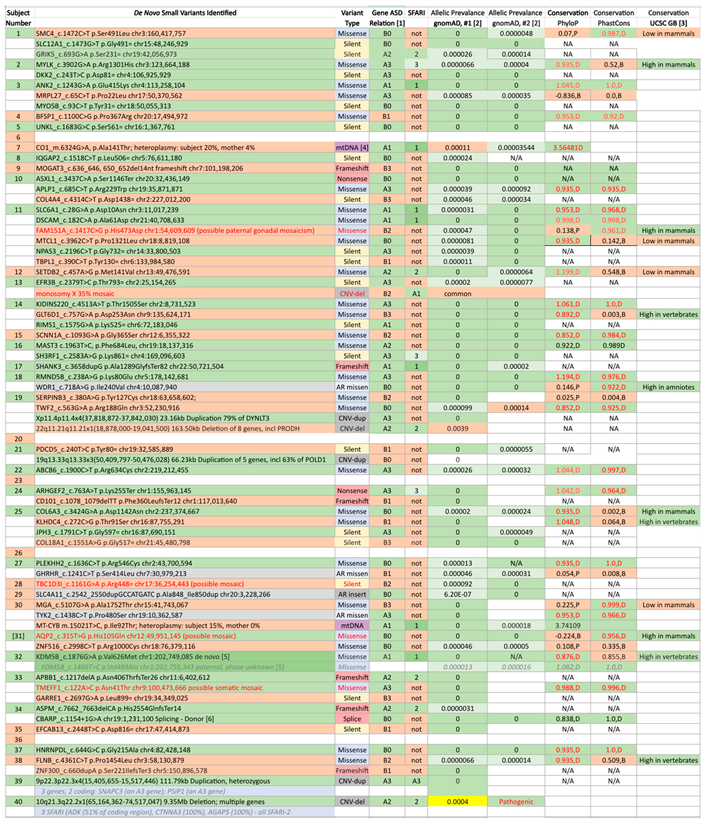
A total of 151 de novo variants (DNVs) were identified genome-wide that alter the amino acid code of any protein among the 100 subjects (mean 1.5 per subject, range 0-6, Table 1). Among these 151 DNVs, only 17 (present in 15 of the 100 subjects) were reported on the Variantyx laboratory report, and all 17 met criteria for Principal Diagnostic Variants (PDVs) by our algorithm (Table 2, light blue background in column 1). Only six of those 17 variants (in 6 different subjects) were reported as “Positive” (Pathogenic, determined to be highly likely to be disease related/causal) by the laboratory, and half (3) of those were large CNV deletions. Adding in an additional 9 DNVs (in 7 subjects) with indeterminate designations by the laboratory (labeled as “Other variants of interest”, “Uncertain”, or “Supplementary”), the yield of genetic testing for DNVs related to disease in our cohort was 15/100 (15%). Two additional laboratory-report-listed DNVs labeled as “Negative” and “Likely Negative” were not counted, but if they are counted the yield increases to 17%. Note that this is not the “laboratory yield” as this analysis is limited to DNVs, and there were subjects with results indicating positive laboratory results for inherited variants.
Following our comprehensive sequence reanalysis (as per Methods and [14]), we identified an additional 41 DNVs as PDVs. At least one DNV-PDV was identified in 47/100 subjects (47%). After adding an additional 19 silent DNVs identified (based upon our analyses discussed later in this section), a total of 79 DNVs met our criteria for PDVs (Table 2, yellow background in column 1), with at least one DNV-PDV in 55 subjects. Thus, the overall yield for having at least one DNV labelled as a PDV was 55/100 (55%) subjects. Among the 79 DNV-PDVs, there were 43 missense (one on the X-chromosome), 19 silent (one on the mtDNA), 4 frameshift, 3 nonsense (stop codon gain), 2 splice site, and 7 large copy number variants (4 duplications and 3 deletions). One, 2, 3, and 4 PDVs were identified in 37, 15, 2, and 1 subject(s), respectively (Table 1).
An additional 48 DNVs (none listed on the laboratory reports) were excluded as PDVs: 17 for no/inadequate published link to ASD (B1-3 genes), 8 for inadequate evolutionary conservation, 10 for both gene association and conservation, 6 for being in genes in which autosomal recessive (AR) inheritance is well established, but not autosomal dominant inheritance (likely indicating carrier status), 2 for AR plus gene association, 2 for AR, gene, and conservation, and 1 for prevalence. Regarding the latter, variants below an allelic prevalence of > 1/10,000 were excluded by the computer software, but one borderline case was manually excluded from our analyses, yet shown in Table 1. In subject 32, we labeled one DNV as a PDV in the KDM5B gene, which is known to have autosomal recessive inheritance, because of the presence of an additional inherited, rare highly-conserved missense variant, although the phase is unknown.
Seventy-three DNV-PDVs involving only a single gene (72 single nucleotide variants (SNVs) and one smaller CNV) were identified in 50 subjects. Among these 73 DNVs, 30 (41%) were in genes with ≥ 10 individual cases reported with clinical phenotypes (see Table 2 legend, #4 for details), and thus labeled as “Known” disorders (Table 2, column 4). Another 19 DNV-PDVs (26%) were in genes with 1 to 9 cases so reported, and thus labeled as “Very rare” disorders. Finally, 24 (33%) were in genes without any cases so reported, and thus labeled as “Novel” disorders. With the sole exception of two subjects (49 and 50) with DNV-PDVs in the titan (TTN) gene, a Known disorder, there were no duplications; every other gene is listed only once. Among the 24 Novel disorders, 10 have at least one case listed on the Human Genome Mutation Database (HGMD). Most of these HGMD listings are indexed from studies whereas over 1,000 individuals were sequenced, and no phenotypic (if ASD criteria were truly met) or genotypic (variant parameters differentiating apparent pathogenic from benign) details are available. Thus, other cases may have been identified, although this is unclear in the absence of published phenotypic or genotypic elaboration. Fourteen of the Novel disorders have no case reports and no HGMD listings. For all 24 Novel disorders, the information in the present Table S1 (phenotypic), Table 1 (genotypic), and Table 2 (putative mechanistic) constitute the first true report.
Comparison of clinical data with the presence or absence of a DNV PDV is fraught with low numbers for many parameters. However, finding such a variant was statistically more likely in the vast majority of the subjects with at least moderate intellectual disability (51/85, 60% versus 2/10, 20%, P = 0.02). There were trends for an increased likelihood of identifying a DNV PDV in those more clinically affected regarding verbal ability (20/29, 69% versus 35/71, 49%, P = 0.08), epilepsy (18/36, 50% versus 13/36, 36%, P = 0.3), and a history of regression (36/60, 60% versus 19/40, 48%, P = 0.2). There were no significant difference or trends for adult age (> 18 versus < 18 years, P = 1.0), female sex (P = 0.8), or the presence of tics (P = 0.7).
Protein Functions and Pathways Related to the Identified DNV-PDVs
A synopsis of the known functions of each protein encoded by an DNV-PDVs is shown in Table 2. Among the 73 of these variants involving only a single gene, known functions were tabulated for selected pathways: ion transport (13 PDVs, red in in Table 2), mitochondrial redox potential/energy metabolism/cell death responses (5, orange), immune system manifestations (11, yellow), ubiquitin-related protein degradation pathway (5, green), synapse/neurotransmission-related (12, blue), gene expression (17, purple), neurogenesis/brain development (14, pink), cytoskeleton-related (10, light grey) cell-cell interactions including adhesion (6, dark grey), signaling pathways other than synaptic transmission (14, black), and cell danger responses (5, brown). As the causal gene is unclear for CNVs encompassing more than one gene, this data is not included in the above numbers, but the pathways related to the best candidate genes are shown in Table 2.
Tallying Inherited and De Novo Variants in Our Subjects
As ASD is often considered to be polygenic even within affected individuals [14,24], the total number of inherited variants, among all 20,000-23,000 genes, was tallied in a randomized group of our subjects for specific variant types: missense, silent, UTR (untranslated regions 5` and 3` added together), and up/downstream (~1 kb adjacent to each gene in each direction, added together), and compared to de novo missense and silent variants (Table 3). The average number per subject for each variant type is shown in row 5 of Table 3. Each variant was queried as to whether the gene is listed in SFARI or not, and the average number of variants in SFARI genes for each variant type per subject is shown in row 7.
As shown in column B, among our 100 subjects, 11 of 43 (27%) small (not CNV), nuclear (not mtDNA), missense de novo PDVs are present in SFARI-listed genes. Among the same subjects (column D) 696 of 7838 inherited small, nuclear, missense variants, genome-wide, 9.0%, are present in SFARI-listed genes (P = 0.0004, odds ratio 3.4, 95% confidence interval (CI) 1.7-6.8; cell B11, yellow background). Thus, de novo PDV missense variants are about 3½ times more likely to be SFARI-listed than are inherited missense variants among our subjects.
While non-transcribed variants in the vicinity of the gene (e.g., up/downstream) can affect protein function, it is widely believed that the vast majority of them do not, and thus these variants were chosen to be our controls. Being conservative and estimating the total number of genes adequately sequenced by Variantyx to be 20,000, the 1114 ASD-related genes listed by SFARI comprise 5.57% of all genes. This number is remarkably similar to the 5.43% figure in Table 3 (G8) regarding the proportion of up/downstream variants, genome-wide, that are in SFARI-listed genes, validating our choice of using these variants as controls. All variant types we queried, both de novo and inherited, were found to be statistically more likely to be in SFARI-listed genes than are control (upstream/downstream) variants among our subjects (Table 3, row 14, pink background).
Our data demonstrate that inherited silent variants are highly more likely than control (inherited up/downstream) variants to be in SFARI-listed genes (P < 0.0001, Table 3, E14). Unexpectedly, these inherited silent variants are also highly more likely than inherited missense variants to be in SFARI-listed genes (P < 0.0001, D12, orange background). Additionally, despite small numbers, de novo silent variants are increased relative to control variants, and with similar odds ratios as that for de novo missense variants (compare cells B14 and C14).
Discussion
Phenotypes in ASD
Overall, the current and previous study [14] cohorts are quite clinically similar in terms of the proportion that is female (20% versus 22%), non-verbal (29% vs. 26%), epileptic (27% vs. 30%), and status-post developmental regression (57% vs. 54%), respectively. As explained in [14], these parameters are rather typical for people with autism seen by tertiary care specialists. Tics are less common in the current cohort (9% vs. 26%, P = 0.013), although this is difficult to assess from chart review as parents often confuse tics with other conditions, such as repetitive autistic behavior, and may reflect practice methodology differing between the two physicians. However, the current cohort demonstrates an overall significant higher severity of intellectual disability (ID), in that at least moderate ID is present in 85/95 (89% with 5 subjects not recorded) versus in 25/50 (50%) of the subjects we reported previously [14] (P < 0.0001). Although the numbers are small, individuals who were less affected in terms of intellectual disability, nonverbal status, epilepsy, or past developmental regression appear to have fewer important (PDVs) DNVs identified. Thus, the results of our study should be interpreted as applying to a cohort of predominantly children and young adults with autism on the more-severe end of the spectrum that are referred to a tertiary care specialist. Lower genomic yields are possible, and likely expected, in individuals less clinically affected.
The polygenic nature of ASD [24] and the large number of involved genes precludes genotype-phenotype correlations in a study of this size. To address these correlations, phenotypic and genotypic information at least as detailed as tabulated in the present study in very large ASD cohorts will need to be reviewed, likely through a meta-analysis. The information presented in Table S1 and Table 1 can be used in such analyses. In addition, this information might be useful when additional cases are identified with DNVs in genes corresponding to the 24 Novel (no cases reported) and 19 Very rare (1-9 cases reported) disorders (Table 2) briefly characterized herein.
Genotypes in ASD
Physicians are aware of monogenic disorders, in which 1-2 variants in a single gene are predominately causal for disease (e.g., Down syndrome, sickle cell), and highly polygenic disorders, in which multiple common variants each contribute only a small degree of the genetic susceptibility (e.g., asthma, diabetes). Of course, in real life there are numerous shades of grey between these models, and that is where ASD apparently oftentimes lies [24]. An inherited genetic variant in unaffected or minimally-affected parents is unlikely to be a substantial risk factor for severe disease in their child (disease causal or major risk factor), unless bi-allelic/recessive, but certainly could be a less-substantial (intermediate or minor) risk factor, or unrelated. On the other hand, a DNV in that setting could be a risk factor with any degree of disease association, from disease causal to unrelated.
An ideal control group would be to perform the same sequencing and bioinformatics analyses in unaffected individuals without any first-degree relatives with a neurodevelopmental disorder. This is not feasible due to the high cost of sequencing. Even if a few hundreds of thousands of US$ were dedicated to ascertain and sequence such a group, this control group would be highly time-limited as re-sequencing would need to be performed each time there is an update in procedures. Given the wide range of comorbidities seen in people with ASD, sequence data obtained from the sequencing of patients with other disorders is highly problematic. Our best option was to look at SFARI status for each gene with an identified variant in the subjects. Listing genes with high degrees of certainty to be ASD related, the SFARI database only lists a relatively small fraction of genes related to ASD based on a detailed literature search (Table 2, compare the 4th column to the 5th column). However, the latter analysis is extremely labor intensive and thus not possible to use to score the thousands of genes in which inherited variants were identified. However, SFARI status in the gene could be and was automated for every variant found. If missense variants throughout all genes are indeed part of the background genetic predisposition towards ASD (e.g., minor risk factors), the genes in which these variants are found should be weighed towards having more ASD-related genes, relative to controls. This is indeed what we are reporting.
The number of variants and genes comprising this background/minor inherited risk among our cohort is large. For example, we identified an average of 157 inherited missense variants per subject, 14 (9%) of which are in SFARI-listed genes (Table 3, column D). Given the odds ratio of 1.7 versus controls, this means that missense variants in the cohort are 70% more likely to be in a SFARI gene relative to controls (50% increased odds if using the lower figure in the 95% confidence index). For missense DNVs, we identified an average of 0.43 variants per subject, 0.11 (27%) of which are in SFARI-listed genes, with an odds ratio of 5.8, (Table 3, column B). This is an almost six-fold increased likelihood, suggesting that the majority (6:1) of the DNV-PDVs we present in the current tables are predicted to be ASD related in those subjects. Again, and as per [25], we assert that DNVs in ASD can be benign, minor risk factors, major risk factors, or disease causal, but that when strict criteria are imposed (like those we use to define PDVs), most of those identified are disease related to various degrees. As a comparison, 1.5 DNVs per subject are present in our current ASD cohort, versus 0.2-0.3 per person in unaffected people (discussed in [14]).
Silent Variants in Autism
Silent, also known as synonymous, variants occur when a mutation in the third nucleotide of a codon does not change the amino acid code. Silent variants can affect gene expression of proteins through various mechanisms, including changes to mRNA binding, microRNA, RNA splicing, and codon efficacy, among others. However, generally these effects are difficult to measure, and silent variants are often overlooked, particularly in clinical medicine. In our previous study, we used silent variants as controls (sic), and intended to do the same in the current study, until we analyzed the data. However, as per Results and Table 3, our data reveal that silent variants, both inherited and de novo, are strongly associated with ASD in our cohort. Among inherited variants, silent variants are more likely to be in SFARI genes than are control (up/downstream) variants (P<0.0001, OR, 95% C.I.: 1.7, 1.5-1.9). Inherited silent are also more likely to be in SFARI genes than are inherited missense variants (P<0.0001, 1.3, 1.2-1.5). Among de novo variants, silent and missense variants have similar odds ratios, relative to controls, for being in SFARI genes (OR, 95% C.I.: 5.8, 2.9-11 versus 4.6, 1.5-14).
Takata et al, 2016 [26] “found that near-splice site de novo synonymous mutations are almost twice as frequent in ASD than controls” (P = 0.0003, OR 1.96). identifying “101 mutations in 1,043 ASD cases and 37 mutations in 731 controls.” The estimated contributions of de novo silent variants were “comparable to that of” de novo loss-of-function variants (1.3%), “and much higher than that of” de novo missense variants (0.1%). Per Jaganathan et al, 2019 [27], “(d)e novo mutations that are predicted to disrupt splicing are enriched 1.51-fold in intellectual disability (p = 0.000416) and 1.30-fold in autism spectrum disorder (p = 0.0203) compared to healthy controls.” Rhine et al 2022 [28] wrote that “(e)xonic splicing mutants were enriched in probands relative to unaffected siblings -especially synonymous variants (7.5% vs 3.5%, respectively).” An increase of silent postzygotic mosaic mutations was published in one study [29]. In addition, silent DNVs were published as being causal for ASD in at least three case reports [30,31,32].
The literature and the current data strongly suggest that silent variants are important in ASD pathogenesis, perhaps with a higher disease association than missense variants, with odds ratios relative to controls varying from 1.3 to 2.0 (1.7 in the present study, the higher end of 2.0 was for near-splice site variants). Thus, silent DNVs should not be dismissed when evaluating the DNA sequence of someone with ASD. Based on this information, 17 silent DNVs were re-scored as PNVs, which increased the number of our 100 subjects that have at least one DNV-PNV by eight, from 47 to 55.
ACMGG Criteria, Near Misses and Low Laboratory Yield
The main limitation in the study is the difficulty of determining if a variant alters protein function or is disease related; which is also the main limitation in clinical genetic testing. In our determination of a DNV as a potential PDV, we aimed for a higher sensitivity (identifying less false positives) such that variants so designated are highly likely to be disease related. We did not use American College of Medical Genetics and Genomics (ACMGG) standards as previously discussed [14]. However, the vast majority of the listed DNV-PDVs we report (Table 1 and Table 2) at least meet ACMGG criteria for Likely Pathogenic (based on PS2/DNV and PM2/not present in control individuals), with the only caveat that we apply PM2 for prevalence <0.00001 (< one in 10,000 alleles). ACMGG guidelines were published in 2015 when control sequences were limited, while current databases constitute over one million individuals. We added the requirement for at least moderate evolutionary conservation, which is beyond ACMGG guidelines. Furthermore, ACMGG guidelines are designed for known disorders, while we also wish to identify variants in very rare and novel disorders. Since we cannot rely on phenotypic matches for these disorder types, in order to increase specificity, we only scored as PDVs variants in genes published to be related to ASD, either directly or one-degree indirectly, as per Methods.
In the process of strengthening specificity, sensitivity is compromised. There are many “near-misses”, or DNVs that might be disease related, but were not labeled as such due to failure to meet a single criterion. Two such examples include the frameshift variants in subjects #24 (CD101) and 38 (ZNF300), excluded for no known connection of the genes to ASD even though both are in pathways (immune, gene expression) known to be important in ASD pathogenesis (B1 genes). In particular, new pathways related to ASD will be missed by our, of any (e.g., ACMGG), methodology that requires a published connection to ASD for each gene in variant classification. A variant in another zinc finger gene (ZNF516) in subject #31 was excluded on grounds of conservation only. A variant in TWF2 in subject #19 was excluded for a combined prevalence figure just barely >1/10,000. A review of Table 1 reveals many other similar near-misses.
Based alone on a laboratory report of indeterminate or better, the yield for at least one DNV is only 15/100 (15%) in our cohort. However, this figure jumps to 55/100 (55%) for having at least one DNV-PDV following our methodology, providing additional DNVs highly-likely to be disease related in 40/100 (40%) additional subjects. There are many reasons for this discrepancy, but mostly the present methodology did not exclude: 1) very rare and, especially, novel disorders, which are beyond the preview of clinical laboratories, 2) very rare variants that are nonetheless still listed over zero prevalence on the over-one-million-person gnomAD control database, and 3) silent DNV variants. Our methodology requires expertise in genomics and the pathophysiology of ASD, thus it is not suitable for widespread adoption, although it is the clinical practice for all ASD patients seen by the first author.
Mechanistic Pathways and Clinical Utility
There are a variety of mechanistic pathways known to be involved in ASD, many of which are shown in Table 2 corresponding to the known functions of genes in which we identified a DNV-PDV. Most of these pathways are either neuron/brain specific (synapse related, neurogenesis) or ubiquitous to all cell types but of particular importance to neuron/brain (ion transport, energy metabolism, immune system, ubiquitin-related protein turnover, cytoskeletal, cell-cell interactions, and cell danger response). The remaining pathways, gene expression and cell signaling, are highly complex as tissue specificity varies from case to case. Together, these pathways are highly fundamental to biology, in general. Considering the issue of multiple factors leading towards ASD from another direction, despite over 5% of all genes being listed on SFARI, that database likely only includes a small fraction of genes in which variants can predispose towards autism. Thus, a very sizable proportion of all genes are likely involved in ASD pathogenesis. How do so many genes in a variety of pathways fundamental to life predispose towards one entity - ASD? A parsimonious hypothesis is that social communication and executive functioning (e.g., ADHD, which is extremely common in ASD [33] are highly vulnerable pathways that are oftentimes the main sequalae of generalized cellular insults (e.g., hypoxia, ethanol), and thus are oftentimes the main sequalae of a DNV in a very-wide number of genes in which the variant severely compromises general cellular homeostasis. Phenotypic targeting (e.g., the development of ASD versus intellectual disability, epilepsy, schizophrenia, etc.) may be in large part due to inherited genetic modifying variants and/or environmental factors. Future studies are needed to continue exploring the pathways that contribute to ASD to find additional actionable clinical targets
Of particular clinical importance, at least four of the pathways shown, ion transport, energy metabolism, synapse related, and immune system, are at least partially treatable. In the clinical practice of the first and last authors, identifying variants, both de novo and inherited, in these pathways among our ASD patients frequently leads to treatment options with anecdotal clinical improvements.
Limitations
As explained above, the main limitation in the study is the difficulty in variant classification in terms of disease relationship, including the difficulty of determining if a gene is ASD related. Our strict criteria likely led to an under-ascertainment of DNVs associated with ASD. Our cohort is small in terms of a sequencing study in ASD, but large for a study that correlates phenotype, genotype, and mechanisms. Hopefully, future studies will include more subjects as well as this information. Finally, our cohort represents individuals on the more-severe end of the broad ASD spectrum, and is likely not applicable to those with lesser-degrees of clinical severity.
Potential Implications to an Increasing Prevalence of ASD
At the time of this publication, the autism community is bitterly divided among those that believe that ASD is genetic and not increasing in frequency (e.g., better recognition, altered diagnostic practices), and those that believe that the frequency is increasing dramatically, which can only be due to environmental toxicity. DNVs, which are genetic yet not inherited, occur in both monozygotic twins but only one of dizygotic twins, and thus would be determined to be genetic in twin studies. DNVs generally occur in spermatogenesis (small variants) or oogenesis (CNVs), while a relatively small proportion are postzygotic in early embryology. Most of the DNVs found in autism are small variants, usually single nucleotide, thus likely occurring in spermatogenesis, possibly years or even decades prior to conception. DNVs are not new; they have always occurred. Indeed, they are the drivers of evolution as well as new genetic disorders. However, a rapidly-increasing incidence of ASD might be due to an increasing rate of DNVs caused by mutagenesis secondary to multiple and dramatic environmental changes occurring in recent decades. In particular, heavy metals, chemicals such as dibenzodioxins and alkylating agents, and multiple metabolites from bacteria and fungi are known to be mutagenic.
In addition, insufficient folate during gestation or gametogenesis can result in DNVs (mutations) [34,35,36]. Insufficient folate during early gestation can cause post-zygotic DNVs while prezygotic maternally-derived DNVs occur in the maternal grandmother during gestation of the mother. Additionally, prezygotic paternally-derived DNVs can continue to occur during spermatogenesis which commences in adolescence and continues throughout life. One of the unique characteristics of ASD is the relationship between paternal age and increasing ASD risk. Advanced paternal age provides more time for DNVs to occur. Toxicant exposure and poor folate intake throughout life could certainly result in a cumulative mutation load resulting in poorer sperm quality in age. Interestingly, folate is protective for environmental toxicants, so suboptimal folate intake itself may not cause DNVs but could increase risk of toxicants causing DNVs. On the other hand, excessive folic acid may increase the DNV rate [https://www.nature.com/articles/s41421-022-00512-0].
The authors assert that future studies are extremely important to answer the questions posed by our work. Are DNV in humans increasing overtime? Are they more numerous in people with ASD, or are those people simply unlucky as to where the DNVs occurred? What environmental factors are driving any increase in DNVs? Finally, perhaps a question that all aspects of the ASD community can agree on: What environmental epigenetic factors are contributing towards ASD pathophysiology, whether the targeted genetic variants are de novo or inherited, and regardless of whether DNVs (or ASD) is truly increasing in prevalence overtime?
Conclusions
DNVs, including missense and silent, are likely related to disease pathogenesis in about one-half of individuals with moderate-to-severe forms of ASD, likely as significant factors in disease pathogenesis. Numerous inherited variants, including missense and silent, are ASD associated, likely each as minor factors in disease pathogenesis. DNVs can explain how a predominately genetic disorder could rapidly increase in true incidence, and themselves can oftentimes suggest therapeutic options. However, knowledge in this area is still preliminary, and future studies are desperately needed.
Supplementary Materials
The following supporting information can be downloaded at the website of this paper posted on Preprints.org.
References
- American Psychiatric Association. Diagnostic and Statistical Manual of Mental Disorders, 5th ed.; American Psychiatric Association: Washington, DC, USA, 2022. [Google Scholar] [CrossRef]
- Kim, J.Y.; Son, M.J.; Son, C.Y.; Radua, J.; Eisenhut, M.; Gressier, F.; Koyanagi, A.; Carvalho, A.F.; Stubbs, B.; Solmi, M.; et al. Environmental risk factors and biomarkers for autism spectrum disorder: an umbrella review of the evidence. Lancet Psychiatry 2019, 6, 590–600. [Google Scholar] [CrossRef]
- Brown, W.; Friedman, E.; Jenkins, E.; Brooks, J.; Wisniewski, K.; Raguthu, S.; French, J. ASSOCIATION OF FRAGILE X SYNDROME WITH AUTISM. Lancet 1982, 319, 100. [Google Scholar] [CrossRef]
- Steffenburg, S.; Gillberg, C.; Hellgren, L.; Andersson, L.; Gillberg, I.C.; Jakobsson, G.; Bohman, M. A Twin Study of Autism in Denmark, Finland, Iceland, Norway and Sweden. J. Child Psychol. Psychiatry 1989, 30, 405–416. [Google Scholar] [CrossRef]
- Bailey, A.; Le Couteur, A.; Gottesman, I.; Bolton, P.; Simonoff, E.; Yuzda, E.; Rutter, M. Autism as a strongly genetic disorder: evidence from a British twin study. Psychol. Med. 1995, 25, 63–77. [Google Scholar] [CrossRef]
- Dietert, R.R.; Dietert, J.M.; Dewitt, J.C. Environmental risk factors for autism. Emerg. Heal. Threat. J. 2011, 4, 7111. [Google Scholar] [CrossRef]
- Shaw, K.A. Prevalence and Early Identification of Autism Spectrum Disorder Among Children Aged 4 and 8 Years — Autism and Developmental Disabilities Monitoring Network, 16 Sites, United States, 2022. MMWR. Surveill. Summ. 2025, 74, 1–22. [Google Scholar] [CrossRef] [PubMed]
- Autism diagnosis on the rise, according to trends study,” autism speaks. Accessed: May 28, 2025. [Online]. Available: https://www.autismspeaks.org/science-news/why-autism-increasing.
- Leeb, R.T.; Danielson, M.L.; Claussen, A.H.; Robinson, L.R.; Lebrun-Harris, L.A.; Ghandour, R.; Bitsko, R.H.; Katz, S.M.; Kaminski, J.W.; Brown, J. Trends in Mental, Behavioral, and Developmental Disorders Among Children and Adolescents in the US, 2016–2021. Prev. Chronic Dis. 2024, 21, 240142. [Google Scholar] [CrossRef]
- AutDB.” Accessed: May 29, 2025. [Online]. Available: http://www.mindspec.org/autdb.html.
- SFARI Gene.” Accessed: May 29, 2025. [Online]. Available: https://gene.sfari.org.
- De Rubeis, S.; Buxbaum, J.D. Genetics and genomics of autism spectrum disorder: embracing complexity. Hum. Mol. Genet. 2015, 24, R24–R31. [Google Scholar] [CrossRef] [PubMed]
- Kreiman, B.L.; Boles, R.G. State of the Art of Genetic Testing for Patients With Autism: A Practical Guide for Clinicians. Semin. Pediatr. Neurol. 2020, 34, 100804. [Google Scholar] [CrossRef] [PubMed]
- Bar, O.; Vahey, E.; Mintz, M.; Frye, R.E.; Boles, R.G. Reanalysis of Trio Whole-Genome Sequencing Data Doubles the Yield in Autism Spectrum Disorder: De Novo Variants Present in Half. Int. J. Mol. Sci. 2024, 25, 1192. [Google Scholar] [CrossRef]
- Sheth, F.; Shah, J.; Jain, D.; Shah, S.; Patel, H.; Patel, K.; I Solanki, D.; Iyer, A.S.; Menghani, B.; Mhatre, P.; et al. Comparative yield of molecular diagnostic algorithms for autism spectrum disorder diagnosis in India: evidence supporting whole exome sequencing as first tier test. BMC Neurol. 2023, 23, 292. [Google Scholar] [CrossRef]
- Furukawa, S.; Kushima, I.; Kato, H.; Kimura, H.; Nawa, Y.; Aleksic, B.; Banno, M.; Yamamoto, M.; Uematsu, M.; Nagasaki, Y.; et al. Whole-genome sequencing analysis of Japanese autism spectrum disorder trios. Psychiatry Clin. Neurosci. 2024, 79, 87–97. [Google Scholar] [CrossRef]
- Jiang, Y.-H.; Yuen, R.K.; Jin, X.; Wang, M.; Chen, N.; Wu, X.; Ju, J.; Mei, J.; Shi, Y.; He, M.; et al. Detection of Clinically Relevant Genetic Variants in Autism Spectrum Disorder by Whole-Genome Sequencing. Am. J. Hum. Genet. 2013, 93, 249–263. [Google Scholar] [CrossRef]
- Abdi, M.; Aliyev, E.; Trost, B.; Kohailan, M.; Aamer, W.; Syed, N.; Shaath, R.; Gandhi, G.D.; Engchuan, W.; Howe, J.; et al. Genomic architecture of autism spectrum disorder in Qatar: The BARAKA-Qatar Study. Genome Med. 2023, 15, 81. [Google Scholar] [CrossRef]
- Neerman, N.; Faust, G.; Meeks, N.; Modai, S.; Kalfon, L.; Falik-Zaccai, T.; Kaplun, A. A clinically validated whole genome pipeline for structural variant detection and analysis. BMC Genom. 2019, 20, 545. [Google Scholar] [CrossRef]
- Bar, O.; Ebenau, L.; Weiner, K.; Mintz, M.; Boles, R.G. Whole exome/genome sequencing in cyclic vomiting syndrome reveals multiple candidate genes, suggesting a model of elevated intracellular cations and mitochondrial dysfunction. Front. Neurol. 2023, 14. [Google Scholar] [CrossRef]
- University of California Santa Cruz Genomic Institute UCSC Genome Browser. Available online: https://genome.ucsc.edu/ (accessed on 29 May 2025).
- GraphPad by Dotmatics.” Accessed: May 29, 2025. [Online]. Available: https://www.graphpad.com/quickcalcs/contingency1.cfm.
- MedCalc®.” Accessed: May 29, 2025. [Online]. Available: https://www.medcalc.org/calc/odds_ratio.php.
- Leblond, C.S.; Rolland, T.; Barthome, E.; Mougin, Z.; Fleury, M.; Ecker, C.; Bonnot-Briey, S.; Cliquet, F.; Tabet, A.-C.; Maruani, A.; et al. A Genetic Bridge Between Medicine and Neurodiversity for Autism. Annu. Rev. Genet. 2024, 58, 487–512. [Google Scholar] [CrossRef]
- Leblond, C.S.; Rolland, T.; Barthome, E.; Mougin, Z.; Fleury, M.; Ecker, C.; Bonnot-Briey, S.; Cliquet, F.; Tabet, A.-C.; Maruani, A.; et al. A Genetic Bridge Between Medicine and Neurodiversity for Autism. Annu. Rev. Genet. 2024, 58, 487–512. [Google Scholar] [CrossRef] [PubMed]
- Takata, A.; Ionita-Laza, I.; Gogos, J.A.; Xu, B.; Karayiorgou, M. De Novo Synonymous Mutations in Regulatory Elements Contribute to the Genetic Etiology of Autism and Schizophrenia. Neuron 2016, 89, 940–947. [Google Scholar] [CrossRef] [PubMed]
- Jaganathan, K.; Panagiotopoulou, S.K.; McRae, J.F.; Darbandi, S.F.; Knowles, D.; Li, Y.I.; Kosmicki, J.A.; Arbelaez, J.; Cui, W.; Schwartz, G.B.; et al. Predicting Splicing from Primary Sequence with Deep Learning. Cell 2019, 176, 535–548.e24. [Google Scholar] [CrossRef] [PubMed]
- Rhine, C.L.; Neil, C.; Wang, J.; Maguire, S.; Buerer, L.; Salomon, M.; Meremikwu, I.C.; Kim, J.; Strande, N.T.; Fairbrother, W.G.; et al. Massively parallel reporter assays discover de novo exonic splicing mutants in paralogs of Autism genes. PLOS Genet. 2022, 18, e1009884. [Google Scholar] [CrossRef] [PubMed]
- Krupp, D.R.; Barnard, R.A.; Duffourd, Y.; Evans, S.A.; Mulqueen, R.M.; Bernier, R.; Rivière, J.-B.; Fombonne, E.; O’rOak, B.J. Exonic Mosaic Mutations Contribute Risk for Autism Spectrum Disorder. Am. J. Hum. Genet. 2017, 101, 369–390. [Google Scholar] [CrossRef]
- Yi, S.; Chen, F.; Qin, Z.; Yi, S.; Huang, L.; Huang, L.; Feng, Y.; Wei, H.; Yang, Q.; Zhang, Q.; et al. Novel Synonymous and Frameshift Variants in the TRIP12 Gene Identified in 2 Chinese Patients With Intellectual Disability. Neurol. Genet. 2022, 8, e200025. [Google Scholar] [CrossRef]
- Benvenuto, M.; Cesarini, S.; Severi, G.; Ambrosini, E.; Russo, A.; Seri, M.; Palumbo, P.; Palumbo, O.; Castori, M.; Panza, E.; et al. Phenotypic Description of A Patient with ODLURO Syndrome and Functional Characterization of the Pathogenetic Role of A Synonymous Variant c.186G>A in KMT2E Gene. Genes 2024, 15, 430. [Google Scholar] [CrossRef]
- Zhou, F.; Zhong, H.; Wu, B.; Cui, Y.; Li, J.; Jia, X.; Yu, C.; Li, D.; Shu, J.; Cai, C. Identification of the synonymous variant c.3141G > A in TNRC6B gene that altered RNA splicing by minigene assay. Mol. Biol. Rep. 2024, 51, 1–8. [Google Scholar] [CrossRef]
- Hours, C.; Recasens, C.; Baleyte, J.-M. ASD and ADHD Comorbidity: What Are We Talking About? Front. Psychiatry 2022, 13, 837424. [Google Scholar] [CrossRef]
- LeBlanc, D.P.; Behan, N.A.; O'Brien, J.M.; Marchetti, F.; MacFarlane, A.J.; Gollapudi, B. Folate deficiency increases chromosomal damage and mutations in hematopoietic cells in the transgenic mutamouse model. Environ. Mol. Mutagen. 2018, 59, 366–374. [Google Scholar] [CrossRef]
- Rai, S.; Leydier, L.; Sharma, S.; Katwala, J.; Sahu, A. A quest for genetic causes underlying signaling pathways associated with neural tube defects. Front. Pediatr. 2023, 11. [Google Scholar] [CrossRef] [PubMed]
- Copp, A.J.; DE Greene, N. Genetics and development of neural tube defects. J. Pathol. 2009, 220, 217–230. [Google Scholar] [CrossRef]

Table 1.
All coding de novo variants identified in our 100 subjects with ASD.
 |
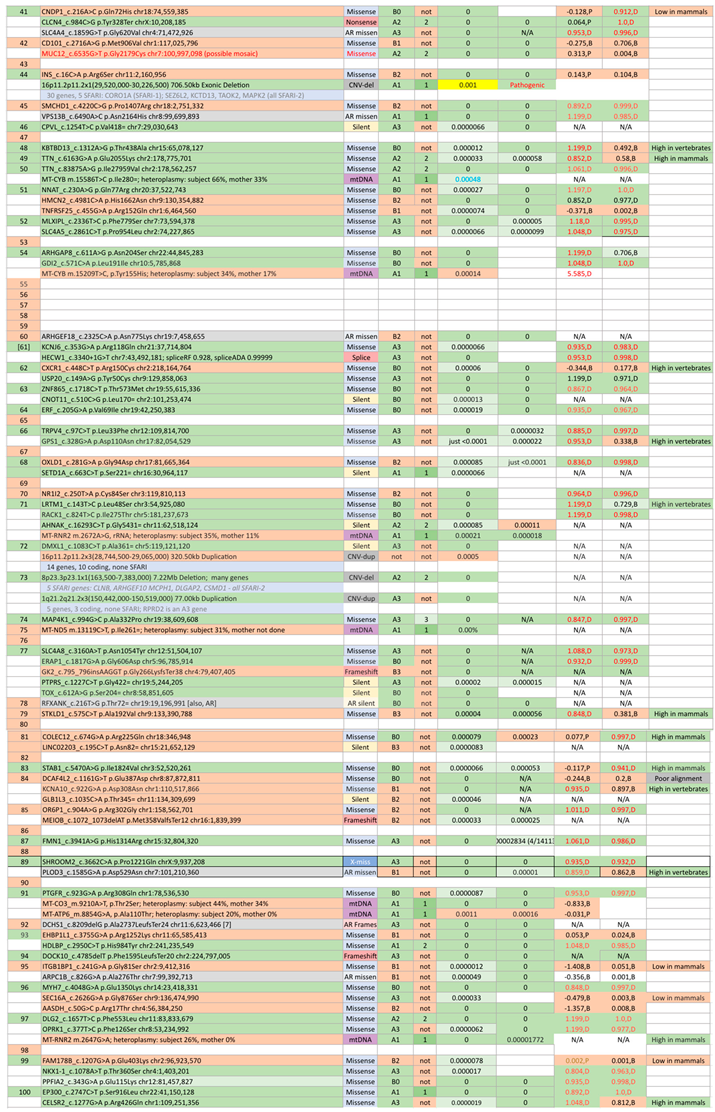 |
Table 1 Legend: Every variant detected, genome-wide, that alters the amino acid code of any genes is shown and evaluated in this table. Light green and light orange background indicate data that met, and failed to meet, our scoring criteria, respectively. Light green background in column 2 indicates that all criteria were satisfied for designation as a Principal Diagnostic Variant (PDV), and thus likely to be disease associated in a substantial manner. Light green background in column 1 indicates that the subject has at least one PDV. Light gray background in column 2 indicates genes that are well-established to segregate in an autosomal recessive manner, without clear dominant inheritance being demonstrated ([5] below is an exception). Yellow background denotes when the variant prevalence > 1/10K yet the variant is widely considered to be Pathogenic/disease associated, and was designated as a PDV. Although sequencing coverage was inadequate to firmly establish mosaicism and the mosaic proportions, red font in columns 2 and 3 indicate variants found at substantially less than 50% (relative to coverage) such that they likely are mosaic. Red font in columns 8 and 9 indicate values corresponding to at least moderate conservation, roughly corresponding to conservation through at least mammals. [1] Based on our criteria explained in Methods. [2] The proportion of alleles in the general population with that variant per gnomAD. For rare variants, the number can be doubled to closely approximate the proportion of people with that variant. For most variant types, #1 and 2 are the allelic frequencies from genomes and exomes, respectively. For mtDNA variants, #1 and 2 are the allelic frequencies in homoplasmic and heteroplasmic forms, respectively. [3] When the computer algorithms for evolutionary conservation, PhyloP and PhastCons do not agree, conservation was determined manually by the University of California, Santa Cruz Genome Browser (UCSC-GB). [4] The variant is present on the mitochondrial DNA (mtDNA) regardless of variant type. [5] A de novo variant in an established recessive gene was designated as a PDV because another rare and conserved variant (shown in the row below) was also identified in that gene. The variants are too distant from each other for phase to be established. [6] Splice site computer algorithmic predictions were not available, yet the nucleotide was found to highly conserved via the UCSC-GB. [7] Per Online Mendelian Inheritance in Man (OMIM), loss-of-function variants in this gene are recessive in inheritance.
Table 2.
Primary Diagnostic Variants (PDV) that were and were not listed on the official laboratory report, with information regarding protein function.
Table 2.
Primary Diagnostic Variants (PDV) that were and were not listed on the official laboratory report, with information regarding protein function.
| Subject # 1 | Gene(s) with De Novo Variant 2 | Designation on Report 3 | Disease Status 4 | Case Reports (individuals, families, publications) 5 | NDD per HGMD 6 | Protein Function 7 | IonTransp | Red OxMito |
Immune | Ubiquitin | Synapse | Express | NeuroGen | CytoSkel | Cell -Cell |
Signal ing |
Danger |
|---|---|---|---|---|---|---|---|---|---|---|---|---|---|---|---|---|---|
| 3 | ANK2 | Other Variants | Known | 36, 30, 10 | 64 | Spectrin-actin cytoskeleton | |||||||||||
| 10 | ASXL1 | Positive | Known | 135, 134, 121 | 6 | Gene silencing, developmental roles | |||||||||||
| 11 | SLC6A1 | Other Variants | Known | 18, 18, 15 | 53 | GABA transporter | |||||||||||
| 11 | DSCAM | Other Variants | Very rare | 7, 6, 6 | 38 | Neural cell adhesion molecule | |||||||||||
| 16 | MAST3 | Other Variants | Known | 13, 7, 2 | 1 | Serine/threonine kinase | |||||||||||
| 17 | SHANK3 | Positive | Known | 188, 206, 64 | 91 | Synaptic scaffolding protein | |||||||||||
| 32 | KDM5B | Uncertain | Very rare | 4, 3, 3 | 31 | Demethylase, gene repression | |||||||||||
| 33 | APBB1 | Likely Negative | Novel | 0, 0, 0 | 1 | Transcription coregulator | |||||||||||
| 34 | ASPM | Other Variants | Known | 85, 75, 24 | 13 | Mitotic spindle function in embryonic neuroblasts | |||||||||||
| 37 | HNRNPDL | Negative | Known | 118, 78, 24 | 0 | mRNA splicing and nuclear export | |||||||||||
| 40 | 10q21.3q22.2x1 (65,164,362-74,517,047) 9.35Mb deletion [>170/many/3 genes] | Positive | Known | ADK: 50, 45, 36 CTNNA3: 4, 4, 4 AGAP5: 2, 1, 1 |
ADK: 3 CTNNA3: 30 AGAP5: Not reported |
ADK (51%): Adenosine kinase, regulator of extracellular and intracellular adenine/ adenosine; anti-inflammatory agents CTNNA3: Catenin family, cell-cell adhesion; roles in blood-brain barrier and immune cell transmigration AGAP5: Possibly GTPase activator. |
|||||||||||
| 41 | CLCN4 | Positive | Known | 62, 25, 8 | 18 | Voltage-gated chloride channel | |||||||||||
| 44 | 16p11.2p11.2x1 (29,520,000-30,226,500) 706.50kb deletion [39/31/5] |
Positive | Very rare | CORO1A: 7, 5, 5 SEZ6L2: 9, 9, 6 KCTD13: 0, 0, 0 TAOK2: 1, 1, 1 MAPK3: 9, 9, 5 |
CORO1A: 1 SEZ6L2: 1 KCTD13: 11 TAOK2: 3 MAPK3: 5 |
CORO1A: possibly cell cycle progression, signal transduction, apoptosis, and gene regulation SEZ6L2: May contribute to specialized endoplasmic reticulum functions in neurons KCTD13: ubiquitin-dependent protein catabolic process, signal transduction TAOK2: focal adhesion assembly, intracellular signal transduction MAPK3: Kinase, signaling cascade regulating cellular processes including differentiation |
|||||||||||
| 73 | 8p23.3p23.1x1 (163,500-7,383,000) 7.22Mb deletion [88/26/5] | Positive | Known | CLN8: 65, 52, 33 ARHGEF10: 4, 4, 4 MCPH1: 38, 22, 19 DLGAP2: 7, 7, 4 CSMD1: 10, 8, 8 |
CLN8: 4 ARHGEF10: 6 MCPH1: 10 DLGAP2: 17 CSMD1: 27 |
CLN8: Possibly lipid related, neuronal differentiation, protection against cell death ARHGEF10: Guanine nucleotide exchange; possibly role in neural morphogenesis MCPH1: DNA damage response protein, G2/M checkpoint arrest DLGAP2: Synapse organization and signaling in neuronal cells CSMD1: Likely involved in learning or memory |
|||||||||||
| 97 | DLG2 | Supplementary | Very rare | 6, 4, 3 | 11 | Membrane-associated guanylate kinase, scaffold for the clustering of receptors, ion channels, and associated signaling proteins | |||||||||||
| 97 | OPRK1 | Supplementary | Known | 2241, 546, 2 | 0 | Opioid receptor | |||||||||||
| 100 | EP300 | Uncertain | Known | 316, 313, 85 | 9 | Histone acetyltransferase | |||||||||||
| 1 | SLC12A1 | Known | 57, 51, 30 | 0 | Na-K-Cl cotransporter | ||||||||||||
| 2 | MYLK | Known | 117, 117, 8 | 0 | Myosin light chain kinase | ||||||||||||
| 3 | MYOSB | Known | 18, 7, 4 | Not reported | Myoglobin | ||||||||||||
| 5 | UNKL | Novel | 0, 0, 0 | 0 | Ubiquitination | ||||||||||||
| 8 | IQGAP2 | Very rare | 1, 1, 1 | 2 | GTPase binding, interacts with cytoskeleton, cell adhesion, and signaling molecules to regulate cell morphology and motility | ||||||||||||
| 10 | APLP1 | Very rare | 7, 2, 2 | 1 | Transcriptional activator, synaptic maturation | ||||||||||||
| 11 | NPAS3 | Very rare | 4, 3, 3 | 2 | Transcription factor, neurogenesis | ||||||||||||
| 13 | EFR3B | Novel | 0, 0, 0 | 1 | Localize phosphatidylinositol 4-kinase to the plasma membrane | ||||||||||||
| 14 | KIDINS220 | Known | 15, 12, 12 | 4 | Controls neuronal cell survival, differentiation into exons and dendrites, synaptic plasticity; interacts with membrane, cytosolic signaling, and cytoskeletal components | ||||||||||||
| 14 | RIMS1 | Very rare | 6, 5, 5 | 13 | Regulates synaptic vesicle exocytosis, regulates voltage-gated calcium channels during neurotransmitter and insulin release | ||||||||||||
| 16 | SH3RF1 | Novel | 0, 0, 0 | Not reported | E3 ubiquitin ligase, cell death response, calcium homeostasis | ||||||||||||
| 19 | Xp11.4p11.4x2 (37,818,872-37,842,030) 23.16kb intragenic 2-copy-duplication (on X-chromosome in XY male) [1/1/0] | Very rare | DYNLT3: 1, 1, 1 | DYNLT3: Not reported | DYNLT3 (79%): A dynein light chain – a motor protein - intracellular retrograde motility of vesicles and organelles along microtubules; transcriptional modulator | ||||||||||||
| 21 | 19q13.33q13.33x3 (50,409,797-50,476,028) 66.23kb 3-copy-duplication of 5 genes, incl 35% of POLD1 [4/4/0] | Known | POLD1: 40, 34, 30 FAM71E1: 0, 0, 0 SPIB: 0, 0, 0 MYBPC2: 0, 0, 0 |
POLD1: 0 FAM71E1: 0 SPIB: 0 MYBPC2: 0 |
POLD1 (35%): Catalytic subunit of DNA polymerase delta; plays a critical role in DNA replication and repair FAM71E1 (69%): Innate immune response SPIB: Transcriptional activator, acts as a lymphoid-specific enhancer MYBPC2: Modifies the activity of actin-activated myosin ATPase |
||||||||||||
| 22 | ABCB6 | Known | 79, 4, 14 | 1 | Heavy metal importer, mitochondrial porphyrin uptake | ||||||||||||
| 24 | ARHGEF2 | Very rare | 2, 2, 2 | 2 | Rho GTPase, transcriptional factor binding; involvement in cell motility and polarization, dendritic spine morphology, antigen presentation, innate immune response, cell cycle regulation, and microtubule stability | ||||||||||||
| 25 | COL6A3 | Known | 609, 590, 41 | 1 | Alpha-3 chain of type VI collagen | ||||||||||||
| 25 | JPH3 | Known | 13, 11, 7 | 1 | Junctional complexes between the plasma membrane and endoplasmic reticulum, mediates cross talk between cell surface and intracellular ion channels. | ||||||||||||
| 27 | PLEKHH2 | Known | 17, 17, 7 | 0 | Predicted to enable actin binding activity, including cytoskeleton | ||||||||||||
| 31 | AQP2 | Known | 88, 61, 50 | 0 | Aquaporin-2 water channel prominent in renal collecting tubules | ||||||||||||
| 33 | TMEFF1 | Very rare | 1, 1, 1 | 0 | Blocks viruses from entering neurons | ||||||||||||
| 34 | CBARP | Novel | 0, 0, 0 | Not reported | Regulation of calcium ion-dependent exocytosis and voltage-gated calcium channel activity. | ||||||||||||
| 39 | 9p22.3p22.3x4 (15,405655-15,517,446) 111.79kb 4-copy-duplication [3/2/0] | Known | SNAPC3: 0, 0, 0 PSIP1: 10, 10, 7 |
SNAPC3: 1 PSIP1: Not reported |
SNAPC3: Transcription of both RNA polymerase II and III small-nuclear RNA genes PSIP1: Transcriptional coactivator involved in neuroepithelial stem cell differentiation and neurogenesis |
||||||||||||
| 46 | CPVL | Novel | 0, 0, 0 | 0 | Carboxypeptidase likely involved in lysosomal phagocytosis, inflammatory protease cascade, and antigen presentation. | ||||||||||||
| 49 | TTN | Known | 215, 165, 116 | 14 | Assembly and functioning of cardiac and striated myocytes | ||||||||||||
| 50 | TTN | Known | 215, 165, 116 | 14 | Assembly and functioning of cardiac and striated myocytes | ||||||||||||
| 50 | MT-CYB | Known | 21, 21, 11 | Not reported | mtDNA-encoded subunit of respiratory complex III | ||||||||||||
| 51 | NNAT | Very rare | 2, 2, 1 | Not reported | May regulate ion channels during brain development | ||||||||||||
| 52 | MLXIPL | Novel | 0, 0, 0 | 0 | Transcription factor for triglyceride synthesis genes | ||||||||||||
| 52 | SLC4A5 | Novel | 0, 0, 0 | Not reported | Sodium bicarbonate cotransporter involved in intracellular pH regulation | ||||||||||||
| 54 | ARHGAP8 | Novel | 0, 0, 0 | 0 | GTPase activator for the Rho-type GTPases. Involved in signaling pathways that regulate cell processes involved in cytoskeletal changes | ||||||||||||
| 54 | GDI2 | Novel | 0, 0, 0 | Not reported | GDP-dissociation inhibitor, regulates intracellular membrane trafficking | ||||||||||||
| 61 | KCNJ6 | Known | 12, 12, 7 | 1 | G protein-coupled inwardly-rectifying potassium channel; may be involved in the regulation of insulin secretion by glucose and/or neurotransmitters. | ||||||||||||
| 61 | HECW1 | Novel | 0, 0, 0 | 1 | E3 ubiquitin protein ligase | ||||||||||||
| 62 | USP20 | Novel | 0, 0, 0 | 2 | Deubiquitinating enzyme that plays a role in many cellular processes including autophagy, cellular antiviral response | ||||||||||||
| 63 | ZNF865 | Novel | 0, 0, 0 | Not reported | Transcription factor | ||||||||||||
| 63 | CNOT11 | Novel | 0, 0, 0 | 1 | Involved in nuclear-transcribed mRNA poly(A) tail shortening | ||||||||||||
| 64 | ERF | Known | 32, 26, 26 | 1 | Transcription factor; involved in development, apoptosis, and the regulation of telomerase | ||||||||||||
| 66 | TRPV4 | Known | 115, 85, 48 | 3 | Ca2+-permeable, nonselective cation channel; regulation of systemic osmotic pressure. | ||||||||||||
| 66 | GPS1 | Novel | 0, 0, 0 | 1 | Suppresses G-protein and mitogen-activated signal transduction; essential regulator of the ubiquitin conjugation pathway | ||||||||||||
| 68 | SETD1A | Very rare | 9, 7, 6 | 12 | Histone lysine methyltransferase; involved in RNA processing and the DNA damage response | ||||||||||||
| 71 | LRTM1 | Novel | 0, 0, 0 | Not reported | Axon guidance and negative chemotaxis, synapse assembly | ||||||||||||
| 71 | RACK1 | Very rare | 1, 1, 1 | 0 | Regulation of signal transduction; and vesicle-mediated transport; present in phagocytic cup | ||||||||||||
| 71 | AHNAK | Very rare | 3, 3, 2 | 6 | Large structural scaffold protein involved in blood-brain barrier formation, cell structure and migration, cardiac calcium channel regulation, and neuronal cell differentiation | ||||||||||||
| 72 | DMXL1 | Very rare | 2, 2, 2 | 6 | WD repeat protein, regulatory functions | ||||||||||||
| 73 | 1q21.2q21.2x3 (150,442,000-150,519,000) 77.00kb 3-copy-duplication [5/3/0] | Known | RPRD2: 0, 0, 0 TARS2: 3, 3, 3 ECM1: 84, 74, 59 |
RPRD2: 1 TARS2: 0 ECM1: 0 |
RPRD2 (88%): Involved in mRNA 3'-end processing TARS2: Mitochondrial aminoacyl-tRNA synthetase – mitochondrial translation ECM1: Negative regulator of endochondral bone mineralization |
||||||||||||
| 74 | MAP4K1 | Novel | 0, 0, 0 | 1 | Serine/threonine-protein kinase; involved in several processes: response to environmental stress, cell signaling, promoting apoptosis, hematopoietic lineage decisions and growth regulation, IL2 production | ||||||||||||
| 77 | SLC4A8 | Novel | 0, 0, 0 | 0 | Sodium and bicarbonate cotransporter, important for pH regulation in neurons | ||||||||||||
| 77 | ERAP1 | Very rare | 3, 3, 1 | 0 | Aminopeptidase involved in trimming HLA class I-binding precursors so that they can be presented on MHC class I molecules | ||||||||||||
| 77 | PTPRS | Known | 13, 13, 8 | 0 | Protein tyrosine phosphatase signaling protein involved in cell-cell interaction, primary axonogenesis, and axon guidance during embryogenesis; down-regulates activation of NF-kappa-B, TNF, interferon alpha, and interferon beta | ||||||||||||
| 77 | TOX | Known | 603, 520, 1 | 0 | Transcriptional regulator, involved in chromatin assembly, transcription and replication, may function to regulate T-cell development | ||||||||||||
| 83 | STAB1 | Known | 0, 0, 0 | 2 | Roles in tissue homeostasis and remodeling, intracellular sorting and recycling, cell adhesion, receptor scavenging; possible roles in angiogenesis, defense against bacterial infection | ||||||||||||
| 87 | FMN1 | Novel | 0, 0, 0 | 2 | Roles in adherens junction formation, polymerization of linear actin cables; transcriptional activity | ||||||||||||
| 89 | SHROOM2 | Very rare | 3, 2, 1 | 0 | Amiloride-sensitive sodium channel activity; regulates cytoskeletal organization and architecture of endothelial cells; roles in migration and angiogenesis | ||||||||||||
| 91 | PTGFR | Novel | 0, 0, 0 | 0 | G-protein coupled receptor for prostaglandin F2-alpha which activate a phosphatidylinositol-calcium second messenger system | ||||||||||||
| 93 | HDLBP | Very rare | 4, 4, 4 | 2 | Binds high density lipoprotein; removes excess cholesterol levels in cells; binds RNA and can induce heterochromatin formation | ||||||||||||
| 94 | DOCK10 | Novel | 0, 0, 0 | 0 | Guanosine nucleotide exchange factors for Rho GTPases; involved in cytokinesis; essential for dendritic spine morphogenesis in Purkinje cells and in hippocampal neurons; sustains B-cell lymphopoiesis. | ||||||||||||
| 96 | MYH7 | Known | 797, 699, 155 | 1 | Myosin heavy chain 7; interacts with actin for force generation; abundant in muscle but present ubiquitously including in brain | ||||||||||||
| 99 | NKX1-1 | Novel | 0, 0, 0 | Not reported | Transcription factor homeobox protein; embryonic development | ||||||||||||
| 99 | PPFIA2 | Novel | 0, 0, 0 | 1 | Liprin, scaffold for recruitment and anchoring of LAR family PTPases; binds to calcium-calmodulin-dependent serine protein kinase; important for axon guidance; scaffolding protein in the dendritic spines | ||||||||||||
| 100 | CELSR2 | Very rare | 1, 1, 1 | 2 | Belongs to the flamingo subfamily of non-classic-type cadherins; likely a receptor involved in cell adhesion and receptor-ligand interactions; cell/cell signaling during nervous system formation |
Table 2Legend: 1. All Primary Diagnostic Variants (PDVs) from Table 2. Are shown herein. Light blue and light-yellow backgrounds in column 1 indicate PDVs that were and were not listed in the laboratory report from Variantyx, respectively. For large copy number variants (CNVs), the number of involved genes is provided [total/coding/SFARI listed]. 2. For large CNVs incorporating > 3 genes, only SFARI-listed genes are shown in this table. 3. The text corresponds to the actual wording on the laboratory report in respect to that variant (exception “Other Variants of Interest”), and the shading reflects the color on the report. 4. Cases are counted only if phenotypic information on the individual is reported at least as detailed to that displayed in the current Table 1. Novel/orange background: Novel disorder - the condition is unpublished in that no cases meeting that minimum standard are reported. Very rare: 1 to 9 cases with phenotypic information are reported. Known: Ten or more cases with phenotypic information are reported. For CNVs with two or more genes affected, the designation refers to the highest designation (Known > Very Rare > Novel) among the genes listed. 5. The data shown refer to the number of individuals reported with minimal phenotypic information per the standard in #4 above. The first number refers to the total number of affected individuals reported with a presumed disease-associated variant in that gene. The second and third numbers refer to the number of families and publications. For example, one paper with affected siblings and a second paper with two unrelated affected individuals would count as 4 individuals in 3 families in 2 publications (4, 3, 2). 6. Cases of neurodevelopmental disorders (NDDs) listed on HGMD (Human Gene Mutation Database) accessed on 17 June 2025; https://www.hgmd.cf.ac.uk/ac/index.php. Listing on HGMD alone with an NDD, but without published phenotypic information, did not qualify for inclusion in columns 4 and 5 of this Table. 7. Synopsis of the known functions of the protein, with an emphasis regarding the 11 mechanistic categories shown in this table. Information was generally obtained from GeneCards.com on 21 June 2025. Percentages in parenthesis indicate the proportion of the coding region affected by the CNV, the entire gene is affected when not specified. For CNVs involving > 5 genes, only SFARI genes are listed in the Table. The 11 categories are (shown in the columns to the right): Red: ion transport; Orange: mitochondrial redox potential/energy metabolism/cell death responses; Yellow: immune system manifestations; Green: ubiquitin-related protein degradation pathway; Blue: synapse/neurotransmission-related; Purple: gene expression; Pink: neurogenesis/brain development; Light grey: cytoskeleton-related; Dark grey: cell-cell interactions including adhesion; Black: signaling pathways other than synaptic transmission; Brown: cell danger response.
Table 3.
Small variants identified genome-wide in randomly-selected subjects.
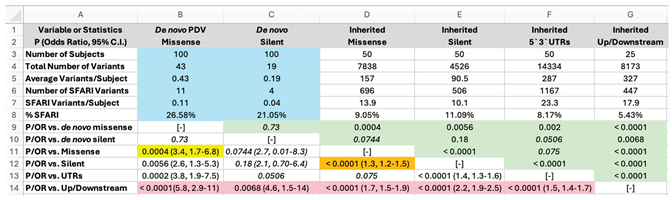 |
Table 3 Legend: Every variant was tallied genome-wide through all (20,000-23,000) genes for the variant types listed in the column headings, for the number of subjects listed in row 1. P = probability, OR = odds ratio, C.I. = confidence interval, UTRs = untranslated regions, SFARI = Simons Foundation Autism Research Initiative (sfari.org). Statistical analyses are per https://www.medcalc.org/calc/odds_ratio.php. Formatting within cells is P (Odds Ratio, 95% C.I.). Figures in italic font are not statistically significant. Light blue background emphasizes that those figures are for de novo variants. Light green backgrounds indicate duplicate values also found to the left/below. Other colored backgrounds emphasize important comparisons discussed in the text. Copy number and mtDNA variants were excluded.
Disclaimer/Publisher’s Note: The statements, opinions and data contained in all publications are solely those of the individual author(s) and contributor(s) and not of MDPI and/or the editor(s). MDPI and/or the editor(s) disclaim responsibility for any injury to people or property resulting from any ideas, methods, instructions or products referred to in the content. |
© 2025 by the authors. Licensee MDPI, Basel, Switzerland. This article is an open access article distributed under the terms and conditions of the Creative Commons Attribution (CC BY) license (http://creativecommons.org/licenses/by/4.0/).
Copyright: This open access article is published under a Creative Commons CC BY 4.0 license, which permit the free download, distribution, and reuse, provided that the author and preprint are cited in any reuse.


