

Submitted:
22 July 2025
Posted:
23 July 2025
You are already at the latest version
Abstract
A series of half-titanocenes containing different trialkylsilyl para-phenoxy substituents, Cp*TiCl2(O-2,6-iPr2-4-R-C6H2) [Cp* = C5Me5; R = Si(n-Bu)3 (5), SiMe2(n-C8H17) (6), SiMe2(t-Bu) (7)], have been prepared and identified. The catalytic activity in the ethylene polymerization by Cp*TiCl2(O-2,6-iPr2-4-R-C6H2) [R = H (1), SiMe3 (2), SiEt3 (3), Si(i-Pr)3 (4), 5-7]—MAO (methylaluminoxane) catalysts increased in the order (in toluene at 25 °C, ethylene 4 atm): R = H (1) < SiMe3 (2), SiEt3 (3), Si(i-Pr)3 (4) < SiMe2(t-Bu) (7) < SiMe2(n-C8H17) (6) < Si(n-Bu)3 (5, activity = 6.56×10⁴ kg-PE/mol-Ti·h). The results thus suggest that the introduction of alkyl group into the silyl substituent led to an increase in activity. The activities by 5 were affected by Al/Ti molar ratio (amount of MAO charged), and the highest activity (7.00×10⁵ kg-PE/mol-Ti·h) was observed under the optimized conditions at 50 °C; the activity decreased at 80 °C. In ethylene copolymerization with 1-dodecene, the Si(n-Bu)3 analogue (5) exhibited the remarkable catalytic activity (4.32×10⁶ kg-polymer/moil-Ti·h at 25 °C), which was higher than those by the reported catalysts (1-3), affording poly(ethylene-co-1-dodecene)s with efficient comonomer incorporation as observed by 3 [rE = 3.77 (5) vs 3.58 (3)].
Keywords:
titanium catalyst
; homogeneous catalysis
; polymerization
; polyethylene
; ligand effect
; copolymerization
; methylaluminoxane
; phenoxide ligand
1. Introduction
Polyolefins [exemplified as high-density polyethylene (HDPE), linear low-density polyethylene (LLDPE), isotactic polypropylene (PP), ethylene propylene diene terpolymer (EPDM) etc.] are commodity plastics in our daily life, and transition metal catalyzed olefin polymerization is the core technology. Development of new polymers exhibiting specified properties has been an important subject in the field of catalysis, polymer chemistry [1,2,3,4,5,6,7,8,9,10,11,12,13,14,15,16]. The copolymerization approach by incorporation of monomers, that cannot be incorporated by conventional catalysts (Ziegler-Natta, metallocene catalysts), has been employed as an efficient approach, because their material properties (physical, mechanical, chemical etc.) can be modified by individual components (contents of two, three monomers) [2,3,4,5,7,8,9,12]. Design of the molecular catalysts especially exhibiting high catalytic activities with better comonomer incorporations, thus attracts considerable attention in the field of catalysis as well as polymer chemistry [1,2,3,4,5,6,7,8,9,10,11,12,13,14,15,16].
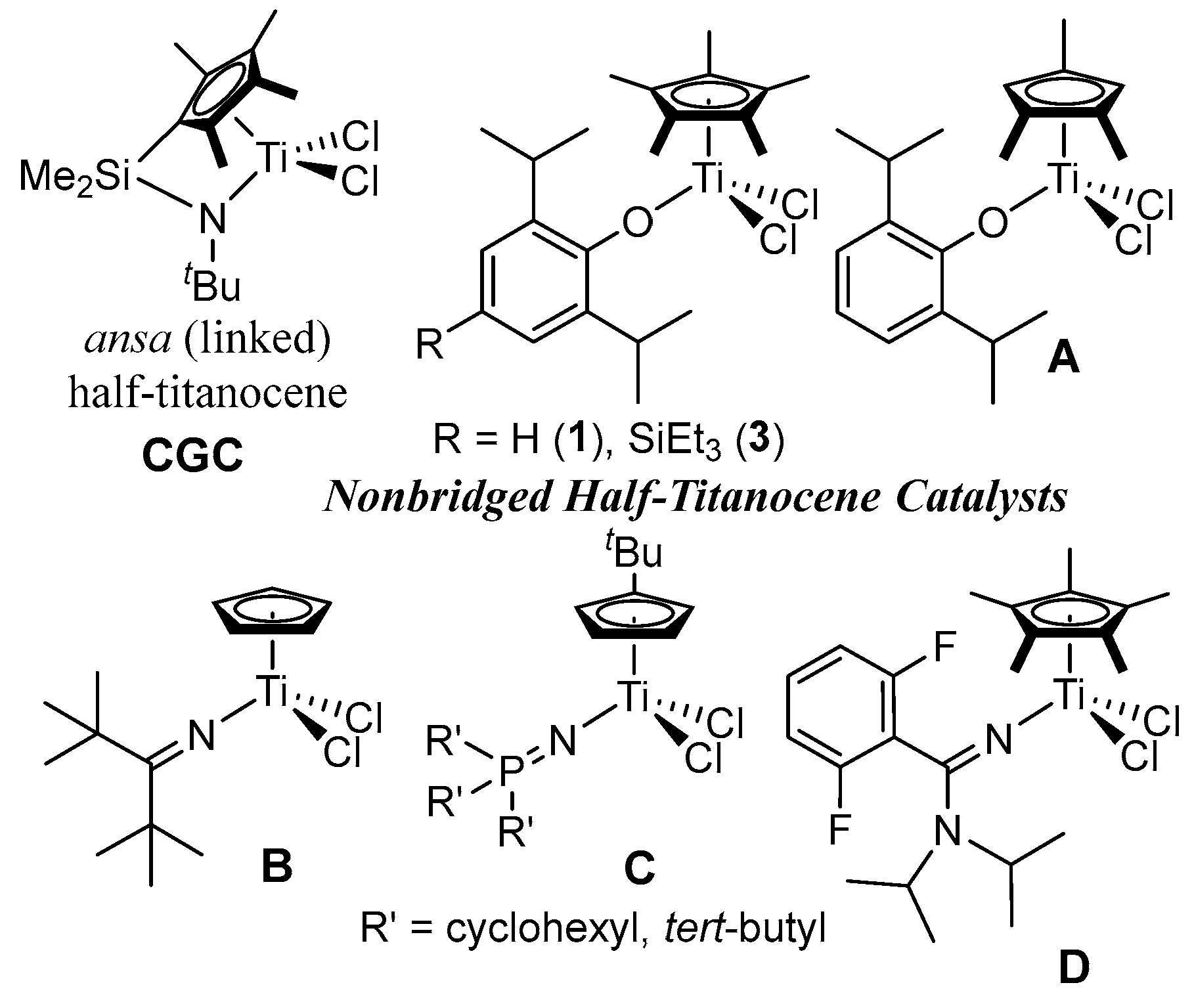
It has been demonstrated that nonbridged half-titanocenes (half-sandwich titanium complexes) modified with anionic ancillary donor ligands (Y) of type, Cp’TiX2(Y) (Cp’ = cyclopentadienyl, X = halogen or alkyl, Scheme 1), display as promising catalysts for synthesis of the new copolymers by incorporations of various olefins (sterically encumbered olefins, cyclic olefins, aromatic vinyl monomers, the others) [7,8,9,16]. The phenoxide (1,3, A) [7,8,9,17,18,19], the ketimide (B) [7,8,9,20,21,22] and phosphinimide (C) [7,8,9,23,24,25] analogues have been the known successful examples [26,27,28], and the η1-amidinate analogue (D) later demonstrated an industrial production of chlorine-free synthetic EPDM rubber without deep cooling, commonly employed in the conventional (Ziegler type) catalyst systems in industry [12].
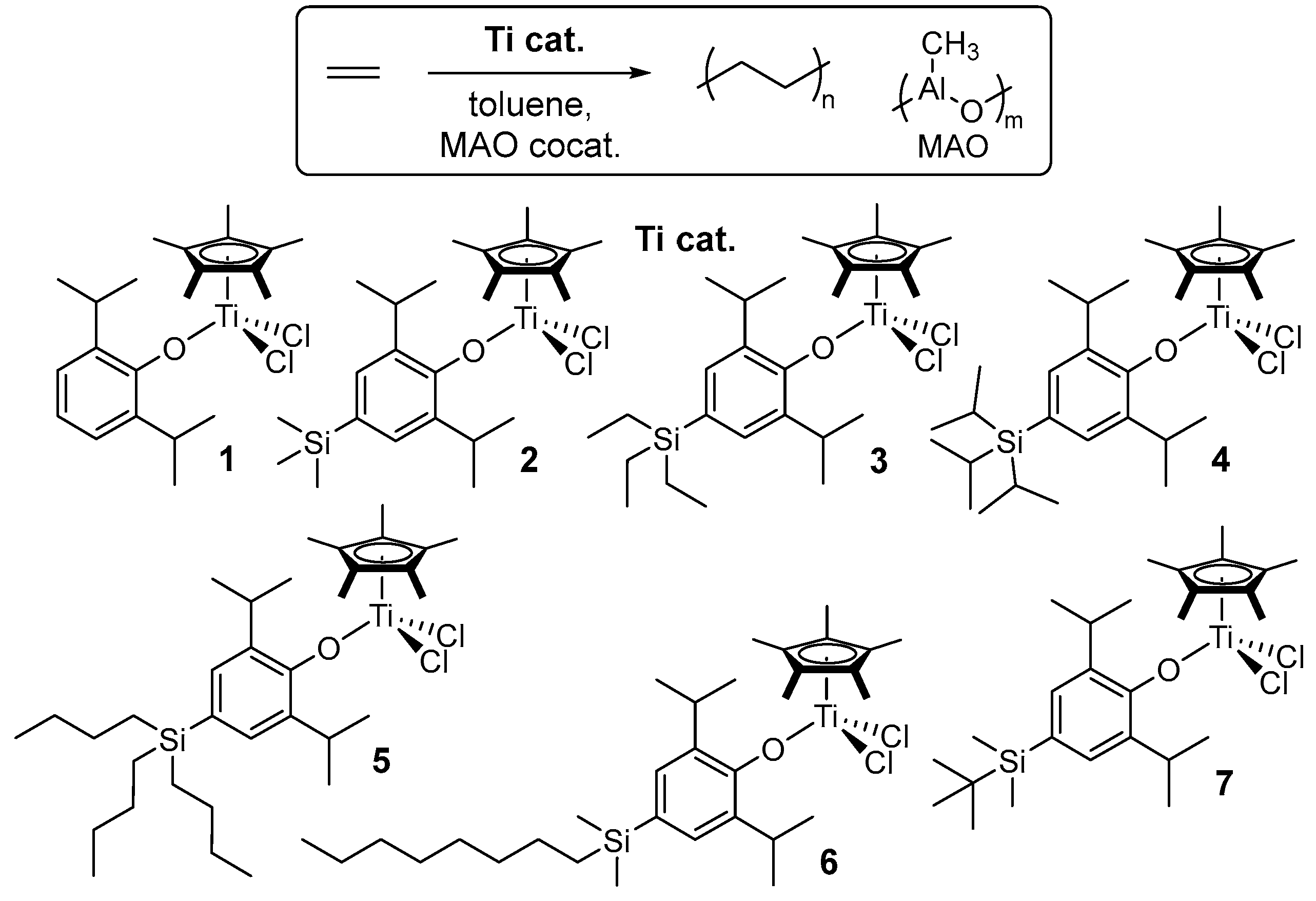
Recently, we communicated that the phenoxide modified half-titanocenes containing SiEt3 para-substituent, Cp*TiCl2(O-2,6-iPr2-4-SiEt3-C6H2) (3, Cp* = C5Me5), exhibited the remarkable increase in the catalytic activities compared to the original 1 in ethylene copolymerizations with 2-methyl-1-pentene, 1-decene, 1-dodecene (DD) at 50 °C in the presence of methylaluminoxane (MAO) cocatalyst. The efficient synthesis of high molecular weight ethylene copolymers containing 9-decene-1-ol could also be demonstrated in this catalysis with high catalytic activities [17]. Moreover, we reported later that both the SiEt3 (3) and Si(i-Pr)3 (4) catalysts were effective for synthesis of ethylene copolymers with 2-allylpohenol [29]. In order to explore the effect of trialkyl substituent on the para-phenoxide ligand in the ethylene polymerization, we prepared and identified various half-titanocenes containing different para-phenoxy substituents, Cp*TiCl2(O-2,6-iPr2-4-R-C6H2) [R = Si(n-Bu)3 (5), SiMe2(n-C8H17) (6), SiMe2(t-Bu) (7)], and studied the ligand effect in ethylene polymerization and ethylene copolymerization with 1-dodecene by using 1-7—MAO catalysts (Scheme 2). We thus wish to present our preliminary data that the Si(n-Bu)3 (5) displays promising capability in term of the activities and the comonomer incorporation.
2. Results and Discussion
2.1. Synthesis of Half-Titanocenes Containing Different Trialkylsilyl Para-Phenoxy Substituents, Cp*TiCl2(O-2,6-iPr2-4-R-C6H2) (5-7)
A series of phenoxide modified half-titanocenes containing different trialkylsilyl para-phenoxy substituent, Cp*TiCl2(O-2,6-iPr2-4-R-C6H2) [R = Si(n-Bu)3 (5), SiMe2(n-C8H17) (6), SiMe2(t-Bu) (7)], were prepared by treating Cp*TiCl3 with the corresponding phenol, 2,6-iPr2-4-R-C6H2OH, in toluene in the presence of NEt3 according to synthesis of the SiEt3 analogue (3) [17]. The reaction conditions for synthesis of 2,6-iPr2-4-R-C6H2OH had to be optimized, as conducted in the synthesis of 2,6-iPr2-4-Si(i-Pr)3-C6H2OH [28], especially ratio of solvent and the reaction temperature and time, these phenols could be obtained as moderate yields (51-86 %). The resultant titanium complexes were identified by NMR spectra and elemental analysis (shown below in the Experimental section).
2.2. Ethylene Polymerization by Cp*TiCl2(O-2,6-iPr2-4-R-C6H2) (1-7)
Ethylene polymerizations using Cp*TiCl2(O-2,6-iPr2-4-R-C6H2) [1-7; R = H (1), SiMe3 (2), SiEt3 (3), Si(i-Pr)3 (4), Si(n-Bu)3 (5), SiMe2(n-C8H17) (6), SiMe2(t-Bu) (7)] were conducted in toluene (30 mL scale) in the presence of MAO cocatalyst at 25 or 50 °C, and the selected results conducted under the same conditions (catalyst 0.015 μmol, MAO 3.0 mmol, ethylene 4 atm, 10 min) are summarized in Table 1. MAO employed in this study was used as white solids (expressed as dried MAO) after removal of AlMe3 and toluene from the commercially available MAO [TMAO-S, 9.5 wt% (Al) toluene solution, Tosoh Finechem Co.], since the use of this MAO was effective to afford the ethylene copolymers with uniform compositions [7,8,9,17,18,19,20,22].
It was revealed that the catalytic activities were affected by the trialkylsilyl para-phenoxy substituent employed, and the activity by Cp*TiCl2(O-2,6-iPr2-4-R-C6H2) (1-7)—MAO catalysts increased in the order (25 °C, ethylene 4 atm): R = H (1, activity 49600 kg-PE/mol-Ti·h, run 1) < SiMe3 (2, 54400, run 3), SiEt3 (3, 55600, run 5), Si(i-Pr)3 (4, 56400, run 7) < SiMe2(t-Bu) (7, 58800, run 15) < SiMe2(n-C8H17) (6, 62800, run 13) < Si(n-Bu)3 (5, 65600, run 9). It seems likely that the introduction of alkyl group into the silyl group led to an increase in activity, probably due to better π-donation to titanium, as discussed previously [7-9.17]. It was also revealed that the activities at 50 °C by 1, 4, 5 were low compared to those conducted at 25 °C, whereas the activities by 2, 3, 6, 7 increased at 50 °C. The resultant polymers prepared at 25 °C possessed ultrahigh molecular weights (Mn = 0.78-1.64×10⁶) with unimodal molecular weight distributions (Mw/Mn = 2.43-3.84) although the PDI (Mw/Mn) values are rather high. The Mn values in the resultant polymers prepared at 50 °C became low (Mn = 4.3-6.7×10⁵) with low PDI values (Mw/Mn = 2.31-2.96) compared to those prepared at 25 °C, suggesting that certain degree of chain-transfer increased with an increase of the polymerization temperature.
Table 2 summarizes the results for effect of MAO (Al/Ti molar ratio) toward the catalytic activities in the ethylene polymerization by the Si(i-Pr)3 (4) and the Si(n-Bu)3 (5) analogues at 25-80 °C, since the activity by the SiEt3 analogue (3) was affected by the amount of MAO charged at various temperature [17]. It was revealed that, as observed in the ethylene polymerization by 2,3‒MAO catalysts (under the same conditions), the activities by 4,5 conducted at 25 °C increased upon increase in the amount of MAO charged (runs 17-22). Moreover, the activity by 5 at 50 °C initially increased upon increasing the MAO charged (runs 23-25) but decreased upon further addition (run 26); the similar trend was seen by 5 conducted at 80 °C (runs 27-31). Since the Mn values decreased upon increasing the MAO charged as well as increase in the polymerization temperature, it thus seems likely that certain degree of the chain-transfer to Al occurred in this catalysis especially at 50-80 °C.
2.3. Ethylene Copolymerization with 1-Dodecene by Cp*TiCl2(O-2,6-iPr2-4-R-C6H2) (4-7)
Ethylene copolymerizations with 1-dodecene (DD) by Cp*TiCl2(O-2,6-iPr2-4-R-C6H2) [R = Si(i-Pr)3 (4), Si(n-Bu)3 (5), SiMe2(n-C8H17) (6), SiMe2(t-Bu) (7)] were conducted at 25 or 50 °C in the presence of MAO cocatalyst [ethylene 6 atm, DD 5.0 mL, 0.75 M in toluene (total 30 mL), 6 min, Scheme 3] in order to study the effect of trialkylsilyl para-phenoxy substituent toward the activity and the DD incorporation. The results are summarized in Table 3, and the results conducted by 1-3 are also placed for comparison.
It was revealed that the catalytic activities in the copolymerizations conducted at 25 °C increased in the order: 1 (activity = 1.60×10⁵ kg-polymer/mol-Ti·h, run 32) < 2 (8.50×10⁵, run 34) < 3 (1.09×10⁶, run 36) < 7 (1.56×10⁶, run 52) < 4 (2.07×10⁶, run 38) < 6 (3.10×10⁶, run 46) < 5 (3.40×10⁶, run 41; 4.32×10⁶, run 42); the Si(n-Bu)3 analogue (5) thus showed the highest activity conducted under the same conditions. The resultant polymers were poly(ethylene-co-DD)s possessing rather high molecular weights (Mn = 1.50-2.54×10⁵) with unimodal molecular weight distributions (Mw/Mn = 1.54-1.90); no significant differences in the DD content in the resultant copolymers were seen. It should be noted that the activities by 1-3 increased at 50 °C (with increases in the DD contents), whereas no significant differences in the activities were seen by 5,6 conducted under the optimized amount of MAO charged (runs 44,45,50); the activities, in contrast decreased by 4 and 7 (runs 39,40,53,54). Among these catalysts, the Si(n-Bu)3 analogue (5) showed the highest catalytic activities (runs 44,45). The Mn values in the resultant copolymers prepared at 50 °C (Mn = 1.31-1.68×10⁵) were somewhat low compared to those prepared at 25 °C (Mn = 1.50-2.54×10⁵); no significant differences in the DD contents were seen, as observed reported by 1-3 [17]. This probably presumes that the trialkylsilyl substituent would only contribute to increase the catalytic activity (through π-donation to the catalytically active Ti) leading to the higher catalytic activity [7,8,9].
Table 4 summarizes the triad sequence distribution, the dyads, rE, rD, and rE·rD values [E = ethylene, D = 1-dodecene (DD)] by microstructural analysis of poly(ethylene-co-1-dodecene)s prepared by 4-7–MAO catalysts estimated by the 13C NMR spectra (shown in Supplementary Materials) [30,31]. The rE·rD values are 0.44-0.57, clearly suggesting that these copolymerizations proceeded in a random manner (DD incorporation is random), whereas the DD incorporation was rather alternating. The monomer reactivity ratios, defined as rE, for 4-7 are 3.34-4.40, and these values were not affected by the polymerization temperature employed, whereas it has been known that the rE value is affected by the polymerization temperature in the ethylene copolymerization using ordinary metallocene catalysts [32,33]. As commented previously [7,8,9], this is one of the unique characteristics in this catalysis. The rE values are close to those by original catalyst 1 (rE= 3.92) [34] and the SiEt3 analogue (3, rE = 3.58) [35]. The values by the Si(n-Bu)3 analogue 5 (3.77, 4.09), exhibited the highest catalytic activity with efficient DD incorporation, are rather small compared to that by the linked half-titanocene (called constrained geometry catalysis), [Me2Si(C5Me4)(NtBu)]TiCl2 (CGC, rE = 4.31) [34], known as the efficient catalyst for ethylene copolymerization [4,5].
3. Conclusions
In this study, effect of trialkylsilyl para-phenoxy substituent in ethylene polymerization and ethylene/1-dodecene copolymerization using Cp*TiCl2(O-2,6-iPr2-4-R-C6H2) [1-7; R = H (1), SiMe3 (2), SiEt3 (3), Si(i-Pr)3 (4), Si(n-Bu)3 (5), SiMe2(n-C8H17) (6), SiMe2(t-Bu) (7)] have been studied. For this purpose, complexes 4-7 have been prepared and identified by NMR spectra and elemental analysis. The activity in ethylene polymerization by a series of complexes (1-7)—MAO catalysts increased in the order (25 °C, ethylene 4 atm): R = H (1, activity 49600 kg-PE/mol-Ti·h, run 1) < SiMe3 (2, 54400, run 3), SiEt3 (3, 55600, run 5), Si(i-Pr)3 (4, 56400, run 7) < SiMe2(t-Bu) (7, 58800, run 15) < SiMe2(n-C8H17) (6, 62800, run 13) < Si(n-Bu)3 (5, 65600, run 9). And the activity was also affected by the amount of MAO charged, whereas increase in the activity was observed when the polymerizations by 5 were conducted at 50 °C. Moreover, the catalytic activities in the ethylene/1-dodecene copolymerizations (ethylene 6 atm, DD 0.75M, 25 °C) increased in the order: 1 (activity = 1.60×10⁵ kg-polymer/mol-Ti·h, run 32) < 2 (8.50×10⁵, run 34) < 3 (1.09×10⁶, run 36) < 7 (1.56×10⁶, run 52) < 4 (2.07×10⁶, run 38) < 6 (3.10×10⁶, run 46) < 5 (3.40×10⁶, run 41; 4.32×10⁶, run 42); the Si(n-Bu)3 analogue (5) thus showed the highest activity conducted under the same conditions. The microstructural analysis revealed that the rE values by 5 (3.77, 4.09) are close to those by original catalyst 1 (rE= 3.92) [34] and the SiEt3 analogue (3, rE = 3.58) [35]. The values by the Si(n-Bu)3 analogue (5), clearly suggesting the copolymerization proceeds with efficient comonomer incorporation. It is clear that the present catalyst, especially 5, displays promising capability as the catalyst for ethylene copolymerization; further studies including copolymerizations with sterically sterically encumbered olefins, alken-1-ol [17] will be introduced in the future.
4. Materials and Methods
All experiments were carried out under a nitrogen atmosphere in a Vacuum Atmospheres drybox unless otherwise specified. All chemicals including 1-dodecene (DD, Tokyo Chemical Industry Co., Ltd.) used were of reagent grade and were purified by the standard purification procedures. Anhydrous grade of toluene (Kanto Kagaku Co. Ltd) was transferred into a bottle containing molecular sieves (mixture of 3A, 4A 1/16, and 13X) in the drybox and used without further purification. Ethylene for polymerization was of polymerization grade (purity >99.9%; Sumitomo Seika Co., Ltd.) and was used as received. Toluene and AlMe3 in the commercially available methylaluminoxane (MAO) [TMAO-S, 9.5 wt% (Al) toluene solution, Tosoh Finechem Co.] were taken to dryness under reduced pressure (at ca. 50 ºC for removing toluene, Me3Al, and then heated at >100 °C for 1 h for completion) in the drybox to give d-MAO white solids [17,18,19,20,22]. Cp*TiCl2(O-2,6-iPr2C6H3) (1) [36], Cp*TiCl2(O-2,6-iPr2-4-SiMe3-C6H2) (2) [17], Cp*TiCl2(O-2,6-iPr2-4-SiEt3-C6H2) (3) [17], and Cp*TiCl2(O-2,6-iPr2-4-Si(i-Pr)3-C6H2) (4) [29] were prepared according to the reported procedure.
All 1H NMR and 13C NMR spectra were recorded on a Bruker AV500 spectrometer (500.13 MHz, 1H; 125.77 MHz, 13C), and all spectra were obtained in the solvent indicated at 25 ℃ unless otherwise noted. Chemical shifts are given in ppm and are referenced to SiMe4 (δ 0.00 ppm, 1H, 13C). Elemental analyses were performed by using EAI CE-440 CHN/O/S Elemental Analyzer (Exeter Analytical, Inc.). Molecular weights and molecular weight distributions for the resultant polymers were measured by gel permeation chromatography (Tosoh HLC-8121GPC/HT) using a RI-8022 detector (for high temperature; Tosoh Co.) with a polystyrene gel column (TSK gel GMHHR-H HT × 2, 30 cm × 7.8 mm i.d.), ranging from <102 to < 2.8 × 10⁸ MW) at 140 °C using o-dichlorobenzene containing 0.05 wt/v% 2,6-di-tert-butylp-cresol as the solvent. The molecular weight was calculated by a standard procedure based on the calibration with standard polystyrene samples.
Synthesis of Cp*TiCl2(O-2,6-iPr2-4-SiBu3-C6H2) (5). (i) Synthesis of 4-SiBu3-2,6-iPr2C6H2OH. To a solution of 4-Br-2,6-iPr2C6H2OH (2.57 g, 10 mmol) in 15 mL of Et2O was added TMSCl (1.35 g, 12 mmol) and Et3N (1262 mg, 12 mmol) at -30 ºC. The mixture was then warmed to room temperature and stirred overnight. The reaction mixture was filtered through the Celite pad and washed with Et2O. The filtrate was dried under reduced pressure to give a yellow liquid product (4-Br-2,6-iPr2C6H2OTMS, 3.0 g). Yield: 92%. 4.0 mL n-BuLi (1.6 M, 6.2 mmol) was added at -78 ºC to a solution of 4-Br-2,6-iPr2C6H2OTMS (1.66 g, 5.0 mmol) in 6.0 mL hexane, and 10 mL THF was added at -78 ºC. The mixture was stirred for 1.5 h at -78 ºC, and Bu3SiCl (5.87 g, 25 mmol) was then added. The mixture was stirred for 6 h at -78 ºC. The reaction mixture was then warmed consecutively to 0 ºC and stirred for 18 h, and to room temperature and stirred for 2 h. The reaction mixture was filtered through the Celite pad and washed with hexane. The filtrate was dried under reduced pressure to give a green oily product. 10 wt% HCl aq. (10 mL) was added to the solution of the green oily product in dissolved in 10 mL of THF, and then stirred for 20 min at 0ºC. Water was added to quench the reaction, and extracted with hexane. The organic phase was collected and dried over MgSO4. The mixture was filtered to remove the MgSO4, and the organic layer was collected and dried under reduced pressure to give a liquid crude product. The crude product was purified by silica gel column chromatography (hexane/EtOAc = 30:2) to give a slight orange liquid product (1.25 g, yield: 66%). 1H NMR (CDCl3): δ 7.15 (s, 2H), 4.82 (s, 1H), 3.11-3.19 (m, 2H), 1.32-1.33 (m, 12H), 1.28 (d, J = 8.2 Hz, 12H), 0.88 (t, J = 7.5 Hz, 9H), 0.74-0.77 (m, 6H). 13C NMR (CDCl3): δ 151.7, 133.5, 130.4, 129.5, 28.1, 27.8, 27.1, 23.8, 14.8, 13.4.
(ii) Synthesis of Cp*TiCl2(O-4-SiBu3-2,6-iPr2C6H2) (5). A solution of 4-SiBu3-2,6-iPr2C6H2OH (412 mg, 1.1 mmol) in 10 mL of toluene and Et3N (0.15 g, 1.5 mmol) was added at -30°C to a solution of Cp*TiCl3 (289 mg, 1.0 mmol) in toluene (20 mL). The mixture was warmed to room temperature and stirred overnight. The reaction mixture was filtered through the Celite pad and washed with toluene. The filtrate was dried under reduced pressure to give a red oily product. The oily product was then dissolved in hexane and placed in the freezer (-30 ºC) to give red crystals. Yield: 497 mg (81.3%). 1H NMR (CDCl3): δ 7.16 (s, 2H), 3.15-3.19 (m, 2H), 2.18 (s, 15H), 1.31-1.33 (m, 12H), 1.21 (d, J = 8.2 Hz, 12H), 0.88 (t, J = 7.5 Hz, 9H), 0.74-0.78 (m, 6H). 13C NMR (CDCl3): δ 161.1, 138.9, 133.5, 133.3, 129.9, 27.7, 27.5, 27.2, 25.0, 14.8, 13.9, 13.3. Anal. Calcd. C34H58Cl2OSiTi: C, 64.85; H, 9.28; found: C, 64.84; H, 9.20.
Synthesis of Cp*TiCl2(O-2,6-iPr2-4-SiMe2(n-C8H17)-C6H2) (6). (i) Synthesis of 4-SiMe2(n-C8H17)-2,6-iPr2C6H2OH. NaH (150 mg, 6.2 mmol) was added a -30 ºC to a solution of 4-Br-2,6-iPr2C6H2OH (1290 mg, 5.0 mmol) in 6.0 mL hexane and 10 mL THF. The mixture was warmed to room temperature and stirred for 1 h. Then it cooled down to -78 ºC. 4.0 mL n-BuLi (1.6 M, 6.2 mmol) was added to the reaction mixture and stirred for 1.5 h at -78 ºC. SiMe2(n-C8H17)Cl (5.15 g, 25 mmol) was then added and stirred for 4 h at -78 ºC. The reaction mixture was then warmed consecutively to 0 ºC and stirred for 14 h, and to room temperature and stirred for 2 h. The reaction mixture was filtered through the Celite pad and washed with hexane. The filtrate was dried under reduced pressure to give a green oily product. 10 mL of 10 wt% HCl aq. was added to the solution of green oily product in 10 mL of THF, and the mixture was then stirred for 20 min at 0 ºC. Water was added to quench the reaction and extracted with hexane. The organic phase was collected and dried over MgSO4. The mixture was filtered to remove the MgSO4, and the organic layer was collected and dried under reduced pressure to give a liquid crude product. The crude product was purified by silica gel column chromatography (hexane/EtOAc = 30:2) to give an orange liquid product (0.93 g, yield: 51.2%). 1H NMR (CDCl3): δ 7.15 (s, 2H), 4.82 (s, 1H), 3.09-3.15 (m, 2H), 1.22-1.35 (m, 24H), 0.84 (t, J = 2.7 Hz, 3H), 0.69 (t, J = 7.5 Hz, 2H), 0.20 (s, 6H). 13C NMR (CDCl3): δ 151.9, 133.6, 131.2, 129.8, 34.6, 32.9, 30.3, 30.2, 28.3, 24.9, 23.7, 23.6, 16.9, 15.1.
(ii) Synthesis of Cp*TiCl2(O-4-SiMe2(n-C8H17)-2,6-iPr2C6H2) (6). The procedure for the synthesis of 6 was conducted using the same procedure for the synthesis of catalyst 5 using 4-SiMe2(n-C8H17)-2,6-iPr2C6H2OH (381.7 mg, 1.1 mmol). Yield: 573 mg (89.3%). 1H NMR (CDCl3): δ 7.18 (s, 2H), 3.13-3.20 (m, 2H), 2.18 (s, 15H), 1.24-1.30 (m, 12H), 1.21 (d, J = 8.2 Hz, 12H), 0.85-0.90 (m, 3H), 0.71 (d, J = 6.9 Hz, 2H), 0.24 (s, 6H). 13C NMR (CDCl3): δ 161.2, 139.0, 135.0, 133.3, 129.3, 34.5, 32.9, 30.3, 30.2, 27.5, 25.0, 24.9, 23.7, 16.9, 15.1, 13.9, 13.9. Anal. Calcd. C32H54Cl2OSiTi: C, 63.88; H, 9.05; found: C, 64.10; H, 9.08.
Synthesis of Cp*TiCl2(O-2,6-iPr2-4-SiMe2(t-Bu)-C6H2) (7). (i) Synthesis of 4-SiMe2(t-Bu)-2,6-iPr2C6H2OH. NaH (150 mg, 6.2 mmol) was added a -30 ºC to a solution of 4-Br-2,6-iPr2C6H2OH (1.29 g, 5.0 mmol) in 6.0 mL hexane and 10 mL THF. The mixture was warmed to room temperature and stirred for 1 h. Then it cooled down to -78 ºC. 4.0 mL n-BuLi (1.6 M, 6.2 mmol) was added to the reaction mixture and stirred for 1.5 h at -78 ºC. SiMe2(t-Bu)Cl (5.25 g, 35 mmol) was added and stirred for 3 h at -78 ºC. The reaction mixture was then warmed consecutively to 0 ºC and stirred for 10 h and to room temperature for 2 h. The reaction mixture was filtered through the Celite pad and washed with hexane. The filtrate was dried under reduced pressure to give a green oily product. 10 mL of 10 wt% HCl aq. was added to the solution of the green oily product in 10 mL of THF and stirred for 20 min at 0 ºC. Water was added to quench the reaction and extracted with hexane. The organic phase was collected and dried over MgSO4. The mixture was filtered to remove the MgSO4, and the organic layer was collected and dried under reduced pressure to give a liquid crude product. The crude product was purified by silica gel column chromatography (hexane/EtOAc = 30:2) to give an orange liquid product (1.0 g, yield: 86%). 1H NMR (CDCl3): δ 7.19 (s, 2H), 4.85 (s, 1H), 3.12-3.19 (m, 2H), 1.28 (d, J = 6.9 Hz, 12H), 0.86 (s, 9H), 0.25 (s, 6H). 13C NMR (CDCl3): δ .151.9, 133.4, 130.7, 129.1, 28.2, 27.5, 23.7, 17.8, 15.1.
(ii) Synthesis of Cp*TiCl2(O-4-SiMe2(t-Bu)-2,6-iPr2C6H2) (7). The procedure for the synthesis of 5 was conducted using the same procedure for the synthesis of catalyst 4, using 4-SiMe2(t-Bu)-2,6-iPr2C6H2OH (320.1 mg, 1.1 mmol). Yield: 448 mg (65.0%). 1H NMR (CDCl3): δ 7.19 (s, 2H), 3.12-3.23 (m, 2H), 2.18 (s, 15H), 1.21 (d, J = 6.9 Hz, 12H), 0.84 (s, 9H), 0.27 (s, 6H). 13C NMR (CDCl3): δ 160.2, 137.9, 133.7, 132.5, 129.5, 35.0, 26.6, 24.2, 24.1, 21.5, 18.8, 13.05. Anal. Calcd. C32H54Cl2OSiTi: C, 61.65; H, 8.50; found: C, 61.65; H, 8.46.
Ethylene Polymerization. Reactions with ethylene were conducted as follows. In the drybox, Toluene (29.0 mL) and the prescribed amount of MAO were charged to a 100 mL scale stainless steel autoclave. The reaction apparatus was then filled with ethylene (1 atm), and the prescribed amount of complex in 1.0 mL of toluene was added. The autoclave was then pressurized with ethylene to 3 atm (total ethylene pressure is 4 atm), and the mixture was stirred for 5 or 10 min with constant ethylene pressure. The resultant polymers were collected as white precipitates by precipitation in HCl acidified MeOH and by filtration and were adequately washed with MeOH. The resultant polymer was then dried in vacuo at 60°C for 2 h.
Ethylene copolymerization with 1-dodecene (DD). The copolymerization reactions were conducted as follows. In the drybox, the prescribed amounts of 1-hexene or 1-dodecene, MAO, and toluene (total 29 mL) were added into the 100 mL scale stainless steel autoclave. Ethylene (1 atm), and a toluene solution containing a prescribed amount of complex (1.0 mL) were added to the reaction apparatus. The autoclave was then immediately pressurized with ethylene to 5 atm (total pressure is 6 atm), and the mixture was stirred for 6 min with constant ethylene pressure at the prescribed temperature. After the reaction, the autoclave was placed in an ice bath to release the unreacted ethylene. The resultant polymers were collected as white precipitates by precipitation in HCl acidified MeOH and by filtration and were adequately washed with MeOH. The resultant polymer was then dried in vacuo at 60 °C for 6 h.
Supplementary Materials
The following supporting information can be downloaded at: Preprints.org, Selected NMR spectra of the ligands and catalysts, selected 13C NMR spectra for resultant ethylene/1-dodecene copolymers, and GPC charts of the resultant polymers.
Author Contributions
Conceptualization, K.N.; methodology, K.N.; supervision, K.N. and W.S.; validation, formal analysis, J.G.; investigation, data curation, K.N. and J.G.; resources, K.N.; writing—original draft preparation, J.G., W.S. and K.N.; writing—review and editing, visualization, project administration, funding acquisition, K.N. All authors have read and agreed to the published version of the manuscript.
Funding
This project was partly supported by Grant-in-Aid for Scientific Research (B) from the Japan Society for the Promotion of Science (JSPS, Grant Number 21H01942, 25K01583).
Data Availability Statement
The data are contained within the article and the Supplementary Material (NMR spectra, GPC traces).
Acknowledgments
J.G. expresses his heartfelt thanks to Prof. Mohamed M. Abdellatif (Tokyo Univ. Metropolitan University) and the laboratory members for fruitful support, and to Tokyo Metropolitan government (Tokyo Human Resources Fund for City Diplomacy) for pre-doctoral fellowship. K.N. thanks to Tosoh Finechem Co. for donating MAO.
Conflicts of Interest
The authors declare no conflicts of interest.
References
- Selected pioneering reviews, see refs 1-6: Brintzinger, H. H.; Fischer, D.; Mülhaupt, R.; Rieger, B.; Waymouth, R. M. A Tailor-made metallocene for the copolymerization of ethene with bulky cycloalkenes. Angew. Chem. Int. Ed. Engl. 1995, 34, 1143–1170. [CrossRef]
- Kaminsky, W. New polymers by metallocene catalysis Macromol. Chem. Phys. 1996, 197, 3907–3945. [Google Scholar] [CrossRef]
- Kaminsky, W.; Arndt, M. Metallocenes for polymer catalysis. Adv. Polym. Sci. 1997, 127, 143–187. [Google Scholar] [CrossRef]
- Suhm, J.; Heinemann, J.; Wörner, C.; Müller, P.; Stricker, F.; Kressler, J.; Okuda, J.; Mülhaupt, R. Novel polyolefin materials via catalysis and reactive processing. Macromol. Symp. 1998, 129, 1–28. [Google Scholar] [CrossRef]
- McKnight, A. L.; Waymouth, R. M. Group 4 ansa-cyclopentadienyl-amido catalysts for olefin polymerization Chem. Rev. 1998, 98, 2587–2598. [Google Scholar] [CrossRef]
- Gibson, V. C.; Spitzmesser, S. K. Advances in non-metallocene olefin polymerization catalysis. Chem. Rev. 2003, 103, 283–316. [Google Scholar] [CrossRef] [PubMed]
- Nomura, K.; Liu, J.; Padmanabhan, S.; Kitiyanan, B. Nonbridged half-metallocenes containing anionic ancillary donor ligands: New promising candidates as catalysts for precise olefin polymerization. J. Mol. Catal. A: Chem. 2007, 267, 1–29. [Google Scholar] [CrossRef]
- Nomura, K. Half-titanocenes containing anionic ancillary donor ligands as promising new catalysts for precise olefin polymerization. Dalton Trans. 2009, 38, 8811–8823. [Google Scholar] [CrossRef] [PubMed]
- Nomura, K.; Liu, J. Half-titanocenes for precise olefin polymerisation: Effects of ligand substituents and some mechanistic aspects. Dalton Trans. 2011, 40, 7666–7682. [Google Scholar] [CrossRef] [PubMed]
- Redshaw, C.; Tang, Y. Tridentate ligands and beyond in group IV metal α-olefin homo-/co-polymerization catalysis. Chem. Soc. Rev. 2012, 41, 4484–4510. [Google Scholar] [CrossRef] [PubMed]
- Baier, M. C.; Zuideveld, M. A.; Mecking, S. Post-metallocenes in the industrial production of polyolefins. Angew. Chem. Int. Ed. 2014, 53, 9722–9744. [Google Scholar] [CrossRef] [PubMed]
- van Doremaele, G.; van Duin, M.; Valla, M.; Berthoud, A. On the development of titanium κ1-amidinate complexes, commercialized as Keltan ACETM technology, enabling the production of an unprecedented large variety of EPDM polymer structures. J. Polym. Sci. PartA: Polym. Chem. 2017, 55, 2877–2891. [Google Scholar] [CrossRef]
- Yuan, S.-F.; Yan, Y.; Solan, G. A.; Ma, Y.; Sun, W.-H. Recent advancements in N-ligated group 4 molecular catalysts for the (co)polymerization of ethylene. Coord. Chem. Rev. 2020, 411, 213254. [Google Scholar] [CrossRef]
- Organometallic Reactions and Polymerization; Osakada, K., Ed.; The Lecture Notes in Chemistry 85; Springer-Verlag: Berlin, 2014. [Google Scholar]
- Handbook of Transition Metal Polymerization Catalysts (2nd Ed.); Hoff, R., Ed.; Hoff R. Ed.; John Wiley & Sons, Inc.: Hoboken, NJ, USA, 2018. [Google Scholar]
- Nomura, K.; Kitphaitun, S. Catalysis for a Sustainable Environment: Reactions, Processes and Applied Technologies; Pombeiro, A.J.L., Sutradhar, M., Alegria, E.C.B.A, Eds.; John Wiley & Sons, Ltd.: Chichester, West Sussex, UK, 2024; pp. 323–338. [Google Scholar]
- For recent examples, references 17-19: Kitphaitun, S.; Yan, Q.; Nomura, K. Effect of SiMe3, SiEt3 para-substituents for exhibiting high activity, introduction of hydroxy group in ethylene copolymerization catalyzed by phenoxide-modified half-titanocenes. Angew. Chem. Int. Ed. 2020, 59, 23072–23076. [CrossRef] [PubMed]
- Kawamura, K.; Nomura, K. Ethylene copolymerization with limonene, β-pinene: New bio-based polyolefins prepared by coordination polymerization. Macromolecules 2021, 54, 4693–4703. [Google Scholar] [CrossRef]
- Kitphaitun, S.; Chaimongkolkunasin, S.; Manit, J.; Makino, R.; Kadota, J.; Hirano, H.; Nomura, K. Ethylene/myrcene copolymer as new bio-based elastomers prepared by coordination polymerization using titanium catalysts. Macromolecules 2021, 54, 10049–10058. [Google Scholar] [CrossRef]
- For recent examples, references 20-22: Kawatsu, M.; Fujioka, T.; Losio, S.; Tritto, I.; Nomura, K. (Trialkylsilyl-cyclo-pentadienyl)titanium(IV) dichloride complexes containing ketimide ligands, Cp′TiCl2(N=CtBu2) (Cp′ = Me3SiC5H4, Et3SiC5H4), as efficient catalysts for ethylene copolymerisation with norbornene and tetracyclododecene. Catal. Sci. Technolog. 2025, 15, 2757–2765. [CrossRef]
- Wang, Q.; Chen, M.; Zou, C.; Chen, C. L. Direct synthesis of polar-functionalized polyolefin elastomers. Angew. Chem. Int. Ed. 2025, 64, e202423814. [Google Scholar] [CrossRef] [PubMed]
- Losio, S.; Boggioni, L.; Vignali, A.; Bertini, F.; Nishiyama, A.; Nomura, K.; Tritto, I. Poly(propene-co-norbornene)s with high molar masses, tunable norbornene contents and properties, in high yield by ketimide-modified half-titanocene catalysts. Polym. Chem. 2025, 16, accepted. [Google Scholar] [CrossRef]
- Selected examples, references 23-25: Stephan, D. W.; Stewart, J. C.; Guérin, F.; Spence, R. E. v. H.; Xu, W.; Harrison, D. G. Organometallics 1999, 18, 1116–1118. [CrossRef]
- Stephan, D. W.; Stewart, J. C.; Guérin, F.; Courtenay, S.; Kickham, J.; Hollink, E.; Beddie, C.; Hoskin, A.; Graham, T.; Wei, P.; Spence, R. E. v. H.; Xu, W.; Koch, L.; Gao, X.; Harrison, D. G. An Approach to Catalyst Design: Cyclopentadienyl-titanium phosphinimide complexes in ethylene polymerization. Organometallics 2003, 22, 1937–1947. [Google Scholar] [CrossRef]
- Stephan, D. W. The road to early-transition-metal phosphinimide olefin polymerization catalysts. Organometallics 2005, 24, 2548–2560. [Google Scholar] [CrossRef]
- Selected known the other reports, references 26-28: Kretschmer, W. P.; Dijkhuis, C.; Meetsma, A.; Hessen, B.; Teuben, J. H. A highly efficient titanium-based olefin polymerisation catalyst with a monoanionic iminoimidazolidide π-donor ancillary ligand. Chem. Commun. 2002, 608–609. [CrossRef]
- Tamm, M.; Randoll, S.; Herdtweck, E.; Kleigrewe, N.; Kehr, G.; Erker, G.; Rieger, B. Imidazolin-2-iminato titanium complexes: synthesis, structure and use in ethylenepolymerization catalysis. Dalton Trans 2006, 459–467. [Google Scholar] [CrossRef] [PubMed]
- Ijpeij, E. G.; Coussens, B.; Zuideveld, M. A.; van Doremaele, G. H. J.; Mountford, P.; Lutz, M.; Spek, A. L. Synthesis, solid state and DFT structure and olefin polymerization capability of a unique base-free dimeric methyl titanium dication. Chem. Commun. 2010, 46, 3339–3341. [Google Scholar] [CrossRef] [PubMed]
- Jiang, Y.; Shimoyama, D.; Gao, J.; Nomura, K. Synthesis of ethylene copolymers with 2-allylphenol by half-titanocene catalysts containing SiEt3-, SiiPr3-substituted phenoxide ligands, Cp*TiCl2(O-2,6-iPr2-4-SiR3-C6H2) (R = Et, iPr). Catal. Sci. Technolog. 2023, 14, 3800–3806. [Google Scholar] [CrossRef]
- Dodecene content (mol%) in poly(ethylene-co-1-hexene)s and triad sequence distributions were estimated from 13C NMR spectra. These calculations were made by the following paper, Randall, J. C. A review of high resolution liquid 13carbon nuclear magnetic resonance characterizations of ethylene based polymers. J. Macromol. Sci., Rev. Macromol. Chem. Phys. 1989, C29, 201–317. [CrossRef]
- The calculations of rE and rH values are based on dyads and the initial monomer concentrations. Ethylene concentrations under the reaction conditions were estimated by the equation quoted by Kissin (Kissin, Y.V. Isospecific Polymerization of Olefin with Heterogeneous Ziegler-Natta Catalysts, Springer-Verlag, NewYork, 1985), and the ethylene solubilities in the reaction mixture (1 atm) were used as those in toluene reported in the following article, Sahgal, A.; La, H. M.; Hayduk, W. Solubility of ethylene in several polar and non-polar solvents. Can. J. Chem. Eng. 1978, 56, 354–357. [CrossRef]
- Heiland, K.; Kaminsky, W. Comparison of zirconocene and hafnocene catalysts for the polymerization of ethylene and 1-butene. Makrmol. Chem. 1992, 193, 601. [Google Scholar] [CrossRef]
- Suhm, J.; Schneider, M. J.; Mülhaupt, R. Temperature dependence of copolymerization parameters in ethene/1-octene copolymerization using homogeneous rac-Me2Si(2-MeBenz[e]Ind)2ZrCl2/MAO catalyst. J. Polym. Sci., Part A: Polym. Chem. 1997, 35, 735. [Google Scholar] [CrossRef]
- Kakinuki, K.; Fujiki, M.; Nomura, K. Copolymerization of ethylene with α-olefins containing various substituents catalyzed by half-titanocenes: Factors affecting the monomer reactivities. Macromolecules 2009, 42, 4585–4595. [Google Scholar] [CrossRef]
- Kitphaitun, S.; Yan, Q.; Nomura, K. Effect of para-substituents in ethylene copolymerizations with 1-decene, 1-dodecene, and with 2-methyl-1-pentene using phenoxide modified half-titanocenes-MAO catalyst systems. ChemistryOpen 2021, 10, 867–876. [Google Scholar] [CrossRef] [PubMed]
- Nomura, K.; Naga, N.; Miki, M.; Yanagi, K. Olefin polymerization by (cyclopentadienyl)(aryloxy)titanium(IV) complexes-cocatalyst systems. Macromolecules 1998, 31, 7588–7597. [Google Scholar] [CrossRef]
Scheme 2.
Effect of trialkysilyl para-phenoxy substituents in ethylene (co)polymerization using Cp*TiCl2(O-2,6-iPr2-4-R-C6H2)—MAO catalysts.
Scheme 2.
Effect of trialkysilyl para-phenoxy substituents in ethylene (co)polymerization using Cp*TiCl2(O-2,6-iPr2-4-R-C6H2)—MAO catalysts.
Scheme 3.
Effect of trialkysilyl para-phenoxy substituents in ethylene copolymerization with 1-dodecene (DD) using Cp*TiCl2(O-2,6-iPr2-4-R-C6H2)—MAO catalysts.
Scheme 3.
Effect of trialkysilyl para-phenoxy substituents in ethylene copolymerization with 1-dodecene (DD) using Cp*TiCl2(O-2,6-iPr2-4-R-C6H2)—MAO catalysts.
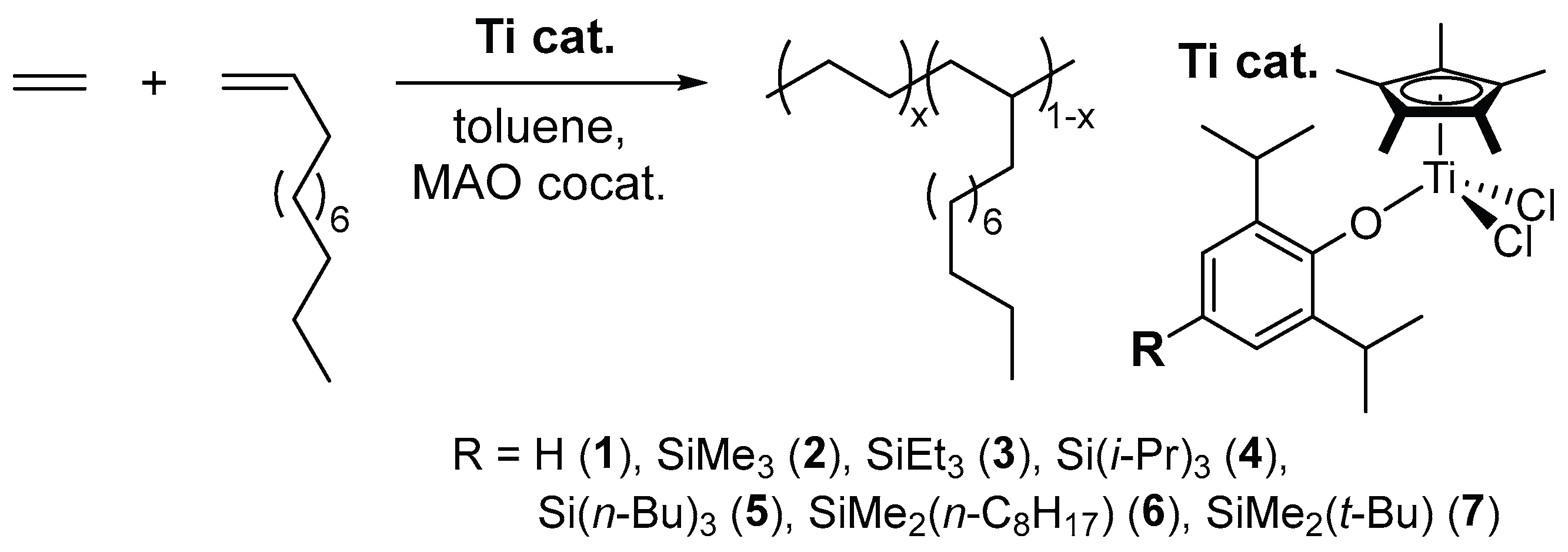

Table 1.
Ethylene polymerization by Cp*TiCl2(O-2,6-iPr2-4-R-C6H2) [R = H (1), SiMe3 (2), SiEt3 (3), Si(i-Pr)3 (4), Si(n-Bu)3 (5), SiMe2(n-C8H17) (6), SiMe2(t-Bu) (7)]‒MAO catalysts (in toluene, ethylene 4 atm, 10 min).1
Table 1.
Ethylene polymerization by Cp*TiCl2(O-2,6-iPr2-4-R-C6H2) [R = H (1), SiMe3 (2), SiEt3 (3), Si(i-Pr)3 (4), Si(n-Bu)3 (5), SiMe2(n-C8H17) (6), SiMe2(t-Bu) (7)]‒MAO catalysts (in toluene, ethylene 4 atm, 10 min).1
| run | cat. |
temp / °C |
yield / mg |
activity / kg-PE/mol-Ti·h |
Mn2 ×10-6 |
Mw/Mn2 |
|---|---|---|---|---|---|---|
| 1 | 1 | 25 | 124 | 49600 | 1.06 | 3.18 |
| 2 | 1 | 50 | 120 | 48000 | 0.67 | 2.41 |
| 3 | 2 | 25 | 136 | 54400 | ||
| 4 | 2 | 50 | 147 | 58800 | ||
| 5 | 3 | 25 | 139 | 55600 | 1.64 | 3.84 |
| 6 | 3 | 50 | 161 | 64400 | 0.55 | 2.96 |
| 7 | 4 | 25 | 141 | 56400 | 1.17 | 2.67 |
| 8 | 4 | 50 | 127 | 50800 | 0.43 | 2.31 |
| 9 | 5 | 25 | 164 | 65600 | 0.88 | 2.84 |
| 10 | 5 | 25 | 170 | 68000 | 1.21 | 2.78 |
| 11 | 5 | 50 | 157 | 62800 | 0.53 | 2.44 |
| 12 | 6 | 25 | 154 | 61600 | 0.78 | 2.89 |
| 13 | 6 | 25 | 157 | 62800 | 0.67 | 2.49 |
| 14 | 6 | 50 | 179 | 71600 | ||
| 15 | 7 | 25 | 147 | 58800 | 1.06 | 2.43 |
| 16 | 7 | 50 | 157 | 62800 | 0.44 | 2.72 |
1 Conditions: Catalyst 0.015 μmol, toluene total 30 mL, ethylene 4 atm, d-MAO 3.0 mmol, 10 min. 2 GPC data in o-dichlorobenzene vs. polystyrene standards.
Table 2.
Ethylene polymerization by Cp*TiCl2(O-2,6-iPr2-4-R-C6H2) [R = Si(i-Pr)3 (4), SinBu3 (5)]‒MAO catalysts (in toluene, ethylene 4 atm): Effect of MAO and temperature.1.
Table 2.
Ethylene polymerization by Cp*TiCl2(O-2,6-iPr2-4-R-C6H2) [R = Si(i-Pr)3 (4), SinBu3 (5)]‒MAO catalysts (in toluene, ethylene 4 atm): Effect of MAO and temperature.1.
| run | cat. / μmol |
temp / oC |
MAO / mmol |
yield / mg |
activity / kg-PE/mol-Ti·h |
Mn2 ×10-6 |
Mw/ Mn2 |
|---|---|---|---|---|---|---|---|
| 17 | 4 (0.005) | 25 | 2.0 | 40 | 48000 | 1.23 | 2.98 |
| 18 | 4 (0.005) | 25 | 3.0 | 60 | 72000 | ||
| 19 | 4 (0.005) | 25 | 4.0 | 73 | 87600 | 0.65 | 2.18 |
| 20 | 5 (0.005) | 25 | 2.0 | 80 | 96000 | 0.65 | 2.81 |
| 21 | 5 (0.005) | 25 | 3.0 | 108 | 129600 | ||
| 22 | 5 (0.005) | 25 | 4.0 | 120 | 144000 | 0.55 | 2.20 |
| 23 | 5 (0.015) | 50 | 3.0 | 157 | 628000 | 0.53 | 2.44 |
| 24 | 5 (0.015) | 50 | 4.0 | 161 | 644000 | 0.37 | 1.95 |
| 25 | 5 (0.015) | 50 | 5.0 | 175 | 700000 | 0.29 | 1.75 |
| 26 | 5 (0.015) | 50 | 6.0 | 161 | 644000 | 0.24 | 2.28 |
| 27 | 5 (0.015) | 80 | 2.0 | 107 | 428000 | 0.28 | 2.85 |
| 28 | 5 (0.015) | 80 | 3.0 | 124 | 496000 | 0.27 | 1.87 |
| 29 | 5 (0.015) | 80 | 4.0 | 132 | 528000 | 0.23 | 2.14 |
| 30 | 5 (0.015) | 80 | 5.0 | 151 | 604000 | 0.17 | 2.05 |
| 31 | 5 (0.015) | 80 | 6.0 | 144 | 576000 | 0.15 | 2.22 |
1 Conditions: Catalyst 0.005 or 0.015 μmol, toluene total 30 mL, ethylene 4 atm, 10 min. 2 GPC data in o-dichlorobenzene vs. polystyrene standards.
Table 3.
Ethylene copolymerization with 1-dodecene (DD) by Cp*TiCl2(O-2,6-iPr2-4-R-C6H2) [R = H (1), SiMe3 (2), SiEt3 (3), Si(i-Pr)3 (4), Si(n-Bu)3 (5), SiMe2(n-C8H17) (6), SiMe2(t-Bu) (7)]‒MAO catalysts (in toluene, DD 0.75 M, ethylene 6 atm, 6 min).1.
Table 3.
Ethylene copolymerization with 1-dodecene (DD) by Cp*TiCl2(O-2,6-iPr2-4-R-C6H2) [R = H (1), SiMe3 (2), SiEt3 (3), Si(i-Pr)3 (4), Si(n-Bu)3 (5), SiMe2(n-C8H17) (6), SiMe2(t-Bu) (7)]‒MAO catalysts (in toluene, DD 0.75 M, ethylene 6 atm, 6 min).1.
| run | cat. | temp / °C |
MAO / mmol |
yield / mg |
activity2 / kg-polymer/mol-Ti·h |
Mn3 ×10-5 |
Mw/ Mn3 |
cont.4 / mol% |
|---|---|---|---|---|---|---|---|---|
| 32 | 1 | 25 | 2.0 | 16 | 160000 | 2.54 | 1.90 | |
| 33 | 1 | 50 | 2.0 | 89 | 890000 | |||
| 34 | 2 | 25 | 2.0 | 85 | 850000 | 1.50 | 1.54 | |
| 35 | 2 | 50 | 2.0 | 105 | 1050000 | |||
| 36 | 3 | 25 | 2.0 | 109 | 1090000 | 1.67 | 1.62 | |
| 37 | 3 | 50 | 2.0 | 155 | 1550000 | |||
| 38 | 4 | 25 | 2.0 | 207 | 2070000 | 1.95 | 1.86 | 19.8 |
| 39 | 4 | 50 | 2.0 | 60 | 600000 | |||
| 40 | 4 | 50 | 3.5 | 72 | 720000 | 1.59 | 2.03 | 25.2 |
| 41 | 5 | 25 | 2.0 | 340 | 3400000 | 2.29 | 1.72 | 18.9 |
| 425 | 5 | 25 | 2.0 | 108 | 4320000 | |||
| 43 | 5 | 50 | 2.0 | 298 | 2980000 | |||
| 44 | 5 | 50 | 3.5 | 350 | 3500000 | 1.46 | 2.07 | 25.9 |
| 45 | 5 | 50 | 3.5 | 355 | 3550000 | |||
| 46 | 6 | 25 | 2.0 | 310 | 3100000 | 1.99 | 1.84 | 19.8 |
| 47 | 6 | 50 | 2.0 | 40 | 400000 | |||
| 48 | 6 | 50 | 2.5 | 75 | 750000 | |||
| 49 | 6 | 50 | 3.0 | 309 | 3090000 | |||
| 50 | 6 | 50 | 3.5 | 328 | 3280000 | 1.31 | 2.01 | 21.8 |
| 51 | 6 | 50 | 4.0 | 225 | 2250000 | |||
| 52 | 7 | 25 | 2.0 | 156 | 1560000 | 1.96 | 1.84 | 18.3 |
| 53 | 7 | 50 | 2.0 | 90 | 900000 | |||
| 54 | 7 | 50 | 3.5 | 120 | 1200000 | 1.68 | 2.07 | 23.2 |
1 Conditions: Catalyst 0.001 μmol (run 42, 0.00025 μmol), toluene and 1-dodecene (5.0 mL, DD 0.75 M) total 30.0 mL, ethylene 6 atm, 6 min. 2 Activity in kg-polymer/mol-Ti·h. 3 GPC data in o-dichlorobenzene vs polystyrene standards. 4 1-Dodecene (DD) content (mol%) estimated by 13C NMR spectra. 5 Catalyst 0.00025 μmol.
Table 4.
Microstructural Analysis for Poly(ethylene-1-dodecene) by 13C NMR spectra.1
| run | cat. | temp. | DD2 | triad sequence distribution3/ % | dyads4/ % | rE5 | rD5 | rE·rD6 | rE·rD7 | |||||||
|---|---|---|---|---|---|---|---|---|---|---|---|---|---|---|---|---|
| / °C | / mol% | EEE | EED+DEE | DED | EDE | DDE+EDD | DDD | EE | ED+DE | DD | ||||||
| 38 | 4 | 25 | 19.8 | 46.4 | 27.5 | 6.2 | 15.3 | 3.6 | 0.9 | 60.1 | 37.1 | 2.7 | 3.34 | 0.14 | 0.48 | 0.48 |
| 40 | 4 | 50 | 25.2 | 48.1 | 20.6 | 6.0 | 19.6 | 5.6 | trace | 58.5 | 38.7 | 2.8 | 4.05 | 0.11 | 0.44 | 0.44 |
| 41 | 5 | 25 | 18.9 | 52.5 | 25.3 | 3.3 | 15.4 | 2.8 | 0.7 | 65.1 | 32.8 | 2.1 | 4.09 | 0.12 | 0.50 | 0.50 |
| 44 | 5 | 50 | 25.9 | 42.9 | 26.7 | 4.4 | 20.4 | 3.6 | 1.9 | 56.3 | 40.0 | 3.7 | 3.77 | 0.14 | 0.51 | 0.51 |
| 46 | 6 | 25 | 19.7 | 47.3 | 28.7 | 4.3 | 16.3 | 1.1 | 2.3 | 61.6 | 35.5 | 2.9 | 3.57 | 0.16 | 0.56 | 0.57 |
| 50 | 6 | 50 | 21.8 | 46.7 | 27.7 | 3.7 | 17.3 | 4.0 | 0.5 | 60.6 | 36.9 | 2.5 | 4.40 | 0.10 | 0.44 | 0.45 |
| 52 | 7 | 25 | 18.3 | 54.5 | 23.9 | 3.2 | 15.4 | 2.4 | 0.5 | 66.5 | 31.7 | 1.7 | 4.32 | 0.11 | 0.46 | 0.46 |
| 54 | 7 | 50 | 23.2 | 48.2 | 22.9 | 5.6 | 17.3 | 5.4 | 0.5 | 59.7 | 37.1 | 3.2 | 4.31 | 0.13 | 0.55 | 0.56 |
1 Detailed polymerization data, see Table 3. 2 1-Dodecene (DD or D) contents estimated by 13C NMR spectra, [DD] = [EDE]+[DDE+EDD]+[DDD]. 3 Estimated by 13C NMR spectra, E = ethylene, D = 1-dodecene. 4 [EE] = [EEE] + 1/2[EED+DEE], [ED+DE] = [DED]+[EDE]+1/2{[EED+DEE]+[DDE+EDD]}, [DD] = [DDD]+1/2[DDE+EDD]. 5 rE = [D]0/[E]0×2[EE]/[ED+DE], rC = [E]0/[C]0×2[DD]/[ED+DE], [E]0, [D]0 corresponds to the initial concentration. 6 rE·rD = 4[EE][DD]/[ED+DE] 2. 7 rE·rD = rE×rD.
Disclaimer/Publisher’s Note: The statements, opinions and data contained in all publications are solely those of the individual author(s) and contributor(s) and not of MDPI and/or the editor(s). MDPI and/or the editor(s) disclaim responsibility for any injury to people or property resulting from any ideas, methods, instructions or products referred to in the content. |
© 2025 by the authors. Licensee MDPI, Basel, Switzerland. This article is an open access article distributed under the terms and conditions of the Creative Commons Attribution (CC BY) license (http://creativecommons.org/licenses/by/4.0/).
Copyright: This open access article is published under a Creative Commons CC BY 4.0 license, which permit the free download, distribution, and reuse, provided that the author and preprint are cited in any reuse.


