

Submitted:
21 July 2025
Posted:
25 July 2025
You are already at the latest version
Abstract
This paper critically reviews and expands Biggs’ widely used 3P model (Presage–Process–Product), proposing an updated and enhanced framework—the 3P2T model—to better reflect contemporary higher education contexts. The original 3P model, while influential, presents limitations due to its linear structure and lack of explicit attention to dynamic, reciprocal, and temporal factors that shape student learning today. The proposed 3P2T model addresses these shortcomings by integrating feedback loops, task-level granularity, and temporal dynamics, thereby capturing the complex interactions between student characteristics, instructional processes, and educational outcomes. By emphasising personalised and flexible pedagogical strategies responsive to diverse student populations and evolving digital environments, the 3P2T model provides educators with robust theoretical insights and practical guidance for enhancing student engagement and achievement. Future empirical validation is encouraged to further confirm its applicability and effectiveness across varied educational settings.
Keywords:
"Briggs 3P"
; feedback loops
; flexible pedagogy
; educational outcomes
; learning frameworks
Introduction
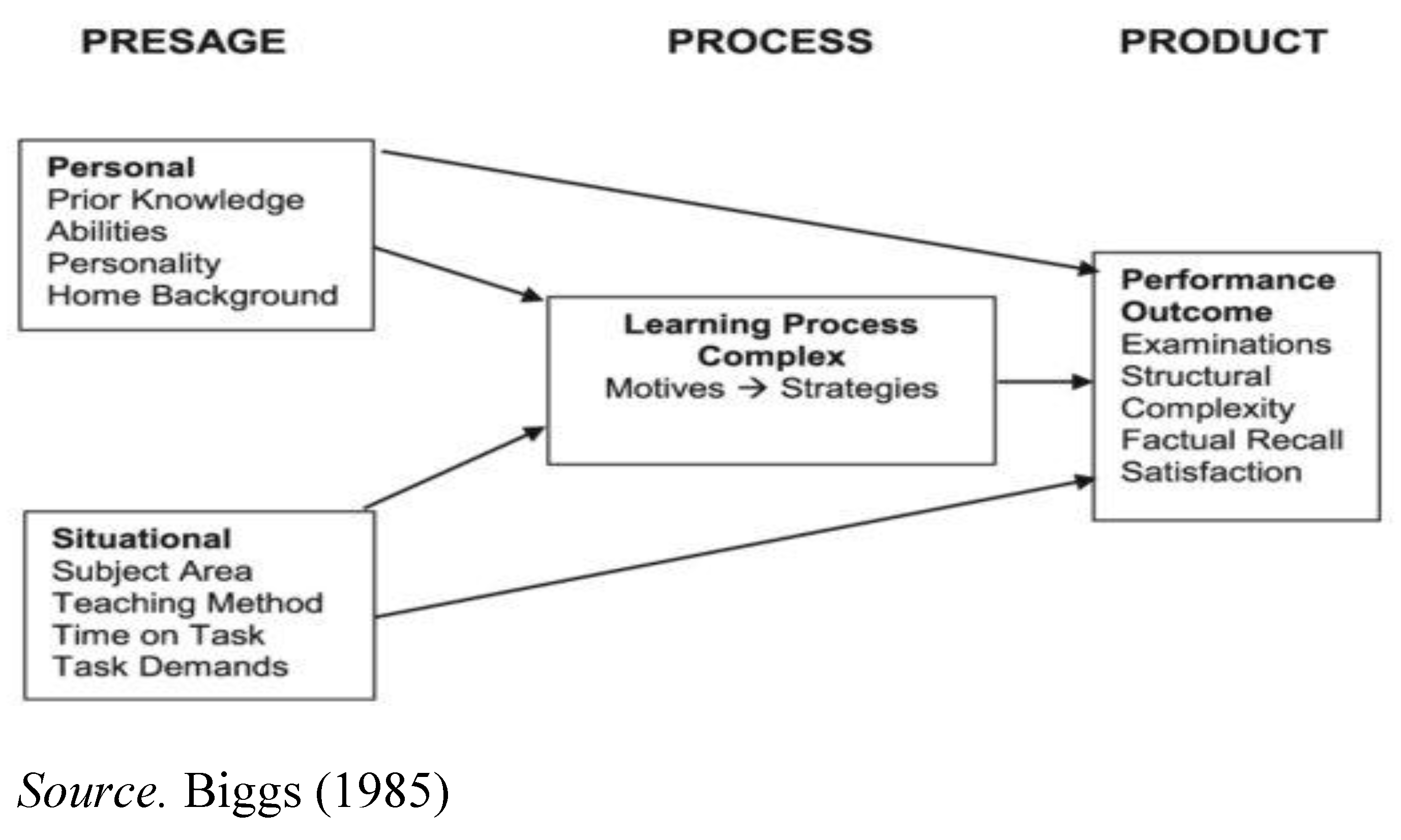
The Biggs 3P model (Biggs, 1993) is a well-established and widely used model of learning, that was developed by John Biggs and Kevin Collis in 1982 to design and evaluate teaching and learning programs. The model consists of three main components, originally Product-Process-Person, which in 1993 was amended to Presage-Process-Product (see Figure 1). Presage corresponds to the individual factors influencing students’ ability to learn. These include both contextual and personal factors such as the student's background, prior knowledge, IQ, cognitive abilities, learning styles, and motivation. Process refers to the learning activities and strategies used by the student and their instructors, such as instructional design, teaching methods, and student feedback. Lastly, product denotes the student's learning outcomes and achievements. This includes elements such as grades, test scores, and other measures of academic success. At the centre of the model is the process level, where the learning approach taken by the student is converted into learning strategies, which in turn inform expected academic outcomes. Learning outcomes are the product of the presage and process variables and can be described quantitatively, qualitatively, and institutionally (Biggs, 1993; Hamilton & Tee, 2009; Chatti et al., 2010; Quinlan, 2019).
Figure 1.
Bigg’s 3P Model.
The Biggs 3P model has provided educators with a robust theoretical framework for understanding student learning. However, the increasingly diverse student demographics, alongside widespread digitalisation of education, have exposed critical limitations in its applicability. These developments necessitate revisiting and refining the model to better reflect the complexities of contemporary higher education.
By using the 3P model, educators can ensure that their teaching methods, assessment techniques, and resources align with the intended learning outcomes and the characteristics of their students, thus enhancing the constructive alignment (i.e., the effectiveness) of their programs (Biggs, 1996; Kandlbinder, 2014). Additionally, the model provides a useful framework for understanding the complexities and interactions between the teaching environment and student specific factors. For example, Kember et al., (2003) explain that student characteristics such as prior knowledge, ability, and preferred learning approaches interact with the teaching context (i.e., the content, teaching and assessment methods, and the institutional climate) to determine the ongoing approach taken by students to a particular task.
When assessing learning practices, it is crucial to note the variability individual learning styles have on the effectiveness of instructional approaches (Kember et al., 2004). Moreover, Entwistle et al., (2002) challenge the common assumption that all successful students follow the same path to academic achievement. Therefore, it is important to recognise that there is no single approach to education that can be universally applied to meet every individual’s learning goals (van Merriënboer & Kirschner, 2017). Additionally, factors affecting student learning are complex and difficult to define, making it essential to consider them from multiple perspectives to aid the totality of understanding.
Literature Review
While Biggs’ 3P model remains influential in understanding how learning outcomes are shaped by both student and contextual variables, a growing body of literature has critically examined and extended its application across diverse educational settings. Multiple studies have reaffirmed the central tenets of the model while identifying important nuances that reflect variations in learning context, modality, and student background. Empirical applications of the 3P model have consistently affirmed its utility while progressively highlighting its limitations and areas requiring refinement. Barattucci et al. (2017), for instance, successfully validated the model within Italian higher education, clearly showing how positive perceptions of the academic environment significantly predicted deeper learning approaches and improved academic outcomes. This finding highlights the critical role of presage factors, particularly environmental perceptions, in shaping learning processes.
Building upon this insight, Ganotice and Chan (2019) further extended the model into the specific context of computer supported interprofessional team-based learning. Their study underscored how individual preparedness, and the perception of peer contributions influenced students' motivation and perceived effectiveness of learning. Crucially, their results illuminated the mediating role motivational processes play between initial student attributes (presage) and successful learning outcomes (product), demonstrating the critical importance of motivational and emotional dimensions in the learning process.
Further insights emerged from Albelbisi et al.’s (2018) systematic review of Massive Open Online Courses (MOOCs), which identified critical success factors within digital learning environments through the lens of the 3P model. Their findings emphasised the significance of acknowledging learner diversity and complexity, highlighting that variability in learners' characteristics and their interactions with pedagogical structures directly influenced dropout rates. These observations reinforce the model's need for increased flexibility to effectively accommodate the extensive variability found in contemporary digital education.
Addressing these emerging limitations explicitly, Kember et al. (2020) proposed a revised version of the 3P model, expanding its scope to more comprehensively incorporate the broader teaching and learning environment and placing explicit emphasis on the development of graduate attributes. By employing structural equation modelling, their work clearly demonstrated that fostering deep learning approaches is not just beneficial but essential for developing both cognitive competencies and crucial social attributes. This suggests that a more holistic view of learning contexts is necessary for the model to maintain relevance in contemporary educational settings.
Moreover, recent adaptations of the 3P model have extended its relevance to socially inclusive and cross-cultural educational environments. For instance, Kee and Lai (2022) applied the model to disadvantaged learners engaged in participatory design, finding that empowering students through collaborative, student-driven activities significantly increased their motivation and psychological empowerment, while reducing feelings of alienation. Similarly, Li et al. (2023) emphasised intercultural adaptation, proposing a coconstructed approach to understand mutual adjustments between Chinese international students and their Australian lecturers. Their findings revealed that reciprocal perceptions and adaptations significantly shaped engagement and outcomes, highlighting the inherently interactive and dynamic nature of the learning process.
Collectively, these empirical studies underscore the strength of the 3P model in highlighting the importance of student and contextual interactions but simultaneously point to its critical limitations—particularly its original linear representation. The dynamic, reciprocal, and culturally responsive nature of contemporary higher education clearly necessitates an updated model that explicitly recognises these complex interactions and provides guidance for educators to respond adaptively to diverse educational contexts.
Despite its popularity, the 3P model holds various shortcomings. Firstly, the linear fashion of the model neglects the interactive and reciprocal nature of each of the facets and their feedback loops (Entwistle et al., 2002; Carless, 2019), thus ignoring the temporal processes of student development across their degree. Secondly, the classroom-based model was developed in the 1990s from which significant changes in the educational landscape have ensued including, but not limited to, increasing use of digital technologies, and cultural, socio-economic, and demographic shifts in the student population. These changes have produced shifts in the styles (e.g., audio, visual, kinaesthetic) and preferences (e.g., more self-directed and informal, gradual vs summative assessments) students hold in their learning. Crucially, the model does not provide any guidance on how teachers can tailor their teaching methods to different learning styles.
In light of the model's limitations, it is increasingly argued that Biggs' 3P framework should not be conceptualised as a strictly linear or unidirectional process. Instead, a more dynamic, cyclical interpretation is warranted—one that recognises the presence of reciprocal feedback loops between presage, process, and product elements. While presage factors (such as student characteristics and perceptions of the learning environment) initially shape learning approaches, and these in turn influence outcomes, the outcomes themselves—whether academic success, disengagement, or dropout—can retroactively affect learners’ motivation, self-efficacy, and perceptions of future learning contexts (Carless, 2019; Entwistle et al., 2002). This cyclical perspective better reflects the temporal and evolving nature of student development, allowing for iterative adaptation or, conversely, disruption where feedback loops are weakened or fail entirely, such as in cases of student withdrawal or sustained disengagement.
Additionally, researchers are increasingly encouraged to consider the level of measurement of the educational task or outcome under study. Constructs such as motivation, engagement, and achievement operate across multiple layers—from individual learners to group dynamics and institutional environments. A multilevel approach is therefore essential to adequately capture this complexity. For example, Trautwein and Lüdtke (2007) demonstrate how both individual and classroom-level factors significantly contribute to learning outcomes, highlighting the importance of accounting for nested influences in educational research. Without such granularity, single-level analyses risk misattributing effects or oversimplifying the interplay between contextual and personal factors that shape learning trajectories. Recent research further supports the need for flexible educational models, highlighting that personalised instructional approaches significantly enhance student engagement and academic achievement (Krooi et al., 2024).
An Updated Model
As such, this paper seeks to extend Biggs’ (1993) existing 3P model of learning, improving relevance in the current education system whilst considering the current digital transformation in Higher Education. This paper Proposes a new model (the 3P2T) that considers various contextual and personal factors that may influence students’ academic success (or failure). By doing so, complex dynamics of student learning in the contemporary educational setting and can provide educators with a more nuanced and effective framework for supporting student learning.
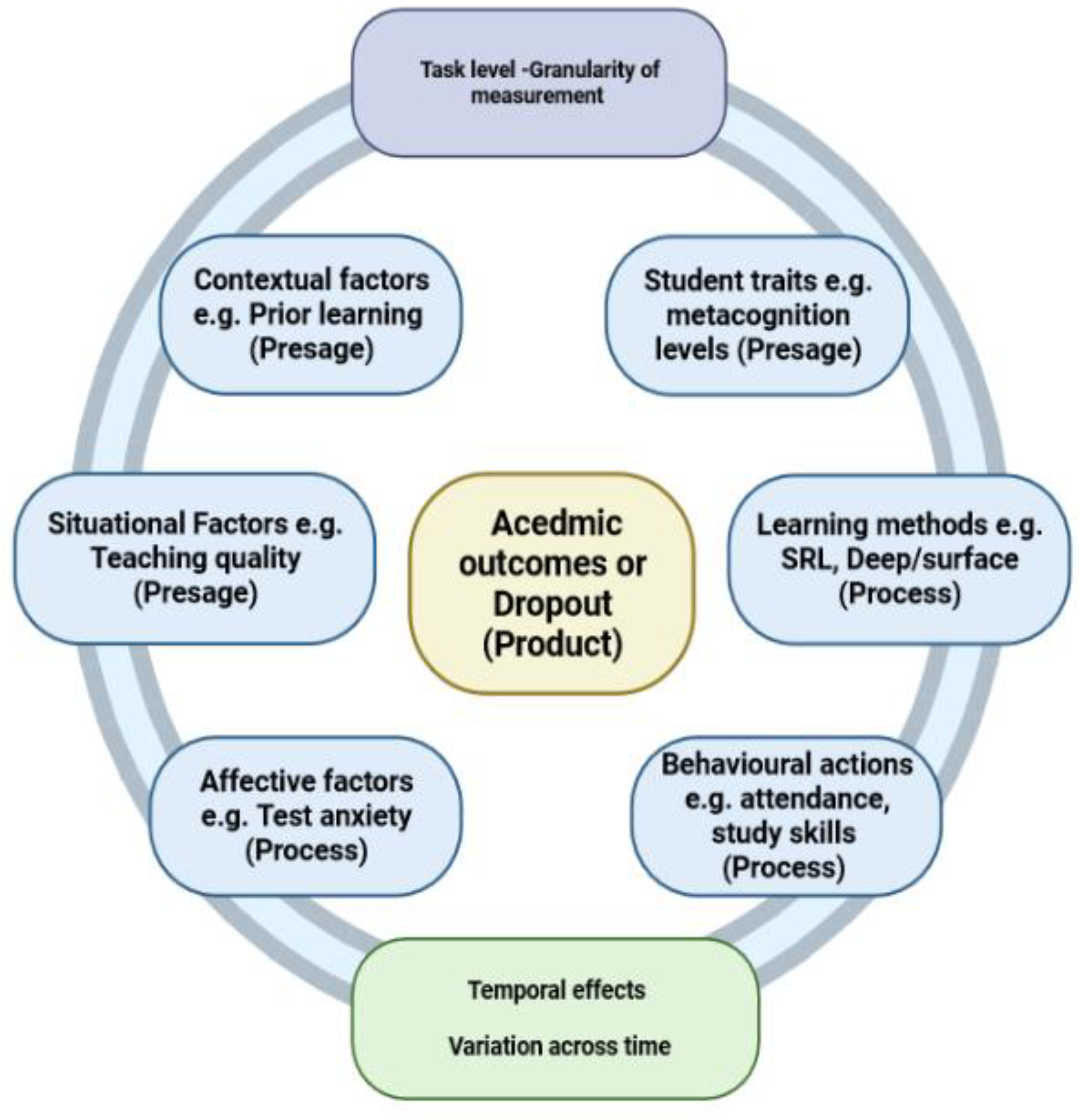
The proposed 3P2T model (Figure 2) advances Biggs’ (1993) foundational 3P model by explicitly addressing contemporary complexities of student learning through two additional dimensions: Task level (granularity of measurement) and Temporal effects (variation across time). By introducing these dimensions, the 3P2T framework provides a richer understanding of the dynamic interactions influencing student academic outcomes.
Figure 2.
Proposed 3P2T Model.
A crucial refinement proposed here is the explicit recognition of reciprocal feedback loops within the model. In contrast to the linear interpretation, the updated 3P2T framework emphasises ongoing and iterative interactions between presage, process, and product elements. For example, students' academic outcomes (product) influence their future motivation and perceptions (presage), subsequently altering their learning strategies (process). Such cyclical interactions better represent real-world educational dynamics, allowing for both positive reinforcement and adaptive responses to negative outcomes, such as dropout or disengagement (REF). For instance, an educator observing declining engagement might intervene by modifying instructional methods or assessment formats (process), informed directly by student feedback (product). Over time, these changes can reshape student perceptions and approaches (presage), creating a self-sustaining cycle of educational improvement.
The core components—Presage, Process, and Product—are maintained but have been substantially refined and contextualised. Within the Presage dimension, contextual factors such as prior learning and situational influences including teaching quality are identified as critical precursors shaping the learner’s initial state. In parallel, individual student traits, such as metacognitive skills, influence how students engage with learning tasks.
The Process dimension is expanded to encapsulate not just cognitive or strategic aspects (e.g., surface or deep learning strategies, self-regulated learning) but also affective (emotional) and behavioural dimensions. Affective factors (e.g., anxiety, emotional engagement) have significant implications for motivation and overall learning quality, thus demanding specific attention. Behavioural actions, such as attendance patterns, study habits, and task engagement, are explicitly identified as active mediators of student success.
The Product dimension remains focused on measurable academic outcomes, but the 3P2T model explicitly acknowledges the potential for both positive outcomes (academic success) and negative outcomes (disengagement or dropout). This dual framing emphasises the need for proactive interventions and robust feedback systems within institutional strategies.
The additional layer of Task level granularity highlights the importance of considering measurement precision and the context-specific nature of educational tasks. Different academic tasks vary widely in complexity, cognitive demands, and learning objectives. Recognising these variations explicitly can support more effective, targeted pedagogical interventions.
Critically, the introduction of Temporal effects recognises learning as inherently dynamic. Students’ motivations, behaviours, and outcomes fluctuate over time, influenced by short-term cycles such as exam periods and longer-term developmental changes across a degree programme. Acknowledging this variability encourages educators to adopt more responsive, flexible strategies and continuous assessment frameworks, rather than relying solely on summative or snapshot measures of student achievement.
The 3P2T model highlights several practical implications and recommendations for educators aiming to maximise student learning in contemporary educational settings. Firstly, recognising the cyclical, interactive nature of student learning underscores the need for educators to routinely monitor and adapt their instructional practices and assessments. Educators should embrace formative assessments and ongoing feedback to more effectively respond to changing student needs and motivational states.
Secondly, the acknowledgment of affective and behavioural processes within student learning underlines the value of supporting emotional regulation and positive behavioural habits in students. Educators can implement structured strategies such as academic coaching, peer mentoring schemes, and anxiety reduction workshops to enhance students’ emotional resilience and foster productive behaviours, thereby positively influencing academic outcomes.
Thirdly, educators should ensure that instructional design is informed by a clear understanding of task granularity. Specific tasks should be matched to appropriate pedagogical strategies and evaluation criteria, reflecting varying complexity levels and learning objectives. Differentiation and personalisation of instruction—such as adaptive learning software or targeted interventions—can help address diverse learner profiles, ensuring greater inclusivity and effectiveness in teaching practices.
Moreover, educators must actively foster an institutional environment that values interactive models over deficit-oriented perspectives. Rather than focusing narrowly on perceived student deficiencies, educators and institutions should emphasise a holistic view of learning, recognising that academic outcomes emerge from the complex interplay of personal traits, instructional approaches, and broader institutional contexts. This approach advocates for systemic and collaborative solutions to academic challenges, shifting from blame towards shared responsibility for student success.
Finally, addressing the temporal dimension explicitly highlights the necessity of flexible instructional practices. Educators are encouraged to adopt iterative curricular designs and modular delivery methods, allowing periodic review and timely modifications to pedagogical approaches. Such flexibility ensures responsiveness to evolving educational demands, student feedback, and technological advances.
Future empirical studies are encouraged to operationalise the 3P2T model in diverse contexts, testing its effectiveness in capturing temporal dynamics and feedback interactions. Such validation would further enhance its practical utility and theoretical robustness, guiding educational practices and institutional strategies more effectively.
Conclusions
The proposed 3P2T model offers a refined and comprehensive framework for understanding student learning, significantly expanding upon Biggs' foundational 3P model by explicitly incorporating multidimensional, reciprocal, and temporal dynamics. Recognising that contemporary higher education is shaped by ongoing digital transformations, increased student diversity, and dynamic interactions between learners, tasks, and institutional contexts, this model provides educators and institutions with robust theoretical insights and actionable guidance. By emphasising reciprocal feedback loops, educators are better positioned to proactively respond to student needs and adapt instructional strategies effectively. Additionally, the explicit integration of temporal dimensions and task-specific granularity underscores the necessity for flexible and personalised pedagogies that accommodate diverse learner trajectories and preferences. As recent empirical evidence suggests, incorporating personalised and adaptive educational practices meaningfully enhances student engagement and academic achievement (Krooi et al., 2024). Moving forward, the 3P2T model not only encourages more responsive and inclusive teaching strategies but also lays a solid foundation for future empirical research. Validation and exploration of this updated framework across diverse educational contexts will further strengthen its theoretical robustness and practical applicability, ultimately driving continuous improvement in student learning and institutional effectiveness in a rapidly evolving educational landscape.
References
- Albelbisi, N.; Yusop, F.D.; Salleh, U.K.M. Mapping the Factors Influencing Success of Massive Open Online Courses (MOOC) in Higher Education. Eurasia Journal of Mathematics, Science and Technology Education 2018, 14, 2995–3012. [Google Scholar] [CrossRef] [PubMed]
- Barattucci M, Pagliaro S, Cafagna, D.; Bosetto, D. An examination of the Applicability of Biggs’ 3P Learning Process Model to Italian University. Journal of E-Learning and Knowledge Society 2017, 13. [CrossRef]
- Biggs, J. Enhancing teaching through constructive alignment. Higher Education 1996, 32, 347–364. [Google Scholar] [CrossRef]
- Biggs, J.B. From Theory to Practice: A Cognitive Systems Approach. Higher Education Research & Development 1993, 12, 73–85. [Google Scholar] [CrossRef]
- Carless, D. Feedback loops and the longer-term: Towards feedback spirals. Assessment & Evaluation in Higher Education 2019, 44, 705–714. [Google Scholar] [CrossRef]
- Chatti MA, Jarke, M. ; Specht, M. The 3P Learning Model. Educational Technology & Society 2010, 13, 74–85, https://www.jstor.org/stable/jeductechsoci.13.4.74. [Google Scholar]
- Entwistle N, McCune, V. ; Hounsell, J. Approaches to studying and perceptions of university teaching-learning environments: Concepts, measures and preliminary findings. Occasional report 2002, 1, 1–19. [Google Scholar]
- Ganotice FA,, J. r.; Chan, L.K. How can students succeed in computer-supported interprofessional team-based learning? Understanding the underlying psychological pathways using Biggs' 3P model. Computers in Human Behavior 2019, 91, 211–219. [Google Scholar] [CrossRef]
- Hamilton, J.A.; Tee, S. (2009). Extending the Biggs 3P teaching and learning model: a structural equation modeling approach. Proceedings of the International Conference on Electronic Business (ICEB). https://aisel.aisnet.org/iceb2009/150. 2009. [Google Scholar]
- Kandlbinder, P. Constructive alignment in university teaching. HERDSA News 2014, 36, 5–6. [Google Scholar]
- Kee, T.; Lai, A. Learning motivation and psychological empowerment of socioeconomically disadvantaged learners – an empirical study on inclusive project-based learning during Covid-19. International Journal of Inclusive Education 2022, 28, 2438–2457. [Google Scholar] [CrossRef]
- Kember D, Jenkins, W. ; Ng, K.C. Adult students' perceptions of good teaching as a function of their conceptions of learning—part 1. influencing the development of self-determination. Studies in Continuing Education 2003, 25, 239–251. [Google Scholar] [CrossRef]
- Kember D, Webster, B. J.; Chan, W.S.C. Refocusing the 3P model to incorporate a learning and teaching environment and graduate attributes. Educational Psychology 2020, 40, 592–607. [Google Scholar] [CrossRef]
- Krooi M, Whittingham, J. ; Beausaert, S. Introducing the 3P conceptual model of internal quality assurance in higher education: A systematic literature review. Studies in Educational Evaluation 2024, 82, 101360. [Google Scholar] [CrossRef]
- Li B, Burke, J. ; Plunkett, M. Perceptions of Chinese international students’ learning approaches in Australian universities: a co-constructed model. Asia Pacific Journal of Education 2023, 45, 903–919. [Google Scholar] [CrossRef]
- Quinlan, K.M. What triggers students’ interest during higher education lectures? personal and situational variables associated with situational interest. Studies in Higher Education 2019, 44, 1781–1792. [Google Scholar] [CrossRef]
- Trautwein, U.; Lüdtke, O. Epistemological beliefs, school achievement, and college enrollment: How are they related and what can we learn from them? British Journal of Educational Psychology 2007, 77, 963–984. [Google Scholar] [CrossRef]
- van Merriënboer, J.J.G. ; KirschnerP.A. (2017). Ten Steps to Complex Learning: A Systematic Approach to Four-Component Instructional Design (3rd ed.). Routledge. [CrossRef]
Disclaimer/Publisher’s Note: The statements, opinions and data contained in all publications are solely those of the individual author(s) and contributor(s) and not of MDPI and/or the editor(s). MDPI and/or the editor(s) disclaim responsibility for any injury to people or property resulting from any ideas, methods, instructions or products referred to in the content. |
© 2025 by the author. Licensee MDPI, Basel, Switzerland. This article is an open access article distributed under the terms and conditions of the Creative Commons Attribution (CC BY) license (https://creativecommons.org/licenses/by/4.0/).
Copyright: This open access article is published under a Creative Commons CC BY 4.0 license, which permit the free download, distribution, and reuse, provided that the author and preprint are cited in any reuse.


