

Submitted:
21 July 2025
Posted:
22 July 2025
Read the latest preprint version here
Abstract
Thiochromones are known to possess useful optical properties and rich bioactivities, including antioxidant, antimicrobial, and anticancer properties. They are known to inhibit tumor cell growth, induce apoptosis, and have antiplatelet aggregation effects. Thiochromones are also used as synthons and precursors in organic synthesis for bioactive agents. Although many synthetic approaches to oxygen containing counterparts, chromones, have been reported, research on the synthesis of thiochromones are scarce. The synthesis of thiochromones can be challenging due to the inherent nature of sulfur, including its multiple oxidation states and tendency to form diverse bonding patterns. Here we report the one-pot synthesis of thiochromone, where two transformations of the starting material, 3-(arylthiol)propanoic acid, are performed within a single reaction vessel, eliminating the need for intermediate purification step. This one-pot reaction worked well with a variety of substrates with both electron withdrawing and donating groups on the aromatic ring of 3-(arylthiol)propanoic acids to give thiochromone with good yields (up to 81%). This approach offers advantages like time and cost savings, increased efficiency, and reduced waste. This synthetic approach will allow access to a broader scope of thiochromones due to the readily available thiophenols.
Keywords:
Thiochromone
; 3-(arylthiol)propanoic acids
; thiochroman-4-one
; one-pot synthesis
1. Introduction
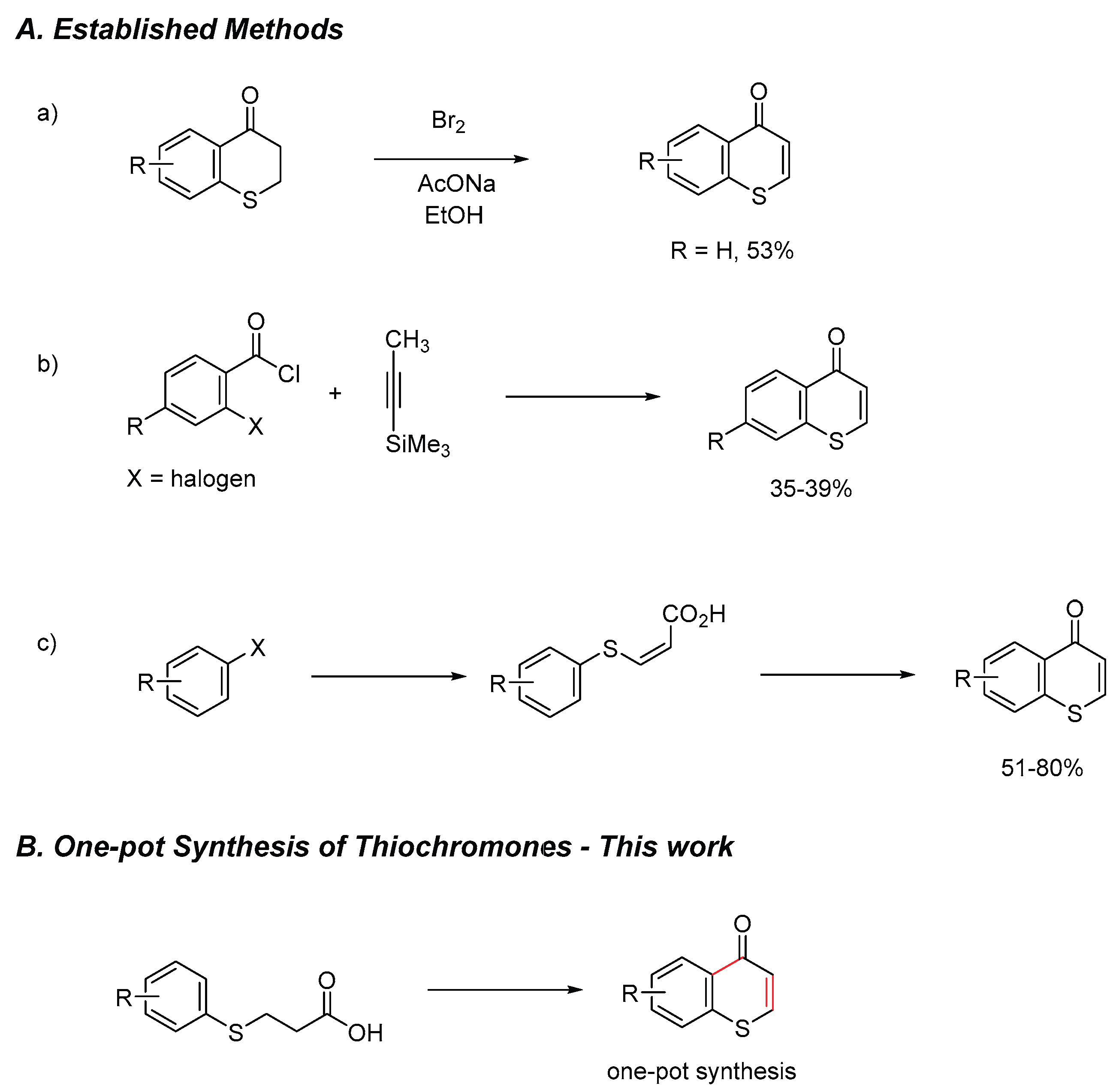
Chromones are an important class of heterocycles and known as privileged scaffolds [1,2,3] in medicinal chemistry due to their wide range of biological activities including antioxidants [4], antiprotozoal [5] or anticancer agents [6,7,8]. Synthetic approaches to chromones have been extensively reported [9]. Thiochromones [10] are the sulfur analogs of chromone, in which the O-1 atom is replaced by a sulfur atom. The sulfur containing heterocyclic compounds benzothiopyrans or thiochromones stand out as having promising biological activities due to their structural relationship with chromones (benzopyrans), which are widely known as privileged scaffolds in medicinal chemistry [1,2,3,4,5,6,7,8]. However, the sulfur containing thiochromones have been significantly less explored presumably due to the reduced reactivity of the thiopyrone moiety as the result of the replacement of oxygen by sulfur atom. Thiochromones are known to possess useful optical properties and rich bioactivities, including antioxidant, antimicrobial, and anticancer properties. They are known to inhibit tumor cell growth, induce apoptosis, and have antiplatelet aggregation effects [11,12]. Thiochromones are also used as synthons and precursors in organic synthesis for useful sulfur heterocycles and other bioactive agents [13]. In the past several years, we have reported the conjugate addition of organometallic reagents to thiochromones in the synthesis of thioflavanones, thiochroman-4-ones with additional synthetic applications [14,15,16,17]. Although many synthetic approaches to oxygen containing counterparts, chromones, have been reported, [9] research on the synthesis of thiochromones are scarce. The synthesis of thiochromones can be challenging due to the inherent nature of sulfur, including its multiple oxidation states and tendency to form diverse bonding patterns. One of the earliest methods for the preparation of 2,3-unsubstituted thiochromone involved the bromination of thiochroman-4-one and subsequent dehydrohalogenation to give the desired thiochromone (Figure 1, A, a) [18].
Another method utilized a 3-component synthesis of 2,3-unsubstituted thiochromones from o-haloaroyl chlorides, trimethylsilylacetylene, and sodium sulfide nonahydrate with modest yields (35-39%, Figure 1, A, b) [19,20]. Another synthetic approach to thiochromone involved a key intermediate (Z)-3-arylthioacrylic acids, which were synthesized from aryl halides, sodium sulfide pentahydrate, and propiolic acid. The subsequent Friedel-Crafts acylation reaction of (Z)-3-arylthioacrylic acids under treatment with sulfuric acid at 100 °c to give thiochromones in good yields (51-80%, Figure 1, A, c) [21]. However, accessing a broad scope of thiochromones, a class of sulfur-containing heterocycles, remains a significant synthetic challenge. Here we report the one-pot synthesis [22] of thiochromone (Figure 1, B), where two transformations of the starting material, 3-(arylthiol)propanoic acid, are performed within a single reaction vessel, eliminating the need for intermediate purification step. This approach offers advantages like time and cost savings, increased efficiency, and reduced waste.
2. Results and Discussions
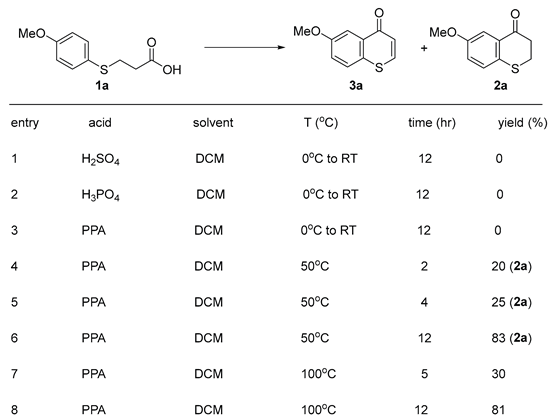
We started our investigation with 3-(4-MeOphenylthiol)propanoic acid 1a and concentrated sulfuric acids. It was found that demethylated thiochroman-4-one was attained in modest yield under the acidic conditions and no thiochromone was observed (Table 1, entry 1). Then phosphoric acid was used, similar result was attained (Table 1, entry 2). So, a weaker acid polyphosphoric acid (PPA) was then deployed instead. Under similar conditions, no reaction was observed as we recovered the starting material (entry 3). Subsequently, when the reaction was heated to a high temperature with polyphosphoric acid (PPA), the corresponding thiochroman-4-one 2a was attained in good yield (up to 83%) but no thiochromone 3a was observed (entries 4-6). We were delighted to see the formation of thiochromone 3a when the reaction temperature was further increased to 100 °C (entry 7). The highest yield can be attained with 3-(4-MeOphenylthiol)propanoic acid and polyphosphoric acid (PPA) at 100 °C for extended period of time (entry 8)

Table 1.
Reactions of with 3-(4-MeOphenylthiol)propanoic acid.
 |
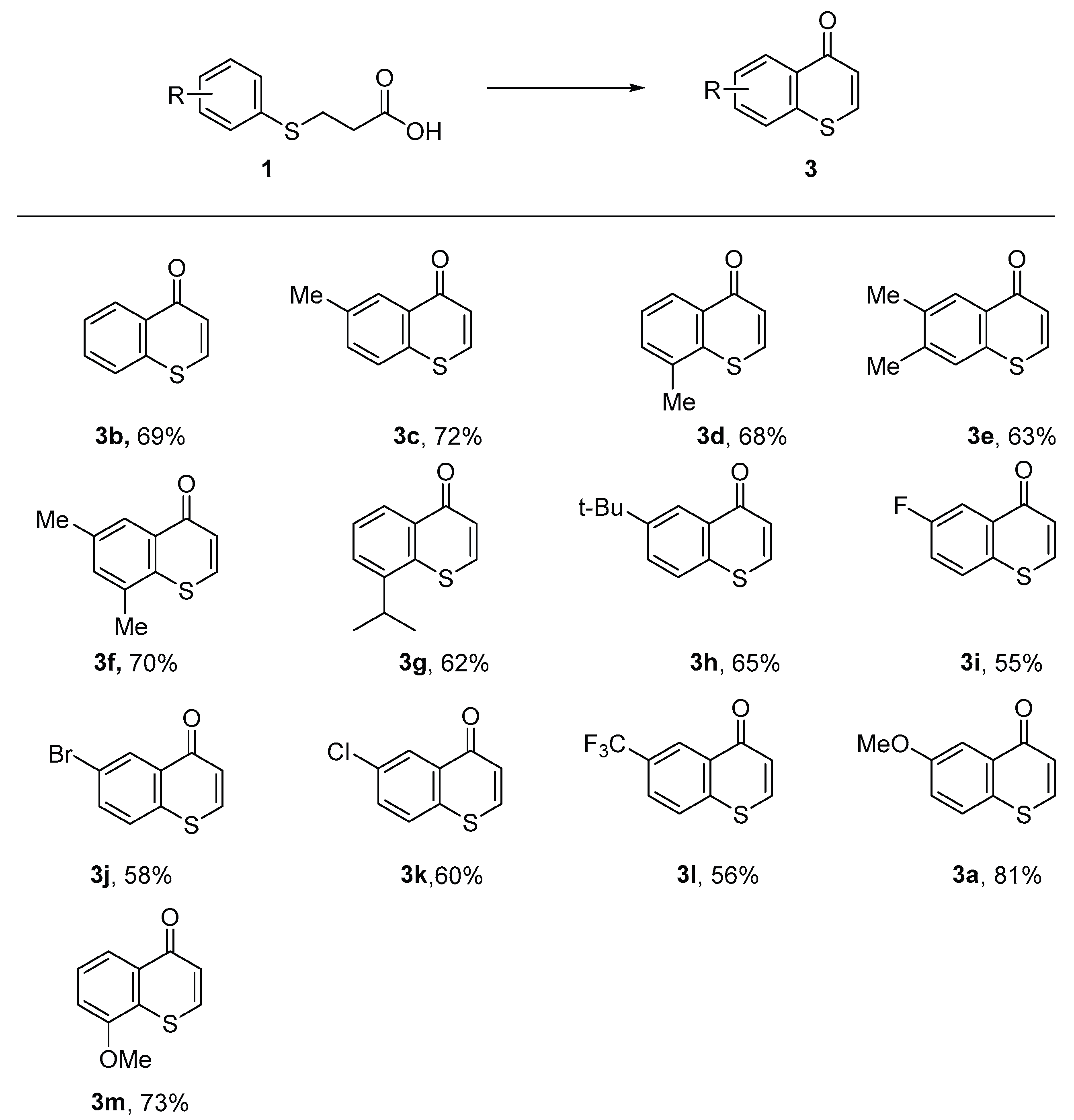
Having found the optimal reaction condition for the one-pot synthesis of thiochromone, we next turned our attention to explore the scope of this reaction. A variety of 3-(arylthiol)propanoic acids with both electron withdrawing and donating group were investigated. It was found that 3-(arylthiol)propanoic acids with both electron withdrawing and donating group on the aromatic ring undergo the one-pot reaction to afford thiochromones 3a-3m with 55–81% yields (Scheme 1). 3-(Phenylthiol)propanoic acid worked well under the optimal one-pot synthesis reaction condition to give thiochromone 3b in good yield. 3-(Arylthiol)propanoic acids bearing simple alkyl substituents on aromatic ring, such as methyl group, reacted well to afford 3c-f in 63–72% yields (Scheme 1). Steric hindrance is not a factor as slightly bulky substituents such as i-Pr worked well to furnish the desired thiochromone 3g in 62% yield. Bulky t-butyl group is also tolerated to afford the corresponding 3h in good yield (Scheme 1, 65%). 3-(Arylthiol)propanoic acids with halides F, Br, and Cl also work well under this one-pot reaction condition but with slightly lower chemical yields (Scheme 1, 55–60%). Strong electron-withdrawing group trifluoromethyl also worked with slightly lower chemical yield (Scheme 1, 3l, 56%). 3-(Arylthiol)propanoic acids with electron-donating groups, such as MeO-, also work well to afford thiochromones 3a (81%) and 3m (73%) in good yields (Scheme 1).
3. Materials and Methods
3.1. General Methods
The 1H and 13C-NMR spectra were recorded on a BRUKER AscendTM 400 NMR spectrometer, operating at 400 MHz for 1H and 100 MHz for 13C. Samples for NMR spectra were dissolved in deuterated chloroform (with TMS). Analytical thin layer chromatography (TLC) was performed on silica gel plates, 60 µ mesh with F254 indicator. Visualization was accomplished by UV light (254 nm), and/or a 10% ethanol solution of phosphomolybdic acid and/or KMnO4 stain prepared by dissolving 1.5 g KMnO4, 10 g potassium carbonate, and 1.25 mL 10% sodium hydroxide in 200 mL water. Flash chromatography was performed with 200–400 µ silica gel.
3.2. Materials
Unless stated otherwise, solvents and chemicals were obtained from commercial sources and used without further purification.
3.3. General Procedure A
A round bottom flask with a stir bar was charged with 3-(arylthiol)propanoic acids (1, 1.0 mmol, 1.0 equivalent, Scheme 1), was added dichloromethane (1.0 mL) and polyphosphoric acid (PPA, 0.5 mL, excess). The result mixture was heated to 100 °C (oil bath temperature) and the reaction was monitored by TLC. Once the TLC monitoring showed complete consumption of starting material, the reaction mixture was allowed to cool down to room temperature. An aqueous saturated NaHCO3 solution was then added dropwise (5.0 mL), and the resultant mixture was allowed to stir for 2 hours at room temperature. It was then extracted with dichloromethane (3 X 15.0 mL). The organic layers were combined, dried with Na2SO4, filtered, and evaporated by vacuum to give crude product. The crude product was purified by column chromatography on silica gel with a mixture of hexanes/ethyl acetate as eluent to give the product thiochromone 3 (Scheme 1) in 55-81% yield.
3.4. Synthesis
HRMS data for compounds 3a, 3d, 3f, 3g, and 3m were analyzed by TOF MS. Compounds 3b, 3c, 3e, and 3h-l have been fully characterized and reported [21]. (Supplementary materials)
3.4.1. Synthesis of 6-methoxyl-4H-thiochromen-4-one (3a)
Employing General Procedure A and using 3-(4-methoxylphenyl)propanoic acids (212 mg, 1.0 mol), after purification by flash column chromatography (silica, 5-10% Ethyl acetate: hexanes, v/v) gave 3a (155 mg, 81%). 1H NMR (400 MHz, CDCl3): δ 3.92 (s, 3H), 7.13 (dd, J = 0.8, 10.4 Hz, 1 H), 7.26 (dd, J = 2.8, 8.8 Hz, 1 H), 7.55 (d, J = 8.8 Hz, 1 H), 7.91 (d, J = 10.4 Hz, 1 H), 7.99 (d, J = 2.8 Hz, 1 H); 13C NMR (100 MHz, CDCl3): δ 56.1, 108.7, 123.5, 123.7, 128.3, 131.3, 132.4, 141.3, 160.4, 179.0; HRMS (EI-ion trap) m/z: [M]+ calcd. for C10H8O2S, 192.0245; found 192.0241.
3.4.2. Synthesis of 8-methyl-4H-thiochromen-4-one (3d)
Employing General Procedure A and using 3-(2-methylphenyl)propanoic acids (196 mg, 1.0 mol), after purification by flash column chromatography (silica, 5-10% Ethyl acetate: hexanes, v/v) gave 3d (119 mg, 68%). 1H NMR (400 MHz, CDCl3): δ 2.30 (s, 3H), 6.85 (d, J = 10.4 Hz, 1 H), 7.19-7.28 (m, 2H), 7.64 (d, J = 10.4 Hz, 1 H), 8.21 (ddd, J = 0.8, 2.4, 7.2 Hz, 1 H); 13C NMR (100 MHz, CDCl3): δ 19.7, 125.6, 126.7, 127.4, 132.6, 132.8, 135.0, 137.4, 137.8, 180.3; HRMS (EI-ion trap) m/z: [M]+ calcd. for C10H8OS, 176.0296; found 176.0293.
3.4.3. Synthesis of 6, 8-dimethyl-4H-thiochromen-4-one (3f)
Employing General Procedure A and using 3-(2,4-dimethylphenyl)propanoic acids (210 mg, 1.0 mol), after purification by flash column chromatography (silica, 5-10% Ethyl acetate: hexanes, v/v) gave 3f (133 mg, 70%). 1H NMR (400 MHz, CDCl3): δ 2.38 (s, 3H), 2.42 (s, 3H), 6.97 (d, J = 10.4 Hz, 1 H), 7.24 (s, 1H), 7.78 (d, J = 10.4 Hz, 1 H), 8.18 (s, 1 H); 13C NMR (100 MHz, CDCl3): δ 19.6, 21.3, 125.5, 126.4, 132.6, 134.2, 134.4, 134.8, 137.3, 137.5, 180.4; HRMS (EI-ion trap) m/z: [M]+ calcd. for C11H10OS, 190.0452; found 190.0455.
3.4.4. Synthesis of 8-isopropyl-4H-thiochromen-4-one (3g)
Employing General Procedure A and using 3-(2-methylphenyl)propanoic acids (224 mg, 1.0 mol), after purification by flash column chromatography (silica, 5-10% Ethyl acetate: hexanes, v/v) gave 3g (126 mg, 62%). 1H NMR (400 MHz, CDCl3): δ 1.38 (s, 3H), 1.40 (s, 3H), 3.43 (septet, J = 6.8 Hz, 1H), 7.04 (d, J = 10.4 Hz, 1 H), 7.55 (t, J = 8 Hz, 1 H), 7.61 (dd, J = 1.6, 7.2 Hz, 1 H), 7.88 (d, J = 10.4 Hz, 1 H), 8.48 (dd, J = 1.6, 8.0 Hz, 1 H); 13C NMR (100 MHz, CDCl3): δ 23.2, 30.5, 124.5, 127.0, 128.1, 128.7, 132.2, 136.7, 139.4, 145.8, 180.5; HRMS (EI-ion trap) m/z: [M]+ calcd. for C12H12OS, 204.0609; found 204.0611.
3.4.5. Synthesis of 8-methoxyl-4H-thiochromen-4-one (3m)
Employing General Procedure A and using 3-(2-methoxylphenyl)propanoic acids (212 mg, 1.0 mol), after purification by flash column chromatography (silica, 5-10% Ethyl acetate: hexanes, v/v) gave 3m (140 mg, 73%). 1H NMR (400 MHz, CDCl3): δ 4.00 (s, 3H), 7.06-7.18 (m, 2 H), 7.50 (t, J = 8.0 Hz, 1 H), 7.92 (d, J = 10.4 Hz, 1 H), 8.16 (dd, J = 0.8, 8.0 Hz, 1 H); 13C NMR (100 MHz, CDCl3): δ 56.7, 111.7, 120.7, 125.2, 128.2, 128.7, 133.0, 139.6, 155.1, 179.8; HRMS (EI-ion trap) m/z: [M]+ calcd. for C10H8O2S, 192.0245; found 192.0249.
4. Conclusions
In conclusion, we successfully developed the one-pot synthesis of thiochromones from 3-(arylthiol)propanoic acids. This reaction was shown to work well with a broad range of substrates with both electron withdrawing and donating groups on the aromatic ring of 3-(arylthiol)propanoic acids. 3-(arylthiol)propanoic acids with both electron withdrawing and donating group on the aromatic ring undergo the one-pot reaction to afford thiochromones with good chemical yields (56-80% in one-pot synthesis). With this one-pot approach, two transformations were performed within a single reaction vessel, eliminating the need for intermediate purification step. This one-pot approach offers advantages like time and cost savings, increased efficiency, and reduced waste. This synthetic approach will allow access to a broader scope of thiochromones due to the readily available thiophenols. The efforts on exploring the broader scope and additional synthetic applications are ongoing in our lab.
Supplementary Materials
The following supporting information can be downloaded at the website of this paper posted on Preprints.org.
Author Contributions
For research articles with several authors, a short paragraph specifying their individual contributions must be provided. The following statements should be used “Conceptualization, F. Guo.; methodology, F. Guo, H. A. H.; validation, K. S. S., M. Y. G., T. D. S., H. A. H.. and F.G.; investigation, K. S. S., M. Y. G., T. D. S., H. A. H.. and F.G.; data curation, K. S. S., M. Y. G., T. D. S., H. A. H.. and F.G.; writing—F. Guo; supervision, F. Guo; project administration, F. Guo; funding acquisition, F. Guo. All authors have read and agreed to the published version of the manuscript.” Please turn to the CRediT taxonomy for the term explanation. Authorship must be limited to those who have contributed substantially to the work reported.
Funding
We thank the NIH National Institute of General Medical Sciences (R16GM145541) for generous financial support. We would also like to thank the National Science Foundation (Award no. 2433178) for financial support.
Data Availability Statement
Data is available via supporting information.
Acknowledgments
We thank Dr. Marcus Wright from the Chemistry Department, Wake Forest University, Winston-Salem for access to NMR facility and assistance in attaining NMR spectra.
Conflicts of Interest
Declare conflicts of interest or state “The authors declare no conflicts of interest.”
References
- Costa, M.; Dias, T.A.; Brito, A.; Proença, F. Biological importance of structurally diversified chromenes. Eur. J. Med. Chem. 2016, 123, 487–507. [Google Scholar] [CrossRef] [PubMed]
- Keri, R.S.; Budagumpi, S.; Pai, R.K.; Balakrishna, R.G. Chromones as a privileged scaffold in drug discovery: A review. Eur. J. Med. Chem. 2014, 78, 340–374. [Google Scholar] [CrossRef] [PubMed]
- Welsch, M.E.; Snyder, S.A.; Stockwell, B.R. Privileged scaffolds for library design and drug discovery. Curr. Opin. Chem. Biol. 2010, 14, 347–361. [Google Scholar] [CrossRef] [PubMed]
- Csepanyi, E.; Szabados-Furjesi, P.; Kiss-Szikszai, A.; Frensemeier, L.M.; Karst, U.; Lekli, I.; Haines, D.D.; Tosaki, A.; Bak, I. Antioxidant properties and oxidative transformation of different chromone derivatives. Molecules 2017, 22, 588. [Google Scholar] [CrossRef] [PubMed]
- Presley, C.C.; Valenciano, A.L.; Fernández-Murga, M.L.; Du, Y.; Shanaiah, N.; Cassera, M.B.; Goetz, M.; Clement, J.A.; Kingston, D.G.I. Antiplasmodial chromanes and chromenes from the monotypic plant species Koeberlinia spinosa. J. Nat. Prod. 2018, 81, 475–483. [Google Scholar] [CrossRef] [PubMed]
- Payen, L.; Honorat, M.; Guitton, J.; Gauthier, C.; Bouard, C.; Lecerf-Schmidt, F.; Peres, B.; Terreux, R.; Gervot, H.; Rioufol, C.; et al. MBL-II-141, a chromone derivative, enhances irinotecan (CPT-11) anticancer efficiency in ABCG2-positive xenografts. Oncotarget 2014, 5, 11957–11970. [Google Scholar] [CrossRef] [PubMed]
- China Raju, B.; Nageswara Rao, R.; Suman, P.; Yogeeswari, P.; Sriram, D.; Shaik, T.B.; Kalivendi, S.V. Synthesis, structure-activity relationship of novel substituted 4H-chromen-1,2,3,4-tetrahydropyrimidine-5-carboxylates as potential anti-mycobacterial and anticancer agents. Bioorg. Med. Chem. Lett. 2011, 21, 2855–2859. [Google Scholar] [CrossRef] [PubMed]
- Shaw, A.Y.; Chang, C.Y.; Liau, H.H.; Lu, P.J.; Chen, H.L.; Yang, C.N.; Li, H.Y. Synthesis of 2-styrylchromones as a novel class of antiproliferative agents targeting carcinoma cells. Eur. J. Med. Chem. 2009, 44, 2552–2562. [Google Scholar] [CrossRef] [PubMed]
- Li, N.-G.; Shi, Z.-H.; Tang, Y.-P.; Ma, H.-Y.; Yang, J.-P.; Li, B.-Q.; Wang, Z.-J.; Song, S.-L.; Duan, J.-A. Synthetic strategies in the construction of chromones. J. Heterocycl. Chem. 2010, 47, 785–799. [Google Scholar] [CrossRef]
- Sosnovskikh, V. Y. Synthesis and chemical properties of thiochromone and its 3-subsituted derivatives. Chemistry of Heterocyclic compounds 2016, 52, 427–440. [Google Scholar] [CrossRef]
- Wang, H.-K.; Bastow, K. F.; Cosentino, L. M.; Lee, K.-H. J. J. Med. Chem 1996, 39, 1975. [CrossRef] [PubMed]
- Schneller, S. W. Adv. Heterocycl. Chem 1975, 18, 79.
- Guo, F.; Young, J.A.; Perez, M.S.; Hankerson, H.A.; Chavez, A.M. Progress on the Cu-Catalyzed 1,4-Conjugate Addition to Thiochromones. Catalysts 2023, 13, 713. [Google Scholar] [CrossRef] [PubMed]
- Bellinger, T.J.; Harvin, T.; Pickens-Flynn, T.; Austin, N.; Whitaker, S.H.; Tang Yuk Tutein, M.L.C.; Hukins, D.T.; Deese, N.; Guo, F. Conjugate Addition of Grignard Reagents to Thiochromones Catalyzed by Copper Salts: A Unified Approach to Both 2-Alkylthiochroman-4-One and Thioflavanone. Molecules 2020, 25, 2128. [Google Scholar] [CrossRef] [PubMed]
- In Lee, J. Synthetic Approaches to 2-Alkylthiochroman-4-ones and Thioflavanones. Bull. Korean Chem. Soc. 2021, 42, 852–862. [Google Scholar] [CrossRef]
- Bass, S.A.; Parker, D.M.; Bellinger, T.J.; Eaton, A.S.; Dibble, A.S.; Koroma, K.L.; Sekyi, S.A.; Pollard, D.A.; Guo, F. Development of Conjugate Addition of Lithium Dialkylcuprates to Thiochromones: Synthesis of 2-Alkylthiochroman-4-ones and Additional Synthetic Applications. Molecules 2018, 23, 1728. [Google Scholar] [CrossRef] [PubMed]
- Guo, F.; Jeffries, M.C.; Graves, B.N.; Graham, S.A.; Pollard, D.A.; Pang, G.; Chen, H.Y. A rapid entry into thioflavanones via conjugate additions of diarylcuprates to thiochromones. Tetrahedron 2017, 73, 5745–5750. [Google Scholar] [CrossRef]
- Nakazumi, H.; Endo, T.; Nakaue, T.; Kitao, T. J. Heterocycl. Chem. 1985, 22, 89. [CrossRef]
- Willy, B.; Müller, T. J. J. A novel consecutive three-component Coupling-Addition-SNAr (CASNAR) synthesis of 4H-thiochromen-4-ones, Synlett. 2009, 1255-1260. [CrossRef]
- Willy, B.; Frank, W.; Müller, T. J. J. Microwave-assisted three-component coupling-addition-SNAr (CASNAR) sequences to annelated 4H-thiopyran-4-ones. Org. Biomol. Chem. 2010, 8, 90. [Google Scholar] [CrossRef] [PubMed]
- Palani, T.; Park, K.; Song, K. H.; Lee, S. Palladium-catalyzed synthesis of (Z)-3-arylthioacrylic acids and thiochromenones, Adv. Synth. Catal. 2013, 355, 1160. [Google Scholar] [CrossRef]
- Hayashi, Y. Pot economy and one-pot synthesis. Chem. Sci 2016, 7, 866–880. [Google Scholar] [CrossRef] [PubMed]
Figure 1.
Synthesis of Thiochromones.
Scheme 1.
The scope of one-pot reaction of 3-(Arylthiol)propanoic acids.
Disclaimer/Publisher’s Note: The statements, opinions and data contained in all publications are solely those of the individual author(s) and contributor(s) and not of MDPI and/or the editor(s). MDPI and/or the editor(s) disclaim responsibility for any injury to people or property resulting from any ideas, methods, instructions or products referred to in the content. |
© 2025 by the authors. Licensee MDPI, Basel, Switzerland. This article is an open access article distributed under the terms and conditions of the Creative Commons Attribution (CC BY) license (http://creativecommons.org/licenses/by/4.0/).
Copyright: This open access article is published under a Creative Commons CC BY 4.0 license, which permit the free download, distribution, and reuse, provided that the author and preprint are cited in any reuse.


