
Submitted:
20 July 2025
Posted:
22 July 2025
You are already at the latest version
Abstract
The emergence of large-scale generative artificial intelligence (AI) presents significant challenges for effective human interaction. A cognitive gap exists between established, human-centric problem-solving frameworks and the ad-hoc, unstructured methods currently used to prompt these AI systems. This paper introduces and formalizes Aiming Thinking (AT), a metacognitive framework designed to bridge this gap. We propose a three-level hierarchy of cognition to position AT as a Level 3 metathinking that structures human-AI collaboration. The framework is operationalized through four distinct pillars—Targeting, Trajectory Design, Sequencing, and Calibration—and a practical library of 20 actionable interaction patterns. We demonstrate the universality and utility of the framework by systematically mapping nine established thinking frameworks (e.g., Computational Thinking, Design Thinking, Critical Thinking) to the principles and patterns of AT. The result is a formal, teachable methodology that moves beyond intuitive prompting to enable more deliberate, reliable, and sophisticated human-AI co-creation.
Keywords:
Aiming Thinking
; Prompt Engineering
; Human-AI Collaboration
; Human-Computer Interaction
; Generative Artificial Intelligence
1. Introduction
Human problem-solving, particularly when directed at complex challenges, has long relied on the development and application of structured cognitive methodologies. These applied thinking frameworks, which include well-established systems such as Computational Thinking, Design Thinking, and Critical Thinking, represent the codification of effective reasoning processes. They function by organizing foundational cognitive skills—like analysis, logic, and creativity—into coherent, repeatable, and teachable approaches. Each framework was designed to address a specific class of problems, from the logical decomposition required for computation to the human-centered exploration needed for innovation. Their success lies in their ability to manage cognitive load, structure inquiry, and guide the user toward a well-defined outcome in a world where the human mind was the primary engine of cognitive work.
The recent development of large-scale generative artificial intelligence (AI) introduces a new and powerful agent into this established problem-solving landscape. Unlike conventional computational tools that are deterministic and operate on formal logic, generative AI models are probabilistic systems that interface through the ambiguity of natural language (Brynjolfsson & McAfee, 2023). This fundamental difference in operational paradigms has created a significant cognitive gap. The structured, human-oriented logic of our existing thinking frameworks lacks a native interaction model for this new technology. Consequently, current human-AI interaction is often characterized by ad-hoc, unstructured conversational methods. This approach, frequently termed prompt engineering, relies heavily on intuition and trial-and-error, often failing to yield reliable, repeatable, or optimal results and leaving the full potential of human-AI collaboration unrealized (White et al., 2023).
To bridge this cognitive gap, this paper proposes and formalizes Aiming Thinking (AT), a metacognitive framework designed specifically to structure the process of co-creation with generative AI. We define AT as a Level 3 metathinking that operates above existing Level 2 frameworks, acting as the necessary interface between human intent and machine generation. Its structure is grounded in the principles of self-regulated learning (Zimmerman & Schunk, 2011) and consists of four primary pillars that guide the interaction cycle: Targeting, the precise, upfront definition of the goal; Trajectory Design, the strategic modeling of the communication itself; Sequencing, the logical decomposition of complex tasks into a managed dialogue; and Calibration, the iterative feedback loop for refining and validating outputs. AT is therefore a human-centric framework focused on the deliberate orchestration of one’s own thought and the AI’s capabilities.
The primary contribution of this work is the systematization of what is currently a largely intuitive practice. By providing a shared vocabulary (the pillars), a conceptual model (the three-level hierarchy of cognition), and a practical toolkit (the library of 20 actionable patterns), Aiming Thinking offers a formal and teachable methodology. Its objective is to move beyond anecdotal tips and tricks and establish a coherent discipline for effective human-AI interaction. This framework is designed to enhance not only the efficiency of the output but also the quality and responsibility of the process, promoting critical evaluation and deliberate goal setting. It enables users to apply their domain-specific knowledge more effectively, shifting their role from that of a simple querent to a strategic director of the AI’s generative capabilities.
This paper is structured to present this framework in a comprehensive manner. Section 2 establishes our proposed three-level hierarchy of cognition, situating foundational skills and existing applied thinking frameworks. Section 3 formally defines Aiming Thinking as a Level 3 metathinking and details its four pillars. Section 4 presents the practical toolkit of the framework: the library of 20 patterns. Section 5 provides the crucial bridge, first by conceptually mapping the nine Level 2 frameworks to the AT methodology, and then by illustrating this mapping with concrete application scenarios. Finally, Section 6 discusses the broader implications of this work, and Section 7 concludes by summarizing our contribution and outlining key directions for future research.
2. The Hierarchy of Applied Cognition
To understand the role of Aiming Thinking as a metacognitive framework, it is first necessary to establish a hierarchy of cognitive processes. We propose a three-level model that distinguishes between foundational cognitive skills, applied thinking frameworks, and a metacognitive interface layer for interacting with artificial intelligence. This section will detail the first two levels of this hierarchy.
2.1. Level 1: Foundational Cognitive Skills
Foundational cognitive skills are the fundamental, general-purpose mental processes that form the atoms of thought. They represent the underlying capabilities an individual uses to learn, reason, and solve problems (Liem et al., 2023). While not tied to a specific domain, they are the essential building blocks for all higher-order reasoning. For clarity, we adapt the widely recognized revised taxonomy by Anderson and Krathwohl (2001) to structure these skills, progressing from simpler to more complex cognitive processes, and we supplement this with the crucial, overarching skill of metacognition:
- Remembering: This is the most basic cognitive skill, involving the retrieval, recognition, and recall of relevant knowledge from long-term memory. It is the foundation upon which all other levels of thinking depend, as one cannot understand or apply knowledge that cannot be recalled (Anderson & Krathwohl, 2001).
- Understanding: This skill involves constructing meaning from various types of information, including oral, written, and graphic messages. The process goes beyond simple recall to include interpreting, exemplifying, classifying, summarizing, inferring, comparing, and explaining. Achieving deep conceptual understanding, rather than rote memorization, is a primary goal of effective learning (Sawyer, 2022).
- Applying: Application refers to the ability to use learned information, procedures, or principles in a new and concrete situation. This skill acts as a bridge between theoretical knowledge and practical problem-solving. The capacity to transfer learning from one context to another is a key indicator of a robust and flexible knowledge base (Perkins & Salomon, 1992).
- Analyzing: This is a higher-order skill that involves breaking down information into its constituent parts to explore relationships and organizational structures. It includes differentiating, organizing, and attributing, allowing the thinker to distinguish between relevant and irrelevant information and to understand how components fit together to form a whole (Anderson & Krathwohl, 2001). Analytical reasoning is a cornerstone of logical and critical thought.
- Evaluating: Evaluation involves making judgments based on criteria and standards. This skill is highly dependent on the preceding ones, as one must first analyze information to evaluate it effectively. It includes checking for inconsistencies or fallacies in an argument and critiquing a work based on specific criteria. The development of evaluative judgement is considered a critical outcome of higher education (Tai et al., 2018).
- Creating: Positioned at the apex of the taxonomy, creating involves putting elements together to form a coherent, functional, or original whole. This can include generating hypotheses, designing experiments, or producing a novel piece of work. It is the essence of innovation and requires a convergence of all other cognitive skills (Anderson & Krathwohl, 2001; OECD, 2022).
- Metacognition: Overarching all these skills is metacognition, often defined as thinking about one’s thinking (Flavell, 1979). It involves the awareness, knowledge, and control of one’s own cognitive processes. This includes planning an approach to a task, monitoring comprehension, and evaluating the effectiveness of one’s strategies. Metacognition is essential for self-regulated learning and is a powerful predictor of academic and problem-solving success (Zimmerman & Schunk, 2011; Zohar & Dori, 2012).
Together, these cognitive skills form a layered continuum of processing depth. The hierarchical relationship between the core processes, adapted from the foundational work of Anderson and Krathwohl (2001), illustrates a progression from lower-order to higher-order thinking. Superimposed on this hierarchy is the essential skill of metacognition, which does not sit at a single level but rather governs the entire process. Figure 1 provides a conceptual visualization of this two-part structure, depicting the cognitive process hierarchy and the overarching role of metacognitive regulation.
As illustrated in Figure 1, metacognition is not merely another step in the hierarchy but a dynamic control system that operates across all levels. It comprises two primary components: metacognitive knowledge and metacognitive regulation (Zohar & Dori, 2012). Metacognitive knowledge is the knowledge about oneself as a learner (e.g., I know that I learn best by drawing diagrams) and about the nature of the task and the strategies available (e.g., I know that for this type of problem, brainstorming is more effective than linear analysis). Metacognitive regulation, on the other hand, is the active process of using this knowledge to manage learning. This involves planning (setting goals and allocating resources), monitoring (tracking one’s progress and comprehension), and evaluating (assessing the final outcome and the effectiveness of the chosen approach) (Schunk, 2012).
The effective application of metacognitive regulation enables a thinker to navigate the cognitive hierarchy depicted in Figure 1 with purpose and efficiency. A learner with strong metacognitive skills does not simply progress linearly. When faced with a task that requires Creating, they might plan their approach, begin to Analyze the components, Evaluate their current understanding, and recognize a knowledge gap, consciously deciding to go back to Remembering or Understanding specific concepts before proceeding. This ability to strategically direct one’s own cognitive processes is the hallmark of a self-regulated learner (Zimmerman & Schunk, 2011). It is this very act of conscious, strategic direction of thought that forms the foundation upon which the more complex, multi-step Level 2 frameworks are built.
2.2. Level 2: Applied Thinking Frameworks
If foundational skills are the atoms of thought, Applied Thinking Frameworks are the molecules. These frameworks are structured, systematic approaches that organize and combine multiple foundational skills to solve specific classes of problems. They provide a scaffold or a process map that guides a thinker from a problem state to a solution state within a particular domain. Unlike a single skill, a framework is a methodology. A wide array of such frameworks has gained prominence across various disciplines, each designed for a specific purpose.
Computational Thinking (CT) is a problem-solving approach essential to the digital age, defined by Wing (2006) as the thought processes involved in formulating problems and their solutions in a way that a computer—human or machine—can effectively execute. It extends beyond computer science, providing a powerful method for tackling complex problems in any field by thinking with the clarity and logic required for computation. This framework encourages breaking down complexity into manageable and executable steps. The framework is traditionally constructed on four key pillars. First, Decomposition involves breaking down a complex problem into smaller, more manageable sub-problems. Second, Pattern Recognition is the identification of similarities or trends among these sub-problems. Third, Abstraction involves focusing on the essential information only, ignoring irrelevant detail. Finally, Algorithm Design is the development of a step-by-step solution to the problem, or the rules to follow to solve each sub-problem (Tang et al., 2023). Together, these pillars guide a systematic path from problem to automatable solution.
A practical example of CT outside of programming is planning a large-scale event, such as a conference. The planner would use decomposition to break the event into modules (venue, speakers, catering, marketing). They would use pattern recognition to handle similar requirements, such as dietary restrictions for all attendees. Abstraction would be used to focus on high-level needs (e.g., seating for 300) rather than individual chair details. The final, detailed project plan, with timelines and responsibilities, serves as the algorithm to execute the event successfully.
Design Thinking (DT) is a human-centered methodology for innovation that seeks to solve complex, often ill-defined problems. Popularized by Tim Brown of IDEO, it is described as an approach that integrates the needs of people, the possibilities of technology, and the requirements for business success (Brown, 2008, p. 86). Its core premise is that by developing deep empathy for the end-user, teams can uncover latent needs and generate solutions that are not only functional but also desirable and meaningful. The process of Design Thinking is typically represented by a five-stage, non-linear model. It begins with Empathize, where researchers seek to understand the user’s experience and motivations. This leads to Define, where the core problem is framed from the user’s perspective. Next is Ideate, a stage of divergent thinking to brainstorm a wide range of potential solutions. These ideas are then brought to life in the Prototype stage, creating low-cost, experimental versions of the solution. Finally, Test involves sharing these prototypes with users to gather feedback, which often cycles back to earlier stages for refinement (Micheli et al., 2019).
An example of DT in action is the development of a new mobile banking application. A design team would begin by empathizing with users through interviews to understand their financial anxieties and goals. They might define the problem as young professionals need a way to visualize their long-term savings goals in a simple, motivating way. During ideation, they would brainstorm features like progress bars and milestone rewards. They would then prototype these ideas in simple, clickable mockups and test them with users, using the feedback to build a more intuitive and emotionally resonant final product.
Critical Thinking (CTr), when structured as a framework, moves beyond a single skill to become a disciplined process for the active and skillful conceptualizing, applying, analyzing, synthesizing, and evaluating of information. It is a mode of thought about any subject, content, or problem in which the thinker improves the quality of their thinking by skillfully taking charge of the structures inherent in thinking and imposing intellectual standards upon them. This framework provides a defense against misinformation and flawed reasoning. A leading model, the Paul-Elder framework, provides the necessary structure by outlining three key components. The Elements of Thought are the eight basic structures present in all thinking (Purpose, Question, Information, etc.). The Universal Intellectual Standards are the ten criteria used to assess the quality of thinking (Clarity, Accuracy, Precision, Depth, etc.). Finally, the Intellectual Traits are the virtues of a fair-minded critical thinker (Intellectual Humility, Courage, Empathy, etc.) (Paul & Elder, 2019). By consciously applying these standards to these elements, one can rigorously analyze any line of reasoning.
For instance, a voter using this framework to evaluate a political candidate’s speech would first analyze its elements: What is the candidate’s purpose? What is the key question at issue? What information are they using, and what are their core assumptions? Then, they would apply the standards: Is the candidate’s argument clear? Is the data they present accurate? Is their reasoning logical and fair? This systematic process allows the voter to move beyond emotional appeal and make a reasoned judgment.
Systems Thinking (ST) is a framework for seeing wholes and understanding the complex web of interconnections between the parts of a system. It challenges the linear, event-oriented view of the world, proposing instead that behavior arises from the underlying structure of a system (Meadows, 2008). By mapping these structures, one can identify leverage points where a small change can produce significant, lasting improvements, avoiding the unintended negative consequences that often result from simplistic solutions. The core components of this framework involve identifying key elements within a system. These include Stocks (accumulations of things, like water in a tub or trust in a relationship), Flows (the rates at which stocks change), and, most critically, Feedback Loops. Feedback loops can be Reinforcing (amplifying change, creating exponential growth or collapse) or Balancing (seeking stability and resisting change). Mapping these loops reveals the system’s dynamic behavior and helps explain why problems persist (Arnold & Wade, 2015).
A classic example is a city trying to solve traffic congestion by building more roads. A linear thinker sees the problem (congestion) and applies a simple solution (more roads). A systems thinker maps the whole system and identifies a balancing feedback loop: more roads initially reduce congestion, which makes driving more attractive, which encourages more people to drive, which ultimately leads to the new roads becoming just as congested as the old ones. The insight from Systems Thinking would be to focus on other leverage points, like public transportation, to alter the system’s behavior.
Strategic Thinking (STr) is the framework used to create and sustain a competitive advantage by aligning an organization’s capabilities with the opportunities and challenges of its environment. It is a distinct mode of thinking that is not merely operational planning but a more holistic, creative, and often messy process of envisioning a desired future. It involves maintaining a sense of purpose and intent while remaining flexible and opportunistic (Liedtka, 1998). Liedtka (1998) identifies five key elements that define this framework. It starts with a Systems Perspective, understanding the complex interdependencies between the organization, its market, and its stakeholders. It is driven by Intent-Focus, a clear sense of direction and purpose. It incorporates Intelligent Opportunism, the ability to adapt the strategy to emerging realities. It operates in Time, connecting past, present, and future. Finally, it is hypothesis-driven, encouraging creative and critical thinking to generate and test potential strategies.
Consider a traditional bookstore facing competition from online giants. An operational plan would focus on cutting costs. Strategic thinking, however, would involve a systems perspective (how does our role in the community create value that online stores cannot?). It would be intent-focused (we will be the city’s central hub for literary culture). It would use intelligent opportunism to pivot into hosting events and cafes. It would think in time, honoring its history while planning for a digital-integrated future, thereby creating a unique and defensible market position.
Creative Thinking (CrT), as a framework, organizes the process of generating ideas that are both novel and useful. It moves beyond the simple lightbulb moment to a structured practice involving distinct phases and techniques. The framework’s core purpose is to provide repeatable methods for producing innovation, whether in the arts, sciences, or business. It is now widely recognized as a fundamental skill for navigating and shaping a rapidly changing world (OECD, 2022). The most common structure within this framework is the interplay between two modes of thought. First is Divergent Thinking, the process of exploring many possible solutions. This phase emphasizes quantity over quality and encourages wild ideas and deferring judgment. The second phase is Convergent Thinking, which involves analyzing, grouping, and refining the generated ideas to select the most promising one(s) that meet a specific set of criteria. This cycle of expansion and contraction is fundamental to creative problem-solving.
For example, a marketing team tasked with naming a new beverage would begin with divergent thinking, using brainstorming techniques to generate hundreds of potential names without criticism. They would write down everything, from the sensible to the absurd. In the convergent thinking phase, they would then group these names by theme, eliminate those that are legally unavailable or off-brand, and use a set of criteria (e.g., memorability, relevance, sound) to narrow the list down to a few top contenders for final selection.
Analytical Thinking (ATy) is a framework that methodically deconstructs a problem or situation to understand its fundamental components, relationships, and principles. It is the logical, step-by-step process of gathering evidence, identifying patterns, and drawing fact-based conclusions. In an era of big data and complex information, the ability to apply this framework systematically is considered a paramount skill for the global workforce (World Economic Forum, 2023). The pillars of this framework typically include several sequential stages. The process starts with Identifying the Problem, defining a clear question. It proceeds to Gathering Information from various sources. The next and most critical stage is Analyzing the Information, which involves organizing data, identifying trends and patterns, and exploring relationships. Finally, the process concludes with Drawing Conclusions, where logical inferences are made based solely on the evidence analyzed.
An example of analytical thinking is a financial analyst assessing the health of a company. The analyst would identify the problem (Is this company a good investment?). They would gather information by collecting financial statements, market reports, and news articles. They would then analyze this data by calculating key ratios, comparing performance to competitors, and identifying trends in revenue and profit. Finally, they would draw a conclusion—a buy, sell, or hold recommendation—based strictly on their logical interpretation of the evidence.
Lateral Thinking (LT) is a framework explicitly designed to disrupt the dominance of linear, logical thought patterns. Coined and developed by Edward de Bono (1970), it is a set of techniques for creative problem-solving that involves approaching problems from indirect and unexpected angles. While traditional (vertical) thinking is concerned with developing existing ideas, lateral thinking is concerned with generating new ones by deliberately moving sideways to challenge assumptions and create new entry points. The framework is built on a collection of specific techniques rather than rigid pillars. Key techniques include Provocation, where one makes a deliberately absurd or counter-intuitive statement (e.g., cars should have square wheels) and then uses it to move to a new idea (e.g., active suspension systems). Another is Random Entry, where one chooses a random object or word and explores its connection to the problem at hand. The core principle is to interrupt the brain’s natural tendency to follow established patterns.
Imagine a team trying to reduce wait times in a hospital emergency room. Vertical thinking might focus on hiring more staff. A team using lateral thinking might use provocation: What if we paid patients to leave? While absurd, this could lead to ideas like a telemedicine pre-screening system that redirects non-urgent cases to other clinics, effectively paying them with a lower co-pay to go elsewhere, thus freeing up the ER and achieving the goal in a non-obvious way.
Ethical Thinking (ET) provides a structured framework for reasoning through moral dilemmas and making justifiable decisions. It moves beyond gut feelings or simple compliance with rules, offering a process to analyze the impact of actions on various stakeholders through the lens of established philosophical principles. In a technologically advanced world where new dilemmas constantly emerge, having a robust framework for ethical deliberation is critical for responsible innovation (Vallor, 2016). The pillars of this framework are often derived from major ethical theories. A comprehensive approach would involve analyzing a problem through several lenses. Deontology focuses on duties and rules (Is the action inherently right or wrong, regardless of consequences?). Utilitarianism focuses on outcomes (Does the action produce the greatest good for the greatest number?). Virtue Ethics focuses on character (What would a virtuous person do in this situation?). Analyzing a dilemma through each of these pillars ensures a more holistic moral evaluation.
For instance, an engineer designing an AI for a self-driving car faces the classic trolley problem. Using an ethical thinking framework, they would analyze the programming choice: A deontological lens might forbid creating a rule that intentionally sacrifices anyone. A utilitarian lens would require calculating which action saves the most lives. A virtue ethics lens would ask what a responsible or courageous system would do. There may be no easy answer, but the framework ensures the decision is made deliberately and transparently, not accidentally.
While each of these nine frameworks possesses a unique process and domain of application, they are not fundamentally disconnected from the cognitive skills detailed in Section 2.1. Rather, each can be understood as a specific recipe or synthesis of these foundational skills, prioritizing certain capabilities over others to achieve its goals. As shown in Figure 2, these frameworks draw from a common pool of cognitive skills to form their distinct methodologies.
Figure 2 conceptually maps the relationship between the foundational cognitive pool and the structured frameworks. The arrows flowing from Level 1 to Level 2 are not exhaustive but illustrative, signifying that each framework draws heavily upon specific cognitive skills to form its unique character. For example, Computational Thinking is shown to rely principally on Logic and Abstraction, while Design Thinking is deeply rooted in Empathy, Creativity, and Evaluation. This visualization reinforces the idea that proficiency in a Level 2 framework is not an isolated skill but is contingent upon the development of its underlying Level 1 cognitive building blocks.
Furthermore, the diagram reveals important interdependencies and shared foundations. Skills such as Analysis and Evaluation act as a common cognitive currency, being integral to multiple frameworks like Critical Thinking, Systems Thinking, and Strategic Thinking. This overlap highlights that these frameworks are not mutually exclusive silos but rather distinct lenses through which to apply a shared set of human cognitive tools. It is precisely this shared foundation of human-centric cognition that creates the challenge addressed by this paper: while these frameworks have been highly effective for organizing human thought, they were developed for a world in which the human was the sole thinking agent. They lack a native model for interacting with a new class of non-human, generative intelligence, which necessitates a higher-level framework.
3. Aiming Thinking: The Metathinking Framework for the AI Era
The limitations of Level 2 frameworks in the context of generative AI reveal a critical need for a new cognitive layer—a methodology designed not to solve a domain-specific problem, but to orchestrate the problem-solving process with an AI partner. We propose Aiming Thinking (AT) as this Level 3 metathinking. This section formally defines AT, justifies its position in the cognitive hierarchy, and details its core components.
3.1. Defining Aiming Thinking as a Level 3 Metathinking
Aiming Thinking is a metacognitive framework for structuring and guiding human-AI collaboration to achieve a desired outcome. Its purpose is to transform the interaction from an unstructured dialogue into a deliberate, strategic, and iterative process. While the ad-hoc practice of writing prompts, often termed prompt engineering, has emerged as a nascent skill, it is frequently described as a dark art that relies on intuition and trial-and-error (White et al., 2023). AT provides the theoretical and practical structure that is currently lacking, elevating this art into a teachable and systematic discipline by focusing on the user’s cognitive preparation and strategic interaction rather than on the mere syntax of the prompt.
We classify Aiming Thinking as a Level 3 metathinking because its function is distinct from and operates upon the Level 2 frameworks. Whereas a Level 2 framework like Computational Thinking organizes foundational skills to solve a computational problem, Aiming Thinking organizes the application of that entire framework within a collaborative dialogue with an AI. It operates one level of abstraction higher, focusing on the process of interaction itself. It provides the necessary translation layer between the structured, human-centric logic of a Level 2 framework and the probabilistic, non-human reasoning of a large language model. This relationship is illustrated in Figure 3.
As Figure 3 shows, traditional Level 2 frameworks were designed for a human to directly address a problem. In the new paradigm, Aiming Thinking serves as the essential intermediary. The human practitioner still leverages their expertise in Design Thinking or Critical Thinking, but AT provides the structure to translate those domain-specific goals and processes into a language and a workflow that the AI can effectively partner with. It addresses questions not native to other frameworks, such as: How must I frame my goal for a probabilistic system to understand it?, What is the optimal sequence of instructions to build a complex artifact iteratively?, and How do I provide feedback to correct the AI’s course effectively?.
This role as a universal translator and guide for cognitive work justifies its position as a metathinking. It does not replace the Level 2 frameworks; it enables them for the AI era. It is the conscious, strategic orchestration of one’s own domain knowledge through a new, powerful, but non-human cognitive tool. This orchestration is a distinct and higher-order metacognitive skill (cf. Zamfirescu-Pereira et al., 2023) essential for moving beyond simple AI usage to sophisticated human-AI co-creation.
3.2. The Four Pillars of Aiming Thinking
The practice of Aiming Thinking is built upon four interconnected pillars. These pillars guide the user from the initial conception of a goal to its final realization, creating a comprehensive cycle of effective interaction. They are not merely sequential steps but form a dynamic, iterative loop where insights from a later pillar can inform and refine an earlier one. Each pillar represents a distinct phase of the process, empowered by specific, actionable patterns.
Targeting: The first pillar, Targeting, is the disciplined process of transforming a vague intention into a clear, specific, and actionable goal for the AI. It is the foundational act of aiming before any instruction is given. This goes beyond a simple request; it involves defining the precise characteristics of the desired output (the what), establishing the criteria for success (the how well), identifying constraints (the what not to do), and providing essential context (the why). This pillar is critical because generative AI systems lack genuine world understanding and common sense; therefore, the quality of their output is directly proportional to the clarity and precision of the target definition provided by the user. It operationalizes the metacognitive act of planning (Schunk, 2012) for the specific context of an AI interaction, ensuring the cognitive effort is directed with purpose.
Trajectory Design: This pillar is the strategic art of modeling the communication itself. Once the target is defined, Trajectory Design involves choosing the most effective path for the instruction to reach that target. This is about crafting the form, not just the content, of the communication. Key activities include selecting the optimal format for the request (e.g., Markdown, structured data), choosing a persona for the AI to adopt (e.g., act as a critical reviewer or a supportive tutor), and providing carefully chosen examples to guide the AI’s style and structure. This pillar heavily leverages the principle of in-context learning, where the model’s behavior is steered by the examples provided directly in the prompt (Brown et al., 2020). By consciously designing the trajectory, the user can dramatically increase the probability of a successful first shot, saving significant time in later refinement cycles.
Sequencing: The third pillar, Sequencing, addresses the reality that complex tasks are rarely achieved in a single interaction. Sequencing is the logical decomposition of a complex goal into a series of smaller, incremental steps or prompts. This pillar draws inspiration from the decomposition principle in Computational Thinking (Wing, 2006) but applies it to a conversational and generative context. Instead of a single, overloaded prompt that is likely to fail, the user designs a coherent sequence of interactions, where the output of one step becomes the input or context for the next. Recent AI research has demonstrated that prompting models to think step-by-step or engage in a chain of thought significantly improves their performance on complex reasoning tasks (Wei et al., 2022). Sequencing formalizes this insight into a core methodological practice for building complex artifacts like reports, software code, or detailed plans.
Calibration: The final pillar, Calibration, is the dynamic and iterative feedback loop that makes Aiming Thinking a true dialogue. After an instruction is executed, Calibration involves evaluating the AI’s output against the goal defined during Targeting and providing precise, corrective feedback to refine the result. This is the most interactive and cognitively demanding phase for the human user. It is where human critical thinking, evaluative judgment (Tai et al., 2018), and domain expertise become paramount. Calibration is not just about correcting errors; it’s about steering the output, asking for alternatives, and fusing different generated pieces. It transforms the user from a passive requester into an active director, steering the AI’s output with each iteration. This pillar is the engine of co-creation, allowing the user and the AI to converge on a high-quality outcome that often surpasses what either could achieve alone.
The interplay of these four pillars forms a continuous, cyclical process, as depicted in Figure 4. This model emphasizes the iterative nature of effective human-AI interaction.
Figure 4 visualizes the Aiming Thinking framework not as a linear checklist but as a dynamic cycle. The process begins with Targeting (1), which informs the Trajectory Design (2) and Sequencing (3) of the interaction with the AI (D). The AI’s output is then subjected to Calibration (4), a critical evaluation phase. The key insight from this model is the two feedback paths originating from Calibration. One path leads directly back to the AI interaction, representing minor adjustments and corrective feedback within a single task (make this paragraph more formal).
The second, more powerful feedback path leads from Calibration all the way back to Targeting. This represents a deeper, metacognitive loop where the interaction process itself provides new insights. For example, a surprising AI output during Calibration might cause the user to completely redefine their initial goal (a new Target), realizing that a more interesting or valuable outcome is possible. This iterative refinement of both the product and the goal itself is what distinguishes Aiming Thinking from a simple, linear prompting process and elevates it to a framework for genuine discovery and co-creation.
4. The Aiming Thinking Pattern Library
While the four pillars provide the theoretical structure for Aiming Thinking, its practical application is enabled by a library of actionable patterns. These patterns are specific, repeatable heuristics—not rigid rules—that operationalize the principles of each pillar. They provide a toolkit for the user to consciously and systematically craft their interactions with an AI. This section details 20 such patterns, grouped into functional categories within each of the four pillars.
4.1. Patterns for Targeting
The patterns in this pillar are designed to solve the primary challenge of goal definition: translating a user’s abstract intent into a precise, machine-interpretable objective. This initial act of aiming is arguably the most critical phase, as ambiguities introduced here will inevitably propagate through the entire interaction, leading to suboptimal or irrelevant results. These patterns force the user to engage in a moment of metacognitive planning, clarifying their own goals before attempting to communicate them. The patterns are grouped into two key functions: defining the core objective and enriching it with essential context.
Goal and Scope Definition Patterns
This category of patterns focuses on delineating the precise boundaries and desired characteristics of the final output. They address the AI’s lack of implicit understanding by making explicit the criteria for a successful outcome. Rather than assuming the AI shares the user’s context or quality standards, these patterns build a fence around the target, clearly marking what is in and out of bounds. This act of defining success and scope upfront prevents wasted cycles of refinement caused by initial instructions that were too vague or open-ended.
-
The Success Definition Pattern
- -
- Problem Context: A user receives a response that is technically correct but does not meet their implicit quality standards or needs (e.g., a summary that is too long, a list that is not prioritized).
- -
- What it Solves: It forces the user to externalize and define their criteria for a good outcome upfront, making success measurable and the AI’s task clearer.
- -
- Generic Application: Begin a prompt by explicitly stating the conditions or characteristics of a successful output.
- -
- Practical Example: I need a title for a blog post about productivity. Success for this task is a title that is under 10 words, creates a sense of urgency, and includes the keyword ‘focus’.
-
The Scope Fencing Pattern
- -
- Problem Context: The AI provides information that is too broad, including irrelevant details or tangential topics that dilute the core message.
- -
- What it Solves: It narrows the AI’s search and generation space, forcing it to concentrate only on what is essential and preventing scope creep.
- -
- Generic Application: Use explicit phrases like Focus only on…, Do not discuss…, or Confine your answer to the period between… to set hard boundaries.
- -
- Practical Example: Explain the causes of the American Revolution. Focus only on the economic factors and do not discuss military or social aspects.
Context and Constraint Setting Patterns
This group of patterns enriches the core objective with the necessary environmental information and rules. If the previous category defines what success looks like, this one explains the why and for whom. These patterns provide the situational awareness that AI models lack, allowing them to tailor their responses with greater relevance and nuance. They also establish explicit negative constraints, which are often easier for a probabilistic system to adhere to than abstract positive guidance. This contextualization is key to moving from generic outputs to highly specific and useful solutions.
-
The Core Context Pattern
- -
- Problem Context: The AI’s response is generic and lacks relevance because it is unaware of the background or the situation that prompted the request.
- -
- What it Solves: It provides the AI with a situational awareness, allowing it to tailor the response to be more applicable and useful.
- -
- Generic Application: Start the prompt with a brief paragraph labeled Context: that explains the scenario before making the request.
- -
- Practical Example: Context: I am a software manager preparing for a quarterly performance review with a junior developer who has shown great progress but struggles with time management. Based on this, generate three positive feedback points and one constructive suggestion.
-
The Audience Persona Pattern
- -
- Problem Context: The AI generates a response with a level of complexity, tone, or jargon that is inappropriate for the intended end-user.
- -
- What it Solves: It forces the AI to adapt its output to a specific reader, dramatically improving the response’s readability and impact.
- -
- Generic Application: Include a clear statement defining the target audience, such as The audience is… or Explain this to a….
- -
- Practical Example: Explain how a blockchain works. The audience is a group of high school students with no prior technical knowledge, so use simple analogies.
-
The Negative Constraint Pattern
- -
- Problem Context: The AI repeatedly includes undesirable elements in its response (e.g., clichés, specific words, overly complex solutions).
- -
- What it Solves: It provides explicit anti-goals, giving the AI clear instructions on what to avoid, which is often easier for it to follow than abstract positive commands.
- -
- Generic Application: Add a clear instruction stating what not to do, such as Do not use…, Avoid mentioning…, or Do not suggest solutions that require….
- -
- Practical Example: Generate marketing slogans for a new coffee brand. Do not use the words ‘fresh,’ ‘best,’ or ‘aroma’.
4.2. Patterns for Trajectory Design
The patterns for this pillar focus on crafting the form of the instruction to maximize its effectiveness, moving beyond what is said to how it is said. Having defined the target, the user must now design the most efficient and effective delivery mechanism for that instruction. This involves making conscious choices about the structure, style, and content of the prompt to steer the AI’s probabilistic generation process toward the desired region of its vast possibility space. These patterns are categorized into those that model the instruction itself and those that specify its content.
Instructional Modeling Patterns
This category of patterns focuses on shaping the AI’s role and the desired output structure before generation begins. They are akin to providing a mold or a template that guides the AI’s response. Instead of letting the model default to a generic helpful assistant persona and a prose format, these patterns give the user directorial control over the character and the final layout of the information, leveraging the principle of in-context learning to elicit more specialized and structured outputs (Brown et al., 2020).
-
The Persona Pattern
- -
- Problem Context: The AI’s default persona is often neutral, generic, and unauthoritative, leading to bland or unspecialized responses.
- -
- What it Solves: It instructs the AI to adopt a specific role or character, which instantly frames its knowledge, tone, and style to be more expert and relevant.
- -
- Generic Application: Begin the prompt with the phrase Act as a… or You are a….
- -
- Practical Example: Act as a seasoned financial advisor. Review the following investment portfolio and identify its main strengths and weaknesses.
-
The Master Example Pattern (Few-Shot)
- -
- Problem Context: Explaining a desired format or style with words alone can be ambiguous and lead to incorrect interpretations by the AI.
- -
- What it Solves: It provides a concrete, unambiguous demonstration of the desired output, allowing the AI to learn the pattern by example (Brown et al., 2020).
- -
- Generic Application: Provide one or more complete examples of the input-output pairing before giving the final instruction.
- -
- Practical Example: Translate the following sentences into French in a formal tone. Example: ‘Hey, what’s up?’ -> ‘Bonjour, comment allez-vous?’. Now, translate: ‘We need to talk.’
-
The Structured Format Pattern
- -
- Problem Context: The user needs the output in a format that can be easily parsed by another software or used in a structured document, but the AI defaults to prose.
- -
- What it Solves: It commands the AI to generate its response in a machine-readable format like JSON, XML, or a human-readable structured format like Markdown.
- -
- Generic Application: End the prompt with Provide the response in [FORMAT] format.
- -
- Practical Example: List three project management software options with their pros and cons. Provide the response as a Markdown table.
Content Specification Patterns
This group of patterns provides fine-grained control over the specific ingredients that must be included in the response. While modeling patterns shape the container, content specification patterns dictate what goes inside it. They are essential for tasks that require adherence to specific knowledge points or the exploration of multiple viewpoints. These patterns ensure that the AI’s creative generation process remains anchored to the user’s core requirements, preventing critical omissions and encouraging a more comprehensive analysis.
-
The Recipe Pattern
- -
- Problem Context: The user needs to ensure that specific key concepts, names, or pieces of information are included in the final response.
- -
- What it Solves: It provides the AI with a checklist of mandatory ingredients, preventing omissions and ensuring the output covers all critical points.
- -
- Generic Application: Include a phrase like Ensure you include the following concepts: A, B, and C.
- -
- Practical Example: Write a summary of the theory of relativity. Ensure you include the concepts of special relativity, general relativity, and the equation E=mc².
-
The Perspective Shift Pattern
- -
- Problem Context: A one-sided or single-perspective analysis is insufficient for a complex topic that requires a holistic understanding.
- -
- What it Solves: It forces the AI to act as a multiperspectival synthesizer, exploring an issue from different angles to provide a more nuanced and comprehensive overview.
- -
- Generic Application: Instruct the AI to analyze a topic from a list of specified viewpoints.
- -
- Practical Example: Analyze the proposal to switch to a four-day work week. First, present the argument from the perspective of an employee. Second, from the perspective of the CEO. Third, from the perspective of a customer.
4.3. Patterns for Sequencing
The patterns in this pillar address the fundamental challenge of complexity. Sophisticated tasks are rarely achieved in a single, monolithic step. This pillar provides methodologies for decomposing a large goal into a manageable series of interactions. This approach not only improves the quality and coherence of the final artifact but also allows for human oversight and course correction at each stage. These patterns are categorized into those that decompose the final product and those that structure the problem-solving process itself.
Task Decomposition Patterns
This category of patterns is used when the final goal is a complex artifact, such as a report, a presentation, or a piece of code. Instead of asking for the entire product at once, which invites errors and incoherence, these patterns build the artifact piece by piece. This gives the user granular control over the development process, ensuring that the foundation of the artifact is solid before subsequent layers are added, much like constructing a building one floor at a time.
-
The Step-by-Step Construction Pattern
- -
- Problem Context: Asking the AI to generate a large or complex artifact (e.g., a full report, a software program) in one go often results in a low-quality, incomplete, or incoherent output.
- -
- What it Solves: It breaks the creation process into logical parts, allowing the user to approve and guide each component before moving to the next, ensuring high quality throughout.
- -
- Generic Application: Engage in a series of prompts, each one asking for the next logical part of the whole.
- -
- Practical Example: (1) ‘Create a detailed outline for a business plan.’ (2) ‘Great. Now write the ’Executive Summary’ section based on that outline.’ (3) ‘Perfect. Next, write the ’Market Analysis’ section.’
-
The Topic Expansion Pattern
- -
- Problem Context: The user is not sure what sub-topics are important within a larger theme and wants to explore before committing to a structure.
- -
- What it solves: It allows for an exploratory approach where the user can get a high-level overview first and then dive deeper into the most interesting or relevant points.
- -
- Generic Application: Start by asking for a list or overview, then follow up by asking for more detail on a specific item from that list.
- -
- Practical Example: (1) ‘What were the main schools of thought in ancient Greek philosophy?’ -> AI lists Stoicism, Epicureanism, etc. (2) ‘Tell me more about the core tenets of Stoicism.’
Process Structuring Patterns
This group of patterns focuses on imposing a logical flow onto the problem-solving process itself, particularly for tasks that require reasoning or creative narrowing. They formalize methodologies like thinking step-by-step or brainstorming and filtering into repeatable interaction sequences. These patterns are invaluable for improving the reliability of the AI’s reasoning (Wei et al., 2022) and for structuring creative work in a way that moves efficiently from broad exploration to a specific, well-defined outcome.
-
The Chain-of-Thought Pattern
- -
- Problem Context: For problems requiring logic, math, or multi-step reasoning, the AI may jump to an incorrect conclusion without showing its work.
- -
- What it Solves: It forces the AI to externalize its reasoning process, which has been shown to significantly improve the accuracy of its conclusions (Wei et al., 2022). It allows the user to debug the AI’s logic.
- -
- Generic Application: Append the instruction Think step-by-step or Show your reasoning before giving the final answer.
- -
- Practical Example: A bat and a ball cost $1.10 in total. The bat costs $1.00 more than the ball. How much does the ball cost? Show your reasoning step-by-step.
-
The Funneling Pattern
- -
- Problem Context: When brainstorming, a user needs to move from a wide array of possibilities to a single, refined choice, but struggles to manage the process.
- -
- What it Solves: It structures the creative process into a classic divergent-convergent cycle, using the AI for both large-scale idea generation and criteria-based filtering.
- -
- Generic Application: Use a sequence of prompts that first asks for many ideas, then asks to filter them based on criteria, and finally asks for a detailed analysis of the top choice.
- -
- Practical Example: (1) ‘Generate 30 names for a new tech startup.’ (2) ‘From that list, select the 5 that are easiest to spell and remember.’ (3) ‘For those 5, which one best implies ’speed and reliability’?’
-
The Template Builder Pattern
- -
- Problem Context: The user repeatedly needs to create documents or inputs with the same structure, a tedious and repetitive task.
- -
- What it Solves: It leverages the AI to create a reusable template or scaffold that the user can then quickly fill out for future tasks.
- -
- Generic Application: Ask the AI to create a template for a specific purpose, using placeholders for variable content.
- -
- Practical Example: Create a reusable project update email template. Include placeholders in brackets for [Project Name], [Key Accomplishments], [Next Steps], and [Blockers].
4.4. Patterns for Calibration
The patterns for Calibration are used in the iterative feedback loop after the AI has provided an initial response. This pillar is where the collaborative aspect of human-AI interaction truly comes to life. The first output from an AI should be treated as a prototype or a draft, not a final product. Calibration patterns provide the tools to evaluate this draft, provide precise feedback, and steer the AI toward a higher-quality final version. These patterns are categorized into those for refining the output and those for assuring its quality.
Output Refinement Patterns
This category of patterns focuses on molding and improving an existing AI-generated response without starting from scratch. They are tools for editing and iteration, allowing the user to make targeted adjustments to the style, format, or composition of the text. These patterns are highly efficient, as they leverage the initial work done by the AI and focus human effort on higher-level directorial feedback, rather than on rewriting the content manually.
-
The Tone Refinement Pattern
- -
- Problem Context: The AI-generated text has the right information but the wrong style, voice, or level of formality for the intended context.
- -
- What it Solves: It allows the user to quickly and efficiently alter the stylistic properties of a text without having to re-generate the core information.
- -
- Generic Application: After a response is generated, give a command like Make it more…, Rewrite this but in a… tone, or Adjust the style to be….
- -
- Practical Example: (After the AI generates a business email) Make this more casual and friendly. or Rewrite this with a more authoritative and formal tone.
-
The Reformatting Pattern
- -
- Problem Context: The AI provides information in a prose paragraph, but the user realizes it would be more effective or easier to understand in a different layout.
- -
- What it Solves: It restructures existing content into a more effective format (e.g., list, table, summary) without losing the information.
- -
- Generic Application: Take a previous AI response and ask to Convert this into…, Summarize this as…, or Reformat this as a….
- -
- Practical Example: (After the AI provides a long explanation) Summarize the key points of your previous response in five bullet points.
-
The Merge & Synthesize Pattern
- -
- Problem Context: The user has generated several good pieces of information across multiple prompts but needs to combine them into a single, coherent text.
- -
- What it Solves: It uses the AI’s ability to understand context from a conversation to synthesize disparate pieces of information into a unified whole.
- -
- Generic Application: Refer to previous parts of the conversation and ask the AI to combine them.
- -
- Practical Example: Take the market analysis from our earlier conversation and the three marketing slogans you just generated and write a single paragraph that introduces the product and its target market.
Quality Assurance Patterns
This group of patterns addresses one of the most significant weaknesses of current large language models: their propensity for inaccuracy and hallucination (Ji et al., 2023). These patterns operationalize a stance of healthy skepticism, transforming the user into a verifier and a critic. They leverage the AI itself as a tool for quality control, asking it to check its own work or validate its claims. This is a critical function for any responsible use of AI in domains where factual accuracy is important.
-
The Self-Critique Pattern
- -
- Problem Context: An AI-generated response may seem plausible but contain subtle flaws, biases, or weaknesses in its argument that are not immediately obvious.
- -
- What it Solves: It forces the AI to switch from a generator role to an evaluator role, using its own knowledge to find faults in its previous output, a process that can surface valuable insights.
- -
- Generic Application: Ask the AI to Critique your previous response, What are the weaknesses of this argument?, or Play devil’s advocate against your own point.
- -
- Practical Example: (After the AI proposes a business strategy) Identify three potential risks or downsides to the strategy you just outlined.
-
The Fact-Checking Pattern
- -
- Problem Context: Generative AI models are known to hallucinate or invent facts, statistics, and citations, making their outputs unreliable for factual claims (Ji et al., 2023).
- -
- What it Solves: It creates a routine practice of questioning the AI’s claims, asking for sources, and treating all factual statements as claims to be verified rather than truths to be accepted.
- -
- Generic Application: Follow up any factual claim with questions like What is the source for that statistic?, Can you provide a reference for that claim?, or Verify that this person actually said this.
- -
- Practical Example: (After the AI states, Studies show 80% of customers prefer X) Which specific studies show that 80% of customers prefer X? Please provide citations if possible.
The pattern library presented here is intended to be a foundational catalog rather than an exhaustive one. The field of human-AI interaction is evolving at an unprecedented rate, and as models develop new capabilities (e.g., multimodality, tool use), new patterns will undoubtedly emerge from the practices of expert users. This library is, therefore, a snapshot based on the current state of text-based generative AI, designed to address the most common and critical challenges users face today, such as managing a lack of specificity, ensuring factual accuracy, and controlling the structure of complex outputs.
Furthermore, the value of this library lies not only in the individual patterns but in their potential for combination. An expert practitioner of Aiming Thinking does not use these patterns in isolation but weaves them together into sophisticated interaction strategies, as illustrated in Figure 5. This diagram conceptualizes the relationships between patterns, showing how they can be chained and nested to form complex prompt molecules.
As Figure 5 demonstrates, the patterns form an interconnected system. A user might initiate a complex task by constructing a single, powerful prompt that combines the Persona, Core Context, Success Definition, and Structured Format patterns. This well-formed initial instruction then serves as the input for a Step-by-Step Construction sequence. For each step in that sequence—for instance, when the AI generates the first draft of a section—the user can enter a micro-loop of Calibration, using the Self-Critique pattern to identify weaknesses, the Tone Refinement pattern to adjust the style, and the Fact-Checking pattern to validate the claims before accepting the output and moving to the next step. The goal of this catalog is to provide the discrete, learnable components from which users can construct these more complex strategies, thereby developing a robust and adaptable fluency for collaborating with generative AI. This moves the user from being a simple prompter to a true AI interaction designer.
5. Bridging the Gap: Mapping Applied Frameworks to Aiming Thinking
Having established the theoretical foundations of Aiming Thinking (AT) and its library of patterns, this section serves to demonstrate its practical utility as a Level 3 Metathinking framework. We will show how AT acts as the essential API (Application Programming Interface) that connects the established human-centric logic of Level 2 frameworks to the generative capabilities of AI. This section is divided into two parts. First, Section 5.1 provides a systematic conceptual mapping, translating the core concepts of each of the nine frameworks into the pillars and patterns of Aiming Thinking. Second, Section 5.2 will present concrete application scenarios, illustrating the transformative impact of this collaboration.
5.1. Conceptual Mapping of Level 2 Frameworks to Aiming Thinking
This section bridges the theoretical gap by demonstrating how the core tenets of each Level 2 framework find a direct, functional equivalent within the AT methodology. For each framework, we present a table that maps its key concepts to the corresponding AT pillar or pattern that enables its execution in a human-AI collaborative context.
Computational Thinking (CT) to Aiming Thinking (AT)
The systematic, logical structure of Computational Thinking maps naturally onto the deliberate, structured process of Aiming Thinking. AT provides a runtime environment for CT’s principles, translating them from the rigid syntax of code into the flexible, iterative dialogue required for co-creation with an AI.
| Computational Thinking Concept | Mapped to Aiming Thinking Pillar/Pattern |
| Decomposition | Sequencing: The Step-by-Step Construction and Topic Expansion patterns are direct applications of decomposition in a conversational flow. |
| Pattern Recognition | Trajectory Design: Identifying a problem type and selecting the appropriate Persona or Master Example pattern is a form of pattern recognition. |
| Abstraction | Targeting / Trajectory Design: Defining a clear goal while ignoring irrelevant details (Scope Fencing) is abstraction. Using a Persona is abstracting a role. |
| Algorithm Design | Sequencing / Targeting: The entire sequence of prompts forms a natural language algorithm. The Success Definition pattern defines the algorithm’s goal. |
The primary shift for a computational thinker is from designing a deterministic algorithm for a machine that executes commands literally to designing a strategic dialogue for an AI that interprets intent probabilistically. The logical rigor of CT is preserved and channeled through the pillars of AT.
Design Thinking (DT) to Aiming Thinking (AT)
Aiming Thinking acts as a powerful accelerator for the Design Thinking process, drastically shortening the cycles of research, ideation, and prototyping from weeks or days to mere minutes or hours.
| Design Thinking Stage | Mapped to Aiming Thinking Pillar/Pattern |
| Empathize | Targeting: The Audience Persona and Core Context patterns are used to define the user’s needs and situation for the AI. |
| Define | Targeting: The Success Definition pattern is used to frame the problem statement or Point of View as a clear objective for the AI. |
| Ideate | Sequencing: The Funneling Pattern perfectly models the divergent (brainstorming) and convergent (filtering) phases of ideation. |
| Prototype | Calibration: Every output generated by the AI is effectively an instant, low-fidelity prototype ready for immediate feedback. |
| Test | Calibration: The user tests the AI-generated prototype by applying Self-Critique or using it in a thought experiment, then provides feedback. |
For a design thinker, AT allows for the rapid exploration of dozens of prototypes (e.g., different landing page texts, app feature descriptions) and facilitates a highly fluid and accelerated form of creative problem-solving.
Critical Thinking (CTr) to Aiming Thinking (AT)
The relationship between Critical Thinking and Aiming Thinking is deeply synergistic. AT provides a framework to apply critical thought to and through the AI, while critical thinking skills are essential for the effective use of AT, especially in the Calibration phase.
| Critical Thinking Concept (Paul-Elder) | Mapped to Aiming Thinking Pillar/Pattern |
| Elements of Thought (Purpose, Question) | Targeting: Clearly defining the objective and the core question at hand. |
| Intellectual Standards (Clarity, Accuracy) | Calibration: The Fact-Checking and refinement patterns hold the AI’s output to these standards. |
| Analyzing Arguments | Sequencing / Calibration: Using Chain-of-Thought to dissect the AI’s logic and Self-Critique to find flaws in its reasoning. |
| Evaluating Evidence | Calibration: The core function of the Fact-Checking Pattern. |
A critical thinker uses AT not to accept the AI’s first answer, but to structure a rigorous interrogation of a topic, using the AI as a tool to generate arguments, identify counterarguments, and check claims, all while maintaining a healthy, evaluative skepticism.
Systems Thinking (ST) to Aiming Thinking (AT)
Aiming Thinking allows a systems thinker to move from static mapping to dynamic simulation. The conversational nature of AI interaction enables the exploration of system dynamics, feedback loops, and leverage points in an interactive way.
| Systems Thinking Concept | Mapped to Aiming Thinking Pillar/Pattern |
| Seeing Interconnections | Sequencing: Asking a series of what if questions to explore how a change in one part of the system affects others. |
| Identifying Feedback Loops | Calibration: After the AI describes an outcome, asking What are the potential unintended consequences of this? to uncover feedback loops. |
| Finding Leverage Points | Trajectory Design: Crafting a Persona or Core Context that forces the AI to focus on high-impact areas of a system. |
| Understanding Dynamic Behavior | Sequencing: Modeling the evolution of a system over time by asking for outcomes at Time+1, Time+2, etc. |
With AT, a systems thinker can use the AI as a sparring partner to test hypotheses about a system’s behavior, making the abstract concepts of stocks, flows, and loops more tangible and interactive.
Strategic Thinking (STr) to Aiming Thinking (AT)
For a strategic thinker, AT serves as a powerful engine for research, scenario planning, and strategy formulation, enabling a breadth and depth of analysis that would be manually prohibitive.
| Strategic Thinking Element (Liedtka) | Mapped to Aiming Thinking Pillar/Pattern |
| Systems Perspective | Trajectory Design: The Perspective Shift Pattern can be used to analyze the strategic landscape from the view of competitors, customers, and regulators. |
| Intent-Focus | Targeting: The Success Definition and Core Context patterns ensure all AI-generated outputs are aligned with the overarching strategic intent. |
| Intelligent Opportunism | Calibration: The feedback loop allows the strategist to pivot and explore unexpected opportunities that arise from the AI’s responses. |
| Hypothesis-Driven | Sequencing / Calibration: Generating a strategic hypothesis, using the AI to test it against data or scenarios, and then Calibrating based on the results. |
AT transforms the strategist from a solitary thinker into the director of a virtual consulting team, using the AI to generate SWOT analyses, PESTLE analyses, and competitive intelligence to inform a more robust strategic plan.
Creative Thinking (CrT) to Aiming Thinking (AT)
Aiming Thinking provides the structure needed to channel the powerful but often chaotic process of creative thinking. It provides a scaffold for the divergent-convergent cycle that is at the heart of creativity.
| Creative Thinking Process | Mapped to Aiming Thinking Pillar/Pattern |
| Divergent Thinking (Generating ideas) | Sequencing: The first step of the Funneling Pattern is used to generate a large quantity of ideas without judgment. |
| Convergent Thinking (Filtering ideas) | Sequencing / Calibration: The subsequent steps of the Funneling Pattern use criteria to filter ideas. Calibration refines the best ones. |
| Incubation (Stepping away) | N/A (This remains a human cognitive process, though the AI can hold the context of a project indefinitely). |
| Verification (Developing the idea) | Sequencing: The Step-by-Step Construction Pattern is used to flesh out a selected creative idea into a full concept. |
For a creative professional, AT is an inexhaustible brainstorming partner, helping to overcome creative blocks and providing a structured workflow to take a fleeting idea and develop it into a tangible creation.
Analytical Thinking (ATy) to Aiming Thinking (AT)
The methodical, evidence-based process of Analytical Thinking is amplified by AT, which can accelerate data gathering, summarization, and the identification of initial patterns, freeing the human analyst to focus on higher-level interpretation and insight.
| Analytical Thinking Stage | Mapped to Aiming Thinking Pillar/Pattern |
| Identifying the Problem | Targeting: Defining a precise, answerable question. |
| Gathering Information | Sequencing / Calibration: Asking the AI to summarize sources, extract key data points, and using Fact-Checking to verify information. |
| Analyzing Information | Trajectory Design: Using Structured Format to organize data logically (e.g., in tables). Using Chain-of-Thought to have the AI explain its analysis. |
| Drawing Conclusions | Calibration: The human analyst critically evaluates the AI’s preliminary conclusions, using the Self-Critique pattern to challenge them. |
The analytical thinker uses AT to delegate the more laborious parts of the analytical process, acting as a director who guides the investigation, questions the findings, and retains final judgment over the conclusions.
Lateral Thinking (LT) to Aiming Thinking (AT)
Aiming Thinking can serve as a powerful tool for deliberately implementing the non-linear techniques of Lateral Thinking. The AI, unconstrained by human cognitive biases, can be an excellent source of the random and provocative inputs this framework requires.
| Lateral Thinking Technique | Mapped to Aiming Thinking Pillar/Pattern |
| Challenging Assumptions | Calibration: Using the Self-Critique pattern with a prompt like What are the core assumptions in this idea, and how could they be challenged? |
| Provocation | Trajectory Design: Creating a deliberately absurd or provocative prompt to force the AI to generate unexpected connections. |
| Random Entry | Sequencing: (1) Give me a random noun. (2) Now, generate 5 ideas connecting that noun to my problem of [X]. |
| Analogies | Trajectory Design: Using a Persona or specific instruction like Explain my problem using an analogy from biology. |
AT provides the control interface needed to systematically apply the creative chaos of Lateral Thinking, using the AI as a generator of randomness and unexpected perspectives to break through conventional thought patterns.
Ethical Thinking (ET) to Aiming Thinking (AT)
The AT framework is particularly valuable for Ethical Thinking, as it allows for the careful, deliberate, and multi-faceted exploration of complex moral dilemmas in a simulated environment before any real-world decisions are made.
| Ethical Thinking Process | Mapped to Aiming Thinking Pillar/Pattern |
| Framing the Dilemma | Targeting: Using Core Context to lay out the full ethical scenario with all its constraints and stakeholders. |
| Applying Ethical Theories | Trajectory Design: The Perspective Shift Pattern is used to explicitly ask the AI to analyze the dilemma through different ethical lenses (Deontology, Utilitarianism, etc.). |
| Considering Stakeholders | Trajectory Design: The Perspective Shift Pattern is also used to explore the impact on every stakeholder involved. |
| Evaluating Outcomes | Calibration: Critically assessing the AI’s analysis, questioning its moral reasoning, and refining the conclusions. |
Through AT, an ethical thinker can create a structured moral simulation, ensuring that a decision is not made from a single, biased viewpoint but is instead the result of a comprehensive and multi-perspective deliberation.
To summarize the relationship between the Level 2 frameworks and the Aiming Thinking patterns, Table 1 provides a consolidated mapping. This table illustrates how each AT pattern can serve multiple frameworks, acting as a versatile cognitive tool. It highlights which patterns are of primary relevance (●) and secondary relevance (○) to the core activities of each thinking framework. This cross-referencing demonstrates that proficiency in a single AT pattern can enhance a user’s capabilities across a wide spectrum of problem-solving domains.
This consolidated mapping reveals several key insights. First, it demonstrates the universality of certain patterns. For example, the Self-Critique Pattern is shown to be of primary relevance to nearly every framework, highlighting the universal need for critical evaluation when collaborating with AI. Similarly, Topic Expansion is a versatile exploratory tool applicable across most domains. Second, it highlights the specialized nature of other patterns. The Funneling Pattern, for instance, is primarily associated with the divergent-convergent cycle of Design Thinking and Creative Thinking. The Chain-of-Thought pattern is most crucial for frameworks that rely on logical or analytical progression, such as Computational Thinking and Analytical Thinking. This table serves as a practical guide, allowing a practitioner of any Level 2 framework to quickly identify the most relevant AT patterns to augment their existing workflow, thus providing a clear and actionable bridge into the practice of Aiming Thinking.
5.2. Application Scenarios: Augmenting Frameworks with Aiming Thinking
To move from conceptual mapping to practical application, this section presents nine illustrative scenarios. Each scenario focuses on a specific Level 2 framework and contrasts a traditional, human-only approach with an augmented approach using Aiming Thinking (AT) and a generative AI partner. The goal is to demonstrate how AT not only accelerates the workflow but also enhances the quality and depth of the final outcome by strategically applying both primary and secondary relevance patterns.
Scenario 1: Computational Thinking
Task: A junior software developer needs to create a Python script to fetch weather data from a public API, process it, and save the results to a CSV file.
- Approach without AI (Traditional CT): The developer would start by manually decomposing the problem: (1) find a suitable weather API, (2) read its documentation, (3) write code to handle the HTTP request, (4) write code to parse the JSON response, (5) write code to structure the data, and (6) write code to save it to CSV. This process involves significant time spent on searching for information, understanding external library specifics (like requests and csv), and debugging syntax and logic errors step-by-step. The entire process is linear and relies solely on the developer’s existing knowledge and research skills.
-
Approach with Aiming Thinking (Augmented CT): The developer acts as an architect, guiding the AI to build the script.
- Targeting: The developer starts with a clear goal. I need a Python script that takes a city name as input, fetches the current temperature and humidity from the OpenWeatherMap API, and appends a timestamped record to a CSV file named weather_log.csv.
-
Sequencing (Primary Relevance): The developer uses the Step-by-Step Construction pattern.
- Prompt 1: First, write the function to fetch the data from the API. Include error handling for network issues or an invalid API key.
- Prompt 2: Great. Now, write the function that takes the JSON response from the first function and extracts the temperature and humidity.
- Prompt 3: Perfect. Finally, write the main part of the script that calls these functions and appends the data to the CSV file.
-
Calibration (Primary Relevance): The AI’s first version of the CSV writing code might be inefficient. The developer uses the Self-Critique pattern.
- Prompt: Critique the file-handling logic in this script. Is there a more robust way to handle writing to the CSV file to prevent issues if the script is run multiple times? (The AI might suggest using Python’s with open(...) statement for better resource management).
-
Trajectory Design (Secondary Relevance): In the initial prompt, the developer uses the Structured Format pattern by asking for comments in the code.
- Prompt: Please add comments to the code explaining each major step. This makes the AI-generated code easier to understand and maintain, demonstrating a secondary but highly valuable application of a Trajectory pattern to improve the final artifact’s quality.
Comparison: The traditional approach is labor-intensive and focused on low-level implementation details. The AT approach abstracts these details away, allowing the developer to focus on high-level architecture, logic, and robustness. The application of a primary pattern like Step-by-Step Construction builds the script logically, while a secondary pattern like Structured Format (requesting comments) improves its long-term value.
Scenario 2: Design Thinking
Task: A product team needs to brainstorm and refine features for a new mobile app designed to help users reduce their food waste.
- Approach without AI (Traditional DT): The team would schedule a multi-hour workshop. They would use a whiteboard and sticky notes for the Ideate phase, generating a large number of ideas. This would be followed by a lengthy process of affinity mapping (grouping ideas), dot-voting, and discussion to converge on a few promising concepts. Prototyping these ideas would be a separate, subsequent step requiring design and engineering resources.
-
Approach with Aiming Thinking (Augmented DT): The product manager uses the AI to facilitate a rapid, iterative design cycle.
- Targeting: We are designing a mobile app to help busy families reduce food waste. Our target users are tech-savvy but time-poor parents. The app’s tone should be encouraging and non-judgmental. (Uses Audience Persona and Core Context).
-
Sequencing (Primary Relevance): The manager uses the Funneling Pattern to replicate the entire workshop in minutes.
- Prompt 1 (Diverge): Generate 30 distinct feature ideas for this app.
- Prompt 2 (Converge): Excellent list. Now, group these ideas into logical categories (e.g., ‘Inventory Management,’ ‘Recipe Suggestions,’ ‘Shopping Lists’).
- Prompt 3 (Refine): From the ‘Inventory Management’ category, select the top 3 ideas and write a short user story for each.
-
Trajectory Design (Primary Relevance): To deepen the empathy, the manager uses the Perspective Shift Pattern.
- Prompt: For the feature ‘AI-powered expiry date tracking,’ describe its value from the perspective of a parent. Then, describe a potential frustration they might have with it.
-
Calibration (Secondary Relevance): After the AI describes the features, the manager uses the Tone Refinement pattern to align the text with the app’s brand voice.
- Prompt: Take the description of the top 3 features and rewrite them to be more exciting and motivational. This secondary refinement ensures the prototype text is not just functional, but its feel, which is central to the Design Thinking ethos.
Comparison: The AT approach dramatically accelerates the divergent-convergent process. The use of a primary pattern like Funneling structures the core creative workflow. A supporting primary pattern like Perspective Shift ensures the solutions remain human-centered. Finally, a secondary pattern like Tone Refinement allows for rapid prototyping of not just the feature’s function, but its feel, which is central to the Design Thinking ethos.
Scenario 3: Critical Thinking
Task: A student needs to evaluate the credibility of a news article that makes bold claims about a new scientific discovery.
- Approach without AI (Traditional CTr): The student would read the article and begin a manual, time-consuming research process. They would search for the credentials of the author and the publication, look for corroborating reports from other reputable news sources, and attempt to find the original scientific paper the article is based on, which may be behind a paywall or difficult to interpret.
-
Approach with Aiming Thinking (Augmented CTr): The student uses the AI as a research assistant and a critical sparring partner.
- Targeting: I am evaluating a news article titled ‘[Article Title]’ from ‘[Publication]’. My goal is to assess its scientific credibility and identify potential biases.
-
Calibration (Primary Relevance): The core of the task relies on the Fact-Checking Pattern.
- Prompt 1: The article claims a study found ‘X’. Can you find the original scientific paper this claim is based on? Please provide the title, authors, and journal.
- Prompt 2: The author of the article is [Author’s Name]. What are their credentials? Are they a science journalist or an opinion writer?
- Prompt 3: Does the original paper’s conclusion fully support the strong claims made in the news article’s headline?
-
Calibration (Primary Relevance): The student then uses the Self-Critique pattern to uncover potential flaws.
- Prompt: Read the following excerpt from the article. Identify three ways the language used might be sensationalized or misleading for a lay audience.
-
Trajectory Design (Secondary Relevance): To ensure a balanced view, the student employs the Perspective Shift pattern.
- Prompt: Search for critiques or alternative interpretations of this scientific study. Summarize any counter-arguments from other scientists in the field. This secondary pattern usefully extends the critical inquiry from merely verifying the source to understanding its place in the broader scientific conversation.
Comparison: The traditional approach is slow and limited by the student’s access to information. The AT approach transforms the student into an investigative journalist. The primary application of Fact-Checking and Self-Critique directly addresses the core goals of Critical Thinking. The secondary use of Perspective Shift adds a layer of intellectual rigor, moving beyond simple verification to a more holistic evaluation.
Scenario 4: Strategic Thinking
Task: A startup founder needs to develop a go-to-market strategy for a new SaaS product.
- Approach without AI (Traditional STr): The founder would spend days or weeks conducting manual market research, analyzing competitors’ websites, trying to estimate market size from public reports, and brainstorming strategic options alone or with a small team. The process is often limited in scope due to the sheer effort required to gather and synthesize the information.
-
Approach with Aiming Thinking (Augmented STr): The founder uses the AI as a virtual strategy consultant to broaden their analysis and accelerate planning.
- Targeting: We are a B2B SaaS startup launching a new project management tool for remote teams. Our key differentiator is its AI-powered task prioritization feature. Our budget is limited. The goal is a go-to-market strategy for the first 6 months. (Core Context & Success Definition).
-
Trajectory Design (Primary Relevance): The founder uses the Persona and Perspective Shift patterns to model the competitive landscape.
- Prompt 1: Act as a market analyst from Gartner. Provide a SWOT analysis of our startup based on the context I provided.
- Prompt 2: Now, act as the VP of Marketing for our main competitor, Asana. What would be your counter-strategy to our launch?
-
Sequencing (Primary Relevance): The founder uses the Topic Expansion pattern to build the strategy.
- Prompt 1: List the top 5 most effective marketing channels for a B2B SaaS startup with a limited budget.
- Prompt 2: For the top channel you listed, ‘Content Marketing,’ propose a 3-month content strategy.
-
Calibration (Secondary Relevance): After generating a draft strategy, the founder uses the Self-Critique pattern for risk assessment.
- Prompt: What is the single biggest assumption this go-to-market strategy is based on? What is the greatest risk to its success? This secondary use of a Calibration pattern forces a stress test of the strategy, a key component of robust strategic thinking.
Comparison: The AT approach allows the founder to perform a level of analysis that would typically require a team of expensive consultants. The primary use of Perspective Shift generates crucial competitive insights, while Topic Expansion builds the plan methodically. The secondary application of Self-Critique ensures the final strategy is not just optimistic but also resilient, demonstrating how AT can augment not just the breadth but also the depth of strategic thought.
Scenario 5: Creative Thinking
Task: A team of writers is tasked with developing a concept for a new science fiction TV series.
- Approach without AI (Traditional CrT): The team would gather in a room for a brainstorming session, a process that relies heavily on the group’s energy and chemistry. They would use divergent thinking to generate ideas on a whiteboard. This process can be slow and is often dominated by the loudest voices or constrained by the group’s shared biases. The convergent phase of selecting and refining the best idea would involve lengthy debates and subjective decision-making.
-
Approach with Aiming Thinking (Augmented CrT): The lead writer uses AT to facilitate a supercharged creative process.
- Targeting: We need a concept for a new science fiction TV series. It should be high-concept, suitable for a streaming platform, and appeal to fans of ‘Black Mirror’ and ‘The Expanse’. Crucially, do not use concepts involving time travel or alien invasions. (Uses Audience Persona and Negative Constraint).
-
Sequencing (Primary Relevance): The writer uses the Funneling Pattern to manage the creative cycle.
- Prompt 1 (Diverge): Generate 20 unique loglines (one-sentence summaries) for a sci-fi series that fit the criteria.
- Prompt 2 (Converge): Select the top 3 loglines that have the most potential for long-term character development.
-
Sequencing (Primary Relevance): For the winning concept, the writer uses the Topic Expansion pattern to flesh it out.
- Prompt 3: For the logline ‘[Winning Logline]’, create a brief synopsis of the first season.
- Prompt 4: Now, provide character descriptions for the three main protagonists.
-
Trajectory Design (Secondary Relevance): To break a potential creative block, the writer uses the Recipe Pattern in a provocative way.
- Prompt: Let’s make this more unique. Take the current series concept and incorporate the theme of ‘ancient beekeeping’. How could that work? This secondary pattern injects an unexpected element, pushing the concept into a more original space.
Comparison: The traditional method is bound by human limitations in ideation speed and scope. The AT approach allows a single writer to generate a vast array of starting points and then methodically build upon the best ones. The primary use of Funneling and Topic Expansion provides a clear structure for creation, while the secondary use of a provocative Recipe pattern demonstrates how AT can also be a tool for deliberate, non-linear creative leaps.
Scenario 6: Analytical Thinking
Task: A business analyst needs to analyze a dataset of customer feedback comments to identify the most common complaints.
- Approach without AI (Traditional ATy): The analyst would manually read through hundreds or thousands of comments in a spreadsheet. They would create new columns to categorize each comment by theme (e.g., ‘Pricing’, ‘Bugs’, ‘Customer Service’), a subjective and extremely time-consuming process. Finally, they would use pivot tables or other tools to count the occurrences in each category to identify the most frequent complaints.
-
Approach with Aiming Thinking (Augmented ATy): The analyst uses the AI to perform the heavy lifting of categorization and summarization.
- Targeting: I have a dataset of 500 customer feedback comments. My goal is to identify and quantify the top 3 most common complaint categories.
-
Trajectory Design (Primary Relevance): The analyst uses the Structured Format pattern to ensure the output is usable.
- Prompt: (After pasting a sample of the data) Analyze the following customer comments. Your task is to categorize each comment into one of the following categories: ‘Pricing’, ‘Software Bugs’, ‘Feature Request’, or ‘Customer Support’. Provide the output as a two-column Markdown table with the original comment and its category.
-
Calibration (Primary Relevance): After getting the categorized data, the analyst uses the Reformatting Pattern to synthesize the results.
- Prompt: Based on the categorization you just performed, count the number of comments in each category and present the result as a summary.
-
Trajectory Design (Secondary Relevance): To gain deeper insight, the analyst employs the Master Example pattern.
- Prompt: For the ‘Software Bugs’ category, find the comment that is the best example of a clear and actionable bug report. This secondary pattern usefully moves beyond pure quantitative analysis to qualitative insight, helping the analyst find the most representative customer voice.
Comparison: The traditional method is tedious, slow, and prone to human error and inconsistency in categorization. The AT approach automates the most laborious parts of the analysis. The primary use of Structured Format and Reformatting handles the data processing, freeing the analyst to use secondary patterns like Master Example to focus on the qualitative story behind the numbers.
Scenario 7: Systems Thinking
Task: A city manager wants to understand the systemic effects of implementing a new bike-sharing program.
- Approach without AI (Traditional ST): The manager would convene meetings with various departments (transport, public health, police) to manually map out potential effects on a whiteboard. They would draw diagrams with stocks (e.g., ‘Number of Cyclists’) and flows, trying to anticipate feedback loops. The process is static and relies on the collective imagination and experience of the people in the room.
-
Approach with Aiming Thinking (Augmented ST): The manager uses the AI as a dynamic simulation partner to explore the system’s interconnections.
- Targeting: I want to analyze the systemic effects of introducing a city-wide bike-sharing program. The city has a population of 500,000 and moderate existing public transport.
-
Trajectory Design (Primary Relevance): The manager uses the Perspective Shift Pattern to identify system components.
- Prompt: List the potential positive and negative impacts of this program from the perspective of: a daily car commuter, a local shop owner, a public health official, and a tourist.
-
Sequencing (Primary Relevance): The manager uses a form of Topic Expansion to trace causal chains and loops.
- Prompt 1: Let’s focus on a positive impact: ‘Improved public health.’ What are the likely second-order effects of this? (e.g., lower healthcare costs).
- Prompt 2: Now a negative impact: ‘Bikes left improperly parked.’ What is a potential reinforcing feedback loop that could make this problem spiral? (e.g., clutter annoys residents -> residents complain -> negative press -> lower political will for funding -> program maintenance declines -> more broken/mis-parked bikes).
-
Calibration (Secondary Relevance): The manager uses Self-Critique to challenge the model.
- Prompt: The system you’ve described seems plausible. What is the weakest or most uncertain link in this causal chain? Which variable would have the biggest impact if our assumptions about it are wrong? This secondary pattern usefully stress-tests the system map.
Comparison: The traditional approach creates a single, static map. The AT approach creates a dynamic and interactive simulation. The primary use of Perspective Shift and Topic Expansion allows for a much broader and deeper exploration of the system’s connections, while the secondary use of Self-Critique introduces a level of analytical rigor often missing from qualitative systems mapping.
Scenario 8: Lateral Thinking
Task: An advertising agency is stuck and needs a truly unconventional campaign idea for a brand of toothpaste.
- Approach without AI (Traditional LT): A creative director would lead a session using de Bono’s techniques. They might physically pick a random object from the room or a word from a dictionary (Random Entry) and spend an hour trying to force connections. Or they might posit a Provocation (What if toothpaste was black?) and see where the discussion leads. The process can be powerful but is highly dependent on the team’s ability to break out of its own cognitive ruts.
-
Approach with Aiming Thinking (Augmented LT): The creative director uses the AI as an inexhaustible source of randomness and provocation.
-
Trajectory Design (Primary Relevance): The director directly implements the Persona pattern with a lateral twist.
- Prompt 1 (Provocation): Act as a creative director who believes toothpaste is boring. Your mission is to make it exciting. Propose a campaign based on the provocative idea that our toothpaste doesn’t clean teeth, it gives them temporary superpowers.
-
Sequencing (Primary Relevance): The director then uses the Random Entry technique via a sequence of prompts.
- Prompt 2: Give me a completely random, unrelated occupation. -> AI: Deep-sea welder.
- Prompt 3: Now, generate three campaign ideas for our toothpaste that are inspired by a ‘deep-sea welder’.
-
Targeting (Secondary Relevance): The director uses a Negative Constraint to force the AI away from clichés.
- Prompt: Generate more ideas, but do not mention ‘shiny smiles,’ ‘fresh breath,’ or ‘fighting cavities’. This secondary pattern is crucial for lateral thinking as it closes off the obvious, well-trodden neural pathways.
-
Comparison: Traditional Lateral Thinking relies on the effortful self-generation of randomness. The AT approach outsources the generation of randomness and provocation to the AI, allowing the human creatives to focus all their energy on making connections and developing the surprising outputs. The primary application of provocative Personas and Sequencing for random entry operationalizes LT, while the secondary use of Negative Constraints keeps the process in a state of creative challenge.
Scenario 9: Ethical Thinking
Task: A tech company’s policy team needs to draft a policy on the ethical use of AI in its hiring process.
- Approach without AI (Traditional ET): The team would research existing laws and best practices. They would hold meetings to discuss potential issues like bias, privacy, and fairness. The process would be guided by the team’s own ethical frameworks and experiences, which might be limited or contain blind spots.
-
Approach with Aiming Thinking (Augmented ET): The policy lead uses the AI to structure a comprehensive and multi-perspective ethical deliberation.
-
Targeting (Primary Relevance): The lead starts by framing the entire dilemma with the Core Context pattern.
- Prompt: Context: We are developing a policy for using an AI tool to screen resumes and conduct initial video interviews for engineering roles. The company values fairness, diversity, and efficiency. The goal is to draft a policy that maximizes benefits while minimizing ethical risks.
-
Trajectory Design (Primary Relevance): The lead then uses the Perspective Shift pattern as the core of the analysis.
- Prompt 1: Analyze the ethical implications of this AI tool through three different ethical lenses: Deontology (duties and rules), Utilitarianism (greatest good), and Virtue Ethics (character and excellence).
- Prompt 2: Now, identify the key ethical concerns from the perspective of: a job applicant, a hiring manager, and a company lawyer.
-
Calibration (Secondary Relevance): To ensure the policy is practical, the lead uses the Self-Critique pattern.
- Prompt: Based on your analysis, draft a 5-point policy. Then, for each point, identify a potential loophole or challenge in its real-world implementation. This secondary pattern moves the ethical discussion from pure theory to practical application, a key step in effective policy-making.
-
Comparison: The traditional approach risks creating a policy based on a limited set of perspectives. The AT approach structures a comprehensive ethical audit. The primary use of Core Context and Perspective Shift ensures all facets of the dilemma are explored through multiple stakeholder and philosophical lenses. The secondary use of Self-Critique stress-tests the resulting policy, making it more robust and practical.
6. Discussion and Implications
The formalization of Aiming Thinking as a Level 3 metathinking, complete with its pillars and pattern library, extends beyond a mere academic exercise. It offers a structured response to the fundamental challenge of our time: how to effectively collaborate with powerful, non-human intelligence. By providing a common language and a systematic methodology for human-AI interaction, AT has profound implications for several critical domains. This section will discuss the potential impact of this framework on education, professional development, and the design of future AI systems, while also acknowledging its limitations and reinforcing the ultimate importance of human agency.
6.1. Implications for Education
For decades, educational models have been built around the transfer of established knowledge and the development of domain-specific skills. However, the rise of generative AI, which can produce information on demand, challenges this paradigm at its core. Traditional curricula focused on teaching students what to think or even how to code are insufficient when an AI can write an essay or a program in seconds. The new educational imperative is to teach students how to think with these powerful new tools, shifting the focus from knowledge acquisition to knowledge orchestration.
The Aiming Thinking framework provides a concrete curriculum for this new educational imperative. Rather than teaching the specifics of prompt engineering for a particular model, educators can teach the timeless, model-agnostic principles of AT. The pattern library can be used as a set of cognitive tools to be mastered, forming the basis for assignments where the process of inquiry is valued as much as the final product. For instance, a history assignment could be graded not just on the final essay, but on the student’s documented AT process: how they defined their Target, Sequenced their research questions, and Calibrated the AI’s outputs using Fact-Checking and Self-Critique.
Adopting AT in education promises to cultivate a new generation of self-regulated, AI-fluent learners. The role of the teacher would evolve from the sage on the stage to the guide on the side, coaching students on how to formulate better questions, critically evaluate generated content, and synthesize information into genuine understanding. This approach moves beyond simple digital literacy to foster a deeper metacognitive literacy, equipping students with the foundational skills to learn, adapt, and co-create value in a future where collaboration with AI is not just an advantage, but a necessity (Liem & Fegor, 2023).
6.2. Implications for Professional Development
The integration of generative AI into the workplace is often viewed through a lens of automation and job displacement. While some tasks will be automated, Aiming Thinking offers a more optimistic and empowering narrative focused on augmentation and upskilling. It provides a clear pathway for professionals to evolve their roles, shifting their value from performing repetitive cognitive tasks to directing, validating, and refining the output of AI systems. This transition places a premium on the very skills that are uniquely human: domain expertise, strategic intent, and critical judgment.
Professional development programs can be designed around the AT framework to provide a structured method for this evolution. For a marketing professional, mastering the Funneling and Tone Refinement patterns can make them a far more effective creative director. For a lawyer, proficiency in the Perspective Shift and Fact-Checking patterns can augment their ability to conduct legal research and ethical analysis. AT thus becomes the operating system through which professionals can leverage their deep domain knowledge, which is essential for the Targeting and Calibration pillars, to produce higher-quality work at an unprecedented speed.
The long-term impact of this shift is the emergence of the augmented professional, as envisioned in reports on the future of work (World Economic Forum, 2023). By offloading the first draft of reports, code, analyses, or creative ideas to an AI partner, professionals are liberated to focus on higher-order strategic activities. This creates a collaboration dividend, where human expertise, guided by the AT framework, directs the scale and speed of AI to create novel solutions, deeper insights, and greater economic value, ultimately redefining what it means to be an expert in any given field.
6.3. Implications for AI System Design
Current user interfaces for most large language models are deceptively simple: a single chat box. This blank canvas design places the entire cognitive burden of structuring the interaction on the user, leading to the common ad-hoc and ineffective usage patterns this paper seeks to address. The design of these systems implicitly assumes the user is already an expert in metacognitive interaction, which is rarely the case.
The Aiming Thinking framework offers a blueprint for designing the next generation of human-computer interaction (HCI) interfaces. Instead of a simple text box, AI systems could be designed with features that explicitly scaffold the AT pillars. One can envision an interface with dedicated input areas for Core Context, Success Definition, and Negative Constraints. The system could include buttons or commands that directly invoke patterns, such as a Critique Last Response button (Self-Critique) or a Re-analyze from these 3 perspectives feature (Perspective Shift). This would transform the interface from a passive recipient of instructions to an active coach in the interaction process (Zamfirescu-Pereira et al., 2023).
The vision informed by AT is for AI systems to evolve into structured collaboration environments. Such systems would not only process user requests but actively guide users toward more effective interaction patterns, implicitly teaching them the principles of Aiming Thinking through their very design. This would significantly lower the barrier to entry for sophisticated AI use, making the technology more accessible, reliable, and powerful for a much broader audience. The design goal shifts from simply enabling interaction to actively cultivating effective collaboration.
6.4. Limitations and Human Agency
It is crucial to acknowledge that Aiming Thinking, while powerful, is not a panacea and its application is not without risks. The framework is a methodology for interaction, not a replacement for fundamental knowledge or ethical responsibility. An uncritical application of AT could lead to an over-reliance on AI-generated content, potentially deskilling users or amplifying subtle biases present in the model’s training data (Ji et al., 2023). The garbage in, garbage out principle still applies; a well-structured prompt based on a flawed premise will still yield a flawed, albeit well-structured, result.
However, the AT framework, when practiced correctly, is inherently designed to mitigate these risks by keeping the human user firmly in a position of authority and critical oversight. The Calibration pillar is the most explicit manifestation of this, as it is entirely dependent on human expertise, critical judgment, and domain knowledge to evaluate and correct the AI’s output. Patterns like Fact-Checking and Self-Critique are not just tools for improving quality; they are procedural safeguards against the known weaknesses of AI, forcing a moment of verification and critical analysis.
Ultimately, the goal of Aiming Thinking is not to automate human thought but to augment it. It seeks to establish a partnership where the AI handles the scale and speed of generation and computation, while the human provides the indispensable elements of purpose, ethical direction, contextual understanding, and final accountability. AT is a framework for maintaining and enhancing human agency in an age of increasingly powerful machines. It posits that the most effective and responsible future is one where human intelligence is not replaced by artificial intelligence, but amplified by it, a future guided by the deliberate, thoughtful, and well-aimed application of our own cognitive abilities (Vallor, 2016).
7. Conclusion and Future Work
The advent of large-scale generative artificial intelligence has presented both an unprecedented opportunity and a formidable challenge: how to effectively harness a technology that operates probabilistically and at a scale that surpasses human cognitive speed. This paper has addressed this challenge by identifying the cognitive gap between human problem-solving methodologies and the ad-hoc nature of current human-AI interaction. We have proposed a solution in the form of a three-level hierarchy of cognition, culminating in Aiming Thinking (AT), a Level 3 metathinking designed specifically for the AI era. By defining its four pillars—Targeting, Trajectory Design, Sequencing, and Calibration—and providing a foundational library of 20 actionable patterns, we have moved beyond the dark art of prompt engineering to establish a systematic, teachable, and robust framework for human-AI collaboration. The mapping of established Level 2 frameworks, from Computational Thinking to Ethical Thinking, onto the AT methodology demonstrates its universality and its power to augment, rather than replace, existing expert knowledge. Ultimately, Aiming Thinking offers a structured pathway for professionals, educators, and students to evolve from simple users of AI into sophisticated architects of human-AI co-creation.
This paper serves as a foundational step, and the continued, rapid evolution of AI necessitates further research to expand and validate the Aiming Thinking framework. A primary avenue for future work lies in the continuous development and refinement of the pattern library. As user interactions become more complex, involving multimodality (text, image, and audio), longer context windows, and more sophisticated reasoning tasks, new, emergent patterns will undoubtedly be identified from the practices of expert users. Future research should focus on cataloging, analyzing, and formalizing these novel patterns. This includes conducting empirical studies to validate their effectiveness and potentially developing domain-specific pattern libraries (e.g., for legal analysis or scientific discovery) that supplement the general-purpose catalog presented here, ensuring the AT framework remains a living and evolving guide to best practices.
Furthermore, a critical line of inquiry must address the shift towards agentic AI systems. Future interactions may not be with a single monolithic model, but with a team of specialized AI agents designed to collaborate on a complex goal. This paradigm introduces a new layer of complexity that the current AT framework is not fully equipped to handle. Research is needed to explore how Aiming Thinking can be extended to orchestrate these multi-agent systems. This may involve developing new pillars or patterns specifically for delegating tasks among agents, facilitating inter-agent communication, managing conflicting outputs, and synthesizing the collective work of the agent team. Investigating AT in multi-agent contexts will be crucial to ensure that as AI moves from a tool to a team, human users retain the ability to direct the collaboration with purpose, clarity, and ethical oversight.
References
- Anderson, L. W., & Krathwohl, D. R. (Eds.). (2001). A taxonomy for learning, teaching, and assessing: A revision of Bloom’s Taxonomy of educational objectives. Longman.
- Arnold, R. D., & Wade, J. P. (2015). A definition of systems thinking: A systems approach. Procedia Computer Science, 44, 669-678. [CrossRef]
- Brown, T. (2008). Design thinking. Harvard Business Review, 86(6), 84–92.
- Brown, T. B., Mann, B., Ryder, N., Subbiah, M., Kaplan, J., Dhariwal, P., … & Amodei, D. (2020). Language models are few-shot learners. Advances in Neural Information Processing Systems, 33, 1877-1901.
- Brynjolfsson, E., & McAfee, A. (2023). The Turing trap: The promise & peril of human-like artificial intelligence. Daedalus, 152(2), 5-21.
- de Bono, E. (1970). Lateral thinking: Creativity step by step. Harper & Row.
- Flavell, J. H. (1979). Metacognition and cognitive monitoring: A new area of cognitive–developmental inquiry. American Psychologist, 34(10), 906–911. [CrossRef]
- Ji, Z., Lee, N., Frieske, R., Yu, T., Su, D., Xu, Y., … & Fung, P. (2023). Survey of hallucination in natural language generation. ACM Computing Surveys, 55(12), 1-38. [CrossRef]
- Liedtka, J. M. (1998). Strategic thinking: Can it be taught? Long Range Planning, 31(1), 120-129. [CrossRef]
- Liem, G. A. D., & Fegor, M. J. (2023). 21st century skills: The role of cognitive and motivational processes. In Oxford Research Encyclopedia of Education. Oxford University Press. [CrossRef]
- Meadows, D. H. (2008). Thinking in systems: A primer. Chelsea Green Publishing.
- Micheli, P., Wilner, S. J., Bhatti, S. H., Mura, M., & Beverland, M. B. (2019). Doing design thinking: Conceptual review, synthesis, and research agenda. Journal of Product Innovation Management, 36(2), 124-148. [CrossRef]
- OECD (2022). PISA 2021 Creative Thinking Framework (Third Draft). Retrieved from https://www.oecd.org/pisa/publications/PISA-2021-creative-thinking-framework.pdf.
- Paul, R., & Elder, L. (2019). The miniature guide to critical thinking concepts and tools (8th ed.). Rowman & Littlefield.
- Perkins, D. N., & Salomon, G. (1992). Transfer of learning. In International Encyclopedia of Education (2nd ed.). Pergamon Press.
- Sawyer, R. K. (2022). The science of learning: A handbook for teachers. Cambridge University Press.
- Schunk, D. H. (2012). Learning theories: An educational perspective (6th ed.). Pearson.
- Tai, J., Ajjawi, R., Boud, D., Dawson, P., & Panadero, E. (2018). Developing evaluative judgement: enabling students to make decisions about the quality of work. Higher Education, 76(3), 467–481. [CrossRef]
- Tang, X., Yin, Y., Lin, Q., Hadad, R., & Zhai, X. (2023). A systematic review of AI-powered technology for computational thinking education. Computers and Education: Artificial Intelligence, 4, 100131. [CrossRef]
- Vallor, S. (2016). Technology and the virtues: A philosophical guide to a future worth wanting. Oxford University Press.
- Wei, J., Wang, X., Schuurmans, D., Bosma, M., Chi, E., Le, Q., & Zhou, D. (2022). Chain-of-thought prompting elicits reasoning in large language models. Advances in Neural Information Processing Systems, 35, 24824-24837.
- White, J., Fu, Q., Hays, S., Sandborn, M., Olea, C., Gilbert, H., … & Schmidt, D. C. (2023). A prompt-based software engineering. In 2023 IEEE/ACM 1st International Workshop on Prompt-Based Software Engineering (PromptBE) (pp. 19-26). IEEE.
- Wing, J. M. (2006). Computational thinking. Communications of the ACM, 49(3), 33–35. [CrossRef]
- World Economic Forum. (2023, April). The Future of Jobs Report 2023. Retrieved from https://www.weforum.org/reports/the-future-of-jobs-report-2023/.
- Zimmerman, B. J., & Schunk, D. H. (Eds.). (2011). Handbook of self-regulation of learning and performance. Routledge.
- Zohar, A., & Dori, Y. J. (Eds.). (2012). Metacognition in science education: Trends in current research. Springer.
- Zamfirescu-Pereira, J., Wong, R. Y., Hartmann, B., & Yang, Q. (2023). Why and how to ground instructional prompting for co-creation with large language models. In Proceedings of the 2023 CHI Conference on Human Factors in Computing Systems (pp. 1-21). [CrossRef]
Figure 1.
A representation of Level 1 cognitive skills, showing the hierarchical cognitive processes adapted from Anderson & Krathwohl (2001) and the overarching role of Metacognition in monitoring and regulating these processes.
Figure 1.
A representation of Level 1 cognitive skills, showing the hierarchical cognitive processes adapted from Anderson & Krathwohl (2001) and the overarching role of Metacognition in monitoring and regulating these processes.
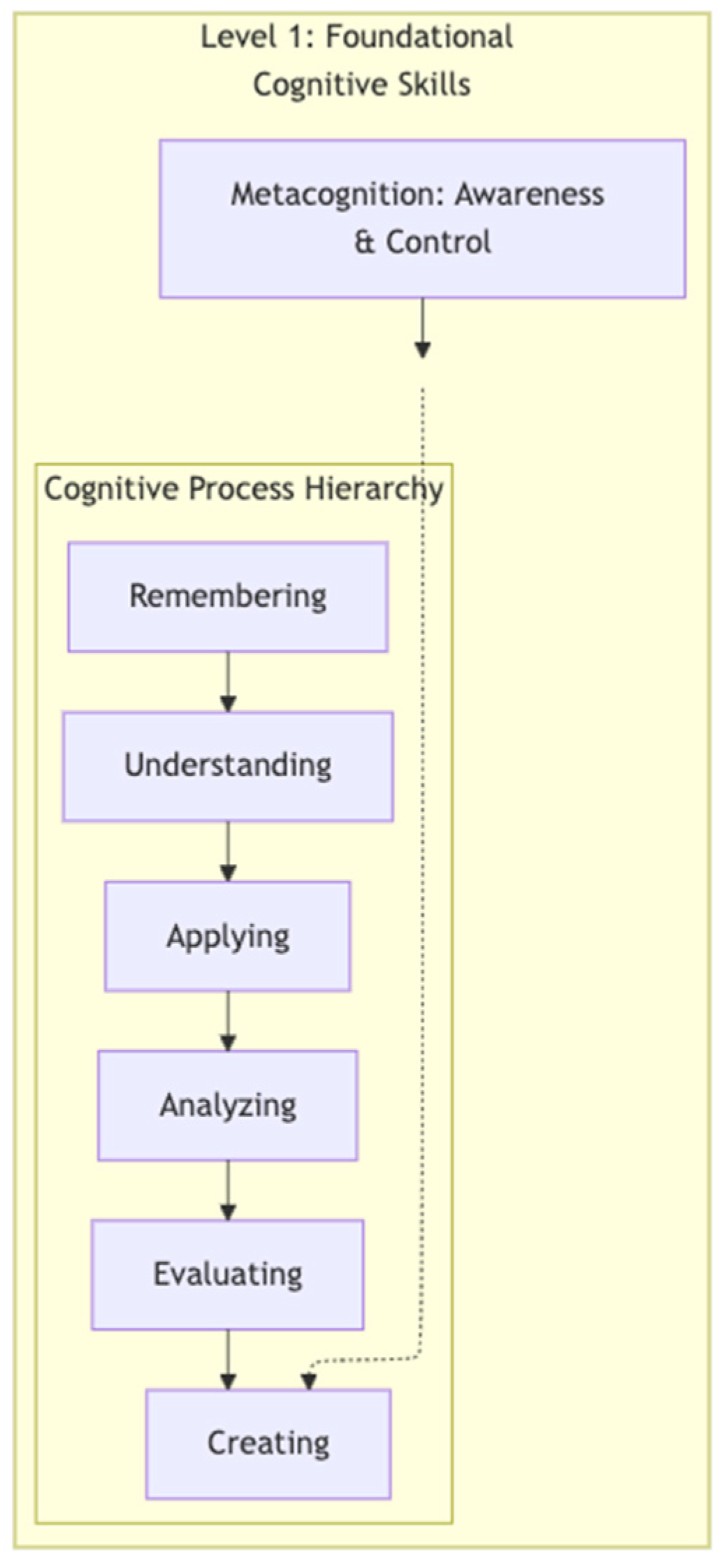
Figure 2.
A conceptual diagram illustrating how Level 2 Applied Thinking Frameworks synthesize various Level 1 Foundational Cognitive Skills to create structured problem-solving methodologies for specific domains.
Figure 2.
A conceptual diagram illustrating how Level 2 Applied Thinking Frameworks synthesize various Level 1 Foundational Cognitive Skills to create structured problem-solving methodologies for specific domains.
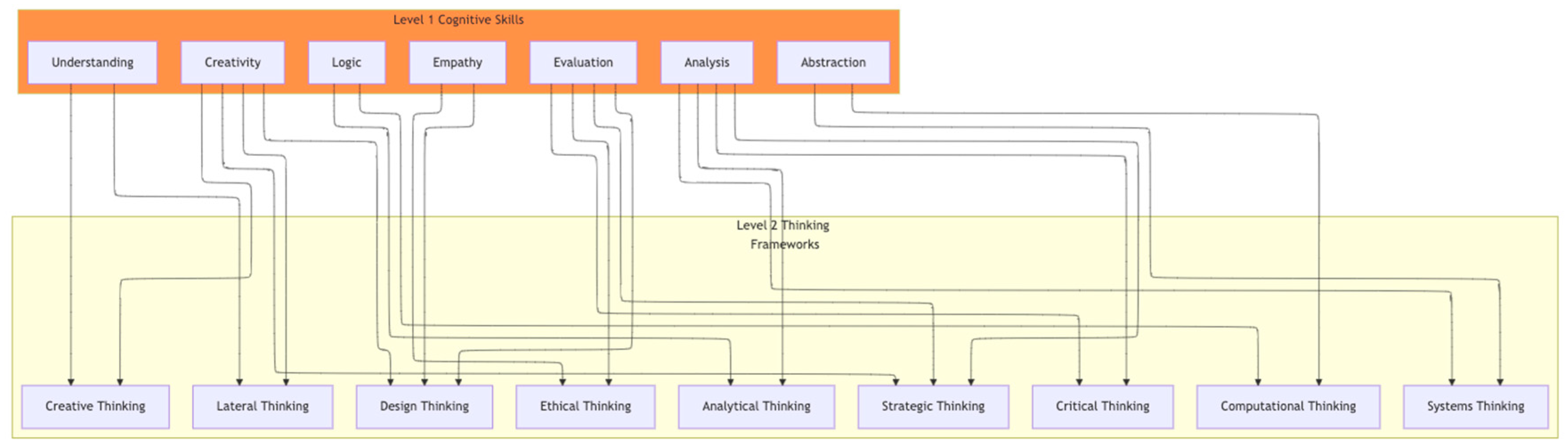
Figure 3.
Aiming Thinking as a Level 3 metathinking framework, acting as the necessary interface between established Level 2 human-centric frameworks and the generative AI model.
Figure 3.
Aiming Thinking as a Level 3 metathinking framework, acting as the necessary interface between established Level 2 human-centric frameworks and the generative AI model.
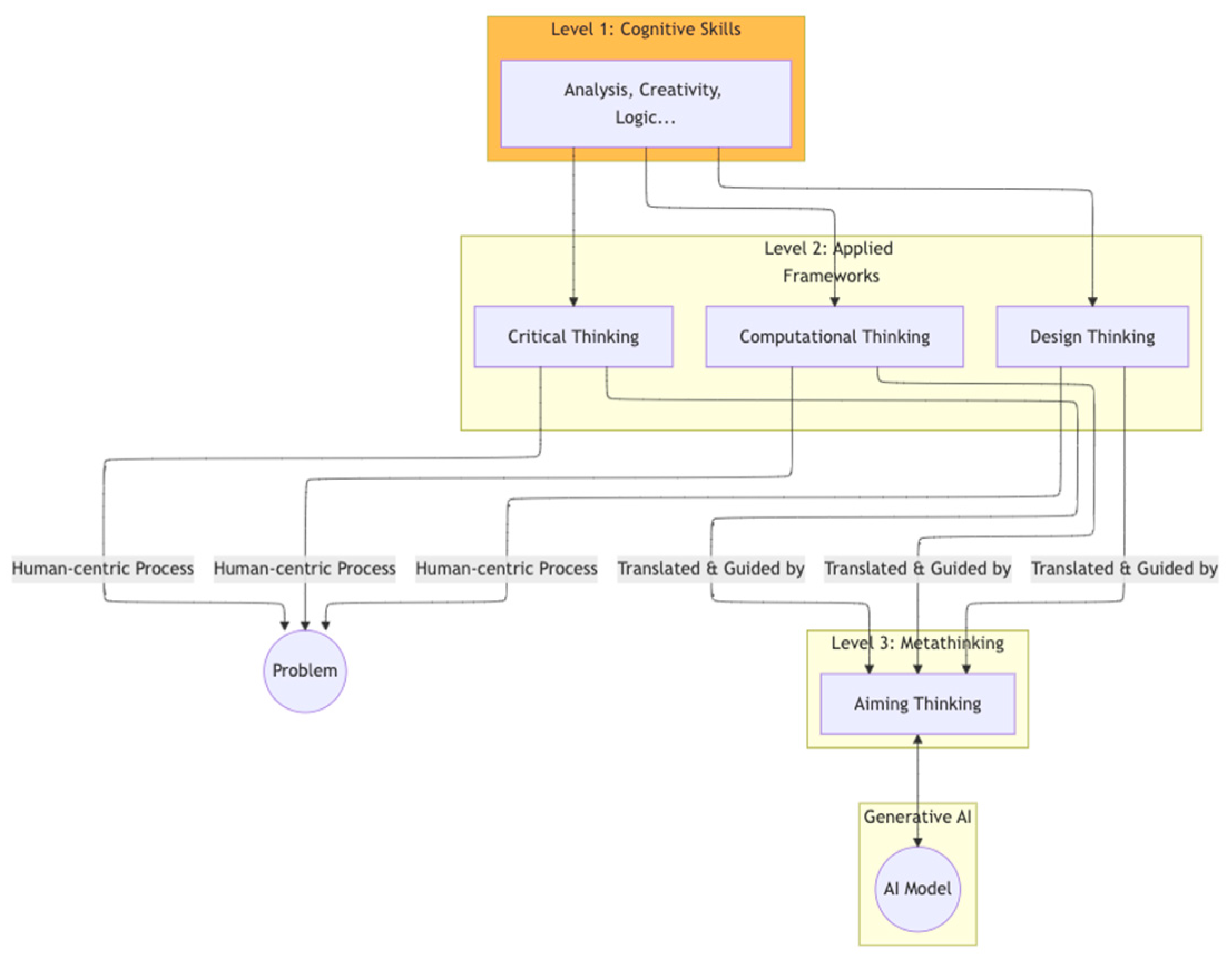
Figure 4.
The cyclical process of Aiming Thinking, illustrating the four pillars as an iterative loop for human-AI collaboration.
Figure 4.
The cyclical process of Aiming Thinking, illustrating the four pillars as an iterative loop for human-AI collaboration.
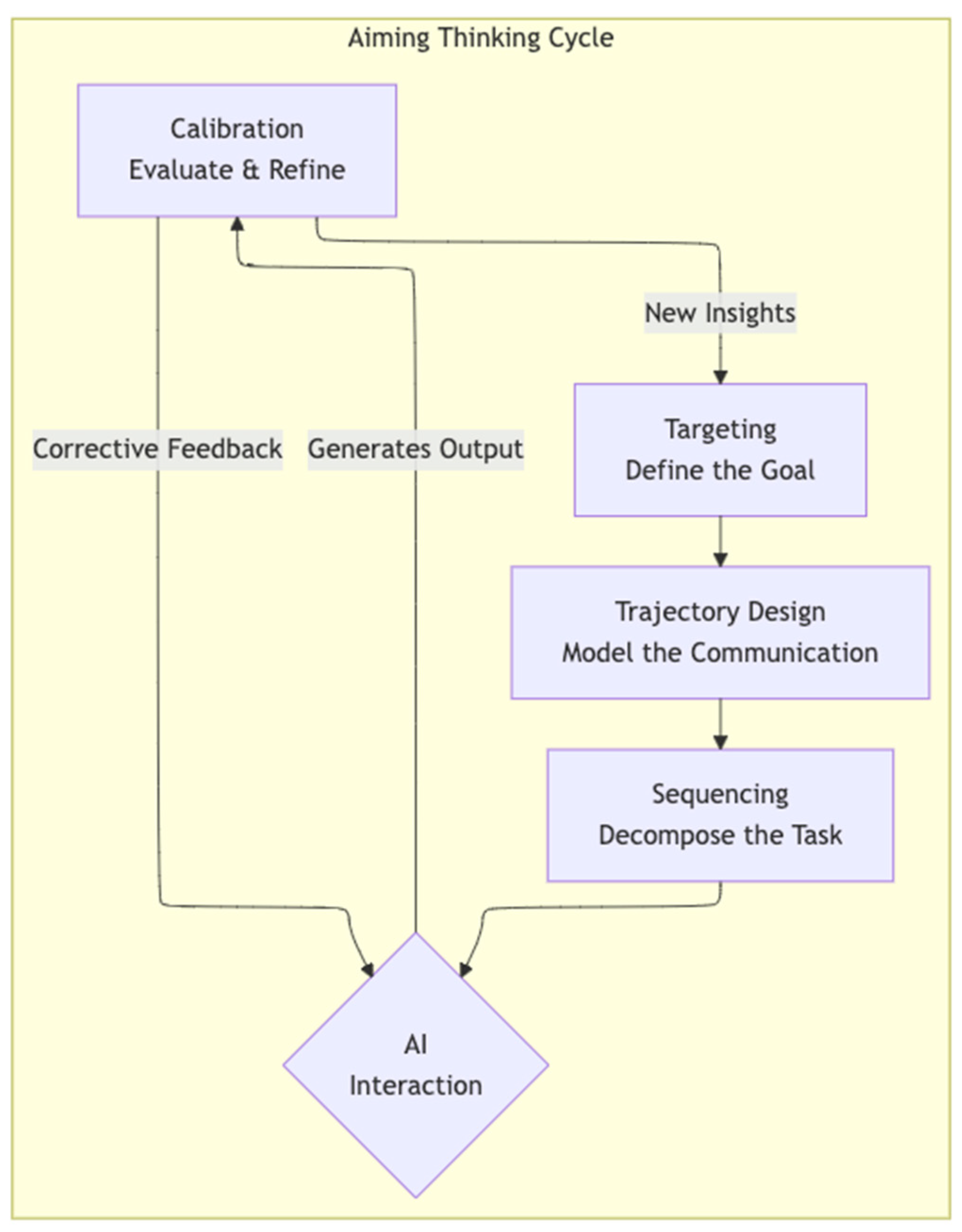
Figure 5.
A relationship diagram illustrating how different Aiming Thinking patterns can be combined. An initial prompt (pink) might be constructed by nesting several Targeting and Trajectory Design patterns. This kicks off a Sequencing pattern (blue), and within each step, a Calibration loop (green) can be initiated using multiple refinement and assurance patterns.
Figure 5.
A relationship diagram illustrating how different Aiming Thinking patterns can be combined. An initial prompt (pink) might be constructed by nesting several Targeting and Trajectory Design patterns. This kicks off a Sequencing pattern (blue), and within each step, a Calibration loop (green) can be initiated using multiple refinement and assurance patterns.
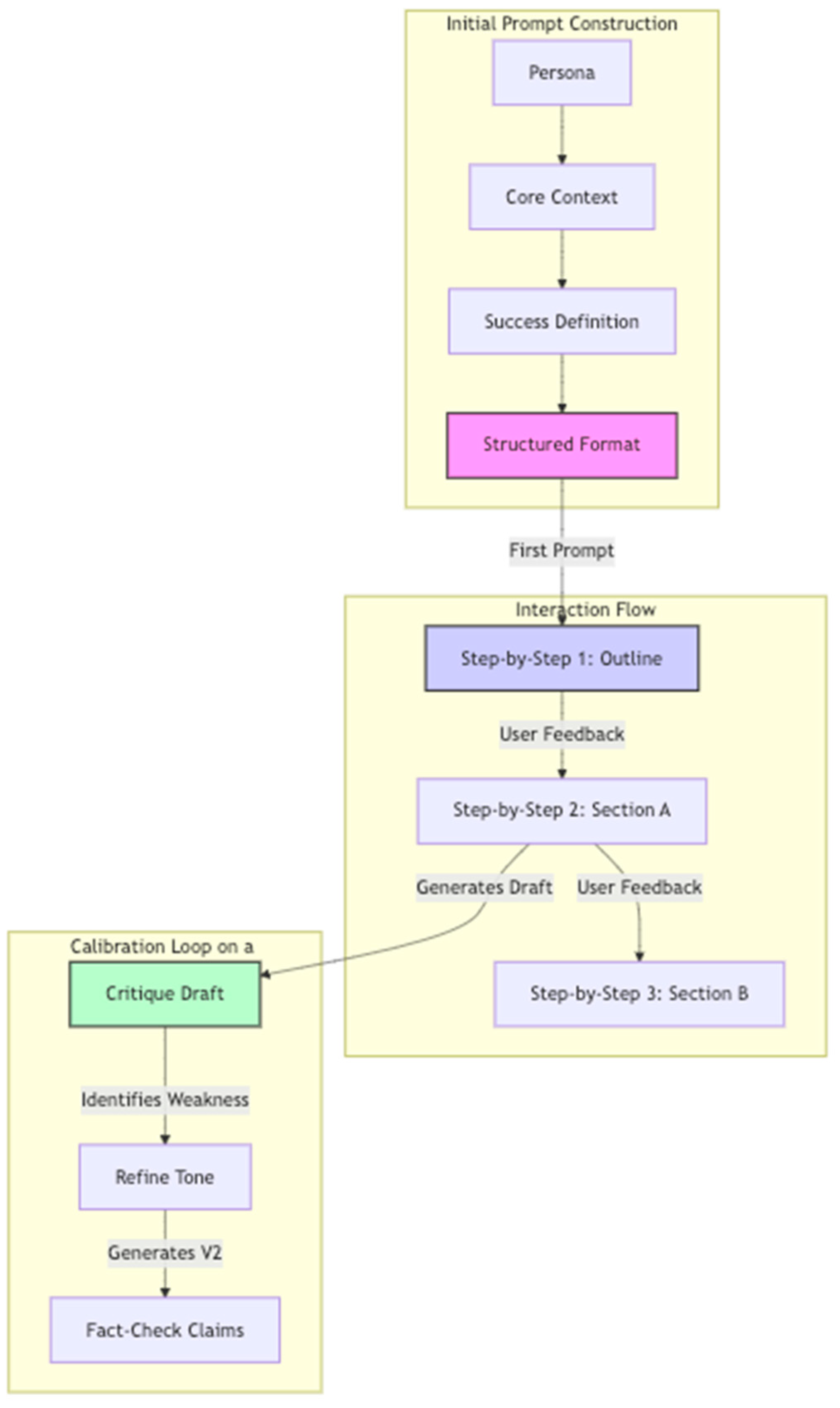

Table 1.
Consolidated Mapping of Level 2 Frameworks to Aiming Thinking (AT) Patterns.
| AT Pattern | CT | DT | CTr | ST | STr | CrT | ATy | LT | ET |
| Targeting | |||||||||
| Success Definition | ● | ● | ○ | ○ | ● | ○ | ● | ○ | ○ |
| Scope Fencing | ● | ○ | ● | ● | ● | ○ | ● | ○ | ● |
| Core Context | ○ | ● | ● | ● | ● | ○ | ○ | ○ | ● |
| Audience Persona | ○ | ● | ○ | ○ | ○ | ○ | ○ | ○ | ○ |
| Negative Constraint | ○ | ○ | ○ | ○ | ○ | ● | ○ | ● | ○ |
| Trajectory Design | |||||||||
| Persona Pattern | ○ | ● | ○ | ○ | ● | ● | ○ | ● | ● |
| Master Example | ● | ● | ○ | ○ | ○ | ● | ● | ○ | ○ |
| Structured Format | ● | ○ | ○ | ○ | ○ | ○ | ● | ○ | ○ |
| Recipe Pattern | ● | ○ | ○ | ○ | ● | ● | ● | ○ | ○ |
| Perspective Shift | ○ | ● | ● | ● | ● | ○ | ○ | ● | ● |
| Sequencing | |||||||||
| Step-by-Step | ● | ● | ○ | ○ | ○ | ● | ● | ○ | ○ |
| Topic Expansion | ● | ● | ● | ● | ● | ○ | ● | ○ | ○ |
| Chain-of-Thought | ● | ○ | ● | ○ | ○ | ○ | ● | ○ | ○ |
| Funneling Pattern | ○ | ● | ○ | ○ | ○ | ● | ○ | ○ | ○ |
| Template Builder | ● | ○ | ○ | ○ | ● | ○ | ○ | ○ | ○ |
| Calibration | |||||||||
| Tone Refinement | ○ | ● | ○ | ○ | ○ | ● | ○ | ○ | ○ |
| Reformatting | ● | ○ | ○ | ● | ○ | ○ | ● | ○ | ○ |
| Merge & Synthesize | ○ | ○ | ○ | ○ | ● | ● | ● | ○ | ○ |
| Self-Critique | ● | ● | ● | ● | ● | ○ | ● | ● | ● |
| Fact-Checking | ○ | ○ | ● | ○ | ○ | ○ | ● | ○ | ● |
Note: ● = Primary relevance; ○ = Secondary relevance.
Disclaimer/Publisher’s Note: The statements, opinions and data contained in all publications are solely those of the individual author(s) and contributor(s) and not of MDPI and/or the editor(s). MDPI and/or the editor(s) disclaim responsibility for any injury to people or property resulting from any ideas, methods, instructions or products referred to in the content. |
© 2025 by the authors. Licensee MDPI, Basel, Switzerland. This article is an open access article distributed under the terms and conditions of the Creative Commons Attribution (CC BY) license (http://creativecommons.org/licenses/by/4.0/).
Copyright: This open access article is published under a Creative Commons CC BY 4.0 license, which permit the free download, distribution, and reuse, provided that the author and preprint are cited in any reuse.


