
Submitted:
19 July 2025
Posted:
21 July 2025
You are already at the latest version
Abstract
This study investigated the effect of input enhancement of semantic primes on the writingaccuracy of intermediate Iranian EFL learners. Semantic primes are fundamental, universalconcepts that cannot be simplified further, yet play a critical role in language acquisition. Atotal of 54 learners were divided into experimental and control groups. The experimental groupreceived instruction using 64 semantic primes embedded in enhanced texts, while the controlgroup followed a traditional approach. Writing performance was assessed using the writingsection of the Preliminary English Test (PET) as both pretest and posttest. Statistical analyses,including paired-sample t-tests and ANOVA, revealed that the experimental group showedsignificantly greater improvement in writing accuracy compared to the control group. Thesefindings highlight the effectiveness of employing input enhancement techniques with semanticprimes to improve EFL learners’ writing performance.
Keywords:
input enhancement
; intermediate learners
; semantic primes
; writing accuracy
Introduction
Language learning considered as a vital process which aid learners' to construct their own knowledge and skills (Mitchell, Myles & Marsden, 2019). Language teachers often find themselves analyzing their teaching practice and learners' progress as a part of a process which they established to provide beneficial linguistic data for the learners. Hyland (2019) stated that writing system in a foreign language is different from the learning process of a language which makes writing in a second language (L2) as the act of expressing oneself in written form in a language other than the mother tongue (L1). Learning to write in a new language is often considered one of the most difficult aspects of second language acquisition (SLA).
Therefore, writing skill can be accounted as a supporting skill and a cognitive skill. In addition, writing system includes different signs which brought together in a systematic way and also it is related to spelling and punctuation system of a language in which foreign language learners required to know how to conduct a written passage ( Sokolik, 2018).
On the other hand, Goddard and Wierzbicka (1994) emphasized the durable effects of semantic primes in second language learning and the strong impact on teaching four main language skills. Also, they indicated the word meanings which exist in each learner's mind are rendered as concepts and linguistically, they must convey through a lexical form or an equivalent word for that certain concept. Goddard (2021) claimed that natural semantic metalanguage (NSM) is innately digestible to any native speaker; so, the semantic primitives are considered as lexical universal which establish the primary bases for learning the language and moreover it had a significant effect on learning how to communicate well via these 64 key words.
In addition, Wierzbicka (2018) noted that semantic primes can be introduced as primitive vocabulary items which can be amplified with a list of semantically primitive syntax constructions. Thus, the researcher in this study tried to familiarize learners with the concept of semantic primes through input enhancement techniques and show them how much they can improve in writing by means of enhancing preliminary units of meaning.
In addition, the current research presented a distinct method for teaching writing and showed English language teachers the degree of using semantic primes in teaching procedures might help them to be proficient in teaching fundamentals in writing.
The materials provided for EFL learners must be well-organized and guide them to use salient structures which lead them to become skillful in writing (Tomlinson, 2023).
The researcher attempted to explain how much input enhancement is beneficial in developing language materials and they could draw their attention to the salient features which might be assisted learners to be fully mastered in different types of writing and also applying input enhancement techniques as an essential approach for constructing writing materials.
Semantic primes are the most prominent elements existed in every natural language such as English language (Goddard & Wierzbicka, 1994). Since the semantic primes were based on the natural language rather than abstract ones, so, the primes are accessible to native speakers (Goddard, 2021). Semantic primes which represent universally meaningful concepts, but to have meaningful messages, or statements, such concepts must combine in a way that they themselves convey meaning (Wierzbicka, 2018).
On the other hand, it is generally agreed today that input enhancement constructs an overabundance of comprehensible input which has a facilitative role in the acquisition of language structure in order to engage language learners to communicate effectively (Brown, 2021). Also, there is a requirement of generating learning process which Smith (1993) defined input enhancement to expose salient features of the certain language to language learners.
Considering writing, Javadi (2018) stated that the ability to write is known as a skill for various works and tasks and it took a significant place in SLA as well as writing accuracy which is accounted for correctness use of grammar, vocabulary and spelling. In addition, the importance of writing skills and their critical role in assessing students' learning progress is widely acknowledged in second language education and research. Writing is seen as a challenging task, even for native speakers, but it can be even more daunting for non-native speakers, particularly those learning English as a foreign language. Various factors contribute to the difficulty of writing, which makes it a complex language skill to master (Javadi, 2018).
Review of the Related Literature
Semantic primes
The Natural Semantic Metalanguage (NSM) is a decomposition system of meaning representation based on experientially established universal semantic primes (Goddard & Wierzbicka, 1994). NSM is used for description of language features. It is based on evidence that there is a small core of basic, universal meanings which are known as semantic primes and the meanings can be expressed by words or other linguistic expressions in all languages, i.e., these meanings are necessary in order to explain other words. The Natural Semantic Metalanguage framework supposed that the meaning of natural languages can be explained without applying to abstract semantic primitives and this metalanguage consisted of a lexicon of undefinable expressions which Goddard and Wierzbicka (2002) named semantic primes. These semantic primes are significant in second language learning as Goddard and Wierzbicka (1994) explained that semantic primes can be helpful for second language learners because these words are universal in all languages and can establish the initial data which every language learner needs to learn.
Based on Wierzbicka (2021) statements, semantic primes exist in all languages of the world and she also mentioned that the meaning of these primes is completely clear in which she mentioned that clarity of meaning is the common feature of the semantic primes and in order to explain other words and phrases these primes can be utilized.
The natural semantic metalanguage primes stabilize as a list of irreducible meanings. These primes are hypothesized to be language universals. Sixteen categories are assigned for the 64 primes as follows (Wierzbicka, 2021):
- Substantives: you, someone, people, something/thing, body
- Relational substantives: kind, part
- Determiners: this, the same, other/else
- Quantifiers: one, two, much/many, some, all
- Evaluators: good, bad
- Descriptors: big, small
- Mental predicates: think, know, want, feel, see, hear
- Speech: say, words, true
- Actions, events, movement, contact: do, happen, move, touch
- Location, existence, possession, specification: be (somewhere), there is, have, be (someone/something)
- Life and death: live, die
- Time: when/time, now, before, after, a long time, a short time, for some time, moment
- Space: where/place, here, above, below, far, near, side, inside
- Logical concepts: not, maybe, can, because, if
- Intensifier: very, more
- Similarity: like/way
Goddard (2021) believed that natural semantic metalanguage (NSM) not only include lexicon but also it proposed syntax in which there are particular patterns among the semantic primes which could be found in all natural languages. Also, Goddard and Wierzbicka (2019) realized that semantic primes of different languages can be compared and as a result, by establishing a framework, researchers can investigate whether the meanings are similar or different. Moreover, semantic primes used in order to construct person's conceptual system which is unique and universal in different aspects (Wierzbicka, 2022).
A study presented by revealed that implementation of semantic primes was very effective in learning Balinese vocabularies on students grade 1, 2, 3 because a strong relation built up between materials and NSM principles.
Input Enhancement
While a direct relationship between language learning and input has yet to be determined, there have been considerable works on manipulating input to make it easier for students to understand which also was investigated in De Wilde, Brysbaert and Eychmans (2020) study on different input modes revealed that the types of exposure conducive to contextual language acquisition highlight the significance of interaction and authentic communication as primary features of input modes. Smith (1991, 1993) defined input enhancement as ''a concept which can be done by covering different techniques to make prominent features of a language for the language learners'' which is taken from information processing in which language learners only receive some parts of the given information; so that, this idea will be done via enriching those parts which students required to learn in order to reach the exact knowledge of the language.
Input enhancement is a concept in second language acquisition which was created the term to consider techniques which used by researchers to form prominent selected features of a language for learners such as word order, parts of words that express tense, agreement and number for example, accents, idioms and slang. As Schmidt (2012) put forward, when a particular form is more salient than the other exposed input, the chances of its selection by the L2 learner will increase. Some researchers emphasized on the importance of input enhancement and they considered it as a deliberate strategy in teaching methods, but, it has always been present implicitly in standard teaching practice (Schmidt, 2012).
Based on Schmidt (1990), exact repetition has positive effect on comprehension and help them to notice the linguistic forms they received and also it gives opportunity to learners to promote their proficiency level in English language. Psychologically, comprehension is an active process which needs thoughtful listening and writing and it might be varied for a learner with the certain degree of proficiency to another learner (Leow, 2019).
The Role of Noticing and Input Enhancement on the teaching of English Prepositions which have been done by Bunyarat (2019) concentrated on the impacts of input enhancement through reading five passages with embedded target grammatical features and they found that enhancing the input effected the perception of that much knowledge which teachers and learners wish for. Navidinia, Mobarak and Malekzadeh (2019) focused on Noticing hypothesis on learners speaking accuracy. The findings of the before-mentioned study revealed that students who received noticing produced less error and improved significantly regarding with speaking skill (Navidinia, Mobarak & Malekzadeh, 2019)
It appears that the most concern of input enhancement techniques within the history of analysis in second or foreign language acquisition has primarily been the acquisition of grammatical forms; therefore Cintrón-Valentín and García-Amaya (2021) investigated textual enhancement and captions in L2 grammar and vocabulary which presented a study on how input enhancement techniques are beneficial on target grammar and vocabulary. The results of the study revealed that textual enhancement techniques had significantly immediate impact on the learning of vocabulary and grammatical structures (Cintrón-Valentín & García-Amaya, 2021)
The significance of input enhancement not only found in teaching grammar but also it has been discovered for teaching vocabulary so that Vu and Peters (2022) reported that the effectiveness of textual and aural input enhancement through two types of teaching including explicit and implicit teaching of lexical items. As they compared reading-while-listening, and reading with Textual Input Enhancement, they concluded that input enhancement can be highly productive and more vocabulary learning in which using high frequency lexical can be more beneficial for learning different learners' level.
Writing Accuracy
Based on Cumming (2023) studies on L2 writing in Canada, he defined writing as ‘written texts’ and also as ‘the acts of thinking, composing, and encoding language’ into such texts. Nowadays, it seems that focusing on accuracy in writing is emphasized by many language learners (Leow & Suh, 2021).
Accordingly, many scholars indicated that language learning means learning how to use a language. Brandl (2020) noted that the concept of CLT (communicative language teaching) highlights the importance of accuracy and fluency which can be seen as a natural outcome of the development of communication skills. Therefore, accuracy in writing or how to create a well-organized text can be considered as a procedure in which various fundamental factors must be involved to obtain perfect result.
Accuracy deals with learners' use of the system, as well as their use of descriptive linguistics, pronunciation and vocabulary. Accuracy is often compared to fluency when we talk about a learner's level of speaking or writing. The development of literacy is of relevance in language learning, especially in formal contexts. Although it may seem common sense that reading and writing are related (Hyland, 2019). Accuracy is probably the most transparent and consistent construct which refers to the degree of deviancy from a particular norm which is distinguished as errors (Loewen, 2020).
It is worth noting that reading and writing are inseparable, i.e. when learners learn how to read, they become good writers, because how much the input become comprehensible in reading comprehension, the writing tasks seem well-organized (Hyland, 2019). Also, she emphasized on grammatical and lexical errors which are considered as marks which indicated lacks of writing skills.
Fazilatfar, Kasiri and Nowbakht (2020), worked on planning time and task conditions on fluency, accuracy and complexity of second language writing. It seemed that task conditions impacted the overall accuracy of writers' performance across all tasks, with a slight improvement in accuracy observed when topic, ideas, and macrostructure were provided compared to only the topic being given (Fazilatfar, Kasiri & Nowbakt, 2020).
The other researchers measured the written performance quality in terms of complexity, accuracy and fluency (Barrot & Agdeppa, 2021). They found out assessing accuracy might be very complicated when the students tend to use new vocabulary which they already learned. Therefore, the findings revealed that an interaction exists between language proficiency and CAF measures.
Yundayani and Ardiasih (2021) focused on task-based English writing for academic purpose (EWAP) martials for the ESP (English for specific purpose) on learners’ writing so that they should fill out a questionnaire in order to find out the importance of task-based contents for learners writing improvement. As a result of learners' need analysis, they came up with advantageous improvements in learners' writing through identifying students’ objectives. They also argue that they are slow and inefficient in finding the right words to express their ideas and construct their ideas fluently.
The research questions of the present study are:
Q1: Does semantic primes via input enhancement have any significant effect on Iranian EFL learners' writing accuracy?
Q2: Is there any significant difference between teaching semantic primes via input enhancement and without input enhancement?
Methods
Participants
The participants of the present study consisted of 54 male and female intermediate level EFL learners participated in the study. The participants were teenage students whose age ranged from 13 to 17 years and they were selected non-randomly from one institute in Karaj. The sampling model which used was availability sampling (Farhady, 1995), i.e. the data will be collected among population who are conveniently available to participate in the study. The participants were later assigned into one experimental group (EG) and one control group (CG).
Materials
The following set of materials applied to accomplish the objects of study:
The writing section of Preliminary English Test (PET, 2004) was administered as the pretest to evaluate the participants’ writing ability at the beginning of the study. It was also used to homogenize the final participants, i.e. the participants who shared similar characteristics or attitudes.
The writing section of PET consists of three parts. Part one is sentence transformation in which five sentences plus one example are given to the learners and the learners should complete similar sentences using different structures.
The second part requires the students to write a short communicative massage in which learners asked to write a short massage in the form of a letter or an email etc. The third part is longer than second part and learners should write in about 100 words which the administrator should focus on coherent, spelling and punctuation.
In order to measure leaners' writing accuracy at the end of the semester, the writing posttest of PET (2015) was administered to assess writing achievements. This test is the same as pretest in all parts only it differs in version.
To score the participants' pretest and posttest, the PET writing scoring criteria was used. The total mark of all writing parts is 25 so that in Part 1, 1 mark assigned for each correct answer. Part 2 has a total of 5 points in which the teacher scores the learners' writing based on PET scoring scale. Part 3 has a total of 15 marks in which the teacher scores based on PET scoring scale.
Procedure
In experimental group, the researcher selected various passages which were enhanced with semantic primes using input enhancement techniques such as bolding, italicizing, underlining; so that the learners' mind would be enhanced. Also the researcher presented 64 semantic primes during the course via sentence making to enhance these primes more.
The passages were selected randomly among the online texts for intermediate EFL learners.
There is an example of how the researcher enhanced the text with semantic primes:
''Here, an idea about a beneficial gadget exists to make some parts of life easier. If you have two hands, you can not help but applaud the original Clapper. First sold in 1985, it worked with a lamp or any other electronic devices. You plugged the Clapper into an outlet. Then you plugged your lamp into the Clapper. By clapping twice, you turned the lamp on or off. It was a convenient gadget that also became popular with handicapped (disabled) people. TV commercials showed grandma lying down in bed reading. She put her book below the table, clapped twice, and went to sleep with a big smile on her face''.
Next, learners were asked to paraphrase the passage in 1 or 2 paragraphs so that the researcher could evaluate the students based on the number of wrong words. After counting the mistaken words in every written task, the researcher delivered the texts to the students along her feedback. Finally, the writing section of PET (2015) was applied as posttest to assess the participants' writing improvement in terms of accuracy.
In the control group, there is not any treatment in order to investigate the degree of improvement of the experimental group. In the control group, the researcher just presented 64 semantic primes normally during the course and the writing section of PET (2004) as pretest and writing section of PET (2015) as posttest were given to the learners just like experimental group.
Design
In this study, the design was quasi-experimental pretest posttest research (Kahn & Best, 2021). The sampling model of this study was convenient or availability sampling because there was no equal chance for all of the participants in the population to be included in the sample and it was not plausible to choose a random sample.
Results
Preliminary Investigation
To start, the data acquired on the pretest and posttest of writing was subject to normality check through one-sample Kolmogorov-Smirnov test to enable the researcher to decide about either the parametric or non-parametric analyses are the most appropriate. The outcomes are then reported in Table 1 and Table 2.
According to the significance values presented in Table 1 and Table 2, all the pretest and posttest scores assigned to the participants’ essays as well as their mean scores are above .05 (α=.05; p>α), that is considered a cut point for the lack of significance and hence a sign of the normality of the data (Pallant, 2020). Therefore, all the data sets are normal. As a result, parametric formulae were used in this study.
The reliability index of the pretests and posttests was also conducted through Pearson Correlation Coefficient as there were two normally distributed sets of scores given to the test takers by two raters (Table 3).
The closer the values to +/-1, the stronger the reliability will be whereas the values close to 0 indicate weak reliability indices. Accordingly, the values reported in Table 3, are all highly reliable since their correlation values are very close to 1 (ρ=.922; ρ=.969; ρ=.909; ρ=.822) in the case of the pretest and posttest scores of the CG and EG.
Participants’ homogeneity in their English knowledge at the start of the study was also investigated through an Independent-Sample T-Test for there were two groups. The groups’ descriptive statistics are represented in Table 4 and Table 5.
Having a look at Table 4, indicating the descriptive statistics of the two groups' scores on their pretest, there is a slight difference observed between 13.09, the CG’s pretest score, and 13.20, the EG’s pretest score. To check the significance of this difference, an Independent-Sample T-Test was conducted (Table 5).
As observed in Table 5, the difference between the two groups’ scores was not noteworthy for the related significance value is .07 for the Levene's Test for Equality of Variances and .92 in the case of t-test for Equality of Means, both bigger than the critical value (F=3.20; p=.07; p=.92; α=.05; p>α). It means, the participants had similar knowledge of English at the beginning of the study; therefore, the two groups belonged to the same population.
Investigation of the Research Questions
Now, to answer the research questions, a repeated-measures two-way ANOVA was needed. Before running the analysis, the descriptive statistics of the writing scores on the pretest and posttest of the two groups are reported in Table 6. Note that the mean scores of the two raters were utilized.
As shown in the first row of Table 6, in the control group, the mean score changed from 13.09 in the pretest to 14.11 in the posttest, which is a good amount of growth. Furthermore, in the experimental group, the mean score improved from 13.20 in the pretest to 20.00 in the posttest, which a fair amount of enhancement. On the other hand, the pretest mean scores of the control and experimental groups are 13.09 and 13.20 respectively meaning that they did not performed much differently from each other at the start of the study (Table 5) whereas their posttest mean scores, 14.11 for the control group and 20.00 for the experimental group, indicate a difference in their performance at the end. That is, it could be claimed that although the participants of the two groups performed almost the same at the beginning, the amount of their improvement was not the same.
To examine whether or not the two groups’ improvement was significant and to conclude about the probable difference between their improvement, the outcomes of a repeated-measures two-way ANOVA is represented in the following tables and figure.
As reported in the first row of Table 7, the significance level for the within-subject effect (i.e. time) is .00 which is below the standard level (F=74.90; p=.00; α=.05; p<α). Consequently, the two groups’ performance can be claimed to change significantly from the pretest to the posttest, that is, the treatments the learners received affected their performance significantly. The value in the second row, the between-subject effect (i.e. group), is again .00 and smaller than the critical level. Therefore, the two groups’ performance was significantly different from each other (F=8.10; p=.00; α=.05; p<α). Finally, regarding the interaction of time and group, the represented level of significance was again lower than the critical level (F=40.94; p=.00; α=.05; p<α). Hence, although the two groups progressed considerably from the beginning to the end of the research, the amount of their progress was significantly different from each other from the pretest to the posttest.
To find out which group had more progress from the pretest to the posttest on selective listening tasks, Table 7 is provided, which shows the multiple comparisons among the three groups’ performance on these tasks in the posttest.
As indicated in Table 8, the significance value of the difference between the experimental and control groups’ performance in their posttest is .00 and smaller than standard (p=.00; α=.05; p<α). It means the learners’ performance was significantly different from each other. Looking back to Table 6 for their mean scores, the conclusion is that the participants of the experimental group had better amount of improvement in their posttest.
Figure 1 below is a visual representation of the outcomes obtained. Note that the left line signposts the performance of the experimental group and the right one the control group.
Having a look at Figure 1, it can be seen that although the two groups performed very much similar on their pretest, they performed much differently in their posttest, with the experimental group having considerable amounts of improvement.
According to the results of Table 6, Table 7 and Table 8 as well as Figure 1, the participants’ performance improved significantly from the pretest to the posttest of writing in both experimental and control groups. However, the experimental group’s improvement was more noteworthy. As a result, the two research questions of the study could be answered as the following:
1. Semantic primes via input enhancement had a significant effect on Iranian EFL learners' writing accuracy.
2. There is a significant difference between teaching semantic primes via input enhancement and without input enhancement.
Conclusions
As it is stated previously, the main purpose of the present study is to search for the significant effects of input enhancement of semantic primes on Iranian EFL learners' writing accuracy.
Since writing is considered as one of the most important language skills, it is a demanding product of education and it requires so much great effort that teachers need to pay more attention to teaching of writing and choosing the best methods and techniques to improve the learners' writing ability.
The results of this study related to the effect of input enhancement of semantic primes indicated in before-mentioned Tables. So that, the obtained results in the present study show that using input enhancement techniques for teaching semantic primes to promote the learners' writing accuracy had wonderful effect on their writing performance since that the learners' progress in the experimental group was very obvious from their written tasks.
Mean difference between pretest to posttest in experimental group was 13.19 and 19.33 which indicated the considerable progress of the learners who exposed to the materials enhanced by semantic primitives and it reveals the significant role of input enhancement techniques which Smith (1993) believed that input enhancement was conceptualized as a research tool, and he said ''the purpose of this term is to describe techniques deliberately or instinctively used in language teaching''.
Since the input enhancement techniques were very beneficial for learners to promote their writing accuracy, the elements in which enhanced were useful. Semantic primes which represent universally meaningful concepts, but to have meaningful messages, or statements which consider as preliminary elements in foreign and second language learning were helpful in this study, because enriching the written texts with semantic primes through input enhancement techniques demonstrated that experimental group participants performed much better than control group. Based on the findings, the amount of the learners' progress is obvious and it made clear that teaching 64 semantic primes via input enhancement techniques was very significant and wonderful. So those, students can learn semantic primes because they are universal concepts.
The implications of this study can be considered as a good way for teachers, learners and material developers to develop different skills and aspects of foreign language learning and teaching. Firstly, learners always face the difficulties in writing skill can gain by practicing the tasks which more enhanced with semantic primes. While teaching writing is a crucial point for teachers, through the findings they can provide passages enriched with semantic primes which is enhanced by input enhancement techniques so that teachers can trigger learners' writing performance. The last point which is related to material developers is noteworthy. Material developers can cover the input enhancement techniques and more importantly application of semantic primitives which they can make them prominent in learners' minds to perform better in writing tasks.
References
- Barrot, J. S., & Agdeppa, J. Y. (2021). Complexity, accuracy, and fluency as indices of college-level L2 writers’ proficiency. Assessing Writing, 47, 100510.
- Brandl, K. (2020). Communicative Language Teaching in Action: Putting Principles to Work. United States: Cognella Academic Publishing.
- Brown, H. D. (2021). Vistas: An interactive course in English (Volume 3). Legare Street Press.
- Bunyarat, P. (2019). The development of teaching prepositions by a lesson based on input enhancement and consciousness-raising. Journal of Faculty of Education Pibulsongkram Rajabhat University, 6(1), 39-51.
- Cintrón-Valentín, M. C., & García-Amaya, L. (2021). Investigating textual enhancement and captions in L2 grammar and vocabulary: An experimental study. Studies in Second Language Acquisition, 43(5), 1068-1093.
- Cumming, A. (2023). Studies of second-language writing in Canada: Three generations. TESL Canada Journal, 40(1), 1-9.
- De Wilde, V., Brysbaert, M., & Eyckmans, J. (2020). Learning English through out-of-school exposure. Which levels of language proficiency are attained and which types of input are important?. Bilingualism: Language and Cognition, 23(1), 171-185. [CrossRef]
- Farhady, H. (1995). Research methods in applied linguistics 1&2.Tehran:Payame Noor University.
- Fazilatfar, A., Kasiri, F., & Nowbakht, M. (2020). The comparative effects of planning time and task conditions on the complexity, accuracy and fluency of L2 writing by EFL learners. Iranian Journal of Language Teaching Research, 8(1), 93-110.
- Goddard, C., & Wierzbicka, A. (1994). Introducing lexical primitives. Semantic and Lexical Universals. Theory and Empirical Findings, 31-54.
- Goddard, C., & Wierzbicka, A. (2019). Direct and indirect speech revisited: Semantic universals and semantic diversity. Indirect reports and pragmatics in the world languages, 173-199.
- Goddard, C. (2021). Natural semantic metalanguage. In The Routledge handbook of cognitive linguistics (pp. 93-110). Routledge.
- Hyland, K. (2019). Second language writing. Cambridge university press.
- Javadi-Safa, A. (2018). A brief overview of key issues in second language writing teaching and research. International Journal of Education and Literacy Studies, 6(2), 12-25. [CrossRef]
- Kahn, J. V., & Best, J. W. (2021). Research in education. Allyn & Bacon.
- Leow, R. P. (2019). Theoretical underpinnings and cognitive processes in instructed SLA. In The Routledge handbook of second language research in classroom learning (pp. 15-27). Routledge.
- Leow, R. P., & Suh, B. R. (2021). Theoretical perspectives on L2 writing, written corrective feedback, and language learning in individual writing conditions. In The Routledge handbook of second language acquisition and writing (pp. 9-21). Routledge.
- Loewen, S. (2020). Introduction to instructed second language acquisition. Routledge.
- Mitchell, R., Myles, F., & Marsden, E. (2019). Second language learning theories. Routledge.
- Navidinia, H., Mobarak, M., & Malekzadeh, F. (2019). Investigating the Effect of Noticing on EFL Students' Speaking Accuracy. International Journal of Instruction, 12(1), 83-98. [CrossRef]
- Muijs, D. (2004). Doing quantitative research in education with SPSS. SAGE Publications Ltd.
- Pallant, S. (2005). Normality Test for Statistical Analysis. A guide for non-statisticians-International Journal, 10.
- Pallant, J. (2020). SPSS survival manual: A step by step guide to data analysis using IBM SPSS. Routledge.
- Rezvani, R., & Khanzade, M. (2022). A study of comparative effects of textual enhancement techniques on Iranian EFL learners’ vocabulary noticing. Research in English Language Pedagogy, 10(1), 96-121.
- Sadow, L. (2018). Can cultural scripts be used for teaching interactional norms?. Australian Review of Applied Linguistics, 41(1), 91-116. [CrossRef]
- Schmidt, R. W. (1990). The role of consciousness in second language learning1. Applied linguistics, 11(2), 129-158. [CrossRef]
- Schmidt, R. (2012). Attention, awareness, and individual differences in language learning. Perspectives on individual characteristics and foreign language education, 6, 27.
- Smith, M. S. (1991). Speaking to many minds: On the relevance of different types of language information for the L2 learner. Interlanguage studies bulletin (Utrecht), 7(2), 118-132. [CrossRef]
- Smith, M. S. (1993). Input enhancement in instructed SLA: Theoretical bases. Studies in second language acquisition, 15(2), 165-179.
- Sokolik, M. (2018). Fifty Ways to Teach Writing: Tips for ESL/EFL Teachers. (n.p.): CreateSpace Independent Publishing Platform.
- Tomlinson, B. (Ed.). (2023). Developing materials for language teaching. Bloomsbury Publishing.
- Vu, D. V., & Peters, E. (2022). Learning vocabulary from reading-only, reading-while-listening, and reading with textual input enhancement: Insights from Vietnamese EFL learners. RELC journal, 53(1), 85-100.
- Wierzbicka, A. (2018). SEMANTIC UNIVERSALS AND LANGUAGE DESCRIPTION. BOOK ON DEMAND Limited.
- Wierzbicka, A. (2021). " Semantic Primitives", fifty years later.
- Wierzbicka, A. (2022). I and Thou: Universal human concepts present as words in all human languages. Russian Journal of Linguistics, 26(4), 908-936. [CrossRef]
- Yundayani, A., & Ardiasih, L. S. (2021). Task-based material design for academic purposes: Learners' English writing skill improvement. Studies in English Language and Education, 8(1), 258-275. [CrossRef]
Figure 1.
Differences between the Pretest and Posttest of Writing Scores of the Two Groups.
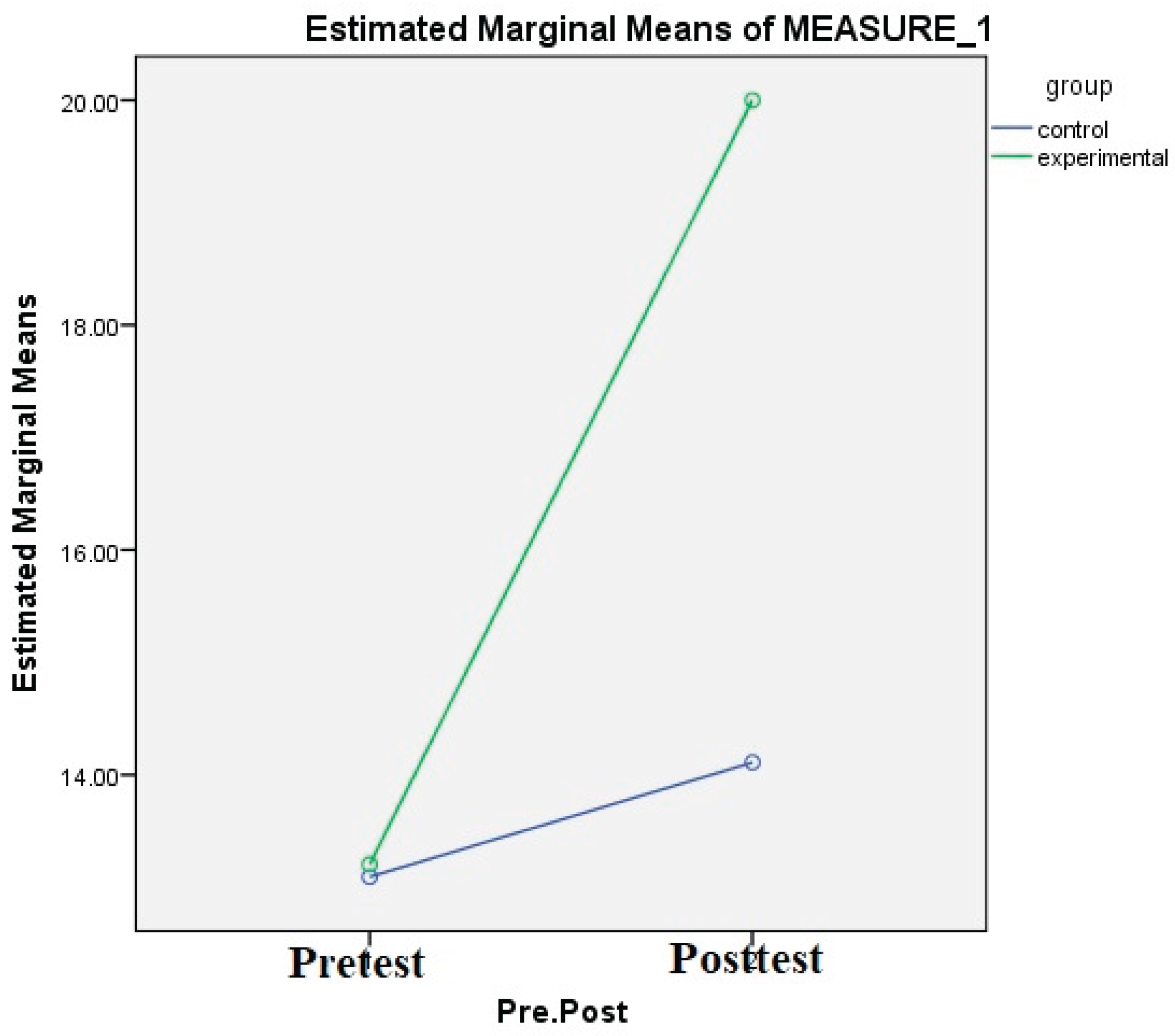

Table 1.
One-sample Kolmogorov-Smirnov Test of the Writing Tests of the Control Group (CG).
| Pre. R1 | Pre. R2 | Pre. Mean | Post. R1 | Post. R2 | Post. Mean | ||
|---|---|---|---|---|---|---|---|
| N | 27 | 27 | 27 | 27 | 27 | 27 | |
| Normal Parameters | Mean | 13.22 | 12.96 | 13.09 | 13.96 | 14.26 | 14.11 |
| SD | 5.32 | 5.11 | 5.11 | 4.99 | 4.84 | 4.88 | |
| Asymp. Sig. (2-tailed) | .51 | .66 | .70 | .43 | .26 | .58 | |
Table 2.
One-sample Kolmogorov-Smirnov Test of the Writing Tests of the Experimental Group (EG).
| Pre. R1 | Pre. R2 | Pre. Mean | Post. R1 | Post. R2 | Post. Mean | ||
| N | 27 | 27 | 27 | 27 | 27 | 27 | |
| Normal Parameters | Mean | 13.19 | 13.22 | 13.20 | 19.33 | 20.67 | 20.00 |
| SD | 4.21 | 3.93 | 3.98 | 2.84 | 1.86 | 2.24 | |
| Asymp. Sig. (2-tailed) | .59 | .66 | .65 | .43 | .19 | .88 | |
Table 3.
Inter-rater Reliability of the Pretest and Posttest Scores of the Two Groups.
| Pre, CG, 2nd rater | Post, CG, 2nd rater |
Pre, EG, 2nd rater | Post, EG, 2nd rater |
||
| Pre, CG, 1st rater |
Pearson Correlation | .922** | |||
| Sig. (2-tailed) | .00 | ||||
| Post, CG, 1st rater | Pearson Correlation | .969** | |||
| Sig. (2-tailed) | .00 | ||||
| Pre, EG, 1st rater |
Pearson Correlation | .909** | |||
| Sig. (2-tailed) | .00 | ||||
| Post, EG, 1st rater | Pearson Correlation | .822** | |||
| Sig. (2-tailed) | .00 | ||||
Table 4.
Descriptive Statistics of the Pretest of the Two Groups.
| Group membership | N | Mean | SD |
| Control Group | 27 | 13.09 | 5.11 |
| Experimental Group | 27 | 13.20 | 3.98 |
Table 5.
Independent-Sample T-Test on the Pretest Scores of the Two Groups.
| Levene's Test for Equality of Variances | t-test for Equality of Means | |||||
| F | Sig. | t | df | Sig. (2-tailed) | ||
| Pretest | Equal variances assumed | 3.20 | .07 | -.08 | 52 | .92 |
| Equal variances not assumed | -.08 | 49.03 | .92 | |||
Table 6.
Descriptive Statistics of the Writing Scores in the Pretest and Posttest of the Two Groups.
Table 6.
Descriptive Statistics of the Writing Scores in the Pretest and Posttest of the Two Groups.
| Pretest | Posttest | ||
| Control Group (N=27) |
Mean | 13.09 | 14.11 |
| SD | 5.11 | 4.88 | |
| Experimental Group (N=27) |
Mean | 13.20 | 20.00 |
| SD | 3.98 | 2.24 | |
Table 7.
Repeated-Measures Two-way ANOVA of the Pretest and Posttest of the Two Groups.
| Effect | Value | F | Sig. | Partial Eta Squared |
| Time | .59 | 74.90 | .00* | .59 |
| Group | 8.10 | .00* | .13 | |
| Time * Group | .44 | 40.94 | .00* | .44 |
Table 8.
Pairwise Comparisons on the Writings of the Two Groups in the Posttest.
| (I) Group | (J) Group | Mean Difference (I-J) | Std. Error | Sig. |
| Experimental group | Control group | 3.000 | 1.05 | .00* |
Disclaimer/Publisher’s Note: The statements, opinions and data contained in all publications are solely those of the individual author(s) and contributor(s) and not of MDPI and/or the editor(s). MDPI and/or the editor(s) disclaim responsibility for any injury to people or property resulting from any ideas, methods, instructions or products referred to in the content. |
© 2025 by the authors. Licensee MDPI, Basel, Switzerland. This article is an open access article distributed under the terms and conditions of the Creative Commons Attribution (CC BY) license (http://creativecommons.org/licenses/by/4.0/).
Copyright: This open access article is published under a Creative Commons CC BY 4.0 license, which permit the free download, distribution, and reuse, provided that the author and preprint are cited in any reuse.


