

Submitted:
01 July 2025
Posted:
17 July 2025
You are already at the latest version
Abstract
Measuring quality of life (QoL) in patients with high-grade central nervous system (CNS) malignancies is crucial, as these patients often endure severe physical, cognitive, and emotional challenges that significantly impact their overall well-being. Understanding and improving QoL is essential for guiding treatment strategies that not only extend survival but also enhance daily functioning and patient satisfaction. This manuscript details a phase II trial investigating the effects of allogeneic dendritic cell (DC) vaccination in patients with recurrent glioblastoma (IDH-1 wild type) and grade 4 astrocytoma (IDH-1 mutated). Among the 37 participants enrolled, comprehensive quality of life data were analyzed for 20 patients. The results revealed a significant survival benefit, with median survival extended by 75% in the vaccinated glioblastoma group and by 200% in the astrocytoma group, compared with controls in the GDC database. Quality of life evaluations using validated instruments, including the EORTC QLQ-C30, FACT-Br, and MDASI, indicated marked improvements across multiple domains, such as general health, physical, emotional, cognitive, and social functioning, along with a reduction in symptom severity. These findings highlight the potential of DC vaccination to not only prolong survival but also enhance the overall quality of life for patients with high-grade CNS malignancies.
Keywords:
glioblastoma
; immunotherapy
; dendritic cells
; cancer vaccine
; cancer treatment
; quality of life
1. Introduction
The measure of quality of life (QoL) is multidimensional, encompassing physical, psychological, and social aspects. Cella et al. describe QoL as a patient’s satisfaction with their current functioning relative to their ideal [1], while Osoba and Till focus on the balance between fulfilling personal ambitions and managing disease symptoms [2,3]. Gotay et al. offer a more clinical perspective, defining QoL in terms of functional abilities and satisfaction with disease control, particularly in the context of clinical trials [4].
For patients with primary brain tumors, the theoretical concepts of QoL described above become tangible, as they face a range of debilitating symptoms that severely impact their well-being. In addition to common issues such as headaches, nausea, seizures, and insomnia, these patients often suffer from motor deficits, cognitive decline, personality changes, and vision problems, all of which are consequences of focal neurological deterioration [5,6]. This burden is especially pronounced in those with high-grade or recurrent gliomas, who show lower overall functioning compared with both healthy individuals and other cancer patients [7].
The treatments themselves—surgery, radiation, and chemotherapy—further contribute to QoL challenges by introducing psychophysiological impairments, including attention deficits, speech disorders, and memory problems. These issues persist even among long-term survivors, with half continuing to experience cognitive impairments [8,9]. Neurocognitive decline, which affects behavior, emotions, and intellect, is nearly universal among brain tumor patients, severely limiting their independence. This decline is attributed to a combination of tumor effects, treatment side effects, and other factors such as age and psychological distress [10,11].
Given the profound impact of neurocognitive function on quality of life, it has become a key component of patient assessments alongside health-related QoL (HRQoL) questionnaires, such as the European Organization for Research and Treatment of Cancer (EORTC) Core Quality of Life Questionnaire (QLQ-C30) and Functional Assessment of Cancer Therapy (FACT) cancer-specific scales. Research has shown that neurocognitive performance is a significant predictor of long-term QoL [12,13,14]. With the limited life expectancy of patients with high-grade gliomas, particularly recurrent glioblastoma (GBM), concerns about QoL take on heightened importance for both patients and caregivers. This is especially crucial when considering new treatments for recurrent GBM that could help slow the rapid deterioration in QoL typically seen after disease progression following standard therapies [15].
A promising advancement in the treatment of CNS malignancies is the use of immunotherapy, particularly through dendritic cell (DC) vaccines [16,17,18,19]. These vaccines harness the power of dendritic cells, which play a crucial role in modulating immune responses by promoting both immune tolerance and activation [20,21]. As such, DCs are key tools in the development of immunotherapies that aim to trigger targeted immune attacks against tumors [22].
Here we report on the evolution of quality of life in patients with glioblastoma (IDH-1 wild type) or grade 4 astrocytoma (IDH-1 mutated) who underwent a phase II trial vaccination with allogeneic dendritic cells. Patients were followed up monthly with assessments of neurologic performance, general status, and QoL using standardized scales such as the EORTC, FACT-Br, and MDASI-BT. All were prospectively enrolled after failure of standard treatment with maximal surgical resection, temozolomide chemotherapy, and fractionated radiotherapy.
Our results showed statistically significant improvements in several EORTC-C30 subcategories, including general health, physical, emotional, cognitive, and social capacities. While the FACT-Br assessment showed stability in most domains, there were notable improvements in functional well-being. Additionally, the MDASI results indicated a reduction in symptom severity, further reinforcing the positive impact of the DC vaccination therapy on patients’ QoL throughout the follow-up period.
2. Materials and Methods
Patient Recruitment and Ethics
This is a complimentary report on a phase I/II prospective trial on allogeneic DC vaccination for GBM at our institution, in which 37 patients have been enrolled. Here, we present the updated analysis on 20 patients from whom detailed quality of life data were available. In this trial, inclusion criteria were >18 years of age, anatomopathological and immunohistochemical confirmation of glioblastoma or grade 4 astrocytoma (according to the WHO 2021 classification), previous treatment according to the best practice (maximal surgical resection, chemotherapy with temozolomide and fractionated radiotherapy with 60Gy total dose), Karnofsky performance score 50 or higher, and radiological progression demonstrated by recent Magnetic Resonance Imaging (MRI), according to RANO criteria. Exclusion criteria were cognitive impairment or aphasia (which would limit comprehension of the consent form), other cancers, pregnancy, other severe or life-threatening clinical conditions, immunodeficiency of any cause, coagulopathy, chronic infection, and/or incomplete previous treatment according to the best oncological evidence. Patients were enrolled at the time of tumor recurrence. All procedures were approved by the Institutional Ethics Committee and the National Research Council at the University of São Paulo (approval number: 58882116.7.3001.0065), and patients were enrolled after providing written informed consent. Clinical and laboratory data were collected prospectively, anonymously, and recorded using the RedCap platform hosted at Hospital das Clínicas, Medical School, University of São Paulo (https://redcap.hc.fm.usp.br).
Vaccine Production and Application
DC vaccines were prepared as already described by Lepski et.al [17]. In summary, peripheral blood mononuclear cells (PBMC) were obtained from leukapheresis chambers of blood donors by separation over Ficoll-Paque gradient (GE Healthcare). PBMC (3 x 10⁸) were seeded in 75 cm2 flasks and incubated for 2 hours at 37°C and 5% CO2. After incubation, nonadherent cells were removed and adherent cells were cultured in AIM-V supplemented with GM-CSF (50 ng/ml; Peprotech) and IL-4 (50 ng/ml; Peprotech). After five days, the cells received a maturation stimulus with TNF-α (50 ng/ml; Peprotech), and, 48 hours after activation, were harvested and resuspended in a sterile 5% glucose solution. In parallel, tumor cells processed from tumor resection and frozen in liquid nitrogen were thawed, washed, and also resuspended in a sterile 5% glucose solution. Both cell suspensions were at a concentration of 1x10⁷ cells/ml. The two cell suspensions were mixed, and the cells were fused by an electric pulse of 1,000 V/cm at 25μF (applied by a Gene-Pulser II; Bio-Rad, Richmond, CA, USA), after being aligned in an electrical field (62.5 V/cm) for 15s. Cells were left to rest for 2-min in the electroporation cuvette and transferred to a relaxation buffer (100-mM KCL, 3-mM NaCl, 1.25-mM EDTA, 10-mM PIPES, 0.5-mM ATP, adjusted to pH 6.8), where they were kept for an additional 3 min. The hybrid cell preparation was centrifuged, resuspended in 1 ml of sterile phosphate-buffered saline (pH 7.2) and, after irradiation (200 Gy), injected into each patient16. The harvested tumor samples were sufficient to produce 1 to 12 vaccine doses (mean 5; median 4). Freshly prepared hybrid cell suspensions were applied once a month intradermically, in 2 points in the forearm, 0.5mL each, after proper asepsis with alcohol swabs.
Quality of Life Assessment
All study patients were followed up at monthly intervals. Neurologic status was assessed by general neurologic exam and the Mini-mental status exam. Overall performance was assessed by the Karnofsky performance status (KPS) and WHO-ECOG, whereas global health and quality of life were assessed by the EORTC-QLQ-C30, EORTC QLQ-BN20, FACT-Br, and MDASI-BT evaluation scales, immediately before each vaccine dose, on a monthly basis. MRI scans were scheduled every 2 months, and tumor progression was defined according to RANO criteria.
Statistical Analysis
Statistical analyses were conducted using JMP v17.0 (SAS Institute, Cary, NC, USA) software. Survival was reported by means of Kaplan-Meier curves, with a 95% confidence interval. Categorical variables such as Mini-mental state, Karnofsky performance score, ECOG, and RANO were evaluated by logistic regression. The goodness of fit was assessed by ANOVA. Here, the F ratio was reported to assess the significance of the whole model; the F statistic is the ratio between mean sum of squares of the regression and the mean sum of squares error (of the residuals). The higher the F value, the better the model is at explaining the data dispersion. Additionally, we reported the probability of p > F. Continuous variables (all other quality of life assessments) were analyzed by linear regression to classify patients with favorable or unfavorable clinical outcomes. Clinical assessments are represented in circles in dispersion graphs, with the corresponding regression line and confidence interval for an α error of 5%. F ratio and ANOVA p values are calculated as previously mentioned.
3. Results
The current DC-vaccination trial included 37 patients with a diagnosis of recurrent glioblastoma (IDH-1 wild type, n=28, 76%) or grade 4 astrocytoma (IDH-1 mutated, n=9, 24%). Mean age was 47 (SD 13, ranging from 19 to 75), and 14 patients (38%) were female. The study population received 1 to 12 vaccine doses (mean 5, median 4). Vaccination was interrupted by death or after all frozen tumor cell samples (maximum 12) had been applied.
3.1. Survival Outcomes
The Kaplan-Meier survival curves presented in Figure 1 demonstrate key insights into patient survival rates. Figure 1A illustrates the overall survival of patients from the time of diagnosis, showing a mean survival of 62.6 months with a standard error of 4.6 months. This finding underscores the extended survival observed in the study cohort. Meanwhile, Figure 1B focuses on survival from the beginning of the vaccination treatment, with a mean survival of 26.0 months and a standard error of 1.4 months. These results suggest that the vaccination therapy may contribute to improved survival outcomes, highlighting its potential as a valuable treatment strategy for patients with glioblastoma.
3.2. Survival Outcomes
In addition to survival outcomes, the study employed a machine learning classifier based on logistic regression to evaluate neurocognitive and functional measures, including the Mini-Mental State Examination (MEEM), the Eastern Cooperative Oncology Group (ECOG) performance status, the Karnofsky Performance Status (KPS), and the Response Assessment in Neuro-Oncology (RANO) scale, as illustrated in Figure 2. The dispersion plots in Figure 2A represent MEEM measurements during follow-up, while the regression model shown in Figure 2B indicates a statistically significant relationship between MEEM scores and the model’s predictions (p < 0.05). In contrast, Figure 2C presents ECOG scores over time, and the corresponding logistic regression model in Figure 2D was not significant (p = 0.4411), indicating limited predictive power for ECOG in this context.
Similarly, KPS scores are shown in Figure 2E, with the logistic regression model in Figure 2F yielding non-significant results (p = 0.5327). These findings suggest that, while MEEM scores are informative for tracking neurocognitive decline, ECOG and KPS scores may not be as robust in predicting patient outcomes. Figure 2G offers a plot for RANO categories (complete response, partial response, stable disease, and progressing disease), weighted by the frequency of observations. The regression model in Figure 2H, however, demonstrates a significant predictive relationship for RANO categories (-LogLikelihood = 23.66, p < 0.0001), making it a valuable tool for assessing disease progression.
3.3. Survival Outcomes
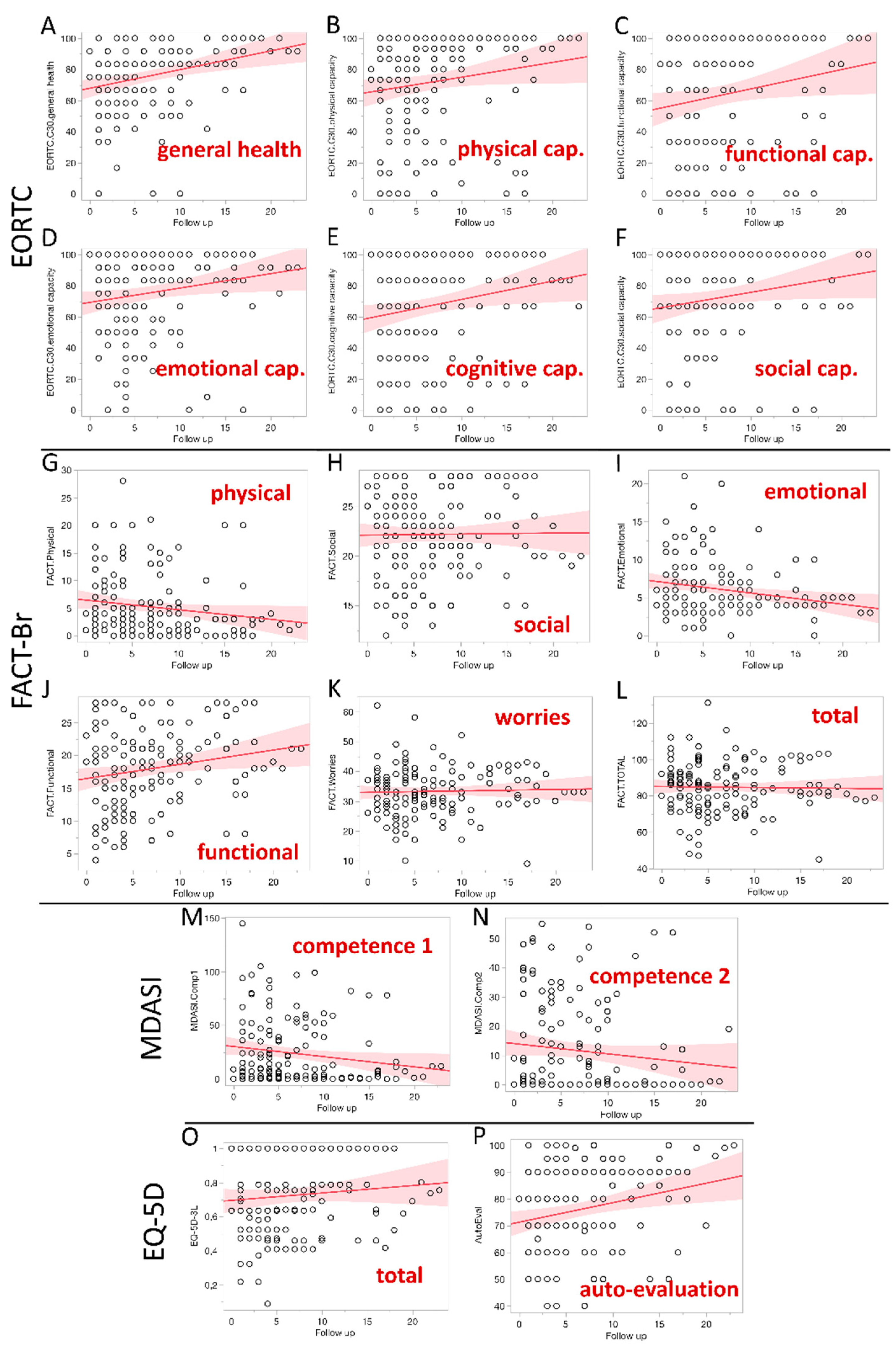
The study further assessed the evolution of patients’ quality of life through the use of several standardized scales, including the European Organization for Research and Treatment of Cancer Quality of Life Questionnaire (EORTC-C30) and the Functional Assessment of Cancer Therapy – Brain (FACT-Br) instrument, as depicted in Figure 3. The results reveal statistically significant improvements across all EORTC-C30 subcategories, indicating broad enhancements in general health (p < 0.001), physical capacity, functional capacity, emotional capacity, cognitive capacity, and social capacity (p < 0.05). These improvements suggest that, in addition to extending survival, the vaccination therapy may contribute to better overall well-being in patients undergoing treatment.
In contrast, the FACT-Br assessment indicated stability in most domains, with slight decreases in physical and emotional well-being but notable improvements in functional well-being (p < 0.05). Social well-being and additional concerns remained stable, with no significant changes. Furthermore, the MD Anderson Symptom Inventory (MDASI) scores revealed an overall improvement in symptom severity (p < 0.05), though there were no significant changes in symptom interference with social and work activities (p = 0.1500).
Finally, the EQ-5D-3L assessment showed stability over time (p = 0.2673), while patients’ self-assessment of their own health status exhibited significant improvement (p < 0.01). These findings suggest that patients perceived a marked improvement in their overall health, further reinforcing the potential benefits of the vaccination therapy not only in extending survival but also in enhancing quality of life.
4. Discussion
Glioblastoma is the most frequent malignant primary brain neoplasia in adults [23]. Despite recent advances in imaging technology, surgical procedures and adjuvant therapies, glioblastoma remains highly resistant to treatment [24,25]. The estimated overall survival for glioblastoma is 14.6 months overall [26] — 1.1 years for IDH-1 wild-type and 3.6 years for IDH-1 mutant subgroups, presently classified as Grade 4 Astrocytomas [27]. Disease progression seems virtually inevitable and occurs at a median of 6.9 months [26]. Clinical decisions are usually made on an individual basis, and no consensus exists on what those decisions should be. Glioblastoma recurrence is currently treated with a number of different strategies, and all of them face countless challenges [28].
The treatment of high-grade gliomas typically involves neurosurgery and radiotherapy, which can have significant effects on patients’ quality of life (QoL). Surgery often provides immediate relief from symptoms related to intracranial pressure [29], while radiotherapy can have mixed outcomes, improving tumor control but potentially leading to cognitive deficits, fatigue, and hair loss [30]. Additionally, corticosteroids and antiepileptic medications used in conjunction with these therapies have been shown to negatively impact neurocognitive function, although the effects are less studied in high-grade gliomas than in low-grade gliomas [31,32,33,34].
In terms of chemotherapy, temozolomide, when added to radiotherapy, has been shown to maintain QoL in most domains, although it can impact social functioning [35]. Studies indicate that patients responding to temozolomide experience improvements in emotional well-being and cognitive function [36]. In contrast, other chemotherapy regimens, such as those involving procarbazine and lomustine, have more pronounced negative effects on QoL, particularly in domains like physical functioning, motor skills, and social engagement [37].
Emerging therapies have shown promising outcomes in this context. For instance, bevacizumab, a monoclonal antibody targeting vascular endothelial growth factor (VEGF), has been associated with a steroid-sparing effect that positively influences neurocognitive function and performance status. Preliminary studies suggest that patients treated with bevacizumab may maintain or improve cognitive function, reduce their dependence on corticosteroids, and experience an overall improvement in well-being [38,39].
Among immunotherapy-based treatments, dendritic cell (DC) vaccines have demonstrated potential, contributing not only to tumor control but also to enhanced quality of life. Vaccination with allogeneic dendritic cells—using donor-derived cells loaded with tumor antigens to stimulate the patient's immune response—aims to bypass the potential bias of a patient's own DCs toward inducing regulatory T cells, which might dampen the immune response against the tumor. The use of allogeneic DCs could enhance antigen presentation and stimulate a more robust immune response [40].
In this study, we reported on the evolution of quality of life in patients with CNS malignancy (glioblastoma, IDH-1 wild type, or grade 4 astrocytoma, IDH-1 mutated) who underwent vaccination with allogeneic dendritic cells. Our previous reports showed that DC-based vaccination enhances immune responses through increased production of IFN-γ and IL-2 [18]. In the case report we presented, the patient exhibited a shift toward a Th1 response—associated with anti-tumor activity—and a decrease in regulatory T cells that can suppress immune responses. This immunological shift aligned with her initial clinical improvement, suggesting a favorable modulation of the immune system. Despite this initial success, the patient later experienced a shift toward a Th17 response and an increase in Th2 activity, which also correlated with clinical deterioration. Th17 cells play complex roles in cancer, potentially contributing to both tumor suppression and promotion. This shift underscores the critical importance of maintaining a balanced distribution of different CD4+ T cell subsets for sustained anti-tumor immunity. It highlights that not only the presence of immune responses but their specific profiles are essential for long-term clinical benefits.
Building upon these findings, our observations indicate that vaccination with allogeneic dendritic cells induces a robust immune response mediated by CD4+ T cells and results in significant improvements in the quality of life for patients with glioblastoma or high-grade astrocytoma. We have highlighted the pivotal role of CD4+ T cells in the immunotherapeutic response, demonstrating that an increase in these cells, particularly the Th1 subpopulation, is associated with positive clinical outcomes. This suggests that CD4+ T cells are crucial in orchestrating an effective anti-tumor immune response, potentially enhancing the activation and function of CD8+ T cells.
Complementing these immunological insights, our study revealed that patients undergoing this vaccination strategy exhibited statistically significant improvements across multiple domains of quality of life. These include general health, physical capacity, emotional well-being, cognitive function, and social interaction, indicating that the benefits of the vaccine extend beyond immunological parameters to positively impact patients’ daily lives. Specifically, the study found statistically significant enhancements in general health (p < 0.001), with significant improvements in physical capacity, functional capacity, emotional capacity, cognitive capacity, and social capacity (p < 0.05). Functional well-being, as assessed by the FACT-Br scale, also showed notable positive changes (p < 0.05). Additionally, the MDASI scores indicated a significant reduction in symptom severity (p < 0.05), and patients’ self-assessment of their health status using the EQ-5D-3L revealed a significant enhancement (p < 0.01).
Furthermore, we showed significantly longer overall survival for vaccinated patients compared with matched controls from the Genomic Data Commons database. Specifically, vaccinated patients with glioblastoma had a mean overall survival of 27.6 months versus 16.3 months in the control group (log-rank p < 0.001, HR = 0.53), indicating a 47% reduction in the risk of death. Patients with grade 4 astrocytoma showed even more pronounced benefits, with a mean survival of 59.5 months compared with 19.8 months among controls (log-rank p < 0.01, HR = 0.18), representing an 82% relative reduction in the risk of death [17]. Impressively, five patients from the trial remain alive today, with some exhibiting survival times extending beyond 70 months. These survival benefits align with the immune and quality of life improvements observed in our studies, reinforcing the notion that the immune modulation induced by the dendritic cell vaccine leads to durable clinical responses.
The use of allogeneic dendritic cells fused with autologous tumor cells may overcome some limitations of previous strategies, such as the induction of regulatory T cells by autologous DCs, and may enhance the activation of effector T cells. Collectively, these findings underscore the potential of allogeneic dendritic cell vaccines as a promising therapeutic approach that not only improves survival rates but also enhances quality of life for patients with high-grade gliomas.
Despite the rarity of long-term survival in glioblastoma patients, the literature indicates that those who do survive beyond five years often face significant challenges related to quality of life, including persistent cognitive deficits, emotional distress, and physical limitations. For instance, Taphoorn and Klein [41] highlight that cognitive impairments such as difficulties in memory, attention, and executive functions are prevalent among long-term survivors, adversely affecting their daily functioning and independence. Ownsworth et al. [42] emphasize the psychological and social adjustments required, noting that survivors may struggle with changes in identity and social roles, which can impact their emotional well-being.
In contrast to these findings, our study demonstrated that patients included in the dendritic cell vaccine trial not only exhibited extended survival times but also significant improvements in QoL across multiple domains. Specifically, patients reported enhancements in cognitive function, emotional well-being, physical capacity, and social interaction. These improvements suggest that the dendritic cell vaccine may mitigate some of the QoL challenges typically faced by long-term survivors of glioblastoma.
The alignment of extended survival with improved QoL in our patients contrasts with the persistent QoL issues documented in the literature [43,44], highlighting the potential of this immunotherapeutic approach to address the multifaceted needs of glioblastoma patients. These findings underscore the importance of therapies that not only prolong life but also enhance its quality, advocating for further research into dendritic cell vaccine strategies as a promising avenue for improving outcomes in this challenging patient population.
5. Conclusions
The findings reported in the present study on allogeneic DC vaccination are an important contribution to the field as it indicates that the immunological modulation induced by the dendritic cell vaccine translates into tangible benefits in patients’ daily functioning and overall well-being. The link between the immunological and quality of life findings suggests that the immune modulation promoted by the dendritic cell vaccine contributes not only to tumor control but also to the improvement of patients’ quality of life. We hope these encouraging findings guide us and our colleagues in the field in our search for novel strategies against one of the most challenging cancer variations in humans, thus providing renewed hope for patients and their families.
Author Contributions
G.A.L. designed the study, wrote the manuscript, and was responsible for the medical, surgical, and clinical parts of the research (operation, clinical data collection, and handling), as well as data analysis; N.P. designed the study and wrote the manuscript; P.C.B.-S. prepared the vaccines and wrote the manuscript; C.S.F., E.A.F., G.C.M.E., J.V.d.O. and M.P.P. wrote the manuscript; J.A.M.B. conceived and designed the study, supervised the analysis, and wrote the manuscript. All authors have read and agreed to the published version of the manuscript.
Funding
This report was financed with resources from the Fundação Faculdade de Medicina, Universidade de São Paulo, Brazil, and by grants from the São Paulo Research Foundation - FAPESP (#2014/25988-1; #2016/01137-8), the Coordination for the Improvement of Higher Education Personnel - CAPES, and from National Council for Scientific and Technological Development - CNPq (409825/2016-6) and CNPq (308053/2017-6).
Institutional Review Board Statement
All procedures were approved by the Institutional Ethics Committee and National Research Council (approval 58882116.7.3001.0065).
Informed Consent Statement
At the time of enrollment, all patients signed an informed consent to participate in the study and have its results published.
Acknowledgements
The authors would like to thank the patients and their families, who fought bravely against the tragedy imposed by this disease and resiliently deposited their hope in science, adhering strictly to our protocols.
Conflicts of Interest
The authors have no conflict of interest to disclose.
Abbreviations
The following abbreviations are used in this manuscript:
| CNS | Central Nervous System |
| DC | Dendritic Cell |
| ECOG | Eastern Cooperative Oncology Group |
| EORTC | European Organization for Research and Treatment of Cancer (EORTC) |
| FACT | Functional Assessment of Cancer Therapy |
| GBM | Glioblastoma |
| HRQoL | Health-Related QoL |
| KPS | Karnofsky Performance Status |
| MDASI-BT | MD Anderson Symptom Inventory Brain Tumor |
| MEEM | Mini-Mental State Examination |
| PBMC | Peripheral Blood Mononuclear Cells |
| QLQ-C30 | Quality of Life Questionnaire |
| QoL | Quality of life |
References
- Cella D.F.; Tuslky D.S. Quality of life in cancer. Definition, purpose and method of measurement. Cancer Invest 1993, 11:327-336.
- Osoba D. Measuring the effect of cancer on health-related quality of life. Pharmacoeconomics 1995, 7(4):308-19. [CrossRef]
- Till J.E., McNeil B.J., Bush R.S. Measurements of multiple components of quality of life. Cancer Treat Sympt 1984, 1:177.
- Gotay C.C., Korn E.L., McCabe M.S., Moore T.D., Cheson B.D. Quality-of-life assessment in cancer treatment protocols: research issues in protocol development. J Natl Cancer Inst. 1992, 15;84(8):575-9. [CrossRef]
- Heimans J.J., Taphoorn M.J. Impact of brain tumour treatment on quality of life. J Neurol. 2002, 249(8):955-60.
- Osoba D., Brada M., Prados M.D., Yung W.K. Effect of disease burden on health-related quality of life in patients with malignant gliomas. Neuro Oncol 2000, 2(4):221-8.
- Klein M., Taphoorn M.J., Heimans J.J., van der Ploeg H.M., Vandertop W.P., Smit E.F., Leenstra S., Tulleken C.A., Boogerd W., Belderbos J.S., Cleijne W., Aaronson N.K. Neurobehavioral status and health-related quality of life in newly diagnosed high-grade glioma patients. J Clin Oncol. 2001, 15;19(20):4037-47. [CrossRef]
- Imperato J.P., Paleologos N.A., Vick N.A. Effects of treatment on long-term survivors with malignant astrocytomas. Ann Neurol. 1990, 28(6):818-22. [CrossRef]
- Gregor A., Cull A., Traynor E., Stewart M., Lander F., Love S. Neuropsychometric evaluation of long-term survivors of adult brain tumours: relationship with tumour and treatment parameters. Radiother Oncol. 1996, 41(1):55-9. [CrossRef]
- Henriksson R., Asklund T., Poulsen H.S. Impact of therapy on quality of life, neurocognitive function and their correlates in glioblastoma multiforme: a review. J Neurooncol. 2011, 104(3):639-46. [CrossRef]
- Samman R.R., Timraz J.H., Mosalem Al-Nakhli A., Haidar S., Muhammad Q., Irfan Thalib H., Hafez Mousa A., Samy Kharoub M. The Impact of Brain Tumors on Emotional and Behavioral Functioning. Cureus. 2024, 8;16(12):e75315.
- Fujii D.E., Wylie A.M., Nathan J.H. Neurocognition and long-term prediction of quality of life in outpatients with severe and persistent mental illness. Schizophr Res. 2004, 1;69(1):67-73.
- Giovagnoli A.R., Silvani A., Colombo E., Boiardi A. Facets and determinants of quality of life in patients with recurrent high grade glioma. J Neurol Neurosurg Psychiatry. 2005, 76(4):562-8. [CrossRef]
- Li J., Bentzen S.M., Li J., Renschler M., Mehta M.P. Relationship between neurocognitive function and quality of life after whole-brain radiotherapy in patients with brain metastasis. Int J Radiat Oncol Biol Phys. 2008, 1;71(1):64-70. [CrossRef]
- Cheng J.X., Zhang X., Liu B.L. Health-related quality of life in patients with high-grade glioma. Neuro Oncol. 2009, 11:41–50. [CrossRef]
- Peres N., Lepski G.A., Fogolin C.S., Evangelista G.C.M., Flatow E.A., de Oliveira J.V., Pinho M.P., Bergami-Santos P.C., Barbuto J.A.M. Profiling of Tumor-Infiltrating Immune Cells and Their Impact on Survival in Glioblastoma Patients Undergoing Immunotherapy with Dendritic Cells. Int J Mol Sci. 2024, 12;25(10):5275. [CrossRef]
- Lepski G., Bergami-Santos P.C., Pinho M.P., Chauca-Torres N.E., Evangelista G.C.M., Teixeira S.F., Flatow E., de Oliveira J.V., Fogolin C., Peres N., Arévalo A., Alves V.A.F., Barbuto J.A.M. Adjuvant Vaccination with Allogenic Dendritic Cells Significantly Prolongs Overall Survival in High-Grade Gliomas: Results of a Phase II Trial. Cancers 2023, 15;15(4):1239. [CrossRef]
- Pinho M.P., Lepski G.A., Rehder R., Chauca-Torres N.E., Evangelista G.C.M., Teixeira S.F., Flatow E.A., de Oliveira J.V., Fogolin C.S., Peres N., Arévalo A., Alves V., Barbuto J.A.M., Bergami-Santos P.C. Near-Complete Remission of Glioblastoma in a Patient Treated with an Allogenic Dendritic Cell-Based Vaccine: The Role of Tumor-Specific CD4+T-Cell Cytokine Secretion Pattern in Predicting Response and Recurrence. Int J Mol Sci. 2022, 12;23(10):5396. [CrossRef]
- Reardon D.A., Freeman G., Wu C.,.et al. Immunotherapy advances for glioblastoma. Neuro Oncol 2014, 16:1441-58.
- Steinman R.M. Decisions about dendritic cells: past, present, and future. Annu Rev Immunol 2012, 30:1-22. [CrossRef]
- Patente T.A., Pinho M.P., Oliveira A.A., Evangelista G.C.M., Bergami-Santos P.C., Barbuto J.A.M. Human Dendritic Cells: Their Heterogeneity and Clinical Application Potential in Cancer Immunotherapy. Front Immunol 2018;9:3176. [CrossRef]
- Palucka K, Banchereau J. Cancer immunotherapy via dendritic cells. Nat Rev Cancer 2012, 12:265-77.
- Ostrom Q.T., Bauchet L., Davis F.G., Deltour I., Fisher J.L., Langer C.E., Pekmezci M., Schwartzbaum J.A., Turner M.C., Walsh K.M., Wrensch M.R., Barnholtz-Sloan J.S. The epidemiology of glioma in adults: a "state of the science" review. Neuro Oncol. 2014, 16(7):896-913. [CrossRef]
- Bleeker F.E., Molenaar R.J., Leenstra S. Recent advances in the molecular understanding of glioblastoma. J Neurooncol 2012, 108:11-27. [CrossRef]
- Weathers S.P., Gilbert M.R. Current challenges in designing GBM trials for immunotherapy. J Neurooncol 2015;123:331-7. [CrossRef]
- Stupp R., Mason W.P., van den Bent M.J., et al. Radiotherapy plus concomitant and adjuvant temozolomide for glioblastoma. N Engl J Med 2005, 352:987-96. [CrossRef]
- Louis D.N., Perry A., Wesseling P., et al. The 2021 WHO Classification of Tumors of the Central Nervous System: a summary. Neuro Oncol 2021, 23:1231-51. [CrossRef]
- Mooney J., Bernstock J.D., Ilyas A., et al. Current Approaches and Challenges in the Molecular Therapeutic Targeting of Glioblastoma. World Neurosurg 2019, 129:90-100. [CrossRef]
- Garside R., Pitt M., Anderson R., Rogers G., Dyer M., Mealing S., Somerville M., Price A., Stein K. The effectiveness and cost-effectiveness of carmustine implants and temozolomide for the treatment of newly diagnosed high-grade glioma: a systematic review and economic evaluation. Health Technol Assess. 2007, 11(45):iii-iv, ix-221. [CrossRef]
- Klein M., Heimans J.J., Aaronson N.K., van der Ploeg H.M., Grit J., Muller M., Postma T.J., Mooij J.J., Boerman R.H., Beute G.N., Ossenkoppele G.J., van Imhoff G.W., Dekker A.W., Jolles J., Slotman B.J., Struikmans H., Taphoorn M.J. Effect of radiotherapy and other treatment-related factors on mid-term to long-term cognitive sequelae in low-grade gliomas: a comparative study. Lancet. 2002, 2;360(9343):1361-8.
- Hempen C., Weiss E., Hess C.F. Dexamethasone treatment in patients with brain metastases and primary brain tumors: do the benefits outweigh the side-effects? Support Care Cancer. 2002, 10(4):322-8.
- Sturdza A., Millar B.A., Bana N., Laperriere N., Pond G., Wong R.K., Bezjak A. The use and toxicity of steroids in the management of patients with brain metastases. Support Care Cancer. 2008, 16(9):1041-8.
- Taphoorn M.J. Neurocognitive sequelae in the treatment of low-grade gliomas. Semin Oncol. 2003, 30(6 Suppl 19):45-8. [CrossRef]
- Klein M., Taphoorn M.J., Heimans J.J., van der Ploeg H.M., Vandertop W.P., Smit E.F., Leenstra S., Tulleken C.A., Boogerd W., Belderbos J.S., Cleijne W., Aaronson N.K. Neurobehavioral status and health-related quality of life in newly diagnosed high-grade glioma patients. J Clin Oncol. 2001, 15;19(20):4037-47. [CrossRef]
- Taphoorn M.J., Stupp R., Coens C., Osoba D., Kortmann R., van den Bent M.J., Mason W., Mirimanoff R.O., Baumert B.G., Eisenhauer E., Forsyth P., Bottomley A. Health-related quality of life in patients with glioblastoma: a randomised controlled trial. Lancet Oncol. 2005, 6(12):937-44. [CrossRef]
- Brada M., Hoang-Xuan K., Rampling R., Dietrich P.Y., Dirix L.Y., Macdonald D., Heimans J.J., Zonnenberg B.A., Bravo-Marques J.M., Henriksson R., Stupp R., Yue N., Bruner J., Dugan M., Rao S., Zaknoen S. Multicenter phase II trial of temozolomide in patients with glioblastoma multiforme at first relapse. Ann Oncol. 2001, 12(2):259-66. [CrossRef]
- Osoba D., Brada M., Yung W.K., Prados M.. Health-related quality of life in patients treated with temozolomide versus procarbazine for recurrent glioblastoma multiforme. J Clin Oncol. 2000, 18(7):1481-91. [CrossRef]
- Cloughesy T., Vredenburgh J.J., Day B. et al. Updated safety and survival of patients with relapsed glioblastoma treated with bevacizumab in the BRAIN study. J Clin Oncol 2010, 28(suppl; abstr 2008). [CrossRef]
- Zuniga R.M., Torcuator R., Jain R., Anderson J., Doyle T., Ellika S., Schultz L., Mikkelsen T. Efficacy, safety and patterns of response and recurrence in patients with recurrent high-grade gliomas treated with bevacizumab plus irinotecan. J Neurooncol. 2009, 91(3):329-36. [CrossRef]
- Barbuto, J.A.; Ensina, L.F.; Neves, A.R.; Bergami-Santos, P.; Leite, K.R.; Marques, R.; Costa, F.; Martins, S.C.; Camara-Lopes, L.H.; Buzaid, A.C. Dendritic cell-tumor cell hybrid vaccination for metastatic cancer. Cancer Immunol. Immunother. 2004, 53, 1111–1118. [CrossRef]
- Taphoorn M.J., Klein M. Cognitive deficits in adult patients with brain tumours. Lancet Neurol. 2004, 3(3):159-68. [CrossRef]
- Ownsworth T., Hawkes A., Steginga S., Walker D., Shum D. A biopsychosocial perspective on adjustment and quality of life following brain tumor: a systematic evaluation of the literature. Disabil Rehabil. 2009, 31(13):1038-55. [CrossRef]
- Gehring K., Sitskoorn M.M., Aaronson N.K., Taphoorn M.J. Interventions for cognitive deficits in adults with brain tumours. Lancet Neurol. 2008, 7(6):548-60. [CrossRef]
- Liu R., Page M., Solheim K., Fox S., Chang S.M. Quality of life in adults with brain tumors: current knowledge and future directions. Neuro Oncol. 2009, 11(3):330-9.
Figure 1.
Kaplan-Meyer survival curves with a 95% confidence interval. In A, overall survival since diagnosis (mean 62.6 months ± 4.6 standard error), and in B, survival since beginning of the vaccination treatment (mean 26.0 months ± 1.4 standard error).
Figure 1.
Kaplan-Meyer survival curves with a 95% confidence interval. In A, overall survival since diagnosis (mean 62.6 months ± 4.6 standard error), and in B, survival since beginning of the vaccination treatment (mean 26.0 months ± 1.4 standard error).
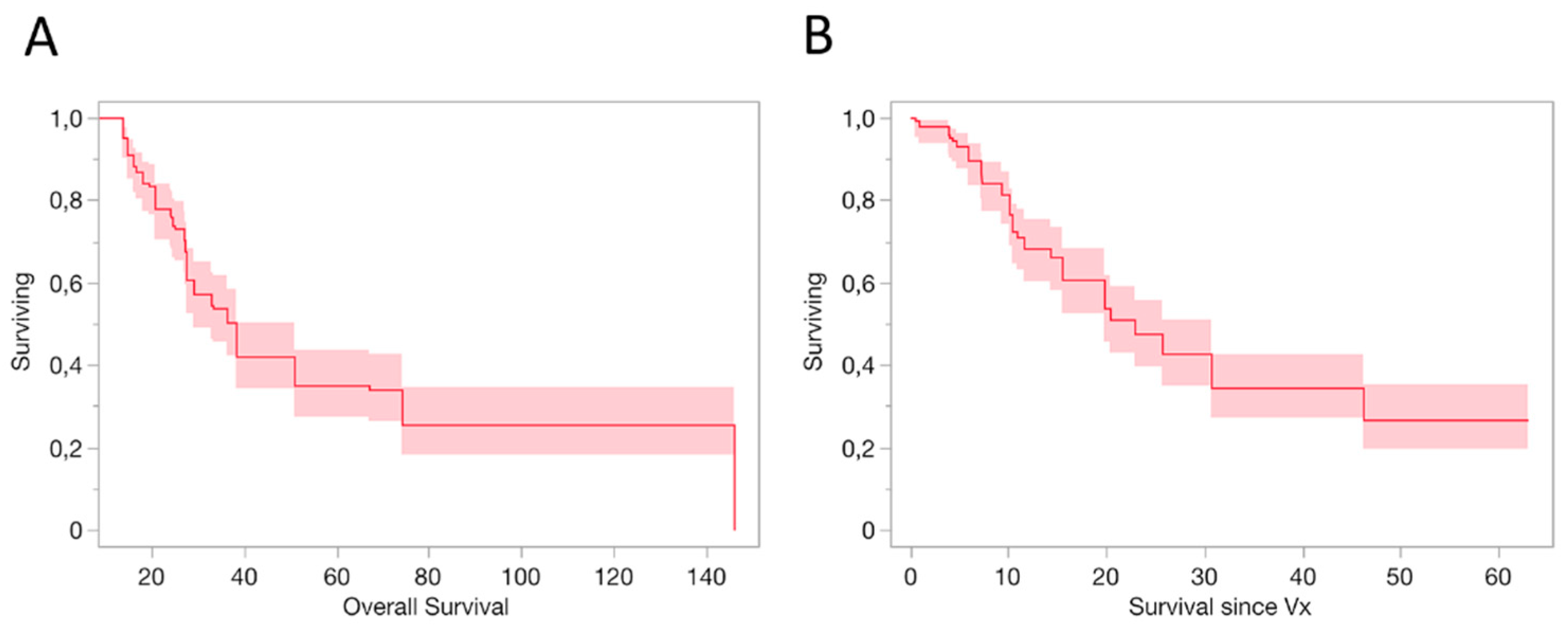
Figure 2.
Machine learning classifier based on logistic regression for the categorical variables MEEM, ECOG, KPS, and RANO. In A, dispersion plots of all measurements of MEEM during follow-up; in B, the applied linear regression model: blue lines represent the model itself; whole model test (ChiSquare): -LogLikelihood 2.74; p<0.05. In C, dispersion plot for ECOG assessments; in D, logistic regression classifier; whole model test –LogLikelihood = 0.29; p = 0.4411. In E, dispersion plot for KPS; in F, logistic regression classifier: whole model test: -LogLikelihood = 0.19; p=0.5327. In G, ”violin” area plot for RANO categories during follow-up (on Y-axis, 0= complete response, 1 = partial response, 2= stable disease, 3 = progressing disease); the violin areas are weighted according to the frequency of observations. In H, linear regression model to predict the probability of a given RANO category; whole model test –LogLikelihood = 23.66; p<0.0001.
Figure 2.
Machine learning classifier based on logistic regression for the categorical variables MEEM, ECOG, KPS, and RANO. In A, dispersion plots of all measurements of MEEM during follow-up; in B, the applied linear regression model: blue lines represent the model itself; whole model test (ChiSquare): -LogLikelihood 2.74; p<0.05. In C, dispersion plot for ECOG assessments; in D, logistic regression classifier; whole model test –LogLikelihood = 0.29; p = 0.4411. In E, dispersion plot for KPS; in F, logistic regression classifier: whole model test: -LogLikelihood = 0.19; p=0.5327. In G, ”violin” area plot for RANO categories during follow-up (on Y-axis, 0= complete response, 1 = partial response, 2= stable disease, 3 = progressing disease); the violin areas are weighted according to the frequency of observations. In H, linear regression model to predict the probability of a given RANO category; whole model test –LogLikelihood = 23.66; p<0.0001.
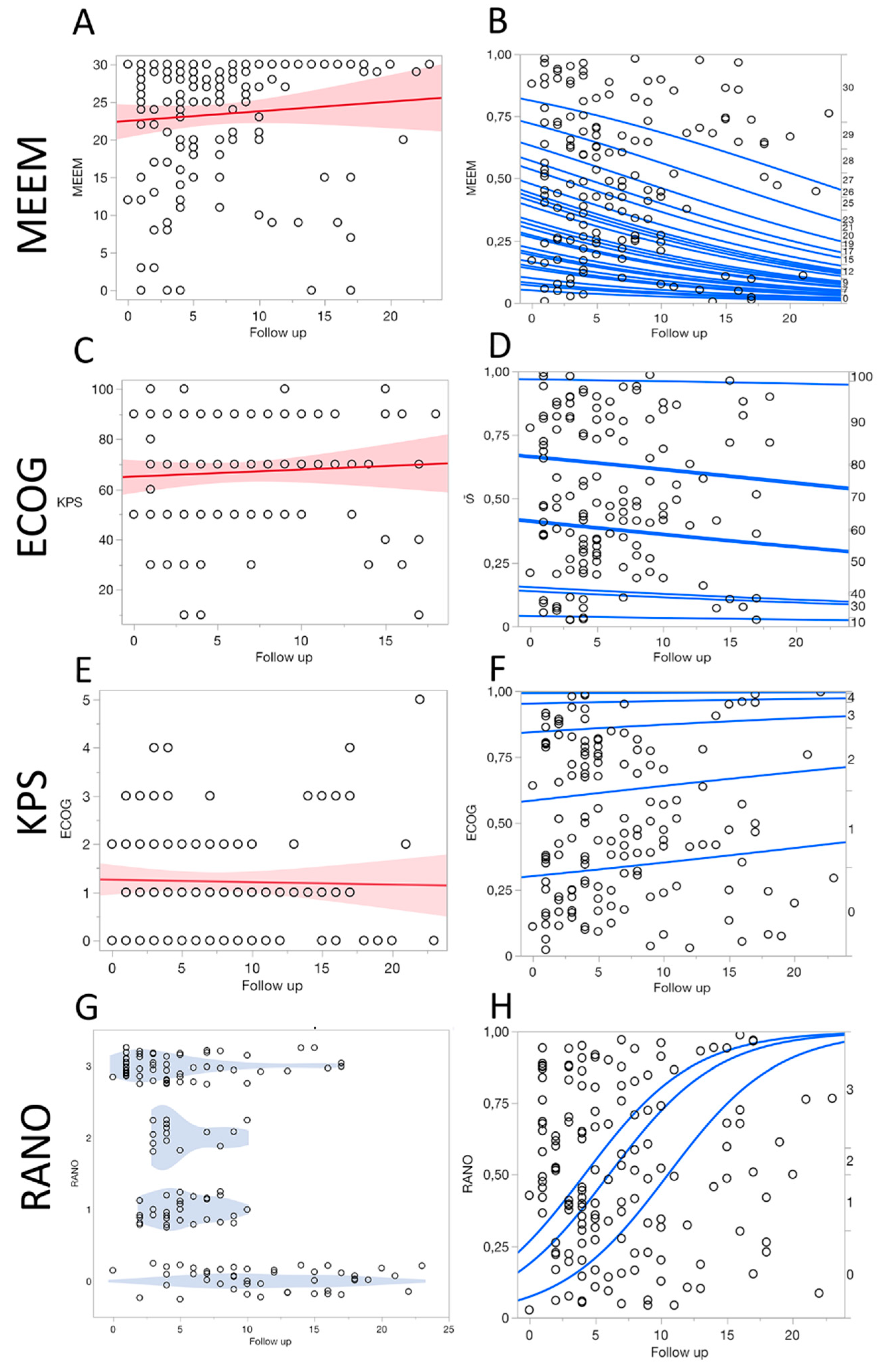
Figure 3.
Linear modelling to predict evolution of the quality of life scales during follow-up. A to F, EORTC-C30 major components. In general, we observed statistically significant improvement in all sub-categories. More specifically, in A, general health (ANOVA F ratio 12.86, p<0.001); in B, physical capacity (ANOVA F ratio 3.86, p<0.05), in C, functional capacity (ANOVA F ratio 4.54, p<0.05); in D, emotional capacity (ANOVA F ratio 5.09, p<0.05); in E, cognitive capacity (ANOVA F ratio 5.84, p<0.05); in F, social capacity (ANOVA F ratio 4.03, p<0.05). From G to L, FACT-Br assessment, which showed general stability, with a slight decrease in the reported physical and emotional well being scores and improvement in functional well being. Specifically, in G, physical well being (F ratio 3.89, p<0.05); in H, social well being (ANOVA F ratio 0.82, p=0.8731); In I, emotional well being (ANOVA F ratio 7.59, p<0.01). In J, functional well being (ANOVA F ratio 5.39, p<0.05). In K, additional worries (ANOVA F ratio 0.15, p=0.7013); In L, total FACT score (ANOVA F ratio 0.05, p=0.8132). M and N, MDASI scores, in which a numeric reduction is associated with improvement. Competence 1 refers to symptom severity (the higher, the worse), and competence 2 refers to symptom interference with social and work activities (the higher, the worse). For both categories, an overall improvement in quality of life was observed. In M, competence 1 (ANOVA F ratio 4.38, p<0.05); In N, competence 2 (ANOVA F ratio 2.09, p=0.1500). In O, EQ-5D-3L assessment, which showed stability over time (ANOVA F ratio 1.2410, p=0.2673). In P, self-evaluation, which showed a drastic improvement in patients’ definition of their own health status (ANOVA F ratio 8.35, p<0.01).
Figure 3.
Linear modelling to predict evolution of the quality of life scales during follow-up. A to F, EORTC-C30 major components. In general, we observed statistically significant improvement in all sub-categories. More specifically, in A, general health (ANOVA F ratio 12.86, p<0.001); in B, physical capacity (ANOVA F ratio 3.86, p<0.05), in C, functional capacity (ANOVA F ratio 4.54, p<0.05); in D, emotional capacity (ANOVA F ratio 5.09, p<0.05); in E, cognitive capacity (ANOVA F ratio 5.84, p<0.05); in F, social capacity (ANOVA F ratio 4.03, p<0.05). From G to L, FACT-Br assessment, which showed general stability, with a slight decrease in the reported physical and emotional well being scores and improvement in functional well being. Specifically, in G, physical well being (F ratio 3.89, p<0.05); in H, social well being (ANOVA F ratio 0.82, p=0.8731); In I, emotional well being (ANOVA F ratio 7.59, p<0.01). In J, functional well being (ANOVA F ratio 5.39, p<0.05). In K, additional worries (ANOVA F ratio 0.15, p=0.7013); In L, total FACT score (ANOVA F ratio 0.05, p=0.8132). M and N, MDASI scores, in which a numeric reduction is associated with improvement. Competence 1 refers to symptom severity (the higher, the worse), and competence 2 refers to symptom interference with social and work activities (the higher, the worse). For both categories, an overall improvement in quality of life was observed. In M, competence 1 (ANOVA F ratio 4.38, p<0.05); In N, competence 2 (ANOVA F ratio 2.09, p=0.1500). In O, EQ-5D-3L assessment, which showed stability over time (ANOVA F ratio 1.2410, p=0.2673). In P, self-evaluation, which showed a drastic improvement in patients’ definition of their own health status (ANOVA F ratio 8.35, p<0.01).
Disclaimer/Publisher’s Note: The statements, opinions and data contained in all publications are solely those of the individual author(s) and contributor(s) and not of MDPI and/or the editor(s). MDPI and/or the editor(s) disclaim responsibility for any injury to people or property resulting from any ideas, methods, instructions or products referred to in the content. |
© 2025 by the authors. Licensee MDPI, Basel, Switzerland. This article is an open access article distributed under the terms and conditions of the Creative Commons Attribution (CC BY) license (http://creativecommons.org/licenses/by/4.0/).
Copyright: This open access article is published under a Creative Commons CC BY 4.0 license, which permit the free download, distribution, and reuse, provided that the author and preprint are cited in any reuse.


