

Submitted:
16 July 2025
Posted:
17 July 2025
You are already at the latest version
Abstract
Escalating extreme wildfires, fueled by the confluence of climate change, land use patterns alterations, and flammable fuels accumulation, pose significant and increasingly destructive risks to Critical Infrastructure (CI). This study presents a comprehensive comparative analysis of wildfires impacts, and the corresponding CI resilience strategies employed across the EU and the US. It examines the vulnerability of CIs to the devastating effects of wildfires and their inadvertently contribution to wildfire ignition and spread. The study evaluates EU's CER Directive and US National Infrastructure Protection Plan and assesses European Commission wildfire resilience related initiatives including FIRELOGUE, FIRE-RES, SILVANUS, and TREEADS flagship projects. It synthesizes empirical evidence and extracts key lessons learned from major wildfire events in the EU (2017 Portuguese fires; 2018 Mati wildfire) and the US (2023 Lahaina disaster; 2025 Los Angeles fires), drawing insights regarding the effectiveness of various resilience measures and identifying areas for improvement. Persistent challenges impeding effective wildfire resilience are identified, including governance fragmentation, lack of standardization in risk assessment and mitigation protocols, and insufficient integration of scientific knowledge and data into policy formulation and implementation. It concludes with actionable recommendations aimed at fostering science-based, multi-stakeholder approaches to strengthen wildfire resilience at both policy and operational levels.
Keywords:
wildfires
; critical infrastructure
; climate change
; resilience
; CER directive
; policy recommendations
1. Introduction
Wildfires are an escalating threat, especially in Mediterranean regions, which account for over 80% of the EU’s burned area [1]. Historically, fire was part of landscape management [2,3], but trends like rural abandonment, climate-driven droughts, and increased fuel loads have intensified fire events, threatening critical infrastructure (CI) and ecosystems [4,5,6]. In the US, burned areas and fire frequency vary regionally, with Alaska showing the largest burned areas and the Eastern states recording the highest number of incidents [7].
CI systems such as energy, water, telecom, health, finance, and transport are vital to society but increasingly vulnerable to wildfire disruptions [8]. Failures in these systems can produce widespread consequences, affecting public safety, economic activity, and emergency response [9]. Rising hybrid threats and climate impacts further underscore the need for robust infrastructure resilience [10,11].
The Dual Role of Critical Infrastructure in Wildfire Risk: CIs are increasingly exposed to wildfires due to their location in fire-prone areas and shifting fire regimes [12,13]. Wildfires can physically damage assets—power lines, bridges, roads—and disrupt essential services, with cascading impacts on public safety, economy, and emergency response, particularly in remote regions [14,15]. This relationship is dual: infrastructure is both at risk from wildfires and can also ignite them. Failures, malfunctions, weather impacts, or intentional acts can trigger fires [16,17,18]. In the EU, the Critical Entities Resilience (CER) Directive 2022/2557 [19] replaces the previous Council Directive 2008/114/EC with the aim to strengthen the CI resilience from both natural and human-caused disruptions, including wildfire.
Policy and Governance Responses: Both the EU and the US have developed frameworks to address wildfire-related risks to CI. The EU’s CER Directive [19] strengthens resilience at the entity level. The US uses the National Infrastructure Protection Plan (NIPP) and sector-specific policies under Presidential Policy Directive 21 [20]. Extreme wildfire events, marked by pyro-convective behavior and high fireline intensity (>10,000 kW/m) and spread rates (>50 m/min), exceed local control capacities and demand coordinated, cross-border responses [21]. Effective governance integrates advanced modeling, early warning systems, real-time monitoring, and regional cooperation.
Research Initiatives and Innovation Programs: To address these challenges, the European Commission has recently launched various research and innovation initiatives like FirEUrisk, FIRELOGUE, FIRE-RES, TREEADS and SILVANUS. These research projects aim to foster multidisciplinary collaboration and develop tools, methodologies, and policy recommendations to address and mitigate wildfire risk, as well as to enhance CI resilience, especially in the wildland-urban interface and reduce the wildfire triggering factors associated with CIs.
2. Materials and Methods
This study explores the dual role of Critical Infrastructure (CI) in wildfires—as both ignition sources and vulnerable assets. It examines wildfire risk mitigation efforts in the EU and compares them to those in the US.
This research follows a three-part analytical framework which is also schematically depicted in Figure 1:
- “As-Is” Policy Review: Analyzes wildfire-related CI policies in the EU and US—such as the CER Directive [19], the Union Civil Protection Mechanism (UCPM), and the National Infrastructure Protection Plan (NIPP)—to assess strengths and gaps in addressing wildfire risks;
- Comparative Analysis: Benchmarks institutional structures, governance, funding, and resilience strategies across both regions to identify best practices and areas for improvement;
- Case Study Synthesis: Reviews major wildfire events—including the 2018 Camp Fire, Portugal 2017, and Greece 2018—to derive insights on wildfire causes, impacts on CI, response effectiveness, and lessons learned.
The research uses a data-driven, multi-source methodology. Sources include scientific literature, national/international policy documents, project reports, and post-fire event data. In the framework of FIRELOGUE project, it also incorporates insights from stakeholder workshops in Solsona (Spain) and Nea Makri (Greece), involving emergency responders, CI operators, planners, researchers, and WUI residents. These workshops utilized cross-sectoral dialogue formats to foster collaboration and understanding among a diverse range of the aforementioned stakeholders. The workshops were structured around four key thematic strands: socioeconomic factors, climate policy (both mitigation and adaptation), technology, and earth observation. These themes guided discussions within and across the working groups, ensuring that parallel processes were maintained while also promoting cross-group exchange of ideas and perspectives. The primary objective of these workshops was to identify synergies and conflicts related to Wildfire Risk Management (WFRM) and Critical Infrastructures, using a gradual, structured dialogue format to explore these dynamics and foster more integrated and effective risk management strategies. This experiential input enriches the analysis of wildfire–CI dynamics and resilience needs. This approach blends real-world evidence with innovative initiatives aimed at strengthening CI resilience. The goal is to propose science-based, collaborative policy pathways that reduce wildfire risks and enhance infrastructure resilience at all levels.
3. Wildfire and Critical Infrastructures – Trends and Risks
3.1. Drivers of Wildfire Ignition and Spread
Wildfire ignition and spread are influenced by a mix of environmental factors, fuel characteristics, weather, topography, and human activities. Fine dead fuels, particularly in herbaceous areas, are highly susceptible to ignition due to their high surface area to volume ration [22,23,24]. Weather conditions such as droughts, high temperatures, and low humidity decrease fuel moisture, increasing ignition risk [25], while strong winds promote fire spread. South-facing slopes, with lower moisture, also increase fire risk.
Human activities, including unattended campfires, discarded smoking materials, and agricultural practices, are major ignition sources [26,27]. Proximity to roads, power lines, and railroads increases ignition likelihood [28]. The growth of the Wildland-Urban Interface (WUI) has led to more fire incidents and larger burned areas (Bar-Massada et al., 2023; Tang et al., 2024) [29,30].
Climate change worsens ignition and spread by altering weather patterns and fuel conditions [31]. Prolonged droughts and extreme weather events extend fire seasons. Advances in spatiotemporal modeling, considering local winds, solar radiation, and fuel connectivity, improve prediction accuracy and risk management [32,33]. Moisture content is crucial in both ignition and fire spread, with higher moisture slowing the spread [34,35,36]. Wind speed and direction are key in fire dynamics, influencing intensity and spread by supplying oxygen and transporting embers [37]. Wind can also cause fire channeling and vorticity-driven spread [38,39,40]. Atmospheric instability can exacerbate fire behavior during extreme weather events [41,42,43,44]. Slope steepness accelerates fire movement due to changes in fluid dynamics around flames [45]. Fuel type and arrangement significantly impact fire behavior. Fine fuels like dried leaves are key during ignition, while overall fuel load determines fire intensity and spread [46]. Vegetation composition affects fire hazard; mixed forests behave differently than monoculture coniferous stands [47].
Ignition sources, both natural and human-made, are critical, with small ignition points like power line sparks or heat from machinery often causing wildfires [48]. Firebrands, especially in the WUI, can ignite structures ahead of the main fire [49,50], underlining the importance of understanding ignition processes and ember spread dynamics in fire management.
3.2. Global and European Trends in Wildfire Ignitions and Exposure
Global wildfire activity has surged in both frequency and severity, especially in WUI areas. The proportion of fires occurring in the WUI rose by 23% between 2005 and 2020, highlighting the growing threat to communities and infrastructure [51,52]. Recent catastrophic wildfires, such as those in Los Angeles (2017, 2018, 2025), Attica (2018), Australia (2019-2020), and more recently in Greece and Canada (2023), have underscored the devastating impacts on lives, property, and ecosystems [6,51]. Key events include the Black Saturday bushfires (2009) in Australia, the Fort McMurray wildfire (2016) in Canada, the Pedrógão Grande wildfire (2017) in Portugal, and the Camp Fire (2018) in the United States [6,51].
Warmer, drier conditions are extending fire seasons, with climate change exacerbating these trends through intensified heat waves and water shortages [53,54,55,56]. This convergence of factors accelerates fire spread and increases fire intensity, resulting in more destructive fires. Fuel accumulation in fire-prone areas is driving extreme wildfires, marked by rapid spread, high intensity, toxic smoke, and long-distance ember emissions. In the Mediterranean, rural depopulation and land abandonment have disrupted complex mosaic landscapes, which previously acted as firebreaks [57]. Today, areas once dominated by discontinuous patterns and low fuel loads are increasingly covered by dense, unmanaged forests [58]. Fire exclusion policies have led to more accumulated fuel, increasing the risk of large, high-intensity fires [59]. As conditions worsen, firefighter responses become overwhelmed, exacerbating the so-called “fire paradox” [60].
In the EU, Mediterranean countries—Portugal, Spain, Italy, and Greece—account for nearly 80% of total burned areas, with around 39,000 fires consuming approximately 340,000 hectares annually [61]. The 2022 wildfire season, marked by extreme weather anomalies, saw significant activity in southern Europe, particularly in the Iberian Peninsula [62]. Large fire data from the European Forest Fire Information System (EFFIS) for 2000–2024 shows that regions in Central and Northern Portugal, as well as Galicia in Spain, together account for about one-third of the total burned area. The most fire-prone 25% of the EU accounts for over 90% of burned areas, while less fire-prone regions (50% of the EU) contribute to less than 2%. Over the same period, the largest 0.3% of fires caused 25% of the total burned area, with the worst season in 2017 burning 10% of the total area.
3.3. Fire Behavior in Wildland-Urban Interface (WUI) Areas
Fire regimes in WUI areas present unique challenges for management [64,65]. Despite suppression efforts, full suppression policies remain common in fire-prone regions such as the western US, northern Australia, and southern Europe [64]. The presence of Critical Infrastructure (CI) often limits the use of controlled burns due to the high vulnerability to wildfires and significant potential losses [65].
While initial firefighting efforts are effective in early stages, catastrophic fires can rapidly spread, causing significant damage. The frequency of such events is expected to increase due to short rainy seasons and prolonged droughts, which enhance the availability of dry vegetation [66]. Wildfires have become more frequent and widespread, particularly in WUI areas [29,67]. The WUI represents a critical zone where human habitation intersects with wildland vegetation, posing distinct challenges for fire management. The rising prevalence of WUI fires is linked to urban expansion into wildland areas, human activities, and the vulnerabilities of structures in these zones [68,69,70,71].
WUI areas are typically divided into two types: the intermixed WUI, where communities extend into forested ecosystems, and the boundary WUI, where developed areas are situated at the vegetation transition. The intermixed WUI presents a complex fuel matrix, facilitating rapid fire spread, while the boundary WUI creates a distinct boundary between built and natural environments, presenting unique management challenges [68,72]. These areas are particularly vulnerable to wildfires, with a large proportion of fires being human-caused. For instance, over 90% of wildfires in Mediterranean Europe are attributed to human activities, underscoring the need for effective fire risk management [73]. The WUI is defined by a housing density of at least one structure per 40 acres (16 ha) or 6.17 housing units/km², combined with vegetation cover exceeding 50%, both of which contribute to rapid fire spread [67,68,74,75,76].
3.3.1. Fuel Management Strategies in WUI Zones
Complementing CI-focused strategies, WUI zones demand robust fuel management and building code enforcement to minimize structure exposure and fire spread. Recent studies from Mediterranean landscapes demonstrate the effectiveness of GIS-based Multicriteria Decision Analysis (MCDA) combined with stochastic fire simulation tools like Minimum Travel Time (MTT) for optimizing fuel treatment allocations [77,78].
In Greece, for example, the designation of Fuel Treatment Grids (FTGs) has enabled local forest services to prioritize high-risk areas based on ecological suitability, economic feasibility, and proximity to populated zones. Treatments have been most effective in coniferous forests and Mediterranean maquis, which exhibit high fuel continuity and combustibility. Local constraints such as steep topography, land tenure fragmentation, and road accessibility were integrated into the decision-making process, as illustrated by the “AntiNERO” national prevention program, which allocated €1.4 million for proactive interventions in the Kassandra Peninsula. However, field implementation revealed logistical and administrative limitations: high-priority treatments alone could require up to 50 years and €35 million using current mechanical methods, underscoring the need for cost-effective alternatives such as prescribed burning and adaptive silviculture [77,78].
3.3.2. Building Code Enforcement in WUI Areas
In tandem, building codes must enforce resilient design features to improve structural survivability in WUI areas [79]. Recommended measures by Fire-Res [80] include the installation of double-glazed windows, aluminum shutters, and the use of non-combustible materials for gutters and roof overhangs. Regular maintenance and the exclusion of flammable materials within defensible space zones are critical. Vegetation management protocols should incorporate guidelines for spacing between trees and shrubs, consider species-specific combustibility and height, and reflect topographic variations, as fire behavior differs significantly between upslope and downslope conditions. Monitoring foliar moisture content can further refine risk assessments and inform adaptive strategies.
Cost-efficient fuel treatment networks in rural WUI areas must be co-designed with stakeholders to align protection priorities with economic constraints. This necessitates the use of performance metrics, trade-off models, and participatory planning frameworks. Importantly, successful implementation requires localized contextualization, cross-sectoral governance, and integration with the broader stages of the Integrated Fire Management (IFM) value chain, particularly in planning and prevention.
3.4. The relationship between Critical Infrastructures and Wildfires
3.4.1. Critical Infrastructure (CI) and Wildfire Ignition Risks
The proximity of Critical Infrastructure (CI) to forested and protected areas, along with the mobility of people and goods in rural and remote regions, increases the likelihood of CI causing or facilitating wildfire ignition [28,81,82,83]. Infrastructure such as power lines, utility substations, roads, and railways are particularly vulnerable to causing wildfires, either accidentally or intentionally.
The most common ignition sources from CI are power lines, which can spark wildfires through three primary faults: electric arcs, structural failures, and external objects falling onto lines [13,84,85]. Electric arcs occur when electrical discharges bridge air gaps, often due to high voltage or strong winds causing conductors to sway. These arcs can ignite vegetation without direct contact. Structural failures, such as cable tearings or pole breakage, can lead to live wires touching the ground or flammable materials, often exacerbated by aging infrastructure or extreme weather [13]. External objects like trees or branches falling on power lines can create unintended conductive paths that spark or overheat, igniting nearby vegetation [86]. Proactive vegetation management around power lines is critical to mitigate this risk.
To reduce wildfire risks, effective mitigation strategies include regular inspection, advanced fault detection systems, and vegetation management, especially in high-fire-risk areas. This is essential to protect communities and ecosystems from catastrophic fires.
3.4.2. Impacts of Wildfires on Critical Infrastructures and Society
Wildfires present direct and indirect risks to physical infrastructure and may trigger cascading effects, impacting systems like telecommunications, power, and water supply. Protecting both physical and digital infrastructure from wildfire impacts is crucial. Strategies include using stronger poles, reducing spans between poles, and covering power lines where possible. Increasing the connectivity of networks and grids can reduce the impact of wildfires, providing system redundancies. While wildfires may damage electricity systems, they can also lead to cascading failures in drought-prone regions, where fire from electrical faults may not be contained swiftly. The loss of power supply can affect telecommunication networks, transport systems, and critical infrastructure, increasing risks to communities during both the event and recovery phases [87].
The economic and social impacts of wildfires on CI depend on the size, duration, and resilience of the systems involved. Fast resource deployment, stakeholder communication, and early warning systems can reduce the effects of climate-induced events [88]. Fire prevention is often seen as risky by resource managers, but it can reduce suppression costs by 88% and overall spending by 55%, showing that investment in prevention can offset rising suppression costs [88].
Energy, transport, and telecommunication infrastructures are highly vulnerable to wildfires. Economic losses include property damage, income loss, and increased costs for insurance companies and energy utilities, ultimately affecting consumers [89-91]. Power system disruptions are particularly costly, especially for vulnerable groups who depend on electricity-dependent medical equipment [92]. Wildfires also disrupt supply chains, affecting businesses and industries.
Wildfires can harm public health by damaging power lines and substations, which impacts drinking water, wastewater systems, and food supply chains. Disruptions to medical equipment and medication transport also occur. Real-time data systems are needed to coordinate evacuations and health responses [93]. Without proper planning, power outages during wildfires threaten comm[89–91unity safety and well-being.
Therefore, reinforcing and protecting CIs grid (digital and physical assets) from the impacts of wildfires becomes pivotal. Potential approaches focus on stronger poles and system components, reduction of spans between poles, and covering lines when available. Investing in more expensive upgrades to the power system provides protection against service disruption (e.g. by reinforcing hospitals, communication centers and fuel terminals). These measures may include adoption of enhanced powerline safety settings (known as fast trip), undergrounding distribution lines, and creating more remote grids where other alternatives are not feasible.
3.4.3. Vegetation Management and Critical Infrastructure
Critical infrastructure plays a key role in wildfire risk reduction, particularly in implementing fuel treatments to minimize fire ignitions [94,95]. Treating vegetation near infrastructure, such as power lines and railways, poses challenges, including safe access for crews, operational restrictions, and coordination with infrastructure operators to avoid disrupting services. Environmental considerations and regulatory compliance also add complexity. Effective public and stakeholder engagement, along with adequate funding, are necessary for long-term maintenance and success. Advanced technologies, like remote sensing for fire ignition, can improve efficiency but require significant investment. Optimizing vegetation management near CI—such as electrical grids, roads, and rail systems—is crucial for reducing wildfire risk. Determining Acceptable Safety Distances (ASDs) for vegetation clearance depends on factors like vegetation type, climate, and infrastructure requirements. These distances are dynamically calculated using a multiplier system to account for fuel load and combustibility, supporting scalable vegetation management across European regions.
Operationally, a zonal prioritization methodology incorporating historical ignition density, fire spread modeling (Rate of Spread—ROS), and topographic hazard overlays has been applied to delineate intervention buffers along linear infrastructure. High-priority zones typically include substation vicinities, WUI transition corridors, and rail-adjacent unmanaged woodlands. Targeted mitigation actions within these zones include mechanical clearance, prescribed burning, non-flammable ground cover applications, and protective infrastructure coatings. Maintenance protocols such as UAV-based ASD monitoring, seasonal inspections, and preemptive shutdown strategies are recommended, supported by legal instruments for liability and cross-sector coordination.
3.4.4. Critical Infrastructure as Firebreaks
Critical infrastructures like roads and utility corridors can also serve as effective firebreaks, hindering wildfire spread. Major highways, due to their width and maintained surfaces, can prevent fire progression [96]. Even smaller, well-maintained forest roads can delay fire spread and provide access for firefighting teams [97]. Infrastructure in or near forested areas can support suppression efforts by reducing fuel loads when properly maintained [98]. Personnel working in these areas can also act as first responders, aiding early fire control [99,100]. This coordinated approach boosts the effectiveness of wildfire management.
4. The EU and the US Management Pathways: An Outlook and Comparative Analysis
4.1. EU Critical Infrastructure and Resilience
Challenges of Disasters on Critical Infrastructure (CI): Disasters pose significant challenges to the functioning of vital CI systems, with natural and human-made threats leading to substantial loss of life and property damage [95]. These challenges are compounded by escalating risks, exacerbating societal consequences, creating new vulnerabilities, and increasing social inequalities. The evolving nature of these risks affects nations on an unprecedented global scale, making the multi-hazard framework for CI increasingly systemic [101].
The European Union (EU) has long recognized the importance of CI across Europe. This recognition led to the establishment of the European Programme for Critical Infrastructure Protection (EPCIP) in 2006, followed by the Directive on the identification and designation of European Critical Infrastructures [102], which has since been repealed and replaced by the CER Directive [19] focusing on CI resilience. The NIS2 Directive [103], which repeals the 2016 NIS Directive (2016/1148), expands cybersecurity requirements for essential services, emphasizing the need for cross-border cooperation to enforce national resilience strategies.
The CER Directive mandates that EU Member States ensure the resilience of critical entities by taking necessary steps to maintain essential services without interruption. This framework encompasses all potential risks, including natural disasters, public health emergencies, hybrid threats, and even terrorism [19].
Expanding Scope of Critical Infrastructure: Unlike the earlier ECI Directive [102], which focused on energy and transport sectors, the CER Directive expands the scope to cover 11 sectors, including health, drinking water, wastewater, banking, financial services, digital infrastructure, public administration, space, and food production [19]. The identification of critical entities, defined by their ability to provide essential services, is a key obligation under this Directive. These entities must be classified based on criteria that assess potential cross-sectoral or cross-border disruptions.
Defining Resilience in CI: The CER Directive defines resilience as “a critical entity’s ability to prevent, respond to, resist, mitigate, absorb, accommodate, and recover from incidents” [19]. Globally, various definitions exist for resilience of CIs exist [9,20,101,104,105,106,107,108,109]. For instance, the UNDP defines CI resilience as “the ability to anticipate, withstand, and recover from shocks, adapting to new conditions for better future coping with both chronic stresses and acute shocks” [101]. The CER Directive emphasizes a comprehensive approach, requiring entities to adopt technical, security, and organizational measures that align with the risks they face, ensuring effective incident response and continuity of essential services. The CIP ecosystem is evolving rapidly in response to emerging threats and technological advancements. Key trends include:
- Convergence of Physical and Cybersecurity: The integration of physical and cyber systems is driving a more holistic approach to CI protection;
- Use of Advanced Technologies: The adoption of technologies like artificial intelligence, machine learning, IoT, and blockchain is enhancing threat detection, early warnings, and rapid responses;
- Increased Collaboration: There is a growing trend of public-private collaboration and knowledge sharing to strengthen CI resilience;
- Focus on Resilience: There is an increasing focus on not just protecting CI but also ensuring that it can recover quickly and maintain functionality during disruptions;
- Regulatory Compliance: The development of standards and regulations is becoming more important to ensure a harmonized approach to CI resilience across sectors and countries;
- Increased Awareness and Education: Efforts are being made to raise awareness among the general public and stakeholders about the importance of CI and its resilience.
4.2. Wildfire Management Pathways in Europe
In the EU, wildfire and land management fall under shared competences of the Union and Member States (Treaty on the Functioning of the EU, Articles 191 and 192), with national authorities holding primary operational responsibility. No binding EU legislation directly governs wildfire protection, but several frameworks support prevention, preparedness, and response. The European Forest Fire Information System (EFFIS) was launched in 1998 and later integrated into the Copernicus Emergency Management Service. EFFIS now brings together 43 countries to collect and forecast fire data [110].
- 7.
- The EU Biodiversity Strategy for 2030 [111] identifies forest fires as major climate-related threats. It mandates strict protection of high-value forests, restoration of degraded ecosystems, and integration of fire risk into forest management plans. Complementing this, the EU Forest Strategy for 2030 [112] sets actions for sustainable forest management, including fuel control, fire-resilient species, and silvicultural adaptation.
- 8.
- The Union Civil Protection Mechanism (UCPM), established by Decision No. 1313/2013/EU [113] and strengthened by Regulation (EU) 2021/836 [114], serves as the main EU framework for mobilizing firefighting assets across borders. National efforts are supported by rescEU, coordinated through the Emergency Response Coordination Centre (ERCC). Early warnings are generated via EFFIS and Copernicus Emergency Management Service, which provide daily forecasts, satellite fire mapping, and situational awareness.
- 9.
- Wildfire risk management in the EU begins with prevention, using fire behavior models, historical data, vegetation and climate mapping, and infrastructure risk analysis [1,11]]. Preparedness includes strategic prepositioning of resources and deployment of early warning systems integrating meteorological and satellite data (Di Giuseppe et al., 2020; Rodrigues et al., 2019; 2020) [100,116,11]]. In 2023, the Wildfire Peer Review Assessment Framework (PRAF) was introduced under UCPM. It enables voluntary self-assessments and peer reviews of national wildfire governance across seven dimensions, including prevention, response, and recovery [118,12]]. Recovery efforts, guided by UCPM protocols, include rapid damage assessments, restoration of electricity, transport, and communications infrastructure, and ecological rehabilitation such as reforestation and erosion control. Long-term monitoring uses satellite and ground-based tools to inform adaptive wildfire management.
4.3. US Critical Infrastructures Policy and Wildfire Risk
Much like the EU’s CER [19] and NIS2 [103] Directives, the US has several federal policies which apply at the federal-level but have more nuanced applications at state and local levels, especially as implemented for individual sectors and in private-public collaborations. The National Infrastructure Protection Plan (NIPP), first established in 2006 and updated in 2009, covers 16 critical infrastructure sectors, integrating both physical and cybersecurity measures [122]. In contrast to the EU's broad coverage, the US takes a more industry-specific approach, reflecting the differences in policy and oversight between the two regions.
Presidential Directives and Executive Orders (EO) have emphasized resilience and the integration of planning to support collaborative, risk-based standards development [20,123,124]. Recently, [126] further focuses on wildfire response and mitigation, requiring the Federal Government to enhance its support for state and local leaders by streamlining federal wildfire capabilities. This order also encourages local, technology-enabled strategies for land management and the identification of policies that hinder wildfire prevention, detection, or response. Additional policies and EOs have addressed cybersecurity specifically as AI is rapidly integrating into government and private sector operations [126,127]. The energy sector has a cross-cutting function and enables the function of many other critical infrastructure sectors; thus, the protection of its reliability of both distribution and generation are a central focus of US policy [128].
The EU’s CER Directive [19] provides mandatory requirements for Member States where, in contrast, the approach set forward in US policy is primarily voluntary and paired with incentives. Due to the decentralized management of the different sectors, most have a public-private partnership that provides guidance and sets forward best practices and incentives but there is limited enforcement [93]. The US framework allows greater customization, flexibility, and for more adaptability driven by industry rather than top-down policy which may take longer time periods to initiate and enact.
4.4. Wildfire Management Pathways in the US
In the USA, wildfire risk is addressed through policies and procedures developed by state and local governments, public utility commissions, land management agencies, and electric utilities. The Wildfire Crisis Strategy [129] builds on the National Fire Plan and the National Cohesive Wildland Fire Management Strategy. It sets out a 10-year, multi-agency framework for fuel treatments and forest health efforts to reduce fire risks, using controlled burns, mechanical thinning, and community engagement.
High-risk landscapes—where ignitions may endanger homes, infrastructure, and essential services—were identified for prioritized treatment. The USDA Wildfire Crisis Strategy targets these areas to protect power lines, major roads, and drinking water sources from wildfire-related disruptions [129].
To strengthen wildfire governance, Congress established the Wildland Fire Mitigation and Management Commission through the 2021 Infrastructure Investment and Jobs Act (Pub. L. No. 117-58; § 40803, 135 Stat. 1097 (2021)). The Commission, composed of 50 members, produced policy recommendations covering all phases of wildfire risk—mitigation, response, and recovery. It advocated a proactive, multi-scalar approach to wildfire management, recognizing that no single cause or solution exists. Key recommendations include improved coordination, interoperability, and system simplification [130].
The U.S. Fire Administration (USFA), part of DHS/FEMA (Department of Homeland Security/Federal Emergency Management Agency), supports local outreach by providing educational materials—from GIS-based wildfire maps to training for fire-adapted communities [131,132,133]. The National Fire Protection Association (NFPA) has published WUI-specific codes and standards [134] aligned with the International Wildland-Urban Interface Code [135]. While federal codes exist, states and cities adopt and adapt them voluntarily through zoning and land-use regulations, promoting use of fire-resistant materials and vegetation buffers.
There is no central US agency responsible for electric utility infrastructure hardening. Instead, resilience efforts operate through public–private partnerships. The Federal Energy Regulatory Commission (FERC) plays a key role, overseeing standards set by the North American Electric Reliability Corporation (NERC). FERC also works with the Department of Energy, DHS, and the Cybersecurity and Infrastructure Security Agency (CISA) to address evolving threats.
Despite having one of the world’s most complex electrical grids [136], the US has taken limited systematic action to wildfire-proof its infrastructure [137]. However, adaptation is advancing. Utilities are implementing:
- Enhanced Powerline Safety Settings in high-risk areas;
- Removal of overhead assets when alternatives exist;
- Undergrounding distribution lines, though expensive ($2.6M–$6.1M per mile);
- Covered conductors and fire-resistant poles, which cost ~$480,000 per mile [138].
California utilities lead in wildfire hardening. Though undergrounding is part of their plans, most rely on more affordable methods such as covered conductors and replacing wood poles with steel [139].
The Firewise USA Program [140], administered by NFPA and supported by the US Forest Service and state agencies, helps neighborhoods increase ignition resistance. It promotes defensible space, fire-resistant construction, and community engagement. Programs are run by volunteers using local outreach and educational campaigns [141].
4.5. Comparative Analysis
Across both the EU and the US, wildfire strategies intersect with broader critical infrastructure resilience policies. However, their legal foundations, coordination mechanisms, funding models and approaches to land management, preparedness and infrastructure hardening differ markedly (Table 1).
4.6.1. Regulatory and Policy Frameworks
In the EU, resilience obligations for essential services are now outlined in the Critical Entities Resilience (CER) Directive, which requires Member States to transpose it into national law [19]. Wildfire management per se remains a competence of Member States and regions, with no binding EU-level regulation specifically to forest fire protection. The US framework is built on Presidential Policy Directive 21 [20], which mandates an all-hazards approach to critical-infrastructure security and resilience across sixteen designated sectors, and the National Infrastructure Protection Plan [122], which provides a common risk-management methodology and establishes clear federal, state, local and private-sector roles [20,122].
4.6.2. Coordination of Emergency Response
The EU’s Union Civil Protection Mechanism (UCPM), established by [113] and reinforced by [114], pools firefighting resources (rescEU) and delivers early warnings via EFFIS and the Copernicus Emergency Management Service. Deployment is coordinated through the Emergency Response Coordination Centre (ERCC) when national capacities are exceeded [19]. In the US, inter-agency coordination is structured around the National Interagency Fire Center (NIFC) and the Incident Command System (ICS), with FEMA, USFS and BLM contributing personnel and assets under unified command. [20] directs the Department of Homeland Security to integrate these efforts, while the NIPP promotes mutual-aid agreements and sector-specific councils to streamline resource sharing [20,122].
4.6.3. Funding and Incentive Mechanisms
EU wildfire prevention and response are financed principally at the national level, with limited earmarked EU funding: the UCPM’s rescEU pool is funded from the EU budget, and broader resilience research may be supported under Horizon Europe (Reg (EU) 2021/695) and the Internal Security Fund (Reg (EU) 2021/1149). The CER Directive does not establish a dedicated wildfire fund. In the US, Congress authorizes federal grants (e.g., FEMA’s Hazard Mitigation Grant Program and the USFS State Fire Assistance grants) and voluntary programs such as Firewise USA to incentivize community risk reduction. Utilities may cost-recover wildfire mitigation investments through state public-utility commissions under NIPP-aligned guidelines [20,122].
4.6.4. Land Management and Preparedness
EU land-use planning and fuel-management guidelines flow from the EU Forest Strategy for 2030 and national forest laws, but implementation rests with Member States. Preparedness leverages EFFIS fire-danger indices and satellite-based monitoring via Copernicus to trigger national and regional readiness measures [19]. In the US, roughly half of western landscapes are managed by federal agencies (USFS, BLM), which under the FLAME Act and National Fire Plan conduct mechanical thinning and prescribed burns. NIPP’s risk-management framework guides states and localities in mapping wildfire exposures and integrating them into broader emergency-management plans [20,122].
4.6.5. Infrastructure Hardening and Public–Private Partnerships
The CER Directive mandates that critical entities take resilience measures, perform risk assessments and face penalties for non-compliance, fostering stronger public–private cooperation in resilience planning [19]. The US model relies heavily on sector-specific partnerships under NIPP: Sector Coordinating Councils and Government Coordinating Councils bring together utilities, emergency services and regulators to agree on hardening standards—such as covered conductors, undergrounding lines or enhanced powerline settings—and to integrate cybersecurity and physical security under FERC-backed NERC CIP reliability standards [20,122].
5. Case Studies: Lessons from Extreme Wildfire Events
The following case studies illustrate the impact of wildfires on CI and the effectiveness of different resilience strategies:
California Wildfires (US): The 2017 and 2018 wildfires in California caused $13 billion in insured losses [142], leading to power outages, communication failures, and transportation disruptions. The 2017 fires were exacerbated by strong winds and power infrastructure failures [143], while the 2018 Camp Fire revealed weaknesses in aging transportation infrastructure [142]. These events highlight the need for fuel management, grid hardening, and infrastructure resilience to prevent cascading impacts.
2017 Pedrógão Grande Wildfire Complex (Portugal): On 17 June 2017, one of the most severe wildfire events in Portugal's history began when at least five separate fires merged in the central region, ultimately consuming more than 45,000 ha. The human toll was heavy: 66 people lost their lives, many while attempting to flee, over 250 were injured, and more than 1,000 structures, including 263 homes, were damaged or destroyed. Direct losses to housing and private property were estimated at around €200 million [7]. Critical infrastructure also suffered extensive damage. Municipal assets—such as local roads, public lighting, water distribution systems, and urban equipment—required approximately €21.7 million in repairs, while restoration of the national road network cost an additional €2.6 million, and mobilizing firefighting and emergency services added another €4.5 million (San-Miguel-Ayanz et al., 2020) [144]. The disaster disrupted roads, water supply, power, and telecommunications. In response, the Portuguese government launched a ten-year National Plan for Integrated Rural Fire Management (2020–2030), with two primary targets: to reduce the occurrence of large fires (over 500 ha) to less than 0.3% of all incidents, and to limit the total burned area to under 660,000 ha during the plan's duration. To coordinate implementation, in 2018 the Agência de Gestão Integrada de Fogos Rurais (AGIF) was created to promote integrated rural fire management through a territorial governance model involving both public institutions and local communities in protecting Portugal’s landscape and infrastructure.
2018 East Attica Wildfires (Greece): The 2018 Attica wildfires caused significant fatalities and property damage. In the morning of 23rd of July, a wildfire ignited in a dense forest of pines in the Western part of Attica. The fire damaged houses in the broader Kineta area, spotted over a six-lane highway and threatened an oil refinery located in the area. The same day, in the afternoon around 17:00 h local time, another wildfire ignited at the east of Attica, at the Penteli mountain. Due to the combination of extreme weather conditions (high temperatures, unusual strong Western winds), vegetation type and structure, and topography, the fire spread rapidly towards the East and South, moved towards the sea (Mati area) where it entered the WUI community of Mati (total fire duration of about 3 hours) [145]. This extreme wildfire event resulted to the death of 103 people, burned residential buildings, vehicles and vegetation. In the affected area of Rafina-Pikermi and Marathonas municipalities, 4,691 buildings were inspected and only 50% were characterized as usable. Specifically, in the Mati locality 23% of the inspected buildings have been categorized as “not to be used until repaired” and 28% as “dangerous/heavily damaged” [146]. The event highlighted the need for improved land-use planning, building codes, awareness issues, evacuation, and other emergency response capabilities.
2023 Evros Wildfires (Greece): The wildfire disaster that affected the Dadia-Lefkimi-Soufli Forest National Park in August 2023 represents one of the most extensive and destructive wildfire events ever recorded in Europe. The fire ignited on 19 August 2023 and remained active for over 15 days, ultimately burning approximately 93,880 hectares, with an estimated 71,000 hectares located within the boundaries of the protected forest park. The fire, fueled by extreme meteorological conditions—including multiple heatwaves, prolonged drought, and strong winds—was characterized by average flame lengths exceeding 40 meters and fireline intensities over 90,000 kW/m, making suppression efforts technically unfeasible at the peak of the event [147]. Ecologically, the wildfire devastated one of Europe’s most significant biodiversity hotspots, home to endangered avian species such as the Black Vulture (Aegypius monachus), Egyptian Vulture (Neophron percnopterus), and Griffon Vulture (Gyps fulvus). The destruction of breeding and feeding habitats is expected to have long-term implications for the viability of these species within the region. The societal impacts were also considerable. Multiple settlements in the municipality of Alexandroupolis were evacuated, and infrastructure damage was reported across several sectors. The extensive fire perimeter disrupted road access, affecting both local transportation and emergency logistics. Power outages occurred due to the destruction of electricity distribution lines and utility poles, impacting both residential zones and emergency coordination centers. Telecommunications were temporarily disabled in several localities, complicating evacuation efforts and the dissemination of warnings. Additionally, the fire resulted in degraded air quality across northeastern Greece and neighboring regions, exposing populations to elevated levels of particulate matter (PM2.5), with potential short- and long-term health effects. This burden was particularly acute for vulnerable groups such as the elderly, children, and individuals with respiratory conditions. This wildfire was declared the largest in the European Union since systematic records began under the European Forest Fire Information System (EFFIS) [147]. The scale and intensity of the event underscored the urgent need for enhanced wildfire risk governance, adaptive land management practices, and investment in climate-resilient infrastructure systems.
2023 Hawaii wildfires: The Lahaina wildfire of August 8–9, 2023, in Maui, Hawaii, stands among the most destructive wildfire events in recent USA history. Fueled by severe drought, hurricane-force downslope winds from Hurricane Dora, and highly combustible non-native grasses, the fire swept through Lahaina in less than 24 hours. It resulted in 100 fatalities, making it the deadliest US wildfire since 1918 [148]. More than 2,200 structures were destroyed, causing an estimated $5.5 billion in total damage, of which $3.4 billion were insured losses [149,150]. The wildfire had severe consequences for critical infrastructure. Power lines, likely both the ignition source and casualties of the fire, collapsed during the blaze, leading to prolonged outages across West Maui. Water distribution systems also failed: firefighting hydrants ran dry in several areas due to melted mains and depressurization [151]. The telecommunications network suffered significant damage, with fiber-optic cables and mobile towers destroyed, halting emergency alerts and severely impairing public communication. Notably, the state's emergency outdoor siren system, despite being functional, was not activated [152]. Evacuation attempts were severely obstructed by narrow streets, blocked roads, and fast-moving flames. Many residents were forced to abandon vehicles and escape on foot, with some entering the ocean to avoid the fire. In the aftermath, the Maui Fire Department issued a formal report listing 111 specific recommendations, citing deficiencies in equipment, coordination, and mutual-aid frameworks [153]. Social and health consequences have persisted. A statewide survey in early 2025 reported that over 40% of affected residents experienced worsening physical or mental health, with elevated levels of post-traumatic stress, anxiety, and food insecurity [154]. Cultural and historical losses were also substantial, including the destruction of the 1901 Pioneer Inn and the Lahaina Heritage Museum, both of which held deep significance to Native Hawaiian identity and local tourism.
2025 Los Angeles area, California, wildfires: In early January 2025, Southern California experienced two of the most devastating wildfire events in recent state history—the Palisades Fire in Pacific Palisades and the Eaton Fire in the Altadena-Pasadena corridor. Both fires ignited on January 7 amid extreme Santa Ana wind conditions, prolonged drought, and abnormally low humidity, which created ideal circumstances for rapid fire spread. The Palisades Fire burned approximately 23,448 acres (9,489 hectares), destroying 6,837 structures and damaging over 1,000 more. It caused 12 confirmed fatalities and at least four injuries, with forced evacuations affecting over 105,000 residents across multiple districts [155,156]. Simultaneously, the Eaton Fire consumed more than 14,000 acres, destroyed 9,418 structures, and resulted in 17 fatalities and nine injuries. It has been classified as California’s second-most destructive and fifth-deadliest wildfire on record [157]. The fires inflicted widespread damage on critical infrastructure. Electrical power systems suffered extensive outages as overhead lines collapsed or were shut down preemptively to reduce ignition risk. In several neighborhoods, these power cuts hindered both suppression and communication operations. Water infrastructure also failed in parts of the fire zone, where melted distribution lines and reduced pressure rendered fire hydrants non-operational at key moments during suppression efforts. Telecommunications networks, including mobile towers and fiber-optic cables, were compromised, leading to communication blackouts that disrupted evacuation notifications and real-time coordination [156]. Post-fire hazards further amplified the disaster’s impact. In the days following containment, heavy rainfall triggered debris flows and landslides in severely burned terrain, destroying additional structures and cutting off access roads. These cascading effects complicated the recovery process and delayed the reactivation of essential services such as water treatment and power restoration [155]. Shelter capacity also proved inadequate. Spatial disparities in access to emergency shelters left vulnerable populations in both urban and hillside communities underserved, highlighting inequities in preparedness infrastructure [156]. Economic losses from both fires were estimated at approximately $4.9 billion, with insurance claims mounting and reconstruction expected to take several years. Daily population exposure to fire conditions peaked at nearly 4,300 individuals in the Eaton Fire zone and over 3,900 in the Palisades perimeter [157].
All these extreme fire events collectively underscored the urgent need for systemic improvements in wildfire preparedness, including fuel management, infrastructure hardening, building codes, expansion of defensible space, early warning systems, and more equitable shelter and evacuation planning. They also reinforced the critical importance of integrating Earth observation data and climate forecasting into regional disaster risk reduction strategies.
6. Research and Innovation Projects addressing wildfires
The European Union is making a major effort to combat the growing threat of destructive wildfires in Europe with several important research projects focused on addressing important societal issues. Funded by the Horizon 2020 Green Deal call, these programs—which include FIRELOGUE, FIRE-RES, SILVANUS, and TREEADS—share the objective of reducing the risk of wildfires while enhancing community and landscape resilience. In addition to the Green Deal projects another EU flagship project FiREUrisk provided also insights and results relevant to the relations between critical entities and wildfires.
6.1. Wildfire Prevention and Response Innovation Projects
SILVANUS – Integrated Technological and Information Platform for Wildfire Management (Grant Agreement No. 101037247, CORDIS) revolutionizes wildfire management by adopting an Integrated Fire Management (IFM) approach, combining multi-source data, advanced risk assessment models, and stakeholder engagement strategies. Utilizing a diverse set of sensor networks, remote sensing data [158,159], IoT devices [160] and AI-driven analytics, SILVANUS enhances environmental monitoring to identify high-risk areas before fires ignite [161]. The platform integrates citizen-reported fire events via mobile applications and social media, fostering community participation and a collaborative approach to wildfire prevention. It provides decision-makers with comprehensive insights through a unified GIS-based platform, enabling proactive and data-driven fire prevention strategies. Additionally, SILVANUS advances wildfire response capabilities by integrating real-time fire detection through IoT-enabled sensors, UAVs/UGVs and advanced communication support [162], and edge computing, optimizing resource allocation, evacuation planning and health impact [163,164] through AI-based simulations and dynamic risk assessments.
Beyond immediate response, SILVANUS supports post-fire restoration and climate adaptation through long-term ecosystem monitoring and biodiversity protection. It enables automated tools for assessing fire impact, air quality degradation, and vegetation recovery, aiding in reforestation planning, soil rehabilitation, and adaptive land management. The platform also integrates ecological data into GIS layers [165], supporting sustainable landscape management strategies that mitigate future wildfire risks. Furthermore, it strengthens CI resilience by integrating early warning systems and real-time risk assessments, enabling proactive mitigation measures and minimizing service disruptions in wildfire-prone regions.
TREEADS – Intelligent Ecosystem for Fire Management (Grant Agreement No. 101036926, CORDIS): aimed at developing a comprehensive fire management ecosystem for the prevention, detection, and restoration of environmental disasters, particularly wildfires. By integrating state-of-the-art technologies and socio-technological resources, TREEADS focuses on optimizing strategies across the three critical phases of wildfire management: Prevention and Preparedness, Detection and Response, and Restoration and Adaptation. The project’s innovative solutions, such as real-time risk evaluation tools, low-altitude drones, and advanced decision support systems, are being tested and validated in eight complex pilot campaigns across diverse European and Taiwanese environments. These pilots, including those in Norway and Italy, address specific challenges such as protecting wooden infrastructure in the Wildland-Urban Interface (WUI) and ensuring the safety of critical transport systems in fire-prone areas.
To support the dissemination and exploitation of these solutions, TREEADS has developed the Knowledge Marketplace Repository (KMR), an open platform that serves as a resource center and promotional channel for wildfire management technologies, including a range of educational materials, such as online mini-courses, webinar recordings, and training programs, as well as standards and guidelines for wildfire management. Additionally, the project emphasizes the development of fire-resilient materials and passive fire protection strategies to enhance the resilience of critical infrastructure, ensuring continued functionality during and after wildfires.
FIRE-RES– Innovative Technologies and Socio-Ecological Strategies for Extreme Wildfire Events (Grant Agreement No. 101037419, CORDIS) aims to accelerate the socio-ecological transition of the European Union towards a fire-resilient continent, giving emphasis on Extreme Wildfire Events (EWE) [166]. At its basis, it demonstrates and implements 34 innovation actions that are evaluated in 11 different living labs. These innovations, centered on Integrated Fire Management, cover prevention, preparedness, detection, response, restoration, and adaptation efforts [167].
In order to transition to an Integrated Fire Management approach, FIRE-RES has taken on four important pillars: (a) Behaviour and drivers of extreme wildfires: this includes analysing the factors that allow extreme wildfires to occur and spread; (b) Optimizing emergency services: this focuses on evaluating and enhancing emergency services' responses to extreme wildfires; (c) Landscapes and economies of resilience: This comprehends the function of landscape management and its viability from an economic standpoint in incorporating resilience measures for communities and areas that are prone to fires; (d) comprehend the role that governance and social action play during intense wildfire events.
FirEUrisk – Developing a Holistic, Risk-Wise Strategy for European Wildfire Management (Grant Agreement No. 101003890, CORDIS) provides a harmonized framework for wildfire risk assessment and mitigation across Europe. Coordinated by the University of Alcalá, the project integrates satellite-based hazard modeling, socio-economic vulnerability metrics, and climate-land use projections to inform risk governance. FirEUrisk innovations include European-scale fuel maps, a WUI-focused public alert app, a firefighter operations manual, and a pan-European wildfire observatory [168,169]. Demonstrations across 26 pilot sites in five fire-prone regions validate tools for spatially explicit planning and adaptation.
FIRELOGUE — Cross-sector Dialogue for Wildfire Risk Management (Grant Agreement No. 101036534, CORDIS) serves as a coordination platform enhancing wildfire hazard management and reducing wildfire risks across Europe by coordinating efforts, exchanging critical information, and developing comprehensive solutions through the EUFireProjectsUnited initiative.
6.2. Critical Infrastructure Protection Research Initiatives
The European Knowledge Hub and Policy Testbed for Critical Infrastructure Protection (EU-CIP) network represent significant advancements in the domain of Critical Infrastructure Protection (CIP). EU-CIP, a three-year Coordination and Support Action (CSA) funded by the European Commission, aims to establish a pan-European knowledge network that supports resilient infrastructures. This network will enable policymakers to develop data-driven, evidence-based policies while enhancing the innovation capacity of CI operators, authorities, and innovators, including SMEs.
In tackling the resilience of critical infrastructures, EU-CIP addresses several key challenges posed by wildfires. These include the vulnerability of energy and communication systems to fire damage, which can lead to service disruptions and safety hazards. The interconnectedness of infrastructures means that a wildfire in one CI sector can have cascading effects across others, intensifying the overall impact. Effective wildfire management requires significant resources and coordinated action among various stakeholders, which can be challenging to achieve consistently. Additionally, developing infrastructures capable of adapting to and recovering from wildfire incidents remains a continuous challenge, especially in regions increasingly affected by climate change.
EU-CIP supports wildfire risk management through data analysis, policy development, innovation support, and stakeholder engagement. By collecting and analyzing data on wildfire incidents and their impacts, EU-CIP generates insights into vulnerabilities and areas for improvement, supporting proactive risk management. The program also provides evidence-based recommendations for policies and standards that help mitigate wildfire risks, ensuring a cohesive approach to critical infrastructure protection (CIP) that incorporates natural hazards.
The EU-CIP Knowledge Hub (KH, https://knowledgehub.eucip.eu/) serves as a central resource for advancing wildfire resilience within the European CIP community. It offers a centralized information repository for data, research outcomes, and best practices related to wildfire risk management, facilitating collaboration among CI operators, policymakers, researchers, and innovators.
7. Recommendations for Critical Infrastructure Resilience
Based on the comparative analysis, deployment of the two (2) workshops, webinars and case study findings, the following recommendations that could be considered for policy-making at EU level are summarized in the next options (Table 2).
8. Discussion and Conclusions
Wildfire threats to critical infrastructure are accelerating, driven by the compounding effects of climate instability, urban expansion into the wildland-urban interface, and underlying socio-economic vulnerabilities. This study reveals how infrastructure systems, while vital to societal functioning, are often unprepared for the cascading disruptions caused by extreme wildfires, leading to widespread economic losses, social hardship, and environmental degradation.
Through a comparative assessment of EU and US policy and practice, we find a convergence of overarching goals — namely, resilience and service continuity — but a marked divergence in enforcement mechanisms, funding allocation and governance models. The EU's CER Directive [19] mandates a systemic approach to resilience, emphasizing preparedness and risk management across sectors. The US relies more heavily on sector-specific, incentive-driven programs, often prioritizing reactive measures and post-disaster recovery. However, significant implementation gaps remain in both regions, hindering the effective translation of policy into tangible on-the-ground improvements.
Cross-Regional Learning Potential: Collaborative approaches between the EU and the US offer significant potential for cross-regional learning and knowledge transfer. Europe can draw from the US experience with utility-specific wildfire mitigation plans, innovative financing mechanisms, and incentive-based public-private partnerships to encourage infrastructure resilience investments. Conversely, the US can benefit from the EU’s regulatory frameworks looking towards harmonized resilience requirements, all-hazards approaches and risk assessment iterations (as embodied in the CER Directive), and from finding of comprehensive, multi-sectoral programs such as FIRELOGUE.
Paradigm Shift Requirements: Ultimately, enhancing the resilience of critical infrastructure to wildfires requires a fundamental paradigm shift, moving away from a sole reliance on suppression strategies towards a more proactive approach that emphasizes adaptation in the frame of new fire regimes. This means embracing forward-looking land-use planning reforms that limit development in high-risk areas, investing in resilient infrastructure designs that can withstand extreme fire events, and promoting sustainable land management practices that reduce fuel loadings and enhance ecosystem health.
Above all, it requires fostering a culture of adaptability and preparedness across all levels of society, ensuring that communities build resilience from the ground up. Only through coordinated, transdisciplinary action can build robust infrastructure, in both developed and developing regions facing increasingly extreme wildfire events. The evidence presented demonstrates that effective wildfire-critical infrastructure resilience depends not only on technological solutions but on integrated governance frameworks that bridge policy, science, and community engagement for sustainable protection of essential services and societal functions.
Wildfire threats to critical infrastructure are accelerating due to climate instability, urban expansion into the wildland-urban interface, and underlying socio-economic vulnerabilities. This study reveals that infrastructure systems, while vital to societal functioning, are often unprepared for cascading disruptions caused by extreme wildfires, leading to widespread economic losses, social hardship, and environmental degradation.
Through comparative assessment of EU and US policy and practice, we identify convergence in overarching goals—resilience and service continuity—but marked divergence in enforcement mechanisms, funding allocation, and governance models. The EU's CER Directive [19] mandates a systemic approach to resilience, emphasizing preparedness and risk management across sectors, with implementation deadlines requiring Member States to identify critical entities by July 2026. The US relies more heavily on sector-specific, incentive-driven programs under the updated NSM-22 framework [170], often prioritizing reactive measures and post-disaster recovery.
Future Challenges and Opportunities: Future challenges include projected increases in fire season lengths, coupled with escalating frequency and intensity of wildfires driven by climate change [55,56]. Addressing these challenges requires targeted involvement from governments at all levels, infrastructure operators, scientists, emergency responders, and local communities. The success of EU research initiatives like FIRELOGUE, FIRE-RES, SILVANUS, TREEADS, and FirEUrisk demonstrates the value of coordinated, multidisciplinary approaches to wildfire risk management.
Opportunities lie in strategic integration of advanced technologies—AI-powered early warning systems developed through projects like SILVANUS, real-time satellite monitoring via EFFIS and Copernicus, and drone-based reconnaissance tested in TREEADS pilots—which can radically improve wildfire management effectiveness. However, technological innovation must be coupled with strengthened institutional capacity, regulatory alignment across jurisdictions, and inclusive governance structures prioritizing community needs and vulnerabilities.
Research and Innovation Contributions: The analysis demonstrates that EU wildfire research projects have made substantial contributions to addressing CI resilience challenges. SILVANUS has developed integrated technological platforms combining IoT sensors, AI analytics, and citizen engagement tools [158,161] across 8 European and 3 international pilots. FIRE-RES has tested 34 innovation actions across 11 living labs, providing evidence-based approaches to extreme wildfire management [166]. TREEADS has advanced multi-phase fire management frameworks with demonstrated applications across eight pilot sites. Furthermore, FirEUrisk has created harmonized risk assessment tools and European-scale fuel maps [168].
These projects, coordinated through FIRELOGUE's EUFireProjectsUnited initiative, demonstrate the value of integrated research approaches combining technological innovation with policy development and stakeholder engagement. The EU-CIP Knowledge Hub provides a model for sustained knowledge transfer and capacity building that could be replicated in wildfire-specific domains.
Policy Implementation Priorities: Based on the case study analysis, several implementation priorities emerge for policymakers:
- Immediate Actions (2025-2026): Member States should prioritize CER Directive transposition focusing on wildfire risks, establish critical entity identification processes, and strengthen cross-border cooperation mechanisms through UCPM and rescEU frameworks.
- Medium-term Development (2026-2030): Implement standardized risk assessment methodologies informed by FirEUrisk tools, develop integrated early warning systems building on EFFIS and Copernicus capabilities, and establish comprehensive training programs for CI operators and emergency responders.
- Long-term Transformation (2030-2035): Achieve full integration of wildfire considerations into CI planning and design, establish sustainable funding mechanisms for resilience investments, and create adaptive governance frameworks capable of responding to evolving climate and technological conditions.
Only through coordinated, transdisciplinary action can robust infrastructure systems be built in both developed and developing regions facing increasingly extreme wildfire events. The evidence presented demonstrates that effective wildfire-critical infrastructure resilience depends not only on technological solutions but on integrated governance frameworks that bridge policy, science, and community engagement for sustainable protection of essential services and societal functions.
Limitations and Future Research: This analysis acknowledges several limitations. The comparative assessment focuses primarily on EU and US frameworks, with limited consideration of other international approaches that may offer valuable insights. The case studies, while comprehensive, represent specific regional contexts that may not be fully generalizable to all EU Member States or US jurisdictions.
Future research should explore the effectiveness of implemented recommendations through longitudinal studies, investigate the role of emerging technologies (artificial intelligence, machine learning, autonomous systems) in enhancing CI resilience, and assess the integration of wildfire considerations into broader climate adaptation strategies. Additionally, research on social equity dimensions of wildfire-CI interactions, particularly regarding vulnerable populations and environmental justice concerns, would strengthen the policy framework.
Author Contributions
For research articles with several authors, a short paragraph specifying their individual contributions must be provided. The following statements should be used “Conceptualization, N.K. and G.S.; methodology, N.K., G.S. and D.K.; investigation, N.K., G.S., and D.K.; resources, N.K., G.S., D.K., F.A., M.C., G.E., C.K., L.M., E.G, K.D., D.K., M.E., V.V, C.B., K.K, O.R., K.C., M.P., A.M., M.C. and A.S.; writing—original draft preparation, N.K., G.S., F.A., M.C., C.K, E.G., K.D., D.K., M.E., V.V., O.R., K.C. and M.P.; writing—review and editing, N.K., G.S., D.K., F.A., M.C., G.E., C.K., L.M., E.G, K.D., D.K., M.E., V.V, C.B., K.K, O.R., K.C., M.P., A.M., M.C. and A.S.; visualization, N.K. and G.S.; supervision, N.K. and G.S.; project administration, N.K. and G.S.; funding acquisition, N.K., G.S. and D.K.. All authors have read and agreed to the published version of the manuscript.”.
Funding
This research was funded by the European Union’s Horizon 2020 research and innovation programme under the Grant Agreement No 101036534 (FIRELOGUE - Cross-sector dialogue for Wildfire Risk Management.
Acknowledgments
The authors would like to thank all the experts participated in the two workshops in Solsona Spain (July 2023), and in Nea Makri, Greece (April 2024) as well as in the online webinar (July 2024) for the constructive discussion and exchange of knowledge.
Conflicts of Interest
The authors declare no conflicts of interest. The funders had no role in the design of the study; in the collection, analyses, or interpretation of data; in the writing of the manuscript; or in the decision to publish the results.
Abbreviations
The following abbreviations are used in this manuscript:
| AI | Artificial Intelligence |
| AGIF | Agência de Gestão Integrada de Fogos Rurais |
| ASDs | Acceptable Safety Distances |
| BLM | Bureau of Land Management |
| CI(s) | Critical Infrastructure(s) |
| CIP | Critical Infrastructure Protection |
| CISA | Cybersecurity and Infrastructure Security Agency |
| CER | Critical Entities Resilience |
| CSA | Coordination and Support Action |
| DHS/FEMA | Department of Homeland Security/Federal Emergency Management Agency |
| EFFIS | European Forest Fire Information System |
| EO | Executive Order |
| EPCIP | European Programme for Critical Infrastructure Protection |
| ERCC | Emergency Response Coordination Centre |
| EU | European union |
| ICS | Incident Command System |
| IoT | Internet of Things |
| FERC | Federal Energy Regulatory Commission |
| FTGs | Fuel Treatment Grids |
| GIS | Geographic Information System |
| IFM | Integrated Fire Management |
| KMR | Knowledge Marketplace Repository |
| MCDA | Multicriteria Decision Analysis |
| MTT | Minimum Travel Time |
| NERC | North American Electric Reliability Corporation |
| NIFC | National Interagency Fire Center |
| NIPP | National Infrastructure Protection Plan |
| NUTS2 | Nomenclature of territorial units for statistics level 2 |
| PRAF | Peer Review Assessment Framework |
| ROS | Rate of Spread |
| UAV | Unmanned Aerial Vehicle |
| UGV | Unmanned Ground Vehicle |
| UCPM | Union Civil Protection Mechanism |
| US | United States of America |
| USFS | United States Forest Service |
| WUI | Wildland Urban Interface |
References
- Salis, M.; Arca, B.; Del Giudice, L.; Palaiologou, P.; Alcasena, F.; Ager, A.; Fiori, M.; Pellizzaro, G.; Scarpa, C.; Schirru, M.; Ventura, A.; Casula, M.; Duce, P. Application of simulation modeling for wildfire exposure and transmission assessment in Sardinia, Italy. Int J Disast Risk Re 2021, 58, 102189. [Google Scholar] [CrossRef]
- Coughlan, M.R. Traditional fire-use, landscape transition, and the legacies of social theory past. Ambio 2015, 44, 705–17. [Google Scholar] [CrossRef] [PubMed]
- Mantero, G.; Morresi, D.; Marzano, R.; Motta, R.; Mladenoff, D.J.; Garbarino, M. The influence of land abandonment on forest disturbance regimes: a global review. Landscape Ecol 2020, 35, 2723–2744. [Google Scholar] [CrossRef]
- Seijo, F.; Millington, J.D.A.; Gray, R.; Mateo, L.H.; Sangüesa-Barreda, G.; Camarero, J.J. Divergent Fire Regimes in Two Contrasting Mediterranean Chestnut Forest Landscapes. Human Ecology 2016, 45, 205–219. [Google Scholar] [CrossRef]
- Salis, M.; Arca, B.; Alcasena-Urdiroz, F.; Massaiu, A.; Bacciu, V.; Bosseur, F.; Caramelle, P.; Dettori, S.; Fernandes De Oliveira, A.S.; Molina-Terren, D.; Pellizzaro, G.; Santoni, P.A.; Spano, D.; Vega-Garcia, C.; Duce, P. Analyzing the recent dynamics of wildland fires in Quercus suber L. woodlands in Sardinia (Italy), Corsica (France) and Catalonia (Spain). Eur J Forest Res 2019, 138, 415–431. [Google Scholar] [CrossRef]
- Ribeiro, L.M.; Rodrigues, A.; Lucas, D.; Viegas, D.X. The Impact on Structures of the Pedrógão Grande Fire Complex in June 2017 (Portugal). Fire 2020, 3, 57. [Google Scholar] [CrossRef]
- NIFC – National Interagency Coordination Center. Wildland Fire Summary and Statistics Annual Report 2024, 2025. Last accessed online 12/02/2025, https://www.nifc.gov/sites/default/files/NICC/2-Predictive%20Services/Intelligence/Annual%20Reports/2024/annual_report_2024.pdf.
- Guo, D.; Shan, M.; Kingsford Owusu, E. Resilience Assessment Frameworks of Critical Infrastructures: State-of-the-Art Review. Buildings 2021, 11, 464. [Google Scholar] [CrossRef]
- OECD. Good Governance for Critical Infrastructure Resilience; OECD Reviews of Risk Management Policies; OECD Publishing, 2019. [Google Scholar] [CrossRef]
- Jungwirth, R.; Smith, H.; Willkomm, E.; Savolainen, J.; Alonso Villota, M.; Lebrun, M.; Aho, A.; Giannopoulos, G. Hybrid Threats: A Comprehensive Resilience Ecosystem, EUR 31104 EN, Publications Office of the European Union, 2023. [CrossRef]
- Cullen, P.; Juola, C.; Karagiannis, G.; Kivisoo, K.; Normark, M.; Rácz, A.; Schmid, J.; Schroefl, J. The landscape of Hybrid Threats: A Conceptual Model (Public Version), Giannopoulos, G., Smith, H. and Theocharidou, M. editor(s), EUR 30585 EN, Publications Office of the European Union, Luxembourg. 2021. [Google Scholar] [CrossRef]
- Haces-Fernandez, F. Wind Energy Implementation to Mitigate Wildfire Risk and Preemptive Blackouts. Energies 2020, 13, 2421. [Google Scholar] [CrossRef]
- Sohrabi, B.; Arabnya, A.; Thompson, M.P.; Khodaei, A. A Wildfire Progression Simulation and Risk-Rating Methodology for Power Grid Infrastructure. IEEE Access 2024, 12, 112144–112156. [Google Scholar] [CrossRef]
- Beloglazov, A.; Almashor, M.; Abebe, E.; Richter, J.; Barton, K. Simulation of wildfire evacuation with dynamic factors and model composition. Simulation Modelling Practice and Theory 2016, 60, 144–159. [Google Scholar] [CrossRef]
- Fraser, A.M.; Chester, M.V.; Underwood, B.S. Wildfire risk, post-fire debris flows, and transportation infrastructure vulnerability. Sustainable and Resilient Infrastructure 2020, 5, 1–13. [Google Scholar] [CrossRef]
- Mitchell, J.W. Power line failures and catastrophic wildfires under extreme weather conditions. Engineering Failure Analysis 2013, 35, 726–735. [Google Scholar] [CrossRef]
- Jazebi, S.; de León, F.; Nelson, A. Review of Wildfire Management Techniques—Part I: Causes, Prevention, Detection, Suppression, and Data Analytics. IEEE Transactions on Power Delivery 2020, 35, 430–439. [Google Scholar] [CrossRef]
- Bandara, S.; Rajeev, P.; Gad, E. Power Distribution System Faults and Wildfires: Mechanisms and Prevention. Forests 2023, 14, 1146. [Google Scholar] [CrossRef]
- EC. Directive (EU) 2022/2557 of the European Parliament and of the Council of 14 December 2022 on the resilience of critical entities and repealing Council Directive 2008/114/EC 2022a. European Commission.
- PPD-21. Presidential Policy Directive -- Critical Infrastructure Security and Resilience. The White House 2013. Last accessed online, 27/12/2024 at https://obamawhitehouse.archives.gov/the-press-office/2013/02/12/presidential-policy-directive-critical-infrastructure-security-and-resil.
- Tedim, F.; Leone, V.; Amraoui, M.; Bouillon, C.; Coughlan, M.R.; Delogu, G.M.; Fernandes, P.; Ferreira, C.; McCaffrey, S.; McGee, T.K.; Parente, J.; Paton, D.; Pereira, M.G.; Ribeiro, L.M.; Viegas, D.X.; Xanthopoulos, G. Defining extreme wildfire events: Difficulties, challenges, and impacts. Fire 2018, 1, 9. [Google Scholar] [CrossRef]
- Jiménez-Ruano, A.; Jolly, W.M.; Freeborn, P.H.; Vega-Nieva, D.J.; Monjarás-Vega, N.A.; Briones-Herrera, C.I.; Rodrigues, M. Spatial Predictions of Human and Natural-Caused Wildfire Likelihood across Montana (USA). Forests 2022, 13, 1200. [Google Scholar] [CrossRef]
- Pourmohamad, Y.; Abatzoglou, J.T.; Fleishman, E.; Short, K.C.; Shuman, J.; AghaKouchak, A.; Williamson, M.; Seydi, S.T.; Sadegh, M. Inference of Wildfire Causes From Their Physical, Biological, Social and Management Attributes. Earth’s Future 2025, 13, e2024EF005187. [Google Scholar] [CrossRef]
- Gelabert, P.J.; Jiménez-Ruano, A.; Ochoa, C.; Alcasena, F.; Sjöström, J.; Marrs, C.; Ribeiro, L.M.; Palaiologou, P.; Bentué Martínez, C.; Chuvieco, E.; Vega-Garcia, C.; Rodrigues, M. Assessing human-caused wildfire ignition likelihood across Europe [Preprint]. NHESS 2025. [CrossRef]
- Rodrigues, M.; Resco De Dios, V.; Sil, Â.; Cunill Camprubí, À.; Fernandes, P.M. VPD-based models of dead fine fuel moisture provide best estimates in a global dataset. Agricultural and Forest Meteorology 2024, 346, 109868. [Google Scholar] [CrossRef]
- Salis, M.; Ager, A.A.; Alcasena, F.J.; Arca, B.; Finney, M.A.; Pellizzaro, G.; Spano, D. Analyzing seasonal patterns of wildfire exposure factors in Sardinia, Italy. Environmental Monitoring and Assessment 2015, 187, 4175. [Google Scholar] [CrossRef]
- Pourmohamad, Y.; Abatzoglou, J.T.; Belval, E.J.; Fleishman, E.; Short, K.; Reeves, M.C.; Nauslar, N.; Higuera, P.E.; Henderson, E.; Ball, S.; AghaKouchak, A.; Prestemon, J.P.; Olszewski, J.; Sadegh, M. Physical, social, and biological attributes for improved understanding and prediction of wildfires: FPA FOD-Attributes dataset. Earth System Science Data 2024, 16, 3045–3060. [Google Scholar] [CrossRef]
- Ager, A.A.; Preisler, H.K.; Arca, B.; Spano, D.; Salis, M. Wildfire risk estimation in the Mediterranean area. Environmetrics 2014, 25, 384–396. [Google Scholar] [CrossRef]
- Bar-Massada, A.; Alcasena, F.; Schug, F.; Radeloff, V.C. The wildland – urban interface in Europe: Spatial patterns and associations with socioeconomic and demographic variables. Landscape and Urban Planning 2023, 235, 104759. [Google Scholar] [CrossRef]
- Tang, W.; He, C.; Emmons, L.; Zhang, J. Global expansion of wildland-urban interface (WUI) and WUI fires: insights from a multiyear worldwide unified database (WUWUI). Environmental Research Letters 2024, 19, 044028. [Google Scholar] [CrossRef]
- Ruffault, J.; Curt, T.; Martin St-Paul, N.K.; Moron, V.; Trigo, R.M. Extreme wildfire occurrence in response to global change type droughts in the Northern Mediterranean. Nat. Hazards Earth Syst. Sci. Discussions 2017, 1–21. [Google Scholar] [CrossRef]
- Hersbach, H.; Bell, B.; Berrisford, P.; Biavati, G.; Horányi, A.; Muñoz-Sabater, J.; Nicolas, J.; Peubey, C.; Radu, R.; Rozum, I.; Schepers, D.; Simmons, A.; Soci, C.; Dee, D.; Thépaut, J.N. ERA5 hourly data on single levels from 1940 to present. Copernicus Climate Change Service (C3S) Climate Data Store (CDS) 2023. [CrossRef]
- Jolly, M.; Freeborn, P.H.; Bradshaw, L.S.; Wallace, J.; Brittain, S. Modernizing the US National Fire Danger Rating System (Version 4): Simplified Fuel Models and Improved Live and Dead Fuel Moisture Calculations. Environmental Modelling and Software 2024, 181, 106181. [Google Scholar] [CrossRef]
- Masinda, M.; Sun, L.; Wang, G.; Hu, T. Moisture content thresholds for ignition and rate of fire spread for various dead fuels in northeast forest ecosystems of China. Journal of Forestry Research 2020, 32, 1147–1155. [Google Scholar] [CrossRef]
- Weise, D.; Zhou, X.; Sun, L.; Mahalingam, S. Fire spread in chaparral—'go or no-go? '. International Journal of Wildland Fire, 2005, 14, 99. [Google Scholar] [CrossRef]
- MVG, A.; Batista, A.; RV, S.; Ottaviano, M.; Marchetti, M. Fuel moisture sampling and modeling in pinus elliottii engelm. plantations based on weather conditions in paraná - brazil. Iforest - Biogeosciences and Forestry 2009, 2, 99–103. [Google Scholar] [CrossRef]
- Linn, R.; Cunningham, P. Numerical simulations of grass fires using a coupled atmosphere–fire model: basic fire behavior and dependence on wind speed. Journal of Geophysical Research Atmospheres 2005, 110. [Google Scholar] [CrossRef]
- Sharples, J.; McRae, R.; Wilkes, S. Wind - terrain effects on the propagation of wildfires in rugged terrain: fire channelling. International Journal of Wildland Fire 2012, 21, 282–296. [Google Scholar] [CrossRef]
- Brody-Heine, S.; Katurji, M.; Zhang, J. Observed wind vector change across new zealand’s national network of fire-weather stations in predicting fire risk. Advances in Forest Fire Research 2022, 1248–1254. [Google Scholar] [CrossRef]
- Simpson, C.; Sharples, J.; Evans, J. Sensitivity of atypical lateral fire spread to wind and slope. Geophysical Research Letters 2016, 43, 1744–1751. [Google Scholar] [CrossRef]
- Crimmins, M. Synoptic climatology of extreme fire-weather conditions across the southwest united states. International Journal of Climatology 2006, 26, 1001–1016. [Google Scholar] [CrossRef]
- Dong, L.; Leung, L.; Qian, Y.; Zou, Y.; Song, F.; Chen, X. Meteorological environments associated with California wildfires and their potential roles in wildfire changes during 1984–2017. Journal of Geophysical Research Atmospheres 2021, 126. [Google Scholar] [CrossRef]
- Andrade, C.; Bugalho, L. Multi-Indices Diagnosis of the Conditions That Led to the Two 2017 Major Wildfires in Portugal. Fire 2023, 6, 56. [Google Scholar] [CrossRef]
- Santos, L.C.; Lima, M.M.; Bento, V.A.; Nunes, S.A.; DaCamara, C.C.; Russo, A.; Soares, P.M.M.; Trigo, R.M. An Evaluation of the Atmospheric Instability Effect on Wildfire Danger Using ERA5 over the Iberian Peninsula. Fire 2023, 6, 120. [Google Scholar] [CrossRef]
- Morandini, F.; Silvani, X.; Honoré, D.; Boutin, G.; Susset, A.; Vernet, R. Slope effects on the fluid dynamics of a fire spreading across a fuel bed: piv measurements and oh* chemiluminescence imaging. Experiments in Fluids 2014, 55. [Google Scholar] [CrossRef]
- Seo, H.; Choung, Y. Vulnerability of pinus densiflora to forest fire based on ignition characteristics. Journal of Ecology and Environment 2010, 33, 343–349. [Google Scholar] [CrossRef]
- Hély, C.; Bergeron, Y.; Flannigan, M. Effects of stand composition on fire hazard in mixed-wood canadian boreal forest. Journal of Vegetation Science 2000, 11, 813–824. [Google Scholar] [CrossRef]
- Wang, S.; Thomsen, M.; Huang, X.; Fernandez-Pello, C. Spot ignition of a wildland fire and its transition to propagation. International Journal of Wildland Fire 2024, 33, WF23207. [Google Scholar] [CrossRef]
- Manzello, S.; Suzuki, S.; Gollner, M.; Fernandez-Pello, A. Role of firebrand combustion in large outdoor fire spread. Progress in Energy and Combustion Science 2020, 76, 100801. [Google Scholar] [CrossRef]
- Suzuki, S.; Johnsson, E.; Maranghides, A.; Manzello, S. Ignition of wood fencing assemblies exposed to continuous wind-driven firebrand showers. Fire Technology 2015, 52, 1051–1067. [Google Scholar] [CrossRef]
- Filkov, A.I.; Ngo, T.; Matthews, S.; Telfer, S.; Penman, T.D. Impact of Australia’s catastrophic 2019/20 bushfire season on communities and environment. Retrospective analysis and current trends. Journal of Safety Science and Resilience 2020, 1, 44–56. [Google Scholar]
- Tang, W.; He, C.; Emmons, L.; Zhang, J. Global expansion of wildland-urban interface (WUI) and WUI fires: insights from a multiyear worldwide unified database (WUWUI). Environmental Research Letters 2024, 19, 044028. [Google Scholar] [CrossRef]
- Turco, M.; Jerez, S.; Augusto, S.; Tarín-Carrasco, P.; Ratola, N.; Jiménez-Guerrero, P.; Trigo, R.M. Climate drivers of the 2017 devastating fires in Portugal. Scientific Reports 2019, 9, 1–8. [Google Scholar] [CrossRef]
- IPCC. ‘Climate Change 2021 – The Physical Science Basis: Working Group I Contribution to the Sixth Assessment Report of the Intergovernmental Panel on Climate Change.’ 1st edn.; Cambridge University Press; 2019.
- Peace, M.; McCaw, L. Future fire events are likely to be worse than climate projections indicate – these are some of the reasons why. International Journal of Wildland Fire 2024, 33, WF23138. [Google Scholar] [CrossRef]
- Torres-Vázquez, M.Á.; Di Giuseppe, F.; Moreno-Torreira, A.; Gincheva, A.; Jerez, S.; Turco, M. Large increase in extreme fire weather synchronicity over Europe. Environmental Research Letters 2025, 20, 024045. [Google Scholar] [CrossRef]
- Salis, M.; Del Giudice, L.; Jahdi, R.; Alcasena-Urdiroz, F.; Scarpa, C.; Pellizzaro, G.; Bacciu, V.; Schirru, M.; Ventura, A.; Casula, M.; Pedes, F.; Canu, A.; Duce, P.; Arca, B. Spatial Patterns and Intensity of Land Abandonment Drive Wildfire Hazard and Likelihood in Mediterranean Agropastoral Areas. Land 2022, 11, 1942. [Google Scholar] [CrossRef]
- Errea, M.P.; Cortijos-López, M.; Llena, M.; Nadal-Romero, E.; Zabalza-Martínez, J.; Lasanta, T. From the local landscape organization to land abandonment: an analysis of landscape changes (1956–2017) in the Aísa Valley (Spanish Pyrenees). Landscape Ecology 2023, 38, 3443–3462. [Google Scholar] [CrossRef]
- Moreira, F.; Ascoli, D.; Safford, H.; Adams, M.A.; Moreno, J.M.; Pereira, J.M.C.; Catry, F.X.; Armesto, J.; Bond, W.; González, M.E.; Curt, T.; Koutsias, N.; McCaw, L.; Price, O.; Pausas, J.G.; Rigolot, E.; Stephens, S.; Tavsanoglu, C.; Vallejo, V.R. ; Van Wilgen, B,W. ; Xanthopoulos, G.; Fernandes, P.M. Wildfire management in Mediterranean-type regions: paradigm change needed. Environmental Research Letters 2020, 15, 011001. [Google Scholar]
- Rego, F.; Alexandrian, D.; Fernandes, P.; Rigolot, E. Fire Paradox: An innovative Approach of Integrated Wildland Fire Management – A joint European initiative 2007.
- San-Miguel-Ayanz, J.; Durrant, T.; Boca, R.; Libertà, G.; Branco, A.; De Rigo, D.; Ferrari, D.; Maianti, P.; Vivancos, T.A.; Oom, D.; Pfeiffer, H.; Grecchi, R. Forest Fires in Europe, Middle East and North Africa 2020. Joint Research Centre, European Comission, 2021, Technical Report EUR 30862 EN. (Luxenburg) https://effis.jrc.ec.europa.eu/effis/reports-and-publications/annual-fire-reports/2020_Annual_reports/Annual_Report_2020_final_topdf.pdf.
- Almeida, M.; Soviev, M.; San-Miguel, J.; Durrant, T.; Oom, D.; Branco, A.; Ferrari, D.; Boca, R.; Maianti, P.; De Rigo, D.; Suarez-Moreno, M.; Roglia, E.; Scionti, N.; Broglia, M.; Alves, D.; Matos, C.; Ribeiro, L.M.; Viegas, D.X.; Ribeiro, C.; Rodrigues, T.; Chuvieco, E.; Oliva, P.; Garcia, M.; Velea, R.; Laterza, R.; De Lucia, M.; Lorenzoni, P.; Arca, B.; Salis, M.; Bacciu, V.; Del Giudice, L.; Pelizzaro, G.; Duce, P.; Marrs, C.; Forkel, M.; Beetz, K.; Kosczor, E.; Podebradska, M.; Politi, N.; Sfetsos, A.; Vlachogiannis, D.; Eftychidis, G.; Stavrakoudis, D.; Varela, V.; Gitas, I.Z.; Sjostrom, J.; Petrila, M.; Lorent, A.; Drobinkova, N.; Vasilev, V.; Tsvetkova, N.; Yanko, B.; Gospodinov, I.; Zibtsev, S.; Goldammer, J.; Myroniuk, V.; Sydorenko, S.; Soshenskyi, O.; Bogomolov, V.; Borsuk, O. Report on the large wildfires of 2022 in Europe, Publications Office of the European Union, Luxembourg 2024, https://data.europa.eu/doi/10.2760/19760, JRC138859.
- European Forest Fire Information System – EFFIS. Personal Communication, 2025.
- Moritz, M. A.; Morais, M. E.; Summerell, L. A.; Carlson, J. M.; Doyle, J. Wildfires, complexity, and highly optimized tolerance. Proc. Natl. Acad. Sci. USA 2005, 102, 17912–7. [Google Scholar] [CrossRef] [PubMed]
- Krebs, P.; Pezzatti, G.B.; Mazzoleni, S.; et al. Fire regime: history and definition of a key concept in disturbance ecology. Theory Biosci. 2010, 129, 53–69. [Google Scholar] [CrossRef] [PubMed]
- EC. COMMISSION STAFF WORKING DOCUMENT. Supporting the REPORT FROM THE COMMISSION TO THE EUROPEAN PARLIAMENT AND THE COUNCIL on progress on implementation of article 6 of the Union Civil Protection Mechanism (Decision No 1313/2013/EU), Preventing and managing disaster risk in Europe. Brussels, 12.3.2024, SWD(2024) 130 final, PART 1/3, 2024.
- Schug, F.; Bar-Massada, A.; Carlson, A.R.; et al. The global wildland–urban interface. Nature 2023, 621, 94–99. [Google Scholar] [CrossRef]
- Radeloff, V. C.; Hammer, R. B.; Stewart, S. I.; Fried, J. S.; Holcomb, S. S.; McKeefry, J. F. The Wildland-Urban Interface in the United States. Ecological Applications 2005, 15, 799–805. [Google Scholar] [CrossRef]
- Chas-Amil, M.L.; Touza, J.; García-Martínez, E. Forest fires in the wildland–urban interface: A spatial analysis of forest fragmentation and human impacts. Applied Geography 2013, 43, 127–137. [Google Scholar] [CrossRef]
- Badia, A.; Montserrat, P.B.; Valldeperas, N.; Gisbert, M. Wildfires in the wildland-urban interface in Catalonia: Vulnerability analysis based on land use and land cover change. Science of The Total Environment 2019, 673, 184–196. [Google Scholar] [CrossRef]
- Wigtil, G.; Hammer, R.B.; Kline, J.D.; Mockrin, M.H.; Stewart, S.I.; Roper, D.; et al. Places where wildfire potential and social vulnerability coincide in the coterminous United States. International Journal of Wildland Fire 2016, 25, 896–908. [Google Scholar] [CrossRef]
- Taccaliti, F.; Marzano, R.; Bell, T.L.; Lingua, E. Wildland–Urban Interface: Definition and Physical Fire Risk Mitigation Measures, a Systematic Review. Fire 2023, 6, 343. [Google Scholar] [CrossRef]
- Lampin-Maillet, C.; Jappiot, M.; Long, M.; Bouillon, C.; Morge, D.; Ferrier, J. Mapping wildland-urban interfaces at large scales integrating housing density and vegetation aggregation for fire prevention in the south of France. Journal of Environmental Management 2010, 91, 732–741. [Google Scholar] [CrossRef]
- Li, S.; Dao, V.; Kumar, M.; et al. Mapping the wildland-urban interface in California using remote sensing data. Sci Rep 2022, 12, 5789. [Google Scholar] [CrossRef] [PubMed]
- Martinuzzi, S.; Stewart, S.; Helmers, D.; Mockrin, M.; Hammer, R.; Radeloff, V. The 2010 wildland-urban interface of the conterminous United States 2015, 124 p. [CrossRef]
- Kaim, D.; Radeloff, V.C.; Szwagrzyk, M.; Dobosz, M.; Ostafin, K. Long-Term Changes of the Wildland–Urban Interface in the Polish Carpathians. ISPRS Int. J. Geo-Inf. 2018, 7, 137. [Google Scholar] [CrossRef]
- Bachantourian, M.; Kalabokidis, K.; Palaiologou, P.; Chaleplis, K. Optimizing Fuel Treatments Allocation to Protect the Wildland–Urban Interface from Large-Scale Wildfires in Greece. Fire 2023, 6, 75. [Google Scholar] [CrossRef]
- Palaiologou, P.; Kalabokidis, K.; Ager, A.A.; Day, M.A. Development of comprehensive fuel management strategies for reducing wildfire risk in Greece. Forests 2020, 11, 789. [Google Scholar] [CrossRef]
- Menemenlis, D.; Palaiologou, P.; Kalabokidis, K. Wildfire-residential risk analysis using building characteristics and simulations to enhance structural fire resistance in Greece. Fire 2023, 6, 403. [Google Scholar] [CrossRef]
- Τihay Felicelli, V.; Graziani, A.; Barboni, T.; Perez-Ramirez, Y.; Santoni, P.A. FIRE RES D2.3 Quality standard for WUI architecture and landscape design, 2024, 90 p. [CrossRef]
- Collins, K.M.; Penman, T.D.; Price, O.F. Some Wildfire Ignition Causes Pose More Risk of Destroying Houses than Others. PLOS ONE 2016, 11. [Google Scholar] [CrossRef]
- Ager, A.A.; Day, M.A.; Alcasena, F.J.; Evers, C.R.; Short, K.C.; Grenfell, I. Predicting Paradise: Modeling future wildfire disasters in the western US. Science of the total environment 2021, 784, 147057. [Google Scholar] [CrossRef]
- WFCA (n.d.). Western Fire Chiefs Association, The Link Between Power Lines and Wildfires. Available online at: https://wfca.com/wildfire-articles/power-lines-and-wildfires/. Last accessed online, 3 July.
- Wischkaemper, J.A.; Benner, C.L.; Russell, B.D.; Manivannan, K.M. Application of advanced electrical waveform monitoring and analytics for reduction of wildfire risk. IEE, In ISGT 2014, 1-5.
- Sayarshad, H. R. Preignition risk mitigation model for analysis of wildfires caused by electrical power conductors. International Journal of Electrical Power & Energy Systems 2023, 153, 109353. [Google Scholar] [CrossRef]
- Guil, F.; Soria, M.Á.; Margalida, A.; Pérez-García, J. M. Wildfires as collateral effects of wildlife electrocution: An economic approach to the situation in Spain in recent years. Science of the total environment 2018, 625, 460–469. [Google Scholar] [CrossRef]
- Zamuda, C. D.; Wall, T.; Guzowski, L.; Bergerson, J.; Ford, J.; Lewis, L.P.; DeRosa, S. Resilience management practices for electric utilities and extreme weather. The Electricity Journal 2019, 32, 106642. [Google Scholar] [CrossRef]
- Heines, B.; Lenhart, S.; Sims, C. Assessing the economic trade-offs between prevention and suppression of forest fires. Natural Resource Modeling 2018, 31, e12159. [Google Scholar] [CrossRef]
- OCIA - Office of Cyber and Infrastructure Analysis. Critical Infrastructure Security and Resilience Note: Wildland Fires and Critical Infrastructure 2014. https://www.amwa.net/assets/OCIA_CISR_Wildland_Fire_PDM14223_1AUG14.pdf. Last accessed online 29/05/2025.
- Schmidt, J. (2024). Incendiary assets: Risk, power, and the law in an era of catastrophic fire. Environment and Planning A: Economy and Space, 56, 418–435. [CrossRef]
- Nordman, A; Hall, I. Up in Flames: Containing wildfire liability for utilities in the west. Tulane Environmental Law Journal 2020, 33, 55–91.
- Mango, M.; Casey, J.A.; Hernández, D. Resilient Power: A home-based electricity generation and storage solution for the medically vulnerable during climate-induced power outages. Futures 2021, 128, 102707. [Google Scholar] [CrossRef]
- CISA. Cybersecurity & Infrastructure Security Agency. https://www.cisa.gov/topics/critical-infrastructure-security-and-resilience. Last accessed online, 29/05/2025.
- Salis, M.; Del Giudice, L.; Arca, B.; Ager, A.A.; Alcasena-Urdiroz, F.; Lozano, O.; Duce, P. Modeling the effects of different fuel treatment mosaics on wildfire spread and behavior in a Mediterranean agro-pastoral area. Journal of environmental management 2018, 212, 490–505. [Google Scholar] [CrossRef]
- Varela, V.; Eftychidis, G.; Arca, B.; Laneve, G.; Almeida, M.; Salis, M. Guidelines for Reducing Fire Ignitions. Deliverable 2.1, FirEUrisk Project 2024, Horizon 2020, Grant Agreement No. 101003890.
- Scott, J.H.; Burgan, R.E. Standard Fire Behavior Fuel Models: A Comprehensive Set for Use with Rothermel's Surface Fire Spread Model. USDA Forest Service, Rocky Mountain Research Station 2005.
- Agee, J.K.; Skinner, C.N.; Wagtendonk, J.W. Fire and Fire Surrogate Study for the Sierra Nevada. USDA Forest Service, Pacific Southwest Research Station, 2000.
- Calkin, D.E.; Cohen, J.D.; Finney, M.A.; Thompson, M.P. How risk management can prevent future wildfire disasters in the wildland-urban interface. Proc. Natl. Acad. Sci. U.S.A. 2014, 111, 746–751. [Google Scholar] [CrossRef]
- Finney, M.A.; Cohen, J.D.; McHugh, C.W. Fire behavior simulation techniques for assessing fuel treatment and water quality impacts. Forest Ecology and Management 2007, 238(1-3), 90-102.
- Rodrigues, M.; Alcasena, F.; Vega-García, C. Modeling initial attack success of wildfire suppression in Catalonia, Spain. Science of The Total Environment 2019, 666, 915–927. [Google Scholar] [CrossRef]
- UNDP. Guidance notes on building critical infrastructure resilience in Europe and Central Asia. United Nations Development Programme, (Plaza New York, NY), 2022.
- EC. Council Directive 2008/114/EC of on the identification and designation of European critical infrastructures and the assessment of the need to improve their protection. Available online at: http://eurlex. europa.eu/LexUriServ/LexUriServ.do?uri=OJ:L:2008:345:0075:0082:EN:PDF. European Commission 2008. Last accessed online, 14 June 2025. 8 December.
- EC. DIRECTIVE (EU) 2022/2555 OF THE EUROPEAN PARLIAMENT AND OF THE COUNCIL of on measures for a high common level of cybersecurity across the Union, amending Regulation (EU) No 910/2014 and Directive (EU) 2018/1972, and repealing Directive (EU) 2016/1148 (NIS 2 Directive), European Commission 2022b. 14 December.
- Bruner, M.; Suter, E.M. International CIIP Handbook 2008/2009. Center for Security Studies 2008, ETH Zurich, 652 pp.
- NIAC. National Infrastructure Advisory Council. Critical Infrastructure Resilience Final Report and Recommendations [R]. City:Department: 54. 2009. Available online: https://www.cisa.gov/sites/default/files/publications/niac-critical-infrastructure-resilience-final-report-09-08-09-508.pdf.
- Bocchini, P.; Frangopol, D.M.; Ummenhofer, T.; Zinke, T. Resilience and Sustainability of Civil Infrastructure: Toward a UnifiedApproach. J. Infrastruct. Syst. 2014, 20, 04014004. [Google Scholar] [CrossRef]
- United Nations Office for Disaster Risk Reduction (UNDRR). The Sendai Framework Terminology on Disaster Risk Reduction. "Critical infrastructure", 2017. Accessed . https://www.undrr.org/terminology/critical-infrastructure. 8 June.
- Pursiainen, C. Critical infrastructure resilience: A Nordic model in the making? Int. J. Disaster Risk Reduct. 2018, 27, 632–641. [Google Scholar] [CrossRef]
- Rehak, D.; Senovsky, P.; Jemelková, S. Resilience of Critical Infrastructure Elements and Its Main Factors. Systems 2018, 6: Article No. 21. [CrossRef]
- San-Miguel-Ayanz, J.; Costa, H.; De Rigo, D.; Liberta, G.; Artes Vivancos, T.; Durrant Houston, T.; Nuijten, D.; Loffler, P. , Moore, P. 2950; -2. [Google Scholar] [CrossRef]
- EC. COMMUNICATION FROM THE COMMISSION TO THE EUROPEAN PARLIAMENT, THE COUNCIL, THE EUROPEAN ECONOMIC AND SOCIAL COMMITTEE AND THE COMMITTEE OF THE REGIONS, EU Biodiversity Strategy for 2030. Brussels, 20.5.2020, COM(2020) 380 final. Available online at: https://eur-lex.europa.eu/legal-content/EN/TXT/HTML/?uri=CELEX:52020DC0380. European Commission 2020. Last accessed, 3 July.
- EC. COMMUNICATION FROM THE COMMISSION TO THE EUROPEAN PARLIAMENT, THE COUNCIL, THE EUROPEAN ECONOMIC AND SOCIAL COMMITTEE AND THE COMMITTEE OF THE REGIONS. New EU Forest Strategy for 2030. Brussels, 16.7.2021, COM(2021) 572 final. Available online at: https://eur-lex.europa.eu/legal-content/EN/TXT/HTML/?uri=CELEX:52021DC0572. Last accessed, 3 July.
- Decision No 1313/2013/EU of the European Parliament and of the Council of on a Union Civil Protection Mechanism Text with EEA relevance. Available online: https://eur-lex.europa.eu/eli/dec/2013/1313/oj/eng, accessed on 15 July 2025. 17 December.
- Regulation (EU) 2021/836 of the European Parliament and of the Council of amending Decision No 1313/2013/EU on a Union Civil Protection Mechanism (Text with EEA relevance). Available online: https://eur-lex.europa.eu/eli/reg/2021/836/oj/eng, accessed on 15 July 2025. 20 May.
- Alcasena, F.; Ager, A.; Le Page, Y.; Bessa, P.; Loureiro, C.; Oliveira, T. Assessing Wildfire Exposure to Communities and Protected Areas in Portugal. Fire 2021, 4, 82. [Google Scholar] [CrossRef]
- Di Giuseppe, F.; Vitolo, C.; Krzeminski, B.; Barnard, C.; Maciel, P.; San-Miguel, J. Fire Weather Index: the skill provided by the European Centre for Medium-Range Weather Forecasts ensemble prediction system. Natural Hazards and Earth System Sciences ( 20, 2365–2378. [CrossRef]
- Rodrigues, M.; Alcasena, F.; Gelabert, P.; Vega-García, C. Geospatial Modeling of Containment Probability for Escaped Wildfires in a Mediterranean Region. Risk Analysis 2020, 40, 1762–1779. [Google Scholar] [CrossRef] [PubMed]
- Casartelli, V.; Mysiak, J. Union Civil Protection Mechanism - Peer Review Programme for disaster risk management: Wildfire Peer Review Assessment Framework (Wildfire PRAF) 2023.
- Casartelli, V.; Salpina, D.; Marengo, A.; Vivo, G.; Sørensen, J.; Mysiak, J. An innovative framework to conduct peer reviews of disaster risk management capabilities under the Union Civil Protection Mechanism (UCPM). International Journal of Disaster Risk Reduction 2025, 120, 105350. [Google Scholar] [CrossRef]
- van der, Velden; et al. , (2024). Interim Evaluation of the implementation of Decision No 1313/2013/EU on a Union Civil Protection Mechanism, 2017-2022.
- EC. COMMISSION STAFF WORKING DOCUMENT. Supporting the REPORT FROM THE COMMISSION TO THE EUROPEAN PARLIAMENT AND THE COUNCIL on progress on implementation of article 6 of the Union Civil Protection Mechanism (Decision No 1313/2013/EU), Preventing and managing disaster risk in Europe. Brussels, 12.3.2024, SWD(2024) 130 final, PART 1/3, 2024.
- NIPP. Partnering for Critical Infrastructure Security and Resilience. US Homeland Security. US Dept of Homeland Security. https://www.cisa.gov/resources-tools/resources/2013-national-infrastructure-protection-plan, 2013. Last accessed online, 4 July.
- EO 13636. Executive Order 13636, Improving Critical Infrastructure Cybersecurity 2013. Available online at: https://www.federalregister.gov/documents/2013/02/19/2013-03915/improving-critical-infrastructure-cybersecurity#page-. Last accessed online, 2 July.
- EO 13800. Executive Order 13800, Strengthening the Cybersecurity of Federal Networks and Critical Infrastructure 2017. Available online at: https://www.federalregister.gov/documents/2017/05/16/2017-10004/strengthening-the-cybersecurity-of-federal-networks-and-critical-infrastructure#page-. Last accessed online, 2 July.
- EO 14308. Executive Order 14308, Empowering Commonsense Wildfire Prevention and Response 2025. Available online at: https://www.federalregister.gov/documents/2025/06/18/2025-11358/empowering-commonsense-wildfire-prevention-and-response. Last accessed online, 2 July.
- EO 14028. Executive Order 14028, Improving the Nation's Cybersecurity 2021. Available online at: https://www.federalregister.gov/documents/2021/05/17/2021-10460/improving-the-nations-cybersecurity#page-. Last accessed online, 2 July.
- EO 14144. Executive Order 14144, Strengthening and Promoting Innovation in the Nation's Cybersecurity 2025. Available online at: https://www.federalregister.gov/documents/2025/01/17/2025-01470/strengthening-and-promoting-innovation-in-the-nations-cybersecurity#page-. Last accessed online, 2 July.
- EO 14156. Executive Order 14156, Declaring a National Energy Emergency 2025. Available online at: https://www.federalregister.gov/documents/2025/01/29/2025-02003/declaring-a-national-energy-emergency#page-. Last accessed online, 2 July.
- USDA. Confronting the Wildfire Crisis. A Strategy for Protecting Communities and Improving Resilience in America’s Forests. Forest Service. U.S. Department of Agriculture 2022, FS-1187a. https://www.fs.usda.gov/sites/default/files/Confronting-Wildfire-Crisis.pdf. Last accessed online, 29/05/2022.
- Adams, J; et al. (2023). ON FIRE: The Report of the Wildland Fire Mitigation and Management Commission Wildland Fire Mitigation and Management Commission (2023). https://alliancewr.org/commission/, Last accessed online. 2 July.
- USFA. US Fire Administration, What is the WUI? https://www.usfa.fema.gov/wui/what-is-the-wui/. Last accessed online on. 2 July.
- USFA. US Fire Administration, Wildfire Outreach Materials. https://www.usfa.fema.gov/wui/outreach/. Last accessed online on. 2 July.
- USFA. US Fire Administration, Fire-Adapted Communities. https://www.usfa.fema.gov/wui/communities/. Last accessed online on. 2 July.
- NWGG. NWCG Standards for Mitigation in the Wildland Urban Interface. 23. PMS 052. https://www.nwcg.gov/sites/default/files/publications/pms052.pdf. 20 May.
- ICC - International Code Council. 2018 International Wildland-Urban Interface Code (IWUIC). ICC 2017. https://codes.iccsafe.org/content/IWUIC2018. Last accessed online, 29/05/2025.
- Einberger, M. Reality Check: The United States Has the Only Major Power Grid without a Plan. RMI 2023. Available online at: https://rmi.org/the-united-states-has-the-only-major-power-grid-without-a-plan/. Last accessed, 4 July.
- Murphy, S. Modernizing the US electric grid: A proposal to update transmission infrastructure for the future of electricity. Environmental Progress & Sustainable Energy 2022, 41, e13798. [Google Scholar] [CrossRef]
- CPUC. CPUC Staff Report: Modeling Assumptions for the 2020-2021 Transmission Planning Process Release 2 (TPP Sensitivity Portfolios), 2020.
- Lazo, A. Californians Pay Billions for Power Companies’ Wildfire Prevention Efforts. Are They Cost-Effective?. Santa Barbara Independent 2024. Retrieved from https://www.independent.com/2024/12/06/californians-pay-billions-for-power-companies-wildfire-prevention-efforts-are-they-cost-effective. Last accessed online, 3 July.
- Kampfschulte, A.; Miller, R.K. Regional participation trends for community wildfire preparedness program firewise USA. Environmental Research: Climate 2023, 2, 035013. [Google Scholar] [CrossRef]
- NFPA. Firewise USA. Available online at: https://www.nfpa.org/education-and-research/wildfire/firewise-usa. Last accessed online on. 2 July.
- Calkin, D.; Karen, S.; Traci, M. California Wildfires. In: Rubin, C.B.; Cutter, S.L.; Cutter, S.L.; Rubin, C.B. (Eds.). U.S. Emergency Management in the 21st Century: From Disaster to Catastrophe (1st ed.). Routledge 2019. [CrossRef]
- Mass, C.; Ovens, D. The Northern California Wildfires of 8–9 October 2017: The Role of a Major Downslope Wind Event. Bulletin of the American Meteorological Society 2019, 100, 235–256. [Google Scholar] [CrossRef]
- San-Miguel-Ayanz, J.; Oom, D.; Artes, T.; Viegas, D.X.; Fernandes, P.; Faivre, N.; Freire, S.; Moore, P.; Rego, F.; Castellnou, M. Forest fires in Portugal in 2017. In Casajus Valles, A.; Marin Ferrer, M., Poljanšek, K., Eds.; Clark, I. (eds.), Science for Disaster Risk Management 2020: acting today, protecting tomorrow, EUR 30183 EN, Publications Office of the European Union, Luxembourg, 2020; ISBN 978-92-76-18182-8. [Google Scholar] [CrossRef]
- Lagouvardos, K.; Kotroni, V.; Giannaros, T.; Dafis, S. Meteorological Conditions Conducive to the Rapid Spread of the Deadly Wildfire in Eastern Attica, Greece. Bulletin of the American Meteorological Society 2019, 100, 2137–2145. [Google Scholar] [CrossRef]
- Dandoulaki, M.; Lazoglou, M.; Pangas, N.; Serraos, K. Disaster Risk Management and Spatial Planning: Evidence from the Fire-Stricken Area of Mati, Greece. Sustainability 2023; 15:9776. [CrossRef]
- Arbinolo, M.; Patimo, G.; Rey, E. ; Stokkeland, O; Verde, J.C.; Casartelli, V.; Marengo, A.; Melinato, S.; Mysiak, J.; Salpina, D.; Afentoulidis, S.; Brăilescu, C.; Sørensen, J. UCPM Wildfire Peer review report: Greece 2024. [CrossRef]
- NOAA NCE. National oceanic and atmospheric administration (NOAA) national centers for environmental information (NCE), September 11th 2023. U.S. Billion-dollar weather and climate disasters 1980-2023 report 2023, 20. Available online at: https://www.ncei.noaa.gov/access/billions/events.pdf, Last accessed. 3 July.
- USFA. Preliminary After-Action Report: 2023 Maui Wildfire, 2024. Available online at: https://www.usfa.fema.gov/blog/preliminary-after-action-report-2023-maui-wildfire/. Last accessed, 4 July.
- III. Insurance Information Institute, Spotlight on: Catastrophes - Insurance issues, . Available online at: https://www.iii.org/article/spotlight-on-catastrophes-insurance-issues#top. Last accessed online, 4 July 2025. 28 February.
- Sowby, R.B.; Porter, B.W. Water Supply and Firefighting: Early Lessons from the 2023 Maui Fires. Water 2024, 16, 600. [Google Scholar] [CrossRef]
- The Guardian. Multiple communications failures hurt emergency response to Maui wildfires – report. Available online: https://www.theguardian.com/us-news/2024/apr/17/maui-wildfires-multiple-failures-report. (accessed on 4 July 2025).
- Yan, H.; Missed communications and blocked evacuation routes: New report details problems and heroism from Maui’s disastrous wildfires. CNN. Available online: https://edition.cnn.com/2024/04/17/us/hawai-maui-wildfire-report. (accessed on 4 July 2025).
- The Guardian. Mental health and poverty remain a struggle for Maui wildfire survivors, new study says. Available online: https://www.theguardian.com/us-news/2025/jun/18/maui-wildfires-mental-health. (accessed on day month year).
- Seydi, T. Assessment of the 25 Los Angeles County wildfires: A multi-modal analysis of impact, response, and population exposure. 20 January; arXiv:2501.17880; 2025.
- Han, S.Y. , et al. Spatial Disparities in Fire Shelter Accessibility: Capacity Challenges in the Palisades and Eaton Fires. arXiv:2506.06803, 2025.
- Zong, Z.; et al. Integrating Earth Observation Data into the Tri-Environmental Evaluation of the Economic Cost of Natural Disasters: A Case Study of 2025 LA Wildfire. SSRN 2025. Available at SSRN: https://ssrn.com/abstract=5249854. 5249. [Google Scholar] [CrossRef]
- Balata, D.; Gama, I.; Domingos, T.; Proença, V. Using Satellite NDVI Time-Series to Monitor Grazing Effects on Vegetation Productivity and Phenology in Heterogeneous Mediterranean Forests. Remote Sensing. 2022, 14. [Google Scholar] [CrossRef]
- Sykas, D.; Zografakis, D.; Demestichas, K. Deep Learning Approaches for Wildfire Severity Prediction: A Comparative Study of Image Segmentation Networks and Visual Transformers on the EO4WildFires Dataset. Fire 2024, 7, 374. [Google Scholar] [CrossRef]
- Iacovou, M.; Kontogiannis, S.; Avgerinakis, K. Ontology Data Insights and Alerts for Wildfire Protection. In Proceedings of the 13th Hellenic Conference on Artificial Intelligence (SETN '24). Association for Computing Machinery, New York, NY, USA, Article 41, 1–6. 2024. [Google Scholar] [CrossRef]
- Marić, L.; et al. Advancement of an Integrated Technological Platform for Wildfire Management through Edge Computing. 2023; -6. [Google Scholar] [CrossRef]
- Markarian, G.; Sakkas, G.; Kalapodis, N.; Chandramouli, K.; Marić, L. Utilisation of Unmanned Aerial Vehicles and Mesh in the Sky Wireless Communication System in Wildfire Management. 2024. [Google Scholar] [CrossRef]
- Lioliopoulos, P.; Oikonomou, P.; Boulougaris, G.; Kolomvatsos, K. 2024. [CrossRef]
- Lioliopoulos, P.; Oikonomou, P.; Boulougaris, G.; Kolomvatsos, K. Integrated Portable and Stationary Health Impact-Monitoring System for Firefighters. Sensors 2024, 24:2273. [CrossRef]
- Yuana, K.A.; et al. A: data support technique for forest fire management and decision support system, 2023. [CrossRef]
- Duane, A.; Trasobares, A.; Górriz, E.; Casafont, L.; Maltoni, S. The FIRE-RES Project: Innovative Technologies and Socio-Ecological–Economic Solutions for FIRE RESilient Territories in Europe, Environmental Sciences Proceedings 22. 20 August.
- Górriz-Mifsud, E.; Casafont, L.; Trasobares, A. FIRE-RES – Innovative technologies & socio-ecological-economic solutions for fire resilient territories in Europe, El nuevo Horizonte para Europa: 11ª Conferencia del Programa Marco de Investigación e Innovación de la Unión Europea en España. April 2022.
- Chuvieco, E.; Yebra, M.; Martino, S.; Thonicke, K.; Gómez-Giménez, M.; San-Miguel, J.; Oom, D.; Velea, R.; Mouillot, F.; Molina, J. R, Miranda, A. I.; Lopes, D.; Salis, M.; Bugaric, M.; Sofiev, M; Kadantsev, E.; Gitas, I.Z.; Stavrakoudis, D., Eftychidis, G., Bar-Massada, A.; Neidermeier, A.; Pampanoni, V.; Pettinari, M.L.; Arrogante-Funes, F.; Ochoa, C., Moreira, B.; Viegas, D. Towards an Integrated Approach to Wildfire Risk Assessment: When, Where, What and How May the Landscapes Burn. Fire 2023, 6, 215. [Google Scholar] [CrossRef]
- Chuvieco, E. , et al. Scientific and Technical Report on Fire Risk Scenarios and Management Pathways [Deliverable D1.3, FirEUrisk Project] 2022. https://fireurisk.eu/deliverables/.
- NSM-22. National Security Memorandum on Critical Infrastructure Security and Resilience, White House Directive, 2024.
Figure 1.
The methodological framework.
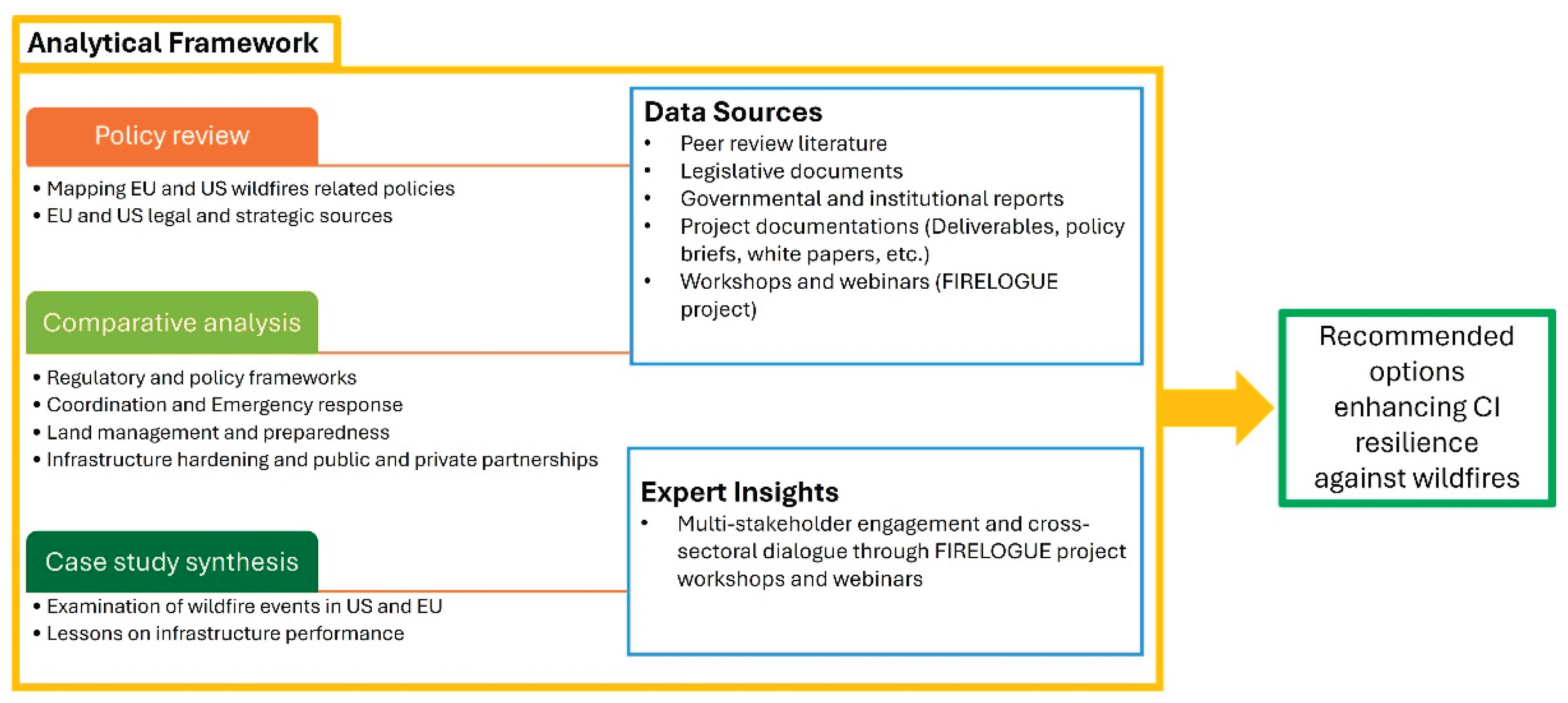
Figure 2.
Percentage of burned area in NUTS2 regions (A) and the cumulative burned area ranked from highest to lowest percentage of burned area (B) in the EU. The figure is based on remote sensing-derived burned area data from large fire events recorded between 2000 and 2024 [63].
Figure 2.
Percentage of burned area in NUTS2 regions (A) and the cumulative burned area ranked from highest to lowest percentage of burned area (B) in the EU. The figure is based on remote sensing-derived burned area data from large fire events recorded between 2000 and 2024 [63].
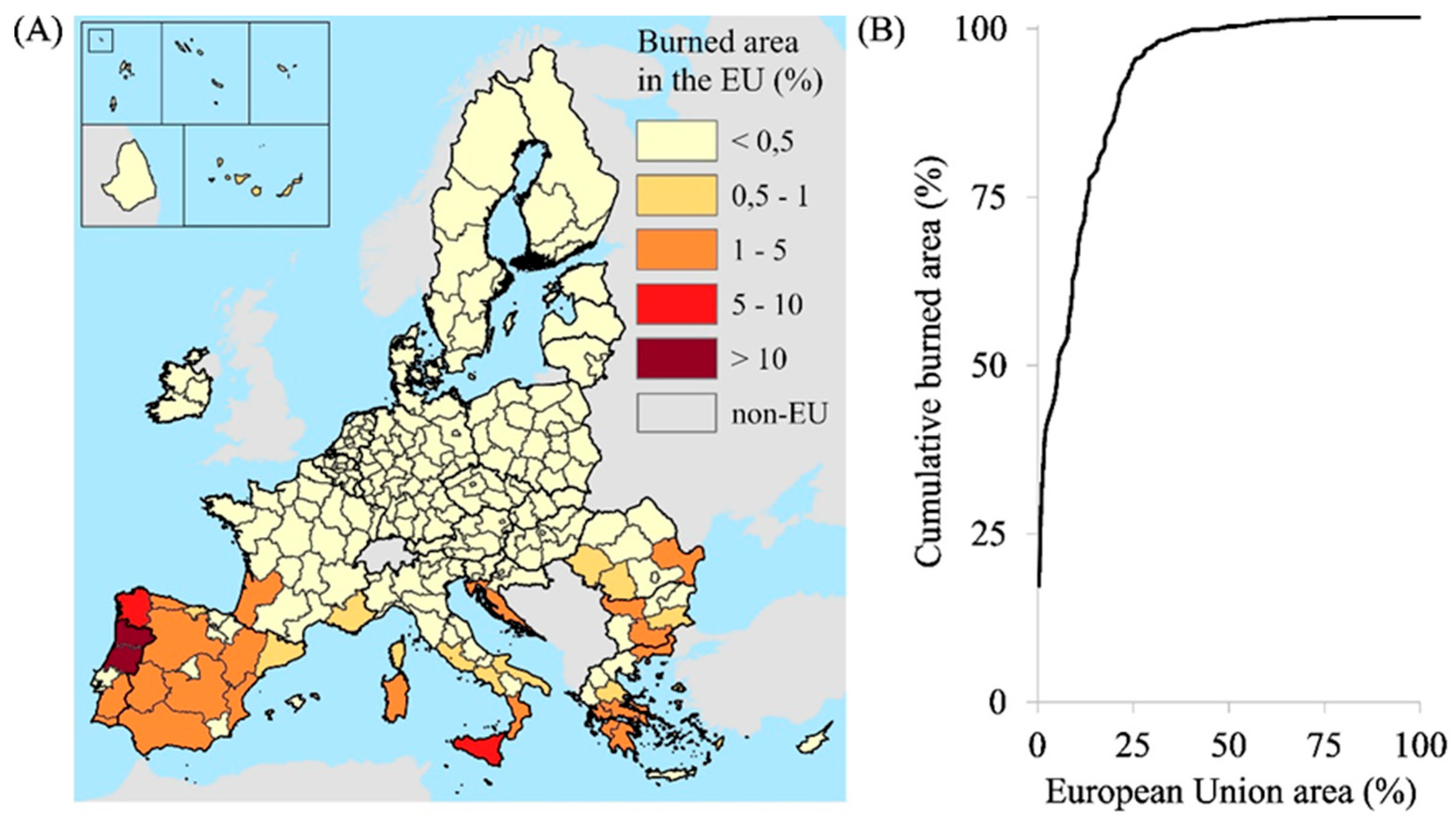

Table 1.
Comparison of EU’s harmonized resilience objectives implemented by member states versus the US’s centralized all-hazards framework with strong federal leadership and private-sector incentive structures. Abbreviation Full Form - EU European Union-US United States- CER Directive Critical Entities Resilience Directive (EU 2022/2557)- PPD-21 Presidential Policy Directive 21 (2013)- NIPP National Infrastructure Protection Plan (2013)- UCPM Union Civil Protection Mechanism- rescEU Reserve of Civil Protection assets under the UCPM- ERCC Emergency Response Coordination Centre- EFFIS European Forest Fire Information System- Copernicus EMS Copernicus Emergency Management Service- NIFC National Interagency Fire Center- ICS Incident Command System- EMAC Emergency Management Assistance Compact- FEMA Federal Emergency Management Agency- USFS United States Forest Service- BLM Bureau of Land Management- PPPs Public–Private Partnerships.
Table 1.
Comparison of EU’s harmonized resilience objectives implemented by member states versus the US’s centralized all-hazards framework with strong federal leadership and private-sector incentive structures. Abbreviation Full Form - EU European Union-US United States- CER Directive Critical Entities Resilience Directive (EU 2022/2557)- PPD-21 Presidential Policy Directive 21 (2013)- NIPP National Infrastructure Protection Plan (2013)- UCPM Union Civil Protection Mechanism- rescEU Reserve of Civil Protection assets under the UCPM- ERCC Emergency Response Coordination Centre- EFFIS European Forest Fire Information System- Copernicus EMS Copernicus Emergency Management Service- NIFC National Interagency Fire Center- ICS Incident Command System- EMAC Emergency Management Assistance Compact- FEMA Federal Emergency Management Agency- USFS United States Forest Service- BLM Bureau of Land Management- PPPs Public–Private Partnerships.
| Aspect | EU | US |
|---|---|---|
| Policy Basis | Shared competence (TFEU Arts 191–192); CER Directive 2022/2557 (11 sectors) | PPD-21 (2013) all-hazards policy; NIPP 2013 risk-management framework (16 sectors) |
| Response Coordination | UCPM (Decision 1313/2013/EU; rescEU; ERCC); EFFIS/Copernicus early warning | NIFC; ICS under USFS/BLM/FEMA; mutual aid via EMAC; sector councils |
| Funding | National budgets; EU rescue pools; research grants (Horizon Europe; ISF) | FEMA grants (Hazard Mitigation, Fire Assistance); Firewise program; utility cost recovery via state commissions |
| Land Management & Preparedness | Member State forest laws; Forest Strategy 2030 fuel guidelines; EFFIS/Copernicus monitoring | Federal land agencies (USFS, BLM) fuel treatments; prescribed burns; state/local wildfire risk maps under NIPP |
| Infrastructure Hardening & PPP | CER Directive requires resilience planning, assessments, penalties; limited EU-level mandates | NIPP-driven public–private partnerships; Sector/Government Coordinating Councils; FERC/NERC CIP reliability standards |
Table 2.
Recommended options to enhance infrastructure resilience.
| Option | Benefit | Implementation Strategies |
|---|---|---|
| Option 1: Promoting a multi-governance approach to wildfire risk management and infrastructure resilience and improving collaboration among relevant stakeholders. | This option provides an integrated approach for the enhancement of wildfire risk management and critical infrastructure resilience by making sure that all relevant stakeholders are involved in, and no one is left behind. It also enhances the collaboration between them, which is extremely important during the response phase. | Create fora where stakeholders can exchange knowledge, resources, and strategies on a regular basis. Implement comprehensive training programs for infrastructure operators to ensure they are equipped with the latest knowledge and skills with a strong focus on wildfire prevention, preparedness, and response strategies. Enhance participatory processes by establishing legal, scientific and other related committees to develop a common approach on wildfire risk management for experts and CI operators, through directives, standards, etc. Secure necessary funding to support the establishment and maintenance of collaboration platforms, training programs, and resource-sharing initiatives. Create policy frameworks that outline the roles and responsibilities of various stakeholders in wildfire risk management for CIs. This will help ensure accountability and streamline collaboration efforts. |
| Option 2: Strengthening CI resilience to wildfire through standardization, data strategies and incentives | This approach promotes common understanding, improved cooperation, and enhanced situational awareness across sectors and jurisdictions. | Support the creation and updating of building codes and standards aimed at a) reducing ignition hazards, b) hardening existing infrastructures and c) take into consideration the results of wildfire risk assessment for new CIs in a “security by design” concept. Stricter regulations and zoning laws that account for fire risks should be considered, along with a process for regularly reviewing and adapting codes and standards based on evolving wildfire risk as well as advancements in technology and practices. Facilitate data sharing, interoperability and collaboration among various stakeholders. This will reduce data fragmentation and enhance the comparability of information, leading to improved understanding, communication and coordination. Ultimately, this enables a more integrated approach to wildfire risk management. Introduce financial incentives for property and CI owners to invest in fire-resistant materials, protective barriers and monitoring tools. This can include grants, insurance reduction, tax breaks, or low-interest loans aimed at promoting infrastructure resilience. Create certification schemes for personnel and systems involved in wildfire management (e.g., register of specialists, cooperation agreements, peer-review frameworks). This will ensure that those responsible for firefighting and prevention possess the necessary skills and knowledge across the EU. Create new standards that outline qualifications and competencies (e.g., training programmes, exercises) required for wildfire management personnel (first and second responders) specifically for events involving CIs. Ensure consistent definitions and terminologies among all stakeholders. Develop standardized formats for incident reporting and data collection, to facilitate common understanding. Promote and incentivize the collection and sharing of wildfire data, focusing specifically on ignition points and causes including impacts on affected CIs. Create tax incentives for individuals to harden their homes and residences. Promote insurance innovation to recognize individual home hardening as a basis for premium cost reduction. |
| Option 3: Advancing research and technology usage in the whole cycle of wildfire risk management for CIs. | This recommendation improves fuels reduction, prevention technology, early ignition detection, early warning, support suppression efforts of response teams (situation awareness, coordination, resources allocation, evacuation), reducing impacts. Developing innovative solutions to be implemented | Allocate more funding, specifically for research and technology initiatives focused on wildfire risk management and technology development and implementation. This investment should support innovative projects that aim to enhance resilience of CIs against wildfires. Develop test beds for wildfire technology to ensure efficacy, performance and safety while providing third party certification or validation. Develop policies and incentives that encourage the adoption of advanced wildfire risk management and critical infrastructure related technologies (e.g., early detection through Internet of Things or Long Range networks, monitoring of smoke and heat, installation of real-time transmission meteorological stations, automated sprinklers, real-time fire danger calculation). This could include incentives to utilize innovative practices or technologies in daily operations. |
| Option 4: Enhancing assessment and management of wildfire risk to CIs | This recommendation improves risk assessment and management, improved planning and suppression, protect infrastructure assets and the surrounding area. Understanding wildfire impacts on critical infrastructure | Promote guidelines on wildfire risk assessment affecting CI. This will require regular updates based on evolving wildfire risks and scientific insights. Investigate the socio-economic impacts of wildfires to understand how they affect communities and infrastructures. This assessment would inform risk management strategies and enhance community and infrastructure resilience. Develop best practices for reducing the risk of wildfires, including fuel management, across the EU. Promote data collection and sharing, focusing specifically on ignition points to identify the probable cause and simulate fire spread. |
| Option 5: Strengthening Cross-Border Cooperation and Knowledge Transfer | Building on the comparative analysis between EU and US approaches, enhanced international cooperation is essential | Establish formal cooperation agreements between EU and US agencies for sharing wildfire-CI protection best practices Develop joint research initiatives leveraging US experience with utility-specific wildfire mitigation plans and EU regulatory frameworks Create transnational training programs for CI operators and emergency responders Facilitate technology transfer and innovation exchange between regions Strengthen the Wildfire Peer Review Assessment Framework (PRAF) with international components. |
Disclaimer/Publisher’s Note: The statements, opinions and data contained in all publications are solely those of the individual author(s) and contributor(s) and not of MDPI and/or the editor(s). MDPI and/or the editor(s) disclaim responsibility for any injury to people or property resulting from any ideas, methods, instructions or products referred to in the content. Dr Lori Moore-Merrell views are her own and do not represent the U.S. government. |
© 2025 by the authors. Licensee MDPI, Basel, Switzerland. This article is an open access article distributed under the terms and conditions of the Creative Commons Attribution (CC BY) license (http://creativecommons.org/licenses/by/4.0/).
Copyright: This open access article is published under a Creative Commons CC BY 4.0 license, which permit the free download, distribution, and reuse, provided that the author and preprint are cited in any reuse.


