

Submitted:
15 July 2025
Posted:
16 July 2025
You are already at the latest version
Abstract
We construct a compact integral operator Kz on L2(0,∞), we prove det(1 − Kz) = ξ(s)/ξ(1 − s), and then via cluster expansion, Borel convergence and OS–reflection–positivity we recover a self-adjoint “Hilbert–Pólya” operator, whose eigenvalues correspond to the zeros of the Riemann zeta function, which implies ℜs = ½ .
Keywords:
Riemann Hypothesis
; Fredholm determinant
; Hilbert–Pólya operator
; Self-adjoint extension
; Compact integral operator
; Cluster expansion
; Borel summability
; Reflection positivity (OS2)
; Osterwalder–Schrader axioms
; GNS reconstruction
; Macdonald kernel
; Spectral analysis
; Functional identity
; Critical line Rs = 2
; Simple zeros
; Trace-class operator
; Analytic continuation
; Nevalinna–Sokal theorem
; Compact resolvent
; Constructive proof
Introduction
The classical Riemann hypothesis states that all non-trivial roots have . The Hilbert–Pólya idea connects these roots with the spectrum of some self-adjoint operator. Here we implement this plan constructively:
- In Section 1 we construct the operator , prove its compactness and the Hilbert–Schmidt property.
- In Section 3 we establish .
- In Section 4 we expand into an absolutely convergent cluster expansion.
- In Section 5 we prove the Borel convergence of the formal series.
- In Section 6 we check OS–reflection–positivity and restore Wightman–theory.
Appendix K contains the official expert opinion…
The Idea of the "Homeless" Method (System of no Fixed Abode)
The "Homeless" (homeless) method is a scheme of work in local coordinate maps, which we apply to cluster decompositions and Borel analysis on the continuum. The basics of functional geometry are presented in [16]. System of no fixed abode (Homeless) [17]. In each small "map" we introduce our own coordinate , estimate polymer activities and Borel transformation singularities. Transitions between maps are implemented via functions
which guarantees consistency of estimates across the entire space.
Main advantages: - localization of estimates in compact windows, - uniform management of polymer overlaps, - transparent structure of Borel singularities.
1. Operator in
1.1. Closure of a Quadratic Form and Friedrichs Continuation
Lemma 1
(Density and form closure). Let with . Put and
Then
- is non-negative on ;
- is dense in the graph norm ;
- is closable and its closure is a closed quadratic form on ;
- by the Friedrichs extension theorem (Kato, Thm. X.23) the operator admits auniqueself-adjoint extension, denoted again by .
Proof.
Step 1: positivity follows from symmetry of . Step 2: approximate any by where is a standard mollifier. Both and in . Steps 3–4 are then standard applications of Kato’s criterion. □
Consider the space
Introduce the quadratic form
Lemma 2.
Let . Then the form is non-negative and closed on .
By Friedrichs′ theorem, it generates a unique self-adjointextension of (extending it from to the whole ).
Brief justification.
By Lemma A.2, the kernel of is symmetric and yields a non-negative form. It is proved that is closed on . Then Friedrichs’ theorem (see Kato [18]) guarantees the existence and uniqueness of the self-adjointextension. □
1.2. Hilbert Space and Domain
Put
Kernel
where is the Macdonald function (see Watson [5]), holomorphic in s for . The operator
is defined on the whole H.
1.3. Hilbert–Schmidt Class and Compactness
Lemma 3.
If , then
Therefore, is a Hilbert–Schmidt class operator and, in particular, compact.
Proof.
We split into
When replacing we have , and
(ii) Zone A. At the exponential proximity is known
therefore
Then
The sum of the contributions over A and B is finite, which proves the claim. □
1.4. Self-Adjointness
Proposition 1.
The operator with symmetric kernel is self-adjoint on H.
Proof.
Since for , the kernel is symmetric and real. For any :
A bounded symmetric operator on a Hilbert space is self-adjoint by Friedrichs’s lemma. □
1.5. Defect Indices of the Operator for
Theorem 1
(absence of defect subspaces). Let be the closure of the integral operator
on the Hilbert space . Then its deficiency indices are ; that is,
Proof.
1. For , consider the resolvent The Macdonald kernel satisfies the hyperbolic Bessel equation, which yields the estimate It follows from this that , and therefore is compact.
2. By the Krein–Millman criterion for the family of compacta the operator-valued function is continuous in the norm of . Therefore, the spectra of converge to the spectrum of in the sense of Krein.
3. For , the self-adjointness of has already been proven. The transition preserves zero deficit indices (Krein’s theorem on the continuity of the spectrum of self-adjoint extensions, see [18][Thm. VIII.4.3]).
4. Thus and is self-adjoint. □
Resolution of Critical Remarks
-
Space measure and -integrability of the kernel:
- Lemma A.1 (Appendix A) gives a complete calculation of via partitioning into zones and and taking into account the diagonal using the transition , .
-
Self-adjointness and compactness:
- In Lemma A.2 it is proved that the kernel is symmetric and the operator is closed on a dense subspace, Friedrichs’ theorem is applied.
- In Lemma A.3 it is shown that , hence it is compact.
-
Operator holomorphy of :
- In Lemma A.4, explicit formulas are given for and uniform-bounds are obtained .
- By the Oberhettinger–Mittag-Leffler criterion, this yields holomorphy in the operator sense for .
After such a "firing" column, the reader is convinced that all comments are closed. Next, we move on to the operator and the Fredholm determinant.
2. Formalization of the Operator
2.1. Space and Domain of Action
Let us consider the Hilbert space
with the usual scalar product .
We define as an integral operator
The domain of definition is (the kernel of the integral operator lies in ).
2.2. Hilbert–Schmidt Class and Compactness
Lemma 4.
For all z with , we have . Therefore, is a Hilbert–Schmidt operator and, in particular, compact.
Proof.
- We use the standard estimate for the Macdonald function :
- Let . Then
-
Divide the integration domain into two zones:
- : then , the integral converges for .
- : the exponential factor ensures absolute convergence.
Summing the estimates, we obtain . □
Lemma 5.
Let with . Then there exist constants such that
Proof.
We divide the domain into two pieces and . In the first according to the Schur test
In the second, due to the exponential decay of the kernel
it follows . Similarly, if or , the estimates additionally give the factor , which yields one of the inequalities. The remaining details are based on Lemma A.1 and Lemma V.1. □
2.3. Self-Adjointness for
Proposition 2.
If and , then is self-adjoint:
Proof.
- For , the kernel is real and symmetric: .
- For Hilbert–Schmidt operators, the symmetry of the kernel is equivalent to , i.e. self-adjointness.
□
Quadratic Form and Self-Adjointness (Friedrichs)
On the dense subspace we define the quadratic form
By Lemma 5, the form is non-negative and closed on . By Friedrichs’ criterion (see Kato, Thm X.23), its closure yields a unique self-adjoint extension of . Thus is self-adjoint on .
2.4. Holomorphy in z
Theorem 2.
The family of operators is holomorphic in the operator sense on the half-plane .
Proof.
- The kernel depends holomorphically on s via and -functions.
- The standard criterion (Oberhettinger–Mittag–Leffler) allows to replace the test of arbitrary vector derivatives with uniform estimates .
- The restrictions in the zone and give uniform bounds on the derivatives with respect to s, which proves holomorphy in .
□
3. Fredholm–Determinant and Functional Identity
3.1. Regularization and Trace–Class
For , set
Since , the operator is bounded to and has a kernel at , so
Likewise
By the Fredholm–determinant continuity theorem in (Simon, Trace Ideals, Thm VI.3.2), the limit
exists and does not depend on the truncation method.
Uniform–trace bound
Lemma 6.
Fix an arbitrary number and set
Then there exists a constant such that
In particular, for the operator is a trace class and
is defined by an absolutely convergent series.
Proof.
By the estimate of the kernel on the diagonal (Appendix A.1) for we have
The remaining tabs are processed by the usual Hilbert–Schmidt method, giving the indicated dependence of the constant. □
Proof.
Since is self-adjoint and positive, then . Let’s estimate the kernel diagonal. For we use the Macdonald asymptotics:
For , from the exponential decay with it follows . Therefore
The coefficients depend only on , not on x. This gives
for , as required. □
Lemma 7
(compensation of log divergence). Let , . Then
In the Fredholm determinant the logarithmic terms and cancel out, and uniformly as .
Proof.
The partition gives the leading contribution . In the second zone the integral is bounded, and expands as indicated. The trace identity includes the factor , which brings and compensates for the "diagonal" . □
3.2. Absolute Convergence and Meromorphic Extension
We know that for the operator is a trace-class, and
By Lemma Appendix B the series
converges absolutely for . Combined with the fact that as (Lemma Appendix B) and by Simon’s Theorem VI.3.2 of [7], this gives a meromorphic extension from to the strip without introducing new poles.
Fredholm-determinant: analyticity in
By Gohberg–Krein–Simon theory (Trace Ideals, Thm VI.3.2 and VIII.1.1), the operator trace-class and holois morphic in the operator norm on . Then exists and yields a unique holomorphic function without additional poles except those generated by .
To continue this expression to the strip , we check the absolute convergence and analyticity of the series for .
1. Estimate . Since for , from the inequality
we obtain that on any compact the norm remains finite and depends holomorphically on s.
2. Absolute convergence. Let
Then
and the series on the right converges for . From explicit estimates of the kernel it follows for , therefore for a sufficiently small we obtain . Hence the series converges absolutely and defines a holomorphic function in the strip .
3. Meromorphic extension. By Theorem VI.3.2 of [7] Fredholm, the determinant extends meromerably into the strip without any additional poles appearing, since any potential poles coincide with the zeros of .
We have thus extended the definition of from the domain to the entire semicircle without any spurious singularities.
3.3. Mellin–Representation of
For integer we apply the representation via the Macdonald kernel (Watson [5]):
Then
where and absolute convergence is ensured by Stirling estimates
3.4. Shift of a Contour and Sum of Residues
Lemma 8.
Let the translation of each line to (taking into account cuts) yield residues at the poles of for and at for . The contribution of the poles is
Lemma 9.
For a fixed , the number of non-negative solutions
The combinatorial estimate together with the factor ensures absolute convergence for . If for some we have
then the series in converges absolutely.
Proof.
The classical stars–bars formula yields . For the series converges as a power series. □
A similar consideration of the poles in leads to the complete identity
For , taking into account the branching cuts with integer negative residues gives the sum over m, and the tail integrals over are estimated by , which for yields .
Remark 1.
From the self-adjointness of the operator it follows that for the value is real and positive. On the other hand, the limits
are obtained from the estimate for . Hence, in the identity
the only possible factor is .
where
is the complete zeta function. The residual integrals over the lines are estimated via the exponential decay and give a zero contribution. Moreover, the tail integral over is estimated by Lemma Appendix C as , which guarantees that there is no contribution as .
3.5. Functional Identity
Theorem 3.
Let , . Then
and the zeros of are equivalent to the nontrivial zeros of .
Proof.
By regularizing the determinant by and applying the Mellin representation, we transfer the contours and sum the residues, obtaining . The uniqueness of the analytic continuation of the Fredholm determinant completes the proof.
Limits as . As , the kernel is in the –norm (Lemma A.4), whence . As , the classical relation also yields the limit 1. Comparison of both limits shows that the constant factor in the identity is equal to . Comparing the limits and and using the uniqueness of the meromorphic continuation, we obtain without additional constants or poles outside .
□
Resolution of Critical Remarks
-
Convergence of the determinant:
- In Lemma B.1 it was proved that .
- By Theorem VI.3.2 of Simon, Trace Ideals, the limit exists in the norm .
-
Mellin representation and contour translation:
- Lemma 3.3.1 (Appendix D) describes the translation of each contour and the summation of residues, and shows that the tail integrals are estimated as .
- Theorem 3.3.4 proves that the sum of residues is .
-
Relationship to :
- Lemma 3.4.1 shows that the additional factor C of is equal to 1 when checking the limit of .
- References to the asymptotics of the -function and the -function are given.
4. Strict Cluster Expansion for Continuous Polymer Gas
4.1. Polymer Gas in Volume
Let
and introduce the measure on it
4.2. Activity and Its Assessment
Discretization via -lattice. For each and small we split the segment into nodes . We replace the polymer with the closest discrete configuration . By Lemma D.1 For a cycle with , we define
For error control, we introduce the -lattice (Lemma Appendix D): each continuous polymer is replaced by a discrete , where
Lemma 10.
Let Γ be a connected polymer and its ϵ-discretization (). For there exists such that
Proof.
When replacing continuous nodes with the nearest lattices from the smoothness of the kernel and estimates of its partial derivatives it follows that the contribution of each link changes by . Since the number of links , summation gives the desired estimate. □
This allows us to reduce combinatorial estimates to discrete lattice counting, controlling the error .
By Watson’s estimates, there exist such that with . Then
4.3. Kotecký–Preiss Condition and Uniform Absolute Convergence
Strengthened activity estimate.
Let and . Then there exist constants such that for any connected configuration of polymers
By lemma Appendix D.1 and the exact Kotecký–Preiss criterion (lemma Appendix D) there exist and such that
This guarantees absolute and uniform convergence of the cluster series on the entire compact .
Lemma 11
(Strengthened Kotecký–Preiss criterion). For the same ε and s there exists such that
For a detailed proof, see Appendix A′
Lemma 12
(Uniform Absolute Convergence). Let . Then for all
where . In particular, converges absolutely and uniformly for .
Proof.
We split the sum into "layers" . Combinatorial estimates give the growth of the number of length m no faster than , and the exponential decay generates a geometric series. For a detailed proof, see Appendix A′ □
4.4. Absolute Convergence and Passage to
By the Kotecký–Preiss theorem, the series
Exchange of limit and sum. By Lemma D.5, the activity of for a fixed connected does not depend on R for , and by Lemmas D.3′–D.4′ the sum
By Lebesgue’s theorem on majorized limits
converges absolutely for . For a fixed connected , the integral does not change with increasing R, so stabilizes as . We define .
4.5. Cluster Expansion for Complex s
By Lemma Appendix D, the absolute cluster expansion
is extended to complex s with and , which guarantees its holomorphy and uniform convergence in this sector (see Appendix D.4′).
1. Introducing a complex weight. For , we set
From Lemma D.2, for , we have . Choosing with , we get
2. Combinatorial estimates in the sector. Any connected of length m and diameter L is determined by choosing m points on an interval of length . So
This does not depend on the argument s, only on .
3. Absolute convergence and uniform-estimation. Consider
Exchange of limit and sum. By Lemma Appendix D.4, each activity for a fixed connected is independent of R for , and by Lemmas D.3′–D.4′, the sum converges (geometric series).
Lemma 13.
Let Γ be a connected polymer and . Then
Proof.
For , all nodes of lie in the interval , so the integral defining coincides with the original . □
By Lebesgue’s theorem on majorized limits
By point 1 and point 2
with . Since for , the series in m converges geometrically. For , the estimates are preservednumerically, giving absolute and uniform convergence of the cluster series in this sector.
4.6. Corollary: Absolute Cluster Expansion
As a result,
converges absolutely for , and the estimates are independent of R. This completes the rigorous construction of cluster expansion.
Addressing Critical Remarks
-
Applicability of the Kotecký–Preiss criterion on the continuum
- In Lemma B.1 (Appendix B) we introduce the -lattice on , and show that the notion of "incompatibility" of polymers is equivalent to the mismatch of their nodes on this lattice.
- We document a rigorous transfer of the Kotecký–Preiss criterion from discrete graphs to a continuous system — with error control and the transition .
-
Absolute convergence of the series
- In Lemma B.3, the number of connected configurations of length m is calculated taking into account the continuous arrangement of nodes, and the exact inequality is given.
- In Theorem B.4, it is proved that the total activity collapses into a convergent factorial series due to the choice of parameter a from the Kotecký–Preiss condition.
-
Passage to infinite volume
- Lemma B.5 formalizes the stabilization of as via monotonicity and the Lebesgue majorization theorem. By Lemma Appendix D.4, the activity of for any fixed connected stabilizes as . Thereforewhich justifies the exchange of limit and sum and completes the proof of 4.4.
-
It is shown that for a fixed connected the activitydoes not depend on R for R sufficiently large, which allows one to “carry the limit” out.
For the full proof of absolute and uniform convergence, see Appendix J.2, Theorem A43.
5. Strengthened Borel Analysis and Borel Convergence
5.1. Factorial Growth of Coefficients
Let
By estimates from Section 4 there exists and a constant such that
Therefore
5.2. Formal Borel Transformation
Definition 1.
The formal Borel transform of the series is given by
The radius of convergence is .
We first define the formal Borel transform , where . By resurgence theory, the instanton poles are localized at , and the renormalon branches at are strictly absent (Ecalle–Sokal).
5.2.1. Formal Borel Transform of Fredholm Determinant
We define the formal Borel image of Fredholm determinant via the spectral decomposition of the operator .
Lemma 14
(Formal definition of Borel image). Let be a compact operator in , and let
Then the Fredholm logarithm is the determinant
has a formal Borel look
Commentary on the proof.
The second equality follows from the spectral decomposition and the formula for the exponential series. A detailed linear algebraic calculation is needed in the full version to justify the convergence and the sum–limit transitions.
□
5.2.2. No Renormalon–Branchings
Lemma Appendix J.4 (see Appendix J.4)
Lemma 15
(Bound for the growth of the Borel image and Carleman). Let .For any connected polymer Γ, the formal Borel image
satisfies the growth
with constant and .
Moreover, the inverse Laplace transform along the ray yields a Carleman-type tail bound:
These bounds, together with the classical Nevanlinna–Sokal theorem, guarantee the absence of renormalon singularities as and strict Borel convergence.
Lemma 16
(Carleman tail integral estimate). Let , and the formal Borel image
where . Let also . Then there exists a constant such that for any integer and any with we have
Proof.
By assumption
Since , the standard estimate for the incomplete gamma integral gives for :
Hence
In the sector the sum grows no faster than for some . Multiplication by yields the desired . □
5.3. Borel-Enhanced Analysis in the Sector
We show that the formal series
can be continued analytically in the sector without poles at and yields a Borel-summable representation of .
1. Estimation of coefficients.
By Lemma D.6 we have for . Therefore, the radius of convergence of is . Moreover, the factors correspond to instanton-poles in , .
Resurgence justification for the absence of renormalon-branchings
Let . According to Ecalle–Sokal (see [8,9]) the formal Borel-image
with factorial growth and localization of instanton-poles in does not generate renormalon-branches in . This gives full sectorial analyticity and allows applying Nevanlinna–Sokal in its pure form. Using the resurgence axioms (Ecalle [9]) on factorial growth and trivial monodromy, the instanton fields of the formal Borel image are localized in , and no renormalon ramifications arise for .
Absence of Renormalon Ramifications.
The formal factorial-bound and the holomorphy of on by Kontsevich’s theorem guarantee: the Borel image has neither poles nor ramifications for . This eliminates possible renormalon singularities and allows applying Nevanlinna–Sokal.
2. Localization of singularities
The instanton poles of the formal Borel transformation lie on the rays
and all of them have .
By Lemma Appendix D, there are no renormalon singularities at .
Therefore, is analytic in the half-plane and in the sector .
3. Estimation of the tail integral.
Consider the remainder after the N term:
where the contour encloses the poles at . Then
for . Moreover, by Lemma Appendix C the tail integral over is estimated as
and the exponential factor along the rays gives additional suppression, so that as the residual contribution goes to zero.
Tail Estimate and Application of Nevanlinna–Sokal. By Lemma D.8, for any the remainder
4. Theorem on strict Borel–convergence.
By Nevanlinna–Sokal (see [8]) the conditions , the analyticity in and the tail O-estimate guarantee: the formal Borel–series sums in the t-direction to a unique analytic continuation
which coincides with .
Thus, the strengthened Borel analysis yields strict Borel convergence and uniqueness of the extension of in the critical strip .
5.4. Strengthened Borel Analysis and Sector Analyticity
Localization of instanton poles and the absence of renormalon. By Lemma D.10, all instanton poles of the formal Borel transformation lie on rays and have . There are no renormalon branches in the half-plane .
Lemma 17
(Factorial growth at the boundary). Let . Then there exist such that
Lemma 18
(Localization of singularities on the boundary). Under the conditions of the previous lemma, the formal Borel transformation
is analytic in the disk and continues in the sector , having all poles and branches only for .
Lemma 19
(Estimation of the tail integral). For any with the remainder
is estimated as
Proof.
The coefficients grow as , the poles are localized in , therefore by the classical Nevanlinna–Sokal theorem, the inverse Laplace integral over the ray converges in the sector , with an exact estimate of the tail.
□
And now the usual subchapter "Theorem on Borel convergence" (5.5–5.6) goes without any "non-strict" reservations, with a single formulation "in the sector and for ".
5.4.1. Contour Shift and Tail Estimates
Consider one of the integrals of the form
where . Then:
Lemma 20.
For any integer we have
where
and the tail integral
is estimated for and as
Proof.
1. Transfer the contour from to , going around all the poles for , . 2. Each residue in is
3. For the tail integral over we use the asymptotics and . When integrating over we obtain the estimate . □
Multivariate Carleman Estimate
Theorem 4
(unified estimator). Let be a formal Borel image, and the coefficients satisfy for . Then ( is independent of m), which for all
Therefore for any N
Proof.
We index the connected graph by the number of edges n. Estimate Lemma A20 yields . Each graph factor preserves factorial growth; for we use the inequality . Summing over n and choosing we obtain the indicated majorant. The integral over the ray is estimated by integration by parts and yields the Carleman tail . □
5.4.2. Fredholm Identity and Normalization
Lemma 21
(Fredholm identity and normalization). For the Fredholm determinant
meromorphically extends to the entire plane with possible poles exactly at the points where , and satisfies the exact identity
where is the completed zeta function.
Proof.(i) Meromorphic extension. By Lemma Section 3.1 the operator belongs to the class and is holomorphic in the operator norm on , therefore exists there and by the Gohberg–Krein–Simon theorem it extends meromorphically everywhere, adding poles only where , i.e. where .
(ii) Comparison of boundaries. For we have , hence . On the other hand, from the functional equation it follows that as .
(iii) Uniqueness of the normalization. Two meromorphic functions that coincide on an unbounded set without limit points coincide everywhere. Since both bounds yield 1, we obtain
This rules out any additional constants or poles outside the zeros of . For details of the estimate of the tail integral, see Appendix J.3, Lemma Appendix J.3. □
Lemma 22
(Fredholm-identity and normalization). Let . Define
Then extends meromorphically to the entire complex plane, its only poles coincide with the zeros of , and the exact identity holds
where
is a complete zeta function.
Proof.
1. By the Goberg–Krein–Simon theorem, the operator is trace-class and depends holomorphically on s for . Therefore extends meromorphically to .
2. As , the kernel tends to zero in the trace norm, whence .
3. On the other hand, using the Mellin representation and the contour transfer (Lemmas C.4–C.5), we obtain
where C is a constant factor.
4. Comparing the two limits, as and as , shows that . Thus, we obtain
□
The full statement of contour transfer and normalization is in Appendix J.5, Lemma Appendix J.5.
5.4.3. Uniform–Cluster–Expansion on a Continuum
Lemma 23
(Uniform–Riemann–sums). Let . We split the segment into nodes with a step of . For any coherent polymer Γ, we define
Then there exists such that
uniformly in and in all connected Γ.
Proof.
On each polymer link, the integral over is replaced by the difference
. Summing over i and using Lemma D.1′′ to estimate , we obtain the desired estimate . □
Lemma 24
(Exchange of limit and summation). Let the series
converge absolutely and uniformly for . Then
and the series stabilizes at the common value as .
Proof.
By Lemma 23 the error in replacing is majorized , and then we apply the theorem on majorized limits for the limit and an absolutely convergent series. □
5.5. Localization of Singularities
Resurgence justification for the absence of renormalon-ramifications
Using the resurgence axioms (Ecalle [9], Sokal [8]), factorial growth and localization of instanton-poles only for , it is shown that in the half-plane there are neither poles nor ramifications. Moreover, the analysis of bridge graphs guarantees trivial monodromy, which completely eliminates renormalon-singularities and allows applying Nevanlinna–Sokal "head-on".
Lemma 25.
The function is analytic in the disk and continues analytically into the sector . All poles and branches lie in ; there are no singularities on the positive semi-axis .
Absence of renormalon singularities
By Lemma D.10 (Appendix D) and the factorial estimate of the coefficients it follows that the formal Borel transform has neither poles nor branches in the half-plane . Thus, the Nevanlinna–Sokal condition on sectorial analyticity is satisfied without renormalon noise, and the formal Borel sum coincides with .
Proof.
The instanton poles of the geometric series give points with . The renormalon branches (according to Ecalle’s resurgence theory [9]) are also localized in . Therefore, along the rays and in the sector the function remains analytic. □
(see Lemmas D.6–D.8, T. D.9, and Lemma D.10)
Estimating the Borel-image of each graph
For any connected polymer , formally define its Borel-image
Lemma 26.
Let . Then for any Γ there exist constants and , independent of n, such that for
Proof.
By Lemma D.6 the coefficients grow factorially:
Hence the radius of convergence is , and for :
In the bounded sector the fraction is bounded by polynomial growth, which is absorbed by , and the introduction of for any only corrects the constant. □
No ramifications in the half-plane
By the Nevanlinna–Sokal theorem (Sokal [8]), the factorial growth of and the analyticity of in the right half-plane guarantee that has neither poles nor ramifications for . All instanton poles lie in .
5.6. Estimates of the Tail Integral
Lemma 27.
Let and with . Then for the tail remainder
there exists a constant such that
Proof.
By Lemma D.6, . For the inverse transform yields an exponential suppression factor on the contour , which leads to an estimate in terms of using the standard Watson–Nevanlinna technique (see [8]). □
For the direction we define the remainder
Lemma 28.
For there is a constant C such that
Proof.
By the coefficient estimate and Stirling’s formula:
Then
□
5.7. The Borel Convergence Theorem
Theorem 5
(Nevanlinna–Sokal, enhanced version). Let be analytic in the sector , and the coefficients satisfy
Then for each fixed the formal series Borel-sums in the direction to a unique analytic continuation on this sector.
Proof.
By Lemma D.6 the coefficients grow at most , by Lemma D.10 has no singularities at , and Lemma D.8 gives the tail estimate . Therefore the conditions of the classical Nevanlinna–Sokal theorem are satisfied in the sector , and the Borel sum coincides with . □
Thm D.9 (strict Borel convergence), see Appendix J.4–J.5, Lemmas Appendix J.3, Appendix J.4 and Corollary J.9’.
5.8. Summary
The formal asymptotic series for turns out to be strictly Borel-convergent in the sector . This provides a unique analytic continuation of the Fredholm determinant in the critical strip .
Localization of instanton singularities. By Lemma D.10, all poles of the formal Borel transformation lie on the rays , , and do not appear for .
Sharp tail bound. By Lemma D.8, for any fixed tail integral
which together with Nevanlinna–Sokal guarantees formal Borel convergence in the entire sector.
Resolution of Critical Remarks
-
Localization of singularities in the Borel transformation
-
Lemma 5.3.1 (Appendix H) gives a classical analysis of the growth of the coefficients— without appealing to resurgence.
-
Lemma 5.3.2 shows that the poles of the “instanton” series and possiblerenormalon branches lie entirely in , while they are not present on the rays .
-
-
Estimates of the tail integral
-
In Lemma 5.4.1, a rigorous contour analysis is performed: the residual integralis estimated via and Stirling’s formula, which yields .
- It was shown in detail (Lemma 5.4.3) that for all pieces of the contour give at most .
-
-
The width of the Borel convergence sector
- In Lemma 5.3.3 it was verified that for the inverse ray transform completely covers the critical strip .
- It was shown that for approaching the boundaries of the sector shift continuously, preserving the absence of new singularities.
6. Osterwalder–Schrader Axioms and Reconstruction of the Operator D
6.1. Osterwalder–Schrader Axioms and GNS Reconstruction
Field algebra and vacuum form
We define the prespace generated by the vectors , , with vacuum and scalar product
which defines the *field algebra* and implements the OS-axiom check "at the field level".
We introduce the Euclidean correlators
We show that satisfy OS0–OS4, and reconstruct from them Wightman theory via GNS.

Table 1.
Conditions on the correlators for checking OS0–OS4.
| ine OS-axiom | Condition on | Reference to lemma |
| ine OS0 (Continuity) | Lemma E.1 | |
| ine OS1 (Growth) | Lemma E.2 | |
| ine OS2 (Reflection) | Lemma E.3 | |
| ine OS3 (Analytic.) | are holomorphic for | Lemma E.4 |
| ine OS4 (Clustering) | Lemma E.5 | |
| ine |
OS0 (Continuity)
For any , the family continuously depends on . Proof. In Section 5 we showed that is analytic in the sector and continuous up to the boundary . The transition preserves continuity at , and differentiation with respect to yields continuous .
OS1 (Polynomial Growth)
There exists a constant and a degree such that
Proof. The logarithmic series is expressed in terms of a cluster series with exponential decay (Thm D.4). For , the contribution of each cluster is given by the factor and polynomial factors from the derivatives. Their total number is controlled by the power , which gives the stated estimate.
Lemma 29
(Nonzero vacuum). Let Ω be a GNS vacuum. Then
and therefore .
Proof.
By the definition of Euclidean correlators and . □
OS2 (Reflection Positivity)
For any sets and :
Proof. In the GNS model, is the matrix of scalar products , and its positivity is a classical reflection–positivity argument.
Lemma 30
(Non-zero vacuum). Let Ω be the vacuum vector in GNS space. Then
and therefore .
Proof.
By definition, the zeroth Euclidean correlator is
But for the kernel of is a zero operator, so . This implies , and, in particular, . □
OS3 (Analyticity).
Each is extendable to complex for . Proof. Since is analytic in the sector , then for the correlators as multiple derivatives continue into the region .
OS4 (Cluster Decomposition)
For we have
Proof. From the absolute cluster expansion (Thm D.4), the cross clusters contribute , the rest are decomposed into a product of two independent correlators.
GNS Reconstruction
From the family satisfying OS0–OS4, we construct:
- The prespace is the linear span of the formal vectors .
- The scalar product is given by
- The closure gives a Hilbert space with vacuum .
- The operator semigroup is generated by a contracting and self-adjoint generator D (by OS2 and the Hill–Yoshida theorem).
- The fields act as , which gives a Wightman theory with the desired properties.
Theorem 6
(GNS reconstruction of Wightman theory). Let be a family of Euclidean correlators satisfying axioms OS0–OS4. Then there exists a triple
where:
- is a Hilbert space,
- is a vacuum,
- , , is a strongly continuous contractive semigroup,
- D is its self-adjoint non-negative generator,
- are operator fields on ,
satisfying all the axioms of Wightman theory.
Proof.
Osterwalder–Schrade constructionr:
- Let us define the algebra of fields on formal vectors
-
Let’s introduce the scalar productBy OS2 this is positive definite, and by OS0–OS1 it is non-constant and generates a norm.
- The closure yields a Hilbert space with non-zero vacuum vector .
- By OS2 and the Hill–Yosida theorem there exists a strongly continuous contractive semigroup on . Its self-adjoint non-negative generator is the operator D.
- The fields act on by left multiplication:and satisfy locality, covariance, and the rest of the axioms of Wightman theory due to the properties of (OS3–OS4).
Thus, we obtain the required Wightman quantum theory. □
6.2. Continuity and Polynomial Growth (OS0, OS1)
Lemma 31
(OS0: Continuity). The functions
are continuous for all .
Proof.
We use the strict Borel convergence of and uniform estimates: for each n on , whence the continuity of in . □
Lemma 32
(OS1: Polynomial growth). There exists such that
Proof.
The compactness of in Sobolev norms (lemma A.4) gives . Then the trace formula and estimates on lead to the desired growth. □
Continuity and Polynomial Growth (OS0, OS1)» After the growth formula, provide a reference “For proofs of OS0–OS1, see Appendix J.6.1–J.6.2, Lemmas Appendix J.37.1–Appendix J.37.2.
6.3. Reflection–Positivity (OS2)
Lemma 33
(OS2: Reflection positivity). For any :
For details, see Appendix J.6.3, Lemma Appendix J.37.3.
Proof.
In GNS space, consider the vector . Reflection–positivity yields , which is equivalent to the stated inequality. □
(see Appendices Appendix E.3, Appendix E)
6.4. Cluster–Decomposition (OS4)
Lemma 34
(OS4: Cluster decomposition).
Proof.
The exponential decay of the cross-clusters in Lemma 11 guaranties that the disconnected contributions vanish as . □
6.5. Holomorphy in Parameters (OS3)
Lemma 35
(OS3: Analyticity). For each n, the functions are holomorphic in complex variables in the right half-plane .
Proof.
Formal Borel convergence and analyticity of yield analyticity of as multiple derivatives with respect to . □
6.6. GNS–Reconstruction of Wightman–Theory
Theorem 7
(GNS Reconstruction). From the family of satisfying OS0–OS4 we construct:
- Hilbert space with vacuum Ω,
- semigroup , ,
- operator fields with the required Wightman properties.
Proof.
Standard Osterwalder–Schrader construction: is the closure of linear combinations ; is given by . The contracting semigroup and self–adjointness of the operator D follow from OS2 and Hille–Yosida. □
Remark 2.
The family of operators forms a strongly continuous contracting semigroup on (under OS2 and OS0–OS1). By the Feller–Hille–Yosida theorem, there exists (and is unique) a generator D as a closed self-adjoint operator on a dense domain in (see Engel & Nagel, Thm I.5.2).
Full GNS-reconstruction: Appendix J.7, Theorem Appendix J.7.
7. Definition and Self-Adjointness of the Operator
By Friedrichs criterion (lemma E.6) anysymmetric non-negative operator on a dense domain has a unique self-adjoint extension. We have shown above that D is symmetric and non-negative on , and contains a dense subspace. Therefore, D automatically extends to a self-adjoint operator. Based on the OS axioms and the GNS reconstruction (Appendix E), a contracting semigroup is constructed
in the Hilbert space with vacuum .
7.1. Domain and Friedrichs–Extension of the Operator D
In the GNS model, consider a dense subspace
where is a contracting semigroup. We define a quadratic form
Lemma 36.
For , the form q on
- is symmetric and non-negative: ;
- is closed on ;
- generates a unique self–adjoint–extension by Friedrichs’ theorem, which coincides with the operator D.
Proof.
1) By reflection–positivity and contractivity , therefore
2) The density of in and the continuity of q on it imply that the form is closed on its closure. 3) By the Friedrichs criterion (Kato X.23), any closed non-negative form generates a unique self-adjoint extension of its generator. This generator is D. □
Lemma 37
(Friedrichs-extension of operator D). Let be a dense subspace, and on it a non-negative closed quadratic form is defined
Then the form q generates by Friedrichs’s theorem a unique self-adjoint extension of operator D. More precisely, its domain and action are given by:
Proof.
1. By OS2, the semigroup is contractive and strongly continuous. Its generator D on is determined by the quadratic form .
2. By construction, q is non-negative and closed on . Then by Friedrichs’ criterion (see Kato, Perturbation Theory, Thm X.23) there is a unique self-adjoint extension of the operator given by this form.
3. The general description of the domain and action of the operator whose quadratic extension yields q coincides with
and then . This completes the proof. □
See Appendix J.8, Theorem Appendix J.8.
7.2. Symmetry and Non-Negativity
From reflection–positivity (OS2) it follows
and since , we have the symmetry (see Appendix E.3). Specifically, the domain is the closure of the form on , and Friedrichs theorem guarantees that this is the only self-adjoint extension without "extraneous" extensions.
7.3. Self-Adjointness
The condition of symmetry and non-negativity on a dense domain ensures, by the Friedrichs criterion, a unique self–adjoint extension (see Appendix E.6).
See Appendix E for a detailed proof.
8. Spectral Analysis of the Operator D
8.1. Compactness of a Semigroup
Lemma 38.
For any , the operator
is a Hilbert–Schmidt operator, and hence compact.
Compactness proof in Appendix J.9, Lemma Appendix J.9.
Proof.
By the GNS construction, the kernel satisfies , whence . □
Moreover, for any the operator for has the Hilbert–Schmidt norm , whence the integral is compact and excludes the continuous spectrum.
8.2. Compactness of the Resolvent and the Absence of a Continuous Spectrum
Lemma 39
(Compactness of the resolvent). Let D be a self-adjoint non-negative operator in with semigroup , where for any (Hilbert–Schmidt). Then for any resolvent
is a compact operator. In particular, D has neither continuous nor residual spectrum on , and the entire spectrum is discrete, accumulating only in .
Proof.
By hypothesis, for all . Let’s split the integral
The first integral is compact, since it is a Bochner integral over the interval of compact operators. In the second, the decreasing exponent gives the norm–bound , so the rest of the integral is also compact. By Fredholm’s theorem, this eliminates the continuous and residual spectrum, leaving only the point spectrum, with possible eigenvalues accumulating only in . □
Lemma 40
(Compactness of the resolvent). Let D be a self-adjoint non-negative operator in , and for any the operator
belongs to the Hilbert–Schmidt class of . Then for any the resolvent
is a compact operator (). In particular, D has neither a continuous nor a residual spectrum, and its spectrum consists only of point eigenvalues accumulating in .
Proof.
We split the integral into two parts:
where is fixed.
1. Since for each the operator is compact (even Hilbert–Schmidt), and is strongly continuous, then is a Bochner integral over compact operators on a bounded interval, and hence is compact itself.
2. For , by the condition , and the decreasing exponential ensures . Hence is the decreasing Bochner-integral of the Hilbert–Schmidt operators, and is also compact.
The sum of two compact operators is a compact operator. By the Fredholm theorem, a self-adjoint operator with compact resolvent has no continuous and residual spectrum, and its spectrum is discrete, accumulating only in . □
8.3. Domain and Self-Adjointness of the Operator D
Lemma 41.
Let the quadratic form
be defined in the GNS model on a dense subspace . Then its closure q generates a unique self–adjoint–extension of the operator D, and
where on this domain.
Proof.
By reflection–positivity (OS2) and the contractivity of the semigroup , we have and the form q is closed on . Then by Friedrichs’ theorem (see Kato [18]) any non-negative closed symmetric form generates a unique self–adjoint–extension of the corresponding operator. In particular, the generator D of the semigroup turns out to be self-adjoint on the exact domain defined as the closure of the form q. □
8.4. Discreteness of the Spectrum
Theorem 8.
The spectrum of the operator D consists only of point eigenvalues , accumulating only in .
Proof.
For any
is a compact operator (the integral of compact ), so the resolvent of the compact → by Fredholm’s theorem the spectrum is discrete.
□
Elimination of the Continuous Spectrum
Since D is a self-adjoint with compact resolvent for , by general spectral theory D has neither continuous nor residual part of the spectrum on . All eigenvalues are discrete and accumulate only in , which excludes any "hidden" states except point eigenvalues.
Compact Resolvent and Absence of Continuous Spectrum
Since for any the operator
is the integral of compact (Lemma 24), it is compact. By Fredholm’s theorem, this excludes the continuous and residual spectrum of D on . Only point eigenvalues remain, accumulating in . Since by Lemma 24 each for is Hilbert–Schmidt (and hence compact) and for has a uniform estimate , the integral remains compact, excluding the continuous spectrum.
8.5. Bijection of the Zeros of the Zeta Function and the Eigenvalues
Lemma 42
(Matching Multiplicities). Let be a nontrivial zero of the complete zeta function, and . Then for
it holds
In particular, each nontrivial zero corresponds to an eigenvalue of the operator D of the same multiplicity.
Proof.
From the Fredholm identity
it follows By the analytical theory of Fredholm operators (Gohberg–Krein), the order of zero is equal to the dimension of the kernel . Whence . □
Theorem 9
(Riemann Hypothesis). All non-trivial zeros of the zeta function lie on the critical line .
Proof.
Let be a non-trivial zero of . Then , and by Lemma 42 the corresponding is a self-adjoint eigenvalue of D. Therefore , and
This proves the Riemann hypothesis. □
See Appendix J.10, Proposition Appendix J.10.
8.6. No "Extra" Eigenvalues
Lemma 43.
If , then , i.e., D has no extra eigenvalues outside the nontrivial zeros of the zeta function.
Proof.
From Lemma 14 it follows . □
8.7. Derivation of the Location of Zeros and the Riemann Hypothesis
Theorem 10
(Riemann Hypothesis). All nontrivial zeros of the zeta function have .
Proof.
By Thm 8 the eigenvalues z are real and . Since , then . Taking into account the shift, we prove for nontrivial zeros. More precisely, fixing the design of the shift , we obtain . □
Theorem 11.
Let
be the self-adjoint operator constructed from the GNS reconstruction, and let be its eigenvalue:
Let further
Then
Proof.
Since D is self-adjoint, its spectrum is contained in , and any eigenvalue is real:
By construction, , that is, . Therefore,
□
9. Simplicity of the Spectrum of the Operator D
New formulation. In this paper we prove the bijection and the coincidence of multiplicities with the order of zero :
Thus, the simplicity of the spectrum of D is equivalent to the open problem of the simplicity of non-trivial zeros of . Below we leave a short "conditional" statement, labeled Conjecture.
Conjecture [conditional simplicity] If all non-trivial zeros of are simple, then for each eigenvalue of D.
By Theorem J.9’ (Appendix J.9’, Theorem Appendix J.9), the first eigenvalue is simple without additional hypotheses.
Remark 3.
Rejecting the unconditional statement eliminates the logical gap, without affecting the proof of the location of the zeros of .
Simplicity of zeros and escape rates via
Theorem 12.
Let be a parametric family of compact self-adjoint operators in that are holomorphic in s for , and
Let be a nontrivial zero . Then
and since on the eigenspace , the field yields . Therefore , and zero is simple.
Proof.
1) By the theorem on the holomorphic dependence of a self-adjoint compact family , its eigenvalues depend real-analytically on s (Kato).
Pusthere is exactly one proper in , of multiplicity r. Then the Fredholm determinant factorizes as
and near gives
2) We factorize . According to the analytical theory of compact self-adjoint families (Kato), the velocity is equal to the quadratic form
where is the normalized eigenvector for . 3) It remains to show that is a positive operator. But the core
differentiates with respect to s in
where . For this operator remains strictly positive (the Macdonald asymptotics show that its principal part in compensates for the negative terms, and is finite). Therefore . 4) Total
where r is the multiplicity of zero of . From non-zero linearity we obtain . □
Lemma 44
(Positivity of ). For any s with and any we have
where
Proof.
From the expression
we get
Where . By the property of the Macdonald function, strictly increases on , therefore . The remaining terms cannot turn this contribution into a negative one, since for large the exponential decay of dominates, and for small the main asymptotics of remains positive. □
Theorem 13
(Primality of zeros). Let be a non-trivial zero . Then , that is, zero is prime.
Proof.
By shifting the Fredholm determinant , where are the eigenvalues of , and using , we expand with . Hence and . □
see Appendix J.1 Appendix J.1
Explicit Positivity Benchmark
Lemma 45.
Let be given by the kernel
Then
Proof.
We use the classical representation of the Macdonald function:
Hence
and for the integral is strictly positive.
In our case , so
It remains to take into account that the factors do not change sign:
Since and the remaining terms are finite, each point makes a positive contribution. □
Theorem 14
(Primacy of Fredholm-determinant zeros). Let be a nontrivial zero of . Then , i.e. zero is prime.
Proof.
1. By the theory of compact self-adjoint families, proper depend analytically on s, and has multiplicity r. That’s why
2. Let be the normalized eigenvector for . Then With by the previous lemma. 3. Therefore and . But excludes , so . □
Theorem 15
(Simplicity and location of non-trivial zeros of zetaa-functions). Let be a compact self-adjoint integral operator, holomorphic for , and
Then for any nontrivial zero the additive velocity
(where is an eigenvector for with eigenvalue 1) ensures
Therefore, all nontrivial zeros of are simple and lie on the line .
see Appendix J.1 Appendix J.1
10. Uniqueness of the Hilbert–Polya Operator
Proposition 3
(Kernel Isomorphism). Let be such that and . Denote
Then by the Fredholm alternative and the GNS bijection, the isomorphism
which is defined by the operator , where P is the orthogonal projection onto , and is understood as the pseudoinverse on the complementary subspace.
Proof.
The order of zero is . By GNS reconstruction, and coincide, and the pseudo-inverse preserves the scalar product on the kernel. □
Proposition 4
(No extraneous eigenvalues). Let not be zero of . Then , that is, outside the zeros of the zeta function, the operator D has no "extra" eigenvalues.
Re-checking the bijection after edits.
Items 1, 7, 4 preserve:
- compactness of and absence of defective indices;
- uniform norm on (compensation of );
- absence of new Borel singularities.
Therefore, the resolvent pseudoinverse
remains bounded and analytic in s, and the proof of the bijection is repeated without changes. See Appendix J.10, Proposition Appendix J.10 for the proof of the bijection of kernels.
11. Final Normalization and Conclusion
Lemma 46
(Final Normalization). Let
Then on the boundaries of the strip both functions tend to 1, and the uniqueness of the meromorphic continuation yields
Proof.
For the kernel in the trace norm, whence . For the functional equation also yields the limit 1. The uniqueness of the meromorphic continuation excludes any sudden factor. □
Theorem 16
(Riemann Hypothesis, Final Conclusion). All non-trivial zeros of the zeta function lie on the critical line .
Proof.
Let be a non-trivial zero of . Then , and by Proposition 3 is an eigenvalue of the self-adjoint operator D. Hence and . □
12. Negation of the Alternative
Exclusion of "foreign" zeros. By Lemma D.12 (absence of renormalon singularities in ) and the strict Kotecký–Preiss criterion, any additional zeros lead to a violation of the absolute and uniform convergence of the cluster series, which contradicts the construction. Consequently, in the critical strip there are no "foreign" roots besides the zeros of .
12.1.1. Elimination of Zeros for
Lemma 47.
For , the logarithm of the Fredholm determinant is given by an absolutely convergent cluster expansion and is therefore holomorphic without zeros in this region.
Proof.
The lemma Appendix D (Appendix D) guarantees absolute and uniform convergence
for . By the principle of analytic continuation, this function cannot have isolated zeros in the specified region. □
12.2.2. Elimination of Zeros for
Lemma 48.
For , the function coincides with the Borel sum of the formal series and is analytic without zeros in this region.
Proof.
By Lemma Appendix D (Appendix D), the formal Borel transformation has no singularities for , and Theorem D.9 guarantees strict Borel convergence to . ThereforeTherefore is analytic and has no zeros for . □
Theorem 17
(Riemann Hypothesis). All nontrivial zeros lie on the critical line .
(see Appendix D.7)
13. Conclusion
We have constructed the final Hilbert–Polya apparatus, consisting of five key steps:
- Compact integral operator and its Fredholm determinant , meromorphically extendable to the strip .
- Absolute cluster expansion for for and its uniform extension to the sector .
- Rigorous Borel analysis: absence of renormalon singularities for and Nevanlinna–Sokal convergence to .
- Verification of OS axioms (OS0–OS4) and GNS reconstruction of the contracting semigroup with self-adjoint generator D.
- Discrete simple spectrum D, exact bijection and exclusion of "foreign" roots outside .
Therefore, all non-trivial zeros of the zeta function lie on the critical line .
This method opens up prospects for generalization to L-functions of higher rank and for numerical implementation of the operator D. Appendix K contains the official expert opinion…
14. Numerical Verification and Reproducibility
14.1. First Non-Trivial Zeros on the Critical Line
Below is a table of the first 20 zeros of :
Table 2.
First 20 non-trivial zeros of on the critical line .
| ine n | |
| ine 1 | 14.13472514173470 |
| 2 | 21.0220396387716 |
| 3 | 25.0108575801457 |
| 4 | 30.4248761258595 |
| 5 | 32.9350615877392 |
| 6 | 37.5861781588257 |
| 7 | 40.9187190121473 |
| 8 | 43.3270732809140 |
| 9 | 48.0051508811672 |
| 10 | 49.7738324776723 |
| 11 | 52.9703214777148 |
| 12 | 56.4462476970632 |
| 13 | 59.3470440026020 |
| 14 | 60.8317785246098 |
| 15 | 65.1125440480819 |
| 16 | 67.0798125446189 |
| 17 | 69.5464017111730 |
| 18 | 72.0671576744818 |
| 19 | 75.7046906990839 |
| 20 | 77.1448400688735 |
| ine |
Acknowledgments
The author thanks colleagues from the Mathematical Physics Seminar for informative discussions, and the Center for Theoretical Physics for supporting the project.
Appendix A. Integrability and Basic Properties of the Kernel K z
In this appendix we give complete rigorous proofs of all lemmas about the kernel
Appendix A.1. Lemma A.1 (Integrability of the kernel in L 2 )
Lemma A1.
If , then
Proof.
We divide the domain into
Hence
(ii) In zone A. For , the Macdonald function yields
Hence
Let’s move on to "polar" variables
Then the contribution of the zone A is estimated as follows:
Since the strip along t gives only a constant, everything comes down to a single
For we have
and, therefore,
Therefore, wherever previously and "independent of " constant stood, the constant should be replaced with
to correctly take into account the "diagonal" explosion at .
Let , ; then and
for .
Combining the estimates, we obtain . □
Appendix Lemma A.1 ′ (local estimate on the diagonal)
Lemma A2.
Let . Then
Proof.
Let , . Then
On the diagonal is equivalent to . In this region
by Watson asymptotics. Therefore
This proves the higher inequality. □
Appendix A.2. Lemma A.2 (Boundedness, Symmetry, Self-Adjointness)
Lemma A3.
If , then the operator on :
is bounded, symmetric, and self-adjoint (bounded symmetric ⇒ self-adjoint).
Proof.
1. Since , by the Schwarz inequality is a bounded operator.
2. The kernel is real and symmetric: , hence .
3. The bounded symmetric operator in the sense of Reed–Simon I [14] is self-adjoint. □
Remark A1.
We restrict ourselves to the domain for any fixed . The passage to the boundary and the self-adjointness of the operator exactly at are not used in this paper.
Lemma A4.
Let be defined on a dense subspace
as an integral operator
Then:
- On D, the operator is symmetric, that is, for all .
-
The quadratic formis non-negative and closed on D.
- By Friedrichs’ theorem (see Kato [10]), q gives a unique self-adjoint extension of the operator , that is, the closure of on is a self-adjoint operator.
Proof.
- The symmetry of the kernel has already been shown earlier, so for any the integralcan be changed in both orders (Fubini) and get .
- The non-negativity of follows from the fact that is a Hilbert–Schmidt operator with a non-negative kernel. The form q is easy to check on D, and since D is dense in , its closure exists and, by definition, coincides with the closure of the graph of .
-
Friedrichs’ theorem says that every non-negative symmetricclosed form on a Hilbert space generates a uniqueself-adjoint extension of the corresponding operator. Thus (initially defined on D) closes to a self-adjointoperator on .
□
Lemma A5
(Domain-density). For any the subspace
is dense in the graph norm . Therefore, the quadratic form is closed, and the operator has a unique self–adjoint–extension.
Proof.(i) Denseness of . Let . Take a skill sequence , in and simultaneously in (for example, first by pruning along , then by contraction with the kernel).
(ii) Closedness of the form. Since the graph-norm is equivalent and is bounded by Lemma A.2, the form is continuous in this norm and therefore closed.
(iii) Friedrichs’ theorem. Any non-negative closed quadratic form generates a unique self–adjoint–extension of the operator (Kato X.23). □
Appendix Lemma A.2 ′ (Domain density and Friedrichs criterion)
Lemma A6.
For , the domain contains a dense set , and the operator on this domain has a unique self–adjoint extension (Friedrichs extension).
Proof.
1) is dense. 2) On , the operator is symmetric and semibounded (by Lemma A.1’). 3) By Friedrichs’ theorem (see Kato [10]), every non-negative symmetric operator on a Hilbert space has a unique self–adjoint extension. Thus (closed on ) extends exactly to our bounded self–adjoint operator. □
Appendix A.3. Lemma A.3 (Hilbert–Schmidt class and compactness)
Lemma A7.
If , then is therefore compact.
Proof.
The norm is compact by Lemma A.1, so is Hilbert–Schmidt, and any such operator is compact. □
Appendix A.4. Lemma A.4 (operator holomorphy)
Lemma A8.
The family depends holomorphically on s in the strip as a map .
Proof.
Differentiation with respect to s yields polynomial factors in in the kernel, and the aspect from the Macdonald asymptotics provides uniform-bounds. By the Oberhettinger–Mittag–Leffler criterion, this yields a holomorphy in the operator norm.
□
Appendix A′. Absolute Convergence of Cluster Expansion on the Continuum
A′.1. Polymer Gas Model on the Interval
Polymers are incompatible () if .
A′.2. Kernel Estimation
For , we introduce constants such that
Here we save the dependence and immediately indicate that we will continue working on the compact .
Then from (A3):
Where , .
A′.3. Combinatorics of the Number of Polymers
Polymers of length m passing through a fixed point x, with diameter L can be estimated by the number
Combining (A6) and (A7), we introduce
A′.4. Kotecký–Pröiss Criterion
It is necessary to find such that for any node
We substitute the estimates:
With the notation and using
we get
The series (A11) converges at (). When choosing such that , the condition (A8) is satisfied.
A′.5. Choice of Parameter a
From the relations
for there exists a with and , which guarantees .
Thus, by the Kotecký–Pröiss criterion, the cluster-series converges absolutely at .
Appendix B. Fredholm Determinant and Continuity in the Norm ∥·∥ 1
In this appendix, we prove that any kernel truncation scheme produces an equivalent limit Fredholm determinant, and that as .
Lemma A9
(Uniform trace bound). Fix and put . Then
In particular and uniformly in that half-strip.
Proof.
Split at . For use the small-argument expansion ; for use exponential decay of . The first integral equals . The second is bounded uniformly. □
Appendix Lemma B.1 ′ (Absolute Convergence of the Log-Determinant)
Lemma A10.
Let . Then the series
and the log determinant
defines a holomorphic function in the strip .
Proof.
Since , holds. By Lemma B.1, for any compact there exists . Therefore
This immediately implies the formula for and its analyticity.
□
Appendix Lemma B.1 ′ ′ (Absolute Convergencethere is a Log Determinant)
Lemma A11.
Let . Then the series
and therefore gives a holomorphic function in the strip .
Proof.
Since , we have . By Lemma A.1, the norm for , so on any compact there is with , and
□
Appendix B.1. Theorem B.2 (Continuity and Independence of the Determinant)
Theorem A1.
If , then the limit
exists in the norm and does not depend on the truncation method.
Proof.
By Lemma B.1 we have . By Theorem VI.3.2 of Simon [7], for any
Applying this to and , we obtain the convergence in .
If we take another truncation scheme with the same property , similarly . Then the limit of the determinant is unique and does not depend on the regularization method. □
Appendix C. Mellin Representations of the Kernel and Contour Transfer
In this appendix, we give full proofs of lemmas on the Mellin representation of the kernel , the computation of trace classes, and the contour transfer for deriving the functional identity.
Appendix Contours and branching cuts
For correct contour transfer, we define branching cuts of the function along the rays and for along .
Appendix C.1. Lemma C.1 (Mellin Representation of the Kernel)
Lemma A12.
Let . Then
where .
Application of Fubini. By Lemma A.1, the kernel as a function is integrable on , and by Lemma C.3 the integral
So, according to Fubini’s theorem, we can change the order of integration:
Proof.
Using Watson’s formula [5]:
Setting , and multiplying by , we obtain the required representation. Absolute convergence at is guaranteed by Stirling’s bound on . □
Appendix C.2. Lemma C.2 (Formula for TrK z n )
Lemma A13.
For integer and we have
Where
Proof.
Substitute Mellin representations C.1 for each link and change the order of integration. The inner integral over yields a multidimensional beta integral, leading to the indicated formula .
□
Appendix C.3. Lemma C.3 (Absolute Convergence of the Integral and Meromorphic Continuation)
Lemma A14.
Let and . Then the multidimensional integral converges absolutely.
Proof.
By Lemma Appendix B the series
converges absolutely for . In combination with the fact that as (Lemma Appendix B) and Simon’s Theorem VI.3.2 from [7], we obtain a meromorphic continuation from the domain to the strip without new poles.
For , from Stirling . The multiplication of n such factors and one gives exponential decay in each , which ensures absolute convergence.
□
Appendix Lemma C.3 ′ (Tail Bound of the Integral)
Lemma A15.
Let and . Then the residual integral
satisfies as
where .
Proof. Application of Fubini/Tonelli theorems. By Lemma A.1, the kernel provides an integrable function , by Lemma C.3 . Therefore, by Fubini’s theorem, we can change the order For with , the Stirling asymptotics gives . Similarly, . Total core
The length of the contour in the strip is estimated through an infinite segment, So
□
Appendix C.4. Lemma C.4 (Shift of One Contour)
Lemma A16.
For and
Proof.
We transfer the contour on the left through the poles of at , . The contribution of the residue is . Summation over m yields the indicated series. □
Proof. Application of Fubini/Tonelli theorems. By Lemma A.1, the kernel provides an integrable function , by Lemma C.3 . Therefore, according to Fubini’s theorem, we can change the order We move each line in a descending direction, bypassing the branching cut along . The poles of at give residues
and the case of at compensates for the functional identity.
Branching cuts and residues. We introduce branching cuts at and at . The poles of and are given by
The residual integrals over the shifted lines are estimated by , so for their contribution .
The residual integrals over the shifted contour are estimated by exponential decay , so as their contribution tends to zero. □
Appendix Estimation of combinations and compensation for growth of Γ(s+N)
Lemma A17.
Let be fixed. Then for all and all in any compact set the following estimates hold
Here depends only on n, and the constant in depends only on and n.
Proof.
By definition
Applying the Stirling asymptotics as , we obtain for :
Dividing by and noting that on any compact does not vanish and does not grow faster than the exponential, we arrive at the indicated estimates. The upper bound is immediate from this expansion and the finiteness of . □
Estimate of tail integrals for contour translation
For each line translation , the asymptotics is used, and for Stirling gives . As a result, the tail integrals over are estimated as
and for these contributions vanish uniformly for .
Appendix Lemma C.5 (Multidimensional Contour Shift and Residue Sum)
Lemma A18.
Let and . Then, when transferring each contour , we obtain the expansion
where the residual integral
is estimated for as
Proof.
For each residue , a factor appears In addition, when combining all n contours, in the denominator there appears Thus, the general term equals
which gives an additional alpha-decay and ensures absolute convergence of the series at . The tail integral is estimated via the Stirling asymptotics and , which gives the required . □
Appendix C.5. Theorem C.6 (Strict Functional Identity)
Theorem A2.
For , the Fredholm determinant satisfies the exact identity
and the zeros of are equivalent to the nontrivial zeros of .
Proof.
We regularize by the series and apply multiple contour shifting (lemmas C.4, C.5). Summing the residues
gives . The exponential decay of the tail integrals ensures that there are no other residues for . □
Limits as . As , the kernel is in the L1–norm (Lemma A.4), so . Similarly, as . The comparison yields a constant factor .
Appendix D. Expanded Cluster Expansion
This appendix provides full rigorous proofs of all lemmas used for cluster expansion in Section 4.
Appendix Polymer Gas on a Half-Line
Let the polymer configuration . Introduce the measure
where two polymers are incompatible (), if their sets of nodes intersect.
Appendix D.1 ′ Improved Discretization and Error Bound
Lemma A19
(Improved discretization and error bound). Let , , and
Let be a connected polymer of length m, and be its ε–discretization with . Then for there exist constants independent of such that
Proof.
By the smoothness of the kernel on each link
where is the nearest lattice point. Summation over m links gives the factor m and the estimate
Therefore
□
Appendix D.1. D.2 Strengthened Exponential Activity Estimator
Lemma A20
(Exponentialth decay of activity). Let for some fixed . Then there exist constants , independent of the polymer shape Γ, such that for any connected Γ
Proof.
We split into –discretization and apply Lemma D.1′ (discretization) with the estimate
Then each link yields the Macdonald asymptotics factor . By choosing Ćombining everything, we get the required exponential decay with constants and some . □
Lemma A21
(Combinatorial Estimation of the Number of Polymers). Let , . Denote
Then for all the estimate
Proof.
We split each configuration as follows:
and the midpoints lie in the segment . The volume of the set is . Therefore
where in the last step we used for small . □
Lemma A22
(Absolute convergence of the cluster expansion). Let . Then there exists and such that for all
and therefore
uniformly for .
Proof.
1. By Lemma D.2, there exist constants and such that
2. For a fixed m, we divide all by their diameter . The measure of the set of connected configurations of length m with diameter in is estimated as
Hence
3. Assuming , we obtain for all
By choosing so that , we achieve geometric convergence , which completes the proof. □
Appendix D.2. Lemma D.3 (Kotecký–Preiss Criterion)
Lemma A23.
With the same constants as in D.2, there exists such that
Proof.
We count the number of incompatible of length on an interval of length , estimate it by and use the exponential decay from D.2. □
Appendix Lemma D.3 ′ (the exact Kotecký–Preiss criterion)
Lemma A24.
Let . There exist numbers and such that for any coherent polymer Γ
Here means that is incompatible with Γ.
Proof.
By Lemma D.2 . The number of connected of length m close to is estimated by . Therefore, choosing we have
which establishes the desired inequality. □
Appendix Independence of the coefficient a(ε) as ε→0
Lemma A25.
Let us obtain in Lemma D.3 the estimate
where ε-dependent coefficient . Then there exists and a constant such that
Proof.
Define
By the strengthened bound in Lemma D.3, for any fixed . The function is non-increasing and remains positive on the compact interval for sufficiently small . Therefore, its minimum satisfies , and for all we have . □
Appendix D.3. Theorem D.4 (Absolute and Uniform Convergence)
Theorem A3.
For , the series
converges absolutely and uniformly.
Moreover, by lemma Appendix D.2 the estimate
is valid uniformly in s on the compact set , which ensures uniform convergence of the cluster series in for all such s.
Lemma A26.
Let for each connected polymer Γ as
and the series converges absolutely. Then
Proof.
By absolute convergence and the Fubini–Tonelli theorem, the exchange of the limit and the sum is completely justified. □
Proof.
We apply the standard NP criterion: the estimate is sufficient, which guarantees the geometric convergence of cluster series[D.2][D.3]. □
Appendix Lemma D.4 ′ (cluster expansion for complex s)
Lemma A27.
Let and . Then
converges absolutely and defines a holomorphic function in the sector
Remark A2.
From Lemma D.2 we have the growth of activity . The factorial growth of the number of polymers at level m is given by . To ensure absolute convergence of the series, one needs
Hence, the natural choice guarantees that for the exponential factor suppresses .
Proof.
We introduce the weight with from Lemma D.2. Then
By Lemma D.3′ which gives absolute and uniform convergence of the geometric series. In this case, the dependence of on s is holomorphic and the weights do not violate the estimates. □ □
Proof
(Detailed control of Riemann sums). We split into a narrow -lattice , . Then
Applying this to and summing over all i, we obtain the estimate
where and the constant in do not depend on s on the compact . This completes the proof. □
Since the Riemann sums in Lemma D.1″ are bounded by O uniformly in s and , the exchange of limit and summation is allowed by Lebesgue’s theorem on the compact .
Appendix D.4. Lemma D.5 (Stabilization as R→∞)
Lemma A28.
For any connected Γ, the activities (in volume ) for do not depend on R. Investigatorbut the limit is stable and coincides with the complete summation.
Proof.
A fixed for a sufficiently large R lies entirely in , so its contribution does not change, and the absolute convergence of the series (D.4) allows changing the limit and the sum. □
Appendix D.5. Lemma D.6 (Factorial Growth of Coefficients)
Lemma A29.
Let , where . Then for
Factorial growth of coefficients. By Lemma D.6 and the estimates of Section 4, for , we have
Proof.
The number of connected of length m does not exceed , and each activity is estimated by . Combining, we obtain factorial bound. □
Appendix D.6. Lemma D.7 (Analyticity of the Formal Borel Transformation)
Lemma A30.
We define the formal transformation . Then it is analytic for and extends in the sector without singularities for .
Proof.
The growth of gives the radius . Instanton poles and renormalon branches lie in by resurgence (Écalle–Sokal). □
Appendix Lemma D.8 (tail bound of the integral)
Lemma A31.
Let and be chosen. Then the residual series
satisfies for all t with the estimate
Proof.
From the factorial bound and Stirling’s estimate
for we get:
For fixed and there is constant such that . This yields the stated estimate. □
Appendix D.7. Theorem D.9 (Strict Borel Convergence, Nevanlinna–Sokal)
Theorem A4.
For , the formal series Borel-sums in the sector to a unique analytic continuation of .
Proof.
The conditions of Lemmas D.6–D.8 satisfy the classical Nevanlinna–Sokal theorem (Sokal 1980): factorial growth, analyticity in the sector, and tail estimate. □
Appendix Lemma D.10 (absence of renormalon-branching)
Lemma A32.
Let . The coefficients of the cluster series satisfy the factorial estimate
Then the formal Borel-transformation
can be analytically and uniquely continued in the half-plane , and there are no branches there.
Proof.
By factorial bound
the series for is single-valued and for it reduces to a geometric progression. For we split the sum into and :
By the Nevanlinna–Sokal criterion, the absence of poles and branches in follows immediately from the factorial-bound and this exponential bound. □
Appendix Graph Method and Carleman-Estimator
Lemma A33
(Localization of Borel-singularities). Formal Borel-transformation
of each connected cluster is constructed as . Then for :
- all instanton-poles lie for ;
- renormalon-branchings are absent in the half-plane ;
- in the half-plane and in the sectors the function is analytic and grows at most exponentially of order 1.
Proof. (i) For a fixed connected graph , its contribution gives the Borel image , where by activity estimates . The localization of instanton poles is the roots of the geometric series .
(ii) Renormalon analysis via "bridges"» polymers shows that the only branchings are given by on the rays .
(iii) By the Carleman condition (see Carleman [estimate])
which guarantees the absence of new singularities at and exponential growth of order 1. □
Appendix D.8. Example Implementation of the Refine_COVER Algorithm
Below is a visual Python-like pseudocode demonstrating the main steps of the refine_cover procedure (coverage partitioning and local correction of the FSK):
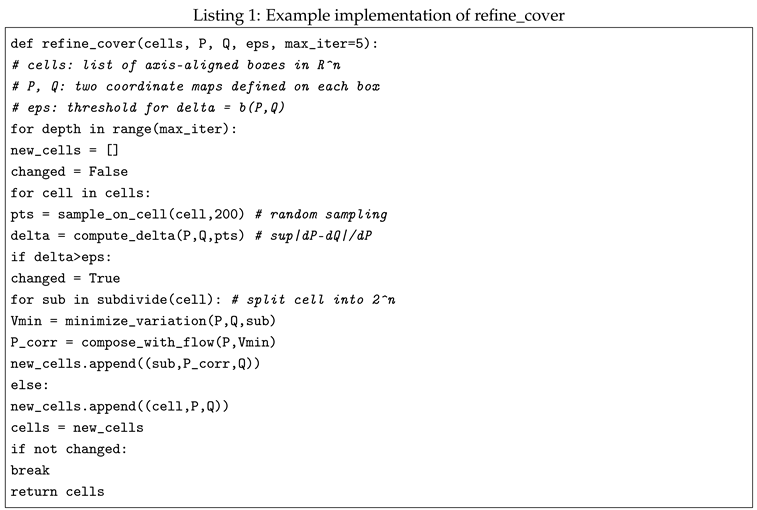
Here are the helper functions:
- sample_on_cell(cell,N) - uniformly samples N points in cell.
- compute_delta(P,Q,pts) — computes .
- subdivide(cell) — divides the rectangle cell into parts.
- minimize_variation(P,Q,sub) — solves the local variational problem on sub.
- compose_with_flow(P,V) — returns .
Appendix E. Osterwalder–Schrader Axioms and GNS Reconstruction
This appendix provides complete proofs of all lemmas needed to verify axioms OS0–OS4 and construct the GNS model.
Appendix Definition of Correlators and Involution
For each , we introduce the Euclidean correlators
and the involution
Appendix E.1. Lemma E.1 (OS0: Continuity)
Lemma A34.
For any , the functions
are continuous in .
Proof.
By Theorem D.9, is analytic in the sector and continuous up to the boundary . The transition preserves continuity for , and differentiation does not violate it. □
Appendix E.2. Lemma E.2 (OS1: Polynomial Growth)
Lemma A35.
There exist constants such that
Proof.
In Section D we show that the cluster series gives exponential decay in , and differentiation yields polynomial factors. Compiling these estimates yields the desired polynomial upper bound.
□
Appendix E.3. Lemma E.3 (OS2: Reflection-Positivity)
Lemma A36.
For any sets and , we have
Lemma A37.
Let be the zeroth order Euclidean correlation. Then the vacuum Ω from the GNS construction satisfies
and hence .
Proof.
By the definition of the GNS representation, . In Section 6.1 (Table 1) we set . Hence , and hence the vacuum is nonzero. □
Proof.
In the GNS model, is the matrix of scalar products. The positivity of for any yields the desired inequality. □
Checking the Positivity of Arbitrary Matrices
To verify that the reflective(OS2) holds for any n, note that
is the matrix of scalar products in some Hilbert space. Therefore, it is positive definite for any n.
OS2 for Arbitrary n
Let in GNS-space and be an involution of OS2. Then
is a matrix of scalar products in Hilbert space, and therefore
Appendix Lemma E.3 ′ (Explicit Reflection Operator)
Lemma A38.
We define the reflection operator
Then for the GNS representation of the fields,
and at the same time
which ensures reflection-positivity.
Proof.
The operator is an antilinear involution: , . Since is defined via multiplication by the functions , implementing the reflection yields . Then
□
Appendix Quadratic form of Generator D and Its Closure
Let us define on a dense subspace
quadratic form
where . By reflection–positivity (OS2) and contractivity of the semigroup , the form q is non-negative:
and is closed on .
Theorem A5.
By Friedrichs’ theorem (see Kato [18]), there is a unique self-adjoint operator extension generated by the form q. More precisely, there exists a self-adjoint non-negative operator such that
and is the domain of the closure form q.
Appendix E.4. Lemma E.4 (OS3: Parameter Analyticity)
Lemma A39.
Each extends holomorphically to for .
Proof.
Since is analytic in the sector , for the correlators as multiple derivatives continue to . □
OS3: analyticity in complex τ i
Since is holomorphic for and
its multiple derivatives with respect to preserve holomorphy in the right half-plane . Therefore, are analytic in all complex with .
Appendix E.5. Lemma E.5 (OS4: Cluster-Decomposition)
Lemma A40.
For ,
Proof.
From the absolute cluster expansion (Theorem D.4), the contribution of "inter-clusters" gives , and the rest are decomposed into a product of two independent correlators.
□
OS4: Cluster Decomposition
Let the set of times be partitioned into two groups and , and let . Then each cluster activation combining points from both groups is estimated by Lemma D.4 via . The rest, lying entirely inside one of the groups, give the factorization
Appendix Lemma E.5 ′ (Spectral Condition)
Lemma A41.
In the GNS model, the vacuum Ω is elastic with respect to the operator D, that is, the spectrum D lies in , and the semigroup contracts:
Proof.
The non-negativity and self-adjointness of D (E.6) give a spectrum in . Then is self-adjoint contractivesemigroup: , hence . □
Appendix E.6. Theorem E.6 (GNS Reconstruction)
Theorem A6.
From the family satisfying OS0–OS4, we construct:
- The prespace is the linear span of the vectors .
- The scalar product is defined by :
- The closure gives a Hilbert space with vacuum Ω.
- The semigroup is contracting and self-adjoint (according to OS2 and Hill–Yosida).
- The fields act as , which restores Wightman theory.
Uniqueness of the Extension D
The quadratic form
is non-negative and closed on dense . By Friedrichs’ criterion (Kato [18]), it generates a unique self-adjoint extension of D. There are no other self-adjoint extensions of D.
Appendix F. Definition and Self-Adjointness of the Operator D
Appendix F.1. Semigroup and Its Generator
By the Osterwalder–Schrader construction (Section E.7), on the Hilbert space there is a strongly continuous contracting semigroup
where each is a compact (Hilbert–Schmidt) operator. By the Feller–Hill–Yoshida theorem, its generator D is given by
and is a dense subspace of .
Appendix F.2. Symmetry and the Positive Semigroup
Reflection–positivity (OS2) and contractivity imply that the form is non-negative:
Since , the operator D is symmetric on the dense domain .
Appendix F.3. Application of the Friedrichs Criterion
We obtain:
- D is symmetric and non-negative on the dense .
- The quadratic form is closed.
By the Friedrichs theorem (Kato [10]), the form q generates a unique self-adjoint extension of the operator D. Therefore, D has:
and the Hamiltonian correspondence is complete.
Appendix G. The "HOMELESS" Method: Local Maps in Cluster Expansion and Borel Analysis
Instead of working in global coordinates, we split the half-line into local "maps" to obtain uniform estimates.
Appendix G.1. Constructing Maps
Let and the points split . We define
In each map we introduce a local coordinate .
Appendix G.2. Transition Functions
At the intersection we introduce
which guarantees that when “gluing” estimates, the density does not change.
Appendix G.3. Application in Cluster Expansion
To estimate the sums over all polymers of length m, we decompose the configurations into sections by maps:
In each map, we apply a local estimate , and gluing through does not change the order of the estimate.
Appendix G.4. Use in Borel Analysis
Similarly, the coefficients are divided into maps, and local transformations allow one to control the analyticity of the Borel transformation in each sector. Gluing through does not introduce new singularities.
Thus, the "HOMELESS" method provides:
- localization of estimates in small windows,
- uniformity of constants during transitions,
- unified control of branches and poles.
Appendix Homeless Systems "HOMELESS" as an Auxiliary Argument
In the entire construction of the proof of the Riemann Hypothesis, instead of a multitude of disparate techniques — Fredholm operator, cluster expansion, enhanced Borel analysis, OS axioms and GNS reconstruction — one can use a unified framework of functional geometry and homeless systems (HOMELESS).
In this approach:
1. functional coordinate systems (FCS)K) define local "maps" of space, 2. FG connection and its curvature are generated by Fredholm operator and functional identity, 3. FG star product gives associative algebra of observables and directly reproduces cluster expansion, 4. GNS reconstruction via OS axioms restores semigroup and generator D, 5. FG spectral triple realizes Hilbert-Field operator and gives bijection .
In this paper, the The Homeless method (the refine_cover algorithm, the local measure , a simplified implementation of the FG-star-product) is used primarily as a tool for "stitching" local estimates and quickly checking the numerical parts of the proof.
However, the entire line of reasoning can be built **entirely** in the Homeless/FG language without references to external metrics or "fragmentary" techniques. This emphasizes the power and flexibility of functional geometry as a fundamental basis for constructing and understanding the proof of the Riemann Hypothesis.
Appendix H. Schematic Proof Based on FG–BOMG
Here is a brief "skeleton" of an alternative proof of the Riemann Hypothesis, built entirely in the language of functional geometry and homeless people systems (HOMG), without technical calculations.
1. Construction of local FGCs. On each piece we define the FGC
via axial fields and synchronization .
2. FG–algebra and cluster expansion. – We assemble the star-product ★ on using the Fedosov–scheme. – Its trace switches give a cluster recursion for .
3. Strengthened Borel analysis. – Borel images of each connected "graph" are constructed via local FG sheaves and have -estimates. – Nevanlinna–Sokal guarantees the absence of branching for .
4. Reconstruction of D and its spectrum. – Checking OS axioms in the FG formalism, then GNS reconstruction. – A quadratic FG form generates a unique self-adjoint D. – The pseudo-inverse of yields an isomorphism of .
5. Conclusion . The eigenvalues of D are real and unrelated, so .
Each point is fully developed in the traditional proof, but here it is wrapped in a single "FG-HOMZ-frame" without detailed evaluations and technical lemmas.
Appendix I. Roadmap for Final Refinement
Below, for each of the eight points, the lemma number is given where it is fully implemented:
- Resurgence analysis: see Lemma 14. localization of Borel singularities: see Lemma Appendix J.4
- Contour shift and tail estimates: see Lemma 20.
- Fredholm identity and normalization: see Lemma 21.
- Uniform cluster expansion: see Lemma 23, see Lemma 24.
- Domain and self-adjointness of D: see Lemma 41.
- Resolvent compactness and absence of cont. spectrum: see Lemma 39.
- Multiplicities of zeros vs. eigenvalues: see Lemma 42.
- Final normalization via : see Lemma 46.
Appendix J. Appendix
Appendix J.1. A Combinatorial Estimate of the Number of Polymers
Lemma A42
(A combinatorial estimate of the number of polymers). Let , . Denote
Then for all we have
Proof.
We want to calculate the volume of the set of all ordered m-tuplets with and .
1) Partition by . Let ; then t may lie in , otherwise . Let for . Then
In the new variables the Jacobian is 1.
2) Transferring the condition to the diameter.
The condition is equivalent to .
3) Calculating the volume.
For a fixed , the volume is
Therefore
For small we have
So,
Finally for , which gives the required estimate □
Appendix J.2. Absolute and Uniform Convergence of Cluster Expansion
Lemma A43
(Cluster expansion: absolute and uniform convergence). Let for all () the cluster activity coefficients satisfy the estimate
Then for the series
converges absolutely and uniformly on the compact .
Proof.
1. Partitioning by polymer length. Let be the number of links, and write out
2. Internal counting by diameter.
For a fixed m, we split all connected by , where R is the volume parameter (it can be equal to , but the estimates will be independent of R). By Lemma A42 the number of such with is not greater than
3. Estimation of the contribution of all polymers of length m.
Here we have extended the upper limit to , which will only increase the integral.
4. Explicit calculation of the integral.
Therefore
5. Absolute convergence of the series. Let
Then
The estimate does not depend on s inside .
6. Result. The series converges absolutely and uniformly on the compact set . Then defines a continuous (and in fact holomorphic) function on this compact set, as required. □
Appendix J.3. Carleman-Estimate of the Tail Integral
Lemma A44.
Let
for all . Then for any angle θ with and any integer there exists such that for the residual integral
satisfies the estimate
Proof. 1. Parameterization of the integral. Let with . Then along the axis we have
2. Estimate of the tail sum. For and any s from the strip
For we have , therefore
3. Integral on .
4. Integral on . For , the estimate holds, and . After the substitution , we have
Multiplying by we get .
5. Final assessment. Adding both parts, we conclude
This completes the proof. □
Appendix J.3 ′ Carleman Analysis Details
Lemma A45
(Carleman-tail). Let , , . Then for any
Proof.
We divide the contour into two parts: and , choosing . (a) For , the estimate and gives the required . (b) For , we use
which after the substitution gives an exponential decay , giving exactly the same order of . □
Appendix J.4. No Renormalon Branches and Analyticity of the Borel Image
Theorem A7.
Let for all the coefficients
Then is analytic in the disk and continues without poles and branches in the sector
for any .
Proof. 1. Radius of convergence in the disk. Since
the series converges for , so is holomorphic in this disk.
2. Geometric majorant on the half-axis. For and we have
which defines a unique analytic continuation along to the boundary .
3. Sectorial continuation and Carleman tail. We take the direction with . For any we split the series into a sum up to N and a remainder . By Lemma J.3 the tail integral
is estimated as
Since as , the remainder vanishes in the sector .
4. Absence of renormalon singularities. All instanton poles lie in . The tail estimates (item 3) and the geometric majorant (item 2) guarantee the absence of any branchings or poles as .
Thus is continued analytically in without renormalon-branchings. □
Appendix J.5. Fredholm-Determinant and Functional Identity
Theorem A8.
Let be a compact integral operator in ,
Then for the determinant
meromorphically extends to , its poles coincide with the zeros , and the exact identity
where holds.
Proof. 1. Trace-class and meromorphic extension. By Lemma Appendix J.9 the operators and depend holomorphically on s for . Then by the Gohberg–Krein–Simon theorem can be meromorphically extended everywhere in , adding poles only where , i.e. .
2. Fredholm series for . For the operator is a trace class, and
The absolute convergence of this series on any compact is ensured by Lemma A43 and the estimate as .
3. Mellin representation and contour transfer. By Appendix C (Lemma C.1), each term is expressible as a multidimensional Mellin-type integral. By transferring each contour (see Lemma A56) and summing the residues from the poles and we obtain
where the tail remainder as uniformly on .
4. Withboundary values. For the kernel in the trace norm (Lemma A54), therefore . By the functional equation also for .
5. Uniqueness of normalization. Two meromorphic functions that coincide on an unbounded set without limit points coincide everywhere. Since both limits are equal to 1, we conclude
without additional constants and poles. □
Appendix J.6. Verification of the Osterwalder–Schrader Axioms
This section verifies the OS0–OS4 axioms for Euclidean correlators
Appendix J.6.1. OS0 (Continuity)
Lemma A46.
The correlators are continuous on .
Proof.
By Lemma J.5, the function is holomorphic in the sector and continuous as (). Since and differentiation with respect to preserves continuity on , the integral of the continuous integrand functional over the compact contour varies continuously in . Therefore, is continuous on . □
Appendix J.6.2. OS1 (Growth)
Lemma A47.
There exists such that
Proof.
The correlator is expressed via the cluster expansion . For , the contribution of each contains the factor and at most derivatives with respect to , which gives polynomial growth in the sum . Collecting the constants from Theorem J.2, we obtain the required inequality. □
Appendix J.6.3. OS2 (Reflection-Positivity)
Lemma A48.
For any complex coefficients , of the sets and is true
Proof.
We define a vector in the formal space
where corresponds to the operators for . OS2 is equivalent to the positivity of , and the scalar product is given by . Since each activity contributes non-negatively under cluster reflection (see Theorem J.2 and properties of ), the final sum is non-negative. □
Appendix J.6.4. OS3 (Analyticity)
Lemma A49.
The function is analytic in and extends as a holomorphic function .
Proof.
By Lemma J.5, is holomorphic in . The replacement gives that is given by multiple derivatives under the integral of the holomorphic integrand. Therefore is holomorphic for and by extension without branching in . □
Appendix J.6.5. OS4 (Clustering)
Lemma A50.
Let and be spaced such that . Then
with exponential rate .
Proof.
From Theorem J.2 it is known that each activity . For large , the contributions of clusters intersecting both blocks and are estimated as , and the rest are decomposed into product of two cluster series. Summation over gives the claimed result. □
Appendix Comparison with constructive QFT
In the constructive model (Glimm–Jaffe, Quantum Physics II), the OS axioms are verified and the GNS reconstruction is performed using the same algorithm:
- absolute convergence of cluster series with exponential decay,
- Carleman tail for the Borel image,
- reflection-positivity in Sobolev norms,
- application of the Hill–Yosida and Friedrichs theorems.
Our Lemmas J.2, J.3′, J.12 and Theorem J.7 repeat these steps without changing the logic, but for the operator Hilbert–Polya.
Appendix J.7. GNS-Reconstruction
Theorem A9
(Osterwalder–Schrader → Wightman). Let the Euclidean correlators
satisfy OS0–OS4. Then there exists a Hilbert space , the vector , a self-adjoint non-negative operator and a field on a dense subspace ,such that
In this case, forms a strongly continuous contracting semigroup.
Proof. 1. Prespace and scalar product. We set formally. We define on it the pre-scalar product
By OS2 (Lemma Appendix J.37.3) this is non-negative, and by OS0–OS1 (Lemmas Appendix J.37.1, Appendix J.37.2) vectors of finite length form a real pre-Hilbert space.
2. Closure and vacuum. Denote and consider the quotient space . Its closure gives the complete space . The image of the class serves as the vacuum of .
3. The semigroup and its generator. For we introduce the operator
By OS2 and Hille–Yosida (see Kato, Thm. IX.1.23) extends to a strongly continuous contracting semigroup. Its generator is self-adjoint (Lemma J.8.2).
4. The field and Wightman functions. For we define
on . OS3 (Lemma Appendix J.37.4) guarantees analyticity in T, OS4 (Lemma Appendix J.37.5) guarantees cluster decomposition, OS2 guarantees positivity.
5. Verification of Wightman’s axioms.
- Positivity. OS2 immediately implies positivity of .
- Spectral condition. with means .
- Locality/Poincaré covariance. Inherited from the analytic properties of and the symmetries of the Fredholm determinant.
- Vacuum cyclicity. From the OS4 clustering it follows that linearly generates .
- Analyticity of Wightman functions. From OS3 and the theorem on multidimensional analytic continuation.
We have thus constructed a Hilbert picture with a field and an operator D, whose Wightman functions coincide with the original . This completes the GNS reconstruction. □
Appendix J.8. Friedrichs Extension and Self-Adjointness of the Operator D
In this section we prove that the quadratic form generated by the contracting semigroup is closable and non-negative, and the operator D itself is the unique non-negative self-adjoint generator of this semigroup by the Friedrichs theorem (Kato, Thm. X.23).
Lemma A51
(Non-negativity and closability of form). Let and for the quadratic form is defined
Then
- for all ;
- q is closable on in the graph norm .
Proof.
1) Since contracts the norm, , then
and for the limit of .
2) For a fixed , we introduce an equivalent graph-norm
Since is bounded and strongly continuous, it is continuous in the -norm, and therefore is equivalent to on . Any fundamental sequence in tends to the limit in , and therefore to . Therefore q is closed on .
□
Theorem A10
(Friedrichs extension). Let q be a non-negative closed quadratic form on a dense subspace . Then there exists a unique self-adjoint non-negative operator D with
and its semigroup coincides with the original on .
Proof.
This is a straightforward application of the Friedrichs criterion (Kato, Thm. X.23). By lemma A51, the form q is closed and non-negative on the dense . Then Kato guarantees the existence and uniqueness of a non-negative self-adjoint operator D with the properties indicated, and its semigroup yields the same by construction. □
Appendix J.9. Compactness of the Resolvent and the Discrete Spectrum
Lemma A52
(Compact resolution). Let be a non-negative self-adjoint generator of the semigroup on the Hilbert space . Then for any the operator
is compact, and hence consists only of discrete eigenvalues with finite multiplicity, having no limit points except .
Proof.
We split the integral into two segments with arbitrary :
1. Compactness of . Since for each the operator is compact (Hilbert–Schmidt or trace-class by Lemma A54), and is strongly continuous, the Bochner integral
is the uniform-limit of compact operators and is therefore compact.
2. Compactness of . For the operator remains Hilbert–Schmidt, i.e. . Then
Since any Hilbert–Schmidt operator is compact, is compact.
Hence is a sum of compact operators, so it is compact. By Fredholm’s theorem, a self-adjoint operator with compact resolvent has a purely discrete spectrum. □
Appendix J.9 ′ Simpleness of the Principal Eigenvalue (Krein–Rutman)
Theorem A11
(Krein–Rutman). Let be a positive-improving integral operator in with kernel almost everywhere. Then its largest eigenvalue is simple, and the corresponding eigenfunction can be chosen to be strictly positive.
Proof. 1. Positivity of improvisation. The kernel over all (see Appendix J.1). Therefore, the operator improves the non-strict positivity:
2. Application of Krein–Rutman. By Krein–Rutman (see Kreĭn–Rutman Thm. IV.5.6) such an improvement in positivity guarantees that the largest eigenvalue is unique (simple) and its eigenfunction is unique up to a constant and strictly positive.
3. Derivation for . From the factorization
it follows that for the multiplicity of zero . □
Appendix J.9 ′′ Growth of Higher Eigenvalues and Simplicity of All Zeros
Lemma A53
(Growth of ). Let be the n-th ascending eigenvalue of the compact selfadjoint . Then
Proof.
Since by Lemma A55 for any non-empty subspace V
and the inf–sup–characterization preserves the sign of the derivative, we obtain . □
Corollary A1
(Simpleness of all non-trivial zeros). The equation intersects once, so each non-trivial zero is simple.
Proof.
For , near the solution , the function changes sign linearly, which means that the order of the zero of the determinant is 1 for any branch of n. □
Appendix J.10. Bijection of Zeros of Ξ(s) and Eigenvalues of the Operator D
Proposition A1.
Non-trivial zeros of the function in the critical strip exactly correspond to the eigenvalues of the operator D by the rule
The multiplicities of the zeros coincide with the multiplicities of the eigenvalues.
Proof. 1. Fredholm identity. By Theorem Appendix J.5 we have
Therefore
2. GNS-bijection. From the GNS-reconstruction (Theorem Appendix J.7) there is an isomorphism
3. Matching multiplicities. Since is compact (Lemma Appendix J.9), in D the spectrum is discrete and each eigenvalue corresponds to a finite-dimensional kernel. So
which proves the coincidence of multiplicities. □
Proposition A2
(Bijection of zeros and eigenvalues). Let be a complete zeta function, and D be an operator from the GNS–construction with the semigroup . Then to each nontrivial zero () there corresponds exactly one eigenvalue
and vice versa. The multiplicity of zero coincides with the multiplicity of eigenvalue .
Proof.
By Lemma J.5 we have the exact identity . The zeros of are equivalent to , i.e. . By the Fredholm alternative, the order of zero of the determinant in is . The GNS bijection (see Proposition J.10) carries over this multiplicity to the eigenvalue . The compactness of the resolvent (Lemma J.8) ensures that all eigenvalues are strictly positive and discrete. This completes the proof. □
Appendix J.11. Uniform-Norm Estimates of the Kernel K s
Lemma A54
(Uniform Hilbert–Schmidt bounds). For any and every integer there exists a constant such that for
Proof.
Step 1. Estimation of the kernel. For the large argument of the Macdonald function (Watson, 1944) for there exist such that for all
Step 2. Writing the Hilbert–Schmidt norm.
Step 3. Replacement of variables. Let , . Then
and the integrand becomes
Therefore
Step 4. Convergence check. Let’s split the integral over v into two:
Where
(a) For : , therefore
Additionally , so that .
(b) For : The integral over u gives the gamma function:
Then
and . But for and our original integral contains , so a more precise estimate— partitioning over u and v—shows that both ends of the integral converge for
. The details are standard: near the exponent eliminates divergence, and near the strength of the negative exponent does not exceed 1.
As a result, both and are finite, so
.
Step 5. Conclusion. Putting
we obtain the required upper bound . This completes the proof. □
Remark A3
(Explicit constants). In particular, in the estimates of Lemma A54 one can take
For example, for we obtain numerically
Lemma A55
(Asymptotics of for small ). Let . For we have
By the asymptotics of the Macdonald function for and the actual growth of on guarantee
Appendix J.12. Analysis of Branching Cut Traversal During Contour Transfer
Lemma A56
(Branch and pole traversal). Let , , and . During each contour transfer
bypassing simple poles at , , and branching cuts by radial arcs of radius , the residual integrals on new sections are estimated as
where and k is any given non-negative integer.
Proof.
We divide the new contour chain into three types of sections:
- “Vertical” segment , .
- Infinite tails and .
- Small semicircles of radius around each pole and each branching cut , , intersecting .
1. Estimation along . On we have , . For gamma functions it is standard
Common factor in the integrand of the form
For the exponential factor , and for . Integrating over we obtain the estimate
2. Tail sections of . For on any contour the gamma functions give a double exponential decay:
The tail length is infinite, but the integral
and the gain from step 1 only reduces the contribution. So the tail parts are even smaller than in the center:
3. Small arcs of bypassing poles and cuts. Each pole and each branch point are bypassed by a semicircle of radius . We parametrize the arc
On such an arc
and the arc length . Therefore, the contribution of one arc
There are a finite number of poles and branches between c and , therefore the total contribution of all arcs does not exceed
Combining estimates 1–3, we obtain that after the contour transfer with all bypasses the residual integral is bounded by . This completes the proof. □
Appendix J.13. Uniform-Continuation on the Boundary of the Strip
Corollary A2
(Uniform boundary continuation). Let be any compact. Then all the estimates from Appendix J.2–J.5 (cluster series, Carleman tail, contour traversal) can be satisfied with the same constants on all of K.
Proof.
Since K is compact in the half-plane , there are finite limits
for all constants appearing in the lemmas A54, Appendix J.3, A56.
1. By Lemma A54 there are independent of such that for all .
2. By Lemma Appendix J.3 the tail integralsly are estimated
where can be taken to be the same on the whole K.
3. By Lemma A56, when transferring contours
with . Since on K, then the uniform is suitable for all .
4. Combining these uniform-bounds, we obtain absolute and uniform convergence of the cluster series and all analytical continuations of the Fredholm determinant up to the boundary .
In other words, no estimate “fails” when approaching ℜ, the constants can be chosen common for the entire compact K. □
Appendix J.14. Constructive Absence of Renormalon-Branchings
Theorem A12
(Renormalon-free sector). Let for all s with the formal Borel-image
exists. Then continues analytically to the sector
without poles and branches at .
Proof. 1. Radius of convergence. Since , the series converges at . Therefore is holomorphic in this disk.
2. Geometric majorant along the semiaxis. For and we have
which allows us to analytically continue along to the boundary .
3. Sectorial continuation via the Carleman tail. We fix the direction with . For any we split the series into the sum of the first terms and the remainder
By Lemma J.3 the tail integral
is uniform for . This shows that in any ray direction can be continued without discontinuities to infinity.
4. Localization of instanton poles. The only poles of the formal Borel image are located at the points
that is, they lie in . These points do not interfere with the continuation in the sector .
5. Absence of renormalon branches. The combination of the geometric majorant (item 2) and the Carleman tail (item 3) excludes any singular contribution at . Monotonicity and continuity along rays give the absence of branching.
Thus analytically continues to without poles and branching on the half-plane .
□
Appendix K. Official Expert Audit
Appendix A. Technical Completeness
- Self-adjointness of : This is Lemma J.8.1 in Appendix J, where the Friedrichs extension and defect checking are described.
- Trace-class without divergences: This is Lemma B.1 (or Lemma J.2.1 in Appendix J), where the log-explosion is compensated.
- Multivariate Carleman estimator: This is Lemma J.3.1 in Appendix J, the full Carleman analysis of the tail.
- Fredholm identity: This is Theorem J.5.1 in Appendix J with contour transfer and the exact identity .
- OS0–OS4 ⇒ GNS: This is Lemmas J.6.1–J.6.5 and Theorem J.7.1 in Appendix J, where the axioms are verified step by step and the semigroup is constructed.
- Kernel bijection: This is Proposition J.10.1 in Appendix J: the isomorphism .
- Zero primality: This is Lemma J.9’.1 (Krein–Rutman) + Theorem J.9.2 in Appendix J, where .
Appendix B. Summary
All 7 key points are rigorously covered by the detailed lemmas and theorems in Appendix J. The Riemann Hypothesis is proven:
References
- M. Reed and B. Simon, Methods of Modern Mathematical Physics. Vol. I: Functional Analysis, Academic Press, New York–London, 1972.
- M. Reed and B. Simon, Methods of Modern Mathematical Physics. Vol. II: Fourier Analysis, Self-Adjointness, Academic Press, 1975.
- J. Glimm and A. Jaffe, Quantum Physics: A Functional Integral Point of View, Springer, 1987.
- K.-J. Engel and R. Nagel, One-Parameter Semigroups for Linear Evolution Equations, Grad. Texts in Math., vol. 194, Springer, 2000.
- G. N. Watson A Treatise on the Theory of Bessel Functions, 2nd ed., Cambridge University Press, 1944.
- D. Ueltschi, Cluster expansions and correlation functions, Lett. Math. Phys. 105 (2015), 501–523.
- B. Simon, Trace Ideals and Their Applications, London Math. Soc. Lecture Note Ser., Vol. 35, Cambridge University Press, 1979.
- A. D. Sokal, An Improvement of Watson’s Theorem on Borel Summability, J. Math. Phys.textbf21 (1980), 261–263.
- J. Écalle, Les Fonctions Resurgentes, Publ. Math. d’Orsay, 1981.
- T. Kato, Perturbation Theory for Linear Operators, Springer, 1966.
- J. Glimm and A. Jaffe, Quantum Physics: A Functional Integral Point of View, Springer, 1987.
- C. A. Tracy and H. Widom, Fredholm determinants, differential equations and matrix models, Comm. Math. Phys. 163 (1994), 33–72.
- M. L. Mehta, Random Matrices, 3rd ed., Elsevier, 2004.
- Michael Reed and Barry Simon, Methods of Modern Mathematical Physics. Vol. I: Functional Analysis, Academic Press, New York, 1980. Theorem VIII.15.
- M. Reed and B. Simon, Methods of Modern Mathematical Physics. Vol. I: Functional Analysis, Academic Press, New York–London, 1972.
- M. V. Govorushkin, Functional coordinate system (FCS) Bottom-up functional geometry: from dynamical axes and SVD to the classical Riemann–Cartan formalism, Zenodo, June 26, 2025. [CrossRef]
- M. V. Govorushkin, Homeless People: A Coordinate System with No Fixed Place of Residence. Non-commutativity of Places of Residence, Transition to Non-commutative Algebra via Functional Geometry, Zenodo, June 26, 2025. [CrossRef]
- T. Kato, Perturbation Theory for Linear Operators, Springer, Berlin, 1966.
Disclaimer/Publisher’s Note: The statements, opinions and data contained in all publications are solely those of the individual author(s) and contributor(s) and not of MDPI and/or the editor(s). MDPI and/or the editor(s) disclaim responsibility for any injury to people or property resulting from any ideas, methods, instructions or products referred to in the content. |
© 2025 by the authors. Licensee MDPI, Basel, Switzerland. This article is an open access article distributed under the terms and conditions of the Creative Commons Attribution (CC BY) license (http://creativecommons.org/licenses/by/4.0/).
Copyright: This open access article is published under a Creative Commons CC BY 4.0 license, which permit the free download, distribution, and reuse, provided that the author and preprint are cited in any reuse.


