

Submitted:
14 July 2025
Posted:
16 July 2025
You are already at the latest version
Abstract
The rise of the digital economy is profoundly transforming urban landscapes by reshaping how people live, work, consume, and move. This paper conducts a systematic literature review of peer-reviewed articles to explore how digital disruptions are altering urban activities, human behaviours, and mobility patterns—and how these changes redefine land use and land value. Findings reveal that the digital economy is decoupling urban functions from geographic proximity, undermining traditional land value determinants. E-commerce, remote work, and gig economies are restructuring retail, office, and housing demand, while platform urbanism is driving the privatisation of public spaces and corporatisation of governance. Digital behaviour shifts, including on-demand consumption and digital engagement, are creating new spatial and economic inequalities. Urban mobility is transitioning toward shared, electric, and autonomous solutions, supporting 15-minute city concepts but also challenging infrastructure and regulatory norms. This study underscores the urgency of rethinking planning, land valuation, and equity in the digital era. The paper concludes with implications for urban policymakers, planners, and real estate professionals seeking adaptive, inclusive, and forward-looking land use strategies.
Keywords:
digital economy
; urban disruption
; land use
; land value
; urban mobility
; platform urbanism
; e‐commerce
; remote work
; behavioural shifts
; urban planning and development
1. Introduction
The advent of the digital economy has brought about significant changes in how people live, work, and interact within urban environments. Traditional urban activities, such as retail, commerce, and recreation, are increasingly being augmented or replaced by digital alternatives [1]. This shift is influencing human behaviour, leading to new patterns of consumption, communication, and social interaction [2,3,4]. Simultaneously, digital technologies are transforming mobility, with the rise of shared mobility platforms, electric vehicles, and autonomous transportation systems [5,6]. These changes collectively impact land use patterns and, consequently, land values within cities [7].
The conventional understanding of land use and land value is predicated on physical proximity and accessibility to economic opportunities, amenities, and transportation infrastructure [8,9]. Nevertheless, the digital economy challenges these assumptions by reducing the importance of physical location for certain activities and creating new forms of value that are not directly tied to traditional land uses [1,10,11]. For instance, the rise of remote work has decoupled employment from physical workplaces, potentially leading to shifts in residential preferences and demand for office spaces [12]. Similarly, the growth of e-commerce has altered retail patterns, impacting the demand for brick-and-mortar stores and transforming commercial districts [13,14].
Understanding these transformations is essential for urban planners, policymakers, and real estate professionals. Traditional land use regulations and valuation models may no longer accurately reflect the realities of the digital economy, leading to inefficiencies, inequities, and unsustainable development patterns [15,16]. This study will address the following key research questions: (a) How does the digital economy disrupt traditional urban activities, and what are the implications for land use patterns? (b) How does the digital economy influence human behaviour in urban environments, and how do these behavioural shifts affect land demand and value? (c) How does the digital economy transform urban mobility through the emergence of new transportation technologies and platforms, and what are the consequences for land use, accessibility, and urban form? By examining the disruptions caused by the digital economy on urban activities, behaviour, and mobility, this research aims to provide insights that can inform more effective land use policies, valuation methodologies, and urban development strategies.
2. Literature Background
2.1. The Digital Economy and Urban Activities
The digital economy has significantly altered traditional urban activities, such as retail, commerce, and recreation [17,18,19]. The rise of e-commerce has disrupted traditional retail patterns, leading to a decline in brick-and-mortar stores and the emergence of new forms of online shopping [13]. This transformation has implications for the demand for commercial spaces and the vitality of traditional commercial districts. Similarly, the digital economy has facilitated the growth of online services, such as online education, telemedicine, and remote entertainment, which have reduced the need for physical spaces dedicated to these activities [20,21,22]. The shift towards a digital economy has also led to the emergence of new types of urban activities, such as co-working spaces, maker spaces, and innovation hubs [23,24]. These spaces cater to the needs of digital workers, entrepreneurs, and startups, fostering collaboration, creativity, and innovation. They often require different types of land use and infrastructure compared to traditional office spaces, necessitating a re-evaluation of zoning regulations and development policies.
2.2. Digital Economy and Human Behaviour
The digital economy has profoundly influenced human behaviour in urban environments, including consumption patterns, social interactions, and mobility choices [25,26,27]. The proliferation of smartphones, social media, and online platforms has transformed how people consume goods and services, communicate with each other, and access information [28]. These behavioural shifts have implications for land demand and value. For instance, the rise of online shopping has altered consumer behaviour, leading to a greater emphasis on convenience, personalisation, and price transparency [29]. This has reduced the demand for traditional retail spaces and increased the demand for logistics and distribution centres [30,31]. Similarly, the growth of social media has transformed social interactions, leading to a greater emphasis on online communities and virtual experiences [32]. This has implications for the demand for public spaces and community facilities.
2.3. Digital Economy and Urban Mobility
The digital economy has revolutionised urban mobility through the emergence of new transportation technologies and platforms. Shared mobility platforms, such as Uber and Lyft, have transformed how people move around cities, providing convenient and affordable transportation options [33]. Electric vehicles are gaining popularity, reducing reliance on fossil fuels and promoting sustainable transportation [34]. Autonomous vehicles hold the promise of further transforming urban mobility, potentially leading to safer, more efficient, and more accessible transportation systems [35]. These transformations have significant consequences for land use, accessibility, and urban form. The rise of shared mobility platforms may reduce the need for private car ownership, leading to a decrease in demand for parking spaces and a shift towards more pedestrian-friendly and bike-friendly urban environments [36,37,38]. The adoption of electric vehicles may require the development of new charging infrastructure, which could impact land use patterns and energy consumption [39,40]. The deployment of autonomous vehicles may lead to more efficient use of road space, potentially reducing traffic congestion and improving accessibility [41].
3. Research Design
3.1. Methodological Approach
This study employs a systematic literature review (SLR) methodology to investigate how the digital economy disrupts traditional urban activities, behaviour, and mobility patterns, and their subsequent impacts on land use and land value. The SLR follows a rigorous three-stage methodological approach adapted from [42], ensuring comprehensive coverage and systematic analysis of relevant literature. The review was guided by three key research questions: (a) How does the digital economy disrupt traditional urban activities, and what are the implications for land use patterns? (b) How does the digital economy influence human behaviour in urban environments, and how do these behavioural shifts affect land demand and value? (c) How does the digital economy transform urban mobility through the emergence of new transportation technologies and platforms, and what are the consequences for land use, accessibility, and urban form?
3.2. Literature Search Strategy
The first stage (Stage 1) is to define the literature search strategy. To ensure comprehensive coverage of relevant literature, a structured search strategy was developed using Boolean operators to combine key terms related to each research question. Three distinct search queries were formulated: ("urban activities" OR "urban land use" OR "urban functions") AND ("digital transformation" OR "digital economy") for addressing urban activities; ("urban behaviour" OR "consumer behaviour" OR "lifestyle changes") AND ("digital transformation" OR "digital economy") for examining behavioural aspects; and ("urban mobility" OR "travel behaviour" OR "commuting patterns") AND ("digital transformation" OR "technological disruption") for investigating mobility transformations. These search queries were applied to the title, abstract, and keywords fields across four major academic databases. Scopus was selected for its comprehensive coverage of peer-reviewed literature across multiple disciplines, particularly strong in urban studies, geography, and technology research. Web of Science was utilised for its rigorous selection criteria and citation indexing, ensuring high-quality scholarly publications. Google Scholar was included to capture a broader range of academic literature, including recent publications and interdisciplinary research that might not yet be indexed in traditional databases. ProQuest was employed to access additional academic journals and ensure coverage of publications from diverse geographic regions and emerging research areas.
The search was restricted to articles published between 2019 and 2024 to capture recent developments in the rapidly evolving digital economy. Additional filters were applied to ensure quality and relevance, including limiting results to peer-reviewed journal articles, research papers only (excluding reviews, editorials, and conference papers), English language publications, and full open-access articles. The initial search yielded 512 articles across all databases, providing a substantial corpus for systematic review.
In Stage 2, The selection process involved a multi-stage screening approach with clearly defined inclusion and exclusion criteria applied at primary and secondary levels. Primary inclusion criteria specified peer-reviewed research articles with full-text availability online and articles published in academic journals. Primary exclusion criteria eliminated duplicate records across databases, books and book chapters, industry reports, and government reports and policy documents. Application of primary criteria reduced the initial 512 articles to 244 unique research articles.
Secondary screening criteria were then applied in two phases. The inclusion criteria at this stage required direct relevance to digital transformation impacts on urban activities, behaviour, or mobility; clear alignment with one or more research questions; demonstrable methodological rigour; and provision of empirical evidence or robust theoretical contributions. Articles were excluded if they had only tangential relationships to digital transformation in urban contexts, lacked clear connection to urban activities, behaviour, or mobility, showed insufficient relevance to the research aims, or were purely descriptive studies without analytical depth. The first phase involved screening titles, abstracts, and keywords of the 244 articles, resulting in 77 articles deemed potentially relevant. The second phase consisted of full-text review of these 77 articles against secondary criteria, yielding a final sample of 66 articles for in-depth analysis. Figure 1 presents a summary of the methodology described above, including the Boolean search terms applied.
3.3. Data Analysis
In Stage 3, The analysis employed a systematic categorisation method adapted from [43], utilising a four-step qualitative approach to identify and organise key themes aligned with the research questions. These themes were then re-evaluated, refined, and cross-referenced with other literature and review studies. The criteria for the formation of the themes are presented in Table 1.
The analysis utilised descriptive qualitative techniques rather than statistical methods. Pattern matching was employed to identify common themes, trends, and differences across the selected literature using systematic eye-balling techniques deemed sufficient for assessing and organising the data. Explanation building was used to develop coherent narratives connecting identified patterns to the theoretical framework and research questions. This analytical process resulted in the distribution of the 66 selected articles across three primary thematic categories: How Digital Economy Disrupts Urban Activities (n = 22), How Digital Economy Disrupts Urban Behaviour (n = 22), and How Digital Economy Disrupts Urban Mobility (n = 22). The final stage involved synthesising findings from the analysed articles into a comprehensive narrative that addresses each research question, presenting key findings within each thematic category, identifying cross-cutting themes and interconnections, and highlighting implications for land use patterns and land values.
4. Analysis and Results
4.1. General Observation
The increasing number of publications focusing on the digital economy's impact on urban environments demonstrates a growing interest among researchers. The number of articles published reflects this trend, with two articles in 2017, four in 2018, four in 2019, 12 in 2020, 12 in 2021, 10 in 2022, and 22 between 2023 and 2024. A significant number of leading authors are affiliated with academic institutions in Europe (n = 32) and Asia (n = 20), reflecting the widespread adoption of the digital economy in these regions. Interest is also evident in Australia (n = 5), South America (n = 4), and the Middle East (n = 4), with fewer studies originating from North America (n = 1). A graph illustrating the growth of literature on the impact of the digital economy in relation to publication year and world region is available.
The extensive and multifaceted impact of the digital economy on urban environments is reflected in the diverse range of journals and proceedings from which articles were selected for this research review. Approximately half of the articles are distributed across journals and proceedings focusing on Geography, Planning and Development (n = 8), Economics (n = 8), Business and Finance (n = 8), and Social Science (n = 8). The remaining half are primarily found in publications centred on Urban Studies (n = 6), Transport (n = 5), Environmental Science (n = 5), Engineering and Technology (n = 5), and Tourism (n = 5). A smaller proportion of papers originate from other various fields.
Regarding the research method, literature reviews represent the most prevalent type of paper addressing the impact of the digital economy (n = 24). The academic discourse on the digital economy and its effects on urban areas is often scattered across various disciplines, including management, information systems, economics, and urban planning. A literature review can bridge these disciplinary divides by synthesising diverse perspectives and bringing together insights from different fields [44]. While a literature review provides a broad overview of a topic, it may lack the depth and detail necessary to fully understand the complexities of the digital economy and its urban impacts. They are not always consistent, and different studies may reach conflicting conclusions [45].
An additional common research method employed is quantitative analysis, with 17 papers utilising approaches such as surveys, questionnaires, panel data, and regression models. Quantitative analysis is adept at identifying broad trends and patterns within large datasets. By analysing survey responses from a diverse sample of urban residents, researchers can uncover common behaviours related to digital platforms, such as e-commerce adoption, use of ride-sharing services, or engagement in online communities [46]. Quantitative methods, particularly surveys and panel data, can be scaled to cover large populations and diverse geographic areas, enhancing the generalisability of research findings. However, Quantitative analysis often lacks the depth and contextual understanding that qualitative methods can provide. Surveys and questionnaires typically focus on specific variables, neglecting the broader social, cultural, and historical context that shapes urban activities and behaviours [47].
Conversely, a dozen of papers adopted a qualitative approach, incorporating interviews, ethnographic studies, comparative analyses, and workshops. Qualitative methods prioritise the exploration of subjective experiences and meanings. They allow researchers to understand how urban residents perceive, interpret, and make sense of the changes brought about by the digital economy. even though Qualitative research is inherently subjective, and researcher bias can influence the data collection, analysis, and interpretation processes.
Another methodological approach used are case study (n = 10) and Mixed Method (n = 4). The case study approach is flexible and adaptable, allowing researchers to adjust their research questions and methods as new information emerges. This is particularly useful in the rapidly evolving digital economy, where new technologies and business models are constantly emerging. While case studies are often used for exploratory research, they can also contribute to theory building by generating new concepts, frameworks, and hypotheses.
4.2. How Digital Economy Disrupts Urban Activities
This section discusses some digital economy impacts on urban activities disruption. Based on the reviewed literature the following outcomes were identified: (a) spatial segregation; (b) privatisation of public space; (c) corporatisation of urban governance; (d) Revaluation of urban centres and suburban areas, and (e) tourism disruption (Table 2).
First, digital economies have shifted urban governance towards a smart city model, integrating high-tech investments and knowledge-intensive industries [48]. Municipalities are now active participants in shaping digital infrastructure, forming public-private partnerships and data-driven policies. This involves designing cities to support digital entrepreneurship through "smart precincts" and innovation hubs, leading to specialised districts catering to knowledge economies.
The increasing importance of digital connectivity and data accessibility is shifting the economic value of land [49]. High-tech districts and smart city hubs are experiencing land value appreciation, while traditional commercial zones are becoming less relevant [50]. This dynamic leads to increased value in digitally connected districts, potentially causing gentrification and displacement. As an example, smart city projects can attract private investment, which increases real estate prices and displaces low-income residents. Furthermore, Algorithmic Urban Exclusion, Digital mapping and AI-driven urban services often prioritise privileged groups while excluding marginalised communities [51]. For example, Routing algorithms in ride-hailing apps avoid low-income neighbourhoods, reinforcing spatial segregation and unequal access to services.
Secondly, Municipal governments are increasingly collaborating with tech firms, leading to the privatisation of public services and spaces, potentially catering primarily to those who can afford them [52]. This collaboration blurs the boundaries between public and private spaces, transforming public areas into commercialised zones, as seen in smart city projects that maximise data collection and monetisation. Cities are being designed with interactive urban environments, integrating technologies like AR, smart sensors, and AI-driven public services, and shifting urban services such as transport and accommodation to private digital platforms, which affects affordability [53]. This shift highlights the digital divide and socio-spatial inequality, as not all residents benefit equally from these digital transformations [50], leading to the exclusion of marginalised communities from digital economic benefits.
Third, digital urbanism is evolving from smart, data-driven city management to platform urbanism, where digital platforms increasingly mediate urban services and interactions . These platforms, exemplified by transportation services like Uber and short-term rentals like Airbnb, act as intermediaries that reshape traditional urban economies [54]. This shift can lead to cities becoming reliant on specific corporate platforms, creating issues of "lock-in" and potentially "lock-out" from alternative solutions, and influencing city governance and service delivery [52]. The rise of these platforms also fosters informalisation and deregulation, creating tensions with existing municipal policies, and potentially leading to corporate-controlled governance models where private firms dictate urban management strategies, as seen in projects where private firms experiment with urban governance models [55].
Fourth, the increasing prevalence of remote work, e-commerce, and home delivery platforms is reshaping urban landscapes by diminishing physical movement within cities [56]. This shift leads to a decline in traditional office and retail districts as digital alternatives reduce foot traffic, prompting the conversion of retail spaces and adaptation of residential areas with co-working spaces and smart home technologies [57]. While suburban and exurban areas gain value due to increased digital connectivity, allowing work from diverse locations, demand rises for logistics hubs and data centres, yet urban centres maintain their appeal due to proximity to customers, skilled workers, and innovation ecosystems [58]. Despite Industry 4.0’s ability to decentralise production, companies still cluster in knowledge-intensive urban environments.
Digital platforms are transforming urban employment patterns by reshaping labour markets, leading to both the decline of traditional jobs and the creation of new, digitally based opportunities [59]. This shift fosters informal employment, particularly in gig-based mobility services, creating a new category of workers as independent contractors and expanding flexible employment opportunities that alter commuting patterns and demand for commercial spaces [60]. The digital economy also reduces information asymmetry between enterprises and consumers through online platforms, enabling cross-regional economic transactions and making financial services more inclusive, while the reduced need for physical proximity disperses economic activities beyond traditional urban cores.
The final outcome relates to tourism disruption. Digital technologies are reshaping urban economies reliant on tourism by enhancing efficiency, reducing business costs, and offering personalised services [61]. This encourages tourism specialisation in non-traditional tourist destinations, shifting their economic focus. As digital platforms boost tourism, land values in certain urban areas may increase due to higher visitor demand. Digital storytelling and mobile apps are redefining tourist experiences at urban heritage sites [62], while the value of urban land is now based on digital enhancements and engagement metrics, with digital tools creating new interactions between residents, tourists, and city infrastructure [63]. However, areas with digital upgrades may experience increased land values, potentially displacing residents and businesses, indicating that urban land value is increasingly tied to digital infrastructure and tourism potential [64].
4.3. How Digital Economy Disrupts Urban Behaviour
This section discusses how digital economy disrupt urban behaviour. This disruption can be seen in: (a) Gig work and digital nomadism; (b) Consumption patterns; (c) From ownership to access-based consumption; (d) The power of digital engagement (Table 3).
The first disrupted urban behaviour is related to working behaviour. The digital economy is reshaping urban work and consumption patterns by diminishing reliance on centralised office districts and physical retail spaces [65]. This shift is driven by the rise of digital businesses that operate without fixed locations and the growth of remote work, digital nomadism, and flexible workspaces [66]. As businesses migrate to digital platforms, traditional retail and office spaces lose value, potentially leading to the repurposing of shopping malls and business districts into mixed-use developments or logistics hubs. This transformation leads to new job opportunities in logistics, digital marketing, and information technology, while simultaneously disrupting traditional retail employment, requiring cities to adapt their workforce and education systems to meet Industry 4.0 requirements [67,68]. The platform economy, encompassing gig work and remote jobs, further redistributes urban wealth and employment, leading to uneven economic transformations that necessitate a rethinking of labour policies and workforce training, and highlighting the need for cities to address digital inequality to ensure e-inclusion and social equity.
The second disruption affects consumption pattern. The digital economy is reshaping urban consumption patterns, with consumers increasingly favouring online and hybrid shopping experiences, which reduces foot traffic in physical retail spaces [69]. Businesses are adapting from product-centric to customer-centric models that emphasise personalised digital interactions, which alters traditional commercial zones. This retail transformation favours experience-based spaces like interactive showrooms and pop-up stores, necessitating adjustments in commercial zoning policies, while the adoption of e-wallets further reduces reliance on physical cash, impacting how people engage with urban commercial spaces [70]. Digital payment systems also support the development of smart and cashless cities, where urban spaces integrate seamless digital services, potentially leading to a redesign of urban centres that facilitates digital transactions and reduces the need for ATMs and physical banking spaces.
The shift towards digital consumption is reshaping urban spaces as traditional retail diminishes and e-commerce expands. This leads to the repurposing of vacant department stores into mixed-use developments or logistics hubs, while the growth of home delivery services increases the demand for urban logistics centres [71]. Developed urban centres experience faster digital consumption growth, potentially creating regional imbalances, and technological innovation in the digital economy impacts income distribution and urban investment [72]. Furthermore, digital commerce adoption is higher among younger and wealthier urban consumers, which may exacerbate economic polarisation between digitally connected and disconnected communities.
The third, the digital economy fosters on-demand access to services, shifting consumer behaviour toward instant and flexible consumption models. This has led to collaborative consumption, where individuals share assets like cars and homes, facilitated by digital platforms that prioritise renting, lending, and sharing over ownership, exemplified by services like Airbnb and Uber [73]. This transition reduces the demand for personal vehicle ownership and property investment, influencing urban planning by potentially repurposing parking spaces for green areas and requiring redesign of public transport access points to accommodate on-demand pick-up/drop-off zones. Furthermore, Public transportation may need to adapt to a more flexible, on-demand model rather than traditional fixed routes.
Subsequently, consumer spending habits are influenced by economic crises and conflicts, leading to increased price sensitivity and a focus on product availability, delivery efficiency, and affordability [74]. This shift is further amplified by the digital economy, where younger, tech-savvy generations like Millennials and Gen Z are more inclined to participate in the sharing economy, driven by social and environmental motivations, and enabled by the reduced barriers to access provided by digital platforms [73]. Moreover, higher technological proficiency and openness to innovation among these younger populations drive greater adoption of digital payment methods, influencing urban economic activities and potentially redesigning urban centres to facilitate digital transactions [70]. The COVID-19 pandemic has also accelerated the transition of businesses to new conditions of functioning, further solidifying the importance of digital solutions in meeting consumer demands.
The power of digital engagement is the final impact of urban behaviour disruption. Consumers are increasingly utilising self-service technologies and digital platforms, which is reshaping their engagement with businesses and altering urban spaces. This shift is evident in the rising expectation for digital interfaces in hospitality and other urban services by tourists and shoppers, which is impacting the demand for traditional service spaces [75,76]. As restaurants integrate self-service technologies, the demand for large seating areas and physical interactions may decline, potentially leading to the repurposing of commercial spaces. The rise of travel applications and online booking platforms empowers tourists to plan independently, leading to a preference for unorganised tourism and more diverse tourist routes that extend to lesser-known urban areas [77,78]. This dispersion of tourists can challenge local infrastructure, potentially leading to the repurposing of commercial spaces.
The increasing reliance on digital platforms and social networks is shifting decision-making from local interactions to global digital spaces [79]. People engage with urban environments through digital interfaces, and increasingly rely on online information and peer reviews, leading to a preference for self-guided tourism and diverse routes [77]. Metropolitan residents engage in more digital transactions and use online information sources (e.g., reviews, comparison sites) more frequently than rural residents [80]. While the gig economy allows residents to monetise assets through ride-sharing and local tours. Historic city centres experience higher rental prices and displacement of local communities due to increased short-term rental activity. leading to short-term rental booms in tourist-heavy areas. This affects housing availability and affordability for local residents. Increased demand for temporary lodging changes zoning regulations and urban planning priorities.
4.4. How Digital Economy Disrupts Urban Mobility
This section discusses what kind of urban mobility is affected by digital economy development. These disruptions are evident in: (a) commuting mobility; (b) logistic and last-mile delivery; (c) supporting 15-minute city implementation, and (d) car ownership vs on-demand mobility (Table 4).
The first, the digital economy is reshaping urban commuting patterns by shifting employment from manufacturing and construction to service-based jobs, leading to a decreased demand for industrial zones and an increased need for co-working spaces and digital hubs [81]. This shift is further amplified by the rise of remote work, which has significantly reduced daily commutes and reliance on public transport and private vehicles [82]. Consequently, suburban areas are becoming more attractive due to the reduced need for commuting, leading to a shift in housing preferences towards larger homes with workspaces and potentially driving demand for decentralised mobility solutions in previously car-dependent peripheral urban areas.
The second, the rise of online shopping is substituting physical trips, which has led to a decline in shopping-related travel and has affected public transport ridership and road congestion [83]. This shift requires updating traditional travel demand models to reflect how digital platforms influence when, where, and how people travel for shopping. As people manage social and commercial activities through digital platforms, public spaces see a decline in casual movement, while increased home deliveries have shifted urban mobility patterns, necessitated new models of urban freight distribution and potentially causing congestion with the rise of same-day delivery and e-commerce logistics hubs [84]. The increased demand for logistics and last-mile delivery hubs is also shifting land use patterns from retail-centric to warehousing, prompting cities to rezone areas for micro-fulfillment centres and distribution hubs to support rapid delivery services. With more people working remotely and using shared transport, parking lots and car-dependent infrastructure may become obsolete. Urban planners might convert underutilised parking spaces into green spaces, pedestrian-friendly zones, or mixed-use developments.
The third, as commuting decreased, people compensated with more local, non-work-related travel, leading to increased neighbourhood-level mobility and demand for high-quality public spaces. This shift supported the rise of 15-minute cities and self-sustaining, mixed-use districts where daily needs are met within short distances [85]. Enhanced by digital economies, these urban clusters promote localised living and reduce the need for cross-city travel, with mobility dominated by autonomous buses, personal mobility devices, cycling, and walking [86]. As a result, urban policies are increasingly focused on reducing car dependency, enhancing walkability, and reallocating road space for green and functional urban areas.
The final, Digital platforms are transforming travel behaviour by promoting convenience and efficiency over car ownership, with users favouring pay-per-use models enabled by app-based services [87,88]. Millennials, as tech-savvy digital natives, drive demand for flexible, technology-driven transport options like Uber and Lyft, reducing reliance on private vehicles and disrupting traditional transportation systems [89,90]. Features like voice search and AI recommendations further shape travel choices. While women often prefer these digital solutions for safety and time control, access remains unequal, with financial barriers potentially widening mobility gaps [91].
Mobility-as-a-Service (MaaS) supports compact, mixed-use urban development by reducing reliance on private cars and enhancing access to jobs and services through integrated, multimodal transport hubs [92]. These hubs connect public transit, shared mobility, and micromobility options, prompting cities to redesign infrastructure and zoning policies—such as exclusive parking for shared vehicles—to support seamless travel [93]. Cities like Zurich, Basel, Paris, and San Francisco are leading these efforts. MaaS platforms also use demand-based pricing, influencing travel behaviour and land use, while offering potential solutions for declining public transport in rural and suburban areas through shared mobility alternatives [94].
5. Findings and Discussion
This section presents and discusses the core findings of this systematic review by thematically synthesising how the digital economy disrupts three fundamental aspects of urban systems—i.e., urban activities, human behaviours, and mobility. The implications for land use and land value are examined in each theme to demonstrate how traditional spatial-economic models are being transformed in the digital age.
5.1. Disruptions to Urban Activities
The digital economy has transformed the nature and spatial organisation of urban activities, challenging conventional planning paradigms anchored in proximity, density, and centrality. Key disruptions include spatial segregation, privatisation of public space, corporatisation of urban governance, the revaluation of central and peripheral areas, and a reconfiguration of the tourism economy.
Spatial Segregation and Gentrification: Smart city developments and digital infrastructure projects often concentrate in economically privileged urban districts, contributing to spatial inequality. These developments raise land and property values, pricing out low-income populations and exacerbating residential displacement. As Praharaj [95] notes, such projects can create 'digital enclaves'—spaces of advanced connectivity and services that exclude those lacking digital access or literacy. Displacement from digital transformation is not only economic but also social and cultural. Marginalised residents are not only pushed out of gentrifying precincts but lose access to employment, social networks, and essential urban amenities [96]. These outcomes demand proactive housing and equity policies that integrate affordability protections within digital development frameworks [97].
Privatisation of Public Space: The digital economy is also altering the nature of public space. As activities such as work, retail, learning, and entertainment migrate online, physical public spaces lose foot traffic and visibility, making them vulnerable to commercial redevelopment. Digitally mediated environments—like app-based coworking spaces and private delivery hubs—transform traditional commons into controlled, pay-to-access areas [98]. Li et al [99] warn that such privatisation erodes civic identity and reduces social mixing, while Erdmann-Goldoni [100] emphasises the importance of preserving inclusive urban spaces as sites of community belonging. Aprilia [101] and Lee [102] further caution that this shift risks deepening social fragmentation, especially where digital access is uneven.
Corporatisation of Urban Governance: Platform urbanism represents a paradigm shift in how cities are governed. With tech companies playing an increasing role in managing data, infrastructure, and services, the boundaries between public and private governance are blurring. D’Amico et al. [103] show how urban planning is now often shaped by algorithmic insights produced by corporations, not municipalities. This corporatisation undermines traditional democratic accountability. Graham [104] and Ferreri & Sanyal [19] argue that platform-led governance prioritises efficiency and profit, often at the expense of public values such as equity, accessibility, and sustainability. Van Doorn [105] conceptualises platforms as new urban institutions that mediate relations between the state, market, and citizens. Without regulatory intervention, these arrangements may exacerbate power asymmetries in decision-making.
Revaluation of Urban and Suburban Areas: The digital economy is reshaping urban geography. Central business districts, once prized for proximity to workplaces, are declining in relative value due to the normalisation of remote work. Conversely, suburban areas are becoming more attractive due to affordable housing, lower congestion, and enhanced connectivity [106]. This shift is visible in the emergence of digital suburbs with smart infrastructure and home-office-friendly housing. However, these transformations require significant planning investment—particularly in transport, public services, and mixed-use zoning—to avoid digital sprawl [107,108]. The redistribution of economic activity also redefines land valuation patterns, with digitally connected areas gaining appreciation over traditional commercial zones.
Digital Tourism Disruption: Tourism economies are being reconfigured by digital platforms such as Airbnb and TripAdvisor. These technologies allow tourists to access customised, real-time experiences, reshaping demand and spatial flows within cities [109,110]. However, the commodification of neighbourhoods into tourist destinations displaces local communities and disrupts housing markets [111,112]. The resulting “touristification” drives up land prices and reduces housing availability for long-term residents. Policymakers must address these disruptions by regulating short-term rentals, supporting local culture, and balancing tourism development with residential needs.
5.2. Disruptions to Urban Behaviour
Digital technologies are transforming urban residents’ consumption, work, socialisation, and engagement behaviours—reshaping urban land demand and value in the process.
Gig Work and Digital Nomadism: The rise of gig platforms has decoupled work from fixed locations. Digital nomadism and freelance gig work are now common among younger, mobile workers [113,114]. This shift alters spatial preferences, increasing demand for flexible housing, coworking hubs, and high-speed digital connectivity across urban and suburban areas. Wulansari et al. [115] highlight how digital nomads prioritise work-life balance, while Blázquez et al. [116] note risks to labour rights and well-being. These evolving lifestyles change how people interact with cities, altering land use patterns—e.g., converting apartments into work-live studios—and impacting local labour markets and amenities.
Changing Consumption Patterns: E-commerce, digital wallets, and real-time shopping interfaces are reshaping urban consumption behaviours. Physical retail is declining while demand for warehousing, logistics, and last-mile infrastructure is surging [70,117]. As traditional retail zones become obsolete, land use must shift to accommodate new hybrid commercial spaces. Moreover, the rise of ethical and sustainable consumption is influencing the spatial economy of cities. Consumers now favour producers and retailers that support local, low-carbon, and transparent supply chains, which may impact zoning for local markets, production facilities, and green urban logistics [118,119].
Access-Based Consumption and the Sharing Economy: Ownership is giving way to access. Ride-sharing, home-sharing, and subscription-based models reduce the need for personal vehicle ownership or property investments, shifting demand from private assets to shared infrastructure [120,121]. However, the impact of sharing economies on sustainability and equity is mixed. In some cities, car-sharing aligns with environmental goals and reduces emissions. In others, short-term rentals inflate rents and displace locals. Enochsson et al. [122] call for nuanced governance strategies that distinguish between collaborative and extractive platform models.
Digital Engagement and Spatial Behaviour: Digital engagement has become a key driver of urban behaviour. Mobile apps, social networks, and digital platforms mediate how residents access services, navigate space, and participate in civic life [123]. These platforms increase efficiency and responsiveness but may also reduce spontaneous social interaction and deepen surveillance [124]. As Singh et al. [125] and Muharam et al. [126] note, digital engagement is shaped by demographics, literacy, and platform design. Cities must ensure that public spaces and services remain accessible both physically and digitally to avoid reinforcing inequalities.
5.3. Disruptions to Urban Mobility
Urban mobility is undergoing profound shifts driven by remote work, digital logistics, localised travel, and shared mobility platforms. These changes are altering land use dynamics and reshaping the spatial configuration of cities.
Suburban Attraction and Digital Gentrification: Remote work has reduced the need to live near employment hubs, prompting many to move to suburbs and rural fringes. This has led to a phenomenon termed “digital gentrification,” where digitally connected migrants raise local land values and reshape neighbourhood cultures [127,128]. These trends call for renewed suburban investment in transport, schools, and public services to support more diverse and denser populations. The creation of suburban economic hubs further decentralises cities, requiring revised land valuation frameworks that reflect digital connectivity over physical proximity [129].
Logistics and Last-Mile Delivery: The growth of e-commerce has increased demand for last-mile delivery infrastructure. Consumers expect rapid, contactless, and trackable delivery, which in turn drives up demand for urban logistics hubs, micro-fulfillment centres, and smart delivery networks [130,131]. This trend has land use implications: traditional commercial areas may need to be rezoned for warehousing, while traffic congestion and emissions from delivery vehicles necessitate environmental regulations and urban design adaptations [132].
15-Minute Cities and Localised Mobility: The digital economy facilitates the realisation of the 15-minute city model, where all essential needs are accessible within a short walk or ride. Data-driven mobility services—such as e-scooters, shared bikes, and local super apps—can enhance accessibility and reduce car dependency [133,134]. Such urban forms demand land use strategies that integrate housing, services, and mobility infrastructure. Cities must redesign zoning codes and spatial planning policies to support hyper-local, mixed-use developments that align with digital lifestyles.
On-Demand and Shared Mobility: Ride-hailing, carpooling, and micro-transit services offer flexible alternatives to car ownership. They challenge public transit systems while simultaneously filling service gaps, particularly in low-density areas [135]. These services influence land use by reducing parking requirements, altering traffic flows, and changing accessibility norms. Yet without regulation, on-demand mobility can worsen urban sprawl, encourage reliance on private services, and raise concerns around equity, privacy, and labour conditions [136,137]. Policymakers must integrate such services into public mobility ecosystems while addressing sustainability, spatial equity and digital access barriers [138,139,140].
6. Conclusion
This study provides a comprehensive synthesis of the ways in which the digital economy is reshaping the foundations of urban systems, with profound implications for land use and land value. By systematically reviewing recent academic literature, we identified key disruptions across three interconnected domains—urban activities, human behaviour, and mobility—highlighting how digital transformations are decoupling land value from traditional locational determinants such as proximity to services, employment centres, and infrastructure.
The findings demonstrate that the rise of e-commerce, remote work, platform urbanism, and digital service delivery has redefined the spatial and economic logic of cities. Urban activities are becoming increasingly detached from fixed locations, giving rise to new typologies such as innovation hubs, logistics centres, and virtual marketplaces. At the behavioural level, shifts toward gig work, digital nomadism, access-based consumption, and immersive digital engagement are reshaping consumption and settlement patterns, while also exacerbating socio-spatial inequalities. Urban mobility is undergoing a parallel transformation, with the decline of private vehicle ownership and the rise of on-demand, shared, and autonomous mobility systems, challenging existing transport infrastructure and land use frameworks.
Critically, these transformations signal the need to reconfigure urban planning, land valuation models, and regulatory frameworks. Traditional land use policies, which assume stable and spatially fixed patterns of economic activity, risk becoming obsolete in an era where virtual connectivity competes with physical accessibility. The uneven adoption of digital technologies also raises new challenges in ensuring equitable access to urban opportunities, particularly for marginalised communities.
Moving forward, urban planners and policymakers must adopt more adaptive, inclusive, and anticipatory approaches. This includes integrating digital infrastructures into land use planning, safeguarding equitable access to public goods, and revising zoning regulations to accommodate hybrid and flexible urban functions. Moreover, future research should empirically validate the theoretical frameworks presented in this review by investigating case studies across different socio-economic and geographical contexts.
In sum, the digital economy is not merely adding a new layer to urban systems—it is fundamentally restructuring the way our cities function, are governed, and are valued. A rethinking of urban land use and valuation practices is therefore essential to create resilient, just, and future-ready cities.
Author Contributions
I.H.: Data collection, processing, investigation, analysis, and writing—original draft; T.Y.: Supervision, conceptualization, writing—review and editing. All authors have read and agreed to the published version of the manuscript.
Funding
This research received no external funding.
Data Availability Statement
Data is contained within the article.
Conflicts of Interest
The authors declare no conflicts of interest.
References
- Meng, X. Analysis of the Dual Impact of Digital Economy on Urban-Rural Income Gap. Frontiers in Business, Economics and Management 2022, 7, 34–36. [CrossRef]
- Allam, Z.; Sharifi, A.; Bibri, S.E.; Jones, D.S.; Krogstie, J. The Metaverse as a Virtual Form of Smart Cities: Opportunities and Challenges for Environmental, Economic, and Social Sustainability in Urban Futures. Smart Cities 2022, 5, 771–801. [CrossRef]
- Anselmsson, J.; Tunca, B. Exciting on Facebook or Competent in the Newspaper? Media Effects on Consumers’ Perceptions of Brands in the Fashion Category. Journal of Marketing Communications 2019, 25, 720–737. [CrossRef]
- Nadiger, Ms.A.S.; Chidri, B.; Jyotsna, N.; Goyal, P.; S, R.; Shrestha, S.; Agarwal, V. Impact of E-Commerce on Traditional Retail: A Study in Bangalore. International Journal of Research Publication and Reviews 2024, 5, 5268–5277. [CrossRef]
- Stehlin, J.; Hodson, M.; McMeekin, A. Platform Mobilities and the Production of Urban Space: Toward a Typology of Platformization Trajectories. Environment and Planning A: Economy and Space 2020, 52, 1250–1268. [CrossRef]
- Leão, J.; Sarmento, T.; Feliz, V. How the COVID-19 Changed the Urban Mobility Ecosystem: A Perspective for New Hybrid Services.; November 28 2023; pp. 1704–1718.
- Vitriana, A. Increase in Land Value Due to Spatial Transformation in the Northern Part of the Bandung – Cimahi Peri-Urban Region. Journal of Regional and City Planning 2017, 28, 70. [CrossRef]
- Higgins, C.; Kanaroglou, P. Rapid Transit, Transit-Oriented Development, and the Contextual Sensitivity of Land Value Uplift in Toronto. Urban Studies 2018, 55, 2197–2225. [CrossRef]
- Kashkooli, H.N.; Hajipoor, K.; Arasteh, M.; Soltani, A. The Impact of Subway Station Proximity on Apartment Prices in Shiraz. Transportation in Developing Economies 2024, 10, 16. [CrossRef]
- Li, G.; Zhao, X.; Jiang, Y.; Zou, Y.; Liu, S.; Li, X.; Zeng, L. How Can Digital Economy Accessibility Accelerate Urban Land Green Transformation in China? Evidence from Threshold and Intermediary Effects. Land (Basel) 2025, 14, 322. [CrossRef]
- Ai, K.; Li, H.; Zhang, W.; Yan, X.-W. Digital Economy and Green and Low-Carbon Transformation of Land Use: Spatial Effects and Moderating Mechanisms. Land (Basel) 2024, 13, 1172. [CrossRef]
- Lennon, M. Planning and the Post-Pandemic City. Planning Theory & Practice 2023, 24, 140–143. [CrossRef]
- Tiwari, A. E-Commerce Revolution: Exploring the Impact of Online Shopping on Traditional Retail. Int J Res Appl Sci Eng Technol 2023, 11, 2221–2226. [CrossRef]
- Reinartz, W.; Wiegand, N.; Imschloss, M. The Impact of Digital Transformation on the Retailing Value Chain. International Journal of Research in Marketing 2019, 36, 350–366. [CrossRef]
- Guo, Q.; Ma, X. How Does the Digital Economy Affect Sustainable Urban Development? Empirical Evidence from Chinese Cities. Sustainability 2023, 15, 4098. [CrossRef]
- Liu, Y.; Timo de Vries, W.; Zhang, G.; Cui, X. From Tradition to Smart: A Comprehensive Review of the Evolution and Prospects of Land Use Planning Tools. Heliyon 2024, 10, e40857. [CrossRef]
- Bahar, U. Transforming Urban Retail Environments: A Strategic Framework for Digital-Age Regeneration. Journal of Urban Regeneration and Renewal 2025, 18, 239. [CrossRef]
- Wang, S.; Song, Y.; Min Du, A.; Liang, J. The Digital Economy and Entrepreneurial Dynamics: An Empirical Analysis of Urban Regions in China. Res Int Bus Finance 2024, 71, 102459. [CrossRef]
- Ferreri, M.; Sanyal, R. Platform Economies and Urban Planning: Airbnb and Regulated Deregulation in London. Urban Studies 2018, 55, 3353–3368. [CrossRef]
- Palvia, S.; Aeron, P.; Gupta, P.; Mahapatra, D.; Parida, R.; Rosner, R.; Sindhi, S. Online Education: Worldwide Status, Challenges, Trends, and Implications. Journal of Global Information Technology Management 2018, 21, 233–241. [CrossRef]
- Portnoy, J.; Waller, M.; Elliott, T. Telemedicine in the Era of COVID-19. J Allergy Clin Immunol Pract 2020, 8, 1489–1491. [CrossRef]
- Sergeev, S.M.; Kurochkina, A.A.; Lukina, O. V; Zasenko, V.E. Interactive Algorithm for Estimating Consumer Demand for Tourism Services for Sustainable Operation of the Transport Industry. IOP Conf Ser Mater Sci Eng 2020, 918, 012219. [CrossRef]
- Yu, R.; Burke, M.; Raad, N. Exploring Impact of Future Flexible Working Model Evolution on Urban Environment, Economy and Planning. Journal of Urban Management 2019, 8, 447–457. [CrossRef]
- Zhao, K.; Xu, H.; Wu, W. Digital Economy and Urban Innovation Ability: From the Spatial Nonlinear Perspective. Sage Open 2024, 14. [CrossRef]
- Chasovskaya, L.A.; Glotov, L.D. Students’ Values in the Context of Digital Economy Development: New Generation – New Priorities. Теoрия и практика oбщественнoгo развития 2025, 57–62. [CrossRef]
- Yadav, R.; -, S.M. Consumer Decision-Making in the Age of Digital Payments: Evidence from Urban Markets. International Journal For Multidisciplinary Research 2025, 7. [CrossRef]
- Yin, X.; Zhang, J.; Zheng, X. How Does Digital Economy Influence Green Mobility for Sustainable Development? Moderating Effect of Policy Instruments. Sustainability 2024, 16, 9316. [CrossRef]
- Gupta, Dr.M.S.; Kathale, J.; Sambhalwar, S. Unplugged Minds: Navigating the Cognitive Impact of Smartphones in a Connected World. International Journal of Information technology and Computer Engineering 2023, 20–25. [CrossRef]
- Modi, K. A Study on Online Shopping and Its Effects on Consumer Behaviour. International Journal of Engineering Applied Sciences and Technology 2023, 8, 105–110. [CrossRef]
- Yang, J. The Impact of the Digital Economy on Informal Employment of Platform Economy Workers in Chinese Cities. Advances in Economics, Management and Political Sciences 2024, 134, 39–44. [CrossRef]
- Muhammed Sha.S; Dr.P.V. Lal Wilson An Investigation into the Influence of E-Commerce Platforms on Local Retailers: A Case Study of Kollam District. International Research Journal on Advanced Engineering Hub (IRJAEH) 2024, 2, 1101–1107. [CrossRef]
- Hurova, I. V.; Shkurov, Y. V. Man in Digitized Urban Socio-Cultural Space. Anthropological Measurements of Philosophical Research 2023, 75–87. [CrossRef]
- Santi, P.; Ratti, C. A Future of Shared Mobility. Journal of Urban Regeneration and Renewal 2017, 10, 328. [CrossRef]
- S, R.; R, J. Review on Electric Mobility: Trends, Challenges and Opportunities. Results in Engineering 2024, 23, 102631. [CrossRef]
- Karolemeas, C.; Tsigdinos, S.; Moschou, E.; Kepaptsoglou, K. Shared Autonomous Vehicles and Agent Based Models: A Review of Methods and Impacts. European Transport Research Review 2024, 16, 25. [CrossRef]
- Nikitas, A.; Kougias, I.; Alyavina, E.; Njoya Tchouamou, E. How Can Autonomous and Connected Vehicles, Electromobility, BRT, Hyperloop, Shared Use Mobility and Mobility-As-A-Service Shape Transport Futures for the Context of Smart Cities? Urban Science 2017, 1, 36. [CrossRef]
- Mouratidis, K. Bike-Sharing, Car-Sharing, e-Scooters, and Uber: Who Are the Shared Mobility Users and Where Do They Live? Sustain Cities Soc 2022, 86, 104161. [CrossRef]
- Liao, F.; Correia, G. Electric Carsharing and Micromobility: A Literature Review on Their Usage Pattern, Demand, and Potential Impacts. Int J Sustain Transp 2022, 16, 269–286. [CrossRef]
- Horesh, N.; Trinko, D.A.; Quinn, J.C. Comparing Costs and Climate Impacts of Various Electric Vehicle Charging Systems across the United States. Nat Commun 2024, 15, 4680. [CrossRef]
- Sharma, S.; Kaur, D.; Saxena, N.K. Investigation for Size and Location of Electric Vehicle Charging Station Accompanying VRP Index and Commissioning Cost. International Journal of Emerging Electric Power Systems 2024, 25, 45–59. [CrossRef]
- Uzzaman, A.; Adam, M.I.; Alam, S.; Basak, P. Review on the Safety and Sustainability of Autonomous Vehicles: Challenges and Future Directions. Control Systems and Optimization Letters 2025, 3, 103–109. [CrossRef]
- Kankanamge, N.; Yigitcanlar, T.; Goonetilleke, A.; Kamruzzaman, M. Can Volunteer Crowdsourcing Reduce Disaster Risk? A Systematic Review of the Literature. International Journal of Disaster Risk Reduction 2019, 35.
- Yigitcanlar, T.; Kamruzzaman, Md.; Foth, M.; Sabatini-Marques, J.; da Costa, E.; Ioppolo, G. Can Cities Become Smart without Being Sustainable? A Systematic Review of the Literature. Sustain Cities Soc 2019, 45, 348–365. [CrossRef]
- Poniatowski, M.; Lüttenberg, H.; Beverungen, D.; Kundisch, D. Three Layers of Abstraction: A Conceptual Framework for Theorizing Digital Multi-Sided Platforms. Information Systems and e-Business Management 2022, 20, 257–283. [CrossRef]
- Lee, K.-S.; Eom, J.K. Systematic Literature Review on Impacts of COVID-19 Pandemic and Corresponding Measures on Mobility. Transportation (Amst) 2024, 51, 1907–1961. [CrossRef]
- Dablanc, L.; Morganti, E.; Arvidsson, N.; Woxenius, J.; Browne, M.; Saidi, N. The Rise of On-Demand ‘Instant Deliveries’ in European Cities. Supply Chain Forum: An International Journal 2017, 18, 203–217. [CrossRef]
- Allam, Z.; Sharifi, A.; Bibri, S.E.; Jones, D.S.; Krogstie, J. The Metaverse as a Virtual Form of Smart Cities: Opportunities and Challenges for Environmental, Economic, and Social Sustainability in Urban Futures. Smart Cities 2022, 5, 771–801. [CrossRef]
- McGuirk, P.; Dowling, R.; Chatterjee, P. Municipal Statecraft For The Smart City: Retooling The Smart Entrepreneurial City? Environment and Planning A: Economy and Space 2021, 53, 1730–1748. [CrossRef]
- Wang, J. Development Trend of Urban Design in “Digital Age”: Pan-Dimensionality and Individual-Ubiquity. Frontiers of Structural and Civil Engineering 2021, 15, 569–575. [CrossRef]
- Yeo, S.J.I. Negotiating Digital Urban Futures: The Limits and Possibilities of Future-making in Singapore. Transactions of the Institute of British Geographers 2024, 49. [CrossRef]
- Elwood, S. Digital Geographies, Feminist Relationality, Black and Queer Code Studies: Thriving Otherwise. Prog Hum Geogr 2021, 45, 209–228. [CrossRef]
- Lee, A.; Mackenzie, A.; J. D. Smith, G.; Box, P. Mapping Platform Urbanism: Charting the Nuance of the Platform Pivot. Urban Plan 2020, 5, 116–128. [CrossRef]
- Sadowski, J. Who Owns the Future City? Phases of Technological Urbanism and Shifts in Sovereignty. Urban Studies 2021, 58, 1732–1744. [CrossRef]
- Rose, G.; Raghuram, P.; Watson, S.; Wigley, E. Platform Urbanism, Smartphone Applications and Valuing Data in a Smart City. Transactions of the Institute of British Geographers 2021, 46, 59–72. [CrossRef]
- Hodson, M.; McMeekin, A. Global Technology Companies and the Politics of Urban Socio-Technical Imaginaries in the Digital Age: Processual Proxies, Trojan Horses and Global Beachheads. Environment and Planning A: Economy and Space 2021, 53, 1391–1411. [CrossRef]
- Hodson, M.; Lockhart, A.; McMeekin, A. How Have Digital Mobility Platforms Responded to COVID-19 and Why Does This Matter for ‘the Urban’? Urban Studies 2024, 61, 923–942. [CrossRef]
- Allam, Z.; Newman, P. Redefining the Smart City: Culture, Metabolism and Governance. Smart Cities 2018, 1, 4–25. [CrossRef]
- Busch, H.-C.; Mühl, C.; Fuchs, M.; Fromhold-Eisebith, M. Digital Urban Production: How Does Industry 4.0 Reconfigure Productive Value Creation in Urban Contexts? Reg Stud 2021, 55, 1801–1815. [CrossRef]
- Shi, Y.; Zhang, T.; Jiang, Y. Digital Economy, Technological Innovation and Urban Resilience. Sustainability 2023, 15, 9250. [CrossRef]
- Santos, I.C. dos; Leão, N.C. de A.; Silva, E.E. da; Silveira, G.B. Determinants of E-Inclusion and Digital Inequality in the Use of Urban Mobility Applications in Mobility. Research, Society and Development 2022, 11, e184111335243. [CrossRef]
- Tang, H.; Cai, C.; Xu, C. Does the Digital Economy Improve Urban Tourism Development? An Examination of the Chinese Case. Sustainability 2022, 14, 15708. [CrossRef]
- Basaraba, N. The Emergence of Creative and Digital Place-Making: A Scoping Review across Disciplines. New Media Soc 2023, 25, 1470–1497. [CrossRef]
- Ouda, M.; Abd El Aziz, N. The International Hybrid Conference on Contingency Planning and Adaptive Urbanism (CPAU). In Proceedings of the Proceedings of the The International Hybrid Conference on Contingency Planning and Adaptive Urbanism (CPAU); CPAU, 2022.
- Söderström, O.; Mermet, A.-C. When Airbnb Sits in the Control Room: Platform Urbanism as Actually Existing Smart Urbanism in Reykjavík. Frontiers in Sustainable Cities 2020, 2. [CrossRef]
- Thompson, E.M.; Turner, E. Navigating the Digital Transformation: How Businesses Adapt and Thrive in the Age of Disruption. Research Studies … 2023.
- Atanasova, A. Characteristics of Digital Entrepreneurship. Entrepreneurship 2022, 10, 7–21. [CrossRef]
- Yadav, S.; Kopare, A.; Manjunath, H.R.; ... Effects of the Industrial 4.0 Transition on Consumer Behavior: A Systematic Overview. Multidisciplinary Reviews 2023.
- Rosales, N.; Vigonte, F.; Abante, M. V Digital Transformation and Elastic Demand: Assessment on the Impact of E-Commerce Growth on Consumer Goods in the Philippines. Available at SSRN 4742048 2024.
- Gillpatrick, T. The Digital Transformation of Marketing: Impact on Marketing Practice & Markets. Economics 2019, 7, 139–156. [CrossRef]
- Khoa, B.T. The Role of Mobile Skillfulness and User Innovation toward Electronic Wallet Acceptance in the Digital Transformation Era. … conference on information technology systems and … 2020.
- Kalashnikova, T.; Panchuk, A.; Bezuhla, L.; ... Global Trends in the Behavior of Consumers of Retail Enterprises in the Digital Economy. … Series: Earth and … 2023. [CrossRef]
- Zheng, M.; Yang, L. Research on the Impact of Digital Economy on Residents’ Consumption Upgrading. Frontiers in Business, Economics and Management 2023.
- Gazzola, P.; Grechi, D.; Papagiannis, F.; Marrapodi, C. The Sharing Economy in a Digital Society: Youth Consumer Behavior in Italy. Kybernetes 2021, 50, 147–164. [CrossRef]
- Qadir, A.M.A.; Arab, H.R.; Nuri, B.H. Digital Consumer Behavior and Ecommerce Tendencies During the New War Crisis. Journal of Survey in … 2023.
- Lin, P.M.C.; Peng, K.-L.; Au, W.C.W.; Qiu, H.; Deng, C.D. Digital Menus Innovation Diffusion and Transformation Process of Consumer Behavior. Journal of Hospitality and Tourism Technology 2023, 14, 732–761. [CrossRef]
- Petković, G.; Pindžo, R.; Agić, M.M. Digital Economy and (Non) Incremental Changes in Tourism and Retail Business Model. Ekonomika preduzeća 2018.
- Maslova, T.; Pletneva, N.; Althonayan, A.; Tarasova, E.; Krasnov, A. Transformation of Consumer Behavior in the Tourism Industry in the Conditions of Digital Economy. IOP Conf Ser Mater Sci Eng 2020, 940, 012070. [CrossRef]
- Bozhuk, S.; Pletneva, N.; Maslova, T.; ... Problems of Transformation in the Tourism Industry in the Digital Economy. SHS Web of … 2020.
- Yao, A.; Chan, N.; Yao, N. Understanding Consumer Behavior in Phygital Environments: An Interpretivist Methodological Framework. Qualitative Market Research: An International … 2024. [CrossRef]
- Räsänen, P.; Koivula, A.; Keipi, T. Online Information Seeking Patterns and Social Inequality in a Digital Economy. The International Review of Retail … 2021. [CrossRef]
- Zhao, Y.; Said, R. The Effect of the Digital Economy on the Employment Structure in China. Economies 2023, 11, 227. [CrossRef]
- Paköz, M.Z.; Kaya, N. Personal Adaptations to Remote Working in the Post-Pandemic City and Its Potential Impact on Residential Relocations: The Case of Istanbul. Transp Res Rec 2023. [CrossRef]
- Suel, E.; Polak, J.W. Incorporating Online Shopping into Travel Demand Modelling: Challenges, Progress, and Opportunities. Transp Rev 2018, 38, 576–601. [CrossRef]
- Ghonimi, I. Smart City: A Question of Social Sustainability in Urban Spaces? Assessing The Impacts of ICT on Changing Urban Behavioral Patterns in Urban Spaces of Madinaty, Egypt. Journal of Urban Research 2021, 42, 70–96. [CrossRef]
- Leontev, M.; Magera, T. Digitalization of the Transport Industry: Social-and-Psychological Emphasis. IOP Conf Ser Mater Sci Eng 2020, 918, 012190. [CrossRef]
- Zahraei, S.M.; Kurniawan, J.H.; Cheah, L. A Foresight Study on Urban Mobility: Singapore in 2040. foresight 2019, 22, 37–52. [CrossRef]
- Tartaglia, M.; Petrozziello, E. Measuring the Impact of Institutional and Territorial Drivers for an Efficient and Smooth Mobility as a Service (MaaS) Implementation: A Global Analysis. European Transport 2024.
- Gonzalez, P.P.; Quadros, R. Digital Transformation and New Business Models in Urban Mobility: The Case of Carsharing in Brazil. 2022 Portland International … 2022.
- Starcevic, S.; Konjikušić, S. Why Millennials as Digital Travelers Transformed Marketing Strategy in Tourism Industry. … in the Era of Digital Transformation … 2018.
- Gupta, S.; Sufi, T.; Gautam, P.K. Role of Technological Transformation in Shaping Millennials’ Travel Behaviour: A Review. 2022 10th International … 2022.
- Baudens, P.; Masso, A.; Soe, R.-M. Women’s (Im)Mobility Strategies and Digital Platform Adoption: The Case Study of Employees Doing Desk Work in Pune, India. Gend Technol Dev 2023, 27, 423–443. [CrossRef]
- Šulskytė, D. Mobility-as-a-Service: Concepts and Theoretical Approach. … IEEE International Conference on Technology and … 2021.
- Alanazi, F.; Alenezi, M. Driving the Future: Leveraging Digital Transformation for Sustainable Transportation. Journal of Infrastructure … 2024.
- Berg, B.W. vom; Gómez, J.M.; ... ICT-Platform to Transform Car Dealerships to Regional Providers of Sustainable Mobility Services. … Journal of Information … 2017.
- Praharaj, S. Area-Based Urban Renewal Approach for Smart Cities Development in India: Challenges of Inclusion and Sustainability. Urban Plan 2021, 6, 202–215. [CrossRef]
- Tok, E.; Oguz, M. Manifestations of Neoliberal Urbanisation: The Case of Sulukule/Istanbul. Journal of Planning 2013, 23, 57–66. [CrossRef]
- Jennings, J. Urban Planning, Community Participation, and the Roxbury Master Plan in Boston. Ann Am Acad Pol Soc Sci 2004, 594, 12–33. [CrossRef]
- Cueva, O.; S, M. El Medio Innovador : La Clave Difusa de La “Ciudad Informacional” : Aproximación al 22@ Barcelona, Con Énfasis En Los Polígonos “Campus Audiovisual” y “Llull Pujades Levant,” Universitat Politècnica de Catalunya, 2016.
- Li, F.; Nucciarelli, A.; Roden, S.; ... How Smart Cities Transform Operations Models: A New Research Agenda for Operations Management in the Digital Economy. Production Planning & … 2016. [CrossRef]
- Erdmann-Goldoni, C. Contemporary Art in Public Spaces: Forms of Expression, Social Significance, and Revitalization. European Public & Social Innovation Review 2024, 9, 1–20. [CrossRef]
- Aprilia, R. Digital Culture and Individuals: (Analysis of the Influence of Digital Culture on Individuals). Jurnal Komunikasi 2023, 17, 76–85. [CrossRef]
- Lee, A. In the Shadow of Platforms. M/C Journal 2021, 24. [CrossRef]
- D’Amico, G.; L’Abbate, P.; Liao, W.; Yigitcanlar, T.; Ioppolo, G. Understanding Sensor Cities: Insights from Technology Giant Company Driven Smart Urbanism Practices. Sensors (Switzerland) 2020, 20, 1–24. [CrossRef]
- Graham, M. Regulate, Replicate, and Resist – the Conjunctural Geographies of Platform Urbanism. Urban Geogr 2020, 41, 453–457. [CrossRef]
- van Doorn, N. A New Institution on the Block: On Platform Urbanism and Airbnb Citizenship. New Media Soc 2020, 22, 1808–1826. [CrossRef]
- Zenkteler, M.; Foth, M.; Hearn, G. The Role of Residential Suburbs in the Knowledge Economy: Insights from a Design Charrette into Nomadic and Remote Work Practices. J Urban Des (Abingdon) 2021, 26, 422–440. [CrossRef]
- Wang, L.; Wang, J.; Qian, X. Does the Bullet Train Exacerbate Urban Shrinkage? Lessons from Japan. Papers in Regional Science 2023, 102, 187–213. [CrossRef]
- Ibrahim, H.; Salama, A.; Awwaad, R.; Aboukalloub, B. Housing Dynamics for Sustainable Urban Development in Greater Doha. Journal of Engineering Research 2024, 12, 1–8. [CrossRef]
- Minoia, P.; Jokela, S. Platform-Mediated Tourism: Social Justice and Urban Governance before and during Covid-19. Journal of Sustainable Tourism 2022, 30, 951–965. [CrossRef]
- Mamrayeva, D.G.; Tashenova, L. V.; Grebenyuk, D.D. Peculiarities of Using Digital Technologies in the Development of Urban Tourist Routes: The Best World Practices. Bulletin of “Turan” University 2022, 122–131. [CrossRef]
- Stors, N.; Baltes, S. Constructing Urban Tourism Space Digitally. Proc ACM Hum Comput Interact 2018, 2, 1–29. [CrossRef]
- Richards, G. Urban Tourism as a Special Type of Cultural Tourism. In A Research Agenda for Urban Tourism; Edward Elgar Publishing, 2022.
- Heeks, R. Decent Work and the Digital Gig Economy: A Developing Country Perspective on Employment Impacts and Standards in Online Outsourcing, Crowdwork, Etc. SSRN Electronic Journal 2017. [CrossRef]
- Anwar, M.A.; Graham, M. Between a Rock and a Hard Place: Freedom, Flexibility, Precarity and Vulnerability in the Gig Economy in Africa. Compet Change 2021, 25, 237–258. [CrossRef]
- Wulansari, A.D.; Novianto, A.; Keban, Y.T.; Hernawan, A. Hiding behind the Platform: The Myth of Flexibility for Gig Workers in Indonesia. South East Asia Res 2024, 32, 22–40. [CrossRef]
- Blázquez, M.; Herrarte, A.; Moro-Egido, A.I. Well-Being Effects of the Digital Platform Economy: The Case of Temporary and Self-Employment. Technological and Economic Development of Economy 2024, 30, 1618–1651. [CrossRef]
- Ansari, S.; Manna, H. Impact of Online Shopping on Consumers. Recent trends in Management and Commerce 2024, 5, 1–9. [CrossRef]
- Rosário, A.T.; Dias, J.C. The New Digital Economy and Sustainability: Challenges and Opportunities. Sustainability 2023, 15, 10902. [CrossRef]
- Strzelecki, A.; Kolny, B.; Kucia, M. Smart Homes as Catalysts for Sustainable Consumption: A Digital Economy Perspective. Sustainability 2024, 16, 4676. [CrossRef]
- Billows, G.; McNeill, L. Consumer Attitude and Behavioral Intention toward Collaborative Consumption of Shared Services. Sustainability 2018, 10, 4468. [CrossRef]
- Ekmekçi, E. Quantitative Analysis of the Future of the Sharing Economy, Housing, White-Collar Labor Markets, and Problems in Big Cities. Next Generation Journal for The Young Researchers 2024, 8, 49. [CrossRef]
- Enochsson, L.; Voytenko Palgan, Y.; Plepys, A.; Mont, O. Impacts of the Sharing Economy on Urban Sustainability: The Perceptions of Municipal Governments and Sharing Organisations. Sustainability 2021, 13, 4213. [CrossRef]
- Habib, G.; Ahmed, Z.; Yasir, A.; Sabir, T. Digital Transformation of Urban Mobility: An Exploration of Para Transit Users’ Behavior. Journal of Social Science (JoSS) 2025, 4, 128–141. [CrossRef]
- Lara-Millán, A.; Guzman-Garcia, M. Digital Platforms and the Maintenance of the Urban Order. Soc Probl 2025, 72, 675–695. [CrossRef]
- Singh, S.; Bajracharya, S.; Rijal, S.; Shrestha, S.; Singh, S. The Effect of Social Media Influencer on Brand Switching Behavior of Millennial and Generation Z. New Perspective: Journal of Business and Economics 2024, 7. [CrossRef]
- Muharam, H.; Wandrial, S.; Rumondang, P.R.; Handayani, M.A.; Masruchan, M. Innovative Strategies in Digital Marketing: Enhancing Consumer Engagement and Brand Loyalty. Global International Journal of Innovative Research 2024, 2, 1629–1643. [CrossRef]
- Shkurat, M.; Kushko, Z.; Shkurat, O. Analysis of the State of the Global Labor Market in the Context of Global Digitalization. Actual Problems of Economics 2024, 1, 66–79. [CrossRef]
- Martin, J. Cryptomarkets and Drug Market Gentrification. In Digital Transformations of Illicit Drug Markets: Reconfiguration and Continuity; Emerald Publishing Limited, 2023; pp. 127–139.
- Tufail, M.A.; Abu Bakar, A.H.; Virgiyanti, W.; Arain, F.M. Factors Leading to Decentralization of ICT Companies: The Case of Multimedia Super Corridor, Malaysia. Business Review 2013, 8, 83–97. [CrossRef]
- Ghazal, A.; Narayanan, S.; Adeniran, I.O.; Kehrt, C.; Antoniou, C. Analysis of Logistics Measures of CEP Service Providers for the Last-Mile Delivery in Small- and Medium-Sized Cities: A Case Study for the Aachen City Region. European Transport Research Review 2025, 17, 5. [CrossRef]
- Sharma, A. The Future Delivered: Rethinking Last Mile in the Age of Instant Gratification. International Journal of Supply Chain Management 2024, 13, 1–15. [CrossRef]
- Babjak, S.; Yung, C. Zero Emission Freight Transport and Impacts on Last Mile Delivery. Liikenne-vuosikirja 2024, 6. [CrossRef]
- Martin, R.J. Operationalising the 15-Minute City with New Mobility Services. Proceedings from the Annual Transport Conference at Aalborg University 2024, 31. [CrossRef]
- Hasselwander, M.; Weiss, D.; Werland, S. Local Super Apps in the 15-Minute City: A New Model for Sustainable Smart Cities? Frontiers in Sustainable Cities 2024, 6. [CrossRef]
- Liyanage, S.; Dia, H.; Abduljabbar, R.; Bagloee, S. Flexible Mobility On-Demand: An Environmental Scan. Sustainability 2019, 11, 1262. [CrossRef]
- Bento, A.M.; Cropper, M.L.; Mobarak, A.M.; Vinha, K. The Impact of Urban Spatial Structure on Travel Demand in the United States; World Bank, Washington, DC, USA, 2003.
- Galang, N.A.A.; Villeno, A.M.M.; Camaro, P.J.; Cabauatan, R.R. Impact of Digital Platform Economy and Ride-Hailing Services on Urban Mobility in Pampanga. Journal of Technology and Systems 2025, 7, 28–57. [CrossRef]
- Dizdaroglu, D.; Yigitcanlar, T.; Dawes, L. A micro-level indexing model for assessing urban ecosystem sustainability. Smart and Sustainable Built Environment. 2012, 23, 291-315. [CrossRef]
- Yigitcanlar, T. Rethinking Sustainable Development: Urban Management, Engineering and Design. Hersey PA USA, IGI Global; 2010.
- Kamruzzaman, M.; Hine, J.; Yigitcanlar, T. Investigating the link between carbon dioxide emissions and transport-related social exclusion in rural Northern Ireland. International Journal of Environmental Science and Technology. 2015, 12, 3463-3478. [CrossRef]
Figure 1.
Literature selection procedure.
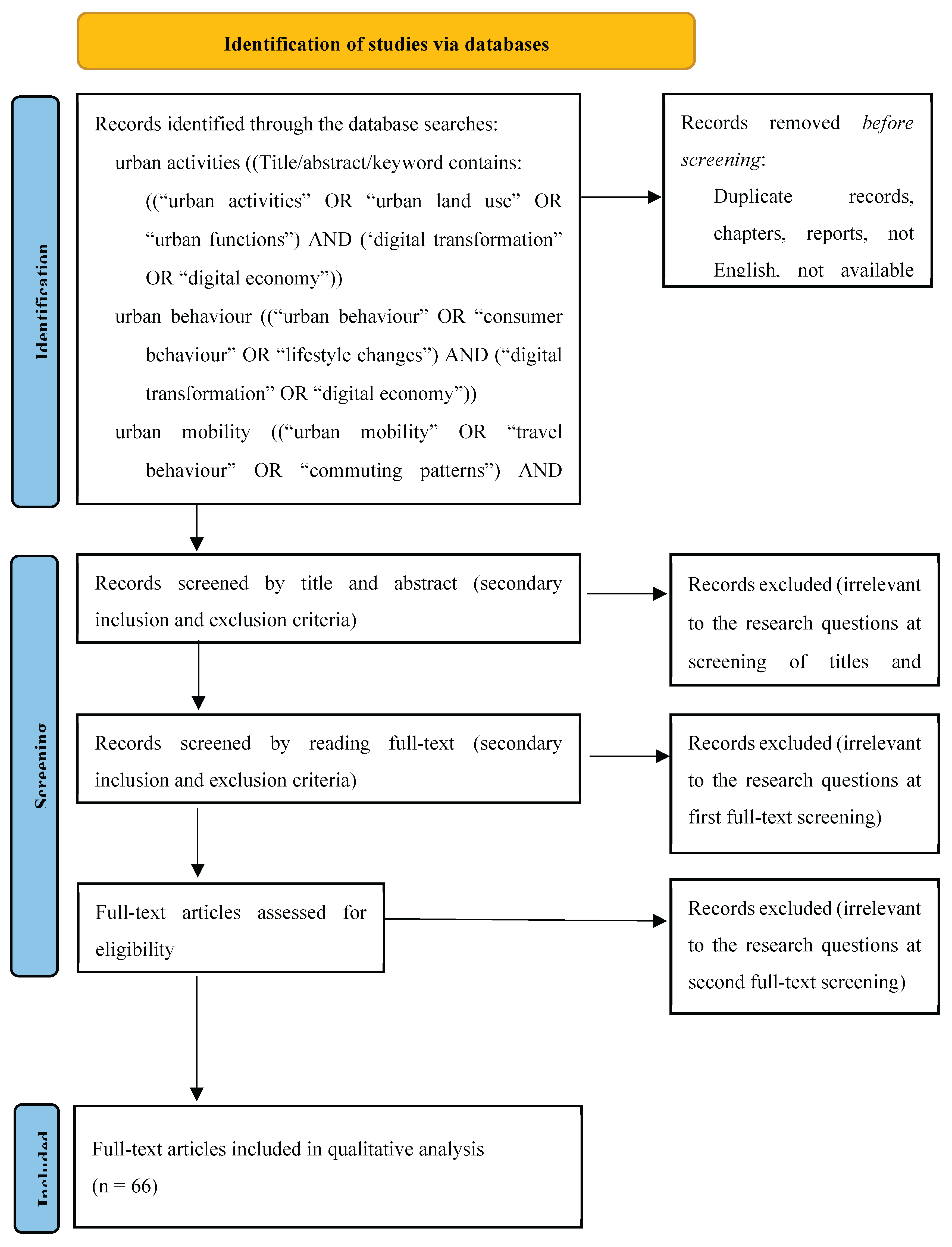

Table 1.
Criteria for category formulation.
| Step | Selection Criteria | Process Description |
|---|---|---|
| 1 | Initial Issue Identification | Determine key issues relevant to digital economy impacts on urban land use and land value using the eye-balling technique across the literature |
| 2 | Disruption Detection |
|
| 3 | Category Formation | Group identified disruptions with similarities to form broader potential categories |
| 4 | Category Refinement |
|
| 5 | Finalisation |
|
Table 2.
Urban activity disruption.
| Author | Year | Title | Journal | Method | Finding | Reframe the Use and Value of Urban Form | Region |
|---|---|---|---|---|---|---|---|
| Audouin and Neves | 2017 | What Regulations for ICT-Based Mobility Services in Urban Transportation Systems? The Cases of Ride-Booking Regulation in São Paulo and Rio de Janeiro | Urban Transport | Case study | Integrating ride-booking services with public transport | Enhance the efficiency and sustainability of urban mobility | Brazil |
| Allam and Newman | 2018 | Redefining the Smart City: Culture, Metabolism and Governance | Smart Cities | Literature review | Smart City initiatives often focus on technology and corporate branding, neglecting cultural and historical contexts | Promotes the preservation and enhancement of urban identity and history | Australia |
| Caprotti and Cowley | 2019 | Varieties of smart urbanism in the UK: Discursive logics, the state and local urban context | Trans Inst Br Geogr | Thematic review | Smart-city strategies often invoke crisis to justify technological and policy interventions | Highlights the need for resilient and adaptive urban forms | UK |
| Lee et al | 2020 | Mapping Platform Urbanism: Charting the Nuance of the Platform Pivot | Urban planning | Landscape scan | The growth of markets for smart city products, primarily driven by corporate actors | Limits the availability of alternatives and raises concerns about the influence of corporate interests on urban governance | Australia |
| Rose et al | 2020 | Platform Urbanism, Smartphone Applications and Valuing Data in a Smart City | Trans Inst Br Geogr | Interviews | Data generated by the apps were intended to create various forms of value beyond financial profit | Smart city initiatives can generate multiple forms of value | UK |
| Söderström and Mermet | 2020 | When Airbnb Sits in the Control Room: Platform Urbanism as Actually Existing Smart Urbanism in Reykjavík | Frontiers in Sustainable Cities | Case study | Neighbourhoods with high concentrations of Airbnb listings have experienced changes in their demographic features, retail structures, and local sense of place | The integration of short-term rentals into residential neighbourhoods blur the boundaries between residential and commercial uses of urban space | Iceland |
| Busch et al | 2021 | Digital Urban Production: How Does Industry 4.0 Reconfigure Productive Value Creation in Urban Contexts? | Regional Studies | Multiple case study | Urban areas offer a pool of highly skilled workers with the necessary technical and digital skills | Underscores the value of urban areas as centres of knowledge, innovation, and skilled labour | Germany |
| Elwood | 2021 | Digital geographies, feminist relationality, Black and queer code studies: Thriving otherwise | Progress in Human Geography | Theoretical and analytical approach | Digital urbanism mediates for precarity and racialised inequalities | Highlight the potential for urban spaces to be re-mediated for collective wellbeing and mutual support | USA |
| Hodson and McMeekin | 2021 | Global technology companies and the politics of urban socio-technical imaginaries in the digital age: Processual proxies, Trojan horses and global beachheads | EPA: Economy and Space | Case study | Sidewalk Labs (SL) project: a new model of private digital governance that could be circulated globally | Highlights the potential for global dissemination of urban governance practices | UK |
| McGuirk et al | 2021 | Municipal Statecraft for the Smart City: Retooling the Smart Entrepreneurial City? | EPA: Economy and Space | Interviews | Municipalities engaged in diverse activities to build public legitimacy for smart city governance | Municipalities are not merely reactive enablers of smart city initiatives but are actively shaping and directing smart city trajectories | Australia |
| Sadowski | 2021 | Who owns the future city? Phases of technological urbanism and shifts in sovereignty | Urban Studies | Critical commentary | Phases of Technological Urbanism: different degrees of control over urban governance, services, and space | The rise of platform urbanism changes the economic landscape of cities | Australia |
| Wang | 2021 | Development Trend of Urban Design in ‘Digital Age’: Pan-dimensionality and Individual-Ubiquity | Front. Struct. Civ. Eng | Literature review | Urban development is moving from a three-dimensional city to a pan-dimensional digital city | Urban spaces are no longer static but dynamic and multi-dimensional | China |
| Allam et al | 2022 | The Metaverse as a Virtual Form of Smart Cities: Opportunities and Challenges for Environmental, Economic, and Social Sustainability in Urban Futures | Smart Cities | Literature review | The Metaverse can reduce the need for physical infrastructure and promoting virtual interactions | Optimise resource use and reduce environmental impact | Australia |
| Ouda and Aziz | 2022 | Digital Placemaking: Perceiving Meaningful Spaces Through the Digital Environment | Contingency planning of adaptive urbanism | Comparative analysis | Digital placemaking practices have successfully created a sense of place, belonging, and community engagement | Transforming public spaces into interactive and engaging environments | Egypt |
| Santos et al | 2022 | Determinants of e-inclusion and digital inequality in the use of urban mobility applications in mobility | Research, Society and Development | Mixed method | Income was found to be a significant factor in digital inclusion and digital inequality | The significant influence of income on digital inclusion suggests the need for targeted interventions to support lower-income groups | Brazil |
| Tang et al | 2022 | Does the Digital Economy Improve Urban Tourism Development? An Examination of the Chinese Case | Sustainability | Benchmark regression model, panel threshold model (PTM), and spatial Durbin model (SDM) | The digital economy improves connectivity and accessibility, | There are positive spatial spillover effects, meaning the digital economy in one city can positively influence tourism development in neighbouring cities | China |
| Basaraba | 2023 | The emergence of creative and digital place-making: A scoping review across disciplines | new media & society | Scoping review | Digital place-making: Engaging the public in co-creation processes | Not only boosts tourism but also fosters a sense of community and belonging among residents | Netherlands |
| Carpentiere et al | 2023 | Innovative Business Models for the Future Smart City | Proceedings of Science and Technology | Multiple case study | Helps users find parking, reduces unnecessary driving, and offers real-time data | Focus on user-centric solutions improves the quality of life and encourages citizen engagement | Italy |
| Shi et al | 2023 | Digital Economy, Technological Innovation and Urban Resilience | Sustainability | Regression model | The digital economy exhibits positive spatial spillover effects on urban resilience | Cities should work together to leverage the benefits of the digital economy | China |
| Hodson et al | 2024 | How have digital mobility platforms responded to COVID-19 and why does this matter for ‘the urban | Urban Studies | Critical review and database analysis | Growth of platforms supporting homeworking, home entertainment, and rapid delivery services, reconstituting the home as a bio-secure site | The rise of homeworking and delivery platforms is decentralising economic activity, disrupting the traditional urban agglomeration model. |
UK |
| Kırdar and Çağdaş | 2024 | Digital Participatory Model as Part of a Data-Driven Decision Support System for Urban Vibrancy | Urban Planning | Survey | High likability areas are associated with cultural landmarks, urban greening, and scenic vistas | The image value of place, defined through likability and likability features | Turkey |
| Yeo | 2024 | Negotiating Digital Urban Futures: The Limits and Possibilities of Future-Making in Singapore | Trans Inst Br Geogr | Ethnographic Fieldwork | Urban dwellers employ various tactics to negotiate digital urban futures | Demonstrating that urban futures are not entirely predetermined | Singapore |
Table 3.
Urban behaviour disruption.
| Author | Year | Title | Journal | Method | Finding | Reframe the Use and Value of Urban Form | Region |
|---|---|---|---|---|---|---|---|
| Petković et al | 2018 | Digital Economy and (Non) Incremental Changes in Tourism and Retail Business Model | Ekonomika | Comparative analysis | Led to the development of personalised and experience-based tourism services | Creates new economic opportunities within urban areas particularly in sectors like tourism and retail | Serbia |
| Gillpatrick | 2019 | The Digital Transformation of Marketing: Impact on Marketing Practice & Markets | Economics | Literature Review | Three waves of digital disruption: unbundling, disintermediation, and decoupling | Shifts the focus from traditional manufacturing to service-oriented and tech-driven industries | Europe |
| Gillpatrick et al | 2019 | Understanding the Role of Consumer Behavior in Forecasting the Impact of Industry 4.0 and the Wave of Digital Disruption Driving Innovation in Retailing | DIEM | Literature review and exploratory interviews | Consumers now expect more personalised, convenient, and efficient shopping experiences | Retail spaces are evolving to meet the demands of digitally savvy consumers | Europe |
| Bozhuk et al | 2020 | Problems of transformation in the tourism industry in the digital economy | SHS Web of Conferences 73, | Online survey | Tourism shifts: Better service, personalised trips | Digital era drives diverse tourism space demand | Russia |
| Gazzola et al | 2020 | The sharing economy in a digital society: youth consumer behavior in Italy |
Kybernetes | Mixed method | Key motivations include reducing waste, improving environmental efficiency, and saving money | The sharing economy can enhance economic efficiency and reduce the cost of living in urban areas | Italy |
| Khoa | 2020 | The role of Mobile Skillfulness and User Innovation toward Electronic Wallet Acceptance in the Digital Transformation Era | International Conference on Information Technology Systems and Innovation (ICITSI) | Mixed method | Mobile skills boost e-wallet adoption intent. | Reduced Physical Bank Branches | Vietnam |
| Maslova et al | 2020 | Transformation of consumer behavior in the tourism industry in the conditions of digital economy |
IOP Conference Series: Materials Science and Engineering |
Online survey | There is a growing trend of tourists organising their trips independently using digital tools | The transformation in consumer behaviour can lead to increased economic activity in urban areas | Russia |
| Papagiannis et al | 2020 | The Sharing Economy in a Digital Society: Youth Consumer Behavior in Italy | Kybernetes | Questionnaires | Younger people prefer low-cost digital platforms and networks of shared products/services’ providers and on-demand access Young people avoid ownership due to high management costs. |
Increased demand for distribution centres and shared amenities | Italy |
| Chatterjee & Kulkarni | 2021 | Healthcare consumer behaviour: the impact of digital transformation of healthcare on consumer |
Cardiometry | Interviews | Factors in healthcare choice: Digital, service, brand | Create welcoming space for positive customer vibes | India |
| Räsänen et al | 2021 | Online information seeking patterns and social inequality in a digital economy | The International Review of Retail, Distribution and Consumer Research, |
Survey | Digital divide: Key to equitable economic access City folk likely to browse online post-purchase Rural areas: Less inclined to shop online casually |
Brick-and-mortar stores face declining traffic Retail closures reshape urban landscape E-commerce spurs new industrial space development |
Finland |
| Singh | 2021 | Digital Transformation Changes in the Producer Consumer Relationship | South Asian Journal of Marketing & Management Research (SAJMMR) | Literature review | Shifting the balance of power towards consumers, who now play a more active role in co-production and co-creation | Businesses in urban areas focusing on personalised and hyper-differentiated products and services | India |
| Ananjeva et al | 2022 | Digital Transformation Towards Sustainability A Case Study of Process Views in District Heating | Software Business | Case study | Digital shift: Tech, business, value chain changes Org change key for digital skills & culture growth |
Digital tech: Energy savings & business innovation boost Digital platforms enable new energy stakeholder ties Digital tech improves space use & energy efficiency |
Denmark |
| Atanasova | 2022 | Characteristics of Digital Entrepreneurship | Entrepreneurship | Online survey | Digital entrepreneurship is an integral part of the digital economy | Urban environments need to foster innovation and creativity | Russia |
| Dewi | 2023 | Changes In Retail Consumer Shopping Behavior After The End Of Covid 19 In Indonesia: Towards Digital Transformation Behavior | Proceeding of International Conference on Digital Advance Tourism, Management and Technology 2023 |
Literature review | Digital payments via e-wallets replace cash, optimizing tech integration and transforming social behaviour | Businesses must adapt to real-time tech in online shopping, supported by policy, as digital infrastructure becomes vital for retail and entrepreneurial space value. | Indonesia |
| Kalashnikova et al | 2023 | Global trends in the behavior of consumers of retail enterprises in the digital economy | IOP Conf. Series: Earth and Environmental Science | Mixed method | The pandemic accelerated the transition to online shopping | Highlights the need for urban areas to build economic resilience by diversifying retail offerings and supporting local businesses | Ukraine |
| Lin et al | 2023 | Digital menus innovation diffusion and transformation process of consumer behavior | Journal of Hospitality and Tourism Technology | Online survey | Perceived information quality, food quality, and service quality all significantly influence diners’ intentions to revisit | Restaurants that adopt advanced digital menus may see increased customer satisfaction and loyalty, | China |
| Qadir et al | 2023 | Digital Consumer Behavior and Ecommerce Tendencies During the New War Crisis | Journal of Survey in Fisheries Sciences | Literature review | Traumatic events like war can permanently alter consumer purchasing behaviour | Cities can adopt agile methodologies to respond swiftly to changing conditions | Asia |
| Thompson & Turner | 2023 | Navigating the Digital Transformation: How Businesses Adapt and Thrive in the Age of Disruption | Research Studies of Business | Literature review | Businesses must foster a culture of agility, encouraging continuous learning, experimentation, and rapid iteration | Flexible zoning laws and adaptive reuse of spaces | Europe |
| Zheng and Yang | 2023 | Research on the Impact of Digital Economy on Residents' Consumption Upgrading | Frontiers in Business, Economics and Management | Panel Data Analysis | The digital economy promotes the upgrading of residents’ consumption levels and structures | Cities can become centres of technological innovation | China |
| Chan & Yao | 2024 | Understanding consumer behavior in phygital environments: an interpretivist methodological framework |
Qualitative Market Research: An International Journal |
Ethnographic observations, focus groups and content analysis | Social dynamics, peer influences, and the role of influencers are critical in shaping consumer behaviour in phygital spaces | Phygital environments create immersive and engaging consumer experiences by integrating physical and digital elements | China |
| Rosales et al | 2024 | Digital Transformation and Elastic Demand: Assessment on the Impact of E-commerce Growth on Consumer Goods in the Philippines | SSRN Electronic Journal | Literature review | Income level influences online shopping behaviour E-commerce benefits busy, higher-income individuals. E-commerce minimally impacts lower-income shopping habits. |
E-commerce appeals to busy urban residents. Physical stores appeal to lower urban residents |
Philippines |
| Yadav et al | 2024 | Effects of the industrial 4.0 transition on consumer behavior: A systematic overview | International Conference on Contemporary Engineering, Technology and Management (ICCETM 2023) |
Literature review | Digitalisation impacts employment patterns | Reshape urban economies, creating new job opportunities and business models | Asia |
Table 4.
Urban mobility disruption.
| Author | Year | Title | Journal | Method | Finding | Reframe the Use and Value of Urban Form | Region |
|---|---|---|---|---|---|---|---|
| vom Berg et al | 2017 | ICT-Platform to Transform Car Dealerships to Regional Providers of Sustainable Mobility Services |
Interdisciplinary Journal of Information | Interviews | New mobility services by car dealerships | The floating car sharing are only feasible in urban or confined areas. Suitable for rural areas where public transport services are declining |
Germany |
| Starĉević & Konjikušić | 2018 | Why Millenials as Digital Travelers Transformed Marketing Strategy in Tourism Industry | Tourism in Function of Development of The Republic of Serbia. International Scientific Conference | Meta-analysis | Millennials are price sensitive, not predictable, and seek shareable social media experiences | Offer unique, sharable, and mobile-bookable travel experiences | Europe |
| Suel & Polak | 2018 | Incorporating online shopping into travel demand modelling: challenges, progress, and opportunities |
Transport Reviews | Literature review | Individual trips to stores may be Replaced by home deliveries by retailers or third-party carriers | The growing importance of urban logistics in planning | Europe |
| Zahraei et al | 2019 | A foresight study on urban mobility: Singapore in 2040 |
Foresight | Scenario planning workshop | The Shared world scenario: Community focus: Safety, cost, local travel & bonds The Virtual world scenario: Speed key in travel; distance no longer a barrier | The Shared world scenario: Local govt key in shaping urban development The virtual world: Society leads tech; govt supports urban change |
Singapore |
| Ammar et al | 2020 | Studying of Sharing Economy in Egypt as a Destination for Tourism and Hospitality | JAAUTH | Questionnaires | The sharing economy influences travellers’ choice of destinations, frequency of travel, and length of stay | Enhances urban resilience and community revitalization but also poses challenges regarding regulatory frameworks and sustainability | Egypt |
| Leontev & Magera | 2020 | Digitalization of the transport industry: social-and psychological emphasis | VIII International Scientific Conference Transport of Siberia | Case study | Social and psychological impacts on digitalisation of transport industry | Cities might evolve towards more flexible, hybrid uses of space, accommodating both physical and virtual functions | Singapore |
| Silva et al | 2020 | The Outsourcing Urban Mobility in Industry 4.0 and the Challenges Faced by The Category of Workers In Search Of Rights and Occupational Safety |
Journal of Engineering and Technology for Industrial Applications | Interviews | Startups link services & consumers via cheap labour Industry 4.0 safety: Adapt to worker health needs | Urban labour impact: Living costs vs. Wages gap | Brazil |
| Viri et al | 2020 | Connected and Multimodal Passenger Transport Through Big Data Analytics: Case Tampere City Region, Finland | 20th Working Conference on Virtual Enterprises (PRO-VE), |
Case study | Big data reveals passenger behaviour and travel paths. | Improved traffic management | Finland |
| Ghonimi | 2021 | Smart City: A Question of Social Sustainability in Urban Spaces? Assessing The Impacts of ICT on Changing Urban Behavioral Patterns in Urban Spaces of Madinaty, Egypt |
Journal of Urban Research | Case study | ICT encourages people to depend on private modes for long-distance trips Minimise urban mobility to short distance trips Services trips will be reduced |
Reduce road width and parking requirements The growth of self-contained communities |
Egypt |
| Sonnberger and Graf | 2021 | Sociocultural dimensions of mobility transitions to come: introduction to the special issue | Sustainability: Science, Practice and Policy | Ethnographic | Sociocultural factors play a crucial role in shaping mobility transitions | The importance of cultural and social innovations in shaping future mobility systems | Germany |
| Šulskytė | 2021 | Mobility-As-A-Service: Concepts and Theoretical Approach | IEEE International Conference on Technology and Entrepreneurship (ICTE) | Literature review | Digital illiteracy persists in tech-averse older travellers. | Trigger gentrification processes and displacement risks | Europe |
| Gonzalez & Quadros | 2022 | Digital Transformation and New Business Models in Urban Mobility: The Case of Carsharing in Brazil | Proceedings of PICMET '22: Technology Management and Leadership in Digital Transformation | Multiple case studies | Carsharing offer affordable, sustainable, and convenient transportation services | Reduce the need for private car ownership | Brazil |
| Gupta et al | 2022 | Role of Technological Transformation in Shaping Millennials' Travel Behaviour: A Review | 10th International Conference on Reliability, Infocom Technologies and Optimization (Trends and Future Directions) (ICRITO) | Literature review | Millennials favour freestyle travel, new experiences, heritage. Millennials rely on tech and social media for travel choices. |
Urban areas are being reimagined to include more cultural and social spaces that cater to the experiential preferences of Millennials | Asia |
| Shatnawi & Zoltan | 2022 | Digital Transformation during Covid-19 and Its Impact on Transportation and Mobility | IEEE 16th International Symposium on Applied Computational Intelligence and Informatics | Questionnaires | Remote work trend driven by desire to avoid transit | Housing Value will be not affected by the proximity to transit | Budapest & Amman |
| Zha et al | 2022 | The impact of digital economy development on carbon emissions-- based on the Yangtze River Delta urban agglomeration | Frontiers in Environmental Science | Panel data and multiple econometric models | Showing that as work becomes increasingly remote, traditional peak hour transportation demand is altered, leading to varied usage of transport systems at different times | Reducing commuting demands and reshaping spatial density patterns | China |
| Baudens et al | 2023 | Women’s (im)mobility strategies and digital platform adoption: the case study of employees doing desk work in Pune, India |
Gender, Technology and Development | Interviews | The women participants chose their transport mode based on their perceptions and personal priorities | Highlighting the importance of considering social conditions and cultural bias | India |
| Mentsiev et al | 2023 | Digital transformation in transport infrastructure energy efficiency: smart cities and sustainable mobility | E3S Web of Conferences 460, 07018 | Literature review | AI-powered personalised routing for city residents | Facilitate more polycentric urban development by enabling easier access across urban sub-centers | Russia |
| Pako¨z & Kaya | 2023 | Personal Adaptations to Remote Working in the Post-Pandemic City and Its Potential Impact on Residential Relocations: The Case of Istanbul |
Transportation Research Record | Online survey and correlation analysis | Remote work impacts travel, energy use, home choice | Proximity to family, housing affordability, and proximity to essential amenities facilitate remote working and relocation processes. | Istanbul, Türkiye |
| Zhao and Said | 2023 | The Effect of the Digital Economy on the Employment Structure in China | Economies | Panel data analysis | The digital economy profoundly influences employment structures, leading to shifts in commuting patterns due to the changing work nature. | Potentially decentralising urban cores and flattening land-use intensity gradients | China |
| Alanazi & Alenezi | 2024 | Driving the future: Leveraging digital transformation for sustainable transportation | Journal of Infrastructure, Policy and Development | Literature review | Digital transformation boosts environmental sustainability. Digital transformation risks: privacy, security, ethics. | Urban quality of life improvements boost area value. | Middle East |
| Gulc & Budna | 2024 | Classification of Smart and Sustainable Urban Mobility | Energies | Literature review & case studies | SSUM: electromobility, collective transport 2.0 and low mobility Societies | Promoting compactness, low-mobility societies, and flexible land use patterns | EU |
| Tartaglia & Petrozziello | 2024 | Measuring the impact of institutional and territorial drivers for an efficient and smooth Mobility as a Service (MaaS) implementation: a global analysis | European Transport \ Trasporti Europei | Composite set of indicators |
The ultimate shift that maas needs is a cultural one, from ownership to usership | Institutional factors key to smooth maas implementation. | Europe |
Disclaimer/Publisher’s Note: The statements, opinions and data contained in all publications are solely those of the individual author(s) and contributor(s) and not of MDPI and/or the editor(s). MDPI and/or the editor(s) disclaim responsibility for any injury to people or property resulting from any ideas, methods, instructions or products referred to in the content. |
© 2025 by the authors. Licensee MDPI, Basel, Switzerland. This article is an open access article distributed under the terms and conditions of the Creative Commons Attribution (CC BY) license (http://creativecommons.org/licenses/by/4.0/).
Copyright: This open access article is published under a Creative Commons CC BY 4.0 license, which permit the free download, distribution, and reuse, provided that the author and preprint are cited in any reuse.


