

Submitted:
04 July 2025
Posted:
07 July 2025
You are already at the latest version
Abstract
This study employs a comprehensive bibliometric analysis to examine the evolving landscape of Artificial Intelligence (AI) research within the Architecture, Engineering, and Construction (AEC) industry over the past decade. Through systematic analysis of 68 publications from the Scopus database, utilizing co-authorship networks, citation analysis, and keyword co-occurrence mapping, the research reveals significant patterns and trends in AI adoption and research focus. The findings indicate a rapid growth in research output, with China, the United States, and the United Kingdom emerging as leading contributors. The analysis identifies four primary research clusters: AI integration across AEC processes, building lifecycle applications, digital technologies convergence, and automation techniques. A temporal evolution is observed, transitioning from basic automation to sophisticated applications involving machine learning, digital twins, and deep learning. The study highlights geographical disparities in research contributions and emphasizes the need for standardization in AI implementation. By providing insights into research trends, collaborative networks, and evolving focus areas, this analysis contributes to a deeper understanding of AI's role in transforming the AEC industry. The findings can guide future research directions, inform industry practitioners about emerging technologies, and support policymakers in developing frameworks for AI adoption in construction, ultimately facilitating more effective and responsible integration of AI technologies in AEC practices.
Keywords:
Artificial intelligence
; AEC industry
; Digital technologies
; Architecture
; Engineering
; Construction
; Internet of Things
1. Introduction
Artificial Intelligence (AI) has emerged as a transformative force across numerous sectors, promising to revolutionize traditional practices and unlock new possibilities through its capacity to process vast amounts of data, recognize patterns, and make intelligent decisions [1]. As we stand on the cusp of what many consider the Fourth Industrial Revolution (4IR), AI technologies encompassing machine learning, deep learning, neural networks, and other computational approaches that simulate human intelligence are reshaping industries and redefining the boundaries of what machines can achieve [2]. From healthcare and finance to manufacturing and transportation [3], AI's impact is profound and far-reaching, with global AI revenue projected to reach $554.3 billion by 2024 [4]. The architecture, engineering, and construction (AEC) industry is experiencing a significant transformation driven by technological advancements, particularly in the realm of Artificial Intelligence (AI). As one of the largest sectors globally, the AEC industry has traditionally been characterized by its labor-intensive processes, fragmented nature, and resistance to technological change [1,5]. However, the emergence of AI technologies presents unprecedented opportunities to address longstanding challenges in construction productivity, safety, and quality [6].
AI, encompassing machine learning, deep learning, and neural networks, has demonstrated remarkable potential in revolutionizing various aspects of the AEC industry. From automated design optimization and construction robotics to predictive maintenance and safety monitoring, AI applications are reshaping traditional practices [7]. Recent studies indicate that AI-powered solutions can potentially increase construction productivity by up to 50% and reduce project costs by 20-45% [1,8,9,10,11]. Despite these promising prospects, the AEC industry's adoption of AI remains relatively slow compared to other sectors such as manufacturing or finance [12]. Several challenges impede the widespread implementation of AI in the AEC industry. These include data quality and availability issues, lack of standardization, privacy and security concerns, and resistance to change among industry practitioners [13]. Additionally, the complex and unique nature of construction projects poses significant challenges for AI implementation, as each project typically involves different stakeholders, specifications, and site conditions [1,7]. The fragmented nature of the industry further complicates the adoption of AI technologies, as different stakeholders may have varying levels of technological readiness and willingness to invest in AI solutions [6].
Given these challenges and opportunities, there is a growing body of research exploring various aspects of AI in the AEC industry. Understanding the evolution and current state of this research landscape is crucial for several reasons. First, it helps identify emerging trends and potential research gaps that need attention [14]. Second, it provides valuable insights for industry practitioners and policymakers to make informed decisions about AI adoption and implementation [15]. Finally, analyzing research trends can facilitate more effective collaboration between academia and industry, ensuring that research efforts align with practical needs and challenges [16]. Despite the importance of understanding AI research trends in the AEC industry, there has been limited systematic analysis of the existing literature using robust bibliometric approaches. While several literature reviews exist, they often focus on specific applications or technologies rather than providing a comprehensive overview of the field [7]. Bibliometric analysis, as a quantitative approach to analyzing research patterns and trends, can offer valuable insights into the evolution and current state of AI research in the AEC industry [14].
Therefore, this study aims to conduct a comprehensive bibliometric analysis of AI research in the AEC industry to map out the intellectual landscape, identify key research themes, and highlight potential areas for future investigation. By employing various bibliometric techniques, including keyword co-occurrence, and citation analysis, this study seeks to provide a holistic understanding of the field's development and current status. The findings of this study will be centered on the objectives, which are to:
- Identify the countries and authors with the highest focus on artificial intelligence in the AEC industry in the last 10 years,
- Identify the most cited published works and sources on artificial intelligence in the AEC industry in the last 10 years,
- Map out research focus on artificial intelligence in the AEC industry in the last 10 years; and
- Identify the research trends in artificial intelligence in the AEC industry.
2. Research Methodology
This study employs a bibliometric approach to systematically analyze research trends in Artificial Intelligence (AI) within the Architecture, Engineering, and Construction (AEC) industry. Bibliometric analysis, a quantitative method that applies statistical and mathematical techniques to examine patterns in publication data and citations [17], has been widely recognized as an effective tool for mapping the intellectual structure of research fields and identifying emerging trends [14].
The Scopus database was selected as the primary source for data collection due to several key factors. First, it is the largest abstract and citation database of peer-reviewed literature [18]. Second, it provides comprehensive coverage of scientific fields [19]. Third, it offers superior functionality for bibliometric analysis compared to other databases [20]. While Web of Science is also recognized for bibliometric studies, Scopus has been found to have wider coverage, particularly in newer research areas [21].
The search strategy was carefully designed to ensure comprehensive yet focused results. The following keywords were used in combination: "Artificial Intelligence" OR "AI" AND "Architecture Engineering and Construction" OR "AEC". These terms were searched within article titles, abstracts, and keywords of publications. Boolean operators were employed to ensure the retrieval of relevant documents while minimizing noise in the dataset [22]. The search was limited to publications from 2014 to 2024, providing a ten-year window for analysis. This timeframe was chosen to capture the recent surge in AI applications within the AEC industry while ensuring a sufficient temporal scope to identify meaningful trends.
To ensure the quality and relevance of the analyzed documents, specific criteria were applied. The inclusion criteria encompassed publications in English, documents focused on AI applications in AEC industry study areas (such as engineering, computer science, and environmental science), and various document types including conference proceedings, journal articles, books, and book chapters. Exclusion criteria removed publications not directly related to AEC applications and duplicated records. The initial search yielded 70 documents, which was reduced to 68 after applying these criteria. This filtering process was conducted automatically using the Scopus database's refine search feature, followed by a manual review to ensure the relevance and quality of the final dataset [16].
The analysis was primarily conducted using VOSviewer (version 1.6.20), a software tool specifically designed for constructing and visualizing bibliometric networks [23]. VOSviewer was chosen for its ability to handle large datasets and create various types of bibliometric visualizations [24]. This approach aligns with similar methodologies used in previous studies, such as Aghimien [12], who conducted a bibliometric literature review on robotics and automation research in construction-related studies. Figure 1 shows the framework adopted for the research.
2.1. Types of Analyses Performed
Five main types of analyses were conducted:
- Publication Trends Analysis: Examining the temporal distribution of publications to identify research growth patterns over the past 10 years, including analysis by country or region.
- Source Analysis: Evaluating the distribution of publications across different journals and conference proceedings to identify key venues for AI in AEC research.
- Citation Analysis: Examining citation patterns to identify influential publications and authors, including both document citation analysis and author citation analysis [25].
- Authorship and Co-authorship Analysis: Investigating collaboration patterns between authors to identify key research clusters and collaborative networks [26].
- Keyword Co-occurrence Analysis: Analyzing relationships between keywords to identify major research themes and their evolution over time, effectively mapping the conceptual structure of the research field [27].
Prior to analysis, the data was preprocessed to ensure consistency in author names, institutional affiliations, and keywords. This involved manual checking and standardization of terms to avoid fragmentation due to variations in naming conventions [28]. For example, during manual checking, it was detected and corrected that China and Hong Kong were initially analyzed as two different countries instead of one. The results from these analyses were visualized using network maps and overlay visualizations, allowing for both structural and temporal understanding of the research landscape. These visualizations were complemented with quantitative metrics to provide a comprehensive view of the field's development [29].
3. Results and Discussion
3.1. Publication Trends Analysis
3.1.1. Publications per Year
A total of 68 articles on the application of AI in the AEC industry were reviewed, categorized into different publication types. Among these, 29 were conference proceedings, 19 were journal articles, 17 were review articles, 5 were book chapters, and 1 was a book. The distribution of publications over the years is illustrated in Figure 2, which shows a growing interest in AI in the AEC industry and its related fields from 2018 to 2024.
The analysis reveals a notable growth trajectory in AI-related publications within the AEC industry from 2018 to 2024, albeit with some fluctuations. The significant increase from 2 publications in 2018 to 10 in 2019 aligns with the broader trend of AI adoption across industries during this period. This surge coincides with what Darko [7] identified as a pivotal moment when the AEC industry began recognizing AI's potential to address longstanding challenges in productivity, safety, and decision-making processes.
The sharp decline in publications during 2020, with only 4 recorded papers, can be largely attributed to the global COVID-19 pandemic's impact on research activities. Pan and Zhang [30] noted that many research institutions faced disruptions, leading to delayed or suspended projects across various fields, including AI research in construction. However, the quick recovery and sustained growth in 2021 and 2022, with 10 publications each year, demonstrates the resilience and growing importance of AI research in the AEC sector. This resurgence reflects what Leontie [31] described as an accelerated digital transformation in the construction industry, partly catalyzed by the pandemic's challenges.
The continued upward trend reaching 12 publications in 2023 and peaking at 20 in 2024 signifies a maturing research field. This pattern is consistent with observations by Mardiani and Iswahyudi [32], who highlighted an increasing recognition of AI's transformative potential in construction processes, from design optimization to project management. The distribution of publications over the document types is illustrated in Figure 3, which shows predominance of conference proceedings (29) over journal articles (19) suggesting a field that is rapidly evolving, with researchers prioritizing faster dissemination of findings through conferences. This publication pattern aligns with Salehi and Burgueño's [33] assessment that emerging technological fields often see higher conference participation as they allow for more immediate sharing of developments.
The presence of 17 review articles within this timeframe indicates a field that is actively consolidating knowledge and establishing theoretical frameworks. Jin [34] argue that such review papers are crucial in emerging fields for synthesizing scattered findings and identifying future research directions. The inclusion of book chapters and a complete book further suggests the field is reaching a level of maturity where comprehensive, long-form treatments of the subject are becoming necessary and valuable.
3.1.2. Publications per Country
In analyzing the number of studies per country of origin, the results revealed that some articles had multiple countries listed in their title or affiliation, resulting in some overlap. Similarly, some countries produced only one article within the 10-year span, and these were eliminated from consideration under the assumption that they may simply reflect overlaps. Therefore, only countries with at least two research articles originating from them were included in the analysis. As illustrated in Figure 4, China tops the list with a total of 13 research papers and 613 citations. This is followed by the United States of America, contributing 20 papers with 278 citations. The United Kingdom is next with 6 papers and 440 citations, while Australia has 8 papers and 391 citations. Sweden (3 papers, 155 citations), Italy (6 papers, 110 citations), and Turkey (2 papers, 98 citations) also feature prominently.
Other countries with notable contributions include Portugal (4 papers, 10 citations), Switzerland (3 papers, 37 citations), and Iran (4 papers, 61 citations). Additionally, Brazil and Canada each produced 2 papers with 17 citations, while South Korea (2 papers, 16 citations), Spain (2 papers, 13 citations), Poland (3 papers, 12 citations), and Taiwan (2 papers, 10 citations) round out the list of countries with at least two published research articles.
The geographical distribution of AI research in AEC reveals interesting patterns of global engagement and impact. China's dominant position, with 13 highly-cited papers (613 citations), reflects its broader strategic focus on AI development and application across various sectors. This aligns with China's national AI strategy, which has positioned the country as a global leader in AI research and development [35]. The high citation count suggests that Chinese research is not only prolific but also influential in shaping the field's direction.
While the United States produces the highest number of papers (20), its relatively lower citation count (278) compared to China, the UK, and Australia is noteworthy. This pattern may reflect what Pan [36] identified as a shift in global research influence, particularly in technology-focused fields. The strong showing of European countries, including the UK, Sweden, and Italy, aligns with the European Union's coordinated efforts to advance AI research and application in various industries, including construction [37].
The presence of emerging economies like Turkey, Iran, and Brazil in the list indicates a growing global interest in AI applications for AEC. However, the notable absence of African countries mirrors findings from other technological domains, such as Building Information Modeling (BIM), where Saka and Chan [38] identified a significant knowledge gap in African research contribution. This geographical disparity could potentially hinder the global adoption of AI in construction, as region-specific challenges and applications may remain unexplored
The variation in citation impact across countries is particularly striking. For instance, Turkey's two papers garnered 98 citations, while Portugal's four papers received only 10 citations. This suggests that the influence of research is not necessarily correlated with quantity of output. As Hou [39] noted in a broader study of scientific impact, factors such as international collaboration, research focus, and alignment with industry needs can significantly affect citation rates. Developed Asian economies like South Korea, and Taiwan show moderate engagement in AI-AEC research. This is somewhat surprising given their general technological advancement and strong construction sectors. However, as Li [16] observed, some Asian countries may focus more on practical implementation rather than academic research in construction technology.
3.2. Source Analysis
The number of extracted papers per source title was evaluated. The 68 publications were sourced from 47 different sources, of which 37 had only one publication within the assessed 10-year time frame. Table 1 presents the sources that published at least two papers on AI in the AEC industry, each with a minimum of 10 citations. "Automation in Construction" topped the list with 6 publications and 495 citations. According to Aghimien [12], this is unsurprising, as the journal focuses on research that explores the use of information technology in the design, engineering, construction, management, and maintenance of construction facilities. It is followed by "Applied Sciences (Switzerland)" with 2 papers and 106 citations, and "Construction Innovation" with 2 papers and 91 citations. Other notable sources include "Lecture Notes in Civil Engineering" (4 papers, 31 citations), "Buildings" (4 papers, 11 citations), and "Engineering, Construction, and Architectural Management" (4 papers, 10 citations).
The analysis of publication sources reveals important insights into the scholarly landscape of AI research in the AEC industry. The dominance of "Automation in Construction" with 6 publications and 495 citations indicates not only the quantity but also the significant impact of AI-related research published in this journal. This aligns with previous bibliometric studies in construction technology, where "Automation in Construction" has consistently emerged as a leading venue for advanced technological applications in the built environment [12,40,41]. The journal's focus on information technology applications in construction makes it a natural home for AI research, as noted by Li [16] who found that construction automation increasingly relies on AI technologies.
The presence of both specialized construction journals and broader scientific publications in the top sources suggests a multi-disciplinary approach to AI in AEC. "Applied Sciences" and "Construction Innovation," with their notable citation counts despite fewer publications, indicate high-impact research that bridges the gap between theoretical AI advancements and practical construction applications. This mirrors the findings of Almatared [42], who observed that impactful construction technology research often emerges from the intersection of computer science and construction management.
The relatively high number of sources (47) publishing AI-related research, with most (37) having only one publication, suggests a broad but fragmented research landscape. This dispersion of publications across many venues could indicate the emerging nature of AI applications in AEC, as noted by Darko [41] who found similar patterns in early-stage construction technology research. However, it may also pose challenges for knowledge consolidation and could slow the field's development, as argued by He [43] in their analysis of emerging technologies in construction.
The presence of "Lecture Notes in Civil Engineering" and "Buildings" among the top sources, despite lower citation counts, suggests these venues may be important for disseminating newer research that hasn't yet accumulated citations. This pattern aligns with Cao's [44] observation that emerging research topics often appear first in such outlets before gaining traction in higher-impact journals.
3.3. Citation Analysis
To fully understand the research landscape of AI in the AEC industry, it was essential to analyze the extracted papers to identify the most cited documents and their areas of concentration. Among the 68 extracted documents, only 12 have gathered 20 or more citations, as shown in Table 2, indicating a concentrated impact among select publications. This pattern suggests that while the field is growing, certain influential works have disproportionately influenced the research landscape.
The analysis of highly cited works reveals evolving trends in AI applications within the AEC industry, from broad systematic assessments to specific technological implementations and ethical considerations. The most influential work, by Darko [7] with 341 citations, employed scientometric analysis to comprehensively review AI applications in AEC. This study's significant impact underscores the industry's crucial need for systematic understanding of AI integration, setting a foundation for subsequent research directions [16].
Building upon this broad assessment, the field has seen a shift towards integration of AI with existing digital tools, particularly Building Information Modeling (BIM). Pan & Zhang's [30] work on BIM and AI integration for smart construction management, garnering 108 citations, exemplifies this trend. This integration represents a crucial development in advancing construction management practices [55], with cognitive digital twins emerging as a critical research area, as evidenced by Yitmen's [45] 90 citations. The significant attention to digital twins reflects the industry's progression towards sophisticated digital representations of physical assets, enabling more efficient building lifecycle management [56].
Parallel to these developments, research has focused on practical applications of AI in specific construction technologies. Studies on Terrestrial Laser Scanning [46] and automated design for mass-customized housing [48] have received substantial attention, indicating the industry's interest in concrete applications that enhance efficiency and customization in construction processes [57].
Recent developments in the field show an evolution beyond purely technical considerations. Emaminejad & Akhavian's [49] work on trustworthy AI and robotics signals a growing emphasis on ethical implementations, while studies on conversational AI (Saka et al., 2023) and virtual design and construction [50] point to new frontiers in human-AI interaction. These emerging research directions represent potential paradigm shifts in how AEC professionals interact with AI systems [58], suggesting a maturation of the field from basic implementation to more nuanced and responsible deployment of AI technologies.
This evolution in research focus, from broad assessments through specific applications to ethical considerations and human-AI interaction, reflects the AEC industry's growing sophistication in understanding and implementing AI technologies. The high citation counts across these various aspects indicate a vibrant and rapidly evolving research landscape, with implications for both theoretical understanding and practical applications in the AEC sector.
3.4. Authorship and Co-Authorship Analysis
In terms of authorship, the 68 assessed documents involved a total of 242 authors, including both lead authors and their collaborators. With the minimum number of documents per author set at 2 and the minimum number of citations per author set at 10, only 6 authors were identified as meeting these criteria. As shown in Table 3, the top authors contributing to AI research in the AEC industry and who are well-cited include Hosseini, M. Reza (2 papers, 367 citations), Darko, Amos (2 papers, 341 citations), Nabizadeh, Amir Hossein (2 papers, 61 citations), Akhavian, Reza (3 papers, 56 citations), Emaminejad, Newsha (3 papers, 56 citations), and Zhang, Cheng (2 papers, 23 citations).
The overlay visualization of the co-authorship network, illustrated in Figure 5, reveals four distinct clusters of collaboration. The earliest set of authors who began publishing in AI in the AEC industry includes Hosseini, M. Reza, Zhang, Cheng, and Darko, Amos. Their collaborations, represented in deep purple to light blue on the map, span from 2021 to 2022. More recently, the authors Emaminejad, Newsha, Akhavian, Reza, and Nabizadeh, Amir Hossein have emerged as active contributors to AI research in the AEC industry. Their publications, which began in mid-2022 and continue to the present, are visualized in the green and yellow cluster on the right corner of the map.
The analysis of authorship patterns reveals interesting insights into the scholarly landscape of AI research in the AEC industry. The relatively small number of authors (6) meeting the criteria of multiple publications and significant citations suggests that AI research in AEC is still an emerging field with a limited but growing core of dedicated researchers. This aligns with observations by Pan and Zhang [6], who noted that AI applications in construction are still in their early stages compared to other industries.
The prominence of researchers like Hosseini and Darko, who have achieved high citation counts with relatively few publications, indicates the significant impact of their work in shaping the field. This phenomenon of high impact from a select few authors is typical in emerging research areas, as observed by Jadidi [59] in their analysis of nascent technological fields. The high citation counts of these authors (367 and 341 respectively) suggest that their work has been instrumental in establishing foundational concepts and methodologies for AI applications in AEC.
The temporal analysis of co-authorship networks reveals an interesting evolution in the field. The transition from the earlier cluster of authors (Hosseini, Zhang, and Darko) publishing in 2021-2022 to a new group (Emaminejad, Akhavian, and Nabizadeh) emerging in mid-2022 indicates a rapid expansion and diversification of research perspectives. This swift evolution mirrors patterns observed in other technological fields within construction, such as Building Information Modeling (BIM), where Santos [15] documented similar rapid expansions in research networks over short timeframes.
The formation of distinct collaborative clusters, as visualized in the co-authorship network, suggests the emergence of specialized research focus areas within AI applications for AEC. This specialization is typical of maturing research fields, as noted by Wang [60] in their analysis of construction technology research trends. The presence of four distinct clusters might indicate different approaches to AI implementation in AEC, possibly reflecting various application areas or methodological approaches.
3.5. Keyword Co-Occurrence Analysis
3.5.1. Research Focus Based on Co-Occurring Keywords
In analyzing research focus through keyword co-occurrence, methodological considerations played a crucial role in ensuring meaningful results. The study adopted a threshold of 4 co-occurrences, striking a balance between VOSviewer's default of 5, which proved too restrictive (yielding only 27 keywords), and lower thresholds of 2-3, which produced excessive redundancy with 70 keywords. This methodological decision aligns with previous bibliometric studies in construction-related fields [12] while being tailored to the specific characteristics of AI research in AEC industry. This means that for a keyword to be included in the analysis, it must have appeared at least 4 times in the author and source-indexed keywords. The analysis revealed a total of 717 keywords across all 68 publications, out of which 41 met the threshold of 4 co-occurrences. These keywords were then grouped into 4 clusters. It is important to note that the closer the keywords are to each other on the map, the higher their co-occurrence, as highlighted by Aghimien [12]. Figure 6 shows the network visualization map of the 41 co-occurring keywords and their corresponding clusters. At the center of this network are the keywords "Artificial Intelligence" and "AEC," to which all other keywords are linked, indicating their central role in the thematic areas of research within AI and the AEC industry.
Cluster 1 - Highlighted in red on the map, consists of 13 co-occurring keywords. The central keywords in this cluster are "Artificial Intelligence" and "AEC Industry," which have strong links to several significant terms. These include "accident prevention," "AEC," "architecture," "architectural engineering," "automation," "construction," "construction industry," "design and construction," "digitization," "information management," "project management," and "systematic review." The analysis of co-occurring keywords reveals significant patterns in AI research within the AEC industry. The emergence of "Architectural Engineering and Construction industry" as a primary cluster, encompassing 13 interconnected keywords, suggests a strong focus on the integration of AI across various aspects of architectural engineering and construction processes. This finding aligns with previous research by Pan and Zhang [6], who noted that the AEC industry is increasingly embracing AI technologies to enhance efficiency and innovation across multiple domains. The prominence of keywords such as "accident prevention" and "automation" within this cluster indicates a growing emphasis on leveraging AI for safety and process optimization in construction. This trend corresponds with observations by Darko [7], who found that safety enhancement and automation are primary drivers for AI adoption in the construction industry. The inclusion of "digitalisation" as a key term further supports the industry's ongoing digital transformation, as highlighted by Forcael [61] in their comprehensive review of construction digitalization. The strong connection between "information management" and "project management" within the cluster suggests that AI applications are increasingly being viewed as essential tools for effective project delivery. This observation is consistent with findings by Zhang [62] who demonstrated that AI-driven project management systems can significantly improve decision-making processes and project outcomes in construction projects. The presence of "systematic review" as a keyword indicates a methodological trend in AI research within the AEC industry, pointing to efforts to consolidate and synthesize existing knowledge. This reflects a maturing field of study, as noted by Sacks [63], who emphasized the importance of systematic approaches in understanding the impact of AI on construction practices.
Cluster 2 - Represented in green on the map, initially contained twelve keywords, but some were repetitions due to spelling errors. After removing these duplicates, eight distinct keywords remained: "architectural design," "artificial intelligence (AI)," "building information modeling (BIM)," "deep learning," "information theory," "learning systems," "lifecycle," and "machine learning." The emergence of a distinct cluster linking artificial intelligence with building lifecycle processes highlights the growing integration of AI technologies throughout the entire construction value chain. This cluster's keywords suggest a significant focus on leveraging AI, particularly machine learning and deep learning, to enhance various aspects of building design, construction, and management. The strong association between AI and Building Information Modeling (BIM) within this cluster is particularly noteworthy, as it indicates a trend toward the integration of intelligent systems with digital building representations. This alignment supports the findings of Pan and Zhang [6], who identified BIM as a crucial enabler for AI applications in construction, providing the structured data necessary for machine learning algorithms. The presence of "lifecycle" as a key term alongside AI technologies suggests an industry shift toward utilizing intelligent systems throughout a building's entire lifespan, from conception to demolition. This holistic approach aligns with research by Salehi and Burgueño [33], who emphasized the potential of AI to optimize decision-making across all phases of construction projects. The inclusion of "architectural design" in this cluster indicates a particular emphasis on implementing AI in the early stages of building development. This trend is supported by Pena [64], who documented the transformative impact of machine learning on architectural design processes, enabling more data-driven and optimized design solutions. The prominence of different AI methodologies within this cluster - specifically deep learning, machine learning, and learning systems - reflects the diverse approaches being explored in the AEC industry. According to Darko [7], this variety is essential as different construction challenges require different AI solutions. The connection between these AI methods and information theory suggests a focus on not just implementing AI, but also on understanding and optimizing how these systems process and utilize construction-related data.
Cluster 3 - Represented in blue on the map, initially contained nine keywords, but after removing two repetitions, seven distinct keywords remained. These keywords are: "AEC industry," "augmented reality," "digital technologies," "digital twin," "engineering education," "internet of things," and "virtual reality." The emergence of digital technologies in AEC industry as a significant cluster in AI research within the AEC industry reflects the sector's ongoing digital transformation. This cluster's keywords highlight the convergence of various digital technologies that are reshaping traditional AEC practices. Virtual Reality (VR) and Augmented Reality (AR) have gained considerable traction in the industry, with studies showing their potential to enhance visualization, improve design processes, and facilitate more effective collaboration among project stakeholders [65]. These technologies enable professionals to interact with digital models in immersive environments, leading to better decision-making and reduced errors in the construction phase [66]. The presence of Internet of Things (IoT) in this cluster indicates its growing importance in connecting physical construction elements with digital systems. IoT applications in AEC range from real-time monitoring of construction progress to managing building systems post-completion [67]. This connectivity forms the foundation for the Digital Twin concept, another key keyword in the cluster. Digital Twins provide a bridge between physical and virtual worlds, enabling real-time monitoring, simulation, and optimization of construction projects and completed buildings [68]. The integration of these technologies is transforming how projects are delivered, with studies indicating improved efficiency, safety, and sustainability outcomes [69]. The inclusion of "engineering education" within this cluster suggests a recognition of the need to prepare future AEC professionals for this increasingly digitalized industry. Research indicates that incorporating digital technologies into engineering curricula is essential for developing the skills required in modern construction practices [70]. This educational focus reflects the industry's acknowledgment that successful digital transformation depends not only on technological advancement but also on developing a workforce capable of effectively utilizing these tools.
Cluster 4 - Represented in yellow on the map, consists of seven keywords: "computer-aided design," "construction projects," "decision making," "fuzzy logic," "genetic algorithms," "knowledge-based systems," and "robotics." The emergence of a distinct cluster focused on automation in AEC highlights the industry's growing emphasis on computerized and algorithmic approaches to traditional processes. This cluster's keywords reflect a shift from manual to automated decision-making systems, leveraging various computational techniques. Computer-aided design (CAD) has been a cornerstone of this transformation, fundamentally changing how construction projects are conceptualized and executed [71]. The integration of CAD with other automated systems has enabled more efficient project planning and implementation, reducing errors and improving overall project outcomes [72]. The presence of decision-making and knowledge-based systems in this cluster indicates a move toward more intelligent automation in AEC. These systems, often powered by fuzzy logic and genetic algorithms, are capable of handling complex, multi-variable problems that are common in construction projects [6]. For instance, genetic algorithms have been successfully applied to optimize construction schedules, resource allocation, and cost estimation, demonstrating superior results compared to traditional methods [73]. Similarly, fuzzy logic systems have proven valuable in dealing with the uncertainty and imprecision inherent in construction decision-making processes, particularly in risk assessment and quality control [74]. The inclusion of robotics in this automation cluster signifies the industry's recognition of the potential for physical automation beyond digital tools. Robotics in construction has evolved from simple repetitive tasks to more complex operations, guided by the knowledge-based systems and decision-making algorithms identified in this cluster [75]. This integration of physical and digital automation represents a significant step toward more comprehensive automation in the AEC industry, although challenges remain in terms of implementation and widespread adoption [76].
3.5.2. Research Focus Based on the Year of Publication
The temporal analysis of research keywords reveals a clear evolution in the focus of AI applications within the AEC industry. Figure 7 presents the overlay visualization network map for co-occurring keywords across different years of publication. With a minimum of five occurrences, several research trends have been identified based on the year of focus.
From 2020 to 2021, research related to "Automation in AEC" and "Digital Technologies in the AEC Industry" was more prominent. During this period, significant keywords include "robotics," "knowledge-based systems," "engineering education," "fuzzy logic," "genetic algorithms," "computer-aided design," "architectural engineering," and "construction projects." These keywords are depicted in the purple and blue clusters on the map, reflecting a concentration on automation and digital technology advancements within the AEC sector. In the 2020-2021 period, the emphasis on automation and digital technologies aligns with the industry's broader push toward digitalization and Industry 4.0 principles. This focus on robotics, knowledge-based systems, and computer-aided design reflects what Maskuriy [77] identified as the initial stage of AI adoption in construction, where the industry sought to automate existing processes and integrate basic digital tools. The presence of keywords related to engineering education during this period also suggests an acknowledgment of the need to prepare the workforce for technological transformation, a challenge highlighted by Pan and Zhang [6].
Between 2021 and 2022, the research emphasis shifted towards topics such as "machine learning," "architectural design," "artificial intelligence," "decision making," "automation," "augmented reality," "AEC industry," "information management," "learning systems," "information theory," and "architecture." These are indicated in the dark green cluster on the map, suggesting a deeper exploration of AI applications and learning systems within architectural practices and decision-making processes. The shift toward machine learning and more sophisticated AI applications in 2021-2022 indicates a maturation in the industry's approach to AI. This evolution mirrors the trajectory observed by Darko [7], who noted that as AI technologies became more accessible and proven, AEC practitioners began exploring more advanced applications beyond simple automation. The emergence of augmented reality and information management as key themes during this period also suggests a growing recognition of AI's potential to enhance decision-making processes, a trend previously identified by Elghaish [78].
Publications from 2022 to 2023 saw an increased focus on AI in the AEC industry, particularly in areas such as "project management," "virtual reality," "digital twin," "life cycle," "architectural engineering," "Internet of Things," "building information modeling," "machine learning," "construction," "digitization," "systematic review," and "AEC." These keywords, indicated in light green on the map, highlight the expanding role of AI in project management, digital twins, and BIM integration during this period. The period from 2022 to 2023 marked a significant expansion in the scope of AI applications, particularly in project management and digital twin technologies. This broadening of focus aligns with Sacks [63] observation that the AEC industry was moving toward more holistic, lifecycle-oriented approaches to digital technology implementation. The integration of AI with Building Information Modeling (BIM) and Internet of Things (IoT) during this period reflects what Tang [79] described as the convergence of multiple digital technologies to create more comprehensive solutions for the AEC industry.
Finally, from 2023 to 2024, research focused on issues such as "accident prevention," "deep learning," and "artificial intelligence," as depicted in the yellow cluster on the map. This recent shift reflects a growing interest in safety measures and the more advanced applications of AI, such as deep learning, within the AEC industry. Most recently (2023-2024), the emphasis on accident prevention and deep learning indicates a shift toward more specialized and sophisticated AI applications. This focus on safety aligns with Xu [80] findings that AI's potential to enhance construction safety was becoming a primary driver of its adoption. The emergence of deep learning as a key theme suggests that the industry is beginning to explore more advanced AI techniques, a development that Kor [81] predicted would lead to more transformative applications of AI in construction.
This temporal evolution in research focus suggests a maturing approach to AI in the AEC industry, moving from basic automation to more sophisticated and integrated applications. However, as Delgado [76] note, the industry still faces significant challenges in fully realizing AI's potential, particularly in terms of data quality, standardization, and workforce skills. The ongoing emphasis on education and training throughout the analyzed period indicates a recognition of these challenges.
4. Conclusion and Recommendations
This comprehensive bibliometric analysis of Artificial Intelligence (AI) research in the Architecture, Engineering, and Construction (AEC) industry reveals a rapidly evolving landscape characterized by growing sophistication and expanding applications. The study identified several key trends and patterns that provide valuable insights into the current state and future directions of AI in AEC.
The temporal analysis of publications from 2018 to 2024 demonstrates a clear upward trajectory in research output, despite a brief downturn during the global pandemic in 2020. This resilience and subsequent growth indicate the industry's strong commitment to AI advancement. The dominance of conference proceedings over journal articles suggests a field that prioritizes rapid knowledge dissemination, typical of fast-evolving technological domains. However, the emergence of review articles and books signals a maturing field that is beginning to consolidate its knowledge base.
Geographical analysis reveals a concentrated but globally distributed research landscape, with China, the United States, and the United Kingdom emerging as leading contributors. The high citation impact of publications from these countries indicates their significant influence in shaping the field's direction. However, the notable absence of contributions from certain regions, particularly Africa, highlights a geographical disparity that could potentially limit the global applicability of AI solutions in construction.
The co-authorship network analysis identified distinct collaborative clusters, indicating the emergence of specialized research focus areas within AI applications for AEC. The evolution from earlier collaborations focusing on broad assessments to more recent work on specific applications and ethical considerations reflects the field's maturation. This progression suggests a deepening understanding of both the potential and challenges of AI implementation in construction contexts.
Keyword co-occurrence analysis revealed four primary clusters of research focus: integration of AI across AEC processes, building lifecycle applications, digital technologies convergence, and automation techniques. The temporal evolution of keywords indicates a shift from basic automation and digital tool integration toward more sophisticated applications involving machine learning, digital twins, and deep learning. This progression demonstrates the industry's growing capability to leverage AI for increasingly complex construction challenges.
Based on these findings, several recommendations can be made for future research and industry practice:
- Standardization Initiatives: There is a pressing need for the development of standardized frameworks for AI implementation in AEC. Future research should focus on creating industry-wide standards for data collection, AI model development, and implementation protocols to facilitate broader adoption.
- Cross-Regional Collaboration: Efforts should be made to promote research collaboration between established and emerging regions in AI-AEC research. This could help address the current geographical disparities and ensure AI solutions are applicable across diverse construction contexts.
- Integration of Ethics and Safety: As AI applications become more sophisticated, future research should prioritize the development of ethical guidelines and safety protocols specific to AI use in construction. This includes addressing issues of data privacy, algorithmic bias, and the responsible implementation of AI in safety-critical construction applications.
- Education and Training: The industry should invest in developing comprehensive education and training programs to prepare the workforce for AI integration. This includes both technical skills development and fostering an understanding of AI's capabilities and limitations in construction contexts.
- Interdisciplinary Approach: Future research should emphasize interdisciplinary collaboration, particularly between construction professionals, computer scientists, and ethicists, to ensure AI solutions are both technically sound and responsibly implemented.
- Validation and Verification: There is a need for more research on methods to validate and verify AI systems in construction applications, ensuring their reliability and safety in real-world settings.
Limitations of this study include the focus on Scopus as the sole database and the potential impact of publication lag on the analysis of very recent trends. Future bibliometric studies could benefit from incorporating multiple databases and considering alternative metrics to capture the impact of AI research in construction. While AI research in the AEC industry has made significant strides, there remain substantial opportunities for growth and improvement. By addressing the identified gaps and following the recommended directions, the industry can work towards more effective and responsible integration of AI technologies, ultimately enhancing construction practices and outcomes.
Author Contributions
Conceptualization, B.A.A. and V.O.E.; methodology, B.A.A. and V.O.E.; software, V.O.E.; validation, V.O.E.; formal analysis, V.O.E. and B.A.A.; investigation, V.O.E. and B.A.A.; resources, B.A.A. and V.O.E.; data curation, V.O.E.; writing—original draft preparation, V.O.E.; writing—review and editing, B.A.A., V.O.E. and C.O.A.; visualization, V.O.E.; supervision, B.A.A. and C.O.A.; project administration, B.A.A., V.O.E. and C.O.A. All authors have read and agreed to the published version of the manuscript.
Funding
This research received no external funding.
Acknowledgments
The authors would like to acknowledge CUCRID Covenant University Centre for Research, Innovation, and Discovery and CIDB Centre of Excellence & Sustainable Human Settlement and Construction Research Centre, Faculty of Engineering and the Built Environment, University of Johannesburg, South Africa, for their support in providing facilities which facilitated the completion and publication of this work.
Conflicts of Interest
The authors declare no conflicts of interest.
References
- Adewale, B. A.; Onyedikachi, V. E.; Ogunbayo, B. F.; Aigbavboa, C. O. A Systematic Review of the Applications of AI in a Sustainable Building’s Lifecycle. Buildings 2024, 14, 2137. [CrossRef]
- Haenlein, M.; Kaplan, A. A Brief History of Artificial Intelligence: On the Past, Present, and Future of Artificial Intelligence. Calif. Manag. Rev. 2019, 61, 5–14. [CrossRef]
- Aghimien, D. O.; Aigbavboa, C. O.; Oke, A. E. Digitalisation for Effective Construction Project Delivery in South Africa. In Proceedings of the Contemporary Construction Conference: Dynamic and Innovative Built Environment (CCC2018), Coventry, United Kingdom, 5–6 July 2018; pp. 3–10.
- Statista. Revenues from the Artificial Intelligence (AI) Software Market Worldwide from 2018 to 2025. Statista Research Department. Available online: https://www.statista.com/statistics/607716/worldwide-artificial-intelligence-market-revenues/ (accessed on 4 October 2024).
- Oesterreich, T. D.; Teuteberg, F. Understanding the Implications of Digitisation and Automation in the Context of Industry 4.0: A Triangulation Approach and Elements of a Research Agenda for the Construction Industry. Comput. Ind. 2016, 83, 121–139. [CrossRef]
- Pan, Y.; Zhang, L. Roles of Artificial Intelligence in Construction Engineering and Management: A Critical Review and Future Trends. Autom. Constr. 2021, 122, 103517. [CrossRef]
- Darko, A.; Chan, A. P.; Adabre, M. A.; Edwards, D. J.; Hosseini, M. R.; Ameyaw, E. E. Artificial Intelligence in the AEC Industry: Scientometric Analysis and Visualization of Research Activities. Autom. Constr. 2020, 112, 103081. [CrossRef]
- Sholanke, A. B.; Opoko, A. P.; Onakoya, A. O.; Adigun, T. F. Awareness Level and Adoption of Modular Construction for Affordable Housing in Nigeria: Architects’ Perspective. Int. J. Innov. Technol. Explor. Eng. 2019, 8, 251–257. [CrossRef]
- Suleman, T. A.; Ezema, I. C.; Aderonmu, P. A. Exploring the Opportunities in Circular Design as an Affordable Housing Solution in Nigeria. IOP Conf. Ser. Earth Environ. Sci. 2024, 1369, 012037. [CrossRef]
- Babalola, O.; Ibem, E. O.; Ezema, I. C. Implementation of Lean Practices in the Construction Industry: A Systematic Review. Build. Environ. 2019, 148, 34–43. [CrossRef]
- Babalola, O.; Ibem, E. O.; Ezema, I. C. Lean Construction: An Approach to Achieving Sustainable Built Environment in Nigeria. J. Phys. Conf. Ser. 2019, 1299, 012007. [CrossRef]
- Aghimien, D. O.; Aigbavboa, C. O.; Oke, A. E.; Thwala, W. D. Mapping Out Research Focus for Robotics and Automation Research in Construction-Related Studies. J. Eng. Des. Technol. 2019, 18, 1063–1079. [CrossRef]
- Abioye, S. O.; Oyedele, L. O.; Akanbi, L.; Ajayi, A.; Delgado, J. M. D.; Bilal, M.; Ahmed, A. Artificial Intelligence in the Construction Industry: A Review of Present Status, Opportunities, and Future Challenges. J. Build. Eng. 2021, 44, 103299. [CrossRef]
- Hosseini, M. R.; Martek, I.; Zavadskas, E. K.; Aibinu, A. A.; Arashpour, M.; Chileshe, N. Critical Evaluation of Off-Site Construction Research: A Scientometric Analysis. Autom. Constr. 2018, 87, 235–247. [CrossRef]
- Santos, R.; Costa, A. A.; Grilo, A. Bibliometric Analysis and Review of Building Information Modelling Literature Published Between 2005 and 2015. Autom. Constr. 2017, 80, 118–136. [CrossRef]
- Li, X.; Wu, P.; Shen, G. Q.; Wang, X.; Teng, Y. Mapping the Knowledge Domains of Building Information Modeling (BIM): A Bibliometric Approach. Autom. Constr. 2017, 84, 195–206. [CrossRef]
- Pritchard, A. Statistical Bibliography or Bibliometrics. J. Doc. 1969, 25, 348–349.
- Guz, A. N.; Rushchitsky, J. J. Scopus: A System for the Evaluation of Scientific Journals. Int. Appl. Mech. 2009, 45, 351–362. [CrossRef]
- Mongeon, P.; Paul-Hus, A. The Journal Coverage of Web of Science and Scopus: A Comparative Analysis. Scientometrics 2016, 106, 213–228. [CrossRef]
- Zhao, D.; Strotmann, A. Analysis and Visualization of Citation Networks. Synth. Lect. Inf. Concepts Retr. Serv. 2015, 7, 1–207. [CrossRef]
- Hong, Y.; Chan, D. W.; Chan, A. P.; Yeung, J. F. Critical Analysis of Partnering Research Trend in Construction Journals. J. Manag. Eng. 2012, 28, 82–95. [CrossRef]
- Salvador-Oliván, J. A.; Marco-Cuenca, G.; Arquero-Avilés, R. Errors in Search Strategies Used in Systematic Reviews and Their Effects on Information Retrieval. J. Med. Libr. Assoc. 2019, 107. [CrossRef]
- Van Eck, N. J.; Waltman, L. Software Survey: VOSviewer, a Computer Program for Bibliometric Mapping. Scientometrics 2010, 84, 523–538.
- Perianes-Rodriguez, A.; Waltman, L.; van Eck, N. J. Constructing Bibliometric Networks: A Comparison Between Full and Fractional Counting. J. Informetr. 2016, 10, 1178–1195. [CrossRef]
- Small, H. Co-Citation in the Scientific Literature: A New Measure of the Relationship Between Two Documents. J. Am. Soc. Inf. Sci. 1973, 24, 265–269. [CrossRef]
- Zupic, I.; Čater, T. Bibliometric Methods in Management and Organization. Organ. Res. Methods 2015, 18, 429–472. [CrossRef]
- Chen, C.; Ibekwe-SanJuan, F.; Hou, J. The Structure and Dynamics of Cocitation Clusters: A Multiple-Perspective Cocitation Analysis. J. Am. Soc. Inf. Sci. Technol. 2016, 61, 1386–1409. [CrossRef]
- Wang, Q.; Waltman, L. Large-Scale Analysis of the Accuracy of the Journal Classification Systems of Web of Science and Scopus. J. Informetr. 2016, 10, 347–364. [CrossRef]
- Cobo, M. J.; López-Herrera, A. G.; Herrera-Viedma, E.; Herrera, F. Science Mapping Software Tools: Review, Analysis, and Cooperative Study Among Tools. J. Am. Soc. Inf. Sci. Technol. 2011, 62, 1382–1402. [CrossRef]
- Pan, Y.; Zhang, L. Integrating BIM and AI for Smart Construction Management: Current Status and Future Directions. Arch. Comput. Methods Eng. 2022, 30, 1081–1110. [CrossRef]
- Leontie, V.; Maha, L.; Stoian, I. C. COVID-19 Pandemic and Its Effects on the Usage of Information Technologies in the Construction Industry: The Case of Romania. Buildings 2022, 12, 166. [CrossRef]
- Mardiani, N. E.; Iswahyudi, M. S. Mapping the Landscape of Artificial Intelligence Research: A Bibliometric Approach. West Sci. Interdiscip. Stud. 2023, 1, 587–599. [CrossRef]
- Salehi, H.; Burgueño, R. Emerging Artificial Intelligence Methods in Structural Engineering. Eng. Struct. 2018, 171, 170–189. [CrossRef]
- Jin, R.; Zou, P. X.; Piroozfar, P.; Wood, H.; Yang, Y.; Yan, L.; Han, Y. A Science Mapping Approach-Based Review of Construction Safety Research. Saf. Sci. 2018, 113, 285–297. [CrossRef]
- Zhang, D.; Mishra, S.; Brynjolfsson, E.; Etchemendy, J.; Ganguli, D.; Grosz, B.; Lyons, T.; Manyika, J.; Niebles, J.C.; Sellitto, M.; Shoham, Y.; Clark, J.; Perrault, R. The AI Index 2021 Annual Report. AI Index Steering Committee, Human-Centered AI Institute, Stanford University, 2021.
- Pan, Y. Heading Toward Artificial Intelligence 2.0. Eng. 2016, 2, 409–413. [CrossRef]
- Dutton, T. An Overview of National AI Strategies. Politics + AI. Available online: https://medium.com/politics-ai/an-overview-of-national-ai-strategies-59dfa8f2d47a (accessed on 28 September 2024).
- Saka, A.B.; Chan, D.W.M. A Scientometric Review and Metasynthesis of Building Information Modelling (BIM) Research in Africa. Buildings 2019, 9, 85. [CrossRef]
- Hou, L.; Pan, Y.; Zhu, J. J. Impact of Scientific, Economic, Geopolitical, and Cultural Factors on International Research Collaboration. J. Informetr. 2021, 15, 101194. [CrossRef]
- Pan, M.; Linner, T.; Pan, W.; Cheng, H.; Bock, T. A Framework of Indicators for Assessing Construction Automation and Robotics in the Sustainability Context. J. Clean. Prod. 2018, 182, 82–95. [CrossRef]
- Darko, A.; Chan, A. P.; Huo, X.; Owusu-Manu, D. A Scientometric Analysis and Visualization of Global Green Building Research. Build. Environ. 2018, 149, 501–511. [CrossRef]
- Almatared, M.; Liu, H.; Tang, S.; Sulaiman, M.; Lei, Z.; Li, H. X. Digital Twin in the Architecture, Engineering, and Construction Industry: A Bibliometric Review. In Construction Research Congress 2022; pp. 670–678.
- He, Q.; Wang, G.; Luo, L.; Shi, Q.; Xie, J.; Meng, X. Mapping the Managerial Areas of Building Information Modeling (BIM) Using Scientometric Analysis. Int. J. Proj. Manag. 2016, 35, 670–685. [CrossRef]
- Cao, J.; Lim, Y.; Sengoku, S.; Guo, X.; Kodama, K. Exploring the Shift in International Trends in Mobile Health Research from 2000 to 2020: Bibliometric Analysis. JMIR Mhealth Uhealth 2021, 9, e31097. [CrossRef]
- Yitmen, I.; Alizadehsalehi, S.; Akıner, İ.; Akıner, M. E. An Adapted Model of Cognitive Digital Twins for Building Lifecycle Management. Appl. Sci. 2021, 11, 4276. [CrossRef]
- Wu, C.; Yuan, Y.; Tang, Y.; Tian, B. Application of Terrestrial Laser Scanning (TLS) in the Architecture, Engineering and Construction (AEC) Industry. Sensors 2022, 22, 265. [CrossRef]
- Bosch-Sijtsema, P.; Claeson-Jonsson, C.; Johansson, M.; Roupe, M. The Hype Factor of Digital Technologies in AEC. Constr. Innov. 2021, 21, 899–916. [CrossRef]
- Bianconi, F.; Filippucci, M.; Buffi, A. Automated Design and Modeling for Mass-Customized Housing: A Web-Based Design Space Catalog for Timber Structures. Autom. Constr. 2019, 103, 13–25. [CrossRef]
- Emaminejad, N.; Akhavian, R. Trustworthy AI and Robotics: Implications for the AEC Industry. Autom. Constr. 2022, 139, 104298. [CrossRef]
- Rafsanjani, H. N.; Nabizadeh, A. H. Towards Digital Architecture, Engineering, and Construction (AEC) Industry Through Virtual Design and Construction (VDC) and Digital Twin. Energy Built Environ. 2023, 4, 169–178. [CrossRef]
- Saka, A. B.; Oyedele, L. O.; Akanbi, L. A.; Ganiyu, S. A.; Chan, D. W.; Bello, S. A. Conversational Artificial Intelligence in the AEC Industry: A Review of Present Status, Challenges and Opportunities. Adv. Eng. Inform. 2023, 55, 101869. [CrossRef]
- Jafari, K. G.; Noorzai, E.; Hosseini, M. R. Assessing the Capabilities of Computing Features in Addressing the Most Common Issues in the AEC Industry. Constr. Innov. 2021, 1, 1–24. [CrossRef]
- Rinaldi, S.; Flammini, A.; Pasetti, M.; Tagliabue, L. C.; Ciribini, A. C.; Zanoni, S. Metrological Issues in the Integration of Heterogeneous IoT Devices for Energy Efficiency in Cognitive Buildings. In Proceedings of the IEEE International Instrumentation and Measurement Technology Conference (I2MTC), Houston, TX, USA, May 2018; pp. 1–6.
- Cotella, V. A. From 3D Point Clouds to HBIM: Application of Artificial Intelligence in Cultural Heritage. Autom. Constr. 2023, 152, 104936. [CrossRef]
- Zabin, A.; González, V. A.; Zou, Y.; Amor, R. Applications of Machine Learning to BIM: A Systematic Literature Review. Adv. Eng. Inform. 2021, 51, 101474. [CrossRef]
- Opoku, D. G. J.; Perera, S.; Osei-Kyei, R.; Rashidi, M. Digital Twin Application in the Construction Industry: A Literature Review. J. Build. Eng. 2021, 40, 102726. [CrossRef]
- Liu, Y.; Van Nederveen, S.; Hertogh, M. Understanding Effects of BIM on Collaborative Design and Construction: An Empirical Study in China. Int. J. Proj. Manag. 2016, 35, 686–698. [CrossRef]
- Rafsanjani, H. N.; Nabizadeh, A. H. Towards Human-Centered Artificial Intelligence (AI) in Architecture, Engineering, and Construction (AEC) Industry. Comput. Hum. Behav. Rep. 2023, 11, 100319. [CrossRef]
- Jadidi, M.; Karimi, F.; Lietz, H.; Wagner, C. Gender Disparities in Science? Dropout, Productivity, Collaborations and Success of Male and Female Computer Scientists. Adv. Complex Syst. 2018, 21, 1750011. [CrossRef]
- Wang, J.; Liu, Z.; Hou, J.; Ge, M. Research Progress and Trend Analysis of Concrete 3D Printing Technology Based on CiteSpace. Buildings 2024, 14, 989. [CrossRef]
- Forcael, E.; Ferrari, I.; Opazo-Vega, A.; Pulido-Arcas, J. A. Construction 4.0: A Literature Review. Sustainability 2020, 12, 9755.
- Zhang, L.; Yao, H.; Fu, Y.; Chen, Y. Comparing Subjective and Objective Measurements of Contract Complexity in Influencing Construction Project Performance: Survey versus Machine Learning. J. Manag. Eng. 2023, 39. [CrossRef]
- Sacks, R.; Girolami, M.; Brilakis, I. Building Information Modelling, Artificial Intelligence and Construction Tech. Dev. Built Environ. 2020, 4, 100011. [CrossRef]
- Pena, M. L. C.; Carballal, A.; Rodríguez-Fernández, N.; Santos, I.; Romero, J. Artificial Intelligence Applied to Conceptual Design: A Review of Its Use in Architecture. Autom. Constr. 2021, 124, 103550. [CrossRef]
- Li, X.; Yi, W.; Chi, H. L.; Wang, X.; Chan, A. P. A Critical Review of Virtual and Augmented Reality (VR/AR) Applications in Construction Safety. Autom. Constr. 2018, 86, 150–162. [CrossRef]
- Wang, P.; Wu, P.; Wang, J.; Chi, H. L.; Wang, X. A Critical Review of the Use of Virtual Reality in Construction Engineering Education and Training. Int. J. Environ. Res. Pub. Health 2018, 15, 1204. [CrossRef]
- Dave, B.; Buda, A.; Nurminen, A.; Främling, K. A Framework for Integrating BIM and IoT Through Open Standards. Autom. Constr. 2018, 95, 35–45. [CrossRef]
- Boje, C.; Guerriero, A.; Kubicki, S.; Rezgui, Y. Towards a Semantic Construction Digital Twin: Directions for Future Research. Autom. Constr. 2020, 114, 103179. [CrossRef]
- Deng, M.; Menassa, C. C.; Kamat, V. R. From BIM to Digital Twins: A Systematic Review of the Evolution of Intelligent Building Representations in the AEC-FM Industry. J. Inf. Technol. Constr. 2021, 26.
- Allcoat, D.; Hatchard, T.; Azmat, F.; Stansfield, K.; Watson, D.; Von Mühlenen, A. Education in the Digital Age: Learning Experience in Virtual and Mixed Realities. J. Educ. Comput. Res. 2021, 59, 795–816. [CrossRef]
- Sacks, R.; Eastman, C.; Lee, G.; Teicholz, P. BIM Handbook: A Guide to Building Information Modeling for Owners, Designers, Engineers, Contractors, and Facility Managers; 3rd ed.; John Wiley & Sons: Hoboken, NJ, USA, 2018.
- Wang, M.; Deng, Y.; Won, J.; Cheng, J. C. An Integrated Underground Utility Management and Decision Support Based on BIM and GIS. Autom. Constr. 2019, 107, 102931. [CrossRef]
- Jaakkola, H.; Henno, J.; Makela, J.; Thalheim, B. Artificial Intelligence Yesterday, Today and Tomorrow. In Proceedings of the 42nd International Convention on Information and Communication Technology, Electronics and Microelectronics (MIPRO), Opatija, Croatia, 2019. [CrossRef]
- Krishnamoorthi, S.; Raphael, B. A Review of Methodologies for Performance Evaluation of Automated Construction Processes. Built Environ. Proj. Asset Manag. 2022, 12, 719–737. [CrossRef]
- Bock, T.; Linner, T. Construction Robots: Elementary Technologies and Single-Task Construction Robots; Vol. 3; Cambridge University Press: Cambridge, UK, 2016.
- Delgado, J. M. D.; Oyedele, L.; Ajayi, A.; Akanbi, L.; Akinade, O.; Bilal, M.; Owolabi, H. Robotics and Automated Systems in Construction: Understanding Industry-Specific Challenges for Adoption. J. Build. Eng. 2019, 26, 100868. [CrossRef]
- Maskuriy, R.; Selamat, A.; Ali, K. N.; Maresova, P.; Krejcar, O. Industry 4.0 for the Construction Industry—How Ready Is the Industry? Appl. Sci. 2019, 9, 2819.
- Elghaish, F.; Matarneh, S.; Talebi, S.; Kagioglou, M.; Hosseini, M. R.; Abrishami, S. Toward Digitalization in the Construction Industry with Immersive and Drones Technologies: A Critical Literature Review. Smart Sustain. Built Environ. 2020, 10, 345–363. [CrossRef]
- Tang, S.; Shelden, D. R.; Eastman, C. M.; Pishdad-Bozorgi, P.; Gao, X. A Review of Building Information Modeling (BIM) and the Internet of Things (IoT) Devices Integration: Present Status and Future Trends. Autom. Constr. 2019, 101, 127–139. [CrossRef]
- Xu, S.; Wang, J.; Shou, W.; Ngo, T.; Sadick, A. M.; Wang, X. Computer Vision Techniques in Construction: A Critical Review. Arch. Comput. Methods Eng. 2021, 28, 3383–3397. [CrossRef]
- Kor, M.; Yitmen, I.; Alizadehsalehi, S. An Investigation for Integration of Deep Learning and Digital Twins Towards Construction 4.0. Smart Sustain. Built Environ. 2022, 12, 461–487. [CrossRef]
Figure 1.
Framework adopted for the research..
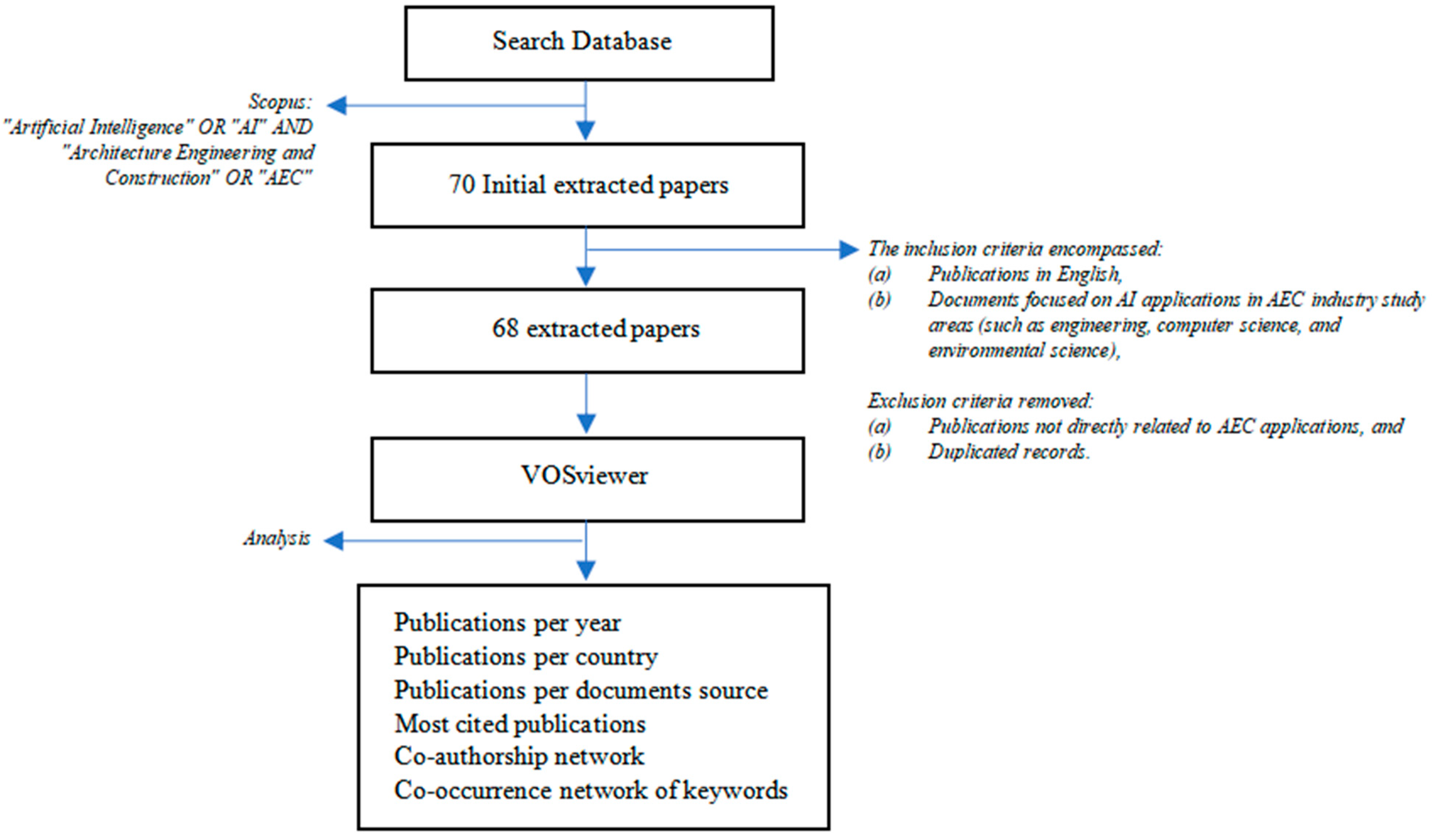
Figure 2.
Number of publications per year.
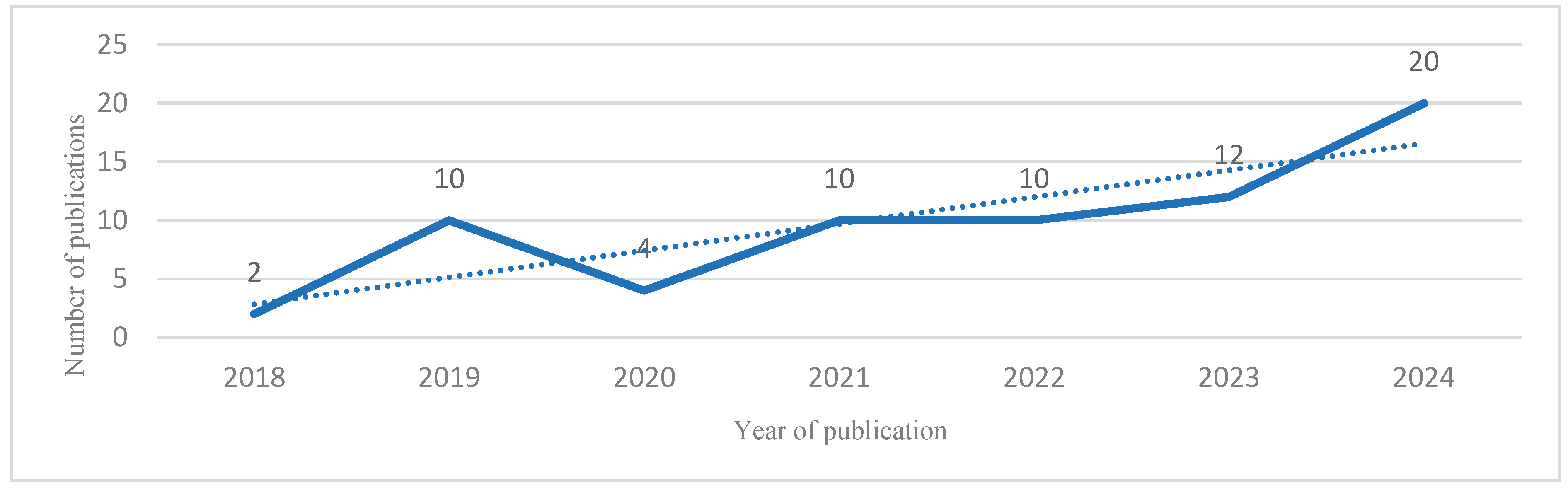
Figure 3.
Number of publications per document type.
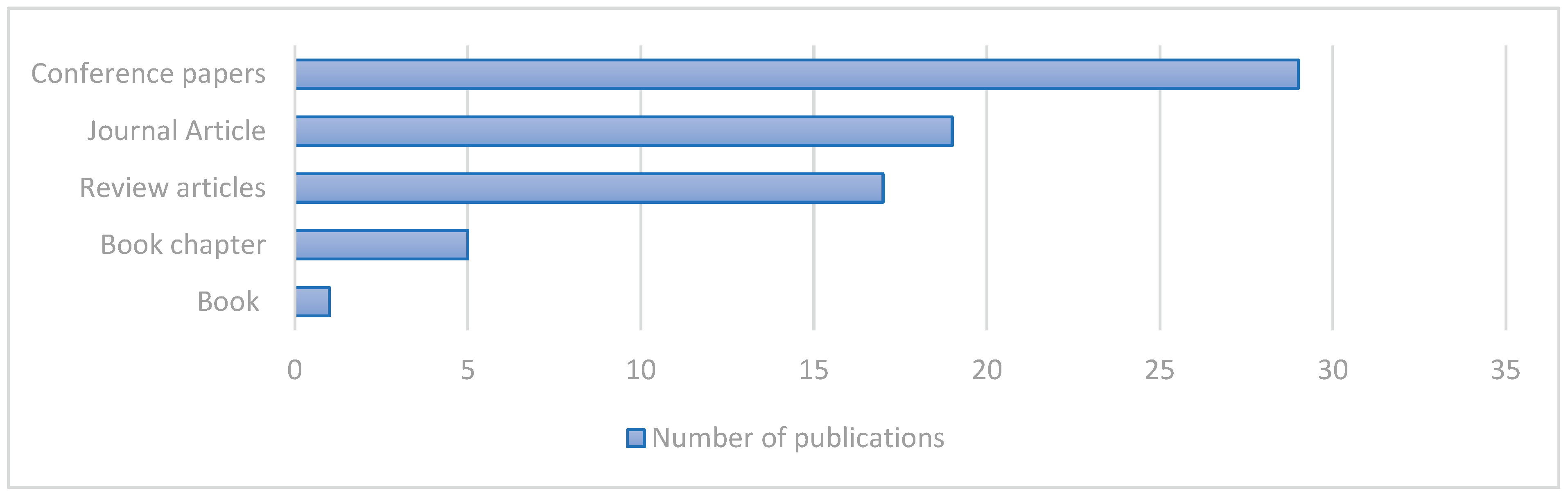
Figure 4.
Number of publications and citations of leading countries.
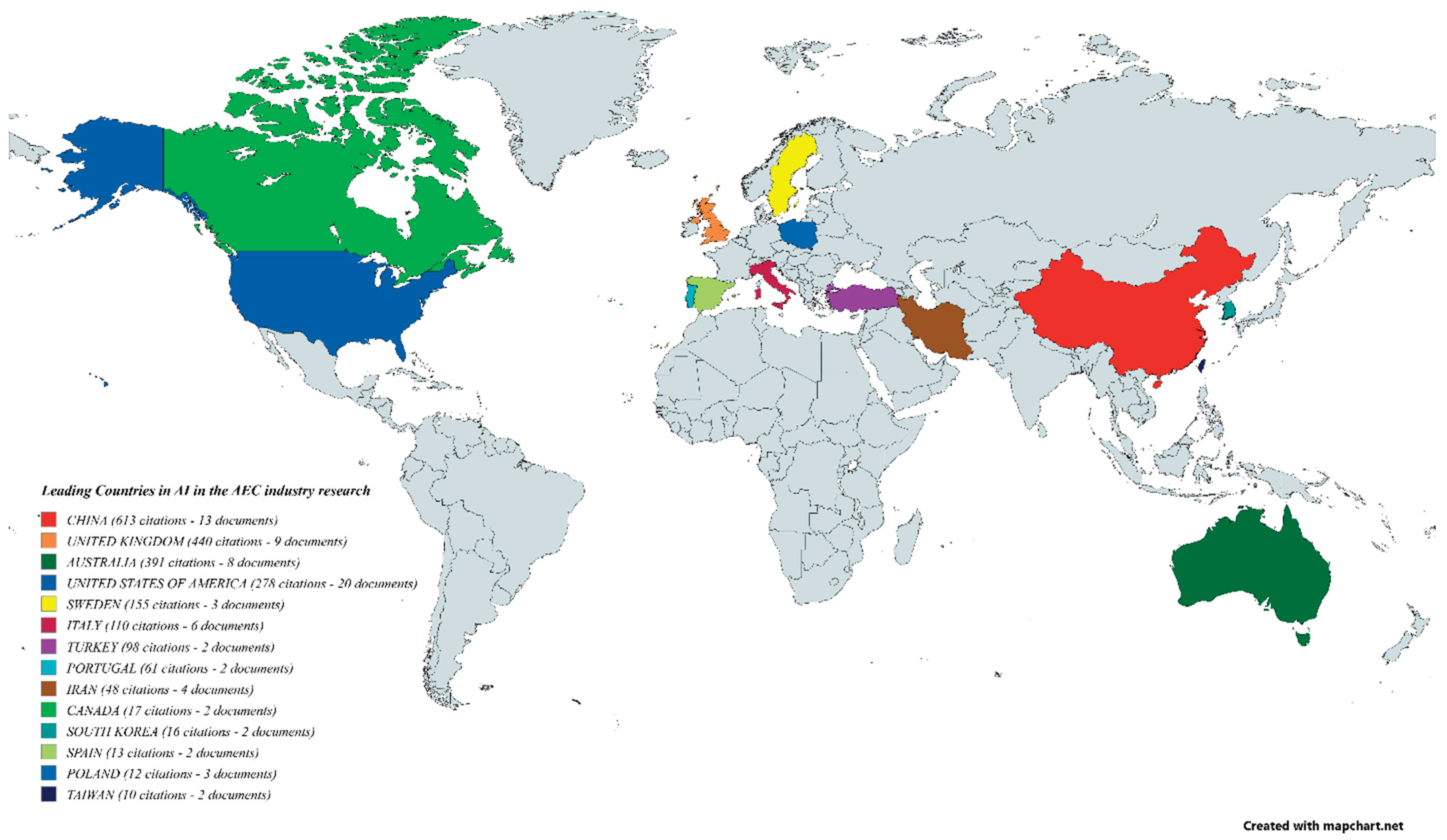
Figure 5.
Overlay visualization of co-authorship network.
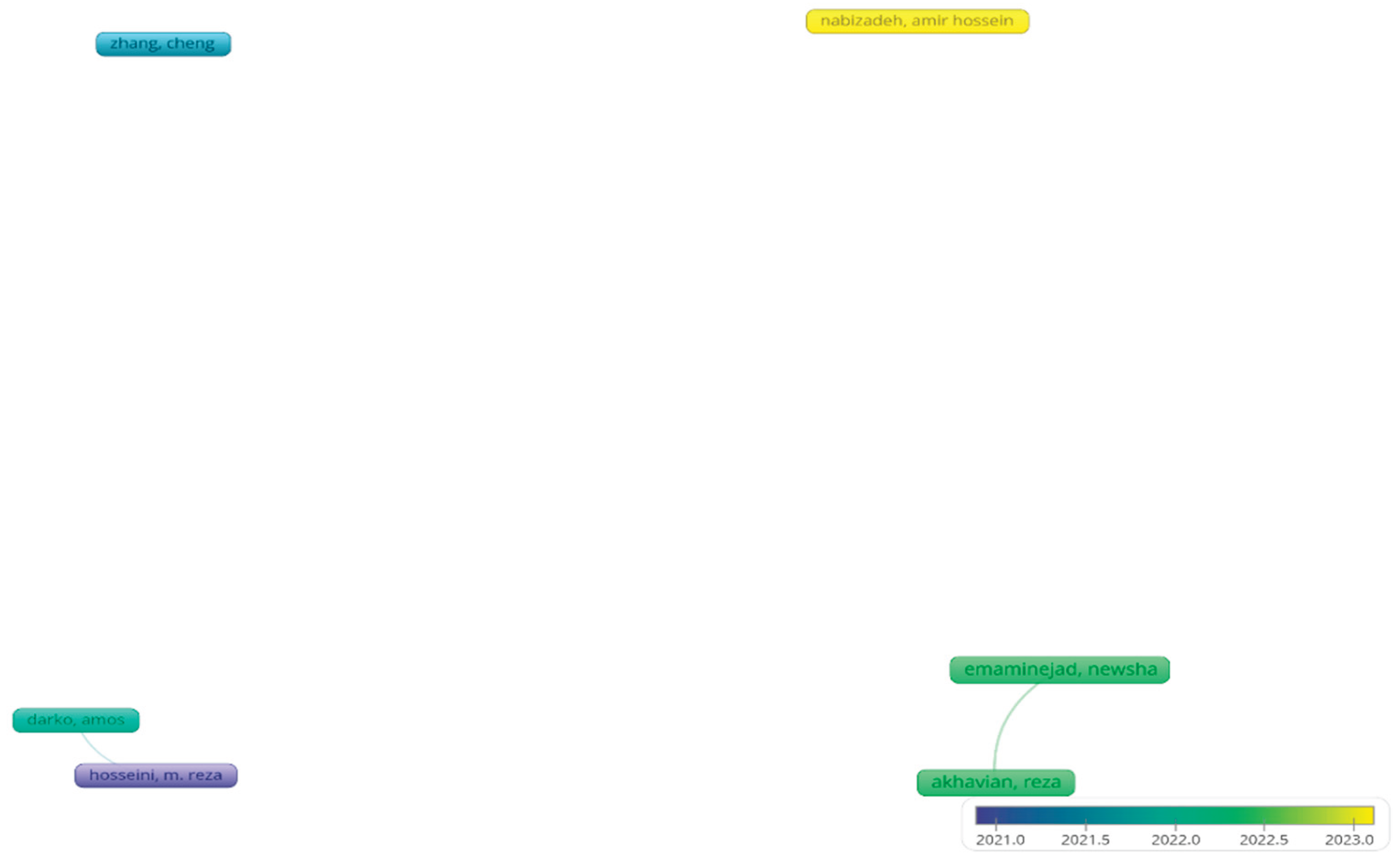
Figure 6.
Network visualization map of co-occurring keywords.
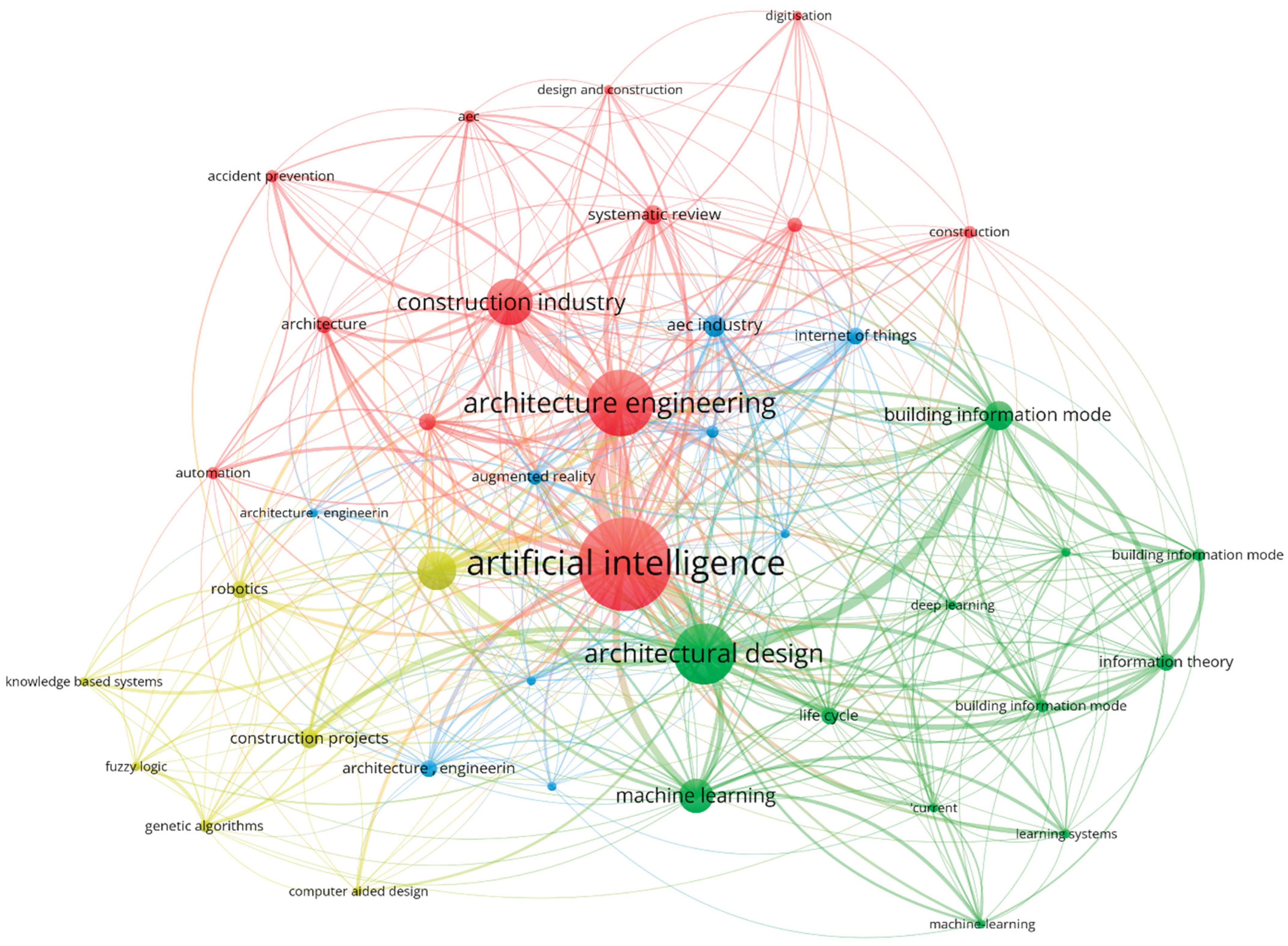
Figure 7.
Overlay visualization map of co-occurring keywords.
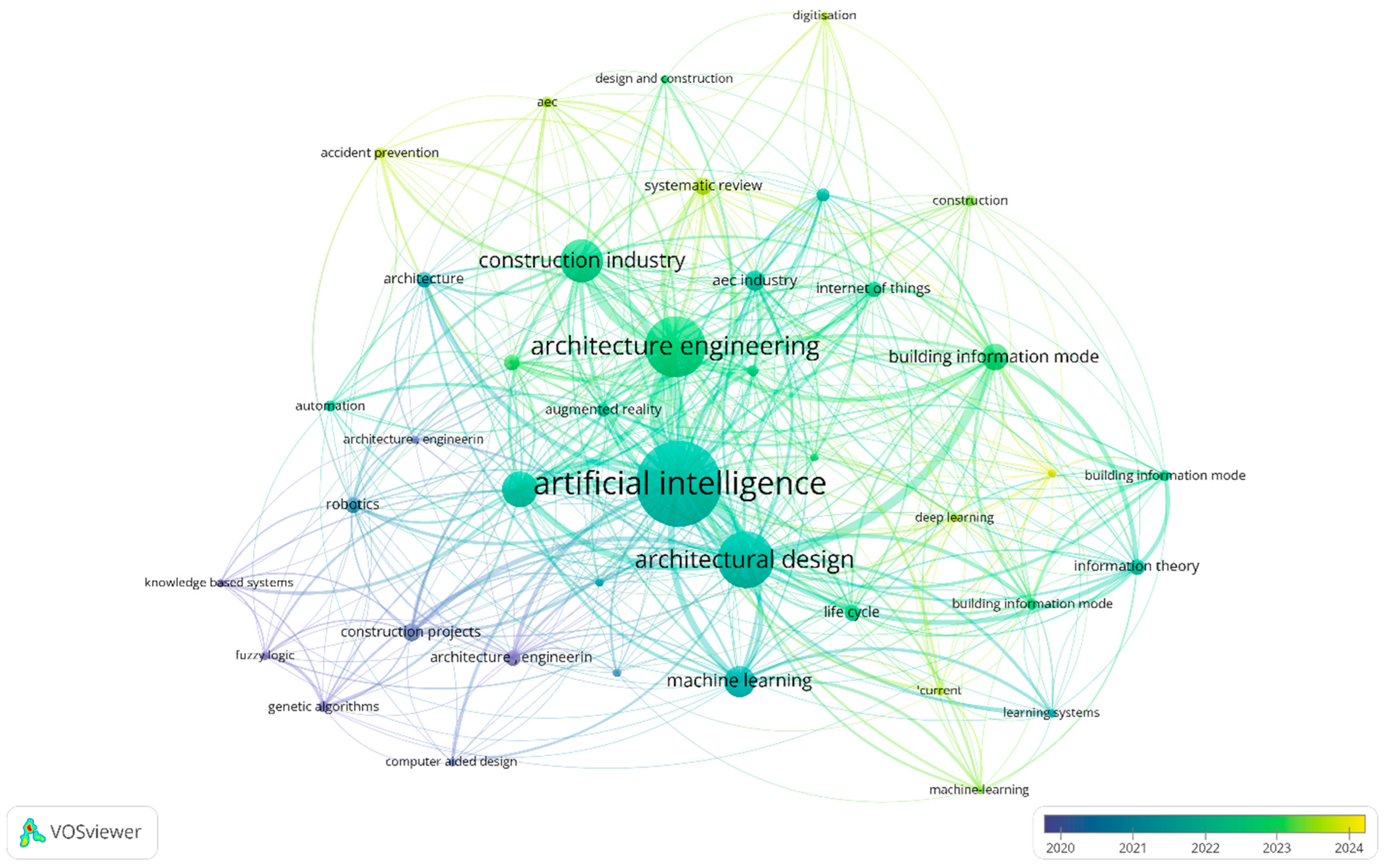

Table 1.
Number of publications per source
| Source | Documents | Citations |
|---|---|---|
| Automation in Construction | 6 | 495 |
| Applied Sciences (Switzerland) | 2 | 106 |
| Construction Innovation | 2 | 91 |
| Lecture Notes in Civil Engineering | 4 | 31 |
| Buildings | 4 | 11 |
| Engineering, Construction, and Architectural Management | 4 | 10 |
Table 2.
Top cited publications.
| Source | Title | Citations | Method | Focus |
|---|---|---|---|---|
| [7] | Artificial intelligence in the AEC industry: Scientometric analysis and visualization of research activities | 341 | Scientometric analysis, Visualization techniques | Comprehensive review of AI applications in AEC, Research trend analysis |
| [30] | Integrating BIM and AI for Smart Construction Management: Current Status and Future Directions | 108 | Literature review, Integration framework analysis | Building Information Modeling (BIM), AI integration, Construction management |
| [45] | An adapted model of cognitive digital twins for building lifecycle management | 90 | Model development, Conceptual framework | Cognitive digital twins, Building lifecycle management |
| [46] | Application of terrestrial laser scanning (Tls) in the architecture, engineering and construction (AEC) industry | 69 | Technology application analysis | Terrestrial Laser Scanning (TLS), AEC applications |
| [47] | The hype factor of digital technologies in AEC | 65 | Critical analysis | Digital technology hype, Impact assessment in AEC |
| [48] | Automated design and modeling for mass-customized housing. A web-based design space catalog for timber structures | 64 | Web-based modeling, Automated design | Mass-customized housing, Timber structures |
| [49] | Trustworthy AI and robotics: Implications for the AEC industry | 47 | Implications analysis | Trustworthy AI, Robotics in AEC |
| [50] | Towards digital architecture, engineering, and construction (AEC) industry through virtual design and construction (VDC) and digital twin | 47 | Conceptual analysis | Virtual Design and Construction (VDC), Digital twin technology |
| [51] | Conversational artificial intelligence in the AEC industry: A review of present status, challenges and opportunities | 42 | Literature review | Conversational AI, Current status, and challenges |
| [52] | Assessing the capabilities of computing features in addressing the most common issues in the AEC industry | 26 | Capability assessment | Computing features, Common AEC industry issues |
| [53] | Metrological Issues in the Integration of Heterogeneous IoT Devices for Energy Efficiency in Cognitive Buildings | 23 | Metrological analysis | IoT device integration, Energy efficiency in cognitive buildings |
| [54] | From 3D point clouds to HBIM: Application of Artificial Intelligence in Cultural Heritage | 23 | AI application analysis, 3D point cloud processing | Heritage Building Information Modeling (HBIM), Cultural heritage preservation |
Table 3.
Number of publications and citations per author.
| Author | Affiliation | Documents | Citations |
|---|---|---|---|
| Hosseini, M. Reza | School of Architecture and Built Environment, Deakin University, Geelong, 3220, Australia | 2 | 367 |
| Darko, Amos | Department of Building and Real Estate, The Hong Kong Polytechnic University, Hong Kong | 2 | 341 |
| Nabizadeh, Amir Hossein | Medical Informatics Research Center, Institute for Futures Studies in Health, Kerman University of Medical Sciences, Kerman, Iran, INESC-ID, Lisbon, 1000-029, Portugal | 2 | 61 |
| Akhavian, Reza | Department of Civil, Construction, Environmental Engineering, San Diego State University, 5500 Campanile Dr., San Diego, 92182, CA, United States | 3 | 56 |
| Emaminejad, Newsha | Dept. of Civil, Construction, and Environmental Engineering, San Diego State Univ., San Diego, 92182, CA, United States | 3 | 56 |
| Zhang, Cheng | Dept. of Construction Science and Organizational Leadership, Purdue Univ. Northwest, Hammond, IN, United States | 2 | 23 |
Disclaimer/Publisher’s Note: The statements, opinions and data contained in all publications are solely those of the individual author(s) and contributor(s) and not of MDPI and/or the editor(s). MDPI and/or the editor(s) disclaim responsibility for any injury to people or property resulting from any ideas, methods, instructions or products referred to in the content. |
© 2025 by the authors. Licensee MDPI, Basel, Switzerland. This article is an open access article distributed under the terms and conditions of the Creative Commons Attribution (CC BY) license (http://creativecommons.org/licenses/by/4.0/).
Copyright: This open access article is published under a Creative Commons CC BY 4.0 license, which permit the free download, distribution, and reuse, provided that the author and preprint are cited in any reuse.


