

Submitted:
18 October 2024
Posted:
21 October 2024
You are already at the latest version
Abstract
The integration of Artificial Intelligence (AI) into architecture is reshaping the industry by enhancing design processes, project management, and sustainability efforts. This study provides a comprehensive analysis of AI software tools, focusing on their functionalities in the market, automated site analysis, building performance analysis, architectural design development, and additional features. Key findings reveal that while tools like Spacio.ai, Swapp, and Autodesk Forma offer extensive features across various design phases, their effectiveness is influenced by design capabilities, sustainability and viability assessments, overall architectural design procedures, and third-party interactions. The study underscores the need for tailored AI tools that can effectively follow the architectural process from conceptualization and design to engineering and building permits, all while ensuring full regulatory compliance and adaptability in real-time. By identifying current trends and features, this study contributes to understanding the role of AI in architecture, offering valuable insights for software developers and professionals aiming to integrate AI capabilities into a robust platform. The goal is to elevate architecture to higher levels of human engagement and construction excellence, harnessing the full potential of AI.
Keywords:
Artificial Intelligence in Architecture
; AI Software Tools in Architecture
; Global AI Adoption
; Construction Technology AI assisted
; Real Estate AI Engagement
; Augmented Reality in Design Process
1. Introduction
1.1. Background
The integration of Artificial Intelligence (AI) into architecture has emerged as a transformative force, fundamentally altering traditional methods and practices across various stages of design, construction, and urban planning. AI's ability to process vast amounts of data, learn from patterns, and generate innovative solutions has positioned it as a game-changer in the architectural field. However, despite the growing body of literature exploring AI's role in architecture, significant gaps remain in understanding the collective impact of these tools on the future of the architectural industry. Much of the current research tends to focus on individual AI tools or specific functionalities, often lacking a holistic perspective on how these technologies influence the broader architectural process, including design, project management, and sustainability efforts [1].
One of the critical areas where existing research falls short is in the comparative analysis of AI tools. While studies have highlighted the capabilities of specific tools, such as AI-driven generative design platforms and AI-enhanced building information modeling (BIM) systems, there is a notable scarcity of comprehensive analyses that evaluate these tools in terms of their functionalities, market coverage, and overall effectiveness in different architectural workloads [2]. This lack of in-depth, comparative studies hinders architects and industry professionals from making well-informed decisions about which AI tools are best suited for their needs. The absence of such analyses also means that there is limited guidance available on how to integrate these tools into existing workflows to maximize efficiency and creativity.
Furthermore, existing studies often overlook the broader professional, economic, and regulatory factors that drive the adoption of AI in architecture. While the technological capabilities of AI tools are well-documented, there is less understanding of how market dynamics, regional disparities in technological infrastructure, and varying regulatory environments influence the adoption and effectiveness of these tools [3]. For instance, regions with advanced technological infrastructure, such as the United States, EU and China, have seen more rapid adoption of AI in architecture compared to other parts of the world, where economic constraints and less supportive regulatory frameworks may pose significant barriers [4]. Understanding these factors is crucial for developing a global perspective on AI's role in the future of architecture.
This study seeks to address these research gaps by providing a comprehensive analysis of AI software tools in architecture, with a particular focus on their functionalities and potential impacts on the future development of the industry. By systematically reviewing key features of widely used AI tools such as Midjourney, DALL-E 2, and Stable Diffusion—especially in early-stage design processes like ideation, sketching, and modeling [5]. Alongside other tools that have seen less commercial success but have the potential to become the next master tools spanning various phases of the design process, this research aims to capture the current trend of increasingly integrated AI applications. Factors that affect the adoption of AI also determine how effectively these tools can be integrated across the architectural workload. These applications cover a broad range of design stages, from initial architectural concepts to complex engineering solutions, and are capable of reaching the building permit stage [1].
The study gap lies in understanding the implications of these factors for the global landscape of AI in architecture. By understanding the professional drivers behind AI adoption, it aims to provide valuable insights into how these tools can be better tailored to meet the needs of architects. This understanding is crucial for informing the development of AI tools that are not only technologically advanced but also accessible and applicable in diverse architectural contexts. Ultimately, this research aims to forecast the future capabilities of AI applications by understanding current trends and their implications for the architectural industry, contributing to a more informed approach to AI tool selection and implementation [3].
1.2. Literature Review
The integration of AI into architecture has become a focal point of extensive research, with studies exploring its impact across various dimensions, from design creativity and project management to sustainability and education. Each study provides unique insights but often overlooks crucial aspects that could enhance our understanding of AI's role in transforming architectural practices.
Amira Fawzy et al. (2024) investigated the impact of AI on design education, particularly its role in enhancing efficiency, sustainability, and creativity. The objective was to assess how AI tools could be integrated into architectural education to improve learning outcomes. The study utilized a case study approach, focusing on a specific group of students and their interaction with AI tools. While the study provided valuable insights, it overlooked a more diverse sample that could have offered a broader perspective on AI's impact in different educational settings. The research concluded that AI significantly improves learning outcomes and promotes sustainable design practices, but also highlighted the need for ongoing evaluation and adaptation to maximize its benefits. The study's findings underscore the importance of integrating AI into educational curricula more systematically, ensuring that future architects are well-equipped to leverage these technologies effectively [3].
Shitao Jin et al. (2024) conducted a study focused on the integration of AI in architectural education, specifically within a design course. The research aimed to evaluate the impact of AI on learning outcomes by analyzing qualitative data from student feedback and performance assessments. The study's methodology was robust, employing a case study approach that allowed for an in-depth examination of AI's role in enhancing creativity and efficiency in design tasks. However, the study's sample was somewhat narrow, focusing on a single course, which limits the generalizability of the findings. The study concluded that AI tools significantly enhance creativity and efficiency in design tasks, though challenges such as unpredictability in AI-generated designs were noted. The study suggests that future research should explore the integration of AI across a wider range of educational settings and courses to fully understand its potential and limitations [6].
Md Haseen Akhtar and J. Ramkumar (2023) conducted an extensive overview of AI applications in architecture, focusing on their impact on design processes and project management. The study aimed to highlight the potential of AI to improve design efficiency and foster innovation within architectural practices. However, the sample used in the study was somewhat limited, primarily focusing on specific AI tools without a broader comparative analysis. The methodology involved a qualitative review of existing literature, which, while thorough, did not encompass a wide enough range of tools or applications. The study concluded that AI offers significant benefits for architecture but emphasized that careful planning and management are essential for successful integration. The findings suggest that future research should explore a broader range of AI tools and their comparative effectiveness in different architectural contexts to better inform industry practices [2].
Amit Kumar (2024) examined AI's role in the design and construction industry, emphasizing its ability to improve efficiency and innovation. The objective was to assess how AI tools can be integrated into project management and execution to enhance accuracy and efficiency. The study's methodology involved a comprehensive literature review, but it primarily focused on established markets, overlooking the challenges faced by emerging markets. The study concluded that AI enhances project management and execution, leading to increased accuracy and efficiency. However, it also highlighted the need for careful planning and management to ensure positive outcomes. The findings suggest that future research should focus on understanding the barriers to AI adoption in emerging markets and explore strategies to overcome these challenges [7,8].
Nitin Rane et al. (2023) provided a comprehensive review of advanced technologies, including AI, used in architectural design. The study aimed to highlight how these technologies, particularly AI, enhance design processes and outcomes. The methodology involved a systematic review of existing literature, which provided a broad overview but lacked a focus on specific AI tools or their comparative effectiveness. The study concluded that these technologies significantly enhance design processes and outcomes, but their integration requires careful planning and collaboration. The study's findings indicate that future research should focus on developing best practices for integrating AI into architectural workflows, ensuring that these tools can be used effectively across different stages of the design process [9].
Abdulatif Alabdulatif (2024) explored the global impact of AI on sustainability, particularly its role in addressing environmental challenges and improving resource efficiency. The objective was to assess how AI tools can be used to promote sustainable architectural practices. The study utilized a literature review methodology, synthesizing insights from existing studies. However, it overlooked the regional differences in AI adoption and the specific challenges faced by different markets. The study concluded that AI has substantial potential in optimizing resource use and reducing environmental footprints, but emphasized the need to consider ethical and social implications to ensure successful implementation. The findings suggest that future research should explore how AI can be tailored to meet the sustainability goals of different regions, considering their unique challenges and opportunities [4].
Mateusz Płoszaj-Mazurek and Elżbieta Ryńska (2024) examined the use of AI and digital tools in low-carbon architectural design. The study aimed to assess how AI can support life cycle assessments and promote sustainable design practices. The methodology involved a technical review of AI tools used in low-carbon design, but the study's sample was limited to a few specific tools, overlooking the broader range of AI applications. The study concluded that AI is instrumental in promoting sustainable design practices, particularly in enhancing life cycle assessments and supporting low-carbon initiatives. However, the study also highlighted the need for careful planning and collaboration among stakeholders. The findings suggest that future research should explore how AI tools can be integrated into broader sustainability frameworks, ensuring that they contribute effectively to global sustainability goals [10].
While recent studies demonstrate the transformative potential of AI in architecture—enhancing design efficiency, creativity, and sustainability—they also reveal significant gaps. The research highlights the need for broader analyses across diverse contexts and emerging markets. Studies by Akhtar and Kumar emphasize AI's benefits in design and project management but call for more comprehensive evaluations [8]. Fawzy, Jin, and others point to the advancements in educational settings and sustainability but stress the importance of integrating AI into varied educational frameworks and regional sustainability goals [2,3]. To fully leverage AI’s capabilities, future research must address these gaps and explore its impact more broadly and deeply.
2. Materials and Methods
This study explores the integration of AI software tools to streamline architectural workflows and improve project outcomes, particularly in early-stage design and sustainability efforts, with a focus on their functionalities across various stages of the design process. The research emphasizes the capabilities of these tools in supporting the United Nations' (UN) Sustainable Development Goals (SDGs), which guided the selection of assessment criteria outlined in Table 1. A mixed-methods approach was employed, combining qualitative assessments of tool features with quantitative measures to evaluate their capacity to generate fully integrated architectural and engineering blueprints that are ready for building permits.
A comprehensive review of both software industry practices and scientific literature was conducted to identify and thoroughly document the most widely recognized and utilized AI tools within the field of architecture. This review was designed to encompass a broad spectrum of AI applications, focusing on 32 distinct tools ranging from those integrated with third-party applications (Annex), such as SketchUp and Rhinoceros, to more comprehensive platforms capable of managing the entire building process. Additionally, this review incorporated insights from recent studies, emphasizing the necessity for broader analyses across diverse contexts and emerging markets to better understand the global implications and adoption of AI in architecture [2,3,4].
A qualitative analysis was conducted on selected AI tools to evaluate their functions in creativity, efficiency, and design processes. The case studies examined how these tools are integrated into architectural workflows and their impact across different stages of the design process. The analysis also measured the coverage of various stages of the design process by these tools. Additionally, the study examined the influence of professional and economic factors on AI adoption, considering regional disparities and the broader context of global AI adoption in architecture [6,8,10].
Quantitative analysis examined the specifications and characteristics of the AI tools, covering 42 variables, as outlined in Table 1, ranging from tool names to their countries of origin. The analysis categorized the tools into major groups, including Market, Automated Site Analysis, Building Performance Analysis, Architecture and Design Development, and Additional Features. Subtotals were calculated for each group to understand the architecture workflow covered.
The six criteria in market groups include architecture & design, urban planning, construction, visualization, sustainability, and art & marketing. The authors evaluate software on its ability to support architectural and urban planning design and generate construction drawings after design completion. Visualization addresses 3D modeling, rendering, and virtual reality, aiding stakeholders in project assessment. Sustainability focuses on eco-friendly and resource-efficient designs, examining whether the software integrates sustainable practices. Art & marketing blends artistic expression and marketing strategies to enhance branding and communication in the architecture, real estate, and construction industries.
The authors identified 11 key criteria for software evaluation in automated site analysis. These include: (1) Area metrics, which measure site dimensions and surface areas, including land usage and building footprints; (2) Parking metrics, which plan and optimize parking spaces, considering layout and regulations; (3) Sun analysis, which simulates sunlight exposure and optimizes natural light; (4) Daylight potential analysis, which assesses daylight penetration to improve energy efficiency; (5) Wind analysis, which simulates wind patterns and evaluates their impact on buildings and outdoor spaces; (6) Microclimate analysis, which assesses localized environmental factors like temperature and humidity; (7) Disaster testing, which simulates natural disasters and evaluates site resilience; (8) Noise analysis, which measures noise levels to address sound pollution; (9) Solar energy analysis, which assesses solar energy potential and integrates renewable energy solutions; (10) Terrain modeling, which represents the site's topography; and (11) Space planning, which organizes site or building layouts, focusing on circulation and spatial relationships.
In the building performance analysis group, there are six key variables: (1) Views analysis, which assesses the software's ability to provide a comprehensive view of the entire project; (2) Cost-effective solutions, which evaluates strategies that balance building performance and affordability; (3) Water consumption, which measures the building's use of water resources; (4) Operational energy, assessing the building’s energy performance during operation; (5) CO2 emissions, analyzing carbon emissions from construction, materials, and operation, aiming to reduce the building’s carbon footprint; and (6) Sustainable certification, which evaluates the building’s compliance with sustainability standards like LEED, BREEAM, or WELL, ensuring the project meets energy efficiency and environmental criteria.
In the architecture and design development group, there are 10 key variables: (1) Generative design, where the software automatically creates multiple design options based on set parameters; (2) Photorealism, the ability to produce highly realistic 3D renderings; (3) Motion images, which refers to the creation of animated sequences or videos simulating movement within the design; (4) Vector-based rendering, ensuring high-quality, scalable images that maintain clarity at any size; (5) Parametric design, allowing flexible models that can be adjusted by altering parameters; (6) Design optimization, analyzing and improving designs based on performance criteria; (7) Detailed design input, enabling the input of specific design requirements and constraints; (8) BIM generation, where the software can generate Building Information Models; (9) Clash detection, a tool to identify and resolve conflicts between design elements; and (10) Feasibility studies, assessing the viability of design solutions.
In the surplus group, there are four criteria: Augmented reality, which enables the overlay of digital content onto the real world through devices like smartphones or AR headsets; Real-time collaboration, allowing multiple users to work on the same project simultaneously from different locations; Web-based Software, which can be accessed through a browser without installation; and mobile app availability, providing access to projects via smartphones or tablets for increased mobility and convenience.
Data were gathered from official websites, product documentation, and existing research to create a dataset of AI tools relevant to the architecture industry. The dataset was continuously updated to incorporate the latest advancements in AI tools and their applications in architecture, up to the end of August 2024. The dataset was updated and cross-referenced with multiple online sources to ensure accuracy and relevance. To ensure the validity and reliability of the findings, each author independently verified the data, creating separate tables to facilitate data triangulation. Any discrepancies were compared, discussed, and resolved to produce a final version in accordance with the study's objectives.
The study recognizes the diversity of tasks covered by specific tools, noting that while the selected tools are representative of the industry, they do not encompass all aspects of architectural workflows from the early stages of design to the building permit process. Separate analyses were conducted to account for tools that are focused on specific building tasks rather than the entire architectural workflow.
3. Results
The study analyzes the data to identify the top five software tools in each category: Market, Automated Site Analysis, Building Performance Analysis, Architecture and Design Development, and Additional Features. The analysis focuses on the tools with the highest totals or most extensive feature sets in each category, reflecting their significance within the architectural workflow. The paragraphs below will report the Table 1 results per category, and at the end, per total.
At the Market category, only Swapp and BricsCAD have received the highest ratings with five scores, followed by Spacio.ai, Autodesk Forma, LookX, ARCHITEChTURES, Delve, TestFit, Finch3D, D5 Render, Veras.ai, and Fologram, each rated with four scores. Swapp provides integrated support across the project lifecycle, from schematic design and development to the production of construction documentation, enhancing efficiency throughout the design process [11]. BricsCAD, a versatile CAD platform, offers tools for 2D drafting, 3D modeling, and BIM, supporting comprehensive workflows in architecture and construction, thereby facilitating project management from concept to completion [12]. Spacio.ai accelerates architectural workflows by enabling rapid modeling that incorporates real-time site data, facilitating immediate adjustments and improving project feasibility [13,14]. Autodesk Forma employs AI to generate and evaluate design options, aiding urban designers in optimizing environmental conditions and increasing project efficiency [15]. LookX differentiates itself by focusing on competitive design submissions and providing a more extensive range of services. Its AI-driven platform supports urban planning and architectural design through intelligent design assistance, digital process optimization, and prefabricated component design, addressing both early-stage conceptualization and detailed planning [16]. ARCHITEChTURES automates large portions of project layouts, particularly for multifamily residential buildings, streamlining repetitive processes such as modeling, measurements, and calculations to enhance design efficiency and decision-making [17]. These tools collectively provide a comprehensive range of functionalities, each contributing automate the architecture workflow [18].

Table 1.
AI software on the architecture field by offered features to address the design phasis.
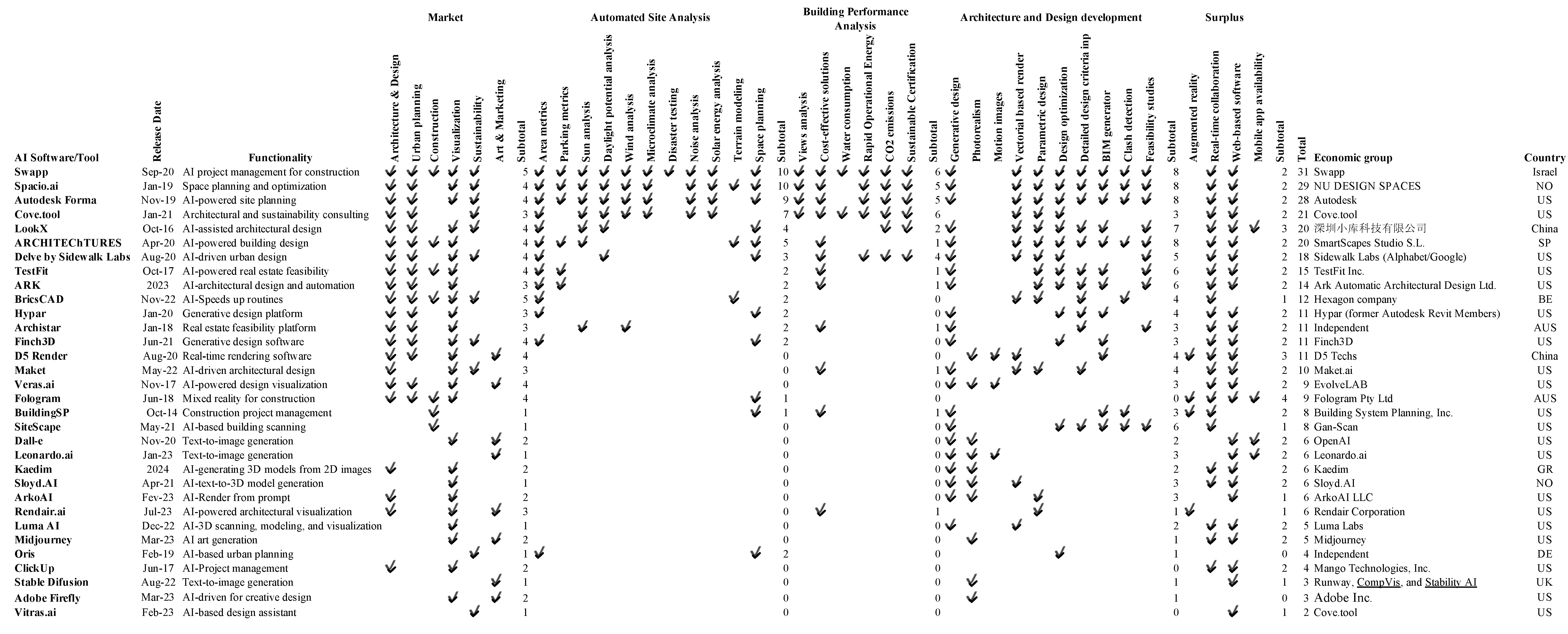
In Automated Site Analysis category, Swapp and Spacio.ai lead the field, each offering ten features, followed by Autodesk Forma with nine features and Cove.tool with seven Swapp supports a comprehensive range of site analysis functions, including area and parking metrics, as well as analyses of sun, wind, daylight, microclimate, noise, and solar energy, with terrain modeling being the only exception. Spacio.ai provides automatic site modeling, including surrounding buildings, streets, maps, and terrain data [13]. Autodesk Forma provides data-driven insights and real-time environmental analytics for early-stage planning and design, offering intuitive project setup and design automation [15]. Its AI-powered analytics provide insights on key factors such as sun hours, daylight potential, noise, wind, and microclimate. Cove.tool focuses on AI-assisted consulting services for sustainability and design optimization, leveraging BIM data for cost control and sustainable design [19]. The focus on automated site analysis in these tools reflects the industry's recognition of the importance of early-stage decision-making in architectural projects, enabling architects and designers to make informed decisions that can significantly impact project outcomes, sustainability, and alignment with SDGs from the very beginning of the design process.
The Building Performance Analysis category plays a critical role in ensuring high-quality architectural outcomes, with Swapp and Cove.tool leading the field, each receiving six scores, followed closely by Autodesk Forma and Spacio.ai with five scores each. Swapp utilizes AI to automate construction documentation and BIM modeling, incorporating features such as views analysis and delivering cost-effective solutions by significantly reducing project timelines and expenses [20]. Cove.tool focuses on AI-assisted consulting for sustainability and design optimization, providing features such as water consumption analysis, rapid operational energy assessments, CO2 emissions tracking, and sustainable certification processes [21]. While Autodesk Forma and Spacio.ai are recognized for their capabilities in site planning and optimization, within the Building Performance Analysis category, they contribute through views analysis, supporting informed decision-making to enhance project feasibility and sustainability [22,23]. The integration of these AI-powered tools into the architectural workflow enables the creation of buildings that are efficient, sustainable, and aligned with industry demands for climate-conscious development.
In Architecture and Design Development group, Swapp, Spacio.ai, Autodesk Forma and ARCHITEChTURES lead with eight scores each, while LookX with seven scores, TestFit, ARK and SiteScape are follow closely with six features [14]. Swapp enhances generative design and optimization by automating floor plans and layouts, quickly generating multiple design iterations to improve architectural efficiency [24]. It also focuses on automating construction documentation and BIM modeling, incorporating features like clash detection and feasibility studies, significantly reducing project duration and costs. Spacio.ai excels in providing capabilities such as vectorial-based renderings, and design optimization, combining generative AI speed with free-form editing flexibility [23]. Autodesk Forma offers comprehensive tools for early-stage architectural design, including generative design, parametric design, and detailed design criteria input, which simplify BIM project initiation and enable rapid exploration of design concepts [25]. ARCHITEChTURES allows users to easily input design criteria and generate AI-optimized 2D and 3D models in real-time, with BIM solutions and project data available for download in multiple formats [26]. LookX integrates AI into the design process with tools like “MasterPlanner” and “BuildingCreator”, supporting generative design and optimized planning schemes [14]. These advanced tools are crucial in the architectural process as they enhance efficiency, enable data-driven decision-making, integrate sustainability considerations, improve collaboration, reduce costs, augment creativity, and ensure compliance with building codes and standards [27,28]. The integration of AI and advanced computational tools in Architecture and Design Development represents a significant shift in the industry, enabling architects to create more sophisticated, efficient, and sustainable designs while streamlining the design process [29].
In the Surplus group, two software solutions stand out: Fologram with four features and LookX with three features. Fologram, although offering fewer features, excels with its unique mixed reality (MR) capabilities, including MR visualization, real-time design changes in MR, and collaborative MR sessions tailored for precise construction of free-form objects. These tools enable architects to overlay digital models onto the physical world, make instant design modifications, and facilitate group discussions in a shared virtual space, also make assisted construction. LookX provides real-time collaboration, web-based software, and mobile app availability, offering tools such as “ColorMaster” for colorizing site plans, real-time 3D visualization, cloud-based collaboration, and multi-format export capabilities. These features enhance client understanding and support seamless communication among team members. The integration of these advanced communication tools marks a significant shift in how architects interact with clients and stakeholders, improving understanding, enabling efficient feedback loops, enhancing engagement, reducing miscommunication, and potentially saving costs while providing a marketing advantage. As the industry evolves, the ability to effectively communicate design intent and gather feedback through these innovative tools is becoming increasingly crucial for successful project delivery.
The overall results highlight three software solutions that stand out in covering the widest range of architectural workflows: Swapp leads with 31 features, closely followed by Spacio.ai with 29 features, and Autodesk Forma with 28 features. These tools represent a significant advancement in AI-driven architecture, offering comprehensive capabilities that enhance project efficiency, sustainability, and collaboration. Swapp, with its strong focus on automating architecture, engineering, and building documentation through BIM modeling, provides cost-effective solutions that significantly reduce project duration, designer workloads, and overall associated expenses [2,10]. Spacio.ai distinguishes itself with features such as preset modeling capabilities, automatic site modeling, and a real-time performance dashboard, enabling architects to analyze, design, and develop structured building proposals more efficiently [11, 23]. Autodesk Forma closely follows Spacio.ai but does not surpass its feature set. The gap between these top performers and other tools in the market underscores a new standard for integrated architectural software, setting a benchmark for functionality and innovation in the industry [14,23,31]. These leading platforms exemplify the growing role of AI in architecture, driving the industry toward more efficient, sustainable, and innovative practices that cover the entire architectural workflow.
However, not all listed software solutions aim to cover the entire architectural workflow, as outlined in this study; many excel in specialized tasks. Notable tools in this category include Midjourney V6, DALL-E, and Stable Diffusion for conceptual design visualization; Luma AI for 3D capture and reconstruction; SiteScape generates floor plans with infrastructure from real buildings using mobile devices; D5 Render for real-time architectural visualization; Fologram for mixed reality applications in construction; TestFit for rapid building feasibility studies; ARCHITEChTURES for parametric design; Cove.tool for building performance analysis; and LookX for AI-driven urban planning and architectural design with BIM capabilities [29]. Midjourney V6, in particular, has set a new standard in conceptual design visualization by enhancing image quality and improving user interaction with a more intuitive prompt language, influencing the direction of other tools in this area [32].
Swapp, while promising comprehensive coverage from early stages to building permit, currently has limited usability, being restricted to company-selected users, and its real-world capabilities lack extensive testing and validation [20]. These specialized tools demonstrate the diverse ways in which AI and advanced computational methods are transforming specific aspects of architectural practice, each addressing unique challenges within the design and construction process[13,33].
4. Discussion
The integration of AI into architecture is reshaping the field by improving efficiency, sustainability, and collaboration. The study reveals that tools such as Swapp, Spacio.ai and Autodesk Forma dominate the market due to their extensive feature sets, each addressing critical phases of the architectural process. Swapp, which focuses on automating construction documentation and BIM modeling, offers cost-effective solutions but faces criticism due to its limited real-world application and access. Akhtar & Ramkumar (2023) similarly noted that while AI has significant potential in architectural workflows, the lack of large-scale testing and validation often limits adoption, particularly in regions where technological infrastructure is lacking [34]. Spacio.ai, with its rapid modeling and real-time performance dashboards, leads in facilitating faster decision-making, enabling architects to efficiently navigate early-stage project development. This aligns with previous research by Płoszaj-Mazurek & Ryńska (2024), who emphasize that AI's ability to rapidly process large datasets and provide actionable insights is crucial in promoting sustainable design practices [10].
Furthermore, while Autodesk Forma offers environmental optimization and is closely matched with Spacio.ai in terms of features, it does not surpass it. This gap highlights a recurring theme in AI research, as observed by Jin et al. (2024), where AI’s effectiveness is influenced by external factors such as market readiness, regulatory environments, and technological infrastructure [6].
The gap between these top-performing tools and more specialized solutions demonstrates that the current AI landscape is fragmented, with each tool addressing a specific segment of the architectural process. This mirrors the findings of Kumar (2024), who stressed that AI tools, while transformative, are often limited in their ability to cover the entire architectural workflow comprehensively, necessitating a combination of specialized tools for maximum efficiency [7]. For example, Midjourney and DALL-E, which excel in conceptual design visualization, and Cove.tool, which focuses on sustainability consulting, are examples of AI tools that target specific aspects of the architectural process without offering comprehensive coverage.
The regional distribution of AI software in architecture is predominantly concentrated in the US, EU, Australia, and increasingly, China. These regions benefit from advanced technological infrastructures that provide the computational resources and skilled talent necessary for AI innovation in fields like architecture and urban planning. The US, EU, and Australia have strong economies that enable significant investment in AI research and development, while China, with its government-driven initiatives and substantial tech ecosystem, has rapidly become a major player in AI technology. Economic and regulatory frameworks in these areas are generally more favorable, offering clear guidelines on data privacy, ethics, and the integration of AI technologies. This contrasts with emerging markets, where financial and regulatory barriers limit the development and adoption of AI tools. As early adopters, the US, EU, Australia, and China not only lead in AI development but also set global standards, shaping the broader market’s adoption of innovative architectural solutions.
This study provides a comprehensive analysis of AI tools in architecture, but several limitations should be acknowledged. Firstly, the research primarily relies on available literature, official product documentation, and data from selected AI tools, which may not fully capture the breadth and nuances of AI applications in the architectural industry. Additionally, the varying levels of transparency and detail in the available data for each tool, particularly regarding real-world performance and adoption, create challenges for direct comparison. This is especially evident in tools like Swapp, which, despite its potential, has limited real-world validation and user access. Consequently, there may be discrepancies in the depth of analysis between tools with extensive market presence and those with restricted or emerging usage, potentially affecting the overall comprehensiveness of the findings. Further research, including more widespread testing and industry feedback, will be necessary to refine these insights and ensure a more robust understanding of AI’s impact on architecture.
Lastly, none of the authors have any financial interests or professional affiliations with the companies whose AI tools were studied. This ensures that the research findings are unbiased and based solely on the data collected and analyzed. Further research is encouraged to explore the long-term impacts and evolving functionalities of AI tools in architecture, considering the rapidly changing technological landscape and market dynamics.
5. Conclusions
This study underscores the transformative potential of AI in architecture, with tools like Swapp, Spacio.ai, and Autodesk Forma setting new standards in feature coverage and efficiency. These tools exemplify AI’s role in enhancing project management, sustainability, and design capabilities across various phases. However, consistent with the literature, there remain significant challenges in the widespread adoption of AI tools. As Alabdulatif (2024) and Akhtar & Ramkumar (2023) emphasize, economic constraints, regulatory barriers, and the lack of comprehensive, real-world testing are limiting factors for AI adoption in emerging markets[4,34].
Moreover, while tools like Swapp offer significant automation potential, their limited usability in real-world applications, as noted by Almaz et al. (2024), restricts their impact. Addressing these barriers, particularly through more inclusive and scalable testing, will be crucial for driving broader AI adoption [35]. The need for tailored AI solutions, especially those that can adapt to different regional and technological contexts, is critical for ensuring that the benefits of AI are accessible across the global architectural industry.
In line with Li et al. (2024) and Płoszaj-Mazurek & Ryńska (2024), this study highlights the importance of AI in promoting sustainability, aligning with global initiatives such as the UN’s SDGs [10,36]. AI tools like Cove.tool and Autodesk Forma are instrumental in achieving these goals by providing data-driven insights that reduce environmental impacts. However, as the literature suggests, the global effectiveness of these tools is contingent on their adaptability to diverse regional conditions and regulatory environments.
To fully leverage AI’s capabilities, future research should explore strategies for integrating these tools into various architectural workflows, considering the professional, economic, and regulatory factors that influence adoption. By doing so, the architectural industry can better prepare for a future where AI is not just a tool for efficiency, but a catalyst for sustainable and innovative design practices, as Almaz et al. (2024) propose [35].
Author Contributions
Conceptualization, N.D.C and C.C.D; methodology, N.D.C and C.C.D; software, N.D.C and C.C.D; validation, N.D.C, C.C.D and X.Z.; formal analysis, N.D.C, C.C.D and X.Z.; investigation, N.D.C, C.C.D and X.Z.; resources, N.D.C and C.C.D; data curation, N.D.C, C.C.D and X.Z.; writing—original draft preparation, N.D.C and C.C.D; writing—review and editing, N.D.C, C.C.D and X.Z.; visualization, N.D.C, C.C.D and X.Z.; supervision, N.D.C and C.C.D; project administration, N.D.C; funding acquisition, N.D.C. All authors have read and agreed to the published version of the manuscript.
Funding
This research was funded by FCT - Fundação para a Ciência e a Tecnologia, I.P., under Strategic Project with the references UIDB/04008/2020 and UIDP/04008/2020, and CIAUD, Research Centre for Architecture, Urbanism, and Design.
Conflicts of Interest
The authors declare no conflicts of interest. The funders had no role in the design of the study; in the collection, analyses, or interpretation of data; in the writing of the manuscript; or in the decision to publish the results.
Appendix A
- Adobe Firefly - https://www.adobe.com/sensei/generative-ai/adobe-firefly.html
- ARCHITEChTURES - https://www.architechtures.com
- Archistar - https://www.archistar.ai
- ARK - https://arkdesign.ai
- ArkoAI - https://arko.ai
- BricsCAD - https://www.bricsys.com
- ClickUp - https://clickup.com
- Cove.tool - https://www.covetool.com
- D5 Render - https://www.d5render.com
- DALL-E - https://openai.com/dall-e
- Delve by Sidewalk Labs - https://www.sidewalklabs.com/delve
- Finch3D - https://www.finch3d.com
- Fologram - https://fologram.com
- Hypar - https://hypar.io
- Kaedim - https://www.kaedim3d.com
- Leonardo.ai - https://leonardo.ai
- Luma AI - https://lumalabs.ai
- Maket - https://maket.ai
- Midjourney - https://www.midjourney.com
- Rendair.ai - https://www.rendair.ai
- SiteScape - https://www.sitescape.ai
- Sloyd.AI - https://www.sloyd.ai
- Spacio.ai - https://www.spacio.ai
- Autodesk Forma - https://www.autodesk.com/products/forma/overview
- Stable Diffusion - https://stability.ai
- Swapp - https://www.swapp.net
- TestFit - https://www.testfit.io
- Veras.ai - https://www.evolvelab.io/veras
- Vitras.ai - https://cove.tools/products/vitras-ai
- LookX - https://www.LookX.ai
References
- Cortiços, N.D.; Duarte, C.C. Artificial Inteligence Impact on Buildings Energy Efficiency. In Proceedings of the 2023 7th International Conference on Computer, Software and Modeling (ICCSM); July 2023; pp. 56–61.
- Zhang, Z.; Fort, J.M.; Giménez Mateu, L. Decoding Emotional Responses to AI-Generated Architectural Imagery. Front. Psychol. 2024, 15. [CrossRef]
- Almaz, A.F.; El-Agouz, E.A.E.; Abdelfatah, M.T.; Mohamed, I.R. The Future Role of Artificial Intelligence (AI) Design’s Integration into Architectural and Interior Design Education Is to Improve Efficiency, Sustainability, and Creativity. Civ. Eng. Archit. 2024, 12, 1749–1772. [CrossRef]
- Alabdulatif, A. The Global Impact of Artificial Intelligence. In Technical and Technological Solutions Towards a Sustainable Society and Circular Economy; Mabrouki, J., Mourade, A., Eds.; Springer Nature Switzerland: Cham, 2024; pp. 263–277 ISBN 978-3-031-56292-1.
- Ploennigs, J.; Berger, M. AI Art in Architecture. AI Civ. Eng. 2023, 2, 8. [CrossRef]
- Jin, S.; Tu, H.; Li, J.; Fang, Y.; Qu, Z.; Xu, F.; Liu, K.; Lin, Y. Enhancing Architectural Education through Artificial Intelligence: A Case Study of an AI-Assisted Architectural Programming and Design Course. Buildings 2024, 14, 1613. [CrossRef]
- Kamath, B. Building Indian AI Models Is a Key Focus, Says Google Cloud India’s Amit Kumar Available online: https://yourstory.com/2024/02/building-indian-ai-models-key-focus-google-cloud-india-amit-kumar (accessed on 5 September 2024).
- IIPSeries - Conferences & Edited Books Available online: https://iipseries.org/ (accessed on 28 August 2024).
- Rane, N.; Choudhary, S.; Rane, J. Leading-Edge Technologies for Architectural Design: A Comprehensive Review. SSRN Electron. J. 2023. [CrossRef]
- Płoszaj-Mazurek, M.; Ryńska, E. Artificial Intelligence and Digital Tools for Assisting Low-Carbon Architectural Design: Merging the Use of Machine Learning, Large Language Models, and Building Information Modeling for Life Cycle Assessment Tool Development. Energies 2024, 17, 2997. [CrossRef]
- Swapp Swapp: AI-Powered Design Automation Available online: https://www.swapp.ai/.
- Bricsys BricsCAD: Design, Draft, and Model in 2D & 3D Available online: https://www.bricsys.com/en-eu/bricscad.
- Spacio - There Is a Better Way to Design Buildings Available online: https://spacio.ai/ (accessed on 28 August 2024).
- TheTrendChaser Top 7 AI Tools For Architects and Interior Designers - Thetrendchaser.Com 2024.
- Spacemaker: Merging AI Technology with Urban Planning and Design. Digit. Innov. Transform.
- He, W.; Yang, X. Artificial Intelligence Design, from Research to Practice. In Proceedings of the 2019 DigitalFUTURES; Yuan, P.F., Xie, Y.M., Yao, J., Yan, C., Eds.; Springer Singapore: Singapore, 2020; pp. 189–198 ISBN 9789811381522.
- AEC+Tech AEC+Tech Available online: https://www.aecplustech.com/.
- CAD Software - 2D/3D CAD - Bricsys® Available online: https://www.bricsys.com/en-eu (accessed on 28 August 2024).
- Solution Generation, Cloud-Based Editing, Automatic Drawing... the Junior AI Assistant for Architects! Available online: https://www.archdaily.com/974602/solution-generation-cloud-based-editing-automatic-drawing-the-junior-ai-assistant-for-architects (accessed on 28 August 2024).
- Swapp And 5 Other AI Alternatives For Architectural Planning Available online: https://theresanaiforthat.com/ai/swapp (accessed on 28 August 2024).
- futurepedia Swapp AI Reviews: Use Cases, Pricing & Alternatives Available online: https://www.futurepedia.io/tool/swapp (accessed on 28 August 2024).
- Customer Story: SWAPP Available online: https://aps.autodesk.com/customer-stories/swapp (accessed on 28 August 2024).
- AI for Architecture Design | TOP 7 AI TOOLS - Integrated BIM Available online: https://integratedbim.com/ai-for-architecture-design-ai-tools/ (accessed on 28 August 2024).
- Swapp Swapp: Developers Available online: https://www.swapp.ai/developers.
- Vagon Best AI Tools for Architects and Designers Available online: https://vagon.io/blog/best-ai-tools-for-architects-and-designers.
- ARCHITEChTURES ARCHITEChTURES: AI-Based Building Design Platform Available online: https://architechtures.com/en.
- The 10 Best Software Architecture Tools Compared - 2024 Available online: https://tectrain.ch/en/best-10-software-architecture-tools-2023 (accessed on 28 August 2024).
- Saporta, O. 5 Best Software Architecture Tools of 2024 Available online: https://vfunction.com/blog/software-architecture-tools/ (accessed on 28 August 2024).
- XKool Technology Available online: https://www.xkool.ai/XkoolDesignCloud (accessed on 28 August 2024).
- AI for Architecture Design | TOP 7 AI TOOLS - Integrated BIM Available online: https://integratedbim.com/ai-for-architecture-design-ai-tools/ (accessed on 28 August 2024).
- allisterlewis Why Architects Choose Spacio.Ai - the New Generative AI in Construction Available online: https://addd.io/why-architects-choose-spacio/ (accessed on 28 August 2024).
- MidJourney V6 - Free AI Image Generator Guide 2024.
- Autodesk Empowers Innovators Everywhere to Make the New Possible Available online: https://www.autodesk.com/ (accessed on 28 August 2024).
- Akhtar, M.H.; Ramkumar, J. AI for All. In AI for Designers; Akhtar, M.H., Ramkumar, J., Eds.; Springer Nature: Singapore, 2024; pp. 1–18 ISBN 978-981-9968-97-8.
- Almaz, A.F.; El-Agouz, E.A.E.; Abdelfatah, M.T.; Mohamed, I.R. The Future Role of Artificial Intelligence (AI) Design’s Integration into Architectural and Interior Design Education Is to Improve Efficiency, Sustainability, and Creativity. Civ. Eng. Archit. 2024, 12, 1749–1772. [CrossRef]
- Li, Y.; Antwi-Afari, M.F.; Anwer, S.; Mehmood, I.; Umer, W.; Mohandes, S.R.; Wuni, I.Y.; Abdul-Rahman, M.; Li, H. Artificial Intelligence in Net-Zero Carbon Emissions for Sustainable Building Projects: A Systematic Literature and Science Mapping Review. Buildings 2024, 14, 2752. [CrossRef]
Disclaimer/Publisher’s Note: The statements, opinions and data contained in all publications are solely those of the individual author(s) and contributor(s) and not of MDPI and/or the editor(s). MDPI and/or the editor(s) disclaim responsibility for any injury to people or property resulting from any ideas, methods, instructions or products referred to in the content. |
© 2024 by the authors. Licensee MDPI, Basel, Switzerland. This article is an open access article distributed under the terms and conditions of the Creative Commons Attribution (CC BY) license (http://creativecommons.org/licenses/by/4.0/).
Copyright: This open access article is published under a Creative Commons CC BY 4.0 license, which permit the free download, distribution, and reuse, provided that the author and preprint are cited in any reuse.


