

Submitted:
04 July 2025
Posted:
07 July 2025
Read the latest preprint version here
Abstract
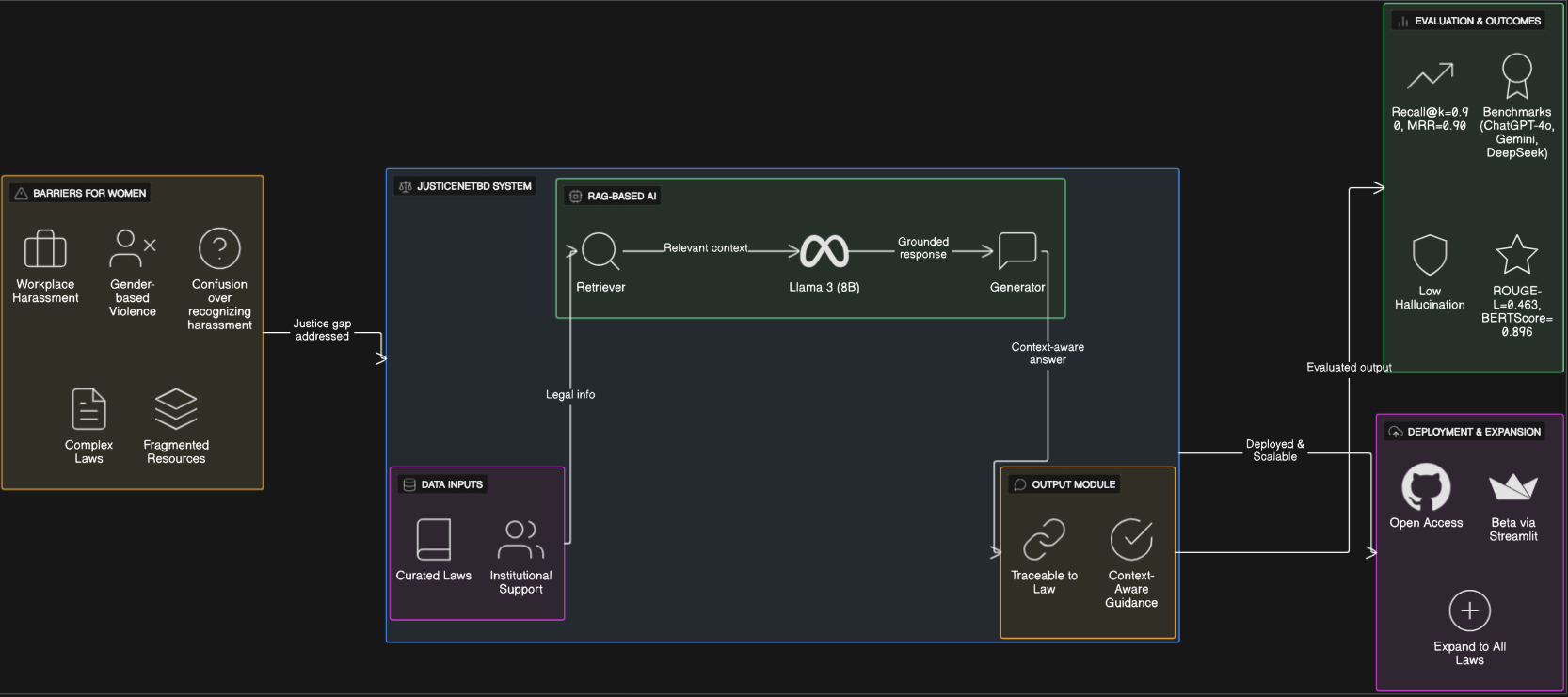
Women in Bangladesh often face barriers in accessing justice due to gender-based violence, workplace harassment, and limited awareness of legal protections. Despite existing laws, complex language and fragmented resources hinder women from seeking redress. Hence, many women do not realize a specific law exists for the harassment they faced, so they just feel uncomfortable, not knowing it was actually illegal. This paper proposes JusticeNetBD, a Retrieval-Augmented Generation (RAG)-based legal assistant designed to provide accurate, context-aware, and accessible legal guidance tailored for Bangladeshi women. While the current focus is women’s legal rights, the framework is designed for gradual expansion to all Bangladeshi law domains. The system integrates a curated corpus of national laws (e.g., Dowry Prohibition Act 2018, Women and Children Repression Prevention Act, 2000) and institutional support data, leveraging the Meta’s Llama 3 AI (8B version) to generate grounded responses. Evaluated against benchmarks like ChatGPT-4o, Gemini Flash 2.5, and DeepSeek-V3, JusticeNetBD achieves superior retrieval performance (Recall@k = 0.90, MRR = 0.90) and answer quality (ROUGE-L = 0.463, BERTScore F1 = 0.896), significantly outperforming closed-book models. By mitigating hallucination and enhancing traceability to legal texts, the system offers a scalable, culturally sensitive solution to bridge the justice gap for women in low-resource settings. The beta version of the application is hosted via Streamlit. Application access link and reproducibility guidelines are available in the GitHub repository: https://github.com/SakibHasanSimanto/JusticeNetBD.
Keywords:
retrieval-augmented generation
; conversational AI
; legal AI
; women safety
; access to justice
1. Introduction
Women in Bangladesh face persistent challenges related to gender-based violence, workplace harassment, and limited access to justice. According to a report by the Bangladesh Bureau of Statistics (BBS), nearly 72.6% of women experience some form of violence in their lifetime, including physical, emotional, and sexual abuse [1]. Despite the existence of legal frameworks aimed at protecting women’s rights, such as the Domestic Violence (Prevention and Protection) Act 2010 and the Dowry Prohibition Act 2018, many women are either unaware of these protections or unable to access justice mechanisms due to structural, social, or informational barriers [2]. In recent years, the problem has been exacerbated by the increasing incidence of digital harassment, leading to the enactment of the Cyber Security Ordinance 2025. However, navigating the legal and procedural landscape remains difficult for most women, particularly those in low-literacy or technologically weak environments [3]. A critical barrier is the unavailability of simple, localized, and accessible legal information, which is a challenge even for educated people. Because legal documents are usually written in complex and formal language, making them hard to interpret without professional legal assistance. Moreover, resources are fragmented across various NGO websites, legal portals, and government databases [4]. This lack of cohesive, user-friendly, and real-time legal guidance contributes to underreporting of abuse and limited legal redress. Therefore, providing context-aware, conversational access to reliable legal information can be transformative for women. It has the potential to empower them with knowledge, increase reporting, and direct them toward appropriate support services. This paper proposes a chat assistant specifically designed to address this gap using Retrieval-Augmented Generation (RAG) techniques to ensure accurate, real-time, and explainable guidance for users.
Legal frameworks play a pivotal role in safeguarding women’s rights and addressing various forms of abuse and discrimination. In Bangladesh, several important laws exist to protect women, as mentioned before. Additionally, the High Court Directive of 2009 serves as a key policy guideline for preventing sexual harassment in educational institutions and workplaces [5]. Despite these provisions, a significant gap exists between legislation and its practical application, primarily due to a lack of awareness and understanding among the population, particularly women. Studies have shown that a majority of women do not know where to seek help when their rights are violated, nor do they fully comprehend the protections afforded to them under existing laws [6]. The complexity of legal language and procedures further alienates victims from pursuing justice. Legal documents are often not translated into accessible formats or local dialects, and many legal aid organizations lack the capacity to provide immediate, understandable guidance [4]. As a result, women often rely on hearsay, personal belief, or intermediaries, which may expose them to misinformation or exploitation [7]. Ensuring access to clear, trustworthy, and timely legal information is thus critical. It not only empowers women to recognize abuse and assert their rights, but also promotes better accountability within institutions tasked with protecting them. Integrating such legal knowledge into conversational platforms could bridge the awareness gap and provide a scalable, culturally appropriate support mechanism for Bangladeshi women.
Although Bangladesh has a well-defined set of laws aimed at protecting women, these legal resources are often fragmented across various platforms and institutions. Official legal texts are primarily published through government gazettes, legal databases, or judiciary websites, but these are typically difficult to navigate and not designed for the general public [8]. In many cases, updates to laws or relevant guidelines are delayed in publication or are not communicated effectively to the community [7]. Furthermore, most legal information is written in highly technical Bengali or in English, rendering it inaccessible to large portions of the population, especially women in rural areas, who may have limited literacy or digital access [9]. Legal aid services provided by NGOs and government bodies such as the National Legal Aid Services Organization (NLASO) are valuable, but their capacity to deliver personalized, on-demand legal advice remains limited [10]. In addition, support services such as helplines, shelters, and legal aid centers often operate independently, with little data interoperability or centralized information systems. As a result, a woman seeking help may not know which service to contact, whether the offender is legally innocent, or what her legal options are. This institutional disconnect creates confusion, delays, and often discourages victims from pursuing justice [2]. The absence of an integrated, user-friendly platform for accessing legal information and protection mechanisms is a significant bottleneck in ensuring timely and effective support for women. This fragmented ecosystem makes it difficult to build trust in legal remedies and reinforces the marginalization of women within the justice system.
In recent years, chatbots and virtual assistants have become increasingly prevalent across various sectors such as healthcare, finance, and education, providing users with convenient, on-demand access to information and services [11,12]. These AI-driven conversational interfaces enable personalized interactions that can improve user engagement and accessibility, often bridging gaps where human resources are limited or overwhelmed. Despite these advances, the application of such technologies in providing legal aid, especially for women, remains significantly underdeveloped. Women often face unique legal challenges related to rights, safety, and social justice, which require not only accurate legal knowledge but also sensitivity to cultural and local contexts [13]. Legal assistance systems that are localized, culturally aware, and legally informed hold tremendous potential to empower women by delivering relevant, trustworthy guidance tailored to their specific environments [14]. Thus, integrating AI with conversational interfaces tailored for women’s legal rights can address critical accessibility issues. Such systems can provide scalable, confidential, and user-friendly support, helping overcome barriers posed by fragmented legal information and socio-cultural constraints [15].
Retrieval-Augmented Generation (RAG) represents a transformative approach that combines the strengths of conversational AI with the precision of trusted document retrieval [16]. By integrating real-time access to external knowledge sources during generation, RAG enables conversational agents to produce responses that are not only fluent and coherent but also firmly grounded in authentic, up-to-date documents. This capability is especially crucial in legal domains, where accuracy and traceability are paramount. Traditional large language models (LLMs) may suffer from hallucination, that generates plausible but incorrect or unverifiable information [17]. RAG addresses this challenge by anchoring generated answers in relevant legal texts, such as statutes, regulations, NGO helpline details, and case precedents, thereby improving reliability and user trust [18]. Moreover, by dynamically retrieving pertinent documents from a curated legal corpus, RAG bridges the knowledge gap between static model training data and evolving real-world legal information. This ensures that users receive contextual, timely, and relevant legal guidance tailored to their queries [19]. In the context of women’s legal assistance, such real-time, document-backed conversational AI can empower users with actionable insights while minimizing misinformation risks.
Research Objectives
The primary goals of this research are outlined as follows:
- To experimentally develop a Retrieval-Augmented Generation (RAG)-based Legal Assistant system named JusticeNetBD focused on providing accessible and accurate legal aid tailored specifically for women.
-
To support legal queries in simple English language during the initial implementation phase, using a curated corpus derived from authoritative Bangladeshi legal sources, including:
- –
- The Bangladesh Penal Code, 1860
- –
- The Women and Children Repression Prevention Act, 2000
- –
- The Dowry Prohibition Act, 2018
- –
- Other relevant acts
- To ensure contextually grounded responses by integrating these legal documents into a retrieval system that feeds into a generative language model.
-
To rigorously evaluate the assistant’s performance using quantitative metrics such as:
- –
- Recall@k and MRR
- –
- ROUGE-L
- –
- BERTScore F1
- To benchmark the assistant’s performance against contemporary state-of-the-art models such as ChatGPT-4o Turbo, Gemini Flash 2.5 and DeepSeek-V3, thereby assessing its comparative effectiveness in the domain of legal conversational AI.
2. Related Work
2.1. Machine Learning for Safety
The use of machine learning (ML) in addressing violence and safety has seen notable advances in recent years. Research has focused on applying ML techniques to detect harassment, provide timely interventions, and assist in legal and psychological support. This subsection reviews recent works that align with the proposed system’s objectives. Tiwari and Marisport (2024) proposed a novel AI framework to detect and intervene in domestic violence cases, particularly targeting women with disabilities in India [20]. Their work integrated natural language processing (NLP) and multimodal sentiment detection to analyze textual and speech data from help-seeking interactions. The model demonstrated improved identification accuracy in emotionally sensitive environments and emphasized the role of AI-enabled chatbots in promoting accessibility. Ketnoi et al. (2023) developed an NLP-driven classifier to detect workplace harassment from employee complaints and social media platforms [21]. The authors aim to identify sexual harassment in Thai literature and categorize the emotion using deep learning methods from the social networking site X (Twitter). The RoBERTa model was the main focus of this investigation, and it was contrasted with the BERT, mBERT, and BERT-th models. The percentages of accuracy were 91%, 95%, and 95%, in that order. Chavez et al. (2019) describes the Safe Commuting System (SCS) which aims to improve the safety of commuters in urban areas using both historical and real-time crowdsourced data (through mobile devices) about safety incidents. The SCS informs commuters about at-risk areas and will provide alternative commuting routes.
2.2. AI in Social Applications for Safety
Artificial Intelligence has increasingly been applied in domains beyond industry and commerce, particularly in enhancing public safety and social well-being. These applications span predictive policing, crisis intervention, public health, and digital protection for vulnerable communities. This subsection highlights several recent contributions to the field. Al-Shaikh et al. (2024) conducted a survey on AI adoption in law enforcement, focusing on predictive analytics, crowd monitoring, and threat modeling [24]. While the potential to reduce response time and increase resource efficiency was noted, the authors cautioned against unchecked surveillance and profiling, emphasizing the need for ethically aligned AI deployment in public institutions. Aldkheel (2024) suggests that conversational agents should emphasize with user’s experiences and provide them with meaningful informational, tangible, and emotional support [23]. Cenci (2025) introduced a value-sensitive design framework for AI tools aimed at vulnerable individuals in liberal democracies [25]. Using citizen science methodologies, the study addressed the trade-offs between data-driven optimization and societal values such as transparency, consent, and inclusivity—critical aspects for any AI applied to marginalized groups. Panadés and Yuguero (2025) proposed a new discipline called "cyber-bioethics" to explore how AI systems in digital health can align with humanitarian principles [26]. Their work critiques current digital safety mechanisms and calls for more robust ethical oversight, especially when dealing with mental health and social service chatbots. Ibrahim et al. (2025) explored how AI models could assist in managing diseases caused by unsafe water in under-resourced areas [27]. While not directly focused on gender, their study underlines the application of AI for public safety in vulnerable environments, supporting the case for AI as a tool for equitable access and human security. Parihar and Koolwal (2025) analyzed AI-based surveillance tools for predicting child offenses, examining legal boundaries and ethical risks of data misuse [28]. Their findings suggest the urgent need for policy alignment when deploying AI in socially sensitive contexts. Collectively, these studies reinforce the idea that while AI presents transformative potential in social safety applications, ethical design, public accountability, and human-centric governance remain non-negotiable pillars.
2.3. Retrieval-Augmented Generation in Legal AI
Retrieval-Augmented Generation shows its proficiency of developing context-aware AI in many domains including business, healthcare, education, and law as well. Kalra et al. (2024) introduces HyPA-RAG, a Hybrid Parameter-Adaptive RAG system tailored for the AI legal domain, using NYC Local Law 144 (LL144) as a case study. HyPA-RAG combines a query complexity classifier for adaptive tuning, a hybrid retrieval strategy integrating dense, sparse, and knowledge graph methods, and a custom evaluation framework with domain-specific question types and metrics. Experiments on LL144 show that HyPA-RAG improves retrieval accuracy, response fidelity, and contextual precision [29]. Rafat (2024) develops a prototype for legal purposes using RAG-optimized LLM technology and evaluates its performance against three popular non-optimized LLM-based AI systems. The experiment involves real-life housing dispute prompts, including common user errors, to assess RAG’s impact on chatbot effectiveness. Built on MS Azure, the prototype integrates Azure OpenAI 3.5 Turbo and Azure AI Search. Evaluation focuses on the chatbots’ comprehension and response generation [30].
Lee et al. (2025) presents a system using LLMs and RAG to recommend key evidence in financial advisor dispute cases. Unlike traditional legal AI focused on outcome prediction, the approach supports judicial reasoning by retrieving contextually relevant evidence from past cases [31]. Schwarcz et al. (2025) explores two AI innovations aimed at improving legal AI: RAG, which grounds analysis in legal sources, and AI reasoning models, which structure complex reasoning before output. In the first randomized controlled trial of these tools, upper-level law students completed six tasks using either a RAG-based tool (Vincent AI), a reasoning model (OpenAI’s o1-preview), or no AI. Both tools significantly improved work quality, in contrast to earlier studies on models like GPT-4 [32]. Amato et al. (2024) investigates the limitations of Federated Learning (FL) for training legal LLMs, highlighting its privacy benefits but also its computational and efficiency challenges. As an alternative, it explores Federated Search (FS), which retrieves relevant legal information from distributed sources without training, offering lower resource requirements and greater flexibility. The research supports the development of FS-based RAG systems for more practical and privacy-preserving legal AI solutions [33].
Research Gaps and Rationale
While the reviewed literature highlights significant advancements in the application of machine learning, conversational and RAG agents for public safety and legal aid, several critical gaps remain unaddressed. First, there is a noticeable lack of context-specific implementations tailored to the sociocultural and legal realities of Global South countries like Bangladesh. Second, although RAG architectures are emerging as effective tools for grounded responses, their deployment in sensitive domains like domestic violence and harassment remains rare. Few systems explicitly focus on women’s rights or provide multi-purpose support, ranging from legal guidance to emotional safety, in a seamless, explainable, and trustworthy manner. Moreover, many existing legal chatbots do not integrate with verified databases of laws, helplines, or NGO services, reducing their reliability in real-world use cases. Also, most of the RAG systems are not developed for practical usage as well, instead they are coded for theoretical or semi-applied research purpose only. Finally, ethical considerations such as privacy, user anonymity, and psychological safety are often treated as secondary concerns, despite their paramount importance in designing AI for vulnerable populations. There is limited research on designing culturally sensitive, low-barrier AI assistants for women seeking justice or protection. To address these gaps, the study proposes a simple English chat assistant powered by RAG, specifically designed and developed to provide legally accurate, anonymized, and accessible information on women’s rights and safety mechanisms in Bangladesh. The system aims to bridge fragmented legal resources, enhance digital trust, and offer immediate support to those who need it most.
3. Methodology
This section outlines the design and development process of the proposed women’s rights and safety chat assistant. The methodology follows a Retrieval-Augmented Generation (RAG) architecture to combine generative language modeling with trustworthy legal and institutional knowledge sources. The system comprises three core stages: (i) corpus generation and preprocessing, (ii) LLM selection and fine-tuning for generation, and (iii) end-to-end RAG workflow integration. Below, each component is described in detail, beginning with the data corpus creation. Reproducibility and model guidelines are available in the GitHub repository [35].
3.1. Corpus Construction from Legal and Institutional Sources
To ensure accurate and explainable responses, a high-quality knowledge corpus composed of legally verified documents and public service datasets is curated. These sources were selected to reflect the laws, protection mechanisms, and real-world support systems available to women in Bangladesh. The knowledge base is organized such that each paragraph encapsulates a self-contained legal idea or provision. This structure minimizes redundancy and facilitates efficient chunking, allowing a simple Python script to segment the documents paragraph-wise. For Bengali legal texts, manual or semi-automated translation into English was performed to ensure consistency and compatibility with English-language LLMs. Thus, legal provisions were split into semantically coherent chunks. This ensured effective retrieval and traceability when integrated into the RAG pipeline. The corpus includes the following content domains:
- Bangladesh Penal Code, 1860: Selected sections on rape, miscarriage, and wrongful confinement relevant to gender-based violence cases.
- Women and Children Repression Prevention Act, 2000: All sections related to women and child abuse, including punishment, procedural guidelines, and trial procedures in special tribunals.
- Dowry Prohibition Act, 2018: Legal definitions, punishable offenses, and complaint mechanisms concerning dowry-related harassment and violence.
- Domestic Violence (Prevention and Protection) Act, 2010: Documentation related to domestic violance, rights of aggrieved person, custody, and reconciliation procedures.
- Cyber Security Ordinance 2025: Sections related to cyber harassment, threats, defamation, and unauthorized disclosure of private information, particularly relevant to online abuse cases.
- NGO Legal Aid and Support Info: Helpline numbers, and legal aid procedures were extracted from reputable NGOs such as BRAC, Ain o Salish Kendra (ASK), and Bangladesh Legal Aid and Services Trust (BLAST).
All documents were preprocessed using personal writing skills, noise removal, and sentence segmentation pipelines.
3.2. Language Model Configuration for RAG Generation
To generate grounded and contextually relevant responses based on retrieved legal documents, the Retrieval-Augmented Generation (RAG) system employs the llama3-8b-8192 model as the backbone language generator. This model belongs to Meta’s LLaMA 3 (Large Language Model Meta AI) family, which provides high-performance transformer-based architectures optimized for both instruction following and knowledge-intensive tasks [34]. The specific 8B variant used here was accessed through the GROQ API, which offers real-time inference capabilities due to its high-throughput low-latency AI inference engine.
The llama3-8b-8192 model is trained on the corpus created before, enabling it to generalize well across structured and semi-structured legal content. Its architecture consists of approximately 8 billion parameters and supports a context window of 8192 tokens, allowing it to process and generate long, coherent outputs, especially useful in legal explanations and policy summarization. Key decoding parameters for the generation process include:
- Temperature = 0.4: This parameter controls the randomness of token selection. Lower values (closer to 0) make the model more deterministic and focused, reducing variation in outputs. A value of 0.4 is selected to balance factual consistency with slight linguistic diversity in answers.
- Max_tokens = 800: This setting determines the upper bound of tokens in the generated output. It ensures that the chatbot provides sufficiently informative responses without exceeding reasonable interaction length. The value can be tuned by the developer based on response verbosity requirements.
- Stop Sequences and Prompt Formatting: Custom prompt templates were designed to encourage concise, empathetic, and legally accurate outputs. The model was conditioned to avoid speculative or hallucinated statements and to cite retrieved legal segments when available.
The model was not fine-tuned but instead used in a zero-shot or few-shot retrieval-augmented configuration, leveraging curated retrieval outputs for context grounding. This approach allowed for fast deployment while maintaining a high standard of reliability and explainability.
3.3. Retrieval-Augmented Generation Workflow
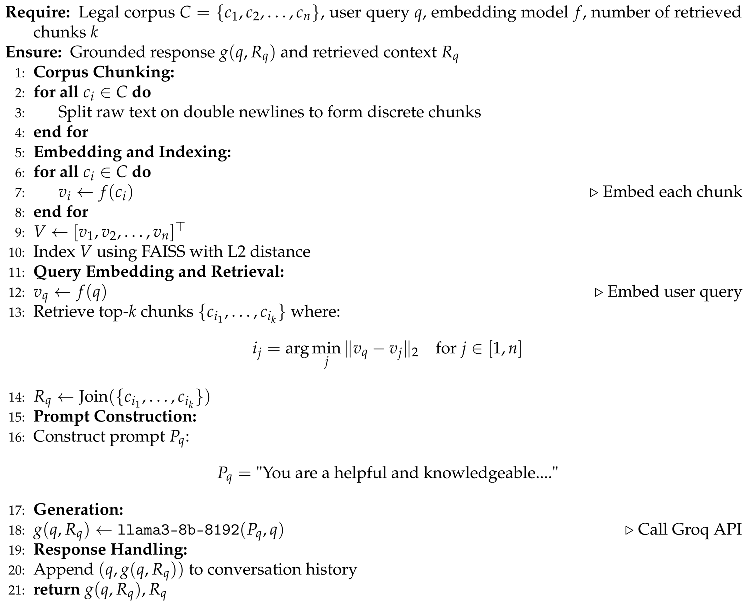
The core architecture follows a Retrieval-Augmented Generation (RAG) pipeline, in which a query-aware retriever identifies relevant textual chunks from a pre-embedded legal corpus, and a language model conditions its output on this retrieved context to produce grounded, human-readable responses. The general workflow for every RAG model is depicted in Figure 1.
The system is composed of six modular stages as shown in Algorithm 1.
1. Corpus Chunking
Let denote the full corpus, consisting of n legal and institutional text paragraphs extracted from curated sources. Each paragraph is treated as a discrete chunk, forming the base retrieval unit. Chunks are created by splitting the raw text on double newlines.
2. Embedding with Sentence Transformer
Each chunk is embedded into a dense vector representation using the pre-trained BAAI/bge-small-en-v1.5, a text embedding model developed by the Beijing Academy of Artificial Intelligence (BAAI). The embedding function maps all text into a d-dimensional vector space:
The full matrix is indexed using FAISS (Facebook AI Similarity Search) for efficient nearest-neighbor search via L2 distance.
3. Indexing and Storage
FAISS stores the indexed vector representations of the corpus in a flat L2 index. This allows fast top-k retrievals by computing:
where q is the user’s input query.
4. Query Embedding and Context Retrieval
Upon receiving a user input q, the system encodes it using the same sentence transformer and retrieves the top-k most semantically similar chunks:
The selected chunks are joined as a context string for prompt conditioning.
5. Prompt Construction and Generation
The retrieved context is embedded into a custom system prompt:
"You are a helpful and knowledgeable AI assistant. Always respond based on the following trusted legal and institutional context: [retrieved text]"
The full prompt is then passed to the llama3-8b-8192 model via the Groq API. The model responds with a completion conditioned on both the query and retrieved context.
6. Response Handling and History Update
The chatbot appends each user–assistant pair to a conversational memory, enabling context-aware multi-turn interaction. The final response is returned alongside the retrieved chunks for evaluation and transparency.
| Algorithm 1 RAG-Based Legal Question Answering Workflow |
 |
Illustrative Simulation: A Query–Response Example
User Input:"How can I file a complaint if my husband demands dowry after marriage?"
- The query q is embedded and matched against the FAISS index.
-
Two retrieved chunks from the Dowry Prohibition Act 2018 are returned:
- “Any demand for dowry, whether before or after marriage, is punishable by law under Section 3. A woman may file a complaint directly to the nearest police station or seek legal aid.”
- “The penalty includes imprisonment up to five years and/or a monetary fine. Complaints can also be submitted to women’s helpline 109.”
-
The model is prompted with this legal context and returns:"Under the Dowry Prohibition Act 2018, demanding dowry after marriage is illegal and punishable. You may file a complaint at your local police station or call the government helpline 109. Legal aid is also available through NGOs like ASK or BLAST."
Figure 2.
RAG Workflow: Simulation of Legal Response
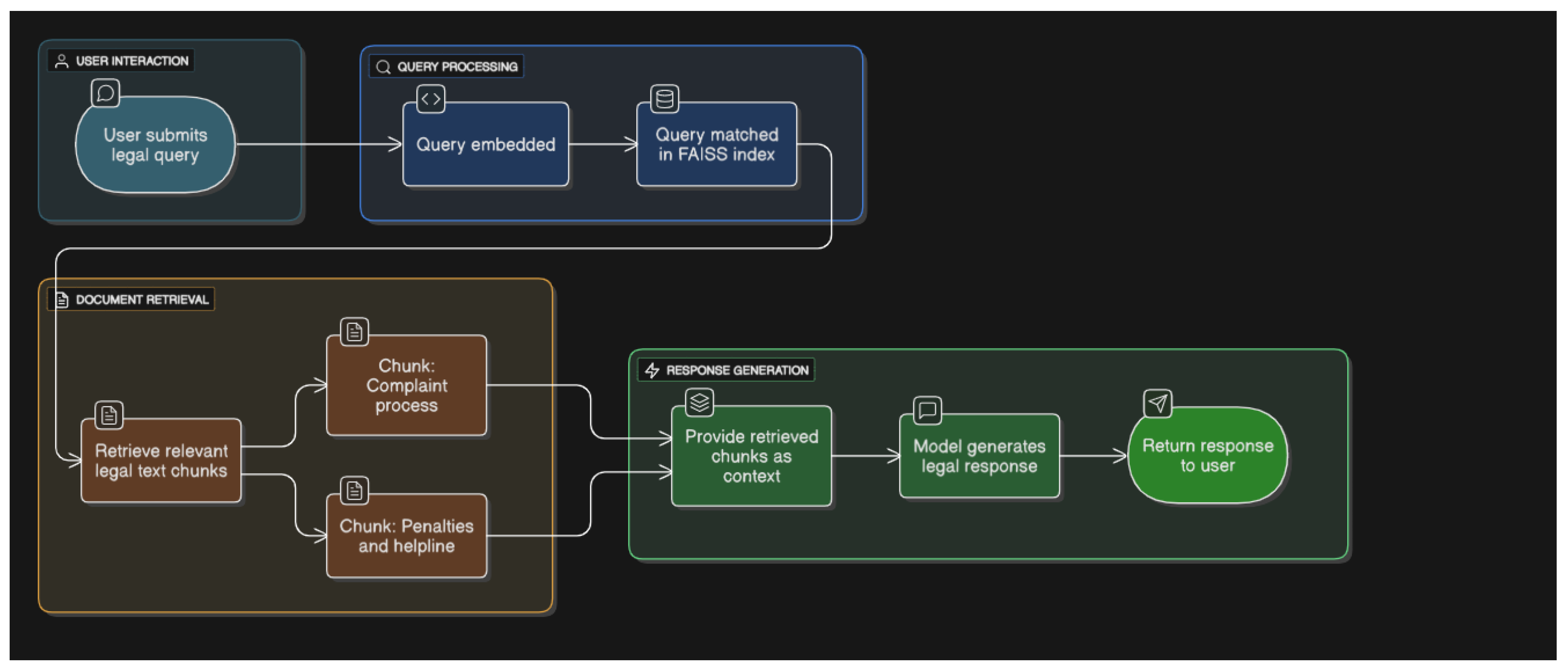
This simulation illustrates the transparent retrieval–generation pipeline, ensuring that the chatbot outputs are both relevant and verifiable.
3.4. Deployment, Safety, and Usage Safeguards
The JusticeNetBD application is publicly deployed using Streamlit Cloud, enabling seamless browser-based interaction without requiring installation or configuration on the user’s end. The app is accessible to any user in Bangladesh or globally with a lightweight interface.
The application is currently in its beta phase and may face scalability limitations under heavy concurrent usage. Given that Streamlit Community Cloud offers limited resource allocation (e.g., single-threaded execution and capped compute time), the app is optimized for lightweight interactions and is best suited for individual or low-traffic use cases. Despite such constraints, user comfort is prioritized via fast semantic search and clear error handling mechanisms. Furthermore, the app does not implement automatic session expiry currently, so users are advised not to leave it inactive for extended periods to avoid unexpected resets, loss of chat history, or other security concerns. Figure 3 depicts a portion of the user interface of JusticeNetBD. Figure 4 shows a conversation between a user and the model.
To ensure secure interaction, session-level isolation is enforced through a per-user session identifier generated using uuid. This design ensures that each user maintains their own private session history, thereby avoiding shared state or cross-user data leakage. Streamlit’s session_state is used exclusively in-memory during the session and is cleared upon session expiration or browser reset, thereby maintaining short-term privacy and avoiding persistent data retention. No user-identifiable information or chat logs are stored server-side beyond the runtime. Users can also delete their chat history to overcome API errors.
To prevent abuse or misuse of the model’s API endpoint and to throttle aggressive prompting behaviors, a mandatory 5-second cooldown is enforced after each user prompt. If a user attempts to send multiple prompts in rapid succession, a warning is shown and the input interface is temporarily locked. This basic form of rate-limiting serves both technical purposes (avoiding token quota overflow on the GROQ API) and ethical enforcement by deterring spammy interactions.
Robust safety guidelines are incorporated into the system prompt to proactively filter harmful content. Specifically, the model is explicitly instructed to avoid generating unsafe, violent, or offensive content. If a user enters an abusive, derogatory, or otherwise inappropriate prompt, the model is instructed to decline responding and politely request respectful behavior. This safeguards the system against toxic use cases, particularly important given the sensitive legal context and vulnerable user base the app serves.
Prompt injection attacks are not a viable threat in this system for several reasons. First, the underlying model has no access to confidential data or backend controls, it is strictly limited to answering questions based on a closed corpus of public legal documents. Second, since the system prompt is regenerated with each user input and not user-controllable, adversarial prompt modifications do not persist or affect future interactions. Finally, no dynamic API calls, file access, or backend execution commands are exposed in the model’s response mechanism, significantly minimizing the risk surface.
In addition, users are shown an explicit disclaimer informing them that the tool is experimental and not a substitute for professional legal advice. This legal safeguard aligns with ethical research practices and ensures transparency during public beta deployment.
3.5. Performance Evaluation Metrics
To rigorously assess the quality and effectiveness of the proposed RAG-based Legal Assistant, both retrieval-level and generation-level metrics are employed. These metrics are designed to evaluate how accurately relevant information is retrieved from the corpus and how coherently and factually correct the generated responses are. The chosen evaluation metrics include Recall@k, Mean Reciprocal Rank (MRR), ROUGE-L, and BERTScore-F1.
1. Recall@k
Definition: Recall@k measures the proportion of relevant documents or chunks that are retrieved among the top-k results. It is commonly used in information retrieval to evaluate how effectively a system retrieves relevant items.
Formula:
Interpretation: A higher Recall@k indicates that the model is more effective at retrieving relevant information within the top-k retrieved results. In practice, when the total number of relevant documents is unknown or assumed to be 1 (as in many QA tasks), Recall@k simplifies to a binary value (0 or 1) indicating whether a relevant item appeared in the top-k.
2. Mean Reciprocal Rank (MRR)
Definition: MRR evaluates the ranking quality of the retrieved results by computing the reciprocal of the rank at which the first relevant item appears. It is the average of these reciprocals over all queries.
Formula:
where is the position of the first relevant result for the i-th query.
Interpretation: MRR values range from 0 to 1. A higher MRR indicates that relevant results tend to appear earlier in the ranked list.
3. ROUGE-L
Definition: ROUGE-L (Recall-Oriented Understudy for Gisting Evaluation - Longest Common Subsequence) is a metric for evaluating the similarity between a generated sequence and a reference by measuring the length of their Longest Common Subsequence (LCS). It focuses on recall by quantifying how much of the reference text is preserved in the generated output.
Formula: Let X be the reference text and Y be the generated text.
Interpretation: ROUGE-L emphasizes recall, i.e., how much of the reference is preserved in the system-generated output. It is particularly useful for tasks like summarization, where capturing essential information is critical.
4. BERTScore F1
Definition: BERTScore evaluates the semantic similarity between a generated response and a reference by computing token-level cosine similarities of contextual embeddings from a pretrained BERT model. It aligns tokens using greedy matching and computes precision, recall, and F1.
Formula: Let be tokens in the reference, and in the generated text. Let denote contextual embeddings.
Interpretation: Unlike traditional n-gram based metrics, BERTScore captures deep semantic alignment. Higher scores indicate greater semantic similarity between predicted and reference texts.
In combination, these metrics provide a comprehensive picture of both the retrieval and generative performance of the RAG-based assistant, spanning retrieval precision, ranking quality, syntactic similarity, and semantic fidelity.
The proposed model is evaluated against three state-of-the-art (SOTA) large language models (LLMs) in a closed-book system. These models are ChatGPT-4o Turbo, Gemini Flash 2.5, and DeepSeek-V3. In the context of language models, a closed-book system refers to one that generates answers solely based on the knowledge encoded within its parameters, without access to external documents or databases at inference time. Such models do not retrieve or consult any supplementary information, relying entirely on pre-trained knowledge. To ensure a fair comparison, all SOTA models were explicitly prompted not to use any external search or retrieval capabilities, and to rely solely on their pretrained knowledge. Allowing access to search functions could unfairly advantage them over the proposed RAG-based model, JusticeNetBD, by retrieving potentially helpful external information. Conversely, search results from unreliable or irrelevant sources could degrade their performance, unfairly disadvantageing them against the proposed model. In both cases, such access would introduce bias into the evaluation. Therefore, to maintain consistency, all models were constrained to operate using only their internal pretrained knowledge. Afterward, a set of legal queries was presented to the SOTA models, and their responses were evaluated using ROUGE-L and BERTScore F1, comparing against ground-truth legal answers. These scores were then compared with those of the proposed JusticeNetBD model.
4. Results and Discussion
The model performance is assessed from two complementary angles. Only the RAG model (JusticeNetBD) produces an explicit list of evidence passages, so recall@k and MRR are reported only for this model. For all models, JusticeNetBD and three state-of-the-art (SOTA) closed-book LLMs, ROUGE-L and BERTScore F1 are computed as well.
4.1. Quantitative Results

Table 1.
Average performance over the 10-question legal QA benchmark. R-L = ROUGE-L, BS = BERTScore F1. Only the proposed model produces retrieval metrics.
Table 1.
Average performance over the 10-question legal QA benchmark. R-L = ROUGE-L, BS = BERTScore F1. Only the proposed model produces retrieval metrics.
| Model | Recall@2 | MRR | R-L | BS |
|---|---|---|---|---|
| JusticeNetBD | 0.90 | 0.90 | 0.463 | 0.896 |
| DeepSeek V3 (Closed-Book) | n/a | n/a | 0.210 | 0.850 |
| Gemini Flash 2.5 (Closed-Book) | n/a | n/a | 0.242 | 0.863 |
| ChatGPT 4o-Turbo (Closed-Book) | n/a | n/a | 0.221 | 0.862 |
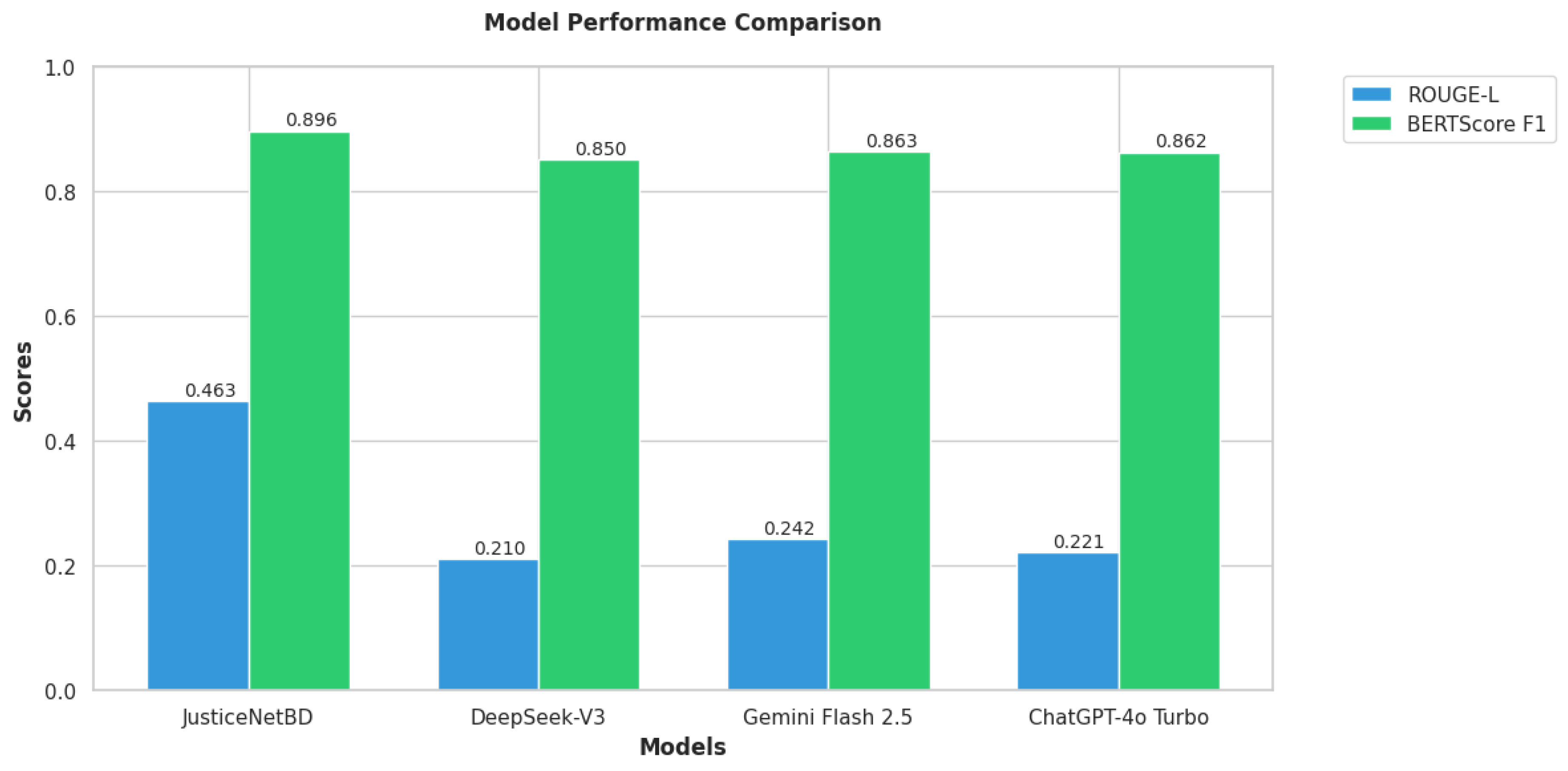
The RAG system achieves recall@2 = 0.90 and MRR = 0.90, demonstrating that the sentence-transformer combined with FAISS effectively retrieves the relevant clauses from the Bangladeshi legal corpus. This high retrieval fidelity translates into improved answer quality, with ROUGE-L scores increasing by +23–25 percentage points and BERTScore F1 by +3–5 percentage points compared to all closed-book large language models (LLMs).
General-purpose state-of-the-art large language models such as DeepSeek-V3, Gemini Flash 2.5, and ChatGPT-4o underperform in this domain due to their lack of access to domain-specific legal statutes relevant to Bangladesh, as shown in Figure 5. As a result, these models tend to produce generic legal advice or reference incorrect statutory sections, which adversely affects lexical overlap metrics (e.g., ROUGE-L) and, to a lesser extent, semantic similarity measures such as BERTScore F1. Additionally, their responses often include hedging phrases (e.g., “laws may vary...”) rather than directly citing precise punitive clauses.
Incorporating exact statutory text segments into the prompt allows the RAG model to:
- Mitigate hallucination: ensuring that every generated claim can be traced to retrieved source text.
- Enhance lexical fidelity: resulting in improved ROUGE-L scores due to accurate legal phrasing.
- Preserve linguistic fluency: maintaining BERTScore values comparable to human-generated responses.
However, despite strong retrieval performance, approximately 10% of queries fail to retrieve the gold-standard statutory chunk. This can be a result of colloquial query phrasing. It refers to how people naturally ask questions in everyday conversation, often using informal language, slang, abbreviations, or incomplete sentences rather than structured, formal queries. Future work could explore approaches such as query rewriting or hybrid sparse-dense retrieval methods to further improve recall towards 1.0. In the context of providing high-stakes legal advice, the grounded RAG system substantially outperforms closed-book state-of-the-art LLMs. The pipeline not only enhances factual accuracy but also offers transparent evidence retrieval, thereby providing a safer and more reliable tool for supporting women’s rights initiatives in Bangladesh.
5. Conclusion
JusticeNetBD represents a significant advancement in leveraging AI to address the critical issue of women’s access to legal information in Bangladesh. By integrating Retrieval-Augmented Generation (RAG) with a curated corpus of Bangladeshi legal texts and institutional support data, the system provides accurate, context-aware, and culturally sensitive legal guidance tailored to women’s needs. The evaluation results demonstrate its superior performance over state-of-the-art closed-book models, achieving high retrieval accuracy (Recall@2 = 0.90, MRR = 0.90) and answer quality (ROUGE-L = 0.463, BERTScore F1 = 0.896). These metrics underscore the system’s ability to mitigate hallucination, enhance traceability, and deliver reliable legal information. The success of JusticeNetBD highlights the transformative potential of AI in bridging the justice gap for communities that are not aware of every legal procedures and offenses, particularly in low-resource settings. However, challenges such as colloquial query phrasing and multi-section legal references remain areas for future improvement. Expanding the system to include more languages, refining retrieval techniques, and incorporating user feedback could further enhance its accessibility and effectiveness. Ultimately, JusticeNetBD serves as a scalable, ethical, and practical solution to empower women with legal knowledge, fostering greater awareness and accountability. Its framework also sets a precedent for future AI applications in legal aid, not only in Bangladesh but in similar contexts worldwide. By combining cutting-edge technology with a human-centric approach, JusticeNetBD paves the way for more equitable access to justice.
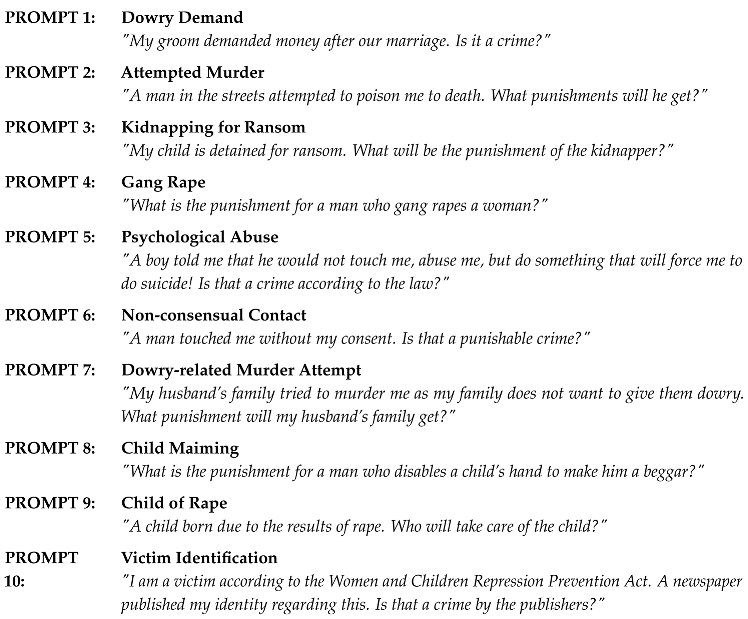
Appendix A: User Prompts for Model Evaluation
The following 10 legal questions were uniformly presented to all evaluated models (ChatGPT-4o Turbo, DeepSeek-V3, Gemini Flash 2.5, and JusticeNetBD) to assess their comparative performance on legal reasoning tasks.
References
- Bangladesh Bureau of Statistics. (2016). Report on violence against women survey. Ministry of Planning, Government of Bangladesh.
- Ain o Salish Kendra. (2022). Annual report on human rights.
- Centre for Policy Dialogue. (2021). Digital rights and safety of women in Bangladesh. CPD Working Paper Series.
- Ahmmed, M. E. (2023). Access to justice for illiterate women in the southern char areas of Bangladesh. SSRN Working Paper.
- Naznin, S. M. (2020). Women’s rights to access to justice: The role of public interest litigation in Bangladesh. Australian Journal of Asian Law, 21, 99–116.
- Human Rights Watch. (2020). Why is it so difficult for Bangladeshi women to get justice?
- Rahman, M. A. (2024). Understanding the developmental approach to legal pluralism and access to justice in Bangladesh. Australian Journal of Asian Law, 25, 17–34.
- Begum, A., & Saha, N. K. (2017). Women’s access to justice in Bangladesh: Constraints and way forward. Journal of Malaysian and Comparative Law, 44, 39–58.
- UN Women. (2020). UN Women Bangladesh.
- National Legal Aid Services Organization. (2021). Annual legal aid report. Ministry of Law, Justice and Parliamentary Affairs, Bangladesh.
- Nadarzynski, T., Miles, O., Cowie, A., & Ridge, D. (2019). Acceptability of artificial intelligence (AI)-led chatbot services in healthcare: A mixed-methods study. Digital Health, 5, 2055207619871808.
- Dede, C. (1986). A review and synthesis of recent research in intelligent computer-assisted instruction. International Journal of Man-Machine Studies, 24(4), 329–353.
- Rajendran, R. K., Vetrivel, S., & NR, W. B. (2025). The role of AI in enhancing access to justice and legal services. In Exploration of AI in contemporary legal systems (pp. 139–162). IGI Global.
- Chien, C. V., & Kim, M. (2024). Generative AI and legal aid: Results from a field study and 100 use cases to bridge the access to justice gap. Loyola of Los Angeles Law Review, 57, 903–940.
- Mariani, M. M., Hashemi, N., & Wirtz, J. (2023). Artificial intelligence empowered conversational agents: A systematic literature review and research agenda. Journal of Business Research, 161, 113838.
- Lewis, P., Perez, E., Piktus, A., Petroni, F., Karpukhin, V., Goyal, N., ... & Riedel, S. (2020). Retrieval-augmented generation for knowledge-intensive NLP tasks. Advances in Neural Information Processing Systems, 33, 9459–9474.
- Maynez, J., Narayan, S., Bohnet, B., & McDonald, R. (2020). On faithfulness and factuality in abstractive summarization. In Proceedings of the 58th Annual Meeting of the Association for Computational Linguistics (pp. 1906–1919).
- Guu, K., Lee, K., Tung, Z., Pasupat, P., & Chang, M. (2020). Retrieval augmented language model pre-training. In Proceedings of the 38th International Conference on Machine Learning (pp. 3749–3761).
- Karpukhin, V., Oguz, B., Min, S., Lewis, P., Wu, L., Edunov, S., ... & Yih, W.-t. (2020). Dense passage retrieval for open-domain question answering. In Proceedings of the 2020 Conference on Empirical Methods in Natural Language Processing (pp. 6769–6781).
- Tiwari, A. K., & Marisport, A. (2024). Leveraging artificial intelligence to address domestic violence against women with disabilities in India. In Proceedings of the 2024 International Conference on AI for Good (pp. 1–6). IEEE.
- Ketnoi, N., Daenglim, T., & Chaisiriprasert, P. (2024, November). A new approach for sentiment analysis of sexual harassment in Thai sentences using transformer models. In 2024 8th International Conference on Information Technology (InCIT) (pp. 1–6). IEEE.
- Chavez, C. V., Ruiz, E., Rodriguez, A. G., Pena, I. R., Larios, V. M., Villanueva-Rosales, N., & Cheu, R. L. (2019, October). Towards improving safety in urban mobility using crowdsourcing incident data collection. In 2019 IEEE International Smart Cities Conference (ISC2) (pp. 626–631). IEEE.
- Aldkheel, A. (2024). Design and evaluation of a conversational agent for supporting domestic violence survivors (Doctoral dissertation, University of North Carolina at Charlotte).
- Al-Shaikh, A., AlAlfi, A. H., Al-Nsour, E. Y. A., & others. (2024). Using artificial intelligence techniques in law enforcement: A survey. In Arab Conference on Smart Systems. IEEE.
- Cenci, A. (2025). Citizen science and negotiating values in the ethical design of AI-based technologies targeting vulnerable individuals. AI and Ethics.
- Panadés, R., & Yuguero, O. (2025). Cyber-bioethics: The new ethical discipline for digital health. Frontiers in Digital Health, 4, 1523180.
- Ibrahim, A. M., Okesanya, O. J., Ukoaka, B. M., & Ahmed, M. M. (2025). Harnessing artificial intelligence to address diseases attributable to unsafe drinking water. Discover Water, 5, 1–6.
- Parihar, M. R., & Koolwal, M. (2025). Ethical and legal implications of using AI for predictive policing in child offenses. International Journal of Environmental Safety, 11, 1201–1213.
- Kalra, R., Wu, Z., Gulley, A., Hilliard, A., Guan, X., Koshiyama, A., & Treleaven, P. (2024). HyPA-RAG: A Hybrid Parameter Adaptive Retrieval-Augmented Generation System for AI Legal and Policy Applications. arXiv preprint arXiv:2409.09046.
- Rafat, M. I. (2024). AI-powered Legal Virtual Assistant: Utilizing RAG-optimized LLM for Housing Dispute Resolution in Finland.
- Lee, H. H., Chen, C. C., & Yen, A. Z. (2025, May). RAG-Enhanced Evidence Recommendation in Financial Legal Resolutions. In Companion Proceedings of the ACM on Web Conference 2025 (pp. 1096-1099).
- Schwarcz, D., Manning, S., Barry, P., Cleveland, D. R., Prescott, J. J., & Rich, B. (2025). Ai-powered lawyering: Ai reasoning models, retrieval augmented generation, and the future of legal practice.
- Amato, F., Cirillo, E., Fonisto, M., & Moccardi, A. (2024, December). Optimizing Legal Information Access: Federated Search and RAG for Secure AI-Powered Legal Solutions. In 2024 IEEE International Conference on Big Data (BigData) (pp. 7632-7639).
- Grattafiori, A., Dubey, A., Jauhri, A., Pandey, A., Kadian, A., Al-Dahle, A., ... & Vasic, P. (2024). The LLaMA 3 herd of models. arXiv Preprint arXiv:2407.21783.
- Simanto, S. H. (2025). JusticeNetBD [Computer software]. GitHub. https://github.com/SakibHasanSimanto/JusticeNetBD.
Figure 1.
RAG Workflow

Figure 3.
User Interface (UI) of JusticeNetBD
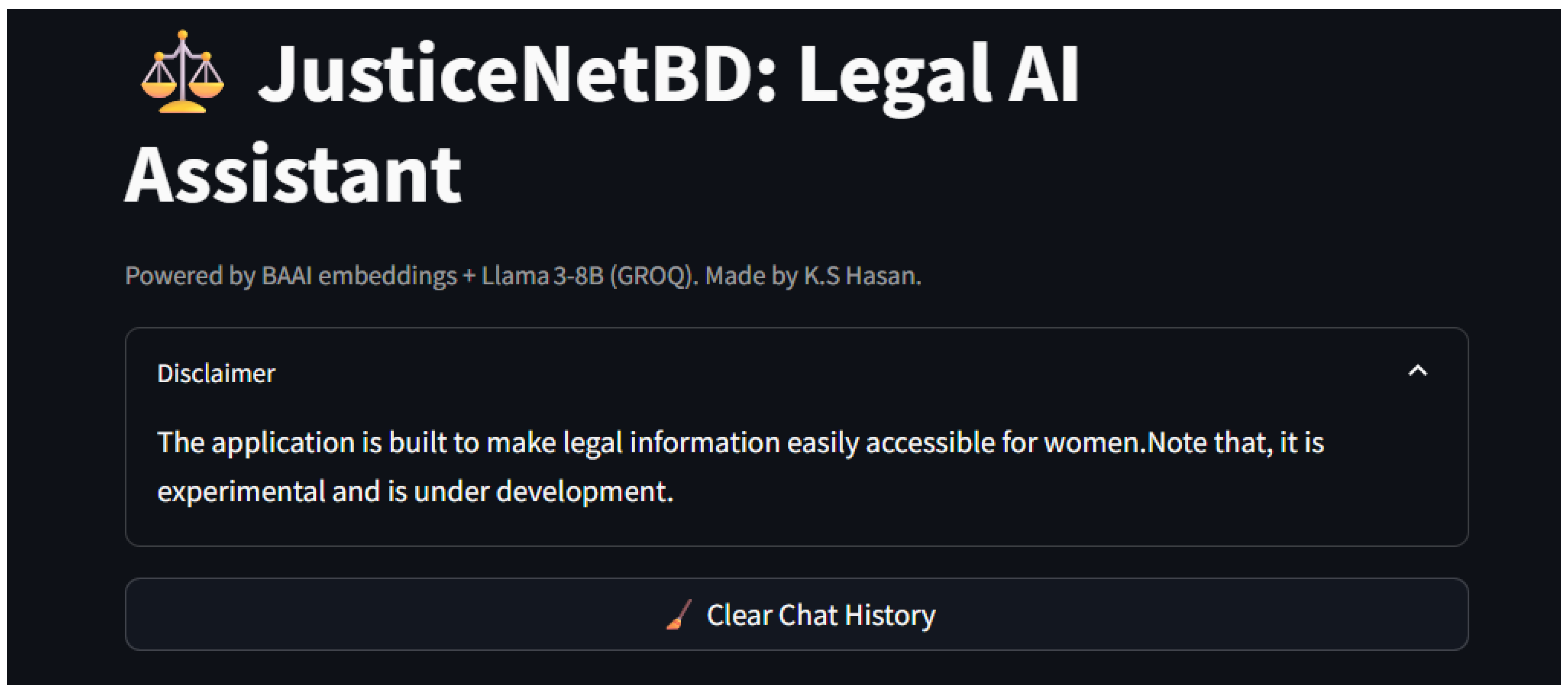
Figure 4.
Conversation between a user and JusticeNetBD
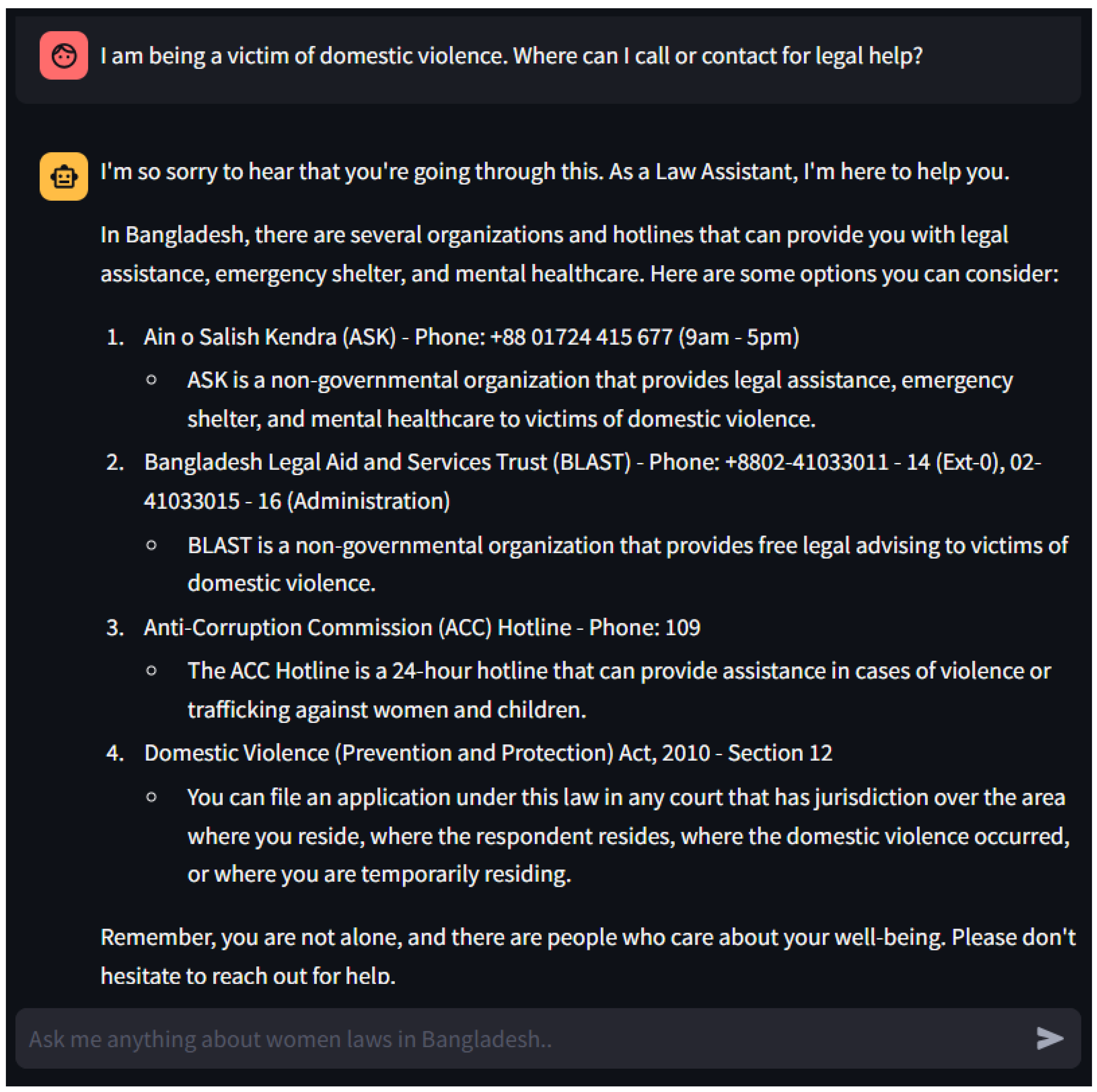
Figure 5.
Model Performance Comparison
Disclaimer/Publisher’s Note: The statements, opinions and data contained in all publications are solely those of the individual author(s) and contributor(s) and not of MDPI and/or the editor(s). MDPI and/or the editor(s) disclaim responsibility for any injury to people or property resulting from any ideas, methods, instructions or products referred to in the content. |
© 2025 by the authors. Licensee MDPI, Basel, Switzerland. This article is an open access article distributed under the terms and conditions of the Creative Commons Attribution (CC BY) license (http://creativecommons.org/licenses/by/4.0/).
Copyright: This open access article is published under a Creative Commons CC BY 4.0 license, which permit the free download, distribution, and reuse, provided that the author and preprint are cited in any reuse.


