

Submitted:
04 July 2025
Posted:
04 July 2025
You are already at the latest version
Preprints on COVID-19 and SARS-CoV-2
Abstract
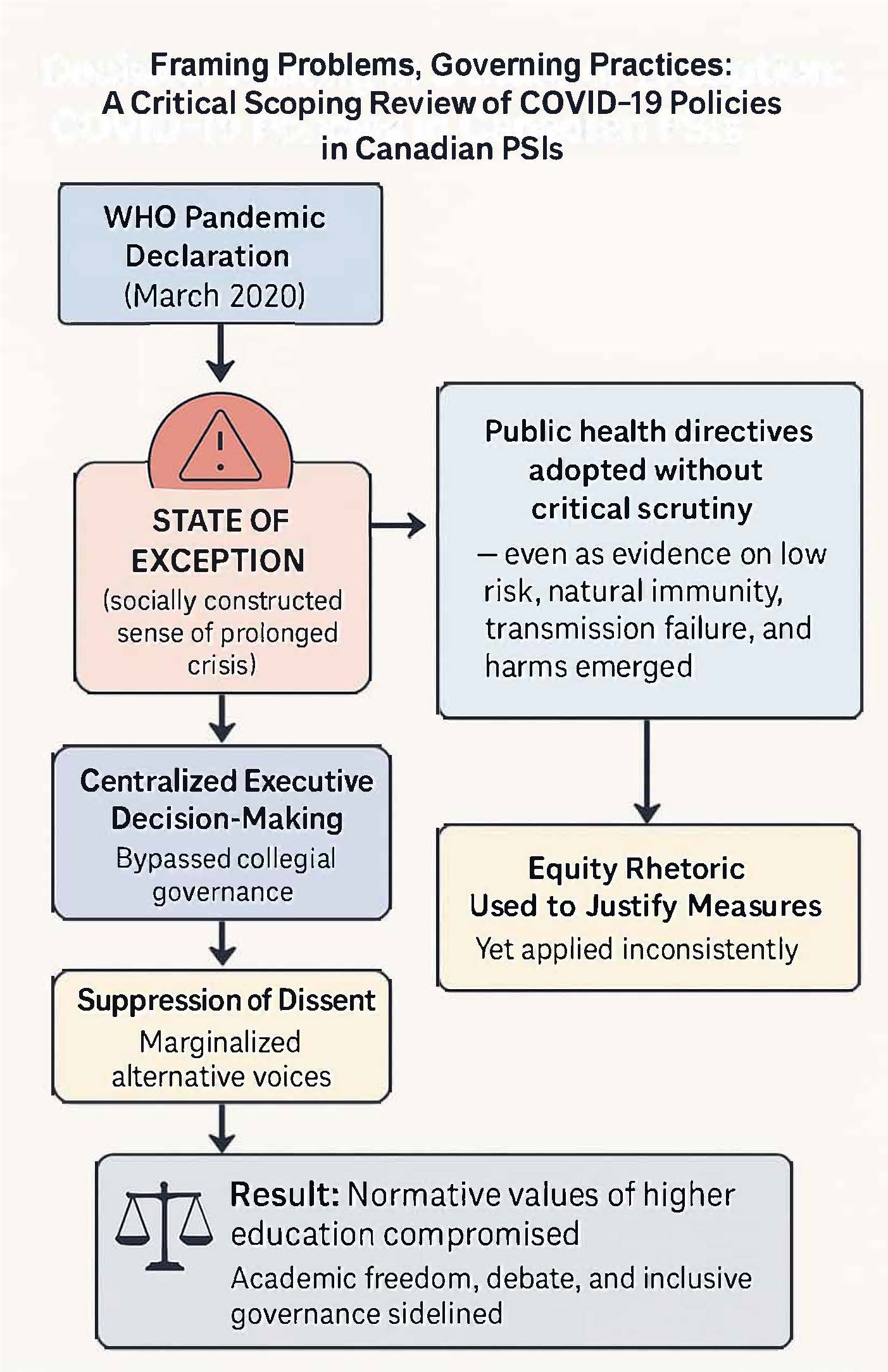
Background: When the World Health Organization declared COVID-19 a pandemic, unprecedented policy responses ensued in higher education, with Canadian post-secondary institutions (PSIs) rapidly adopting radical measures, including campus closures, masking requirements, and vaccine mandates. These policies were widely justified as evidence-based, ethical, and legal. Methods and data: This critical scoping review examined the COVID-19 policy responses at five Ontario PSIs. Using Carol Bacchi’s "What’s the Problem Represented to Be?" approach, we explored how problems were framed, decisions made, and ethical principles invoked. Data included publicly available policy documents, union statements, and legal decisions. Findings: PSIs portrayed the problem as a deadly, “equal opportunity” virus demanding maximum compliance with public health directives, particularly vaccination. This framing dominated governance practices, often sidelining collegial decision-making in favour of executive authority and ad hoc committees. Claims of a scientific consensus were central to policy justification, despite initial and growing evidence – such as low infection fatality rates among young adults, the strength of natural immunity, the failure of vaccines to stop transmission, and reports of vaccine-related adverse events – challenging that framing. Equity, diversity, and inclusivity were frequently invoked to support these policies, yet the same measures often excluded individuals with diverse needs and applied exemptions inconsistently. Conclusions: The COVID-19 response in Canadian PSIs reflected not a true consensus but an illusion of consensus, produced through the foreclosure of debate and suppression of dissent — patterns at odds with the normative values of higher education.
Keywords:
COVID-19
; scoping review
; critical policy analysis
; decision-making
; governance
; academia
; postsecondary education
; medical mandates
1. Introduction
The World Health Organization’s (WHO) declaration of COVID-19 as a pandemic overhauled usual norms, policies, and practices in a range of social institutions, globally and nationally. The postsecondary sector in Canada was no exception. Unifying themes across Canadian postsecondary institutions (PSIs) were that the global public health emergency called for bold policy responses, that the health and safety of community members were priorities, that working together around the common goals of teaching, learning, and research was critical, and that PSI COVID policies would comply with public health regulations (Do, 2020; Lenton, 2020; McMaster University, 2020b). However, evidence indicates that institutional policies varied according to existing norms, practices, and political imperatives in the sector. As a result, the rationale offered by academic authorities in support of these policies was not always clear, nor was the decision-making process always transparent. Importantly, the power dynamics underlying the COVID-19 policy response across PSIs has been insufficiently explored, despite the dramatic impact of these policies on the lives of millions, and the unprecedented measures imposed on noncompliant individuals – such as gag orders instructing educators to avoid discussing COVID-19 vaccination (Macintosh, 2021), job termination of tenured professors expressing dissenting views (Goudreault, 2024), and deregistration of students who refused to declare their vaccination status (Edwardson, 2021).
Building on our published protocol (Chaufan, Manwell, Gabbay, Heredia, Daniels, et al., 2023) and informed by Carol Bacchi’s critical policy analysis approach “What is the problem represented to be?” (WPR), we conducted a scoping review of COVID-19 policies in selected Canadian PSIs. Our phenomenon of interest (Munn et al., 2018) was the decision-making process leading to medical mandates, a key question of governance, i.e., the notion addressing the question “Who makes what decisions?” (Goedegebuure & Hayden, 2007). Following this introduction, section 2 describes the methods, section 3 presents the findings, section 4 discusses these findings, and section 5 concludes our analysis and suggests implications for democratic and ethical academic governance, especially in times of crises. The study is part of a larger project reappraising the COVID-19 policy response (https://osf.io/pjxzt/). We relied solely on publicly available documents, so the study was exempt from Institutional Review Board approval.
2. Material and Methods
2.1. Conceptual Framework
A decades-long tradition of scholarship has underscored the importance of appraising the power dynamics in public policy making (Bacchi, 2016; Walt, 1994), and has proposed to bring to reviews of the literature a “critical” lens that focuses on this dynamics – that goes beyond listing or cataloguing previous research and instead probes the assumptions underlying knowledge claims (Mingers, 2000; Saunders & Rojon, 2011). An exemplar of this tradition in the field of policy studies is Carol Bacchi’s approach “What is the problem represented to be?” (WPR) (Bacchi, 2012, 2016). The approach is “critical” because, rather than taking at face value problems as framed by policy authorities, WPR encourages researchers to problematize, i.e., scrutinize and question, dominant problem representations.
In this study, the WPR approach informed our use of Arksey and O'Malley framework for scoping reviews that, as the authors note, can include diverse documentary evidence, call for exploring “phenomena of interest” rather than merely documenting outcomes (Munn et al., 2018), and seek to answer broad questions (Arksey & O’Malley, 2005), all of these suitable to the goal of our review. Our analysis was enhanced by Levac et al.’s team-based approach (Levac et al., 2010) that proposes that throughout the review, from articulating a research question; identifying and selecting relevant studies; charting the data and collating, summarizing, and reporting results; the process should be iterative and cooperative, i.e., “team-based” – an approach that helps research teams address unforeseen practical challenges, such as the need to refine inclusion/exclusion criteria during the screening and selection process, and which informed our refining of the study focus.
Document analysis, which views documents as "social facts" that convey meaning (G. A. Bowen, 2009a), supported our choice of documents as data and thematic analysis, which allows researchers to identify salient themes within the data, guided our interpretation (Braun & Clarke, 2006). We followed the Preferred Reporting Items for Systematic Reviews and Meta-Analyses extension for Scoping Reviews (PRISMA-ScR) Checklist (Tricco et al., 2018), registered the protocol (https://osf.io/r8fgk), and published it (Chaufan, Manwell, Gabbay, Heredia, Daniels, et al., 2023). Finally, because three authors have relevant biomedical expertise, we relied heavily on the epidemiology, immunology, and pathophysiology of COVID-19 to interpret our observations.
2.2. Goal of the Review and Review Questions
Our phenomenon of interest (Munn et al., 2018) was the decision-making process leading to COVID-19 responses in Canadian PSIs, with an emphasis on medical mandates. Our goal was to examine how these responses were influenced by competing views on what counts as reliable scientific evidence, by the power/class structure within universities (e.g., management versus faculty) and by potential conflicts of interests (e.g., research funding). We organized our review findings around the initial protocol questions, as follows:
- a)
- Problem representation and related issues – What was/is the problem represented to be in the COVID-19 policy response in Canadian PSIs? What evidence supported this problem representation? What was the alignment of institutional policies with policies implemented by public health authorities? What was left unproblematic in this problem representation?
- b)
- Decision-making process and related issues – What institutional or individual social actors were responsible for making decisions concerning the perceived problem and what processes of consultation, if any, were carried out to arrive at a given decision? What were the external influences, if any, in the decision-making process?
- c)
- Equity, diversity, inclusivity, and bioethical principles – What equity, diversity, inclusivity, and bioethical criteria were (or not) considered?
2.3. Data Type, Selection, and Charting
Our data were publicly available documents that we treated as social facts, i.e., organized to reflect actual power relations and convey meanings (G. A. Bowen, 2009b). They were retrieved from the websites of five Canadian universities including: 1) University of British Columbia, University of Alberta, University of Toronto, McMaster University, and Redeemer University. We chose these universities because of their recognized leadership in research, policy influence, or contrasting geographical location and policy choices. Data included three types of documents: 1) meeting agendas, minutes, reports, and motion records of meetings of decision-making academic bodies and their subsequent dissemination through public news and announcements, retrieved directly from the university’s websites (hereafter Governance Documents); 2) communications from faculty, staff, and student associations, retrieved from associations’ websites (hereafter Association Documents); and 3) documents containing information on legal decisions affecting Canadian postsecondary institutions, retrieved from the Canadian Legal Information Institute (CanLII), a non-profit database of legal documents with information on legal decisions affecting Canadian postsecondary institutions (hereafter Legal Documents). Table 1 lists the data types and indicates links to their access.

Table 1.
Data description & access.
| Category | Data description | Data source | Document count | URLs |
|---|---|---|---|---|
| Legal documents | Documents containing information on legal decisions affecting Canadian postsecondary institutions. |
Canadian Legal Information Institute: Non-profit database of legal documents with information on legal decisions affecting Canadian postsecondary institutions. |
Total: 22 | https://www.canlii.org/en |
| Association documents | Publicly available communications from faculty, staff, and student associations. |
Main websites of faculty, staff, and student associations (e.g., University of Toronto Faculty Association) | Total: 127 37 UBC 30 UofT 28 McMaster 27 UofA 4 CUPE 1 Ontario Undergraduate Student Alliance |
https://www.utfa.org/ |
| Governance documents |
Publicly available agendas, minutes, reports, and motion records of meetings of decision-making academic bodies. |
Websites of five universities from across Canada, selected for strategic reasons (scientific leadership; policy influence; contrasting geographical location; diverse ideological orientation; policy choices): 1) University of Toronto; 2) McMaster University; 3) Redeemer University; 4) University of Alberta; 5) University of British Columbia |
Total: 395 168 UofT 103 UofA 87 McMaster 32 UBC 5 Redeemer |
https://www.utoronto.ca/ https://www.mcmaster.ca/ https://www.redeemer.ca/ https://www.ualberta.ca/index.html https://www.ubc.ca/ |
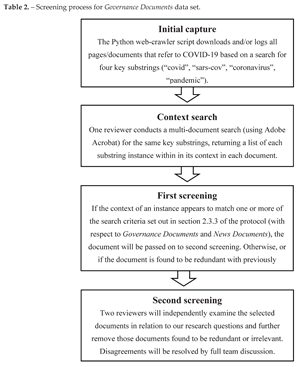
Document selection for all three data sets was performed as follows: for the Governance documents, a multistep process was performed that involved automatically scoping the source databases with tailor-made Python-based web crawlers to capture all documents and/or web pages containing key substrings (“covid,” “sars-cov,” “coronavirus,” and “pandemic”) intending to capture any and all references made to COVID-19 and policy responses, and manually filtering the captured documents to identify those that discussed the areas in which most Canadian PSIs developed/enforced COVID-19 policies (e.g., social distancing and, by extension, capacity limits, campus closures, and remote learning; masking; and proof-of-vaccination policies); and/or discussed the decision-making process of COVID-19-related policies; and/or discussed collaboration with government bodies, NGOs, and/or other institutions in the context of forming said policies. Documents found during this selection were added as needed if considered relevant to our research goal. For example, in one instance, many relevant public Governance documents from McMaster University needed to be obtained by email request from the office of the McMaster Secretariat because they were absent from the list of published secretariat documents on the university’s website.
Associations documents were retrieved directly from university websites In the case of Redeemer University, because governance- and association-related documents were not publicly available, pertinent information about the university’s policies and decision-making was obtained by email request from the university’s Communications Director (Redeemer University, 2024). For the Legal and Association data sets, we selected documents using keywords (i.e., “COVID-19”, “policy”, “decision-making”) that answered the question “What can be gleaned from existing documents about the decision-making process in Canadian PSIs concerning COVID-19 policy?”, and were related to either non-pharmaceutical interventions (i.e., institutional closures, remote work, physical distancing, hygiene, and masking) or pharmaceutical interventions (i.e., vaccination), and were in English. A table of selected documents and pdfs of actual documents are accessible via a link to a dedicated Google Drive https://drive.google.com/drive/folders/1UED6pPf4xVJQjBy1p30Qq3QQgm90meAo?usp=drive_link
The dates of all documents selected for analysis spanned close to four years, from January 2020 through August 2023. For all data sets, one reviewer conducted a preliminary search to narrow retrieved documents to a number manageable given our team’s human resources and timeline. Upon this initial screening, two reviewers independently screened the remaining documents in relation to review questions and eliminated those that did not meet the inclusion criteria. Disagreements were resolved by full team discussion. Data charting included features of documents (e.g., type/author/date), social actors participating in a decision (e.g., management vs. faculty vs. staff vs. students), policy area under discussion (e.g., campus closure; vaccination mandate), evidence informing the decision (e.g., public health agencies; original medical research), and factors potentially influencing a given decision (e.g., funding streams). Before beginning full charting, two researchers independently charted data from a sample of documents, and the team met to calibrate the approach, using the Dedoose Training Centre Test or the Campbell et al. method for calculating inter-rater reliability, as appropriate (Campbell et al., 2013). Charting was assisted by Dedoose, a cloud-based application that helps to organize and analyse a wide range of data. Table 2 describes the screening process used for the initial collection of Governance documents:
Qualitative thematic synthesis was used to transform the data into themes (Braun & Clarke, 2006; Thomas & Harden, 2008), applying a hybrid, deductive/inductive approach that involves reading and rereading the evidence to identify salient themes. Our review questions helped to identify preliminary themes, but as we assigned data to them, we assessed if they were supported by the data or required revising or adding new themes (Pluye & Hong, 2014). We also compared findings across types of documents, universities, social actors participating in a decision, and other factors identified during the analysis. We did not assess risk of bias because, unlike with systematic reviews, the scoping review approach does not require it (Arksey & O’Malley, 2005). More importantly, our data was “biased” by its very nature, because one major goal of our review was to appraise if and to what extent the decision-making process concerning COVID-19 policy was informed by scientific evidence and aligned with principles of bioethics and academic equity, so an assessment of quality and bias that excluded documents for failing to meet empirical or ethical standards would have defeated our goal. Finally, we followed the Preferred Reporting Items for Systematic Reviews and Meta-Analyses extension for Scoping Reviews (PRISMA-ScR) Checklist (Page et al., 2021), registered the protocol with the Open Science Framework (https://osf.io/pbthn), and published it in AIMS Public Health (Chaufan, Manwell, Gabbay, Heredia, Daniels, et al., 2023).
2.4. Statement on Reflexivity
The research team consisted of four investigators with over six decades of combined research in medical sociology, the medical sciences, and health and education policy, and lived experience of the COVID-19 policy response in the Canadian PSI sector. Following Malterud (Malterud, 2001a), these disclosures are not offered for the purpose of personal or ideological positioning, but rather as a means of enhancing transparency and to ground our commitment to epistemic integrity. In addition to our academic and professional expertise, our engagement with the topic stems from longstanding concerns about the impact of COVID-19 policies in public institutions in Canada – specifically in higher education and health care – as reflected in a substantial body of individual and collaborative research (Chaufan et al., 2025; Chaufan, Manwell, Gabbay, Heredia, & Daniels, 2023). Based on a prior critical policy analysis by the lead author of the expert literature on attitudes about COVID vaccination among postsecondary students (Chaufan, 2023), in-depth interviews of university students (Chaufan & Hemsing, 2023), and research conducted to design this study, published as a protocol (Chaufan, Manwell, Gabbay, Heredia, Daniels, et al., 2023), this impact has not been adequately addressed in dominant policy narratives and academic circles.
3. Findings
For the Governance data set, we selected and analyzed a total of 395 documents – 168 from University of Toronto, 103 from the University of Alberta, 87 from McMaster University, 32 from the University of British Columbia, and 5 from Redeemer University. For the Associations data set, we selected and analyzed a total of 127 documents – 37 from the University of British Columbia, 30 from the University of Toronto, 28 from McMaster University, 27 from the University of Alberta, 4 from the Canadian Union of Public Employees (CUPE), and 1 from the Ontario Undergraduate Student Alliance. For the Legal data set, we selected and analyzed a total of 22 documents – all from the Canadian Legal Information Institute (CanLII). The selection process is illustrated in Graph 1 - Prisma flowchart.

The following subheadings present our findings organized around WPR informed charting categories.
3.1. Problem Representation and Related Issues
The imperative to protect physical safety was the dominant problem representation, one that implied that protection would require stopping viral spread at all costs. This representation justified the multiple and radical measures that, almost overnight, PSIs implemented across Ontario around mid-March 2020 – limiting person-to-person contact and the number of people sharing indoor airspace, reducing proximity between individuals, and ensuring frequent cleaning of shared surfaces – while striving to continue business as “normally” as possible. The need to stop viral spread was based on two core assumptions: (a) that SARS-CoV-2 posed an existential, “equal opportunity” public health threat requiring unprecedented measures, and (b)
that the measures would effectively reduce viral transmission.
Anxiety over how and when to reopen campus spaces was especially pronounced in the lead-up to Fall 2020 (University of Toronto Faculty Association, 2020c) and Fall 2021 (Association of Administrative and Professional Staff at UBC, 2021b; McMaster University Faculty Association, 2021; Richardson, 2021a), the latter marking a return to more extensive in-person learning. Across institutions, faculty, staff, and student associations voiced the most intense concerns, often supported by surveys indicating that members felt unsafe returning to campus after periods of lockdown or remote work (Evans & Bhangu, 2021; University of Alberta Students Union, 2022). In articulating these concerns, the University of British Columbia Faculty Association president stated in August 2021 that the association “considered the preeminent moral concern of the University to be the health and wellbeing of its employees and students and of their families” (Richardson, 2021c). New SARS-CoV-2 variants, such as Delta and Omicron, became focal points for these parties in justifying calls for stricter measures (Confederation of Alberta Faculty Associations, 2021, p. 3; CUPE 3902, 2021a; Association of Academic Staff University of Alberta, 2022a; CUPE 3902, 2023, p. 2; University of Alberta Students Union, 2021; Richardson, 2021f; Graduate Student Society of UBC Vancouver, 2022).
Physical safety concerns were frequently voiced alongside other issues, including increased workload and professional implications of remote work, such as disruptions to tenure-track timelines (McMaster University Faculty Association, 2020b; Sprout, 2020) and questions about intellectual property rights over online learning materials (Sprout, 2020; University of Toronto Faculty Association, 2020a). For example, in July 2021, the University of Toronto Faculty Association president, representing a coalition of faculty associations from Ontario College of Art and Design University, Toronto Metropolitan University, York University, and the University of Toronto, asserted: “We strongly prefer in-person teaching and learning and want to return to campus as soon as it is safe enough to do so, but it is still not safe enough” (University of Toronto Faculty Association, 2021a). Meanwhile, student associations voiced concerns about the negative impacts of prolonged remote learning on both educational quality and student mental health (Da-Ré, 2021, pp. 48, 79 ,84, 85; University of Toronto, 2021g), while at the same time reporting significant health-related anxieties about returning to campus (University of Alberta Students Union, 2022; Evans & Bhangu, 2021; Graduate Student Society of UBC Vancouver, 2022).
The arrival of vaccines in late 2020 and early 2021 introduced a new dimension to the problem representation. While early discussions had included concerns about inadequate vaccine access for students – since older populations were prioritized – and although discussion of mandated vaccination had emerged as early as November 2020 at a University of Toronto Academic Board meeting (University of Toronto, 2020g), the legal implications of mandates did not surface until spring 2021. At that time, McMaster University acknowledged that they were “investigating what can be imposed as there are some legal implications” (McMaster University, 2021d, p. 2), while the University of Toronto indicated that “the Council of Ontario Universities [an advocacy group whose role will be discussed later] was seeking legal guidance” on the matter (University of Toronto, 2021d). McMaster’s framing was interesting in that inadequate availability of vaccines for the age group of students was proposed as an obstacle to the feasibility of mandates (McMaster University, 2021d, p. 2).
In March 2021, a working group at the University of Alberta issued a report identifying numerous legal and ethical challenges to vaccine mandates, including issues of privacy, autonomy, and equity (University of Alberta COVID-19 Vaccination Working Group, 2021). Later than year, in August 2021, these concerns were echoed by University of Alberta President Bill Flanagan, who noted that “Mandatory vaccination raises a complex range of legal and ethical issues, including privacy, autonomy, and social equity” (Flanagan, 2021). While we found no evidence that the University of British Columbia’s executive leadership questioned the legality of mandates, it also did not openly endorse it, whereas, in contrast, the university’s Faculty Association firmly asserted that the university held “the legal authority and institutional autonomy necessary to introduce a blanket vaccine mandate for students, faculty, and staff” (Richardson, 2021e, p. 1). Notably, the Faculty Association argued that it was not the enforcement but rather the absence of a mandate that represented an ethical failure, or even a violation of ethical principles, because the choice was “not between depriving some [people] of an education and depriving no one of an education [but] between depriving an education to someone who freely chooses not to do something versus depriving an education to someone whose life situation [e.g., a disability] does not allow them to make the choice to come to campus. The more ethical course of action, in our view, is the opposite of what the [Public Health Officer] suggests” (Richardson, 2021e, p. 2). This assertion, as others across the data, framed non-compliant individuals as an unacceptable threat, as well as morally defective.
As vaccines became widely available and mandates were implemented, the problem representation shifted from viral transmission to vaccination uptake. Vaccine hesitancy and low vaccination rates were framed as obstacles to resolving the crisis, with communications by PSIs regularly equating vaccination rates with the permissibility of reducing campus restrictions. It follows that the assumption was that higher vaccination rates would translate to stronger immunity, lower transmission rates, and better clinical outcomes overall – more on this point in the discussion. For example, a Fall 2021 bulletin from the University of Alberta stated: “By maximizing our community immunity, we will maximize in-person learning experiences for students and on-campus opportunities for everyone” (University of Alberta, 2021d). Similarly, McMaster’s Faculty Association declared that “high rates of vaccination (including a vaccine mandate for anyone present on campus) makes [an in-person Winter term] more likely” (McMaster University Faculty Association, 2021). Redeemer University echoed this logic in a Fall 2021 memo: “As more Ontarians are vaccinated and COVID-19 hospitalizations continue to decrease, September is beginning to look like a return to normal,” implicitly tying vaccination and hospitalization rates directly to the question of campus operation (McBride, 2021).
The most explicit articulation of this logic appeared in a highly influential letter by the Council of Ontario Medical Officers of Health (COMOH) – an influential public body representing current and past medical officers from 34 public health units in Ontario. The letter, dated August 24, 2021 (updated August 26 (Council of Ontario Medical Officers of Health, 2021b)), framed stagnating vaccination rates among students as the key justification for more aggressive pandemic measures, lamenting that: “Unfortunately, vaccination uptake amongst [the post-secondary student demographic] has plateaued” (Council of Ontario Medical Officers of Health, 2021a). Though the connection between vaccination rates and viral transmission was often left unstated, it underpinned policy decisions across institutions.
Legal disputes also reflected this framing. In an arbitration between Wilfrid Laurier University and the United Food and Commercial Workers Union, a July 22, 2021 letter from the Region of Waterloo’s Medical Officer of Health was cited, which stated that “ensuring high rates of vaccination among the student population will be critical to Ontario’s pandemic control,” asserting that “transmission among this age group has contributed to sustaining community transmission”, and describing vaccination as “our strongest tool to prevent local outbreaks” (Wilfred Laurier University v. United Food and Commercial Workers Union, 2022, p. 7). Perhaps the most forceful alignment of vaccine uptake with collective safety and the moral legitimacy of punishing dissenters appeared in the court decision of Costa et al. v. Seneca College (2022), in which the presiding judge equated public health safety with high vaccination rates, writing that there exists “a legitimate point of view among the vast majority of Ontarians … that [prizes] the safety associated with vaccinations above the rights of a small minority of people to move among them in an unprotected and potentially infectious state” (Costa, Love, Badowich and Mandekic v. Seneca College of Applied Arts and Technology, 2022, p. 10). Here, the judge effectively collapsed the problem of viral spread into the problem of unvaccinated individuals, reinforcing assumptions underpinning dominant COVID policy, namely, that the unvaccinated presented an inordinate risk as compared to the vaccinated – assumptions that we examine in the discussion section. This conflation would become central to justifying PSI vaccine mandates.
3.2. Decision-Making Process and Related Issues
Although transparency and democratic participation are often emphasized in academic governance, the COVID-19 response among Ontario’s PSIs unfolded swiftly and centrally. Virtually all PSIs suspended in-person classes and shifted online by March 16, 2020 (Jabakhanji, 2020). While institution-level records attribute these decisions to the presidents’ offices, the uniform timing suggests coordination by an authority operating at a higher level – perhaps provincial or federal. While the data we identified did not support a definitive answer, a remark by the president of the McMaster University Faculty Association supports this hypothesis: “[I]n the morning of Thursday March 12 […] the word at McMaster was the university was working in a ‘business as usual’ mode […] By lunch time, I was providing comments on a plan to cancel classes and exams […] and before dinner, the Ontario government closed all elementary and secondary schools until April 5th” (McMaster University Faculty Association, 2020a). However, the only public record of such an announcement is a March 12, 2020, release from the Premier’s Office, which referred to the closure of ‘publicly funded schools,’ not PSIs (Office of the Premier, 2020). Nonetheless, Redeemer University, a private institution, ceased in-person operations the following day (Redeemer University, 2021).
Mask mandates were another near-universal policy adopted by all five PSIs studied, with slight variations in timing. The University of Toronto was the earliest adopter, announcing on July 7, 2020, a limited requirement for the wearing of face-coverings in public-access areas (Kalvapalle, 2020b), which expanded to classrooms by July 23 (Kalvapalle, 2020c). McMaster followed with a July 10 announcement (effective July 14) (McMaster University, 2020e), and the University of Alberta and the University of British Columbia announced policies on July 30 and September 11, respectively (McCreary, 2020; University of British Columbia, 2020b). Most institutions rescinded these requirements between March and June 2022, though timing varied (University of Toronto, 2022b; McMaster University, 2022b; University of Alberta, 2022b; Government of British Columbia, 2022). The mask policies were nearly identical: face coverings were required in all indoor shared spaces, with exceptions for eating, private offices, and medical exemptions. Non-medical masks were often encouraged, likely to reserve Personal Protective Equipment (PPE) for healthcare settings.
Vaccination requirements showed greater variations. The University of Toronto led the way on June 8, 2021, mandating vaccines for students living in residence (Kalvapalle, 2021a). McMaster followed on July 21 (McMaster University, 2021f), and the University of British Columbia implemented a similar mandate under a provincial order (Fletcher, 2021a). No record was found of residence-specific mandates for the University of Alberta or Redeemer. By Fall 2021, all five institutions had introduced broader campus-wide vaccination policies – either mandating proof of vaccination or, at a minimum, requiring disclosure or testing for students, staff, faculty, visitors, and contractors present on campus – and all PSIs in Ontario were compelled to implement such a policy (albeit not necessarily mandates – more on this point later) by an August 30, 2021, provincial directive (Government of Ontario, 2021).
While three PSIs – the University of Toronto, McMaster, and the University of Alberta – imposed mandates with no alternatives (e.g., no rapid testing) (University of Toronto, 2021b; McMaster University, 2021c; University of Alberta, 2021f), their implementation varied. For instance, initial announcements at the University of Toronto July 29 (Kalvapalle, 2021b) and the University of Alberta August 17 (University of Alberta, 2021c) allowed rapid testing, but both shifted quickly (U of T News Team, 2021) (University of Alberta, 2021d), with updated policies restricting campus access to those with proof of vaccination or approved exemptions. The University of British Columbia’s approach remained less stringent, requiring only completion of a vaccination status declaration form and testing for unvaccinated or undisclosed individuals (Fletcher, 2021b). Redeemer’s policy followed a similar model (Redeemer University, 2024). All five institutions paused or lifted vaccination policies in 2022, often soon after changes in public health directives. The University of Alberta was the first to suspend their requirement on February 28, 2022 (Flanagan, 2022b), followed shortly thereafter by Redeemer on March 4 (Redeemer University, 2024) – in the wake of the Ontario Chief Medical Officer of Health’s March 1 revocation of the order requiring PSIs to develop vaccination policies (K. M. Moore, 2022). The University of Toronto (University of Toronto, 2022d) and McMaster (Farrar & Tighe, 2022a), along with most other PSIs in Ontario, synchronously “paused” their vaccination requirements on May 1, 2022, making clear that the requirement could be reinstated at short notice (Farrar & Tighe, 2022a; University of Toronto, 2022c) if in their judgement public health circumstances changed.
A theme across some PSIs was abrupt policy shifts. For example, on August 6, 2021, University of Alberta President Bill Flanagan, citing a working group report advising against vaccine mandates, stated that the university would not be requiring vaccinations and that a prior masking policy would be lifted (Flanagan, 2021). Eleven days later, the institution reversed course and implemented both mandates (University of Alberta, 2021d). The University of Toronto followed an incrementalist pattern, issuing partial measures before implementing more robust policies. For example, on July 7, 2020, masking was limited to public areas (Kalvapalle, 2020b); by July 23, classrooms were included (Kalvapalle, 2020c). Similarly, a vaccination policy announced July 29 initially applying only to “high-risk” activities – like “music instruction” or “varsity sports” - (Kalvapalle, 2021b) was amended on August 11 to extend to anyone coming to campus (U of T News Team, 2021).
“Return-to-campus” plans were published by most institutions during 2020. These included University of Toronto’s UTogether (University of Toronto, 2020b), University of British Columbia’s COVID-19 Safety Planning Framework (University of British Columbia, 2020a), and University of Alberta Campus 2020-21 (University of Alberta, 2020a). These plans offered guiding principles – health and safety, academic continuity – but were frequently updated as public health policies evolved. Redeemer had their own, unbranded plan (Redeemer University, 2020b) as well as a “Safe Return” opening plan (Redeemer University, 2020a). Policy development was often delegated to working groups or ad hoc committees – for example, the University of Toronto’s Incident Leadership Team (University of Toronto, 2020b), later replaced by the Response and Adaptation Committee (University of Toronto, 2020a), McMaster’s Crisis Management Group (McMaster University, 2020c, p. 8), and the University of British Columbia’s “pan-[University of British Columbia] governance structure,” established to purportedly facilitate their COVID-19 response (University of British Columbia, 2022a, p. 24). In some cases, these groups had pre-existing mandates to handle situations declared to be emergencies; others were created upon COVID-19’s declaration as a pandemic. Their powers varied – some were advisory; others had executive authority. For instance, the University of Toronto temporarily delegated power to its COVID-19 Special Committee, a subcommittee of the Governing Council (University of Toronto, 2020c). The University of Alberta’s Public Health Response Team (University of Alberta, 2021a) exercised similar powers, with the latter having been delegated executive authority from the university president (University of Alberta, 2022a, p. 121).
These groups appear to have had an outsized influence and often operated without publishing minutes or seeking broader consent from traditional governance bodies. At the University of Alberta, almost all COVID-related decisions were made with executive authority by the President and Vice Chancellor, the Public Health Response Team, or the General Faculties Council Executive Committee, according to the university’s “COVID-19 Governance Emergency Protocols Decision Tracker” (University of Alberta, 2022a, pp. 120–124). At McMaster, executive subcommittees of larger governing bodies (e.g., Senate, Undergraduate Council) approved vaccination policies for undergraduate and graduate students “on behalf” of the full Senate (McMaster University, 2021c, p. 40), although the undergraduate policy still received the required majority approval from Senate before being implemented (McMaster University, 2021h, pp. 4–6), and the graduate students policy, first approved by the Graduate Council by normal governance pathways, received final consent by the Senate Executive Committee “on behalf of Senate” (McMaster University, 2021b, p. 11).
In contrast, a more sweeping policy, applying to the entire university community, was approved on September 6, 2021 by the President and Vice-President alone (McMaster University, 2021i, p. 1). The University of Toronto’s COVID-19 Special Committee produced and approved the university’s August 10, 2020, masking requirement (University of Toronto, 2020d); the committee comprised the Chair and Vice-Chair of the Governing Council and the University President, Vice-President, and Provost, and was given “the power to make decisions and take actions on matters the urgency of which does not permit their deferral until the next regular meeting of Governing Council or its appropriate standing committee, campus council or board” (University of Toronto, 2020c). The university’s vaccination policy, introduced on September 3, 2021, appears to have originated from the joint authority of the Provost’s Office and the Office of People Strategy, Equity & Culture (University of Toronto, 2021b), but does not appear to have received – or sought – formal approval from governing bodies.
Despite frequent references to collaboration with public health, few records show that PSIs simply aligned their policy with public health guidelines – in fact, most organizational policies exceeded the minimum requirements of these guidelines. For example, mask mandates were often implemented before being required by provincial health authorities, and continued after such requirements had been lifted. This was also true for vaccine and/or testing mandates, which were implemented by the University of Alberta and the University of British Columbia despite not being required for PSIs by public health authorities in their respective provinces.
In fact, the University of British Columbia’s staff association raised concerns that British Columbia public health was preventing the university from implementing certain public health requirements that exceeded the public health mandate (Association of Administrative and Professional Staff at UBC, 2021c). Likewise, vaccination mandates at nearly all PSIs in Ontario were introduced in excess of the directive from Chief Medical Officer Dr. Kieran Moore (August 30, 2021), which required PSIs to adopt vaccination policies but did not mandate vaccination for campus access, only listing it within a range of policy options (Government of Ontario, 2021). To our knowledge, Redeemer was the only university in Ontario to have expressly met only the minimum requirement of the provincial public health order for a vaccination policy (Redeemer University, 2024) by choosing clause 1(c) of the August 30 directive, which allowed individuals to choose to undergo regular rapid testing and complete a COVID-vaccination-related educational session as an alternative to submitting proof of COVD vaccination (Government of Ontario, 2021).
Similarly, while public health distancing requirements – and by extension, building closures and capacity limits – were varied and changed often, no institution appeared to have challenged them, and some PSIs exceeded them – such as the University of Alberta in Summer 2020 (Sharman, 2020) and the University of Toronto at the end of 2021/start of 2022 (Kalvapalle, 2021c). Other examples of autonomous decisions include those made in the Summer of 2021 by the University of Toronto (Kalvapalle, 2021a) and McMaster (McMaster University, 2021f) to mandate vaccination for students in campus residences, as well as to retain vaccination and masking policies for several months past the point at which the province’s requirements were revoked, in March 2022. This decision appears to have either been heavily influenced by, or jointly made with, the Council of Ontario Universities, who announced it on March 11, 2021 (Council of Ontario Universities, 2022), and the University of Toronto’s decision, in July 2022, to “reinstate” the vaccination requirement (it is unclear by our obtained records when or if the vaccination requirement for residences was ever paused) for “students and employees living in University residences” (Regehr & Hannah-Moffat, 2022). This requirement included “a primary series of a COVID-19 vaccine” and “at least one booster dose” (Regehr & Hannah-Moffat, 2022), making it one of the few PSI booster requirements ever issued in Ontario.
On this matter, it should be noted that the record cited earlier – a memo published on the University’s Division of People Strategy, Equity & Culture in the University of Toronto – had to be individually retrieved, as there was no mention of this reinstated residence requirement within the data collected for this university. The record was specially sought out because one of the authors was passively aware of the booster requirement, which gained attention in the news media during the summer of 2022. There is also no record in our data to indicate if or when the booster requirement for residences was officially paused or revoked, although a cursory search of the University of Toronto’s residence information available online revealed no mention of such a requirement being in effect as of May 2024. It should also be noted that for its July 2021 residence vaccination requirement, the university appears to have made an effort to obtain letters of support from Toronto and Peel local public health units to justify its policy, although both letters merely endorsed “policy options” that “achieve the highest vaccination rates” (Vinita Dubey, 2021) or “facilitate the highest vaccination coverage possible among the student population” (Loh, 2021) without explicitly mentioning mandates. This point is worth noting because it illustrates the generally obscure nature of the grounds and drivers of PSIs’ policy decisions.
Faculty, staff, and student input into decision-making was inconsistent. In one instance, University of Alberta’s staff union (NASA) stated it had “not been formally consulted or involved in any part of the university’s planning process” (Non-Academic Staff Association University of Alberta, 2021). Faculty and student associations often claimed credit for policy changes – University of Alberta’s Faculty Association viewed the August 2021 vaccine mandate as “a response to the strong mobilization and advocacy of our members” (Association of Academic Staff University of Alberta, 2021) and, at the University of Toronto, the student union took partial credit for the university’s decision to “bar those who are not vaccinated from coming to any of [our] three campuses” (University of Toronto Students’ Union, 2021).
Indeed, in most cases, these associations advocated for more – rather than equal, or less – stringent measures. For example, student associations at the University of Toronto, (University of Toronto Students Union, 2020; The University of Toronto Students’ Union Executive Committee, 2021) University of British Columbia (Graduate Student Society of UBC Vancouver, 2022), and Alberta (University of Alberta Students Union, 2021), at various moments called for increased stringency in university policy, including limiting in-person learning and stronger masking and vaccination requirements; faculty associations shared similar concerns and also engaged in vocal advocacy to the same effect (Association of Academic Staff University of Alberta, 2022b; Richardson, 2021b; University of Toronto Faculty Association, 2020c, 2021b). In one case, McMaster’s faculty association sought intervenor status in a legal case defending the school’s mandate, citing their prior advocacy (McMaster University Faculty Association, 2022, p. 5). In our records, the only case of advocacy against any COVID measures by a student, staff, or faculty association was the University of Toronto Graduate Student Union’s criticism of the cancellation of Spring 2020 convocation (University of Toronto Graduate Students Union, 2020).
Provincial faculty associations also played a significant role in favour of mandatory vaccination and masking. The Confederation of University Faculty Associations of British Columbia petitioned the BC government for university autonomy in setting safety rules (Confederation of University Faculty Associations of British Columbia, 2021). The Confederation of Alberta Faculty Associations and the Council of Alberta University Students pressed for vaccine passports and masking – with the first publishing a letter in August 2021 petitioning the provincial government for “a mandatory masking mandate and vaccine passports across all of Alberta’s universities” if “the provincial government and our institutional leadership cannot provide scientific data of COVID cases and vaccination rates on campuses to our associations” (Confederation of Alberta Faculty Associations, 2021).
In Ontario, the Council of Ontario Universities – self-described as “a non-partisan organization committed to working in partnership with government, industry, and community stakeholders in fostering student success and economic growth” (Council of Ontario Universities, n.d.) – played a major role in influencing COVID policy at Ontario PSIs, advocating for capacity limit exemptions (University of Toronto Faculty Association, 2021b) and a provincial vaccine mandate – dubbed “safe pass” (McMaster University, 2021b, p. 3). The University of Toronto’s leadership in “a special COVID-19 working group formed by the Council of Ontario Universities to co-ordinate the sector’s response to the pandemic” (University of Toronto, 2020f) suggests a principal role by this university in pandemic-related advocacy. Related evidence from the University of Waterloo – a PSI not included in this study - suggests that the Council of Ontario Universities played a key role in influencing (University of Waterloo, 2021, p. 29) the Council of Ontario Medical Officers of Health to issue its influential August 24, 2021 letter recommending vaccine mandates and rejecting rapid testing alternatives (Council of Ontario Medical Officers of Health, 2021a) (rev. August 26 (Council of Ontario Medical Officers of Health, 2021b)). The letter was cited by the University of Toronto (Vendeville, 2021a) as a rationale for limiting rapid-testing alternatives in its vaccination policy, and by the Information and Privacy Commissioner of Ontario in a related privacy ruling that found the University of Guelph’s vaccination status disclosure policies in compliance with health law (University of Guelph (Re), 2022). McMaster also cited the letter in its policy preamble (McMaster University, 2021i).
Finally, while policy documents frequently invoked “science,” “public health advice,” and “expert consultations” (University of Toronto, 2021e, 2021h; Kalvapalle, 2020d; University of Alberta, 2021b, p. 61; Farrar & Tighe, 2022b; University of British Columbia Board of Governors, 2022, p. 3), very few contained actual data (Vendeville, 2020; The University of British Columbia, 2021; University of Toronto, 2022a). Rhetorical references to evidence were common, yet without specific citation of data or scientific sources – “The public health evidence is clear” (U of T News Team, 2021), “We know that being fully vaccinated lowers the risk of serious illness and hospitalization significantly” (Mema, 2021), or “While vaccinated people can become infected, infection is much less likely as compared with unvaccinated people” (CUPE 3902, 2021b, p. 2), and so on. At times, PSIs’ news bulletins hyperlinked provincial public health websites, and trends in hospitalization and campus cases were occasionally cited, but specifics were rare (Kalvapalle, 2021a, 2022; University of Toronto, 2023, pp. 1, 3). Both the University of Toronto and McMaster appeared to have been heavily involved in knowledge production, with McMaster’s COVID-19 Evidence Network (McMaster University, 2021e, p. 290) and the University of Toronto’s affiliation with provincial advisory groups (University of Toronto, 2021c) suggesting access to data, but such evidence was largely absent from public policy statements.
Legal decisions shed further light on the treatment of scientific evidence, or rather, claims made about it. For instance, in Costa, Love, Badowich and Mandekic v. Seneca College of Applied Arts and Technology, the court sided with evidence presented by the expert witness of the defendants rather than that provided by the applicant’s expert witness on the basis that the latter witness “[attracted] considerably more controversy,” even though both witnesses were similarly qualified (Costa, Love, Badowich and Mandekic v. Seneca College of Applied Arts and Technology, 2022, p. 3); the arbitrator took note of the importance of academic freedom, but concluded that “particularly in areas in which the court has no pre-existing expertise of its own, caselaw compels us to hew closely to […] well-accepted views” (Costa, Love, Badowich and Mandekic v. Seneca College of Applied Arts and Technology, 2022, p. 5).
In another case, Wilfred Laurier University v. United Food and Commercial Workers Union, 2022, arbitrator Wright considered the relevance of the results of another union arbitration, FCA Canada Inc. and Unifor Locals 195, 444, and 1285; in this case, the arbitrator had ruled that the “mandatory vaccination policy before her had been reasonable when it was introduced [but] was no longer reasonable the date she released her award…”, citing “increased transmissibility of the Omicron variant of COVID-19 - which had become the dominant strain of the virus in the winter and spring of 2022” - and concluding that the difference between the risk of transmission between a two-dose vaccine regimen and remaining unvaccinated was “negligible” (Wilfred Laurier University v. United Food and Commercial Workers Union, 2022, p. 21).
Without disputing the reasoning in the FCA award, Arbitrator Wright accepted the University’s argument that this earlier case was “distinguishable,” because the arbitrator had declared the policy unreasonable only in June 2022, after reviewing evidence available at that time. Because Wilfrid Laurier’s vaccination mandate ended on May 1, 2022, Wright argued there was no evidence the FCA arbitrator had deemed comparable policies unreasonable “from March 1st, 2022, to May 1st, 2022, which is the relevant period in the present case” (Wilfred Laurier University v. United Food and Commercial Workers Union, 2022, p. 27). In doing so, Wright evaluated the policy’s “reasonableness” based on the date of the other arbitration decision, rather than critically engaging with the broader scientific evidence - already widely documented by late 2021 and early 2022 - showing vaccines’ sharply reduced effectiveness at preventing Omicron transmission (Andrews et al., 2022). As a result, the decision arguably prioritized the formal timing of an external ruling over the actual epidemiological facts known at the time.
As to factors external to the PSIs’ internal dynamics or to public health authorities that may have influenced the decision-making process, our data provided little information on any such influence. While we identified an overarching theme of significant provincial and federal government investment in PSIs for a) COVID pandemic relief, and b) COVID-related research, evaluating the requests for proposals from government granting agencies was beyond the scope of our research. We note however that the Ontario government did provide > $106 million to PSIs in the province “to help address the financial impact of COVID-19 on the postsecondary sector” (Ontario Newsroom, 2021), and that neither the University of Toronto, nor McMaster or Redeemer appear on the list of PSIs who received relief funding. Rather, the lion’s share of public funds invested in the University of Toronto and McMaster during the pandemic was directed towards health research (Kalvapalle, 2020a; Canadian Institutes of Health Research, 2020), including the Canadian Hub for Health Intelligence and Innovation in Infectious Diseases (“Led and anchored by the University of Toronto”) (Zou, 2023) that emerged from the university’s pandemic response, and McMaster’s Global Nexus and Canadian Pandemic Preparedness Hub (McMaster University, 2023; Donovan, 2023) – once again, two potential sources of influence that were outside the scope of our study to evaluate.
Finally, concerning private sector influence, the most noteworthy instance was the apparent collaboration of the Toronto Board of Trade with the Council of Ontario Universities in the advocacy of a PSI vaccination requirement (McMaster University, 2021b, p. 3). We also identified a similar influence at the University of Alberta, with the Confederation of Alberta Faculty Associations referring to “vaccine passport” advocacy by the Calgary Chamber of Commerce in their August 17, 2021 open letter calling for increased pandemic measures on Alberta campuses (Confederation of Alberta Faculty Associations, 2021, p. 1). An empirical examination of these and similar influences – beyond the scope of our data - may also shed light on factors shaping COVID-19 policy in Canadian PSIs.
3.3. Equity, Diversity, Inclusivity, and Bioethical Principles
From the onset of the pandemic, Ontario PSIs consistently claimed to prioritize accessibility for students, staff, and faculty in adapting course delivery formats between virtual and in-person learning. Statements across the institutions referenced “accommodations” for students (Return to McMaster Oversight Committee, 2021, pp. 8–9; University of Toronto, 2021a, p. 3; Flanagan, 2022a), for instance, those “not able to attend in person course components for various reasons” (University of Alberta, 2020b, p. 3) and “accommodations for staff with young children” (University of Alberta, 2020c, pp. 7–8), though details on the nature of these accommodations were often vague. Faculty and staff associations played a significant role in supporting members’ requests for accommodations, especially when health-related concerns were involved – such as immunocompromised status, pregnancy, age, or other medical vulnerabilities (University of Toronto Faculty Association, 2020b; Association of Administrative and Professional Staff at UBC, 2021a; CUPE 3902, 2021a; McMaster University Faculty Association, 2020c, p. 4; Richardson, 2021b). Similarly, the Ontario Undergraduate Student Association argued that “Immunocompromised students should have access to academic accommodations to continue receiving access to high-quality education without sacrificing their health or getting exposure to COVID-19” (Abou-Rabia et al., 2021).
Concerning medical mandates, in the case of masking requirements, all PSIs included provisions for exemptions and accommodations, though specifics were not always clear. Policies at the University of Toronto, McMaster, University of Alberta, and the University of British Columbia acknowledged general exemptions on grounds of physical or mental health (University of Toronto, 2020e; McMaster University, 2020d, p. 2; University of Alberta, 2020d; University of British Columbia, 2020c, p. 4), while the University of Toronto and the University of British Columbia specified exemptions where visual access to the mouth was required for communication, for instance, with deaf or hard-of-hearing individuals. University of Toronto’s policy also stipulated that “Members of the community should not ask colleagues, students, or others at the University for supporting documentation or other proof regarding exemptions,” except where health and safety were at risk (University of Toronto, 2020e, p. 7). In contrast, University of Alberta’s policy required a formal process with medical documentation from a physician or faith leader for exemptions (University of Alberta, 2021e). For its part, records from Redeemer offered few details beyond dates of mask mandate implementation and withdrawal, noting that accommodations were available upon request but not specifying the process (Redeemer University, 2020a, p. 5).
Vaccination requirements generated significantly more discussion on ethics and equity than masking mandates, particularly regarding their exemption processes. Faculty advocacy in support of vaccination mandates frequently appealed to the need to protect vulnerable populations. For example, in its August 9, 2021, letter, the University of British Columbia Faculty Association explicitly invoked the university’s Diversity, Equity, and Inclusion (DEI) commitments, stating that the institution was “[obliged] to its most vulnerable members [and their families] – those with chronic illnesses, those with disabilities, those who are immunocompromised” to implement a vaccine mandate (Richardson, 2021d, p. 2). The ethical focus largely converged on the process to obtain exemptions under vaccination policies. Both University of Toronto’s (Kalvapalle, 2021a) and McMaster’s (McMaster University, 2021g) residence mandates and their subsequent campus-wide requirements (University of Toronto, 2021b; McMaster University, 2021i) allowed for exemption requests based on grounds protected by provincial human rights codes. University of Alberta’s mandate also offered exemptions but included language discouraging remote work as a means of avoiding compliance, unless the case qualified under human rights accommodations (University of Alberta, 2021f). In contrast, the University of British Columbia and Redeemer, whose policies relied on rapid testing rather than vaccination mandates, did not appear to maintain formal exemption processes (University of British Columbia, 2022b; Redeemer University, 2024).
In practice, the review process to consider exemptions involved discretionary approval by university-appointed teams. McMaster University, for instance, reported that non-medical requests were reviewed by its Human Rights and Dispute Resolution Team, with guidelines prepared “with input from McMaster’s Chaplaincy Centre, Equity and Inclusion Office and Legal Services Office” (Michalski v. McMaster University, 2022, p. 8). Similarly, the University of Toronto indicated that all their vaccination exemptions had been “closely reviewed to ensure they align with guidance from the province’s Ministry of Health and the Ontario Human Rights Commission” (Vendeville, 2021b). Nevertheless, both institutions initially indicated they anticipated approved exemptions to be “rare” (University of Toronto, 2021e) or only a “very small number” (McMaster University, 2021j). This position is reflected in the low number of approvals at the University of Toronto, which reported 22 exemptions granted across its three campuses by October 1, 2021, representing 0.03% of the 76,000 registrants on its vaccine app (Vendeville, 2021b). McMaster reported receiving 117 medical exemption requests and 470 non-medical ones, mostly from students, but approval rates were unspecified (Michalski v. McMaster University, 2022, p. 22).
This high barrier to exemptions reflected broader legal contestations around the definition of “legitimate” accommodation under human rights law. Several rulings from Ontario and other provinces rejected challenges based on “personal beliefs and convictions” as insufficient to meet the standard for creed-based exemptions. For example, in Costa et al. v. Seneca College (2022), the court determined that the applicants’ refusal to vaccinate was opinion-based rather than credibly linked to protected grounds (Costa, Love, Badowich and Mandekic v. Seneca College of Applied Arts and Technology, 2022, p. 15). In Wilfrid Laurier University v. United Food and Commercial Workers Union (2022), while arbitrators acknowledged sincere religious beliefs, they concluded these did not outweigh public health rationales for the mandate (Wilfrid Laurier University v. United Food and Commercial Workers Union, 2022, pp. 25–26). A similar position was upheld in Ortiz v. University of Toronto (2022), where the adjudicator ruled that the applicant’s creed claim did not meet the legal criteria, despite being sincerely held (Ortiz v. University of Toronto, 2022, p. 6). McMaster echoed this stance in court, quoting their internal “Guideline for assessing Covid-19 vaccination exemption requests based on the human rights ground of creed,” which asserts that “personal beliefs and convictions, political positions, concerns about medical science, etc., are not creed” (Michalski v. McMaster University, 2022, p. 8).
Debates over the unenrollment and termination of unvaccinated or not fully vaccinated members of the academic community revealed tensions between competing interpretations of equity. On the one hand, equity was framed as the obligation to protect vulnerable groups – such as immunocompromised individuals – from the perceived threat posed by noncompliant members. On the other hand, equity was also invoked in calls for flexibility and accommodation, positioning those seeking exemptions as themselves deserving of protection and inclusion, although less frequently. Thus, the ability of unvaccinated or undisclosed-status students to remain enrolled during mandate periods was unclear. While policies generally targeted on-campus attendance, there was contradictory language across institutions about whether noncompliant students would be unenrolled from courses.
For example, McMaster’s Board of Governors discussed “unenrollment processes” for students without exemptions (McMaster University, 2021a, p. 10), though later meeting records suggest that students might be allowed to remain enrolled, but barred from physical campus access (McMaster University, 2022a, p. 6). The University of British Columbia debated similar issues within its Senate, where discussions arose about deregistering students noncompliant with the testing and disclosure regime – with some senators arguing this was unjustifiable given the “inaccuracy of rapid testing and the hyper-sensitivity of [Polymerase Chain Reaction] tests,” and others pressing for strict enforcement (University of British Columbia, 2021, pp. 8–9). Ultimately, the university passed a motion allowing deregistration only “from courses where an online option or accommodation is not available” (University of British Columbia, 2021, p. 11), though whether this was enforced remains unclear (Richardson, 2021f). Redeemer, which never mandated vaccines, consistently provided consistent dual delivery options as an alternative to vaccination or vaccination status disclosure (Redeemer University, 2024; Foster, 2021).
The employment consequences for noncompliant faculty and staff were also ambiguous. Policies at the University of Toronto (University of Toronto, 2021b, p. 3), McMaster (McMaster University, 2021i, pp. 8–11), the University of Alberta (University of Alberta, 2021f) , and the University of British Columbia (University of British Columbia, 2022b, pp. 4–5) mentioned potential disciplinary action, including termination, for failure to comply with vaccination or masking requirements, but records provide little detail on how frequently or under what conditions these measures were enforced. For example, the University of Toronto stated that unvaccinated employees “needed on-site but not vaccinated” would be moved to unpaid status, but the long-term approach remained under discussion (University of Toronto, 2021f). Similarly, McMaster’s administration indicated “ongoing work” with labor groups to manage these situations, but did not specify outcomes (McMaster University, 2021a, p. 10). Legal data reviewed in this study revealed at least one termination case at Georgian College related to mandate noncompliance, although the termination was framed as having arisen from alleged misconduct during the dispute processes, rather than the mandate violation itself (Georgian College v. Ontario Public Service Employees’ Union, Local 349, 2021).
While faculty and staff associations overwhelmingly advocated for stronger measures for students, their stance on labor protections for their own unvaccinated members was more cautious. University of Toronto’s Canadian Union of Public Employees division, for example, asserted that “workers must not be disciplined, terminated, or subjected to harassment based on vaccination status” and emphasized respect for “Duty to Accommodate” (CUPE 3261, 2021). McMaster’s Canadian Union of Public Employees branch, however, proffered that arbitrators might uphold terminations for refusal to vaccinate, because in their view, “vaccination status [was] not a protected human rights ground” – underscoring the legal vulnerability of dissenting employees (CUPE 3902, 2021b).
Be that as it may, legal challenges against PSI COVID-19 policies – whether targeting the mandates themselves or the unions’ failure to grieve them on behalf of its members – almost universally failed. Courts and arbitrators consistently found that vaccination mandates did not constitute coercion or discrimination when implemented with allowance for exemptions consistent with human rights law (Hawke v. Western University, 2022, p. 14; Costa, Love, Badowich and Mandekic v. Seneca College of Applied Arts and Technology, 2022, p. 15; Ortiz v. University of Toronto, 2022, pp. 5–6). Rulings appeared to rely primarily on the views of the Ontario Human Rights Commission, which made its position clear, in September 2021, that “a person who chooses not to be vaccinated based on personal preference does not have the right to accommodation under the Code” (Wilfrid Laurier University v. United Food and Commercial Workers Union, 2022, p. 5). In one Manitoba Labor Board case, a union was found not to have breached its duty of fair representation by choosing not to oppose the institution’s mandate, even where certain members disagreed with the policy” (S.C.S. v. The University of Winnipeg Faculty Association, Collegiate Division, 2022, p. 11).
The University of Alberta’s COVID-19 Vaccination Working Group was among the few internal bodies to voice significant ethical and legal concerns about vaccination mandates. Its March 2021 report cautioned that such requirements could violate bodily integrity and privacy rights, warning of potential conflict with collective agreements and Freedom of Information and Protection of Privacy legislation (University of Alberta COVID-19 Vaccination Working Group, 2021). The report recommended against mandating vaccines or requiring proof of immunization, citing logistical, legal, and resource constraints. However, University of Alberta leadership later implemented a vaccination disclosure and testing requirement, followed, as previously discussed, by a full mandate, without further reference to the Working Group’s conclusions.
The tension between health data privacy and enforceability of mandates was a recurring theme, with privacy and data management issues surfacing frequently; thus, while some associations pressed for greater verifiability, even at the cost of disclosure, others expressed discomfort with the surveillance potential of mandates, leading to tensions within institutions. For example, as early as March 2020, McMaster debated concerns about disclosure of private medical information such as COVID infection status, versus community protection (McMaster University, 2020a, pp. 1–2); later, in 2021, its Canadian Union of Public Employees branch assured members that vaccination data would remain confidential from supervisors (CUPE 3906, 2021). The University of British Columbia’s Faculty Association raised similar concerns in April 2021 about members with “COVID health-related vulnerabilities” being asked for “personal health information” upon seeking accommodations for in-person teaching (Richardson, 2021a), but did not appear to maintain this critique during their later advocacy for vaccine mandates.
Masking policies also intersected with privacy concerns. University of Toronto’s guideline against asking others for exemption documentation was criticized by the Canadian Union of Public Employees, which argued that this policy left employees unable to verify which students had “approved accommodations,” and complained that the university was “deferring its health and safety responsibilities to the honour system” (CUPE 3902, 2021a). University of Alberta’s faculty association (Association of Academic Staff University of Alberta, 2021) and University of Toronto’s student union (University of Toronto Students Union, 2021) similarly criticized self-attestation policies that relied on declarations rather than proof of vaccination. Even after the University of Toronto shifted to requiring vaccination proof, its faculty association advocated for using official government QR codes instead of the university’s internal app that did not distinguish between vaccinated and exempt individuals (University of Toronto, 2021h).
4. Discussion
This study analyzed how five Canadian PSIs represented the problem of COVID-19, structured their decision-making processes, and navigated the ethical, equity, and legal implications of their policy responses. Across the three areas examined – problem representation, decision-making process, and ethical tensions – a dominant logic emerged: institutional actions were grounded in the assumption that physical safety, defined primarily as the avoidance of viral transmission, was the central problem to be solved. This problem representation hinged upon two core premises: a) that the virus represented an “equal opportunity” lethal threat, and b) that the measures would effectively stop viral transmission. As a result, stopping viral spread was treated not only as a public health objective but as an ethical imperative, worth overriding any other ethical consideration – educational access, procedural inclusivity, and bodily autonomy.
It followed that measures such as campus closures, masking, distancing, and later, vaccination mandates, were positioned as necessary to counter an existential threat. Faculty, staff, and student associations frequently supported these measures, emphasizing health risks to vulnerable populations, though their demands also highlighted anxieties around workload, academic continuity, and mental health. The rollout of vaccines and the introduction of mandates reframed the core problem from stopping transmission to ensuring vaccine uptake, equating uptake with reduced transmission, physical safety, and moral citizenship, with little empirical evidence to support these claims.
Decision-making processes revealed a pattern of centralized, executive-driven policy formation, typically bypassing or limiting the role of traditional collegial governance structures. Senior administrators, specialized committees, and emergency working groups shaped most decisions, with faculty, student, and staff associations largely positioned as outside advocates rather than decision makers, albeit almost always in favour of greater restrictions. Although public health guidance was routinely invoked, institutional policies frequently exceeded minimum public health requirements, suggesting an autonomous escalation by PSI leadership. We propose that these governance patterns, marked by top-down decision-making and limited community-member participation – did not emerge in isolation; rather, they reflect long-standing tensions in Canadian postsecondary governance, where the original commitment to bicameralism and academic autonomy has been increasingly challenged by managerial/technocratic approaches, growing corporate influences, and the rise of opaque, executive-centred governance models (Canadian Union of Public Employees, 2019; Giroux et al., 2015; Jones et al., 2001).
While our study did not identify overt conflicts of interest in COVID policy formation, the centralization of authority and lack of transparency observed resonate with these broader governance critiques. These include concerns about the influence on institutional policy of corporate partnerships and funding streams that illustrate the virtual fusion of academic and commercial interests and logic – pursuits as diverse as “cutting-edge technologies,” “science and engineering innovations”, “equitable procurement,” and “global health challenges,” intended to “tackle society’s most pressing issues” (Crljen, 2023; Fiorentino, 2024; York University, 2023).
Finally, the ethics, equity, and human rights dimensions of PSI pandemic responses were defined by strong commitments to protecting the public good in general and vulnerable groups in particular. However, we identified many unresolved tensions – for instance, concerning mandates, justified on grounds of protecting vulnerable community members, and for which noncompliance was punished, yet whose implementation, as noted in the literature, often excluded the views and lived experience of individuals from within those same vulnerable populations (Childs & Taylor, 2024; Taylor & Charran, 2023)).
Further, these commitments often collided with the punitive enforcement of mandates and the selective protection of human rights, whereby the rights of an “othered” – marginalized and often demonized – social group were framed as being worth less than those of the dominant majority. In particular, vaccination policies foregrounded equity discourse while simultaneously excluding or disciplining dissenters, leading to student deregistration or faculty and staff unpaid leaves or terminations (CityNews Kitchener Staff, 2022; Dewan, 2021; Edwardson, 2021; Lupton, 2021; M. Moore, 2022; Oromoni, 2022; Teotonio, 2022). Accommodation processes, although formally in place, were restrictive, and successful exemption requests exceedingly rare; records obtained via FOI request from the University of Toronto reveal that, of 217 medical exemption requests received, the school granted 25, and of approximately 700 creed-based exemption requests received, the school granted 13 (University of Toronto, Freedom of Information and Protection of Privacy Office, 2023). Legal challenges to PSI policies largely failed, with courts and arbitrators siding with institutional interpretations of human rights codes and granting only limited exemptions. Together, these findings illustrate how problem-framing, governance patterns, and equity discourse intersected in ways that prioritized an alleged collective safety while dismissing or ignoring scientific evidence incompatible with the dominant problem representation – more on this point shortly – ethical deliberation, and democratic decision-making.
A central claim underlying COVID-19 mandates in Canadian PSIs has been the existence of a “scientific consensus” regarding the need for interventions such as mass masking, lockdowns, testing, and, most importantly, mass vaccination across all demographics. This framing, originally articulated in a 2020 Lancet article (Alwan et al., 2020) was upheld well after the WHO, in May of 2023, declared the end to the “global public health emergency”, even as many public health agencies continued to promote mass vaccination for individuals as young as six months old as late as May 2025 (CDC, 2024; Public Health Agency of Canada, 2024). Challenges to this framing were frequently dismissed as “misinformation” (Columbia University School of Professional Studies, 2024; Department of Homeland Security, 2019; GDI, n.d.), creating an “illusion of consensus” (Yousefi et al., 2021), manufactured through the enforcement of consent, the foreclosure of debate, and the suppression of dissent – all these at odds with the normative values of higher education.
Contrary to this assumed consensus, substantial and well-documented scientific evidence consistently demonstrated that COVID-19 posed minimal risk to young adults – the primary population in PSIs. Pre-vaccine era infection fatality rates in this demographic group were below 0.02%, roughly 140 times lower than for individuals aged 70 and above (COVID-19 Forecasting Team, 2022; Pezzullo et al., 2023), while risks of poor outcomes were especially concentrated among aged and institutionalized individuals, especially those with multiple comorbidities (Kompaniyets, 2021). It should be noted that these individuals could have been afforded “focused protection” (Battacharya et al., 2020; Kulldorff et al., 2020), early treatment when necessary, and even preventive measures (Derwand et al., 2020; Kerr et al., 2022; Kory et al., 2021; McCullough et al., 2021; Risch, 2020) – medical and policy measures that would have rendered unnecessary to suspend normal societal functioning for most people. Furthermore, outbreak data repeatedly showed that educational institutions, dominated by young populations, were not significant sites of transmission (Ludvigsson et al., 2021).
The mandates also disregarded long-established public health guidance, including the WHO’s 2019 recommendations against measures like mass masking of healthy populations, lockdowns, and quarantining healthy individuals – practices shown to be not only ineffective for respiratory viral pandemics but also associated with serious collateral harms (WHO, 2019). Indeed, early evidence indicated that lockdowns, masking, and vaccine mandates would result in profound physical, psychological, emotional, social, and educational harms, particularly affecting younger populations (Bardosh et al., 2022; Bavli et al., 2020; Glover et al., 2020). As well, early evidence from Wuhan demonstrated that among nearly 10 million tested individuals, asymptomatic positives were exceedingly rare, with no detected spread among close contacts (Cao et al., 2020), calling into question the oft cited claim that even healthy individuals could inadvertently represent a lethal threat – a claim used to justify continuing mass testing, isolation, and vaccination (Mandavilli, 2020; Stobbe, 2020). In the summer of 2020, it was also revealed that many public health agencies, national and local – for instance, the Centers for Disease Control in the USA (Schreiber, 2022) or Toronto Public Health – were over estimating COVID deaths, by including in the case counts “individuals who have died with COVID-19, but not as a result of COVID-19” (@TO Public Health, 2020). These and other similar occurrences jointly suggest that the rationale for isolating and locking down the healthy lacked the empirical foundation claimed by proponents.
Beyond non-pharmaceutical interventions, the claim that COVID-19 vaccination would prevent infection and transmission was undermined early in the vaccination campaign: for instance, by spring 2021, the CDC had documented over 10,000 “breakthrough infections” - in reality, vaccine failures – a figure that prompted the agency to stop tracking such cases unless they led to hospitalization (CDC COVID-19 Vaccine Breakthrough Case Investigations Team, 2021). Subsequent studies, such as one in the European Journal of Epidemiology – of 68 countries and 2,947 US counties – confirmed no correlation between vaccination rates and COVID-19 case rates (Subramanian & Kumar, 2021). Eventual recalculations of COVID death counts by Canadian health authorities would reveal overreporting based on flawed diagnostic criteria (CBC News, 2022) – all of which jointly suggested that the rationale for mandates lacked scientific foundation. Crucially, early COVID-19 seminal vaccine trials did not assess prevention of transmission, hospitalizations, or deaths as clinical endpoints (Doshi, 2020; Pfizer, 2022), further reinforcing this point. Subsequent research has shown that repeated boosting with bivalent formulations may be associated with a higher, not lower, risk of infection (Shrestha et al., 2023), while natural immunity has proven more robust and durable than vaccine-induced immunity (Chemaitelly, Ayoub, et al., 2022; Chemaitelly, Nagelkerke, et al., 2022; Gazit et al., 2022).
Meanwhile, mounting evidence points to significant adverse events linked to COVID-19 vaccines, including myopericarditis in young adult males (Naveed et al., 2022), negative impacts on the menstrual cycle (Chao et al., 2022; Rodríguez Quejada et al., 2022), serious events such as cerebral venous sinus thrombosis and Guillain-Barré syndrome (Faksova et al., 2024), and an observed vs. expected (OE) ratio for acute disseminated encephalomyelitis of 3.78, for cerebral venous sinus thrombosis of 3.23, and for Guillain-Barré syndrome of 2.49, and an excess risk of serious adverse events of special interest, including death, between 10.1 and 15.1 (Fraiman et al., 2022). Further, independent analyses have estimated excess risks of serious adverse events far exceeding original trial reports, concerningly, among the young (Buchan et al., 2022; Karlstad et al., 2022; Mansanguan et al., 2022). Clearly, claims about a consensus around the safety, effectiveness, and necessity of the measures embraced by Canadian PSIs collapse under scrutiny.
Finally, arguments that mandates are ethical because students can simply withdraw or faculty and staff can pursue other employment opportunities (Trosow & Lowe, 2021) ignore the coercive nature of such policies and violate the right to informed consent (Shuster, 1997). Other fundamental bioethical principles, including proportionality, non-maleficence, and the precautionary principle, support the argument that bodily rights are nonnegotiable, even if an intervention did promote the public good (UNESCO, 2005) – and even more so when its scientific foundation are highly contested (Kriebel et al., 2001).
Limitations
This study is shaped by methodological limitations that merit acknowledgment. Some might ask: with only five universities analyzed – out of 223 public and private universities and 213 public colleges and institutes (Council of Ministers of Education, Canada, nd) – can these findings claim to reflect broader governance patterns or ethical challenges across the sector? The answer lies in the nature of qualitative inquiry, which does not aim for statistical generalizability but rather explanatory depth and contextual insight (Tracy, 2010). Our selection of five institutions was intended not to be exhaustive, but illustrative, allowing for a close examination of policy documents, union statements, and legal rulings across diverse institutional contexts, although the inclusion and close examination of the requests for proposals from government granting agencies may have shed further light on how factors external to PSIs might explain some of the similarities and differences identified across universities in their COVID-19 policy response.
Another likely question is whether our sample could ever be comprehensive enough. Given the potentially infinite number of relevant communications – internal memos, email exchanges, informal statements – does our selection from within a universe of possible documents not undermine our conclusions? Once again, qualitative research proceeds on the principle of theoretical saturation, not data exhaustiveness (G. Bowen, 2008). While we cannot claim to have captured every document relevant to COVID-19 policy decision-making, we have analyzed a wide-enough array to identify recurring themes in problem representations, governance patterns, and ethical tensions. The risk of missing isolated documents does not negate the consistent trends that emerged across the materials studied.
The process of collecting documents for analysis was inherently limited by the variability and opacity of record-keeping systems used by the institutions we analyzed. Decisions on which websites to scope and how to do so (e.g., by manual search or Python scraper) were made by an often-naïve exploration of the primary websites of the institutions in question (in the case of Governance and News documents) or a simple Google search (in the case of Association documents). As such, relevant material hosted in places external to these websites, including subsites, or websites not readily catalogued by Google – e.g., McMaster University’s COVID-news subsite (https:// covid19.mcmaster.ca), and University of British Columbia’s Senate subsite (https://senate.ubc.ca) – was unknown to us at the beginning of the scoping process. If relevant repositories of material were discovered early enough in the process, they were integrated into the project; however, those that were discovered after document analysis was already well underway, such as University of British Columbia’s Senate minutes, had to be omitted.
It is also worth anticipating the challenge that qualitative analysis, being interpretive, is inherently subjective. This is true, but subjectivity does not mean arbitrariness. Rather, it reflects the critical judgment, transparency, and reflexivity of the researcher, which in turn enhances the epistemic integrity and validity of the work (Malterud, 2001b). In the qualitative tradition, the emphasis is not on generalizability in the statistical sense, but on transferability – the relevance and adaptability of a study findings to other contexts (Drisko, 2025). By providing sufficient contextual detail and clarity about methods, we invite rather than preclude such critical engagement by other researchers in the field.
5. Conclusions
The COVID-19 event prompted extraordinary policy responses across Canadian PSIs, grounded in problem representations that framed viral transmission as an existential threat, and compliance with public health directives as scientific and moral imperatives. This framing legitimized coercive measures and obscured inconvenient evidence, competing ethical principles, and the lived experiences of many members of the academic community affected by these policies. Decision-making processes were centralized, collegial governance was sidelined, and equity discourse was invoked to suppress non-conforming views.
Nevertheless, one might reasonably ask: given the unprecedented nature of the COVID-19 pandemic, was it not prudent — even ethically necessary — for universities to err on the side of caution and defer to public health expertise? Would tolerance for dissent, deeper deliberation, or greater procedural transparency not have simply slowed urgently needed action? These questions deserve serious consideration, yet they rest on the premise of a real, immediate emergency — by nature, a limited event, like an earthquake, requiring rapid and extraordinary measures. Our findings suggest a different dynamic. Instead, they point to a socially constructed “state of exception” (Agamben, 2021), in which the prolonged and diffuse sense of crisis was invoked to justify suspending debate, suppressing dissent, relying on top-down decision-making, and adopting public health directives without critical scrutiny - measures that would otherwise have provoked significant resistance.
To conclude, we present our findings as an invitation to critically rethink how universities govern, decide, and justify their policies. Institutions of higher learning, devoted to critical inquiry and ethical leadership, are uniquely positioned to model better approaches – ones that truly embrace diversity, invite dissent, and prioritize transparency, humility, and fairness. However, doing so requires confronting not only the details of the COVID-19 policy response, but also the patterns of governance that have enabled top-down, opaque decision-making to persist. The erosion of collegial governance, the marginalization, demonization, or suppression of dissident voices, and the influence of a corporate logic on institutional priorities are not new phenomena, but their consequences become especially visible under real or perceived crises. Rather than reinforcing the illusion of consensus, higher education can choose to foster a culture of debate, deliberation, and democratic engagement – qualities that are not only essential in times of crisis, but foundational to the mission of postsecondary education itself.
CRediT Author Statement
Claudia Chaufan: Conceptualization, Methodology, Investigation, Resources, Supervision, Project Administration, Writing – Original Draft, Review & Editing, Funding acquisition
Benjamin Gabbay: Formal analysis, Data Curation, Writing – Review & Editing
Laurie Manwell: Formal analysis, Data Curation, Review & Editing, Funding acquisition. Camila Heredia: Visualization, Formal analysis, Data Curation – Review & Editing
Ethics
Ethics approval and consent to participate – not applicable. Consent for publication – not applicable.
Conflicts of Interests
None declared.
Funding
This work was funded by a New Frontiers in Research Fund (NFRF) 2022 Special Call, NFRFR-2022-00305.
Acknowledgements
The authors wish to thank Charlotte Daniels, Vanessa Vashishth and Avery Ervin for their research assistance which made the completion of the project possible.
References
- Abou-Rabia, M. , Harris, S., Hurley, A., Oladejo, E., Sriharan, B., & Quinn, E. (2021). Policy Paper: Responding to COVID-19, /: Ontario Undergraduate Student Alliance. https, 2006. [Google Scholar]
- Agamben, G. (with Dani, V.). (2021). Where Are We Now? The Epidemic as Politics. Rowman & Littlefield Publishers.
- Alwan, N. A., Burgess, R. A., Ashworth, S., Beale, R., Bhadelia, N., Bogaert, D., Dowd, J., Eckerle, I., Goldman, L. R., Greenhalgh, T., Gurdasani, D., Hamdy, A., Hanage, W. P., Hodcroft, E. B., Hyde, Z., Kellam, P., Kelly-Irving, M., Krammer, F., Lipsitch, M., … Ziauddeen, h. (2020). Scientific consensus on the COVID-19 pandemic: We need to act now. The Lancet, 396(10260), e71–e72. [CrossRef]
- Andrews, N., Stowe, J., Kirsebom, F., Toffa, S., Rickeard, T., Gallagher, E., Gower, C., Kall, M., Groves, N., O’Connell, A.-M., Simons, D., Blomquist, P. B., Zaidi, A., Nash, S., Iwani Binti Abdul Aziz, N., Thelwall, S., Dabrera, G., Myers, R., Amirthalingam, G., … Lopez Bernal, J. (2022). Covid-19 Vaccine Effectiveness against the Omicron (B.1.1.529) Variant. The New England Journal of Medicine, NEJMoa2119451. [CrossRef]
- Arksey, H. , & O’Malley, L. (2005). Scoping studies: Towards a methodological framework. International Journal of Social Research Methodology. [CrossRef]
- Association of Academic Staff University of Alberta. (2021, August 20). Update on COVID-19 measures and member rights. Association of Academic Staff University of Alberta. Available online: https://aasua.ca/Web/Web/Communications/President-s-Message-Articles/Update-on-COVID-19-measures-and-member-rights.aspx.
- Association of Academic Staff University of Alberta. (2022a, January 20). Remote teaching extended, bargaining and students. Association of Academic Staff University of Alberta. Available online: https://aasua.ca/Web/Web/Communications/President-s-Message-Articles/Remote-teaching-extended-bargaining-and-students.aspx.
- Association of Academic Staff University of Alberta. (2022b, November 21). AASUA requests mask mandate. Association of Academic Staff University of Alberta. Available online: https://aasua.ca/Web/Communications/President-s-Message-Articles/AASUA-requests-mask-mandate.aspx.
- Association of Administrative and Professional Staff at UBC. (2021a). On-going Remote Work Arrangement Conversations for AAPS Members. Association of Administrative and Professional Staff at UBC. Available online: https://web.archive.org/web/20210925185232/https://aaps.ubc.ca/member/news/going-remote-work-arrangement-conversations-aaps-members.
- Association of Administrative and Professional Staff at UBC. (2021b, August 9). AAPS Memo to Members: UBC Reopening. Association of Administrative and Professional Staff at UBC. Available online: https://aaps.ubc.ca/member/news/aaps-memo-members-ubc-reopening.
- Association of Administrative and Professional Staff at UBC. (2021c, August 20). AAPS Memo to Members: Follow-up to our UBCreopening memo and an opportunity to share your concerns, /: Administrative and Professional Staff at UBC. https://web.archive.org/web/20210820223658/https, 20 August 2021.
- Bacchi, C. (2012). Why Study Problematizations? Making Politics Visible. Open Journal of Political Science, Vol.02No.01, 8. [CrossRef]
- Bacchi, C. (2016). Questioning How “Problems” Are Constituted in Policies. SAGE Open, 6(2), 2158244016653986. [CrossRef]
- Bardosh, K., Figueiredo, A. de, Gur-Arie, R., Jamrozik, E., Doidge, J., Lemmens, T., Keshavjee, S., Graham, J., & Baral, S. (2022). The unintended consequences of COVID-19 vaccine policy: Why mandates, passports, and segregated lockdowns may cause more harm than good. BMJ Global Health, 7(5), e008684.
- Battacharya, J., Gupta, S., & Kulldorff, M. (2020, November 25). Focused Protection. Great Barrington Declaration.
- Bavli, I., Sutton, B., & Galea, S. (2020). Harms of public health interventions against covid-19 must not be ignored. BMJ, 371, m4074. [CrossRef]
- Bowen, G. (2008). Naturalistic inquiry and the saturation concept: A research note. Qualitative Research, 8(1), 137–152. [CrossRef]
- Bowen, G. A. (2009a). Document Analysis as a Qualitative Research Method. Qualitative Research Journal, 9(2), 27–40. [CrossRef]
- Bowen, G. A. (2009b). Document Analysis as a Qualitative Research Method. Qualitative Research Journal, 9(2), 27–40. [CrossRef]
- Braun, V., & Clarke, V. (2006). Using thematic analysis in psychology. Qualitative Research in Psychology, 3(2), 77–101. [CrossRef]
- Buchan, S. A., Seo, C. Y., Johnson, C., Alley, S., Kwong, J. C., Nasreen, S., Calzavara, A., Lu, D., Harris, T. M., Yu, K., & Wilson, S. E. (2022). Epidemiology of Myocarditis and Pericarditis Following mRNA Vaccination by Vaccine Product, Schedule, and Interdose Interval Among Adolescents and Adults in Ontario, Canada. JAMA Network Open, 5(6), e2218505. [CrossRef]
- Campbell, J. L., Quincy, C., Osserman, J., & Pedersen, O. K. (2013). Coding In-depth Semistructured Interviews: Problems of Unitization and Intercoder Reliability and Agreement. Sociological Methods & Research, 42(3), 294–320. [CrossRef]
- Canadian Institutes of Health Research. (2020, August 8). Government of Canada funds 49 additional COVID-19 research projects – Details of the funded projects. Government of Canada. Available online: https://www.canada.ca/en/institutes-health-research/news/2020/03/government-of-canada-funds-49-additional-covid-19-research-projects-details-of-the-funded-projects.html.
- Canadian Union of Public Employees. (2019, January 29). The corporatization of post-secondary education. Canadian Union of Public Employees. Available online: https://cupe.ca/corporatization-post-secondary-education.
- Cao, S., Gan, Y., Wang, C., Bachmann, M., Wei, S., Gong, J., Huang, Y., Wang, T., Li, L., Lu, K., Jiang, H., Gong, Y., Xu, H., Shen, X., Tian, Q., Lv, C., Song, F., Yin, X., & Lu, Z. (2020). Post-lockdown SARS-CoV-2 nucleic acid screening in nearly ten million residents of Wuhan, China. Nature Communications, 11(1), 5917. [CrossRef]
- CBC News. (2022, 11). Ontario removes more than 400 deaths from official COVID-19 count. CBC. Available online: https://www.cbc.ca/news/canada/toronto/covid19-ontario-march-11-1.6381330.
- CDC. (2024, April 4). Clinical Guidance for COVID-19 Vaccination | CDC. Available online: https://www.cdc.gov/vaccines/covid-19/clinical-considerations/interim-considerations-us.html.
- CDC COVID-19 Vaccine Breakthrough Case Investigations Team. (2021). COVID-19 Vaccine Breakthrough Infections Reported to CDC — United States, January 1–April 30, 2021. MMWR Morb Mortal Wkly Rep, 70. [CrossRef]
- Chao, M. J., Menon, C., & Elgendi, M. (2022). Effect of COVID-19 vaccination on the menstrual cycle. Frontiers in Medicine, 9, 1065421.
- Chaufan, C. (2023). Is Covid-19 “vaccine uptake” in postsecondary education a “problem”? A critical policy inquiry. Health, 13634593231204169. [CrossRef]
- Chaufan, C., & Hemsing, N. (2023). In the name of health and illness: An inquiry into Covid-19 vaccination policy in postsecondary education in Canada. Journal of Research and Applied Medicine, 1(6), 1–21. [CrossRef]
- Chaufan, C., Manwell, L., Gabbay, B., Heredia, C., & Daniels, C. (2023). Appraising the decision-making process concerning COVID-19 policy in postsecondary education in Canada: A critical scoping review protocol. AIMS Public Health, 10(4), Article publichealth-10-04-059. [CrossRef]
- Chaufan, C., Manwell, L., Heredia, C., & McDonald, J. (2025). COVID-19 Vaccination and Autoimmune Disorders: A Scoping Review (2025060831). [CrossRef]
- Chemaitelly, H., Ayoub, H. H., AlMukdad, S., Coyle, P., Tang, P., Yassine, H. M., Al-Khatib, H. A., Smatti, M. K., Hasan, M. R., Al-Kanaani, Z., Al-Kuwari, E., Jeremijenko, A., Kaleeckal, A. H., Latif, A. N., Shaik, R. M., Abdul-Rahim, H. F., Nasrallah, G. K., Al-Kuwari, M. G., Butt, A. A., … Abu-Raddad, L. J. (2022). Protection from previous natural infection compared with mRNA vaccination against SARS-CoV-2 infection and severe COVID-19 in Qatar: A retrospective cohort study. The Lancet Microbe, 3(12), e944–e955. [CrossRef]
- Chemaitelly, H., Nagelkerke, N., Ayoub, H. H., Coyle, P., Tang, P., Yassine, H. M., Al-Khatib, H. A., Smatti, M. K., Hasan, M. R., Al-Kanaani, Z., Al-Kuwari, E., Jeremijenko, A., Kaleeckal, A. H., Latif, A. N., Shaik, R. M., Abdul-Rahim, H. F., Nasrallah, G. K., Al-Kuwari, M. G., Butt, A. A., … Abu-Raddad, L. J. (2022). Duration of immune protection of SARS-CoV-2 natural infection against reinfection. Journal of Travel Medicine, 29(8), taac109. [CrossRef]
- Childs, J., & Taylor, Z. W. (2024). Returning at Any Cost? How Black College Students Feel Toward COVID Vaccines and Institutional Mandates. Journal of Black Studies, 55(5), 400–417. [CrossRef]
- CityNews Kitchener Staff. (2022, March 25). Nearly 50 people fired for not complying with UW’s vaccine mandate. CityNews. Available online: https://kitchener.citynews.ca/2022/03/25/nearly-50-people-fired-for-not-complying-with-uws-vaccine-mandate-5197789/.
- Columbia University School of Professional Studies. (2024, January 2). The Real Impact of Fake News: The Rise of Political Misinformation—and How We Can Combat Its Influence. Available online: https://sps.columbia.edu/news/real-impact-fake-news-rise-political-misinformation-and-how-we-can-combat-its-influence.
- Confederation of Alberta Faculty Associations. (2021, August 17). Alberta’s Faculty Call for Safe, Scientifically Based, Return to Campus Plans. Available online: https://cafa-ab.ca/wp-content/uploads/2021/08/PressReleaseCampusReopenings.pdf.
- Confederation of University Faculty Associations of British Columbia. (2021, August 5). CUFA BC Calls for Institutional Autonomy Over Safe Campus Decisions. CUFA BC; Wayback Machine. Available online: https://web.archive.org/web/20210805205326/https://cufa.bc.ca/cufa-bc-letter-to-aest-minister-over-institutional-autonomy-and-safe-campus-decisions/.
- Costa, Love, Badowich and Mandekic v. Seneca College of Applied Arts and Technology, 2022 ONSC 5111 (September 12, 2022). Available online: https://www.canlii.org/en/on/onsc/doc/2022/2022onsc5111/2022onsc5111.pdf.
- Council of Ministers of Education, Canada. (nd). Council of Ministers of Education, Canada. CMEC.
- Council of Ontario Medical Officers of Health. (2021a, August 24). Vaccine Policies at Ontario Universities and Colleges. COMOH. Available online: https://cdn.ymaws.com/www.alphaweb.org/resource/collection/D927A028-023E-4413-B438-86101BEFB7B7/COMOH_Vaccine_Policies_at_Ontario_Universities_and_Colleges_240821.pdf.
- . Council of Ontario Medical Officers of Health. (2021b, August 26). Vaccine Policies at Ontario Universities and Colleges (Updated August 26). COMOH. Available online: https://cdn.ymaws.com/www.alphaweb.org/resource/collection/D927A028-023E-4413-B438-86101BEFB7B7/COMOH_Vaccine_Policies_at_Ontario_Universities_and_Colleges_260821.pdf.
- Council of Ontario Universities. (2022, March 11). COU Statement: COVID-19 Vaccination and Masking Policies. Ontario’s Universities. Available online: https://ontariosuniversities.ca/news/cou-statement-covid-19-vaccination-and-masking-policies/.
- Council of Ontario Universities. (n.d.). Home—The Council of Ontario Universities. Council of Ontario Universities; Wayback Machine. Available online: https://web.archive.org/web/20250503060125/https://cou.ca/.
- COVID-19 Forecasting Team. (2022). Variation in the COVID-19 infection–fatality ratio by age, time, and geography during the pre-vaccine era: A systematic analysis. The Lancet, 399(10334), 1469–1488. [CrossRef]
- Crljen, J. (2023, December 6). Medicine by Design and CCRM announce strategic alliance to bolster Canada’s globally-leading position in regenerative medicine [University of Toronto]. Medicine by Design. Available online: https://mbd.utoronto.ca/news/med-by-design-ccrm-alliance/.
- CUPE 3261. (2021, August 30). U of T Vaccine Policy & Your Rights. CUPE 3261. Available online: https://3261.cupe.ca/2021/08/30/u-of-t-vaccine-policy-your-rights/.
- CUPE 3902. (2021a). COVID-19: Updates & Resources. CUPE 3902. Available online: https://web.archive.org/web/20230927193118/https://www.cupe3902.org/covid-19-updates-resources/.
- CUPE 3902. (2021b, October 8). Vaccine Policies FAQ. Available online: https://web.archive.org/web/20211015202517/https://cupe3902.org/wp-content/uploads/2021/09/Vaccine-Policies-FAQ.pdf.
- CUPE 3902. (2023, January 29). DEFY EXPECTATIONS: A Fair and Safe U of T in 2022. Available online: https://web.archive.org/web/20230129010144/https://www.cupe3902.org/wp-content/uploads/2021/12/Joint-Letter-Defy-Expectations-in-2022.pdf.
- CUPE 3906. (2021, September 29). COVID back-to-work questions. CUPE 3906. Available online: https://cupe3906.org/2021/09/29/covid-back-to-work-questions/.
- Da-Ré, G. (2021). MSU President Transition Report. McMaster Students Union. Available online: https://msumcmaster.ca/app/uploads/2021/06/MSU-President-TR-Denver-For-Distribution.docx.
- Department of Homeland Security. (2019). Combatting Targeted Disinformation Campaigns; A whole-of-society issue (p. 28). DHS. Available online: https://www.hsdl.org/c/view?docid=845040.
- Derwand, R., Scholz, M., & Zelenko, V. (2020). COVID-19 outpatients: Early risk-stratified treatment with zinc plus low-dose hydroxychloroquine and azithromycin: a retrospective case series study. International Journal of Antimicrobial Agents, 56(6), 106214. [CrossRef]
- Dewan, G. (2021, November 22). Shown the door for not taking a shot; Western University student expelled. CBC News. Available online: https://www.ctvnews.ca/london/article/shown-the-door-for-not-taking-a-shot-western-university-student-expelled/.
- Do, L. (2020, March 20). “Early and bold interventions are best”: U of T researcher on simulating a pandemic response. U of T News. Available online: https://www.utoronto.ca/news/early-and-bold-interventions-are-best-u-t-researcher-simulating-pandemic-response.
- Donovan, M. (2023, January 20). New inhaled COVID-19 vaccine receives more than $8M for next stage of human trials. Brighter World - McMaster University. Available online: https://brighterworld.mcmaster.ca/articles/new-inhaled-covid-19-vaccine-receives-more-than-8m-for-next-stage-of-human-trials/.
- Doshi, P. (2020). Will covid-19 vaccines save lives? Current trials aren’t designed to tell us. BMJ, m4037. [CrossRef]
- Drisko, J. W. (2025). Transferability and Generalization in Qualitative Research. Research on Social Work Practice, 35(1), 102–110. [CrossRef]
- Edwardson, L. (2021, October 4). 11 Mount Royal University students deregistered for not declaring vaccination status. CBC News. Available online: https://www.cbc.ca/news/canada/calgary/mru-students-deregistered-vaccination-status-1.6199073.
- Evans, C., & Bhangu, E. (2021, July 23). Open Letter to UBC on student concerns about returning to campus. Available online: https://www.ams.ubc.ca/student-life/stories/open-letter-to-ubc-on-student-concerns-about-returning-to-campus/.
- Faksova, K., Walsh, D., Jiang, Y., Griffin, J., Phillips, A., Gentile, A., Kwong, J. C., Macartney, K., Naus, M., Grange, Z., Escolano, S., Sepulveda, G., Shetty, A., Pillsbury, A., Sullivan, C., Naveed, Z., Janjua, N. Z., Giglio, N., Perälä, J., … Hviid, A. (2024). COVID-19 vaccines and adverse events of special interest: A multinational Global Vaccine Data Network (GVDN) cohort study of 99 million vaccinated individuals. Vaccine. [CrossRef]
- Farrar, D., & Tighe, S. (2022a, March 25). McMaster to pause vaccine and mask requirements from May 1: A letter from the President and Provost. Daily News. Available online: https://dailynews.mcmaster.ca/articles/mcmaster-to-pause-vaccine-and-mask-requirements-from-may-1-a-letter-from-the-president-and-provost/.
- Farrar, D., & Tighe, S. (2022b, August 24). Message from the President and Provost regarding the fall 2022 term. Daily News. Available online: https://dailynews.mcmaster.ca/articles/message-from-the-president-and-provost-regarding-the-fall-2022-term/.
- Fiorentino, D. (2024, March 5). McMaster and Celesta partner to accelerate deep tech innovation and commercialization [McMaster University]. Brighter World - Research Focused on the Health and Wellbeing of All. Available online: https://brighterworld.mcmaster.ca/articles/mcmaster-celesta-partnership-for-deep-tech-innovation-commercialization/.
- Flanagan, B. (2021, August 6). Your Safety is Our Top Priority: A Message from President Flanagan. The Quad. Available online: https://www.ualberta.ca/en/the-quad/2021/08/your-safety-is-our-top-priority.html.
- Flanagan, B. (2022a, February 10). From the President’s Desk: Returning safely to campus on February 28. The Quad. Available online: https://www.ualberta.ca/en/the-quad/2022/02/from-the-presidents-desk-returning-safely-to-campus-on-february-28.html.
- Flanagan, B. (2022b, February 17). From the President’s Desk: Suspending the Vaccination Directive and CampusReady program. The Quad. Available online: https://www.ualberta.ca/en/the-quad/2022/02/from-the-presidents-desk-suspending-the-vaccination-directive-and-campusready-program.html.
- Fletcher, T. (2021a, August 23). Announcement of BC Vaccine Card for specific activities. UBC News. Available online: https://news.ubc.ca/2021/08/announcement-of-bc-vaccine-card-for-specific-activities/.
- Fletcher, T. (2021b, August 26). UBC implements vaccine declaration and rapid testing for COVID-19. UBC News. Available online: https://news.ubc.ca/2021/08/ubc-implements-vaccine-declaration-and-rapid-testing-for-covid-19/.
- Foster, A. (2021, March 22). Dual Delivery Maintains Relational Learning. Resound. Available online: https://www.redeemer.ca/resound/dual-delivery-maintains-relational-learning/.
- Fraiman, J., Erviti, J., Jones, M., Greenland, S., Whelan, P., Kaplan, R. M., & Doshi, P. (2022). Serious adverse events of special interest following mRNA COVID-19 vaccination in randomized trials in adults. Vaccine, 40(40), 5798–5805. [CrossRef]
- Gazit, S., Shlezinger, R., Perez, G., Lotan, R., Peretz, A., Ben-Tov, A., Herzel, E., Alapi, H., Cohen, D., Muhsen, K., Chodick, G., & Patalon, T. (2022). Severe Acute Respiratory Syndrome Coronavirus 2 (SARS-CoV-2) Naturally Acquired Immunity versus Vaccine-induced Immunity, Reinfections versus Breakthrough Infections: A Retrospective Cohort Study. Clinical Infectious Diseases, 75(1), e545–e551. [CrossRef]
- GDI. (n.d.). The Global Disinformation Index. Retrieved April 24, 2024.
- Georgian College v. Ontario Public Service Employees’ Union, Local 349, 2021 CanLII 150911 (ON LA) (May 16, 2021).
- Giroux, D., Karmis, D., & Rouillard, C. (2015). Between the Managerial and the Democratic University: Governance Structure and Academic Freedom as Sites of Political Struggle. Studies in Social Justice, 9(2), Article 2. [CrossRef]
- Glover, R. E., van Schalkwyk, M. C. I., Akl, E. A., Kristjannson, E., Lotfi, T., Petkovic, J., Petticrew, M. P., Pottie, K., Tugwell, P., & Welch, V. (2020). A framework for identifying and mitigating the equity harms of COVID-19 policy interventions. Journal of Clinical Epidemiology, 128, 35–48. [CrossRef]
- Goedegebuure, L., & Hayden, M. (2007). Overview: Governance in higher education—concepts and issues. Higher Education Research & Development, 26(1), 1–11. [CrossRef]
- Goudreault, Z. (2024, April 26). Le controversé professeur Patrick Provost conteste son congédiement de l’Université Laval. Le Devoir. Available online: https://www.ledevoir.com/societe/education/811751/controverse-professeur-patrick-provost-conteste-congediement-universite-laval.
- Government of British Columbia. (2022, March 10). B.C. takes next step in balanced plan to lift COVID-19 restrictions. BC Gov News. Available online: https://news.gov.bc.ca/releases/2022HLTH0081-000324.
- Government of Ontario. (2021, September 2). Instructions issued by the Office of the Chief Medical Officer of Health. Ministry of Health. Available online: https://ontariosuniversities.ca/wp-content/uploads/2021/09/CMOH-Instructions-EN.pdf.
- Graduate Student Society of UBC Vancouver. (2022, January 21). A Joint Letter Addressing Student Safety as Omicron Surges. Graduate Student Society of UBC Vancouver. Available online: https://gss.ubc.ca/joint-letter-student-safety-omicron/.
- Hawke v. Western University, 2022 ONSC 5243 (CanLII) (September 23, 2022). Available online: https://www.canlii.org/en/on/onsc/doc/2022/2022onsc5243/2022onsc5243.pdf.
- Jabakhanji, S. (2020, March 13). Toronto universities, colleges suspend all on-campus classes amid COVID-19 pandemic. CBC News. Available online: https://www.cbc.ca/news/canada/toronto/toronto-universities-covid-19-1.5497047.
- Jones, G. A., Shanahan, T., & Goyan, P. (2001). University governance in Canadian higher education. Tertiary Education and Management, 7(2), 135–148. [CrossRef]
- Kalvapalle, R. (2020a, March 31). Nine U of T researchers receive federal grants for COVID-19 projects. U of T News. Available online: https://www.utoronto.ca/news/nine-u-t-researchers-receive-federal-grants-covid-19-projects.
- Kalvapalle, R. (2020b, July 7). New U of T measure calls for non-medical masks or face coverings in indoor public spaces. U of T News. Available online: https://www.utoronto.ca/news/new-u-t-measure-calls-non-medical-masks-or-face-coverings-indoor-public-spaces.
- Kalvapalle, R. (2020c, July 23). How U of T plans to keep everyone safe on campus this fall. U of T News. Available online: https://www.utoronto.ca/news/how-u-t-plans-keep-everyone-safe-campus-fall.
- Kalvapalle, R. (2020d, August 31). U of T implements protocols to respond to COVID-19 cases on campus this fall. U of T News. Available online: https://www.utoronto.ca/news/u-t-implements-protocols-respond-covid-19-cases-campus-fall.
- Kalvapalle, R. (2021a, June 8). U of T to require COVID-19 vaccinations for students living in residence. U of T News. Available online: https://www.utoronto.ca/news/u-t-require-covid-19-vaccinations-students-living-residence.
- Kalvapalle, R. (2021b, July 29). U of T to require vaccination for high-risk activities, self-declaration of vaccination status. U of T News. Available online: https://www.utoronto.ca/news/u-t-require-vaccination-high-risk-activities-self-declaration-vaccination-status.
- Kalvapalle, R. (2021c, December 15). U of T cancels in-person exams, delays in-person classes due to Omicron variant. U of T News. Available online: https://www.utoronto.ca/news/u-t-cancels-person-exams-delays-person-classes-due-omicron-variant.
- Kalvapalle, R. (2022, January 19). U of T to increase in-person learning and activities in February. U of T News. Available online: https://www.utoronto.ca/news/u-t-increase-person-learning-and-activities-february.
- Karlstad, Ø., Hovi, P., Husby, A., Härkänen, T., Selmer, R. M., Pihlström, N., Hansen, J. V., Nohynek, H., Gunnes, N., Sundström, A., Wohlfahrt, J., Nieminen, T. A., Grünewald, M., Gulseth, H. L., Hviid, A., & Ljung, R. (2022). SARS-CoV-2 Vaccination and Myocarditis in a Nordic Cohort Study of 23 Million Residents. JAMA Cardiology. [CrossRef]
- Kerr, L., Cadegiani, F. A., Baldi, F., Lobo, R. B., Assagra, W. L. O., Proença, F. C., Kory, P., Hibberd, J. A., Chamie-Quintero, J. J., Kerr, L., Cadegiani, F. A., Baldi, F., Lobo, R., Sr, W. L. A., Sr, F. C. P., Kory, P., Hibberd, J. A., & Chamie-Quintero, J. J. (2022). Ivermectin Prophylaxis Used for COVID-19: A Citywide, Prospective, Observational Study of 223,128 Subjects Using Propensity Score Matching. Cureus, 14(1). [CrossRef]
- Kompaniyets, L. (2021). Underlying Medical Conditions and Severe Illness Among 540,667 Adults Hospitalized With COVID-19, March 2020–March 2021. Preventing Chronic Disease, 20 March. [CrossRef]
- Kory, P., Meduri, G. U., Varon, J., Iglesias, J., & Marik, P. E. (2021). Review of the Emerging Evidence Demonstrating the Efficacy of Ivermectin in the Prophylaxis and Treatment of COVID-19. American Journal of Therapeutics, 20. [CrossRef]
- Kriebel, D., Tickner, J., Epstein, P., Lemons, J., Levins, R., Loechler, E. L., Quinn, M., Rudel, R., Schettler, T., & Stoto, M. (2001). The precautionary principle in environmental science. Environmental Health Perspectives, 109(9), 871–876. Available online: https://www.ncbi.nlm.nih.gov/pmc/articles/PMC1240435/.
- Kulldorff, M. , Gupta, S., & Bhattacharya, J. (2020). Great Barrington Declaration and Petition. Great Barrington Declaration.
- Lenton, R. (2020, July 31). Community Update #6—Toronto in Stage 3 – What it means for York. Better Together.
- Levac, D., Colquhoun, H., & O’Brien, K. K. (2010). Scoping studies: Advancing the methodology. Implementation Science: IS, 5, 69. [CrossRef]
- Loh, L. C. (2021, July 1). Re: Vaccination of University of Toronto Students for the 2021-2022 Academic Year. Wayback Machine. Available online: https://web.archive.org/web/20210702164639.
- Ludvigsson, J. F., Engerström, L., Nordenhäll, C., & Larsson, E. (2021). Open Schools, Covid-19, and Child and Teacher Morbidity in Sweden. The New England Journal of Medicine, NEJMc2026670. [CrossRef]
- Lupton, A. (2021, September 8). Western-affiliated ethics prof says she faces “imminent dismissal” for refusing COVID-19 vaccine. CBC News. Available online: https://www.cbc.ca/news/canada/london/western-affiliated-ethics-prof-says-she-faces-imminent-dismissal-for-refusing-covid-19-vaccine-1.6168094.
- Macintosh, M. (2021, May 26). May 2021: Steinbach school issues gag order to teachers. Winnipeg Free Press. Available online: https://www.winnipegfreepress.com/breakingnews/2021/05/26/steinbach-school-issues-gag-order-to-teachers.
- Malterud, K. (2001a). Qualitative research: Standards, challenges, and guidelines. The Lancet, 358(9280), 483–488. [CrossRef]
- Malterud, K. (2001b). Qualitative research: Standards, challenges, and guidelines. The Lancet, 358(9280), 483–488. [CrossRef]
- Mandavilli, A. (2020, March 31). Infected but Feeling Fine: The Unwitting Coronavirus Spreaders. The New York Times. Available online: https://www.nytimes.com/2020/03/31/health/coronavirus-asymptomatic-transmission.html.
- Mansanguan, S., Charunwatthana, P., Piyaphanee, W., Dechkhajorn, W., Poolcharoen, A., & Mansanguan, C. (2022). Cardiovascular Manifestation of the BNT162b2 mRNA COVID-19 Vaccine in Adolescents. Tropical Medicine and Infectious Disease, 7(8), Article 8. [CrossRef]
- McBride, S. (2021, May 26). Looking Forward to Fall 2021. Resound. Available online: https://web.archive.org/web/20221130042058/https://www.redeemer.ca/resound/looking-forward-to-fall-2021/.
- McCreary, M. (2020, July 30). Wearing Masks on Our Campuses: What You Need to Know. The Quad. Available online: https://www.ualberta.ca/en/the-quad/2020/07/wearing-masks-on-campus-what-you-need-to-know.html.
- McCullough, P. A., Kelly, R. J., Ruocco, G., Lerma, E., Tumlin, J., Wheelan, K. R., Katz, N., Lepor, N. E., Vijay, K., Carter, H., Singh, B., McCullough, S. P., Bhambi, B. K., Palazzuoli, A., De Ferrari, G. M., Milligan, G. P., Safder, T., Tecson, K. M., Wang, D. D., … Risch, H. A. (2021). Pathophysiological Basis and Rationale for Early Outpatient Treatment of SARS-CoV-2 (COVID-19) Infection. The American Journal of Medicine, 134(1), 16–22. [CrossRef]
- McMaster University. (2020a, March 11). Senate Minutes, Wednesday, March 11, 2020 at 3:30 p.m. McMaster University. Available online: https://secretariat.mcmaster.ca/app/uploads/MIN-SENATE-OPEN-2020-March-11.pdf.
- McMaster University. (2020b, March 19). New today: Updates on virtual classrooms, research and campus operations. COVID-19 Back to Mac. Available online: https://covid19.mcmaster.ca/covid-19-update-march-19-2020/.
- McMaster University. (2020c, April 8). Senate Minutes, Wednesday, April 8, 2020 at 3:30 PM. McMaster University; Wayback Machine. Available online: https://web.archive.org/web/20240130155637/https://secretariat.mcmaster.ca/app/uploads/PKG-Senate-Open-Session-2019-8-Apr.pdf.
- McMaster University. (2020d, May 1). Face Coverings and Mask Usage – COVID-19. McMaster University. Available online: https://hr.mcmaster.ca/app/uploads/2020/05/Face-Coverings-and-Mask-Usage-COVID-19.pdf.
- McMaster University. (2020e, July 10). Masks or face coverings to be required on campus; David Braley Clinic reopening. Daily News COVID-19 (Coronavirus). Available online: https://web.archive.org/web/20200715235947/https://covid19.mcmaster.ca/masks-or-face-coverings-to-be-required-on-campus-david-braley-clinic-reopening/.
- McMaster University. (2021a). Agenda, Board of Governors, 9:00 AM, Thursday, December 9, 2021. Wayback Machine. Available online: https://web.archive.org/web/20231030001018/https://secretariat.mcmaster.ca/app/uploads/Board-of-Governors-09-Dec-2021-Open-Agenda-1-Pdf.pdf Reference class.
- McMaster University. (2021b). Agenda, Senate, Wednesday, October 20, 2021 at 3:30 PM (pp. 1–67). McMaster University; Wayback Machine. Available online: https://web.archive.org/web/20231029231415/https://secretariat.mcmaster.ca/app/uploads/PKG-SENATE-Open-Session-20-Oct-2021.pdf.
- McMaster University. (2021c). Agenda, Undergraduate Council, Tuesday, September 28, 2021 at 2:30 p.m. (pp. 1–55). McMaster University; Wayback Machine. Available online: https://web.archive.org/web/20240130160028/https://secretariat.mcmaster.ca/app/uploads/Undergraduate-Council-28-Sep-2021-Agenda-Pdf.pdf/.
- McMaster University. (2021d, April 14). Senate Minutes, Wednesday, April 14, 2021 at 3:30 p.m. McMaster University. Available online: https://secretariat.mcmaster.ca/app/uploads/MIN-SENATE-OPEN-2021-April-14.pdf.
- McMaster University. (2021e, June 10). Agenda, Board of Governors, 8:30 AM, Thursday, June 10, 2021. McMaster University.
- McMaster University. (2021f, July 21). McMaster student residences will require COVID vaccinations. COVID-19 BacktoMac. Available online: https://covid19.mcmaster.ca/mcmaster-student-residences-will-require-covid-vaccinations/.
- McMaster University. (2021g, July 31). McMaster Housing: Future Residents Fall 2021. Housing & Conference Services. Available online: https://web.archive.org/web/20210731110456/https://housing.mcmaster.ca/future-residents/fall-2021/.
- McMaster University. (2021h, September 8). Senate Minutes, Wednesday, September 8, 2021 at 3:30 p.m. McMaster University. Available online: https://secretariat.mcmaster.ca/app/uploads/MIN-SENATE-OPEN-2021-September-8.pdf.
- McMaster University. (2021i, September 8). Vaccination Policy: COVID-19 Requirements for Employees and Students. McMaster University. Available online: https://secretariat.mcmaster.ca/app/uploads/Vaccination-Policy-COVID-19-Requirements-for-Employees-and-Students.pdf.
- McMaster University. (2021j, September 28). Undergraduate Council Minutes, Tuesday, September 28, 2021 at 2:30 p.m. McMaster University. Available online: https://secretariat.mcmaster.ca/app/uploads/Minutes-September-28th-2021.pdf.
- McMaster University. (2022a, June 8). Senate Minutes, Wednesday, June 8, 2022 at 3:30 p.m. McMaster University. Available online: https://secretariat.mcmaster.ca/app/uploads/MIN-SENATE-OPEN-2022-June-8.pdf.
- McMaster University. (2022b, August 25). Back to Mac: Employee guide to fall 2022. Daily News. Available online: https://dailynews.mcmaster.ca/articles/back-to-mac-employee-guide-to-fall-2022/.
- McMaster University. (2023, March 2). McMaster, University of Ottawa join forces to prepare Canada for future pandemics. Brighter World - McMaster University. Available online: https://brighterworld.mcmaster.ca/articles/mcmaster-university-of-ottawa-join-forces-to-prepare-canada-for-future-pandemics/.
- McMaster University Faculty Association. (2020a, March 13). COVID-19: The fast-moving crisis and response at McMaster. COVID-19: The Fast-Moving Crisis and Response at McMaster. Available online: https://macfaculty.mcmaster.ca/covid-19-the-fast-moving-crisis-and-response-at-mcmaster/.
- McMaster University Faculty Association. (2020b, April 15). COVID-19 Resources for Faculty Members. COVID-19 Resources for Faculty Members. Available online: https://macfaculty.mcmaster.ca/covid-19-resources-for-faculty-members/.
- McMaster University Faculty Association. (2020c, May 1). McMaster University Faculty Association Newlsetter, May 2020. MUFA Newsletter, 1–15. Available online: https://macfaculty.mcmaster.ca/app/uploads/2021/01/202005Newsletter.pdf.
- McMaster University Faculty Association. (2021, September 1). McMaster University Faculty Association Newlsetter, September 2021. MUFA Newsletter, 1–13. Available online: https://macfaculty.mcmaster.ca/app/uploads/2021/09/202109Newsletter.pdf Reference class.
- McMaster University Faculty Association. (2022, May 1). McMaster University Faculty Association Newlsetter, May 2022. MUFA Newsletter, 1–14. Available online: https://macfaculty.mcmaster.ca/app/uploads/2022/05/202205Newsletter.pdf.
- Mema, S. (2021, September 20). Letter from Interior Health Medical Health Officer. Available online: https://bog3.sites.olt.ubc.ca/files/2021/09/1.8_2021.09_Letter-from-Interior-Health-Medical-Health-Officer.pdf.
- Michalski v. McMaster University, 2022 ONSC 2625 (CanLII) (April 29, 2022). Available online: https://www.canlii.org/en/on/onscdc/doc/2022/2022onsc2625/2022onsc2625.pdf.
- Mingers, J. (2000). What is it to be Critical?: Teaching a Critical Approach to Management Undergraduates. Management Learning, 31(2), 219–237. [CrossRef]
- Moore, K. M. (2022, March 1). Re: Revocation of Instructions issued by the Office of the Chief Medical Officer of Health. Office of Chief Medical Officer of Health, Public Health.
- Moore, M. (2022, February 10). Memorial University has 15 staff members on unpaid leave due to vaccination status. CBC News. Available online: https://www.cbc.ca/news/canada/newfoundland-labrador/mun-faculty-staff-unpaid-leave-covid-vaccine-1.6344733.
- Munn, Z., Stern, C., Aromataris, E., Lockwood, C., & Jordan, Z. (2018). What kind of systematic review should I conduct? A proposed typology and guidance for systematic reviewers in the medical and health sciences. BMC Medical Research Methodology, 18, 5. [CrossRef]
- Naveed, Z., Li, J., Spencer, M., Wilton, J., Naus, M., García, H. A. V., Otterstatter, M., & Janjua, N. Z. (2022). Observed versus expected rates of myocarditis after SARS-CoV-2 vaccination: A population-based cohort study. CMAJ, 194(45), E1529–E1536. [CrossRef]
- Non-Academic Staff Association University of Alberta. (2021, August 10). NASA statement on a safe return to campus. NASA (Non-Academic Staff Association of University of Alberta). Available online: https://web.archive.org/web/20230922150440/https://www.nasa.ualberta.ca/nasa-statement-safe-return-campus.
- Office of the Premier. (2020, March 12). Statement from Premier Ford, Minister Elliott, and Minister Lecce on the 2019 Novel Coronavirus (COVID-19). Ontario Newsroom.
- Ontario Newsroom. (2021, March 22). Ontario Supports Colleges and Universities Impacted by COVID-19. Ontario Newsroom. Available online: https://news.ontario.ca/en/backgrounder/60812/ontario-supports-colleges-and-universities-impacted-by-covid-19.
- Oromoni, A. (2022, May 9). McMaster University wins judicial review over removal of students for refusing COVID-19 vaccine. Law Times. Available online: https://www.lawtimesnews.com/practice-areas/litigation/mcmaster-university-wins-judicial-review-over-removal-of-students-for-refusing-covid-19-vaccine/366479.
- Ortiz v. University of Toronto, 2022 HRTO 1288 (CanLII) (October 28, 2022). Available online: https://www.canlii.org/en/on/onhrt/doc/2022/2022hrto1288/2022hrto1288.pdf.
- Page, M. J., McKenzie, J. E., Bossuyt, P. M., Boutron, I., Hoffmann, T. C., Mulrow, C. D., Shamseer, L., Tetzlaff, J. M., Akl, E. A., Brennan, S. E., Chou, R., Glanville, J., Grimshaw, J. M., Hróbjartsson, A., Lalu, M. M., Li, T., Loder, E. W., Mayo-Wilson, E., McDonald, S., … Moher, D. (2021). The PRISMA 2020 statement: An updated guideline for reporting systematic reviews. BMJ, n71. [CrossRef]
- Pezzullo, A. M., Axfors, C., Contopoulos-Ioannidis, D. G., Apostolatos, A., & Ioannidis, J. P. A. (2023). Age-stratified infection fatality rate of COVID-19 in the non-elderly population. Environmental Research, 216, 114655. [CrossRef]
- Pfizer. (2022). Pfizer-BioNTech COVID-19 BNT162b2 Vaccine Effectiveness Study—Kaiser Permanente Southern California (Clinical Trial Registration NCT04848584). Available online: https://clinicaltrials.gov/ct2/show/NCT04848584.
- Pluye, P., & Hong, Q. N. (2014). Combining the Power of Stories and the Power of Numbers: Mixed Methods Research and Mixed Studies Reviews. Annual Review of Public Health, 35(1), 29–45. [CrossRef]
- Public Health Agency of Canada. (2024, March 20). Updated guidance on the use of protein subunit COVID-19 vaccine (Novavax Nuvaxovid). Available online: https://www.canada.ca/en/public-health/services/publications/vaccines-immunization/national-advisory-committee-immunization-updated-guidance-use-protein-subunit-covid-19-vaccine-novavax-nuvaxovid.html.
- Redeemer University. (2020a). A Safe Return to Campus. Available online: https://web.archive.org/web/20210610185130/https://www.Redeemer.ca/covid-19/safe-return/.
- Redeemer University. (2020b, July 1). Redeemer Framework for Fall 2020. Available online: https://web.archive.org/web/20210510044644/https://www.Redeemer.ca/covid-19/Redeemer-framework-for-fall-2020/.
- Redeemer University. (2021, May 13). COVID-19: Updates. Redeemer University. Available online: https://web.archive.org/web/20210607183234/https://www.redeemer.ca/covid-19/updates/.
- Redeemer University. (2024, September 27). Response from Redeemer University, September 27, 2024. Redeemer University.
- Regehr, C., & Hannah-Moffat, K. (2022, July 28). Monitoring COVID-19 Conditions. University of Toronto.
- Return to McMaster Oversight Committee. (2021). Return to McMaster Oversight Committee Report (pp. 1–17). McMaster University. Available online: https://covid19.mcmaster.ca/app/uploads/2021/05/Return-to-McMaster-Oversight-Committee-Report-May-2021.pdf.
- Richardson, A. (2021a, April 27). Message from UBCFA President: Merit/Returning to Campus. University of British Columbia Faculty Association. Available online: https://www.facultyassociation.ubc.ca/member_notice/message-president-returning/.
- Richardson, A. (2021b, July 26). Message from the President – Return to Campus. University of British Columbia Faculty Association. Available online: https://www.facultyassociation.ubc.ca/member_notice/message-president-return/.
- Richardson, A. (2021c, August 9). Message from the President – Update on Return to Campus. University of British Columbia Faculty Association. Available online: https://www.facultyassociation.ubc.ca/member_notice/message-president-update/.
- Richardson, A. (2021d, August 9). Re: Return to campus, August 9, 2021. Available online: https://ubcfa.wpengine.com/wp-content/uploads/LT-Ono-McKenzie-9-Aug21-re-Return-to-Campus.pdf.
- Richardson, A. (2021e, August 24). Re: Return to campus, response letter, August 24, 2021. Available online: https://ubcfa.wpengine.com/wp-content/uploads/LT-Ono-McKenzie-24-Aug21-re-Return-to-Campus.pdf.
- Richardson, A. (2021f, December 16). Message from the President: Omicron and Safety Concerns. University of British Columbia Faculty Association. Available online: https://www.facultyassociation.ubc.ca/member_notice/message-president-concerns/.
- Risch, H. A. (2020). Early Outpatient Treatment of Symptomatic, High-Risk COVID-19 Patients That Should Be Ramped Up Immediately as Key to the Pandemic Crisis. American Journal of Epidemiology, 189(11), 1218–1226. [CrossRef]
- Rodríguez Quejada, L., Toro Wills, M. F., Martínez-Ávila, M. C., & Patiño-Aldana, A. F. (2022). Menstrual cycle disturbances after COVID-19 vaccination. Women’s Health, 18, 17455057221109375. [CrossRef]
- Saunders, M. N. K., & Rojon, C. (2011). On the attributes of a critical literature review. Coaching: An International Journal of Theory, Research and Practice, 4(2), 156–162. [CrossRef]
- Schreiber, M. (2022, March 24). CDC coding error led to overcount of 72,000 Covid deaths. The Guardian. Available online: https://www.theguardian.com/world/2022/mar/24/cdc-coding-error-overcount-covid-deaths Reference class.
- S.C.S. v. The University of Winnipeg Faculty Association, Collegiate Division, 2022 CanLII 131218 (MB LB) (July 27, 2022). Available online: https://www.canlii.org/en/mb/mblb/doc/2022/2022canlii131218/2022canlii131218.pdf.
- Sharman, A. (2020, June 11). COVID-19 Response Update: U of A Phase 2 Starting in July. The Quad. Available online: https://www.ualberta.ca/en/the-quad/2020/06/covid-19-response-update-u-of-a-phase-2-starting-in-july.html Reference class.
- Shrestha, N. K., Burke, P. C., Nowacki, A. S., Simon, J. F., Hagen, A., & Gordon, S. M. (2023). Effectiveness of the Coronavirus Disease 2019 Bivalent Vaccine. Open Forum Infectious Diseases, 10(6), ofad209. [CrossRef]
- Shuster, E. (1997). Fifty Years Later: The Significance of the Nuremberg Code. New England Journal of Medicine, 337(20), 1436–1440. [CrossRef]
- Sprout, B. (2020, March 16). Notice from the President re: Coronavirus. University of British Columbia Faculty Association. Available online: https://www.facultyassociation.ubc.ca/member_notice/notice-president-coronavirus/.
- Stobbe, M. (2020, April 2). More evidence emerges that coronavirus infections can spread by people with no clear symptoms. CBC News. Available online: https://www.cbc.ca/news/health/covid-19-singapore-symptoms-1.5518772.
- Subramanian, S. V., & Kumar, A. (2021). Increases in COVID-19 are unrelated to levels of vaccination across 68 countries and 2947 counties in the United States. European Journal of Epidemiology, 36(12), 1237–1240. [CrossRef]
- Taylor, Z. W., & Charran, C. (2023). Measuring College Students’ with Disabilities Attitudes Toward Taking COVID-19 Vaccines. Interchange (Toronto, Ont. : 1984), 54(1), 39–47. [CrossRef]
- Teotonio, I. (2022, March 25). One professor fired, others face discipline as universities enforce soon-to-expire vaccine mandates. The Toronto Star.
- The University of British Columbia. (2021, May 25). UBC experts on COVID-19. UBC News. Available online: https://news.ubc.ca/advisory/ubc-experts-on-covid-19-2/.
- The University of Toronto Students’ Union Executive Committee. (2021, August 14). Open Letter RE: University of Toronto’s Return to Campus Plan for Fall 2021. Available online: https://drive.google.com/file/d/1OfNvyRtskiftNp-GWEBdTK_TvigzFHJX/view.
- Thomas, J., & Harden, A. (2008). Methods for the thematic synthesis of qualitative research in systematic reviews. BMC Medical Research Methodology, 8(1), 45. [CrossRef]
- @TO Public Health. (2020, June 24). @peteevans66 Individuals who have died with COVID-19, but not as a result of COVID-19 are included in the case counts for COVID-19 deaths in Toronto. Available online: https://twitter.com/TOPublicHealth/status/1275888390060285967.
- Tracy, S. J. (2010). Qualitative Quality: Eight “Big-Tent” Criteria for Excellent Qualitative Research. Qualitative Inquiry, 16(10), 837–851. [CrossRef]
- Tricco, A. C., Lillie, E., Zarin, W., O’Brien, K. K., Colquhoun, H., Levac, D., Moher, D., Peters, M. D. J., Horsley, T., Weeks, L., Hempel, S., Akl, E. A., Chang, C., McGowan, J., Stewart, L., Hartling, L., Aldcroft, A., Wilson, M. G., Garritty, C., … Straus, S. E. (2018). PRISMA Extension for Scoping Reviews (PRISMA-ScR): Checklist and Explanation. Annals of Internal Medicine, 169(7), 467–473. [CrossRef]
- Trosow, S. E., & Lowe, J. (2021, September 10). Canadian colleges and universities can mandate COVID-19 vaccination without violating Charter rights. University Affairs. Available online: https://www.universityaffairs.ca/opinion/in-my-opinion/canadian-colleges-and-universities-can-mandate-covid-19-vaccination-without-violating-charter-rights/.
- U of T News Team. (2021, August 11). ‘The public health evidence is clear’: Salvatore Spadafora on U of T’s vaccine requirement. U of T News. Available online: https://www.utoronto.ca/news/public-health-evidence-clear-salvatore-spadafora-u-t-s-vaccine-requirement.
- UNESCO. (2005). Universal Declaration on Bioethics and Human Rights. Available online: https://www.unesco.org/en/ethics-science-technology/bioethics-and-human-rights.
- University of Alberta. (2020a). Campus 2020-2021: A Framework for the University of Alberta. Available online: https://web.archive.org/web/20200719054211/https://www.ualberta.ca/covid-19/about/campus-2020-21.html.
- University of Alberta. (2020b, June 12). Draft Open Session Minutes, General Faculties Council, Council on Student Affairs, Friday, June 12, 2020. University of Alberta. Available online: https://www.ualberta.ca/en/governance/media-library/documents/member-zone/gfc-standing-committees/cosa-minutes/2020-06-12-cosa-minutes.pdf.
- University of Alberta. (2020c, June 22). Open Session Agenda, General Faculties Council, Monday, June 22, 2020. University of Alberta. Available online: https://www.ualberta.ca/en/governance/media-library/documents/member-zone/gfc/agenda-and-docs/2020-06-22-gfc-agenda-documents.pdf.
- University of Alberta. (2020d, October 26). Non-Medical Masks on Campus. Available online: https://web.archive.org/web/20201025092644/https://www.ualberta.ca/covid-19/campus-safety/safety-measures-general-directives/masks.html.
- University of Alberta. (2021a). Public Health Response Team (PHRT). Available online: https://web.archive.org/web/20210427233703/https://www.ualberta.ca/facilities-operations/portfolio/emergency-management-office/what-does-the-university-do/respond-university/crisis-management-team/phrt.html.
- University of Alberta. (2021b, February 22). Open Session Agenda, General Faculties Council, Monday, February 22, 2021. University of Alberta. Available online: https://www.ualberta.ca/en/governance/media-library/documents/member-zone/gfc/agenda-and-docs/2021-02-22-gfc-agenda-documents.pdf.
- University of Alberta. (2021c, August 17). New Measures for Fall Return to Campus. University of Alberta News. Available online: https://www.ualberta.ca/en/news/2021/08/new-measures-for-fall-return-to-campus.html.
- University of Alberta. (2021d, September 13). Enhancing vaccination protocols for campus safety. University of Alberta News. Available online: https://www.ualberta.ca/en/news/2021/09/enhancing-vaccination-protocols-for-campus-safety.html.
- University of Alberta. (2021e, September 26). Safety Directives Exemption – University of Alberta. Available online: https://web.archive.org/web/20210926120642/https://www.ualberta.ca/current-students/academic-success-centre/accessibility-resources/arrange/safety-directives-exemption.html.
- University of Alberta. (2021f, October 6). Vaccination Directive – University of Alberta. Available online: https://web.archive.org/web/20211006095449/https://www.ualberta.ca/covid-19/vaccinations-testing/vaccination-directive.html.
- University of Alberta. (2022a, January 31). Open Session Agenda, General Faculties Council, Monday, January 31, 2022. University of Alberta. Available online: https://www.ualberta.ca/en/governance/media-library/documents/member-zone/gfc/agenda-and-docs/2022-01-31-gfc-agenda-documents.pdf.
- University of Alberta. (2022b, March 11). Updates for the U of A community, week ending March 11. University of Alberta. Available online: https://www.ualberta.ca/en/covid-19/updates/2022/03/2022-03-11-updates-for-week-ending-march-11.html.
- University of Alberta COVID-19 Vaccination Working Group. (2021). Vaccination Working Group Report 2021 – University of Alberta. University of Alberta. Available online: https://www.ualberta.ca/en/campus-operations-services/media-library/documents/vaccination-working-group-report-2021.pdf.
- University of Alberta Students Union. (2021, December 22). UASU responds to Omicron wave and temporary remote learning. University of Alberta Students Union. Available online: https://www2.su.ualberta.ca/about/news/entry/373/uasu-responds-to-omicron-wave-and-temporary-remote-learning/.
- University of Alberta Students Union. (2022, January 14). Students brace for delayed return to campus. University of Alberta Students Union. Available online: https://www2.su.ualberta.ca/about/news/entry/374/students-brace-for-delayed-return-to-campus/.
- University of British Columbia. (2020a, July 15). UBC COVID-19 Safety Planning Framework. University of British Columbia. Available online: https://web.archive.org/web/20200715183708/https://srs.ubc.ca/files/2020/07/UBC-COVID-19-Safety-Planning-Framework.pdf.
- University of British Columbia. (2020b, September 11). COVID-19—Required use of non-medical masks at UBC, effective Sep 16. UBC Broadcast. Available online: https://broadcastemail.ubc.ca/2020/09/11/covid-19-required-use-of-non-medical-masks-at-ubc-effective-sep-16/.
- University of British Columbia. (2020c, September 16). UBC COVID-19 Safety Rules—September 16, 2020—Version 2. University of British Columbia; Wayback Machine. Available online: https://web.archive.org/web/20201122190205/https://srs.ubc.ca/files/2020/06/4.-COVID-19-Campus-Rules.pdf.
- University of British Columbia. (2021, December 15). Vancouver Senate Materials – December 15, 2021. University of British Columbia. Available online: https://web.archive.org/web/20211214182724/https://senate.ubc.ca/sites/senate.ubc.ca/files/downloads/20211215%20Vancouver%20Senate%20Materials.pdf.
- University of British Columbia. (2022a). UBC 2021/22 Institutional Accountability Plan and Report (pp. 1–135). University of British Columbia. Available online: https://bog3.sites.olt.ubc.ca/files/2022/06/4_2022.06_UBC-Annual-Report-2021-2022-and-Institutional-Accountability-Plan-Report.pdf.
- University of British Columbia. (2022b, January 25). UBC COVID-19 Campus Rules—January 25, 2022—Version 14. University of British Columbia. Available online: https://web.archive.org/web/20220201211241/https://riskmanagement.sites.olt.ubc.ca/files/2021/09/COVID19-Campus-Rules.pdf.
- University of British Columbia Board of Governors. (2022, January 25). Minutes, Board of Governors, Tuesday, January 25, 2022. University of British Columbia. Available online: https://bog3.sites.olt.ubc.ca/files/2022/09/MIN-BG-2022.01.pdf.
- Available online: https://www.canlii.org/en/on/onipc/doc/2022/2022canlii25559/2022canlii25559.pdf.
- University of Toronto. (2020a). COVID-19 Response and Adaptation Committee. Division of the Vice-President & Provost - University of Toronto. Available online: https://www.provost.utoronto.ca/committees/covid-19-response-and-adaptation-committee/.
- University of Toronto. (2020b). UTogether2020: A Roadmap for the University of Toronto. University of Toronto; Wayback Machine. Available online: https://web.archive.org/web/20200521211047/https://www.provost.utoronto.ca/planning-policy/utogether2020-a-roadmap-for-the-university-of-toronto/.
- University of Toronto. (2020c, April 2). Report: Governing Council - April 2, 2020. University of Toronto | Secretariat. Available online: https://governingcouncil.utoronto.ca/secretariat/page/governance-bodies/governing-council/reports/apr-02-2020.
- University of Toronto. (2020d, August 10). Report of the COVID-19 Special Committee. University of Toronto. Available online: https://governingcouncil.utoronto.ca/sites/default/files/agenda-items/20200909_GC_4b.pdf.
- University of Toronto. (2020e, October 6). Policy on Non-Medical Masks or Face Coverings—Business Board, September 2, 2020 for October 6, 2020. University of Toronto. Available online: https://governingcouncil.utoronto.ca/sites/default/files/agenda-items/20201006_BB_02bii.pdf.
- University of Toronto. (2020f, October 8). Report: Academic Board - October 08, 2020. University of Toronto | Secretariat. Available online: https://governingcouncil.utoronto.ca/secretariat/page/governance-bodies/academic-board/reports/oct-08-2020.
- University of Toronto. (2020g, November 18). Report: Academic Board - November 18, 2020. University of Toronto | Secretariat. Available online: https://governingcouncil.utoronto.ca/secretariat/page/governance-bodies/academic-board/reports/nov-18-2020.
- University of Toronto. (2021a). Council of Ontario Universities – Academic Colleague Report, May 2020 – April 2021 (pp. 1–3). Available online: https://governingcouncil.utoronto.ca/system/files/agenda-items/20210527_AB_11a.pdf.
- University of Toronto. (2021b). Joint Provostial and Human Resources Guideline on Vaccination (pp. 1–3). University of Toronto. Available online: https://www.provost.utoronto.ca/wp-content/uploads/2021/09/U-of-T-Vaccine-Guideline-Sep.3.2021.pdf.
- University of Toronto. (2021c, February 25). Report: Governing Council - February 25, 2021. University of Toronto | Secretariat. Available online: https://governingcouncil.utoronto.ca/secretariat/page/governance-bodies/governing-council/reports/feb-25-2021.
- University of Toronto. (2021d, May 4). Report: Executive Committee - May 04, 2021. University of Toronto | Secretariat. Available online: https://governingcouncil.utoronto.ca/secretariat/page/governance-bodies/executive-committee/reports/may-04-2021.
- University of Toronto. (2021e, September 9). Report: Governing Council - September 09, 2021. University of Toronto | Secretariat. Available online: https://governingcouncil.utoronto.ca/secretariat/page/governance-bodies/governing-council/reports/sep-09-2021.
- University of Toronto. (2021f, October 28). Report: Governing Council - October 28, 2021. University of Toronto | Secretariat. Available online: https://governingcouncil.utoronto.ca/secretariat/page/governance-bodies/governing-council/reports/oct-28-2021.
- University of Toronto. (2021g, December 7). Report: Executive Committee - December 07, 2021. University of Toronto | Secretariat. Available online: https://governingcouncil.utoronto.ca/secretariat/page/governance-bodies/executive-committee/reports/dec-07-2021.
- University of Toronto. (2021h, December 16). Report: Governing Council - December 16, 2021. University of Toronto | Secretariat. Available online: https://governingcouncil.utoronto.ca/secretariat/page/governance-bodies/governing-council/reports/dec-16-2021.
- University of Toronto. (2022a, January 25). Report: UTM Campus Council - January 25, 2022. University of Toronto | Secretariat. Available online: https://governingcouncil.utoronto.ca/secretariat/page/governance-bodies/utm-campus-council/reports/jan-25-2022.
- University of Toronto. (2022b, March 31). Report: Governing Council - March 31, 2022. University of Toronto | Secretariat. Available online: https://governingcouncil.utoronto.ca/secretariat/page/governance-bodies/governing-council/reports/mar-31-2022.
- University of Toronto. (2022c, April 3). UTogether FAQs – University of Toronto. University of Toronto; Wayback Machine. Available online: https://web.archive.org/web/20220403083741/http://www.utoronto.ca/utogether/faqs.
- University of Toronto. (2022d, April 26). Report: Business Board - April 26, 2022. University of Toronto | Secretariat. Available online: https://governingcouncil.utoronto.ca/secretariat/page/governance-bodies/business-board/reports/apr-26-2022.
- University of Toronto. (2023, July 14). COVID-19 General Workplace Guideline (GWG). University of Toronto. Available online: https://ehs.utoronto.ca/wp-content/uploads/2020/05/MERGED-COVID-19-20220923.pdf.
- University of Toronto Faculty Association. (2020a, March 17). Update: COVID-19 crisis at U of T. University of Toronto Faculty Association. Available online: https://www.utfa.org/content/update-covid-19-crisis-u-t.
- University of Toronto Faculty Association. (2020b, May 15). Fall Teaching: Faculty Need Choice and Support. University of Toronto Faculty Association. Available online: https://www.utfa.org/content/fall-teaching-faculty-need-choice-and-support.
- University of Toronto Faculty Association. (2020c, July 28). U of T’s Reopening Plan is NOT Safe Enough. We Need to Take Fall 2020 Online. University of Toronto Faculty Association. Available online: https://www.utfa.org/content/u-t-s-reopening-plan-not-safe-enough-we-need-take-fall-2020-online.
- University of Toronto Faculty Association. (2021a, July 21). Coalition of Toronto-area university staff call on Administrations to commit to transparency to accelerate a safe return to in-person learning. University of Toronto Faculty Association. Available online: https://www.utfa.org/content/coalition-toronto-area-university-staff-call-administrations-commit-transparency-accelerate.
- University of Toronto Faculty Association. (2021b, August 31). Open Letter to President Gertler on COU Lobbying on Occupancy Limits. University of Toronto Faculty Association. Available online: https://www.utfa.org/content/open-letter-president-gertler-cou-lobbying-occupancy-limits.
- University of Toronto, Freedom of Information and Protection of Privacy Office. (2023). Access decision re: COVID-19 vaccination mandate exemptions (Request #23-0036). University of Toronto.
- University of Toronto Graduate Students Union. (2020, March 27). COVID-19 Convocation Cancelation Statement. University of Toronto Graduate Students Union. Available online: https://drive.google.com/file/d/1aJSBHw_BbGfpdpUPsrdAKbFCPlliduMw/view?usp=drive_open&usp=embed_facebook.
- University of Toronto Students Union. (2020, September 12). UTSU CityNews Interview Regarding Campus Closures and COVID-19. University of Toronto Students Union. Available online: https://www.utsu.ca/utsu-president-on-citynews-speaking-out-about-the-u-of-t-reopening-plans-and-lack-of-student-consultation/.
- University of Toronto Students Union. (2021, August 21). University of Toronto’s Return to Campus Plan for Fall 2021. Google Doc. Available online: https://drive.google.com/file/d/1OfNvyRtskiftNp-GWEBdTK_TvigzFHJX/view?usp=drive_link&usp=embed_facebook.
- University of Toronto Students’ Union. (2021, September 1). We still need your support to create a safer campus! University of Toronto Students’ Union. Available online: https://www.utsu.ca/we-still-need-your-support-to-create-a-safer-campus/.
- University of Waterloo. (2021, October 18). University of Waterloo Senate, Minutes of the Monday 18 October 2021 Meeting. University of Waterloo. Available online: https://uwaterloo.ca/secretariat/sites/default/files/uploads/files/20211115oagsen_package_2_0.pdf.
- Vendeville, G. (2020, January 31). U of T takes steps to protect and inform community members during coronavirus outbreak. U of T News. Available online: https://www.utoronto.ca/news/u-t-takes-steps-protect-and-inform-community-members-during-coronavirus-outbreak.
- Vendeville, G. (2021a, August 26). U of T to require proof of vaccination for all community members coming to campus. U of T News. Available online: https://www.utoronto.ca/news/u-t-require-proof-vaccination-all-community-members-coming-campus.
- Vendeville, G. (2021b, October 1). U of T community members upload proof of vaccination status. U of T News. Available online: https://www.utoronto.ca/news/u-t-community-members-upload-proof-vaccination-status.
- Vinita Dubey. (2021, July 1). Re: Optimizing COVID-19 vaccination rates in Post-Secondary Institutions. Wayback Machine. Available online: https://web.archive.org/web/20210702164656/https://www.viceprovoststudents.utoronto.ca/wp-content/uploads/Toronto-Public-Health-Letter.pdf.
- Walt, G. (1994). Health Policy: An Introduction to Process and Power. Zed Books.
- WHO. (2019). Non-pharmaceutical public health measures for mitigating the risk and impact of epidemic and pandemic influenza. Available online: https://www.who.int/publications-detail-redirect/non-pharmaceutical-public-health-measuresfor-mitigating-the-risk-and-impact-of-epidemic-and-pandemic-influenza.
- Wilfred Laurier University v. United Food and Commercial Workers Union, 2022 CanLII 69168 (ON LA) (July 22, 2022). Available online: https://www.canlii.org/en/on/onla/doc/2022/2022canlii69168/2022canlii69168.pdf.
- Wilfrid Laurier University v. United Food and Commercial Workers Union, 2022 CanLII 120371 (ON LA) (December 16, 2022). Available online: https://www.canlii.org/en/on/onla/doc/2022/2022canlii120371/2022canlii120371.pdf.
- York University. (2023). Working in Partnership—York University Office of the President. 2023 President’s Annual Report. Available online: https://presidentsreport2023.yorku.ca/our-priorities/working-in-partnership/.
- Yousefi, N. S., Dara R, Mubareka S, Papadopoulos A, & Sharif S. (2021). An Analysis of COVID-19 Vaccine Sentiments and Opinions on Twitter. International Journal of Infectious Diseases : IJID : Official Publication of the International Society for Infectious Diseases, 108, 256–262. O. [CrossRef]
- Zou, B. (2023, March 2). U of T home to new hub that will strengthen Canada’s pandemic preparedness and increase biomanufacturing capacity. U of T News. Available online: https://www.utoronto.ca/news/u-t-home-new-hub-will-strengthen-canada-s-pandemic-preparedness-and-increase-biomanufacturing.
Disclaimer/Publisher’s Note: The statements, opinions and data contained in all publications are solely those of the individual author(s) and contributor(s) and not of MDPI and/or the editor(s). MDPI and/or the editor(s) disclaim responsibility for any injury to people or property resulting from any ideas, methods, instructions or products referred to in the content. |
© 2025 by the authors. Licensee MDPI, Basel, Switzerland. This article is an open access article distributed under the terms and conditions of the Creative Commons Attribution (CC BY) license (http://creativecommons.org/licenses/by/4.0/).
Copyright: This open access article is published under a Creative Commons CC BY 4.0 license, which permit the free download, distribution, and reuse, provided that the author and preprint are cited in any reuse.