

Submitted:
01 July 2025
Posted:
02 July 2025
You are already at the latest version
Abstract
This study aimed to investigate the possibility of partial replacement of genetically modified soybean meal (SBM) with raw white lupin (WL) seeds in a growing pigs’ diets and to determine its impact on performance [body weight (BW), average daily gain (ADG), average daily feed intake (ADFI)], meat quality and fatty acid profile. A total of 54 male crossbred pigs (Topigs Large White x Norsvin Landrace) x Duroc with an initial average body weight of 30.30 kg were divided into three dietary groups of 18 piglets each. The control group (CON) was fed a standardized SBM-based complete feed. In the experimental groups (WL1, WL2) the SBM was replaced with increasing levels of WL seeds [WL1-5.0% and WL2-10.0% (grower period, 30-60 kg BW), and WL1-7.0% and WL2-14.0% (finisher period, 61-110 kg BW)]. All diets were calculated to be isonitrogenous and isocaloric with similar content of total lysine and sulphur amino acids, calcium, and available phosphorous. After 83 days of fattening, the animals were slaughtered. (LD) muscle was sampled for analyses of the physicochemical traits. The results show that increasing the dietary raw WL concentration, decreased final BW (P = 0.039), ADG (P < 0.0001), and ADFI (P = 0.004) throughout the experimental period, especially in the second phase of feeding (finisher, 61-110 kg). Dietary treatments did not affect the pigs’ blood biochemical constituents. Concerning LD muscle characteristics, the redness color (a*) and collagen content was higher (P < 0.0001) in the WL-fed vs. CON group. Beneficial decrease in the values of some textural attributes (hardness, gumminess, chewiness, resilience) of LD in WL-fed vs. CON group was registered. The use of WL had a significant effect on the content of FAs, especially for eicosapentaenoic (P = 0.014), and n-3 PUFA (P = 0.045), which were higher than those fed CON diet. In conclusion, WL could be used as a replacement of SBM in the diets of growing-finishing pigs with significant improvement of meat fatty acid profile and technological properties.
Keywords:
pigs
; lupin
; performance
; blood metabolites
; meat quality
1. Introduction
The primary source of protein in feed for modern pigs, is genetically modified soybean meal (SBM), an expensive and imported component. In the search for alternative protein sources replacing SBM, much attention has been paid during the last decade to the use protein feeds of local origin, such as legumes [1]. From this point of view, legumes, among which cultivated species of lupines are included (the genus Lupinus), may be considered as potential alternative crops and traceable protein sources in Europe. In addition to the nutritional value in animal feeding, lupin seeds productivity is reasonable [2], can adapt to less fertile soils [3], are low-nutrients-demanding [4], and can play an excellent role in crop rotation [3,5].
Among the species of the genus Lupinus, white lupin (Lupinus albus L.) seeds from low-alkaloid varieties (less than 0.02%) contains in fact comparable amounts of crude protein (ranged from 30 to 40%) like SBM as documented in different reports [6-8]. Also, lupin seeds oil is an important source of polyunsaturated fatty acids (PUFA), which represent a precious source of essential fatty acids, mainly the n-3 group [8-11]. Moreover, lupin seeds are characterized by many valuable biologically active substances, such as phenolic acids, flavones, and isoflavones [12-14], that promote antioxidant and anti-inflammatory properties [15] and improve health, particularly in the area of dyslipidemia, hyperglycemia, and hypertension prevention [6,16-18]. Also, the results on the improvement of lipid metabolism, with lower blood cholesterol and low mortality rate are documented in publications dealing with feeding animals with lupin beans [19,20]. However, existing results and experience with lupin utilization in pig nutrition are controversial. Feeding the diets containing 20% white sweet lupin (L. albus, var. Amiga) to pigs, Zettl et al. found out reduced feed intake and daily weight gain [21]. Van Nevel et al. also documented decreased nutrient conversion and growth depression in pigs receiving diets containing 30% of white lupin (cv. Lublanc) [22]. Moore et al. found a reduction of feed intake and daily gain in pigs fed diets containing 20% L. albus [23,24]. In contrast, no growth depression was found by Zralý et al. in pigs fed a diet based on L. albus (cv. Butan) as a substitute for soybean meal [25]. For these reasons, the seeds of cultivated L. albus varieties, are a subject of great interest as an alternative source protein in animal’s diet, especially for growing-fattening pigs.
Furthermore, an important aspect of the produced livestock is obtaining good quality meat. The quality of meat and meat products must be considered, given the consumers’ requirements and the growing popularity of traditional pork products. The pork meat can be assessed by several attributes, chemical composition (proximate analysis), sensory attributes (color, tenderness, flavor, juiciness, palatability, overall acceptability), physicochemical traits (muscle yield, water-holding capacity, cooking loss, drip loss, pH). Furthermore, the content of fatty acids (FAs) in muscle plays a key role in meat quality, which determines the nutritional value and flavor of the meat. Additionally, FAs content, greatly affect flavor and taste of meat [26]. Up to date we could not find any research about the effect of white lupin seeds (WL) on the quality of pigs’ meat, therefor this research was an opportunity to test these diets effect on FAs deposition in Longissimus dorsi muscle.
Thus, the objective of this study was to investigate an appropriate inclusion level of raw WL seeds in pigs’ diet as an alternative to SBM and to assess the effects on growth performance, meat quality and FAs muscle profile.
2. Materials and Methods
2.1. Animals, Housing and Diets
The experiment involved fifty-four male pigs [♀ TN70 (F1 cross between the Topigs Large White and Norsvin Landrace) × ♂ TN Talent (purebred boar of Duroc origin) by Topigs Norsvin]. The animals were randomly divided into 3 feeding groups (control group-CON, and experimental groups-WL1, WL2) after being ear-tagged, individually weighed and dewormed. The initial body weight was 30.32 ± 0.77 kg. Pigs were group-housed (3 pigs per pen with 6 replicate pens per treatment) in an environmentally controlled, growing-finishing facility with a target room temperature of 18-19˚C.
Pigs in CON group received SBM diets as the only source of protein in both fattening periods (grower and finisher diets). In the experimental groups (WL1 and WL2), the SBM was replaced with increasing levels of raw WL seeds [WL1-5.0% and WL2-10.0% (grower period, 30-60 kg BW), respectively WL1-7.0% and WL2-14.0% (finisher period, 61-110 kg BW)].
Diets were formulated to contain equal concentrations of metabolizable energy, crude protein, minerals, and vitamins to meet the requirements for growing pigs according to the National Research Council (NRC, Table 1 and Table 2) [27].
No feed or water, medication, or growth-promoting additives were used throughout the study. All pigs had free access to water (nipple drinkers) and complete pellets (stainless steel feeders) throughout the experiment. The hygienic conditions (temperature, relative humidity, and cooling) were optimal for the fattened pigs and were the same for all the groups. The health and welfare of the animals were monitored twice a day. During the experiment, each animal was weighed 3 times (at the beginning, at 60 kg BW, and before slaughter) to calculate the ADG. The feed consumption was measured every day to calculate the ADFI and feed conversion ratio (FCR).
2.2. Ingredients and Feed Chemical Analyses
WL seeds (Mihai variety) with low alkaloid content (< 0.01%) used in this research was purchased from a local farmer who cultivated this variety in 2022 in climatic conditions specific to the Moldavian area (46°54ʹ37ʺ N; 26°50ʹ05ʺ E), Romania. The chemical composition and FAs profile of the WL seeds are presented in Table 3.
Samples of ingredients and feeds were analyzed in duplicate for dry matter (DM), crude protein (CP), crude fat as ether extract (EE), crude fibre (CF), and ash content, using standard procedures by the methods of the European Commission Regulation (EC) no. 152 (OJEU, 2009) [28]. Nitrogen-free extract (NFE) content was calculated as follows: NFE (%) = DM% – (CP% + EE% + crude ash% % + CF%). The content of dietary fibre fraction: neutral detergent fibre (NDF), acid detergent fibre (ADF), and acid detergent lignin (ADL) was determined with the classical semi-automatic Fibertec method (FOSS, Tecator AB, Höganäs, Sweden) [29]. Cellulose and hemicellulose content were estimated as ADF-ADL and NDF-ADF, respectively. The calcium content was determined in an SOLAAR M6 atomic absorption spectrometer (Thermo Electron Ltd., Cambridge, UK), whereas the phosphorus content was assessed with the spectrometric method, according to the OJEU (2009) methods. Phytic acid and free phosphorus content were determined using the phytic acid assay kit (K-PHYT) from Megazyme Inc. (Bray, Ireland), following the instructions provided by the manufacturer.
2.3. Plasma Biochemistry
Blood samples (6 mL) were collected from jugular venipuncture of live animals before the morning feeding at the end of the experimental period into lithium heparin sterilized tubes (Kima, Arzegrande, PD, Italy). Blood tubes were then centrifuged (3000 x g for 15 min at +4°C) and the resulting plasma was transferred into Eppendorf tubes and stored at -20°C until analysis. The biochemical profile of the plasma consisted of measurements of glucose (GLU), triglycerides (TG), total cholesterol (TCH), high-density lipoprotein cholesterol (HDL-C), low-density lipoprotein cholesterol (LDL-C), total protein (TP), albumin (ALB), bilirubin (BIL), urea (BUN), creatinine (CRE), uric acid (UA), calcium (Ca), magnesium (Mg), inorganic phosphorus (IP), as well as alanine aminotransferase (ALT), aspartate aminotransferase (AST), alkaline phosphatase (ALP), creatine kinase (CK), lactate dehydrogenase (LDH), and gamma-glutamyl-transferase (GGT). They were analyzed using an automated dry chemistry system SPOTCHEM EZ SP-4430 (ARKRAY Global Business Inc., Kyoto, Japan) according to the manufacturer’s instructions.
2.4. Sample Collection and Characteristics Measurements
Eighteen pigs (6 pigs/ treatment group) with a median weight of the group were selected and slaughtered humanely after electrical stunning, in compliance with the procedures adopted at the slaughterhouse. After slaughter, dressing percentage was calculated as the ratio between live weight and hot carcass weight. To evaluate physicochemical properties and textural attributes of meat, the samples of Longissimus dorsi muscle (LD; approx. 0.5 kg) were excised from right cold half-carcasses (area between the last thoracic and the first lumbar vertebrae).
2.5. Assessment of Meat Quality
The pH value was directly measured in the LD muscle via a portable pH meter, fitted with a glass electrode in a steel knife and an automatic temperature compensation probe (HI99163, Hanna Instruments, Romania), with triplication into different regions. The pH meter was previously calibrated in buffer solutions (pH 7.0 and 4.0).
The meat color on the LD surface was assessed after oxygenation of myoglobin via exposure to air for 30 min using a portable colorimeter (Konica Minolta CR-410, Osaka, Japan). Before measuring meat color, the colorimeter was calibrated with a white plate (Y = 83.5, x = 0.3199, y = 0.3367). The color values were expressed by a Commission International de l’Eclairage (CIE, 1986) system, such as lightness (CIE L*), redness (CIE a*), and yellowness (CIE b*).
Drip loss was analyzed by suspending the LD chops (ca. 100 g) in a plastic bag for 24 h at 4°C [30]. After suspension, the LD chops were weighed, and drip loss was presented as a percentage of the initial weight.
The basic chemical meat composition (moisture, protein, fat, and collagen content) was determined via near-infrared (NIR) transmission spectroscopy using a DA 6200 Lab meat analyzer (PerkinElmer Inc., USA).
Texture Profile Analysis (TPA) was carried out using a BROOKFIELD CT3 Texture Analyzer (AMETEK BROOKFIELD, USA) equipped with a 50 kg load cell, and a cylinder probe of 76.2 × 10 mm to compress the samples, and a fixture base table. A test of double compression of the samples to 50% deformation of their height was performed. The experimental physical conditions were set as previously described by Ciurescu et al. [31], [pre-test (speed = 2.0 mm s−1), test (speed = 1.0 mm s−1), and post-test (speed = 2.0 mm s−1)]. The analysis of the texture profile considered such parameters as hardness, gumminess, chewiness, springiness, adhesiveness, and resilience. For each sample, 3-4 repetitions of TPA determinations were made.
2.6. Fatty Acid (FA) Analysis
The FA profile of the WL seeds and LD muscle of growing pigs was analyzed using a gas chromatography (PerkinElmer - Clarus 500, Waltham, MA, USA). In brief, FA from the total lipid extracts was converted to methyl esters by transesterification (in methanol containing 3% concentrated H2SO4, for 4 h at 80°C). FA methyl esters (FAME) were evaluated in a PerkinElmer-Clarus 500 chromatograph equipped with a flame ionization detector (FID) and capillary separation column with a high-polar stationary phase TRACE TR-Fame (Thermo Electron, Waltham, MA, USA), with dimensions of 60 m × 0.25 mm × 0.25 μm. The column temperature was programmed at 5°C/min from 180 to 220°C. The carrier gas was hydrogen (35 cm/s linear velocities at 180°C), and the splitting ratio was 1:100. The injector and detector temperatures used were 250°C and 260°C, respectively. Peaks were identified by injecting pure FAME standards; quantification was assessed using tridecanoic acid (C13:0) as an internal standard. The results were expressed as the percentage of the total detected FAME. The following groups of FA were determined: saturated FA (SFA)-C14:0, C16:0, C18:0; monounsaturated FA (MUFA)-C16:1, C18:1n-9, C22:1n-9; polyunsaturated FA (PUFA)-C18:2n-6, CLA C18:2n-6, C18:3n-3, C20:2n-6, C20:4n-6, C20:5n-3, C22:2n-6, C22:4n-6, C22:6n-3. The determined contents of individual FA and groups of FA allowed computing: atherogenicity index (AI), and thrombogenicity index (TI), using the following formulas [32]:
AI = (4 x C14:0 + C16:0) / (MUFA + PUFA).
TI = (C14:0 + C16:0 + C18:0) / [(0.5 x MUFA) +( 0.5 x n-6 PUFA) +(3 x n-3 PUFA) + n-3 / n-6 PUFA].
2.7. Statistical Analysis
Data were analyzed by using IBM SPSS software version 21.0 (SPSS Inc., Chicago, IL, USA). Analysis of variance (ANOVA) was used to evaluate the effects of the WL inclusion in the diet on productive performance, blood biochemistry, meat quality, and fatty acid profile. The pen was used as the experimental unit for growth parameters. The individual was taken to be the experimental unit for all the data collected. All data are presented as mean values with standard error of the mean (SEM). The statistically significant mean differences were estimated by using the Tukey’s post-hoc test, with a P ≤ 0.05 indicating statistical significance and 0.05 < P ≤ 0.10 a trend. The chart for textural properties of LD muscle was generated using GraphPad Prism software.9.1.2 (Boston, MA, USA) and data are represented as means ± standard deviation of means.
3. Results
3.1. Growth Performance
No mortality was found in any group and no veterinary service was required. The analysis of the whole fattening period (83 days) showed a significant decrease in the pigs’ body weight due to replacing SBM with the examined plant protein sources (Table 4).
The initial BW of pigs was similar in the groups and reached 30.30 ± 0.77 kg. In the first period (grower) of the experiment, pigs fed raw WL (Mihai variety) seeds tended to have a lower final BW and ADG (P = 0.090 and P = 0.065, respectively), compared to those fed CON diet. Average daily feed intake (ADFI) and feed conversion ratio (FCR) did not differ according to dietary treatment (P > 0.05). In the second phase of feeding (finisher) an increase in the WL concentration of diets, a decrease in final BW, ADG, and ADFI, and the noted differences were significant (P = 0.039; P < 0.0001, and P = 0.004, respectively) in WL groups compared with the CON pigs. Consequently, the pigs with the lowest ADG (WL1 and WL2) had the highest value of FCR (P = 0.025). Considering the overall period, a significant decline in ADG and ADFI (P = 0.051, respectively; P = 0.007) was observed as a result of including WL seeds in the diets. FCR was not influenced by the dietary treatments (P > 0.05). Our findings show that the inclusion of raw WL seeds in the diets of growing-fattening pigs, at varying levels, depresses growth rate throughout the experimental period, especially in the second phase of feeding (finisher, 61-110 kg). Increased content of WL in the finisher diet (up to 14% in WL2 group) led to a significant decrease in final BW, ADG, and ADFI. In both WL groups (WL1 or WL2), lower ADFI could result from the presence of alkaloids and phenolics in WL seeds (Mihai variety). Even if present in low amounts, those compounds may reduce feed consumption due to their bitter taste.
3.2. Blood Parameters
Dietary treatments did not affect the pigs’ blood plasma biochemical constituents (Table 5). Moreover, ALT, AST, ALP, GGT, LDH, and CK are parameters for liver damage assessment, and the diagnosis of these enzymes is frequently used for hepatic function evaluation.
In the present research, the partial replacement of SBM with raw WL seeds did not affect the activity of these plasma enzymes, indicating that the protein source or level did not affect liver health (P > 0.05).
3.3. Quality of Longissimus Dorsi Muscle (LD)
It is important to ensure that the inclusion of alternative protein ingredients does not affect meat quality. Since it is directly perceived by the consumer, meat color is an essential quality parameter. In the present study, the color of meat was slightly affected by the partial replacement of SBM with raw WL seeds (Table 6). Pigs fed WL diets (WL1 or WL2) had significantly higher (P < 0.0001) redness (a* values) colour, compared with the meat samples from pigs fed the CON diet. In contrast, lightness (L* value), yellowness (b* value), pH and drip loss value in LD muscle were similar in all groups. One of the primary factors affecting meat quality traits is pH, which is strongly correlated with color and appearance traits [31]. The pH is an indication of how much glycogen was in the muscle before slaughter, and how rapidly the remaining glycogen was converted to lactic acid after slaughter. However, the pH 24 results obtained in the present study fell within the range of meat suitable for technological processing. No changes were demonstrated in chemical composition (protein, fat, moisture) of LD samples, except for collagen contents, whose value was higher (P < 0.0001) in samples collected from pigs fed WL, compared to those fed CON diet (Table 6).
The dietary inclusion of raw WL seeds (Mihai variety) into pigs’ diets modified the TPA instrumental attributes such as hardness, gumminess, chewiness, and resilience of LD muscles (Figure 1).
Thus, hardness, gumminess, chewiness, as well as resilience, significantly decreased (P < 0.001 and P = 0.042, respectively), whereas springiness and adhesiveness values remain unchanged (P > 0.05).
3.4. Fatty Acid Profile, and Lipid Nutritional Indices of LD Muscle
Table 7 displays the effects of dietary treatments on the FAs profile of the LD muscle. The WL fed-groups did not substantially modify the FAs composition of LD except for eicosapentaenoic (C20:5n-3; P = 0.014), and n-3 PUFA (P = 0.045), which were significantly increased, compared with the CON group. Conversely, they displayed significantly decreased contents of total MUFA (p = 0.018) FAs, especially in oleic acid (C18:1n-9; P = 0.008). The contents of the remaining FAs in LD muscle were not significantly influenced by the dietary treatments (P > 0.05). In addition, the dietetically-beneficial values of atherogenicity (AI) and thrombogenicity (TI) indexes also were not affected by the WL fed-groups compared with the CON group (Table 7).
4. Discussion
In agriculture, the main goal for farmers and animal livestock is to enhance growth performance with minimal feed costs of dietary formulation [33]. It is known that growth performance is influenced by a series of factors, such as variety or breed, nutritional quality of feed, minerals (calcium and phosphorus), feed additives, as well as management and feeding strategies [33,34]. Studies performed on growing pigs have suggested that the use of lupin seeds in diets are characterized by controversial results of bio productive effects [35]. According to our study, Moore et al. found a similar adverse effect on growth rate and FI in pigs fed with a diet containing 20% of Lupinus albus (variety Amira) [23,24]. The inclusion of Albus lupins in the diet at 30% has also resulted in reductions in FI between 12% and 27% in the finishing period [23]. On the other hand, fed 10% to 30% white lupin (cultivar Ultra) to pigs from 58 to 102 kg and found that FI and daily gain were reduced only by the inclusion of 30% A. lupins [36]. The authors concluded that the differences between studies may be attributed to the length of time for which the white lupin was fed, with a longer feeding time potentially resulting in the pigs acclimatizing to these seeds in the diet. Other research, under our data, in which other low-alkaloid varieties of Lupinus albus (i.e., Hamburg, Lublanc, or Kiev) were used in pig studies, resulted in a reduction in FI to various extents [37-39]. The authors suggest that the FI decrease may be due to bitter saponins in L. albus seeds or an increase in volatile acid production in the hind gut [37]. However, in their review, Van Barneveld concluded that it is unlikely that the reduced FI in pigs fed white lupin seeds is due to saponins as there are low levels present [37]. As shown in Table 4, no difference was found in carcass yield between the dietary treatments, although a decreasing trend is observed (group: CON > WL1 > WL2; P > 0.05). This is supported by Moore et al., who, when feeding immunocastrated males 200 g/kg of A. lupins (Amira variety), found no difference in the dressing percentage when compared to those fed 0 g/kg A. lupins for 14 d pre-slaughter [24]. In contrast, when pigs were fed 200 g/kg A. lupins or 200 to 300 g/kg A. lupins for 28 d pre-slaughter, the dressing percentage was decreased by between 0.8% and 1.5% compared to those who did not receive A. lupins [24]. King et al. also found that the dressing percentage decreased when L. albus were included in the diet at 350 g/kg [38].
Blood biochemistry is a labile biochemical system that can reflect the condition of the organism and the changes happening to it under the influence of internal and external factors. In this experiment, data for the biochemical components in the plasma of growing-fattening pigs in the WL groups were not significantly different to the CON group. Therefore, with the crude protein of the basic diet identical among groups, the protein blood plasma constituents did not appear to be affected by WL and were within the normal range. Few data are available on the effect of WL on pigs’ blood parameters. The obtained results are comparable with the results reported by Prandini et al. [40] who observed that diets containing pea and lupin (L. albus var. Multitalia) seeds had no negative effect on liver functions, as concentrations of ALP, ASPAT, and ALAT in the blood of experimental piglets were like those determined in blood samples of the control animals. Also, Zralý et al. reported comparable results when evaluating the effect of soya replacement (50 or 100%) with white lupin (cv. Butan) in the diets for market pigs [41]. Accordingly, to Sobotka et al., the replacement of genetically modified SBM with 00-rapeseed meal (RSM) alone or combined with low-tannin faba bean or low-alkaloid yellow lupins did not influence blood GLU, protein markers, or liver function indicators [42]. This supports the conclusion that WL can be safely included up to 14% in growing pigs’ diets without impacting the systemic metabolism.
One of the important parameters for evaluating the meat quality is its colour, as a vital sensory characteristic that affects the preferences of consumers during its purchase. Regarding the physicochemical properties of meat, our results confirm data reported earlier by Leikus et al., who detected a reduction in the color intensity of meat in pigs fed with a diet containing 15% of white lupin [43]. In contrast, Moore et al. found that the inclusion of L. albus at 20% and 30% for four weeks pre-slaughter had no effect of meat quality, except for pH 45 min after slaughter, which was higher in meat from pigs fed lupin, compared to the conventional diet [24]. Very few data are available in the literature about the effects of WL on meat textural attributes. García-Gudiño et al. observed no significant differences in meat parameters such pH, colour, and texture of Iberian pigs' during the growing and fattening phases fed with sweet white lupin seeds [44]. The a* values obtained in our study are in line with literature data, on Iberian fresh meat [45]. Zralý et al. demonstrated that meat from pigs fed the diet containing non-dehulled white lupin (cv. Butan) was characterized as most tender in comparison with SBM [41].
Literature data concerning the effect of lupin on the FAs profile of pork is scarce. Zralý et al. observed a lower n-6/n-3 ratio of PUFAs in meat lipids of pigs fed the highest amount of white lupine (cv. Butan) [25]. In addition, Zralý et al. obtained a significantly lower content of palmitic (C16:0) acid and a significant increase in oleic (C18:1n-9) acid and n3-PUFAs, as well as in the alpha-linolenic (C18:3n3) acid content in the meat of pigs fed with white lupin (20% inclusion of genotype Amiga) with a beneficial effect on human health [41]. The concentrations of PUFAs and the n-6/n-3 ratio in all tissues depend on dietary intake, as pigs cannot de novo synthesize fatty acids of the n-6 and n-3 [46]. Finally, significant differences in SFA content were observed in this meat, with lower levels of SFA in pigs fed lupine-based diets compared to those fed with soybean meal-based diets. Cebulska et al. tested yellow lupin and pea as a replacement of soybean meal in grower-finisher pig diets and reported no significant modification on FAs profile [47]. In contrast, the proportion of n-6/n-3 PUFAs was not significantly modified by the diet (P =0.595 vs. P = 0.714) [47], with the observation that the level ranged in our study from 9.08-9.14 compared to values between 6.221 to 6.812 reported in Cebulska et al. [47]. In terms of health-related lipid indices, both AI and TI indices remained statistically unaffected (P = 0.172 and P = 0.196), indicating that white lupin inclusion does not compromise the nutritional quality of fat meat [47].
5. Conclusions
Considering our results and those found in the literature, white lupin (Lupinus albus L.) seeds represent very interesting alternative protein sources to SBM in pigs’ diets. Including raw white lupin (Mihai variety) unprocessed seeds in the diets of growing-fattening male pigs decreased growing performance. Nevertheless, dietary treatments did not affect the pigs’ blood biochemical constituents. Concerning LD muscle characteristics, the beneficial changes in contents of eicosapentaenoic (C20:5n-3) acid and n-3 PUFAs as well as textural attributes justify the use of white lupin seeds in diets for fattening pigs. However, their use needs further research in the swine sector to better assess both their growth performance and their effects on meat quality (fatty acid profile) and technological properties (textural attributes).
Author Contributions
Conceptualization, G.C.; methodology, G.C. and M.D.; software, G.C., M.D., and N.A.L.; validation, G.C. and M.D.; formal analysis, M.D., N.A.L., and G.C., D.-T.R.; investigation, G.C.; resources, G.C.; data curation G.C.; writing—original draft preparation, G.C., M.D.; writing—review and editing, M.D., G.C.; project administration, G.C.; funding acquisition, G.C. All authors have read and agreed to the published version of the manuscript.
Funding
This research was financially supported by the Romanian Ministry of Education and Research (project no. PN23-20.04.01).
Institutional Review Board Statement
The study was conducted according to the experimental protocol (no. IBNA-2227-04.05.2023) approved by the Ethics Commission of the National Research-Development Institute for Animal Biology and Nutrition, Balotești, Romania and complied with European Directive (2010/63/EU) and Law 43/04.2014 on Animals Protection of used for scientific purposes.
Informed Consent Statement
Not applicable.
Data Availability Statement
The original contributions presented in the study are included in the article, further inquiries can be directed to the corresponding author.
Conflicts of Interest
The authors declare no conflicts of interest.
References
- Ciurescu, G.; Vasilachi, A.; Ropotă, M. Effect of dietary cowpea (Vigna unguiculata [L] Walp) and chickpea (Cicer arietinum L.) seeds on growth performance, blood parameters and breast meat fatty acids in broiler chickens. Italian J Anim Sci. 2022, 21, 97–105. [Google Scholar] [CrossRef]
- Chiofalo, B.; Lo Presti, V.; Chiofalo, V.; Gresta, F. The productive traits, fatty acid profile and nutritional indices of three lupin (Lupinus spp.) species cultivated in a Mediterranean environment for the livestock. Anim. Feed Sci. Technol. 2012, 171, 230–239. [Google Scholar] [CrossRef]
- Gresta, F.; Wink, M.; Prins, U.; Abberton, M.; Capraro, J.; Scarafoni, A.; Hill, G. Lupins in European cropping systems. In Legumes in cropping systems. CABI: Wallingford, UK, 2017, 88–108. ISBN 9781780644981.
- Bolland, M.D.A.; Brennan, R.F. Comparing the phosphorus requirements of wheat, lupine, and canola. Aust. J. Agric. Res. 2008, 59, 983–998. [Google Scholar] [CrossRef]
- Fumagalli, P.; Comolli, R.; Ferre, C.; Ghiani, A.; Gentili, R.; Citterio, S. The rotation of white lupin (Lupinus albus L.) with metal-accumulating plant crops: A strategy to increase the benefits of soil phytoremediation. J. Environ. Manag 2014, 145, 35–42. [Google Scholar] [CrossRef]
- Martínez-Villaluenga, C.; Frias, J.; Vidal-Valverde, C. Functional lupin seeds (Lupinus albus L. and Lupinus luteus L.) after extraction of α-galactosides. Food Chem. 2006, 98, 291–299. [Google Scholar] [CrossRef]
- Calabrò, S.; Cutrignelli, M.I.; Lo Presti, V.; Tudisco, R.; Chiofalo, V.; Grossi, M.; Infacelli, F.; Chiofalo, B. Characterization and effect of year of harvest on the nutritional properties of three varieties of white lupine (Lupinus albus L.). J. Sci. Food Agric. 2015, 95, 3127–3136. [Google Scholar] [CrossRef]
- Gresta, F.; Oteri, M.; Scordia, D.; Costale, A.; Armone, R.; Meineri, G.; Chiofalo, B. White lupin (Lupinus albus L.), an alternative legume for animal feeding in the Mediterranean area. Agricult. 2023, 13, 1–16. [Google Scholar] [CrossRef]
- Boschin, G.; D’Agostina, A.; Annicchiarico, P.; Arnoldi, A. The fatty acid composition of the oil from Lupinus albus cv. Luxe affected by environmental and agricultural factors. Eur. Food Res. Technol. 2007, 225, 769–776. [Google Scholar] [CrossRef]
- Zapletal, D.; Suchy, P.; Strakova, E.; Karel, K.; Kubiska, Z.; Machacek, M.; Vopalensky, J.; Sedlakova, K. Quality of lupin seeds of free varieties of white lupin grown in the Czech Republic. In Capraro, J.; Duranti, M., Magni, Ch., Scarafoni, A., Eds.; editors. 14th International Lupin Conference, Book of Proceedings, Milano (Italy): International Lupin Association, 2015. [Google Scholar]
- Mierlita, D.; Simeanu, D.; Pop, I.M.; Criste, F.; Pop, C.; Simeanu, C.; Lup, F. Chemical composition and nutritional evaluation of the lupine seeds (Lupinus albus L.) from low-alkaloid varieties. Rev. Chim. 2018, 69, 453–458. [Google Scholar] [CrossRef]
- Ranilla, L.G.; Genovese, M.I.; Lajolo, F.M. Isoflavones and antioxidant capacity of Peruvian and Brazilian lupin cultivars. J Food Compos. Anal. 2009, 22, 397–404. [Google Scholar] [CrossRef]
- Siger, A.; Czubinski, J.; Kachlicki, P.; Dwiecki, K.; Lampart-Szczapa, E.; Nogala-Kałucka, M. Antioxidant activity and phenolic content in three lupin species. J Food Compos Anal. 2012, 25, 190–197. [Google Scholar] [CrossRef]
- Hellal, K.; Mediani, A.; Ismail, I.S.; Tan, C.P.; Abas, F. 1H NMR-based metabolomics and UHPLC-ESI-MS/MS for the investigation of bioactive compounds from Lupinus albus fractions. Food Res. Int. 2021, 140, 1–12. [Google Scholar] [CrossRef]
- Khan, M.K.; Karnpanit, W.; Nasar-Abbas, S.M.; Huma, Z.E. , Jayasena, V. Phytochemical composition and bioactivities of lupin: A review. Int J Food Sci Technol. 2015, 50, 2004–2012. [Google Scholar] [CrossRef]
- Arnoldi, A.; Boschin, G.; Zanoni, C.; Lammi, C. The health benefits of sweet lupin seed flours and isolated proteins. J. Funct. Foods. 2015, 18, 550–563. [Google Scholar] [CrossRef]
- Andor, B.; Danciu, C.; Alexa, E.; Zupko, I.; Hogea, E.; Cioca, A.; Coricovac, D., Pinzaru, I.; Pătrașcu, J.M.; Mioc ,M.; Cristina, R.T.; Soica, C.; Dehelean, C. Germinated and ungerminated seeds extract from two Lupinus species: Biological compounds characterization and in vitro and in vivo evaluations. Evid. Based Complementary Altern. Med. 2016, 1-9. 7638542. [CrossRef]
- Pereira, A.; Ramos, F.; Sanches Silva, A. Lupin (Lupinus albus L.) seeds: balancing the good and the bad and addressing future challenges. Molecules 2022, 27. [Google Scholar] [CrossRef]
- Martins, J.M.; Riottot, M.; de Abreu, M.C.; Viegas-Crespo, A.M.; Lanca, M.J.; Almeida, J.A.; Freire, J.B.; Bento, O.P. Cholesterol-lowering effects of dietary blue lupin (Lupinus angustifolius L.) in intact and ileorectal anastomosed pigs. J. Lipid Res. 2005, 46, 1539–1547. [Google Scholar] [CrossRef] [PubMed]
- Viveros, A.; Centeno, C.; Arija, I.; Brenes, A. Cholesterol-lowering effects of dietary lupin (Lupinus albus var. Multolupa) in chicken diets. Poult. Sci. 2007, 86, 2631–2638. [Google Scholar] [CrossRef]
- Zettl, A.; Lettner, F.; Wetscherek, W. Use of white sweet lupine seed (Lupinus albus var. Amiga) in a diet for pig fattening. Bodenkultur, 1995, 46, 165–175. [Google Scholar]
- Van Nevel, C.; Seynaeve, M.; Van De Voorde, G.; De Smet, S.; Van Driessche, E.; de Wilde, R. Effects of increasing amounts of Lupinus albus seeds without or with whole egg powder in the diet of growing pigs on performance. Anim. Feed Sci. Technol. 2000, 83, 89–101. [Google Scholar] [CrossRef]
- Moore, K.L.; Mullan, B.P.; Kim, J.C.; Dunshea, F.R. The effect of Lupinus albus and calcium chloride on growth performance, body composition, plasma biochemistry and meat quality of male pigs immunized against gonadotrophin releasing factor. Animals 2016, 6, 78. [Google Scholar] [CrossRef]
- Moore, K.L.; Mullan, B.P.; Kim, J.C.; Dunshea, F. The effect of Lupinus albus on growth performance, body composition and satiety hormones of male pigs immunized against gonadotrophin releasing factor. Animals 2017, 7, 15. [Google Scholar] [CrossRef] [PubMed]
- Zralý, Z.; Písaříková, B.; Trčková, M.; Doleža, M.; Thiemel, J.; Simeonovová, J.; Jůzl, M. Replacement of soya in pig diets with white lupine cv. Butan. Czech J. Anim. Sci. 2008, 53, 418–430. [Google Scholar] [CrossRef]
- Pereira, P.M. de C.C.; Vicente, A.F. dos R.B. Meat nutritional composition and nutritive role in the human diet. Meat Sci. 2013, 93, 586–592. [Google Scholar] [CrossRef] [PubMed]
- NRC. National Research Council. The Nutrient Requirements of Swine; Eighth Revised Edition; National Academy Press: Washington, 2012. [Google Scholar]
- Commission of the European Communities. Commission Regulation (EC) No 152/2009 of 27 January 2009 laying down the methods of sampling and analysis for the official control of feed. OJEU, 2009, 54, 1–130, Available at: https://eur-lex.europa.eu/legal-content/EN/TXT/?uri=CELEX:32009R0152. [Google Scholar]
- Ciurescu, G.; Toncea, I; Ropota, M. ; Hăbeanu, M. Seeds composition and their nutrients quality of some pea (Pisum sativum L.) and lentil (Lens culinaris Medik.) cultivars. Rom. Agricult. Res. 2018, 35, 101–108. [Google Scholar]
- Honikel, K.O. Reference methods for the assessment of physical characteristics of meat. Meat Sci. 1998, 49, 447–457. [Google Scholar] [CrossRef]
- Ciurescu, G.; Idriceau, L.; Gheorghe, A.; Ropotă, M.; Drăghici, R. Meat quality in broiler chickens fed on cowpea (Vigna unguiculata [L.] Walp) seeds. Scientific Reports 2022, 12, 9685. [Google Scholar] [CrossRef]
- Ulbricht, T.L.V.; Southgate, D.A.T. Coronary heart disease seven dietary factors. Lancet. 1991, 338, 985–992. [Google Scholar] [CrossRef]
- Cao, S.; Wang, J.; Zhao, J.; Li, S.; Tang, W.; Diao, H.; Liu, J. Dietary soybean oligosaccharides addition increases growth performance and reduces lipid deposition by altering fecal short-chain fatty acids composition in growing pigs. Animals, 2023, 13, 3648. [Google Scholar] [CrossRef]
- Chen, F.; Yang, L.; Zhe, L.; Jlali, M.; Zhuo, Y.; Jiang, X.; Zhuo, Y.; Jiang, X.; Huang, L.; Wu, F.; Zhang, R.; Xu, S.; Lin, Y.; Che, L.; Feng, B.; Wu, D.; Preynat, A.; Fang, Z. Supplementation of a multi-carbohydrase and phytase complex in diets regardless of nutritional levels, improved nutrients digestibility, growth performance, and bone mineralization of growing–finishing pigs. Animals 2023, 13, 1557. [Google Scholar] [CrossRef]
- Struti, D.I.; Mierlita, D.; Pop, I.M.; Ladosi, D.; Papuc, T. Evaluation of the chemical composition and nutritional quality of dehulled lupin seed meal (Lupinus spp. L.) and its use for monogastrics animal nutrition: a review. Sci. Papers Ser. D, Anim. Sci. 2020, 63, 92–105. [Google Scholar]
- Kelly, J.D.; Cheeke, P.R.; Patton, N.M. Evaluation of lupin (Lupinus albus) seed as a feedstuff for swine and rabbits. J. App. Rabbit Res. 1990, 13, 145–150. [Google Scholar]
- Van Barneveld, R.J. Understanding the nutritional chemistry of lupin (Lupinus spp.) seed to improve livestock production efficiency. Nutr. Res. Rev. 1999, 12, 203–230. [Google Scholar] [CrossRef] [PubMed]
- King, R.J.; Dunshea, F.R.; Morrish, L.; Eason, P.J.; van Barneveld, R.J.; Mullan, B.P.; Campbell, R.G. The energy value of Lupinus angustifolius and Lupinus albus for growing pigs. Anim Feed Sci Technol. 2000, 83, 17–30. [Google Scholar] [CrossRef]
- Dunshea, F.R.; Gannon, N.J.; van Barneveld, R.J.; Mullan BP, Campbell, R. G.; King, R.H. Dietary lupins (Lupinus angustifolius and Lupinus albus) can increase digesta retention in the gastrointestinal tract of pigs. Aust. J. Agric. Res. 2001, 52, 593–602. [Google Scholar] [CrossRef]
- Prandini, A.; Morlacchini, M.; Moschini, M.; Fusconi, G.; Masoero, F.; Pivam, G. Raw and extruded pea (Pisum sativum) and lupin (Lupinus albus var. Multitalia) seeds as protein sources in weaned piglets’ diets: Effect on growth rate and blood parameters. Ital. J. Anim. Sci. 2005, 4, 385–394. [Google Scholar] [CrossRef]
- Zralý, Z.; Pisarikova, B.; Trckova, M.; Herzig, I.; Juzl, M.; Simeonovova, J. The effect of white lupine on the performance, health, carcass characteristics and meat quality of market pigs. Veterinarni Medicina, 2007, 52, 29–41. [Google Scholar] [CrossRef]
- Sobotka, W.; Fiedorowicz-Szatkowska, E. The effect of replacing genetically modified soybean meal with 00-rapeseed meal, faba bean and yellow lupine in grower-finisher diets on nutrient digestibility, nitrogen retention, selected blood biochemical parameters and fattening performance of pigs. Animals 2021, 11, 1–15. [Google Scholar] [CrossRef] [PubMed]
- Leikus, R.; Triukas, K.; Svirmickas, G.; Juskiene, V. The influence of various leguminous seed diets on carcass and meat quality of fattening pigs. Czech J. Anim. Sci. 2004, 49, 398–406. [Google Scholar] [CrossRef]
- García-Gudiño, J.; López-Parra, M.; Hernández-García, F.I.; Barraso, C.; Izquierdo, M.; Lozano, M.J.; Matías, J. Use of Lupinus albus as a local protein source in the production of high-quality iberian pig products. Animals 2024, 14, 3084. [Google Scholar] [CrossRef]
- Ortiz, A., Tejerina, D., García-Torres, S., González, E., Morcillo, J. F., & Mayoral, A. I. (2021). Effect of animal age at slaughter on the muscle fibres of Longissimus thoracis and meat quality of fresh loin from Iberian× Duroc crossbred pig under two production systems. Animals, 11, 2143.
- Wiseman, J.; Redshaw, M.S.; Jagger, S.; Nute, G.R.; Wood, J.D. Influence of type and dietary rate of inclusion of oil on meat quality of finishing pigs. Anim. Sci. 2000, 70, 307–315. [Google Scholar] [CrossRef]
- Cebulska, A.; Jankowiak, H.; Weisbauerová, E.; Nevrkla, P. Influence of an increased content of pea and yellow lupin protein in the diet of pigs on meat quality. PHM, 2021, 7, 1–9. [Google Scholar] [CrossRef] [PubMed]
Figure 1.
Textural properties of LD muscle (data are means of 6 pigs per dietary treatment). abWithin each treatment, means without the same superscript differ significantly (P < .05).
Figure 1.
Textural properties of LD muscle (data are means of 6 pigs per dietary treatment). abWithin each treatment, means without the same superscript differ significantly (P < .05).
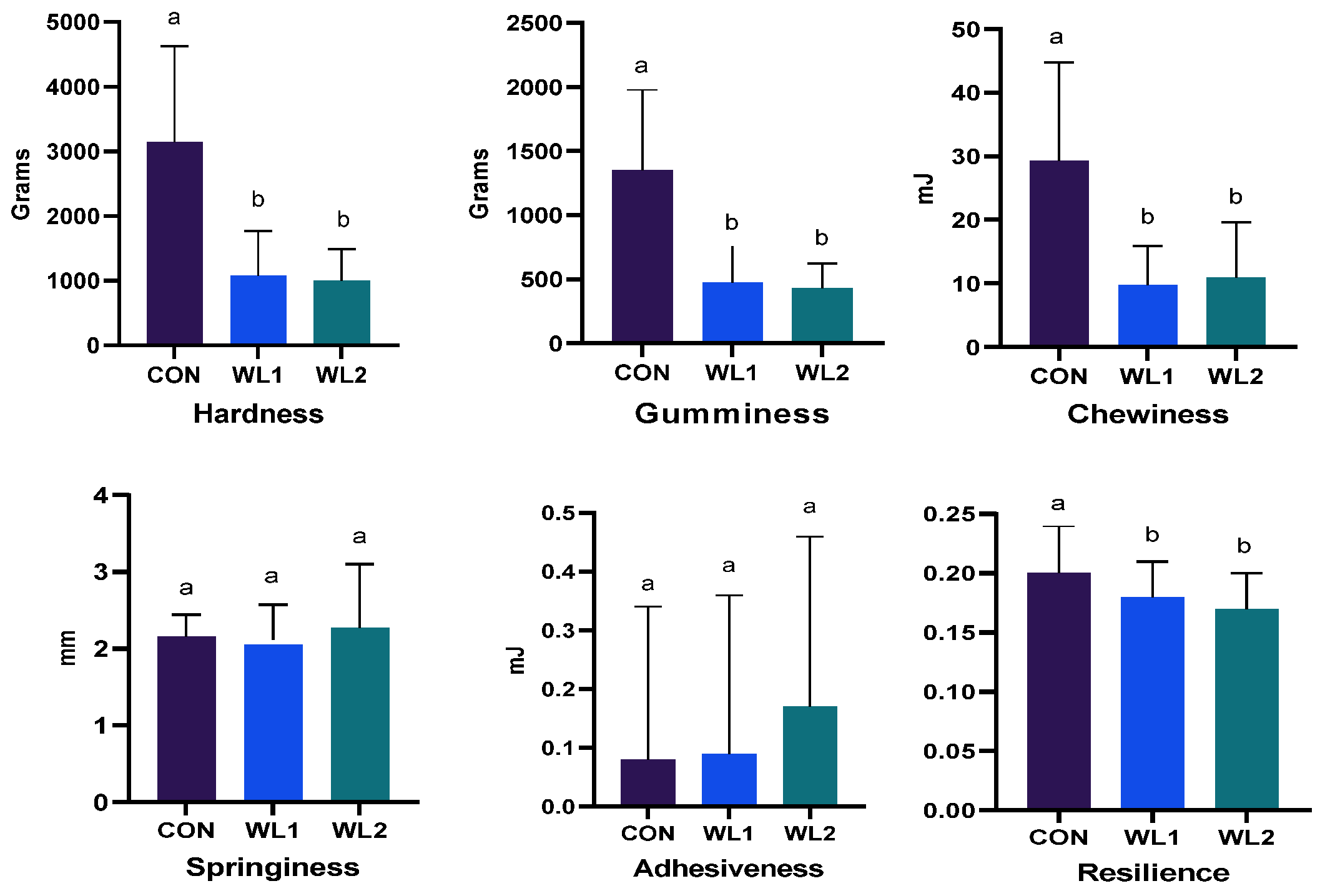

Table 1.
Ingredient and nutrient composition of experimental diets, as-fed basis.
| Composition (%) | Grower Period | ||
|---|---|---|---|
| CON | WL1 | WL2 | |
| Corn | 684.5 | 620.9 | 610.8 |
| Rice bran | 20.0 | 100.0 | 100.0 |
| Soybean meal, 45.6% CP | 125.0 | 90.0 | 60.0 |
| Sunflower meal, 34% CP | 100.0 | 70.0 | 60.0 |
| White lupin | - | 50.0 | 100.0 |
| Corn gluten meal, 60% CP | 10.0 | 10.0 | 10.0 |
| Vegetable oil | 15.0 | 15.0 | 15.0 |
| DL-Methionine, 99% Met | 0.7 | 0.9 | 1.0 |
| L-Lysine HCl, 78% Lys | 4.7 | 4.8 | 4.9 |
| Carbonate calcium | 16.5 | 17.5 | 17.3 |
| Monocalcium phosphate | 10.6 | 7.9 | 8.0 |
| Salt | 2.0 | 2.0 | 2.0 |
| Premix Choline, 50% | 1.0 | 1.0 | 1.0 |
| Vitamin-mineral premix*, no antibiotic | 10.0 | 10.0 | 10.0 |
| Calculated nutritional value (%) | |||
| ME, MJ/kg** | 13.07 | 13.02 | 13.05 |
| Crude protein | 16.87 | 16.83 | 16.85 |
| Lysine | 1.06 | 1.06 | 1.06 |
| Methionine + cystine | 0.64 | 0.64 | 0.64 |
| Calcium | 0.90 | 0.90 | 0.90 |
| Total Phosphorus | 0.65 | 0.66 | 0.65 |
| Analyzed nutritional value (%) | |||
| Dry matter | 89.32 | 89.55 | 89.23 |
| Crude protein | 17.95 | 17.90 | 17.93 |
| Ether extract | 3.90 | 4.15 | 4.30 |
| Crude fibre | 4.94 | 4.96 | 5.22 |
| Crude ash | 6.03 | 5.74 | 5.95 |
Dietary treatments: CON–soybean meal diet; WL1–5%, white lupin diet; WL2–10%, white lupin diet; *Vitamin-mineral premix provided per kg diet: 2500 IU vitamin A; 500 IU vitamin D3; 15 IU vitamin E; 1 mg vitamin K3; 1 mg vitamin B1; 3.2 mg vitamin B2; 15 mg vitamin B3; 7.2 mg vitamin B5; 2 mg vitamin B6; 0.04 mg vitamin B7; 0.4 mg vitamin B9; 0.01 mg vitamin B12; 12 mg Mn; 66 mg Fe; 12.5 mg Cu; 80 mg Zn; 0.15 mg I; 0.18 mg Se; 0.2 mg Co; 60 mg antioxidant; 0.2 g Axtra PHY 5,000 L (1,000 FTU). **ME, Metabolizable energy calculated from the specified raw nutrient content.
Table 2.
Ingredient and nutrient composition of experimental diets, as-fed basis.
| Composition (%) | Finisher Period | ||
|---|---|---|---|
| CON | WL1 | WL2 | |
| Corn | 569.9 | 549.6 | 586.3 |
| Wheat | 167.0 | 177.0 | 120.0 |
| Soybean meal, 45.6% CP | 160.0 | 110.0 | 60.0 |
| Sunflower meal, 34% CP | 60.0 | 50.0 | 50.0 |
| White lupin | - | 70.0 | 140.0 |
| DL-Methionine, 99% Met | 0.4 | 0.6 | 0.7 |
| L-Lysine HCl, 78% Lys | 3.0 | 3.3 | 3.6 |
| Carbonate calcium | 14.4 | 14.2 | 13.9 |
| Monocalcium phosphate | 9.3 | 9.3 | 9.5 |
| Salt | 4.0 | 4.0 | 4.0 |
| Premix Choline, 50% | 2.0 | 2.0 | 2.0 |
| Vitamin-mineral premix*, no antibiotic | 10.0 | 10.0 | 10.0 |
| Calculated nutritional value (%) | |||
| ME, MJ/kg** | 13.00 | 13.00 | 12.98 |
| Crude protein | 15.87 | 15.85 | 15.87 |
| Lysine | 0.97 | 0.97 | 0.97 |
| Methionine + cystine | 0.60 | 0.60 | 0.60 |
| Calcium | 0.80 | 0.80 | 0.80 |
| Total Phosphorus | 0.60 | 0.60 | 0.59 |
| Analysed nutritional value (%) | |||
| Dry matter | 89.33 | 89.27 | 89.05 |
| Crude protein | 15.98 | 15.93 | 15.85 |
| Ether extract | 3.58 | 3.77 | 4.06 |
| Crude fibre | 4.50 | 4.70 | 5.30 |
| Crude ash | 5.20 | 5.41 | 5.46 |
Dietary treatments: CON–soybean meal diet; WL1–7%, white lupin diet; WL2–14%, white lupin diet; *Vitamin-mineral premix provided per kg diet: 2500 IU vitamin A; 500 IU vitamin D3; 15 IU vitamin E; 1 mg vitamin K3; 1 mg vitamin B1; 3.2 mg vitamin B2; 15 mg vitamin B3; 7.2 mg vitamin B5; 2 mg vitamin B6; 0.04 mg vitamin B7; 0.4 mg vitamin B9; 0.01 mg vitamin B12; 12 mg Mn; 66 mg Fe; 12.5 mg Cu; 80 mg Zn; 0.15 mg I; 0.18 mg Se; 0.2 mg Co; 60 mg antioxidant; 0.2 g Axtra PHY 5,000 L (1,000 FTU). **ME, Metabolizable energy calculated from the specified raw nutrient content.
Table 3.
Chemical composition and fatty acid profile of white lupin seeds.
| Item (%) |
Lupinus albus L., Mihai Variety |
|---|---|
| Dry matter | 89.77 |
| Crude protein | 36.19 |
| Ether extract | 8.08 |
| Crude fibre | 14.64 |
| Ash | 3.47 |
| NFE | 26.39 |
| NDF | 22.76 |
| ADF | 15.97 |
| ADL | 3.77 |
| Cellulose | 12.20 |
| Hemicelluloses | 6.79 |
| Calcium | 0.32 |
| Phosphorus | 0.49 |
| Antinutrients | |
| Phytic acid, mg/100 g | 0.64 |
| Free Phosphorous, g/100 g | 0.12 |
| Fatty acids (g FAME/100 g total FAME) | |
| Lauric (C12:0) | 0.09 |
| Myristic (C14:0) | 0.29 |
| Palmitic (C16:0) | 10.52 |
| Stearic (C18:0) | 2.49 |
| Heneicosanoic (C21:0) | 0.74 |
| Total SFA | 14.13 |
| Pentadecanoic (C15:1) | 0.15 |
| Palmitoleic (C16:1) | 0.64 |
| Oleic (C18:1n-9) | 51.74 |
| Total MUFA | 52.53 |
| Linoleic (C18:2n-6) | 18.81 |
| α-linolenic (C18:3n-3) | 11.34 |
| Octadecatetraenoic (C18:3n-3) | 3.11 |
| Eicosadienoic (C18:3n-3) | 0.08 |
| Total PUFA | 33.34 |
| PUFA n-3 | 14.53 |
Abbreviation: n, number of samples used in quality analysis; NFE, nitrogen-free extract; NDF, neutral detergent fibre; ADF, acid detergent fibre; ADL, acid detergent lignin; SFA, saturated fatty acids; MUFA, monounsaturated fatty acids; PUFA, polyunsaturated fatty acids.
Table 4.
The pigs’ performance parameters.
| Item | Dietary Treatments | SEM | P-Value | ||||
|---|---|---|---|---|---|---|---|
| CON | WL1 | WL2 | |||||
| Grower period (30-60 kg) | |||||||
| IBW, kg | 30.30 | 30.32 | 30.35 | 0.10 | 0.981 | ||
| Final BW, kg | 61.17 | 59.50 | 59.42 | 0.30 | 0.090T | ||
| ADG, kg | 0.882 | 0.834 | 0.831 | 0.05 | 0.065 T | ||
| ADFI, kg | 2.06 | 1.93 | 1.84 | 0.05 | 0.151 | ||
| FCR, kg/kg | 2.34 | 2.30 | 2.22 | 0.09 | 0.747 | ||
| Finisher period (61-110 kg) | |||||||
| Final BW, kg | 106.62a | 99.10b | 94.65c | 1.14 | 0.039 | ||
| ADG, kg/day | 0.947a | 0.825b | 0.734b | 0.05 | 0.0001 | ||
| ADFI, kg | 3.18a | 3.07ab | 2.76b | 0.06 | 0.004 | ||
| FCR, kg/kg | 3.36b | 3.72a | 3.76a | 0.07 | 0.025 | ||
| Overall | |||||||
| ADG, kg | 0.920a | 0.829ab | 0.776bc | 0.04 | 0.051 | ||
| ADFI, kg/day | 2.71a | 2.59ab | 2.37b | 0.04 | 0.007 | ||
| FCR, kg/kg | 2.95 | 3.10 | 3.05 | 0.05 | 0.437 | ||
| Carcass yield, % | 72.56 | 71.73 | 71.47 | 0.56 | 0.096 | ||
Dietary treatments: CON, soybean meal diet; WL1, 5% white lupin seeds (grower phase, 30–60 kg BW) or 7% (finisher phase, 61–110 kg BW); WL2, 10% white lupin seeds (grower phase, 30–60 kg BW) or 14% (finisher phase, 61–110 kg BW). Abbreviation: IBW, initial body weight; ADG, average daily gain; ADFI, average daily feed intake; FCR, feed conversion ratio; SEM, standard error of the mean; a-cMeans in the same row without the same superscript differ significantly (P ≤ 0.05).
Table 5.
Blood plasma biochemical profile1 of pigs.
| Item | Parameters | Dietary Treatments | SEM | P-Value | ||
|---|---|---|---|---|---|---|
| CON | WL1 | WL2 | ||||
|
Energy profile |
GLU, mg/ dL | 110.17 | 109.00 | 112.25 | 0.14 | 0.124 |
| TG, mg/ dL | 59.50 | 56.50 | 55.00 | 2.19 | 0.116 | |
| TCH, mg/ dL | 99.00 | 90.00 | 101.25 | 1.22 | 0.168 | |
| HDL-C, mg/ dL | 59.00 | 61.00 | 63.00 | 1.12 | 0.434 | |
| LDL-C, mg/ dL | 58.87 | 58.57 | 58.54 | 1.10 | 0.352 | |
|
Protein profile |
TP, g/ dL | 4.27 | 4.55 | 4.10 | 0.11 | 0.668 |
| ALB, g/ dL | 2.30 | 2.50 | 2.73 | 0.04 | 0.168 | |
| BIL, mg/ dL | 0.22 | 0.20 | 0.20 | 0.01 | 0.239 | |
| BUN, mg/ dL | 11.50 | 12.00 | 12.00 | 0.32 | 0.421 | |
| UA, mg/ dL | 0.42 | 0.35 | 0.40 | 0.01 | 0.232 | |
| CRE, mg/ dL | 1.27 | 1.25 | 1.45 | 0.05 | 0.158 | |
|
Mineral profile |
Ca, mg/ dL | 11.23 | 11.25 | 11.58 | 0.24 | 0.121 |
| Mg, mg/ dL | 1.77 | 1.80 | 1.75 | 0.07 | 0.178 | |
| IP, mg/ dL | 8.27 | 7.30 | 7.38 | 0.16 | 0.230 | |
|
Enzymatic profile |
ALT, U/L | 47.50 | 45.00 | 44.50 | 2.10 | 0.322 |
| AST, U/L | 31.83 | 29.50 | 28.95 | 2.22 | 0.449 | |
| ALP, U/L | 133.51 | 130.12 | 129.10 | 1.55 | 0.202 | |
| CK, UI/L | 325.00 | 328.00 | 326.01 | 2.20 | 0.429 | |
| LDH, UI/L | 520.10 | 527.33 | 524.00 | 3.05 | 0.115 | |
| GGT, UI/L | 39.50 | 40.30 | 38.55 | 1.22 | 0.658 | |
1Means of 6 samples/group. Dietary treatments: CON, soybean meal diet; WL1, 5% white lupin seeds meal (grower phase, 30–60 kg BW) or 7% (finisher phase, 61–110 kg BW); WL2, 10% white lupin seeds meal (grower phase, 30–60 kg BW) or 14% (finisher phase, 61–110 kg BW). Abbreviation: GLU, glucose; TG, triglycerides; TCH, total cholesterol; HDL-C, high density lipoprotein-cholesterol; LDL-C, low density lipoprotein-cholesterol; TP, total protein; ALB, albumin; BIL, bilirubin; BUN, blood urea nitrogen; UA, uric acid; CRE, creatinine; Ca, calcium; Mg, magnesium; I, P inorganic phosphorus; ALT, alanine aminotransferase; AST, aspartate aminotransferase; ALP, alkaline phosphatase; CK, creatine kinase; LDH, lactate dehydrogenase; GGT, gamma-glutamyl transferase. SEM, standard error of the means.
Table 6.
Quality of Longissimus dorsi muscle1 of pigs.
| Parameters | Dietary Treatments | SEM | P-Value | ||
|---|---|---|---|---|---|
| CON | WL1 | WL2 | |||
| Physical traits | |||||
| Color components in the CIE scale: | |||||
| L* | 61.35 | 59.82 | 59.61 | 0.61 | 0.462 |
| a* | 10.48c | 12.29b | 13.23a | 0.20 | 0.0001 |
| b* | 7.67 | 7.42 | 7.53 | 0.13 | 0.563 |
| pH24 | 5.64 | 5.65 | 5.62 | 0.07 | 0.659 |
| Drip loss, % | 3.96 | 3.87 | 3.84 | 0.12 | 0.092 |
| Chemical composition | |||||
| Moisture, % | 74.52 | 72.93 | 73.03 | 0.12 | 0.0001 |
| Protein, % | 22.03 | 22.33 | 21.79 | 0.14 | 0.292 |
| Fat, % | 2.60 | 3.99 | 4.66 | 0.19 | 0.001 |
| Collagen, % | 0.83c | 0.92b | 0.97a | 0.01 | 0.0001 |
1Means of 6 samples/group. Dietary treatments: CON, soybean meal diet; WL1, 5% white lupin seeds (grower phase, 30–60 kg BW) or 7% (finisher phase, 61–110 kg BW); WL2, 10.0% white lupin seeds meal (grower phase, 30–60 kg BW) or 14% (finisher phase, 61–110 kg BW. Abbreviation: pH24, pH 24 h after slaughter; L*, lightness; a*, redness; b*, yellowness; SEM, standard error of the mean; a-c Means in the same row without the same superscript differ significantly (P < 0.05).
Table 7.
Fatty acid composition from Longissimus dorsi muscle1 of pigs.
| Fatty Acid (g/100 g Total FAME) |
Formula | Dietary Treatments | SEM | P-Value | ||
|---|---|---|---|---|---|---|
| CON | WL1 | WL2 | ||||
| Myristic | C14:0 | 1.32a | 1.00b | 1.44c | 0.07 | 0.008 |
| Palmitic | C16:0 | 23.72 | 23.41 | 24.72 | 0.27 | 0.103 |
| Palmitoleic | C16:1 | 2.81 | 3.26 | 3.24 | 0.10 | 0.131 |
| Stearic | C18:0 | 13.24 | 12.31 | 12.66 | 0.22 | 0.222 |
| Oleic | C18:1n-9 | 41.76a | 41.12b | 38.71c | 0.52 | 0.008 |
| Linoleic | C18:2n-6 | 9.98 | 10.73 | 11.12 | 0.25 | 0.170 |
| Linoleic conjugate | C18:2 | 0.24 | 0.25 | 0.27 | 0.01 | 0.627 |
| α-Linolenic | C18:3n-3 | 0.27 | 0.30 | 0.29 | 0.01 | 0.490 |
| Eicosadienoic | C20:2n-6 | 0.26 | 0.25 | 0.37 | 0.02 | 0.257 |
| Eicosatetraenoic | C20:4n-6 | 1.66 | 2.01 | 1.67 | 0.13 | 0.507 |
| Eicosapentaenoic | C20:5n-3 | 0.02a | 0.05ab | 0.10c | 0.01 | 0.014 |
| Nervonic | C24:1n-9 | 0.35 | 0.39 | 0.32 | 0.01 | 0.263 |
| Docosadienoic | C22:2n-6 | 0.06a | 0.06ab | 0.14c | 0.01 | 0.004 |
| Docosatetraenoic | C22:4n-6 | 0.06 | 0.09 | 0.07 | 0.03 | 0.279 |
| Docosahexaenoic | C22:6n-3 | 0.10 | 0.14 | 0.10 | 0.01 | 0.287 |
| Other FA | 0.90 | 0.65 | 0.62 | 0.65 | 0.150 | |
| SFA | 39.11 | 37.93 | 39.97 | 0.44 | 0.163 | |
| MUFA | 45.58a | 45.68ab | 43.38c | 0.44 | 0.018 | |
| PUFA | 14.41 | 15.74 | 16.03 | 0.42 | 0.278 | |
| PUFA/ SFA ratio | 0.37 | 0.42 | 0.40 | 0.01 | 0.401 | |
| n-6 PUFA | 14.16 | 15.49 | 15.76 | 0.42 | 0.277 | |
| n-3 PUFA | 1.56b | 1.71a | 1.76a | 0.08 | 0.045 | |
| n-6/ n-3 PUFA ratio | 9.14 | 9.13 | 9.08 | 0.24 | 0.595 | |
| AI | 0.48 | 0.46 | 0.51 | 0.01 | 0.172 | |
| TI | 0.012 | 0.011 | 0.012 | 0.001 | 0.196 | |
1Means of 6 samples/group. Dietary treatments: CON, soybean meal diet; WL1, 5% white lupin seeds (grower phase, 30–60 kg BW) or 7% (finisher phase, 61–110 kg BW); WL2, 10.0% white lupin seeds meal (grower phase, 30–60 kg BW) or 14% (finisher phase, 61–110 kg BW). Abbreviation: FAME, fatty acids methyl ester; SFA, saturated fatty acids; MUFA, monounsaturated fatty acids; UFA, unsaturated fatty acids; PUFA, polyunsaturated fatty acids; AI = atherogenic index; TI = thrombogenic index. SEM, standard error of means. a,b,c Means in the same row without the same superscript differ significantly (P < 0.05).
Disclaimer/Publisher’s Note: The statements, opinions and data contained in all publications are solely those of the individual author(s) and contributor(s) and not of MDPI and/or the editor(s). MDPI and/or the editor(s) disclaim responsibility for any injury to people or property resulting from any ideas, methods, instructions or products referred to in the content. |
© 2025 by the authors. Licensee MDPI, Basel, Switzerland. This article is an open access article distributed under the terms and conditions of the Creative Commons Attribution (CC BY) license (http://creativecommons.org/licenses/by/4.0/).
Copyright: This open access article is published under a Creative Commons CC BY 4.0 license, which permit the free download, distribution, and reuse, provided that the author and preprint are cited in any reuse.