

Submitted:
30 June 2025
Posted:
01 July 2025
You are already at the latest version
Abstract
The Fusarium genus includes some of the most economically and ecologically impactful fungal pathogens affecting global agriculture and human health. Over the past 15 years, rapid advances in molecular biology, genomics, and diagnostic technologies have re-shaped our understanding of Fusarium taxonomy, host-pathogen dynamics, mycotoxin biosynthesis, and disease management. This review synthesizes key developments in these areas, focusing on agriculturally important Fusarium species complexes such as the Fusarium oxysporum species complex (FOSC), Fusarium graminearum species complex (FGSC), and a discussion on emerging lineages such as Neocosmospora. We explore recent shifts in species delimitation, functional genomics, and the molecular architecture of pathogenicity. In addition, we examine the global burden of Fusarium-induced myco-toxins by examining their prevalence in three of the world’s most widely consumed staple crops: maize, wheat, and rice. Last, we also evaluate contemporary management strategies, including molecular diagnostics, host resistance, and integrated disease con-trol, positioning this review as a roadmap for future research and practical solutions in Fusarium-related disease and mycotoxin management.
Keywords:
Fusarium
; species complex
; host specificity
; mycotoxins
; functional genomics
; disease management
; phylogenomics
; wilting
; root rot
1. Fusarium: A Genus of Global Agricultural and Phytopathological Significance
Fusarium is a cosmopolitan genus of Ascomycota (class Sordariomycetes, order Hypocreales, family Nectriaceae), characterized by high species diversity and considerable economic impact across global agriculture [1] comprising over 400 phylogenetically distinct species, many of which form species complexes with overlapping ecological and pathogenic roles [2]. These species are organized into at least 22 species complexes, with additional monotypic lineages identified through molecular phylogenetic analyses [3]. This genus comprises saprophytic, endophytic, and pathogenic species responsible for a range of plant diseases, including vascular wilts, root rots, and head blights [4]. Fusarium spp. infects a broad range of hosts, including cereals, legumes, and horticultural crops, and are frequently implicated in postharvest decay [5,6,7,8]. Fusarium graminearum and F. oxysporum are consistently ranked among the top ten fungal pathogens of plants globally due to their host range, virulence, and economic impact [9]. Many Fusarium species are also known to produce fusariotoxins, which include secondary metabolites such as trichothecenes, fumonisins, and zearalenone. These compounds can cause toxic effects in humans and animals upon consumption of contaminated grains [10].
Fusarium-induced symptoms are highly variable and often non-specific, limiting the reliability of visual diagnosis. Symptomatology includes wilting, vascular discoloration, chlorosis, and rots affecting the root, crown, stem or seed, with variation depending on host and Fusarium species [8,11,12,13]. Symptoms overlap with other seed- and soilborne pathogens, or abiotic stressors, further complicates field-level diagnosis. While pathogen isolation and culturing remain foundational, morphological differentiation is hampered by shared features such as colony pigmentation, conidial morphology, and growth rate. Moreover, species within the F. oxysporum species complex (FOSC) or the F. solani species complex (FSSC) may show minimal morphological differences while displaying significant variation in pathogenicity and host range [14,4]. Consequently, molecular techniques, including species-specific PCR assays, sequencing of conserved genomic regions, and whole-genome comparisons, have become essential tools for accurate identification and classification of Fusarium species in diagnostic and research settings [15].
The taxonomy of Fusarium remains dynamic, driven by the ongoing discovery of novel taxa and reevaluation of existing lineages through molecular approaches [2]. Recent tools such as FusaHelp have augmented traditional morphological identification by providing web-based platforms for rapid species comparison [16]. Regardless of morphological features, Infantino et al. [16] pointed out that F. equiseti and F. compactum exhibit very similar morphological characteristics when cultured on artificial media, highlighting that molecular markers are crucial for the accurate identification of these microorganisms. Multilocus phylogenetics, DNA barcoding, and genome-scale approaches have redefined Fusarium systematics, enabling higher-resolution species delimitation [17]. As of this writing, the number of phylogenetically supported Fusarium species continues to rise, and with it, the complexity of species recognition and nomenclature.
Anthropogenic drivers such as climate change, international trade, and intensive monoculture are expected to exacerbate the spread and impact of Fusarium diseases [18]. Given recent advancements in taxonomy, diagnostics, and functional genomics, an updated synthesis is warranted to contextualize emerging patterns and inform research priorities. This review integrates developments across five key domains: (1) taxonomy and phylogenetics, (2) genomic and functional analyses, (3) host-pathogen interactions, (4) mycotoxin biosynthesis and toxicology, and (5) disease management. The goal is to offer an interdisciplinary framework for understanding Fusarium biology and guiding future directions in research and management.
2. Taxonomy and Phylogenetics of Fusarium Species
The classification of Fusarium has undergone a profound transformation, shifting from traditional morphology-based taxonomy to advanced molecular approaches, including multilocus sequencing and genome-wide analyses. This evolution has been instrumental in recognizing the complexity of species groups, such as FOSC, Fusarium fujikuroi species complex (FFSC), FGSC, and, Fusarium incarnatum-equiseti species complex (FIESC), which play significant roles in agriculture and plant pathology. The taxonomic debate surrounding Neocosmospora has further reshaped perspectives, raising questions about whether its reclassification reflects a broader genus redefinition. Additionally, newly emerging Fusarium species are gaining attention due to their increasing impact on niche crops in diverse geographic regions. Recent phylogenetic insights drawn from whole-genome datasets continue to refine our understanding of species boundaries, host specificity, and evolutionary trajectories, underscoring the relevance of molecular tools in fungal systematics.
2.1. From Morphology to Genomics: Evolution of Fusarium Classification
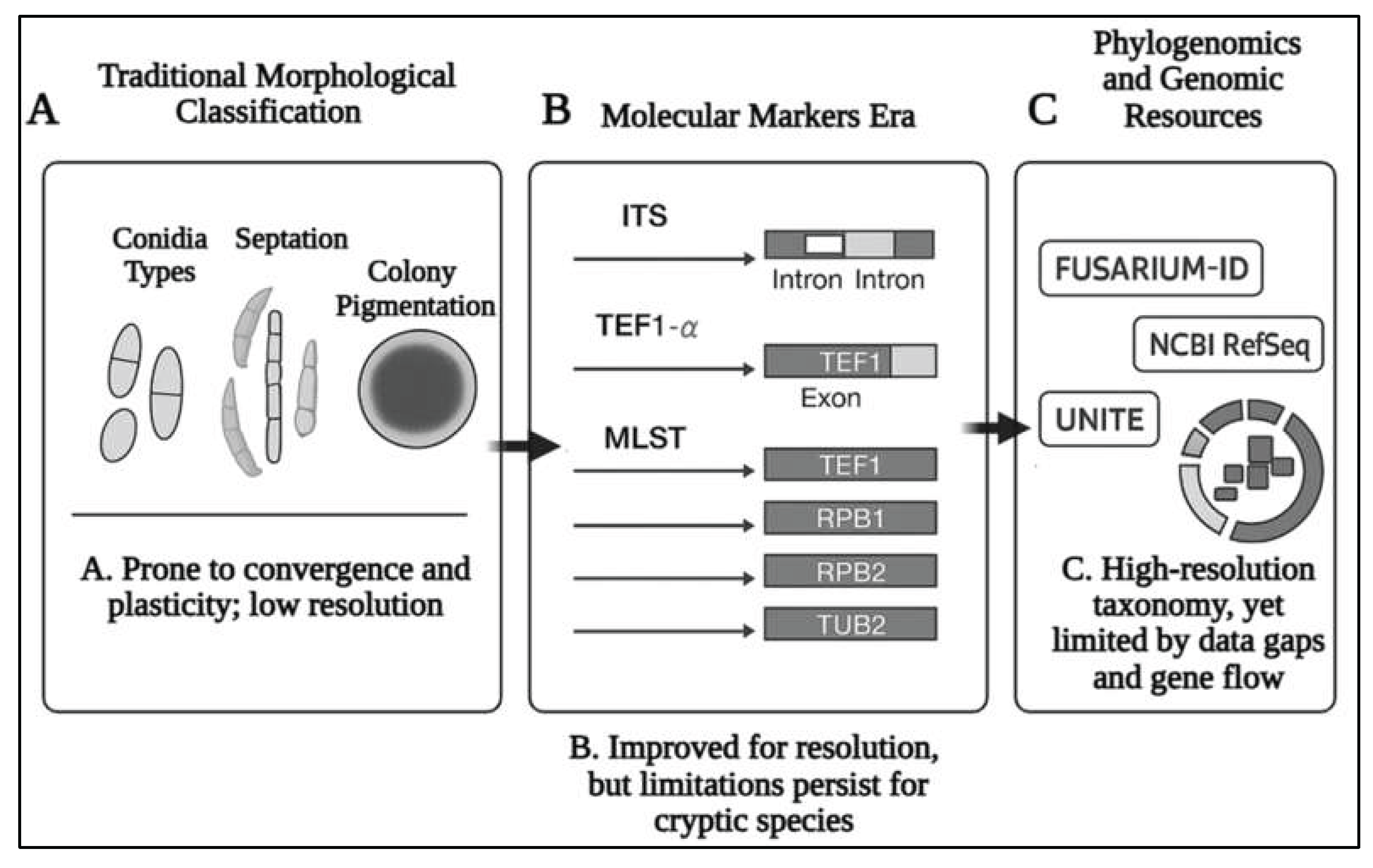
The taxonomy of Fusarium has undergone significant transformation over the past century, transitioning from traditional morphological classification to a multifaceted taxonomic framework incorporating molecular techniques, reflecting the increasing need for accurate pathogen identification in agricultural and ecological settings. Initially, species identification relied heavily on morphological characteristics based on observable phenotypic traits, such as conidial shape, septation, and pigmentation, as detailed in the foundational works of Buxton [19], Snyder & Hansen ([20], and Booth [21]. However, these phenotypic traits often exhibited plasticity and convergence, leading to misidentifications and taxonomic ambiguities, particularly in delineating species within this genetically and ecologically diverse genus. Fusarium taxonomy has undergone multiple revisions to address these challenges, moving from traditional classification based on morphological traits to DNA sequence-based approaches. Multilocus sequence typing (MLST) using genes such as translation elongation factor 1-alpha (TEF1-α), RNA polymerase II subunits (RPB1 and RPB2), and β-tubulin (TUB2) has enhanced species resolution and facilitated the recognition of cryptic species complexes [22]. Despite these advances, challenges persist due to cryptic species and morphological plasticity, as well as frequent horizontal gene transfer and hybridization events that blur species boundaries [23]. Recent genome-wide phylogenomic approaches have provided deeper insights into the evolutionary relationships within the genus Fusarium, offering a more robust framework for species delimitation and understanding of pathogenicity [24].
The adoption of molecular tools has significantly improved the resolution of Fusarium species. The internal transcribed spacer (ITS) region was the first molecular marker widely used in fungal systematics. However, it has limited resolution at the species level for Fusarium, particularly due to its conserved nature among closely related taxa and the presence of paralogous copies complicating alignment and interpretation [25]. Studies have demonstrated that while the ITS region provides useful information for taxonomic classification, analyses of the ITS region in Fusarium species have shown it to be phylogenetically uninformative in some cases, resulting in misleading taxonomic assignments [26,27]. TEF1-α became the second major marker, providing greater resolution, yet still falling short when used in isolation. Although ITS and TEF1-α remain widely used markers for Fusarium species identification and phylogenetic analysis, their resolution is often insufficient for distinguishing closely related or cryptic species due to the genus's high evolutionary complexity [28,29]. Also, many studies rely solely on traditional loci such as ITS and TEF1-α for the identification of Fusarium species, especially within species complexes [30]. This has led to recommendations for incorporating additional markers, such as RPB2 in molecular studies to achieve higher levels of precision in species identification [31]. Indeed, the combination of multiple genetic markers has been shown to significantly enhance the resolution of Fusarium phylogenetics, allowing for better discrimination among species and improving our understanding of their ecological and pathogenic roles [32].
Future research should adopt MLST and genome-scale data to enhance taxonomic resolution and accurately capture pathogenic and ecological diversity across Fusarium lineages [33,34]. To address these challenges, additional multilocus sequencing, typically using markers such as RPB1 and RPB2 and TUB2 has become a standard approach for delimiting species boundaries in the Fusarium genus [35]. For instance, phylogenetic analyses of RPB1 and RPB2 have resolved species within several complexes and supported the monophyly of Fusarium [36]. TUB2 has enhanced species delimitation in the Fusarium genus by providing additional phylogenetic resolution, particularly when ITS, TEF1-α, and RPB1/2 fail to discriminate closely related or cryptic taxa. Its sequence variability complements other loci in multilocus analyses, supporting more robust species boundaries, especially in complexes like F. fujikuroi and F. sambucinum [37,38]. However, challenges remain, including occasional gene tree discordance, amplification difficulties, and limited reference coverage, underscoring the need for standardized multilocus or genome-scale approaches. Frameworks such as Phylogenetic Species Recognition (PSR) and Genealogical Concordance Phylogenetic Species Recognition (GCPSR) have proven particularly effective in resolving cryptic species within major groups like FOSC and FSSC [39,40].
Recent advancements in next-generation sequencing (NGS) and phylogenomics have refined our understanding of Fusarium evolution. Phylogenomic analyses utilizing hundreds to thousands of single-copy orthologous genes have clarified deep phylogenetic relationships and confirmed the monophyly of the genus [41]. These studies have also highlighted genome dynamics, such as gene duplications and horizontal gene transfers, that contribute to the adaptability and pathogenicity of Fusarium species. For example, horizontal gene transfer has been linked to the emergence of host-specific lineages during successive outbreaks of coffee wilt disease [42]. However, despite these advances, species delimitation remains challenging due to incomplete lineage sorting, interspecific gene flow, and the limited availability of type material and genome-scale data for many underexplored taxa, particularly those associated with wild hosts or remote ecological regions [43]. Phylogenomic studies emphasize the necessity of employing comprehensive genetic datasets to capture the diversity within Fusarium. For instance, studies have demonstrated that the genus encompasses over 400 phylogenetically distinct species grouped into numerous complexes, such as FOSC and FSSC [29,44]. The development of curated, publicly accessible genomic repositories and barcoding databases such as FUSARIUM-ID, Fusarioid-ID, and UNITE has been instrumental in improving species resolution, facilitating accurate diagnostics, and promoting taxonomic consistency across research communities [45]. Many Fusarium species, particularly those from underexplored habitats or non-cultivated hosts, lack representation in reference databases, limiting the utility of barcoding tools for comprehensive identification. Additionally, discrepancies in marker choice, inconsistent taxonomic frameworks, and variable data quality across repositories can lead to misidentifications or conflicting results. Integrating multilocus and genome-scale data into these platforms, along with community-driven curation and type-material anchoring, will be essential for ensuring taxonomic reliability and expanding coverage of the full phylogenetic and ecological diversity within the Fusarium and Fusarioid clades.
Figure 1.
The Evolution of Fusarium Taxonomy: A comparative timeline of morphological, molecular, and genomic approaches to species delimitation. Each phase highlights advances in species resolution alongside persisting challenges such as cryptic diversity and horizontal gene transfer.
Figure 1.
The Evolution of Fusarium Taxonomy: A comparative timeline of morphological, molecular, and genomic approaches to species delimitation. Each phase highlights advances in species resolution alongside persisting challenges such as cryptic diversity and horizontal gene transfer.
2.2. Rise and Relevance of Fusarium Species Complexes: Evolutionary Divergence, Taxonomic Challenges, Intraspecific Variability and Pathogenic Implications
The rise of species complexes represents a significant aspect of evolutionary biology and taxonomy, particularly regarding the genus Fusarium, which exemplifies the complexities caused by ecological variations and genetic divergence [22,46]. A species complex refers to a group of closely related species that are morphologically similar but genetically distinct, resulting in challenges in identification and treatment, particularly in agriculture. These species complexes have surfaced as significant entities in the taxonomy of Fusarium [47]. Fusarium fujikuroi (FFSC), FGSC, Fusarium incarnatum-equiseti (FIESC),FOSC, FSSC, and Fusarium tricinctum (FTSC), species complexes are prominent examples, with each complex highlighting unique ecological niches and pathogenic potential [48]. Molecular systematics has revealed that many named species are in fact species of complex groups of genetically distinct but morphologically indistinguishable taxa, which has revolutionized our understanding of Fusarium evolution and pathogenicity [49].
These Fusarium species complexes vary in host specificity, pathogenicity, and toxin production [49]. The morphological overlap among Fusarium species from different complexes frequently leads to misidentification and complicates disease diagnosis in crops like maize, tomato, rice, and cereals [50,51] (Figure 2). For instance, vascular wilt symptoms in tomato can be caused by both F. oxysporum and F. solani (wilting occurring in rare instances as a secondary symptom), while maize stalk rot may be attributed to F. verticillioides (FFSC) or co-occurring F. solani strains [52,53] and has accelerated the shift toward multilocus sequence typing and genome-informed phylogenetics as standard practice. Emerging research reveals that species within the Fusarium complex also exhibit extensive genetic and phenotypic variation in plant hosts, which plays a critical role in their virulence, host range, and evasion of plant defense responses [54,55,56]. For example, members of FOSC can display varying degrees of aggressiveness and host specificity, often mediated by lineage-specific chromosomes encoding effector proteins that suppress plant immunity [57]. Similarly, strains within FSSC have demonstrated the ability to colonize diverse plant tissues, aided by enzymes that degrade cell walls and subvert plant signaling pathways [14,58]. These adaptive mechanisms not only facilitate cross-species infection but also complicate disease management strategies, emphasizing the ecological and agricultural significance of Fusarium diversity and its evolutionary capacity to overcome plant defenses.
Moreover, taxonomic classification has undergone significant refinement within the Fusarium genus, particularly concerning species complexes that challenge traditional morphological and pathogenicity-based frameworks. A prime example is FSSC, where historical use of the forma specialis designation, such as in F. solani f. sp. pisi has proven inadequate for reflecting phylogenetic diversity and host range specificity [59]. Molecular phylogenetics, especially MLST and whole-genome analyses, have revealed that what was once considered a single species based on pathogenic behavior encompasses numerous cryptic taxa with distinct evolutionary lineages and ecological adaptations [60,22], particularly given the agricultural relevance of FSSC members [61]. In addition to interspecific divergence, intraspecific variability, such as the occurrence of physiological races within formae specialis, adds further complexity. For example, F. oxysporum f. sp. lycopersici comprises three main races (1, 2, and 3), each defined by its ability to overcome specific tomato resistance genes [62]. A study from Baja California, Mexico, identified multiple races co-occurring within tomato fields, underscoring the ongoing diversification and adaptation of this pathogen under selective host pressure. Similarly, F. oxysporum f. sp. melonis, affecting cucurbits, exhibits a well-defined race structure in Italy, where isolates belonging to races 1 and 2 were found to differ significantly in pathogenicity and genetic makeup, revealing strong geographic and host-specific adaptation [64]. These race dynamics reflect host-pathogen coevolution and present major challenges for resistance breeding, epidemiological surveillance, and effective disease control. Recent studies emphasize the necessity of abandoning the formae specialis nomenclature in favor of phylogenetically informed classifications, which not only improve species resolution but also enhance our understanding of host-pathogen interactions and cross-kingdom pathogenicity [61,59]. Integrative taxonomy combining morphological traits, pathogenicity assays, and genomic data is now indispensable for accurate Fusarium species identification. The study of species complexes is further underscored by broader implications in ecology and evolutionary biology. Alterations in species distributions, as witnessed in invasive organisms, indicate niche shifts due to environmental changes, which also applies to Fusarium species and native species adapting to new ecological contexts. This dynamic illustrates how ecological pressures influence species complex evolution [65,49]. The understanding of these processes not only informs taxonomy but also aids in conservation efforts by delineating species that might otherwise be overlooked, especially in environments facing multiple stressors. In summary, the rise of species complexes such as those represented by the genus Fusarium emphasizes the complex interplay of genetics, ecology, evolutionary processes, and recognizing ecological roles and resistance mechanisms are pivotal for advancing our understanding and management of these biologically significant groups.
2.3. The Neocosmospora Debate: Taxonomy Reshuffled, or Genus Redefined?
The taxonomic classification of FSSC remains a subject of considerable debate in agricultural mycology, particularly concerning its proposed reclassification into the genus Neocosmospora. This shift has been advocated based on multilocus phylogenetic analyses, with proponents arguing that it reflects a more precise evolutionary understanding [43]. However, critics suggest that such a segregation could diminish diagnostic clarity and taxonomic stability, which are pivotal in managing Fusarium infections [66]. Phylogenetic studies using multilocus sequence data and genome-scale analyses have consistently demonstrated that members of the FSSC, including F. solani sensu stricto, form a distinct monophyletic clade that is evolutionarily divergent from the core Fusarium lineage [32]. In response, some taxonomists have proposed reclassifying these organisms under Neocosmospora, a move that seeks to align nomenclature with phylogenetic evidence [67]. However, in agricultural contexts, this proposed separation poses significant challenges. Neocosmospora solani, which includes strains formerly identified as F. solani, causing diseases in legumes, cucurbits, and solanaceous crops, is one of the most widely distributed and economically impactful plant pathogens worldwide [48]. Fusarium carries historical and regulatory significance, and abrupt taxonomic changes without broad community consensus can hinder communication and the practical application of agricultural research findings.
Moreover, the significance of FSSC in agriculture is substantial, as members of this complex are major pathogens responsible for diverse plant diseases across a wide range of economically important crops. The FSSC includes highly virulent strains that cause root rot, stem rot, and seedling blight, leading to considerable yield losses and affecting plant health in both field and greenhouse conditions [66]. The taxonomic complexity of the FSSC, compounded by its morphological similarity to other Fusarium species, poses challenges for accurate identification and effective disease management. Molecular typing has become essential to resolve these ambiguities and ensure precise diagnostics in phytopathological studies. Recent phylogenetic analyses support the segregation of certain FSSC members into the genus Neocosmospora, based on distinct genetic and morphological characteristics. However, this taxonomic revision remains controversial, particularly due to the long-standing agronomic relevance of the FSSC within the broader Fusarium genus and concerns over continuity in disease monitoring and control strategies [32,66].
Recent phylogenomic investigations have provided compelling evidence that FSSC shares a core evolutionary lineage with other major Fusarium clades, supporting its continued placement within the genus. Whole-genome analyses have revealed substantial genomic synteny and conserved orthologous gene content across FSSC and other Fusarium lineages, suggesting that FSSC members, including agriculturally significant pathogens of legumes and solanaceous crops, are not sufficiently divergent to justify generic separation [68]. These genomic similarities underscore a broader shift in fungal systematics toward phylogenomically informed classification schemes that prioritize shared evolutionary ancestry over ecological niche or morphological traits [69,70]. This unified taxonomic framework is particularly important in agricultural contexts, where precision in pathogen identification directly impacts disease surveillance, resistance breeding, and biosecurity strategies. For instance, the retention of FSSC in Fusarium facilitates the use of standardized molecular barcoding tools (e.g., TEF1-α and RPB2 loci) that underpin many diagnostic platforms in agricultural research and regulatory systems [71]. In summary, while phylogenomic evidence supports a move towards recognizing Neocosmospora as a distinct entity, the practical implications for diagnostics and the continuity of historical nomenclature raise critical questions about the stability and operational utility of such taxonomic changes. Additionally, whereas monophyly is necessary, it is not sufficient for genus-level classification [72] but rather an integrated approach combining morphology, ecology, biochemistry and phylogeny. The ongoing debate reflects broader issues within fungal systematics, where phylogenetic integrity must be balanced against practical considerations in agricultural settings.
2.4. Emerging Fusarium Pathogens in Niche Crops and Geographies
The landscape of Fusarium-related plant diseases is rapidly shifting, with both novel and previously known species emerging in unexpected host crops and regions, driven by ecological, agricultural, and climate dynamics (Table 1). Fusarium zanthoxyli was recently identified as the causal agent of stem canker in Zanthoxylum bungeanum (Sichuan pepper), a high-value spice crop widely cultivated in northern China [73,74]. This pathogen invades woody tissues, resulting in cankers, dieback, and often tree mortality, causing substantial yield and economic losses. Phylogenetic analyses position F. zanthoxyli within the newly defined Fusarium torreyae species complex (FTOSC), which also includes F. torreyae, a pathogen known to devastate Torreya taxifolia populations in North America [75]. Notably, the FTOSC represents a group of wood-adapted Fusarium pathogens that diverged significantly from typical herbaceous-host lineages. Comparative genomic studies estimate the divergence of F. zanthoxyli from other Fusarium species occurred between 17.2 and 27.5 million years ago and uncovered 137 lineage-specific effector proteins that likely contribute to host specificity and virulence in woody plants [76]. This molecular specialization underscores the evolutionary plasticity of Fusarium in colonizing novel ecological niches. Similar adaptability has been observed in well-known pathogens such as F. oxysporum f. sp. cubense Tropical Race 4 (Foc TR4), the causal agent of banana wilt, which has expanded rapidly from Southeast Asia to the Middle East, Africa, and most recently Latin America, threatening global banana production [77,78,79]. The emergence of F. zanthoxyli in perennial spice systems, alongside the re-emergence of virulent F. oxysporum strains in globally strategic crops like banana, highlights the urgency of targeted pathogen surveillance and the development of integrated, crop- and region-specific disease management strategies.
FIESC and FFSC, long associated with cereals, are now emerging in diverse agroecosystems, including medicinal herbs, horticultural crops, and legumes across Asia, Africa, and South America [80,81]. In China, Wang et al. [82] identified nine novel FIESC species from a variety of hosts, underscoring the taxonomic complexity and diagnostic challenges within this group. These species exhibited diverse virulence profiles and mycotoxin production capabilities, which complicate risk assessments in traditional and alternative cropping systems. In Brazil and other parts of South America, FIESC members have been implicated in diseases of rice and soybean, with some isolates producing significant levels of zearalenone and deoxynivalenol [83,84,85]. Similar trends are emerging in African countries, where FIESC strains have been isolated from legumes and horticultural crops, raising concerns over regional food safety and market access. These developments stress the need for region-specific diagnostic tools and comprehensive toxigenic profiling to inform appropriate disease control strategies.
FTSC is also gaining prominence as a pathogen group affecting niche and high-value crops. Members such as F. acuminatum, F. avenaceum, and F. tricinctum have been increasingly reported from soybean [86], medicinal herbs [87,89,38], cereals [90], and temperate fruits, including apples, strawberries, and raspberries, across Asia and Europe. F. avenaceum is particularly concerning due to its cross-pathogenic behavior; it has been linked to root rot in pulses and cereals [91] and raspberry [92]. Moreover, FTSC members are increasingly associated with storage rots in postharvest fruit systems, reducing shelf life and marketability. The frequent isolation of FTSC species from geographically and taxonomically diverse hosts suggests a broad ecological amplitude and underscores the importance of enhanced molecular diagnostics, regionally tailored management practices, and cross-border phytosanitary coordination. Collectively, these findings illustrate how emerging Fusarium pathogens are reshaping the disease landscape in non-cereal crops, with implications for food security, biodiversity, and international trade. Their rising prevalence is closely linked to agricultural intensification, climate variability, global seed exchange, and expanding monocultures. A proactive and globally coordinated response integrating pathogen genomics, surveillance, and crop-specific disease management is critical to mitigate the expanding threat of Fusarium in niche and non-traditional agroecosystems.
2.5. Phylogenomics of Fusarium: Insights from Whole-Genome Data
Whole genome sequencing (WGS) has dramatically revolutionized the understanding of evolutionary complexity in the Fusarium genus. Among the most remarkable features is the diversity of genome size and GC-content, particularly within the FFSC and the FIESC [95,46]. For example, species from FFSC present genome sizes varying from 39 to 56 Mb and strong heterogeneity in the GC content, indicating complex evolutionary story and lineage-specific genome plasticity [96,97]. Similarly, an assembly of F. equiseti genomes from multiple agroecosystems showed the presence of numerous variabilities in repetitive DNA and mobile elements, which probably leads to the genomic heterogeneity [98]. The genome of F. solani f. sp. melongenae with unique ankyrin-repeat proteins exhibited large-scale structural changes including inversions and rearrangements [99]. These changes in genome architecture could contribute to ecological specialization and host range broadening. This flexibility indicates that Fusarium species have developed separate genome architectures, which have allowed adaptation to selective pressures, which is supported by the observed genetic diversity and haplotype variation within Fusarium isolates. Yet understanding why this variability occurs is a key problem, since it requires understanding the pressures which exert their influence at the level of size and genome organization.
Comparison of core proteome also revealed a conservation profile among the Fusarium species; indicative of fundamental cellular processes and functions shared among species that reside in different members in the genus [32,100]. For instance, FGSCs encoding biosynthesis pathways of secondary metabolites that are important to these fungi for ecological fitness are observed to be conserved in various Fusarium species, suggesting the same evolutionary origin [101]. Nevertheless, an overall high degree of conservation in the core proteome in the genus is maintained, in which Fusarium spp. harbour a conserved core genome of hundreds of single gene orthologs shared within pathogenic and non-pathogenic strains, suggesting that it is evolutionarily stable [102,103]. These conserved proteins are often involved in basal cellular processes, including those of primary metabolism, DNA replication and translation. The conservation of these sequences renders them suitable targets for species specific identification and robust phylogenetic inference. Moreover, this evolutionary conservation provides a molecular framework for taxonomic stability, allowing for high-resolution phylogenomic trees that are representative of species relationships [104]. The problem is the reliable resolution of these crosstalk effects into conserved gene interaction networks with environmental variables and, especially, how these play a role in species divergence and adaptation [105, 106], which may be indispensable for implementation of standardized molecular barcoding sets and next-generation diagnostic tools for crop protection.
In contrast to the conserved core, the genomic structure in Fusarium is thus an example of functional diversification also for accessory chromosomes (ACs) which are of particular interest in the FOSC and FFSC where ACs are required for increased pathogenicity and specialization towards certain hosts by carrying genes that are responsible for these beneficial characteristics [107,108]. Functional differentiation is focused in the ACs, especially in the FOSC and FSSC. These ACs contain genes involved in host-pathogen interactions, including virulence effectors secreted in xylem proteins (SIX effectors) and specialized secondary metabolite clusters [56]. ACs have been reported to have extensive structural variation and can be often horizontally transferred among strains, providing a potential reservoir for transfer of pathogenic evolution [109,110]. Most Fusarium genomes have large accessory regions (i.e., gene-based regions present in only some strains of a species) that can significantly differ in content, reflecting their potential as contributors to host-specific interactions. It has also been demonstrated that these accessory elements can be gained or lost through horizontal gene transfer, adding complexity to clade-specific evolution of genes in Fusarium [107]. Phytopathogenic Fusarium species have been associated with host specificity jumps in pulse crops and some medicinal plants, and to a lesser extent in pathogens of xenobiotic degrading plant-pathogens [91,88]. Yet, the mechanisms by which accessory chromosomes shape pathogenicity and environmental response are still not fully understood. These findings highlight the plasticity of the Fusarium genome and its ability to colonize new environments.
A further insight that can be gleaned from genome-wide data is the extent of gene duplication in lineage-specific regions, which is commonly associated with host adaptation and the evolution of secondary metabolism. Similarly, gene duplications related to metabolic pathways that result in variation in metabolism (mycotoxins production) implies adaptive responses to environmental stresses or host interactions (87,105]. There is evidence that some duplications of individual gene clusters, but not class of gene clusters, such as the PKSs, NRPSs, and P450s, are associated with the ability of various Fusarium strains to produce specific mycotoxins or other types of secondary metabolites [111]. These genomic adaptations improve the fitness and competitive ability of the Fusarium species on unique hosts and subvert disease diagnostics and toxin surveillance. However, more work is needed to fully elucidate the long-term evolutionary dynamics of these gene duplications and the effects on pathogen virulence and resistance. Linking genetic adaptations with functional effects across different ecological circumstances is an ongoing challenge.
3. Genomic Insights and Functional Genomics: Exploring Recent Genomic Studies and Their Implications for Understanding Pathogenicity and Resistance Mechanisms
Recent advances in genomic research have deepened our understanding of Fusarium species, shedding light on their evolution, pathogenicity, and adaptive mechanisms. High-quality genome assemblies and annotations have revealed mobile pathogenicity chromosomes, emphasizing the role of horizontal gene transfer in shaping virulence traits. Comparative genomics has identified key genes implicated in infection processes, host adaptation, and secondary metabolism clusters that influence toxin production and environmental interactions. Functional genomics tools such as CRISPR/Cas9 and RNA-Seq continue to refine gene function studies, enabling precise manipulation of Fusarium genomes and facilitating investigations into molecular mechanisms governing fungal pathogenicity. Phylogenomic analyses provide critical insights into species relationships within Fusarium complexes, highlighting genetic diversity and evolutionary trajectories across different lineages. Together, these advances contribute to a more comprehensive framework for understanding Fusarium biology, with implications for disease management and agricultural sustainability.
3.1. Genomic Architecture of Fusarium spp.
Recent genome assemblies and annotations of various Fusarium species, such as F. graminearum, F. verticillioides, and F. oxysporum, have revealed complex genomic architectures comprising both core and accessory chromosomes [112]. Core chromosomes encode genes essential for basic cellular functions, while accessory chromosomes are enriched with genes involved in pathogenicity, environmental adaptation, and secondary metabolism. One of the most striking discoveries in F. oxysporum is the presence of mobile pathogenicity chromosomes, which confer host-specific virulence and can be horizontally transferred between strains (57). This process, known as Horizontal Chromosome Transfer (HCT), has been most extensively studied in F. oxysporum, but emerging evidence suggests that HCT may also occur in other Fusarium species, potentially contributing to the rapid evolution of pathogenic traits across the genus. Here are some examples and key findings related to HCT in different Fusarium species:
F. oxysporum: HCT has been extensively studied in F. oxysporum, particularly in relation to pathogenicity chromosomes encoding host-specific virulence factors. These transfers contribute to the emergence of new races/pathotypes and formae specialeswithin F. oxysporum. A prominent example is the SIX (Secreted In Xylem) gene family, located on these accessory chromosomes, which is involved in virulence and can be horizontally transferred [113]. Comparative genomics and pathogenicity phenotyping have been used to explore the role of HCT in the evolution of F. oxysporum f. sp. fragariae, the causative agent of Fusarium wilt in strawberries [114]. Isolates from four continents revealed two distinct pathogenicity syndromes: one characterized by chlorosis (yellows-fragariae) and the other by wilting (wilt-fragariae). Notably, all yellows-fragariae isolates carried a pathogenicity chromosome, chrY-frag, which was horizontally transferred at least four times. This chromosome was linked to virulence on specific cultivars and encoded predicted effectors that were significantly upregulated during infection. The absence of chrY-frag in wilt-fragariae isolates indicated that pathogenicity could evolve independently in different strains. Furthermore, interactions between F. oxysporum f. sp. apii race 4 and F. oxysporum f. sp. coriandri were also studied, showing that under conditions conducive to somatic compatibility or conidial anastomosis tube formation, F. oxysporum species can perform nuclear transfer and HCT, leading to the development of more virulent genotypes [115].
Beyond F. oxysporum, several other Fusarium species exhibit genomic traits suggestive of HCT involvement. In F. graminearum, there is emerging evidence that gene clusters involved in secondary metabolite production, such as those for trichothecene biosynthesis (e.g., deoxynivalenol, DON), may have been horizontally transferred between F. graminearum and related species. Such transfers could enhance pathogenicity and adaptability to cereal crops, although more definitive evidence is still needed [112]. In F. verticillioides, the causal agent of ear rot in maize, variability in fumonisin biosynthetic gene clusters among different strains also suggests possible involvement of HCT in shaping strain-specific pathogenic traits and environmental adaptation [116]. Likewise, in F. solani, genomic analyses have revealed lineage-specific genes likely acquired through HCT that may contribute to its opportunistic pathogenicity and ability to thrive in diverse ecological niches [112]. Fusarium fujikuroi, known for producing gibberellins and other secondary metabolites, also harbors diverse biosynthetic gene clusters with regional variation, potentially due to HCT. These clusters are linked to pathogenicity and host specialization, enhancing the species' metabolic flexibility and environmental adaptability [117]. While F. oxysporum is the best-studied species for HCT, emerging research suggests that other Fusarium species may also utilize HCT to enhance pathogenicity, expand host range, and adapt to different environmental conditions. Horizontal transfer of chromosomal regions involved in virulence factors and secondary metabolite production could be a key mechanism driving the emergence of new pathogenic races and increased virulence in Fusarium species. However, more genomic studies and pathogenicity phenotyping are needed to validate these findings across various Fusarium species.
3.2. Secondary Metabolites, Genome Plasticity, and Host Specialization
Secondary metabolites and genome plasticity are key drivers of pathogenicity, host specialization, and environmental adaptation in Fusarium species. Economically important species such as F. proliferatum and F. fujikuroi harbor extensive biosynthetic gene clusters responsible for the production of secondary metabolites including beauvericin, fumonisins, moniliformin, gibberellins, and fusarin C. These mycotoxins not only contribute to virulence and host colonization but also enhance the pathogen's competitive fitness in planta. Comparative genomic analyses of F. fujikuroi have revealed a significantly expanded repertoire of polyketide synthase (PKS) and nonribosomal peptide synthetase (NRPS) genes relative to non-pathogenic species, underscoring the role of secondary metabolism in the evolution of a pathogenic lifestyle [117].
Furthermore, isolates of F. fujikuroi from different geographical regions display substantial variation in the presence and expression of secondary metabolite gene clusters. This leads to distinct mycotoxin profiles, which correlate with differences in virulence, host range, and ecological adaptation. The presence of lineage-specific clusters, such as those involved in gibberellin and fusarin C biosynthesis, enhances metabolic plasticity and facilitates adaptation to diverse host environments [117].
Complementing the role of secondary metabolites, genome plasticity - particularly the presence of accessory genomic elements - further drives host specialization in Fusarium species. Pan-genomic analyses reveal that approximately 20–30% of the Fusarium genome consists of accessory genes that are highly variable among isolates [118,119,57,117]. These accessory regions are enriched in genes related to pathogenicity, secondary metabolism, and environmental sensing, providing a flexible genomic toolkit for rapid adaptation to novel hosts or fluctuating environmental conditions.
Together, the dynamic interplay between secondary metabolite diversity and genome plasticity defines the remarkable ecological adaptability and host specificity of Fusarium pathogens, positioning them as versatile and persistent threats in agricultural systems.
3.2.1. Functional Genomics and Pathogenicity Mechanisms
Recent advancements in functional genomics have significantly enhanced our understanding of the pathogenicity mechanisms in Fusarium species. Tools such as CRISPR/Cas9 and RNA-Seq have revolutionized our ability to dissect the molecular basis of fungal virulence, providing insights into the roles of key genes involved in infection and host interaction.
The CRISPR (clustered regularly interspaced short palindromic repeats)-Cas9 system, derived from the bacterial and archaeal immune system, has been developed into a powerful gene editing tool widely applied to Fusarium species to elucidate the functions of specific genes related to pathogenicity. This technology has allowed for the targeted knockout of genes thought to be essential for virulence [120,121,122]. For example, in F. oxysporum, the FTF (Fusarium transcription factor) gene family, consisting of the conserved FTF2 and multiple FTF1 copies (exclusive to F. oxysporum), plays a key role in pathogenicity regulation. Functional studies using RNA interference demonstrated that knockdown of FTF1 and FTF2 led to a strong reduction in virulence, correlated with decreased expression of SIX effector genes and their regulator SGE1, suggesting that FTF1 paralogs control the activation of effector gene expression critical for host infection [123,124].
Mutants lacking FTF1 showed a markedly reduced ability to cause disease, highlighting the key role of this transcription factor in regulating both effector gene expression and secondary metabolism pathways associated with virulence in F. oxysporum. In parallel, the TRI gene cluster, responsible for trichothecene biosynthesis in F. graminearum, is critical for pathogenicity. Disruption of key TRI genes, such as TRI5 or TRI14, significantly impairs fungal spread and DON accumulation in wheat, confirming that trichothecenes function as essential virulence factors [125,126]
In addition to genes encoding secondary metabolites, CRISPR/Cas9 has also been employed to investigate other virulence-related genes, such as those involved in cell wall integrity and host recognition. In F. oxysporum, the Slp1 gene, which encodes a secreted LysM protein that suppresses plant immune responses, has been identified as essential for host-specific pathogenicity, as its disruption leads to loss of virulence on certain plant hosts [127]. Given its critical role, Slp1 represents a promising target for functional knockout using CRISPR/Cas9 technology, which could validate and exploit its role in virulence suppression for disease control strategies. These findings highlight the capacity of CRISPR/Cas9 for functional validation of genes involved in Fusarium pathogenicity and host specialization.
RNA-Seq technology has become a cornerstone in functional genomics, offering high-resolution insights into transcriptional reprogramming during plant-pathogen and plant-beneficial microbe interactions. In Fusarium species, RNA-Seq has enabled the identification of host-specific expression patterns of virulence-associated genes, including those encoding effector proteins and cell wall-degrading enzymes (CWDEs), which are essential for successful colonization and infection. For example, in F. oxysporum f. sp. fragariae, RNA-Seq analyses revealed that specific effector genes were significantly upregulated during the infection of susceptible strawberry cultivars, highlighting their role in host adaptation and pathogenicity [128]. Additionally, genes encoding CWDEs, such as cellulases, pectinases, xylanases, and glucanases, have been consistently identified as major factors facilitating plant tissue invasion by degrading structural barriers and suppressing host defense responses.
Similarly, in F. graminearum, which causes Fusarium head blight in cereals, transcriptomic analyses during wheat and maize infection have demonstrated the simultaneous upregulation of TRI genes responsible for trichothecene biosynthesis and multiple genes coding for CWDEs. These coordinated transcriptional responses reflect a multifaceted infection strategy aimed at both chemical and enzymatic suppression of plant immunity [129].
Importantly, RNA-Seq has also been instrumental in characterizing beneficial microbes such as Trichoderma spp., which are widely employed as biocontrol agents. A recent comparative transcriptomic study focused on two T. afroharzianum isolates (Th19A and Th4) during their interaction with F. virguliforme, the soybean sudden death syndrome pathogen. Despite being of the same species, these isolates exhibited markedly different antagonistic behaviors—Th19A overgrew the pathogen, whereas Th4 induced a clear inhibition zone. These phenotypic differences were reflected at the transcriptomic level, revealing significant changes in the expression of genes encoding secreted proteins, including CAZymes and CBM1-domain-containing proteins, in both Trichoderma and F. virguliforme. Notably, some of these genes were upregulated even before physical contact occurred, suggesting that volatile-mediated recognition may play a role in early signaling events during biocontrol interactions [130].
Collectively, these studies underscore the versatility of RNA-Seq as a tool for unraveling the complex molecular interactions between plants, pathogens, and beneficial microbes. Insights gained from such analyses are critical for the development of targeted and efficient biological control strategies, tailored to specific host-pathogen contexts and microbial isolates.
In addition to genome editing and transcriptomic approaches, the identification of key transcription factors has been pivotal for understanding how Fusarium species regulate host-specific pathogenicity and secondary metabolism. Table 2 summarizes major transcription factors known to control pathogenicity genes and the synthesis of toxic secondary metabolites in various Fusarium species.
3.2.2 Proteomics and Secreted Virulence Factors
Proteomic studies further complement transcriptomic data by identifying secreted virulence factors that play critical roles in pathogenicity. Secreted proteins, including hydrolases, lipases, and necrosis-inducing proteins, have been detected in the secretomes of various Fusarium species, emphasizing their involvement in tissue colonization and nutrient acquisition. In F. oxysporum, a necrosis- and ethylene-inducing peptide (Nep1)-like protein was found to trigger programmed cell death in Arabidopsis thaliana, creating an environment conducive to fungal growth and colonization [139].
Similarly, F. verticillioides, a maize pathogen, secretes a variety of proteins, including lipases and cutinases, which are involved in breaking down plant cuticle and cell wall components, facilitating fungal entry and colonization [140]. These secreted proteins not only contribute to virulence but also help the fungi obtain nutrients from the host, a critical step in its survival and pathogenicity.
Proteomics has also led to the identification of a range of effector proteins that help the pathogen evade the plant immune system. For example, F. oxysporum secretes effectors known as SIX proteins, which are highly conserved and have been shown to play essential roles in promoting virulence in different plant hosts. One such effector, SIX6, contributes to virulence and is capable of suppressing host defense responses, including I-2-mediated cell death in tomato [141]. These effectors manipulate plant immune responses, enabling the pathogen to suppress host defenses and establish successful infections.
3.3. Resistance Mechanisms in Host Plants
Plant defense against Fusarium involves recognition of pathogen-derived molecules and activation of immune responses. This includes both basal immunities, triggered by conserved microbial signatures, and specific resistance mediated by R genes that recognize pathogen effectors. Advances in genome-wide association studies (GWAS), gene expression profiling, and functional genomics have enabled the identification of candidate resistance genes across numerous crop species. These discoveries have improved our understanding of host-pathogen interactions and supported breeding programs aimed at developing Fusarium-resistant cultivars. A practical reference is provided in Table 3, summarizing economically important Fusarium species, major host crops, and associated resistance genes.
3.4. Phylogenomics and Comparative Genome Analysis Across Species Complexes
Phylogenomic approaches integrate evolutionary and functional data to resolve relationships within species complexes like F. oxysporum species complex (FOSC) and F. fujikuroi species complex (FFSC). Comparative analyses across these complexes reveal that horizontal gene transfer, gene duplication, and differential loss shape the evolution of pathogenicity traits [125]. For example, the divergence of formae specialeswithin F. oxysporum is linked to acquisition and diversification of pathogenicity chromosomes, with effectors evolving under strong positive selection pressures. Comparative studies also show that some secondary metabolite clusters are conserved across species, while others are uniquely expanded, offering a window into how host specificity and virulence evolve. Pan-genomic approaches are now being used to capture the full spectrum of genetic diversity in Fusarium, revealing a "flexible genome" architecture that underpins both saprophytic and pathogenic lifestyles [119].
In conclusion, the integration of genomics, pathogenomics, and functional studies is reshaping our understanding of Fusarium pathogenicity and host resistance. This knowledge is being applied to breed resistant cultivars through marker-assisted selection (MAS), genomic selection, and genome editing.CRISPR/Cas9, RNA interference (RNAi), and new systems biology tools are poised to accelerate functional validation of resistance and virulence genes. Future work will focus on real-time pathogen monitoring, deeper understanding of epigenetic regulation of pathogenicity, and synthetic biology approaches to create durable resistance in crops. Continued efforts in multi-omics integration, real-time pathogen monitoring, and functional validation of candidate genes will be essential in managing Fusarium-related crop losses in a changing climate.
4. Pathogenicity and Host Interactions
Fusarium species exhibit a wide range of pathogenic behaviors, influencing agricultural ecosystems through host-specific interactions and adaptive infection strategies. The pathogenic potential of Fusarium spp. is shaped by diverse virulence factors, allowing them to infect numerous plant species and cause devastating diseases. Host specificity plays a crucial role in infection dynamics, with certain Fusarium species forming distinct formae speciales that target specific plant hosts. This specialization highlights the genetic and molecular adaptations that drive host-pathogen compatibility. Plants, however, are not passive victims; they deploy complex immune responses, including structural defenses and biochemical signaling, to resist Fusarium infections. In response, Fusarium species have evolved sophisticated counter-defense mechanisms, such as effector proteins and toxin production, to suppress host immunity and enhance disease progression. Understanding these interactions at the molecular and genomic levels is essential for developing effective disease management strategies and mitigating the impact of Fusarium-induced crop losses.
4.1. Fusarium spp. Pathogenicity
This section seeks to emphasize recent studies in understanding the pathogenicity of key Fusarium species and their dynamic interactions with hosts. The pathogenicity of Fusarium species is driven by a complex interplay of virulence factors, including effector proteins, mycotoxins, and cell wall-degrading enzymes, which collectively facilitate host colonization and disease progression [153]. Advances in genomic and molecular studies have shed light on how these pathogens adapt to diverse hosts and environmental conditions, often through horizontal gene transfer or genomic rearrangements [56]. Unraveling these adaptive strategies is critical for developing targeted interventions, such as resistant crop varieties or antifungal agents, to mitigate the devastating impacts of Fusarium-associated diseases on agriculture and food security. A prominent example of these virulence mechanisms can be found in F. oxysporum, which employs specialized effect proteins to manipulate host defenses and facilitate infection.
F. oxysporum secretes Secreted in Xylem (SIX) proteins, which suppress host immunity and facilitate colonization. For example, F. oxysporum f. sp. lycopersici (Fol) produces 14 SIX proteins, including SIX1–SIX14, with SIX4 (Avr1), SIX3 (Avr2), and SIX1 (Avr3) acting as avirulence effectors recognized by resistant tomato cultivars [154,13]. In F. oxysporum f. sp. vasinfectum (Fov), 19 FovSIX proteins were identified, with FovSIX16 experimentally confirmed as essential for virulence in cotton [154]. These effectors are often located on lineage-specific (LS) chromosomes, which can be horizontally transferred between strains, altering host specificity [154,155].
Additionally, other Fusarium species produce mycotoxins (e.g., trichothecenes, fumonisins) that weaken host defenses and contaminate crops. Fusarium graminearum synthesizes deoxynivalenol (DON), which disrupts plant cell functions and promotes head blight in cereals [156,157]. F. oxysporum produces fusaric acid, a phytotoxin that induces wilting by disrupting mitochondrial function and suppressing host immune responses [158]. Secondary metabolite gene clusters (e.g., nonribosomal peptide synthetases, polyketide synthases) are enriched in LS chromosomes, linking them to pathogenicity [158].
Fusarium employs Cell Wall-Degrading Enzymes (CWDEs) such as pectinases, cellulases, and xylanases to breach plant cell walls. Transcriptomic studies of F. oxysporum f. sp. cucumerinum (Foc) revealed upregulation of CWDE genes during infection, enabling root colonization [159]. These enzymes are critical for nutrient acquisition and tissue maceration, with their expression often modulated by host-derived signals [159,157]
Another pathogenicity aspect is horizontal chromosome transfer (HCT) and the role of accessory genomes where, for instance, LS chromosomes harbor virulence genes and can be transferred horizontally between strains. For instance, F. oxysporum f. sp. lycopersici acquires pathogenicity via HCT of a "pathogenicity chromosome" [13,155]. Clinical F. oxysporum strains also carry unique LS chromosomes enriched in metal transporters, aiding niche adaptation in human hosts [155].
4.2. Host Specificity and Formae speciales in Fusarium Species
Fusarium spp. exhibit a high level of host specificity leading to classification of strains into formae speciales. They can be defined as informal groups within a fungal species resulting from their ability to cause disease on specific hosts or groups of hosts. The concept of formae specialis (f. sp.) in Fusarium taxonomy is particularly prominent in Fusarium oxysporum, which comprises over 100 recognized formae speciales, each specialized to infect a narrow host range [160,161]. These formae speciales include F. oxysporum f. sp. lycopersici (tomato), f. sp. cubense (banana), f. sp. vasinfectum (cotton), and many others, each named after their primary host species or genus (Table 4). Unlike morphologically defined species, formae speciales are determined by host specificity and pathogenic behavior, often without corresponding genetic divergence [162]. Fusarium solani, though previously categorized into multiple formae speciales such as f. sp. pisi and f. sp. cucurbitae, is now treated as a species complex (FSSC) due to high genetic diversity, and its formae speciales nomenclature is being phased out in favor of phylogenetic species designations [163,61]. In contrast, other economically important species like F. graminearum, F. verticillioides, and F. proliferatum exhibit broad host ranges and do not utilize formae speciales, as they lack the tightly host-specific infection patterns seen in F. oxysporum [164]. The formae specialis concept remains a vital, albeit imperfect, tool for understanding Fusarium-host interactions, particularly in pathotype delineation for resistance breeding and diagnostics.
4.3. Plant Immune Responses and Fusarium Counter-Defenses
The interaction between plants and Fusarium species is governed by a complex network of host immune responses and pathogen-derived countermeasures. Plants possess an innate immune system comprising multiple layers of defense. The first layer, pattern-triggered immunity (PTI), is initiated upon recognition of pathogen-associated molecular patterns (PAMPs) by membrane-localized pattern recognition receptors (PRRs). In the case of Fusarium, heat-stable, non-proteinaceous molecules derived from the fungal cell wall have been identified as PAMPs that elicit PTI in Arabidopsis thaliana and cotton. These molecules activate mitogen-activated protein kinase (MAPK) cascades and induce expression of defense-associated genes, thereby enhancing the plant’s basal immunity [165].
In addition to PTI, plants utilize effector-triggered immunity (ETI), a more robust and specific immune response mediated by intracellular nucleotide-binding leucine-rich repeat (NLR) proteins. ETI is activated upon recognition of pathogen effectors, leading to a localized hypersensitive response. In tomato (Solanum lycopersicum), resistance genes such as I-2 and I-3 confer immunity to Fusarium oxysporum f. sp. lycopersici through the recognition of effector proteins such as SIX3 (Avr2) and SIX1 [141]. These R genes are a product of co-evolution with the pathogen and are integral to resistance breeding programs in Solanaceous crops.
Hormonal signaling pathways involving salicylic acid (SA), jasmonic acid (JA), and ethylene (ET) further regulate plant defense responses. Each hormone plays a distinct role depending on the pathogen’s lifestyle. For instance, in Cucumis sativus infected with F. oxysporum f. sp. cucumerinum, transcriptomic analyses revealed significant upregulation of ET-responsive genes, highlighting the involvement of ethylene signaling in the host defense mechanism [166]. These hormonal pathways orchestrate defense responses such as reactive oxygen species (ROS) production, cell wall reinforcement, and synthesis of pathogenesis-related proteins. Moreover, RNA silencing mechanisms contribute to plant immune regulation. Small RNAs, including microRNAs (miRNAs) and phased secondary siRNAs (phasiRNAs), modulate the expression of immune-related genes, particularly NLRs, to balance immune activation and prevent deleterious autoimmunity. This epigenetic regulation enhances the plant’s capacity to respond to rapidly evolving pathogens, including Fusarium species [167]. In response, Fusarium has evolved multiple strategies to circumvent host immunity. One major counter-defense involves the secretion of effector proteins that suppress host immune responses. For example, F. oxysporum f. sp. cubense secretes FoSSP71, a small, secreted protein that inhibits plant immunity by suppressing ROS accumulation and callose deposition, thereby promoting fungal colonization and disease development [168]. These effectors often interfere with key signaling components such as MAPK pathways, diminishing the effectiveness of both PTI and ETI [165].
Additionally, Fusarium spp. produce an array of cell wall-degrading enzymes (CWDEs), which facilitate host tissue invasion and nutrient acquisition. These enzymes also interact with the host immune system. For instance, a pectate lyase secreted by Fusarium sacchari induces defense-related gene expression in Nicotiana benthamiana, functioning dually as both a virulence factor and a modulator of plant immunity [169]. This dual functionality underscores the complexity of host–pathogen interactions and highlights the adaptive mechanisms employed by Fusarium.
In conclusion, the interaction between plant immune systems and Fusarium species involves a dynamic and multilayered exchange of molecular signals. Understanding these mechanisms is critical for the development of resistant crop varieties and for the implementation of sustainable disease management strategies in agriculture.
5. Toxins Produced by Fusarium: Global Burden in Major Staple Crops
The genus Fusarium is currently recognized as the most prolific producer of mycotoxins within the fungal kingdom [153,170]. While several reviews have addressed Fusarium mycotoxins, covering their chemistry [171,172], toxicology [173,174], and the genetic regulation of their biosynthesis [175,176,177,178], less emphasis has been placed on integrating information on global and regional patterns of Fusarium toxin occurrence, particularly in relation to dietary exposure and regulatory oversight. This section focuses on the global burden of Fusarium-induced mycotoxicoses by examining their prevalence in three of the world’s most widely consumed staple crops: maize, wheat, and rice. These grains form the dietary foundation for billions of people, yet the risk of chronic exposure to Fusarium mycotoxins such as fumonisins, trichothecenes, and zearalenone is often underrecognized, especially in regions with weak regulatory frameworks [179]. For example, in Mexico, maize-based products like tortillas are consumed by millions of people daily, but there is limited enforcement of mycotoxin thresholds, which can lead to sustained public health risks. By evaluating regional trends in toxin occurrence alongside crop consumption patterns, this review aims to identify areas of elevated risk and underscore the need for targeted monitoring and mitigation efforts in vulnerable populations.
5.1. Overview of Major Fusarium-derived Toxins in Staple Crops
Maize (also known as corn), wheat, and rice are the world's most produced and consumed cereal crops, forming the backbone of global food security [180]. Their dominance is evident in both production volumes and harvested areas across various regions. Maize is grown globally in approximately 206 million hectares [181]. In most growing regions, maize is predominantly affected by fumonisins (especially FB₁ and FB₂), and by deoxynivalenol (DON) and zearalenone (ZEA), due to Fusarium infection in the field or during storage [182,170,178]. Wheat is the most widely grown crop worldwide and is frequently affected by trichothecenes (notably DON), nivalenol (NIV), and ZEA [183,184] (Table S1). Rice, like maize and wheat, is one of the world’s most produced and consumed cereal crops. Rice is less commonly studied than maize and wheat but is known to carry fumonisins, DON, and beauvericin in some areas [185,186].
5.2. Regional Analysis of Mycotoxin Burden and Exposure Risk
The occurrence and impact of Fusarium mycotoxins vary markedly by region due to differences in climate, crop production systems, dietary dependence on susceptible grains, and the enforcement of food safety regulations [187,188,189] (Table S2). In regions such as sub-Saharan Africa and parts of Latin America, maize is a dietary staple, yet regulatory oversight and testing infrastructure are often limited. This raises the risk of chronic exposure to fumonisins, which are frequently detected in field-infected maize [190,191]. Similarly, in parts of Asia, rice and wheat form the nutritional backbone, with reports indicating significant levels of trichothecenes like DON and T-2 toxin, particularly under poor postharvest storage conditions [192, 193]. Regional disparities in exposure risk are further compounded by climatic conditions favorable to Fusarium proliferation such as high humidity and fluctuating temperatureswhich exacerbate infection in the field and toxin accumulation in storage [194]. Importantly, populations in these high-risk areas may lack awareness of mycotoxin-related health risks, and food consumed locally may bypass formal safety checks [195]. These overlapping factors create a geography of vulnerability where both mycotoxin burden and exposure risk are disproportionately high. A regionalized approach to monitoring, education, and regulation is thus essential to effectively reduce mycotoxin-related health impacts and to guide resource allocation for food safety interventions [196]. This regional analysis highlights the need for tailored strategies in monitoring, regulation, and public education to mitigate the health risks posed by Fusarium mycotoxins. Understanding the specific challenges and exposure risks in each region is crucial for developing effective interventions and ensuring food safety globally.
5.3. Mycotoxin Detection
Recent reviews have comprehensively summarized the state of mycotoxin detection, highlighting both established and emerging techniques. Chromatographic methods such as HPLC and GC-MS remain the gold standard due to their high sensitivity and specificity, particularly for regulated mycotoxins like deoxynivalenol (DON), zearalenone (ZEN), and fumonisins[197] Immunoassays, especially ELISA, continue to be widely used for rapid screening, offering cost-effective and high-throughput options despite occasional cross-reactivity and matrix interference[198]. Meanwhile, molecular diagnostics like qPCR and LAMP are gaining traction for early detection of Fusarium DNA and mycotoxin biosynthesis genes, enabling preemptive management before toxin accumulation[199]
Recent advances also include biosensor technologies, aptamer-based assays, and machine learning-assisted predictive models that aim to improve detection speed and accuracy[198]. These innovations are particularly promising for multiplex detection and on-site diagnostics. However, despite these developments, a critical gap remains in the detection of masked and emerging mycotoxins, which are often overlooked by conventional assays. These compounds may escape detection due to their altered chemical structures or low concentrations, yet they can still pose significant health risks once metabolized in humans or animals [197,199]
Moreover, the lack of standardized protocols for sample preparation, especially in heterogeneous matrices like silage or processed feeds, continues to hinder reproducibility and comparability across laboratories [198]. Addressing this gap will require harmonized validation frameworks and broader adoption of integrative platforms that combine molecular, immunological, and chemical detection methods. As the field evolves, the integration of high-resolution mass spectrometry with real-time biosensing and AI-driven analytics holds promise for more comprehensive and proactive mycotoxin surveillance.
6. Management and Diagnostic Strategies of Fusarium-Induced Plant Diseases
Managing Fusarium-induced plant diseases requires a multifaceted approach that integrates traditional, biological, molecular, and advanced methods. Conventional methods such as crop rotation and chemical fungicide applications remain essential in limiting disease spread, although concerns over sustainability and resistance drive the search for alternative solutions. Biocontrol methods, including microbial antagonists and endophytic fungi, show promise in suppressing Fusarium pathogens through natural competition and protective mechanisms. Molecular diagnostics, such as qPCR, LAMP, and nanopore sequencing, enable rapid and accurate detection of Fusarium species, improving disease surveillance and early intervention. Breeding for resistance has seen notable successes but continues to face challenges due to genetic variability among Fusarium strains; novel tools like CRISPR offer potential breakthroughs for precise resistance gene editing. Looking ahead, predictive modeling enhances disease forecasting, while RNAi-based strategies and integrated pest management (IPM) pave the way for innovative, sustainable disease control solutions. A combination of these approaches offers the best path toward effective management and long-term protection of susceptible crops.
Several practices including cultural, such as crop rotation, along with modern approaches, such as chemical interventions, have long been the mainstays of management strategies for various Fusarium-induced diseases [213,214,215]. In the next couple paragraphs, we discuss some of the successful management approaches for Fusarium-induced diseases.
- a)
- Crop Rotation: Prior to the widespread use of synthetic fertilizers and pesticides in the 1950s, crop rotation played a particularly important role in the management of diseases and pests [216]. Because Fusarium inoculum is widely distributed in soil, on plant parts, and on debris, crop rotation has been the foundational basis for limiting its accumulation [217,218]. Crop rotation lowers the risk of disease development and pressure by using a nonhost crop to disrupt a Fusarium species’ life cycle [219,220,221]
However, crop rotation might not always be a successful disease control strategy because many Fusarium species have wide geographical and host ranges. Several significant species of Fusarium, including F. graminearum and F. oxysporum, have been isolated from corn, soybean, pea, chickpea, lentil, wheat, sorghum, and canola [222,223,217,224,225,226,217,91,227,228,229]. Furthermore, the ability of Fusarium pathogens to survive for long periods, sometimes up to 10 years, as chlamydospores in the soil, complicates the long-term efficacy of crop rotation [230,231,232]. Studies have demonstrated that the impact of crop rotation on Fusarium populations is species-specific. For instance, Marburger et al. [214] reported that crop rotation had little to no effect on the soil populations of F. oxysporum and F. virguliforme populations. In contrast, F. graminearum was detected more frequently in continuous wheat plots (44%) compared to those under corn - soybean - wheat rotation (13%). These findings suggest that while crop rotation may impact certain Fusarium species, its effectiveness varies depending on the biology of the pathogen and environmental factors rather than offering uniform control across the genus [233].
- b)
- Chemical Control: The use of fungicides remains a common component of integrated management strategies aimed at mitigating diseases caused by Fusarium species. In large-scale cropping systems, this approach is often favored for its efficiency, ease of application, and relatively rapid suppression of disease symptoms [234]. The choice of fungicide depends on the species and the disease location - aboveground (foliar fungicide application) or soil/stubble borne (seed treatment) [235,236,214,237,155].
Several studies have evaluated the efficacy of foliar fungicides for controlling aboveground diseases such as Fusarium Head Blight (FHB) caused by Fusarium graminearum in cereals and reducing associated mycotoxin accumulation (e.g., Deoxynivalenol – DON). However, the observed efficacy has varied from substantial suppression to insignificant impact [238,239,240,241,242,243,244].
Fungicide seed treatments are commonly used to manage root-infecting pathogens such as those causing sudden death syndrome (SDS). This approach is often favored for the ineffectiveness of foliar fungicides [245,214). The effectiveness of seed treatments is influenced by the Fusarium species and the fungicide's mode of action [246,247,237].
Several potentially effective fungicides against Fusarium species are applied as either seed treatments or foliar sprays include azoxystrobin, carbendazim, cyclobutrifluram, difenoconazole, fludioxonil, fluopyram, phenamacril, prothioconazole, pyraclostrobin, tebuconazole, and trifloxystrobin [248,249,250,234,250] (Table 5).
While these chemical fungicides are considered effective to some degree, their overall field performance is influenced by variable weather conditions and the level of pathogen resistance. The emergence of fungicide-resistant Fusarium strains due to frequent and indiscriminate use poses a challenge to their efficacy [251,252,237,253,234] and raises environmental and human health concerns [254,255,256,257]. Therefore, there is a need to integrate fungicide applications with other sustainable Fusarium disease management strategies such as biological control to enhance their efficacy and minimize the risk of resistance development.
- c)
- Biocontrol: This offers a sustainable alternative to chemical fungicides for the management of plant diseases caused by Fusarium species, reducing the impact of associated environmental and human health risks [275, 276]. Several biological control agents (BCAs), including strains of Trichoderma species and Bacillus velezensis have demonstrated efficacy in suppressing Fusarium-induced plant diseases across both controlled and field environments [277,275,278,279].
The BCAs employ different mechanisms to inhibit Fusarium species, such as: (1) competition for nutrients and or space. For instance, strains of Bacillus and Pseudomonas sequester iron through siderophores, thereby limiting the growth of fungal pathogens [280]. (2) Production of antifungal metabolites by genera like Trichoderma and Bacillus with potent antifungal activity [281,282]. (3) Induction of systemic resistance of host plant defenses, enhancing defense against Fusarium infections [281,283,280]. (4) Disruption of pathogen life cycles. BCAs, like Clonostachys rosea, are well-known antagonists that can colonize crop residues, inhibiting the reproductive structures like the perithecia [285,286].
Non-pathogenic Fusarium strains, like F. oxysporum Fo47 and CS-20, and fungal/bacterial endophytes are also known to function as effective BCAs [287, 289, 289, 290]. For example, in melon and tomato, they compete for space and nutrients and induce host resistance to significantly reduce the disease incidence [291]. Some endophytes show specific adaptability due to their shared niche with internal pathogens and close host relationships, thereby enhancing their persistence under field conditions [292,293,294, 295].
For reliable field efficacy, the selection of BCAs must be prioritized on strains with environmental resilience, compatibility with formulation processes, and integrated into the broader disease management strategies [296,297,298].
- d)
- Use of Resistant Cultivars: Host resistance remains one of the most effective and sustainable Fusarium management strategies. Conventional breeding has identified several quantitative trait loci (QTLs) conferring resistance to Fusarium diseases, like FHB in wheat and barley, and Fusarium wilt in grain legumes [299,300,301,302]. However, conventional breeding methods are labor-intensive, can take a long time, and require enough genetic variation in the breeding material [303,304].
Recent advancements in molecular biology and genomic technologies, such as marker-assisted selection (MAS) and genomic selection (GS), have accelerated the introgression of resistance genes into elite lines and the development of new cultivars [303,304,305,306]. MAS has been successfully applied to select for large-effect QTLs and choose the prominent resistance QTL Fhb1 in bread wheat and durum wheat [307,308]. Furthermore, in crops like rice, wheat and maize, successful application of MAS has improved resistance against diseases such as bacterial blight, blast, rusts, and northern corn leaf blight [309] Genomic selection, a breeding method which employs genome-wide prediction models, has been used to predict with precision mycotoxin accumulation, thus improving the accuracy of resistant cultivar selection and potentially reducing the breeding cycles [310]. Genomic selection has shown promise for breeding programs aimed at FHB resistance [311]. Despite the breeding progress, the success of marker-assisted breeding depends on several variables such as marker quality, the genetic basis of traits, linkage-related genes, and their effects [312]. In addition, polygenic resistance and genotype-environment interactions pose major challenges, while the cost for genome-wide marker coverage, high-throughput, and cost-efficient phenotyping technologies remains high. To this end, genome editing (GE) and clustered regularly interspaced short palindromic repeats (CRISPR)/CRISPR-associated endonuclease 9 (Cas9) hold promise for revolutionizing plant breeding for disease resistance [313,306]. Genome editing methods like CRISPR/Cas9, transcription activator-like effector nucleases (TALENs), and zinc-finger nucleases (ZFNs) are a transformative approach to develop resistant varieties with high precision and affordability [314,315,316]. By directly editing trait-responsive genes in elite breeding lines or commercial cultivars, linkage drag, and time-consuming, labor-intensive backcrossing can be avoided [317]. CRISPR/Cas has been successfully used to improve resistance against various bacterial and fungal diseases [318,315,318,320,321,322]. In their study, Brauer et al. [323] showed that CRISPR-mediated editing of wheat susceptibility genes significantly reduced the severity of the disease, suggesting that targeted genome editing of susceptible genes can be an effective strategy for enhancing wheat disease resistance.
Although genome editing is a powerful and promising tool for developing disease-resistant crops, its full potential can only be realized when combined with conventional breeding approaches. This would ensure that the crop varieties produced are both genetically diverse and well-adapted to real-time growing conditions [325,306].
d) Predictive modeling, RNAi, and integrated disease management approaches:
The next frontier in the strategic management and control of Fusarium-induced diseases involves combining advanced technologies with ecological insights. This requires implementation of future-forward approaches that leverage predictive tools, innovative biotechnologies like RNA interference (RNAi), and comprehensive integrated pest management (IPM) principles.
Predictive Modeling: Fusarium species cause major crop diseases such as blight, root and stem rots, and wilts across various climatic zones [325,326]. Understanding how common species of Fusarium, like F. graminearum and F. oxysporum, are likely to respond to changing climatic conditions is essential for timely interventions to minimize crop losses [326,327].
Predictive tools such as species distribution models (SDMs) help give early warnings on fungal growth and spread under different climatic conditions [326]. Models like generalized linear models (GLM), maximum entropy (MaxEnt), and generalized boosting models (GBM), together with climate variables like temperature and rainfall, can be used to predict the habitats and spread of fungal pathogens [325,326].
Ensemble predictions, a technique combining outputs from multiple SDMs, help minimize uncertainty and generate more reliable projections on how specific Fusarium species will evolve under different climate change scenarios [326,328]. This provides an opportunity for proactive strategic management methods.
Therefore, predictive modeling based on weather, crop phenology, and pathogen biology enables early warnings and helps reduce yield losses [329]. These models have already predicted higher risks of diseases linked to Fusarium in Asia, Europe, the Americas, and Australia [326]. De Wolf et al., [330] developed risk models that guide fungicide application in wheat for FHB caused by F. graminearum. Thus, integrating such models with real-time data can optimize intervention timing.
RNA interference (RNAi) approaches are a natural process that controls gene expression via small RNA (sRNA) molecules, resulting in sequence-specific gene silencing [331,332,333,327,328]. They have emerged as promising, environmentally safe management strategies against insect pests and fungal pathogens, including Fusarium species [327]. In RNAi approaches, genes necessary for growth, development, or pathogen virulence can be specifically silenced [331,327]. There are two key RNAi-based strategies for crop protection. These include Host-Induced Gene Silencing (HIGS) and Spray-Induced Gene Silencing (SIGS) [331,332]
In HIGS, plants are genetically modified to generate double-stranded RNAs (dsRNAs) that target important fungal genes [332,334]). During infection, these dsRNAs are converted into small interfering RNAs (siRNAs), which enter the invading Fusarium cells and silence genes essential for virulence and fungal growth [331,335,332,334]. HIGS has been used to target key genes such as the CYP51 gene family in F. graminearum, which are targets of azole fungicides, enabling synergistic or alternative control measures [334].
In contrast, SIGS represents a non-transgenic alternative that involves spraying plants with dsRNA or siRNA molecules aimed at silencing specific pathogen genes [331,335,332,336,337]
The pathogen may directly absorb these external RNA molecules from the plant surface, or the plant may absorb and transfer them to the pathogen. By focusing on genes involved in fungal development and toxin production, studies have shown SIGS to reduce disease in crops such as tomato and barley [332,336,338]. However, RNA stability in environmental settings remains a challenge, and current studies are looking into the use of stabilizers and nanoparticles to increase RNA uptake and longevity [331,339, 169]. A SIGS-based dsRNA product's commercial registration against the Colorado potato beetle demonstrates the technology's usefulness and potential for more extensive uses in fungal disease control, such as those caused by Fusarium species [335]
While RNAi approaches offer advantages over traditional chemical treatments due to their sequence specificity, challenges remain. These include the variability in RNAi effectiveness among Fusarium species and the potential for resistance development over time [331,[331,,340]. To address these challenges, it's important to include resistance management strategies like using multiple targets or combining RNAi with other complementary control methods [331,340]
Integrated Pest Management (IPM): IPM involves a combination of complementary management strategies to reduce disease pressure and enhance long-term agricultural sustainability. The effective management of diseases caused by Fusarium species should involve an integrated approach, combining agronomic practices, use of resistant cultivars, chemical control, and biocontrol (as previously discussed). This is important due to the complex population biology and genetic diversity of Fusarium species [95].
Integrating predictive modeling, RNAi technologies, host resistance, cultural practices, chemical use, and biological controls will form a powerful, multifaceted approach to Fusarium management and control [329,341,220].
Predictive models guide the timing of interventions such as application of fungicides, BCAs, or potentially SIGS treatments [329,341]. RNAi, on the other hand, with its species-specific targeting, offers an exact tool that can be integrated into existing spray programs (SIGS) or genetic resistance strategies (HIGS) [331,341,334]. For efficient and sustainable fungal pathogen management, the development of RNAi-based biopesticides and their integration into IPM programs are essential [341]. Developing climate-smart pathogen control solutions and enhancing global food security require an integrated approach that considers climate change projections and make use of both cutting-edge biotechnologies and well-established practices [329,331,326,220]. Furthermore, incorporating advanced technologies like sensors, drones, and AI-based analytics may improve precision in managing Fusarium diseases.
6.1. Molecular diagnostics
Rapid and correct identification of pathogens is a prerequisite for any successful disease management strategies. Traditional pathogen diagnostic methods, such as culturing and morphological observation, are often slow and unreliable, particularly for non-culturable pathogens. Traditional identification of Fusarium, which comprises many species that have seen numerous revisions since their inception, has been historically accomplished by using several manuals detailing essential synoptic keys [342,218,343,344]. The recent development of FusaHelp, an open-access, web-assisted resource platform, has significantly streamlined conventional Fusarium identification [345]
While traditional methods remain in use, molecular techniques, including PCR of specific marker genes like TEF, rpb2, DNA hybridization, and sequencing, have significantly improved the speed and cost-effectiveness of diagnosis for a huge number of Fusarium species of agronomic concern [346,347] and of human disease relevance [34]. The most innovative achievements in the field of identification of Fusarium spp. involve the development of techniques even more rapid, precise, high throughput, economic and possibly portable.
Among the most notable innovations is Digital PCR (dPCR), which enables highly sensitive and absolute quantification of DNA by partitioning the reaction mix into thousands of individual compartments [348]. dPCR has been effectively applied to quantify trichothecene-producing Fusarium spp. [349,350] and F. oxysporum f. sp. cubense Tropical Race 4 (Tr4) [351,352]. Compared to qPCR, dPCR offers greater precision at low target concentrations, is less affected by inhibitors, and does not require reference standards. Another important innovation is the availability of new technology that can amplify DNA at constant and low temperatures thus eliminating the requirement for thermal cyclers. Loop-mediated isothermal amplification (LAMP) has become popular for pathogen detection and disease diagnosis. It requires four to six primers to synthesize DNA amplicons of various sizes [353,354].
Among others, positive applications of LAMP have been achieved for the rapid detection of F. oxysporum f. sp. ciceris [355], and of F. fujikuroi on rice seeds [356]. Another isothermal nucleic acid amplification technique is the Recombinase Polymerase Amplification (RPA), in which 30- to 35-bp-long primers form a complex with a recombinase enzyme, which binds to homologous DNA regions resulting in the formation of D-loop structures. It requires only one pair of oligonucleotide primers, and RPA amplicons using an oligonucleotide probe can be visualized in real time using lateral flow dipsticks (LFDs) [357] also halving the reaction time as compared to LAMP. It has been utilized for the detection of F. asiaticum [58], F. oxysporum [358], and F. graminearum [359].
Technological progress in high-throughput sequencing (HTS), with new sequencers from companies like Illumina, PacBio, and Oxford Nanopore and the development of data analysis pipelines, has revolutionized diagnostics by enabling rapid and cost-effective sequencing of numerous microorganisms, which aids in monitoring diseases through environmental DNA (eDNA) analysis and decreases dependence on taxonomic expertise. These techniques have been utilized for the diagnosis of Fusarium spp. in complex environments such as soil [360] or of complex etiology diseases like Fusarium Head blight [361,362,363].
Fungi produce hundreds of volatile organic compounds (VOCs) as a byproduct of their metabolism [364]. These compounds are responsible for different smells that could be utilized for the early detection of fungi in plants or in transformed commodities [365]. The study of VOCs (volatome or volatilome) is an emerging field intersecting with medicine, agriculture, and ecology [366]. Analytical methods for studying VOCs include PTR-ToF-MS (Proton-Transfer-Reaction Time-of-Flight Mass Spectrometry), SPME-GC/MS (Solid-Phase Microextraction Gas Chromatography/Mass Spectrometry), and electronic nose. They are fast and sensitive for detecting trace and low-molecular-weight VOCs, require minimal samples, no solvents, and no pre-treatment, thus preventing sample alteration. Several examples of practical applications of VOCs produced by Fusarium spp. are available, particularly for the rapid detection of species involved in FHB and relative mycotoxins [367,368,369] or other species, i.e. rice [370], onions [371], maize [372], and garlic [373].
These techniques will be relevant for the development of portable diagnostic technologies, including handheld biosensors and smartphone platforms, supporting advanced diagnostic assays in field settings, facilitating precision agriculture and evidence-based decision-making while integrating with Internet of Things (IoT) and cloud systems.
7. Conclusions and Future Perspectives
The battle against Fusarium is far from over. As we unlock its genomic secrets and refine our taxonomies, the path forward hinges on integrating molecular tools with field-tested management strategies. Future research must address the interplay between pathogen evolution and agroecological change, especially under the looming shadow of climate variability. The goal is not eradication, perhaps an illusion, but equilibrium: a sustainable coexistence guided by science, stewardship, and innovation.
Supplementary Materials
The following supporting information can be downloaded at: Preprints.org, Table S1: Major Fusarium mycotoxins in staple crops and associated health effects.; Table S2: Regional overview of Fusarium-derived toxins in staple crops: Regulatory and public health concerns
Author Contributions
Conceptualization, C.B.; Introduction, S.M.; Taxonomy and Phylogenetics of Fusarium Species, A.N.T; Genomic Insights and Functional Genomics, K.P.; Pathogenicity and Host Interactions, C.B.; Mycotoxin Production and Regulation, O.P.H; Disease Management and Control Strategies, P.O.; Phylogenomics and comparative genome analysis across species complexes, A.I.; writing—review and editing, C.B., O.P.H., P.O., S.M., K.P., A.N.T., and A.I; visualization, A.N.T; supervision, C.B.; project administration, C.B.; All authors have read and agreed to the published version of the manuscript.
Funding
This research received no external funding. The APC was funded by MDPI PATHOGENS JOURNAL
Institutional Review Board Statement
Not applicable
Informed Consent Statement
Not applicable
Data Availability Statement
Not applicable
Acknowledgments
We would like to acknowledge all the researchers that have contributed to our understanding of the Fusarium genus. There’s a lot of work we might have not reflected in this review, but we still want you all to know that we thank you for all your contributions in advancing our understanding of this significant pathogen. We hope that this review also helps highlight some of the current gaps in Fusarium research.
Conflicts of Interest
The authors declare no conflicts of interest.
References
- Aoki, T. , O'Donnell, K., & Geiser, D. M. (2014). Systematics of key phytopathogenic Fusarium species: Current status and future challenges. Journal of General Plant Pathology, 80, 189–201. [CrossRef]
- O'Donnell, K. , Whitaker, B. K., Laraba, I., Proctor, R. H., Brown, D. W., Broders, K., Kim, H.-S., McCormick, S. P., Busman, M., Aoki, T. (2022). DNA sequence-based identification of Fusarium: A work in progress. Plant Disease, 106, 1597–1609. [CrossRef]
- Kamil, D. , Mishra, A. K., Das, A., & Nishmitha, K. (2025). Genus Fusarium and Fusarium species complexes. In Biodiversity, bioengineering, and biotechnology of fungi (pp. 209-225). Academic Press. [CrossRef]
- Torbati, M. , Arzanlou, M., & da Silva Santos, A. C. (2021). Fungicolous Fusarium species: Ecology, diversity, isolation, and identification. Current Microbiology, 78, 2850–2859. [CrossRef]
- Armer, V. J. , Kroll, E., Darino, M., Smith, D. P., Urban, M., & Hammond-Kosack, K. E. (2024). Navigating the Fusarium species complex: Host-range plasticity and genome variations. Fungal Biology, 128, 2439–2459. [CrossRef]
- Khuna, S., Kumla, J., Thitla, T., Nuangmek, W., Lumyong, S., & Suwannarach, N. (2022). Morphology, molecular identification, and pathogenicity of two novel Fusarium species associated with postharvest fruit rot of cucurbits in Northern Thailand. Journal of Fungi, 8(11), 1135. [CrossRef]
- Moparthi, S. , Burrows, M., Mgbechi-Ezeri, J., & Agindotan, B. (2021). Fusarium spp. associated with root rot of pulse crops and their cross-pathogenicity to cereal crops in Montana. Plant Disease, 105 548–557. [CrossRef]
- Moparthi, S. , Perez-Hernandez, O., Burrows, M. E., Bradshaw, M. J., Bugingo, C., Brelsford, M., & McPhee, K. (2024). Identification of Fusarium spp. associated with chickpea root rot in Montana. Agriculture, 14, 974. [CrossRef]
- Dean, R. , van Kan, J. A. L., Pretorius, Z. A., Hammond-Kosack, K. E., Di Pietro, A., Spanu, P. D., Rudd, J. J., Dickman, M., Kahmann, R., & Ellis, J. (2012). The top 10 fungal pathogens in molecular plant pathology. Molecular Plant Pathology, 13 414–430. [CrossRef]
- Ekwomadu, T. I., Akinola, S. A., & Mwanza, M. (2021). Fusarium mycotoxins, their metabolites (free, emerging, and masked), food safety concerns, and health impacts. International Journal of Environmental Research and Public Health, 18(22), 11741. [CrossRef]
- Okungbowa, F. I. , & Shittu, H. O. (2012). Fusarium wilts: An overview. Environmental Research Journal, 6, 83–102.
- Arie, T. (2019). Fusarium diseases of cultivated plants, control, diagnosis, and molecular and genetic studies. Journal of Pesticide Sciences, 44(4), 275–281. [CrossRef]
- Ma, L.-J., Geiser, D. M., Proctor, R. H., Rooney, A. P., O'Donnell, K., Trail, F., Gardiner, D. M., Manners, J. M., & Kazan, K. (2013). Fusarium pathogenomics. Annual Review of Microbiology, 67, 399–416. [CrossRef]
- Coleman, J. J. (2016). The Fusarium solani species complex: Ubiquitous pathogens of agricultural importance. Molecular Plant Pathology, 17(2), 146–158. [CrossRef]
- Chandra, N. S. , Wulff, E. G., Udayashankar, A. C., Nandini, B. P., Niranjana, S. R., Mortensen, C. N., & Prakash, H. S. (2011). Prospects of molecular markers in Fusarium species diversity. Applied Microbiology and Biotechnology, 90(5), 1625–1639. [CrossRef]
- Infantino, A. , Grottoli, A., Bergamaschi, V., Oufensou, S., Burgess, L. W., & Balmas, V. (2023). FusaHelp: A web site program for the morphological identification of Fusarium species. Journal of Plant Pathology, 105(2), 429–436. [CrossRef]
- O'Donnell, K. , Ward, T. J., Robert, V. A., Crous, P. W., Geiser, D. M., & Kang, S. (2015). DNA sequence-based identification of Fusarium: Current status and future directions. Phytoparasitica, 43(5), 583–595. [CrossRef]
- Desai, S. , Dubey, S. C., & Prasad, R. D. (2020). Impacts of climate change on Fusarium species vis-à-vis adaptation strategies. Indian Phytopathology, 73(4), 593–603. [CrossRef]
- Buxton, E. W. (1955). The taxonomy and variation in culture of Fusarium oxysporum from gladiolus. Transactions of the British Mycological Society, 38(3), 202–208. [CrossRef]
- Snyder, W. C., & Hansen, H. N. (1940). The species concept in Fusarium. American Journal of Botany, 27(1), 64–67. [CrossRef]
- Booth, C. (1971). The genus Fusarium. Commonwealth Mycological Institute.
- O'Donnell, K. , Sutton, D. A., Rinaldi, M. G., Sarver, B. A., Balajee, S. A., Schroers, H.-J., Summerbell, R. C., Robert, V. A., Crous, P. W., & Zhang, N. (2010). Internet-accessible DNA sequence database for identifying fusaria from human and animal infections. Journal of Clinical Microbiology, 48(10), 3708–3718. [CrossRef]
- Watanabe, M. , Yonezawa, T., Lee, K.-i., Kumagai, S., Sugita-Konishi, Y., Goto, K., & Hara-Kudo, Y. (2011). Molecular phylogeny of the higher and lower taxonomy of the Fusarium genus and differences in the evolutionary histories of multiple genes. BMC Evolutionary Biology, 11(1), 322. [CrossRef]
- Lizcano Salas, A. F. , Duitama, J., Restrepo, S., & Celis Ramírez, A. M. (2024). Phylogenomic approaches reveal a robust time-scale phylogeny of the Terminal Fusarium Clade. IMA Fungus, 15(1), 13. [CrossRef]
- Schoch, C. L., Seifert, K. A., Huhndorf, S., Robert, V., Spouge, J. L., Levesque, C. A., Chen, W., & Fungal Barcoding Consortium. (2012). Nuclear ribosomal internal transcribed spacer (ITS) region as a universal DNA barcode marker for Fungi. Proceedings of the National Academy of Sciences, 109(16), 6241–6246. [CrossRef]
- Singha, I. M., Kakoty, Y., Unni, B. G., Das, J., & Kalita, M. C. (2016). Identification and characterization of Fusarium spp. using ITS and RAPD causing fusarium wilt of tomato isolated from Assam, Northeast India. Journal of Genetic Engineering and Biotechnology, 14(1), 99–105. [CrossRef]
- Zarrin, M. , Ganj, F., & Faramarzi, S. (2016). Analysis of the rDNA internal transcribed spacer region of the Fusarium species by polymerase chain reaction-restriction fragment length polymorphism. Biomedical Reports, 4(4), 471–474. [CrossRef]
- O’Donnell, K. , Ward, T. J., Robert, V. A., Crous, P. W., Geiser, D. M., & Kang, S. (2015). DNA sequence-based identification of Fusarium: Current status and future directions. Phytoparasitica, 43(5), 583–595. [CrossRef]
- Crous, P. W. , Lombard, L., Sandoval-Denis, M., Seifert, K. A., Schroers, H.-J., Chaverri, P., Gené, J., Guarro, J., Hirooka, Y., & Bensch, K. (2021). Fusarium: More than a node or a foot-shaped basal cell. Studies in Mycology, 98, 100116. [CrossRef]
- van Diepeningen, A. D. , Feng, P., Ahmed, S., Sudhadham, M., Bunyaratavej, S., & de Hoog, G. S. (2015). Spectrum of Fusarium infections in tropical dermatology evidenced by multilocus sequencing typing diagnostics. Mycoses, 58(1), 48–57. [CrossRef]
- Oliveira, L. J. M. G. , Rodrigues, A. A. C., Silva, E. K. C., Oliveira, A. C. S., Barros, M. C., Fraga, E. C., Nascimento, I. O., & Silva, M. R. M. (2021). Morphological and phylogenetic characterization of Fusarium Link. Australian Journal of Crop Science, 15(12), 1406–1415. [CrossRef]
- Yörük, E. , & Yli-Mattila, T. (2024). Translation elongation factor 1-alpha sequencing provides reliable tool for identification of Fusarium graminearum species complex members. Diversity, 16(8), 481. [CrossRef]
- Geiser, D. M. , Al-Hatmi, A. M., Aoki, T., Arie, T., Balmas, V., Barnes, I., Bergstrom, G. C., Bhattacharyya, M. K., Blomquist, C. L., & Bowden, R. L. (2021). Phylogenomic analysis of a 55.1-kb 19-gene dataset resolves a monophyletic Fusarium that includes the Fusarium solani species complex. Phytopathology, 111(7), 1064–1079. [CrossRef]
- Sandoval-Denis, M. , Lombard, L., & Crous, P. W. (2019). Back to the roots: A reappraisal of Neocosmospora. Persoonia, 43(1), 90–185. [CrossRef]
- Maryani, N. , Sandoval-Denis, M., Lombard, L., Crous, P. W., & Kema, G. (2019). New endemic Fusarium species hitch-hiking with pathogenic Fusarium strains causing Panama disease in small-holder banana plots in Indonesia. Persoonia, 43(1), 48–69. [CrossRef]
- O’Donnell, K., Rooney, A. P., Proctor, R. H., Brown, D. W., McCormick, S. P., Ward, T. J., Frandsen, R. J., Lysøe, E., Rehner, S. A., & Aoki, T. (2013). Phylogenetic analyses of RPB1 and RPB2 support a middle Cretaceous origin for a clade comprising all agriculturally and medically important fusaria. Fungal Genetics and Biology, 52, 20–31. [CrossRef]
- Manukyan, I., Khatsaeva, R., Kosyrev, S., & Nagam, M. A. A. (2024). Species diversity of Fusarium fungi on grain crops in the conditions of the foothill zone of the Central Caucasus. BIO Web of Conferences, 118, 01018. [CrossRef]
- Wang, M. , Crous, P. W., Sandoval-Denis, M., Han, S., Liu, F., Liang, J., Duan, W., & Cai, L. (2022). Fusarium and allied genera from China: Species diversity and distribution. Persoonia, 48(1), 1–53. [CrossRef]
- Laurence, M. H., Summerell, B. A., Burgess, L. W., & Liew, E. C. (2014). Genealogical concordance phylogenetic species recognition in the Fusarium oxysporum species complex. Fungal Biology, 118(4), 374–384. [CrossRef]
- Sandoval-Denis, M. , Lombard, L., & Crous, P. W. (2019). Back to the roots: A reappraisal of Neocosmospora. Persoonia, 43(1), 90–185. [CrossRef]
- Mi, Z. , Su, J., Yu, L., & Zhang, T. (2024). Comparative mitochondrial genomics of Thelebolaceae in Antarctica: Insights into their extremophilic adaptations and evolutionary dynamics. IMA Fungus, 15(1), 33. [CrossRef]
- Peck, L. D. , Llewellyn, T., Bennetot, B., O'Donnell, S., Nowell, R. W., Ryan, M. J., Flood, J., de la Vega, R. C. R., Ropars, J., & Giraud, T. (2024). Horizontal transfers between fungal Fusarium species contributed to successive outbreaks of coffee wilt disease. PLoS Biology, 22(12), e3002480. [CrossRef]
- Lombard, L. , Sandoval-Denis, M., Cai, L., & Crous, P. W. (2019). Changing the game: Resolving systematic issues in key Fusarium species complexes. Persoonia, 43(1), i-ii. [CrossRef]
- O'Donnell, K. , Humber, R. A., Geiser, D. M., Kang, S., Park, B., Robert, V. A., Crous, P. W., Johnston, P. R., Aoki, T., & Rooney, A. P. (2012). Phylogenetic diversity of insecticolous fusaria inferred from multilocus DNA sequence data and their molecular identification via FUSARIUM-ID and Fusarium MLST. Mycologia, 104(2), 427-445. [CrossRef]
- Nilsson, R. H. , Larsson, K.-H., Taylor, A. F. S., Bengtsson-Palme, J., Jeppesen, T. S., Schigel, D., Kennedy, P., Picard, K., Glöckner, F. O., & Tedersoo, L. (2019). The UNITE database for molecular identification of fungi: Handling dark taxa and parallel taxonomic classifications. Nucleic Acids Research, 47(D1), D259-D264. [CrossRef]
- Villani, A. , Proctor, R. H., Kim, H.-S., Brown, D. W., Logrieco, A. F., Amatulli, M. T., Moretti, A., & Susca, A. (2019). Variation in secondary metabolite production potential in the Fusarium incarnatum-equiseti species complex revealed by comparative analysis of 13 genomes. BMC Genomics, 20(1), 314. [CrossRef]
- Ha, M. S., Ryu, H., Ju, H. J., & Choi, H.-W. (2023). Diversity and pathogenic characteristics of the Fusarium species isolated from minor legumes in Korea. Scientific Reports, 13(1), 22516. [CrossRef]
- Summerell, B. A. (2019). Resolving Fusarium: Current status of the genus. Annual Review of Phytopathology, 57(1), 323-339. [CrossRef]
- Kamil, D. , Mishra, A. K., Das, A., & Nishmitha, K. (2025). Genus Fusarium and Fusarium species complexes. In Biodiversity, bioengineering, and biotechnology of fungi (pp. 209-225). Academic Press. [CrossRef]
- Gao, Y., Zhang, Z., Ji, M., Ze, S., Wang, H., Yang, B., Hu, L., & Zhao, N. (2025). Identification and pathogenicity of Fusarium species from herbaceous plants on grassland in Qiaojia County, China. Microorganisms, 13(1), 113. [CrossRef]
- Harish, J. , Jambhulkar, P. P., Bajpai, R., Arya, M., Babele, P. K., Chaturvedi, S. K., Kumar, A., & Lakshman, D. K. (2023). Morphological characterization, pathogenicity screening, and molecular identification of Fusarium spp. isolates causing post-flowering stalk rot in maize. Frontiers in Microbiology, 14, 1121781. [CrossRef]
- Pothiraj, G. , Hussain, Z., Singh, A. K., Solanke, A. U., Aggarwal, R., Ramesh, R., & Shanmugam, V. (2021). Characterization of Fusarium spp. inciting vascular wilt of tomato and its management by a Chaetomium-based biocontrol consortium. Frontiers in Plant Science, 12, 748013. [CrossRef]
- Zhang, L., Hou, M., Zhang, X., Cao, Y., Sun, S., Zhu, Z., Han, S., Chen, Y., Ku, L., & Duan, C. (2023). Integrative transcriptome and proteome analysis reveals maize responses to Fusarium verticillioides infection inside the stalks. Molecular Plant Pathology, 24(7), 693-710. [CrossRef]
- Achari, S. R., Kaur, J., Dinh, Q., Mann, R., Sawbridge, T., Summerell, B. A., & Edwards, J. (2020). Phylogenetic relationship between Australian Fusarium oxysporum isolates and resolving the species complex using the multispecies coalescent model. BMC Genomics, 21(1), 1-20. [CrossRef]
- Brankovics, B. , van Dam, P., Rep, M., de Hoog, G. S., van der Lee, T. A. J., Waalwijk, C., & van Diepeningen, A. D. (2017). Mitochondrial genomes reveal recombination in the presumed asexual Fusarium oxysporum species complex. BMC Genomics, 18(1), 1-14. [CrossRef]
- Coleman, J. J. , Rounsley, S. D., Rodriguez-Carres, M., Kuo, A., Wasmann, C. C., Grimwood, J., Schmutz, J., Taga, M., White, G. J., & Zhou, S. (2009). The genome of Nectria haematococca: Contribution of supernumerary chromosomes to gene expansion. PLoS Genetics, 5(8), e1000618. [CrossRef]
- Ma, L. J., Geiser, D. M., Proctor, R. H., Rooney, A. P., O'Donnell, K., Trail, F., Gardiner, D. M., Manners, J. M., & Kazan, K. (2013). Fusarium pathogenomics. Annual Review of Microbiology, 67, 399-416. [CrossRef]
- Homa, M. , Galgóczy, L., Manikandan, P., Narendran, V., Sinka, R., Csernetics, Á., Vágvölgyi, C., Kredics, L., & Papp, T. (2018). South Indian isolates of the Fusarium solani species complex from clinical and environmental samples: Identification, antifungal susceptibilities, and virulence. Frontiers in Microbiology, 9, 1052. [CrossRef]
- Šišić, A. , Baćanović-Šišić, J., Al-Hatmi, A. M., Karlovsky, P., Ahmed, S. A., Maier, W., de Hoog, G. S., & Finckh, M. R. (2018). The 'forma specialis' issue in Fusarium: A case study in Fusarium solani f. sp. pisi. Scientific Reports, 8(1), 1252. [CrossRef]
- Moussa, T. A. A., Al-Zahrani, H. S., Kadasa, N. M. S., Ahmed, S. A., de Hoog, G. S., & Al-Hatmi, A. M. S. (2017). Two new species of the Fusarium fujikuroi species complex isolated from the natural environment. Antonie van Leeuwenhoek, 110(6), 819-832. [CrossRef]
- Geiser, D. M. , Aoki, T., Bacon, C. W., Baker, S. E., Bhattacharyya, M. K., Brandt, M. E., Brown, D. W., Burgess, L. W., Chulze, S., & Coleman, J. J. (2013). One fungus, one name: defining the genus Fusarium in a scientifically robust way that preserves longstanding use. Phytopathology, 103(5), 400-408. [CrossRef]
- Inami, K. , Yoshioka-Akiyama, C., Morita, Y., Yamasaki, M., Teraoka, T., & Arie, T. (2012). A genetic mechanism for emergence of races in Fusarium oxysporum f. sp. lycopersici: Inactivation of avirulence gene AVR1 by transposon insertion. PLOS ONE, 7 e44101. [CrossRef]
- Armenta-López, S. E. , Valenzuela-Solano, C., & Hernández-Martínez, R. (2021). Identification and molecular analysis of races of Fusarium oxysporum f. sp. lycopersici isolated from tomato in Baja California, Mexico. Mexican Journal of Phytopathology, 39 266–288. [CrossRef]
- Haegi, A. , De Felice, S., Scotton, M., Luongo, L., & Belisario, A. (2017). Fusarium oxysporum f. sp. melonis-melon interaction: Effect of grafting combination on pathogen gene expression. European Journal of Plant Pathology, 149 1–17. [CrossRef]
- Armer, V.J.; Kroll, E.; Darino, M.; Smith, D.P.; Urban, M.; Hammond-Kosack, K.E. Navigating the Fusarium Species Complex: Host-Range Plasticity and Genome Variations. Fungal Biology 2024, 128, 2439–2459. [Google Scholar] [CrossRef]
- O’Donnell, K. , Al-Hatmi, A. M., Aoki, T., Brankovics, B., Cano-Lira, J. F., Coleman, J. J., de Hoog, G. S., Di Pietro, A., Frandsen, R. J., & Geiser, D. M. (2020). No to Neocosmospora: phylogenomic and practical reasons for continued inclusion of the Fusarium solani species complex in the genus Fusarium. mSphere, 5(5), 10.1128/msphere. 00810-00820. [CrossRef]
- Ulaszewski, B. , Sandoval-Denis, M., Groenewald, J. Z., Costa, M. M., Mishra, B., Ploch, S., Crous, P. W., & Thines, M. (2025). Genomic features and evolution of lifestyles support the recognition of distinct genera among fusarioid fungi. Mycological Progress, 24(1), 20. [CrossRef]
- van Dam, P., Fokkens, L., Schmidt, S. M., Linmans, J. H., Kistler, H. C., Ma, L. J., & Rep, M. (2016a). Effector profiles distinguish formae speciales of Fusarium oxysporum. Environmental Microbiology, 18(11), 4087-4102. [CrossRef]
- Li, Y. , Steenwyk, J. L., Chang, Y., Wang, Y., James, T. Y., Stajich, J. E., Spatafora, J. W., Groenewald, M., Dunn, C. W., & Hittinger, C. T. (2021). A genome-scale phylogeny of the kingdom Fungi. Current Biology, 31(8), 1653-1665. e1655. [CrossRef]
- Stajich, J. E. (2017). Fungal genomes and insights into the evolution of the kingdom. Microbiology spectrum, 5(4), 10.1128/microbiolspec. funk-0055-2016. [CrossRef]
- O’Donnell, K., Ward, T. J., Aberra, D., Kistler, H. C., Aoki, T., Orwig, N., Kimura, M., Bjørnstad, Å., & Klemsdal, S. S. (2008). Multilocus genotyping and molecular phylogenetics resolve a novel head blight pathogen within the Fusarium graminearum species complex from Ethiopia. Fungal Genetics and Biology, 45(11), 1514-1522. [CrossRef]
- Lizcano Salas, A.F. , Duitama, J., Restrepo, S. and Celis Ramírez, A.M., (2024). Phylogenomic approaches reveal a robust time-scale phylogeny of the Terminal Fusarium Clade. IMA fungus, 15(1), p.13. [CrossRef]
- Jiao, J. , Zhong, S., Zhao, L., Yang, X., Tang, G., & Li, P. (2025). Genome-wide characterization of effector proteins in Fusarium zanthoxyli and their effects on plant’s innate immunity responses. BMC Plant Biology, 25(1), 298. [CrossRef]
- Zhou, X., O’Donnell, K., Aoki, T., Smith, J. A., Kasson, M. T., & Cao, Z.-M. (2016). Two novel Fusarium species that cause canker disease of prickly ash (Zanthoxylum bungeanum) in northern China form a novel clade with Fusarium torreyae. Mycologia, 108(4), 668-681. [CrossRef]
- Zhou, X. , Kerry, O. D., Hye-Seon, K., H., P. R., Gail, D., & and Cao, Z.-M. (2018). Heterothallic sexual reproduction in three canker-inducing tree pathogens within the Fusarium torreyae species complex. Mycologia, 110(4), 710-725. [CrossRef]
- Ruan, Z., Jiao, J., Zhao, J., Liu, J., Liang, C., Yang, X., Sun, Y., Tang, G., & Li, P. (2024). Genome sequencing and comparative genomics reveal insights into pathogenicity and evolution of Fusarium zanthoxyli, the causal agent of stem canker in prickly ash. BMC genomics, 25(1), 502. [CrossRef]
- Dita, M. , Barquero, M., Heck, D., Mizubuti, E.S., & Staver, C.P. (2018). Fusarium wilt of banana: current knowledge on epidemiology and research needs toward sustainable disease management. Frontiers in Plant Science 9, 1468. [CrossRef]
- Ordóñez, N. , Seidl, M.F., Waalwijk, C., Drenth, A., Kilian, A., Thomma, B.P.H.J., Ploetz, R.C., & Kema, G.H.J. (2015). Worse comes to worst: bananas and Panama disease—when plant and pathogen clones meet. PLoS Pathogens, 11, e1005197. [CrossRef]
- Liu, S., Li, J., Zhang, Y., Liu, N., Viljoen, A., Mostert, D., Zuo, C., Hu, C., Bi, F., Gao, H., & Sheng, O. (2020). Fusaric acid instigates the invasion of banana by Fusarium oxysporum f. sp. cubense TR4. New Phytologist, 225(2), 913–929. [CrossRef]
- Afzalinia, S. , Mehrabi-Koushki, M., & Farokhinejad, R. (2024). Two new species of Fusarium in the F. incarnatum-equiseti species complex from Oryza sativa in Iran. Antonie van Leeuwenhoek, 118(1), 5. [CrossRef]
- Matić, S. , Tabone, G., Guarnaccia, V., Gullino, M. L., & Garibaldi, A. (2020). Emerging leafy vegetable crop diseases caused by the Fusarium incarnatum-equiseti species complex. Phytopathol. Mediterr, 59(2), 2.
- Wang, M., Chen, Q., Diao, Y., Duan, W., & Cai, L. (2019). Fusarium incarnatum-equiseti complex from China. Persoonia-Molecular Phylogeny and Evolution of Fungi, 43(1), 70-89. [CrossRef]
- Avila, C. F., Moreira, G. M., Nicolli, C. P., Gomes, L. B., Abreu, L. M., Pfenning, L. H., Haidukowski, M., Moretti, A., Logrieco, A., & Del Ponte, E. M. (2019). Fusarium incarnatum-equiseti species complex associated with Brazilian rice: Phylogeny, morphology and toxigenic potential. International Journal of Food Microbiology, 306, 108267. [CrossRef]
- Moreira, G. M. , Nicolli, C. P., Gomes, L. B., Ogoshi, C., Scheuermann, K. K., Silva-Lobo, V. L., Schurt, D. A., Ritieni, A., Moretti, A., Pfenning, L. H., & Del Ponte, E. M. (2020). Nationwide survey reveals high diversity of Fusarium species and related mycotoxins in Brazilian rice: 2014 and 2015 harvests. Food Control, 113, 107171. [CrossRef]
- Lu, Y. , Qiu, J., Wang, S., Xu, J., Ma, G., Shi, J., & Bao, Z. (2021). Species diversity and toxigenic potential of Fusarium incarnatum-equiseti species complex isolates from rice and soybean in China. Plant Disease, 105(9), 2628-2636. [CrossRef]
- Petrović, K., Orzali, L., Krsmanović, S., Valente, M. T., Tolimir, M., Pavlov, J., & Riccioni, L. (2024). Genetic diversity and pathogenicity of the Fusarium species complex on soybean in Serbia. Plant Disease, 108(6), 1851-1860. [CrossRef]
- Liu, Y., Tian, Y., Zhao, X., Yue, L., Uwaremwe, C., Zhou, Q., Wang, Y., Zhang, Y., Dun, Z., Cui, Z., & Wang, R. (2022). Identification of Pathogenic Fusarium spp. Responsible for Root Rot of Angelica sinensis and Characterization of Their Biological Enemies in Dingxi, China. Plant Disease, 106(7), 1898-1910. [CrossRef]
- Niyongabo Turatsinze, A. , Xie, X., Ye, A., Chen, G., Wang, Y., Yue, L., Zhou, Q., Wu, L., Zhang, M., & Zhang, Z. (2025). Fusarium cross-infection in medicinal herbs alters rhizosphere microbiomes and disrupts mycorrhizal functions under soil physicochemical imbalances. Plant and soil, 1-31. [CrossRef]
- Wang, Y., Wang, R., & Sha, Y. (2022). Distribution, pathogenicity and disease control of Fusarium tricinctum. Front Microbiol, 13, 939927. [CrossRef]
- Senatore, M., Ward, T., Cappelletti, E., Beccari, G., McCormick, S., Busman, M., Laraba, I., O'Donnell, K., & Prodi, A. (2021). Species diversity and mycotoxin production by members of the Fusarium tricinctum species complex associated with Fusarium head blight of wheat and barley in Italy. International Journal of Food Microbiology, 358, 109298. [CrossRef]
- Moparthi, S.; Burrows, M.; Mgbechi-Ezeri, J.; Agindotan, B. (2021). Fusarium spp. Associated with Root Rot of Pulse Crops and Their Cross-Pathogenicity to Cereal Crops in Montana. Plant Dis. 105, 548–557. [CrossRef]
- Niyongabo Turatsinze, A., Xie, X., Chen, G., Ye, A., Yue, L., Wang, Y., Zhou, Q., Zhang, M., Zhang, Z., Zhao, J., Zhang, Y., & Wang, R. (2024). First Report of Fusarium avenaceum Causing Root Rot of Raspberry (Rubus corchorifolius) in China. Plant Disease, 108(10), 3194. [CrossRef]
- Okello, P. N., & Mathew, F. M. (2019). Cross-pathogenicity studies show South Dakota isolates of Fusarium acuminatum, F. equiseti, F. graminearum, F. oxysporum, F. proliferatum, F. solani, and F. subglutinans from either soybean or corn are pathogenic to both crops. Plant Health Progress, *20*(1), 44-49. [CrossRef]
- Bugingo, C. , Brelsford, M., Fonseka, D., Pasche, J., & Burrows, M. (2025). Unveiling the diversity and virulence of seedborne Fusarium species in lentil production: Insights from a two-year study in the Northern Great Plains. Plant Health Progress. [CrossRef]
- Jambhulkar, P. P., Bajpai, R., Reddy, H. J., Tripathy, P. S., Varun, P., Rout, A. K., Behera, B. K., Lakshman, D. K., & Nanjundappa, M. (2024). Assessment of Genetic Diversity and the Population Structure of Species from the Fusarium fujikuroi Species Complex Causing Fusarium Stalk Rot of Maize. Journal of Fungi, 10(8), 574. [CrossRef]
- Dewing, C. (2020). Comparative Genomics Reveal Processes Implicated in Host-Specificity in Species Within the American Clade of the Fusarium Fujikuroi Species Complex University of Pretoria (South Africa)]. https://www.proquest.com/dissertations-theses/comparative-genomics-reveal-processes-implicated/docview/3122660831/se-2.
- Witte, T. E. , Villeneuve, N., Boddy, C. N., & Overy, D. P. (2021). Accessory Chromosome-Acquired Secondary Metabolism in Plant Pathogenic Fungi: The Evolution of Biotrophs Into Host-Specific Pathogens [Review]. Frontiers in Microbiology, Volume 12 - 2021. [CrossRef]
- Li, X. , Xu, S., Zhang, J., & Li, M. (2021). Assembly and annotation of whole-genome sequence of Fusarium equiseti. Genomics, 113(4), 2870-2876. [CrossRef]
- Xie, S.-Y. , Ma, T., Zhao, N., Zhang, X., Fang, B., & Huang, L. (2022). Whole-genome sequencing and comparative genome analysis of Fusarium solani-melongenae causing Fusarium root and stem rot in sweetpotatoes. Microbiology spectrum, 10(4), e00683-00622. [CrossRef]
- Hoogendoorn, K., Barra, L., Waalwijk, C., Dickschat, J. S., Van der Lee, T. A., & Medema, M. H. (2018). Evolution and diversity of biosynthetic gene clusters in Fusarium. Frontiers in Microbiology, 9, 1158. [CrossRef]
- Fokkens, L. , Shahi, S., Connolly, L. R., Stam, R., Schmidt, S. M., Smith, K. M., Freitag, M., & Rep, M. (2018). The multi-speed genome of Fusarium oxysporum reveals association of histone modifications with sequence divergence and footprints of past horizontal chromosome transfer events. BioRxiv, 465070. [CrossRef]
- Bates, H. J., Pike, J., Price, R. J., Jenkins, S., Connell, J., Legg, A., Armitage, A., Harrison, R. J., & Clarkson, J. P. (2024). Comparative genomics and transcriptomics reveal differences in effector complement and expression between races of Fusarium oxysporum f.sp. lactucae [Original Research]. Frontiers in Plant Science, Volume 15 - 2024. [CrossRef]
- van Dam, P., Fokkens, L., Schmidt, S. M., Linmans, J. H. J., Kistler, H. C., Ma, L.-J., & Rep, M. (2016b). Effector profiles distinguish formae specialesof Fusarium oxysporum. Environmental Microbiology, 18(11), 4087-4102. [CrossRef]
- Crous, P. W. , Wingfield, M. J., Burgess, T. I., Carnegie, A. J., Hardy, G., Smith, D., Summerell, B. A., Cano-Lira, J. F., Guarro, J., & Houbraken, J. (2017). Fungal Planet description sheets: 625–715. Persoonia: Molecular Phylogeny and Evolution of Fungi, 39, 270. [CrossRef]
- Navale, V. D., Sawant, A. M., Gowda, V. U., & Vamkudoth, K. R. (2022). Assembly, annotation, and comparative whole genome sequence of Fusarium verticillioides isolated from stored maize grains. Pathogens, 11(7), 810. [CrossRef]
- Urbaniak, M. , Waśkiewicz, A., Trzebny, A., Koczyk, G., & Stępień, Ł. (2020). Cyclodepsipeptide biosynthesis in hypocreales fungi and sequence divergence of the non-ribosomal peptide synthase genes. Pathogens, 9(7), 552. [CrossRef]
- Navasca, A., Singh, J., Rivera-Varas, V., Gill, U., Secor, G., & Baldwin, T. (2025). Dispensable genome and segmental duplications drive the genome plasticity in Fusarium solani. Frontiers in Fungal Biology, 6, 1432339. [CrossRef]
- van Westerhoven, A. C. , Aguilera-Galvez, C., Nakasato-Tagami, G., Shi-Kunne, X., Martinez de la Parte, E., Chavarro-Carrero, E., Meijer, H. J., Feurtey, A., Maryani, N., & Ordóñez, N. (2024). Segmental duplications drive the evolution of accessory regions in a major crop pathogen. New Phytologist, 242(2), 610-625. [CrossRef]
- Ma, L. J. (2014). Horizontal chromosome transfer and rational strategies to manage Fusarium vascular wilt diseases. Molecular Plant Pathology, 15(8), 763. [CrossRef]
- Yang, H., Yu, H., & Ma, L.-J. (2020). Accessory chromosomes in Fusarium oxysporum. Phytopathology, 110(9), 1488-1496. [CrossRef]
- Wiemann, P. , Sieber, C.M., Von Bargen, K.W., Studt, L., Niehaus, E.M., Espino, J.J., Huss, K., Michielse, C.B., Albermann, S., Wagner, D. and Bergner, S.V. (2013). Deciphering the cryptic genome: genome-wide analyses of the rice pathogen Fusarium fujikuroi reveal complex regulation of secondary metabolism and novel metabolites. PLoS pathogens, 9(6), p.e1003475. [CrossRef]
- Rampersad, S. N. (2020). Pathogenomics and Management of Fusarium Diseases in Plants. Pathogens (Basel, Switzerland), 9(5), 340. [CrossRef]
- Thatcher, L. F., Gardiner, D. M., Kazan, K., & Manners, J. M. (2012). A highly conserved effector in Fusarium oxysporum is required for full virulence on Arabidopsis. Molecular plant-microbe interactions: MPMI, 25(2), 180–190. [CrossRef]
- Henry, P. M., Pincot, D. D. A., Jenner, B. N., Borrero, C., Aviles, M., Nam, M.-H., Epstein, L., Knapp, S. J., & Gordon, T. R. (2021). Horizontal chromosome transfer and independent evolution drive diversification in Fusarium oxysporum f. sp. fragariae. New Phytologist, 230(1), 327-340. [CrossRef]
- Epstein, L., Kaur, S., & Henry, P. M. (2022). The emergence of Fusarium oxysporum f. sp. apii race 4 and Fusarium oxysporum f. sp. coriandrii highlights major obstacles facing agricultural production in coastal California in a warming climate: A case study. Frontiers in Plant Science, 13, 921516. [CrossRef]
- Ma, H., Liu, Y., Zhao, X., Zhang, S., & Ma, H. (2022). Exploring and applying genes to enhance the resistance to Fusarium head blight in wheat. Frontiers in Plant Science, 13, 1026611. [CrossRef]
- Niehaus, E.-M., Münsterkötter, M., Proctor, R. H., Brown, D. W., Sharon, A., Idan, Y., Oren-Young, L., Sieber, C. M., Novák, O., Pěnčík, A., Tarkowská, D., Hromadová, K., Freeman, S., Maymon, M., Elazar, M., Youssef, S. A., El-Shabrawy, E. S. M., Shalaby, A. B. A., Houterman, P., Brock, N. L., Burkhardt, I., Tsavkelova, E. A., Dickschat, J. S., Galuszka, P., Güldener, U., & Tudzynski, B. (2016). Comparative "omics" of the Fusarium fujikuroi species complex highlights differences in genetic potential and metabolite synthesis. Genome Biology and Evolution, 8(11), 3574–3599. [CrossRef]
- Armitage, A. D., Taylor, A., Sobczyk, M. K., Baxter, L., Greenfield, B. P. J., Bates, H. J., Wilson, F., Jackson, A. C., Ott, S., Harrison, R. J., & Clarkson, J. P. (2018). Characterisation of pathogen-specific regions and novel effector candidates in Fusarium oxysporum f. sp. cepae. Scientific Reports, 8, 13530. [CrossRef]
- Lanubile, A., Ferrarini, A., Maschietto, V., Delledonne, M., Marocco, A., & Bellin, D. (2014). Functional genomic analysis of constitutive and inducible defense responses to Fusarium verticillioides infection in maize genotypes with contrasting ear rot resistance. BMC Genomics, 15, 710. [CrossRef]
- Lightfoot, J. D., & Fuller, K. K. (2019). CRISPR/Cas9-Mediated Gene Replacement in the Fungal Keratitis Pathogen Fusarium solani var. petroliphilum. Microorganisms, 7(10), 457. [CrossRef]
- Pokhrel, A. , Seo, S., Wang, Q., Coleman, J. J. (2022). Targeted Gene Disruption Via CRISPR/Cas9 Ribonucleoprotein Complexes in Fusarium oxysporum. In: Coleman, J. (eds) Fusarium wilt. Methods in Molecular Biology, vol 2391. Humana, New York, NY. [CrossRef]
- van Dijk, A. , Wilson, A. M., Marx, B., Hough, B., Swalarsk-Parry, B., De Vos, L., Wingfield, M. J., Wingfield, B. D., & Steenkamp, E. T. (2025). CRISPR-Cas9 genome editing reveals that the Pgs gene of Fusarium circinatum is involved in pathogenicity, growth and sporulation. Fungal Genetics and Biology, 177, 103970. [CrossRef]
- de Vega-Bartol, J. J. , Martín-Dominguez, R., Ramos, B., García-Sánchez, M. A., & Díaz-Mínguez, J. M. (2011). New virulence groups in Fusarium oxysporum f. sp. phaseoli: the expression of the gene coding for the transcription factor ftf1 correlates with virulence. Phytopathology, 101, 470–479. [CrossRef]
- Niño-Sánchez, J. , Casado-Del Castillo, V., Tello, V., De Vega-Bartol, J. J., Ramos, B., Sukno, S. A., & Díaz Mínguez, J. M. (2016). The FTF gene family regulates virulence and expression of SIX effectors in Fusarium oxysporum. Molecular plant pathology, 17; 1124–1139. [Google Scholar] [CrossRef]
- Ma, L.J.; Geiser, D.M.; Proctor, R.H.; Rooney, A.P.; O'Donnell, K.; Trail, F.; Gardiner, D.M.; Manners, J.M.; Kazan, K. Fusarium Pathogenomics. Annu. Rev. Microbiol. 2013, 67, 399–416. [Google Scholar] [CrossRef]
- Hao, G., Proctor, R. H., Brown, D. W., Rhoades, N. A., Naumann, T. A., Kim, H., Gutiėrrez, S., & McCormick, S. P. (2024). TRI14 Is Critical for Fusarium graminearum Infection and Spread in Wheat. Applied Microbiology, 4(2), 839-855. [CrossRef]
- Rep, M., van der Does, H. C., Meijer, M., van Wijk, R., Houterman, P. M., Dekker, H. L., de Koster, C. G., & Cornelissen, B. J. (2004). A small, cysteine-rich protein secreted by Fusarium oxysporum during colonization of xylem vessels is required for I-3-mediated resistance in tomato. Molecular microbiology, 53(5), 1373–1383. [CrossRef]
- Jenner, B. N., & Henry, P. M. (2022). Pathotypes of Fusarium oxysporum f. sp. fragariae express discrete repertoires of accessory genes and induce distinct host transcriptional responses during root infection. Environmental microbiology, 24(10), 4570–4586. [CrossRef]
- Brown, N. A., Evans, J., Mead, A., & Hammond-Kosack, K. E. (2017). A spatial temporal analysis of the Fusarium graminearum transcriptome during symptomless and symptomatic wheat infection. Molecular plant pathology, 18(9), 1295–1312. [CrossRef]
- Pimentel, M. F., Rocha, L. F., Subedi, A., Bond, J. P., & Fakhoury, A. M. (2025). Dual RNA-seq reveals transcriptome changes during Fusarium virguliforme-Trichoderma afroharzianum interactions. PloS one, 20(1), e0310850. [CrossRef]
- Seong, K.-Y., Pasquali, M., Zhou, X., Song, J., Hilburn, K., McCormick, S., Dong, Y., Xu, J.-R., & Kistler, H. C. (2009). Global gene regulation by Fusarium transcription factors Tri6 and Tri10 reveals adaptations for toxin biosynthesis. Molecular Microbiology, 72(2), 354-367. [CrossRef]
- Nasmith, C. G., Walkowiak, S., Wang, L., Leung, W. W. Y., Gong, Y., Johnston, A., Harris, L. J., Guttman, D. S., & Subramaniam, R. (2011). Tri6 is a global transcription regulator in the phytopathogen Fusarium graminearum. PLoS Pathogens, 7(9), e1002266. [CrossRef]
- Caracuel, Z., Roncero, M. I., Espeso, E. A., González-Verdejo, C. I., García-Maceira, F. I., & Di Pietro, A. (2003). The pH signaling transcription factor PacC controls virulence in the plant pathogen Fusarium oxysporum. Molecular microbiology, 48(3), 765–779. [CrossRef]
- van der Does, H. C., Fokkens, L., Yang, A., Schmidt, S. M., Langereis, L., Lukasiewicz, J. M., Hughes, T. R., & Rep, M. (2016). Transcription factors encoded on core and accessory chromosomes of Fusarium oxysporum induce expression of effector genes. PLoS Genetics, 12(11), e1006401. [CrossRef]
- Michielse, C. B., van Wijk, R., Reijnen, L., Manders, E. M. M., Boas, S., Olivain, C., Alabouvette, C., & Rep, M. (2009). The nuclear protein Sge1 of Fusarium oxysporum is required for parasitic growth. PLoS Pathogens, 5(10), e1000637. [CrossRef]
- Kim, H.-K., Lee, S., Jo, S.-M., McCormick, S. P., Butchko, R. A. E., Proctor, R. H., & Yun, S.-H. (2013). Functional roles of FgLaeA in controlling secondary metabolism, sexual development, and virulence in Fusarium graminearum. PLoS ONE, 8(7), e68441. [CrossRef]
- Studt, L. , Rösler, S. M., Burkhardt, I., Arndt, B., Freitag, M., Humpf, H.-U., Dickschat, J. S., & Tudzynski, B. (2016). Knock-down of the methyltransferase Kmt6 relieves H3K27me3 and results in induction of cryptic and otherwise silent secondary metabolite gene clusters in Fusarium fujikuroi. Environmental Microbiology, 18, 4037–4054. [CrossRef]
- Mihlan, M., Homann, V., Liu, T.-W. D., & Tudzynski, B. (2003). AREA directly mediates nitrogen regulation of gibberellin biosynthesis in Gibberella fujikuroi, but its activity is not affected by NMR. Molecular Microbiology, 47(4), 975-991. [CrossRef]
- Bae, H. , Kim, M. S., Sicher, R. C., Bae, H.-J., & Bailey, B. A. (2006). Necrosis- and ethylene-inducing peptide from Fusarium oxysporum induces a complex cascade of transcripts associated with signal transduction and cell death in Arabidopsis. Plant Physiology, 141, 1056–1067. [CrossRef]
- Ravalason, H., Grisel, S., Chevret, D., Favel, A., Berrin, J.-G., Sigoillot, J.-C., & Herpoël-Gimbert, I. (2012). Fusarium verticillioides secretome as a source of auxiliary enzymes to enhance saccharification of wheat straw. Bioresource Technology, 114, 589-596. [CrossRef]
- Gawehns, F. , Houterman, P. M., Ait Ichou, F., Michielse, C. B., Hijdra, M., Cornelissen, B. J. C., Rep, M., & Takken, F. L. W. (2014). The Fusarium oxysporum effector Six6 contributes to virulence and suppresses I-2-mediated cell death. *Molecular Plant-Microbe Interactions, 27*(4), 336-348. [CrossRef]
- Su, Z. , Bernardo, A., Tian, B., Chen, H., Wang, S., Ma, H., Cai, S., Liu, D., Zhang, D., Li, T., Trick, H., St. Amand, P., Yu, J., Zhang, Z., & Bai, G. A deletion mutation in TaHRC confers Fhb1 resistance to Fusarium head blight in wheat. >Nature Genetics 2019, 51, 1099–1105. [Google Scholar] [CrossRef]
- Catanzariti, A. M., Do, H. T. T., Bru, P., de Sain, M., Thatcher, L. F., Rep, M., & Jones, D. A. (2017). The tomato I gene for Fusarium wilt resistance encodes an atypical leucine-rich repeat receptor-like protein whose function is nevertheless dependent on SOBIR1 and SERK3/BAK1. Plant Journal, 89(6), 1195-1209. [CrossRef]
- Kumar, J. M., Dikshit, H. K., Aski, M., Gupta, S., Singh, A., Tripathi, A., Thribhuvan, R., & Chourasia, N. K. (2023). Molecular mapping of a gene conferring Fusarium wilt resistance in lentil (Lens culinaris Medikus subsp. culinaris) using bulked-segregant analysis. Legume Research, 46(6), 801-805. [CrossRef]
- Bugingo, C., Brelsford, M., McPhee, K., & Burrows, M. (2024). Pathotype characterization of Fusarium oxysporum f. sp. lentis (Fol) isolates in North America. Plant Health Progress. Advance online publication. [CrossRef]
- Srour, A., Afzal, A. J., Blahut-Beatty, L., Hemmati, N., Simmonds, D. H., Li, W., Liu, M., Town, C. D., Sharma, H., & Lightfoot, D. A. (2012). The receptor-like kinase at *Rhg1-a/Rfs2* caused pleiotropic resistance to sudden death syndrome and soybean cyst nematode as a transgene by altering signaling responses. BMC Genomics, 13, 368. [CrossRef]
- Ma, P., Liu, E., Zhang, Z., Li, T., Zhou, Z., Yao, W., Chen, J., Wu, J., Xu, Y., & Zhang, H. (2023). Genetic variation in ZmWAX2 confers maize resistance to Fusarium verticillioides. Plant biotechnology journal, 21(9), 1812–1826. [CrossRef]
- Xu, Y., Fan, Y., Liu, L., Cao, J., Zhou, J., Liu, E., Li, R., Ma, P., Yao, W., Wu, J., Li, T., & Zhang, H. (2025a). Enhancing maize resistance to Fusarium verticillioides through modulation of cell wall structure and components by ZmXYXT2. Journal of Advanced Research. Advance online publication. [CrossRef]
- Chen, A., Sun, J., Martin, G., Gray, L.-A., Hřibová, E., Christelová, P., Yahiaoui, N., Rounsley, S., Lyons, R., Batley, J., Chen, N., Hamill, S., Rai, S. K., Coin, L., Uwimana, B., D’Hont, A., Doležel, J., Edwards, D., Swennen, R., & Aitken, E. A. B. (2023). Identification of a Major QTL-Controlling Resistance to the Subtropical Race 4 of Fusarium oxysporum f. sp. cubense in Musa acuminata ssp. malaccensis. Pathogens, 12(2), 289. [CrossRef]
- Wang, P., Zhou, L., Jamieson, P., Zhang, L., Zhao, Z., Babilonia, K., Shao, W., Wu, L., Mustafa, R., Amin, I., Diomaiuti, A., Pontiggia, D., Ferrari, S., Hou, Y., He, P., & Shan, L. (2020). The cotton wall-associated kinase GhWAK7A mediates responses to fungal wilt pathogens by complexing with the chitin sensory receptors. The Plant Cell, 32(12), 3978-4001. [CrossRef]
- Dong, J., Xu, J., Xu, X., Xu, Q., & Chen, X. (2019). Inheritance and quantitative trait locus mapping of Fusarium wilt resistance in cucumber. Frontiers in Plant Science, 10, 1425. [CrossRef]
- Bartholomew, E. S., Xu, S., Zhang, Y., Yin, S., Feng, Z., Chen, S., Sun, L., Yang, S., Wang, Y., Liu, P., Ren, H., & Liu, X. (2022). A chitinase CsChi23 promoter polymorphism underlies cucumber resistance against Fusarium oxysporum f. sp. cucumerinum. New Phytologist, 236(4), 1471–1486. [CrossRef]
- Dean, R. , Van Kan, J. A. L., Pretorius, Z. A., Hammond-Kosack, K. E., Di Pietro, A., Spanu, P. D., Rudd, J. J., Dickman, M.,... Foster, G. D. (2012). The Top 10 fungal pathogens in molecular plant pathology. Molecular Plant Pathology, 13(4), 414–430. [CrossRef]
- Yang, D. , Zhang, X., Ming, Y., Liu, C., Zhang, X., Liu, S., & Zhu, L. (2024). Characterization of the High-Quality Genome Sequence and Virulence Factors of Fusarium oxysporum f. sp. vasinfectum Race 7. Journal of Fungi, 10(4), 242. [CrossRef]
- Zhang, Q. , Shi, X., Gao, T., Xing, Y., Jin, H., Hao, J., Liu, X., Liu, X., & Liu, P. (2024). Precision management of Fusarium fujikuroi in rice through seed coating with an enhanced nanopesticide using a tannic acid-ZnII formulation. Journal of Nanobiotechnology, 22, 717. [CrossRef]
- Beccari, G. , Hao, G., & Liu, H. (2022). Editorial: Fusarium pathogenesis: Infection mechanisms and disease progression in host plants. Frontiers in Plant Science, 13, 1020404. [CrossRef]
- Sperschneider, J. , Gardiner, D. M., Thatcher, L. F., Lyons, R., Singh, K. B., Manners, J. M., & Taylor, J. M. (2015). Genome-Wide Analysis in Three Fusarium Pathogens Identifies Rapidly Evolving Chromosomes and Genes Associated with Pathogenicity. Genome biology and evolution, 7(6), 1613–1627. [CrossRef]
- Wang, H. , Yao, G., Chen, W. et al. A gap-free genome assembly of Fusarium oxysporum f. sp. conglutinans, 2024; 11, 925. [Google Scholar] [CrossRef]
- Huang, X.-Q. , Lu, X.-H., Sun, M.-H., Guo, R.-J., van Diepeningen, A. D., & Li, S.-D. (2019). Transcriptome analysis of virulence-differentiated Fusarium oxysporum f. sp. cucumerinum isolates during cucumber colonisation reveals pathogenicity profiles. BMC Genomics, 20, 570. [CrossRef]
- Armstrong, G. M., & Armstrong, J. K. (1981). Formae specialesand races of Fusarium oxysporum causing wilt disease. In P. E. Nelson, T. A. Toussoun, & R. J. Cook (Eds.), Fusarium: Disease, biology, and taxonomy (pp. 391–399). Pennsylvania State University Press. https://www.scirp.org/reference/referencespapers?referenceid=399958.
- Gordon, T. R., & Martyn, R. D. (1997). The evolutionary biology of Fusarium oxysporum. Annual review of phytopathology, 35, 111–128. [CrossRef]
- Lievens, B., Rep, M., & Thomma, B. P. (2008). Recent developments in the molecular discrimination of formae specialesof Fusarium oxysporum. Pest management science, 64(8), 781–788. [CrossRef]
- O'Donnell, K. , Sutton, D. A., Rinaldi, M. G., Magnon, K. C., Cox, P. A., Revankar, S. G., Sanche, S., Geiser, D. M., Juba, J. H., Van Burik, J. A. H., Padhye, A., Anaissie, E. J., Francesconi, A., Walsh, T. J., & Robinson, J. S. (2004). Genetic diversity of human pathogenic members of the Fusarium oxysporum complex inferred from multilocus DNA sequence data and amplified fragment length polymorphism analyses: Evidence for the recent dispersion of a geographically widespread clonal lineage and nosocomial origin. Journal of clinical microbiology, 42(11), 5109-5120. [CrossRef]
- Summerell, B. A., Laurence, M. H., Liew, E. C. Y., & Leslie, J. F. (2010). Biogeography and phylogeography of Fusarium: A review. Fungal Diversity, 44, 3–13. [CrossRef]
- Babilonia, K., Wang, P., Liu, Z., Jamieson, P., Mormile, B., Rodrigues, O., Zhang, L., Lin, W., Clement, C. D., Menezes de Moura, S., Alves-Ferreira, M., Finlayson, S. A., Nichols, R. L., Wheeler, T. A., Dever, J. K., Shan, L., & He, P. (2021). A nonproteinaceous Fusarium cell wall extract triggers receptor-like protein-dependent immune responses in Arabidopsis and cotton. New Phytologist, 230(1), 275–289. [CrossRef]
- Dong, J., Wang, Y., Xian, Q., Chen, X., & Xu, J. (2020). Transcriptome analysis reveals ethylene-mediated defense responses to Fusarium oxysporum f. sp. cucumerinum infection in Cucumis sativus L. BMC Plant Biology, 20(1), 334. [CrossRef]
- Mierziak, J., & Wojtasik, W. (2024). Epigenetic weapons of plants against fungal pathogens. BMC Plant Biology, 24(1), 175. [CrossRef]
- Liu, S., Wu, J., Sun, Y., Xu, Y., Zhou, S., Luo, P., Wang, Z., Chen, D., Liang, X., Kang, Z., & Zheng, L. (2025). A novel key virulence factor, FoSSP71, inhibits plant immunity and promotes pathogenesis in Fusarium oxysporum f. sp. cubense. Microbiology Spectrum, 13(2), e02940-24. [CrossRef]
- Wang, C., Huang, Z., Duan, Z., Zhu, L., Di, R., Bao, Y., Powell, C. A., Hu, Q., Chen, B., Zhang, M., & Yao, W. (2023). Pectate lyase from Fusarium sacchari induces plant immune responses and contributes to virulence. Microbiology Spectrum, 11(3), e00165-23. [CrossRef]
- Munkvold, G. P. (2021). Fusarium species and their associated mycotoxins. In A. Moretti & A. Susca (Eds.), Mycotoxigenic fungi: Methods and protocols (pp. 123–139). Springer. [CrossRef]
- Bräse, S., Encinas, A., Keck, J., & Nising, C. F. (2009). Chemistry and biology of mycotoxins and related fungal metabolites. Chemical Reviews, 109(9), 3903–3990. [CrossRef]
- Steyn, P. S. (1995). Mycotoxins, general view, chemistry and structure. Toxicology Letters, 82–83, 843–851. [CrossRef]
- International Agency for Research on Cancer. (1993). Some naturally occurring substances: Food items and constituents, heterocyclic aromatic amines and mycotoxins (IARC Monographs on the Evaluation of Carcinogenic Risks to Humans, Vol. 56). World Health Organization.
- Pietragallo, Z., Kovalsky, P., Nagl, V., Schwartz-Zimmermann, H. E., Moll, W.-D., Schatzmayr, G., & Krska, R. (2021). Mycotoxin exposure and human health risk in rural sub-Saharan Africa. Toxins, 13(9), 618. [CrossRef]
- Alexander, N. J. , Hohn, T. M., & McCormick, S. P. (1999). The TRI11 gene of Fusarium sporotrichioides encodes a cytochrome P450 monooxygenase required for C-15 hydroxylation in trichothecene biosynthesis. Applied and Environmental Microbiology, 65(12), 5621-5625. [CrossRef]
- Brown, D. W., McCormick, S. P., Alexander, N. J., Proctor, R. H., & Desjardins, A. E. (2005). Inactivation of a Fusarium verticillioides FUM gene cluster prevents fumonisin production. Journal of Agricultural and Food Chemistry, 53(14), 5666-5673. [CrossRef]
- Chen, Y.; Kistler, H.C.; Ma, Z. (2019).Fusarium graminearum trichothecene mycotoxins: Biosynthesis, regulation, and management. Annu. Rev. Phytopathol. 57, 15–39. [CrossRef]
- Wang, J.-H., Ward, T. J., Lu, Y., Luo, C. X., Li, X., & Jin, J. (2022). Genetic basis of variation in trichothecene biosynthesis and pathogenicity in Fusarium graminearum. Frontiers in Microbiology, 13, 814270. [CrossRef]
- Schaarschmidt, S., and Fauhl-Hassek, C. 2019. Mycotoxins during the processes of nixtamalization and tortilla production. Toxins, 11, 227. [CrossRef]
- Food and Agriculture Organization of the United Nations. (2023). FAOSTAT statistical database.
- Food and Agriculture Organization of the United Nations. (2022). World food and agriculture—Statistical yearbook 2022. https://www.fao.org/statistics/yearbook.
- Logrieco, A., Battilani, P., Leggieri, M. C., Jiang, D., Haque, M. M., & Mahmud, N. U. (2021). Mycotoxins in maize: A global concern. Toxins, 13(7), 494. [CrossRef]
- Bottalico, A., & Perrone, G. (2002). Toxigenic Fusarium species and mycotoxins associated with head blight in small-grain cereals in Europe. European Journal of Plant Pathology, 108(7), 611–624. [CrossRef]
- Lee, H. J., & Ryu, D. (2017). Worldwide occurrence of mycotoxins in cereals and cereal-derived food products: Public health perspectives of their co-occurrence. Journal of Agricultural and Food Chemistry, 65(36), 7034–7051. [CrossRef]
- Yoshizawa, T. (1999). Mycotoxins in rice. International Journal of Food Microbiology, 59(2), 139–146. [CrossRef]
- Zhou, H., Fink-Gremmels, J., & van Egmond, H. P. (2008). Occurrence of Fusarium mycotoxins in rice. Food Additives and Contaminants, 25(10), 1124–1130. [CrossRef]
- Eskola, M., Kos, G., Elliott, C. T., Hajšlová, J., Mayar, S., & Krska, R. (2020). Worldwide contamination of food-crops with mycotoxins: Validity of the widely cited 'FAO estimate' of 25%. Critical Reviews in Food Science and Nutrition, 60(16), 2773–2789. [CrossRef]
- Magan, N., Medina, A., & Aldred, D. (2011). Possible climate-change effects on mycotoxin contamination of food crops pre- and postharvest. Plant Pathology, 60(1), 150–163. [CrossRef]
- Battilani, P., Toscano, P., Van der Fels-Klerx, H. J., Moretti, A., Camardo Leggieri, M., Brera, C., Rortais, A., Goumperis, T., & Robinson, T. (2016). Aflatoxin B1 contamination in maize in Europe increases due to climate change. Scientific Reports, 6, 24328. [CrossRef]
- Wagacha, J. M., & Muthomi, J. W. (2008). Mycotoxin problem in Africa: Current status, implications to food safety and health and possible management strategies. International Journal of Food Microbiology, 124(1), 1–12. [CrossRef]
- Torres, O., Matute, J., Gelineau-van Waes, J., Maddox, J. R., Gregory, S. G., Ashley-Koch, A. E., Showker, J. L., Voss, K. A., & Riley, R. T. (2007). Human dietary exposure to fumonisin B1 in a high-risk maize area of Guatemala. Food Additives & Contaminants: Part A, 24(4), 429–437. [CrossRef]
- Liu, Y., & Wu, F. (2010). Global burden of aflatoxin-induced hepatocellular carcinoma: A risk assessment. Environmental Health Perspectives, 118(6), 818–824. [CrossRef]
- Yoshizawa, T., Yamamoto, S., Sakamoto, S., & Watanabe, T. (2004). Natural occurrence of Fusarium mycotoxins (trichothecenes, zearalenone and fumonisins) in cereals collected in Nepal. Mycopathologia, 157(2), 233–241. [CrossRef]
- Medina, Á., Rodríguez, A., & Magan, N. (2014). Effect of climate change on Aspergillus flavus and aflatoxin B1 production. Frontiers in Microbiology, 5, 348. [CrossRef]
- Bhat, R. V., Rai, R. N., Karimullakhan, M., & Rao, V. S. (2003). Food safety in food security and food trade: Mycotoxin food safety risk in developing countries. International Food Policy Research Institute. https://www.ifpri.org/publication/mycotoxin-food-safety-risk-developing-countries.
- Udomkun, P., Wiredu, A. N., Nagle, M., Müller, J., Vanlauwe, B., & Bandyopadhyay, R. (2017). Mycotoxins in sub-Saharan Africa: Present situation, socio-economic impact, awareness, and outlook. Food Control, 72, 110–122. [CrossRef]
- Gómez-Osorio, L.-M. (2023). Addressing the gaps in mycotoxin management: Challenges and strategies for South America's poultry industry. MycotoxinSite. https://mycotoxinsite.com/addressing-gaps-mycotoxin-management-challenges-strategies-south-americas-poultry-industry/?lang=en.
- Juan-García, A. , & Jakšić, D. (2025). Novel Approaches in Mycotoxins Research: Detection, Prevention and Mode of Action. Toxins, 17(4), 161. [CrossRef]
- Li, R. , Wen, Y., Wang, F., & He, P. (2021). Recent advances in immunoassays and biosensors for mycotoxins detection in feedstuffs and foods. Journal of Animal Science and Biotechnology, 12(108). [CrossRef]
- Kamle, M., Mahato, D. K., Devi, S., Kumar, P., Patil, R. K., Kang, S. G., & Kumar, A. (2019). Fumonisins: Impact on agriculture, food, and human health and their management strategies. Toxins, 11(6), 328. [CrossRef]
- International Agency for Research on Cancer (IARC). (2002). Fumonisin B₁. In IARC monographs on the evaluation of carcinogenic risks to humans (Vol. 82). IARC Press.
- Mafe, A. N. , & Büsselberg, D. (2024). Mycotoxins in food: Cancer risks and strategies for control. Foods, 13, 3502. [CrossRef]
- Pestka, J. J. , & Smolinski, A. T. (2005). Deoxynivalenol: Toxicology and potential effects on humans. Journal of Toxicology and Environmental Health, Part B, 8, 39–69. [CrossRef]
- Kamle, M., Devi, S., Mahato, D. K., Mishra, S., & Kumar, A. (2022). Occurrence, toxicity, and risk assessment of deoxynivalenol and its modified forms in food. Toxins, 14(3), 187. [CrossRef]
- European Food Safety Authority (EFSA). (2017). Scientific opinion on the risks for animal and public health related to the presence of T-2 and HT-2 toxin in food and feed. EFSA Journal, 15(8), e04655. [CrossRef]
- European Food Safety Authority (EFSA). Scientific opinion on the risks for public health related to the presence of zearalenone in food. EFSA Journal 2011, 9(6), 2197. [Google Scholar] [CrossRef]
- European Food Safety Authority (EFSA). Risks to human and animal health related to the presence of deoxynivalenol (DON) in food and feed. EFSA Journal 2017, 15(9), e04718. [Google Scholar] [CrossRef]
- Streit, E. , Schatzmayr, G., Tassis, P., Tzika, E., Marin, D., Taranu, I., Puel, O., & Oswald, I. P. (2013). Current situation of mycotoxin contamination and co-occurrence in animal feed—Focus on Europe. Toxins, 5, 895–921. [CrossRef]
- Pestka, J. J. (2010). Deoxynivalenol: Mechanisms of action, human exposure, and toxicological relevance. Archives of Toxicology, 84, 663–679. [CrossRef]
- Qie, Y. , Liu, C., Yang, C., Zhang, H., Wang, J., & Shen, C. (2024). Occurrence and toxicity of beauvericin: A review. Toxins, 16, 45. [CrossRef]
- Jestoi, M. (2008). Emerging Fusarium mycotoxins fusaproliferin, beauvericin, enniatins, and moniliformin—A review. Critical Reviews in Food Science and Nutrition, 48, 21–49. [CrossRef]
- Zinedine, A. , Soriano, J. M., Moltó, J. C., & Mañes, J. (2007). Review on the toxicity, occurrence, metabolism, detoxification, regulations and intake of zearalenone: An oestrogenic mycotoxin. Food and Chemical Toxicology, 45, 1–18. [CrossRef]
- Beres, B. L. , Brûlé-Babel, A. L., Ye, Z., Graf, R. J., Turkington, T. K., Harding, M. W., Kutcher, H. R., & Hooker, D. C. (2018). Exploring genotype × environment × management synergies to manage Fusarium head blight in wheat. Canadian Journal of Plant Pathology, 40, 179–188. [CrossRef]
- Marburger, D. A. , Venkateshwaran, M., Conley, S. P., Esker, P. D., Lauer, J. G., & Ané, J. M. (2015). Crop rotation and management effect on Fusarium spp. populations. Crop Science, 55, 365–376. [CrossRef]
- Rojas, E. C. , Jørgensen, H. J., Jensen, B., & Collinge, D. B. (2018). Fusarium diseases: Biology and management perspectives. In Integrated disease management of wheat and barley (pp. 43-66). Burleigh Dodds Science Publishing.
- University of Wisconsin-Madison. (n.d.). What do we know about crop rotations? Wisconsin Corn Agronomy. Retrieved May 6, 2025, from https://corn.agronomy.wisc.edu/WCM/W110.aspx.
- Leslie, J. F., Pearson, C. A., Nelson, P. E., & Toussoun, T. (1990). Fusarium spp. from corn, sorghum, and soybean fields in the central and eastern United States. Ecological Studies, 44, 66.
- Nelson, P. E., Toussoun, T. A., & Marasas, W. F. O. (1983). Fusarium species: An illustrated manual for identification. Pennsylvania State University Press.
- Islam, M. N., Banik, M., Sura, S., Tucker, J. R., & Wang, X. (2022). Implications of crop rotation and fungicide on Fusarium and mycotoxin spectra in Manitoba barley, 2017–2019. Toxins, 14(7), 463. [CrossRef]
- Islam, T. (2022). An integrated pest management program for managing Fusarium head blight disease in cereals. Journal of Integrative Agriculture, 21(12), 3434–3444. [CrossRef]
- Krupinsky, J. M., Bailey, K. L., McMullen, M. P., Gossen, B. D., & Turkington, T. K. (2002). Managing plant disease risk in diversified cropping systems. Agronomy Journal, 94(2), 198–209. [CrossRef]
- Arias, M. D., Munkvold, G. P., Ellis, M. L., & Leandro, L. F. (2013). Distribution and frequency of Fusarium species associated with soybean roots in Iowa. Plant Disease, 97(12), 1557–1562. [CrossRef]
- Broders, K. D. , Lipps, P. E., Paul, P. A., & Dorrance, A. E. Evaluation of Fusarium graminearum associated with corn and soybean seed and seedling disease in Ohio. Plant Disease 2007, 91(9), 1155–1160. [Google Scholar] [CrossRef]
- Okello, P. N. , Petrović, K., Kontz, B., Ali, S., Marek, L. F., & Mathew, F. M. Root rot caused by species of Fusarium on Brassica carinata in South Dakota. Plant Health Progress 2018, 19(3), 188–192. [Google Scholar] [CrossRef]
- Okello, P. N. , & Mathew, F. M. (2019). Cross-pathogenicity studies show South Dakota isolates of Fusarium acuminatum, F. equiseti, F. graminearum, F. oxysporum, F. proliferatum, F. solani, and F. subglutinans from either soybean or corn are pathogenic to both crops. Plant Health Progress, 20, 44–49. [CrossRef]
- Okello, P. N. , Petrovic, K., Singh, A. K., Kontz, B., & Mathew, F. M. Characterization of species of Fusarium causing root rot of soybean (Glycine max L.) in South Dakota, USA. Canadian Journal of Plant Pathology 2020, 42(4), 560–571. [Google Scholar] [CrossRef]
- Pioli, R. N., Mozzoni, L., & Morandi, E. N. (2004). First report of pathogenic association between Fusarium graminearum and soybean. Plant Disease, 88(2), 220. [CrossRef]
- Xue, A. G., Cober, E., Voldeng, H. D., Babcock, C., & Clear, R. M. (2007). Evaluation of the pathogenicity of Fusarium graminearum and Fusarium pseudograminearum on soybean seedlings under controlled conditions. Canadian Journal of Plant Pathology, 29(1), 35–40. [CrossRef]
- Xu, F., Liu, W., Song, Y., Zhou, Y., Xu, X., Yang, G., Wang, J., Zhang, J., & Liu, L. (2021). The distribution of Fusarium graminearum and Fusarium asiaticum causing Fusarium head blight of wheat in relation to climate and cropping system. Plant Disease, 105(10), 2830–2835. [CrossRef]
- Cotten, T. K., & Munkvold, G. P. (1998). Survival of Fusarium moniliforme, F. proliferatum, and F. subglutinans in maize stalk residue. Phytopathology, 88(6), 550–555. [CrossRef]
- Inch, S. A., & Gilbert, J. (2003). Survival of Gibberella zeae in Fusarium-damaged wheat kernels. Plant Disease, 87(3), 282–287. [CrossRef]
- Paulitz, T. C., Smiley, R. W., & Cook, R. J. (2002). Insights into the prevalence and management of soilborne cereal pathogens under direct seeding in the Pacific Northwest, USA. Canadian Journal of Plant Pathology, 24(4), 416–428. [CrossRef]
- Bernhoft, A., Torp, M., Clasen, P. E., Løes, A. K., & Kristoffersen, A. B. (2012). Influence of agronomic and climatic factors on Fusarium infestation and mycotoxin contamination of cereals in Norway. Food Additives & Contaminants: Part A, 29(7), 1129–1140. [CrossRef]
- Panth, M., Hassler, S. C., & Baysal-Gurel, F. (2020). Methods for management of soilborne diseases in crop production. Agriculture, 10(1), 16. [CrossRef]
- Bugingo, C., Ali, S., Yabwalo, D., & Byamukama, E. (2025). Optimizing fungicide seed treatments for early foliar disease management in wheat under Northern Great Plains conditions. Agronomy, 15(2), 291. [CrossRef]
- Lamichhane, J. R. , You, M. P., Laudinot, V., Barbetti, M. J., & Aubertot, J. N. Revisiting sustainability of fungicide seed treatments for field crops. Plant Disease 2020, 104(3), 610–623. [Google Scholar] [CrossRef]
- Munkvold, G. P. , & O'Mara, J. K. Laboratory and growth chamber evaluation of fungicidal seed treatments for maize seedling blight caused by Fusarium species. Plant Disease 2002, 86(2), 143–150. [Google Scholar] [CrossRef]
- Cromey, M. G. , Lauren, D. R., Parkes, R. A., Sinclair, K. I., Shorter, S. C., & Wallace, A. R. Control of Fusarium head blight of wheat with fungicides. Australasian Plant Pathology 2001, 30(4), 301–308. [Google Scholar] [CrossRef]
- Hollingsworth, C. R. , Motteberg, C. D., Assistant, R., & Thompson, W. G. Assessing fungicide efficacies for the management of Fusarium head blight on spring wheat and barley. Plant Health Progress 2006, 7(1), 14. [Google Scholar] [CrossRef]
- Ioos, R., Belhadj, A., Menez, M., & Faure, A. (2005). The effects of fungicides on Fusarium spp. and Microdochium nivale and their associated trichothecene mycotoxins in French naturally-infected cereal grains. Crop Protection, 24(10), 894–902. [CrossRef]
- Jones, R. K. (2000). Assessments of Fusarium head blight of wheat and barley in response to fungicide treatment. Plant Disease, 84, 1030. [CrossRef]
- Mesterhazy, A. , Bartok, T., & Lamper, C. Influence of wheat cultivar, species of Fusarium, and isolate aggressiveness on the efficacy of fungicides for control of Fusarium head blight. Fusarium 2003, 87(9), 1107–1115. [Google Scholar] [CrossRef]
- Wegulo, S. N. , Bockus, W. W., Nopsa, J. H., De Wolf, E. D., Eskridge, K. M., Peiris, K. H., & Dowell, F. E. Effects of integrating cultivar resistance and fungicide application on Fusarium head blight and deoxynivalenol in winter wheat. Fusarium 2011, 95(5), 554–560. [Google Scholar] [CrossRef]
- Willyerd, K. T. , Li, C., Madden, L. V., Bradley, C. A., Bergstrom, G. C., Sweets, L. E., McMullen, M., Ransom, J. K., Grybauskas, A., Osborne, L., & Wegulo, S. N. Efficacy and stability of integrating fungicide and cultivar resistance to manage Fusarium head blight and deoxynivalenol in wheat. Plant Disease 2012, 96(7), 957–967. [Google Scholar] [CrossRef] [PubMed]
- Kandel, Y. R. , Bradley, C. A., Chilvers, M. I., Mathew, F. M., Tenuta, A. U., Smith, D. L., Wise, K. A., & Mueller, D. S. Effect of seed treatment and foliar crop protection products on sudden death syndrome and yield of soybean. Plant Disease 2019, 103(7), 1712–1720. [Google Scholar] [CrossRef] [PubMed]
- Bugingo, C. , Brelsford, M., & Burrows, M. Fungicide sensitivity of Fusarium oxysporum f. sp. lentis and Fusarium acuminatum affecting lentil in the Northern Great Plains. Plant Disease 2024, 108(2), 286–290. [Google Scholar] [PubMed]
- Ellis, M. L. , Broders, K. D., Paul, P. A., & Dorrance, A. E. Infection of soybean seed by Fusarium graminearum and effect of seed treatments on disease under controlled conditions. Plant Disease 2011, 95(4), 401–407. [Google Scholar] [CrossRef]
- Capo, L. , Zappino, A., Reyneri, A., & Blandino, M. (2020). Role of the fungicide seed dressing in controlling seed-borne Fusarium spp. infection and in enhancing the early development and grain yield of maize. Agronomy, 10, 784. [CrossRef]
- Edwards, S. G. (2022). Pydiflumetofen co-formulated with prothioconazole: A novel fungicide for Fusarium head blight and deoxynivalenol control. Toxins, 14, 34. [CrossRef]
- Hou, Y. , Guo, Y., Wang, L., He, S., Zheng, W., Liu, S., & Xu, J. (2023). Impact of phenamacril on the growth and development of Fusarium pseudograminearum and control of crown rot of wheat. Plant Disease 107(12), 3843–3850. [CrossRef]
- Jayawardana, M. A. , & Fernando, W. G. (2024). The mechanisms of developing fungicide resistance in Fusarium graminearum causing Fusarium head blight and fungicide resistance management. Pathogens 13(11), 1012. [CrossRef]
- Ghosal, D., Tarafder, M., & Datta, B. (2020). Fusarium oxysporum isolates showed varied benzimidazole fungicides sensitivity under low temperature and heavy metal stress. Rhizosphere, 15, 100227. [CrossRef]
- Miao, J. , Li, Y., Hu, S., Li, G., Gao, X., Dai, T., & Liu, X. Resistance risk, resistance mechanism and the effect on DON production of a new SDHI fungicide cyclobutrifluram in Fusarium graminearum. Pesticide Biochemistry and Physiology 2024, 199, 105795. [Google Scholar] [CrossRef]
- Ceresini, P. C. , Silva, T. C., Vicentini, S. N., Leite Júnior, R. P., Moreira, S. I., Castro-Ríos, K., Garcés-Fiallos, F. R., Krug, L. D., Moura, S. S., Silva, A. G., & Custódio, A. A. (2024). Strategies for managing fungicide resistance in the Brazilian tropical agroecosystem: Safeguarding food safety, health, and the environmental quality. Tropical Plant Pathology, 49, 36–70. [CrossRef]
- Lucas, J. A. , Hawkins, N. J., & Fraaije, B. A. The evolution of fungicide resistance. Advances in Applied Microbiology 2015, 90, 29–92. [Google Scholar] [CrossRef]
- Naqvi, S. A., Farhan, M., Ahmad, M., Kiran, R., Shahbaz, M., Abbas, A., Hakim, F., Shabbir, M., Tan, Y. S., & Sathiya Seelan, J. S. (2025). Fungicide resistance in Fusarium species: Exploring environmental impacts and sustainable management strategies. Archives of Microbiology, 207(2), 1-24. [CrossRef]
- Shang, N., Yang, Y., Xiao, Y., Wu, Y., Li, K., Jiang, X., Sanganyado, E., Zhang, Q., & Xia, X. (2024). Exposure levels and health implications of fungicides, neonicotinoid insecticides, triazine herbicides and their associated metabolites in pregnant women and men. Environmental Pollution, 342, 123069. [CrossRef]
- Bartlett, D. W. , Clough, J. M., Godwin, J. R., Hall, A. A., Hamer, M., & Parr-Dobrzanski, B.. The strobilurin fungicides. Pest Management Science 2002, 58(7), 649–662. [Google Scholar] [CrossRef]
- Degani, O. , & Kalman, B. Assessment of commercial fungicides against onion (Allium cepa) basal rot disease caused by Fusarium oxysporum f. sp. cepae and Fusarium acutatum. Journal of Fungi 2021, 7(3), 235. [Google Scholar] [CrossRef]
- Ramirez, M. L. , Chulze, S., & Magan, N. Impact of environmental factors and fungicides on growth and deoxynivalenol production by Fusarium graminearum isolates from Argentinian wheat. Crop Protection 2004, 23(2), 117–125. [Google Scholar] [CrossRef]
- Dahal, N. , & Shrestha, R. K. Evaluation of efficacy of fungicides against Fusarium oxysporum f. sp. lentis in vitro at Lamjung, Nepal. Journal of the Institute of Agriculture and Animal Science 2018, 35(1), 105–112. [Google Scholar] [CrossRef]
- Lal, D. K. , Wagan, K. H., Mushatque, S., Ehsan, S., & Chaudhary, N. Investigations on seed-borne fungi associated with maize varieties and their control. Journal of Microbiological Sciences 2025, 4, 1–2. [Google Scholar] [CrossRef]
- Rajput, A. Q. , Arain, M. H., Pathan, M. A., Jiskani, M. M., & Lodhi, A. M. (2006). Efficacy of different fungicides against Fusarium wilt of cotton caused by Fusarium oxysporum f. sp. vasinfectum. Pakistan Journal of Botany 2006, 38(3), 875. [Google Scholar]
- Xu, C., Guo, M., Han, X., Ren, C., Liu, C., Fu, W., Qi, J., Ge, Z., Ma, Z., & Chen, Y. (2025). Fungal pathogen diversity and fungicide resistance assessment in Fusarium crown rot of wheat in the Huanghuai region of China. Journal of Agricultural and Food Chemistry. [CrossRef]
- Allen, T. W., Enebak, S. A., & Carey, W. A. (2004). Evaluation of fungicides for control of species of Fusarium on longleaf pine seed. Crop Protection, 23(10), 979-982. 10. [CrossRef]
- Hudec, K. (2006). Influence of seed treatment, temperature and origin of inocula on pathogenicity of Fusarium species to wheat and barley seedlings. Cereal Research Communications, 34, 1059–1066. [CrossRef]
- Müllenborn, C. Effect of fungicides on the complex of Fusarium species and saprophytic fungi colonizing wheat kernels. European Journal of Plant Pathology 2008, 120, 157–166. [Google Scholar] [CrossRef]
- Shin, J. H., Han, J. H., Lee, J. K., & Kim, K. S. (2014). Characterization of the maize stalk rot pathogens Fusarium subglutinans and F. temperatum and the effect of fungicides on their mycelial growth and colony formation. The Plant Pathology Journal, 30(4), 397-406. [CrossRef]
- Giedrojć, W. , Pluskota, W. E., & Wachowska, U. (2025). Fusarium graminearum in wheat—Management strategies in Central Europe. Pathogens, 14, 265. [CrossRef]
- Paul, P. A. , Lipps, P. E., Hershman, D. E., McMullen, M. P., Draper, M. A., & Madden, L. V. (2008). Efficacy of triazole-based fungicides for Fusarium head blight and deoxynivalenol control in wheat: A multivariate meta-analysis. Phytopathology, 98, 999–1011. [CrossRef]
- Buttar, H. S. , Singh, A., Sirari, A., Anupam, Kaur, K., Kumar, A., Lal, M. K., Tiwari, R. K., & Kumar, R. Investigating the impact of fungicides and mungbean genotypes on the management of pod rot disease caused by Fusarium equiseti and Fusarium chlamydosporum. Frontiers in Plant Science 2023, 14, 1164245. [Google Scholar] [CrossRef]
- Vatankhah, M., Saberi-Riseh, R., Moradzadeh Eskandari, M., & Afzali, H. (2019). Evaluation of some fungicides for the control of Fusarium dry rot of potato. Journal of Crop Protection, *8*(3), 275-285.
- Chala, A., Weinert, J., & Wolf, G. A. (2003). An integrated approach to the evaluation of the efficacy of fungicides against Fusarium culmorum, the cause of head blight of wheat. Journal of Phytopathology, 151(11-12), 673-678. [CrossRef]
- Weems, J. D. , Haudenshield, J. S., Bond, J. P., Hartman, G. L., Ames, K. A., & Bradley, C. A. (2015). Effect of fungicide seed treatments on Fusarium virguliforme infection of soybean and development of sudden death syndrome. Canadian Journal of Plant Pathology, 37, 435–447. [CrossRef]
- Boulahouat, S. , Cherif-Silini, H., Silini, A., Bouket, A. C., Luptakova, L., Alenezi, F. N., & Belbahri, L. (2023). Biocontrol efficiency of rhizospheric Bacillus against the plant pathogen Fusarium oxysporum: A promising approach for sustainable agriculture. Microbiology Research, 14, 892–908. [CrossRef]
- Mon, Y. Y., Bidabadi, S. S., Oo, K. S., & Zheng, S. J. (2021). The antagonistic mechanism of rhizosphere microbes and endophytes on the interaction between banana and Fusarium oxysporum f. sp. cubense. Physiological and Molecular Plant Pathology, 116, 101733. [CrossRef]
- Alukumbura, A. S., Bigi, A., Sarrocco, S., Fernando, W. D., Vannacci, G., Mazzoncini, M., & Bakker, M. G. (2022). Minimal impacts on the wheat microbiome when Trichoderma gamsii T6085 is applied as a biocontrol agent to manage Fusarium head blight disease. Frontiers in Microbiology, 13, 972016. [CrossRef]
- Liang, N., Charron, J. B., & Jabaji, S. (2023). Comparative transcriptome analysis reveals the biocontrol mechanism of Bacillus velezensis E68 against Fusarium graminearum DAOMC 180378, the causal agent of Fusarium head blight. PLOS ONE, 18(1), e0277983. [CrossRef]
- Yeo, Y. J., Park, A. R., Vuong, B. S., & Kim, J. C. (2024). Biocontrol of Fusarium head blight in rice using Bacillus velezensis JCK-7158. Frontiers in Microbiology, 15, 1358689. [CrossRef]
- Raaijmakers, J. M., Leeman, M., Van Oorschot, M. M., Van der Sluis, I., Schippers, B., & Bakker, P. A. (1995). Dose-response relationships in biological control of Fusarium wilt of radish by Pseudomonas spp. Phytopathology, 85(10), 1075–1080.
- Kiesewalter, H. T., Lozano-Andrade, C. N., Wibowo, M., Strube, M. L., Maróti, G., Snyder, D., Jørgensen, T. S., Larsen, T. O., Cooper, V. S., Weber, T., & Kovács, Á. T. (2021). Genomic and chemical diversity of Bacillus subtilis secondary metabolites against plant pathogenic fungi. mSystems, 6(1), e00770-20. [CrossRef]
- Sivasithamparam, K., & Ghisalberti, E. (2002). Secondary metabolism in Trichoderma. In Trichoderma and Gliocladium (Vol. 1, pp. 139–191). Taylor & Francis.
- Compant, S., Duffy, B., Nowak, J., Clément, C., & Barka, E. A. (2005). Use of plant growth-promoting bacteria for biocontrol of plant diseases: Principles, mechanisms of action, and future prospects. Applied and Environmental Microbiology, 71(9), 4951–4959. [CrossRef]
- Petrucci, A., Khairullina, A., Sarrocco, S., Jensen, D. F., Jensen, B., Jørgensen, H. J., & Collinge, D. B. (2023). Understanding the mechanisms underlying biological control of Fusarium diseases in cereals. European Journal of Plant Pathology, 167(4), 453–476. [CrossRef]
- Gimeno, A. , Kägi, A., Drakopoulos, D., Bänziger, I., Lehmann, E., Forrer, H. R., Keller, B., & Vogelgsang, S. (2020). From laboratory to the field: Biological control of Fusarium graminearum on infected maize crop residues. Journal of Applied Microbiology, 129, 680–694. [CrossRef]
- Xue, A. G. , Chen, Y., Voldeng, H. D., Fedak, G., Savard, M. E., Längle, T., Zhang, J., & Harman, G. E. (2014). Concentration and cultivar effects on efficacy of CLO-1 biofungicide in controlling Fusarium head blight of wheat. Biological Control, 73, 2–7. [CrossRef]
- Abaya, A., Serajazari, M., & Hsiang, T. (2021). Control of Fusarium head blight using the endophytic fungus, Simplicillium lamellicola, and its effect on the growth of Triticum aestivum. Biological Control, 160, 104684. [CrossRef]
- Bhardwaj, M., Kailoo, S., Khan, R. T., Khan, S. S., & Rasool, S. (2023). Harnessing fungal endophytes for natural management: A biocontrol perspective. Frontiers in Microbiology, 14, 1280258. [CrossRef]
- Noel, Z. A., Roze, L. V., Breunig, M., & Trail, F. (2022). Endophytic fungi as a promising biocontrol agent to protect wheat from Fusarium graminearum head blight. Plant Disease, 106(2), 595–602. [CrossRef]
- Thangavelu, R., & Gopi, M. (2015). Field suppression of Fusarium wilt disease in banana by the combined application of native endophytic and rhizospheric bacterial isolates possessing multiple functions. Phytopathologia Mediterranea, 54(2), 241–252. [CrossRef]
- De Lamo, F. J., & Takken, F. L. (2020). Biocontrol by Fusarium oxysporum using endophyte-mediated resistance. Frontiers in Plant Science, 11, 37. [CrossRef]
- Rojas, E. C., Jensen, B., Jørgensen, H. J., Latz, M. A., Esteban, P., Ding, Y., & Collinge, D. B. (2020). Selection of fungal endophytes with biocontrol potential against Fusarium head blight in wheat. Biological Control, 144, 104222. [CrossRef]
- Bosco, S., Prencipe, S., Mezzalama, M., & Spadaro, D. (2024). Screening and characterization of bacterial and fungal endophytes as potential biocontrol agents for rice seed dressing against Fusarium fujikuroi. Biological Control, 196, 105580. [CrossRef]
- Nawaz, M. E., Malik, K., & Hassan, M. N. (2022). Rice-associated antagonistic bacteria suppress the Fusarium fujikuroi causing rice bakanae disease. BioControl, 67(1), 101–109. [CrossRef]
- O’Sullivan, C. A., Roper, M. M., Myers, C. A., & Thatcher, L. F. (2021). Developing actinobacterial endophytes as biocontrol products for Fusarium pseudograminearum in wheat. Frontiers in Bioengineering and Biotechnology, 9, 691770. [CrossRef]
- Abd-Elgawad, M. M., & Askary, T. H. (2020). Factors affecting success of biological agents used in controlling the plant-parasitic nematodes. Egyptian Journal of Biological Pest Control, 30(1), 17. [CrossRef]
- He, D. C., He, M. H., Amalin, D. M., Liu, W., Alvindia, D. G., & Zhan, J. (2021). Biological control of plant diseases: An evolutionary and eco-economic consideration. Pathogens, 10(10), 1311. [CrossRef]
- Teixidó, N., Usall, J., & Torres, R. (2022). Insight into a successful development of biocontrol agents: Production, formulation, packaging, and shelf life as key aspects. Horticulturae, 8(4), 305. [CrossRef]
- Alisaac, E., & Mahlein, A. K. (2023). Fusarium head blight on wheat: Biology, modern detection and diagnosis and integrated disease management. Toxins, 15(3), 192. [CrossRef]
- Figlan, S., & Mwadzingeni, L. (2022). Breeding tools for assessing and improving resistance and limiting mycotoxin production by Fusarium graminearum in wheat. Plants, 11(15), 1933. [CrossRef]
- Poudel, B. (2024). *CRISPR/Cas9 based gene editing in wheat and potato to enhance multiple disease resistance* [PhD thesis, McGill University].
- Hameed, A. , Poznanski, P., Noman, M., Ahmed, T., Iqbal, A., Nadolska-Orczyk, A., & Orczyk, W. (2022). Barley resistance to Fusarium graminearum infections: From transcriptomics to field with food safety concerns. Journal of Agricultural and Food Chemistry, 70, 14571–14587. [CrossRef]
- Jha, U. C., Bohra, A., Pandey, S., & Parida, S. K. (2020). Breeding, genetics, and genomics approaches for improving Fusarium wilt resistance in major grain legumes. Frontiers in Genetics, 11, 1001. [CrossRef]
- Yin, K., & Qiu, J. L. (2019). Genome editing for plant disease resistance: Applications and perspectives. Philosophical Transactions of the Royal Society B, 374(1767), 20180322. [CrossRef]
- Ollier, M., Talle, V., Brisset, A. L., Le Bihan, Z., Duerr, S., Lemmens, M., Goudemand, E., Robert, O., Hilbert, J. L., & Buerstmayr, H. (2020). QTL mapping and successful introgression of the spring wheat-derived QTL Fhb1 for Fusarium head blight resistance in three European triticale populations. Theoretical and Applied Genetics, 133, 457–477. [CrossRef]
- Waites, J., Achary, V. M., Syombua, E. D., Hearne, S. J., & Bandyopadhyay, A. (2025). CRISPR-mediated genome editing of wheat for enhancing disease resistance. Frontiers in Genome Editing, 7, 1542487. [CrossRef]
- Zhang, F., Shi, Y., Ali, J., Xu, J., & Li, Z. (2021). Breeding by selective introgression: Theory, practices, and lessons learned from rice. The Crop Journal, 9(3), 646–657. [CrossRef]
- Ma, H., Zhang, X., Yao, J., & Cheng, S. (2019). Breeding for the resistance to Fusarium head blight of wheat in China. Frontiers of Agricultural Science and Engineering, 6(3), 251–264. [CrossRef]
- Mapari, A. R., & Mehandi, S. (2024). Enhancing crop resilience: Advances and challenges in marker-assisted selection for disease resistance. Journal of Advances in Biology & Biotechnology, 27(7), 569–580. [CrossRef]
- Gaire, R., de Arruda, M. P., Mohammadi, M., Brown-Guedira, G., Kolb, F. L., & Rutkoski, J. (2022). Multi-trait genomic selection can increase selection accuracy for deoxynivalenol accumulation resulting from Fusarium head blight in wheat. The Plant Genome, 15(1), e20188. [CrossRef]
- Steiner, B., Buerstmayr, M., Michel, S., Schweiger, W., Lemmens, M., & Buerstmayr, H. (2017). Breeding strategies and advances in line selection for Fusarium head blight resistance in wheat. Tropical Plant Pathology, 42, 165–174. [CrossRef]
- Guo-Liang, J. (2013). Molecular markers and marker-assisted breeding in plants. In A. Sven Bode (Ed.), Plant Breeding from Laboratories to Fields (pp. Ch.3). IntechOpen.
- Luo, K., Guo, J., He, D., Li, G., & Ouellet, T. (2023). Deoxynivalenol accumulation and detoxification in cereals and its potential role in wheat–Fusarium graminearum interactions. Abiotech, 4(2), 155–171. [CrossRef]
- Jiang, F., & Doudna, J. A. (2017). CRISPR–Cas9 structures and mechanisms. Annual Review of Biophysics, 46(1), 505–529. [CrossRef]
- Langner, T., Kamoun, S., & Belhaj, K. (2018). CRISPR crops: Plant genome editing toward disease resistance. Annual Review of Phytopathology, 56(1), 479–512. [CrossRef]
- Wolter, F. , Schindele, P., & Puchta, H. (2019). Plant breeding at the speed of light: The power of CRISPR/Cas to generate directed genetic diversity at multiple sites. BMC Plant Biology, 19, 176. [CrossRef]
- Pixley, K. V. , Falck-Zepeda, J. B., Paarlberg, R. L., Phillips, P. W., Slamet-Loedin, I. H., Dhugga, K. S., Campos, H., & Gutterson, N. (2022). Genome-edited crops for improved food security of smallholder farmers. Nature Genetics, 54, 364–367. [CrossRef]
- Borrelli, V. M. , Brambilla, V., Rogowsky, P., Marocco, A., & Lanubile, A. (2018). The enhancement of plant disease resistance using CRISPR/Cas9 technology. Frontiers in Plant Science, 9, 1245. [CrossRef]
- Nekrasov, V. , Wang, C., Win, J., Lanz, C., Weigel, D., & Kamoun, S. (2017). Rapid generation of a transgene-free powdery mildew resistant tomato by genome deletion. Scientific Reports, 7, 482. [CrossRef]
- Paul, N. C. , Park, S. W., Liu, H., Choi, S., Ma, J., MacCready, J. S., Chilvers, M. I., & Sang, H. (2021). Plant and fungal genome editing to enhance plant disease resistance using the CRISPR/Cas9 system. Frontiers in Plant Science, 12, 700925. [CrossRef]
- Tyagi, S. , Kumar, R., Kumar, V., Won, S. Y., & Shukla, P. (2021). Engineering disease resistant plants through CRISPR-Cas9 technology. GM Crops & Food, 12, 125–144. [CrossRef]
- Zhang, M. , Liu, Q., Yang, X., Xu, J., Liu, G., Yao, X., Ren, R., Xu, J., & Lou, L. (2020). CRISPR/Cas9-mediated mutagenesis of Clpsk1 in watermelon to confer resistance to Fusarium oxysporum f. sp. niveum. Plant Cell Reports, 39, 589–595. [CrossRef]
- Brauer, E. K. , Balcerzak, M., Rocheleau, H., Leung, W., Schernthaner, J., Subramaniam, R., & Ouellet, T. (2020). Genome editing of a deoxynivalenol-induced transcription factor confers resistance to Fusarium graminearum in wheat. *Molecular Plant-Microbe Interactions, 33*(3), 553–560. [CrossRef]
- Zaidi, S. S. , Mahas, A., Vanderschuren, H., & Mahfouz, M. M. (2020). Engineering crops of the future: CRISPR approaches to develop climate-resilient and disease-resistant plants. Genome Biology, 21, 289. [CrossRef]
- Ahmad, I. , Mazhar, K., Atiq, M., Khalaf, A. K., Rashid, M. H., Asif, M., Ahmed, S., Adil, Z., Fayyaz, A., Al-Sadoon, M. K., & Al-Otaibi, H. S. Epidemiology and management of Fusarium wilt of Eucalyptus camaldulensis through systemic acquired resistance. PeerJ 2024, 12, e17022. [Google Scholar] [CrossRef]
- Ejaz, M. R. , Jaoua, S., Ahmadi, M., & Shabani, F. (2023). An examination of how climate change could affect the future spread of Fusarium spp. around the world, using correlative models to model the changes. Environmental Technology & Innovation, 31, 103177. [CrossRef]
- Liu, C. , Kogel, K. H., & Ladera-Carmona, M. (2024). Harnessing RNA interference for the control of Fusarium species: A critical review. Molecular Plant Pathology, 25, e70011. [CrossRef]
- Araújo, M. B. , & New, M. (2007). Ensemble forecasting of species distributions. Trends in Ecology & Evolution, 22, 42–47. [CrossRef]
- Alagendran, S., & Prasanna, G. S. (2024). Climate-adapted pathogen control through biological and chemical agents. In Plant pathology in the age of climate change (1st ed., pp. 244–263). Golden Leaf Publishers. ISBN: 978-93-48240-31-6.
- De Wolf, E. D. , Madden, L. V., & Lipps, P. E. (2003). Risk assessment models for wheat Fusarium head blight epidemics based on within-season weather data. Phytopathology, 93, 428–435. [CrossRef]
- Beernink, B. M. , Amanat, N., Li, V. H., Manchur, C. L., Whyard, S., & Belmonte, M. F. (2024). SIGS vs. HIGS: Opportunities and challenges of RNAi pest and pathogen control strategies. Canadian Journal of Plant Pathology, 46, 675–689. [CrossRef]
- Koch, A. , Biedenkopf, D., Furch, A., Weber, L., Rossbach, O., Abdellatef, E., Linicus, L., Johannsmeier, J., Jelonek, L., Goesmann, A., & Cardoza, V. (2016). An RNAi-based control of Fusarium graminearum infections through spraying of long dsRNAs involves a plant passage and is controlled by the fungal silencing machinery. PLoS Pathogens, 12, e1005901. [CrossRef]
- Padilla-Roji, I. , Ruiz-Jiménez, L., Bakhat, N., Vielba-Fernández, A., Pérez-García, A., & Fernández-Ortuño, D. (2023). RNAi technology: A new path for the research and management of obligate biotrophic phytopathogenic fungi. International Journal of Molecular Sciences, 24, 9082. [CrossRef]
- Machado, A. K. , Brown, N. A., Urban, M., Kanyuka, K., & Hammond-Kosack, K. E. RNAi as an emerging approach to control Fusarium head blight disease and mycotoxin contamination in cereals. Pest Management Science 2018, 74(4), 790–799. [Google Scholar] [CrossRef]
- Huang, X. N. , Wang, Y., Li, Y. T., et al. (2025). Trans-kingdom sRNA silencing in the prevention and control of crop Fusarium wilt disease. Phytopathol Res, 7, 18. [CrossRef]
- Ouyang, S. Q. , Ji, H. M., Feng, T., Luo, S. J., Cheng, L., & Wang, N. (2023). Artificial trans-kingdom RNAi of FolRDR1 is a potential strategy to control tomato wilt disease. PLoS Pathogens, 19, e1011463. [CrossRef]
- Qiao, L. , Lan, C., Capriotti, L., Ah-Fong, A., Nino Sanchez, J., Hamby, R., Heller, J., Zhao, H., Glass, N. L., Judelson, H. S., & Mezzetti, B. (2021). Spray-induced gene silencing for disease control is dependent on the efficiency of pathogen RNA uptake. Plant Biotechnology Journal, 19, 1756–1768. [CrossRef]
- Werner, B. T. , Gaffar, F. Y., Schuemann, J., Biedenkopf, D., & Koch, A. M. (2020). RNA-spray-mediated silencing of Fusarium graminearum AGO and DCL genes improve barley disease resistance. Frontiers in Plant Science, 11, 476. [CrossRef]
- Yang, W. , Wang, B., Lei, G., Chen, G., & Liu, D. (2022). Advances in nanocarriers to improve the stability of dsRNA in the environment. Frontiers in Bioengineering and Biotechnology 10, 974646. [CrossRef]
- Hanamasagar, Y. , Ramesha, N. M., Mahapatra, S., Panigrahi, C. K., Vidhya, C. S., Agnihotri, N., & Satapathy, S. N. (2024). Advancing RNAi for sustainable insect management: Targeted solutions for eco-friendly pest control. Journal of Experimental Agriculture International, 46, 740–745. [CrossRef]
- Lamichhane, S. , Neupane, S., Timsina, S., Chapagain, B., Paudel, P. P., & Rimal, A. (2024). Potato late blight caused by Phytophthora infestans: An overview on pathology, integrated disease management approaches, and forecasting models. Social Science Research Network. [CrossRef]
- Gerlach, W., & Nirenberg, H. (1982). The genus Fusarium: A pictorial atlas. Berlin-Dahlem, Germany.
- Burgess, L. W., Liddell, C. M., & Summerell, B. A. (1988). Laboratory manual for Fusarium research (2nd ed.). Fusarium Research Laboratory.
- Leslie, J. F., & Summerell, B. A. (Eds.). (2006). The Fusarium laboratory manual. Blackwell Publishing. [CrossRef]
- Infantino, A. , Grottoli, A., Bergamaschi, V., Oufensou, S., Burgess, L. W., & Balmas, V. (2023). FusaHelp: A web site program for the morphological identification of Fusarium species. Journal of Plant Pathology, 105, 429–436. [CrossRef]
- Mulè, G. , González-Jaén, M. T., Hornok, L., Nicholson, P., & Waalwijk, C. (2005). Advances in molecular diagnosis of toxigenic Fusarium species: A review. Food Additives & Contaminants, 22, 316–323. [CrossRef]
- Jurado, M. , Vázquez, C., Marín, S., Sanchis, V., & González-Jaén, M. T. (2006). PCR-based strategy to detect contamination with mycotoxigenic Fusarium species in maize. Systematic and Applied Microbiology, 29, 681–689. [CrossRef]
- Gutiérrez-Aguirre, I. , Rački, N., Dreo, T., & Ravnikar, M. (2015). Droplet digital PCR for absolute quantification of pathogens. In C. Lacomme (Ed.), Plant pathology: Methods in molecular biology (Vol. 1302, pp. 431–442). Humana Press. [CrossRef]
- Morcia, C., Tumino, G., Gasparo, G., Ceresoli, C., Fattorini, C., Ghizzoni, R., Carnevali, P., & Terzi, V. (2020). Moving from qPCR to Chip Digital PCR Assays for tracking of some Fusarium species causing Fusarium head blight in cereals. Microorganisms, 8(9), 1307. [CrossRef]
- Natarajan, S., Bucur, D., Kildea, S., & Doohan, F. (2025). Digital PCR assays for quantifying trichothecene-producing Fusarium species, including Fusarium langsethiae, F. poae, and F. sporotrichioides, in oats. Analytical and Bioanalytical Chemistry. [CrossRef]
- Li, B. , Du, J., Lan, C., Liu, P., Weng, Q., & Chen, Q. (2013). Development of a loop-mediated isothermal amplification assay for rapid and sensitive detection of Fusarium oxysporum f. sp. cubense race 4. European Journal of Plant Pathology, 135, 903–911. [CrossRef]
- Lovera, A. , Rodríguez, E., Simbaqueba, J., Burbano-David, D., Carmona, S. L., Izquierdo-García, L. F., Gómez-Correa, J. C., Leon-Pacheco, R. I., Parra-Fuentes, M., Rodríguez-Yzquierdo, G., Betancourt, M., Zuluaga, P., & Soto-Suárez, M. (2023). Development and application of a droplet digital PCR assay for the detection of Fusarium oxysporum f. sp. cubense tropical race 4 from different biological samples. Plant Pathology. [CrossRef]
- Notomi, T. , Okayama, H., Masubuchi, H., Yonekawa, T., Watanabe, K., Amino, N., & Hase, T. (2000). Loop-mediated isothermal amplification of DNA. Nucleic Acids Research, 28, e63. [CrossRef]
- Li, Y. , Fan, P., Zhou, S., & Zhang, L. (2017). Loop-mediated isothermal amplification (LAMP): A novel rapid detection platform for pathogens. Microbial Pathogenesis, 107, 54–61. [CrossRef]
- Ghosh, R. , Nagavardhini, A., Sengupta, A., & Sharma, M. (2015). Development of loop-mediated isothermal amplification (LAMP) assay for rapid detection of Fusarium oxysporum f. sp. ciceris - wilt pathogen of chickpea. BMC Research Notes, 8, Article 40. [CrossRef]
- Jiang, H. , Wu, N., Jin, S., Ahmed, T., Wang, H., Li, B., Wu, X., Bao, Y., Liu, F., & Zhang, J.-Z. (2021). Identification of rice seed-derived Fusarium spp. and development of LAMP assay against Fusarium fujikuroi. Pathogens, 10, 1. [CrossRef]
- Ghosh, D.K. , Kokane, S.B., Kokane, A.D., Warghane, A.J., Motghare, M.R., Bhose, S., et al. (2018) Development of a recombinase polymerase based isothermal amplification combined with lateral flow assay (HLB-RPA-LFA) for rapid detection of "Candidatus Liberibacter asiaticus". PLoS ONE 13(12): e0208530. [CrossRef]
- Hu, S. , Yan, C., Yu, H., Zhang, Y., & Zhang, C. Q. (2023). Establishment of the Recombinase Polymerase Amplification-Lateral Flow Dipstick Detection Technique for Fusarium oxysporum. Plant disease, 107, 2665–2672. [CrossRef]
- Liang, X., Zhang, X., Haseeb, H. A., Tang, T., Shan, J., Yin, B., & Guo, W. (2022). Development and evaluation of a novel visual and rapid detection assay for toxigenic Fusarium graminearum in maize based on recombinase polymerase amplification and lateral flow analysis. International Journal of Food Microbiology, 372, 109682. [CrossRef]
- Cobo-Díaz, J. F., Baroncelli, R., Le Floch, G., & Picot, A. (2019). A novel metabarcoding approach to investigate Fusarium species composition in soil and plant samples. FEMS Microbiology Ecology, 95(6), fiz084. [CrossRef]
- Walder, F., Schlaeppi, K., Wittwer, R., van der Heijden, M. G. A., & Vogelgsang, S. (2017). Community profiling of Fusarium and other plant-associated fungi in crops using SMRT sequencing. Frontiers in Plant Science, 8, 2019. [CrossRef]
- Karlsson, I., Persson, P., & Friberg, H. (2021). Fusarium head blight from a microbiome perspective. Frontiers in Microbiology, 12, 628373. [CrossRef]
- Pieczul, K., Świerczyńska, I., & Wójtowicz, A. (2025). Advanced rDNA-based detection of wheat pathogens in grain samples using NGS. Pathogens, 14(2), 164. [CrossRef]
- Martinez, A. , & Bennett, J. W. (2021). Fungal volatile organic compounds. In O. Zaragoza (Ed.), Encyclopedia of mycology (Vol. 1, pp. 239-245). Elsevier.
- Cui, S. , Ling, P., Zhu, H., & Keener, H. M. (2018). Plant pest detection using an artificial nose system: A review. Sensors, 18, 378. [CrossRef]
- Cellini, A., Blasioli, S., Biondi, E., Bertaccini, A., Braschi, I., & Spinelli, F. (2017). Potential applications and limitations of electronic nose devices for plant disease diagnosis. Sensors, 17(11), 2596. [CrossRef]
- Infantino, A., Costa, C., Aragona, M., Reverberi, M., Taiti, C., & Mancuso, S. (2017). Identification of different Fusarium spp. through mVOCs profiling by means of proton-transfer-reaction time-of-flight (PTR-ToF-MS) analysis. Journal of Plant Pathology, 99(4), 663-669. [CrossRef]
- Camardo Leggieri, M., Mazzoni, M., Bertuzzi, T., Moschini, M., Prandini, A., & Battilani, P. (2022). Electronic nose for the rapid detection of deoxynivalenol in wheat using classification and regression trees. Toxins, 14(9), 617. [CrossRef]
- Bu´sko, M., Gracka, A., Jele ´ n, H., Szablewska, K.S., Przybylska-Balcerek, A.;,Szwajkowska-Michałek, L., Góral, T., (2023) The effect of organic and conventional cultivation systems on the profile of Volatile Organic Compounds in winter wheat grain, including susceptibility to Fusarium Head Blight. Metabolites, 13, 1045. [CrossRef]
- Zhang, J., Zhang, B., Dong, J., Tian, Y., Lin, Y., Fang, G., & Wang, S. (2022). Identification of mouldy rice using an electronic nose combined with SPME-GC/MS. Journal of Stored Products Research, 95, 101921. [CrossRef]
- Wesoly, M., Daulton, E., Jenkins, S., van Amsterdam, S., Clarkson, J., & Covington, J. A. (2024). Early detection of Fusarium basal rot infection in onions and shallots based on VOC profiles analysis. Journal of Agricultural and Food Chemistry, 72(7), 3664–3672. [CrossRef]
- Rizzi, L., Galuppi, R., Simioli, M., Canestrari, G., Bonoli, C., & Tampieri, M. P. (2009). Grains colonised by moulds: fungal identification and headspace analysis of produced volatile metabolites. Italian Journal of Animal Science, 8(sup2), 334–336. [CrossRef]
- Infantino, A., Taiti, C., Grottoli, A., Mancuso, S., Costa, C., & Garzoli, S. (2023). Examination of volatile signatures of Fusarium bulb rot in garlic using PTR-ToF-MS and SPME-GC/MS. Separations, 10(11), 556. [CrossRef]
Figure 2.
Phylogeny relationships and pathogenic overlap among Fusarium species complexes. Dashed arrows indicate reported overlaps in crop host range, morphological features, or disease symptoms between species from different complexes.
Figure 2.
Phylogeny relationships and pathogenic overlap among Fusarium species complexes. Dashed arrows indicate reported overlaps in crop host range, morphological features, or disease symptoms between species from different complexes.
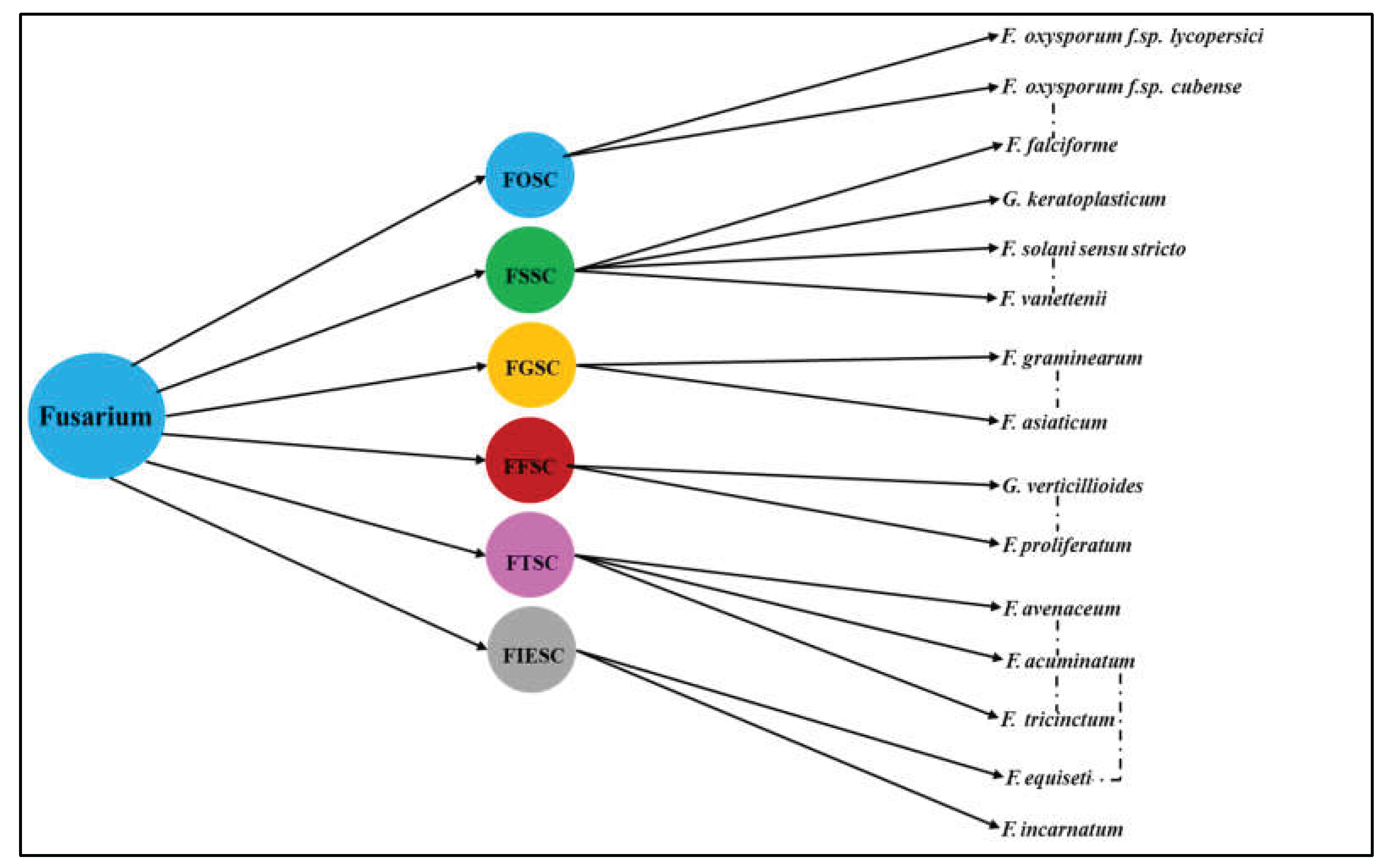

Table 1.
Geographic distribution and host range of emerging Fusarium pathogens in niche and high-value crops.
Table 1.
Geographic distribution and host range of emerging Fusarium pathogens in niche and high-value crops.
| Fusarium Species | Species Complex | Primary Host(s) | Crop Type | Region | References |
|---|---|---|---|---|---|
| F. zanthoxyli | FTOSC | Zanthoxylum bungeanum | Spice crop (woody) | Northern China | [73,74] |
| F. torreyae | FTOSC | Torreya taxifolia | Tree (conifer) | North America | [75] |
| F. oxysporum f. sp. cubense TR4 | FOSC | Banana (Musa spp.) | Fruit crop (perennial herb) | Southeast Asia, Middle East, Africa, Latin America | [77,78,79] |
| Novel FIESC spp. | FIESC | Various herbs & crops | Medicinal, legumes | China | [82] |
| FIESC spp. | FIESC | Rice, soybean, legumes | Cereals, legumes | South America, Africa, Europe | [86,83,85] |
| F. acuminatum, F. avenaceum, F. tricinctum | FTSC | Soybean, medicinal herbs, fruits, cereals | Multiple | Asia, Europe | [86,88,93] |
| F. avenaceum | FTSC | Raspberry, pulses, cereals, soybean | Berries, legumes | Europe, North-Estern China | [86,91,94,92] |
Table 2.
Key transcription factors regulating host-specific pathogenicity and secondary metabolism in Fusarium species.
Table 2.
Key transcription factors regulating host-specific pathogenicity and secondary metabolism in Fusarium species.
| Transcription Factor | Fusarium species | Function | Regulates | Reference |
|---|---|---|---|---|
| Tri6 | F. graminearum | Zn(II)2Cys6 TF; pathway-specific regulator | Trichothecene biosynthesis gene cluster (TRI genes); also acts as global regulator | [131,132] |
| Tri10 | F. graminearum | Transcriptional activator | Activates TRI gene expression in coordination with Tri6 | [131] |
| PacC | F. oxysporum | pH-responsive TF | Virulence gene expression under neutral-alkaline pH; adaptation to host environment | [133] |
| Ftf1 | F. oxysporum | Zn(II)2Cys6 TF encoded on accessory chromosome | Effector gene expression and host-specific pathogenicity | [134] |
| Sge1 | F. oxysporum | Global TF involved in effector regulation | SIX gene expression (secreted in xylem proteins) | [135] |
| FgLaeA (part of VeA complex) | F. graminearum | Global regulator of secondary metabolism, sexual development, and virulence | Regulates the expression of trichothecene biosynthetic genes (TRI6, ZEB2), sexual development genes, and virulence factors via interaction with FgVeA | [136] |
| Table 2 continued. | ||||
| Transcription Factor | Fusarium species | Function | Regulates | Reference |
| Kmt6 (H3K27 methyltransferase) | F. fujikuroi | Epigenetic regulator of secondary metabolism via histone modification | Controls the activation of silent secondary metabolite gene clusters by modifying chromatin accessibility through H3K27me3 marks | [137] |
| AreA | F. fujikuroi | Nitrogen metabolism TF | Gibberellin biosynthesis genes (in response to nitrogen availability) | [138] |
Table 3.
Economically important Fusarium species, major host crops, and associated resistance genes.
Table 3.
Economically important Fusarium species, major host crops, and associated resistance genes.
| Fusarium species | Host crop | Disease | Resistance gene/locus | Reference |
|---|---|---|---|---|
| F. graminearum | Wheat | Fusarium head blight | Fhb1 | [142] |
| F. oxysporum f. sp. lycopersici | Tomato | Fusarium wilt | I, I-2, I-3 | [143] |
| F. oxysporum f. sp. lentis | Lentil | Fusarium wilt/root rot | Fw Gene | [144,145] |
| F. virguliforme (syn. F. solani f. sp. Glycines) | Soybean | Sudden death syndrome | Rhg1, Rhg4 | [146] |
| F. verticillioides | Maize | Ear rot, seedling blight | ZmWAX2, ZmXYXT2, | [147,148] |
| F. oxysporum f. sp. cubense tropical race 4 (Tr4) | Banana | Fusarium wilt (Panama disease) | QTLs (Ma848, Ma851) | [149] |
| F. oxysporum f. sp. vasinfectum | Cotton | Fusarium wilt | GhWAK7A | [150] |
| F. oxysporum f. sp. cucumerinum | Cucumber | Fusarium wilt | QTLs CsChi23 |
[151,151] |
Table 4.
Formae speciales status of some of the common Fusarium Species.
| Fusarium Species | Known for Formae Speciales? | Notable Formae speciales (f. sp.) |
|---|---|---|
| F. oxysporum | Yes – over 100 | f. sp. lycopersici (tomato), cubense (banana), vasinfectum (cotton), cepae (onion), melonis (melon), pisi (pea) |
| F. solani (FSSC) | Yes, but being revised | f. sp. pisi (pea), phaseoli (bean), cucurbitae (cucurbits), mori (mulberry) |
| F. graminearum | No | Not applicable – broad host range |
| F. verticillioides | No | Not applicable – infects maize, sorghum, and others broadly |
| F. proliferatum | No | Not applicable – opportunistic across many hosts |
| F. avenaceum | No | Not applicable – generalist necrotrophy |
Table 5.
Some commonly used fungicides against diseases caused by Fusarium species and their mode of application.
Table 5.
Some commonly used fungicides against diseases caused by Fusarium species and their mode of application.
| Fungicide (Common Name) | Commercial Name (if specificied) | FRAC Category / Chemical Group | Mode of Application | Target Fusarium Species / Disease a | Reference |
|---|---|---|---|---|---|
| Azoxystrobin | Azimut, Amistar, Dynasty, Ortiva | Strobilurin (QoI, FRAC group 11) | Seed coating, Culture plates, Seed treatment, Foliar spray, in vitro | F. acutatum, F. oxysporum f. sp. cepae, Fusarium spp., F. virguliforme, F. subglutinans, F. temperatum, F. graminearum, F. oxysporum, F. pseudograminearum | [258,223,259,260] |
| Carbendazim | Antracol | Benzimidazole (Systemic, Broad-spectrum) | Seed treatment, Soil mixture, Culture media | Fusarium spp., F. oxysporum f. sp. vasinfectum, F. oxysporum f. sp. lentis, F. oxysporum (maize), F. equiseti, F. chlamydosporum, F. pseudograminearum | [261,262,263] |
| Fungicide (Common Name) | Commercial Name (if specificied) | FRAC Category / Chemical Group | Mode of Application | Target Fusarium Species / Disease a | Reference |
| Cyclobutrifluram | - | SDHI (FRAC group 7) | In vitro | F. pseudograminearum | [264] |
| Difenoconazole | Dividend XL RTA | Azole (DMI) | Culture plates, Seed treatment, in vitro | F. solani, F. proliferatum, F. oxysporum, F. circinatum, F. avenaceum, F. culmorum, F. poae, F. sporotrichioides, F. subglutinans, F. temperatum, F. pseudograminearum | [265,266,267,268] |
| Fludioxonil | Vibrance, Maxim 4 FS, MaximQuattro, Celest XL, Celest Quattro | Phenylpyrrole | Seed coating, Culture plates, Seed treatment | F. acutatum, F. oxysporum f. sp. cepae, Rhizoctonia, Fusarium spp., F. graminearum, F. virguliforme, F. solani, F. oxysporum (dry rot), Sclerotinia sclerotiorum, F. verticillioides, F. pseudograminearum | [223,247,237] |
| Fluopyram | ILeVO | SDHI (FRAC group 7) | Seed treatment | F. virguliforme | [245] |
| Phenamacril | - | Myosin inhibitor | In vitro | F. pseudograminearum | [250,264] |
| Prochloraz | Sportak | Azole (DMI) | Seed coating, Potted sprout irrigation, Culture plates | F. oxysporum f. sp. cepae, F. acutatum, F. subglutinans, F. temperatum, F. oxysporum (banana wilt), F. graminearum (FHB), F. culmorum (FHB), F. oxysporum f. sp. lycopersici, F. pseudograminearum | [259,268] |
| Prothioconazole | Redigo, Proline, Prosaro | Azole (DMI, FRAC group 3) | Seed treatment, Foliar fungicide, in vitro | Fusarium spp., F. virguliforme, F. graminearum (FHB), F. poae, F. pseudograminearum | [269,246,270] |
| Pyraclostrobin | Stamina, BAS 580 | Strobilurin (QoI, FRAC group 11) | Seed treatment, Foliar fungicide, in vitro | Fusarium spp., F. virguliforme, F. graminearum, F. pseudograminearum | [247,269,264] |
| Tebuconazole | Orius 25, Azimut, Raxil 250 FL, Raxil MD, Raxil T, Folicur, Nativo SC300, Twinstar 75 WG, Prosaro | Azole (DMI, FRAC group 3) | Culture plates, Seed coating, In vitro, Foliar spray | F. acutatum, F. oxysporum f. sp. cepae, F. subglutinans, F. temperatum, F. graminearum (FHB), F. culmorum (FHB), F. poae, Fusarium equiseti, F. chlamydosporum, Fusarium spp., F. pseudograminearum | [271,267,268] |
| Thiabendazole | Mertect 340F, Rival, Tecto, MaximQuattro, Trilex AL (part of) | Benzimidazole (FRAC group 1) | Culture plates, Seed treatment, In vitro, In vivo, In situ | F. solani, Fusarium spp., F. oxysporum, F. graminearum (part of combination), F. verticillioides (part of combination) | [265,272] |
| Trifloxystrobin | Trilex, Fortix | Strobilurin (QoI, FRAC group 11) | Seed treatment, Foliar fungicide, in vitro | Fusarium spp., F. graminearum, F. virguliforme, F. chlamydosporum, F. asiaticum | [271,273,267] |
Disclaimer/Publisher’s Note: The statements, opinions and data contained in all publications are solely those of the individual author(s) and contributor(s) and not of MDPI and/or the editor(s). MDPI and/or the editor(s) disclaim responsibility for any injury to people or property resulting from any ideas, methods, instructions or products referred to in the content. |
© 2025 by the authors. Licensee MDPI, Basel, Switzerland. This article is an open access article distributed under the terms and conditions of the Creative Commons Attribution (CC BY) license (http://creativecommons.org/licenses/by/4.0/).
Copyright: This open access article is published under a Creative Commons CC BY 4.0 license, which permit the free download, distribution, and reuse, provided that the author and preprint are cited in any reuse.