

Submitted:
29 June 2025
Posted:
30 June 2025
You are already at the latest version
Abstract
Meat, fish, and dairy products have long served as the primary sources of protein in our diets. However, contemporary food production heavily relies on intensive farming and fishing practices, which present significant environmental threats. With the global popu-lation growing rapidly, food systems must identify sustainable alternatives to meet the increasing demand for protein. Alternative proteins denote non-traditional, high-protein foods. These innovative sources aim to compete with conventional animal products by providing protein-rich, sustainable, nutritious, and flavourful options. Currently, five main categories of alternative proteins are being developed: plant-based proteins, cultured meat, single-cell proteins, edible insects, and seaweed. Nonetheless, several chemical and microbiological food safety hazards are associated with these alternatives. Incorporating novel protein sources into food products may heighten the prevalence of existing food al-lergies. This could arise from extracting proteins from their natural matrices and utilising them at significantly higher concentrations. Additionally, the introduction of new proteins may lead to the development of novel food allergies. Proteins that are currently seldom or never consumed may cause primary sensitisation or trigger cross-reactivity with known allergens. To date, alternative proteins have not been thoroughly studied for their aller-genic potential, and there is no standardised method for assessing this risk. This narrative review aims to explore non-traditional protein sources, discussing their nutritional and functional properties, as well as their potential allergenicity based on available research.
Keywords:
novel food
; plant-based proteins
; cultured meat
; single-cell proteins
; edible insects
; sea-weed
; allergenicity
1. Introduction
The global population is expected to reach 10 billion people by 2050. Therefore, one of the most pressing problems for humanity is how to feed the world population while preserving the planet [1]. The rapid population growth has raised concerns about whether the Earth’s finite resources, such as agricultural land and freshwater, will be sufficient to satisfy the food demands of such a large population [2]. In addition, the rising consumption of meat and fish is considered problematic, primarily because intensive farming practices are often associated with public health risks, sustainability challenges, and environmental concerns (including greenhouse gas emissions, land and water consumption), as well as animal welfare issues (such as the impact of fertilizers, pesticides, and hormones used in animal feeding) [3]. Numerous studies suggest that many of these critical issues could be substantially alleviated by removing animals from the production process. Consequently, considerable efforts are being devoted to identifying alternative protein sources, essential for human nutrition. These alternative proteins encompass a range of options, including edible insects, plant-based proteins, fungal proteins, algae proteins, cultured meat and single-cell proteins. In recent years, investment in the alternative protein sector has rapidly increased, with hundreds of new companies entering the market and billions of dollars being invested. A recent report indicates that the alternative protein market is expected to reach US$290 billion by 2035, when it will make up 11% of the overall protein market [4]. However, it is essential to carefully assess and identify potential risks to consumer health when incorporating alternative proteins into the food system. One of the primary concerns is the potential for allergens to enter the diet through the consumption of novel or modified proteins or allergen cross-reactivity (Figure 1). Food allergy (FA) is an increasing health concern globally. At present, 10% of adults and 8% of children in developed countries are affected by this condition. FA is an immune system reaction that occurs in sensitized individuals whenever they are exposed to a specific allergen. It is distinct from food intolerance, which involves a non-immune response. FA can be classified into three types: IgE-mediated, caused by immunoglobulin E (IgE) antibodies targeting food antigens; non-IgE mediated, where the immune response primarily involves cell-mediated mechanisms; and mixed, where both IgE-mediated and cell-mediated immune responses are involved [5]. IgE-mediated FA are the most common. They are easily characterised by the presence of specific serum IgE (sIgE) or a positive skin prick test (SPT). They occur most frequently in the first years of life, giving rise to urticaria/angioedema, oral allergic syndrome, rhinitis, or acute asthma and anaphylaxis [6]. Non-IgE FA are characterised by cutaneous reactions (such as atopic dermatitis, contact dermatitis and dermatitis herpetiformis), respiratory reactions (such as Heiner’s syndrome) or gastrointestinal reactions [7]. Non-IgE and mixed FA have a less clear pathogenesis, despite their frequency. The clinical manifestations of food allergies include skin, gastrointestinal, respiratory and systemic manifestations with varying severity [8,9,10]. The diagnostic approach begins with a careful medical history collection to identify the culprit food and a physical examination [11]. Oral food challenge (OFC) currently represents the diagnostic gold standard, even if the accuracy of diagnostic tests for some foods, when combined with clinical history, may be sufficient in many cases in clinical practice to provide a robust diagnosis [12, 13]. Treatment consists of the elimination of the offending allergen. The development of allergic diseases depends not only on the allergen itself but also on the individual genetic predisposition and other environmental factors. Currently, no validated tests are available to predict the sensitization potential of food proteins [14]. The current available methodology is suitable mainly for assessing new proteins’ allergenic potential for cross-reactivity. In contrast, methodologies to evaluate the allergenic potential of new proteins due to de novo sensitisation are limited [15]. Most available tests focus on sequence similarity, which may elucidate a cross-reactive potency but not de novo sensitization [16]. Current evaluation strategies for the allergenicity of alternative proteins primarily depend on a weight-of-evidence approach to risk assessment [17,18,19,20]. According to EFSA, it includes assessing the gene sources, analyzing sequence homology with known allergens, testing the binding affinity to IgE from allergic individuals, and evaluating the protein stability using a pepsin resistance test. Furthermore, EFSA recommended that allergenicity assessments consider the production process and available experimental and human data, including cross-reactivity information. Risk assessment of de novo sensitization presents a greater challenge and necessitates the development of reliable and validated in silico, in vitro and in vivo models (Figure 1). This review aims to provide a comprehensive overview of the most promising alternative proteins sources, highlighting the possible risks in term of their potential allergenicity and critically discussing potential clinical implications.
2. Materials and Methods
A comprehensive literature search was conducted in April 2025 using the MEDLINE database via PubMed (www.pubmed.gov) and Embase (www.embase.com). No restrictions were applied regarding language, publication type, study design, or year of publication. Additional relevant articles were identified by manually screening the reference lists of the included studies. Guidelines, systematic reviews, and original research articles were all considered for inclusion. We employed a standardized search strategy across all categories of alternative proteins, modifying only the protein-specific keywords while maintaining a consistent focus on allergenicity. For example: Insects: (“insect protein” OR “edible insects”) AND (“allergenicity” OR “allergic reactions” OR “food allergy”); Seaweeds: (“seaweeds” OR “algae” OR “sea vegetables”) AND (“allergenicity” OR “allergic reactions” OR “food allergy”); Cultured meat: (“cultured meat” OR “lab-grown meat” OR “cell-based meat” OR “in vitro meat”) AND (“allergenicity” OR “allergic reactions” OR “food allergy”); Single-cell protein: (“single cell protein” OR “SCP” OR “microbial protein” OR “yeast protein” OR “fungal protein”) AND (“allergenicity” OR “allergic reactions” OR “food allergy”); Plant-based protein: (“plant-based protein” OR “plant protein” OR “vegetable protein”) AND (“allergenicity” OR “allergic reactions” OR “food allergy”) The search yielded 292 articles from PubMed and 405 from Embase. After removing duplicates, a total of 315 unique records were identified. Of these, 156 articles were deemed relevant based on title and abstract screening and are cited in the references. Further methodological details and search results are discussed in the corresponding sections of the manuscript.
3. Results
3.1. Cutured Meat
An emerging alternative to conventional animal products, cultured meat, also known as cultivated, synthetic, or in vitro meat, is increasingly recognized as a viable alternative to traditional animal-derived products [21]. This innovative technology has garnered significant interest over the past decade due to its potential to mimic the nutritional value and sensory characteristics of conventional meat while addressing the environmental and ethical issues associated with intensive livestock farming. Cultured meat production avoids many of the greenhouse gas emissions, water use, and land degradation caused by traditional farming methods. Moreover, it offers a solution to the moral dilemmas tied to the exploitation and slaughter of animals, presenting an alternative that could transform the food industry. The production process begins with the isolation of stem cells from a small biopsy taken from a live animal [22]. These cells are then cultivated in a nutrient-rich medium under laboratory conditions, where they multiply and differentiate into muscle or fat cells [23]. By growing the cells on three-dimensional scaffolds made from natural biomaterials, researchers aim to recreate the texture and structure of animal muscle tissue. However, this process is still in its infancy, and the resulting disorganized muscle fibers fall short of replicating the complexity of real meat. Key challenges include replicating blood vessels, nerve tissue, connective tissue, and intramuscular fat, which influence the flavour, texture, and overall quality of meat. Currently, the most effective growth medium for cultured meat production relies on fetal bovine serum (FBS), a substance derived from the blood of deceased calves [24]. While FBS is rich in essential nutrients, hormones, and growth factors required for cell proliferation, its use is ethically controversial and economically unsustainable. Researchers are actively working to develop plant-based or synthetic alternatives to FBS that are both cost-effective and capable of supporting efficient cell growth [25]. The search for an alternative medium is vital to scaling up production and making cultured meat accessible to a wider consumer base. Health and safety concerns surrounding cultured meat also require careful consideration [26]. Advocates argue that cultured meat is inherently safer than conventional meat, as it is produced in sterile, controlled environments that eliminate exposure to intestinal pathogens like E. coli, Salmonella, and Campylobacter [27]. Despite these advantages, the use of animal-derived serum introduces potential risks, such as contamination with prion proteins, which are associated with transmissible spongiform encephalopathies, including Creutzfeldt-Jakob disease [28]. Additionally, the extensive cell multiplication involved in production raises concerns about unintended biological changes, such as dysregulation of cell lines, which could have unknown effects on human health [29]. Rigorous safety testing and regulatory oversight will be essential to address these uncertainties, particularly as the technology scales up for mass production. Cultured meat offers unique opportunities to enhance the nutritional profile of meat products. By modifying the composition of the growth medium, producers can control the types and ratios of fats in the final product [30]. For instance, saturated fats can be replaced with healthier polyunsaturated fats, such as omega-3 fatty acids. However, this modification introduces the challenge of managing the increased risk of rancidity associated with polyunsaturated fats. Furthermore, the bioavailability of micronutrients like iron and the organization of biological compounds within cultured cells may differ from those in conventional meat, potentially reducing their health benefits [31]. Research is needed to optimise the nutritional composition of cultured meat and ensure it provides comparable, if not superior, benefits to traditional meat. Another critical consideration is the potential for allergic reactions. Cultured meat contains the same molecular components as traditional meat, making it likely to trigger allergies in individuals sensitive to specific types of meat [32]. The major concerns raised for food allergies originate from sensitization to specific carbohydrate structures (e.g., alpha-galactose) [33]. For example, people with alpha-gal syndrome, a rare allergy to a sugar molecule found in red meat [34], or those allergic to poultry, may experience adverse reactions to cultured products derived from these sources [35]. Symptoms of such allergies range from mild skin irritations to severe anaphylaxis, highlighting the importance of clear and accurate labelling. Regulatory definitions of cultured meat, which may differ across regions, will play a crucial role in ensuring consumer safety and avoiding confusion. Notably, some meat industry stakeholders oppose the use of the term “meat” for cultured products, adding to the complexity of labelling and marketing these items. As research and development continue, cultured meat holds promise for addressing some of the most pressing challenges of modern food systems, including sustainability, animal welfare, and global food security. However, significant technical, regulatory, and societal hurdles remain. The transition from experimental production to large-scale commercialization will require breakthroughs in cell culture technology, cost reduction, and public acceptance. Equally important will be the establishment of robust safety standards and transparent labelling practices to build consumer trust and confidence. With continued innovation and collaboration across scientific, industrial, and regulatory domains, cultured meat could redefine the future of food.
3.2. Seaweed
Seaweed is one such alternative source of protein that requires greater investigation, and it is a promising biomass with applications in food, beverages, feed, nutraceuticals, and pharmaceuticals, also suggested as an alternative solution for the food industry to replace meat as a source of gelatin and protein [36]. Seaweed consists of several macroscopic and microscopic species of algae that can be classified based on their pigmentation into brown (Phaeophyta), green (Chlorophyta), and red (Rhodophyta) algae. It provides various amounts of protein, ranging from 3 ± 15% dry weight for brown alga, 9 ± 26% dry weight for green alga, and up to 47% dry weight for red alga [37]. Edible seaweeds are very popular in East Asia, particularly in Korea, China, and Japan. Some of the most common species used in food preparation include the red seaweeds Porphyra (Nori) for sushi wrappings, Palmaria Palmata (dulse), and Chondrus crispus (Irish moss) as a thickening agent. Varieties of brown seaweeds, such as the kelps Undaria pinnatifida (wakame) and Laminaria japonica (kombu), and green seaweeds, such as Ulva spp (sea lettuce), are consumed as sea vegetables [38]. Seaweed can incorporate essential amino acids, fibres, vitamins, carotenoids, and other bioactive metabolites in foodstuffs, besides acting as flavouring agents with umami taste and binding agents for partial replacement of egg yolk in formulations of vegetarian hamburgers and other products [39,40,41,42]. Within this context, edible seaweed has been considered a “superfood”. The microalgae A. platensis and C. vulgaris currently represent the largest share of the global market for algae-based proteins. Species of the genera Chlorella and Arthrospirahave been sold as ingredients in various forms, including powder, paste, pellets, and flakes, for the manufacture of pasta, beverages, vegetarian meat analogues, and animal feed. Seaweed farming is primarily conducted in Asia (China, Indonesia, the Philippines, Korea, and Japan) and Africa (Zanzibar and Madagascar), where it presents a socio-economic opportunity for coastal communities. There are significant differences in the composition of these new protein sources: Seaweed, along with insects, stands out by their superior content of proteins (50%) and fibers (27%), while they have a low content of lipids (8%); carbohydrates are present in concentrations below 20% [3]. Polyunsaturated fatty acids, especially ω-3, and phytosterols are usual seaweed constituents and corroborate several functional food claims. As well as plants, these organisms are unable to synthesize cholesterol, a substance present in foods of animal origin, like red meat and eggs. Thanks to its composition, seaweed can exert antimicrobial, antioxidant, anti-hypertensive, antidiabetic, antidepressant, antitumor, and immunomodulatory activities [43]. However, there are some doubts about the possibility of harmful effects on human health resulting from the consumption of seaweeds. Factors like the seaweed type, cultivation and harvest conditions, and further processing, among others, were found to influence the presence of hazards in seaweed. Recent literature shows that (inorganic) arsenic, cadmium, lead, mercury, iodine, pathogenic bacteria like Salmonella spp., Bacillus spp., Vibrio spp., and norovirus have been reported as relevant hazards in seaweed. Despite the wealth of research on these hazards, data gaps on the presence of other hazards exist. Banach, Hoek-van den Hil, and van der Fels-Klerx (2020) indicated data gaps for pesticide residues, dioxins and polychlorinated biphenyls, brominated flame retardants, PAHs, pharmaceuticals, marine biotoxins, allergens, micro-and nanoplastics, and pathogenic microorganisms E. coli, Listeria spp., St. aureus, norovirus, and hepatitis E virus. Moreover, although research describing the effects of processing, like washing seaweed to reduce microplastics or marine biotoxins, as well as soaking or washing and cooking to reduce inorganic arsenic and iodine in seaweed, has been reported, there remain research gaps on the effects of processing. Also, additional monitoring of seaweed and data collection on the health effects, e.g., dietary exposure, to further characterize hazards is needed [44,45,46]. With the expected further increase in protein alternatives in consumers’ diets, the risk of food allergens is apparent. The consumption of new proteins or the increased introduction of existing ones, through the use of purified protein concentrates, can lead to: a) increased prevalence of known allergies through the extraction of proteins from their natural matrix and the incorporation of them into other products in much higher quantities; b) development of new allergies, as a result of consuming foods that we do not consume or rarely consume, through primary sensitization to these foods or cross-reactivity reactions to existing allergens; c) sensitization to new proteins with cross-reactivity phenomena toward foods considered non-allergenic or rarely allergenic [43]. Seaweed allergy has been reported on several occasions: cases of respiratory reactions have been described where algae acted as inhalant allergens both in children and in adult workers in a British factory producing alginates [47, 48]. A case of fatal anaphylaxis possibly due to an allergy to an alginate-based paste used for dental impressions has been described in a patient with multiple severe comorbidities [49]. Anaphylaxis to antacid tablets [50] and alginate dressing [51] have also been reported (Sodium alginate is derived from brown seaweed). There are also multiple reports of hypersensitivity reactions after laminaria stick insertion (derived from the brown seaweeds Laminaria japonica or digitata) during dilation and evacuation procedures in obstetrics, which are suggestive of underlying IgE-mediated mechanism [52]. A case of food allergy to seaweed was described in 2018 by I. Thomas and colleagues [36]. It involved a 27-year-old patient who had eaten sushi on several occasions and experienced repeated generalized reactions. The patient ingested the various ingredients of the sushi after the reactions without any issues, except for crustaceans, sesame, and seaweed. The Prick-by-Prick test with fresh tiger prawn and sesame was negative. The Prick-by-Prick test with fresh NORI (red seaweed) was positive, with a 13-mm wheal. The Prick-by-Prick test with other red seaweeds was positive, while it was negative with brown and green seaweeds, indicating the lack of cross-reactivity between different groups of seaweeds. However, patients allergic to seaweed should avoid all products containing seaweed unless tolerance has been proven with negative skin and challenge tests. Phycobiliproteins, the main proteins of red seaweeds, and phycolectins are possible allergens [53]. Four other reports of food allergy caused by algae are described in the literature (4 cases of anaphylaxis due to Spirulina) [54]. Spirulina (Arthrospira platensis) is a blue-green microalgae (cyanobacteria), used as a human protein supplement because of the high content of proteins, γ-linoleic acid and vitamins. In the first report, which describes a case of Anaphylaxis in a 14-year-old patient, the β-chain of phycocyanin was identified as the responsible one, using extraction techniques and Western blotting [55]. The work of Lee and colleagues describes a case of anaphylaxis in a 17-year-old adolescent suffering from dermatitis. asthma, allergic rhinitis (grass, house dust mite, dog, cat) and a possible pollen-food syndrome (oral allergy symptoms to tomato and cucumber). He developed the first time that he ingested a Spirulina tablet (300 mg), within 10 minutes, symptoms of anaphylaxis [56]. The third work reports two cases of anaphylaxis in two patients with a past medical history of oral allergy syndrome with positive birch pollen components on component resolved testing (rBet V 1) and seasonal rhinitis [57].
3.3. Single-Cell Proteins
Proteins play a fundamental role in the human diet and, compared to other nutrients, are the most expensive [58, 59]. The rising demand for proteins caused by population growth and the lack of other cultivable land has driven research into alternative sources to meat, dairy, and plants [60,61,62,63,64]. Single-cell proteins (SCP) represent a possible solution to meet global food needs sustainably [59]. They include proteins of high biological value with all essential amino acids, fibres, minerals, and vitamins, and are low in fats, making them a promising option for both human and animal nutrition [59,60,61,62,63,64]. SCP are derived from microorganisms, most frequently yeasts (Saccharomyces cerevisiae and Kluyveromyces marxianus), but also from fungi, algae, and bacteria [59,60,61]. The advantages of using microorganisms to produce SCP are many. Firstly, their rapid proliferation ensures large yields of protein. They require small spaces and minimal water, and their production is unaffected by weather conditions or soil contaminants such as insecticides or fertilisers [60, 61]. SCP can be produced from a wide range of microorganisms, but as they are intended for human consumption, their selection depends on various factors, including taste and pathogenicity [60, 61, 64]. Some microorganisms can produce toxins or contain nucleic acids (RNA) or heavy metals, which pose risks to human health and may cause nephrotoxicity, immunosuppression, carcinogenicity, and teratogenic effects [42, 60, 61]. For example, high levels of RNA can lead to hyperuricemia, and many Fusarium species produce mycotoxins harmful to the central nervous system [61]. Acute tubulointerstitial nephritis has also been reported in a boy who consumed Chlorella tablets for three months [61]. The potential for allergic reactions remains a concern, especially due to possible cross-reactivity with fungal allergens and mould proteins [65]. Moreover, certain fungal proteins—such as enolase and triose-phosphate isomerase—are recognised as cross-reactive allergens. This suggests that individuals already sensitised to airborne fungi or other fungal allergens could react negatively when consuming mycoprotein [66]. Allergic reactions, including anaphylaxis, have been documented, such as an incident involving an adolescent after taking Spirulina tablets containing phycocyanin [60, 61]. The choice of microorganisms is crucial, as the processes used to remove toxins or contaminants can increase costs and reduce yields [59]. Advances in production techniques have led to second-generation SCP derived from food waste, by-products, and genetically modified microorganisms [59, 62]. These sources are ideal substrates as they reduce industrial residues and manufacturing costs [59,60,61,62]. SCP is not a novel concept. Initially, it was produced during World War I in Germany as yeast biomass. The bacterial SCP from methanol, Pruteen, was developed in the 1970s, and Pekilo®, a mycoprotein from pulp and paper industry by-products, was available in Finland from 1974 to 1989 and is now being refined [67]. Today, various SCP products are available, including Quorn™, a fungus-based meat substitute, FeedKind®, Spirulina, and UniProtein® [67]. Additionally, KnipBio Meal, a fish substitute, was approved by the Food and Drug Administration in 2021. It consists of an SCP produced by the yeast Yarrowia lipolytica, genetically modified to enhance its nutritional profile with increased astaxanthin [61]. The potential of SCP as a sustainable and efficient protein source is substantial and offers promise for the future of food and feed industries, despite remaining challenges such as consumer acceptance, scaling production to meet global demand, and improving cost-efficiency in large-scale SCP manufacturing [59].
3.4. Plant-Based Proteins
Recently, the eating habits of Western countries have been changing, influenced by new trends and needs, leading to a widespread adoption of plant-based diets. On one side, vegetarianism, veganism, and their variants are gaining greater acceptance among the general population and are often chosen by adults and introduced to children even at early ages. On the other hand, emerging trends advocate plant-based alternatives for improved eco-sustainability and better health profiles within the population’s lifestyles [68]. This has driven food industries to develop new options that mimic the texture, mouthfeel, and satiety usually associated with animal-derived products, expanding choices from legumes to nuts, seeds, cereals, and tubers [69] –Table 1. However, vegetable protein sources used in these alternatives are responsible for a significant proportion of food allergies. A potential risk for consumers is the unintentional introduction of allergens through new exposures, such as novel or modified proteins, undeclared added allergens, or cross-reactivity [70]. Technologies now process vegetables like peas, potatoes, seaweed, fava beans, and chickpeas to produce isolated and concentrated protein sources that can be added to various foods to create high-protein plant-based products, reducing reliance on traditional sources like wheat and soy [71]. Potatoes, for example, are generally considered allergen-free [72]. Conversely, legumes exhibit a high degree of cross-reactivity among each other in individuals allergic to one, although it is rare for a person to be allergic to all of them [73, 74]. Consequently, legume crops have expanded recently to meet market demand, despite the well-documented allergenic potential and cross-reactivity of these proteins, especially in adults, who are the primary sufferers of food allergies due to the more recognisable nature of plant-based proteins compared to animal proteins from the immune system’s perspective [75, 76]. Further clinical research is needed to clarify the allergenic roles of legumes such as lentils and chickpeas, and seeds like poppy and pumpkin, particularly given their increasing popularity in diets alongside reports of allergic reactions [77]. It is important to note that the food industry often adds plant-based ingredients during product formulation to offer healthier alternatives (e.g., pea protein versus lupine or soy) or to reduce costs. When present in amounts below 2%, these ingredients are not required to be listed unless they are major allergens. This increases the risk of hidden or undeclared allergens [78,79,80]. The food industry should invest in proteomic technologies to accurately identify protein contents and improve quality control to ensure consumer safety [81, 82]. Sensitisation to proteins can occur via different routes: oral, respiratory, and skin exposures, each playing a distinct role in either triggering reactivity or promoting immune tolerance. For instance, recent evidence suggests that respiratory sensitisation through aeroallergens often precedes the development of food allergies due to cross-reactivity between shared allergen components in plants. Globalisation has further influenced dietary habits worldwide, integrating foods from diverse cultures and increasing exposure to new allergens and allergy prevalence [83]. Additionally, the allergenic potential depends on the protein’s characteristics, such as secondary and tertiary structures (antigenic determinants), enzymatic activity, post-translational modifications (like glycosylation), and stability to digestion or heat. The matrix in which allergens are embedded also affects their reactivity, as does food processing [84]. For example, non-thermal techniques used for whey protein (WP) can reduce its allergenicity [85], while thermal processing involving the Maillard reaction can increase the immunogenicity of wheat proteins. Current literature lacks comprehensive information on how various technological and cooking methods, or the composition of processed foods, influence the allergenicity of plant-based proteins. These proteins are often processed with novel techniques to create new shapes, textures, flavours, and effects for commercial purposes [88, 89]. New processing methods may pose allergenic risks, as their effects on the immune system are not yet fully understood or predictable. An example is the recent rise in peanut allergies among children in Asia, potentially linked to exposure to differently processed peanuts (such as roasted peanut butter instead of boiled peanuts) [90].
3.4.1. Plant-Derived Food Allergen Components
Plant-derived food allergens mainly fall into four protein families or superfamilies: prolamin, cupin, Bet v 1/pathogenesis-related protein 10 (PR-10), and profilin (Table 1) [91]. The prolamin superfamily includes 2S albumin, non-specific lipid transfer protein (ns-LTP), cereal prolamin, and α-amylase/trypsin inhibitors. The cupin superfamily encompasses proteins such as vicilin (7S globulin) and legumin (11S globulin), found in microorganisms, plants, and animals, all originating from a common ancestral, conserved protein sequence. Bet v 1/PR-10 and profilin are major fruit allergens responsible for cross-reactive pollen allergies. Oleosins are stored in plant seeds [92]. Plant defensins, like those in the PR-12 family, contribute to innate immune responses through antifungal and antibacterial activities, and have been identified as peanut allergens [93, 94]. 2S albumin, acting as a storage protein, is an allergen present in peanuts, soybeans, nuts, sesame, and buckwheat. The sequence similarity of 2S albumin across peanuts, nuts, and sesame seeds is relatively low, around 20-60%, whereas in walnut (Jug r 1) and pecan (Car i 1), both from the Juglandaceae family, the homology is higher, approximately 88% [95]. Ara h 2, Ara h 6, and Ara h 7 show limited sequence overlap, not exceeding 55%, despite being isoforms [96]. The storage proteins called legumins are found in the seeds of various plants, sharing high sequence identities ranging from 32% to 95% [97]. Like 2S albumin, vicilins are storage proteins. Oleosins are stored in lipid droplets within seeds, providing energy during plant growth. Oleosins act as allergens in peanuts (Ara h 10, Ara h 11, Ara h 14, Ara h 15), sesame (Sesi 4, Sesi 5), and hazelnuts (Cor a 12, Cor a 13, Cor a 15). Peanut defensins (Ara h 12 and Ara h 13), soybean defensin (Gly m 2), share low sequence identity with a reduced risk of cross-reactivity [99]. Regarding wheat allergens, cereal prolamin and alpha-amylase/trypsin inhibitors merit mention. Wheat prolamins include gliadin and glutenin, which are key components of wheat gluten [100]. The primary allergenic risk for children involves wheat components such as gliadin (Tri a 20 and 21) and low-molecular-weight glutenin (Tri a 36). Additionally, gliadin (Tri a 19) and high-molecular-weight glutenin (Tri a 26) are often implicated in food-dependent exercise-induced anaphylaxis episodes [101]. These molecules feature repetitive sequences rich in proline and glutamine, which seem to be involved in allergic symptoms. Wheat alpha-amylase/trypsin inhibitors are responsible for baker’s asthma episodes. Several types have been classified based on their assembly, and their immunoreactivity varies: monomeric (Tri a 15), dimeric (Tri a 28), and tetrameric (Tri a 29, Tri a 30, Tri a 40) [102]. Cross-reactivity with Bet v 1/PR-10 is known to contribute to plant-based allergy symptoms, as many fruits and vegetables cross-react with pollen, a condition known as pollen-food allergy syndrome (PFAS) [103]. Bet v 1 of birch pollen acts as the primary antigen, inducing allergic responses through cross-reactivity. PR-10 proteins are found in seeds, especially peanuts and soybeans. An allergy to soybean milk often coincides with elevated IgE antibodies specific to Gly m 4, leading to soybean allergy in adults [104]. Bet v 2, the first profilin identified in birch pollen, shares highly conserved amino acid sequences with other seed profilins, which are responsible for PFAS [105]. Ns-LTP, a defense protein in the PR-14 family, is detected in seeds and fruits of Mediterranean Europe, including Rosaceae fruits, vegetables, walnuts, hazelnuts, and peanuts. It is often linked to peach and apple allergies and associated with systemic symptoms [106]. GRPs, members of the snakin/GASA family, are plant antimicrobial peptides [107]. These stable proteins withstand heating and digestion. Peach GRP (Pru p7) is notably associated with systemic symptoms in peach allergy patients from France and other countries [108,109,110]. Other fruit allergies also involve cross-reactivity with homologous GRP epitopes, especially following initial sensitisation to GRP in cedar pollen [111].
3.5. Insects
The rapid growth of the human population and the rising demand for high-quality protein sources have prompted the scientific community to investigate novel, sustainable, and natural alternatives, including invertebrates such as insects. Currently, insects are a regular part of the diet for about 2 billion people worldwide, with over 2, 000 edible species identified [112]. Among these, the most commonly utilised for their protein content belong to the orders Coleoptera (beetles), Lepidoptera (caterpillars), and Hymenoptera (wasps, bees, and ants). Insects are recognised as a rich source of essential nutrients, including polyunsaturated fatty acids, essential amino acids, micronutrients, and proteins [113]. Their nutritional profile features a high protein content, along with significant amounts of fats, minerals, vitamins, and energy. A comprehensive review by Rumpold et al. highlights both the nutritional benefits and potential risks associated with edible insects [111]. Proteins are the predominant macronutrient, with an average content of approximately 40%, though this can vary from 20% to over 70%, depending on the species [114]. Notably, three insect species commonly farmed in Europe—Tenebrio molitor, Gryllodes sigillatus, and Schistocerca gregaria—exhibit particularly high protein levels, estimated at 52%, 70%, and 76%, respectively [112]. For instance, protein extracts derived from Hermetia illucens and related species show poor solubility in aqueous media, which may limit their nutritional and functional potential [115]. Conversely, proteins from Protaetiabra revitarsis and Allo-Myrina dichotoma display superior thermal stability and emulsification capacity compared to T. molitor, making them more suitable for food processing applications [116]. Additionally, the high polyphenol content in Hermetia illucens protein extracts has been shown to reduce emulsification activity, further influencing their functional properties [117]. Beyond their protein content, insect-derived proteins exhibit variable digestibility. They are generally more digestible than plant proteins but slightly less so than traditional animal proteins [118]. Moreover, their functional properties differ significantly between species. The use of insect ingredients, such as insect flour, has been explored in food formulations, particularly in bakery products, where it enhances both nutritional value and overall product quality [119]. An equally important aspect of insect consumption is its sustainability. According to studies by Mason et al., producing one gram of beef requires 21 times more water than producing the same amount of protein from crickets, making insect-derived proteins a valuable and sustainable alternative to conventional meat sources [120]. However, consuming insects carries potential risks. Concerns include chemical hazards, such as heavy metal accumulation, and microbiological contamination. Additionally, insects have been linked to allergic reactions through various exposure routes, including inhalation, direct contact, stings or bites, and ingestion [121]. Data on allergic risks linked to insect consumption remain limited. Most studies involve small sample sizes (n<20), and geographic disparities in research availability hinder comprehensive evaluation [122]. Many relevant articles are published in Chinese, limiting access for Western researchers, while data from regions where insect consumption is common—such as Africa, South America, and Asia—are scarce [123]. Few studies have explored the epidemiology of food allergies to insects, despite their inclusion in many populations’ diets worldwide. In China, a review of literature from 1980 to 2007 estimated that around 17% of food-related anaphylaxis cases were due to insect consumption, with locusts, grasshoppers, and silkworms being the most frequently implicated species [124]. It has been reported that over 1, 000 patients annually suffer anaphylactic reactions after consuming silkworm pupae in China [125]. Conversely, a 2015 study in Laos found that 7.6% of insect consumers had experienced an allergic reaction [126]. The remaining literature mainly comprises case reports, with about 30 documented cases [123]. To date, many IgE-binding allergens have been identified in the main groups of invertebrates, including mites, crustaceans, arachnids, insects, molluscs, and nematodes. Most of these are pan-allergens common across invertebrate groups, as shown in Table 1 [123]. The potential allergenicity of insect-derived proteins is a serious concern, especially for individuals sensitised to invertebrate allergens such as those found in crustaceans and house dust mites (HDM) [127]. The most clinically relevant insect allergens are tropomyosin (TM) and arginine kinase (AK), both of which have demonstrated cross-reactivity with other invertebrate allergens [128]. TM is the most widely studied insect allergen, characterised by an alpha-helical structure and a key role in muscular contraction [129]. As a recognised allergen, TM is commonly found in shellfish, including crustaceans, molluscs, and cephalopods [130]. For example, a study by Jeong et al. showed that silkworm tropomyosin shared 73.5 to 92.3% sequence identity with other allergenic tropomyosins, suggesting possible cross-reactivity [131]. Furthermore, Kamemura et al. identified a high molecular weight cricket tropomyosin that appears cross-reactive with shrimp tropomyosins, highlighting the strong amino acid similarity among insect homologues [132]. Recently, TM from the yellow mealworm (YMW) (Tenebrio molitor) has been identified as a major allergen in this emerging food source [133]. The co-sensitisation between YMW and crustaceans has been extensively demonstrated, particularly in individuals allergic to shrimp [132]. Barre et al. conducted a comprehensive study on YMW allergenic proteins, identifying TM, AK, α-amylase, heat shock protein 70 (HSP70), apolipophorin-III (apoLp-III), larval cuticle protein (LCP), and a 12-kDa hemolymph protein as allergenic targets for shrimp-allergic patients [133, 134]. Furthermore, most shrimp-allergic individuals were found to be sensitised to T. molitor [135]. Additional research by Broekman et al. identified three novel mealworm allergens: larval cuticle proteins A1A, A2B, and A3A [130]. Notably, the allergens causing primary mealworm allergy may differ from those responsible for cross-reactivity [130]. AK is another key pan-allergen, with enzymatic activity and a highly conserved amino acid sequence across invertebrates [131]. Structurally, AK consists of a β-sheet domain surrounded by α-helices. For example, sensitisation to silkworm allergens is mainly linked to AK (Bomb m1), paramyosin, and chitin. AK Bomb m1 is the only officially recognised edible insect allergen listed in the IUIS allergen database (www.allergen.org) [136]. Cricket allergens remain poorly characterised, with limited research on cross-reactivity in those allergic to shellfish or HDM. Srinroch et al. identified AK and hexamerin 1B (HEX1B) as major and minor allergens in Gryllus bimaculatus, using sera from prawn-allergic patients [137]. Beyond TM and AK, additional allergens have been identified in Bombyx mori, including chitinase and paramyosin [138, 139]. Karnaneedi et al. found further potential allergens, demonstrating cross-reactivity among hemocyanin, vitellogenin, HSP20, apolipophorin-III, and chitin-binding proteins present in shrimp, crickets, and black soldier fly. Troponin C, involved in muscle contraction, has also been implicated as a relevant pan-allergen in insects such as Bombyx and Drosophila. Numerous reports describe sensitisation to cockroaches, though these studies mainly focus on inhalant exposure rather than ingestion. No cases of allergic reactions following their consumption have been documented. Beyond allergenicity, other health risks linked to insect consumption include the presence of heat-resistant thiaminase in pupae of the African silkworm (Anaphe spp.), which has been associated with seasonal ataxic syndrome due to thiamine deficiency in Nigeria. The impact of food processing on allergenic potential is another concern, as it can alter protein structure and IgE-binding capacity. However, limited studies have assessed the effects of processing on edible insects. Some research has examined thermal treatments on mealworms, silkworms, and locusts, while enzymatic hydrolysis has been investigated as a method to reduce allergenicity in food matrices. In the case of mealworms, processing methods affected protein solubility but did not consistently decrease immunoreactivity.
3.6. Regulation of Alternative Protein Consumption
The main European food regulations impacting the development and commercialization of alternative proteins include the Novel Food Regulation, the regulation of genetically modified (GM) foods, food information regulations, nutrition regulations, and the Organic Food Regulation [146,147,148]. In the European context, according to Regulation (EU) 2015/2283, novel foods are defined as food products and substances that had no ‘significant’ history of consumption in the EU before 15 May 1997 [149]. These products must undergo an authorization process to assess their safety before being placed on the market. The European Food Safety Authority (EFSA) is responsible for pre-market risk assessment. To introduce a novel food to the market, a dossier must be submitted containing specific studies on the food’s effects on human health. This process follows a centralized procedure. EFSA’s scientific opinion usually serves as the basis for the European Commission to draft and adopt food legislation applicable across all member states. In the European Community (EU), the insects are considered “novel foods” [149]. Regulation (EU) 2015/2283, effective from 1 January 2018, replaced Regulations (EC) No 258/97 and No 1852/2001, and streamlined the approval process for innovative and novel foods while ensuring consumer safety [149]. The EU Novel Foods Regulation, in force since 1 January 2018, simplifies the introduction of novel and innovative foods into the EU market, while ensuring safety for consumers. EFSA has approved the market placement of several insect species under Regulation (EU) 2015/2283. In Italy, four insect species were authorized in 2023 for consumption in frozen, dried, and powdered form: Tenebrio molitor (yellow mealworm), Locusta migratoria (migratory locust), Acheta domesticus (house cricket), and Alphitobiusdiaperinus (lesser mealworm) [150,151,152,153,154,155]. These insect-based products must carry clear labelling indicating the insect species used, the quantity, the country of origin, and potential allergy risks. Additionally, these products must be sold in designated compartments with appropriate signage. As of 2024, the EU has approved 20 new seaweeds as novel foods, increasing the total number of seaweeds authorised for consumption to 60. Cultivated meat has not yet been approved for sale in the EU, but has been authorised for consumption in Singapore since 2020, and in the US in 2023.The European Commission has clarified that mycoproteins derived from Fusarium venenatum can be considered traditional foods. Therefore, under specified conditions, products containing these mycoproteins do not require prior authorization under Regulation (EU) 2015/2283.
3.7. Allergenicity Assessment of Alternative Proteins
As the use of alternative protein sources, such as insects and legumes, expands, concerns are increasing over their allergenic potential and the risk of cross-reactivity. Many of these proteins resemble known allergens structurally, which raises the likelihood of cross-reactive allergic reactions. For example, insect proteins like tropomyosin share structural similarities with crustacean proteins, meaning individuals allergic to shrimp or crabs could experience reactions [127]. Similarly, plant-based proteins from chickpeas and lentils have epitopes in common with peanuts, posing potential risks to peanut-allergic persons [93]. To assess these risks, a comprehensive evaluation is carried out, which includes:
1) Gene source analysis: identifying the origin of the protein
2) Sequence homology: comparing amino acid sequences with recognised allergens
3) IgE binding tests: evaluating how proteins interact with IgE antibodies from allergic subjects
4) Pepsin resistance testing: assessing protein stability in simulated gastric fluid, as resistant proteins are more likely to be allergenic.
Despite these methods, accurately identifying allergenic determinants at the molecular level remains difficult. There is currently no single, definitive approach to fully predict the allergenicity of a new protein. Besides classical in vivo (e.g., human or animal testing) and in vitro (lab) assessments, in silico (computational) tools are becoming increasingly significant. These include:
1) Bioinformatic screening: utilised to identify potential allergenic sequences by comparing new proteins to known allergens using databases such as AllergenOnline, Allermatch, or UniProt. Criteria include at least 35% identity over an 80-amino acid segment or eight or more consecutive identical amino acids.
2) Omics technologies, especially:
- ○
- Proteomics is the large-scale study of the complete set of proteins (proteome) expressed by a cell or tissue. Techniques include:
- Mass Spectrometry (MS): for identifying and quantifying proteins.
- 2D-Gel Electrophoresis (2D-GEL): for separating proteins by charge and mass.
- LC-MS/MS (Liquid Chromatography with Tandem Mass Spectrometry): for in-depth protein analysis.
- ○
- Transcriptomics: the investigation of RNA transcripts to comprehend gene expression.
These modern techniques enhance traditional testing methods, offering a more comprehensive and predictive approach to assessing the allergenic potential of alternative protein-based foods [159]. Thorough studies, involving both in vitro and in vivo methods, will be essential to evaluate how effective these strategies are in reducing the allergenic potential of emerging protein alternative sources.
3.8. Outlook on Alternative Proteins to 2050
A study by Witte et al. (2021) estimates that by 2035, alternative proteins—including plant-based options—will account for 11% of the global food protein market, with the potential to reach as high as 22%. The study identifies Europe and North America as the most developed markets for alternative proteins, while highlighting the Asia-Pacific region as having the greatest growth potential. By 2035, Asia-Pacific is expected to represent two-thirds of global consumption of alternative proteins [4]. According to the study’s baseline scenario, Europe could produce around 15 million metric tonnes of alternative proteins by 2035. This includes plant-based meat alternatives, cultured meat (derived from animal cells), and products made using microorganisms such as microalgae. Insect proteins are not part of the analysis. This volume would constitute about 22% of the market currently held by conventional animal proteins. In an optimistic scenario—where Europe reaches ‘peak meat’ consumption by 2025 and benefits from significant technological and regulatory advancements—alternative proteins could grow to 33 million metric tonnes, accounting for 34% of the current traditional protein market. The study by Witte et al. (2021) projects that alternative proteins, including plant-based options, will constitute approximately 11% of the global food protein market by 2035, with the possibility of reaching up to 22%. It highlights Europe and North America as the most mature markets for these alternatives, while pointing out that the Asia-Pacific region shows the greatest growth potential. By 2035, Asia-Pacific is expected to account for two-thirds of worldwide consumption of alternative proteins [4]. Based on the study’s baseline scenario, Europe could produce around 15 million metric tonnes of alternative proteins by 2035. This includes plant-based meat substitutes, cultured meat (produced from animal cells), and products created using microorganisms such as microalgae. Proteins from insects are not included in this analysis. This amount would represent about 22% of the current market share held by traditional animal proteins. In a positive scenario—where Europe reaches ‘peak meat’ consumption by 2025 and benefits from significant technological and regulatory progress—alternative proteins could increase to 33 million metric tonnes, comprising roughly 34% of the current conventional protein market [160].
3.9. Conclusions
The incorporation of alternative proteins into human diets represents a promising solution to many of the challenges facing the global food system today. With growing concerns over environmental sustainability, food security, and health, plant-based proteins, cultured meat, and insect-derived proteins offer viable, lower-impact options compared to traditional animal sources. While there are still barriers to overcome, such as consumer acceptance, regulatory approval, and production scalability, the continued advancement in food technology and increased awareness of the benefits of sustainable eating are accelerating progress. Ultimately, alternative proteins have the potential to play a key role in building a more resilient, ethical, and environmentally friendly food future.
Author Contributions
For research articles with several authors, a short paragraph specifying their individual contributions must be provided. The following statements should be used “Conceptualization, C.A., and M.C.; methodology, C.A., F.M., M.U.A.S., M.C.; software, F.M., M.U.A.S., E.P.; investigation, C.A., G.G., G.C.I., E.M., F.M., M.U.A.S; data curation, F.M., M.U.A.S., E.M., E.P., G.G., B.C., F.D.; writing—original draft preparation, C.A., G.G., G.C.I., E.M., F.M., M.U.A.S; writing—review and editing, M.C., E.D., C.A.; visualization, F.M., M.U.A.S., B.C., F.D.; supervision, C.A., M.C., E.D.; project administration, C.A., M.C., E.D. All authors have read and agreed to the published version of the manuscript.
Funding
This research received no external funding
Institutional Review Board Statement
Not applicable
Informed Consent Statement
Not applicable.
Conflicts of Interest
The authors declare no conflicts of interest
References
- United Nations Department of Economic and Social Affairs, Population Division (2022). World Population Prospects 2022: Summary of Results. UN DESA/POP/2022/TR/NO. 3. Available online: https://www.un.org/development/desa/pd/sites/www.un.org.development.desa.pd/files/wpp2022_summary_of_results.pdf (accessed on 22.06.2025).
- FAO The State of Food Security and Nutrition in the World 2022. Available online: https://openknowledge.fao.org/server/api/core/bitstreams/67b1e9c7-1a7f-4dc6-a19e-f6472a4ea83a/content (accessed on 22.06.2025).
- Turner, N.D.; Lloyd, S.K. Association between red meat consumption and colon cancer: A systematic review of experimental results. ExpBiol Med (Maywood). 2017, 242, 813–839. [CrossRef]
- Witte, B.; Obloj, P.; Koktenturk, S.; Morach, B.; Brigl, M.; Rogg, J.; Schulze, U.; Walker, D.; Von Koeller, E.; Dehnert, N.; et al. Food for Thought: The protein transformation, Boston Consulting Group and Blue Horizon Corporation, Industrial Biotechnology 2021, 17, 3. [CrossRef]
- Calvani, M.; Anania, C.; Cuomo, B.; D’Auria, E.; Decimo, F.; Indirli, G.C.; Marseglia, G.; Mastrorilli,V.; Sartorio, M.U.A.; Santoro, A.; et al. Non-IgE- or Mixed IgE/Non-IgE-Mediated Gastrointestinal Food Allergies in the First Years of Life: Old and New Tools for Diagnosis. Nutrients. 2021, 13, 226. [CrossRef]
- Boyce, J.; Assa’ad, A.; Burks, A.W.; Jones, S.M.; Sampson, H.A.; Wood, R.A.; Plaut, M.; Cooper, S.F.; Fento, M.J.; Arshad, S.H.; et al. Guidelines for the diagnosis and management of food allergy in the United States: Report of the NIAID- sponsored expert panel. J. Allergy Clin. Immunol. 2010, 126, 1–58. [CrossRef]
- Cianferoni, A. Non-IgE Mediated Food Allergy. Curr Pediatr Rev. 2020, 16, 95–105. [CrossRef]
- Mennini, M.; Fiocchi, A.G.; Cafarotti, A.; Montesano, M.; Mauro, A.; Villa, M.P.; Di Nardo, G. Food protein-induced allergic proctocolitis in infants: Literature review and proposal of a management protocol. World Allergy Organ J. 2020, 13, 100471. [CrossRef]
- Fox, V.L. Gastrointestinal bleeding in infancy and childhood. Gastroenterol. Clin. N. Am. 2000, 29, 37–66; [CrossRef]
- Kaya, A.; Toyran, M.; Civelek, E.; Misirlioglu, E.; Kirsaclioglu, C.; Kocabas, C. Characteristics and prognosis of allergic proctocolitis in infants. J.Pediatr Gastroenterol. Nutr. 2015, 61, 69–73. [CrossRef]
- Leonard, S.A.; Nowak-Wegryn, A. Food Protein–Induced Enterocolitis Syndrome. Pediatr. Clin. N. Am. 2015, 62, 1463–1477. [CrossRef]
- Nowak-Wegrzyn, A.; Berin, M.C.; Mehr, S. Food Protein-Induced Enterocolitis Syndrome. J. Allergy Clin.I mmunol. Pr. 2020, 8, 24–35. [CrossRef]
- Santos, A.F.; Riggioni, C.; Agache, I.; Akdis, C.A,: Akdis, M.; Alvarez-Perea, A.; Alvaro-Lozano, M.; Ballmer-Weber, B.; Barni, S.; Beyer, K.; et al. EAACI guidelines on the diagnosis of IgE-mediated food allergy. Allergy. 2023, 78, 3057–3076. [CrossRef]
- Dearman, R.J.; Kimber, I. Animal models of protein allergenicity: potential benefits, pitfalls and challenges. Clin Exp Allergy. 2009, 39, 458–68. [CrossRef]
- Liguori, B.; Sancho, A.I.; Poulsen M.; Lindholm Bøgh, K. Novel foods: allergenicity assessment of insect proteins. EFSA J. 2022, 14, 20,e200910. [CrossRef]
- Remington, B.; Broekman, H.C.H.; Blom, W.M.; Capt, A.; Crevel, R.W.R.; Dimitrov, I.; Faeste, C.K.; Fernandez-Canton, R.; Giavi, S.; Houben, G.F.; et al. Approaches to assess IgE mediated allergy risks (sensitization and cross-reactivity) from new or modified dietary proteins. Food Chem Toxicol. 2018, 112, 97–107. [CrossRef]
- EFSA Panel on Dietetic Products, Nutrition and Allergy. 2016. Guidance on the preparation and presentation of an application for authorization of a novel food in the context of Regulation (EU) 2015/2283. EFSA Journal.2016, 14, 4594. [CrossRef]
- EFSA Panel on Genetically Modified Organisms (GMO); Naegeli, H.; Birch, A.N.; Casacuberta, J.; De Schrijver, A.; Gralak, M.A.; Guerche, P.; Jones, H.; Manachini, B.; Messean, A.; Nielsen, E.E.; et al. Guidance on allergenicity assessment of genetically modified plants. EFSA J. 2017, 15,e04862. [CrossRef]
- Kopko, C.; Garthoff, J.A.; Zhou, K.; Meunier, L.; O’Sullivan, A.J.; Fattori, V. Are alternative proteins increasing food allergies? Trends, drivers and future perspectives. Trends in Food Science & Technology.2022, 129, 126-133. [CrossRef]
- Ribeiro, J.C.B.; Sousa-Pinto, J.; Fonseca, S.; Caldas Fonseca, S.; Cunha, L.M. Edible insects and food safety: allergy. Journal of Insects as Food and Feed. 2021, 7, 833–847. [CrossRef]
- Post, M.J.; Levenberg, S.; Kaplan, D.L.; Genovese, N.; Fu, J.; Bryant, C.J.; Negowetti, N.; Verzijden, K.; Moutsatsou, P. Scientific, sustainability and regulatory challenges of cultured meat. Nat Food. 2020, 1, 403–415. [CrossRef]
- Salter, A.M.; Lopez-Viso, C. Role of novel protein sources in sustainably meeting future global requirements. Proc Nutr Soc. 2021, 80, 186–194. [CrossRef]
- Post, M.J. Cultured beef: medical technology to produce food. J Sci Food Agric. 2014, 94, 1039–41. [CrossRef]
- Post, M.J. Cultured Meat from Stem Cells: Challenges and Prospects. Meat Sci. 2012, 92, 297–301. [CrossRef]
- Hadi, J.; Brightwell, G. Safety of Alternative Proteins: Technological, Environmental and Regulatory Aspects of Cultured Meat, Plant-Based Meat, Insect Protein and Single-Cell Protein. Foods. 2021, 10, 1226. [CrossRef]
- Ong, K.J.; Johnston, J.; Datar, I.; Sewalt, V.; Holmes, D.; Shatkin, J.A. Food safety considerations and research priorities for the cultured meat and seafood industry. Compr Rev Food Sci Food Saf. 2021, 20, 5421– 5448. [CrossRef]
- Shapiro, P. Clean meat: how growing meat without animals will revolutionize dinner and the world. Science. 2018, 359, 399. [CrossRef]
- Hawkes, P.W. Fetal Bovine Serum: Geographic Origin and Regulatory Relevance of Viral Contamination. Bioresour. Bioprocess. 2015, 2, 1–5. [CrossRef]
- Hocquette, J-F. Is in vitro meat the solution for the future? Meat Sci. 2016, 120, 167–76. [CrossRef]
- Chriki, S.; Hocquette, J.F. The Myth of Cultured Meat: A Review. Front Nutr. 2020, 7, 7. [CrossRef]
- Fraeye, I.; Kratka, M.; Vandenburgh, H.; Thorrez, L. Sensorial and Nutritional Aspects of Cultured Meat in Comparison to Traditional Meat: Much to Be Inferred. Front Nutr. 2020, 7, 35. [CrossRef]
- Bryant, C.J. Culture, meat, and cultured meat. J Anim Sci. 2020, 98,skaa172. [CrossRef]
- Lee, L.Y.G.N.; Leow, S.Y.; Wen, H.; Soh, J.Y.; Chiang, W.C.; Zhong, Y.; Tham, E.H.; Loh, W.; Delsing, D.J.; Lee, B.W.; et al. An Evaluation of the Mechanisms of Galacto-Oligosaccharide (GOS)-Induced IgE Cross-Linking on Basophils in GOS Allergy. Front Allergy. 2022, 3, 840454. [CrossRef]
- Commins, S.P. Diagnosis & management of alpha-gal syndrome: lessons from 2, 500 patients. Expert Rev Clin Immunol. 2020, 16, 667–677. [CrossRef]
- Restani, P.; Ballabio, C.; Tripodi, S.; Fiocchi, A. Meat allergy. Curr Opin Allergy Clin Immunol. 2009, 9, 265–9. [CrossRef]
- Doumeizel, V.; Aass, K. Seaweed revolution: a manifesto for a sustainable future. Lloyd’s Register Foundation 2020. Available online: https://www.lrfoundation.org.uk/publications/the-seaweed-revolution-a-manifesto-for-a-sustainable-future (accessed on 22.06.2025).
- Fleurence, J. M.; Morancais, M.; Dumay, J. Seaweed proteins. In Proteins in food processing, 2nd edition; Editor Yada, R.Y. Woodhead Publishing: Sawston, UK,2017; pp.245-262.
- Thomas, I.; Siew, L.Q.C.; Watts, T.J.; Haque, R. Seaweed allergy. J Allergy Clin Immunol Pract. 2019, 7, 714–715. [CrossRef]
- DIC color and comfort. Available online: https://www.dic-global.com/en/products/health_foods (accessed on 22.06.2025).
- Damhert nutrition. Available online: https://damhert.com/en/shop/r-gime-spirulina-chips (accessed on 22.06.2025).
- Phycom. Available online: https://phycom.eu/how-we-create-algae (accessed on 22.06.2025).
- Purasana your natural protection. Available online: https://purasana.com/super-green/spirulina-raw-powder (accessed on 22.06.2025).
- Moura, M.A.F.E.; Martins, B.A.; Oliveira, G.P.; Takahashi, J.A. Alternative protein sources of plant, algal, fungal and insect origins for dietary diversification in search of nutrition and health. Crit Rev Food Sci Nutr. 2023, 63, 10691–10708. [CrossRef]
- Banach, J. L.; Hoffmans, Y.; Faassen, E. J.; Hoek-van den Hil, E. F.; Klijnstra, M.D. Food safety in the seaweed food supply chain: inventory of production, consumption and chemical and physical hazards. Wageningen, the Netherlands, 2020, WFSR-report / Wageningen Food Safety Research. Available on line https://research.wur.nl/en/publications/food-safety-in-the-seaweed-food-supply-chain-inventory-of-product (accessed on 22.06.2025).
- van der Fels-Klerx, H. J.; Camenzuli, L.; Belluco, S.; Meijer, N.; Ricci, A. Food safety issues related to uses of insects for feeds and foods. Compr Rev Food Sci Food Saf. 2018, 17, 1172–1183. [CrossRef]
- Adesogan, A. T.; Havelaar, A. H.; McKune, S. L.; Eilittä, M.; Dahl, G. E.; Animal source foods: Sustainability problem or malnutrition and sustainability solution? Perspective matters. Global Food Security, 2020, 25, 100325. [CrossRef]
- McElhenney, T.R.; Bold, H.C.; Brown, R.M. Jr.; McGovern, J.P. Algae: a cause of inhalant allergy in children. Ann Allergy. 1962, 20, 739–43. [CrossRef]
- Henderson, A.K.; Ranger, A.F.; Lloyd, J.; McSharry, C.; Mills, R.J.; Moran, F. Pulmonary hypersensitivity in the alginate industry. Scottish Med J.1984, 29, 90-5. [CrossRef]
- Gangemi, S.; Spagnolo, E.V.; Cardia, G.; Minciullo, P.L. Fatal anaphylactic shock due to a dental impression material. Int J Prosthodontics. 2009, 22, 33–4.
- Lauerma, A.I.; Petman, L.; Mäkinen-Kiljunen, S. IgE-mediated anaphylaxis to antacid. Allergy. 2001, 56, 580. [CrossRef]
- McCarthy, S.; Dvorakova, V.; O’Sullivan, P.; Bourke, J.F. Anaphylaxis caused by alginate dressing. Contact Dermatitis. 2018, 79, 396. [CrossRef]
- Sierra, T.; Figueroa, M.M.; Chen, K.T.; Lunde, B.; Jacobs, A. Hypersensitivity to laminaria: a case report and review of literature. Contraception. 2015, 91, 353–5. [CrossRef]
- Cian, R.E.; Drago, S.R.; de Medina, F.S.; Martínez-Augustin, O. Proteins and carbohydrates from red seaweeds: evidence for beneficial effects on gut function and microbiota. Marine Drugs. 2015, 13, 5358–83. [CrossRef]
- Peipei, L.I.; Sheng, L.; Ye, Y.; Wang, J-S.; Geng, S.; Ning, D.; Sun, X. Allergenicity of alternative proteins: research hotspots, new findings, evaluation strategies, regulatory status, and future trends: a bibliometric analysis, Crit Rev Food Sci Nutr. 2025;65, 1749-1760. [CrossRef]
- Petrus, M.; Culerrier, R.; Campistron, M.; Barre, A.; Rougé, P. First case report of anaphylaxis to spirulin: identification of phycocyanin as responsible allergen. Allergy. 2010, 65, 924–5. [CrossRef]
- Le, T.M.; Knulst, A.C.; Röckmann, H. Anaphylaxis to Spirulina confirmed by skin prick test with ingredients of Spirulina tablets. Food Chem Toxicol. 2014, 74, 309–10. [CrossRef]
- Peter, P. Spirulina allergy; a case history of two patients. World Allergy Organization Journal. 2020, 13, 100149–. [CrossRef]
- Li, Y.P.; Ahmadi, F.; Kariman, K.; Lackner, M. Recent advances and challenges in single cell protein (SCP) technologies for food and feed production. NPJ Sci Food. 2024, 8, 66. [CrossRef]
- Ribeiro, G.O.; Rodrigues, L.A.P.; Dos Santos, T.B.S.; Alves, J.P.S.; Oliveira, R.S.; Nery, T.B.R.; Barbosa, J.D.V.; Soares, M.B.P. Innovations and developments in single cell protein: Bibliometric review and patents analysis. Front Microbiol. 2023, 13, 1093464. [CrossRef]
- Salazar-López, N.J.; Barco-Mendoza, G.A.; Zuñiga-Martínez, B.S.; Domínguez-Avila, J.A.; Robles-Sánchez, R.M.; Ochoa, M.A.V.; González-Aguilar, G.A. Single-Cell Protein Production as a Strategy to Reincorporate Food Waste and Agro By-Products Back into the Processing Chain. Bioengineering (Basel). 2022, 9, 623. [CrossRef]
- Sekoai, P.T.; Roets-Dlamini, Y.; Brien, F.; Ramchuran, S.; Chunilall, V. Valorization of Food Waste into Single-Cell Protein: An Innovative Technological Strategy for Sustainable Protein Production. Microorganisms. 2024, 12, 166. [CrossRef]
- Ritala, A.; Häkkinen, S.T.; Toivari, M.; Wiebe, M.G. Single Cell Protein-State-of-the-Art, Industrial Landscape and Patents 2001-2016. Front Microbiol. 2017, 8, 2009. [CrossRef]
- Ye, L.; Bogicevic, B.; Bolten, C.J.; Wittmann, C. Single-cell protein: overcoming technological and biological challenges towards improved industrialization. Curr Opin Biotechnol. 2024, 88, 103171. [CrossRef]
- Nyyssölä, A.; Suhonen, A.; Ritala, A.; Oksman-Caldentey, K.M. The role of single cell protein in cellular agriculture. Curr Opin Biotechnol. 2022, 75, 102686. [CrossRef]
- Saeed, F.; Afzaal, M.; Khalid, A.; Shah, Y.A.; Ateeq, H.; Islam, F.; Akram, N.; Ejaz, A.; Nayik, G.A.; Shah, M.A. Role of Mycoprotein as a Non-Meat Protein in Food Security and Sustainability: A Review. Int. J. Food Prop. 2023, 26, 683−695. [CrossRef]
- Xing, H.; Wang, J.; Sun, Y.; Wang, H. Recent Advances in the Allergic Cross-Reactivity between Fungi and Foods. J. Immunol. Res. 2022, 2022, 7583400. [CrossRef]
- Fasihi, M.; Jouzi, F.; Tervasmäki, P.; Vainikka, P.; Breyer, C. Global potential of sustainable single-cell protein based on variable renewable electricity. Nat Commun. 2025, 16, 1496. [CrossRef]
- McClements, D.J.; Grossmann, L. The science of plant-based foods: Constructing next-generation meat, fish, milk, and egg analogs. Compr Rev Food Sci Food Saf. 2021, 20, 4049–4100. [CrossRef]
- He, J.; Evans, N.M.; Liu, H.; Shao, S. A review of research on plant-based meat alternatives: Driving forces, history, manufacturing, and consumer attitudes. Compr Rev Food Sci Food Saf. 2020, 19, 2639–2656. [CrossRef]
- Sha, L.; Xiong, Y. Plant protein-based alternatives of reconstructed meat: Science, technology, and challenges. Trends in Food Science. Technology. 2020, 102, 51–61. [CrossRef]
- Webb, D.; Plattner, B. J.; Donald, E.; Funk, D.; Plattner, B. S.; Alavi, S. Role of chickpea flour in texturization of extruded pea protein. Journal of Food Science. 2020, 85, 4180–4187. [CrossRef]
- Hussain, M.; Qayum, A.; Zhang, X.; Liu, L.; Hussain, K.; Pan, Y.; Sun, Y.; Koko, M. Y. F.; Hussain, A.; Li, X. Potato protein: An emerging source of high quality and allergy free protein, and its possible future based products. Food Research International. 2021;148, 110583. [CrossRef]
- Bessada, S. M. F.; Barreira, J. C. M.; Oliveira, M. B. P. P. Pulses and food security: Dietary protein, digestibility, bioactive and functional properties. TrendsIn Food Science and Technology. 2019, 93, 53–68. [CrossRef]
- Kakleas, K.; Luyt, D.; Foley, G.; Noimark, L. Is it necessary to avoid all legumes in legume allergy? Pediatr Allergy Immunology. 2020, 31, 848–851. [CrossRef]
- Masilamani, M.; Commins, S.; Shreffler, W. Determinants of food allergy. Immunol Allergy Clin North Am. 2012, 32, 11–33. [CrossRef]
- Shahali, Y.; Dadar, M. Plant food allergy: Influence of chemicals on plant allergens. Food Chem Toxicol. 2018, 115, 365–374. [CrossRef]
- Soller, L.; Vieille, S. L.; Cameron, S. B.; Mak, R.; Cook, V. E.; Gerdts, J.; Chan, E. S. Allergic reactions to emerging food allergens in Canadian children. Allergy Asthma Clin Immunol. 2021, 17, 71. [CrossRef]
- Lavine, E.; Ben-Shoshan, M. Anaphylaxis to hidden pea protein: A Canadian pediatric case series. J Allergy Clin Immunol Pract. 2019, 7, 2070–2071. [CrossRef]
- Martin-Munoz, M.F.; Diaz-Perales, A.; Cannabal, J.; Quirce, S. Anaphylaxis to hidden potato allergens in a peach and egg allergic boy. Eur Ann Allergy Clin Immunol. 2017;49, 45–48.
- Skypala, I. J. Food-Induced anaphylaxis: Role of hidden allergens and cofactors. Front Immunol. 2019, 10, 673. [CrossRef]
- Carrera, M.; Canas, B.; Gallardo, J. M. Advanced proteomics and systems biology applied to study food allergy. Current Opinion in Food Science. 2018, 22, 9–16. [CrossRef]
- Khan, M.U.; Lin, H.; Ahmed, I.; Chen, Y.; Zhao, J.; Hang, T.; Dasanayaka, B.P.; Li, Z. Whey allergens: Influence of nonthermal processing treatments and their detection methods. Compr Rev Food Sci Food Saf. 2021, 20, 4480–4510. [CrossRef]
- Popescu, F.D. Cross-reactivity between aeroallergens and food allergens. World Journal of Methodology. 2015, 5, 31–50. [CrossRef]
- Verhoeckx, K.; Bøgh, K. L.; Constable, A.; Epstein, M.; Sommergruber, K.H.; Holzhauser, T.; Houben, G.; Kuehn, A.; Roggen, E.; O’Mahony, L.; et al. COST action ‘ImpARAS’: What have we learnt to improve food allergy risk assessment. A summary of a 4-year networking consortium. Clinical and Translational Allergy. 2020, 10, 13. [CrossRef]
- Toda, M.; Hellwig, M.; Henle, T.; Vieths, S. Influence of the Maillard Reaction on the Allergenicity of Food Proteins and the Development of Allergic Inflammation. Curr Allergy Asthma Rep. 2019, 19, 4. [CrossRef]
- Nakamura, A.; Watanabe, K.; Ojima, T.; Ahn, D.H.; Saeki, H. Effect of maillard reaction on allergenicity of scallop tropomyosin. J. Agric. Food Chem. 2005, 53, 7559–7564. [CrossRef]
- Teodorowicz, M.; van Neerven, J; Savelkoul, H. Food Processing: The Influence of the Maillard Reaction on Immunogenicity and Allergenicity of Food Proteins. Nutrients. 2017, 9, 835. [CrossRef]
- EFSA Panel on Dietetic Products, Nutrition and Allergies. Scientific Opinion on the evaluation of allergenic foods and food ingredients for labelling purposes. EFSA Journal. 2014, 12, 3894. [CrossRef]
- Verhoeckx, K. C. M.; Vissers, Y. M.; Baumert, J. L.; Faludi, R.; Feys, M.; Flanagan, S.; Herouet-Guicheney, C.; Holzhauser, T.; Shimojo, R.; van der Bolt, N.; et al. Food processing and allergenicity. Food and Chemical Toxicology. 2015, 80, 223–240. [CrossRef]
- Liew, W. K.; Chiang, W. C.; Goh, A. E.; Lim, H. H.; Chay, O. M.; Chang, S.; Tan, J.H.; Shih, E. C.; Kidon, M. Paediatric anaphylaxis in a Singaporean children cohort: Changing food allergy triggers over time. Asia Pacific Allergy. 2013, 3, 29–34. [CrossRef]
- Radauer, C.; Breiteneder, H. Evolutionary biology of plant food allergens. J Allergy Clin Immunol. 2007, 120, 518–25. [CrossRef]
- Schwager, C.; Kull, S.; Behrends, J.; Rockendorf, N.; Schocker, F.; Frey, A.; Homann, A.; Becker, W.M.; Jappe, U. Peanut oleosins associated with severe peanut allergy-importance of lipophilic allergens for comprehensive allergy diagnostics. J Allergy Clin Immunol. 2017, 140, 1331–1338.e8. [CrossRef]
- Bublin, M.; Breiteneder, H. Cross-reactivity of peanut allergens. Curr Allergy Asthma Rep. 2014, 14, 426. [CrossRef]
- Inomata, N. Gibberellin-regulated protein allergy: clinical features and cross-reactivity. Allergol Int. 2020, 69, 11–18. [CrossRef]
- Moreno, F.J.; Clemente, A. 2S albumin storage proteins: what makes them food allergens? Open Biochem J. 2008, 2, 16–28. [CrossRef]
- Smeekens, J.M.; Bagley, K.; Kulis, M. Tree nut allergies: allergen homology, cross- reactivity, and implications for therapy. Clin Exp Allergy. 2018, 48, 762–72. [CrossRef]
- Rasheed, F.; Markgren, J.; Hedenqvist, M.; Johansson, E. Modeling tounderstand plant protein structure-function relationships-implications for seed storage proteins. Molecules. 2020, 25, 873. [CrossRef]
- Huang, A.H.C. Plant lipid droplets and their associated proteins: potential for rapid advances. Plant Physiol. 2018, 176, 1894–1918. [CrossRef]
- Bublin, M.; Breiteneder, H. Cross-reactivity of peanut allergens. Curr Allergy Asthma Rep. 2014, 14, 426. [CrossRef]
- Tatham AS, Shewry PR. Allergens to wheat and related cereals. Clin Exp Allergy. 2008, 38, 1712–26. [CrossRef]
- Matsuo, H.; Yokooji, T.; Taogoshi, T. Common food allergens and their IgE-binding epitopes. Allergol Int. 2015, 64, 332–43. [CrossRef]
- Sander, I.; Rihs, H-P.; Brüning, T.; Raulf, M. A further wheat allergen for baker;s asthma: Tri a 40. J Allergy Clin Immunol. 2016, 137, 1286. [CrossRef]
- Carlson, G.; Coop, C. Pollen food allergy syndrome (PFAS): a review of current available literature. Ann Allergy Asthma Immunol. 2019, 123, 359–365. [CrossRef]
- Fukutomi, Y.; Sjolander, S.; Nakazawa, T.; Borres, M.P.; Ishii, T.; Nakayama, S.; Tanaka, A.; Taniguchi, M.; Saito, A.; Yasueda, H.; et al. Clinical relevance of IgE to recombinant Gly m 4 in the diagnosis of adult soybean allergy. J Allergy Clin Immunol. 2012, 129, 860–863.e3. [CrossRef]
- Kapingidza, A.B.; Pye, S.E.; Hyduke, N.; Dolamore, C.; Pote, S.; Schlachter, C.R.; Commins, S.P.; Kowal, K.; Chruszcz, M. Comparative structural and thermal stability studies of Cuc m 2.0101, Art v 4.0101 and other allergenic pro lins. Mol Immunol. 2019, 114, 19–29. [CrossRef]
- Asero, R.; Piantanida, M.; Pinter, E.; Pravettoni, V. The clinical relevance of lipid transfer protein. Clin Exp Allergy. 2018, 48, 6–12. [CrossRef]
- Oliveira-Lima, M.; Benko-Iseppon, A.M.; Ribamar Costa Ferreira Neto, J.; Rodriguez-Decuadro, S.; Kido, E.A.; Crovella, S.; Pandolfi, V. Snakin: structure, roles and applications of a plant antimicrobial peptide. Curr Protein Pept Sci. 2017, 18, 368–374. https:// doi.org/10.2174/1389203717666160619183140.
- Barni, S.; Caimmi, D.; Chiera, F.; Comberiati, P.; Mastrorilli, C.; Pelosi, U.; Paravati, F.; Marseglia, G.L.; Arasi, S. Phenotypes and Endotypes of Peach Allergy: What Is New? Nutrients. 2022, 14, 998. [CrossRef]
- Tuppo, L.; Alessandri, C.; Pomponi, D.; Picone, D.; Tamburrini, M.; Ferrara, R.; Petriccione, M.; Mangone, I.; Palazzo, P.; Liso, M.; et al. Peamaclein-a new peach allergenic protein: similarities, differences and misleading features compared to Pru p 3. Clin Exp Allergy. 2013, 43, 128–40. [CrossRef]
- Senechal, H.; Keykhosravi, S.; Couderc, R.; Selva, M.A.; Shahali, Y.; Aizawa, T.; Busnel, J.M.; Arif, R.; Mercier, I.; Pham-Thi, N.; et al. Pollen/Fruit syndrome: clinical relevance of the cypress pollen allergenic gibberellin-regulated. Allergy Asthma Immunol Res. 2019, 11, 143–151. [CrossRef]
- Iizuka, T.; Takei, M.; Saito, Y.; Rumi, F.; Zheng, J.; Lu, X.; Chafey, P.; Broussard, C.; Guilloux-Assalet, L.; Charpin, D.; et al. Gibberellin-regulated protein sensitization in Japanese cedar (Cryptomeria japonica) pollen allergic Japanese cohorts. Allergy. 2021, 76, 2297–2302. [CrossRef]
- Quintieri, L.; Nitride, C.; De Angelis, E.; Lamonaca, A.; Pilolli, R.; Russo, F.; Monaci, L. Alternative Protein Sources and Novel Foods: Benefits, Food Applications and Safety Issues. Nutr. 2023, 15, 1509. [CrossRef]
- Rumpold, B.A.; Schlüter, O. Nutritional composition and safety aspects of edible insects. Mol Nutr Food Res. 2013, 57, 802–823. [CrossRef]
- Elhassan, M.; Wendin, K.; Olsson, V.; Langton, M.; Quality Aspects of Insects as Food—Nutritional, Sensory, and Related Concepts. Foods. 2019, 8, 95. [CrossRef]
- Grossmann, L.; Hinrichs, J.; Weiss, J. Cultivation and downstream processing of microalgae and cyanobacteria to generate protein-based technofunctional food ingredients. Crit Rev Food Sci Nutr. 2020, 60, 2961–2989. [CrossRef]
- Kim, T.; Lee, M.H.; Yu, M.H. Thermal stability and rheological properties of heat-induced gels prepared using edible insect proteins in a model system. LWT. 2020, 134, 110270. [CrossRef]
- Wang, J.; Jousse, M.; Jayakumar, J.Black Soldier Fly (Hermetia illucens) Protein Concentrates as a Sustainable Source to Stabilize O/W Emulsions Produced by a Low-Energy High-Throughput Emulsification Technology. Foods. 2021, 10, 1048. [CrossRef]
- Kouřimská, L.; Adámková, A. Nutritional and sensory quality of edible insects. NFS J. 2016, 4, 22–26. [CrossRef]
- Kowalski, S.; Mikulec, A.; Mickowska, B.; Skotnicka, M.; Mazurek, A. Wheat bread supplementation with various edible insect flours. Influence of chemical composition on nutritional and technological aspects. LWT. 2022, 159, 113220. [CrossRef]
- Mason, J.B.; Black, R.; Booth, S.L.; Fostering Strategies to Expand the Consumption of Edible Insects: The Value of a Tripartite Coalition between Academia, Industry, and Government. Curr Dev Nutr. 2018, 2,nzy056. [CrossRef]
- de Gier, S.; Verhoeckx, K. Insect (food) allergy and allergens. Mol Immunol. 2018, 100, 82–106. [CrossRef]
- Amadi, E.; Kiin-Kabari, D. Nutritional composition and microbiology of some edible insects commonly eaten in Africa, hurdles and future prospects: a critical review. Jour of Food: Micr, Saf & Hyg. 2016, 1, 1–7. [CrossRef]
- Barre, A.; Simplicien, M.; Cassan, G.; Benoist, H.; Rougé, P. Food allergen families common to different arthropods (mites, insects, crustaceans), mollusks and nematods: Cross-reactivity and potential cross-allergenicity. Rev Fr Allergol. 2018, 58, 581–593. [CrossRef]
- Ji, K.; Chen, J.; Li, M. Anaphylactic shock and lethal anaphylaxis caused by food consumption in China. Trends Food Sci Technol. 2009, 20, 227–231. [CrossRef]
- Ji, K.M.; Zhan, Z.K.; Chen, J.J.; Liu, Z.G. Anaphylactic shock caused by silkworm pupa consumption in China. Allergy. 2008, 63, 1407–8. [CrossRef]
- Barennes, H. Insect Consumption to Address Undernutrition, A National Survey on The Prevalence of İnsect Consumption Among Adults and Vendors in Laos. PloS one. 2015, 10,e0136458. [CrossRef]
- Verhoeckx, K.C.M.; van Broekhoven, S.; den Hartog-Jager, C.F. House dust mite (Der p 10) and crustacean allergic patients may react to food containing Yellow mealworm proteins. Food Chem Toxicol. 2014, 65, 364–373. [CrossRef]
- Kamemura, N.; Sugimoto, M.; Tamehiro, N. Cross-allergenicity of crustacean and the edible insect Gryllus bimaculatus in patients with shrimp allergy. Mol Immunol. 2019, 106, 127–134. [CrossRef]
- Radauer, C.; Bublin, M.; Wagner, S.; Mari, A.; Breiteneder, H. Allergens are distributed into few protein families and possess a restricted number of biochemical functions. J Allergy Clin Immunol. 2008, 121, 847–852.e7. [CrossRef]
- Pedrosa, M.; Boyano-Martínez, T.; García-Ara, C.; Quirce, S. Shellfish Allergy: a Comprehensive Review. Clin Rev All. Immunol. 2015, 49, 203–216. [CrossRef]
- Jeong, K.Y.; Han, I.S.; Lee, J.Y.; Park, K.H.; Lee, J.H.; Park, J.W. Role of tropomyosin in silkworm allergy. Mol Med Rep. 2017, 15, 3264–3270. [CrossRef]
- Pali-Schöll, I.; Verhoeckx, K.; Mafra, I.; Bavaro, S.L.; Clare Mills, E.N.; Monaci, L. Allergenic and novel food proteins: State of the art and challenges in the allergenicity assessment. Trends Food Sci Technol. 2019, 84, 45–48. [CrossRef]
- Broekman, H.; Verhoeckx, K.C.; den Hartog Jager, C.F. Majority of shrimp-allergic patients are allergic to mealworm. J Allergy Clin Immunol. 2016, 137, 1261–1. [CrossRef]
- Barre, A.; Pichereaux, C.; Velazquez, E. Insights into the Allergenic Potential of the Edible Yellow Mealworm (Tenebrio molitor). Foods. 2019, 8, 515. [CrossRef]
- Van Broekhoven, S.; Bastiaan-Net, S.; de Jong, N.W.; Wichers, H.J. Influence of processing and in vitro digestion on the allergic cross-reactivity of three mealworm species. Food Chem. 2016, 196, 1075–1083. [CrossRef]
- Liu, Z.; Xia, L.; Wu, Y.; Xia, Q.; Chen, J.; Roux, K.H. Identification and Characterization of an Arginine Kinase as a Major Allergen from Silkworm (Bombyx mori) Larvae. Int Arch Allergy Immunol. 2009, 150, 8–14. [CrossRef]
- Srinroch, C.; Srisomsap, C.; Chokchaichamnankit, D.; Punyarit, P.; Phiriyangkul, P. Identification of novel allergen in edible insect, Gryllus bimaculatus and its cross-reactivity with Macrobrachium spp. allergens. Food Chem. 2015, 184, 160–166. [CrossRef]
- Jeong, K.Y.; Son, M.; Lee, J.Y.; Park, K.H.; Lee, J.H.; Park, J.W. Allergenic Characterization of 27-kDa Glycoprotein, a Novel Heat Stable Allergen, from the Pupa of Silkworm, Bombyx mori. J Korean Med Sci. 2016, 31, 18. [CrossRef]
- Zhao, X.; Li, L.; Kuang, Z.; Luo, G.; Li, B. Experimental immunology Proteomic and immunological identification of two new allergens from silkworm (Bombyx mori L.) pupae. Cent Eur J Immunol. 2015, 1, 30–34. [CrossRef]
- Karnaneedi, S.; Johnston, E.B.; Bose, U. The Allergen Profile of Two Edible Insect Species—Acheta domesticus and Hermetia illucens. Mol Nutr Food Res. 2024, 68, 1–14. [CrossRef]
- 141. Nishimune, T.; Watanabe, Y.; Okazaki, H.; Akai, H. Thia min Is Decomposed Due to Anaphe spp. Entomophagy in Seasonal Ataxia Patients in Nigeria. J Nutr. 2000, 130, 1625–1628. [CrossRef]
- Sathe, S.K.; Sharma, G.M. Effects of food processing on food allergens. Mol Nutr Food Res. 2009, 53, 970–978. [CrossRef]
- De Marchi, L.; Wangorsch, A.; Zoccatelli, G. Allergens from Edible Insects: Cross-reactivity and Effects of Processing. Curr Allergy Asthma Rep. 2021, 21, 35. [CrossRef]
- Pali-Schöll, I.; Meinlschmidt, P.; Larenas-Linnemann, D. Edible insects: Cross-recognition of IgE from crustacean- and house dust mite allergic patients, and reduction of allergenicity by food processing. World Allergy Organ J. 2019, 12, 100006. [CrossRef]
- He, W.; He, K.; Sun, F. Effect of heat, enzymatic hydrolysis and acid-alkali treatment on the allergenicity of silkworm pupa protein extract. Food Chem. 2021, 343, 128461. [CrossRef]
- Regulation (EC) No 258/97 of the European Parliament and of the Council of 27 January 1997 concerning novel foods and novel food ingredients Official Journal L 043, 14/02/1997 P. 0001 – 0006.
- Regulation (EC) No 1829/2003 of the European Parliament and of the Council of 22 September 2003 on genetically modified food and feed (Text with EEA relevance) Official Journal L 268, 18.10.2003, p. 1–23.
- 25 October 1169; 148. Regulation (EU) No 1169/2011 of the European Parliament and of the Council of 25 October 2011 on the provision of food information to consumers, amending Regulations (EC) No 1924/2006 and (EC) No 1925/2006 of the European Parliament and of the Council, and repealing Commission Directive 87/250/EEC, Council Directive 90/496/EEC, Commission Directive 1999/10/EC, Directive 2000/13/EC of the European Parliament and of the Council, Commission Directives 2002/67/EC and 2008/5/EC and Commission Regulation (EC) No 608/2004.
- Regulation (EU) 2015/2283 of the European Parliament and of the Council of 25 November 2015 on novel foods, amending Regulation (EU) No 1169/2011 of the European Parliament and of the Council and repealing Regulation (EC) No 258/97 of the European Parliament and of the Council and Commission Regulation (EC) No 1852/2001 (Text with EEA relevance) OJ L 327, 11.12.2015, p. 1–22.
- Commission Implementing Regulation (EU) 2021/1975 of 12 November 2021 Authorising the Placing on the Market of Frozen, Dried and Powder Forms of Locusta migratoria as a Novel Food under Regulation (EU) 2015/2283 of the European Parliament and of the Counc.
- Commission Implementing Regulation (EU) 2021/1975 of 12 November 2021 Authorising the Placing on the Market of Frozen, Dried and Powder Forms of Locusta migratoria as a Novel Food under Regulation (EU) 2015/2283 of the European Parliament and of the Counc.
- 1 June 2021; 152. Commission Implementing Regulation (EU) 2021/882 of 1 June 2021 Authorising the Placing on the Market of Dried Tenebrio molitor larva as a Novel Food under Regulation (EU) 2015/2283 of the European Parliament and of the Council, and Amending Commission Im.
- Commission Implementing Regulation (EU) 2022/188 of 10 February 2022 Authorising the Placing on the Market of Frozen, Dried and Powder Forms of Acheta domesticus as a Novel Food under Regulation (EU) 2015/2283 of the European Parliament and of the Council.
- 5 January 2023; 154. Commission Implementing Regulation (EU) 2023/58 of 5 January 2023 Authorising the Placing on the Market of the Frozen, Paste, Dried and Powder Forms of Alphitobius diaperinus Larvae (Lesser Mealworm) as a Novel Food and Amending Implementing Regulation.
- Alimenti e preparati, destinati al consumo umano, ottenuti mediante l’utilizzzo della polvere parzialmente sgrassata di Acheta domesticus ovvero di Acheta domesticus congelato, essiccato e in polvere. (23A07040) (GU Serie Generale n.302 del 29-12-2023).
- Alimenti e preparati, destinati al consumo umano, ottenuti mediante l’utilizzo della Locusta migratoria, congelata, essiccata e in polvere. (23A07042) (GU Serie Generale n.302 del 29-12-2023).
- Alimenti e preparati, destinati al consumo umano, ottenuti mediante l’utilizzo delle larve di Alphitobius diaperinus (verme della farina minore) congelata, in pasta, essiccate e in polvere. (23A07043) (GU Serie Generale n.302 del 29-12-2023).
- Alimenti e preparati, destinati al consumo umano, ottenuti mediante l’utilizzo della larva gialla della farina (larva di Tenebrio molitor) congelata, essiccata o in polvere. (23A07041) (GU Serie Generale n.302 del 29-12-2023).
- López-Pedrouso, M.; Lorenzo, J.M.; Alché, J.D.; Moreira, R.; Franco, D.; Advanced Proteomic and Bioinformatic Tools for Predictive Analysis of Allergens in Novel Foods. Biology (Basel). 2023 ;12:714. [CrossRef]
- European Parliament: Alternative protein sources for food and feed. Scientific Foresight Unit (STOA). 2024 https://www.europarl.europa.eu › etudes › STUD.
Figure 1.
Benefits and challenges of consuming emerging proteins.
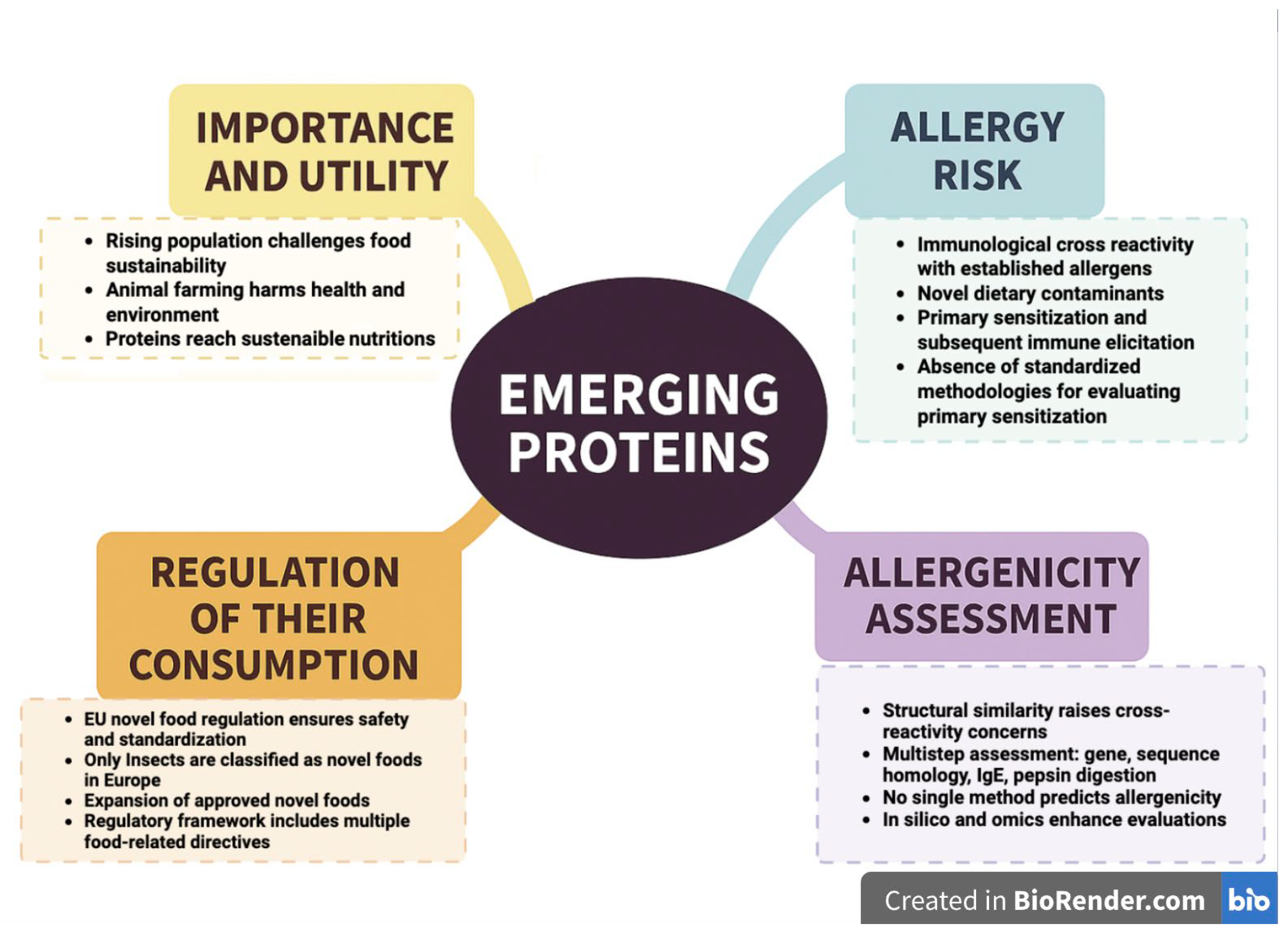

Table 1.
Most used plant-derived food alternatives as sources of allergens.
| Plant-derived foods | Tofu (main ingredient: fermented soy milk) |
| Soybeans, Tempeh (main ingredient: fermented soybeans), Edamame (immature soybeans) |
|
| Peanuts | |
| Lentils | |
| Chickpeas | |
| Beans | |
| Peas | |
| Quinoa | |
| Mycoprotein | |
| Broccoli | |
| Treenuts (especially almonds) | |
| Spirulina | |
| Plant-derived food allergen components | Prolamin superfamily, including 2S albumin, non-specific lipid transfer protein (ns-LTP), cereal prolamin, and a-amylase/trypsin inhibitors |
| Cupin, including vicilin (7S globulin) and legumin (11S globulin) | |
| Bet v 1/pathogenesis related protein 10 (PR-10) | |
| Profilin | |
| Oleosins |
Disclaimer/Publisher’s Note: The statements, opinions and data contained in all publications are solely those of the individual author(s) and contributor(s) and not of MDPI and/or the editor(s). MDPI and/or the editor(s) disclaim responsibility for any injury to people or property resulting from any ideas, methods, instructions or products referred to in the content. |
© 2025 by the authors. Licensee MDPI, Basel, Switzerland. This article is an open access article distributed under the terms and conditions of the Creative Commons Attribution (CC BY) license (http://creativecommons.org/licenses/by/4.0/).
Copyright: This open access article is published under a Creative Commons CC BY 4.0 license, which permit the free download, distribution, and reuse, provided that the author and preprint are cited in any reuse.