
Submitted:
03 July 2025
Posted:
04 July 2025
You are already at the latest version
Abstract
The prevailing cosmological paradigm interprets the nearly linear redshift–distance relation of galaxies as evidence that the entire fabric of space has been expanding since an initial highentropy event commonly referred to as the Big Bang. This paper advances an alternative view: the observed expansion is confined to the hot, energetically active domain that constitutes the observable universe, whereas remote, energy-poor regions beyond the photon horizon may remain static or contractive. The apparent Hubble flow is modeled as a consequence of local thermodynamic gradients. Zones of high temperature and energy density undergo metric dilation, while colder, nearly empty zones do not. This framework reinterprets cosmic expansion as a macroscopic thermodynamic process akin to heat diffusion, extended to astrophysical scales. It challenges the necessity of auxiliary constructs such as dark energy, the cosmological constant, or negative-mass antimatter, and outlines empirical signatures by which it can be tested. The universe, in this view, does not face an inevitable disintegration or "heat death", but self-regulates through expanding and contracting regions in pursuit of large-scale thermodynamic equilibrium.
Keywords:
thermodynamic gradient cosmology
; local cosmic expansion
; entropy-driven universe
; temperature gradient model
; Hubble tension
; spatial H₀ variance
; hot observable universe
; cold contracting voids
; alternative to dark energy
; entropy flow
; large-scale structure
; cosmic voids
; modified FLRW
; emergent cosmology
; entropic gravity
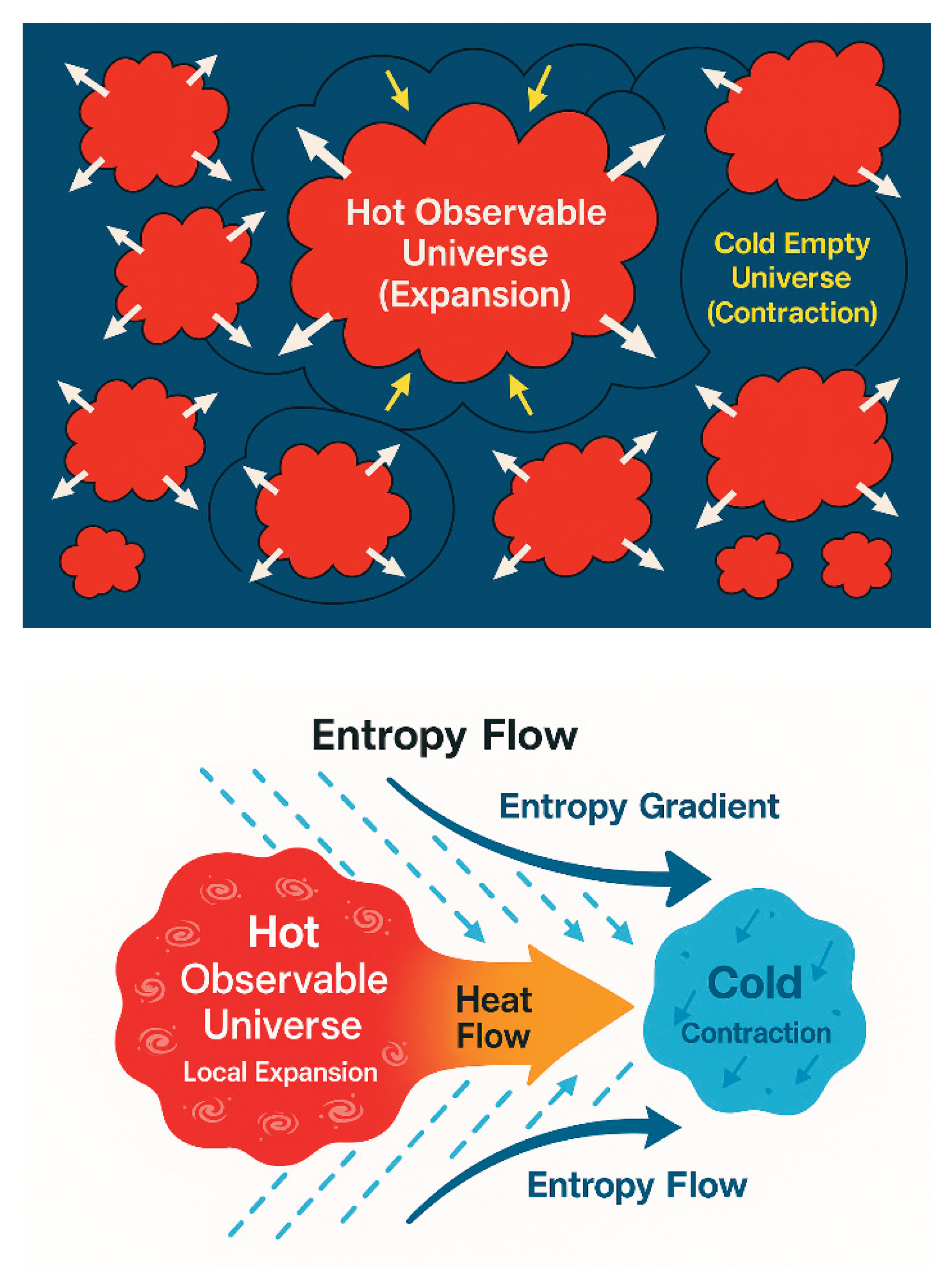
Figure 1 illustrates the conceptual foundation of Thermodynamic Gradient Cosmology. In panel (a), the universe is depicted as a mosaic of thermodynamically distinct domains: hot, star-rich zones undergo local expansion (white arrows), while cold, energy-poor voids contract. The observable universe lies within one such hot, expanding domain. Panel (b) models this mechanism as a thermodynamic process: heat and entropy flow from a hot region into a neighboring cold one, driving local metric expansion in the source domain and contraction in the sink. This process is governed by entropy gradients, analogous to classical diffusion phenomena but operating on cosmological scales.
1. Introduction
Since Hubble’s original measurements of galactic
redshifts, mainstream cosmology has embraced the notion of a globally expanding
space-time. Contemporary ΛCDM cosmology sustains this narrative by postulating
dark energy to reconcile late-time acceleration with general relativity. Yet
the data used to infer a global expansion originate exclusively from within the
region bounded by our particle horizon, the observable universe. This region is
not a random sample of the cosmos but a thermodynamically exceptional zone:
rich in stars, galaxies, and radiation, and far from equilibrium.
The present study explores the possibility that the
inferred expansion is not a universal property of space, but a thermodynamic
artefact of our hot, luminous vantage point. The central thesis of
Thermodynamic Gradient Cosmology (TGC) is this:
“Metric expansion arises locally in response to
strong energy and temperature gradients; it is not a general property of empty
space.”
In this view, star-forming regions, hot plasma, and
thermally active matter contribute to metric dilation as a consequence of
entropy flow. Cold, low-density voids and regions beyond the photon horizon may
remain static, or even contract, in response to this imbalance. The expansion
we observe is therefore not the fate of all space, but a local reaction to our
energetic environment.
This approach reframes cosmic dynamics in terms of
heat and energy exchange. The expansion becomes a large-scale thermodynamic
phenomenon, not unlike the way thermal expansion occurs in matter due to
molecular motion. But here, it is scaled up: entire clusters of galaxies
participate in a kind of astrophysical thermodynamic equilibration. Gravity
continues to shape local orbits and bound systems, but across cosmological
distances, thermal forces may govern the evolution of space itself.
Under this hypothesis, the universe self-organizes:
hot sectors expand, cold sectors contract, and the net result is not endless
acceleration but dynamic balance. The ultimate fate is not a Big Rip or
universal freeze-out, but a long-term thermal equilibrium across vast domains.
As such, the theory offers a conceptually economical framework that eliminates
the need for dark energy or exotic constructs, and it introduces observable
phenomena, such as Hubble constant gradients and temperature–lensing correlations,
by which it can be tested.
The following sections outline the theoretical,
mathematical, and observational structure of Thermodynamic Gradient Cosmology
and offer a roadmap for its potential validation or falsification.
2. Key propositions
- Expansion is local, not global. The metric expansion of space occurs only in regions with high temperature and energy density, such as the observable universe. Cold, nearly empty zones remain static or contract.
- Expansion is thermodynamically driven. Heat and entropy flow outward from hot zones into colder surroundings, creating a large-scale dilation analogous to thermal expansion in matter.
- The Big Bang extrapolation is incomplete. Assuming universal expansion beyond the observable horizon presumes large-scale homogeneity, a postulate not supported by direct observation.
- Dark energy and exotic matter are unnecessary. The observed acceleration and metric behavior can be explained as emergent thermodynamic effects, eliminating the need for dark energy, a cosmological constant, or negative-mass matter.
- The universe self-regulates. Instead of expanding uniformly toward thermal death, the cosmos undergoes regional expansion and contraction, gradually approaching thermodynamic equilibrium on a vast scale.
3. Theoretical Foundations
The hypothesis underlying Thermodynamic Gradient
Cosmology (TGC) is rooted in a reinterpretation of cosmic expansion as a
large-scale thermodynamic phenomenon. Rather than assuming that space itself
expands uniformly and globally, this framework proposes that metric dilation is
a localized response to energy gradients in the universe. Most notably the vast
temperature differentials between hot, luminous regions and cold, nearly empty
voids. This section outlines the theoretical motivation for such a model, drawing
analogies to classical thermodynamics, examining the role of entropy and energy
flow, and identifying the interaction between thermally induced expansion and
gravitational confinement.
3.1. Thermodynamic Mechanism of Metric Expansion
In classical physics, temperature gradients within
a medium give rise to well-understood macroscopic effects: heat flow, pressure
differences, and thermal expansion. These phenomena are governed by the second
law of thermodynamics, whereby systems spontaneously evolve toward equilibrium
by redistributing energy from hot to cold regions. Analogously, in TGC, regions
of high temperature and radiation density (e.g., galaxies, stellar clusters)
are posited to expand not because of any intrinsic property of space-time, but
because of their energetic imbalance with surrounding colder zones.
The basic mechanism can be conceptualized as
follows:
- A hot, thermally active region seeks to export entropy outward, leading to local geometric expansion as a means of dissipating energy.
- Adjacent cold, low-entropy voids act as thermodynamic sinks. Their metric contracts or remains static, effectively maintaining the energy differential that drives the process.
- This interplay results in a dynamic mosaic of expanding and contracting regions, each governed by local thermodynamic conditions rather than a universal scale factor.
Unlike the standard FLRW metric of general
relativity, which treats the cosmic scale factor as a global function of time, Thermodynamic
Gradient Cosmology (TGC) proposes a locally varying scale factor, denoted as , which depends on both spatial position and time , and is directly influenced by the local energy
density and temperature.
3.2. Entropy Gradients and Cosmic Structure
The emergence of structure in the universe, from
galaxies to galaxy clusters, has long been associated with gravitational
instability. However, gravitational evolution occurs within a broader
thermodynamic context: energy must be redistributed, and entropy gradients
evolve over time. TGC emphasizes that entropy gradients are not just byproducts
of cosmic evolution but active agents in shaping metric behavior.
In this model:
- The redshift–distance relation arises not from the stretching of all space, but from light traversing through a network of expanding high-energy zones embedded in a mostly static or contractive background.
- Over time, hot regions cool and expand, while cold regions remain gravitationally bound or contract, creating a form of cosmic thermal diffusion.
- This results in a non-linear, non-uniform Hubble flow when viewed across large distances.
The model can thus naturally explain certain
observed anisotropies, such as dipole or quadrupole alignments in the cosmic
microwave background (CMB), as emergent features of large-scale entropy
gradients.
3.3. Gravitational Constraint within Expanding Zones
While thermodynamic gradients drive local
expansion, gravity remains essential for the structural integrity of bound
systems. Stars orbit galaxies, and galaxies cluster together, despite
participating in large-scale expansion. This apparent contradiction is
reconciled in TGC by viewing gravity as a local counterforce that stabilizes
metric dilation on small scales, while allowing for expansion on larger,
intergalactic scales.
In particular:
- On scales smaller than galactic superclusters, gravitational potential dominates, preventing significant metric change.
- On cosmological scales, thermal pressure and entropy flow overcome gravitational binding, allowing space between structures to expand.
This balance explains why we do not observe metric
expansion within solar systems or galaxies, even though the surrounding
universe exhibits redshift behavior. In TGC, metric expansion becomes
scale-dependent and thermodynamically selective, in contrast to the
scale-invariant expansion postulated by standard ΛCDM cosmology.
4. Mathematical Framework
This section introduces the mathematical foundation
of Thermodynamic Gradient Cosmology (TGC). Building on the physical principles
outlined in Chapter 3, I propose a set of equations that describe how local
metric expansion arises from thermodynamic gradients. The goal is not to derive
a full set of field equations from first principles (which remains a task for
future work), but to present a plausible phenomenological model that connects
temperature, energy density, and the local expansion rate of space.
4.1. Local Hubble Parameter from Temperature Contrast
Let us define the local baryonic temperature as the coarse-grained average temperature in a
given region, and let denote the baseline temperature of deep
intergalactic voids, corresponding to the Cosmic Microwave Background (CMB).
I propose the following phenomenological relation
for the local Hubble parameter:
This implies that the expansion rate in a given region depends linearly on the temperature excess over the background CMB. Here, λ is a proportionality constant that can be calibrated using known data from the local universe.
Using approximate values:
- (temperature in star-forming regions)
We obtain:
This simple scaling relation implies that:
- In hot regions: , corresponding to metric expansion
- In cold regions: or even negative, corresponding to static or contracting space
4.2. Thermodynamic Formulation
The relation above can be reformulated in terms of the temperature difference
This differential form defines the local time evolution of the scale factor . The expansion rate increases with greater thermal contrast to the background.
To generalize this to spatially varying environments, we introduce a diffusive model analogous to classical heat conduction:
Where:
- is an effective cosmological thermodiffusivity
- is a dimensionless coupling constant
- is the divergence of the thermal flux
This equation suggests that local metric change behaves like a response to thermodynamic imbalance. Regions with steep temperature gradients act as "sources" of expansion, while surrounding colder areas act as sinks.
4.3. Interpretation as a Field Equation
The equations above constitute a Thermodynamic Field Equation System, which can be heuristically embedded into a modified cosmological model by replacing the global scale factor of the FLRW metric with the local term . A fully consistent relativistic theory would require:
- Coupling these thermodynamic terms to the Einstein field equations
- Introducing a stress-energy tensor component dependent on
While such a derivation is beyond the scope of this paper, I propose that metric dynamics may arise as an emergent response to thermodynamic disequilibrium, analogous to how pressure gradients induce fluid flow.
Key Equations
- Local Hubble parameter:
- 2.
- Expansion rate via temperature difference:
- 3.
- Diffusive formulation of metric change:
5. Predictions and Observational Tests
Thermodynamic Gradient Cosmology (TGC) distinguishes itself from many alternative cosmologies by proposing specific empirical signatures that can be sought in existing and upcoming astronomical data. This chapter outlines several key phenomena through which TGC can be experimentally confirmed or falsified.
5.1. Spatial Variations in the Hubble Parameter
If metric expansion is driven by local thermodynamic conditions, then the Hubble parameter H₀ should not be a truly global constant, but rather exhibit small-scale spatial variation depending on local temperature and energy density.
From Chapter 4, I proposed the relation:
Thus, the relative variation in H between two regions with different temperatures is given by:
As an example:
- A galaxy cluster with
- A deep void with
This yields a fractional difference of order to , which may be detectable with upcoming high-precision supernova surveys like:
- LSST (Legacy Survey of Space and Time)
- Nancy Grace Roman Space Telescope
Such a detection would directly contradict the ΛCDM assumption of large-scale uniformity.
5.2. Temperature–Lensing Correlation
Gravitational lensing depends on the geometry of space-time. If metric expansion is thermodynamically driven, then cold voids (which expand less or contract) should have slightly altered lensing signatures compared to the ΛCDM prediction.
Prediction:
- Weak-lensing convergence maps should show enhanced lensing in underdense, cold regions, an effect sometimes described as “over-convergence.”
- This can be tested using:
- Euclid mission
- Dark Energy Survey (DES)
- CMB lensing reconstruction maps
A statistically significant anti-correlation between local temperature and lensing signal would be strong evidence for the TGC framework.
5.3. CMB Anomalies and Alignment with Temperature Dipole
The standard ΛCDM model treats low-multipole anisotropies in the cosmic microwave background (CMB), such as the quadrupole, as primordial. However, in TGC, these may emerge as thermal alignment effects with local structure.
Prediction:
- Large-angle CMB anomalies (quadrupole, octopole) should align with large-scale temperature gradients, such as the super-galactic temperature dipole.
If this alignment strengthens with improved foreground subtraction and resolution (e.g. with CMB-S4), it would support the notion that local thermodynamics influence the observed metric.
5.4. Redshift Distribution in Cosmic Voids
A central tenet of TGC is that galaxies in deep, cold voids experience less expansion, or even mild contraction, relative to those in rich, hot environments. As a result:
Prediction:
- Galaxies located in deep voids should exhibit lower redshifts at the same comoving distance than galaxies located in clusters.
This would appear as a break in the global Hubble line, measurable via redshift surveys like:
- eBOSS
- SDSS
- DESI (Dark Energy Spectroscopic Instrument)
Any systematic offset correlated with local temperature or void depth would challenge the assumption of a universal scale factor and support the thermodynamic model.
5.5. Summary of Testable Predictions
The key predictions of Thermodynamic Gradient Cosmology (TGC) can be described as follows:
- Spatial H₀ Gradients: The Hubble parameter should vary slightly depending on local temperature and energy density. Regions such as galaxy clusters and cosmic voids are expected to show small but measurable differences in H₀. This can be tested using high-precision supernova surveys such as LSST or the Nancy Grace Roman Space Telescope.
- Void Lensing Anomaly: Cold and underdense regions may produce stronger gravitational lensing than predicted by ΛCDM. This "over-convergence" can be searched for in weak-lensing maps, particularly using data from Euclid or the Dark Energy Survey (DES).
- CMB Anomaly Alignment: Large-scale anomalies in the cosmic microwave background, especially in the quadrupole and octopole, may align with large-scale temperature gradients, rather than being purely primordial. Such alignments can be tested by comparing CMB maps from Planck or CMB-S4 with known thermal structures in the universe.
- Redshift Deviations in Voids: Galaxies located in deep, cold voids are predicted to show lower redshifts than galaxies in hotter environments, at the same comoving distance. This would appear as a break in the global Hubble relation. Suitable data sources include SDSS, eBOSS, and the DESI survey.
Each of these tests is falsifiable. A failure to observe any of these effects would weaken or rule out the TGC framework. Conversely, detection of multiple effects across independent datasets would position Thermodynamic Gradient Cosmology as a viable and potentially superior alternative to ΛCDM.
6. Implications for Cosmology
If Thermodynamic Gradient Cosmology (TGC) accurately describes the true nature of cosmic expansion, its implications reach far beyond the scope of localized redshift observations. It challenges some of the most deeply embedded assumptions in contemporary cosmology, particularly the necessity of dark energy, the universality of the Big Bang model, and the predicted heat death of the universe. This chapter outlines the broader consequences of adopting a thermodynamic rather than geometric interpretation of cosmic expansion.
6.1. Reconsidering Dark Energy
The ΛCDM model explains the observed acceleration of cosmic expansion through a mysterious form of energy known as dark energy, typically modeled as a cosmological constant Λ with negative pressure. However, dark energy is a purely theoretical construct: it has never been directly observed, and its physical nature remains undefined.
In contrast, TGC offers a concrete physical mechanism, entropy flow and heat redistribution across cosmic scales, as the driver of local expansion. The apparent acceleration of distant galaxies may simply reflect our position inside a hot, expanding region bordered by colder surroundings. No exotic energy field is required.
Implication:What ΛCDM attributes to a universal force with finely tuned properties, TGC explains as an emergent effect of thermodynamic imbalance. The cosmological constant becomes unnecessary.
6.2. No Need for Negative-Mass Matter or Exotic Fields
Several speculative models attempt to explain expansion anomalies or gravitational lensing discrepancies by invoking exotic entities such as negative-mass antimatter, scalar fields, or modifications to gravity. While mathematically interesting, these additions often complicate the physical model and lack independent empirical support.
TGC accounts for expansion without invoking such constructs. By treating heat flow and entropy gradients as fundamental drivers of metric behavior, the theory retains a simpler and more grounded physical foundation.
Implication:TGC restores Occam’s razor to cosmology by eliminating unnecessary theoretical entities in favor of observable thermodynamic properties.
6.3. A Non-Catastrophic Cosmic Future
In ΛCDM, the long-term fate of the universe is one of thermal death: expansion accelerates endlessly, matter dilutes, stars fade, and even atoms may eventually be torn apart in a hypothetical Big Rip. These scenarios rely on the assumption that the entire universe is expanding uniformly and irreversibly.
TGC suggests a different outcome. Since expansion is localized and thermodynamically regulated, it does not proceed unchecked. As entropy spreads and temperature gradients diminish, the driving force behind metric expansion naturally weakens. Some regions may contract, others may stabilize, and a large-scale dynamic equilibrium may emerge.
Implication:The universe is not doomed to fade or tear apart, but may evolve into a thermodynamically balanced state, dynamic, eternal, and self-regulating.
6.4. Beyond the Observable Universe
Current cosmology extrapolates the behavior of space-time far beyond the limits of observation, assuming that conditions in the visible universe are representative of the whole. TGC questions this assumption.
In this framework, the observable universe is a hot spot in a much larger thermodynamic structure, a region of elevated energy undergoing temporary expansion. Beyond the photon horizon, the universe may be static, contractive, oscillatory, or exhibit entirely different behavior.
Implication:We cannot assume homogeneity on scales we cannot observe. TGC allows for a richer, more complex universe composed of thermodynamic domains, each with its own metric dynamics.
6.5. A Shift in Cosmological Thinking
If confirmed, TGC would represent a paradigm shift in cosmology, from a geometric to a thermodynamic understanding of space-time behavior. It reinterprets redshifts, large-scale structure, and cosmic acceleration not as consequences of dark energy or primordial inflation, but as thermodynamic responses to local energy imbalance.
This shift echoes a broader movement in physics toward viewing gravity, space, and time as emergent phenomena, products of deeper informational or entropic principles, as suggested in entropic gravity theories and holographic models.
Implication:TGC aligns with a growing perspective that space-time geometry may be shaped not by fundamental fields alone, but by the flow of energy, entropy, and information.
7. Discussion and Future Work
7.1. Theoretical Limitations
While Thermodynamic Gradient Cosmology (TGC) offers a conceptually elegant alternative to dark energy, several theoretical questions remain. Most notably, the framework lacks a fully developed set of field equations that relate local thermodynamic variables directly to space-time curvature. Although the concept of a locally varying scale factor is intuitive, its incorporation into general relativity or modified gravity theories requires further formalization. Additionally, the microscopic mechanism by which entropy gradients induce metric dilation is not yet rigorously derived from quantum field theory or thermodynamic first principles.
7.2. Relationship to Existing Theories
TGC overlaps conceptually with several modern ideas in theoretical physics, including emergent gravity, entropic gravity, and causal set theory. However, it is distinct in its concrete thermodynamic formulation and its predictive focus on observable gradients. Future work should investigate how TGC can be embedded within a more general framework, possibly as an emergent limit of a deeper informational or quantum gravitational model. The theory may also be compatible with ideas from black hole thermodynamics, suggesting new links between cosmology and quantum information theory.
7.3. Experimental Challenges
Testing TGC will require extremely precise measurements of redshift, lensing, and temperature distributions across large-scale structures. Some of the theory’s predictions, such as spatial gradients in the Hubble parameter or lensing anomalies in cosmic voids, lie at the edge of current observational capabilities. However, upcoming missions like Euclid, Roman, and CMB-S4 may provide the resolution needed. It is also critical to differentiate TGC’s predictions from those of inhomogeneous ΛCDM models, which can produce superficially similar effects through different mechanisms.
7.4. Simulation and Modeling Needs
To evaluate the full implications of TGC, numerical simulations must be developed that integrate thermodynamic variables directly into cosmological models. This includes tracking entropy flow across spatial domains, modeling localized expansion, and simulating the resulting impact on observable structure. Such simulations may require new computational tools that bridge the gap between statistical physics and relativistic cosmology.
7.5. Outlook
TGC proposes a bold reinterpretation of the universe as a patchwork of thermodynamic domains, each evolving according to local gradients rather than a universal scale factor. If confirmed, this framework could reshape our understanding of cosmic history and future. But to move from hypothesis to accepted theory, TGC must be developed into a testable, mathematically rigorous model and subjected to the same level of empirical scrutiny that has shaped modern cosmology. The potential reward, however, is considerable: a universe that is not fading into entropy, but self-organizing toward equilibrium through the flow of heat and time.
8. Conclusion
Thermodynamic Gradient Cosmology (TGC) offers a radically different perspective on the observed expansion of the universe. Rather than assuming that all of space is stretching uniformly due to a mysterious repulsive force or a finely tuned cosmological constant, TGC proposes a more grounded mechanism: metric expansion is a thermodynamic response to localized gradients in temperature and energy density. In this view, the observable universe is not representative of the cosmos at large, but a luminous and energetic outlier embedded in a broader, colder and potentially contracting environment.
By reframing expansion as a local, emergent phenomenon akin to heat diffusion, TGC dissolves the need for constructs such as dark energy, negative-mass antimatter, or time-dependent scalar fields. It instead emphasizes the role of entropy flows in shaping the geometry of space-time, an idea both intuitively compelling and rooted in physical principles observed across scales.
This theoretical framework offers a coherent set of propositions:
- Metric expansion is driven by heat and entropy, not by vacuum energy.
- The expansion is spatially heterogeneous, limited to thermodynamically active domains.
- The large-scale universe may be in dynamic balance, with hot regions expanding and cold regions contracting.
- Observable anomalies, such as Hubble tension, lensing irregularities, and inhomogeneous flows, may be signatures of underlying thermodynamic structure.
While still in its early conceptual phase, TGC invites a fundamental rethinking of cosmology’s first principles. It suggests that our observational position in the universe may bias our interpretation of its overall behavior, and that the true dynamics of space-time may be more intricate and self-regulating than current models assume.
Future work must address the mathematical formalism, derive precise predictions, and pursue observational tests capable of confirming or falsifying this view. But if the central claim of TGC holds, it will not only resolve long-standing cosmological puzzles but offer a unified, thermodynamically grounded vision of a universe that evolves not toward death, but toward balance.
References
- Einstein, A. Kosmologische Betrachtungen zur allgemeinen Relativitätstheorie; Sitzungsberichte der Königlich Preußischen Akademie der Wissenschaften, 1917. [Google Scholar]
- Hubble, E. A relation between distance and radial velocity among extra-galactic nebulae. Proceedings of the National Academy of Sciences 1929, 15(3), 168–173. [Google Scholar] [CrossRef] [PubMed]
- Friedmann, A. Über die Krümmung des Raumes. Zeitschrift für Physik 1922, 10, 377–386. [Google Scholar] [CrossRef]
- Planck Collaboration. Planck 2018 results. VI. Cosmological parameters. Astronomy & Astrophysics 2018, 641, A6. [Google Scholar]
- Riess, A. G. Observational evidence from supernovae for an accelerating universe and a cosmological constant. The Astronomical Journal 1998, 116(3), 1009–1038. [Google Scholar] [CrossRef]
- Perlmutter, S. Measurements of Omega and Lambda from 42 high-redshift supernovae. The Astrophysical Journal 1999, 517(2), 565–586. [Google Scholar] [CrossRef]
- Peebles, P. J. E.; Ratra, B. The cosmological constant and dark energy. Reviews of Modern Physics 2003, 75(2), 559. [Google Scholar] [CrossRef]
- Carroll, S. The cosmological constant. Living Reviews in Relativity 2001, 4(1), 1. [Google Scholar] [CrossRef] [PubMed]
- Padmanabhan, T. Dark energy: mystery of the millennium. AIP Conference Proceedings 2005, 861, 179–196. [Google Scholar]
- Easson, D. A.; Frampton, P. H.; Smoot, G. F. Entropic accelerating universe. Physics Letters B 2011, 696(3), 273–277. [Google Scholar] [CrossRef]
- Verlinde, E. On the origin of gravity and the laws of Newton. Journal of High Energy Physics 2011, 2011(4), 29. [Google Scholar] [CrossRef]
- Bekenstein, J. D. Black holes and entropy. Physical Review D 1973, 7(8), 2333. [Google Scholar] [CrossRef]
- Hawking, S. W. Particle creation by black holes. Communications in Mathematical Physics 1975, 43(3), 199–220. [Google Scholar] [CrossRef]
- Tolman, R. C. Relativity, Thermodynamics, and Cosmology; Clarendon Press, Oxford, 1934. [Google Scholar]
- Kolb, E. W.; Turner, M. S. The Early Universe; Addison-Wesley, 1990. [Google Scholar]
- Mukhanov, V. Physical Foundations of Cosmology; Cambridge University Press, 2005. [Google Scholar]
- Barbour, J.; Koslowski, T.; Mercati, F. The Janus point: A new theory of time. arXiv 2014, arXiv:1409.0917. [Google Scholar]
- Ellis, G. F. R.; Maartens, R.; MacCallum, M. A. H. Relativistic Cosmology; Cambridge University Press, 2012. [Google Scholar]
- Carroll, S. M. Spacetime and Geometry: An Introduction to General Relativity, 2nd ed.; Cambridge University Press, 2019. [Google Scholar]
- Penrose, R. The Emperor’s New Mind; Oxford University Press, 1989. [Google Scholar]
- Nielsen, H. B.; Ninomiya, M. Future dependent initial conditions from imaginary part in Lagrangian. International Journal of Modern Physics A 2006, 21(21), 5151–5164. [Google Scholar] [CrossRef]
- M. G. Menken (2025). Thermodynamic Gradient Cosmology – A Local Model for the Observed Expansion of the Universe (preprint). Second edition, revised July 2025.
Figure 1.
Illustrations by Mika G. Menken: (a) mosaic of hot, expanding regions versus cold, contracting voids; (b) heat- and entropy flow from a hot cell to a neighbouring cold cell in the TGC framework.
Figure 1.
Illustrations by Mika G. Menken: (a) mosaic of hot, expanding regions versus cold, contracting voids; (b) heat- and entropy flow from a hot cell to a neighbouring cold cell in the TGC framework.
Disclaimer/Publisher’s Note: The statements, opinions and data contained in all publications are solely those of the individual author(s) and contributor(s) and not of MDPI and/or the editor(s). MDPI and/or the editor(s) disclaim responsibility for any injury to people or property resulting from any ideas, methods, instructions or products referred to in the content. |
© 2025 by the authors. Licensee MDPI, Basel, Switzerland. This article is an open access article distributed under the terms and conditions of the Creative Commons Attribution (CC BY) license (http://creativecommons.org/licenses/by/4.0/).
Copyright: This open access article is published under a Creative Commons CC BY 4.0 license, which permit the free download, distribution, and reuse, provided that the author and preprint are cited in any reuse.