
Submitted:
19 June 2025
Posted:
27 June 2025
Read the latest preprint version here
Abstract
The prevailing cosmological paradigm interprets the nearly linear red-shift–distance relation of galaxies as evidence that the entire fabric of space has been expanding since an initial high-entropy event commonly referred to as the Big Bang. This paper advances an alternative view: the observed expansion is confined to the hot, energetically active domain that constitutes the observable universe, whereas remote, energy-poor regions beyond the photon horizon may remain static or contractive. The apparent Hubble flow is modelled as a consequence of local thermodynamic gradients—zones of high temperature and energy density undergo metric dilation, while colder, nearly empty zones do not. The framework challenges the necessity of auxiliary constructs such as dark energy, the cosmological constant, or negative-mass antimatter, and outlines empirical signatures by which it can be tested.
Keywords:
thermodynamic gradient cosmology
; local cosmic expansion
; entropy-driven universe
; temperature gradient model
; Hubble tension
; spatial H₀ variance
; hot observable universe
; cold contracting voids
; alternative to dark energy
; entropy flow
; large-scale structure
; cosmic voids
; modified FLRW
; emergent cosmology
; entropic gravity
1. Introduction
Since Hubble’s original measurements of galactic red-shifts, mainstream cosmology has embraced the notion of a globally expanding space-time. Contemporary ΛCDM cosmology sustains this narrative by postulating dark energy to reconcile late-time acceleration with general relativity. Yet the data used to infer a global expansion originate exclusively from within the region bounded by our particle horizon—the observable universe. The present study explores the possibility that the inferred expansion is a thermodynamic artefact of our hot, luminous vantage point rather than a universal property of space itself.
Figure 1.
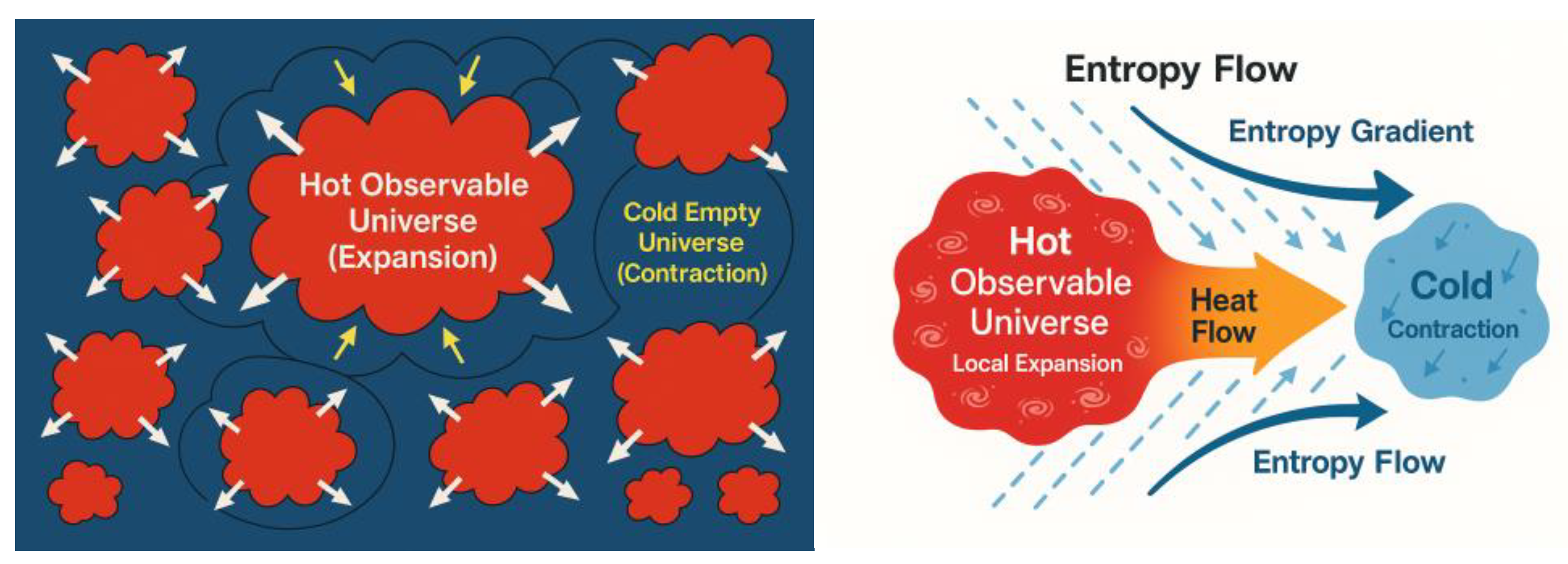
Illustrations by Mika G. Menken: (a) mosaic of hot, expanding regions versus cold, contracting voids; (b) heat- and entropy flow from a hot cell to a neighbouring cold cell in the TGC framework.
Figure 1.
Illustrations by Mika G. Menken: (a) mosaic of hot, expanding regions versus cold, contracting voids; (b) heat- and entropy flow from a hot cell to a neighbouring cold cell in the TGC framework.
Key propositions
- Only the observable universe expands. Metric dilation is confined to the spatial domain in which radiation and luminous matter dominate the energy budget.
- Expansion is thermodynamically driven. Hot, star-forming regions dilute to equilibrate entropy with surrounding cold, energy-scarce domains.
- The canonical Big-Bang extrapolation is incomplete. Extending local expansion to the entire cosmos embeds an untested assumption of large-scale homogeneity.
2. Thermodynamic Framework
2.1. Mathematical Formulation
Let T_v ≈ 2.725 K denote the baseline temperature of the cosmic microwave background in deep voids, T_b(r,t) the coarse-grained baryonic temperature in luminous regions, and a(r,t) a local scale factor normalised to unity at the present cosmic time t0 in the Solar neighbourhood.
A phenomenological relation for the local Hubble parameter H ≡ ȧ⁄a is proposed:
(1) H(r,t) = λ [(T_b(r,t) ⁄ T_v) − 1].
Calibrating with T_b ≈ 10⁴ K and H0 ≈ 70 km s⁻¹ Mpc⁻¹ for the Milky Way environment yields
(2) λ ≈ 1.6 × 10⁻¹⁸ s⁻¹.
More generally, for ΔT = T_b − T_v:
(3) ȧ⁄a = λ ΔT ⁄ T_v.
Including spatial gradients produces a diffusive form reminiscent of heat conduction:
(4) ∂ₜ ln a = α ∇·(κ ∇T),
where κ is an effective cosmological thermodiffusivity and α a dimensionless coupling constant. Equations (1)–(4) constitute a Thermodynamic Field Equation system that can be embedded in a modified FLRW metric by replacing the global scale factor with a(r,t) and adding a temperature-dependent stress–energy component.
2.2. Testable Predictions
- Spatial H0 gradients. From Eq. (1): ΔH⁄H0 ≈ ΔT⁄T_b. A deep void with T_b ≈ 10 K should display an ≈ 0.1 % lower Hubble parameter than a rich cluster environment. Forthcoming supernova surveys (LSST, Roman Space Telescope) can probe this.
- Temperature–lensing correlation. Weak-lensing convergence maps should be anticorrelated with large-scale temperature fields: colder voids produce slightly over-convergent signals relative to ΛCDM expectations.
- CMB quadrupole alignment. If expansion is thermally driven, low-ℓ CMB anomalies should align with the super-galactic temperature dipole rather than purely primordial fluctuations.
- Red-shift distribution in voids. Galaxies in deep voids should exhibit systematically lower red-shifts at a given comoving distance than cluster galaxies, violating a single global Hubble line.
Failure to observe all four signatures would falsify the thermodynamic gradient cosmology; confirmation in multiple datasets would establish it as a credible competitor to ΛCDM.
3. Consistency with Observational Data
Current data quality does not yet decisively confirm or refute the predicted H0 variance, temperature–lensing anticorrelation, or quadrupole alignment. However, LSST, Euclid, and CMB Stage-4 missions will resolve galaxy-cluster dynamics, void statistics, and polarisation anisotropies at precisions sufficient to test Equations (1)–(4). Early hints of H0 tension between supernova and CMB methods may already point toward a geographically varying expansion rate, consistent with the proposed framework.
4. Relation to Existing Alternative Models
While steady-state cosmology posits continuous matter creation and conformal cyclic cosmology envisages sequential aeons, the present approach leaves the global geometry indeterminate: regions beyond the horizon may be static, oscillatory, or topologically closed. The key innovation is attributing metric dynamics to temperature gradients, not to an initial singularity or an unexplained cosmological constant. The framework thus complements, but does not contradict, emergent-gravity ideas such as Verlinde’s entropic gravity.
5. Implications for Dark Energy and Negative-Mass Matter
If expansion is local and thermodynamic in origin, the cosmological constant ceases to be required as an energy component. Apparent late-time acceleration could reflect our thermal position within an evolving gradient field. Likewise, hypothetical negative-mass antimatter—often invoked as a bookkeeping device—becomes unnecessary; momentum conservation is satisfied by gradients in the stress–energy tensor associated with ∇T.
6. Discussion and Future Work
Immediate tasks include deriving full field equations that couple Einstein tensors to the temperature-dependent scale factor, performing numerical simulations of galaxy evolution under gradient-driven expansion, and devising observational strategies to isolate spatial variations in H0. A rigorous Bayesian model comparison with ΛCDM will be essential.
7. Conclusions
Thermodynamic Gradient Cosmology posits that the familiar metric expansion is a local phenomenon confined to the hot, energetic sector we inhabit. By linking expansion to entropy gradients, the model offers a conceptually economical alternative to ΛCDM, eliminating the need for dark energy and negative-mass matter. Observable spatial variations in the Hubble parameter, void lensing discrepancies, and explicit correlations between temperature and expansion rate will decide its fate.
References
- E. Hubble, "A Relation between Distance and Radial Velocity among Extra-Galactic Nebulae," Proc. Natl. Acad. Sci. USA 15, 168 (1929). [CrossRef]
- G. Riess et al., "A Comprehensive Measurement of the Local Value of the Hubble Constant from the SHOES Project," Astrophys. J. 934, L7 (2022).
- W. L. Freedman et al., "The Carnegie–Chicago Hubble Program. VIII. An Independent Determination of the Hubble Constant Based on the Tip of the Red Giant Branch," Astrophys. J. 882, 34 (2019). [CrossRef]
- N. Aghanim et al. (Planck Collaboration), "Planck 2018 Results. VI. Cosmological Parameters," Astron. Astrophys. 641, A6 (2020).
- T. M. C. Abbott et al. (DES Collaboration), "Dark Energy Survey Year 3 Results: Cosmological Constraints from Galaxy Clustering and Weak Lensing," Phys. Rev. D 105, 023520 (2022).
- S. Alam et al. (eBOSS Collaboration), "Completed SDSS-IV Extended Baryon Oscillation Spectroscopic Survey: Cosmological Implications," Phys. Rev. D 103, 083533 (2021).
- R. B. Tully & I. D. Karachentsev, "Our Peculiar Motion Away from a Local Void," Astrophys. J. 802, L25 (2015). [CrossRef]
- M. Kraljic & F. R. Bouchet, "Evidence of a Large Local Void from Galaxy Surveys," Astron. Astrophys. 628, A114 (2019).
- N. Hamaus et al., "Constraints on Cosmology and Gravity from the Dynamics of Voids," Phys. Rev. Lett. 117, 091302 (2016). [CrossRef]
- E. P. Verlinde, "On the Origin of Gravity and the Laws of Newton," J. High Energy Phys. 2011, 29 (2011). [CrossRef]
- R. Penrose, Cycles of Time, Bodley Head, London (2010).
- LSST Dark Energy Science Collaboration, "Science Requirements Document," arXiv:2008.06060 (2020).
Disclaimer/Publisher’s Note: The statements, opinions and data contained in all publications are solely those of the individual author(s) and contributor(s) and not of MDPI and/or the editor(s). MDPI and/or the editor(s) disclaim responsibility for any injury to people or property resulting from any ideas, methods, instructions or products referred to in the content. |
© 2025 by the authors. Licensee MDPI, Basel, Switzerland. This article is an open access article distributed under the terms and conditions of the Creative Commons Attribution (CC BY) license (http://creativecommons.org/licenses/by/4.0/).
Copyright: This open access article is published under a Creative Commons CC BY 4.0 license, which permit the free download, distribution, and reuse, provided that the author and preprint are cited in any reuse.


