

Submitted:
25 June 2025
Posted:
26 June 2025
You are already at the latest version
Abstract
This article proposes a method that utilizes image analysis for the extraction of parameters in solar cells and panels. The method leverages the I-V curve image, provided by the manufacturer in the device's datasheet (solar cell/panel), which is processed using image editing software (Adobe Photoshop). Using Matlab, a reference system is established, enabling the calculation of key pa-rameters such as series resistance, shunt resistance, and maximum power point of the solar device. In this way, this method eliminates the need for formulating complex systems of equations, conducting prior measurements, employing costly equipment, or acquiring a dataset, as is the case with other parameter extraction methods for solar devices.
Keywords:
parameter extraction
; photovoltaic
; solar energy
; solar cells
1. Introduction
In recent years, image analysis has made notable advances in various applications, such as autonomous control of vehicles (land and aerial), facial recognition for security purposes, and even in sports through the use of VAR (Video Assistant Referee) technology, give some examples [1,2,3]. In this context, the present work seeks to expand the application of image analysis in the field of renewable energies, specifically in the modeling and parameter extraction of solar cells and panels.
The modeling and parameter extraction of solar cells and panels have generated growing interest due to the need to identify loss mechanisms that affect the efficiency of photovoltaic devices [4]. For this purpose, various techniques and methodologies for parameter extraction have been developed, which can be classified into three groups: iterative methods, non-iterative methods, and optimization methods [5,6,7].
However, although the aforementioned methods achieve a good approximation between the modeled curve and the experimental curve depending on the error metrics used (RMSE and NRMSE), certain limitations have been identified in most of these methodologies. Among these limitations are: difficulty in accurately estimating the maximum power point (Pmax); failure to obtain the performance parameters of the simulated curve; inability to generalize the method for both panels and solar cells; dependence on a prior dataset for implementation, which limits its application to other cases; reliance on ambiguous or unspecified prior measurements; and the need for costly equipment to obtain measurements or create a dataset, which restricts studies on photovoltaic devices.
Given these limitations, this work presents an alternative that expands the study and development of photovoltaic technology in a less expensive and more interactive way. The proposed method allows for the manipulation of the main parameters (IO: Reverse saturation current, IPV: Photogenerated current, n: Diode ideality factor, RS: Series resistance, and RP: Parallel resistance) of the single-diode model (SDM) [8], the number of series-connected cells (Ns) that constitute the solar device, as well as the environmental parameters (G: Radiant power, T: Temperature).
2. Materials and Method
2.1. Materials
Two of the most reported photovoltaic devices in the literature were selected as study objects: the Kyocera KC200GT solar panel [9], the RTC-FRANCE solar cell [10], as well as next-generation devices such as the SP450M solar panel [11] and the solar cell fabricated in our laboratories (INAOE) [12]. Table 1 shows the performance parameters (taken directly from the datasheets provided by the manufacturers [6,7,8,9]) for each of the aforementioned devices.
The datasheet specifies that the photovoltaic devices were characterized under standard test conditions (STC: G = 1000 W/m² and T = 25°C), with the exception of the RTC France cell, for which a temperature of T = 33°C is specified.
2.2. Graphical Method for Extracting Electrical Parameters.
Considering that solar cell and panel manufacturers provide the characteristic curve (I-V curve) of their devices in the datasheet, it is possible to use the image of the I-V curve for processing with the help of software Adobe Photoshop [13].
Using the image editing software, the I-V curve image is cleaned, scaled, and cropped according to our needs, as shown in Figure 1.
Once the image is processed using Matlab [14], a new reference system is established for the I-V curve, adjusted in terms of current and voltage. This system is scaled according to the original measurements provided by the manufacturer in the datasheet. With this new reference system and based on the equations and parameter extraction method described in [15], it is possible to identify the points and lines of interest for calculating the resistances RS and RP, as well as approximating the Pmax according to the values indicated by the manufacturer in the datasheet (see Figure 2).
The identification of points and lines of interest for obtaining RS, RP, and Pmax eliminates the need to formulate a complex system of equations to derive these parameters. In some methods, whether non-iterative, iterative, or optimization-based, attempting to generalize or expand their application often results in unsatisfactory approximations or parameter extraction.
Given the characteristics of the proposed method, it has been called Graphical Method (GM), as it is directly on the current vs. voltage curve graph where the lines and points of interest are plotted to perform the necessary calculations.
3. Validation of the Proposed Method
The curves provided by the manufacturer in the datasheets of the solar devices were obtained and processed, and the proposed method outlined in Section 2 was applied to them.
Table 2 presents the results obtained from the parameter extraction using the proposed method (GM), compared with other methods that have performed parameter extraction for both the RTC France solar cell and the KC200GT solar panel. Some of the methods applied for parameter extraction, in the case of the RTC France cell, date back to 1986 [10], while for the KC200GT solar panel, the first parameter extraction methods for solar panels date back to 2009 [19].
For the case of the INAOE solar cell and the SP450M solar panel, this would be the first time that data on the extraction of its parameters has been recorded. It is worth noting that to determine the region of the I-V curve where the calculation of Rs is most accurately performed, the study carried out in [16] was used, which was applied to both solar panels and solar cells. Additionally, standard test conditions (STC) were established to enhance the calculations of the remaining parameters that complete the SDM.
As shown in Table 2, the first parameter extraction for the RTC France cell was carried out in 1986, applying the Nonlinear Minimization Algorithm (NMA), which can be interpreted as a "baseline" of results for the application of future methods studying this device. This is reflected in the results reported by Ben Aribia [18], who, according to his system of equations and the application of Grow Optimization (GO), achieved a close approximation to the results reported in 1986 for [10].
On the other hand, Cubas, in 2017 [17], reported the application of the Analytical Calculation of Photovoltaic Systems based on the Operation Point (ACPSBOP) method, which could extract parameters for both solar cells and panels, obtaining values very close to those achieved by the method proposed in this work, particularly for RS and RP.
In the case of the KC200GT solar panel, one of the methods applied for parameter extraction in solar panels was the Newton-Raphson method, an iterative approach. However, being an iterative method, it can become trapped in a local minimum and fail to reach a solution. Additionally, modifying any of the input parameters, such as Ns, T, or G, may prevent obtaining a solution, which limits its applicability [20].
Returning to the method proposed by Ben Aribia, which applies an optimization algorithm, it is noted that it achieves a good approximation when studying solar cells, as in the case of the RTC France cell. However, when attempting to extend the application of the method to solar panels, the results obtained for these devices fall outside the theoretical range they should have. For example, RP shows a value (RP ≈ 15 Ω) that would describe high losses at the junction of non-conductive materials, which should not be the case for a commercial solar panel [21,22].
On the other hand, geometrically speaking, the value of the resistance RP reported by Ben Aribia indicates a very low slope relative to the voltage axis, suggesting that the applied method focused on calculating RS with minimal error, as this parameter (according to their results) tends to have values below 1 Ω.
As a verification of the parameter extraction, a software tool was designed and programmed using Matlab. This tool allows for the plotting of a simulated curve (Figure 3), from which it is possible to calculate the simulated performance parameters (ISCSIM, VOCSIM, IMSIM, VMSIM, PMAXSIM, and ηSIM). It allows enables a direct comparison between the simulated curve (CSIM) and the manufacturer's curve (CFAB).
The operation of the verification software tool is similar to the parameter extraction process, as it projects a reference system in terms of current and voltage onto the processed I-V curve image. This system is scaled according to the original measurements.
The results obtained from plotting the simulated curve and calculating the performance parameters are shown in Table 3.
In the results shown in Table 3, slight variations can be observed for the main performance parameters of a solar device. To make a more effective comparison and considering that efficiency (η) is the most important parameter of a solar cell or panel, the following analysis is presented.
For the RTC France and INAOE solar cells, the average difference in η is greater than 2%; this could be due to the fact that, being wafer-level devices, they are significantly more susceptible to noise generated by variations in temperature (T), irradiance (G), and even parasitic resistances associated with the probes used during measurements. This is particularly relevant for the RTC France cell, where it is reported that it was characterized at T = 33°C to obtain its performance parameters. However, when considering this temperature, the VOC would be approximately 0.49 V. Therefore, in this work, the temperature for parameter extraction is set to 25°C, allowing for performance parameters with variations of less than 1% compared to those reported by the manufacturer.
For the KC200GT and SP450M solar panels, the average difference in η is less than 1%, reflecting good precision in the parameter extraction applied to these types of devices.
4. Conclusions
In this work, a method that uses image analysis for the extraction of parameters in solar cells and panels was proposed. This approach allows for the direct calculation of the slopes of the lines required to determine RS and RP. One of the main advantages of this method is that it eliminates the need to formulate a complex system of equations, significantly simplifying the process.
Unlike iterative methods, the proposed method avoids getting trapped in local minima, ensuring greater reliability in the results. It also does not depend on prior measurements obtained using costly equipment, as is the case with certain non-iterative methods, making it more accessible and economically viable.
Another notable advantage of the graphical method is that it eliminates the dependency on datasets required by optimization methods or advanced algorithms. These datasets are often expensive or not openly available, limiting their applicability for many researchers and developers.
Due to the flexibility of the approach, it is possible to migrate to the double-diode model to improve accuracy in both parameter extraction and the plotting of the simulated I-V curve.
References
- Kozłowski, Michał & Racewicz, Szymon & Wierzbicki, Sławomir. (2024). Image Analysis in Autonomous Vehicles: A Review of the Latest AI Solutions and Their Comparison. Applied Sciences. 14. 8150. [CrossRef]
- Sun, Yan & Ren, Zhenyun & Zheng, Wenxi. (2022). Research on Face Recognition Algorithm Based on Image Processing. Computational Intelligence and Neuroscience. 2022. [CrossRef]
- Sijo TF, Impact of image and video visual analysis in sports, International Journal of Physiology, Nutrition and Physical Education 2019; 4(1): 1294-1296, 4-1-323-276.
- Fischer, Bernhard. (2003). Loss Analysis of Crystalline Silicon Solar Cells Using Photoconductance and Quantum Efficiency Measurements.
- Kumar M, Kumar A. An efficient parameters extraction technique of photovoltaic models for performance assessment. Solar Energy. 2017;158:192-206.
- Batzelis, Efstratios. (2019). Non-Iterative Methods for the Extraction of the Single-Diode Model Parameters of Photovoltaic Modules: A Review and Comparative Assessment. Energies. 12. [CrossRef]
- Venkateswari, Radhakrishnan & Rajasekar, Natarajan. (2021). Review on parameter estimation techniques of solar photovoltaic systems. International Transactions on Electrical Energy Systems. 31. [CrossRef]
- Ramos, Jose & Martín, J.J. & Belver, I. & Larrañaga Lesaca, JM & Zulueta, Ekaitz & Pérez, E.. (2010). Modelling of Photovoltaic Module. Renewable Energy and Power Quality Journal. 1. 1186-1190. [CrossRef]
- “KC200GT High Efficiency Multicrystalline Photovoltaic Module Datasheet Kyocera,” [Online]. Available: http://www.kyocera.com.
- Easwarakhanthan, T.; Bottin, J.; Bouhouch, I.; Boutrit, C. Nonlinear minimization algorithm for determiningthe solar cell parameters with microcomputers. Int. J. Sol. Energy 1986, 4, 1–12.
- http://m.sunpropowersky.com/solar-panel/mono-solar-panel/450w-144cells-mono-solar-panel-with-black.html.
- José de Jesús Martínez Basilio, “Desarrollo e Investigación de un Proceso de Fabricación de Celdas Solares Basadas en la Tecnología del c-Si, INAOE”, Tesis de Doctorado, INAOE, 2017.
- Ye, Fan. (2021). Application of Photoshop Graphics and Image Processing in the Field of Animation. Journal of Sensors. 2021. 1-18. [CrossRef]
- Shaltout, Mohamed & Gad, Mohamed. (2021). MATLAB for Modeling, Simulating, Analyzing and Visualizing.
- M. J. Heredia-Rios, L. Hernandez-Matinez, M. Linares-Aranda and M. Moreno-Moreno, "Non-iterative parameter extraction method based on the single diode model (SDM).," 2023 IEEE Latin American Electron Devices Conference (LAEDC), Puebla, Mexico, 2023, pp. 1-5. [CrossRef]
- Heredia-Rios M.J.; Hernandez-Martinez L.; Linares-Aranda M.; Moreno-Moreno M.; Méndez J.F. Analysis of Losses Associated with Series Resistance (Rs) in Simple-Structured c-Si Solar Cells. Energies 2024, 17, 1520. [CrossRef]
- Cubas, Javier & Pindado, Santiago & Sorribes, Felix. (2017). Analytical Calculation of Photovoltaic Systems Maximum Power Point (MPP) Based on the Operation Point. Applied Sciences. 7. 870. [CrossRef]
- Ben aribia, Houssem & El-Rifaie, Ali & Tolba, Mohamed & Shaheen, Abdullah & Moustaffa, Ghareeb & Elsayed, Fahmi & Elshahed, Mostafa. (2023). Growth Optimizer for Parameter Identification of Solar Photovoltaic Cells and Modules. Sustainability. 15. 7896. [CrossRef]
- Villalva, M.; Gazoli, J.; Filho, E. Comprehensive approach to modeling and simulation of photovoltaic arrays. IEEE Trans. Power Electron. 2009, 24, 1198–1208.
- Manuel Jesús Heredia Rios, “Método de extracción de parámetros para el modelado de celdas y paneles solares”, Tesis de Doctorado, INAOE, 2024.
- Breitenstein, J. P. Rakotoniaina, M. H. Al Rifai, and M.Werner, “Shunt types in crystalline silicon solar cells,” Progressin Photovoltaics: Research and Applications, vol. 12, no. 7, pp.529–538, 2004.
- R Singh, Priyanka & Ravindra, Nuggehalli. (2012). Analysis of series and shunt resistance in silicon solar cells using single and double exponential models. Emerging Materials Research. 1. 33–38. [CrossRef]
Figure 1.
Processed I-V curve image using Adobe Photoshop software.
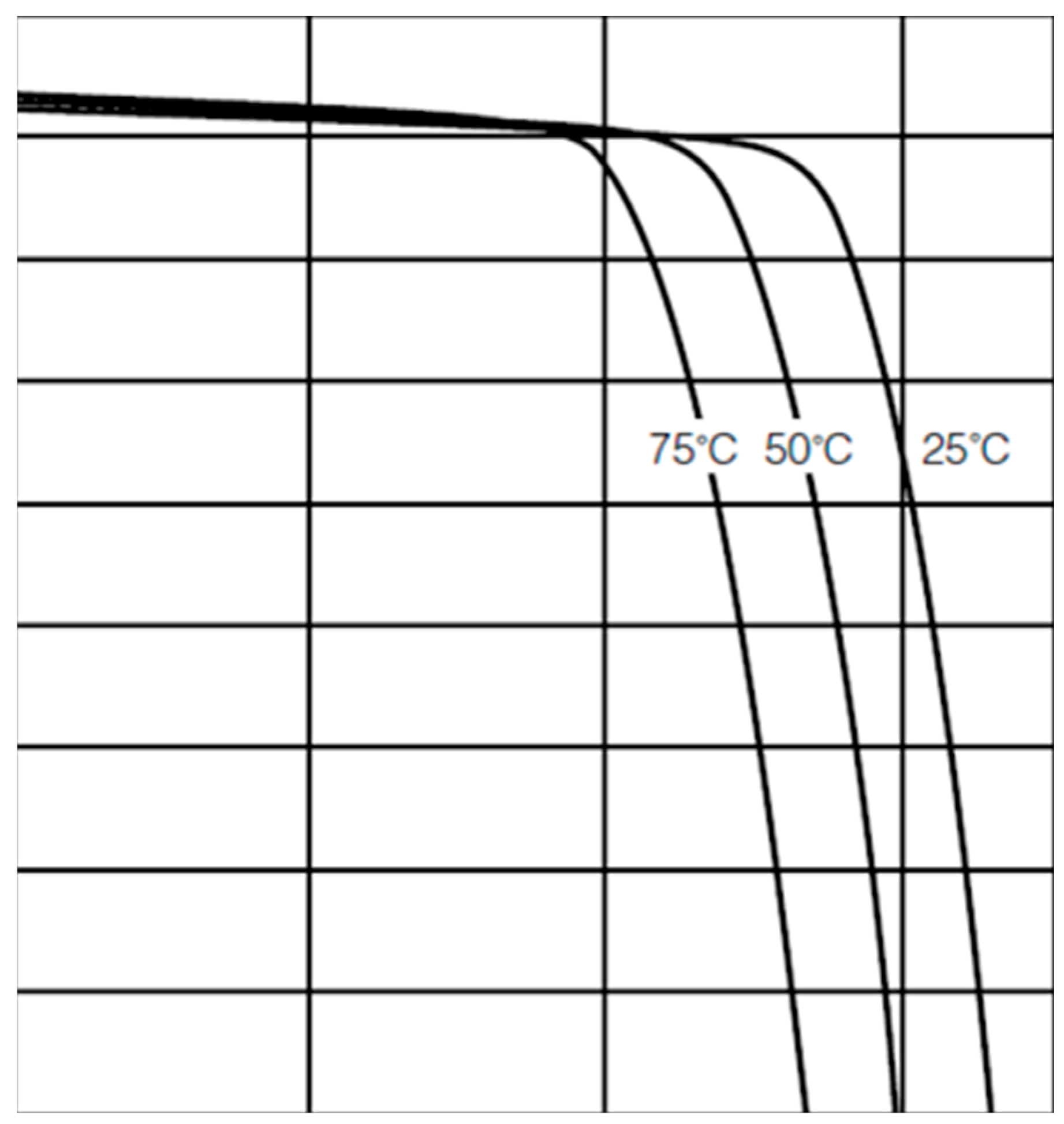
Figure 2.
Identification of points and lines of interest on the I-V curve image for calculating RS, RP, and Pmax.
Figure 2.
Identification of points and lines of interest on the I-V curve image for calculating RS, RP, and Pmax.
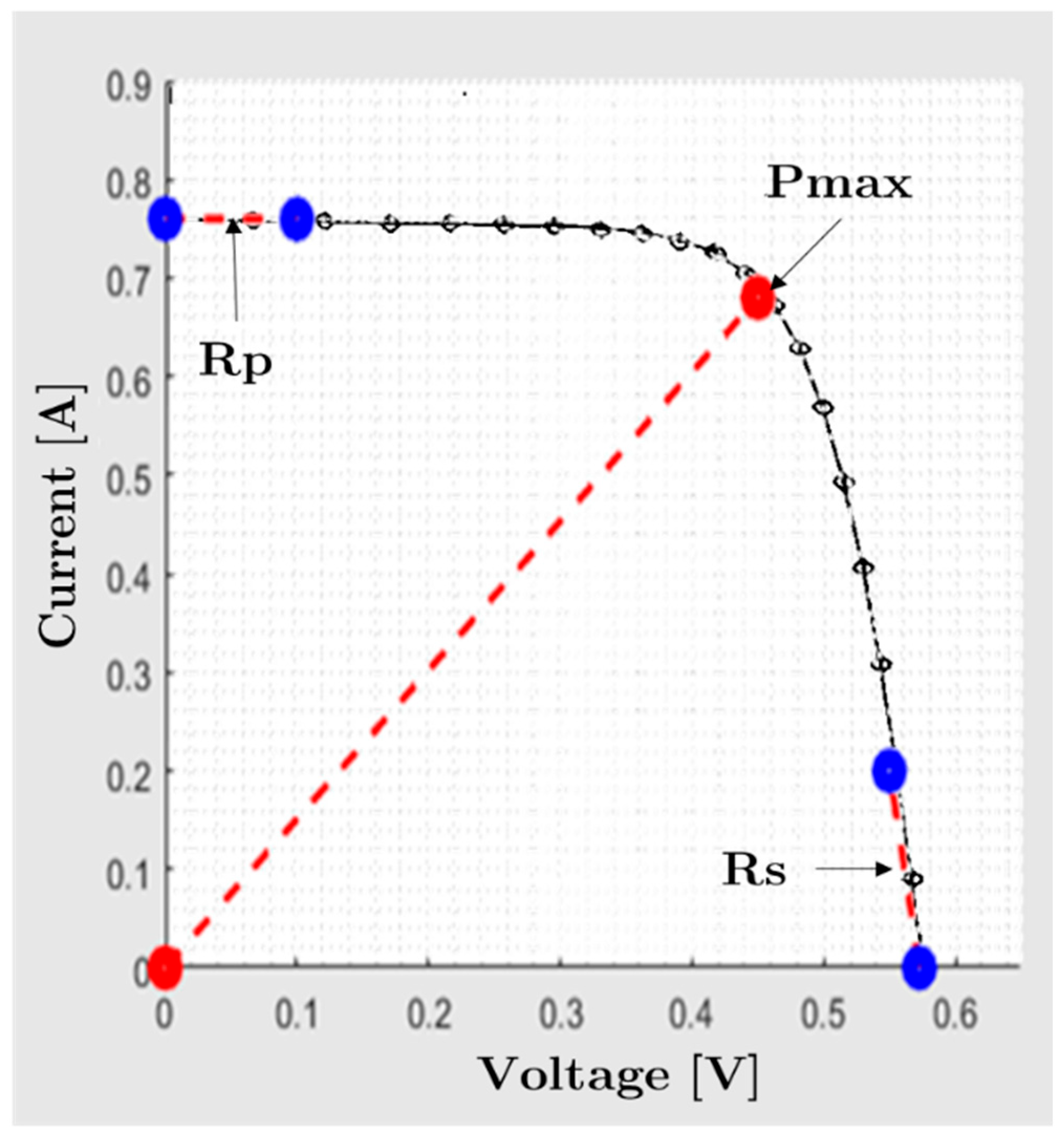
Figure 3.
Plotting of the simulated I-V curve (dashed line) over the I-V curve obtained from the datasheet.
Figure 3.
Plotting of the simulated I-V curve (dashed line) over the I-V curve obtained from the datasheet.
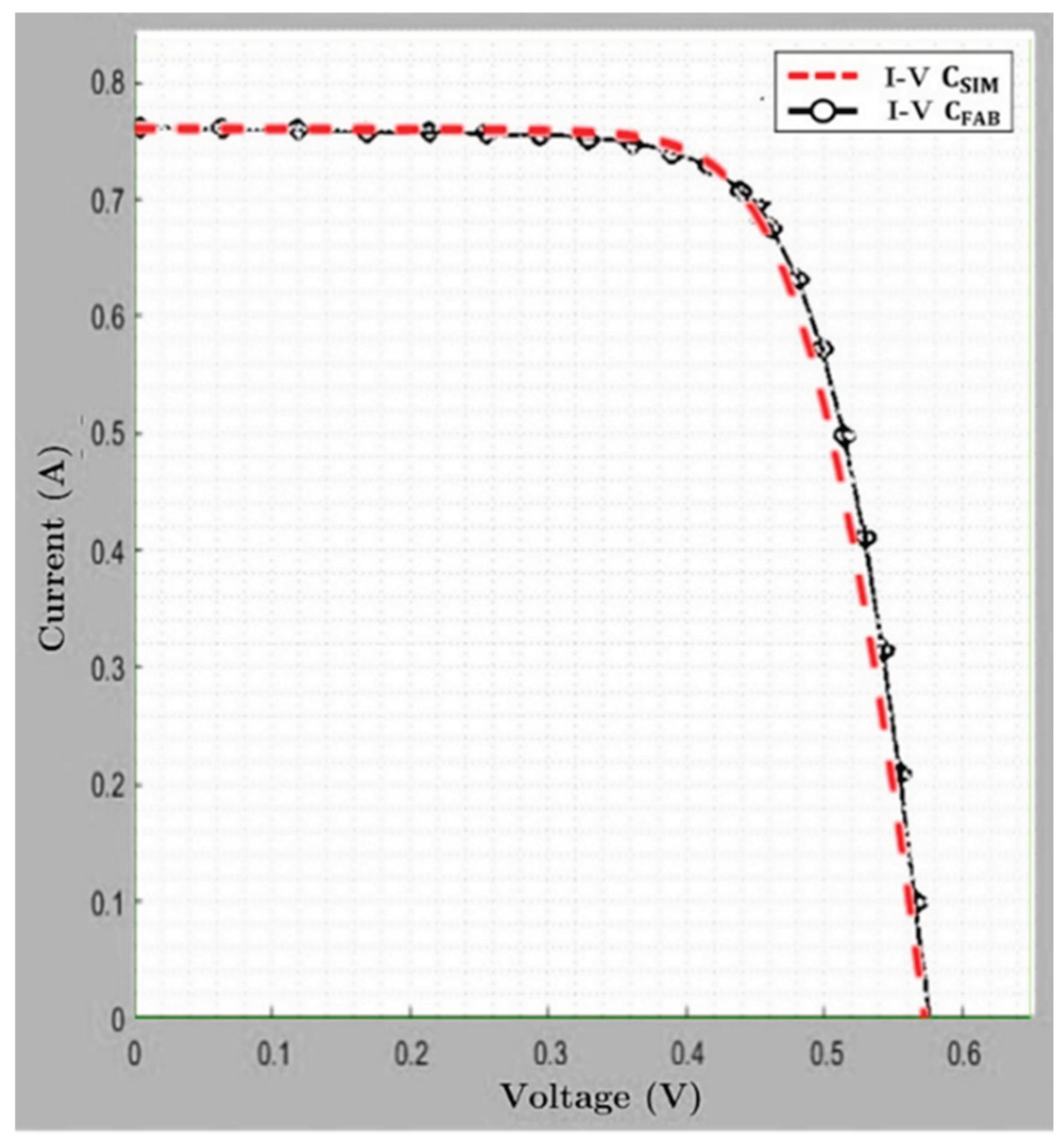

Table 1.
Performance Parameters of Photovoltaic Devices and Their Technology.
| Name | Type | Technology | Isc (A) | Voc (V) | Im (A) | Vm (V) | Pmax (W) |
|---|---|---|---|---|---|---|---|
| RTC-FRANCE [10] | Cell | Poly-Si | 0.76 | 0.572 | 0.689 | 0.450 | 0.310 |
| INAOE [12] | Cell | c-Si | 28.76e-03 | 0.52 | 0.32 | 2.227e-03 | 7.126e-03 |
| KC200GT [9] | Panel | Poly-Si | 8.21 | 32.9 | 7.63 | 25.6 | 200(+10%/-5%) |
| SP450M [11] | Panel | mono-Si | 11.56 | 49.8 | 10.98 | 41 | 450 |
Table 2.
Parameter extraction for solar devices using the proposed method.
| Device | Method | Author | IO (A) | IPV (A) | n | RS (Ω) | RP (Ω) |
|---|---|---|---|---|---|---|---|
| RTC-FRANCE | NMA | Easwarakhanthan (1986), [10] | 3.22E-07 | 0.760 | 1.483 | 0.036 | 53.763 |
| ACPSBOP | Cubas (2017) [17] | 2.92E-06 | 0.760 | 1.74 | 0.045 | 246.785 | |
| GO | Ben aribia (2023) [18] | 3.23E-07 | 0.760 | 1.481 | 0.036 | 53.718 | |
| Proposed | Proposed (2025) | 1.04E-08 | 0.760 | 1.154 | 0.075 | 333.333 | |
| KC200GT | NR | Villalva (2009) [19] | 9.82E-08 | 8.210 | 1.300 | 0.221 | 415.405 |
| GO | Ben aribia (2023) [18] | 4.31E-08 | 8.192 | 1.248 | 0.004 | 15.103 | |
| Proposed | Proposed (2025) | 8.78E-08 | 8.212 | 1.293 | 0.114 | 801.5 | |
| INAOE | Proposed | Proposed (2025) | 4.53e-09 | 28.9e-03 | 1.29 | 7.2 | 1000 |
| SP450M | Proposed | Proposed (2025) | 3.22e-07 | 11.195 | 1.853 | 0.700 | 90.909 |
Table 3.
Performance parameters calculated from the simulated curve.
| Device | Parameter extraction | ISC (A) | VOC (V) | PMAX (W) | η (%) | % Difference in η |
|---|---|---|---|---|---|---|
| RTC-FRANCE | Manufacturer | 0.7603 | 0.5728 | 0.3107 | 3.10 | 3.5 |
| Proposed | 0.7600 | 0.5720 | 0.3107 | 2.99 | ||
| KC200GT | Manufacturer | 8.21 | 32.9 | 200.143 | 16 | 0.62 |
| Proposed | 8.21 | 32.9 | 200.14 | 15.9 | ||
| SP450M | Manufacturer | 11.56 | 49.8 | 450 | 20.77 | 1.1 |
| Proposed | 11.56 | 49.8 | 451 | 21 | ||
| INAOE | Manufacturer | 28.76e-03 | 0.520 | 7.126e-03 | 7.125 | 1.14 |
| Proposed | 28.90e-03 | 0.528 | 7.04e-03 | 7.044 |
Disclaimer/Publisher’s Note: The statements, opinions and data contained in all publications are solely those of the individual author(s) and contributor(s) and not of MDPI and/or the editor(s). MDPI and/or the editor(s) disclaim responsibility for any injury to people or property resulting from any ideas, methods, instructions or products referred to in the content. |
© 2025 by the authors. Licensee MDPI, Basel, Switzerland. This article is an open access article distributed under the terms and conditions of the Creative Commons Attribution (CC BY) license (http://creativecommons.org/licenses/by/4.0/).
Copyright: This open access article is published under a Creative Commons CC BY 4.0 license, which permit the free download, distribution, and reuse, provided that the author and preprint are cited in any reuse.


