

Submitted:
25 June 2025
Posted:
26 June 2025
You are already at the latest version
Abstract
The search for natural additives from underutilized halophytes and fruit by-products aligns with circular economy principles, addressing consumer demand for healthier and more sustainable alternatives to salt and synthetic antioxidants in foods. Salicornia ramosissima, a halophytic plant rich in minerals, and Malpighia emarginata (acerola), a fruit rich in bioactive compounds, were selected for their potential to enhance meat preservation while reducing reliance on conventional salt and chemical additives. This study evaluated the effects of replacing salt with S. ramosissima powder (1%, 2%) and adding acerola extract (0.3%) in Mertolenga D.O.P. beef hamburgers. Control (1% salt), salt + acerola, and salt-free Salicornia formulations were analyzed over 10 days for: (1) microbial counts (mesophiles, psychrotrophics, Enterobacteriaceae, Pseudomonas spp., Brochothrix thermosphacta, lactic acid bacteria, fungi, Salmonella spp., and E. coli); (2) physicochemical parameters (pH, water activity, CIE-Lab color); and (3) sensory attributes (odor, color, freshness). Salicornia at 1% reduced metallic odor compared to the control (p > 0.05) and lowered water activity (aw). However, higher concentrations (2%) negatively impacted color (reduced a value, p < 0.001) and sensory scores (darker appearance, p < 0.001). Acerola extract improved color stability, overall freshness, and reduced oxidative odors, demonstrating antioxidant potential. Microbial stability was maintained across all treatments. Acerola extract shows promise as a natural antioxidant for meat products, while S. ramosissima at ≤ 1% may serve as a partial salt substitute without compromising quality. Higher Salicornia concentrations require caution due to sensory trade-offs. These findings support the use of halophytes and fruit extracts in sustainable meat preservation strategies.
Keywords:
hamburger
; meat
; salicornia
; acerola
; salt
; food safety
1. Introduction
The global food industry is undergoing a transformative shift toward sustainable practices, driven by consumer demand for healthier options and regulatory pressures to reduce environmental impacts [1]. Meat is an important source of high-quality protein in the human diet, and has been increasingly consumed worldwide, though consumption trends vary regionally, with declines in some European markets due to health and environmental concerns [2]. In fact, meat's high nutritional value and moisture content render it particularly susceptible to quality deterioration and microbial spoilage, contributing to significant losses across the supply chain – most of them occurring during distribution, retail, and consumer stages [3].
Within this context, meat products face particular scrutiny due to their resource-intensive production and association with health risks when processed with synthetic additives [4]. Recent trends indicate a growing consumer preference for minimally processed, clean-label products, reflecting broader societal movements toward holistic health and environmental stewardship [5]. This paradigm shift aligns with the United Nations' 2030 Agenda for Sustainable Development, particularly Goal 2 (Zero Hunger), 3 (Good Health and Well-Being) and 12 (Responsible Consumption and Production), which calls for sustainable management of natural resources in food systems [6,7]. Given the significant environmental footprint of livestock production coupled with meat's nutritional value, the meat industry faces a critical challenge: developing innovative preservation methods that simultaneously extend shelf-life, maintain safety and quality, and meet sustainability demands throughout the distribution chain - from processing to consumer [3,8].
Ground meat products, including hamburgers, represent a significant segment of the global meat market due to their nutritional quality, convenience and versatility [4]. However, the grinding process dramatically increases the surface area exposed, resulting in a higher risk of contamination and deteriorative processes, leading to a shorter shelf-life, when compared to fresh meat [8]. Studies demonstrate that ground beef undergoes enzymatic and oxidative changes and develops rancidity more quickly than intact muscle, with microbial counts often reaching unacceptable levels within 3 days of refrigerated storage [9]. This vulnerability stems from the disruption of cellular structures during grinding, which releases pro-oxidative enzymes and provides ideal conditions for microbial growth [4]. The food industry has traditionally relied on synthetic antioxidants and stringent cold chains to mitigate these effects, but growing consumer resistance to artificial additives has created an urgent need for natural alternatives that can deliver comparable preservation benefits without compromising clean-label status [10,11].
The search for natural preservatives has been intensified in recent years, focusing on plant-derived compounds with demonstrated antimicrobial and antioxidant properties [12]. This movement responds not only to consumer preferences, but also to public health initiatives targeting sodium reduction [13]. The World Health Organization recommends limiting sodium intake to less than 2 g/day (equivalent to 5 g salt), yet processed meat products frequently exceed this threshold, contributing to cardiovascular disease risk [6]. In the European Union, where sodium consumption averages 3.5–5 g/day, regulatory frameworks like Regulation 601/2014 strictly control food additives while paradoxically lacking clear definitions for "natural" alternatives [1,10]. This regulatory gap has spurred research into unconventional ingredients that can fulfil multiple technological functions – salt reduction, microbial inhibition, and oxidative stability – while meeting clean-label expectations [11,12].
Among the most promising candidates is Salicornia ramosissima, a halophytic plant that thrives in saline coastal environments unsuitable for conventional agriculture [14,15]. This resilient species has evolved sophisticated mechanisms to manage osmotic stress, accumulating mineral ions and bioactive compounds in its succulent stems [16]. Nutritional analyses reveal that Salicornia contains essential minerals (including sodium, potassium, and magnesium), phenolic compounds, and vitamin C at concentrations that vary depending on growth conditions and harvest time [14,17]. Of particular interest is its mineral profile, which confers a salty taste while providing a more balanced sodium-to-potassium ratio than pure NaCl [14]. When processed into powder, Salicornia has shown potential as a partial salt substitute in various food matrices, including bread and sausages, where it can reduce sodium content by 30–50% without compromising preservation efficacy [13,17]. However, its application in meat products, particularly those with Protected Designation of Origin (PDO) status like Mertolenga D.O.P. beef, remains unexplored [17,18]. As part of its food quality policy, the European Union (EU) promotes three types of quality labels for agricultural products and foodstuffs, one of whom is Protected Designation of Origin (PDO), that covers agricultural products or foodstuffs that are produced, processed and prepared in a specific geographical area, using recognized know-how [19]. PDO products present unique formulation challenges, as any additives must preserve the authentic sensory characteristics that define their geographical identity [10].
Complementing halophyte-based salt substitutes, tropical fruits like acerola (Malpighia emarginata) offer potent natural antioxidant solutions [20,21]. Native to Central and South America, acerola cherries contain extraordinary concentrations of vitamin C (ranging from 1000 to 4500 mg/100 g fresh fruit), along with a diverse collection of carotenoids, flavonoids, and phenolic acids [11,20,22]. Unlike synthetic ascorbic acid, acerola's antioxidant activity derives from synergistic interactions among these compounds, making it particularly effective against both lipid and protein oxidation in complex food systems [8,11]. Though widely used in beverages and dietary supplements, acerola's potential in meat preservation has been minimally explored, with only a handful of studies examining its effects on colour stability and microbial inhibition in meats [8,11]. This represents a significant knowledge gap, given acerola's status as one of nature's richest sources of antioxidants [11,21].
The intersection of these two natural resources – Salicornia's mineral-rich profile and acerola's antioxidant profile – presents an innovative approach to sustainable meat preservation [14,16]. However, critical questions remain about their individual effects on meat products, particularly regarding dose optimization and sensory compatibility [10,17]. Previous research on Salicornia in meat systems has noted potential challenges, including colour alterations (notably reduced redness) and flavour deviations at concentrations above 1.5% [17]. Similarly, while acerola extracts effectively inhibit oxidation, their strong acidic profile may require careful balancing to avoid undesirable taste impacts [8,11]. These considerations are especially pertinent for PDO products like Mertolenga D.O.P., where maintaining traditional sensory attributes is paramount [10]. Furthermore, the sustainability credentials of both ingredients warrant examination through the lens of circular bioeconomy principles – Salicornia's ability to rehabilitate saline soils [15] and acerola's potential as a by-product valorisation opportunity [11], could significantly enhance their appeal to environmentally conscious consumers and producers alike [5,23].
This study addresses these multifaceted challenges through a systematic evaluation of Salicornia ramosissima powder and acerola extract as natural preservatives in Mertolenga D.O.P. beef hamburgers [10,17]. The research assesses microbial dynamics (total mesophiles, psychrotrophs, Enterobacteriaceae, Pseudomonas spp., Brochothrix thermosphacta, and lactic acid bacteria), physicochemical parameters (pH, water activity, CIE-Lab colour), and sensory attributes over 10 days of refrigerated storage [4,9]. By examining these natural additives independently and in combination, the study provides clear guidelines for formulators seeking to reduce sodium content while maintaining oxidative stability in premium meat products [10,13]. From a broader perspective, the findings contribute to sustainable food systems by validating the use of climate-resilient crops (Salicornia) [14,15] and nutrient-dense fruit by-products (acerola) [11] in value-added applications – advancing progress toward multiple Sustainable Development Goals while addressing industry needs for clean-label preservation solutions [1,6,7].
2. Materials and Methods
2.1. Experimental Design
2.1.1. Sampling, Preparation and Processing of Samples
For this study, the semitendinosus and semimembranosus muscles were collected at 4 days post mortem from three male carcasses of Mertolenga D.O.P. beef. These muscles were subsequently divided into three independent, vacuum-packaged batches and transported under controlled refrigeration (T ≤ 4ºC) and strict hygiene. This ensured optimal meat quality and prevented contamination or deterioration. Within the laboratory, the three batches were physically isolated and maintained at 3.0 ± 0.5 º C until further processing.
Meat preparation took place on the same day in the laboratory's processing room, which was pre-sanitized and maintained at 12.0 ± 0.5 ºC. The initial step involved fat extraction, followed by cutting the meat into approximately 4 cm3 pieces using a stainless-steel knife and a cut-resistant stainless-steel glove, both sterilized in water at 82 ºC. Samples were collected from each meat batch for microbiological analysis. The remaining meat was then promptly minced using a mincer (PM70, Mainca; Spain) equipped with a 4 mm perforated plate, resulting in a typical fine hamburger consistency. For experimental conditions, each batch was divided into seven equal portions. Each portion was then homogenized with specific ingredients. Two ingredients were tested independently and in combination: acerola extract (Formulab, LDA, Portugal) and powdered salicornia (Horta da Ria, LDA, Portugal). Table 1 details the experimental conditions and the ingredients used for each treatment.

Table 1.
Experimental Conditions and Ingredient Combinations for Mertolenga D.O.P. Beef Hamburgers.
| Salt | Acerola extract | Salicornia powder | |
|---|---|---|---|
| Control | - | - | - |
| Salt | 1% | - | - |
| Salt and Acerola | 1% | 0.3% | - |
| Salic. 1% | - | - | 1% |
| Salic. 2% | - | - | 2% |
| Acerola and Salic. 1% | - | 0.3% | 1% |
| Acerola and Salic. 2% | - | 0.3% | 2% |
To achieve a proper homogenization of all the components of the hamburger, the ingredients were previously mixed with 15 mL of distilled water, forming a homogeneous mixture, and added to the minced meat, 5 mL at a time, in 3 random points of the meat, while it was mixed at low speed in a mixer for 30 seconds. Then, Mertolenga D.O.P. beef miniburgers weighing 20.0 ± 0.5 g, with 1 cm thickness and 4 cm diameter, were shaped using a Petri dish.
2.1.2. Packaging and Storage of Samples
Mertolenga D.O.P. beef hamburgers were individually packed in co-extruded PA/PE bags (Formulab, LDA, Portugal), subjected to modified atmosphere (70% O2: 30% CO2; Air Liquide, Portugal), and sealed in a specific packaging machine (V-420 SGA, SAM-MIC, Spain). In total, 315 Mertolenga D.O.P. beef hamburgers were produced, 15 hamburgers for each of the 6 conditions, in triplicate (three batches). For each of the 5 analyzed times, 3 Mertolenga D.O.P. beef hamburgers of each condition were used. The samples were stored at 1.5 ± 0.5 °C in a refrigeration chamber and analyzed on days 1, 3, 5, 7, 10. The experimental dynamics consisted of performing the microbiological analysis first, followed by the instrumental color analysis, and finally the sensory analysis on each analysis day.
2.2. Microbial Analysis
Microbiological analysis was initially performed on the meat pieces before the production of the Mertolenga D.O.P. beef hamburgers. For this, 10.0 g samples were aseptically collected from each batch for the quantification of total mesophilic and psychrotrophic microorganisms, Enterobacteriaceae, Pseudomonas spp., Brochothrix thermosphacta, Lactic Acid Bacteria (LAB), fungi, and E. coli. Additionally, 25.0 g samples were collected from each batch for the detection of Salmonella spp. and Listeria monocytogenes.
Subsequently, microbiological analysis was conducted on the produced Mertolenga D.O.P. beef hamburgers on days 1, 3, 5, 7, and 10. The Mertolenga D.O.P. beef hamburgers were removed from refrigeration as needed. All conditions under study were analyzed in a laminar flow hood under sterile conditions. For each Mertolenga D.O.P. beef hamburger, 10.0 g was weighed and subsequently diluted in 90 mL of tryptone salt solution (0.3% tryptone and 0.85% NaCl, sterilized at 121 ºC for 15 minutes) within a Stomacher bag. This mixture was then homogenized in a Stomacher (IUL, Barcelona, Spain) for 90 seconds. Successive decimal dilutions were prepared in test tubes by adding 1 mL of the solution from the Stomacher bag to 9 mL of sterile tryptone salt. Following this, inoculations were performed by surface plating or pour plating onto the respective culture media. The plates were then incubated according to the time and temperature stipulated for each microorganism in study. After incubation, typical colonies were counted and results were expressed in log CFU/g.
2.3. Physical and Chemical Analyses
On days 1, 3, 5, 7, and 10, pH and water activity were measured. The pH value was obtained by the arithmetic mean of three successive measurements taken at random points on each sample, using a pH meter (WTW GmbH, PH 330i, Germany) with a probe placed directly into the sample. To measure water activity, the samples were slowly heated up to 25°C (optimum temperature for measurement) to prevent evaporation or condensation. An electronic hygrometer (Rotronic, HygroLab C1, Switzerland) was used with two attached probes with a resolution of ± 0.001 aw and accuracy between 0.01 and 0.02 aw to obtain the results.
2.3. Instrumental Colour Measurement
Colour measurements were carried out in the CIE-Lab space, using a Minolta Chromo Meter CR-310 (Konica Minolta, Osaka, Japan) with a standard 2° observer, illuminant D65, and a 4 mm aperture diameter. The Commission Internationale de l’Eclairage (CIE) L* (lightness), a* (redness), and b* values (yellowness) system was used to determine the color of fresh meat hamburgers after opening the modified atmosphere packaging and before sensory analysis. Colour measurements were carried out on days 1, 3, 5, 7 and 10 of storage. The results were obtained by the arithmetic mean of three successive measurements from random points of each sample.
2.4. Sensory Analysis
The sensory analysis was conducted by a trained panel with experience in beef sensory evaluation. Samples were evaluated in a dedicated sensory analysis room 60 minutes after opening the modified atmosphere packaging. All Mertolenga D.O.P beef hamburgers, refrigerated at 3.0 ± 0.5 ºC, were presented individually and randomly to each panelist under consistent lighting conditions. Each panelist received a sensory evaluation sheet for each hamburger. Panelists were asked to evaluate sample colour, intensity and acceptability of off-flavours, specific odors detected and overall freshness. These qualities were evaluated with the use of 9 cm non-structured linear scoring scale, ranging from 0 – not intense / unacceptable to 9 – extremely intense / acceptable.
Finally, overall freshness was assessed on a 0 to 9 cm line scale and classified as follows: fresh meat from 6 to 9 cm, semi-fresh meat from 3 to 6 cm, and deteriorated meat from 0 to 3 cm.
2.5. Data Analysis
All statistical analyses were primarily performed using SPSS Statistics (Version 33.0, IBM Corp., Armonk, NY, USA). The individual and interactive effects of acerola and salicornia addition were evaluated using ANOVA. When significant differences between groups were identified by the ANOVA test, where Tukey's HSD (Honestly Significantly Different) post hoc test was employed to determine specific group differences. A multivariate analysis was also conducted using Pearson's correlation coefficient to measure the degree of linear correlation between two variables. For the microbiological counts, one-way analysis of variance (ANOVA) was conducted to test the effect of meat pH for each sampling day. A statistical significance set at a 5% level of probability (p < 0.05) was used.
3. Results
3.1. Microorganisms Quantification
Table 2 shows the microbial counts of fresh Mertolenga D.O.P beef before the production of Mertolenga D.O.P beef hamburgers and immediately after opening the vacuum package that came directly from the cutting room. The absence of important pathogenic bacteria such as Salmonella spp., E. coli and L. monocytogenes was noted.
Table 2.
Microorganism counts (mean and standard deviation) in fresh D.O.P. vacuum packed.
| Microorganism | log ufc/ g sample |
|---|---|
| Total mesophiles | 4.59 ± 0.17 |
| Total psychrotrophs | 4.91 ± 0.17 |
| Enterobacteriaceae | 3.69 ± 1.43 |
| Pseudomonas spp. | 4.19 ± 0.47 |
| Brochothrix thermosphacta | 3.61 ± 0.32 |
| Lactic acid bacteria | 2.70 ± 0.49 |
| Molds and Yeasts | - |
| Salmonella spp. | - |
| E. coli | - |
| L. monocytogenes | - |
Table 3 presents the microbiological evolution of hamburgers during storage. All treatments showed consistent increases in microbial counts throughout the storage period. Significant time-dependent growth (p ≤ 0.05) was observed specifically for psychrotrophics, Enterobacteriaceae, lactic acid bacteria (LAB), B. thermosphacta, and Pseudomonas spp. in certain treatments. Notably, the natural additives (acerola extract, Salicornia powder, or their combination) showed no significant differences compared to the salt or the control treatments (p > 0.05) for any microbial group. While all experimental treatments exhibited numerically lower counts than the salt and control treatments at various time points, these differences were not statistically significant. Most importantly, these results confirm that the natural alternatives performed at least as well as conventional salt in maintaining microbiological quality.
Table 3.
Effect of addition of acerola and salicornia on microbial counts (means and standard deviation) of fresh D.O.P. vacuum-packed Mertolenga D.O.P. hamburgers (expressed in log CFU/g-1).
Table 3.
Effect of addition of acerola and salicornia on microbial counts (means and standard deviation) of fresh D.O.P. vacuum-packed Mertolenga D.O.P. hamburgers (expressed in log CFU/g-1).
| Time | ||||||
|---|---|---|---|---|---|---|
| 1 | 3 | 5 | 7 | 10 | p | |
| Mesophiles | ||||||
| Control | 5.58 ± 0.43 | 6.70 ± 0.25 | 6.81 ± 0.78 | 7.50 ± 1.29 | 6.70 ± 1.65 | n.s. |
| Salt | 5.48 ± 0.51 | 6.61 ± 0.28 | 6.84 ± 0.95 | 7.44 ± 0.88 | 6.46 ± 2.07 | n.s. |
| Salt and Acerola | 5.58 ± 0.66 | 6.58 ± 0.12 | 6.99 ± 0.64 | 6.96 ± 0.38 | 6.35 ± 1.17 | n.s. |
| Salic. 1% | 6.46 ± 0.05 | 5.85 ± 1.16 | 6.96 ± 0.63 | 6.87 ± 0.02 | 6.66 ± 0.51 | n.s. |
| Salic. 2% | 6.10 ± 0.63 | 6.88 ± 0.43 | 7.36 ± 0.63 | 6.96 ± 0.50 | 6.85 ± 0.73 | n.s. |
| Acerola and Salic. 1% | 6.47 ± 0.15 | 6.43 ± 0.20 | 7.13 ± 0.46 | 7.01 ± 0.39 | 6.11 ± 0.69 | n.s. |
| Acerola and Salic. 2% | 6.52 ± 0.07 | 7.00 ± 0.63 | 7.30 ± 0.56 | 7.22 ± 0.40 | 6.98 ± 0.81 | n.s. |
| Psychrotrophs | ||||||
| Control | 5.92 ± 0.68 | 7.12 ± 0.20 | 7.48 ± 0.28 | 7.61 ± 0.63 | 7.88 ± 0.33 | ≤ 0.01 |
| Salt | 5.40 ± 0.67 | 6.99 ± 0.58 | 7.76 ± 0.35 | 7.79 ± 0.56 | 7.97 ± 0.27 | ≤ 0.01 |
| Salt and Acerola | 5.58 ± 0.57 | 6.89 ± 0.65 | 7.49 ± 0.31 | 7.75 ± 0.44 | 7.37 ± 0.16 | ≤ 0.001 |
| Salic. 1% | 5.05 ± 0.52 | 6.88 ± 0.36 | 7.55 ± 0.14 | 7.63 ± 0.90 | 7.86 ± 0.34 | ≤ 0.001 |
| Salic. 2% | 5.30 ± 0.66 | 7.10 ± 0.51 | 7.98 ± 0.05 | 7.75 ± 0.47 | 7.91 ± 0.03 | ≤ 0.001 |
| Acerola and Salic. 1% | 5.23 ± 0.48 | 7.15 ± 0.93 | 7.93 ± 0.21 | 7.70 ± 0.64 | 8.09 ± 0.04 | ≤ 0.001 |
| Acerola and Salic. 2% | 5.18 ± 0.59 | 6.67 ± 0.93 | 7.72 ± 0.13 | 7.49 ± 0.22 | 7.47 ± 0.57 | ≤ 0.01 |
| Enterobacteriaceae | ||||||
| Control | 2.81 ± 1.12 | 3.90 ± 0.81 | 4.66 ± 1.63 | 4.87 ± 0.42 | 4.64 ± 0.86 | n.s. |
| Salt | 3.17 ± 0.61 | 4.06 ± 0.66 | 4.64 ± 1.26 | 4.89 ± 0.63 | 4.26 ± 1.30 | n.s. |
| Salt and Acerola | 3.28 ± 0.20 | 4.08 ± 0.14 | 4.71 ± 1.16 | 4.99 ± 0.94 | 4.94 ± 0.36 | n.s. |
| Salic. 1% | 3.28 ± 0.91 | 3.87 ± 0.66 | 4.71 ± 1.54 | 4.71 ± 0.54 | 4.27 ± 1.37 | n.s. |
| Salic. 2% | 2.98 ± 0.53 | 3.72 ± 0.68 | 5.14 ± 1.29 | 4.66 ± 0.56 | 4.19 ± 1.43 | ≤ 0.05 |
| Acerola and Salic. 1% | 3.39 ± 0.55 | 4.60 ± 1.37 | 4.52 ± 0.35 | 6.18 ± 1.22 | 5.14 ± 0.13 | ≤ 0.05 |
| Acerola and Salic. 2% | 3.10 ± 0.35 | 4.10 ± 0.25 | 4.95 ± 0.83 | 5.08 ± 0.78 | 4.73 ± 1.24 | ≤ 0.05 |
| LAB | ||||||
| Control | 3.27 ± 0.31 | 4.46 ± 0.98 | 5.96 ± 0.85 | 7.10 ± 1.16 | 4.89 ± 0.28 | ≤ 0.01 |
| Salt | 3.59 ± 1.86 | 4.20 ± 0.46 | 6.05 ± 1.13 | 7.50 ± 1.32 | 4.93 ± 0.16 | ≤ 0.01 |
| Salt and Acerola | 3.37 ± 0.54 | 4.56 ± 0.72 | 6.21 ± 0.90 | 7.05 ± 0.98 | 4.52 ± 0.12 | ≤ 0.05 |
| Salic. 1% | 3.21 ± 0.62 | 4.58 ± 0.47 | 6.18 ± 1.05 | 6.83 ± 0.83 | 5.11 ± 0.66 | ≤ 0.01 |
| Salic. 2% | 3.02 ± 0.33 | 3.91 ± 0.37 | 6.10 ± 0.81 | 6.45 ± 0.95 | 5.06 ± 0.24 | ≤ 0.01 |
| Acerola and Salic. 1% | 4.13 ± 1.93 | 3.97 ± 0.66 | 5.59 ± 0.88 | 6.93 ± 0.91 | 5.16 ± 0.55 | n.s. |
| Acerola and Salic. 2% | 4.03 ± 1.89 | 4.40 ± 0.62 | 5.52 ± 0.60 | 6.71 ± 0.17 | 6.29 ± 1.37 | n.s. |
| B. thermosphacta | ||||||
| Control | 3.55 ± 0.87 | 5.81 ± 0.14 | 5.84 ± 0.91 | 5.56 ± 1.02 | 5.83 ± 1.30 | ≤ 0.05 |
| Salt | 3.74 ± 0.73 | 5.29 ± 0.43 | 5.79 ± 1.26 | 6.38 ± 0.91 | 5.18 ± 2.65 | n.s. |
| Salt and Acerola | 3.95 ± 0.85 | 5.32 ± 0.53 | 5.71 ± 0.83 | 5.67 ± 0.74 | 5.29 ± 1.31 | n.s. |
| Salic. 1% | 3.95 ± 0.74 | 5.35 ± 0.10 | 5.45 ± 1.26 | 5.13 ± 0.89 | 4.93 ± 1.74 | n.s. |
| Salic. 2% | 3.73 ± 1.22 | 4.91 ± 0.53 | 6.20 ± 1.65 | 4.68 ± 1.65 | 4.75 ± 2.48 | n.s. |
| Acerola and Salic. 1% | 3.25 ± 0.70 | 4.93 ± 0.44 | 5.07 ± 1.52 | 4.35 ± 1.85 | 4.85 ± 0.61 | n.s. |
| Acerola and Salic. 2% | 3.50 ± 0.58 | 4.92 ± 0.23 | 5.77 ± 1.22 | 5.36 ± 0.83 | 4.66 ± 2.34 | n.s. |
| Molds and Yeasts | ||||||
| Control | 2.60 ± 0.52 | 2.89 ± 0.77 | 3.50 ± 0.74 | 3.84 ± 0.08 | 3.89 ± 0.36 | n.s. |
| Salt | 2.90 ± 0.26 | 3.00 ± 0.35 | 3.45 ± 0.40 | 3.79 ± 0.38 | 3.39 ± 0.23 | n.s. |
| Salt and Acerola | 2.68 ± 0.14 | 3.07 ± 0.22 | 3.32 ± 0.34 | 3.50 ± 1.11 | 3.19 ± 1.01 | n.s. |
| Salic. 1% | 2.85 ± 0.24 | 3.34 ± 0.39 | 3.09 ± 0.36 | 3.13 ± 0.98 | 3.57 ± 0.74 | n.s. |
| Salic. 2% | 2.59 ± 0.03 | 2.63 ± 0.57 | 3.31 ± 0.62 | 3.25 ± 0.51 | 3.44 ± 0.41 | n.s. |
| Acerola and Salic. 1% | 3.05 ± 0.36 | 3.00 ± 0.18 | 2.97 ± 0.25 | 3.56 ± 0.32 | 3.76 ± 0.97 | n.s. |
| Acerola and Salic. 2% | 3.19 ± 0.81 | 2.97 ± 0.36 | 3.69 ± 0.44 | 3.44 ± 0.69 | 3.20 ± 0.59 | n.s. |
| Pseudomonasspp. | ||||||
| Control | 3.66 ± 0.42 | 4.43 ± 0.32 | 4.53 ± 0.52 | 4.91 ± 0.41 | 4.49 ± 0.70 | n.s. |
| Salt | 4.13 ± 0.96 | 4.38 ± 0.17 | 4.41 ± 0.74 | 5.19 ± 0.66 | 4.86 ± 0.61 | n.s. |
| Salt and Acerola | 3.84 ± 0.57 | 4.14 ± 0.17 | 4.41 ± 0.45 | 4.86 ± 0.93 | 4.11 ± 0.16 | n.s. |
| Salic. 1% | 3.84 ± 0.38 | 3.78 ± 0.20 | 4.76 ± 0.52 | 4.71 ± 0.58 | 4.30 ± 0.43 | n.s. |
| Salic. 2% | 3.32 ± 0.24 | 4.08 ± 0.18 | 4.37 ± 0.60 | 4.43 ± 0.37 | 4.55 ± 1.21 | n.s. |
| Acerola and Salic. 1% | 3.69 ± 0.41 | 3.95 ± 0.21 | 4.31 ± 0.67 | 4.91 ± 0.54 | 5.00 ± 0.06 | ≤ 0.05 |
| Acerola and Salic. 2% | 4.46 ± 0.93 | 4.10 ± 0.34 | 4.82 ± 0.78 | 4.76 ± 0.72 | 4.24 ± 0.34 | n.s. |
3.2. Physical-Chemical Parameters
Table 4 summarizes the physical and chemical results obtained throughout storage. The physicochemical analysis revealed consistent patterns across all treatments: pH values showed a gradual decrease during storage, while water activity (aw) remained stable. Statistical analysis confirmed no significant differences between treatments for either parameter (p > 0.05), demonstrating that neither acerola extract nor Salicornia powder negatively affected these critical quality indicators compared to the control.
Instrumental color analysis (CIE-Lab) revealed significant treatment and time effects on the hamburgers' appearance. For lightness (L*) and redness (a*), all samples showed an initial increase until day 3 followed by gradual darkening during storage, for all treatments. Treatment effects were particularly evident, with control samples maintaining the highest values, followed by salt and acerola treatments which were statistically similar. Salicornia-containing samples showed concentration-dependent darkening, with the 2% addition resulting in significantly lower lightness compared to other treatments. Yellowness (b*) remained stable throughout storage (p > 0.05) except on day 10, when significant differences emerged between the control (lowest b* value) and 1% salicornia (highest b* value) (p ≤ 0.05). These results demonstrated that while salicornia significantly influenced color parameters (particularly at 2% concentration), acerola maintain color characteristics comparable to conventional salt treatment.
Table 3. Effect of addition of acerola and salicornia on physical-chemical parameters (means and standard deviation) of fresh D.O.P. vacuum-packed Mertolenga D.O.P. hamburgers.
Table 3. Effect of addition of acerola and salicornia on physical-chemical parameters (means and standard deviation) of fresh D.O.P. vacuum-packed Mertolenga D.O.P. hamburgers.
| Time | ||||||
| 1 | 3 | 5 | 7 | 10 | p | |
| pH | ||||||
| Control | 5.77 ± 0.19 | 5.74 ± 0.26 | 5.78 ± 0.14 | 5.69 ± 0.26 | 5.64 ± 0.23 | n.s. |
| Salt | 5.66 ± 0.14 | 5.59 ± 0.08 | 5.54 ± 0.04 | 5.49 ± 0.03 | 5.44 ± 0.15 | n.s. |
| Salt and Acerola | 5.69 ± 0.18 | 5.67 ± 0.11 | 5.62 ± 0.13 | 5.66 ± 0.16 | 5.50 ± 0.13 | n.s. |
| Salic. 1% | 5.65 ± 0.15 | 5.53 ± 0.12 | 5.50 ± 0.08 | 5.39 ± 0.07 | 5.34 ± 0.15 | n.s. |
| Salic. 2% | 5.62 ± 0.20 | 5.58 ± 0.21 | 5.42 ± 0.18 | 5.38 ± 0.13 | 5.25 ± 0.01 | n.s. |
| Acerola and Salic. 1% | 5.70 ± 0.19 | 5.62 ± 0.17 | 5.52 ± 0.10 | 5.49 ± 0.10 | 5.62 ± 0.26 | n.s. |
| Acerola and Salic. 2% | 5.70 ± 0.18 | 5.70 ± 0.25 | 5.60 ± 0.13 | 5.59 ± 0.20 | 5.51 ± 0.19 | n.s. |
| p | n.s. | n.s. | n.s. | n.s. | n.s. | |
| aw | ||||||
| Control | 1.00 ± 0.00 | 0.99 ± 0.01 | 4.00 ± 5.19 | 0.99 ± 0.01 | 1.00 ± 0.00 | n.s. |
| Salt | 0.98 ± 0.01 | 0.98 ± 0.01 | 0.98 ± 0.01 | 0.99 ± 0.00 | 0.99 ± 0.01 | n.s. |
| Salt and Acerola | 0.99 ± 0.01 | 0.99 ± 0.00 | 0.99 ± 0.01 | 0.99 ± 0.01 | 0.99 ± 0.01 | n.s. |
| Salic. 1% | 0.99 ± 0.01 | 0.99 ± 0.01 | 0.99 ± 0.01 | 0.99 ± 0.01 | 0.99 ± 0.01 | n.s. |
| Salic. 2% | 0.99 ± 0.01 | 0.98 ± 0.00 | 0.98 ± 0.01 | 0.98 ± 0.00 | 0.98 ± 0.01 | n.s. |
| Acerola and Salic. 1% | 0.99 ± 0.01 | 0.99 ± 0.00 | 0.99 ± 0.01 | 0.99 ± 0.01 | 0.99 ± 0.01 | n.s. |
| Acerola and Salic. 2% | 0.99 ± 0.01 | 0.98 ± 0.00 | 0.98 ± 0.00 | 0.98 ± 0.00 | 0.98 ± 0.00 | n.s. |
| p | n.s. | n.s. | n.s. | n.s. | n.s. | |
| L* | ||||||
| Control | 39.03 ± 0.96 a | 44.38 ± 2.58 a | 41.04 ± 0.43 a | 41.79 ± 1.36 a | 41.16 ± 2.32 | ≤ 0.05 |
| Salt | 37.04 ± 1.85 ab | 40.08 ± 0.59 ab | 40.25 ± 0.70 ab | 38.99 ± 1.72 ab | 41.30 ± 3.17 | n.s. |
| Salt and Acerola | 38.40 ± 2.43 a | 39.06 ± 2.94 ab | 37.62 ± 2.27 abc | 38.70 ± 1.32 abc | 40.33 ± 1.54 | n.s. |
| Salic. 1% | 33.85 ± 0.68 bc | 37.66 ± 0.77 b | 37.86 ± 0.61 abc | 38.06 ± 0.70 bc | 39.92 ± 0.54 | ≤ 0.001 |
| Salic. 2% | 33.61 ± 0.91 bc | 37.67 ± 3.99 b | 37.46 ± 1.73 bc | 36.90 ± 1.30 bc | 37.12 ± 0.90 | n.s. |
| Acerola and Salic. 1% | 36.13 ± 2.28 abc | 37.66 ± 1.49 b | 38.81 ± 1.31 ab | 38.99 ± 0.74 ab | 37.67 ± 0.40 | n.s. |
| Acerola and Salic. 2% | 32.61 ± 0.61 c | 36.67 ± 2.47 b | 34.54 ± 0.66 c | 35.53 ± 1.22 c | 37.05 ± 1.92 | ≤ 0.05 |
| p | ≤ 0.001 | ≤ 0.05 | ≤ 0.001 | ≤ 0.001 | ≤ 0.05 | |
| a* | ||||||
| Control | 21.86 ± 0.84 a | 23.30 ± 3.99 | 21.17 ± 2.48 a | 21.38 ± 1.51 a | 16.75 ± 0.60 | ≤ 0.05 |
| Salt | 19.56 ± 0.77 ab | 21.46 ± 0.71 | 22.35 ± 1.35 a | 20.97 ± 1.70 ab | 18.22 ± 1.53 | ≤ 0.05 |
| Salt and Acerola | 18.85 ± 0.25 ab | 22.22 ± 1.59 | 19.45 ± 1.82 ab | 18.78 ± 0.92 abc | 16.07 ± 3.23 | ≤ 0.05 |
| Salic. 1% | 17.63 ± 1.96 b | 16.23 ± 4.10 | 17.37 ± 0.77 ab | 17.61 ± 0.18 bc | 15.18 ± 3.85 | n.s. |
| Salic. 2% | 14.43 ± 1.62 cd | 15.23 ± 2.77 | 17.00 ± 5.35 ab | 14.01 ± 1.23 de | 12.96 ± 2.49 | n.s. |
| Acerola and Salic. 1% | 16.53 ± 0.31 bc | 15.57 ± 2.53 | 17.00 ± 0.44 ab | 16.69 ± 1.47 cd | 15.96 ± 3.76 | n.s. |
| Acerola and Salic. 2% | 12.85 ± 1.01 d | 17.27 ± 5.52 | 14.05 ± 1.82 b | 12.60 ± 0.75 e | 12.55 ± 1.99 | n.s. |
| p | ≤ 0.001 | ≤ 0.05 | ≤ 0.05 | ≤ 0.001 | n.s. | |
| b* | ||||||
| Control | 12.51 ± 0.95 | 11.96 ± 1.18 | 12.27 ± 1.55 | 11.28 ± 2.69 | 8.17 ± 2.92 b | n.s. |
| Salt | 11.05 ± 0.72 | 12.71 ± 1.01 | 13.36 ± 0.41 | 12.23 ± 0.93 | 11.51 ± 0.40 ab | ≤ 0.05 |
| Salt and Acerola | 10.99 ± 1.41 | 12.68 ± 1.21 | 11.46 ± 1.25 | 10.82 ± 1.23 | 8.87 ± 1.30 ab | n.s. |
| Salic. 1% | 12.76 ± 0.95 | 12.84 ± 1.30 | 12.58 ± 0.66 | 12.41 ± 0.74 | 11.79 ± 0.11 a | n.s. |
| Salic. 2% | 12.16 ± 0.20 | 12.14 ± 2.06 | 12.95 ± 1.46 | 11.80 ± 0.66 | 11.02 ± 0.40 ab | n.s. |
| Acerola and Salic. 1% | 12.99 ± 0.77 | 12.34 ± 0.27 | 12.75 ± 0.40 | 11.83 ± 1.96 | 10.51 ± 0.86 ab | n.s. |
| Acerola and Salic. 2% | 11.40 ± 0.57 | 13.42 ± 1.46 | 11.99 ± 0.62 | 11.29 ± 0.71 | 10.32 ± 0.67 ab | ≤ 0.05 |
| p | n.s. | n.s. | n.s. | n.s. | ≤ 0.05 | |
3.3. Sensory Analysis
The trained sensory panel documented significant changes in product characteristics throughout the storage period. Color evaluation revealed that all samples underwent progressive darkening, with initial bright red hues gradually transitioning to darker red and brown tones. Notably, burgers containing acerola extract exhibited slower browning development compared to other treatments. In contrast, Salicornia-supplemented samples were immediately identified as darker (Day 1), displaying significantly deeper red tones and more pronounced browning – an effect that intensified with increasing Salicornia concentration. The 2% Salicornia treatment showed the most affected color alterations, remaining statistically distinct from both control and salt-only samples at all evaluation points.
Odor assessment demonstrated treatment-specific preservation patterns. Acerola samples consistently received higher scores, showing delayed off-odor development with significantly lower rotten odor ratings versus control from Day 5 onward. While 1% Salicornia also exhibited improved odor preservation compared to higher concentrations, its effects were less pronounced than acerola's.
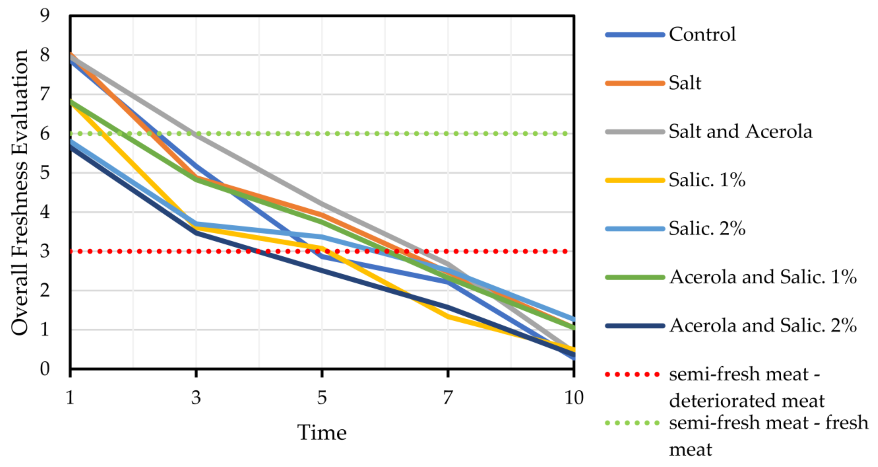
The Overall Freshness Evaluation (OFE) provided crucial shelf-life insights (Figure 1). Initial OFE scores averaged 6.99 cm (> 6 cm = "fresh"), except for treatments containing 2% Salicornia (5.8 cm = "semi-fresh"). While all treatments showed declining freshness, acerola maintained higher OFE scores through Day 6 – exceeding control and salt samples by 1-2 days before reaching the "deteriorated" threshold (Day 7 vs. Days 5-6). Importantly, the Acerola + 1% Salicornia combination significantly improved OFE when compared to Salicornia-only treatments, while 2% Salicornia mixtures showed the most rapid quality decline, being classified as "spoiled" by Day 4.
4. Discussion
Regarding the microbiological parameters, it is possible to verify that the behavior of the microbiota present in the meat was similar between the different conditions analyzed (p > 0.05). The most dominant microorganisms of the deteriorative microbiota analyzed were lactic acid bacteria and B. thermosphacta as described by other authors who concluded that in modified atmosphere with less than 50% CO2 and with O2 these microorganisms are the most prevalent in refrigerated meat [24]. Although the initial contamination of lactic acid bacteria is relatively low, their growth is exponential and reaches values greater than 7 log cfu/g, which leads to acid odors and discoloration, being typical sensory alterations involved in the deterioration of meat by lactic acid bacteria. It is essentially due to the accumulation of end products of the metabolism of these bacteria such as lactic acid, acetic acid and butyric acid. This production is also responsible for the appreciable reduction in pH [25]. B. thermosphacta was one of the prevalent microorganisms in the meat samples. This microorganism produces diacetyl and a range of fatty acids due to the aerobic metabolism of glucose that give rise to sour, acidic or musty odors. These sensory defects can be observed once this organism reaches values of 5 log cfu/g [26]. Several scientists have concluded that total mesophilic bacterial counts between 107 and 108 cfu/g sample are sufficient to start causing off-odors and slime [27], these values were reached on average by day 7. Tremonte et al. 2016, evaluated the antimicrobial effect of acerola on red meat shelf-life [28]. Results reported in their study highlight that acerola extract is able to produce a strong antagonistic effect against Pseudomonas species and B. thermosphacta, involved in the spoilage of fresh meat products. They described a strong antimicrobial activity of acerola extract, probably due to the presence of several compounds belonging to different bioactive groups, which represent a series of hurdles for the microbial growth.
According to Leygonie et al. (2012), freezing and subsequent thawing of fresh meat can lead to a decrease in pH, this is explained by the fact that pH is a measure of the amount of free hydrogen ions (H+), it is possible that freezing leads to the subsequent production of exudate and this could cause denaturation of the buffer proteins, the release of hydrogen ions and a consequent decrease in the measured pH [29]. Alternatively, loss of fluid from meat can cause an increase in solute concentration, which also results in a decrease in pH. Regardless, all samples were frozen and thawed following the same procedure, and it can be considered that the deviation of results due to the freezing/thawing process is identical in all samples and therefore the differences found between different conditions can be considered plausible. In all treatments, the average initial pH obtained at time 1 showed a value of 5.68 ± 0.15, which is in line with other authors who demonstrate that this value should be between 5.70 and 5.90 for fresh beef [30,31]. Samples treated with acerola had the lowest pH throughout the analysis period. This evidence suggests that the addition of acerola, due to its high content of ascorbic acid, could make it possible to lower the pH in beef [32]. However, in the control and salt samples, the pH also decreased, this drop in pH can be explained by the high prevalence of lactic acid bacteria in the meat throughout the period analyzed, due to the production of lactic, acetic, butyric acid, among others as exposed by other authors [25].
The use of Salicornia ramosissima in different concentrations decreased the aw, which goes against what has been shown by other authors, that when the ionic concentration increases, the aw decreases proportionally [33].
In determining the objective color of the meat samples according to the CIE-Lab color space, it was found that the initial mean value of the parameter L* in the study with acerola at the initial time corresponded to 38.16, which is in agreement with other authors who analyzed the color parameters and defined that the L* coordinate had a value of 37.61 ± 0.31 on day 1 [34]. In the study with salicornia, the mean initial value of the L* parameter at the initial time corresponded to 35.9, which is not in accordance with the parameter defined by [34], which can be explained by the addition of salicornia which, due to its strong color, significantly altered the color pattern of the Mertolenga D.O.P beef hamburgers. As expected, it was found that in the initial time there was an increase in the a* coordinate due to the passage of the deoxymyoglobin form into oxymyoglobin due to the oxygen-rich modified atmosphere package [27]. The initial average value of the parameter a* in the initial time in the acerola study corresponded to 21,86 ± 0,84, similar to the results obtained by other authors in minced meat packed in modified atmosphere packaging with high oxygen content [34]. Over time, the a* coordinate declines due to the gradual oxidation of myoglobin and the accumulation of metmyoglobin [27]. The initial mean value of the parameter a* at the initial time in the study with salicornia samples corresponded to 17.70, which is not in line with what was observed by the previously mentioned authors [34], which can be explained by the fact that the samples with salicornia added acquire a more brownish color from the salicornia pigments. There were no significant differences regarding the b* parameter either in the sample with acerola or in the samples with salicornia, considering the time effect. These results are in line with those demonstrated by other authors, in which no significant differences were found in the parameter b* of beef stored in modified atmosphere packaging over time [34].
Among other factors able to influence the consumer choice, the color represents one of the most important visual clues for red fresh meat [35]. Regarding the color, as you would expect, the bright red color starts to become dark red and the brown color intensifies, over time due to the chemical and microbial deterioration that occurs over time that causes oxidation of myoglobin and the consequent accumulation of methemoglobin [27]. In our study, Mertolenga D.O.P. beef hamburgers containing acerola extract demonstrated significantly attenuated browning development compared to control samples throughout the evaluation period. This protective effect on color stability aligns with acerola’s known antioxidant properties, where its phenolic compounds interfere with myoglobin oxidation – a process where lipid oxidation products convert oxymyoglobin's Fe²⁺ to metmyoglobin's Fe³⁺, causing discoloration. By potentially neutralizing hydroperoxides and free radicals, acerola's antioxidants appear to slow this oxidative cascade, thereby preserving redness longer than control samples [28]. This study clearly demonstrated a concentration-dependent relationship between Salicornia content and color perception, with higher concentrations progressively intensifying both dark red and brown coloration at all time points. Importantly, the initially observed darker pigmentation in Salicornia-treated samples – distinct from control and salt samples at early stages – should be attributed to the plant's natural pigments rather than product deterioration. This interpretation is supported by the parallel color evolution patterns observed across all treatments during storage, where gradual darkening of red tones and increased browning developed consistently due to metmyoglobin accumulation (as previously discussed). These findings suggest that while Salicornia's inherent pigmentation significantly impacts initial product color, it does not accelerate the fundamental oxidative processes responsible for meat discoloration during storage. Samples with 2% salicornia acquired a darker color due to the plant's own pigments, thus reducing the red color of the meat and consequently the overall freshness value. The use of acerola (Malpighia emarginata) showed satisfactory results regarding the reduction of the rot smell, improved the maintenance of the typical red color of the meat and obtained positive results in the overall evaluation of freshness. As would be expected, the effect of time on rot odor is noticeable in all samples. However, the addition of acerola significantly differed from the control and salt samples, this fact may be due to the lower microbial contamination that the sample with acerola showed in relation to Pseudomonas, a microorganism known for its great proteolytic and consequently deteriorative activity [24]. This lower contamination may allow the lower presence of off-odors since this microorganism is directly linked to their presence. The sample with acerola obtained better results in the overall freshness assessment during all periods under analysis, increasing the shelf-life of the hamburger by at least 1 day. These results are in line with another study that concluded that the use of acerola at 0.15% improved the sensory qualities of Mertolenga D.O.P beef hamburgers [8].
5. Conclusions
Our findings demonstrate that acerola (Malpighia emarginata) effectively preserves meat quality, significantly reducing rotten odor development, maintaining typical red coloration, and improving overall freshness scores – extending shelf-life by approximately 24 hours compared to controls. Salicornia (Salicornia ramosissima) exhibited concentration-dependent effects: while 1% supplementation reduced water activity (aw) and delayed off-odor perception, higher concentrations (2%) introduced plant-derived pigmentation that darkened meat color, adversely affecting consumer appeal.
From a sustainability perspective, both ingredients offer compelling advantages. Acerola represents a valorization opportunity for tropical fruit byproducts, converting nutrient-rich waste into functional food additives. Salicornia – a halophyte requiring no freshwater irrigation – could help salt reduction strategies in processed meats.
We conclude that acerola serves as a potent natural antioxidant for premium meat products like Mertolenga D.O.P. burgers. For Salicornia, while concentrations > 1% impair sensory quality, further research should explore: (a) optimal dosing to leverage its mineral profile and salt-replacement potential; (b) synergistic applications with other natural preservatives and (c) environmental impact assessments of large-scale cultivation.
Supplementary Materials
The following supporting information can be downloaded at: https://www.mdpi.com/article/doi/s1, Figure S1: title; Table S1: title; Video S1: title.
Author Contributions
Conceptualization, G.M., C.G., M.F., H.R. and C.S., ; methodology, H.R. and C.S.; software, J.M.M.M.A. and C.S. and.; validation, C.G., S.S., J.G.D., H.R. and C.S.; formal analysis, J.P., S.S., M.M.A., J.M.M.M.A. and C.S.,.; investigation, J.P., G.M., M.F., M.M.A., J.G.D., H.R. and C.S.; resources, G.M., C.G., H.R. and C.S..; data curation, C.S.; writing—original draft preparation, J.P., T.S., S.S., J.G.D. and C.S..; writing—review and editing, J.P., C.G., S.S., J.M.M.M.A. and C.S.; visualization, J.P. and C.S.; supervision, J.M.M.A., H.R. and C.S.; project administration, C.S.; funding acquisition, C.S.. All authors have read and agreed to the published version of the manuscript.
Funding
This research was funded by national funds by FCT- Portuguese Foundation for Science and Technology, under the PEst-OE/AGR/UI0772/2014.
Data Availability Statement
The study was conducted in accordance with the Declaration of Helsinki, and the protocol was approved by the Ethics Committee of University of Trás-os-Montes and Alto Douro (Ref. Doc25-CE-UTAD-2024) on 28/02/2024.
Acknowledgments
This work was supported by the project Wasteless (HORIZON-CL6-2022-FARM2FORK-01). SS, JGD and CS would like to thank to CECAV and the support of the projects UIDB/CVT/00772/2020 and LA/P/0059/2020 funded by the Portuguese Foundation for Science and Technology (FCT). The authors would like to thank CECAV-UTAD.
Conflicts of Interest
The authors declare no conflicts of interest.
Abbreviations
The following abbreviations are used in this manuscript:
| DOP | Protected Designation of Origin |
| LAB | Lactic Acid Bacteria |
| CIE | Commission Internationale de l’Eclairage |
| OFE | Overall Freshness Evaluation |
References
- Official Journal of the European Union Commission Regulation (EU) No 601/2014 of 4 June 2014 Amending Annex II to Regulation (EC) No 1333/2008 of the European Parliament and of the Council as Regards the Food Categories of Meat and the Use of Certain Food Additives in Meat Preparations; Brussels, 2014.
- González, N.; Marquès, M.; Nadal, M.; Domingo, J.L. Meat Consumption: Which Are the Current Global Risks? A Review of Recent (2010–2020) Evidences. Food Research International 2020, 137. [Google Scholar] [CrossRef] [PubMed]
- Li, X.; Zhang, R.; Hassan, M.M.; Cheng, Z.; Mills, J.; Hou, C.; Realini, C.E.; Chen, L.; Day, L.; Zheng, X.; et al. Active Packaging for the Extended Shelf-Life of Meat: Perspectives from Consumption Habits, Market Requirements and Packaging Practices in China and New Zealand. Foods 2022, 11. [Google Scholar] [CrossRef] [PubMed]
- Hoelscher, H.; Fell, E.L.; Colet, R.; Nascimento, L.H.; Backes, Â.S.; Backes, G.T.; Cansian, R.L.; Valduga, E.; Steffens, C. Antioxidant Activity of Rosemary Extract, Acerola Extract and a Mixture of Tocopherols in Sausage during Storage at 8 °C. J Food Sci Technol 2024, 61, 69–83. [Google Scholar] [CrossRef] [PubMed]
- Grunert, K.G.; Hieke, S.; Wills, J. Sustainability Labels on Food Products: Consumer Motivation, Understanding and Use. Food Policy 2014, 44, 177–189. [Google Scholar] [CrossRef]
- World Health Organization Guideline: Sodium Intake for Adults and Children; Geneva, 2012.
- United Nations General Assembly; Transforming Our World: The 2030 Agenda for Sustainable Development; A/RES/70/1; New York, 2015.
- Realini, C.E.; Guàrdia, M.D.; Díaz, I.; García-Regueiro, J.A.; Arnau, J. Effects of Acerola Fruit Extract on Sensory and Shelf-Life of Salted Beef Patties from Grinds Differing in Fatty Acid Composition. Meat Sci 2014, 99, 18–24. [Google Scholar] [CrossRef]
- de Paiva, G.B.; Trindade, M.A.; Romero, J.T.; da Silva-Barretto, A.C. Antioxidant Effect of Acerola Fruit Powder, Rosemary and Licorice Extract in Caiman Meat Nuggets Containing Mechanically Separated Caiman Meat. Meat Sci 2021, 173. [Google Scholar] [CrossRef]
- Suchopárová, M.; Janoud, Š.; Rydlova, L.; Beňo, F.; Pohůnek, V.; Ševčík, R. Effect of Acerola (Malpighia Emarginata DC.) Fruit Extract on the Quality of Soft Salami. Journal of Food and Nutrition Research 2022. [Google Scholar]
- Wang, K.; Mi, L.; Wang, X.; Zhou, L.; Xu, Z. Integration of Untargeted Metabolomics and Object-Oriented Data-Processing Protocols to Characterize Acerola Powder Composition as Functional Food Ingredient. Antioxidants 2023, 12. [Google Scholar] [CrossRef]
- Woźniak, Ł.; Porębska, I.; Świder, O.; Sokołowska, B.; Szczepańska-Stolarczyk, J.; Lendzion, K.; Marszałek, K. The Impact of Plant Additives on the Quality and Safety of Ostrich Meat Sausages. Molecules 2024, 29. [Google Scholar] [CrossRef]
- Lopes, M.; Cavaleiro, C.; Ramos, F. Sodium Reduction in Bread: A Role for Glasswort (Salicornia Ramosissima J. Woods). Compr Rev Food Sci Food Saf 2017, 16, 1056–1071. [Google Scholar] [CrossRef]
- Nájar, A.M.; Romero-Bernal, M.; del Río, C.; Montaner, J. A Review on Polyphenols in Salicornia Ramosissima with Special Emphasis on Their Beneficial Effects on Brain Ischemia. Nutrients 2023, 15. [Google Scholar] [CrossRef] [PubMed]
- Lopes, M.; Roque, M.J.; Cavaleiro, C.; Ramos, F. Nutrient Value of Salicornia Ramosissima—A Green Extraction Process for Mineral Analysis. Journal of Food Composition and Analysis 2021, 104. [Google Scholar] [CrossRef]
- Limongelli, F.; Crupi, P.; Clodoveo, M.L.; Corbo, F.; Muraglia, M. Overview of the Polyphenols in Salicornia: From Recovery to Health-Promoting Effect. Molecules 2022, 27. [Google Scholar] [CrossRef] [PubMed]
- Ferreira, I.; Leite, A.; Vasconcelos, L.; Rodrigues, S.; Mateo, J.; Munekata, P.E.S.; Teixeira, A. Sodium Reduction in Traditional Dry-Cured Pork Belly Using Glasswort Powder (Salicornia Herbacea) as a Partial NaCl Replacer. Foods 2022, 11. [Google Scholar] [CrossRef]
- Carne Mertolenga Denominação de Origem Protegida - Caderno de Especificações.
- European Commission; Commission Staff Working Document: Evaluation of Geographical Indications and Traditional Specialities Guaranteed Protected in the EU; SWD(2021) 427 final; Brussels, 2021.
- Bourafai-Aziez, A.; Jacob, D.; Charpentier, G.; Cassin, E.; Rousselot, G.; Moing, A.; Deborde, C. Development, Validation, and Use of 1H-NMR Spectroscopy for Evaluating the Quality of Acerola-Based Food Supplements and Quantifying Ascorbic Acid. Molecules 2022, 27. [Google Scholar] [CrossRef]
- Olędzki, R.; Harasym, J. Acerola (Malpighia Emarginata) Anti-Inflammatory Activity—A Review. Int J Mol Sci 2024, 25. [Google Scholar] [CrossRef]
- Mezadri, T.; Villaño, D.; Fernández-Pachón, M.S.; García-Parrilla, M.C.; Troncoso, A.M. Antioxidant Compounds and Antioxidant Activity in Acerola (Malpighia Emarginata DC.) Fruits and Derivatives. Journal of Food Composition and Analysis 2008, 21, 282–290. [Google Scholar] [CrossRef]
- Tuffs, S.W.; Herfst, C.A.; Baroja, M.L.; Podskalniy, V.A.; DeJong, E.N.; Coleman, C.E.M.; McCormick, J.K. Regulation of Toxic Shock Syndrome Toxin-1 by the Accessory Gene Regulator in Staphylococcus Aureus Is Mediated by the Repressor of Toxins. Mol Microbiol 2019, 112, 1163–1177. [Google Scholar] [CrossRef]
- Nychas, G.J.E.; Skandamis, P.N.; Tassou, C.C.; Koutsoumanis, K.P. Meat Spoilage during Distribution. Meat Sci 2008, 78, 77–89. [Google Scholar] [CrossRef]
- Food Spoilage Microorganisms; Blackburn, C. de W., Ed.; 1st ed.; Woodhead Publishing, 2006.
- Holley, R.A. Brochothrix. In Encyclopedia of Food Microbiology; Elsevier, 2014; pp. 331–334.
- Limbo, S.; Torri, L.; Sinelli, N.; Franzetti, L.; Casiraghi, E. Evaluation and Predictive Modeling of Shelf Life of Minced Beef Stored in High-Oxygen Modified Atmosphere Packaging at Different Temperatures. Meat Sci 2010, 84, 129–136. [Google Scholar] [CrossRef]
- Tremonte, P.; Sorrentino, E.; Succi, M.; Tipaldi, L.; Pannella, G.; Ibañez, E.; Mendiola, J.A.; Di Renzo, T.; Reale, A.; Coppola, R. Antimicrobial Effect of Malpighia Punicifolia and Extension of Water Buffalo Steak Shelf-Life. J Food Sci 2016, 81, M97–M105. [Google Scholar] [CrossRef] [PubMed]
- Leygonie, C.; Britz, T.J.; Hoffman, L.C. Impact of Freezing and Thawing on the Quality of Meat: Review. Meat Sci 2012, 91, 93–98. [Google Scholar] [CrossRef] [PubMed]
- Waimin, J.; Gopalakrishnan, S.; Heredia-Rivera, U.; Kerr, N.A.; Nejati, S.; Gallina, N.L.F.; Bhunia, A.K.; Rahimi, R. Low-Cost Nonreversible Electronic-Free Wireless PH Sensor for Spoilage Detection in Packaged Meat Products. ACS Appl Mater Interfaces 2022, 14, 45752–45764. [Google Scholar] [CrossRef] [PubMed]
- Husin, N.; Zulkhairi, M.; Rahim, A.; Azizan, M.; Noor, M.; Fitry, I.; Rashedi, M.; Hassan, N. Real-Time Monitoring of Food Freshness Using Delphinidin-Based Visual Indicator. Malaysian Journal of Analytical Sciences 2020, 24, 558–569. [Google Scholar]
- Alves da Paz, M.E.; de Barcelos, S.C.; Cals de Oliveira, V.; Pinto, M.B.; Alves Teixeira Sá, D.M. Impact of Adding Dehydrated Acerola (Malpighia Emarginata DC) on the Microbiological, Colorimetric, and Sensory Characteristics of Acerola Ice Cream. Int J Gastron Food Sci 2025, 39. [Google Scholar] [CrossRef]
- Water Activity in Foods; Barbosa-Cánovas, G. V., Fontana, A.J., Schmidt, S.J., Labuza, T.P., Eds.; Wiley, 2007; ISBN 9780813824086.
- Li, X.; Lindahl, G.; Zamaratskaia, G.; Lundström, K. Influence of Vacuum Skin Packaging on Color Stability of Beef Longissimus Lumborum Compared with Vacuum and High-Oxygen Modified Atmosphere Packaging. Meat Sci 2012, 92, 604–609. [Google Scholar] [CrossRef]
- Hernández Salueña, B.; Sáenz Gamasa, C.; Diñeiro Rubial, J.M.; Alberdi Odriozola, C. CIELAB Color Paths during Meat Shelf Life. Meat Sci 2019, 157. [Google Scholar] [CrossRef]
Disclaimer/Publisher’s Note: The statements, opinions and data contained in all publications are solely those of the individual author(s) and contributor(s) and not of MDPI and/or the editor(s). MDPI and/or the editor(s) disclaim responsibility for any injury to people or property resulting from any ideas, methods, instructions or products referred to in the content. |
© 2025 by the authors. Licensee MDPI, Basel, Switzerland. This article is an open access article distributed under the terms and conditions of the Creative Commons Attribution (CC BY) license (http://creativecommons.org/licenses/by/4.0/).
Copyright: This open access article is published under a Creative Commons CC BY 4.0 license, which permit the free download, distribution, and reuse, provided that the author and preprint are cited in any reuse.


