

Submitted:
25 June 2025
Posted:
26 June 2025
You are already at the latest version
Abstract
Money is not a source of happiness—it is a structural expander of objective agency: the volume of viable actions available to an individual in a given system. This concept paper introduces a systems-theoretic model of money as a general-purpose constraint-removal mechanism. It formally distinguishes between objective and perceived agency, and proposes Agency-Adjusted Income (AAI) as a more accurate metric of real-world freedom than GDP or gross wages. This reframing resolves core paradoxes in the happiness literature, explains international migration and geo-arbitrage behavior, and suggests new design paradigms for policy, mental health, and urban systems. We argue that real freedom is quantifiable and expandable through deliberate system architecture—and that maximizing agency-per-capita should be a foundational aim of human development.
Keywords:
money
; agency
; decision space
; systems theory
; agency-adjusted income
; freedom
; public policy
; behavioral economics
; inequality
; human development
1. What: Money as Decision-Space
Money does not purchase happiness. It purchases agency: the ability to act, choose, and change course. In systems terms, money is a fungible constraint-removal mechanism. It expands the volume of an agent’s objective decision-space: the set of viable actions available within a given environment.
Consider two people in New York City:
- Person A (broke) can walk, sit in Central Park, read at the library. They have some agency, but operate within tight boundaries.
- Person B (wealthy) can do everything Person A can do, plus: eat anywhere, stay anywhere, attend events, leave the city at will, hire help, buy time.
The only variable that changed is money, yet the decision-space expanded geometrically. When you are broke, your feasible set is a narrow corridor. With wealth, it becomes an open field. Money does not create new categories of experience—it multiplies the options available within every category.
Two types of agency matter:
- Objective: the physical, legal, and logistical space of possible action. This is what money directly expands.
- Perceived: the felt sense of control, shaped by trauma, belief, and expectation.
A trust fund child may have massive objective agency and minimal perceived agency. The two dimensions are distinct, but intertwined.
This paper is about objective agency and how money, by definition, expands it.
2. So What: Why It Matters
Reframing money as objective agency resolves long-standing confusions in economics, psychology, and ethics:
- The happiness–income paradox: Research has long conflicted on whether money buys happiness. Kahneman and Deaton (2010) found emotional well-being plateaus at $75 k.[1] Killingsworth (2023) shows happiness continues to rise for most people.[2] The tension dissolves once we separate objective agency from perceived well-being: money always expands the former; the latter depends on psychology.
- Individual strategy: If what makes you happy costs little, you don’t need much money. If your goals require travel, flexibility, or investments, you need more. The key question isn’t "How much money do I want?" but "What do I want to be able to do?"
- Policy precision: Cash transfers, UBI, and micro-finance work because they expand viable choices, not because they inject pleasure. Success should be measured in newly feasible actions, not ambiguous “happiness scores.”
- Design implication: Societies can expand real freedom without making everyone rich. Public transit, broadband, and legal simplicity are infrastructure for agency.
Money is not a pleasure-delivery mechanism; it is a general-purpose expander of choice-space. Failing to see this keeps debates moral. Recognizing it makes them designable.
The Happiness Paradox Explained
The previous section showed that money matters only insofar as it expands agency. Nowhere is that clearer than in the so-called “happiness paradox,” where national well-being outpaces national income.
Countries such as Denmark and Costa Rica consistently rank near the top of the World Happiness Report despite only mid-tier GDP per capita.[3,4] Our framework explains this paradox by shifting focus from wealth to agency-per-capita.
- Agency infrastructure: Universal healthcare, free education, reliable public transit, and strong safety nets dramatically lower the personal cost of exercising choices. Citizens enjoy large decision-spaces without needing high income.
- Low friction, low fixed costs: Walkable cities, affordable housing, and simple bureaucracy reduce everyday friction. Result: high agency at low income levels.
-
Agency-Adjusted Income (AAI): Raw income is a misleading signal. What matters is how far your income stretches—how many viable options it unlocks. We define:A city where income and cost of living both rise by 100% gives you no net gain in agency (). A region with 25% higher income but baseline costs yields : more real choices with less nominal money. Policy should track AAI (or agency-per-capita), not GDP or median wages.
- Geo-arbitrage and migration flows: Immigrants come to the U.S. not for guaranteed wealth, but for greater upward mobility.[6] Conversely, digital nomads leave high-cost cities for places like Thailand or Mexico, stretching their decision-space via geo-arbitrage (relocating to cheaper regions to stretch income).[7] Both behaviors reveal the same principle: people move to optimize for agency, not just money.
| Prediction: Aggregate well-being tracks agency-per-capita more reliably than GDP-per-capita. Countries that invest in “agency infrastructure” (healthcare, transit, legal simplicity) consistently outperform richer peers on happiness metrics.[5] |
The happiness paradox is no longer a paradox once you recognize that real freedom is a function of choice, not dollar-denominated wealth.
The American Promise as Agency Architecture
Having addressed the “happiness paradox,” we turn to a single country whose founding myth is explicitly framed as freedom. The American experiment offers a living case study of agency maximization both its achievements and its recent strains.
The United States is not mythologized as “the land of the wealthy.” It is mythologized as the land of the free. That freedom has always implicitly referred to agency: the ability to act, choose, and move toward better outcomes.
America’s founding promise was never guaranteed comfort—it was guaranteed possibility.
Immigration as agency-seeking: People do not come to America simply to earn more money. They come because the system offers more viable trajectories: upward mobility, access to capital, and legal permission to try. Immigrants often outperform natives in intergenerational income mobility for this reason.[6]
Geo-arbitrage as agency-maximization: Meanwhile, Americans increasingly move to lower-cost countries to stretch their agency using the same amount of money.[7] They are not abandoning freedom, just seeking more of it per dollar.
Freedom is quantifiable: When Americans say they “feel less free,” the issue is rarely censorship or surveillance. It is usually a collapse in their Agency-Adjusted Income: wages stagnate, costs rise, and viable choices shrink.
Despite the nation being far wealthier than it was decades ago, the average American now commands less real agency. Real wages for typical workers have barely grown since 1979, even as productivity and GDP surged.[8] Meanwhile, the share of adults in the middle class has fallen from 61% in 1971 to roughly 50% today,[9] and surveys show a growing belief that the “American Dream” is slipping out of reach.[10]
A system that once expanded decision-space now delivers fewer usable options. This perceived “death of the American Dream” is not a moral failure; it is a structural one—fewer choices, more friction, shrinking mobility. A republic built to maximize agency must re-engineer the economic baseline that makes freedom real.
The U.S. was built on agency-maximization: freedom of religion, freedom of movement, freedom of enterprise were always structural expansions of decision-space. If America is to remain “the land of the free,” it must prioritize policies and infrastructure that maximize real agency not just protect abstract rights or chase aggregate wealth.
Now What: Designing for Agency
Imagine washing ashore on a deserted island with a waterproof suitcase containing $10 billion. Without markets, people, or infrastructure, that fortune buys nothing. You do not want the money; you want the agency money usually allows—the ability to choose, move, act, and change course.
Money’s true value is not comfort; it is freedom, formalised here as objective agency. Maximizing wealth and maximizing agency are not the same goal. One accumulates resources while the other expands reality.
The insight that money = objective agency is only useful if it guides action. Below are four high-leverage arenas where policy-makers, planners, and practitioners can expand real freedom for ordinary people:
- Policy: Track agency-per-capita, not GDP. Invest in infrastructure, broadband, and legal clarity to expand freedom without demanding high personal income.
- Mental health: Depression often manifests as a collapse of perceived agency. Restoring an individual’s internal map of choices is integral to restoring their wellbeing.
- Urban design: Build cities for choice-flow: flexible transit, access to nature, and frictionless civic systems. A well-designed city increases agency per dollar spent.
- Inequality: The real divide is not merely income; it is the number of available pathways. Closing the agency gap benefits everyone, not just the poor.
The fundamental reframe is to stop asking “How do we make people wealthier?” and to start asking “How do we give people more real choices?”
3. Conclusion: Rethinking Money, Reclaiming Freedom
This paper has argued that money is not a source of happiness—it is a structural expander of objective agency. It increases the volume of viable actions an individual can take.
Once this is understood, much becomes clear:
- Why some low-income countries outperform wealthy ones on happiness.
- Why people migrate toward perceived freedom and relocate for geo-arbitrage.
- Why depression feels like entrapment.
- Why wealth doesn’t guarantee fulfillment.
- Why “freedom” is a math problem, not a metaphor.
If we want to build more resilient individuals, healthier societies, and more coherent systems, we must stop treating money as a symbol of virtue or vice. The goal is not to maximize every human’s wealth. It is to maximize what Viktor Frankl called “the last of the human freedoms”: the ability to choose one’s own way.
In system terms: the freedom to choose is agency. And agency can be expanded structurally, deliberately, and measurably. Creating a world that maximizes human agency, and thus human freedom, should be one of the ultimate aims of our species.
As Jefferson wrote nearly 250 years ago, all humans are endowed with certain unalienable rights—among them, life, liberty, and the pursuit of happiness. We now have the clarity and the tools to design a world that finally fulfills those words.
Appendix A Mathematical Formalization
Appendix A.1. Feasible-Set Definition
Let represent a vector of possible actions. An agent’s objective decision-space is defined as:
where:
- : fixed constraints (time, laws, skills, physics)
- : monetary cost of action x
- M: available money
Appendix A.2. Agency Metrics
Objective agency can be expressed as a monotonic function of :
- Cardinality (discrete):
- Volume (continuous):
- Entropy (probabilistic):
Appendix A.3. Monotonicity Lemma
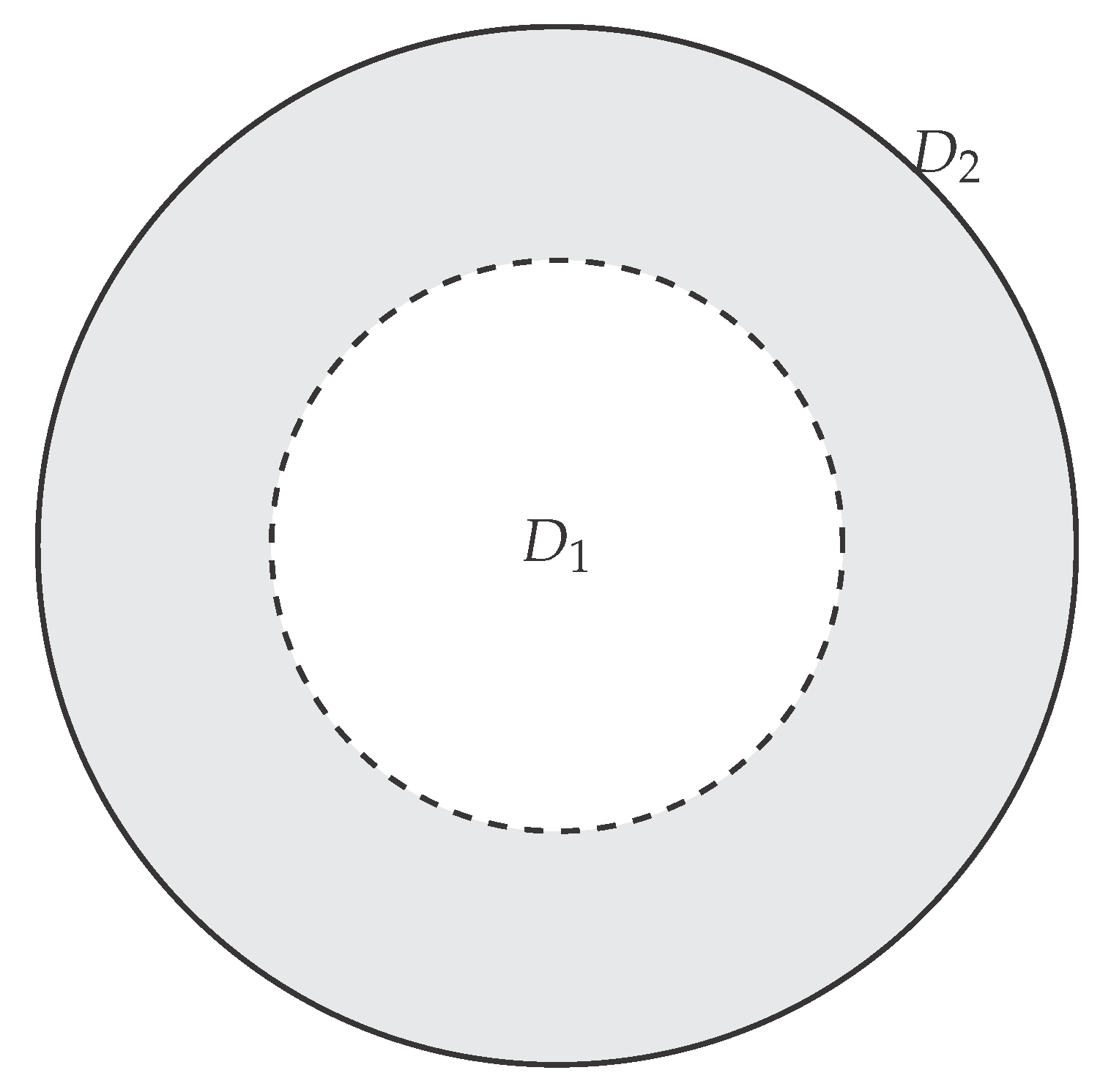
Appendix A.4. Visual Illustration
Figure A1.
Nested decision spaces: low-money set high-money set .
Appendix A.5. Objective vs. Perceived Agency
- Objective agency: The full structural option set —physically, legally, and logistically possible moves.
- Perceived agency: The subset an agent believes they can act on—shaped by psychology, trauma, or belief.
Money acts directly on the former. Psychology governs the latter. This paper has addressed only objective agency.
References
- Kahneman, Daniel, and Angus Deaton. “High income improves evaluation of life but not emotional well-being.” Proceedings of the National Academy of Sciences, 107 (38), 2010, 16489-16493.
- Killingsworth, Matthew A., Daniel Kahneman, and Angus Deaton. “Experienced well-being rises with income, even above $75,000 per year.” Proceedings of the National Academy of Sciences, 120 (11), 2023, e2204912120.
- Helliwell, John F., Richard Layard, Jan-Emmanuel De Neve, et al. World Happiness Report 2025. Wellbeing Research Centre (Oxford), Gallup, and United Nations SDSN, 2025.
- “Costa Rica climbs in 2025 World Happiness Rankings.” The Tico Times, 20 March 2025.
- Associated Press. “Finland again ranked the happiest country in the world as U.S. falls to record low.” AP News, 20 March 2025.
- Abramitzky, Ran, Leah Boustan, Santiago Jácome, and Juan Pérez. “The children of immigrants experience faster upward mobility.” NBER Reporter, Winter 2025.
- “Geo-arbitrage can help digital nomads lead a better life.” andysto.com, 14 September 2024.
- Economic Policy Institute. Wage Stagnation in Nine Charts. EPI, 2023.
- Pew Research Center. “How the American Middle Class Has Changed in the Past Five Decades.” 2022.
- Pew Research Center. “Americans Are Split Over the State of the American Dream.” 2024.
- Sen, Amartya. Development as Freedom. Anchor Books, 1999.
- Nussbaum, Martha C. Creating Capabilities: The Human Development Approach. Harvard University Press, 2011.
- Frankl, Viktor E. Man’s Search for Meaning. Beacon Press, 1959.
Disclaimer/Publisher’s Note: The statements, opinions and data contained in all publications are solely those of the individual author(s) and contributor(s) and not of MDPI and/or the editor(s). MDPI and/or the editor(s) disclaim responsibility for any injury to people or property resulting from any ideas, methods, instructions or products referred to in the content. |
© 2025 by the authors. Licensee MDPI, Basel, Switzerland. This article is an open access article distributed under the terms and conditions of the Creative Commons Attribution (CC BY) license (http://creativecommons.org/licenses/by/4.0/).
Copyright: This open access article is published under a Creative Commons CC BY 4.0 license, which permit the free download, distribution, and reuse, provided that the author and preprint are cited in any reuse.


