

Submitted:
25 June 2025
Posted:
26 June 2025
You are already at the latest version
Abstract
Fishes have flexible and indeterminate growth, and many of them do not reach their growth and size potential. They may become stunted with impaired growth and early maturity as a phenotypically plastic reaction. Chief causes of stunted growth are negatively density-dependent food availability and keen intraspecific competition leading to environmental stress. Typically, their growth levels off early in life as the energy consumption approaches the energy costs of maintenance. Females appear to attain maturity soon after the energy surplus from feeding starts to decrease, males are often more variable in size at maturity owing to alternative mating strategies and their size at maturity depends on both species specific mating behaviours and environmental opportunities. In polyphenic/polymorphic populations, where the fish are split between stunted and large-growing individuals, stunted individuals do not perform a required ontogenetic niche shift needed to grow larger. The adult morphology of stunted fish typically appears to be similar to the morphology of the juveniles. Their secondary sexual characters are less well developed and phenotypically, they retain adaptation to their early feeding niche which is different from that of large growing individuals. There are open questions regarding to what extent genetics and epigenetics regulate the life histories of stunted phenotypes.
Keywords:
environmental stress
; growth
; life history
; maturation
; metabolic rate
; morphology
; phenotypic plasticity
; stunting
1. Introduction
Fish growth is phenotypically plastic, and many fish do not reach their growth and size potential. Instead they may become stunted with impaired growth, early maturity and short life span. Already a century ago, this aspect of phenotypic plasticity bothered and was eagerly discussed by fish ecologists [1,2,3,4,5,6,7], and still, fish growth and stunting are important ecological issues [8,9,10,11,12].
Phenotypic plasticity is the reaction norm of phenotypic traits to variable environmental conditions [13,14]. Reaction norms may be expressed as continual gradient variations of individual traits depending on the characteristics of the organisms’ environment, but can also be dichotomous as in polymorphic and polyphenic populations, where the individuals are expressed as alternative phenotypes [15]. Each of these alternative phenotypes are also phenotypically plastic [16]. In fishes, examples of the latter are conspecific phenotypes such as sympatric epibenthic and limnetic Arctic charr Salvelinus alpinus (L,. 1758) where one of them is stunted [17]. Other such examples are invertebrate feeding and fish feeding European perch Perca fluviatilis L., 1758 [18] and anadromous and river-resident Atlantic salmon Salmo salar L., 1758 [19]. Typically, stunted fish cease growing at an early age, and thereafter, somatic growth is slow and may even be negative [20,21,22]. In extreme cases, stunted adults weigh only a few percent of normally growing conspecifics, such as in freshwater resident and anadromous Atlantic salmon [23,24].
In this review, I will summarize reasons why fish stunt, describe characteristics of stunted fish, and how they differ from normally growing conspecifics. My hypothesis is that stunted and normally growing conspecifics typically are adapted to different environmental niches. I will briefly describe energy budgets that lead to stunting. Then, I review typical characteristics of stunted populations and how age and size at maturity differ from normally growing conspecifics. At the end, I discuss differences between stunted and non-stunted conspecifics and present some issues that need further research. Many of the examples I use are from studies of salmonid species. However, other species are mentioned when appropriate to show that these are issues of wider significance.
2. Why Do Fish Stunt?
There are several reasons why individual fish stunt, but the best described size-regulatory mechanism is negative, density-dependent growth which function in concert with density-dependent mortality [18,25,26,27,28]. For instance, Lobon-Cervia [29] found for stream living populations of brown trout Salmo trutta L., 1758 that when recruitment was low, growth but not early survival decreased with increasing population density. In cases of elevated recruitment, both growth and survival decreased with increasing density. Because of competition for limited resources, food availability for individual fish decreases with increasing population density [30,31,32]. Interference competition appears to dominate in lotic environments and exploitative competition typically occurs in lentic environments [33]. However, both lead to reduced growth and increased mortality although the mechanisms differ. Exploitative competition does this by reducing the resource availability and increasing the vulnerability to other pressures such as predation. Interference competition leads to increased mortality and reduced growth and shifts in resource use because of direct interference between the competitors. Populations with stunted fish are typically found in overcrowded ponds and small lakes, where the fish are restricted from exploiting alternative habitats with better growth opportunities [34,35], but it is not limited to these. Stunted growth is also described from rivers, large lakes, and marine systems [12,24,36,37]. Less is known about whether interspecific competition leads to stunting, although it is known that interacting populations can adjust their phenotypes in response to their respective competitors [38]. Also, when limited prey availability constitutes a whole prey category, such as zooplankton, zoobenthos, or fish, this can function as a trophic bottleneck leading to stunting of all species that depend on this prey group for continued growth [39,40]. Thus, interspecific competition may lead to stunting, and the growth restriction should be strongest in enclosed systems with few alternative food niches.
There are also a number of other reasons than increased density that can lead to stunting. For example, a high risk of predation can reduce the feeding activity of prey species, and reduce their access to habitats with proper food [18,41,42,43]. Experimentally, this was demonstrated for juvenile three-spined sticklebacks Gasterosteus aculeatus L., 1758 exposed to cues of predatory rainbow trout Oncorhynchus mykiss (Walbaum, 1792). Initially, their growth was fast, but they matured younger and smaller than unexposed conspecifics[44]. Furthermore, fishing and predators may selectively remove old prey and select for younger age at maturity and smaller adult size [45,46]. But predators or fishing may also have the opposite effect, reducing population density and leading to increased individual growth [8,47,48](Sneider and Lockwood 2002; de Roos et al. 2008; Amundsen et al. 2019). In addition, parasitation and disease can cause environmental stress and lead to stunted growth [49,50]. Stunting may be also associated with an inferior physical habitat and pollution [12,51], nutrient deficiency for example owing to waste water purification [52], extreme temperatures [53], low oxygen saturation [54,55], and low pH of the water [56,57].
Thus, poor growth is associated with a variety of environmental stressors [58,59]. The physiological responses to these stressors, however, appear similar. Possibly, the stressors trigger the same responses through the hypothalamic-pituitary-adrenal axis [60], a neuro-endocrine mechanism that increases the release of glucocorticoid hormones (cortisol and coticosterone) [11,61]. It may also lead to reduced insulin secretion [56,62] and the insulin-like growth factor [63,64]. Behaviourally, environmental stress may lead to allostatic overload, i.e. the stress response system becomes overwhelmed and dysregulated. This may reduce escape responses, reduce feeding and increase the vulnerability to predation [65].
Although stunting typically is an environmentally induced effect [66], reaction norms are formed by natural selection so there is also a genetic component involved that restricts the degree of plasticity [67,68], and epigenetic regulation of it may be involved like in human stunted growth [69,70,71,72]. Although there is little evidence of epigenetic regulation of growth from studies of fish [73], there is some evidence suggesting that early environmental stimuli, such as incubation temperature of embryos, may influence later somatic growth [74]. This was reported from studies of haddock Melanogrammus aeglefinus (L., 1758) [75], carp Cyprinus carpio L., 1758 [76], Atlantic salmon [77], European whitefish Coregonus lavaretus (L., 1758)[78], and Senegal sole Solea senegalensis Kaup, 1858 [79]. In Atlantic salmon and European whitefish, egg incubation temperature influences adult size [78,80], and recent evidence from walleye Sander vitreus (Mitchill, 1818) suggests that early environments affect offspring growth as an epigenetic and/or parental effect, and possibly lead to stunting in some cases [81]. Thus, environmental influences at the embryo stage may affect later growth of fishes.
3. Energy Budget, Growth and Food Intake
Although stunted fish growth has been known since the first half of the 20th century, in situ measurements of energy intake and costs of a stunted fish were not reported before half a century later [20]. Metabolic measurements of Arctic charr were made possible by the use of a tracer element (137Cs) [82,83] which was available in northern ecosystems after the Chernobyl disaster in 1986 [84]. This, but also other tracer elements can be used for measurements of metabolic rates in nature [85,86,87].
Stunted fish cease to grow because the annual energy-use approaches the gains from food consumption (Figure 1). They reach maximum energy intake when relatively young, in this example at age-2 at a mean wet mass of 40 g. Thereafter, the annual energy intake decreases with increasing age and mass, which appears typical for stunted fish [20]. Maximum growth-rate is reached at Wopt where the difference between energy consumption and cost is at its maximum, in this case at 30 g wet mass, which is far less than in normally growing Arctic charr. Also, total energy costs level off with age, but the reduction in cost is smaller than the reduction in energy intake. In the present example, the annual energy intake and cost are similar at 60 g, the growth stagnates and the mean body mass may even decrease among older fish of stunted populations [21].
The energy intake of stunted fish may be restricted by keen competition for food or other causes of environmental stress [64,88]. Offspring from stunted parents, however, can grow large when the growth restrictions are released, although their maximum size may still be smaller than among normally growing conspecifics, e.g. associated with earlier sexual maturation or other, inherited differences [1]. Experimentally starved fish released from food restrictions, may start growing at a higher than the usual rate. This is a technique used by some to save costs in artificial fish rearing [9,89,90]. For example, in a field experiment, Lingam et al. [11] showed that milkfish Chanos chanos (Fabricius, 1775) had elevated specific growth rates, body mass gains, and digestive enzyme activities during a period after the growth restrictions was terminated, and they had a complete restoration of nutrients. However, compensatory growth after fasting is not always observed. For instance, growth may be limited after fasting in cases where the population density is very high with intense environmental stress [91].
Decreasing individual growth rate with increasing body size is a natural process, possibly because body mass increases faster than the ability of fish to digest and process food [92,93], and/or that the food can be more restricted because the requirements to energy and food particle size increase as they grow [94]. Naturally, fish may in periods stop feeding when their lipid reserves are high [95], and it is observed that the length of natural fasting periods increases with age [96]. Fasting is typically associated with sexual maturation and spawning, but there may be also other fasting periods, such as at high temperatures in summer, decreasing temperature during autumn or low temperatures during winter [22,97].
Growth restrictions often lead to ontogenetic shifts in food consumption, but growth may also stagnate after ontogenetic switches. Forseth et al. [20] exhibited that young Arctic charr in a study lake fed successfully on zooplankton until an age of 3 years. After that, the growth rate declined quickly. Apparently, the availability of and competition for zoobenthos restricted further growth. A similar observation was reported for stunted America yellow perch Perca flavescens (Mitchill, 1814) in Lac Hertl (Quebec) [39]. In this lake, also zoobenthos feeding pumpkinseed, Lepomis gibbosus (L., 1758), rock bass, Ambloplites rupestris (Rafinesque, 1817), and brown bullhead Ictalurus nebulosus Lesueur, 1819, stunted. Northern pike, Esox lucius L., 1758 and golden shiner, Notemigonus crysoleucas (Mitchill, 1814), on the other hand, did not feed on zoobenthos and were non-stunted. But in absence of prey fish, northern pike will feed on invertebrates and stunt [98,99]. Restricted availability of benthic invertebrates was blamed for these trophic bottlenecks.
In ecological literature, most examples of stunted fish populations are from freshwater systems. However, the same may hold for marine species in enclosed areas, such as reported for large yellow croaker Larimichthys crocea (Richardson, 1846) [100]. Another example was reported by Neuenfeldt et al. [12] who found stunted growth of Atlantic cod Gadus morhua L., 1758 in the East Baltic Sea. Also in that case, lack of benthic invertebrates was blamed for poor fish growth restricting the young from switching from a zooplankton diet to larger prey. Moreover, the cod were restricted from deep water because of poor water quality in the profundal zone.
4. Morphology and Habitat
Often, stunted phenotypes resemble young conspecifics that have not performed an ontogenetic habitat and/or dietary switch like normally growing conspecifics do, and their coloration is also similar to the young fish. For example, Arctic charr often forms stunted populations [66,101,102], and it may also form stunted and normal growing populations within the same lake [17,103]. Normally growing Arctic charr, in the scientific literature often called normal charr, perform an ontogenetic niche shift and move from an epibenthic, often profundal, habitat to the limnetic zone when they are 15-20 cm in length, i.e. when the predation risk of for example brown trout is strongly reduced [104,105]. The stunted fish remain in their juvenile habitat, have beige backs and vertical parr marks along their flanks and do not exhibit the bright spawning colours when they mature as normal charr do. At the ontogenetic change, the backs of normal charr become darker, their sides become silvery and their parr marks disappear. They also acquire a more stream-lined body shape and a bright red belly as a spawning dress (photos in [17]). Thus, the stunted charr flaunt epibenthic camouflage colours and normal charr exhibit pelagic camouflage colours. The stunted phenotype has also a relatively larger head and a stouter body shape than normal charr. This is a trait reported also from other species stunted fish species such as crucian carp Carassius carassius (l., 1758) [106], white perch Morone americanus (Gmelin, 1789) and green sunfish Lepomis cyanellus Rafinesque, 1819 [50]. Furthermore, stunted white perch have a relatively short middle body giving it a stouter appearance.
Stunted Arctic charr also have a more subterminal mouth than normally growing Arctic charr as described from Vangsvatnet Lake, Norway [17,107]. This difference corresponds to differences in feeding mode and persist in offspring when reared in a common garden experiment. A subterminal mouth is probably an adaptation to epibenthic feeding, and a more terminal mouth position an adaptation to zooplankton feeding. A similar difference in head morphology was reported for epibenthic and limnetic Arctic charr in Thingvallavatn, Iceland [108]. There, a stunted phenotype lives in small crevices and holes among the lava stones in the bottom substratum during daytime [109], but come up and feed on snails, Lymneae peregra Müller, 1774 [110] in littoral waters at night. In addition, there is a stunted, limnetic phenotype that feed chiefly on zooplankton. The most fast-growing of the two stunted phenotypes switch to larger forms. The benthic phenotype switch habitat to live in littoral waters where they feed on zoobenthos. The fastest growing of the limnetic form become predators and become piscivores. Their morphology changes accordingly, and they become adapted to their new habitats and diets [108].
When offspring of stunted and normal Arctic charr are reared together in tanks, most of the morphological difference between the two disappears, but some differences such as the difference in mouth position remain. In addition, there are differences in these traits among populations suggesting genetic differences among phenotypes. Different spawning habitat and spawning time appear to lead to a partial isolation between morphs. Stunted Arctic charr start spawning later and they spawn deeper than normal charr in Vangsvatnet Lake [16] and the two phenotypes appear to spawn assortative also in other lakes [103,111]. Assortative mating seems to be a reason for the maintenance to sympatric phenotypes as in three-spined sticklebacks [112]. In shallow lakes, Arctic charr do not exhibit a similar morph differentiation [113], and their habitat use may also differ in lakes where the risk of predation is small [105]. Thus, the morphology of stunted and normal Arctic charr seems associated with the habitat use, feeding mode and predator avoidance.
Crucian carp is another example of a species where predation risk influences growth. In ponds without northern pike, they have leaner, more shallow bodies and are more slow growing than in ponds with northern pike [106,114,115]. In this species, risk of predation appears to stimulate growth rate, body shape and size. In presence of northern pike or only the smell of it, they grow larger and develop a deeper body shape, apparently as an adaptation to reduce risk of predation [116,117]. Morphological changes because of predation risk are also reported from some other fishes, for instance eastern mosquitofish Gambusia holbrooki Girard, 1859 and western mosquitofish Gambusia affinis (Baird and Girard, 1853) [118] and fathead minnows Pimephales promelas (Rafinesque, 1820) [119]. The latter authors suggest that this phenotypic change is a predation induced, epigenetic effect.
Risk of predation can restrict individuals from habitats and food resources e.g. by restricting the access to littoral or pelagic areas [41,105]. Predator-induced behavioural shifts in habitat use during development occur rapidly and may be associated with changes in brain morphology and neural mechanisms as demonstrated for guppies Poecilia reticulata Peters, 1859 [120]. Furthermore, poor feeding condition may favour smaller individuals because of their lower food requirements and better ability to handle and consume small food items [121]. Also, availability of food at one trophic level can influence further growth and whether individuals will reach a large enough size to use a higher trophic level, such as a change from invertebrate to fish feeding observed for limnetic Arctic charr in Thingvallavatn (Iceland) [103,110] and Lávkajárvi (Norway) [102], brown trout in Lake Femund [122] and zander Sander lucioperca (L., 1758) in Lake Ringsjön, Sweden [123].
Thus, phenotypes show adaptations according to their feeding niches, and these may differ among systems, depending on habitat depth, prey availability and predation risk as known from a number of fish species world-wide [124,125,126], and these relationships between morphological traits and ecological function appear consistent among taxa [92,127,128]. Also, there may be physiological and anatomical changes associated with ontogenetic shifts that distinguish stunted from normally growing conspecifics [129]. These differences can be changes in gut morphology and endocrinology, although such changes are less often reported than differences in outer coloration and body proportions [130,131].
The hormonal system is the most important mediator of environmental and developmental change, and may partly control changes in morphology and habitat use of phenotypically plastic species [132]. This has been best investigated for anadromous species that change body proportions and coloration before they start the seaward migration from fresh water. For these, several hormones surge during the body transformation [133,134], but ontogenetic shifts in freshwater populations may also be under endocrine control [135,136]. Changes in neural mechanisms for these changes are less investigated, but may be important [120].
5. Life History
There are genetic relationships between morphology, habitat use and life histories [137,138]. Population genomics studies in Atlantic salmon have identified two unlinked genomic regions, surrounding the genes six6 in chromosome 9 and vgll3 in chromosome 25 associated with both functional morphology and life history traits of European Atlantic salmon lineages [139,140]. Genes at the six6 locus are associated with head morphology important for the feeding strategy of the fish and those at the vgll3 locus are associated with their swimming performance [138], aggressivness, metabolic rate and aerobic scope [141,142]. Furthermore, both loci influence age and size at first maturity and iteroparity, also important for the fitness of the fish [138,139]. Thus, life history traits are influenced by natural selection.
Life history theory says that selection favours age at first maturity maximizing the net reproductive rate considered over the entire life span [143], and is a function of survival and growth [144,145]. However, individual fish probably do not know their age, growth rate or risk of dying. Still, they typically attain maturity when the juvenile growth-rate begins to level off [18,146,147,148,149]. The relationship between growth rate, length and age at first maturity is statistically significant. Data from 265 fish species of 88 families exhibited that length (cm) at first maturity (Lm) and the asymptotic length (L∞) estimated from the von Bertalanffy growth model was: Log Lm = 0.90Log L∞ - 0.078 [150]. However, this simple model does not explain individual variation in age and size at first maturity within populations where fast growers typically attain maturity younger and smaller than individuals growing at an intermediate rate. This holds for stunted as well as normally growing phenotypes [16]. After the attainment of maturity, most fish species typically spawn annually for the rest of their lives. But large individuals may need extra time before they re-mature as observed in white sturgeon Acipenser transmontanus Richardson, 1836 [151 and Atlantic salmon [152]. It is also known that adults can skip spawning in years with poor feeding opportunities (e.g. little food and low temperature), and/or poor spawning conditions (high fish density, poor water quality, no available partner, restricted access to spawning grounds) which may lead to an increase in future growth [153].
After the onset of maturation, the somatic growth decreases because reproduction is energy demanding [154,155,156,157]. For example, somatic growth of anadromous brown trout is reduced by ca. 50% in the year at first maturity [158]. After maturing, stunted fish therefore stay small for the rest of their lives, relative to conspecifics that continue to grow until they mature at an older age. Stunted fish seldom switch to a normal growth pattern after having matured [159].
Another cost of early maturation is a short life span [102,160,161,162]. This is associated with the costs of reproductive behaviours (migration, courting, preparing spawning site, fighting, restricted feeding and spawning with fertilization of the eggs), which also increase the risk of predation [163]. The size of the energy and survival costs associated with reproduction varies within and among species, whether the fish carries out energy demanding migrations such as Atlantic salmon [164](Jonsson et al. 1997), defend their nest as Pacific salmon (Oncorhynchus spp.) [165] or care for their offspring as three-spined stickebacks [166].
Males are often smaller at first maturity than females, and in some species, only males become stunted. Pauly [167] explains this by that males being more active and therefore devote less energy to somatic growth. This may not be the entire explanation. For instance, male and female brown trout grow at similar rates when sharing habitats, but males, compared to females, occur more frequently in lotic than lentic habitats where they grow less and they also attain maturity younger and are therefore smaller [168]. Furthermore, this sexual dimorphism may be associated with a closer correlation between body size at maturity and fitness in females than males [169].
Fish size may also be restricted by the spawning habitat. For instance, Atlantic salmon spawning in small streams mature young and grow more slowly compared with those spawning in large rivers although they share feeding areas in the Atlantic Ocean [152,170]. A similar finding holds for anadromous brown trout where the size of the adults increases with the stream size up to a certain stream size [171]. In addition, in species where males exhibit alternative spawning behaviours, this may induce a variable male phenotype where a part of the males mature early and are small [172]. Thus, there are also other reasons for maturing small than restricted food availability, such as adapting their adult size to the water level of the spawning grounds, or having alternative spawning strategies, which contribute to sexual dimorphism [171].
Often, stunted fish have smaller investments in egg and milt production than normally growing conspecifics [16,158,173], but this difference may disappear in offspring of the types when reared under similar conditions, as found for brown trout [174]. When stunted and normally growing fish live in sympatry, the morphs may reproduce assortatively, as observed for Arctic charr [16], brown trout Salmo trutta L., 1758 [158] and sockeye salmon Oncorhynchus nerka ( Walbaum, 1792) [175]. However, the reproductive isolation may be incomplete, e.g. by that small males may sneak fertilize eggs at the nests of the normal phenotype (satellite males) and thereby counteract sympatric speciation [176,177]. The satellite males of Atlantic salmon have much higher gonadal index (GSI) than the anadromous males [178] which may be an adaptation to their reproductive tactic where they sneak fertilize the eggs instead of fighting for female access. Some other differences in reproductive biology of stunted and non-stunted individuals have also been observed. For example, in bluegill Lepomis macrochirus Rafinesque, 1819, stunted individuals have a shortened reproductive season owing to a delay in the onset of spawning and reduced reproductive success [179]. Also, in bighead carp Aristichthys nobilis (Richardson, 1845), the onset of gonad maturity was delayed in stunted males under experimental conditions [180]. Thus, stunting has effects on the reproductive biology of fish, and this may result from their smaller somatic energy resources.
6. Discussion
Body size has a major impact on the trophic position of fish and is a main reason why stunted and non-stunted phenotypes have different trophic positions. Size strongly influence the ability of fish to capture and consume prey [92,94], and for example tests of 6 species of freshwater fishes by Farley et al. [181] exhibited that trophic positions of all were positively associated with their body sizes. This and other studies such as [182,183,184,185] exhibits the strong effect of body size on the trophic niche of animals, and lend support to my hypothesis that stunted and non-stunted conspecifics typically are adapted to different niches.
Stunted fish cease growing from a relatively young age. This is often because of food is restricted e.g. due to competition, or the fish have grown out of their present niche and there is no alternative food niche available with better growth opportunities [18]. To continue growing, fish gradually need more food and larger food items [181,186], but not too large food items because there are gape limitations [187,188]. Also, small individuals may out-compete larger conspecifics when the food items are small [121]. In addition, environmental stress caused by pollution or risk of predation may constrain habitat use and food consumption [41,189].
The various life history characters are co-adapted. Age at maturity depends to a large extent on the rate of growth and length of the length of the life span. Maturity is typically attained when the growth rate of the juveniles begin to level off [147,190]. The observation that the most fast-growing, young fish attained maturity early and became small was at first confusing [191](Alm 1959), but has later been verified by a large number of investigations, such as [34,192,193]. Why should the most fast-growing individuals mature and stop growing early? With the development of ecological theory this became more understandable. Theoretically, age at maturity ought to be adapted to the expected mortality and growth rate of each individual so that the net reproductive rate is maximized [139,194,195,196]. Within populations, fast-growers have a higher probability of dying early, and they may reach food limitations and stop growing sooner than more slow-growing individuals when the food items are small [145,197]. Also, good growth in a nursery does not necessarily mean that the growth will stay good after an ontogenetic niche shift [198]. Thus, the optimal age at maturity will be younger if it is less favourable to perform a niche shift and grow larger. Occasionally, however, early maturing individuals skip re-maturing in a subsequent year and perform an ontogenetic niche shift such that mature male parr of Atlantic salmon can do [199]. In such cases, they escape from their niche restrictions and exploit a more profitable feeding niche and grow large before they eventually re-mature [147,200].
Environmental variables that influence age at first maturity are growth, temperature, body size and condition [201,202,203] However, whether it is the rate of growth per se, or a variable associated with the growth rate that initiate maturation, is still unknown. This may be a variable such as metabolic rate or lipid density of the fish [147,197]. Growth tend to increase with metabolic rate [204,205] and may thereby be associated with age at maturity. Thorpe [206] hypothesized that fish can be physiologically aware of its growth through the rate at which they accumulate surplus energy. When this rate is above a genetically determined threshold, they may start to mature and then spawn in due course. For Atlantic salmon male parr, Thorpe [206] suggested that the level of reserve energy in the autumn about one year prior to spawning, determine whether they would spawn in the subsequent year. Pauly [190] suggested a similar hypothesis, but that the stimulating factor that triggers the first maturation is the rate of oxygen consumption. The oxygen consumption is also related to the metabolic rate [207], suggesting that growth or associated metabolic relationships are influencing age at first maturity in fish [208,209], although more tests are needed to verify the relationship between growth and maturity.
In addition, biological inheritance influences age and size at first maturity. This has been well shown for Atlantic salmon [139,203,210,211]. Although most fitness-related traits are assumed to have low to moderate additive inheritance (0.2-0.3) and influenced by a large number of alleles, each with a small effect [212,213], age at maturity may be more strongly inherited than this. For example, age at first maturity in Atlantic salmon is to a larger extent (~40%) controlled by a single genomic region (vgll3) [139,210,214]. In addition to its morphological effect [138], this genotypic region is associated with the lipid metabolism of the liver and may through this be linked to the maturation process of Atlantic salmon [215]. Less is known about genetic influences on age at maturity for other species, and possibly there are differences among species depending on which factors that influence their fitness. For example, Oplinger et al. [216] claim that environmental factors and not inheritance are by far most important for age at first maturity of bluegills. This species may be less influenced by the nature of their spawning area than anadromous salmon and trout that have adult sizes that seems adapted to the water flow of the rivers where they spawn [152,171].
Selective breeding programmes have shown that there are genetic differences in growth performance within and among conspecific populations [217,218]. Through genetic modifications one can accelerate the growth hormone production and thereby speed up growth, increase feed conversion efficiency and improve the utilization of food [219]. However, such transgenic changes may have unintended physiological effects, some of which are negative for the fish such as impaired immune responses. So far it is little reason to suspect that genetic variation is the main reason for variation in growth among most conspecific fish populations [39], but it certainly has an additive effect. For example, genetic changes caused by selective fishing, can reduce age at maturity and give smaller fish, indicative of this [18,220].
Are there epigenetic influences on growth rate, age at first maturity and breeding performance? Possibly, adverse environmental conditions and stress encountered at the embryo or fry stage may reduce later growth through an epigenetic influence downregulating genes associated with the production of growth hormones [221,222,223,224]. It has been found that environmental stress, e.g. exposure to predator cues in early life, affects the breeding performance, growth and size of three-spined sticklebacks [44,225,226]. Environmental stress by adverse conditions can silence specific genes e.g. by DNA methylation. Furthermore, environmental stress can modify growth patterns in humans and other mammalians [61,69,227]. For fish, Morán and Pérez-Figueroa [228] suggested that DNA methylation was involved in early maturation and size of mature male parr of Atlantic salmon. Epigenetics may also affect developmental trajectories and play a role in physiological programming and rates such as trade-offs between somatic growth and sexual maturation, although it is challenging to associate specific traits with an epigenetic mechanism [72,74,229]. At present, there are few studies of epigenetic influence on growth and life histories, and one must therefore be careful in making generalizations. However, this may be an important supplement to the genetic programming of growth patterns and morphological adaptations to habitats and feeding niches [230,231,232]. Thus, evidence suggests that there are both genetic and environmental components to the variation in morphology, growth, and other life history traits that differentiate stunted from non-stunted individuals within species of fish [233].
7. Further Perspective
Stunting in fish is a well-studied field, not the least because fish size and production are major human concerns. But still, we do not know enough about the mechanisms that regulate growth, the interplay between growth and other life history variables, and how fish allocate their energetic resources during development and determine their adapted phenotype. How is lipid density influencing life history decisions and to what degree is sensory impulses involved? Are there differences among populations and species in how genetics and environments form their adult phenotype, and if so, what is the reason for this? Furthermore, little is known about if early environmental influences later ontogenetic niche shifts. We know that environmental stress is important for stunting in fish, but we know less about individual variation of growth to environmental stress. Furthermore, is stunting a uniform mechanism of all fish species, or are some species more plastic than others, and if so, why? Epigenetics may be involved in the development of flexible phenotypes, but we still know little about the mechanisms. However, epigenetics and gene regulation is a rapidly growing field of endocrinology. As a last point, is there transgenerational effects of stunting?
Research on these and related questions will give a better understanding of growth of fishes as a phenotypically plastic reaction norm to environmental influences and elucidate how selection and environmental adaptation are involved in stunting.
8. Conclusions
Density-dependent food consumption, restricted food availability and environmental stress lead to growth restrictions, early maturation and death and an annual energy intake which approaches the cost of maintenance. Stunted and non-stunted fish may differ in morphology and coloration and are typically adapted to different feeding niches. This review supports the hypothesis that non-stunted fish usually perform an ontogenetic niche shift not shared by the stunted conspecifics. In sympatry, stunted and non-stunted conspecifics are adapted to different feeding habitats, food niches and/or breeding conditions. Life history differences such as growth, age at maturity and life span are coadapted in both stunted and non-stunted populations and appear chiefly endocrinologically controlled. Little is known about possible genetic and epigenetic influences on stunting and phenotypic plasticity of life history traits including growth.
Funding
The author received no funding.
Institutional Review Board Statement
Not applicable.
Acknowledgments
I thank Kjetil Hindar for reading and commenting on a draft of the manuscript and Nina Jonsson for drawing the figure.
Conflicts of Interest
The author declares no conflict of interest.
References
- Alm, G. Investigations on the growth etc. by different forms of trout. Medd. Unders. Førsøksanst. Søtvf. 1939, 15, 1–93.
- Alm. G. Reasons for the occurrence of stunted fish populations-with special regard to the perch. Medd. Unders. Førsøksanst. Søtvf. 1946, 25, 1–146.
- Beckman, W. C. Further studies on the increased growth rate of the rock bass Ambloplites rupestris (Rafinesque), following reduction in density of the population. Trans. Am. Fish. Soc. 1943, 72, 72–78.
- Dahl, K. 1917. [Studier and Experiments on Trout and Trout Waters](in Norwegian). Centraltrykkeriet, Christiania, Norway, 119pp.
- Deedler, C.L. A contribution to the knowledge of the stunted growth of perch (Perca fluviatilis L.) in Holland. Hydrobiolgia 1951, 3, 357–378.
- Swingle, H.S. Experiments with combinations of largemouth black bass, bluegills, and minnows in ponds. Trans. Am. Fish. Soc. 1946, 76, 46–62. [CrossRef]
- Weatherley, A.H.. Ecology of fish growth. Nature 1966, 212, 1321–1324.
- Amundsen, P.A.; Primicerio, R.; Smalås, A.; Henriksen, E.H.; Knudsen, R.; Kristoffersen, R.; Klemetsen, A. Long-term ecological studies in northern lakes—challenges, experiences, and accomplishments. Limnol. Oceanogr. 2019, 64 (S1), 11–21.
- Babu, P.P.S.; Anuraj, A.; Loka, J..; Praveen, N.D.; Rao, P.S.; Shilta, M.T.; Anikuttan, K.K.; Jayakumar, R.; Nazar, A.K.A.; Boby, I.; et al. Impact of duration of stunting on compensatory growth and biometrics of snubnose pompano, Trachinotus blochii (Lacepede,1801) in low saline conditions. Thalassas: Int. J. Mar. Sci. 2022, 38, 1301–1310. [CrossRef]
- Denechaud, C., Smoliński, S., Geffen, A.J., Godiksen, J.A., Campana, S.E. A century of fish growth in relation to climate change, population dynamics and exploitation, Glob. Change Biol. 2020, 26, 5661–5678.
- Lingam, S.S.; Sawant, P.B.; Chadha, N.K. Duration of stunting impacts compensatory growth and carcass quality of farmed milkfish, Chanos chanos (Forsskal, 1775) under field conditions. Sci. Rep. 2019, 9, 16747. [CrossRef]
- Neuenfeldt, S.; Bartolino, V.; Orio, A.; Andersen, K.; Andersen, N.G.; Niiranen, S.; Bergström, U.; Kulatska, N.; Casini, M. Feeding and growth of Atlantic cod (Gadus morhua L.) in the eastern Baltic Sea under environmental change. ICES J. Mar. Sci. 2020, 77, 624–632. [CrossRef]
- Stearns, S.C. The evolutionary significance of phenotypic plasticity. BioScience 1989, 39, 436–445.
- Forsman, A. Rethinking phenotypic plasticity and its consequences for individuals, populations and species. Heredity 2015, 115, 276–284. [CrossRef]
- Gomulkiewicz, R.; Stinchcombe, J.R. Phenotypic plasticity made simple, but not too simple. Am. J. Bot. 2022, 109, 1519–1524.
- Jonsson, B.; Hindar, K. Reproductive strategy of dwarf and normal Arctic charr (Salvelinus alpinus) from Vangsvatnet Lake, western Norway. Can. J. Fish. Aquat. Sci. 1982, 39, 1404–1413.
- Hindar, K.; Jonsson, B. Habitat and food segregation of dwarf and normal Arctic charr (Salvelinus alpinus) from Vangsvatnet Lake, western Norway. Can. J. Fish. Aquat. Sci. 1982, 39, 1030–1045. [CrossRef]
- Ylikarjula, J.; Heino, M,; Dickmann, U. Ecology and adaptation of stunted growth in fish. Evol. Ecol. 1999, 13, 433–453.
- Berg, O.K. The formation of non-anadromous populations of Atlantic salmon, Salmo salar L., in Europe. J. Fish Biol. 1985, 27, 805–815.
- Forseth, T.; Ugedal, O.; Jonsson, B. The energy budget, niche shift, reproduction and growth in a population of Arctic charr, Salvelinus alpinus. J. Anim. Ecol. 1994, 63, 116–126. [CrossRef]
- Huusko, A.; Mäki-Petäys, A.; Stickler, M.; Mykrä, H. Fish can shrink under harsh living conditions. Funct. Ecol. 2011, 25, 628–635.
- Letcher, B.H.; Nislow, K.H.; O’Donnell, M.J.; Hayden, M.J.; Dubreuil, T,L. Negative growth in body mass of trout and salmon in a small stream network. Can. J. Fish. Aquat. Sci. 2025. [CrossRef]
- Leggett, W.C.; Power, G. Differences between two populations of landlocked Atlantic salmon (Salmo salar) in Newfoundland. J. Fish. Res. Board Can. 1969, 26, 1585–1596. [CrossRef]
- Davidsen, J.G.; Eikås, L.; Hedger, R.D.; Thorstad, E.B.; Rønning, L.; Sjursen, A.D., Berg, O.K.; Bremset, G.; Karlsson, S.; Sundt-Hansen, L.E. Migration and habitat use of the landlocked riverine Atlantic salmon Salmo salar småblank. Hydrobiologia 2020, 847, 2295–2306. [CrossRef]
- Lorenzen K, Enberg K. Density-dependent growth as a key mechanism in the regulation of fish populations: evidence from among-population comparisons. Proc. Biol. Sci. 2002, 269, 49–54. [CrossRef]
- Zimmermann, F.; Ricard D.; Heino, M. Density regulation in Northeast Atlantic fish populations: Density dependence is stronger in recruitment than in somatic growth. J. Anim. Ecol. 2018, 78, 1763–1778.
- Fletcher, C.M.; Vollins, S.F.; Nannini, M.A.; Wahl, D.H. Competition during early ontogeny: Effects of native and invasive planktivores on the growth, survival, and habitat use of bluegill. Freshw. Biol. 2019, 64, 697–707. [CrossRef]
- Croll, J.C.;, van Kooten, T.; de Roos, A.M. The consequences of density-dependent individual growth for sustainable harvesting and management of fish stocks. Fish Fish. 2023, 24, 427–438.
- Lobon-Cervia J. Density-dependent growth in stream-living brown trout Salmo trutta L. Funct. Ecol. 2007, 21, 117–124.
- Amundsen, P.A.; Knudsen, R.; Klemetsen, A. Intraspecific competition and density dependence of food competition and growth in Arctic charr. J. Anim. Ecol. 2007, 76, 149–158.
- Huss, M.; Persson, L.; Borcherding, J.; Heermann, L. Timing of the diet shift from zooplankton to macroinvertebrates and size at maturity determine whether normally piscivorous fish can persist in otherwise fishless lakes. Freshw. Biol, 2013, 58, 1416–1424. [CrossRef]
- Cantin, A.; Post, J.R. Habitat availability and ontogenetic shifts alter bottlenecks in size-structured fish populations. Ecology 2018, 99, 1644–1659. [CrossRef]
- Matte, J.M.O.; Grant, J.W.A.; Fraser, D.J. Meta-analysis reveals that density dependent growth, survival and their trade-off vary systematically among habitats and taxa. Can. J. Zool. 2025, 103. [CrossRef]
- Aday, D.D. Exploring stunted body size: Where have we been, what do we know, and where do we go? Am. Fish. Soc. Symp 2008, 62, 349–367.
- Zuh, C.K.; Abodi, S.M.; Campion, B.B. Comparative assessment of age, growth and food habit of the black-chinned tilapia, Sarotherodon melanotheron (Rüppell, 1852), from a closed and open lagoon, Ghana. Fish. Aquat. Sci. 2019, 22, 31. [CrossRef]
- Rindorf, A.; van Deurs, M.; Howell, D.; Andonegi, E.; Berger, A.; Bogstad, B.; Cadigan, N.; Elvarsson, B. Þ.; Hintzen, N.; Roland, M.S.; et al. Strength and consistency of density dependence in marine fish productivity. Fish Fish. 2022, 231, 812–828.
- Schram, E.; van der Heul, J.W.; Kamstra, A.; Verdegem, M.C.J. Stocking density dependent growth of Dover sole (Solea solea). Aquaculture 2006, 252, 339–347.
- Agrawal, A.A. Phenotypic plasticity in the interactions and evolution of species. Science 2001, 294, 321–326. [CrossRef]
- Heath, D.D.; Roff, D.A. The role of trophic bottlenecks in stunting: A field test of an allocation model of growth and reproduction in yellow perch, Perca flavescens. Env. Biol. Fish. 1996, 45, 53–63. [CrossRef]
- Blouzdis, C.E.; Ivan, L.N.; Pothoven, S.A. ; Roswell, C.R.; Foley, C.J.; Höök, T.O. A trophic bottleneck?: The ecological role of trout-perch Percopsis omiscomaycus in Saginaw Bay, Lake Huron. J. Appl, Ichthyol, 2013, 29, 416–424.
- Jakobsen, P.J.; Johnsen, G.H.; Larsson, P. Effect of predation risk on the feeding ecology, habitat us and abundance of lacustrine threespine stickleback (Gasterosteus aculeatus). Can. J. Fish. Aquat. Sci. 1988, 45, 426–431.
- Damsgård, B.; Ugedal, O. The influence of predation risk on habitat selection and food intake by Arctic charr, Salvelinus alpinus (L). Ecol. Freshw. Fish 1997, 6, 95–101. [CrossRef]
- Bordeau, P. E.; Johansson, F. Predator-induced morphological defenses as by-products of prey behavior: a review and prospectus. Oikos 2012, 121, 1175–1190.
- Bell, A.M.; Dingemanse, N.J.; Hankison, S.J.; Langenhof, M.B.W.; Rollins, K. Early exposure to non-lethal predation risk by size-selective predators increases somatic growth and decrease size at adulthood of three-spined sticklebacks. J. Evol. Biol. 2011, 24, 943–953.
- Gosch, N.J.C.; Pierce, L.L.; Pope, K.L. The effect of predation on stunted and nonstunted white perch. Ecol. Freshw Fish 2010, 19, 401–407. [CrossRef]
- Czorlich, Y.; Aykanat, T.; Erkinaro, J.; Orell, P.; Primmer, C.R. Rapid evolution in salmon life history induced by direct and indirect effects of fishing. Science 2022, 376, 420-423. [CrossRef]
- Sneider, J.C.; Lockwood, R.N. Use of walleye stocking, antimycin treatments, and catch-and-release angling regulations to increase growth and length of stunted bluegill populations in Michigan lakes. N. Am, J. Fish. Manage. 2002, 22, 1041–1052.
- de Roos, A. M.; Schellekens, T.; van Kooten, T.; Persson, L. Stage-specific predator species help each other to persist while competing for a single prey. Proc. Natl. Acad. Sci. USA 2008, 105, 13930–13935. [CrossRef]
- Boerlijst, M.C.; de Roos, A.M. Competition and facilitation between a disease and a predator in a stunted prey population. PLOS One 2015, 10, e0132251.
- Chizinski, C.J.;, Pope, K.L.; Wilde, G.R.; Strauss, R.E. Implications of stunting on morphology of freshwater fishes. J. Fish Biol. 2010, 76, 564–579. [CrossRef]
- Mustafa, S.A.; Al-Rudainy A.J.; Salman, N.M. Effect of environmental pollutants on fish health: An overview. Egypt. J. Aquat. Res. 2024, 50. 225–233.
- Bolle, L.J.; Hoek, R.; Pennock, I.; Poiesz, S.S.H.; van Beusekom, J.E.E.; van der Veer. H.; Wille, J.I.J.; Tulp, I. Evidence for reduced growth in resident fish species in the era of de-eutrophication in a coastal area in NW Europe. Mar. Env. Res. 2021, 169, 105364. [CrossRef]
- Neuheimer, A.; Thresher, R.; Lyle, J.; Semmens, J.M. Tolerance limit for fish growth exceeded by warming waters. Nat. Clim. Chang. 2011, 1, 110–113.
- Kolding, J.; Haug, L.; Stefansson, S. Effect of ambient oxygen on growth and reproduction in Nile tilapia (Oreochromis niloticus). Can. J. Fish, Aquat. Sci. 2008, 65, 1413–1424. [CrossRef]
- Thorarensen, H.; Gústavsson, A.; Gunnarsson, S.; Árnason, J.; Steinarsson, A.; Björnsdóttir, R.; Imsland, A.K.D. The effect of oxygen saturation on the growth and food conversion of juvenile Atlantic cod Gadus morhua L. Aquaculture 2017, 475, 24–28. [CrossRef]
- Mackett, D.B.; Tam, W.H.; Fryer, V.N. Histological changes in insulin-immunoreactive pancreatic beta-cells, and suppression of insulin-secretion and somatotropic activity in brook trout (Salvelinus fontinalis) maintained on reduced food-intake or exposed to acidic environment. Fish Physiol. Biochem. 1992, 10, 223–243.
- Brogowski, Z.; Siewert, H.; Keplinger, D. Feeding and growth responses of bluegill fish (Lepomis macrochirus) at various pH levels. Pol. J. Env. Stud. 2005, 14, 517–519.
- Schlichting, C.D.; Wund, M.A. Phenotypic plasticity and epigenetic marking: an assessment of evidence for epigenetic accommodation. Evolution 2014, 68, 656–672.
- Vogt, G. Facilitation of environmental adaptation by epigenetic phenotype variation: insights from clonal, invasive, polyploid, and domesticated animals. Env. Epigen. 2017, 3, dvx002.
- Tsigos, C.; Chrousos, G.P. Hypothalamic–pituitary–adrenal axis, neuroendocrine factors and stress. J. Psychosom. Res. 2002, 53, 65 – 871.
- Metcalfe, N.B. How important is hidden phenotypic plasticity arising from alternative but converging developmental trajectories, and what limits it? J. Exp. Biol. 2024, 227(Suppl 1), jeb246010. [CrossRef]
- Yaribeygi, H.; Maleki, M.; Butler, A.E.; Jamialahmadi, T.; Sahebkar, A. Molecular mechanisms linking stress and insulin resistance. Excli. J. 2022, 21, 317–334. [CrossRef]
- Duan, C.M.;, Plisetskaya, E.M.; Dickhoff, W.W. Expression of insulin-like growth-factor in normally and abnormally developing coho salmon (Oncorhynchus kisuch). Endocrinology 1995, 136, 446–452.
- Canosa, L.F.; Bertucci, J.I. The effect of environmental stressors on growth in fish and its endocrine control. Front. Endicrinol. 2023, 14, 1109461. [CrossRef]
- Patel, D.M.; Brinchmann, M.F.; Hansen, A.; Iversen, M.H. Changes in the skin proteome and signs of allostatic overload Type 2, chronic stress, in response to repeated overcrowding of lumpfish (Cyclopterus lumpus L.). Front. Mar. Sci. 2022, 9, 891451.
- Janhunen, M.; Peuhkuri, N.; Piironen, J. A comparison of growth patterns between a stunted and two large predatory Arctic charr populations under identical hatchery conditions. Env. Biol. Fish. 2010, 87, 113–121. [CrossRef]
- Canale, C.J.; Henry, P.Y. Adaptive phenotypic plasticity and resilience of vertebrates to increasing climatic instability. Clim. Res. 2010, 43, 135–147.
- Khare, S.B.; Holt, R.D.; Scheiner, S.M. The genetics of phenotypic plasticity. XVIII. Developmental limits restrict adaptive plasticity. Evolution 2024, 78, 1761–1773. [CrossRef]
- Abdelnour, S.A.; Naiel, A.E.; Said, M.B.; Alnajeebi, A.M.; Nasr FA, Al-Doaiss, A.A.; Mahasneh, Z.M.H.; Noreldin, A.E. Environmental epigenetics: Exploring phenotypic plasticity and transgenerational adaptation in fish. Env. Res., 2024, 252, 118799.
- Chukwuma, C. Epigenetics and its essence in understanding human growth, development and disease. J. Med. Dis. 2022, 8, 165–172.
- Kanherkar, R.R.; Bhatia-Dey, N.; Csoka, A.B. Epigenetics across the human lifespan. Front. Cell. Dev. Biol. 2014, 2, 49. [CrossRef]
- Lui, J.C. Growth disorders caused by variants in epigenetic regulators; progress and prospects. Front. Endocrinol. 2024, 15, 1327378.
- Oplinger, R.W.; Wahl, D.H. Egg characteristics and larval growth of bluegill from stunted and non-stunted populations. J. Freshw. Ecol. 2015, 30, 299–309. [CrossRef]
- Jonsson, B.; Jonsson, N.; Hansen, M.M. Knock-on effects of environmental influences during embryonic development of ectothermic vertebrates. Q. Rev. Biol. 2022, 97, 95–139.
- Martell, D.J.; Kieffer, D.J.; Trippel, E.A. Effects of temperature during early life history on embryonic and larval development and growth in haddock. J. Fish Biol. 2005, 66, 1558–1575. [CrossRef]
- Korwin-Kossakowski, M. The influence of temperature during the embryonic period on larval growth and development in carp, Cyprinus carpio L. and grass carp, Ctenopharyngodon Idella (Val.): theoretical and practical aspects. Arch. Pol. Fish. 2008, 16, 231–314.
- Finstad, A.G; Jonsson, B. Effect of incubation temperature on growth performance in Atlantic salmon. Mar. Ecol. Progr. Ser. 2012, 454, 75–82. [CrossRef]
- Steinbacher, P.; Wanzenböck, J.; Brandauer, M.; Holper, R.; Landertshammer, J.; Mayr, M.; Platzl, C.; Stoiber, W. Thermal experience during embryogenesis contributes to the induction of dwarfism in whitefish Coregonus lavaretus. PLOS One 2017, 12, e0185384.
- Carballo, C.; Firmino, J.; Anjos, L.; Santos, S.; Power, D.M.; Manchad, M. Short- and long-term effects on growth and expression patterns in response to incubation temperature in Senegalese sole. Aquaculture 2018, 495, 222–231. [CrossRef]
- Jonsson, B.; Jonsson, N.; Finstad, A.G. Linking embryonic temperature with adult reproductive investment. Mar. Ecol. Progr. Ser. 2014, 515, 217–226.
- Almeida, L.Z.; Ludsin, S.A.; Faust, M.D.; Marschall, E.A. Lingering legacies: Past growth and parental experience influence somatic growth in a fish population. J. Anim. Ecol. 2024, 93, 1462–1474.
- Forseth, T.; Jonsson, B.; Neumann, R.; Ugedal, O. Radioisotope method for estimating food consumption by brown trout(Salmo trutta). Can. J. Fish. Aquat. Sci. 1992, 49, 1328–1335. [CrossRef]
- Ugedal, O.; Jonsson, B.; Njåstad, O.; Næumann, R. Effects of temperature and body size on radiocaesium retention in brown trout, Salmo trutta. Freshw. Biol. 1992, 28, 165–171.
- Jonsson, B.; Forseth, T.; Ugedal, T. Chernobyl radioactivity persists in fish. Nature 1999, 400, 417. [CrossRef]
- Rowan, D.J.; Rasmussen, J.B. Measuring the bioenergetic cost of fish activity in situ using a globally dispersed radiotracer (137Cs). Can. J. Fish. Aquat. Sci. 1996, 53, 734–745.
- Kennedy; B.P.; Klaue, B.; Blum, J.D.; Folt, C.L. Integrative measures of consumption rates in salmon: expansion and application of a trace element approach. J. Appl. Ecol. 2004, 41, 1009–1020. [CrossRef]
- de Groot, V.A.; Trueman, C.; Bates, A.E. 2024. Incorporating otolith-isotope inferred field metabolic rate into conservation strategies. Cons Physiol. 2024, 12, coae013.
- Anacleto, P.; Figueiredo, C.; Baptista, M.; Maulvault A.L.; Camacho, C.; Pousao-Ferreira, P.; Valente, L.M.P.;, Marques A, Rosa. Fish energy budget under ocean warming and flame retardant exposure. Env. Res. 2018, 164, 186–196.
- Assis, Y.P.A.S.; de Assis Porto, L.; de Melo, N.F.A.C.; Palheta, G.D.A.; Luz, R.K.; Favero, G.C. Feeding restriction a feed management strategy in Colossoma macropomum juveniles under recirculating aquaculture system (RAS). Aquaculture 2020, 529, 735689. [CrossRef]
- Schultz, E.T.; Langford, T.E.; Conover, D.O. The covariance of routine and compensatory juvenile growth rates over a seasonality gradient in a coastal fish. Oecologia 2002, 133, 501–509.
- Sahoo, P.R., Das, P.C.; Nanda, S.; Sahu, B.; Muduli, L. Compensatory growth response of Catla catla (Hamilton, 1822) juveniles, stunted with varied stocking density and photoperiod, in subsequent grow-out phase. Ind. J. Fish. 2021, 68, 49–55. [CrossRef]
- Wootton, R.J. Ecology of Teleost Fishes. Chapman & Hall: London, UK, 1990.
- Volkoff. H.; Rønnestad, I. Effects of temperature on feeding and digestive processes in fish. Temperature 2020, 7, 307–320.
- Werner, E.E. Species packing and niche complementarity in three sunfishes. Am. Nat. 1977, 111, 553–578.
- Metcalfe, N.B.; Thorpe, J.E. Anorexia and defended energy levels in over-wintering juvenile salmon. J. Anim. Ecol. 1992, 61, 175–181. [CrossRef]
- Nikolsky GV. Ecology of Fishes. Acad. Press: London, UK, 1963.
- Hvas, M.; Kolrevic, J.; Noble, C.; Oppedahl, F.; Stien, L.H. Fasting and its implications for fish welfare in Atlantic salmon aquaculture. Rev. Aquacult. 2024, 16, 1308–1332. [CrossRef]
- Diana, J.S. 1987. Stunting in northern pike Esox lucius is caused by lack of suitable prey size, lack of thermal refuges in mid-summer overpopulations and competition. Trans. Am. Fish. Soc. 1987, 116, 612–617.
- Venturelli, P.A.; Tonn, W.M. Diet and growth in the absence of prey fishes: Initial consequences in disturbance-prone lakes. Trans. Am. Fish. Soc. 2016, 135, 1512–1522.
- Xie, B., Huang, C., Wang, Y., Zhou, X., Peng, G., Tao, Y., Huang, J., Lin, X. Huang, L. Trophic Gauntlet Effects on Fisheries Recovery: A Case Study in Sansha Bay, China. Ecosyst. Health Sustain. 2021, 7, 1965035.
- Finstad, A.G.; Berg, O.K.; Langeland, A.; Lohrmann, A. Reproductive investment and energy allocation in an Alpine Arctic charr, Salvelinus alpinus, population. Env. Biol. Fish. 2002, 65, 63–70. [CrossRef]
- Amundsen, P.A. Contrasting life-history strategies facilitated by cannibalism in a stunted Arctic charr population. Hydrobiologia 2016, 783, 11–19. [CrossRef]
- Sandlund, O.T.; Gunnarson, K.; Jónasson, P.M.; Jonsson, B.; Lindem, T.; Magnússon, K.P.; Malmquist, H.J.; Sigurjónsdóttir, H.: Skúlason S.; Snorrason, S.S. The Arctic charr Salvelinus alpinus (L.) in Thingvallavatn. Oikos 1992, 64, 305–351.
- Langeland, A.; L’Abée-Lund, J.H.; Jonsson, B.; Jonsson, N. Resource partitioning and niche shift in Arctic charr, Salvelinus alpinus and brown trout, Salmo trutta. J. Anim. Ecol. 1991, 60, 895–912. [CrossRef]
- L’Abée-Lund, J.H.; Langeland, A.L.; Jonsson B. Spatial segregation by age and size in brown trout and Arctic charr: a trade-off between feeding possibilities and risk of predation. J. Anim. Ecol. 1993, 62, 160–168.
- Holopainen, I.J.; Aho, J.; Vornanen, M.; Huuskonen, H. Phenotypic plasticity and predator effects on morphology and physiology of crucian carp in nature and in the laboratory. J. Fish Biol. 1997, 50, 781–798.
- Hindar, K.; Jonsson, B. Ecological polymorphism in Arctic charr. Biol. J. Linn. Soc. 1993, 8, 63–74.
- Snorrason, S.S.; Skulason, S; Jonsson B.; Malmquist, H.; Jonasson, P.M.; Sandlund, O.T.; Lindem ,T. Trophic specialization in Arctic charr Salvelinus alpinus (Pisces: Salmonidae): morphological divergence and ontogenetic shifts. Biol. J. Linn. Soc. 1994, 52, 1–18.
- Sandlund, O.T.; Jonsson, B.; Malmquist H.J.; Gydemo, R.; Lindem, T.; Snorrason, S.S.; Skùlason, S; Jónasson, P.M. Habitat use by Arctic charr Salvelinus alpinus in lake Thingvallavatn, Iceland, as shown by gill net catches. Env. Biol. Fish. 1987, 20, 263-274.
- Malmquist, H.J.; Snorrason, S.S.;, Skulason, S.; Jonsson, B.; Sandlund, O.T.; Jonasson, P.M. Diet differentiation in polymorphic arctic charr, Salvelinus alpinus (L.) in Thingvallavatn, Iceland. J. Anim. Ecol. 1992, 61, 21–35.
- Svedäng, H. Genetic basis of life history variation of dwarf and normal Arctic charr, Salvelinus alpinus (L.) in Stora Rösjön, Central Sweden. J. Fish Biol. 1990, 36, 917–932.
- Gardeno-Paz, M.V.; Huntingford, F.A.; Garrett, S.; Adams, C.E. A phenotypically magic trait promote reproductive isolation in stickleback. Evol. Ecol. 2020, 34, 123–131. [CrossRef]
- Klemetsen, A. The charr problem revisited: Exceptional phenotypic plasticity promotes ecological speciation in postglacial lakes. Freshw. Rev. 2010, 3, 49–74.
- Brönmark, C.; Miner, J.G. Predator-induced phenotypical change in body morphology in crucian carp. Science 1992, 258, 1348–1350.
- Olsén, K.H.; Bonow, M. Crucian carp (Carassius carassius (L.)), and anonymous fish with great skills. Ichthyol. Res. 2023, 70, 313–331. [CrossRef]
- Brönmark, C.; Petterson, L.B. Chemical cues from piscivores induce a change in morphology in crucian carp. Oikos 1994, 70, 364–402.
- Andersson, J.; Johansson, F.; Söderlund, T. 2006. Interactions between predator- and diet-induced phenotypic changes in body shape of crucian carp. Proc. Biol. Sci. 2005, 273, 431–437.
- Arnett, H.A.; Kinnison, M.T. Predation-induced phenotypic plasticity of shape and behavior: parallel and unique patterns across sexes and species. Curr. Zool. 2017, 63, 369–378. [CrossRef]
- Meutthen, D.; Ferrari, M.C.O.; Lane, T., Chivers, D.P. Predation risk induces age- and sex-specific morphological plastic responses in the fathead minnow Pimephales promelas. Sci. Rep. 2019, 9, 15378.
- Yang, Y.; Axelrod, C.J.; Grant, E.; Earl, S.R.; Urquart, E.M.; Talbert, K.; Johnson, L.E., Walker, Z.; Hsiao, K.; Stone, I.; et al. Evolutionary divergence of developmental plasticity and learning of mating tactics in Trinidadian guppies. J. Anim. Ecol. 2025, 94, 276-290.
- Persson, L. Food consumption and competition between age classes in a perch Perca fluviatilis population in a shallow eutrophic lake. Oikos 1983, 40, 197–207. [CrossRef]
- Jonsson, N.; Næsje, T.F.; Jonsson, B.; Saksgård R.; Sandlund, O.T. The influence of piscivory on life history traits of brown trout. J. Fish Biol. 1999, 55, 1129–114.
- Persson, A.; Brönmark, C. Foraging capacity and resource synchronization in an ontogenetic diet switcher, pikeperch (Stizostedion lucioperca). Ecology 2002, 83, 3014–3022.
- Gatz, A. J. Community organization in fishes as indicated by morphological features. Ecology 1979, 60, 711–718.
- Binning, S. A.; Chapman, L. J. Is intraspecific variation in diet and morphology related to environmental gradients? Exploring Liem’s paradox. Integr. Zool. 2010, 5, 241–255. [CrossRef]
- Shuai, F.; Yu, S.; Li, X. Habitat effects on intra-species variation in functional morphology: Evidence from freshwater fish. Ecol. Evol. 2018, 8, 10902-10913.
- Davis, A. M.; Pusey, B. J.; Pearson, R. G. Trophic ecology of terapontid fishes (Pisces : Terapontidae): The role of morphology and ontogeny. Mar. Freshw. Res. 2012, 63, 128–141.
- Berchtoldi, A.E.; Colborne, S.F.; Longsstaffe, F.J.; Neff, B.D. Ecomorphological patterns linking morphology and diet across three populations of pumpkinseed sunfish (Lepomis gibbosus). Can. J. Zool. 2015, 93, 289–297. [CrossRef]
- Wainwright, P. C. Ecomorphology: Experimental functional anatomy for ecological problems. Am. Zool. 1991, 31, 680–693.
- Elliott, J. P.; Bellwood, D. R.. Alimentary tract morphology and diet in three coral reef fish families. J. Fish Biol. 2003, 63, 1598–1609.
- Sullam, K.E.; Dalton, C.M.; Russell. J.A.; Kilham, S.S.; El-Sabaawi, R.; German, D.P.; Flecker, A.S. Changes in digestive traits and body nutritional composition accommodate a trophic niche shift in Trinidadian guppies. Oecologia 2015, 177, 245–257. [CrossRef]
- McCormick, S.D. Evolution of the hormonal control of animal performance: Insights from the seaward migration of salmon. Integr. Comp. Biol. 2009, 49, 408–422.
- Ojima, D.; Iwata, M. Central administration of growth hormone-releasing hormone and corticotropin-releasing hormone stimulate downstream movement and thyroxine secretion in fall-smolting coho salmon (Oncorhynchus kisutch). Gen. Comp. Endocrin. 2010, 168, 82–87. [CrossRef]
- Duarte, V.; Gaetano, P.; Striberny, A.; Hazlerigg, D.; Jørgensen, E.H.; Fuentes, J.; Campinho, M.A. Modulation of intestinal growth and differentiation by photoperiod and dietary treatment during smoltification in Atlantic salmon (Salmo salar, L.). Aquaculture 2023, 566, 739164.
- Yeda, T.; Iguchi, K.; Yamamoto, S.; Sakano, H.; Takasawa, T.; Katsura, K.; Abe, N.; Aawata, S.; Uchida, K. Prolactin and upstream migration of the amphidromous teleost, ayu Plecoglossus altivelis. Zool. Scr. 2014, 31, 507–514. [CrossRef]
- Regish, A.M.; Ardren, W.R.; Staats, N.R.; Bouchard, H.; Withers, J.L.; Castro-Santos, T.; McCormick, S.D. Surface water with more natural temperatures promotes physiological and endocrine changes in landlocked Atlantic salmon smolts. Can. J. Fish. Aquat. Sci. 2021, 78, 775–786.
- Blanck, A.; Tedesco, P. A.; Lamouroux, N. Relationships between life-history strategies of European freshwater fish species and their habitat preferences. Freshw. Biol. 2007, 52, 843–859. [CrossRef]
- Aykanat, T.; Debes, P.V.; Jansouz, S.; Gueguen, L.; House, A.H.; Roukolainen, A.; Erkinaro, J.; Prichard, V.L.; Primmer, C.R.; Bolstad, G.H. Large effect life-history genomic regions are associated with functional morphological traits in Atlantic salmon. G3 Genes Genomes Genetics 2025. [CrossRef]
- Barson, N.J.; Aykanat, T.; Hindar, K.; Baranski, M.; Bolstad, G.H.; Fiske, P.; Jacq, C.; Jensen, A.J.; Johnston, S.E.; Karlsson, S.; et al. Sex dependent dominance at a single locus maintains variation in age at maturity in salmon. Nature 2015, 528, 405–408. [CrossRef]
- Pritchard, V.L.; Makinen, H.; Vaha, J.P.; Erkinaro, J.; Orell, P.; Primmer, C.R. Genomic signatures of fine -scale local selection in Atlantic salmon suggest involvement of sexual maturation, energy homeostasis and immune.
- defence-related genes. Mol. Ecol. 2018, 27, 2560–2575.
- Bangura PB, Tiira K, Niemela PT, Erkinaro J, Liljestrom P, Toikkanen A. Primmer, C.R. Linking vgll3 genotype and aggressive behaviour in juvenile Atlantic salmon (Salmo salar). J. Fish Biol. 2022, 100, 1264–1271. [CrossRef]
- Prokkola, J.M.; Åsheim, E.R.; Morozov, S.; Bangura, P,; Erkinaro, J.; Ruokolainen, A., Primmer, C.R.; Aykanat, T. Genetic coupling of life - history and aerobic performance in Atlantic salmon. Proc R Soc B. 2022, 289, 20212500.
- Roff, D.A. 1992. Evolution of Life Histories. Theory and analysis. Chapman & Hall: New York, NY.
- Werner, E.E.; Gilliam, J.F. The ontogenetic niche and species interactions in size-structured populations. Ann. Rev. Ecol. Syst. 1984, 15, 393–425. [CrossRef]
- Fonseca, V.F.; Cabral, H.N. Are fish early growth and condition patterns related to life-history strategies? Rev. Fish Biol. Fish. 2007, 17, 545–564.
- Jonsson, B.; Hindar, K.; Northcote, T.G. Optimal age at sexual maturity of sympatric and experimentally allopatric cutthroat trout and Dolly Varden charr. Oecologia 1984, 61, 319–325.
- Jonsson, B.; Jonsson, N. Partial migration: niche shift versus sexual maturation in fishes. Rev. Fish Biol. Fish. 1993, 3, 348–365.
- Jensen, A.L. Origin of the relation between K and Linf and synthesis of relations among life history parameters. Can. J. Fish. Aquat. Sci. 1997, 54, 987–989. [CrossRef]
- Rossignol, O.; Dodson, J.J.; Guderley, H. Relationship between metabolism, sex and reproductive tactics in young Atlantic salmon (Salmo salar L.). Comp. Biochem. Physiol. A: Mol. Integr. Physiol. 2011, 159, 82–91.
- Froese, R.; Binohlan, C. Empirical relationships to estimate asymptotic length, length at first maturity and length at maximum yield per recruit in fishes, with a simple method to evaluate length frequency data. J. Fish Biol. 2000, 56, 758–773.
- Rien, T.A.; Beamesderfer, R.C. Accuracy and precision of white sturgeon age estimates from pectoral fin rays. Trans. Am. Fish. Soc. 1994, 123, 255–265. [CrossRef]
- Jonsson, N.; Hansen, L.P.; Jonsson, B. Variation in age, size and repeat spawning of adult Atlantic salmon in relation to river discharge. J. Anim. Ecol. 1991, 60, 937–947.
- Rideout, R.M.; Rose, G.A.; Burton, M. Skipped spawning in female iteroparous fish. Fish Fish. 2005, 6, 50–72. [CrossRef]
- Bell, G. The costs of reproduction and their consequences. Am. Nat. 1980, 116, 45–76.
- Reznick, D.N. Cost of reproduction: an evaluation of the empirical evidence. Oikos 1985, 44, 257–267.
- Sneider, J. Energy balance and reproduction. Physiol. Behav. 2004, 81, 289–317.
- Ginther, S.C.; Cameron, H.; White, C.R.; Marshall, D.J. Metabolic loads and the cost of metazoan reproduction. Science 2024, 384, 763–767. [CrossRef]
- Jonsson, B. Life history patterns of freshwater resident and sea-run migrant brown trout in Norway. Trans. Am. Fish. Soc. 1985, 114, 182–194.
- Lothian, A.J.; Rodger, J.; Wilkie, L.; Walters, M.; Miller, R.; Conroy, C.; Marshall, S.; MacKenzie, M.; Adams, C.E. Smolting in post-sexually mature male Atlantic salmon (Salmo salar L.) parr in the wild. Ecol. Freshw. Fish 2024; 33, e12755.
- Rochet, M.J. A comparative approach to life history strategies and tactics among four orders of teleost fish. ICES J. Mar. Sci. 2000, 57, 228–239.
- Scarnecchia, D.L.; Ryckman, L.F.; Lim, Y.; Power, G.J.; Schmitz, B.J.; Firehammer, J.A. Life-history and the costs of reproduction in Northern Great Plains paddlefish (Polyodon spathula) as a potential framework for other Acipenseriform fishes. Rev. Fish. Sci. 2007, 15, 211–263. [CrossRef]
- Kuparinen, A.; Hardie, D.C.; Hutchings. J.A. Evolutionary and ecological feedbacks of the survival cost of reproduction, Evol. Appl. 2011, 5, 245–255.
- Metcalfe, N.B.; Fraser, N.H.C.; Burns, M.D. Food availability and the nocturnal vs. diurnal foraging trade-off in juvenile salmon. J. Anim. Ecol. 1999, 68, 371–381.
- Jonsson, N.; Jonsson, B.; Hansen L.P. Changes in proximate composition and estimates of energetic costs during upstream migration and spawning in Atlantic salmon Salmo salar. J. Anim. Ecol. 1997, 66, 425–436. [CrossRef]
- Glebe, B.D.; Leggett, W.C. Latitudinal differences in energy allocation and use during the freshwater migrations of American shad (Alosa sapidissima) during the spawning migration. Can. J. Fish. Aquat. Sci. 1981, 38, 806–820.
- Daufresne, F.; FitzGerald, G.J.; Lachance, S. Age and size-related differences in reproductive success and reproductive costs in threespine sticklebacks (Gasterosteus aculeatus). Behav. Ecol. 1990, 1, 140–147.
- Pauly, D. Female fish grow bigger: Let's deal with it. Trends Ecol. Evol. 2018, 34, 181–182.
- Jonsson B. Life history and habitat use of Norwegian brown trout (Salmo trutta). Freshw. Biol. 1989, 21, 71–86.
- Fleming, I.A. Reproductive strategies of Atlantic salmon: ecology and evolution. Rev. Fish Biol. Fish. 1996, 6, 379–416. [CrossRef]
- Schaffer, W.M.; Elson, P.F. The adaptive significance of variations in life history among local populations of Atlantic salmon in North America. Ecology 1975, 56, 577–590.
- Jonsson, B.; Jonsson, N. Sexual size dimorphism in anadromous brown trout Salmo trutta. J. Fish Biol. 2015, 87, 187–193.
- Gross, M.R. Alternative reproductive strategies and tactics: diversity within sexes. Trends. Ecol. Evol. 1996, 11, 92–98.
- Babu, P.P.S.; Rao, P.S.; Prasad, J.K.; Sharma, R.; Rani, A.M.B.; Biju, I.F. Observations on impact of stunting on breeding performance of farmed rohu Labeo rohita (Hamilton, 1822). Ind. J. Fish. 2021, 68, 117–121. [CrossRef]
- Jonsson, N.; Jonsson, B. Trade-off between egg size and numbers in brown trout. J. Fish Biol. 1999, 55, 767–783.
- Wood, C.C., Foote, C.J. Evidence for sympatric genetic divergence of anadromous and nonanadromous morphs of sockeye salmon (Oncorhynchus nerka). Evolution 1996, 50, 1265–1279. [CrossRef]
- Jonsson, B.; Jonsson, N. Polymorphism and speciation in Arctic charr. J. Fish Biol. 2001, 58, 605-638.
- Parker, H.H.; Noonburg, E.G.; Nisbet, R.M. Models of alternative life-history strategies, population structure and potential speciation in salmonid fish stocks. J. Anim. Ecol. 2001, 70, 260–272.
- Jonsson, B.; Jonsson, N. Lipid energy reserves influence life-history decision of Atlantic salmon (Salmo salar) and brown trout (S. trutta) in fresh water. Ecol. Freshw. Fish 2005, 14, 296–301. [CrossRef]
- Aday, D.D.; Kush, C.M.; Wahl, D.H.; Phillip, D.P. The influence of stunted body size on the reproductive ecology of bluegill Lepomis macrochirus. Ecol. Freshw. Fish 2002, 11, 190–195.
- Santiago, C.B.; Gonzales, A.C.; Aralar, E.V.; Arcilla, R.P. Effect of stunting of juvenile bighead carp Aristichthys nobilis (Richardson) on compensatory growth and reproduction. Aquacult. Res. 2004, 35, 836–841. [CrossRef]
- Fraley, K.M.; Warburton, H.J.; Jellyman, P.G.; Kelly, D.; McIntosh, A.R. Do body mass and habitat factors predict trophic position in temperate stream fishes? Freshw. Sci. 2020, 39, 405–414.
- Arim, M.; Abades, S. R.; Laufer, G.; Loureiro, M.; & Marquet, P. A. Food web structure and body size: Trophic position and resource acquisition. Oikos 2010, 119, 147–153. [CrossRef]
- Ou, C.; Montaña, C.; Winemiller, K.O. Body size–trophic position relationships among fishes of the lower Mekong basin. R. Soc. Open Sci. 2017, 4, 160645.
- Potapov, A. M., Brose, U., Scheu, S., & Tiunov, A. V. Trophic position of consumers and size structure of food webs across aquatic and terrestrial ecosystems. Am. Nat. 2019, 194, 823–839. [CrossRef]
- Kopf, R.K.; McPhan, L.; McInerney, P.J.; Zampatti, B.; Thiem, J.; Koster, W.; Butler, L.G.; Bond, N.; Thompson, R.M. Intraspecific body size determines isotopic trophic structure of a large river fish community. J. Anim Ecol. 2025. [CrossRef]
- Hallbert, T.B.; Keeley, E.R. Allometric shifts in foraging site selection and area increase energy intake for Yellowstone cutthroat trout but are constrained by functional limits to prey capture. Trans. Am. Fish. Soc. 2024, 153, 660–673.
- Osenberg, C.W.; Mittelbach, G.G. Effects on body size on the predator prey interaction between pumpkinseed sunfish and gastropods. Ecol. Monogr. 1989, 59, 405–432. [CrossRef]
- Olson, M.H.; Mittelbach, G.G.; Osenberg, C.W. Competition between predator and prey – resource-based mechanisms and implications for stage-structured dynamics. Ecology 1995, 76, 1758–1771.
- Matte, J.M.O.; Fraser, D.J.; Grant, J.W.A. Mechanisms of density dependence in juvenile salmonids: prey depletion, interference competition, or energy expenditure? Ecosphere 2021, 12, e0367.
- Pauly, D. Why do fish reach first maturity when they do? J. Fish Biol. 2022, 101, 333–341. [CrossRef]
- Alm, G. Connection between maturity, size and age in fishes. Rep. Inst. Freshw. Res. Drottningholm 1959, 40, 5–145.
- Rowe, D.; Thorpe, J.E. Difference in growth between maturing and nonmaturing male Atlantic salmon, Salmo salar. J. Fish Biol. 1990, 36, 643–658.
- Taylor, B.M.; Choat, J.H.; DeMartini, E.E.; Hoey, A.S.; Mershell, A.; Priest, M.S.; Rhodes, K.L.; Meekan, M.G. Demographic plasticity facilitates ecological and economic resilience in a commercially important reef fish. J. Anim. Ecol. 2019, 88, 1888–1900.
- Schaffer, W.M. Optimal reproductive effort in fluctuating environments. Am, Nat. 1974, 108, 783–790. [CrossRef]
- Charnov, E.L. Gompertz mortality, natural selection, and the ‘shape of ageing’. Evol. Ecol. Res. 2014, 16, 435–439.
- Steiner, U.K.; Tuljapurkar, S.; Coulson T. Generation time, net reproductive rate, and growth in stage-age structured populations. Am. Nat. 2014, 183, 771–783.
- Forseth, T.; Næsje. T.F.; Jonsson, B.; Hårsaker, K. Juvenile migration in brown trout: a consequence of energetic state. J. Anim. Ecol. 1999, 68, 783–793.
- Alioravainen, N.; Orell, P; Erkinaro, J. Long-term trends in freshwater and marine growth patterns in three sub-Arctic Atlantic salmon populations. Fishes 2023, 8,441. [CrossRef]
- Berglund, I.; Hansen, L.P.; Lundqvist, H.; Jonsson, B., Eriksson, T., Thorpe, J.E.; Eriksson, L.O. Effects of elevated winter temperature on seawater adaptability, sexual rematuration and downstream migratory behaviour in mature male Atlantic salmon parr (Salmo salar). Can. J. Fish. Aquat. Sci. 1991, 48, 1041–1047.
- Nevoux, M.; Finstad, B.; Davidsen, J.G.; Finlay, R.; Josset, Q.; Poole, R.; Höjesjö, J.; Aarestrup, K.; Persson, L.; Tolvanen, O.; Jonsson, B. Environmental influences of life history strategies in partial anadromous brown trout (Salmo trutta, Salmonidae). Fish Fish. 2019, 20, 1051–1082.
- Jonsson, B.; Finstad, A.G.; Jonsson, N. Winter temperature and food quality affect age and size at maturity in ectotherms: an experimental test with Atlantic salmon. Can, J. Fish Aquat. Sci. 2012, 69, 1817–1826.
- Jonsson, B.; Jonsson, N.; Finstad, A.G. Effects of temperature and food quality on age at maturity of ectotherms: an experimental test of Atlantic salmon. J. Anim. Ecol. 2013, 82, 201–210. [CrossRef]
- Åsheim, E.R.; Debes, P.V.; House, A.; Liljeström, P.; Niemelä, P.T.; Siren, J.; Erkinaro, J.; Primmer, C.R. Atlantic salmon (Salmo salar) age at maturity is strongly affected by temperature, population, and age-at-maturity genotype. Cons. Physiol. 2023, 11, coac86.
- Killen, S.S.; Glazier, D.S.; Rezende, E:L.; Clark, T.D.; Atkinson, D.; Willener, A.S.T.; Halsey. L.G. Ecological influences and morphological correlates of resting and maximal metabolic rates across teleost fish species. Am. Nat. 2016, 187, 592–606.
- Wang, S.; Bigman J.S.; Dolvy, N.K. The metabolic pace of life histories across fishes. Proc. Biol. Sci. 2021, 288, 20210910.
- Thorpe, J.E. Age at first maturity in Atlantic salmon, Salmo salar: freshwater period influences and conflicts with smolting. Can. Spec. Publ. Fish. Aquat. Sci. 1986, 89, 7–14.
- Edwards, R.W. The relation of oxygen consumption to body size and to temperature in the larvae of Chironomus riparius Meigen. J. Exp. Biol. 1958. 35, 383–395.
- Imsland, A. K. Sexual maturation in turbot (Scophthalmus maximus) is related to genotypic oxygen affinity: Experimental support for Pauly’s juvenile-to-adult transition hypothesis. ICES J. Mar. Sci. 1999, 56, 320–325.
- Amarasinghe, U.S.; Pauly, D. The relationship between size at maturity and maximum size in cichlid populations corroborates the gill-oxygen limitation theory (GOLT). Asian Fish. Sci. 2021, 34, 14–22. [CrossRef]
- Czorlich, Y.; Aykanat, T.; Erkinaro, J.; Orell P.; Primmer, C.R. Rapid sex specific evolution of age at maturity is shaped by genetic architecture in Atlantic salmon. Nat Evol. Ecol. 2018, 2, 1800–1807. [CrossRef]
- Yuan, R.; Hascup, E.; Hascup, K.; Bartke, A. Relationships among development, growth, body size, reproduction, aging, and longevity - trade-offs and pace-of-life. Biochemistry 2023, 88, 1692–1703.
- Mousseau, T.A.; Roff, D.A. Natural selection and the heritability of fitness components. Heredity 1987, 59, 181–97.
- McFarlane SE, Gorrell JC, Coltman DW, Humphries MM, Boutin S, McAdam AG. Very low levels of direct additive genetic variance in fitness and fitness components in a red squirrel population. Ecol Evol. 2014, 4, 1729–1738. [CrossRef]
- Aykanat, T.; Ozerov, M.; Vähä, J.P.; Orell, P.; Niemelä, E.; Erkinaro, J.; Primmer, C.R. Co-inheritance of age at maturity and iteroparity in the Atlantic salmon vgll3 genomic region. J. Evol. Biol. 2019, 32, 343–355.
- House, H.; Debes, P.V.; Holopainen, M.; Käkelä, R.; Donner, I.; Frapin, M.; Ahi E.P.; Kurko, J.; Ruhanen, H.; Primmer, C.R. Seasonal and genetic effects on lipid profiles of juvenile Atlantic salmon. Biochim. Biophys. Mol. Cell Biol. Lip. 2025, 1870, 159565. [CrossRef]
- Oplinger, R.W.; Wahl, D.H.; Philip, D.P. Parental influence on the size and age at maturity of bluegills. Trans. Am. Fish. Soc. 2013, 142, 1067–1074.
- Chavanne, H.; Jansen, K.; Hofherr, J.; Contini, F.; Haffray, P.; Komen, H.; Nielsen, E.E.; Bargelloni, L. 2016. A comprehensive survey on selective breeding programs and seed market in the European aquaculture fish industry. Aquacult. Int. 2016, 24, 1287–1307. [CrossRef]
- Gjedrem, T.; Rye, M. Selection response in fish and shellfish: a review. Rev. Aquacult. 2018, 10, 168–179.
- Devlin, R.H.; Leggatt, R.A.; Benfey, T.J. Genetic modification of growth in fish species used in aquaculture: phenotypic and physiological responses. Pages 237–272 in Farrell, A.P.; Brenner, C.J.; Benfey, T.J. [eds.] Fish Physiology 38 Aquaculture. Academic Press: New York, NY.
- Walsh, M.R.; Munch S.B.; Chiba S,; Conover D.O. Maladaptive changes in multiple traits caused by fishing: impediments to population recovery. Ecol. Lett. 2006, 9, 142–148. [CrossRef]
- Jonsson, N.; Jonsson, N.; Hansen, L.P. Does climate during embryonic development influences parr growth and age of seaward migration in Atlantic salmon (Salmo salar) smolts? Can. J. Fish. Aquat. Sci. 2005, 62, 2502–2508.
- Jonsson, B.; Jonsson, N. Phenotypic plasticity and epigenetics of fish: embryo temperature affects later developing traits. Aquat. Biol. 2019, 28, 21–32.
- Murugananthkumar, R.; Sudhakumari, C.C. Understanding the impact of stress on teleostean reproduction. Aquacult. Fish. 2022, 7, 553–561. [CrossRef]
- Kho, J.; Ruzzante, D.E. The role of DNA methylation in facilitating life history trait diversity in fishes. Rev. Fish. Biol. Fish. 2024, 34, 1531–156.
- Lee, W.S.; Monaghan, P.; Metcalfe, N.B. The pattern of early growth trajectories affects adult breeding performance. Ecology 2012, 93, 902–912. [CrossRef]
- Kim, SY.; Metcalfe, N.B.; da Silva A.; Velando A. Thermal conditions during early life influence seasonal maternal strategies in the three-spined stickleback. BMC Ecol 2017, 17, 34.
- Ramsteijn, A.S.; Ndiaye, M.; Kalashikam, R.R.; Htet, M.K.; Dm, D.Y.; Augustine, L.F.; Zahra, N.L.; Djigal, A.; Yanti, D.; Angelin, T.C.; et al. Epigenetic studies in children at risk of stunting and their parents in India, Indonesia and Sene and Senegal: a UKRI GCRF Action Against Stunting Hub protocol paper. BMJ Pediatr. Open 2024, 8(Suppl 1), e001770.
- Morán, P.; Pérez-Figueroa, A. Methylation changes associated with early maturation stages in the Atlantic salmon. BMC Genet. 2011, 12, 1–8.
- Liu, S.; Jonsson, B.; Greenberg, L.; Hansen, M.M. Limited persistence of temperature-induced methylation compared to significant parental effects in juvenile brown trout Salmo trutta. Submitted to Ecol. Evol. 2025.
- Aday D.D.; Wahl, D.H.; Philipp D.P. Assessing population-specific and environmental influences on bluegill life histories: A common garden approach. Ecology 2003, 84, 3370–3375. [CrossRef]
- Fischer-Rousseau, L.; Clautier, R.; Zelditch, M. Morphological integration and developmental progress during fish ontogeny in two contrasting habitats. Evol. Dev. 2009, 11, 740–753.37.
- Sibly, R.M.; Baker, J.; Grady, J.M.; Brown, J.H. Fundamental insights into ontogenetic growth from theory and fish. Proc. Nat. Acad. Sci. USA 2015, 112, 13934–13939. [CrossRef]
- Liu, Z.J.; Zhou, T.; Gao, D.Y. Genetic and epigenetic regulation of growth, reproduction, disease resistance and stress responses in aquaculture. Front. Genet. 2022, 13, 994471. [CrossRef]
Figure 1.
Energy intake (kJ) ( ) and energetic costs () of stunted Arctic charr Salvelinus alpinus of different (a) ages (mean values) and (b) mass in Lake Høysjøen, Norway. Curves represent second order polynomial curve fits. The optimal size (WOpt) and maximum mass (Wmax) is indicated (the figure is based on data in [20]).
Figure 1.
Energy intake (kJ) ( ) and energetic costs () of stunted Arctic charr Salvelinus alpinus of different (a) ages (mean values) and (b) mass in Lake Høysjøen, Norway. Curves represent second order polynomial curve fits. The optimal size (WOpt) and maximum mass (Wmax) is indicated (the figure is based on data in [20]).
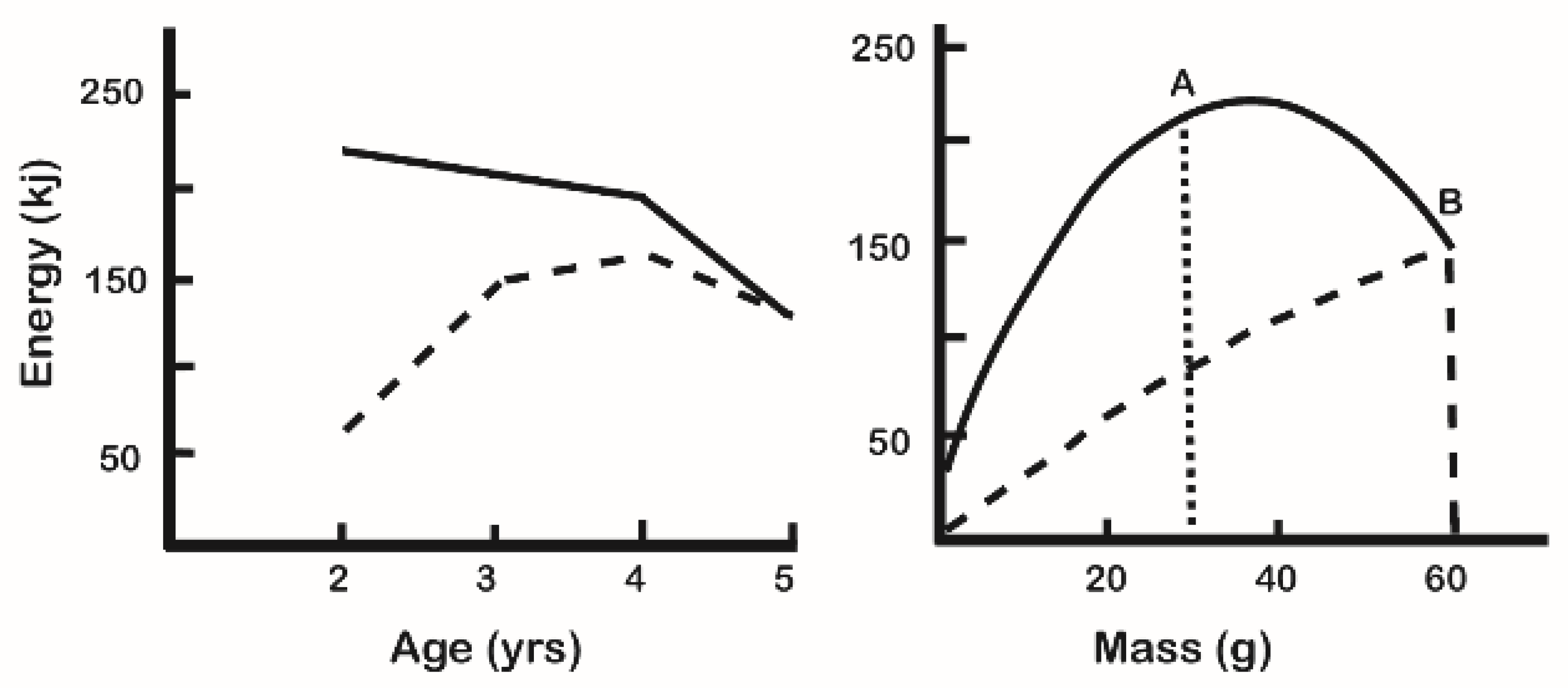
Disclaimer/Publisher’s Note: The statements, opinions and data contained in all publications are solely those of the individual author(s) and contributor(s) and not of MDPI and/or the editor(s). MDPI and/or the editor(s) disclaim responsibility for any injury to people or property resulting from any ideas, methods, instructions or products referred to in the content. |
© 2025 by the authors. Licensee MDPI, Basel, Switzerland. This article is an open access article distributed under the terms and conditions of the Creative Commons Attribution (CC BY) license (http://creativecommons.org/licenses/by/4.0/).
Copyright: This open access article is published under a Creative Commons CC BY 4.0 license, which permit the free download, distribution, and reuse, provided that the author and preprint are cited in any reuse.


