

Submitted:
20 June 2025
Posted:
24 June 2025
You are already at the latest version
Abstract
Despite the continued growth of the gluten free food market, there is a dearth of sensory and consumer knowledge on commercial products. The existing research is mostly limited to hedonic measurements and ingredient effects instead of analytical methods for a better understanding of product characteristics. In this work, a semi-trained consumer panel used projective mapping to choose objectively different plain/original crackers from a pool of sixteen commercial gluten free cracker varieties. The cracker samples represented a widespread sensory space originating from different key ingredients such as brown rice, white rice, flaxseed, cassava flour, nut flour blend, millet blend, and tapioca/potato starch blend. Based on projective mapping results, the crackers that mostly represented the sensory space were selected for characterization by a modified flash profiling method. The consumer panel developed 74 descriptors including 30 aromas, 28 flavors, 15 texture terms, and a mouthfeel attribute. The samples were monadically rated for intensity on a 4-point scale (0 = none, 1 = low, 2 = medium, and 3 = high). Rice, toasted, salt, grain, burnt, flaxseed, bitter, earthy, nutty, seeds, and grass were the prevalent aroma and flavors. Others were specific to cracker type. A couple of these attributes can be traced back to the ingredients list. Results suggest, ingredients used in small portions are defining the flavor properties over the major grains/flour blends. All samples had some degree of crunchiness, crispness, and pasty mouthfeel; rice crackers were particularly firm, hard, and chewy; brown rice crackers were gritty; crackers with tuber starches/flours were more airy, soft, smooth, and flaky. Overall, the samples shared more aroma and flavor notes than texture attributes. In comparison to trained panel results, consumers generated a greater number of terms, were successful in finding subtle differences primarily on texture, but had many overlapped flavors. The developed consumer terminology will facilitate the gluten free industry to tailor communication that better resonates with consumer experiences, needs and product values.
Keywords:
consumer
; lexicon
; gluten free crackers
; sensory
; rapid methods
1. Introduction
The global food market is witnessing a substantial paradigm shift towards specialized dietary options, predominantly propelled by escalating consumer awareness regarding food sensitivities and health-oriented lifestyles. Consumers are seeking gluten-free (GF) food products due to increasing prevalence of celiac disease, non-celiac gluten sensitivity, health trends, convenience, accessibility, shift toward plant-based and clean-label diets [1,2,3]. The GF food market has expanded significantly over the past two decades, mostly in baked products including bread, cookies, biscuits, crackers, etc. The market expansion has generated a large amount of research and published works in recent years, mainly focused on improving nutritional value [4,5,6,7], chemical composition [8], technology [9,10,11], quality [12], shelf life [13], and hedonics [14,15]. Though, very limited work has been dedicated to understanding consumer terminologies used in describing the perception of sensory characteristics of GF products. As the demand for GF products rises, so does the need for standardized language which can be used to define, evaluate, and market these products.
Recent reviews by Kneževic et al. [12] and Hassan et al. [1] concluded that consumers express a desire for new flavors, textures, and overall improved quality in GF products, indicating a market opportunity for manufacturers to innovate. Similar conclusions were made by de Kock [16], and Alencar [2]. The existing GF products, that are characterized by diverse ingredients, varying nutritional quality, and sensory traits; could be considered as a new category of foods. Commercially available GF products typically utilize a wide range of ingredients (rice, corn, cassava, potato, nuts, etc.), leading to a variety in nutrition, texture and flavor [17]. Some examples are bread varieties [18,19,20], lentil enriched crackers [21], biscuits formulated with buckwheat sorghum lentils [15,22], rice and potato flour biscuits [23], sorghum-based cakes [14], spaghetti [24], muffins [25], and pasta [26]. Moreover, the inclusion of texture binders (hydrocolloids), flavor enhancers, and other functional ingredients could generate a widespread sensory experience [3,17]. Despite the availability of many GF options, the majority of consumers remain dissatisfied with the price, accessibility, and taste of these products. Recent studies highlighted the challenges faced by consumers of GF products. Primary areas of concern were taste, texture, aroma and overall sensory quality [1]; unacceptable aroma and texture [27]; poor texture, aroma, and taste of GF bread [2]; less tasty GF bread in South American millennials [28]; purchase decision was mainly influenced by sensory characteristics [29]; dissatisfaction with sensory experience of bread, pasta, and crackers in the UK market [30]; lower sensory preference of GF bread, pasta, crackers, flour, and breakfast cereals among Australia and New Zealand population [31]; and low sensorial performance of pasta with Italian consumers [32,33].
In addition, limited knowledge about GF products including taste features, quality, and benefits, greatly affected consumer’s perception [28]. Several studies have pointed out that knowledge gaps and inadequate education about GF products among consumers played a vital role in product consumption. For example, unawareness about nutritional value [34,35]; restricted knowledge of GF products and their labels affected purchase decisions in some cases [36,37,38,39]. Clearly, GF products are failing to delight consumers due to the lack of a desired sensory profile, and also the lack of awareness among consumers, which have restricted their success in the market [1,3,12,40]. Given these findings, it is essential to not only improve the sensory appeal of GF products but to also educate consumers on products and benefits through targeted awareness campaigns using consumer language. This study has aimed to develop a consumer lexicon as well as drawing a comparison to trained descriptive panel terms.
Among all GF products, gluten free crackers (GFC) have emerged as a popular snack, appreciated not only by individuals with dietary restrictions but also by health-conscious consumers. At present, these products are marketed and described by various terms on packaging, in advertising, and online consumer reviews. The existing comprised lexicon surrounding the current range of products is heavily influenced by marketing, but completely devoid of product specific sensory attributes. There remains a gap in comprehending the sensory features and range of commercially available market products [3]. The existing research studies on sensory characteristics of GF foods are constrained to lab developed prototypes, while only a few have attempted to examine market GF breads [2,17,18,41]. Therefore, this works is the first of its kind that attempts to generate consumer driven intrinsic characteristics of GF crackers. The product selection was restricted to GF crackers that are marketed as plain/original with no added flavors other than salt.
The significance of consumer-based sensory characterization has largely increased in the last decade, partially motivated by the early inclusion of consumer input in the new product development process [42,43]. The relevance of sensory terminology does become extremely valuable when gluten free products are perceived as inferior in nutrition, quality, and hedonics [1,3,12]. From conventional to novel profiling techniques, several methodologies are available for gathering information about sensory characteristics of products. Consumer-oriented techniques such as projective mapping (PM) and flash profiling (FP) are based on the evaluation of global similarities and difference among samples [44]. These techniques are less time consuming, cost effective, and have been used on various food products to understand consumer perception and description of sensory attributes. In PM, participants focus on relative differences between products by forming an overall opinion on holistic similarities and differences. Participants are instructed to place similar products close to each other while different products should be located further apart. In this study, PM is used as a tool for preliminary scanning to remove GF crackers that had very similar sensory properties.
The modified flash profiling (MFP) allows consumers to generate sensory attributes in their own words and then rank products for intensities. It also requires less training, and is found to be very effective when used with naïve consumers. Several studies were conducted using FP as a standalone method as well as in combination with traditional descriptive analysis (DA) [45,46]. However, results produced by rapid methods using consumers are difficult to reproduce, less repeatable, and fail to capture fine differences. The DA using trained panelists is also widely used to obtain subtle differences between products. DA provides detailed sensory profiles, and is considered superior due to highly reproducibility and repeatability of results [47,48,49]. The use of a specific method or more than one method is strictly subjective to research objectives, and level of risk tolerance in results.
Henceforth, to make GF products more acceptable among users and successful in market, it is paramount to not only understand consumer liking but also their perception and description of characteristics. The research approach adopted in this work is pivotal in assessing nuanced and sophisticated language that consumers use to describe, evaluate, and select gluten free crackers (GFC). This study aimed to 1) investigate characteristics of commercially available plain GFC using rapid methods with consumers, and to b) compare consumer terminology with descriptive lexicon generated by a trained panel.
2. Materials and Methods
2.1. Participants
Eighteen consumers were recruited from the Kansas City suburban area to participate in the study. All selected participants met predefined requirements of study eligibility through an online screener. Participant ages were between 18 and 65 years old, current consumers of GFC, purchased and consumed GFC at least once every 3 months, and were from different income backgrounds. They were also asked about the reasons for consuming GFC. Consumers with gluten sensitivity or who live with someone who has gluten sensitivity, purchase and consume GFC, and do not like eating products with gluten were selected. Those who have participated in any consumer research in the last 3 months, and/or working in a food company or media/consumer research were excluded. The study was conducted at the Sensory and Consumer Research Center at Kansas State University, Olathe, Kansas, USA. Compusense (Compusense, Inc., Guelph, ON, Canada) was used for screening, recruitment, execution, and data collection. Participants signed an electronic informed consent and were compensated for their time. The study was managed under the existing Institutional Review Board (IRB) approval (05930) using approved protocols.
2.2. Gluten Free Crackers
Sixteen commercial plain/original flavor GFC were purchased online from Amazon, Walmart, Whole Foods, and Sprouts (Table 1). All cracker samples were inspected for integrity (whole crackers) and were stored in airtight food grade 2.8L containers (Chef’s Path) at ambient conditions until the time for the study. The crackers were from various brands and were made with different grain sources. Crackers with main ingredients such as brown rice, white rice, flaxseed flour, cassava flour blend, nut flour blend, millet blend, and tapioca/potato starch blend were included to ensure variety of flavor and texture.
2.3. Projective Mapping
The aim of PM was to only retain samples that maximize differentiation in the sensory space. The PM was performed in two sessions. In the first session, the method was explained to participants, followed by a training session on the selected samples. The assessors were instructed to place the samples on a two-dimensional rectangular sheet based on perceived similarities (similar samples closer and different samples far away from each other). Consumer were explained to use his/her own criteria that is holistic (appearance, flavor, texture) differences and similarities. Samples were presented simultaneously; consumers were free to taste the samples in any order and to try them as many times as they wanted. The samples were served at room temperature in 4 oz cups with clear lids (Dart, Mason, Michigan, USA), the crackers were placed in cups right before the evaluation sessions to minimize texture changes. Sample cups were labelled with three-digit random codes. Purified bottled water (Niagara) was provided for palate cleansing between samples. After placing the samples, assessors were asked to write down a minimum of three terms that described each sample. Using PM results, five samples that either did not fit the study scope or had sensory profiles similar to an existing sample in the study were removed. The final list of ten samples selected for further profiling are highlighted with an asterisk (*) symbol in Table 1.
2.4. Modified Flash Profiling
All consumers participated in the MFP task, held in two 90 minutes sessions over two consecutive days. On day 1, assessors were exposed to the method, and products. They were tasked to generously generate descriptive terms for the products being evaluated and were asked to avoid hedonic terms such as good, bad, and fair. The samples were served one by one in a monadic order. The evaluation was focused on only 3 modalities in a fixed order: aroma, flavor, and texture. Consumers were instructed to produce descriptive terms and limit the number of terms to 4 for aroma, 4 terms for flavor, and 3 terms for texture through individual evaluations. It was emphasized that consumers focus on the differences they perceive and record attributes following the sequence of perception. The data was collected manually. At the end of day 1, a detailed list of attributes was compiled through a consensus discussion, after removing a few terms which made little sense to the study objectives. For example, bland, no significant taste/ aroma. The term fiber was closely related to consumer understanding of grain/seeds, and because those attributes were already present, fiber was eliminated from the final list. Attribute pasty was moved from texture to mouthfeel as consumers described it as “product dissolving in their mouth”. On day 2, participants were presented with a compiled ballot of 74 attributes collected from day 1 work. All samples were presented simultaneously for attribute intensity rating on a 4-point scale, with 0 = none, 1 = low, 2 = medium, and 3 = high. The cracker samples were presented in 4 oz cups with clear lids (Dart, Mason, Michigan, USA) labelled with three-digit random codes, and purified bottled water (Niagara) was provided for palate cleansing. Several studies have applied flash profiling to characterize various food products, such as wine [50], fermented soybean curd [51], milk and yogurt products [52], and cheese [53].
2.5. Descriptive Analysis
Five highly trained panelists from Sensation Research, Mason, Ohio evaluated the products using a consensus spectrum method [54]. The panelists had descriptive sensory experience of 7-12 years on various food and beverage product categories including crackers, snacks, meat, beverages, vegetables, meals, etc. Each panelist conducted more than 1000 hours of sensory evaluation on various product categories. The study followed Society of Sensory Professionals (SSP) recommendations for the number of panelists. Past studies have reported 4-18 panelists, but the appropriate number of panelists can vary depending on study type, level of panelist training, previous experience, and product complexity [55,56,57]. The samples were served at room temperature on 4-inch white plates, crackers were taken out from package just 5 mins before the panel session. A 150-point scale with 1.0 increments was used for intensity quantification of attributes. The panel evaluated all the samples over three 90-minute evaluation sessions, evaluating 4 samples on day 1 and day 2, and the rest 2 samples on day 3. Water is used as the only palate cleanser.
2.6. Data Analysis
XLSTAT software (Lumivero, Denver, CO, USA) was used to perform data analysis. Multiple Factor Analysis (MFA) was used for examining PM data. The coordinates of each sample were measured in inches using a ruler and distance from the X and Y axis. The MFA analysis generated a plot to determine the relationship between samples. Generalized Procrustes Analysis (GPA) was applied to data collected by flash profiling method [49,50]. All attributes’ data were run together for deeper understanding through GPA analysis. Attributes that were not elicited or related to the samples were marked as zero for analysis purposes. Principal Component Analysis (PCA) was applied to the consensus scores of the 44 descriptive attributes produced in DA.
3. Results
3.1. Projective Mapping
The PM technique was applied to the selected crackers using a consumer panel. The data obtained in PM is plotted using MFA (Figure 1). Both dimensions (Dim) explained 61.36% variability. Flaxseed crackers (DRGF and FAGF) contributed most to both Dim’s, demonstrating noticeable large sensory differences from the rest of the cracker samples. Crackers with nut blend base flour (HUGF and SIMIGF), and brown rice crackers (MAGOGF and MASSGF) influenced x-axis (Dim 1) to a greater extent, implying that consumer perceived them very differently. For Dim 2, the main contributors were brown rice crackers (SESGF and CRMSFG) and white rice crackers (TJGF and BLDIGF). The distinct text colors of product names represent different grain sources; orange for brown rice, black for white rice, blue for flaxseed, green for cassava flour, yellow for nut flour blend, red for millet blend, and purple for tapioca/potato starch blend. The spatial placement of crackers on MFA plot suggests four different product groups. The largest group had eight crackers placed together, such as GLUTGF, LANCGF, CRUNGF, ABOSGF, SIMIGF, KAMGF, SCHAGF, and HUGF. The crackers in this group had white rice, cassava flour, tapioca/potato starch blend, millet blend, and nut blend as major ingredient in the formulations, respectively. The second largest group had four products; brown rice crackers (SESGF and CRMSGF), and white rice crackers (TJGF and BLDIGF). Additionally, two brown rice crackers (MAGOGF and MASSGF) seem to have very similar sensory characteristics between them, but different enough to the other brown rice crackers (SESGF and CRMSFG) that remained more distant. The flaxseed crackers (DRGF and FAGF) were close to each other due to their distinct strong aroma and flavor of flaxseeds. PM technique was effective, consumers were able to segregate samples based on sensory differences mostly between crackers made with different base flour types. Finally, based on PM results, only 10 GFC samples (with asterisk (*) symbol in Table 1) were selected for advance investigation using MFP, and DA.
3.2. Modified Flash Profiling
A total of 74 descriptors were generated by consumers after evaluating 10 different plain GFC. The terms were categorized in 30 aromas, 28 flavors, 15 textures, and one mouthfeel attribute (Table 2). A GPA chart of the MFP is shown in Figure 2. Overall, 41.62% of the variability was explained by the first two Dim’s. The brown rice samples (MAGOGF and SESGF) are positioned on the positive axis of Dim 1. The main aroma and flavors associated were peanut, flaxseed, nutty, sesame, green, earthy, rice, grain, and seeds. The terms flaxseed and sesame seeds can be associated with ingredients mentioned on product package. Consumers described brown rice crackers as crunchy, crispy, hard, gritty, and with subdued levels of moisture. The white rice cracker (BLDIGF) had sensory features similar to brown rice crackers with main characteristics of corn, rice, grain, and bitter. The other white rice samples (GLUTGF, LANCGF), cassava flour (CRUNGF), and tapioca/ potato starch (ABSOGF) were positioned on the negative axis of Dim 1. These were mainly characterized by toasted, flour, salt, smoothness, and puffiness. The tuber flour and starch formulated crackers were particularly associated with uncooked flour, burnt, earthy, airy, and firmness. Consumers identified specific flavors such as butter, chemical, oil, thickness and puffiness in one white rice sample (LANCF). This sample was also noted for oxidized oil probably originating from palm oil being the leading ingredients in the list.
The second dimension explained 14.64% of data; nut blend cracker (SIMIGF), and white rice (KAMGF) are positioned closer to each other. SIMIGF sample was distinct for herbs, chicken, savory, cheesy, onion, and butter flavor. The millet blend sample SCHAGF stretched the plot for its distinct sensory properties. It was related with toasted, cardboard, pepper, wheat, sweet, oats, flakiness, roughness, and pasty mouthfeel. Brown rice crackers (SESGF, MAGOGF) were noticeably different for texture features mainly crispiness, grittiness, hardness and crunchiness. Consumers associated rice crackers with highest hardness and crispiness [58]. White rice crackers (LANCGF, BLDIGF) were characterized by thickness and puffiness, GLUTGF was gummy and chewy, and cassava flour (CRUNGF) crackers were distinct for firmness, and airy texture. Giuberti et al. [59] also reported increase in hardness with high levels of rice flour formulated GF cookies. The blend (ABSOGF) crackers were explained as more soft, smooth, and airy. Both millet blend (SCHAGF) and nut blend (SIMIGF) crackers were characterized by flakiness, and pasty mouthfeel . The results suggest that there is no clear relationship between texture attributes and crackers formulated with specific grain types, except for brown rice crackers which were positions together in MFA (Figure 2). Overall, consumers were able to perform MFP task, no problems were reported during the study. Consumers narrated the perceived characteristics using their own language, and the words provided to describe stimulis were specific to the modality. It is worth noting that consumer described aroma (sniffed through nostrils) first, and flavor duing mastication. There are a couple of attributes perceived both in aroma and flavor evaluation. The results suggest that consumers stayed focused on the task as well as on the specific modality of interest. The cracker samples were well differentiated for texture, but less on flavor and aroma.
3.3. Descriptive Analysis
Trained panelist for the DA generated 44 terms which were classified into 7 appearance, 30 flavors, and 7 texture attributes (Table 2). PC1 (30.71%) and PC2 (21.93%) explained 52.64% of the variance in the DA data (Figure 3). The positive axis of PC1 was characterized by brown rice (MAGOGF and SESGF), white rice (BLDIGF), and nut blend (SIMIGF) cracker, whereas samples millet blend (SCHAGF), tuber flour (ABSOGF, CRUNGF), and white rice (GLUTGF, LANCGF, KAMGF) were on the negative axis of PC1.
The brown rice crackers (MAGOGF and SESGF) were clearly different from the other samples regarding amount and size of seeds, roughness emerging from seeds, earthy, burnt, and cardboard. Nevertheless, nut blend (SIMIGF) and white rice (BLDIGF) had different grain types but were positioned similarly. They were characterized by brittle texture (fracturability), nutty, and oily flavor. The samples SCHAGF, ABSOGF, GLUTGF, and LANCGF were located on the positive axes of PC1 and PC2, mainly described as thick, bitter, baking soda, toasted, and uneven browning. The Millet blend sample was associated with unique characteristics of wheat, sesame/flax seeds, and toasted; tapioca flour cracker (ABSOGF) was described as dry, potato, and burnt; and white rice crackers (GLUTGF, and LANCGF) has starch complex and rice notes. The cassava flour (CRUNGF) and white rice (KAMGF) crackers were distinct for shiny appearance but shared many sensory properties similar to white rice crackers (GLUTGF, and LANCGF). DA results indicated that GFC samples were relatively well differented for appearance, texture, and flavor. Also, the samples could be largely grouped for similarties, such as white rice crackers (GLUTGF, and LANCGF) and brown rice crackers (MAGOGF and SESGF). However, the spectrum of differences is less varied and diverse, probably due to the limited range of GF crackers available in the market [12].
4. Discussion
4.1. Projective Mapping
At large, the PM results indicate that crackers with the same flour type are not necessarily placed together, and there are certainly common sensory properties dispersed within and between groups. Particularly, consumer did not see bigger differences between brown rice crackers (SESGF and CRMSFG) and (MAGOGF and MASSGF). At this stage, cracker CRMSGF (brown rice) was eliminated because a similar profile brown rice cracker SESGF was retained. Following the same strategy MAGOGF was selected to move forward over MASSGF. Similarly, white rice cracker TJGF was removed as it seems to have a similar profile of BLDIGF. Using PM results, both flaxseed crackers FAGF and DRGF were not taken forward because of strong flavor originating from flaxseed which was beyond the scope of this study. The differences were so remarkable that the researchers believed that these products belonged to a different category. Correspondingly, HUGF was eliminated because of strong onion and garlic notes which deviated from the study objective of including plain/original crackers so that the effect of different flour blends could be observed on the different sensory attributes. The 10 samples selected to move forward for MFP are highlighted with an asterisk (*) symbol in Table 1. Overall, the PM technique was valuable to narrow down a large number of samples for further evaluation. Likewise, other studies have also used PM for preliminary examination of snack foods [46] , dairy products [60] and other products [61].
4.2. Modified Flash Profiling
The results of MFP demonstrated that GFC samples were primarily classified by their aroma and flavor notes of seeds, flour, rice, toasted, salt, grain, earthy etc. A few unique aromas and flavors were specific to cracker types such as onion and cheese (SIMIGF), rosemary (CRUNGF), flaxseed (MAGOGF), and Oats (SCHAF). These samples had detectable flavors which could be related to one of the ingredients listed on the package, but they were still marketed as “plain” crackers. Brown rice (MAGOGF and SESGF), millet blend (SCHAG), and nut blend (SIMIGF) were well differentiated from other samples. However, in case of white rice (KAMGF GLUTGF, LANCGF), cassava flour (CRUNGF), and tapioca/potato starch (ABSOGF), crackers were not as clearly distinguished because of their overlapping flavors (rice, toasted, flour) and texture characteristics (crunchy, crispy, hardness, and grittiness). The substantial overlap of flavor and aroma terms between samples suggests that consumers have not been able to clearly differentiate aroma and flavor resulting in some redundancy (Table 2). It is evident, however, that the MFP methodology is a good fit in a scenario where broader characterization is needed instead of detecting subtle differences for specific attributes.
4.3. Descriptive Analysis
In general, all samples had some degree of shine, thickness, and rough surface mainly from inclusions such as flaxseeds. The prevalent flavor attributes across samples were salt, sweet, astringent, rice, starch complex, toasted, baking soda, bitter, sour, oily, cardboard, and strong lingering aftertaste. The common flavor attributes can be linked to base ingredients such as white rice, brown rice, millets blend, and tapioca starch. Some flavor terms such as coconut, seedy, wheat like, peppery heat, earthy, black pepper, oil, herbs, soy sauce, garlic, seaweed, dairy, and nutty were specific to certain cracker types. For example, coconut flavor of cassava flour (CRUNGF); wheat-like flavor in millet blend (SCHAGF); dairy in white rice (LANCGF); seaweed, soy sauce, and burnt in brown rice (MAGOGF); and peppery heat in brown rice cracker (SESGF). It appears that ingredients such as almonds, non-fat dairy milk, flax seeds, sesame seeds, and coconut flour influenced the differences through rare flavors. Similarly, texture attributes such as thickness, hardness, fracturability, grit, dryness, and tooth packing were present across cracker samples used in this study. The panel also identified subtle texture differences for roughness from seeds/particulates occurred only for a few samples. Overall, the trained panel was able to differentiative GFC samples for shared sensory characteristics as well as for specific attributes.
4.4. Comparison Between Modified Flash Profiling and Descriptive Analysis
As expected, the MFP results from the consumer panel produced a greater number of attributes in comparison to the trained panel [52]. The consumer panel produced 74 descriptors (30 aromas, 28 flavors, 15 textures, and one mouthfeel attribute), whereas the DA panel generated 44 terms (7 appearance, 30 flavors, and 7 texture) to characterize GFC. The consumer panel was instructed not to use appearance for profiling. The trained panel generated 30 terms for aroma/flavor combined, and consumer panel generated 58 aroma and flavor terms. Table 3 highlights the summary of various indices between DA and MFP method. A comparison of aroma and flavor attributes from both panels reveals 15 common terms (Table 2). The terms are bitter, burnt, pepper/back pepper, cardboard, dairy/buttery, garlic, herbs, oily, salty, sweet, toasted, wheat-like/wheat, sesame, seed, flax, and earthy. The DA panel combined terms sesame, seedy, and flax into a single descriptor whereas consumer saw them as 3 different attributes. The terms that were only provided by the DA panel for describing aroma and flavor of GFC are baking soda, dairy/nut milk (which was described as cheesy/buttery by consumers), soy sauce, seaweed, irritating (which might be ascribed to chemical by consumers), burning heat from pepper, true to gluten, sour, potato (flour/starch), starch complex, coconut/coconut flour, astringent, overall aroma intensity, overall flavor intensity, and aftertaste. Whereas, consumers produced unique flavors such as rosemary, sunflower seed, woody, uncooked flour, green, grassy, oxidized/rancid oil, etc., demonstrating the effectiveness of using category users as panelists.
A comparison between the biplots generated by MFP and DA shows that several GFC samples are positioned very similar. Brown rice crackers (MAGOGF and SESGF) are position in the same sensory space along with one of the white rice cracker samples (BLDIGF). The terms used to describe brown rice crackers such as earthy, flaxseed, and cardboard were common. Likewise, crackers samples ABSOGF, GLUTGF, and LANCGF are also positioned together. Both panels described SCHAGF and CRUNGF as sweet, LANGF as strong dairy (butter), SIMIGF as onion, CRUNGF as garlic, and SCHAGF and SIMIGF as having herbs and pepper flavor. Consumers associated corn flavor with BLDIGF and SESGF cracker samples, but not the trained panel. Interestingly, corn was present in 3 out of 10 formulations. Another term coconut for aroma/flavor was generated by the DA panel, reported in two formulations, however, this term was not identified by the consumer panel. Additionally, attribute sunflower seed was used by the consumer panel, which was on the ingredient list for MAGOGF, but it was not part of attributes generated by the DA panel. It can be said that the rapid methods can be used as an initial technique to identify key sensory descriptors of products using consumers, mainly for developing marketing and consumer friendly language. To obtain a sensory data which is reproducible, accurate, more sensitive to small differences, and has standardized terms that are clearly defined, results from a descriptive panel will be more appropriate.
5. Conclusions
This study helps increase the knowledge about the characteristics of commercially available GFC. Overall, it can be concluded that GFC market products lack sensory variety and complexity. This study suggests that a different base flour does not necessary produce a diverse sensory experience. However, this hypothesis needs to be further evaluated in a more controlled setting, ideally using a design of experiments (DOE) approach. Also, minor ingredients such as flaxseed or onions might dominate flavor profiles and also create noticeable and unique flavors across samples, even though they are still marketed or labelled as “plain” crackers. MFP evaluations by a consumer panel used 74 attributes, and the descriptive panel used 44 terms to explain sensory features of GFC. Among both panels, flavor attributes were more common than texture, and the sample grouping and positioning were somewhat identical. While the descriptive panel captured subtle differences between samples, the consumer panel identified unique flavor notes at lower intensities. Findings of this work can serve as a guide for product improvement, product development, quality control, examining the effects of ingredients on product properties, designing marketing campaigns, and understanding consumer experience.
The findings demonstrate that rapid methods can be viable and produce actionable results when compared to traditional descriptive methods. This study was performed at a central location under controlled settings; future studies can explore consumer perception in more dynamic and situational conditions. Additionally, forthcoming research could focus on evaluating sensor properties of GFC eaten in combination with dipping, spreads, toppings, etc.
Author Contributions
Conceptualization, J.B., M.J.T.; methodology, J.B., M.J.T.; software, J.B., R.K., M.J.T.; validation, J.B., M.J.T.; formal analysis, J.B., R.K., M.J.T.; investigation, J.B., M.J.T., R.K.; resources, M.J.T.; data curation, J.B., M.J.T., R.K.; writing—original draft preparation, J.B.; writing—review and editing, R.K., M.J.T.; visualization, J.B., R.K., M.J.T.; supervision, M.J.T; project administration, M.J.T.; funding acquisition, M.J.T. All authors have read and agreed to the published version of the manuscript.
Funding
This research received no external funding.
Institutional Review Board Statement
The study was conducted under protocol #05930 approved by the Committee on Research with Human Subjects at Kansas State University.
Informed Consent Statement
Informed consent was obtained from all participants who were anonymous to the researchers.
Data Availability Statement
The raw data supporting the conclusions of this article will be made available by the authors on request.
Acknowledgments
We are thankful to the researchers and staff at Sensory and Consumer Research Center, Kansas State University Olathe who helped with this project.
Conflicts of Interest
The authors declare no conflicts of interest.
Abbreviations
The following abbreviations are used in this manuscript:
| GF | Gluten free |
| GFC | Gluten free crackers |
| PM | Projective mapping |
| FP | Flash profiling |
| MFP | Modified flash profiling |
| DA | Descriptive analysis |
| MFA | Multiple factor analysis |
| GPA | Generalized procrustes analysis |
| PCA | Principle component analysis |
References
- H. F. Hassan et al., “Perceptions towards gluten free products among consumers: A narrative review,” Applied Food Research, vol. 4, no. 2, p. 100441, Dec. 2024. [CrossRef]
- N. M. M. Alencar, V. A. de Araújo, L. Faggian, M. B. da Silveira Araújo, and V. D. Capriles, “What about gluten-free products? An insight on celiac consumers’ opinions and expectations,” J Sens Stud, vol. 36, no. 4, Aug. 2021. [CrossRef]
- V. D. Capriles et al., “Current status and future prospects of sensory and consumer research approaches to gluten-free bakery and pasta products,” Food Research International, vol. 173, p. 113389, Nov. 2023. [CrossRef]
- S. E. Stantiall and L. Serventi, “Nutritional and sensory challenges of gluten-free bakery products: a review,” Int J Food Sci Nutr, vol. 69, no. 4, pp. 427–436, May 2018. [CrossRef]
- C. Mármol-Soler et al., “Gluten-Free Products: Do We Need to Update Our Knowledge?,” Foods, vol. 11, no. 23, p. 3839, Nov. 2022. [CrossRef]
- I. Demirkesen and B. Ozkaya, “Recent strategies for tackling the problems in gluten-free diet and products,” Crit Rev Food Sci Nutr, vol. 62, no. 3, pp. 571–597, Jan. 2022. [CrossRef]
- M. A. N. Khairuddin and O. Lasekan, “Gluten-Free Cereal Products and Beverages: A Review of Their Health Benefits in the Last Five Years,” Foods, vol. 10, no. 11, p. 2523, Oct. 2021. [CrossRef]
- J. Xu, Y. Zhang, W. Wang, and Y. Li, “Advanced properties of gluten-free cookies, cakes, and crackers: A review,” Trends Food Sci Technol, vol. 103, pp. 200–213, Sep. 2020. [CrossRef]
- D. Bender and R. Schönlechner, “Innovative approaches towards improved gluten-free bread properties,” J Cereal Sci, vol. 91, p. 102904, Jan. 2020. [CrossRef]
- D. El Khoury, S. Balfour-Ducharme, and I. J. Joye, “A Review on the Gluten-Free Diet: Technological and Nutritional Challenges,” Nutrients, vol. 10, no. 10, p. 1410, Oct. 2018. [CrossRef]
- O. Gorach, D. Oksana, and N. Rezvykh, “Innovative Technology for the Production of Gluten-free Food Products of a New Generation,” Curr Nutr Food Sci, vol. 20, no. 6, pp. 734–744, Jul. 2024. [CrossRef]
- N. Knežević et al., “Consumer Satisfaction with the Quality and Availability of Gluten-Free Products,” Sustainability, vol. 16, no. 18, p. 8215, Sep. 2024. [CrossRef]
- C. Fratelli, F. G. Santos, D. G. Muniz, S. Habu, A. R. C. Braga, and V. D. Capriles, “Psyllium Improves the Quality and Shelf Life of Gluten-Free Bread,” Foods, vol. 10, no. 5, p. 954, Apr. 2021. [CrossRef]
- C. A. Cayres, J. L. Ramírez Ascheri, M. A. Peixoto Gimenes Couto, E. L. Almeida, and L. Melo, “Consumers’ acceptance of optimized gluten-free sorghum-based cakes and their drivers of liking and disliking,” J Cereal Sci, vol. 93, p. 102938, May 2020. [CrossRef]
- M. Di Cairano, N. Condelli, F. Galgano, and M. C. Caruso, “Experimental gluten-free biscuits with underexploited flours versus commercial products: Preference pattern and sensory characterisation by Check All That Apply Questionnaire,” Int J Food Sci Technol, vol. 57, no. 4, pp. 1936–1944, Apr. 2022. [CrossRef]
- H. L. de Kock and N. N. Magano, “Sensory tools for the development of gluten-free bakery foods,” J Cereal Sci, vol. 94, p. 102990, Jul. 2020. [CrossRef]
- L. Roman, M. Belorio, and M. Gomez, “Gluten-Free Breads: The Gap Between Research and Commercial Reality,” Compr Rev Food Sci Food Saf, vol. 18, no. 3, pp. 690–702, May 2019. [CrossRef]
- M. Tóth, T. Kaszab, and A. Meretei, “Texture profile analysis and sensory evaluation of commercially available gluten-free bread samples,” European Food Research and Technology, vol. 248, no. 6, pp. 1447–1455, Jun. 2022. [CrossRef]
- T. Heberle, B. P. Ávila, L. Á. do Nascimento, and M. A. Gularte, “Consumer perception of breads made with germinated rice flour and its nutritional and technological properties,” Applied Food Research, vol. 2, no. 2, p. 100142, Dec. 2022. [CrossRef]
- F. Laignier et al., “Amorphophallus konjac: Sensory Profile of This Novel Alternative Flour on Gluten-Free Bread,” Foods, vol. 11, no. 10, p. 1379, May 2022. [CrossRef]
- S. Li, “The instrumental texture, descriptive sensory profile, and overall consumer acceptance of lentil-enriched crackers,” Montana State University, Bozeman, Montana , 2020. Accessed: Aug. 30, 2024. [Online]. Available: https://scholarworks.montana.edu/handle/1/15891.
- M. Di Cairano, N. Condelli, N. Cela, L. Sportiello, M. C. Caruso, and F. Galgano, “Formulation of gluten-free biscuits with reduced glycaemic index: Focus on in vitro glucose release, physical and sensory properties,” LWT, vol. 154, p. 112654, Jan. 2022. [CrossRef]
- R. Jiamjariyatam, S. Krajangsang, and W. Lorliam, “Effects of Jasmine Rice Flour, Glutinous Rice Flour, and Potato Flour on Gluten-Free Coffee Biscuit Quality,” Journal of Culinary Science & Technology, vol. 22, no. 4, pp. 648–666, Jul. 2024. [CrossRef]
- M. A. Giménez et al., “Sensory evaluation and acceptability of gluten-free Andean corn spaghetti,” J Sci Food Agric, vol. 95, no. 1, pp. 186–192, Jan. 2015. [CrossRef]
- S. Hosseininejad, V. Larrea, G. Moraga, and I. Hernando, “Evaluation of the Bioactive Compounds, and Physicochemical and Sensory Properties of Gluten-Free Muffins Enriched with Persimmon ‘Rojo Brillante’ Flour,” Foods, vol. 11, no. 21, p. 3357, Oct. 2022. [CrossRef]
- L. de L. de Oliveira et al., “Gluten-Free Sorghum Pasta: Composition and Sensory Evaluation with Different Sorghum Hybrids,” Foods, vol. 11, no. 19, p. 3124, Oct. 2022. [CrossRef]
- L. Esposito et al., “Sensory Evaluation and Consumers’ Acceptance of a Low Glycemic and Gluten-Free Carob-Based Bakery Product,” Foods, vol. 13, no. 17, p. 2815, Sep. 2024. [CrossRef]
- N. Magano, G. du Rand, and H. de Kock, “Perception of Gluten-Free Bread as Influenced by Information and Health and Taste Attitudes of Millennials,” Foods, vol. 11, no. 4, p. 491, Feb. 2022. [CrossRef]
- C. Ike, “Physicochemical Properties and Rheological Behavior of Gluten-Free Flour Blends for Bakery Products,” Journal of Food Sciences, vol. 5, no. 1, pp. 43–55, Apr. 2024. [CrossRef]
- F. Vriesekoop, E. Wright, S. Swinyard, and W. de Koning, “Gluten-free Products in the UK Retail Environment. Availability, Pricing, Consumer Opinions in a Longitudinal Study,” Internatioal Journal of Celiac Disease, vol. 8, no. 3, pp. 95–103, 2020.
- W. de Koning et al., “Price, quality, and availability of gluten-free products in Australia and New Zealand – a cross-sectional study,” J R Soc N Z, pp. 1–17, Aug. 2024. [CrossRef]
- V. Xhakollari and M. Canavari, “Celiac and non-celiac consumers’ experiences when purchasing gluten-free products in Italy,” ECONOMIA AGRO-ALIMENTARE, no. 1, pp. 29–48, May 2019. [CrossRef]
- V. Xhakollari, M. Canavari, and M. Osman, “Factors affecting consumers’ adherence to gluten-free diet, a systematic review,” Trends Food Sci Technol, vol. 85, pp. 23–33, Mar. 2019. [CrossRef]
- K. Arslain, C. R. Gustafson, P. Baishya, and D. J. Rose, “Determinants of gluten-free diet adoption among individuals without celiac disease or non-celiac gluten sensitivity,” Appetite, vol. 156, p. 104958, Jan. 2021. [CrossRef]
- M. Prada, C. Godinho, D. L. Rodrigues, C. Lopes, and M. V. Garrido, “The impact of a gluten-free claim on the perceived healthfulness, calories, level of processing and expected taste of food products,” Food Qual Prefer, vol. 73, pp. 284–287, Apr. 2019. [CrossRef]
- M. Sielicka-Różyńska, E. Jerzyk, and N. Gluza, “Consumer perception of packaging: An eye-tracking study of gluten-free cookies,” Int J Consum Stud, vol. 45, no. 1, pp. 14–27, Jan. 2021. [CrossRef]
- W. Zysk, D. Głąbska, and D. Guzek, “Food Neophobia in Celiac Disease and Other Gluten-Free Diet Individuals,” Nutrients, vol. 11, no. 8, p. 1762, Jul. 2019. [CrossRef]
- S. Paganizza, R. Zanotti, A. D’Odorico, P. Scapolo, and C. Canova, “Is Adherence to a Gluten-Free Diet by Adult Patients With Celiac Disease Influenced by Their Knowledge of the Gluten Content of Foods?,” Gastroenterology Nursing, vol. 42, no. 1, pp. 55–64, Jan. 2019. [CrossRef]
- M. Vázquez-Polo et al., “Uncovering the Concerns and Needs of Individuals with Celiac Disease: A Cross-Sectional Study,” Nutrients, vol. 15, no. 17, p. 3681, Aug. 2023. [CrossRef]
- D. Dean et al., “Against the Grain: Consumer’s Purchase Habits and Satisfaction with Gluten-Free Product Offerings in European Food Retail,” Foods, vol. 13, no. 19, p. 3152, Oct. 2024. [CrossRef]
- E. V. Aguiar et al., “An integrated instrumental and sensory techniques for assessing liking, softness and emotional related of gluten-free bread based on blended rice and bean flour,” Food Research International, vol. 154, p. 110999, Apr. 2022. [CrossRef]
- A. C. Pinesso Ribeiro, E. A. Esmerino, E. R. Tavares Filho, A. G. Cruz, and T. C. Pimentel, “Unraveling the potential of co-creation on the new food product development: A comprehensive review on why and how listening to consumer voices,” Trends Food Sci Technol, vol. 159, p. 104978, May 2025. [CrossRef]
- R. Kumar and E. Chambers, “Understanding the terminology for snack foods and their texture by consumers in four languages: A qualitative study,” Foods, vol. 8, no. 10, 2019. [CrossRef]
- P. Varela and G. Ares, “Sensory profiling, the blurred line between sensory and consumer science. A review of novel methods for product characterization,” Food Research International, vol. 48, no. 2, pp. 893–908, Oct. 2012. [CrossRef]
- Y. P. Chen, T. K. Chiang, and H. Y. Chung, “Optimization of a headspace solid-phase micro-extraction method to quantify volatile compounds in plain sufu, and application of the method in sample discrimination,” Food Chem, vol. 275, pp. 32–40, Mar. 2019. [CrossRef]
- R. Kumar, E. Chambers, D. H. Chambers, and J. Lee, “Generating new snack food texture ideas using sensory and consumer research tools: A case study of the Japanese and south Korean snack food markets,” Foods, vol. 10, no. 2, pp. 1–24, Feb. 2021. [CrossRef]
- S. E. Kemp, J. Hort, and T. Hollowood, Descriptive Analysis in Sensory Evaluation. Wiley, 2018. [CrossRef]
- C. Ruiz-Capillas and A. M. Herrero, “Sensory Analysis and Consumer Research in New Product Development,” Foods, vol. 10, no. 3, p. 582, Mar. 2021. [CrossRef]
- C. Marques, E. Correia, L.-T. Dinis, and A. Vilela, “An Overview of Sensory Characterization Techniques: From Classical Descriptive Analysis to the Emergence of Novel Profiling Methods,” Foods, vol. 11, no. 3, p. 255, Jan. 2022. [CrossRef]
- J. Liu, W. L. P. Bredie, E. Sherman, J. F. Harbertson, and H. Heymann, “Comparison of rapid descriptive sensory methodologies: Free-Choice Profiling, Flash Profile and modified Flash Profile,” Food Research International, vol. 106, pp. 892–900, Apr. 2018. [CrossRef]
- W. He and H. Y. Chung, “Comparison between quantitative descriptive analysis and flash profile in profiling the sensory properties of commercial red sufu (Chinese fermented soybean curd),” J Sci Food Agric, vol. 99, no. 6, pp. 3024–3033, Apr. 2019. [CrossRef]
- J. Heo, S. J. Lee, J. Oh, M.-R. Kim, and H. S. Kwak, “Comparison of descriptive analysis and flash profile by naïve consumers and experts on commercial milk and yogurt products,” Food Qual Prefer, vol. 110, p. 104946, Aug. 2023. [CrossRef]
- N. A. Miele, S. Puleo, R. Di Monaco, S. Cavella, and P. Masi, “Sensory profile of protected designation of origin water buffalo ricotta cheese by different sensory methodologies,” J Sens Stud, vol. 36, no. 3, Jun. 2021. [CrossRef]
- C. Dus, L. Stapleton, A. Trail, A. R. Krogmann, and G. V. Civille, “SpectrumTM Method,” in Descriptive Analysis in Sensory Evaluation, Wiley, 2018, pp. 319–353. [CrossRef]
- R. C. Hootman, “Manual on descriptive analysis testing for sensory evaluation,” Philadelphia: ASTM, 1992.
- B. J. Plattner et al., “Use of Pea Proteins in High-Moisture Meat Analogs: Physicochemical Properties of Raw Formulations and Their Texturization Using Extrusion,” Foods, vol. 13, no. 8, p. 1195, Apr. 2024. [CrossRef]
- Society of Sensory Professionals (SSP), “Recommendations for Publications Containing Sensory Data,” Available online. Accessed: Jun. 05, 2025. [Online]. Available: https://www.sensorysociety.org/knowledge/Pages/Sensory-Data-Publications.aspx.
- G. T. de Castro et al., “Evaluation of the substitution of common flours for gluten-free flours in cookies,” J Food Process Preserv, vol. 46, no. 2, Feb. 2022. [CrossRef]
- G. Giuberti, G. Rocchetti, S. Sigolo, P. Fortunati, L. Lucini, and A. Gallo, “Exploitation of alfalfa seed (Medicago sativa L.) flour into gluten-free rice cookies: Nutritional, antioxidant and quality characteristics,” Food Chem, vol. 239, pp. 679–687, Jan. 2018. [CrossRef]
- A. C. Ribeiro, M. Magnani, T. R. Baú, E. A. Esmerino, A. G. Cruz, and T. C. Pimentel, “Update on emerging sensory methodologies applied to investigating dairy products,” Curr Opin Food Sci, vol. 56, p. 101135, Apr. 2024. [CrossRef]
- R. Moss and M. B. McSweeney, “Projective mapping as a versatile sensory profiling tool: A review of recent studies on different food products,” J Sens Stud, vol. 37, no. 3, Jun. 2022. [CrossRef]
Figure 1.
Projective mapping result plot generated by multiple factor analysis for gluen free crackers. The distinct text colors of product names represent different grain sources; orange for brown rice, black for white rice, blue for flaxseed, green for cassava flour, yellow for nut flour blend, red for millet blend, and purple for tapioca/potato starch blend. Refer to Tabled 1 for detailed names of cracker varities.
Figure 1.
Projective mapping result plot generated by multiple factor analysis for gluen free crackers. The distinct text colors of product names represent different grain sources; orange for brown rice, black for white rice, blue for flaxseed, green for cassava flour, yellow for nut flour blend, red for millet blend, and purple for tapioca/potato starch blend. Refer to Tabled 1 for detailed names of cracker varities.
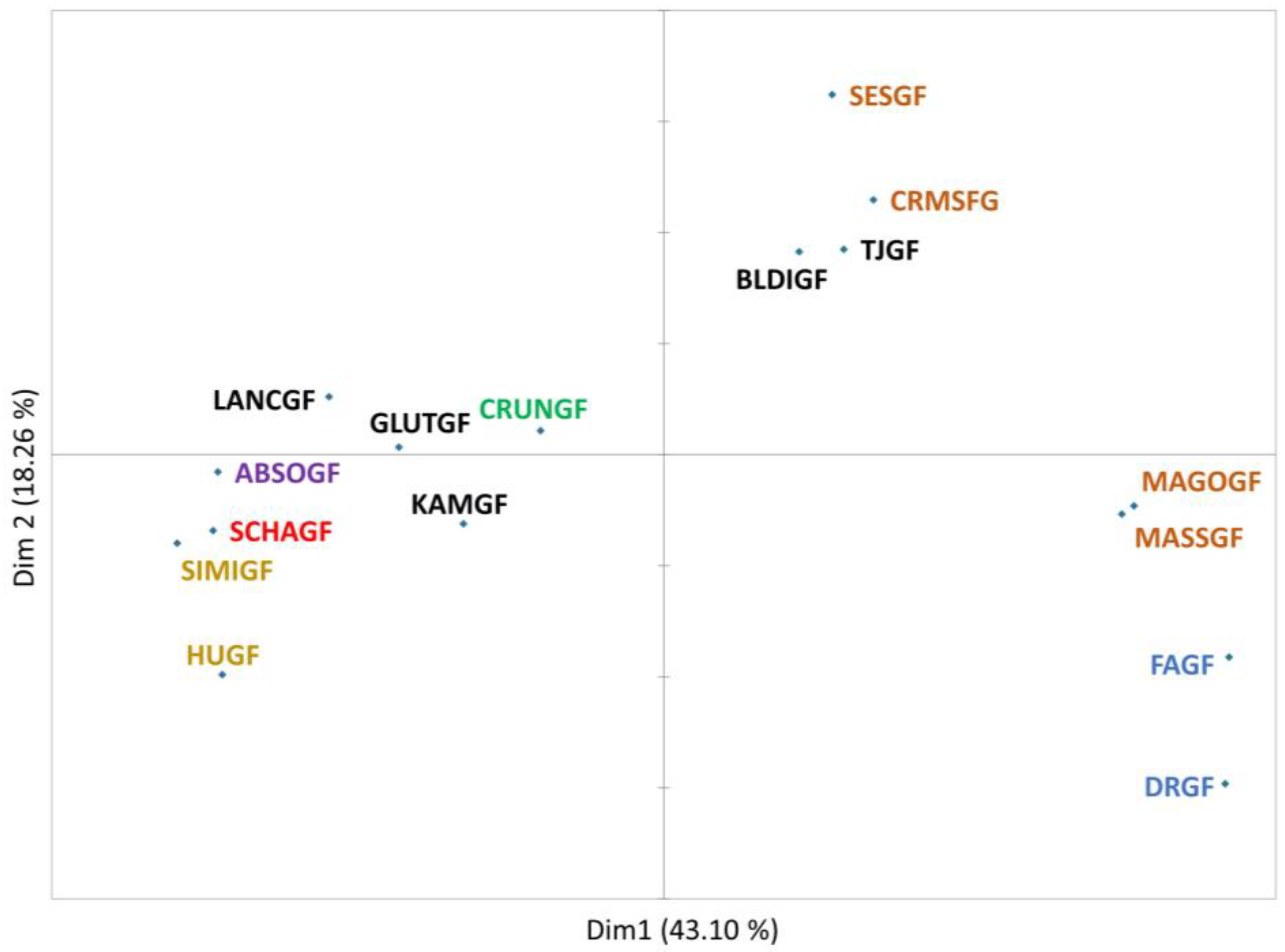
Figure 2.
Modified flash profiling result plot generated by generalized procrustes analysis for gluen free crackers. The distinct text colors of product names represent different grain sources; orange for brown rice, black for white rice, green for cassava flour, yellow for nut flour blend, red for millet blend, and purple for tapioca/potato starch blend. Attributes are represented in blue color text. Refer to Tabled 1 for detailed names of cracker varities.Note: AR- aroma, FL- flavor, and TX- texture.
Figure 2.
Modified flash profiling result plot generated by generalized procrustes analysis for gluen free crackers. The distinct text colors of product names represent different grain sources; orange for brown rice, black for white rice, green for cassava flour, yellow for nut flour blend, red for millet blend, and purple for tapioca/potato starch blend. Attributes are represented in blue color text. Refer to Tabled 1 for detailed names of cracker varities.Note: AR- aroma, FL- flavor, and TX- texture.
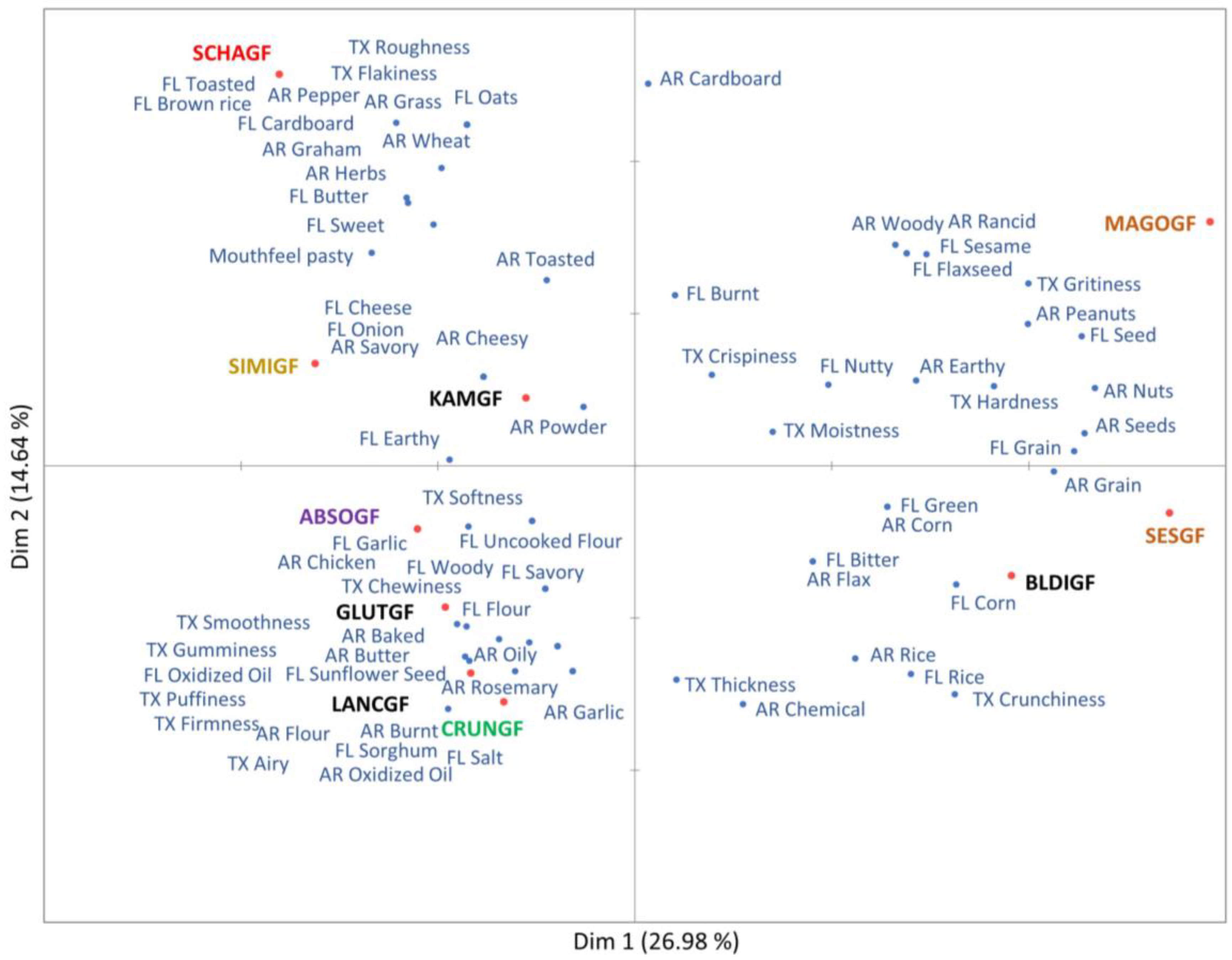
Figure 3.
Principle component analysis chart of descriptive data. The distinct text colors of product names represent different grain sources; orange for brown rice, black for white rice, green for cassava flour, yellow for nut flour blend, red for millet blend, and purple for tapioca/potato starch blend. Attributes are represented in blue color text. Refer to Tabled 1 for detailed names of cracker varities.Note: AP- appearance, FL- flavor, and TX- texture.
Figure 3.
Principle component analysis chart of descriptive data. The distinct text colors of product names represent different grain sources; orange for brown rice, black for white rice, green for cassava flour, yellow for nut flour blend, red for millet blend, and purple for tapioca/potato starch blend. Attributes are represented in blue color text. Refer to Tabled 1 for detailed names of cracker varities.Note: AP- appearance, FL- flavor, and TX- texture.
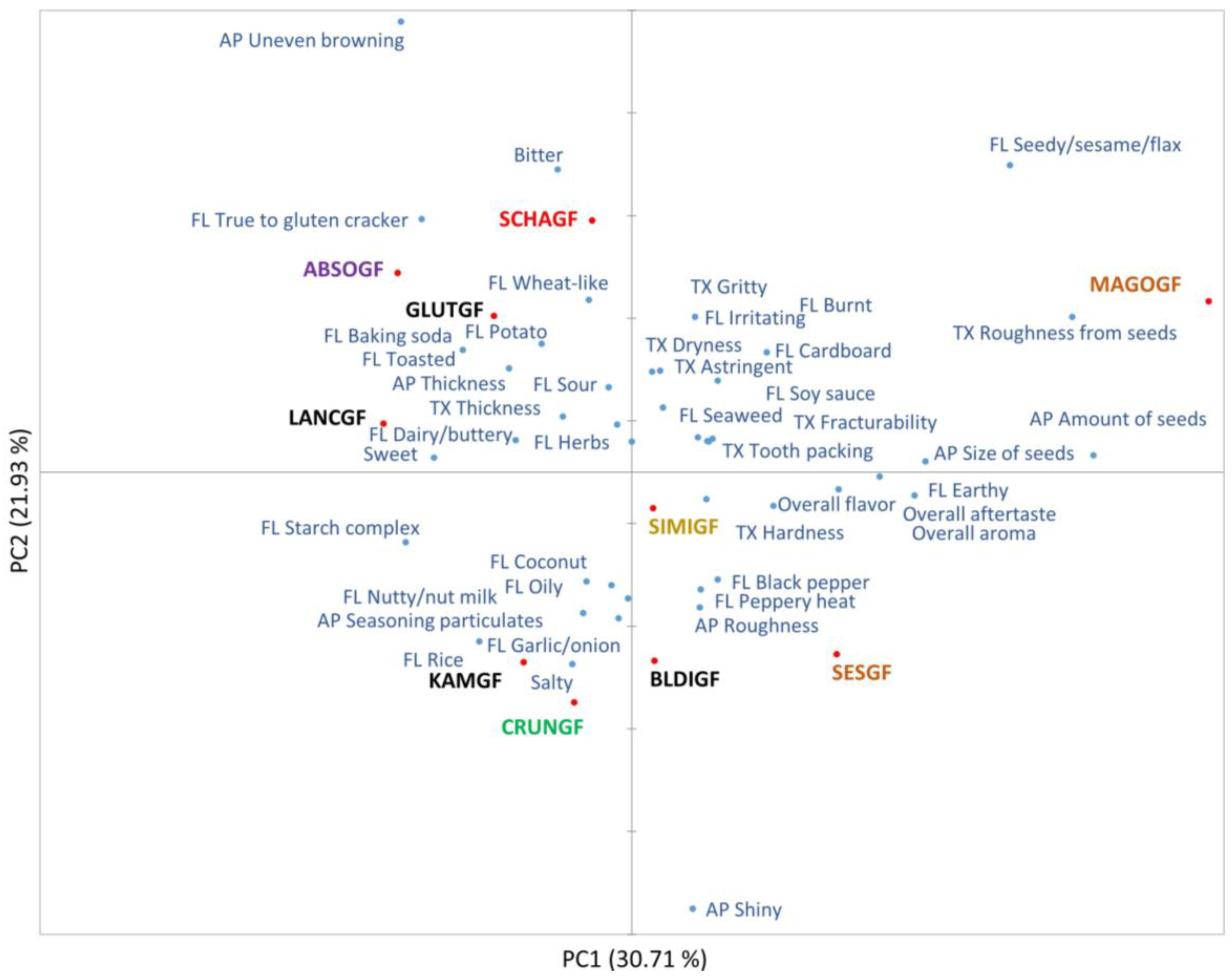

Table 1.
List of commercially available gluten free crackers used for consumer and descriptive lexicon development.
Table 1.
List of commercially available gluten free crackers used for consumer and descriptive lexicon development.
| Cracker brand | Code | Flour base | Ingredients | Variety |
|---|---|---|---|---|
| Absolutely gluten-Free crackers* | ABSOGF | Tapioca/potato starch blend | Tapioca starch, water, potato starch, potato flakes, palm oil, honey, egg yolks, natural vinegar, salt | Original |
| Crunch Master grain free crackers* | CRUNGF | Cassava flour | Cassava flour, organic coconut flour, tapioca starch, safflower oil, sea salt, garlic powder | Original |
| Hu Gluten-Free Grain-Free Crackers | HUGF | Almond, Cassava, Coconut flour blend | Grain-free flour blend (almond, cassava, organic coconut), black chia seed, flax seed, organic coconut aminos | Sea Salt |
| Schar Table gluten-free crackers* | SCHAGF | Millet blend | Non GMO corn starch, vegetable fats and oils (palm, palm kernel, non GMO rape seed), maltodextrin, modified tapioca starch, whole millet flour, non GMO soy flour, rice syrup, whole rice flour, buckwheat flour, sorghum flour, flax seed flour, non GMO corn flour, dried sourdough (buckwheat, quinoa), non GMO soy bran, poppy seeds, non GMO sugar beet syrup, sea salt, cream of tartar, ammonium bicarbonate, baking powder, guar gum, modified cellulose, citric acid, natural flavoring (rosemary) | Original |
| Simple Mills Sea salt crackers* | SIMIGF | Nut flour blend | Nut and seed flour blend (almond flour, sunflower seeds, flax seeds), tapioca starch, cassava, organic sunflower oil, sea salt, organic onion, organic garlic, rosemary extract (for freshness) | Sea Salt |
| Glutino gluten-free crackers* | GLUTGF | White rice | Corn starch, white rice flour, organic palm oil, modified corn starch, eggs, sugar, salt, vegetable fibers, dextrose, guar gum, sodium bicarbonate, natural flavor, monocalcium phosphate, ammonium bicarbonate | Original |
| Blue Diamond nut Thins* | BLDIGF | White rice | Rice flour, almonds, potato starch, sea salt, safflower oil, natural flavors (contains milk) | Original |
| Lance gluten-free crackers* | LANCGF | White rice | Palm oil, rice flour, rice starch, sugar, corn starch, potato starch, baking soda, tapioca flour, glucose, xanthan gum, monocalcium phosphate, salt, soy lecithin, locust bean gum, non-fat milk | Original |
| Trader Joe’s Savory Thin Crackers | TJGF | White Rice | Rice, sesame seeds, expeller pressed safflower oil, tamari soy sauce (soybeans, rice, salt), salt, garlic, soybean | Original |
| Mary’s Gone crackers* | MAGOGF | Brown rice | Brown rice, quinoa, flax seeds, sesame seeds, tamari (water, soybeans, salt, vinegar), sea salt | Original |
| Sesmark gluten-free crackers* | SESGF | Brown rice | Rice flour, expeller pressed safflower oil, sesame seeds, sesame flour, wheat free tamari soy sauce powder [tamari soy sauce (soybeans, salt), maltodextrin (from corn)], wheat free teriyaki powder, [wheat free teriyaki sauce (tamari soy sauce ([soybeans, salt),], sake (rice, salt), apple cider vinegar, garlic, mustard, ginger, white and black pepper), maltodextrin, sucrose, fructose,], onion powder and soy lecithin | Sea Salt |
| Mary’s Gone Super Seed Gluten -Free Crackers | MASSGF | Brown Rice | Brown rice, quinoa, pumpkin seeds, sunflower seeds, flax seeds, sesame seeds, poppy seeds, sea salt, seaweed, black pepper, spices | Original |
| Crunch Master Multigrain Crackers | CRMSGF | Brown Rice | Brown rice flour, whole grain yellow corn, potato starch, safflower oil, oat fiber, cane sugar, sesame seeds, flax seeds, millet, sea salt, quinoa seeds. | Original |
| Ka Me rice crackers* | KAMGF | Jasmine rice | Jasmine rice, rice bran oil, sea salt, soybean tocopherols (preservative) | Original |
| Doctor in the Kitchen Flackers | DRGF | Flaxseed | Organic flax seeds, organic apple cider vinegar, sea salt | Sea Salt |
| Foods Alive Original Flax Crackers | FAGF | Flaxseed | Golden flaxseed, bragg liquid aminos (a non-GMO wheat-free soy sauce), lemon juice | Original |
Note: Gluten free crackers with asterisk (*) symbol are selected for modified flash profiling and descriptive analysis.
Table 2.
List of attributes generated by cosumers using modified falsh profiling method, and by trained panel with descritpive analyisis.
Table 2.
List of attributes generated by cosumers using modified falsh profiling method, and by trained panel with descritpive analyisis.
| Appearance | Aroma and flavor | Texture | ||||
|---|---|---|---|---|---|---|
| Modified flash profiling | Descriptive | Modified flash profiling | Descriptive | Modified flash profiling | Descriptive | |
| Aroma | Flavor | Aroma and flavor | ||||
| None | Amt of seeds/inclusions | Baked | Bitter | Astringent | Airy | Dryness/moisture absorbency* |
| Color | Burnt | Brown rice | Baking soda | Chewiness | Fracturability | |
| Holes (yes/no) | Butter | Burnt | Bitter* | Crispiness | Grit/chalky/mouth coating* | |
| Rough appearance | Cardboard | Butter | Black pepper* | Crunchiness | Hardness* | |
| Seasoning particulates | Cheesy | Cardboard | Burning heat from pepper | Firmness | Roughness(seeds/particulates)* | |
| Shape | Chemical | Cheese | Burnt* | Flakiness | Thickness* | |
| Shiny | Chicken | Corn | Cardboard* | Grittiness | Tooth stick/tooth packing | |
| Size of seeds | Corn | Earthy | Coconut (flour) | Gumminess | ||
| Thickness appearance | Earthy | Flaxseed | Dairy/buttery* | Hardness | ||
| Uneven browning | Flaxseed | Flour | Earthy* | Moistness | ||
| Flour | Garlic | Garlic/onion* | Puffiness | |||
| Garlic | Grain | Herbs* | Roughness | |||
| Graham | Green | Irritating | Smoothness | |||
| Grain | Nutty | Nutty/nut milk* | Softness | |||
| Grass | Oats | Oily* | Thickness | |||
| Herbs | Onion | Overall aftertaste | ||||
| Nuts | Oxidized oil | Overall aroma | ||||
| Oily | Rice | Overall flavor | ||||
| Oxidized oil | Salt | Potato (flour, starch) | ||||
| Peanuts | Savory | Rice (flour, starch)* | ||||
| Pepper | Seed | Salty* | ||||
| Powder | Sesame | Seaweed | ||||
| Rancid | Sorghum | Seedy/sesame/flax* | ||||
| Rice | Sunflower seed | Sour | ||||
| Rosemary | Sweet | Soy sauce | ||||
| Savory | Toasted | Starch complex | ||||
| Seeds | Uncooked flour | Sweet* | ||||
| Toasted | Woody | Toasted* | ||||
| Wheat | True to gluten cracker | |||||
| Woody | Wheat-like* | |||||
Note: Descriptive attributes with asterisk (*) symbol were also found in consumer terms obtained in modified flash profiling.
Table 3.
List of attributes generated by cosumers using modified falsh profiling method, and by trained panel with descritpive analyisis.
Table 3.
List of attributes generated by cosumers using modified falsh profiling method, and by trained panel with descritpive analyisis.
| Modified flash profiling | Descriptive analysis | |
|---|---|---|
| Number of products evaluated | 10 | 10 |
| Number of panelists | 18 | 5 |
| Number of sessions | 3 | 3 |
| Panel type | Untrained (individual evaluations) | Trained (consensus) |
| Task | Used own words to describe the attributes. Rate products’ perceived attributes for intensities | Rate products for intensities. Panelists were trained on specific attributes and references |
| Scale used | 4-point scale (0 = none, 1 = low, 2 = medium, and 3 = high) | 150-point scale with 1.0 increments |
| Data analysis type | Multiple factor analysis | Principle component Analysis |
| Total number of attributes | 74 | 44 |
| Appearance | - | 7 |
| Aroma | 30 | - |
| Flavor | 28 | 30 |
| Texture | 15 | 7 |
| Mouthfeel | 1 | - |
| Results | Global overview of commercial gluten free crackers space. Ideal for obtaining consumer differentiation. | Precise, accurate, and consistent measurements between cracker samples. |
Disclaimer/Publisher’s Note: The statements, opinions and data contained in all publications are solely those of the individual author(s) and contributor(s) and not of MDPI and/or the editor(s). MDPI and/or the editor(s) disclaim responsibility for any injury to people or property resulting from any ideas, methods, instructions or products referred to in the content. |
© 2025 by the authors. Licensee MDPI, Basel, Switzerland. This article is an open access article distributed under the terms and conditions of the Creative Commons Attribution (CC BY) license (http://creativecommons.org/licenses/by/4.0/).
Copyright: This open access article is published under a Creative Commons CC BY 4.0 license, which permit the free download, distribution, and reuse, provided that the author and preprint are cited in any reuse.


