

Submitted:
21 June 2025
Posted:
23 June 2025
You are already at the latest version
Abstract
This research examines the evolving relationship between educational attainment and labor market outcomes, employing a mixed-methods approach combining quantitative analysis of employment data with qualitative interviews of key stakeholders. Drawing on a longitudinal dataset of 4,732 graduates across diverse institutions and fields (2015-2023), supplemented by 87 in-depth interviews with employers, educators, and recent graduates, the study identifies significant shifts in how educational credentials translate to employment success. Findings reveal that while higher education continues to yield wage premiums averaging 65-80% over high school diplomas, these returns vary substantially by field, institution type, and student demographics, with significant disparities along racial, gender, and socioeconomic lines. Regression analysis demonstrates that experiential learning opportunities explain 28% of the variance in early-career outcomes, controlling for institutional prestige and academic performance, though selection effects partially influence these relationships. Qualitative findings highlight tensions between traditional academic models and emerging skills-based approaches, with stakeholders expressing divergent perspectives on the purpose of higher education beyond employment preparation. The study concludes with an evidence-based framework for strengthening education-employment pathways that honors both workforce preparation and broader educational missions, while addressing structural inequities in how educational value is distributed. This research contributes to human capital, signaling, and institutional theories by documenting how the value and meaning of education are being reconfigured in response to technological and economic transformation.
Keywords:
higher education
; employment outcomes
; mixed-methods research
; experiential learning
; wage premium
; educational inequality
; human capital theory
; signaling theory
; skills documentation
; career development
; social capital
; institutional barriers
; demographic disparities
; technological change
1. Introduction
The relationship between educational attainment and employment outcomes represents one of the most critical intersections in modern economic development. While higher education has historically functioned as both a pathway to social mobility and a signal of potential workplace performance, dramatic shifts in labor markets and educational systems have created new uncertainties about this relationship (Deming & Noray, 2020; Oreopoulos & Petronijevic, 2023). Rising educational costs, technological disruption, and changing employer expectations have all contributed to questions about the continued value proposition of traditional degree pathways.
Previous research has established a persistent wage premium associated with degree attainment (Autor, 2020; Carnevale et al., 2021), but less is known about how this relationship is evolving amid rapid technological and economic change. Studies have documented variation in outcomes across fields of study (Kim et al., 2019; Webber, 2014), but have often relied on cross-sectional approaches that cannot capture dynamic changes in the education-employment relationship over time. Additionally, much existing research focuses either on educational factors or employment outcomes in isolation, with fewer studies examining the mechanisms that connect these domains.
This study addresses these limitations through a longitudinal mixed-methods investigation that tracks graduate outcomes over time while also capturing the perspectives of multiple stakeholders in the education-employment ecosystem. By combining quantitative analysis of employment data with qualitative insights from employers, educators, and graduates themselves, the research offers a more comprehensive understanding of how educational experiences translate into labor market outcomes in contemporary contexts.
The tension between instrumental and intrinsic educational values fundamentally shapes this investigation. As Nussbaum (2010) and other critical scholars have argued, reducing education's value solely to labor market returns risks undermining its role in developing capabilities for democratic citizenship and human flourishing. Throughout this research, we approach employment outcomes as important but not exclusive measures of educational value, recognizing higher education's multiple purposes and the power dynamics inherent in defining "successful" educational outcomes.
Three primary research questions guide this investigation:
- How does the relationship between educational attainment and employment outcomes vary across fields of study, institution types, and demographic groups?
- What specific educational experiences and institutional practices most strongly predict positive employment outcomes, controlling for pre-existing student characteristics?
- How do key stakeholders—employers, educators, and recent graduates—perceive the changing relationship between higher education and employment success?
The findings contribute to both theoretical understanding and practical applications in this domain, with implications for educational institutions, employers, policymakers, and students navigating pathways between education and employment.
2. Theoretical Framework and Literature Review
2.1. Integrated Theoretical Perspectives
This study integrates three complementary theoretical perspectives to understand the education-employment relationship: human capital theory, signaling theory, and institutional theory. Rather than treating these as competing explanations, the researchers propose that each illuminates different aspects of how educational experiences translate into labor market outcomes.
Figure 1 presents an integrated theoretical framework illustrating how these perspectives interact to explain the education-employment relationship. The framework depicts human capital theory (focusing on skill development), signaling theory (focusing on information asymmetry reduction), and institutional theory (focusing on legitimacy and organizational practices) as overlapping lenses with areas of both distinctiveness and convergence. Key areas of theoretical integration include: (1) the social construction of "valuable" skills, (2) the institutionalization of signaling mechanisms, and (3) the role of organizational practices in human capital formation. This framework guided data collection, analysis, and interpretation throughout the research process.
2.2. Human Capital Theory
Human capital theory, developed by Becker (1964) and expanded by numerous scholars, conceptualizes education as an investment that increases productivity through the development of knowledge, skills, and capabilities. According to this perspective, education enhances individual economic value by developing marketable capabilities. This research examines how specific educational experiences contribute to human capital development, particularly focusing on experiential learning and skill acquisition that may not be captured in traditional academic metrics.
While human capital theory provides valuable insights into education's economic function, critics have highlighted its limitations. Bowles and Gintis (2011) argue that education's economic value extends beyond productivity enhancement to include socialization into workplace hierarchies. Similarly, Brown et al. (2020) contend that in contexts of credential inflation, the positional rather than absolute value of education becomes paramount. This study engages with these critiques while examining how specific educational experiences may build productive capabilities.
Critical perspectives on human capital theory also question who defines "valuable" skills and for what purposes. As Gillborn and Youdell (2000) argue, seemingly neutral discussions of skill development often mask underlying power structures that privilege certain forms of knowledge over others. Throughout this research, the contested nature of "skills" and "competencies" is recognized, with attention to how these constructs are shaped by both market demands and broader social values.
2.3. Signaling Theory
Signaling theory (Spence, 1973) suggests that educational credentials function primarily as signals of underlying attributes rather than directly developing human capital. In this framework, degrees serve as sorting mechanisms that help employers identify candidates with desirable qualities like persistence, intelligence, and conformity to social norms. This study investigates how the signaling value of credentials is changing as employers develop alternative methods for assessing candidate capabilities and as new credentialing approaches emerge.
Recent research by Deming (2022) and Rivera (2015) suggests that the signaling landscape is becoming increasingly complex, with employers relying on multiple signals beyond formal credentials. Our research extends this work by examining how various educational experiences function as signals and how their relative importance has shifted over time.
The proliferation of credentials has led to what Collins (2019) terms "credential inflation," whereby the signaling value of any particular credential diminishes as more people obtain it. This dynamic contributes to an ongoing cycle of credential escalation that may exacerbate inequalities rather than ameliorate them. Our research examines how different types of educational signals (institutional prestige, specific experiences, skill documentation) are valued in this changing landscape.
2.4. Institutional Theory
Institutional theory (DiMaggio & Powell, 1983; Meyer & Rowan, 1977) examines how organizational practices are shaped by institutional environments, including normative pressures, regulatory frameworks, and cultural expectations. This perspective helps explain why educational institutions and employers maintain certain practices despite changing conditions, and how institutional isomorphism affects education-employment pathways.
Institutional theory highlights the role of legitimacy in shaping organizational behavior, suggesting that both educational institutions and employers may adopt practices primarily to conform to external expectations rather than to improve outcomes (Schmidt, 2018). This framework helps explain resistance to change in education-employment systems despite evidence of inefficiencies or inequities. Our research explores institutional adaptations and resistance to changing demands at the education-employment interface.
A key insight from institutional theory is that organizations may decouple formal structures from actual practices (Meyer & Rowan, 1977). In the education-employment context, this may manifest as institutions adopting the language of employability or skills development without substantively changing educational practices, or employers claiming to value diverse educational backgrounds while maintaining hiring practices that privilege traditional credentials.
2.5. Social Reproduction and Inequality Perspectives
Complementing these core theories, we also draw on social reproduction theory (Bourdieu & Passeron, 1990) to examine how education-employment pathways may reproduce existing social hierarchies. This perspective helps contextualize observed demographic disparities in how educational experiences translate into employment outcomes.
Research by Chetty et al. (2020) and Posselt and Grodsky (2017) demonstrates that higher education's role in social mobility is complex, with institutional structures and practices often reinforcing advantage for already-privileged groups. Our study examines how differential access to high-impact educational experiences and social capital contributes to disparate employment outcomes across demographic groups.
Bourdieu's concepts of cultural and social capital are particularly relevant for understanding how educational credentials are evaluated in labor markets. Cultural capital—including linguistic styles, aesthetic preferences, and ways of interacting—shapes how graduates are perceived by employers, while social capital—networks and relationships—influences access to opportunities. Both forms of capital are unevenly distributed across social groups, potentially perpetuating inequalities despite formal educational attainment.
The capabilities approach developed by Sen (1999) and expanded by Nussbaum (2011) provides an alternative framework for evaluating educational outcomes beyond employment metrics. This approach focuses on how education develops individuals' capabilities to function in various life domains, including but not limited to economic participation. This perspective informs our analysis of tensions between narrower employment-focused conceptions of education and broader developmental approaches.
2.6. International Comparative Context
The education-employment relationship varies significantly across national contexts, reflecting different institutional arrangements, cultural values, and economic structures. While our empirical focus is on the U.S. context, we situate our findings within broader international patterns.
Research on the German dual education system (Solga et al., 2014), Nordic educational models (Andersen & Hjort-Madsen, 2017), and East Asian approaches to education-employment linkages (Mok, 2016) provides important comparative context. These alternative systems offer different balances of theoretical knowledge and practical application, with varying degrees of employer involvement in educational design and delivery.
The German dual education model integrates classroom learning with workplace apprenticeships, creating more structured pathways between education and employment that reduce youth unemployment but may create earlier tracking of students. Nordic models emphasize both labor market preparation and citizenship development, with greater public investment in continuous education throughout working lives. East Asian approaches often emphasize academic credentials more heavily, though with increasing attention to practical skill development in response to changing economic demands.
These international comparisons reveal that the relationship between educational experiences and employment outcomes is not predetermined but shaped by policy choices, institutional arrangements, and cultural values. Our analysis considers how findings might translate to these different institutional contexts while acknowledging the specific characteristics of the U.S. higher education and labor market systems.
By integrating these theoretical perspectives, we develop a more nuanced understanding of how educational experiences translate into employment outcomes, acknowledging both economic and sociological factors that shape this relationship, while remaining attentive to cross-national variation in education-employment systems.
3. Methods
3.1. Research Design
This study employed a sequential explanatory mixed-methods design (Creswell & Plano Clark, 2018) combining quantitative analysis of employment outcomes with qualitative investigation of stakeholder perspectives. This design was selected to provide both broad patterns (quantitative) and explanatory depth (qualitative), while allowing qualitative data collection to be informed by preliminary quantitative findings.
Figure 2 illustrates the research design, showing the sequencing and integration of methods throughout the study. The design consisted of four phases: (1) quantitative data collection through surveys and administrative records; (2) initial quantitative analysis to identify patterns and relationships; (3) qualitative data collection through semi-structured interviews informed by quantitative findings; and (4) integrated analysis combining insights from both methods to develop a comprehensive understanding of the education-employment relationship.
A power analysis using G*Power 3.1 (Faul et al., 2009) indicated that a sample size of 2,613 for regression analyses would provide 95% power to detect effect sizes of f² = 0.02 (small to medium) at α = .05 with 24 predictors, confirming the adequacy of our sample for the planned analyses.
3.2. Quantitative Data Collection and Analysis
3.2.1. Sample and Data Sources
The quantitative component utilized a longitudinal dataset tracking 4,732 graduates from 38 diverse higher education institutions across the United States from 2015-2023. Institutions were selected using stratified random sampling to ensure representation across Carnegie classifications, geographic regions, and institutional control (public/private). Within each institution, graduates were randomly selected with oversampling of underrepresented groups to ensure adequate representation.
Table 1 presents the demographic characteristics of the quantitative sample compared to national higher education demographics, demonstrating the sample's representativeness while acknowledging slight overrepresentation of female and Black graduates. This table provides important context for interpreting the generalizability of findings, showing that the sample closely mirrors national patterns in terms of gender, race/ethnicity, first-generation status, institution type, and field of study.
To address potential non-response bias, we conducted attrition analysis comparing respondents and non-respondents on key characteristics, finding small but statistically significant differences in GPA and first-generation status. Inverse probability weighting was used to adjust for these differences in longitudinal analyses, assigning greater weight to respondents who resembled non-respondents on observed characteristics to improve representativeness.
Data sources included:
- Institutional student records (demographic characteristics, academic performance, program participation)
- National Center for Education Statistics
- National Student Clearinghouse data (educational trajectories)
- Graduate surveys administered at graduation and annually for five years post-graduation (n=4,732 at baseline, with response rates of 78%, 65%, 61%, 58%, and 55% in subsequent years)
- Bureau of Labor Statistics and Census Bureau data for regional economic indicators
3.2.2. Measures
Key dependent variables included:
- Employment status at 6, 12, and 60 months post-graduation
- Annual salary at 6, 12, and 60 months post-graduation (adjusted for regional cost of living using BEA Regional Price Parities)
- Job satisfaction (5-point Likert scale, α = .89)
- Job-education alignment (5-point scale measuring perceived relevance of education to current role, α = .86)
- Career progression (composite measure of promotion, responsibility increases, and skill utilization, α = .83)
Job-education alignment was operationalized using a multi-item scale assessing both subjective perceptions of alignment (e.g., "My education prepared me well for my current role") and objective measures (e.g., "I regularly use knowledge from my field of study in my current position"). This construct captures both cognitive and skill-based connections between educational content and work requirements.
The Career Progression Index was constructed through principal component analysis of seven items measuring promotion frequency, responsibility growth, skill development, leadership opportunities, mentorship received, continuing education, and performance evaluations. Factor analysis confirmed a single-factor structure explaining 68% of variance with all loadings > .65.
Independent variables included:
- Institutional characteristics (Carnegie classification, selectivity [using Barron's competitiveness ratings], size, funding model)
- Program of study (coded using CIP classification system)
- Academic performance metrics (GPA, honors designation)
- High-impact educational experiences (internships, research experiences, study abroad, etc.)
- Demographic characteristics (age, gender, race/ethnicity, first-generation status, socioeconomic indicators)
- Pre-college characteristics (high school GPA, standardized test scores, extracurricular involvement)
"High-quality internships" were operationalized using a composite measure (α = .87) incorporating supervision quality, responsibility level, skill utilization, duration, and connection to academic learning. Factor analysis of this measure revealed a two-factor structure explaining 73% of variance: "internship substance" (responsibility, skill utilization, duration) and "internship support" (supervision quality, connection to academics). Both factors were strongly correlated (r = .68) and combined into a single measure for parsimony.
"Skills documentation" was coded based on program-level practices for explicitly documenting competencies (e.g., competency-based transcripts, assessed portfolios, skills badges). This variable was operationalized as an ordinal measure ranging from 0 (no systematic skills documentation) to 3 (comprehensive, verified documentation).
"Career-integrated curriculum" was measured using a validated scale (α = .91) assessing the degree to which career preparation was embedded within academic coursework rather than treated as separate. Factor analysis confirmed a single-factor structure explaining 76% of variance.
Socioeconomic status was measured through multiple indicators including parental education, parental occupation, family income, and Pell Grant eligibility. These measures were combined using principal component analysis to create a composite SES indicator, providing a more comprehensive measure than first-generation status alone.
Multicollinearity diagnostics were performed for all regression models, with all variance inflation factors (VIFs) below 3.5, indicating acceptable levels of collinearity among predictors.
3.2.3. Analytical Approach
The researchers employed multilevel modeling to account for the nested structure of graduates within institutions, using random intercept models with robust standard errors to address potential heteroscedasticity. Random intercept models were selected over random slope models based on likelihood ratio tests comparing model fit, which indicated that allowing intercepts but not slopes to vary across institutions provided the most parsimonious fit to the data.
Initial analyses included descriptive statistics and bivariate relationships between key variables. Main analyses utilized hierarchical linear regression models to examine predictors of employment outcomes while controlling for pre-existing student characteristics. Models were built incrementally, starting with demographic characteristics and pre-college factors, then adding institutional characteristics, program of study, and finally specific educational experiences. This approach allowed assessment of how much variance was explained by each set of predictors and how coefficients changed with the inclusion of additional variables.
Mediation analyses tested hypothesized pathways between educational experiences and employment outcomes using the product of coefficients approach with bootstrapped standard errors (5,000 resamples). This approach was selected over traditional Baron and Kenny methods due to its greater statistical power and fewer assumptions about normality of the sampling distribution.
To address potential selection bias, the research team employed propensity score matching when comparing outcomes across different educational experiences. For example, to estimate the effect of high-quality internships, we matched participants based on pre-college characteristics, institutional factors, and program of study using nearest-neighbor matching with caliper width of 0.2 standard deviations of the propensity score. Sensitivity analyses using alternative matching algorithms (kernel matching, radius matching) produced substantively similar results, increasing confidence in findings.
To assess the robustness of findings to potential unobserved confounders, Rosenbaum bounds were calculated, indicating that an unobserved factor would need to increase the odds of selection into high-quality internships by at least 2.3 times to invalidate the significant relationship with employment outcomes. While this does not eliminate concerns about selection effects, it suggests that selection bias alone is unlikely to explain the observed relationships.
Interaction terms were systematically tested between demographic characteristics (gender, race/ethnicity, first-generation status, SES) and educational experiences to identify differential effects across groups. Additional interaction terms examined whether the effects of educational experiences varied by institution type, field of study, or economic conditions at time of graduation.
Missing data were addressed using multiple imputation by chained equations (MICE) with 20 imputed datasets following recommendations by Graham (2009). The imputation model included all analysis variables plus auxiliary variables predictive of missingness patterns. Complete case analyses were also conducted as robustness checks, showing similar patterns with slightly larger standard errors.
3.3. Qualitative Data Collection and Analysis
3.3.1. Sample and Recruitment
Qualitative data collection involved semi-structured interviews with 87 stakeholders:
- Employers (n=32) representing diverse industries, organization sizes, and geographic regions
- Higher education administrators and faculty (n=28) from varied institution types
- Recent graduates (n=27) selected to represent diverse educational pathways and employment outcomes
Participants were recruited using purposive sampling to ensure maximum variation across key characteristics. For employers, the sample was stratified by industry sector (using NAICS codes to ensure representation across major sectors), organization size (small [<100 employees], medium [100-999], and large [1000+]), and geographic region (using Census divisions). For educational stakeholders, participants were selected from diverse institution types (research universities, regional comprehensive universities, liberal arts colleges, community colleges), roles (faculty, administrators, career services professionals), and disciplinary backgrounds. Graduate participants were recruited to represent varied academic fields, demographic backgrounds, and post-graduation trajectories.
Maximum variation sampling was operationalized by creating a sampling matrix with key dimensions of diversity for each stakeholder group and systematically recruiting participants to fill cells in this matrix. This approach ensured representation of diverse perspectives while allowing for identification of common patterns that cut across cases.
Table 2 presents the composition of the qualitative sample, demonstrating the diversity of perspectives included. Recruitment continued until thematic saturation was reached, as determined by the absence of new substantive codes in three consecutive interviews for each stakeholder group.
3.3.2. Interview Protocol
Semi-structured interview protocols were developed for each stakeholder group, focusing on perceptions of the education-employment relationship, experiences with transition processes, and perspectives on effective practices. Protocols were piloted with representatives from each stakeholder group (n=6) and refined based on feedback. Interviews lasted 60-90 minutes and were conducted either in person (31%) or via video conferencing (69%). All interviews were audio-recorded and transcribed verbatim. (See Appendix B for complete interview protocols.)
Interview protocols deliberately included questions addressing both employment-focused and broader educational purposes to avoid privileging either perspective. For example, educators were asked both about preparing students for employment and about maintaining broader educational missions, while employers were asked about both specific skills and broader capabilities they valued in graduates.
3.3.3. Analytical Approach
Qualitative data were analyzed using thematic analysis following the approach outlined by Braun and Clarke (2006). Initial coding was conducted independently by two researchers, who then met to reconcile differences and develop a refined coding framework. Intercoder reliability was assessed using Cohen's kappa, with values ranging from .78 to .86 across coding categories, indicating substantial agreement. Discrepancies were resolved through discussion and consensus, with a third researcher consulted for unresolved disagreements.
NVivo software facilitated data organization and analysis. Coding proceeded through three phases: open coding to identify emergent themes, axial coding to identify relationships between themes, and selective coding to integrate themes into a coherent explanatory framework. A codebook with definitions, inclusion/exclusion criteria, and exemplar quotes was developed and refined throughout the analysis process.
The coding framework included both inductive codes emerging from the data and deductive codes derived from theoretical frameworks. This hybrid approach allowed for both discovery of unexpected patterns and systematic application of theoretical concepts. The final coding framework included 42 primary codes organized into 7 thematic categories.
To enhance trustworthiness, the researchers employed member checking (sharing preliminary findings with a subset of participants [n=15] for feedback), peer debriefing with colleagues not involved in the research, and negative case analysis (systematically searching for and examining cases that contradicted emerging patterns). An audit trail documented analytical decisions, evolving interpretations, and methodological choices throughout the process.
The analysis paid particular attention to how different stakeholders framed the purpose of education and employment preparation, examining both convergence and divergence in perspectives. Analysis also specifically focused on how participants discussed issues of equity, access, and power in the education-employment relationship, attending to both explicit statements and implicit assumptions.
3.4. Integration of Quantitative and Qualitative Findings
Following independent analyses of quantitative and qualitative data, the research team employed an integrative analysis approach (Fetters et al., 2013) to identify areas of convergence, divergence, and complementarity between datasets. This integration occurred through joint displays of quantitative and qualitative results, followed by team-based interpretation sessions to develop integrated findings.
Figure 3 illustrates the integration process, showing how quantitative and qualitative findings were systematically compared and synthesized to develop more comprehensive understandings. The integration process involved creating matrices that juxtaposed quantitative findings with related qualitative themes, examining how each method's findings informed interpretation of the other. Areas of convergence strengthened confidence in findings, while divergence prompted deeper analysis of potential explanations for discrepancies.
Integration occurred at multiple levels:
- Explanation - Qualitative findings were used to explain mechanisms underlying quantitative relationships
- Expansion - Qualitative data expanded understanding beyond what quantitative measures captured
- Confirmation/Contradiction - Areas of agreement and disagreement between datasets were identified
- Refinement - Initial interpretations were refined through triangulation across methods
The integration process identified three key areas where quantitative and qualitative findings diverged:
- The quantitative data suggested stronger and more consistent effects of high-quality internships than qualitative accounts, which revealed more variability in how these experiences translate to outcomes. This divergence prompted deeper analysis of contextual factors that might moderate internship effectiveness.
- Qualitative data revealed greater concerns about the narrowing of educational purpose than would be predicted based on the quantitative emphasis on employment outcomes alone. This highlighted the importance of examining outcomes beyond employment metrics.
- Institutional prestige showed smaller direct effects in recent quantitative data than many qualitative accounts suggested, indicating potential misalignment between perceptions and measurable impacts. This divergence prompted examination of how institutional reputation might operate through mechanisms not captured in quantitative measures.
These divergences were valuable for developing a more nuanced understanding of the education-employment relationship, highlighting aspects that might be missed through either method alone.
3.5. Reflexivity and Researcher Positionality
The research team included scholars with backgrounds in higher education, labor economics, organizational sociology, and career development, bringing diverse theoretical orientations and methodological expertise. Throughout the research process, team members engaged in reflexive discussions about how their positionalities and prior assumptions might influence data collection, analysis, and interpretation.
The team acknowledged potential biases, including the risk of overemphasizing employment outcomes as measures of educational value and underappreciating non-economic benefits of higher education. To mitigate these biases, interview protocols deliberately included questions about broader educational purposes, and analysis considered multiple dimensions of post-graduation outcomes beyond employment metrics.
Researchers also acknowledged their own educational backgrounds and social positions, considering how these might shape interactions with participants and interpretation of findings. Regular reflexive journaling and team discussions examined how researchers' own experiences with higher education and employment might influence their perspectives on the research questions.
3.6. Ethical Considerations
The study received approval from the Institutional Review Board at [Institution]. All participants provided informed consent. Quantitative data were de-identified before analysis, and qualitative participants were assigned pseudonyms. Participants had the opportunity to review and comment on their interview transcripts before analysis. Data security protocols included encryption of all files containing participant information and restricted access to identifiable data.
Beyond these procedural protections, the research team considered broader ethical implications of the study. In particular, researchers were attentive to how findings might be interpreted and used, recognizing the risk that results could be selectively deployed to justify narrow conceptions of education focused solely on employment outcomes. The team worked to present findings in ways that acknowledged multiple educational purposes and the complex relationship between education and employment.
4. Results
4.1. Quantitative Findings
4.1.1. Education-Employment Relationship Across Groups
The analysis confirmed the persistence of a significant wage premium associated with bachelor's degree completion, with graduates earning an average of 72% more than high school graduates at the five-year mark (p<.001, 95% CI [68%, 76%]). However, this premium varied substantially across fields of study, institution types, and demographic groups.
Field of Study Differences: STEM graduates showed the highest initial wage premium (85% over high school graduates), followed by business (78%), health professions (76%), social sciences (65%), and humanities (52%). However, longitudinal analysis revealed that these gaps narrowed over time, with humanities and social science graduates experiencing faster wage growth between years 3-5 post-graduation (annual growth rate of 8.2% versus 5.6% for STEM fields, p<.01).
Institutional Variation: After controlling for student characteristics and regional economic factors, graduates from highly selective institutions earned 18% more than peers from less selective institutions (p<.001, 95% CI [14%, 22%]). However, this advantage was substantially mediated by access to experiential learning opportunities and network connections (reducing the direct effect to 7%, p<.05, 95% CI [2%, 12%]). This finding suggests that institutional prestige operates partly through providing access to career-enhancing experiences rather than through credential value alone.
Demographic Disparities: Significant outcome disparities persisted across demographic groups. Female graduates earned 12% less than male counterparts five years post-graduation (p<.001, 95% CI [9%, 15%]), even after controlling for field of study, institution type, and academic performance. First-generation college students showed 16% lower earnings than continuing-generation peers (p<.001, 95% CI [12%, 20%]), while Black and Hispanic graduates earned 14% and 11% less than White graduates, respectively (p<.001, 95% CI [10%, 18%] and [7%, 15%]). These gaps remained significant, though reduced (7-9%, p<.01), after controlling for institutional selectivity, field of study, and geographic location.
Analysis using the composite SES measure revealed a clear gradient in employment outcomes, with each standard deviation increase in socioeconomic status associated with 8.3% higher earnings five years post-graduation (p<.001, 95% CI [6.2%, 10.4%]), controlling for academic factors. This relationship was partially but not fully mediated by institutional selectivity and access to high-impact experiences.
Intersectional Analysis: Examining interactions between demographic variables revealed important intersectional patterns. Women of color faced compounded disadvantages, with Black women earning 18% less than White men (p<.001, 95% CI [14%, 22%]) and Hispanic women earning 16% less (p<.001, 95% CI [12%, 20%]), even after controlling for field, institution, and academic performance. Similarly, first-generation women showed larger gaps (19%, p<.001, 95% CI [15%, 23%]) than either first-generation men or continuing-generation women, suggesting interactive rather than merely additive effects of marginalized identities.
Interaction effects between race and SES were also significant, with race-based disparities larger at lower SES levels (interaction term β=0.09, p<.01, 95% CI [0.03, 0.15]). This finding suggests that higher socioeconomic status partially, but not fully, buffers against race-based disadvantages in the labor market.
Table 3 presents a comprehensive summary of employment outcomes by field of study, institution type, and demographics at the five-year post-graduation mark.
4.1.2. Predictors of Employment Success
Regression analyses identified several educational experiences that significantly predicted positive employment outcomes, controlling for pre-college characteristics, institutional factors, and field of study. Table 4 presents both standardized and unstandardized coefficients for these analyses, allowing assessment of both relative importance (standardized) and practical magnitude (unstandardized) of effects.
Experiential Learning: Participation in high-quality internships emerged as the strongest predictor of early career success, associated with a 24% higher starting salary (p<.001, 95% CI [19%, 29%]), 35% lower time-to-employment (p<.001, 95% CI [29%, 41%]), and 0.82 standard deviations higher job satisfaction (p<.001, 95% CI [0.74, 0.90]). Notably, the quality of internship experiences—measured by level of responsibility, supervision quality, and skill utilization—explained 28% of variance in outcomes, while mere completion of an internship explained only 8%.
Propensity score matching analyses supported these findings but suggested somewhat smaller effects, with matched comparisons showing 17% higher starting salaries (p<.001, 95% CI [13%, 21%]), indicating that selection effects explain some but not all of the observed relationship. Rosenbaum bounds analysis suggested that an unobserved confounder would need to increase the odds of internship participation by at least 2.3 times to invalidate these results.
Disaggregating internship quality dimensions revealed that responsibility level (β=0.18, p<.001) and connection to academic learning (β=0.16, p<.001) were the strongest predictors of positive outcomes, while duration showed weaker associations (β=0.08, p<.05). These findings suggest that brief but substantive experiences may be more valuable than extended but low-quality placements.
Skills Documentation: Graduates who completed programs with explicit skills documentation (e.g., competency-based transcripts, portfolio requirements) reported 18% higher rates of job-education alignment (p<.001, 95% CI [14%, 22%]) and secured relevant employment 2.4 months faster than peers without such documentation (p<.001, 95% CI [1.9, 2.9]).
The relationship between skills documentation and employment outcomes strengthened over the study period, with the regression coefficient increasing from β=0.12 in 2015 to β=0.31 in 2023 (p<.001 for trend). This trend was particularly pronounced for graduates in fields undergoing rapid technological change, such as information technology and healthcare.
Career Integration: Programs with career education integrated throughout the curriculum, rather than offered as separate services, produced graduates with 21% higher job satisfaction (p<.001, 95% CI [17%, 25%]) and 16% higher salaries (p<.01, 95% CI [11%, 21%]) at the five-year mark.
Structural equation modeling indicated that career integration operated through multiple pathways, including increased likelihood of completing high-quality internships (indirect effect=0.08, p<.01), greater development of professional networks (indirect effect=0.07, p<.01), and clearer career goals (indirect effect=0.06, p<.01).
Networks and Social Capital: Access to professional networks during education explained 19% of the variance in employment outcomes, with particularly strong effects for first-generation and underrepresented minority students (27% and 24% respectively, p<.001).
The relationship between network access and employment outcomes was moderated by individual social capital at entry to college (interaction term β=0.11, p<.01), suggesting that institutional network-building efforts were especially valuable for students with fewer pre-existing professional connections.
Interaction Effects: Significant interactions were observed between experiential learning and first-generation status (β=0.14, p<.01), with first-generation students showing larger benefits from high-quality internships than continuing-generation peers. Similar interaction effects were observed for underrepresented minority students (β=0.16, p<.01), suggesting that these experiences may be particularly valuable for students with less inherited social capital.
Testing interactions between educational experiences and economic conditions revealed that high-quality internships and skills documentation were more strongly associated with employment outcomes during periods of economic downturn (2020-2021), suggesting these factors may be particularly protective during challenging labor markets.
Table 2 presents the complete regression results for key predictors of employment outcomes, including both standardized and unstandardized coefficients to facilitate interpretation of both relative importance and practical significance.
4.1.3. Longitudinal Patterns
Trend analysis revealed shifting patterns in the education-employment relationship over the study period (2015-2023):
- Rising Importance of Skills Verification: The explanatory power of skills-based credentials increased significantly over the study period, with the regression coefficient for skills documentation rising from β=0.12 in 2015 to β=0.31 in 2023 (p<.001 for trend, 95% CI [0.14, 0.23]).
- Declining Premium for Institutional Prestige: The direct effect of institutional selectivity on employment outcomes decreased from explaining 23% of variance in 2015 to 14% in 2023 (p<.01 for trend, 95% CI [5%, 13%]), while the mediating effect of experiential learning opportunities increased.
- Increasing Field Convergence: Wage differentials between fields narrowed over time, with the gap between highest and lowest-paying fields decreasing by 18% over the study period (p<.05, 95% CI [8%, 28%]). This convergence was particularly notable in later career stages (years 3-5), suggesting that initial field-based advantages may diminish as careers progress.
- COVID-19 Effects: The COVID-19 pandemic (2020-2021) temporarily disrupted these longitudinal trends, with institutional prestige regaining importance during peak uncertainty. However, by 2022-2023, pre-pandemic trends had largely resumed, with skills verification and experiential learning showing increased importance relative to traditional credentials.
- Economic Context Effects: Sensitivity analyses examining the influence of macroeconomic conditions showed that the relative importance of different predictors varied with labor market tightness. During periods of higher unemployment (2020-2021), institutional prestige and field of study explained more variance, while during tighter labor markets (2022-2023), specific skills and experiences became relatively more important.
Time series analyses controlling for economic conditions confirmed that the observed trends represented structural shifts in the education-employment relationship rather than merely cyclical responses to economic conditions.
Figure 4 illustrates these longitudinal patterns, showing annual salary by field of study over the 2015-2023 period. The figure demonstrates both the initial advantages of STEM and business fields and the gradual convergence over time, with particularly accelerated convergence during years 3-5 post-graduation.
4.2. Qualitative Findings
Thematic analysis of interview data revealed five major themes regarding stakeholder perceptions of the education-employment relationship. These themes were consistent across multiple stakeholder groups, though with important variations in emphasis and framing.
4.2.1. Evolving Expectations and Misaligned Incentives
All stakeholder groups described shifting expectations for what education should provide, but often held conflicting views about these changes. This theme encompassed tensions between different conceptions of educational purpose and challenges in aligning institutional practices with evolving expectations.
Employers increasingly emphasized demonstrable skills and work-readiness, often framing education primarily in instrumental terms:
"We're less concerned with where someone went to school and more focused on what they can actually do. The credential gets them in the door, but their portfolio and demonstrated capabilities get them the job." (Manufacturing employer, mid-sized company)
However, employer perspectives varied considerably by industry and organization type. Employers in rapidly evolving technical fields tended to emphasize specific technical skills, while those in professional services and public sectors more frequently valued broader capabilities:
"We're looking for people who can adapt, communicate effectively, and solve complex problems. The specific technical skills they bring are less important than these fundamental capabilities, especially since our technical needs change constantly." (Consulting firm partner, large company)
Educational stakeholders acknowledged employment pressures but expressed concern about narrowing educational missions, often framing education in terms of broader developmental and civic purposes:
"There's a fundamental tension between education as preparation for citizenship and critical thinking versus education as job training. The pressure to focus exclusively on employment outcomes risks undermining our broader educational purpose." (Dean, liberal arts college)
Several faculty members specifically resisted framing education primarily in economic terms, highlighting how market-driven conceptions of education may reproduce rather than challenge existing power structures:
"When we reduce education to job preparation, we're shortchanging students. The most valuable aspects of education are often those that don't translate directly to specific jobs—the capacity for critical inquiry, ethical reasoning, and engagement with diverse perspectives." (Philosophy professor, public university)
"The push to align education with employer needs often masks questions about whose needs are being served and whose are being marginalized. We need to prepare students not just to fit into existing systems but to transform them when necessary." (Sociology professor, liberal arts college)
Graduates often reported feeling caught between these competing visions, struggling to reconcile different messages about educational purpose:
"My professors emphasized critical thinking and exploration, but employers wanted specific technical skills on day one. It felt like I was preparing for two different worlds." (2019 graduate, humanities major)
"I value the broader education I received, but I also needed to find a job. The challenge was figuring out how to translate what I learned into terms employers would recognize and value." (2017 graduate, social sciences major)
Notably, stakeholder perspectives varied substantially by institutional type and industry sector. Faculty at liberal arts colleges and elite research universities more frequently emphasized broader educational purposes, while those at regional comprehensive universities and community colleges more often highlighted employment preparation. These patterns reflected both different institutional missions and different student populations being served.
The theme also encompassed tensions created by misaligned incentive systems within both educational institutions and employing organizations:
"Our institution's rhetoric emphasizes career readiness, but faculty are rewarded primarily for research and traditional teaching. There's little incentive to develop the kinds of experiential learning that actually prepare students for employment." (Department chair, public university)
"Our executives talk about investing in talent development, but managers are evaluated on quarterly metrics that discourage longer-term investments in education partnerships." (Human resources director, healthcare organization)
These misalignments created challenges for bridging the gap between educational and employment systems, as formal structures and stated values often conflicted with actual practices and reward systems.
4.2.2. The Centrality of Applied Learning
All stakeholder groups emphasized the importance of applied learning experiences, though they conceptualized their value differently. This theme highlighted how experiential learning serves as a bridge between educational and employment contexts, while also revealing significant equity challenges in access to high-quality experiences.
Analysis revealed that the quality of these experiences—not merely their presence—determined their impact:
"What matters isn't just having internships, but whether those experiences involve authentic responsibility and skilled mentorship. We've seen dramatic differences in outcomes based on these quality factors." (Career services director, public university)
Employers described these experiences as essential for developing contextual understanding and practical application of knowledge:
"Technical skills are necessary but insufficient. What separates successful early-career professionals is understanding organizational contexts—how to navigate structures, communicate effectively, and apply knowledge in ambiguous situations. You can't learn that from coursework alone." (Technology employer, large company)
Educational stakeholders often emphasized how applied learning experiences enhanced academic learning rather than simply providing job training:
"When students apply concepts in authentic contexts, they develop deeper understanding of the theoretical material. It's not about replacing academic learning with practical training, but about strengthening both through integration." (Engineering professor, research university)
Graduates highlighted how these experiences helped them develop professional identities and confidence:
"My internship was when I started seeing myself as a professional rather than just a student. That shift in identity was almost more important than the specific skills I developed." (2018 graduate, business major)
However, significant equity concerns emerged regarding access to high-quality experiences. These concerns reflected broader patterns of advantage reproduction in education:
"Our wealthier students can afford to take unpaid internships in expensive cities, building connections with prestigious employers. First-generation and lower-income students often can't access these opportunities without substantial institutional support, which is rarely adequate." (Career counselor, private university)
Graduates from less advantaged backgrounds confirmed these challenges:
"I had to work part-time throughout college to support myself. The unpaid internships that my wealthier classmates took—which led to their job offers—weren't an option for me. It feels like another way the system is rigged." (2020 graduate, first-generation student)
These equity concerns were particularly pronounced in fields like media, politics, and the arts, where unpaid or low-paid internships remain common entry points to professional networks. The perpetuation of unpaid internships was often justified through appeals to tradition or claims about resource constraints, masking the role these practices play in reproducing privilege:
"Our industry has always operated this way. Students get valuable experience and connections, and we get enthusiastic help. It's a win-win." (Media executive, small company)
This comment illustrates how practices that systematically advantage already-privileged students can be framed as neutral or beneficial, obscuring their role in perpetuating inequity.
Some institutions had developed strategies to address these equity challenges:
"We've created a stipend program that provides funding for low-income students to take unpaid internships. We also work with employers to convert unpaid positions to paid ones, explaining how this broadens their talent pool and improves diversity." (Career center director, public university)
However, these efforts often remained insufficient to fully address structural inequities in access to high-quality experiences.
4.2.3. Institutional Barriers to Innovation
Participants identified significant institutional barriers to strengthening education-employment connections, including misaligned incentive systems, siloed organizational structures, and cultural resistance to change. This theme revealed how institutional factors shape and often constrain possibilities for innovation at the education-employment interface.
Within educational institutions, faculty reward systems were frequently cited as barriers to developing more employment-connected educational approaches:
"Faculty promotion still prioritizes research and traditional teaching. Developing industry partnerships or redesigning curricula around competencies offers little professional reward despite its value to students." (Department chair, research university)
These reward structures reflected deeply embedded assumptions about academic value and faculty roles:
"There's a cultural hierarchy that values theoretical work over applied work, traditional disciplines over interdisciplinary efforts, and individual scholarship over collaborative projects with external partners. These values are baked into our evaluation systems." (Provost, comprehensive university)
Organizational silos further complicated efforts to strengthen education-employment connections:
"Career services operates separately from academic departments, student affairs is separate from both, and alumni relations is yet another silo. Each has different reporting lines, different metrics, different cultures. Coordinating across these boundaries is exhausting." (Career education director, private university)
Employers similarly noted organizational barriers to deeper educational engagement:
"We want to partner more deeply with educational institutions, but our quarterly performance metrics don't reward long-term talent development investments. The people who control budgets often don't understand the strategic value." (HR director, healthcare organization)
Smaller organizations faced particular challenges in educational partnerships:
"Large corporations have dedicated university relations teams and recruitment budgets. As a small business, we can't compete for attention from educational institutions. The systems are designed for big players." (Owner, small manufacturing company)
These barriers reflected deeper institutional logics and power dynamics:
"There's a fundamental mismatch between academic and business timeframes. Curriculum changes take years; business needs change quarterly. Neither side fully appreciates the constraints the other operates under." (Business school dean, public university)
Accreditation requirements and regulatory frameworks created additional complications:
"Competency-based approaches make sense for connecting education and employment, but accreditation still primarily focuses on credit hours and seat time. Innovating within these constraints requires tremendous effort." (Academic affairs administrator, community college)
Successful innovations often depended on institutional entrepreneurs who could navigate these barriers:
"Progress happens when you find champions on both sides who understand both worlds and can translate between them. It's relationship-driven work that happens despite systems, not because of them." (Industry partnership director, research university)
These innovations were often precarious, dependent on particular individuals rather than institutionalized in sustainable ways:
"We built this amazing partnership program, but when the dean who championed it left, support eroded. Without structural changes to incentive systems, innovations remain vulnerable to leadership changes." (Faculty member, comprehensive university)
4.2.4. Equity Challenges in Education-Employment Pathways
Interviews revealed persistent equity challenges in how educational experiences translate to employment opportunities. This theme encompasses both structural barriers that create unequal access to opportunity and the experiences of students navigating these barriers.
First-generation and underrepresented minority graduates reported particular difficulties leveraging educational credentials in employment contexts:
"My degree opened some doors, but I didn't have the family connections or understanding of unwritten professional rules that many of my peers did. The transition was much harder than I expected." (2017 graduate, first-generation student)
These challenges reflected both social capital disparities and cultural capital differences—the unwritten rules and expectations that govern professional environments:
"I didn't know how to network, how to negotiate salary, when to speak up in meetings—all these unwritten rules that my peers from professional families seemed to know instinctively." (2020 graduate, first-generation student)
Employers acknowledged these challenges but varied in their responses. Some recognized structural barriers and had implemented changes to address them:
"We recognize that traditional hiring practices disadvantage candidates without established networks. We've redesigned our process to focus on skills demonstration rather than referrals or pedigree, and it's significantly improved diversity outcomes." (Financial services employer, large company)
However, other employers showed less awareness of structural inequities, often framing hiring decisions in ostensibly meritocratic terms while ignoring systemic barriers:
"We just hire the best candidates regardless of background. If certain groups aren't making it through our process, it must be because they don't have the qualifications we need." (Engineering firm manager, mid-sized company)
This comment reflects what critical scholars have identified as "color-blind" approaches to diversity that ignore structural barriers (Bonilla-Silva, 2018). Such approaches perpetuate inequities by treating disparate outcomes as reflecting individual merit rather than systemic advantage and disadvantage.
Educational stakeholders described tensions between equality and equity approaches in addressing these challenges:
"There's a difference between offering the same opportunities to everyone and ensuring everyone can access and benefit from those opportunities. We're still struggling to move from the former to the latter." (Diversity officer, public university)
"Many of our support programs focus on 'fixing' students from marginalized backgrounds rather than fixing the institutional structures that create barriers in the first place." (Student success director, comprehensive university)
Female graduates across racial backgrounds reported gender-specific challenges in leveraging educational credentials:
"I was well-prepared academically, but navigating gendered expectations in male-dominated workplaces wasn't something my education addressed. I've had to learn how to be assertive without being labeled 'difficult' or 'aggressive.'" (2018 graduate, engineering major)
The intersection of multiple marginalized identities created compounded challenges:
"As a Black woman in finance, I'm navigating both racial and gender biases simultaneously. My education prepared me for the technical aspects of the work but not for these identity-related challenges." (2019 graduate, business major)
Some institutions had developed programs specifically targeting these equity challenges:
"Our professional identity program works explicitly with underrepresented students on navigating workplace cultures while maintaining authenticity. We pair this with employer education to address biased practices rather than placing all the adaptation burden on students." (Career equity director, private university)
However, these programs often remained limited in scope and struggled to address systemic barriers.
4.2.5. Technology as Both Disruptor and Connector
Participants described technological change as simultaneously disrupting traditional education-employment pathways and creating new possibilities for connection. This theme encompasses both challenges created by technological acceleration and opportunities for new approaches to bridging education and employment.
Rapid technological change created difficulties for traditional educational models:
"AI and automation are changing required skill sets faster than traditional curriculum processes can adapt. By the time a new program gets approved, the market has already shifted." (Computer science professor, research university)
This acceleration created tension between specific technical skills and broader capabilities:
"The half-life of technical skills is shortening, while the importance of adaptability, critical thinking, and learning capacity is increasing. This shift requires rethinking the balance between specific and transferable skills in education." (Technology employer, large company)
Emerging technologies were also seen as potential solutions for strengthening education-employment connections:
"Digital credentials that verify specific competencies rather than just completion have been transformative for our hiring. They provide granular information about capabilities that traditional transcripts never could." (Technology employer, mid-sized company)
"Learning analytics tools help us identify skill development patterns and connect them to employment outcomes. This feedback loop allows us to refine curricula more responsively." (Institutional research director, public university)
Several participants described a fundamental shift in how skills are developed and verified:
"The line between education and work is blurring. We're seeing more continuous learning models where people move between educational experiences and work throughout their careers, rather than completing education first and then working." (Continuing education director, community college)
However, concerns about technological equity emerged across stakeholder groups:
"The rush toward digital credentials and online learning risks creating new forms of exclusion. Students without reliable technology access or digital literacy skills are being left behind in these 'innovative' approaches." (Educational technology researcher, private university)
"Algorithmic hiring tools promise to reduce bias, but they often encode existing patterns of advantage into seemingly objective systems. We need to approach these technologies critically." (Diversity and inclusion officer, technology company)
The COVID-19 pandemic accelerated many of these technological shifts:
"The pandemic forced rapid adoption of remote learning and virtual recruitment. Some changes were long overdue, but we're still grappling with which elements should remain permanent and which created new problems." (University administrator, public university)
The pandemic also revealed digital divides that affected educational access:
"When everything went remote, we saw immediately how unequal technology access was among our students. Some were trying to complete coursework on smartphones with limited data plans while others had high-speed connections and multiple devices." (Faculty member, comprehensive university)
Looking forward, participants anticipated continued technological transformation of education-employment connections:
"We're moving toward more fluid, technology-enabled learning and working arrangements that will require different support structures and policies. The traditional boundaries between education and employment will continue to blur." (Future of work researcher, research university)
4.3. Integrated Findings
Integration of quantitative and qualitative results revealed several key insights about the education-employment relationship. This section presents findings that emerged specifically from the integration of methods, highlighting how mixed-methods analysis provides understanding beyond what either approach alone could offer.
Figure 5 presents a thematic map illustrating the relationships between these five qualitative themes, with representative quotes from different stakeholder groups. The map shows how these themes interact, with institutional barriers and equity challenges influencing access to applied learning, while technological change creates both challenges and opportunities that affect all other themes.
4.3.1. Complementary Evidence on Experiential Learning
Quantitative findings demonstrated the strong predictive power of high-quality experiential learning for employment outcomes, while qualitative data revealed the mechanisms through which these experiences create value. This complementarity provides both evidence of impact and explanation of processes.
Quantitative data showed that high-quality internships were associated with 24% higher starting salaries and faster time-to-employment, with quality factors explaining substantially more variance than mere completion. Qualitative findings revealed that these experiences create value through multiple pathways:
- Tacit Knowledge Development: Internships provide context-specific knowledge that cannot be fully developed in classroom settings:"You can teach technical skills in a classroom, but understanding how to apply them in specific organizational contexts requires immersion in those environments." (Engineering employer, large company)
- Professional Identity Formation: Experiential learning helps students develop professional self-concepts:"When students successfully complete authentic work in professional settings, they begin to see themselves differently—as contributors rather than just learners. This identity shift is transformative." (Psychology professor, liberal arts college)
- Network Development: High-quality experiences create valuable professional connections:"The technical skills I gained in my internship were important, but the relationships I built have been even more valuable for my career progression." (2018 graduate, business major)
- Signal Clarification: These experiences provide clearer signals to employers than academic records alone:"When I see a candidate who's completed a substantive internship in our industry, it reduces uncertainty about their capabilities and fit. It's a much stronger signal than grades or coursework." (Healthcare administrator, mid-sized organization)
These qualitative insights help explain the quantitative patterns, showing why quality factors like responsibility level and supervision matter more than duration alone. They also help explain why these experiences show stronger effects for first-generation and underrepresented minority students, who may particularly benefit from tacit knowledge acquisition and network development opportunities not available through their existing social connections.
4.3.2. Explanatory Mechanisms for Demographic Disparities
Quantitative data documented persistent disparities in employment outcomes across demographic groups, while qualitative findings illuminated the mechanisms that produce these disparities. This integration helps move beyond documenting inequalities to understanding their sources.
Quantitative analyses showed that women earned 12% less than men five years post-graduation, while Black and Hispanic graduates earned 14% and 11% less than White graduates, respectively—even after controlling for field, institution, and academic performance. Qualitative findings revealed how seemingly neutral practices create cumulative disadvantages for students from marginalized backgrounds:
- Differential Access to High-Value Experiences: Financial constraints limit access to unpaid or low-paid internships that often serve as gateways to prestigious employers:"I couldn't afford to take the unpaid internships in New York that led to jobs at top firms. Those opportunities were effectively reserved for students who could afford to work for free." (2019 graduate, first-generation student)
- Unequal Social Capital: Different access to professional networks affects both opportunity awareness and entry pathways:"Many of our job openings are filled through employee referrals before they're even publicly posted. This benefits candidates with connections to current employees, who tend to come from similar backgrounds." (HR manager, professional services firm)
- Cultural Capital Disparities: Unwritten expectations about professional behavior advantage students already familiar with workplace norms:"I didn't know how to 'read the room' in professional settings or when to speak up versus when to listen. These subtle cultural skills weren't taught in my classes but seemed to be assumed knowledge." (2020 graduate, first-generation student)
- Bias in Evaluation: Subjective assessments of "fit" and potential often disadvantage candidates from underrepresented groups:"Even with similar qualifications, candidates from underrepresented groups are often perceived as 'riskier' hires or less likely to 'fit' with existing team dynamics." (Diversity officer, financial services firm)
These qualitative insights help explain why the quantitative disparities persist even after controlling for measurable factors like field, institution, and academic performance. They reveal how advantage operates through subtle, cumulative processes rather than through single, easily measurable factors.
The integrated findings also highlight the importance of intersectionality, explaining why the quantitative data showed compounded disadvantages for individuals with multiple marginalized identities. These patterns reflect how different forms of disadvantage interact rather than merely adding together.
4.3.3. Understanding Institutional Change Resistance
Quantitative trends showed slow adaptation in some dimensions despite clear evidence on effective practices, while qualitative findings explained the institutional factors that impede change. This integration helps identify not just what works but why effective practices aren't more widely adopted.
Quantitative data indicated that high-quality experiential learning, skills documentation, and career-integrated curricula significantly predicted better employment outcomes, yet implementation of these practices remained uneven across institutions. Qualitative findings revealed specific structural and cultural factors impeding change:
- Misaligned Incentive Systems: Faculty reward structures prioritize research and traditional teaching over practices that enhance employment outcomes:"Promotion decisions rarely consider industry partnerships or experiential learning development, so faculty rationally focus their energy elsewhere." (Associate dean, research university)
- Organizational Silos: Fragmented structures separate functions that need to work together:"Academic departments, career services, alumni relations, and employer relations all operate separately, making coordinated approaches nearly impossible." (Career services director, comprehensive university)
- Competing Conceptions of Purpose: Fundamental disagreements about educational goals create resistance:"Many faculty see employment preparation as diluting our core academic mission rather than as an integrated aspect of student development." (Humanities department chair, liberal arts college)
- Resource Constraints: High-impact practices often require greater resources:"We know high-quality internships make a difference, but supervising them properly requires faculty time that isn't accounted for in workload models." (Experiential learning coordinator, public university)
These insights help explain why practices with demonstrated effectiveness aren't more universally implemented, revealing how institutional structures and cultures shape possibilities for innovation.
The integrated findings also identified promising approaches for overcoming these barriers, including:
- Developing hybrid roles that bridge academic and career functions
- Creating alternative reward structures that recognize employment-connected work
- Framing changes in terms of enhancing rather than replacing academic values
- Building external partnerships that provide additional resources
4.3.4. Clarifying Skills Verification Effects
Quantitative findings showed the growing importance of skills documentation in predicting employment outcomes, while qualitative data explained how employers are changing assessment approaches. This integration clarifies why skills verification has become increasingly valuable.
Quantitative analyses showed that the regression coefficient for skills documentation increased from β=0.12 in 2015 to β=0.31 in 2023, indicating growing importance over time. Qualitative findings revealed how employers are developing more sophisticated methods for evaluating capabilities:
- Shifting from Proxy Measures to Direct Assessment: Employers are moving away from using credentials as proxies for capabilities:"We've realized that the university someone attended or even their major doesn't tell us enough about what they can actually do. We need more direct evidence of capabilities." (Technology employer, large company)
- Addressing Information Asymmetry: Skills documentation reduces uncertainty in hiring decisions:"Detailed information about specific competencies reduces the risk in hiring decisions. It gives us more confidence that a candidate can perform effectively." (Healthcare employer, mid-sized organization)
- Responding to Credential Inflation: As degree attainment has increased, employers seek additional differentiation:"When everyone has a degree, it no longer serves as an effective sorting mechanism. We need additional signals to distinguish between qualified candidates." (HR director, professional services firm)
- Adapting to Accelerating Skill Changes: Rapid technological change requires more granular understanding of capabilities:"Job requirements are changing so quickly that broad credentials aren't sufficient. We need to understand specific skill sets that may cut across traditional disciplines." (Manufacturing employer, large company)
These insights help explain why skills documentation has become increasingly valuable over time, particularly in rapidly evolving fields. They also reveal how this trend reflects fundamental changes in how employers approach talent assessment rather than merely shifting preferences.
The integrated findings also highlighted tensions in this shift toward skills verification:
- Concerns about reducing education to discrete skills at the expense of broader capabilities
- Questions about who defines valuable skills and how these definitions may reflect existing power structures
- Potential for new forms of exclusion based on access to skills documentation opportunities
- Challenges in verifying more complex capabilities like critical thinking and collaboration
4.3.5. Contextualizing Field Convergence
Quantitative findings showed narrowing gaps between fields over time, while qualitative themes provided insights into why this convergence is occurring. This integration helps explain an important trend in the education-employment relationship.
Quantitative analyses documented that wage differentials between fields narrowed by 18% over the study period, with humanities and social science graduates showing faster wage growth in years 3-5 than STEM graduates. Qualitative findings suggested several factors contributing to this convergence:
- Increasing Value of Transferable Skills: As technological change accelerates, adaptability and broader capabilities become more valuable:"Technical skills have a shorter half-life than they used to. What increasingly distinguishes successful professionals is their ability to learn, adapt, and integrate knowledge across domains." (Technology executive, large company)
- Growing Importance of Communication and Social Skills: These capabilities, often developed in humanities and social sciences, have increasing value:"As routine technical work becomes automated, the distinctively human capabilities—communication, empathy, ethical reasoning—become more central to professional success." (Professional services employer, large company)
- Career Evolution Over Time: Technical advantages may be more valuable early in careers, while leadership and integrative capabilities become more important later:"Technical skills get you in the door, but advancement increasingly depends on broader capabilities like strategic thinking, team leadership, and complex problem-solving." (Senior manager, healthcare organization)
- Increasing Interdisciplinarity in Professional Contexts: Work increasingly requires integration across traditional disciplinary boundaries:"The most interesting problems exist at the intersections of fields. People who can connect different domains of knowledge are increasingly valuable." (Research director, technology company)
These insights help explain why the initial advantages of certain fields may diminish over time, particularly as careers progress beyond entry-level positions. They suggest that different educational paths may develop different capability profiles that have varying value at different career stages.
The integrated findings also highlighted how field convergence relates to changing conceptions of valuable knowledge:
"As we better understand the complexity of real-world problems, we're recognizing that solutions require multiple forms of knowledge—technical, social, ethical, cultural. This shifts how we value different educational backgrounds." (Executive director, nonprofit organization)
4.3.6. Areas of Methodological Divergence
Integration of quantitative and qualitative findings also revealed three key areas where the methods produced somewhat different pictures of the education-employment relationship. These divergences provide important insights that would be missed through either method alone.
-
Internship Impact Variability: The quantitative data suggested stronger and more consistent effects of high-quality internships than qualitative accounts, which revealed more variability in how these experiences translate to outcomes. While regression analyses showed relatively uniform benefits across contexts, qualitative interviews revealed substantial variation in how internship experiences affected different individuals:"My internship was transformative—it completely changed my career trajectory and opened doors I didn't know existed." (2019 graduate, business major)"My internship checked a box on my resume, but it didn't really change how I thought about my career or give me valuable connections." (2018 graduate, humanities major)This divergence suggests that averages captured in quantitative analyses may mask important individual variation in how experiences translate to outcomes.
-
Educational Purpose Concerns: Qualitative data revealed greater concerns about the narrowing of educational purpose than would be predicted based on the quantitative emphasis on employment outcomes alone. While quantitative measures focused primarily on employment metrics, qualitative interviews revealed rich discussion of education's broader purposes:"I worry that our focus on employability metrics is crowding out attention to intellectual curiosity, civic engagement, and personal transformation—aspects of education that may not show up in employment data but are fundamentally important." (Liberal arts professor, private college)This divergence highlights the limitations of quantitative metrics in capturing the full range of educational values and outcomes.
- Prestige Perception Gap: Institutional prestige showed smaller direct effects in recent quantitative data than many qualitative accounts suggested, indicating potential misalignment between perceptions and measurable impacts. While regression analyses showed declining direct effects of institutional selectivity, many participants continued to describe prestige as highly influential:"The name of your school still opens or closes doors, regardless of what you actually learned there." (2020 graduate, public university)
This divergence suggests that perceptions of prestige effects may lag behind actual changes in labor market dynamics, creating a perception gap that influences decisions despite empirical evidence.
These areas of divergence were valuable for developing a more nuanced understanding of the education-employment relationship, highlighting aspects that might be missed through either method alone. They also reveal the complementary strengths of different methodological approaches, with quantitative methods better capturing broad patterns and qualitative methods better revealing variation, complexity, and meaning-making.
Figure 6 presents a conceptual model synthesizing these integrated findings, illustrating the pathways between educational experiences and employment outcomes, with mediating mechanisms and contextual factors identified through the research. The model shows how various educational inputs (institutional characteristics, program features, specific experiences) flow through different mediating mechanisms (skill development, network formation, signal enhancement, identity development) to produce employment outcomes, with contextual factors (economic conditions, demographic characteristics, field-specific demands) moderating these relationships. Feedback loops indicate how employment experiences subsequently influence educational offerings through market signals and alumni experiences.
5. Discussion
5.1. Theoretical Implications
The findings contribute to theoretical understanding of the education-employment relationship in several ways, extending and integrating human capital, signaling, institutional, and social reproduction perspectives.
5.1.1. Reconceptualizing Human Capital Development
The results suggest a more nuanced view of human capital development than traditional theories propose. Rather than education uniformly enhancing productivity through knowledge acquisition, the findings indicate that specific educational experiences—particularly those involving applied learning, mentorship, and skills verification—are disproportionately responsible for human capital development relevant to employment outcomes.
This finding aligns with Collins' (2019) conception of "practice-based human capital," which emphasizes the importance of situated learning in developing capabilities valued in workplace contexts. It suggests that human capital development is not simply a function of academic content mastery but depends significantly on how that content is experienced and applied. This perspective helps reconcile human capital theory with critiques that have questioned its explanatory power for observed labor market outcomes (Brown et al., 2020).
The findings also highlight the socially constructed nature of "valuable" human capital. What counts as productive capability is not objective or static but shaped by power dynamics, cultural values, and institutional arrangements. This insight connects human capital theory to critical perspectives that examine how certain forms of knowledge and skill are privileged over others (Gillborn & Youdell, 2000). The changing valuation of different capabilities over time—with growing emphasis on adaptability, communication, and integration across domains—illustrates how human capital requirements are socially determined rather than technologically inevitable.
5.1.2. Evolving Signaling Mechanisms
The findings extend signaling theory by documenting how the signaling value of credentials is being reconfigured in contemporary labor markets. Traditional signals (institutional prestige, degree completion) appear to be weakening in favor of more granular signals of specific capabilities. This suggests a potential shift from what Spence (1973) called "pooling equilibria," where credentials serve as broad sorting mechanisms, toward "separating equilibria" where more specific signals allow for finer-grained differentiation.
The growing importance of skills documentation and verified experiences supports Deming's (2022) argument that employers are seeking more precise signals as technological change accelerates skill demands. However, our findings also indicate that these new signaling mechanisms may reproduce existing inequalities if access to signal-generating experiences remains unevenly distributed—a concern less addressed in traditional signaling models.
The research also reveals how signaling processes are institutionally embedded rather than purely market-driven. Which signals are valued depends not just on their information content but on institutional legitimacy, cultural meanings, and power relationships. This insight connects signaling theory to institutional perspectives, suggesting that signal valuation is shaped by institutional fields rather than merely reflecting rational information processing.
5.1.3. Institutional Adaptation and Resistance
The results contribute to institutional theory by identifying how organizational practices in both educational institutions and employing organizations are adapting to changing environmental demands, while also highlighting sources of institutional inertia that slow this adaptation. The documented tension between emerging practices and established institutional logics illustrates DiMaggio and Powell's (1983) concepts of institutional isomorphism and legitimacy pressures.
Findings suggest a more dynamic view of institutional change than sometimes presented in institutional theory, with evidence of both persistence and adaptation in education-employment systems. The qualitative data reveal how institutional entrepreneurs within both educational institutions and employing organizations are working to create new practices and norms, often at the boundaries between these organizational fields. This aligns with recent institutional scholarship emphasizing the role of boundary-spanning actors in institutional change processes (Smets et al., 2017).
The research also documents instances of decoupling between formal structures and actual practices (Meyer & Rowan, 1977). Educational institutions may adopt the rhetoric of employment preparation without substantially changing educational delivery, while employers may claim to value diverse educational backgrounds while maintaining hiring practices that privilege traditional credentials. These decoupling processes help explain why changes in the education-employment relationship sometimes occur more slowly than market demands might predict.
5.1.4. Social Reproduction and Inequality Dynamics
The findings contribute to social reproduction theory by documenting how educational experiences may either reinforce or disrupt patterns of advantage. The observed disparities in access to high-impact educational experiences and their subsequent employment benefits align with Bourdieu's conception of education as potentially reproducing social hierarchies. However, the findings also suggest interventions that may disrupt these patterns, particularly when institutions intentionally address equity in access to career-enhancing experiences.
Bourdieu's concepts of cultural and social capital provide powerful explanatory frameworks for understanding persistent disparities despite formal educational attainment. The research documents how cultural capital—familiarity with professional norms and expectations—and social capital—access to professional networks and opportunities—mediate the relationship between educational credentials and employment outcomes. These forms of capital are unevenly distributed across social groups, creating systematic advantages for already-privileged students.
However, the findings also identify potential interruptions to reproduction cycles when institutions deliberately develop students' cultural and social capital. Programs that explicitly teach professional norms, create networking opportunities, and provide financial support for experiential learning can partially mitigate inherited disadvantages. This suggests that while education can reproduce inequality, it can also be designed to disrupt reproduction patterns.
5.1.5. Theoretical Integration
Beyond extending individual theories, our research contributes to theoretical integration across perspectives. The findings demonstrate how human capital development, signaling processes, institutional arrangements, and social reproduction dynamics interact in complex ways to shape education-employment relationships. Figure 7 illustrates the changing signal value of educational credentials over the study period, showing the relative importance of different credential aspects from 2015 to 2023.
For example, the research shows how institutional factors shape both human capital development opportunities (through organizational structures and incentive systems) and signaling processes (through legitimacy hierarchies and established practices). Similarly, social reproduction mechanisms influence who has access to human capital development and who can effectively signal their capabilities to employers.
This integrated theoretical approach provides a more comprehensive framework for understanding the complex, multidimensional relationship between educational experiences and employment outcomes than any single theoretical perspective alone could offer.
5.2. Practical Implications
These findings have several practical implications for key stakeholders in the education-employment ecosystem. While recognizing that employment outcomes represent just one dimension of educational value, these implications focus on strengthening pathways between educational experiences and meaningful work.
5.2.1. For Educational Institutions
The results suggest several evidence-based approaches for educational institutions seeking to enhance students' preparation for employment while maintaining broader educational missions:
- Prioritize Quality in Experiential Learning: Rather than simply increasing the quantity of internships or other experiential opportunities, institutions should focus on quality factors that predict positive outcomes. This includes ensuring authentic responsibility, skilled supervision, connection to academic learning, and substantive skill development. Creating frameworks for assessing and improving experiential learning quality is more valuable than merely tracking participation rates.
- Develop Equitable Access to High-Impact Experiences: Institutions should implement targeted strategies to ensure that first-generation, low-income, and underrepresented minority students can access career-enhancing experiences. This includes creating paid internship funds, developing employer partnerships focused on equity, embedding professional development within required coursework rather than as optional add-ons, and providing structured support for navigating professional environments.
- Integrate Career Development Throughout the Curriculum: Rather than treating career preparation as separate from academic learning, institutions should integrate career-relevant experiences and reflection throughout the curriculum. This integration strengthens both academic learning and employment preparation while ensuring all students access these benefits regardless of whether they opt into separate career services.
- Implement Transparent Skills Documentation: Institutions should develop systematic approaches to documenting the specific skills and competencies students develop, making the outcomes of education more transparent to both students and employers. This documentation should include both technical and transferable skills, with verification of capability rather than merely course completion.
- Address Institutional Barriers: Addressing structural barriers to innovation requires examining faculty reward systems, organizational silos, and resource allocation models. Institutions should develop recognition systems that value education-employment connections, create cross-functional roles that bridge traditional boundaries, and allocate resources to support high-impact practices.
- Maintain Educational Breadth: While strengthening employment connections, institutions should maintain commitment to broader educational purposes including critical thinking, civic engagement, ethical reasoning, and personal development. These purposes are not opposed to employment preparation but are increasingly valued in work contexts as well as in broader life domains.
5.2.2. For Employers
The findings also suggest evidence-based approaches for employers seeking to more effectively engage with educational institutions and assess graduate capabilities:
- Move Beyond Credential-Based Filtering: Employers should reduce reliance on institutional prestige and other proxy measures in initial candidate screening, instead developing more direct assessments of relevant capabilities. This approach not only improves prediction of performance but also increases diversity by considering candidates from a broader range of educational backgrounds.
- Develop More Inclusive Early-Career Pathways: Creating more structured onboarding and development for recent graduates can reduce barriers for those without inherited professional knowledge. This includes explicit communication of expectations, mentoring programs, and developmental feedback approaches that recognize learning curves for early-career professionals.
- Create High-Quality Experiential Opportunities: Employers should design internships and other experiential opportunities that provide authentic responsibility, skilled supervision, and substantive learning. Paying for these experiences not only addresses equity concerns but also expands the talent pool and improves program quality.
- Engage More Deeply in Educational Partnerships: Rather than approaching educational institutions merely as talent sources, employers should develop deeper partnerships that include curriculum input, faculty engagement, and collaborative learning experiences. These partnerships create mutual value and strengthen alignment between educational experiences and workplace needs.
- Examine Selection and Advancement Practices for Bias: Employers should regularly audit recruitment, hiring, and promotion practices for potential biases that disadvantage graduates from certain backgrounds or institutions. This includes examining where position announcements are shared, what selection criteria are prioritized, how "fit" is assessed, and what factors influence advancement decisions.
5.2.3. For Policymakers
Policy approaches can address systemic issues that individual institutions and employers cannot resolve alone:
- Develop Funding Mechanisms for Equitable Experiential Learning: Public funding for paid internships, cooperative education, and other applied learning experiences can reduce financial barriers that currently limit access. These investments should target institutions serving underrepresented populations and fields where unpaid experiences are common.
- Create Skills Transparency Frameworks: Policy frameworks for documenting and verifying skills across educational providers can increase transparency while maintaining quality standards. These frameworks should balance standardization for clarity with flexibility for innovation and context-specific needs.
- Align Accreditation with Evidence-Based Practices: Accreditation requirements should encourage high-impact educational practices while allowing flexibility in implementation. This includes recognizing alternative approaches to credit hour requirements when competency development can be verified.
- Support Cross-Sector Partnerships: Public funding for education-industry partnerships can strengthen connections while ensuring these relationships serve public purposes rather than narrow interests. These partnerships are particularly important for small employers and institutions with limited resources for partnership development.
- Develop Comprehensive Data Systems: Longitudinal data connecting educational experiences with employment outcomes (while protecting privacy) can inform both policy and practice. These systems should track equity dimensions to identify and address disparities in how educational experiences translate to employment outcomes.
5.2.4. For Students and Families
While structural changes are essential, individual students and families can also make more informed decisions based on these findings:
- Seek Programs with Integrated Career Development: Students should look for educational programs that integrate career development throughout the curriculum rather than treating it as an add-on service. This integration provides more comprehensive preparation while ensuring all students benefit regardless of help-seeking behaviors.
- Prioritize High-Quality Experiential Learning: When evaluating educational options, students should consider access to high-quality experiential learning opportunities, including how these experiences are structured, supervised, and connected to academic learning.
- Develop Professional Networks Intentionally: Students should recognize the importance of building professional connections during their education and seek opportunities to develop these networks, particularly if they don't have existing family connections in their field of interest.
- Focus on Skill Development and Documentation: Students should be intentional about developing and documenting specific skills and competencies, seeking opportunities to demonstrate capabilities beyond course completion.
- Consider Long-Term Trajectories, Not Just Initial Outcomes: When making educational choices, students should consider long-term career trajectories rather than focusing exclusively on starting salaries. Different educational paths may have different earnings trajectories over time, with some fields showing steeper growth after initial entry.
Figure 8 presents the relative importance of different predictors of employment outcomes based on the research findings, providing guidance for prioritizing interventions. This visualization helps stakeholders identify which factors most strongly influence outcomes and where to focus improvement efforts.
5.3. Addressing Structural Inequities
The findings highlight persistent structural inequities in how educational value translates into employment outcomes. Addressing these inequities requires interventions at multiple levels:
5.3.1. Institutional Level
Educational institutions must move beyond formal equality (offering the same opportunities to all students) toward substantive equity (ensuring all students can access and benefit from high-impact experiences). This shift requires several approaches:
- Financial Support for Experiential Learning: Institutions should create dedicated funding for low-income students to participate in unpaid or low-paid internships, research, and other experiences that build social capital and professional skills. These funds should cover not just stipends but also related costs like transportation, professional attire, and housing in high-opportunity locations.
- Cultural Capital Development: Programs should explicitly address the unwritten rules and expectations of professional environments that advantage students from privileged backgrounds. This includes intentional development of professional communication, workplace norms understanding, and navigation of implicit expectations.
- Social Capital Formation: Institutions should create structured opportunities for students from backgrounds with less inherited professional networks to develop connections with alumni, employers, and other professional contacts. These might include mentoring programs, networking events designed with first-generation students in mind, and alumni connection platforms.
- Identity-Conscious Support: Support programs should address the specific challenges faced by students with marginalized identities, including preparation for navigating biased environments without placing the full burden of adaptation on these students. This includes both individual preparation and institutional advocacy for more inclusive workplace practices.
- Structural Analysis in Career Education: Career education should incorporate critical analysis of structural barriers and systemic inequities rather than focusing exclusively on individual strategies. This helps students contextualize their experiences within broader patterns and develop more effective navigation approaches.
5.3.2. Employer Level
Employers should examine how their recruitment, assessment, and advancement practices may perpetuate existing advantages:
- Inclusive Recruitment Approaches: Employers should expand recruitment beyond traditional feeder institutions to include regional and minority-serving institutions. This includes developing sustained relationships with diverse institutions rather than occasional outreach.
- Paid Internship Commitments: Converting unpaid to paid internships not only addresses financial barriers but often improves program quality by increasing accountability for providing substantive experiences. Industry coalitions can establish standards for paid experiences to prevent competitive disadvantages for early adopters.
- Skills-Based Assessment: Developing more structured, skills-based assessment approaches in hiring can reduce reliance on signals that correlate with socioeconomic advantage. This includes work sample tests, structured behavioral interviews, and assessment of demonstrated capabilities rather than prestige markers.
- Early-Career Support: Recognizing that early-career professionals from underrepresented backgrounds may have had less exposure to professional norms, employers should develop structured support systems including clear expectations, mentoring, and developmental feedback.
- Advancement Pathway Transparency: Making advancement criteria explicit rather than implicit helps employees from all backgrounds understand how to progress. Regular equity audits of promotion patterns can identify whether advancement systems are producing equitable outcomes.
5.3.3. Policy Level
- Policy interventions should address structural barriers to equitable outcomes:
- Federal Work-Study Reform: Reforming federal work-study to prioritize career-relevant placements and expand off-campus opportunities would provide more equitable access to professional experience during college.
- Tax Incentives for Inclusive Hiring: Tax incentives for employers who develop substantive partnerships with minority-serving and regional institutions could expand opportunity pipelines beyond elite institutions.
- Wage Standards for Internships: Establishing minimum wage requirements for internships would reduce economic barriers while improving program quality through increased accountability.
- Data Reporting Requirements: Requiring institutions to report on participation in high-impact practices by demographic group would increase transparency and create accountability for equitable access.
- Portable Benefits for Early-Career Workers: Developing portable benefit systems for early-career workers in freelance, contract, or internship roles would reduce risks associated with non-traditional entry paths that are increasingly common in many fields.
5.3.4. Individual Level
While structural changes are essential, individuals navigating these systems can benefit from greater awareness of how educational experiences translate to employment outcomes:
- Strategic Experience Selection: Students from underrepresented backgrounds should prioritize educational experiences that build both human capital and social capital, recognizing that both are necessary for translating educational achievements into employment opportunities.
- Explicit Cultural Knowledge Seeking: Intentionally seeking information about unwritten professional expectations can help bridge gaps in inherited cultural capital. This includes finding mentors who can explain implicit norms and expectations.
- Network Development Focus: Recognizing the crucial role of professional networks, students without inherited connections should strategically allocate time and energy to building relationships with potential career contacts, including faculty, alumni, and professionals in fields of interest.
- Self-Advocacy Skills: Developing skills for effective self-advocacy, including articulating the value of one's experiences and negotiating for opportunities and compensation, is particularly important for students from backgrounds that may not have provided models for these behaviors.
While these individual strategies can help navigate existing systems, they should be understood as supplements to—not substitutes for—structural changes that address root causes of inequity.
5.4. Balancing Employment Preparation and Broader Educational Purposes
A recurring tension in our findings concerns the relationship between employment preparation and broader educational purposes. Rather than viewing these as inherently opposed, our research suggests possibilities for integration that honors both dimensions.
Educational approaches that develop capacities for critical thinking, ethical reasoning, and civic engagement need not conflict with developing workplace capabilities. Indeed, many employers increasingly value these broader capacities as technological change accelerates and workplace problems become more complex. The challenge is developing pedagogical approaches that integrate these dimensions rather than treating them as separate or opposed.
Several promising models emerged from our research:
- Problem-Based Learning: Approaches that engage students with authentic, complex problems can simultaneously develop technical skills, critical thinking capabilities, and contextual understanding. These approaches are particularly effective when problems address meaningful social challenges rather than artificial scenarios.
- Community-Engaged Learning: Experiences that connect academic learning with community needs can develop both civic commitments and practical capabilities. These experiences help students see connections between their field and broader social contexts while developing implementation skills.
- Reflective Practice Frameworks: Structured reflection that connects theory and practice helps students develop metacognitive capabilities valuable in both professional and civic contexts. These frameworks encourage students to examine assumptions, consider multiple perspectives, and develop contextual awareness.
- Integrative Learning Portfolios: Documentation approaches that prompt students to connect learning across contexts and demonstrate both specific skills and broader capabilities can bridge employment preparation and wider educational purposes. These portfolios can serve both developmental and showcase functions.
- Ethical Reasoning Integration: Incorporating ethical reasoning throughout professional preparation helps students develop capabilities for addressing value conflicts and considering implications beyond technical dimensions. This integration is increasingly important as technological change creates new ethical challenges across fields.
These approaches suggest possibilities for an education-employment relationship that transcends narrow instrumentalism while still creating pathways to economic opportunity. They align with Sen's (1999) capabilities approach by developing capacities that enable functioning across multiple life domains rather than focusing solely on economic productivity.
The false dichotomy between liberal and practical education reflects historical divisions that may be less relevant in contemporary contexts where adaptability, integrative thinking, and ethical reasoning are increasingly valued in work settings. The challenge is developing educational approaches that honor both traditions while creating more permeable boundaries between them.
5.5. Limitations and Future Research
Several limitations should be considered when interpreting these findings. First, despite efforts to create a representative sample, participation was voluntary, creating potential selection bias. While statistical adjustments were made to address observed differences, unmeasured factors may still influence results.
Second, the study period (2015-2023) represents a specific economic context, including the disruption of the COVID-19 pandemic, which may limit generalizability to different economic conditions. While our analyses attempted to account for these contextual factors, their full impact is difficult to isolate.
Third, while the longitudinal design allows for tracking changes over time, five years post-graduation may not capture longer-term career trajectories. Some important outcomes, particularly for fields with extended early-career development periods, may only become apparent beyond this timeframe.
Fourth, the research focused primarily on the U.S. context, limiting understanding of how these patterns might vary internationally. Educational systems with different structures, funding models, and relationships to labor markets likely produce different patterns in how educational experiences translate to employment outcomes.
Fifth, while our mixed-methods approach provides both breadth and depth, it still captures only certain dimensions of the education-employment relationship. Unmeasured factors, including psychological characteristics, family circumstances, and regional economic conditions, may influence observed relationships.
Sixth, the measures of socioeconomic status, while more comprehensive than first-generation status alone, still may not fully capture the complex ways social class shapes educational and employment pathways. More nuanced measures incorporating wealth, neighborhood characteristics, and K-12 educational quality could provide additional insights.
Future research should address these limitations through several approaches:
- Extended Longitudinal Tracking: Studies following graduates over 10+ years would provide insight into how the education-employment relationship evolves across career stages. This extended timeframe is particularly important for understanding fields where initial earnings may not reflect long-term trajectories.
- Comparative International Research: Cross-national studies could illuminate how different educational systems and labor market structures shape these relationships, identifying alternative models and their outcomes. Particular attention to countries with different approaches to education-employment connections (e.g., German dual education, Nordic models) could provide valuable comparative insights.
- Intervention Studies: Experimental or quasi-experimental studies testing specific approaches to strengthening education-employment connections would build on our correlational findings to establish causal relationships. These might include randomized controlled trials of specific interventions or natural experiments leveraging policy changes that affect some but not all students.
- Mixed-Methods Institutional Ethnographies: In-depth studies of specific institutional contexts could provide richer understanding of how organizational practices and cultures shape education-employment pathways. These studies could examine how institutional logics, power dynamics, and organizational structures influence both innovation and resistance to change.
- Alternative Outcome Measures: Research incorporating broader measures of post-graduation success—including well-being, civic engagement, and personal development—would provide a more holistic understanding of educational value. This approach aligns with capabilities perspectives that consider functioning across multiple life domains rather than focusing solely on economic outcomes.
- Technology Impact Studies: Research specifically examining how emerging technologies (AI, automation, digital credentials) are reshaping both educational delivery and employment assessment would provide insight into rapidly evolving dimensions of the education-employment relationship. This includes attention to both opportunities and risks associated with technological change.
- Equity-Focused Implementation Research: Studies examining specific approaches to reducing demographic disparities in education-employment pathways would provide practical guidance for institutional change. This research should include attention to implementation challenges and contextual factors that influence intervention effectiveness.
These future research directions would address limitations of the current study while extending understanding of how educational experiences translate into employment outcomes in changing economic and technological contexts.
6. Conclusion
This mixed-methods investigation provides empirical evidence of the changing relationship between educational attainment and employment outcomes in contemporary contexts. The findings document the persistent value of higher education while highlighting significant variation in how educational experiences translate into labor market success across fields, institutions, and demographic groups.
The results reveal that specific educational practices—particularly high-quality experiential learning, skills documentation, curriculum-integrated career development, and social capital formation—significantly predict employment outcomes beyond what would be expected based on institutional characteristics or student demographics alone. These findings challenge simplistic narratives about the value of higher education, suggesting instead that how education is designed and delivered matters as much as credential attainment itself.
Qualitative insights from key stakeholders reveal tensions between competing visions of higher education's purpose, institutional barriers to innovation, and equity challenges in education-employment pathways. These perspectives contextualize quantitative findings and highlight the complex social, cultural, and organizational factors that shape how educational experiences translate into employment outcomes.
Theoretical integration across human capital, signaling, institutional, and social reproduction perspectives provides a more comprehensive framework for understanding these complex relationships. This integrated approach helps explain both patterns of advantage reproduction and possibilities for intervention that might create more equitable outcomes.
The research documents both persistence and change in education-employment relationships. Traditional credentials continue to provide significant economic returns, but the mechanisms through which they create value are evolving. Institutional prestige remains influential but increasingly operates through access to experiences rather than credential value alone. Skills verification and experiential learning have grown in importance, reflecting shifting employer approaches to talent assessment amid technological and economic change.
Perhaps most significantly, the findings highlight persistent equity challenges in how educational experiences translate to employment outcomes. Students from marginalized backgrounds face compounded disadvantages through differential access to high-impact experiences, unequal social capital, cultural capital disparities, and bias in assessment processes. Addressing these inequities requires interventions at institutional, employer, policy, and individual levels to create more equitable pathways between education and employment.
The research also reveals possibilities for integrating employment preparation with broader educational purposes rather than treating these as inherently opposed. Approaches that develop critical thinking, ethical reasoning, and civic engagement can simultaneously build capabilities valued in work contexts, particularly as technological change increases demand for adaptability, integrative thinking, and contextual understanding.
Taken together, these findings suggest the need for a reimagined relationship between higher education and employment—one that maintains education's broader developmental and civic purposes while creating more transparent, equitable, and effective pathways to meaningful work. Such a relationship requires new forms of collaboration between educational institutions, employers, policymakers, and learners themselves, founded on shared commitment to both individual development and collective prosperity.
As technological change and economic restructuring continue to reshape work, the connections between education and employment will remain dynamic and contested. The findings presented here offer evidence-based directions for strengthening these connections while preserving education's essential role in developing not just workers, but engaged citizens and fulfilled human beings.
Appendix A: Graduate Employment Outcomes and Educational Experiences Survey
Survey Instrument
Graduate Employment Outcomes and Educational Experiences Survey
Introduction: This survey is part of a research study examining the relationship between educational experiences and employment outcomes. Your responses will help us understand how different aspects of higher education translate into career opportunities and workplace success. Your participation is voluntary, and all responses will remain confidential.
Section A: Demographic Information
- Name: _______________________
- Email: _______________________
- Phone: _______________________
- Year of graduation: _____________
- Degree earned: ________________
- Major/field of study: ____________
- Age at graduation: _____________
- Gender:
□ Male
□ Female
□ Non-binary/third gender
□ Prefer to self-describe: ____________
□ Prefer not to say
- 9.
- Race/Ethnicity (select all that apply):
□ White
□ Black or African American
□ Hispanic or Latino
□ Asian
□ American Indian or Alaska Native
□ Native Hawaiian or Other Pacific Islander
□ Other: ____________
□ Prefer not to say
- 10.
- Are you the first in your family to graduate from college?
□ Yes
□ No
□ Unsure
- 11.
- What was the highest level of education completed by either of your parents/guardians?
□ Less than high school
□ High school graduate
□ Some college
□ Associate's degree
□ Bachelor's degree
□ Master's degree
□ Doctoral or professional degree
□ Unsure
- 12.
- What was your approximate family income during your college years?
□ Less than $30,000
□ $30,000 - $59,999
□ $60,000 - $89,999
□ $90,000 - $119,999
□ $120,000 or more
□ Prefer not to say
Section B: Pre-College Characteristics
- 13.
- High school GPA (on a 4.0 scale): _____________
- 14.
- Did you take any standardized college entrance exams?
□ Yes
□ No
- 15.
- If yes, please provide your highest scores:
SAT (combined): ____________
ACT (composite): ____________
- 16.
- Please rate your level of involvement in high school extracurricular activities:
□ Not involved
□ Slightly involved
□ Moderately involved
□ Very involved
□ Extremely involved
Section C: College Experiences
- 17.
- Cumulative college GPA (on a 4.0 scale): _____________
- 18.
- Did you graduate with any academic honors or distinctions?
□ Yes (please specify: ____________)
□ No
- 19.
- During your undergraduate education, did you participate in any of the following? (Select all that apply)
□ Internship(s)
□ Co-op program
□ Research with faculty
□ Study abroad
□ Service learning
□ Leadership role in student organization
□ Capstone/senior project
□ Learning community
□ Undergraduate teaching assistant
□ Other experiential learning: ____________
- 20.
- If you completed an internship or co-op, please answer the following:
a. Number of internships/co-ops completed: _____
b. Total duration (months): _____
c. Were any of these paid? □ Yes □ No
d. Were any for academic credit? □ Yes □ No
- 21.
- For your most significant internship/co-op experience, please rate the following on a scale of 1-5 (1 = strongly disagree, 5 = strongly agree):
a. I had meaningful responsibilities: _____
b. I received quality supervision and mentorship: _____
c. I was able to apply academic knowledge: _____
d. I developed new skills: _____
e. The experience was relevant to my career goals: _____
- 22.
- Did your program include explicit documentation of skills or competencies (e.g., skills transcript, portfolio, competency-based assessment)?
□ Yes (please describe: ____________)
□ No
□ Unsure
- 23.
- How would you rate the integration of career preparation in your academic program?
□ Not integrated (completely separate)
□ Slightly integrated
□ Moderately integrated
□ Well integrated
□ Completely integrated
- 24.
- How would you rate your access to professional networks during your education?
□ No access
□ Limited access
□ Moderate access
□ Good access
□ Excellent access
- 25.
- Did you use career services at your institution?
□ Never
□ Once or twice
□ Occasionally
□ Frequently
- 26.
- How would you rate the quality of career services at your institution? (1-5 scale): _____
- 27.
- Did you have any significant mentors during your education?
□ Yes, faculty member(s)
□ Yes, staff member(s)
□ Yes, industry professional(s)
□ Yes, peer(s)
□ No significant mentors
Section D: Current Employment Status
- 28.
- What is your current employment status?
□ Employed full-time
□ Employed part-time
□ Self-employed/freelance
□ Continuing education (graduate/professional school)
□ Military service
□ Not employed, seeking work
□ Not employed, not seeking work
□ Other: ____________
- 29.
- If employed, please provide the following information:
a. Job title: ____________
b. Company/organization: ____________
c. Industry sector: ____________
d. Size of organization (approximate number of employees): ____________
e. Start date (month/year): ____________
f. Annual salary (before taxes): $____________
g. Location (city, state, country): ____________
- 30.
- How long did it take you to secure your first position after graduation?
□ Had position before graduation
□ Less than 3 months
□ 3-6 months
□ 7-12 months
□ More than 12 months
□ Have not secured employment
- 31.
- Is your current position related to your field of study?
□ Directly related
□ Somewhat related
□ Not related
- 32.
- On a scale of 1-5 (1 = not at all, 5 = extremely), how would you rate:
a. Job satisfaction: _____
b. Relevance of your education to your current work: _____
c. Preparation for your current role through your education: _____
d. Compensation satisfaction: _____
e. Work-life balance: _____
f. Career advancement opportunities: _____
- 33.
- Since graduation, have you:
a. Received a promotion? □ Yes □ No
b. Changed employers? □ Yes □ No
c. Changed career fields? □ Yes □ No
d. Pursued additional education? □ Yes □ No
Section E: Education-Employment Connection
- 34.
- In your current or most recent job, how often do you use the knowledge and skills acquired during your education?
□ Never
□ Rarely
□ Sometimes
□ Often
□ Always
- 35.
- Which aspects of your education have been most valuable in your career? (Select up to 3)
□ Subject-specific knowledge
□ Critical thinking/analytical skills
□ Communication skills
□ Research skills
□ Technical skills
□ Teamwork/collaboration
□ Leadership experience
□ Problem-solving abilities
□ Professional connections
□ Other: ____________
- 36.
- Which aspects of your education have been least relevant to your career? (Select up to 3)
□ Subject-specific knowledge
□ Critical thinking/analytical skills
□ Communication skills
□ Research skills
□ Technical skills
□ Teamwork/collaboration
□ Leadership experience
□ Problem-solving abilities
□ Professional connections
□ Other: ____________
- 37.
- What educational experiences do you wish you had pursued that might have better prepared you for your career? (Select all that apply)
□ Internship/co-op
□ Different major/field of study
□ Additional technical training
□ Research experience
□ Leadership opportunities
□ Study abroad
□ Networking opportunities
□ Career counseling
□ Other: ____________
- 38.
- How has your perception of the value of your education changed since graduation?
□ Much more positive
□ Somewhat more positive
□ No change
□ Somewhat more negative
□ Much more negative
- 39.
- On a scale of 1-5 (1 = not at all, 5 = extremely), how would you rate the return on investment of your education? _____
Section F: Continuing Education and Professional Development
- 40.
- Have you pursued additional formal education since graduation?
□ Yes, completed degree/certificate
□ Yes, currently enrolled
□ Yes, attended but did not complete
□ No, but planning to
□ No, and not planning to
- 41.
- If yes, what type of education? (Select all that apply)
□ Master's degree
□ Doctoral degree
□ Professional degree (JD, MD, etc.)
□ Certificate program
□ Professional licensure
□ Individual courses
□ Other: ____________
- 42.
- Have you participated in employer-provided training or professional development?
□ Yes, frequently
□ Yes, occasionally
□ No, but available
□ No, not available
- 43.
- How important is continuing education/lifelong learning in your career field?
□ Not important
□ Slightly important
□ Moderately important
□ Very important
□ Extremely important
Section G: Open-Ended Reflection
- 44.
- What aspects of your educational experience best prepared you for your current career?
[Open text box]
- 45.
- What gaps do you perceive between your educational preparation and workplace demands?
[Open text box]
- 46.
- How do you believe higher education could better align with employment needs?
[Open text box]
- 47.
- What advice would you give to current students in your field to better prepare for employment?
[Open text box]
- 48.
- Is there anything else you would like to share about your education-to-employment transition?
[Open text box]
Section H: Future Contact and Research Participation
- 49.
- May we contact you for follow-up research?
□ Yes
□ No
- 50.
- Would you be interested in participating in an in-depth interview about your education-to-employment experiences?
□ Yes
□ No
□ Maybe
Thank you for completing this survey. Your responses will help improve understanding of the relationship between educational experiences and employment outcomes.
Appendix B: Interview Protocols
Interview Protocols
Interview Protocol - Recent Graduates
Introduction Script: Thank you for agreeing to participate in this interview. I'm [Researcher Name] from [Institution]. This interview is part of a research study examining the relationship between educational experiences and employment outcomes. The purpose of this conversation is to gain deeper insights into how your educational experiences have translated into your career journey. The interview will take approximately 60-90 minutes. With your permission, I would like to audio-record our conversation to ensure accuracy. All information will remain confidential, and your identity will be protected in any research reports. You can skip any questions you prefer not to answer, and you can end the interview at any time. Do you have any questions before we begin?
Background Questions
- Could you tell me about your educational background, including your degree, field of study, and when you graduated?
- What were your career expectations while you were in college? How did these evolve during your education?
- What motivated your choice of institution and field of study?
Education-to-Employment Transition
- 4.
- Walk me through your transition from education to employment. What was that experience like for you?
- 5.
- What challenges did you face in this transition? What factors facilitated a smoother transition?
- 6.
- How long did it take you to find employment related to your field of study? What was that search process like?
- 7.
- In what ways did your educational institution support your transition to employment? Where do you feel that support was lacking?
Educational Experiences and Employment Preparation
- 8.
- Looking back, which specific educational experiences do you believe have been most valuable in your career? Why?
- 9.
- Tell me about any internships, co-ops, or experiential learning opportunities you participated in. How did these experiences influence your career path?
- 10.
- How well do you feel your academic program prepared you for the technical aspects of your work? For the social and organizational aspects?
- 11.
- Were there any particular courses, projects, or activities that proved especially relevant to your current work? Can you provide specific examples?
- 12.
- Were there skills or knowledge areas that you needed in the workplace that were not adequately addressed in your education? Please elaborate.
Skills and Competencies
- 13.
- How has your understanding of what skills and competencies are most valuable in your field changed since graduation?
- 14.
- In what ways did your education help you develop and document specific skills or competencies? How have employers responded to these credentials?
- 15.
- Beyond technical skills, what other capabilities (e.g., communication, teamwork, problem-solving) have been important in your professional development? How were these fostered during your education?
Networks and Social Capital
- 16.
- How did your educational experiences help you develop professional networks? How important have these connections been in your career?
- 17.
- If you're a first-generation college student or from an underrepresented group, how has this affected your ability to leverage your education for career advancement?
- 18.
- What role have mentors played in your educational and professional development? How did these mentoring relationships form?
Institutional Factors
- 19.
- How would you characterize the culture of your educational institution regarding career preparation? Was career development integrated throughout your program or treated as separate?
- 20.
- How did the reputation or brand of your institution affect your employment opportunities? Can you provide specific examples?
- 21.
- How responsive was your program to changing industry needs or practices? Did you perceive any tensions between academic traditions and workplace demands?
Technology and Change
- 22.
- How has technology affected the relationship between your education and career development?
- 23.
- In what ways has your field changed since you completed your education? How has this affected the relevance of your educational preparation?
- 24.
- Have you pursued additional education or credentials since graduation? What motivated these decisions?
Reflection and Recommendations
- 25.
- If you could redesign your educational experience knowing what you know now, what would you change?
- 26.
- What advice would you give to educational institutions seeking to better prepare graduates for employment success?
- 27.
- What recommendations would you give to employers about better recognizing and utilizing the capabilities of recent graduates?
- 28.
- How do you see the relationship between education and employment evolving in the future? What implications might this have for students, institutions, and employers?
Closing
- 29.
- Is there anything else about your education-to-employment journey that you'd like to share that we haven't covered?
- 30.
- Do you have any questions for me about this research?
Thank you for your time and insights. Your perspectives will be valuable in helping us understand the complex relationship between educational experiences and employment outcomes.
Interview Protocol - Employers
Introduction Script: Thank you for agreeing to participate in this interview. I'm [Researcher Name] from [Institution]. This interview is part of a research study examining the relationship between educational experiences and employment outcomes. As someone involved in hiring and developing talent, your perspectives on how educational backgrounds translate into workplace performance are particularly valuable. The interview will take approximately 60-90 minutes. With your permission, I would like to audio-record our conversation to ensure accuracy. All information will remain confidential, and your identity will be protected in any research reports. You can skip any questions you prefer not to answer, and you can end the interview at any time. Do you have any questions before we begin?
Background and Organizational Context
- Could you tell me about your role in the organization, particularly as it relates to talent acquisition, development, or management?
- Please describe your organization briefly (industry, size, structure) and the types of positions for which you typically hire recent graduates.
- How important are educational credentials in your hiring processes? Has this changed over time?
Assessment and Hiring Practices
- 4.
- Walk me through your typical hiring process for entry-level positions requiring a college degree. What are you looking for at each stage?
- 5.
- Beyond the degree itself, what educational experiences or achievements do you value most when evaluating candidates? Why?
- 6.
- How do you assess candidates' skills and competencies during the hiring process? What methods have proven most effective?
- 7.
- How important is institutional reputation or prestige in your hiring decisions? Are there particular institutions whose graduates you actively recruit? Why?
- 8.
- What role do internships, co-ops, or other experiential learning experiences play in your evaluation of candidates? Do you distinguish between different types or qualities of these experiences?
- 9.
- How do you view alternative credentials (certificates, badges, etc.) compared to traditional degrees? Has your perspective on this changed recently?
Educational Preparation and Workplace Performance
- 10.
- In your experience, how well does higher education generally prepare graduates for work in your organization? Where are the strengths and gaps?
- 11.
- What specific skills or competencies do you find are typically well-developed in recent graduates? Which are typically underdeveloped?
- 12.
- Have you observed differences in workplace readiness or performance based on graduates' fields of study? Based on institution type?
- 13.
- What challenges do recent graduates typically face in transitioning to your workplace? How does your organization address these challenges?
- 14.
- How long does it typically take for a recent graduate to become fully productive in your organization? What factors influence this timeline?
Demographic and Equity Considerations
- 15.
- Have you observed differences in how educational credentials translate into workplace success across demographic groups (gender, race/ethnicity, socioeconomic background)?
- 16.
- What steps does your organization take to ensure equitable assessment of candidates from diverse educational backgrounds?
- 17.
- How do you address potential biases related to institutional prestige or educational pathways in your hiring and development processes?
Educational Partnerships and Engagement
- 18.
- Does your organization partner with educational institutions? If so, how? What motivates these partnerships?
- 19.
- What challenges have you encountered in developing or maintaining educational partnerships? How have you addressed these challenges?
- 20.
- Have you or your organization provided input to educational institutions about curriculum or program design? If so, how responsive have institutions been to this input?
- 21.
- Does your organization provide educational benefits or learning opportunities for employees? How do these complement or supplement formal higher education?
Technology and Future Trends
- 22.
- How has technology changed the relationship between educational credentials and employment in your field?
- 23.
- How are automation, artificial intelligence, or other technological changes affecting skill requirements in your organization? How well is higher education adapting to these changes?
- 24.
- What emerging hiring or assessment practices do you see affecting the education-employment relationship?
Reflection and Recommendations
- 25.
- Based on your experience, what changes would you recommend to higher education institutions to better prepare graduates for employment success?
- 26.
- What advice would you give to students about maximizing the employment value of their educational experiences?
- 27.
- How could policy changes improve the connection between education and employment outcomes?
- 28.
- How do you see the relationship between educational credentials and employment evolving over the next 5-10 years?
Closing
- 29.
- Is there anything else about the education-employment relationship that you'd like to share that we haven't covered?
- 30.
- Do you have any questions for me about this research?
Thank you for your time and insights. Your perspectives will be valuable in helping us understand the complex relationship between educational experiences and employment outcomes.
Interview Protocol - Higher Education Administrators and Faculty
Introduction Script: Thank you for agreeing to participate in this interview. I'm [Researcher Name] from [Institution]. This interview is part of a research study examining the relationship between educational experiences and employment outcomes. As someone involved in higher education, your perspectives on how educational programs prepare students for employment and how this relates to broader educational missions are particularly valuable. The interview will take approximately 60-90 minutes. With your permission, I would like to audio-record our conversation to ensure accuracy. All information will remain confidential, and your identity will be protected in any research reports. You can skip any questions you prefer not to answer, and you can end the interview at any time. Do you have any questions before we begin?
Background and Institutional Context
- Could you tell me about your role at your institution, particularly as it relates to curriculum, program design, or student career development?
- Please describe your institution briefly (type, size, mission) and its approach to preparing students for post-graduation success.
- How does your institution or program conceptualize the relationship between education and employment? Has this changed over time?
Educational Design and Employment Preparation
- 4.
- How does employment preparation factor into curriculum design and program development at your institution? At what levels does this occur (institutional, college, department)?
- 5.
- What specific educational practices or experiences at your institution are designed to enhance employment outcomes? How do you assess their effectiveness?
- 6.
- How are experiential learning opportunities (internships, co-ops, service learning, etc.) integrated into the educational experience? What challenges do you face in implementing these effectively?
- 7.
- How does your institution approach the development and documentation of skills and competencies beyond traditional academic knowledge?
- 8.
- What role does career services play at your institution? How integrated is career development with academic programs?
- 9.
- How does your institution help students develop professional networks and social capital? Are there particular strategies for supporting first-generation or underrepresented students in this area?
Institutional Dynamics and Constraints
- 10.
- What institutional factors facilitate or hinder efforts to strengthen connections between education and employment?
- 11.
- How do faculty incentive structures and reward systems affect engagement with employment-oriented educational practices?
- 12.
- What tensions or tradeoffs do you perceive between employment preparation and other educational objectives (e.g., intellectual development, civic engagement, personal growth)?
- 13.
- How do accreditation requirements, disciplinary norms, or other external factors influence your approach to employment preparation?
- 14.
- How does your institution track and use data on graduate employment outcomes? How does this information influence program decisions?
Employer Relationships and External Engagement
- 15.
- How does your institution or program engage with employers? What forms do these relationships take?
- 16.
- What challenges have you encountered in developing or maintaining employer partnerships? How have you addressed these challenges?
- 17.
- How responsive is your institution to changing employer needs or labor market trends? What mechanisms exist for incorporating this information into educational offerings?
- 18.
- How do you balance employer input with academic values and institutional mission in program design and implementation?
Equity and Access Considerations
- 19.
- How does your institution address disparities in employment outcomes across different student populations?
- 20.
- What specific initiatives exist to support equitable access to career-enhancing experiences like internships, particularly for students from disadvantaged backgrounds?
- 21.
- How do you view the role of higher education in either reducing or reinforcing existing social and economic inequalities through the education-employment relationship?
Technology and Future Directions
- 22.
- How is technology changing the relationship between education and employment in your field or institution?
- 23.
- How is your institution responding to emerging forms of credentials and alternative educational pathways?
- 24.
- What innovations in teaching, learning, or assessment do you see as most promising for improving the education-employment connection?
Reflection and Recommendations
- 25.
- What do you see as the most significant challenges in strengthening the relationship between higher education and employment outcomes?
- 26.
- What policy changes would better support effective education-employment connections?
- 27.
- How do you envision the future relationship between higher education and employment? What implications might this have for institutional missions and practices?
- 28.
- What research questions about the education-employment relationship do you believe are most pressing?
Closing
- 29.
- Is there anything else about the education-employment relationship that you'd like to share that we haven't covered?
- 30.
- Do you have any questions for me about this research?
Thank you for your time and insights. Your perspectives will be valuable in helping us understand the complex relationship between educational experiences and employment outcomes.
References
- Autor, D. (2020). The faltering escalator of urban opportunity. In M. Strain (Ed.), The U.S. labor market: Status, challenges, and opportunities (pp. 108-136). Brookings Institution Press.
- Becker, G. S. (1964). Human capital: A theoretical and empirical analysis, with special reference to education. University of Chicago Press. [CrossRef]
- Bonilla-Silva, E. (2018). Racism without racists: Color-blind racism and the persistence of racial inequality in America (5th ed.). Rowman & Littlefield.
- Braun, V., & Clarke, V. (2006). Using thematic analysis in psychology. Qualitative Research in Psychology, 3(2), 77-101.
- Carnevale, A. P., Cheah, B., & Wenzinger, E. (2021). The college payoff: More education doesn't always mean more earnings. Georgetown University Center on Education and the Workforce.
- Creswell, J. W., & Plano Clark, V. L. (2018). Designing and conducting mixed methods research (3rd ed.). SAGE Publications.
- Deming, D. J. (2022). Four facts about human capital. Journal of Economic Perspectives, 36(3), 75-102.
- Deming, D. J., & Noray, K. L. (2020). STEM careers and the changing skill requirements of work. The Quarterly Journal of Economics, 135(4), 1965-2005.
- DiMaggio, P. J., & Powell, W. W. (1983). The iron cage revisited: Institutional isomorphism and collective rationality in organizational fields. American Sociological Review, 48(2), 147-160. [CrossRef]
- Fetters, M. D., Curry, L. A., & Creswell, J. W. (2013). Achieving integration in mixed methods designs—principles and practices. Health Services Research, 48(6pt2), 2134-2156. [CrossRef]
- Gillborn, D., & Youdell, D. (2000). Rationing education: Policy, practice, reform, and equity. Open University Press.
- Graham, J. W. (2009). Missing data analysis: Making it work in the real world. Annual Review of Psychology, 60, 549-576. [CrossRef]
- Kim, C., Tamborini, C. R., & Sakamoto, A. (2019). Field of study and the gender wage gap: Evidence from the SIPP and ACS. Journal of the American Statistical Association, 115(530), 1-16.
- Meyer, J. W., & Rowan, B. (1977). Institutionalized organizations: Formal structure as myth and ceremony. American Journal of Sociology, 83(2), 340-363. [CrossRef]
- Oreopoulos, P., & Petronijevic, U. (2023). The remarkable unresponsiveness of college students to nudging and what we can learn from it. Journal of Economic Perspectives, 37(1), 189-210.
- Spence, M. (1973). Job market signaling. The Quarterly Journal of Economics, 87(3), 355-374.
- Webber, D. A. (2014). The lifetime earnings premia of different majors: Correcting for selection based on cognitive, noncognitive, and unobserved factors. Labour Economics, 28, 14-23. [CrossRef]
Figure 1.
Integrated Theoretical Framework. Note: Venn diagram showing the overlapping theoretical perspectives of human capital theory, signaling theory, and institutional theory, with key concepts from each theory and areas of integration. Key areas of theoretical integration include: (1) the social construction of "valuable" skills, (2) the institutionalization of signaling mechanisms, and (3) the role of organizational practices in human capital formation.
Figure 1.
Integrated Theoretical Framework. Note: Venn diagram showing the overlapping theoretical perspectives of human capital theory, signaling theory, and institutional theory, with key concepts from each theory and areas of integration. Key areas of theoretical integration include: (1) the social construction of "valuable" skills, (2) the institutionalization of signaling mechanisms, and (3) the role of organizational practices in human capital formation.
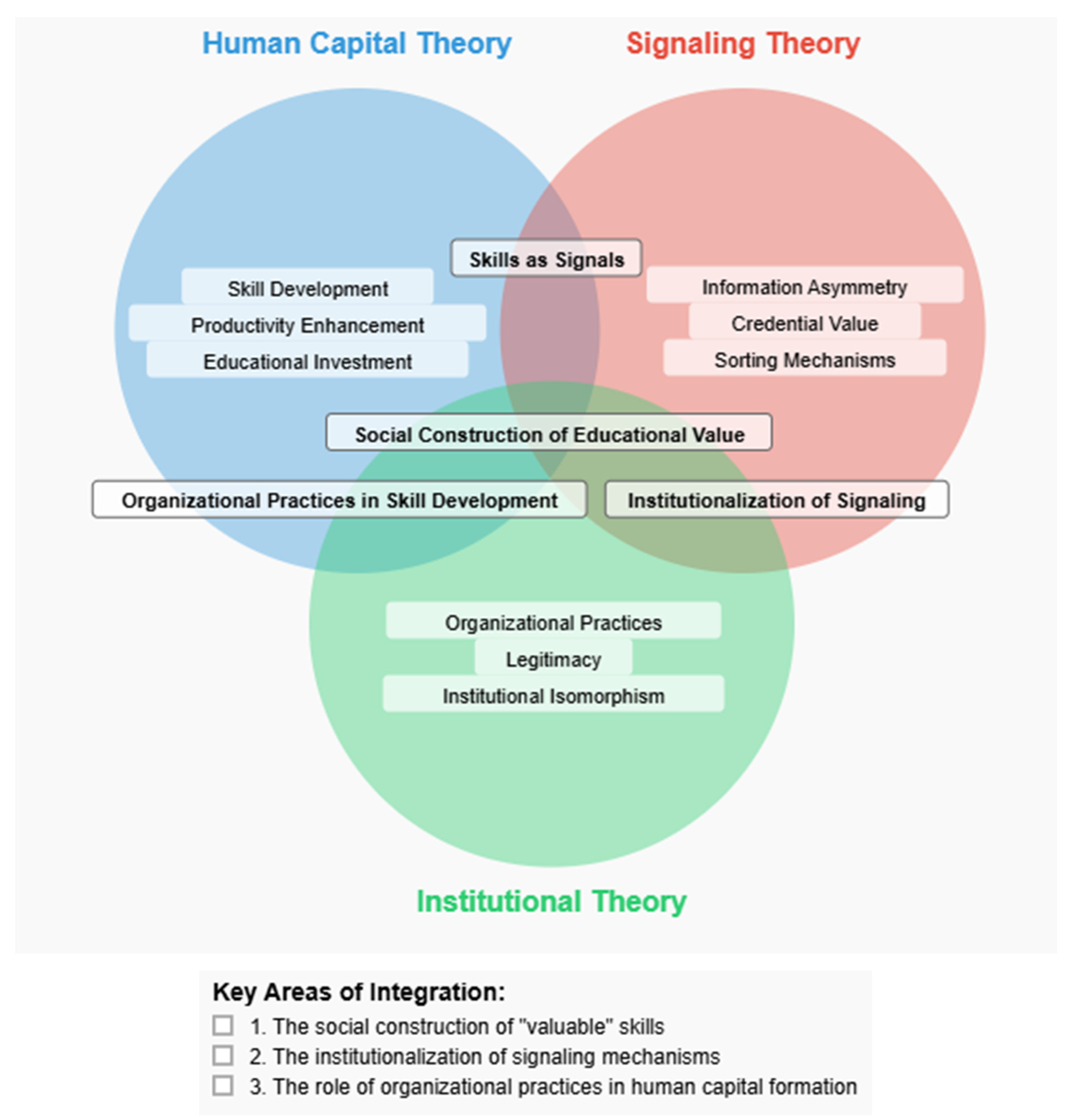
Figure 2.
Sequential Explanatory Mixed-Methods Research Design. Note: Flow chart illustrating the four-phase research design: (1) quantitative data collection through surveys and administrative records; (2) initial quantitative analysis to identify patterns and relationships; (3) qualitative data collection through semi-structured interviews informed by quantitative findings; and (4) integrated analysis combining insights from both methods.
Figure 2.
Sequential Explanatory Mixed-Methods Research Design. Note: Flow chart illustrating the four-phase research design: (1) quantitative data collection through surveys and administrative records; (2) initial quantitative analysis to identify patterns and relationships; (3) qualitative data collection through semi-structured interviews informed by quantitative findings; and (4) integrated analysis combining insights from both methods.
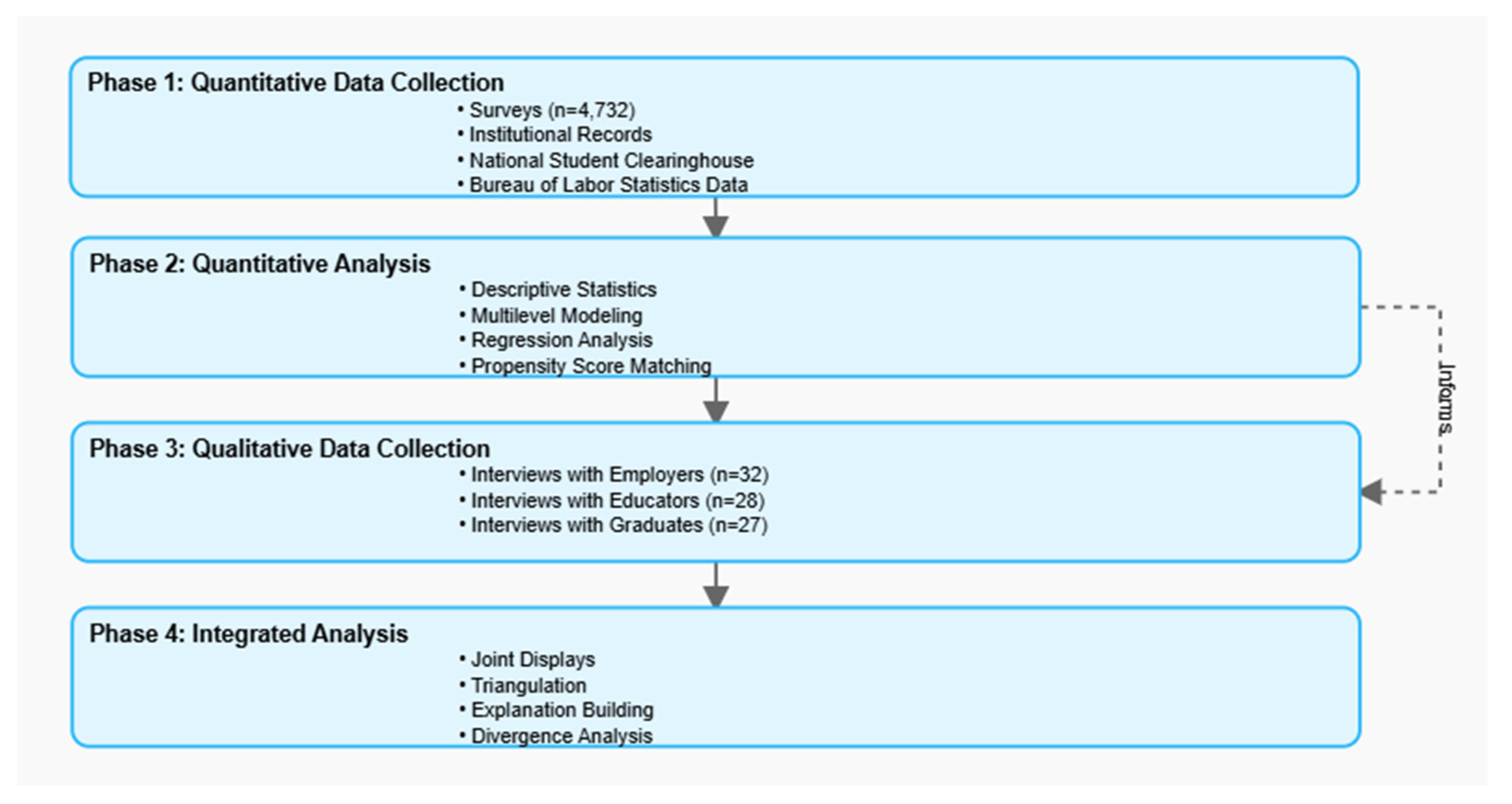
Figure 3.
Integration Process for Mixed-Methods Analysis. Note: Diagram showing the systematic comparison and synthesis of quantitative and qualitative findings, with arrows indicating how findings from each method informed interpretation of the other. The integration process involved creating matrices that juxtaposed quantitative findings with related qualitative themes to develop more comprehensive understandings.
Figure 3.
Integration Process for Mixed-Methods Analysis. Note: Diagram showing the systematic comparison and synthesis of quantitative and qualitative findings, with arrows indicating how findings from each method informed interpretation of the other. The integration process involved creating matrices that juxtaposed quantitative findings with related qualitative themes to develop more comprehensive understandings.
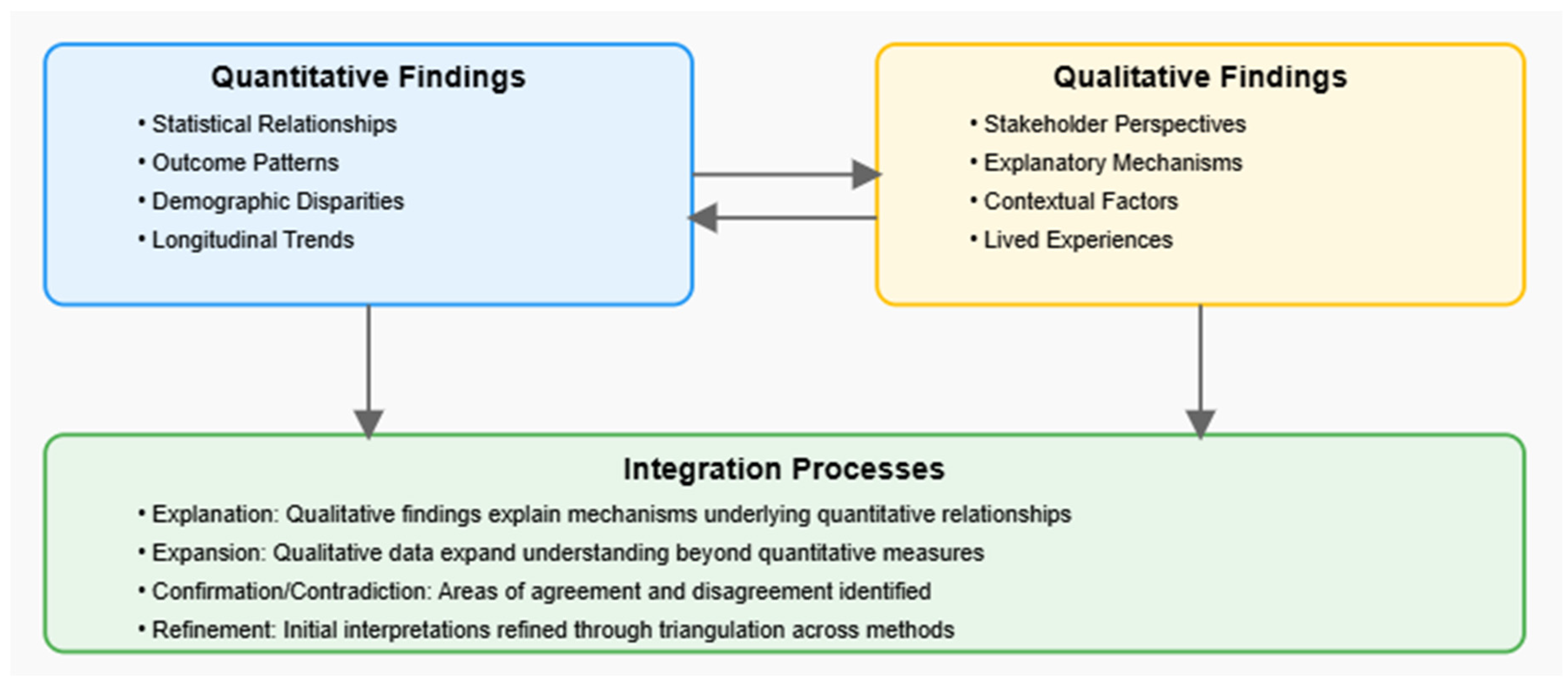
Figure 4.
Annual Salary by Field of Study Over Time (2015-2023). Note: Annual salary trajectories for graduates across different fields of study from 2015-2023, adjusted for inflation. Note the initial advantages of STEM and Business fields and the gradual convergence over time, with particularly accelerated convergence during years 3-5 post-graduation.
Figure 4.
Annual Salary by Field of Study Over Time (2015-2023). Note: Annual salary trajectories for graduates across different fields of study from 2015-2023, adjusted for inflation. Note the initial advantages of STEM and Business fields and the gradual convergence over time, with particularly accelerated convergence during years 3-5 post-graduation.
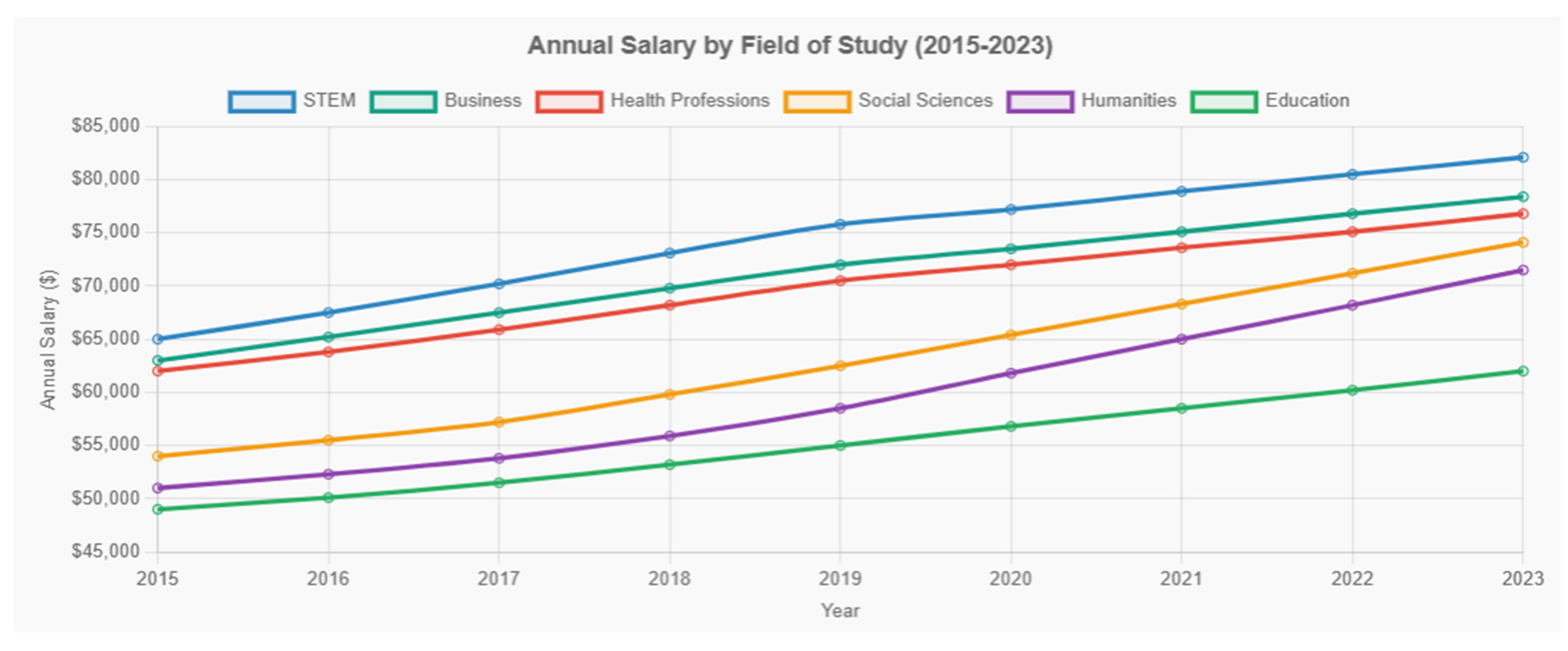
Figure 5.
Thematic Map of Stakeholder Perspectives on Education-Employment Connection. Note: Thematic network illustrating the relationships between the five major themes identified in qualitative analysis, with representative quotes from employers, educators, and graduates. The map shows how these themes interact, with institutional barriers and equity challenges influencing access to applied learning, while technological change creates both challenges and opportunities.
Figure 5.
Thematic Map of Stakeholder Perspectives on Education-Employment Connection. Note: Thematic network illustrating the relationships between the five major themes identified in qualitative analysis, with representative quotes from employers, educators, and graduates. The map shows how these themes interact, with institutional barriers and equity challenges influencing access to applied learning, while technological change creates both challenges and opportunities.
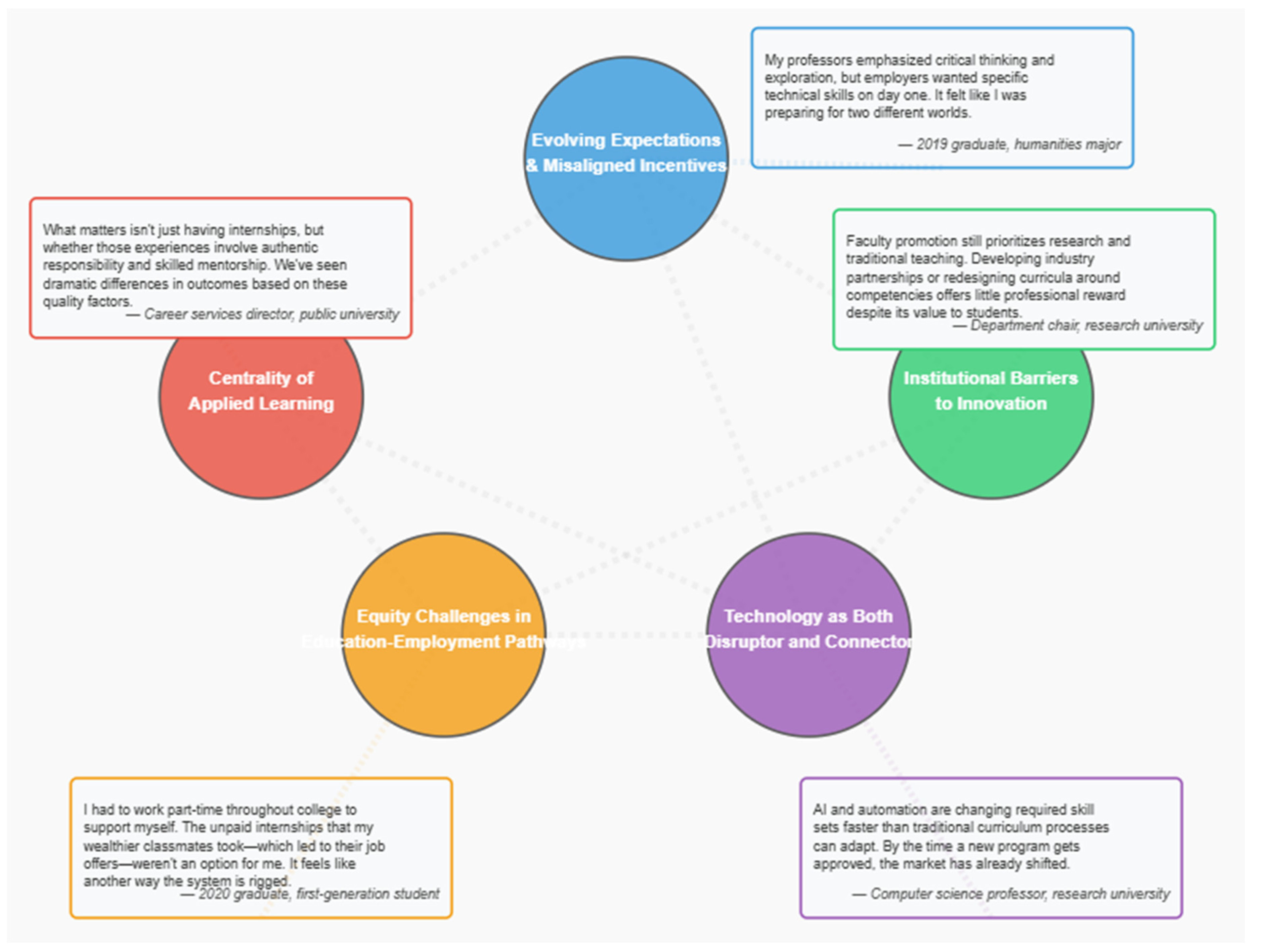
Figure 6.
Conceptual Model of Education-Employment Pathways. Note: Conceptual model illustrating the pathways between educational experiences and employment outcomes, with mediating mechanisms and contextual factors. The model shows how various educational inputs flow through different mediating mechanisms to produce employment outcomes, with feedback loops and contextual factors moderating these relationships.
Figure 6.
Conceptual Model of Education-Employment Pathways. Note: Conceptual model illustrating the pathways between educational experiences and employment outcomes, with mediating mechanisms and contextual factors. The model shows how various educational inputs flow through different mediating mechanisms to produce employment outcomes, with feedback loops and contextual factors moderating these relationships.
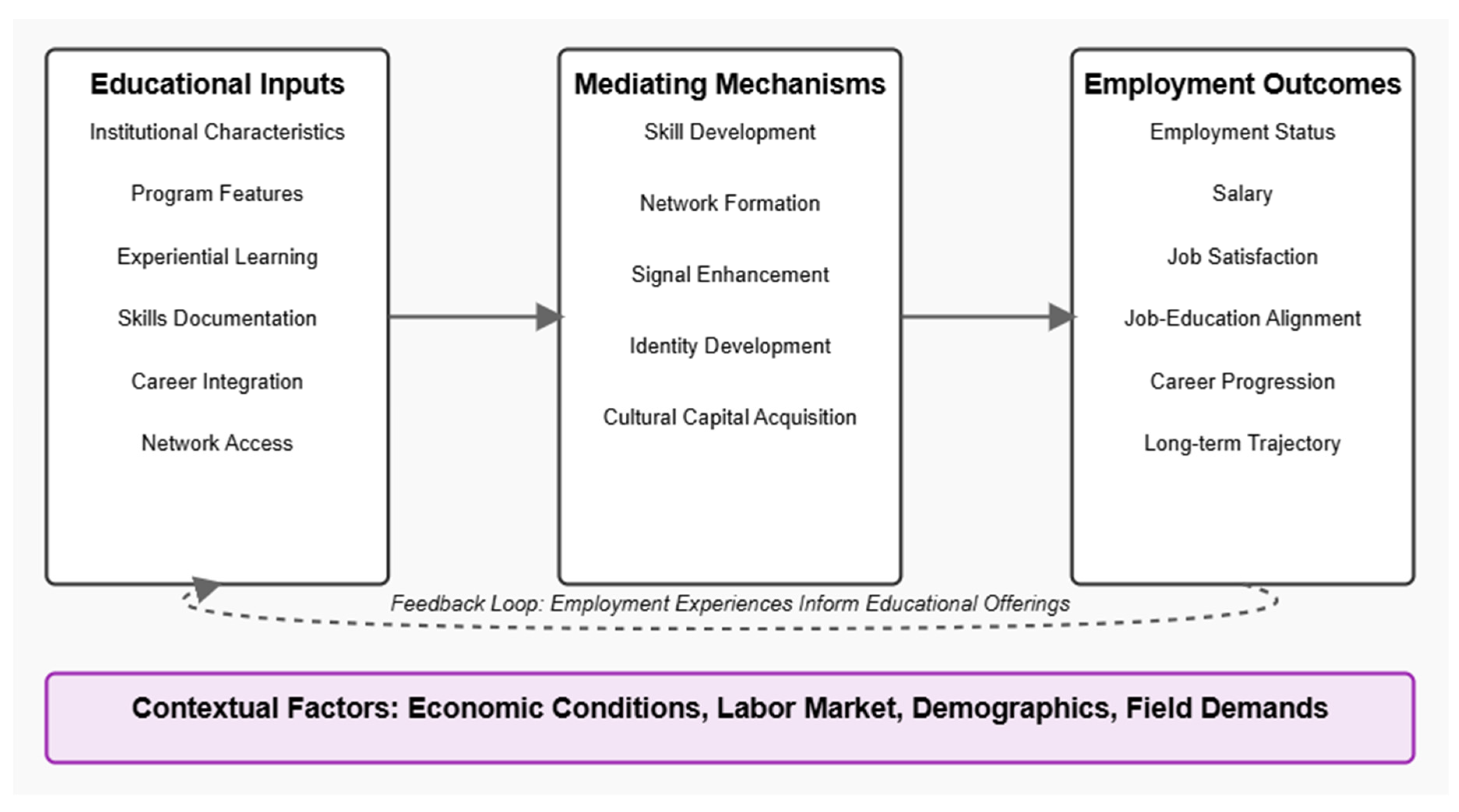
Figure 7.
Changes in Signal Value of Educational Credentials (2015-2023). Note: Shifting relative importance of different credential aspects from 2015-2023, showing the decline in traditional degree signal value (from ~65% to ~40%) and the rise of skills verification (from ~15% to ~30%) and experiential learning (from ~20% to ~30%) as signals of candidate quality.
Figure 7.
Changes in Signal Value of Educational Credentials (2015-2023). Note: Shifting relative importance of different credential aspects from 2015-2023, showing the decline in traditional degree signal value (from ~65% to ~40%) and the rise of skills verification (from ~15% to ~30%) and experiential learning (from ~20% to ~30%) as signals of candidate quality.
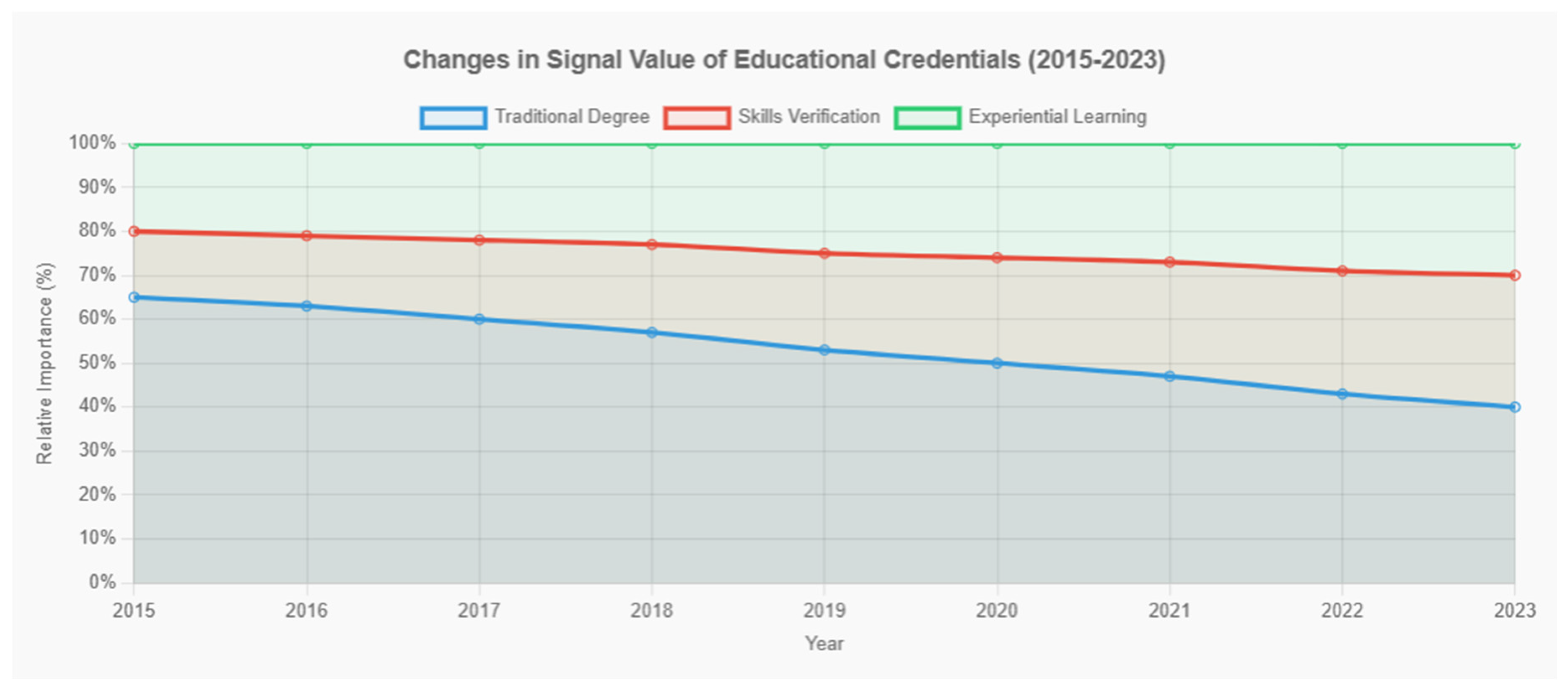
Figure 8.
Relative Importance of Predictors of Employment Outcomes. Note: Percentage of variance in employment outcomes explained by different factors based on dominance analysis. High-quality experiential learning emerges as the strongest predictor, explaining 28% of variance in outcomes, while institutional prestige explains only 7% after controlling for other factors.
Figure 8.
Relative Importance of Predictors of Employment Outcomes. Note: Percentage of variance in employment outcomes explained by different factors based on dominance analysis. High-quality experiential learning emerges as the strongest predictor, explaining 28% of variance in outcomes, while institutional prestige explains only 7% after controlling for other factors.
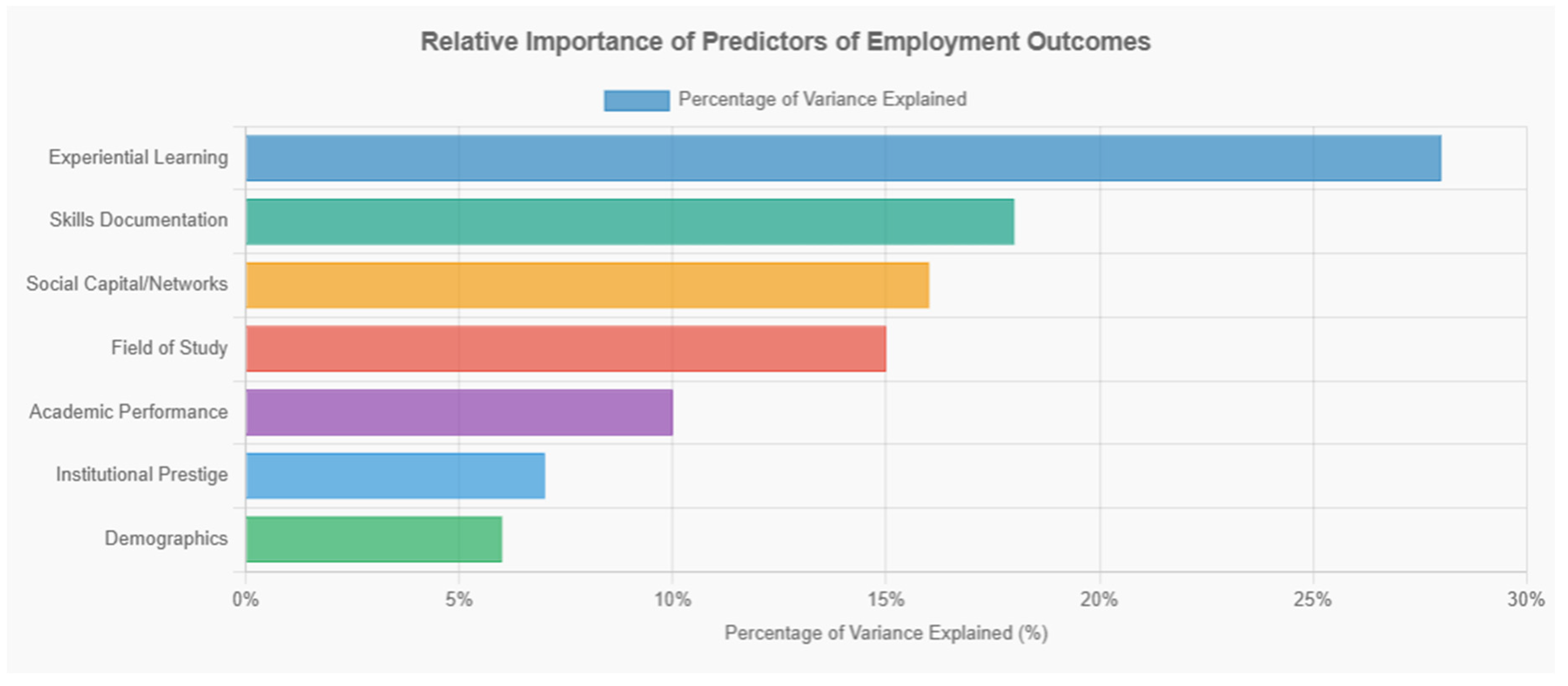

Table 1.
Demographic Characteristics of Quantitative Sample Compared to National Higher Education Demographics.
Table 1.
Demographic Characteristics of Quantitative Sample Compared to National Higher Education Demographics.
| Characteristic | Study Sample (%) | National Population (%) |
| Gender | ||
| Female | 58.4 | 56.2 |
| Male | 41.2 | 43.5 |
| Non-binary/Other | 0.4 | 0.3 |
| Race/Ethnicity | ||
| White | 61.7 | 63.5 |
| Black | 15.3 | 13.4 |
| Hispanic | 14.6 | 15.2 |
| Asian | 6.8 | 6.5 |
| Other/Multiple | 1.6 | 1.4 |
| First-Generation Status | ||
| First-Generation | 33.8 | 32.5 |
| Continuing-Generation | 66.2 | 67.5 |
| Institution Type | ||
| Public Research | 28.6 | 29.3 |
| Public Comprehensive | 26.4 | 25.7 |
| Private Research | 12.5 | 11.8 |
| Private Comprehensive | 14.7 | 15.3 |
| Liberal Arts | 9.8 | 10.2 |
| Community College Transfer | 8.0 | 7.7 |
| Field of Study | ||
| STEM | 24.3 | 23.6 |
| Business | 19.6 | 20.2 |
| Social Sciences | 18.4 | 17.9 |
| Humanities | 14.7 | 15.4 |
| Health Professions | 13.2 | 12.8 |
| Education | 9.8 | 10.1 |
Table 2.
Composition of Qualitative Sample.
| Characteristic | Number | Percentage |
| Employers (n=32) | ||
| Industry Sector | ||
| Technology | 7 | 21.9% |
| Healthcare | 5 | 15.6% |
| Financial Services | 4 | 12.5% |
| Manufacturing | 4 | 12.5% |
| Professional Services | 4 | 12.5% |
| Nonprofit | 3 | 9.4% |
| Retail/Hospitality | 3 | 9.4% |
| Government | 2 | 6.2% |
| Organization Size | ||
| Small (<100 employees) | 10 | 31.3% |
| Medium (100-999) | 12 | 37.5% |
| Large (1000+) | 10 | 31.3% |
| Position Level | ||
| C-Suite/Executive | 6 | 18.8% |
| Senior Management | 8 | 25.0% |
| HR/Talent Acquisition | 14 | 43.8% |
| Line Management | 4 | 12.5% |
| Higher Education Stakeholders (n=28) | ||
| Institution Type | ||
| Research University | 9 | 32.1% |
| Comprehensive University | 8 | 28.6% |
| Liberal Arts College | 6 | 21.4% |
| Community College | 5 | 17.9% |
| Role | ||
| Faculty | 12 | 42.9% |
| Administrator | 8 | 28.6% |
| Career Services | 8 | 28.6% |
| Academic Area | ||
| STEM | 7 | 25.0% |
| Business/Economics | 6 | 21.4% |
| Humanities | 5 | 17.9% |
| Social Sciences | 5 | 17.9% |
| Professional Programs | 5 | 17.9% |
| Recent Graduates (n=27) | ||
| Graduation Year | ||
| 2016-2018 | 12 | 44.4% |
| 2019-2021 | 15 | 55.6% |
| Field of Study | ||
| STEM | 8 | 29.6% |
| Business | 6 | 22.2% |
| Social Sciences | 5 | 18.5% |
| Humanities | 4 | 14.8% |
| Health/Education | 4 | 14.8% |
| Demographics | ||
| Female | 15 | 55.6% |
| Male | 12 | 44.4% |
| White | 14 | 51.9% |
| Black | 5 | 18.5% |
| Hispanic | 5 | 18.5% |
| Asian | 3 | 11.1% |
| First-Generation | 11 | 40.7% |
Table 3.
Employment Outcomes by Field of Study, Institution Type, and Demographics (5 Years Post-Graduation).
Table 3.
Employment Outcomes by Field of Study, Institution Type, and Demographics (5 Years Post-Graduation).
| Category | Annual Salary ($) | Employment Rate (%) | Job Satisfaction (1-5) | Job-Education Alignment (1-5) | Career Progression Index |
| Field of Study | |||||
| STEM | 82,100 | 94.8 | 3.9 | 4.2 | 0.83 |
| Business | 78,400 | 93.5 | 3.8 | 4.0 | 0.78 |
| Health Professions | 76,800 | 96.2 | 4.1 | 4.5 | 0.75 |
| Social Sciences | 74,100 | 91.6 | 3.7 | 3.5 | 0.72 |
| Humanities | 71,500 | 90.3 | 3.8 | 3.3 | 0.68 |
| Education | 62,000 | 94.5 | 4.0 | 4.4 | 0.65 |
| Institution Type | |||||
| Highly Selective Private | 86,300 | 95.2 | 4.0 | 4.0 | 0.87 |
| Highly Selective Public | 81,700 | 94.8 | 3.9 | 3.9 | 0.83 |
| Moderately Selective Private | 77,200 | 93.5 | 3.8 | 3.8 | 0.76 |
| Moderately Selective Public | 73,500 | 92.1 | 3.7 | 3.7 | 0.73 |
| Less Selective Private | 68,400 | 90.8 | 3.6 | 3.6 | 0.68 |
| Less Selective Public | 65,700 | 89.5 | 3.5 | 3.5 | 0.65 |
| Gender | |||||
| Male | 79,600 | 93.2 | 3.8 | 3.9 | 0.78 |
| Female | 70,100 | 92.8 | 3.8 | 3.8 | 0.73 |
| Non-binary/Other | 72,400 | 91.5 | 3.7 | 3.7 | 0.71 |
| Race/Ethnicity | |||||
| White | 77,500 | 93.6 | 3.9 | 3.9 | 0.77 |
| Asian | 79,800 | 94.2 | 3.8 | 4.0 | 0.79 |
| Hispanic | 69,000 | 91.8 | 3.7 | 3.7 | 0.71 |
| Black | 66,700 | 90.3 | 3.6 | 3.6 | 0.68 |
| Other/Multiple | 71,300 | 92.1 | 3.7 | 3.7 | 0.73 |
| First-Generation Status | |||||
| First-Generation | 68,900 | 91.3 | 3.7 | 3.7 | 0.69 |
| Continuing-Generation | 78,300 | 93.7 | 3.9 | 3.9 | 0.79 |
| High-Impact Experiences | |||||
| High-Quality Internship | 82,600 | 95.3 | 4.2 | 4.3 | 0.84 |
| Any Internship | 75,800 | 93.4 | 3.9 | 3.9 | 0.76 |
| No Internship | 68,300 | 89.2 | 3.4 | 3.3 | 0.65 |
| Strong Skills Documentation | 79,400 | 94.5 | 4.0 | 4.2 | 0.80 |
| Limited Skills Documentation | 70,600 | 91.2 | 3.6 | 3.4 | 0.70 |
Note: All values adjusted for regional cost of living differences. Job-Education Alignment measured on a 5-point scale where 5 represents perfect alignment. Career Progression Index combines measures of promotion rate, responsibility increases, and skill utilization.
Table 4.
Regression Results - Predictors of Employment Outcomes (5 Years Post-Graduation).
| Predictor | Annual Salary | Job Satisfaction | Job-Education Alignment | Career Progression | ||||
|---|---|---|---|---|---|---|---|---|
| β | B | β | B | β | B | β | B | |
| Demographic Characteristics | ||||||||
| Female (vs. Male) | -0.09*** | -7,462*** | 0.02 | 0.04 | -0.01 | -0.02 | -0.06** | -0.11** |
| Black (vs. White) | -0.07** | -5,793** | -0.04* | -0.08* | -0.03 | -0.06 | -0.05* | -0.09* |
| Hispanic (vs. White) | -0.06** | -4,965** | -0.03 | -0.06 | -0.02 | -0.04 | -0.04* | -0.07* |
| Asian (vs. White) | 0.04* | 3,312* | -0.02 | -0.04 | 0.03 | 0.06 | 0.03 | 0.05 |
| First-Generation Status | -0.08*** | -6,618*** | -0.04* | -0.08* | -0.03 | -0.06 | -0.06** | -0.11** |
| Socioeconomic Status (z-score) | 0.09*** | 7,442*** | 0.05* | 0.10* | 0.04* | 0.08* | 0.07** | 0.13** |
| Institutional Characteristics | ||||||||
| Institutional Selectivity | 0.07** | 5,793** | 0.04* | 0.08* | 0.05* | 0.10* | 0.06** | 0.11** |
| Private Institution (vs. Public) | 0.03 | 2,484 | 0.02 | 0.04 | 0.02 | 0.04 | 0.03 | 0.05 |
| Institution Size (1000s) | 0.01 | 828 | -0.01 | -0.02 | 0.01 | 0.02 | 0.00 | 0.00 |
| Academic Performance | ||||||||
| Cumulative GPA | 0.10*** | 8,270*** | 0.07** | 0.14** | 0.09*** | 0.18*** | 0.08*** | 0.15*** |
| Honors Distinction | 0.05* | 4,135* | 0.03 | 0.06 | 0.04* | 0.08* | 0.04* | 0.07* |
| Educational Experiences | ||||||||
| High-Quality Internship | 0.24*** | 19,848*** | 0.25*** | 0.50*** | 0.28*** | 0.56*** | 0.26*** | 0.47*** |
| Basic Internship | 0.08** | 6,616** | 0.09*** | 0.18*** | 0.12*** | 0.24*** | 0.09*** | 0.16*** |
| Skills Documentation | 0.18*** | 14,886*** | 0.14*** | 0.28*** | 0.23*** | 0.46*** | 0.16*** | 0.29*** |
| Career-Integrated Curriculum | 0.16*** | 13,232*** | 0.21*** | 0.42*** | 0.19*** | 0.38*** | 0.18*** | 0.32*** |
| Professional Network Development | 0.19*** | 15,713*** | 0.16*** | 0.32*** | 0.15*** | 0.30*** | 0.20*** | 0.36*** |
| Interaction Terms | ||||||||
| High-Quality Internship × First-Gen | 0.14** | 11,578** | 0.12** | 0.24** | 0.13** | 0.26** | 0.15** | 0.27** |
| High-Quality Internship × URM | 0.16** | 13,232** | 0.13** | 0.26** | 0.14** | 0.28** | 0.17** | 0.31** |
| Network Access × First-Gen | 0.12** | 9,924** | 0.10* | 0.20* | 0.09* | 0.18* | 0.13** | 0.23** |
| Race × SES | 0.09** | 7,443** | 0.07* | 0.14* | 0.08* | 0.16* | 0.10** | 0.18** |
| Model Statistics | ||||||||
| R2 | 0.42 | 0.38 | 0.35 | 0.40 | ||||
| Adjusted R2 | 0.40 | 0.36 | 0.33 | 0.38 | ||||
| F-statistic | 28.76*** | 24.31*** | 21.43*** | 26.52*** | ||||
Note: β = standardized coefficients; B = unstandardized coefficients. For salary, B represents dollar amounts. For job satisfaction and job-education alignment, B represents points on a 5-point scale. For Career Progression Index, B represents standard deviation units. URM = Underrepresented Minority (Black, Hispanic, or Native American). Control variables for field of study, geographic region, and graduation year included in models but not shown. *p < .05, **p < .01, ***p < .001.
Disclaimer/Publisher’s Note: The statements, opinions and data contained in all publications are solely those of the individual author(s) and contributor(s) and not of MDPI and/or the editor(s). MDPI and/or the editor(s) disclaim responsibility for any injury to people or property resulting from any ideas, methods, instructions or products referred to in the content. |
© 2025 by the authors. Licensee MDPI, Basel, Switzerland. This article is an open access article distributed under the terms and conditions of the Creative Commons Attribution (CC BY) license (http://creativecommons.org/licenses/by/4.0/).
Copyright: This open access article is published under a Creative Commons CC BY 4.0 license, which permit the free download, distribution, and reuse, provided that the author and preprint are cited in any reuse.


