

Submitted:
19 June 2025
Posted:
23 June 2025
You are already at the latest version
Abstract
The following article explores the phenomenon of urban sprawl in the peripheries, specifically analyzing the case of the city of Querétaro, Mexico. The research focuses on new gated communities, approaching them from a social urban approach, examining the impact of these real estate market models on community cohesion, access to services and sustainability. The aim is to understand and analyze how their design contributes to different urban problems, mainly in terms of socio-spatial segregation. It also seeks to provide urban design strategies focused on mitigating the problem, with the objective of promoting a more equitable and sustainable city.
Keywords:
social segregation
; urban sprawl
; sustainability
; urban development
; peripheries
; social integration
Introduction
The periphery, a term previously coined by many as a symbol of poverty and marginalization, or rather, by some authors as the “dwelling place of the poor” (Hiernaux & Lindón, 2004), could be having a reinterpretation in our times. In Querétaro, the phenomenon was transformed and something contrary happened with the conquest of a real estate market that targeted a different population sector, with a better economic position. This change transformed what was previously an issue of exclusion into one of exclusivity, a phenomenon similar to that described by Borja and Castells (n.d.), who argue that modern urban development reflects the globalized economy by fostering exclusive and segregated spaces.
In recent years the city has experienced a growth towards what once could be called the periphery, redrawing its configuration through the conformation of new “small cities”, also called by Mario Pani as “satellite cities” (Duhau, 2001) and described by other authors as “dispersed urbanization” (Ferrás Sexto, 2000), which seem to house the indispensable for the lives of its inhabitants, enclosing them in a bubble of comfort, a symbol that for many might seem to provide them with power and status.
Although the issue is not something new for the city, since, like many cities around the world, it already had its own division by sectors, which distribute the population in different concentrations according to their economic and social position, which could be called segregation, i.e. an “unequal spatial distribution in the city of different social groups” (La división social del espacio metropolitano. A proposal for analysis, 2013).
It is interesting to analyze the case of the particular area of Zákia, Zibatá and El Refugio, because given their geographic location, positioned in one of the higher parts and far from the heart of the city, they send a certain message of isolation. In terms of urban mobility is clear, because it is not so easy to access since its design seems to be focused on transportation by means of vehicles, which is usually considered as an object of privileged acquisition, since not many can afford to have a private car, leaving aside more accessible means of transportation such as public transport or on foot.
At first this could be considered as an evolution for the development of Queretaro, due to its improvements in infrastructure, technology and economy, however, seen from the urban point of view, it has also brought with it a series of social challenges, where the city, instead of fostering a sense of community among its inhabitants promotes social fragmentation.
Architectural Configuration
Subdivisions, being an integral part of urban planning and recognized by building regulations and urban codes as urban works, have a significant impact on the structure of the city and its population. Although this often seems to go unnoticed by the inhabitants, its effects transcend beyond an environmental issue, influencing people's education and culture. Especially the materialism that reinforces dynamics of classism and social exclusion.
Despite the problem, the design of these developments continues to promote lines of separation between the different neighborhoods, through walls and barriers, which not only deepen the problem towards the outskirts of these, but also in its interior, generating divisions that negatively affect the social integration of condominium owners and security since they reduce the “natural watchmen in the street” (Jacobs, 1961).
On the other hand, we face the phenomenon of globalization, where housing is reduced to an imposition of standardized models, designed under criteria of serial construction and economic efficiency, leaving aside the specific needs of the people who inhabit them. As Zapata (2023) points out, contributing significantly to the loss of architectural and cultural identity. The lack of identity in housing can be a factor that influences the weakening of social ties and community building, intensifying problems of disconnection between neighbors and individualism.
Current Challenges
The acquisition of housing is facing increasing difficulties due to the rise in real estate prices. This situation not only widens the social gap, since it is the privileged sectors who have more possibilities of acquiring a home, which is why the markets are focusing more on investment in exclusive developments, based on the fact that not everyone can live in these developments, limiting the possibilities of acquiring a home of their own.
INEGI's National Housing Survey (ENVI) 2020 reveals that 15% of Mexican households spend more than 30% of their income on housing payments. The survey also provides data on the percentage of homes inhabited mainly for rental purposes, according to which in Querétaro 41% of the population lives in this type of housing due to a lack of resources or access to credit (INEGI, 2020). This scenario reflects the need for public policies that promote equitable access to decent and affordable housing, with the main purpose of improving the quality of life of the population and reducing social inequality.
Another consequence of growth, which is undoubtedly a matter for reflection, is the current climate situation. Authors such as Lezama and Domínguez (2006) mention that cities are the opposite of sustainability. It is not only the issue of land occupation that is of concern in this regard, but also the issue of mobility and transportation, since being in remote areas of the city, people have to move around by less friendly means such as automobiles.
The Course of Time: Factors of Change
From a photographic analysis, we will observe how the new weft and fabric (Rossi, 1966) of the city is being shaped with the construction of these developments, determining relevant architectural and urban elements of the area, highlighting patterns that suggest a contrast.
According to aerial photographs obtained from Google Earth we can see the transformation of the urban stain at the beginning of 2011 [Figure 1], which begins with the planning of the developments to be studied, in the case of Zibatá we can notice how this seems to be the first to begin with the spatial delimitation, which is reflected in the preparation of the land. Another noteworthy point is the lack of completion of the road known as the Fray Junipero Serra Ring Road which is currently the main access route connecting the city with this sector, whose work began in 2007 according to data found in the Skyscraper City Forum, however, in Figure 2 we can see a great contrast, since despite being a photograph with few years of difference there is a notable difference in progress, where it seems that as these subdivisions were consolidated the construction of the road was rushed.
Undoubtedly the creation of this road represented an impulse for the establishment of new housing, since its construction implied a connection of the city with other points.
It is important to analyze how the development of La Pradera and El Refugio [Figure 2] occurred simultaneously, despite the fact that they present a marked contrast in both technical aspects and socioeconomic levels. This phenomenon reflects tensions in the search for social union and the persistence of socio-spatial segregation. Research on this type of social mixtures, highlights that, although there is geographic proximity, interactions between socioeconomic groups are limited, giving rise to what some call “communities of strangers” (Vergara Erices, 2019).
Although neighborhoods such as La Pradera are often seen as places of lesser value, their urban relevance lies in the networks of interaction and social cohesion that develop here. Demonstrating that barrier-free neighborhoods promote among their inhabitants relationships of trust, mutual support and a sense of belonging.
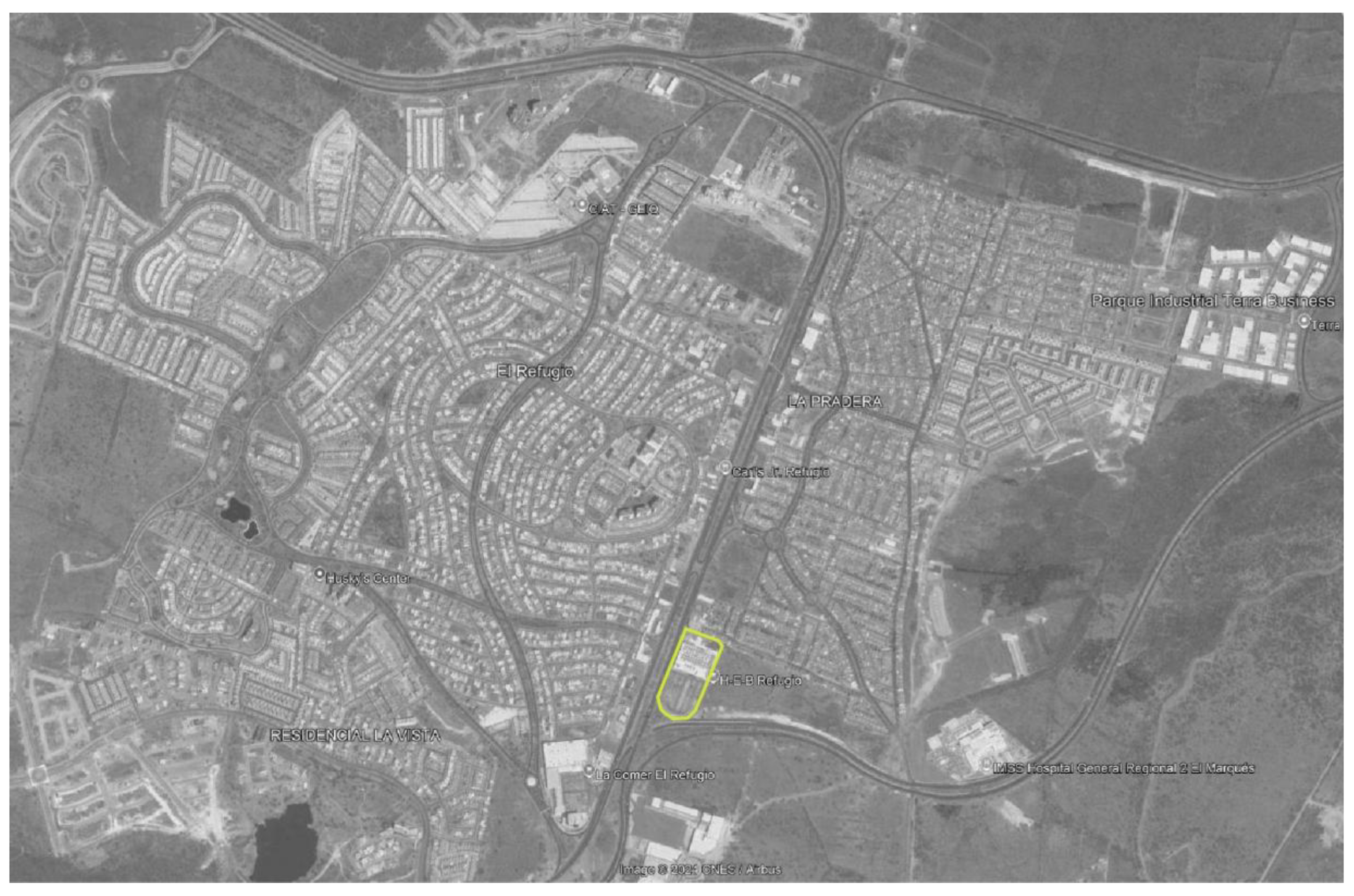
In addition, due to its constant growth, we noticed the arrival of commercial markets [Figure 3 and Figure 4] that not only complemented the area, but also increased its added value, reinforcing the socioeconomic segmentation of the city. A clear example is the construction of the Paseo Querétaro shopping mall and other international chains such as H.E.B., strategically designed for the public in the area, who have high purchasing power.
The location also plays a fundamental role when studying these spaces since they were positioned in areas that, as already mentioned, have limited access, where the lack of public transportation limits the arrival of different sectors of the population, fostering the perception that certain urban spaces are not intended for everyone. Likewise, their existence reinforces consumption patterns and lifestyles that accentuate social disparity.
This is also noticeable in the architecture of these residential developments, which prioritizes aesthetics and formal uniformity. Achieving an apparent order and harmony through repetition. However, this homogeneity not only has social and urban implications, but also contributes to the loss of identity in the built environment. The standardization of housing reinforces generic architectural models that do not respect the particular needs of the inhabitants, leading to an architecture disconnected from the urban and cultural context.
Figure 5.
Housing in La Pradera. Source: Propiedades.com.
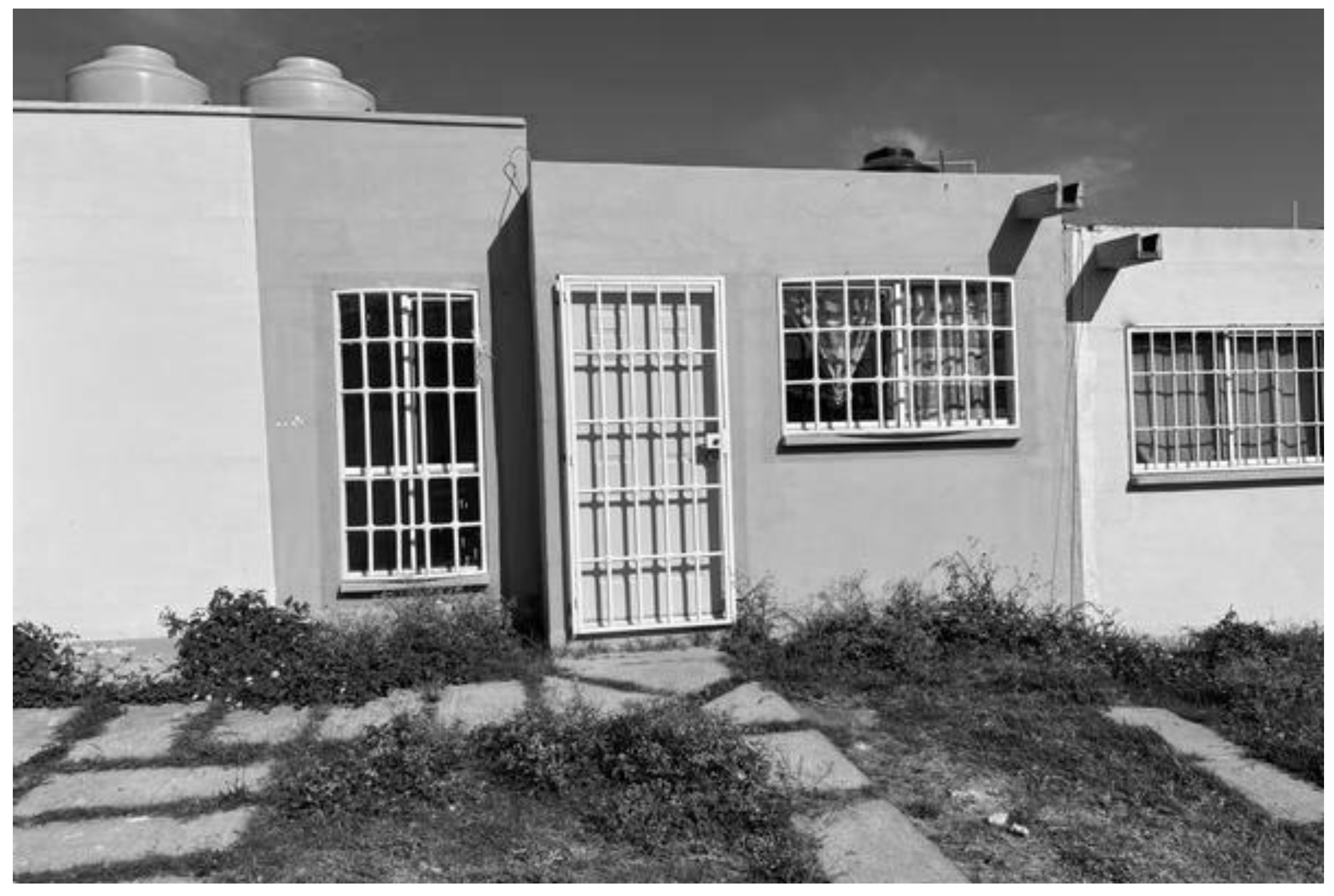
Figure 6.
Housing in Zibatá. Source: Propiedades. com.
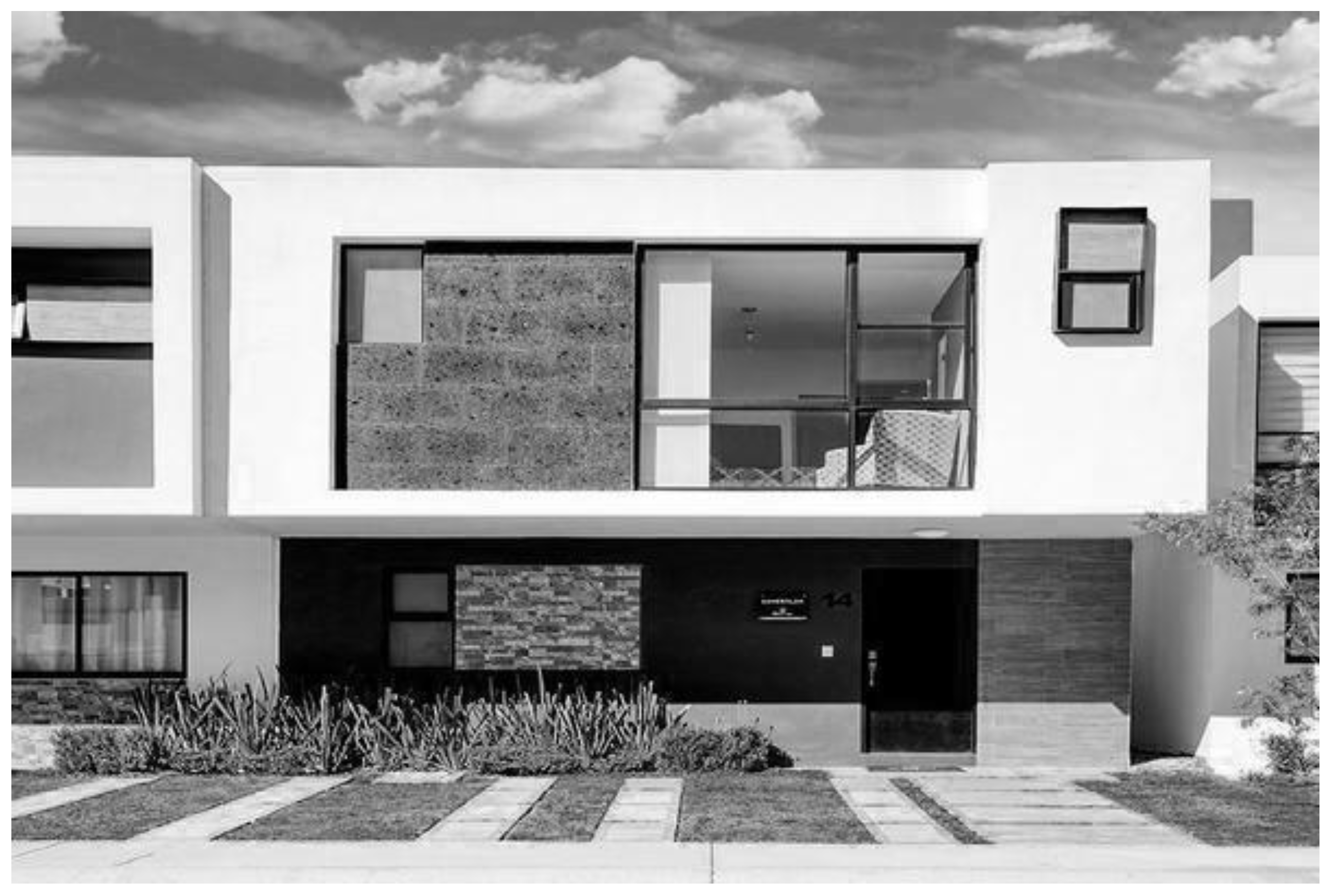
From the very dimensions of the living spaces, it can be observed that low-income housing perpetuates inequalities. Whereas, in medium-high- and high-level developments, such as those examined, spaciousness and recreation are privileged, in contrast to low-income housing, which limits the quality of life and restricts certain activities. This not only affects the dignity of the residents but is also evidence of how housing policies have failed to promote an equitable city where everyone has access to adequate housing.
The Recovery of the City
Faced with the challenge of this type of development models, it is imperative to design and promote urban-architectural strategies that promote social and urban balance, in order to create a city for all.
One of the actions to counter isolation and individualism are urban parks that can act as bridges between communities, where different groups can interact. Designed under sustainability criteria, these spaces can include green areas that conserve biodiversity, encourage rainwater harvesting and reduce heat islands. At the same time, they should be functional, accessible, flexible and attractive for different activities.
Segregation is also reinforced by urban design that favors car use and creates significant distances to access certain parts of the city. In a recent keynote speech entitled “The 15-minute City, Ville du Quart d'heure” as part of the UN HABITAT congress held in Querétaro, Carlos Moreno addressed the issue of urban sprawl by mentioning that the solution is not to build outside the city because we break the relationship of proximity with others.
His proposal to create compact cities highlights the importance of maintaining human and functional connections, where basic needs are within walking distance, thus preventing distance and isolation from becoming barriers to integration, while contributing to a more sustainable urbanism.
A compact design, therefore, invites citizens to move around by basic means that prioritize the pedestrian and facilitate access to public transport and bicycles, allowing them to get to know their surroundings and the people who live there better, while promoting the creation of community ties, which also translates into safer environments where human presence in the streets is key as it brings vitality to the space.
In segregated environments, loss of identity is a recurring problem. Gated condominiums tend to isolate themselves from the urban character that defines the city, limiting expressions of community identity. One of the most important manifestations, but sometimes perceived as a negative phenomenon, is urban art which can play a crucial role in community building, in public spaces it can contribute to reactivate street life and build cultural bridges between diverse communities. These interventions are a reminder that streets are shared and vibrant spaces.
Condominium design can evolve towards models that promote greater openness and connection, including, for example, the integration of architectural elements that reduce the perception of isolation, through permeable designs that allow visual connection with the exterior, through context-sensitive architecture.
By promoting sustainability, interaction and diversity, it is possible to build cities where all inhabitants perceive themselves as part of the city, overcoming the limitations imposed by current segregationist models.
Conclusion
Although gated communities represent a consolidated reality, their urban impact goes beyond the physical limits that delimit them. Although internally they may seem to function well as “isolated cities”, as discussed throughout the text, their existence reinforces a segregation that fragments the urban and social fabric. This fact should be taken as a matter of reflection for architects, urban planners and developers about their responsibility in the construction of inclusive environments.
Architecture has an enormous potential to unite, as Aldo Rossi mentioned, the city is the stage of life and each building, regardless of its size, is part of the scenography where the stories of the inhabitants are born and intertwine. This integrating value of architecture should be taken as an inspiration to design cities without barriers, where we are all actors and spectators of a diversity that enriches the urban environment.
Continuing to opt for models such as closed condominiums is nothing more than a reflection of the individualism of our contemporary society. This tendency contradicts one of the fundamental purposes of the city: to be a space where interactions that give diversity are generated. When barriers isolate us, we limit the birth of new human connections.
It is also important to understand that, although physical barriers promise security, they do not necessarily guarantee it. Urban planners such as Jane Jacobs in her work “In Defense of the Big City” (1961) emphasized that true safety is found in urban vitality: the transit of people, social interaction and activity in the streets, which can range from commerce to recreation.
In conclusion, a design in tune with its surroundings has the potential to break down barriers, unite communities and generate safer and more inclusive cities.
References
- Borja, J., & Castells, M. (s.f.). LOCAL Y GLOBAL: LA GESTIÓN DE LAS CIUDADES EN LA ERA DE LA INFORMACIÓN. Obtenido de https://arielsheen.com/wp-content/uploads/2019/08/7.-Lectura-6-LOCAL-Y-GLOBAL-LA-GESTI%C3%93N-DE-LAS-CIUDADES.pdf.
- Duhau, E. (2001). La megaciudad en el siglo XXI. De la modernidad inconclusa a la crisis del espacio público. Obtenido de https://www.scielo.org.mx/scielo.php?script=sci_arttext&pid=S1405-74252001000400006.
- Enríquez Acosta, J. (2007). Ciudad de muros. Socialización y tipología de las urbanizaciones cerradas en Tijuana. Obtenido de https://www.scielo.org.mx/scielo.php?pid=s0187-73722007000200005&script=sci_arttext.
- Ferrás Sexto, C. (2000). Ciudad dispersa, aldea virtual y revolucón tecnnólogica. Reflexión acerca de sus relaciones y significados social. Obtenido de https://www.ub.edu/geocrit/sn-69-68.htm.
- Flores, D. (2024). Zonas de estudio de la transformación urbana [Imagen modificada]. Imagen original de Google. Google Earth Pro (2008). Google Earth Pro.
- Flores, D. (2024). Nuevas vialidades [Imagen modificada]. Imagen original de Google. Google Earth Pro (2011). Google Earth Pro.
- Flores, D. (2024). Llegada de mercados [Imagen modificada]. Imagen original de Google. Google Earth Pro (2019). Google Earth Pro.
- Flores, D. (2024). Empresas internacionales [Imagen modificada]. Imagen original de Google. Google Earth Pro (2019). Google Earth Pro.
- Hernández Sampieri, R., Fernández Collado, C., & Baptista Lucio, M. (1998). Metodología de la investigación (5ª edición ed.). The McGraw-Hill Companies. Obtenido de https://www.smujerescoahuila.gob.mx/wp-content/uploads/2020/05/Sampieri.Met.Inv.pdf.
- Hiernaux , D., & Lindón, A. (2004). La periferia: voz y sentido. Obtenido de http://www.scielo.org.mx/scielo.php?script=sci_arttext&pid=S1405-74252004000400005&lng=es&tlng=es.
- INEGI . (2020). Encuesta Nacional de Vivienda (2020). Obtenido de https://www.inegi.org.mx/contenidos/programas/envi/2020/doc/envi_2020_presentacion.pdf.
- Jacobs, J. (1961). Muerte y vida de las grandes ciudades. Capitán Swing Libros.
- La división social del espacio metropolitano. Una propuesta de análisis. (2013). Nueva Sociedad. Obtenido de https://nuso.org/articulo/la-division-social-del-espacio-metropolitano-una-propuesta-de-analisis/.
- Lezama, J., & Domínguez, J. (2006). Medio ambiente y sustentabilidad urbana. Obtenido de https://www.scielosp.org/article/csp/2023.v39n5/e00149822/.
- Moreno, Carlos. (2024, 08 octubre). The 15-minute City, Ville du Quart d´heure [Conferencia Magistral]. Más Allá de la Agenda 2030, Querétaro, México. (s.f.).
- Propiedades.com (s.f.). Casa en renta Paseo Pradera 5, La Pradera, Querétaro [Imagen]. Propiedades.com https://propiedades.com/inmuebles/casa-en-renta-paseo-pradera-5-la-pradera-queretaro-26370554.
- Propiedades.com (s.f.). Casa en venta en Zibatá, Zibatá, Querétaro [Imagen]. Propiedades.com https://propiedades.com/inmuebles/casa-en-venta-zibata-zibata-queretaro-23364370.
- Rossi, A. (1966). La arquitectura de la ciudad (2015 ed.). Gustavo Gili.
- Vergara Erices, L. (2019). Mixtura y cohesión social de barrio: una aproximación socio-espacial a las nuevas políticas de vivienda de Latinoamérica. Obtenido de https://www.scielo.org.mx/scielo.php?script=sci_arttext&pid=S1870-00632019000200275.
- Zapata, C. (2023). Tipologías arquitectónicas y pérdida de la identidadarquitectonica en las viviendas tradicionales de la época colonial del distrito de Zaña. Obtenido de https://tesis.usat.edu.pe/handle/20.500.12423/6998.
Figure 1.
Urban transformation study areas. Source: Google Earth Pro (2008), own intervention.
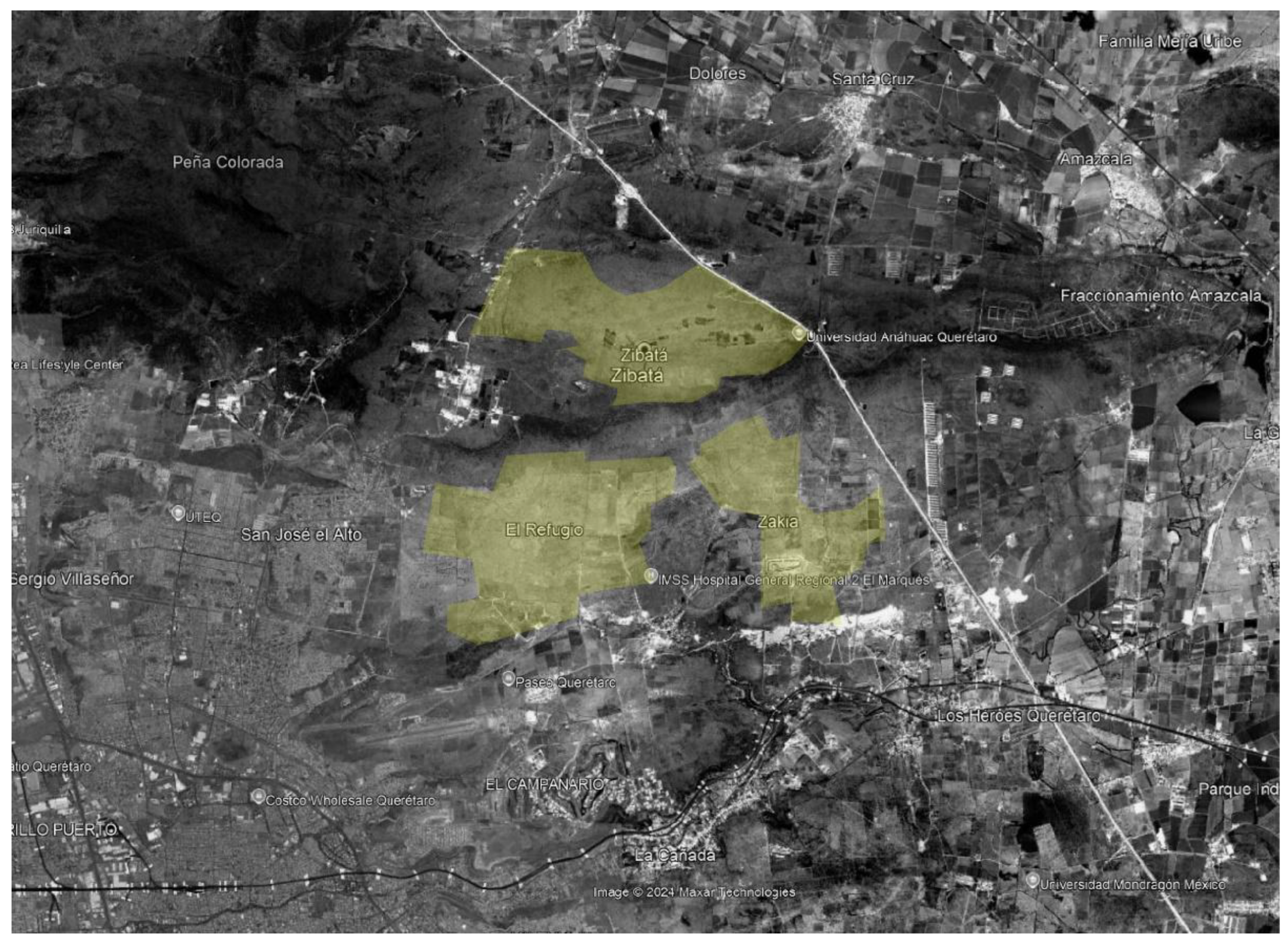
Figure 2.
New roads. Source: Google Earth Pro (2011), own intervention.
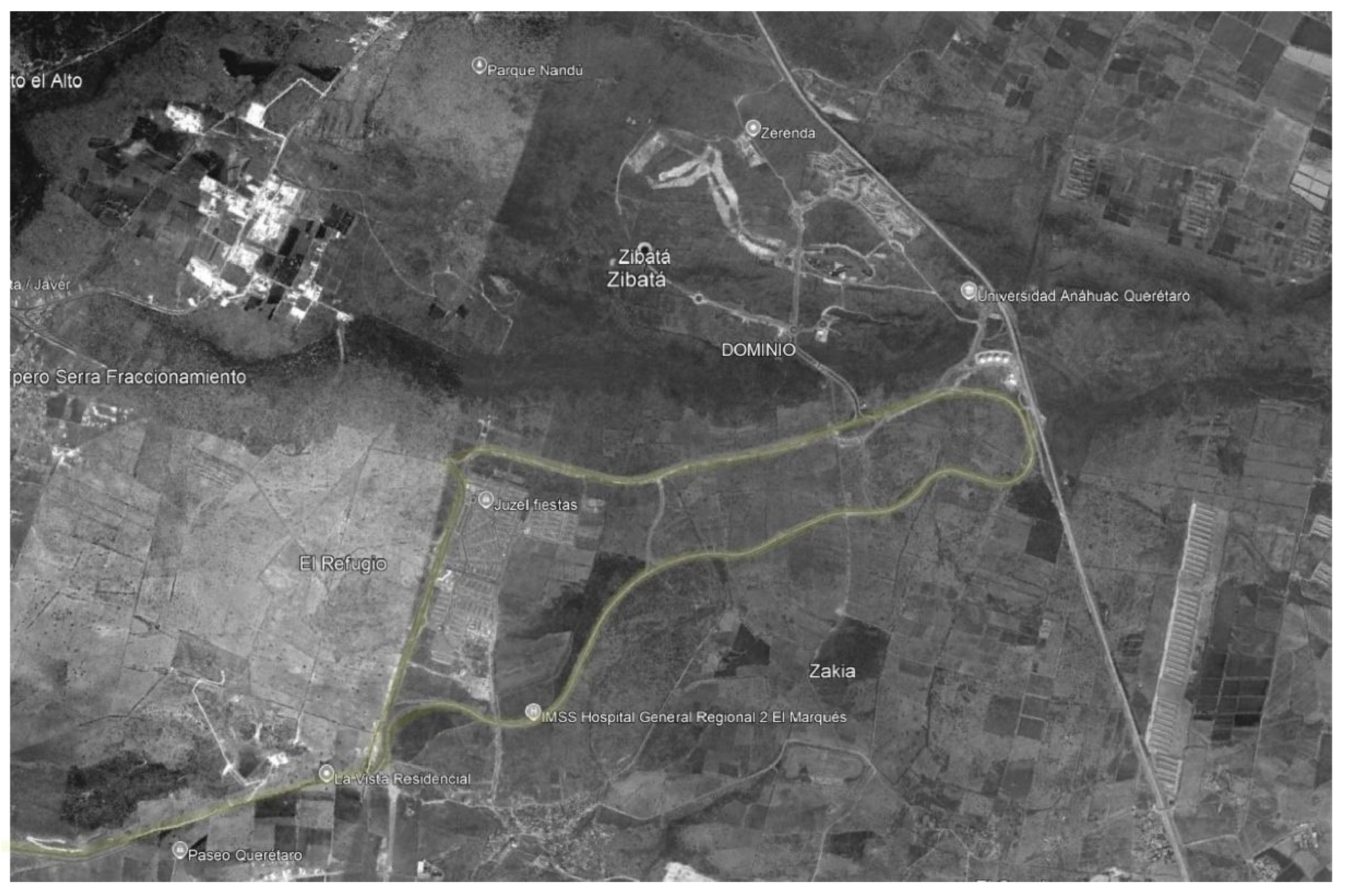
Figure 3.
Arrival of markets. Source: Google Earth Pro (2019), own intervention.
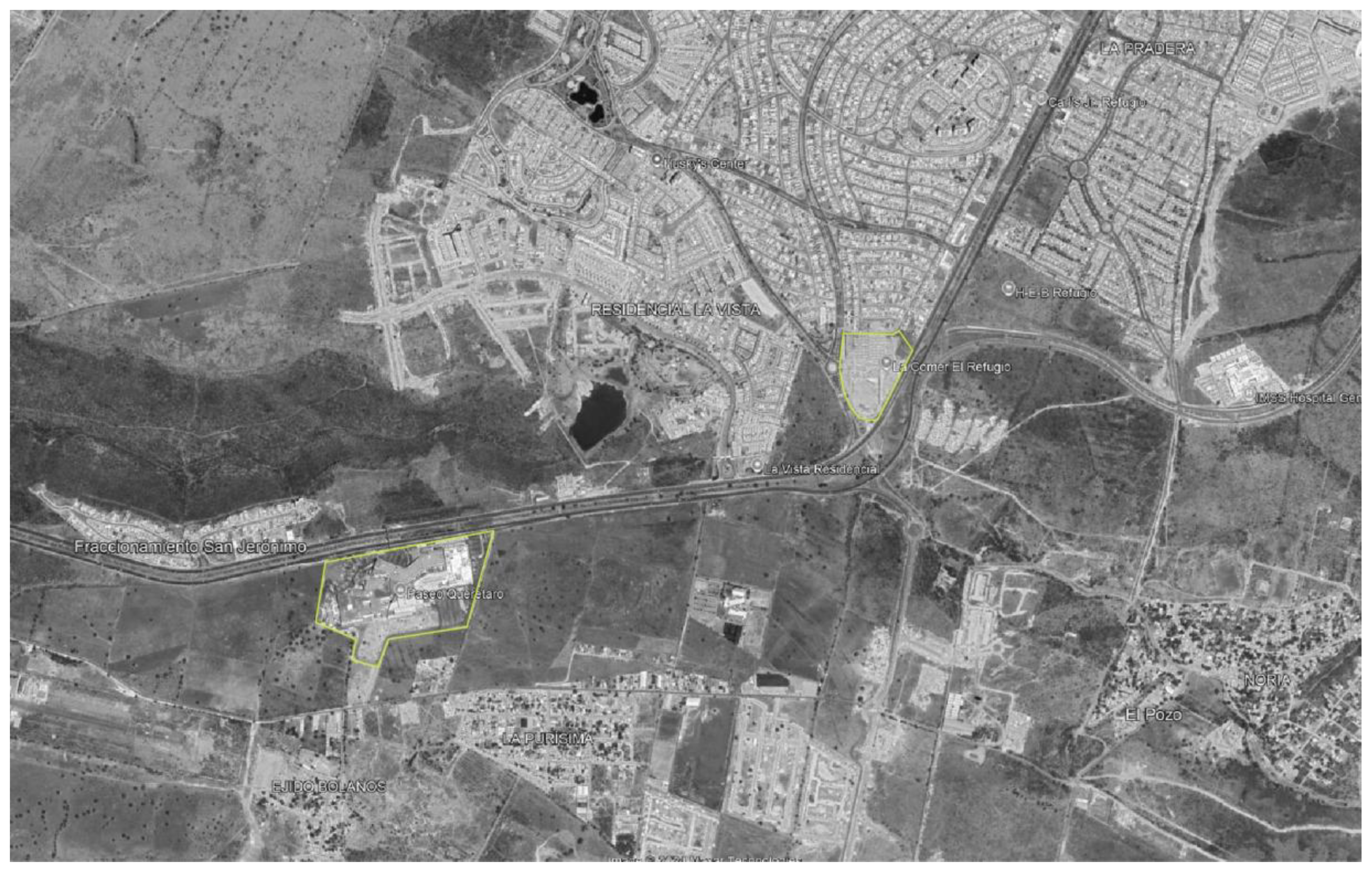
Figure 4.
Empresas internacionales. Fuente: Google Earth Pro (2021), intervención propia.
Disclaimer/Publisher’s Note: The statements, opinions and data contained in all publications are solely those of the individual author(s) and contributor(s) and not of MDPI and/or the editor(s). MDPI and/or the editor(s) disclaim responsibility for any injury to people or property resulting from any ideas, methods, instructions or products referred to in the content. |
© 2025 by the authors. Licensee MDPI, Basel, Switzerland. This article is an open access article distributed under the terms and conditions of the Creative Commons Attribution (CC BY) license (http://creativecommons.org/licenses/by/4.0/).
Copyright: This open access article is published under a Creative Commons CC BY 4.0 license, which permit the free download, distribution, and reuse, provided that the author and preprint are cited in any reuse.


