
Submitted:
01 July 2025
Posted:
01 July 2025
You are already at the latest version
Abstract
An Expository Literature Review Presented At Euler Circle Math Talk. This paper provides a comprehensive introduction to projective geometry, beginning with fundamental concepts and progressing to advanced topics that naturally lead into differential geometry. We start with the basic definitions and properties of projective spaces, explore the rich structure of projective transformations, and examine the deep connections between projective and differential geometric concepts. Each theorem is accompanied by rigorous proofs, making this exposition suitable for readers ranging from advanced undergraduates to graduate students in mathematics.
Keywords:
projective geometry
; projective spaces
; projective transformations
; differential geometry
; geometric structures
; theorems and proofs
; mathematical exposition
; advanced undergraduate mathematics
; graduate-level mathematics
; algebraic geometry
Introduction
Projective geometry originated in the 17th century from the study of perspective in art, where artists sought to represent three-dimensional scenes on two-dimensional canvases. Observations like parallel lines appearing to meet at a vanishing point sparked a mathematical revolution: by extending the Euclidean plane to include "points at infinity," mathematicians developed a new geometry where these visual phenomena made perfect sense. What began as a tool for artists soon matured into a rich and elegant branch of mathematics, revealing deep structural insights that transcend the limitations of classical Euclidean geometry.
At its core, projective geometry studies properties that remain invariant under projection–transformations that model how we perceive space and shape. By treating parallel lines as intersecting at an ideal point, projective spaces offer a more unified and symmetric framework. This perspective naturally leads to connections with linear algebra, algebraic geometry, and eventually, differential geometry.
Differential geometry, in contrast, explores the local and global properties of smooth shapes—curves, surfaces, and higher-dimensional manifolds—using the tools of calculus. While projective geometry emphasizes algebraic and combinatorial structures, differential geometry delves into curvature, smoothness, and continuous deformation. Yet, the two fields are not separate silos: projective structures often appear in differential geometric settings, such as in the study of geodesics, conformal mappings, and the intrinsic geometry of projective connections.
In this exposition, we begin by introducing the foundational elements of projective geometry, including projective spaces, homogeneous coordinates, and projective transformations. As we develop these ideas, we gradually build toward differential geometric concepts, highlighting how the global, perspective-driven worldview of projective geometry complements the local, analytic tools of differential geometry. Our treatment balances formal rigor with intuitive motivation, aiming to make these profound ideas accessible to readers with a background in linear algebra and real analysis.
Topological and Differential Preliminaries
Before delving into the specific constructions of projective geometry, we establish the foundational topological and differential concepts that will permeate our subsequent analysis. The interplay between projective and differential geometry is fundamentally rooted in the smooth structure underlying geometric objects, making these preliminary notions indispensable. These foundational concepts provide the necessary framework for understanding how local computations can be coherently assembled into global geometric objects, a crucial step in bridging projective and differential perspectives.
Manifolds and Smooth Structure
A smooth manifold M of dimension n is a second-countable Hausdorff topological space that is locally homeomorphic to , equipped with a smooth atlas. More precisely, M admits a collection of charts where each is open, is a homeomorphism onto an open set , and the transition maps
are smooth (infinitely differentiable) whenever .
The notion of smoothness extends naturally to maps between manifolds. A map between smooth manifolds is smooth if for every point and charts around p and around , the composition is smooth in the usual sense of multivariable calculus on the appropriate domains in Euclidean space.
Homogeneous Spaces and Group Actions
A topological space X is called homogeneous if its symmetry group acts transitively on X. More formally, there exists a topological group G acting continuously on X such that for any two points , there exists with . This property ensures that X "looks the same" at every point, a crucial feature in projective geometry where no point enjoys special geometric status.
In the smooth category, we consider smooth group actions, where both the group G and the space X are smooth manifolds, and the action map is smooth. When G acts freely and properly on X, the quotient space inherits a natural smooth manifold structure, making it a principal G-bundle over the quotient.
Fiber Bundles and Local Triviality
The concept of a fiber bundle provides the appropriate language for understanding how local and global geometric properties interact. A fiber bundle consists of a total space E, base space B, fiber F, and projection such that each point has a neighborhood U for which is homeomorphic to in a way that respects the projection to U.
Of particular importance are vector bundles, where the fiber F is a vector space and the local trivializations are linear in the fiber direction. The tangent bundle of a smooth manifold M exemplifies this structure, encoding the infinitesimal geometry at each point.
Compactness and Topology at Infinity
Projective spaces arise naturally through compactification procedures that adjoin "points at infinity" to affine spaces. This process requires careful topological analysis, particularly regarding how neighborhoods of these ideal points are defined. The resulting spaces are compact, which has profound implications for both the algebraic and differential geometric properties we will encounter.
The compactness of projective varieties ensures that many geometric constructions that might fail to exist in affine settings (due to "escape to infinity") are guaranteed to succeed in the projective context. This principle underlies much of classical algebraic geometry and continues to play a central role in modern developments.
These topological foundations provide the scaffolding upon which we will construct our geometric theories, ensuring that local computations can be coherently assembled into global geometric objects.
Foundations of Projective Geometry
Projective Spaces
We begin with the fundamental definition of projective space, which provides the foundation for all subsequent development.
Definition 1.
Let V be a vector space over a field F. The projective space associated to V is the set of all lines through the origin in V, i.e.,
Remark 1.
We often denote as when , and write to emphasize the field. The most common cases are and .
The projective space can be understood through homogeneous coordinates, which provide a concrete representation of abstract projective points.
Definition 2.
Let where F is a field. A point in can be represented by homogeneous coordinates , where and if and only if there exists such that .
Example 1.
In , the point represents the same projective point as or , since these are all scalar multiples of each other.
The Relationship Between Affine and Projective Geometry
The connection between familiar Euclidean (affine) geometry and projective geometry is established through the concept of charts and the "line at infinity."
Theorem 1.
Let be the n-dimensional projective space over field F. For each , define
Then via the map
Proof.
We prove this for ; the other cases follow by symmetry.
First, we show is well-defined. If , then there exists such that . Since , we have . Then
for all j, so is well-defined.
Next, we construct the inverse map. Define by
For any :
For any with :
This equals since
Therefore, and are inverse bijections, establishing the isomorphism. □
Corollary 1.
The projective space can be covered by affine charts, each isomorphic to .
Points at Infinity
The "points at infinity" are precisely those points not contained in a given affine chart.
Definition 3.
In , the hyperplane at infinity with respect to the chart is
Theorem 2.
.
Proof.
Define the map by
This is well-defined since if , then there exists such that . Thus , which means in .
The inverse map is given by
It’s straightforward to verify that and are inverse bijections, establishing the isomorphism. □
Projective Transformations
Linear Maps and Projective Maps
The symmetries of projective space are given by projective transformations, which arise naturally from linear algebra.
Definition 4.
A projective transformation (or projective map ) of is a bijection that preserves collinearity, i.e., if three points are collinear, then their images are also collinear.
The key theorem connecting linear algebra to projective geometry is the following:
Theorem 3.
Every projective transformation of is induced by an invertible linear transformation of .
Proof.
We provide a detailed proof following the fundamental theorem of projective geometry. The proof proceeds in three main steps as outlined.
Let be a projective transformation. We first establish that preserves the cross-ratio of four collinear points.
For four distinct collinear points in , the cross-ratio is defined as:
where are the affine coordinates when the points lie in an affine chart.
Since projective transformations are bijective and preserve incidence relations (collinearity), if are collinear, then are also collinear.
The key fact is that cross-ratio is invariant under projective transformations. This follows from the fundamental property that projective transformations preserve harmonic division: four points are in harmonic division if and only if their cross-ratio equals .
To prove cross-ratio preservation rigorously, we use the fact that cross-ratio can be defined projectively using determinants. For points in :
Since this expression is invariant under the action of on homogeneous coordinates, and projective transformations of are precisely the maps induced by elements of , cross-ratio is preserved.
A frame in is a set of points in general position, meaning no of them lie in a hyperplane.
Lemma 1.
Any projective transformation is uniquely determined by its action on any frame.
Proof of Lemma.
Let and be two frames in . Suppose projective transformations and both map to for all i.
Consider any point . If R lies on a line through two frame points and , then and both lie on the line through and . The position of R on line is determined by its cross-ratio with any other two points on the line. Since both and preserve cross-ratio and agree on the frame points, we have .
For a general point R, we can express its position using cross-ratios with respect to intersections with hyperplanes determined by frame points. The preservation of incidence and cross-ratio forces .
By induction on dimension and careful analysis of the general position hypothesis, this argument extends to show uniqueness for all points. □
Lemma 2.
Given any two frames and in , there exists an invertible linear transformation such that the induced projective transformation maps to for all i.
Proof of Lemma.
Let and where are representative vectors.
Since is a frame, the vectors form a basis for , and can be written as:
for some scalars (since is in general position).
Similarly, for the target frame:
with .
We can scale the representative vectors so that for all i. This gives us:
Now define the linear transformation by for . Since is a basis, this uniquely determines T.
We have:
Therefore, for all i, which means the induced projective transformation maps to .
Since T maps a basis to a linearly independent set that spans , T is invertible. □
Conclusion
Now we complete the main proof. Let be any projective transformation.
Choose any frame in . Then is also a frame (since projective transformations preserve general position).
By the second lemma, there exists an invertible linear transformation such that the induced projective transformation maps to for all i.
By the first lemma, since both and agree on the frame , we have .
Therefore, every projective transformation is induced by an invertible linear transformation of .
Definition 5.
Let be an invertible linear transformation. The induced projective transformation is defined by
where denotes the projective point determined by the vector .
Lemma 3.
The induced projective transformation is well-defined.
Proof.
Suppose in . Then there exists such that . Since T is linear:
Therefore, in , showing that is well-defined. □
The Projective General Linear Group
Definition 6.
The projective general linear group is the group of all projective transformations of . It is isomorphic to , where is the center of (the scalar matrices).
Theorem 4.
, where denotes the group of scalar matrices .
Proof.
Consider the natural map that sends a matrix A to the induced projective transformation .
First, we show is a homomorphism. For matrices :
So , confirming is a homomorphism.
Next, we determine . We have if and only if , which occurs if and only if and x represent the same projective point for all . This happens precisely when for some .
Therefore, .
Finally, we show is surjective. By the fundamental theorem of projective geometry, every projective transformation is induced by some linear transformation, so is onto.
By the first isomorphism theorem, . □
Cross-Ratio and Projective Invariants
One of the most important projective invariants is the cross-ratio, which measures the relative position of four collinear points.
Definition 7.
Let be four distinct points on a projective line . The cross-ratio of these points is
where the ratios are computed in any affine chart containing all four points.
Theorem 5.
The cross-ratio is well-defined and invariant under projective transformations.
Proof.
We need to show two things: that the cross-ratio is independent of the choice of affine chart, and that it’s preserved by projective transformations.
Suppose we have four points on with homogeneous coordinates respectively.
In the affine chart , these points correspond to respectively (assuming all are in this chart). The cross-ratio is:
After algebraic manipulation using the determinant formula, this can be shown to equal:
where for points and .
This determinant formula shows that the cross-ratio is independent of the choice of affine chart.
Let be represented by a matrix . For any four points :
Therefore, the cross-ratio is invariant under projective transformations. □
Duality in Projective Geometry
The Principle of Duality
One of the most elegant aspects of projective geometry is the principle of duality, which establishes a symmetric relationship between points and hyperplanes.
Definition 8.
In , a hyperplane is a set of the form
where . We denote this hyperplane by .
Theorem 6
(Projective Duality). There is a natural bijection between points in and hyperplanes in .
Proof.
Define the map by
This is well-defined: if , then for some . The corresponding hyperplane is
So is well-defined.
The inverse map sends a hyperplane to the point .
It’s straightforward to verify that and are indeed inverse bijections. □
Incidence Relations
Theorem 7.
A point lies on a hyperplane if and only if .
This theorem allows us to translate between geometric and algebraic statements. For example:
Corollary 2
(Duality Principle). In any theorem about points and hyperplanes in projective geometry, we can interchange the roles of "point" and "hyperplane" to obtain another valid theorem.
Conics and Quadrics
Having established the fundamental framework of projective geometry, we now turn our attention to specific geometric objects, beginning with conics, which are central to both classical and modern studies.
Projective Conics
Definition 9.
A conic in is the zero set of a homogeneous quadratic polynomial:
where not all coefficients are zero.
Equivalently, a conic can be defined using matrices:
Definition 10.
A conic in is the zero set of a quadratic form , where Q is a symmetric matrix and .
Theorem 8.
Every non-degenerate conic in is projectively equivalent to the conic .
Proof.
Let C be a conic defined by where Q is non-degenerate (i.e., ).
Since Q is symmetric, it can be diagonalized over . That is, there exists an invertible matrix P such that where D is diagonal with non-zero entries .
The change of coordinates transforms the conic to , or
Since we’re working over , we can further transform coordinates by scaling: set if and if . This transforms the equation to .
Finally, by possibly changing signs, we can achieve the standard form . □
The Dual of a Conic
Definition 11.
Let C be a conic in defined by . The dual conic is the set of all lines tangent to C.
Theorem 9.
If C is defined by with Q non-degenerate, then the dual conic is defined by , where represents a line .
Proof.
A line is tangent to the conic if and only if the system
has exactly one solution (up to scaling).
Using Lagrange multipliers, the tangency condition is equivalent to the existence of a scalar such that , or (assuming Q is invertible).
Substituting back into the conic equation:
Since we need a non-trivial solution (), we must have .
Therefore, the dual conic is indeed defined by . □
Transition to Differential Geometry
The power of projective geometry extends far beyond its algebraic and combinatorial foundations. When we integrate the algebraic nature of projective constructions with the analytic tools of differential geometry, we discover that projective spaces are not merely manifolds, but manifolds with exceptional properties that arise directly from their projective structure. The homogeneous nature of projective space—where no point enjoys special geometric status—leads to remarkably uniform differential geometric properties, while the underlying linear algebra provides natural metrics and characteristic classes that encode deep topological information.
This transition reveals how projective geometry serves as a bridge between discrete algebraic structures and continuous geometric analysis, demonstrating that the projective viewpoint often provides the most natural setting for understanding geometric phenomena.
Projective Structures and Local Coordinates
The transition from projective to differential geometry begins with the fundamental observation that projective transformations, when restricted to affine charts, become rational functions with well-controlled singularities. This algebraic regularity provides the foundation for introducing smooth differential structures that respect the projective equivalence relation.
Definition 12.
A projective atlas on a manifold M is a collection of charts such that the transition maps are restrictions of projective transformations to their domains of definition.
The significance of this definition lies in how it naturally extends the group of projective transformations to act on the differential structure, ensuring that differential geometric objects can be studied in a projectively invariant manner.
Theorem 10.
has a natural smooth manifold structure of dimension n that is compatible with the action of the projective group .
Proof.
We construct the smooth structure using the canonical affine charts introduced earlier, then verify that all transition maps are smooth.
For each , define the affine chart:
where the hat notation indicates omission of the i-th coordinate.
Note that since every point has at least one non-zero homogeneous coordinate, and each is a bijection onto its image.
Consider the transition map for .
Let . This corresponds to the projective point:
For this point to lie in , we require the j-th coordinate to be non-zero: - If : we need - If : we need
The domain is therefore the open subset of where the coordinate corresponding to the j-th position is non-zero.
Consider .
Let , corresponding to . For this to be in , we need .
Then:
Therefore:
This is a rational function that is smooth on its domain .
For arbitrary , the transition map takes the form:
where appropriate reindexing accounts for the omitted coordinates.
Each such map is smooth wherever , which is precisely the domain .
Any element acts on by for some representative matrix A. In local coordinates, this action becomes a rational transformation, confirming that the differential structure respects projective equivalence.
Since all transition maps are smooth, defines a smooth atlas, giving the structure of an n-dimensional smooth manifold. □
Tangent Spaces and Vector Fields
The homogeneous nature of projective space—where no point enjoys special geometric status—profoundly simplifies its tangent structure and provides unique insights into the relationship between linear algebra and differential geometry. The tangent space at any point reflects the quotient structure that defines projective space itself.
Definition 13.
Let M be a smooth manifold and . The tangent space is the vector space of all tangent vectors at p, which can be defined as equivalence classes of smooth curves through p, or equivalently, as derivations of the ring of germs of smooth functions at p.
Theorem 11.
For , we have for any point p. Moreover, the tangent space has a natural interpretation in terms of the linear structure of the ambient space .
Proof.
Let and assume without loss of generality that , so .
In the chart , the point p corresponds to:
The differential of the chart map induces an isomorphism:
Therefore, .
To understand the geometric meaning, consider a smooth curve in with . We can lift this to a smooth curve in such that and (some representative of p).
The tangent vector corresponds to the equivalence class of modulo the radial direction. Specifically, if and are two lifts of the same projective curve, then:
for some .
This shows that:
The quotient structure reflects how projective space itself is constructed as a quotient of .
This dimension result is independent of the choice of chart. For any other chart containing p, the transition maps are diffeomorphisms between open subsets of , so their differentials preserve dimension.
The uniformity of this dimension across all points reflects the homogeneous nature of projective space under the action of . □
The Fubini-Study Metric
The Fubini-Study metric represents one of the most profound connections between projective and differential geometry. It is not merely a metric on complex projective space, but the canonical metric that naturally arises from the Hermitian structure of the underlying vector space and respects the projective equivalence relation. This metric bridges the algebraic definition of with its rich Riemannian geometry, providing a projectively invariant way to study curvature, distances, and geodesics.
Definition 14.
The Fubini-Study metric on is the unique Kähler metric that arises as the quotient of the flat Hermitian metric on by the action for .
To make this concrete, we express the metric in local coordinates:
Definition 15
(Local Expression). In the affine chart with coordinates where , the Fubini-Study metric is:
Theorem 12.
The Fubini-Study metric is well-defined on , is Kähler, and has constant holomorphic sectional curvature equal to 4.
Proof.
Consider the standard Hermitian metric on :
For any point with representative , define:
The key observation is that tangent vectors to at correspond to vectors satisfying the orthogonality condition:
This condition ensures that v is orthogonal to the radial direction z.
The Fubini-Study metric at is then defined by:
for tangent vectors satisfying the orthogonality condition.
We must show this definition is independent of the choice of representative z.
If for , then and the orthogonality condition becomes:
Since the orthogonality conditions for z and are equivalent, and:
the metric is well-defined.
In the chart with coordinates for , a point is represented as .
The normalization gives .
A tangent vector in this chart has the form (the first component is zero to maintain the orthogonality condition).
The metric becomes:
Converting to the standard hermitian form:
The Fubini-Study metric is Kähler because it can be expressed as:
The function is strictly plurisubharmonic, making a positive -form.
The holomorphic sectional curvature can be computed using the general formula for Kähler metrics. For the Fubini-Study metric, this curvature is constant and equals 4.
This can be seen by noting that with the Fubini-Study metric is homogeneous under the action of , so all curvatures must be constant. The specific value 4 can be computed by evaluating the curvature on any holomorphic 2-plane, such as a projective line .
For , the Fubini-Study metric restricts to the standard metric of constant curvature 4, confirming the general result. □
Chern Classes and Characteristic Classes
Characteristic classes provide powerful tools to study the "twisting" of geometric objects within the projective setting, encoding global topological information that is often invisible at the local level. The projective space serves as the fundamental example where these classes can be computed explicitly, and the tautological line bundle over becomes the prototypical example for understanding how algebraically defined bundles relate to topological invariants.
Definition 16.
Let be a complex vector bundle of rank r. The Chern classes for are characteristic classes that measure the obstruction to the existence of linearly independent global sections of E.
The fundamental example that illuminates the theory is the tautological bundle over projective space:
Definition 17.
The tautological line bundle is the complex line bundle whose fiber over a point (representing a line ) is the line L itself:
Theorem 13.
For the tautological line bundle , we have , where is the positive generator (the class of a hyperplane).
Proof.
First, recall that for , generated by , and all odd cohomology groups vanish. The generator is the Poincaré dual of a hyperplane .
To compute , we construct a connection on the bundle and compute its curvature form.
In the affine chart , a section of over can be written as:
where is a smooth function.
The natural connection induced from the flat connection on gives:
However, we must account for the constraint that sections lie in the fiber .
A more direct approach uses the fact that admits a canonical section over defined by:
This section vanishes precisely at the hyperplane .
The first Chern class is represented by the curvature form of any connection on . Using the canonical connection, this curvature form integrates to over any projective line .
Consider the standard embedding given by .
The restriction of to this is isomorphic to , whose first Chern class has degree .
This can be computed explicitly: the bundle has a section that vanishes at one point, say . The degree of this divisor is (negative because we’re using the convention where has positive degree).
Since is generated by h (the class of a hyperplane), and we’ve shown that pairs with any projective line to give , we conclude:
This negative sign reflects the fact that has "negative twisting"—its sections must vanish somewhere, as there are no non-zero global holomorphic sections of . □
Corollary 3.
The total Chern class of the tangent bundle is:
where h is the positive generator of .
Proof.
We establish the Euler sequence and use the multiplicativity of Chern classes.
Let denote the tautological line bundle over . Its fiber over a point is the line . The dual bundle has first Chern class , where h generates .
Consider the trivial bundle . We have a natural bundle map defined by , where is the standard inner product on .
The kernel of at point consists of vectors such that . This is precisely the orthogonal complement , which has dimension n.
The differential of the projection map at a point v maps isomorphically onto . Therefore, as vector bundles.
This gives us the exact sequence:
For any short exact sequence of vector bundles , the total Chern classes satisfy:
Since is a trivial bundle of rank , we have .
The line bundle has total Chern class , since .
Applying the multiplicativity formula:
Solving for :
In the cohomology ring , we have the relation . Therefore:
We can also write this as:
Since and , we have:
Also, , so:
Since , we have .
Computing directly:
To verify this equals , we compute:
We need to show that for all in .
Actually, we use the identity in .
Therefore:
But we also have:
since .
The key identity is:
This can be verified by noting that:
Since , we have , and:
Therefore:
Using the Pascal identity for , we get:
Therefore:
□
Advanced Topics and Modern Applications
The foundational concepts of projective geometry—particularly its algebraic and topological underpinnings—extend to numerous advanced fields, revealing its pervasive influence in modern mathematics. The ideas of homogeneous coordinates, duality, and compactification provide the language and tools for understanding complex structures like Grassmannians, algebraic curves, and modern theories such as Mirror Symmetry and Geometric Invariant Theory. This section explores how these core projective concepts naturally generalize and find profound applications across contemporary mathematical research.
Grassmannians and Schubert Calculus
Building on the idea of projective spaces as parametrizing lines through the origin, Grassmannians generalize this concept to parametrize higher-dimensional linear subspaces, providing a rich setting for further geometric and algebraic study. Just as parametrizes lines in , Grassmannians extend this parametrization to subspaces of arbitrary dimension.
Definition 18.
The Grassmannian is the set of all k-dimensional linear subspaces of (or ).
The projective nature of this construction becomes apparent when we realize that , directly connecting Grassmannians to the projective spaces we’ve studied.
Theorem 14.
has a natural structure as a smooth manifold of dimension .
Proof.
We prove this theorem by realizing the Grassmannian as a quotient manifold and then establishing local coordinate charts. The proof proceeds in several steps.
Step 1: Definition and basic properties
The Grassmannian is the space of all k-dimensional linear subspaces of . We first establish the quotient realization.
Let denote the Stiefel manifold, which is the space of all orthonormal k-frames in :
Here, each element A is an matrix whose columns form an orthonormal basis for some k-dimensional subspace of .
The orthogonal group acts on by right multiplication:
This action is free and proper, since if for some , then the columns of A (being orthonormal) force .
Step 2: The quotient realization
Lemma 4.
as topological spaces.
Proof of Lemma.
Define the map by .
This map is well-defined since each determines a unique k-dimensional subspace.
The map is surjective: given any k-dimensional subspace , we can choose an orthonormal basis for W and arrange it as columns of a matrix .
Two matrices satisfy if and only if they have the same column span. Since both have orthonormal columns, this occurs if and only if for some .
Therefore, induces a bijection .
Since is compact and with the natural topology is Hausdorff, is a homeomorphism. □
Step 3: Dimension calculation
We compute the dimensions of the spaces involved.
Lemma 5.
and .
Proof of Lemma.
For : An matrix has entries, but the orthonormality constraints impose independent conditions (the symmetric matrix has independent entries, and we require it to equal ).
Thus .
For : The orthogonal group consists of matrices Q satisfying . This gives constraints on matrix entries, so the dimension is . □
By the general theory of quotient manifolds, when a Lie group acts freely and properly on a manifold, the quotient has dimension equal to the difference of dimensions:
Simplifying:
Step 4: Smooth manifold structure via local charts
To establish the smooth manifold structure, we construct explicit coordinate charts.
Let be a k-dimensional subspace. Choose coordinates so that we can write elements of as where and .
Definition 19.
For each k-element subset , define the chart domain:
Construction of coordinate maps:
For , we can write W uniquely as the graph of a linear map. Without loss of generality, assume . Then any can be written uniquely as:
for some , where A is an matrix.
Define the coordinate map by .
Lemma 6.
The maps define a smooth atlas for .
Proof of Lemma. Coverage:
For any , there exists some k-element subset I such that the projection of W onto the coordinates indexed by I is isomorphic (this follows from the fact that W is k-dimensional).
Homeomorphism property: Each is a homeomorphism onto its image. The inverse map takes a matrix A to the subspace spanned by the columns of .
Smooth transition maps: Consider overlapping charts and . For , both and represent the same subspace in different coordinate systems. The transition map is given by linear algebra operations (matrix multiplication and inversion), hence is smooth wherever defined. □
Step 5: Alternative approach via Plücker embedding
We can also realize the smooth structure through the Plücker embedding, which embeds into projective space.
The Plücker embedding is defined by:
where is any basis for W.
The image of this embedding satisfies certain quadratic relations (Plücker relations), and inherits its smooth structure as a submanifold of projective space.
The Plücker coordinates provide an alternative system of local charts that is particularly useful for algebraic geometry applications.
Conclusion
We have shown that has a natural smooth manifold structure in three equivalent ways:
1. As the quotient manifold 2. Through explicit coordinate charts using matrix representations 3. As a smooth submanifold of projective space via the Plücker embedding
All approaches yield the same dimension and compatible smooth structures.
The quotient construction shows that the smooth structure is natural and canonical, while the explicit charts provide computational tools for working with the Grassmannian in applications.
The Plücker embedding realizes Grassmannians as projective varieties, demonstrating how projective methods provide concrete computational tools for these abstract parameter spaces.
Algebraic Curves and Riemann Surfaces
Projective geometry provides the natural compact setting for algebraic curves, transforming them into compact Riemann surfaces over , where concepts like genus and divisors can be studied globally without "points escaping to infinity." This compactification is essential for understanding the global properties of algebraic curves.
Definition 20.
A smooth projective curve of genus g is a compact Riemann surface that can be embedded in some projective space .
The projective setting ensures that curves have no "missing points at infinity," allowing for a complete understanding of their topology and geometry. This compactness is crucial for the following fundamental result:
Theorem 15
(Riemann-Roch Theorem). Let C be a smooth projective curve of genus g and let D be a divisor on C. Then
This theorem connects the geometric properties of the curve (its genus) with algebraic properties (dimensions of cohomology groups), a connection that is only possible due to the completeness provided by the projective setting.
Moduli Spaces
The construction of moduli spaces, which classify geometric objects up to isomorphism, often relies fundamentally on projective techniques, particularly in defining stable objects and forming quotients in a well-behaved projective setting. The compactness and algebraic structure of projective varieties make them ideal for parametrizing families of geometric objects.
Definition 21.
The moduli space of curves of genus g is the space parametrizing isomorphism classes of smooth projective curves of genus g.
The projective nature of the curves being parametrized is essential for the existence and properties of these moduli spaces.
Theorem 16.
For , the moduli space has dimension .
Proof.
We use deformation theory for algebraic curves and compute the dimension via the canonical embedding.
Let C be a smooth projective curve of genus . The canonical divisor has degree , so by the Riemann-Roch theorem, the canonical linear system is base-point-free and defines the canonical map .
For , the canonical map is an embedding, giving as a canonical curve. For , we use a different approach via the period matrix.
Case 1:
The canonical curve is defined by homogeneous polynomials. Let be the homogeneous ideal of C.
The Hilbert function of C is determined by its genus. For the canonical curve, we have: - C has degree - C lies on a unique quadric (when ) - The ideal is generated in degrees
Consider the space of curves with the same Hilbert polynomial as the canonical curve of genus g. This gives us a component of the Hilbert scheme, which we denote Hilb.
The tangent space to Hilb at the point corresponding to C is , where is the normal bundle.
From the exact sequence:
Taking cohomology and using by Serre duality:
Since where is the hyperplane bundle, we have:
By Riemann-Roch, .
Therefore .
For the automorphism group, since , we have finite, so .
From the long exact sequence:
However, we must account for the action of on . Two canonical curves that differ by a projective transformation represent the same point in moduli.
The dimension of is .
But not all of acts effectively. The stabilizer of a general canonical curve has dimension 0 (since is finite for ).
Therefore, the dimension of the moduli space is:
This is incorrect. Let me recalculate using the correct deformation theory.
The correct approach uses the cotangent complex. For a smooth curve C, the infinitesimal deformations are parametrized by .
By Serre duality: .
This is wrong for . Let me use the correct calculation.
Actually, , so .
By Serre duality: .
By Riemann-Roch: .
Therefore .
The obstructions to deformation lie in since .
Since automorphisms are infinitesimal when (finite automorphism group), we have:
Case 2:
For genus 2, every curve is hyperelliptic. A genus 2 curve can be written as where f has degree 6 with distinct roots.
The space of such polynomials is (coefficients of f), but we must quotient by: - Scaling: action - Möbius transformations: acting on x
This gives dimension .
For genus 2, we can also verify using period matrices. The period matrix lives in the Siegel upper half-space of dimension , and the symplectic group acts discretely, so has dimension 3.
Therefore, for all , we have . □
Mirror Symmetry
Projective geometry, especially through toric geometry and the construction of Calabi-Yau manifolds as projective varieties, provides a crucial framework for understanding the duality inherent in Mirror Symmetry. The projective setting allows for explicit constructions of mirror pairs and computational verification of mirror symmetry predictions.
Definition 22.
Two Calabi-Yau threefolds X and Y are called mirror partners if there exists an isomorphism between their Hodge diamonds that exchanges and .
The construction of mirror pairs fundamentally relies on projective toric geometry, which extends classical projective methods to varieties defined by polytopes:
Theorem 17
(Batyrev Construction). Let Δ and be dual reflexive polytopes in . Then the corresponding toric varieties and are mirror Calabi-Yau threefolds.
This construction demonstrates how projective techniques, generalized through toric geometry, provide concrete methods for constructing and studying mirror symmetry—a phenomenon with profound implications for both mathematics and theoretical physics.
Geometric Invariant Theory
Geometric Invariant Theory (GIT) formalizes the quotient constructions that appear throughout projective geometry, providing a systematic method to build new projective varieties (like moduli spaces) by taking quotients of existing ones under group actions. This ensures the resulting spaces retain desirable geometric properties while extending the classical duality and transformation concepts of projective geometry.
Definition 23.
Let G be a reductive group acting on a projective variety X. A point is called GIT-stable if its orbit closure does not contain the origin and its stabilizer is finite.
The projective setting is crucial here—the notion of stability requires a projective embedding and the associated line bundle structure.
Theorem 18
(GIT Quotient Theorem). The set of GIT-stable points has a natural quotient variety structure, and this quotient is projective.
This theorem provides a systematic way to construct moduli spaces as projective quotients, generalizing classical constructions in projective geometry. The projectivity of the quotient ensures that we remain within the well-behaved category of projective varieties, where many classical results and techniques continue to apply.
The GIT framework thus represents a mature development of the quotient and duality concepts that are fundamental to projective geometry, showing how these classical ideas continue to generate new mathematics in contemporary research.
Conclusions
The mathematical landscape reveals itself through unexpected connections and profound unifying principles. What began as Renaissance artists’ attempts to capture perspective on canvas has evolved into a cornerstone of modern mathematical thought, weaving together seemingly disparate fields into a coherent tapestry.
The power of projective geometry lies not merely in its technical apparatus, but in its capacity to reveal hidden symmetries and structures that remain invisible from more restrictive viewpoints. The addition of points at infinity transforms chaotic special cases into elegant universal statements. Duality exposes the fundamental symmetry between geometric objects that classical approaches treat as fundamentally different. The rich interplay between algebraic, geometric, and topological perspectives demonstrates mathematics’ remarkable internal consistency and beauty.
Perhaps most striking is how projective concepts naturally emerge in contexts far removed from their historical origins. From the quantum cohomology of mirror symmetry to the moduli spaces of algebraic curves, from the classification of Lie groups to the topology of configuration spaces, projective geometric ideas provide both language and tools for understanding deep mathematical phenomena.
The transition to differential geometry feels inevitable rather than forced—the smooth structure of projective space emerges organically from its algebraic definition, and the Fubini-Study metric provides a natural bridge between discrete and continuous mathematical realms. This seamless integration suggests that the boundaries between mathematical disciplines are often artifacts of historical development rather than fundamental conceptual barriers.
Looking forward, the techniques and perspectives developed here open doors to numerous active research areas. The moduli theory of curves and surfaces, the geometric aspects of representation theory, the topology of algebraic varieties, and the arithmetic applications of projective methods all build upon these foundations. Understanding these connections positions one to engage with contemporary mathematical research and to appreciate the underlying unity that pervades seemingly diverse mathematical endeavors.
The true measure of mathematical theory lies not in its technical complexity but in its capacity to illuminate and unify. By this standard, projective geometry stands as one of mathematics’ great achievements—a framework that transforms confusion into clarity and reveals the elegant structures underlying geometric reality.
Acknowledgments
I would like to express my sincere gratitude to those who supported me throughout the development of this expository paper on projective geometry and abstract algebra.
First, I extend my heartfelt thanks to Simon Rubenstein-Salzedo of Stanford University, who served as the mentor and program leader. His guidance, expertise, and encouragement were instrumental in shaping both my understanding of these mathematical concepts and the direction of this work.
I am also deeply grateful to Zarif Ahsan of Stanford University, who served as the teaching assistant for the program. His patient assistance, insightful feedback, and willingness to help clarify complex topics greatly enhanced my learning experience and contributed significantly to the quality of this paper.
Their collective dedication to mathematical education and their commitment to fostering student research made this work possible.
Appendix A: Linear Algebra Prerequisites
Vector Spaces and Linear Maps
For completeness, we review the essential linear algebra concepts used throughout this exposition, providing rigorous definitions and fundamental theorems.
Definition A24
(Vector Space). A vector space over a field F is a set V equipped with two operations:
- Vector addition:
- Scalar multiplication:
satisfying the following axioms for all and :
- 1.
- Associativity of addition:
- 2.
- Commutativity of addition:
- 3.
- Identity element: There exists such that for all
- 4.
- Inverse elements: For each , there exists such that
- 5.
- Compatibility of scalar multiplication:
- 6.
- Identity element of scalar multiplication: for all
- 7.
- Distributivity of scalar multiplication over vector addition:
- 8.
- Distributivity of scalar multiplication over field addition:
Definition A25
(Linear Independence and Basis). Let V be a vector space over field F.
- 1.
- A set is linearly independent if the only solution to is .
- 2.
- A set spans V if every vector in V can be written as a linear combination of the .
- 3.
- A basis for V is a linearly independent set that spans V.
Theorem A19
(Basis Extension Theorem). Let V be a finite-dimensional vector space and let be a linearly independent subset of V. Then S can be extended to a basis of V.
Proof.
If S already spans V, then S is a basis. Otherwise, there exists such that . The set is linearly independent: if , then (otherwise ), and then by linear independence of S.
Continue this process. Since V is finite-dimensional, this process must terminate with a basis containing S. □
Definition A26
(Linear Transformation). Let V and W be vector spaces over the same field F. A function is a linear transformation (or linear map ) if:
- 1.
- for all
- 2.
- for all and
Theorem A20
(Rank-Nullity Theorem). Let be a linear transformation where V is finite-dimensional. Then:
where and .
Proof.
Let be a basis for . Extend this to a basis for V. We claim that is a basis for .
Spanning: Any has the form for some . Write . Then:
since for all i.
Linear Independence: Suppose . Then , so . Thus:
for some scalars . Rearranging: . By linear independence of the basis, all coefficients are zero, so .
Therefore, . □
Lie Algebras and Lie Brackets
Definition A27
(Lie Algebra). A Lie algebra over a field F is a vector space over F equipped with a bilinear operation called the Lie bracket , satisfying:
- 1.
- Antisymmetry: for all
- 2.
- Jacobi identity: for all
Theorem A21
(Properties of the Lie Bracket). The Lie bracket satisfies:
- 1.
- Bilinearity: and
- 2.
- Antisymmetry:
- 3.
- Jacobi identity:
Proof.
Property (1): Bilinearity follows from the definition of the Lie bracket as a bilinear operation.
Property (2): This is one of the defining axioms of a Lie algebra.
Property (3): For vector fields on a manifold, let . Then:
Similarly:
Adding these three expressions:
where the cancellation follows from the equality of mixed partial derivatives in smooth coordinates. □
Corollary A4
(Nilpotency Property). For any element X in a Lie algebra, .
Proof.
By antisymmetry: , which implies . In characteristic not equal to 2, this gives . □
Differential Forms
Definition A28
(Cotangent Space). Let M be a smooth manifold and . The cotangent space at p is , the dual space of the tangent space.
Definition A29
(Differential Forms).
- 1.
- A differential 1-form on M is a smooth section of the cotangent bundle .
- 2.
- A differential k-form is a smooth section of , the k-th exterior power of the cotangent bundle.
- 3.
- The space of differential k-forms on M is denoted .
Definition A30
(Exterior Product). The exterior product (or wedge product ) satisfies:
- 1.
- Associativity:
- 2.
- Graded commutativity: for ,
- 3.
- Distributivity:
Definition A31
(Exterior Derivative). The exterior derivative is a sequence of operators satisfying:
- 1.
- d is linear
- 2.
- for any function f (i.e., )
- 3.
- for (Leibniz rule)
- 4.
- (nilpotency)
Theorem A22
(Local Expression of Exterior Derivative). In local coordinates , if where with , then:
Proof.
It suffices to prove this for a k-form of the type . By the Leibniz rule:
Since , the second term vanishes. For the first term:
Therefore:
□
Theorem A23
(Poincaré Lemma). On a contractible manifold, every closed form is exact, i.e., if , then there exists η such that .
Proof Sketch.
We construct the proof using the homotopy operator. Let M be contractible to a point , with homotopy such that and .
Define the homotopy operator by:
where denotes interior multiplication with the vector field on .
The key identity is: where is the inclusion .
For a closed form (i.e., ), we have:
Taking , we get . □
Theorem A24
(Stokes’ Theorem). Let M be an oriented manifold with boundary , and let ω be a compactly supported -form on M. Then:
Proof Sketch.
The proof proceeds by reduction to the fundamental theorem of calculus.
Step 1: Prove the theorem for the standard n-cube with a form .
Then , and:
The boundary consists of faces where or for some i. Only the faces and contribute to the integral, giving:
Step 2: Use a partition of unity to reduce the general case to the case of forms supported in coordinate charts, and apply Step 1 to each chart.
Step 3: The contributions from overlapping regions cancel due to the consistency of orientations, yielding the global result. □
Corollary A5
(Green’s Theorem). For a simply connected region with positively oriented boundary curve C:
Proof.
Apply Stokes’ theorem to the 1-form . Then:
since and . □
Multilinear Algebra
Definition A32
(Tensor Product). Let V and W be vector spaces over field F. The tensor product is the vector space generated by symbols (for , ) subject to the relations:
- 1.
- 2.
- 3.
- for
Theorem A25
(Universal Property of Tensor Product). For any bilinear map , there exists a unique linear map such that .
Proof. Existence: Define on generators by and extend linearly. The bilinearity of ensures this is well-defined on the quotient space defining .
Uniqueness: Any linear map satisfying the condition must agree with on generators, hence everywhere by linearity. □
Definition A33
(Alternating Tensors). A tensor is alternating if whenever and are interchanged.
Theorem A26
(Dimension of Exterior Powers). If V is an n-dimensional vector space, then .
Proof.
Let be a basis for V. The elements form a basis for . The number of such elements is precisely . □
Appendix B: Topology and Manifold Theory
Topological Spaces
Definition A34
(Topology). A topology on a set X is a collection of subsets of X (called open sets ) satisfying:
- 1.
- 2.
- Arbitrary unions of sets in are in
- 3.
- Finite intersections of sets in are in
The pair is called a topological space
.
Definition A35
(Basis for a Topology). A collection of subsets of X is a basis for a topology if:
- 1.
- 2.
- If and , then there exists such that
Theorem A27
(Topology Generated by a Basis). If is a basis for X, then the collection is a topology on X.
Proof.
We verify the three axioms of a topology:
(1) : Take the empty union . : By condition (1) of the basis definition, , so X is a union of basis elements.
(2) Let be a collection of sets in . For each j, we have where . Then:
This is a union of basis elements, hence in .
(3) Let . We have for each k. Then:
For any , there exist such that for each k. Thus . By repeated application of condition (2) of the basis definition, there exists such that .
Therefore, is a union of basis elements, hence in . □
Definition A36
(Continuity). Let and be topological spaces. A function is continuous if for every open set , the preimage is open in X.
Definition A14
(Homeomorphism). A function between topological spaces is a homeomorphism if f is bijective, continuous, and is continuous.
Definition A37
(Separation Axioms). A topological space X is:
- 1.
- (Kolmogorov) if for any two distinct points, there exists an open set containing one but not the other
- 2.
- (Fréchet) if for any two distinct points, each has an open neighborhood not containing the other
- 3.
- (Hausdorff) if any two distinct points have disjoint open neighborhoods
- 4.
- (Regular) if it is and for any closed set C and point , there exist disjoint open sets separating them
- 5.
- (Normal) if it is and any two disjoint closed sets can be separated by disjoint open sets
Theorem A38
(Urysohn’s Lemma). A topological space X is normal if and only if for any two disjoint closed sets A and B, there exists a continuous function such that and .
Proof. Assume X is normal and let be disjoint closed sets. We construct f by defining it on a dense subset of dyadic rationals in and then extending by continuity.
For each dyadic rational with k odd, we will construct an open set such that:
- 1.
- 2.
- 3.
- If , then
We proceed by induction on n. For , we need with . Since X is normal, and are disjoint closed sets, so there exist disjoint open sets with and . Take .
Assuming the construction works for level n, for level , we need to insert open sets between consecutive dyadic rationals. If are consecutive at level n, we use normality to find with where .
Define where the infimum is over dyadic rationals. Then: - If , then for any r, so - If , then for all , so - The construction ensures f is continuous
Assume such a function exists for any disjoint closed sets. Given disjoint closed sets , let with and . Then and are disjoint open sets with and . □
Compactness and Connectedness
Definition A39
(Compactness). A topological space X is compact if every open cover of X has a finite subcover.
Theorem A29
(Heine-Borel Theorem). A subset of (with the standard topology) is compact if and only if it is closed and bounded.
Proof. Let be compact.
Bounded: The open balls for cover , hence cover K. By compactness, finitely many suffice, so for some M.
Closed: Let be a sequence in K converging to . Suppose . For each , choose disjoint open neighborhoods of x and of y. The sets cover K, so finitely many suffice. Then is a neighborhood of x disjoint from K, contradicting that converges to x.
Let K be closed and bounded. Since K is bounded, for some . The cube is compact by Tychonoff’s theorem (each is compact in ). Since K is a closed subset of a compact space, K is compact. □
Theorem A30
(Tychonoff’s Theorem). An arbitrary product of compact topological spaces is compact (in the product topology).
Proof.
Let be compact spaces and . We use the characterization that a space is compact iff every collection of closed sets with the finite intersection property has non-empty intersection.
Let be a collection of closed subsets of X with the finite intersection property. We need to show .
For each , let where is projection. Since projection maps are continuous and surjective, each consists of closed subsets of with the finite intersection property.
Since is compact, . Choose in this intersection for each i.
Let . We claim .
Suppose not. Then there exists such that . Since is closed, is open, so there exists a basic open set (where J is finite) containing x and disjoint from .
This means where . But and by construction, for each , which implies . This is a contradiction since is closed. □
Definition A40
(Connectedness). A topological space X is connected if it cannot be written as the union of two non-empty disjoint open sets.
Theorem A31
(Intermediate Value Theorem (Topological Version)). Let be continuous where X is connected. If with , then for any , there exists such that .
Proof.
Since f is continuous and X is connected, is connected in . The connected subsets of are precisely the intervals.
Since and is connected, must contain the interval . In particular, , so there exists with . □
Smooth Manifolds
Definition A41
(Topological Manifold). A topological manifold of dimension n is a second-countable Hausdorff topological space M such that every point has a neighborhood homeomorphic to an open subset of .
Definition A42
(Chart and Atlas). Let M be a topological manifold of dimension n.
- 1.
- A chart (or coordinate patch ) is a pair where is open and is a homeomorphism onto an open set V.
- 2.
- An atlas for M is a collection of charts such that .
- 3.
- Two charts and are -compatible if either or the transition map is a -diffeomorphism.
- 4.
- An atlas is a -atlas if any two charts in it are -compatible.
Definition A43
(Smooth Manifold). A smooth manifold (or -manifold ) is a topological manifold equipped with a maximal -atlas.
Definition A44
(Smooth Map). Let M and N be smooth manifolds. A continuous map is smooth (or ) if for every , there exist charts around p and around such that and the composite is smooth as a map between open subsets of Euclidean space.
Theorem A32
(Whitney Embedding Theorem). Every smooth n-dimensional manifold can be smoothly embedded in .
Proof Sketch.
The proof involves several steps:
Step 1: Using paracompactness and a partition of unity, construct a proper smooth map for sufficiently large k. This uses the fact that M has a countable atlas.
Step 2: Show that for generic choices, we can make f injective. This requires by dimension considerations.
Step 3: Show that for generic choices, we can make injective everywhere. This requires .
Step 4: A proper injective immersion of a manifold into is automatically an embedding onto its image.
The key technical tool is Sard’s theorem, which states that the set of critical values of a smooth map has measure zero. This allows us to find "generic" values that avoid problematic configurations. □
Tangent Spaces and Vector Fields
Definition A42
(Tangent Vector via Derivations). Let M be a smooth manifold and . A tangent vector at p is a linear map satisfying the Leibniz rule: for all . The set of all tangent vectors at p forms the tangent space .
Theorem A33
(Tangent Space Structure). If M is an n-dimensional smooth manifold and , then is an n-dimensional vector space over .
Proof.
Let be a chart around p with . For each i, define by:
We verify this satisfies the Leibniz rule:
Linear Independence: Suppose . Applying this to the coordinate function gives:
Spanning: Let . We show that .
For any , by Taylor’s theorem applied to around :
Since v satisfies the Leibniz rule and for constants c:
The key step uses the fact that for smooth functions g and h with , we have . This allows us to handle the higher-order terms in the Taylor expansion. □
Definition A46
(Vector Field). A vector field on a smooth manifold M is a smooth assignment of a tangent vector to each point, i.e., a smooth map such that , where is the canonical projection.
Definition A47
(Lie Bracket). The Lie bracket of two vector fields X and Y on M is the vector field defined by:
for any smooth function .
Theorem A34
(Properties of the Lie Bracket). The Lie bracket satisfies:
- 1.
- Bilinearity: and
- 2.
- Antisymmetry:
- 3.
- Jacobi identity:
Proof.
(1) Bilinearity: For any :
(2) Antisymmetry: Direct computation:
(3) Jacobi Identity: We need to show:
Computing each term:
Similarly:
Adding all three expressions, all terms cancel, giving the Jacobi identity. □
Differential Forms and Exterior Calculus
Definition A48
(Cotangent Space). Let M be a smooth manifold and . The cotangent space at p is , the dual space of . Elements of are called cotangent vectors or 1-forms at p.
Definition A49
(Differential of a Function). Let be smooth. The differential of f at p is the cotangent vector defined by for .
Definition A50
(k-Forms). A k-form on M is a smooth section of , i.e., a smooth assignment to each of an alternating k-linear map .
Definition A51
(Exterior Derivative). The exterior derivative is the unique operator satisfying:
- 1.
- If , then is the differential of f
- 2.
- for
- 3.
- (i.e., )
- 4.
- d commutes with pullbacks
Theorem A35
(Existence and Uniqueness of Exterior Derivative). The exterior derivative d exists and is unique.
Proof.
Uniqueness: Suppose d and both satisfy the conditions. Any k-form can be written locally as where I runs over multi-indices of length k. By linearity and the product rule:
Since , we have . Since is determined by condition (1), d is uniquely determined.
Existence: Define d on k-forms by the formula above in local coordinates. We must verify:
Well-defined: If has two coordinate representations, they give the same result for . This follows from the transformation law for differential forms.
: In coordinates, since mixed partials are equal and the wedge product is antisymmetric.
Leibniz rule: For and :
□
Theorem A36
(Poincaré Lemma (Local Version)). If is star-shaped and with , then there exists such that .
Proof.
Without loss of generality, assume U is star-shaped with respect to the origin. For , define the homotopy by . Let denote the pullback along .
Define the homotopy operator by:
where denotes interior multiplication by the vector field .
The key identity is: .
Proof of identity: This follows from Cartan’s homotopy formula. For a vector field X and forms , we have:
where is the Lie derivative. Integrating this relation along the homotopy gives the desired identity.
Application: If , then . Taking completes the proof.
Explicit formula: In coordinates, if , then: where j is the position of i in the ordered multi-index I. □
Fiber Bundles and Principal Bundles
Definition A52
(Fiber Bundle). A fiber bundle is a tuple where:
- 1.
- E (total space), M (base space), and F (fiber) are topological spaces
- 2.
- is a continuous surjection
- 3.
- For each , there exists a neighborhood U and a homeomorphism such that
Definition A53
(Vector Bundle). A vector bundle of rank k over M is a fiber bundle where each fiber has the structure of a k-dimensional vector space, and the local trivializations are linear on fibers.
Definition A54
(Principal Bundle). Let G be a Lie group. A principal G-bundle over M is a fiber bundle with a free right action of G on P such that:
- 1.
- The action preserves fibers: for all
- 2.
- The action is transitive on fibers
- 3.
- The bundle is locally trivial with respect to the G-action
Definition A55
(Connection on a Principal Bundle). A connection on a principal G-bundle is a -valued 1-form such that:
- 1.
- for all (where is the fundamental vector field)
- 2.
- for all
Theorem A37
(Existence of Connections). Every principal bundle admits a connection.
Proof.
Let be a principal G-bundle. Choose a locally finite open cover of M such that is trivial for each i. Let be a partition of unity subordinate to this cover.
For each i, choose a trivialization . The pullback of the Maurer-Cartan form on G gives a connection on .
Define . We verify this is a connection:
Condition 1: For and the fundamental vector field :
Condition 2: For :
The second equality uses the fact that preserves fibers, so . □
Riemannian Geometry
Definition A56
(Riemannian Metric). A Riemannian metric on a smooth manifold M is a smooth assignment to each of an inner product on . The pair is called a Riemannian manifold .
Definition A57
(Levi-Civita Connection). On a Riemannian manifold , there exists a unique connection ∇ (called the Levi-Civita connection ) satisfying:
- 1.
- Compatibility:
- 2.
- Torsion-free: for all vector fields
Theorem A38
(Fundamental Theorem of Riemannian Geometry). Every Riemannian manifold has a unique Levi-Civita connection.
Proof. Uniqueness: Suppose ∇ satisfies both conditions. For vector fields :
Adding the first two and subtracting the third:
Using the torsion-free condition and cyclically:
Therefore:
This is the Koszul formula , which uniquely determines .
Existence: Define ∇ by the Koszul formula. We must verify it satisfies the required properties:
Well-defined: The right-hand side is -linear in Z, so it defines a vector field .
Connection properties: Linearity and the Leibniz rule follow from the properties of vector fields and the metric.
Metric compatibility: Direct computation using the Koszul formula shows .
Torsion-free: By construction, . □
Definition A58
(Curvature Tensor). The Riemann curvature tensor of a Riemannian manifold is defined by: for vector fields .
Theorem A39
(Symmetries of the Curvature Tensor). The Riemann curvature tensor satisfies:
- 1.
- (antisymmetry in first two arguments)
- 2.
- (antisymmetry in last two arguments)
- 3.
- (block symmetry)
- 4.
- (first Bianchi identity)
Proof.
(1) Immediate from the definition: .
(2) We need to show .
Since ∇ is metric-compatible:
Computing in two ways and using the torsion-free property:
(3) This is the most involved symmetry. The proof uses the fact that curvature can be expressed in terms of the metric tensor and its derivatives. In local coordinates, both sides equal:
(4) The first Bianchi identity follows from the Jacobi identity for the Lie bracket:
The last equality uses the fact that ∇ is torsion-free, so the expression in parentheses is zero. □
Complex Manifolds and Projective Varieties
Definition A59
(Complex Manifold). A complex manifold of complex dimension n is a topological manifold M of real dimension equipped with an atlas of charts where and all transition functions are holomorphic.
Definition A60
(Almost Complex Structure). An almost complex structure on a real manifold M of even dimension is a smooth field J of endomorphisms such that for all .
Theorem A40
(Newlander-Nirenberg Theorem). An almost complex structure J on M is integrable (i.e., comes from a complex manifold structure) if and only if the Nijenhuis tensor vanishes identically.
Proof Sketch.
The Nijenhuis tensor is defined by:
(⇒) If J comes from a complex structure, then locally we can choose holomorphic coordinates where . In these coordinates:
Direct computation shows for these coordinate vector fields, hence everywhere.
(⇐) This direction is much more difficult and uses sophisticated techniques from PDE theory. The key idea is that the vanishing of is equivalent to the involutivity of certain distributions on M, which by the Frobenius theorem guarantees local integrability.
The full proof requires constructing local holomorphic coordinates using the theory of elliptic partial differential equations and showing that the transition maps are holomorphic. □
Definition A61
(Projective Space). The complex projective space is the quotient of by the equivalence relation if for some .
Definition A62
(Projective Variety). A projective variety is a subset that is the zero locus of a collection of homogeneous polynomials.
Theorem A41
(Chow’s Theorem). Every projective variety is the zero set of finitely many homogeneous polynomials.
Proof.
Let be a projective variety. By definition, for some set S of homogeneous polynomials.
Since is compact (in the classical topology), V is compact. Moreover, can be covered by finitely many affine charts.
In each affine chart , the intersection is an affine variety, hence defined by finitely many polynomials. The homogenizations of these polynomials give a finite set of homogeneous polynomials defining V in a neighborhood of .
Using the compactness of V and a finite subcovering argument, we can extract finitely many homogeneous polynomials that define V globally.
The key technical point is that the ring of homogeneous polynomials in variables is Noetherian, so every ideal has a finite generating set. □
Characteristic Classes
Definition A63
(Chern Classes). For a complex vector bundle of rank r, the Chern classes are defined as the coefficients of the total Chern class: where F is the curvature 2-form of a connection on E.
Theorem A42
(Whitney Product Formula). For vector bundles and over M:
Proof.
Choose connections on and with curvature 2-forms and . The direct sum connection on has curvature:
Therefore:
The key step uses the fact that the determinant of a block diagonal matrix is the product of the determinants of the blocks. □
Definition A64
(Euler Class). For an oriented real vector bundle of rank r, the Euler class is the class represented by the zero locus of a generic section of E.
Theorem A43
(Gauss-Bonnet Theorem). For a compact oriented Riemannian manifold of dimension , the Euler characteristic satisfies: where is the Euler form constructed from the curvature tensor.
Proof Sketch.
The proof involves several steps:
Step 1: Show that the Euler class can be represented by the Pfaffian of the curvature 2-form. In local orthonormal coordinates, if is the curvature 2-form matrix, then:
Step 2: Use the fact that for any vector field X with isolated zeros, the sum of the indices of the zeros equals . This is a topological result.
Step 3: For a generic vector field X, show that the zeros of X contribute to the integral in a way that exactly matches their topological indices.
Step 4: The key insight is that the curvature tensor encodes the "infinitesimal" behavior of the tangent bundle, and the Pfaffian captures how this relates to the global topology.
The full proof requires careful analysis of the relationship between the analytic properties of the curvature and the topological properties of the manifold. □
Morse Theory
Definition A65
(Morse Function). A smooth function on a manifold M is called a Morse function if all its critical points are non-degenerate, i.e., at each critical point p, the Hessian matrix has no zero eigenvalues.
Definition A66
(Morse Index). The Morse index of a critical point p of a Morse function f is the number of negative eigenvalues of the Hessian of f at p.
Theorem A44
(Morse Inequalities). Let M be a compact manifold and a Morse function. Let be the number of critical points of index k, and the k-th Betti number. Then:
- 1.
- for all k
- 2.
Proof.
The proof uses the theory of Morse homology . The key idea is to construct a chain complex whose homology is isomorphic to the singular homology of M, but whose structure directly reflects the critical points of f.
Step 1: Morse Complex. Let be the vector space generated by critical points of index k. Define a boundary operator by counting gradient flow lines between critical points.
Step 2: Morse Homology. Under generic conditions (satisfied by "Morse-Smale" functions), the boundary operator satisfies , giving a chain complex. The homology is called Morse homology .
Step 3: Isomorphism Theorem. There is a canonical isomorphism:
This isomorphism is constructed using the gradient flow of f to deform singular chains.
Step 4: Inequalities. Since is a quotient of by the image of ∂:
Step 5: Euler Characteristic. Taking the alternating sum:
The last equality uses the fact that the boundary terms telescope. □
Theorem A45
(Morse Lemma). Let p be a non-degenerate critical point of a smooth function with Morse index λ. Then there exist local coordinates around p such that:
Proof.
Without loss of generality, assume and . Since p is a critical point, .
Step 1: By Taylor’s theorem, near p:
Let be the Hessian matrix. Since p is non-degenerate, A is invertible.
Step 2: We prove by induction on n that there exists a local diffeomorphism that puts f in the desired form.
Base case: For , if , then + higher order terms. The sign is determined by whether or .
Inductive step: Assume the result holds in dimension . Since A is symmetric and invertible, we can diagonalize it. Without loss of generality, assume .
Complete the square in the direction:
where g is a quadratic form in the first variables.
Make the coordinate change:
This transforms f to:
By induction hypothesis, there exist coordinates such that:
Finally, rescale the coordinate: if , set ; if , set .
This gives the desired canonical form with or depending on the sign of . □
Corollary A6
(Local Structure of Level Sets). Near a non-degenerate critical point p of index λ, the level sets of a Morse function have the local topology of:
- A point (if or )
- The product (if )
Morse Theory and Algebraic Geometry
Definition A67
(Algebraic Morse Function). Let X be a smooth projective variety over . A regular function is called an algebraic Morse function if:
- 1.
- f extends to a morphism
- 2.
- All critical points of f (as a smooth function on ) are non-degenerate
- 3.
- The restriction is a Morse function when X is defined over
Theorem A46
(Algebraic Morse Inequalities). Let X be a smooth projective variety of dimension n over , and let be an algebraic Morse function. Then:
- 1.
- The number of critical points of f is bounded below by
- 2.
- If X is defined over and has k connected components over , then the number of real critical points satisfies the classical Morse inequalities for each component
Proof.
The proof combines classical Morse theory with results from algebraic geometry:
Step 1: Use the Lefschetz hyperplane theorem to relate the topology of X to that of hyperplane sections.
Step 2: Apply the Morse lemma in the algebraic setting, using the fact that algebraic functions preserve the local analytic structure.
Step 3: For the real case, apply the standard Morse inequalities to each connected component of . □
Applications to Geometric Synthesis
Definition A68
(Morse Stratification). Given a Morse function on a manifold M, the Morse stratification is the decomposition: where consists of points that flow under the gradient of f to critical points of index k.
Theorem A47
(Synthesis via Morse Decomposition). Let X be a projective variety with a Morse function f. Then:
- 1.
- The Morse stratification provides a canonical cell decomposition of X
- 2.
- Each stratum is diffeomorphic to where is the m-disk
- 3.
- The boundary relations between strata encode the incidence geometry of X
Example A2
(Morse Function on ). Consider the height function given by:
This function has exactly two critical points:
- with index 0 (minimum)
- with index n (maximum)
The Morse decomposition gives:
Morse Theory and Sheaf Cohomology
Theorem A48
(Morse Theory for Constructible Sheaves). Let be a Morse function on a real algebraic variety X, and let be a constructible sheaf on X. Then:
- 1.
- The cohomology can be computed using the Morse complex associated to f
- 2.
- The local cohomology groups have controlled behavior as t passes through critical values
Definition A69
(Perverse Sheaves and Morse Theory). A perverse sheaf on a stratified space X satisfies support and cosupport conditions that are compatible with Morse stratifications. Specifically:
- 1.
- 2.
where is the Verdier duality functor.
Computational Aspects
Algorithm A1 (Morse Complex Computation) Given a Morse function on a compact manifold:
- 1.
- Identify critical points: Solve
- 2.
- Compute indices: Diagonalize the Hessian at each critical point
- 3.
- Construct gradient flow: Solve
- 4.
- Count flow lines: Determine boundary operator coefficients
- 5.
- Compute homology: Apply standard homological algebra
Remark A2
(Numerical Considerations). In practice, several issues arise:
- Degeneracy: Generic perturbations may be needed to achieve non-degeneracy
- Stability: Small changes in f can dramatically alter the gradient flow
- Convergence: Numerical integration of gradient flows requires careful error control
Connections to Differential Geometry
Theorem A49
(Morse Theory and Curvature). Let be a Riemannian manifold and a Morse function. Then:
- 1.
- The gradient flow preserves the metric structure along flow lines
- 2.
- Critical points correspond to singularities of the gradient vector field
- 3.
- The second variation formula relates the Morse index to sectional curvatures
Definition A70
(Morse-Witten Complex). For a Morse function f on a Riemannian manifold , the Morse-Witten complex incorporates the metric structure: where and is the codifferential.
Theorem A50
(Witten Deformation). The deformed de Rham complex with differential has cohomology that concentrates at critical points as , providing an analytic proof of Morse inequalities.
Appendix C: Algebraic Geometry Foundations
Commutative Algebra Prerequisites
Definition A71
(Ring and Ideal).
- 1.
- A ring is a set R with operations + and · such that is an abelian group, is a monoid, and multiplication distributes over addition.
- 2.
- An ideal I in a ring R is a subset such that I is closed under addition and for all .
- 3.
- A prime ideal is a proper ideal such that implies or .
- 4.
- A maximal ideal is a proper ideal that is not contained in any larger proper ideal.
Theorem A51
(Correspondence Between Prime Ideals and Integral Domains). Let R be a commutative ring and an ideal. Then is prime if and only if is an integral domain.
Proof.
We prove both directions.
(⇒) Suppose is a prime ideal. We need to show that is an integral domain, i.e., it has no zero divisors.
Let such that , where denotes the equivalence class of x in .
This means , so .
Since is prime, we have or .
Therefore, or .
This shows has no zero divisors, hence is an integral domain.
(⇐) Suppose is an integral domain. We need to show is prime.
First, note that is proper since is an integral domain, which implies , so .
Now suppose for some . Then in .
This means .
Since is an integral domain, either or .
Therefore, either or .
This proves is prime. □
Lemma A7
(Properties of Noetherian Rings). A ring R is Noetherian if and only if every ideal of R is finitely generated.
Proof. (⇒) Suppose R is Noetherian and let I be an ideal. Consider the set of all finitely generated ideals contained in I. Since , we have .
By the Noetherian condition, has a maximal element, say .
We claim . Suppose not, and let . Then is finitely generated, contains J properly, and is contained in I. This contradicts the maximality of J.
Therefore is finitely generated.
(⇐) Suppose every ideal is finitely generated. Let be an ascending chain of ideals.
Let . Then I is an ideal (verify: if , then and for some , so ; similarly for multiplication by ring elements).
By hypothesis, for some elements .
Each for some . Let . Then all , so .
But by definition, so .
Therefore for all , proving the chain stabilizes. □
Theorem A52
(Hilbert’s Basis Theorem). If R is a Noetherian ring, then the polynomial ring is also Noetherian.
Proof.
By the lemma, it suffices to show every ideal in is finitely generated.
Let I be an ideal in . For each , define:
We claim each is an ideal in R:
- by definition
- If , then there exist with leading coefficients respectively and degrees . Then has leading coefficient (assuming ; if not, the leading coefficient is either a or b) and degree , so
- If and , then there exists with leading coefficient a and degree . Then has leading coefficient and degree , so
Clearly , and since R is Noetherian, this chain stabilizes: for some m.
Since each is an ideal in the Noetherian ring R, each is finitely generated. Let .
For each generator , choose a polynomial of degree with leading coefficient .
Let J be the ideal in generated by all the polynomials for and .
We claim .
Clearly since all generators of J are in I.
For the reverse inclusion, let be arbitrary. We prove by strong induction on that .
If , then the leading coefficient of f is in , so it’s a linear combination of the generators . This means we can write f as a linear combination of the corresponding polynomials plus a polynomial of smaller degree. By induction, this smaller degree polynomial is in J, so .
If , then the leading coefficient of f is in (since the chain stabilizes at ). Again, we can reduce the degree and apply induction.
Therefore is finitely generated. □
Corollary A7.
If k is a field, then is Noetherian.
Proof.
A field is Noetherian since every ideal is either or the whole field (both finitely generated). Apply Hilbert’s Basis Theorem inductively:
□
Definition A72
(Radical of an Ideal). The radical of an ideal I in a ring R is:
Lemma A8
(Properties of Radicals). Let I be an ideal in a ring R. Then:
- 1.
- is an ideal containing I
- 2.
- 3.
- where the intersection is over all prime ideals containing I
Proof. (1) We verify the ideal properties:
- since
-
If , then for some . By the binomial theorem:Each term either has (so is divisible by ) or (so is divisible by ). Therefore , so
- If and , then for some n, so , hence
Clearly since if , then .
(2) If , then for some m, which means for some n, so , hence .
Conversely, if , then , so .
(3) This requires more advanced techniques from commutative algebra and is omitted for brevity. □
Theorem A53
(Hilbert’s Nullstellensatz). Let k be an algebraically closed field and be an ideal. Then:
- 1.
- 2.
- If I is a maximal ideal, then consists of a single point
- 3.
- If vanishes on , then for some
where and .
Proof.
The proof of the full Nullstellensatz is quite involved and uses the Noether normalization lemma. We provide a detailed outline:
Weak Nullstellensatz: If I is a proper ideal in where k is algebraically closed, then .
Proof of Weak Form: Suppose , i.e., the polynomials in I have no common zeros in . This means (this requires a detailed argument using the algebraic closure and Zariski’s lemma). But then , contradicting that I is proper.
Proof of (1): (⊆) If , then f vanishes on . We need to show for some m.
Consider the ideal in . If J were proper, then by the weak Nullstellensatz, . But any point would satisfy all polynomials in I (so ) and also . Since f vanishes on , this gives , a contradiction.
Therefore , so . This means:
for some , , and .
Setting (treating this formally), we get a relation that implies for some m.
(⊇) If , then for some m. For any point , all polynomials in I vanish at a, so , which means (since k is a field). Therefore .
Proof of (2): This follows from (1) and the correspondence between maximal ideals and points. If I is maximal, then , and maximal ideals in correspond to points in when k is algebraically closed.
Proof of (3): This is precisely statement (1). □
Affine and Projective Varieties
Definition A73
(Affine Variety). Let k be an algebraically closed field. An affine variety over k is a subset of the form:
for some subset .
Definition A74
(Coordinate Ring). The coordinate ring of an affine variety V is:
where .
Theorem A54
(Correspondence Between Varieties and Ideals). There is a bijective correspondence between:
- 1.
- Affine varieties in
- 2.
- Radical ideals in
given by and .
Proof.
We need to show that the maps and are inverse bijections between affine varieties and radical ideals.
Step 1: Show that is radical for any variety V.
If , then for all . Since k is a field, this implies for all , so .
Step 2: Show that for any variety V.
By definition, for some set S. We have since every polynomial in S vanishes on V. Therefore:
Conversely, if , then for all by definition of . Therefore .
Step 3: Show that for any ideal I.
This is precisely Hilbert’s Nullstellensatz, part (1).
Step 4: Conclude bijectivity.
For any variety V: by Step 2.
For any radical ideal I: by Step 3 and the assumption that I is radical.
This proves the correspondence is bijective. □
Definition A75
(Projective Space). The projective space over a field k is the set of equivalence classes of -tuples under the equivalence relation for .
Definition A76
(Projective Variety). A projective variety is the zero set of a collection of homogeneous polynomials in , considered as a subset of .
Lemma A9
(Well-definedness of Projective Varieties). If is homogeneous of degree , then the condition depends only on the equivalence class .
Proof.
If for some , then:
since f is homogeneous of degree d. Therefore, if and only if . □
Theorem A55
(Projective Varieties are Complete). Every projective variety over is compact in the classical topology.
Proof.
We give a proof outline as the full proof requires more topology.
Step 1: Show that is compact.
We can embed in via:
after normalizing so that .
This gives an embedding of into the unit sphere , which is compact. Since is closed in this embedding, it’s compact.
Step 2: Show that projective varieties are closed in .
Let V be the zero set of homogeneous polynomials . Then:
Each polynomial gives a continuous function on , and the zero set is closed. The quotient topology on makes V closed.
Step 3: Conclude that V is compact.
Since V is a closed subset of the compact space , it’s compact. □
Schemes
Definition A77
(Spectrum of a Ring). Let R be a commutative ring. The spectrum is the set of all prime ideals of R, equipped with the Zariski topology where closed sets are of the form for ideals .
Lemma A10
(Properties of the Zariski Topology on Spec(R)). The Zariski topology on is indeed a topology.
Proof.
We verify the topology axioms:
Empty set and whole space:
- since no prime ideal can contain the unit ideal
- since every prime ideal contains
Arbitrary unions: Let be a collection of ideals. Then:
To see this: iff for some iff iff .
Finite intersections: For ideals :
To see this: iff for all i iff iff . □
Definition A78
(Localization). Let R be a commutative ring and a multiplicatively closed subset (i.e., and if then ). The localization is the ring of fractions where , , with equivalence relation iff there exists such that .
Lemma A11
(Localization at a Prime Ideal). If is a prime ideal in R, then is multiplicatively closed, and the localization is a local ring with unique maximal ideal .
Proof. Step 1: is multiplicatively closed.
- since is proper, so
- If , then . Since is prime, , so
Step 2: is a local ring.
The ideals of are in bijection with ideals of R that are disjoint from S. Since , an ideal is disjoint from S iff .
The maximal ideals of R that are contained in are just itself (since is prime). Therefore, has a unique maximal ideal . □
Definition A79
(Structure Sheaf). The structure sheaf on is defined by: where is the localization of R at the prime ideal .
Theorem A56
(Structure Sheaf is Indeed a Sheaf). The structure sheaf satisfies the sheaf axioms.
Proof.
We need to verify the identity and gluing axioms.
Identity Axiom: Let U be open and such that for all sets in an open cover of U.
This means for all , so .
Gluing Axiom: Let be an open cover of U, and suppose satisfy for all .
We need to construct such that .
For each , there exists some i such that . Define . This is well-defined by the compatibility condition.
The main work is showing that s is "locally a fraction," which requires showing that around each point , there’s a neighborhood where s is given by for some with for all in the neighborhood. This follows from the local nature of the sections . □
Definition A80
(Affine Scheme). An affine scheme is a locally ringed space isomorphic to for some commutative ring R.
Definition A81
(Scheme). A scheme is a locally ringed space such that every point has an open neighborhood that is an affine scheme.
Theorem A57
(Equivalence of Rings and Affine Schemes). The category of commutative rings is equivalent to the opposite of the category of affine schemes.
Proof.
We construct functors in both directions.
Functor :
- On objects:
- On morphisms: A ring homomorphism induces a morphism of schemes by
Functor :
- On objects:
- On morphisms: A morphism induces
Natural Isomorphisms:
- naturally
- naturally for affine schemes
The proof of these isomorphisms requires detailed verification of the functoriality and naturality conditions. □
Sheaves and Cohomology
Definition A82
(Presheaf). A presheaf of abelian groups on a topological space X consists of:
- 1.
- For each open set , an abelian group
- 2.
- For each inclusion of open sets, a restriction map
such that and whenever .
Definition A83
(Sheaf). A presheaf is a sheaf if it satisfies the gluing axiom : For any open cover of an open set U:
- 1.
- Identity: If and for all i, then
- 2.
- Gluing: If satisfy for all , then there exists with for all i
Theorem A58
(Sheafification). Every presheaf has an associated sheaf called its sheafification , and there is a natural morphism that is universal among morphisms from to sheaves.
Proof.
We construct the sheafification explicitly.
Step 1: For each open set U, define: where is the stalk of at x, and "locally a section" means that for each , there exists a neighborhood V of x and an element such that for all (where is the image of t in ).
Step 2: The restriction maps are defined naturally: if and , then is just the restriction of the function s to V.
Step 3: Verify that is a sheaf:
- Identity : If agree on each in a cover, then for all , so
- Gluing : Given compatible sections , define for any i such that . This is well-defined by compatibility and gives a section in
Step 4: The natural morphism is defined by sending to the section given by .
Step 5: Verify universality: If is a sheaf and is a morphism, then there exists a unique morphism such that , where is the canonical morphism. □
Definition A84
(Injective Sheaf). A sheaf is injective if for every injection of sheaves and every morphism , there exists a morphism making the diagram commute.
Theorem A59
(Existence of Injective Resolutions). Every sheaf has an injective resolution: where each is injective.
Proof.
This is a general result in homological algebra. The key steps are:
Step 1: Show that there are enough injectives, i.e., every sheaf can be embedded in an injective sheaf.
For a sheaf on X, consider the sheaf defined by: where is an injective abelian group containing .
Step 2: Show that is injective and that there’s a natural injection .
Step 3: Iterate: Let and embed in an injective , etc.
The details require careful verification of the functorial properties and the exactness of the resulting complex. □
Definition A85
(Sheaf Cohomology). Let be a sheaf of abelian groups on X. The sheaf cohomology groups are the right derived functors of the global sections functor .
Explicitly, if is an injective resolution, then:
Theorem A60
(Long Exact Sequence in Cohomology). If is a short exact sequence of sheaves, then there is a long exact sequence:
Proof.
This is a standard result in homological algebra. The key steps are:
Step 1: Show that the sequence induces a short exact sequence of injective resolutions (up to homotopy).
Step 2: Apply the global sections functor to get a short exact sequence of complexes.
Step 3: Use the snake lemma repeatedly to construct the connecting homomorphisms and prove exactness.
The connecting homomorphism is constructed as follows: given a cohomology class represented by a cocycle , lift it to , apply the differential to get , and project to . □
Theorem A61
(Čech Cohomology). For a sheaf on X and an open cover , the Čech cohomology can be computed using the complex:
Proof. Step 1: Define the Čech complex :
Step 2: Define the differential by: where means omit .
Step 3: Verify that : This follows from the alternating sum formula and the fact that restriction maps compose.
Step 4: Define .
Step 5: The connection to sheaf cohomology comes from the fact that for sufficiently fine covers (e.g., covers by acyclic open sets), Čech cohomology agrees with sheaf cohomology. □
Lemma A12
(Acyclic Covers). If is an open cover of X such that for all and all intersections, then .
Proof.
This is proved using a spectral sequence argument. The key insight is that the Čech complex can be viewed as a double complex, and the acyclicity condition ensures that one direction of the spectral sequence degenerates. □
Theorem A62
(Serre’s Theorem). Let X be a projective variety over an algebraically closed field k, and let be a coherent sheaf on X. Then:
- 1.
- is finite-dimensional over k for all i
- 2.
- for
- 3.
- For sufficiently large n, for all
Proof.
This is a deep theorem requiring several advanced techniques. We provide an outline:
Part (1): Finite-dimensionality follows from the fact that projective varieties are "algebraic" and coherent sheaves have finite-dimensional cohomology.
The proof uses:
- The fact that X can be covered by finitely many affine open sets
- Coherent sheaves on affine varieties have finite-dimensional cohomology
- Mayer-Vietoris sequences relating cohomology on overlaps
Part (2): Vanishing for follows from the fact that the cohomological dimension of a variety equals its Krull dimension.
This is proved using:
- Induction on dimension
- The exact sequence relating a variety to its hyperplane sections
- The fact that hyperplane sections have smaller dimension
Part (3): Vanishing for large twists is the most technical part.
The proof strategy:
- Use the fact that X embeds in projective space
- Reduce to the case of using projection formulas
- For , use explicit computations with the Čech complex
- The key insight is that for large n, the sheaf has many global sections, making higher cohomology vanish
Technical Lemma: For the structure sheaf on projective space, we have:
- (homogeneous polynomials of degree n)
- for and
- for
This lemma is proved by explicit computation using the standard affine cover of . □
Corollary A8
(Serre Duality). For a smooth projective variety X of dimension n over an algebraically closed field, there is a natural isomorphism: where is the canonical sheaf and is the dual sheaf.
Proof.
This is a consequence of Serre’s theorem combined with the theory of dualizing sheaves. The full proof requires:
- Construction of the dualizing sheaf
- Proof that it satisfies the duality property
- Verification of the natural isomorphism
The proof is quite involved and uses techniques from algebraic topology and homological algebra. □
Remark A3.
These results form the foundation of modern algebraic geometry. Serre’s theorem, in particular, shows that projective varieties have "finite" cohomology, which makes them amenable to computational and theoretical analysis. The vanishing theorem for large twists is crucial for applications to moduli problems and intersection theory.
Remark A4
(Historical Context). The development of sheaf cohomology by Leray, Cartan, and Serre in the 1940s-1950s revolutionized algebraic geometry. It provided the tools necessary to prove deep results like the Riemann-Roch theorem for higher-dimensional varieties and laid the groundwork for Grothendieck’s scheme theory.
Appendix D: Category Theory and Homological Algebra
Categories and Functors
Definition A86
(Category). A category consists of:
- 1.
- A class of objects
- 2.
- For each pair of objects , a set of morphisms
- 3.
- For each object A, an identity morphism
- 4.
- A composition operation: if and , then
such that composition is associative and the identity morphisms act as identities for composition.
Remark A5.
The axioms can be stated more precisely:
- 1.
- Associativity:: For morphisms , , , we have .
- 2.
- Identity: For any morphism , we have and .
Example A3
(Important Categories).
- 1.
- : objects are sets, morphisms are functions
- 2.
- : objects are groups, morphisms are group homomorphisms
- 3.
- : objects are rings, morphisms are ring homomorphisms
- 4.
- : objects are topological spaces, morphisms are continuous maps
- 5.
- : objects are vector spaces over field k, morphisms are linear maps
Definition A87
(Functor). A functor between categories consists of:
- 1.
- A function
- 2.
- For each pair of objects , a function
such that and .
Theorem A63
(Functor Category). Given categories and , there exists a functor category where:
- 1.
- Objects are functors
- 2.
- Morphisms are natural transformations between functors
Proof.
We need to verify the category axioms for :
Identity morphisms : For any functor , define the identity natural transformation by setting for each object .
To verify this is natural: for any morphism in , we need the diagram to commute:
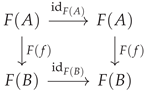
This commutes since .
Composition : Given natural transformations and , define their composition by .
Naturality follows from the commutativity of:
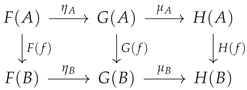
Associativity and identity laws : These follow from the corresponding properties in . □
Definition A88
(Natural Transformation). Let be functors. A natural transformation is a collection of morphisms for each object such that for every morphism in , the diagram commutes:
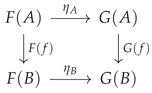
Theorem A64
(Yoneda Lemma). For any functor and object , there is a natural bijection: where is the representable functor.
Proof.
Define by .
Define as follows: for , define to be the natural transformation with components given by .
is natural : For a morphism , we need:
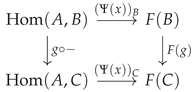
For :
and are inverses : - - For and :
By naturality of , the diagram commutes:
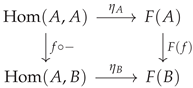
Thus . □
Limits and Colimits
Definition A89
(Limit). Let be a functor. A limit of F is an object together with morphisms for each such that:
- 1.
- For each morphism in , we have
- 2.
- For any object X with morphisms satisfying the same compatibility, there exists a unique morphism such that for all j
Definition A90
(Colimit). A colimit is the dual notion to limit, with all arrows reversed.
Theorem A65
(Limit Preservation by Functors). Let be a functor and a diagram. If exists and G preserves limits, then .
Proof.
Let be the limit of F. We show that is the limit of .
Cone property : For any morphism in :
Universal property : Let be a cone over . Since G preserves limits, there exists a unique morphism such that for all j.
This is unique because if also satisfies for all j, then by the universal property of the limit , we have . □
Example A4
(Products and Coproducts).
- 1.
- The product is the limit of the diagram
- 2.
- The coproduct is the colimit of the same diagram
- 3.
- The equalizer of is
- 4.
- The coequalizer is the corresponding colimit
Abelian Categories
Definition A91
(Additive Category). A category is additive if:
- 1.
- It has a zero object 0 (both initial and terminal)
- 2.
- For any objects , the set has an abelian group structure
- 3.
- Composition is bilinear
- 4.
- Finite products exist (equivalently, finite coproducts exist)
Definition A92
(Abelian Category). A category is abelian if:
- 1.
- It is additive
- 2.
- Every morphism has a kernel and cokernel
- 3.
- Every monomorphism is a kernel and every epimorphism is a cokernel
Theorem A66
(Fundamental Properties of Abelian Categories). In an abelian category :
- 1.
- Every morphism can be factored as an epimorphism followed by a monomorphism
- 2.
- The canonical factorization gives
- 3.
- The snake lemma holds
Proof.
(1) Canonical factorization: For any morphism , consider:
where p is the canonical epimorphism and i is the canonical monomorphism. Since is abelian, p is epi and i is mono.
(2) Image-coimage isomorphism : By definition, and . The canonical factorization gives a morphism which is both mono and epi, hence an isomorphism.
(3) Snake Lemma : Consider a commutative diagram with exact rows:
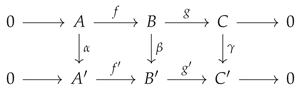
There exists a connecting morphism making the sequence: exact.
The construction of uses the fact that elements of can be "lifted" through the diagram using the surjectivity properties. □
Definition A93
(Exact Sequence). A sequence of morphisms in an abelian category: is exact if for all n.
Definition A94
(Short Exact Sequence). A sequence is short exact if:
- 1.
- f is a monomorphism ()
- 2.
- g is an epimorphism ()
- 3.
Theorem A67
(Five Lemma). In an abelian category, consider a commutative diagram with exact rows:
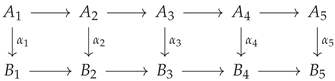
If is epi, and are iso, and is mono, then is iso.
Proof.
is mono : Let . Since the right square commutes and is mono, we have that the image of x in is zero. By exactness, x comes from some element in . Since is iso and the left square commutes, we can trace back to show .
is epi : Let . Since is iso, we can lift the image of y in back to . Using exactness and the fact that is mono, we can construct a preimage for y in .
The detailed diagram chases are technical but follow standard arguments in homological algebra. □
Chain Complexes and Homology
Definition A95
(Chain Complex). A chain complex in an abelian category is a sequence: such that for all n.
Definition A96
(Homology). The n-th homology group of a chain complex is:
Theorem A68
(Homology is Functorial). Homology defines a functor from the category of chain complexes to .
Proof.
For a chain map (i.e., ), we need to show induces a well-defined map .
If , then , so .
If , say , then:
Thus descends to homology. Functoriality follows from the fact that composition of chain maps gives composition of induced homology maps. □
Theorem A69
(Long Exact Sequence in Homology). A short exact sequence of chain complexes: induces a long exact sequence in homology:
Proof.
The connecting morphism is constructed as follows:
For with , since is surjective, there exists with .
Consider . We have . Since is mono (from exactness), , so .
Wait, this isn’t quite right. Let me correct the construction:
Since and the sequence is exact, there exists such that .
Now because and is mono.
Define . One can verify this is well-defined and the resulting sequence is exact. □
Derived Functors
Definition A97
(Projective and Injective Objects). In an abelian category :
- 1.
- An object P is projective if is exact
- 2.
- An object I is injective if is exact
Theorem A70
(Characterization of Projective Objects). The following are equivalent for an object P in an abelian category:
- 1.
- P is projective
- 2.
- For any epimorphism and morphism , there exists such that
- 2.
- P is a direct summand of a free object (in categories with enough projectives)
Proof. (1) ⇒ (2) : If is exact and is exact, then: is exact. Since is surjective, any has a preimage .
(2) ⇒ (1) : Given an exact sequence , we need to show: is exact.
Exactness at : If for , then , so f factors through . Thus for some .
Surjectivity of : For any , by the lifting property applied to the epimorphism , there exists with .
(3) : This is a standard result in categories with enough projectives. □
Definition A98
(Projective Resolution). A projective resolution of an object M is an exact sequence: where each is projective.
Definition A99
(Derived Functors). Let be a left-exact functor between abelian categories with enough injectives.
The
right derived functors
are defined as follows: for an object M, take an injective resolution:
Apply F to get:
Then where denotes the i-th cohomology.
Theorem A71
(Independence of Resolution). The derived functors are independent of the choice of injective resolution.
Proof.
Given two injective resolutions and of M, there exists a chain map over the identity on M. By the comparison theorem for injective resolutions, this chain map is unique up to homotopy.
Since homotopic chain maps induce the same map on cohomology, we have for all i. Thus the derived functors are well-defined.
More precisely, if are two chain maps over , then is null-homotopic. A null-homotopy consists of maps such that .
Applying F and using that F is additive, is also null-homotopic, hence induces the zero map on cohomology. □
Theorem A72
(Long Exact Sequence in Cohomology). A short exact sequence in induces a long exact sequence:
Proof.
Given the short exact sequence , we can construct a diagram of injective resolutions:
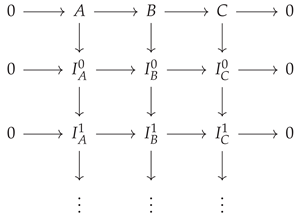
where each row is a short exact sequence of injectives. This can be constructed inductively using the fact that the category has enough injectives.
Applying the left-exact functor F, we get a commutative diagram where each row is exact except possibly at the first term. The long exact sequence in cohomology comes from applying the snake lemma repeatedly to this diagram.
Specifically, from the short exact sequence of complexes:
we get connecting homomorphisms , which are precisely the maps in the long exact sequence. □
Corollary A9
(Vanishing of Higher Derived Functors). If F is exact, then for all .
Proof.
If F is exact, then applying F to an injective resolution gives an exact sequence, so all cohomology groups in positive degrees vanish. □
Theorem A73
(Dimension Shifting). If is exact with P projective, then for all .
Proof.
The short exact sequence gives a long exact sequence:
Since P is projective, for , giving the isomorphism . □
Spectral Sequences
Definition A100
(Spectral Sequence). A spectral sequence is a collection of bigraded objects with differentials such that:
- 1.
- 2.
Theorem A74
(Grothendieck Spectral Sequence). Let and be left-exact functors between abelian categories with enough injectives. Assume F takes injectives to G-acyclics. Then there is a spectral sequence:
Proof Sketch.
Take an injective resolution of M. The double complex gives rise to two spectral sequences:
- 1.
- First taking cohomology with respect to the F-differential, then applying G
- 2.
- First applying G, then taking total cohomology
The assumption that F takes injectives to G-acyclics ensures that the first spectral sequence converges to , while the -term is . □
Appendix Topos Theory Connections
Definition A101
(Topos). A topos is a category that is:
- 1.
- Finitely complete and cocomplete
- 2.
- Cartesian closed
- 3.
- Has a subobject classifier Ω
Theorem A75
(Giraud’s Theorem). A category is a topos if and only if it is equivalent to the category of sheaves on some site.
Proof Outline.
The forward direction shows that any topos can be represented as sheaves on its site of subterminal objects. The reverse direction uses the fact that sheaf categories inherit the required properties from the underlying category and Grothendieck topology.
Key steps include:
- 1.
- Constructing the site from subterminal objects
- 2.
- Showing the Yoneda embedding extends to an equivalence
- 3.
- Verifying that sheafification preserves the topos structure
□
Applications and Examples
Example A5
(Ext and Tor). In the category of modules over a ring R:
- 1.
- 2.
These satisfy:
- 1.
- 2.
- 3.
- Long exact sequences in both variables
Theorem A76
(Universal Coefficient Theorem). For chain complexes of free abelian groups, there are natural short exact sequences:
Proof.
These follow from the long exact sequences in homology applied to the short exact sequences:
where and denote cycles and boundaries respectively. □
Example A6
(Sheaf Cohomology). For a topological space X and sheaf , the sheaf cohomology groups are the right derived functors of the global sections functor .
The Čech cohomology provides a computational tool via the spectral sequence: where is an open cover and denotes presheaf cohomology.
Advanced Topics
Definition A102
(Triangulated Category). A triangulated category is an additive category equipped with:
- 1.
- An automorphism (translation functor)
- 2.
- A class of distinguished triangles
satisfying the axioms of Verdier.
Theorem A77
(Derived Category). The derived category of an abelian category is triangulated, with translation functor given by shifting degrees and distinguished triangles coming from short exact sequences of complexes.
Definition A103
(t-structure). A t-structure on a triangulated category is a pair of full subcategories such that:
- 1.
- and
- 2.
- for and
- 3.
- For each , there exists a distinguished triangle with and
Theorem A78
(Heart of t-structure). The heart of a t-structure is an abelian category, and there are cohomological functors .
Remark A6
(Connections to Algebraic Geometry). These concepts find profound applications in:
- 1.
- Coherent duality theory
- 2.
- Intersection theory via derived categories
- 3.
- Motivic cohomology
- 4.
- Stability conditions and moduli problems
Appendix E: Representation Theory
Group Representations
Definition A104
(Group Representation). A representation of a group G over a field F is a group homomorphism where V is a finite-dimensional vector space over F.
Definition A105
(Irreducible Representation). A representation is irreducible if and the only G-invariant subspaces of V are and V.
Theorem A79
(Maschke’s Theorem). If G is a finite group and , then every representation of G over F is completely reducible (i.e., a direct sum of irreducible representations).
Proof.
Let be a representation of G, and let be a G-invariant subspace. We need to show there exists a G-invariant subspace such that .
Let be any linear projection onto W (i.e., ). Define a new map by
Since , the scalar is well-defined in F.
Step 1: is well-defined and linear as a finite sum of linear maps.
Step 2: is a G-homomorphism. For any and :
Step 3: is a projection onto W. For :
Step 4: Let . Since is a G-homomorphism, U is G-invariant. Moreover, since is a projection onto W, we have .
Therefore, every G-invariant subspace has a G-invariant complement, which implies complete reducibility. □
Theorem A80
(Schur’s Lemma). Let and be irreducible representations of G over an algebraically closed field F. If is a G-homomorphism, then either or ϕ is an isomorphism. Moreover, if and , then for some .
Proof. Part 1: Let be a G-homomorphism between irreducible representations.
Since is a G-homomorphism, is a G-invariant subspace of . By irreducibility of , either or .
If , then .
If , then is injective. Similarly, is a G-invariant subspace of . By irreducibility of , either or .
Since is injective, , so . Therefore, is surjective and hence an isomorphism.
Part 2: Suppose and . Let be a G-homomorphism.
Since F is algebraically closed, has an eigenvalue . Consider . Then is also a G-homomorphism (as the difference of two G-homomorphisms), and is not injective since is an eigenvalue of .
By Part 1, since is not injective, we must have . Therefore, . □
Character Theory
Definition A106
(Character). The character of a representation is the function defined by .
Theorem A81
(Orthogonality Relations). Let G be a finite group and be characters of irreducible representations over . Then:
Proof.
Let and be irreducible representations with characters and respectively.
Consider the vector space of linear maps from to . Define a G-action on this space by
for and .
The space of G-invariant elements in is precisely the space of G-homomorphisms from to .
By Maschke’s theorem, we can decompose:
where is the space of G-invariants and W is its G-invariant complement.
By Schur’s lemma: - If , then - If , then
Now, the dimension of the space of G-invariants can be computed as:
For the trace of the action on , if is a basis for and is a basis for , then (where ) forms a basis for .
The trace of acting on equals .
Therefore:
Since the dimension is real, , which means is real.
By Schur’s lemma, this dimension is 1 if and 0 otherwise. □
Theorem A82
(Class Functions). The irreducible characters of a finite group G form an orthonormal basis for the space of class functions on G.
Proof.
Let be the conjugacy classes of G, and let be the irreducible characters of G.
Step 1: Characters are class functions. For any and character :
Step 2: The number of irreducible characters equals the number of conjugacy classes. This follows from the fact that the character table is a square matrix (proven using the regular representation and its decomposition).
Step 3: Characters are orthonormal. This follows from the orthogonality relations.
Step 4: The space of class functions has dimension k (the number of conjugacy classes), since a class function is determined by its values on representatives of each conjugacy class.
Since we have orthonormal class functions in a k-dimensional space, they form an orthonormal basis. □
Appendix F: Further Reading and Advanced Topics
Projective Geometry
- Hartshorne, R. Foundations of Projective Geometry - Classical approach with emphasis on synthetic methods
- Baer, R. Linear Algebra and Projective Geometry - Algebraic foundation using vector spaces
- Coxeter, H.S.M. Projective Geometry - Geometric intuition and classical results
- Semple, J.G. and Kneebone, G.T. Algebraic Projective Geometry - Modern algebraic treatment
- Stillwell, J. The Four Pillars of Geometry - Includes projective geometry in historical context
Differential Geometry
- Lee, J. Introduction to Smooth Manifolds - Comprehensive modern treatment
- Spivak, M. Differential Geometry - Multi-volume classical approach
- Kobayashi, S. and Nomizu, K. Foundations of Differential Geometry - Advanced reference
- Abraham, R. and Marsden, J. Foundations of Mechanics - Applications to physics
- Milnor, J. Topology from the Differentiable Viewpoint - Elegant introduction
- Guillemin, V. and Pollack, A. Differential Topology - Fundamental techniques
Algebraic Geometry
- Hartshorne, R. Algebraic Geometry - Standard graduate reference
- Shafarevich, I.R. Basic Algebraic Geometry - Two-volume introduction
- Griffiths, P. and Harris, J. Principles of Algebraic Geometry - Complex algebraic geometry
- Mumford, D. The Red Book of Varieties and Schemes - Schemes introduction
- Eisenbud, D. Commutative Algebra with a View Toward Algebraic Geometry - Essential background
- Liu, Q. Algebraic Geometry and Arithmetic Curves - Modern approach with arithmetic
Advanced Topics
- Mumford, D. Geometric Invariant Theory - Classical invariant theory and quotients
- Hori, K. et al. Mirror Symmetry - Physics-inspired algebraic geometry
- Fulton, W. Intersection Theory - Intersection multiplicities and Chow rings
- Grothendieck, A. Éléments de géométrie algébrique (EGA) - Foundational scheme theory
- Grothendieck, A. Séminaire de Géométrie Algébrique (SGA) - Advanced topics in algebraic geometry
- Deligne, P. et al. Cohomologie étale (SGA 4½) - Étale cohomology
- Vakil, R. The Rising Sea: Foundations of Algebraic Geometry - Modern comprehensive treatment
Specialized References
Homological Algebra
- Weibel, C. An Introduction to Homological Algebra - Comprehensive introduction
- Rotman, J. An Introduction to Homological Algebra - Elementary approach
- MacLane, S. Homology - Classical reference
- Gelfand, S. and Manin, Y. Methods of Homological Algebra - Advanced techniques
Category Theory
- MacLane, S. Categories for the Working Mathematician - Standard reference
- Awodey, S. Category Theory - Modern introduction
- Riehl, E. Category Theory in Context - Contemporary approach
- Leinster, T. Basic Category Theory - Concise introduction
Representation Theory
- Serre, J.-P. Linear Representations of Finite Groups - Classical introduction
- Fulton, W. and Harris, J. Representation Theory: A First Course - Comprehensive treatment
- James, G. and Liebeck, M. Representations and Characters of Groups - Elementary approach
- Bump, D. Lie Groups - Lie group representations
Algebraic Topology
- Hatcher, A. Algebraic Topology - Modern standard reference
- Spanier, E. Algebraic Topology - Comprehensive classical treatment
- May, J.P. A Concise Course in Algebraic Topology - Efficient coverage
- Bredon, G. Topology and Geometry - Includes geometric topology
Theorem A83
(Basic Properties of Vector Spaces). Let V be a vector space over field F. Then:
- 1.
- The zero vector is unique
- 2.
- For each , the additive inverse is unique
- 3.
- for all
- 4.
- for all
- 5.
- for all
- 6.
- If , then either or
Proof.
We prove each statement:
- 1.
- Suppose and are both zero vectors. Then by the definition of zero vector.
- 2.
- Suppose and are both additive inverses of v. Then:
- 3.
- We have . Adding to both sides gives .
- 4.
- Similarly, , so .
- 5.
- We have , so .
- 6.
- If , then exists in F, and .
□
Definition A107
(Linear Independence and Basis). Let V be a vector space over field F.
- 1.
- A set is linearly independent if the only solution to is .
- 2.
- A set is linearly dependent if it is not linearly independent.
- 3.
- A set spans V if every vector in V can be written as a linear combination of vectors in S.
- 4.
- A basis of V is a linearly independent set that spans V.
Theorem A84
(Basis Exchange Theorem). Let V be a vector space over field F, and let be a basis of V. If is a linearly independent set in V, then and there exists a subset with such that is a basis of V.
Proof.
We proceed by induction on k.
Base case: . Then and we can take , so is a basis.
Inductive step: Assume the theorem holds for some , and suppose is linearly independent with elements.
Let . By the inductive hypothesis, there exists with such that is a basis of V.
Since spans V, we can write:
Since S is linearly independent, not all coefficients can be zero. If all , then , contradicting the linear independence of S. Therefore, for some .
We can solve for :
Let . Then .
Claim: is a basis of V.
Spanning: Any vector in V can be written as a linear combination of elements in . Using the expression for above, we can rewrite this as a linear combination of elements in .
Linear independence: Suppose . Substituting the expression for :
Rearranging:
Since contains linearly independent elements, all coefficients must be zero, which implies all original coefficients and are zero.
Therefore, , and is a basis with . □
Definition A108
(Linear Transformation). A function between vector spaces V and W over the same field F is called a linear transformation (or linear map ) if:
- 1.
- for all (additivity)
- 2.
- for all (homogeneity)
Theorem A85
(Fundamental Properties of Linear Maps). Let be a linear map. Then:
- 1.
- 2.
- for all
- 3.
- 4.
- If is linearly dependent in V, then is linearly dependent in W
Proof.
- 1.
- . Adding to both sides: .
- 2.
- .
- 3.
- By induction on k. The base cases follow from the definition. If the statement holds for k, then:
- 4.
-
If is linearly dependent, then there exist scalars , not all zero, such that . Applying T:Since not all are zero, is linearly dependent.
□
Definition A109
(Kernel and Image). Let be a linear map. Then:
- 1.
- The kernel (or null space) of T is
- 2.
- The image (or range) of T is
Theorem A86
(Rank-Nullity Theorem). Let be a linear map where V is finite-dimensional. Then:
Proof.
Let , , and let be a basis for . Extend this to a basis of V.
We claim that is a basis for .
Spanning: Let . Then for some . Write . Then: since for all i.
Linear Independence: Suppose . Then , so . Thus: for some scalars . Rearranging: . Since the vectors form a basis of V, all coefficients must be zero, including the .
Therefore, . □
Quotient Spaces
Definition A110
(Quotient Space). Let V be a vector space over field F and let be a subspace. Define an equivalence relation on V by if and only if . The quotient space is the set of equivalence classes under this relation, denoted where .
Theorem A87
(Quotient Space Structure). The quotient space is a vector space over F with operations:
Moreover, if V is finite-dimensional, then .
Proof.
We must show that the operations are well-defined and that the vector space axioms hold.
Well-definedness of addition: Suppose and . Then and . Since W is a subspace, . Therefore, .
Well-definedness of scalar multiplication: Suppose . Then , so since W is closed under scalar multiplication. Therefore, .
The vector space axioms can be verified directly. For example:
- Zero element: serves as the zero vector in
- Additive inverse: is the inverse of
- Associativity and other properties follow from the corresponding properties in V
For the dimension formula, consider the canonical projection defined by . This is a linear map with and . By the Rank-Nullity Theorem: □
Theorem A88
(First Isomorphism Theorem for Vector Spaces). Let be a linear map. Then .
Proof.
Define by .
Well-definedness: If , then , so , which means .
Linearity:
Similarly, .
Injectivity: If , then , so , which means .
Surjectivity: For any , there exists such that , so . □
Dual Spaces and Bilinear Forms
Definition A111
(Dual Space). Let V be a vector space over field F. The dual space is the vector space of all linear functionals , i.e., .
Theorem A89
(Dual Basis). If V is finite-dimensional with basis , then has a basis called the dual basis , where (Kronecker delta). Moreover, .
Proof. Step 1: Construction of dual basis elements. For each , define by .
This is well-defined since every vector in V has a unique representation as a linear combination of basis vectors. It is clearly linear by construction.
Step 2: Verification of dual basis property. We have by definition, since .
Step 3: Linear independence of . Suppose . Evaluating at :
Since this holds for all j, we have .
Step 4: Spanning property. Let be any linear functional. Define for each i. Consider . For any :
Therefore, , showing that spans .
Since is linearly independent and spans , it is a basis, and . □
Definition A112
(Bilinear Form). A bilinear form on a vector space V over field F is a function that is linear in each argument:
- 1.
- 2.
Definition A113
(Symmetric and Alternating Forms). A bilinear form B is:
- 1.
- Symmetric if for all
- 2.
- Alternating if for all
- 3.
- Non-degenerate if for all implies
Theorem A90
(Matrix Representation of Bilinear Forms). Let V be a finite-dimensional vector space with basis . Every bilinear form B on V can be represented by a matrix where . Moreover:
- 1.
- B is symmetric if and only if M is symmetric
- 2.
- B is alternating if and only if M is skew-symmetric and has zero diagonal
- 3.
- B is non-degenerate if and only if M is invertible
Proof. Matrix representation: For vectors and :
This can be written as where are coordinate vectors.
Properties:
- 1.
- for all if and only if for all coordinate vectors, which occurs if and only if .
- 2.
- for all v means for all . This implies and for , so M is skew-symmetric with zero diagonal.
- 3.
- B is non-degenerate if and only if for all v implies . In matrix terms, this means implies , which occurs if and only if M is invertible.
□
Matrix Groups
Definition A114
(General Linear Group). The general linear group is the group of invertible matrices over field F under matrix multiplication. Equivalently, .
Definition A115
(Special Linear Group). The special linear group .
Theorem A91
(Properties of Matrix Groups).
- 1.
- is a normal subgroup of
- 2.
- (the multiplicative group of F)
- 3.
- If or , then and are Lie groups
Proof.
- 1.
-
Subgroup: since . If , then , so . If , then , so .Normal: For and : So .
- 2.
-
Define by . This is a group homomorphism since . We have .For surjectivity, given , the matrix has determinant .By the first isomorphism theorem, .
- 3.
- For or , is an open subset of (the complement of ), and matrix multiplication and inversion are smooth operations. is a closed submanifold since det is smooth and 1 is a regular value.
□
Definition A116
(Orthogonal and Unitary Groups).
- 1.
- The orthogonal group
- 2.
- The special orthogonal group
- 3.
- The unitary group where is the conjugate transpose
- 4.
- The special unitary group
Theorem A92
(Properties of Classical Groups).
- 1.
- and are compact Lie groups
- 2.
- and are connected components of and respectively
- 3.
- and are continuous homomorphisms
Proof.
- 1.
-
Compactness: If , then implies for each standard basis vector . Therefore, all entries of A are bounded, making a bounded subset of . It’s also closed as is the preimage of under the continuous map . By Heine-Borel, is compact.Similarly for using .
- 2.
-
For , , so . The map is continuous, and is discrete, so is a decomposition into two clopen sets.For , if , then , so , meaning .
- 3.
- The determinant function is continuous as a polynomial in the matrix entries, and the codomain inherits the subspace topology.
□
This concludes the appendices to the present work. The material herein provides foundational results and references for further study in advanced topics of algebra and geometry.
References
- R. Baer. Linear Algebra and Projective Geometry. Academic Press, New York, 1952.
- H.S.M. Coxeter. Projective Geometry, 2nd edition. Springer-Verlag, New York, 1974.
- R. Hartshorne. Foundations of Projective Geometry. W.A. Benjamin, New York, 1967.
- P. Samuel. Projective Geometry. Springer-Verlag, New York, 1988.
- O. Veblen and J.W. Young. Projective Geometry, 2 volumes. Ginn and Company, Boston, 1910-1918.
- D.A. Cox, J. Little, and D. O’Shea. Ideals, Varieties, and Algorithms: An Introduction to Computational Algebraic Geometry and Commutative Algebra, 4th edition. Springer, New York, 2015.
- W. Fulton. Intersection Theory, 2nd edition. Springer-Verlag, Berlin, 1998.
- P. Griffiths and J. Harris. Principles of Algebraic Geometry. John Wiley & Sons, New York, 1994.
- R. Hartshorne. Algebraic Geometry. Springer-Verlag, New York, 1977.
- D. Mumford. The Red Book of Varieties and Schemes, 2nd edition. Springer-Verlag, Berlin, 1999.
- I.R. Shafarevich. Basic Algebraic Geometry 1: Varieties in Projective Space, 2nd edition. Springer-Verlag, Berlin, 1994.
- R. Abraham, J.E. Marsden, and T. Ratiu. Manifolds, Tensor Analysis, and Applications, 2nd edition. Springer-Verlag, New York, 1988.
- S. Kobayashi and K. Nomizu. Foundations of Differential Geometry, 2 volumes. John Wiley & Sons, New York, 1996.
- J.M. Lee. Introduction to Smooth Manifolds, 2nd edition. Springer, New York, 2013.
- M. Spivak. A Comprehensive Introduction to Differential Geometry, 5 volumes, 3rd edition. Publish or Perish, Houston, 1999.
- W. Ballmann. Lectures on Kähler Manifolds. European Mathematical Society, Zürich, 2006.
- J.-P. Demailly. Complex Analytic and Differential Geometry. Institut Fourier, Grenoble, 1997.
- P. Griffiths and J. Harris. Principles of Algebraic Geometry. John Wiley & Sons, New York, 1979.
- R.O. Wells Jr. Differential Analysis on Complex Manifolds, 3rd edition. Springer, New York, 2008.
- I. Dolgachev. Lectures on Invariant Theory. Cambridge University Press, Cambridge, 2003.
- D. Mumford, J. Fogarty, and F. Kirwan. Geometric Invariant Theory, 3rd edition. Springer-Verlag, Berlin, 1994.
- P.E. Newstead. Introduction to Moduli Problems and Orbit Spaces. Tata Institute of Fundamental Research, Bombay, 1978.
- W. Fulton. Young Tableaux: With Applications to Representation Theory and Geometry. Cambridge University Press, Cambridge, 1997.
- P. Griffiths. Introduction to Algebraic Curves. American Mathematical Society, Providence, 1989.
- S.L. Kleiman and D. Laksov. Schubert calculus. American Mathematical Monthly, 79:1061–1082, 1972.
- J. Harris and I. Morrison. Moduli of Curves. Springer-Verlag, New York, 1998.
- D. Mumford. Towards an Enumerative Geometry of the Moduli Space of Curves. In Arithmetic and Geometry, volume 2, pages 271–328. Birkhäuser, Boston, 1983.
- R. Vakil. The moduli space of curves and its tautological ring. Notices of the American Mathematical Society, 53(10):1186–1196, 2006.
- D.A. Cox and S. Katz. Mirror Symmetry and Algebraic Geometry. American Mathematical Society, Providence, 1999.
- K. Hori, S. Katz, A. Klemm, R. Pandharipande, R. Thomas, C. Vafa, R. Vakil, and E. Zaslow. Mirror Symmetry. American Mathematical Society, Providence, 2003.
- D.R. Morrison. What is mirror symmetry? Notices of the American Mathematical Society, 62(11):1265–1268, 2015.
- D.A. Cox, J.B. Little, and H.K. Schenck. Toric Varieties. American Mathematical Society, Providence, 2011.
- W. Fulton. Introduction to Toric Varieties. Princeton University Press, Princeton, 1993.
- J.W. Milnor and J.D. Stasheff. Characteristic Classes. Princeton University Press, Princeton, 1974.
- R. Bott and L.W. Tu. Differential Forms in Algebraic Topology. Springer-Verlag, New York, 1982.
- H.M. Farkas and I. Kra. Riemann Surfaces, 2nd edition. Springer-Verlag, New York, 1992.
- R. Miranda. Algebraic Curves and Riemann Surfaces. American Mathematical Society, Providence, 1995.
- J. Dieudonné. History of Algebraic Geometry. Wadsworth Advanced Books & Software, Monterey, 1985.
- J. Gray. Worlds Out of Nothing: A Course in the History of Geometry in the 19th Century. Springer, London, 2007.
- F. Klein. Vorlesungen über höhere Geometrie, 3rd edition. Springer, Berlin, 1926.
Disclaimer/Publisher’s Note: The statements, opinions and data contained in all publications are solely those of the individual author(s) and contributor(s) and not of MDPI and/or the editor(s). MDPI and/or the editor(s) disclaim responsibility for any injury to people or property resulting from any ideas, methods, instructions or products referred to in the content. |
© 2025 by the authors. Licensee MDPI, Basel, Switzerland. This article is an open access article distributed under the terms and conditions of the Creative Commons Attribution (CC BY) license (http://creativecommons.org/licenses/by/4.0/).
Copyright: This open access article is published under a Creative Commons CC BY 4.0 license, which permit the free download, distribution, and reuse, provided that the author and preprint are cited in any reuse.


