

Submitted:
18 June 2025
Posted:
20 June 2025
You are already at the latest version
Abstract
This study investigates the use of the mathematical idea of functions to find and represent the best elements affecting teaching in universities, colleges, and schools. Conceptualising these elements as variables inside functional connections helps us create a phenomenal mathematical approach to maximise learning results. A strict method of grasping the complicated interaction of factors like teacher competence, student involvement, resources, and institutional policies is the integration of mathematical models, hence enabling evidence-based techniques for academic excellence.
Keywords:
Mathematics
; Education
; Teaching Quality
; Universities
; Colleges
; Schools
1. Introduction
Effective educational systems depend on high-quality teaching all around. Although thorough qualitative research (Mageed & Nazir, 2024; Mageed, 2024a; Mageed, 2024b; Mageed, 2024c; Mageed, 2024d; Mageed, 2025a; Mageed, 2025b; Mageed, 2025c; Mageed, 2025d) quantifies the connections among different influencing elements, it is difficult to measure them. Recent developments in educational data analytics(Mougiakou et al. , 2024) indicate that a mathematical approach, especially the employment of functions, can provide accurate models for studying and raising teaching quality (Madukala & Bai, 2025). Essential building blocks in mathematics, functions define connections between outputs (dependent variables) and inputs (independent variables). Using this model on education enables the creation of teaching quality dynamics models.
2. Mathematical Foundations of Functions in Education
A function, , is defined as a relation that assigns exactly one output to each input in each domain (Demidovich & Yankovskv, 2020). Formally, are sets of inputs and outputs, respectively. In the context of education, inputs could include teacher qualifications, student motivation, institutional resources, and pedagogical methods, while the output could be a measure of teaching quality, student achievement, or satisfaction(Amtu et al., 2020).
2.1. Modeling Factors Influencing Teaching Quality
Let us consider a set of variables:
- -
- : Teacher competence
- -
- : Student engagement
- -
- : Resources available
- -
- : Institutional policies
- -
- : Educational environment
The quality of teaching, , can be modelled as a function:
This multivariate function encapsulates the combined influence of these factors. For simplicity, initial models can assume linearity:
where are coefficients representing the weight of each factor, and accounts for error or unmodeled variability.
2.2. Optimizing Teaching Quality through Functional Analysis
Understanding the sensitivity of to each factor enables targeted interventions(Li, 2022; Guo et al., 2023). For instance, if the partial derivative is high, then enhancing teacher competence yields significant improvements in quality. Nonlinear models, such as polynomial or exponential functions, can capture more complex relationships:
Applying calculus and optimization techniques, educational policymakers can identify optimal levels of each factor to maximize .
It is evident that:
2.3. Empirical Evidence and Model Validation
Using regression analysis, structural equation modeling, and machine learning algorithms, empirical investigations have verified the applicability of such functional models ((Yao & Lin, 2023, Yu, 2024; Johnson et al. , 2023; Liao et al., 2021; Singh et al., 2024; Poulose et al. , 2024). For visual demonstrations, see Figs.1-5 (Yao & Lin, 2023).
Figure 1.
Creating a quantitative burnout model for educators.
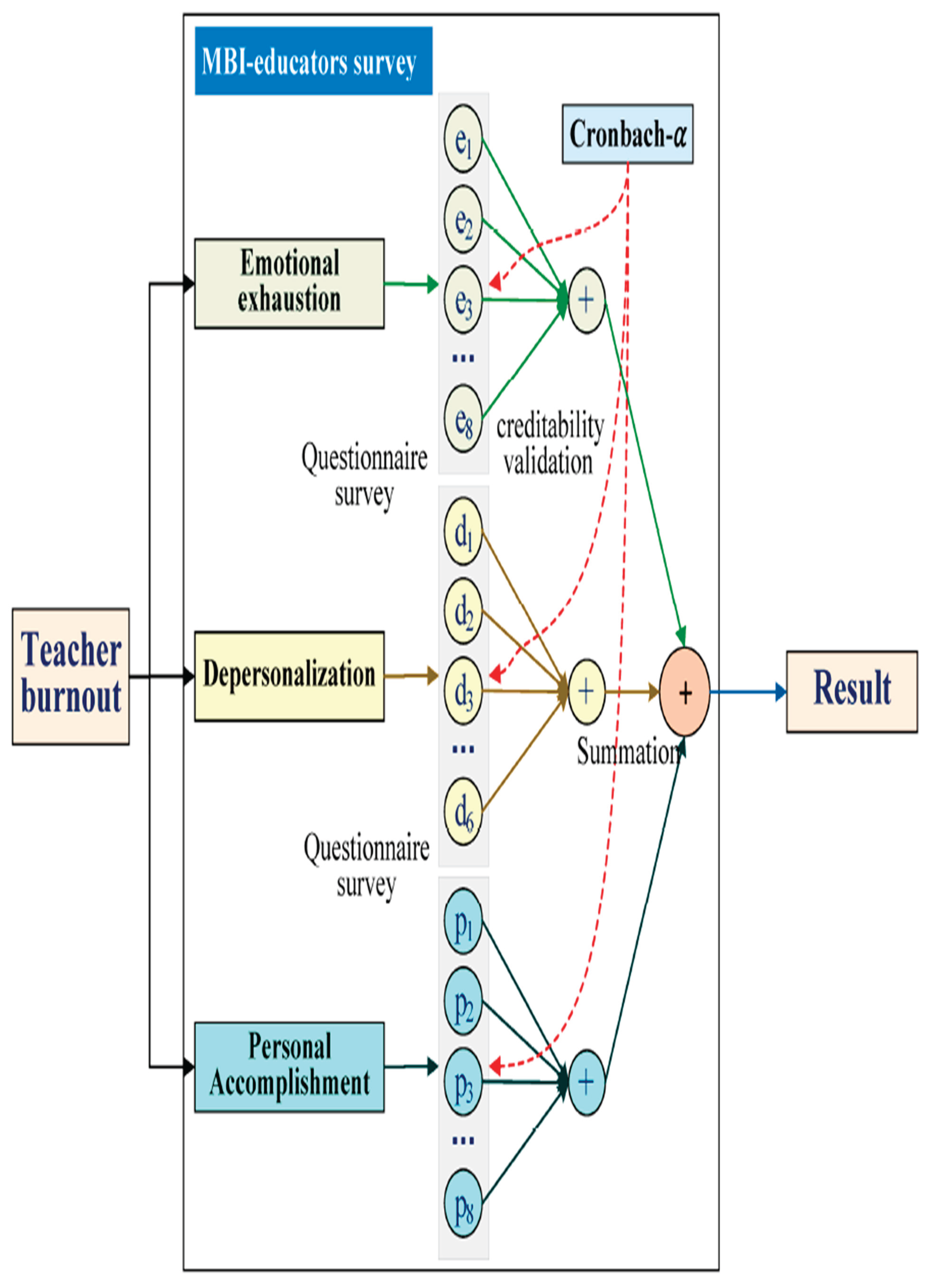
Figure 2.
A quantitative approach to education.
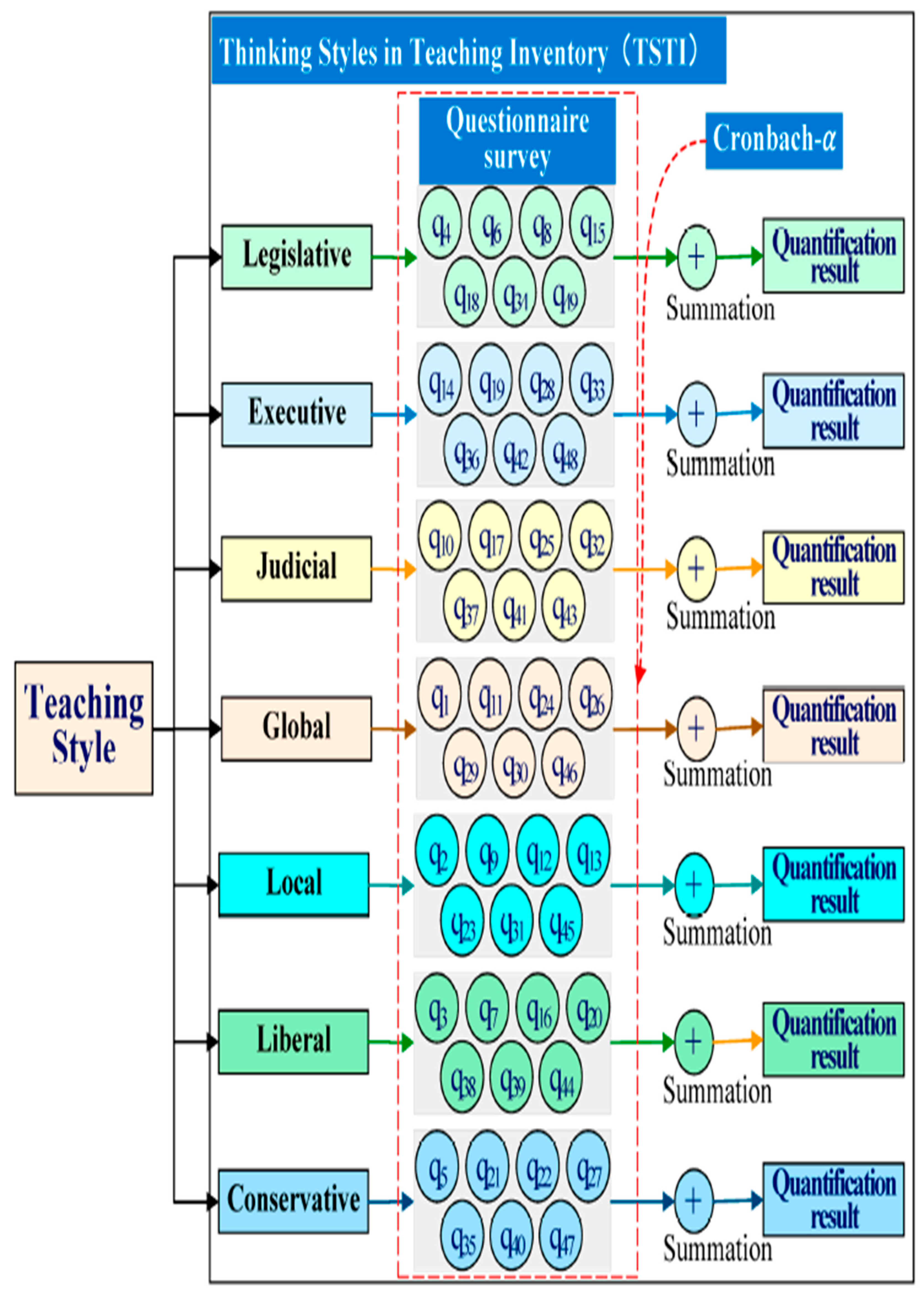
Figure 3.
The quantitative model of TPACK.
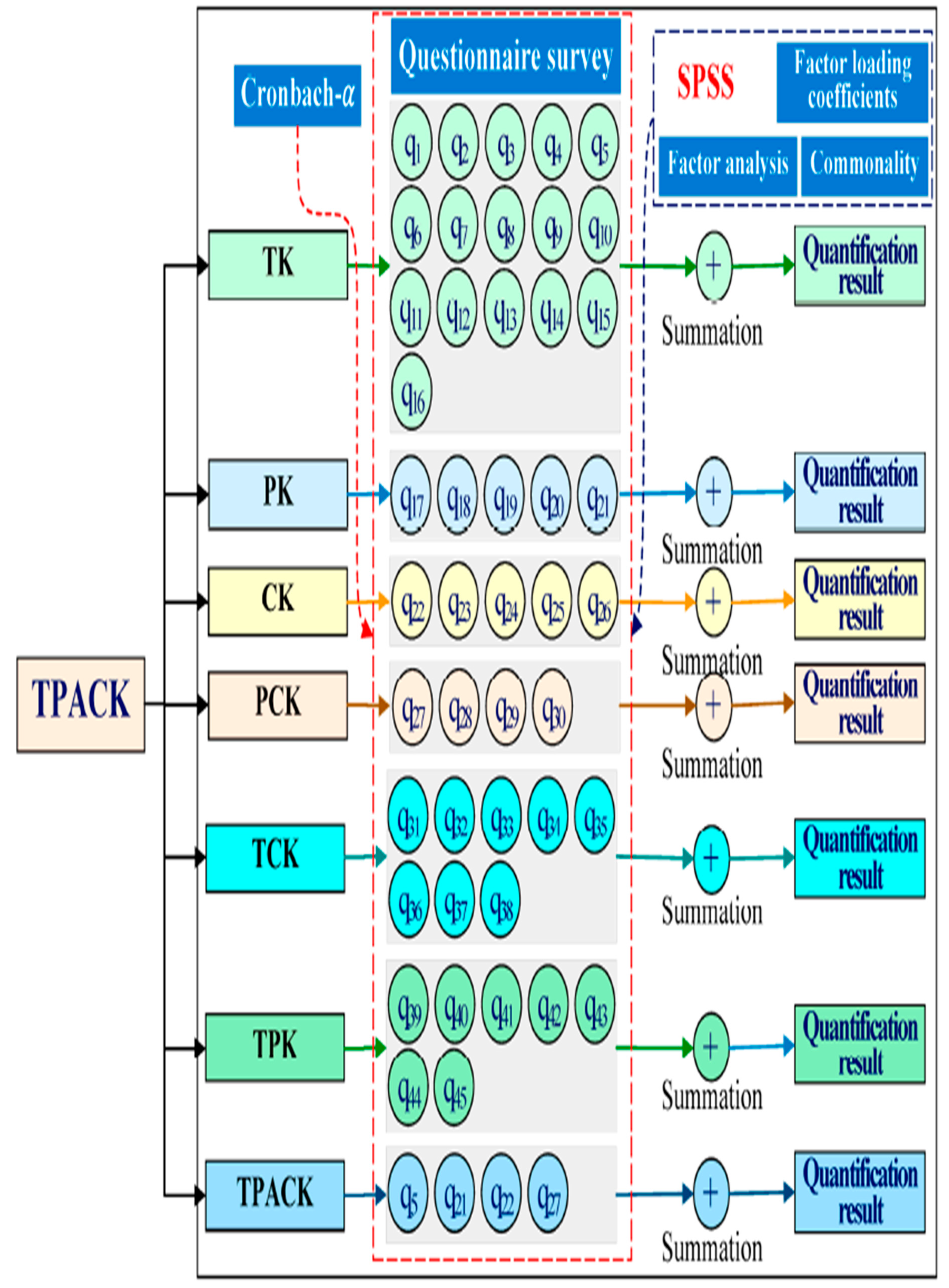
Figure 4.
University Lecturers' varied burnout circumstances, underscoring the necessity for more thorough and in-depth studies on their working conditions and mental health.
Figure 4.
University Lecturers' varied burnout circumstances, underscoring the necessity for more thorough and in-depth studies on their working conditions and mental health.
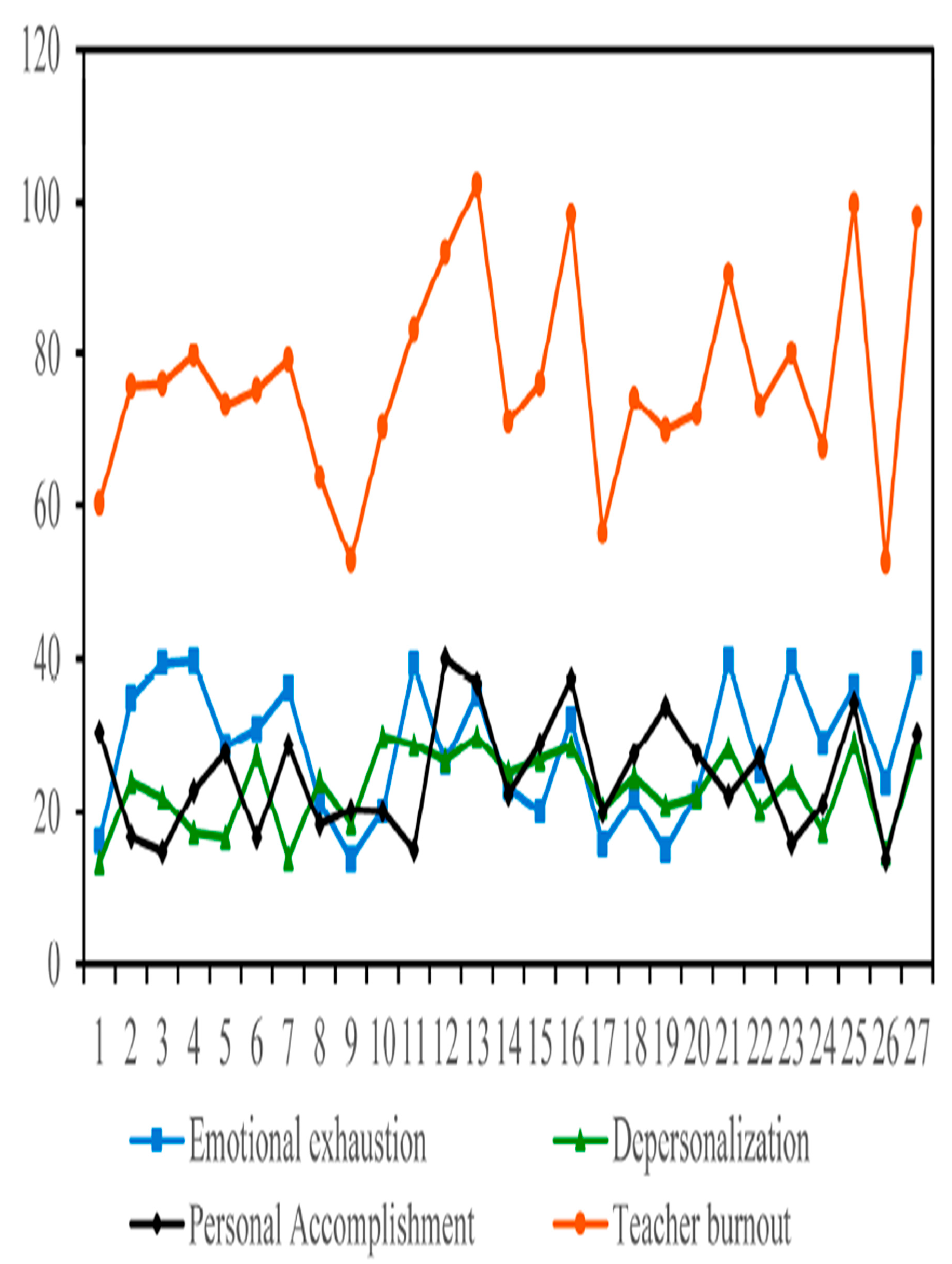
Figure 5.
Outcomes of 27 teachers' academic performance.
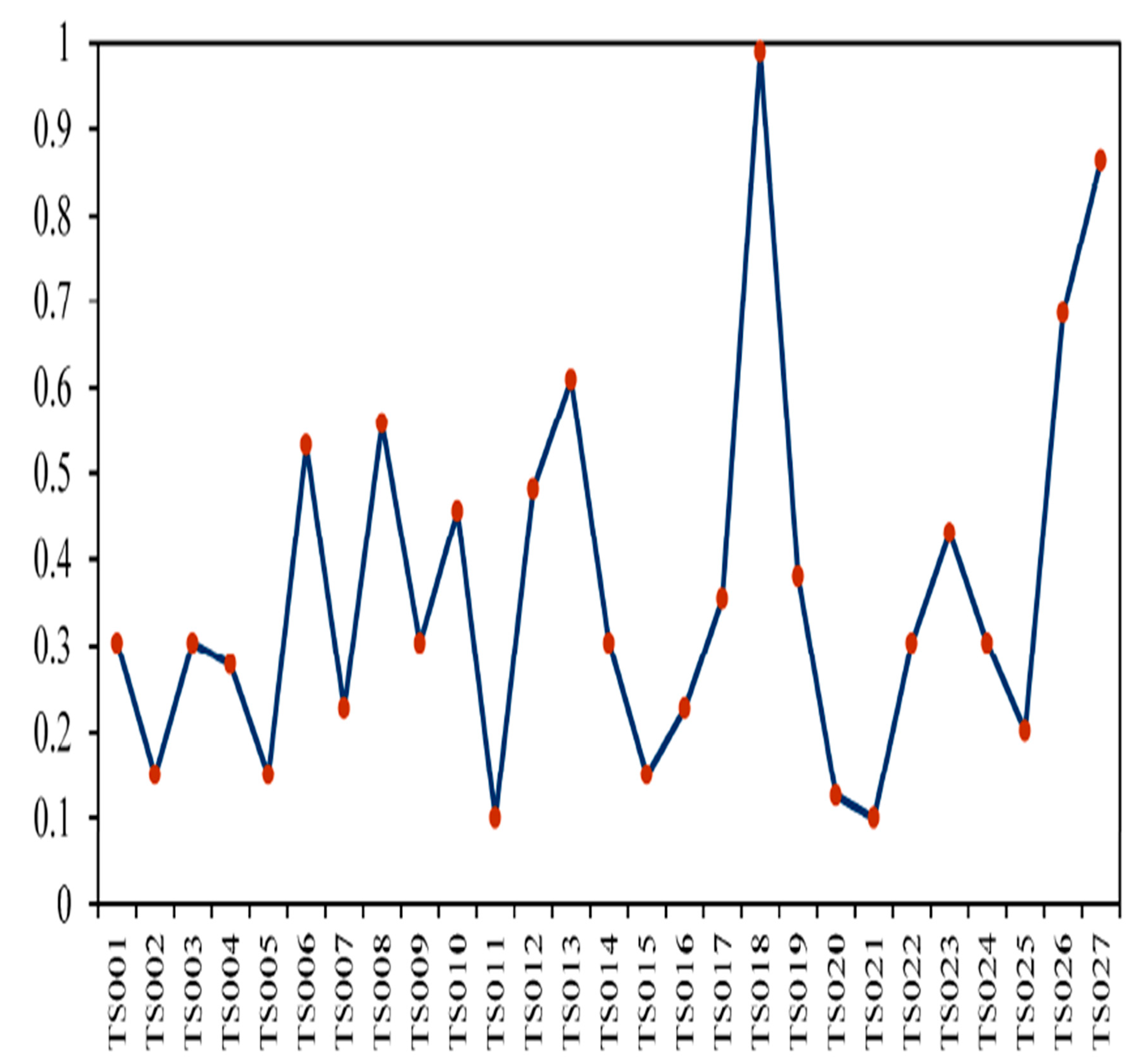
Data from standardized tests, instructor assessments, and student questionnaires are used to estimate the parameters of these functions, therefore offering practical insights.
2.4. Discussion
There are several benefits of mathematically framing variables affecting instruction quality:-
- Predictive Power: Based on variable changes, models can project results (Almalawi et al., 2024).
- Strategically planning locating main leverage points for resource distribution (Jafari et al., 2024).
- Ongoing improvement: Tracking developments over time to improve approaches (Yorkofsky et al., 2020). Data quality, the complexity of human variables, and contextual variation across educational environments, nevertheless, present issues (Lee et al., 2024).
3. Open Problems
- Looking at Eqs (1)-(6), it is needed to explore further investigations to find the exact expressions of in terms of Institutional policies () and Educational environment ().
- Having done that, exploratory research needs to be undertaken to closely analyse and examine the equational relations between and
- The third phase ahead is to examine other undisclosed factors, shown as , referring for error or unmodeled variability, and how to mathematically configure such an .
- The fourth phase is to redefine Eqs (1) - (6) and solve the whole system of the newly generated (1)-(6).
Conclusion
Applying the concept of functions to represent the variables controlling great teaching offers a strict, quantitative framework for educational change. Future research should concentrate on creating complex, nonlinear models and using real-time data analytics to dynamically enhance teaching methods. This framework shows how the mathematical idea of functions can methodically simulate and improve the elements affecting excellent teaching across many degrees of education. Future research should build upon these models with real-time data and sophisticated nonlinear methods to more precisely define educational approaches.
References
- Almalawi, A., Soh, B., Li, A. and Samra, H., 2024. Predictive Models for Educational Purposes: A. [CrossRef]
- Amtu, O., Makulua, K., Matital, J. and Pattiruhu, C.M., 2020. Improving student learning outcomes through school culture, work motivation and teacher performance. International Journal of Instruction, 13(4), pp.885-902. [CrossRef]
- and Five. Preprints. [CrossRef]
- Curriculars: Innovative Next-Generation Teaching of Mathematics Across Key Stages Three, Four,.
- Demidovich, B. and Yankovskv, G., 2020. Problems in mathematical analysis. Mir Publishers.
- Educational Resources. Journal of Resource Management and Decision Engineering, 3(2), pp.41-48.
- Guo, Z., Park, B., Huang, X. and Choi, S., 2023. [Retracted] Evaluation Model of Physical Education Teaching Effect Based on AHP Algorithm. Computational Intelligence and Neuroscience, 2023(1), p.9363403.
- . [CrossRef]
- Jafari, S., Naeeni, S.K. and Nouhi, N., 2024. Decision-Making Strategies in the Allocation of.
- Johnson, C.C., Walton, J.B., Strickler, L. and Elliott, J.B., 2023. Online teaching in K-12 education in the United States: A systematic review. Review of Educational Research, 93(3), pp.353-411. [CrossRef]
- Lee, S.S., Li, N. and Kim, J., 2024. Conceptual model for Mexican teachers' adoption of learning analytics systems: The integration of the information system success model and the technology acceptance model. Education and Information Technologies, 29(11), pp.13387-13412. [CrossRef]
- Li, X., 2022. A Model for analyzing teaching quality data of sports faculties based on particle swarm optimization neural network. Computational Intelligence and Neuroscience, 2022(1), p.6776603. [CrossRef]
- Liao, Y.C., Ottenbreit-Leftwich, A., Zhu, M., Jantaraweragul, K., Christie, L., Krothe, K. and Sparks, K., 2021. How can we support online learning for elementary students? Perceptions and experiences of award-winning K-6 teachers. TechTrends, 65(6), pp.939-951. [CrossRef]
- Madukala, J. and Bai, M., 2025. Over-education, wage gap and job satisfaction of tertiary Education: Evidence from OECD economies. Available at SSRN 5112505.
- Mageed, I. A., 2025a. The Hidden Poetry & Music of Mathematics for Teaching Professionals: Inspiring Students through the Art of Mathematics: A Guide for Educators. Eliva Press. https://www.elivabooks.com/en/book/book-1450104825.
- Mageed, I. A., 2025d. A Fractal Geometric Approach to Teaching Fractions for Mastery in Key.
- Mageed, I., 2025c. Teaching Statistics for Mastery Using Music and Other Phenomenal Extra-.
- Mageed, I.A. 2025b. The Hidden Dancing & Physical Education of Mathematics for Teaching Professionals. Eliva Press. https://www.elivabooks.com/en/book/book-7724827898.
- Mageed, I.A. and Nazir, A.R., 2024. AI-Generated Abstract Expressionism Inspiring Creativity through Ismail A Mageed's Internal Monologues in Poetic Form. Annals of Process Engineering and Management, 1(1), pp.33-85.
- Mageed, I.A., 2024a. Do You Speak The Mighty Triad?(Poetry, Mathematics and Music) Innovative Teaching of Mathematics. MDPI Preprints. [CrossRef].
- Mageed, I.A., 2024b. The Mathematization of Puzzles or Puzzling Mathematics Innovative Teaching of Mathematics. Preprints. [CrossRef]
- Mageed, I.A., 2024c. Let’s All Dance and Play Mathematics Innovative Teaching of Mathematics. Preprints.. [CrossRef]
- Mageed, I.A., 2024d. AI-Generated Abstract Expressionism Inspiring Creativity Through Ismail A Mageed's Internal Monologues in Poetic Form. Preprints.
- Mougiakou, S., Vinatsella, D., Sampson, D., Papamitsiou, Z., Giannakos, M. and Ifenthaler, D., 2023. Educational data analytics for teachers and school leaders (p. 238). Springer Nature.
- Poulose, J., Sharma, V. and Maheshkar, C. eds., 2024. Data-Driven Decision Making. Palgrave Macmillan.
- Practice. Preprints. [CrossRef]
- Singh, J., Goyal, S.B., Kaushal, R.K., Kumar, N. and Sehra, S.S., 2024. Applied Data Science and Smart Systems. Taylor & Francis Group.
- Stages Two and Three: Open Problems and a Combined Theoretical Framework with Intelligent.
- Systematic Review. Big Data and Cognitive Computing, 8(12), p.187.
- Yao, D. and Lin, J., 2023. Identifying key factors influencing teaching quality: A computational pedagogy approach. Systems, 11(9), p.455. [CrossRef]
- Yu, J., 2024. Evaluation of influencing factors of China university teaching quality based on fuzzy logic and deep learning technology. PloS one, 19(9), p.e0303613. [CrossRef]
Disclaimer/Publisher’s Note: The statements, opinions and data contained in all publications are solely those of the individual author(s) and contributor(s) and not of MDPI and/or the editor(s). MDPI and/or the editor(s) disclaim responsibility for any injury to people or property resulting from any ideas, methods, instructions or products referred to in the content. |
© 2025 by the authors. Licensee MDPI, Basel, Switzerland. This article is an open access article distributed under the terms and conditions of the Creative Commons Attribution (CC BY) license (http://creativecommons.org/licenses/by/4.0/).
Copyright: This open access article is published under a Creative Commons CC BY 4.0 license, which permit the free download, distribution, and reuse, provided that the author and preprint are cited in any reuse.


