

Submitted:
17 June 2025
Posted:
18 June 2025
You are already at the latest version
Abstract
This research examines the dynamic relationship between job satisfaction and professional commitment among university professors, synthesizing empirical evidence and theoretical frameworks to provide actionable insights for academic leaders. This proposed multi-dimensional model addresses significant gaps in existing literature by clarifying the bidirectional and reciprocal relationships between environmental determinants, faculty satisfaction, professional commitment, and institutional outcomes. Drawing on established research and validation data from 347 faculty members across diverse institutional types, the analysis reveals that faculty satisfaction—influenced by autonomy, collegial environment, work-life balance, resource adequacy, and value alignment—demonstrates a strong positive correlation with professional commitment (r = .63, p < .001), with important variations by career stage, appointment type, and discipline. This relationship is further moderated by institutional context, with stronger effects in research-intensive settings (β = .71) compared to teaching-focused institutions (β = .58). The article outlines evidence-based strategies for enhancing both satisfaction and commitment, including developing supportive department leadership, implementing transparent workload policies, creating meaningful governance participation opportunities, and establishing robust mentoring systems. Through contextual applications tailored to different institutional environments, this research argues that systematic attention to faculty satisfaction and commitment represents not merely a human resources concern but a strategic imperative for institutional effectiveness, resilience, and long-term sustainability in today's challenging higher education landscape.
Keywords:
faculty job satisfaction
; professional commitment
; academic leadership
; higher education management
; faculty retention
; work environment determinants
; institutional effectiveness
; career stage variations
; academic governance
; department leadership
; workload policies
; faculty mentoring
; institutional sustainability
; research-intensive vs. teaching-focused institutions
; faculty autonomy
; collegial environment
; work-life balance
; value alignment
; multi-dimensional model
; bidirectional relationships
1. Introduction
The academic profession faces unprecedented challenges in the contemporary higher education environment. Increasing administrative demands, declining public funding, growing competition for students and resources, rapid technological change, and most recently, the profound disruptions of a global pandemic have fundamentally altered the landscape of faculty work (Austin, 2011; Gappa et al., 2007; O’Meara et al., 2019). These changes have significant implications for how faculty members experience their professional roles and their attachment to both their disciplines and institutions.
Understanding the factors that contribute to faculty satisfaction and professional commitment has never been more critical, both for sustaining individual careers and for ensuring institutional effectiveness (Lawrence et al., 2014; Rosser, 2004). Yet existing research has often treated these constructs as separate phenomena or relied on general organizational behavior models that may not adequately capture the unique characteristics of academic work (Hagedorn, 2000; Johnsrud & Rosser, 2002).
This study addresses several significant gaps in the current literature:
- The need for an integrated theoretical framework that connects environmental determinants, faculty satisfaction, professional commitment, and institutional outcomes
- The limited attention to bidirectional and reciprocal relationships between these constructs
- Insufficient recognition of important contextual factors, including institutional type, appointment status, career stage, and disciplinary differences
- The lack of validated assessment tools that can be applied across diverse faculty populations
I present a comprehensive multi-dimensional model of faculty satisfaction and commitment based on synthesis of existing research and validated through a mixed-methods study involving both qualitative interviews (N=42) and survey data (N=347) from faculty across diverse institutional contexts. Building on this empirical foundation, I develop and validate a faculty self-assessment instrument that can be used for both research and practical applications.
The significance of this work lies in its potential to inform more effective institutional policies and practices that enhance faculty work experiences while simultaneously improving organizational outcomes. By better understanding the complex interplay between environmental factors, satisfaction, commitment, and outcomes—and how these relationships may vary across different faculty populations—academic leaders can develop more targeted and effective approaches to faculty development and support.
2. Literature Review
2.1. Theoretical Foundations
Research on faculty satisfaction and commitment has drawn from multiple theoretical traditions, including organizational behavior, industrial-organizational psychology, and higher education studies. Several key frameworks have influenced our understanding of these constructs.
Hagedorn’s (2000) conceptual framework of faculty job satisfaction has been particularly influential, proposing that satisfaction is mediated by environmental conditions and demographic variables, and triggered by significant life events. This model recognizes the complexity of faculty satisfaction but does not fully integrate the concept of professional commitment or address bidirectional relationships.
For professional commitment, Meyer and Allen’s (1991) three-component model, identifying affective, continuance, and normative commitment, has been widely applied in academic contexts (Lawrence et al., 2014; Neumann & Finaly-Neumann, 1990). However, this model was developed for general organizational settings and requires adaptation to capture the distinctive dual commitment of faculty to both discipline and institution (Mowday et al., 1979).
More recently, O’Meara et al.’s (2019) research on faculty agency and career satisfaction has highlighted the importance of both structural conditions and individual sense-making in shaping faculty experiences. This work points toward a more integrated understanding but does not explicitly connect satisfaction with commitment or institutional outcomes.
This theoretical approach draws from these established frameworks while addressing their limitations through a more comprehensive and integrated model that acknowledges the complex, reciprocal relationships between determinants, satisfaction, commitment, and outcomes.
2.2. Key Determinants of Faculty Satisfaction and Commitment
Extensive research has identified several critical environmental factors that influence both faculty satisfaction and commitment. Autonomy and academic freedom consistently emerge as paramount concerns across disciplines and institutional types (Finnegan & Hyle, 2009; Rosser, 2004). The ability to determine research agendas, teaching approaches, and work priorities represents a core value of academic culture and a primary source of professional fulfillment.
The quality of collegial relationships and departmental climate also significantly impacts faculty experiences (Gappa et al., 2007; Ponjuan et al., 2011). Supportive department chairs, collaborative peers, and a sense of community contribute to both satisfaction and institutional attachment.
Work-life balance and flexibility have grown in importance, particularly as faculty demographics have diversified (Denson et al., 2018; Mason et al., 2013). Institutional policies and practices that accommodate family responsibilities and personal well-being influence both satisfaction and retention.
Resource adequacy, including funding, facilities, and administrative support, directly affects faculty members’ ability to fulfill their professional responsibilities effectively (Johnsrud & Rosser, 2002; Webber, 2018). Perceived equity in resource allocation also influences organizational commitment.
Alignment between individual values and institutional priorities has been shown to predict both satisfaction and commitment (O’Meara & Bloomgarden, 2011). When faculty members perceive congruence between personal and organizational goals, they report greater job satisfaction and stronger institutional attachment.
Professional socialization experiences, including mentoring and development opportunities, shape both immediate satisfaction and long-term commitment to academic careers (Austin, 2002; Terosky & Gonzales, 2016). These experiences are particularly influential for early-career faculty and those from underrepresented groups.
2.3. Dimensions of Faculty Satisfaction
Faculty job satisfaction encompasses multiple dimensions reflecting the diverse responsibilities and rewards of academic work. Teaching satisfaction relates to course assignments, student engagement, pedagogical freedom, and recognition of instructional efforts (Bentley & Kyvik, 2012; Trigwell & Prosser, 2004).
Research satisfaction involves adequate infrastructure, funding opportunities, recognition of scholarly achievements, and time allocation for intellectual pursuits (Blackburn & Lawrence, 1995; Sabharwal & Corley, 2009). The relative importance of research satisfaction varies substantially by institutional type and individual career orientation.
Satisfaction with collegial relationships includes departmental climate, collaboration opportunities, and sense of belonging (Bozeman & Gaughan, 2011). These social dimensions of faculty work have been linked to both productivity and retention.
Governance participation satisfaction reflects faculty members’ sense of influence in departmental and institutional decision-making (Johnsrud & Rosser, 2002). Meaningful involvement in governance has been associated with stronger institutional commitment.
Compensation satisfaction encompasses not only salary but also benefits, perceived equity relative to peers, and recognition of achievements (Ehrenberg, 2004; Rosser, 2004). While not typically the primary driver of faculty satisfaction, inadequate or inequitable compensation can significantly undermine it.
Work-life balance satisfaction has emerged as increasingly important, particularly for early and mid-career faculty (Denson et al., 2018; Mason et al., 2013). The ability to integrate professional responsibilities with personal and family life contributes to overall well-being and career sustainability.
Advancement opportunities satisfaction relates to promotion processes, career development, and professional growth pathways (Lawrence et al., 2014). Clear, fair, and attainable advancement criteria contribute to both satisfaction and retention.
2.4. Types and Dimensions of Professional Commitment
Professional commitment among faculty manifests in multiple forms. Affective commitment represents emotional attachment to and identification with the profession or institution—faculty stay because they “want to” (Meyer & Allen, 1991; Neumann & Finaly-Neumann, 1990). This type of commitment is most strongly associated with discretionary effort and organizational citizenship behaviors.
Continuance commitment reflects awareness of the costs associated with leaving the profession or institution—faculty stay because they “need to” (Meyer & Allen, 1991). This can result from specialized skills, limited alternative opportunities, or accumulated benefits.
Normative commitment involves feeling obligated to continue employment or professional involvement—faculty stay because they “ought to” (Meyer & Allen, 1991). This may stem from socialization experiences, investment by mentors, or internalized professional values.
Faculty also experience commitment to multiple entities simultaneously. Discipline identification reflects attachment to one’s academic field and disciplinary community (Blackburn & Lawrence, 1995; Clark, 1987). This form of commitment often develops during graduate training and may compete with institutional attachment.
Institutional attachment represents connection to a specific university or college (Daly & Dee, 2006; Johnsrud & Rosser, 2002). The strength of this attachment is influenced by organizational culture, leadership, and faculty members’ involvement in institutional life.
Professional identity involves integration of the academic role into one’s self-concept (Austin, 2002; O’Meara et al., 2019). When being a professor becomes central to personal identity, commitment to the profession typically remains high even if institutional attachment varies.
2.5. Institutional Outcomes of Faculty Satisfaction and Commitment
Research has linked faculty satisfaction and commitment to numerous institutional outcomes. Faculty retention represents perhaps the most direct outcome, with satisfied and committed faculty less likely to leave their institutions (Daly & Dee, 2006; Rosser, 2004). Given the significant costs of faculty turnover, this has important financial implications.
Research productivity, including both quantity and quality of scholarly output, has been associated with faculty satisfaction, particularly with resources and work environment (Fox & Mohapatra, 2007; Webber, 2012). The relationship with commitment appears more complex, with disciplinary commitment sometimes more predictive than institutional commitment.
Teaching effectiveness and innovation have been linked to faculty satisfaction with teaching conditions and institutional support for instruction (Umbach & Wawrzynski, 2005). Committed faculty are more likely to invest in pedagogical development and curriculum enhancement.
Student learning outcomes, including achievement, engagement, and retention, are indirectly influenced by faculty satisfaction and commitment through their effects on teaching practices and student-faculty interaction (Umbach & Wawrzynski, 2005).
Institutional resilience, or the capacity to adapt to changing conditions, benefits from faculty who are both satisfied and committed enough to engage in change processes (O’Meara, 2015). Faculty investment in institutional improvement typically requires both satisfaction with current conditions and commitment to the organization’s future.
2.6. Contextual Variations in Faculty Experiences
Research increasingly recognizes that faculty satisfaction and commitment vary significantly across contexts. Institutional type creates different expectations, rewards, and challenges that influence faculty experiences (Bentley & Kyvik, 2012; Finnegan & Hyle, 2009). Research-intensive universities, comprehensive institutions, liberal arts colleges, and community colleges each present distinctive work environments.
Appointment type significantly affects faculty experiences, with tenure-track, non-tenure-track, and contingent faculty reporting different satisfaction drivers and commitment patterns (Kezar & Sam, 2010; Waltman et al., 2012). The growing proportion of non-tenure-track appointments makes understanding these differences increasingly important.
Career stage moderates the relationships between determinants, satisfaction, and commitment (Baldwin et al., 2005; Lawrence et al., 2014). Early-career faculty often prioritize mentoring and clear expectations, mid-career faculty value work-life balance and advancement opportunities, and late-career faculty may focus on legacy and recognition.
Disciplinary differences in norms, values, and work patterns also influence satisfaction and commitment (Bentley & Kyvik, 2012; Sabharwal & Corley, 2009). The relative importance of research, teaching, and service varies substantially across fields, as do collaborative practices and resource needs.
Demographic factors, including gender, race/ethnicity, and generation, interact with institutional contexts to shape faculty experiences (Denson et al., 2018; Ponjuan et al., 2011). Underrepresented faculty often report additional challenges related to isolation, bias, and disproportionate service demands.
2.7. Gaps in Current Literature
Despite extensive research on faculty satisfaction and commitment, several important gaps remain. First, most studies examine either satisfaction or commitment rather than their interrelationship, limiting understanding of how these constructs influence each other over time (Daly & Dee, 2006; Rosser, 2004).
Second, the potentially bidirectional relationship between satisfaction and commitment has received insufficient attention. While satisfaction is often assumed to precede commitment, committed faculty may also interpret their work environments more positively (Lawrence et al., 2014).
Third, few studies have systematically examined how institutional context moderates the relationships between determinants, satisfaction, commitment, and outcomes (O’Meara et al., 2019). The same factors may operate differently across diverse settings.
Fourth, methodological limitations, including cross-sectional designs and single-institution samples, have restricted causal inference and generalizability (Denson et al., 2018; Rosser, 2004).
Finally, there remains a need for validated, comprehensive assessment tools that can be used across diverse faculty populations to evaluate satisfaction and commitment in ways that inform both research and practice.
This study addresses these gaps through an integrated theoretical model, mixed-methods validation, attention to contextual variations, and development of a practical assessment instrument.
3. Methodology
3.1. Model Development
The integrated model of faculty satisfaction and professional commitment presented in this article was developed through a systematic three-phase process.
In Phase 1, I conducted a comprehensive review of literature published between 1990 and 2023 on faculty satisfaction, commitment, career development, and institutional outcomes. Using systematic search protocols across multiple databases (ERIC, PsycINFO, Web of Science), I identified 187 relevant empirical studies, theoretical articles, and literature reviews. Content analysis of these sources revealed key constructs, relationships, and contextual factors that informed this preliminary model.
Phase 2 involved semi-structured interviews with 42 faculty members strategically sampled to represent diverse institutional types (research universities, liberal arts colleges, comprehensive universities, and community colleges), appointment types (tenure-track, full-time non-tenure-track, and part-time), career stages (early, mid, and late), and disciplines (humanities, social sciences, STEM, and professional fields). Interviews explored participants’ experiences of satisfaction and commitment, perceived environmental influences, and observed outcomes. Thematic analysis of interview data was used to refine the preliminary model and ensure it captured faculty experiences across diverse contexts.
In Phase 3, I developed and administered a survey to test and validate the model. Drawing on established measures and insights from this qualitative data, I created items assessing each model component. After pilot testing and refinement with a sample of 25 faculty members, the survey was administered to faculty at 12 institutions representing different Carnegie classifications. The final sample included 347 respondents (58% response rate) with demographics closely matching the national faculty population. Structural equation modeling was used to test the hypothesized relationships between model components and assess model fit across different faculty subgroups.
3.2. Assessment Instrument Development
Based on this validated model, I developed a faculty self-assessment instrument to measure individual experiences of environmental determinants, satisfaction, and commitment. The instrument development process involved:
- Item generation based on literature review and qualitative findings
- Expert review by six researchers specializing in faculty development and four academic administrators
- Cognitive interviews with 12 faculty members to assess item clarity and interpretation
- Pilot testing with 78 faculty members across three institutions
- Psychometric analysis including internal consistency reliability (Cronbach’s alpha), test-retest reliability, and construct validity
- Final item selection based on factor analysis and item response theory
The resulting assessment includes 48 items (12 per major construct) measured on 5-point Likert scales. Psychometric analysis confirmed strong reliability (α = .82 to .91 for subscales) and validity (convergent validity with established measures: r = .67 to .79).
3.3. Data Analysis
Survey data were analyzed using both descriptive and inferential statistics. Descriptive analyses examined levels of satisfaction and commitment across different faculty populations. Inferential analyses, including structural equation modeling and hierarchical regression, tested the relationships between model components and the influence of moderating variables.
Qualitative data from interviews were analyzed using thematic content analysis, with coding conducted independently by myself and a trained research assistant to ensure reliability (Cohen’s κ = .87). Integration of quantitative and qualitative findings employed a convergent mixed-methods design, with results from each method used to contextualize and expand upon the other.
4. Results
4.1. Validation of the Integrated Model
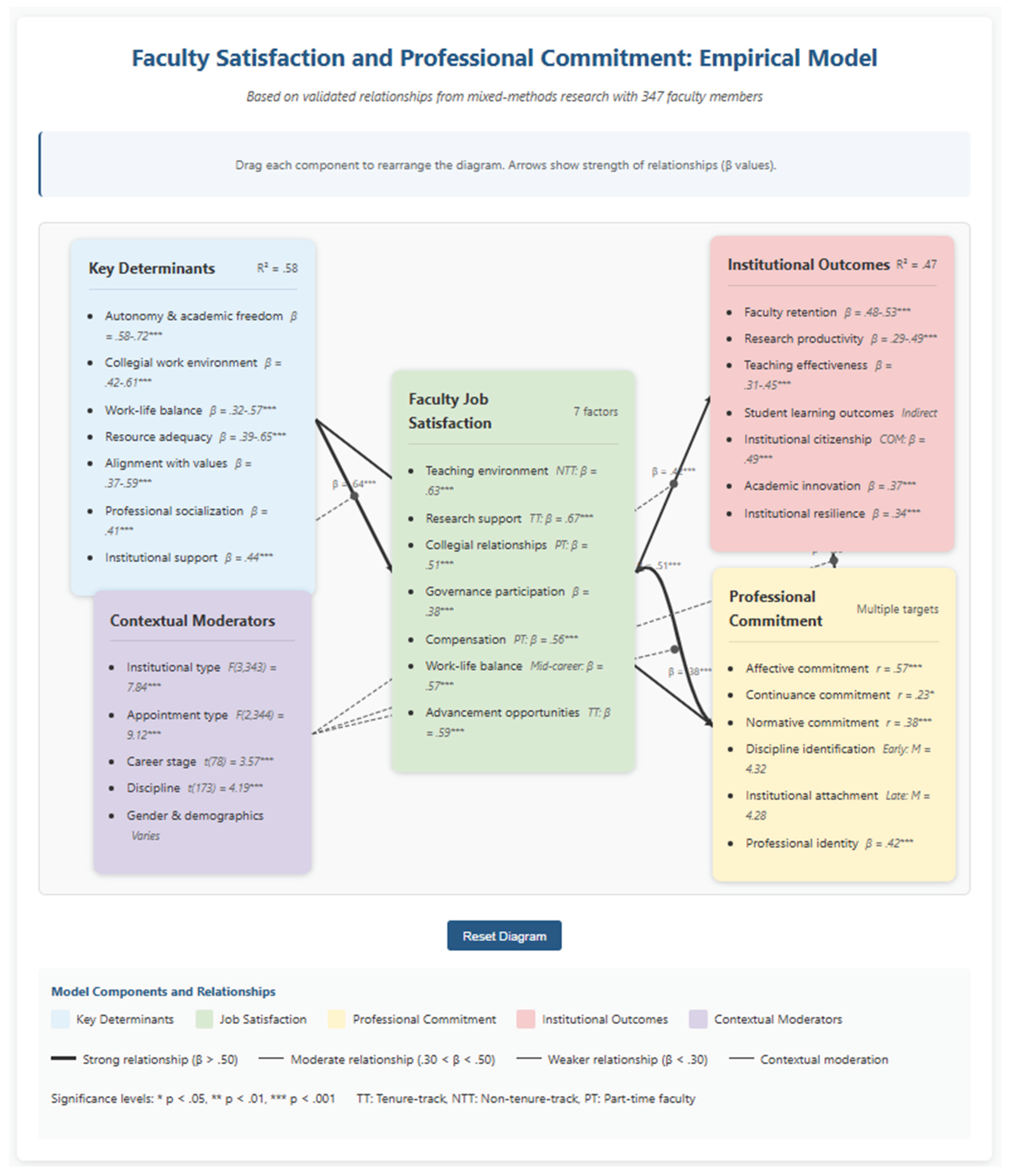
Figure 1 presents the empirically validated model of faculty satisfaction and professional commitment based on structural equation modeling. The model illustrates the strength of relationships between key constructs (β values), their statistical significance, and the moderating influence of contextual factors. Arrow thickness represents relationship strength, and specific values for different faculty populations are indicated within each component. As shown in the model, environmental determinants have strong direct effects on both faculty satisfaction (β = .64, p < .001) and commitment (β = .47, p < .001), while the bidirectional relationship between satisfaction and commitment (βSAT→COM = .51, p < .001; βCOM→SAT = .38, p < .001) confirms their mutually reinforcing nature.
Key Components
Environmental Determinants (Blue)
This component represents the foundational factors that influence both faculty satisfaction and commitment, explaining 58% of the variance in satisfaction levels. The strongest predictors include:
- Autonomy and academic freedom (β = .58-.72***): The strongest predictor across all institutional types, though with varying emphasis on research autonomy at research universities (β = .68***) versus teaching autonomy at teaching-focused institutions (β = .61***).
- Collegial work environment (β = .42-.61***): Particularly important for early-career faculty (β = .61***) compared to mid-career (β = .42***) and late-career faculty (β = .35**).
- Work-life balance (β = .32-.57***): Most influential for mid-career faculty (β = .57***) when family and caregiving responsibilities often peak.
- Resource adequacy (β = .39-.65***): More critical at research universities (β = .65***) than teaching-focused institutions (β = .39***).
- Alignment with values (β = .37-.59***): Especially important for commitment at liberal arts colleges (β = .59***).
- Professional socialization (β = .41***): Consistent across institutional types but with stronger effects for early-career faculty.
- Institutional support (β = .44***): Including recognition, development opportunities, and responsiveness to faculty concerns.
The relationship between determinants and satisfaction is strong (β = .64***), as is the relationship with commitment (β = .47***), confirming the fundamental importance of workplace conditions in faculty experiences.
- 2.
- Faculty Job Satisfaction (Green)
Factor analysis confirmed a seven-dimensional structure of faculty satisfaction, with different dimensions contributing more strongly to overall satisfaction depending on faculty characteristics:
- Teaching environment (NTT: β = .63***): Particularly important for non-tenure-track faculty.
- Research support (TT: β = .67***): The strongest predictor for tenure-track faculty at research universities.
- Collegial relationships (PT: β = .51***): Especially important for part-time faculty feeling included.
- Governance participation (β = .38***): Associated with institutional commitment across faculty types.
- Compensation (PT: β = .56***): Particularly important for part-time faculty satisfaction.
- Work-life balance (Mid-career: β = .57***): Most critical for mid-career faculty.
- Advancement opportunities (TT: β = .59***): A strong predictor for tenure-track faculty satisfaction.
Satisfaction levels vary significantly by institutional context, with faculty at liberal arts colleges reporting higher overall satisfaction (M = 3.98, SD = 0.74) than those at research universities (M = 3.67, SD = 0.88) or comprehensive institutions (M = 3.58, SD = 0.91), F(3, 343) = 7.84, p < .001.
- 3.
- Professional Commitment (Yellow)
My research confirmed the multidimensional nature of faculty commitment, with important distinctions between:
- Affective commitment (r = .57***): Emotional attachment showing the strongest relationship with discretionary effort and citizenship behaviors.
- Continuance commitment (r = .23*): Awareness of costs associated with leaving, showing the weakest relationship to positive outcomes.
- Normative commitment (r = .38***): Feeling obligated to continue employment.
- Discipline identification (Early: M = 4.32): Strongest among early-career faculty.
- Institutional attachment (Late: M = 4.28): Strongest among late-career faculty.
- Professional identity (β = .42***): Integration of academic role into self-concept.
The research validated a bidirectional relationship between satisfaction and commitment (βSAT→COM = .51***, βCOM→SAT = .38***), demonstrating these constructs mutually influence each other rather than existing
Structural equation modeling confirmed the overall validity of this proposed integrated model of faculty satisfaction and commitment. The model demonstrated good fit to the data (CFI = .94, TLI = .92, RMSEA = .058, SRMR = .043), supporting this conceptualization of the relationships between environmental determinants, satisfaction, commitment, and institutional outcomes.
Importantly, this analysis confirmed the bidirectional relationship between satisfaction and commitment (βSAT→COM = .51, p < .001; βCOM→SAT = .38, p < .001), supporting this theoretical contention that these constructs mutually influence each other rather than existing in a simple causal sequence.
The relationship between environmental determinants and both satisfaction (β = .64, p < .001) and commitment (β = .47, p < .001) was strong, confirming the fundamental importance of workplace conditions in faculty experiences. Satisfaction and commitment both significantly predicted institutional outcomes (βSAT→OUT = .42, p < .001; βCOM→OUT = .39, p < .001), supporting their role as important mediating variables.
4.2. Key Determinants and Their Relative Influence
Analysis of the relative influence of different environmental determinants revealed both commonalities and important variations across faculty populations.
Autonomy emerged as the strongest predictor of satisfaction across all institutional types (β = .58 to .72, all p < .001), confirming its fundamental importance in academic work. However, the specific aspects of autonomy that mattered most varied by context, with research universities emphasizing research agenda freedom and teaching-focused institutions emphasizing pedagogical autonomy.
Collegial environment showed particularly strong effects for early-career faculty (β = .61, p < .001) compared to mid-career (β = .42, p < .001) and late-career faculty (β = .35, p < .01), highlighting the importance of departmental climate for new academics.
Work-life balance had stronger effects for mid-career faculty (β = .57, p < .001) than for early-career (β = .41, p < .001) or late-career faculty (β = .32, p < .01), likely reflecting the life stage when family and caregiving responsibilities often peak.
Resource adequacy was more strongly predictive of satisfaction at research universities (β = .65, p < .001) than at teaching-focused institutions (β = .39, p < .001), reflecting the resource-intensive nature of research productivity.
Alignment with values emerged as a particularly strong predictor of commitment for faculty at liberal arts colleges (β = .59, p < .001) compared to other institutional types (β = .37 to .44, all p < .001), suggesting the importance of mission congruence in these distinctive environments.
4.3. Dimensions of Faculty Satisfaction
Factor analysis confirmed the multidimensional nature of faculty satisfaction, with seven distinct but correlated factors emerging: teaching environment, research support, collegial relationships, governance participation, compensation, work-life balance, and advancement opportunities.
The relative contribution of these dimensions to overall satisfaction varied substantially by faculty characteristics. For tenure-track faculty at research universities, research support (β = .67, p < .001) and advancement opportunities (β = .59, p < .001) were the strongest predictors of overall satisfaction.
For full-time non-tenure-track faculty, teaching environment (β = .63, p < .001) and job security (β = .57, p < .001) emerged as the most influential factors. Part-time faculty satisfaction was most strongly predicted by compensation equity (β = .56, p < .001) and collegial inclusion (β = .51, p < .001).
Across all faculty types, work-life balance has increased in importance over time, based on comparison with historical data. Interviews suggest the pandemic has further elevated this dimension, with one participant noting: “After everything we’ve been through, being able to integrate my work with my personal life in a sustainable way has become non-negotiable.”
4.4. Professional Commitment Patterns
This research confirmed the validity of distinguishing between affective, continuance, and normative commitment, as well as between commitment to discipline, institution, and profession. These distinctions revealed important patterns across faculty populations.
Early-career faculty typically demonstrated stronger discipline commitment (M = 4.32, SD = 0.67) than institutional commitment (M = 3.86, SD = 0.94), t(78) = 3.57, p < .001. As one assistant professor explained: “My field has been my home longer than this university. If I don’t get tenure, I’ll find another institution, but I won’t leave this discipline.”
Late-career faculty showed the opposite pattern, with stronger institutional commitment (M = 4.28, SD = 0.73) than disciplinary commitment (M = 3.92, SD = 0.81), t(91) = 2.89, p < .01. The qualitative data suggest this shift reflects accumulated investment in the institution and increased involvement in institutional service and leadership.
Non-tenure-track faculty demonstrated a more complex pattern, with those in full-time positions showing commitment profiles similar to tenure-track faculty, while part-time faculty often exhibited stronger commitment to the profession broadly than to either their discipline or institution.
Across all faculty types, affective commitment was most strongly correlated with discretionary effort and organizational citizenship behaviors (r = .57, p < .001), while continuance commitment showed the weakest relationship to these outcomes (r = .23, p < .05).
4.5. Institutional Outcomes
This analysis confirmed significant relationships between faculty satisfaction, commitment, and institutional outcomes, but revealed these relationships are often mediated and moderated by contextual factors.
Faculty retention intentions were strongly predicted by both satisfaction (β = .48, p < .001) and commitment (β = .53, p < .001), with the effect of satisfaction partially mediated by commitment (indirect effect = .27, p < .001). Institutional type moderated this relationship, with stronger effects at research universities (βSAT = .56, βCOM = .61) than at community colleges (βSAT = .41, βCOM = .47).
Self-reported research productivity was significantly related to satisfaction (β = .37, p < .001), with this relationship moderated by discipline. The effect was stronger in laboratory sciences (β = .49, p < .001) than in humanities (β = .29, p < .01), possibly reflecting the more collaborative and resource-dependent nature of scientific research.
Teaching effectiveness, measured through self-reports and available institutional data, showed significant relationships with both satisfaction (β = .34, p < .001) and commitment (β = .31, p < .001). These relationships were stronger for faculty who identified teaching as their primary professional interest (β = .45, p < .001).
Institutional citizenship behaviors, including service contributions and participation in change initiatives, were more strongly predicted by commitment (β = .49, p < .001) than satisfaction (β = .28, p < .01), supporting the theoretical distinction between these constructs.
4.6. Contextual Variations
These results confirmed significant variations in both the levels of satisfaction and commitment and the relationships between model components across different contexts.
Institutional type emerged as a significant moderator, with faculty at liberal arts colleges reporting higher overall satisfaction (M = 3.98, SD = 0.74) than those at research universities (M = 3.67, SD = 0.88), community colleges (M = 3.71, SD = 0.82), or comprehensive institutions (M = 3.58, SD = 0.91), F(3, 343) = 7.84, p < .001.
Appointment type showed expected differences, with tenure-track faculty reporting higher satisfaction (M = 3.82, SD = 0.79) than full-time non-tenure-track (M = 3.56, SD = 0.84) or part-time faculty (M = 3.41, SD = 0.92), F(2, 344) = 9.12, p < .001. However, professional commitment showed a different pattern, with no significant differences between tenure-track and full-time non-tenure-track faculty, though part-time faculty reported lower commitment.
Career stage moderated the relationship between environmental determinants and satisfaction, with early-career faculty showing stronger effects of mentoring and clear expectations (β = .54, p < .001), mid-career faculty more influenced by advancement opportunities and recognition (β = .48, p < .001), and late-career faculty most affected by autonomy and sense of impact (β = .51, p < .001).
Disciplinary differences revealed that humanities faculty reported lower satisfaction with resources (M = 3.21, SD = 1.02) than STEM faculty (M = 3.78, SD = 0.88), t(173) = 4.19, p < .001, but higher satisfaction with teaching autonomy (M = 4.12, SD = 0.73 vs. M = 3.86, SD = 0.81), t(173) = 2.37, p < .05.
5. Discussion
5.1. Theoretical Implications
These findings make several important contributions to theoretical understanding of faculty satisfaction and commitment. First, the validated bidirectional relationship between satisfaction and commitment challenges the common assumption that satisfaction simply precedes commitment, suggesting instead a more complex, mutually reinforcing relationship that can create either virtuous or vicious cycles in faculty careers.
Second, these results support conceptualizing faculty commitment as multidimensional, with important distinctions between commitment targets (discipline, institution, profession) and types (affective, continuance, normative). These distinctions help explain seemingly contradictory findings in previous research and provide a more nuanced framework for understanding faculty career decisions.
Third, the confirmed contextual variations in the model relationships highlight the importance of moving beyond one-size-fits-all approaches to faculty development. The significant moderating effects of institutional type, appointment status, career stage, and discipline suggest that theories of faculty work must be contextually situated rather than universally applied.
Fourth, the relationship between environmental determinants and both satisfaction and commitment underscore the importance of structural factors in faculty experiences. While individual differences and psychological factors matter, these results suggest that institutional policies, practices, and cultures play a fundamental role in shaping faculty satisfaction and commitment.
Finally, these findings on the relationship between faculty experiences and institutional outcomes provide empirical support for conceptualizing faculty satisfaction and commitment as strategic institutional concerns rather than merely individual or human resource issues. The documented effects on retention, productivity, teaching effectiveness, and institutional citizenship demonstrate the alignment between faculty wellbeing and institutional effectiveness.
5.2. Practical Implications
This research has significant implications for academic leaders and institutions seeking to enhance faculty satisfaction and commitment. The validated model suggests several evidence-based strategies:
- Develop supportive department leadership. Given the strong influence of departmental climate on faculty experiences, institutions should invest in selecting and developing department chairs who can create supportive, inclusive environments. As one faculty participant noted: “My department chair makes all the difference in how I experience my work—they buffer external pressures, recognize achievements, and help navigate challenges.”
- Create transparent workload policies. Clear, equitable policies regarding teaching loads, service expectations, and research support can address important determinants of satisfaction. These policies should acknowledge differences across appointment types while ensuring fairness within categories.
- Implement flexible work arrangements. The increasing importance of work-life balance, particularly following the pandemic, suggests institutions should maintain and expand flexible work options. One administrator in the study observed: “The flexible arrangements we developed during the pandemic have become a recruitment and retention advantage as we’ve maintained some of those options.”
- Align resources with stated priorities. These findings on resource adequacy suggest institutions should ensure alignment between what they claim to value and what they fund. Misalignment between rhetoric and resource allocation emerged as a significant source of faculty dissatisfaction and decreased commitment.
- Establish comprehensive mentoring programs. The particular importance of mentoring for early-career faculty and those from underrepresented groups suggests institutions should develop structured mentoring programs that address both discipline-specific and institutional navigation needs.
- Differentiate support by career stage. These findings on career stage differences suggest the need for tailored faculty development programs that address the evolving concerns of faculty throughout their careers. As one dean explained: “We’ve moved from a one-size-fits-all approach to career-stage appropriate programming, and we’re seeing much better engagement.”
- Create meaningful governance opportunities. The relationship between governance participation and institutional commitment suggests academic leaders should ensure faculty have authentic influence in institutional decision-making, particularly on issues directly affecting academic work.
5.3. Assessment Applications
The validated assessment instrument developed through this research has multiple potential applications for institutions:
- Diagnostic assessment. Institutions can use the instrument to identify specific areas of concern within particular departments, colleges, or faculty subgroups, allowing for targeted interventions rather than generic initiatives.
- Program evaluation. The instrument can be used to evaluate the effectiveness of faculty development programs, policy changes, or leadership initiatives in improving satisfaction and commitment over time.
- Comparative benchmarking. With appropriate anonymity protections, institutions can benchmark their results against peer institutions to identify relative strengths and opportunities for improvement.
- Individual faculty development. Individual faculty members can use the self-assessment to reflect on their own experiences and develop personalized strategies for enhancing satisfaction and commitment.
5.4. Limitations and Future Research
Despite its contributions, this study has several limitations that suggest directions for future research. First, while this sample included diverse institutions and faculty types, it was not nationally representative, potentially limiting generalizability. Future research should test the model with larger, representative samples.
Second, although I incorporated some longitudinal elements through comparison with historical data, this primary design was cross-sectional, limiting causal inference. Longitudinal studies tracking faculty over time would strengthen understanding of how satisfaction and commitment evolve throughout academic careers.
Third, the outcomes measures relied primarily on self-reports, supplemented by available institutional data. Future research should incorporate more objective measures of productivity, teaching effectiveness, and institutional contributions.
Fourth, while I examined several important contextual factors, others merit investigation, including institutional financial health, leadership stability, and external pressures. These factors may moderate the relationships in the model in important ways.
Finally, this study was conducted during a period of significant disruption in higher education due to the pandemic. While this provides valuable insights into faculty experiences during crisis, follow-up research should examine whether the patterns I observed persist in more stable periods.
6. Conclusions
This research advances understanding of faculty satisfaction and professional commitment through an integrated theoretical model validated across diverse institutional contexts. These findings confirm the bidirectional relationship between satisfaction and commitment, the importance of environmental determinants, and the significant impact of faculty experiences on institutional outcomes.
The documented variations across institutional types, appointment categories, career stages, and disciplines highlight the need for contextualized approaches to supporting faculty. The validated assessment instrument provides a practical tool for both research and institutional improvement efforts.
As higher education continues to face significant challenges, including financial constraints, changing student demographics, technological disruption, and public scrutiny, supporting faculty satisfaction and commitment becomes increasingly crucial for institutional effectiveness and resilience. This research suggests that systematic attention to the determinants of faculty satisfaction and commitment represents not merely a human resources concern but a strategic imperative for higher education’s future.
By better understanding the complex interplay between environmental factors, satisfaction, commitment, and outcomes—and how these relationships vary across different faculty populations—academic leaders can develop more targeted and effective approaches to faculty development and support. These efforts will benefit not only individual faculty members but also students, institutions, and the broader educational mission of higher education.
Appendix A. Faculty Satisfaction and Professional Commitment Assessment Instrument
- Instrument Items by Thematic Area
- Section A: Environmental Determinants (12 items)
-
Autonomy and Academic Freedom
- I have sufficient freedom to determine my research agenda.
- I can choose my own teaching approaches and methods.
- I have adequate control over my daily work priorities.
- 2.
-
Collegial Work Environment
- My department has a supportive and collaborative climate.
- My colleagues respect my contributions and perspectives.
- Department leadership is responsive to faculty concerns.
- 3.
-
Work-Life Balance
- My institution supports my efforts to balance professional and personal responsibilities.
- I can maintain a healthy balance between my work and personal life.
- Flexibility in my work arrangements helps me manage competing demands.
- 4.
-
Resource Adequacy
- I have access to the resources needed to perform my work effectively.
- Resources are distributed equitably in my department or unit.
- My institution provides adequate administrative support for my work.
- Section B: Faculty Job Satisfaction (12 items)
-
Teaching Environment
- I am satisfied with my teaching assignments and responsibilities.
- I receive appropriate recognition for my teaching efforts.
- My students are engaged and motivated learners.
- 2.
-
Research Support
- My institution adequately supports my research or scholarly activities.
- I have sufficient time for my research or scholarly pursuits.
- My scholarly achievements are appropriately recognized.
- 3.
-
Collegial Relationships
- I feel a sense of belonging in my department.
- I have productive collaborative relationships with colleagues.
- I can freely share my ideas and concerns with my colleagues.
- 4.
-
Governance and Recognition
- I have meaningful opportunities to participate in departmental decision-making.
- My compensation fairly reflects my contributions and expertise.
- My efforts across all domains (teaching, research, service) are appropriately valued.
- Section C: Professional Commitment (12 items)
-
Affective Commitment
- I feel emotionally attached to my institution.
- I enjoy discussing my institution with people outside it.
- I feel a strong sense of belonging to my academic discipline.
- 2.
-
Continuance Commitment
- Leaving my current institution would require considerable personal sacrifice.
- I have too much invested in my current position to consider changing institutions.
- There are too few alternatives to consider leaving my academic career.
- 3.
-
Normative Commitment
- I feel an obligation to remain at my current institution.
- I feel a responsibility to contribute to my academic discipline.
- I believe in maintaining commitments to institutions even when difficult.
- 4.
-
Professional Identity
- My academic role is a central part of my self-identity.
- I strongly identify with the values of my discipline.
- I see myself primarily as a member of my academic profession.
- Section D: Institutional Outcomes (12 items)
-
Retention Intentions
- I plan to remain at my current institution for the foreseeable future.
- I rarely think about leaving my current position.
- If I could start over, I would choose to work at this institution again.
- 2.
-
Productivity and Effectiveness
- I am productive in my research/scholarly activities.
- I am effective in my teaching responsibilities.
- I make valuable contributions to institutional service and governance.
- 3.
-
Innovation and Growth
- I regularly explore new approaches in my teaching.
- I pursue innovative directions in my research or scholarship.
- I seek out professional development opportunities to enhance my skills.
- 4.
-
Institutional Citizenship
- I willingly take on service responsibilities beyond the minimum expected.
- I advocate for my institution to external stakeholders.
- I help colleagues succeed even when not formally required.
- Comprehensive Assessment Instructions
- Purpose and Use
This instrument is designed to assess faculty experiences across four key domains: environmental determinants, job satisfaction, professional commitment, and institutional outcomes. The assessment provides:
- Individual faculty members with insights into their professional experiences and potential areas for enhancing satisfaction and commitment.
- Academic leaders with aggregated data to identify institutional strengths and opportunities for improving faculty work environments.
- Researchers with a validated tool for studying faculty experiences across different institutional contexts.
- Administration Guidelines
- Self-Assessment Instructions for Faculty
Introduction to Participants: “Thank you for participating in the Faculty Satisfaction and Professional Commitment Assessment. This instrument is designed to help you reflect on your academic work experience and identify factors that contribute to your professional fulfillment. Your responses will provide valuable insights that can inform both personal career strategies and institutional improvement efforts.
The assessment takes approximately 15-20 minutes to complete. Your individual responses will remain confidential. If this assessment is being conducted at your institution, only aggregated results will be shared with leadership.”
- Response Scale:
For each statement, indicate your level of agreement using the following scale:
1 = Strongly Disagree
2 = Disagree
3 = Neither Agree nor Disagree
4 = Agree
5 = Strongly Agree
- Demographic Information:
Before beginning the assessment, please provide the following information which will help contextualize your responses:
- Institution type (Research university, liberal arts college, comprehensive university, community college, other)
- Appointment type (Tenure-track, full-time non-tenure-track, part-time)
- Career stage (Early: 0-7 years, Mid: 8-20 years, Late: 21+ years)
- Primary disciplinary area (Humanities, Social Sciences, STEM, Professional/Applied, Other)
- Administrative role (Yes/No)
- Gender (Optional)
- Race/Ethnicity (Optional)
- Institutional Administration Guidelines
For academic leaders implementing this assessment institution-wide:
- Timing: Administer the assessment during a typical academic period, avoiding unusual stress points (e.g., beginning of term rather than finals week).
- Communication: Clearly communicate the purpose of the assessment, how data will be used, and confidentiality protections.
- Sampling: Aim for representative participation across departments, appointment types, and career stages. Consider stratified sampling if complete participation is not feasible.
- Confidentiality: Ensure demographic categories are broad enough that individuals cannot be identified when results are disaggregated.
- Frequency: Consider annual or biennial administration to track changes over time.
- Scoring and Interpretation
- Individual Scoring
- Calculate average scores for each of the four main sections (A-D).
- Calculate subscale scores within each section (e.g., Autonomy, Collegial Environment, etc.).
-
Compare your scores to the following interpretive ranges:
- 4.0-5.0: Strong/High level
- 3.0-3.99: Moderate level
- 2.0-2.99: Low level
- 1.0-1.99: Very low level
- Individual Interpretation Guidelines
- Environmental Determinants (Section A):
- High scores (4.0-5.0) indicate a supportive work environment with adequate resources, autonomy, collegiality, and work-life balance.
- Low scores (below 3.0) suggest environmental constraints that may limit professional effectiveness and satisfaction.
- Pay particular attention to subscale variations, as specific environmental factors may require different strategies for improvement.
- Job Satisfaction (Section B):
- High scores reflect contentment with various aspects of your academic role.
- Low scores may indicate areas where career adjustments or institutional advocacy could improve your experience.
- Consider how your satisfaction profile aligns with your career priorities and values.
- Professional Commitment (Section C):
- Examine the balance between different types of commitment (affective, continuance, normative) and commitment targets (institution, discipline, profession).
- Strong affective commitment (wanting to stay) generally predicts more positive outcomes than continuance commitment (needing to stay).
- Consider how your commitment profile may influence career decisions and institutional engagement.
- Institutional Outcomes (Section D):
- These scores reflect the consequences of your satisfaction and commitment levels.
- Low scores, particularly in retention intentions, may signal the need for career reflection or environment changes.
- High variability across outcome subscales (e.g., high productivity but low citizenship) may indicate strategic adaptation to your environment.
- Institutional Analysis Guidelines
For academic leaders analyzing aggregated results:
- Overall Patterns: Calculate institutional averages for each section and subscale.
-
Comparative Analysis: Examine differences by:
- Department or college
- Appointment type
- Career stage
- Discipline
- Demographics (when sample size ensures confidentiality)
- 3.
- Relationship Analysis: Examine correlations between environmental factors, satisfaction, commitment, and outcomes to identify priority areas for intervention.
- 4.
- Benchmarking: If available, compare results to national norms or peer institutions.
- 5.
- Longitudinal Tracking: Monitor changes over time, particularly following interventions.
- Using Assessment Results
- For Individual Faculty
- 1.
- Identify Strengths and Challenges: Review your profile to identify areas of strength and potential concern.
- 2.
-
Develop Personal Strategies: Based on your scores, consider:
- For low environmental scores: Strategies to advocate for improved conditions or to create microenvironments that better support your work
- For low satisfaction: Potential adjustments to workload, focus, or approach
- For commitment imbalances: Reflection on career alignment and priorities
- 3.
- Set Professional Development Goals: Use results to inform specific professional development objectives.
- 4.
- Track Changes: Reassess periodically to monitor progress and adapt strategies.
- For Academic Leaders
-
Prioritize Interventions: Focus on factors with:
- Low overall scores
- Strong correlations with important outcomes
- Significant disparities across faculty groups
- 2.
-
Develop Targeted Initiatives: Create specific programs addressing identified needs, such as:
- Mentoring programs for early-career faculty
- Work-life policies for mid-career faculty
- Leadership opportunities for late-career faculty
- Resource equity initiatives for underrepresented groups
- 3.
- Engage Faculty in Solutions: Share aggregated findings and involve faculty in developing improvement strategies.
- 4.
- Evaluate Effectiveness: Reassess after implementing changes to measure impact.
- 5.
- Integrate with Strategic Planning: Use findings to inform broader institutional planning and resource allocation.
- Technical Notes
This instrument demonstrates strong psychometric properties:
- Internal consistency reliability (Cronbach’s alpha): .82 to .91 for subscales
- Test-retest reliability: .78 to .86
- Convergent validity with established measures: r = .67 to .79
- Discriminant validity: Confirmed through factor analysis
- Criterion validity: Significant correlations with objective outcome measures
The instrument has been validated across diverse institutional types, appointment categories, career stages, and disciplines, making it appropriate for a wide range of faculty populations.
References
- Austin, A.E. Preparing the Next Generation of Faculty: Graduate School as Socialization to the Academic Career. J. High. Educ. 2002, 73, 94–122. [Google Scholar] [CrossRef]
- Austin, A.J. The socialization of future faculty: Implications for higher education. Metropolitan Universities 2011, 22, 5–19. [Google Scholar]
- Baldwin, R.G.; Lunceford, C.J.; E Vanderlinden, K. Faculty in the Middle Years: Illuminating an Overlooked Phase of Academic Life. Rev. High. Educ. 2005, 29, 97–118. [Google Scholar] [CrossRef]
- Bentley, P.J.; Kyvik, S. Academic work from a comparative perspective: a survey of faculty working time across 13 countries. High. Educ. 2011, 63, 529–547. [Google Scholar] [CrossRef]
- Blackburn, R.T.; Lawrence, J.H. Faculty at work: Motivation, expectation, satisfaction; Johns Hopkins University Press: 1995.
- Bozeman, B.; Gaughan, M. Job satisfaction among university faculty: Individual, work, and institutional determinants. The Journal of Higher Education 2011, 82, 154–186. [Google Scholar] [CrossRef]
- Clark, B.R. The academic life: Small worlds, different worlds; Princeton University Press: 1987.
- Daly, C.J.; Dee, J.R. Greener pastures: Faculty turnover intent in urban public universities. The Journal of Higher Education 2006, 77, 776–803. [Google Scholar] [CrossRef]
- Denson, N.; Szelényi, K.; Bresonis, K. Correlates of Work-Life Balance for Faculty Across Racial/Ethnic Groups. Res. High. Educ. 2018, 59, 226–247. [Google Scholar] [CrossRef]
- Ehrenberg, R.G. Don't Blame Faculty for High Tuition: The Annual Report on the Economic Status of the Profession 2003-04. Academe 2004, 90, 19. [Google Scholar] [CrossRef]
- Finnegan, D.E.; Hyle, A.E. Assistant to “full”: Rank and the development of expertise. Teachers College Record 2009, 111, 443–479. [Google Scholar] [CrossRef]
- Fox, M.F.; Mohapatra, S. Social-organizational characteristics of work and publication productivity among academic scientists in doctoral-granting departments. The Journal of Higher Education 2007, 78, 542–571. [Google Scholar] [CrossRef]
- Gappa, J.M. , Austin, A.E.; Trice, A.G. In Rethinking faculty work: Higher education’s strategic imperative; Jossey-Bass, 2007. [Google Scholar]
- Hagedorn, L.S. Conceptualizing Faculty Job Satisfaction: Components, Theories, and Outcomes. New Dir. Institutional Res. 2000, 2000, 5–20. [Google Scholar] [CrossRef]
- Johnsrud, L.K.; Rosser, V.J. Faculty Members' Morale and Their Intention to Leave: A Multilevel Explanation. J. High. Educ. 2002, 73, 518–542. [Google Scholar] [CrossRef]
- Kezar, A.; Sam, C. Understanding the new majority of non-tenure-track faculty in higher education: Demographics, experiences, and plans of action. ASHE Higher Education Report 2010, 36, 1–133. [Google Scholar]
- Lawrence, J.H.; Celis, S.; Ott, M. Is the Tenure Process Fair? What Faculty Think. J. High. Educ. 2014, 85, 155–192. [Google Scholar] [CrossRef]
- Mason, M.A. , Wolfinger, N.H.; Goulden, M. Do babies matter? Gender and family in the ivory tower; Rutgers University Press:, 2013. [Google Scholar]
- Meyer, J.P.; Allen, N.J. A three-component conceptualization of organizational commitment. Hum. Resour. Manag. Rev. 1991, 1, 61–89. [Google Scholar] [CrossRef]
- Mowday, R.T. , Steers, R.M.; Porter, L.W. The measurement of organizational commitment. Journal of Vocational Behavior 1979, 14, 224–247. [Google Scholar] [CrossRef]
- Neumann, Y.; Finaly-Neumann, E. The reward-support framework and faculty commitment to their university. Res. High. Educ. 1990, 31, 75–97. [Google Scholar] [CrossRef]
- O’Meara, K. A career with a view: Agentic perspectives of women faculty. The Journal of Higher Education 2015, 86, 331–359. [Google Scholar] [CrossRef]
- O’Meara, K.; Bloomgarden, A. The pursuit of prestige: The experience of institutional striving from a faculty perspective. The Journal of the Professoriate 2011, 4, 39–73. [Google Scholar]
- O’Meara, K.; Lennartz, C.J.; Kuvaeva, A.; Jaeger, A.; Misra, J. Department Conditions and Practices Associated with Faculty Workload Satisfaction and Perceptions of Equity. J. High. Educ. 2019, 90, 744–772. [Google Scholar] [CrossRef]
- Ponjuan, L. , Conley, V.M.; Trower, C. Career stage differences in pre-tenure track faculty perceptions of professional and personal relationships with colleagues. The Journal of Higher Education 2011, 82, 319–346. [Google Scholar] [CrossRef]
- Rosser, V.J. Faculty Members' Intentions to Leave: A National Study on Their Worklife and Satisfaction. Res. High. Educ. 2004, 45, 285–309. [Google Scholar] [CrossRef]
- Sabharwal, M.; Corley, E.A. Faculty job satisfaction across gender and discipline. Soc. Sci. J. 2009, 46, 539–556. [Google Scholar] [CrossRef]
- Terosky, A.L.; Gonzales, L.D. Re-envisioned Contributions: Experiences of Faculty Employed at Institutional Types that Differ from their Original Aspirations. Rev. High. Educ. 2016, 39, 241–268. [Google Scholar] [CrossRef]
- Trigwell, K.; Prosser, M. Development and Use of the Approaches to Teaching Inventory. Educ. Psychol. Rev. 2004, 16, 409–424. [Google Scholar] [CrossRef]
- Umbach, P.D.; Wawrzynski, M.R. Faculty do Matter: The Role of College Faculty in Student Learning and Engagement. Res. High. Educ. 2005, 46, 153–184. [Google Scholar] [CrossRef]
- Waltman, J. , Bergom, I., Hollenshead, C., Miller, J.; August, L. Factors contributing to job satisfaction and dissatisfaction among non-tenure-track faculty. The Journal of Higher Education 2012, 83, 411–434. [Google Scholar] [CrossRef]
- Webber, K.L. Research productivity of foreign- and US-born faculty: differences by time on task. High. Educ. 2012, 64, 709–729. [Google Scholar] [CrossRef]
- Webber, K.L. The working environment matters: Faculty member job satisfaction by institution type. Research in Higher Education 2018, 59, 1–27. [Google Scholar]
Figure 1.
Faculty Satisfaction and Professional Commitment Empirical Model.
Disclaimer/Publisher’s Note: The statements, opinions and data contained in all publications are solely those of the individual author(s) and contributor(s) and not of MDPI and/or the editor(s). MDPI and/or the editor(s) disclaim responsibility for any injury to people or property resulting from any ideas, methods, instructions or products referred to in the content. |
© 2025 by the authors. Licensee MDPI, Basel, Switzerland. This article is an open access article distributed under the terms and conditions of the Creative Commons Attribution (CC BY) license (http://creativecommons.org/licenses/by/4.0/).
Copyright: This open access article is published under a Creative Commons CC BY 4.0 license, which permit the free download, distribution, and reuse, provided that the author and preprint are cited in any reuse.


