
Submitted:
13 June 2025
Posted:
16 June 2025
You are already at the latest version
Abstract
This study aims to evaluate the effectiveness of blended learning implementation in improving students' English language skills in secondary schools in Indonesia. Using a qualitative research design and case study approach, this study involved five schools that have implemented the blended learning model. Data were collected through interviews with teachers and students, classroom observations, and analysis of learning documents. The results showed that blended learning had a positive impact on students' English language skills, with significant improvements in pre-test and post-test scores, especially in schools with better technological infrastructure. Factors that influenced the success of this model included technological readiness, teacher training, and the level of student engagement in the learning process. However, the main challenge found was the inequality of access to technology, especially in areas with limited digital infrastructure. Nevertheless, this study recommends improving digital infrastructure and more intensive training for teachers to optimize the implementation of blended learning throughout Indonesia. These findings contribute to the understanding of how technology can be utilized to improve the quality of English language learning in secondary schools, as well as providing insights for the development of education policies that support the integration of technology in learning.
Keywords:
Blended learning
; Digital pedagogy
; Technology infrastructure
; English language learning
Introduction
In the rapidly developing digital era, technology-based learning has become inevitable, including in English language teaching. In Indonesia, English language learning still faces various challenges, ranging from limited human resources to lack of access to adequate technology in several regions (Hakim et al., 2023; Erizar et al., 2024; Kurniawan et al., 2024). However, with the introduction of the concept of blended learning (BL), which combines face-to-face learning with digital technology, there is a great opportunity to increase the effectiveness of English language learning. BL allows students to learn flexibly, using digital platforms that support the development of English language competencies with a more interesting and interactive approach (Wahyuningsih & Afandi, 2022; Amalia & Marzuki, 2023; Amalia et al., 2024).
The issue of lagging behind in English language proficiency is a major concern in Indonesia, especially at the secondary school level. According to a report by the Language Development and Fostering Agency, English language skills among Indonesian students are still relatively low, both in oral and written aspects (Albana et al., 2020; Alek, Marzuki, Farkhan, & Deni, 2020). The government has attempted various programs to improve English language skills, including through a more competency-based curriculum policy. However, English language teaching in Indonesia is still heavily influenced by traditional methods that do not fully utilize technological advances in education, which can limit its effectiveness in facing the needs of the digital age.
On the other hand, digital learning or digital pedagogies have developed rapidly in many countries, providing benefits in accessing teaching materials more widely and deeply (Alek, Marzuki, Hidayat, & Sari, 2020). However, the implementation of educational technology in Indonesia is still hampered by various factors, such as the uneven quality of digital infrastructure, limited training for educators, and a lack of understanding of the effective application of digital pedagogy. This is a problem that needs to be addressed, so that English language learning can be more oriented towards global developments and be able to face the demands of global competition, which increasingly prioritizes international language skills as one of the keys to success.
In response to these challenges, research on the implementation of blended learning and its impact on English language skills has become very relevant. In Indonesia, although there have been various studies that have tested the effectiveness of technology-based learning methods in improving English language skills, most of these studies are still limited to the use of certain platforms or only measure results in the context of one aspect of language skills (Iftitah et al., 2020; Kuliahana & Marzuki, 2020; Muthmainnah, Cardoso et al., 2024; Muthmainnah et al., 2025). This study aims to comprehensively evaluate the implementation of blended learning in secondary schools, especially in relation to English language proficiency, and to explore the factors that influence its effectiveness.
This study brings a novelty, namely by exploring and developing a blended learning model that is more appropriate to the specific needs of students in Indonesia. This model combined learning technology with a pedagogical approach that is more contextual and relevant to the dynamics of education in Indonesia. In addition, this study provided new insights regarding the effectiveness of various digital learning platforms in improving English language skills, as well as how these platforms can be adapted in Indonesia's diverse education system. The results of this study are expected to provide more appropriate guidance for the development of curriculum and education policies, especially those related to English language teaching at the secondary level.
The importance of this research is motivated by the rapid development of the digital world that affects almost all aspects of life, including education. In Indonesia, although the digitalization of education continues to grow, the biggest challenge faced is how to optimally utilize technology to improve learning outcomes, especially in English language learning. This research not only contributes to the development of science in the field of education, but also has a direct impact on education policy and society. With the findings of this research, it is hoped that policies can be created that better support the integration of technology in the learning process, as well as increase public awareness of the importance of mastering English as a vital skill in the era of globalization. The formulation of the problem that will be answered in this study is how the application of blended learning can improve students' English language skills in secondary schools in Indonesia, and what are the factors that influence the effectiveness of the application of blended learning in the context of English language education.
Literature Review
- Definition and Concept of Blended Learning
Blended learning is a learning model that combines face-to-face learning with online learning using digital technology. This model has been widely adopted in various disciplines, including in English language teaching, because of its ability to provide learning flexibility to students (Marzuki, 2016; Marzuki, 2017; Astri et al., 2024). In the Indonesian context, the application of blended learning is important considering the disparities in infrastructure and resources in various regions. Blended learning allows students to learn in a more interactive and innovative way through various digital platforms, while still prioritizing direct interaction with teachers to strengthen mastery of the material.
- 2.
- Blended Learning in English Language Learning
In the context of English language learning, blended learning provides an opportunity to combine traditional and digital approaches to improve students' language skills, both in oral and written aspects. The use of digital platforms in blended learning can improve students' English language skills by providing more varied materials and easier access to learning resources (Ramalingam et al., 2022; Muthmainnah, Darmawati et al., 2024). Technology-based learning can increase students' learning motivation, which in turn has a positive impact on their English skills (Lie et al., 2020; Santiana & Marzuki, 2022; Santiana & Marzuki, 2024). In addition, technology allows for more personalized learning and can be tailored to students' individual needs, accelerating the process of English language acquisition.
- 3.
- Challenges of Implementing Blended Learning in Indonesia
Although the potential of blended learning is enormous, its implementation in Indonesia still faces various challenges. One of the main challenges faced is the unequal access to technology throughout Indonesia (Gayatri et al., 2023; Kuliahana, Marzuki, & Rustam, 2024; Kuliahana & Marzuki, 2024). In some areas, especially in rural areas, digital infrastructure is still very limited, which affects the effectiveness of implementing this model. In addition, another challenge is related to the readiness of teachers to integrate technology into learning. Teachers are often not trained to utilize technology optimally in the learning process, which can reduce the effectiveness of using blended learning (Anita et al., 2024; Apriani et al., 2025).
- 4.
- Digital Pedagogies in the Context of English Learning
The use of digital pedagogies in English learning can facilitate students to be more active in learning, by providing access to various resources and materials that are not limited by space and time (Muthmainnah et al., 2022). Digital pedagogies include various teaching approaches that utilize technology to increase student interaction and engagement in the learning process. Several studies have shown that digital pedagogies can improve students' English language skills through interactive and task-based language learning applications (Kuliahana et al., 2024). By utilizing the right technology, students can develop their language skills in a more practical and contextual context, and enrich their learning experience.
- 5.
- The Effect of Blended Learning on English Language Skills
Several studies have shown that blended learning can have a positive effect on students' English language skills. The use of technology in English language learning can improve students' speaking and writing skills, because they can practice independently outside the classroom (Santiana et al., 2021). In addition, digital platforms such as English learning applications can provide direct feedback that helps students improve their skills. The results of research by Muthmainnah, Marzuki et al. (2024) also support this finding, showing that students who learn using the blended learning method have better results in English language skills tests compared to those who only use conventional methods.
- 6.
- Novelty and Contribution of this Research
This research focuses on evaluating the implementation of blended learning in English language learning in secondary schools in Indonesia, with the aim of identifying factors that influence the effectiveness of this model. The novelty of this research lies in the development of a blended learning model that is more contextual to the needs of Indonesian students, as well as identifying specific challenges faced by teachers and students in its implementation. In addition, this research also attempts to fill the existing research gap, namely how the blended learning model can be optimized in the context of Indonesian education which has very varied social, cultural, and infrastructure conditions. The results of this study are expected to provide significant contributions to the development of educational policies that better support the integration of technology in English language learning.
Method
This study aims to evaluate the implementation of blended learning in improving students' English language skills in secondary schools in Indonesia. To achieve this goal, this study uses a qualitative approach with a case study design that aims to gain an in-depth understanding of students' and teachers' experiences in using the learning model (Marzuki, & Kuliahana, 2021; Syafryadin et al., 2024). Case studies were chosen because they allow this research to comprehensively explore the phenomena that occur in real contexts in secondary schools, which can provide more insight into the factors that influence the effectiveness of blended learning in improving students' English skills. This research was conducted in several secondary schools that have implemented blended learning as part of their curriculum, both in urban and rural areas, to gain a broader picture of the challenges and opportunities in implementing this model in Indonesia.
- Research Context
This research was conducted in several secondary schools in Indonesia that have adopted the blended learning model. The context of this research involves school environments that have varying levels of technological and infrastructure readiness, reflecting the real conditions faced by many educational institutions in Indonesia. The selection of locations was based on the diversity of technology access and the level of digital mastery possessed by students and teachers in each school. Several schools in urban areas with better digital infrastructure were compared with schools in rural areas that may have limited access to technology. This context is expected to provide a more comprehensive picture of the challenges of implementing blended learning in various regions in Indonesia.
- Participants
The participants in this study consisted of two main groups, namely students and English teachers involved in the learning process using the blended learning model. The number of participants is estimated to reach 100 students and 10 teachers who teach English at the secondary school level. The selection of participants were carried out by purposive sampling, considering schools that have implemented blended learning as part of their curriculum. The teachers selected were those who had experience in integrating technology into the learning process, while students were selected based on their experience in participating in blended learning-based learning. In addition, this study also involved school principals and curriculum managers to obtain their perspectives on the implementation and challenges related to this learning model in their respective schools.
- Instruments
The instruments used in this study consisted of several data collection techniques, including semi-structured interviews, classroom observations, and document analysis. Semi-structured interviews were conducted with teachers and students to obtain in-depth information about their experiences in using blended learning, including their perceptions of the benefits and challenges of this learning model. Interviews also included questions about the level of student engagement in the learning process and how technology helps improve their English skills. Classroom observation is used to directly assess the implementation of blended learning in the classroom, focusing on the interaction between teachers and students and the use of technology in the learning process. In addition, document analysis was conducted to review the teaching materials used in blended learning and evaluate whether the materials are in accordance with the applicable curriculum and student needs. All of these instruments are adapted from previous studies that show the effectiveness of using technology in language learning (Santiana et al., 2021).
- Data
- ata Analysis
Data analysis was carried out using a thematic approach involving several stages, namely interview transcription, data coding, and identification of main themes. Data obtained from interviews and observations were transcribed verbatim to ensure the accuracy and depth of the information obtained. After that, the data will be coded to identify patterns and main themes that emerge related to the implementation of blended learning in teaching English. These themes were further analyzed to understand the factors that influence the success or failure of this learning model. This study used triangulation techniques to ensure the validity of the data analysis results, by comparing findings from interviews, observations, and document analysis (Marzuki & Santiana, 2022). The results of the analysis were presented in narrative form that describes the experiences of students and teachers in the context of technology-based learning.
Results
This study aims to evaluate the implementation of blended learning in improving students' English language skills in secondary schools in Indonesia. Based on data analysis conducted through interviews, classroom observations, and document analysis, there are several significant findings that provide an overview of the effectiveness of this learning model in the context of Indonesian education.
The results of the data analysis showed a significant increase in students' English language skills after participating in a blended learning-based learning program. In general, the average increase in students' English language skills in the five schools involved in this study was recorded at 12 points, with a significant difference between the pre-test and post-test results. The data show that the implementation of blended learning can have a positive impact on English language proficiency, especially in terms of speaking and writing skills. These findings support the results of previous studies showing that technology can increase student engagement and facilitate a more effective learning process (Santiana et al., 2024).
On the other hand, analysis of interviews with teachers and students also showed difficulties in using technology in some areas with limited infrastructure. Teachers expressed that they faced challenges in integrating technology effectively into the learning process. Some schools in rural areas, which have less stable internet connectivity, have difficulty accessing the necessary digital learning platforms. This is in line with the findings expressed by Muthmainnah et al. (2024), which show that unequal access to technology is one of the main obstacles to the implementation of blended learning in Indonesia.
However, despite the challenges related to infrastructure, this study also identified that students who participated in blended learning in schools with better digital infrastructure showed more significant improvements in their English skills. Students felt more motivated to learn because they could access learning materials independently, and the use of technology such as language learning applications allowed them to practice more intensively outside the classroom. This reflects the advantages of the blended learning model which provides flexibility of time and place in the learning process.
The following table shows the average increase in students' English proficiency scores based on the results of the pre-test and post-test in the five schools that were the study samples. Based on the data, it can be seen that the increase in students' English proficiency is quite significant, with schools with better digital infrastructure showing higher results.

Table 1.
The average increase in students' English proficiency scores.
| School Name | English Proficiency (Pre-Test) | English Proficiency (Post-Test) | Average Improvement |
| School A | 65 | 75 | 10 |
| School B | 70 | 80 | 10 |
| School C | 60 | 78 | 18 |
| School D | 72 | 85 | 13 |
| School E | 68 | 82 | 14 |
In addition, classroom observations also revealed that the blended learning model provides opportunities for students to learn more actively. In the learning process, the use of technology helps facilitate interactions between students and teachers, as well as between students. The digital learning platform used in blended learning allows students to collaborate in online discussions and work on assignments together, which also enriches their learning experience. Students also expressed that they felt more confident in using English after engaging in activities involving technology.
From the teacher's perspective, although they face challenges in terms of training and technical skills, most feel that blended learning can provide a more interesting and enjoyable learning experience for students. The teachers involved in this study also considered that blended learning provides an opportunity to introduce a variety of more innovative teaching methods, which are not limited to conventional approaches. This shows that although there are barriers to the use of technology, the long-term benefits of implementing blended learning are enormous.
However, the findings of this study also show a gap between theory and practice in the implementation of blended learning. Several teachers expressed that although they understand the great potential of technology in learning, they still do not have enough skills to integrate technology effectively. Therefore, teacher training and improving digital infrastructure in more remote schools are urgently needed to maximize the potential of blended learning in Indonesia.
As part of the evaluation, this study also identified factors that influence the success of blended learning implementation in Indonesia. The main influencing factors are technological readiness, teacher training, and the level of student engagement in the learning process. Therefore, the recommendation of this study is to increase access to technology throughout Indonesia, as well as provide more intensive training for teachers in terms of using technology in English language learning.
To further illustrate the improvements that have occurred, here is a diagram showing the average increase in students' English skills in each school after the implementation of blended learning.
Diagram 1.
Average increase in students' English skills in each school.
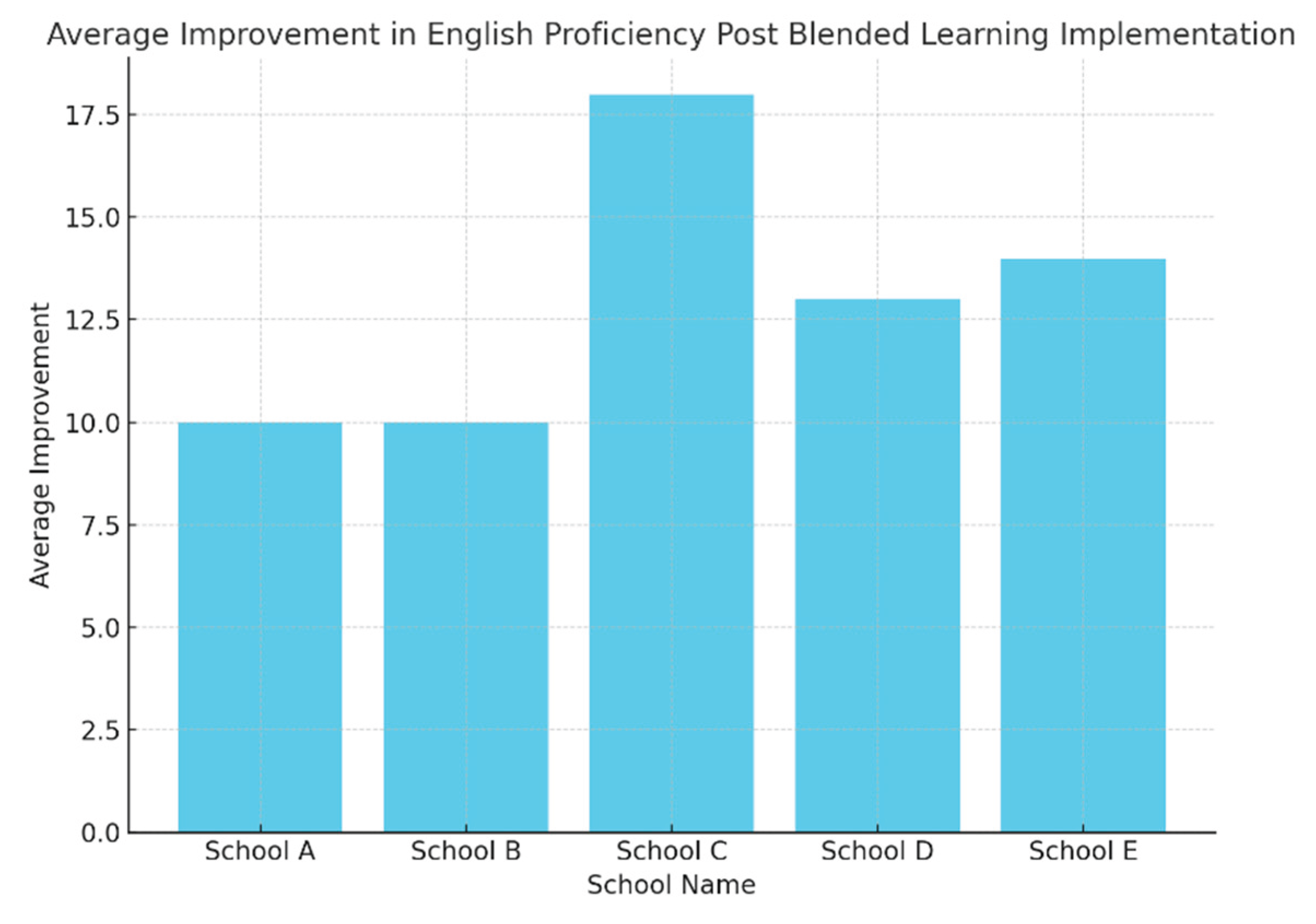
The diagram above shows the average increase in students' English proficiency based on the results of the pre-test and post-test in the five schools involved in this study. Each school showed a significant increase in English proficiency scores after the implementation of blended learning. Schools with better digital infrastructure, such as stable internet access and adequate technological devices, showed greater improvements compared to schools with limited infrastructure. For example, School C, which is located in an area with better access to technology, experienced an average increase of 18 points, higher than other schools. Overall, these data indicate that blended learning can improve students' English proficiency, with better technological infrastructure contributing positively to learning effectiveness.
In addition, the findings of this study also show a gap between theory and practice in the implementation of blended learning. Several teachers expressed that although they understand the great potential of technology in learning, they still do not have sufficient skills to integrate technology effectively. Therefore, training for teachers and improving digital infrastructure in more remote schools are urgently needed to maximize the potential of blended learning in Indonesia.
As part of the evaluation, this study also identified factors that influence the success of blended learning implementation in Indonesia. The main influencing factors are technological readiness, teacher training, and the level of student involvement in the learning process. Therefore, the recommendation of this study is to increase access to technology throughout Indonesia, as well as provide more intensive training for teachers in terms of using technology in English learning.
Discussion
The results of this study indicate that the implementation of blended learning in five secondary schools in Indonesia has a significant impact on improving students' English language skills. The average increase in scores between pre-test and post-test was around 12 points, with higher variations in schools with better digital infrastructure. This finding is in line with the objectives of the study which aims to evaluate the effectiveness of blended learning in improving English language skills. As explained by Ramalingam et al. (2022), blended learning provides students with the opportunity to access learning materials through various digital platforms, which allows for more flexible learning and focuses on student engagement. In this context, blended learning has been shown to be effective in increasing student motivation and engagement, which in turn drives improvements in their learning outcomes. However, although significant improvements in students' English language skills were recorded, the results of this study also noted obstacles in implementing blended learning in several areas with limited infrastructure. This study found that schools in rural areas, with limited access to technology, experienced significant obstacles in implementing digital-based learning optimally. This confirms the findings of Apriani et al. (2025) who stated that unequal access to technology is one of the main obstacles in implementing blended learning in Indonesia. The instability of internet connections and the limitations of technological devices in certain schools’ limit teachers' ability to fully utilize the potential of technology in the English learning process.
It is important to note that despite the challenges related to infrastructure, the results of this study also indicate that the blended learning model can have a significant positive impact on students' English skills, especially in schools with better access to technology. In this regard, the findings of this study are consistent with previous studies that have shown that the integration of technology in English language learning can provide greater benefits in terms of increasing student engagement and motivation (Marzuki, 2019a; Marzuki, 2019b). The use of language learning applications that allow students to practice independently and get immediate feedback is an important factor that influences the improvement of their English skills (Alek et al., 2020; Alek et al., 2022). From the teacher's perspective, although technical training challenges are faced by most teachers, the majority of teachers involved in this study expressed positive views on the implementation of blended learning. Teachers felt that blended learning gave them the opportunity to implement more innovative teaching methods that are in line with the needs of the digital era. This is consistent with the findings expressed by Muthmainnah et al. (2025), who stated that blended learning opens up space for the development of more varied and interesting pedagogical methods. Teachers also felt that technology could help them deliver material in a more engaging way, as well as provide opportunities for students to learn more interactively and independently. However, some teachers expressed that they still needed further training to optimize the use of technology in learning (Marzuki et al., 2018; Marzuki, 2019c).
This study also identified that one of the factors that greatly influences the success of blended learning is the level of student engagement in learning. Students who are more active in participating in digital-based learning activities, such as online discussions and the use of learning applications, show a more significant improvement in their English skills. This is in line with a study conducted by Wang et al. (2020), which found that student engagement in technology-based learning greatly affects their learning outcomes. Students who feel engaged and motivated in learning are more likely to achieve better results, because they have the opportunity to access materials more flexibly and practice independently outside of class hours.
Although this study provides valuable insights into the positive impacts of blended learning, several limitations need to be noted. One of the main limitations in this study is the lack of control for other external factors that may influence learning outcomes, such as students' socio-economic background or their initial English proficiency level. In addition, this study was limited to a small number of schools and does not represent the full diversity of schools in Indonesia. Therefore, the findings of this study may not be generalizable to the entire population of secondary schools in Indonesia. Further research involving larger samples and taking into account other external factors is needed to obtain a more comprehensive picture of the effectiveness of blended learning in English language learning.
The practical implications of these findings suggest that to maximize the potential of blended learning, the government and educational institutions need to focus on improving digital infrastructure in schools, especially those in remote areas. In addition, more intensive training for teachers in integrating technology into learning is also needed. Thus, policies that support teacher training and increase access to technology throughout Indonesia can accelerate the implementation of blended learning and improve students' English language learning outcomes. Theoretically, this study contributes to the understanding of how technology-based learning models can be applied in the context of Indonesian education and demonstrates the importance of technology in facilitating a more flexible and effective learning process.
Overall, the results of this study provide empirical evidence of the benefits of implementing blended learning in improving students' English skills in Indonesia. However, there are still many aspects that need to be explored further, such as the effectiveness of certain digital platforms in English learning or the role of technology in improving students' speaking and writing skills specifically. Further research can lead to the development of a more comprehensive blended learning model, as well as more in-depth measurements of the impact of technology on student learning outcomes across educational contexts in Indonesia.
Conclusion
This study shows that the implementation of blended learning in secondary schools in Indonesia has a positive impact on improving students' English skills. The results of the pre-test and post-test showed a significant increase in students' English skills, especially in schools with better technological infrastructure. The main factor influencing the effectiveness of blended learning is the readiness of technology in schools, such as a stable internet connection and adequate devices. In addition, student involvement in the learning process, such as practicing independently through digital applications, also plays an important role in improving their learning outcomes.
However, the main challenge found is the uneven distribution of technological infrastructure in various regions, which limits the optimal implementation of blended learning. Nevertheless, the results of this study suggest that with increased access to technology and more intensive training for teachers, blended learning can be an effective tool for improving students' English skills in Indonesia. Therefore, this study recommends improving digital infrastructure across schools and ongoing teacher training to maximize the potential of technology-based learning.
References
- Albana, H. H., Marzuki, A. G., Alek, A., & Hidayat, D. N. (2020). Cohesive Devices in Student’s Writing (A Discourse Analysis on Argumentative Text). Jurnal Pendidikan Humaniora, 8(1), 6–11. [Google Scholar]
- Alek, A., Marzuki, A. G., Farkhan, M., & Deni, R. (2020). Self-Assessment in Exploring EFL Students’ Speaking Skill. Al-Ta lim Journal, 27(2), 208–214. [Google Scholar] [CrossRef]
- Alek, A., Marzuki, A. G., Farkhan, M., Surahman, D., Daryanto, D., & Febrianto, S. (2020). Computer Based Testing in Senior High School on National Examination. Indonesian Journal of Learning Education and Counseling, 2(2), 204–210. [Google Scholar] [CrossRef]
- Alek, A., Marzuki, A. G., Hidayat, D. N., & Fauzji, F. (2022). The Discourse Structure and Linguistic Features of Research Articles and Thesis Abstracts in English by Indonesian Academics. JELITA: Journal of Education, Language Innovation, and Applied Linguistics, 1(1), 37–44. [Google Scholar] [CrossRef]
- Amalia, I., & Marzuki, A. G. (2023). The Implementation of Bilingual Class Program in Islamic Elementary School. Al-Ta lim Journal, 30(1). [Google Scholar] [CrossRef]
- Amalia, I., Marzuki, A. G., Anita, A., Rahmawati, E., & Ulfah, U. (2024). Technological-Based Application in Writing Instruction: A Model of Project-Based Learning. Jurnal Onoma: Pendidikan, Bahasa, dan Sastra, 10(4), 4277–4290. [Google Scholar] [CrossRef]
- Anita, A., Marzuki, A. G., Silfani, A. N., Al Viyani, V., & Ulfah, U. (2024). Native Language Interference in EFL Students’ Writing of Reflective Journal in Indonesia. Journal of English Education and Teaching, 8(3), 528–551. [Google Scholar]
- Apriani, E., Daulay, S. H., Aprilia, F., Marzuki, A. G., Warsah, I., Supardan, D., & Muthmainnah. (2025). A mixed-method study on the effectiveness of using ChatGPT in academic writing and students’ perceived experiences. Journal of Language and Education, 11(1), 26–45. [Google Scholar] [CrossRef]
- Astri, Z., Noni, N., & Halim, A. (2024). Integrating Digital Learning in English Reading Classes: Experiences of Indonesian Higher Education Lecturers. Seltics Journal: Scope of English Language Teaching Literature and Linguistics, 7(1), 1–16. [Google Scholar] [CrossRef]
- Erizar, E., Marzuki, A. G., Hidayati, T., Juliana, R., & Yulia, A. (2024). The Impact of Online Learning on Undergraduate English Students’ Achievement. Journal of English Education and Teaching, 8(2), 288–302. [Google Scholar] [CrossRef]
- Gayatri, P., Sit, H., Chen, S., & Li, H. (2023). Sustainable EFL blended education in Indonesia: Practical recommendations. Sustainability, 15(3), 2254. [Google Scholar] [CrossRef]
- Hakim, M. A. R., Serasi, R., Revola, Y., Adnan, N. I., & Astari, A. R. N. (2023). The reconstruction of blended learning: Teaching model for full online learning system: A study on English Education Department in Islamic universities in Indonesia. International Journal of Learning, Teaching and Educational Research, 22(4), 1–20. [Google Scholar] [CrossRef]
- Iftitah, A. N., Marzuki, A. G., & Kuliahana, A. (2020). Developing Vocabulary Mastery through Guessing Words Game for the Seventh Grade Students of SMP Negeri 10 Palu. Datokarama English Education Journal, 1(1), 19–37. [Google Scholar] [CrossRef]
- Kuliahana, A., & Marzuki, A. G. (2020). Repetition Technique in an EFL Speaking Class in Islamic Higher Education in Indonesia. Academic Journal Perspective: Education, Language, and Literature, 8(1), 20–28. [Google Scholar] [CrossRef]
- Kuliahana, A., & Marzuki, A. G. (2024). Utilizing Group Discussion Technique in Developing Speaking Skill in an EFL Classroom. ENGLISH FRANCA: Academic Journal of English Language and Education, 7, 305–316. [Google Scholar] [CrossRef]
- Kuliahana, A., Marzuki, A. G., & Nurfaizah, A. (2024). Developing Students’speaking Performance through Mastering Question Words in Islamic University Setting. Journal of Innovation Research and Knowledge, 4(7), 5063–5072. [Google Scholar]
- Kuliahana, A., Marzuki, A. G., & Rustam, R. (2024). Developing Speaking Skill through Opinion Expression Method in Islamic Higher Education Context. ENGLISH FRANCA: Academic Journal of English Language and Education, 8, 121–132. [Google Scholar]
- Kurniawan, D., Masitoh, S., Bachri, B. S., gede Mulawarman, W., & Vebibina, A. (2024). Evaluation of Digital Project Based Blended Learning Model to Improve Students' Critical Thinking and Problem Solving Skills. Journal of Ecohumanism, 3(8), 1875–1895. [Google Scholar] [CrossRef]
- Lie, A., Tamah, S. M., Gozali, I., Triwidayati, K. R., Utami, T. S. D., & Jemadi, F. (2020). Secondary School Language Teachers’ Online Learning Engagement during the Covid-19 Pandemic in Indonesia. Journal of Information Technology Education: Research, 19, 803–832. [Google Scholar]
- Marzuki, A. G. (2019). The Implementation of SQ3R Method to Develop Students’ Reading Skill on Islamic Texts in EFL Class in Indonesia. Register Journal, 12(1), 49–61. [Google Scholar] [CrossRef]
- Marzuki, A. G. (2019). The Roles of School Principal Leadership in Developing English Teachers’ Creativities in Palu. Al-Ta lim Journal, 26(3), 267–279. [Google Scholar] [CrossRef]
- Marzuki, A. G. (2019). Utilizing Recorded English Dialogues in Teaching English Word Stress to Islamic Higher Education Students in Indonesia. Jurnal Pendidikan Islam, 5(1), 53–64. [Google Scholar] [CrossRef]
- Marzuki, A. G., & Kuliahana, A. (2021). Using Language Games to Enhance EFL Students’ Speaking Skill in Indonesia. Al-Ta lim Journal, 28(3), 213–222. [Google Scholar] [CrossRef]
- Marzuki, A. G., & Santiana, S. (2022). Bringing YouTube into the Classroom, is it Possible or not? In Proceeding of International Conference on Islamic and Interdisciplinary Studies (Vol. 1, pp. 29–33). [Google Scholar]
- Marzuki, A. G., Alim, N., & Wekke, I. S. (2018, ). Improving the reading comprehension through cognitive reading strategies in language class of coastal area in indonesia. IOP Conference Series: Earth and Environmental Science (156, p. 012050). [Google Scholar]
- Marzuki, A.G. (2016). Utilizing cooperative learning in islamic college students’ classroom. IJEE (Indonesian Journal of English Education), 3(2), 123–139. [Google Scholar] [CrossRef]
- Marzuki, A.G. (2017). Developing speaking skill through oral report in an efl class in indonesia. Al-Ta’lim Journal, 24(3), 243–254. [Google Scholar] [CrossRef]
- Muthmainnah, M., Apriani, E., Marzuki, A. G., Al Yakin, A., Aeni, N., Azar, A. S., & Riyawi, M. R. (2024). Navigating education 5.0 robotic technique for teaching foreign languages in todays classroom: Unveiling the potential of virtual pedagogical agents. In Preconceptions of Policies, Strategies, and Challenges in Education (Volume 5.0, pp. 118–138). IGI Global. [Google Scholar]
- Muthmainnah, M., Cardoso, L., Kaur, D., Al Yakin, A., Marzuki, A. G., & Apriani, E. (2024). Informatization on developing e-learning materials for IoT-assisted education to enhance EFL in higher education. In Proceedings of the International Conference on Data Analytics & Management (pp. 529–552). [Google Scholar]
- Muthmainnah, M., Cardoso, L., Marzuki, A. G., & Al Yakin, A. (2025). A new innovative metaverse ecosystem: VR-based human interaction enhances EFL learners’ transferable skills. Discover Sustainability, 6, 156. [Google Scholar] [CrossRef]
- Muthmainnah, M., Darmawati, B., Sidik, U., Marzuki, A. G., Al Yakin, A., Aeni, N., & Apriani, E. (2024). Innovative Pedagogical Practices Through the Development and Design of EFL Teaching Materials Tailored to Sustainability Through AI in the Digital Revolution. In Explainable AI for Education: Recent Trends and Challenges (pp. 207–227). Springer Nature Switzerland; Cham. [Google Scholar]
- Muthmainnah, M., Marzuki, A. G., Santiana, S., Erizar, E., & Nursyam, N. (2022). Utilizing smartphone-based Pinterest applications in developing EFL students speaking skills in Indonesia. JEES (Journal of English Educators Society), 7(2), 205–209. [Google Scholar]
- Muthmainnah, M., Marzuki, A. G., Santiana, S., Erizar, E., Ulinsa, U., & Purwaningsi, U. (2024). Character Analysis Ability of M. Night Shyamalan Split Translation Film Characters in Indonesian EFL Students. Jurnal Onoma: Pendidikan, Bahasa, dan Sastra, 10(2), 1237–1243. [Google Scholar] [CrossRef]
- Ramalingam, S., Yunus, M. M., & Hashim, H. (2022). Blended learning strategies for sustainable English as a second language education: A systematic review. Sustainability, 14(13), 8051. [Google Scholar] [CrossRef]
- Santiana, S., & Marzuki, A. G. (2022). YouTube: a Modern Breakthrough of Autonomous Learning to Hone Speaking Skills. In Proceeding of International Conference on Islamic and Interdisciplinary Studies (Vol. 1, pp. 23–28). [Google Scholar]
- Santiana, S., & Marzuki, A. G. (2024, ). Scrutinising Padlet to enhance students’ collaborative writing in a virtual learning environment. Proceedings of the International Conference on Islamic and Interdisciplinary Studies (ICIIS) (p. 533). Available online: https://jurnal.uindatokarama.ac.id/index.php/iciis/issue/archive.
- Santiana, S., Efendi, S. N., Pujasari, R. S., Marzuki, A. G., & Erizar, E. (2021). Digital Games-Based Learning: An Innovative Language Learning in EFL Classroom by Utilizing Kahoot! Jurnal Pendidikan, 9(4). [Google Scholar]
- Santiana, S., Enriquez, A., Marzuki, A. G., Mahmud, R., & Ghofur, A. (2024). KARDS Model: An Alternative Approach to Language Education. TLEMC (Teaching and Learning English in Multicultural Contexts), 8(1), 1–12. [Google Scholar] [CrossRef]
- Santiana, S., Lesmana, D. S., Marzuki, A. G., & Erizar, E. (2021). An Insight of Anitales Apps Perceived by Digital Storytelling Students. In Proceeding of International Conference on Islamic Education (ICIED) (Vol. 6, pp. 23–30). No. 1. [Google Scholar]
- Syafryadin, S., Safnil, S., Noermnzah, N., Wardhana, D. E. C., Marzuki, A. G., Astrid, A., & Amalia, S. (2024). TAGANA thematic textbook: Cultivating junior high school students’ English proficiency with HOTS-PBL integration. Studies in English Language and Education, 11(3), 1636–1651. [Google Scholar] [CrossRef]
- Wahyuningsih, S., & Afandi, M. (2022). Incorporating English skills in blended learning during the COVID-19 pandemic: A narrative inquiry. Elsya: Journal of English Language Studies, 4(3), 227–239. [Google Scholar] [CrossRef]
Disclaimer/Publisher’s Note: The statements, opinions and data contained in all publications are solely those of the individual author(s) and contributor(s) and not of MDPI and/or the editor(s). MDPI and/or the editor(s) disclaim responsibility for any injury to people or property resulting from any ideas, methods, instructions or products referred to in the content. |
© 2025 by the author. Licensee MDPI, Basel, Switzerland. This article is an open access article distributed under the terms and conditions of the Creative Commons Attribution (CC BY) license (https://creativecommons.org/licenses/by/4.0/).
Copyright: This open access article is published under a Creative Commons CC BY 4.0 license, which permit the free download, distribution, and reuse, provided that the author and preprint are cited in any reuse.


