

Submitted:
09 June 2025
Posted:
10 June 2025
You are already at the latest version
Abstract
Counting of number of set bits as high in a binary sequence is a very important and a powerful domain question that has it’s wide applications in cryptography, statistical machine learning, as well as information theory of data retrieval. With the increasing demand in software systems for tabulating the hamming weight/ Population Count / Bit count , unfortunately the classical algorithm of bitwise iteration remains widespread. The present study explores the various software-based algorithms used in the current objective like Brian-Kerninghan, LookUp Table algorithm, etc. Upon performing the complexity comparison study of time as well as space complexities its concludable that Lookup table method is about 5 times more efficient than the traditional sequential search.
Keywords:
algorithmic complexity
; bit counting
; cryptography
; density count
; document retrieval
; efficient algorithm
; hamming weight
1. Introduction
The rapid increase in computation devices following their architectural progression has witnessed the need for counting the number of Bit’s High(that is 1) in a binary sequence. Initial discussions in early 1960’s [1] revealed it’s significance in varying fields of Computational Science and Mathematics like those in cryptography, database management, statistical machine learning. The following table reveals the various common terminologies associated with population count in binary sequence.

Table 1.
Contextual Description useful in terms related to the population count.
| S. No | Synonym | Contextual Description |
|---|---|---|
| 1 | Bit Count | Generic term for counting bits, often implies counting 1s |
| 2 | Population Count | Most widely used term in software/hardware literature |
| 3 | Hamming Weight | Term used in information theory and coding |
| 4 | 1’s Count | Number of 1s in the binary sequence |
| 5 | Set Bit Count | Bits that are 1 |
| 6 | Bitwise Weight | Usud in Hardware Literatures , specially related to FPGA |
Authors specifically E. El-Qawasmeh and Marilyn Mack have contributed significantly in this domain, with their papers having the following titles :
- Papers by Marilyn Mack :
(a) A bit-counting algorithm using the frequency division principle [2]
- Papers by E. El Qawasmeh :
(a) Beating the Popcount [3]
- While both the researchers that is Marilyn Mack and E. El Qawasmeh contributed the following works together:
(a) Increasing the Efficiency of Bit-Counting [4]
(b) Organization of near matching in bit attribute matrix applied to associative access methods in information retrieval. [5]
On comparing with Hardware perspective papers of Daniel Lemire, titled the following (a) introduces Advancement recent in this field for Faster Positional-Population Counts for AVX2, AVX-512, and ASIMD. [6]
(b) Faster Population Counts Using AVX2 Instructions [7]
These emphasizes a lot over the technicality and need to compute mathematically the Population-Count of given Binary Sequence.
2. Case Study
| Algorithm 1 Population count using Naive Bitwise Count |
|
def popcount_naive(NUM : int) -> int:
COUNT = 0
while NUM:
COUNT += NUM & 1
NUM = NUM >> 1
return COUNT
|
| Algorithm 2 Population count using Brian Kernighan’s Algorithm |
|
def popcount_b_kerninghan(NUM : int) -> int:
COUNT = 0
while NUM:
NUM = NUM & (NUM - 1)
COUNT += 1
return COUNT
|
| Algorithm 3 Population count using Lookup Table |
|
bit_Table_256 = [0] * 256
for bit_i in range(256):
bit_Table_256[bit_i] = (bit_i & 1) + bit_Table_256[bit_i >> 1]
def popcount_LookupTable(NUM : int) -> int :
return bit_Table_256[ NUM & 0xff ] + bit_Table_256[ (NUM >> 8) & 0xff ] +
bit_Table_256[ (NUM >> 16) & 0xff ] + bit_Table_256[ (NUM >> 24) & 0xff ]
|
| Algorithm 4 Population count using CSA - Carry Save Adder| |
|
from typing import List
def csa(a: int, b: int, c: int) -> (int, int):
total = a ⌃b ⌃c
carry = (a & b) | (b & c) | (a & c)
return carry,total
def popcount(x: int) -> int:
x = x - ((x >> 1) & 0x5555555555555555)
x = (x & 0x3333333333333333) + ((x >> 2) & 0x3333333333333333)
x = (x + (x >> 4)) & 0x0F0F0F0F0F0F0F0F
x = x + (x >> 8)
x = x + (x >> 16)
x = x + (x >> 32)
return x & 0x7F
def popcount_csa(data: List[int]) -> int:
ones = twos = fours = eights = 0
i = 0
n = len(data)
while i + 7 < n:
t1, o1 = csa(data[i], data[i+1], data[i+2])
t2, o2 = csa(data[i+3], data[i+4], data[i+5])
f1, t3 = csa(t1, t2, data[i+6])
f2, ones = csa(o1, o2, data[i+7])
fours, twos = csa(f1, f2, twos)
eights, fours = csa(eights, fours, 0)
i += 8
TOTAL = (
8 * popcount(eights) +
4 * popcount(fours) +
2 * popcount(twos) +
1 * popcount(ones) )
while i < n:
TOTAL += popcount(data[i])
i += 1
return TOTAL
|
| Algorithm 5 Population count using VTPC method |
|
def popcount_VTPC(n : int) -> int :
mask_size = 4
mask = [0,1,1,2]
m = 0
i = 0
e = mask_size
r = n
while d ≥ 0 :
return m
|
| Algorithm 6 Population count using Divide and Conquer adder |
|
def popcount_divconq(NUM : int) -> int :
NUM = (NUM & 0x55555555) + ((NUM >> 1) & 0x55555555)
NUM = (NUM & 0x33333333) + ((NUM >> 2) & 0x33333333)
NUM = (NUM + (NUM >> 4)) & 0x0F0F0F0F
NUM = (NUM * 0x01010101) >> 24
return NUM
|
| Algorithm 7 Population count using RF method |
|
def countRF(N):
TEMP = N
COIN = 2
prev = 1
COUNTER = 0
while TEMP :
ss = (N+1)//COIN
v1 = (N+1)%COIN
if v1 <= prev:
REM = 0
else:
REM = (N+1)%prev
COUNTER += REM + ss*prev
prev = prev<<1
COIN = COIN<<1
TEMP = TEMP >> 1
return COUNTER
def RF(N):
return countRF(N) - countRF(N-1)
|
3. Complexity Comparison
Under this section we discuss and show the complexity analysis of various algorithms, by taking LOG10 OF (N) : Input number, as this value ranges from [1,1000000], it;s imperative to transform it into a scale that’s quite implementable on the graph of Time to compute vs Input Size. He nce we applied the following transformations :
Table 2.
The transformation analysis of plotting functions over the graph from old v/s new perspective ,where N : number till we checked Natural numbers for the several algorithms, the results T : Time taken to compute these results (ms).
Table 2.
The transformation analysis of plotting functions over the graph from old v/s new perspective ,where N : number till we checked Natural numbers for the several algorithms, the results T : Time taken to compute these results (ms).
| S.No | Old parameter | Transformed parameter |
|---|---|---|
| 1 | N | Log10 N |
| 2 | T | Ln T |
Table 3.
An outline in comparison of several software algorithmic implementations of techniques in computing the population count for binary sequences, where M : Number of bits used to implement the input Number. N : Input Number. L : Number of elements in addressing each element of Lookup Table. S : Size of Mask Vector.
Table 3.
An outline in comparison of several software algorithmic implementations of techniques in computing the population count for binary sequences, where M : Number of bits used to implement the input Number. N : Input Number. L : Number of elements in addressing each element of Lookup Table. S : Size of Mask Vector.
| S. No | Method | Average Time | Space |
|---|---|---|---|
| Complexity | Complexity | ||
| 1 | Naive Approach | O(M) | O(1) |
| 2 | Brian Kerninghan | O( (N)) | O(1) |
| 3 | Lookup Table | O(M / L) | O(256) |
| 4 | CSA | O( (M)) | O(M) |
| 5 | VTPC | O( (N)) | O(S) |
| 6 | Divide and Conquer | O( (M)) | O(1) |
| 7 | RF Algorithm | O(log2 N) | O(1) |
Figure 1.
The plot of natural LOG T : Time taken against LOG10 (NUMBER) of Natural Numbers till count of population count is taken.
Figure 1.
The plot of natural LOG T : Time taken against LOG10 (NUMBER) of Natural Numbers till count of population count is taken.
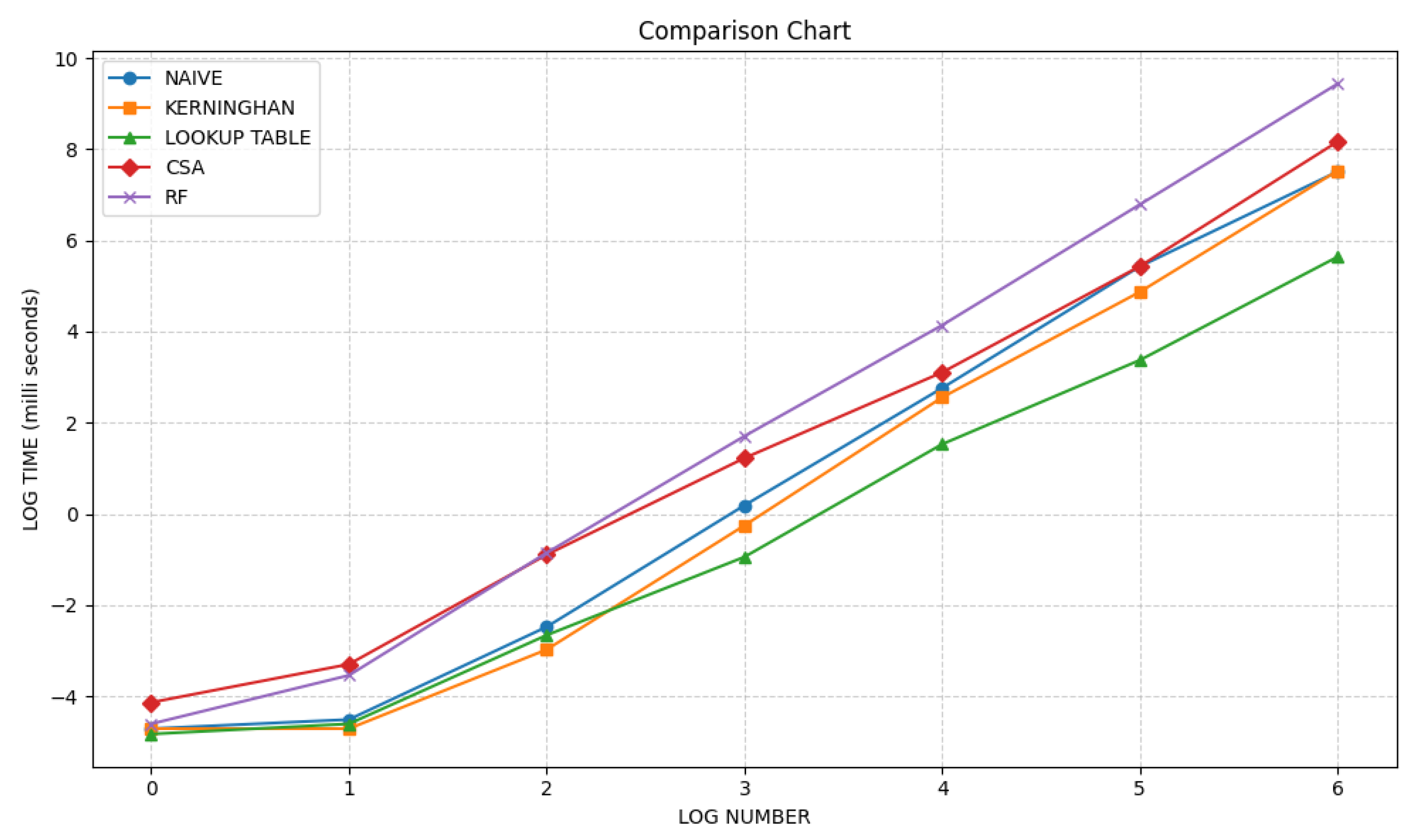
Table 4.
Time Taken to Compute Bit’s population count till given Number - N by various Algorithms, with time taken to compute is in milli seconds (ms).
Table 4.
Time Taken to Compute Bit’s population count till given Number - N by various Algorithms, with time taken to compute is in milli seconds (ms).
| N | log10N | NAIVE | KERNINGHAN | LOOKUP | CSA | RF | |||||
|---|---|---|---|---|---|---|---|---|---|---|---|
| T | Ln T | T | Ln T | T | Ln T | T | Ln T | T | Ln T | ||
| 1 | 0 | 0.009 | -4.711 | 0.009 | -4.711 | 0.008 | -4.828 | 0.016 | -4.135 | 0.01 | -4.605 |
| 10 | 1 | 0.011 | -4.51 | 0.009 | -4.711 | 0.01 | -4.605 | 0.037 | -3.297 | 0.029 | -3.54 |
| 100 | 2 | 0.084 | -2.477 | 0.051 | -2.976 | 0.07 | -2.659 | 0.409 | -0.894 | 0.426 | -0.853 |
| 103 | 3 | 1.206 | 0.187 | 0.776 | -0.254 | 0.389 | -0.944 | 3.403 | 1.225 | 5.509 | 1.706 |
| 104 | 4 | 15.816 | 2.761 | 12.887 | 2.556 | 4.616 | 1.53 | 22.309 | 3.105 | 62.769 | 4.139 |
| 105 | 5 | 227.941 | 5.429 | 130.344 | 4.87 | 29.188 | 3.374 | 228.655 | 5.432 | 886.574 | 6.787 |
| 106 | 6 | 1823.992 | 7.509 | 1858.631 | 7.528 | 281.325 | 5.64 | 3518.617 | 8.166 | 12526.57 | 9.436 |
4. Conclusions
Through the current work, we presented multiple software-oriented algorithms that are pivotal in computing the population count of ones in a binary sequence. The results were developed as a result of and are dependent upon the programming language , compiler/interpreter version, also the server’s memory and priority pooling allocation for the google colab notebook , that was used to run and implement these algorithms.
References
- Lehmer, D. The machine tools of combinatorics, Applied Combinatorial Mathematics, EF Beckenbach, ed, 1964.
- Berkovich, S.; Lapir, G.M.; Mack, M. A bit-counting algorithm using the frequency division principle. Software: Practice and Experience 2000, 30, 1531–1540. [Google Scholar] [CrossRef]
- El-Qawasmeh, E. Beating the popcount. International Journal of Information Technology 2003, 9, 1–18. [Google Scholar]
- El-Qawasmeh, E.; Strauss, M.; Mack, M.; Berkovich, S. Increasing the efficiency of bit-counting. International Journal of Computers and Applications 2007, 29, 51–58. [Google Scholar] [CrossRef]
- Berkovich, S.; El-Qawasmeh, E.; Lapir, G.; Mack, M.; Zincke, C. Organization of near matching in bit attribute matrix applied to associative access methods in information retrieval. In Proceedings of the APPLIED INFORMATICS-PROCEEDINGS-; 1998; pp. 62–64. [Google Scholar]
- Clausecker, R.; Lemire, D.; Schintke, F. Faster Positional-Population Counts for AVX2, AVX-512, and ASIMD. arXiv 2024, arXiv:2412.16370 2024. [Google Scholar]
- Muła, W.; Kurz, N.; Lemire, D. Faster population counts using AVX2 instructions. The Computer Journal 2018, 61, 111–120. [Google Scholar] [CrossRef]
Disclaimer/Publisher’s Note: The statements, opinions and data contained in all publications are solely those of the individual author(s) and contributor(s) and not of MDPI and/or the editor(s). MDPI and/or the editor(s) disclaim responsibility for any injury to people or property resulting from any ideas, methods, instructions or products referred to in the content. |
© 2025 by the authors. Licensee MDPI, Basel, Switzerland. This article is an open access article distributed under the terms and conditions of the Creative Commons Attribution (CC BY) license (http://creativecommons.org/licenses/by/4.0/).
Copyright: This open access article is published under a Creative Commons CC BY 4.0 license, which permit the free download, distribution, and reuse, provided that the author and preprint are cited in any reuse.


