

Submitted:
08 June 2025
Posted:
09 June 2025
You are already at the latest version
Abstract
Polylactic acid (PLA) is a biodegradable polymer synthesized from renewable feedstocks such as corn starch, sugarcane, and cassava, presenting a sustainable alternative to conventional petroleum-based plastics worldwide. Global plastic pollution, particularly from single-use plastics, has driven increasing interest in PLA, with national policies and international initiatives aiming to reduce plastic waste and greenhouse gas emissions. PLA production offers notable environmental benefits, including 25–55% lower energy consumption and up to 70% fewer greenhouse gas emissions compared to traditional plastics. Despite these advantages, PLA faces technical challenges such as low thermal stability (~60°C), brittleness, and limited gas barrier properties. Recent innovations—such as nanofiller incorporation and stereocomplex PLA with enhanced thermal resistance exceeding 230°C—have addressed many of these limitations. The global PLA production capacity reached approximately 1 million metric tons per year and is projected to exceed 3 million tons by 2030, driven by advances in cost-effective raw materials, enzymatic recycling technologies, and hybrid bioplastic systems. This review systematically explores the current status, technological challenges, and strategic policy measures supporting PLA adoption globally, emphasizing the importance of innovation, circular economy approaches, and multi-stakeholder collaboration to realize PLA’s full potential as a cornerstone of sustainable material development.
Keywords:
Biodegradable polymers
; circular economy
; polylactic acid (PLA)
; renewable resources
; sustainable development
1. Introduction
Plastic pollution has emerged as a critical global challenge, with more than 400 million metric tons of plastic produced annually [1,2] and approximately 8-11 million metric tons entering the oceans each year [3,4]. A substantial portion of this waste is derived from single-use and non-degradable plastics, which persist in the environment for hundreds of years, contributing to the accumulation of microplastics in terrestrial and aquatic ecosystems [5]. The environmental and public health impacts of plastic pollution have prompted increasing global concern and have led many countries to develop national strategies and regulatory frameworks to reduce dependence on conventional plastics [6,7,8].
Vietnam ranks among the top contributors to global marine plastic pollution, discharging approximately 0.28 to 0.73 million metric tons of plastic waste into oceans annually, with 72% stemming from single-use plastics [9,10,11]. Rapid urbanization, population growth, and industrial expansion have exacerbated plastic consumption, leading to severe environmental impacts, including widespread microplastic contamination in water systems and coastal ecosystems [12]. The persistence of non-degradable plastics poses long-term ecological threats, highlighting the urgent need for sustainable alternatives [13]. In response, Vietnam has launched several initiatives, including the National Action Plan for Management of Marine Plastic Litter (2020–2030), targeting a 50% reduction by 2025 and 75% by 2030 [9,14]. Complementary policies aim to ban the production and import of plastic bags by 2026 and phase out most single-use plastics by 2031 [15]. These measures, combined with economic incentives and research funding, promote the adoption of biodegradable materials such as polylactic acid (PLA), which offers a promising alternative due to its biodegradability, renewable origin, and alignment with Vietnam’s Green Growth Strategy and international sustainability goals.
Bioplastics, classified based on raw materials and biodegradability, represent an emerging class of eco-friendly materials capable of reducing dependence on fossil fuels and minimizing environmental pollution [16]. Table 1 provides an overview of key bioplastic types, including starch-based plastics, cellulose-based plastics, chitosan-based plastics, seaweed-based plastics, PLA, PHA, PHB, and bio-based PE, detailing their sources, biodegradability, processing methods, strengths, and limitations. Among these, PLA has gained significant attention for its production from renewable feedstocks like corn starch and sugarcane [17]. PLA’s industrial compostability and ability to degrade into water and carbon dioxide under controlled conditions address waste management challenges, while its production consumes 25–55% less energy than conventional plastics, resulting in lower carbon emissions [18]. Table 2 compares PLA’s mechanical and thermal properties with PET and PS, demonstrating competitive tensile strength and modulus, although its thermal resistance and flexibility require enhancement for broader applications.
Global production of PLA is expanding, with major manufacturers operating in North America, Europe, and Asia. However, despite growing market interest, the scaling of PLA production technologies faces several challenges [18]. These include high production costs, limited thermal and mechanical performance, and difficulties in processing using conventional plastic fabrication equipment [19]. Addressing these barriers requires research focused on optimizing fermentation and polymerization processes, developing new catalysts, and incorporating additives to improve thermal stability and mechanical strength [20,21]. Collaboration among research institutions, industry stakeholders, and policymakers is essential for advancing bioplastic manufacturing capacity worldwide. Such coordinated efforts can drive technological innovation, support economic development, and accelerate the transition toward sustainable materials. Strengthening global partnerships will be key to scaling bioplastics like PLA, supporting circular economy models, and addressing the escalating plastic pollution crisis on an international scale.
Moreover, one of the major barriers to widespread PLA adoption is the lack of standardized production protocols and certification frameworks. Inconsistent product quality, variable biodegradability under different conditions, and the absence of harmonized standards across countries hinder the integration of PLA into mainstream plastic supply chains. Efforts by organizations such as the European Committee for Standardization and the ASTM International have led to the development of testing standards for compostability and biodegradability, but a global consensus on production and performance criteria remains limited. This gap not only affects market confidence but also limits the potential for national policy integration.
Recognizing these limitations, several governments have incorporated bioplastic development into broader sustainability agendas [22,23]. For instance, the European Union’s Green Deal and Circular Economy Action Plan emphasize reducing plastic waste and promoting bio-based alternatives [24,25]. Similarly, Japan’s Bioplastic Roadmap [26,27] and the United States’ BioPreferred Program [25,28] incentivize the research, development, and procurement of bioplastics such as PLA. These initiatives underscore the importance of aligning technological innovation with regulatory and economic instruments, including public procurement policies, tax incentives, and investment in infrastructure for composting and recycling.
In addition to its technical and environmental merits, the successful adoption of polylactic acid (PLA) as a sustainable alternative to conventional plastics also hinges on the establishment of regulatory frameworks and international standards [4,27,29,30]. Standardization efforts are crucial for ensuring the safety, performance, and environmental integrity of PLA-based products. Globally recognized organizations such as ASTM International and the International Organization for Standardization (ISO) have developed a series of standards that define aceebiodegradability, compostability, and product labeling. For instance, ASTM D6400 and ISO 17088 outline specifications for compostable plastics under industrial composting conditions, while EN 13432 is widely used in Europe to certify packaging materials' compostability.
Moreover, government policies and national strategies are playing a growing role in supporting PLA innovation and market growth [31]. The European Union has enacted comprehensive legislation under the European Green Deal and Circular Economy Action Plan, including restrictions on single-use plastics and incentives for biodegradable alternatives [25]. Countries like Germany and France have introduced extended producer responsibility (EPR) schemes and public funding programs for bioplastic research. Similarly, the United States supports PLA development through initiatives such as the BioPreferred Program administered by the U.S. Department of Agriculture, which promotes biobased products in federal procurement [28].
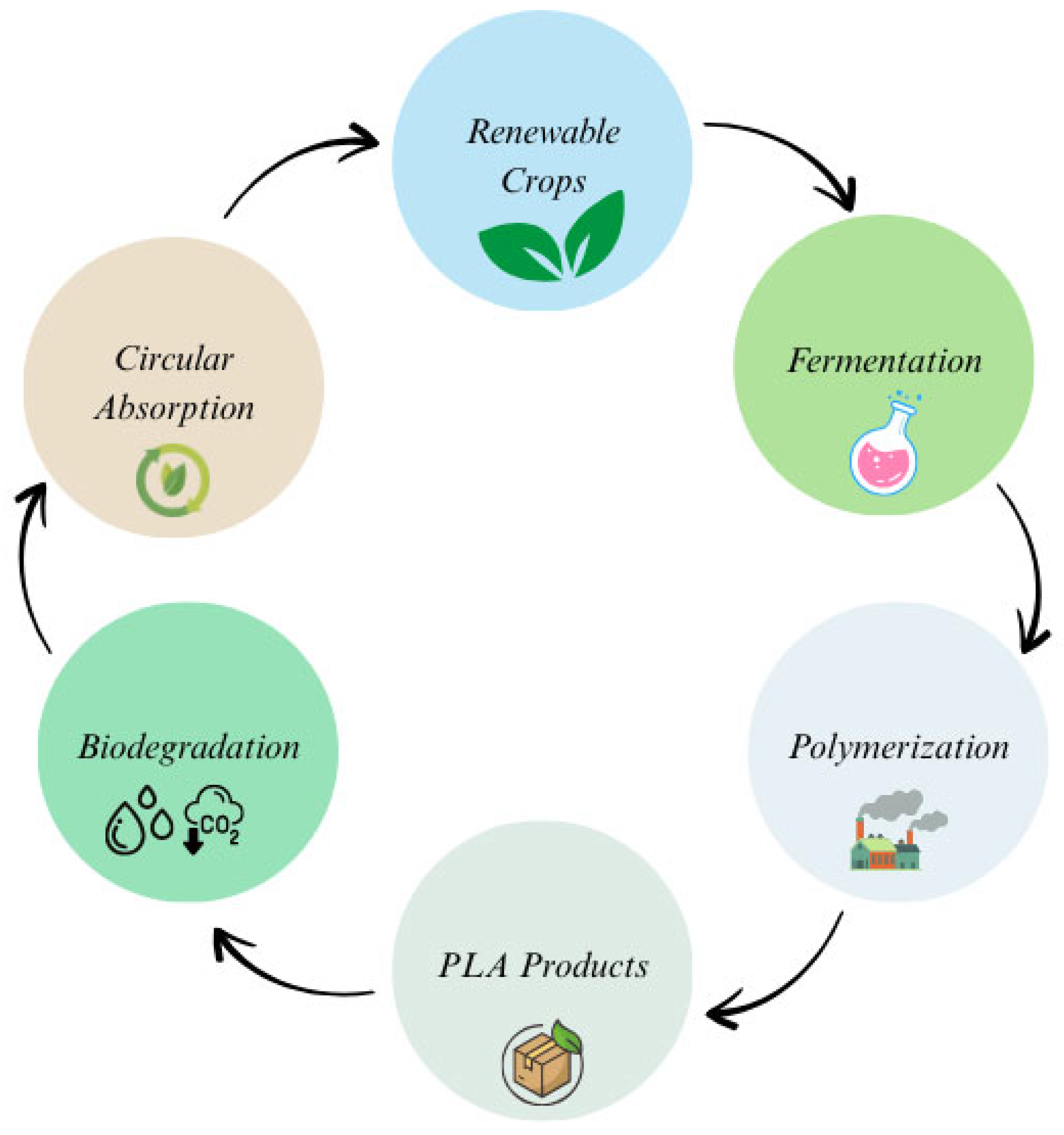
Figure 1.
Circular Economy Model for the Production and Biodegradation of Polylactic Acid (PLA).
In Asia, nations including Japan, South Korea, and China have implemented national plastic reduction roadmaps that explicitly encourage the use of bioplastics. Japan’s Biomass Plastic Introduction Roadmap, for example, sets a target of replacing 2 million tons of conventional plastics with bioplastics, including PLA, by 2030. These policies not only create favorable market conditions but also encourage investment in domestic PLA production capacity and innovation in end-of-life solutions such as composting and chemical recycling [32].
Despite these advances, inconsistencies in certification standards, inadequate composting infrastructure, and limited public awareness remain challenges that must be addressed through coordinated international efforts [27]. Establishing harmonized global standards and supportive policy mechanisms will be essential to unlock PLA’s full potential and ensure its effective integration into sustainable material systems [30].
This review examines the current state of PLA manufacturing technologies, highlighting key innovations in fermentation, polymerization, and materials engineering. It also analyzes the role of standardization efforts and policy frameworks in supporting national transitions toward bioplastic adoption. By bridging technological readiness with policy implementation, countries can create enabling environments for PLA to become a viable and scalable alternative to conventional plastics. Such alignment is critical not only to mitigate environmental damage but also to stimulate green innovation, build domestic manufacturing capacity, and position nations competitively within the emerging global bioplastics market.
2. PLA in the World
2.1. Potential for Utilizing Renewable Resources
The global shift toward sustainable materials is closely tied to the availability and utilization of renewable resources that serve as feedstocks for bioplastics [33,34]. Polylactic acid (PLA), one of the most commercially successful bioplastics, is derived primarily from fermentable sugars obtained from crops such as corn, sugarcane, cassava, and beetroot. These crops are cultivated in abundance across various regions, offering significant opportunities for large-scale, decentralized PLA production and reducing reliance on fossil-derived polymers. [35]
Globally, the agricultural potential for supplying PLA feedstocks is robust [36]. The United States and Brazil, for example, lead the world in corn and sugarcane production, respectively—two of the most common sources of fermentable sugars for PLA synthesis [37,38]. In Asia, countries such as Thailand, India, and China also possess extensive sugar and starch crop outputs, enabling regional supply chains for PLA manufacturing [39,40,41,42]. It is estimated that less than 0.05% of global agricultural land is currently used for bioplastics feedstock cultivation, indicating substantial room for growth without significantly impacting food security.
In addition to traditional crops, emerging feedstocks such as agricultural residues, algae, and industrial waste streams offer promising pathways to produce lactic acid through non-food-based biomass conversion [43,44]. Advancements in biorefinery technologies, including enzymatic hydrolysis and microbial fermentation, have increased the feasibility of extracting high yields of lactic acid from lignocellulosic biomass [45,46,47]. These innovations not only diversify the resource base but also promote circular economy principles by utilizing waste as a resource.
The strategic integration of renewable resources into PLA production aligns with global sustainability goals, particularly the United Nations Sustainable Development Goals (SDGs), including SDG 9 (industry, innovation, and infrastructure), SDG 12 (responsible consumption and production), and SDG 13 (climate action) [48]. Moreover, using bio-based feedstocks contributes to lower greenhouse gas emissions across the PLA life cycle, as biomass absorbs CO₂ during cultivation, partially offsetting emissions from processing and disposal stages [32,49].
Despite this potential, several barriers persist to fully harnessing global renewable resources for PLA production. These include the need for infrastructure investment, regional disparities in biomass availability, and competition with food and feed markets. Furthermore, conversion efficiencies and energy demands during fermentation and polymerization processes vary widely depending on feedstock type and technology used, influencing both the cost and environmental performance of PLA.
To overcome these challenges, various governments and regional bodies are supporting feedstock development programs, promoting sustainable agriculture practices, and investing in next-generation biorefineries. For example, the European Union’s Bioeconomy Strategy emphasizes the use of local biomass for industrial applications, while the United States Department of Agriculture’s BioPreferred Program supports the commercialization of biobased products through labeling and procurement incentives. In Asia, countries such as Thailand and Japan have established national roadmaps for bioplastics development, which include targets for increasing domestic biomass utilization and building PLA manufacturing capacity.
Vietnam's abundant renewable resources present a significant opportunity to enhance its energy portfolio and reduce reliance on fossil fuels [50,51]. The country is endowed with substantial potential in solar, wind, biomass, and hydropower. Solar energy potential is estimated at approximately 963 gigawatts (GW), with average solar radiation ranging from 4 to 5 kilowatt-hours per square meter per day [52,53]. Wind energy potential is also considerable, particularly in coastal regions and the central highlands, with technical potential estimated at around 1,000 GW [54]. Biomass resources, derived from agricultural residues such as rice husks and straw, offer an estimated potential of 2,565 megawatts (MW) [55]. Hydropower remains a significant contributor, with an estimated potential of 35,000 MW, of which approximately 17,000 MW has been exploited [56].
Despite this vast potential, the integration of renewable energy into Vietnam's energy mix has been limited (Figure 2). As of 2020, renewable energy sources accounted for approximately 10% of the total installed capacity, with hydropower being the dominant contributor. The government has set ambitious targets to increase the share of renewable energy, aiming for 30.9% to 39.2% by 2030 and 47% by 2050 [57,58]. Achieving these targets necessitates substantial investments in infrastructure, policy reforms, and technological advancements. Challenges such as high initial capital costs, limited grid capacity, and regulatory hurdles must be addressed to facilitate the integration of renewable energy sources. To capitalize on its renewable energy potential, Vietnam has implemented several policy initiatives. The Power Development Plan VIII (PDP8) outlines strategies to enhance renewable energy development, including the establishment of renewable energy zones and incentives for private sector investment [59,60]. Additionally, the government has introduced feed-in tariffs and tax incentives to encourage the adoption of renewable energy technologies. International cooperation and investment play a crucial role in advancing Vietnam's renewable energy sector.
In summary, the global potential for renewable resource utilization in PLA production is substantial and underexploited. Strengthening agricultural-industrial linkages, expanding the use of non-food biomass, and aligning national policies with sustainability goals are key to scaling up PLA production while minimizing environmental trade-offs. Harnessing this potential through technological innovation and international cooperation will be essential for advancing a sustainable global bioplastics industry.
2.2. Scale and Growth Rate of the Global Bioplastic Market
The global bioplastics industry has undergone rapid expansion in the past decade, fueled by rising environmental concerns, tightening regulations on single-use plastics, and increasing demand for sustainable alternatives. In 2023, the global bioplastics market was valued at approximately USD 14.5 billion, with polylactic acid (PLA) accounting for nearly 13% of total bioplastics production by volume [1,61]. The industry is projected to grow at a compound annual growth rate (CAGR) of 17–20%, reaching a market size of over USD 45 billion by 2032 [62,63,64]. This growth reflects not only increased consumer awareness but also strategic policy shifts in both developed and emerging economies.
Bioplastics are being increasingly adopted across diverse end-use sectors, including packaging, agriculture, automotive, textiles, consumer electronics, and medical applications. The packaging industry remains the dominant consumer, representing nearly 60% of global demand in 2023, primarily for food containers, films, and shopping bags [65]. PLA, with its clarity, printability, and industrial compostability, has become a material of choice for rigid and flexible packaging, as well as for 3D printing filaments and single-use utensils.
Geographically, Europe and Asia-Pacific are leading in bioplastic production and consumption. Europe continues to play a central role in policy development and investment, supported by frameworks such as the EU Green Deal, the Plastics Strategy, and extended producer responsibility (EPR) schemes. The Asia-Pacific region, led by China, Japan, Thailand, and South Korea, benefits from abundant agricultural feedstocks and increasingly sophisticated biopolymer manufacturing capacity. North America, meanwhile, has seen steady market growth driven by the United States' BioPreferred Program, municipal composting mandates, and corporate sustainability commitments from multinational brands.
Despite optimistic projections, the global bioplastics industry still faces significant technical, economic, and infrastructural challenges. High production costs remain a barrier to scaling, largely due to expensive feedstocks, limited economies of scale, and the energy-intensive nature of certain fermentation and polymerization processes [66,67,68]. While the cost of PLA has declined in recent years, it still remains 20–80% more expensive than conventional petrochemical plastics in many markets [23,32,70,71].
Moreover, end-of-life management for bioplastics remains inconsistent across regions. While materials like PLA are industrially compostable, many countries lack the infrastructure to process them appropriately. If not properly collected and treated, bioplastics can contaminate conventional recycling streams or fail to degrade under ambient environmental conditions, reducing their ecological benefits [72]. Harmonizing global standards for labeling, disposal, and certification is therefore critical to unlocking the full environmental potential of PLA and other bioplastics.
To address these challenges, governments and private stakeholders are increasing investments in research and development (R&D) to improve process efficiency, develop next-generation PLA composites with enhanced thermal and mechanical properties, and design biodegradable products tailored for regional waste systems [73]. At the same time, public-private partnerships are emerging as key enablers of innovation. Multinational companies such as Danone, Nestlé, and Coca-Cola have launched pilot projects using PLA packaging, while governments are offering incentives for local manufacturing, green procurement mandates, and bioplastics innovation hubs [74,75,76].
Looking forward, the global PLA market is expected to play a pivotal role in the transition toward climate-resilient and circular economies. Its success will depend on synchronized efforts among researchers, policymakers, industry actors, and civil society. Scaling PLA adoption at the national level will require the development of production standards, supportive fiscal policies, and robust waste management strategies to ensure that environmental gains are realized across the entire lifecycle—from farm to factory to final disposal.
2.3. Economic Challenges Production and Distribution
Despite the growing global demand for sustainable materials, the production and distribution of polylactic acid (PLA) continue to face notable economic constraints that hinder its competitiveness against conventional petrochemical-based plastics. These challenges are especially pronounced in developing economies but are also relevant across industrialized nations striving to establish domestic PLA supply chains.
One of the most pressing issues is high production costs, largely driven by the price of renewable feedstocks, the complexity of fermentation and polymerization technologies, and the absence of large-scale economies. Globally, the cost of producing PLA remains 20% to 80% higher than traditional plastics like polyethylene (PE) or polystyrene (PS) [77,78]. While feedstocks such as corn, sugarcane, and cassava are renewable, their availability and pricing are subject to seasonal variation and competition with food markets, which can elevate input costs. Additionally, the biotechnological processes used to convert sugars into lactic acid, followed by ring-opening polymerization, are energy-intensive and capital-intensive, requiring advanced equipment and skilled labor [37,79,80].
These cost barriers are compounded by limited access to financing, especially for small and medium-sized enterprises (SMEs) in emerging economies that wish to participate in PLA production. In many countries, SMEs face restrictive lending policies, high interest rates, or a lack of institutional knowledge about bioplastics investment risks and returns. This restricts their ability to invest in production technologies or to scale operations effectively. Even in developed economies, venture capital and green financing for bioplastic ventures remain limited compared to fossil-based plastic innovations, which benefit from deeply entrenched supply chains and higher margins [81,82].
The infrastructure for distribution and storage presents another layer of difficulty. Unlike traditional plastics, PLA and other bioplastics require specialized conditions for storage to prevent premature degradation, particularly in humid or high-temperature environments. However, many regions lack cold-chain logistics or humidity-controlled warehouses tailored for biodegradable materials. Furthermore, global logistics networks still prioritize conventional packaging, meaning that PLA products often suffer from higher shipping and handling costs, longer delivery times, and insufficient integration into circular waste systems [83,84].
Another key challenge is competition from conventional plastics, which continue to dominate due to their low cost, versatility, and well-established supply and recycling infrastructures. In many price-sensitive markets, especially in low- and middle-income countries, the price differential between PLA and fossil-derived plastics makes bioplastics a less attractive option for manufacturers and consumers alike [60,85]. In the absence of market-based incentives, carbon pricing, or regulatory penalties on conventional plastic use, PLA struggles to gain traction despite its environmental advantages.
The production and distribution of PLA in Vietnam face several economic challenges that hinder the growth of the bioplastics industry. These challenges include high production costs, limited access to financing, inadequate infrastructure, and competition with conventional plastics. PLA production in Vietnam is associated with elevated costs due to the reliance on imported raw materials and the lack of economies of scale [86,87]. The cost of producing PLA is approximately 20-50% higher than that of traditional plastics, making it less competitive in the market (Table 4) [88]. Additionally, the technological processes involved in PLA production are capital-intensive, requiring significant investment in equipment and facilities [89]. This financial burden is particularly challenging for small and medium-sized enterprises (SMEs) attempting to enter the bioplastics market.
SMEs in Vietnam often encounter difficulties in securing financing for PLA production due to stringent lending criteria and high-interest rates. The average lending interest rate for businesses in Vietnam ranges from 7% to 9% per annum, which is relatively high compared to other Southeast Asian countries [90]. This financial constraint limits the ability of producers to invest in necessary technologies and scale up production capacities, thereby impeding the growth of the PLA industry. The distribution of PLA products is further complicated by inadequate infrastructure, including transportation networks and storage facilities. Vietnam's logistics performance index ranks 39th out of 160 countries, indicating room for improvement in logistics efficiency [91]. Poor infrastructure leads to increased transportation costs and delays, affecting the timely delivery of PLA products to domestic and international markets [92,93]. Moreover, the lack of specialized storage facilities for bioplastics, which require specific conditions to maintain quality, poses additional challenges in the supply chain [94].
Compounding these structural issues is low consumer awareness. While some high-income markets have embraced eco-friendly products, large segments of the global population are still unaware of the benefits and limitations of PLA. This gap hinders demand generation and limits the commercial viability of bioplastics at scale. Additionally, greenwashing by producers of oxo-degradable plastics often confuses consumers, reducing trust in genuinely compostable materials like PLA.
To overcome these economic challenges, a coordinated policy approach is needed. Governments can play a critical role by offering tax incentives, green procurement mandates, feedstock subsidies, and financing support for bioplastics producers. At the same time, industry stakeholders must invest in technological innovation to reduce costs—including new catalysts, continuous processing systems, and improved fermentation strains. Establishing global standards for PLA certification, biodegradability, and product labeling will further support market clarity and consumer confidence.
In conclusion, while PLA offers promising sustainability benefits, its widespread adoption is currently constrained by systemic economic hurdles. Bridging this gap will require multi-level collaboration across public and private sectors to drive down costs, build enabling infrastructure, and foster equitable access to financing and markets.
3. Polymerization Process of D-Lactic and L-Lactic into PLA
Polylactic acid (PLA) is synthesized from lactic acid monomers, which occur as two optical isomers—L-lactic acid and D-lactic acid—distinguished by the spatial configuration of their asymmetric carbon center (Table 5). The stereochemistry of these enantiomers plays a critical role in determining the crystallinity, thermal behavior, degradation rate, and mechanical properties of the resulting polymer. PLA derived primarily from L-lactic acid (poly-L-lactic acid, PLLA) exhibits semi-crystalline morphology, high melting temperature (170–180°C), and superior tensile strength, making it suitable for load-bearing biomedical applications such as orthopedic implants, surgical sutures, and drug delivery matrices [95,96,97,98]. In contrast, the incorporation of D-lactic acid disrupts chain packing, yielding amorphous or low-crystallinity PLA with faster processing, higher flexibility, and slower hydrolytic degradation, which is advantageous for packaging, films, and controlled-release systems [99,100,101,102,103,104].
Both D- and L-lactic acid are typically produced through microbial fermentation of carbohydrate-rich substrates such as glucose, sucrose, or starch. Lactobacillus delbrueckii, Lactobacillus plantarum, and other homofermentative strains are commonly employed for L-lactic acid synthesis, while Lactobacillus coryniformis and Sporolactobacillus inulinus are used to produce D-lactic acid with high optical purity [105,106,107,108]. The choice of microbial strain, pH control, fermentation temperature, and nutrient composition are key parameters in optimizing enantiomeric excess and conversion efficiency. High-purity monomers are crucial, as even small amounts of D-isomer can significantly reduce the crystallinity of PLLA [109,110].
The polymerization of lactic acid into PLA can be accomplished through several methods, each with distinct implications for molecular weight, architecture, and end-use properties:
- Direct polycondensation is the simplest route, involving the condensation of lactic acid monomers under heat and vacuum, with water as a byproduct. However, the reversible nature of the reaction and difficulties in removing water limit the achievable molecular weight (typically <20,000 Da) [96]. Advanced techniques such as azeotropic dehydration, use of chain extenders (e.g., diisocyanates), or solid-state polymerization have been explored to overcome this limitation [35].
- Ring-opening polymerization (ROP) of lactide—a cyclic dimer of lactic acid—is the predominant industrial method for producing high-molecular-weight PLA (up to 500,000 Da). ROP provides superior control over polymer chain length, stereochemistry, and branching, and allows tuning of thermal and mechanical properties. Catalysts such as tin(II) octoate, aluminum alkoxides, and zinc-based systems are used to initiate polymerization under relatively mild conditions [9,10]. Different lactide forms, including L-lactide, D-lactide, and meso-lactide, enable the synthesis of tailored PLA structures. For instance, pure L-lactide yields PLLA, while racemic mixtures result in amorphous PLA, which is advantageous for applications demanding clarity and pliability [110,111].
Emerging polymerization strategies aim to improve sustainability, cost-efficiency, and environmental performance. Enzymatic polymerization, using lipases or esterases, offers a low-energy and eco-friendly alternative, although its industrial adoption is currently constrained by slow kinetics and high enzyme costs [111,112,113,114,115]. Another promising direction is direct microbial polymerization, wherein genetically engineered microbes produce PLA or PLA-like polymers intracellularly from renewable substrates, integrating fermentation and polymerization in a single step. This approach simplifies the production chain and reduces waste, though challenges persist in achieving high polymer purity and yield [116,117,118,119].
Globally, the choice of polymerization technology is often dictated by application needs, scale, regulatory compliance, and raw material availability. As the demand for biodegradable polymers grows, continuous process innovation and optimization of catalysts, reactors, and bioprocess integration will be key to reducing production costs and expanding PLA’s utility across packaging, textiles, electronics, and medical sectors.
4. Catalysts in the Polymerization of PLA: Advancements and Industrial Relevance
Polylactic acid (PLA) is primarily synthesized via ring-opening polymerization (ROP) of lactide—a cyclic dimer of lactic acid—under the action of specific catalysts that critically influence reaction efficiency, polymer molecular weight, stereochemical control, and end-use properties [35,103,120]. The catalyst system selected for the ROP process is not merely a facilitator but a decisive determinant of PLA’s final characteristics, such as crystallinity, thermal behavior, mechanical strength, and biodegradability.
4.1. Metal-Based Catalysts: Current Industrial Backbone
Among catalytic systems, metal-based catalysts dominate industrial-scale PLA production due to their high catalytic activity and ability to produce high-molecular-weight polymers with controlled microstructure. The most extensively employed is tin(II) octoate (Sn(Oct)₂), a commercially approved catalyst for food-contact polymers in some jurisdictions [121,122,123]. It exhibits excellent polymerization kinetics, good tolerance to impurities, and compatibility with both L-, D-, and meso-lactide monomers. However, concerns about residual tin content and potential toxicity—especially for biomedical applications—have fueled the search for safer alternatives [124,125].
In response, zinc-based and aluminum-based catalysts have emerged as effective substitutes. These catalysts offer reduced toxicity while maintaining acceptable activity levels and enable the synthesis of PLA with controlled tacticity and molecular weight [96,103,122,126]. Zinc lactates and alkoxides, in particular, show promise for applications where low residual metal content is required. Additionally, certain rare earth metals (e.g., yttrium, lanthanum) have demonstrated high stereoselectivity, allowing the formation of isotactic PLA—a highly crystalline form with superior thermal and mechanical properties [126,127].
4.2. Organocatalysts: Toward Green and Sustainable Synthesis
To address environmental and health safety concerns associated with metal residues, organocatalysts have gained increasing attention. These metal-free systems—including N-heterocyclic carbenes (NHCs), phosphazene bases, and thioureas—offer advantages in biocompatibility, environmental sustainability, and milder reaction conditions [128,129]. For example, phosphazene-based catalysts have demonstrated high activity and good control over molecular weight, while also avoiding metal contamination [130,131,132,133]. However, challenges remain: moisture sensitivity, relatively lower catalytic efficiency, and limited industrial scalability are significant barriers to widespread adoption [134,135].
Despite these limitations, organocatalysts are particularly valuable in biomedical contexts and research settings, where purity and environmental footprint take precedence over production speed.
4.3. Emerging Catalytic Approaches and Integrated Technologies
Beyond traditional catalytic systems, enzymatic polymerization represents an emerging green alternative. Enzymes such as lipases enable ROP under ambient temperatures and pressures, reducing energy consumption [136,137,138,139,140]. However, this method suffers from slow kinetics, low molecular weight yield, and high enzyme costs, limiting its industrial potential.
Another frontier lies in direct microbial biosynthesis of PLA or PLA-like polyesters using genetically engineered microorganisms such as Escherichia coli. These systems incorporate lactic acid polymerization machinery within fermentation pathways, eliminating the need for separate purification and polymerization steps [141,142,143,145,146]. While still in the early stages of development, such biosynthetic platforms hold promise for integrated and low-carbon production chains.
4.4. Catalysts and Final Product Performance
The choice of catalyst directly impacts the architecture and quality of the resulting PLA polymer. For example, stereoselective catalysts can induce the formation of highly crystalline isotactic PLA, which demonstrates higher melting temperatures, mechanical strength, and slower degradation—key attributes for medical and structural applications. In contrast, non-stereoselective catalysts produce atactic or amorphous PLA, which is more flexible and suitable for applications like packaging and single-use goods [103,110,143,147,148].
The generalized ROP reaction catalyzed by these systems can be represented as:
C₆H₈O₄ (Lactide)+Catalyst→[−C₃H₄O₂−]n(Poly(lactic acid))

Table 6.
Summarizes catalyst types and their corresponding advantages and limitations.
| Catalyst Type | Examples | Advantages | Limitations |
| Metal-based catalysts | Tin(II) octoate, zinc lactate, aluminum isopropoxide | - High catalytic efficiency- High molecular weight PLA- Well-established industrial use | - Potential metal residue toxicity- Environmental and health concerns |
| Rare earth metal catalysts | Yttrium, lanthanum complexes | - High stereoselectivity- Improved crystallinity and thermal properties | - High cost- Limited commercial availability |
| Zinc and aluminum-based | Zinc acetate, aluminum alkoxides | - Lower toxicity than tin- Effective for controlled polymerization | - Less catalytic activity than tin-based systems |
| Organocatalysts | N-heterocyclic carbenes (NHCs), phosphazene bases, thioureas | - Metal-free (biocompatible)- Environmentally friendly- Selective control | - Moisture sensitivity- Lower reaction rates- Scalability challenges |
| Enzymatic catalysts | Lipase (e.g., Candida antarctica) | - Mild conditions- Green chemistry approach | - Slow polymerization- Low molecular weight products- High enzyme cost |
| Microbial biosynthesis (genetic engineering) | Engineered E. coli, Corynebacterium glutamicum | - Direct PLA synthesis from biomass- Reduced processing steps | - Limited to lab/pilot scale- Complex process control |
4.5. Industrial Integration and Application Advancements
Recent technological innovations have significantly improved the scalability and consistency of PLA production. For instance, Sulzer Chemtech has developed modular systems for lactic acid purification, lactide synthesis, and polymerization, enabling seamless integration of the entire PLA production chain [149]. Companies like TotalEnergies Corbion and NatureWorks have leveraged these technologies to reach industrial capacities exceeding 75,000 tons per year, producing tailored PLA grades for packaging, consumer goods, and 3D printing [150,151].
PLA's popularity in additive manufacturing continues to grow, thanks to its low melting point, minimal warping, and biocompatibility. Simultaneously, nanocomposite enhancements—such as graphene, hydroxyapatite, and carbon nanotube reinforcements—are expanding PLA’s potential in high-performance applications like tissue engineering and smart materials [98,151,152,153].
The biomedical sector has seen significant progress in PLA-based materials, including nanocomposites enhanced with nanofillers such as graphene, hydroxyapatite, or carbon nanotubes [154]. These nanocomposites exhibit improved mechanical strength, biocompatibility, and functionality, making them ideal for advanced drug delivery systems, tissue engineering scaffolds, and implantable medical devices [155]. Simultaneously, advancements in industrial-scale PLA production have been realized, with companies such as TotalEnergies Corbion achieving an annual production capacity of 75 kilotons of high-performance PLA resins [156]. These resins are optimized for applications in sustainable packaging, a sector that continues to drive demand for environmentally friendly alternatives to petroleum-based plastics.
Despite these advancements, challenges persist in optimizing PLA's thermal and mechanical properties to compete with conventional plastics such as polyethylene and polypropylene. Research efforts are focused on modifying PLA's molecular structure, incorporating copolymers, and developing PLA blends or composites to enhance its flexibility, durability, and thermal resistance. Additionally, ongoing innovations aim to reduce production costs through more efficient fermentation techniques and the utilization of alternative, cost-effective feedstocks such as agricultural waste or non-food biomass. These efforts are essential for scaling up PLA production sustainably and maintaining its competitive edge in the global market for biodegradable polymers.
5. Technical and Technological Barriers in PLA Development
Polylactic acid (PLA) is a promising biodegradable polymer, yet its broader industrial adoption remains constrained by several technical and technological limitations [157]. A primary concern is its mechanical brittleness, with an elongation at break of less than 10%, significantly lower than that of polyethylene terephthalate (PET) (50–150%) and polypropylene (PP) (200–700%) [158,159,160]. Although PLA exhibits moderate tensile strength (50–70 MPa), its limited flexibility and poor impact resistance restrict its use in high-performance applications such as automotive components and structural parts [161].
To overcome this, various blending and copolymerization strategies have been explored. Incorporating rubbery polymers such as polycaprolactone (PCL) or thermoplastic elastomers (TPE) improves toughness but often compromises thermal resistance [162,163]. Furthermore, PLA’s relatively low glass transition temperature (Tg ≈ 60°C) restricts its applicability in heat-resistant packaging and industrial settings [67]. The use of nucleating agents, such as talc, has proven effective in increasing PLA’s crystallinity from 10% to over 40%, thereby enhancing thermal and mechanical performance [164]. However, these modifications increase production complexity and associated costs [165,166].
Table 7.
Key Technical and Technological Barriers in PLA Development.
| Barrier | Description |
| Mechanical Limitations | Inherent brittleness and low elongation at break, limiting impact resistance. |
| Thermal Stability | Low glass transition temperature (~60°C) restricting use in high-temperature environments. |
| Barrier Properties | High oxygen and moisture permeability limiting applications in food packaging. |
| Processing Challenges | Narrow processing window and susceptibility to thermal degradation during melt processing. |
| Crystallization Rate | Slow crystallization leading to longer production cycle times in molding processes. |
| Environmental Degradation | Inconsistent degradation rates across natural environments, raising concerns about sustainability. |
The barrier properties of PLA pose another significant challenge, particularly in the packaging industry, where gas and moisture permeability are critical for preserving product shelf life [165,167]. PLA's oxygen transmission rate (OTR) is approximately 10–15 cm³·mil/m²·day, which is considerably higher than PET (1–5 cm³·mil/m²·day), making it less effective in protecting oxygen-sensitive products like food and beverages [168]. Similarly, PLA's water vapor transmission rate (WVTR) is higher than that of conventional plastics, limiting its suitability for moisture-sensitive applications. To address these deficiencies, researchers have explored the incorporation of nanofillers such as graphene, clay nanoparticles, or cellulose nanocrystals. Studies have demonstrated that adding just 2% nanoclay can reduce PLA's oxygen permeability by up to 70%, while maintaining its biodegradability [169,170]. Multilayer coatings, combining PLA with high-barrier polymers like ethylene vinyl alcohol (EVOH), have also been developed to improve gas and moisture resistance [171]. However, these solutions come with trade-offs, including increased production complexity, reduced recyclability, and higher costs, which remain significant barriers to commercialization [172,173,174].
Processing challenges further complicate the scalability of PLA in industrial applications (Figure 4). PLA’s narrow processing window, typically between 180°C and 200°C, makes it highly susceptible to thermal degradation during melt processing [175]. Temperatures exceeding 200°C can cause hydrolysis and chain scission, resulting in a significant reduction in molecular weight and mechanical properties [176]. This degradation is exacerbated by the presence of residual moisture, even at levels as low as 0.01%, necessitating thorough drying of PLA pellets before processing. Additionally, PLA’s slow crystallization rate leads to longer cycle times in injection molding and thermoforming processes, reducing production efficiency. To address these issues, research has focused on developing faster-crystallizing PLA grades through copolymerization with lactide isomers or the addition of crystallization promoters such as zinc stearate [177]. For instance, the use of D-lactide in small quantities has been shown to enhance PLA crystallization rates without significantly compromising mechanical properties [178]. Advanced processing techniques, such as reactive extrusion and solid-state polymerization, have also been employed to produce high-molecular-weight PLA with improved thermal and mechanical performance [35,179]. While these advancements are promising, they require significant investment in specialized equipment and expertise, posing challenges for smaller manufacturers and emerging markets [180,181].
While PLA is marketed as a biodegradable alternative to conventional plastics, its environmental performance is heavily influenced by external conditions. Under industrial composting conditions, where temperatures exceed 58°C and humidity is tightly controlled, PLA can degrade into water and carbon dioxide within 90–180 days [89,99,100,182]. However, in natural environments such as soil, freshwater, or marine settings, the degradation process is significantly slower. Studies have shown that PLA can persist in marine environments for up to 5 years, raising concerns about its contribution to microplastic pollution [183,184]. This discrepancy undermines the perception of PLA as an environmentally friendly material, highlighting the need for effective waste management systems to ensure that PLA products are directed to appropriate industrial composting facilities. Furthermore, the variability in degradation rates presents challenges for applications in agricultural films or marine-grade packaging, where predictable biodegradability is essential [185]. To address this, researchers are exploring the incorporation of pro-degradant additives, such as metal oxides or enzymes, to accelerate PLA degradation in non-industrial environments [186,187]. While these approaches show potential, their scalability and long-term environmental impact remain areas of active investigation.
Figure 2.
Standard PLA production process.
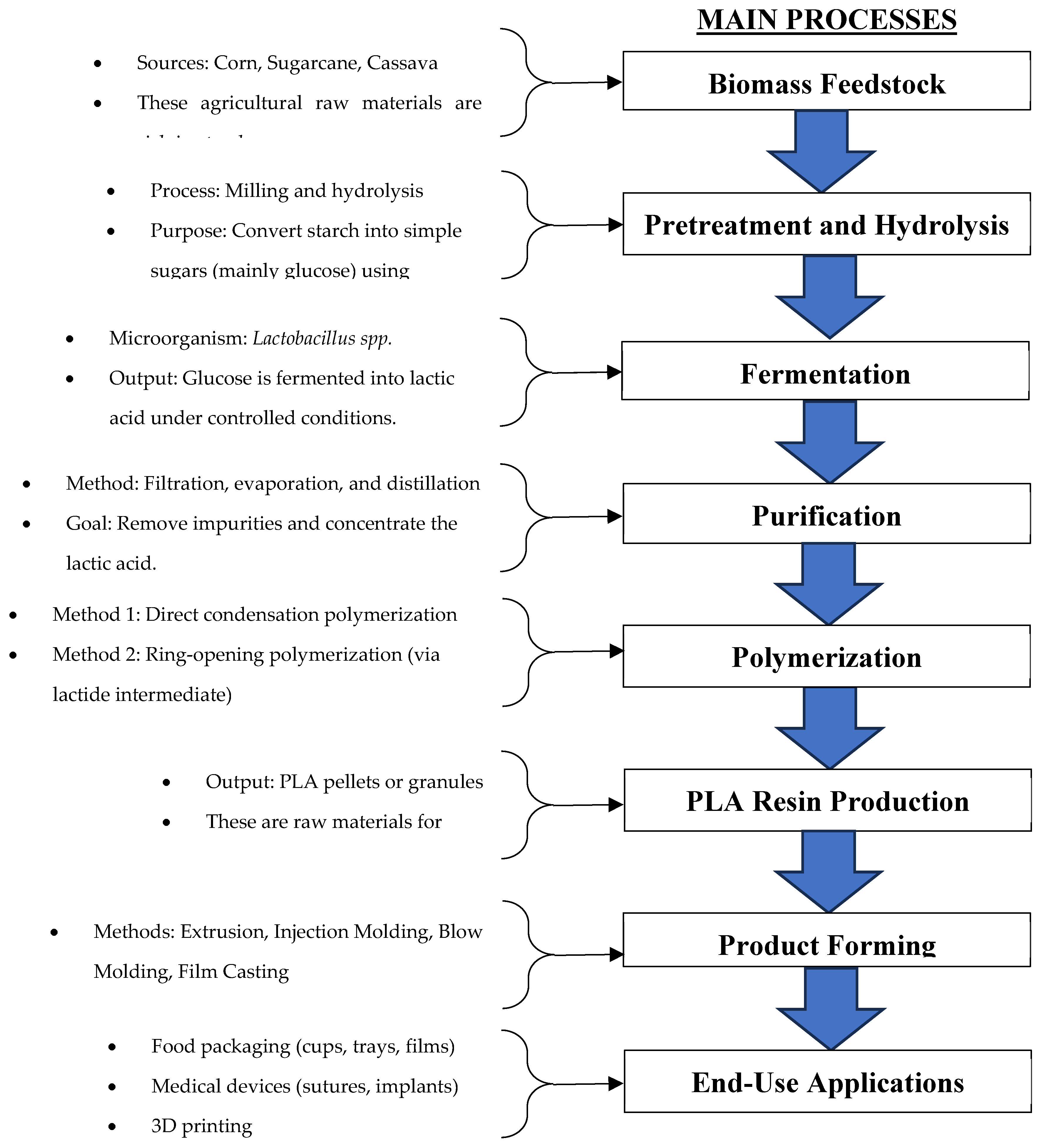
The production of polylactic acid (PLA) begins with the collection of renewable biomass feedstocks such as corn, sugarcane, or cassava—agricultural crops rich in starch or sugar. These raw materials undergo pretreatment and hydrolysis, where the starches are broken down into fermentable sugars like glucose using enzymatic or acid-based processes. The resulting glucose solution is then subjected to microbial fermentation, typically using Lactobacillus species, to produce lactic acid. After fermentation, the lactic acid is purified through filtration, evaporation, and distillation to achieve high purity, which is essential for polymerization. The purified lactic acid is then polymerized either by direct condensation or, more commonly, via ring-opening polymerization of lactide, a cyclic dimer of lactic acid, to form high-molecular-weight PLA. The resulting PLA polymer is cooled and processed into resin pellets or granules, which serve as raw materials for product fabrication. These resins can be formed into various shapes using conventional plastic manufacturing techniques such as extrusion, injection molding, blow molding, or film casting. Finally, PLA is utilized in a wide range of applications, including food packaging, 3D printing, biomedical devices, and agricultural films. Due to its compostability and lower carbon footprint, PLA offers a promising alternative to petroleum-based plastics, supporting global efforts toward a more sustainable materials economy.
6. Innovations in PLA Production Technology and Applications
6.1. Improving PLA Properties through Additives and Blending
Recent advancements in PLA research have concentrated on overcoming its inherent limitations—such as brittleness, low thermal stability, and poor barrier performance—through the use of polymer blending, incorporation of bio-based fillers, and functional additives. Blending PLA with other biodegradable polymers, such as poly(3-hydroxybutyrate) (PHB) or natural rubber, has been demonstrated to enhance flexibility, impact resistance, and thermal properties while maintaining overall biodegradability [188].
The incorporation of modified biomass-derived fillers, including cellulose nanocrystals, lignin, and starch derivatives, further improves PLA’s mechanical strength, thermal resistance, and barrier properties. These biofillers not only reinforce the PLA matrix but also contribute to sustainability by utilizing renewable resources [188].
Additionally, the use of organoclays and chain extenders has shown to be particularly effective in simultaneously enhancing multiple performance aspects. Organoclays increase gas barrier resistance and thermal stability through improved interfacial interactions, while chain extenders mitigate thermal degradation by rebuilding molecular weight during melt processing, thereby improving impact toughness and elongation at break [189].
An emerging and promising technique is in situ microfibrillar blending, particularly with engineering polymers such as polyamide-6 (PA6). This approach leads to the formation of highly oriented fibrillar structures within the PLA matrix, which significantly enhances crystallization kinetics, mechanical performance, and foaming capability—important parameters for packaging and lightweight structural applications [190].
Collectively, these material engineering strategies address PLA’s key deficiencies without compromising its biocompatibility, biodegradability, and processability, expanding its utility in advanced applications such as additive manufacturing (3D printing), biomedical scaffolds, and sustainable packaging systems [191,192].
6.2. Development of PLA Films with Natural Antibacterial and Antifungal Properties
Recent advancements in poly(lactic acid) (PLA) research have emphasized the development of active packaging materials by incorporating natural antibacterial and antifungal agents into PLA films, particularly for food preservation applications. Bioactive compounds such as essential oils (e.g., thymol, carvacrol), spruce resin, and chitosan have been successfully integrated into PLA matrices to inhibit the growth of common foodborne pathogens, including Escherichia coli, Listeria monocytogenes, and Aspergillus niger [193,194].
In addition to providing antimicrobial functionality, these bio-based additives modulate key physicochemical properties of the films, such as tensile strength, oxygen and water vapor permeability, and thermal stability [195]. For instance, the addition of chitosan enhances film flexibility and antimicrobial action, while certain essential oils can improve or impair mechanical integrity depending on their concentration and dispersion within the PLA matrix.
Various processing methods—such as solution casting, melt extrusion, and compression molding—have been employed to fabricate these active films, each presenting unique advantages in terms of additive dispersion and retention of bioactivity [196,197]. However, challenges remain in achieving uniform distribution and long-term stability of natural antimicrobials due to their volatility, hydrophobicity, and potential incompatibility with the PLA matrix [198]. These issues necessitate modification strategies, such as microencapsulation, emulsification, or the use of compatibilizers, to enhance additive stability and interfacial adhesion.
Despite these challenges, ongoing research continues to demonstrate the viability and sustainability of using natural antimicrobial agents in PLA-based films, offering a biodegradable, non-toxic alternative to conventional synthetic packaging. This innovation aligns with increasing consumer demand for environmentally friendly and safe food packaging solutions.
6.3. PLA in Practical Packaging Applications
Polylactic acid (PLA) has emerged as a leading biodegradable polymer in the packaging industry due to its high tensile strength, optical clarity, and biocompatibility [199]. These properties make PLA particularly attractive for applications such as food containers, trays, and films. However, its inherent brittleness, limited elongation at break, and suboptimal gas and moisture barrier properties have posed significant limitations for broader commercial adoption, particularly in the packaging of perishable or sensitive goods [167,200].
To address these challenges, researchers have employed a variety of modification strategies. The incorporation of plasticizers such as polyethylene glycol (PEG), citrate esters, or oligomeric lactic acid has been shown to reduce brittleness and improve flexibility, though this often comes at the expense of mechanical strength and thermal resistance [201]. Blending PLA with other biodegradable polymers, including poly(butylene adipate-co-terephthalate) (PBAT) or polyhydroxyalkanoates (PHAs), enhances impact resistance and toughness while maintaining biodegradability.
Chain extenders—such as epoxy-functionalized additives—are commonly used to increase molecular weight and restore mechanical properties in recycled or degraded PLA, contributing to a more circular material lifecycle. Furthermore, nanocomposite technology has significantly advanced PLA’s applicability in packaging. The incorporation of nanofillers, including clay nanoparticles, cellulose nanocrystals, and graphene oxide, has demonstrated improvements in mechanical strength, thermal stability, and gas barrier performance, with some studies reporting reductions in oxygen and water vapor permeability by over 50% [154].
In food packaging, tailoring barrier properties remains a priority to prolong shelf life and maintain product quality [158,159,202]. Multilayered PLA structures and the inclusion of active agents—such as antioxidants and antimicrobial compounds—further expand its utility in smart and functional packaging solutions.
Despite current limitations, PLA continues to gain momentum as a sustainable alternative to petrochemical-based plastics. Its applications now extend beyond packaging to include medical implants, drug delivery systems, and 3D printing [203]. Ongoing research is focused on enhancing processability, property retention during recycling, and performance in varying environmental conditions, all of which are essential to expanding PLA’s role in next-generation, environmentally friendly packaging systems.
6.4. Alternative Biomaterials and the Future of PLA
Polylactic acid (PLA) continues to garner attention as a biodegradable, bio-based alternative to petroleum-derived plastics, with a favorable environmental profile and compatibility with existing processing technologies [89,204]. However, intrinsic limitations in toughness, thermal stability, and gas barrier performance constrain its deployment in demanding industrial and packaging applications [205].
To overcome these deficiencies, innovative material design strategies have been proposed. These include the blending of PLA with modified biomass components—such as lignin, cellulose derivatives, or starch—to enhance mechanical strength and maintain compostability [64,206]. The formation of stereocomplex PLA, derived from enantiomeric blends of poly(L-lactide) and poly(D-lactide), has shown considerable promise in elevating melting temperatures and crystallinity, thereby significantly improving thermal resistance and mechanical robustness.
Furthermore, the integration of natural and synthetic reinforcing fibers, including flax, kenaf, carbon fibers, or nanocellulose, has been explored to fabricate PLA-based biocomposites with superior load-bearing capabilities. These approaches not only enhance functional performance but also retain biodegradability, expanding PLA’s use in automotive components, consumer electronics, and structural packaging.
The advent of advanced fabrication techniques, such as additive manufacturing (3D printing), has also opened new horizons for PLA. PLA’s ease of processing, biodegradability, and biocompatibility make it well-suited for the production of personalized medical devices, biodegradable scaffolds, and multi-material constructs that leverage gradient properties for tailored functionality [207,208].
Despite these advancements, PLA faces growing competition from next-generation bio-based polymers such as polyhydroxyalkanoates (PHAs), polyethylene furanoate (PEF), and polybutylene succinate (PBS), which may offer improved thermal and mechanical profiles or enhanced environmental degradability under ambient conditions. However, PLA’s established infrastructure for production, processing, and end-of-life management remains a key advantage.
Looking ahead, the future of PLA hinges on continued material innovation, cost reduction strategies, and improved end-of-life pathways, including chemical recycling and industrial composting. As sustainability pressures intensify across industries, PLA’s potential as a scalable and versatile alternative to conventional plastics is poised to grow—particularly as part of integrated circular bioeconomy systems aimed at minimizing environmental impact while meeting performance demands across multiple sectors [89].
7. International Strategies and Policies for Scaling Up PLA Use
7.1. PLA and the United Nations Sustainable Development Goals (SDGs)
Polylactic acid (PLA), a biodegradable and bio-based polymer synthesized from renewable agricultural resources, holds significant potential to support multiple United Nations Sustainable Development Goals (SDGs)—notably SDG 12 (Responsible Consumption and Production) and SDG 13 (Climate Action) [209]. As a low-carbon alternative to conventional petroleum-based plastics, PLA offers substantial environmental advantages, including a reduction in greenhouse gas emissions by approximately 60% over its life cycle, primarily due to the biogenic origin of its carbon feedstock and the relatively energy-efficient production processes.
The incorporation of PLA into sectors such as packaging, textiles, and consumer goods provides a tangible pathway for advancing climate mitigation goals under SDG 13, while also supporting circular economy practices under SDG 12. In Vietnam, where plastic consumption is rapidly increasing and plastic pollution ranks among the most pressing environmental challenges, the adoption of PLA can play a pivotal role. Vietnam is currently among the top five contributors to marine plastic pollution, with 0.28 to 0.73 million metric tons of plastic waste estimated to leak into the ocean each year. A shift from conventional polymers to PLA-based materials could significantly reduce this burden, particularly in the single-use packaging sector, which constitutes a major portion of plastic leakage.
Furthermore, the localization of PLA production using domestically available biomass sources, such as cassava starch, sugarcane bagasse, or corn, aligns with SDG 8 (Decent Work and Economic Growth) and SDG 9 (Industry, Innovation, and Infrastructure). It offers opportunities to stimulate rural agricultural economies, create new value chains, and attract green investment into bio-refinery and biopolymer manufacturing sectors. This, in turn, can enhance Vietnam’s economic resilience while fostering sustainable industrial development.
Despite its promise, the widespread adoption of PLA in Vietnam faces multiple barriers, including:
- High production and retail costs relative to conventional plastics,
- Low consumer awareness and acceptance of biodegradable alternatives,
- Limited industrial composting facilities and infrastructure for bioplastic waste treatment,
- Policy and regulatory gaps in bioplastics standards and labeling [104].
To address these challenges, a comprehensive policy framework is essential. Recommended strategies include:
- Subsidies or tax incentives for PLA producers and importers to improve market competitiveness,
- Public procurement policies favoring biodegradable materials in government operations,
- Educational campaigns to raise consumer awareness on the environmental and health benefits of bioplastics,
- Investment in waste management infrastructure, particularly industrial composting and anaerobic digestion facilities,
- Clear labeling standards and certification schemes to differentiate biodegradable PLA products from conventional or oxo-degradable plastics.
In the context of Vietnam, the integration of PLA into the manufacturing and packaging sectors presents an opportunity to address the country's escalating plastic waste problem. Vietnam ranks among the top five countries contributing to marine plastic pollution, with an estimated 0.28 to 0.73 million metric tons of plastic waste entering the ocean annually. By substituting conventional plastics with PLA, Vietnam can enhance its waste management practices and promote sustainable consumption patterns, in line with SDG 12 [9]. Moreover, the utilization of locally sourced biomass for PLA production can stimulate the agricultural sector, providing economic benefits and fostering sustainable development.
Vietnam has taken initial steps toward sustainable materials adoption, including plastic bag levies and national action plans on marine plastic litter [210,211]. These efforts can be further strengthened through multi-stakeholder collaboration, engaging government agencies, academic institutions, private enterprises, and civil society to advance research, development, and commercialization of PLA and other biopolymers.
By leveraging its abundant biomass resources, growing scientific capacity, and rising public concern over environmental degradation, Vietnam is well-positioned to integrate PLA into a broader green transformation strategy—contributing meaningfully to its national sustainable development agenda and the global pursuit of the SDGs.
7.2. Government Policies and Support for PLA Bioplastics
Governments around the world are increasingly adopting policies to promote the development and use of polylactic acid (PLA) and other bioplastics as part of their strategies for environmental protection, waste reduction, and sustainable development. Regulatory frameworks targeting single-use plastics, incentives for bio-based materials, and support for research and innovation are among the key mechanisms used to facilitate this transition.
In the European Union, the European Green Deal and the Circular Economy Action Plan have set ambitious targets to reduce plastic waste and promote biodegradable alternatives. The EU Single-Use Plastics Directive, implemented in 2021, bans a range of disposable plastic items and encourages the development of bioplastics, including PLA, as alternatives. National strategies, such as France’s Roadmap for a Circular Economy, include targets for bioplastics adoption, research funding, and labeling schemes for compostable materials [212].
Table 8.
Key Government Policies Supporting PLA Bioplastics Worldwide.
| Policy/Initiative | Description |
| EU Single-Use Plastics Directive (2021) | Bans a range of single-use plastic items and promotes the development of biodegradable alternatives like PLA within the EU market. |
| USDA BioPreferred Program (USA) | Certifies and promotes biobased products, including PLA, by encouraging federal procurement and raising consumer awareness. |
| Japan Biomass Utilization Promotion Plan | Provides subsidies and strategic support for the development and commercialization of bioplastics, including those made from agricultural residues. |
| France Circular Economy Law (2020) | Requires all plastic packaging to be recyclable, compostable, or reusable by 2025; includes labeling requirements for compostable bioplastics. |
| Canada’s Single-Use Plastics Ban (2023) | Bans harmful plastic items and encourages innovation in sustainable alternatives, including PLA and compostable materials. |
| South Korea 2030 Resource Circulation Strategy | Combines extended producer responsibility (EPR) with tax incentives and R&D funding to support bioplastics and circular economy goals. |
| India’s Single-Use Plastic Ban (2022) | Nationwide prohibition of specific plastic items, with government support for alternatives including PLA derived from agricultural biomass. |
| Plastics Innovation Hub Vietnam (2022) | A public-private partnership fostering research into PLA and other sustainable materials, supported by CSIRO and international donors. |
Similarly, countries like Japan and South Korea have established roadmaps for transitioning to a bioeconomy. Japan's “Biomass Utilization Promotion Plan” offers subsidies for manufacturers adopting bioplastics and supports public awareness campaigns to encourage environmentally responsible consumer behavior [213]. South Korea’s “2030 Resource Circulation Strategy” includes bans on non-recyclable plastics and tax incentives for sustainable packaging solutions [214].
In North America, the U.S. Department of Agriculture (USDA) supports PLA development through its BioPreferred Program, which certifies and promotes biobased products [28]. At the state level, California and New York have introduced legislative bans on single-use plastics, indirectly driving demand for alternatives such as PLA. Canada has announced a nationwide ban on harmful single-use plastics and is investing in composting and recycling infrastructure to manage bioplastic waste streams effectively.
Emerging economies are also taking action. Vietnam, for example, passed a new Law on Environmental Protection (2020) that includes future bans on non-biodegradable plastics and encourages domestic PLA production [14]. The Plastics Innovation Hub Vietnam, established in collaboration with the Commonwealth Scientific and Industrial Research Organisation (CSIRO), exemplifies growing public-private partnerships to scale up sustainable materials. Meanwhile, India has implemented national bans on single-use plastics and is investing in research initiatives focused on biopolymers derived from agricultural waste.
Specifically, from January 1, 2026, the manufacture and import of non-biodegradable plastic bags smaller than 50 cm x 50 cm and thinner than 50 μm will be prohibited, except for export purposes or packaging of other goods [215]. Furthermore, by December 31, 2030, the production and import of single-use plastic products, non-biodegradable plastic packaging, and products containing microplastics will be banned, with certain exceptions. To support these initiatives, the government has collaborated with international organizations to tackle ocean plastic pollution. In 2020, Vietnam joined the Global Plastic Action Partnership, aiming to reduce plastic waste through public-private partnerships and policy interventions. Additionally, the United Nations Development Programme (UNDP) has assisted Vietnam in designing and implementing integrated waste and plastic management programs, focusing on behavior change, waste segregation, and recycling.
Table 9.
Key Government Policies Supporting PLA Bioplastics in Vietnam.
| Policy/Initiative | Description |
| Law on Environmental Protection (2020) | Introduced regulations to control production and import of single-use plastics and non-biodegradable packaging. |
| Global Plastic Action Partnership (2020) | Collaboration to reduce plastic waste through public-private partnerships and policy interventions. |
| Plastics Innovation Hub Vietnam (2022) | Initiative to foster research and development in sustainable plastic alternatives, including PLA. |
| Proposed Consumption Tax on Plastic Bags | Measure to discourage use of plastic bags and promote environmentally friendly alternatives. |
| Incentives for Eco-Friendly Product Manufacturers | Policies to encourage businesses to produce and utilize bioplastics and other sustainable materials. |
Despite these initiatives, several challenges persist globally. The high production costs of PLA, limited consumer awareness, and gaps in industrial composting infrastructure remain significant barriers to widespread adoption [216]. Furthermore, harmonized standards and certifications for compostability and biodegradability are still lacking across regions, hindering international trade and consumer confidence.
To overcome these obstacles, many governments are pursuing a combination of economic incentives, extended producer responsibility (EPR) schemes, public procurement policies favoring bioplastics, and investments in waste management infrastructure. International collaboration—such as through the Global Plastic Action Partnership, the UN Environment Programme (UNEP), and the OECD Working Party on Resource Productivity and Waste—is essential for aligning policies, sharing best practices, and accelerating the global transition toward sustainable materials like PLA.
Continued collaboration between government agencies, private enterprises, and international partners is essential to overcome these barriers and promote the sustainable development of the bioplastics industry in Vietnam.
7.3. Growth Potential of the Global PLA Sector in Sustainability Strategies
The global shift towards sustainable development and circular economy practices has positioned polylactic acid (PLA) as a key material in the transition to bio-based and biodegradable alternatives. Derived from renewable resources such as corn, sugarcane, and cassava, PLA aligns with global efforts to reduce plastic pollution, curb greenhouse gas emissions, and promote resource efficiency. Across various regions, supportive regulatory frameworks, increasing consumer demand for sustainable products, and growing investment in bioplastics are accelerating the adoption of PLA in packaging, agriculture, textiles, medical devices, and additive manufacturing.
Table 10.
Key Factors Influencing the Growth Potential of the Global PLA Sector.
| Factor | Description |
| Government Policies | Regulatory restrictions on conventional plastics and mandates for bio-based alternatives. |
| Feedstock Availability | Abundance of renewable agricultural sources such as corn, sugarcane, cassava. |
| Production Costs | Cost competitiveness with traditional plastics and scaling efficiencies. |
| Consumer Awareness | Public understanding and acceptance of compostable and biodegradable products. |
| Waste Management Systems | Infrastructure for industrial composting and effective end-of-life disposal. |
| Technological Innovations | Advances in PLA synthesis, processing, blending, and material enhancement. |
| Market Demand | Rising global demand for sustainable packaging and materials. |
| Investment and Incentives | Financial support for bioplastics production and market development. |
| Environmental Impact | Contribution to reducing fossil fuel use, carbon emissions, and plastic waste. |
Governments around the world have introduced policies restricting single-use and non-biodegradable plastics, creating favorable conditions for PLA expansion. For example, the European Union’s directive on single-use plastics, Canada’s national ban on plastic straws and bags, and India’s phase-out of select plastic items signal a rising commitment to alternative materials. These policies, coupled with tax incentives, green procurement standards, and public awareness campaigns, have catalyzed industry-wide shifts toward biodegradable options like PLA.
Feedstock availability also supports PLA expansion. Agricultural regions in Asia, South America, and parts of Africa provide plentiful biomass sources for lactic acid fermentation. Investments in second-generation feedstocks and waste-to-PLA technologies further promise to enhance sustainability while reducing competition with food crops.
Despite its potential, the PLA industry faces challenges, including high production costs, variability in composting infrastructure, and limitations in mechanical performance compared to petroleum-based plastics. Addressing these issues requires continued innovation in production technologies, public-private partnerships, and harmonization of international standards for biodegradability and certification.
Vietnam's commitment to sustainable development presents significant growth opportunities for the polylactic acid (PLA) sector (Table 11). As a biodegradable polymer derived from renewable resources, PLA aligns with the nation's environmental objectives and offers a viable alternative to conventional plastics. The Vietnamese government has implemented several policies to promote the adoption of bioplastics, including PLA. The Law on Environmental Protection, enacted in 2020, introduced regulations to control the production and import of single-use plastic products and non-biodegradable plastic packaging. Specifically, from January 1, 2026, the manufacture and import of non-biodegradable plastic bags smaller than 50 cm x 50 cm and thinner than 50 μm will be prohibited, except for export purposes or packaging of other goods. Furthermore, by December 31, 2030, the production and import of single-use plastic products, non-biodegradable plastic packaging, and products containing microplastics will be banned, with certain exceptions. These regulatory measures create a favorable environment for the growth of the PLA industry.
In addition to regulatory support, Vietnam's abundant agricultural resources provide a substantial feedstock for PLA production. The country is a leading producer of cassava and sugarcane, both of which can be utilized in the fermentation processes to produce lactic acid, the monomer for PLA synthesis. Leveraging these resources can reduce reliance on imported raw materials and enhance the competitiveness of domestically produced PLA.
Despite these opportunities, challenges remain in scaling up PLA production. High production costs, limited consumer awareness, and inadequate waste management infrastructure hinder the transition from conventional plastics to bioplastics. To address these issues, the government has proposed measures such as consumption taxes on plastic bags and incentives for businesses producing environmentally friendly products. Continued collaboration between government agencies, private enterprises, and international partners is essential to overcome these barriers and promote the sustainable development of the bioplastics industry in Vietnam.
8. Standards and Certification Frameworks: A Critical Pillar for PLA Adoption
Despite the increasing interest in polylactic acid (PLA) as a sustainable substitute for petroleum-based plastics, the absence of harmonized global standards and certification frameworks remains a major bottleneck—particularly in developing countries, where infrastructure, regulatory capacity, and consumer awareness are still evolving. Standards serve as a cornerstone for ensuring product safety, environmental integrity, and market credibility, and are indispensable for enabling the scaling and integration of PLA into national material economies.
Several internationally recognized standards have been established to assess the compostability and biodegradability of PLA. These include ASTM D6400 and ISO 17088, which define criteria for industrial composting, and EN 13432, which is widely applied in the European Union. Certification schemes such as TÜV Austria’s OK Compost, DIN CERTCO, and the USDA BioPreferred® Program offer third-party verification for compostability and bio-based content. These frameworks provide important tools for validating environmental claims and facilitating global trade in PLA-based products.
However, these standards are often designed with developed countries in mind, where industrial composting infrastructure is accessible, regulatory enforcement is strong, and public understanding of eco-labels is relatively high. In developing countries, the situation is different: composting systems are limited, landfill disposal dominates, and inconsistent product labeling leads to confusion among consumers and policymakers. Without clear and enforceable standards adapted to local conditions, PLA products may not degrade as intended, potentially undermining both environmental goals and public trust.
Furthermore, many developing countries lack domestic certification bodies or the technical capacity to implement foreign standards. This creates a dependency on imported certification services, which can be costly and inaccessible for local producers and startups. As a result, market access is constrained, and innovation in bioplastics may be discouraged due to regulatory uncertainty.
Establishing national and regional standardization systems for bioplastics—aligned with international norms but tailored to local environmental, economic, and infrastructural contexts—is therefore essential. These systems should include:
- Adapted biodegradability criteria for local composting and disposal conditions (e.g., landfill, marine, soil, home composting);
- Clear labeling regulations to help consumers distinguish between bio-based, biodegradable, and compostable plastics;
- Capacity building for laboratories, regulators, and manufacturers to implement and monitor standards;
- Integration of standards into procurement policies and plastic waste reduction legislation.
Governments in developing countries can also leverage international partnerships and funding mechanisms—such as those supported by the UNEP, World Bank, or Global Environment Facility (GEF)—to build institutional capacity for certification and oversight. National strategies such as Vietnam’s National Action Plan on Marine Plastic Litter (2020–2030) and Indonesia’s Roadmap for Plastic Waste Reduction already acknowledge the importance of sustainable materials but would benefit from stronger technical underpinnings rooted in robust, context-appropriate standards.
Ultimately, harmonizing global and local standards will be key not only to expanding PLA adoption but also to ensuring its environmental effectiveness and socio-economic viability. In the absence of well-defined criteria and consistent enforcement, PLA risks being perceived as a “greenwashed” solution rather than a truly sustainable one. For developing countries, standardization is not a bureaucratic formality—it is a strategic necessity to unlock the full potential of bioplastics in driving green growth, environmental resilience, and participation in the emerging global bioeconomy.
9. Future Prospects and Application Potential of PLA in the Global Sustainability Context
The global transition towards bioplastics, particularly polylactic acid (PLA), represents a strategic opportunity to align industrial development with international sustainability goals. PLA, derived from renewable agricultural resources, supports the realization of key United Nations Sustainable Development Goals (SDGs), including SDG 12 on responsible consumption and production, and SDG 13 on climate action. With a carbon footprint reduction of approximately 60% compared to conventional petroleum-based plastics, PLA offers a promising solution to mitigate greenhouse gas emissions and reduce environmental pollution worldwide.
Globally, the consumption of plastics continues to rise, with single-use packaging comprising a significant share of plastic waste. Countries facing plastic pollution challenges—such as Vietnam, parts of Southeast Asia, Europe, and North America—are actively seeking biodegradable alternatives like PLA to improve waste management and reduce marine litter. The use of locally available biomass feedstocks, including cassava, sugarcane, corn, and other agricultural residues, not only supports sustainable material production but also stimulates rural economies and enhances agricultural value chains.
Policy frameworks have become critical drivers of PLA adoption internationally. Regulatory measures limiting single-use plastics, plastic bag bans, extended producer responsibility schemes, and incentives for bio-based product development are increasingly common. Collaborations between governments, international organizations, and private sectors—such as the Global Plastic Action Partnership and national innovation hubs—have accelerated research, development, and commercialization of PLA-based materials.
Despite positive momentum, challenges remain globally. High production costs relative to fossil-based plastics, inconsistent waste collection and composting infrastructure, and limited public awareness about biodegradable materials hinder large-scale adoption. Addressing these barriers requires coordinated efforts to advance R&D, improve public engagement, and develop infrastructure for effective end-of-life management of bioplastics.
Technological advancements offer promising avenues to overcome current limitations of PLA. Innovations such as blending with other biopolymers (e.g., polyhydroxyalkanoates - PHA), incorporating bio-based nanofillers, and enhancing stereocomplex crystallization significantly improve PLA’s mechanical strength, thermal stability, and barrier properties. These enhancements broaden PLA’s applicability across diverse sectors including automotive, biomedical devices, electronics, and sustainable packaging.
Emerging recycling methods, particularly enzymatic depolymerization, enable closed-loop recycling of PLA with low energy consumption, supporting circular economy objectives. Furthermore, hybrid bioplastics that combine PLA with functional marine-derived polymers like alginate and chitosan show added benefits such as antimicrobial activity and accelerated biodegradability.
For countries like Vietnam and others with strong agricultural bases, leveraging these innovations within circular economy frameworks can transform the bioplastics sector into a cornerstone of green economic growth. By fostering innovation, policy support, and international collaboration, the global PLA industry is poised to become a leader in sustainable materials science, contributing meaningfully to environmental protection and economic resilience.
Policy interventions have played a central role in facilitating this shift. National regulations such as the 2020 Law on Environmental Protection and upcoming restrictions on single-use plastics are key drivers for bioplastics adoption. Initiatives such as the Plastics Innovation Hub and partnerships with international organizations have further reinforced the national agenda to reduce plastic waste and support the development of sustainable alternatives. These efforts have begun to yield results: by 2022, PLA accounted for 15% of Vietnam’s domestic biodegradable packaging materials, and the government has signaled continued commitment through incentives and investment schemes. Despite progress, several barriers remain, including high production costs, a lack of composting infrastructure, and low public awareness regarding biodegradable materials. Overcoming these challenges will require collaborative engagement across industry, academia, and policymakers to accelerate R&D, enhance public education, and scale waste management infrastructure for bioplastics.
Looking ahead, technological advancements offer promising solutions to PLA’s current limitations. Blending with alternative biopolymers such as polyhydroxyalkanoates (PHA), incorporating bio-based nanofillers, and optimizing stereocomplex formation have demonstrated the potential to enhance PLA’s mechanical and thermal properties. These modifications are crucial for expanding PLA's applicability in sectors such as automotive components, biomedical devices, and high-performance packaging. Additionally, enzymatic recycling technologies are emerging as viable approaches to close the material loop, enabling PLA to be reprocessed into monomers with minimal energy input. Hybrid bioplastics combining PLA with alginate, chitosan, and marine-based polymers are also gaining attention for their added functionality, including antimicrobial properties and enhanced biodegradability. For Vietnam, harnessing these innovations within the framework of a circular economy could transform the domestic bioplastics industry into a pillar of green growth, while positioning the country as a regional leader in sustainable material science.
10. Conclusions
This review summarizes recent advancements, current challenges, and future directions for polylactic acid (PLA) as a sustainable alternative to conventional plastics. Global interest in PLA has surged, evidenced by over 12,000 scientific publications between 2010 and 2022, with projections estimating annual publications to reach 3,200 by 2027. PLA production capacity attained 550,000 metric tons in 2022 and is expected to exceed 3 million metric tons by 2032. In Vietnam, research and applications of PLA have grown significantly, especially in the food packaging sector, where PLA-based products now represent approximately 15% of biodegradable materials used.
While PLA offers benefits such as biodegradability and reduced carbon emissions, it continues to face challenges regarding mechanical strength, thermal stability, and barrier properties. These limitations have been partly mitigated through strategies including polymer blending, incorporation of nanofillers, and stereocomplex formation.
The strategic value of PLA lies in its alignment with global sustainability objectives and circular economy principles. For countries like Vietnam, harnessing abundant agricultural feedstocks such as cassava and sugarcane could facilitate cost-effective PLA production, supporting both environmental conservation and rural economic development. Future research priorities should focus on advancing enzymatic recycling technologies to improve PLA end-of-life management and investigating hybrid bioplastic systems that integrate PLA with alginate or chitosan to broaden its application potential. Enhanced collaboration among academia, industry, and policymakers will be essential to accelerate PLA innovation, ensuring bioplastics serve as a cornerstone of sustainable development strategies in the decades ahead.
Author Contributions
Conceptualization, N.Q.T. and N.T.H.M.; project administration, C.N.H. and N.T.D.; supervision, N.Q.T. and C.N.H.; writing - original draft, C.N.H., and T.N.M.; writing - review & editing, N.T.D.; T.N.M. and C.N.H.; data curation, L.N.A.; H.L.T.A. and T.M.V.; formal analysis, L.N.A.; H.L.T.A. and T.M.V.; investigation, N.T.H.M.; N.B.N. and T.N.M.; validation, N.Q.T. and N.B.N.; resources, T.N.M.; software, N.Q.T.; funding acquisition, C.N.H and N.T.D. All authors have read and agreed to the published version of the manuscript.
Funding
This research was supported by the Vietnam Academy of Science and Technology under Grant No. TĐNSH0.06/22-24 and Grant No. NCXS 01.02/23-25.
Acknowledgments
The authors would like to acknowledge the Center for High Technology Research and Development and the Institute of Biology for their partial support of this work.
Conflicts of Interest
The authors declare no conflicts of interest.
References
- Hana Najahi, Mohamed Banni, Mantoura Nakad, Rami Abboud, Jean Claude Assaf, Luigi Operato, Malika Belhassen, Leonardo Gomes, Wael Hamd, Plastic pollution in food packaging systems: impact on human health, socioeconomic considerations and regulatory framework, Journal of Hazardous Materials Advances, 2025, 18, 100667. [CrossRef]
- Houssini, K., Li, J. & Tan, Q. Complexities of the global plastics supply chain revealed in a trade-linked material flow analysis. Commun Earth Environ 6, 257 (2025). [CrossRef]
- Allan T. Williams, Nelson Rangel-Buitrago, The past, present, and future of plastic pollution, Marine Pollution Bulletin, 2022, 176, 113429. [CrossRef]
- Sina Matavos-Aramyan, Addressing the microplastic crisis: A multifaceted approach to removal and regulation, Environmental Advances, 2024, 17, 100579. [CrossRef]
- Kelaniyagama, S.H.; Gannoruwa, A.; Nilmini, A.H.L. Synthesize and applications of biodegradable plastics as a solution for environmental pollution due to non-biodegradable plastics: A review. Sustain. Polym. Energy 2024, 2(4), 10011.
- Peter Stoett, Vitória M. Scrich, Carla I. Elliff, Mariana M. Andrade, Natalia de M. Grilli, Alexander Turra, Global plastic pollution, sustainable development, and plastic justice, World Development, 2024, 184, 106756. [CrossRef]
- P.G.C. Nayanathara Thathsarani Pilapitiya, Amila Sandaruwan Ratnayake, The world of plastic waste: A review, Cleaner Materials, 2024, 11, 100220. [CrossRef]
- Alabi OA, Ologbonjaye KI, Awosolu O, Alalade OE (2019) Public and Environmental Health Effects of Plastic Wastes Disposal: A Review. J Toxicol Risk Assess 5:021. doi.org/10.23937/2572-4061.1510021.
- Islam, M.Z. Prevention policies for the marine ecological environment in the South China Sea as a consequence of excessive plastic compound use in Vietnam. Integr. Environ. Assess. Manag. 2024, 20(6), 2088–2106.
- Jambeck, J.; Moss, E.; Dubey, B.; Arifin, Z.; Godfrey, L.; Hardesty, B.D.; Woodall, L. Leveraging multi-target strategies to address plastic pollution in the context of an already stressed ocean. In The Blue Compendium: From Knowledge to Action for a Sustainable Ocean Economy; Springer: Cham, Switzerland, 2023; pp. 141–184.
- Arifin, Z.; Godfrey, L.; Hardesty, B.D.; Hendrawan, I.G.; Hien, T.T.; Junguo, L.; Woodall, L. Leveraging multi-target strategies to address plastic pollution in the context of an already stressed ocean. Unpublished manuscript, 2020.
- Kumar, R.; Verma, A.; Shome, A.; Sinha, R.; Sinha, S.; Jha, P.K.; Vara Prasad, P.V. Impacts of plastic pollution on ecosystem services, sustainable development goals, and need to focus on circular economy and policy interventions. Sustainability 2021, 13(17), 9963.
- Kelaniyagama, S.H.; Gannoruwa, A.; Nilmini, A.H.L. Synthesize and applications of biodegradable plastics as a solution for environmental pollution due to non-biodegradable plastics: A review. Sustain. Polym. Energy 2024, 2(4), 10011.
- Nguyen, T.X.S.; Hong Thao, N.; Thi My Linh, D.; Tien Vinh, N. Vietnam’s legal framework on reducing plastic waste towards a global treaty. Environ. Claims J. 2024, 36(1), 94–113.
- Sahimaa, O.; Sepponen, S.; Virtanen, J.; Carruth, A.; Nauta Ibsen, B.; Knudsen, C.; Skjelsvik, S. Waste prevention in the Nordics: What policies and measures are needed to prevent waste production and promote reuse? Unpublished Report, 2025.
- Fatchurrohman, N.; Muhida, R. From corn to cassava: Unveiling PLA origins for sustainable 3D printing. J. Teknol. 2023, 13(2), 87–93.
- Rezvani Ghomi, E.; Khosravi, F.; Saedi Ardahaei, A.; Dai, Y.; Neisiany, R.E.; Foroughi, F.; Ramakrishna, S. The life cycle assessment for polylactic acid (PLA) to make it a low-carbon material. Polymers 2021, 13(11), 1854.
- Agbelusi, J.; Arowosegbe, O.B.; Alomaja, O.A.; Odunfa, O.A.; Ballali, C. Strategies for minimizing carbon footprint in the agricultural supply chain: Leveraging sustainable practices and emerging technologies. World J. Adv. Res. Rev. 2024, 23(3), 2625–2646.
- Jeevahan, J.J.; Chandrasekaran, M.; Venkatesan, S.P.; Sriram, V.; Joseph, G.B.; Mageshwaran, G.; Durairaj, R.B. Scaling up difficulties and commercial aspects of edible films for food packaging: A review. Trends Food Sci. Technol. 2020, 100, 210–222.
- Bin Abu Sofian, A.D.A.; Sun, X.; Gupta, V.K.; Berenjian, A.; Xia, A.; Ma, Z.; Show, P.L. Advances, synergy, and perspectives of machine learning and biobased polymers for energy, fuels, and biochemicals for a sustainable future. Energy Fuels 2024, 38(3), 1593–1617.
- Rinn, R.; Jankovský, M.; Palátová, P.; García-Jácome, S.P.; Sharp, A.; Wangpakapattanawong, P.; Doungmala, K. Bioeconomy in countries of the Mekong region: Stakeholder understanding and perceptions in Thailand, Vietnam, and Laos. For. Policy Econ. 2024, 162, 103190.
- Taofeeq D. Moshood, Gusman Nawanir, Fatimah Mahmud, Fazeeda Mohamad, Mohd Hanafiah Ahmad, Airin AbdulGhani, Sustainability of biodegradable plastics: New problem or solution to solve the global plastic pollution?, Current Research in Green and Sustainable Chemistry, 2022, 5, 100273. [CrossRef]
- Dang, D.T. Nguyen, H. Thai, T.C. Nguyen, T.T.H. Tran, V.H. Le, X.B. Tran, T.P.T. Pham, T.G. Nguyen, Q.T. Nguyen, Plastic degradation by thermophilic Bacillus sp. BCBT21 isolated from composting agricultural residual in Vietnam, Adv. Nat. Sci. Nanosci. Nanotechnol., 9 (2018), Article 015014. [CrossRef]
- Dominika Kasznik, Zofia Łapniewska, The end of plastic? The EU’s directive on single-use plastics and its implementation in Poland, Environmental Science & Policy, 2023, 145, 151-163. [CrossRef]
- Katrin Beer, Michael Böcher, Caroline Ganzer, Anke Blöbaum, Lukas Engel, Theresa De Paula Sieverding, Kai Sundmacher, Ellen Matthies, Forest-based bioeconomy and bio-based chemical production in the European Union: Policy issues, institutions, actors, and instruments in a changing forest policy subsystem, Forest Policy and Economics, 2025, 177, 103521. [CrossRef]
- Government of Japan, Roadmap for Bioplastics Introduction - For the sustainable use of plastics, 2021.
- Aswathy Jayakumar, Sabarish Radoor, Suchart Siengchin, Gye Hwa Shin, Jun Tae Kim, Recent progress of bioplastics in their properties, standards, certifications and regulations: A review, Science of The Total Environment, 2023, 878, 163156. [CrossRef]
- USDA, BioPreferred. Website United States Department of Agriculture (2024), https://www.biopreferred.gov/BioPreferred/ (accessed Fri, June 6, 2025).
- Taofeeq D. Moshood, Gusman Nawanir, Fatimah Mahmud, Fazeeda Mohamad, Mohd Hanafiah Ahmad, Airin AbdulGhani, Biodegradable plastic applications towards sustainability: A recent innovations in the green product, Cleaner Engineering and Technology, 2022, 6, 100404. [CrossRef]
- Neelima Tripathi, Manjusri Misra, and Amar K. Mohanty, Durable Polylactic Acid (PLA)-Based Sustainable Engineered Blends and Biocomposites: Recent Developments, Challenges, and Opportunities, ACS Engineering Au 2021 1 (1), 7-38. DOI: 10.1021/acsengineeringau.1c00011.
- Katz, Yaron. (2021). Government’s Role in Advancing Innovation. Randwick International of Social Science Journal. 2. 31-45. 10.47175/rissj.v2i2.213.
- Sameh Samir Ali, Esraa A. Abdelkarim, Tamer Elsamahy, Rania Al-Tohamy, Fanghua Li, Michael Kornaros, Antonio Zuorro, Daochen Zhu, Jianzhong Sun, Bioplastic production in terms of life cycle assessment: A state-of-the-art review, Environmental Science and Ecotechnology, 2023, 15, 100254. [CrossRef]
- Nguyen, X.P.; Le, N.D.; Pham, V.V.; Huynh, T.T.; Dong, V.H.; Hoang, A.T. Mission, challenges, and prospects of renewable energy development in Vietnam. Energy Sources Part A Recover. Util. Environ. Eff. 2021, 1–13.
- Nguyen, M.P.; Ponomarenko, T.; Nguyen, N. Energy transition in Vietnam: A strategic analysis and forecast. Sustainability 2024, 16(5), 1969.
- Balla E, Daniilidis V, Karlioti G, Kalamas T, Stefanidou M, Bikiaris ND, Vlachopoulos A, Koumentakou I, Bikiaris DN. Poly(lactic Acid): A Versatile Biobased Polymer for the Future with Multifunctional Properties-From Monomer Synthesis, Polymerization Techniques and Molecular Weight Increase to PLA Applications. Polymers (Basel). 2021 May 31;13(11):1822. doi: 10.3390/polym13111822. PMID: 34072917; PMCID: PMC8198026.
- Abdelshafy A, Hermann A, Herres-Pawlis S, Walther G. Opportunities and Challenges of Establishing a Regional Bio-based Polylactic Acid Supply Chain. Glob Chall. 2023 May 5;7(7):2200218. doi: 10.1002/gch2.202200218. PMID: 37483423; PMCID: PMC10362116.
- Graham Hayes, Matthew Laurel, Dan MacKinnon, Tieshuai Zhao, Hannes A. Houck, and C. Remzi Becer, Polymers without Petrochemicals: Sustainable Routes to Conventional Monomers, Chemical Reviews 2023 123 (5), 2609-2734, DOI: 10.1021/acs.chemrev.2c00354.
- Secches TO, Santos Viera CF, Pereira TKE, Santos VTO, Ribeirodos Santos J, Pereira GAG, Carazzolle MF. Brazilian industrial yeasts show high fermentative performance in high solids content for corn ethanol process. Bioresour Bioprocess. 2022 Sep 11;9(1):97. doi: 10.1186/s40643-022-00580-w. PMID: 38647773; PMCID: PMC10991476.
- Ha-Duong, M. Power system planning in the energy transition era: the case of Vietnam’s Power Development Plan 8. Clim. Policy 2024, 24, 1–16.
- Rinn, R.; Jankovský, M.; Palátová, P.; García-Jácome, S.P.; Sharp, A.; Wangpakapattanawong, P.; Doungmala, K. Bioeconomy in countries of the Mekong region: Stakeholder understanding and perceptions in Thailand, Vietnam, and Laos. For. Policy Econ. 2024, 162, 103190.
- Formann S, Hahn A, Janke L, Stinner W, Sträuber H, Logroño W and Nikolausz M (2020) Beyond Sugar and Ethanol Production: Value Generation Opportunities Through Sugarcane Residues. Front. Energy Res. 8:579577. doi: 10.3389/fenrg.2020.579577.
- Abdelshafy, A., Hermann, A., Herres-Pawlis, S., & Walther, G. (2023). Opportunities and Challenges of Establishing a Regional Bio-based Polylactic Acid Supply Chain. Global Challenges, 7(7). [CrossRef]
- Selwal, N., Sultana, H., Rahayu, F., Hariyono, B., Riajaya, P. D., Kadarwati, F. T., Herwati, A., Latifah, E., Indriani, F. C., Saeri, M., Dar, M. A., Chopra, C., Abass, K. S., & Wani, A. K. (2025). Emerging technologies in biomass conversion: Bioengineering and nanocatalysts to AI-driven process optimization. Biomass and Bioenergy, 200, 108054. [CrossRef]
- Yankov D. Fermentative Lactic Acid Production From Lignocellulosic Feedstocks: From Source to Purified Product. Front Chem. 2022 Mar 4;10:823005. doi: 10.3389/fchem.2022.823005. PMID: 35308791; PMCID: PMC8931288.
- Samoraj, M., Çalış, D., Trzaska, K., Mironiuk, M., & Chojnacka, K. (2024). Advancements in algal biorefineries for sustainable agriculture: Biofuels, high-value products, and environmental solutions. Biocatalysis and Agricultural Biotechnology, 58, 103224. [CrossRef]
- Jain, S., & Kumar, S. (2024). Advances and challenges in pretreatment technologies for bioethanol production: A comprehensive review. Sustainable Chemistry for Climate Action, 5, 100053. [CrossRef]
- Li, Y., Bhagwat, S. S., Cortés-Peña, Y. R., Ki, D., Rao, C. V., Jin, Y.-S., & Guest, J. S. (2021). Sustainable Lactic Acid Production from Lignocellulosic Biomass. ACS Sustainable Chemistry & Engineering, 9(3), 1341–1351. [CrossRef]
- Strelkovskii, N., & Komendantova, N. (2025). Integration of UN sustainable development goals in national hydrogen strategies: A text analysis approach. International Journal of Hydrogen Energy, 102, 1282–1294. [CrossRef]
- Islam, M., Xayachak, T., Haque, N., Lau, D., Bhuiyan, M., & Pramanik, B. K. (2024). Impact of bioplastics on environment from its production to end-of-life. Process Safety and Environmental Protection, 188, 151–166. [CrossRef]
- Nguyen, X.P.; Le, N.D.; Pham, V.V.; Huynh, T.T.; Dong, V.H.; Hoang, A.T. Mission, challenges, and prospects of renewable energy development in Vietnam. Energy Sources Part A Recover. Util. Environ. Eff. 2021, 1–13.
- Nguyen, M.P.; Ponomarenko, T.; Nguyen, N. Energy transition in Vietnam: A strategic analysis and forecast. Sustainability 2024, 16(5), 1969.
- Benti, N.E.; Gurmesa, G.S.; Argaw, T.; Aneseyee, A.B.; Gunta, S.; Kassahun, G.B.; Asfaw, A.A. The current status, challenges and prospects of using biomass energy in Ethiopia. Biotechnol. Biofuels 2021, 14, 1–24.
- Järvinen, A. Energy-water nexus: An overview of the Finnish case. Unpublished Report, 2021.
- Nie, B.; Li, J. Technical potential assessment of offshore wind energy over shallow continental shelf along China coast. Renew. Energy 2018, 128, 391–399.
- Mofijur, M.; Mahlia, T.M.I.; Logeswaran, J.; Anwar, M.; Silitonga, A.S.; Rahman, S.A.; Shamsuddin, A.H. Potential of rice industry biomass as a renewable energy source. Energies 2019, 12(21), 4116.
- Sen, S.K.; Khan, A.H.A.N.; Dutta, S.; Mortuza, A.A.; Sumaiya, U. Hydropower potentials in Bangladesh in context of current exploitation of energy sources: A comprehensive review. Int. J. Energy Water Resour. 2022, 6(3), 413–435.
- Vision, V.N.S.E.S. Towards 100% renewable energy by 2050. Vietnam Sustainability Vision Report. 2023.
- Ha-Duong, M. Power system planning in the energy transition era: the case of Vietnam’s Power Development Plan 8. Clim. Policy 2024, 24, 1–16.
- Moazzem, K.G.; Shibly, A.S.A. Power sector in the 8th five year plan: Reflection on its strategy and initiatives. Centre for Policy Dialogue (CPD) Working Paper. 2021.
- Zhao, G.; Zhou, P.; Wen, W. Feed-in tariffs, knowledge stocks and renewable energy technology innovation: the role of local government intervention. Energy Policy 2021, 156, 112453.
- Jambeck, J.; Moss, E.; Dubey, B.; Arifin, Z.; Godfrey, L.; Hardesty, B.D.; Woodall, L. Leveraging multi-target strategies to address plastic pollution in the context of an already stressed ocean. In The Blue Compendium: From Knowledge to Action for a Sustainable Ocean Economy; Springer: Cham, Switzerland, 2023; pp. 141–184.
- Arifin, Z.; Godfrey, L.; Hardesty, B.D.; Hendrawan, I.G.; Hien, T.T.; Junguo, L.; Woodall, L. Leveraging multi-target strategies to address plastic pollution in the context of an already stressed ocean. Unpublished manuscript, 2020.
- https://www.precedenceresearch.com/bioplastics-market.
- https://www.fortunebusinessinsights.com/press-release/bioplastics-market-9499.
- Chakori, S., Aziz, A. A., Smith, C., & Dargusch, P. (2021). Untangling the underlying drivers of the use of single-use food packaging. Ecological Economics, 185, 107063. [CrossRef]
- Gundlapalli, M., & Ganesan, S. (2025). Polyhydroxyalkanoates (PHAs): Key Challenges in production and sustainable strategies for cost reduction within a circular economy framework. Results in Engineering, 26, 105345. [CrossRef]
- Khunnonkwao, P., Thitiprasert, S., Jaiaue, P., Khumrangsee, K., Cheirsilp, B., & Thongchul, N. (2024). The outlooks and key challenges in renewable biomass feedstock utilization for value-added platform chemical via bioprocesses. Heliyon, 10(10), e30830. [CrossRef]
- Balan V. Current challenges in commercially producing biofuels from lignocellulosic biomass. ISRN Biotechnol. 2014 May 4;2014:463074. doi: 10.1155/2014/463074. PMID: 25937989; PMCID: PMC4393053.
- Joseph TM, Kallingal A, Suresh AM, Mahapatra DK, Hasanin MS, Haponiuk J, Thomas S. 3D printing of polylactic acid: recent advances and opportunities. Int J Adv Manuf Technol. 2023;125(3-4):1015-1035. doi: 10.1007/s00170-022-10795-y. Epub 2023 Jan 7. PMID: 36644783; PMCID: PMC9822698.
- Quang, T. H., Phong, N. V., Anh, L. N., Hanh, T. T. H., Cuong, N. X., Ngan, N. T. T., Trung, N. Q., Nam, N. H., & Minh, C. V. (2020). Secondary metabolites from a peanut-associated fungus Aspergillus niger IMBC-NMTP01 with cytotoxic, anti-inflammatory, and antimicrobial activities. Natural Product Research, 36(5), 1215–1223. [CrossRef]
- Hasan, M. R., Davies, I. J., Pramanik, A., John, M., & Biswas, W. K. (2024). Potential of recycled PLA in 3D printing: A review. Sustainable Manufacturing and Service Economics, 3, 100020. [CrossRef]
- Fredi, G., & Dorigato, A. (2021). Recycling of bioplastic waste: A review. Advanced Industrial and Engineering Polymer Research, 4(3), 159–177. [CrossRef]
- Alaghemandi, M. (2024). Sustainable Solutions Through Innovative Plastic Waste Recycling Technologies. Sustainability, 16(23), 10401. [CrossRef]
- Firoozi, A. A., Firoozi, A. A., Oyejobi, D. O., Avudaiappan, S., & Flores, E. S. (2024). Emerging trends in sustainable building materials: Technological innovations, enhanced performance, and future directions. Results in Engineering, 24, 103521. [CrossRef]
- Markus Amann, Zbigniew Klimont, T An Ha, Peter Rafaj, Gregor Kiesewetter, Adriana Gomez Sanabria, Binh Nguyen, TN Thi Thu, Kimminh Thuy, Wolfgang Schöpp, Jens Borken-Kleefeld, L Höglund-Isaksson, Fabian Wagner, Robert Sander, Chris Heyes, Janusz Cofala, Nguyen Quang Trung, Nguyen Tien Dat, Nguyen Ngoc Tung, Future Air Quality in Ha Noi and Northern Vietnam, http://pure.iiasa.ac.at/15803 (2019).
- Ghosh, K., & Jones, B. H. (2021). Roadmap to Biodegradable Plastics—Current State and Research Needs. ACS Sustainable Chemistry & Engineering, 9(18), 6170–6187. [CrossRef]
- Naser AZ, Deiab I, Darras BM. Poly(lactic acid) (PLA) and polyhydroxyalkanoates (PHAs), green alternatives to petroleum-based plastics: a review. RSC Adv. 2021 May 10;11(28):17151-17196. doi: 10.1039/d1ra02390j. PMID: 35479695; PMCID: PMC9033233.
- Pinlova, B., Sudheshwar, A., Vogel, K., Malinverno, N., Hischier, R., & Som, C. (2024). What can we learn about the climate change impacts of polylactic acid from a review and meta-analysis of lifecycle assessment studies? Sustainable Production and Consumption, 48, 396–406. [CrossRef]
- Mak, S. L., Wu, M. Y. T., Chak, W. Y., Kwong, W. K., Tang, W. F., Li, C. H., Lee, C. C., & Li, C. Y. (2023). A Review of the Feasibility of Producing Polylactic Acid (PLA) Polymers Using Spent Coffee Ground. Sustainability, 15(18), 13498. [CrossRef]
- Zhao, X., Wang, Y., Chen, X., Yu, X., Li, W., Zhang, S., Meng, X., Zhao, Z.-M., Dong, T., Anderson, A., Aiyedun, A., Li, Y., Webb, E., Wu, Z., Kunc, V., Ragauskas, A., Ozcan, S., & Zhu, H. (2023). Sustainable bioplastics derived from renewable natural resources for food packaging. Matter, 6(1), 97–127. [CrossRef]
- Comunale, M. (2024). The Economic Impacts and the Regulation of AI: A Review of the Academic Literature and Policy Actions. IMF Working Papers, 2024(065), 1. [CrossRef]
- Thein, E. E., Niigata, A., & Inaba, K. (2025). Exploring the Roots of Small and Medium Enterprise Financing Issues in Myanmar. International Journal of Economics and Finance, 17(3), 58. [CrossRef]
- Moshood, T. D., Nawanir, G., Mahmud, F., Mohamad, F., Ahmad, M. H., & AbdulGhani, A. (2022). Sustainability of biodegradable plastics: New problem or solution to solve the global plastic pollution? Current Research in Green and Sustainable Chemistry, 5, 100273. [CrossRef]
- Haq, F., Kiran, M., Khan, I. A., Mehmood, S., Aziz, T., & Haroon, M. (2025). Exploring the pathways to sustainability: A comprehensive review of biodegradable plastics in the circular economy. Materials Today Sustainability, 29, 101067. [CrossRef]
- Rosenboom, J.-G., Langer, R., & Traverso, G. (2022). Bioplastics for a circular economy. Nature Reviews Materials, 7(2), 117–137. [CrossRef]
- Tran, T.T.H.; Luc, T.T.H. Reverse logistics in plastic supply chain: the current practice in Vietnam. In Nachhaltige Impulse für Produktion und Logistikmanagement: Festschrift zum 60. Geburtstag von Prof. Dr. Hans-Dietrich Haasis; Springer: Berlin/Heidelberg, Germany, 2018; pp. 219–233.
- Vu-Duc, N., Nguyen-Quang, T., Le-Minh, T., Nguyen-Thi, X., Tran, T. M., Vu, H. A., Nguyen, L.-A., Doan-Duy, T., Van Hoi, B., Vu, C.-T., Le-Van, D., Phung-Thi, L.-A., Vu-Thi, H.-A., & Chu, D. B. (2019). Multiresidue Pesticides Analysis of Vegetables in Vietnam by Ultrahigh-Performance Liquid Chromatography in Combination with High-Resolution Mass Spectrometry (UPLC-Orbitrap MS). Journal of Analytical Methods in Chemistry, 2019, 1–12. [CrossRef]
- Cong Thanh, N.; Minh Khoa, N. Investigating the production of alternatives to single-use plastic products in Vietnam. Sustain. Prod. Vietnam Stud. 2024.
- Taib, N.A.A.B.; Rahman, M.R.; Huda, D.; Kuok, K.K.; Hamdan, S.; Bakri, M.K.B.; Khan, A. A review on poly lactic acid (PLA) as a biodegradable polymer. Polym. Bull. 2023, 80(2), 1179–1213.
- Mailaram, S.; Narisetty, V.; Maity, S.K.; Gadkari, S.; Thakur, V.K.; Russell, S.; Kumar, V. Lactic acid and biomethane production from bread waste: a techno-economic and profitability analysis using pinch technology. Sustain. Energy Fuels 2023, 7(13), 3034–3046.
- Trinh, P.T.T.; Thanh, N.D. Development characteristics of SME sector in Vietnam: Evidence from the Vietnam enterprise census 2006–2015. VEPR Working Paper 2017, WP-18, Hanoi, Vietnam.
- Vu, H.P. Vietnam's logistics costs paradox: causes and optimal solutions. Vietnam Logist. Policy Rev. 2021.
- Hai, Y. D., Tran-Lam, T.-T., Nguyen, T. Q., Vu, N. D., Ma, K. H., & Le, G. T. (2019). Acrylamide in daily food in the metropolitan area of Hanoi, Vietnam. Food Additives & Contaminants: Part B, 12(3), 159–166. [CrossRef]
- Kanike, U.K. Factors disrupting supply chain management in manufacturing industries. J. Supply Chain Manag. Sci. 2023, 4(1–2), 1–24.
- Capuana E, Lopresti F, Ceraulo M, La Carrubba V. Poly-l-Lactic Acid (PLLA)-Based Biomaterials for Regenerative Medicine: A Review on Processing and Applications. Polymers (Basel). 2022 Mar 14;14(6):1153. doi: 10.3390/polym14061153. PMID: 35335484; PMCID: PMC8955974.
- Hussain, M., Khan, S. M., Shafiq, M., & Abbas, N. (2024). A review on PLA-based biodegradable materials for biomedical applications. Giant, 18, 100261. [CrossRef]
- Naser AZ, Deiab I, Defersha F, Yang S. Expanding Poly(lactic acid) (PLA) and Polyhydroxyalkanoates (PHAs) Applications: A Review on Modifications and Effects. Polymers (Basel). 2021 Dec 6;13(23):4271. doi: 10.3390/polym13234271. PMID: 34883773; PMCID: PMC8659978.
- Liu, S., Qin, S., He, M., Zhou, D., Qin, Q., & Wang, H. (2020). Current applications of poly(lactic acid) composites in tissue engineering and drug delivery. Composites Part B: Engineering, 199, 108238. [CrossRef]
- Duong, T. T., Nguyen, T. T. L., Dinh, T. H. V., Hoang, T. Q., Vu, T. N., Doan, T. O., Dang, T. M. A., Le, T. P. Q., Tran, D. T., Le, V. N., Nguyen, Q. T., Le, P. T., Nguyen, T. K., Pham, T. D., & Bui, H. M. (2021). Auxin production of the filamentous cyanobacterial Planktothricoides strain isolated from a polluted river in Vietnam. Chemosphere, 284, 131242. [CrossRef]
- Teixeira, S., Eblagon, K. M., Miranda, F., R. Pereira, M. F., & Figueiredo, J. L. (2021). Towards Controlled Degradation of Poly(lactic) Acid in Technical Applications. C, 7(2), 42. [CrossRef]
- Standau T, Zhao C, Murillo Castellón S, Bonten C, Altstädt V. Chemical Modification and Foam Processing of Polylactide (PLA). Polymers (Basel). 2019 Feb 12;11(2):306. doi: 10.3390/polym11020306. PMID: 30960290; PMCID: PMC6419231.
- Makadia HK, Siegel SJ. Poly Lactic-co-Glycolic Acid (PLGA) as Biodegradable Controlled Drug Delivery Carrier. Polymers (Basel). 2011 Sep 1;3(3):1377-1397. doi: 10.3390/polym3031377. Epub 2011 Aug 26. PMID: 22577513; PMCID: PMC3347861.
- Kost, B., Basko, M., Bednarek, M., Socka, M., Kopka, B., Łapienis, G., Biela, T., Kubisa, P., & Brzeziński, M. (2022). The influence of the functional end groups on the properties of polylactide-based materials. Progress in Polymer Science, 130, 101556. [CrossRef]
- Momeni, S., Craplewe, K., Safder, M., Luz, S., Sauvageau, D., & Elias, A. (2023). Accelerating the Biodegradation of Poly(lactic acid) through the Inclusion of Plant Fibers: A Review of Recent Advances. ACS Sustainable Chemistry & Engineering, 11(42), 15146–15170. [CrossRef]
- Alexandri, M., Hübner, D., Schneider, R., Fröhling, A., & Venus, J. (2022). Towards efficient production of highly optically pure d-lactic acid from lignocellulosic hydrolysates using newly isolated lactic acid bacteria. New Biotechnology, 72, 1–10. [CrossRef]
- Hanh, T. T. H., Anh, D. H., Huong, P. T. T., Thanh, N. V., Trung, N. Q., Cuong, T. V., Mai, N. T., Cuong, N. T., Cuong, N. X., Nam, N. H., & Minh, C. V. (2018). Crinane, augustamine, and β -carboline alkaloids from Crinum latifolium. Phytochemistry Letters, 24, 27–30. [CrossRef]
- Coelho MC, Malcata FX, Silva CCG. Lactic Acid Bacteria in Raw-Milk Cheeses: From Starter Cultures to Probiotic Functions. Foods. 2022 Jul 29;11(15):2276. doi: 10.3390/foods11152276. PMID: 35954043; PMCID: PMC9368153.
- Kim, J., Kim, Y.-M., Lebaka, V. R., & Wee, Y.-J. (2022). Lactic Acid for Green Chemical Industry: Recent Advances in and Future Prospects for Production Technology, Recovery, and Applications. Fermentation, 8(11), 609. [CrossRef]
- Díez-Rodríguez TM, Blázquez-Blázquez E, Pérez E, Cerrada ML. Influence of Content in D Isomer and Incorporation of SBA-15 Silica on the Crystallization Ability and Mechanical Properties in PLLA Based Materials. Polymers (Basel). 2022 Mar 18;14(6):1237. doi: 10.3390/polym14061237. PMID: 35335567; PMCID: PMC8949796.
- de França JOC, da Silva Valadares D, Paiva MF, Dias SCL, Dias JA. Polymers Based on PLA from Synthesis Using D,L-Lactic Acid (or Racemic Lactide) and Some Biomedical Applications: A Short Review. Polymers (Basel). 2022 Jun 8;14(12):2317. doi: 10.3390/polym14122317. PMID: 35745893; PMCID: PMC9229942.
- Nu Nguyen, H. M., Khieu, H. T., Ta, N. A., Le, H. Q., Nguyen, T. Q., Do, T. Q., Hoang, A. Q., Kannan, K., & Tran, T. M. (2021). Distribution of cyclic volatile methylsiloxanes in drinking water, tap water, surface water, and wastewater in Hanoi, Vietnam. Environmental Pollution, 285, 117260. [CrossRef]
- Wei R, Westh P, Weber G, Blank LM, Bornscheuer UT. Standardization guidelines and future trends for PET hydrolase research. Nat Commun. 2025 May 20;16(1):4684. doi: 10.1038/s41467-025-60016-9. PMID: 40393972; PMCID: PMC12092820.
- Hommes, A., de Wit, T., Euverink, G. J. W., & Yue, J. (2019). Enzymatic Biodiesel Synthesis by the Biphasic Esterification of Oleic Acid and 1-Butanol in Microreactors. Industrial & Engineering Chemistry Research, 58(34), 15432–15444. [CrossRef]
- Pellis, A., Herrero Acero, E., Ferrario, V., Ribitsch, D., Guebitz, G. M., & Gardossi, L. (2016). The Closure of the Cycle: Enzymatic Synthesis and Functionalization of Bio-Based Polyesters. Trends in Biotechnology, 34(4), 316–328. [CrossRef]
- Gkountela, C. I., & Vouyiouka, S. N. (2022). Enzymatic Polymerization as a Green Approach to Synthesizing Bio-Based Polyesters. Macromol, 2(1), 30–57. [CrossRef]
- Andhalkar, V. V., Ahorsu, R., Domínguez de María, P., Winterburn, J., Medina, F., & Constantí, M. (2022). Valorization of Lignocellulose by Producing Polyhydroxyalkanoates under Circular Bioeconomy Premises: Facts and Challenges. ACS Sustainable Chemistry & Engineering, 10(50), 16459–16475. [CrossRef]
- Anwar, M. A., Suprihatin, Sasongko, N. A., Najib, M., & Pranoto, B. (2024). Challenges and prospects of multilayer plastic waste management in several countries: A systematic literature review. Case Studies in Chemical and Environmental Engineering, 10, 100911. [CrossRef]
- M. Abdelfatah, A., Hosny, M., S. Elbay, A., El-Maghrabi, N., & Fawzy, M. (2024). From Waste to Worth: Upcycling Plastic into High-Value Carbon-Based Nanomaterials. Polymers, 17(1), 63. [CrossRef]
- Sun, J., Dong, J., Gao, L., Zhao, Y.-Q., Moon, H., & Scott, S. L. (2024). Catalytic Upcycling of Polyolefins. Chemical Reviews, 124(16), 9457–9579. [CrossRef]
- Grillo, A.; Rusconi, Y.; D’Alterio, M.C.; De Rosa, C.; Talarico, G.; Poater, A. Ring opening polymerization of six- and eight-membered racemic cyclic esters for biodegradable materials. Int. J. Mol. Sci. 2024, 25(3), 1647.
- Polishchuk LM, Kozakevych RB, Kusyak AP, Tertykh VA, Tkachenko O, Strømme M, Budnyak TM. In Situ Ring-Opening Polymerization of L-lactide on the Surface of Pristine and Aminated Silica: Synthesis and Metal Ions Extraction. Polymers (Basel). 2022 Nov 18;14(22):4995. doi: 10.3390/polym14224995. PMID: 36433121; PMCID: PMC9695270.
- Quang, T. H., Phong, N. V., Anh, L. N., Hanh, T. T. H., Cuong, N. X., Ngan, N. T. T., Trung, N. Q., Nam, N. H., & Minh, C. V. (2020). Secondary metabolites from a peanut-associated fungus Aspergillus niger IMBC-NMTP01 with cytotoxic, anti-inflammatory, and antimicrobial activities. Natural Product Research, 36(5), 1215–1223. [CrossRef]
- Ambade, A.V. Ring-opening polymerization and metathesis polymerizations. In Metal-Catalyzed Polymerization; CRC Press: Boca Raton, FL, USA, 2017; pp. 137–160.
- Popov AA, Tselikov G, Dumas N, Berard C, Metwally K, Jones N, Al-Kattan A, Larrat B, Braguer D, Mensah S, Da Silva A, Estève MA, Kabashin AV. Laser- synthesized TiN nanoparticles as promising plasmonic alternative for biomedical applications. Sci Rep. 2019 Feb 4;9(1):1194. doi: 10.1038/s41598-018-37519-1. PMID: 30718560; PMCID: PMC6362057.
- Amirtharaj Mosas KK, Chandrasekar AR, Dasan A, Pakseresht A, Galusek D. Recent Advancements in Materials and Coatings for Biomedical Implants. Gels. 2022 May 21;8(5):323. doi: 10.3390/gels8050323. PMID: 35621621; PMCID: PMC9140433.
- Gadomska-Gajadhur, A., & Ruśkowski, P. (2020). Biocompatible Catalysts for Lactide Polymerization—Catalyst Activity, Racemization Effect, and Optimization of the Polymerization Based On Design of Experiments. Organic Process Research & Development, 24(8), 1435–1442. [CrossRef]
- Tang X, Chen EY. Chemical synthesis of perfectly isotactic and high melting bacterial poly(3-hydroxybutyrate) from bio-sourced racemic cyclic diolide. Nat Commun. 2018 Jun 11;9(1):2345. doi: 10.1038/s41467-018-04734-3. PMID: 29891896; PMCID: PMC5995816.
- Sánchez-Roa, D., Sessini, V., Mosquera, M. E. G., & Cámpora, J. (2024). N-Heterocyclic Carbene-Carbodiimide (NHC-CDI) Betaines as Organocatalysts for β-Butyrolactone Polymerization: Synthesis of Green PHB Plasticizers with Tailored Molecular Weights. ACS Catalysis, 14(4), 2487–2501. [CrossRef]
- Zhong M, Yuan M. Recent advances in the use of N-heterocyclic carbene adducts of N, P, C elements as supporting ligands in organometallic chemistry. RSC Adv. 2025 May 8;15(19):15052-15085. doi: 10.1039/d5ra02549d. PMID: 40343319; PMCID: PMC12060012.
- Zhu J, Luo X, Li X. Ring-Opening Polymerization of Trimethylene Carbonate with Phosphazene Organocatalyst. Polymers (Basel). 2023 Jan 31;15(3):720. doi: 10.3390/polym15030720. PMID: 36772021; PMCID: PMC9921643.
- Truong, A. H., Kim, M. T., Nguyen, T. T., Nguyen, N. T., & Nguyen, Q. T. (2018). Methane, Nitrous Oxide and Ammonia Emissions from Livestock Farming in the Red River Delta, Vietnam: An Inventory and Projection for 2000–2030. Sustainability, 10(10), 3826. [CrossRef]
- Ahmad, M., Nawaz, T., Hussain, I., Chen, X., Imran, M., Hussain, R., Assiri, M. A., Ali, S., & Wu, Z. (2022). Phosphazene Cyclomatrix Network-Based Polymer: Chemistry, Synthesis, and Applications. ACS Omega, 7(33), 28694–28707. [CrossRef]
- Piskun YA, Ksendzov EA, Resko AV, Soldatov MA, Timashev P, Liu H, Vasilenko IV, Kostjuk SV. Phosphazene Functionalized Silsesquioxane-Based Porous Polymer as Thermally Stable and Reusable Catalyst for Bulk Ring-Opening Polymerization of ε-Caprolactone. Polymers (Basel). 2023 Mar 3;15(5):1291. doi: 10.3390/polym15051291. PMID: 36904533; PMCID: PMC10007598.
- Ma, H., Fu, H., Tong, Y., Umar, A., Hung, Y. M., & Wang, X. (2025). Advances in CO2 capture and separation materials: Emerging trends, challenges, and prospects for sustainable applications. Carbon Capture Science & Technology, 15, 100441. [CrossRef]
- Wan Osman, W. N. A., Rosli, M. H., Mazli, W. N. A., & Samsuri, S. (2024). Comparative review of biodiesel production and purification. Carbon Capture Science & Technology, 13, 100264. [CrossRef]
- Panjaitan, W., Prihandini, G., Restiawaty, E., Rendra Graha, H. P., Miyamoto, M., Uemiya, S., Akhmaloka, A., & Budhi, Y. W. (2024). Enhanced fatty acid production using recombinant Lipase in a Rotating Bed Reactor (RBR). Case Studies in Chemical and Environmental Engineering, 10, 101017. [CrossRef]
- Dos Santos LN, Perna RF, Vieira AC, de Almeida AF, Ferreira NR. Trends in the Use of Lipases: A Systematic Review and Bibliometric Analysis. Foods. 2023 Aug 15;12(16):3058. doi: 10.3390/foods12163058. PMID: 37628057; PMCID: PMC10453403.
- Anh, B. T. K., Minh, N. N., Ha, N. T. H., Kim, D. D., Kien, N. T., Trung, N. Q., Cuong, T. T., & Danh, L. T. (2018). Field Survey and Comparative Study of Pteris Vittata and Pityrogramma Calomelanos Grown on Arsenic Contaminated Lands with Different Soil pH. Bulletin of Environmental Contamination and Toxicology, 100(5), 720–726. [CrossRef]
- Kuddus M, Roohi, Bano N, Sheik GB, Joseph B, Hamid B, Sindhu R, Madhavan A. Cold-active microbial enzymes and their biotechnological applications. Microb Biotechnol. 2024 Apr;17(4):e14467. doi: 10.1111/1751-7915.14467. PMID: 38656876; PMCID: PMC11042537.
- Baena, A., Orjuela, A., Rakshit, S. K., & Clark, J. H. (2022). Enzymatic hydrolysis of waste fats, oils and greases (FOGs): Status, prospective, and process intensification alternatives. Chemical Engineering and Processing - Process Intensification, 175, 108930. [CrossRef]
- Salatein, Nahla. M., Abdelghany, A. M., Elmowafy, B. M., Hassan, R. K., Omara, A. F., Mansour, A. R., & Fahim, I. S. (2025). Lactic acid separation technologies: Enhancing efficiency and purity using membrane separation technology (mini review). Results in Chemistry, 15, 102280. [CrossRef]
- Komesu, A., Wolf Maciel, M. R., & Maciel Filho, R. (2017). Separation and Purification Technologies for Lactic Acid – A Brief Review. BioResources, 12(3). [CrossRef]
- Trinh, H. T., Marcussen, H., Hansen, H. C. B., Le, G. T., Duong, H. T., Ta, N. T., Nguyen, T. Q., Hansen, S., & Strobel, B. W. (2017). Screening of inorganic and organic contaminants in floodwater in paddy fields of Hue and Thanh Hoa in Vietnam. Environmental Science and Pollution Research, 24(8), 7348–7358. [CrossRef]
- Yang Z, Yin G, Sun S, Xu P. Medical applications and prospects of polylactic acid materials. iScience. 2024 Dec 1;27(12):111512. doi: 10.1016/j.isci.2024.111512. PMID: 39759018; PMCID: PMC11699620.
- Din, N. A. S., Lim, S. J., Maskat, M. Y., Mutalib, S. A., & Zaini, N. A. M. (2021). Lactic acid separation and recovery from fermentation broth by ion-exchange resin: A review. Bioresources and Bioprocessing, 8(1). [CrossRef]
- Ojo, A. O., & de Smidt, O. (2023). Lactic Acid: A Comprehensive Review of Production to Purification. Processes, 11(3), 688. [CrossRef]
- Hu, C., Zhang, Y., Pang, X., & Chen, X. (2024). Poly(Lactic Acid): Recent Stereochemical Advances and New Materials Engineering. Advanced Materials, 37(22). [CrossRef]
- De Luca, S., Milanese, D., Gallichi-Nottiani, D., Cavazza, A., & Sciancalepore, C. (2023). Poly(lactic acid) and Its Blends for Packaging Application: A Review. Clean Technologies, 5(4), 1304–1343. [CrossRef]
- Dubey, S.P.; Thakur, V.K.; Krishnaswamy, S.; Abhyankar, H.A.; Marchante, V.; Brighton, J.L. Progress in environmentally friendly polymer nanocomposite material from PLA: Synthesis, processing and applications. Vacuum 2017, 146, 655–663.
- Joseph, T.M.; Kallingal, A.; Suresh, A.M.; Mahapatra, D.K.; Hasanin, M.S.; Haponiuk, J.; Thomas, S. 3D printing of polylactic acid: Recent advances and opportunities. Int. J. Adv. Manuf. Technol. 2023, 125(3), 1015–1035.
- Truong, D. A., Trinh, H. T., Le, G. T., Phan, T. Q., Duong, H. T., Tran, T. T. L., Nguyen, T. Q., Hoang, M. T. T., & Nguyen, T. V. (2023). Occurrence and ecological risk assessment of organophosphate esters in surface water from rivers and lakes in urban Hanoi, Vietnam. Chemosphere, 331, 138805. [CrossRef]
- Musa AA, Bello A, Adams SM, Onwualu AP, Anye VC, Bello KA, Obianyo II. Nano-Enhanced Polymer Composite Materials: A Review of Current Advancements and Challenges. Polymers (Basel). 2025 Mar 26;17(7):893. doi: 10.3390/polym17070893. PMID: 40219283; PMCID: PMC11991163.
- Igwe Idumah, C., Nwabanne, J. T., & Tanjung, F. A. (2021). Novel trends in poly (lactic) acid hybrid bionanocomposites. Cleaner Materials, 2, 100022. [CrossRef]
- Bikiaris, N.D.; Koumentakou, I.; Samiotaki, C.; Meimaroglou, D.; Varytimidou, D.; Karatza, A.; Papageorgiou, G.Z. Recent advances in the investigation of poly(lactic acid) (PLA) nanocomposites: Incorporation of various nanofillers and their properties and applications. Polymers 2023, 15(5), 1196.
- Sharma, S.; Sudhakara, P.; Singh, J.; Ilyas, R.A.; Asyraf, M.R.M.; Razman, M.R. Critical review of biodegradable and bioactive polymer composites for bone tissue engineering and drug delivery applications. Polymers 2021, 13(16), 2623.
- Rebouillat, S.; Pla, F. Recent strategies for the development of biosourced-monomers, oligomers and polymers-based materials: A review with an innovation and a bigger data focus. J. Biomater. Nanobiotechnol. 2016, 7(4), 167.
- Wu, F.; Misra, M.; Mohanty, A.K. Challenges and new opportunities on barrier performance of biodegradable polymers for sustainable packaging. Prog. Polym. Sci. 2021, 117, 101395.
- Dang, T. T., Vo, T. A., Duong, M. T., Pham, T. M., Van Nguyen, Q., Nguyen, T. Q., Bui, M. Q., Syrbu, N. N., & Van Do, M. (2022). Heavy metals in cultured oysters (Saccostrea glomerata) and clams (Meretrix lyrata) from the northern coastal area of Vietnam. Marine Pollution Bulletin, 184, 114140. [CrossRef]
- Deeraj, B.D.S.; Jayan, J.S.; Saritha, A.; Joseph, K. PLA-based blends and composites. In Biodegradable Polymers, Blends and Composites; Woodhead Publishing: Sawston, UK, 2022; pp. 237–281.
- Li, X.; Zhang, X.; Yan, R.; Jia, L. Structural design and impact resistance of three-dimensional structure-reinforced flexible polymer composites. Polym. Adv. Technol. 2023, 34(2), 506–519.
- Odent, J.; Raquez, J.M.; Dubois, P. Highly Toughened Polylactide-Based Materials through Melt-Blending Techniques. In Biodegradable Polyesters; Springer: Cham, Switzerland, 2015; pp. 235–274.
- Hai, C. T., Luyen, N. T., Giang, D. H., Minh, B. Q., Trung, N. Q., Chinh, P. T., Hau, D. V., & Dat, N. T. (2023). <i>Atractylodes macrocephala</i> Rhizomes Contain Anti-inflammatory Sesquiterpenes. Chemical and Pharmaceutical Bulletin, 71(6), 451–453. [CrossRef]
- Gendron, R.; Mihai, M. Extrusion foaming of polylactide. In Polymeric Foams; CRC Press: Boca Raton, FL, USA, 2016; pp. 123–174.
- Ujcic, A.; Fortelny, I.; Krejcikova, S.; Pavlova, E.; Hodan, J.; Slouf, M. Effects of thermal treatment and nucleating agents on crystallinity, toughness, and stiffness of PLA/PCL blends. Express Polym. Lett. 2022, 16(3).
- Odera, R.S.; Idumah, C.I. Novel advancements in additive manufacturing of PLA: a review. Polym. Eng. Sci. 2023, 63(10), 3189–3208.
- Hanh, T. T. H., Hang, L. T. T., Huong Giang, V., Trung, N. Q., Thanh, N. V., Quang, T. H., & Cuong, N. X. (2021). Chemical constituents of Blumea balsamifera. Phytochemistry Letters, 43, 35–39. [CrossRef]
- Marano, S.; Laudadio, E.; Minnelli, C.; Stipa, P. Tailoring the barrier properties of PLA: A state-of-the-art review for food packaging applications. Polymers 2022, 14(8), 1626.
- Yun, X.; Liu, L.; Hu, J.; Sun, T.; Zhang, J.; Dong, T. Mechanical and gas permeability properties of poly (L-lactic acid)–based films and their application in fresh produce preservation. Packag. Technol. Sci. 2024, 37(4), 293–317.
- Hanh, T. T. H., Cham, P. T., Anh, D. H., Cuong, N. T., Trung, N. Q., Quang, T. H., Cuong, N. X., Nam, N. H., & Minh, C. V. (2021). Dammarane-type triterpenoid saponins from the flower buds of Panax pseudoginseng with cytotoxic activity. Natural Product Research, 36(17), 4343–4351. [CrossRef]
- Lim, J.W.; Lim, W.S.; Lee, M.H.; Park, H.J. Barrier and structural properties of polyethylene terephthalate film coated with poly (acrylic acid)/montmorillonite nanocomposites. Packag. Technol. Sci. 2021, 34(3), 141–150.
- Oliver-Ortega, H.; Vandemoortele, V.; Bala, A.; Julian, F.; Méndez, J.A.; Espinach, F.X. Nanoclay effect into the biodegradation and processability of poly (lactic acid) nanocomposites for food packaging. Polymers 2021, 13(16), 2741.
- Huang, H.D.; Ren, P.G.; Zhong, G.J.; Olah, A.; Li, Z.M.; Baer, E.; Zhu, L. Promising strategies and new opportunities for high barrier polymer packaging films. Prog. Polym. Sci. 2023, 144, 101722.
- Nguyen-Quang, T., Do-Hoang, G., & Truong-Ngoc, M. (2021). Multielement Analysis of Pakchoi (Brassica rapa L. ssp. chinensis) by ICP-MS and Their Classification according to Different Small Geographical Origins. Journal of Analytical Methods in Chemistry, 2021, 1–11. [CrossRef]
- Blanchard, J.L.; Watson, R.A.; Fulton, E.A.; Cottrell, R.S.; Nash, K.L.; Bryndum-Buchholz, A.; ... Jennings, S. Linked sustainability challenges and trade-offs among fisheries, aquaculture and agriculture. Nat. Ecol. Evol. 2017, 1(9), 1240–1249.
- Velghe, I.; Buffel, B.; Vandeginste, V.; Thielemans, W.; Desplentere, F. Review on the Degradation of Poly (lactic acid) during Melt Processing. Polymers 2023, 15(9), 2047.
- Pinheiro, L.A.; Chinelatto, M.A.; Canevarolo, S.V. The role of chain scission and chain branching in high density polyethylene during thermo-mechanical degradation. Polym. Degrad. Stab. 2004, 86(3), 445–453.
- Aliotta, L.; Sciara, L.M.; Cinelli, P.; Canesi, I.; Lazzeri, A. Improvement of the PLA crystallinity and heat distortion temperature optimizing the content of nucleating agents and the injection molding cycle time. Polymers 2022, 14(5), 977.
- Litauszki, K.; Petrény, R.; Haramia, Z.; Mészáros, L. Combined effects of plasticizers and D-lactide content on the mechanical and morphological behavior of polylactic acid. Heliyon 2023, 9(4).
- Bourbigot, S.; Fontaine, G.; Gallos, A.; Bellayer, S. Reactive extrusion of PLA and of PLA/carbon nanotubes nanocomposite: processing, characterization and flame retardancy. Polym. Adv. Technol. 2011, 22(1), 30–37.
- Trung, N. Q., Van Nhan, L., Thao, P. T. P., & Giang, L. T. (2017). Novel draw solutes of iron complexes easier recovery in forward osmosis process. Journal of Water Reuse and Desalination, 8(2), 244–250. [CrossRef]
- Javalgi, R.R.G.; Gross, A.C.; Joseph, W.B.; Granot, E. Assessing competitive advantage of emerging markets in knowledge intensive business services. J. Bus. Ind. Mark. 2011, 26(3), 171–180.
- Rajeshkumar, G.; Seshadri, S.A.; Devnani, G.L.; Sanjay, M.R.; Siengchin, S.; Maran, J.P.; Anuf, A.R. Environment friendly, renewable and sustainable poly lactic acid (PLA) based natural fiber reinforced composites - A comprehensive review. J. Clean. Prod. 2021, 310, 127483.
- Van, Pc. P., Ngo Van, H., Quang, M. B., Duong Thanh, N., Nguyen Van, D., Thanh, T. D., Tran Minh, N., Thi Thu, H. N., Quang, T. N., Thao Do, T., Thanh, L. P., Do Thi Thu, H., & Le Tuan, A. H. (2023). Stigmastane-type steroid saponins from the leaves of Vernonia amygdalina and their α -glucosidase and xanthine oxidase inhibitory activities. Natural Product Research, 38(4), 601–606. [CrossRef]
- Ainali, N.M.; Kalaronis, D.; Evgenidou, E.; Kyzas, G.Z.; Bobori, D.C.; Kaloyianni, M.; Lambropoulou, D.A. Do poly (lactic acid) microplastics instigate a threat? A perception for their dynamic towards environmental pollution and toxicity. Sci. Total Environ. 2022, 832, 155014.
- Loetscher, L.; Sharvelle, S.; De Long, S.; Davis, J. The Development and demonstration of a multiple stage anaerobic digester for the treatment of high solids wastes. Masters Thesis, Colorado State University, 2018.
- Minh, T. N., Minh, B. Q., Duc, T. H. M., Thinh, P. V., Anh, L. V., Dat, N. T., Nhan, L. V., & Trung, N. Q. (2022). Potential Use of Moringa oleifera Twigs Extracts as an Anti-Hyperuricemic and Anti-Microbial Source. Processes, 10(3), 563. [CrossRef]
- Tyagi, P.; Agate, S.; Velev, O.D.; Lucia, L.; Pal, L. A critical review of the performance and soil biodegradability profiles of biobased natural and chemically synthesized polymers in industrial applications. Environ. Sci. Technol. 2022, 56(4), 2071–2095.
- Kervran, M.; Vagner, C.; Cochez, M.; Ponçot, M.; Saeb, M.R.; Vahabi, H. Thermal degradation of polylactic acid (PLA)/polyhydroxybutyrate (PHB) blends: A systematic review. Polym. Degrad. Stab. 2022, 201, 109995.
- Dey, N.; Vickram, S.; Thanigaivel, S.; Subbaiya, R.; Kim, W.; Karmegam, N.; Govarthanan, M. Nanomaterials for transforming barrier properties of lignocellulosic biomass towards potential applications - A review. Fuel 2022, 316, 123444.
- Ghanbari, A.; Heuzey, M.C.; Carreau, P.J. Polyethylene terephthalate/organoclay nanocomposites: Improvement of morphology and viscoelastic properties by using a chain-extender. Appl. Clay Sci. 2022, 225, 106551.
- Noori, N.; Khanjari, A.; Rezaeigolestani, M.; Karabagias, I.K.; Mokhtari, S. Development of antibacterial biocomposites based on poly (lactic acid) with spice essential oil (Pimpinella anisum) for food applications. Polymers 2021, 13(21), 3791.
- Quang, T. H., Phong, N. V., Anh, D. V., Hanh, T. T. H., Cuong, N. X., Ngan, N. T. T., Trung, N. Q., Oh, H., Nam, N. H., & Minh, C. V. (2021). Bioactive secondary metabolites from a soybean-derived fungus Aspergillus versicolor IMBC-NMTP02. Phytochemistry Letters, 45, 93–99. [CrossRef]
- Yaman, M.; Yildiz, S.; Özdemir, A.; Yemiş, G.P. Multicomponent system for development of antimicrobial PLA-based films with enhanced physical characteristics. Int. J. Biol. Macromol. 2024, 262, 129832.
- Rihayat, T.; Hadi, A.E.; Aidy, N.; Safitri, A.; Siregar, J.P.; Cionita, T.; Fitriyana, D.F. Biodegradation of Polylactic Acid-based bio composites reinforced with chitosan and essential oils as anti-microbial material for food packaging. Polymers 2021, 13(22), 4019.
- Jamshidian, M.; Tehrany, E.A.; Imran, M.; Akhtar, M.J.; Cleymand, F.; Desobry, S. Structural, mechanical and barrier properties of active PLA–antioxidant films. J. Food Eng. 2012, 110(3), 380–389.
- Bui, M. Q., Quan, T. C., Nguyen, Q. T., Tran-Lam, T.-T., & Dao, Y. H. (2022). Geographical origin traceability of Sengcu rice using elemental markers and multivariate analysis. Food Additives & Contaminants: Part B, 15(3), 177–190. [CrossRef]
- Rhim, J.W.; Mohanty, A.K.; Singh, S.P.; Ng, P.K. Effect of the processing methods on the performance of polylactide films: Thermocompression versus solvent casting. J. Appl. Polym. Sci. 2006, 101(6), 3736–3742.
- Mlalila, N.; Hilonga, A.; Swai, H.; Devlieghere, F.; Ragaert, P. Antimicrobial packaging based on starch, poly (3-hydroxybutyrate) and poly (lactic-co-glycolide) materials and application challenges. Trends Food Sci. Technol. 2018, 74, 1–11.
- Malek, N.S.A.; Faizuwan, M.; Khusaimi, Z.; Bonnia, N.N.; Rusop, M.; Asli, N.A. Preparation and characterization of biodegradable polylactic acid (PLA) film for food packaging application: A Review. J. Phys. Conf. Ser. 2021, 1892(1), 012037.
- Singha, S.; Hedenqvist, M.S. A review on barrier properties of poly (lactic acid)/clay nanocomposites. Polymers 2020, 12(5), 1095.
- Jordá-Reolid, M.; Ibáñez-García, A.; Catani, L.; Martínez-García, A. Development of blends to improve flexibility of biodegradable polymers. Polymers 2022, 14(23), 5223.
- Sanchez-Garcia, M.D.; Lopez-Rubio, A.; Lagaron, J.M. Natural micro and nanobiocomposites with enhanced barrier properties and novel functionalities for food biopackaging applications. Trends Food Sci. Technol. 2010, 21(11), 528–536.
- Arif, Z.U.; Khalid, M.Y.; Noroozi, R.; Sadeghianmaryan, A.; Jalalvand, M.; Hossain, M. Recent advances in 3D-printed polylactide and polycaprolactone-based biomaterials for tissue engineering applications. Int. J. Biol. Macromol. 2022, 218, 930–968.
- Naser, A.Z.; Deiab, I.; Darras, B.M. Poly (lactic acid)(PLA) and polyhydroxyalkanoates (PHAs), green alternatives to petroleum-based plastics: A review. RSC Adv. 2021, 11(28), 17151–17196.
- Liu, B.; Liu, Y.; Zhu, C.; Xiang, H.; Chen, H.; Sun, L.; Zhou, Y. Advances on strategies for searching for next generation thermal barrier coating materials. J. Mater. Sci. Technol. 2019, 35(5), 833–851.
- Mokhena, T.C.; Sefadi, J.S.; Sadiku, E.R.; John, M.J.; Mochane, M.J.; Mtibe, A. Thermoplastic processing of PLA/cellulose nanomaterials composites. Polymers 2018, 10(12), 1363.
- Ali, S.; Deiab, I.; Pervaiz, S. State-of-the-art review on fused deposition modeling (FDM) for 3D printing of polymer blends and composites: Innovations, challenges, and applications. Int. J. Adv. Manuf. Technol. 2024, 1–29.
- Thang, P. Q., Muto, Y., Maeda, Y., Trung, N. Q., Itano, Y., & Takenaka, N. (2016). Increase in ozone due to the use of biodiesel fuel rather than diesel fuel. Environmental Pollution, 216, 400–407. [CrossRef]
- Abdelhafeez, I.A.; Ramakrishna, S. Promising sustainable models toward water, air, and solid sustainable management in the view of SDGs. Mater. Circ. Econ. 2021, 3(1), 21.
- Darkó, E., Khalil, R., Elsayed, N., Pál, M., Hamow, K. A., Szalai, G., Tajti, J., Nguyen, Q. T., Nguyen, N. T., Le, V. N., & Janda, T. (2019). Factors playing role in heat acclimation processes in barley and oat plants. Photosynthetica, 57(4), 1035–1043. [CrossRef]
- Mazhandu, Z.S.; Muzenda, E.; Mamvura, T.A.; Belaid, M.; Nhubu, T. Integrated and consolidated review of plastic waste management and bio-based biodegradable plastics: Challenges and opportunities. Sustainability 2020, 12(20), 8360.
- Elliott, T., Gillie, H., & Thomson, A. (2020). European Union’s plastic strategy and an impact assessment of the proposed directive on tackling single-use plastics items. In Plastic Waste and Recycling (pp. 601–633). Elsevier. [CrossRef]
- Chapman, A., Sen, K. K., Mochida, T., Yoshimoto, Y., & Kishimoto, K. (2024). Overcoming barriers to proactive plastic recycling toward a sustainable future. Environmental Challenges, 17, 101040. [CrossRef]
- Jang, Y.-C., Lee, G., Kwon, Y., Lim, J., & Jeong, J. (2020). Recycling and management practices of plastic packaging waste towards a circular economy in South Korea. Resources, Conservation and Recycling, 158, 104798. [CrossRef]
- Decree 08/2022/ND-CP of the Government. Stipulates a roadmap to limit the production and import of single-use plastic products, hard-to-biodegradable plastic packaging, and products and goods containing microplastics, 2022.
- Findrik, E.; Meixner, O. Drivers and barriers for consumers purchasing bioplastics - A systematic literature review. J. Clean. Prod. 2023, 410, 137311.
Figure 2.
Distribution of Main Renewable Sources for Bioplastic Production.
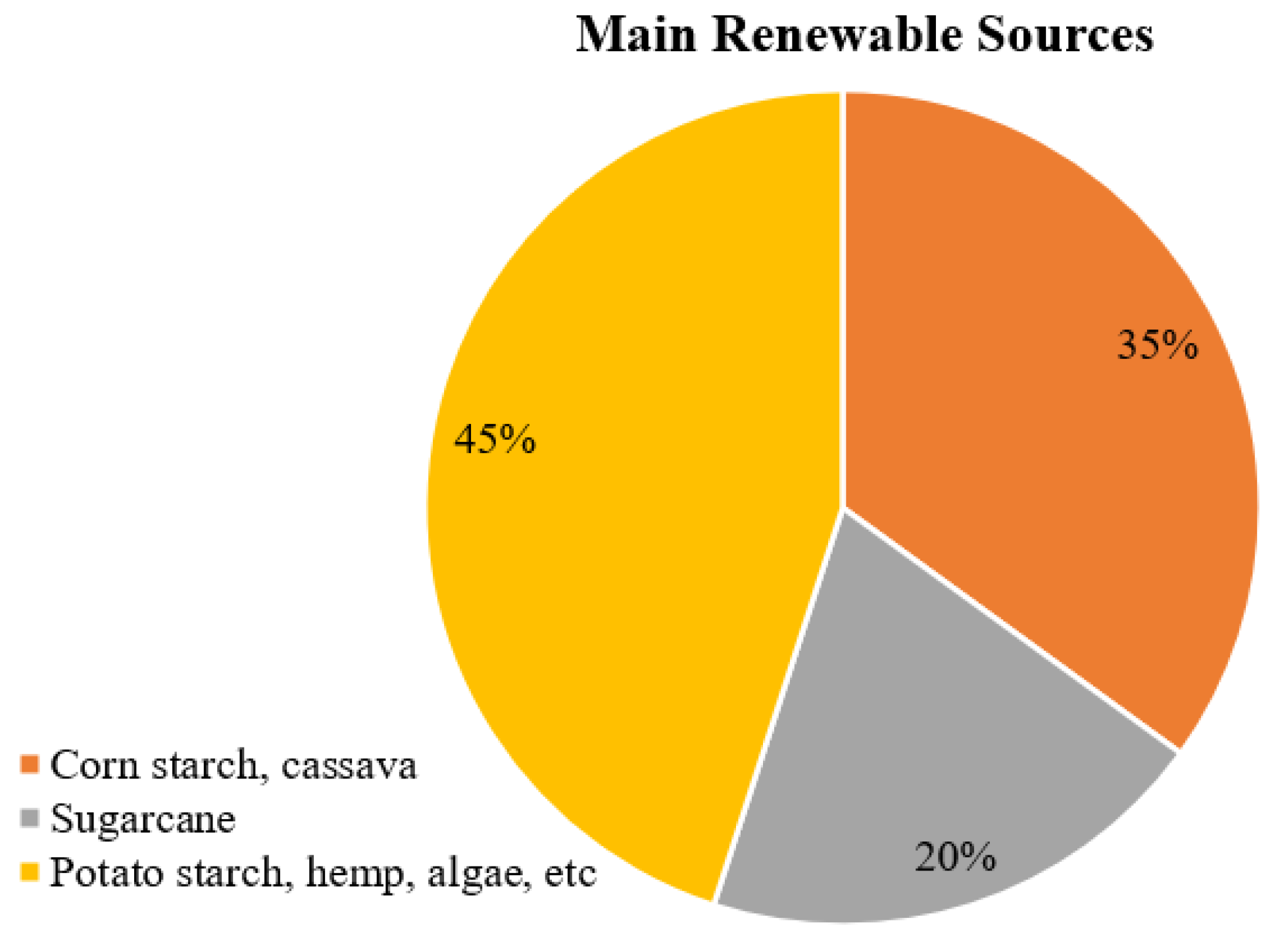
Figure 3.
Global Production Growth of Polylactic Acid (PLA) from 2010 to 2032.
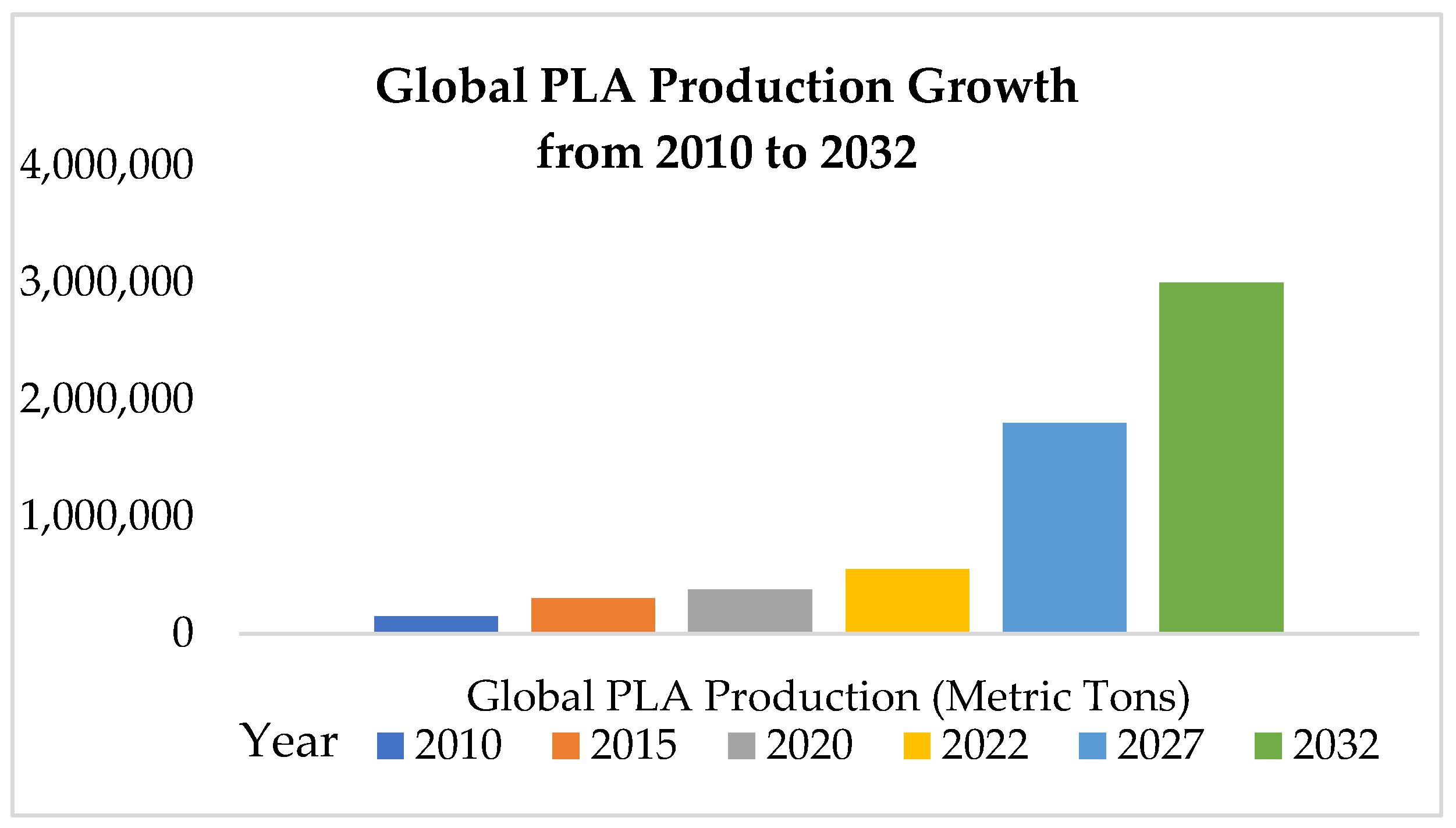
Figure 4.
Comparative Analysis of Mechanical and Thermal Properties of PLA, PET, PP, and PHA.
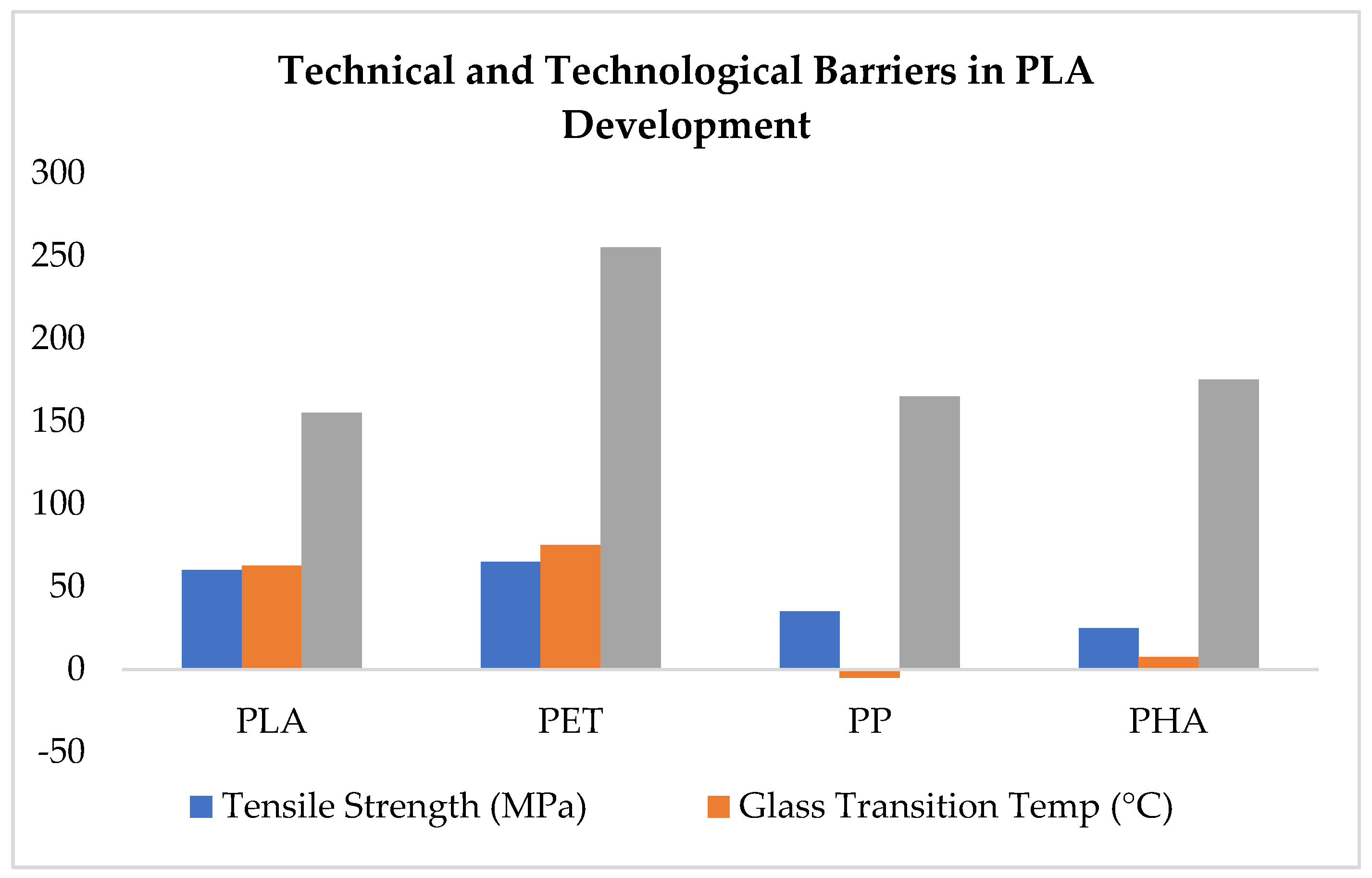
Table 1.
Classification of Bioplastics Based on Source and Key Properties.
| Type | Source Materials | Biodegradability | Processing Methods | Applications | Strengths | Limitations |
| Starch-Based Plastics | Corn, cassava, potato starch | Biodegradable in compost | Thermoplastic blending, extrusion | Food packaging, cutlery, agricultural films | Abundant feedstock, cost-effective, compostable | Sensitive to moisture, limited mechanical strength |
| Cellulose-Based Plastics | Wood pulp, cotton linters | Biodegradable | Chemical modification, extrusion | Film coatings, fibers, textiles, packaging | Renewable, high mechanical strength | Water sensitivity, requires chemical modification |
| Chitosan-Based Plastics | Chitin from shrimp/crab shells | Biodegradable | Blending, casting | Antimicrobial films, wound dressings, coatings | Antimicrobial, biocompatible, renewable | Limited processability, costly extraction methods |
| Seaweed-Based Plastics | Red and brown algae | Biodegradable in water | Gelation, casting | Edible packaging, disposable films, capsules | Renewable, edible, compostable in marine environments | Mechanical fragility, scalability challenges |
| PLA (Polylactic Acid) | Corn starch, sugarcane | Biodegradable (industrial) | Fermentation, polymerization | Food packaging, 3D printing, biomedical devices | High transparency, good mechanical strength, compostable | High production cost, limited thermal resistance |
| PHA (Polyhydroxyalkanoates) | Bacterial fermentation of organic waste | Biodegradable in soil and water | Fermentation, extraction, injection molding | Medical implants, packaging, agricultural films | Biocompatible, marine degradable | Expensive production, limited scalability |
| PHB (Polyhydroxybutyrate) | Bacterial synthesis from sugars | Biodegradable in soil | Fermentation, casting, extrusion | Medical sutures, packaging, disposable utensils | High crystallinity, biocompatible, compostable | Brittle, slow degradation under low-moisture conditions |
| Bio-based PE | Sugarcane ethanol | Non-biodegradable | Polymerization | Bottles, films, automotive components | Compatible with recycling systems, drop-in replacement | Non-biodegradable, depends on fossil-based recycling |
Table 2.
Mechanical and Thermal Properties of PLA Compared to Conventional Plastics.
| Property | PLA | PET | PS |
| Tensile Strength (MPa) | 50–70 | 55–75 | 30–50 |
| Tensile Modulus (GPa) | 2.7–16 | 2.7–3.1 | 2.5–3.5 |
| Elongation at Break (%) | <10 | 50–150 | 1.5–2.5 |
| Glass Transition Temp (°C) | 60–65 | 70–80 | 100–105 |
| Melting Temp (°C) | 130–180 | 250–260 | Amorphous (no melting point) |
| Density (g/cm³) | 1.24 | 1.38 | 1.04–1.06 |
Table 3.
Key Statistics of Bioplastic Market and an example in Vietnam.
| Year | Market Value (USD Billion) | Global Market Share (%) | CAGR (%) 2024–2032 | Packaging Sector Share (%) | Government Policies Impact |
| Global’s Bioplastic Market | |||||
| 2023 | 15.58 | 19.5 | 15.5 | 60 | Ban on single-use plastics by 2025 |
| 2032 | 90.29 (projected) | 24.14 (projected) | 15.5 | 65 (projected) | Enhanced regulations and incentives |
| Vietnam’s Bioplastic Market | |||||
| 2023 | 150 | 1.5 | 15.5 | 60 | Ban on single-use plastics by 2025 |
| 2032 | 450 (projected) | 3.0 (projected) | 15.5 | 65 (projected) | Enhanced regulations and incentives |
Table 4.
Economic Challenges in PLA Production and Distribution in Vietnam.
| Challenge | Description |
| High Production Costs | PLA production costs are 20-50% higher than traditional plastics due to imported raw materials and lack of economies of scale. |
| Limited Access to Financing | SMEs face difficulties securing financing with lending interest rates ranging from 7% to 9% per annum. |
| Inadequate Infrastructure | Poor logistics and lack of specialized storage facilities increase transportation costs and affect product quality. |
| Competition with Conventional Plastics | Lower production costs and established supply chains of traditional plastics make it difficult for PLA to compete. |
Table 5.
Comparison of PLA Polymerization Methods.
| Method | Process Description | Advantages | Disadvantages |
| Direct Polycondensation | Condensation of lactic acid monomers with water removal | Simple process | Low molecular weight, requires water removal |
| Ring-Opening Polymerization (ROP) | Polymerization of lactide using catalysts | High molecular weight, controlled properties | Requires lactide synthesis, catalyst residues |
| Enzymatic Polymerization | Enzyme-catalyzed polymerization under mild conditions | Environmentally friendly, mild conditions | High cost of enzymes, slower reaction rates |
| Direct Fermentation | Microbial production of PLA directly from renewable resources | Sustainable, integrates production steps | Complex process control, lower purity of PLA |
Table 6.
Recent Innovations in PLA Production Technologies and Applications.
| Innovation Area | Description |
| High-Molecular-Weight PLA | Development of modular systems for efficient production of high-purity PLA |
| 3D Printing Optimization | Adjustment of printing parameters to enhance mechanical properties of PLA prints |
| PLA Nanocomposites | Integration of nanofillers to improve strength, biocompatibility, and thermal stability |
| Industrial-Scale Production | Large-scale production of high-purity PLA resins for sustainable packaging solutions |
| Cost Reduction Strategies | Use of alternative feedstocks and advanced fermentation processes to lower production costs |
| Advanced Biomedical Devices | Development of PLA-based scaffolds, implants, and drug delivery systems with superior functionality |
Table 11.
Key Factors Influencing the Growth Potential of the PLA Sector in Vietnam.
| Factor | Description |
| Government Policies | Implementation of regulations promoting bioplastics and restricting conventional plastics. |
| Agricultural Resources | Availability of cassava and sugarcane as feedstock for PLA production. |
| Production Costs | High costs associated with PLA production compared to traditional plastics. |
| Consumer Awareness | Level of public knowledge and acceptance of bioplastic products. |
| Waste Management Infrastructure | Adequacy of systems for collecting and processing bioplastic waste. |
| Technological Advancements | Innovations in PLA production processes to improve efficiency and reduce costs. |
| Market Demand | Domestic and international demand for sustainable packaging solutions. |
| Investment Incentives | Financial incentives and support for businesses investing in PLA production. |
| Environmental Impact | Potential reduction in plastic pollution through increased use of PLA. |
Table 12.
Key Quality Standards and Specifications for PLA Materials.
| Category | Parameter | Requirement | Relevant Standards | Purpose |
| Mechanical Properties | Tensile Strength | 50–70 MPa | ASTM D638, ISO 527 | Determines PLA’s ability to withstand pulling forces. |
| Elongation at Break | 3–10% | ASTM D638, ISO 527 | Indicates ductility (brittleness vs. flexibility). | |
| Flexural Modulus | 3000–4000 MPa | ASTM D790 | Measures stiffness under bending stress. | |
| Thermal Properties | Glass Transition Temperature (Tg) | 55–65°C | ASTM D3418, ISO 11357 | Key for heat resistance; affects storage and use. |
| Melting Temperature | 150–180°C | ASTM D3418, ISO 11357 | Affects processing (extrusion, molding). | |
| Heat Deflection Temperature (HDT) | ~50–60°C (standard), >100°C (stereocomplexed) | ASTM D648 | Critical for use in heated environments (e.g., hot liquids). | |
| Degradation & Compostability | Biodegradation Rate (Industrial Composting) | ≥90% in 180 days | ASTM D6400, ISO 17088, EN 13432 | Must meet to be labeled as industrially compostable. |
| Residue After Disintegration | ≤10% in industrial compost | EN 13432 | Ensures no visible or toxic fragments remain. | |
| Heavy Metal Content | ≤50 ppm total | EN 13432, ISO 17088 | Ensures environmental safety of compost residues. | |
| Physical Properties | Density | 1.24–1.27 g/cm³ | ASTM D792 | Affects weight and design of final product. |
| MFI (Melt Flow Index, 190°C/2.16 kg) | 3–10 g/10 min (varies by grade) | ASTM D1238 | Indicates flowability for molding/extrusion. | |
| Environmental Labeling & Safety | Compostability Label Certification | Must meet criteria for industrial composting | TÜV Austria OK Compost, BPI, DIN CERTCO | Recognized eco-labels proving biodegradability. |
| Food Contact Safety | Migration limits defined | FDA (21 CFR), EU 10/2011 | Required for food packaging applications. |
Disclaimer/Publisher’s Note: The statements, opinions and data contained in all publications are solely those of the individual author(s) and contributor(s) and not of MDPI and/or the editor(s). MDPI and/or the editor(s) disclaim responsibility for any injury to people or property resulting from any ideas, methods, instructions or products referred to in the content. |
© 2025 by the authors. Licensee MDPI, Basel, Switzerland. This article is an open access article distributed under the terms and conditions of the Creative Commons Attribution (CC BY) license (http://creativecommons.org/licenses/by/4.0/).
Copyright: This open access article is published under a Creative Commons CC BY 4.0 license, which permit the free download, distribution, and reuse, provided that the author and preprint are cited in any reuse.