

Submitted:
05 June 2025
Posted:
06 June 2025
You are already at the latest version
Abstract
BaTiO₃ has emerged as a promising photocatalyst for solar-driven water splitting due to its unique ferroelectric, piezoelectric, and electronic properties. This review provides a comprehensive analysis of atomistic simulation studies on BaTiO₃, highlighting the role of Density Functional Theory (DFT), ab initio Molecular Dynamics (MD), and classical all-atom MD in exploring its photocatalytic behavior. DFT studies have offered valuable insights into the electronic structure, density of state, optical properties, band gap engineering and others of BaTiO₃, while MD simulations have enabled a dynamic understanding of water-splitting mechanisms at finite temperatures. The review discusses the impact of doping, surface modifications, and defect engineering on enhancing charge separation and reaction kinetics. Key findings from recent computational works are summarized, offering a deeper understanding of BaTiO₃’s photocatalytic activity. This study underscores the significance of advanced multi scale simulation techniques in optimizing BaTiO₃ for solar water splitting and provides perspectives for future research in developing high-performance photocatalytic materials.
Keywords:
BaTiO3
; doping
; defect engineering
; surface functionalization
; atomistic study
; photocatalytic water splitting
1. Introduction
Green hydrogen is a promising alternative fuel produced from renewable energy sources, playing a crucial role in achieving a carbon-free energy landscape. Unlike conventional hydrogen production methods that rely on fossil fuels, green hydrogen is generated through environmentally friendly techniques, reducing carbon emissions and supporting sustainable energy transitions in line with the Paris Agreement [1,2,3]. Several key methods are employed to produce green hydrogen efficiently. Several key methods are employed to produce green hydrogen efficiently, including (i) steam methane reforming (SMR) with carbon capture, (ii) electrolysis, (iii) biomass gasification, (iv) biological hydrogen production, (v) the hybrid Cu–Cl cycle, and (vi) solar-driven hydrogen production, all of which will be briefly discussed in the next paragraph.
Firstly, traditional SMR, which involves heating methane from natural gas with steam to produce hydrogen, carbon monoxide, and carbon dioxide, is not inherently a green process. However, when combined with carbon capture and storage technologies, it becomes "blue hydrogen," a lower-carbon alternative to traditional hydrogen production [4,5,6]. Although not fully green, this method serves as a transitional approach to reducing emissions.
Secondly, electrolysis is one of the most widely studied methods for green hydrogen production. This process splits water into oxygen and hydrogen using an electric current. When powered by renewable energy sources such as wind or solar power, the process is entirely carbon-free, classifying it as green hydrogen. Electrolysis is particularly suitable for applications requiring high-purity hydrogen and benefits from the increasing integration of renewable electricity into the global energy grid [7,8].
Thirdly, biomass gasification involves converting organic materials into hydrogen-rich syngas through high-temperature reactions. Since the carbon emissions from biomass are biogenic and do not contribute to additional atmospheric CO₂, this method presents a sustainable alternative to traditional fossil fuel-based hydrogen production [9,10].
Fourthly, microbial activity offers another sustainable hydrogen production method. Certain bacteria and microalgae can generate hydrogen by breaking down organic matter such as biomass or wastewater. This process not only produces hydrogen but also helps in waste management and organic matter recycling [11,12].
Fifthly, hybrid Cu-Cl cycle is an advanced thermochemical cycle that integrates nuclear heat, renewable energy, or industrial waste heat to produce hydrogen efficiently. Its potential scalability makes it an attractive option for large-scale hydrogen generation [13,14].
Lastly, several innovative solar-driven methods have been developed to harness sunlight for hydrogen generation. Photobiological processes utilize certain bacteria and green algae that produce hydrogen through photosynthesis, providing a bio-inspired and sustainable approach. Photoelectrochemical water splitting employs specialized semiconductors that absorb sunlight to drive water-splitting reactions, directly converting solar energy into hydrogen. Solar thermochemical hydrogen production leverages concentrated solar power to initiate chemical reactions, often involving metal oxides, to efficiently split water into hydrogen and oxygen. These solar-driven technologies offer environmentally friendly solutions for hydrogen production, contributing to the transition toward sustainable energy systems. Additionally, photocatalytic water splitting is another emerging technique that utilizes photocatalysts typically semiconductor materials such as TiO₂ or other metal oxides—to absorb sunlight and facilitate water decomposition into hydrogen and oxygen [15,16]. These photocatalysts enhance reaction efficiency by reducing activation energy and improving charge separation, making them a cost-effective and scalable option for hydrogen production.
1.1. Photocatalytic Water Splitting and Its Challenges
Figure 1 presents a schematic illustration of three distinct water-splitting methods: electrochemical, photoelectrochemical, and photocatalytic water splitting [17].
In electrochemical water splitting, an external electrical source drives the water electrolysis process, typically using alkaline or proton exchange membrane electrolyzers. Photo electrochemical water splitting combines light absorption and electrochemical reactions in a single system, where a semiconductor photoelectrode absorbs solar energy to generate charge carriers for water splitting. In photocatalytic water splitting, a photocatalyst directly absorbs sunlight to excite electrons, facilitating overall water splitting without external bias, though its efficiency remains lower than the other methods [18,19,20,21,22]. Photocatalytic water splitting relies on semiconductor photocatalysts that absorb light and generate electron-hole pairs, which facilitate redox reactions necessary for water decomposition.
Various photocatalysts have been explored for their efficiency and stability in hydrogen production, including TiO₂, ZnO, CdS, WO₃, g-C₃N₄, and BiVO₄ [23,24,25,26]. Among these materials, perovskite-based photocatalysts have gained significant attention due to their excellent light absorption, charge separation efficiency, and structural tunability.
Despite its potential, photocatalytic water splitting faces several challenges that limit its efficiency and large-scale application including (i) low efficiency – many photocatalytic materials exhibit low solar-to-hydrogen conversion efficiencies, requiring further improvements to enhance practical viability; (ii) limited light absorption – some photocatalysts, such as TiO₂, primarily absorb ultraviolet light, which constitutes only a small fraction of the solar spectrum. This limits their overall efficiency in utilizing sunlight for hydrogen production; (iii) charge recombination – the photogenerated electron-hole pairs often recombine before participating in the water-splitting reaction, significantly reducing the quantum yield and overall hydrogen generation rate; (iv) photocorrosion – certain semiconductor materials, such as CdS, suffer from instability in aqueous solutions, undergoing degradation due to photocorrosion, which compromises their long-term performance; (v) high overpotentials – the water-splitting reaction requires overcoming high overpotentials, which slows down reaction kinetics and demands the use of additional co-catalysts to improve efficiency [26,27,28,29,30].
Addressing these challenges requires material modifications, such as doping, heterojunction formation, and surface engineering, to improve light absorption, charge separation, and stability. In this regard, BaTiO₃ has emerged as a promising photocatalyst for water splitting due to its strong ferroelectric properties, high chemical stability, and ability to enhance charge separation, thereby improving photocatalytic efficiency. This review focuses on the role of BaTiO₃ in photocatalytic water splitting. BaTiO₃, with its inherent ferroelectric properties and chemical stability, has shown promise in overcoming some of these limitations, making it a compelling candidate for photocatalytic water splitting applications.
1.2. Background of BaTiO3for Photocatalytic Water Splitting
BaTiO₃ is an inorganic compound with a perovskite crystal structure, widely studied for its unique ferroelectric, piezoelectric, and dielectric properties. It is a wide-bandgap semiconductor that exhibits excellent chemical stability and high charge separation efficiency [31,32,33]. These characteristics make it highly valuable in various technological applications, including capacitors, sensors, microwave devices, and photocatalytic water splitting.
The use of BaTiO₃ in microwave devices dates back to the early 1950s. Research found that adding Sr could decrease the Curie temperature, the transition point between its ferroelectric and paraelectric states, from approximately 120°C to room temperature. This led to the development of Ba₁₋ₓSrₓTiO₃, which gained significant interest due to its high dielectric constant, low dielectric loss, and high dielectric breakdown. Additionally, the composition-dependent Curie temperature of Ba₁₋ₓSrₓTiO₃ made it an attractive material for tunable microwave applications, including phase shifters and frequency-agile components in communication systems [34,35,36].
The chemical formula of barium titanate is BaTiO₃, and it is classified as the barium salt of metatitanic acid. It exhibits strong ferroelectric, piezoelectric, and pyroelectric properties, which contribute to its broad applicability. BaTiO₃ is a solid material with a high dielectric constant, making it useful in applications where charge storage and energy conversion are critical [35,36,37,38]. Its crystal structure undergoes several phase transitions depending on temperature, influencing its electrical and mechanical properties.
BaTiO₃ exhibits several polymorphs depending on temperature (Figure 2) [39]. At above ~120°C, it adopts a cubic (Pm3̅m) perovskite structure, which is a paraelectric and centrosymmetric phase. Between ~5°C and 120°C, BaTiO₃ transitions to a tetragonal (P4mm) phase, a ferroelectric structure characterized by spontaneous polarization along the c-axis. As the temperature decreases further to between ~−90°C and 5°C, it takes on an orthorhombic (Amm2) phase, where the polarization shifts to a different direction compared to the tetragonal phase. Below ~−90°C, the material stabilizes in a rhombohedral (R3m) phase, with spontaneous polarization along the [111] direction. Additionally, BaTiO₃ can exist in a hexagonal (P63/mmc) phase under high-pressure or non-equilibrium conditions, but this phase is not a stable ferroelectric structure under normal conditions [39,40,41,42].
BaTiO₃ has widespread use in electronic and energy-related technologies. Its high dielectric constant makes it an essential component in capacitors, improving energy storage efficiency in consumer and industrial electronics. In sensor applications, its piezoelectric properties allow precise detection of mechanical and thermal changes, which is crucial in automotive and biomedical fields [41,42,43,44,45]. Additionally, BaTiO₃, along with SrTiO₃, plays a significant role in microwave tunable devices, contributing to the advancement of wireless communication technologies.
In the field of memory storage, BaTiO₃ is a promising candidate for replacing SiO₂ as a charge storage dielectric in dynamic random-access memory. Its superior charge retention capabilities could lead to more energy-efficient and higher-capacity memory devices [45,46,47]. Moreover, its integration into micro-electromechanical systems technology enables its use in micro-electromechanical systems switches, which are key components in modern phase shifters and adaptive electronic circuits.
BaTiO₃ is also widely researched for its potential in energy harvesting applications. As a ferroelectric and piezoelectric material, it can convert mechanical vibrations into electrical energy, making it useful in self-powered sensors and wearable electronics [48,49,50]. Additionally, BaTiO₃-based materials have been explored for their role in positive temperature coefficient resistors, where their resistivity increases with temperature, providing applications in thermal sensing and circuit protection.
One of the most promising applications of BaTiO₃ is in photocatalytic water splitting for hydrogen production. Due to its high charge separation efficiency and chemical stability, BaTiO₃ can act as an efficient photocatalyst, harnessing solar energy to drive the splitting of water into hydrogen and oxygen [50,51,52,53,54,55]. This process represents a sustainable method for hydrogen generation, contributing to the global shift toward renewable energy sources.
With its wide-ranging applications, BaTiO₃ continues to be an important material in modern technology. Its unique combination of electrical, dielectric, and structural properties enables innovations in energy storage, electronic devices, and environmental sustainability.
1.3. Application of Atomistic Study of BaTiO3 Photocatalyst
Atomistic simulations play a crucial role in understanding the photocatalytic properties of BaTiO₃, providing insights at multiple scales through Density Functional Theory (DFT), ab initio Molecular Dynamics (MD), and classical all-atom MD simulations (Figure 3) [56].
DFT is widely utilized to accurately describe the electronic structure, phase stability, and defect behavior of BaTiO₃ at the atomic level. It offers a cost-effective approach for investigating its ferroelectric and piezoelectric properties, which are crucial for photocatalytic activity. Given that BaTiO₃ undergoes multiple temperature-dependent phase transitions, DFT calculations help predict the relative stability of different polymorphs (cubic, tetragonal, orthorhombic, and rhombohedral) and their corresponding electronic and vibrational characteristics [63,64,65]. Moreover, DFT enables researchers to explore how external factors such as doping, strain, and electric fields modify the dielectric and electronic properties, making it invaluable for designing optimized photocatalytic materials.
Beyond structural analysis, DFT provides detailed insights into BaTiO₃’s electronic band structure and charge distribution, which are fundamental for photocatalysis. It aids in determining bandgap energies and evaluating charge transfer mechanisms, crucial for understanding photoinduced electron-hole separation in water splitting applications [64,65,66,67,68,69]. Additionally, defect formation energy calculations using DFT help assess the impact of oxygen vacancies, which play a critical role in tuning BaTiO₃’s optical and electronic response for enhanced photocatalytic performance.
To complement DFT, ab initio MD simulations provide a temperature-dependent and dynamic perspective on BaTiO₃’s behavior in aqueous environments or under irradiation conditions. Ab initio MD simulations helps investigate surface interactions, the stability of adsorbed water molecules, and proton transfer mechanisms, which are essential for assessing BaTiO₃’s efficiency in photocatalytic water splitting [70,71,72,73,74,75]. Furthermore, Ab initio MD captures thermal fluctuations and structural rearrangements that static DFT calculations cannot fully describe, offering a more realistic depiction of BaTiO₃’s catalytic interface under operating conditions.
In addition, classical all-atom MD simulations provide large-scale insights into BaTiO₃ nanoparticle stability, solvent interactions, and ion diffusion in solution-based photocatalytic processes. By employing force field-based molecular dynamics, these simulations help analyze solute-solvent interactions, charge carrier mobility, and ion adsorption at BaTiO₃ surfaces [72,73,74,75,76,77,78,79,80]. This is particularly important for studying BaTiO₃-based hybrid photocatalysts, where interactions with co-catalysts, organic molecules, or electrolyte species significantly influence performance.
By integrating DFT, ab initio MD, and classical all-atom MD simulations, researchers can develop a multi-scale understanding of BaTiO₃’s photocatalytic properties. This combined approach not only aids in optimizing BaTiO₃’s electronic and structural features but also guides the design of novel photocatalytic systems for applications in hydrogen production, CO₂ reduction, and environmental remediation.
1.4. Outline of Our Review
This work presents a topical and characteristic analysis of recent computational studies on BaTiO₃-based photocatalysts for solar water splitting. There were various work conducted for atomistic study of advanced energy materials including fuel cells, batteries, hydrogen fuel storage, carbon capture, drug design and others [81,82,83,84,85,86,87,88,89,90,91,92,93,94,95,96,97,98,99,100]. Computational modeling and simulation techniques have become essential tools for examining the electronic structure, defect dynamics, charge transport, and reaction mechanisms of BaTiO₃ in photocatalytic applications.
Several computational approaches are commonly utilized in this field:
DFT calculations offer critical insights into the band structure, density of states, charge transfer processes, and defect formation energies [101,102,103,104,105,106,107,108,109,110] of BaTiO₃. These studies assist in identifying optimal doping strategies to enhance photocatalytic performance.
Ab initio MD simulations are used to investigate the thermal stability, charge carrier dynamics, and interfacial interactions [111,112,113,114,115,116,117,118,119,120] of BaTiO₃ in aqueous environments under realistic conditions. Ab initio MD provides valuable data on the time evolution of atomic-scale processes.
Classical all-atom MD simulations help analyze the structural and solvation characteristics [121,122,123,124,125] of BaTiO₃ surfaces in water. These simulations offer insights into surface adsorption behavior, charge transfer dynamics, and the mechanisms underlying the water-splitting reaction.
To the best of our knowledge, a comprehensive review integrating these atomistic simulation techniques for BaTiO₃ photocatalysis remains scarce. This work aims to introduce these computational methods and highlight their recent applications in studying BaTiO₃-based solar-driven water splitting.
The discussions in this paper are illustrative, and the examples provided are representative. We believe this review will serve as a valuable resource for researchers focused on designing and optimizing BaTiO₃ photocatalysts, encouraging the adoption of DFT, ab initio MD, and classical all-atom MD simulations to explore material properties across different length and time scales.
2. Main Body
2.1. DFT Calculations
DFT calculations serve as a cornerstone for investigating the electronic structure and energetic properties of BaTiO₃ -based systems. By solving the Kohn-Sham equations under various approximations for exchange-correlation functionals, DFT provides detailed insights into charge distribution, density of states, and interaction energies at the atomic scale [126,127,128,129,130,131,132,133,134,135]. Despite its accuracy, conventional DFT calculations can be computationally demanding, especially for large systems or complex defect structures. To address this, hybrid functionals and dispersion corrections are often incorporated to enhance accuracy, while computational efficiency is improved through localized basis sets and advanced numerical techniques. In this regard, a series of DFT studies in the field of photocatalytic water splitting for BaTiO₃-based systems is reviewed below paragraphs and Table 1.
Yang et al. investigated the electronic properties and photocatalytic performance of TiO₂, TiO₂@BaTiO₃, and TiO₂@BaTiO₃/CdS composites [138]. DFT calculations revealed that pure TiO₂ has a band gap of 3.22 eV, with CB and VB primarily composed of O(p) and Ti(d) orbitals, respectively. Incorporating BaTiO₃ reduced the band gap to 1.53 eV while maintaining similar CB and VB compositions. Further modification with CdS introduced slight crystal distortion in BaTiO₃, leading to spontaneous polarization and a further reduced band gap of 1.19 eV. The built-in electric field within the BaTiO₃ shell facilitated efficient charge separation, enhancing photocatalytic hydrogen evolution. The optimized TiO₂@BaTiO₃/CdS nanocomposite exhibited a significantly higher hydrogen evolution rate (13.22 mmol/g∙h) and prolonged charge carrier lifetime (0.42 ns), outperforming its individual components and binary composites. This study highlights the potential of ferroelectric photocatalysts in improving charge separation and promoting photocatalytic efficiency.
The study by Cai et al. highlights the synergistic effect of oxygen vacancies and piezoelectric properties in enhancing the photocatalytic CO₂ reduction performance [139] of BaTiO₃. By introducing oxygen vacancies, the visible light absorption range was extended, and the density of active surface sites increased, significantly improving charge separation. The piezoelectric effect further facilitated electron-hole separation, enhancing the photocatalytic efficiency.Among the synthesized BaTiO₃-X samples, BaTiO₃-1.5 exhibited the highest CO production, achieving 6.41 μmol⋅g⁻¹ under light alone and 9.17 μmol⋅g⁻¹ under light and ultrasound, outperforming pristine BaTiO₃ by factors of 3.22 and 1.86, respectively. DFT calculations revealed that oxygen vacancies reduced the band gap from 3.058 eV to 2.717 eV, improving charge transfer. These findings suggest that defect engineering, combined with piezoelectric effects, offers a promising strategy for optimizing BaTiO₃-based photocatalysts for CO₂ conversion, with potential applications in sustainable energy solutions.
Wang et al. used first-principles DFT calculations to investigate how non-metal dopants (X = C, Si, N, P, S, Se, F, Cl, Br, I) [140] affect the geometric and electronic structures (Figure 4), stability, and photocatalytic properties of BaTiO₃. They examined two doping scenarios: substitution at the oxygen site (X@O) and the titanium site (X@Ti).Their findings align with experimental data, particularly regarding band gap narrowing in N-doped BaTiO₃. The preferred doping site depends on the dopant’s ionic size and electronegativity. C@O and I@O doping extended absorption into the visible spectrum, enhancing photocatalytic efficiency, while S and Se doping at either site improved photo-oxidation and photo-reduction.F- and N-doped BaTiO₃ (X@O) and Si-doped BaTiO₃ (X@Ti) were thermodynamically favorable. The study supports previous theories, highlighting non-metal doping’s role in modifying BaTiO₃ for visible-light photocatalysis, with further experimental validation needed.
Figure 4.
Optimized local structures of BaTiO₃ configurations doped with (a) C, (b) Si, (c) N, (d) P, (e) S, (f) Se, (g) F, (h) Cl, (i) Br, and (j) I, where X substitutes O (X@O).Reprinted with permission from [140]. Copyright 2019, for Elsevier.
Figure 4.
Optimized local structures of BaTiO₃ configurations doped with (a) C, (b) Si, (c) N, (d) P, (e) S, (f) Se, (g) F, (h) Cl, (i) Br, and (j) I, where X substitutes O (X@O).Reprinted with permission from [140]. Copyright 2019, for Elsevier.
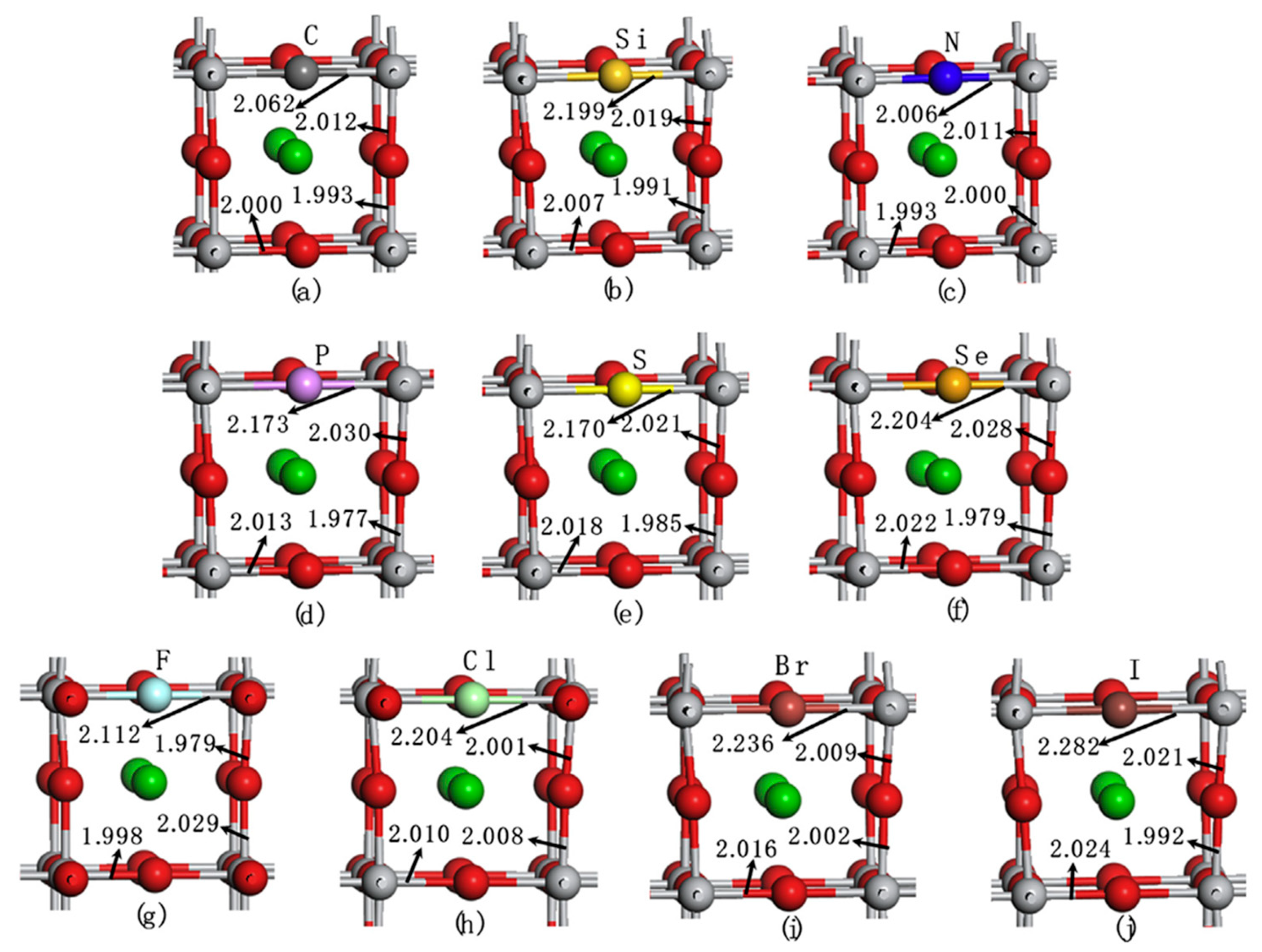

Table 1.
Recently performed DFT calculation details and main findings.
| Designed systems | Methods | Main findings |
| TiO2[138] | DFT calculations using VASP with GGA-PBE functional. PAW method for ion-electron interactions (cutoff energy: 400 eV). DFT+U approach for d-electron correlation correction. FDTD method for electric field distribution simulations. |
Calculated band gap of TiO₂: 3.22 eV. Conduction band (CB) primarily composed of O(p) orbitals. Valence band (VB) primarily composed of Ti(d) orbitals. Photogenerated charge likely accumulates in these orbitals. |
| TiO2@ BaTiO3[138] | After combining with BaTiO₃, CB and VB compositions remain similar to TiO₂. Calculated band gap decreases to 1.53 eV (approximately half of TiO₂). |
|
| TiO2@ BaTiO3/ CdS [138] | Adding CdS clusters to TiO₂@BaTiO₃ caused slight crystal distortion in BaTiO₃, potentially inducing spontaneous polarization. Density of states at CB and VB formed by S(p), Ba(d), and Cd(d) orbitals. Band gap further decreased to 1.19 eV. TiO₂@BaTiO₃/CdS nanosheet exhibits an intrinsic electric field, facilitating charge separation and diffusion to the surface. |
|
| Wheat-heading BaTiO3 [139]. | DFT calculations using Materials Studio 2017 GGA-PBE functional Plane wave cutoff energy: 400 eV K-point mesh: 3 × 3 × 3 Maximum force tolerance: 0.05 eV/Å Cleaved along [001] direction Vacuum thickness of 10 Å in z-direction |
Band gap for wheat heading BaTiO3: 3.058 eV CB mainly composed of Ti 3d and O 2p orbitals VB dominated by O 2p orbitals Charge transfer from O 2p to Ti 3d After oxygen vacancy, band gap reduced to 2.717 eV VB remains dominated by O 2p orbitals CB contributions shift to O 2p, Ba 3d, and Ti 3d Enhanced charge transfer between Ti and Ovs Higher charge density improves piezo-photocatalytic performance |
| Wheat-heading BaTiO3-Oxygen Vacancy (Ovs) [139] | ||
| Pure BaTiO₃[140] | Spin-polarized DFT calculations using VASP GGA-PBE functional PAW method for core electrons Plane-wave cutoff energy: 400 eV 9 × 9 × 9 Monkhorst-Pack k-point mesh Fully optimized cubic BaTiO₃ unit cell with a lattice parameter of 4.004 Å 2 × 2 × 2 supercell (40 atoms) modeled for bulk BaTiO₃ Geometry convergence criterion: forces < 0.01 eV/Å HSE06 functional for electronic structure calculations with HF exchange fraction (α) = 0.32 |
Structural and electronic properties of BaTiO₃ were well reproduced Band gap improved with HSE06functional, aligning with experimental values Basis for further doping studies to enhance photocatalytic properties F- and N-doped BaTiO₃ (X@O) and Si-doped BaTiO₃ (X@Ti) showed negative formation energy, indicating thermodynamic stability Stability of doping systems depends on ionic radius and electronegativity of dopants relative to O or Ti C-, S-, Se-, and I-doped BaTiO₃ (X@O) extended the absorption edge into the visible light region, enhancing photocatalytic water splitting capabilities S- and Se-doped BaTiO₃ (X@Ti) exhibited potential for water splitting under visible light Doping-induced modifications improved both photo-oxidation and photo-reduction properties of BaTiO₃ Key Findings for X@O Doping Band gap (Eg) range: 1.93 eV (C) – 3.31 eV (Si, P, F) Highest CBM: F-doped BaTiO₃ (-3.82 eV) Lowest CBM: Si-doped BaTiO₃ (-3.03 eV) Electronegativity (χ) range: 4.68 (Si) – 5.47 (F) Photocatalytic potential: C-, S-, Se-, and I-doped BaTiO₃ extend absorption into the visible region, enhancing photocatalytic efficiency. Key Findings for X@Ti Doping Band gap (Eg) range: 0.84 eV (Cl) – 3.31 eV (F) Narrowest band gap: Cl-doped BaTiO₃ (Eg = 0.84 eV), due to low CBM (-5.69 eV) and VBM (-6.53 eV) Highest CBM: Si-doped BaTiO₃ (-3.89 eV) Highest VBM: Br-doped BaTiO₃ (-7.47 eV) Electronegativity generally higher for X@Ti systems compared to X@O, resulting in distinct electronic structure modifications. |
| Non-metal-doped BaTiO₃ (X@O or X@Ti, X = C, Si, N, P, S, Se, F, Cl, Br, I) [140] | DFT calculations with VASP 3 × 3 × 3 k-point mesh for geometry optimization and electronic properties Substituting O or Ti with non-metal dopants at a doping concentration of 2.5 at.% HSE06 functional used for accurate band gap calculations |
|
| Pure BaTiO₃[141] La-doped BaTiO₃[141] |
CASTEP program in Materials Studio DFT with plane-wave pseudopotential method GGA-PBE functional Birch-Murnaghan equation of state for lattice optimization Cut-off energy: 340 eV |
BaTiO₃ exists in a cubic structure (Pm3m) with Ba at corners, Ti at the body center, and O at face centers. The calculated lattice constant is 4.034 Å, closely matching experimental values. Optical properties such as dielectric function, absorption, and refractive index are analyzed. |
| La doping at Ba sites reduces the lattice parameter (a = 3.971 Å) and unit cell volume. The band structure changes from an indirect to a direct band gap, reducing the gap to 1.569 eV. This shift enhances conductivity by facilitating electron-hole recombination. The La-5d states contribute significantly to the conduction band. Optical properties, including dielectric function, absorption, and refractive index, are modified. | ||
| BaTiO₃ with Ba and Ti vacancy [142] | Modeled using Materials Studio Optimized structure using VASP First-principles calculations based on DFT framework 2 × 2 × 2 crystal structure containing 8 Ba, 24 O, and 8 Ti atoms PAW and PBE methods used for structure optimization and charge density calculations |
Lattice distortion occurs due to Ba and Ti vacancies, affecting oxygen coordination and Coulomb repulsion. Oxygen vacancies are necessary for charge conservation in the system. Lattice expansion and distortion due to Ti and O vacancies are significantly higher than those caused by Ba and O vacancies. Charge density changes: • Ba and O vacancies decrease charge density in specific regions of the unit cell. • Ti vacancy increases and homogenizes charge density at the vacancy position. Lattice deformation leads to internal atomic shifts, with Ti atoms moving away from symmetry centers. |
| Pure BaTiO₃ (BTO) [143] Mo-doped BTO (2.5 at%) [143] |
First-principles calculations using DFT with the supercell approach, performed using VASP. Functional: Generalized Gradient Approximation (GGA) for the projector-augmented wave (PAW) method. Structural Model: Cubic 1×1×1 BTO unit cell. Plane-wave energy cutoff: 500 eV. k-point sampling: Monkhorst-Pack grid of 7×7×7. |
The calculated bandgap of pure BTO is 1.56 eV, which is underestimated due to DFT limitations. Charge-density analysis confirms covalent Ti–O bonding. Mo doping narrows the bandgap to 1.27 eV due to impurity levels formed by Ti 3d and Mo 3d interactions. Mo–O bonding results in a more uniform charge distribution than pure BTO. |
| Pure BaTiO₃ [144] Cs-doped BaTiO₃ (0.13%, 0.26%, 0.39%) [144] |
• CASTEP code used for geometry optimization and property investigation. • GGA-PBE exchange correlation functional with DFT+U correction (U = 4 for Ti-d orbital). • Plane-wave pseudopotential technique based on DFT. • Vanderbilt-type ultrasoft pseudopotentials for electron–ion interactions. • BFGS energy minimization for electronic wave functions and charge densities. • Pulay density mixing scheme applied. • Monkhorst–Pack method for k-point sampling (6×6×6 k-points mesh). • Energy cutoff = 630 eV. • Total energy difference per atom: 2 × 10⁵ eV. • Max ionic displacement: 2 × 10³ Å. • Cubic phase (Pm3m, 221) chosen. |
Pure BaTiO₃ Indirect band gap: 2.513 eV (higher than previous theoretical value of 1.719 eV but closer to experimental results). The difference is due to DFT+U correction, as earlier studies used only PBE-GGA. TDOS maximum peak at 4.29 eV (6.58 value), with other peaks at 1.79 eV and 0.95 eV. Phonon spectra show no imaginary frequencies, confirming stability. |
| For Cs-doped BaTiO₃ (0.13%, 0.26%, 0.39%) Band gap converts from indirect to direct upon Cs doping. 0.13% Cs: 1.858 eV (direct band gap). 0.26% Cs: 2.103 eV (direct band gap). 0.39% Cs: 1.882 eV (direct band gap). TDOS of 0.13% Cs-doped BaTiO₃ shows enhanced peaks, with a maximum peak at 0.77 eV (57.46 value). New peaks in TDOS appear at 3.43, 2.37, 2.40, 3.36, and 4.47 eV. Phonon spectra confirm stability for 0.13% Cs-doped BaTiO₃ (no imaginary frequencies detected). | ||
| BaTiO3(111) surfaces with different terminations [145] | DFT calculations using VASP PAW method for core electrons Plane-wave basis with 400 eV cutoff DFT+U approach with PBE functional (Ueff = 4.0 eV for Ti 3d) Conjugated gradient geometry optimization 6×6×1 Monkhorst-Pack k-point sampling Dipole correction applied Slab model with 13 atomic layers (7 fixed, 6 relaxed) and 15 Å vacuum gap Considered stoichiometric (BaO3, Ti) and non-stoichiometric (BaO2, BaO, Ba, O3, O2, O) terminations |
Surface energy and stability BaO2 and O terminations have the lowest cleavage energies, making them the most thermodynamically stable. Removal of oxygen, Ti, or Ba reduces cleavage energy, stabilizing polar surfaces. Excess Ba (BaO +O2) or oxygen (Ba +O3) leads to instability with higher cleavage energies. Phase diagram analysis (SGP method) BaO2 and O terminations dominate under wide O- and Ba-rich conditions. Stoichiometric BaO3 and Ti terminations are stable only in limited conditions. Results from O-Ti phase diagram match O-Ba phase diagram, confirming BaO2 and O as the most stable. Charge compensation mechanism Bader charge analysis shows charge redistribution in surface layers to compensate dipole moments. |
| BaTiO3 doped with chalcogens (S, Se, Te) under different concentrations [146] | DFT calculations using WIEN2K package with FP-LAPW method and LDA+mBJ exchange-correlation potential Calculation of ε(ω) = ε1(ω) + iε2(ω) |
BaTiO3 has a cubic Pm3m structure. Lattice constant (a0 = 3.9412 Å) agrees with experimental (4.0000 Å) and theoretical values. The forbidden band gap decreases with increasing chalcogen concentration due to electronegativity differences. Doping reduces the band gap significantly (Eg reduction from 2.901 eV to 0 eV in some cases). Strong hybridization occurs between O-2p and chalcogen-p orbitals. |
| Pressed BaTiO3 (2.3% axial compressive strain)[147] Barium Titanate under triaxial compressive strain [147] |
- Ab initio calculations based on DFT using FP-LAPW method (WIEN2K package) - Exchange correlation potential: LDA + mBJ - Thermoelectric properties: BoltzTraP code - Brillouin zone integration: 6×6×6 k-points for electronic and optical properties, 10×10×10 for thermoelectric properties - Structural optimization: Comparison with experimental and theoretical results |
Lattice constant reduced to ap = 3.8505 Å. Pressed BaTiO3 exhibits a direct bandgap at the Γ point, unlike pure BaTiO3, which has an indirect bandgap. Further band gap reduction compared to non-pressed doped structures. Pressed BaTiO3 exhibits slightly higher optical property peaks in ε1(ω) and ε2(ω) compared to pure BaTiO3. |
| Electronic properties: Pure BaTiO3 is a semiconductor with an indirect band gap (2.901 eV for cubic, 2.922 eV for tetragonal phase) Under ξ = 2.3% compressive strain, BaTiO3 transitions to a direct band gap semiconductor, improving potential for photovoltaic applications Density of States analysis confirms VB is mainly O-2p, while CB is Ti-3d Band gap increases with strain, indicating possible piezoelectric properties | ||
| BaTiO₃ (001) surfaces doped with metal and nonmetal elements [148] | DFT calculations using VASP, PBE functional under GGA, and HSE06 hybrid functional. Plane-wave cutoff energy: 400 eV. k-point mesh: 9×9×9 for bulk optimization and 3×3×1 for surface calculations. | The tetragonal BaTiO₃ unit cell was fully optimized, with lattice parameters a = b = 3.992 Å, c = 4.056 Å, matching experimental and theoretical results. BaTiO₃ (001) surface modeled with TiO₂- and BaO- terminations. Symmetric slabs (odd atomic layers) were adopted due to the absence of macroscopic dipole moments. Co-doped systems (M+X) are more stable when M and X are adjacent due to M-X bond formation. Formation energies indicate that O substitution by C or N is easier under Ti-rich conditions, while Ti substitution by metal dopants is favored under O-rich conditions. Binding energy calculations show that co-doped systems are more stable than mono-doped systems. The computed bandgap of bulk BaTiO₃ is 3.03 eV, while the pure BaTiO₃ (001) surface has a bandgap of 1.42 eV. Passivated co-doping (e.g., V+N, Nb+N, Ta+N) introduces charge compensation, eliminating mid-gap states. The Ta+N co-doping system leads to the most significant bandgap narrowing (1.09 eV) due to the upshift of the valence band maximum. |
| BaTiO₃ polymorphs (Cubic, Rhombohedral, Orthorhombic, Tetragonal, Hexagonal) [149] | First-principles calculations using CASTEP within DFT framework (GGA-PBE, LDA, and HSE06 functionals) | Optimized lattice parameters are consistent with theoretical and experimental results. Formation enthalpies indicate all phases are energetically stable, with cubic phase being the most stable. Band structure analysis shows indirect bandgaps for four phases and a direct bandgap for the hexagonal phase. GGA-PBE and LDA underestimate bandgaps, while HSE06 gives values closer to experimental data. Higher electron mobility and conductivity inferred from band structure analysis. Density of states analysis confirms structural stability and electrical conductivity. |
| BaTiO₃, PGBT [150] BaTiO₃, PG, PGBT [150] |
Electronic structure and density of states calculations using Quantum ESPRESSO with PBE pseudopotentials - k-mesh: 9 × 9 × 1 for self-consistent field (scf) and 18 × 18 × 1 for non-self-consistent field calculations. - Energy cutoff: 90 Ry for wavefunctions, 740 Ry for charge density. |
Redshift in absorption edges of PGBT compared to pure BaTiO₃. Bandgap energies (Tauc method): BaTiO₃ (3.12 eV), PGBT (2.95–2.79 eV, decreasing with increasing PG content). Lower fluorescence intensity indicates reduced charge carrier recombination, enhancing photocatalytic efficiency. Electron migration from BaTiO₃ to PG via Ba–C bond supports charge separation. Beyond 7.5 PGBT, fluorescence intensity increases due to excess PG acting as a recombination center. |
| Fully relaxed 5 × 5 × 1 supercell of PGBT with a 12 Å vacuum to prevent interaction between composites. Estimated bandgap of 1.74 eV (indirect, R to Γ), lower due to DFT underestimation. Additional bandgaps observed: direct at Γ, indirect from M to Γ. BaTiO₃: VB primarily from O ‘p’ states; CB dominated by Ti ‘p’ states with minor O ‘p’ contributions. | ||
| Ba₁₋ₓGaₓTiO₃ (x = 50%) [151] | DFT simulations using WIEN2k Tetra-elastic package for elastic properties Ba₁₋ₓGaₓTiO₃ was studied using full-potential linearized augmented plane wave (FP-LAPW) method. A 2000 k-point mesh was used for Brillouin zone integration. Band structure and density of states were analyzed for electronic properties. Elastic coefficients were calculated usingEulerian strain approach. The unit cell structure was modeled with tetragonal symmetry. |
Pristine BaTiO₃ exhibits an indirect band gap of 2.65 eV. Ga substitution reduces the band gap to 1.84 eV for the majority spin channel. The minority spin channel exhibits metallic behavior with a half-metallic gap of 0.59 eV. Partial density of states analysis shows significant contributions from O-p, Ti-d, and Ga-p states. Dielectric constant (ε₁(0)) increased from 8.8 (pure) to 100 (Ga-doped). A peak in the imaginary dielectric function ε₂(ω) at 3.9 eV corresponds to O-p electron transitions to the conduction band. Ga doping shifts absorption peaks towards the visible and infrared regions, enhancing optical activity. |
| t-BTO@NiFe-LDH heterojunctions [152] | First-principles DFT calculations within GGA using PBE functional PAW potentials for ionic cores Plane wave basis set with 450 eV cutoff Gaussian smearing (0.05 eV) Self-consistent energy threshold: 10⁻⁶ eV Geometry optimization convergence: 0.05 eV/Å 2 × 2 × 1 Monkhorst-Pack k-point sampling Adsorption energy (E_ads) and free energy (G) calculations |
Formation of t-BTO@NiFe-LDH heterojunctions increased Ni³⁺ content (45% → 68% for NiFe LDH, 61% → 83% for t-BTO@NiFe-LDH) after OER test. Fe³⁺/Fe²⁺ ratio increased slightly after OER test, improving OER electrocatalytic activity. Free energy calculation showed a lower rate-determining step (RDS) energy for t-BTO@NiFe-LDH (1.52 eV for Ni site, 1.76 eV for Fe site) compared to NiFe-LDH. Bandgap of t-BTO@NiFe-LDH (0.42 eV) was lower than NiFe-LDH (0.95 eV) and t-BTO (2.37 eV), indicating enhanced electronic conductivity. Charge density difference analysis showed electron transfer from NiFe-LDH to t-BTO, improving OER activity. d-band center shifted from 3.89 eV (NiFe-LDH) to 2.98 eV (t-BTO@NiFe-LDH), favoring adsorption of OER intermediates. Enhanced electron movement near Ti atoms improved spontaneous polarization of t-BTO. |
| BTO, BTPO-0.09, BTPOv-0.09 [153] | DFT using VASP PBE exchange-correlation function PAW pseudopotentials Cutoff energy: 520 eV Monkhorst-Pack 2×2×1 k-points for Brillouin zone sampling DFT-D3 for vdW interactions Geometry optimization criteria: 1.0×10⁻⁵ eV/atom (energy), 0.01 eV/Å (force) UV-Vis diffuse reflectance spectroscopy UV photoelectron spectroscopy Electrochemical impedance spectroscopy XANES and XPS for charge distribution analysis |
The bandgaps of synthesized materials (3.24 eV, 3.20 eV, and 3.13 eV) are close to theoretical values, confirming minimal influence from PtOx loading. Pt-O-Ti³⁺ sites act as defect energy levels and oxidation sites. Charge density analysis revealed electron accumulation around PtOx and depletion around Ti atoms, matching XANES and XPS results. Polarization studies showed improved current response for PtOx-loaded samples, confirming enhanced photocatalytic activity. Pt serves as an electron aggregation center, accelerating proton reduction for H₂ production. Oxygen vacancies facilitate charge aggregation, and Ti³⁺ defects enhance rapid electron transfer. The defect energy level at Pt-O-Ti³⁺ sites allows efficient separation of electrons and holes, leading to an effective bifunctional catalytic system. |
| BaTiO₃/SrTiO₃ [154] |
First-principles calculations using DFT-D3 VASP Generalized-Gradient Approximation (GGA) with PBE functional Kinetic cutoff energy: 520 eV Brillouin zone sampling: 5×5×1 Monkhorst-Pack mesh External electrostatic field along [001] direction (E = 0.1 eV/Å) Band structure and density of statescalculations Gibbs free-energy change (ΔG_H*) calculations for hydrogen adsorption Visualization with VESTA software |
The BaTiO₃/SrTiO₃ heterojunction has a lower bandgap (1.1 eV) compared to individual SrTiO₃ (2.31 eV) and BaTiO₃ (2.15 eV), promoting photocatalytic efficiency. Application of an external electric field further narrows the bandgap to 1.0 eV, enhancing electron transport and energy band bending. Differential charge density analysis reveals efficient electron transfer from BaTiO₃ to SrTiO₃ at the heterostructure interface. Hydrogen adsorption Gibbs free energy (ΔG_H*) shows SrTiO₃ (0.57 eV), BaTiO₃ (-1.01 eV), and BaTiO₃/SrTiO₃ (-0.42 eV), indicating BaTiO₃/SrTiO₃has optimized adsorption-desorption balance. |
| Zr+X codoped BaTiO₃ systems [155] | DFT calculations SCAN functional for structural and energetic properties TB-mBJ functional for electronic and optical properties Full-potential linearized augmented plane wave (FP-LAPW) method using WIEN2k package 2×2×2 supercell approach for constructing doped and codoped systems k-mesh: 12×12×12 for bulk, 6×6×6 for supercell |
Structural and Thermodynamic Properties: SCAN functional accurately predicts lattice parameters and cohesive energies. The computed cohesive energies of S, Se, and Te match well with previous studies. Electronic Properties: TB-mBJ functional predicts larger band gaps than SCAN functional. X-doped systems (BTOX) have valence band edges composed of O-2p states with contributions from X-p states. Zr-doped system (BTZO) shows conduction band modifications due to Zr-4d states. Zr+X codoping (BTZOX) leads to a reduced band gap, making them promising for visible-light applications. |
| MO/BTO Heterostructures (ZnO/BTO, TiO2/BTO, SnO2/BTO) [156] | DFT using QuantumEspresso GGA for exchange-correlation functional Plane wave basis (320 Ry cut-off) k-point meshes: 6×6×1 for integration, 12×12×1 for density of states Marzari-Vanderbilt cold smearing (0.05 Ry) Fully relativistic norm-conserving pseudopotentials van der Waals corrections included DFT+U for accurate band gap predictions Charge carrier effective masses calculated from Bloch band curvature Structural relaxations using BFGS algorithm |
Structural Properties: ZnO/BTO shows a decrease in BTO lattice vector c due to interface-induced tetragonality enhancement. Interface distances: ZnO/BTO (2 Å), TiO2/BTO and SnO2/BTO (4 Å). ZnO mid-slab oxygen layers exhibit large displacements due to interface interactions. Lattice mismatch effects cause strain in BTO, compressing c in ZnO/BTO. Electronic Properties: Band gaps in bulk: BaTiO3 (3.28 eV), ZnO (3.41 eV), TiO2 (3.17 eV), SnO2 (3.52 eV). Interface effects modify band structures, introducing metal-induced gap states in ZnO/BTO. ZnO/BTO exhibits highly dispersive bands due to stronger interface interaction. TiO2/BTO shows a single dispersive surface state, SnO2/BTO retains bulk-like band structure. BTO and SnO2 maintain their direct semiconducting nature in HS form. |
| Rhombohedral BaTiO₃ (BaTiO₃ (001) surface, pure and Rh-doped) [157] | Ab initio plane-wave calculations using VASP with PAW formalism and PBE-GGA exchange-correlation functional. Solvation effects modeled using VASPsol. Monkhorst–Pack grid: 2×2×2 for bulk, 2×2×1 for slab. Cutoff energy: 520 eV. Convergence tolerance: 10⁻⁶ eV. Slab models with 7 alternating TiO₂- and BaO-planes and 13 Å vacuum gap. Rh doping effects analyzed by replacing Ti with Rh and re-optimizing structures. |
Rhombohedral BaTiO₃ is ferroelectric and stable below 90°C. Structural calculations show good agreement with experimental and previous theoretical studies. Ti displacement (-0.0137 Å) and O displacement (0.0232 Å) along [111] in rhombohedral BaTiO₃. Calculated Ba–O (2.87 Å) and Ti–O (1.89 Å) bond lengths match experimental data. Direct bandgap of 2.25 eV is consistent with previous theoretical studies, though underestimated by GGA-PBE. BaTiO₃ (001) surface (TiO₂-terminated) is nonpolar with a vacuum gap of 13 Å in slab models. Rh doping (substituting Ti with Rh) slightly affects lattice structure; minimal bond length change observed. Effective charge of Rh (1.66e) is lower than Ba (2.55e). Rh doping reduces the bandgap from 1.45 eV to 0.67 eV and introduces an in-bandgap acceptor level (0.115 eV above Fermi level). Rh and O hybridized orbitals create defect states in the bandgap, influencing photocatalytic performance. |
| BaTiO₃/LaAlO₃ heterostructures [158] | DFT calculations using Quantum Espresso Norm-conserving pseudopotentials GGA-PBE functional for exchange-correlation Monkhorst-Pack k-point grid (10×10×1 for heterostructure, 12×12×1 for bulk) 30 Å vacuum space with dipole correction DFT-D3(BJ) for van der Waals interactions Plane-wave cut-off energy: 45 Ry Slab model for surface and interface calculations Geometry optimization using the BFGS scheme Self-consistent field iteration convergence: 10⁻⁶ Ry Hybrid HSE06 functional for electronic structure calculations |
Optimized lattice parameters of bulk LaAlO₃ (3.83 Å) and BaTiO₃ (3.97 Å) agree with experimental values. Small lattice mismatch (-3.16%) in Conf(001) heterostructure allows epitaxial growth. Lattice mismatch in Conf(011) and Conf(111) was reduced using supercell stacking. Ab initio MD and phonon dispersion results confirm dynamic and thermal stability of BaTiO₃/LaAlO₃(001) heterostructures at 300 K. BaTiO₃(001) surface has the lowest bandgap (3.44 eV), favoring higher photocatalytic performance. BaTiO₃(011) and (111) surfaces show direct bandgap behavior (4.05 eV, 3.75 eV). Conf(111) heterostructure has an indirect bandgap (1.59 eV), while Conf(011) and Conf(111) show direct bandgap (2.21 eV, 1.75 eV), making them promising for visible-light photocatalysis. PDOS analysis reveals that charge carrier separation efficiency is influenced by surface composition. |
| BaTiO₃ thin films with TiO₂- and BaO-terminated slabs for electrocatalysis [159] | Ab initio periodic DFT+U calculations using the Quantum Espresso package, with GGA+U approximation and ultrasoft pseudopotentials. U = 4 eV for Ti d states. Kinetic energy cutoff: 320 eV. K-point grids: 4 × 4 × 1. Slabs modeled with four BaO and four TiO₂ layers on Pt as an electron reservoir. Binding free energy calculations performed for HER mechanism. |
Polarization direction affects electronic structure: Upward polarization → Electron-rich surface (downward band bending, Ti d states near Fermi level). Downward polarization → Hole-doped surface (upward band bending, O p states near Fermi level). Surface energy calculations: TiO₂-terminated slabs are the most stable. HER activity trends: Poled-up surfaces show smaller reaction barriers for HER, making them more favorable. Only H adsorption on O site of poled-down surface has an optimal |
| Up-poled and Down-poled BFO/BVO heterostructures [160] | DFT calculations using CRYSTAL23 code with B3LYP functional, D3 dispersion corrections, and spin polarization. Basis sets: pob-TZVP-Rev2. Slabs modeled in R3c space group with (110) surface exposed. | Up-poled BFO surface: Spontaneously dissociates water molecules, converting surface O to OH. Oxygen vacancies migrate to the surface under upward polarization, enhancing OH adsorption. XPS spectra: OL-H peak intensity increases, OL peak weakens and broadens with blue shift due to electron transfer to BVO. Stronger interaction with water compared to down-poled BFO, enhancing OW-C and OW-P peaks. Binds molecular oxygen more strongly, which may slow reaction rate. Down-poled BFO surface: H+ adsorption promotes surface OH formation, enhancing OL-H peak. OL and OL-H peaks shift to higher binding energies due to ferroelectric polarization effects. Weaker interaction with water, dominated by physisorption, leading to weaker OW-C peak and stronger OW-P peak. More fluid interaction with water and easier oxygen desorption, improving reaction rate. pH significantly affects BFO-water interactions due to availability of H+/OH−. |
| Anionic mono- and co-doped BaTiO₃[161] | QuantumATK software package DFT with PBE-GGA Norm-conserving PseudoDojo pseudopotential Self-consistent field simulations (10⁻⁸ Ha tolerance LBFGS geometry optimization Monkhorst–Pack k-grid for Brillouin Zone integration HSE06 hybrid density functional for electronic calculations 2×2×2 supercell approach with periodic boundary conditions |
Lattice constants of mono-doped and co-doped BaTiO₃ structures decrease due to incorporation of anionic elements. Formation energy calculations indicate anionic co-doping is more stable than mono-doping, especially in O-poor conditions. N-doping introduces asymmetrical density of state, leading to magnetic behavior (+1.0 μB). P-doping also induces magnetism (+1.0 μB) and localized states near the Fermi level. C-doping introduces two acceptor levels, with a strong magnetic moment (+2.002 μB). S-doping maintains valence electron count, interacting with Ti 3d states and resulting in a favorable band gap (2.24 eV) for visible light absorption. Co-doped systems (e.g., N-N, C-S, N-P) exhibit lower formation energies than their mono-doped counterparts, making them more thermodynamically favorable. N-N co-doping is the most stable due to similar atomic radii and strong anionic interactions. |
| Ir-doped BaTiO₃ [162] | DFT calculations usingVASP Projector Augmented Wave (PAW) method Generalized Gradient Approximation (GGA) with Perdew−Burke−Ernzerhof (PBE) functional GGA+U method (U values: Ti = 4 eV, O = 8 eV, Ir = 2 eV) Self-consistent and non-self-consistent field calculations with Monkhorst−Pack k-point grids (3×3×3 and 7×7×7) Cutoff energy: 500 eV Structural relaxation criteria: Total energy convergence at 10⁻⁶ eV, residual atomic force <0.01 eV/Å Analysis of Density of States and Fermi-level shifts |
Ir doping at the Ti site in BTO induces a transition from n-type to p-type conductivity. DOS calculations reveal a substantial downward shift in the Fermi level (from 4.36 eV to 3.18 eV), confirming p-type behavior. Ir doping at the Ba site does not induce a similar Fermi-level shift. DOS analysis indicates partially and fully occupied Ir 5d orbitals below and above the Fermi level. Charge neutrality is maintained by Ir³⁺ to Ir⁴⁺ transitions, contributing to hole formation and p-type behavior. Findings align with previous studies on Rh-doped SrTiO₃. Ir-doped BTO exhibits visible-light absorption, making it a promising material for optoelectronic and photocatalytic applications. urther investigations on solar hydrogen evolution activity are in progress. |
| Rh-doped BaTiO3 (Case A: Rh at Ba and Ti sites) [163] | - First-principles DFT calculations using Quantum ESPRESSO - PW functional with LDA pseudopotential - Norm-conserving pseudopotential with valence electrons: 6s² (Ba), 3d²4s² (Ti), 2s²2p⁴ (O) - Plane wave cutoff: 120 Ry, charge density cutoff: 480 Ry - k-point mesh: 4×4×4 (SCF), 8×8×8 (NSCF) - Electronic structure along G-X-M-G-R-X path |
BaTiO₃ has a cubic perovskite structure Direct bandgap of 1.929 eV at G point due to folding of R point onto G point in 2×2×2 supercell Additional indirect bandgap transitions (R → G and M → G) Underestimation of bandgap in DFT due to derivative discontinuities Valence band formed by O p-orbitals, conduction band formed by Ti d-orbitals Ba atoms have an ionic nature and do not contribute significantly to pDOS Rh-doped BaTiO3 (Case A: Rh at Ba and Ti sites) Formation of acceptor level within the bandgap (width: 0.167 eV above Fermi level) Reduction of bandgap to 0.673 eV Acceptor level formed due to hybridization of Rh (Ba site) d-orbitals and O p-orbitals Large gap (1.032 eV) between valence band and acceptor level increases recombination center lifetime Deep defect states observed in wavefunction analysis Direct bandgap: 2.028 eV at G point Indirect bandgap: 1.796 eV (X → G) due to defect band overlapping with valence band edge Hybridization of O p-orbitals and Rh d-orbitals at defect band region Rh-doped BaTiO3 (Case C: Rh at Ba sites only) Formation of donor level (width: 0.363 eV) 0.148 eV above valence band edge Reduction of bandgap to 1.525 eV (lowest among cases) Valence band mainly from O p-orbitals, with hybridization with Rh d-orbitals Minor Rh d-orbital contributions in conduction band Single occupancy ensures continuous band structure, facilitating charge carrier migration |
| BaTiO₃ surfaces with different polarization states for hydrogen evolution reaction [164] | First-principles calculations using VASP 5.4.4 with GGA-PBE functional and DFT-D3 dispersion correction | The tetragonal phase of BTO was used, as it is stable at room temperature where HER occurs. GGA was chosen due to limitations of LDA for hydrogen-bonded ferroelectrics. Lattice constants were fixed to experimental values. The calculated polarization of BTO bulk (30.23 μC/cm²) is close to experimental (∼26 μC/cm²), and U_eff = 6 eV improves accuracy. Surface structure relaxation leads to rumpling, affecting adsorption behavior. For out-of-plane polarized BTO, the most stable hydrogen adsorption site is the surface oxygen site. The surface titanium site is inactive for HER. In-plane polarization states can be modulated via thin-film growth techniques and electrochemical poling. A switchable HER catalysis mechanism is proposed, where mechanical strain can modulate BTO polarization states, affecting hydrogen adsorption. |
| La-N@B co-doped BaTiO3 [165] | DFT computations using CASTEP in Material Studio PBE exchange-correlation functional with GGA + U (U = 4.3 eV for Ti-3d, 8.1 eV for La-4f) Energy cutoff: 500 eV k-point grid: 3 × 3 × 3 Ultra-soft pseudopotentials Energy convergence: 1.0 × 10⁻⁵ eV/atom Structural relaxation: Max force = 3.0 × 10⁻² eV/Å, Max stress = 5.0 × 10⁻² GPa, Max atomic displacement = 1.0 × 10⁻³ Å |
La and N mono-doping effects: La substitution at the Ba site reduced the bandgap to 1.55 eV La substitution at the Ti site caused a slight bandgap increase (+0.10 eV) N substitution at O sites lowered the bandgap to 1.23 eV Co-doping impact (La-N@B, 25%): Band edge positions were more favorable for photocatalytic water decomposition Modulated electronic structure and optimized bandgap for improved absorption properties PDOS and TDOS analysis revealed Ti-3d and O-2p as dominant contributors to the conduction band minimum (CBM) and valence band maximum (VBM) - The cubic BaTiO3 phase (Pm3m) was used as a structural model despite its high-temperature stability for computational feasibility |
| [57] Tetragonal BaTiO3 with (001) TiO2- and BaO-terminated surfaces | DFT calculations using HSE06 functional Geometry optimization and substitution energy calculations Density of States and optical absorption analysis |
Modeled BaTiO3 (001) surfaces with TiO2- and BaO-terminated slabs. Rh doping of Ba/Ti sites prevents dipole moments due to symmetry preservation. BaO-terminated surfaces found to be unstable under operating conditions. Substitution of Ti4+ with Rh4+ slightly distorts the lattice, while Ba2+ → Rh3+ + OH− substitution leads to significant structural changes. Doping the TiO2-terminated surface with Rh4+ introduces Rh-4d states in the band gap, reducing its value. Optical absorption threshold shifts due to Rh4+ doping, with DOS analysis confirming band gap modifications. |
| [166] Pt-doped BaTiO₃ | First-principles calculations using the supercell method, DFT with GGA-PW91, CASTEP, PAW approach, Energy cutoff: 300 eV, Monkhorst-Pack k-mesh (4×4×4), Scissor operator (0.75 eV) applied | Optimized BaTiO₃ unit cell and constructed 2×2×2 supercell (40 atoms). Pt doping at Ba and Ti sites (0.125 ratio) slightly reduces stability but remains thermodynamically favorable. Bandgap reduction observed: 1.78 eV (Ba site) and 2.06 eV (Ti site), indicating semiconducting behavior. Strong hybridization between Pt–5d and O–2p states. Mulliken charge analysis shows increased charge redistribution around O atoms. Pt doping introduces ferromagnetism in BaTiO₃. Charge density analysis confirms the ionic-covalent bonding nature. |
| BaTiO3/Cu2O heterojunction [167] | Quantum Espresso package DFT Generalized Gradient Approximation (GGA) using PBE functional Ultrasoft pseudopotentials Plane-wave basis set (30 Ry energy cutoff, 180 Ry charge density cutoff) Monkhorst-pack mesh for Brillouin zone sampling Structural optimization via Hellman-Feynman forces |
Band alignment and offsets were calculated using supercell periodic slab models BaTiO3/Cu2O interface shows a staggered (Type-II) band alignment, which favors charge separation and enhances photoelectrochemical activity Band offset values were obtained by considering valence band (Ev) and conduction band (Ec) discontinuities Effective mass of electrons and holes was calculated, revealing that Cu2O has a lower electron effective mass, indicating higher carrier mobility The interface has a built-in dipole due to electronic charge transfer, influencing potential shifts across the heterojunction |
| [169] BaTiO3 (BTO) (001) surfaces, including perfect and oxygen-deficient (TiO2-terminated) surfaces | DFT with DFT+U using the VASP | PBE+U(Ti,O) approach improves the accuracy of band gap calculations and bond energy predictions compared to standard PBE and PBE+U(Ti). Oxygen vacancies (Ovac) introduce in-gap states with Ti-3d character, positioned ~1.0 eV above the valence band maximum (VBM) and ~0.8 eV below the conduction band minimum (CBM). The stability of BaO- and TiO2-terminated surfaces depends on temperature: BaO is more stable at 0K, but TiO2 dominates at high temperatures (>1000K). Formation of Ovac is energetically more favorable on TiO2-terminated surfaces than on BaO-terminated surfaces. Adsorption of oxygenated species (O*, HO*, HOO*) occurs preferentially on Ti5c sites, with binding energies increasing from the perfect surface to the reduced surface (cBTO-TiO2 → cBTO-TiO2−x). Adsorption of O* exhibits two states: radical adsorbate and surface hole (h+), with a transition state energy barrier of ~0.3 eV. The reaction step from radical O* to surface hole (h+) involves electron transfer from a surface oxygen atom connected to the Ti adsorption site. |
Rizwan et al. conducted a first-principles investigation of BaTiO₃ and La-doped BaTiO₃ using the CASTEP program based on Density Functional Theory (DFT) with the GGA-PBE functional [141]. Their study examined structural, electronic, and optical properties before and after doping. The optimized lattice parameter for pure BaTiO₃ was 4.034 Å, closely matching experimental values, while La doping reduced it to 3.971 Å. Band structure analysis revealed that pure BaTiO₃ exhibited an indirect band gap (1.723 eV), which transformed into a direct band gap (1.569 eV) upon La doping, enhancing conductivity by facilitating electron-hole recombination. The La-5d states played a crucial role in modifying the conduction band. Optical properties, including refractive index (2.598 for pure, 2.482 for doped) and absorption, were significantly affected by doping. The results demonstrated strong agreement with previous theoretical and experimental findings, validating the computational approach used in their study.
Figure 5.
BaTiO₃ lattice structure representations: (a) Ba vacancy, (b) Ti vacancy, and (c) ideal tetragonal BaTiO₃. (d) Ba and (e) Ti vacancies. (f) Front view of the tetragonal BaTiO₃ model; front view of lattice structure simulation results. Charge density difference (CDD) for (g) Ba vacancy and (h) Ti vacancy. (i) Ideal tetragonal BaTiO₃ model viewed along the [001] zone axis. CDD contour maps for (j) Ba vacancy and (k) Ti vacancy. (l) Ideal tetragonal BaTiO₃ model. The intercepts are shown at 0d, 0.25d, and 0.5d. Ba is represented in light blue, Ti in light orange, and O in light green.
Figure 5.
BaTiO₃ lattice structure representations: (a) Ba vacancy, (b) Ti vacancy, and (c) ideal tetragonal BaTiO₃. (d) Ba and (e) Ti vacancies. (f) Front view of the tetragonal BaTiO₃ model; front view of lattice structure simulation results. Charge density difference (CDD) for (g) Ba vacancy and (h) Ti vacancy. (i) Ideal tetragonal BaTiO₃ model viewed along the [001] zone axis. CDD contour maps for (j) Ba vacancy and (k) Ti vacancy. (l) Ideal tetragonal BaTiO₃ model. The intercepts are shown at 0d, 0.25d, and 0.5d. Ba is represented in light blue, Ti in light orange, and O in light green.
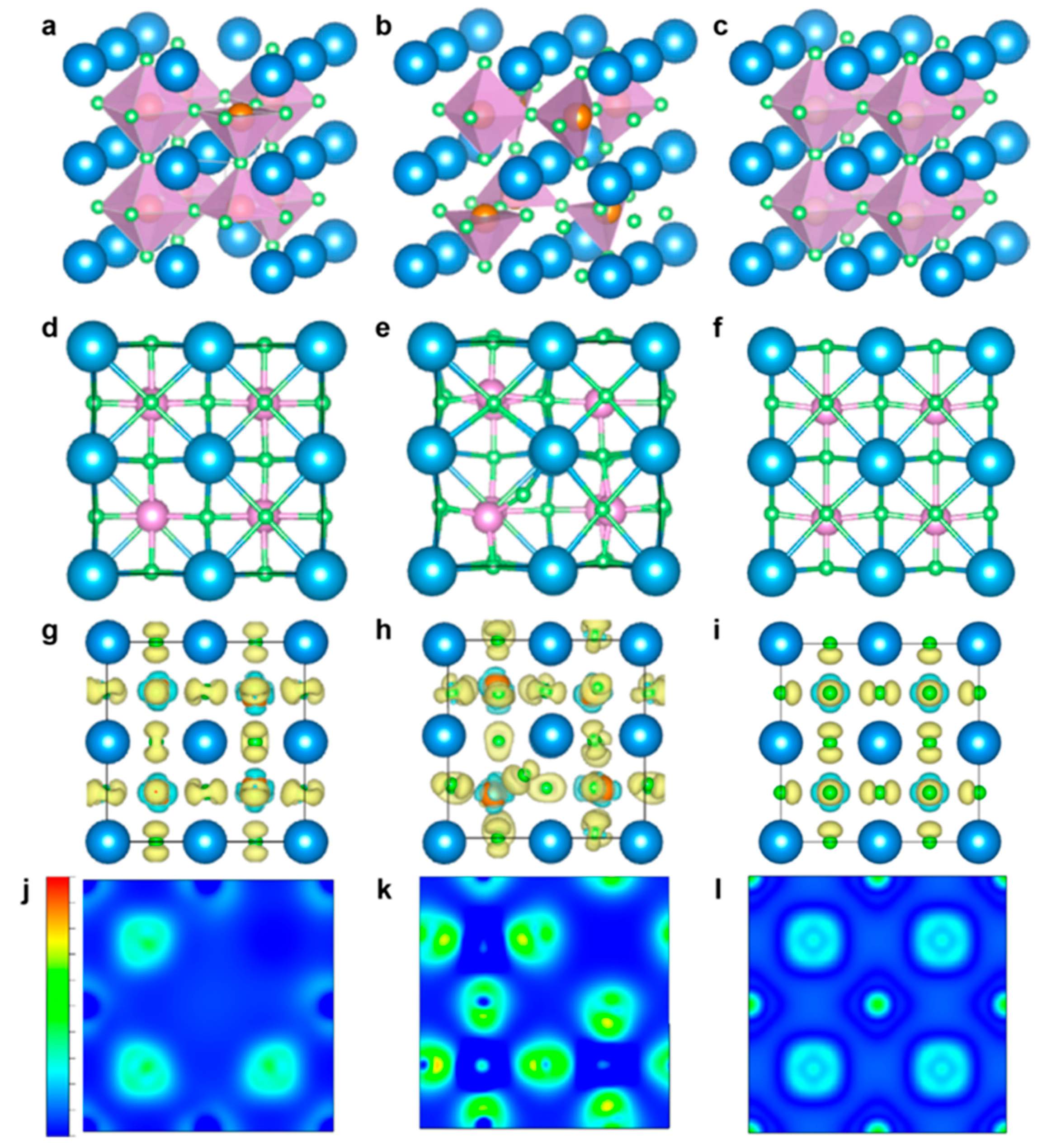
Xu et al. investigated the impact of Ba/Ti ratio on the tetragonality of BaTiO₃ powder, challenging the conventional view that attributes tetragonality solely to grain size [142]. Their study demonstrated that as the Ba/Ti ratio increased from 0.990 to 1.010, the particle size remained stable at approximately 200 nm. Tetragonality initially rose from 1.006 to a peak of 1.0092 at Ba/Ti = 1.000 before declining to 1.005. Using density functional theory (DFT), they analyzed electron density and lattice distortion, revealing that both Ba and Ti vacancies influence lattice deformation, with Ti vacancies causing more significant lattice expansion and reduced tetragonality. Their findings were supported by calculated charge density distributions, which showed that Ti vacancies increased charge uniformity. Using this optimized BaTiO₃ powder, they fabricated high-density ceramics and multilayer ceramic capacitors (MLCCs) with X7R temperature stability, highlighting the potential of Ba/Ti ratio control in developing advanced dielectric materials.
Xie et al. investigated the enhancement of photocatalytic hydrogen production through Mo doping in BaTiO₃ (BTO) [143]. To improve light absorption, they synthesized Mo-doped BTO via a solid-state reaction and modified the samples with 0.4 wt% Pt using a photoreduction method. Their findings revealed that Mo doping significantly narrows the bandgap, shifting the absorption edge into the visible-light region. Compared to pure BTO, which has a hydrogen evolution rate of 35 mmol g⁻¹ h⁻¹, Mo-doped BTO (2 at%) achieved 63 mmol g⁻¹ h⁻¹, nearly twice the efficiency. First-principles density functional theory (DFT) calculations demonstrated that the hybridization between Ti 3d and Mo 3d orbitals led to a downward shift in the conduction band minimum, explaining the improved photocatalytic performance. Their study highlights how bandgap engineering via dopant selection enhances light absorption and provides valuable insights for designing high-performance metal-oxide photocatalysts for solar-driven hydrogen production.
Usman et al. conducted a theoretical investigation into the structural, electronic, and optical properties of pure and Cs-doped BaTiO₃ using the CASTEP code [144]. Their study employed the plane-wave pseudopotential method with the Perdew-Burke-Ernzerhof (PBE) exchange-correlation functional and the DFT+U approach to enhance electronic property accuracy. The calculated lattice parameter for pure BaTiO₃ was 4.034 Å, with an indirect band gap of 2.513 eV, aligning well with prior research. Upon Cs doping (0.13%, 0.26%, and 0.39%), the band gap transitioned to a direct type, with values of 1.858 eV, 2.103 eV, and 1.882 eV, respectively. Notably, 0.13% Cs-doped BaTiO₃ exhibited the highest absorption edge in the visible spectrum and the lowest energy loss, making it a promising candidate for photocatalytic water splitting. The introduction of Cs-3p states into the valence band enhanced photocatalytic activity, particularly in the visible range, improving BaTiO₃’s potential for energy applications.
Chun et al. investigated the surface termination of single-crystal BaTiO₃(111) using a combination of Density Functional Theory (DFT) and X-ray Photoelectron Spectroscopy (XPS) [145]. Their study focused on the stability of stoichiometric (BaO₃ and Ti) and non-stoichiometric (BaO₂, O, BaO, O₂, Ba, and O₃) terminations. DFT+U calculations revealed that BaO₂ and O terminations exhibit the lowest cleavage and surface energies, making them the most stable under different conditions. The presence of Ti³⁺ states and oxygen defects was confirmed through XPS analysis of the O 1s and Ti 2p regions. Further DFT calculations of O 1s chemical shifts indicated that OH* species preferentially adsorb on O-terminated surfaces, closely matching experimental XPS data. Their findings suggest that BaTiO₃(111) favors an OH*-covered O termination, with surface defects playing a crucial role in stabilizing the polar surface.
Dahbi et al. investigated the thermodynamic stability, electronic structures, and optical properties of pure and compressed BaTiO₃ doped with varying concentrations of oxygen group elements (S, Se, and Te) using Density Functional Theory [146]. Their findings revealed that substituting oxygen atoms with chalcogen elements significantly reduced the forbidden band gap from 3.010 eV (for compressed BaTiO₃) to 0.000 eV (for Te-doped BaTiO₃), highlighting the crucial role of chalcogen impurities in modifying the electronic properties of BaTiO₃. Additionally, applying a 2.3% compressive strain, with or without chalcogen doping, transformed BaTiO₃ from an indirect to a direct semiconductor. The calculated formation energy confirmed the thermodynamic stability of all studied compounds. Furthermore, doping altered the absorption behavior of BaTiO₃, making it more suitable for optoelectronic applications due to the introduction of additional charge carriers into the system. These findings provide valuable insights into the potential applications of doped BaTiO₃ in electronic and optical devices.
Dahbi et al. investigated the impact of compressive strain on the electronic, optical, and thermoelectric properties of cubic and tetragonal phases of BTO perovskite-type crystals using Density Functional Theory (DFT) [147]. Their study revealed that applying a compressive strain of 2.3% or higher transforms BTO into a semiconductor with a direct bandgap, eliminating additional interactions in the conduction band—an important characteristic for photovoltaic applications. Additionally, the bandgap width increased with strain, highlighting the piezoelectric nature of BTO. The optical analysis indicated that both pure and strained BTO exhibit strong optical properties across the visible and UV spectra. Furthermore, compressive strain enhanced hole mobility, leading to improved thermal and electrical conductivity. A shift in absorption coefficient and optical conductivity peaks to higher UV energies further supported the piezoelectric behavior of BTO. These findings underscore the potential of strained BTO in electronic and energy-related applications.
Figure 6.
Free energy diagrams for the oxygen evolution reaction (OER) at the Ti site on BaTiO₃ (001) surfaces at pH = 0 and T = 298 K under different applied potentials: (a) pure, (b) (V + N)-codoped, (c) (Nb + N)-codoped, and (d) (Ta + N)-codoped systems.Reprinted with permission from [148]. Copyright 2022, for Elsevier [148].
Figure 6.
Free energy diagrams for the oxygen evolution reaction (OER) at the Ti site on BaTiO₃ (001) surfaces at pH = 0 and T = 298 K under different applied potentials: (a) pure, (b) (V + N)-codoped, (c) (Nb + N)-codoped, and (d) (Ta + N)-codoped systems.Reprinted with permission from [148]. Copyright 2022, for Elsevier [148].
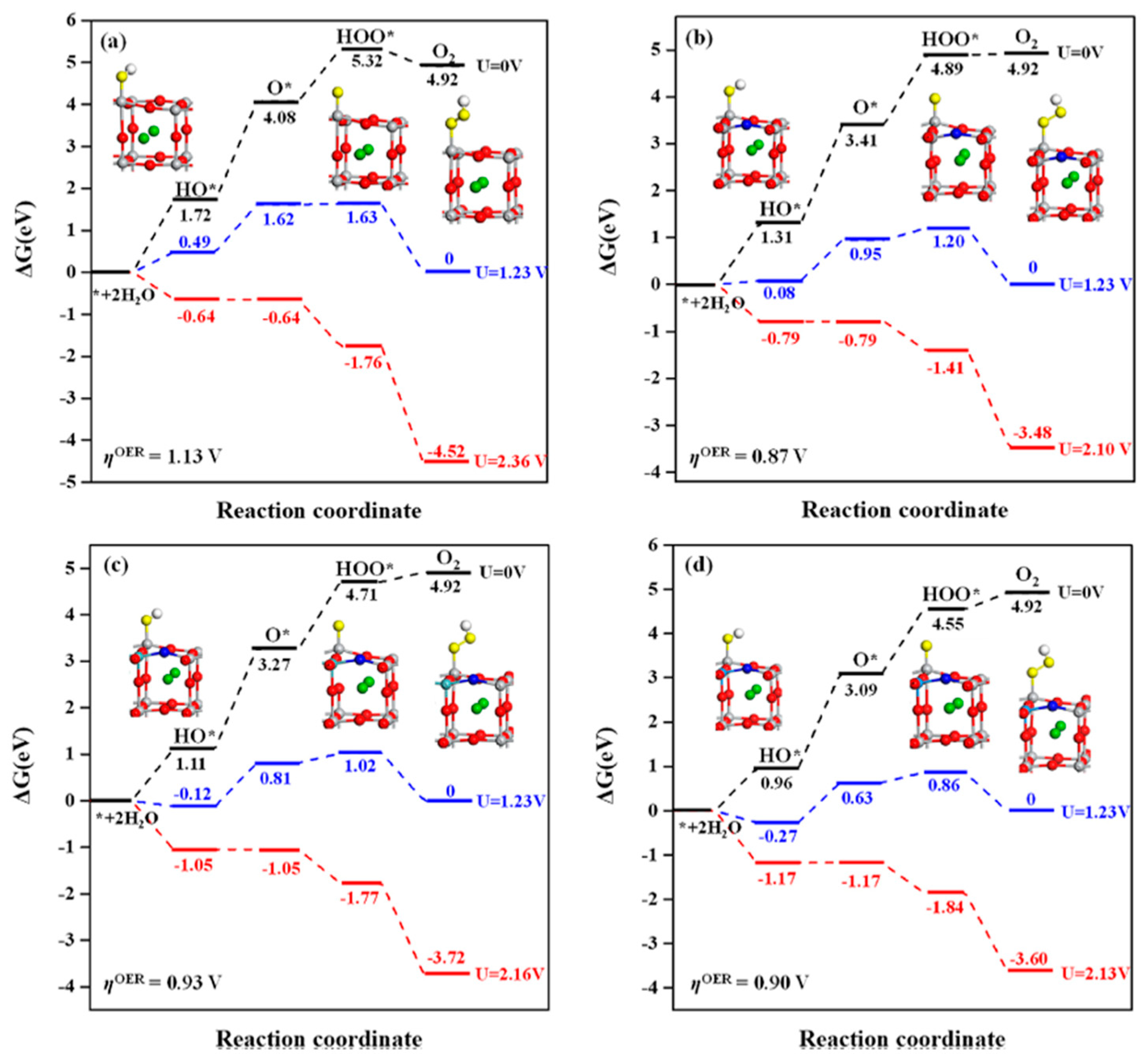
Fo et al. conducted a density functional theory (DFT) study to examine the effects of metal-nonmetal co-doping on the stability, electronic properties, and photocatalytic activity of tetragonal BaTiO₃ (001) surfaces [148]. Their findings indicate that co-doped systems (M = V, Nb, Ta, Mo, W; X = N, C) are energetically stable, favoring formation in O-rich conditions. Most co-doped surfaces exhibit significantly reduced bandgaps, enhancing visible-light absorption. Additionally, co-doping improves water affinity and modifies active sites for the hydrogen evolution reaction (HER) and oxygen evolution reaction (OER), with the O site and Ti site (adjacent to the metal dopant) acting as active centers, respectively. Notably, passivated co-doping lowers the HER free energy barrier and reduces the OER overpotential compared to pristine BaTiO₃. Among the studied systems, Ta+N, W+N, Mo+N, Mo+C, Mo+2N, and W+2N co-doped BaTiO₃ are highlighted as promising photocatalysts for overall water splitting.
Chakraborty et al. investigated the structural, electronic, and optical properties of BaTiO₃ using density functional theory (DFT), highlighting its potential for photocatalytic applications, including water splitting and pollutant degradation [149]. Their study employed the hybrid HSE06 functional, yielding bandgap values of 3.254, 3.894, 3.694, 3.519, and 3.388 eV for cubic, rhombohedral, orthorhombic, tetragonal, and hexagonal BaTiO₃ polymorphs, respectively. Notably, this was the first DFT-based study to closely match experimental bandgap values. Electronic band structure analysis revealed that all polymorphs exhibit semiconducting behavior, with indirect bandgaps except for the hexagonal phase, which has a direct bandgap. The density of states analysis indicated significant hybridization between O-2p and Ti-3d states. Optical studies confirmed strong absorption, low reflectivity, and optical anisotropy in the orthorhombic and tetragonal phases, making BaTiO₃ suitable for UV-based optical devices, waveguides, and dielectric applications. The findings suggest BaTiO₃’s strong redox potential enhances its photocatalytic efficiency.
Bhat et al. successfully synthesized a porous graphene-BaTiO₃ (PGBT) nanocomposite using a simple one-pot solvothermal method and investigated its photocatalytic efficiency in degrading methylene blue (MB) dye under visible light [150]. The combined experimental and theoretical analysis demonstrated enhanced photocatalytic performance, attributed to the formation of Ba–C bonds, which facilitated charge carrier transport and suppressed recombination. Additionally, the reduced band gap due to hybridized states extended light absorption into the visible range, while the high surface area provided more active sites for MB adsorption. The PGBT composite exhibited a threefold increase in photodegradation efficiency compared to pure BaTiO₃, achieving 98.6% degradation within 80 minutes. Furthermore, it showed excellent cyclic stability, highlighting its potential as a durable photocatalyst for environmental remediation. This study serves as a valuable reference for designing PG-based nanocomposites, leveraging solar energy for sustainable pollutant degradation.
Bashir et al. conducted a theoretical investigation of gallium-modified barium titanate (Ga-BTO) perovskite ceramics (Ba₁₋ₓGaₓTiO₃, x = 50%) using density functional theory-based full potential linear augmented plane wave (FP-LAPW) calculations [151]. Their study explored the optoelectronic, elastic, and mechanical properties of both pure and Ga-doped BaTiO₃. The results revealed that Ga substitution altered the electronic structure, reducing the bandgap to 1.84 eV and inducing half-metallic behavior with 100% spin polarization. Optical analysis indicated enhanced absorption in the ultraviolet region, a lower reflectivity, and a static refractive index of 12.2. The modified BTO exhibited higher ductility, anisotropy, and bulk modulus (169.96 GPa) compared to the pure form. Additionally, prominent peaks in optical conductivity at 4.2 and 5.8 eV suggested potential applications in optoelectronics and spintronics. These findings highlight Ga-BTO as a promising material for infrared detectors and antireflective coatings.
Wang et al. developed a flower-like core–shell heterostructured oxygen evolution reaction electrocatalyst by integrating tetragonal BaTiO3 nanoparticles (t-BTO NPs) with NiFe-layered double hydroxide (NiFe-LDH) nanoarrays [152]. The study explored how the self-polarization effect of t-BTO influenced the OER performance of NiFe-LDH. In alkaline media (1.0 M KOH), the t-BTO@NiFe-LDH heterojunction exhibited a remarkably low overpotential of 186 mV at 10 mA/cm² and a Tafel slope of 38.3 mV dec⁻¹, outperforming its individual components. Density functional theory (DFT) calculations demonstrated that electronic modulation between t-BTO and NiFe-LDH reduced the bandgap, enhanced conductivity, and optimized the adsorption of oxygen-containing intermediates. Projected density of states (PDOS) analysis confirmed that t-BTO facilitated rapid electron transfer through self-polarization. The synergistic effects of these heterostructures resulted in superior electrocatalytic activity, offering insights into the rational design of efficient, noble-metal-free OER electrocatalysts.
Chen et al. developed an amorphous PtOx-supported BaTiO3 catalyst (BTPOv-0.09) with oxygen vacancies (Figure 7), designed for efficient hydrogen (H₂) production from wastewater while simultaneously degrading organic pollutants [153]. The catalyst features Pt-O-Ti³⁺ charge separation sites, enhancing photocatalytic efficiency. BTPOv-0.09 achieved a remarkable H₂ generation rate of 1891 μmol⋅g⁻¹⋅h⁻¹ and exhibited a degradation rate constant (k) of 0.0485 min⁻¹ for pefloxacin (PFX), significantly outperforming pristine BaTiO3. The introduction of PtOx facilitated oxygen vacancy formation, improving charge transfer and catalytic activity. X-ray absorption spectroscopy and HAADF-STEM analysis confirmed the presence of PtOx. The Pt sites optimized H* adsorption and H₂ desorption, while Ti³⁺ sites enhanced PFX adsorption. As a result, BTPOv-0.09 demonstrated superior performance, achieving 98.1% PFX removal within 90 minutes. This work highlights an effective strategy for developing bifunctional photocatalysts by engineering multiple active sites on a single catalyst for simultaneous redox reactions.
Guo et al. explored the synergistic effect between piezoelectricity and photocatalysis to enhance hydrogen production via water splitting [154]. By combining experimental and theoretical analyses, they demonstrated that the inherent piezoelectric field in BaTiO3 can reduce the bandgap of SrTiO3/BaTiO3 heterojunction nanofibers, facilitating electron transfer through the Z-scheme mechanism. The incorporation of piezoelectric BaTiO3 significantly boosted the hydrogen evolution rate of SrTiO3/BaTiO3 nanofibers to 1950.2 μmol⋅g⁻¹⋅h⁻¹, surpassing pure SrTiO3 and BaTiO3 by factors of 2.4 and 4.1, respectively. This rate also exceeded previously reported perovskite-based piezo-photocatalysts. Fabricated via electrospinning followed by thermal treatment, these nanofibers exhibited enhanced charge separation due to the piezoelectric field generated under ultrasonic vibrations. Their findings highlight the crucial role of piezoelectric-assisted photocatalysis in improving energy band alignment and efficiency, paving the way for advanced photocatalysts that address energy and environmental challenges in sustainable hydrogen production.
Zulfiqar et al. investigated the potential of chalcogen doping (X = S, Se, Te) in BaTiO₃ for visible-light-driven photocatalysis in hydrogen production [155]. Using first-principles density functional theory (DFT) calculations with the SCAN meta-GGA functional, they assessed the structural, thermodynamic, electronic, and optical properties of X-doped BaTiO₃. Their results indicated that incorporating a chalcogen atom at an oxygen site in BaTiO₃ is thermodynamically challenging due to significant differences in atomic radii and electronegativities. To enhance the synthesis feasibility, they proposed Zr codoping at Ti-sites, which improved thermodynamic stability while maintaining band gap reduction. Electronic structure calculations using the TB-mBJ functional showed that Zr+Xcodoping converted BaTiO₃ into a direct band gap material with band edge positions favorable for overall water splitting. This study highlights the potential of Zr+XcodopedBaTiO₃ as an efficient photocatalyst for hydrogen evolution under both oxygen-rich and oxygen-poor conditions.
Kovač et al. investigated the role of transport layers in perovskite solar cells, focusing on their charge carrier extraction and transfer mechanisms [156]. Using ab initio calculations, they examined the interface properties of metal oxide/BaTiO₃ heterostructures, identifying key competing factors influencing charge dynamics. Their findings highlight the impact of band gap character on charge carrier mobility, where a direct band gap reduces electron-hole lifetime and diffusion length. Additionally, they explored the influence of electrostatic potential variations, which enhance charge transfer rates but are counteracted by unfavorable conduction band offsets. The study emphasizes the importance of interlayer morphology over intrinsic material properties, suggesting that optimizing atomic plane distances and atomic number distributions can improve charge transport efficiency. They further propose that ultra-thin buffer layers may enable charge tunneling, similar to effects observed in CIGS solar cells with CdS layers. These insights provide guidelines for designing enhanced buffer layers in perovskite solar cells.
Kaptagayet al. investigated the oxygen evolution reaction (OER) on a Rh-doped BaTiO₃ (001) surface using DFT calculations [157]. Their study assessed the Gibbs free energy changes for each reaction step and calculated the overpotential while considering solvation effects. The findings revealed that Rh doping significantly reduces the overpotential compared to the undoped BaTiO₃ surface, which exhibits low OER efficiency. This improvement is attributed to the oxidation state transition of Rh from 3+ to 4+ during water splitting, which enhances the charge transfer from surface oxygen ions. As a result, the binding energy between surface ions and adsorbates increases, weakening the adsorbate-adsorbate interactions and leading to a lower overpotential. The reduced overpotential on the Rh-modified TiO₂ surface confirms its enhanced catalytic activity in electrochemical water oxidation, aligning well with experimental results and previous studies. These insights highlight Rh doping as a promising strategy for improving OER efficiency.
Opoku et al. investigated the electronic structure, charge transfer, and photocatalytic properties of cubic LaAlO₃(001) modified with cubic BaTiO₃(001), (011), and (111) surfaces [158]. Their study aimed to understand how LaAlO₃ can be activated under light irradiation through the incorporation of different BaTiO₃ surfaces. The heterostructures demonstrated a reduced bandgap energy, enhancing visible light absorption. Additionally, BaTiO₃/LaAlO₃(001) heterostructures exhibited a staggered type-II band alignment, which facilitated charge carrier separation and minimized recombination. The BaTiO₃(001) surface, in particular, enhanced photocatalytic activity due to its complex surface structure and active barium adsorption sites. BaTiO₃ acted as a sensitizer, improving overall photoactivity. Their findings provide valuable insights into the preferential exposure of photocatalytic active surfaces, aiding in the design of advanced heterostructures for photocatalytic applications and offering a deeper understanding of photocatalytic mechanisms.
Abbasi et al. investigated the impact of ferroelectric polarization on the electronic structure and electrocatalytic activity of BaTiO₃ thin films, particularly in the hydrogen evolution reaction (HER) [159]. Unlike previous studies focused on nanoparticle systems with complex interfaces, they used molecular beam epitaxy (MBE) to grow epitaxial BaTiO₃ films with atomically sharp interfaces. Their surface spectroscopy and ab initio DFT+U calculations revealed that upward polarization decreases the work function and lowers the HER barrier, correlating with enhanced experimental activity. The study demonstrated that modulating polarization can dynamically switch between distinct electrocatalytic surfaces, altering charge transfer resistance and exchange current density. The findings highlight how ferroelectric layers can be used to control intermediate binding energies in electrochemical reactions, offering new avenues for nanoscale catalyst design by leveraging polarization-dependent surface properties beyond conventional catalytic descriptors.
Gunawan et al. investigated the role of ferroelectric polarization in enhancing photoelectrochemical (PEC) performance, addressing challenges related to charge recombination and sluggish charge transfer kinetics [160]. They designed a heterostructure composed of multiferroic bismuth ferrite (BFO) and photoactive bismuth vanadate (BVO) in a neutral pH electrolyte, demonstrating significant photocurrent improvements. Notably, both polarization states contributed to enhancement: the down-poled BFO/BVO exhibited a 136% increase, while the up-poled configuration showed a 70% improvement at 1.23 V_RHE, surpassing previous reports. Extensive PEC analysis, surface characterization, and density functional theory (DFT) calculations revealed that the improvements were driven by band energy gradient modulation, band bending, and altered BFO/adsorbate interactions. The sol–gel synthesis method used is scalable and employs environmentally friendly materials, making this approach promising for next-generation dynamic photoelectrodes. Their findings advance the field of ferroelectric-based PEC systems by enabling tunable charge dynamics and overcoming limitations of conventional semiconductor photoelectrodes.
Goumri-Said et al. conducted a comprehensive study on the electronic properties and optical absorption behavior of anion-anion co-doped BaTiO3 to design efficient photocatalysts for water redox reactions [161]. Using first-principles hybrid density functional theory (DFT) calculations with the HSE06 functional, they analyzed the impact of double-hole doping on band structure modifications. Their findings revealed that the formation energy of mono- and co-doped configurations increased as the oxygen chemical potential decreased, with N–N co-doped BaTiO3 exhibiting the most favorable formation energy under O-poor conditions. All co-doping configurations resulted in band gap reduction, enhancing visible light absorption and aligning band edge positions with water oxidation-reduction potentials. This study highlights the effectiveness of anionic co-doping in tuning wide-bandgap semiconductors, demonstrating that such modifications can produce highly efficient photocatalysts for solar-driven water splitting.
Chandrappaet al. explored strategies to modify the electronic and optical properties of BaTiO₃ (BTO) by introducing Ir doping at Ti sites [162]. While pristine BTO typically exhibits strong n-type behavior and ultraviolet absorption (λ ≤ 390 nm), their study demonstrated a successful transition to p-type semiconducting behavior with extended visible-light absorption (λ ≤ 600 nm). Through a combination of advanced spectroscopy, microscopy, and computational electronic structure analysis, they elucidated the underlying mechanisms governing this transition. The redshift in optical absorption was attributed to the formation of Ir³⁺/Ir⁴⁺ in-gap energy levels within the bandgap, facilitating optical transitions. Furthermore, the observed decrease in Ti³⁺ donor levels and correlated oxygen vacancies played a crucial role in enabling the p-type behavior. These findings highlight the potential of Ir-doped BTO as a promising visible-light-absorbing semiconductor with significant applications in optoelectronics and solar fuel generation.
Bhat et al. investigated the potential of environmentally friendly BaTiO3 as a photocatalyst, despite its initially wide band gap, which limits efficiency [163]. They explored Rh doping to reduce the band gap but avoided the formation of mid-gap recombination centers that typically hinder photocatalytic performance. Using first-principles DFT calculations, they determined that Rh occupying both Ba and Ti sites simultaneously would introduce detrimental acceptor states. To address this, they employed a hydrothermal synthesis method to direct Rh towards Ba sites, leading to donor Rh³⁺ states that lowered the band gap while maintaining high photocatalytic activity. Their experimental results confirmed an efficient 96% degradation of methylene blue dye within 120 minutes for a 0.5 Rh-doped sample. This study demonstrated a viable strategy to enhance BaTiO3's photocatalytic efficiency and suggested that similar methods could be applied to other perovskite oxides for improved dye degradation.
Qiu et al. investigated the impact of switchable polarization in ferroelectric catalysts on the hydrogen evolution reaction (HER), aiming to overcome the Sabatier limit faced by traditional catalysts [164]. Using BaTiO₃ (BTO) as a model system, they demonstrated that HER activity is tunable by controlling polarization states. First-principles calculations revealed that in-plane polarized BTO enhances HER performance compared to out-of-plane polarization, due to surface dipole–dipole interactions. Surface rumpling, influenced by polarization states, significantly affects surface oxygen reactivity, with an optimal 2p band center correlating to improved HER activity. The study also established a link between hydrogen adsorption energy and polarization effects. Furthermore, a HER catalytic cycle leveraging switchable polarization states was proposed, showing potential for enhanced catalytic efficiency. Their findings highlight the role of ferroelectric polarization control in designing high-performance electrocatalysts, providing insights into functional ferroelectric catalysis beyond HER applications.
Wang et al. investigated the impact of co-doping rare earth elements on the electronic and photocatalytic properties of BaTiO3 using first-principles calculations [165]. They examined BaTiO3 supercell structures with La concentrations of 12.5% and 25%, focusing on doping at both Ba and Ti sites. Their analysis of band structure, density of states, and charge density difference revealed that co-doping 25% La at the Ti site significantly enhanced visible light absorption and water-splitting performance. The introduction of La created intermediate energy levels within the bandgap, reducing the energy required for electronic transitions. Further, La-N co-doping at the Ti site effectively modified the band structure, improving photocatalytic efficiency. Optical property calculations confirmed an extended absorption edge, enhancing BaTiO3’s visible light response. Their findings highlight La co-doping as a promising strategy for optimizing BaTiO3’s electronic structure and photocatalytic activity, making it a viable material for energy-related applications.
Figure 8.
(a) Ion arrangement changes in the slab after Ba substitution with Rh, (b) electronic DOS of the relaxed slab, and (c) optical absorption spectrum of the investigated model. Dashed and dotted lines indicate optical absorption for spin-up and spin-down states, while the solid line represents total absorption. Reprinted with permission from [57]. Copyright 2024, for MDPI [57].
Figure 8.
(a) Ion arrangement changes in the slab after Ba substitution with Rh, (b) electronic DOS of the relaxed slab, and (c) optical absorption spectrum of the investigated model. Dashed and dotted lines indicate optical absorption for spin-up and spin-down states, while the solid line represents total absorption. Reprinted with permission from [57]. Copyright 2024, for MDPI [57].
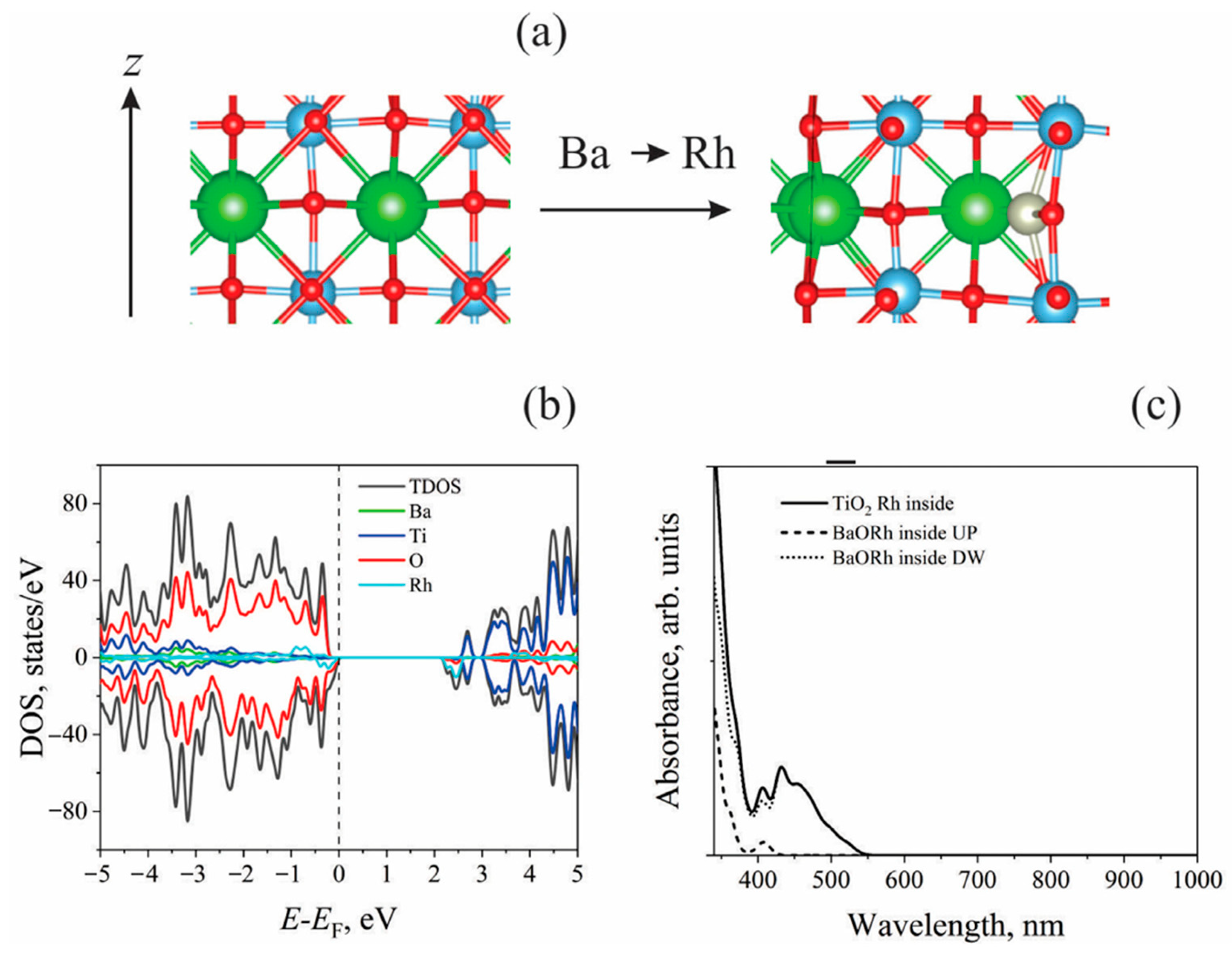
Inerbaev et al. explored the potential of modified barium titanate (BaTiO₃), a cost-effective perovskite oxide, as an efficient water oxidation electrocatalyst using first-principles calculations [57,135]. Their study demonstrated that Rh doping enhances BaTiO₃’s light absorption capabilities while reducing the overpotential required for water oxidation. The TiO₂-terminated BaTiO₃ (001) surface was identified as particularly promising for catalytic applications. Rh doping expanded the material’s absorption spectrum to cover the entire visible range, with the aqueous environment playing a crucial role in modulating its solar radiation absorption. Upon Ti→Rh substitution, rhodium ions partially acquired electron density from surrounding oxygen atoms, stabilizing an intermediate oxidation state (3+ to 4+) during water oxidation. This interaction influenced the adsorption energies of reaction intermediates, effectively lowering the overpotential. The study concluded that Rh-modified BaTiO₃ surfaces exhibit significant potential as photoanodes in photoelectrochemical systems for water oxidation.Inerbaev et al. investigated also the optical properties of tetragonal BaTiO₃ using density functional theory, incorporating both static lattice calculations and ab initio molecular dynamics [135]. Their study, which applied GGA + U and hybrid functionals, revealed that atomic motion significantly lowers the optical absorption threshold. This reduction occurs due to thermal fluctuations enabling previously forbidden electronic transitions and shifting the energy levels of optical absorption, providing insights into the photoluminescence behavior of BaTiO₃.
Saadon et al. investigated the structural, electronic, and optical properties of platinum (Pt)-doped cubic BaTiO3 perovskite using density functional theory (DFT) calculations. By employing the CASTEP code with the generalized gradient approximation (GGA) and PW91 functional, they examined the effects of substituting 0.125 Pt at Ba and Ti sites. Their findings showed that Pt doping reduced the band gap to 1.78 eV and 2.06 eV for Ba and Ti substitution, respectively, and introduced Pt-5d states in the conduction band, significantly influencing electronic properties. Additionally, the optical absorption spectrum exhibited a red shift, extending into the visible range, making Pt-BaTiO3 a promising material for optoelectronic applications. The negative formation energy confirmed the thermodynamic stability of the doped system. Mulliken charge analysis further revealed a shift from ionic to covalent bonding in Ba–Pt and Ti–Pt interactions. Future studies may explore the material’s potential in photocatalysis and environmental applications [166].
Sharma et al. synthesized nanostructured BaTiO3/Cu2O heterojunction electrodes with varying Cu2O film thickness using spray deposition onto spin-coated BaTiO3 thin films [167]. For the first time, first-principles density functional theory (DFT) calculations were performed to determine band offsets and effective masses of charge carriers for bulk BaTiO3 and Cu2O. The study revealed enhanced separation of photogenerated charge carriers at the BaTiO3/Cu2O interface. Experimental photoelectrochemical (PEC) analysis confirmed these findings, showing a maximum photocurrent density of 1.44 mA/cm² at 0.95 V/SCE for a 442 nm thick heterojunction electrode. This structure exhibited superior charge transfer, reduced resistance, and improved light absorption compared to individual BaTiO3 or Cu2O electrodes. The study demonstrated that BaTiO3/Cu2O heterojunctions improve water-splitting efficiency in PEC cells, achieving a peak conversion efficiency of 0.66%, outperforming FeTiO2/Zn-Fe2O3 heterojunctions. Theoretical results aligned well with experimental data, providing insights into charge separation mechanisms.
Tyminska et al. investigated the impact of oxygen vacancies (Ovac) on the oxygen evolution reaction (OER) at the TiO2-terminated (001) surface of cubic BaTiO3 (cBTO-TiO2) using spin-polarized DFT+U calculations and the standard four-step proton-coupled electron transfer (PCET) mechanism [169]. Their study revealed that excess electrons from Ovac contribute to charge transfer (CT) with intermediate adsorbates (HO*, O*, and HOO*) or generate surface oxygen hole states. This CT enhances the binding energies of these species in proportion to their electronegativity. Notably, HO* and O* are stabilized more strongly than HOO*, leading to increased OER overpotential (ηOER) on the oxygen-deficient surface. This contradicts experimental findings that indicate enhanced efficiency for oxygen-deficient BTO, suggesting that a different mechanism or surface structure may be responsible under experimental conditions. Additionally, they identified novel HO* and O* adsorption structures that induce surface oxidation, attributed to the low work function of Ti−O−Ti moieties.
2.2. Ab initio MD Simulations
Atomistic simulations play a crucial role in understanding the fundamental mechanisms governing photocatalytic activity in BaTiO₃-based systems [59]. Among these methods, ab initio MD simulation is widely employed to capture the electronic structure and dynamic behavior of catalytic interfaces at finite temperatures. However, ab initio MD simulations are computationally expensive, limiting their application to short timescales [170,171,172,173,174,175]. To overcome this limitation, machine learning potentials (MLP) trained on DFT data have been developed, offering an efficient alternative for extended simulations while retaining DFT-level accuracy [176,177,178,179,180,181,182,183,184].
This study employs machine learning potentials (MLP) to investigate the oxygen evolution reaction through metadynamics simulations. Figure 7 outlines the MLP training process, which involves constructing a dataset that captures the configurational space of oxygen evolution reaction over BaTiO₃ and Ni@BaTiO₃ slabs [59]. Additionally, single-point DFT calculations can be applied to selected structures, improving efficiency through parallelization, unlike the inherently sequential nature of MD.
Figure 7.
Overview of the MLP training workflow for MD simulations using DFT data.Reprinted with permission from [59]. Copyright 2024, for the arXiv [59].
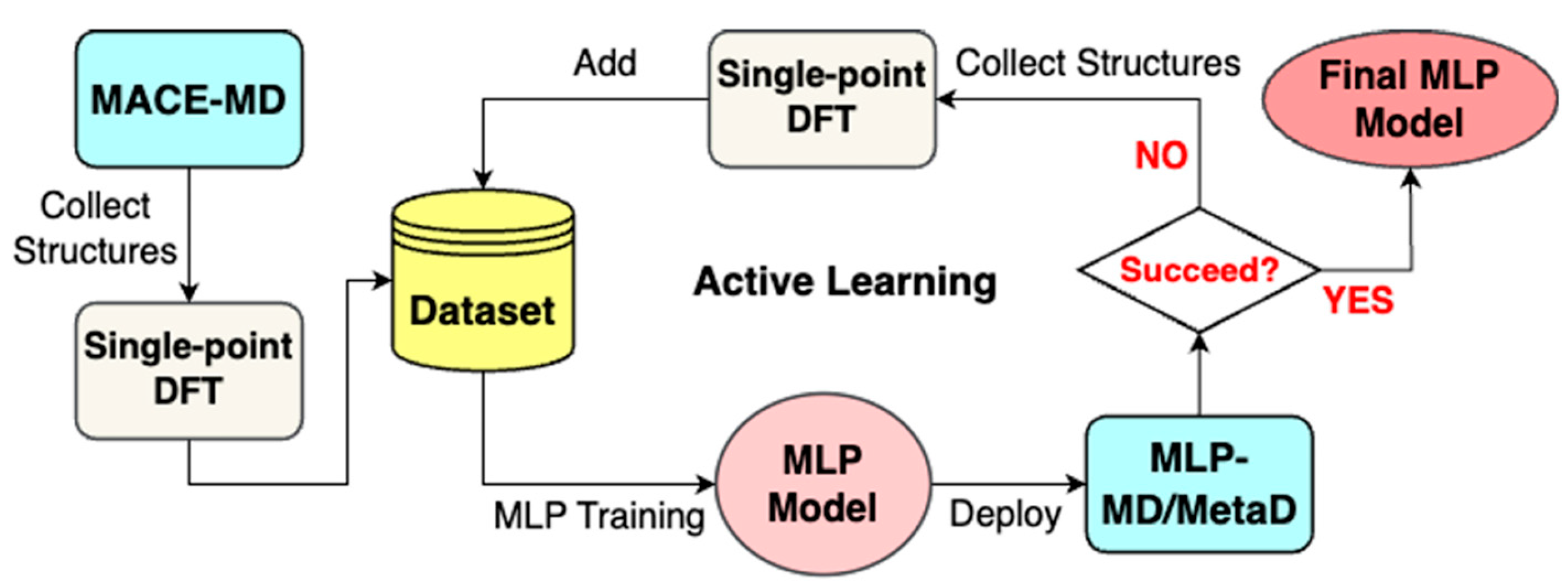
The stepwise mechanism of oxygen evolution reaction mechanism, as depicted in Figure 8, is analyzed using free energy surface calculations.
Figure 8.
Illustration of the oxygen evolution reaction mechanism observed in the MLP-metadynamics trajectory of the BaTiO₃ (4×4)/128H₂O system, with the Ti active site annotated.Reprinted with permission from [59]. Copyright 2024, for the arXiv [59].
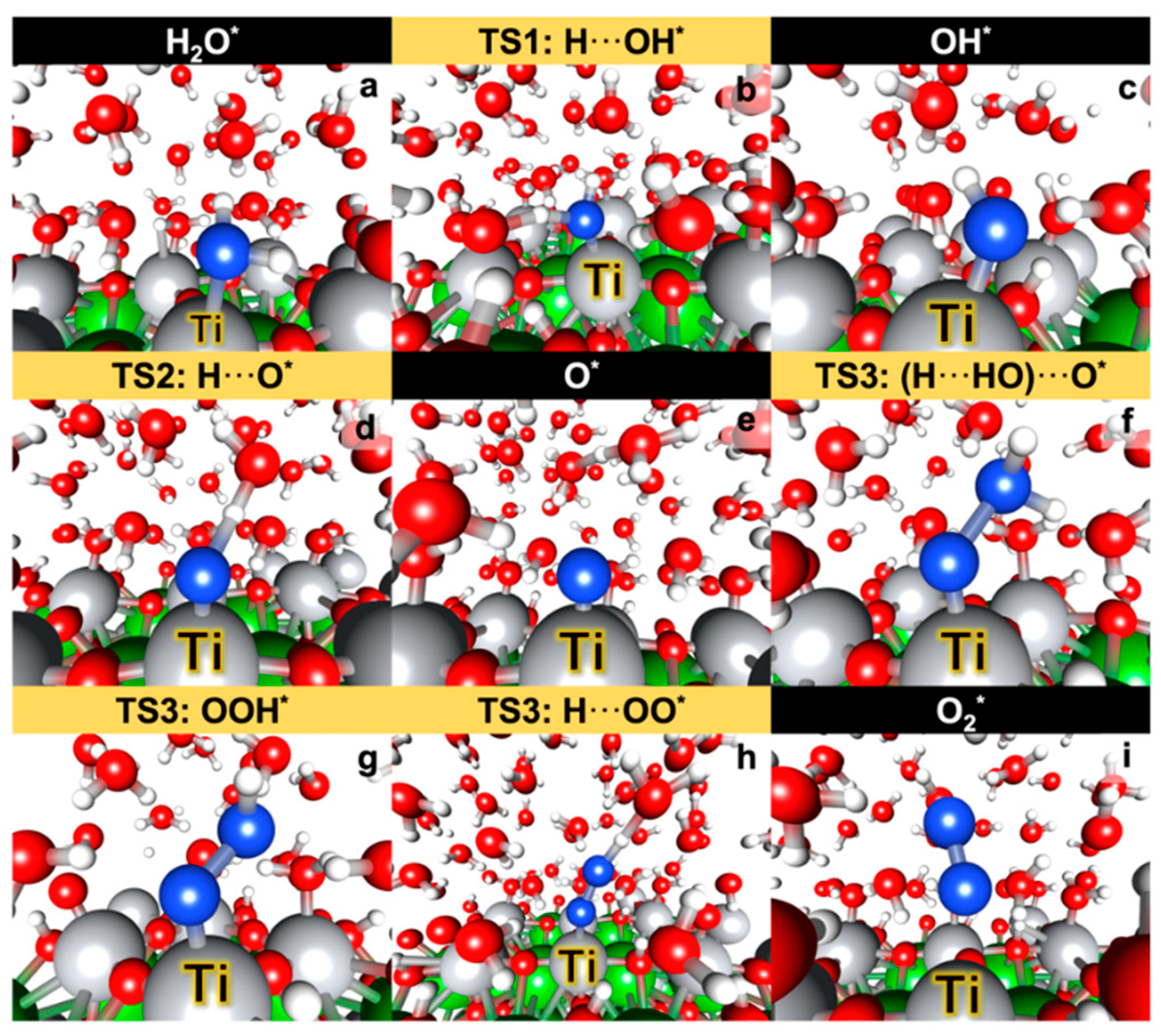
The catalytic process was analyzed using ab initio MD simulations with VASP as shown in Figure 9. The newly formed oxygen molecule indicates that oxygen continuously dissolves in water, sustaining OOH generation and continuous H₂O₂ production. Figure 9d,e further reveals the presence of OH radicals, formed either by water oxidation or H₂O₂ decomposition, emphasizing the role of O₂⁻ radicals in OH radical formation (Table 2).
Boonpalit et al. investigated the oxygen evolution reaction on pristine and Ni-dopedBaTiO3 surfaces using metadynamics simulations with machine learning interatomic potentials. Their study aimed to develop cost-effective alternatives to expensive Pt and IrOx/RuOx catalysts for electrocatalytic water splitting. By leveraging artificial neural networks and the MACE-mp-0 model, they created an accurate machine learning potential to simulate oxygen evolution reaction at explicit water interfaces [59]. Their results revealed that Ni-doping enhances BaTiO3's catalytic activity by lowering the free energy barrier for oxo-oxo bond formation, aligning with experimental findings. However, the study did not account for the lattice oxygen-mediated mechanism, suggesting future work in this area. The database and machine learning potential developed in this study lay a foundation for further investigations into complex catalytic pathways, extending to broader electrochemical reactions at electrode–electrolyte interfaces in explicit solvent environments [59].
Next, Wang et al. investigated the piezo-photocatalytic process by fabricating Ba₀.₇Sr₀.₃TiO₃ nanorod arrays on fluorine-doped tin oxide-coated glass as recoverable catalysts. Their study demonstrated that the piezoelectric effect significantly enhances photocatalytic efficiency. Under ultrasonic vibrations, the degradation rate constant (k) for rhodamine B using poled Ba₀.₇Sr₀.₃TiO₃ nanorod reached 0.0447 min⁻¹, which was twice as high as that of the unpoled Ba₀.₇Sr₀.₃TiO₃ nanorod (0.00183 min⁻¹). This improvement was attributed to the piezoelectric potential generated by poled Ba₀.₇Sr₀.₃TiO₃ nanorod. Additionally, the Ba₀.₇Sr₀.₃TiO₃ nanorodarray exhibited a hydrogen production rate of 411.5 μmol g⁻¹ h⁻¹. Ab initio MD simulations revealed that hydroxyl radicals (•OH) played a dominant role over superoxide radicals (•O₂⁻) in the degradation process [185].
2.3. Classical All-Atom MD Simulations
Classical all-atom MD simulations have proven to be an essential tool for understanding the atomic-scale interactions between the BaTiO₃ surface and OH⁻ ions in aqueous environments, particularly under different polarization conditions [186,187,188,189,190,191,192,193,194]. These simulations provide valuable insights into adsorption behavior, surface charge effects, and polarization-induced modifications that influence BaTiO₃'s role in solar water splitting applications. To illustrate this, Figure 10 presents the adsorption of OH⁻ ions on BaTiO₃ surfaces at varying H₂O:OH⁻ ratios under both unpolarized and positively polarized conditions. Additionally, Table 3 summarizes recent classical all-atom MD studies investigating these interactions, detailing their methodologies and key findings.
At lower pH values, the positively polarized sample exhibits the highest Vph, while the negatively polarized sample shows the lowest Vph, indicating that polarization enhances the generation of non-equilibrium carriers (Figure 10). However, at higher pH values, the Vph of both polarized photoanodes decreases compared to the unpolarized sample, aligning with the LSV results. This suggests that at high pH, the presence of BaTiO₃ influences the surface behavior differently, impacting the overall performance.
Chen et al. employed molecular dynamics simulations and density functional theory calculations to investigate the impact of ferroelectric polarization on photoelectrochemicalwater oxidation. Their study demonstrated that the polarization field of BaTiO3 can significantly enhance the photocurrent density of a hybrid α-Fe₂O₃/ BaTiO3photoanode by approximately 30% in near-neutral electrolytes. This improvement is attributed to the polarization-induced enhancement of surface states and donor density within the space charge layer, which facilitates hole collection and improves reaction kinetics. However, computational findings revealed that at high pH values, the adsorption capacity of OH⁻ ions on polarized and unpolarized BaTiO3 surfaces becomes nearly identical, weakening the effect of the ferroelectric polarization field [58]. Consequently, the polarized field has a minimal influence on photoelectrochemical performance in alkaline conditions. Their work highlights the critical role of electrolyte pH in optimizing ferroelectric materials for photoelectrochemicalapplications, offering new insights into their mechanistic behavior.
While classical all-atom MD simulations have predominantly been used to study BaTiO₃ in photoelectrochemical applications, their potential extends to photocatalytic processes as well [195,196,197,198,199,200]. By investigating ion adsorption, interfacial charge transfer, and surface state modifications, classical all-atom MD simulations can provide deeper mechanistic insights into BaTiO₃ based photocatalysts for solar-driven water splitting and related reactions. In conclusion, it is also important to note that calculations of defect-induced Raman modes allow a more in-depth consideration and understanding of the role of surface defects [201,202,203,204,205].
3. Conclusions and Outlook
BaTiO₃ has demonstrated significant potential as a photocatalyst for solar water splitting due to its favorable electronic and ferroelectric properties. Atomistic simulations, particularly DFT, ab initio MD, classical all-atom MD, and MLP-based studies, have played a pivotal role in elucidating the fundamental mechanisms governing its photocatalytic activity. DFT calculations have provided insights into band structure modifications, defect engineering, and doping strategies, while ab initio MD and classical all-atom MD simulations have revealed the dynamic interactions of BaTiO₃ surfaces with water molecules under realistic conditions. Furthermore, MLP-assisted metadynamics simulations have emerged as a powerful tool for overcoming the computational limitations of traditional ab initio MD approaches. Collectively, these studies highlight the importance of computational modeling in optimizing BaTiO₃-based photocatalysts. However, challenges such as charge recombination, surface stability, and scalability of synthesis methods remain critical obstacles that need to be addressed for practical applications.
Future research should focus on integrating multiscale modeling techniques to bridge the gap between atomistic simulations and experimental validation. The incorporation of hybrid DFT functionals and beyond-DFT methods could improve the accuracy of electronic structure predictions, particularly for defect states and charge transport mechanisms. Additionally, the development of advanced machine learning potentials tailored for BaTiO₃ could further accelerate large-scale simulations and enhance predictive capabilities. Experimentally, synthesizing BaTiO₃-based heterostructures with co-catalysts and optimizing defect engineering strategies will be crucial for improving catalytic performance. A deeper exploration of photoelectrochemical and piezo-photocatalytic effects in BaTiO₃ could unlock new pathways for enhancing efficiency. Overall, a synergistic approach combining computational modeling and experimental techniques will be essential to realize the full potential of BaTiO₃ for sustainable hydrogen production.
Author Contributions
A.U.A, U.Z.T. and B.M.S.: conceptualization, methodology, formal analysis, writing—original draft, review and editing; T.M.I.: funding acquisition, writing—original draft, review and editing; M.K.: conceptualization, visualization, writing—review and editing; F.U.A.: conceptualization, formal analysis, writing— original draft, review and editing; A. I. P.: funding acquisition, writing—review and editing. All authors have read and agreed to the published version of the manuscript.
Funding
This research was funded by the Science Committee of the Ministry of Science and Higher Education of the Republic of Kazakhstan “Development of hybrid perovskite nanostructures for hydrogen photogeneration” (Grant No. AP23489103).This research was also funded by the Science Committee of the Ministry of Science and Higher Education of the Republic of Kazakhstan “Green Energy: Foundational Research of Solar Fuel Technologies for Sustainable Production and Advanced Storage” (Grant No.BR21882185).
Institutional Review Board Statement
Not applicable.
Informed Consent Statement
Not applicable.
Data Availability Statement
The raw data supporting the conclusions of this article will be made available by the authors on request.
Acknowledgments
This research was funded by the Science Committee of the Ministry of Science and Higher Education of the Republic of Kazakhstan “Development of hybrid perovskite nanostructures for hydrogen photogeneration” (Grant No. AP23489103). This research was also funded by the Science Committee of the Ministry of Science and Higher Education of the Republic of Kazakhstan “Green Energy: Foundational Research of Solar Fuel Technologies for Sustainable Production and Advanced Storage” (Grant No.BR21882185).
Conflicts of Interest
The authors declare no conflicts of interest.
Abbreviations
The following abbreviations are used in this manuscript:
| CV | Conduction band |
| DFT | Density Functional Theory |
| MD | Molecular Dynamics |
| MLP | Machine learning potentials |
| SMR | Steam methane reforming |
| VB | Valence band |
References
- Atilhan, S.; Park, S.; El-Halwagi, M.M.; Atilhan, M.; Moore, M.; Nielsen, R.B. Green hydrogen as an alternative fuel for the shipping industry. Curr. Opin. Chem. Eng. 2021, 31, 100668. [Google Scholar] [CrossRef]
- Qazi, U.Y. Future of hydrogen as an alternative fuel for next-generation industrial applications; challenges and expected opportunities. Energies 2022, 15, 4741. [Google Scholar] [CrossRef]
- Hosseini, S.E.; Wahid, M.A. Hydrogen production from renewable and sustainable energy resources: Promising green energy carrier for clean development. Renew. Sustain. Energy Rev. 2016, 57, 850–866. [Google Scholar] [CrossRef]
- Kaiwen, L.; Bin, Y.; Tao, Z. Economic analysis of hydrogen production from steam reforming process: A literature review. Energy Sources, Part B 2018, 13, 109–115. [Google Scholar] [CrossRef]
- Franchi, G.; Capocelli, M.; De Falco, M.; Piemonte, V.; Barba, D. Hydrogen production via steam reforming: A critical analysis of MR and RMM technologies. Membranes 2020, 10, 10. [Google Scholar] [CrossRef]
- Ranjekar, A.M.; Yadav, G.D. Steam reforming of methanol for hydrogen production: A critical analysis of catalysis, processes, and scope. Ind. Eng. Chem. Res. 2021, 60, 89–113. [Google Scholar] [CrossRef]
- Wang, M.; Wang, Z.; Gong, X.; Guo, Z. The intensification technologies to water electrolysis for hydrogen production–A review. Renew. Sustain. Energy Rev. 2014, 29, 573–588. [Google Scholar] [CrossRef]
- El-Shafie, M. Hydrogen production by water electrolysis technologies: A review. Results Eng. 2023, 20, 101426. [Google Scholar] [CrossRef]
- Shayan, E.; Zare, V.; Mirzaee, I.J.E.C. Hydrogen production from biomass gasification; a theoretical comparison of using different gasification agents. Energy Convers. Manag. 2018, 159, 30–41. [Google Scholar] [CrossRef]
- Tezer, Ö.; Karabağ, N.; Öngen, A.; Çolpan, C.Ö.; Ayol, A. Biomass gasification for sustainable energy production: A review. Int. J. Hydrog. Energy 2022, 47, 15419–15433. [Google Scholar] [CrossRef]
- Akhlaghi, N.; Najafpour-Darzi, G. A comprehensive review on biological hydrogen production. Int. J. Hydrog. Energy 2020, 45, 22492–22512. [Google Scholar] [CrossRef]
- Xu, X.; Zhou, Q.; Yu, D. The future of hydrogen energy: Bio-hydrogen production technology. Int. J. Hydrog. Energy 2022, 47, 33677–33698. [Google Scholar] [CrossRef]
- Razi, F.; Dincer, I.; Gabriel, K. Exergoenvironmental analysis of the integrated copper-chlorine cycle for hydrogen production. Energy 2021, 226, 120426. [Google Scholar] [CrossRef]
- Strušnik, D.; Avsec, J. Exergoeconomic machine-learning method of integrating a thermochemical Cu–Cl cycle in a multigeneration combined cycle gas turbine for hydrogen production. Int. J. Hydrog. Energy 2022, 47, 17121–17149. [Google Scholar] [CrossRef]
- . [CrossRef]
- Song, H.; Luo, S.; Huang, H.; Deng, B.; Ye, J. Solar-driven hydrogen production: Recent advances, challenges, and future perspectives. ACS Energy Lett. 2022, 7, 1043–1065. [Google Scholar] [CrossRef]
- Takeda, S.; Nam, H.; Chapman, A. Low-carbon energy transition with the sun and forest: Solar-driven hydrogen production from biomass. Int. J. Hydrog. Energy 2022, 47, 24651–24668. [Google Scholar] [CrossRef]
- Lim, Y.; Lee, D.-K.; Kim, S.M.; Park, W.; Cho, S.Y.; Sim, U. Low Dimensional Carbon-Based Catalysts for Efficient Photocatalytic and Photo/Electrochemical Water Splitting Reactions. Materials 2020, 13, 114. [Google Scholar] [CrossRef]
- Eidsvåg, H.; Bentouba, S.; Vajeeston, P.; Yohi, S.; Velauthapillai, D. TiO2 as a Photocatalyst for Water Splitting—An Experimental and Theoretical Review. Molecules 2021, 26, 1687. [Google Scholar] [CrossRef]
- Nadeem, M.A.; Khan, M.A.; Ziani, A.A.; Idriss, H. An Overview of the Photocatalytic Water Splitting over Suspended Particles. Catalysts 2021, 11, 60. [Google Scholar] [CrossRef]
- Arunachalam, P.; Nagai, K.; Amer, M.S.; Ghanem, M.A.; Ramalingam, R.J.; Al-Mayouf, A.M. Recent Developments in the Use of Heterogeneous Semiconductor Photocatalyst Based Materials for a Visible-Light-Induced Water-Splitting System—A Brief Review. Catalysts 2021, 11, 160. [Google Scholar] [CrossRef]
- Tian, L.; Guan, X.; Zong, S.; Dai, A.; Qu, J. Cocatalysts for Photocatalytic Overall Water Splitting: A Mini Review. Catalysts 2023, 13, 355. [Google Scholar] [CrossRef]
- Jakhar, M.; Kumar, A.; Ahluwalia, P.K.; Tankeshwar, K.; Pandey, R. Engineering 2D Materials for Photocatalytic Water-Splitting from a Theoretical Perspective. Materials 2022, 15, 2221. [Google Scholar] [CrossRef] [PubMed]
- Dauletbekova, A.; Abuova, F.; Piskunov, S. First-principles modeling of the H color centers in MgF₂ crystals. Phys. Status Solidi C 2012, 10, 160–164. [Google Scholar] [CrossRef]
- Abuova, F.U.; Kotomin, E.A.; Lisitsyn, V.M.; Akilbekov, A.T.; Piskunov, S. Ab initio modeling of radiation damage in MgF₂ crystals. Nucl. Instrum. Methods Phys. Res. B 2014, 326, 314–317. [Google Scholar] [CrossRef]
- Goumri-Said, S.; Kanoun, M.B. Insight into the Effect of Anionic–Anionic Co-Doping on BaTiO3 for Visible Light Photocatalytic Water Splitting: A First-Principles Hybrid Computational Study. Catalysts 2022, 12, 1672. [Google Scholar] [CrossRef]
- Guo, S.; Lin, H.; Hu, J.; Su, Z.; Zhang, Y. Computational Study of Novel Semiconducting Sc2CT2 (T = F, Cl, Br) MXenes for Visible-Light Photocatalytic Water Splitting. Materials 2021, 14, 4739. [Google Scholar] [CrossRef]
- Wang, G.; Xie, W.; Guo, S.; Chang, J.; Chen, Y.; Long, X.; Zhou, L.; Ang, Y.S.; Yuan, H. Two-Dimensional GeC/MXY (M = Zr, Hf; X, Y = S, Se) Heterojunctions Used as Highly Efficient Overall Water-Splitting Photocatalysts. Molecules 2024, 29, 2793. [Google Scholar] [CrossRef]
- Wang, Y.; Wang, H.; Li, Y.; Zhang, M.; Zheng, Y. Designing a 0D/1D S-Scheme Heterojunction of Cadmium Selenide and Polymeric Carbon Nitride for Photocatalytic Water Splitting and Carbon Dioxide Reduction. Molecules 2022, 27, 6286. [Google Scholar] [CrossRef]
- Yan, Y.; Chen, Z.; Cheng, X.; Shi, W. Research Progress of ZnIn2S4-Based Catalysts for Photocatalytic Overall Water Splitting. Catalysts 2023, 13, 967. [Google Scholar] [CrossRef]
- Zhang, H.; Liu, J.; Xu, T.; Ji, W.; Zong, X. Recent Advances on Small Band Gap Semiconductor Materials (≤2.1 eV) for Solar Water Splitting. Catalysts 2023, 13, 728. [Google Scholar] [CrossRef]
- Morante, N.; Folliero, V.; Dell’Annunziata, F.; Capuano, N.; Mancuso, A.; Monzillo, K.; Galdiero, M.; Sannino, D.; Franci, G. Characterization and Photocatalytic and Antibacterial Properties of Ag- and TiOx-Based (x = 2, 3) Composite Nanomaterials under UV Irradiation. Materials 2024, 17, 2178. [Google Scholar] [CrossRef] [PubMed]
- Zhao, Z.; Li, R.; Zhao, C.; Pei, J. A Study on the Effect of Conductive Particles on the Performance of Road-Suitable Barium Titanate/Polyvinylidene Fluoride Composite Materials. Materials 2025, 18, 1185. [Google Scholar] [CrossRef] [PubMed]
- Mamani Flores, E.; Vera Barrios, B.S.; HuillcaHuillca, J.C.; Chacaltana García, J.A.; Polo Bravo, C.A.; Nina Mendoza, H.E.; Quispe Cohaila, A.B.; Gamarra Gómez, F.; Tamayo Calderón, R.M.; Fora Quispe, G.d.L.; et al. Cr3+ Doping Effects on Structural, Optical, and Morphological Characteristics of BaTiO3 Nanoparticles and Their Bioactive Behavior. Crystals 2024, 14, 998. [Google Scholar] [CrossRef]
- Abidin, M.Z.U.; Ikram, M.; Moeen, S.; Nazir, G.; Kanoun, M.B.; Goumri-Said, S. A comprehensive review on the synthesis of ferrite nanomaterials via bottom-up and top-down approaches: Advantages, disadvantages, characterizations, and computational insights. Coord. Chem. Rev. 2024, 520, 216158. [Google Scholar] [CrossRef]
- Jiang, Q.; Cui, X.F.; Zhao, M. Size effects on Curie temperature of ferroelectric particles. Appl. Phys. A Mater. Sci. Process. 2004, 78, 703–704. [Google Scholar] [CrossRef]
- Sood, A.; Desseigne, M.; Dev, A.; Maurizi, L.; Kumar, A.; Millot, N.; Han, S.S. A Comprehensive Review on Barium Titanate Nanoparticles as a Persuasive Piezoelectric Material for Biomedical Applications: Prospects and Challenges. Small 2023, 19, e2206401. [Google Scholar] [CrossRef]
- Lang, X.Y.; Jiang, Q. Size and interface effects on Curie temperature of perovskite ferroelectric nanosolids. J. Nanopart. Res. 2007, 9, 595–603. [Google Scholar] [CrossRef]
- Wada, S.; Hoshina, T.; Yasuno, H.; Ohishi, M.; Kakemoto, H.; Tsurumi, T.; Yashima, M. Size Effect of Dielectric Properties for Barium Titanate Particles and Its Model. Key Eng. Mater. 2006, 301, 27–30. [Google Scholar] [CrossRef]
- Chakraborty, A.; Liton, M.N.H.; Sarker, M.S.I.; Rahman, M.M.; Khan, M.K.R. A comprehensive DFT evaluation of catalytic and optoelectronic properties of BaTiO₃ polymorphs. Phys. B: Condens. Matter 2023, 648, 414418. [Google Scholar] [CrossRef]
- Navas, D.; Fuentes, S.; Castro-Alvarez, A.; Chavez-Angel, E. Review on Sol-Gel Synthesis of Perovskite and Oxide Nanomaterials. Gels 2021, 7, 275. [Google Scholar] [CrossRef]
- Lu, W.; Quilitz, M.; Schmidt, H. Nanoscaled BaTiO3 powders with a large surface area synthesized by precipitation from aqueous solutions: Preparation, characterization and sintering. J. Eur. Ceram. Soc. 2007, 27, 3149–3159. [Google Scholar] [CrossRef]
- Suherman, B.; Nurosyid, F.; Khairuddin; Sandi, D.K.; Irian, Y. Impacts of low sintering temperature on microstructure, atomic bonds, and dielectric constant of barium titanate (BaTiO3) prepared by co-precipitation technique. J. Phys. Conf. Ser. 2022, 2190, 12006. [CrossRef]
- Hayashi, H.; Hakuta, Y. Hydrothermal Synthesis of Metal Oxide Nanoparticles in Supercritical Water. Materials 2010, 3, 3794–3817. [Google Scholar] [CrossRef]
- Khort, A.A.; Podbolotov, K.B. Preparation of BaTiO3 nanopowders by the solution combustion method. Ceram. Int. 2016, 42, 15343–15348. [Google Scholar] [CrossRef]
- Choi, G.J.; Kim, H.S.; Cho, Y.S. BaTiO3 particles prepared by microwave-assisted hydrothermal reaction using titanium acylate precursors. Mater. Lett. 1999, 41, 122–127. [Google Scholar] [CrossRef]
- Buscaglia, V.; Buscaglia, M.T.; Canu, G. BaTiO3-Based Ceramics: Fundamentals, Properties and Applications. Encyclopedia of Materials: Technical Ceramics and Glasses; Elsevier: Amsterdam, The Netherlands, 2021; pp. 311–344. ISBN 9780128222331. [Google Scholar]
- Ramakanth, S.; James Raju, K.C. Band gap narrowing in BaTiO3 nanoparticles facilitated by multiple mechanisms. J. Appl. Phys. 2014, 115, 173507. [Google Scholar] [CrossRef]
- Tewatia, K.; Sharma, A.; Sharma, M.; Kumar, A. Factors affecting morphological and electrical properties of Barium Titanate: A brief review. Mater. Today Proc. 2021, 44, 4548–4556. [Google Scholar] [CrossRef]
- Kumar, A.; Gori, Y.; Kumar, A.; Meena, C.S.; Dutt, N. (Eds.) Advanced Materials for Biomedical Applications, 1st ed.; Taylor and Francis: Boca Raton, FL, USA, 2023; ISBN 9781032356068.
- Benyoussef, M.; Mura, T.; Saitzek, S.; Azrour, F.; Blach, J.-F.; Lahmar, A.; Gagou, Y.; El Marssi, M.; Sayede, A.; Jouiad, M. Nanostructured BaTi1−xSnxO3 ferroelectric materials for electrocaloric applications and energy performance. Curr. Appl. Phys. 2022, 38, 59–66. [Google Scholar] [CrossRef]
- Qiao, L.; Bi, X. Microstructure and grain size dependence of ferroelectric properties of BaTiO3 thin films on LaNiO3 buffered Si. J. Eur. Ceram. Soc. 2009, 29, 1995–2001. [Google Scholar] [CrossRef]
- Buscaglia, M.T.; Buscaglia, V.; Viviani, M.; Nanni, P.; Hanuskova, M. Influence of foreign ions on the crystal structure of BaTiO3. J. Eur. Ceram. Soc. 2000, 20, 1997–2007. [Google Scholar] [CrossRef]
- Khedhri, M.H.; Abdelmoula, N.; Khemakhem, H.; Douali, R.; Dubois, F. Structural, spectroscopic and dielectric properties of Ca-doped BaTiO3. Appl. Phys. A Mater. Sci. Process. 2019, 125, 193. [Google Scholar] [CrossRef]
- Da Lu, Y.; Han, D.D.; Liu, Q.L.; Wang, Y.D.; Sun, X.Y. Structure and Dielectric Properties of Ce and Ca Co-Doped BaTiO3 Ceramics. Key Eng. Mater. 2016, 680, 184–188. [Google Scholar] [CrossRef]
- Rached, A.; Wederni, M.A.; Belkahla, A.; Dhahri, J.; Khirouni, K.; Alaya, S.; Martín-Palma, R.J. Effect of doping in the physico-chemical properties of BaTiO3 ceramics. Phys. B Condens. Matter 2020, 596, 412343. [Google Scholar] [CrossRef]
- Banerjee, T.; Balasubramanian, G. Predictive Modeling of Molecular Mechanisms in Hydrogen Production and Storage Materials. Materials 2023, 16, 6050. [Google Scholar] [CrossRef]
- Inerbaev, T.M.; Abuova, A.U.; Zakiyeva, Z.Y.; Abuova, F.U.; Mastrikov, Y.A.; Sokolov, M.; Gryaznov, D.; Kotomin, E.A. Effect of Rh doping on optical absorption and oxygen evolution reaction activity on BaTiO₃ (001) surfaces. Molecules 2024, 29, 11. [Google Scholar] [CrossRef]
- Chen, L.; Yu, Z.; Ji, X.; Huang, R.; Luo, L.; Tang, Z.; Zhang, Y. Insight into the effect of pH on the ferroelectric polarization field applied in photoelectrochemical water oxidation. Mater. Sci. Semicond. Process. 2022, 147, 106729. [Google Scholar] [CrossRef]
- Boonpalit, K.; Artrith, N. Mechanistic Insights into the Oxygen Evolution Reaction on Nickel-Doped Barium Titanate via Machine Learning-Accelerated Simulations. arXiv 2024, arXiv:2412.15452. [Google Scholar] [CrossRef]
- Bradley, R.; Radhakrishnan, R. Coarse-Grained Models for Protein-Cell Membrane Interactions. Polymers 2013, 5, 890–936. [Google Scholar] [CrossRef]
- Ren, H.; Yang, J.; Yang, W.; Zhong, H.; Lin, J.; Radjenovic, P.M.; Sun, L.; Zhang, H.; Xu, J.; Tian, Z.; Li, J. Core–Shell–Satellite plasmonic photocatalyst for broad-spectrum photocatalytic water splitting. ACS Mater. Lett. 2020, 3, 69–76. [Google Scholar] [CrossRef]
- Goga, N.; Mayrhofer, L.; Tranca, I.; Nedea, S.; Heijmans, K.; Ponnuchamy, V.; Vasilateanu, A. A Review of Recent Developments in Molecular Dynamics Simulations of the Photoelectrochemical Water Splitting Process. Catalysts 2021, 11, 807. [Google Scholar] [CrossRef]
- Abdikarimova, U.; Bissenova, M.; Matsko, N.; Issadykov, A.; Khromushin, I.; Aksenova, T.; Munasbayeva, K.; Slyamzhanov, E.; Serik, A. Visible Light-Driven Photocatalysis of Al-Doped SrTiO3: Experimental and DFT Study. Molecules 2024, 29, 5326. [Google Scholar] [CrossRef] [PubMed]
- Eglitis, R.I.; Piskunov, S.; Popov, A.I.; Purans, J.; Bocharov, D.; Jia, R. Systematic Trends in Hybrid-DFT Computations of BaTiO3/SrTiO3, PbTiO3/SrTiO3 and PbZrO3/SrZrO3 (001) Hetero Structures. Condens. Matter 2022, 7, 70. [Google Scholar] [CrossRef]
- Eglitis, R.I.; Purans, J.; Jia, R. Comparative Hybrid Hartree-Fock-DFT Calculations of WO2-Terminated Cubic WO3 as Well as SrTiO3, BaTiO3, PbTiO3 and CaTiO3 (001) Surfaces. Crystals 2021, 11, 455. [Google Scholar] [CrossRef]
- Sikam, P.; Thirayatorn, R.; Kaewmaraya, T.; Thongbai, P.; Moontragoon, P.; Ikonic, Z. Improved Thermoelectric Properties of SrTiO3 via (La, Dy and N) Co-Doping: DFT Approach. Molecules 2022, 27, 7923. [Google Scholar] [CrossRef]
- Eglitis, R.I.; Jia, R. Review of Systematic Tendencies in (001), (011) and (111) Surfaces Using B3PW as Well as B3LYP Computations of BaTiO3, CaTiO3, PbTiO3, SrTiO3, BaZrO3, CaZrO3, PbZrO3 and SrZrO3 Perovskites. Materials 2023, 16, 7623. [Google Scholar] [CrossRef]
- Jouybar, S.; Naji, L.; Sarabadani Tafreshi, S.; de Leeuw, N.H. A Density Functional Theory Study of the Physico-Chemical Properties of Alkali Metal Titanate Perovskites for Solar Cell Applications. Molecules 2024, 29, 3355. [Google Scholar] [CrossRef]
- Elegbeleye, I.F.; Maluta, N.E.; Maphanga, R.R. Density Functional Theory Study of Optical and Electronic Properties of (TiO2)n=5,8,68 Clusters for Application in Solar Cells. Molecules 2021, 26, 955. [Google Scholar] [CrossRef]
- Yan, Z.; Zhang, Y.; Kang, W.; Deng, N.; Pan, Y.; Sun, W.; Ni, J.; Kang, X. TiO2 Gas Sensors Combining Experimental and DFT Calculations: A Review. Nanomaterials 2022, 12, 3611. [Google Scholar] [CrossRef]
- Gustavsen, K.R.; Feng, T.; Huang, H.; Li, G.; Narkiewicz, U.; Wang, K. DFT Calculation of Carbon-Doped TiO2 Nanocomposites. Materials 2023, 16, 6117. [Google Scholar] [CrossRef]
- Wang, J.; Zhou, T.; Zhang, Y.; Chen, S.; Bai, J.; Li, J.; Zhou, B. The design of high-performance photoanode of CQDs/TiO₂/WO₃ based on DFT alignment of lattice parameter and energy band, and charge distribution. J. Colloid Interface Sci. 2021, 600, 828–837. [Google Scholar] [CrossRef]
- Thongyong, N.; Chanlek, N.; Srepusharawoot, P.; Takesada, M.; Cann, D.P.; Thongbai, P. Experimental study and DFT calculations of improved giant dielectric properties of Ni²⁺/Ta⁵⁺ co-doped TiO₂ by engineering defects and internal interfaces. J. Eur. Ceram. Soc. 2022, 42, 4944–4952. [Google Scholar] [CrossRef]
- Amrhar, O.; Lee, H.S.; Lgaz, H.; Berisha, A.; Ebenso, E.E.; Cho, Y. Computational insights into the adsorption mechanisms of anionic dyes on the rutile TiO₂ (110) surface: Combining SCC-DFT tight binding with quantum chemical and molecular dynamics simulations. J. Mol. Liq. 2023, 377, 121554. [Google Scholar] [CrossRef]
- Zeng, Z.; Wodaczek, F.; Liu, K.; Stein, F.; Hutter, J.; Chen, J.; Cheng, B. Mechanistic insight on water dissociation on pristine low-index TiO₂ surfaces from machine learning molecular dynamics simulations. Nat. Commun. 2023, 14, 6131. [Google Scholar] [CrossRef]
- Boboriko, N.E.; Dzichenka, Y.U. Molecular dynamics simulation as a tool for prediction of the properties of TiO₂ and TiO₂: MoO₃-based chemical gas sensors. J. Alloys Compd. 2021, 855, 157490. [Google Scholar] [CrossRef]
- Raffaini, G. Surface chemistry, crystal structure, size, and topography role in the albumin adsorption process on TiO₂ anatase crystallographic faces and its 3D-nanocrystal: A molecular dynamics study. Coatings 2021, 11, 420. [Google Scholar] [CrossRef]
- Maleki, F.; Di Liberto, G.; Pacchioni, G. pH-and facet-dependent surface chemistry of TiO₂ in aqueous environment from first principles. ACS Appl. Mater. Interfaces 2023, 15, 11216–11224. [Google Scholar] [CrossRef]
- Nosaka, Y. Water Photo-Oxidation over TiO2—History and Reaction Mechanism. Catalysts 2022, 12, 1557. [Google Scholar] [CrossRef]
- Estévez Ruiz, E.P.; Lago, J.L.; Thirumuruganandham, S.P. Experimental Studies on TiO2 NT with Metal Dopants through Co-Precipitation, Sol–Gel, Hydrothermal Scheme and Corresponding Computational Molecular Evaluations. Materials 2023, 16, 3076. [Google Scholar] [CrossRef]
- Harrison, J.A.; Schall, J.D.; Maskey, S.; Mikulski, P.T.; Knippenberg, M.T.; Morrow, B.H. Review of force fields and intermolecular potentials used in atomistic computational materials research. Appl. Phys. Rev. 2018, 5, 031104. [Google Scholar] [CrossRef]
- Yang, M.; Bonati, L.; Polino, D.; Parrinello, M. Using metadynamics to build neural network potentials for reactive events: The case of urea decomposition in water. Catal. Today 2022, 387, 143–149. [Google Scholar] [CrossRef]
- Lowe, J.S.; Siegel, D.J. Modeling the interface between lithium metal and its native oxide. ACS Appl. Mater. Interfaces 2020, 12, 46015–46026. [Google Scholar] [CrossRef] [PubMed]
- Joraleechanchai, N.; Duangdangchote, S.; Sawangphruk, M. Machine Learning and Reactive Force Field Molecular Dynamics Investigation of Electrolytes for Ultra-fast Charging Li-ion Batteries. ECS Trans. 2020, 97, 45. [Google Scholar] [CrossRef]
- Yao, N.; Chen, X.; Fu, Z.H.; Zhang, Q. Applying classical, ab initio, and machine-learning molecular dynamics simulations to the liquid electrolyte for rechargeable batteries. Chem. Rev. 2022, 122, 10970–11021. [Google Scholar] [CrossRef] [PubMed]
- Chen, Y.; Liu, Y.; Xu, Y.; Guo, X.; Cao, Y.; Ming, W. Review: Modeling and Simulation of Membrane Electrode Material Structure for Proton Exchange Membrane Fuel Cells. Coatings 2022, 12, 1145. [Google Scholar] [CrossRef]
- Samantaray, S.; Mohanty, D.; Satpathy, S.K.; Hung, I.-M. Exploring Recent Developments in Graphene-Based Cathode Materials for Fuel Cell Applications: A Comprehensive Overview. Molecules 2024, 29, 2937. [Google Scholar] [CrossRef]
- Dhanasekaran, A.; Subramanian, Y.; Omeiza, L.A.; Raj, V.; Yassin, H.P.H.M.; SA, M.A.; Azad, A.K. Computational Fluid Dynamics for Protonic Ceramic Fuel Cell Stack Modeling: A Brief Review. Energies 2023, 16, 208. [Google Scholar] [CrossRef]
- Wang, W.; Qu, Z.; Wang, X.; Zhang, J. A Molecular Model of PEMFC Catalyst Layer: Simulation on Reactant Transport and Thermal Conduction. Membranes 2021, 11, 148. [Google Scholar] [CrossRef]
- Chen, X.; Hou, W.; Zhai, F.; Cheng, J.; Yuan, S.; Li, Y.; Wang, N.; Zhang, L.; Ren, J. Reversible Hydrogen Storage Media by g-CN Monolayer Decorated with NLi4: A First-Principles Study. Nanomaterials 2023, 13, 647. [Google Scholar] [CrossRef]
- Li, Q.; Li, Q.; Wang, F.; Wu, J.; Wang, Y. The Carrying Behavior of Water-Based Fracturing Fluid in Shale Reservoir Fractures and Molecular Dynamics of Sand-Carrying Mechanism. Processes 2024, 12, 2051. [Google Scholar] [CrossRef]
- Hu, Z.; Wei, L. Review on Characterization of Biochar Derived from Biomass Pyrolysis via Reactive Molecular Dynamics Simulations. J. Compos. Sci. 2023, 7, 354. [Google Scholar] [CrossRef]
- Shelyapina, M.G. Hydrogen Diffusion on, into and in Magnesium Probed by DFT: A Review. Hydrogen 2022, 3, 285–302. [Google Scholar] [CrossRef]
- Mutisya, S.M.; Kalinichev, A.G. Carbonation reaction mechanisms of portlandite predicted from enhanced Ab Initio molecular dynamics simulations. Minerals 2021, 11, 509. [Google Scholar] [CrossRef]
- Kohmuean, P.; Inthomya, W.; Wongkoblap, A.; Tangsathitkulchai, C. Monte Carlo Simulation and Experimental Studies of CO2, CH4 and Their Mixture Capture in Porous Carbons. Molecules 2021, 26, 2413. [Google Scholar] [CrossRef] [PubMed]
- Sobornova, V.V.; Belov, K.V.; Dyshin, A.A.; Gurina, D.L.; Khodov, I.A.; Kiselev, M.G. Molecular Dynamics and Nuclear Magnetic Resonance Studies of Supercritical CO2 Sorption in Poly(Methyl Methacrylate). Polymers 2022, 14, 5332. [Google Scholar] [CrossRef]
- Dong, K.; Niu, Z.; Kong, S.; Jia, B. Impact of Supercritical Carbon Dioxide on Pore Structure and Gas Transport in Bituminous Coal: An Integrated Experiment and Simulation. Molecules 2025, 30, 1200. [Google Scholar] [CrossRef]
- Filipe, H.A.L.; Loura, L.M.S. Molecular Dynamics Simulations: Advances and Applications. Molecules 2022, 27, 2105. [Google Scholar] [CrossRef]
- Smith, A.; Dong, X.; Raghavan, V. An Overview of Molecular Dynamics Simulation for Food Products and Processes. Processes 2022, 10, 119. [Google Scholar] [CrossRef]
- Celik, I.; Yadav, R.; Duzgun, Z.; Albogami, S.; El-Shehawi, A.M.; Fatimawali; Idroes, R.; Tallei, T.E.; Emran, T.B. Interactions of the Receptor Binding Domain of SARS-CoV-2 Variants with hACE2: Insights from Molecular Docking Analysis and Molecular Dynamic Simulation. Biology 2021, 10, 880. [CrossRef]
- SdfLiu, W.D.; Yu, Y.; Dargusch, M.; Liu, Q.; Chen, Z.G. Carbon allotrope hybrids advance thermoelectric development and applications. Renew. Sustain. Energy Rev. 2021, 141, 110800. [Google Scholar] [CrossRef]
- Zhang, Y.Q.; Liu, Y.J.; Liu, Y.L.; Zhao, J.X. Boosting sensitivity of Boron Nitride Nanotube (BNNT) to nitrogen dioxide by Fe encapsulation. J. Mol. Graph. Model. 2014, 51, 1–6. [Google Scholar] [CrossRef]
- Rodríguez-Quintana, R.; Carbajal-Franco, G.; Rojas-Chávez, H. DFT study of the H2 molecules adsorption on pristine and Ni doped graphite surfaces. Mater. Lett. 2021, 293, 129660. [Google Scholar] [CrossRef]
- Zhang, W.-S.; Liu, Y.-T.; Yao, T.-T.; Wu, G.-P.; Liu, Q. Oxygen defect engineering toward the length-selective tailoring of carbon nanotubes via a two-step electrochemical strategy. J. Phys. Chem. C 2020, 124, 27097–27106. [Google Scholar] [CrossRef]
- Elias, A.; Uddin, N.; Hossain, A.; Saha, J.K.; Siddiquey, I.A.; Sarker, D.R.; Diba, Z.R.; Uddin, J.; Choudhury, M.H.R.; Firoz, S.H. An experimental and theoretical study of the effect of Ce doping in ZnO/CNT composite thin film with enhanced visible light photo-catalysis. Int. J. Hydrogen Energy 2019, 44, 20068–20078. [Google Scholar] [CrossRef]
- Liu, Y.; Zhang, H.; Zhang, Z.; Jia, X.; An, L. CO adsorption on Fe-doped vacancy-defected CNTs–A DFT study. Chem. Phys. Lett. 2019, 730, 316–320. [Google Scholar] [CrossRef]
- Jakhar, M.; Kumar, A.; Ahluwalia, P.K.; Tankeshwar, K.; Pandey, R. Engineering 2D Materials for Photocatalytic Water-Splitting from a Theoretical Perspective. Materials 2022, 15, 2221. [Google Scholar] [CrossRef]
- Xu, J.; Wan, Q.; Anpo, M.; Lin, S. Bandgap opening of graphdiyne monolayer via B, N-codoping for photocatalytic overall water splitting: Design strategy from DFT studies. J. Phys. Chem. C 2020, 124, 6624–6633. [Google Scholar] [CrossRef]
- Loh, G.; Pandey, R.; Yap, Y.K.; Karna, S.P. MoS2 quantum dot: Effects of passivation, additional layer, and h-BN substrate on its stability and electronic properties. J. Phys. Chem. C 2015, 119, 1565–1574. [Google Scholar] [CrossRef]
- Pandey, D.; Kumar, A.; Chakrabarti, A.; Pandey, R. Stacking-dependent electronic properties of aluminene based multilayer van der Waals heterostructures. Comput. Mater. Sci. 2020, 185, 109952. [Google Scholar] [CrossRef]
- Lin, Y.-P.; Bocharov, D.; Isakoviča, I.; Pankratov, V.; Popov, A.A.; Popov, A.I.; Piskunov, S. Chlorine Adsorption on TiO2(110)/Water Interface: Nonadiabatic Molecular Dynamics Simulations for Photocatalytic Water Splitting. Electron. Mater. 2023, 4, 33–48. [Google Scholar] [CrossRef]
- Tada, K.; Sakata, K.; Yamada, S.; Okazaki, K.; Kitagawa, Y.; Kawakami, T.; Yamanaka, S.; Okumura, M. DFT calculations for Au adsorption onto a reduced TiO2 (110) surface with the coexistence of Cl. Mol. Phys. 2014, 112, 365–378. [Google Scholar] [CrossRef]
- Li, Y.; Gao, D.; Peng, S.; Lu, G.; Li, S. Photocatalytic hydrogen evolution over Pt/Cd0.5Zn0.5S from saltwater using glucose as electron donor: An investigation of the influence of electrolyte NaCl. Int. J. Hydrog. Energy 2011, 36, 4291–4297. [Google Scholar] [CrossRef]
- Alghamdi, H.; Idriss, H. Study of the modes of adsorption and electronic structure of hydrogen peroxide and ethanol over TiO2 rutile (110) surface within the context of water splitting. Surf. Sci. 2018, 669, 103–113. [Google Scholar] [CrossRef]
- Vu, N.H.; Le, H.V.; Cao, T.M.; Pham, V.V.; Le, H.M.; Nguyen-Manh, D. Anatase–rutile phase transformation of titanium dioxide bulk material: A DFT+U approach. J. Phys. Condens. Matter 2012, 24, 405501. [Google Scholar] [CrossRef]
- Kolesov, G.; Grånäs, O.; Hoyt, R.; Vinichenko, D.; Kaxiras, E. Real–time TD–DFT with classical ion dynamics: Methodology and applications. J. Chem. Theory Comput. 2016, 12, 466–476. [Google Scholar] [CrossRef]
- You, P.; Chen, D.; Lian, C.; Zhang, C.; Meng, S. First–principles dynamics of photoexcited molecules and materials towards a quantum description. Wiley Interdiscip. Rev. Comput. Mol. Sci. 2021, 11, e1492. [Google Scholar] [CrossRef]
- Pham, T.A.; Ping, Y.; Galli, G. Modelling heterogeneous interfaces for solar water splitting. Nat. Mater. 2017, 16, 401–408. [Google Scholar] [CrossRef]
- Agosta, L.; Brandt, E.G.; Lyubartsev, A.P. Diffusion and reaction pathways of water near fully hydrated TiO2 surfaces from ab initio molecular dynamics. J. Chem. Phys. 2017, 147, 024704. [Google Scholar] [CrossRef]
- Balzaretti, F.; Gupta, V.; Ciacchi, L.C.; Aradi, B.; Frauenheim, T.; Köppen, S. Water reactions on reconstructed rutile TiO2: A density functional theory/density functional tight binding approach. J. Phys. Chem. C 2021, 125, 13234–13246. [Google Scholar] [CrossRef]
- Gao, M.; Connor, P.K.N.; Ho, G.W. Plasmonic photothermic directed broadband sunlight harnessing for seawater catalysis and desalination. Energy Environ. Sci. 2016, 9, 3151–3160. [Google Scholar] [CrossRef]
- Schilling, M.; Luber, S. Computational Modeling of Cobalt-Based Water Oxidation: Current Status and Future Challenges. Front Chem. 2018, 6, 100. [Google Scholar] [CrossRef]
- VandeVondele, J.; Mohamed, F.; Krack, M.; Hutter, J.; Sprik, M.; Parrinello, M. The influence of temperature and density functional models in ab initio molecular dynamics simulation of liquid water. J. Chem. Phys. 2005, 122, 014515. [Google Scholar] [CrossRef] [PubMed]
- Sinha, V.; Govindarajan, N.; de Bruin, B.; Meijer, E.J. How Solvent Affects C–H Activation and Hydrogen Production Pathways in Homogeneous Ru-Catalyzed Methanol Dehydrogenation Reactions. ACS Catal. 2018, 8, 6908–6913. [Google Scholar] [CrossRef] [PubMed]
- Cheng, J.; Liu, X.; VandeVondele, J.; Sulpizi, M.; Sprik, M. Redox Potentials and Acidity Constants from Density Functional Theory Based Molecular Dynamics. Acc. Chem. Res. 2014, 47, 3522–3529. [Google Scholar] [CrossRef] [PubMed]
- Liu, X.; Jiang, B.; Liu, Y.; Liu, L.; Xia, T.; Zhang, X.; Ye, C.; Yu, Y.; Wang, B. Two-Dimensional As/BlueP van der Waals Hetero-Structure as a Promising Photocatalyst for Water Splitting: A DFT Study. Coatings 2020, 10, 1160. [Google Scholar] [CrossRef]
- Singh, A.K.; Mathew, K.; Zhuang, H.L.; Henning, R.G. Computational screening of 2D materials for photocatalysis. J. Phys. Chem. Lett. 2015, 6, 1087–1098. [Google Scholar] [CrossRef]
- Ma, X.G.; Lv, Y.H.; Xu, J.; Liu, Y.F.; Zhang, R.Q.; Zhu, Y.F. A strategy of enhancing the photoactivity of g-C3N4 via doping of nonmetal elements: A first-principles study. J. Phys. Chem. C 2012, 116, 23485–23493. [Google Scholar] [CrossRef]
- Li, G.; Zhao, Y.C.; Zeng, S.M.; Ni, J. The realization of half-metal and spin-semiconductor for metal adatoms on arsenene. Appl. Surf. Sci. 2016, 390, 60–67. [Google Scholar] [CrossRef]
- Li, X.H.; Wang, B.J.; Cai, X.L.; Zhang, L.W.; Wang, G.D.; Ke, S.H. Tunable electronic properties of arsenene/GaS van der Waals heterostructures. RSC Adv. 2017, 7, 28393. [Google Scholar] [CrossRef]
- Fang, L.Z.; Li, X.P.; Geng, Z.D.; Wang, T.X.; Xia, C.X. Band alignment tuning in GeS/arsenene staggered hetero-structures. J. Alloy. Compd. 2019, 793, 283–288. [Google Scholar] [CrossRef]
- Jamdagni, P.; Thakur, A.; Kumar, A.; Ahluwalia, P.K.; Pandey, R. Two dimensional allotropes of arsenene with a wide range of high and anisotropic carrier mobility. Phys. Chem. Chem. Phys. 2018, 20, 29939. [Google Scholar] [CrossRef]
- Wang, B.J.; Li, X.H.; Cai, X.L.; Yu, W.Y.; Zhang, L.W.; Zhao, R.Q.; Ke, S.H. Blue Phosphorus/Mg(OH)2 van der Waals hetero-structures as Promising Visible-Light Photocatalysts for Water Splitting. J. Phys. Chem. C 2018, 122, 7075–7080. [Google Scholar] [CrossRef]
- Li, Q.F.; Ma, X.F.; Lei, Z.; Wan, X.G.; Rao, W.F. Theoretical design of blue phosphorene/arsenene lateral heterostructures with superior electronic properties. J. Phys. D Appl. Phys. 2018, 51, 255304. [Google Scholar] [CrossRef]
- Inerbaev, T.M.; Graupner, D.R.; Abuova, A.U.; Abuova, F.U.; Kilin, D.S. Optical properties of BaTiO₃ at room temperature: DFT modelling. RSC Advances 2025, 15, 5405–5412. [Google Scholar] [CrossRef] [PubMed]
- Ogunkunle, S.A.; Mortier, F.; Bouzid, A.; Hinsch, J.J.; Zhang, L.; Wu, Z.; Bernard, S.; Zhu, Y.; Wang, Y. Navigating Alkaline Hydrogen Evolution Reaction Descriptors for Electrocatalyst Design. Catalysts 2024, 14, 608. [Google Scholar] [CrossRef]
- Miran, H.A.; Jaf, Z.N.; Altarawneh, M.; Jiang, Z.-T. An Insight into Geometries and Catalytic Applications of CeO2 from a DFT Outlook. Molecules 2021, 26, 6485. [Google Scholar] [CrossRef]
- Yang, C.; Chen, Y.; Chen, T.; Rajendran, S.; Zeng, Z.; Qin, J.; Zhang, X. A long-standing polarized electric field in TiO₂@BaTiO₃/CdS nanocomposite for effective photocatalytic hydrogen evolution. Fuel 2021, 314, 122758. [Google Scholar] [CrossRef]
- Cai, W.; Ma, X.; Chen, J.; Shi, R.; Wang, Y.; Yang, Y.; Jing, D.; Yuan, H.; Du, J.; Que, M. Synergy of oxygen vacancy and piezoelectricity effect promotes the CO₂ photoreduction by BaTiO₃. Applied Surface Science 2023, 619, 156773. [Google Scholar] [CrossRef]
- Wang, M.; Wang, C.; Liu, Y.; Zhou, X. Hybrid density functional theory description of non-metal doping in perovskite BaTiO₃ for visible-light photocatalysis. Journal of Solid State Chemistry 2019, 280, 121018. [Google Scholar] [CrossRef]
- Rizwan, M.; Hajra, N.; Zeba, I.; Shakil, M.; Gillani, S.; Usman, Z. Electronic, structural, and optical properties of BaTiO₃ doped with lanthanum (La): Insight from DFT calculation. Optik 2020, 211, 164611. [Google Scholar] [CrossRef]
- Xu, H.; Wang, P.; Luan, S.; Cheng, L.; Fu, Z.; Cao, X.; Zhang, L.; Yu, S.; Sun, R. Vacancy engineering for high tetragonal BaTiO₃ synthesized by solid-state approaches. Powder Technology 2024, 444, 119955. [Google Scholar] [CrossRef]
- Xie, P.; Yang, F.; Li, R.; Ai, C.; Lin, C.; Lin, S. Improving hydrogen evolution activity of perovskite BaTiO₃ with Mo doping: Experiments and first-principles analysis. International Journal of Hydrogen Energy 2019, 44, 11695–11704. [Google Scholar] [CrossRef]
- Usman, M.; Rehman, J.U.; Tahir, M.B.; Hussain, A. First-principles calculations to investigate the effect of Cs-doping in BaTiO₃ for water-splitting application. Solid State Communications 2022, 355, 114920. [Google Scholar] [CrossRef]
- Chun, H.; Lee, Y.; Kim, S.; Yoon, Y.; Kim, Y.; Park, S. Surface termination of BaTiO₃(111) single crystal: A combined DFT and XPS study. Applied Surface Science 2021, 578, 152018. [Google Scholar] [CrossRef]
- Dahbi, S.; Tahiri, N.; Bounagui, O.E.; Ez-Zahraouy, H. Effects of oxygen group elements on thermodynamic stability, electronic structures, and optical properties of the pure and pressed BaTiO₃ perovskite. Computational Condensed Matter 2022, 32, e00728. [Google Scholar] [CrossRef]
- Dahbi, S.; Tahiri, N.; Bounagui, O.E.; Ez-Zahraouy, H. Electronic, optical, and thermoelectric properties of perovskite BaTiO₃ compound under the effect of compressive strain. Chemical Physics 2021, 544, 111105. [Google Scholar] [CrossRef]
- Fo, Y.; Zhou, X. A theoretical study on tetragonal BaTiO₃ modified by surface co-doping for photocatalytic overall water splitting. International Journal of Hydrogen Energy 2022, 47, 19073–19085. [Google Scholar] [CrossRef]
- Chakraborty, A.; Liton, M.; Sarker, M.; Rahman, M.; Khan, M. A comprehensive DFT evaluation of catalytic and optoelectronic properties of BaTiO₃ polymorphs. Physica B: Condensed Matter 2022, 648, 414418. [Google Scholar] [CrossRef]
- Bhat, D.K.; Bantawal, H.; Pi, U.; Shenoy, U.S. Enhanced photoresponse and efficient charge transfer in porous graphene-BaTiO₃ nanocomposite for high-performance photocatalysis. Diamond and Related Materials 2023, 139, 110312. [Google Scholar] [CrossRef]
- Bashir, M.Z.; Naqvi, S.A.Z.; Naeem, M.A.; Munir, R.; Noreen, S. Theoretical study of optoelectronic, elastic, and mechanical properties of gallium-modified barium titanate (Ba₁₋ₓGaₓTiO₃) perovskite ceramics by DFT. Materials Science in Semiconductor Processing 2024, 182, 108734. [Google Scholar] [CrossRef]
- Wang, S.; Ge, K.; Cui, H.; Li, S.; Yang, Y.; Pan, M.; Zhu, L. Self-polarization-enhanced oxygen evolution reaction by flower-like core–shell BaTiO₃@NiFe-layered double hydroxide heterojunctions. Chemical Engineering Journal 2023, 479, 147831. [Google Scholar] [CrossRef]
- Chen, G.; Ji, Y.; Shi, X.; An, P.; Zhang, J.; Li, Y.; Liu, S.F.; Yan, J. Oxygen-deficient BaTiO₃ loading sub-nm PtOₓ for photocatalytic biological wastewater splitting to green hydrogen production. Chemical Engineering Journal 2024, 496, 154261. [Google Scholar] [CrossRef]
- Guo, M.; Zhong, J.; Li, W.; Hou, H.; Bowen, C.R.; Zhan, X.; Yang, H.; Yang, M.; Chen, Z.; Chen, D.; Liang, Z.; Yang, W. Highly efficient photocatalytic hydrogen evolution enabled by piezotronic effects in SrTiO₃/BaTiO₃ nanofiber heterojunctions. Nano Energy 2024, 127, 109745. [Google Scholar] [CrossRef]
- Zulfiqar, W.; Alay-E-Abbas, S.M. Improved thermodynamic stability and visible light absorption in Zr+Xcodoped (X = S, Se, and Te) BaTiO₃ photocatalysts: A first-principles study. Materials Today Communications 2022, 32, 103867. [Google Scholar] [CrossRef]
- Kovač, I; Mužević, M; Pajtler, M.V.; Lukačević, I. Charge carrier dynamics across the metal oxide/BaTiO₃ interfaces toward photovoltaic applications from the theoretical perspective. Surfaces and Interfaces 2023, 39, 102974. [CrossRef]
- Kaptagay, G.A.; Satanova, B.M.; Abuova, A.U.; Konuhova, M.; Zakiyeva, Z.h.Y.e.; Tolegen, U.Z.h.; Koilyk, N.O.; Abuova, F.U. Effect of rhodium doping for photocatalytic activity of barium titanate. Opt. Mater. X 2025, 25, 100382. [Google Scholar] [CrossRef]
- Opoku, F.; Akoto, O.; Kwaansa-Ansah, E.E.; Asare-Donkor, N.K.; Adimado, A.A. Role of BaTiO₃ crystal surfaces on the electronic properties, charge separation, and visible light–response of the most active (001) surface of LaAlO₃: A hybrid density functional study. Chemical Physics Impact 2023, 6, 100236. [Google Scholar] [CrossRef]
- Abbasi, P.; Barone, M.R.; De La Paz Cruz-Jáuregui, M.; Valdespino-Padilla, D.; Paik, H.; Kim, T.; Kornblum, L.; Schlom, D.G.; Pascal, T.A.; Fenning, D.P. Ferroelectric Modulation of Surface Electronic States in BaTiO₃ for Enhanced Hydrogen Evolution Activity. Nano Lett. 2022, 22, 4276–4284. [Google Scholar] [CrossRef]
- Gunawan, M.; Bowdler, O.; Zhou, S.; Fang, X.; Zhang, Q.; Sakamoto, Y.; Sun, K.; Gunawan, D.; Chang, S.L.; Amal, R.; Valanoor, N.; Scott, J.; Hart, J.N.; Toe, C.Y. Ferroelectric Polarization-Induced Performance Enhancements in BiFeO₃/BiVO₄ Photoanodes for Photoelectrochemical Water Splitting. Adv. Funct. Mater. 2025. [Google Scholar] [CrossRef]
- Goumri-Said, S.; Kanoun, M.B. Insight into the Effect of Anionic–Anionic Co-Doping on BaTiO3 for Visible Light Photocatalytic Water Splitting: A First-Principles Hybrid Computational Study. Catalysts 2022, 12, 1672. [Google Scholar] [CrossRef]
- Chandrappa, S.; Galbao, S.J.; Krishnan, P.S.S.R.; Koshi, N.A.; Das, S.; Myakala, S.N.; Lee, S.; Dutta, A.; Cherevan, A.; Bhattacharjee, S.; Murthy, D.H.K. Iridium-Doping as a Strategy to Realize Visible-Light Absorption and P-Type Behavior in BaTiO₃. J. Phys. Chem. C 2023, 127, 12383–12393. [Google Scholar] [CrossRef]
- Bhat, D.K.; Bantawal, H.; Shenoy, U.S. Rhodium Doping Augments Photocatalytic Activity of Barium Titanate: Effect of Electronic Structure Engineering. Nanoscale Adv. 2020, 2, 5688–5698. [Google Scholar] [CrossRef] [PubMed]
- Qiu, H.; Yang, T.; Zhou, J.; Yang, K.; Ying, Y.; Ding, K.; Yang, M.; Huang, H. Tunable Hydrogen Evolution Activity by Modulating Polarization States of Ferroelectric BaTiO₃. J. Mater. Chem. A 2023, 11, 7034–7042. [Google Scholar] [CrossRef]
- Wang, Y.; Zhou, Q.; Zhang, Q.; Ren, Y.; Cui, K.; Cheng, C.; Wu, K. Effects of La-N Co-Doping of BaTiO3 on Its Electron-Optical Properties for Photocatalysis: A DFT Study. Molecules 2024, 29, 2250. [Google Scholar] [CrossRef] [PubMed]
- Saadon, N.M.Q.; Miran, H.A. Optoelectronic Tuning of Barium Titanate Doped with Pt: A Systematic First-Principles Study. Pap. Phys. 2024, 16, 160002. [Google Scholar] [CrossRef]
- Sharma, D.; Upadhyay, S.; Satsangi, V.R.; Shrivastav, R.; Waghmare, U.V.; Dass, S. Nanostructured BaTiO₃/Cu₂O Heterojunction with Improved Photoelectrochemical Activity for H₂ Evolution: Experimental and First-Principles Analysis. Appl. Catal. B 2016, 189, 75–85. [Google Scholar] [CrossRef]
- Zhao, Y.; Ran, L.; Chen, R.; Song, Y.; Gao, J.; Sun, L.; Hou, J. Boosting Charge Mediation in Ferroelectric BaTiO₃₋ₓ-Based Photoanode for Efficient and Stable Photoelectrochemical Water Oxidation. Small Struct. 2023, 4, 2300072. [Google Scholar] [CrossRef]
- Tymińska, N.; Wu, G.; Dupuis, M. Water Oxidation on Oxygen-Deficient Barium Titanate: A First-Principles Study. J. Phys. Chem. C 2017, 121, 8378–8389. [Google Scholar] [CrossRef]
- Fan, X.T.; Wen, X.J.; Zhuang, Y.B.; Cheng, J. Molecular insight into the GaP (110)-water interface using machine learning accelerated molecular dynamics. J. Energy Chem. 2023, 82, 239–247. [Google Scholar] [CrossRef]
- Miao, L.; Jia, W.; Cao, X.; Jiao, L. Computational chemistry for water-splitting electrocatalysis. Chem. Soc. Rev. 2024, 53, 2771–2807. [Google Scholar] [CrossRef]
- Zhang, M.; Hou, Y.C.; Jiang, Y.; Ni, X.; Wang, Y.; Zou, X. Rational design of water splitting electrocatalysts through computational insights. Chem. Commun. 2024. [Google Scholar] [CrossRef]
- Orhan, I.B.; Zhao, Y.; Babarao, R.; Thornton, A.W.; Le, T.C. Machine Learning Descriptors for CO2 Capture Materials. Molecules 2025, 30, 650. [Google Scholar] [CrossRef] [PubMed]
- Ma, K.; Yang, C.; Zhang, J.; Li, Y.; Jiang, G.; Chai, J. Machine Learning-Assisted Hartree–Fock Approach for Energy Level Calculations in the Neutral Ytterbium Atom. Entropy 2024, 26, 962. [Google Scholar] [CrossRef]
- Tereshchenko, A.; Pashkov, D.; Guda, A.; Guda, S.; Rusalev, Y.; Soldatov, A. Adsorption Sites on Pd Nanoparticles Unraveled by Machine-Learning Potential with Adaptive Sampling. Molecules 2022, 27, 357. [Google Scholar] [CrossRef]
- Biswas, M.; Desai, R.; Mannodi-Kanakkithodi, A. Screening of novel halide perovskites for photocatalytic water splitting using multi-fidelity machine learning. Phys. Chem. Chem. Phys. 2024, 26, 23177–23188. [Google Scholar] [CrossRef]
- Allam, O.; Maghsoodi, M.; Jang, S.S.; Snow, S.D. Unveiling competitive adsorption in TiO₂ photocatalysis through machine-learning-accelerated molecular dynamics, DFT, and experimental methods. ACS Appl. Mater. Interfaces 2024, 16, 36215–36223. [Google Scholar] [CrossRef]
- Agrawal, S.; Wang, B.; Wu, Y.; Casanova, D.; Prezhdo, O.V. Photocatalytic activity of dual defect modified graphitic carbon nitride is robust to tautomerism: Machine learning assisted ab initio quantum dynamics. Nanoscale 2024, 16, 8986–8995. [Google Scholar] [CrossRef]
- Gao, Y.; Zhang, Q.; Hu, W.; Yang, J. First-principles computational screening of two-dimensional polar materials for photocatalytic water splitting. ACS Nano 2024, 18, 19381–19390. [Google Scholar] [CrossRef]
- Raman, A.S.; Vojvodic, A. Providing atomistic insights into the dissolution of rutile oxides in electrocatalytic water splitting. J. Phys. Chem. C 2022, 126, 922–932. [Google Scholar] [CrossRef]
- Li, Z.; Wang, J.; Yang, C.; Liu, L.; Yang, J.Y. Thermal transport across TiO₂–H₂O interface involving water dissociation: Ab initio-assisted deep potential molecular dynamics. J. Chem. Phys. 2023, 159. [Google Scholar] [CrossRef]
- Jia, M.; Zhuang, Y.B.; Wang, F.; Zhang, C.; Cheng, J. Water-mediated proton hopping mechanisms at the SnO₂ (110)/H₂O interface from ab initio deep potential molecular dynamics. Precis. Chem. 2024, 2, 644–654. [Google Scholar] [CrossRef]
- Schienbein, P.; Blumberger, J. Data-Efficient Active Learning for Thermodynamic Integration: Acidity Constants of BiVO₄ in Water. ChemPhysChem 2025, 26, e202400490. [Google Scholar] [CrossRef] [PubMed]
- Park, H.; Kim, Y.; Choi, S.; Kim, H.J. Data-driven computational design of stable oxygen evolution catalysts by DFT and machine learning: Promising electrocatalysts. J. Energy Chem. 2024, 91, 645–655. [Google Scholar] [CrossRef]
- Wang, W.; Zhang, M.; Li, X.; Zhang, S.; Yu, F.; Li, S.; Comini, E.; Wang, Z.L.; Ren, K. Boosting efficiency in piezo-photocatalysis process using POLED Ba₀.₇Sr₀.₃TiO₃ nanorod arrays for pollutant degradation and hydrogen production. ACS Appl. Mater. Interfaces 2024. [CrossRef]
- Shao, Y.; de Ruiter, J.M.; de Groot, H.J.M.; Buda, F. Photocatalytic Water Splitting Cycle in a Dye-Catalyst Supramolecular Complex: Ab Initio Molecular Dynamics Simulations. J. Phys. Chem. C 2019, 123, 21403–21414. [Google Scholar] [CrossRef]
- Zhang, S.; Ye, H.; Hua, J.; Tian, H. Recent Advances in Dye-Sensitized Photoelectrochemical Cells for Water Splitting. EnergyChem 2019, 1, 100015. [Google Scholar] [CrossRef]
- Nada, H.; Kobayashi, M.; Kakihana, M. Anisotropy in Conformation and Dynamics of a Glycolate Ion Near the Surface of a TiO2 Rutile Crystal Between Its {001} and {110} Planes: A Molecular Dynamics Study. J. Phys. Chem. C 2016, 120, 6502–6514. [Google Scholar] [CrossRef]
- YazdanYar, A.; Aschauer, U.; Bowen, P. Interaction of Biologically Relevant Ions and Organic Molecules with Titanium Oxide (Rutile) Surfaces: A Review on Molecular Dynamics Studies. Colloids Surf. B Biointerfaces 2018, 161, 563–577. [Google Scholar] [CrossRef]
- Harmon, K.J.; Chen, Y.; Bylaska, E.J.; Catalano, J.G.; Bedzyk, M.J.; Weare, J.H.; Fenter, P. Insights on the Alumina–Water Interface Structure by Direct Comparison of Density Functional Simulations with X-ray Reflectivity. J. Phys. Chem. C 2018, 122, 26934–26944. [Google Scholar] [CrossRef]
- Biriukov, D.; Kroutil, O.; Předota, M. Modeling of Solid–Liquid Interfaces Using Scaled Charges: Rutile (110) Surfaces. Phys. Chem. Chem. Phys. 2018, 20, 23954–23966. [Google Scholar] [CrossRef]
- Futera, Z.; English, N.J. Exploring Rutile (110) and Anatase (101) TiO2 Water Interfaces by Reactive Force-Field Simulations. J. Phys. Chem. C 2017, 121, 6701–6711. [Google Scholar] [CrossRef]
- Cheng, J.; Sprik, M. Aligning Electronic Energy Levels at the TiO2/H2O Interface. Phys. Rev. B 2010, 82, 081406. [Google Scholar] [CrossRef]
- Asproulis, N.; Drikakis, D. An Artificial Neural Network-Based Multiscale Method for Hybrid Atomistic-Continuum Simulations. Microfluid Nanofluid 2013, 15, 559–574. [Google Scholar] [CrossRef]
- Smith, E.R.; Müller, E.A.; Craster, R.V.; Matar, O.K. A Langevin Model for Fluctuating Contact Angle BehaviourParametrised Using Molecular Dynamics. Soft Matter 2016, 12, 9604–9615. [Google Scholar] [CrossRef] [PubMed]
- Smith, E.R.; Theodorakis, P.E.; Craster, R.V.; Matar, O.K. Moving Contact Lines: Linking Molecular Dynamics and Continuum-Scale Modeling. Langmuir 2018, 34, 12501–12518. [Google Scholar] [CrossRef] [PubMed]
- Zhang, X.; Bieberle-Hütter, A. Modeling and Simulations in Photoelectrochemical Water Oxidation: From Single Level to Multiscale Modeling. ChemSusChem 2016, 9, 1223–1242. [Google Scholar] [CrossRef]
- Jung, C.K.; Braunwarth, L.; Jacob, T. Grand Canonical ReaxFF Molecular Dynamics Simulations for Catalytic Reactions. J. Chem. Theory Comput. 2019, 15, 5810–5816. [Google Scholar] [CrossRef]
- Islam, M.M.; Kolesov, G.; Verstraelen, T.; Kaxiras, E.; van Duin, A.C.T. EReaxFF: A Pseudoclassical Treatment of Explicit Electrons within Reactive Force Field Simulations. J. Chem. Theory Comput. 2016, 12, 3463–3472. [Google Scholar] [CrossRef]
- Tranca, D.C.; Zimmerman, P.M.; Gomes, J.; Lambrecht, D.; Keil, F.J.; Head-Gordon, M.; Bell, A.T. Hexane Cracking on ZSM-5 and Faujasite Zeolites: A QM/MM/QCT Study. J. Phys. Chem. C 2015, 119, 28836–28853. [Google Scholar] [CrossRef]
- Rusevich, L.L.; Kotomin, E.A.; Zvejnieks, G.; Popov, A.I. Ab initio calculations of structural, electronic and vibrational properties of BaTiO3 and SrTiO3 perovskite crystals with oxygen vacancies. Low Temp. Phys. 2020, 46, 1185–1195. [Google Scholar] [CrossRef]
- Eglitis, R.; Purans, J.; Popov, A.I.; Jia, R. Systematic trends in YAlO3, SrTiO3, BaTiO3, BaZrO3 (001) and (111) surface ab initio calculations. Int. J. Mod. Phys. B 2019, 33, 1950390. [Google Scholar] [CrossRef]
- Eglitis, R.I.; Purans, J.; Popov, A.I.; Bocharov, D.; Chekhovska, A.; Jia, R. Ab initio computations of O and AO as well as ReO2, WO2 and BO2-terminated ReO3, WO3, BaTiO3, SrTiO3 and BaZrO3 (001) surfaces. Symmetry 2022, 14, 1050. [Google Scholar] [CrossRef]
- Eglitis, R.I.; Kotomin, E.A.; Popov, A.I.; Kruchinin, S.P.; Jia, R. Comparative ab initio calculations of SrTiO3, BaTiO3, PbTiO3 and SrZrO3 (001) and (111) surfaces as well as oxygen vacancies. Low. Temp. Phys. 2022, 48, 80–88. [Google Scholar] [CrossRef]
- Eglitis, R.I.; Popov, A.I. Comparative ab initio calculations for ABO3 perovskite (001), (011) and (111) surfaces as well as YAlO3 (001) surfaces and F centers. J. Nano Electron. Phys. 2019, 11, 01001. [Google Scholar] [CrossRef]
Figure 1.
Schemes illustrate three major various water splitting methods [17].Reprinted with permission from [17]. Copyright 2020, for MDPI.
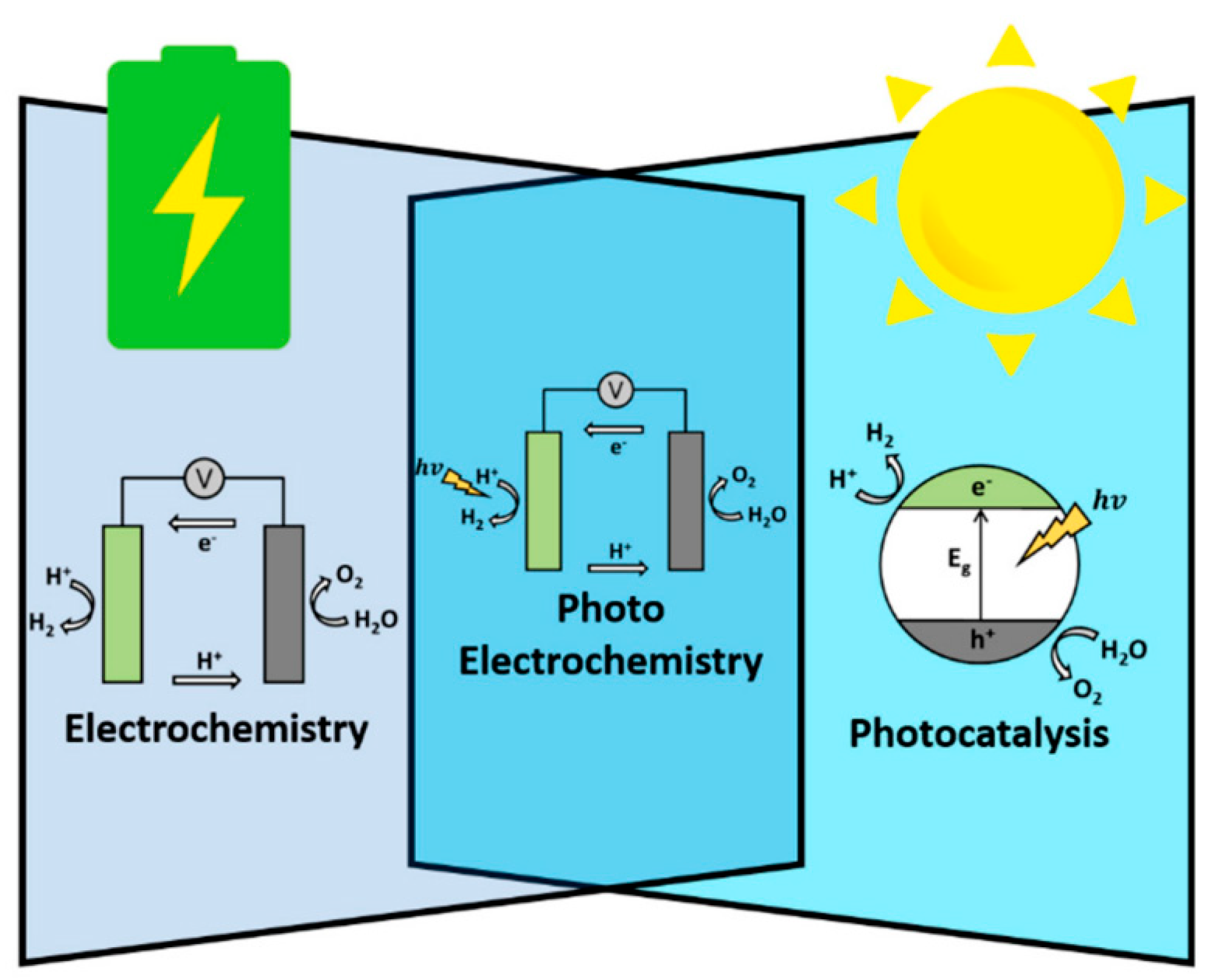
Figure 2.
Atomistic representation of the BaTiO₃ polymorphs structures in different phases: (a) cubic, (b) rhombohedral, (c) orthorhombic, (d) tetragonal, and (e) hexagonal [39].Reprinted with permission from [39]. Copyright 2023, for Elsevier.
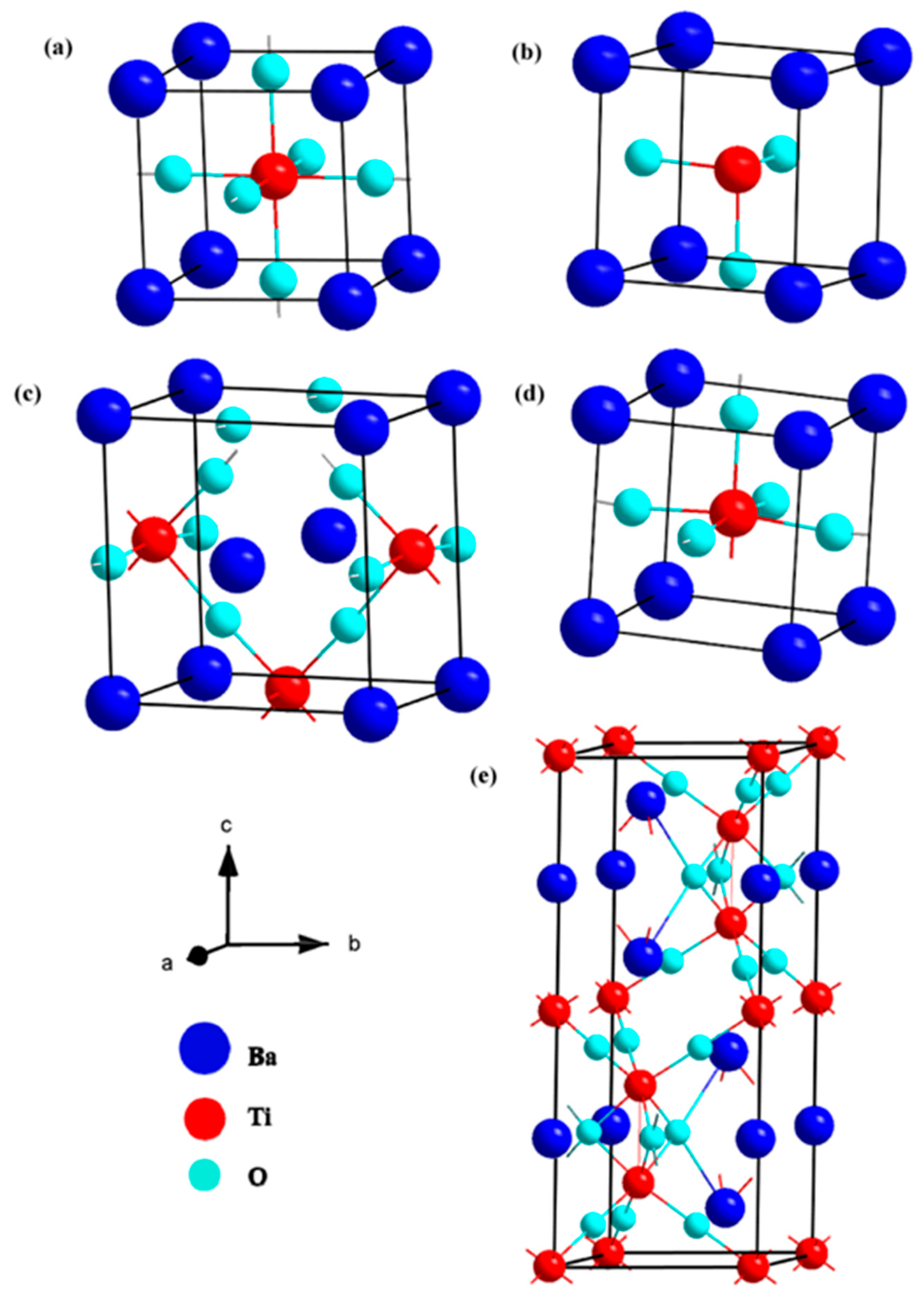
Figure 3.
Illustration of different scales in computational engineering and material design. Reprinted with permission from [57,58,59,60,61]. Copyright 2024, for MDPI [57], copyright 2022, for the Elsevier [58], copyright 2024, for the arXiv [59], copyright 2013, for the MDPI [60], copyright 2020, for the American Chemical Society [61].
Figure 3.
Illustration of different scales in computational engineering and material design. Reprinted with permission from [57,58,59,60,61]. Copyright 2024, for MDPI [57], copyright 2022, for the Elsevier [58], copyright 2024, for the arXiv [59], copyright 2013, for the MDPI [60], copyright 2020, for the American Chemical Society [61].
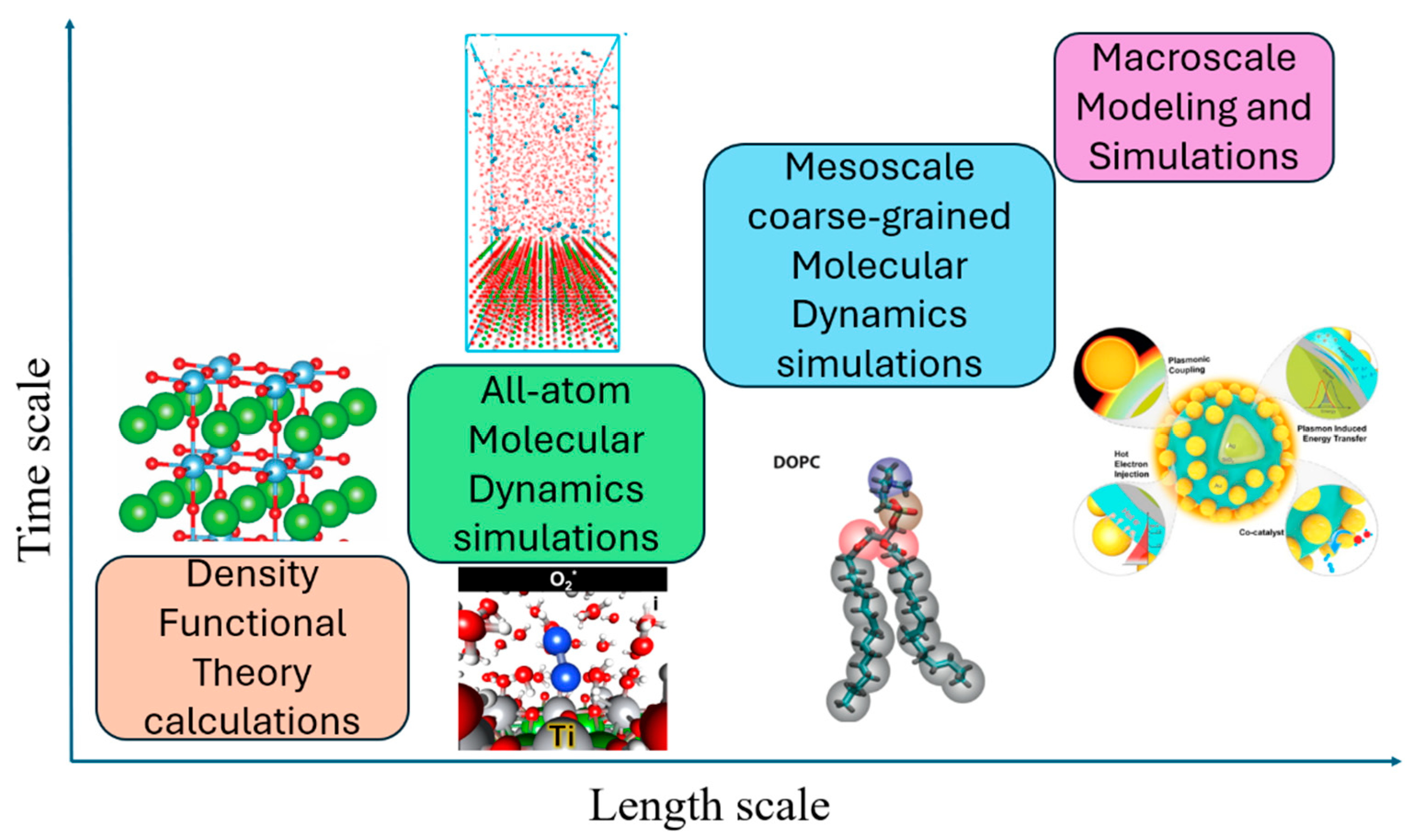
Figure 7.
Interface reaction mechanism: (a) DOS configuration file for BTPOv-0.09, (b) top and side views of charge distribution in BTPOv-0.09, (c) EIS Nyquist plots of BTO, BTPO-0.09, and BTPOv-0.09 under dark and light conditions, and (d) reaction mechanism diagram of BTPOv-0.09.Reprinted with permission from [153]. Copyright 2024, for Elsevier [153].
Figure 7.
Interface reaction mechanism: (a) DOS configuration file for BTPOv-0.09, (b) top and side views of charge distribution in BTPOv-0.09, (c) EIS Nyquist plots of BTO, BTPO-0.09, and BTPOv-0.09 under dark and light conditions, and (d) reaction mechanism diagram of BTPOv-0.09.Reprinted with permission from [153]. Copyright 2024, for Elsevier [153].
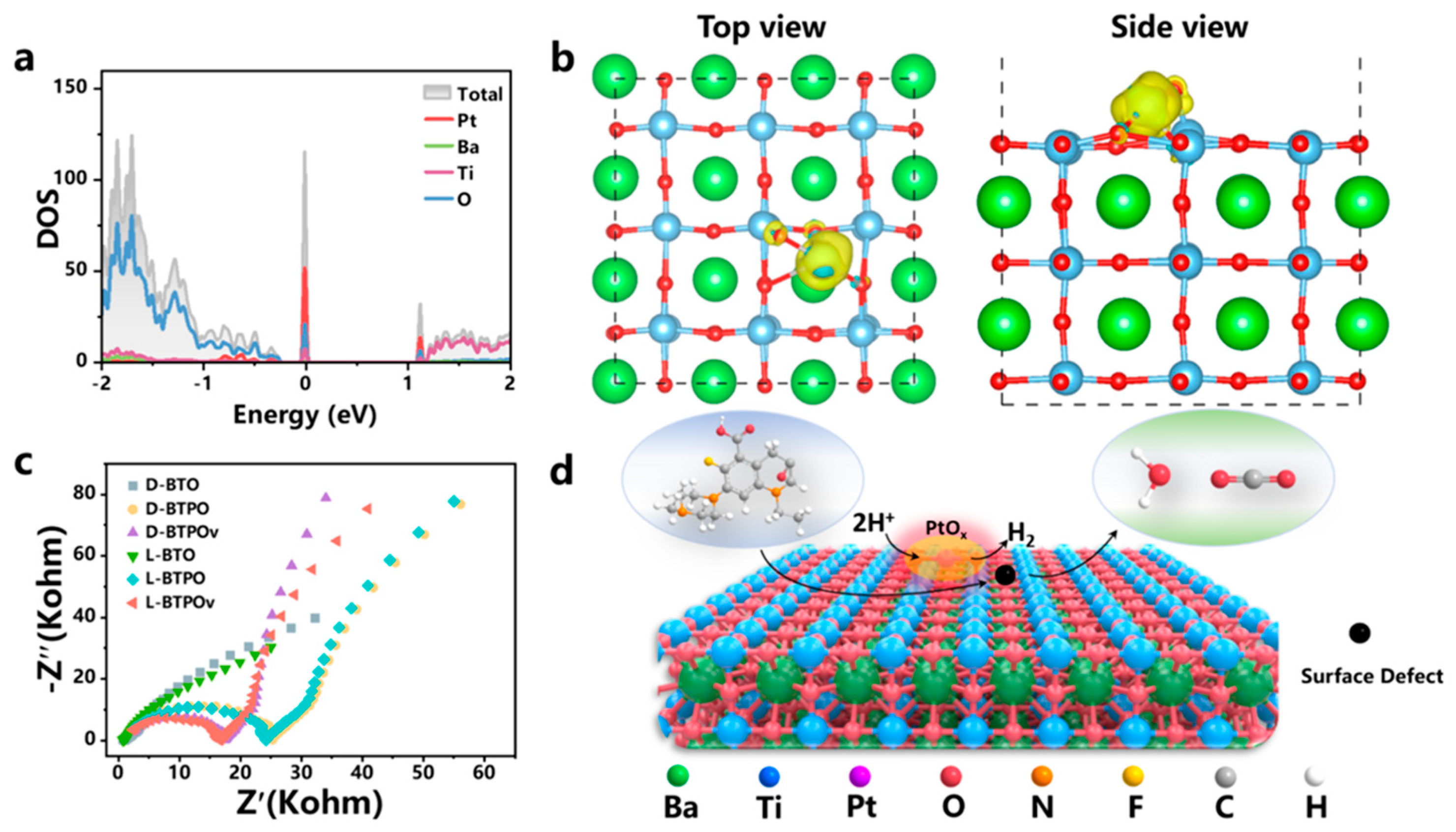
Figure 9.
Representations of the ab initio MD simulations, depicting (a) a model with water molecules and a single oxygen molecule before the catalytic reaction and (b) after the reaction. It also includes (c) a model of a single OOH radical before the reaction, (d) the conversion of two OOH radicals into a single H₂O₂ and O₂ molecule, and (e) OH radicals derived from H₂O₂ after the reaction. Reprinted with permission from [185]. Copyright 2024, for the American Chemical Society [185].
Figure 9.
Representations of the ab initio MD simulations, depicting (a) a model with water molecules and a single oxygen molecule before the catalytic reaction and (b) after the reaction. It also includes (c) a model of a single OOH radical before the reaction, (d) the conversion of two OOH radicals into a single H₂O₂ and O₂ molecule, and (e) OH radicals derived from H₂O₂ after the reaction. Reprinted with permission from [185]. Copyright 2024, for the American Chemical Society [185].
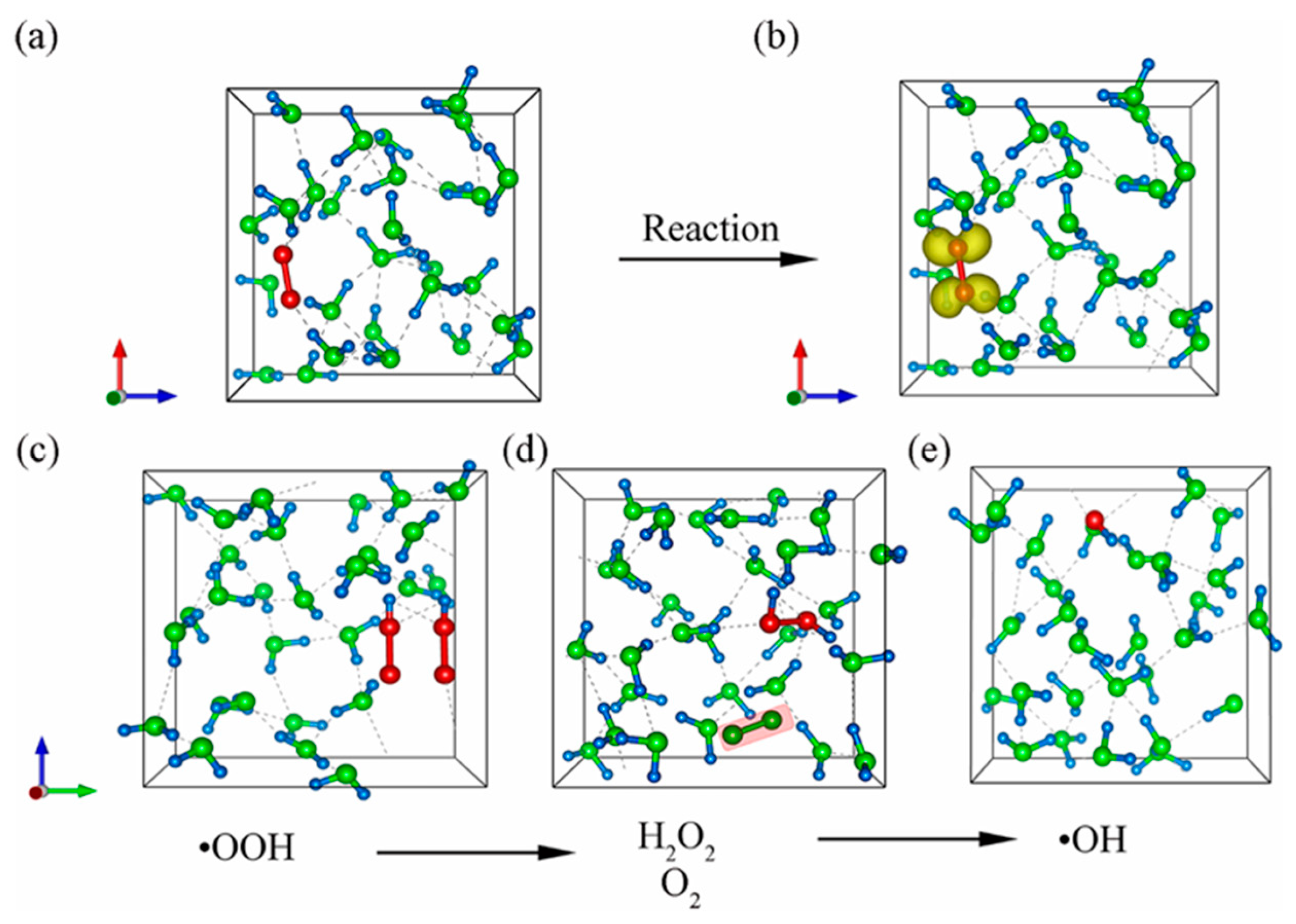
Figure 10.
Adsorption of OH⁻ ions on the BaTiO₃ surface at different H₂O:OH⁻ ratios including (a) unpolarized and (d) positively polarized (0.01 V Å⁻¹) BaTiO₃ surface at an H₂O:OH⁻ ratio of 30:1, (b) unpolarized and (e) positively polarized (0.01 V Å⁻¹) BaTiO₃ surface at an H₂O:OH⁻ ratio of 10:1, (c) unpolarized and (f) positively polarized (0.01 V Å⁻¹) BaTiO₃ surface at an H₂O:OH⁻ ratio of 50:1.Reprinted with permission from [58]. Copyright 2022, for the Elsevier [58].
Figure 10.
Adsorption of OH⁻ ions on the BaTiO₃ surface at different H₂O:OH⁻ ratios including (a) unpolarized and (d) positively polarized (0.01 V Å⁻¹) BaTiO₃ surface at an H₂O:OH⁻ ratio of 30:1, (b) unpolarized and (e) positively polarized (0.01 V Å⁻¹) BaTiO₃ surface at an H₂O:OH⁻ ratio of 10:1, (c) unpolarized and (f) positively polarized (0.01 V Å⁻¹) BaTiO₃ surface at an H₂O:OH⁻ ratio of 50:1.Reprinted with permission from [58]. Copyright 2022, for the Elsevier [58].
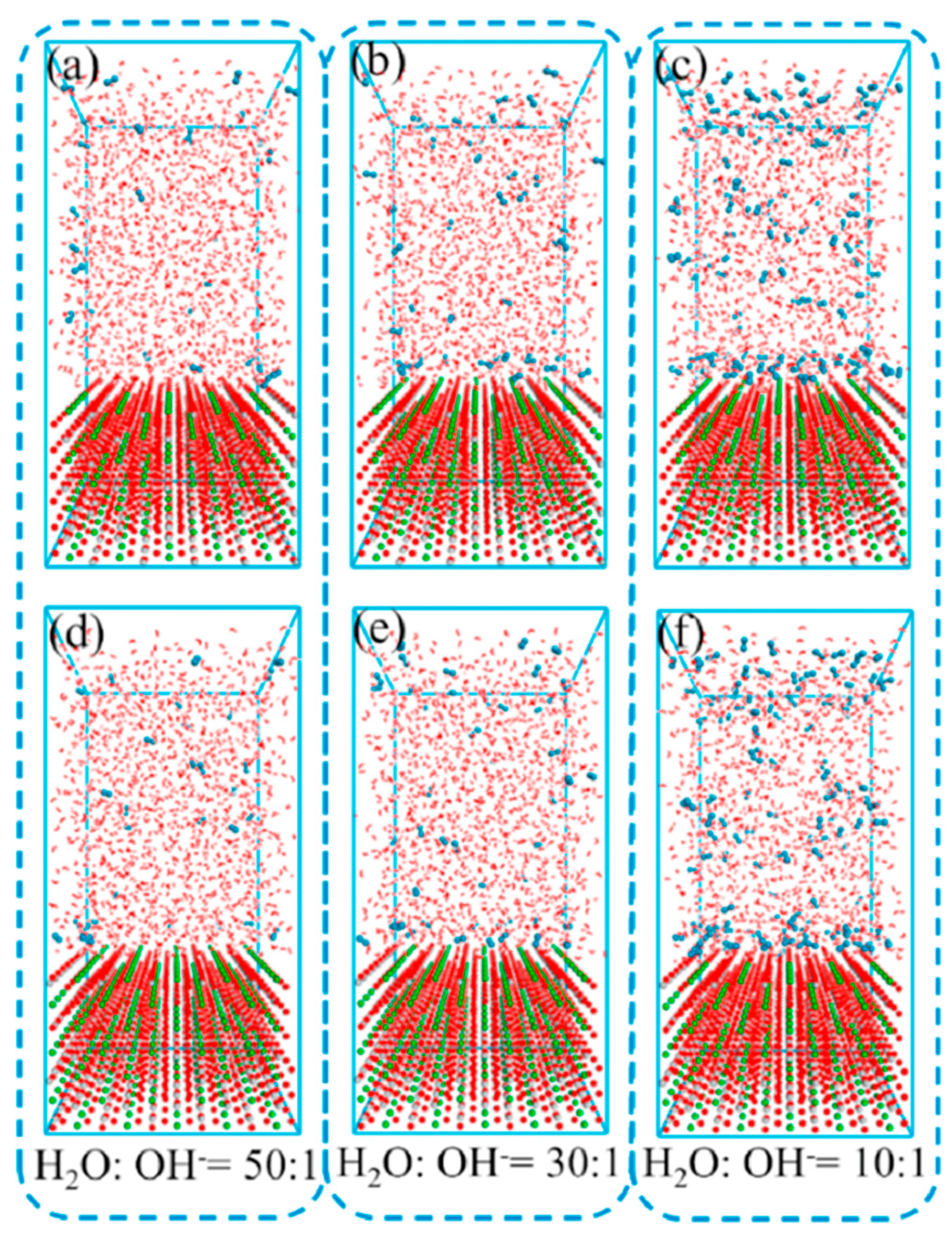
Table 2.
Recently performed ab initio MD simulation details and main findings.
| Designed systems | Methods | Main findings |
| BaTiO₃ surface [59] | - Spin-polarized DFT calculations (VASP) with PAW pseudopotentials and RPBE+D3 functional. - High plane-wave cutoff (520 eV). - Dataset of 16,162 configurations, trained with a 95:5 train-validation split, utilizing a multi-layer perceptron (tanh activation). - MLP models trained using PyTorch with AUC inter-atomic descriptors - MD simulations with MACE-mp-0 model (ASE) MD simulations were conducted at 300 K, 500 K, and 700 K for 50 ps using a pre-trained MACE model. - Production MD simulations: Accelerated with MLP models and run for 500 ps at 300 K with a timestep of 0.25 fs. - Metadynamics simulations: Explored oxygen evolution reaction mechanisms using coordination number as collective variables and studied oxygen desorption by tracking Ti-O₂/Ni-O₂ distances. - Well-tempered Metadynamics simulations using PLUMED2-LAMMPS under NVT ensemble |
- The energy barrier for oxygen desorption is lower than for oxygen evolution reaction, leading to the choice of specific metadynamics parameters (Gaussian height = 0.01 eV, width = 0.05, deposition rate = 6.25 fs). - Water dissociation on the surface forms OH* intermediates with a free energy barrier (∆G‡ H2O→OH) of 0.06 eV for BaTiO₃. - Oxygen evolution reaction steps analyzed using coordination number as collective variables. - Formation of OOH* species occurs when coordination number (Os-Oaw) ≈ 0.3. - Transition from OOH* to O2* is barrierless with rapid proton abstraction. - The calculated free energy barrier for the O→O2 transition (∆G‡ O→O2) is 1.57 eV for BaTiO₃ and 1.20 eV for Ni@BaTiO₃. - The oxygen desorption step is endothermic, with ∆GO→O2 values of 1.37 eV for BaTiO₃ and 0.97 eV for Ni@BaTiO₃. - MLP models enable longer simulation times with DFT-level accuracy, improving efficiency compared to ab initio MD. |
| CTF/BaTiO₃ photoanodes [185] | - DFT calculations using VASP 6.3.0 - Perdew-Burke-Ernzerhof (PBE) functional within GGA - Plane wave energy cutoff: 500 eV - k-mesh: 8 × 8 × 8 for bulk and 3 × 2 × 1 for supercell BaTiO3-x - BaTiO3-x slab modeled with (001) surface and (3 × 3 × 1) supercell with 30 Å vacuum - CTF/BaTiO3-x model constructed by depositing CTF on BaTiO3-x slab |
- Introduction of CTF reduces the rate-determining step energy barrier from 1.03 eV to 0.84 eV, enhancing oxygen evolution reactionkinetics. - The CTF/BaTiO3-x photoanode achieves a high photocurrent density of 0.83 mA/cm² at 1.23 V (vs. RHE) and a low onset potential of 0.23 V (vs. RHE). - CTF acts as a protective layer, improving stability for real water redox reactions. - Provides a universal strategy for organic/inorganic hybrid photoanodes with high photoconversion efficiency. |
Table 3.
Recently performed classical all-atom MD simulation details and main findings.
| Designed systems | Methods | Main findings |
|
BaTiO3 surface and its interaction with OH- ions in an electrolyte [59] |
- DFT calculation - CASTEP module in Materials Studio - Classical all-atom MD simulations - Forcite module in Materials Studio - COMPASSIII force field - Electric field of 0.01 eV/Å applied to study positive polarization effects. |
- Higher OH- concentration leads to increased adsorption on the BaTiO surface. - At a 10:1 (H2O:OH-) ratio, adsorption is significantly higher compared to a 50:1 ratio. - At a 50:1 (H2O:OH-) ratio, polarization significantly impacts OH- adsorption, but at higher OH- concentrations, the effect diminishes. - Polarization field enhances photoanode performance in near-neutral conditions by improving surface states and hole collection efficiency. |
Disclaimer/Publisher’s Note: The statements, opinions and data contained in all publications are solely those of the individual author(s) and contributor(s) and not of MDPI and/or the editor(s). MDPI and/or the editor(s) disclaim responsibility for any injury to people or property resulting from any ideas, methods, instructions or products referred to in the content. |
© 2025 by the authors. Licensee MDPI, Basel, Switzerland. This article is an open access article distributed under the terms and conditions of the Creative Commons Attribution (CC BY) license (http://creativecommons.org/licenses/by/4.0/).
Copyright: This open access article is published under a Creative Commons CC BY 4.0 license, which permit the free download, distribution, and reuse, provided that the author and preprint are cited in any reuse.


