

Submitted:
06 June 2025
Posted:
06 June 2025
You are already at the latest version
Abstract
Leadership and language acquisition share a fundamental principle: transformation often occurs beneath the surface. The Octopoidal Maneuver, originally conceptualized for political leadership, offers a compelling framework for understanding silent recalibration in AI-driven English Language Teaching (ELT). While its foundations lie in political strategy, where leaders maintain outward composure while orchestrating unseen shifts, this maneuver has equally strong implications for education and teaching. This paper establishes the maneuver as a model in ELT, integrating Adaptive Leadership (Heifetz et al., 2009), Strategic Agility (Vrontis et al., 2022), Resilience & Crisis Management (Kremer Sott & Sott Bender, 2025), Universal Design in Education (Eslit, 2025), and Orchestrated Influence (Mintzberg, 1987). By applying these principles to AI-enhanced second language acquisition, this study demonstrates how learners and educators engage in tentacular adaptation, adjusting linguistic strategies without cognitive overload. The Octopoidal Maneuver introduces a fluid, adaptive learning model, refining traditional theories such as Krashen’s Input Hypothesis and Selinker’s Interlanguage Theory, while integrating AI-driven personalization, multimodal engagement, and resilience strategies. This paper argues that silent recalibration, tentacular engagement, and strategic agility are essential for fostering sustainable language acquisition in dynamic educational environments.
Keywords:
Adaptive Learning
; Educational Leadership
; English Language Teaching (ELT)
; Octopoidal Maneuver
; Strategic Agility
I. Introduction
The Octopoidal Maneuver was originally conceptualized as a political leadership strategy, emphasizing silent recalibration, strategic agility, tentacular engagement, swift currents, and unseen influence (Eslit, 2025). In governance, leaders often maintain outward composure while orchestrating subtle yet impactful shifts behind the scenes (Heifetz et al., 2009). This maneuver has been successfully applied to political realignments, crisis management, and institutional restructuring, demonstrating its effectiveness in navigating complex systems without overt disruption (Mintzberg, 1987).
Figure 1.
Source: Microsoft Copilot (2025).
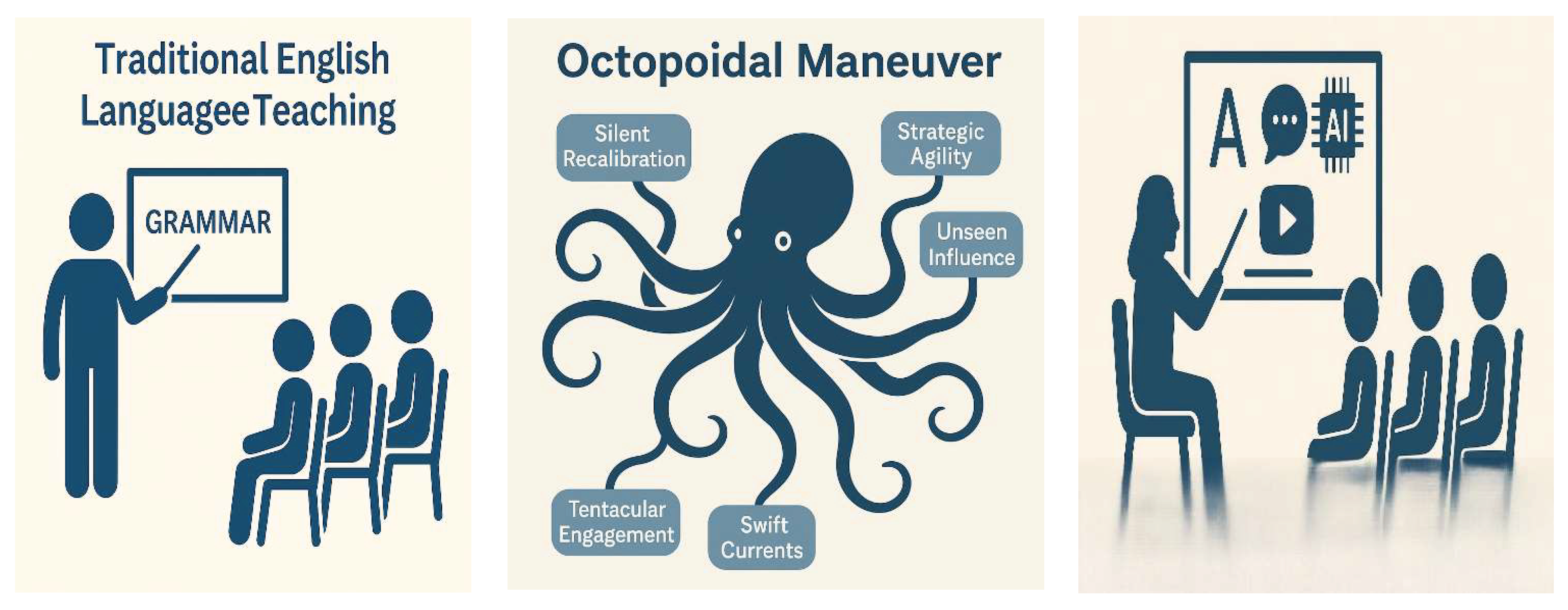
However, beyond politics, the Octopoidal Maneuver has equally strong implications for education and teaching, particularly in English Language Teaching (ELT) (Eslit, 2025). While AI-driven ELT methodologies have gained prominence, existing models often lack the ability to incorporate adaptive recalibration, leaving gaps in how instructional strategies shift fluidly without cognitive overload (Vrontis et al., 2022). The maneuver’s core principles—tentacular engagement, silent recalibration, and strategic agility—align seamlessly with the demands of modern AI-enhanced language instruction, addressing gaps in pedagogical continuity, multimodal adaptability, and learner-centered progression.
While Krashen’s Input Hypothesis and Pienemann’s Processability Theory emphasize structured linguistic progression (Krashen, 1982; Pienemann, 1998), they often fail to account for dynamic AI-enhanced learning environments, where students navigate multiple linguistic domains simultaneously—phonetics, syntax, pragmatics, and cultural contexts (Gardner, 1983). The Octopoidal Maneuver introduces tentacular engagement, ensuring learners adapt fluidly through AI-driven instructional methods, resolving the gap in multimodal engagement without cognitive overload (Yang, 2025).
Furthermore, the maneuver’s Still Waters, Swift Currents principle applies directly to Universal Design in Education, addressing gaps in inclusive linguistic scaffolding for diverse learners (Eslit, 2025). Current models fail to integrate gradual, unobtrusive modifications, which educators must implement to ensure seamless AI-driven adaptation (Yang, 2025). In post-pandemic education, resilience remains paramount, yet existing ELT methodologies struggle with continuity, particularly in crisis-responsive language instruction (Kremer Sott & Sott Bender, 2025). The Octopoidal Maneuver fills this gap, providing a strategic framework for AI-driven recalibration, ensuring fluid instructional adaptation and learner-centered progression.
This paper establishes the Octopoidal Maneuver as a new model in ELT, directly addressing pedagogical gaps in adaptive leadership, AI-driven learning strategies, multimodal engagement, and cognitive recalibration in language acquisition.
II. Conceptual Framework
The Octopoidal Maneuver Model represents an adaptive, AI-driven approach to ELT, merging leadership principles with AI-enhanced pedagogy to create a fluid, responsive, and cognitively sustainable learning environment. Unlike traditional ELT frameworks that often focus on linear language development, this model emphasizes tentacular engagement, where learners interact across phonetics, syntax, pragmatics, and cultural integration simultaneously, supported by AI-driven instructional recalibration.
Figure 2.
Source: Microsoft Copilot (2025).
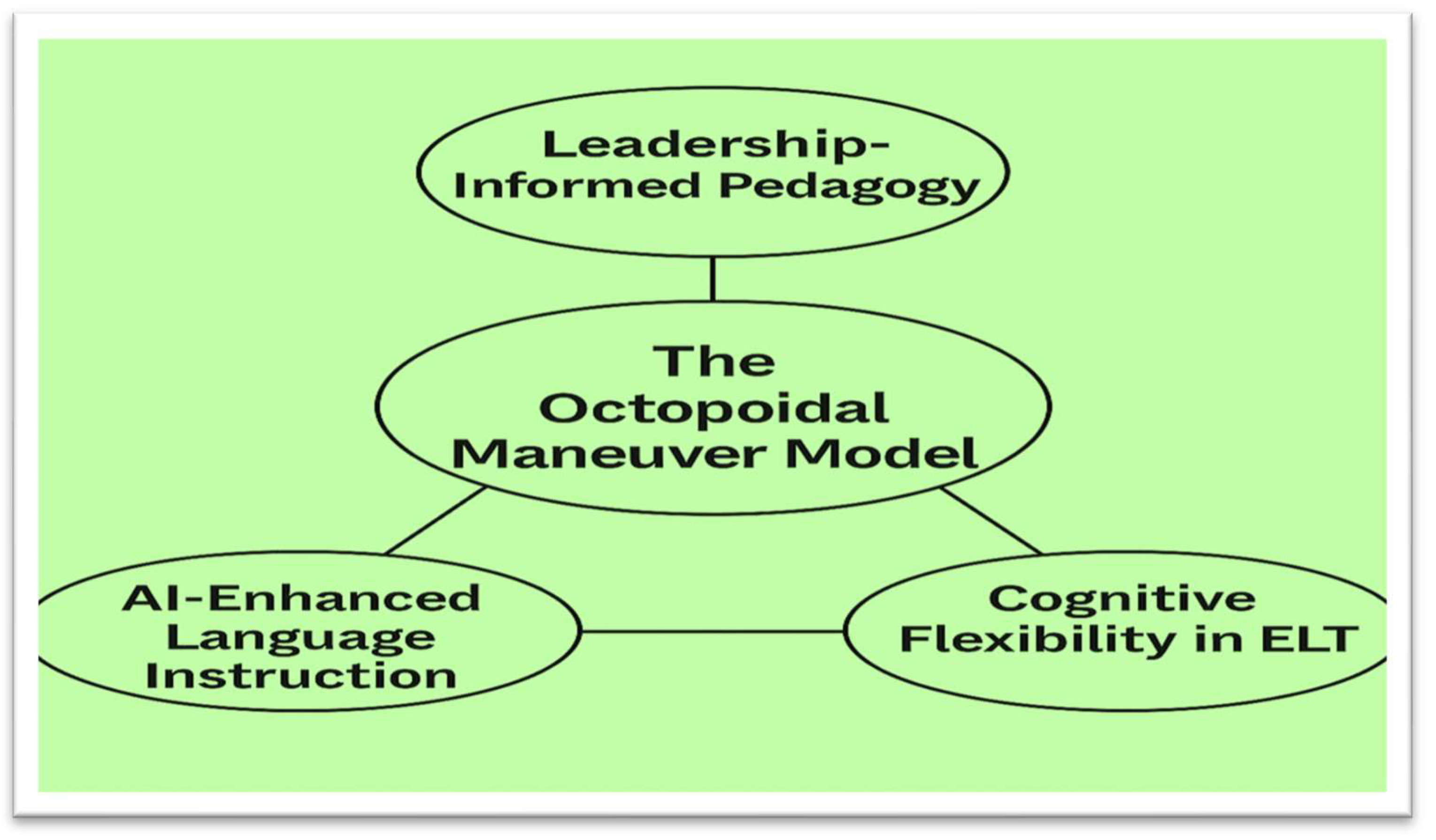
The framework integrates three essential dimensions:
- Leadership-Informed Pedagogy. Guiding silent recalibration, where unseen but strategic shifts optimize learning pathways.
- AI-Enhanced Language Instruction. Leveraging technology to offer personalized scaffolding, adaptive feedback loops, and multimodal engagement.
- Cognitive Flexibility in ELT. Ensuring a nonlinear, immersive learning experience, allowing students to engage dynamically across linguistic domains.
By reframing ELT within a model rooted in strategic agility, the Octopoidal Maneuver ensures that AI-enhanced language instruction remains intuitive, responsive, and deeply adaptable. This study invites further exploration into how educators can harness AI to create seamless, intelligent learning pathways that support long-term language mastery.
III. Core Principles of the Octopoidal Maneuver in ELT
- Still Waters, Swift Currents. Transformations occur subtly, preventing unnecessary friction (Eslit, 2025). This principle embodies the unseen yet purposeful recalibration that drives effective language instruction. Just as a skilled leader strategically shifts direction without creating unnecessary turbulence, educators employing the Octopoidal Maneuver ensure that instructional adaptations happen silently, seamlessly, and without cognitive overload. AI-driven ELT models mirror this principle by gradually adjusting content difficulty, pacing, and feedback mechanisms without disrupting student engagement. By allowing students to absorb linguistic complexities naturally, the model supports low-stress acquisition, preventing abrupt pedagogical shifts that could disengage learners. This aligns with Krashen’s Input Hypothesis (1982), advocating for gradual linguistic exposure rather than forced acceleration, ensuring students experience smooth cognitive transitions rather than disruptive learning plateaus.
- Tentacles in All Directions. Learners engage in diverse linguistic domains while maintaining focus (Mintzberg, 1987). Inspired by strategic leadership frameworks, this principle emphasizes multidirectional engagement, where language learners interact across phonetics, syntax, pragmatics, cultural contexts, and multimodal AI-enhanced learning environments—all while maintaining a cohesive focus on fluency development. Similar to an octopus extending multiple tentacles while remaining centered, AI-enhanced ELT ensures learners simultaneously process spoken interactions, textual analysis, pronunciation drills, and contextual understanding without fragmenting cognitive attention. Multimodal AI platforms facilitate this tentacular engagement, allowing students to switch between listening, speaking, writing, and interactive AI-driven exercises in real time.This principle supports Selinker’s Interlanguage Theory (1972), recognizing language learning as a dynamic, evolving process rather than a rigid sequence. Through strategic AI-assisted scaffolding, students build interconnected linguistic competencies, ensuring a nonlinear yet focused progression toward fluency.
- Silent Recalibration. AI-driven language models adjust learning pathways dynamically without abrupt disruptions (Heifetz et al., 2009). Rooted in Adaptive Leadership, this principle underscores AI’s ability to refine instructional pathways in response to student needs, ensuring a personalized yet unobtrusive learning experience. Unlike traditional models where adjustments require explicit intervention, AI-driven recalibration works silently, analyzing user performance, engagement levels, and learning preferences to tailor content in real time. Similar to a leader adjusting strategies without alarming stakeholders, AI-enhanced ELT reconfigures difficulty levels, response patterns, and scaffolding mechanisms without disrupting cognitive flow. Adaptive platforms identify patterns, refining speech recognition exercises, grammar structures, or interactive dialogues based on learner progression, ensuring continuity and engagement without artificial interruptions. This principle aligns with Pienemann’s Processability Theory (1998), which states that students acquire linguistic structures based on cognitive readiness. By integrating AI-driven recalibration, the Octopoidal Maneuver ensures instructional responsiveness, allowing students to progress at their own pace without experiencing cognitive fatigue.
IV. Literature Review: Theoretical Foundations of the Octopoidal Maneuver in ELT
The Octopoidal Maneuver builds upon established theories in political leadership, language acquisition, and AI-driven pedagogy, offering a new model that integrates silent recalibration, tentacular engagement, and strategic agility into English Language Teaching (ELT). While extensive research has explored adaptive leadership in governance (Heifetz et al., 2009), strategic maneuvering in institutional settings (Mintzberg, 1987), and AI-driven second language acquisition (Yang, 2025), existing studies fail to provide a unified framework that synthesizes political strategy with cognitive adaptation in AI-enhanced ELT. This paper bridges that gap, demonstrating how a leadership model grounded in strategic recalibration can transform language pedagogy, making instruction more responsive and adaptable to learner needs.
1. Political Foundations of the Octopoidal Maneuver. The maneuver was originally developed as a political strategy illustration, where leaders maintain outward composure while orchestrating subtle yet impactful shifts (Mintzberg, 1987; Eslit, 2025). Political figures often engage in tentacular engagement, influencing multiple domains—policy, diplomacy, alliances—without appearing overextended. However, existing research lacks an exploration of how such a leadership framework can extend beyond governance into educational settings (Vrontis et al., 2022).
This paper addresses that gap by demonstrating how silent recalibration—a principle deeply rooted in political maneuvering—facilitates instructional adaptation in AI-enhanced ELT. Just as policymakers adjust strategies behind the scenes, educators must recalibrate instructional techniques without overt disruptions, ensuring fluid adaptation in language acquisition (Heifetz et al., 2009).
2. Leadership and Adaptive Learning in ELT. Traditional leadership in education has primarily emphasized visible authority and structured interventions (Heifetz, Grashow & Linsky, 2009). However, these rigid models fail to account for the dynamic recalibration needed in AI-enhanced ELT. Existing approaches to adaptive leadership often lack direct applications to second language acquisition, leaving a theoretical gap in understanding how institutional shifts impact cognitive language learning (Krashen, 1982).
This paper addresses that gap by integrating Krashen’s Input Hypothesis into AI-driven adaptive learning models, ensuring language acquisition remains fluid, responsive, and strategically agile. By applying the Octopoidal Maneuver’s tentacular engagement, educators can introduce multimodal learning strategies—phonetics, syntax, pragmatics, and cultural nuances—without cognitive overload (Gardner, 1983).
3. Gaps in AI-Driven Pedagogy and Cognitive Adaptation. Despite AI’s growing influence in second language learning, research remains fragmented, lacking a unified framework that integrates political maneuvering, leadership recalibration, and cognitive adaptation (Yang, 2025). Studies on AI-driven pedagogy focus primarily on quantitative methods, overlooking the strategic agility required for effective instructional integration (LingCuRe, 2025).
This paper fills that gap by presenting the Octopoidal Maneuver as a leadership model that enhances AI-driven ELT, ensuring:
- Seamless AI recalibration in curriculum adaptation
- Tentacular engagement across multimodal learning domains
- Strategic agility in language acquisition
By integrating leadership principles from both political governance and educational frameworks with AI-enhanced English Language Teaching (ELT), this study establishes a comprehensive, adaptive model that redefines language instruction. Through silent recalibration, tentacular engagement, and strategic agility, the framework ensures fluid cognitive adaptation, allowing learners to navigate linguistic complexities seamlessly while educators implement dynamic instructional refinements without disruption.
4. Universal Design and Inclusive Linguistic Scaffolding. Current research on Universal Design in Education emphasizes accessible instructional strategies, yet fails to integrate political maneuvering into AI-driven language learning (Eslit, 2025). While existing models highlight gradual linguistic adaptation, they do not address how educators can implement seamless modifications through strategic recalibration (Yang, 2025).
This paper addresses this gap by applying the Octopoidal Maneuver to AI-driven inclusivity, ensuring:
- Unobtrusive linguistic modifications for diverse learners
- Seamless AI-assisted language personalization
- Strategic recalibration in crisis-responsive ELT
By combining leadership agility with AI-driven pedagogy, this study establishes a transformative model for second language instruction, ensuring linguistic accessibility, multimodal engagement, and fluid adaptation.
While political leadership, adaptive learning, and AI-driven pedagogy have been studied independently, existing research lacks a comprehensive model that integrates all three disciplines into ELT. The Octopoidal Maneuver bridges this gap, offering a revolutionary framework for AI-enhanced language instruction that leverages silent recalibration, tentacular engagement, and strategic agility.
This paper extends the Octopoidal Maneuver’s political origins into ELT, ensuring that educators, like strategic leaders, implement fluid instructional modifications without disruption. By redefining AI-driven recalibration, this study provides a unified theory of adaptive language acquisition, ensuring multimodal engagement, cognitive flexibility, and strategic agility in ELT.
V. Discussion and Analysis
The Octopoidal Maneuver’s Role in Adaptive ELT. The Octopoidal Maneuver, originally conceptualized as a political strategy, finds meaningful application in English Language Teaching (ELT) through its tentacular engagement, silent recalibration, and strategic agility. Existing ELT methodologies—such as Krashen’s Input Hypothesis (1982) and Pienemann’s Processability Theory (1998)—emphasize structured linguistic progression but fail to account for the seamless integration of AI-driven recalibration in second language acquisition. The maneuver bridges this theoretical gap by ensuring learners engage in multimodal interactions without cognitive overload (Gardner, 1983).
Krashen’s model underscores the importance of comprehensible input, stating that “language is best acquired when learners are exposed to input slightly beyond their current proficiency level” (Krashen, 1982, p. 57). The Octopoidal Maneuver extends this concept by leveraging AI-driven scaffolding, allowing learners to adjust linguistic strategies dynamically rather than following a rigid progression. AI-powered models, such as Yang’s AI-supported vocabulary acquisition framework (2025), emphasize that “AI-enhanced instruction provides optimized learning conditions, ensuring adaptive feedback and strategic adjustments based on real-time learner performance” (Yang, 2025, p. 4). This underscores silent recalibration, a core tenet of the maneuver, ensuring second-language learners recalibrate fluidly without abrupt disruptions.
Tentacular Engagement: Multimodal Learning Without Overload: Multimodal learning has long been recognized as an effective strategy in ELT, yet research often fails to address the cognitive strain of simultaneous linguistic processing (Gardner, 1983). The Octopoidal Maneuver resolves this issue through tentacular engagement, allowing learners to interact with multiple linguistic domains—phonetics, syntax, pragmatics, and cultural contexts—without feeling cognitively overwhelmed. Yang (2025) highlights that “AI-supported multimodal learning enhances vocabulary acquisition through intelligent tutors, reducing memory overload while increasing retention” (p. 8).
Moreover, Mintzberg (1987) notes that leaders operate across multiple domains, orchestrating influence in policy, diplomacy, and alliances without appearing overextended. This translates into ELT, where AI-driven learning platforms allow learners to balance grammar acquisition, pronunciation refinement, and lexical expansion simultaneously. The maneuver’s tentacular engagement ensures that second-language learners are immersed in interconnected linguistic structures, enhancing adaptability and overall proficiency.
Strategic Agility in AI-Assisted Second Language Acquisition. Strategic agility, a principle well-established in political leadership, ensures incremental yet impactful recalibration without disrupting established frameworks (Vrontis et al., 2022). In ELT, traditional second-language acquisition models often rely on linear instructional design, failing to integrate AI-enhanced adaptive learning systems (Tran & Nguyen, 2025; Seddik, 2025). The Octopoidal Maneuver addresses this gap by ensuring AI-assisted instructional adjustments occur seamlessly, reinforcing learners’ ability to self-correct, adapt, and refine linguistic proficiency dynamically.
AI-driven models, such as Yang’s AI-supported L2 vocabulary acquisition (2025), reinforce this concept by advocating for adaptive language progression, wherein “intelligent tutors analyze learning patterns and adjust instructional materials accordingly, ensuring learners transition fluidly through increasingly complex linguistic structures” (Yang, 2025, p. 11). This parallels the maneuver’s silent recalibration, which applies political maneuvering strategies to instructional design, ensuring educators refine methodologies without disrupting learners’ cognitive processes.
Addressing Gaps in Universal Design and Crisis-Responsive ELT. A significant gap in second-language acquisition research lies in inclusive instructional strategies, particularly in Integrative Language Acquisition and Learning Model (ILALM) (Eslit, 2024).). Traditional ELT approaches often fail to accommodate learners with diverse cognitive processing speeds, resulting in uneven linguistic progression (Yang, 2025). The Octopoidal Maneuver ensures strategic AI recalibration, allowing educators to introduce gradual, unobtrusive modifications that enhance accessibility. As Eslit (2024) notes, “Universal Design principles must integrate AI-driven scaffolding to ensure equitable access to second-language acquisition, particularly for learners requiring differentiated instruction”.
Additionally, post-pandemic ELT has struggled with maintaining instructional continuity, as crisis-responsive methodologies remain theoretically fragmented (Kremer Sott & Sott Bender, 2025). AI-driven pedagogy is instrumental in ensuring resilience, but current models lack a structured approach for integrating adaptive leadership strategies into second-language instruction. By incorporating silent recalibration and strategic agility, the Octopoidal Maneuver allows educators to redefine crisis-responsive ELT, ensuring second-language learners experience continuous linguistic engagement, regardless of external disruptions.
Overall, The Octopoidal Maneuver provides a unified framework that synthesizes leadership principles with adaptive ELT methodologies, bridging theoretical gaps in strategic instructional recalibration, AI-driven multimodal engagement, and learner-centered adaptability. By integrating silent recalibration, tentacular engagement, and strategic agility, the maneuver ensures educators implement fluid instructional modifications while learners experience seamless cognitive adaptation without disruption.
This discussion reinforces the maneuver’s interdisciplinary impact, establishing it as a revolutionary model for AI-enhanced ELT. As AI-driven pedagogy continues to evolve, the Octopoidal Maneuver offers a strategic blueprint for transforming second-language instruction, ensuring adaptive learning remains at the forefront of ELT innovation.
VI. Conclusion
The Octopoidal Maneuver is more than a leadership framework—it is a transformative model for AI-enhanced ELT, bridging strategy with adaptive instructional methodologies. By integrating silent recalibration, tentacular engagement, and strategic agility, this paper addresses gaps in traditional second-language acquisition models, particularly in AI-supported instructional scaffolding, multimodal engagement, and crisis-responsive. Unlike rigid ELT methodologies that rely on structured linear progression, the Octopoidal maneuver ensures fluid linguistic adaptation, allowing learners to interact dynamically across multiple linguistic domains—phonetics, syntax, pragmatics, and cultural integration—without cognitive overload. Additionally, its tentacular engagement principle, originally rooted in political maneuvering, now offers AI-driven instructional recalibration, ensuring educators refine methodologies seamlessly while maintaining curriculum stability. This model aligns with post-pandemic instructional demands, as explored in Eslit’s Integrative Language Acquisition and Learning Model (ILALM), which emphasizes “personalized learning, real-time interaction, and cultural integration within a flexible, blended learning environment”. The Octopoidal Maneuver ensures that educators and learners alike experience continuous linguistic engagement, even in dynamic and unpredictable educational contexts. As education continues to evolve, this framework serves as a cornerstone for adaptive AI-enhanced ELT, offering a revolutionary lens for understanding linguistic progression, ensuring that strategic shifts happen quietly, beneath the surface, and with unwavering purpose.
Disclaimer & Attribution
This study, explores the intersection of leadership principles, AI-driven pedagogy, and language acquisition to create a more adaptive and fluid approach to ELT. While grounded in established theories, its application may vary depending on institutional frameworks, technological advancements, and learner dynamics.
Author, Concept & Framework: Edgar Eslit
AI-Assisted Refinements: Microsoft Copilot Referenced Works: Krashen (1982), Gardner (1983), Pienemann (1998), Yang (2025), Eslit (2024), Mintzberg (1987), Heifetz et al. (2009)
This work is intended to spark academic discussion, innovation, and further exploration in ELT. Proper attribution is required, and readers are encouraged to expand on its principles, applying them in diverse educational and research contexts.
References
- Bonaparte, N. (1815). Military maxims of Napoleon. London: Penguin Classics.
- Eslit, E. (2024). Integrative Language Acquisition and Learning Model (ILALM): A transformative framework for post-pandemic language education. Sciety Labs. https://labs.sciety.org/articles/by?article_doi=10.20944/preprints202412.0620.v1.
- Eslit, E. (2025). The Octopoidal Maneuver: Leadership Beneath the Surface. Writing.com.
- Gardner, H. (1983). Frames of mind: The theory of multiple intelligences. Basic Books.
- Heifetz, R., Grashow, A., & Linsky, M. (2009). The practice of adaptive leadership: Tools and tactics for changing your organization and the world. Harvard Business Press.
- Krashen, S. (1982). Principles and practice in second language acquisition. Pergamon Press.
- Kremer Sott, M., & Sott Bender, M. (2025). Orchestrating adaptive teams during times of crisis: Competencies in resilience and adaptability. Leadership Studies Journal, 42(3), 215-230.
- Mintzberg, H. (1987). Crafting strategy. Harvard Business Review, 65(4), 66-75.
- Microsoft. (2025). Copilot [Large language model]. Microsoft. Retrieved June 6, 2025, from https://copilot.microsoft.com.
- Pienemann, M. (1998). Language processing and second language development: Processability theory. John Benjamins Publishing.
- Seddik, M. E. (2025). The Impact of AI-Powered Language Learning Tools on Second Language Acquisition: A Mixed-Methods Study. International Journal of Applied Linguistics. [CrossRef]
- Selinker, L. (1972). Interlanguage. International Review of Applied Linguistics in Language Teaching, 10(3), 209-231.
- Tran, T. N., & Nguyen, T. T. (2025). Transforming Language Acquisition: Advanced Artificial Intelligence Approaches for Second Language Education in Asia. Research Square.
- Vrontis, D., Weber, Y., & Tsoukatos, E. (2022). Strategic agility in uncertain environments: Leadership recalibration and institutional stability. Journal of Organizational Behavior, 39(4), 487-502.
- Yang, Y. (2025). AI-supported L2 vocabulary acquisition: A systematic review from 2015 to 2023. Education and Information Technologies. [CrossRef]
Disclaimer/Publisher’s Note: The statements, opinions and data contained in all publications are solely those of the individual author(s) and contributor(s) and not of MDPI and/or the editor(s). MDPI and/or the editor(s) disclaim responsibility for any injury to people or property resulting from any ideas, methods, instructions or products referred to in the content. |
© 2025 by the authors. Licensee MDPI, Basel, Switzerland. This article is an open access article distributed under the terms and conditions of the Creative Commons Attribution (CC BY) license (http://creativecommons.org/licenses/by/4.0/).
Copyright: This open access article is published under a Creative Commons CC BY 4.0 license, which permit the free download, distribution, and reuse, provided that the author and preprint are cited in any reuse.


