
Submitted:
04 June 2025
Posted:
06 June 2025
You are already at the latest version
Abstract
This review explores the recent progress in crop yield prediction using deep learning and remote sensing. This highlights the effectiveness of CNNs and LSTMs in analyzing spa tiotemporal crop growth patterns. This study examines various approaches, including hybrid models and attention mechanisms, and notes their improved accuracy and interpretability. The key challenges include data quality, model generalizability, and interpretability. This study emphasizes the potential of these tech niques for addressing food security and sustainable agriculture. Future research directions include multisource data integration, transfer learning, and development of explainable AI models for agriculture.
Keywords:
crop yield prediction
; deep learning
; CNN
; LSTM
; remote sensing
; hybrid models
; attention mechanisms
; data quality
; model interpretability
; generalizability
; food security
; sustainable agriculture
; transfer learning
; explainable AI
1. Introduction
Accurately estimating crop yield is essential for maintaining global food security. Agricultural management and economic planning. As the global population continues to grow and climate patterns become increasingly unpredictable, accurate yield forecasting is essential for various stakeholders in the agricultural sector. This importance is underscored by the United Nations’ Sustainable Development Goal 2, which aims to eliminate hunger, secure food availability, and foster sustainable farming methods by 2030.
The evolution of crop yield and prediction methods has been impressive, shifting from conventional statistical models to sophisticated machine learning and deep learning approaches. This progression has been driven by the need for more accurate and timely predictions in the face of complex environmental issues, such as climate change, soil erosion, and water shortages. The crucial importance of satellite remote sensing data in modern agricultural monitoring cannot be overstated as it has revolutionized crop health assessments by providing large- scale temporal data on key indicators.
This study explored crop yield prediction using satellite imagery and machine learning. It analyzes vegetation indices, land surface temperature, and soil moisture data from satellites such as MODIS, Sentinel, and Landsat. Advanced algorithms, such as Random Forests, XGBoost, CNNs, and LSTMs, process these data. Recent trends have shown a shift towards hybrid frameworks that combine remote sensing with environmental and biophysical parameters. These challenges include data quality, model interpretability, and preprocessing issues. This study synthesizes findings from 15 studies across various crops and regions. A new deep learning framework using CNNs and LSTMs was proposed to address the current limitations and enhance prediction accuracy and applicability. This approach aims to improve crop yield forecasting and contributes to improved agricultural management and food security strategies. This study highlights the potential of integrating diverse data sources and advanced machining techniques to obtain more accurate and reliable crop yield predictions.
2. Background Work and Preliminaries
A. Crop Yield Prediction
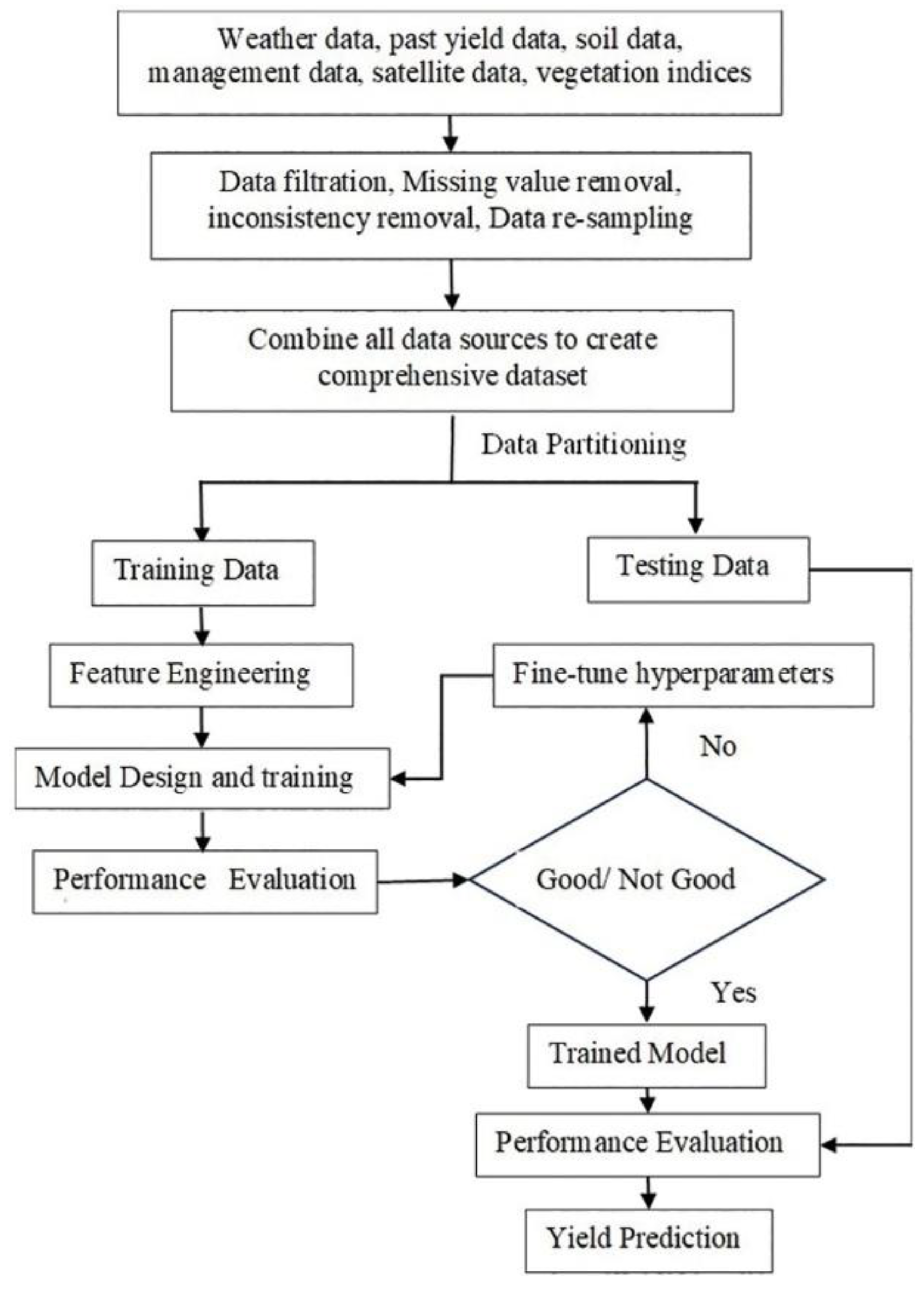
Crop yield prediction estimates expected production for a given area and time, which is crucial for agricultural decisions, resource management, and policy. Traditional methods that use surveys and models lack spatiotemporal detail. Advanced AI techniques, particularly machine learning and deep learning combined with remote sensing, offer improved accuracy and adaptability by capturing the complex relationships between biophysical, environmental, and climatic variables.
Figure 1.
Data-driven crop yield prediction workflow.
B. Satellite Remote Sensing
Remote sensing gathers Earth surface data via satellites or aerial sensors, without direct contact. In agriculture, it enables the continuous monitoring of crop health, land use, and phenological changes across scales. Modern satellites provide multispectral, hyperspectral, and synthetic aperture radar (SAR) data to assess the vegetation conditions.
Key satellite platforms commonly used in crop yield modeling include the following.
- The Moderate Resolution Imaging Spectroradiometer (MODIS): Provides a high temporal resolution with intervals from one day to eight days with moderate spatial resolution (250–1000 m).
- Sentinel-2: Sentinel-2 offers 10–20 m resolution and frequent revisits for vegetation monitoring.
- Landsat: Historical 30-meter data for long-term trend analysis.
C. Vegetation Indices
Vegetation indices are mathematical combinations of spectral reflectance values that are used to assess plant health and density. They serve as critical features in yield prediction models.
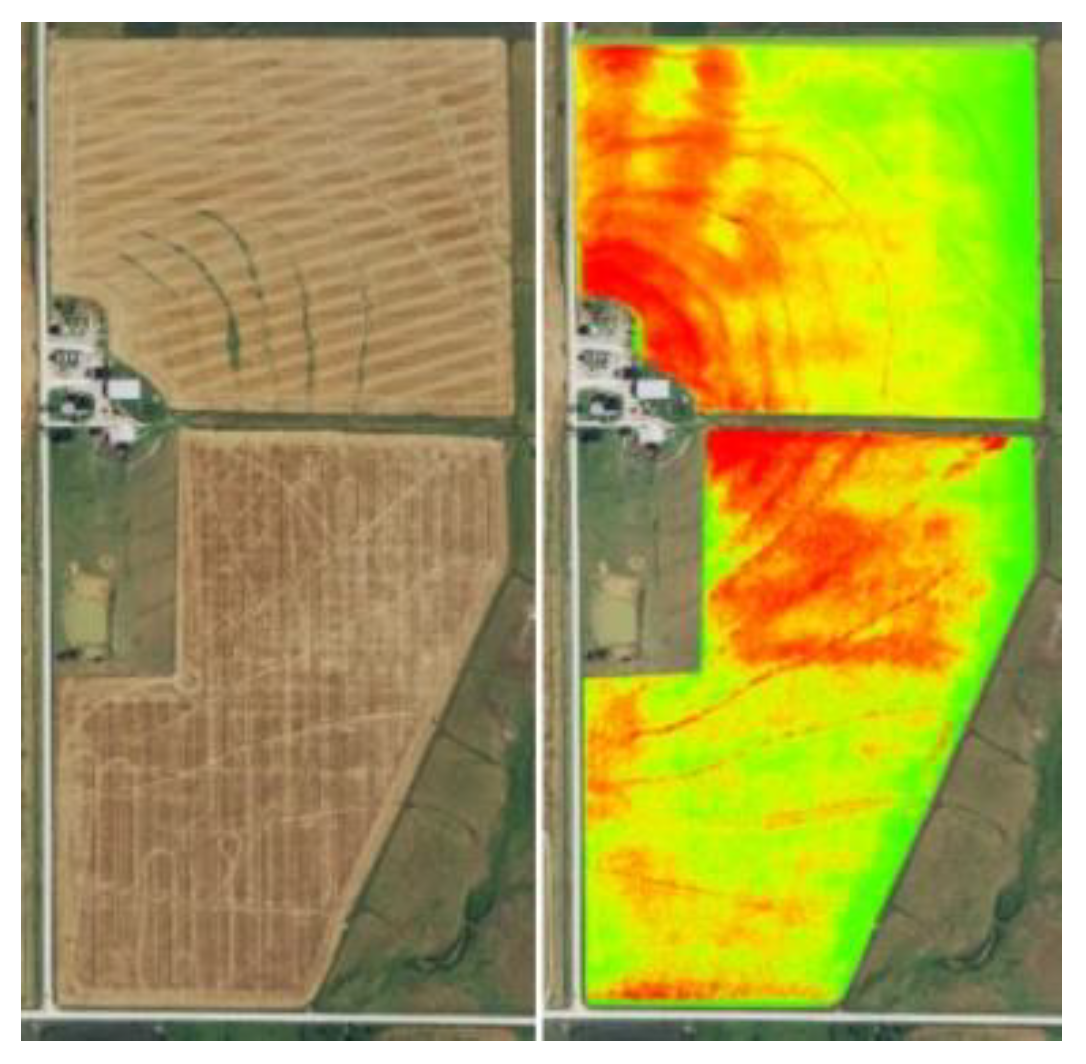
- Normalized Difference Vegetation Index (NDVI):
Indicates vegetation greenness and biomass.
Figure 2.
Satellite Image vs. NDVI Map Highlighting Crop Health Variability.
- Enhanced Vegetation Index (EVI):
This reduces atmospheric influence and improves the sensitivity of dense vegetation.
- Normalized Difference Water Index (NDWI):
This reflects plant water content and stress.
D. Machine Learning and Deep Learning in Agriculture
Machine learning models in agriculture automatically identify patterns in data for tasks, such as crop classification, yield prediction, and disease detection. Popular algorithms include the following.
- Random Forest (RF): A technique combining multiple decision trees to enhance the prediction accuracy and mitigate overfitting. It can effectively manage nonlinear relationships and high-dimensional data.
- XGBoost: An optimized gradient boosting algorithm, XGBoost excels in speed, accuracy, and handling of struc- tured tabular data. This effectively manages the complex feature interactions.
Deep learning, a branch of machine learning, utilizes multilayered artificial neural networks to represent intricate data abstractions. In the field of agriculture, it is particularly effective for analyzing images and time series data.
- Convolutional Neural Networks (CNNs): Convolutional neural networks are highly effective for analyzing spatial data, such as satellite images, to identify features such as the health of plants, the structure of canopies, and the boundaries of crops.
- Long Short-Term Memory (LSTM) Networks: LSTM networks, a variant of RNN, are highly effective at capturing long-term dependencies in sequential data, making them particularly suitable for modeling temporal variations in crop growth stages over an agricultural season.
E. Multisource Data Fusion
Crop yield prediction integrates satellite imagery, spectral data, vegetation indices, weather information, soil characteristics, and historical data. This multisource data fusion enhances model accuracy and generalizability. Vegetation indices and machine-learning techniques have revolutionized yield forecasting, enabling more precise and timely predictions. These advanced models provide valuable insight into agricultural planning and food security.
3. Literature Survey
Jeong et al. [1] reported that deep learning and remote sensing integration have revolutionized forecasting and that rice production is vital for maintaining global food security. Deep neural networks (DNNs), such as the FNN, LSTM, GRU, and BLSTM, have shown superiority over traditional crop models. LSTM models capture time-series dependencies, improving yield and agronomic indicator predictions. Machine learning and DNNs combined with remote sensing data enable timely and reliable predictions of climate variability and support strategic agricultural decisions. However, despite their high accuracies, these models are challenging. Limited interpretability is a concern because of the complex nature of DNNs. The performance may decrease when trained on small or non-diverse datasets, thereby emphasizing the need for comprehensive training data. Future research should focus on enhancing model interpretability in order to build trust and facilitate wider adoption. Expanding applicability to diverse geographic regions and rice varieties would increase global relevance. Exploring advanced architectures such as transformers may unlock new possibilities for precision agriculture and sustainability. As this field evolves, the integration of deep learning and remote sensing has become increasingly crucial for safeguarding food security and enhancing agricultural methods.
Tripathi et al. [2] explained the importance of accurate crop yield estimation for global food security, highlighting the integration of soil health parameters into yield-prediction models that incorporate cutting-edge remote sensing and machine learning methods. They employed Sentinel-1 SAR and Sentinel-2 optical sensors to assess soil characteristics and used a deep learning multilayer perceptron (DLMLP) model to predict crop yields. A case study in Punjab, India demonstrated the model’s superior performance in wheat yield estimation compared to traditional methods.
In [3], Khaki et al. introduced a hybrid model combining CNN and RNN to predict corn and soybean yields in the U.S.. Corn Belt. This model surpassed traditional approaches, achieving RMSEs of 9% for corn and 8% for soybean yield. It effectively captured spatial and temporal dependencies in weather and soil data, with solar radiation, temperature, and precipitation identified as the key factors. Although promising, challenges remain in weather predictions and model interpretability.
[4] The study ”AGNN-RNN Approach for Harnessing Geospatial and Temporal Information” introduces a GNN-RNN model for crop yield prediction, combining geographical and temporal data. Tested on a large US dataset (1981-2019), it outperformed existing methods. This method employs graph neural networks to capture spatial connections and recurrent neural networks to analyze temporal patterns, thereby offering a new direction for agricultural forecasting by leveraging complex environmental data.
Fernandez-Beltran et al. [5] developed a 3D CNN model utilizing Sentinel-2 imagery and weather/soil data for large-scale yield estimations. Subsequent research explored various deep learning approaches, including the BBI model combining BPNN and IndRNN, CNN-based disease detection, and comparisons of DNN training algorithms. This research presented a method for predicting rice crop yields automatically, utilizing SCA-WRELM, integrating data normalization, WRELM-based prediction, and SCA-based hyperparameter tuning. These evolving approaches aim to capture complex relationships between factors influencing crop productivity, leveraging diverse data sources and advanced algorithms to enhance rice yield predictions and promote sustainable agricultural practices.
Elavarasan and Vincent [6] concentrated on predicting crop yields through the application of deep reinforcement learning to promote sustainable agriculture. They proposed a Deep Recurrent Q-Network (DRQN) model that combines the RNN architecture with Q-learning to process environmental, soil, water, and crop parameters sequentially. The model achieved 93.7% accuracy for paddy crop yield prediction in southern India, outperforming other machine learning algorithms. While promising, challenges remain in handling long time-series data and uncertainty quantification. Future research could explore LSTM-based DRL models, probabilistic modeling, and additional parameters for robust yield forecasting.
Cunha and Silva’s [7] deep-learning model predicts yields for five major Brazilian crops using remote sensing and weather data without relying on NDVI or crop masks. The model incorporates geographic coordinates, weather forecasts, soil properties, crop-specific calendars, Growing Degree Days, and a noise layer for weather uncertainties. This approach offers an accurate solution using more accessible data sources, addressing the challenges in obtaining and processing remote sensing data for large areas. Other studies have explored different methods, including the WOFOST model for winter wheat in Ukraine, combining satellite and climate data for Australian wheat, and transfer learning with MODIS imagery for soybean yield in Argentina and Brazil.
[8] The research work titled ”Estimating Soybean Yields Using Causal Inference and Deep Learning Approaches With Satellite Remote Sensing Data” proposes a novel SCM-GAT model that integrates structural causal models with graph attention networks for predicting county-level soybean yields in major U.S. states. By incorporating causal inference and remote sensing data, including MODIS vegetation indices and meteorological variables, the model improves interpretability and robustness, particularly under extreme weather conditions. Dividing the soybean growth cycle into six phases, the study demonstrates that SCM-GAT outperforms traditional and deep learning models, emphasizing the value of causal reasoning and temporal dynamics in yield prediction.
Kalmani et al. [9] created a hybrid model that integrated a 1D CNN, LSTM, and attention mechanisms to forecast wheat and rice yields in India. The model, enhanced with multihead attention and multiplication skip connections, outperformed the traditional methods, with an RMSE of 0.017, MAE of 0.09, and R² of 0.967. Using soil, climate, and historical weather data, the model achieved an accuracy of 98%. Despite limitations due to the small dataset size, the study highlights the potential for accurate yield predictions in the context of climate change and resource management, suggesting future research with larger datasets and ensemble methods.”
Kuriakose and Singh [10] developed a model using LSTM to predict crop yields in India, aiding farmers in choosing appropriate crops by considering factors such as soil, climate, and rainfall. Elavarasan and Vincent applied deep reinforcement learning, achieving 93.7% accuracy. Cunha et al. developed a scalable RNN-based system for pre-season yield forecasting using soil and weather data. Ji et al. showed that an ANN outperformed linear regression for rice yield prediction in mountainous China. Hochreiter and Schmidhuber introduced LSTM to improve the long-term data retention. The combined LSTM-RNN approach integrates climate and soil analyses for accurate yield forecasting and crop selection.
Sharma et al. [11] conducted a comprehensive study on predicting agricultural yields in India using machine-learning and deep-learning techniques. They analyzed data from ten major crops from 1997 to 2020 using various algorithms. Random Forest outperformed other machine learning methods with 98.96% accuracy, whereas CNN showed superior performance among deep learning models. This research underscores the promise of these methods for forecasting agricultural production, and suggests the incorporation of remote sensing data to further enhance accuracy.
Muruganantham et al. [12] analyzed crop yield forecasts using deep learning and remote sensing technologies for the period 2012–2022. LSTM and CNN were identified as the primary deep learning methods, with MODIS satellite data being the most commonly used. Vegetation indices are most commonly used. Deep learning surpasses traditional machine learning in terms of feature extraction and nonlinear relationship modeling. CNN excelled in identifying yield-influencing features, whereas LSTM better recognized data variation patterns and time-series connections. Feature selection varied according to the crop type and factor correlation. Challenges include improving the model accuracy, providing stakeholder information, and addressing the black-box nature of deep learning. The review emphasized the need for larger datasets, advanced tools, and the incorporation of additional factors for more robust prediction models.
Sah et al. [13] investigated rice yield prediction using machine learning models that integrated biophysical parameters with SAR and optical remote sensing data from Uttarakhand, India. In this study, Sentinel-1 SAR data, Sentinel-2 optical data, and ground-based crop biophysical parameters were used to predict the rice yield at different growth stages. Nine machine learning models were employed, with XGB performing best for summer rice and varying models for Kharif rice, highlighting the effectiveness of combining remote sensing data with on-the-ground parameters to accurately predict yields and provide important insights for planning food security and resource management.
Thakkar and Vanzara [14] developed the ”Quartile Clean Image” preprocessing approach to enhance the accuracy of crop yield predictions derived from remote sensing data by correcting outliers using quartile-based pixel analysis. Applied to 20,946 MODIS images, it improved PSNR to 40.91 dB and reduced RMSE by up to 21.85% for corn and 11.52% for soybean when used with CNN and LSTM models. The Vision Transformer (ViT) model, without explicit preprocessing, achieved high R² scores (0.9540–0.9888), demonstrating robustness. Although ViT performs well, Quartile Clean preprocessing with CNN/LSTM often yields a lower RMSE, thereby emphasizing the value of effective preprocessing. Future work will include scaling the method across regions and crops and integrating it with advanced models such as ViT.
Pham et al. [15] devised a framework to boost the accuracy of crop yield forecasts by applying machine learning to vegetation health indices obtained from satellite data. This approach addresses the challenges of one-fits-all models and redundant data by employing spatial independent component analysis (sICA) for regional division and combining principal component analysis (PCA) with machine learning. When applied to predict rice yields in Vietnam, the framework showed enhanced accuracy, with subregional models outperforming universal approaches by as much as 60%, and PCA-ML combinations exceeding ML-only methods by up to 45%. This framework provides predictions to 1-2 months before harvest with an average error of 5%, presenting a strong solution for improving crop yield forecasts at the subregional level.
| Comparison Table | |||
| Sl. No. | Title | Algorithms | Limitations |
| 1. | Crop Yield Prediction Using a DRL Model for Sustainable Agrarian Applications | DRQN: Deep RL combined with recurrent neural networks | Gradient issues with long sequences and limited generalization |
| 2. | Estimating Crop Yields with Remote Sensing and Deep Learning | DL models using weather data, soil data, and crop calendars | Depends on self-reported yields; performance varies across crops |
| 3. | Estimating soybean yields using causal inference and deep learning approaches using satellite remote sensing data | structural causal models with graph attention networks (SCMGAT) | causal findings need broader validation |
| 4. | Crop Yield Prediction using Deep Learning Algorithm based on CNN-LSTM with attention layer and skip connection | CNN-LSTM with multihead attention and skip connections | small dataset size. The model has not yet reached optimal performance. |
| 5. | Indian Crop Yield Prediction using LSTM Deep Learning Networks | LSTM-based two-phase crop prediction | LSTM is time- and memory-intensive for training |
| 6. | Predicting Agriculture Yields Based on Machine Learning Using Regression and Deep Learning | DT, XGBoost RF, CNN, LSTM | Limited to 10 crops; relies on historical data; lacks satellite or remote sensing data |
| 7. | A Systematic Literature Review on Crop Yield Prediction with Deep Learning and Remote Sensing | CNN, LSTM, CNN-LSTM, YieldNet, BNN | Requires large amounts of data and integration complexity |
| 8. | Rice yield prediction through integration of biophysical parameters with SAR and optical remote sensing data using machine learning models | ML models (XGB, NNET, RF, SVM, KNN); optical & SAR remote sensing integration; prediction at 45, 60, 90 DAT | Study in Udham Singh Nagar; requires validation for other regions, limited to rice |
| 8. | Rice yield prediction through integration of biophysical parameters with SAR and optical remote sensing data using machine learning models | ML models optical & SAR remote sensing integration; prediction at 45, 60, 90 DAT | Study in Udham Singh Nagar; needs validation for other regions; limited to rice |
| 9. | Enhancing crop yield estimation from remote sensing data: A comparative study of the Quartile Clean Image method and vision transformer | Quartile Clean image preprocessing, CNN&LSTM, ViT | Negative R² for corn in some years; ViT’s RMSE is higher than that of CNN and LSTM |
| 10. | Enhancing Crop Yield Prediction Utilizing Machine Learning on Satellite-Based Vegetation Health Indices | sICA, PCA-ML, and EBT (Ensemble Boosted Tree) | PCA impact-limited; VCI/TCI accuracy affected by variability |
| 11. | Automated Rice Crop Yield Prediction using Sine Cosine Algorithm with Weighted Regularized Extreme Learning Machine | SCA-WRELM Model | Focuses only on rice crop, SCA-WRELM can be further improved |
| 12. | A GNN-RNN Approach for Harnessing Geospatial and Temporal Information: Application to Crop Yield Prediction | GNN-RNN Model | Can underpredict high yields, especially in the midwest |
| 13. | A CNN-RNN Framework for Crop Yield Prediction | CNN-RNN hybrid model | Requires data, lacks interpretability and is sensitive to input quality |
| 14. | A deep learning multilayer perceptron and remote sensing approach for soil health-based crop yield estimation | DLMLP for yield; ML models for soil health | Limited by SAR penetration and missing full-season variability |
| 15. | Deep learning-enhanced remote sensing integrated crop modeling for rice yield prediction | Deep Learning crop modeling with an FNN, LSTM, GRU, BLSTM | Lower accuracy, limited interpretability, and region-specific training |
4. Proposed System
The proposed crop-yield prediction framework integrates deep learning with multisource data fusion, combining satellite imagery, environmental variables, and historical yield data. A hybrid CNN-LSTM model captured spatial and temporal patterns, whereas multitask learning predicted yield and agronomic indicators. Transfer learning ensures adaptability across crops and regions and causal inference enhances the understanding of feature relationships. The model was validated by using diverse datasets for robust and sustainable agricultural planning.
5. Methodology
We developed a system for comprehensively predicting crop yields using deep learning and remote sensing methods.
- 1)
-
Data Collection and Preprocessing
-
Gather multisource data, including:
- -
- Satellite imagery (e.g., MODIS, Sentinel, Landsat)
- -
- Vegetation indices (NDVI, EVI, NDWI)
- -
- Weather data (temperature, precipitation, wind speed)
- -
- Soil health parameters
- -
- Historical yield data
- Preprocess and normalize data to handle missing values and ensure consistency.
-
- 2)
-
Deep-learning Architecture
-
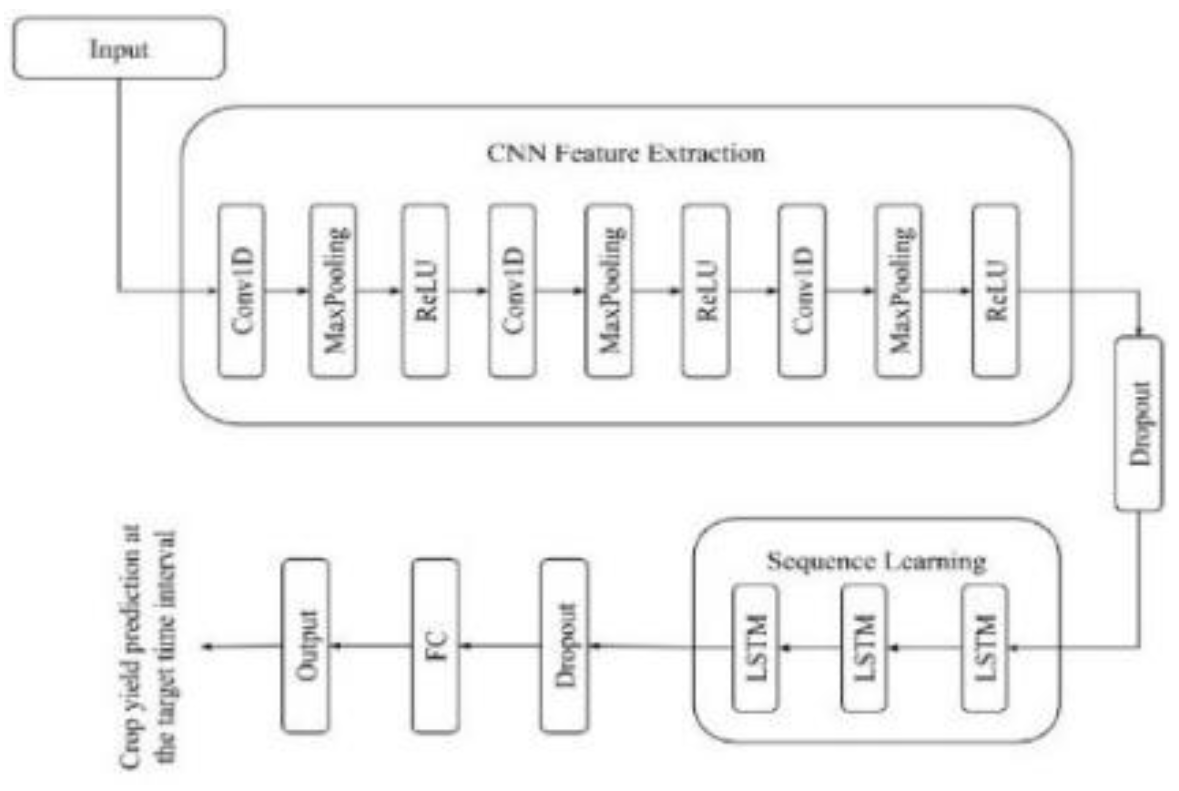
Implementation of a hybrid CNN-LSTM model:
- -
- CNN component for spatial feature extraction from satellite imagery.
- -
- LSTM component for modeling temporal crop growth patterns.
- Incorporate attention mechanisms to improve model interpretability.
- Utilize transfer learning techniques for better gen- eralization across regions.
-
- 3)
-
Multitask Learning
- Simultaneously predict crop yield and other agronomic indicators.
- Integrate causal inference techniques to understand relationships between input features.
- 4)
-
Model Training and Optimization
- Use diverse datasets from multiple geographic regions and crop types.
- Implement techniques like exponential decay learning rates and skip connections.
- Employ ensemble methods to improve overall prediction accuracy.
- 5)
-
Validation and Testing
- Perform cross-validation across different regions and crop seasons.
- Evaluate the effectiveness in comparison with con- ventional machine learning models such as Random Forest and SVM.
- Evaluate using metrics such as RMSE, MAE, R2, and correlation coefficients.
Figure 3.
The architecture of the hybrid CNN-LSTM model.
The proposed system aims to provide accurate, scalable, and interpretable crop yield predictions to support decision making in agriculture and contribute to food security efforts.
6. Results and Discussion
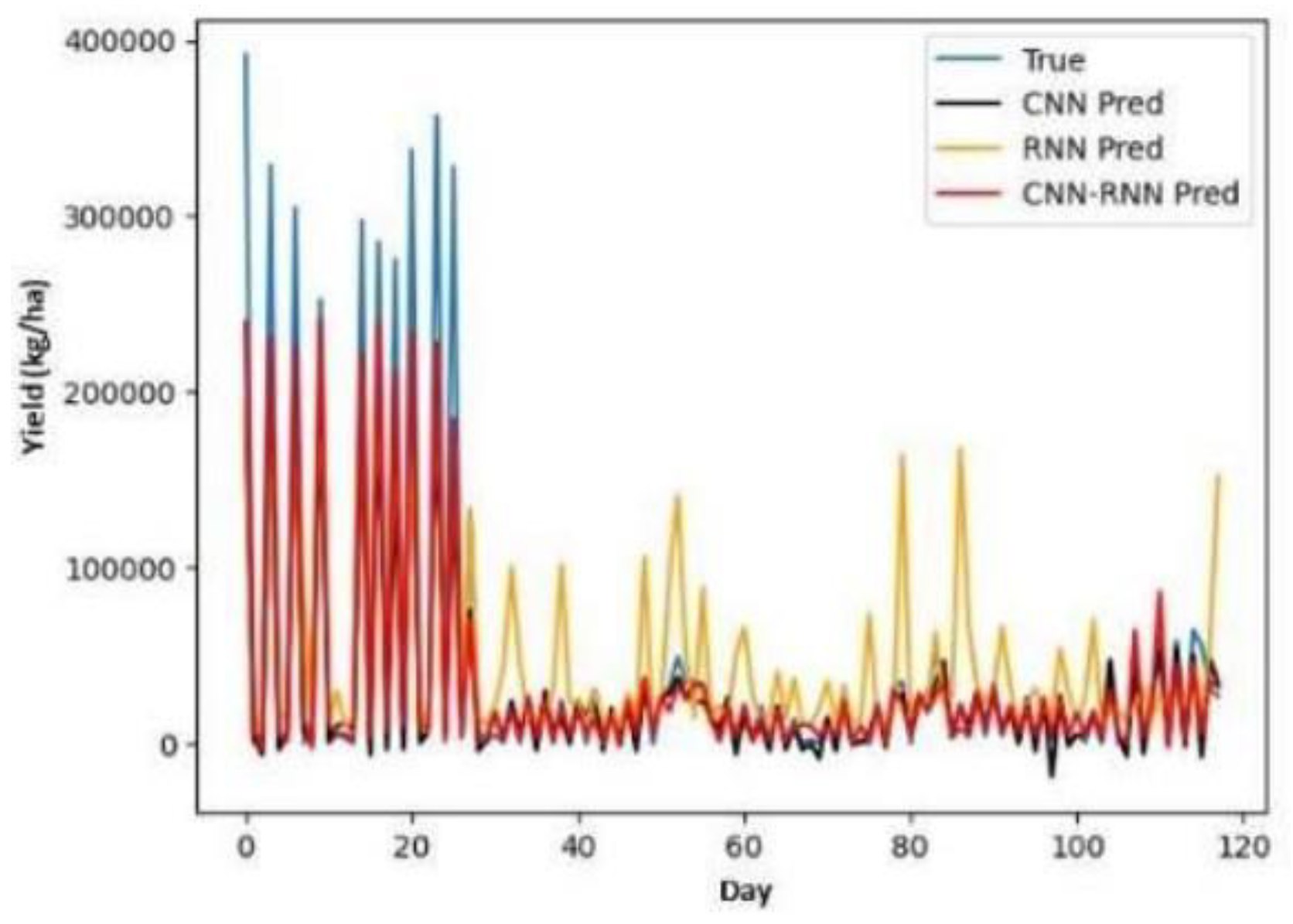
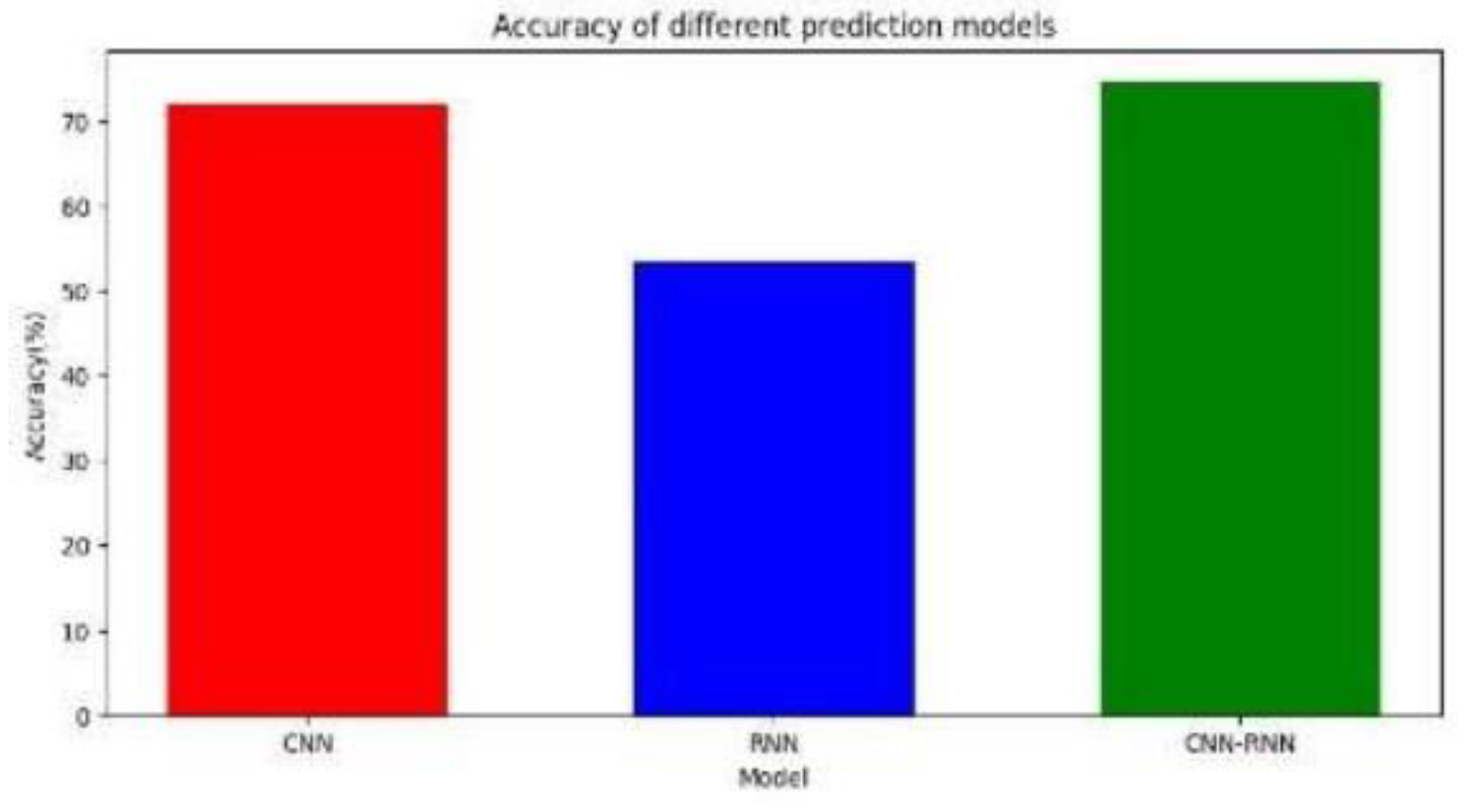
This survey analyzed state-of-the-art crop-yield prediction systems by leveraging deep learning and remote sensing. Among these, hybrid CNN-LSTM models have proven to be highly effective in modeling both spatial and temporal dependencies. Notably, Wang et al. (2024) reported 74% accuracy (R² = 0.87, RMSE = 0.08), outperforming standalone CNN and LSTM models.
Figure 4.
CNN, RNN (LSTM), CNN-RNN vs. actual yield.
Despite these advances, limitations remain, particularly regarding generalizability, dataset diversity, and interpretability. To address these issues, our proposed system extends the CNN-LSTM architecture by incorporating attention mechanisms for feature relevance, causal inference for relationship analysis, multisource data fusion, and transfer learning for adaptability across regions and crops. Although not yet implemented, our framework is expected to outperform the existing models by enhancing accuracy, transparency, and robustness. This study establishes a foundation for more interpretable and scalable crop yield prediction systems, with future work focusing on empirical validation.
Figure 5.
Accuracy graph of CNN, LSTM, and CNN-LSTM models.
7. Future Work
Future research on crop yield prediction should focus on advanced data fusion of satellite, soil, and climate data, along with improved preprocessing, such as cloud removal and gap-filling using machine learning. Hybrid deep learning models such as CNN-LSTM with attention mechanisms show promise for better spatiotemporal modeling and interpretability. Transfer learning and domain adaptation can help apply models to new regions with limited data, whereas explainable AI (XAI) can reveal the key yield drivers.
Efforts should also aim at scalable, multi-crop, and lightweight models for real-time use in precision agriculture.The incorporation of climate change scenarios and carbon estimations will support sustainable and intelligent farming across diverse agroecological zones.
8. Conclusion
This review emphasizes the combination of deep learning and remote sensing to enhance the precision of crop yield forecasts. Hybrid models, such as CNN-LSTM networks, have shown superior performance in capturing spatiotemporal crop-growth dynamics. The proposed research aims to enhance this approach by incorporating attention mechanisms and causal inference capabilities, thereby addressing the limitations of interpretability and generalizability. The system aims to provide adaptable predictions across diverse agroecological settings by fusing multisource data, including satellite imagery and environmental indicators. This study aims to fill the gaps in model transparency, the effects of data quality, and regional adaptability, potentially providing more reliable tools for sustainable agriculture and global food security. Future efforts will concentrate on empirical validation, optimization, and implementation across different crop types and regions.
References
- Jeong, S.; Ko, J.; Ban, J.-O.; Shin, T.; Yeom, J.-M. Deep learning-enhanced remote sensing-integrated crop modeling for rice yield prediction. Ecological Informatics 2024, 84, 102886. [Google Scholar] [CrossRef]
- Tripathi, A.; Tiwari, R.K.; Tiwari, S.P. A deep learning multilayer perceptron and remote sensing approach for soil health based crop yield estimation. International Journal of Applied Earth Observation and Geoinformation 2022, 113, 102959. [Google Scholar] [CrossRef]
- Khaki, S.; Archontoulis, S.V.; Wang, L. A CNN-RNN framework for crop yield prediction. Frontiers in Plant Science 2020, 10. [Google Scholar] [CrossRef] [PubMed]
- Fan, J.; Gomes, C.P.; Bai, J.; Ortiz-Bobea, A.; Li, Z. A GNN-RNN Approach for Harnessing Geospatial and Temporal Information: Application to Crop Yield Prediction. Proceedings of the AAAI Conference on Artificial Intelligence. [CrossRef]
- Thirumal, S.; Latha, R. Automated Rice Crop Yield Prediction using Sine Cosine Algorithm with Weighted Regularized Extreme Learning Machine. [CrossRef]
- Elavarasan, D.; Vincent, P.M.D. Crop Yield Prediction Using Deep Reinforcement Learning Model for Sustainable Agrarian Applications. IEEE Access 2020, 8, 86886–86901. [Google Scholar] [CrossRef]
- Cunha, R.L.F.; Silva, B. ESTIMATING CROP YIELDS WITH REMOTE SENSING AND DEEP LEARNING. ISPRS Annals of the Photogrammetry, Remote Sensing and Spatial Information Sciences 2020, IV-3/W2-2020, 59–64. [Google Scholar] [CrossRef]
- Wang, F.; et al. Estimating Soybean Yields using Causal Inference and Deep Learning Approaches with Satellite Remote Sensing Data. IEEE Journal of Selected Topics in Applied Earth Observations and Remote Sensing 2024. [Google Scholar] [CrossRef]
- Kalmani, V.H.; Dharwadkar, N.V.; Thapa, V. Crop Yield Prediction using Deep Learning Algorithm based on CNN-LSTM with Attention Layer and Skip Connection. Indian Journal Of Agricultural Research. [CrossRef]
- Kuriakose, S.M.; Singh, T. Indian Crop Yield Prediction using LSTM Deep Learning Networks. [CrossRef]
- Sharma, P.; Aneja, N.; Aneja; Dadheech, P. Predicting agricultural yields based on machine learning using regression and deep learning. IEEE Access 2023, 11, 111255–111264. [Google Scholar] [CrossRef]
- Muruganantham, P.; Islam, N.; Samrat, N.H.; Wibowo, S.; Grandhi, S. A Systematic Literature Review on Crop Yield Predic- tion with Deep Learning and Remote Sensing. Remote Sensing 2022, 14, 1990. [Google Scholar] [CrossRef]
- Sah, S.; Haldar, D.; Singh, R.; Das, B.; Nain, A.S. Rice yield prediction through integration of biophysical parameters with SAR and optical remote sensing data using machine learning models. Scientific Reports 2024, 14. [Google Scholar] [CrossRef] [PubMed]
- Thakkar, M.; Vanzara, R. Enhancing crop yield estimation from remote sensing data: a comparative study of the Quartile Clean Image method and vision transformer. Discover Applied Sciences 2024, 6. [Google Scholar] [CrossRef]
- Pham, T.; Bui, L.K.; Kuhn, M.; Awange, J.; Nguyen, B.V. Enhancing Crop Yield Prediction Utilizing Machine Learning on Satellite-Based Vegetation Health Indices. Sensors 2022, 22, 719. [Google Scholar] [CrossRef] [PubMed]
Disclaimer/Publisher’s Note: The statements, opinions and data contained in all publications are solely those of the individual author(s) and contributor(s) and not of MDPI and/or the editor(s). MDPI and/or the editor(s) disclaim responsibility for any injury to people or property resulting from any ideas, methods, instructions or products referred to in the content. |
© 2025 by the authors. Licensee MDPI, Basel, Switzerland. This article is an open access article distributed under the terms and conditions of the Creative Commons Attribution (CC BY) license (http://creativecommons.org/licenses/by/4.0/).
Copyright: This open access article is published under a Creative Commons CC BY 4.0 license, which permit the free download, distribution, and reuse, provided that the author and preprint are cited in any reuse.


