Preprint
Article

This version is not peer-reviewed.

An Approximation to Riemann Hypothesis

Submitted:

30 May 2025

Posted:

04 June 2025

Read the latest preprint version here

Abstract
In this article, we will give an approximate result for Riemann hypothesis.
Keywords: 
;  ;  

1. Introduction

Riemann zeta-function ζ ( s ) is originally defined as
ζ ( s ) = n = 1 1 n s , for Re s > 1 .
and it also can be expressed as the product form
ζ ( s ) = p 1 1 1 / p s , for Re s > 1 .
This formula is called Euler’s product formula, which indicates the relation between ζ ( s ) and prime numbers. About ζ ( s ) there is a well-known Riemann hypothesis, states that all the non-trivial zeros of ζ ( s ) are on the critical line Re s = 1 / 2 . The researches on the conjecture are no doubt a most time-consuming one in mathematics, refer to see the survey paper [3].
The so-called trivial zeros of ζ ( s ) are s = 2 , 4 , , and nontrivial zeros of ζ ( s ) are known all in the critical strip 0 Re s 1 .
Denote by N ( T ) and N 0 ( T ) respectively as the numbers of zeros of ζ ( σ + i t ) in the region 0 σ 1 , 0 t T , and on the critical line σ = 1 / 2 , 0 t T . Riemann hypothesis is that
N 0 ( T ) = N ( T ) .
For N ( T ) , it is known that
N ( T ) = T 2 π log T 2 π T 2 π + O ( log T ) .
And for N 0 ( T ) , Hardy firstly shown that there are infinity many zeros on the critical line, and then he and Littlewood [5] and Selberg [8] proved that
κ = N 0 ( T ) N ( T ) > 0 .
Levinson [6] proved
κ 1 3 .
and then this result has been improved successively. Conrey [2], Feng [4] proved respectively
κ 0.407 , κ 0.412 .
In this paper, we will prove that
Theorem 1. 
N ( T ) = N 0 ( T ) + E .
where E T 7 / 9 log 2 T .
The main arguments in this paper are based the papers [1,6,7], but instead of using Riemann-Siegel formula, it will be applied an auxiliary function ω ( s , T 1 , T 2 ) defined in Lemma 1, which will play a role of mollifier and ferry, it firstly used in [7] but here with a small modification.

2. Some Lemmas

Lemma 1. 
Suppose that T T 1 T 2 2 T , λ = T 14 / 9 , s 1 = λ + c + i u , ( c > 0 ) , s = v + i t ,define
ω ( s , T 1 , T 2 ) = e λ 2 π i T 1 T 2 Γ ( s 1 s ) λ s s 1 d s 1 .
Let σ = λ + c v , there is
| ω ( s , T 1 , T 2 ) | O e ( c v ) 2 / σ
Let Δ = ( 20 λ log T ) 1 / 2 , if t [ T 1 + Δ , T 2 Δ ] , then
| ω ( c + i t , T 1 , T 2 ) 1 | T 10 .
And if t T 1 Δ , or t T 2 + Δ , then
| ω ( c + i t , T 1 , T 2 ) | T 10 .
If | t u | = o ( σ 2 / 3 ) , then
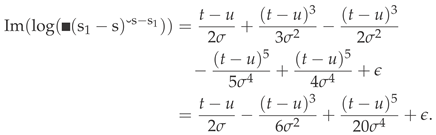
arg ( Γ ( s 1 s ) λ s s 1 ) = t u 2 σ ( t u ) 3 6 σ 2 + ϵ .
Proof. 
By Stirling’s formula, it has
Re ( log Γ ( σ + ( u t ) i ) ) = σ 1 2 log ( σ 2 + ( u t ) 2 ) 2 σ + 1 2 log ( 2 π ) ( u t ) arctan u t σ + O ( 1 / σ )
And
Re ( log ( Γ ( σ + ( u t ) i ) ) ) + Re ( log ( λ ( σ + ( u t ) i ) ) ) + λ = ( c v ) 2 σ ( u t ) 2 4 σ 2 ( u t ) 2 2 σ 1 2 log σ + 1 2 log ( 2 π ) + O ( 1 / σ )
Hence,
| ω ( s , T 1 , T 2 ) | e ( c v ) 2 / σ σ 1 / 2 2 π T 1 T 2 exp ( ( u t ) 2 / σ ) d u e ( c v ) 2 / σ .
Besides, it is familiar that
e λ = 1 2 π i ( c ) Γ ( s 1 s ) λ s s 1 d s .
Hence,
1 ω ( c + i t , T 1 , T 2 ) = R 1 + R 2 ,
where
R 1 = e λ 2 π T 2 Γ ( λ + ( u t ) i ) λ ( λ + ( u t ) i ) d u ,
R 2 = e λ 2 π T 1 Γ ( λ + ( u t ) i ) λ ( λ + ( u t ) i ) d u ,
Hence, if t [ T 1 + Δ , T 2 Δ ] , then
R 1 T 2 e λ Γ ( λ + ( u t ) i ) λ ( λ + ( u t ) i ) d u λ 1 / 2 T 2 exp ( ( u t ) 2 / 2 λ ) d u T 10 .
and similarly
R 2 λ 1 / 2 T 1 exp ( ( u t ) 2 / 2 λ ) d u T 10 .
if t T 1 Δ , or t T 2 + Δ , then
ω ( c + i t , T 1 , T 2 ) λ 1 / 2 T 1 T 2 exp ( ( u t ) 2 / 2 λ ) d u T 10 .
If | t u | = o ( σ 2 / 3 ) , then
Preprints 161773 i001
Lemma 2. 
Let ζ 1 ( s ) , ζ 2 ( s ) be ζ ( s ) or ζ ( s ) and
ζ 1 ( s ) = n a n n s , f o r Re s > 1 ,
ζ 2 ( s ) = n b n n s , f o r Re s > 1 .
Let 0 < a < 1 / 2 , λ same as in Lemma 1, let s 1 = λ + c + i u , c 0 , define
g ( u ) = e λ 2 π i ( a ) Γ ( s 1 s ) λ s 1 + s ζ 1 ( s ) ζ ¯ 2 ( s ) d s
Then for T u 2 T , 1 < β < λ + c , there is
g ( u ) = e λ h = 1 k = 1 a k b ¯ h h 2 β h k s 1 e λ h / k + O ( T 10 ) .
Proof. 
We move the integral path from ( a ) to ( β ) , the residue at the pole s = 1 is
R e λ Γ ( λ + c 1 + i u ) λ ( λ + c 1 + i u ) T 10
Hence,
g ( u ) = h = 1 k = 1 a k b ¯ h k β h β e λ 2 π i ( β ) Γ ( s 1 s ) λ s 1 + s h k i t d s + O ( T 10 ) = h = 1 k = 1 a k b ¯ h h 2 β e λ 2 π i ( β ) Γ ( s 1 s ) λ s 1 + s h k s d s + O ( T 10 ) = h = 1 k = 1 a k b ¯ h h 2 β e λ 2 π i ( λ + c β ) Γ ( w ) λ w h k s 1 w d w + O ( T 10 ) = e λ h = 1 k = 1 a k b ¯ h h 2 β h k s 1 e λ h / k + O ( T 10 ) .
Lemma 3. 
Let θ = ( 20 log T / λ ) 1 / 2 , λ as before, 0 c Δ / 10 , then
J 1 = 1 + θ e λ v λ + c e λ v d v T 8 λ 1 / 2 ,
J 2 = 0 1 θ e λ v λ + c e λ v d v T 10 .
Proof. 
For (2.6), by the integration by parts
J 1 = e λ v λ + c e λ v λ 1 + θ + λ + c λ 1 + θ e λ v λ + c 1 e λ v d v exp 2 θ 2 λ / 5 λ + ( 1 + θ / 10 ) J 1 1 + θ
That is,
9 10 θ λ 1 + θ J 1 exp ( 2 θ 2 λ / 5 ) T 8
and
J 1 T 8 λ 1 / 2 .
For (2.7),
J 2 e λ ( 1 θ ) λ e λ ( 1 θ ) exp ( θ 2 λ / 2 ) T 10 .

3. The Proof of Theorem 1

Proof. 
Let h ( s ) = π s / 2 Γ ( s / 2 ) , then the functional equation of ζ ( s ) can be written as
h ( s ) ζ ( s ) = h ( 1 s ) ζ ( 1 s )
By Stirling’s formula, it has
log h ( s ) = 1 2 ( s 1 ) log s 2 π s 2 + C 0 + O 1 s
Let f ( s ) = log h ( s ) , then
f ( s ) = h ( s ) h ( s ) = 1 2 log s 2 π + O 1 s
and for larger t
f ( s ) + f ( 1 s ) = log t 2 π + O 1 s
Taking logarithm of Equation (3.1), and then derivative, it follows
h ( s ) ζ ( s ) ( f ( s ) + f ( 1 s ) ) = h ( s ) ζ ( s ) h ( 1 s ) ζ ( 1 s )
We note that the right side of (3.5) is a sum of two conjugative complex numbers as s = 1 / 2 + i t , so the zeros of the right side of (3.5) occur if and only if
arg ( h ( s ) ζ ( s ) ) π / 2 mod π
On the left side of (3.5), clearly, h ( s ) is never zero, and by (3.4), so these zeros are just the zeros of ζ ( 1 / 2 + i t ) .
Moreover, let χ ( s ) = h ( 1 s ) / h ( s ) , then ζ ( s ) = χ ( s ) ζ ( 1 s ) , and
ζ ( s ) = χ ( s ) { ( f ( s ) + f ( 1 s ) ) ζ ( 1 s ) + ζ ( 1 s ) }
By (3.6), the zeros of ζ ( 1 / 2 + i t ) are the ones
arg ( h ( 1 s ) { ( f ( s ) + f ( 1 s ) ) ζ ( 1 s ) + ζ ( 1 s ) } ) π / 2 mod π
on σ = 1 / 2 , equivalently,
arg ( h ( s ) { ( f ( s ) + f ( 1 s ) ) ζ ( s ) + ζ ( s ) } ) π / 2 mod π
on σ = 1 / 2 . Write L ( s ) = f ( s ) + f ( 1 s ) , and denote by
G ( s ) = ζ ( s ) + ζ ( s ) / L ( s )
The investigation above means
N 0 ( T ) = 1 π Δ 0 T arg ( h G ( 1 / 2 + i t ) )
By(3.2), it can be known that
Δ 0 T arg ( h ( 1 / 2 + i t ) ) = T 2 log T 2 π T 2 + O ( log T )
So, the main task to determine N 0 ( T ) is to evaluate Δ 0 T arg ( G ( 1 / 2 + i t ) ) .
Take L = log ( T / 2 π ) , U T .
Let D be the rectangle with the vertices 1 / 2 + i T , 3 + i T , 3 + i ( T + U ) , 1 / 2 + i ( T + U ) . First of all, we might as well assume there are no zeros of G ( s ) on the boundary of D, then by the theory of complex function, the change of arg G ( s ) around D is equal to 2 π times N G ( D ) , the number of zeros of G ( s ) in D.
On the right side of D
| G ( 3 + i t ) 1 | n 2 n 3 + O ( 1 / L ) 1 / 3
so, arg G ( s ) change less than π . Moreover, by a known result [9, § 9 . 4 ], a extension of Jessen’s theorem, we can know that on the lower bound and the upper bound arg G ( s ) = O ( L ) . Hence
Δ 0 T arg ( G ( 1 / 2 + i t ) ) = 2 π N G ( D ) + O ( log T )
Now the work is turned into to evaluate N G ( D ) .
Take a = 1 / 2 1 / L , and let D be the rectangle with vertices a + i T , c + i T , c + i ( T + U ) , a + i ( T + U ) , taking the integral D log G ( s ) d s , by the Littlewood’s Lemma [9, § 9 . 9 ], it has
T T + U log | G ( a + i t ) | d t T T + U log | G ( 3 + i t ) | d t + a c arg G ( σ + i ( T + U ) ) d σ a c arg G ( σ + i T ) d σ = 2 π dist
where dist is the sum of the distances of the zeros of G ( s ) from the left. As in the situation of D and take account on the order of G ( s ) , we can know
a c arg G ( σ + i T ) d σ , a c arg G ( σ + i ( T + U ) ) d σ O ( L )
In addition, by (3.9), it is easy to know
T T + U log G ( c + i t ) d t = T T + U log ζ ( c + i t ) d t + O ( 1 / L )
and it is familiar that
log ζ ( s ) = n Λ ( n ) n s log n
So
T T + U log | G ( c + i t ) | d t 1 .
The rest is to calculate the first integral of (3.13).
By the concavity of logarithm, it has
T T + U log | G ( a + i t ) | d t = 1 2 T T + U log | G ( a + i t ) | 2 d t 1 2 U log 1 U T T + U | G ( a + i t ) | 2 d t
At first, we simplify G ( s ) as
G 0 ( s ) = ζ ( s ) + ζ ( s ) L .
Then
G ( s ) = G 0 ( s ) + E ( s ) .
E ( s ) = 1 L ( s ) 1 L ζ ( s ) 1 L 3 ζ ( s ) .
And
T 1 T 2 | G ( a + i t ) | 2 d t = T 1 T 2 | G 0 ( a + i t ) | 2 d t + 2 Re T 1 T 2 G 0 ( a + i t ) E ( a i t ) d t + T 1 T 2 | E ( a + i t ) | 2 d t
By Cauchy inequality
T 1 T 2 G 0 ( a + i t ) E ( a i t ) d t T 1 T 2 | G 0 ( a + i t ) | 2 d t T 1 T 2 | E ( a + i t ) | 2 d t 1 / 2
The third integral in the right side of (3.16) is much smaller than the first one, which will be actually calculated later, hence
T 1 T 2 | G ( a + i t ) | 2 d t = ( 1 + ϵ ) T 1 T 2 | G 0 ( a + i t ) | 2 d t .
Moreover, let
ω 1 ( s , T 1 , T 2 ) = ω 1 / 2 ( s , T 1 , T 2 ) .
By (2.5), we can know that on the upper bound and the lower bound of D , there is
arg ( ω 1 ( s , T 1 Δ , T 2 + Δ ) ) O ( T 3 / λ 2 )
and
a c arg ( ω 1 ( v + T j i , T 1 Δ , T 2 + Δ ) ) d v O ( c T 1 / 9 ) , ( j = 1 , 2 ) .
It is assumed that c Δ / 10 .
Moreover, by Lemma 1,
T 1 T 2 log | ω 1 ( c + i t , T 1 Δ , T 2 + Δ ) | d t T 9 .
This means that the function ω 1 ( s , T 1 Δ , T 2 + Δ ) may be viewed as a mollifier. Let
G ( s ) = G 0 ( s ) ω 1 ( s , T 1 Δ , T 2 + Δ ) .
By (2.5),
T 1 T 2 | G ( s ) | 2 d = T 1 T 2 | G 0 ( s ) | 2 | ω 1 ( s , T 1 Δ , T 2 + Δ ) | 2 d t = T 1 T 2 | G 0 ( s ) | 2 | ω ( s , T 1 Δ , T 2 + Δ ) | d t ( 1 + O ( T 2 / 9 ) ) T 1 T 2 | G 0 ( s ) | 2 ω ( s , T 1 Δ , T 2 + Δ ) d t
In the next is mainly to calculate the last integral.
By Lemma 1, it has
T 1 T 2 ω ( a + i t , T 1 Δ , T 2 + Δ ) | G 0 ( a + i t ) | 2 d t = e λ 2 π T 1 T 2 T 1 Δ T 2 + Δ Γ ( s 1 ( a + i t ) ) λ ( s 1 ( a + i t ) ) d u | G 0 ( a + i t ) | 2 d t = e λ 2 π T 1 Δ T 2 + Δ T 1 T 2 Γ ( s 1 ( a + i t ) ) λ ( s 1 ( a + i t ) ) | G 0 ( a + i t ) | 2 d t d u e λ 2 π T 1 Δ T 2 + Δ Γ ( s 1 ( a + i t ) ) λ ( s 1 ( a + i t ) ) | G 0 ( a + i t ) | 2 d t d u + o ( 1 ) = I 11 + I 12 + I 21 + I 22 + o ( 1 ) .
where
I 11 = e λ 2 π T 1 Δ T 2 + Δ Γ ( s 1 ( a + i t ) ) λ ( s 1 ( a + i t ) ) | ζ ( a + i t ) | 2 d t d u I 12 = e λ 2 π L T 1 Δ T 2 + Δ Γ ( s 1 ( a + i t ) ) λ ( s 1 ( a + i t ) ) ζ ( a + i t ) ζ ( a i t ) d t d u I 21 = e λ 2 π L T 1 Δ T 2 + Δ Γ ( s 1 ( a + i t ) ) λ ( s 1 ( a + i t ) ) ζ ( a i t ) ζ ( a + i t ) d t d u I 22 = e λ 2 π L 2 T 1 Δ T 2 + Δ Γ ( s 1 ( a + i t ) ) λ ( s 1 ( a + i t ) ) | ζ ( a + i t ) | 2 d t d u .
In the following specify T 1 = T , T 2 = T + U . We first calculate I 11 , by Lemma 2
I 11 = e λ T 1 Δ T 2 + Δ j 1 , j 2 1 j 2 2 β ρ s 1 exp ( λ ρ ) d u , ρ = j 2 / j 1 . = I 11 , 0 + I 11 , 1 + I 11 , 2 + I 11 , 3 .
where
I 11 , 0 = j 1 = j 2 e λ j 2 2 β T 1 Δ T 2 + Δ ρ s 1 exp ( λ ρ ) d u , I 11 , 1 = ρ 1 + θ e λ j 2 2 β T 1 Δ T 2 + Δ ρ s 1 exp ( λ ρ ) d u I 11 , 2 = ρ 1 θ e λ j 2 2 β T 1 Δ T 2 + Δ ρ s 1 exp ( λ ρ ) d u I 11 , 3 = 1 θ ρ 1 + θ j 1 j 2 e λ j 2 2 β T 1 Δ T 2 + Δ ρ s 1 exp ( λ ρ ) d u .
Clearly
I 11 , 0 = ( U + 2 Δ ) j 2 1 j 2 2 β = c 11 ( U + 2 Δ ) .
By Lemma 3,
I 11 , 1 j 2 θ 1 j 2 2 β j 2 / j 1 1 + θ e λ j 2 j 1 λ + c exp ( λ j 2 / j 1 ) j 2 θ 1 j 2 2 β 1 j 2 / ( 1 + θ ) e λ j 2 x λ + c exp ( λ j 2 / x ) d x
j 2 θ 1 j 2 2 β 1 + θ j 2 e λ v λ + c 2 exp ( λ v ) d v j 2 θ 1 j 2 2 β 1 + θ e λ v λ + c 2 exp ( λ v ) d v j 2 θ 1 j 2 2 β T 8 λ 1 / 2 T 8 .
I 11 , 2 j 2 θ 1 j 2 2 β j 2 / j 1 1 θ e λ j 2 j 1 λ + c exp ( λ j 2 / j 1 ) j 2 θ 1 j 2 2 β j 2 / ( 1 θ ) e λ j 2 x λ + c exp ( λ j 2 / x ) d x j 2 θ 1 j 2 2 β 0 1 θ e λ v λ + c 2 exp ( λ v ) d v j 2 θ 1 j 2 2 β e λ ( 1 θ ) λ + c 2 exp ( λ ( 1 θ ) ) . j 2 θ 1 j 2 2 β T 10 T 9
And
I 11 , 3 ( U + 2 Δ ) j 2 1 j 2 2 β 1 θ ρ 1 + θ j 1 j 2 e λ j 2 j 1 λ + c exp ( λ j 2 / j 1 ) ( U + 2 Δ ) j 2 1 / θ 1 j 2 2 β j 2 1 θ j 2 1 + θ T 1 / 5 ( U + 2 Δ ) j 2 1 / θ 2 θ j 2 2 β 1 ( 1 θ 2 ) T 1 / 5 ( U + 2 Δ ) θ 2 β 1 T 1 / 5 T 10 , ( β 10 log T ) .
For I 12 , by Lemma 2
I 12 = 1 L e λ T 1 Δ T 2 + Δ j 1 , j 2 log j 2 j 2 2 β ρ s 1 exp ( λ ρ ) d u = I 12 , 0 + I 12 , 1 + I 12 , 2 + I 12 , 3 .
where
I 12 , 0 = 1 L j 1 = j 2 e λ log j 2 j 2 2 c T 1 Δ T 2 + Δ ρ s 1 exp ( λ ρ ) d u , I 12 , 1 = 1 L ρ 1 + θ e λ log j 2 j 2 2 β T 1 Δ T 2 + Δ ρ s 1 exp ( λ ρ ) d u I 12 , 2 = 1 L ρ 1 θ e λ log j 2 j 2 2 β T 1 Δ T 2 + Δ ρ s 1 exp ( λ ρ ) d u I 12 , 3 = 1 L 1 θ ρ 1 + θ j 1 j 2 e λ log j 2 j 2 2 β T 1 Δ T 2 + Δ ρ s 1 exp ( λ ρ ) d u .
Clearly,
I 12 , 0 = ( U + 2 Δ ) 1 L j 2 log j 2 j 2 2 β = c 12 ( U + 2 Δ ) .
By Lemma 3
I 12 , 1 1 L j 2 θ 1 log j 2 j 2 2 β j 2 / j 1 1 + θ e λ j 2 j 1 λ + c exp ( λ j 2 / j 1 ) 1 L j 2 θ 1 log j 2 j 2 2 β 1 j 2 / ( 1 + θ ) e λ j 2 x λ + c exp ( λ j 2 / x ) d x 1 L j 2 θ 1 log j 2 j 2 2 β 1 + θ j 2 e λ v λ + c 2 exp ( λ v ) d v 1 L j 2 θ 1 log j 2 j 2 2 β 1 + θ e λ v λ + c 2 exp ( λ v ) d v 1 L j 2 θ 1 log j 2 j 2 2 β T 8 λ 1 / 2 T 8 .
and
I 12 , 2 j 2 θ 1 log j 2 j 2 2 β j 2 / j 1 1 θ e λ j 2 j 1 λ + c exp ( λ j 2 / j 1 ) 1 L j 2 θ 1 log j 2 j 2 2 β j 2 / ( 1 θ ) e λ j 2 x λ + c exp ( λ j 2 / x ) d x 1 L j 2 θ 1 log j 2 j 2 2 β 0 1 θ e λ v λ + c 2 exp ( λ v ) d v
1 L j 2 θ 1 log j 2 j 2 2 β e λ ( 1 θ ) λ + c 2 exp ( λ ( 1 θ ) ) 1 L j 2 θ 1 log j 2 j 2 2 β T 10 T 9 .
and
I 12 , 3 1 L ( U + 2 Δ ) j 2 1 j 2 2 β 1 θ ρ 1 + θ j 1 j 2 e λ log j 2 j 2 j 1 λ + c exp ( λ j 2 / j 1 ) 1 L ( U + 2 Δ ) j 2 1 / θ log j 2 j 2 2 β j 2 1 θ j 2 1 + θ T 1 / 5 1 L ( U + 2 Δ ) j 2 1 / θ 2 θ log j 2 j 2 2 β 1 ( 1 θ 2 ) T 1 / 5 ( U + 2 Δ ) θ 2 β 1 T 1 / 5 T 10 .
For I 21 , by Lemma 2
I 21 = 1 L e λ T 1 Δ T 2 + Δ j 1 , j 2 log j 1 j 2 2 β ρ s 1 exp ( λ ρ ) d u = I 21 , 0 + I 21 , 1 + I 21 , 2 + I 21 , 3 ,
where
I 21 , 0 = 1 L j 1 = j 2 e λ log j 1 j 2 2 β T 1 Δ T 2 + Δ ρ s 1 exp ( λ ρ ) d u , I 21 , 1 = 1 L ρ 1 + θ e λ log j 1 j 2 2 β T 1 Δ T 2 + Δ ρ s 1 exp ( λ ρ ) d u I 21 , 2 = 1 L ρ 1 θ e λ log j 1 j 2 2 β T 1 Δ T 2 + Δ ρ s 1 exp ( λ ρ ) d u I 21 , 3 = 1 L 1 θ ρ 1 + θ j 1 j 2 e λ log j 1 j 2 2 β T 1 Δ T 2 + Δ ρ s 1 exp ( λ ρ ) d u .
Clearly,
I 21 , 0 = ( U + 2 Δ ) 1 L j 2 log j 2 j 2 2 β = c 21 ( U + 2 Δ )
By Lemma 3
I 21 , 1 1 L j 2 θ 1 j 2 2 β j 2 / j 1 1 + θ e λ log j 1 j 2 j 1 λ + c exp ( λ j 2 / j 1 ) 1 L j 2 θ 1 j 2 2 β 1 j 2 / ( 1 + θ ) e λ log x j 2 x λ + a exp ( λ j 2 / x ) d x 1 L j 2 θ 1 j 2 2 β 1 + θ j 2 e λ log ( j 2 / v ) v λ + c 2 exp ( λ v ) d v 1 L j 2 θ 1 log j 2 j 2 2 β 1 + θ e λ v λ + c 2 exp ( λ v ) d v 1 L j 2 θ 1 log j 2 j 2 2 β T 8 λ 1 / 2 T 8 .
and
I 21 , 2 j 2 θ 1 j 2 2 β j 2 / j 1 1 θ e λ log j 1 j 2 j 1 λ + c exp ( λ j 2 / j 1 ) 1 L j 2 θ 1 j 2 2 β j 2 / ( 1 θ ) e λ log x j 2 x λ + c exp ( λ j 2 / x ) d x 1 L j 2 θ 1 j 2 2 β 0 1 θ e λ log ( j 2 / v ) v λ + c 2 exp ( λ v ) d v 1 L j 2 θ 1 log j 2 j 2 2 β e λ ( 1 θ ) λ + c 2 exp ( λ ( 1 θ ) ) 1 L j 2 θ 1 log j 2 j 2 2 β T 10 T 9 .
and
I 21 , 3 1 L ( U + 2 Δ ) j 2 1 j 2 2 β 1 θ ρ 1 + θ j 1 j 2 e λ log j 1 j 2 j 1 λ + c exp ( λ j 2 / j 1 ) 1 L ( U + 2 Δ ) j 2 1 / θ log j 2 j 2 2 β j 2 1 θ j 2 1 + θ T 1 / 5 1 L ( U + 2 Δ ) j 2 1 / θ 2 θ log j 2 j 2 2 β 1 ( 1 θ 2 ) T 1 / 5 ( U + 2 Δ ) θ 2 β 1 T 1 / 5 T 10 .
For I 22 , by Lemma 2
I 22 = 1 L 2 e λ T 1 Δ T 2 + Δ j 1 , j 2 log j 1 log j 2 j 2 2 β ρ s 1 exp ( λ ρ ) d u = I 22 , 0 + I 22 , 1 + I 22 , 2 + I 22 , 3 ,
where
I 22 , 0 = 1 L 2 j 1 = j 2 e λ log j 1 log j 2 j 2 2 β T 1 Δ T 2 + Δ ρ s 1 exp ( λ ρ ) d u , I 22 , 1 = 1 L 2 ρ 1 + θ e λ log j 1 log j 2 j 2 2 β T 1 Δ T 2 + Δ ρ s 1 exp ( λ ρ ) d u I 22 , 2 = 1 L 2 ρ 1 θ e λ log j 1 log j 2 j 2 2 β T 1 Δ T 2 + Δ ρ s 1 exp ( λ ρ ) d u I 22 , 3 = 1 L 2 1 θ ρ 1 + θ j 1 j 2 e λ log j 1 log j 2 j 2 2 β T 1 Δ T 2 + Δ ρ s 1 exp ( λ ρ ) d u .
Clearly,
I 22 , 0 = ( U + 2 Δ ) 1 L 2 j 2 log 2 j 2 j 2 2 β = c 22 ( U + 2 Δ ) .
By Lemma 3
I 22 , 1 1 L 2 j 2 θ 1 log j 2 j 2 2 β j 2 / j 1 1 + θ e λ log j 1 j 2 j 1 λ + c exp ( λ j 2 / j 1 ) 1 L 2 j 2 θ 1 log j 2 j 2 2 β 1 j 2 / ( 1 + θ ) e λ log x j 2 x λ + c exp ( λ j 2 / x ) d x 1 L 2 j 2 θ 1 log j 2 j 2 2 β 1 + θ j 2 e λ log ( j 2 / v ) v λ + c 2 exp ( λ v ) d v 1 L 2 j 2 θ 1 log 2 j 2 j 2 2 β 1 + θ e λ v λ + c 2 exp ( λ v ) d v 1 L 2 j 2 θ 1 log 2 j 2 j 2 2 β T 8 λ 1 / 2 T 8 .
and
I 22 , 2 1 L 2 j 2 θ 1 log j 2 j 2 2 β j 2 / j 1 1 θ e λ log j 1 j 2 j 1 λ + c exp ( λ j 2 / j 1 )
1 L 2 j 2 θ 1 log j 2 j 2 2 β j 2 / ( 1 θ ) e λ log x j 2 x λ + c exp ( λ j 2 / x ) d x 1 L 2 j 2 θ 1 log j 2 j 2 2 β 0 1 θ e λ log ( j 2 / v ) v λ + c 2 exp ( λ v ) d v 1 L 2 j 2 θ 1 log 2 j 2 j 2 2 β e λ ( 1 θ ) λ + c 2 exp ( λ ( 1 θ ) ) 1 L 2 j 2 θ 1 log 2 j 2 j 2 2 β T 10 T 9 .
and
I 22 , 3 1 L 2 ( U + 2 Δ ) j 2 log j 2 j 2 2 β 1 θ ρ 1 + θ j 1 j 2 e λ log j 1 j 2 j 1 λ + c exp ( λ j 2 / j 1 ) 1 L 2 ( U + 2 Δ ) j 2 1 / θ log 2 j 2 j 2 2 β j 2 1 θ j 2 1 + θ T 1 / 5 1 L 2 ( U + 2 Δ ) j 2 1 / θ 2 θ log 2 j 2 j 2 2 β 1 ( 1 θ 2 ) T 1 / 5 ( U + 2 Δ ) θ 2 β 1 T 1 / 5 T 10 .
Combining all the evaluations above, and recall (3.20), it follows
T T + U | G ( a + i t ) | 2 d t = c 0 ( U + 2 Δ ) ( 1 + O ( T 2 / 9 ) ) + o ( 1 ) .
where
c 0 = c 11 + c 12 + c 21 + c 22 = 1 + j = 2 ( 1 log j / L ) 2 j 2 β = 1 + O ( T 10 ) . ( β 10 log T )
Let U = T , by (3.15),
T T + U log | G ( a + i t ) | d t T 2 log 1 + 2 Δ T + T 2 log ( 1 + O ( T 2 / 9 ) ) + ϵ Δ + O ( T 7 / 9 ) .
By (3.13), (3.14), (3.18),(3.19) and (3.21), and recall that a = 1 / 2 1 / L , it follows
2 π N G ( D ) Δ + O ( T 7 / 9 ) + O ( c T 1 / 9 ) + O ( L 2 ) 1 / 2 a T 7 / 9 log 2 T .
i.e.
Δ 2 T T arg G ( 1 / 2 + i t ) O ( T 7 / 9 log 2 T ) .
and
( N ( 2 T ) N ( T ) ) ( N 0 ( 2 T ) N 0 ( T ) ) O ( T 7 / 9 log 2 T ) .
Then let T be T / 2 k , 1 k log 2 ( T ) , and summing. This proves Theorem 1 in the case that there are no zeros of G ( s ) on the boundary of D.
For the rest case, provided modifying the left side of D as the indented one with semicircles around the zeros of G ( s ) , and notice that, by (3.7), on the side σ = 1 / 2 , a zero of G ( s ) is also a zero of ζ ( s ) , and so a zero of ζ ( s ) , with multiplicity one greater, with a similar argument as [6], (1.2) also can be followed, the detail refer to [6], and Theorem 1 is proved. □
Besides, we know that on the critical line a zero of G ( s ) is also a zero of ζ ( s ) , and so a zero of ζ ( s ) , with multiplicity one greater. Hence
( m 1 ) N G ( D ) .
where sum is over the distinct zeros of ζ ( s ) on the left side of D, m is the multiplicity of a zero.
And so,
m 2 m 2 N G ( D ) O ( T 7 / 9 log 2 T ) .
This means that the zeros of ζ ( s ) on the critical line are almost all simple.
Finally, we would like to mention that, with Lemma 1, it is possible to give further improvement by to extend the left side of the rectangle D to the left half plane, provided to modify the related parameters appropriately.

References

  1. R. Balasubramanian, J.B. Conrey and D.R. Heath-Brown, Asymptotic mean square of the product of the Riemann zeta-function and a Dirichlet polynomial, J. reine angew. Math. 357 (1985), 161-181.
  2. J. B. Conrey, More than two fifths of the zeros of the Riemann zeta function are on the critical line. J. Reine Angew. Math. 399 (1989), 1-26.
  3. J. B. Conrey, Riemann’s Hypothesis.
  4. Shaoji Feng, Zeros of the Riemann zeta function on the critical line. J. Number Theory 132 (2012), no. 4, 511-542. [CrossRef]
  5. G. H. Hardy and J. E. Littlewood, Contributions to the theory of the Riemann zeta-function and the theory of the distribution of primes, Acta Mathematica 41 (1918), 119-196. [CrossRef]
  6. Norman Levinson, More than one third of zeros of Riemann’s zeta-function are on s=1/2. Advances in Math. 13 (1974), 383-436.
  7. A.P. Li, A note on the mean square of Riemann zeta-function, arXiv 2504.11483.
  8. Atle Selberg, On the zeros of Riemann’s zeta-function. Skr. Norske Vid. Akad. Oslo I. 1942, (1942). no. 10, 1-59.
  9. E.C. Titchmarsh, The Theory of the Riemann Zeta-Function, Oxford, 1986.
Disclaimer/Publisher’s Note: The statements, opinions and data contained in all publications are solely those of the individual author(s) and contributor(s) and not of MDPI and/or the editor(s). MDPI and/or the editor(s) disclaim responsibility for any injury to people or property resulting from any ideas, methods, instructions or products referred to in the content.
Copyright: This open access article is published under a Creative Commons CC BY 4.0 license, which permit the free download, distribution, and reuse, provided that the author and preprint are cited in any reuse.
Prerpints.org logo

Preprints.org is a free preprint server supported by MDPI in Basel, Switzerland.

Subscribe

Disclaimer

Terms of Use

Privacy Policy

Privacy Settings

© 2025 MDPI (Basel, Switzerland) unless otherwise stated